<?xml version="1.0" encoding="ISO-8859-1"?><article xmlns:mml="http://www.w3.org/1998/Math/MathML" xmlns:xlink="http://www.w3.org/1999/xlink" xmlns:xsi="http://www.w3.org/2001/XMLSchema-instance">
<front>
<journal-meta>
<journal-id>0034-7744</journal-id>
<journal-title><![CDATA[Revista de Biología Tropical]]></journal-title>
<abbrev-journal-title><![CDATA[Rev. biol. trop]]></abbrev-journal-title>
<issn>0034-7744</issn>
<publisher>
<publisher-name><![CDATA[Universidad de Costa Rica]]></publisher-name>
</publisher>
</journal-meta>
<article-meta>
<article-id>S0034-77442004000400003</article-id>
<title-group>
<article-title xml:lang="en"><![CDATA[Use and management of Mimosa species in the Tehuacán-Cuicatlán Valley, a tropical semi-arid region in Mexico (Fabaceae-Mimosoideae)]]></article-title>
</title-group>
<contrib-group>
<contrib contrib-type="author">
<name>
<surname><![CDATA[Camargo-Ricalde]]></surname>
<given-names><![CDATA[S.L]]></given-names>
</name>
<xref ref-type="aff" rid="A01"/>
</contrib>
<contrib contrib-type="author">
<name>
<surname><![CDATA[Dhillion]]></surname>
<given-names><![CDATA[S.S]]></given-names>
</name>
<xref ref-type="aff" rid="A02"/>
</contrib>
</contrib-group>
<aff id="A01">
<institution><![CDATA[,Universidad Autónoma Metropolitana-Iztapalapa  ]]></institution>
<addr-line><![CDATA[ México D.F]]></addr-line>
</aff>
<aff id="A02">
<institution><![CDATA[,University of Oslo  ]]></institution>
<addr-line><![CDATA[Oslo ]]></addr-line>
</aff>
<pub-date pub-type="pub">
<day>00</day>
<month>12</month>
<year>2004</year>
</pub-date>
<pub-date pub-type="epub">
<day>00</day>
<month>12</month>
<year>2004</year>
</pub-date>
<volume>52</volume>
<numero>4</numero>
<fpage>845</fpage>
<lpage>851</lpage>
<copyright-statement/>
<copyright-year/>
<self-uri xlink:href="http://www.scielo.sa.cr/scielo.php?script=sci_arttext&amp;pid=S0034-77442004000400003&amp;lng=en&amp;nrm=iso"></self-uri><self-uri xlink:href="http://www.scielo.sa.cr/scielo.php?script=sci_abstract&amp;pid=S0034-77442004000400003&amp;lng=en&amp;nrm=iso"></self-uri><self-uri xlink:href="http://www.scielo.sa.cr/scielo.php?script=sci_pdf&amp;pid=S0034-77442004000400003&amp;lng=en&amp;nrm=iso"></self-uri><abstract abstract-type="short" xml:lang="en"><p><![CDATA[We report on the use of 15 Mimosa species within the Tehucán-Cuicatlán Valley,south-central Mexico.Seven of these species are endemic to Mexico,and four species and one variety are endemic to the Valley.We reviewed historical,ethnobotanical and floristic manuscripts,and conducted field studies.Several herbaria were consulted,as well as the BADEPLAM data base.Field work in the Valley has been done from 1994 to date.Most of the Mimosa species occur in the arid tropical scrub and the tropical deciduous forest,which are considered the most endangered vegetation types of the Valley.Our findings show that Mimosa species are used as fodder (45%),fuel (31%),living fences (14%)and construction material (7%).Only one species is used as medicine.Mimosa species are "multipurpose "shrubs/trees of the agrosilvopastoral system of this region.Rev. Biol.Trop.52(4):845-851.Epub 2005 Jun 24.]]></p></abstract>
<abstract abstract-type="short" xml:lang="es"><p><![CDATA[En este trabajo se informa el uso de 15 especies del género Mimosa dentro de la Reserva de la Biósfera del Valle de Tehuacán-Cuicatlán,en la región centro-sur de México.De las 15 especies de Mimosa estudiadas,siete de ellas son endémicas de México y cuatro especies y una variedad son endémicas del Valle.Se revisaron manuscritos y documentos históricos,etnobotánicos y florísticos,y se llevó a cabo trabajo de campo.Se consultaron varios herbarios,así como la base de datos BADEPLAM.El trabajo de campo en el Valle se está realizando desde 1994 hasta la fecha.La mayoría de las especies de Mimosa se establecen en el matorral xerófilo,el cual está considerado como el tipo de vegetación que está más en peligro de todos los que se encuentran en la Reserva.Los resultados muestran que la mayoría de las especies de Mimosa se usan como forraje (45%)y como combustible (31%),así como en la formación de cercas vivas (14%)y como material para construcción (7%);mientras que sólo una especie presenta un uso medicinal.Las especies de Mimosa son arbustos y/o árboles "multipropósito "en los sistemas agrosilvopastoriles practicados en el Valle de Tehuacán-Cuicatlán.]]></p></abstract>
<kwd-group>
<kwd lng="en"><![CDATA[Agrosilvopastoral systems]]></kwd>
<kwd lng="en"><![CDATA[biosphere reserve]]></kwd>
<kwd lng="en"><![CDATA[conservation]]></kwd>
<kwd lng="en"><![CDATA[Mexico]]></kwd>
<kwd lng="en"><![CDATA[natural resources]]></kwd>
<kwd lng="en"><![CDATA[semiarid region]]></kwd>
<kwd lng="es"><![CDATA[Sistema silvoagropastoril]]></kwd>
<kwd lng="es"><![CDATA[reserva de la biosfera]]></kwd>
<kwd lng="es"><![CDATA[conservación]]></kwd>
<kwd lng="es"><![CDATA[México]]></kwd>
<kwd lng="es"><![CDATA[recursos naturales]]></kwd>
<kwd lng="es"><![CDATA[región semiárida]]></kwd>
</kwd-group>
</article-meta>
</front><body><![CDATA[  <b><font face="Arial"></font></b>     <p align="center"><b><font face="Arial">Use and management of </font></b><font  face="Arial"><i>Mimosa </i><b>species in the Tehuacán-Cuicatlán Valley, a tropical semi-arid region in Mexico (Fabaceae-Mimosoideae)</b></font></p> <font face="Arial" size="2"></font>     <p><font face="Arial" size="2">S.L.Camargo-Ricalde<sup><a name="1"></a><a  href="#2">1</a>,<a href="#2">2</a></sup> &amp;S.S.Dhillion<sup><a  href="#2">2</a>,<a href="#2">3</a></sup></font></p>     <p><font face="Arial" size="2"><sup><a name="2"></a><a href="#1">1</a></sup> Universidad Autónoma Metropolitana-Iztapalapa,Div.Ciencias Biológicas y de la Salud, Dpto.Biología,Apdo. Postal 55-535,09340,México D.F.Fax:+525558044688;<a href="mailto:slcr@xanum.uam.mx">slcr@xanum.uam.mx</a></font></p> <font face="Arial" size="2"><sup></sup></font>     <p><font face="Arial" size="2"><a href="#1"><sup>2</sup></a> Agricultural University of Norway,Dept.Ecology and Natural Resource Management,P.O.Box 5003,N-1432,Ås, Norway.Fax:+4764948502</font></p> <font face="Arial" size="2"><sup></sup></font>     <p><font face="Arial" size="2"><a href="#1"><sup>3</sup></a> University of Oslo,Centre for Development and the Environment,SUM-UiO,Sognsveien 68,P.O.Box 1116 Blindern,N-0317,Oslo,Norway.</font></p>     <p align="center"><font face="Arial" size="2">Received 10-VIII-2003. Corrected 14-VI-2004. Accepted 16-VIII-2004.</font></p> <font face="Arial" size="2"><b></b></font>     <p><font face="Arial" size="2"><b>Abstract:</b>We report on the use of 15 <i>Mimosa </i>species within the Tehucán-Cuicatlán Valley,south-central Mexico.Seven of these species are endemic to Mexico,and four species and one variety are endemic to the Valley.We reviewed historical,ethnobotanical and floristic manuscripts,and conducted field studies.Several herbaria were consulted,as well as the BADEPLAM data base.Field work in the Valley has been done from 1994 to date.Most of the <i>Mimosa </i>species occur in the arid tropical scrub and the tropical deciduous forest,which are considered the most endangered vegetation types of the Valley.Our findings show that <i>Mimosa </i>species are used as fodder (45%),fuel (31%),living fences (14%)and construction material (7%).Only one species is used as medicine.<i>Mimosa </i>species are "multipurpose "shrubs/trees of the agrosilvopastoral system of this region.Rev. Biol.Trop.52(4):845-851.Epub 2005 Jun 24.</font></p> <font face="Arial" size="2"><b></b></font>     <p><font face="Arial" size="2"><b>Key words:</b>Agrosilvopastoral systems,biosphere reserve,conservation,Mexico,natural resources, semiarid region.</font></p>     <p><font face="Arial" size="2">Mexican deserts possess a high plant and animal diversity,and are considered the center of origin and evolution of many taxa (<a href="#rz62">Rzedowski 1962</a>,<a href="#ch98">Challenger 1998</a>).Since pre-Columbian times they have also been home to and supported the livelihood of different ethnic and local communities (<a  href="#rz78">Rzedowski 1978</a>, <a href="#va90">Valiente-Banuet 1990</a>). </font></p>     ]]></body>
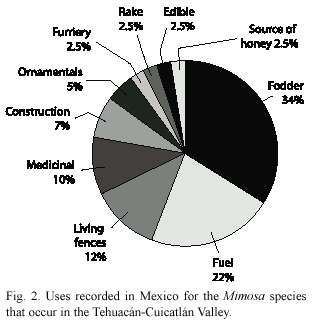
<body><![CDATA[<p><font face="Arial" size="2">The Tehuacán-Cuicatlán Valley (part of it a Biosphere Reserve since 1998)is a semiarid region located in South-central Mexico (17 °20 ’-18 °53 ’N,and 96 °55 ’-97 °44 ’W),with a surface area of ca.10 000 km<sup>2</sup> ,within the states of Puebla and Oaxaca.Plant diversity is high,with ca.3 000 species,of which 30% are estimated to be endemic (<a href="#sm65">Smith 1965</a>, <a  href="#vi90">Villaseñor <i>et al.</i>1990</a>,<a href="#da93">Dávila <i>et al.</i>1993</a>).The Fabaceae family comprises 10%of the plant species of the zone,72 legume genera (288 species)have been reported (<a  href="#da93">Dávila <i>et al.</i>1993</a>). Fifteen of the legume species recorded belong to genus <i>Mimosa </i>L.;seven of these species are endemic to Mexico,and other four species and one variety are endemic to the Valley (<a href="#ma03">Martínez-Bernal and Grether 2003</a>).</font></p>     <p><font face="Arial" size="2">On the other hand,in addition to the most customary production systems developed within the Valley (irrigated and shifting rainfed agriculture,and extensive goat grazing), local communities commonly make use of the available natural resources (<a href="#za98">Zavala-Hurtado and Hernández-Cárdenas 1998</a>), although very little is known concerning the use of these resources.General field observations have pointed to a major use of <i>Mimosa </i>species as part of the traditional agrosilvopastoral systems within the Tehuacán-Cuicatlán Valley.The aim of this study is to report on and analyze the different uses of <i>Mimosa </i>species within the Valley,and to discuss the importance of the genus as a natural resource for the region and as part of the conservation and management strategies planned within the Valley and the Reserve Management Program.</font></p> <font face="Arial" size="2"><b>     <p>Material and methods</p> </b></font>     <p><font face="Arial" size="2">Field work included surveys,plant collections and market visit in the Valley from 1994 to date;voucher specimens are deposited at the Herbario Metropolitano (UAMIZ) of the Universidad Autónoma Metropolitana-Iztapalapa.Other sources of information included herbaria consultations (CODAGEM, ENCB,IEB,IMSSM,MEXU and UAMIZ). Because most of the information about the uses of <i>Mimosa </i>species is disseminate,the revision of historic documents,and ethnobotanical, floristic and ecological studies was done.The Mexican Plants Ethnobotanical Information Data Base (Banco de Información Etnobotánica de Plantas Mexicanas,BADEPLAM)of the Jardín Botánico,Instituto de Biología, Universidad Nacional Autónoma de México, was also consulted.</font></p> <font face="Arial" size="2"><b>     <p>Results</p> </b></font>     <p><font face="Arial" size="2">Although several Mimosoideae species were used since pre-Columbian times (e.g. <i>Acacia </i>spp.,<i>Calliandra </i>spp.,<i>Enterolobium </i>spp.,<i>Leucaena </i>spp.,<i>Prosopis </i>spp.),there was not enough evidence to associate any <i>Mimosa </i>species as one of the species mentioned in the historical reviews (e.g.Annals of the National Medical Institute 1894-1912,<a href="#sa48">Sahagún 1548</a>, <a  href="#he76">Hernández 1570-1576</a>,<a href="#cl87">Clavijero 1787</a>), except in the manuscript of <a href="#de52">De la Cruz (1552)</a>,which mentions a plant called "huihuitzyocochizxihuitl ",positively identified as <i>Mimosa </i>sp.and whose leaves are used to heal insomnia.Recent ethnobotanical, floristic and ecological studies (e.g.<a  href="#ma69">Martínez 1969</a>,<a href="#de79">Del Amo 1979</a>,<a  href="#me81">Mendieta and del Amo 1981</a>,<a href="#ce90">Cedillo-Portugal 1990</a>, <a href="#ma95">Martínez-Alfaro <i>et al.</i>1995</a>,<a  href="#so95">Soto-Núñez and Sousa 1995</a>,<a href="#ca00">Camargo-Ricalde 2000</a>)register some useful <i>Mimosa </i>species;and Camargo-Ricalde <i>et al.</i>(2001)present a preliminary list of the useful Mexican <i>Mimosa </i>species.</font></p>     <p><font face="Arial" size="2">However,only two studies report the use of <i>Mimosa </i>species within the Tehuacán-Cuicatlán Valley.<a  href="#ca01">Casas <i>et al.</i>(2001)</a>recorded 104 useful legume species,including <i>M. albida </i>and <i>M.luisana </i>,and <a  href="#ma03">Martínez-Bernal and Grether (2003)</a>reported the use of four <i>Mimosa </i>species (<i>M.albida </i>,<i>M.calcicola </i>,<i>M. luisana </i>and <i>M.polyantha </i>).</font></p>     <p><font face="Arial" size="2">Field work and herbaria revision point out that the 15 <i>Mimosa </i>species found in the Valley are used by local people (<a href="#t1">Table 1</a>).Most of the species occur in the "matorral xerófilo "(arid tropical scrub),the "selva baja caducifolia " (deciduous tropical forest)and the "matorral espinoso "(thorny scrub);just a few species can establish in the <i>Quercus </i>,<i>Pinus-Quercus </i>and <i>Juniperus </i>forests;though all of them are also found in secondary vegetation,along roads and in resting culture fields.    <br>     <br> </font></p> <a name="t1"></a>     ]]></body>
<body><![CDATA[<div style="text-align: center;"><a href="/img/fbpe/rbt/v52n4/3131i1.JPG"><img  src="/img/fbpe/rbt/v52n4/3131i1-2.JPG" title="" alt=""  style="border: 0px solid ; width: 582px; height: 641px;"></a></div>     
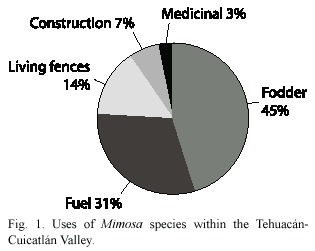
<p><font face="Arial" size="2">&nbsp;</font></p>     <p><font face="Arial" size="2">Nine species are shrubs (60%)and the other six are either shrubs or trees (40%);these species are mostly used as fodder for goats and as a source of wood for fuel and construction mainly of fences and animal shelters (<a href="#t1">Table 1</a>,<a  href="#f1">Fig.1</a>).Four species (<i>M.aculeaticarpa </i>,<i>M. dystachia </i>,<i>M.luisana </i>and <i>M.polyantha </i>)are used as living fences protecting corn fields. The leaves,branches and roots of <i>M.albida </i>are used in traditional medicine to heal stomach diseases, insomnia and body pain.In addition, these plants have not been found in any market of the zone as a "product ",hence people do not get any economic benefits directly from them.</font></p>     <p style="text-align: center;"><font face="Arial" size="2">&nbsp;<a  name="f1"></a><img src="/img/fbpe/rbt/v52n4/3131i2.JPG" title="" alt=""  style="width: 315px; height: 251px;"></font></p>     
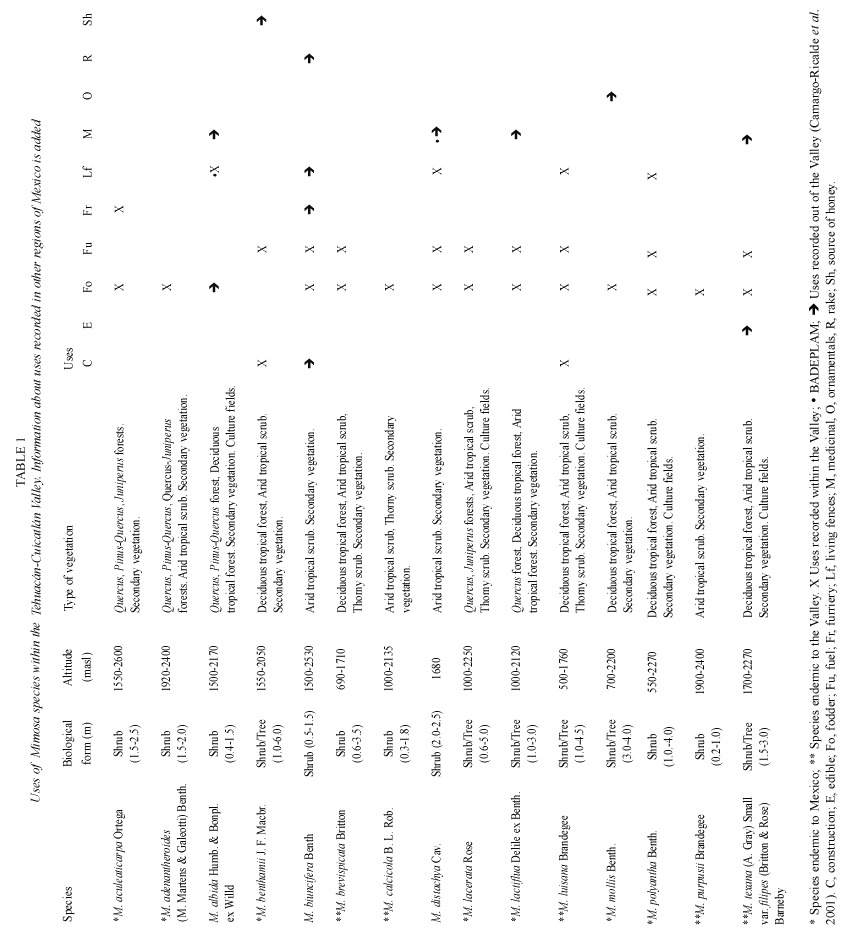
<p><font face="Arial" size="2">&nbsp;</font></p>     <p><font face="Arial" size="2">In different parts of Mexico,other uses have been recorded for seven species found in the Valley (<a href="#cam01">Camargo-Ricalde <i>et al.</i>2001</a>) (<a href="#t1">Table 1</a>,<a href="#f2">Fig.2</a>).<i>M.texana </i>is consumed by humans in the state of Guanajuato (no specification of the edible part);<i>M.biuncifera </i>is used in the furriery industry and as a farm tool (<a href="#camacho98">Camacho-Morfín <i>et al.</i>1998</a>);<i>M.albida </i>and <i>M.mollis </i>as ornamentals,and <i>M.benthamii </i>as a source of honey for bees.In the N-NW of the country the bark of <i>M.dystachia </i>is used for healing skin wounds and to harden teeth gums;<i>M.lacerata </i>for healing fever eruptions in the mouth (not more data specified),and in Guanajuato <i>M.texana </i>is used for healing headaches,fever,rheumatism and fatigue (no information found about which parts of the plant are used)(<a href="#cam01">Camargo-Ricalde <i>et al.</i>2001</a>).    <br> </font></p>     <p><font face="Arial" size="2"><a name="f2"></a></font></p>     <div style="text-align: center;"><font face="Arial" size="2"><img  src="/img/fbpe/rbt/v52n4/3131i3.JPG" title="" alt=""  style="width: 313px; height: 323px;"></font>    
<br> </div>     ]]></body>
<body><![CDATA[<p><font face="Arial" size="2">It is important to note that <i>Mimosa </i>species contain high levels of tannins in all shoot parts,substances usually regarded as unpalatable to animal and human taste.However,tannins are also astringents favoring the healing of skin wounds.</font></p>     <p><font face="Arial" size="2">For all the uses reported for the 15 species studied,60%are found within the Valley and the other 40%are recorded for other regions within Mexico.</font></p> <font face="Arial" size="2"><b>     <p>Discussion</p> </b></font>     <p><font face="Arial" size="2">The 15 useful <i>Mimosa </i>species reported in this study represent ca.50%of all the useful <i>Mimosa </i>species found in Mexico.For the first time,the use of <i>M.adenantheroides </i>, <i>M.brevispicata </i>and <i>M.purpusii </i>is reported, increasing the number of useful <i>Mimosa </i>species of Mexico from 32 (<a href="#cam01">Camargo-Ricalde <i>et al.</i>2001</a>)to 35.</font></p>     <p><font face="Arial" size="2">Most of the <i>Mimosa </i>species occur in the "matorral xerófilo "(arid tropical scrub)and the "selva baja caducifolia "(tropical deciduous forest),which are considered the most endangered vegetation types of the Valley (<a href="#za98">Zavala-Hurtado and Hernández-Cárdenas 1998</a>).Within these vegetation types,human activities mainly focus on rainfed agriculture and extensive goat grazing;hence,there is a high need to ecologically restore the area and,at the same time,allow people to continue their traditional agricultural activities.In the case of developing countries, management programs ought to focus on native species that are important in terms of diversity conservation,economic and cultural value for local people. <i>Mimosa </i>species fit these requirements as "multipurpose "plants.For instance, most of the species are already used as fodder, fuel production and living fences;they are also used for controlling soil erosion and for the regeneration of soil nutrients in abandoned culture and grazing fields.The presence of <i>Mimosa </i>species contribute to ameliorate soil nutrient conditions as well as other environmental factors (e.g.lower temperatures, higher humidity,shadow producers)under their canopy (<a href="#ca02">Camargo-Ricalde <i>et al </i>.2002</a>) creating what it is called "resource islands " (<a href="#re99">Reynolds <i>et al.</i>1999</a>).</font></p>     <p><font face="Arial" size="2">The use and management of "multipurpose "shrubs and trees (e.g.<a href="#mi86">Miehe 1986</a>,<a href="#co95">Cony 1995</a>)in agrosilvopastoral systems have shown good results in terms of soil and vegetation restoration in diverse drylands of Central America (e.g.<a href="#bu93">Budowski 1993</a>,<a href="#ka93">Kass <i>et al.</i>1993</a>)and other regions of the world (e.g.<a href="#gu93">Gutteridge and Shelton 1993</a>,<a href="#th94">Thomson <i>et al.</i>1994</a>,<a href="#pa00">Pandey <i>et al.</i>2000</a>).For Latin America,five <i>Mimosa </i>species have partially been studied:<i>M.bahamensis </i>Benth (<a href="#gr93">Grether and Camargo-Ricalde 1993</a>), <i>M. biuncifera </i>and <i>M.monancistra </i>Benth.(<a href="#gr82">Grether 1982</a>),<i>M.scabrella </i>Benth.(<a href="#ka99">Kass and Somarriba 1999</a>, <a href="#so01">Somarriba and Kass 2001</a>),and <i>M.tenuiflora </i>(Willd.)Poir.(<a href="#no88">Nolasco and Landaverde 1988</a>, <a href="#sa93">Sampaio <i>et al.</i>1993</a>,<a  href="#ca98">Camargo-Ricalde and Grether 1998</a>,<a href="#ca00">Camargo-Ricalde 2000</a>). Although more research is needed to characterize the fallow systems developed in the Valley, the use of <i>Mimosa </i>species is a real option for management strategies through the improvement of agrosilvopastoral systems within the Tehuacán-Cuicatlán Valley.Hence,our results point to the use of <i>Mimosa </i>species as an option for restoration processes in the semiarid Valley of Tehuacán-Cuicatlán.</font></p>     <p><font face="Arial" size="2"><a href="#cam01">Camargo-Ricalde <i>et al.</i>(2001)</a>reported that 15%of all useful <i>Mimosa </i>species in the country are used in traditional medicine.The chemical compounds present in these plants require investigation.The bark (rich in tannins and other compounds)of <i>M.tenuiflora </i>has been used in the cosmetic industry (with two patents already recorded)within Mexico and other countries as France,Italy and Japan (<a href="#ca00">Camargo-Ricalde 2000</a>).</font></p>     <p><font face="Arial" size="2">Though,<i>Mimosa </i>is the genus with the highest number of species (100-110),of which 60% are endemic,of all the Mexican Mimosoideae (<a href="#gr96">Grether <i>et al.</i>1996</a>,<a  href="#so93">Sousa and Delgado 1993</a>), there is a huge gap of biological,ecological and biochemical information which needs to be filled to understand the potential of this genus as a natural resource for Mexico.</font></p> <font face="Arial" size="2"><b>     <p>Acknowledgments</p> </b></font>     <p><font face="Arial" size="2">We thank Rosaura Grether,Mariel Aguilar Støen and Gaseitsiwe Masunga for their advice and Javier Caballero and Laura Cortés for facilitating the use of the BADEPLAM database.This work was supported in part by the Consejo Nacional de Ciencia y Tecnología (CONAC y T,grant 112386 to S.L.C.-R.)and the Universidad Autónoma Metropolitana.The research is linked to that of the Management of Biodiversity Group and NTFP research at SUM-University of Oslo and the Agricultural University of Norway led by S.S.Dhillion.</font></p> <font face="Arial" size="2"><b>     ]]></body>
<body><![CDATA[<p>Resumen</p> </b></font>     <p><font face="Arial" size="2">En este trabajo se informa el uso de 15 especies del género <i>Mimosa </i>dentro de la Reserva de la Biósfera del Valle de Tehuacán-Cuicatlán,en la región centro-sur de México.De las 15 especies de <i>Mimosa </i>estudiadas,siete de ellas son endémicas de México y cuatro especies y una variedad son endémicas del Valle.Se revisaron manuscritos y documentos históricos,etnobotánicos y florísticos,y se llevó a cabo trabajo de campo.Se consultaron varios herbarios,así como la base de datos BADEPLAM.El trabajo de campo en el Valle se está realizando desde 1994 hasta la fecha.La mayoría de las especies de <i>Mimosa </i>se establecen en el matorral xerófilo,el cual está considerado como el</font></p>     <p><font face="Arial" size="2">tipo de vegetación que está más en peligro de todos los que se encuentran en la Reserva.Los resultados muestran que la mayoría de las especies de <i>Mimosa </i>se usan como forraje (45%)y como combustible (31%),así como en la formación de cercas vivas (14%)y como material para construcción (7%);mientras que sólo una especie presenta un uso medicinal.Las especies de <i>Mimosa </i>son arbustos y/o árboles "multipropósito "en los sistemas agrosilvopastoriles practicados en el Valle de Tehuacán-Cuicatlán.</font></p> <font face="Arial" size="2"><b></b></font>     <p><font face="Arial" size="2"><b>Palabras clave </b>:Sistema silvoagropastoril,reserva de la biosfera,conservación,México,recursos naturales, región semiárida.</font></p> <font face="Arial" size="2"><b>     <p>References</p> </b></font>     <!-- ref --><p><font face="Arial" size="2"><a name="bu93"></a>Budowski,G.1993.The scope and potential of agroforestry in Central America.Agrof.Syst.23:121-131.</font>&nbsp;&nbsp;&nbsp;&nbsp;&nbsp;&nbsp;&nbsp;&nbsp;[&#160;<a href="javascript:void(0);" onclick="javascript: window.open('/scielo.php?script=sci_nlinks&ref=1222915&pid=S0034-7744200400040000300001&lng=','','width=640,height=500,resizable=yes,scrollbars=1,menubar=yes,');">Links</a>&#160;]<!-- end-ref --><!-- ref --><p><font face="Arial" size="2"><a name="camacho98"></a>Camacho-Morfín,D.C.,C.Sandoval &amp;A.Ayala.1998. Identificación de especies leñosas forrajeras en el Valle del Mezquital,Hidalgo,México.Abstract book. VII Congreso Latinoamericano de Botánica and XIV Congreso Mexicano de Botánica.México.57 p.</font>&nbsp;&nbsp;&nbsp;&nbsp;&nbsp;&nbsp;&nbsp;&nbsp;[&#160;<a href="javascript:void(0);" onclick="javascript: window.open('/scielo.php?script=sci_nlinks&ref=1222916&pid=S0034-7744200400040000300002&lng=','','width=640,height=500,resizable=yes,scrollbars=1,menubar=yes,');">Links</a>&#160;]<!-- end-ref --><!-- ref --><p><font face="Arial" size="2"><a name="ca98"></a>Camargo-Ricalde,S.L.&amp;R.Grether.1998.Germinación, dispersión y establecimiento de plántulas de <i>Mimosa tenuiflora </i>(Leguminosae)en México.Rev.Biol Trop. 46:543-554.</font>&nbsp;&nbsp;&nbsp;&nbsp;&nbsp;&nbsp;&nbsp;&nbsp;[&#160;<a href="javascript:void(0);" onclick="javascript: window.open('/scielo.php?script=sci_nlinks&ref=1222917&pid=S0034-7744200400040000300003&lng=','','width=640,height=500,resizable=yes,scrollbars=1,menubar=yes,');">Links</a>&#160;]<!-- end-ref --><!-- ref --><p><font face="Arial" size="2"><a name="ca00"></a>Camargo-Ricalde,S.L.2000.Descripción,distribución, anatomía,coposición química y usos de <i>Mimosa tenuiflora </i>(Fabaceae-Mimosoideae)en México.Rev. Biol.Trop.48:939-954.</font>&nbsp;&nbsp;&nbsp;&nbsp;&nbsp;&nbsp;&nbsp;&nbsp;[&#160;<a href="javascript:void(0);" onclick="javascript: window.open('/scielo.php?script=sci_nlinks&ref=1222918&pid=S0034-7744200400040000300004&lng=','','width=640,height=500,resizable=yes,scrollbars=1,menubar=yes,');">Links</a>&#160;]<!-- end-ref --><!-- ref --><p><font face="Arial" size="2"><a name="cam01"></a>Camargo-Ricalde,S.L.,R.Grether,A.Martínez-Bernal,V. García-García &amp;S.Barrios del Rosal. 2001.Especies útiles del género <i>Mimosa </i>(Fabaceae-Mimosoideae) en México.Bol.Soc.Bot México 68:33-44.</font>&nbsp;&nbsp;&nbsp;&nbsp;&nbsp;&nbsp;&nbsp;&nbsp;[&#160;<a href="javascript:void(0);" onclick="javascript: window.open('/scielo.php?script=sci_nlinks&ref=1222919&pid=S0034-7744200400040000300005&lng=','','width=640,height=500,resizable=yes,scrollbars=1,menubar=yes,');">Links</a>&#160;]<!-- end-ref --><!-- ref --><p><font face="Arial" size="2"><a name="ca02"></a>Camargo-Ricalde,S.L.,Dhillion,S.S.&amp;Grether,R.2002. Community structure of endemic <i>Mimosa </i>species and environmental heterogeneity in a semi-arid Mexican valley.J.Veg.Sci.13:697-704.</font>&nbsp;&nbsp;&nbsp;&nbsp;&nbsp;&nbsp;&nbsp;&nbsp;[&#160;<a href="javascript:void(0);" onclick="javascript: window.open('/scielo.php?script=sci_nlinks&ref=1222920&pid=S0034-7744200400040000300006&lng=','','width=640,height=500,resizable=yes,scrollbars=1,menubar=yes,');">Links</a>&#160;]<!-- end-ref --><!-- ref --><p><font face="Arial" size="2"><a name="ca01"></a>Casas,A.,A.Valiente-Banuet,J.L.Viveros,J.Caballero,L. Cortés,P.Dávila,R.Lira &amp; I. Rodríguez. 2001. Plant resources of the Tehuacán-Cuicatlán Valley,Mexico. Econ.Bot.55:129-166.</font>&nbsp;&nbsp;&nbsp;&nbsp;&nbsp;&nbsp;&nbsp;&nbsp;[&#160;<a href="javascript:void(0);" onclick="javascript: window.open('/scielo.php?script=sci_nlinks&ref=1222921&pid=S0034-7744200400040000300007&lng=','','width=640,height=500,resizable=yes,scrollbars=1,menubar=yes,');">Links</a>&#160;]<!-- end-ref --><!-- ref --><p><font face="Arial" size="2"><a name="ce90"></a>Cedillo-Portugal,E.1990.Las plantas útiles del Municipio de Tepoztlán,Morelos.Tesis de maestría,Facultad de Ciencias, UNAM,México,425 p.</font>&nbsp;&nbsp;&nbsp;&nbsp;&nbsp;&nbsp;&nbsp;&nbsp;[&#160;<a href="javascript:void(0);" onclick="javascript: window.open('/scielo.php?script=sci_nlinks&ref=1222922&pid=S0034-7744200400040000300008&lng=','','width=640,height=500,resizable=yes,scrollbars=1,menubar=yes,');">Links</a>&#160;]<!-- end-ref --><!-- ref --><p><font face="Arial" size="2"><a name="ch98"></a>Challenger,A.1998.Utilización y conservación de los ecosistemas terrestres de México. Pasado, presente y futuro. CONABIO,UNAM y Agrupación Sierra Madre,S.C.México,p.25-71.</font>&nbsp;&nbsp;&nbsp;&nbsp;&nbsp;&nbsp;&nbsp;&nbsp;[&#160;<a href="javascript:void(0);" onclick="javascript: window.open('/scielo.php?script=sci_nlinks&ref=1222923&pid=S0034-7744200400040000300009&lng=','','width=640,height=500,resizable=yes,scrollbars=1,menubar=yes,');">Links</a>&#160;]<!-- end-ref --><!-- ref --><p><font face="Arial" size="2"><a name="cl87"></a>Clavijero,F.J.1787.Historia antigua de Méjico.Diez libros sobre la tierra,animales y habitantes de Méjico. Yolva, México.439 p.</font>&nbsp;&nbsp;&nbsp;&nbsp;&nbsp;&nbsp;&nbsp;&nbsp;[&#160;<a href="javascript:void(0);" onclick="javascript: window.open('/scielo.php?script=sci_nlinks&ref=1222924&pid=S0034-7744200400040000300010&lng=','','width=640,height=500,resizable=yes,scrollbars=1,menubar=yes,');">Links</a>&#160;]<!-- end-ref --><!-- ref --><p><font face="Arial" size="2"><a name="co95"></a>Cony,M.A.1995.Reforestación racional de zonas áridas y semiáridas con árboles de múltiples propósitos. Interciencia 20:249-253.</font>&nbsp;&nbsp;&nbsp;&nbsp;&nbsp;&nbsp;&nbsp;&nbsp;[&#160;<a href="javascript:void(0);" onclick="javascript: window.open('/scielo.php?script=sci_nlinks&ref=1222925&pid=S0034-7744200400040000300011&lng=','','width=640,height=500,resizable=yes,scrollbars=1,menubar=yes,');">Links</a>&#160;]<!-- end-ref --><!-- ref --><p><font face="Arial" size="2"><a name="da93"></a>Dávila,P.,R.J.L.Villaseñor,L.R.Medina,R.A.Ramírez, T.A.Salinas,J.Sánchez-Ken &amp;P.Tenorio.1993. Flora del Valle de Tehuacán-Cuicatlán.Listados Florísticos de México X.Inst.Biología,UNAM, México.195 p.</font>&nbsp;&nbsp;&nbsp;&nbsp;&nbsp;&nbsp;&nbsp;&nbsp;[&#160;<a href="javascript:void(0);" onclick="javascript: window.open('/scielo.php?script=sci_nlinks&ref=1222926&pid=S0034-7744200400040000300012&lng=','','width=640,height=500,resizable=yes,scrollbars=1,menubar=yes,');">Links</a>&#160;]<!-- end-ref --><!-- ref --><p><font face="Arial" size="2"><a name="de52"></a>De la Cruz,M.1552.Libellus de Medicinalibus Indorum Herbis.Manuscrito,versión española.Instituto Mexicano del Seguro Social.México.385 p.</font>&nbsp;&nbsp;&nbsp;&nbsp;&nbsp;&nbsp;&nbsp;&nbsp;[&#160;<a href="javascript:void(0);" onclick="javascript: window.open('/scielo.php?script=sci_nlinks&ref=1222927&pid=S0034-7744200400040000300013&lng=','','width=640,height=500,resizable=yes,scrollbars=1,menubar=yes,');">Links</a>&#160;]<!-- end-ref --><!-- ref --><p><font face="Arial" size="2"><a name="de79"></a>Del Amo,S.1979.Plantas medicinales del estado de Veracruz.Inst.Nacional de Investigaciones sobre Recursos Bióticos (INIREB),México.279 p.</font>&nbsp;&nbsp;&nbsp;&nbsp;&nbsp;&nbsp;&nbsp;&nbsp;[&#160;<a href="javascript:void(0);" onclick="javascript: window.open('/scielo.php?script=sci_nlinks&ref=1222928&pid=S0034-7744200400040000300014&lng=','','width=640,height=500,resizable=yes,scrollbars=1,menubar=yes,');">Links</a>&#160;]<!-- end-ref --><!-- ref --><p><font face="Arial" size="2"><a name="gr82"></a>Grether,R.1982.Aspectos ecológicos de <i>M.biuncifera </i>y <i>M.monancistra </i>en el noroeste del estado de Guanajuato. Bol. Soc. Bot.Mex.43:43-60.</font>&nbsp;&nbsp;&nbsp;&nbsp;&nbsp;&nbsp;&nbsp;&nbsp;[&#160;<a href="javascript:void(0);" onclick="javascript: window.open('/scielo.php?script=sci_nlinks&ref=1222929&pid=S0034-7744200400040000300015&lng=','','width=640,height=500,resizable=yes,scrollbars=1,menubar=yes,');">Links</a>&#160;]<!-- end-ref --><!-- ref --><p><font face="Arial" size="2"><a name="gr93"></a>Grether,R.&amp;S.L.Camargo-Ricalde.1993.<i>Mimosa bahamensis </i>(Leguminosae)en la Península de Yucatán. Bol. Soc. Bot. Mex.53:55-72.</font>&nbsp;&nbsp;&nbsp;&nbsp;&nbsp;&nbsp;&nbsp;&nbsp;[&#160;<a href="javascript:void(0);" onclick="javascript: window.open('/scielo.php?script=sci_nlinks&ref=1222930&pid=S0034-7744200400040000300016&lng=','','width=640,height=500,resizable=yes,scrollbars=1,menubar=yes,');">Links</a>&#160;]<!-- end-ref --><!-- ref --><p><font face="Arial" size="2"><a name="gr96"></a>Grether,R.,S.L.Camargo-Ricalde &amp;A.Martínez-Bernal. 1996.Especies del género <i>Mimosa </i>(Leguminosae)presentes en México. Bol.Soc.Bot.Mex.58:149-152.</font>&nbsp;&nbsp;&nbsp;&nbsp;&nbsp;&nbsp;&nbsp;&nbsp;[&#160;<a href="javascript:void(0);" onclick="javascript: window.open('/scielo.php?script=sci_nlinks&ref=1222931&pid=S0034-7744200400040000300017&lng=','','width=640,height=500,resizable=yes,scrollbars=1,menubar=yes,');">Links</a>&#160;]<!-- end-ref --><!-- ref --><p><font face="Arial" size="2"><a name="gu93"></a>Gutteridge,R.C.&amp;H.M.Shelton.1993.The scope and potential of tree legumes in agroforestry. Agrof.Syst. 23:177-194.</font>&nbsp;&nbsp;&nbsp;&nbsp;&nbsp;&nbsp;&nbsp;&nbsp;[&#160;<a href="javascript:void(0);" onclick="javascript: window.open('/scielo.php?script=sci_nlinks&ref=1222932&pid=S0034-7744200400040000300018&lng=','','width=640,height=500,resizable=yes,scrollbars=1,menubar=yes,');">Links</a>&#160;]<!-- end-ref --><!-- ref --><p><font face="Arial" size="2"><a name="he76"></a>Hernández,F.1570-1576.Historia de las plantas de la Nueva España.Tomo 2,p.560-561.</font>&nbsp;&nbsp;&nbsp;&nbsp;&nbsp;&nbsp;&nbsp;&nbsp;[&#160;<a href="javascript:void(0);" onclick="javascript: window.open('/scielo.php?script=sci_nlinks&ref=1222933&pid=S0034-7744200400040000300019&lng=','','width=640,height=500,resizable=yes,scrollbars=1,menubar=yes,');">Links</a>&#160;]<!-- end-ref --><!-- ref --><p><font face="Arial" size="2"><a name="ka93"></a>Kass,D.C.L.,C.Foletti,L.T.Szott,R.Landaverde &amp;R. Nolasco.1993.Traditional fallow systems of the Americas. Agrof. Syst.23:207-218.</font>&nbsp;&nbsp;&nbsp;&nbsp;&nbsp;&nbsp;&nbsp;&nbsp;[&#160;<a href="javascript:void(0);" onclick="javascript: window.open('/scielo.php?script=sci_nlinks&ref=1222934&pid=S0034-7744200400040000300020&lng=','','width=640,height=500,resizable=yes,scrollbars=1,menubar=yes,');">Links</a>&#160;]<!-- end-ref --><!-- ref --><p><font face="Arial" size="2"><a name="ka99"></a>Kass,D.C.L.&amp;E.Somarriba.1999.Traditional fallows in Latin America.Agrof.Syst.47:13-36.</font>&nbsp;&nbsp;&nbsp;&nbsp;&nbsp;&nbsp;&nbsp;&nbsp;[&#160;<a href="javascript:void(0);" onclick="javascript: window.open('/scielo.php?script=sci_nlinks&ref=1222935&pid=S0034-7744200400040000300021&lng=','','width=640,height=500,resizable=yes,scrollbars=1,menubar=yes,');">Links</a>&#160;]<!-- end-ref --><!-- ref --><p><font face="Arial" size="2"><a name="ma69"></a>Martínez,M.1969.Las plantas medicinales de México. Botas,México,656 p.</font>&nbsp;&nbsp;&nbsp;&nbsp;&nbsp;&nbsp;&nbsp;&nbsp;[&#160;<a href="javascript:void(0);" onclick="javascript: window.open('/scielo.php?script=sci_nlinks&ref=1222936&pid=S0034-7744200400040000300022&lng=','','width=640,height=500,resizable=yes,scrollbars=1,menubar=yes,');">Links</a>&#160;]<!-- end-ref --><!-- ref --><p><font face="Arial" size="2"><a name="ma95"></a>Martínez-Alfaro,M.A.,V.Evangelista,M.Mendoza,G. Morales,G.Toledo &amp;A.Wong.1995.Catálogo de plantas útiles de la Sierra Norte de Puebla,México. Inst.Biología,UNAM,México.303 p.</font>&nbsp;&nbsp;&nbsp;&nbsp;&nbsp;&nbsp;&nbsp;&nbsp;[&#160;<a href="javascript:void(0);" onclick="javascript: window.open('/scielo.php?script=sci_nlinks&ref=1222937&pid=S0034-7744200400040000300023&lng=','','width=640,height=500,resizable=yes,scrollbars=1,menubar=yes,');">Links</a>&#160;]<!-- end-ref --><!-- ref --><p><font face="Arial" size="2"><a name="ma03"></a>Martínez-Bernal,A.&amp;R.Grether.2003.<i>Mimosa,</i>p.100.<i>In </i>L.Kelly &amp;R.Medina-Lemus (eds.).Flora del Valle de Tehuacán-Cuicatlán.Fascículo 33.Inst.Biología, UNAM,México.</font>&nbsp;&nbsp;&nbsp;&nbsp;&nbsp;&nbsp;&nbsp;&nbsp;[&#160;<a href="javascript:void(0);" onclick="javascript: window.open('/scielo.php?script=sci_nlinks&ref=1222938&pid=S0034-7744200400040000300024&lng=','','width=640,height=500,resizable=yes,scrollbars=1,menubar=yes,');">Links</a>&#160;]<!-- end-ref --><!-- ref --><p><font face="Arial" size="2"><a name="me81"></a>Mendieta,R.M.&amp;S.del Amo.1981.Plantas medicinales del estado de Yucatán.Inst.Nacional de Investigaciones sobre Recursos Bióticos (INIREB), México.428 p.</font>&nbsp;&nbsp;&nbsp;&nbsp;&nbsp;&nbsp;&nbsp;&nbsp;[&#160;<a href="javascript:void(0);" onclick="javascript: window.open('/scielo.php?script=sci_nlinks&ref=1222939&pid=S0034-7744200400040000300025&lng=','','width=640,height=500,resizable=yes,scrollbars=1,menubar=yes,');">Links</a>&#160;]<!-- end-ref --><!-- ref --><p><font face="Arial" size="2"><a name="mi86"></a>Miehe,S.1986.<i>Acacia albida </i>and other multiporpuse trees on the fur farmlands in the Jebel Marra highlands, Western Darfur,Sudan.Agrof.Syst.4:89-119.</font>&nbsp;&nbsp;&nbsp;&nbsp;&nbsp;&nbsp;&nbsp;&nbsp;[&#160;<a href="javascript:void(0);" onclick="javascript: window.open('/scielo.php?script=sci_nlinks&ref=1222940&pid=S0034-7744200400040000300026&lng=','','width=640,height=500,resizable=yes,scrollbars=1,menubar=yes,');">Links</a>&#160;]<!-- end-ref --><!-- ref --><p><font face="Arial" size="2"><a name="no88"></a>Nolasco,R.&amp;R.Landaverde.1988.Diagnóstico del sistema agroforestal tradicional maíz-maicillo-carbón negro (<i>Mimosa tenuiflora </i>).Programa Marcala-Goascoran (Margoas).Secretaría de Recursos Naturales. Tegucigalpa,Honduras.25 p.</font>&nbsp;&nbsp;&nbsp;&nbsp;&nbsp;&nbsp;&nbsp;&nbsp;[&#160;<a href="javascript:void(0);" onclick="javascript: window.open('/scielo.php?script=sci_nlinks&ref=1222941&pid=S0034-7744200400040000300027&lng=','','width=640,height=500,resizable=yes,scrollbars=1,menubar=yes,');">Links</a>&#160;]<!-- end-ref --><!-- ref --><p><font face="Arial" size="2"><a name="pa00"></a>Pandey,C.B.,A.K.Singh &amp;D.K.Sharma.2000.Soil properties under <i>Acacia nilotica </i>trees in a traditional agroforestry system in central India.Agrof.Syst.49: 53-61.</font>&nbsp;&nbsp;&nbsp;&nbsp;&nbsp;&nbsp;&nbsp;&nbsp;[&#160;<a href="javascript:void(0);" onclick="javascript: window.open('/scielo.php?script=sci_nlinks&ref=1222942&pid=S0034-7744200400040000300028&lng=','','width=640,height=500,resizable=yes,scrollbars=1,menubar=yes,');">Links</a>&#160;]<!-- end-ref --><!-- ref --><p><font face="Arial" size="2"><a name="re99"></a>Reynolds,J.F.,R.A.Virginia,P.R.Kemp,A.G.de Soyza &amp;D.C.Tremmel.1999.Impact of drought on desert shrubs:effects of seasonality and degree of resource islands development.Ecol.Monogr.69: 69-106.</font>&nbsp;&nbsp;&nbsp;&nbsp;&nbsp;&nbsp;&nbsp;&nbsp;[&#160;<a href="javascript:void(0);" onclick="javascript: window.open('/scielo.php?script=sci_nlinks&ref=1222943&pid=S0034-7744200400040000300029&lng=','','width=640,height=500,resizable=yes,scrollbars=1,menubar=yes,');">Links</a>&#160;]<!-- end-ref --><!-- ref --><p><font face="Arial" size="2"><a name="rz62"></a>Rzedowski,J.1962.Contribución a la fitogeografía florística e histórica de México.I.Algunas consideraciones acerca del elemento endémico en la flora mexicana. Bol.Soc.Bot.Mex.27:52-65.</font>&nbsp;&nbsp;&nbsp;&nbsp;&nbsp;&nbsp;&nbsp;&nbsp;[&#160;<a href="javascript:void(0);" onclick="javascript: window.open('/scielo.php?script=sci_nlinks&ref=1222944&pid=S0034-7744200400040000300030&lng=','','width=640,height=500,resizable=yes,scrollbars=1,menubar=yes,');">Links</a>&#160;]<!-- end-ref --><!-- ref --><p><font face="Arial" size="2"><a name="rz78"></a>Rzedowski,J.1978.Vegetación de México.Limusa, México.431 p.</font>&nbsp;&nbsp;&nbsp;&nbsp;&nbsp;&nbsp;&nbsp;&nbsp;[&#160;<a href="javascript:void(0);" onclick="javascript: window.open('/scielo.php?script=sci_nlinks&ref=1222945&pid=S0034-7744200400040000300031&lng=','','width=640,height=500,resizable=yes,scrollbars=1,menubar=yes,');">Links</a>&#160;]<!-- end-ref --><!-- ref --><p><font face="Arial" size="2"><a name="sa48"></a>Sahagún,F.B.1548.Códice Florentino.Vol.III.Libros Décimo y undécimo.Fo:97-114 y 139-178.Secretaría de Gobernación, México.</font>&nbsp;&nbsp;&nbsp;&nbsp;&nbsp;&nbsp;&nbsp;&nbsp;[&#160;<a href="javascript:void(0);" onclick="javascript: window.open('/scielo.php?script=sci_nlinks&ref=1222946&pid=S0034-7744200400040000300032&lng=','','width=640,height=500,resizable=yes,scrollbars=1,menubar=yes,');">Links</a>&#160;]<!-- end-ref --><!-- ref --><p><font face="Arial" size="2"><a name="sa93"></a>Sampaio,E.V.S.B.,I.H.Salcedo &amp;J.B.Kauffman.1993. Effect of different fire severities on coppicing of Caatinga vegetation in Sierra Talhada,PE,Brazil. Biotropica 25:452-460.</font>&nbsp;&nbsp;&nbsp;&nbsp;&nbsp;&nbsp;&nbsp;&nbsp;[&#160;<a href="javascript:void(0);" onclick="javascript: window.open('/scielo.php?script=sci_nlinks&ref=1222947&pid=S0034-7744200400040000300033&lng=','','width=640,height=500,resizable=yes,scrollbars=1,menubar=yes,');">Links</a>&#160;]<!-- end-ref --><!-- ref --><p><font face="Arial" size="2"><a name="sm65"></a>Smith,C.E.1965.Flora Tehuacán Valley.Fieldiana Bot. 31:101-143.</font>&nbsp;&nbsp;&nbsp;&nbsp;&nbsp;&nbsp;&nbsp;&nbsp;[&#160;<a href="javascript:void(0);" onclick="javascript: window.open('/scielo.php?script=sci_nlinks&ref=1222948&pid=S0034-7744200400040000300034&lng=','','width=640,height=500,resizable=yes,scrollbars=1,menubar=yes,');">Links</a>&#160;]<!-- end-ref --><!-- ref --><p><font face="Arial" size="2"><a name="so01"></a>Somarriba,E.&amp;D.C.L.Kass.2001.Estimates of above-ground biomass and nutrient accumulation in <i>Mimosa scabrella </i>fallows in southern Brazil.Agrof. Syst.51:77-84.</font>&nbsp;&nbsp;&nbsp;&nbsp;&nbsp;&nbsp;&nbsp;&nbsp;[&#160;<a href="javascript:void(0);" onclick="javascript: window.open('/scielo.php?script=sci_nlinks&ref=1222949&pid=S0034-7744200400040000300035&lng=','','width=640,height=500,resizable=yes,scrollbars=1,menubar=yes,');">Links</a>&#160;]<!-- end-ref --><!-- ref --><p><font face="Arial" size="2"><a name="so95"></a>Soto-Nuñez,J.C.&amp;M.Sousa.1995.Plantas medicinales de la cuenca del Río Balsas. Inst. Biología,UNAM, México,198 p.</font>&nbsp;&nbsp;&nbsp;&nbsp;&nbsp;&nbsp;&nbsp;&nbsp;[&#160;<a href="javascript:void(0);" onclick="javascript: window.open('/scielo.php?script=sci_nlinks&ref=1222950&pid=S0034-7744200400040000300036&lng=','','width=640,height=500,resizable=yes,scrollbars=1,menubar=yes,');">Links</a>&#160;]<!-- end-ref --><!-- ref --><p><font face="Arial" size="2"><a name="so93"></a>Sousa,M.&amp;A.Delgado.1993.Mexican Leguminosae: phytogeography,endemism,and origins,p.459-511. <i>In </i>T.P.Ramamoorthy,R.Bye,A.Lot &amp;J.Fa (eds.). Biological diversity of Mexico:origins and distribution. Oxford University.</font>&nbsp;&nbsp;&nbsp;&nbsp;&nbsp;&nbsp;&nbsp;&nbsp;[&#160;<a href="javascript:void(0);" onclick="javascript: window.open('/scielo.php?script=sci_nlinks&ref=1222951&pid=S0034-7744200400040000300037&lng=','','width=640,height=500,resizable=yes,scrollbars=1,menubar=yes,');">Links</a>&#160;]<!-- end-ref --><!-- ref --><p><font face="Arial" size="2"><a name="th94"></a>Thomson,L.A.J.,J.W.Turnbull &amp;B.R.Maslin.1994.The utilization of Australian species of <i>Acacia </i>,with particular reference to those of the subtropical dry zone. J.Arid Environ.27:279-295.</font>&nbsp;&nbsp;&nbsp;&nbsp;&nbsp;&nbsp;&nbsp;&nbsp;[&#160;<a href="javascript:void(0);" onclick="javascript: window.open('/scielo.php?script=sci_nlinks&ref=1222952&pid=S0034-7744200400040000300038&lng=','','width=640,height=500,resizable=yes,scrollbars=1,menubar=yes,');">Links</a>&#160;]<!-- end-ref --><!-- ref --><p><font face="Arial" size="2"><a name="va90"></a>Valiente-Banuet,A.1990.Los desiertos de México.Rev. Soc.Mex.Hist.Nat.41:83-84.</font>&nbsp;&nbsp;&nbsp;&nbsp;&nbsp;&nbsp;&nbsp;&nbsp;[&#160;<a href="javascript:void(0);" onclick="javascript: window.open('/scielo.php?script=sci_nlinks&ref=1222953&pid=S0034-7744200400040000300039&lng=','','width=640,height=500,resizable=yes,scrollbars=1,menubar=yes,');">Links</a>&#160;]<!-- end-ref --><!-- ref --><p><font face="Arial" size="2"><a name="vi90"></a>Villaseñor,J.L.,P.Dávila &amp;F.Chiang.1990.Fitogeografía del Valle de Tehuacán-Cuicatlán. Bol. Soc. Bot. Mex. 50:135-149.</font>&nbsp;&nbsp;&nbsp;&nbsp;&nbsp;&nbsp;&nbsp;&nbsp;[&#160;<a href="javascript:void(0);" onclick="javascript: window.open('/scielo.php?script=sci_nlinks&ref=1222954&pid=S0034-7744200400040000300040&lng=','','width=640,height=500,resizable=yes,scrollbars=1,menubar=yes,');">Links</a>&#160;]<!-- end-ref --><!-- ref --><p><font face="Arial" size="2"><a name="za98"></a>Zavala-Hurtado,J.A.&amp;G.Hernández-Cárdenas.1998. Estudio de caracterización y diagnóstico del área propuesta como Reserva de la Biósfera Tehuacán-Cuicatlán.UNAM-Instituto Nacional de Ecología (SEMARNAP),México.</font>&nbsp;&nbsp;&nbsp;&nbsp;&nbsp;&nbsp;&nbsp;&nbsp;[&#160;<a href="javascript:void(0);" onclick="javascript: window.open('/scielo.php?script=sci_nlinks&ref=1222955&pid=S0034-7744200400040000300041&lng=','','width=640,height=500,resizable=yes,scrollbars=1,menubar=yes,');">Links</a>&#160;]<!-- end-ref --> ]]></body><back>
<ref-list>
<ref id="B1">
<nlm-citation citation-type="journal">
<person-group person-group-type="author">
<name>
<surname><![CDATA[Budowski]]></surname>
<given-names><![CDATA[G]]></given-names>
</name>
</person-group>
<article-title xml:lang="en"><![CDATA[The scope and potential of agroforestry in Central America]]></article-title>
<source><![CDATA[Agrof.Syst]]></source>
<year>1993</year>
<volume>23</volume>
<page-range>121-131</page-range></nlm-citation>
</ref>
<ref id="B2">
<nlm-citation citation-type="confpro">
<person-group person-group-type="author">
<name>
<surname><![CDATA[Camacho-Morfín]]></surname>
<given-names><![CDATA[D.C]]></given-names>
</name>
<name>
<surname><![CDATA[Sandoval]]></surname>
<given-names><![CDATA[C]]></given-names>
</name>
<name>
<surname><![CDATA[Ayala]]></surname>
<given-names><![CDATA[A]]></given-names>
</name>
</person-group>
<source><![CDATA[Identificación de especies leñosas forrajeras en el Valle del Mezquital,Hidalgo,México.Abstract book]]></source>
<year>1998</year>
<conf-name><![CDATA[VII Congreso Latinoamericano de Botánica and XIV Congreso Mexicano de Botánica]]></conf-name>
<conf-loc> </conf-loc>
<page-range>57</page-range></nlm-citation>
</ref>
<ref id="B3">
<nlm-citation citation-type="journal">
<person-group person-group-type="author">
<name>
<surname><![CDATA[Camargo-Ricalde]]></surname>
<given-names><![CDATA[S.L]]></given-names>
</name>
<name>
<surname><![CDATA[Grether]]></surname>
<given-names><![CDATA[R]]></given-names>
</name>
</person-group>
<article-title xml:lang="es"><![CDATA[Germinación, dispersión y establecimiento de plántulas de Mimosa tenuiflora (Leguminosae)en México]]></article-title>
<source><![CDATA[Rev.Biol Trop]]></source>
<year>1998</year>
<volume>46</volume>
<page-range>543-554</page-range></nlm-citation>
</ref>
<ref id="B4">
<nlm-citation citation-type="journal">
<person-group person-group-type="author">
<name>
<surname><![CDATA[Camargo-Ricalde]]></surname>
<given-names><![CDATA[S.L]]></given-names>
</name>
</person-group>
<article-title xml:lang="es"><![CDATA[Descripción,distribución, anatomía,coposición química y usos de Mimosa tenuiflora (Fabaceae-Mimosoideae)en México]]></article-title>
<source><![CDATA[Rev. Biol.Trop]]></source>
<year>2000</year>
<volume>48</volume>
<page-range>939-954</page-range></nlm-citation>
</ref>
<ref id="B5">
<nlm-citation citation-type="journal">
<person-group person-group-type="author">
<name>
<surname><![CDATA[Camargo-Ricalde]]></surname>
<given-names><![CDATA[S.L]]></given-names>
</name>
<name>
<surname><![CDATA[Grether]]></surname>
<given-names><![CDATA[R]]></given-names>
</name>
<name>
<surname><![CDATA[Martínez-Bernal]]></surname>
<given-names><![CDATA[A]]></given-names>
</name>
<name>
<surname><![CDATA[García-García]]></surname>
<given-names><![CDATA[V]]></given-names>
</name>
<name>
<surname><![CDATA[Barrios del Rosal]]></surname>
<given-names><![CDATA[S]]></given-names>
</name>
</person-group>
<article-title xml:lang="es"><![CDATA[Especies útiles del género Mimosa (Fabaceae-Mimosoideae) en México]]></article-title>
<source><![CDATA[Bol.Soc.Bot México]]></source>
<year>2001</year>
<volume>68</volume>
<page-range>33-44</page-range></nlm-citation>
</ref>
<ref id="B6">
<nlm-citation citation-type="journal">
<person-group person-group-type="author">
<name>
<surname><![CDATA[Camargo-Ricalde]]></surname>
<given-names><![CDATA[S.L]]></given-names>
</name>
<name>
<surname><![CDATA[Dhillion]]></surname>
<given-names><![CDATA[S.S]]></given-names>
</name>
<name>
<surname><![CDATA[Grether]]></surname>
<given-names><![CDATA[R]]></given-names>
</name>
</person-group>
<article-title xml:lang="en"><![CDATA[Community structure of endemic Mimosa species and environmental heterogeneity in a semi-arid Mexican valley]]></article-title>
<source><![CDATA[J.Veg.Sci]]></source>
<year>2002</year>
<volume>13</volume>
<page-range>697-704</page-range></nlm-citation>
</ref>
<ref id="B7">
<nlm-citation citation-type="journal">
<person-group person-group-type="author">
<name>
<surname><![CDATA[Casas]]></surname>
<given-names><![CDATA[A]]></given-names>
</name>
<name>
<surname><![CDATA[Valiente-Banuet]]></surname>
<given-names><![CDATA[A]]></given-names>
</name>
<name>
<surname><![CDATA[Viveros]]></surname>
<given-names><![CDATA[J.L]]></given-names>
</name>
<name>
<surname><![CDATA[Caballero]]></surname>
<given-names><![CDATA[J]]></given-names>
</name>
<name>
<surname><![CDATA[Cortés]]></surname>
<given-names><![CDATA[L]]></given-names>
</name>
<name>
<surname><![CDATA[Dávila]]></surname>
<given-names><![CDATA[P]]></given-names>
</name>
<name>
<surname><![CDATA[Lira]]></surname>
<given-names><![CDATA[R]]></given-names>
</name>
<name>
<surname><![CDATA[Rodríguez]]></surname>
<given-names><![CDATA[I]]></given-names>
</name>
</person-group>
<article-title xml:lang="en"><![CDATA[Plant resources of the Tehuacán-Cuicatlán Valley,Mexico]]></article-title>
<source><![CDATA[Econ.Bot]]></source>
<year>2001</year>
<volume>55</volume>
<page-range>129-166</page-range></nlm-citation>
</ref>
<ref id="B8">
<nlm-citation citation-type="">
<person-group person-group-type="author">
<name>
<surname><![CDATA[Cedillo-Portugal]]></surname>
<given-names><![CDATA[E]]></given-names>
</name>
</person-group>
<source><![CDATA[Las plantas útiles del Municipio de Tepoztlán,Morelos]]></source>
<year>1990</year>
<page-range>425</page-range></nlm-citation>
</ref>
<ref id="B9">
<nlm-citation citation-type="book">
<person-group person-group-type="author">
<name>
<surname><![CDATA[Challenger]]></surname>
<given-names><![CDATA[A]]></given-names>
</name>
</person-group>
<source><![CDATA[Utilización y conservación de los ecosistemas terrestres de México. Pasado, presente y futuro]]></source>
<year>1998</year>
<page-range>25-71</page-range><publisher-name><![CDATA[CONABIO,UNAM y Agrupación Sierra Madre,S.C]]></publisher-name>
</nlm-citation>
</ref>
<ref id="B10">
<nlm-citation citation-type="">
<person-group person-group-type="author">
<name>
<surname><![CDATA[Clavijero]]></surname>
<given-names><![CDATA[F.J]]></given-names>
</name>
</person-group>
<source><![CDATA[Historia antigua de Méjico.Diez libros sobre la tierra,animales y habitantes de Méjico]]></source>
<year>1787</year>
<page-range>439</page-range><publisher-loc><![CDATA[Yolva ]]></publisher-loc>
</nlm-citation>
</ref>
<ref id="B11">
<nlm-citation citation-type="journal">
<person-group person-group-type="author">
<name>
<surname><![CDATA[Cony]]></surname>
<given-names><![CDATA[M.A]]></given-names>
</name>
</person-group>
<article-title xml:lang="es"><![CDATA[Reforestación racional de zonas áridas y semiáridas con árboles de múltiples propósitos]]></article-title>
<source><![CDATA[Interciencia]]></source>
<year>1995</year>
<volume>20</volume>
<page-range>249-253</page-range></nlm-citation>
</ref>
<ref id="B12">
<nlm-citation citation-type="book">
<person-group person-group-type="author">
<name>
<surname><![CDATA[Dávila]]></surname>
<given-names><![CDATA[P]]></given-names>
</name>
<name>
<surname><![CDATA[Villaseñor]]></surname>
<given-names><![CDATA[R.J.L]]></given-names>
</name>
<name>
<surname><![CDATA[Medina]]></surname>
<given-names><![CDATA[L.R]]></given-names>
</name>
<name>
<surname><![CDATA[Ramírez]]></surname>
<given-names><![CDATA[R.A]]></given-names>
</name>
<name>
<surname><![CDATA[Salinas]]></surname>
<given-names><![CDATA[T.A]]></given-names>
</name>
<name>
<surname><![CDATA[Sánchez-Ken]]></surname>
<given-names><![CDATA[J]]></given-names>
</name>
<name>
<surname><![CDATA[Tenorio]]></surname>
<given-names><![CDATA[P]]></given-names>
</name>
</person-group>
<source><![CDATA[Flora del Valle de Tehuacán-Cuicatlán.Listados Florísticos de México X]]></source>
<year>1993</year>
<page-range>195</page-range><publisher-name><![CDATA[Inst.Biología,UNAM]]></publisher-name>
</nlm-citation>
</ref>
<ref id="B13">
<nlm-citation citation-type="book">
<person-group person-group-type="author">
<name>
<surname><![CDATA[De la Cruz]]></surname>
<given-names><![CDATA[M]]></given-names>
</name>
</person-group>
<source><![CDATA[Libellus de Medicinalibus Indorum Herbis.Manuscrito,versión española]]></source>
<year>1552</year>
<page-range>385</page-range><publisher-loc><![CDATA[México ]]></publisher-loc>
<publisher-name><![CDATA[Instituto Mexicano del Seguro Social]]></publisher-name>
</nlm-citation>
</ref>
<ref id="B14">
<nlm-citation citation-type="book">
<person-group person-group-type="author">
<name>
<surname><![CDATA[Del Amo]]></surname>
<given-names><![CDATA[S]]></given-names>
</name>
</person-group>
<source><![CDATA[Plantas medicinales del estado de Veracruz]]></source>
<year>1979</year>
<page-range>279</page-range><publisher-name><![CDATA[Inst.Nacional de Investigaciones sobre Recursos Bióticos (INIREB)]]></publisher-name>
</nlm-citation>
</ref>
<ref id="B15">
<nlm-citation citation-type="journal">
<person-group person-group-type="author">
<name>
<surname><![CDATA[Grether]]></surname>
<given-names><![CDATA[R]]></given-names>
</name>
</person-group>
<article-title xml:lang="es"><![CDATA[Aspectos ecológicos de M.biuncifera y M.monancistra en el noroeste del estado de Guanajuato]]></article-title>
<source><![CDATA[Bol. Soc. Bot.Mex]]></source>
<year>1982</year>
<volume>43</volume>
<page-range>43-60</page-range></nlm-citation>
</ref>
<ref id="B16">
<nlm-citation citation-type="journal">
<person-group person-group-type="author">
<name>
<surname><![CDATA[Grether]]></surname>
<given-names><![CDATA[R]]></given-names>
</name>
<name>
<surname><![CDATA[Camargo-Ricalde]]></surname>
<given-names><![CDATA[S.L]]></given-names>
</name>
</person-group>
<article-title xml:lang="es"><![CDATA[Mimosa bahamensis (Leguminosae)en la Península de Yucatán]]></article-title>
<source><![CDATA[Bol. Soc. Bot. Mex]]></source>
<year>1993</year>
<volume>53</volume>
<page-range>55-72</page-range></nlm-citation>
</ref>
<ref id="B17">
<nlm-citation citation-type="journal">
<person-group person-group-type="author">
<name>
<surname><![CDATA[Grether]]></surname>
<given-names><![CDATA[R]]></given-names>
</name>
<name>
<surname><![CDATA[Camargo-Ricalde]]></surname>
<given-names><![CDATA[S.L]]></given-names>
</name>
<name>
<surname><![CDATA[Martínez-Bernal]]></surname>
<given-names><![CDATA[A]]></given-names>
</name>
</person-group>
<article-title xml:lang="es"><![CDATA[Especies del género Mimosa (Leguminosae)presentes en México]]></article-title>
<source><![CDATA[Bol.Soc.Bot.Mex]]></source>
<year>1996</year>
<volume>58</volume>
<page-range>149-152</page-range></nlm-citation>
</ref>
<ref id="B18">
<nlm-citation citation-type="journal">
<person-group person-group-type="author">
<name>
<surname><![CDATA[Gutteridge]]></surname>
<given-names><![CDATA[R.C]]></given-names>
</name>
<name>
<surname><![CDATA[Shelton]]></surname>
<given-names><![CDATA[H.M]]></given-names>
</name>
</person-group>
<article-title xml:lang="en"><![CDATA[The scope and potential of tree legumes in agroforestry]]></article-title>
<source><![CDATA[Agrof.Syst]]></source>
<year>1993</year>
<volume>23</volume>
<page-range>177-194</page-range></nlm-citation>
</ref>
<ref id="B19">
<nlm-citation citation-type="">
<person-group person-group-type="author">
<name>
<surname><![CDATA[Hernández]]></surname>
<given-names><![CDATA[F]]></given-names>
</name>
</person-group>
<source><![CDATA[Historia de las plantas de la Nueva España]]></source>
<year>1570</year>
<month>-1</month>
<day>57</day>
<volume>2</volume>
<page-range>560-561</page-range></nlm-citation>
</ref>
<ref id="B20">
<nlm-citation citation-type="journal">
<person-group person-group-type="author">
<name>
<surname><![CDATA[Kass]]></surname>
<given-names><![CDATA[D.C.L]]></given-names>
</name>
<name>
<surname><![CDATA[Foletti]]></surname>
<given-names><![CDATA[C]]></given-names>
</name>
<name>
<surname><![CDATA[Szott]]></surname>
<given-names><![CDATA[L.T]]></given-names>
</name>
<name>
<surname><![CDATA[Landaverde]]></surname>
<given-names><![CDATA[R]]></given-names>
</name>
<name>
<surname><![CDATA[Nolasco]]></surname>
<given-names><![CDATA[R]]></given-names>
</name>
</person-group>
<article-title xml:lang="en"><![CDATA[Traditional fallow systems of the Americas]]></article-title>
<source><![CDATA[Agrof. Syst]]></source>
<year>1993</year>
<volume>23</volume>
<page-range>207-218</page-range></nlm-citation>
</ref>
<ref id="B21">
<nlm-citation citation-type="journal">
<person-group person-group-type="author">
<name>
<surname><![CDATA[Kass]]></surname>
<given-names><![CDATA[D.C.L]]></given-names>
</name>
<name>
<surname><![CDATA[Somarriba]]></surname>
<given-names><![CDATA[E]]></given-names>
</name>
</person-group>
<article-title xml:lang="en"><![CDATA[Traditional fallows in Latin America]]></article-title>
<source><![CDATA[Agrof.Syst]]></source>
<year>1999</year>
<volume>47</volume>
<page-range>13-36</page-range></nlm-citation>
</ref>
<ref id="B22">
<nlm-citation citation-type="">
<person-group person-group-type="author">
<name>
<surname><![CDATA[Martínez]]></surname>
<given-names><![CDATA[M]]></given-names>
</name>
</person-group>
<source><![CDATA[Las plantas medicinales de México]]></source>
<year>1969</year>
<page-range>656</page-range><publisher-loc><![CDATA[Botas ]]></publisher-loc>
</nlm-citation>
</ref>
<ref id="B23">
<nlm-citation citation-type="book">
<person-group person-group-type="author">
<name>
<surname><![CDATA[Martínez-Alfaro]]></surname>
<given-names><![CDATA[M.A]]></given-names>
</name>
<name>
<surname><![CDATA[Evangelista]]></surname>
<given-names><![CDATA[V]]></given-names>
</name>
<name>
<surname><![CDATA[Mendoza]]></surname>
<given-names><![CDATA[M]]></given-names>
</name>
<name>
<surname><![CDATA[Morales]]></surname>
<given-names><![CDATA[G]]></given-names>
</name>
<name>
<surname><![CDATA[Toledo]]></surname>
<given-names><![CDATA[G]]></given-names>
</name>
<name>
<surname><![CDATA[Wong]]></surname>
<given-names><![CDATA[A]]></given-names>
</name>
</person-group>
<source><![CDATA[Catálogo de plantas útiles de la Sierra Norte de Puebla,México]]></source>
<year>1995</year>
<page-range>303</page-range><publisher-name><![CDATA[Inst.Biología,UNAM]]></publisher-name>
</nlm-citation>
</ref>
<ref id="B24">
<nlm-citation citation-type="book">
<person-group person-group-type="author">
<name>
<surname><![CDATA[Martínez-Bernal]]></surname>
<given-names><![CDATA[A]]></given-names>
</name>
<name>
<surname><![CDATA[Grether]]></surname>
<given-names><![CDATA[R]]></given-names>
</name>
</person-group>
<article-title xml:lang="es"><![CDATA[Mimosa]]></article-title>
<person-group person-group-type="editor">
<name>
<surname><![CDATA[Kelly]]></surname>
<given-names><![CDATA[L]]></given-names>
</name>
<name>
<surname><![CDATA[Medina-Lemus]]></surname>
<given-names><![CDATA[R]]></given-names>
</name>
</person-group>
<source><![CDATA[Flora del Valle de Tehuacán-Cuicatlán.Fascículo 33]]></source>
<year>2003</year>
<page-range>100</page-range><publisher-name><![CDATA[Inst.Biología, UNAM]]></publisher-name>
</nlm-citation>
</ref>
<ref id="B25">
<nlm-citation citation-type="book">
<person-group person-group-type="author">
<name>
<surname><![CDATA[Mendieta]]></surname>
<given-names><![CDATA[R.M]]></given-names>
</name>
<name>
<surname><![CDATA[del Amo]]></surname>
<given-names><![CDATA[S]]></given-names>
</name>
</person-group>
<source><![CDATA[Plantas medicinales del estado de Yucatán]]></source>
<year>1981</year>
<page-range>428</page-range><publisher-name><![CDATA[Inst.Nacional de Investigaciones sobre Recursos Bióticos (INIREB)]]></publisher-name>
</nlm-citation>
</ref>
<ref id="B26">
<nlm-citation citation-type="journal">
<person-group person-group-type="author">
<name>
<surname><![CDATA[Miehe]]></surname>
<given-names><![CDATA[S]]></given-names>
</name>
</person-group>
<article-title xml:lang="en"><![CDATA[Acacia albida and other multiporpuse trees on the fur farmlands in the Jebel Marra highlands, Western Darfur,Sudan]]></article-title>
<source><![CDATA[Agrof.Syst]]></source>
<year>1986</year>
<volume>4</volume>
<page-range>89-119</page-range></nlm-citation>
</ref>
<ref id="B27">
<nlm-citation citation-type="book">
<person-group person-group-type="author">
<name>
<surname><![CDATA[Nolasco]]></surname>
<given-names><![CDATA[R]]></given-names>
</name>
<name>
<surname><![CDATA[Landaverde]]></surname>
<given-names><![CDATA[R]]></given-names>
</name>
</person-group>
<source><![CDATA[Diagnóstico del sistema agroforestal tradicional maíz-maicillo-carbón negro (Mimosa tenuiflora ).Programa Marcala-Goascoran (Margoas)]]></source>
<year>1988</year>
<page-range>25</page-range><publisher-loc><![CDATA[Tegucigalpa ]]></publisher-loc>
<publisher-name><![CDATA[Secretaría de Recursos Naturales]]></publisher-name>
</nlm-citation>
</ref>
<ref id="B28">
<nlm-citation citation-type="journal">
<person-group person-group-type="author">
<name>
<surname><![CDATA[Pandey]]></surname>
<given-names><![CDATA[C.B]]></given-names>
</name>
<name>
<surname><![CDATA[Singh]]></surname>
<given-names><![CDATA[A.K]]></given-names>
</name>
<name>
<surname><![CDATA[Sharma]]></surname>
<given-names><![CDATA[D.K]]></given-names>
</name>
</person-group>
<article-title xml:lang="en"><![CDATA[Soil properties under Acacia nilotica trees in a traditional agroforestry system in central India]]></article-title>
<source><![CDATA[Agrof.Syst]]></source>
<year>2000</year>
<volume>49</volume>
<page-range>53-61</page-range></nlm-citation>
</ref>
<ref id="B29">
<nlm-citation citation-type="journal">
<person-group person-group-type="author">
<name>
<surname><![CDATA[Reynolds]]></surname>
<given-names><![CDATA[J.F]]></given-names>
</name>
<name>
<surname><![CDATA[Virginia]]></surname>
<given-names><![CDATA[R.A]]></given-names>
</name>
<name>
<surname><![CDATA[Kemp]]></surname>
<given-names><![CDATA[P.R]]></given-names>
</name>
<name>
<surname><![CDATA[de Soyza]]></surname>
<given-names><![CDATA[A.G]]></given-names>
</name>
<name>
<surname><![CDATA[Tremmel]]></surname>
<given-names><![CDATA[D.C]]></given-names>
</name>
</person-group>
<article-title xml:lang="en"><![CDATA[Impact of drought on desert shrubs: effects of seasonality and degree of resource islands development]]></article-title>
<source><![CDATA[Ecol.Monogr]]></source>
<year>1999</year>
<volume>69</volume>
<page-range>69-106</page-range></nlm-citation>
</ref>
<ref id="B30">
<nlm-citation citation-type="journal">
<person-group person-group-type="author">
<name>
<surname><![CDATA[Rzedowski]]></surname>
<given-names><![CDATA[J]]></given-names>
</name>
</person-group>
<article-title xml:lang="es"><![CDATA[Contribución a la fitogeografía florística e histórica de México.I.Algunas consideraciones acerca del elemento endémico en la flora mexicana]]></article-title>
<source><![CDATA[Bol.Soc.Bot.Mex]]></source>
<year>1962</year>
<volume>27</volume>
<page-range>52-65</page-range></nlm-citation>
</ref>
<ref id="B31">
<nlm-citation citation-type="book">
<person-group person-group-type="author">
<name>
<surname><![CDATA[Rzedowski]]></surname>
<given-names><![CDATA[J]]></given-names>
</name>
</person-group>
<source><![CDATA[Vegetación de México]]></source>
<year>1978</year>
<page-range>431</page-range><publisher-name><![CDATA[LimusaMéxico]]></publisher-name>
</nlm-citation>
</ref>
<ref id="B32">
<nlm-citation citation-type="book">
<person-group person-group-type="author">
<name>
<surname><![CDATA[Sahagún]]></surname>
<given-names><![CDATA[F.B]]></given-names>
</name>
</person-group>
<source><![CDATA[Códice Florentino.Vol.III.Libros Décimo y undécimo.Fo:97-114 y 139-178]]></source>
<year>1548</year>
<publisher-name><![CDATA[Secretaría de Gobernación]]></publisher-name>
</nlm-citation>
</ref>
<ref id="B33">
<nlm-citation citation-type="journal">
<person-group person-group-type="author">
<name>
<surname><![CDATA[Sampaio]]></surname>
<given-names><![CDATA[E.V.S.B]]></given-names>
</name>
<name>
<surname><![CDATA[Salcedo]]></surname>
<given-names><![CDATA[I.H]]></given-names>
</name>
<name>
<surname><![CDATA[Kauffman]]></surname>
<given-names><![CDATA[J.B]]></given-names>
</name>
</person-group>
<article-title xml:lang="en"><![CDATA[Effect of different fire severities on coppicing of Caatinga vegetation in Sierra Talhada,PE,Brazil]]></article-title>
<source><![CDATA[Biotropica]]></source>
<year>1993</year>
<volume>25</volume>
<page-range>452-460</page-range></nlm-citation>
</ref>
<ref id="B34">
<nlm-citation citation-type="journal">
<person-group person-group-type="author">
<name>
<surname><![CDATA[Smith]]></surname>
<given-names><![CDATA[C.E]]></given-names>
</name>
</person-group>
<article-title xml:lang="en"><![CDATA[Flora Tehuacán Valley]]></article-title>
<source><![CDATA[Fieldiana Bot]]></source>
<year>1965</year>
<volume>31</volume>
<page-range>101-143</page-range></nlm-citation>
</ref>
<ref id="B35">
<nlm-citation citation-type="journal">
<person-group person-group-type="author">
<name>
<surname><![CDATA[Somarriba]]></surname>
<given-names><![CDATA[E]]></given-names>
</name>
<name>
<surname><![CDATA[Kass]]></surname>
<given-names><![CDATA[D.C.L]]></given-names>
</name>
</person-group>
<article-title xml:lang="en"><![CDATA[Estimates of above-ground biomass and nutrient accumulation in Mimosa scabrella fallows in southern Brazil]]></article-title>
<source><![CDATA[Agrof. Syst]]></source>
<year>2001</year>
<volume>51</volume>
<page-range>77-84</page-range></nlm-citation>
</ref>
<ref id="B36">
<nlm-citation citation-type="book">
<person-group person-group-type="author">
<name>
<surname><![CDATA[Soto-Nuñez]]></surname>
<given-names><![CDATA[J.C]]></given-names>
</name>
<name>
<surname><![CDATA[Sousa]]></surname>
<given-names><![CDATA[M]]></given-names>
</name>
</person-group>
<source><![CDATA[Plantas medicinales de la cuenca del Río Balsas]]></source>
<year>1995</year>
<page-range>198</page-range><publisher-name><![CDATA[Inst. Biología,UNAM]]></publisher-name>
</nlm-citation>
</ref>
<ref id="B37">
<nlm-citation citation-type="book">
<person-group person-group-type="author">
<name>
<surname><![CDATA[Sousa]]></surname>
<given-names><![CDATA[M]]></given-names>
</name>
<name>
<surname><![CDATA[Delgado]]></surname>
<given-names><![CDATA[A]]></given-names>
</name>
</person-group>
<article-title xml:lang="en"><![CDATA[Mexican Leguminosae: phytogeography,endemism,and origins]]></article-title>
<person-group person-group-type="editor">
<name>
<surname><![CDATA[Ramamoorthy]]></surname>
<given-names><![CDATA[T.P]]></given-names>
</name>
<name>
<surname><![CDATA[Bye]]></surname>
<given-names><![CDATA[R]]></given-names>
</name>
<name>
<surname><![CDATA[Lot]]></surname>
<given-names><![CDATA[A]]></given-names>
</name>
<name>
<surname><![CDATA[Fa]]></surname>
<given-names><![CDATA[J]]></given-names>
</name>
</person-group>
<source><![CDATA[Biological diversity of Mexico: origins and distribution]]></source>
<year>1993</year>
<page-range>459-511</page-range><publisher-name><![CDATA[Oxford University]]></publisher-name>
</nlm-citation>
</ref>
<ref id="B38">
<nlm-citation citation-type="journal">
<person-group person-group-type="author">
<name>
<surname><![CDATA[Thomson]]></surname>
<given-names><![CDATA[L.A.J]]></given-names>
</name>
<name>
<surname><![CDATA[Turnbull]]></surname>
<given-names><![CDATA[J.W]]></given-names>
</name>
<name>
<surname><![CDATA[Maslin]]></surname>
<given-names><![CDATA[B.R]]></given-names>
</name>
</person-group>
<article-title xml:lang="en"><![CDATA[The utilization of Australian species of Acacia ,with particular reference to those of the subtropical dry zone]]></article-title>
<source><![CDATA[J.Arid Environ]]></source>
<year>1994</year>
<volume>27</volume>
<page-range>279-295</page-range></nlm-citation>
</ref>
<ref id="B39">
<nlm-citation citation-type="journal">
<person-group person-group-type="author">
<name>
<surname><![CDATA[Valiente-Banuet]]></surname>
<given-names><![CDATA[A]]></given-names>
</name>
</person-group>
<article-title xml:lang="en"><![CDATA[Los desiertos de México]]></article-title>
<source><![CDATA[Rev. Soc.Mex.Hist.Nat]]></source>
<year>1990</year>
<volume>41</volume>
<page-range>83-84</page-range></nlm-citation>
</ref>
<ref id="B40">
<nlm-citation citation-type="journal">
<person-group person-group-type="author">
<name>
<surname><![CDATA[Villaseñor]]></surname>
<given-names><![CDATA[J.L]]></given-names>
</name>
<name>
<surname><![CDATA[Dávila]]></surname>
<given-names><![CDATA[P]]></given-names>
</name>
<name>
<surname><![CDATA[Chiang]]></surname>
<given-names><![CDATA[F]]></given-names>
</name>
</person-group>
<article-title xml:lang="es"><![CDATA[Fitogeografía del Valle de Tehuacán-Cuicatlán]]></article-title>
<source><![CDATA[Bol. Soc. Bot. Mex]]></source>
<year>1990</year>
<volume>50</volume>
<page-range>135-149</page-range></nlm-citation>
</ref>
<ref id="B41">
<nlm-citation citation-type="">
<person-group person-group-type="author">
<name>
<surname><![CDATA[Zavala-Hurtado]]></surname>
<given-names><![CDATA[J.A]]></given-names>
</name>
<name>
<surname><![CDATA[Hernández-Cárdenas]]></surname>
<given-names><![CDATA[G]]></given-names>
</name>
</person-group>
<source><![CDATA[Estudio de caracterización y diagnóstico del área propuesta como Reserva de la Biósfera Tehuacán-Cuicatlán.UNAM-Instituto Nacional de Ecología (SEMARNAP),México]]></source>
<year>1998</year>
</nlm-citation>
</ref>
</ref-list>
</back>
</article>