<?xml version="1.0" encoding="ISO-8859-1"?><article xmlns:mml="http://www.w3.org/1998/Math/MathML" xmlns:xlink="http://www.w3.org/1999/xlink" xmlns:xsi="http://www.w3.org/2001/XMLSchema-instance">
<front>
<journal-meta>
<journal-id>0034-7744</journal-id>
<journal-title><![CDATA[Revista de Biología Tropical]]></journal-title>
<abbrev-journal-title><![CDATA[Rev. biol. trop]]></abbrev-journal-title>
<issn>0034-7744</issn>
<publisher>
<publisher-name><![CDATA[Universidad de Costa Rica]]></publisher-name>
</publisher>
</journal-meta>
<article-meta>
<article-id>S0034-77442004000300038</article-id>
<title-group>
<article-title xml:lang="en"><![CDATA[Phylogenetic position of the yeast-like symbiotes of Tagosodes orizicolus (Homoptera: Delphacidae) based on 18S ribosomal DNA partial sequences]]></article-title>
</title-group>
<contrib-group>
<contrib contrib-type="author">
<name>
<surname><![CDATA[Xet-Mull]]></surname>
<given-names><![CDATA[Ana M]]></given-names>
</name>
<xref ref-type="aff" rid="A01"/>
</contrib>
<contrib contrib-type="author">
<name>
<surname><![CDATA[Quesada]]></surname>
<given-names><![CDATA[Tania]]></given-names>
</name>
<xref ref-type="aff" rid="A01"/>
</contrib>
<contrib contrib-type="author">
<name>
<surname><![CDATA[Espinoza]]></surname>
<given-names><![CDATA[Ana M]]></given-names>
</name>
<xref ref-type="aff" rid="A02"/>
</contrib>
</contrib-group>
<aff id="A01">
<institution><![CDATA[,Universidad de Costa Rica  ]]></institution>
<addr-line><![CDATA[San José ]]></addr-line>
<country>Costa Rica</country>
</aff>
<aff id="A02">
<institution><![CDATA[,Universidad de Costa Rica  ]]></institution>
<addr-line><![CDATA[San José ]]></addr-line>
<country>Costa Rica</country>
</aff>
<pub-date pub-type="pub">
<day>00</day>
<month>09</month>
<year>2004</year>
</pub-date>
<pub-date pub-type="epub">
<day>00</day>
<month>09</month>
<year>2004</year>
</pub-date>
<volume>52</volume>
<numero>3</numero>
<fpage>777</fpage>
<lpage>785</lpage>
<copyright-statement/>
<copyright-year/>
<self-uri xlink:href="http://www.scielo.sa.cr/scielo.php?script=sci_arttext&amp;pid=S0034-77442004000300038&amp;lng=en&amp;nrm=iso"></self-uri><self-uri xlink:href="http://www.scielo.sa.cr/scielo.php?script=sci_abstract&amp;pid=S0034-77442004000300038&amp;lng=en&amp;nrm=iso"></self-uri><self-uri xlink:href="http://www.scielo.sa.cr/scielo.php?script=sci_pdf&amp;pid=S0034-77442004000300038&amp;lng=en&amp;nrm=iso"></self-uri><abstract abstract-type="short" xml:lang="en"><p><![CDATA[Tagosodes orizicolus Muir (Homoptera: Delphacidae), the endemic delphacid species of tropical America carries yeast-like symbiotes (YLS) in the abdominal fat bodies and the ovarial tissues, like other rice planthoppers of Asia. These YLS are obligate symbiotes, which are transmitted transovarially, and maintain a mutualistic relationship with the insect host. This characteristic has made in vitro culture and classification of YLS rather difficult using conventional methods. Nevertheless, microorganisms of similar characteristics have been successfully classified by using molecular taxonomy. In the present work, the YLS of Tagosodes orizicolus(YLSTo) were purified on Percoll® gradients, and specific segments of 18S rDNA were amplified by PCR, cloned and sequenced. Sequences were aligned by means of the CLUSTAL V (DNASTAR) program; phylogenetic trees were constructed with the Phylogeny Inference Package (PHYLIP), showing that YLSTo belong to the fungi class Pyrenomycetes, phylum Ascomycota. Similarities between 98% and 100% were observed among YLS of the rice delphacids Tagosodes orizicolus, Nilaparvata lugens, Laodelphax striatellus and Sogatella furcifera, and between 89.8% and 90.8% when comparing the above to YLS of the aphid Hamiltonaphis styraci. These comparisons revealed that delphacid YLS are a highly conserved monophyletic group within the Pyrenomycetes and are closely related to Hypomyces chrysospermus. Rev. Biol. Trop. 52(3): 777-785. Epub 2004 Dic 15.]]></p></abstract>
<abstract abstract-type="short" xml:lang="es"><p><![CDATA[Tagosodes orizicolus Muir (Homoptera: Delphacidae) es una especie endémica de América tropical que al igual que otros saltahojas de Asia, tiene simbiontes levaduriformes (YLS, por sus siglas en Inglés) en los cuerpos grasos del abdomen y en los tejidos de los ovarios. Los YLS son simbiontes obligados que se transmiten transovarialmente y que mantienen relaciones mutualística con el insecto hospedero. Esta característica ha hecho muy difícil su cultivo in vitro y por ende su clasificación utilizando métodos convencionales. Sin embargo, otros microorganismos de características similares se han clasificado con éxito utilizando taxonomía molecular. El presente trabajo tiene como objetivo caracterizar los YLS del delfácido Tagosodes orizicolus (YLSTo). Para ello se purificaron los YLSTo en gradientes de Percoll® y el ADN extraído se amplificó por PCR utilizando iniciadores específicos para secuencias parciales del ADN ribosomal 18S. Dichos fragmentos se clonaron y secuenciaron posteriormente. Las secuencias se alinearon mediante el programa CLUSTAL V DNASTAR) y se construyeron árboles filogenéticos con el programa Phylogeny Inference Package (PHYLIP). Se encontró que los YLSTo pertenecen a la clase de hongos Pyrenomycetes, phylum Ascomycota. Se observaron índices de similaridad entre 98% y 100% entre los YLS de Tagosodes orizicolus, Nilaparvata lugens, Laodelphax striatellus and Sogatella furcifera (todos delfácidos de arroz), e índices de similaridad entre 89.8% y 90.8% al compararse con los YLS del áfido Hamiltonaphis styraci. Estas comparaciones revelaron que los YLS de los delfácidos constituyen un grupo monofilético altamente conservado dentro de los Pyrenomycetes y que se relacionan cercanamente con Hypomyces chrysospermus.]]></p></abstract>
<kwd-group>
<kwd lng="en"><![CDATA[Tagosodes orizicolus]]></kwd>
<kwd lng="en"><![CDATA[yeast-like symbiotes]]></kwd>
<kwd lng="en"><![CDATA[18S rDNA, genetic relationships]]></kwd>
<kwd lng="en"><![CDATA[Pyrenomycetes]]></kwd>
<kwd lng="en"><![CDATA[rice planthoppers]]></kwd>
<kwd lng="es"><![CDATA[Tagosodes orizicolus]]></kwd>
<kwd lng="es"><![CDATA[simbiontes semejantes a levaduras]]></kwd>
<kwd lng="es"><![CDATA[DNAr 18S]]></kwd>
<kwd lng="es"><![CDATA[relación genética]]></kwd>
<kwd lng="es"><![CDATA[Pyrenomycetes]]></kwd>
<kwd lng="es"><![CDATA[saltahojas del arroz]]></kwd>
</kwd-group>
</article-meta>
</front><body><![CDATA[ <p align="center"><b><font face="Arial">Phylogenetic position of the yeast-like symbiotes of </font></b><font face="Arial"><i>Tagosodes orizicolus</i></font>    <br> <span style="font-family: arial; font-weight: bold;">(Homoptera: Delphacidae) based on 18S ribosomal DNA partial sequences</span></p> <font face="Arial"><b> </b></font><font face="Arial" size="2"></font>     <p><font face="Arial" size="2">Ana M. Xet-Mull<sup><a name="1"></a><a  href="#2">1</a></sup> , Tania Quesada<a href="#2"><sup>1</sup></a> &amp; Ana M. Espinoza<sup><a href="#2">1</a>,<a href="#2">2</a></sup></font></p>     <p><font face="Arial" size="2"><a name="2"></a><a href="#1">1</a> Centro de Investigación en Biología Celular y Molecular, Ciudad de la Investigación, Universidad de Costa Rica, San José, Costa Rica. Fax: (506) 207-3190</font></p>     <p><font face="Arial" size="2"><a href="#1">2</a> Escuela de Agronomía, Facultad de Ciencias Agroalimentarias, Universidad de Costa Rica, San José, Costa Rica; <a href="mailto:amespino@racsa.co.cr">amespino@racsa.co.cr</a></font></p>     <p style="text-align: center;"><font face="Arial" size="2">Received 16-I-2003.&nbsp;&nbsp;&nbsp;&nbsp; Corrected 18-VIII-2004.&nbsp;&nbsp;&nbsp;&nbsp; Accepted 25-VIII-2004.</font></p> <font face="Arial" size="2"><b>     <p>Abstract</p> </b><i></i></font>     <p><font face="Arial" size="2"><i>Tagosodes orizicolus </i>Muir (Homoptera: Delphacidae), the endemic delphacid species of tropical America carries yeast-like symbiotes (YLS) in the abdominal fat bodies and the ovarial tissues, like other rice planthoppers of Asia. These YLS are obligate symbiotes, which are transmitted transovarially, and maintain a mutualistic relationship with the insect host. This characteristic has made <i>in vitro </i>culture and classification of YLS rather difficult using conventional methods. Nevertheless, microorganisms of similar characteristics have been successfully classified by using molecular taxonomy. In the present work, the YLS of <i>Tagosodes orizicolus</i>(YL<i>ST</i>o) were purified on Percoll® gradients, and specific segments of 18S rDNA were amplified by PCR, cloned and sequenced. Sequences were aligned by means of the CLUSTAL V (DNASTAR) program; phylogenetic trees were constructed with the Phylogeny Inference Package (PHYLIP), showing that YL<i>STo </i>belong to the fungi class Pyrenomycetes, phylum Ascomycota. Similarities between 98% and 100% were observed among YLS of the rice delphacids <i>Tagosodes orizicolus, Nilaparvata lugens, Laodelphax striatellus </i>and <i>Sogatella furcifera, </i>and between 89.8% and 90.8% when comparing the above to YLS of the aphid <i>Hamiltonaphis styraci. </i>These comparisons revealed that delphacid YLS are a highly conserved monophyletic group within the Pyrenomycetes and are closely related to <i>Hypomyces chrysospermu</i>s. Rev. Biol. Trop. 52(3): 777-785. Epub 2004 Dic 15.</font></p> <font face="Arial" size="2"><b></b></font>     <p><font face="Arial" size="2"><b>Key words: </b><i>Tagosodes orizicolu</i>s, yeast-like symbiotes, 18S rDNA, genetic relationships, Pyrenomycetes, rice planthoppers.</font></p> <font face="Arial" size="2"><b></b></font>     <p><font face="Arial" size="2"><b>Palabras clave: </b><i>Tagosodes orizicolu</i>s, simbiontes semejantes a levaduras, DNAr 18S, relación genética, Pyrenomycetes, saltahojas del arroz.</font></p>     ]]></body>
<body><![CDATA[<p><font face="Arial" size="2">&nbsp;</font></p> <font face="Arial" size="2"><i></i></font>     <p><font face="Arial" size="2"><i>Tagosodes orizicolus </i>(Homoptera: Delphacidae) is one of the most important insects affecting rice <i>(Oryza sativ</i>a) in tropical America (<a href="#mc60">McGuire <i>et a</i>l. 1960</a>, <a href="#tr68">Trujillo 1968</a>). It is a rice feeder, which is also the vector for the rice hoja blanca virus (RHBV) (<a  href="#mc60">McGuire <i>et a</i>l. 1960</a>, <a href="#ga68">Gálvez 1968</a>, <a href="#ga69">1969</a>, <a href="#ev69">Everett 1969</a>, <a href="#na94">Nault 1994</a>). <i>T. orizicolus </i>is also known to complete its life cycle on <i>Oryza glumaepatul</i>a, a wild rice species endemic to tropical America that belongs to the same genome type as <i>O. sativa </i>(A. Espinoza, unpublished results). This species is endemic and restricted to tropical America, unlike the rice delphacids <i>Laodelphax striatellus, Sogatella furcifera </i>and <i>Nilaparvata lugens </i>that are distributed throughout Asia.</font></p>     <p><font face="Arial" size="2">Delphacids and other insect species show a close relationship with intracellular and extracellular symbiotic microorganisms of possible prokaryotic and eukaryotic origin (<a  href="#bu65">Buchner 1965</a>, <a href="#ch81a">Chen <i>et al. </i>1981a</a>). Studies held on fifty species of delphacids revealed that 37 percent of the microorganisms on these insects are yeast-like symbiotes (YLS) (<a  href="#mu62">Müller 1962</a>). Intracellular symbiotes of the Homoptera have also been studied through histology, production of aposymbiotic insects, transovarial infection and the effect on insect nutrition (<a href="#no74">Noda 1974</a>, <a href="#no79a">Noda and Saito 1979a</a> and <a href="#no79b">1979b</a>, <a href="#ku79">Kusumi <i>et a</i>l. 1979</a> and <a href="#ku80">1980</a>, <a href="#ho80">Houck 1980</a>, <a href="#ch81a">Chen <i>et al. </i>1981a</a>,<a  href="#ch81b">b</a>, <a href="#na81">Nasu 1981</a>, <a href="#fr89">Frölich 1989</a> and <a href="#sa96">Sasaki <i>et al. </i>1996</a>). Delphacids have microbial symbiotes in their bodies, probably contributing to the lack of proteinases in their salivary glands, like aphids and other insects that are phloem feeders (<a href="#fr89">Frölich 1989</a>). It has been observed that a decrease in the YLS populations in the insect produces deleterious effects, such as reduction in nymph emergence, ecdisis inhibition, decrease in insect size and reproductive failure (<a href="#ch81b">Chen </a><i><a href="#ch81b">et al. 1981b</a>, </i><a href="#fr87">Fredenhagen <i>et a</i>l. 1987</a> and <a  href="#fr89">Frölich 1989</a>). It is also known that the main source of esterol (24-methylenecholesterol) is provided by the YLS, since the lack of these symbiotes affects the insect esterol metabolism, a precursor of ecdisone (<a href="#no79b">Noda and Saito 1979b</a>, <a  href="#fr87">Fredenhagen <i>et al. </i>1987</a>, <a href="#fr89">Frölich 1989</a>).</font></p>     <p><font face="Arial" size="2">YLS are transmitted vertically by an intra-ovarian process, and later infect the fat tissues of the insect’s abdomen (<a href="#mi75">Mitsuhashi 1975</a>, <a href="#ku79">Kusumi <i>et al. </i>1979</a>, <a href="#ch81a">Chen <i>et al. </i>1981a</a>, <a  href="#fr89">Fröhlich 1989</a>), as it occurs with the delphacids <i>Laodelphax striatellus </i>and <i>Nilaparvata lugen</i>s. In the case of <i>Tagosodes orizicolu</i>s, YLS inhabit the intracellular spaces in the fat bodies of the insect’s abdomen, in diffuse patterns associated with syncitia, but without forming mycetomes (<a href="#es04">Espinoza <i>et al. </i>2004</a>).</font></p>     <p><font face="Arial" size="2">Purification and isolation of YLS have been performed on eggs and adult delphacids; however, maintenance of cultures has not been successful because these microorganisms undergo autocatalytic processes (<a href="#mi75">Mitsuhashi 1975</a>, <a  href="#ku79">Kusumi <i>et al. </i>1979</a>, <a href="#na81">Nasu <i>et al. </i>1981</a>, <a href="#ch81a">Chen <i>et al. </i>1981a</a>). This situation has limited the application of conventional classification and identification methods that require <i>in vitro </i>culture of the YLS.</font></p>     <p><font face="Arial" size="2">An alternative method for the classification of these YLSs was developed by <a href="#no95">Noda <i>et al. </i>(1995)</a>, based on the partial 18S rDNA sequences. They determined the phylogenetic relationships of the YLS of three rice delphacids: <i>Nilaparvata lugens </i>(YL<i>SN</i>l), <i>Sogatella furcifera </i>(YL<i>SS</i>f) and <i>Laodelphax striatellus </i>(YL<i>SL</i>s). These were classified among the Pyrenomycetes in the subphylum Ascomycota. These symbiotes had a monophyletic origin and close genetic distances. Aphids also have symbiotic microorganisms; however, these are mainly prokaryotes. One exception is found in the aphid <i>Hamiltonaphis styrac</i>i, which, like delphacids, contains YLS belonging to the Pyrenomycetes class (<a href="#bu65">Buchner 1965</a>, <a href="#ho80">Houk and Griffiths 1980</a>, <a href="#fu92">Fukatsu and Ishikawa 1992</a>, <a href="#fu96">1996</a>, <a href="#fu94">Fukatsu 1994</a>, <a  href="#fu96">Fukatsu and Ishikawa 1996</a>). The beetles <i>Stegobium paniceum </i>and <i>Lasioderma serricorne </i>also have yeast-like symbiotes. These microorganisms are transmitted from generation to generation when the newly emerged larvae feed on the yeast-covered eggshell. These symbiotes form a monophyletic group in the Discomycetes class (<a href="#no96">Noda and Kodama 1996</a>). </font></p>     <p><font face="Arial" size="2">The purpose of this research is to determine the phylogenetic relationships of the yeast-like symbiotes of the delphacid <i>Tagosodes orizicolus </i>with other ascomycetes fungi, as well as to determine the nucleotide similarity of the YLS of <i>T. orizicolus </i>with the YLSs of <i>Nilaparvata lugens, Sogatella furcifera, Laodelphax striatellus </i>and <i>Hamiltonaphis styraci, </i>using partial sequences of the 18S rDNA.</font></p> <font face="Arial" size="2"><b>     <p>Materials and methods</p> </b> <b></b></font>     <p><font face="Arial" size="2"><b>Sample collection: </b><i>Tagosodes orizicolus </i>was collected from sixty day-old-plants in rice fields in the Costa Rican rice growing regions of Guanacaste (N 10°29’04.9" ; W 085°24’23.7") and Parrita (N 09°34’15.3" ; W 084°33’23.3"). Capture was performed with a 32cc motor pump (Craftzman, model 358- 797920), modified by placing a mesh in the suction duct. Insects were transported on ice and stored at -20ºC. Adult selection was performed according to male and female genitalia (Mora <i>et al. </i>2002).</font></p> <font face="Arial" size="2"><b></b></font>     <p><font face="Arial" size="2"><b>Purification of yeast-like symbiotes: </b>Purification was performed on Percoll® gradients, based on the protocol described by <a href="#no92">Noda and Omura (1992)</a>. One gram of adult insects was homogenized on a porcelain mortar with 10 volumes of 0.85% NaCl. Each sample was filtered on cotton cloth and centrifuged for 5 min at 3500 rpm on a clinic IEC centrifuge. The pellet was washed twice, re-suspended in 0.85% NaCl and mixed with four volumes of Percoll (Pharmacia LKB, Sweden). The mixture was centrifuged at 26000 rpm for forty minutes in a Beckman, SW50.1 rotor and a second gradient was performed to remove tissue debris. A standard was prepared by placing 5 µl of each of the floating density markers re-suspended in 1 ml 0.85% NaCl and adding 4 volumes of Percoll. The standard was centrifuged under the same conditions as the samples. Each fraction of the gradient was observed under a light microscope (10X and 40X), confirming the presence of YLS. </font></p> <font face="Arial" size="2"><b></b></font>     ]]></body>
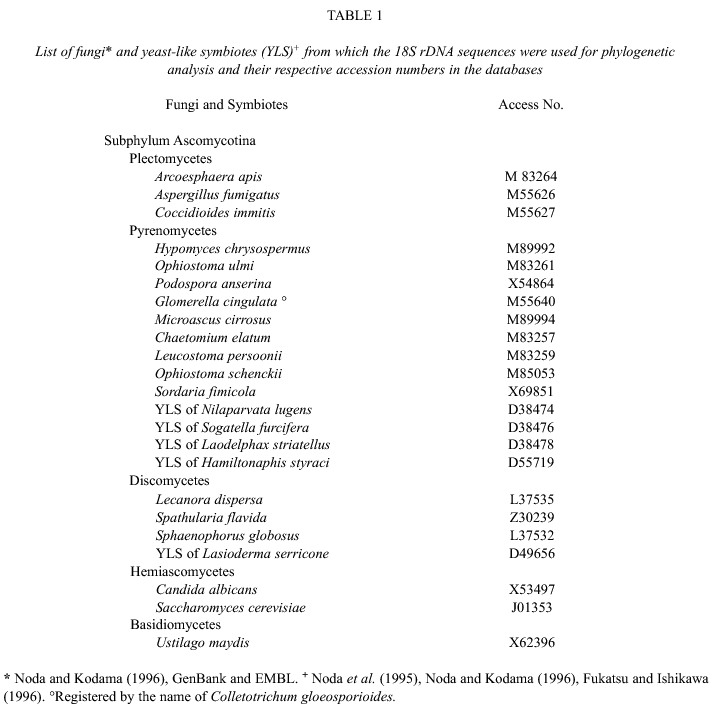
<body><![CDATA[<p><font face="Arial" size="2"><b>DNA extraction: </b>Yeast DNA was extracted by modifying the methods described by <a href="#ce92">Cenis (1992)</a> and <a href="#no95">Noda <i>et al. </i>(1995)</a>. YL<i>STo </i>were re-suspended in 50 mM EDTA, pH 8, 1/3 volume of 1% liticase (Sigma) on 0.01 M sodium phosphate pH 7.5 and 50% glycerol. Spheroplasts were obtained by incubation at 37°C during 45-60 minutes, followed by centrifugation. The pellet was homogenized in 300 µl buffer (200 mM Tris.HCl, pH 8.5, 250 mM NaCl, 25 mM EDTA, 0.5% SDS and glass beads of 212-300 microns). Samples were then treated with 150 µl of 3M sodium acetate and incubated at -30°C for one hour, followed by centrifugation at 13 000 rpm for ten minutes. The supernatant was recovered and DNA was obtained by precipitation with isopropanol. It was then re-suspended in distilled water and quantified by UV spectrophotometry at 260 nm.</font></p> <font face="Arial" size="2"><b></b></font>     <p><font face="Arial" size="2"><b>PCR amplification: </b>Partial sequences of 18S rDNA were amplified from total DNA. The PCR protocol and the primers used were those described by <a href="#no95">Noda and collaborators (1995)</a>. Approximately 40 ng of DNA were used for each reaction and amplification products were analyzed in 0.7% agarose gels. The bands obtained were cut and the products were extracted according to the QIAquick gel extraction protocol (<a href="#qi97">QIAGEN 1997</a>). Ligation and transformation were performed according to the pGEM-T Vector System I (<a href="#pr97">Promega 1997</a>) protocol. The samples were incubated on Luria Bertani (LB) broth for four hours with agitation, and the DNA preparation for sequencing was made by following the protocol of Sambrook <i>et al. </i>(1989). The clones were stored in 30% glycerol at -70°C. </font></p> <font face="Arial" size="2"><b></b></font>     <p><font face="Arial" size="2"><b>DNA sequencing: </b>DNA was sequenced according to the enzymatic method described by <a  href="#sa77">Sanger and collaborators (1977)</a>, using the ABI PRISM automatic sequencing system. Sequences were aligned with those of different fungi and yeasts, as well as with other YLSs from rice delphacids, aphids and coleopterans. The sequence search was performed on the European Molecular Biology (EMBL) and GenBank databases using the programs for the FASTA family. The yeasts and fungi selected for the phylogenetic analyses are shown in <a href="#t1">Table 1</a>, along with their respective access numbers. Sequences were aligned with the CLUSTAL V Multiple Sequence Alignment Program distributed by D.G. Higgins (EMBL) and the Phylogeny Inference Package (PHYLIP) version 3.5C (<a href="#fe93">Felsenstein 1993</a>). Re-sampling analyses were performed with 1000 bootstrapping events and phylogenetic trees were constructed with the Neighbor-joining procedure. </font></p>     <p style="text-align: left;"><font face="Arial" size="2">&nbsp;<a  name="t1"></a><img src="/img/fbpe/rbt/v52n3/3092i4.JPG" title=""  alt="" style="width: 715px; height: 707px;"></font></p> <font face="Arial" size="2"><b>     
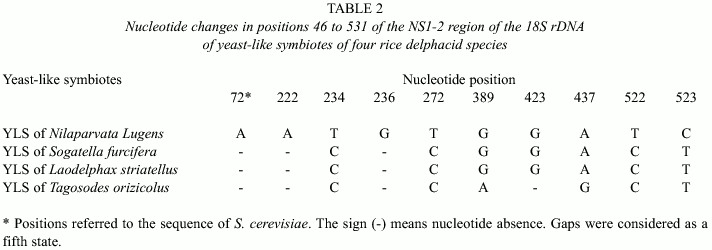
<p>Results</p> </b> </font>     <p><font face="Arial" size="2">The symbiotes were located in densities between 1.087 g/ml to 1.119 g/ml on Percoll gradients, densities similar to those previously reported for the YLS of other delphacids. The YL<i>STo </i>were thus exhaustively purified for DNA extraction in order to avoid contamination by host DNA. The sequence of the dominant species of YL<i>STo </i>was obtained through this procedure, because <i>T. orizicolu</i>s, as well as other delphacids, could host other species of symbiotes among their microbiota. </font></p>     <p><font face="Arial" size="2"><a href="#t2">Table 2</a> shows the partial sequences of the 18S rDNA of YLS <i>Tagosodes orizicolu</i>s, as compared to the NS1-2 region, positions 46 to 531 of <i>Saccharomyces cerevisiae </i>18S rDNA. The analysis also included sequences from YLS of the delphacids <i>Nilaparvata lugens, Laodelphax striatellus </i>and <i>Sogatella furcifer</i>a. </font></p>     <p style="text-align: left;"><font face="Arial" size="2">&nbsp;<a  name="t2"></a><img src="/img/fbpe/rbt/v52n3/3092i5.JPG" title=""  alt="" style="width: 712px; height: 250px;"></font></p>     
<p><font face="Arial" size="2">Upon comparing the YLS sequences of <i>T. orizicolus </i>with those of the YLS from <i>N. lugen</i>s, <i>S. furcifera </i>and <i>L. striatellu</i>s, ten variable positions among the delphacid symbiotes were found (<a href="#t2">Table 2</a>). Six additional variable positions were obtained when the YLSs of the aphid <i>H. styraci </i>were included (data not shown). As observed, YL<i>SSf </i>and YL<i>SLs </i>showed the same nucleotide changes along the whole region analyzed in relation to YL<i>SN</i>l. In the mean time, YL<i>STo </i>varied in the positions 389, 423 and 437 in relation to the former three. The most variable sequence among the symbiotes of rice delphacids was that of YL<i>SNl.</i></font></p>     <p><font face="Arial" size="2">Diversity in the previously described positions was also analyzed by similarity percentages among the sequences (<a href="#t3">Table 3</a>).</font></p> <a name="t3"></a>     ]]></body>
<body><![CDATA[<div style="text-align: center;"><img  src="/img/fbpe/rbt/v52n3/3092i6.JPG" title="" alt=""  style="width: 696px; height: 310px;"></div>     
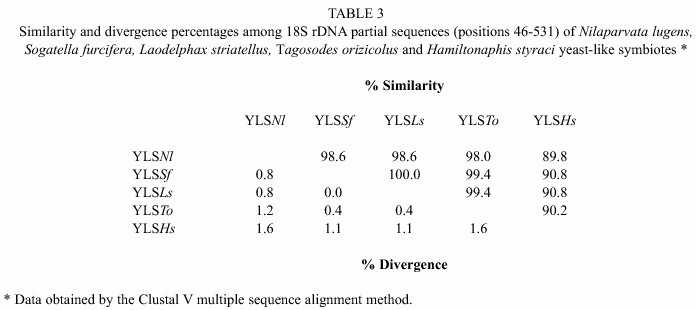
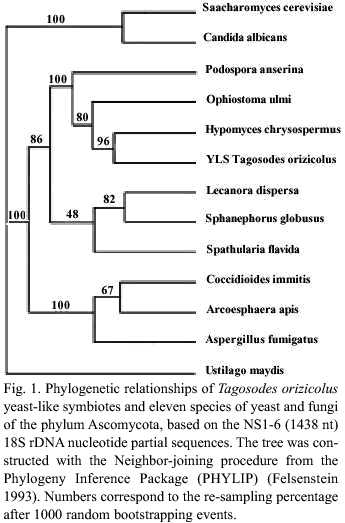
<p><font face="Arial" size="2">In this sense, YL<i>STo </i>are more similar to other delphacid YLSs, such as YL<i>SLs </i>and YL<i>SS</i>f, showing 99.4% similarity, while the similarity with YL<i>SNl </i>was of 98%. In addition, YL<i>STo </i>exhibits a 90.2% similarity with those from the YLS of the aphid <i>Hamiltonaphis styrac</i>i. In other words, the <i>YLSTo </i>have diverged less in relation to YL<i>SLs </i>and YL<i>SSf </i>(0.4%), at an intermediate level as compared to YL<i>SNl </i>(1.2%) and to a higher degree with respect to YL<i>SHs </i>(1.6%) (<a  href="#t3">Table 3</a>).</font></p>     <p><font face="Arial" size="2">The position of YL<i>STo </i>within the phylum Ascomycota was determined after aligning the complete sequence of the NS1-6 (1438 nt) clone with that of eleven ascomycete fungi: <i>Arcoesphaera apis, Aspergyillus fumigatus, Coccidioides immitis </i>(Class Plectomycetes); <i>Hypomyces chrysospermu</i>s, <i>Ophiostoma ulm</i>i, <i>Podospora anserina </i>(Class Pyrenomycetes); <i>Lecanora dispers</i>a, <i>Spathularia flavid</i>a, <i>Spaenophorus globosus </i>(Class Discomycetes); <i>Candida albican</i>s, <i>Saccharomyces cerevisiae </i>(Order Saccharomycetales) and <i>Ustilago maydis </i>(Class Basidiomycetes) as an outgroup (<a href="#f1">Fig. 1</a>). The analyses revealed that YL<i>STo </i>grouped with <i>H. chrysospermu</i>s, <i>O. ulmi </i>and <i>P. anserina </i>in the class Pyrenomycetes. Furthermore, the conformation of three other subgroups was observed. According to the classic taxonomic division (morphologic characteristics), these three subgroups correspond to the fungi Discomycetes, Plectomycetes and Saccharomycetales of the phylum Ascomycota (<a href="#f1">Fig. 1</a>).</font></p>     <p style="text-align: center;"><font face="Arial" size="2">&nbsp;<a  name="f1"></a><img src="/img/fbpe/rbt/v52n3/3092i1.JPG" title=""  alt="" style="width: 345px; height: 523px;"></font></p>     
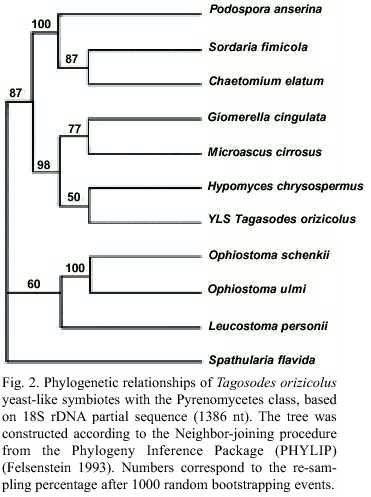
<p><font face="Arial" size="2">&nbsp;    <br> The relationship between YL<i>STo </i>with the Pyrenomycetes was determined by comparing the symbiote 1386 nt 18S rDNA segment with that from nine fungi of this class: <i>H. chrysospermus, O. ulmi, P. anserina, Glomerella cingulata, Microsacus cirrosus, Chaetomium elatum, Leucostoma persoonii, Ophiostoma schenckii </i>and <i>Sordaria fimicola. </i>They conformed a monophyletic group along with <i>H. Chrysospermus, G. cingulata </i>and <i>M. cirrosu</i>s. <i>S. flavida </i>(Discomycete) was included as an external group (<a  href="#f2">Fig. 2</a>).</font></p> <a name="f2"></a>     <div style="text-align: center;"><img  src="/img/fbpe/rbt/v52n3/3092i2.JPG" title="" alt=""  style="width: 371px; height: 497px;"></div>     
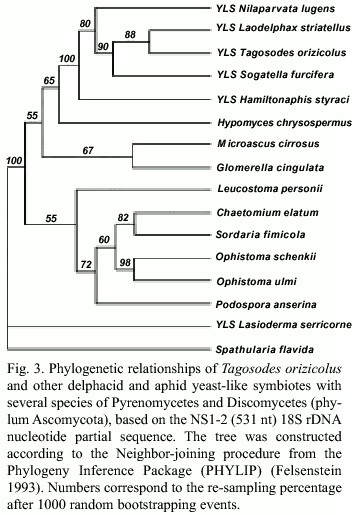
<p><font face="Arial" size="2">The analysis of the 18S rDNA partial sequences (1 a 531 nt) revealed very close relationships among the YL<i>STo </i>and other delphacid and aphid YLS (<a href="#f3">Fig. 3</a>). The dendrogram showed a monophyletic origin of the delphacid YLS and very short genetic distances between YL<i>STo </i>and YL<i>SL</i>s, YL<i>SSf </i>and YL<i>SN</i>l, but slightly larger distances with YL<i>SH</i>s. The symbiotes of the beetle <i>Lasioderma serricorne </i>(YL<i>SLs</i>e) were placed outside the class Pyrenomycetes and grouped with <i>S. flavid</i>a, both Discomycetes.</font></p> <a name="f3"></a>     <div style="text-align: center;"><img  src="/img/fbpe/rbt/v52n3/3092i3.JPG" title="" alt=""  style="width: 358px; height: 515px;"></div> <font face="Arial" size="2"><b>     
<p>Discussion</p> </b> </font>     ]]></body>
<body><![CDATA[<p><font face="Arial" size="2">The yeast-like symbiotes of <i>Tagosodes orizicolus </i>clustered with members of the class Pyrenomycetes when compared to other members of the phylum Ascomycota, like Plectomycetes, Discomycetes, Saccharomycetales and Basidiomycetes (<a href="#f1">Fig. 1</a>). The clustering of YL<i>STo, </i>along with <i>G. cingulata, M. cirrosus, </i>and <i>H. chrysospermu</i>s, within the Pyrenomycetes, supported the above observation (<a href="#f2">Fig. 2</a>). <i>YLSTo </i>and oth<i>er </i>delphacid and aphid yeast-like symbiotes formed a separate cluster, when compared to other members of the Pyrenomycetes and Discomycetes (<a href="#f3">Fig. 3</a>). In contrast, the beetle YL<i>SLs </i>showed affinity to <i>Spathularia flavid</i>a, a Discomycetes, suggesting that different insect orders may have been colonized by YLS belonging to different groups within the phylum Ascomycota. </font></p>     <p><font face="Arial" size="2">The close similarity (more than 90%) observed between the delphacid and aphid symbiotes suggests that an ancestral Pyrenomycete may have parasitized a homopteran common ancestor before these two groups diverged. This ancestral Pyrenomycete may have developed a mutualist symbiotic relationship, a role that yeast-like symbiotes presently have. The phylogenetic distribution of the symbiotes in both planthoppers and aphids is complex (bacterioid and yeast-like type), which may indicate that some events, such as symbiote acquisition and replacement, could have sprung either from the evolution from a common ancestor or from horizontal transfer (<a  href="#fu94">Fukatsu <i>et a</i>l. 1994</a>, <a href="#mo94">Moran and Baumann 1994</a>, <a href="#fu96">Fukatsu and Ishikawa 1996</a>).</font></p>     <p><font face="Arial" size="2">It is interesting to emphasize the high degree of similarity (over 98%) observed in the 18S rDNA partial sequences among the YLSs of Asian and American rice delphacids, especially considering that the YLS might have been present in a common ancestor. The high similarity observed might be reasonable, considering the crucial role of the symbiotes in the physiology, development and reproduction of their delphacid hosts, especially since significant genetic variations on the YLS could directly affect the host fitness and reproductive success. In addition, it is important to mention that the 18S rDNA partial sequences used in this study are likely to be highly conserved, due to the important role of rDNA in protein synthesis, and that analyzing other sequences in the YLS genome could result in higher levels of diversity. </font></p>     <p><font face="Arial" size="2">The phylogenetic relationships of the YLSs of three Asian rice-feeding delphacids <i>(N. lugens, S. furcifera </i>and <i>L striatellu</i>s) were previously described by <a  href="#no95">Noda and collaborators (1995)</a>, and were compared to twenty species of other Ascomycetes. It was observed that the YL<i>STo </i>showed high degree of similarity to those of Asian delphacids; although, <i>T. orizicolus </i>is strictly confined to tropical America. Therefore, the colonization of a delphacid YLS ancestor may have occurred before these species diverged, possibly before the continental drift. It is important to recall that delphacids maintain very close relationships with their plant hosts. For example, <i>T. orizicolus </i>is only capable of feeding and reproducing on rice <i>(Oryza sativ</i>a) and in <i>O. glumaepatula </i>(Hernández and Espinoza, unpublished results), an endemic wild <i>Oryza </i>species of tropical America. <i>O. glumaepatula </i>is related to other Asian and African <i>Oryza </i>species of the <i>O. sativa </i>complex, sharing the AA type genome (<a  href="#ak99">Akimoto 1999</a>). If cultivated rice was introduced to America less than 500 years ago (Cabezas and Espinoza 2001), it is probable that <i>O. glumaepatula </i>may have been the original host of <i>T. orizicolus </i>and that, after the introduction of rice in America, this insect may have adapted to the new host. </font></p>     <p><font face="Arial" size="2">This first report of yeast-like symbiotes in the American delphacid <i>Tagosodes orizicolus </i>offers interesting results concerning the relationship of this organism as compared to other delphacid YLS, as well as other fungi from the phylum Ascomycota. However, in order to understand the acquisition patterns and the evolutionary origin of yeast-like symbiotes, it is still necessary to perform more detailed molecular phylogenetic studies on the symbiotes as well as on their homopteran hosts. </font></p> <font face="Arial" size="2"><b>     <p>Acknowledgments</p> </b></font>     <p><font face="Arial" size="2">The authors wish to thank David Tobin for his support in performing the statistical analyses, and to Xiaoai Chen, of Yale University, for the sequencing of the 18S rDNA clones.</font></p> <font face="Arial" size="2"><b>     <p>Resumen</p> </b><i> </i></font>     <p><font face="Arial" size="2"><i>Tagosodes orizicolus </i>Muir (Homoptera: Delphacidae) es una especie endémica de América tropical que al igual que otros saltahojas de Asia, tiene simbiontes levaduriformes (YLS, por sus siglas en Inglés) en los cuerpos grasos del abdomen y en los tejidos de los ovarios. Los YLS son simbiontes obligados que se transmiten transovarialmente y que mantienen relaciones mutualística con el insecto hospedero. Esta característica ha hecho muy difícil su cultivo <i>in vitro </i>y por ende su clasificación utilizando métodos convencionales. Sin embargo, otros microorganismos de características similares se han clasificado con éxito utilizando taxonomía molecular. El presente trabajo tiene como objetivo caracterizar los YLS del delfácido <i>Tagosodes orizicolus </i>(YL<i>ST</i>o). Para ello se purificaron los YL<i>STo </i>en gradientes de Percoll® y el ADN extraído se amplificó por PCR utilizando iniciadores específicos para secuencias parciales del ADN ribosomal 18S. Dichos fragmentos se clonaron y secuenciaron posteriormente. Las secuencias se alinearon mediante el programa CLUSTAL V DNASTAR) y se construyeron árboles filogenéticos con el programa Phylogeny Inference Package (PHYLIP). Se encontró que los YL<i>STo </i>pertenecen a la clase de hongos Pyrenomycetes, phylum Ascomycota. Se observaron índices de similaridad entre 98% y 100% entre los YLS de <i>Tagosodes orizicolus, Nilaparvata lugens, Laodelphax striatellus </i>and <i>Sogatella furcifera </i>(todos delfácidos de arr<i>oz), </i>e índices de similaridad entre 89.8% y 90.8% al compararse con los YLS del áfido <i>Hamiltonaphis styraci. </i>Estas comparaciones revelaron que los YLS de los delfácidos constituyen un grupo monofilético altamente conservado dentro de los Pyrenomycetes y que se relacionan cercanamente con <i>Hypomyces chrysospermu</i>s. </font></p> <font face="Arial" size="2"><b>     <p>References</p> </b> </font>     ]]></body>
<body><![CDATA[<!-- ref --><p><font face="Arial" size="2"><a name="ak99"></a>Akimoto, M. 1999. Biosystematics of the <i>Oryza </i>AA genome wild taxa <i>(Oryza sativa </i>complex) by morpho- physiological traits, isozyme and RFLPs. Ph.D. Thesis. Hokkaido University, Japan. 53 p. </font>&nbsp;&nbsp;&nbsp;&nbsp;&nbsp;&nbsp;&nbsp;&nbsp;[&#160;<a href="javascript:void(0);" onclick="javascript: window.open('/scielo.php?script=sci_nlinks&ref=1334775&pid=S0034-7744200400030003800001&lng=','','width=640,height=500,resizable=yes,scrollbars=1,menubar=yes,');">Links</a>&#160;]<!-- end-ref --><!-- ref --><p><font face="Arial" size="2"><a name="bu65"></a>Buchner, P. 1965. Endosymbiosis of animals with plant microorganisms. Interscience. Nueva York.</font>&nbsp;&nbsp;&nbsp;&nbsp;&nbsp;&nbsp;&nbsp;&nbsp;[&#160;<a href="javascript:void(0);" onclick="javascript: window.open('/scielo.php?script=sci_nlinks&ref=1334776&pid=S0034-7744200400030003800002&lng=','','width=640,height=500,resizable=yes,scrollbars=1,menubar=yes,');">Links</a>&#160;]<!-- end-ref --><!-- ref --><p><font face="Arial" size="2"><a name="ce92"></a>Cenis, J.L. 1992. Rapid extraction of fungal DNA for PCR amplification. Nucleic Acids Res. 20(9): 2380. </font>&nbsp;&nbsp;&nbsp;&nbsp;&nbsp;&nbsp;&nbsp;&nbsp;[&#160;<a href="javascript:void(0);" onclick="javascript: window.open('/scielo.php?script=sci_nlinks&ref=1334777&pid=S0034-7744200400030003800003&lng=','','width=640,height=500,resizable=yes,scrollbars=1,menubar=yes,');">Links</a>&#160;]<!-- end-ref --><!-- ref --><p><font face="Arial" size="2"><a name="ch96"></a>Chen, D.Q., B.C. Campbell &amp; A.H. Purcell. 1996. A new rickettsia from an herbivorous insect, the pea aphid <i>Acyrthosiphon pisum </i>(Harris). Curr. Microbiol. 33(2): 123-128.</font>&nbsp;&nbsp;&nbsp;&nbsp;&nbsp;&nbsp;&nbsp;&nbsp;[&#160;<a href="javascript:void(0);" onclick="javascript: window.open('/scielo.php?script=sci_nlinks&ref=1334778&pid=S0034-7744200400030003800004&lng=','','width=640,height=500,resizable=yes,scrollbars=1,menubar=yes,');">Links</a>&#160;]<!-- end-ref --><!-- ref --><p><font face="Arial" size="2"><a name="ch81a"></a>Chen, C-C., L-L. Chen, C-C. Kuan &amp; R.F. Hou. 1981a. Studies on the intracellular yeast-like symbiote in the brown planthopper, <i>Nilaparvata lugens </i>Stål. I. Histological observations and population changes of the symbiote. Z. Ang. Ent. 91: 321-327.</font>&nbsp;&nbsp;&nbsp;&nbsp;&nbsp;&nbsp;&nbsp;&nbsp;[&#160;<a href="javascript:void(0);" onclick="javascript: window.open('/scielo.php?script=sci_nlinks&ref=1334779&pid=S0034-7744200400030003800005&lng=','','width=640,height=500,resizable=yes,scrollbars=1,menubar=yes,');">Links</a>&#160;]<!-- end-ref --><!-- ref --><p><font face="Arial" size="2"><a name="ch81b"></a>Chen, C-C., L-L. Chen &amp; R.F. Hou. 1981b. Studies on the intracellular yeast-like symbiote in the brown planthopper, <i>Nilaparvata lugens </i>Stål. II. Effects of antibiotics and elevated temperature on the symbiotes and their host. Z. Ang. Ent. 91: 321-327.</font>&nbsp;&nbsp;&nbsp;&nbsp;&nbsp;&nbsp;&nbsp;&nbsp;[&#160;<a href="javascript:void(0);" onclick="javascript: window.open('/scielo.php?script=sci_nlinks&ref=1334780&pid=S0034-7744200400030003800006&lng=','','width=640,height=500,resizable=yes,scrollbars=1,menubar=yes,');">Links</a>&#160;]<!-- end-ref --><!-- ref --><p><font face="Arial" size="2"><a name="ev69"></a>Everett, T. 1969. Vectors of hoja blanca virus. <i>In </i>J.H. Press (ed.). The virus disease of the rice plant. Proceedings of the Symposium at the International Rice Research Institute (IRRI). Baltimore, Maryland. 354 p. </font>&nbsp;&nbsp;&nbsp;&nbsp;&nbsp;&nbsp;&nbsp;&nbsp;[&#160;<a href="javascript:void(0);" onclick="javascript: window.open('/scielo.php?script=sci_nlinks&ref=1334781&pid=S0034-7744200400030003800007&lng=','','width=640,height=500,resizable=yes,scrollbars=1,menubar=yes,');">Links</a>&#160;]<!-- end-ref --><!-- ref --><p><font face="Arial" size="2"><a name="es04"></a>Espinoza, A.M., A.M. Xet-Mull, R. Mora &amp; E. Sánchez 200<i>4. </i>Morphologic characterization of yeast-like symbiotes of <i>Tagosodes orizicolus </i>(Homoptera: Delphacidae) by light and electron microscopy. Rev. Biol. Trop. 52: in press.</font>&nbsp;&nbsp;&nbsp;&nbsp;&nbsp;&nbsp;&nbsp;&nbsp;[&#160;<a href="javascript:void(0);" onclick="javascript: window.open('/scielo.php?script=sci_nlinks&ref=1334782&pid=S0034-7744200400030003800008&lng=','','width=640,height=500,resizable=yes,scrollbars=1,menubar=yes,');">Links</a>&#160;]<!-- end-ref --><!-- ref --><p><font face="Arial" size="2"><a name="fe93"></a>Felsenstein, J. 1993. PHYLIP (Phylogeny Inference Package) version 3.6. Distributed by the author. Department of Genetics, University of Washington, Seattle.</font>&nbsp;&nbsp;&nbsp;&nbsp;&nbsp;&nbsp;&nbsp;&nbsp;[&#160;<a href="javascript:void(0);" onclick="javascript: window.open('/scielo.php?script=sci_nlinks&ref=1334783&pid=S0034-7744200400030003800009&lng=','','width=640,height=500,resizable=yes,scrollbars=1,menubar=yes,');">Links</a>&#160;]<!-- end-ref --><!-- ref --><p><font face="Arial" size="2"><a name="fr87"></a>Fredenhagen, A., P. Kenny, H. Kita, H. Komura, Y. Naya, K. Nakanishi, L. Nishiyama, M. Sugiura &amp; S. Tamura. 1987. Role of intracellular symbiotes in planthoppers, p. 101-108. <i>In </i>R. Greenhalgh &amp; T.R. Roberts (eds.). Pesticide Science and Biotechnology. Blackwell, London. </font>&nbsp;&nbsp;&nbsp;&nbsp;&nbsp;&nbsp;&nbsp;&nbsp;[&#160;<a href="javascript:void(0);" onclick="javascript: window.open('/scielo.php?script=sci_nlinks&ref=1334784&pid=S0034-7744200400030003800010&lng=','','width=640,height=500,resizable=yes,scrollbars=1,menubar=yes,');">Links</a>&#160;]<!-- end-ref --><!-- ref --><p><font face="Arial" size="2"><a name="fr89"></a>Fröhlich, G. 1989. Endosymbiosis of phloem sap sucking planthoppers with special reference to <i>Sogatodes orizicola </i>(Muir) feeding on <i>Oryza sativa </i>L. Beitr. Ent. 39: S393-412.</font>&nbsp;&nbsp;&nbsp;&nbsp;&nbsp;&nbsp;&nbsp;&nbsp;[&#160;<a href="javascript:void(0);" onclick="javascript: window.open('/scielo.php?script=sci_nlinks&ref=1334785&pid=S0034-7744200400030003800011&lng=','','width=640,height=500,resizable=yes,scrollbars=1,menubar=yes,');">Links</a>&#160;]<!-- end-ref --><!-- ref --><p><font face="Arial" size="2"><a name="fu94"></a></font><font  face="Arial" size="2">Fukatsu, T. 1994. Endosymbiosis of aphids with microorganisms: A model case of dynamic endosymbiotic evolution. Plant Species Biol. 9: 145-154.</font>&nbsp;&nbsp;&nbsp;&nbsp;&nbsp;&nbsp;&nbsp;&nbsp;[&#160;<a href="javascript:void(0);" onclick="javascript: window.open('/scielo.php?script=sci_nlinks&ref=1334786&pid=S0034-7744200400030003800012&lng=','','width=640,height=500,resizable=yes,scrollbars=1,menubar=yes,');">Links</a>&#160;]<!-- end-ref --><!-- ref --><p><font face="Arial" size="2"><a name="fu92"></a>Fukatsu, T. &amp; H. Ishikawa. 1992. Anovel eukariotic extra-cellular symbiont in an aphid, <i>Astegopteryx styraci </i>(Homoptera, Aphididae, Hormaphidinae). J. Insect. Physiol. 38: 765-773.</font>&nbsp;&nbsp;&nbsp;&nbsp;&nbsp;&nbsp;&nbsp;&nbsp;[&#160;<a href="javascript:void(0);" onclick="javascript: window.open('/scielo.php?script=sci_nlinks&ref=1334787&pid=S0034-7744200400030003800013&lng=','','width=640,height=500,resizable=yes,scrollbars=1,menubar=yes,');">Links</a>&#160;]<!-- end-ref --><!-- ref --><p><font face="Arial" size="2"><a name="fu96"></a>Fukatsu, T. &amp; H. Ishikawa. 1996. Phylogenetic position of yeast-like symbiont of <i>Hamiltonaphis styraci </i>(Homoptera, Aphididae) based on 18S rDNA sequence. Insect Biochem. Molec. Biol. 26: 383-388.</font>&nbsp;&nbsp;&nbsp;&nbsp;&nbsp;&nbsp;&nbsp;&nbsp;[&#160;<a href="javascript:void(0);" onclick="javascript: window.open('/scielo.php?script=sci_nlinks&ref=1334788&pid=S0034-7744200400030003800014&lng=','','width=640,height=500,resizable=yes,scrollbars=1,menubar=yes,');">Links</a>&#160;]<!-- end-ref --><!-- ref --><p><font face="Arial" size="2">Fukatsu, T., S. Aoky, U. Kurosu &amp; H. Ishikawa. 1994. Phylogeny of Cerataphidini Aphids revealed by their symbiotic microorganisms and basic structure of their galls: Implications for host-symbiont coevolution and evolution of sterile soldier castes. Zool. Sci. 11: 613-623.</font>&nbsp;&nbsp;&nbsp;&nbsp;&nbsp;&nbsp;&nbsp;&nbsp;[&#160;<a href="javascript:void(0);" onclick="javascript: window.open('/scielo.php?script=sci_nlinks&ref=1334789&pid=S0034-7744200400030003800015&lng=','','width=640,height=500,resizable=yes,scrollbars=1,menubar=yes,');">Links</a>&#160;]<!-- end-ref --><!-- ref --><p><font face="Arial" size="2"><a name="ga68"></a>Gálvez, G.E. 1968. Transmission studies of the hoja blanca virus with highly active, virus-free colonies of <i>Sogatodes oryzicol</i>a. Phytopathology 58: 818-821.</font>&nbsp;&nbsp;&nbsp;&nbsp;&nbsp;&nbsp;&nbsp;&nbsp;[&#160;<a href="javascript:void(0);" onclick="javascript: window.open('/scielo.php?script=sci_nlinks&ref=1334790&pid=S0034-7744200400030003800016&lng=','','width=640,height=500,resizable=yes,scrollbars=1,menubar=yes,');">Links</a>&#160;]<!-- end-ref --><!-- ref --><p><font face="Arial" size="2"><a name="ga69"></a>Gálvez, G.E. 1969. Transmission of hoja blanca virus of rice. <i>In </i>J.H. Press. The virus disease of the rice plant. Proceedings of the Symposium at the International Rice Research Institute (IRRI). Baltimore, Maryland. 354p.</font>&nbsp;&nbsp;&nbsp;&nbsp;&nbsp;&nbsp;&nbsp;&nbsp;[&#160;<a href="javascript:void(0);" onclick="javascript: window.open('/scielo.php?script=sci_nlinks&ref=1334791&pid=S0034-7744200400030003800017&lng=','','width=640,height=500,resizable=yes,scrollbars=1,menubar=yes,');">Links</a>&#160;]<!-- end-ref --><!-- ref --><p><font face="Arial" size="2"><a name="ho80"></a>Houk, E.J. &amp; G.W. Griffiths. 1980. Intracellular symbiotes of the Homoptera. Ann. Rev. Entomol. 25: 161-187.</font>&nbsp;&nbsp;&nbsp;&nbsp;&nbsp;&nbsp;&nbsp;&nbsp;[&#160;<a href="javascript:void(0);" onclick="javascript: window.open('/scielo.php?script=sci_nlinks&ref=1334792&pid=S0034-7744200400030003800018&lng=','','width=640,height=500,resizable=yes,scrollbars=1,menubar=yes,');">Links</a>&#160;]<!-- end-ref --><!-- ref --><p><font face="Arial" size="2"><a name="ku79"></a>Kusumi, T., Y. Suwa, H. Kita &amp; S. Nasu. 1979. Symbiotes of Planthoppers: I. The isolation of intracellular symbiotes from the smaller brown planthopper, <i>Laodelphax striatellus </i>Fallén (Homoptera: Delphacidae). Appl. Ent. Zool. 14: 459-463.</font>&nbsp;&nbsp;&nbsp;&nbsp;&nbsp;&nbsp;&nbsp;&nbsp;[&#160;<a href="javascript:void(0);" onclick="javascript: window.open('/scielo.php?script=sci_nlinks&ref=1334793&pid=S0034-7744200400030003800019&lng=','','width=640,height=500,resizable=yes,scrollbars=1,menubar=yes,');">Links</a>&#160;]<!-- end-ref --><!-- ref --><p><font face="Arial" size="2"><a name="ku80"></a>Kusumi, T., Y. Suwa, H. Kita &amp; S. Nasu. 1980. Properties of intracellular symbiotes from the smaller brown planthopper, <i>Laodelphax striatellus </i>Fallén (Homoptera: Delphacidae). Appl. Ent. Zool. 15: 129-134.</font>&nbsp;&nbsp;&nbsp;&nbsp;&nbsp;&nbsp;&nbsp;&nbsp;[&#160;<a href="javascript:void(0);" onclick="javascript: window.open('/scielo.php?script=sci_nlinks&ref=1334794&pid=S0034-7744200400030003800020&lng=','','width=640,height=500,resizable=yes,scrollbars=1,menubar=yes,');">Links</a>&#160;]<!-- end-ref --><!-- ref --><p><font face="Arial" size="2"><a name="mc60"></a>McGuire, J.U., W.W. McMillian &amp; H.A. Lamey. 1960. Hoja blanca disease of rice and its insect vector. Rice J. 63: 15-28.</font>&nbsp;&nbsp;&nbsp;&nbsp;&nbsp;&nbsp;&nbsp;&nbsp;[&#160;<a href="javascript:void(0);" onclick="javascript: window.open('/scielo.php?script=sci_nlinks&ref=1334795&pid=S0034-7744200400030003800021&lng=','','width=640,height=500,resizable=yes,scrollbars=1,menubar=yes,');">Links</a>&#160;]<!-- end-ref --><!-- ref --><p><font face="Arial" size="2"><a name="mi75"></a>Mitsuhashi, J. 1975. Cultivation of intracellular yeast-like organisms in the Smaller Brown Planthopper, <i>Laodelphax striatellus </i>Fallén (Homoptera: Delphacidae). Appl. Ent. Zool. 10: 243-245.</font>&nbsp;&nbsp;&nbsp;&nbsp;&nbsp;&nbsp;&nbsp;&nbsp;[&#160;<a href="javascript:void(0);" onclick="javascript: window.open('/scielo.php?script=sci_nlinks&ref=1334796&pid=S0034-7744200400030003800022&lng=','','width=640,height=500,resizable=yes,scrollbars=1,menubar=yes,');">Links</a>&#160;]<!-- end-ref --><!-- ref --><p><font face="Arial" size="2"><a name="mo01"></a>Mora, R., A. Retana &amp; A.M. Espinoza. 2001. External morphology of <i>Tagosodes orizicolus </i>Muir (Homoptera: Delphacidae) revealed by scanning electron microscopy. Ann. Enthomol. Soc. Amer. 94(3): 438:448.</font>&nbsp;&nbsp;&nbsp;&nbsp;&nbsp;&nbsp;&nbsp;&nbsp;[&#160;<a href="javascript:void(0);" onclick="javascript: window.open('/scielo.php?script=sci_nlinks&ref=1334797&pid=S0034-7744200400030003800023&lng=','','width=640,height=500,resizable=yes,scrollbars=1,menubar=yes,');">Links</a>&#160;]<!-- end-ref --><!-- ref --><p><font face="Arial" size="2"><a name="mo94"></a>Moran, N. &amp; P. Baumann. 1994. Phylogenetics of cytoplasmically inherited microorganisms of arthropods. Trends Ecol. Evol. 9: 15-20.</font>&nbsp;&nbsp;&nbsp;&nbsp;&nbsp;&nbsp;&nbsp;&nbsp;[&#160;<a href="javascript:void(0);" onclick="javascript: window.open('/scielo.php?script=sci_nlinks&ref=1334798&pid=S0034-7744200400030003800024&lng=','','width=640,height=500,resizable=yes,scrollbars=1,menubar=yes,');">Links</a>&#160;]<!-- end-ref --><!-- ref --><p><font face="Arial" size="2"><a name="mu62"></a>Müller, H.J. 1962. Neuere Vostellunge über Verbreitun und Phylogenie des Endosymbiose der Qikade. Z. Morph. Ökol. Tiere. 51: S190-210.</font>&nbsp;&nbsp;&nbsp;&nbsp;&nbsp;&nbsp;&nbsp;&nbsp;[&#160;<a href="javascript:void(0);" onclick="javascript: window.open('/scielo.php?script=sci_nlinks&ref=1334799&pid=S0034-7744200400030003800025&lng=','','width=640,height=500,resizable=yes,scrollbars=1,menubar=yes,');">Links</a>&#160;]<!-- end-ref --><!-- ref --><p><font face="Arial" size="2"><a name="na81"></a>Nasu, S., T. Kusumi, Y. Suwa &amp; H. Kita. 1981. Symbiotes of planthoppers: II. Isolation of intracellular symbiotic microorganisms from the brown planthopper, <i>Nilaparvata lugens </i>Stål. and immunological comparison of the symbiotes associated with rice planthoppers (Homoptera: Delphacidae). Appl. Ent. Zool. 16: 88-93.</font>&nbsp;&nbsp;&nbsp;&nbsp;&nbsp;&nbsp;&nbsp;&nbsp;[&#160;<a href="javascript:void(0);" onclick="javascript: window.open('/scielo.php?script=sci_nlinks&ref=1334800&pid=S0034-7744200400030003800026&lng=','','width=640,height=500,resizable=yes,scrollbars=1,menubar=yes,');">Links</a>&#160;]<!-- end-ref --><!-- ref --><p><font face="Arial" size="2"><a name="na94"></a>Nault, L.R. 1994. Transmission biology, vector specificity and evolution of planthopper-transmitted viruses, p. 429-448. <i>In </i>R.F. Denno &amp; T.J. Perfect (eds). Planthoppers: Their ecology and management. Chapman &amp; Hall, London.</font>&nbsp;&nbsp;&nbsp;&nbsp;&nbsp;&nbsp;&nbsp;&nbsp;[&#160;<a href="javascript:void(0);" onclick="javascript: window.open('/scielo.php?script=sci_nlinks&ref=1334801&pid=S0034-7744200400030003800027&lng=','','width=640,height=500,resizable=yes,scrollbars=1,menubar=yes,');">Links</a>&#160;]<!-- end-ref --><!-- ref --><p><font face="Arial" size="2"><a name="no74"></a>Noda, H. 1974. Preliminary histological observation and population dynamics of intracellular yeast-like sumbiotes in the smaller brown planthopper, <i>Laodelphax striatellus </i>(Homoptera: Delphacidae). Appl. Ent. Zool. 9: 275-277.</font>&nbsp;&nbsp;&nbsp;&nbsp;&nbsp;&nbsp;&nbsp;&nbsp;[&#160;<a href="javascript:void(0);" onclick="javascript: window.open('/scielo.php?script=sci_nlinks&ref=1334802&pid=S0034-7744200400030003800028&lng=','','width=640,height=500,resizable=yes,scrollbars=1,menubar=yes,');">Links</a>&#160;]<!-- end-ref --><!-- ref --><p><font face="Arial" size="2"><a name="no96"></a>Noda, H. &amp; K. Kodama. 1996. Phylogenetic position of yeast-like endosymbionts of anobiid beetles. Appl. Environ. Microbiol. 62: 162-167.</font>&nbsp;&nbsp;&nbsp;&nbsp;&nbsp;&nbsp;&nbsp;&nbsp;[&#160;<a href="javascript:void(0);" onclick="javascript: window.open('/scielo.php?script=sci_nlinks&ref=1334803&pid=S0034-7744200400030003800029&lng=','','width=640,height=500,resizable=yes,scrollbars=1,menubar=yes,');">Links</a>&#160;]<!-- end-ref --><!-- ref --><p><font face="Arial" size="2"><a name="no92"></a>Noda, H. &amp; T. Omura. 1992. Purification of yeast-like symbiotes of planthoppers. J. Invert. Pathol. 59: 104-105.</font>&nbsp;&nbsp;&nbsp;&nbsp;&nbsp;&nbsp;&nbsp;&nbsp;[&#160;<a href="javascript:void(0);" onclick="javascript: window.open('/scielo.php?script=sci_nlinks&ref=1334804&pid=S0034-7744200400030003800030&lng=','','width=640,height=500,resizable=yes,scrollbars=1,menubar=yes,');">Links</a>&#160;]<!-- end-ref --><!-- ref --><p><font face="Arial" size="2"><a name="no79a"></a>Noda, H. &amp; T. Saito. 1979a. Effects of high temperature on the development of <i>Laodelphax striatellus </i>Fallén (Homoptera: Delphacidae). Appl. Ent. Zool. 14: 64-75. </font>&nbsp;&nbsp;&nbsp;&nbsp;&nbsp;&nbsp;&nbsp;&nbsp;[&#160;<a href="javascript:void(0);" onclick="javascript: window.open('/scielo.php?script=sci_nlinks&ref=1334805&pid=S0034-7744200400030003800031&lng=','','width=640,height=500,resizable=yes,scrollbars=1,menubar=yes,');">Links</a>&#160;]<!-- end-ref --><!-- ref --><p><font face="Arial" size="2"><a name="no79b"></a>Noda, H. &amp; T. Saito. 1979b. The role of intracellular yeast-like symbiotes in the development of <i>Laodelphax striatellus </i>Fallén (Homoptera: Delphacidae). Appl. Ent. Zool. 14: 453-458.</font>&nbsp;&nbsp;&nbsp;&nbsp;&nbsp;&nbsp;&nbsp;&nbsp;[&#160;<a href="javascript:void(0);" onclick="javascript: window.open('/scielo.php?script=sci_nlinks&ref=1334806&pid=S0034-7744200400030003800032&lng=','','width=640,height=500,resizable=yes,scrollbars=1,menubar=yes,');">Links</a>&#160;]<!-- end-ref --><!-- ref --><p><font face="Arial" size="2"><a name="no95"></a>Noda, H., N. Nakashima &amp; M. Koizumi. 1995. Phylogenetic position of yeast-like symbiotes of rice planthoppers based on partial 18S rDNA sequences. Insect Biochem. Molec. Biol. 25: 639-646. </font>&nbsp;&nbsp;&nbsp;&nbsp;&nbsp;&nbsp;&nbsp;&nbsp;[&#160;<a href="javascript:void(0);" onclick="javascript: window.open('/scielo.php?script=sci_nlinks&ref=1334807&pid=S0034-7744200400030003800033&lng=','','width=640,height=500,resizable=yes,scrollbars=1,menubar=yes,');">Links</a>&#160;]<!-- end-ref --><!-- ref --><p><font face="Arial" size="2"><a name="pr97"></a>Promega. 1997. Technical manual of pGEM-T and pGEM-T Easy Vector Systems. Promega Corp, Wisconsin, 26 p.</font>&nbsp;&nbsp;&nbsp;&nbsp;&nbsp;&nbsp;&nbsp;&nbsp;[&#160;<a href="javascript:void(0);" onclick="javascript: window.open('/scielo.php?script=sci_nlinks&ref=1334808&pid=S0034-7744200400030003800034&lng=','','width=640,height=500,resizable=yes,scrollbars=1,menubar=yes,');">Links</a>&#160;]<!-- end-ref --><!-- ref --><p><font face="Arial" size="2"><a name="qi97"></a>QIAGEN. 1997. QIAquick gel extraction kit protocol, p. 24-25. <i>In </i>Anonymous (ed.). QIAquick Spin Handbook. QIAGEN, California.</font>&nbsp;&nbsp;&nbsp;&nbsp;&nbsp;&nbsp;&nbsp;&nbsp;[&#160;<a href="javascript:void(0);" onclick="javascript: window.open('/scielo.php?script=sci_nlinks&ref=1334809&pid=S0034-7744200400030003800035&lng=','','width=640,height=500,resizable=yes,scrollbars=1,menubar=yes,');">Links</a>&#160;]<!-- end-ref --><!-- ref --><p><font face="Arial" size="2"><a name="sa89a"></a>Sambrook, J., E.F. Fritsch &amp; T. Maniatis. 1989a. Molecular cloning. A laboratory manual. CSH, New York. p. 1.29-1.30.</font>&nbsp;&nbsp;&nbsp;&nbsp;&nbsp;&nbsp;&nbsp;&nbsp;[&#160;<a href="javascript:void(0);" onclick="javascript: window.open('/scielo.php?script=sci_nlinks&ref=1334810&pid=S0034-7744200400030003800036&lng=','','width=640,height=500,resizable=yes,scrollbars=1,menubar=yes,');">Links</a>&#160;]<!-- end-ref --><!-- ref --><p><font face="Arial" size="2"><a name="sa77"></a>Sanger, F., G.G. Brownlee &amp; B.G. Barrell. 1977. DNA sequencing with chain-terminating inhibitors. Proc. Natl. Acad. Sci. 74: 5463.</font>&nbsp;&nbsp;&nbsp;&nbsp;&nbsp;&nbsp;&nbsp;&nbsp;[&#160;<a href="javascript:void(0);" onclick="javascript: window.open('/scielo.php?script=sci_nlinks&ref=1334811&pid=S0034-7744200400030003800037&lng=','','width=640,height=500,resizable=yes,scrollbars=1,menubar=yes,');">Links</a>&#160;]<!-- end-ref --><!-- ref --><p><font face="Arial" size="2"><a name="sa96"></a>Sasaki, T., M. Kawamura &amp; H. Ishikawa. 1996. Nitrogen recycling in the brown planthopper, <i>Nilaparvata lugen</i>s: involvement of yeast-like symbionts in uric acid metabolism. J. Insect. Physiol. 42: 125-129. </font>&nbsp;&nbsp;&nbsp;&nbsp;&nbsp;&nbsp;&nbsp;&nbsp;[&#160;<a href="javascript:void(0);" onclick="javascript: window.open('/scielo.php?script=sci_nlinks&ref=1334812&pid=S0034-7744200400030003800038&lng=','','width=640,height=500,resizable=yes,scrollbars=1,menubar=yes,');">Links</a>&#160;]<!-- end-ref --><!-- ref --><p><font face="Arial" size="2"><a name="tr68"></a>Trujillo, G. 1968. Relación entre la aplicación de insecticidas and la transmisión de la hoja blanca del arroz por <i>Sogata orizicol</i>a. Agron. Trop. 18: 441-447.</font>&nbsp;&nbsp;&nbsp;&nbsp;&nbsp;&nbsp;&nbsp;&nbsp;[&#160;<a href="javascript:void(0);" onclick="javascript: window.open('/scielo.php?script=sci_nlinks&ref=1334813&pid=S0034-7744200400030003800039&lng=','','width=640,height=500,resizable=yes,scrollbars=1,menubar=yes,');">Links</a>&#160;]<!-- end-ref --><!-- ref --><p><font face="Arial" size="2"><a name="za01"></a>Zamora, A. 2001. Diversidad morfológica y genética de las especies de <i>Oryza </i>(Poaceae) nativas de Costa Rica. M.Sc. Thesis. Universidad de Costa Rica, Costa Rica. 178 p.</font>&nbsp;&nbsp;&nbsp;&nbsp;&nbsp;&nbsp;&nbsp;&nbsp;[&#160;<a href="javascript:void(0);" onclick="javascript: window.open('/scielo.php?script=sci_nlinks&ref=1334814&pid=S0034-7744200400030003800040&lng=','','width=640,height=500,resizable=yes,scrollbars=1,menubar=yes,');">Links</a>&#160;]<!-- end-ref --> ]]></body><back>
<ref-list>
<ref id="B1">
<nlm-citation citation-type="">
<person-group person-group-type="author">
<name>
<surname><![CDATA[Akimoto]]></surname>
<given-names><![CDATA[M]]></given-names>
</name>
</person-group>
<source><![CDATA[Biosystematics of the Oryza AA genome wild taxa (Oryza sativa complex) by morpho- physiological traits, isozyme and RFLPs]]></source>
<year>1999</year>
<page-range>53</page-range></nlm-citation>
</ref>
<ref id="B2">
<nlm-citation citation-type="book">
<person-group person-group-type="author">
<name>
<surname><![CDATA[Buchner]]></surname>
<given-names><![CDATA[P]]></given-names>
</name>
</person-group>
<source><![CDATA[Endosymbiosis of animals with plant microorganisms]]></source>
<year>1965</year>
<publisher-loc><![CDATA[^eNueva York Nueva York]]></publisher-loc>
<publisher-name><![CDATA[Interscience]]></publisher-name>
</nlm-citation>
</ref>
<ref id="B3">
<nlm-citation citation-type="journal">
<person-group person-group-type="author">
<name>
<surname><![CDATA[Cenis]]></surname>
<given-names><![CDATA[J.L]]></given-names>
</name>
</person-group>
<article-title xml:lang="en"><![CDATA[Rapid extraction of fungal DNA for PCR amplification]]></article-title>
<source><![CDATA[Nucleic Acids Res]]></source>
<year>1992</year>
<volume>20</volume>
<numero>9</numero>
<issue>9</issue>
<page-range>2380</page-range></nlm-citation>
</ref>
<ref id="B4">
<nlm-citation citation-type="journal">
<person-group person-group-type="author">
<name>
<surname><![CDATA[Chen]]></surname>
<given-names><![CDATA[D.Q]]></given-names>
</name>
<name>
<surname><![CDATA[Campbell]]></surname>
<given-names><![CDATA[B.C]]></given-names>
</name>
<name>
<surname><![CDATA[Purcell]]></surname>
<given-names><![CDATA[A.H]]></given-names>
</name>
</person-group>
<article-title xml:lang="en"><![CDATA[A new rickettsia from an herbivorous insect, the pea aphid Acyrthosiphon pisum (Harris)]]></article-title>
<source><![CDATA[Curr. Microbiol]]></source>
<year>1996</year>
<volume>33</volume>
<numero>2</numero>
<issue>2</issue>
<page-range>123-128</page-range></nlm-citation>
</ref>
<ref id="B5">
<nlm-citation citation-type="journal">
<person-group person-group-type="author">
<name>
<surname><![CDATA[Chen]]></surname>
<given-names><![CDATA[C-C]]></given-names>
</name>
<name>
<surname><![CDATA[Chen]]></surname>
<given-names><![CDATA[L-L]]></given-names>
</name>
<name>
<surname><![CDATA[Kuan]]></surname>
<given-names><![CDATA[C-C]]></given-names>
</name>
<name>
<surname><![CDATA[Hou]]></surname>
<given-names><![CDATA[R.F]]></given-names>
</name>
</person-group>
<article-title xml:lang="en"><![CDATA[Studies on the intracellular yeast-like symbiote in the brown planthopper, Nilaparvata lugens Stål. I. Histological observations and population changes of the symbiote]]></article-title>
<source><![CDATA[Z. Ang. Ent]]></source>
<year>1981</year>
<month>a</month>
<volume>91</volume>
<page-range>321-327</page-range></nlm-citation>
</ref>
<ref id="B6">
<nlm-citation citation-type="journal">
<person-group person-group-type="author">
<name>
<surname><![CDATA[Chen]]></surname>
<given-names><![CDATA[C-C]]></given-names>
</name>
<name>
<surname><![CDATA[Chen]]></surname>
<given-names><![CDATA[L-L]]></given-names>
</name>
<name>
<surname><![CDATA[Hou]]></surname>
<given-names><![CDATA[R.F]]></given-names>
</name>
</person-group>
<article-title xml:lang="en"><![CDATA[Studies on the intracellular yeast-like symbiote in the brown planthopper, Nilaparvata lugens Stål. II. Effects of antibiotics and elevated temperature on the symbiotes and their host]]></article-title>
<source><![CDATA[Z. Ang. Ent]]></source>
<year>1981</year>
<month>b</month>
<volume>91</volume>
<page-range>321-327</page-range></nlm-citation>
</ref>
<ref id="B7">
<nlm-citation citation-type="">
<person-group person-group-type="author">
<name>
<surname><![CDATA[Everett]]></surname>
<given-names><![CDATA[T]]></given-names>
</name>
</person-group>
<article-title xml:lang="en"><![CDATA[Vectors of hoja blanca virus]]></article-title>
<person-group person-group-type="editor">
<name>
<surname><![CDATA[Press]]></surname>
<given-names><![CDATA[J.H]]></given-names>
</name>
</person-group>
<source><![CDATA[The virus disease of the rice plant. Proceedings of the Symposium at the International Rice Research Institute (IRRI)]]></source>
<year>1969</year>
<page-range>354</page-range><publisher-loc><![CDATA[Baltimore^eMaryland Maryland]]></publisher-loc>
</nlm-citation>
</ref>
<ref id="B8">
<nlm-citation citation-type="journal">
<person-group person-group-type="author">
<name>
<surname><![CDATA[Espinoza]]></surname>
<given-names><![CDATA[A.M]]></given-names>
</name>
<name>
<surname><![CDATA[Xet-Mull]]></surname>
<given-names><![CDATA[A.M]]></given-names>
</name>
<name>
<surname><![CDATA[Mora]]></surname>
<given-names><![CDATA[R]]></given-names>
</name>
<name>
<surname><![CDATA[Sánchez]]></surname>
<given-names><![CDATA[E]]></given-names>
</name>
</person-group>
<article-title xml:lang="en"><![CDATA[Morphologic characterization of yeast-like symbiotes of Tagosodes orizicolus (Homoptera: Delphacidae) by light and electron microscopy]]></article-title>
<source><![CDATA[Rev. Biol. Trop]]></source>
<year>2004</year>
<volume>52</volume>
</nlm-citation>
</ref>
<ref id="B9">
<nlm-citation citation-type="book">
<person-group person-group-type="author">
<name>
<surname><![CDATA[Felsenstein]]></surname>
<given-names><![CDATA[J]]></given-names>
</name>
</person-group>
<source><![CDATA[PHYLIP (Phylogeny Inference Package) version 3.6. Distributed by the author]]></source>
<year>1993</year>
<publisher-loc><![CDATA[^eSeattle Seattle]]></publisher-loc>
<publisher-name><![CDATA[Department of Genetics, University of Washington]]></publisher-name>
</nlm-citation>
</ref>
<ref id="B10">
<nlm-citation citation-type="book">
<person-group person-group-type="author">
<name>
<surname><![CDATA[Fredenhagen]]></surname>
<given-names><![CDATA[A]]></given-names>
</name>
<name>
<surname><![CDATA[Kenny]]></surname>
<given-names><![CDATA[P]]></given-names>
</name>
<name>
<surname><![CDATA[Kita]]></surname>
<given-names><![CDATA[H]]></given-names>
</name>
<name>
<surname><![CDATA[Komura]]></surname>
<given-names><![CDATA[H]]></given-names>
</name>
<name>
<surname><![CDATA[Naya]]></surname>
<given-names><![CDATA[Y]]></given-names>
</name>
<name>
<surname><![CDATA[Nakanishi]]></surname>
<given-names><![CDATA[K]]></given-names>
</name>
<name>
<surname><![CDATA[Nishiyama]]></surname>
<given-names><![CDATA[L]]></given-names>
</name>
<name>
<surname><![CDATA[Sugiura]]></surname>
<given-names><![CDATA[M]]></given-names>
</name>
<name>
<surname><![CDATA[Tamura]]></surname>
<given-names><![CDATA[S]]></given-names>
</name>
</person-group>
<article-title xml:lang="en"><![CDATA[Role of intracellular symbiotes in planthoppers]]></article-title>
<person-group person-group-type="editor">
<name>
<surname><![CDATA[Greenhalgh]]></surname>
<given-names><![CDATA[R]]></given-names>
</name>
<name>
<surname><![CDATA[Roberts]]></surname>
<given-names><![CDATA[T.R]]></given-names>
</name>
</person-group>
<source><![CDATA[Pesticide Science and Biotechnology]]></source>
<year>1987</year>
<page-range>101-108</page-range><publisher-loc><![CDATA[London ]]></publisher-loc>
<publisher-name><![CDATA[Blackwell]]></publisher-name>
</nlm-citation>
</ref>
<ref id="B11">
<nlm-citation citation-type="journal">
<person-group person-group-type="author">
<name>
<surname><![CDATA[Fröhlich]]></surname>
<given-names><![CDATA[G]]></given-names>
</name>
</person-group>
<article-title xml:lang="en"><![CDATA[Endosymbiosis of phloem sap sucking planthoppers with special reference to Sogatodes orizicola (Muir) feeding on Oryza sativa L]]></article-title>
<source><![CDATA[Beitr. Ent]]></source>
<year>1989</year>
<volume>39</volume>
<page-range>S393-412</page-range></nlm-citation>
</ref>
<ref id="B12">
<nlm-citation citation-type="journal">
<person-group person-group-type="author">
<name>
<surname><![CDATA[Fukatsu]]></surname>
<given-names><![CDATA[T]]></given-names>
</name>
</person-group>
<article-title xml:lang="en"><![CDATA[Endosymbiosis of aphids with microorganisms: A model case of dynamic endosymbiotic evolution]]></article-title>
<source><![CDATA[Plant Species Biol]]></source>
<year>1994</year>
<volume>9</volume>
<page-range>145-154</page-range></nlm-citation>
</ref>
<ref id="B13">
<nlm-citation citation-type="journal">
<person-group person-group-type="author">
<name>
<surname><![CDATA[Fukatsu]]></surname>
<given-names><![CDATA[T]]></given-names>
</name>
<name>
<surname><![CDATA[Ishikawa]]></surname>
<given-names><![CDATA[H]]></given-names>
</name>
</person-group>
<article-title xml:lang="en"><![CDATA[Anovel eukariotic extra-cellular symbiont in an aphid, Astegopteryx styraci (Homoptera, Aphididae, Hormaphidinae)]]></article-title>
<source><![CDATA[J. Insect. Physiol]]></source>
<year>1992</year>
<volume>38</volume>
<page-range>765-773</page-range></nlm-citation>
</ref>
<ref id="B14">
<nlm-citation citation-type="journal">
<person-group person-group-type="author">
<name>
<surname><![CDATA[Fukatsu]]></surname>
<given-names><![CDATA[T]]></given-names>
</name>
<name>
<surname><![CDATA[Ishikawa]]></surname>
<given-names><![CDATA[H]]></given-names>
</name>
</person-group>
<article-title xml:lang="en"><![CDATA[Phylogenetic position of yeast-like symbiont of Hamiltonaphis styraci (Homoptera, Aphididae) based on 18S rDNA sequence]]></article-title>
<source><![CDATA[Insect Biochem. Molec. Biol]]></source>
<year>1996</year>
<volume>26</volume>
<page-range>383-388</page-range></nlm-citation>
</ref>
<ref id="B15">
<nlm-citation citation-type="journal">
<person-group person-group-type="author">
<name>
<surname><![CDATA[Fukatsu]]></surname>
<given-names><![CDATA[T]]></given-names>
</name>
<name>
<surname><![CDATA[Aoky]]></surname>
<given-names><![CDATA[S]]></given-names>
</name>
<name>
<surname><![CDATA[Kurosu]]></surname>
<given-names><![CDATA[U]]></given-names>
</name>
<name>
<surname><![CDATA[Ishikawa]]></surname>
<given-names><![CDATA[H]]></given-names>
</name>
</person-group>
<article-title xml:lang="en"><![CDATA[Phylogeny of Cerataphidini Aphids revealed by their symbiotic microorganisms and basic structure of their galls: Implications for host-symbiont coevolution and evolution of sterile soldier castes]]></article-title>
<source><![CDATA[Zool. Sci]]></source>
<year>1994</year>
<volume>11</volume>
<page-range>613-623</page-range></nlm-citation>
</ref>
<ref id="B16">
<nlm-citation citation-type="journal">
<person-group person-group-type="author">
<name>
<surname><![CDATA[Gálvez]]></surname>
<given-names><![CDATA[G.E]]></given-names>
</name>
</person-group>
<article-title xml:lang="en"><![CDATA[Transmission studies of the hoja blanca virus with highly active, virus-free colonies of Sogatodes oryzicola]]></article-title>
<source><![CDATA[Phytopathology]]></source>
<year>1968</year>
<volume>58</volume>
<page-range>818-821</page-range></nlm-citation>
</ref>
<ref id="B17">
<nlm-citation citation-type="">
<person-group person-group-type="author">
<name>
<surname><![CDATA[Gálvez]]></surname>
<given-names><![CDATA[G.E]]></given-names>
</name>
</person-group>
<article-title xml:lang="en"><![CDATA[Transmission of hoja blanca virus of rice]]></article-title>
<person-group person-group-type="editor">
<name>
<surname><![CDATA[Press]]></surname>
<given-names><![CDATA[J.H]]></given-names>
</name>
</person-group>
<source><![CDATA[The virus disease of the rice plant. Proceedings of the Symposium at the International Rice Research Institute (IRRI)]]></source>
<year>1969</year>
<page-range>354</page-range><publisher-loc><![CDATA[Baltimore^eMaryland Maryland]]></publisher-loc>
</nlm-citation>
</ref>
<ref id="B18">
<nlm-citation citation-type="journal">
<person-group person-group-type="author">
<name>
<surname><![CDATA[Houk]]></surname>
<given-names><![CDATA[E.J]]></given-names>
</name>
<name>
<surname><![CDATA[Griffiths]]></surname>
<given-names><![CDATA[G.W]]></given-names>
</name>
</person-group>
<article-title xml:lang="en"><![CDATA[Intracellular symbiotes of the Homoptera]]></article-title>
<source><![CDATA[Ann. Rev. Entomol]]></source>
<year>1980</year>
<volume>25</volume>
<page-range>161-187</page-range></nlm-citation>
</ref>
<ref id="B19">
<nlm-citation citation-type="journal">
<person-group person-group-type="author">
<name>
<surname><![CDATA[Kusumi]]></surname>
<given-names><![CDATA[T]]></given-names>
</name>
<name>
<surname><![CDATA[Suwa]]></surname>
<given-names><![CDATA[Y]]></given-names>
</name>
<name>
<surname><![CDATA[Kita]]></surname>
<given-names><![CDATA[H]]></given-names>
</name>
<name>
<surname><![CDATA[Nasu]]></surname>
<given-names><![CDATA[S]]></given-names>
</name>
</person-group>
<article-title xml:lang="en"><![CDATA[Symbiotes of Planthoppers: I. The isolation of intracellular symbiotes from the smaller brown planthopper, Laodelphax striatellus Fallén (Homoptera: Delphacidae)]]></article-title>
<source><![CDATA[Appl. Ent. Zool]]></source>
<year>1979</year>
<volume>14</volume>
<page-range>459-463</page-range></nlm-citation>
</ref>
<ref id="B20">
<nlm-citation citation-type="journal">
<person-group person-group-type="author">
<name>
<surname><![CDATA[Kusumi]]></surname>
<given-names><![CDATA[T]]></given-names>
</name>
<name>
<surname><![CDATA[Suwa]]></surname>
<given-names><![CDATA[Y]]></given-names>
</name>
<name>
<surname><![CDATA[Kita]]></surname>
<given-names><![CDATA[H]]></given-names>
</name>
<name>
<surname><![CDATA[Nasu]]></surname>
<given-names><![CDATA[S]]></given-names>
</name>
</person-group>
<article-title xml:lang="en"><![CDATA[Properties of intracellular symbiotes from the smaller brown planthopper, Laodelphax striatellus Fallén (Homoptera: Delphacidae)]]></article-title>
<source><![CDATA[Appl. Ent. Zool]]></source>
<year>1980</year>
<volume>15</volume>
<page-range>129-134</page-range></nlm-citation>
</ref>
<ref id="B21">
<nlm-citation citation-type="journal">
<person-group person-group-type="author">
<name>
<surname><![CDATA[McGuire]]></surname>
<given-names><![CDATA[J.U]]></given-names>
</name>
<name>
<surname><![CDATA[McMillian]]></surname>
<given-names><![CDATA[W.W]]></given-names>
</name>
<name>
<surname><![CDATA[Lamey]]></surname>
<given-names><![CDATA[H.A]]></given-names>
</name>
</person-group>
<article-title xml:lang="en"><![CDATA[Hoja blanca disease of rice and its insect vector]]></article-title>
<source><![CDATA[Rice J]]></source>
<year>1960</year>
<volume>63</volume>
<page-range>15-28</page-range></nlm-citation>
</ref>
<ref id="B22">
<nlm-citation citation-type="journal">
<person-group person-group-type="author">
<name>
<surname><![CDATA[Mitsuhashi]]></surname>
<given-names><![CDATA[J]]></given-names>
</name>
</person-group>
<article-title xml:lang="en"><![CDATA[Cultivation of intracellular yeast-like organisms in the Smaller Brown Planthopper, Laodelphax striatellus Fallén (Homoptera: Delphacidae)]]></article-title>
<source><![CDATA[Appl. Ent. Zool]]></source>
<year>1975</year>
<volume>10</volume>
<page-range>243-245</page-range></nlm-citation>
</ref>
<ref id="B23">
<nlm-citation citation-type="journal">
<person-group person-group-type="author">
<name>
<surname><![CDATA[Mora]]></surname>
<given-names><![CDATA[R]]></given-names>
</name>
<name>
<surname><![CDATA[Retana]]></surname>
<given-names><![CDATA[A]]></given-names>
</name>
<name>
<surname><![CDATA[Espinoza]]></surname>
<given-names><![CDATA[A.M]]></given-names>
</name>
</person-group>
<article-title xml:lang="en"><![CDATA[External morphology of Tagosodes orizicolus Muir (Homoptera: Delphacidae) revealed by scanning electron microscopy]]></article-title>
<source><![CDATA[Ann. Enthomol. Soc. Amer]]></source>
<year>2001</year>
<volume>94</volume>
<numero>3</numero>
<issue>3</issue>
<page-range>438:448</page-range></nlm-citation>
</ref>
<ref id="B24">
<nlm-citation citation-type="journal">
<person-group person-group-type="author">
<name>
<surname><![CDATA[Moran]]></surname>
<given-names><![CDATA[N]]></given-names>
</name>
<name>
<surname><![CDATA[Baumann]]></surname>
<given-names><![CDATA[P]]></given-names>
</name>
</person-group>
<article-title xml:lang="en"><![CDATA[Phylogenetics of cytoplasmically inherited microorganisms of arthropods]]></article-title>
<source><![CDATA[Trends Ecol. Evol]]></source>
<year>1994</year>
<volume>9</volume>
<page-range>15-20</page-range></nlm-citation>
</ref>
<ref id="B25">
<nlm-citation citation-type="journal">
<person-group person-group-type="author">
<name>
<surname><![CDATA[Müller]]></surname>
<given-names><![CDATA[H.J]]></given-names>
</name>
</person-group>
<article-title xml:lang="de"><![CDATA[Neuere Vostellunge über Verbreitun und Phylogenie des Endosymbiose der Qikade]]></article-title>
<source><![CDATA[Z. Morph. Ökol. Tiere]]></source>
<year>1962</year>
<volume>51</volume>
<page-range>S190-210</page-range></nlm-citation>
</ref>
<ref id="B26">
<nlm-citation citation-type="journal">
<person-group person-group-type="author">
<name>
<surname><![CDATA[Nasu]]></surname>
<given-names><![CDATA[S]]></given-names>
</name>
<name>
<surname><![CDATA[Kusumi]]></surname>
<given-names><![CDATA[T]]></given-names>
</name>
<name>
<surname><![CDATA[Suwa]]></surname>
<given-names><![CDATA[Y]]></given-names>
</name>
<name>
<surname><![CDATA[Kita]]></surname>
<given-names><![CDATA[H]]></given-names>
</name>
</person-group>
<article-title xml:lang="en"><![CDATA[Symbiotes of planthoppers: II. Isolation of intracellular symbiotic microorganisms from the brown planthopper, Nilaparvata lugens Stål. and immunological comparison of the symbiotes associated with rice planthoppers (Homoptera: Delphacidae)]]></article-title>
<source><![CDATA[Appl. Ent. Zool]]></source>
<year>1981</year>
<volume>16</volume>
<page-range>88-93</page-range></nlm-citation>
</ref>
<ref id="B27">
<nlm-citation citation-type="book">
<person-group person-group-type="author">
<name>
<surname><![CDATA[Nault]]></surname>
<given-names><![CDATA[L.R]]></given-names>
</name>
</person-group>
<article-title xml:lang="en"><![CDATA[Transmission biology, vector specificity and evolution of planthopper-transmitted viruses]]></article-title>
<person-group person-group-type="editor">
<name>
<surname><![CDATA[Denno]]></surname>
<given-names><![CDATA[R.F]]></given-names>
</name>
<name>
<surname><![CDATA[Perfect]]></surname>
<given-names><![CDATA[T.J]]></given-names>
</name>
</person-group>
<source><![CDATA[Planthoppers: Their ecology and management]]></source>
<year>1994</year>
<page-range>429-448</page-range><publisher-loc><![CDATA[London ]]></publisher-loc>
<publisher-name><![CDATA[Chapman & Hall]]></publisher-name>
</nlm-citation>
</ref>
<ref id="B28">
<nlm-citation citation-type="journal">
<person-group person-group-type="author">
<name>
<surname><![CDATA[Noda]]></surname>
<given-names><![CDATA[H]]></given-names>
</name>
</person-group>
<article-title xml:lang="en"><![CDATA[Preliminary histological observation and population dynamics of intracellular yeast-like sumbiotes in the smaller brown planthopper, Laodelphax striatellus (Homoptera: Delphacidae)]]></article-title>
<source><![CDATA[Appl. Ent. Zool]]></source>
<year>1974</year>
<volume>9</volume>
<page-range>275-277</page-range></nlm-citation>
</ref>
<ref id="B29">
<nlm-citation citation-type="journal">
<person-group person-group-type="author">
<name>
<surname><![CDATA[Noda]]></surname>
<given-names><![CDATA[H]]></given-names>
</name>
<name>
<surname><![CDATA[Kodama]]></surname>
<given-names><![CDATA[K]]></given-names>
</name>
</person-group>
<article-title xml:lang="en"><![CDATA[Phylogenetic position of yeast-like endosymbionts of anobiid beetles]]></article-title>
<source><![CDATA[Appl. Environ. Microbiol]]></source>
<year>1996</year>
<volume>62</volume>
<page-range>162-167</page-range></nlm-citation>
</ref>
<ref id="B30">
<nlm-citation citation-type="journal">
<person-group person-group-type="author">
<name>
<surname><![CDATA[Noda]]></surname>
<given-names><![CDATA[H]]></given-names>
</name>
<name>
<surname><![CDATA[Omura]]></surname>
<given-names><![CDATA[T]]></given-names>
</name>
</person-group>
<article-title xml:lang="en"><![CDATA[Purification of yeast-like symbiotes of planthoppers]]></article-title>
<source><![CDATA[J. Invert. Pathol]]></source>
<year>1992</year>
<volume>59</volume>
<page-range>104-105</page-range></nlm-citation>
</ref>
<ref id="B31">
<nlm-citation citation-type="journal">
<person-group person-group-type="author">
<name>
<surname><![CDATA[Noda]]></surname>
<given-names><![CDATA[H]]></given-names>
</name>
<name>
<surname><![CDATA[Saito]]></surname>
<given-names><![CDATA[T]]></given-names>
</name>
</person-group>
<article-title xml:lang="en"><![CDATA[Effects of high temperature on the development of Laodelphax striatellus Fallén (Homoptera: Delphacidae)]]></article-title>
<source><![CDATA[Appl. Ent. Zool]]></source>
<year>1979</year>
<month>a</month>
<volume>14</volume>
<page-range>64-75</page-range></nlm-citation>
</ref>
<ref id="B32">
<nlm-citation citation-type="journal">
<person-group person-group-type="author">
<name>
<surname><![CDATA[Noda]]></surname>
<given-names><![CDATA[H]]></given-names>
</name>
<name>
<surname><![CDATA[Saito]]></surname>
<given-names><![CDATA[T]]></given-names>
</name>
</person-group>
<article-title xml:lang="en"><![CDATA[The role of intracellular yeast-like symbiotes in the development of Laodelphax striatellus Fallén (Homoptera: Delphacidae)]]></article-title>
<source><![CDATA[Appl. Ent. Zool]]></source>
<year>1979</year>
<month>b</month>
<volume>14</volume>
<page-range>453-458</page-range></nlm-citation>
</ref>
<ref id="B33">
<nlm-citation citation-type="journal">
<person-group person-group-type="author">
<name>
<surname><![CDATA[Noda]]></surname>
<given-names><![CDATA[H]]></given-names>
</name>
<name>
<surname><![CDATA[Nakashima]]></surname>
<given-names><![CDATA[N]]></given-names>
</name>
<name>
<surname><![CDATA[Koizumi]]></surname>
<given-names><![CDATA[M]]></given-names>
</name>
</person-group>
<article-title xml:lang="en"><![CDATA[Phylogenetic position of yeast-like symbiotes of rice planthoppers based on partial 18S rDNA sequences]]></article-title>
<source><![CDATA[Insect Biochem. Molec. Biol]]></source>
<year>1995</year>
<volume>25</volume>
<page-range>639-646</page-range></nlm-citation>
</ref>
<ref id="B34">
<nlm-citation citation-type="book">
<collab>Promega</collab>
<source><![CDATA[Technical manual of pGEM-T and pGEM-T Easy Vector Systems]]></source>
<year>1997</year>
<page-range>26</page-range><publisher-loc><![CDATA[^eWisconsin Wisconsin]]></publisher-loc>
<publisher-name><![CDATA[Promega Corp]]></publisher-name>
</nlm-citation>
</ref>
<ref id="B35">
<nlm-citation citation-type="book">
<collab>QIAGEN</collab>
<article-title xml:lang="en"><![CDATA[QIAquick gel extraction kit protocol]]></article-title>
<person-group person-group-type="author">
<name>
</name>
<name>
</name>
</person-group>
<source><![CDATA[QIAquick Spin Handbook]]></source>
<year>1997</year>
<page-range>24-25</page-range><publisher-loc><![CDATA[^eCalifornia California]]></publisher-loc>
<publisher-name><![CDATA[QIAGEN]]></publisher-name>
</nlm-citation>
</ref>
<ref id="B36">
<nlm-citation citation-type="book">
<person-group person-group-type="author">
<name>
<surname><![CDATA[Sambrook]]></surname>
<given-names><![CDATA[J]]></given-names>
</name>
<name>
<surname><![CDATA[Fritsch]]></surname>
<given-names><![CDATA[E.F]]></given-names>
</name>
<name>
<surname><![CDATA[Maniatis]]></surname>
<given-names><![CDATA[T]]></given-names>
</name>
</person-group>
<source><![CDATA[Molecular cloning. A laboratory manual]]></source>
<year>1989</year>
<month>a</month>
<page-range>1.29-1.30</page-range><publisher-loc><![CDATA[^eNew York New York]]></publisher-loc>
<publisher-name><![CDATA[CSH]]></publisher-name>
</nlm-citation>
</ref>
<ref id="B37">
<nlm-citation citation-type="journal">
<person-group person-group-type="author">
<name>
<surname><![CDATA[Sanger]]></surname>
<given-names><![CDATA[F]]></given-names>
</name>
<name>
<surname><![CDATA[Brownlee]]></surname>
<given-names><![CDATA[G.G]]></given-names>
</name>
<name>
<surname><![CDATA[Barrell]]></surname>
<given-names><![CDATA[B.G]]></given-names>
</name>
</person-group>
<article-title xml:lang="en"><![CDATA[DNA sequencing with chain-terminating inhibitors]]></article-title>
<source><![CDATA[Proc. Natl. Acad. Sci]]></source>
<year>1977</year>
<volume>74</volume>
<page-range>5463</page-range></nlm-citation>
</ref>
<ref id="B38">
<nlm-citation citation-type="journal">
<person-group person-group-type="author">
<name>
<surname><![CDATA[Sasaki]]></surname>
<given-names><![CDATA[T]]></given-names>
</name>
<name>
<surname><![CDATA[Kawamura]]></surname>
<given-names><![CDATA[M]]></given-names>
</name>
<name>
<surname><![CDATA[Ishikawa]]></surname>
<given-names><![CDATA[H]]></given-names>
</name>
</person-group>
<article-title xml:lang="en"><![CDATA[Nitrogen recycling in the brown planthopper, Nilaparvata lugens: involvement of yeast-like symbionts in uric acid metabolism]]></article-title>
<source><![CDATA[J. Insect. Physiol]]></source>
<year>1996</year>
<volume>42</volume>
<page-range>125-129</page-range></nlm-citation>
</ref>
<ref id="B39">
<nlm-citation citation-type="journal">
<person-group person-group-type="author">
<name>
<surname><![CDATA[Trujillo]]></surname>
<given-names><![CDATA[G]]></given-names>
</name>
</person-group>
<article-title xml:lang="es"><![CDATA[Relación entre la aplicación de insecticidas and la transmisión de la hoja blanca del arroz por Sogata orizicola]]></article-title>
<source><![CDATA[Agron. Trop]]></source>
<year>1968</year>
<volume>18</volume>
<page-range>441-447</page-range></nlm-citation>
</ref>
<ref id="B40">
<nlm-citation citation-type="">
<person-group person-group-type="author">
<name>
<surname><![CDATA[Zamora]]></surname>
<given-names><![CDATA[A]]></given-names>
</name>
</person-group>
<source><![CDATA[Diversidad morfológica y genética de las especies de Oryza (Poaceae) nativas de Costa Rica]]></source>
<year>2001</year>
<page-range>178</page-range></nlm-citation>
</ref>
</ref-list>
</back>
</article>