<?xml version="1.0" encoding="ISO-8859-1"?><article xmlns:mml="http://www.w3.org/1998/Math/MathML" xmlns:xlink="http://www.w3.org/1999/xlink" xmlns:xsi="http://www.w3.org/2001/XMLSchema-instance">
<front>
<journal-meta>
<journal-id>0034-7744</journal-id>
<journal-title><![CDATA[Revista de Biología Tropical]]></journal-title>
<abbrev-journal-title><![CDATA[Rev. biol. trop]]></abbrev-journal-title>
<issn>0034-7744</issn>
<publisher>
<publisher-name><![CDATA[Universidad de Costa Rica]]></publisher-name>
</publisher>
</journal-meta>
<article-meta>
<article-id>S0034-77442004000300036</article-id>
<title-group>
<article-title xml:lang="en"><![CDATA[Diversity of Bacillus thuringiensis strains isolated from coffee plantations infested with the coffee berry borer Hypothenemus hampei]]></article-title>
</title-group>
<contrib-group>
<contrib contrib-type="author">
<name>
<surname><![CDATA[Arrieta]]></surname>
<given-names><![CDATA[Glen]]></given-names>
</name>
<xref ref-type="aff" rid="A01"/>
</contrib>
<contrib contrib-type="author">
<name>
<surname><![CDATA[Hernández]]></surname>
<given-names><![CDATA[Alejandro]]></given-names>
</name>
<xref ref-type="aff" rid="A01"/>
</contrib>
<contrib contrib-type="author">
<name>
<surname><![CDATA[Espinoza]]></surname>
<given-names><![CDATA[Ana M]]></given-names>
</name>
<xref ref-type="aff" rid="A02"/>
</contrib>
</contrib-group>
<aff id="A01">
<institution><![CDATA[,Universidad de Costa Rica  ]]></institution>
<addr-line><![CDATA[San José ]]></addr-line>
<country>Costa Rica</country>
</aff>
<aff id="A02">
<institution><![CDATA[,Universidad de Costa Rica  ]]></institution>
<addr-line><![CDATA[San José ]]></addr-line>
<country>Costa Rica</country>
</aff>
<pub-date pub-type="pub">
<day>00</day>
<month>09</month>
<year>2004</year>
</pub-date>
<pub-date pub-type="epub">
<day>00</day>
<month>09</month>
<year>2004</year>
</pub-date>
<volume>52</volume>
<numero>3</numero>
<fpage>757</fpage>
<lpage>764</lpage>
<copyright-statement/>
<copyright-year/>
<self-uri xlink:href="http://www.scielo.sa.cr/scielo.php?script=sci_arttext&amp;pid=S0034-77442004000300036&amp;lng=en&amp;nrm=iso"></self-uri><self-uri xlink:href="http://www.scielo.sa.cr/scielo.php?script=sci_abstract&amp;pid=S0034-77442004000300036&amp;lng=en&amp;nrm=iso"></self-uri><self-uri xlink:href="http://www.scielo.sa.cr/scielo.php?script=sci_pdf&amp;pid=S0034-77442004000300036&amp;lng=en&amp;nrm=iso"></self-uri><abstract abstract-type="short" xml:lang="en"><p><![CDATA[The coffee berry borer Hypothenemus hampei Ferrari (Coleoptera: Scolytidae) was first reported infecting Costa Rican coffee plantations in the year 2000. Due to the impact that this plague has in the economy of the country, we were interested in seeking new alternatives for the biological control of H. hampei, based on the entomopathogenic bacteria Bacillus thuringiensis. Atotal of 202 B. thuringiensis isolates obtained from Costa Rican coffee plantations infested with H. hampei were analyzed through crystal morphology of the crystal inclusions and SDS-PAGE of d-endotoxins, while 105 strains were further evaluated by PCR for the presence cry, cyt and vip genes. Most of the Bt strains showed diverse crystal morphologies: pleomorphic (35%), oval (37%), bipyramidal (3%), bipyramidal and oval (12%), bipyramidal, oval and pleomorphic (10%) and bipyramidal, oval and cubic (3%). The SDS-PAGE analyses of the crystal preparations showed five strains with delta -endotoxin from 20 to 40 kDa, six from 40 to 50 kDa, seven from 50 to 60 kDa, 19 from 60 to 70 kDa, 29 from 70 to 100 kDa and 39 from 100-145 kDa. PCR analyses demonstrated that the collection showed diverse cry genes profiles having several genes per strain: 78 strains contained the vip3 gene, 82 the cry2 gene, 45 the cry1 and 29 strains harbored cry3-cry7 genes. A total of 13 strains did not amplified with any of the cry primers used: cry1, cry2, cry37, cry5, cry11, cry12 and cry14. Forty-three different genetic profiles were found, mainly due to the combination of cry1A genes with other cry and vip genes. The genetic characterization of the collection provides opportunities for the selection of strains to be tested in bioassays against H. hampei and other insect pests of agricultural importance. Rev. Biol. Trop. 52(3): 757-764. Epub 2004 Dic 15.]]></p></abstract>
<abstract abstract-type="short" xml:lang="es"><p><![CDATA[En el año 2000 se reportó por primera vez la principal plaga del cafeto, conocida como broca (Hypothenemus hampei Ferrari) (Coleoptera: Scolitidae) en plantaciones de este cultivo en Costa Rica. Debido al impacto que esta plaga tiene en la economía del país, surgió la necesidad de encontrar una alternativa para el control biológico de esta plaga, basadas en la bacteria entomopatógena Bacillus thuringiensis. El objetivo de este trabajo fue aislar y caracterizar cepas de Bacillus thuringiensis a partir de plantaciones de café infestadas con H. hampei. Se aislaton 202 cepas que se analizaron mediante la morfología del cristal, SDS-PAGE de las delta -endotoxinas, mientras que 105 cepas se evaluaron mediante PCR para determinar la presencia de genes cry, cyt y vip. La mayoría de las cepas presentaron diversas morfologías del cristal: pleomórficos (35%), ovalados (37%), bipiramidales (3%), bipiramidales y ovalados (12%), bipiramidales, ovalados y pleomórficos (10%) y bipiramidales, ovalados y cúbicos (3%). El análisis electorforético de las proteínas mostró que 5 cepas contenían delta -endotoxinas con pesos moleculares entre los 20 y 40 kDa, 6 entre los 40 y 50 kDa, 7 entre los 50 y 60 kDa, 19 cepas entre los 60 y 70 kDa, 29 entre los 70 y 100 kDa y 39 cepas entre los 100 y 145 kDa. Los análisis mediante PCR mostró que la colección presenta una gran diversidad de genes cry, observándose varios genes por cepa: 78 cepas presentaron el gen vip3, 82 el gen cry2, 45 el gen cry1 y 29 cepas los genes cry3 y cry7. Un total de 13 cepas no amplificaron con los iniciadores cry1, cry2, cry3-7, cry5, cry11cry12 y cry14. Se encontraron 43 perfiles genéticos diferentes, detectándose principalmente la combinación de genes cry1A con otros genes cry o vip. La caracterización genética de esta colección provee información importante para la selección de cepas de Bacillus thuringiensis que se evaluarán mediante bioensayos contra Hypothenemus hampei u otras plagas de importancia económica.]]></p></abstract>
<kwd-group>
<kwd lng="en"><![CDATA[Bacillus thuringiensis]]></kwd>
<kwd lng="en"><![CDATA[crystals]]></kwd>
<kwd lng="en"><![CDATA[cry genes]]></kwd>
<kwd lng="en"><![CDATA[delta -endotoxins]]></kwd>
<kwd lng="en"><![CDATA[Hypothenemus hampei]]></kwd>
<kwd lng="en"><![CDATA[coffee]]></kwd>
<kwd lng="es"><![CDATA[Bacillus thuringiensis]]></kwd>
<kwd lng="es"><![CDATA[cristales]]></kwd>
<kwd lng="es"><![CDATA[genes cry]]></kwd>
<kwd lng="es"><![CDATA[delta -endotoxinas]]></kwd>
<kwd lng="es"><![CDATA[Hypothenemus hampei]]></kwd>
<kwd lng="es"><![CDATA[café]]></kwd>
</kwd-group>
</article-meta>
</front><body><![CDATA[  <b><font face="Arial"></font></b>     <p align="center"><b><font face="Arial">Diversity of </font></b><font  face="Arial"><i>Bacillus thuringiensis </i><b>strains isolated from coffee plantations infested with the coffee berry borer </b><i>Hypothenemus hampei</i></font></p> <font face="Arial" size="2"> </font>     <p><font face="Arial" size="2">Glen Arrieta<sup><a name="1"></a><a  href="#2">1</a></sup> , Alejandro Hernández<a href="#2"><sup>1</sup></a> &amp; Ana M. Espinoza<sup><a href="#2">1</a>,<a href="#2">2</a></sup></font></p>     <p><font face="Arial" size="2"><a name="2"></a><a href="#1">1</a> Centro de Investigación en Biología Celular y Molecular (CIBCM). Ciudad de la Investigación, Universidad de Costa Rica. San José, Costa Rica </font></p>     <p><font face="Arial" size="2"><a href="#1">2</a> Escuela de Agronomía, Facultad de Ciencias Agroalimentarias, Universidad de Costa Rica, San José. Costa Rica.</font></p>     <p style="text-align: center;"><font face="Arial" size="2">Received 10-III-2004. &nbsp; &nbsp; Corrected 18-VIII-2004.&nbsp;&nbsp;&nbsp;&nbsp; Accepted 25-VIII-2004.</font></p> <font face="Arial" size="2"><b>     <p>Abstract</p> </b></font>     <p><font face="Arial" size="2">The coffee berry borer <i>Hypothenemus hampei </i>Ferrari (Coleoptera: Scolytidae) was first reported infecting Costa Rican coffee plantations in the year 2000. Due to the impact that this plague has in the economy of the country, we were interested in seeking new alternatives for the biological control of <i>H. hampe</i>i, based on the entomopathogenic bacteria <i>Bacillus thuringiensi</i>s. Atotal of 202 <i>B. thuringiensis </i>isolates obtained from Costa Rican coffee plantations infested with <i>H. hampei </i>were analyzed through crystal morphology of the crystal inclusions and SDS-PAGE of d-endotoxins, while 105 strains were further evaluated by PCR for the presence <i>cr</i>y, <i>cyt </i>and <i>vip </i>genes. Most of the <i>Bt </i>strains showed diverse crystal morphologies: pleomorphic (35%), oval (37%), bipyramidal (3%), bipyramidal and oval (12%), bipyramidal, oval and pleomorphic (10%) and bipyramidal, oval and cubic (3%). The SDS-PAGE analyses of the crystal preparations showed five strains with <font face="Symbol">d</font> -endotoxin from 20 to 40 kDa, six from 40 to 50 kDa, seven from 50 to 60 kDa, 19 from 60 to 70 kDa, 29 from 70 to 100 kDa and 39 from 100-145 kDa. PCR analyses demonstrated that the collection showed diverse <i>cry </i>genes profiles having several genes per strain: 78 strains contained the <i>vip3 </i>gene, 82 the <i>cry2 </i>gene, 45 the <i>cry1 </i>and 29 strains harbored <i>cry3-cry7 </i>genes. A total of 13 strains did not amplified with any of the <i>cry </i>primers used: <i>cry1, cry2, cry37, cry5, cry11, cry12 and cry1</i>4. Forty-three different genetic profiles were found, mainly due to the combination of <i>cry1A </i>genes with other <i>cry </i>and <i>vip </i>genes. The genetic characterization of the collection provides opportunities for the selection of strains to be tested in bioassays against <i>H. hampei </i>and other insect pests of agricultural importance. Rev. Biol. Trop. 52(3): 757-764. Epub 2004 Dic 15.</font></p> <font face="Arial" size="2"><b></b></font>     <p><font face="Arial" size="2"><b>Key word</b>s: <i>Bacillus thuringiensi</i>s, crystals, <i>cry </i>genes, <font face="Symbol">d</font> -endotoxins, <i>Hypothenemus hampei, </i>coffee.</font></p> <font face="Arial" size="2"><b> </b></font>     <p><font face="Arial" size="2"><b>Palabras clav</b>e: <i>Bacillus thuringiensi</i>s, cristales, genes <i>cr</i>y, <font face="Symbol">d</font> -endotoxinas, <i>Hypothenemus hampei, </i>café.</font></p>     ]]></body>
<body><![CDATA[<p><font face="Arial" size="2">Coffee is an important cash crop for several Latin American countries, including Costa Rica. Coffee production has several phytosanitary constrains however, the most important pest is the coffee berry borer <i>Hypothenemus hampei </i>Ferrari (Coleoptera: Scolytidae). This insect attacks coffee beans in all maturation stages, where it carries out most of its life cycle, causing important yield and grain quality loses (<a href="#le68">Le Pelley 1968</a>). The most common strategy for the control of this insect is based on cultural practices and the application of synthetic insecticides such as endosulphan, known for being harmful to the environment, contaminating superficial and underground water, as well as for its toxicity to animals, beneficial insects and human health. In addition, it has been demonstrated that the indiscriminate use of this insecticide induces the emergence of resistant insect populations of <i>H. hampei </i>(<a href="#br89">Brun <i>et a</i>l. 1989</a>). As a consequence the search for new alternatives for the sustainable control of <i>H. hampei </i>is of great environmental impact. </font></p>     <p><font face="Arial" size="2">Several entomopathogenic microorganisms are used for the biological control of insect pests and one of the most widely used is <i>Bacillus thuringiensis (Bt) </i>(<a href="#sa97">Samsonov <i>et al. </i>1997</a>). <i>Bacillus thuringiensis </i>is a Gram-positive bacterium that synthesizes during sporulation crystal inclusions constituted by <font face="Symbol">d</font> -endotoxins of insecticidal activity, encoded by the <i>cry </i>and <i>cyt </i>genes. These <font face="Symbol">d</font> -endotoxins have molecular weights between 14-160 kDa and can be visualized under light microscopy as inclusion bodies (<a href="#sc98">Schnepf <i>et a</i>l. 1998</a>). The geometry of these crystals allows a first classification system of <i>Bt </i>strains. In addition, <i>Bt </i>has other insecticidal proteins like Vips that are secreted during its vegetative cycle (<a href="#es96">Estruch <i>et al. </i>1996</a>, <a  href="#sc98">Schnepf <i>et a</i>l. 1998</a>). </font></p> <font face="Arial" size="2"><i></i></font>     <p><font face="Arial" size="2"><i>Cry </i>genes were classified into 40 families according to their amino acid sequence similarities (<a  href="#sa97">Samsonov <i>et al. </i>1997</a>) and the sequence of more than 160 <i>cry </i>genes are known. The specificity of the toxic effect of the <font face="Symbol">d</font> -endotoxins against certain species makes them environmentally friendly tools for the control of insects that are plagues of important agricultural crops. Cry proteins that could be of particular interest for this study are: Cry3, Cry7 and Cry8 since they have been reported as effective against coleopterans, whereas CryIB, Cry1K and Cry1I have a dual effect against coleopteran and lepidopteran insects (<a  href="#br98">Bravo <i>et a</i>l. 1998</a>). In addition, <a  href="#me03">Méndez-López <i>et al. </i>(2003)</a> recently reported that <i>Bacillus thuringiensis </i>serovar <i>israeliensis </i>is toxic to <i>H. hampei. </i></font></p>     <p><font face="Arial" size="2">The identification of <i>Bt cry </i>genes by PCR has proven to be a very useful method for strain characterization and selection (<a href="#po03">Porcar and Juárez-Pérez, 2003</a>). In addition <a href="#ca91">Carozzi <i>et a</i>l. (1991)</a> found correspondence of toxicity with the amplification of particular cry gene profiles, introducing PCR as a tool to predict <i>B. thuringiensis </i>insecticidal activity.</font></p> <font face="Arial" size="2"><i></i></font>     <p><font face="Arial" size="2"><i>B. thuringiensis-</i>derived bioinsecticides are used in conventional and organic farming (<a  href="#gu97">Gustafson <i>et al. </i>1997</a>), representing 90% of the formulated products that are available in the market. In addition, <i>B. thuringiensis cry </i>genes have allowed the development of transgenic plants that expresse <font face="Symbol">d</font> -endotoxins reducing environmental damage caused by synthetic insecticides and diminishing production costs. The development of new <i>B. thuringiensis</i>-derived bioinsecticides and the manipulation of <i>cry </i>genes for plant genetic engineering depend on the availability of <font  face="Symbol">d</font> -endotoxins that differ in insecticidal activity. To date, there are several genetically engineered <i>B. thuringiensi</i>s- plants, including coffee modified with the <i>cry1A </i>gene, to confer resistance against <i>Perileucoptera coffeella </i>(<a href="#ha99">Hatanaka <i>et al. </i>1999</a>). Thus, there is great interest in the isolation of new <i>B. thuringiensis </i>strains to perform wide screening programs with the purpose of searching for new biological activities against insects of economic importance in agriculture (<a  href="#ki98">Kim <i>et a</i>l. 1998</a>).</font></p>     <p><font face="Arial" size="2">Since it has been propose that <i>B. thuringiensis </i>strains coevolved with their insect hosts (<a  href="#ap95">Apoyolo <i>et al. </i>1995</a>), a more directed approach is to isolate <i>B. thuringiensis </i>strains from coffee plantations infected with <i>H. hampe</i>i. The main purpose of this research was to isolate <i>B. thuringiensis </i>from environmental samples obtained from coffee plantations infested with the <i>H. hampei </i>and to characterize them by light microscopy, SDS-PAGE, and PCR using specific primers for the <i>cry, cyt </i>and <i>vip </i>gene families.</font></p> <font face="Arial" size="2"><b></b></font>     <p><font face="Arial" size="2"><b>Materials and methods</b></font></p>     <p><font face="Arial" size="2"><b>Sample collection: </b>221 samples of soil, leaf litter, fresh foliage and coffee beans from six <i>H. hampei </i>infested coffee plantations were analyzed for the presence of <i>B. thuringiensi</i>s. The samples were dried at 50ºC for 24 hr and later stored at room temperature. In addition, 420 groups of 10-15 insects obtained from the dissection of infested coffee beans and insect traps were analyzed. In addition, 23 individual dead larvae found in infested fruits were also evaluated. The insects were stored at 4ºC in 1.5 ml Eppendorf tubes containing 70% ethanol.</font></p> <font face="Arial" size="2"><b></b></font>     <p><font face="Arial" size="2"><b>Isolation of <i>B. thuringiensi</i>s: </b>Bacteria were isolated using the protocol described by <a  href="#tr87">Travers <i>et al. </i>(1987)</a>. For the isolation from insects, groups of 10-15 adults or individual larvae were homogenized with a sterile pestle in Eppendorf tubes contained LB medium and incubated overnight at 30°C. An aliquot of 200µl of the culture was transferred to Petri dishes with LB-agar medium and incubated at 30°C for 18-24 h. Sporulated colonies with typical <i>B. thuringiensis </i>morphology were preserved on filter paper at room temperature. </font></p> <font face="Arial" size="2"><b></b></font>     <p><font face="Arial" size="2"><b>Light and scanning electron microscopy: </b>The cell suspensions were fixed to a micro slide by heating, and stained with Coomassie blue for 2 min and observed under a light microscope (Nikon Eclipse E-200). For scanning electron microscopy, diluted spore-crystal suspensions were placed on aluminum stubs and air-dried. Samples were coated with gold in a Fullam EMS-76M Evaporator for 5 min, examined and photographed with a Hitachi S-2360N at 10-15 kv and observed at magnifications between 2000 and 24000X.</font></p> <font face="Arial" size="2"><b></b></font>     ]]></body>
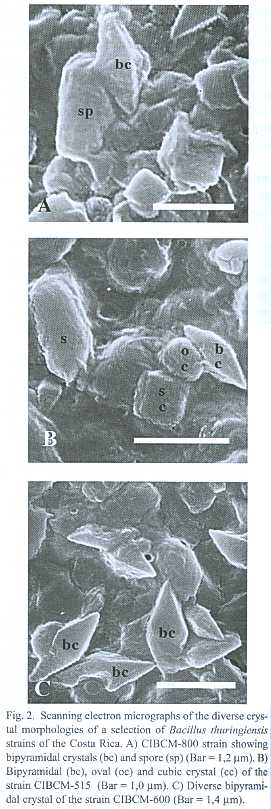
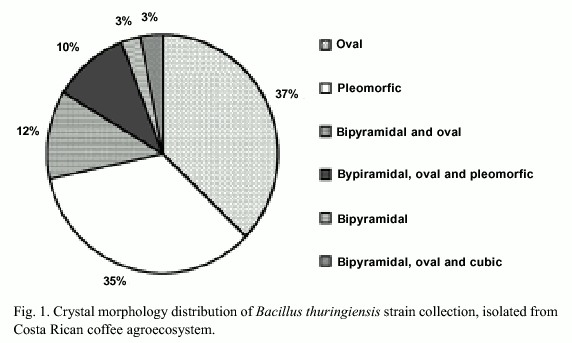
<body><![CDATA[<p><font face="Arial" size="2"><b>Polyacrylamide gel electrophoresis: </b>Spore-crystal suspensions were used for protein analyses in 10% SDS-polyacrylamide gels. Molecular weight markers (BIO-RAD 161-0304) were used to determine the molecular weight of the proteins.</font></p> <font face="Arial" size="2"><b></b></font>     <p><font face="Arial" size="2"><b>DNA extractions: </b>The protocol for DNA extraction described by <a href="#ch93">Chen and Kuo (1993)</a> was used and DNA concentrations were estimated by fluorometry at 280 nm (Quantech fluorometer, model FM1 109535).</font></p> <font face="Arial" size="2"><b></b></font>     <p><font face="Arial" size="2"><b>PCR analysis: </b>The following primers were used: <i>cry1 </i>family <i>(cry1Aa, cry1Ab, cry1Ac, cry1Ad, cry1B, cry1C, cry1D, cry1E </i>and <i>cry1</i>F), <i>cry3-cry</i>7, <i>cry5-cry10, cry8, cry1</i>1, <i>cry12, cry1</i>4, <i>cyt </i>(<a  href="#br98">Bravo <i>et a</i>l. 1998</a>) <i>vip1, vip2 </i>and <i>vip3 </i>(Bravo 2003, personal communication) and <i>cry2 </i>(<a  href="#be97">Ben-Dov <i>et a</i>l. 1997</a>). PCR conditions were used as follows: 25 mM MgCl<sub>2</sub> , 10mM dNTPs, 20 µM of each primer and 2,5 U Taq polymerase. In addition, 1µl of DNA at a concentration of 25 ng/µl was used. The PCR program was: one denaturing cycle of 2 min at 95°C, 30 cycles of 1 min at 95°C, 1 min at 48-54°C, 1 min at 72°C, and a final extension cycle of 5 min at 72°C. PCR products were analyzed by gel electrophoresis in 1% agarose gels. </font></p> <font face="Arial" size="2"><b>     <p>Results </p> </b> </font>     <p><font face="Arial" size="2">Three hundred strains out of a total of 641 environmental samples examined showed colonial morphology similar to <i>Bacillus thuringiensi</i>s. Light microscopy demonstrated that 202 strains presented diverse crystal morphologies: pleomorphic (35%), oval (37%), bipyramidal (3%), bipyramidal and oval (12%), bipyramidal, oval and pleomorphic (10%), bipyramidal, oval and cubic (3%) (<a  href="#f1">Fig. 1</a>). Crystal diversity was confirmed using scanning electron microscopy, showing that some strains presented the crystal adhered to the spore (<a href="#f2">Fig. 2</a>).</font></p>     <p style="text-align: center;"><font face="Arial" size="2">&nbsp;<a  name="f1"></a><img src="/img/fbpe/rbt/v52n3/3090i1.JPG" title=""  alt="" style="width: 572px; height: 343px;">    
<br>     <br> </font></p> <a name="f2"></a>     <div style="text-align: center;"><img  src="/img/fbpe/rbt/v52n3/3090i2.JPG" title="" alt=""  style="width: 271px; height: 809px;"></div>     
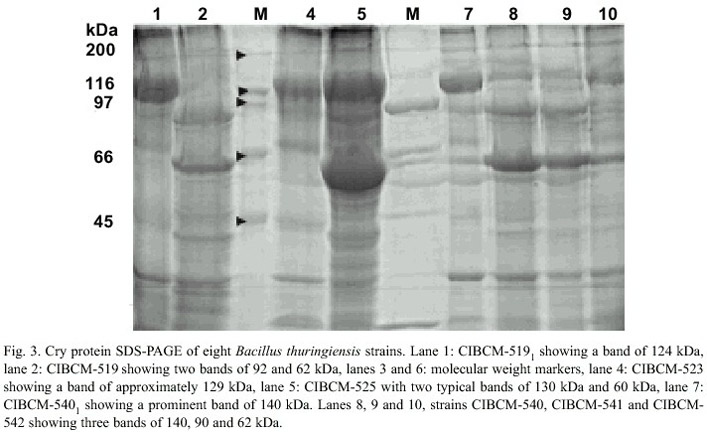
<p><font face="Arial" size="2">Strains that presented crystals were later analyzed by SDS-PAGE to estimate the molecular weight of the Cry proteins. <i>B. thuringiensis </i>strains presented <font  face="Symbol">d</font> -endotoxins with MWs between 20 and 145 kDa but the most common pattern was composed of proteins with MWs between 60-140 kDa (<a href="#f3">Fig. 3</a>). Five strains presented <font face="Symbol">d</font> -endotoxin from 20 to 40 kDa, six from 40 to 50 kDa, seven from 50 to 60 kDa, 19 from 60 to 70 kDa, 29 from 70 to 100 kDa and 39 from 100-145 kDa. </font></p> <a name="f3"></a>     ]]></body>
<body><![CDATA[<div style="text-align: left;"><img src="/img/fbpe/rbt/v52n3/3090i3.JPG" title=""  alt="" style="width: 707px; height: 432px;">    
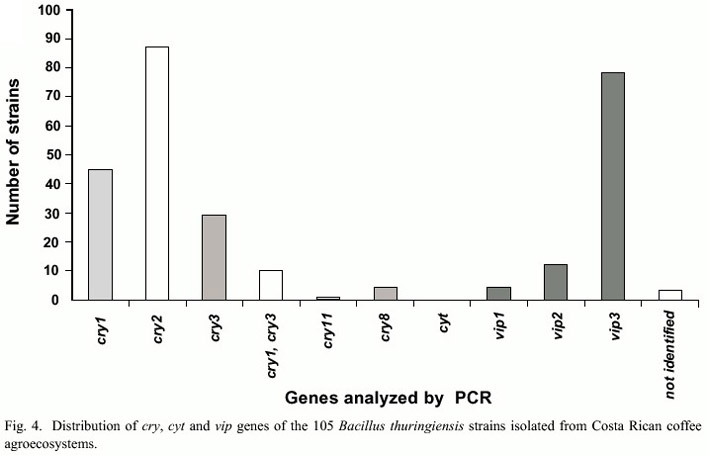
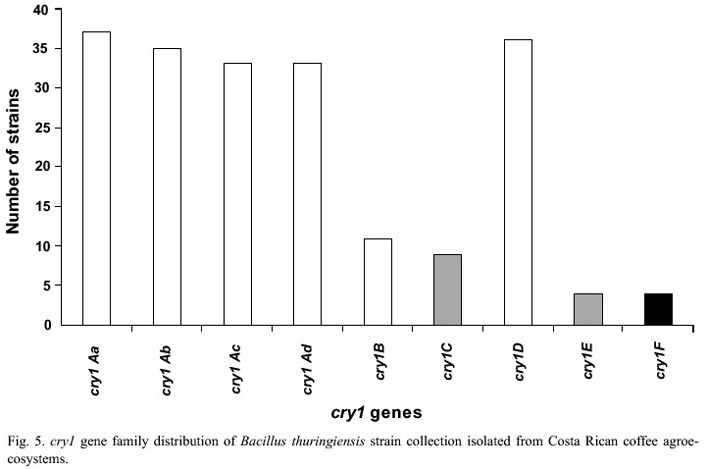
<br> </div>     <p><font face="Arial" size="2">PCR analyses showed that from a total of 105 strains, 82 had the <i>cry2 </i>gene, 45 <i>cry</i>1, 29 <i>cry3-cry7 </i>and 78 the <i>vip3 </i>gene. No amplification was observed for the <i>cry5, cry14, </i>and <i>cry12 </i>and <i>cyt </i>genes. Only one strain amplified with <i>cry11 </i>(<a href="#f4">Fig. 4</a>). The 45 strains that amplified with the general primer for <i>cry1 </i>family were further characterized with specific primers for this subfamily. It was observed that 36 strains presented <i>cry1</i>D, 37 <i>cry1Aa, </i>35 <i>cry1Ab </i>and 33 <i>cry1Ac </i>genes, in contrast to other genes that were less frequent, such as <i>cry1E </i>(4 strains) or <i>cry1F </i>genes (4 strains) (<a href="#f5">Fig. 5</a>). A total of 43 different genetic profiles were found, mainly due to the combination of <i>cry1A </i>genes with other <i>cry </i>and <i>vip </i>genes. It was also frequent to find strains that presented combinations of the <i>cry1, cry2 </i>and <i>cry</i>3<i>-cry</i>7genes. In addition two strains presented the genes <i>cry1, cry3-cry7 </i>and <i>cry</i>8. Ten strains only amplified with the <i>vip3 </i>primers and three did not amplified with any of the primers used. </font></p> <a name="f4"></a>     <div style="text-align: center;">     <div style="text-align: left;"><img src="/img/fbpe/rbt/v52n3/3090i4.JPG" title=""  alt="" style="width: 707px; height: 455px;">    
<br> </div>     <br>     <br> <a name="f5"></a>    <br>     <div style="text-align: left;"><img src="/img/fbpe/rbt/v52n3/3090i5.JPG" title=""  alt="" style="width: 707px; height: 469px;">    
]]></body>
<body><![CDATA[<br> </div> </div> <font face="Arial" size="2"><b>     <p>Discussion</p> </b> </font>     <p><font face="Arial" size="2">A collection of 202 <i>B. thuringiensis </i>strains were isolated from Costa Rican coffee plantations infested with <i>H. hampe</i>i. These strains were analyzed by light microscopy, providing evidence that they produce parasporal crystals. The great diversity observed in crystal morphology for a given strain and between strains could be related to the presence of different and novel <font face="Symbol">d</font> -endotoxins (<a href="#f2">Fig 2</a>), particularly for those strains that did not amplified with any of the primers tested. These strains may contain insecticidal proteins with specificity towards other insect orders.</font></p>     <p><font face="Arial" size="2"> It is interesting to notice that while most of the <i>B. thuringiensis </i>strains produce free crystals in the mother cell compartment, it was observed that some presented the crystal adhered to the spore. It is well known that the spore and crystal are liberated to the environment by the action of lytic enzymes that destroy the membrane that contains them (<a href="#be76">Bechtel &amp; Bulla 1976</a>). However, the absence of this step in some strains of this collection is similar to the one observed in <i>Bacillus sphaericu</i>s, were the binary protein crystal is adhered to the spore and covered by the exosporium membrane.</font></p>     <p><font face="Arial" size="2">The diversity of molecular weights of the&nbsp;<img src="/img/fbpe/rbt/v52n3/DE.JPG" title="" alt=""  style="width: 9px; height: 14px;"> -endotoxins observed in the SDS-PAGE analyses, suggest that there are strains expressing different Cry proteins that could be toxic against coleopterans, like Cry3 (73- kDa), Cry7 (130-kDa), Cry8 (130-kDa), Cry1B (140-kDa), Cry34 (14-kDa), Cry37 (14-kDa), Cry23 (29-kDa), Cry22 (76-kDa) and Cry35 (44-kDa). It is also interesting to notice that strains with low MWs of 20 to 40 kDa did not amplified with <i>cyt </i>genes, so they could contain other type of insecticidal proteins like <i>cry1</i>5. In addition, strains that only amplified with <i>vip3 </i>genes, presented proteins in the SDS-PAGE with MWs similar to Cry proteins, which suggests that they may contain other Cry proteins.</font></p>     
<p><font face="Arial" size="2">The identification of <i>cry, cyt </i>and <i>vip </i>genes in the <i>B. thuringiensis </i>collection is important, since the biological activity of several Cry proteins is known. This allows the selection of strains to be used in the bioassays for specific insect species (<a href="#sa97">Samsonov <i>et a</i>l. 1997</a>). The abundance of strains containing <i>vi</i>p3 genes (74%) is a novel finding, if compared to the 15% previously reported by <a  href="#es96">Estruch and collaborators (1996)</a>. Vip3 protein has been reported to be toxic for lepidopterans. On the other hand, the genes that code for the Vip1 and Vip2 proteins described as toxic to coleopterans, were found in lower frequencies, but always associated to the <i>vip3 </i>gene. </font></p>     <p><font face="Arial" size="2">The most common <i>cry </i>genes found in nature are those within the <i>cry1 </i>subfamily (<a href="#po03">Porcar and Juárez-Pérez 2003</a>). The most abundant gene found in our collection was <i>cry</i>2, and the second most abundant was the <i>cry1 </i>gene family. Several reports show a high frequency of certain <i>cry1 </i>gene combinations, for example the linkage <i>cry1C-cry1D </i>(<a  href="#br98">Bravo <i>et a</i>l. 1998</a>, <a href="#fe99">Ferrandis <i>et a</i>l. 1999</a><i>). </i>The <i>cry1C-cry1D </i>linkage may be explained by their common location on the same replicon (<a  href="#sa88">Sanchis <i>et al. </i>1988</a>). However, in this study <i>cry1D </i>gene was found alone at a relatively high frequency (24 strains) and only 7 strains presented such linkage. The absence of <i>cry1C </i>may be the result of a deletion or a negative selection of <i>cry1C </i>from an ancestral <i>cry1C-cry1D </i>linkage (<a href="#fe99">Ferrandis <i>et a</i>l. 1999</a>). One interesting observation was the high frequency of <i>cry1D </i>in combination with those of the subfamily <i>cry1</i>A. The opposite case was observed with the <i>cry1E </i>and <i>cry1F </i>genes, since only eight strains contained these genes. It is also known that <i>cry1B </i>is found at low frequency (Porcar and Juárez-Pérez), however eleven strains of this collection contained this gene; this could be relevant for the purpose of this study because of the known activity of <i>cry1B </i>against coleopterans.</font></p>     <p><font face="Arial" size="2">Strains with the <i>cry3-cry7 </i>and <i>cry8 </i>genes are also important in our collection due to their activity against coleopterans (<a href="#be86">Bernhard <i>et a</i>l. 1986</a>). The abundance of these genes in this collection is similar to their prevalence in the collection reported by <a href="#br98">Bravo <i>et a</i>l. (1998)</a>. In total, there are 40 strains with toxic potential for coleopterans: 36 strains containing the <i>cry 3-cry7 </i>genes and four strains with <i>cry 8 </i>genes, in addition to eleven strains that have the <i>cry1B </i>genes. However, the strains that did not amplified with <i>cry3, cry7, cry8 </i>and <i>cry1B </i>genes, should be tested in bioassays with <i>H. hampei </i>because they might contain other genes of interest. It is important to notice that even though no <i>B. thuringiensis israelensi</i>s-like strains were isolated from coffee plantations, there are several <i>Bti </i>strains isolated from Costa Rican National Parks (<a href="#ar03">Arrieta 2003</a>) that could be tested against the coffee berry borer since this strain was recently reported toxic to <i>H. hampei </i>(<a href="#me03">Méndez-Lopéz <i>et al. </i>2003</a>). In conclusion, CIBCM-<i>B. thuringiensis </i>collections might contain strains with potential activities against <i>H. hampei </i>as well as other Cry proteins active against other insect species, therefore, they will be tested in bioassays against specific insect pests in the future. </font></p> <font face="Arial" size="2"><b>     <p>Acknowledgments </p> </b> </font>     <p><font face="Arial" size="2">We want to acknowledge the Fundación para la Cooperación Costa Rica-Estados Unidos de América (CR.USA) and the Programa de Cooperación del Gobierno de México for the financial support of the project. We express our acknowledgment to CYTED for supporting the Bt-network of which our laboratory is part. We also thank Alejandra Bravo from the Instituto de Biotecnología de la Universidad Autonoma de México, for critically reading the manuscript. </font></p> <font face="Arial" size="2"><b>     ]]></body>
<body><![CDATA[<p>Resumen</p> </b> </font>     <p><font face="Arial" size="2">En el año 2000 se reportó por primera vez la principal plaga del cafeto, conocida como broca <i>(Hypothenemus hampei </i>Ferrar<i>i) </i>(Coleoptera: Scolitidae) en plantaciones de este cultivo en Costa Rica. Debido al impacto que esta plaga tiene en la economía del país, surgió la necesidad de encontrar una alternativa para el control biológico de esta plaga, basadas en la bacteria entomopatógena <i>Bacillus thuringiensi</i>s. El objetivo de este trabajo fue aislar y caracterizar cepas de <i>Bacillus thuringiensis </i>a partir de plantaciones de café infestadas con <i>H. hampe</i>i. Se aislaton 202 cepas que se analizaron mediante la morfología del cristal, SDS-PAGE de las <font face="Symbol">d</font> -endotoxinas, mientras que 105 cepas se evaluaron mediante PCR para determinar la presencia de genes <i>cry, cyt y vi</i>p. La mayoría de las cepas presentaron diversas morfologías del cristal: pleomórficos (35%), ovalados (37%), bipiramidales (3%), bipiramidales y ovalados (12%), bipiramidales, ovalados y pleomórficos (10%) y bipiramidales, ovalados y cúbicos (3%). El análisis electorforético de las proteínas mostró que 5 cepas contenían <font face="Symbol">d</font> -endotoxinas con pesos moleculares entre los 20 y 40 kDa, 6 entre los 40 y 50 kDa, 7 entre los 50 y 60 kDa, 19 cepas entre los 60 y 70 kDa, 29 entre los 70 y 100 kDa y 39 cepas entre los 100 y 145 kDa. Los análisis mediante PCR mostró que la colección presenta una gran diversidad de genes <i>cr</i>y, observándose varios genes por cepa: 78 cepas presentaron el gen <i>vip</i>3, 82 el gen <i>cry</i>2, 45 el gen <i>cry1 </i>y 29 cepas los genes <i>cry3 </i>y <i>cry</i>7. Un total de 13 cepas no amplificaron con los iniciadores <i>cry1, cry2, cry3-7, cry5, cry11cry12 y cry1</i>4. Se encontraron 43 perfiles genéticos diferentes, detectándose principalmente la combinación de genes <i>cry1A </i>con otros genes <i>cry </i>o <i>vip. </i>La caracterización genética de esta colección provee información importante para la selección de cepas de <i>Bacillus thuringiensis </i>que se evaluarán mediante bioensayos contra <i>Hypothenemus hampei </i>u otras plagas de importancia económica.</font></p> <font face="Arial" size="2"><b>     <p>References</p> </b> </font>     <!-- ref --><p><font face="Arial" size="2"><a name="ap95"></a>Apoyolo, C.I., L. Drif, J.M.Vassal, H. Debarjac, J.P. Bossy, F. Leclant &amp; R. Frutos. 1995. Isolation of multiple subspecies of <i>Bacillus thuringiensis </i>from a population of the European sunflower moth, <i>Homoeosoma nebulell</i>a. Appl. Environ. Microbiol. 61: 4343-4347.</font>&nbsp;&nbsp;&nbsp;&nbsp;&nbsp;&nbsp;&nbsp;&nbsp;[&#160;<a href="javascript:void(0);" onclick="javascript: window.open('/scielo.php?script=sci_nlinks&ref=1334568&pid=S0034-7744200400030003600001&lng=','','width=640,height=500,resizable=yes,scrollbars=1,menubar=yes,');">Links</a>&#160;]<!-- end-ref --><!-- ref --><p><font face="Arial" size="2"><a name="ar03"></a>Arrieta, G. 2003. Caracterización molecular de las <font face="Symbol">d</font> -endotoxinas de una colección de <i>Bacillus thuringiensis </i>aislada a partir de ecosistemas silvestres y agrícolas de Costa Rica. Tesis de Maestría, Universidad de Costa Rica, San José, Costa Rica. 110 p.</font>&nbsp;&nbsp;&nbsp;&nbsp;&nbsp;&nbsp;&nbsp;&nbsp;[&#160;<a href="javascript:void(0);" onclick="javascript: window.open('/scielo.php?script=sci_nlinks&ref=1334569&pid=S0034-7744200400030003600002&lng=','','width=640,height=500,resizable=yes,scrollbars=1,menubar=yes,');">Links</a>&#160;]<!-- end-ref --><!-- ref --><p><font face="Arial" size="2"><a name="be76"></a>Bechtel, D. B. &amp; L.A. Bulla. 1976. Electron microscopic study of sporulation and parasporal formation in <i>Bacillus thuringiensi</i>s. J. Bacteriol. 127: 1472-1481.</font>&nbsp;&nbsp;&nbsp;&nbsp;&nbsp;&nbsp;&nbsp;&nbsp;[&#160;<a href="javascript:void(0);" onclick="javascript: window.open('/scielo.php?script=sci_nlinks&ref=1334570&pid=S0034-7744200400030003600003&lng=','','width=640,height=500,resizable=yes,scrollbars=1,menubar=yes,');">Links</a>&#160;]<!-- end-ref --><!-- ref --><p><font face="Arial" size="2"><a name="ben97"></a>Ben-Dov, E., A. Zaritsky, E. Dahan, Z. Barak, R. Sinai, R. Manasherob, A. Khamraev, E. Troitskaya, A. Dubitsky, N. Berezina &amp; Y. Margalith. 1997. Extended screening by PCR for seven <i>cr</i>y-group genes from field-collected strains of <i>Bacillus thuringiensi</i>s. Appl. Environ. Microbiol. 63: 4883-4890.</font>&nbsp;&nbsp;&nbsp;&nbsp;&nbsp;&nbsp;&nbsp;&nbsp;[&#160;<a href="javascript:void(0);" onclick="javascript: window.open('/scielo.php?script=sci_nlinks&ref=1334571&pid=S0034-7744200400030003600004&lng=','','width=640,height=500,resizable=yes,scrollbars=1,menubar=yes,');">Links</a>&#160;]<!-- end-ref --><!-- ref --><p><font face="Arial" size="2"><a name="be86"></a>Bernhard, K. 1986. Studies on the delta-endotoxin of <i>Bacillus thuringiensis va</i>r. <i>Tenebrioni</i>s. FEMS Microbiol. Lett. 33: 261-265.</font>&nbsp;&nbsp;&nbsp;&nbsp;&nbsp;&nbsp;&nbsp;&nbsp;[&#160;<a href="javascript:void(0);" onclick="javascript: window.open('/scielo.php?script=sci_nlinks&ref=1334572&pid=S0034-7744200400030003600005&lng=','','width=640,height=500,resizable=yes,scrollbars=1,menubar=yes,');">Links</a>&#160;]<!-- end-ref --><!-- ref --><p><font face="Arial" size="2"><a name="be97"></a>Bernhard, K., Jarret P., M. Meadows, J. Butt, D.J. Ellis, G.M. Roberts, S. Pauli, P. Rogers &amp; H.D. Burges. 1997. Natural isolates of <i>Bacillus thuringiensi</i>s: worldwide distribution, characterization and activity against insect pest. J. Invertebr. Pathol. 70: 59-68.</font>&nbsp;&nbsp;&nbsp;&nbsp;&nbsp;&nbsp;&nbsp;&nbsp;[&#160;<a href="javascript:void(0);" onclick="javascript: window.open('/scielo.php?script=sci_nlinks&ref=1334573&pid=S0034-7744200400030003600006&lng=','','width=640,height=500,resizable=yes,scrollbars=1,menubar=yes,');">Links</a>&#160;]<!-- end-ref --><!-- ref --><p><font face="Arial" size="2"><a name="br89"></a>Brun, L.O., C. Marcillaud, V. Gaudichon &amp; D.M. Suckling. 1989. Endosulfan resistance in <i>Hypothenemus hampei </i>(Coleoptera: Scolytidae) in New Caledonia. J. Econ. Entomol. 82: 1312-1316.</font>&nbsp;&nbsp;&nbsp;&nbsp;&nbsp;&nbsp;&nbsp;&nbsp;[&#160;<a href="javascript:void(0);" onclick="javascript: window.open('/scielo.php?script=sci_nlinks&ref=1334574&pid=S0034-7744200400030003600007&lng=','','width=640,height=500,resizable=yes,scrollbars=1,menubar=yes,');">Links</a>&#160;]<!-- end-ref --><!-- ref --><p><font face="Arial" size="2"><a name="br98"></a>Bravo, A., S. Sarabia, L. López, H. Ontiveros, C. Abarca, A. Ortiz, M. Ortiz, L. Lina, J. Villalobos, G. Peña, V. Noez, M. Soberón &amp; R. Quintero. 1998. Characterization of <i>cry </i>genes in a Mexican <i>Bacillus thuringiensis </i>strain collection. Appl. Environ. Microbiol. 64: 4965- 4972.</font>&nbsp;&nbsp;&nbsp;&nbsp;&nbsp;&nbsp;&nbsp;&nbsp;[&#160;<a href="javascript:void(0);" onclick="javascript: window.open('/scielo.php?script=sci_nlinks&ref=1334575&pid=S0034-7744200400030003600008&lng=','','width=640,height=500,resizable=yes,scrollbars=1,menubar=yes,');">Links</a>&#160;]<!-- end-ref --><!-- ref --><p><font face="Arial" size="2"><a name="ca91"></a>Carozzi, N. B., V.C. Kramer, G. W. Warren, S. Evola &amp; M.G. Koziel. 1991. Prediction of insecticidal activity of <i>Bacillus thuringiensis </i>strains by polymerase chain reaction product profiles. Appl. Environ. Microbiol. 57: 3057-3061.</font>&nbsp;&nbsp;&nbsp;&nbsp;&nbsp;&nbsp;&nbsp;&nbsp;[&#160;<a href="javascript:void(0);" onclick="javascript: window.open('/scielo.php?script=sci_nlinks&ref=1334576&pid=S0034-7744200400030003600009&lng=','','width=640,height=500,resizable=yes,scrollbars=1,menubar=yes,');">Links</a>&#160;]<!-- end-ref --><!-- ref --><p><font face="Arial" size="2"><a name="ch93"></a>Chen W. &amp; T. Kuo. 1993. A simple and rapid method for the preparation of gram-negative bacterial genomic DNA. Nucleic Acid Research 21: 2260.</font>&nbsp;&nbsp;&nbsp;&nbsp;&nbsp;&nbsp;&nbsp;&nbsp;[&#160;<a href="javascript:void(0);" onclick="javascript: window.open('/scielo.php?script=sci_nlinks&ref=1334577&pid=S0034-7744200400030003600010&lng=','','width=640,height=500,resizable=yes,scrollbars=1,menubar=yes,');">Links</a>&#160;]<!-- end-ref --><!-- ref --><p><font face="Arial" size="2"><a name="es96"></a>Estruch, J.J., G.W. Warren, M.A. Mullins, G.J. Nye, J.A. Craig &amp; M.G. Koziel. 1996. Vip3A, a novel <i>Bacillus thuringiensis </i>vegetative insecticidal protein with a wide spectum of activities against lepidopteran insects. Proc. Natl. Acad. Sci. 93: 5389-5394.</font>&nbsp;&nbsp;&nbsp;&nbsp;&nbsp;&nbsp;&nbsp;&nbsp;[&#160;<a href="javascript:void(0);" onclick="javascript: window.open('/scielo.php?script=sci_nlinks&ref=1334578&pid=S0034-7744200400030003600011&lng=','','width=640,height=500,resizable=yes,scrollbars=1,menubar=yes,');">Links</a>&#160;]<!-- end-ref --><!-- ref --><p><font face="Arial" size="2"><a name="fe99"></a>Ferrandis, M. D., V. M. Juárez-Pérez, R. Frutos, Y. Bel &amp; J. Ferré. 1999. Distribution of <i>cry</i>1, <i>cryII </i>and <i>cryV </i>genes within <i>Bacillus thuringiensis </i>isolates from Spain. Syst. Appl. Microbiol. 22: 179-185. </font>&nbsp;&nbsp;&nbsp;&nbsp;&nbsp;&nbsp;&nbsp;&nbsp;[&#160;<a href="javascript:void(0);" onclick="javascript: window.open('/scielo.php?script=sci_nlinks&ref=1334579&pid=S0034-7744200400030003600012&lng=','','width=640,height=500,resizable=yes,scrollbars=1,menubar=yes,');">Links</a>&#160;]<!-- end-ref --><!-- ref --><p><font face="Arial" size="2"><a name="gu97"></a>Gustafson, M.E., R.A. Clayton, P.B. Lavrik, G.V. Jonhson, R.M. Leimgruber, S.R. Sims &amp; D.E. Bartnicki. 1997. Large-scale production and characterization of <i>Bacillus thuringiensis </i>subsp. <i>tenebrionis </i>insecticidal protein from <i>Escherichia col</i>i. Appl. Microbiol. Biotech. 47: 255-261.</font>&nbsp;&nbsp;&nbsp;&nbsp;&nbsp;&nbsp;&nbsp;&nbsp;[&#160;<a href="javascript:void(0);" onclick="javascript: window.open('/scielo.php?script=sci_nlinks&ref=1334580&pid=S0034-7744200400030003600013&lng=','','width=640,height=500,resizable=yes,scrollbars=1,menubar=yes,');">Links</a>&#160;]<!-- end-ref --><!-- ref --><p><font face="Arial" size="2"><a name="ha99"></a>Hatanaka, T., Y. Choi, T. Kusano &amp; H. Sano. 1999. Transgenic plants of coffee <i>Coffea arabica </i>from embryogenic callus via <i>Agrobacterium tumefacien</i>s-mediated transformation. Plant Cell Reports 19: 106-110.</font>&nbsp;&nbsp;&nbsp;&nbsp;&nbsp;&nbsp;&nbsp;&nbsp;[&#160;<a href="javascript:void(0);" onclick="javascript: window.open('/scielo.php?script=sci_nlinks&ref=1334581&pid=S0034-7744200400030003600014&lng=','','width=640,height=500,resizable=yes,scrollbars=1,menubar=yes,');">Links</a>&#160;]<!-- end-ref --><!-- ref --><p><font face="Arial" size="2"><a name="ki98"></a>Kim, H.S., D.W. Lee, S.D. Woo, Y.M. Yu &amp; S.K. Kang. 1998. Distribution, serological identification, and PCR analysis of <i>Bacillus thuringiensis </i>isolated from soils of Korea. Curr. Microbiol. 37: 195-20. </font>&nbsp;&nbsp;&nbsp;&nbsp;&nbsp;&nbsp;&nbsp;&nbsp;[&#160;<a href="javascript:void(0);" onclick="javascript: window.open('/scielo.php?script=sci_nlinks&ref=1334582&pid=S0034-7744200400030003600015&lng=','','width=640,height=500,resizable=yes,scrollbars=1,menubar=yes,');">Links</a>&#160;]<!-- end-ref --><!-- ref --><p><font face="Arial" size="2"><a name="le68"></a>Le Pelley, R.H. 1968. Pest of coffee. London, Longman. 590 p.</font>&nbsp;&nbsp;&nbsp;&nbsp;&nbsp;&nbsp;&nbsp;&nbsp;[&#160;<a href="javascript:void(0);" onclick="javascript: window.open('/scielo.php?script=sci_nlinks&ref=1334583&pid=S0034-7744200400030003600016&lng=','','width=640,height=500,resizable=yes,scrollbars=1,menubar=yes,');">Links</a>&#160;]<!-- end-ref --><!-- ref --><p><font face="Arial" size="2"><a name="me03"></a>Méndez-López, I., R. Basurto-Ríos &amp; J. Ibarra. 2003. <i>Bacillus thuringiensis </i>serovar <i>israelensis </i>is highly toxic to the coffee berry borer, <i>Hypothenemus hampei </i>Ferr. (Coleoptera: Scolytidae). FEMS Microbiol. Lett. 11131: 1-5.</font>&nbsp;&nbsp;&nbsp;&nbsp;&nbsp;&nbsp;&nbsp;&nbsp;[&#160;<a href="javascript:void(0);" onclick="javascript: window.open('/scielo.php?script=sci_nlinks&ref=1334584&pid=S0034-7744200400030003600017&lng=','','width=640,height=500,resizable=yes,scrollbars=1,menubar=yes,');">Links</a>&#160;]<!-- end-ref --><!-- ref --><p><font face="Arial" size="2"><a name="po03"></a>Porcar, M. &amp; V. Juárez-Pérez. 2003. PCR-based identification of <i>Bacillus thuringiensis </i>pesticidal crystal genes. FEMS Microbiol. Rev. 26: 419-432.</font>&nbsp;&nbsp;&nbsp;&nbsp;&nbsp;&nbsp;&nbsp;&nbsp;[&#160;<a href="javascript:void(0);" onclick="javascript: window.open('/scielo.php?script=sci_nlinks&ref=1334585&pid=S0034-7744200400030003600018&lng=','','width=640,height=500,resizable=yes,scrollbars=1,menubar=yes,');">Links</a>&#160;]<!-- end-ref --><!-- ref --><p><font face="Arial" size="2"><a name="sa97"></a>Samsonov, P., R.I. Padrón, C. Pardo, J. Cabrera &amp; G.A. De al Riva. 1997. <i>Bacillus thuringiensis </i>from biodiversity to biotechnology. J. Ind. Microbiol. Biotech. 19: 202-219.</font>&nbsp;&nbsp;&nbsp;&nbsp;&nbsp;&nbsp;&nbsp;&nbsp;[&#160;<a href="javascript:void(0);" onclick="javascript: window.open('/scielo.php?script=sci_nlinks&ref=1334586&pid=S0034-7744200400030003600019&lng=','','width=640,height=500,resizable=yes,scrollbars=1,menubar=yes,');">Links</a>&#160;]<!-- end-ref --><!-- ref --><p><font face="Arial" size="2"><a name="sa88"></a>Sanchis, V., D. Lereclus, G. Menou, J. Chaufaux &amp; M.M. Lecadet. 1988. Multiplicity of <font face="Symbol">d</font> -endotoxin genes with different specificities in <i>Bacillus thuringiensis aizawa</i>i. Mol. Microbiol. 2: 393-404.</font>&nbsp;&nbsp;&nbsp;&nbsp;&nbsp;&nbsp;&nbsp;&nbsp;[&#160;<a href="javascript:void(0);" onclick="javascript: window.open('/scielo.php?script=sci_nlinks&ref=1334587&pid=S0034-7744200400030003600020&lng=','','width=640,height=500,resizable=yes,scrollbars=1,menubar=yes,');">Links</a>&#160;]<!-- end-ref --><!-- ref --><p><font face="Arial" size="2"><a name="sc98"></a>Schnepf, H.E., N. Crickmore, N. Van Rie, J. Dereclus, J. Baum, J. Feitelson, D.R. Zeigler &amp; D.H. Dean. 1998. <i>Bacillus thuringiensis </i>and its pesticidal crystal proteins. Microbiol. Mol. Biol. Rev. 62: 775-806.</font>&nbsp;&nbsp;&nbsp;&nbsp;&nbsp;&nbsp;&nbsp;&nbsp;[&#160;<a href="javascript:void(0);" onclick="javascript: window.open('/scielo.php?script=sci_nlinks&ref=1334588&pid=S0034-7744200400030003600021&lng=','','width=640,height=500,resizable=yes,scrollbars=1,menubar=yes,');">Links</a>&#160;]<!-- end-ref --><!-- ref --><p><font face="Arial" size="2"><a name="tr87"></a>Travers, R. S., P.A.W. Martin &amp; C.F. Reichelderfer. 1987. Selective process for efficient isolation of soil <i>Bacillus </i>spp. Appl. Environ. Microbiol. 53: 1263-1266.</font>&nbsp;&nbsp;&nbsp;&nbsp;&nbsp;&nbsp;&nbsp;&nbsp;[&#160;<a href="javascript:void(0);" onclick="javascript: window.open('/scielo.php?script=sci_nlinks&ref=1334589&pid=S0034-7744200400030003600022&lng=','','width=640,height=500,resizable=yes,scrollbars=1,menubar=yes,');">Links</a>&#160;]<!-- end-ref --><p><font face="Arial" size="2">&nbsp;</font></p>      ]]></body><back>
<ref-list>
<ref id="B1">
<nlm-citation citation-type="journal">
<person-group person-group-type="author">
<name>
<surname><![CDATA[Apoyolo]]></surname>
<given-names><![CDATA[C.I]]></given-names>
</name>
<name>
<surname><![CDATA[Drif]]></surname>
<given-names><![CDATA[L]]></given-names>
</name>
<name>
<surname><![CDATA[Vassal]]></surname>
<given-names><![CDATA[J.M]]></given-names>
</name>
<name>
<surname><![CDATA[Debarjac]]></surname>
<given-names><![CDATA[H]]></given-names>
</name>
<name>
<surname><![CDATA[Bossy]]></surname>
<given-names><![CDATA[J.P]]></given-names>
</name>
<name>
<surname><![CDATA[Leclant]]></surname>
<given-names><![CDATA[F]]></given-names>
</name>
<name>
<surname><![CDATA[Frutos]]></surname>
<given-names><![CDATA[R]]></given-names>
</name>
</person-group>
<article-title xml:lang="en"><![CDATA[Isolation of multiple subspecies of Bacillus thuringiensis from a population of the European sunflower moth, Homoeosoma nebulella]]></article-title>
<source><![CDATA[Appl. Environ. Microbiol]]></source>
<year>1995</year>
<volume>61</volume>
<page-range>4343-4347</page-range></nlm-citation>
</ref>
<ref id="B2">
<nlm-citation citation-type="">
<person-group person-group-type="author">
<name>
<surname><![CDATA[Arrieta]]></surname>
<given-names><![CDATA[G]]></given-names>
</name>
</person-group>
<source><![CDATA[Caracterización molecular de las delta -endotoxinas de una colección de Bacillus thuringiensis aislada a partir de ecosistemas silvestres y agrícolas de Costa Rica]]></source>
<year>2003</year>
<page-range>110</page-range></nlm-citation>
</ref>
<ref id="B3">
<nlm-citation citation-type="journal">
<person-group person-group-type="author">
<name>
<surname><![CDATA[Bechtel]]></surname>
<given-names><![CDATA[D. B]]></given-names>
</name>
<name>
<surname><![CDATA[Bulla]]></surname>
<given-names><![CDATA[L.A]]></given-names>
</name>
</person-group>
<article-title xml:lang="en"><![CDATA[Electron microscopic study of sporulation and parasporal formation in Bacillus thuringiensis]]></article-title>
<source><![CDATA[J. Bacteriol]]></source>
<year>1976</year>
<volume>127</volume>
<page-range>1472-1481</page-range></nlm-citation>
</ref>
<ref id="B4">
<nlm-citation citation-type="journal">
<person-group person-group-type="author">
<name>
<surname><![CDATA[Ben-Dov]]></surname>
<given-names><![CDATA[E]]></given-names>
</name>
<name>
<surname><![CDATA[Zaritsky]]></surname>
<given-names><![CDATA[A]]></given-names>
</name>
<name>
<surname><![CDATA[Dahan]]></surname>
<given-names><![CDATA[E]]></given-names>
</name>
<name>
<surname><![CDATA[Barak]]></surname>
<given-names><![CDATA[Z]]></given-names>
</name>
<name>
<surname><![CDATA[Sinai]]></surname>
<given-names><![CDATA[R]]></given-names>
</name>
<name>
<surname><![CDATA[Manasherob]]></surname>
<given-names><![CDATA[R]]></given-names>
</name>
<name>
<surname><![CDATA[Khamraev]]></surname>
<given-names><![CDATA[A]]></given-names>
</name>
<name>
<surname><![CDATA[Troitskaya]]></surname>
<given-names><![CDATA[E]]></given-names>
</name>
<name>
<surname><![CDATA[Dubitsky]]></surname>
<given-names><![CDATA[A]]></given-names>
</name>
<name>
<surname><![CDATA[Berezina]]></surname>
<given-names><![CDATA[N]]></given-names>
</name>
<name>
<surname><![CDATA[Margalith]]></surname>
<given-names><![CDATA[Y]]></given-names>
</name>
</person-group>
<article-title xml:lang="en"><![CDATA[Extended screening by PCR for seven cry-group genes from field-collected strains of Bacillus thuringiensis]]></article-title>
<source><![CDATA[Appl. Environ. Microbiol]]></source>
<year>1997</year>
<volume>63</volume>
<page-range>4883-4890</page-range></nlm-citation>
</ref>
<ref id="B5">
<nlm-citation citation-type="journal">
<person-group person-group-type="author">
<name>
<surname><![CDATA[Bernhard]]></surname>
<given-names><![CDATA[K]]></given-names>
</name>
</person-group>
<article-title xml:lang="en"><![CDATA[Studies on the delta-endotoxin of Bacillus thuringiensis var. Tenebrionis]]></article-title>
<source><![CDATA[FEMS Microbiol. Lett]]></source>
<year>1986</year>
<volume>33</volume>
<page-range>261-265</page-range></nlm-citation>
</ref>
<ref id="B6">
<nlm-citation citation-type="journal">
<person-group person-group-type="author">
<name>
<surname><![CDATA[Bernhard]]></surname>
<given-names><![CDATA[K]]></given-names>
</name>
<name>
<surname><![CDATA[Jarret]]></surname>
<given-names><![CDATA[P]]></given-names>
</name>
<name>
<surname><![CDATA[Meadows]]></surname>
<given-names><![CDATA[M]]></given-names>
</name>
<name>
<surname><![CDATA[Butt]]></surname>
<given-names><![CDATA[J]]></given-names>
</name>
<name>
<surname><![CDATA[Ellis]]></surname>
<given-names><![CDATA[D.J]]></given-names>
</name>
<name>
<surname><![CDATA[Roberts]]></surname>
<given-names><![CDATA[G.M]]></given-names>
</name>
<name>
<surname><![CDATA[Pauli]]></surname>
<given-names><![CDATA[S]]></given-names>
</name>
<name>
<surname><![CDATA[Rogers]]></surname>
<given-names><![CDATA[P]]></given-names>
</name>
<name>
<surname><![CDATA[Burges]]></surname>
<given-names><![CDATA[H.D]]></given-names>
</name>
</person-group>
<article-title xml:lang="en"><![CDATA[Natural isolates of Bacillus thuringiensis: worldwide distribution, characterization and activity against insect pest]]></article-title>
<source><![CDATA[J. Invertebr. Pathol]]></source>
<year>1997</year>
<volume>70</volume>
<page-range>59-68</page-range></nlm-citation>
</ref>
<ref id="B7">
<nlm-citation citation-type="journal">
<person-group person-group-type="author">
<name>
<surname><![CDATA[Brun]]></surname>
<given-names><![CDATA[L.O]]></given-names>
</name>
<name>
<surname><![CDATA[Marcillaud]]></surname>
<given-names><![CDATA[C]]></given-names>
</name>
<name>
<surname><![CDATA[Gaudichon]]></surname>
<given-names><![CDATA[V]]></given-names>
</name>
<name>
<surname><![CDATA[Suckling]]></surname>
<given-names><![CDATA[D.M]]></given-names>
</name>
</person-group>
<article-title xml:lang="en"><![CDATA[Endosulfan resistance in Hypothenemus hampei (Coleoptera: Scolytidae) in New Caledonia]]></article-title>
<source><![CDATA[J. Econ. Entomol]]></source>
<year>1989</year>
<volume>82</volume>
<page-range>1312-1316</page-range></nlm-citation>
</ref>
<ref id="B8">
<nlm-citation citation-type="journal">
<person-group person-group-type="author">
<name>
<surname><![CDATA[Bravo]]></surname>
<given-names><![CDATA[A]]></given-names>
</name>
<name>
<surname><![CDATA[Sarabia]]></surname>
<given-names><![CDATA[S]]></given-names>
</name>
<name>
<surname><![CDATA[López]]></surname>
<given-names><![CDATA[L]]></given-names>
</name>
<name>
<surname><![CDATA[Ontiveros]]></surname>
<given-names><![CDATA[H]]></given-names>
</name>
<name>
<surname><![CDATA[Abarca]]></surname>
<given-names><![CDATA[C]]></given-names>
</name>
<name>
<surname><![CDATA[Ortiz]]></surname>
<given-names><![CDATA[A]]></given-names>
</name>
<name>
<surname><![CDATA[Ortiz]]></surname>
<given-names><![CDATA[M]]></given-names>
</name>
<name>
<surname><![CDATA[Lina]]></surname>
<given-names><![CDATA[L]]></given-names>
</name>
<name>
<surname><![CDATA[Villalobos]]></surname>
<given-names><![CDATA[J]]></given-names>
</name>
<name>
<surname><![CDATA[Peña]]></surname>
<given-names><![CDATA[G]]></given-names>
</name>
<name>
<surname><![CDATA[Noez]]></surname>
<given-names><![CDATA[V]]></given-names>
</name>
<name>
<surname><![CDATA[Soberón]]></surname>
<given-names><![CDATA[M]]></given-names>
</name>
<name>
<surname><![CDATA[Quintero]]></surname>
<given-names><![CDATA[R]]></given-names>
</name>
</person-group>
<article-title xml:lang="en"><![CDATA[Characterization of cry genes in a Mexican Bacillus thuringiensis strain collection]]></article-title>
<source><![CDATA[Appl. Environ. Microbiol]]></source>
<year>1998</year>
<volume>64</volume>
<page-range>4965- 4972</page-range></nlm-citation>
</ref>
<ref id="B9">
<nlm-citation citation-type="journal">
<person-group person-group-type="author">
<name>
<surname><![CDATA[Carozzi]]></surname>
<given-names><![CDATA[N. B]]></given-names>
</name>
<name>
<surname><![CDATA[Kramer]]></surname>
<given-names><![CDATA[V.C]]></given-names>
</name>
<name>
<surname><![CDATA[Warren]]></surname>
<given-names><![CDATA[G. W]]></given-names>
</name>
<name>
<surname><![CDATA[Evola]]></surname>
<given-names><![CDATA[S]]></given-names>
</name>
<name>
<surname><![CDATA[Koziel]]></surname>
<given-names><![CDATA[M.G]]></given-names>
</name>
</person-group>
<article-title xml:lang="en"><![CDATA[Prediction of insecticidal activity of Bacillus thuringiensis strains by polymerase chain reaction product profiles]]></article-title>
<source><![CDATA[Appl. Environ. Microbiol]]></source>
<year>1991</year>
<volume>57</volume>
<page-range>3057-3061</page-range></nlm-citation>
</ref>
<ref id="B10">
<nlm-citation citation-type="journal">
<person-group person-group-type="author">
<name>
<surname><![CDATA[Chen]]></surname>
<given-names><![CDATA[W]]></given-names>
</name>
<name>
<surname><![CDATA[Kuo]]></surname>
<given-names><![CDATA[T]]></given-names>
</name>
</person-group>
<article-title xml:lang="en"><![CDATA[A simple and rapid method for the preparation of gram-negative bacterial genomic DNA]]></article-title>
<source><![CDATA[Nucleic Acid Research]]></source>
<year>1993</year>
<volume>21</volume>
<page-range>2260</page-range></nlm-citation>
</ref>
<ref id="B11">
<nlm-citation citation-type="journal">
<person-group person-group-type="author">
<name>
<surname><![CDATA[Estruch]]></surname>
<given-names><![CDATA[J.J]]></given-names>
</name>
<name>
<surname><![CDATA[Warren]]></surname>
<given-names><![CDATA[G.W]]></given-names>
</name>
<name>
<surname><![CDATA[Mullins]]></surname>
<given-names><![CDATA[M.A]]></given-names>
</name>
<name>
<surname><![CDATA[Nye]]></surname>
<given-names><![CDATA[G.J]]></given-names>
</name>
<name>
<surname><![CDATA[Craig]]></surname>
<given-names><![CDATA[J.A]]></given-names>
</name>
<name>
<surname><![CDATA[Koziel]]></surname>
<given-names><![CDATA[M.G]]></given-names>
</name>
</person-group>
<article-title xml:lang="en"><![CDATA[Vip3A, a novel Bacillus thuringiensis vegetative insecticidal protein with a wide spectum of activities against lepidopteran insects]]></article-title>
<source><![CDATA[Proc. Natl. Acad. Sci]]></source>
<year>1996</year>
<volume>93</volume>
<page-range>5389-5394</page-range></nlm-citation>
</ref>
<ref id="B12">
<nlm-citation citation-type="journal">
<person-group person-group-type="author">
<name>
<surname><![CDATA[Ferrandis]]></surname>
<given-names><![CDATA[M. D]]></given-names>
</name>
<name>
<surname><![CDATA[Juárez-Pérez]]></surname>
<given-names><![CDATA[V. M]]></given-names>
</name>
<name>
<surname><![CDATA[Frutos]]></surname>
<given-names><![CDATA[R]]></given-names>
</name>
<name>
<surname><![CDATA[Bel]]></surname>
<given-names><![CDATA[Y]]></given-names>
</name>
<name>
<surname><![CDATA[Ferré]]></surname>
<given-names><![CDATA[J]]></given-names>
</name>
</person-group>
<article-title xml:lang="en"><![CDATA[Distribution of cry1, cryII and cryV genes within Bacillus thuringiensis isolates from Spain]]></article-title>
<source><![CDATA[Syst. Appl. Microbiol]]></source>
<year>1999</year>
<volume>22</volume>
<page-range>179-185</page-range></nlm-citation>
</ref>
<ref id="B13">
<nlm-citation citation-type="journal">
<person-group person-group-type="author">
<name>
<surname><![CDATA[Gustafson]]></surname>
<given-names><![CDATA[M.E]]></given-names>
</name>
<name>
<surname><![CDATA[Clayton]]></surname>
<given-names><![CDATA[R.A]]></given-names>
</name>
<name>
<surname><![CDATA[Lavrik]]></surname>
<given-names><![CDATA[P.B]]></given-names>
</name>
<name>
<surname><![CDATA[Jonhson]]></surname>
<given-names><![CDATA[G.V]]></given-names>
</name>
<name>
<surname><![CDATA[Leimgruber]]></surname>
<given-names><![CDATA[R.M]]></given-names>
</name>
<name>
<surname><![CDATA[Sims]]></surname>
<given-names><![CDATA[S.R]]></given-names>
</name>
<name>
<surname><![CDATA[Bartnicki]]></surname>
<given-names><![CDATA[D.E]]></given-names>
</name>
</person-group>
<article-title xml:lang="en"><![CDATA[Large-scale production and characterization of Bacillus thuringiensis subsp. tenebrionis insecticidal protein from Escherichia coli]]></article-title>
<source><![CDATA[Appl. Microbiol. Biotech]]></source>
<year>1997</year>
<volume>47</volume>
<page-range>255-261</page-range></nlm-citation>
</ref>
<ref id="B14">
<nlm-citation citation-type="journal">
<person-group person-group-type="author">
<name>
<surname><![CDATA[Hatanaka]]></surname>
<given-names><![CDATA[T]]></given-names>
</name>
<name>
<surname><![CDATA[Choi]]></surname>
<given-names><![CDATA[Y]]></given-names>
</name>
<name>
<surname><![CDATA[Kusano]]></surname>
<given-names><![CDATA[T]]></given-names>
</name>
<name>
<surname><![CDATA[Sano]]></surname>
<given-names><![CDATA[H]]></given-names>
</name>
</person-group>
<article-title xml:lang="en"><![CDATA[Transgenic plants of coffee Coffea arabica from embryogenic callus via Agrobacterium tumefaciens-mediated transformation]]></article-title>
<source><![CDATA[Plant Cell Reports]]></source>
<year>1999</year>
<volume>19</volume>
<page-range>106-110</page-range></nlm-citation>
</ref>
<ref id="B15">
<nlm-citation citation-type="journal">
<person-group person-group-type="author">
<name>
<surname><![CDATA[Kim]]></surname>
<given-names><![CDATA[H.S]]></given-names>
</name>
<name>
<surname><![CDATA[Lee]]></surname>
<given-names><![CDATA[D.W]]></given-names>
</name>
<name>
<surname><![CDATA[Woo]]></surname>
<given-names><![CDATA[S.D]]></given-names>
</name>
<name>
<surname><![CDATA[Yu]]></surname>
<given-names><![CDATA[Y.M]]></given-names>
</name>
<name>
<surname><![CDATA[Kang]]></surname>
<given-names><![CDATA[S.K]]></given-names>
</name>
</person-group>
<article-title xml:lang="en"><![CDATA[Distribution, serological identification, and PCR analysis of Bacillus thuringiensis isolated from soils of Korea]]></article-title>
<source><![CDATA[Curr. Microbiol]]></source>
<year>1998</year>
<volume>37</volume>
<page-range>195-20</page-range></nlm-citation>
</ref>
<ref id="B16">
<nlm-citation citation-type="book">
<person-group person-group-type="author">
<name>
<surname><![CDATA[Le Pelley]]></surname>
<given-names><![CDATA[R.H]]></given-names>
</name>
</person-group>
<source><![CDATA[Pest of coffee]]></source>
<year>1968</year>
<page-range>590</page-range><publisher-name><![CDATA[Longman]]></publisher-name>
</nlm-citation>
</ref>
<ref id="B17">
<nlm-citation citation-type="journal">
<person-group person-group-type="author">
<name>
<surname><![CDATA[Méndez-López]]></surname>
<given-names><![CDATA[I]]></given-names>
</name>
<name>
<surname><![CDATA[Basurto-Ríos]]></surname>
<given-names><![CDATA[R]]></given-names>
</name>
<name>
<surname><![CDATA[Ibarra]]></surname>
<given-names><![CDATA[J]]></given-names>
</name>
</person-group>
<article-title xml:lang="en"><![CDATA[Bacillus thuringiensis serovar israelensis is highly toxic to the coffee berry borer, Hypothenemus hampei Ferr. (Coleoptera: Scolytidae)]]></article-title>
<source><![CDATA[FEMS Microbiol. Lett]]></source>
<year>2003</year>
<volume>11131</volume>
<page-range>1-5</page-range></nlm-citation>
</ref>
<ref id="B18">
<nlm-citation citation-type="journal">
<person-group person-group-type="author">
<name>
<surname><![CDATA[Porcar]]></surname>
<given-names><![CDATA[M]]></given-names>
</name>
<name>
<surname><![CDATA[Juárez-Pérez]]></surname>
<given-names><![CDATA[V]]></given-names>
</name>
</person-group>
<article-title xml:lang="en"><![CDATA[PCR-based identification of Bacillus thuringiensis pesticidal crystal genes]]></article-title>
<source><![CDATA[FEMS Microbiol. Rev]]></source>
<year>2003</year>
<volume>26</volume>
<page-range>419-432</page-range></nlm-citation>
</ref>
<ref id="B19">
<nlm-citation citation-type="journal">
<person-group person-group-type="author">
<name>
<surname><![CDATA[Samsonov]]></surname>
<given-names><![CDATA[P]]></given-names>
</name>
<name>
<surname><![CDATA[Padrón]]></surname>
<given-names><![CDATA[R.I]]></given-names>
</name>
<name>
<surname><![CDATA[Pardo]]></surname>
<given-names><![CDATA[C]]></given-names>
</name>
<name>
<surname><![CDATA[Cabrera]]></surname>
<given-names><![CDATA[J]]></given-names>
</name>
<name>
<surname><![CDATA[De al Riva]]></surname>
<given-names><![CDATA[G.A]]></given-names>
</name>
</person-group>
<article-title xml:lang="en"><![CDATA[Bacillus thuringiensis from biodiversity to biotechnology]]></article-title>
<source><![CDATA[J. Ind. Microbiol. Biotech]]></source>
<year>1997</year>
<volume>19</volume>
<page-range>202-219</page-range></nlm-citation>
</ref>
<ref id="B20">
<nlm-citation citation-type="journal">
<person-group person-group-type="author">
<name>
<surname><![CDATA[Sanchis]]></surname>
<given-names><![CDATA[V]]></given-names>
</name>
<name>
<surname><![CDATA[Lereclus]]></surname>
<given-names><![CDATA[D]]></given-names>
</name>
<name>
<surname><![CDATA[Menou]]></surname>
<given-names><![CDATA[G]]></given-names>
</name>
<name>
<surname><![CDATA[Chaufaux]]></surname>
<given-names><![CDATA[J]]></given-names>
</name>
<name>
<surname><![CDATA[Lecadet]]></surname>
<given-names><![CDATA[M.M]]></given-names>
</name>
</person-group>
<article-title xml:lang="en"><![CDATA[Multiplicity of delta -endotoxin genes with different specificities in Bacillus thuringiensis aizawai]]></article-title>
<source><![CDATA[Mol. Microbiol]]></source>
<year>1988</year>
<volume>2</volume>
<page-range>393-404</page-range></nlm-citation>
</ref>
<ref id="B21">
<nlm-citation citation-type="journal">
<person-group person-group-type="author">
<name>
<surname><![CDATA[Schnepf]]></surname>
<given-names><![CDATA[H.E]]></given-names>
</name>
<name>
<surname><![CDATA[Crickmore]]></surname>
<given-names><![CDATA[N]]></given-names>
</name>
<name>
<surname><![CDATA[Van Rie]]></surname>
<given-names><![CDATA[N]]></given-names>
</name>
<name>
<surname><![CDATA[Dereclus]]></surname>
<given-names><![CDATA[J]]></given-names>
</name>
<name>
<surname><![CDATA[Baum]]></surname>
<given-names><![CDATA[J]]></given-names>
</name>
<name>
<surname><![CDATA[Feitelson]]></surname>
<given-names><![CDATA[J]]></given-names>
</name>
<name>
<surname><![CDATA[Zeigler]]></surname>
<given-names><![CDATA[D.R]]></given-names>
</name>
<name>
<surname><![CDATA[Dean]]></surname>
<given-names><![CDATA[D.H]]></given-names>
</name>
</person-group>
<article-title xml:lang="en"><![CDATA[Bacillus thuringiensis and its pesticidal crystal proteins]]></article-title>
<source><![CDATA[Microbiol. Mol. Biol. Rev]]></source>
<year>1998</year>
<volume>62</volume>
<page-range>775-806</page-range></nlm-citation>
</ref>
<ref id="B22">
<nlm-citation citation-type="journal">
<person-group person-group-type="author">
<name>
<surname><![CDATA[Travers]]></surname>
<given-names><![CDATA[R. S]]></given-names>
</name>
<name>
<surname><![CDATA[Martin]]></surname>
<given-names><![CDATA[P.A.W]]></given-names>
</name>
<name>
<surname><![CDATA[Reichelderfer]]></surname>
<given-names><![CDATA[C.F]]></given-names>
</name>
</person-group>
<article-title xml:lang="en"><![CDATA[Selective process for efficient isolation of soil Bacillus spp]]></article-title>
<source><![CDATA[Appl. Environ. Microbiol]]></source>
<year>1987</year>
<volume>53</volume>
<page-range>1263-1266</page-range></nlm-citation>
</ref>
</ref-list>
</back>
</article>