<?xml version="1.0" encoding="ISO-8859-1"?><article xmlns:mml="http://www.w3.org/1998/Math/MathML" xmlns:xlink="http://www.w3.org/1999/xlink" xmlns:xsi="http://www.w3.org/2001/XMLSchema-instance">
<front>
<journal-meta>
<journal-id>0034-7744</journal-id>
<journal-title><![CDATA[Revista de Biología Tropical]]></journal-title>
<abbrev-journal-title><![CDATA[Rev. biol. trop]]></abbrev-journal-title>
<issn>0034-7744</issn>
<publisher>
<publisher-name><![CDATA[Universidad de Costa Rica]]></publisher-name>
</publisher>
</journal-meta>
<article-meta>
<article-id>S0034-77442004000300029</article-id>
<title-group>
<article-title xml:lang="en"><![CDATA[Distribution, ecology, life history, genetic variation, and risk of extinction of nonhuman primates from Costa Rica]]></article-title>
</title-group>
<contrib-group>
<contrib contrib-type="author">
<name>
<surname><![CDATA[Zaldívar]]></surname>
<given-names><![CDATA[María E]]></given-names>
</name>
<xref ref-type="aff" rid="A01"/>
</contrib>
<contrib contrib-type="author">
<name>
<surname><![CDATA[Rocha]]></surname>
<given-names><![CDATA[Oscar]]></given-names>
</name>
<xref ref-type="aff" rid="A02"/>
</contrib>
<contrib contrib-type="author">
<name>
<surname><![CDATA[Glander]]></surname>
<given-names><![CDATA[Kenneth E]]></given-names>
</name>
<xref ref-type="aff" rid="A03"/>
</contrib>
<contrib contrib-type="author">
<name>
<surname><![CDATA[Aguilar]]></surname>
<given-names><![CDATA[Gabriel]]></given-names>
</name>
<xref ref-type="aff" rid="A03"/>
</contrib>
<contrib contrib-type="author">
<name>
<surname><![CDATA[Huertas]]></surname>
<given-names><![CDATA[Ana S]]></given-names>
</name>
<xref ref-type="aff" rid="A01"/>
</contrib>
<contrib contrib-type="author">
<name>
<surname><![CDATA[Sánchez]]></surname>
<given-names><![CDATA[Ronald]]></given-names>
</name>
<xref ref-type="aff" rid="A04"/>
</contrib>
<contrib contrib-type="author">
<name>
<surname><![CDATA[Wong]]></surname>
<given-names><![CDATA[Grace]]></given-names>
</name>
<xref ref-type="aff" rid="A05"/>
</contrib>
</contrib-group>
<aff id="A01">
<institution><![CDATA[,Universidad de Costa Rica  ]]></institution>
<addr-line><![CDATA[San José ]]></addr-line>
<country>Costa Rica</country>
</aff>
<aff id="A02">
<institution><![CDATA[,Kent State University  ]]></institution>
<addr-line><![CDATA[Cunningham Hall OH]]></addr-line>
<country>USA</country>
</aff>
<aff id="A03">
<institution><![CDATA[,Duke University  ]]></institution>
<addr-line><![CDATA[Durham NC]]></addr-line>
<country>U.S.A</country>
</aff>
<aff id="A04">
<institution><![CDATA[,Universidad de Costa Rica  ]]></institution>
<addr-line><![CDATA[San Ramón de Alajuela ]]></addr-line>
<country>Costa Rica</country>
</aff>
<aff id="A05">
<institution><![CDATA[,Universidad Nacional de Costa Rica  ]]></institution>
<addr-line><![CDATA[Heredia ]]></addr-line>
<country>Costa Rica</country>
</aff>
<pub-date pub-type="pub">
<day>00</day>
<month>09</month>
<year>2004</year>
</pub-date>
<pub-date pub-type="epub">
<day>00</day>
<month>09</month>
<year>2004</year>
</pub-date>
<volume>52</volume>
<numero>3</numero>
<fpage>679</fpage>
<lpage>693</lpage>
<copyright-statement/>
<copyright-year/>
<self-uri xlink:href="http://www.scielo.sa.cr/scielo.php?script=sci_arttext&amp;pid=S0034-77442004000300029&amp;lng=en&amp;nrm=iso"></self-uri><self-uri xlink:href="http://www.scielo.sa.cr/scielo.php?script=sci_abstract&amp;pid=S0034-77442004000300029&amp;lng=en&amp;nrm=iso"></self-uri><self-uri xlink:href="http://www.scielo.sa.cr/scielo.php?script=sci_pdf&amp;pid=S0034-77442004000300029&amp;lng=en&amp;nrm=iso"></self-uri><abstract abstract-type="short" xml:lang="en"><p><![CDATA[We examined the association between geographic distribution, ecological traits, life history, genetic diversity, and risk of extinction in nonhuman primate species from Costa Rica. All of the current nonhuman primate species from Costa Rica are included in the study; spider monkeys (Ateles geoffroyi), howling monkeys (Alouatta palliata), capuchins (Cebus capucinus), and squirrel monkeys (Saimiri oerstedii). Geographic distribution was characterized accessing existing databases. Data on ecology and life history traits were obtained through a literature review. Genetic diversity was characterized using isozyme electrophoresis. Risk of extinction was assessed from the literature. We found that species differed in all these traits. Using these data, we conducted a Pearson correlation between risk of extinction and ecological and life history traits, and genetic variation, for widely distributed species. We found a negative association between risk of extinction and population birth and growth rates; indicating that slower reproducing species had a greater risk of extinction. We found a positive association between genetic variation and risk of extinction; i.e., species showing higher genetic variation had a greater risk of extinction. The relevance of these traits for conservation efforts is discussed. Rev. Biol. Trop. 52(3): 679-693. Epub 2004 Dic 15.]]></p></abstract>
<abstract abstract-type="short" xml:lang="es"><p><![CDATA[Se estudió la asociación entre la distribución geográfica, algunos rasgos ecológicos, las historias de vida, la diversidad genética y el riesgo de extinción, en primates no humanos de Costa Rica. Se incluyen todas las especies de primates no humanos del país: los monos araña (Ateles geoffroyi), congo (Alouatta palliata), cara blanca (Cebus capucinus), y tití (Saimiri oerstedii). La distribución geográfica se caracterizó utilizando principalmente bases de datos existentes. Se obtuvo información acerca de sus características ecológicas y de historias de vida mediante una revisión bibliográfica. Se estudió su diversidad genética utilizando electroforesis de isoenzimas. El riesgo de extinción se evaluó usando información bibliográfica. Se encontró que las cuatro especies presentaban variación en todos estos rasgos. Con estos datos, se realizó una correlación de Pearson entre el riesgo de extinción y las variables indicadoras de la distribución geográfica, los rasgos ecológicos, las historias de vida y la diversidad genética, para aquellas especies con una amplia distribución geográfica. Se encontró una asociación entre el riesgo de extinción y la natalidad y la tasa de crecimiento poblacional; las especies con menor natalidad y menor tasa de crecimiento poblacional tenían mayor riesgo de extinción. Se encontró una asociación positiva entre la diversidad genética y el riesgo de extinción; las especies con mayor diversidad genética tenían mayor riesgo de extinción. Se discute la importancia de estos rasgos para la conservación de estas especies.]]></p></abstract>
<kwd-group>
<kwd lng="en"><![CDATA[New World monkeys]]></kwd>
<kwd lng="en"><![CDATA[Alouatta palliata]]></kwd>
<kwd lng="en"><![CDATA[Ateles geoffroyi]]></kwd>
<kwd lng="en"><![CDATA[Cebus capucinus]]></kwd>
<kwd lng="en"><![CDATA[Saimiri oerstedii]]></kwd>
<kwd lng="en"><![CDATA[isozymes]]></kwd>
<kwd lng="en"><![CDATA[habitat destruction]]></kwd>
<kwd lng="en"><![CDATA[biological conservation]]></kwd>
<kwd lng="es"><![CDATA[monos del Nuevo Mundo]]></kwd>
<kwd lng="es"><![CDATA[Alouatta palliata]]></kwd>
<kwd lng="es"><![CDATA[Ateles geoffroyi]]></kwd>
<kwd lng="es"><![CDATA[Cebus capucinus]]></kwd>
<kwd lng="es"><![CDATA[Saimiri oerstedii]]></kwd>
<kwd lng="es"><![CDATA[isozimas]]></kwd>
<kwd lng="es"><![CDATA[destrucción del habitat]]></kwd>
<kwd lng="es"><![CDATA[conservación biológica]]></kwd>
</kwd-group>
</article-meta>
</front><body><![CDATA[  <b><font face="Arial">     <p align="center">Distribution, ecology, life history, genetic variation, and risk of extinction of nonhuman primates from Costa Rica</p> </font></b><font face="Arial" size="2"> </font>     <p><font face="Arial" size="2">María E. Zaldívar<sup><a name="1"></a><a  href="#2">1</a></sup> <a href="#2">*</a>, Oscar Rocha<sup><a href="#2">1</a>,<a  href="#2">2</a></sup> , Kenneth E. Glander <a href="#2"><sup>3</sup></a> , Gabriel Aguilar <a href="#2"><sup>1</sup></a> , Ana S. Huertas<a  href="#2"><sup>1</sup></a> , Ronald Sánchez<a href="#2"><sup>4</sup></a> &amp; Grace Wong<a href="#2"><sup>5</sup></a></font></p>     <p><font face="Arial" size="2"><a name="2"></a><a href="#1">1</a> Universidad de Costa Rica, Escuela de Biología, Ciudad Universitaria Rodrigo Facio, San José, Costa Rica.</font></p>     <p><font face="Arial" size="2"><a href="#1">2</a> Present address Department of Biological Sciences, Kent State University, 256 Cunningham Hall, Kent, OH, 44242. USA.</font></p>     <p><font face="Arial" size="2"><a href="#1">3</a> Department of Biological Anthropology and Anatomy, Duke University, Durham, NC, 27708 U.S.A.</font></p>     <p><font face="Arial" size="2"><a href="#1">4</a> Departamento de Ciencias Naturales, Sede de Occidente, Universidad de Costa Rica, San Ramón de Alajuela, Costa Rica.</font></p>     <p><font face="Arial" size="2"><a href="#1">5</a> Programa de Maestría en Vida Silvestre, Universidad Nacional de Costa Rica, Heredia, Costa Rica.</font></p>     <p><font face="Arial" size="2"><a href="#1">*</a> Corresponding author: Maria E. Zaldivar. Escuela de Biología, Universidad de Costa Rica, San Pedro, San José, Costa Rica. Tel. (506) 207 4644, Fax (506) 207 4216; <a  href="mailto:marizaldivar@hotmail.com">marizaldivar@hotmail.com</a></font></p>     <p style="text-align: center;"><font face="Arial" size="2">Received 08-VI-2004.&nbsp;&nbsp;&nbsp;&nbsp; Corrected 27-VIII-2004.&nbsp;&nbsp;&nbsp;&nbsp; Accepted 31-VIII-2004.</font></p> <font face="Arial" size="2"><b></b></font>     ]]></body>
<body><![CDATA[<p><font face="Arial" size="2"><b>Abstract: </b>We examined the association between geographic distribution, ecological traits, life history, genetic diversity, and risk of extinction in nonhuman primate species from Costa Rica. All of the current nonhuman primate species from Costa Rica are included in the study; spider monkeys <i>(Ateles geoffroy</i>i), howling monkeys <i>(Alouatta palliat</i>a), capuchins <i>(Cebus capucinu</i>s), and squirrel monkeys <i>(Saimiri oerstedi</i>i). Geographic distribution was characterized accessing existing databases. Data on ecology and life history traits were obtained through a literature review. Genetic diversity was characterized using isozyme electrophoresis. Risk of extinction was assessed from the literature. We found that species differed in all these traits. Using these data, we conducted a Pearson correlation between risk of extinction and ecological and life history traits, and genetic variation, for widely distributed species. We found a negative association between risk of extinction and population birth and growth rates; indicating that slower reproducing species had a greater risk of extinction. We found a positive association between genetic variation and risk of extinction; <i>i.e</i>., species showing higher genetic variation had a greater risk of extinction. The relevance of these traits for conservation efforts is discussed. Rev. Biol. Trop. 52(3): 679-693. Epub 2004 Dic 15.</font></p> <font face="Arial" size="2"><b></b></font>     <p><font face="Arial" size="2"><b>Key words: </b>New World monkeys, <i>Alouatta palliat</i>a, <i>Ateles geoffroy</i>i, <i>Cebus capucinu</i>s, <i>Saimiri oerstedi</i>i, isozymes, habitat destruction, biological conservation</font></p> <font face="Arial" size="2"><b> </b></font>     <p><font face="Arial" size="2"><b>Palabras clave: </b>monos del Nuevo Mundo, <i>Alouatta palliat</i>a, <i>Ateles geoffroy</i>i, <i>Cebus capucinu</i>s, <i>Saimiri oerstedi</i>i, isozimas, destrucción del habitat, conservación biológica.</font></p>     <p><font face="Arial" size="2">Forest destruction and fragmentation, agricultural practices, hunting, and extraction for pets or research purposes (<a href="#mi87">Mittermeier and Cheney 1987</a>, <a  href="#ro96">Rodriguez-Luna <i>et al. </i>1996</a>) have negatively affected nonhuman primate species in Central America. However, species differ in their responses to these factors. There are four nonhuman primate species in Costa Rica and they all show different risks of extinction. Squirrel monkeys <i>(Saimiri oerstedi</i>i) are at greater risk; the IUCN lists them as endangered, with one subspecies <i>(S. o. citrinellu</i>s) listed as critically endangered (<a href="#mi86">Mittermeier <i>et al. </i>1986</a>, <a href="#ry95">Rylands <i>et al. </i>1995</a>, <a href="#ry97">Rylands 1997</a>, <a href="#bo97">Boinski and Sirot 1997</a>). Squirrel monkeys are the Central American nonhuman primates at greater risk of extinction. Spider monkeys <i>(Ateles geoffroy</i>i) rank second and one subspecies <i>(A. g. panamensi</i>s) is considered to be endangered while the other <i>(A. g. ornatu</i>s) is described as vulnerable in the IUCN red list (<a href="#ry95">Rylands <i>et al. </i>1995</a>, <a href="#ry97">Rylands 1997</a>). Howling monkeys <i>(Alouatta palliat</i>a) and capuchins <i>(Cebus capucinu</i>s) have experienced recent reductions in their population sizes and their geographic distributions but they are not considered vulnerable or endangered by the IUCN specialists (<a href="#ry95">Rylands <i>et al. </i>1995</a>, <a  href="#ry97">Rylands 1997</a>).</font></p>     <p><font face="Arial" size="2">Several factors determine the ability of a species to survive environmental disturbance. Rareness is associated with greater risks of extinction (<a href="#ra86">Rabinowitz <i>et al. </i>1986</a>). Species rareness is determined by the geographic distribution, the diversity of habitats occupied, and population sizes (<a  href="#ra86">Rabinowitz <i>et al. </i>1986</a>, <a href="#do93">Dobson and Yu 1993</a>). Species with broader geographic distributions, found in more types of habitats, and with larger population sizes, are at lower risks of extinction. Vulnerability is also determined by ecological and life history traits (<a href="#jo87">Johns and Skorupa 1987</a>, <a href="#ar90">Arita <i>et al. </i>1990</a>, <a  href="#so00">Sorensen and Fedigan 2000</a>). Among nonhuman primates, a larger size and a greater proportion of fruit in the diet are believed to increase the risk of extinction; <i>i.e. </i>large bodied frugivores are more vulnerable than smaller bodied folivores (<a  href="#jo87">Johns and Skorupa 1987</a>, <a href="#so00">Sorensen and Fedigan 2000</a>). Lower fecundity and larger home ranges are also associated with greater risks of extinction (<a href="#jo87">Johns and Skorupa 1987</a>, <a href="#mc89">Mc Farland 1989</a>, <a href="#so00">Sorensen and Fedigan 2000</a>).</font></p>     <p><font face="Arial" size="2">Low levels of genetic diversity are also believed to increase the risk of extinction of threatened or endangered populations (<a href="#ob85">O’Brien <i>et al. </i>1985</a>, <a  href="#al86">Allendorf and Leary 1986</a>, <a href="#ob88">O’Brien and Everman 1988</a>, <a href="#qu89">Quattro and Vriejenhoek 1989</a>, <a href="#ob94a">O’Brien 1994a</a>, <a href="#ob94b">1994b</a>, <a  href="#la97">Lacy 1997</a>). Perhaps the most frequently cited example involves the cheetah; extremely small levels of genetic variation in this species have been associated with low fecundity in captivity and high offspring mortality in the wild (<a href="#ob85">O´Brien <i>et al. </i>1985</a>, <a href="#ob88">O´Brien and Evermann 1988</a>, <a  href="#ob94a">O´Brien 1994a</a>, <a href="#ob94b">1994b</a>) (for a criticism of this hypothesis see <a href="#ca94">Caro and Laurenson 1994</a>, <a href="#la95">Laurenson <i>et al. </i>1995</a>). Data from several species show that low levels of genetic diversity do not result in low rates of population growth (<a href="#bo74">Bonnel and Selander 1974</a>, <a href="#ho93">Hoelzel <i>et al. </i>1993</a>, <a  href="#ste94">Stewart <i>et al. </i>1994</a>, see references in <a  href="#av94">Avise 1994</a>). Also, many threatened species retain high levels of genetic diversity (<a href="#di90">Dinerstein and Mc Cracken 1990</a>, <a href="#ba93">Baker <i>et al. </i>1993</a>, <a  href="#ha94">Hartl and Hell 1994</a>, <a href="#to97">Tomiuk <i>et al. </i>1997</a>, <a href="#ye99">Ye <i>et al. </i>1999</a>, <a  href="#yo99">Young <i>et al. </i>1999</a>). Among primates, microsatellite variation in geographically restricted and endangered bonobos <i>(Pan paniscu</i>s) is comparable to that of its widespread congener <i>P. troglodytes </i>(<a href="#re00">Reinartz <i>et al. </i>2000</a>). Therefore, there is not a clear correlation between genetic diversity and risk of extinction.</font></p>     <p><font face="Arial" size="2">In this study we conducted a literature review to obtain information about the ecology and life history of the nonhuman primate species from Costa Rica. All nonhuman primate species found in Costa Rica are included in the study; <i>i.e</i>., spider monkeys <i>(A. geoffroy</i>i), howling monkeys <i>(A. palliat</i>a), capuchins <i>(C. capucinu</i>s), and squirrel monkeys <i>(S. oerstedi</i>i). We searched existing databases and contacted people working in protected areas to characterize their geographic distribution. In addition, we conducted red cell isozyme electrophoresis to characterize their genetic variation. Using these data, we examined the association between the risk of extinction of nonhuman primates from Costa Rica and their geographic distribution, ecology, life history, and genetic diversity. </font></p> <font face="Arial" size="2"><b></b></font>     <p align="center"><font face="Arial" size="2"><b>Materials and methods</b></font></p>     <p><font face="Arial" size="2"><b>Study species</b></font></p>     <p><font face="Arial" size="2"><b>Geographic distribution: </b>At a regional level, the four species differ in their geographic distribution. <i>Ateles geoffroy</i>i, <i>Alouatta palliat</i>a, and <i>Cebus capucinus </i>have a wide geographic distribution (<a href="#cr87">Crockett and Eisenberg 1987</a>, <a href="#ry95">Rylands <i>et al. </i>1995</a>, <a href="#ry97">Rylands 1997</a>, <a href="#cr98">Crockett 1998</a>, <a  href="#so00">Sorensen and Fedigan 2000</a>). <i>A. geoffroyi </i>are found from Mexico to Panama, <i>A. palliata </i>are found from Mexico to northern Ecuador, and <i>C. capucinus </i>from Honduras to Colombia. <i>Saimiri oerstedii </i>have a very restricted geographic distribution; historically their distribution has been limited to the Pacific wet lowlands of Costa Rica and Panama at altitudes lower than 500 masl, an area smaller than 8000 km<sup>2</sup> (<a href="#wo90a">Wong 1990a</a>, <a href="#wo90b">1990b</a>, <a href="#bo97">Boinski and Sirot 1997</a>, <a href="#cr98">Crockett 1998</a>, <a href="#bo99">Boinski and Cropp 1999</a>).</font></p>     ]]></body>
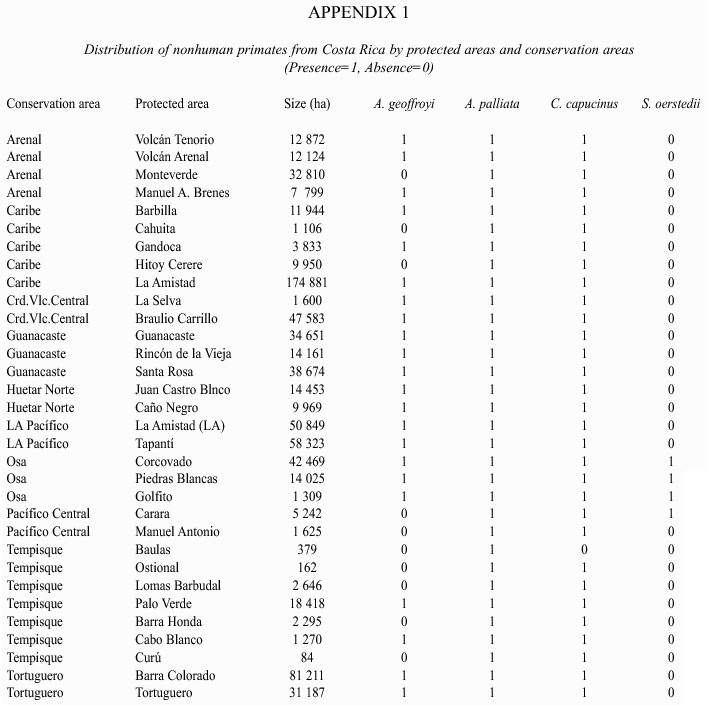
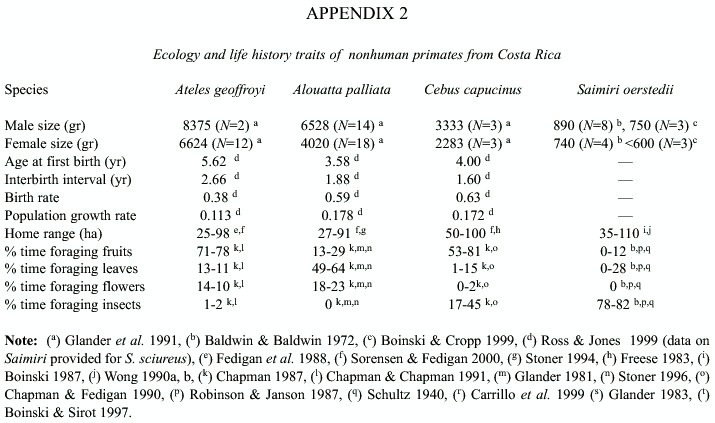
<body><![CDATA[<p><font face="Arial" size="2">At a local level, the four species also differ in their distribution. Appendix 1 shows the presence or absence of these species within conservation areas and protected areas. Conservation areas are large administrative units that include both protected and non-protected areas. These data underestimate the distribution of these species within the country because only populations from protected areas are included. Nonhuman primates are also found outside protected areas, but it was not possible to verify their presence or absence there.</font></p>     <p><font face="Arial" size="2">Overall, <i>A. geoffroy</i>i, <i>C. capucinu</i>s, and <i>A. palliata </i>have a wide geographic distribution within the country, whereas <i>S. oerstedii </i>have a very narrow distribution (<a href="#wi83">Wilson 1983</a>, <a  href="#bo92">Boza 1992</a>, <a href="#ro96">Rodriguez and Chinchilla 1996</a>, <a href="#bo97">Boinski and Sirot 1997</a>, <a href="#ca99">Carrillo <i>et al. </i>1999</a>, <a href="#sa99">Saenz <i>et al. </i>1999</a>, <a href="#wo99">Wong <i>et al. </i>1999</a>, <a href="#mo00">Mora 2000</a>). <i>A. geoffroyi </i>occur principally in protected areas of larger size and extensive forest coverage. <i>A. geoffroyi </i>are not found in the Central Pacific conservation area, where the protected areas are of smaller size. <i>C. capucinus </i>and <i>A. palliata </i>are found in all conservation areas and most protected areas. <i>S. oerstedii </i>are only found in the Central Pacific and Osa conservation areas located in the central and south Pacific region. </font></p> <font face="Arial" size="2"><b></b></font>     <p><font face="Arial" size="2"><b>Population sizes: </b>We lack accurate estimates of population sizes for the whole country, but there is published data for populations within some protected areas. A census conducted in 1972 at the Santa Rosa National Park (<a href="#fr76">Freese 1976</a>) reported estimated population sizes of 110 individuals for <i>A. geoffroy</i>i, 85 <i>A. palliat</i>a, and 300 <i>C. capucinu</i>s. Follow up censuses show that, after almost 30 years of protection within the park and regeneration of the natural habitat, <i>A. palliata </i>and <i>C. capucinus </i>have increased their numbers to 606 and 585 individuals, respectively (<a href="#so00">Sorensen and Fedigan 2000</a>, <a href="#fe01">Fedigan and Jack 2001</a>). We do not have figures for <i>A. geoffroyi </i>but, according to <a  href="#so00">Sorensen and Fedigan (2000)</a>, the population of <i>A. geoffroyi </i>has grown at a slower rate. Censuses conducted in other areas within the Guanacaste region also show that <i>A. palliata </i>are more common, followed by <i>C. capucinu</i>s. In all sites censused, <i>A. geoffroyi </i>are the least common. At Palo Verde, <a href="#ma87">Massey (1987)</a> found that the density of <i>A. palliata </i>was 59.3 ind/km<sup>2</sup> , for <i>C. capucinus </i>there were about 15.4 ind/km<sup>2</sup> , and for <i>A. geoffroyi </i>only 0.62 ind/km<sup>2</sup> . At Cabo Blanco, <a href="#li88">Lippold (1988)</a> found 80 <i>A. palliat</i>a, and 54 <i>C. capucinu</i>s. Other censuses show fairly large populations of <i>A. palliat</i>a. At La Pacífica, the estimated population size has remained around 351 individuals for almost twenty years (<a href="#cl86">Clarke <i>et al. </i>1986</a>, <a href="#cl94">Clarke and Zucker 1994</a>, <a href="#cl02a">Clarke <i>et al. </i>2002a</a>, <a href="#cl02b">2002b</a>). At La Selva, the population ranged between 105 and 225 individuals (<a href="#st94">Stoner 1994</a>).</font></p> <font face="Arial" size="2"><i></i></font>     <p><font face="Arial" size="2"><i>S. oerstedii </i>is believed to have smaller populations than the other species. According to <a  href="#bo97">Boinski and Sirot (1997)</a>, the current population size of <i>S. o. citrinellus </i>within the protected area of the Manuel Antonio National Park is about 100 individuals, while the population size of <i>S. o. oerstedii </i>within the Corcovado National Park ranges between 200 and 500 individuals.</font></p> <font face="Arial" size="2"><b></b></font>     <p><font face="Arial" size="2"><b>Habitats occupied: </b><i>A. geoffroy</i>i, <i>A. palliat</i>a, and <i>C. capucinus </i>occupy a variety of altitudinal ranges and habitats, including mangroves, riparian forests, dry and humid forests, low-land, premontane, and montane forests, secondary forests, and forest edges (<a href="#ei83">Eisenberg 1983</a>, <a href="#fr83">Freese 1983</a>, <a href="#gl83">Glander 1983</a>, <a  href="#sa91">Sanchez 1991</a>, <a href="#st94">Stoner 1994</a>, <a  href="#ca99">Carrillo <i>et al. </i>1999</a>, <a href="#mo00">Mora 2000</a>, <a href="#cl02a">Clarke <i>et al. </i>2002a</a>, <a  href="#cl02b">2002b</a>). <i>A. geoffroyi </i>are found at altitudes ranging from sea level to 2200 m (<a href="#ca99">Carrillo <i>et al. </i>1999</a>), but are restricted to large forest fragments and are less common in altered environments (<a href="#es88">Estrada 1988</a>, <a href="#es96">Estrada and Coates-Estrada 1996</a>, <a href="#ca99">Carrillo <i>et al. </i>1999</a>, <a href="#so00">Sorensen and Fedigan 2000</a>). <i>A. palliata </i>and <i>C. capucinus </i>show comparable altitude ranges (between sea level and 2500 and 3000 m, respectively) (<a href="#ca99">Carrillo <i>et al. </i>1999</a>), but they can be found in small forest patches and altered environments (<a href="#fr83">Freese 1983</a>, <a href="#wi83">Wilson 1983</a>, <a href="#cr98">Crockett 1998</a>, <a href="#ho98">Horwich 1998</a>, <a href="#ca99">Carrillo <i>et al. </i>1999</a>). The mean size of protected areas in which <i>A. geoffroyi </i>occurs is 33 529 ha whereas <i>A. palliat</i>a, and <i>C. capucinus </i>are found in areas averaging 23 906 and 23 930 ha, respectively (From the values in <a  href="#a1">Appendix 1</a>). <i>S. oerstedii </i>occupy fewer kinds of habitats. They are commonly found at altitudes below 500 m, in secondary forests and forest edges, but they can also be present in habitats showing a mosaic of forest types and in cultivated areas (<a  href="#bo87">Boinski 1987</a>, <a href="#wo90a">Wong 1990a</a>, <a  href="#wo90b">1990b</a>, <a href="#ca99">Carrillo <i>et al. </i>1999</a>).</font></p> <font face="Arial" size="2"><b></b></font>     <p><font face="Arial" size="2"><b>Home range and diet: </b>There is a great degree of variation in home range size within each species (<a href="#a2">Appendix 2</a>) (<a href="#fr83">Freese 1983</a>, <a  href="#bo87">Boinski 1987</a>, <a href="#fe88">Fedigan <i>et al. </i>1988</a>, <a href="#wo90a">Wong 1990a</a>, <a href="#wo90b">1990b</a>, <a  href="#sa91">Sanchez 1991</a>, <a href="#cl94">Clarke and Zucker 1994</a>, <a href="#st94">Stoner 1994</a>, <a href="#bo97">Boinski and Sirot 1997</a>, <a href="#so00">Sorensen and Fedigan 2000</a>). Overall, home range sizes vary between 25 and 100 ha.</font></p>     <p><font face="Arial" size="2">These species also show variation in the proportion of time spent eating fruits, flowers, leaves, or insects (<a href="#a2">Appendix 2</a>). Within species, the proportion of time eating each kind of fruit item varies spatially and temporally, depending on their availability. <i>A. geoffroyi </i>consume primarily fruits and some leaves and flowers (<a href="#ch87">Chapman 1987</a>, <a href="#ch91">Chapman and Chapman 1991</a>, <a href="#st92">Strier 1992</a>, <a href="#so00">Sorensen and Fedigan 2000</a>). <i>A. palliata </i>spend most of their time eating leaves and fruits (<a href="#gl81">Glander 1981</a>, <a  href="#ch87">Chapman 1987</a>, <a href="#sa91">Sanchez 1991</a>, <a href="#st92">Strier 1992</a>, <a  href="#st96">Stoner 1996</a>, <a href="#so00">Sorensen and Fedigan 2000</a>). <i>C. capucinus </i>eat mostly fruits and insects and sometimes small vertebrates (<a href="#ch87">Chapman 1987</a>, <a href="#ch90">Chapman and Fedigan 1990</a>, <a href="#so00">Sorensen and Fedigan 2000</a>). <i>S. oerstedii </i>eat mostly insects and some fruits (<a href="#sc40">Schultz 1940</a>, <a href="#ba72">Baldwin and Baldwin 1972</a>, <a href="#ro87">Robinson and Janson 1987</a>, <a  href="#wo90a">Wong 1990a</a>, <a href="#wo90b">1990b</a>). </font></p> <font face="Arial" size="2"><b></b></font>     <p><font face="Arial" size="2"><b>Life history traits: </b>The four species differ in their life history traits. Appendix 2 shows that <i>A. geoffroyi </i>and <i>A. palliata </i>are the largest, <i>C. capucinus </i>is intermediate, and <i>S. oerstedii </i>is the smallest (<a href="#ba72">Baldwin and Baldwin 1972</a>, <a href="#gl91">Glander <i>et al. </i>1991</a>, <a href="#bo99">Boinski and Cropp 1999</a>). It also shows that <i>A. geoffroyi </i>has the lowest reproductive rates (<a href="#fe95">Fedigan and Rose 1995</a>, <a href="#ro99">Ross and Jones 1999</a>, <a href="#fe01">Fedigan and Jack 2001</a>). <i>A. palliata </i>and <i>C. capucinus </i>show higher reproductive rates than <i>A. geoffroyi </i>(<a  href="#gl80">Glander 1980</a>, <a href="#gl92">1992</a>, <a href="#cl84">Clarke and Glander 1984</a>, <a href="#cr87">Crockett and Eisenberg 1987</a>, <a href="#ro87">Robinson and Janson 1987</a>, <a href="#fe95">Fedigan and Rose 1995</a>, <a href="#fe01">Fedigan and Jack 2001</a>). We did not find accurate estimates of reproductive rates for <i>S. oerstedi</i>i. Data on <i>S. sciureu</i>s, other species in the same genus with similar life history and behavior traits, reveals the highest values for all parameters determining reproductive rates (<a href="#bo99">Boinski and Cropp 1999</a>, <a href="#ro99">Ross and Jones 1999</a>). </font></p> <font face="Arial" size="2"><b></b></font>     <p><font face="Arial" size="2"><b>Genetic analysis</b></font></p>     <p><font face="Arial" size="2"><b>Sample collection: </b>Samples of <i>S. oerstedii </i>were collected in the Central Pacific Region. All the samples collected belonged to the <i>S. o. citrinellus </i>subspecies. Two samples were collected at the Manuel Antonio National Park and six samples were collected at Jardin Gaia, a wildlife rehabilitation center next to the park, which receives animals confiscated by the Wildlife Service. The Manuel Antonio National Park has the largest extant population of <i>S. o. citrinellu</i>s. Samples of <i>A. geoffroyi </i>and <i>C. capucinus </i>were obtained at the Parque Zoológico Nacional Simón Bolívar, San José, during their annual physical examination. All the animals also had been confiscated by the Wildlife Service and came from various regions within the country. The exact location of origin was not known for most of the animals. Animals born in captivity (only one) were not included in this study. We analyzed nine samples of <i>A. geoffroyi </i>and five of <i>C. capucinu</i>s.</font></p>     ]]></body>
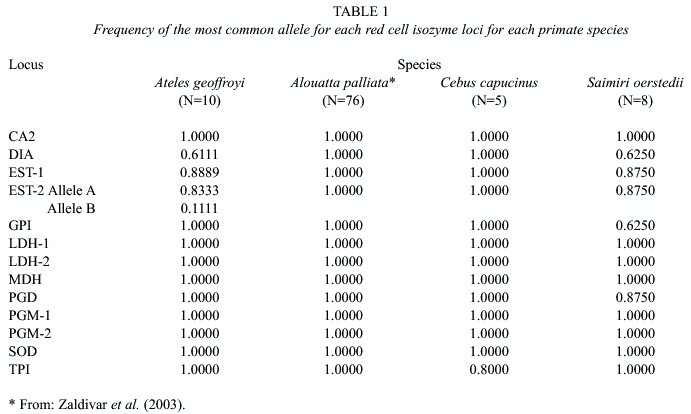
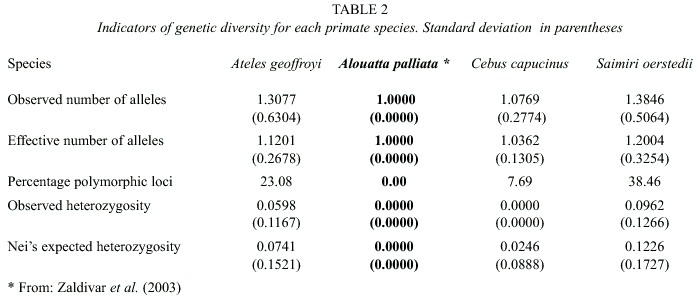
<body><![CDATA[<p><font face="Arial" size="2">Field samples were collected using standard dart gun capture techniques (<a href="#gl91">Glander <i>et al. </i>1991</a>). Samples from captive animals did not require darting. In all cases animals were anesthetized with Telazol (Tilethamine hydrochloride and zolazepam hydrochloride) and blood was drawn from their femoral vein using a Vacutainer with EDTA as an anticoagulant. Darted animals were allowed to recover and then released at the site of capture. </font></p>     <p><font face="Arial" size="2">In a previous study we examined blood samples from <i>A. palliata </i>from several sites in Costa Rica (<a href="#za03">Zaldivar <i>et al. </i>2003</a>). Atotal of 76 samples were analyzed. Most samples come from the Guanacaste region, located on the Northern Pacific side of the country (61 samples), eight samples were collected in the Atlantic Region and seven samples in the Central Pacific region. Elsewhere we provide the exact location of the sites in which the samples were collected (<a href="#za03">Zaldivar <i>et al. </i>2003</a>) . The Atlantic and Pacific Regions are separated by a mountain range running along the center of the country in a North-South direction. </font></p>     <p><font face="Arial" size="2">The blood samples were kept cold until processing in the laboratory. Once in the laboratory, they were centrifuged at low speed for about 15 minutes to separate plasma, white cells, and red cells. The red cells were washed twice with isotonic 9% saline solution. Each fraction was stored separately at -20 ºC.</font></p> <font face="Arial" size="2"><b></b></font>     <p><font face="Arial" size="2"><b>Isozyme analyses: </b>In order to examine the level of genetic variation in each species, we performed electrophoresis of red cell enzymes following the methods described by <a href="#ha78">Harris and Hopkinson (1978)</a>, <a href="#ri86">Richardson <i>et al. </i>(1986)</a>, and <a href="#li90">Lima <i>et al. </i>(1990)</a>. Electrophoresis was conducted on 9 to 11% starch gels. Electrophoresis was run overnight at constant voltage (60-75 Volts). We examined ten enzyme systems, <i>i.e. </i>CA2, DIA, EST, GPI, LDH, MDH, PGD, PGM, SOD, and TPI. For each red cell enzyme we used the buffers and staining procedures recommended by <a href="#ha78">Harris and Hopkinson (1978)</a>. We recorded the genotype of each individual.</font></p>     <p><font face="Arial" size="2">Genetic analyses were conducted using the program POPGENE 1.32 (<a href="#yeh99">Yeh <i>et al. </i>1999</a>). We determined the levels of genetic diversity for each species using common indicators such as observed number of alleles, effective number of alleles, percentage polymorphic loci, observed heterozygosity, and expected heterozygosity. </font></p> <font face="Arial" size="2"><b></b></font>     <p><font face="Arial" size="2"><b>Association between risk of extinction and ecological, life history, and genetic traits: </b>The four primate species included in this study differ in their conservation status. <i>S. oerstedii </i>is considered to be endangered. This species has a very narrow geographic distribution, natural habitats have been destroyed through deforestation, and in some areas population sizes are small. All other species have wide geographic distributions within the country and the region, yet the conservation status of <i>A. geoffroyi </i>is considered to be vulnerable. </font></p>     <p><font face="Arial" size="2">In order to determine which factors may explain the higher risk of extinction of <i>A. geoffroyi </i>compared to <i>A. palliata </i>and <i>C. capucinu</i>s, we conducted a Pearson correlation analysis and examined the association between risk of extinction and ecological traits (mean size of protected areas in which the species is present, size of home range, proportion of fruits in diet, proportion of leaves, proportion of insects), life history (size of males, size of females, age at first birth, interval between births, birth rate, intrinsic rate of population growth), and genetic diversity (observed number of alleles, effective number of alleles, percentage polymorphic loci, observed heterozygosity, and expected heterozygosity). The risk of extinction was assigned a categorical value based on the conservation status determined by <a href="#ry95">Rylands <i>et al. </i>(1995)</a> and <a href="#ry97">Rylands (1997)</a>. <i>C. capucinus </i>and <i>A. palliata </i>have the lowest risk of extinction and were assigned a value of 1, <i>A. geoffroyi </i>has a higher risk was assigned a value of 2. </font></p> <font face="Arial" size="2"><b>     <p align="center">Results</p> </b> <b>     <p>Isozyme analyses</p> </b> </font>     <p><font face="Arial" size="2">A total of 13 putative loci were examined. Seven loci were monomorphic (CA2, LDH-1, LDH-2, MDH, PGM-1, PGM-2, and TPI); <i>i.e. </i>they showed only one electrophoretic variant. Six loci showed two or more variants (DIA, EST-1, EST-2, GPI, PGD, and SOD). <a href="#t1">Table 1</a> shows the frequency of the most common allele for all loci. <i>S. oerstedii </i>showed the greatest number of variable loci; 5 of the 13 loci studied had more than one variant (DIA, EST-1, EST-2, GPI, and PGD). <i>A. geoffroyi </i>had three loci showing more than one electrophoretic variant (DIA, EST-1, and EST-2). <i>C. capucinus </i>showed only one loci with more than one electrophoretic variant (SOD), but the sample size was very small (only five individuals). <i>A. palliat</i>a, despite their much larger sample size, showed no variation and this was true for all the enzymes analyzed; all the individuals examined showed the same electrophoretic pattern at all loci.</font></p>     ]]></body>
<body><![CDATA[<p style="text-align: left;"><font face="Arial" size="2">&nbsp;<a  name="t1"></a><img src="/img/fbpe/rbt/v52n3/3083i3.JPG" title=""  alt="" style="width: 691px; height: 414px;"></font></p>     
<p><font face="Arial" size="2">The four species studied have different patterns of genetic variation according to the values of the indicators of genetic diversity shown in <a href="#t1">Table 1</a>, <i>i.e. </i>observed number of alleles, effective number of alleles, percentage polymorphic loci, observed heterozygosity, and expected heterozygosity. For all indicators of genetic diversity, <i>S. oerstedii </i>show the greatest values, <i>A. geoffroyi </i>rank second, <i>C. capucinus </i>rank third, and <i>A. palliata </i>rank last, since they show no genetic variation for any of the loci examined (<a href="#t2">Table 2</a>).</font></p>     <p style="text-align: left;"><font face="Arial" size="2">&nbsp;<a  name="t2"></a><img src="/img/fbpe/rbt/v52n3/3083i4.JPG" title=""  alt="" style="width: 700px; height: 301px;">    
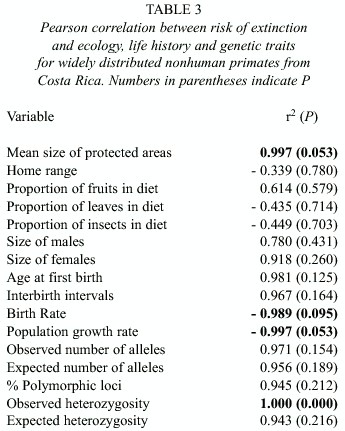
<br> </font></p> <font face="Arial" size="2"></font>     <p><font face="Arial" size="2"><b>Association between risk of extinction and ecological, life history, and genetic traits: </b>Among widely distributed species, we found a negative association between risk of extinction and mean size of protected areas in which the species are found (<a href="#t3">Table 3</a>); where species present in areas of larger mean size are at greater risk of extinction and species found in areas of smaller sizes are at lower risk. For all other ecological variables we did not find a statistically significant association with risk of extinction (<a href="#t3">Table 3</a>). For the correlation analyses between risk of extinction and proportion of fruits in diet, proportion of leaves, proportion of insects, and home range, we used the midvalue of the ranges described in the <a href="#a1">Appendix</a>. We did not find a statistically significant association between risk of extinction and size of males, size of females, age at first birth, and interval between births (<a  href="#t3">Table 3</a>). But we found that risk of extinction is negatively associated with birth rate and rate of population growth (<a href="#t3">table 3</a>); where species with greater birth and population growth rates are at lower risk of extinction and species with smaller birth and population growth rates are at greater risk. For most indicators of genetic diversity we found no statistically significant association between risk of extinction and genetic diversity, but species with greater observed heterozygosity were at greater risk than less diverse species. </font></p>     <p style="text-align: center;"><font face="Arial" size="2">&nbsp;<a  name="t3"></a><img src="/img/fbpe/rbt/v52n3/3083i5.JPG" title=""  alt="" style="width: 345px; height: 431px;"></font></p> <font face="Arial" size="2"><b>     
<p>Discussion</p> </b> </font>     <p><font face="Arial" size="2">Our analysis of isozyme variation revealed that <i>S. o. citrinellus </i>and <i>A. geoffroyi </i>showed high levels of isozyme variation whereas <i>A. palliata </i>and <i>C. capucinus </i>showed very low levels of genetic variation. <i>A. palliata </i>did not show variation for any of the isozymes studied, even though we examined more samples of this species than for any other (<a href="#za03">Zaldivar <i>et al. </i>2003</a>).</font></p>     <p><font face="Arial" size="2">The values of isozyme variation that we find for <i>S. o. citrinellu</i>s, <i>A. geoffroy</i>i, and <i>C. capucinus </i>concur with the results reported for these same groups in South America. South American <i>Saimiri </i>showed genetic variation for EST, GPI, LDH, MDH, PGD, and PGM (<a href="#va90">Vandeberg <i>et al. </i>1990</a>, <a href="#si93">Silva <i>et al. </i>1993</a>). Heterozygosity estimates ranged between 0.086 and 0.025 (<a href="#va90">Vandeberg <i>et al. </i>1990</a>, <a  href="#si93">Silva <i>et al. </i>1993</a>) and are comparable to the value reported by us. South American spider monkeys <i>(A. paniscu</i>s) showed variation in one out of 20 loci (CA2) and <i>A. chamek </i>showed variation in three (ADA, ESD, and GLO) (<a href="#sa93">Sampaio <i>et al. </i>1993</a>). Average heterozygosity was slightly lower than the value found by us (0.06) and it ranged between 0.021 and 0.031 (<a href="#sa93">Sampaio <i>et al. </i>1993</a>). South American capuchins showed low levels of genetic variation. <a  href="#sa93">Sampaio <i>et al. </i>(1993)</a> found that <i>C. apella paraguayanus </i>was polymorphic for two loci (GLO and GPI) and showed an average heterozygosity of 0.014. </font></p>     <p><font face="Arial" size="2">The absence of genetic variation that we found for <i>A. palliata </i>(<a href="#za03">Zaldivar <i>et al. </i>2003</a>) is comparable to the low values of genetic diversity previously reported for this and other Central American populations, and contrasts with the high values reported for South American <i>Alouatt</i>a. Genetic studies of <i>A. palliata </i>in Central America indicate that this species has extremely low levels of isozyme variation. <a href="#ma78">Malmgren and Brush (1978)</a>, using two-dimensional electrophoresis, found 2 of 15 polymorphic loci, including MDH, reported as monomorphic by us. <a href="#fr82">Froelich and Thorington (1982)</a> reported 3 of 25 polymorphic loci (ADA and two serum proteins). <a href="#el00">Ellsworth (2000)</a> analyzed microsatellite variation in <i>A. palliata </i>from Panama, Costa Rica, and Mexico, and found that this species has extremely low genetic variability; the mean number of alleles was 6.3 and the mean observed heterozygosity was 0.35 in a sample of 117 individuals. Genetic studies of the other Central American howler, <i>A. pigr</i>a, also found low levels of isozyme and DNA variation (<a href="#ja97">James <i>et al. </i>1997</a>, <a href="#el00">Ellsworth 2000</a>). <i>A. pigra </i>shows variation in 2 of 36 loci, including GPI, monomorphic in <i>A. palliata </i>(<a href="#ja97">James <i>et al. </i>1997</a>). It also shows low levels of microsatellite variation (<a href="#el00">Ellsworth 2000</a>); in a sample of 28 individuals, the mean number of alleles was 3.8 and the mean observed heterozygosity was 0.45. Genetic studies of South American <i>Alouatta </i>indicate that these species have very high levels of genetic variation. In <i>A. seniculu</i>s, <a href="#po92">Pope (1992)</a> found variation in 10 out of 29 loci and <a href="#li90">Lima <i>et al. </i>(1990)</a> found variation in 9 out of 26 loci. <i>A. belzebul </i>showed comparably high levels of genetic variation (<a href="#sa96">Sampaio 1996</a>). <a  href="#el00">Ellsworth (2000)</a>, using microsatellite analysis, found that the mean number of alleles per individual in <i>A. seniculus </i>(0.71) is much higher than in <i>A. palliata </i>(0.165). Mean observed heterozygosity values were also higher; 0.56 in a sample of six individuals (<a href="#el00">Ellsworth 2000</a>).</font></p>     ]]></body>
<body><![CDATA[<p><font face="Arial" size="2">Among the three species with a wider geographic distribution, we found no association between risk of extinction and most ecological variables such as degree of frugivory or home range size. Home range and diet were highly variable, both between species and within species, and they show both temporal and spatial variation (<a href="#sc40">Schultz 1940</a>, <a href="#ba72">Baldwin and Baldwin 1972</a>, <a href="#gl81">Glander 1981</a>, <a  href="#fr83">Freese 1983</a>, <a href="#bo87">Boinski 1987</a>, <a href="#ch87">Chapman 1987</a>, <a href="#ro87">Robinson and Janson 1987</a>, <a  href="#fe88">Fedigan <i>et al. </i>1988</a>, <a href="#ch87">Chapman and Fedigan 1990</a>, <a  href="#wo90a">Wong 1990a</a>, <a href="#wo90b">1990b</a>, <a  href="#ch91">Chapman and Chapman 1991</a>, <a href="#sa91">Sanchez 1991</a>, <a href="#st92">Strier 1992</a>, <a href="#cl94">Clarke and Zucker 1994</a>, <a href="#st94">Stoner 1994</a>, <a href="#st96">1996</a>, <a href="#bo97">Boinski and Sirot 1997</a>, <a href="#so00">Sorensen and Fedigan 2000</a>). Variation within species would obscure any possible association due to variation between species. We do find an association between risk of extinction and mean size of protected areas in which the species is present; <i>A. geoffroyi </i>are present in areas of larger average mean size and are at greater risk of extinction. <i>A. geoffroyi </i>are seldom present in protected areas of smaller size and they seem to require larger areas of forest. </font></p>     <p><font face="Arial" size="2">Also, among the three species with a wider geographic distribution, we found no association between risk of extinction and most life history traits. But we did observe that lower birth rates and lower population growth rates were associated with greater risks of extinction. These results allow us to explain the vulnerability of <i>A. geoffroy</i>i. Our interpretation agrees with those of other authors who find that lower rates of population growth, limit the potential of <i>A. geoffroyi </i>populations to recover rapidly after experiencing reductions in population size (<a  href="#mc89">Mc Farland 1989</a>, <a href="#so00">Sorensen and Fedigan 2000</a>). </font></p>     <p><font face="Arial" size="2">Finally, we found no association between risk of extinction and genetic diversity. Contrary to the prediction that low levels of genetic diversity increase extinction risks, we found that less variable species, such as <i>C. capucinus </i>and <i>A. palliat</i>a, had lower risks of extinction than more variable species, such as <i>S. oerstedii </i>and <i>A. geoffroy</i>i. Despite their low levels of genetic variation <i>C. capucinus </i>and <i>A. palliata </i>are very resilient and recover quickly from environmental disturbance (<a href="#po95">Pope 1995</a>, <a href="#cr98">Crockett 1998</a>, <a href="#ho98">Horwich 1998</a>, <a href="#so00">Sorensen and Fedigan 2000</a>). Lack of genetic variation has not limited the capacity of <i>A. palliata </i>and <i>C. capucinus </i>to occupy a variety of habitats, including altered environments and small forest patches. Also, it has not limited their ability to recover from habitat destruction (<a href="#po95">Pope 1995</a>, <a href="#fe98">Fedigan <i>et al. </i>1998</a>, <a href="#so00">Sorensen and Fedigan 2000</a>). <i>A. palliata </i>from the population at La Pacífica, Costa Rica, have experienced rapid recovery from habitat deforestation and their population size has remained stable (<a href="#cl02a">Clarke <i>et al. </i>2002a</a>, <a  href="#cl02b">2002b</a>). <i>A. palliata </i>from the Santa Rosa National Park show a seven-fold increase in size in 28 years since the establishment of protection and regeneration of the dry forest (<a href="#fe98">Fedigan <i>et al. </i>1998</a>, <a  href="#fe01">Fedigan and Jack 2001</a>). <i>C. capucinus </i>doubled their population size in this same period (<a href="#so00">Sorensen and Fedigan 2000</a>). </font></p>     <p><font face="Arial" size="2">To conclude, geographic distribution and life history traits seem to be more important determinants of extinction risks than genetic variation, at least for nonhuman primates from Costa Rica. Conservation efforts should emphasize the relevance of these variables. Our data support the need to expand and enforce protection measures for squirrel monkeys. Squirrel monkeys are the most endangered primate species in Central America (<a href="#ry95">Rylands <i>et al. </i>1995</a>, <a href="#ry97">Rylands 1997</a>). Their narrow geographic distribution and habitat range, coupled to extensive habitat destruction and fragmentation in the region, are responsible for the low numbers of populations and individuals remaining (<a href="#bo97">Boinski and Sirot 1997</a>). Spider monkeys are also very vulnerable to disturbances due to their low rate of population growth. The successful recovery of primate populations in the Santa Rosa National Park (<a href="#fe98">Fedigan <i>et al. </i>1998</a>, <a  href="#so00">Sorensen and Fedigan 2000</a>, <a href="#fe01">Fedigan and Jack 2001</a>) should encourage further habitat protection and restoration efforts.</font></p> <font face="Arial" size="2"><b>     <p>Acknowledgments</p> </b> </font>     <p><font face="Arial" size="2">The authors thank Philip Hedrick, Jorge Azofeifa, Mayrelith Artavia, and Ana Araya, for providing useful comments on a previous version of this manuscript. Jose Manuel Mora and Eduardo Carrillo for providing help with the geographic distribution and useful comments. Luis Castro for assistance in the lab, Gustavo Gutiérrez, Isabel Salas and many student volunteers for assistance in the field. Special thanks to the owner and manager of Hacienda La Pacifica for allowing us to work on the ranch. Yolanda Matamoros and Danilo Leandro at the Parque Zoológico Nacional Simón Bolívar, and Dario Castelfranco at Jardin Gaia, for providing us blood samples from their captive animals. This work was funded in part by NSF Grants DBC-9118876</font></p>     <p><font face="Arial" size="2">and SBR-9601766 to Mark Teaford and KEG, Universidad de Costa Rica Dean of Research Grant 111-93-316 to MEZ, and Third World Academy of Sciences Grant 95-364 RG/BIO/LA to MEZ. This research benefited greatly from a visit to Duke University by MEZ funded by the M. I. R. T. Program at this institution. The authors also thank the Office of International Affairs of the Universidad de Costa Rica for a fellowship to MEZ and OJR, which was instrumental for the preparation of this manuscript. </font></p> <font face="Arial" size="2"><b>     <p>Resumen</p> </b> </font>     <p><font face="Arial" size="2">Se estudió la asociación entre la distribución geográfica, algunos rasgos ecológicos, las historias de vida, la diversidad genética y el riesgo de extinción, en primates no humanos de Costa Rica. Se incluyen todas las especies de primates no humanos del país: los monos araña <i>(Ateles geoffroy</i>i), congo <i>(Alouatta palliat</i>a), cara blanca <i>(Cebus capucinu</i>s), y tití <i>(Saimiri oerstedi</i>i). La distribución geográfica se caracterizó utilizando principalmente bases de datos existentes. Se obtuvo información acerca de sus características ecológicas y de historias de vida mediante una revisión bibliográfica. Se estudió su diversidad genética utilizando electroforesis de isoenzimas. El riesgo de extinción se evaluó usando información bibliográfica. Se encontró que las cuatro especies presentaban variación en todos estos rasgos. Con estos datos, se realizó una correlación de Pearson entre el riesgo de extinción y las variables indicadoras de la distribución geográfica, los rasgos ecológicos, las historias de vida y la diversidad genética, para aquellas especies con una amplia distribución geográfica. Se encontró una asociación entre el riesgo de extinción y la natalidad y la tasa de crecimiento poblacional; las especies con menor natalidad y menor tasa de crecimiento poblacional tenían mayor riesgo de extinción. Se encontró una asociación positiva entre la diversidad genética y el riesgo de extinción; las especies con mayor diversidad genética tenían mayor riesgo de extinción. Se discute la importancia de estos rasgos para la conservación de estas especies.</font></p> <font face="Arial" size="2"><b>     <p>References</p> </b> </font>     ]]></body>
<body><![CDATA[<!-- ref --><p><font face="Arial" size="2"><a name="al86"></a>Allendorf, F.W. &amp; R.F. Leary. 1986. Heterozygosity and fitness in natural populations of animals, pp. 57-76. <i>In </i>M. Soule (ed.). Conservation biology: the science of scarcity and diversity. Sinauer, Massachusetts. </font>&nbsp;&nbsp;&nbsp;&nbsp;&nbsp;&nbsp;&nbsp;&nbsp;[&#160;<a href="javascript:void(0);" onclick="javascript: window.open('/scielo.php?script=sci_nlinks&ref=1328015&pid=S0034-7744200400030002900001&lng=','','width=640,height=500,resizable=yes,scrollbars=1,menubar=yes,');">Links</a>&#160;]<!-- end-ref --><!-- ref --><p><font face="Arial" size="2"><a name="ar90"></a>Arita, H., J.G. Robinson &amp; K.H. Redford. 1990. Rarity in neotropical forest mammals and its ecological correlates. Conserv. Biol. 4: 181-192.</font>&nbsp;&nbsp;&nbsp;&nbsp;&nbsp;&nbsp;&nbsp;&nbsp;[&#160;<a href="javascript:void(0);" onclick="javascript: window.open('/scielo.php?script=sci_nlinks&ref=1328016&pid=S0034-7744200400030002900002&lng=','','width=640,height=500,resizable=yes,scrollbars=1,menubar=yes,');">Links</a>&#160;]<!-- end-ref --><!-- ref --><p><font face="Arial" size="2"><a name="av94"></a>Avise, J.C. 1994. Molecular markers, natural history, and evolution. Chapman and Hall, New York. 511 p.</font>&nbsp;&nbsp;&nbsp;&nbsp;&nbsp;&nbsp;&nbsp;&nbsp;[&#160;<a href="javascript:void(0);" onclick="javascript: window.open('/scielo.php?script=sci_nlinks&ref=1328017&pid=S0034-7744200400030002900003&lng=','','width=640,height=500,resizable=yes,scrollbars=1,menubar=yes,');">Links</a>&#160;]<!-- end-ref --><!-- ref --><p><font face="Arial" size="2"><a name="ba93"></a>Baker, C.S., A. Perry, J.L. Bannister &amp; M.T. Weinrich, R.B. Abernethy. 1993. Abundant mitochondrial DNA variation and worldwide population structure in humpback whales. Proc. Natl. Acad. Sci. USA 90: 8238-8243.</font>&nbsp;&nbsp;&nbsp;&nbsp;&nbsp;&nbsp;&nbsp;&nbsp;[&#160;<a href="javascript:void(0);" onclick="javascript: window.open('/scielo.php?script=sci_nlinks&ref=1328018&pid=S0034-7744200400030002900004&lng=','','width=640,height=500,resizable=yes,scrollbars=1,menubar=yes,');">Links</a>&#160;]<!-- end-ref --><!-- ref --><p><font face="Arial" size="2"><a name="ba72"></a>Baldwin J.D. &amp; J. Baldwin. 1972. The ecology and behavior of squirrel monkeys <i>(Saimiri oerstedi</i>i) in a natural forest in western Panama. Folia Primatol. 18: 161-184.</font>&nbsp;&nbsp;&nbsp;&nbsp;&nbsp;&nbsp;&nbsp;&nbsp;[&#160;<a href="javascript:void(0);" onclick="javascript: window.open('/scielo.php?script=sci_nlinks&ref=1328019&pid=S0034-7744200400030002900005&lng=','','width=640,height=500,resizable=yes,scrollbars=1,menubar=yes,');">Links</a>&#160;]<!-- end-ref --><!-- ref --><p><font face="Arial" size="2"><a name="bo87"></a>Boinski, S. 1987. Habitat use by squirrel monkeys <i>(Saimiri oersted</i>i) in Costa Rica. Folia Primatol. 49: 151-167.</font>&nbsp;&nbsp;&nbsp;&nbsp;&nbsp;&nbsp;&nbsp;&nbsp;[&#160;<a href="javascript:void(0);" onclick="javascript: window.open('/scielo.php?script=sci_nlinks&ref=1328020&pid=S0034-7744200400030002900006&lng=','','width=640,height=500,resizable=yes,scrollbars=1,menubar=yes,');">Links</a>&#160;]<!-- end-ref --><!-- ref --><p><font face="Arial" size="2"><a name="bo97"></a>Boinski, S. &amp; L. Sirot. 1997. Uncertain conservation status of Squirrel monkeys in Costa Rica, <i>Saimiri oerstedi oerstedi </i>and <i>Saimiri oerstedi citrinellu</i>s. Folia Primatol. 68: 181-193.</font>&nbsp;&nbsp;&nbsp;&nbsp;&nbsp;&nbsp;&nbsp;&nbsp;[&#160;<a href="javascript:void(0);" onclick="javascript: window.open('/scielo.php?script=sci_nlinks&ref=1328021&pid=S0034-7744200400030002900007&lng=','','width=640,height=500,resizable=yes,scrollbars=1,menubar=yes,');">Links</a>&#160;]<!-- end-ref --><!-- ref --><p><font face="Arial" size="2"><a name="bo99"></a>Boinski, S. &amp; S.J. Cropp. 1999. Disparate data sets resolve squirrel monkey <i>(Saimir</i>i) taxonomy: implications for behavioral ecology and medical usage. Int. J. Primatol. 20: 237-256.</font>&nbsp;&nbsp;&nbsp;&nbsp;&nbsp;&nbsp;&nbsp;&nbsp;[&#160;<a href="javascript:void(0);" onclick="javascript: window.open('/scielo.php?script=sci_nlinks&ref=1328022&pid=S0034-7744200400030002900008&lng=','','width=640,height=500,resizable=yes,scrollbars=1,menubar=yes,');">Links</a>&#160;]<!-- end-ref --><!-- ref --><p><font face="Arial" size="2"><a name="bo74"></a>Bonnel, M.L. &amp; R.K. Selander. 1974. Elephant seals: genetic variation and near extinction. Science 184: 908-909.</font>&nbsp;&nbsp;&nbsp;&nbsp;&nbsp;&nbsp;&nbsp;&nbsp;[&#160;<a href="javascript:void(0);" onclick="javascript: window.open('/scielo.php?script=sci_nlinks&ref=1328023&pid=S0034-7744200400030002900009&lng=','','width=640,height=500,resizable=yes,scrollbars=1,menubar=yes,');">Links</a>&#160;]<!-- end-ref --><!-- ref --><p><font face="Arial" size="2"><a name="bo92"></a>Boza, M.A. 1992. Parques Nacionales de Costa Rica. Incafo, Santo Domingo, Heredia, Costa Rica. 91 p.</font>&nbsp;&nbsp;&nbsp;&nbsp;&nbsp;&nbsp;&nbsp;&nbsp;[&#160;<a href="javascript:void(0);" onclick="javascript: window.open('/scielo.php?script=sci_nlinks&ref=1328024&pid=S0034-7744200400030002900010&lng=','','width=640,height=500,resizable=yes,scrollbars=1,menubar=yes,');">Links</a>&#160;]<!-- end-ref --><!-- ref --><p><font face="Arial" size="2"><a name="ca94"></a>Caro, T.M. &amp; M.K. Laurenson. 1994. Ecological and genetic factors in conservation: a cautionary tale. Science 263: 485-48.</font>&nbsp;&nbsp;&nbsp;&nbsp;&nbsp;&nbsp;&nbsp;&nbsp;[&#160;<a href="javascript:void(0);" onclick="javascript: window.open('/scielo.php?script=sci_nlinks&ref=1328025&pid=S0034-7744200400030002900011&lng=','','width=640,height=500,resizable=yes,scrollbars=1,menubar=yes,');">Links</a>&#160;]<!-- end-ref --><!-- ref --><p><font face="Arial" size="2"><a name="ca99"></a>Carrillo, E., G. Wong &amp; J.C. Saenz. 1999. Mamíferos de Costa Rica. Inbio, Santo Domingo, Heredia, Costa Rica. 248 p.</font>&nbsp;&nbsp;&nbsp;&nbsp;&nbsp;&nbsp;&nbsp;&nbsp;[&#160;<a href="javascript:void(0);" onclick="javascript: window.open('/scielo.php?script=sci_nlinks&ref=1328026&pid=S0034-7744200400030002900012&lng=','','width=640,height=500,resizable=yes,scrollbars=1,menubar=yes,');">Links</a>&#160;]<!-- end-ref --><!-- ref --><p><font face="Arial" size="2"><a name="ch87"></a>Chapman, C.A. 1987. Flexibility in diets of three species of Costa Rican primates. Folia Primatol. 49: 90-105. </font>&nbsp;&nbsp;&nbsp;&nbsp;&nbsp;&nbsp;&nbsp;&nbsp;[&#160;<a href="javascript:void(0);" onclick="javascript: window.open('/scielo.php?script=sci_nlinks&ref=1328027&pid=S0034-7744200400030002900013&lng=','','width=640,height=500,resizable=yes,scrollbars=1,menubar=yes,');">Links</a>&#160;]<!-- end-ref --><!-- ref --><p><font face="Arial" size="2"><a name="ch90"></a>Chapman, C.A. &amp; L.M. Fedigan. 1990. Dietary differences between neighboring <i>Cebus capucinus </i>groups: local traditions, food availability or responses to food profitability? Folia Primatol. 54: 177-186.</font>&nbsp;&nbsp;&nbsp;&nbsp;&nbsp;&nbsp;&nbsp;&nbsp;[&#160;<a href="javascript:void(0);" onclick="javascript: window.open('/scielo.php?script=sci_nlinks&ref=1328028&pid=S0034-7744200400030002900014&lng=','','width=640,height=500,resizable=yes,scrollbars=1,menubar=yes,');">Links</a>&#160;]<!-- end-ref --><!-- ref --><p><font face="Arial" size="2"><a name="ch91"></a>Chapman, C.A. &amp; L.J. Chapman. 1991. The foraging itinerary of spider monkeys: when to eat leaves? Folia Primatol. 56: 162-166.</font>&nbsp;&nbsp;&nbsp;&nbsp;&nbsp;&nbsp;&nbsp;&nbsp;[&#160;<a href="javascript:void(0);" onclick="javascript: window.open('/scielo.php?script=sci_nlinks&ref=1328029&pid=S0034-7744200400030002900015&lng=','','width=640,height=500,resizable=yes,scrollbars=1,menubar=yes,');">Links</a>&#160;]<!-- end-ref --><!-- ref --><p><font face="Arial" size="2"><a name="cl84"></a>Clarke, M.R. &amp; K.E. Glander. 1984. Female reproductive success in a group of free-ranging howling monkeys <i>(Alouatta palliat</i>a) in Costa Rica, pp. 111-126. <i>In </i>M.F. Small (ed.). Female primates: studies by women primatologists. Alan R. Liss Inc, New York.</font>&nbsp;&nbsp;&nbsp;&nbsp;&nbsp;&nbsp;&nbsp;&nbsp;[&#160;<a href="javascript:void(0);" onclick="javascript: window.open('/scielo.php?script=sci_nlinks&ref=1328030&pid=S0034-7744200400030002900016&lng=','','width=640,height=500,resizable=yes,scrollbars=1,menubar=yes,');">Links</a>&#160;]<!-- end-ref --><!-- ref --><p><font face="Arial" size="2"><a name="cl86"></a>Clarke, M.R., E.L. Zucker &amp; N.J. Scott. 1986. Population trends of the mantled howler groups at La Pacifica, Guanacaste, Costa Rica. Am. J. Primatol. 11: 79-88.</font>&nbsp;&nbsp;&nbsp;&nbsp;&nbsp;&nbsp;&nbsp;&nbsp;[&#160;<a href="javascript:void(0);" onclick="javascript: window.open('/scielo.php?script=sci_nlinks&ref=1328031&pid=S0034-7744200400030002900017&lng=','','width=640,height=500,resizable=yes,scrollbars=1,menubar=yes,');">Links</a>&#160;]<!-- end-ref --><!-- ref --><p><font face="Arial" size="2"><a name="cl94"></a>Clarke, M.R. &amp; E.L. Zucker. 1994. Survey of the howling monkey population at La Pacifica: a seven year follow- up. Int. J. Primatol. 15: 61-73.</font>&nbsp;&nbsp;&nbsp;&nbsp;&nbsp;&nbsp;&nbsp;&nbsp;[&#160;<a href="javascript:void(0);" onclick="javascript: window.open('/scielo.php?script=sci_nlinks&ref=1328032&pid=S0034-7744200400030002900018&lng=','','width=640,height=500,resizable=yes,scrollbars=1,menubar=yes,');">Links</a>&#160;]<!-- end-ref --><!-- ref --><p><font face="Arial" size="2"><a name="cl02a"></a>Clarke, M.R., D.A. Collins &amp; E.L. Zucker. 2002a. Responses to deforestation in a group of mantled howlers <i>(Alouatta palliat</i>a) in Costa Rica. Int. J. Primatol. 23: 365-381.</font>&nbsp;&nbsp;&nbsp;&nbsp;&nbsp;&nbsp;&nbsp;&nbsp;[&#160;<a href="javascript:void(0);" onclick="javascript: window.open('/scielo.php?script=sci_nlinks&ref=1328033&pid=S0034-7744200400030002900019&lng=','','width=640,height=500,resizable=yes,scrollbars=1,menubar=yes,');">Links</a>&#160;]<!-- end-ref --><!-- ref --><p><font face="Arial" size="2"><a name="cl02b"></a>Clarke, M.R., C.M. Crockett, E.L. Zucker &amp; M. Zaldivar. 2002b. Mantled howler population of Hacienda La Pacifica, Costa Rica, between 1991 and 1998: effects of deforestation. Am. J. Primatol. 56: 155-163.</font>&nbsp;&nbsp;&nbsp;&nbsp;&nbsp;&nbsp;&nbsp;&nbsp;[&#160;<a href="javascript:void(0);" onclick="javascript: window.open('/scielo.php?script=sci_nlinks&ref=1328034&pid=S0034-7744200400030002900020&lng=','','width=640,height=500,resizable=yes,scrollbars=1,menubar=yes,');">Links</a>&#160;]<!-- end-ref --><!-- ref --><p><font face="Arial" size="2"><a name="cr98"></a>Crockett, C.M. 1998. Conservation biology of the genus <i>Alouatt</i>a. Int. J. Primatol. 19: 549-577.</font>&nbsp;&nbsp;&nbsp;&nbsp;&nbsp;&nbsp;&nbsp;&nbsp;[&#160;<a href="javascript:void(0);" onclick="javascript: window.open('/scielo.php?script=sci_nlinks&ref=1328035&pid=S0034-7744200400030002900021&lng=','','width=640,height=500,resizable=yes,scrollbars=1,menubar=yes,');">Links</a>&#160;]<!-- end-ref --><!-- ref --><p><font face="Arial" size="2"><a name="cr87"></a>Crockett, C.M. &amp; J.F. Eisenberg. 1987. Howlers: variation in group size and demography, pp. 54-68. <i>In </i>B.B. Smuts, D.L. Cheney, R.M. Seyfarth, R.W. Wrangham &amp; T.T. Struhsaker (eds.). Primate Societies. University of Chicago, Chicago.</font>&nbsp;&nbsp;&nbsp;&nbsp;&nbsp;&nbsp;&nbsp;&nbsp;[&#160;<a href="javascript:void(0);" onclick="javascript: window.open('/scielo.php?script=sci_nlinks&ref=1328036&pid=S0034-7744200400030002900022&lng=','','width=640,height=500,resizable=yes,scrollbars=1,menubar=yes,');">Links</a>&#160;]<!-- end-ref --><!-- ref --><p><font face="Arial" size="2"><a name="di90"></a>Dinerstein, E. &amp; G.F. McCracken. 1990. Endangered greater one-horned rhinoceros carry high levels of genetic variation. Conserv. Biol. 4: 417-422.</font>&nbsp;&nbsp;&nbsp;&nbsp;&nbsp;&nbsp;&nbsp;&nbsp;[&#160;<a href="javascript:void(0);" onclick="javascript: window.open('/scielo.php?script=sci_nlinks&ref=1328037&pid=S0034-7744200400030002900023&lng=','','width=640,height=500,resizable=yes,scrollbars=1,menubar=yes,');">Links</a>&#160;]<!-- end-ref --><!-- ref --><p><font face="Arial" size="2"><a name="do93"></a>Dobson, F.S. &amp; J. Yu. 1993. Rarity in neotropical forest mammals revisited. Conserv. Biol. 7: 586-591.</font>&nbsp;&nbsp;&nbsp;&nbsp;&nbsp;&nbsp;&nbsp;&nbsp;[&#160;<a href="javascript:void(0);" onclick="javascript: window.open('/scielo.php?script=sci_nlinks&ref=1328038&pid=S0034-7744200400030002900024&lng=','','width=640,height=500,resizable=yes,scrollbars=1,menubar=yes,');">Links</a>&#160;]<!-- end-ref --><!-- ref --><p><font face="Arial" size="2"><a name="ei83"></a>Eisenberg, J.F. 1983. <i>Ateles geoffroyi </i>(mono araña, mono colorado, spider monkey). <i>In </i>D.H. Janzen (ed.). Costa Rican natural history, pp. 451-453. University of Chicago, Chicago.</font>&nbsp;&nbsp;&nbsp;&nbsp;&nbsp;&nbsp;&nbsp;&nbsp;[&#160;<a href="javascript:void(0);" onclick="javascript: window.open('/scielo.php?script=sci_nlinks&ref=1328039&pid=S0034-7744200400030002900025&lng=','','width=640,height=500,resizable=yes,scrollbars=1,menubar=yes,');">Links</a>&#160;]<!-- end-ref --><!-- ref --><p><font face="Arial" size="2"><a name="el00"></a>Ellsworth, J.A. 2000. Molecular evolution, social structure, and phylogeography of the mantled howler monkey <i>(Alouatta palliata</i>). Ph D Thesis, University of Nevada, Reno, Nevada. 179 p.</font>&nbsp;&nbsp;&nbsp;&nbsp;&nbsp;&nbsp;&nbsp;&nbsp;[&#160;<a href="javascript:void(0);" onclick="javascript: window.open('/scielo.php?script=sci_nlinks&ref=1328040&pid=S0034-7744200400030002900026&lng=','','width=640,height=500,resizable=yes,scrollbars=1,menubar=yes,');">Links</a>&#160;]<!-- end-ref --><!-- ref --><p><font face="Arial" size="2"><a name="es88"></a>Estrada, A. 1988. Tropical rainforest conversion and perspectives in the conservation of wild primates <i>(Alouatta </i>and <i>Atele</i>s) in Mexico. Am. J. Primatol. 14: 315-317.</font>&nbsp;&nbsp;&nbsp;&nbsp;&nbsp;&nbsp;&nbsp;&nbsp;[&#160;<a href="javascript:void(0);" onclick="javascript: window.open('/scielo.php?script=sci_nlinks&ref=1328041&pid=S0034-7744200400030002900027&lng=','','width=640,height=500,resizable=yes,scrollbars=1,menubar=yes,');">Links</a>&#160;]<!-- end-ref --><!-- ref --><p><font face="Arial" size="2"><a name="es96"></a>Estrada, A. &amp; R.M. Coates-Estrada. 1996. Tropical rain forest fragmentation and wild populations of primates at Los Tuxlas. Int. J. Primatol. 5: 759-783.</font>&nbsp;&nbsp;&nbsp;&nbsp;&nbsp;&nbsp;&nbsp;&nbsp;[&#160;<a href="javascript:void(0);" onclick="javascript: window.open('/scielo.php?script=sci_nlinks&ref=1328042&pid=S0034-7744200400030002900028&lng=','','width=640,height=500,resizable=yes,scrollbars=1,menubar=yes,');">Links</a>&#160;]<!-- end-ref --><!-- ref --><p><font face="Arial" size="2"><a name="fe88"></a>Fedigan, L.M., L. Fedigan, C.A. Chapman &amp; K.E. Glander. 1988. Spider monkey home ranges: a comparison of radio telemetry and direct observation. Am. J. Primatol. 16: 19-29.</font>&nbsp;&nbsp;&nbsp;&nbsp;&nbsp;&nbsp;&nbsp;&nbsp;[&#160;<a href="javascript:void(0);" onclick="javascript: window.open('/scielo.php?script=sci_nlinks&ref=1328043&pid=S0034-7744200400030002900029&lng=','','width=640,height=500,resizable=yes,scrollbars=1,menubar=yes,');">Links</a>&#160;]<!-- end-ref --><!-- ref --><p><font face="Arial" size="2"><a name="fe95"></a>Fedigan, L.M. &amp; L.M. Rose. 1995. Interbirth interval variation in three sympatric species or neotropical monkeys. Am. J. Primatol. 37: 9-24.</font>&nbsp;&nbsp;&nbsp;&nbsp;&nbsp;&nbsp;&nbsp;&nbsp;[&#160;<a href="javascript:void(0);" onclick="javascript: window.open('/scielo.php?script=sci_nlinks&ref=1328044&pid=S0034-7744200400030002900030&lng=','','width=640,height=500,resizable=yes,scrollbars=1,menubar=yes,');">Links</a>&#160;]<!-- end-ref --><!-- ref --><p><font face="Arial" size="2"><a name="fe98"></a>Fedigan, L.M., L.M. Rose &amp; R.A. Morera. 1998. Growth of mantled howler groups in a regenerating Costa Rican dry forest. Int. J. Primatol. 19: 405-432.</font>&nbsp;&nbsp;&nbsp;&nbsp;&nbsp;&nbsp;&nbsp;&nbsp;[&#160;<a href="javascript:void(0);" onclick="javascript: window.open('/scielo.php?script=sci_nlinks&ref=1328045&pid=S0034-7744200400030002900031&lng=','','width=640,height=500,resizable=yes,scrollbars=1,menubar=yes,');">Links</a>&#160;]<!-- end-ref --><!-- ref --><p><font face="Arial" size="2"><a name="fe01"></a>Fedigan, L.M. &amp; K. Jack. 2001. Neotropical primates in a regenerating Costa Rican dry forest: a comparison of howler and capuchin population patterns. Int. J. Primatol. 22: 689-713.</font>&nbsp;&nbsp;&nbsp;&nbsp;&nbsp;&nbsp;&nbsp;&nbsp;[&#160;<a href="javascript:void(0);" onclick="javascript: window.open('/scielo.php?script=sci_nlinks&ref=1328046&pid=S0034-7744200400030002900032&lng=','','width=640,height=500,resizable=yes,scrollbars=1,menubar=yes,');">Links</a>&#160;]<!-- end-ref --><!-- ref --><p><font face="Arial" size="2"><a name="fr76"></a>Freese, C. 1976. Censusing <i>Alouatta palliat</i>a, <i>Ateles geoffroy</i>i, and <i>Cebus capucinus </i>in the Costa Rican dry forest, pp. 4-9. <i>In </i>R.W. Thorington &amp; P.G. Heltne (eds.). Distribution and abundance of Neotropical primates. National Academy of Sciences, Washington, D. C.</font>&nbsp;&nbsp;&nbsp;&nbsp;&nbsp;&nbsp;&nbsp;&nbsp;[&#160;<a href="javascript:void(0);" onclick="javascript: window.open('/scielo.php?script=sci_nlinks&ref=1328047&pid=S0034-7744200400030002900033&lng=','','width=640,height=500,resizable=yes,scrollbars=1,menubar=yes,');">Links</a>&#160;]<!-- end-ref --><!-- ref --><p><font face="Arial" size="2"><a name="fr83"></a>Freese, C. 1983. <i>Cebus capucinus </i>(mono cara blanca, white-faced capuchin), pp. 458-460. <i>In </i>D.H. Janzen (ed.). Costa Rican natural history. University of Chicago, Chicago.</font>&nbsp;&nbsp;&nbsp;&nbsp;&nbsp;&nbsp;&nbsp;&nbsp;[&#160;<a href="javascript:void(0);" onclick="javascript: window.open('/scielo.php?script=sci_nlinks&ref=1328048&pid=S0034-7744200400030002900034&lng=','','width=640,height=500,resizable=yes,scrollbars=1,menubar=yes,');">Links</a>&#160;]<!-- end-ref --><!-- ref --><p><font face="Arial" size="2"><a name="fr82"></a>Froelich, J.W. &amp; R.W. Thorington. 1982. The genetic structure and socioecology of howler monkeys <i>(Alouatta palliat</i>a) on Barro Colorado Island, pp. 291-305. <i>In </i>E.G. Leigh, A.S. Rand &amp; D.M. Windsor (eds.). The Ecology of a Tropical Forest. Seasonal rhythms and long-term changes. Smithsonian Institution, Washington D.C.</font>&nbsp;&nbsp;&nbsp;&nbsp;&nbsp;&nbsp;&nbsp;&nbsp;[&#160;<a href="javascript:void(0);" onclick="javascript: window.open('/scielo.php?script=sci_nlinks&ref=1328049&pid=S0034-7744200400030002900035&lng=','','width=640,height=500,resizable=yes,scrollbars=1,menubar=yes,');">Links</a>&#160;]<!-- end-ref --><!-- ref --><p><font face="Arial" size="2"><a name="gl80"></a>Glander, K.E. 1980. Reproduction and population growth in free-ranging mantled howling monkeys. Am. J. Phys. Anthropol. 53: 25-36.</font>&nbsp;&nbsp;&nbsp;&nbsp;&nbsp;&nbsp;&nbsp;&nbsp;[&#160;<a href="javascript:void(0);" onclick="javascript: window.open('/scielo.php?script=sci_nlinks&ref=1328050&pid=S0034-7744200400030002900036&lng=','','width=640,height=500,resizable=yes,scrollbars=1,menubar=yes,');">Links</a>&#160;]<!-- end-ref --><!-- ref --><p><font face="Arial" size="2"><a name="gl81"></a>Glander, K.E. 1981. Feeding patterns in mantled howling monkeys, pp. 231-259. <i>In </i>A. Kamil &amp; T.D. Sargent (eds.). Foraging behavior: ecological, ethological, and psychological approaches. Garland, New York. </font>&nbsp;&nbsp;&nbsp;&nbsp;&nbsp;&nbsp;&nbsp;&nbsp;[&#160;<a href="javascript:void(0);" onclick="javascript: window.open('/scielo.php?script=sci_nlinks&ref=1328051&pid=S0034-7744200400030002900037&lng=','','width=640,height=500,resizable=yes,scrollbars=1,menubar=yes,');">Links</a>&#160;]<!-- end-ref --><!-- ref --><p><font face="Arial" size="2"><a name="gl83"></a>Glander, K.E. 1983. <i>Alouatta palliata </i>(Congo, howling monkey, howler monkey) , pp.448-449. <i>In </i>D.H. Janzen (ed.). Costa Rican natural history. University of Chicago, Chicago.</font>&nbsp;&nbsp;&nbsp;&nbsp;&nbsp;&nbsp;&nbsp;&nbsp;[&#160;<a href="javascript:void(0);" onclick="javascript: window.open('/scielo.php?script=sci_nlinks&ref=1328052&pid=S0034-7744200400030002900038&lng=','','width=640,height=500,resizable=yes,scrollbars=1,menubar=yes,');">Links</a>&#160;]<!-- end-ref --><!-- ref --><p><font face="Arial" size="2"><a name="gl92"></a>Glander, K.E. 1992. Dispersal patterns in Costa Rican howling monkeys. Int. J. Primatol. 13: 415-436.</font>&nbsp;&nbsp;&nbsp;&nbsp;&nbsp;&nbsp;&nbsp;&nbsp;[&#160;<a href="javascript:void(0);" onclick="javascript: window.open('/scielo.php?script=sci_nlinks&ref=1328053&pid=S0034-7744200400030002900039&lng=','','width=640,height=500,resizable=yes,scrollbars=1,menubar=yes,');">Links</a>&#160;]<!-- end-ref --><!-- ref --><p><font face="Arial" size="2"><a name="gl91"></a>Glander, K.E., L.M. Fedigan, L. Fedigan &amp; C. Chapman. 1991. Field methods for capture and measurement of three monkey species in Costa Rica. Folia Primatol. 57: 70-82.</font>&nbsp;&nbsp;&nbsp;&nbsp;&nbsp;&nbsp;&nbsp;&nbsp;[&#160;<a href="javascript:void(0);" onclick="javascript: window.open('/scielo.php?script=sci_nlinks&ref=1328054&pid=S0034-7744200400030002900040&lng=','','width=640,height=500,resizable=yes,scrollbars=1,menubar=yes,');">Links</a>&#160;]<!-- end-ref --><!-- ref --><p><font face="Arial" size="2"><a name="ha78"></a>Harris, H. &amp; D.A. Hopkinson. 1978. Handbook of Enzyme Electrophoresis in Human Genetics. North Holland, Oxford.</font>&nbsp;&nbsp;&nbsp;&nbsp;&nbsp;&nbsp;&nbsp;&nbsp;[&#160;<a href="javascript:void(0);" onclick="javascript: window.open('/scielo.php?script=sci_nlinks&ref=1328055&pid=S0034-7744200400030002900041&lng=','','width=640,height=500,resizable=yes,scrollbars=1,menubar=yes,');">Links</a>&#160;]<!-- end-ref --><!-- ref --><p><font face="Arial" size="2"><a name="ha94"></a>Hartl, G.B. &amp; P. Hell. 1994. Maintenance of high levels of allelic variation in spite of a severe population bottleneck in population size: the brown bear <i>(Ursus arcto</i>s) in the Western Carpathians. Biodivers. Conserv. 3: 546-554.</font>&nbsp;&nbsp;&nbsp;&nbsp;&nbsp;&nbsp;&nbsp;&nbsp;[&#160;<a href="javascript:void(0);" onclick="javascript: window.open('/scielo.php?script=sci_nlinks&ref=1328056&pid=S0034-7744200400030002900042&lng=','','width=640,height=500,resizable=yes,scrollbars=1,menubar=yes,');">Links</a>&#160;]<!-- end-ref --><!-- ref --><p><font face="Arial" size="2"><a name="ho93"></a>Hoelzel, A.R., J. Halley, C. Campagna, T. Arnborn &amp; B. Le Boeuf. 1993. Elephant seal genetic variation and the use of simulation models to investigate historical population bottlenecks. J. Hered. 84: 443-449.</font>&nbsp;&nbsp;&nbsp;&nbsp;&nbsp;&nbsp;&nbsp;&nbsp;[&#160;<a href="javascript:void(0);" onclick="javascript: window.open('/scielo.php?script=sci_nlinks&ref=1328057&pid=S0034-7744200400030002900043&lng=','','width=640,height=500,resizable=yes,scrollbars=1,menubar=yes,');">Links</a>&#160;]<!-- end-ref --><!-- ref --><p><font face="Arial" size="2"><a name="ho98"></a>Horwich, R.H. 1998. Effective solutions for howler conservation. Int. J. Primatol. 19: 579-598.</font>&nbsp;&nbsp;&nbsp;&nbsp;&nbsp;&nbsp;&nbsp;&nbsp;[&#160;<a href="javascript:void(0);" onclick="javascript: window.open('/scielo.php?script=sci_nlinks&ref=1328058&pid=S0034-7744200400030002900044&lng=','','width=640,height=500,resizable=yes,scrollbars=1,menubar=yes,');">Links</a>&#160;]<!-- end-ref --><!-- ref --><p><font face="Arial" size="2"><a name="ja97"></a>James, R.A., P.L. Leberg, J.M. Quattro &amp; R. Vrijenhoek. 1997. Genetic diversity in Black Howler monkeys <i>(Alouatta pigr</i>a) from Belize. Am. J. Phys. Anthropol. 102: 329-336.</font>&nbsp;&nbsp;&nbsp;&nbsp;&nbsp;&nbsp;&nbsp;&nbsp;[&#160;<a href="javascript:void(0);" onclick="javascript: window.open('/scielo.php?script=sci_nlinks&ref=1328059&pid=S0034-7744200400030002900045&lng=','','width=640,height=500,resizable=yes,scrollbars=1,menubar=yes,');">Links</a>&#160;]<!-- end-ref --><!-- ref --><p><font face="Arial" size="2"><a name="jo87"></a>Johns, A.D. &amp; J.P. Skorupa. 1987. Responses of rain-forest primates to habitat disturbance: a review. Int. J. Primatol. 8: 157-191.</font>&nbsp;&nbsp;&nbsp;&nbsp;&nbsp;&nbsp;&nbsp;&nbsp;[&#160;<a href="javascript:void(0);" onclick="javascript: window.open('/scielo.php?script=sci_nlinks&ref=1328060&pid=S0034-7744200400030002900046&lng=','','width=640,height=500,resizable=yes,scrollbars=1,menubar=yes,');">Links</a>&#160;]<!-- end-ref --><!-- ref --><p><font face="Arial" size="2"><a name="la97"></a>Lacy, R.C. 1997. Importance of genetic variation to the viability of mammalian populations. J. Mammal. 78: 320-355.</font>&nbsp;&nbsp;&nbsp;&nbsp;&nbsp;&nbsp;&nbsp;&nbsp;[&#160;<a href="javascript:void(0);" onclick="javascript: window.open('/scielo.php?script=sci_nlinks&ref=1328061&pid=S0034-7744200400030002900047&lng=','','width=640,height=500,resizable=yes,scrollbars=1,menubar=yes,');">Links</a>&#160;]<!-- end-ref --><!-- ref --><p><font face="Arial" size="2"><a name="la95"></a>Laurenson, M.K., N. Wielebnowsky &amp; T.M. Caro. 1995. Extrinsic factors and juvenile mortality in cheetahs. Conserv. Biol. 9: 1329-1331.</font>&nbsp;&nbsp;&nbsp;&nbsp;&nbsp;&nbsp;&nbsp;&nbsp;[&#160;<a href="javascript:void(0);" onclick="javascript: window.open('/scielo.php?script=sci_nlinks&ref=1328062&pid=S0034-7744200400030002900048&lng=','','width=640,height=500,resizable=yes,scrollbars=1,menubar=yes,');">Links</a>&#160;]<!-- end-ref --><!-- ref --><p><font face="Arial" size="2"><a name="li90"></a>Lima, M.M.C., M.I.C. Sampaio, M.P.C. Schneider, W. Scheffrahn, H. Schneider &amp; F.M. Salzano. 1990. Chromosome and protein variation in red howler monkeys. Rev. Bras. Gene<i>t. </i>13: 789-802.</font>&nbsp;&nbsp;&nbsp;&nbsp;&nbsp;&nbsp;&nbsp;&nbsp;[&#160;<a href="javascript:void(0);" onclick="javascript: window.open('/scielo.php?script=sci_nlinks&ref=1328063&pid=S0034-7744200400030002900049&lng=','','width=640,height=500,resizable=yes,scrollbars=1,menubar=yes,');">Links</a>&#160;]<!-- end-ref --><!-- ref --><p><font face="Arial" size="2"><a name="li88"></a>Lippold, L.K. 1988. A census of primates in Cabo Blanco Absolute Reserve, Costa Rica. Brenesia 29: 101-105. </font>&nbsp;&nbsp;&nbsp;&nbsp;&nbsp;&nbsp;&nbsp;&nbsp;[&#160;<a href="javascript:void(0);" onclick="javascript: window.open('/scielo.php?script=sci_nlinks&ref=1328064&pid=S0034-7744200400030002900050&lng=','','width=640,height=500,resizable=yes,scrollbars=1,menubar=yes,');">Links</a>&#160;]<!-- end-ref --><!-- ref --><p><font face="Arial" size="2"><a name="ma78"></a>Malmgren, L.A. &amp; A.H. Brush. 1978. Isozymes and plasma proteins in eight troops of golden mantled howling monkeys <i>(Alouatta palliat</i>a), pp. 283-285. <i>In </i>D.J. Chivers and R.A. Joysey (eds.). Recent advances in primatology III, Evolutio<i>n. </i>Academic, London.</font>&nbsp;&nbsp;&nbsp;&nbsp;&nbsp;&nbsp;&nbsp;&nbsp;[&#160;<a href="javascript:void(0);" onclick="javascript: window.open('/scielo.php?script=sci_nlinks&ref=1328065&pid=S0034-7744200400030002900051&lng=','','width=640,height=500,resizable=yes,scrollbars=1,menubar=yes,');">Links</a>&#160;]<!-- end-ref --><!-- ref --><p><font face="Arial" size="2"><a name="ma87"></a>Massey, A. 1987. A population survey of <i>Alouatta palliat</i>a, <i>Cebus capucinu</i>s, and <i>Ateles geoffroyi </i>at Palo Verde, Costa Rica. Rev. Biol. Trop. 35: 345-347.</font>&nbsp;&nbsp;&nbsp;&nbsp;&nbsp;&nbsp;&nbsp;&nbsp;[&#160;<a href="javascript:void(0);" onclick="javascript: window.open('/scielo.php?script=sci_nlinks&ref=1328066&pid=S0034-7744200400030002900052&lng=','','width=640,height=500,resizable=yes,scrollbars=1,menubar=yes,');">Links</a>&#160;]<!-- end-ref --><!-- ref --><p><font face="Arial" size="2"><a name="mc89"></a>Mc Farland, M. 1989. Environmental determinants of population densities in <i>Atele</i>s. Primate Conserv. 9: 74-79.</font>&nbsp;&nbsp;&nbsp;&nbsp;&nbsp;&nbsp;&nbsp;&nbsp;[&#160;<a href="javascript:void(0);" onclick="javascript: window.open('/scielo.php?script=sci_nlinks&ref=1328067&pid=S0034-7744200400030002900053&lng=','','width=640,height=500,resizable=yes,scrollbars=1,menubar=yes,');">Links</a>&#160;]<!-- end-ref --><!-- ref --><p><font face="Arial" size="2"><a name="mi86"></a>Mittermeier, R.A., J.F. Oates, A.E. Eudey &amp; J. Thornback. 1986. Primate conservation, pp. 3-72. <i>In </i>G. Mitchell &amp; J. Erwin (eds.). Comparative Primate Biology. Vol. 2. Behavior, Conservation, and Ecology. A. R. Liss, New York.</font>&nbsp;&nbsp;&nbsp;&nbsp;&nbsp;&nbsp;&nbsp;&nbsp;[&#160;<a href="javascript:void(0);" onclick="javascript: window.open('/scielo.php?script=sci_nlinks&ref=1328068&pid=S0034-7744200400030002900054&lng=','','width=640,height=500,resizable=yes,scrollbars=1,menubar=yes,');">Links</a>&#160;]<!-- end-ref --><!-- ref --><p><font face="Arial" size="2"><a name="mi87"></a>Mittermeier, R.A. &amp; D.L. Cheney. 1987. Conservation of primates and their habitats, pp. 477-490. <i>In </i>B.B. Smuts, D.L. Cheney, R.M. Seyfarth, R.W. Wrangham &amp; T.T. Struhsaker (eds.). Primate Societies. University of Chicago, Chicago.</font>&nbsp;&nbsp;&nbsp;&nbsp;&nbsp;&nbsp;&nbsp;&nbsp;[&#160;<a href="javascript:void(0);" onclick="javascript: window.open('/scielo.php?script=sci_nlinks&ref=1328069&pid=S0034-7744200400030002900055&lng=','','width=640,height=500,resizable=yes,scrollbars=1,menubar=yes,');">Links</a>&#160;]<!-- end-ref --><!-- ref --><p><font face="Arial" size="2"><a name="mo00"></a>Mora, J.M. 2000. Mamíferos silvestres de Costa Rica. UNED, San Jose, Costa Rica. 220 p.</font>&nbsp;&nbsp;&nbsp;&nbsp;&nbsp;&nbsp;&nbsp;&nbsp;[&#160;<a href="javascript:void(0);" onclick="javascript: window.open('/scielo.php?script=sci_nlinks&ref=1328070&pid=S0034-7744200400030002900056&lng=','','width=640,height=500,resizable=yes,scrollbars=1,menubar=yes,');">Links</a>&#160;]<!-- end-ref --><!-- ref --><p><font face="Arial" size="2"><a name="ob94a"></a>O’Brien, S.J. 1994a. A role for molecular genetics in biological conservation. Proc. Natl. Acad. Sci. USA 91: 5748-5755.</font>&nbsp;&nbsp;&nbsp;&nbsp;&nbsp;&nbsp;&nbsp;&nbsp;[&#160;<a href="javascript:void(0);" onclick="javascript: window.open('/scielo.php?script=sci_nlinks&ref=1328071&pid=S0034-7744200400030002900057&lng=','','width=640,height=500,resizable=yes,scrollbars=1,menubar=yes,');">Links</a>&#160;]<!-- end-ref --><!-- ref --><p><font face="Arial" size="2"><a name="ob94b"></a>O’Brien, S.J. 1994b. Genetic and phylogenetic analyses of endangered species. Ann. Rev. Genet. 28: 467-489.</font>&nbsp;&nbsp;&nbsp;&nbsp;&nbsp;&nbsp;&nbsp;&nbsp;[&#160;<a href="javascript:void(0);" onclick="javascript: window.open('/scielo.php?script=sci_nlinks&ref=1328072&pid=S0034-7744200400030002900058&lng=','','width=640,height=500,resizable=yes,scrollbars=1,menubar=yes,');">Links</a>&#160;]<!-- end-ref --><!-- ref --><p><font face="Arial" size="2"><a name="ob85"></a>O’Brien, S.J., M.E. Roelke, L. Marker, A. Newman, C.A. Winkler, D. Meltzer, L. Colly, J.F. Evermann, M. Bush &amp; D.E. Wildt. 1985. Genetic basis for species vulnerability in the Cheetah. Science 227: 1428- 1434.</font>&nbsp;&nbsp;&nbsp;&nbsp;&nbsp;&nbsp;&nbsp;&nbsp;[&#160;<a href="javascript:void(0);" onclick="javascript: window.open('/scielo.php?script=sci_nlinks&ref=1328073&pid=S0034-7744200400030002900059&lng=','','width=640,height=500,resizable=yes,scrollbars=1,menubar=yes,');">Links</a>&#160;]<!-- end-ref --><!-- ref --><p><font face="Arial" size="2"><a name="ob88"></a>O’Brien, S.J. &amp; J.F. Everman. 1988. Interactive influence of infectious disease and genetic diversity in natural populations. Trends Ecol. Evol. 3: 254-259.</font>&nbsp;&nbsp;&nbsp;&nbsp;&nbsp;&nbsp;&nbsp;&nbsp;[&#160;<a href="javascript:void(0);" onclick="javascript: window.open('/scielo.php?script=sci_nlinks&ref=1328074&pid=S0034-7744200400030002900060&lng=','','width=640,height=500,resizable=yes,scrollbars=1,menubar=yes,');">Links</a>&#160;]<!-- end-ref --><!-- ref --><p><font face="Arial" size="2"><a name="po92"></a>Pope, T.R. 1992. The influence of dispersal patterns and mating system on genetic differentiation within and between populations of the red howler monkey <i>(Alouatta seniculu</i>s). Evolution 46: 1112-1128.</font>&nbsp;&nbsp;&nbsp;&nbsp;&nbsp;&nbsp;&nbsp;&nbsp;[&#160;<a href="javascript:void(0);" onclick="javascript: window.open('/scielo.php?script=sci_nlinks&ref=1328075&pid=S0034-7744200400030002900061&lng=','','width=640,height=500,resizable=yes,scrollbars=1,menubar=yes,');">Links</a>&#160;]<!-- end-ref --><!-- ref --><p><font face="Arial" size="2"><a name="po95"></a>Pope, T.R. 1995. Socioecology, population fragmentation, and patterns of genetic loss in endangered primates, pp. 119-159. <i>In </i>J.C. Avise &amp; J.L. Hamrick (eds.). Conservation genetics: case histories from nature. Chapman and Hall, New York.</font>&nbsp;&nbsp;&nbsp;&nbsp;&nbsp;&nbsp;&nbsp;&nbsp;[&#160;<a href="javascript:void(0);" onclick="javascript: window.open('/scielo.php?script=sci_nlinks&ref=1328076&pid=S0034-7744200400030002900062&lng=','','width=640,height=500,resizable=yes,scrollbars=1,menubar=yes,');">Links</a>&#160;]<!-- end-ref --><!-- ref --><p><font face="Arial" size="2"><a name="qu89"></a>Quattro, J.M. &amp; R.C. Vriejenhoek. 1989. Fitness differences among remnant populations of the endangered Sonoran topminow. Science 245: 976-978.</font>&nbsp;&nbsp;&nbsp;&nbsp;&nbsp;&nbsp;&nbsp;&nbsp;[&#160;<a href="javascript:void(0);" onclick="javascript: window.open('/scielo.php?script=sci_nlinks&ref=1328077&pid=S0034-7744200400030002900063&lng=','','width=640,height=500,resizable=yes,scrollbars=1,menubar=yes,');">Links</a>&#160;]<!-- end-ref --><!-- ref --><p><font face="Arial" size="2"><a name="ra86"></a>Rabinowitz, D., S. Cairns &amp; T. Dillon. 1986. Seven forms of rarity and their frequency in the flora of the British Isles. <i>In </i>M. Soule (ed.). Conservation biology: the science of scarcity and diversity, pp. 184-204. Sinauer, Sunderland, Massachusetts.    &nbsp;&nbsp;&nbsp;&nbsp;&nbsp;&nbsp;&nbsp;&nbsp;[&#160;<a href="javascript:void(0);" onclick="javascript: window.open('/scielo.php?script=sci_nlinks&ref=1328078&pid=S0034-7744200400030002900064&lng=','','width=640,height=500,resizable=yes,scrollbars=1,menubar=yes,');">Links</a>&#160;]<!-- end-ref --><br> </font></p>     <!-- ref --><p><font face="Arial" size="2"><a name="re00"></a>Reinartz, G.E., J.D. Karron, R.B. Phillips &amp; J.L. Weber. 2000. Patterns of microsatellite polymorphism in the range-restricted bonobo <i>(Pan paniscu</i>s): considerations for interspecific comparisons with chimpanzees <i>(P. troglodyte</i>s). Mol. Ecol. 9: 315-328.</font>&nbsp;&nbsp;&nbsp;&nbsp;&nbsp;&nbsp;&nbsp;&nbsp;[&#160;<a href="javascript:void(0);" onclick="javascript: window.open('/scielo.php?script=sci_nlinks&ref=1328080&pid=S0034-7744200400030002900065&lng=','','width=640,height=500,resizable=yes,scrollbars=1,menubar=yes,');">Links</a>&#160;]<!-- end-ref --><!-- ref --><p><font face="Arial" size="2"><a name="ri86"></a>Richardson, B.J., P.R. Baverstock &amp; M. Adams. 1986. Allozyme electrophoresis. A handbook for animal systematics and population studies. Academic, San Diego. 410 p.</font>&nbsp;&nbsp;&nbsp;&nbsp;&nbsp;&nbsp;&nbsp;&nbsp;[&#160;<a href="javascript:void(0);" onclick="javascript: window.open('/scielo.php?script=sci_nlinks&ref=1328081&pid=S0034-7744200400030002900066&lng=','','width=640,height=500,resizable=yes,scrollbars=1,menubar=yes,');">Links</a>&#160;]<!-- end-ref --><!-- ref --><p><font face="Arial" size="2"><a name="ro87"></a>Robinson, J.G. &amp; C.H. Janson. 1987. Capuchins, squirrel monkeys, and atelines: socioecological convergence with Old World primates, pp. 69-82. <i>In </i>B.B. Smuts, D.L. Cheney, R.M. Seyfarth, R.W. Wrangham &amp; T.T. Struhsaker (eds.). Primate Societies. University of Chicago, Chicago. </font>&nbsp;&nbsp;&nbsp;&nbsp;&nbsp;&nbsp;&nbsp;&nbsp;[&#160;<a href="javascript:void(0);" onclick="javascript: window.open('/scielo.php?script=sci_nlinks&ref=1328082&pid=S0034-7744200400030002900067&lng=','','width=640,height=500,resizable=yes,scrollbars=1,menubar=yes,');">Links</a>&#160;]<!-- end-ref --><!-- ref --><p><font face="Arial" size="2"><a name="ro96"></a></font><font  face="Arial" size="2">Rodriguez-Luna, E., L. Cortes-Ortiz, R. Mittermeier &amp; A. Rylands. 1996. Plan de acción para los primates mesoamericanos. IUCN/SSC Primates Specialist Group, Xalapa, Veracruz, Mexico.</font>&nbsp;&nbsp;&nbsp;&nbsp;&nbsp;&nbsp;&nbsp;&nbsp;[&#160;<a href="javascript:void(0);" onclick="javascript: window.open('/scielo.php?script=sci_nlinks&ref=1328083&pid=S0034-7744200400030002900068&lng=','','width=640,height=500,resizable=yes,scrollbars=1,menubar=yes,');">Links</a>&#160;]<!-- end-ref --><!-- ref --><p><font face="Arial" size="2">Rodríguez, J. &amp; F. Chinchilla. 1996. Lista de mamíferos de Costa Rica. Rev. Biol. Trop. 44: 877-890.</font>&nbsp;&nbsp;&nbsp;&nbsp;&nbsp;&nbsp;&nbsp;&nbsp;[&#160;<a href="javascript:void(0);" onclick="javascript: window.open('/scielo.php?script=sci_nlinks&ref=1328084&pid=S0034-7744200400030002900069&lng=','','width=640,height=500,resizable=yes,scrollbars=1,menubar=yes,');">Links</a>&#160;]<!-- end-ref --><!-- ref --><p><font face="Arial" size="2"><a name="ro99"></a>Ross, C. &amp; K.E. Jones. 1999. Socioecology and the evolution of primate reproductive rates, pp. 73-110. <i>In </i>P.C. Lee (ed.). Comparative primate socioecology. Cambridge University, Massachusetts. </font>&nbsp;&nbsp;&nbsp;&nbsp;&nbsp;&nbsp;&nbsp;&nbsp;[&#160;<a href="javascript:void(0);" onclick="javascript: window.open('/scielo.php?script=sci_nlinks&ref=1328085&pid=S0034-7744200400030002900070&lng=','','width=640,height=500,resizable=yes,scrollbars=1,menubar=yes,');">Links</a>&#160;]<!-- end-ref --><!-- ref --><p><font face="Arial" size="2"><a name="ry95"></a>Rylands, A.B., R.A. Mittermeier &amp; E. Rodriguez-Luna. 1995. Aspecies list for the New World primates (Platyrrhini): distribution by country, endemism, and conservation status, according to the Mace-Lande system. Neotrop. Prim. Supp. 3: 113-163.</font>&nbsp;&nbsp;&nbsp;&nbsp;&nbsp;&nbsp;&nbsp;&nbsp;[&#160;<a href="javascript:void(0);" onclick="javascript: window.open('/scielo.php?script=sci_nlinks&ref=1328086&pid=S0034-7744200400030002900071&lng=','','width=640,height=500,resizable=yes,scrollbars=1,menubar=yes,');">Links</a>&#160;]<!-- end-ref --><!-- ref --><p><font face="Arial" size="2"><a name="ry97"></a>Rylands, A.B. 1997. Conservation of neotropical primates: threatened species and an analysis of primate diversity by country and region. Folia Primatol. 68: 134-160.</font>&nbsp;&nbsp;&nbsp;&nbsp;&nbsp;&nbsp;&nbsp;&nbsp;[&#160;<a href="javascript:void(0);" onclick="javascript: window.open('/scielo.php?script=sci_nlinks&ref=1328087&pid=S0034-7744200400030002900072&lng=','','width=640,height=500,resizable=yes,scrollbars=1,menubar=yes,');">Links</a>&#160;]<!-- end-ref --><!-- ref --><p><font face="Arial" size="2"><a name="sa99"></a>Saenz, J.C., E. Carrillo &amp; G. Wong. 1999. Mamíferos del area de conservación Arenal. Inbio, Santo Domingo, Heredia. 130 p.</font>&nbsp;&nbsp;&nbsp;&nbsp;&nbsp;&nbsp;&nbsp;&nbsp;[&#160;<a href="javascript:void(0);" onclick="javascript: window.open('/scielo.php?script=sci_nlinks&ref=1328088&pid=S0034-7744200400030002900073&lng=','','width=640,height=500,resizable=yes,scrollbars=1,menubar=yes,');">Links</a>&#160;]<!-- end-ref --><!-- ref --><p><font face="Arial" size="2"><a name="sa96"></a>Sampaio, M.I.C. 1996. Taxonomy of the <i>Alouatta seniculus </i>group: biochemical and chromosome data. Primates 37: 65-73.</font>&nbsp;&nbsp;&nbsp;&nbsp;&nbsp;&nbsp;&nbsp;&nbsp;[&#160;<a href="javascript:void(0);" onclick="javascript: window.open('/scielo.php?script=sci_nlinks&ref=1328089&pid=S0034-7744200400030002900074&lng=','','width=640,height=500,resizable=yes,scrollbars=1,menubar=yes,');">Links</a>&#160;]<!-- end-ref --><!-- ref --><p><font face="Arial" size="2"><a name="sa93"></a>Sampaio, M.I.C., M.P.C. Schneider &amp; H. Schneider. 1993. Contribution of genetic distances studies to the taxonomy of <i>Atele</i>s, particularly <i>Ateles paniscus paniscus </i>and <i>Ateles paniscus chame</i>k. Am. J. Primatol. 14: 895-903.</font>&nbsp;&nbsp;&nbsp;&nbsp;&nbsp;&nbsp;&nbsp;&nbsp;[&#160;<a href="javascript:void(0);" onclick="javascript: window.open('/scielo.php?script=sci_nlinks&ref=1328090&pid=S0034-7744200400030002900075&lng=','','width=640,height=500,resizable=yes,scrollbars=1,menubar=yes,');">Links</a>&#160;]<!-- end-ref --><!-- ref --><p><font face="Arial" size="2"><a name="sa91"></a>Sánchez, R. 1991. Comportamiento y dieta del mono congo <i>(A. palliat</i>a) en el bosque premontano de San Ramón, Costa Rica. Tesis de Maestría, Universidad Nacional, Heredia, Costa Rica. 108 p. </font>&nbsp;&nbsp;&nbsp;&nbsp;&nbsp;&nbsp;&nbsp;&nbsp;[&#160;<a href="javascript:void(0);" onclick="javascript: window.open('/scielo.php?script=sci_nlinks&ref=1328091&pid=S0034-7744200400030002900076&lng=','','width=640,height=500,resizable=yes,scrollbars=1,menubar=yes,');">Links</a>&#160;]<!-- end-ref --><!-- ref --><p><font face="Arial" size="2"><a name="sc40"></a>Schultz, A.H. 1940. The size of the orbit and of the eye in primates. Am. J. Phys. Anthropol. 26: 389-408.</font>&nbsp;&nbsp;&nbsp;&nbsp;&nbsp;&nbsp;&nbsp;&nbsp;[&#160;<a href="javascript:void(0);" onclick="javascript: window.open('/scielo.php?script=sci_nlinks&ref=1328092&pid=S0034-7744200400030002900077&lng=','','width=640,height=500,resizable=yes,scrollbars=1,menubar=yes,');">Links</a>&#160;]<!-- end-ref --><!-- ref --><p><font face="Arial" size="2"><a name="si93"></a>Silva, B.T.F., M.I.C. Sampaio, H. Schneider, M.P.C. Schneider, E. Montoya, F. Encarnacion, S.M. Callegari-Jacques &amp; F. Salzano. 1993. Protein electrophoretic variability in <i>Saimiri </i>and the question of its species status. Am. J. Primatol. 29: 183-193.</font>&nbsp;&nbsp;&nbsp;&nbsp;&nbsp;&nbsp;&nbsp;&nbsp;[&#160;<a href="javascript:void(0);" onclick="javascript: window.open('/scielo.php?script=sci_nlinks&ref=1328093&pid=S0034-7744200400030002900078&lng=','','width=640,height=500,resizable=yes,scrollbars=1,menubar=yes,');">Links</a>&#160;]<!-- end-ref --><!-- ref --><p><font face="Arial" size="2"><a name="so00"></a>Sorensen, T.C. &amp; L.M. Fedigan. 2000. Distribution of three monkey species along a gradient of regenerating tropical dry forest. Biol. Conserv. 92: 227-240.</font>&nbsp;&nbsp;&nbsp;&nbsp;&nbsp;&nbsp;&nbsp;&nbsp;[&#160;<a href="javascript:void(0);" onclick="javascript: window.open('/scielo.php?script=sci_nlinks&ref=1328094&pid=S0034-7744200400030002900079&lng=','','width=640,height=500,resizable=yes,scrollbars=1,menubar=yes,');">Links</a>&#160;]<!-- end-ref --><!-- ref --><p><font face="Arial" size="2"><a name="ste94"></a>Stewart, B.S., P.K. Yochem, H.R. Huber, R.L. De Long, R.J. Jameson, W.J. Sydeman, S.G. Allen &amp; B.J. Le Boeuf. 1994, pp. 29-48. <i>In </i>B.J. Le Boeuf &amp; R.M. Laws (eds.). Elephant seals: population, ecology, behavior, and physiology. University of California, Berkeley.</font>&nbsp;&nbsp;&nbsp;&nbsp;&nbsp;&nbsp;&nbsp;&nbsp;[&#160;<a href="javascript:void(0);" onclick="javascript: window.open('/scielo.php?script=sci_nlinks&ref=1328095&pid=S0034-7744200400030002900080&lng=','','width=640,height=500,resizable=yes,scrollbars=1,menubar=yes,');">Links</a>&#160;]<!-- end-ref --><!-- ref --><p><font face="Arial" size="2"><a name="st94"></a>Stoner, K.E. 1994. Population density of the mantled howler monkey <i>(Alouatta palliat</i>a) at La Selva Biological Reserve, Costa Rica: a new technique to analyze census data. Biotropica 26: 332-340. </font>&nbsp;&nbsp;&nbsp;&nbsp;&nbsp;&nbsp;&nbsp;&nbsp;[&#160;<a href="javascript:void(0);" onclick="javascript: window.open('/scielo.php?script=sci_nlinks&ref=1328096&pid=S0034-7744200400030002900081&lng=','','width=640,height=500,resizable=yes,scrollbars=1,menubar=yes,');">Links</a>&#160;]<!-- end-ref --><!-- ref --><p><font face="Arial" size="2"><a name="st96"></a>Stoner, K.E. 1996. Habitat selection and seasonal patterns of activity and foraging of mantled howling monkeys <i>(Alouatta palliat</i>a) in Northeastern Costa Rica. Int. J. Primatol. 17: 1-30.</font>&nbsp;&nbsp;&nbsp;&nbsp;&nbsp;&nbsp;&nbsp;&nbsp;[&#160;<a href="javascript:void(0);" onclick="javascript: window.open('/scielo.php?script=sci_nlinks&ref=1328097&pid=S0034-7744200400030002900082&lng=','','width=640,height=500,resizable=yes,scrollbars=1,menubar=yes,');">Links</a>&#160;]<!-- end-ref --><!-- ref --><p><font face="Arial" size="2"><a name="st92"></a>Strier, K.B. 1992. Atelinae adaptations: behavioral strategies and ecological constraints. Am. J. Phys. Anthropol. 88: 515-524.</font>&nbsp;&nbsp;&nbsp;&nbsp;&nbsp;&nbsp;&nbsp;&nbsp;[&#160;<a href="javascript:void(0);" onclick="javascript: window.open('/scielo.php?script=sci_nlinks&ref=1328098&pid=S0034-7744200400030002900083&lng=','','width=640,height=500,resizable=yes,scrollbars=1,menubar=yes,');">Links</a>&#160;]<!-- end-ref --><!-- ref --><p><font face="Arial" size="2"><a name="to97"></a>Tomiuk, J., L. Bachmann, M. Leipoldt, J.U. Ganzhorn, R. Ries, M. Weis &amp; V. Loeschcke. 1997. Genetic diversity of <i>Lepilemur mustelinus ruficaudatu</i>s, a nocturnal lemur of Madagascar. Conserv. Biol. 11: 491-497.</font>&nbsp;&nbsp;&nbsp;&nbsp;&nbsp;&nbsp;&nbsp;&nbsp;[&#160;<a href="javascript:void(0);" onclick="javascript: window.open('/scielo.php?script=sci_nlinks&ref=1328099&pid=S0034-7744200400030002900084&lng=','','width=640,height=500,resizable=yes,scrollbars=1,menubar=yes,');">Links</a>&#160;]<!-- end-ref --><!-- ref --><p><font face="Arial" size="2"><a name="va90"></a>Vandeberg, J.L., S. Williams-Blangero, C.M. Moore, M.L. Cheng &amp; C.R. Abee. 1990. Genetic relationships among the three squirrel monkey types: implications for taxonomy, biomedical research, and captive breeding. Am. J. Primatol. 22: 101-111.</font>&nbsp;&nbsp;&nbsp;&nbsp;&nbsp;&nbsp;&nbsp;&nbsp;[&#160;<a href="javascript:void(0);" onclick="javascript: window.open('/scielo.php?script=sci_nlinks&ref=1328100&pid=S0034-7744200400030002900085&lng=','','width=640,height=500,resizable=yes,scrollbars=1,menubar=yes,');">Links</a>&#160;]<!-- end-ref --><!-- ref --><p><font face="Arial" size="2"><a name="wi83"></a>Wilson, D.E. 1983. Checklist of mammals, pp. 443-447. <i>In </i>D.H. Janzen (ed.). Costa Rican natural history. University of Chicago, Chicago.</font>&nbsp;&nbsp;&nbsp;&nbsp;&nbsp;&nbsp;&nbsp;&nbsp;[&#160;<a href="javascript:void(0);" onclick="javascript: window.open('/scielo.php?script=sci_nlinks&ref=1328101&pid=S0034-7744200400030002900086&lng=','','width=640,height=500,resizable=yes,scrollbars=1,menubar=yes,');">Links</a>&#160;]<!-- end-ref --><!-- ref --><p><font face="Arial" size="2"><a name="wo90a"></a>Wong, G. 1990a. Ecología del mono tití <i>(Saimiri oerstedi citrinellu</i>s) en el Parque Nacional Manuel Antonio, Costa Rica. Tesis de Licenciatura, Universidad Nacional, Heredia, Costa Rica. 57 p.</font>&nbsp;&nbsp;&nbsp;&nbsp;&nbsp;&nbsp;&nbsp;&nbsp;[&#160;<a href="javascript:void(0);" onclick="javascript: window.open('/scielo.php?script=sci_nlinks&ref=1328102&pid=S0034-7744200400030002900087&lng=','','width=640,height=500,resizable=yes,scrollbars=1,menubar=yes,');">Links</a>&#160;]<!-- end-ref --><!-- ref --><p><font face="Arial" size="2"><a name="wo90b"></a>Wong, G. 1990b. Uso del habitat, estimación de la composición y densidad poblacional del mono tití <i>(Saimiri oerstedi citrinellu</i>s) en la zona de Manuel Antonio, Quepos, Costa Rica. Tesis de Maestría, Universidad Nacional, Heredia, Costa Rica. 78 p.</font>&nbsp;&nbsp;&nbsp;&nbsp;&nbsp;&nbsp;&nbsp;&nbsp;[&#160;<a href="javascript:void(0);" onclick="javascript: window.open('/scielo.php?script=sci_nlinks&ref=1328103&pid=S0034-7744200400030002900088&lng=','','width=640,height=500,resizable=yes,scrollbars=1,menubar=yes,');">Links</a>&#160;]<!-- end-ref --><!-- ref --><p><font face="Arial" size="2"><a name="wo99"></a>Wong, G., J.C. Saenz &amp; E. Carrillo. 1999. Mamíferos del parque Nacional Corcovado. Inbio, Santo Domingo, Heredia. 118 p.</font>&nbsp;&nbsp;&nbsp;&nbsp;&nbsp;&nbsp;&nbsp;&nbsp;[&#160;<a href="javascript:void(0);" onclick="javascript: window.open('/scielo.php?script=sci_nlinks&ref=1328104&pid=S0034-7744200400030002900089&lng=','','width=640,height=500,resizable=yes,scrollbars=1,menubar=yes,');">Links</a>&#160;]<!-- end-ref --><!-- ref --><p><font face="Arial" size="2"><a name="ye99"></a>Ye, S., K. Wang, D. Hong, W. Zhang &amp; Y. Zu. 1999. Comparisons of genetic diversity in the endangered <i>Adenophora lobophylla </i>and its widespread congener, <i>A. potanini</i>i. Conserv. Biol. 13: 509-513. </font>&nbsp;&nbsp;&nbsp;&nbsp;&nbsp;&nbsp;&nbsp;&nbsp;[&#160;<a href="javascript:void(0);" onclick="javascript: window.open('/scielo.php?script=sci_nlinks&ref=1328105&pid=S0034-7744200400030002900090&lng=','','width=640,height=500,resizable=yes,scrollbars=1,menubar=yes,');">Links</a>&#160;]<!-- end-ref --><!-- ref --><p><font face="Arial" size="2"><a name="yeh99"></a>Yeh, F.C., R. Yang &amp; T. Boyle. 1999. Popgene version 1.31: Microsoft windows-based freeware for population genetic analysis. University of Alberta, Edmonton, Canada.</font>&nbsp;&nbsp;&nbsp;&nbsp;&nbsp;&nbsp;&nbsp;&nbsp;[&#160;<a href="javascript:void(0);" onclick="javascript: window.open('/scielo.php?script=sci_nlinks&ref=1328106&pid=S0034-7744200400030002900091&lng=','','width=640,height=500,resizable=yes,scrollbars=1,menubar=yes,');">Links</a>&#160;]<!-- end-ref --><!-- ref --><p><font face="Arial" size="2"><a name="yo99"></a>Young, A.G., A.H.D. Brown &amp; F.A. Zich. 1999. Genetic structure of fragmented populations of the endangered daisy <i>Rutidosis leptorrhynchoide</i>s. Conserv. Biol. 13: 256-265.</font>&nbsp;&nbsp;&nbsp;&nbsp;&nbsp;&nbsp;&nbsp;&nbsp;[&#160;<a href="javascript:void(0);" onclick="javascript: window.open('/scielo.php?script=sci_nlinks&ref=1328107&pid=S0034-7744200400030002900092&lng=','','width=640,height=500,resizable=yes,scrollbars=1,menubar=yes,');">Links</a>&#160;]<!-- end-ref --><!-- ref --><p><font face="Arial" size="2"><a name="za03"></a>Zaldivar, M.E., K.E. Glander, O.J. Rocha, G. Aguilar, E. Vargas, G.A. Gutierrez-Espeleta &amp; R. Sanchez. 2003. Genetic variation of mantled howler monkeys <i>(Alouatta palliat</i>a) from Costa Rica. Biotropica 35: 375-381.</font>&nbsp;&nbsp;&nbsp;&nbsp;&nbsp;&nbsp;&nbsp;&nbsp;[&#160;<a href="javascript:void(0);" onclick="javascript: window.open('/scielo.php?script=sci_nlinks&ref=1328108&pid=S0034-7744200400030002900093&lng=','','width=640,height=500,resizable=yes,scrollbars=1,menubar=yes,');">Links</a>&#160;]<!-- end-ref --><p><font face="Arial" size="2">&nbsp;</font></p>     <p><font face="Arial" size="2">&nbsp;</font></p>     <div style="text-align: center;"><font face="Arial" size="2"><b>     <p><a name="a1"></a><img src="/img/fbpe/rbt/v52n3/3083i1.JPG"  title="" alt="" style="width: 709px; height: 705px;"></p> </b></font></div> <font face="Arial" size="2"><b>     
<p>&nbsp;</p>     <p>&nbsp;</p> </b></font>     ]]></body>
<body><![CDATA[<div style="text-align: center;"><font face="Arial" size="2"><b>     <p><a name="a2"></a><img src="/img/fbpe/rbt/v52n3/3083i2.JPG"  title="" alt="" style="width: 715px; height: 423px;"></p> </b></font></div> <font face="Arial" size="2"><b></b></font>     
 ]]></body><back>
<ref-list>
<ref id="B1">
<nlm-citation citation-type="">
<person-group person-group-type="author">
<name>
<surname><![CDATA[Allendorf]]></surname>
<given-names><![CDATA[F.W]]></given-names>
</name>
<name>
<surname><![CDATA[Leary]]></surname>
<given-names><![CDATA[R.F]]></given-names>
</name>
</person-group>
<article-title xml:lang="en"><![CDATA[Heterozygosity and fitness in natural populations of animals]]></article-title>
<person-group person-group-type="editor">
<name>
<surname><![CDATA[Soule]]></surname>
<given-names><![CDATA[M]]></given-names>
</name>
</person-group>
<source><![CDATA[Conservation biology: the science of scarcity and diversity]]></source>
<year>1986</year>
<page-range>57-76</page-range><publisher-loc><![CDATA[Sinauer^eMassachusetts Massachusetts]]></publisher-loc>
</nlm-citation>
</ref>
<ref id="B2">
<nlm-citation citation-type="journal">
<person-group person-group-type="author">
<name>
<surname><![CDATA[Arita]]></surname>
<given-names><![CDATA[H]]></given-names>
</name>
<name>
<surname><![CDATA[Robinson]]></surname>
<given-names><![CDATA[J.G]]></given-names>
</name>
<name>
<surname><![CDATA[Redford]]></surname>
<given-names><![CDATA[K.H]]></given-names>
</name>
</person-group>
<article-title xml:lang="en"><![CDATA[Rarity in neotropical forest mammals and its ecological correlates]]></article-title>
<source><![CDATA[Conserv. Biol]]></source>
<year>1990</year>
<volume>4</volume>
<page-range>181-192</page-range></nlm-citation>
</ref>
<ref id="B3">
<nlm-citation citation-type="book">
<person-group person-group-type="author">
<name>
<surname><![CDATA[Avise]]></surname>
<given-names><![CDATA[J.C]]></given-names>
</name>
</person-group>
<source><![CDATA[Molecular markers, natural history, and evolution]]></source>
<year>1994</year>
<page-range>511</page-range><publisher-loc><![CDATA[^eNew York New York]]></publisher-loc>
<publisher-name><![CDATA[Chapman and Hall]]></publisher-name>
</nlm-citation>
</ref>
<ref id="B4">
<nlm-citation citation-type="journal">
<person-group person-group-type="author">
<name>
<surname><![CDATA[Baker]]></surname>
<given-names><![CDATA[C.S]]></given-names>
</name>
<name>
<surname><![CDATA[Perry]]></surname>
<given-names><![CDATA[A]]></given-names>
</name>
<name>
<surname><![CDATA[Bannister]]></surname>
<given-names><![CDATA[J.L]]></given-names>
</name>
<name>
<surname><![CDATA[Weinrich]]></surname>
<given-names><![CDATA[M.T]]></given-names>
</name>
<name>
<surname><![CDATA[Abernethy]]></surname>
<given-names><![CDATA[R.B]]></given-names>
</name>
</person-group>
<article-title xml:lang="en"><![CDATA[Abundant mitochondrial DNA variation and worldwide population structure in humpback whales]]></article-title>
<source><![CDATA[Proc. Natl. Acad. Sci. USA]]></source>
<year>1993</year>
<volume>90</volume>
<page-range>8238-8243</page-range></nlm-citation>
</ref>
<ref id="B5">
<nlm-citation citation-type="journal">
<person-group person-group-type="author">
<name>
<surname><![CDATA[Baldwin]]></surname>
<given-names><![CDATA[J.D]]></given-names>
</name>
<name>
<surname><![CDATA[Baldwin]]></surname>
<given-names><![CDATA[J]]></given-names>
</name>
</person-group>
<article-title xml:lang="en"><![CDATA[The ecology and behavior of squirrel monkeys (Saimiri oerstedii) in a natural forest in western Panama]]></article-title>
<source><![CDATA[Folia Primatol]]></source>
<year>1972</year>
<volume>18</volume>
<page-range>161-184</page-range></nlm-citation>
</ref>
<ref id="B6">
<nlm-citation citation-type="journal">
<person-group person-group-type="author">
<name>
<surname><![CDATA[Boinski]]></surname>
<given-names><![CDATA[S]]></given-names>
</name>
</person-group>
<article-title xml:lang="en"><![CDATA[Habitat use by squirrel monkeys (Saimiri oerstedi) in Costa Rica]]></article-title>
<source><![CDATA[Folia Primatol]]></source>
<year>1987</year>
<volume>49</volume>
<page-range>151-167</page-range></nlm-citation>
</ref>
<ref id="B7">
<nlm-citation citation-type="journal">
<person-group person-group-type="author">
<name>
<surname><![CDATA[Boinski]]></surname>
<given-names><![CDATA[S]]></given-names>
</name>
<name>
<surname><![CDATA[Sirot]]></surname>
<given-names><![CDATA[L]]></given-names>
</name>
</person-group>
<article-title xml:lang="en"><![CDATA[Uncertain conservation status of Squirrel monkeys in Costa Rica, Saimiri oerstedi oerstedi and Saimiri oerstedi citrinellus]]></article-title>
<source><![CDATA[Folia Primatol]]></source>
<year>1997</year>
<volume>68</volume>
<page-range>181-193</page-range></nlm-citation>
</ref>
<ref id="B8">
<nlm-citation citation-type="journal">
<person-group person-group-type="author">
<name>
<surname><![CDATA[Boinski]]></surname>
<given-names><![CDATA[S]]></given-names>
</name>
<name>
<surname><![CDATA[Cropp]]></surname>
<given-names><![CDATA[S.J]]></given-names>
</name>
</person-group>
<article-title xml:lang="en"><![CDATA[Disparate data sets resolve squirrel monkey (Saimiri) taxonomy: implications for behavioral ecology and medical usage]]></article-title>
<source><![CDATA[Int. J. Primatol]]></source>
<year>1999</year>
<volume>20</volume>
<page-range>237-256</page-range></nlm-citation>
</ref>
<ref id="B9">
<nlm-citation citation-type="journal">
<person-group person-group-type="author">
<name>
<surname><![CDATA[Bonnel]]></surname>
<given-names><![CDATA[M.L]]></given-names>
</name>
<name>
<surname><![CDATA[Selander]]></surname>
<given-names><![CDATA[R.K]]></given-names>
</name>
</person-group>
<article-title xml:lang="en"><![CDATA[Elephant seals: genetic variation and near extinction]]></article-title>
<source><![CDATA[Science]]></source>
<year>1974</year>
<volume>184</volume>
<page-range>908-909</page-range></nlm-citation>
</ref>
<ref id="B10">
<nlm-citation citation-type="book">
<person-group person-group-type="author">
<name>
<surname><![CDATA[Boza]]></surname>
<given-names><![CDATA[M.A]]></given-names>
</name>
</person-group>
<source><![CDATA[Parques Nacionales de Costa Rica]]></source>
<year>1992</year>
<page-range>91</page-range><publisher-loc><![CDATA[Santo Domingo^eHeredia Heredia]]></publisher-loc>
<publisher-name><![CDATA[Incafo]]></publisher-name>
</nlm-citation>
</ref>
<ref id="B11">
<nlm-citation citation-type="journal">
<person-group person-group-type="author">
<name>
<surname><![CDATA[Caro]]></surname>
<given-names><![CDATA[T.M]]></given-names>
</name>
<name>
<surname><![CDATA[Laurenson]]></surname>
<given-names><![CDATA[M.K]]></given-names>
</name>
</person-group>
<article-title xml:lang="en"><![CDATA[Ecological and genetic factors in conservation: a cautionary tale]]></article-title>
<source><![CDATA[Science]]></source>
<year>1994</year>
<volume>263</volume>
<page-range>485-48</page-range></nlm-citation>
</ref>
<ref id="B12">
<nlm-citation citation-type="book">
<person-group person-group-type="author">
<name>
<surname><![CDATA[Carrillo]]></surname>
<given-names><![CDATA[E]]></given-names>
</name>
<name>
<surname><![CDATA[Wong]]></surname>
<given-names><![CDATA[G]]></given-names>
</name>
<name>
<surname><![CDATA[Saenz]]></surname>
<given-names><![CDATA[J.C]]></given-names>
</name>
</person-group>
<source><![CDATA[Mamíferos de Costa Rica]]></source>
<year>1999</year>
<page-range>248</page-range><publisher-loc><![CDATA[Santo Domingo^eHeredia Heredia]]></publisher-loc>
<publisher-name><![CDATA[Inbio]]></publisher-name>
</nlm-citation>
</ref>
<ref id="B13">
<nlm-citation citation-type="journal">
<person-group person-group-type="author">
<name>
<surname><![CDATA[Chapman]]></surname>
<given-names><![CDATA[C.A]]></given-names>
</name>
</person-group>
<article-title xml:lang="en"><![CDATA[Flexibility in diets of three species of Costa Rican primates]]></article-title>
<source><![CDATA[Folia Primatol]]></source>
<year>1987</year>
<volume>49</volume>
<page-range>90-105</page-range></nlm-citation>
</ref>
<ref id="B14">
<nlm-citation citation-type="journal">
<person-group person-group-type="author">
<name>
<surname><![CDATA[Chapman]]></surname>
<given-names><![CDATA[C.A]]></given-names>
</name>
<name>
<surname><![CDATA[Fedigan]]></surname>
<given-names><![CDATA[L.M]]></given-names>
</name>
</person-group>
<article-title xml:lang="en"><![CDATA[Dietary differences between neighboring Cebus capucinus groups: local traditions, food availability or responses to food profitability?]]></article-title>
<source><![CDATA[Folia Primatol]]></source>
<year>1990</year>
<volume>54</volume>
<page-range>177-186</page-range></nlm-citation>
</ref>
<ref id="B15">
<nlm-citation citation-type="journal">
<person-group person-group-type="author">
<name>
<surname><![CDATA[Chapman]]></surname>
<given-names><![CDATA[C.A]]></given-names>
</name>
<name>
<surname><![CDATA[Chapman]]></surname>
<given-names><![CDATA[L.J]]></given-names>
</name>
</person-group>
<article-title xml:lang="en"><![CDATA[The foraging itinerary of spider monkeys: when to eat leaves?]]></article-title>
<source><![CDATA[Folia Primatol]]></source>
<year>1991</year>
<volume>56</volume>
<page-range>162-166</page-range></nlm-citation>
</ref>
<ref id="B16">
<nlm-citation citation-type="book">
<person-group person-group-type="author">
<name>
<surname><![CDATA[Clarke]]></surname>
<given-names><![CDATA[M.R]]></given-names>
</name>
<name>
<surname><![CDATA[Glander]]></surname>
<given-names><![CDATA[K.E]]></given-names>
</name>
</person-group>
<article-title xml:lang="en"><![CDATA[Female reproductive success in a group of free-ranging howling monkeys (Alouatta palliata) in Costa Rica]]></article-title>
<person-group person-group-type="editor">
<name>
<surname><![CDATA[Small]]></surname>
<given-names><![CDATA[M.F]]></given-names>
</name>
</person-group>
<source><![CDATA[Female primates: studies by women primatologists]]></source>
<year>1984</year>
<page-range>111-126</page-range><publisher-loc><![CDATA[^eNew York New York]]></publisher-loc>
<publisher-name><![CDATA[Alan R. Liss Inc]]></publisher-name>
</nlm-citation>
</ref>
<ref id="B17">
<nlm-citation citation-type="journal">
<person-group person-group-type="author">
<name>
<surname><![CDATA[Clarke]]></surname>
<given-names><![CDATA[M.R]]></given-names>
</name>
<name>
<surname><![CDATA[Zucker]]></surname>
<given-names><![CDATA[E.L]]></given-names>
</name>
<name>
<surname><![CDATA[Scott]]></surname>
<given-names><![CDATA[N.J]]></given-names>
</name>
</person-group>
<article-title xml:lang="en"><![CDATA[Population trends of the mantled howler groups at La Pacifica, Guanacaste, Costa Rica]]></article-title>
<source><![CDATA[Am. J. Primatol]]></source>
<year>1986</year>
<volume>11</volume>
<page-range>79-88</page-range></nlm-citation>
</ref>
<ref id="B18">
<nlm-citation citation-type="journal">
<person-group person-group-type="author">
<name>
<surname><![CDATA[Clarke]]></surname>
<given-names><![CDATA[M.R]]></given-names>
</name>
<name>
<surname><![CDATA[Zucker]]></surname>
<given-names><![CDATA[E.L]]></given-names>
</name>
</person-group>
<article-title xml:lang="en"><![CDATA[Survey of the howling monkey population at La Pacifica: a seven year follow- up]]></article-title>
<source><![CDATA[Int. J. Primatol]]></source>
<year>1994</year>
<volume>15</volume>
<page-range>61-73</page-range></nlm-citation>
</ref>
<ref id="B19">
<nlm-citation citation-type="journal">
<person-group person-group-type="author">
<name>
<surname><![CDATA[Clarke]]></surname>
<given-names><![CDATA[M.R]]></given-names>
</name>
<name>
<surname><![CDATA[Collins]]></surname>
<given-names><![CDATA[D.A]]></given-names>
</name>
<name>
<surname><![CDATA[Zucker]]></surname>
<given-names><![CDATA[E.L]]></given-names>
</name>
</person-group>
<article-title xml:lang="en"><![CDATA[Responses to deforestation in a group of mantled howlers (Alouatta palliata) in Costa Rica]]></article-title>
<source><![CDATA[Int. J. Primatol]]></source>
<year>2002</year>
<month>a</month>
<volume>23</volume>
<page-range>365-381</page-range></nlm-citation>
</ref>
<ref id="B20">
<nlm-citation citation-type="journal">
<person-group person-group-type="author">
<name>
<surname><![CDATA[Clarke]]></surname>
<given-names><![CDATA[M.R]]></given-names>
</name>
<name>
<surname><![CDATA[Crockett]]></surname>
<given-names><![CDATA[C.M]]></given-names>
</name>
<name>
<surname><![CDATA[Zucker]]></surname>
<given-names><![CDATA[E.L]]></given-names>
</name>
<name>
<surname><![CDATA[Zaldivar]]></surname>
<given-names><![CDATA[M]]></given-names>
</name>
</person-group>
<article-title xml:lang="en"><![CDATA[Mantled howler population of Hacienda La Pacifica, Costa Rica, between 1991 and 1998: effects of deforestation]]></article-title>
<source><![CDATA[Am. J. Primatol]]></source>
<year>2002</year>
<month>b</month>
<volume>56</volume>
<page-range>155-163</page-range></nlm-citation>
</ref>
<ref id="B21">
<nlm-citation citation-type="journal">
<person-group person-group-type="author">
<name>
<surname><![CDATA[Crockett]]></surname>
<given-names><![CDATA[C.M]]></given-names>
</name>
</person-group>
<article-title xml:lang="en"><![CDATA[Conservation biology of the genus Alouatta]]></article-title>
<source><![CDATA[Int. J. Primatol]]></source>
<year>1998</year>
<volume>19</volume>
<page-range>549-577</page-range></nlm-citation>
</ref>
<ref id="B22">
<nlm-citation citation-type="book">
<person-group person-group-type="author">
<name>
<surname><![CDATA[Crockett]]></surname>
<given-names><![CDATA[C.M]]></given-names>
</name>
<name>
<surname><![CDATA[Eisenberg]]></surname>
<given-names><![CDATA[J.F]]></given-names>
</name>
</person-group>
<article-title xml:lang="en"><![CDATA[Howlers: variation in group size and demography]]></article-title>
<person-group person-group-type="editor">
<name>
<surname><![CDATA[Smuts]]></surname>
<given-names><![CDATA[B.B]]></given-names>
</name>
<name>
<surname><![CDATA[Cheney]]></surname>
<given-names><![CDATA[D.L]]></given-names>
</name>
<name>
<surname><![CDATA[Seyfarth]]></surname>
<given-names><![CDATA[R.M]]></given-names>
</name>
<name>
<surname><![CDATA[Wrangham]]></surname>
<given-names><![CDATA[R.W]]></given-names>
</name>
<name>
<surname><![CDATA[Struhsaker]]></surname>
<given-names><![CDATA[T.T]]></given-names>
</name>
</person-group>
<source><![CDATA[Primate Societies]]></source>
<year>1987</year>
<page-range>54-68</page-range><publisher-loc><![CDATA[^eChicago Chicago]]></publisher-loc>
<publisher-name><![CDATA[University of Chicago]]></publisher-name>
</nlm-citation>
</ref>
<ref id="B23">
<nlm-citation citation-type="journal">
<person-group person-group-type="author">
<name>
<surname><![CDATA[Dinerstein]]></surname>
<given-names><![CDATA[E]]></given-names>
</name>
<name>
<surname><![CDATA[McCracken]]></surname>
<given-names><![CDATA[G.F]]></given-names>
</name>
</person-group>
<article-title xml:lang="en"><![CDATA[Endangered greater one-horned rhinoceros carry high levels of genetic variation]]></article-title>
<source><![CDATA[Conserv. Biol]]></source>
<year>1990</year>
<volume>4</volume>
<page-range>417-422</page-range></nlm-citation>
</ref>
<ref id="B24">
<nlm-citation citation-type="journal">
<person-group person-group-type="author">
<name>
<surname><![CDATA[Dobson]]></surname>
<given-names><![CDATA[F.S]]></given-names>
</name>
<name>
<surname><![CDATA[Yu]]></surname>
<given-names><![CDATA[J]]></given-names>
</name>
</person-group>
<article-title xml:lang="en"><![CDATA[Rarity in neotropical forest mammals revisited]]></article-title>
<source><![CDATA[Conserv. Biol]]></source>
<year>1993</year>
<volume>7</volume>
<page-range>586-591</page-range></nlm-citation>
</ref>
<ref id="B25">
<nlm-citation citation-type="book">
<person-group person-group-type="author">
<name>
<surname><![CDATA[Eisenberg]]></surname>
<given-names><![CDATA[J.F]]></given-names>
</name>
</person-group>
<article-title xml:lang="es"><![CDATA[Ateles geoffroyi (mono araña, mono colorado, spider monkey)]]></article-title>
<person-group person-group-type="editor">
<name>
<surname><![CDATA[Janzen]]></surname>
<given-names><![CDATA[D.H]]></given-names>
</name>
</person-group>
<source><![CDATA[Costa Rican natural history]]></source>
<year>1983</year>
<page-range>451-453</page-range><publisher-loc><![CDATA[^eChicago Chicago]]></publisher-loc>
<publisher-name><![CDATA[University of Chicago]]></publisher-name>
</nlm-citation>
</ref>
<ref id="B26">
<nlm-citation citation-type="">
<person-group person-group-type="author">
<name>
<surname><![CDATA[Ellsworth]]></surname>
<given-names><![CDATA[J.A]]></given-names>
</name>
</person-group>
<source><![CDATA[Molecular evolution, social structure, and phylogeography of the mantled howler monkey (Alouatta palliata)]]></source>
<year>2000</year>
<page-range>179</page-range></nlm-citation>
</ref>
<ref id="B27">
<nlm-citation citation-type="journal">
<person-group person-group-type="author">
<name>
<surname><![CDATA[Estrada]]></surname>
<given-names><![CDATA[A]]></given-names>
</name>
</person-group>
<article-title xml:lang="en"><![CDATA[Tropical rainforest conversion and perspectives in the conservation of wild primates (Alouatta and Ateles) in Mexico]]></article-title>
<source><![CDATA[Am. J. Primatol]]></source>
<year>1988</year>
<volume>14</volume>
<page-range>315-317</page-range></nlm-citation>
</ref>
<ref id="B28">
<nlm-citation citation-type="journal">
<person-group person-group-type="author">
<name>
<surname><![CDATA[Estrada]]></surname>
<given-names><![CDATA[A]]></given-names>
</name>
<name>
<surname><![CDATA[Coates-Estrada]]></surname>
<given-names><![CDATA[R.M]]></given-names>
</name>
</person-group>
<article-title xml:lang="en"><![CDATA[Tropical rain forest fragmentation and wild populations of primates at Los Tuxlas]]></article-title>
<source><![CDATA[Int. J. Primatol]]></source>
<year>1996</year>
<volume>5</volume>
<page-range>759-783</page-range></nlm-citation>
</ref>
<ref id="B29">
<nlm-citation citation-type="journal">
<person-group person-group-type="author">
<name>
<surname><![CDATA[Fedigan]]></surname>
<given-names><![CDATA[L.M]]></given-names>
</name>
<name>
<surname><![CDATA[Fedigan]]></surname>
<given-names><![CDATA[L]]></given-names>
</name>
<name>
<surname><![CDATA[Chapman]]></surname>
<given-names><![CDATA[C.A]]></given-names>
</name>
<name>
<surname><![CDATA[Glander]]></surname>
<given-names><![CDATA[K.E]]></given-names>
</name>
</person-group>
<article-title xml:lang="en"><![CDATA[Spider monkey home ranges: a comparison of radio telemetry and direct observation]]></article-title>
<source><![CDATA[Am. J. Primatol]]></source>
<year>1988</year>
<volume>16</volume>
<page-range>19-29</page-range></nlm-citation>
</ref>
<ref id="B30">
<nlm-citation citation-type="journal">
<person-group person-group-type="author">
<name>
<surname><![CDATA[Fedigan]]></surname>
<given-names><![CDATA[L.M]]></given-names>
</name>
<name>
<surname><![CDATA[Rose]]></surname>
<given-names><![CDATA[L.M]]></given-names>
</name>
</person-group>
<article-title xml:lang="en"><![CDATA[Interbirth interval variation in three sympatric species or neotropical monkeys]]></article-title>
<source><![CDATA[Am. J. Primatol]]></source>
<year>1995</year>
<volume>37</volume>
<page-range>9-24</page-range></nlm-citation>
</ref>
<ref id="B31">
<nlm-citation citation-type="journal">
<person-group person-group-type="author">
<name>
<surname><![CDATA[Fedigan]]></surname>
<given-names><![CDATA[L.M]]></given-names>
</name>
<name>
<surname><![CDATA[Rose]]></surname>
<given-names><![CDATA[L.M]]></given-names>
</name>
<name>
<surname><![CDATA[Morera]]></surname>
<given-names><![CDATA[R.A]]></given-names>
</name>
</person-group>
<article-title xml:lang="en"><![CDATA[Growth of mantled howler groups in a regenerating Costa Rican dry forest]]></article-title>
<source><![CDATA[Int. J. Primatol]]></source>
<year>1998</year>
<volume>19</volume>
<page-range>405-432</page-range></nlm-citation>
</ref>
<ref id="B32">
<nlm-citation citation-type="journal">
<person-group person-group-type="author">
<name>
<surname><![CDATA[Fedigan]]></surname>
<given-names><![CDATA[L.M]]></given-names>
</name>
<name>
<surname><![CDATA[Jack]]></surname>
<given-names><![CDATA[K]]></given-names>
</name>
</person-group>
<article-title xml:lang="en"><![CDATA[Neotropical primates in a regenerating Costa Rican dry forest: a comparison of howler and capuchin population patterns]]></article-title>
<source><![CDATA[Int. J. Primatol]]></source>
<year>2001</year>
<volume>22</volume>
<page-range>689-713</page-range></nlm-citation>
</ref>
<ref id="B33">
<nlm-citation citation-type="book">
<person-group person-group-type="author">
<name>
<surname><![CDATA[Freese]]></surname>
<given-names><![CDATA[C]]></given-names>
</name>
</person-group>
<article-title xml:lang="en"><![CDATA[Censusing Alouatta palliata, Ateles geoffroyi, and Cebus capucinus in the Costa Rican dry forest]]></article-title>
<person-group person-group-type="editor">
<name>
<surname><![CDATA[Thorington]]></surname>
<given-names><![CDATA[R.W]]></given-names>
</name>
<name>
<surname><![CDATA[Heltne]]></surname>
<given-names><![CDATA[P.G]]></given-names>
</name>
</person-group>
<source><![CDATA[Distribution and abundance of Neotropical primates]]></source>
<year>1976</year>
<page-range>4-9</page-range><publisher-loc><![CDATA[^eWashington, D. C Washington, D. C]]></publisher-loc>
<publisher-name><![CDATA[National Academy of Sciences]]></publisher-name>
</nlm-citation>
</ref>
<ref id="B34">
<nlm-citation citation-type="book">
<person-group person-group-type="author">
<name>
<surname><![CDATA[Freese]]></surname>
<given-names><![CDATA[C]]></given-names>
</name>
</person-group>
<article-title xml:lang="en"><![CDATA[Cebus capucinus (mono cara blanca, white-faced capuchin)]]></article-title>
<person-group person-group-type="editor">
<name>
<surname><![CDATA[Janzen]]></surname>
<given-names><![CDATA[D.H]]></given-names>
</name>
</person-group>
<source><![CDATA[Costa Rican natural history]]></source>
<year>1983</year>
<page-range>458-460</page-range><publisher-loc><![CDATA[^eChicago Chicago]]></publisher-loc>
<publisher-name><![CDATA[University of Chicago]]></publisher-name>
</nlm-citation>
</ref>
<ref id="B35">
<nlm-citation citation-type="book">
<person-group person-group-type="author">
<name>
<surname><![CDATA[Froelich]]></surname>
<given-names><![CDATA[J.W]]></given-names>
</name>
<name>
<surname><![CDATA[Thorington]]></surname>
<given-names><![CDATA[R.W]]></given-names>
</name>
</person-group>
<article-title xml:lang="en"><![CDATA[The genetic structure and socioecology of howler monkeys (Alouatta palliata) on Barro Colorado Island]]></article-title>
<person-group person-group-type="editor">
<name>
<surname><![CDATA[Leigh]]></surname>
<given-names><![CDATA[E.G]]></given-names>
</name>
<name>
<surname><![CDATA[Rand]]></surname>
<given-names><![CDATA[A.S]]></given-names>
</name>
<name>
<surname><![CDATA[Windsor]]></surname>
<given-names><![CDATA[D.M]]></given-names>
</name>
</person-group>
<source><![CDATA[The Ecology of a Tropical Forest. Seasonal rhythms and long-term changes]]></source>
<year>1982</year>
<page-range>291-305</page-range><publisher-loc><![CDATA[^eWashington D.C Washington D.C]]></publisher-loc>
<publisher-name><![CDATA[Smithsonian Institution]]></publisher-name>
</nlm-citation>
</ref>
<ref id="B36">
<nlm-citation citation-type="journal">
<person-group person-group-type="author">
<name>
<surname><![CDATA[Glander]]></surname>
<given-names><![CDATA[K.E]]></given-names>
</name>
</person-group>
<article-title xml:lang="en"><![CDATA[Reproduction and population growth in free-ranging mantled howling monkeys]]></article-title>
<source><![CDATA[Am. J. Phys. Anthropol]]></source>
<year>1980</year>
<volume>53</volume>
<page-range>25-36</page-range></nlm-citation>
</ref>
<ref id="B37">
<nlm-citation citation-type="book">
<person-group person-group-type="author">
<name>
<surname><![CDATA[Glander]]></surname>
<given-names><![CDATA[K.E]]></given-names>
</name>
</person-group>
<article-title xml:lang="en"><![CDATA[Feeding patterns in mantled howling monkeys]]></article-title>
<person-group person-group-type="editor">
<name>
<surname><![CDATA[Kamil]]></surname>
<given-names><![CDATA[A]]></given-names>
</name>
<name>
<surname><![CDATA[Sargent]]></surname>
<given-names><![CDATA[T.D]]></given-names>
</name>
</person-group>
<source><![CDATA[Foraging behavior: ecological, ethological, and psychological approaches]]></source>
<year>1981</year>
<page-range>231-259</page-range><publisher-loc><![CDATA[^eNew York New York]]></publisher-loc>
<publisher-name><![CDATA[Garland]]></publisher-name>
</nlm-citation>
</ref>
<ref id="B38">
<nlm-citation citation-type="book">
<person-group person-group-type="author">
<name>
<surname><![CDATA[Glander]]></surname>
<given-names><![CDATA[K.E]]></given-names>
</name>
</person-group>
<article-title xml:lang="en"><![CDATA[Alouatta palliata (Congo, howling monkey, howler monkey)]]></article-title>
<person-group person-group-type="editor">
<name>
<surname><![CDATA[Janzen]]></surname>
<given-names><![CDATA[D.H]]></given-names>
</name>
</person-group>
<source><![CDATA[Costa Rican natural history]]></source>
<year>1983</year>
<page-range>448-449</page-range><publisher-loc><![CDATA[^eChicago Chicago]]></publisher-loc>
<publisher-name><![CDATA[University of Chicago]]></publisher-name>
</nlm-citation>
</ref>
<ref id="B39">
<nlm-citation citation-type="journal">
<person-group person-group-type="author">
<name>
<surname><![CDATA[Glander]]></surname>
<given-names><![CDATA[K.E]]></given-names>
</name>
</person-group>
<article-title xml:lang="en"><![CDATA[Dispersal patterns in Costa Rican howling monkeys]]></article-title>
<source><![CDATA[Int. J. Primatol]]></source>
<year>1992</year>
<volume>13</volume>
<page-range>415-436</page-range></nlm-citation>
</ref>
<ref id="B40">
<nlm-citation citation-type="journal">
<person-group person-group-type="author">
<name>
<surname><![CDATA[Glander]]></surname>
<given-names><![CDATA[K.E]]></given-names>
</name>
<name>
<surname><![CDATA[Fedigan]]></surname>
<given-names><![CDATA[L.M]]></given-names>
</name>
<name>
<surname><![CDATA[Fedigan]]></surname>
<given-names><![CDATA[L]]></given-names>
</name>
<name>
<surname><![CDATA[Chapman]]></surname>
<given-names><![CDATA[C]]></given-names>
</name>
</person-group>
<article-title xml:lang="en"><![CDATA[Field methods for capture and measurement of three monkey species in Costa Rica]]></article-title>
<source><![CDATA[Folia Primatol]]></source>
<year>1991</year>
<volume>57</volume>
<page-range>70-82</page-range></nlm-citation>
</ref>
<ref id="B41">
<nlm-citation citation-type="book">
<person-group person-group-type="author">
<name>
<surname><![CDATA[Harris]]></surname>
<given-names><![CDATA[H]]></given-names>
</name>
<name>
<surname><![CDATA[Hopkinson]]></surname>
<given-names><![CDATA[D.A]]></given-names>
</name>
</person-group>
<source><![CDATA[Handbook of Enzyme Electrophoresis in Human Genetics]]></source>
<year>1978</year>
<publisher-loc><![CDATA[Oxford ]]></publisher-loc>
<publisher-name><![CDATA[North Holland]]></publisher-name>
</nlm-citation>
</ref>
<ref id="B42">
<nlm-citation citation-type="journal">
<person-group person-group-type="author">
<name>
<surname><![CDATA[Hartl]]></surname>
<given-names><![CDATA[G.B]]></given-names>
</name>
<name>
<surname><![CDATA[Hell]]></surname>
<given-names><![CDATA[P]]></given-names>
</name>
</person-group>
<article-title xml:lang="en"><![CDATA[Maintenance of high levels of allelic variation in spite of a severe population bottleneck in population size: the brown bear (Ursus arctos) in the Western Carpathians]]></article-title>
<source><![CDATA[Biodivers. Conserv]]></source>
<year>1994</year>
<volume>3</volume>
<page-range>546-554</page-range></nlm-citation>
</ref>
<ref id="B43">
<nlm-citation citation-type="journal">
<person-group person-group-type="author">
<name>
<surname><![CDATA[Hoelzel]]></surname>
<given-names><![CDATA[A.R]]></given-names>
</name>
<name>
<surname><![CDATA[Halley]]></surname>
<given-names><![CDATA[J]]></given-names>
</name>
<name>
<surname><![CDATA[Campagna]]></surname>
<given-names><![CDATA[C]]></given-names>
</name>
<name>
<surname><![CDATA[Arnborn]]></surname>
<given-names><![CDATA[T]]></given-names>
</name>
<name>
<surname><![CDATA[Le Boeuf]]></surname>
<given-names><![CDATA[B]]></given-names>
</name>
</person-group>
<article-title xml:lang="en"><![CDATA[Elephant seal genetic variation and the use of simulation models to investigate historical population bottlenecks]]></article-title>
<source><![CDATA[J. Hered]]></source>
<year>1993</year>
<volume>84</volume>
<page-range>443-449</page-range></nlm-citation>
</ref>
<ref id="B44">
<nlm-citation citation-type="journal">
<person-group person-group-type="author">
<name>
<surname><![CDATA[Horwich]]></surname>
<given-names><![CDATA[R.H]]></given-names>
</name>
</person-group>
<article-title xml:lang="en"><![CDATA[Effective solutions for howler conservation]]></article-title>
<source><![CDATA[Int. J. Primatol]]></source>
<year>1998</year>
<volume>19</volume>
<page-range>579-598</page-range></nlm-citation>
</ref>
<ref id="B45">
<nlm-citation citation-type="journal">
<person-group person-group-type="author">
<name>
<surname><![CDATA[James]]></surname>
<given-names><![CDATA[R.A]]></given-names>
</name>
<name>
<surname><![CDATA[Leberg]]></surname>
<given-names><![CDATA[P.L]]></given-names>
</name>
<name>
<surname><![CDATA[Quattro]]></surname>
<given-names><![CDATA[J.M]]></given-names>
</name>
<name>
<surname><![CDATA[Vrijenhoek]]></surname>
<given-names><![CDATA[R]]></given-names>
</name>
</person-group>
<article-title xml:lang="en"><![CDATA[Genetic diversity in Black Howler monkeys (Alouatta pigra) from Belize]]></article-title>
<source><![CDATA[Am. J. Phys. Anthropol]]></source>
<year>1997</year>
<volume>102</volume>
<page-range>329-336</page-range></nlm-citation>
</ref>
<ref id="B46">
<nlm-citation citation-type="journal">
<person-group person-group-type="author">
<name>
<surname><![CDATA[Johns]]></surname>
<given-names><![CDATA[A.D]]></given-names>
</name>
<name>
<surname><![CDATA[Skorupa]]></surname>
<given-names><![CDATA[J.P]]></given-names>
</name>
</person-group>
<article-title xml:lang="en"><![CDATA[Responses of rain-forest primates to habitat disturbance: a review]]></article-title>
<source><![CDATA[Int. J. Primatol]]></source>
<year>1987</year>
<volume>8</volume>
<page-range>157-191</page-range></nlm-citation>
</ref>
<ref id="B47">
<nlm-citation citation-type="journal">
<person-group person-group-type="author">
<name>
<surname><![CDATA[Lacy]]></surname>
<given-names><![CDATA[R.C]]></given-names>
</name>
</person-group>
<article-title xml:lang="en"><![CDATA[Importance of genetic variation to the viability of mammalian populations]]></article-title>
<source><![CDATA[J. Mammal]]></source>
<year>1997</year>
<volume>78</volume>
<page-range>320-355</page-range></nlm-citation>
</ref>
<ref id="B48">
<nlm-citation citation-type="journal">
<person-group person-group-type="author">
<name>
<surname><![CDATA[Laurenson]]></surname>
<given-names><![CDATA[M.K]]></given-names>
</name>
<name>
<surname><![CDATA[Wielebnowsky]]></surname>
<given-names><![CDATA[N]]></given-names>
</name>
<name>
<surname><![CDATA[Caro]]></surname>
<given-names><![CDATA[T.M]]></given-names>
</name>
</person-group>
<article-title xml:lang="en"><![CDATA[Extrinsic factors and juvenile mortality in cheetahs]]></article-title>
<source><![CDATA[Conserv. Biol]]></source>
<year>1995</year>
<volume>9</volume>
<page-range>1329-1331</page-range></nlm-citation>
</ref>
<ref id="B49">
<nlm-citation citation-type="journal">
<person-group person-group-type="author">
<name>
<surname><![CDATA[Lima]]></surname>
<given-names><![CDATA[M.M.C]]></given-names>
</name>
<name>
<surname><![CDATA[Sampaio]]></surname>
<given-names><![CDATA[M.I.C]]></given-names>
</name>
<name>
<surname><![CDATA[Schneider]]></surname>
<given-names><![CDATA[M.P.C]]></given-names>
</name>
<name>
<surname><![CDATA[Scheffrahn]]></surname>
<given-names><![CDATA[W]]></given-names>
</name>
<name>
<surname><![CDATA[Schneider]]></surname>
<given-names><![CDATA[H]]></given-names>
</name>
<name>
<surname><![CDATA[Salzano]]></surname>
<given-names><![CDATA[F.M]]></given-names>
</name>
</person-group>
<article-title xml:lang="en"><![CDATA[Chromosome and protein variation in red howler monkeys]]></article-title>
<source><![CDATA[Rev. Bras. Genet]]></source>
<year>1990</year>
<volume>13</volume>
<page-range>789-802</page-range></nlm-citation>
</ref>
<ref id="B50">
<nlm-citation citation-type="journal">
<person-group person-group-type="author">
<name>
<surname><![CDATA[Lippold]]></surname>
<given-names><![CDATA[L.K]]></given-names>
</name>
</person-group>
<article-title xml:lang="en"><![CDATA[A census of primates in Cabo Blanco Absolute Reserve, Costa Rica]]></article-title>
<source><![CDATA[Brenesia]]></source>
<year>1988</year>
<volume>29</volume>
<page-range>101-105</page-range></nlm-citation>
</ref>
<ref id="B51">
<nlm-citation citation-type="book">
<person-group person-group-type="author">
<name>
<surname><![CDATA[Malmgren]]></surname>
<given-names><![CDATA[L.A]]></given-names>
</name>
<name>
<surname><![CDATA[Brush]]></surname>
<given-names><![CDATA[A.H]]></given-names>
</name>
</person-group>
<article-title xml:lang="en"><![CDATA[Isozymes and plasma proteins in eight troops of golden mantled howling monkeys (Alouatta palliata)]]></article-title>
<person-group person-group-type="editor">
<name>
<surname><![CDATA[Chivers]]></surname>
<given-names><![CDATA[D.J]]></given-names>
</name>
<name>
<surname><![CDATA[Joysey]]></surname>
<given-names><![CDATA[R.A]]></given-names>
</name>
</person-group>
<source><![CDATA[Recent advances in primatology III, Evolution]]></source>
<year>1978</year>
<page-range>283-285</page-range><publisher-loc><![CDATA[London ]]></publisher-loc>
<publisher-name><![CDATA[Academic]]></publisher-name>
</nlm-citation>
</ref>
<ref id="B52">
<nlm-citation citation-type="journal">
<person-group person-group-type="author">
<name>
<surname><![CDATA[Massey]]></surname>
<given-names><![CDATA[A]]></given-names>
</name>
</person-group>
<article-title xml:lang="en"><![CDATA[A population survey of Alouatta palliata, Cebus capucinus, and Ateles geoffroyi at Palo Verde, Costa Rica]]></article-title>
<source><![CDATA[Rev. Biol. Trop]]></source>
<year>1987</year>
<volume>35</volume>
<page-range>345-347</page-range></nlm-citation>
</ref>
<ref id="B53">
<nlm-citation citation-type="journal">
<person-group person-group-type="author">
<name>
<surname><![CDATA[Mc Farland]]></surname>
<given-names><![CDATA[M]]></given-names>
</name>
</person-group>
<article-title xml:lang="en"><![CDATA[Environmental determinants of population densities in Ateles]]></article-title>
<source><![CDATA[Primate Conserv]]></source>
<year>1989</year>
<volume>9</volume>
<page-range>74-79</page-range></nlm-citation>
</ref>
<ref id="B54">
<nlm-citation citation-type="book">
<person-group person-group-type="author">
<name>
<surname><![CDATA[Mittermeier]]></surname>
<given-names><![CDATA[R.A]]></given-names>
</name>
<name>
<surname><![CDATA[Oates]]></surname>
<given-names><![CDATA[J.F]]></given-names>
</name>
<name>
<surname><![CDATA[Eudey]]></surname>
<given-names><![CDATA[A.E]]></given-names>
</name>
<name>
<surname><![CDATA[Thornback]]></surname>
<given-names><![CDATA[J]]></given-names>
</name>
</person-group>
<article-title xml:lang="en"><![CDATA[Primate conservation]]></article-title>
<person-group person-group-type="editor">
<name>
<surname><![CDATA[Mitchell]]></surname>
<given-names><![CDATA[G]]></given-names>
</name>
<name>
<surname><![CDATA[Erwin]]></surname>
<given-names><![CDATA[J]]></given-names>
</name>
</person-group>
<source><![CDATA[Comparative Primate Biology. Vol. 2. Behavior, Conservation, and Ecology]]></source>
<year>1986</year>
<page-range>3-72</page-range><publisher-loc><![CDATA[^eNew York New York]]></publisher-loc>
<publisher-name><![CDATA[A. R. Liss]]></publisher-name>
</nlm-citation>
</ref>
<ref id="B55">
<nlm-citation citation-type="book">
<person-group person-group-type="author">
<name>
<surname><![CDATA[Mittermeier]]></surname>
<given-names><![CDATA[R.A]]></given-names>
</name>
<name>
<surname><![CDATA[Cheney]]></surname>
<given-names><![CDATA[D.L]]></given-names>
</name>
</person-group>
<article-title xml:lang="en"><![CDATA[Conservation of primates and their habitats]]></article-title>
<person-group person-group-type="editor">
<name>
<surname><![CDATA[Smuts]]></surname>
<given-names><![CDATA[B.B]]></given-names>
</name>
<name>
<surname><![CDATA[Cheney]]></surname>
<given-names><![CDATA[D.L]]></given-names>
</name>
<name>
<surname><![CDATA[Seyfarth]]></surname>
<given-names><![CDATA[R.M]]></given-names>
</name>
<name>
<surname><![CDATA[Wrangham]]></surname>
<given-names><![CDATA[R.W]]></given-names>
</name>
<name>
<surname><![CDATA[Struhsaker]]></surname>
<given-names><![CDATA[T.T]]></given-names>
</name>
</person-group>
<source><![CDATA[Primate Societies]]></source>
<year>1987</year>
<page-range>477-490</page-range><publisher-loc><![CDATA[^eChicago Chicago]]></publisher-loc>
<publisher-name><![CDATA[University of Chicago]]></publisher-name>
</nlm-citation>
</ref>
<ref id="B56">
<nlm-citation citation-type="book">
<person-group person-group-type="author">
<name>
<surname><![CDATA[Mora]]></surname>
<given-names><![CDATA[J.M]]></given-names>
</name>
</person-group>
<source><![CDATA[Mamíferos silvestres de Costa Rica]]></source>
<year>2000</year>
<page-range>220</page-range><publisher-loc><![CDATA[San Jose ]]></publisher-loc>
<publisher-name><![CDATA[UNED]]></publisher-name>
</nlm-citation>
</ref>
<ref id="B57">
<nlm-citation citation-type="journal">
<person-group person-group-type="author">
<name>
<surname><![CDATA[O’Brien]]></surname>
<given-names><![CDATA[S.J]]></given-names>
</name>
</person-group>
<article-title xml:lang="en"><![CDATA[A role for molecular genetics in biological conservation]]></article-title>
<source><![CDATA[Proc. Natl. Acad. Sci. USA]]></source>
<year>1994</year>
<month>a</month>
<volume>91</volume>
<page-range>5748-5755</page-range></nlm-citation>
</ref>
<ref id="B58">
<nlm-citation citation-type="journal">
<person-group person-group-type="author">
<name>
<surname><![CDATA[O’Brien]]></surname>
<given-names><![CDATA[S.J]]></given-names>
</name>
</person-group>
<article-title xml:lang="en"><![CDATA[Genetic and phylogenetic analyses of endangered species]]></article-title>
<source><![CDATA[Ann. Rev. Genet]]></source>
<year>1994</year>
<month>b</month>
<volume>28</volume>
<page-range>467-489</page-range></nlm-citation>
</ref>
<ref id="B59">
<nlm-citation citation-type="journal">
<person-group person-group-type="author">
<name>
<surname><![CDATA[O’Brien]]></surname>
<given-names><![CDATA[S.J]]></given-names>
</name>
<name>
<surname><![CDATA[Roelke]]></surname>
<given-names><![CDATA[M.E]]></given-names>
</name>
<name>
<surname><![CDATA[Marker]]></surname>
<given-names><![CDATA[L]]></given-names>
</name>
<name>
<surname><![CDATA[Newman]]></surname>
<given-names><![CDATA[A]]></given-names>
</name>
<name>
<surname><![CDATA[Winkler]]></surname>
<given-names><![CDATA[C.A]]></given-names>
</name>
<name>
<surname><![CDATA[Meltzer]]></surname>
<given-names><![CDATA[D]]></given-names>
</name>
<name>
<surname><![CDATA[Colly]]></surname>
<given-names><![CDATA[L]]></given-names>
</name>
<name>
<surname><![CDATA[Evermann]]></surname>
<given-names><![CDATA[J.F]]></given-names>
</name>
<name>
<surname><![CDATA[Bush]]></surname>
<given-names><![CDATA[M]]></given-names>
</name>
<name>
<surname><![CDATA[Wildt]]></surname>
<given-names><![CDATA[D.E]]></given-names>
</name>
</person-group>
<article-title xml:lang="en"><![CDATA[Genetic basis for species vulnerability in the Cheetah]]></article-title>
<source><![CDATA[Science]]></source>
<year>1985</year>
<volume>227</volume>
<page-range>1428- 1434</page-range></nlm-citation>
</ref>
<ref id="B60">
<nlm-citation citation-type="journal">
<person-group person-group-type="author">
<name>
<surname><![CDATA[O’Brien]]></surname>
<given-names><![CDATA[S.J]]></given-names>
</name>
<name>
<surname><![CDATA[Everman]]></surname>
<given-names><![CDATA[J.F]]></given-names>
</name>
</person-group>
<article-title xml:lang="en"><![CDATA[Interactive influence of infectious disease and genetic diversity in natural populations]]></article-title>
<source><![CDATA[Trends Ecol. Evol]]></source>
<year>1988</year>
<volume>3</volume>
<page-range>254-259</page-range></nlm-citation>
</ref>
<ref id="B61">
<nlm-citation citation-type="journal">
<person-group person-group-type="author">
<name>
<surname><![CDATA[Pope]]></surname>
<given-names><![CDATA[T.R]]></given-names>
</name>
</person-group>
<article-title xml:lang="en"><![CDATA[The influence of dispersal patterns and mating system on genetic differentiation within and between populations of the red howler monkey (Alouatta seniculus)]]></article-title>
<source><![CDATA[Evolution]]></source>
<year>1992</year>
<volume>46</volume>
<page-range>1112-1128</page-range></nlm-citation>
</ref>
<ref id="B62">
<nlm-citation citation-type="book">
<person-group person-group-type="author">
<name>
<surname><![CDATA[Pope]]></surname>
<given-names><![CDATA[T.R]]></given-names>
</name>
</person-group>
<article-title xml:lang="en"><![CDATA[Socioecology, population fragmentation, and patterns of genetic loss in endangered primates]]></article-title>
<person-group person-group-type="editor">
<name>
<surname><![CDATA[Avise]]></surname>
<given-names><![CDATA[J.C]]></given-names>
</name>
<name>
<surname><![CDATA[Hamrick]]></surname>
<given-names><![CDATA[J.L]]></given-names>
</name>
</person-group>
<source><![CDATA[Conservation genetics: case histories from nature]]></source>
<year>1995</year>
<page-range>119-159</page-range><publisher-loc><![CDATA[^eNew York New York]]></publisher-loc>
<publisher-name><![CDATA[Chapman and Hall]]></publisher-name>
</nlm-citation>
</ref>
<ref id="B63">
<nlm-citation citation-type="journal">
<person-group person-group-type="author">
<name>
<surname><![CDATA[Quattro]]></surname>
<given-names><![CDATA[J.M]]></given-names>
</name>
<name>
<surname><![CDATA[Vriejenhoek]]></surname>
<given-names><![CDATA[R.C]]></given-names>
</name>
</person-group>
<article-title xml:lang="en"><![CDATA[Fitness differences among remnant populations of the endangered Sonoran topminow]]></article-title>
<source><![CDATA[Science]]></source>
<year>1989</year>
<volume>245</volume>
<page-range>976-978</page-range></nlm-citation>
</ref>
<ref id="B64">
<nlm-citation citation-type="book">
<person-group person-group-type="author">
<name>
<surname><![CDATA[Rabinowitz]]></surname>
<given-names><![CDATA[D]]></given-names>
</name>
<name>
<surname><![CDATA[Cairns]]></surname>
<given-names><![CDATA[S]]></given-names>
</name>
<name>
<surname><![CDATA[Dillon]]></surname>
<given-names><![CDATA[T]]></given-names>
</name>
</person-group>
<article-title xml:lang="en"><![CDATA[Seven forms of rarity and their frequency in the flora of the British Isles]]></article-title>
<person-group person-group-type="editor">
<name>
<surname><![CDATA[Soule]]></surname>
<given-names><![CDATA[M]]></given-names>
</name>
</person-group>
<source><![CDATA[Conservation biology: the science of scarcity and diversity]]></source>
<year>1986</year>
<page-range>184-204</page-range><publisher-loc><![CDATA[Sunderland^eMassachusetts Massachusetts]]></publisher-loc>
<publisher-name><![CDATA[Sinauer]]></publisher-name>
</nlm-citation>
</ref>
<ref id="B65">
<nlm-citation citation-type="journal">
<person-group person-group-type="author">
<name>
<surname><![CDATA[Reinartz]]></surname>
<given-names><![CDATA[G.E]]></given-names>
</name>
<name>
<surname><![CDATA[Karron]]></surname>
<given-names><![CDATA[J.D]]></given-names>
</name>
<name>
<surname><![CDATA[Phillips]]></surname>
<given-names><![CDATA[R.B]]></given-names>
</name>
<name>
<surname><![CDATA[Weber]]></surname>
<given-names><![CDATA[J.L]]></given-names>
</name>
</person-group>
<article-title xml:lang="en"><![CDATA[Patterns of microsatellite polymorphism in the range-restricted bonobo (Pan paniscus): considerations for interspecific comparisons with chimpanzees (P. troglodytes)]]></article-title>
<source><![CDATA[Mol. Ecol]]></source>
<year>2000</year>
<volume>9</volume>
<page-range>315-328</page-range></nlm-citation>
</ref>
<ref id="B66">
<nlm-citation citation-type="book">
<person-group person-group-type="author">
<name>
<surname><![CDATA[Richardson]]></surname>
<given-names><![CDATA[B.J]]></given-names>
</name>
<name>
<surname><![CDATA[Baverstock]]></surname>
<given-names><![CDATA[P.R]]></given-names>
</name>
<name>
<surname><![CDATA[Adams]]></surname>
<given-names><![CDATA[M]]></given-names>
</name>
</person-group>
<source><![CDATA[Allozyme electrophoresis. A handbook for animal systematics and population studies]]></source>
<year>1986</year>
<page-range>410</page-range><publisher-loc><![CDATA[^eSan Diego San Diego]]></publisher-loc>
<publisher-name><![CDATA[Academic]]></publisher-name>
</nlm-citation>
</ref>
<ref id="B67">
<nlm-citation citation-type="book">
<person-group person-group-type="author">
<name>
<surname><![CDATA[Robinson]]></surname>
<given-names><![CDATA[J.G]]></given-names>
</name>
<name>
<surname><![CDATA[Janson]]></surname>
<given-names><![CDATA[C.H]]></given-names>
</name>
</person-group>
<article-title xml:lang="en"><![CDATA[Capuchins, squirrel monkeys, and atelines: socioecological convergence with Old World primates]]></article-title>
<person-group person-group-type="editor">
<name>
<surname><![CDATA[Smuts]]></surname>
<given-names><![CDATA[B.B]]></given-names>
</name>
<name>
<surname><![CDATA[Cheney]]></surname>
<given-names><![CDATA[D.L]]></given-names>
</name>
<name>
<surname><![CDATA[Seyfarth]]></surname>
<given-names><![CDATA[R.M]]></given-names>
</name>
<name>
<surname><![CDATA[Wrangham]]></surname>
<given-names><![CDATA[R.W]]></given-names>
</name>
<name>
<surname><![CDATA[Struhsaker]]></surname>
<given-names><![CDATA[T.T]]></given-names>
</name>
</person-group>
<source><![CDATA[Primate Societies]]></source>
<year>1987</year>
<page-range>69-82</page-range><publisher-loc><![CDATA[^eChicago Chicago]]></publisher-loc>
<publisher-name><![CDATA[University of Chicago]]></publisher-name>
</nlm-citation>
</ref>
<ref id="B68">
<nlm-citation citation-type="book">
<person-group person-group-type="author">
<name>
<surname><![CDATA[Rodriguez-Luna]]></surname>
<given-names><![CDATA[E]]></given-names>
</name>
<name>
<surname><![CDATA[Cortes-Ortiz]]></surname>
<given-names><![CDATA[L]]></given-names>
</name>
<name>
<surname><![CDATA[Mittermeier]]></surname>
<given-names><![CDATA[R]]></given-names>
</name>
<name>
<surname><![CDATA[Rylands]]></surname>
<given-names><![CDATA[A]]></given-names>
</name>
</person-group>
<source><![CDATA[Plan de acción para los primates mesoamericanos]]></source>
<year>1996</year>
<publisher-loc><![CDATA[Xalapa^eVeracruz Veracruz]]></publisher-loc>
<publisher-name><![CDATA[IUCN/SSC Primates Specialist Group]]></publisher-name>
</nlm-citation>
</ref>
<ref id="B69">
<nlm-citation citation-type="journal">
<person-group person-group-type="author">
<name>
<surname><![CDATA[Rodríguez]]></surname>
<given-names><![CDATA[J]]></given-names>
</name>
<name>
<surname><![CDATA[Chinchilla]]></surname>
<given-names><![CDATA[F]]></given-names>
</name>
</person-group>
<article-title xml:lang="es"><![CDATA[Lista de mamíferos de Costa Rica]]></article-title>
<source><![CDATA[Rev. Biol. Trop]]></source>
<year>1996</year>
<volume>44</volume>
<page-range>877-890</page-range></nlm-citation>
</ref>
<ref id="B70">
<nlm-citation citation-type="book">
<person-group person-group-type="author">
<name>
<surname><![CDATA[Ross]]></surname>
<given-names><![CDATA[C]]></given-names>
</name>
<name>
<surname><![CDATA[Jones]]></surname>
<given-names><![CDATA[K.E]]></given-names>
</name>
</person-group>
<article-title xml:lang="en"><![CDATA[Socioecology and the evolution of primate reproductive rates]]></article-title>
<person-group person-group-type="editor">
<name>
<surname><![CDATA[Lee]]></surname>
<given-names><![CDATA[P.C]]></given-names>
</name>
</person-group>
<source><![CDATA[Comparative primate socioecology]]></source>
<year>1999</year>
<page-range>73-110</page-range><publisher-loc><![CDATA[^eMassachusetts Massachusetts]]></publisher-loc>
<publisher-name><![CDATA[Cambridge University]]></publisher-name>
</nlm-citation>
</ref>
<ref id="B71">
<nlm-citation citation-type="journal">
<person-group person-group-type="author">
<name>
<surname><![CDATA[Rylands]]></surname>
<given-names><![CDATA[A.B]]></given-names>
</name>
<name>
<surname><![CDATA[Mittermeier]]></surname>
<given-names><![CDATA[R.A]]></given-names>
</name>
<name>
<surname><![CDATA[Rodriguez-Luna]]></surname>
<given-names><![CDATA[E]]></given-names>
</name>
</person-group>
<article-title xml:lang="en"><![CDATA[Aspecies list for the New World primates (Platyrrhini): distribution by country, endemism, and conservation status, according to the Mace-Lande system]]></article-title>
<source><![CDATA[Neotrop. Prim]]></source>
<year>1995</year>
<numero>^sSupp. 3</numero>
<issue>^sSupp. 3</issue>
<supplement>Supp. 3</supplement>
<page-range>113-163</page-range></nlm-citation>
</ref>
<ref id="B72">
<nlm-citation citation-type="journal">
<person-group person-group-type="author">
<name>
<surname><![CDATA[Rylands]]></surname>
<given-names><![CDATA[A.B]]></given-names>
</name>
</person-group>
<article-title xml:lang="en"><![CDATA[Conservation of neotropical primates: threatened species and an analysis of primate diversity by country and region]]></article-title>
<source><![CDATA[Folia Primatol]]></source>
<year>1997</year>
<volume>68</volume>
<page-range>134-160</page-range></nlm-citation>
</ref>
<ref id="B73">
<nlm-citation citation-type="book">
<person-group person-group-type="author">
<name>
<surname><![CDATA[Saenz]]></surname>
<given-names><![CDATA[J.C]]></given-names>
</name>
<name>
<surname><![CDATA[Carrillo]]></surname>
<given-names><![CDATA[E]]></given-names>
</name>
<name>
<surname><![CDATA[Wong]]></surname>
<given-names><![CDATA[G]]></given-names>
</name>
</person-group>
<source><![CDATA[Mamíferos del area de conservación Arenal]]></source>
<year>1999</year>
<page-range>130</page-range><publisher-loc><![CDATA[Santo Domingo^eHeredia Heredia]]></publisher-loc>
<publisher-name><![CDATA[Inbio]]></publisher-name>
</nlm-citation>
</ref>
<ref id="B74">
<nlm-citation citation-type="journal">
<person-group person-group-type="author">
<name>
<surname><![CDATA[Sampaio]]></surname>
<given-names><![CDATA[M.I.C]]></given-names>
</name>
</person-group>
<article-title xml:lang="en"><![CDATA[Taxonomy of the Alouatta seniculus group: biochemical and chromosome data]]></article-title>
<source><![CDATA[Primates]]></source>
<year>1996</year>
<volume>37</volume>
<page-range>65-73</page-range></nlm-citation>
</ref>
<ref id="B75">
<nlm-citation citation-type="journal">
<person-group person-group-type="author">
<name>
<surname><![CDATA[Sampaio]]></surname>
<given-names><![CDATA[M.I.C]]></given-names>
</name>
<name>
<surname><![CDATA[Schneider]]></surname>
<given-names><![CDATA[M.P.C]]></given-names>
</name>
<name>
<surname><![CDATA[Schneider]]></surname>
<given-names><![CDATA[H]]></given-names>
</name>
</person-group>
<article-title xml:lang="en"><![CDATA[Contribution of genetic distances studies to the taxonomy of Ateles, particularly Ateles paniscus paniscus and Ateles paniscus chamek]]></article-title>
<source><![CDATA[Am. J. Primatol]]></source>
<year>1993</year>
<volume>14</volume>
<page-range>895-903</page-range></nlm-citation>
</ref>
<ref id="B76">
<nlm-citation citation-type="">
<person-group person-group-type="author">
<name>
<surname><![CDATA[Sánchez]]></surname>
<given-names><![CDATA[R]]></given-names>
</name>
</person-group>
<source><![CDATA[Comportamiento y dieta del mono congo (A. palliata) en el bosque premontano de San Ramón, Costa Rica]]></source>
<year>1991</year>
<page-range>108</page-range></nlm-citation>
</ref>
<ref id="B77">
<nlm-citation citation-type="journal">
<person-group person-group-type="author">
<name>
<surname><![CDATA[Schultz]]></surname>
<given-names><![CDATA[A.H]]></given-names>
</name>
</person-group>
<article-title xml:lang="en"><![CDATA[The size of the orbit and of the eye in primates]]></article-title>
<source><![CDATA[Am. J. Phys. Anthropol]]></source>
<year>1940</year>
<volume>26</volume>
<page-range>389-408</page-range></nlm-citation>
</ref>
<ref id="B78">
<nlm-citation citation-type="journal">
<person-group person-group-type="author">
<name>
<surname><![CDATA[Silva]]></surname>
<given-names><![CDATA[B.T.F]]></given-names>
</name>
<name>
<surname><![CDATA[Sampaio]]></surname>
<given-names><![CDATA[M.I.C]]></given-names>
</name>
<name>
<surname><![CDATA[Schneider]]></surname>
<given-names><![CDATA[H]]></given-names>
</name>
<name>
<surname><![CDATA[Schneider]]></surname>
<given-names><![CDATA[M.P.C]]></given-names>
</name>
<name>
<surname><![CDATA[Montoya]]></surname>
<given-names><![CDATA[E]]></given-names>
</name>
<name>
<surname><![CDATA[Encarnacion]]></surname>
<given-names><![CDATA[F]]></given-names>
</name>
<name>
<surname><![CDATA[Callegari-Jacques]]></surname>
<given-names><![CDATA[S.M]]></given-names>
</name>
<name>
<surname><![CDATA[Salzano]]></surname>
<given-names><![CDATA[F]]></given-names>
</name>
</person-group>
<article-title xml:lang="en"><![CDATA[Protein electrophoretic variability in Saimiri and the question of its species status]]></article-title>
<source><![CDATA[Am. J. Primatol]]></source>
<year>1993</year>
<volume>29</volume>
<page-range>183-193</page-range></nlm-citation>
</ref>
<ref id="B79">
<nlm-citation citation-type="journal">
<person-group person-group-type="author">
<name>
<surname><![CDATA[Sorensen]]></surname>
<given-names><![CDATA[T.C]]></given-names>
</name>
<name>
<surname><![CDATA[Fedigan]]></surname>
<given-names><![CDATA[L.M]]></given-names>
</name>
</person-group>
<article-title xml:lang="en"><![CDATA[Distribution of three monkey species along a gradient of regenerating tropical dry forest]]></article-title>
<source><![CDATA[Biol. Conserv]]></source>
<year>2000</year>
<volume>92</volume>
<page-range>227-240</page-range></nlm-citation>
</ref>
<ref id="B80">
<nlm-citation citation-type="book">
<person-group person-group-type="author">
<name>
<surname><![CDATA[Stewart]]></surname>
<given-names><![CDATA[B.S]]></given-names>
</name>
<name>
<surname><![CDATA[Yochem]]></surname>
<given-names><![CDATA[P.K]]></given-names>
</name>
<name>
<surname><![CDATA[Huber]]></surname>
<given-names><![CDATA[H.R]]></given-names>
</name>
<name>
<surname><![CDATA[De Long]]></surname>
<given-names><![CDATA[R.L]]></given-names>
</name>
<name>
<surname><![CDATA[Jameson]]></surname>
<given-names><![CDATA[R.J]]></given-names>
</name>
<name>
<surname><![CDATA[Sydeman]]></surname>
<given-names><![CDATA[W.J]]></given-names>
</name>
<name>
<surname><![CDATA[Allen]]></surname>
<given-names><![CDATA[S.G]]></given-names>
</name>
<name>
<surname><![CDATA[Le Boeuf]]></surname>
<given-names><![CDATA[B.J]]></given-names>
</name>
</person-group>
<person-group person-group-type="editor">
<name>
<surname><![CDATA[Le Boeuf]]></surname>
<given-names><![CDATA[B.J]]></given-names>
</name>
<name>
<surname><![CDATA[Laws]]></surname>
<given-names><![CDATA[R.M]]></given-names>
</name>
</person-group>
<source><![CDATA[Elephant seals: population, ecology, behavior, and physiology]]></source>
<year>1994</year>
<page-range>29-48</page-range><publisher-loc><![CDATA[Berkeley ]]></publisher-loc>
<publisher-name><![CDATA[University of California]]></publisher-name>
</nlm-citation>
</ref>
<ref id="B81">
<nlm-citation citation-type="journal">
<person-group person-group-type="author">
<name>
<surname><![CDATA[Stoner]]></surname>
<given-names><![CDATA[K.E]]></given-names>
</name>
</person-group>
<article-title xml:lang="en"><![CDATA[Population density of the mantled howler monkey (Alouatta palliata) at La Selva Biological Reserve, Costa Rica: a new technique to analyze census data]]></article-title>
<source><![CDATA[Biotropica]]></source>
<year>1994</year>
<volume>26</volume>
<page-range>332-340</page-range></nlm-citation>
</ref>
<ref id="B82">
<nlm-citation citation-type="journal">
<person-group person-group-type="author">
<name>
<surname><![CDATA[Stoner]]></surname>
<given-names><![CDATA[K.E]]></given-names>
</name>
</person-group>
<article-title xml:lang="en"><![CDATA[Habitat selection and seasonal patterns of activity and foraging of mantled howling monkeys (Alouatta palliata) in Northeastern Costa Rica]]></article-title>
<source><![CDATA[Int. J. Primatol]]></source>
<year>1996</year>
<volume>17</volume>
<page-range>1-30</page-range></nlm-citation>
</ref>
<ref id="B83">
<nlm-citation citation-type="journal">
<person-group person-group-type="author">
<name>
<surname><![CDATA[Strier]]></surname>
<given-names><![CDATA[K.B]]></given-names>
</name>
</person-group>
<article-title xml:lang="en"><![CDATA[Atelinae adaptations: behavioral strategies and ecological constraints]]></article-title>
<source><![CDATA[Am. J. Phys. Anthropol]]></source>
<year>1992</year>
<volume>88</volume>
<page-range>515-524</page-range></nlm-citation>
</ref>
<ref id="B84">
<nlm-citation citation-type="journal">
<person-group person-group-type="author">
<name>
<surname><![CDATA[Tomiuk]]></surname>
<given-names><![CDATA[J]]></given-names>
</name>
<name>
<surname><![CDATA[Bachmann]]></surname>
<given-names><![CDATA[L]]></given-names>
</name>
<name>
<surname><![CDATA[Leipoldt]]></surname>
<given-names><![CDATA[M]]></given-names>
</name>
<name>
<surname><![CDATA[Ganzhorn]]></surname>
<given-names><![CDATA[J.U]]></given-names>
</name>
<name>
<surname><![CDATA[Ries]]></surname>
<given-names><![CDATA[R]]></given-names>
</name>
<name>
<surname><![CDATA[Weis]]></surname>
<given-names><![CDATA[M]]></given-names>
</name>
<name>
<surname><![CDATA[Loeschcke]]></surname>
<given-names><![CDATA[V]]></given-names>
</name>
</person-group>
<article-title xml:lang="en"><![CDATA[Genetic diversity of Lepilemur mustelinus ruficaudatus, a nocturnal lemur of Madagascar]]></article-title>
<source><![CDATA[Conserv. Biol]]></source>
<year>1997</year>
<volume>11</volume>
<page-range>491-497</page-range></nlm-citation>
</ref>
<ref id="B85">
<nlm-citation citation-type="journal">
<person-group person-group-type="author">
<name>
<surname><![CDATA[Vandeberg]]></surname>
<given-names><![CDATA[J.L]]></given-names>
</name>
<name>
<surname><![CDATA[Williams-Blangero]]></surname>
<given-names><![CDATA[S]]></given-names>
</name>
<name>
<surname><![CDATA[Moore]]></surname>
<given-names><![CDATA[C.M]]></given-names>
</name>
<name>
<surname><![CDATA[Cheng]]></surname>
<given-names><![CDATA[M.L]]></given-names>
</name>
<name>
<surname><![CDATA[Abee]]></surname>
<given-names><![CDATA[C.R]]></given-names>
</name>
</person-group>
<article-title xml:lang="en"><![CDATA[Genetic relationships among the three squirrel monkey types: implications for taxonomy, biomedical research, and captive breeding]]></article-title>
<source><![CDATA[Am. J. Primatol]]></source>
<year>1990</year>
<volume>22</volume>
<page-range>101-111</page-range></nlm-citation>
</ref>
<ref id="B86">
<nlm-citation citation-type="book">
<person-group person-group-type="author">
<name>
<surname><![CDATA[Wilson]]></surname>
<given-names><![CDATA[D.E]]></given-names>
</name>
</person-group>
<article-title xml:lang="en"><![CDATA[Checklist of mammals]]></article-title>
<person-group person-group-type="editor">
<name>
<surname><![CDATA[Janzen]]></surname>
<given-names><![CDATA[D.H]]></given-names>
</name>
</person-group>
<source><![CDATA[Costa Rican natural history]]></source>
<year>1983</year>
<page-range>443-447</page-range><publisher-loc><![CDATA[^eChicago Chicago]]></publisher-loc>
<publisher-name><![CDATA[University of Chicago]]></publisher-name>
</nlm-citation>
</ref>
<ref id="B87">
<nlm-citation citation-type="">
<person-group person-group-type="author">
<name>
<surname><![CDATA[Wong]]></surname>
<given-names><![CDATA[G]]></given-names>
</name>
</person-group>
<source><![CDATA[Ecología del mono tití (Saimiri oerstedi citrinellus) en el Parque Nacional Manuel Antonio, Costa Rica]]></source>
<year>1990</year>
<month>a</month>
<page-range>57</page-range></nlm-citation>
</ref>
<ref id="B88">
<nlm-citation citation-type="">
<person-group person-group-type="author">
<name>
<surname><![CDATA[Wong]]></surname>
<given-names><![CDATA[G]]></given-names>
</name>
</person-group>
<source><![CDATA[Uso del habitat, estimación de la composición y densidad poblacional del mono tití (Saimiri oerstedi citrinellus) en la zona de Manuel Antonio, Quepos, Costa Rica]]></source>
<year>1990</year>
<month>b</month>
<page-range>78</page-range></nlm-citation>
</ref>
<ref id="B89">
<nlm-citation citation-type="book">
<person-group person-group-type="author">
<name>
<surname><![CDATA[Wong]]></surname>
<given-names><![CDATA[G]]></given-names>
</name>
<name>
<surname><![CDATA[Saenz]]></surname>
<given-names><![CDATA[J.C]]></given-names>
</name>
<name>
<surname><![CDATA[Carrillo]]></surname>
<given-names><![CDATA[E]]></given-names>
</name>
</person-group>
<source><![CDATA[Mamíferos del parque Nacional Corcovado]]></source>
<year>1999</year>
<page-range>118</page-range><publisher-loc><![CDATA[Santo Domingo^eHeredia Heredia]]></publisher-loc>
<publisher-name><![CDATA[Inbio]]></publisher-name>
</nlm-citation>
</ref>
<ref id="B90">
<nlm-citation citation-type="journal">
<person-group person-group-type="author">
<name>
<surname><![CDATA[Ye]]></surname>
<given-names><![CDATA[S]]></given-names>
</name>
<name>
<surname><![CDATA[Wang]]></surname>
<given-names><![CDATA[K]]></given-names>
</name>
<name>
<surname><![CDATA[Hong]]></surname>
<given-names><![CDATA[D]]></given-names>
</name>
<name>
<surname><![CDATA[Zhang]]></surname>
<given-names><![CDATA[W]]></given-names>
</name>
<name>
<surname><![CDATA[Zu]]></surname>
<given-names><![CDATA[Y]]></given-names>
</name>
</person-group>
<article-title xml:lang="en"><![CDATA[Comparisons of genetic diversity in the endangered Adenophora lobophylla and its widespread congener, A. potaninii]]></article-title>
<source><![CDATA[Conserv. Biol]]></source>
<year>1999</year>
<volume>13</volume>
<page-range>509-513</page-range></nlm-citation>
</ref>
<ref id="B91">
<nlm-citation citation-type="book">
<person-group person-group-type="author">
<name>
<surname><![CDATA[Yeh]]></surname>
<given-names><![CDATA[F.C]]></given-names>
</name>
<name>
<surname><![CDATA[Yang]]></surname>
<given-names><![CDATA[R]]></given-names>
</name>
<name>
<surname><![CDATA[Boyle]]></surname>
<given-names><![CDATA[T]]></given-names>
</name>
</person-group>
<source><![CDATA[Popgene version 1.31: Microsoft windows-based freeware for population genetic analysis]]></source>
<year>1999</year>
<publisher-loc><![CDATA[Edmonton ]]></publisher-loc>
<publisher-name><![CDATA[University of Alberta]]></publisher-name>
</nlm-citation>
</ref>
<ref id="B92">
<nlm-citation citation-type="journal">
<person-group person-group-type="author">
<name>
<surname><![CDATA[Young]]></surname>
<given-names><![CDATA[A.G]]></given-names>
</name>
<name>
<surname><![CDATA[Brown]]></surname>
<given-names><![CDATA[A.H.D]]></given-names>
</name>
<name>
<surname><![CDATA[Zich]]></surname>
<given-names><![CDATA[F.A]]></given-names>
</name>
</person-group>
<article-title xml:lang="en"><![CDATA[Genetic structure of fragmented populations of the endangered daisy Rutidosis leptorrhynchoides]]></article-title>
<source><![CDATA[Conserv. Biol]]></source>
<year>1999</year>
<volume>13</volume>
<page-range>256-265</page-range></nlm-citation>
</ref>
<ref id="B93">
<nlm-citation citation-type="journal">
<person-group person-group-type="author">
<name>
<surname><![CDATA[Zaldivar]]></surname>
<given-names><![CDATA[M.E]]></given-names>
</name>
<name>
<surname><![CDATA[Glander]]></surname>
<given-names><![CDATA[K.E]]></given-names>
</name>
<name>
<surname><![CDATA[Rocha]]></surname>
<given-names><![CDATA[O.J]]></given-names>
</name>
<name>
<surname><![CDATA[Aguilar]]></surname>
<given-names><![CDATA[G]]></given-names>
</name>
<name>
<surname><![CDATA[Vargas]]></surname>
<given-names><![CDATA[E]]></given-names>
</name>
<name>
<surname><![CDATA[Gutierrez-Espeleta]]></surname>
<given-names><![CDATA[G.A]]></given-names>
</name>
<name>
<surname><![CDATA[Sanchez]]></surname>
<given-names><![CDATA[R]]></given-names>
</name>
</person-group>
<article-title xml:lang="en"><![CDATA[Genetic variation of mantled howler monkeys (Alouatta palliata) from Costa Rica]]></article-title>
<source><![CDATA[Biotropica]]></source>
<year>2003</year>
<volume>35</volume>
<page-range>375-381</page-range></nlm-citation>
</ref>
</ref-list>
</back>
</article>