<?xml version="1.0" encoding="ISO-8859-1"?><article xmlns:mml="http://www.w3.org/1998/Math/MathML" xmlns:xlink="http://www.w3.org/1999/xlink" xmlns:xsi="http://www.w3.org/2001/XMLSchema-instance">
<front>
<journal-meta>
<journal-id>0034-7744</journal-id>
<journal-title><![CDATA[Revista de Biología Tropical]]></journal-title>
<abbrev-journal-title><![CDATA[Rev. biol. trop]]></abbrev-journal-title>
<issn>0034-7744</issn>
<publisher>
<publisher-name><![CDATA[Universidad de Costa Rica]]></publisher-name>
</publisher>
</journal-meta>
<article-meta>
<article-id>S0034-77442004000300028</article-id>
<title-group>
<article-title xml:lang="en"><![CDATA[A phylogeny of howler monkeys (Cebidae: Alouatta) based on mitochondrial, chromosomal and morphological data]]></article-title>
</title-group>
<contrib-group>
<contrib contrib-type="author">
<name>
<surname><![CDATA[Villalobos]]></surname>
<given-names><![CDATA[Federico]]></given-names>
</name>
<xref ref-type="aff" rid="A02"/>
</contrib>
<contrib contrib-type="author">
<name>
<surname><![CDATA[Valerio]]></surname>
<given-names><![CDATA[Alejandro A]]></given-names>
</name>
<xref ref-type="aff" rid="A01"/>
</contrib>
<contrib contrib-type="author">
<name>
<surname><![CDATA[Retana]]></surname>
<given-names><![CDATA[Axel P]]></given-names>
</name>
<xref ref-type="aff" rid="A01"/>
</contrib>
</contrib-group>
<aff id="A01">
<institution><![CDATA[,Instituto Centroamericano para la Investigación en Biología y Conservación (ICIBC)  ]]></institution>
<addr-line><![CDATA[San Pedro de Montes de Oca San José]]></addr-line>
<country>Costa Rica</country>
</aff>
<aff id="A02">
<institution><![CDATA[,Instituto Centroamericano para la Investigación en Biología y Conservación (ICIBC)  ]]></institution>
<addr-line><![CDATA[ ]]></addr-line>
</aff>
<pub-date pub-type="pub">
<day>00</day>
<month>09</month>
<year>2004</year>
</pub-date>
<pub-date pub-type="epub">
<day>00</day>
<month>09</month>
<year>2004</year>
</pub-date>
<volume>52</volume>
<numero>3</numero>
<fpage>665</fpage>
<lpage>677</lpage>
<copyright-statement/>
<copyright-year/>
<self-uri xlink:href="http://www.scielo.sa.cr/scielo.php?script=sci_arttext&amp;pid=S0034-77442004000300028&amp;lng=en&amp;nrm=iso"></self-uri><self-uri xlink:href="http://www.scielo.sa.cr/scielo.php?script=sci_abstract&amp;pid=S0034-77442004000300028&amp;lng=en&amp;nrm=iso"></self-uri><self-uri xlink:href="http://www.scielo.sa.cr/scielo.php?script=sci_pdf&amp;pid=S0034-77442004000300028&amp;lng=en&amp;nrm=iso"></self-uri><abstract abstract-type="short" xml:lang="en"><p><![CDATA[The current taxonomic status of the species and subspecies belonging to the genus Alouatta is addressed by combined phylogenetic analysis using morphological, kariotipyc and molecular data (mitochondrial genes cytocrome oxidase II and cytochrome B). Our result demonstrated that Alouatta palliata is the most basal taxon for the genus in concordance with previous studies, as well as showing the validity of the taxon Alouatta sara as a species. Also our analysis shows that the sex chromosome has evolved from a XY/XX system to a X1X2Y1Y2/X1X1X2X2 system within the genus, as well as an increase in the size and complexity of the hioideal bone. Rev. Biol. Trop. 52(3): 665-677. Epub 2004 Dic 15.]]></p></abstract>
<abstract abstract-type="short" xml:lang="es"><p><![CDATA[El estado taxonómico actual de las especies y subespecies del genero Alouatta (Lacépède, 1799) fue estudiado empleando un análisis filogenético combinado de datos morfológicos, cariotipicos y moleculares (genes mitocontridales del Citocromo Oxidasa II y el Citocromo B). Nuestros resultados demuestran que Alouatta palliata (Gray 1949) es la especie mas basal del genero en concordancia con propuestas previas para el grupo, también muestran la valides de Alouatta sara (Elliot 1910) como una especie. Nuestros análisis también muestra que los cromosomas sexuales evolucionaron de un sistema XY/XX a un sistema X1X2Y1Y2/X1X1X2X2 dentro del genero así como también un incremento en el tamaño y complejidad del hueso hioideo.]]></p></abstract>
<kwd-group>
<kwd lng="en"><![CDATA[Alouatta]]></kwd>
<kwd lng="en"><![CDATA[phylogeny]]></kwd>
<kwd lng="en"><![CDATA[Platyrrhini]]></kwd>
<kwd lng="en"><![CDATA[taxonomy]]></kwd>
<kwd lng="en"><![CDATA[hyoid bone]]></kwd>
<kwd lng="en"><![CDATA[sex chromosome system]]></kwd>
<kwd lng="es"><![CDATA[Alouatta]]></kwd>
<kwd lng="es"><![CDATA[filogenia]]></kwd>
<kwd lng="es"><![CDATA[Platyrrhini]]></kwd>
<kwd lng="es"><![CDATA[taxonomía]]></kwd>
<kwd lng="es"><![CDATA[hueso hioideo]]></kwd>
<kwd lng="es"><![CDATA[cromosomas sexuales]]></kwd>
</kwd-group>
</article-meta>
</front><body><![CDATA[  <b><font face="Arial"></font></b>     <p align="center"><b><font face="Arial">A phylogeny of howler monkeys (Cebidae: </font></b><font face="Arial"><i>Alouatt</i><b>a) based on mitochondrial, chromosomal and morphological data</b></font></p> <font face="Arial" size="2"> </font>     <p><font face="Arial" size="2">Federico Villalobos<a name="1"></a><sup><a  href="#2">1</a>,<a href="#2">2</a></sup> , Alejandro A. Valerio<a  href="#2"><sup>1</sup></a> &amp; Axel P. Retana<a href="#2"><sup>1</sup></a></font></p>     <p><font face="Arial" size="2"><a name="2"></a><a href="#1">1</a> Instituto Centroamericano para la Investigación en Biología y Conservación (ICIBC). P.O. Box 2398-2050 San Pedro de Montes de Oca, San José, Costa Rica.</font></p>     <p><font face="Arial" size="2"><a href="#1">2</a> <a  href="mailto:fvillalobos@cibrc.org">fvillalobos@cibrc.org</a></font></p> <font face="Arial" size="2"><b>     <p>Abstract</p> </b> </font>     <p><font face="Arial" size="2">The current taxonomic status of the species and subspecies belonging to the genus <i>Alouatta </i>is addressed by combined phylogenetic analysis using morphological, kariotipyc and molecular data (mitochondrial genes cytocrome oxidase II and cytochrome B). Our result demonstrated that <i>Alouatta palliata </i>is the most basal taxon for the genus in concordance with previous studies, as well as showing the validity of the taxon <i>Alouatta sara </i>as a species. Also our analysis shows that the sex chromosome has evolved from a XY/XX system to a X1X2Y1Y2/X1X1X2X2 system within the genus, as well as an increase in the size and complexity of the hioideal bone. Rev. Biol. Trop. 52(3): 665-677. Epub 2004 Dic 15.</font></p> <font face="Arial" size="2"><b> </b></font>     <p><font face="Arial" size="2"><b>Key words: </b><i>Alouatt</i>a, phylogeny, Platyrrhini, taxonomy, hyoid bone, sex chromosome system.</font></p> <font face="Arial" size="2"><b> </b></font>     <p><font face="Arial" size="2"><b>Palabras clave: </b><i>Alouatt</i>a, filogenia, Platyrrhini, taxonomía, hueso hioideo, cromosomas sexuales.</font></p>     <p style="text-align: center;"><font face="Arial" size="2">Received 29-IV-2004.&nbsp;&nbsp;&nbsp;&nbsp; Corrected 24-VIII-2004. &nbsp; &nbsp; Accepted 24-VIII-2004.</font></p>     ]]></body>
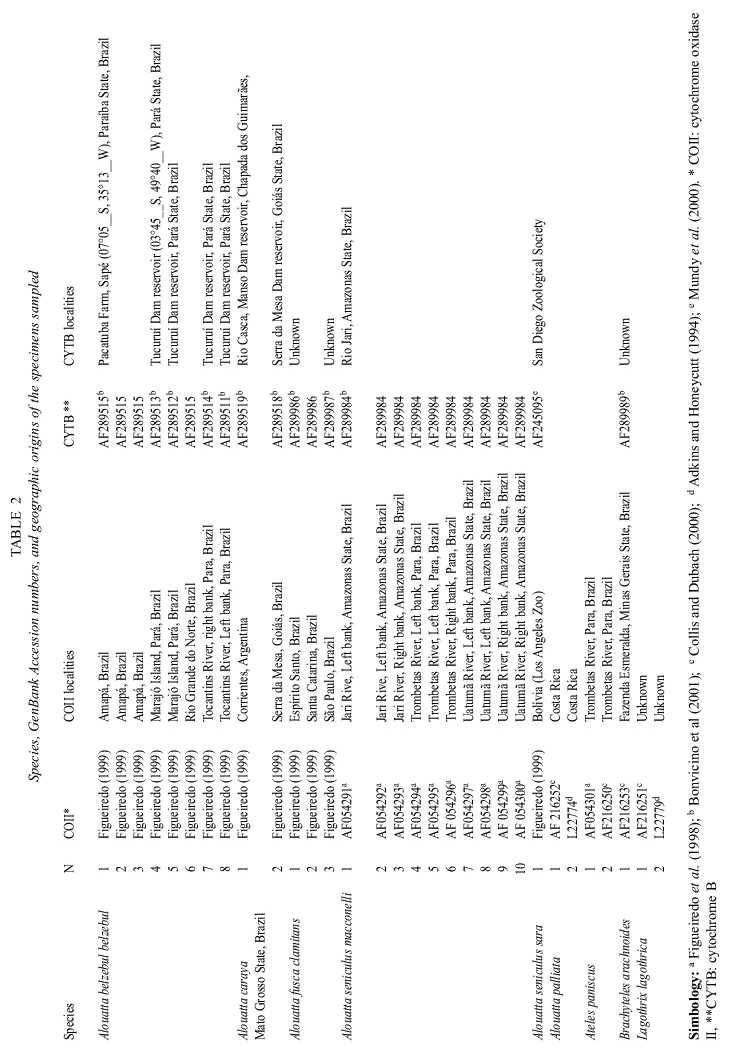
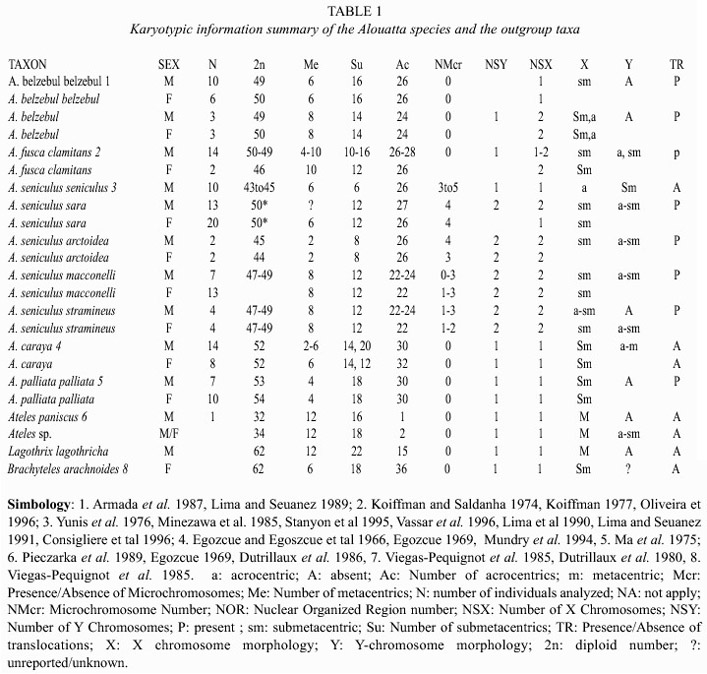
<body><![CDATA[<p><font face="Arial" size="2">The evolutionary relationships of the infraorder Platyrrhini (Primates) genera have been studied using morphological (<a href="#ro81">Rosenberg 1981</a>, <a href="#ro84">1984</a>, <a href="#fo86">Ford 1986</a>, <a href="#zi73">Zingeser 1973</a>, <a  href="#fo92">Ford and Davis 1992</a>), karyotypic and molecular data (<a  href="#sc93">Schneider <i>et al. </i>1993</a>, <a href="#ho98">Horovitz <i>et al. </i>1998</a>, <a href="#du86">Dutrillaux <i>et al. </i>1986</a>). Some incongruence between morphological and molecular data has emerged in some groups, such as the subfamily Atelinae <i>(Lagothrix </i>É. Geoffroy 181<i>2, Brachyteles </i>Spix 182<i>3, Ateles </i>É. Geoffroy 1806, and <i>Alouatta </i>Lacépède 179<i>9</i>). The clade Atelinae is considered to be a monophyletic group based on the large body size, a prehensile tail with a hairless ventral area for grasping, the frequent use of suspensory positional behaviors, and other characters (<a href="#ho98">Horowitz <i>et al. </i>1998</a>, <a  href="#ro89">Rosenberg 1989</a>).</font></p>     <p><font face="Arial" size="2">The phylogenetic relationships among the Atelinae genera have not been explored until recently (<a href="#ho98">Horovitz <i>et al. </i>1998</a>). According to <a href="#ro81">Rosenberg (1981</a>, <a href="#ro84">1984)</a>, <a href="#fo86">Ford (1986)</a>, <a  href="#zi73">Zingeser (1973)</a> and <a href="#fo92">Ford and Davis (1992)</a>, reported that the genus <i>Alouatta </i>is the sister clade to a clade compose of <i>Lagothrix, Brachyteles </i>and <i>Ateles </i>based on morphological data <i>(Brachyteles </i>and <i>Ateles </i>are the sister clade of <i>Lagothri</i>x). In contrast, <a href="#ka90">Kay (1990)</a> found the clade <i>Lagothrix </i>+ <i>Ateles </i>as the sister clade of <i>Alouatta </i>+ <i>Brachyteles </i>based on craneo- dental characters.</font></p>     <p><font face="Arial" size="2"><a href="#du86">Dutrillaux <i>et al. </i>(1986)</a> inferring chromosome rearrangements, reported that <i>Brachyteles, Lagothrix </i>and <i>Ateles </i>form a separate and distinct evolutionary branch from which <i>Lagothrix </i>is more closely related to <i>Ateles </i>than <i>Brachytele</i>s. On the other hand, <a href="#sc93">Schneider <i>et al. </i>(1993</a>, 1996), using DNA sequences for the a-globin and IRBP intron-1, found that <i>Alouatta </i>is the sister taxon to the clade ((<i>Brachyteles+Lagothri</i>x) <i>Atele</i>s). These relationships were tested by <a href="#ho98">Horovitz <i>et al.</i> (1998)</a> in a combined analysis of morphological and molecular data (nuclear and mitochondrial sequences), with the resulting topology identical to the one already obtained by Schneider <i>et al. </i>(1996) for the Atelinae.</font></p>     <p><font face="Arial" size="2">The Atelinae subfamily has also been studied at the species level. Froehlich <i>et al. </i>(1991) used a multivariate approach to examine <i>Ateles </i>cranial and dental morphometric patterns and concluded that this genus may be composed of three species. A more recent study using cytogenetical data (<a  href="#ma97">Madeiros <i>et al. </i>1997</a>), however concluded that <i>Ateles fusciceps </i>maybe reproductive isolated and therefore considered as a separated species. The genus <i>Alouatta </i>is currently considered to be composed of 9 species: <i>Alouatta belzebul </i>(Linnaeus 1766), <i>A. seniculus </i>(Linnaeus 1766), <i>A. caraya </i>(Humboldt 1812), <i>A. fusca </i>(É. Geoffroy 1812), A. <i>palliata </i>(Gray 1849), <i>A. pigra </i>(Lawrence 1933), <i>A. sara </i>(Elliot 1910), <i>A. coibensis </i>(Thomas 1902), and <i>A. arctoidea </i>(Rylands 1995). Of those, <i>A. sara </i>and <i>A. arctoidea </i>were subspecies of <i>A. seniculus </i>but now considered as full species by Minezawa <i>et al. </i>(1985) and Stanyon <i>et al. </i>(1995); while <i>A. coibensis </i>was also proposed as a separate species from the formerly known <i>A. palliata panamensis </i>(<a href="#fr87">Froehlich and Froehlich 1987</a>).</font></p>     <p><font face="Arial" size="2">In addition, the taxonomic status of <i>A. seniculus macconelli </i>and <i>A. s. straminea </i>is in debate. According with <a href="#hi62">Hill (1962)</a>, <i>A. s. macconelli </i>and <i>A. s. straminea </i>were considered as part of the <i>Alouatta </i>seniculu<i>s’ </i>9 subspecies group. <a href="#bo95">Bonvicino <i>et al. </i>(1995)</a>, however, proposed that <i>A. s. seniculu</i>s, <i>A. s. stramineus </i>and <i>A. s. macconelli </i>should be considered as separate species basing their results in the analysis of quantitative cranial traits. In contrast, studies done by <a href="#fi98">Figueiredo (1998)</a> using mitochondrial DNA and <a href="#sa96">Sampaio <i>et al. </i>(1996)</a> using biochemical data (20 protein loci) showed that <i>A. s. macconelli </i>and <i>A. s. stramineus </i>are related closely enough to be considered a single subspecies. In addition, <a  href="#li91">Lima and Seuanez (1991)</a> found the same closeness between these two subspecies, but in this case the authors did not support the fusion of these subspecies.</font></p>     <p><font face="Arial" size="2">The first systematic revision for the genus <i>Alouatta </i>was conducted by <a href="#he49">Hershkovitz (1949)</a> using morphological characters. <a href="#he49">Hershkovitz (1949)</a> proposed its division in three subgroups based on the hyoideal bone morphology, and their composition is as follows: the seniculus group <i>(A. seniculu</i>s, A. <i>belzebu</i>l, <i>A. fusc</i>a), the <i>palliata </i>group (A. <i>palliata </i>and <i>A. pigr</i>a) and finally the caraya group <i>(A. caray</i>a). More recently, <a  href="#sa96">Sampaio <i>et al. </i>(1996)</a> studied the taxonomy of the Seniculus group containing the species <i>A. seniculus </i>and A. <i>belzebu</i>l, based on biochemical and chromosome data. <a  href="#ol96">Oliveira (1996)</a> using cytogenetical data proposed the placement of <i>A. belzebul nigerrima </i>together with <i>A. seniculu</i>s. Also Gregorin (1996) proposed a phylogenetic hypothesis for the <i>Alouatta </i>species using cranial and hiodeal bone morphology which resulted in the placement as species of most of the <i>A. seniculus </i>subspecies, some of which <i>(A. seniculus ululata, A. s. discolo</i>r) were closely related to A. <i>belzebu</i>l. The recent study realized by <a href="#bo01">Bonvicino <i>et al. </i>(2001)</a> using Cytochrome B sequences partially support the phylogenetic relationships found previously: A. <i>palliata </i>as the basal taxon to all <i>Alouatta </i>species. </font></p>     <p><font face="Arial" size="2">The goal of the present paper is to estimate the phylogenetic relationships among <i>Alouatta </i>species using karyotypic, morphological and DNA data on a simultaneous analysis.</font></p> <font face="Arial" size="2"><b></b></font>     <p><font face="Arial" size="2"><b>Material and methods</b></font></p>     <p><font face="Arial" size="2"><b>Data collection: </b>The karyotypic data was compiled from existing literature (<a href="#t1">Table 1</a>). Testing for chromosomal homologies was not possible because the low-resolution techniques used in most of the studies (chromosome homologies only reported by <a href="#mu94">Mudry <i>et al. </i>1994</a>). Characteristics of the hyoideal bone were evaluated and taken from the illustrations of <a href="#he49">Hershkovitz (1949)</a> and illustrations by Gregorin (1996); some of the Gregorin matrix characters used in this analysis as well as the hyoideal volumetric data previously reported by <a href="#cr86">Crockett and Eisenberg (1986)</a>. </font></p> <a name="t1"></a>     <div style="text-align: center;"><img src="/img/fbpe/rbt/v52n3/3082i4.JPG" title=""  alt="" style="width: 707px; height: 674px;">    
]]></body>
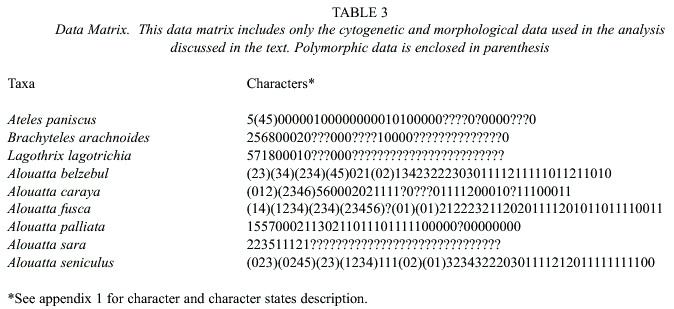
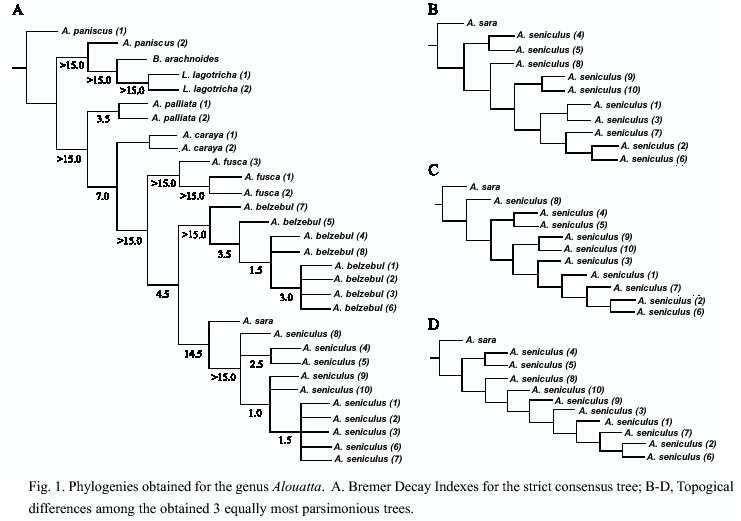
<body><![CDATA[<br> </div>     <p><font face="Arial" size="2">DNA sequences from mitochondrial cytochrome B gene (CYTB) and cytochrome oxidase II (COII) were obtained from genebank and other sources (Table 2). DNA sequence alignments were performed using CLUSTAL W, ver. 1.75. (Thompson <i>et al. </i>1994) and each gene was independently aligned and then concatenated. Because the genes are from independent studies, the sequences were not from the same localities, therefore the criterion used to concatenate was geographical proximity. The karyotypic and morphological data were added <i>a posteriori </i>to each taxon therefore all the sequences for a species had the same information. For <i>Alouatta </i>pigra and <i>A. coibensi</i>s, no available data have been reported from the revised literature.</font></p>     <p><font face="Arial" size="2"><b>Phylogenetic analysis and sequence alignment: </b>The phylogenetic analyses for the simultaneous combined matrix were performed using PIWEE, ver. 2.83. (<a href="#go93">Goloboff 1993</a>). The search strategy consisted in 10000 TBR replicates (mult*), keeping 2 trees by replicate. All the uninformative characters were removed before the analysis. The Bremer decay index was calculated using a sample of 15000 suboptimal trees up to 15% less fit. The preformed homogeneity tests (I.L.D.L test by <a href="#fa95">Farris <i>et al. </i>1995</a>) were also performed using Winclada ver. 1.00.08 with 1000 replicas.</font></p>     <p><font face="Arial" size="2">According to <a href="#wh78">White (1978)</a> the karyotypic information for some taxa shows some discernible directional tendencies but all the characters were stated as unordered because in most cases the available information lacked the resolution needed to infer direction for the chromosomal changes. The genera <i>Lagothrix, Brachyteles, </i>and <i>Ateles </i>were used as the outgroup, and their relationships to <i>Alouatta </i>followed the phylogenetic hypotheses proposed by <a href="#ho98">Horowitz <i>et al. </i>(1998)</a> and <a href="#sc93">Schneider <i>et al. </i>(1993)</a>. Some morphological characters were treated as additive (<a href="#t3">Table 3</a> and <a href="#a1">Appendix</a> for karyiotipic and morphological part of the matrix).</font></p>     <p style="text-align: center;"><font face="Arial" size="2">&nbsp;<a  name="t2"></a></font></p>     <p style="text-align: center;"><font face="Arial" size="2"><a  href="/img/fbpe/rbt/v52n3/3082i5.JPG"><span  style="text-decoration: underline;"><img  src="/img/fbpe/rbt/v52n3/3082i5-2.JPG" title="" alt=""  style="border: 0px solid ; width: 564px; height: 802px;"></span></a>&nbsp;</font></p> <a name="t3"></a>     
<div style="text-align: left;"><img  src="/img/fbpe/rbt/v52n3/3082i6.JPG" title="" alt=""  style="width: 674px; height: 309px;"></div>     
<p><font face="Arial" size="2">We choose the use of simultaneous analysis of different data sets because it could improve the phylogenetic signal because of the possible common shared history of different data sets. The homoplasy distribution is likely to be different in each data set because they are subject to different constrains, therefore when different data sets are analyzed simultaneously the signal common to all of them is more likely to overwhelm the homoplasy signal on the data (<a href="#kl89">Kluge 1989</a>).</font></p> <font face="Arial" size="2"><b>     <p>Results</p> </b> </font>     <p><font face="Arial" size="2">The molecular partition was found to be incompatible with the morphological partition according to the I.L.D. test (Farris <i>et al. </i>1975) (P value= 0.0102) as well as the cytochrome oxidase II gene with respect to the cytochrome B gene (P value= 0.0102). According to <a href="#cu97">Cunningham (p.739, 1997)</a>, however, when the P value of the IDL test is greater than 0.01 the combination of the "incompatible" data sets improved, or in the worst case did not affected the accuracy of the phylogenetic reconstruction.</font></p>     ]]></body>
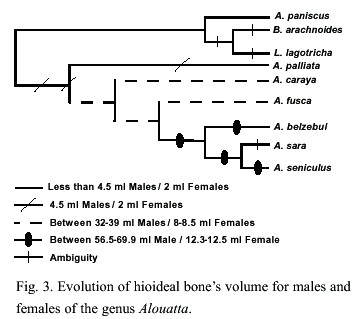
<body><![CDATA[<p><font face="Arial" size="2">From the 1675 characters used, only 264 were informative. The phylogenetic analysis using the whole data set resulted in 3 equally parsimonious trees from which a strict consensus was calculated (<a href="#f1">Fig. 1</a>, Length= 463, CI= 0.69; RI= 0.90, RC= 0.621, Fit value= 2315.0). All the obtained trees only differ on the relationships among DNA sequences within the taxon <i>A. seniculus macconell</i>i.    <br> </font></p>     <p style="text-align: center;"><font face="Arial" size="2"><a name="f1"></a><span  style="text-decoration: underline;">    <br> <a href="/img/fbpe/rbt/v52n3/3082i1.JPG"><img  src="/img/fbpe/rbt/v52n3/3082i1-2.JPG" title="" alt=""  style="border: 0px solid ; width: 496px; height: 349px;"></a>    
<br> </span></font></p> <font face="Arial" size="2"><i></i></font>     <p><font face="Arial" size="2"><i>A. palliata </i>is placed as the sister taxon to all other <i>Alouatta </i>species. In addition, <i>A. s. sara </i>is placed as the sister taxon of <i>A. seniculus macconell</i>i, more than 15 fit units would needed to collapse all <i>A. s. macconelli </i>to conform a single clade with <i>A. s. sara </i>(<a  href="#f1">Fig.1</a>). Also, the phylogenetic relationship among <i>A. fusca, </i>A. <i>belzebul </i>and the clade conformed by <i>A. s. sara </i>and <i>A. s. macconelli </i>on the consensus appears to be resolved. 4.5 fit units would be needed to collapse the clade conformed by A. <i>belzebu</i>l, <i>A. s. sara </i>and <i>A. s. macconelli </i>(<a  href="#f1">Fig. 1</a>).</font></p> <font face="Arial" size="2"><b>     <p>Discussion</p> </b> <b></b></font>     <p><font face="Arial" size="2"><b>Taxonomic implications: </b>According to <a href="#he49">Hershkovitz (1949)</a>, the <i>Alouatta </i>genus could be divided in three different groups based on the hyoid bone morphology. These are: the seniculus group <i>(A. seniculu</i>s, A. <i>belzebul </i>and <i>A. fusc</i>a); the <i>palliata </i>group (A. <i>palliat</i>a) (<a href="#mi88">Mittermeier <i>et al. </i>1988</a>, included <i>A. pigra </i>and <i>A. coibensi</i>s); and finally the caraya group <i>(A. caray</i>a). Later, <a href="#sa96">Sampaio <i>et al. </i>(1996)</a>, using biochemical and chromosome data, found that <i>A. seniculus </i>and A. <i>belzebul </i>are not the closest species at the seniculus group. Meanwhile, the chromosome data compiled by them supports the notion of a closest relationship between <i>A. belzebul </i>and <i>A. fusc</i>a.</font></p>     <p><font face="Arial" size="2">Recent independent molecular analysis using the pseudogene a-1-globin (<a href="#me99">Meireles <i>et al. </i>1999</a>) and cytochrome B sequences (<a href="#bo01">Bonvicino <i>et al. </i>2001</a>) produced partially congruent topologies to the one found with the combined data approach. These studies did not included all the species of the genus, therefore <i>A. palliata </i>was never included, not was <i>A. sara. </i><a href="#fi98">Figueiredo (1998)</a> using the COII gene included this species in her analysis, the trees found could not resolve the relationships among <i>A. belzebu</i>l, <i>A. fusca </i>and a polytomy conformed by <i>A. seniculus, A. sara, A. nigerrima </i>and <i>A. caray</i>a. <a href="#fi98">Figueredo’s (1998)</a> analysis placed <i>A. palliata </i>as the sister taxa to all other species. Morphological analysis based on the hyoid bone was also incongruent with the molecular studies: Gregorin (1999) found <i>A. belzebul </i>and <i>A. seniculus </i>conforming a clade with <i>A. fusca </i>as the sister taxon. Our results support this relationship (<a href="#f1">Fig. 1</a>).</font></p>     <p><font face="Arial" size="2">Our results placed <i>A. palliata </i>as the sister taxon to the remainder taxa agreeing with previously reported topologies (<a href="#me99">Meireles <i>et al. </i>1999</a>, Bonvicino <i>et al. </i>2000). Moreover, <i>A. sara </i>was the sister taxon to <i>A. seniculus macconell</i>i, with a strong support (decay index value of 14.5), confirming its separate species status as previous works (i.e. <a href="#mi85">Minezawa <i>et al.</i>1985</a>, Stanyon <i>et al. </i>1996). Stanyon <i>et al. </i>(1996) sugested the specific status based on more than 10 chromosomal rearrangements between <i>A. s. sara </i>and <i>A. s. arctoide</i>a.</font></p> <font face="Arial" size="2"><b></b></font>     ]]></body>
<body><![CDATA[<p><font face="Arial" size="2"><b>Hyoid evolution: </b>The hyoid bone is a large thin walled subglobular capsule that acts as a resonator and amplifier of <i>Alouatt</i>a’s characteristic loud calls during territorial delimitation and appears to be a very specialized structure (<a href="#he49">Hershkovitz 1949</a>, <a href="#cr86">Crockett and Eisemberg 1986</a>, <a href="#ro89">Rosenberg 1989</a>). Also, it has been considered a key character for <i>Alouatta’s </i>species identification (<a href="#he49">Hershkovitz 1949</a>). There have been few studies so far discussing the evolution of this structure.</font></p>     <p><font face="Arial" size="2">In general, our results suggest a tendency towards an increasing complexity for the hyoid bone. There has been a trend towards a more globular hyoid bone, which is observed as an increase in the volume of the bone (with its highest volume exhibited by <i>A. seniculu</i>s). Also, the tentorium has undergone a size increase in <i>A. seniculus </i>(<a href="#f3">Fig 3</a>). The hyiod opening, the cornum and corniculum has been reduced most probably as a consequence of the increasing bulla development (i.e. the hioyd lateral shape changed from a "J" shape in <i>A. palliata </i>to a globular structure in <i>A. seniculu</i>s). </font></p>     <p style="text-align: center;"><font face="Arial" size="2">&nbsp;<a  name="f3"></a><img src="/img/fbpe/rbt/v52n3/3082i3.JPG" title=""  alt="" style="width: 356px; height: 319px;"></font></p>     
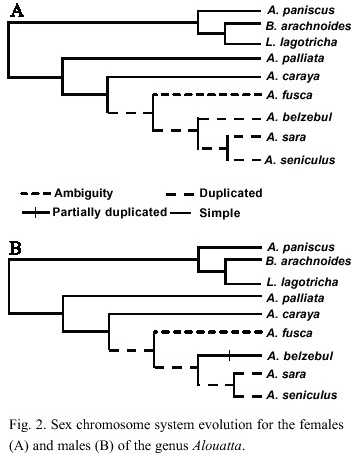
<p><font face="Arial" size="2">The mentioned morphological modifications could account for the present acoustic differences among the species calls. In <i>A. seniculu</i>s, the entering of air acoustically activated air by the glottis into the hyoid bulla and lateral air sacs amplify some frequencies, and increase the amplitude of the calls (<a href="#sc86">Schon-Ybarra 1986</a>). The <i>A. seniculus </i>barks range from 350 to 3500 Hz, with a spectral energy concentration on 350-1100 Hz (<a href="#sc86">Schon-Ybarra 1986</a>) while in <i>A. caray</i>a, which lacks of a complex development in the hyoid bone, produce lower call frequencies. The strongest frequencies in barks and long calls of <i>A. caraya </i>are in the range of 310-328 Hz (Thorington <i>et al. </i>1984). Also, <i>A. palliata, </i>which is the species with the least complex hyoid bone, produces barks and roars at lower frequencies than <i>A. caraya </i>and <i>A. seniculus </i>(<a href="#ei76">Eisenberg 1976</a>, Thorington <i>et al. </i>1984, <a href="#sc86">Schön-Ybarra 1986</a>).</font></p> <font face="Arial" size="2"><b></b></font>     <p><font face="Arial" size="2"><b>Karyotypic evolution: </b>Several tendencies were found for the <i>Alouatta </i>species like the reduction in the diploid number, which is seen as a further gain for <i>A. caraya </i>and <i>A. palliata </i>(<a href="#f2">Fig. 2</a>). These tendencies have also been observed in <i>Ateles </i>species (2n= 34-33) in comparison with the genera <i>Lagothrix </i>and <i>Brachyteles </i>who have a diploid number of 62. <a href="#pi89">Pieczarka <i>et al. </i>(1989)</a> reported for <i>Ateles paniscus </i>paniscus a similar situation as a result of the fusion between the chromosomes 4 and 12. Fusion of chromosomes was also found in <i>A. belzebul belzebu</i>l, <i>A. b. hybridu</i>s, and <i>A. geoffroyi </i>(<a href="#ga75">Garcia <i>et al. </i>1975</a>, <a href="#be75">Benirshke 1975</a>, <a  href="#ku80">Kunkel <i>et al. </i>1980</a>). Nevertheless, it is important to mention that the diploid number for the species is the result of a population sampling process, making this character extremely variable (<a href="#ma75">Ma <i>et al. </i>1975</a>).</font></p>     <p style="text-align: center;"><font face="Arial" size="2">&nbsp;<a  name="f2"></a><img src="/img/fbpe/rbt/v52n3/3082i2.JPG" title=""  alt="" style="width: 358px; height: 457px;"></font></p>     
<p><font face="Arial" size="2">The sex chromosome system in the genus <i>Alouatta </i>is highly diverse in comparison with other Neotropical primates. A. <i>palliata </i>has been described to have an XY system for males and XX for females (<a href="#ma75">Ma <i>et al. </i>1975</a>) from a population studied in Barra Colorado Island (Panama). <i>A. caraya </i>has also been reported to have this same sex chromosome system (<a  href="#ol96">Oliveira 1996</a>). <i>A. fusc</i>a, however, shows at least 4 different karyomorphic groups: 2n=52 XY/XX; 2n= 48 or 50 XY/XX; 2n=49, X1X2Y/50,X1X1X2X2 and 2n=45 X1X2Y/ 46 X1X1X2X2 (<a href="#ol95">Oliveira <i>et al. </i>1995</a>, <a href="#ol98">1998</a>). It seems like the origin of these groups in <i>A. fusca </i>appear independently where the <i>de novo </i>sex chromosomes came from different autosomes (<a  href="#bo01">Bonvicino <i>et al. </i>2001</a>) <i>A. belzebul </i>also present a similar sex chromosome system of 50 X1X1X2X2/49X1X2Y (<a  href="#ar87">Armada <i>et al. </i>1987</a>), while <i>A. macconell</i>i, <i>A. sara </i>and <i>S. arctoidea </i>showed a X1X2Y1Y2/X1X1X2X2 system (<a href="#co96">Consigliere <i>et al. </i>1996</a>, <a  href="#st95">Stanyon <i>et al. </i>1995</a>, <a href="#li90">Lima <i>et al. </i>1990</a>).</font></p>     <p><font face="Arial" size="2">According with our results, the sex chromosome has evolved from a XY/XX system to a X1X2Y1Y2/X1X1X2X2 system. <i>A. fusca </i>is a polymorphic species with regard to the sex chromosome system, and due to its phylogenetic position in our results it was expected to present a XY/XX system. Due to the polymorphic status of this species it is not possible to asset unambiguously a character state at the node shared with the clade composed by <i>A. belzebu</i>l, <i>A. sara </i>and <i>A. macconell</i>i. </font></p>     <p><font face="Arial" size="2">The existence of microchromosomes in some species of the genus <i>Alouatta </i>has been another distinctive feature. These chromosomes have been found in <i>A. sar</i>a, <i>A. s. artoidea </i>(<a href="#co96">Consigliere <i>et al. </i>1996</a>, <a href="#mi85">Minezawa <i>et al. </i>1985</a>), <i>A. s. seniculus </i>(<a href="#yu76">Yunis <i>et al. </i>1976</a>) and <i>A. s. macconelli </i>(<a href="#li90">Lima <i>et al. </i>1990</a>, <a  href="#va96">Vassart <i>et al</i>., 1996</a>). For A. <i>palliata </i>(<a  href="#ma75">Ma <i>et al. </i>1975</a>), <i>A. caraya </i>(<a  href="#eg66">Egozcue and Egozcue 1966</a>, <a href="#mu94">Mudry <i>et al. </i>1994</a>, <a href="#eg69">Egozcue 1969</a>) and A. <i>belzebul belzebul </i>(<a href="#ar87">Armada <i>et al. </i>1987</a>), however the presence of microchromosomes has not been reported. In <i>A. fusc</i>a, the absence of microchromosomes has been reported (<a  href="#ko82">Koiffman 1982</a>, <a href="#ko74">Koiffman and Saldanha 1974</a>), but the authors mention a numerical variation of karyotype in the number of the smallest pair. <a href="#mi85">Minezawa <i>et al. </i>(1985)</a> pointed out that this variation could be due to the presence of "accessory chromosomes" (microchromosomes). According with the present results, if the absence of microchromosomes in <i>A. fusca </i>is considered, the microchromosomes would have evolve once in the genus for the taxa <i>A. sara </i>and <i>A. seniculu</i>s. Conversely, if the numerical variation on the karyotype of <i>A. fusca </i>is considered as proof of the microchromosome presence then the microchromosomes would have acquired independently by <i>A. fusca </i>and the clade <i>A. sara </i>and <i>A. seniculu</i>s. </font></p> <font face="Arial" size="2"><b>     <p>Acknowledgments </p> </b> </font>     ]]></body>
<body><![CDATA[<p><font face="Arial" size="2">We like to thank the following people who provided support and comments: Cukha, Dione, Santiago, Antonia, S. Cameron, Sascha Pfennig and J.B. Whitfield. This research was supported by the Central American Institute for Biological Research and Conservation grand number CIBRC 0001-A.</font></p> <font face="Arial" size="2"><b>     <p>Resumen</p> </b> </font>     <p><font face="Arial" size="2">El estado taxonómico actual de las especies y subespecies del genero <i>Alouatta </i>(Lacépède, 1799) fue estudiado empleando un análisis filogenético combinado de datos morfológicos, cariotipicos y moleculares (genes mitocontridales del Citocromo Oxidasa II y el Citocromo B). Nuestros resultados demuestran que <i>Alouatta palliata </i>(Gray 1949) es la especie mas basal del genero en concordancia con propuestas previas para el grupo, también muestran la valides de <i>Alouatta sara </i>(Elliot 1910) como una especie. Nuestros análisis también muestra que los cromosomas sexuales evolucionaron de un sistema XY/XX a un sistema X1X2Y1Y2/X1X1X2X2 dentro del genero así como también un incremento en el tamaño y complejidad del hueso hioideo.</font></p> <font face="Arial" size="2"><b>     <p>References</p> </b> </font>     <!-- ref --><p><font face="Arial" size="2"><a name="ad94"></a>Adkins, R. &amp; R.L. Honeycutt. 1994. Evolution of the primate cytochrome c oxidase subunit II gene. J. Molec. Evol. 38: 215-231.</font>&nbsp;&nbsp;&nbsp;&nbsp;&nbsp;&nbsp;&nbsp;&nbsp;[&#160;<a href="javascript:void(0);" onclick="javascript: window.open('/scielo.php?script=sci_nlinks&ref=1340312&pid=S0034-7744200400030002800001&lng=','','width=640,height=500,resizable=yes,scrollbars=1,menubar=yes,');">Links</a>&#160;]<!-- end-ref --><!-- ref --><p><font face="Arial" size="2"><a name="ar87"></a>Armada, J.L.A., C.M.L. Barroso, M.M.C. Lima, J.A.P.C. Muniz &amp; H.N. Seuanez. 1987. Chromosome studies in <i>Alouatta belzebu</i>l. Am. J. Primatol. 13: 283-296.</font>&nbsp;&nbsp;&nbsp;&nbsp;&nbsp;&nbsp;&nbsp;&nbsp;[&#160;<a href="javascript:void(0);" onclick="javascript: window.open('/scielo.php?script=sci_nlinks&ref=1340313&pid=S0034-7744200400030002800002&lng=','','width=640,height=500,resizable=yes,scrollbars=1,menubar=yes,');">Links</a>&#160;]<!-- end-ref --><!-- ref --><p><font face="Arial" size="2"><a name="be75"></a>Benirshkle, K. 1975. Biomedical research. In. Research in zoos and acuariums. Ed. by Institute of laboratory animal resources. Nat. Acad. Sci. Washington DC. 3-11.</font>&nbsp;&nbsp;&nbsp;&nbsp;&nbsp;&nbsp;&nbsp;&nbsp;[&#160;<a href="javascript:void(0);" onclick="javascript: window.open('/scielo.php?script=sci_nlinks&ref=1340314&pid=S0034-7744200400030002800003&lng=','','width=640,height=500,resizable=yes,scrollbars=1,menubar=yes,');">Links</a>&#160;]<!-- end-ref --><!-- ref --><p><font face="Arial" size="2"><a name="bo95"></a>Bonvicino, C.R., M.E.B. Fernades &amp; H.N. Seuanez. 1995. Morphological analysis of <i>Alouatta seniculus </i>species group Primates. Cebidae. Acomparison with biochemical and karyological data. Hum. Evol. 10: 169-176.</font>&nbsp;&nbsp;&nbsp;&nbsp;&nbsp;&nbsp;&nbsp;&nbsp;[&#160;<a href="javascript:void(0);" onclick="javascript: window.open('/scielo.php?script=sci_nlinks&ref=1340315&pid=S0034-7744200400030002800004&lng=','','width=640,height=500,resizable=yes,scrollbars=1,menubar=yes,');">Links</a>&#160;]<!-- end-ref --><!-- ref --><p><font face="Arial" size="2"><a name="bo01"></a>Bonvicino, C.R., B. Lemos &amp; H.N. Seuanez. 2001. Molecular phylogenetics of the howler monkey <i>Alouatta </i>Platyrrhini. a comparison with karyotypic data. Chromosoma 110: 241-246.</font>&nbsp;&nbsp;&nbsp;&nbsp;&nbsp;&nbsp;&nbsp;&nbsp;[&#160;<a href="javascript:void(0);" onclick="javascript: window.open('/scielo.php?script=sci_nlinks&ref=1340316&pid=S0034-7744200400030002800005&lng=','','width=640,height=500,resizable=yes,scrollbars=1,menubar=yes,');">Links</a>&#160;]<!-- end-ref --><!-- ref --><p><font face="Arial" size="2"><a name="co00"></a>Collins, A.C. &amp; J.M. Dubach. 2000. Phylogenetic Relationships of Spider Monkeys <i>Ateles </i>Based on Mitochondrial DNA Variation. Int. J. Primatol. 21: 381-420.</font>&nbsp;&nbsp;&nbsp;&nbsp;&nbsp;&nbsp;&nbsp;&nbsp;[&#160;<a href="javascript:void(0);" onclick="javascript: window.open('/scielo.php?script=sci_nlinks&ref=1340317&pid=S0034-7744200400030002800006&lng=','','width=640,height=500,resizable=yes,scrollbars=1,menubar=yes,');">Links</a>&#160;]<!-- end-ref --><!-- ref --><p><font face="Arial" size="2"><a name="co96"></a>Consiliglieri, S., R. Stanyon, U. Koehler, Agoramoorthy G. &amp; J. Wienberg. 1996. Chromosome painting defines genomic rearrangements between red howler monkey subspecies. Chrom. Res. 4: 264-270.</font>&nbsp;&nbsp;&nbsp;&nbsp;&nbsp;&nbsp;&nbsp;&nbsp;[&#160;<a href="javascript:void(0);" onclick="javascript: window.open('/scielo.php?script=sci_nlinks&ref=1340318&pid=S0034-7744200400030002800007&lng=','','width=640,height=500,resizable=yes,scrollbars=1,menubar=yes,');">Links</a>&#160;]<!-- end-ref --><!-- ref --><p><font face="Arial" size="2"><a name="cr86"></a>Crockett, C.M. &amp; J.F. Eisenberg. 1986. Howlers. variation in group sizes and demography. <i>In </i>B.B. Smuts, D.L. Cheney, R.M. Seyfarth R.W. Wrangham &amp; T.T. Struhsaker (eds.). Primate societies. University of Chicago, Chicago USA.</font>&nbsp;&nbsp;&nbsp;&nbsp;&nbsp;&nbsp;&nbsp;&nbsp;[&#160;<a href="javascript:void(0);" onclick="javascript: window.open('/scielo.php?script=sci_nlinks&ref=1340319&pid=S0034-7744200400030002800008&lng=','','width=640,height=500,resizable=yes,scrollbars=1,menubar=yes,');">Links</a>&#160;]<!-- end-ref --><!-- ref --><p><font face="Arial" size="2"><a name="cu97"></a>Cunningham, C.W. 1997. Can tree incongruence test predict when data should be combined? Mol. Biol. Evol. 14: 733-740.</font>&nbsp;&nbsp;&nbsp;&nbsp;&nbsp;&nbsp;&nbsp;&nbsp;[&#160;<a href="javascript:void(0);" onclick="javascript: window.open('/scielo.php?script=sci_nlinks&ref=1340320&pid=S0034-7744200400030002800009&lng=','','width=640,height=500,resizable=yes,scrollbars=1,menubar=yes,');">Links</a>&#160;]<!-- end-ref --><!-- ref --><p><font face="Arial" size="2"><a name="du80"></a>Dutrillaux, B. J. Couturier &amp; A.M. Fosse. 1980. The use of high resolution banding in comparative cytogenetics. comparizion between man and <i>Lagothrix lagotricha </i>(Cebidae). Cythogen. Cell. Gent. 27: 45-51.</font>&nbsp;&nbsp;&nbsp;&nbsp;&nbsp;&nbsp;&nbsp;&nbsp;[&#160;<a href="javascript:void(0);" onclick="javascript: window.open('/scielo.php?script=sci_nlinks&ref=1340321&pid=S0034-7744200400030002800010&lng=','','width=640,height=500,resizable=yes,scrollbars=1,menubar=yes,');">Links</a>&#160;]<!-- end-ref --><!-- ref --><p><font face="Arial" size="2"><a name="du86"></a>Dutrillaux, B., J. Couturier &amp; E.Viegas-Pequignot. 1986. Evolucion cromosomique des Platyrhiniens. Mammalia 50: 56-81.</font>&nbsp;&nbsp;&nbsp;&nbsp;&nbsp;&nbsp;&nbsp;&nbsp;[&#160;<a href="javascript:void(0);" onclick="javascript: window.open('/scielo.php?script=sci_nlinks&ref=1340322&pid=S0034-7744200400030002800011&lng=','','width=640,height=500,resizable=yes,scrollbars=1,menubar=yes,');">Links</a>&#160;]<!-- end-ref --><!-- ref --><p><font face="Arial" size="2"><a name="ei76"></a>Eisenberg, J. 1976. Comunication mechanisms and social integration in the black spider monkey <i>Ateles fusciceps robustus </i>and related species. Smithson. Contr. Zool 213: 1-108.</font>&nbsp;&nbsp;&nbsp;&nbsp;&nbsp;&nbsp;&nbsp;&nbsp;[&#160;<a href="javascript:void(0);" onclick="javascript: window.open('/scielo.php?script=sci_nlinks&ref=1340323&pid=S0034-7744200400030002800012&lng=','','width=640,height=500,resizable=yes,scrollbars=1,menubar=yes,');">Links</a>&#160;]<!-- end-ref --><!-- ref --><p><font face="Arial" size="2"><a name="el10"></a>Elliot, D.G. 1910. Description of new species of monkeys of the genera <i>Galogo Cebus Alouatta </i>and <i>Cercopithecu</i>s. Ann. Mag. Nat. Hist. 8: 77-83.</font>&nbsp;&nbsp;&nbsp;&nbsp;&nbsp;&nbsp;&nbsp;&nbsp;[&#160;<a href="javascript:void(0);" onclick="javascript: window.open('/scielo.php?script=sci_nlinks&ref=1340324&pid=S0034-7744200400030002800013&lng=','','width=640,height=500,resizable=yes,scrollbars=1,menubar=yes,');">Links</a>&#160;]<!-- end-ref --><!-- ref --><p><font face="Arial" size="2"><a name="eg66"></a>Egozcue, J. &amp; M.V. Egozcue. 1966. The chromosime complement of the howler monkey <i>Alouatta caraya </i>Humboldt 1812. Cythogenetics 5: 20-27.</font>&nbsp;&nbsp;&nbsp;&nbsp;&nbsp;&nbsp;&nbsp;&nbsp;[&#160;<a href="javascript:void(0);" onclick="javascript: window.open('/scielo.php?script=sci_nlinks&ref=1340325&pid=S0034-7744200400030002800014&lng=','','width=640,height=500,resizable=yes,scrollbars=1,menubar=yes,');">Links</a>&#160;]<!-- end-ref --><!-- ref --><p><font face="Arial" size="2"><a name="eg69"></a>Egozcue, J. 1969. Primates. <i>In </i>K. Benirschke (Ed.). Comparative mammalian cytogenetics. Springer, New York USA.</font>&nbsp;&nbsp;&nbsp;&nbsp;&nbsp;&nbsp;&nbsp;&nbsp;[&#160;<a href="javascript:void(0);" onclick="javascript: window.open('/scielo.php?script=sci_nlinks&ref=1340326&pid=S0034-7744200400030002800015&lng=','','width=640,height=500,resizable=yes,scrollbars=1,menubar=yes,');">Links</a>&#160;]<!-- end-ref --><!-- ref --><p><font face="Arial" size="2"><a name="fa95"></a>Farris, J.S., Kallersjo M. &amp; C. Bult. 1995. Constructing a Significance Test for Incongruence. Syst. Biol. 44: 572.</font>&nbsp;&nbsp;&nbsp;&nbsp;&nbsp;&nbsp;&nbsp;&nbsp;[&#160;<a href="javascript:void(0);" onclick="javascript: window.open('/scielo.php?script=sci_nlinks&ref=1340327&pid=S0034-7744200400030002800016&lng=','','width=640,height=500,resizable=yes,scrollbars=1,menubar=yes,');">Links</a>&#160;]<!-- end-ref --><!-- ref --><p><font face="Arial" size="2"><a name="fi99"></a>Figueiredo, W.B. 1999. Filogenia molecular do genero <i>Alouatta </i>Lacepede (1799) Atelidae. Primates. MSc Dissertation Universidade Federal do Para Para Brazil.</font>&nbsp;&nbsp;&nbsp;&nbsp;&nbsp;&nbsp;&nbsp;&nbsp;[&#160;<a href="javascript:void(0);" onclick="javascript: window.open('/scielo.php?script=sci_nlinks&ref=1340328&pid=S0034-7744200400030002800017&lng=','','width=640,height=500,resizable=yes,scrollbars=1,menubar=yes,');">Links</a>&#160;]<!-- end-ref --><!-- ref --><p><font face="Arial" size="2"><a name="fi98"></a>Figueiredo, W.B, N.M. Carvalho-Filho, H. Schneider &amp; I. Sampaio. 1998. Mitochondrial DNA sequences and the taxonomic status of <i>Alouatta seniculus </i>populations in northeastern amazonia. Neotrop. Primat. 6: 73-77.</font>&nbsp;&nbsp;&nbsp;&nbsp;&nbsp;&nbsp;&nbsp;&nbsp;[&#160;<a href="javascript:void(0);" onclick="javascript: window.open('/scielo.php?script=sci_nlinks&ref=1340329&pid=S0034-7744200400030002800018&lng=','','width=640,height=500,resizable=yes,scrollbars=1,menubar=yes,');">Links</a>&#160;]<!-- end-ref --><!-- ref --><p><font face="Arial" size="2"><a name="fo86"></a>Ford, S.M. 1986. Systematics of the New World monkeys. <i>In </i>D.R. Swindler &amp; J. Erwing (eds.). Comparative primate biology. A.R. Liss, New York, Syst. Evol. Anat. 1: 73-135.</font>&nbsp;&nbsp;&nbsp;&nbsp;&nbsp;&nbsp;&nbsp;&nbsp;[&#160;<a href="javascript:void(0);" onclick="javascript: window.open('/scielo.php?script=sci_nlinks&ref=1340330&pid=S0034-7744200400030002800019&lng=','','width=640,height=500,resizable=yes,scrollbars=1,menubar=yes,');">Links</a>&#160;]<!-- end-ref --><!-- ref --><p><font face="Arial" size="2"><a name="fo92"></a>Ford, S.M. &amp; L.C Davis. 1992. Systematics and body size. Implications for feeding adaptations in New World monkeys. Am. J. Phys. Anthropol. 88: 415-468.</font>&nbsp;&nbsp;&nbsp;&nbsp;&nbsp;&nbsp;&nbsp;&nbsp;[&#160;<a href="javascript:void(0);" onclick="javascript: window.open('/scielo.php?script=sci_nlinks&ref=1340331&pid=S0034-7744200400030002800020&lng=','','width=640,height=500,resizable=yes,scrollbars=1,menubar=yes,');">Links</a>&#160;]<!-- end-ref --><!-- ref --><p><font face="Arial" size="2"><a name="fr87"></a>Froehlich, J.W. &amp; P.H. Froehlich. 1987. The status of Panamas endemic howling monkeys. Primat. Conserv. 8: 58-62.</font>&nbsp;&nbsp;&nbsp;&nbsp;&nbsp;&nbsp;&nbsp;&nbsp;[&#160;<a href="javascript:void(0);" onclick="javascript: window.open('/scielo.php?script=sci_nlinks&ref=1340332&pid=S0034-7744200400030002800021&lng=','','width=640,height=500,resizable=yes,scrollbars=1,menubar=yes,');">Links</a>&#160;]<!-- end-ref --><!-- ref --><p><font face="Arial" size="2"><a name="ga75"></a>Garcia, M.M., M.R. Cabballin, J. Aragones, C. Godai &amp; J. Egozcue. 1975. Banding patterns of the chromosomes of <i>Ateles geoffroyi </i>with description of two cases of pericentric invertion. J. Med. Primatol. 4: 108-13.</font>&nbsp;&nbsp;&nbsp;&nbsp;&nbsp;&nbsp;&nbsp;&nbsp;[&#160;<a href="javascript:void(0);" onclick="javascript: window.open('/scielo.php?script=sci_nlinks&ref=1340333&pid=S0034-7744200400030002800022&lng=','','width=640,height=500,resizable=yes,scrollbars=1,menubar=yes,');">Links</a>&#160;]<!-- end-ref --><!-- ref --><p><font face="Arial" size="2"><a name="go93"></a>Goloboff, P. 1993. PIWEE. Computer program and software. Tucuman, Argentina. (Available online: <a href="http://www.cladistics.com">http://www.cladistics.com</a>).</font>&nbsp;&nbsp;&nbsp;&nbsp;&nbsp;&nbsp;&nbsp;&nbsp;[&#160;<a href="javascript:void(0);" onclick="javascript: window.open('/scielo.php?script=sci_nlinks&ref=1340334&pid=S0034-7744200400030002800023&lng=','','width=640,height=500,resizable=yes,scrollbars=1,menubar=yes,');">Links</a>&#160;]<!-- end-ref --><!-- ref --><p><font face="Arial" size="2"><a name="gr95"></a>Gregorim, R. 1995. Variação geográfica e taxonomia das espécies brasileiras do gênero <i>Alouatta </i>Lacépède 1799 (Primates: Atelinae). MSc Dissertation Universidade de São Paulo São Paulo Brazil. </font>&nbsp;&nbsp;&nbsp;&nbsp;&nbsp;&nbsp;&nbsp;&nbsp;[&#160;<a href="javascript:void(0);" onclick="javascript: window.open('/scielo.php?script=sci_nlinks&ref=1340335&pid=S0034-7744200400030002800024&lng=','','width=640,height=500,resizable=yes,scrollbars=1,menubar=yes,');">Links</a>&#160;]<!-- end-ref --><!-- ref --><p><font face="Arial" size="2"><a name="gr93"></a>Groves, C.P. 1993. Primates. Cebidae. Alouattinae. <i>In </i>D.E. Wilson &amp; D.R. Reeder. (eds.). Mammal species of the world. A taxonomic and geographic reference. Smithsonian Institute 254-255.</font>&nbsp;&nbsp;&nbsp;&nbsp;&nbsp;&nbsp;&nbsp;&nbsp;[&#160;<a href="javascript:void(0);" onclick="javascript: window.open('/scielo.php?script=sci_nlinks&ref=1340336&pid=S0034-7744200400030002800025&lng=','','width=640,height=500,resizable=yes,scrollbars=1,menubar=yes,');">Links</a>&#160;]<!-- end-ref --><!-- ref --><p><font face="Arial" size="2"><a name="he49"></a>Hershkovitz, P. 1949. Mammals of Northern Colombia. Preliminary report No. 4. Monkeys Primates with taxonomic revisions of some forms. Proc U.S. Nat. Mus. 98: 323-470.</font>&nbsp;&nbsp;&nbsp;&nbsp;&nbsp;&nbsp;&nbsp;&nbsp;[&#160;<a href="javascript:void(0);" onclick="javascript: window.open('/scielo.php?script=sci_nlinks&ref=1340337&pid=S0034-7744200400030002800026&lng=','','width=640,height=500,resizable=yes,scrollbars=1,menubar=yes,');">Links</a>&#160;]<!-- end-ref --><!-- ref --><p><font face="Arial" size="2"><a name="hi62"></a>Hill, W.C.O. 1962. Primates. Comparative anatomy and taxonomy (Cebidae). Vol. V/Part B. Edinburgh University, Edinburgh.</font>&nbsp;&nbsp;&nbsp;&nbsp;&nbsp;&nbsp;&nbsp;&nbsp;[&#160;<a href="javascript:void(0);" onclick="javascript: window.open('/scielo.php?script=sci_nlinks&ref=1340338&pid=S0034-7744200400030002800027&lng=','','width=640,height=500,resizable=yes,scrollbars=1,menubar=yes,');">Links</a>&#160;]<!-- end-ref --><!-- ref --><p><font face="Arial" size="2"><a name="ho98"></a>Horovitz, I., R. Zardoya &amp; A. Meyer. 1998. Platyrrhine systematics. a simultaneous analysis of molecular and morphological data. Am. J. Phys. Anthropol. 106: 261-281.</font>&nbsp;&nbsp;&nbsp;&nbsp;&nbsp;&nbsp;&nbsp;&nbsp;[&#160;<a href="javascript:void(0);" onclick="javascript: window.open('/scielo.php?script=sci_nlinks&ref=1340339&pid=S0034-7744200400030002800028&lng=','','width=640,height=500,resizable=yes,scrollbars=1,menubar=yes,');">Links</a>&#160;]<!-- end-ref --><!-- ref --><p><font face="Arial" size="2"><a name="ja97"></a>James, R.A., P.L. Leberg, J.M. Quattro &amp; R.C. Vrijenhoek. 1997. Genetic diversity in black howler monkeys <i>A. pigra </i>from Belize. Am. J. Phys. Anthropol. 102: 329-336.</font>&nbsp;&nbsp;&nbsp;&nbsp;&nbsp;&nbsp;&nbsp;&nbsp;[&#160;<a href="javascript:void(0);" onclick="javascript: window.open('/scielo.php?script=sci_nlinks&ref=1340340&pid=S0034-7744200400030002800029&lng=','','width=640,height=500,resizable=yes,scrollbars=1,menubar=yes,');">Links</a>&#160;]<!-- end-ref --><!-- ref --><p><font face="Arial" size="2"><a name="ka90"></a>Kay, R.F. 1990. The phyletic relationships of extant and fossil Pitheciinae. J. Hum. Evol. 19: 175-208.</font>&nbsp;&nbsp;&nbsp;&nbsp;&nbsp;&nbsp;&nbsp;&nbsp;[&#160;<a href="javascript:void(0);" onclick="javascript: window.open('/scielo.php?script=sci_nlinks&ref=1340341&pid=S0034-7744200400030002800030&lng=','','width=640,height=500,resizable=yes,scrollbars=1,menubar=yes,');">Links</a>&#160;]<!-- end-ref --><!-- ref --><p><font face="Arial" size="2"><a name="kl89"></a>Kluge, A.G. 1989. A concern for evidence and a phylogenetic hypothesis of relationships among <i>Epicrates </i>(Boidae: Serpentes). Syst. Zool. 38: 7-25.</font>&nbsp;&nbsp;&nbsp;&nbsp;&nbsp;&nbsp;&nbsp;&nbsp;[&#160;<a href="javascript:void(0);" onclick="javascript: window.open('/scielo.php?script=sci_nlinks&ref=1340342&pid=S0034-7744200400030002800031&lng=','','width=640,height=500,resizable=yes,scrollbars=1,menubar=yes,');">Links</a>&#160;]<!-- end-ref --><!-- ref --><p><font face="Arial" size="2"><a name="ko82"></a>Koiffman, C.P. 1982. Variabilidade cromossomica em macacos da familia Cebidae. <i>In </i>P.H. Saldanha. (Ed.). Genetica comparada de primatas Brasileiros. Sociedade Brasileira de Genetica Ribeirao Preto 13-132.</font>&nbsp;&nbsp;&nbsp;&nbsp;&nbsp;&nbsp;&nbsp;&nbsp;[&#160;<a href="javascript:void(0);" onclick="javascript: window.open('/scielo.php?script=sci_nlinks&ref=1340343&pid=S0034-7744200400030002800032&lng=','','width=640,height=500,resizable=yes,scrollbars=1,menubar=yes,');">Links</a>&#160;]<!-- end-ref --><!-- ref --><p><font face="Arial" size="2"><a name="ko74"></a>Koiffman, C.P. &amp; P.H. Saldanha. 1974. Cytogenetics of Brazilian monkeys. J. Hum. Evol. 3: 275-282.</font>&nbsp;&nbsp;&nbsp;&nbsp;&nbsp;&nbsp;&nbsp;&nbsp;[&#160;<a href="javascript:void(0);" onclick="javascript: window.open('/scielo.php?script=sci_nlinks&ref=1340344&pid=S0034-7744200400030002800033&lng=','','width=640,height=500,resizable=yes,scrollbars=1,menubar=yes,');">Links</a>&#160;]<!-- end-ref --><!-- ref --><p><font face="Arial" size="2"><a name="ku80"></a>Kunkel, L.M., P.G. Heltne &amp; D.S. Borgaonkar. 1980. Chromosomal variation and zoogeography in <i>Atele</i>s. Int. J. Primatol. 1: 223-232.</font>&nbsp;&nbsp;&nbsp;&nbsp;&nbsp;&nbsp;&nbsp;&nbsp;[&#160;<a href="javascript:void(0);" onclick="javascript: window.open('/scielo.php?script=sci_nlinks&ref=1340345&pid=S0034-7744200400030002800034&lng=','','width=640,height=500,resizable=yes,scrollbars=1,menubar=yes,');">Links</a>&#160;]<!-- end-ref --><!-- ref --><p><font face="Arial" size="2"><a name="li91"></a>Lima, M.M.C. &amp; H.N. Seuánez. 1991. Chromosome studies in the red howler monkey <i>Alouatta seniculus stramineus </i>(Platirrhini: Primates). description of an X1X2Y1Y2/X1X1X2X2 sex-chromosome system and karyological comparisons with other subspecies. Cytogen. Cell. Genet. 57: 151-156.</font>&nbsp;&nbsp;&nbsp;&nbsp;&nbsp;&nbsp;&nbsp;&nbsp;[&#160;<a href="javascript:void(0);" onclick="javascript: window.open('/scielo.php?script=sci_nlinks&ref=1340346&pid=S0034-7744200400030002800035&lng=','','width=640,height=500,resizable=yes,scrollbars=1,menubar=yes,');">Links</a>&#160;]<!-- end-ref --><!-- ref --><p><font face="Arial" size="2"><a name="li90"></a>Lima, M.M.C., M.I.C. Sampaio, M.P.C. Schneider, W. Scheffrahn, H. Schneider &amp; F.M. Salzano. 1990. Chromosomal and protein variation in the red howler monkeys. Rev. Brasil. Genet.13: 789-802.</font>&nbsp;&nbsp;&nbsp;&nbsp;&nbsp;&nbsp;&nbsp;&nbsp;[&#160;<a href="javascript:void(0);" onclick="javascript: window.open('/scielo.php?script=sci_nlinks&ref=1340347&pid=S0034-7744200400030002800036&lng=','','width=640,height=500,resizable=yes,scrollbars=1,menubar=yes,');">Links</a>&#160;]<!-- end-ref --><!-- ref --><p><font face="Arial" size="2"><a name="li89"></a>Lima, M.M.C. &amp; H.N. Seuánez. 1989. Cytogenetic characterization of <i>Alouatta belzebul </i>with atypical pelage coloration. Fol. Primatol. 52: 97-101.</font>&nbsp;&nbsp;&nbsp;&nbsp;&nbsp;&nbsp;&nbsp;&nbsp;[&#160;<a href="javascript:void(0);" onclick="javascript: window.open('/scielo.php?script=sci_nlinks&ref=1340348&pid=S0034-7744200400030002800037&lng=','','width=640,height=500,resizable=yes,scrollbars=1,menubar=yes,');">Links</a>&#160;]<!-- end-ref --><!-- ref --><p><font face="Arial" size="2"><a name="ma75"></a>Ma, N.S.F., T.C. Jones, R.W. Thorington, A. Miller &amp; L. Morgan. 1975. Y-Autosome translocation in the Howler Monkey <i>Alouatta palliat</i>a. J. Med. Primatol. 4: 299-307.</font>&nbsp;&nbsp;&nbsp;&nbsp;&nbsp;&nbsp;&nbsp;&nbsp;[&#160;<a href="javascript:void(0);" onclick="javascript: window.open('/scielo.php?script=sci_nlinks&ref=1340349&pid=S0034-7744200400030002800038&lng=','','width=640,height=500,resizable=yes,scrollbars=1,menubar=yes,');">Links</a>&#160;]<!-- end-ref --><!-- ref --><p><font face="Arial" size="2"><a name="ma97"></a>Madeiros, M.A., R.M.S. Barros, J.C. Pieczarka, C.Y. Nagamachi, M. Ponsa, M. Garcia, F. Garcia &amp; J. Egozcue. 1997. Radiation and speciation of spider monkeys genus <i>Ateles </i>from a cytogenetic viewpoint. Int. J. Primatol. 42: 167-178.</font>&nbsp;&nbsp;&nbsp;&nbsp;&nbsp;&nbsp;&nbsp;&nbsp;[&#160;<a href="javascript:void(0);" onclick="javascript: window.open('/scielo.php?script=sci_nlinks&ref=1340350&pid=S0034-7744200400030002800039&lng=','','width=640,height=500,resizable=yes,scrollbars=1,menubar=yes,');">Links</a>&#160;]<!-- end-ref --><!-- ref --><p><font face="Arial" size="2"><a name="me99"></a>Meireles, C.M., J. Czelusniak, S.F. Ferrari, M.P.C. Schneider &amp; M. Goodman. 1999. Phylogenetic relationships among brazilian howler monkeys genus <i>Alouatta </i>(Platyrrhini: Atelidae) based on g1-globin pseudogene sequences. Genet Mol. Biol. 22: 337-344.</font>&nbsp;&nbsp;&nbsp;&nbsp;&nbsp;&nbsp;&nbsp;&nbsp;[&#160;<a href="javascript:void(0);" onclick="javascript: window.open('/scielo.php?script=sci_nlinks&ref=1340351&pid=S0034-7744200400030002800040&lng=','','width=640,height=500,resizable=yes,scrollbars=1,menubar=yes,');">Links</a>&#160;]<!-- end-ref --><!-- ref --><p><font face="Arial" size="2"><a name="mi85"></a>Minezawa, M., M. Harada, O.C. Jordan &amp; C.J.V. Borda. 1985. Cytogenetics of Bolivian endemic red howler monkeys <i>Alouatta seniculus sar</i>a. accsesory chromosomes and Y-autosome translocation related numerical variations. Kyoto Univ. Overs. Res. Rep. of New World Monk. 5: 7-16.</font>&nbsp;&nbsp;&nbsp;&nbsp;&nbsp;&nbsp;&nbsp;&nbsp;[&#160;<a href="javascript:void(0);" onclick="javascript: window.open('/scielo.php?script=sci_nlinks&ref=1340352&pid=S0034-7744200400030002800041&lng=','','width=640,height=500,resizable=yes,scrollbars=1,menubar=yes,');">Links</a>&#160;]<!-- end-ref --><!-- ref --><p><font face="Arial" size="2"><a name="mi88"></a>Mittermeier, R.A., A Rylands &amp; A.F. Coimbra-Filho. 1988. Systematics. species ad subspecies- an update. <i>In </i>R.A. Mittermeier, A. Rylands, A.F. Coimbra-Filho &amp; G.B. Fonseca (eds.). Ecology and behavior of neotropical primates vol. 2. World Wildlife Fundation Washington D.C. 13-75.</font>&nbsp;&nbsp;&nbsp;&nbsp;&nbsp;&nbsp;&nbsp;&nbsp;[&#160;<a href="javascript:void(0);" onclick="javascript: window.open('/scielo.php?script=sci_nlinks&ref=1340353&pid=S0034-7744200400030002800042&lng=','','width=640,height=500,resizable=yes,scrollbars=1,menubar=yes,');">Links</a>&#160;]<!-- end-ref --><!-- ref --><p><font face="Arial" size="2"><a name="mu00"></a>Mundy, N.I., A. Pissinatti &amp; D.S. Woodruff. 2000. Multiple Nuclear Insertions of Mitochondrial Cytochrome b Sequences in Callitrichine (Primates). Mol. Biol. Evol. 17: 1075–1080.</font>&nbsp;&nbsp;&nbsp;&nbsp;&nbsp;&nbsp;&nbsp;&nbsp;[&#160;<a href="javascript:void(0);" onclick="javascript: window.open('/scielo.php?script=sci_nlinks&ref=1340354&pid=S0034-7744200400030002800043&lng=','','width=640,height=500,resizable=yes,scrollbars=1,menubar=yes,');">Links</a>&#160;]<!-- end-ref --><!-- ref --><p><font face="Arial" size="2"><a name="mu94"></a>Mudry, M., M. Ponsa, A Borrell, J. Egozcue &amp; M. Garcia. 1994. Prometaphase chromosomes of the howler monkey <i>Alouatta caray</i>a. G, C, NOR and restriction enzyme REs banding. Am. J. Primatol. 33: 121-132. </font>&nbsp;&nbsp;&nbsp;&nbsp;&nbsp;&nbsp;&nbsp;&nbsp;[&#160;<a href="javascript:void(0);" onclick="javascript: window.open('/scielo.php?script=sci_nlinks&ref=1340355&pid=S0034-7744200400030002800044&lng=','','width=640,height=500,resizable=yes,scrollbars=1,menubar=yes,');">Links</a>&#160;]<!-- end-ref --><!-- ref --><p><font face="Arial" size="2"><a name="ol96"></a>Oliveira, E.H.C. 1996. Estudos citogeneticos e evolutivos nas especies brasileiras e argentinas do genero <i>Alouatta </i>Lacepede 1799 (Primates: Atelidae). MSc. Dissertation Universidade Federal do Parana Curitiba Brazil.</font>&nbsp;&nbsp;&nbsp;&nbsp;&nbsp;&nbsp;&nbsp;&nbsp;[&#160;<a href="javascript:void(0);" onclick="javascript: window.open('/scielo.php?script=sci_nlinks&ref=1340356&pid=S0034-7744200400030002800045&lng=','','width=640,height=500,resizable=yes,scrollbars=1,menubar=yes,');">Links</a>&#160;]<!-- end-ref --><!-- ref --><p><font face="Arial" size="2"><a name="ol95"></a>Oliveira, E.H.C., M.M.C. de Lima &amp; I.J. Sbalqueiro. 1995. Chromosomal variation in <i>Alouatta fusc</i>a. Neotrop. Primat. 3: 181-183.</font>&nbsp;&nbsp;&nbsp;&nbsp;&nbsp;&nbsp;&nbsp;&nbsp;[&#160;<a href="javascript:void(0);" onclick="javascript: window.open('/scielo.php?script=sci_nlinks&ref=1340357&pid=S0034-7744200400030002800046&lng=','','width=640,height=500,resizable=yes,scrollbars=1,menubar=yes,');">Links</a>&#160;]<!-- end-ref --><!-- ref --><p><font face="Arial" size="2"><a name="ol98"></a>Oliveira, E.H.C., M.M.C. de Lima, I.J. Sbalqueiro &amp; A. Pissinatti. 1998. The karyotype of <i>Alouatta fusca clamitans </i>from Rio de Janeiro State Brazil. Evidence for Y-autosome translocation. Genet. Mol. Biol. 31: 361-364.</font>&nbsp;&nbsp;&nbsp;&nbsp;&nbsp;&nbsp;&nbsp;&nbsp;[&#160;<a href="javascript:void(0);" onclick="javascript: window.open('/scielo.php?script=sci_nlinks&ref=1340358&pid=S0034-7744200400030002800047&lng=','','width=640,height=500,resizable=yes,scrollbars=1,menubar=yes,');">Links</a>&#160;]<!-- end-ref --><!-- ref --><p><font face="Arial" size="2"><a name="pe85"></a>Péquinot, E.V., C.P. Koiffmann &amp; B. Deutrillaux. 1985. Chormosomal phylogeny of <i>Lagothrix Brachyteles </i>and <i>Cacaja</i>o. Cytogen. Cell. Genet. 39: 99-104.</font>&nbsp;&nbsp;&nbsp;&nbsp;&nbsp;&nbsp;&nbsp;&nbsp;[&#160;<a href="javascript:void(0);" onclick="javascript: window.open('/scielo.php?script=sci_nlinks&ref=1340359&pid=S0034-7744200400030002800048&lng=','','width=640,height=500,resizable=yes,scrollbars=1,menubar=yes,');">Links</a>&#160;]<!-- end-ref --><!-- ref --><p><font face="Arial" size="2"><a name="pi89"></a>Pieczarka, J.C., C.Y. Nagamashi &amp; R.M.S. Barros. 1989. The kariotype of <i>Ateles paniscus paniscus </i>(Cebidae: Primates). 2n= 32. Rev. Brasil. Genet. 12: 543-551.</font>&nbsp;&nbsp;&nbsp;&nbsp;&nbsp;&nbsp;&nbsp;&nbsp;[&#160;<a href="javascript:void(0);" onclick="javascript: window.open('/scielo.php?script=sci_nlinks&ref=1340360&pid=S0034-7744200400030002800049&lng=','','width=640,height=500,resizable=yes,scrollbars=1,menubar=yes,');">Links</a>&#160;]<!-- end-ref --><!-- ref --><p><font face="Arial" size="2"><a name="po96"></a>Pope, T.R. 1996. Socioecology population fragmentation and patterns of genetic loss. <i>In </i>J.C. Avise &amp; J.L. Hamrick (ed.). Conservation genetics. Case histories from nature. Chapman and Hall.</font>&nbsp;&nbsp;&nbsp;&nbsp;&nbsp;&nbsp;&nbsp;&nbsp;[&#160;<a href="javascript:void(0);" onclick="javascript: window.open('/scielo.php?script=sci_nlinks&ref=1340361&pid=S0034-7744200400030002800050&lng=','','width=640,height=500,resizable=yes,scrollbars=1,menubar=yes,');">Links</a>&#160;]<!-- end-ref --><!-- ref --><p><font face="Arial" size="2"><a name="ro89"></a>Rosenberg, A.L. &amp; K.B. Strier. 1989. Adaptive radiation of the Atelinae primates. J. Hum. Evol. 18: 171-750.</font>&nbsp;&nbsp;&nbsp;&nbsp;&nbsp;&nbsp;&nbsp;&nbsp;[&#160;<a href="javascript:void(0);" onclick="javascript: window.open('/scielo.php?script=sci_nlinks&ref=1340362&pid=S0034-7744200400030002800051&lng=','','width=640,height=500,resizable=yes,scrollbars=1,menubar=yes,');">Links</a>&#160;]<!-- end-ref --><!-- ref --><p><font face="Arial" size="2"><a name="ro84"></a>Roseberg, A.L. 1984. Fossil new world monkeys dispute the molecular clock. J. Hum. Evol. 13: 737-742.</font>&nbsp;&nbsp;&nbsp;&nbsp;&nbsp;&nbsp;&nbsp;&nbsp;[&#160;<a href="javascript:void(0);" onclick="javascript: window.open('/scielo.php?script=sci_nlinks&ref=1340363&pid=S0034-7744200400030002800052&lng=','','width=640,height=500,resizable=yes,scrollbars=1,menubar=yes,');">Links</a>&#160;]<!-- end-ref --><!-- ref --><p><font face="Arial" size="2"><a name="ro81"></a>Roseberg, A.L. 1981. Systematics. The higher taxa. A.F. Coimbra-Filho &amp; R.A. Mittermeier (ed.). <i>In </i>Ecology and Behavior of neotropical primates. Rio de Janeiro. Academia Brasileira de Ciencias Vol. 1. 111-168.</font>&nbsp;&nbsp;&nbsp;&nbsp;&nbsp;&nbsp;&nbsp;&nbsp;[&#160;<a href="javascript:void(0);" onclick="javascript: window.open('/scielo.php?script=sci_nlinks&ref=1340364&pid=S0034-7744200400030002800053&lng=','','width=640,height=500,resizable=yes,scrollbars=1,menubar=yes,');">Links</a>&#160;]<!-- end-ref --><!-- ref --><p><font face="Arial" size="2"><a name="ry95"></a>Rylands, A.B., R.A. Mittermeier &amp; E. Rodriquez-Luna. 1995. A species list for the New World primates Platyrrhini. Distribution by country endemism and conservation status according to the Mace-Land system. Neotrop. Primat. 3: 113-160.</font>&nbsp;&nbsp;&nbsp;&nbsp;&nbsp;&nbsp;&nbsp;&nbsp;[&#160;<a href="javascript:void(0);" onclick="javascript: window.open('/scielo.php?script=sci_nlinks&ref=1340365&pid=S0034-7744200400030002800054&lng=','','width=640,height=500,resizable=yes,scrollbars=1,menubar=yes,');">Links</a>&#160;]<!-- end-ref --><!-- ref --><p><font face="Arial" size="2"><a name="sa96"></a>Sampaio, I., M.P.C. Schneider &amp; H. Schneider. 1996. Taxonomy of the <i>Alouatta seniculus </i>group. bio-chemical ad choromosome data. Primates 37: 65-73.</font>&nbsp;&nbsp;&nbsp;&nbsp;&nbsp;&nbsp;&nbsp;&nbsp;[&#160;<a href="javascript:void(0);" onclick="javascript: window.open('/scielo.php?script=sci_nlinks&ref=1340366&pid=S0034-7744200400030002800055&lng=','','width=640,height=500,resizable=yes,scrollbars=1,menubar=yes,');">Links</a>&#160;]<!-- end-ref --><!-- ref --><p><font face="Arial" size="2"><a name="sc93"></a>Schneider, H., M.P.C. Schneider, I. Sampaio, M.L. Harada, M. Stanhope, J. Czelusniak &amp; M. Goodmoan. 1993. Molecular phylogeny of the New World monkeys Platyrrhini Primates. Mol. Phyl. Evol. 2: 225-242.</font>&nbsp;&nbsp;&nbsp;&nbsp;&nbsp;&nbsp;&nbsp;&nbsp;[&#160;<a href="javascript:void(0);" onclick="javascript: window.open('/scielo.php?script=sci_nlinks&ref=1340367&pid=S0034-7744200400030002800056&lng=','','width=640,height=500,resizable=yes,scrollbars=1,menubar=yes,');">Links</a>&#160;]<!-- end-ref --><!-- ref --><p><font face="Arial" size="2"><a name="sc86"></a>Schon-Ybarra, M.A. 1986. Loud calls of adult red howling monkeys <i>Alouatta seniculu</i>s. Fol. Primatol. 47: 204-216.</font>&nbsp;&nbsp;&nbsp;&nbsp;&nbsp;&nbsp;&nbsp;&nbsp;[&#160;<a href="javascript:void(0);" onclick="javascript: window.open('/scielo.php?script=sci_nlinks&ref=1340368&pid=S0034-7744200400030002800057&lng=','','width=640,height=500,resizable=yes,scrollbars=1,menubar=yes,');">Links</a>&#160;]<!-- end-ref --><!-- ref --><p><font face="Arial" size="2"><a name="si87"></a>Sites, J.W. &amp; M. Craig. 1987. Chromosomal evolution and speciation revisited. Syst. Zool. 36: 153-174.</font>&nbsp;&nbsp;&nbsp;&nbsp;&nbsp;&nbsp;&nbsp;&nbsp;[&#160;<a href="javascript:void(0);" onclick="javascript: window.open('/scielo.php?script=sci_nlinks&ref=1340369&pid=S0034-7744200400030002800058&lng=','','width=640,height=500,resizable=yes,scrollbars=1,menubar=yes,');">Links</a>&#160;]<!-- end-ref --><!-- ref --><p><font face="Arial" size="2"><a name="st95"></a>Stanyon, R., S. Tofanelli, M.A. Morescalchi, G. Agoramoorthy, O.A. Rayder &amp; J. Wienberg. 1995. Cytogenetic analysis shows extensive genomic rearragements between Red Howler <i>A. seniculus </i>Linnaeus subspecies. Am. J. Primat. 35: 171-183.</font>&nbsp;&nbsp;&nbsp;&nbsp;&nbsp;&nbsp;&nbsp;&nbsp;[&#160;<a href="javascript:void(0);" onclick="javascript: window.open('/scielo.php?script=sci_nlinks&ref=1340370&pid=S0034-7744200400030002800059&lng=','','width=640,height=500,resizable=yes,scrollbars=1,menubar=yes,');">Links</a>&#160;]<!-- end-ref --><!-- ref --><p><font face="Arial" size="2"><a name="th94"></a>Thompson, J.D., D.G. Higgins &amp; T.J. Gibson. 1994. CLUSTAL W. improving the sensitivity of progressive multiple sequence alignment through sequence weighting position-specific gap penalties and weight matrix choice. Nuc. Ac. Res. 22: 4673-4680. (Available online: <a  href="http://www.ebi.ac.uk/clustalw/">http://www.ebi.ac.uk/clustalw/</a> ).</font>&nbsp;&nbsp;&nbsp;&nbsp;&nbsp;&nbsp;&nbsp;&nbsp;[&#160;<a href="javascript:void(0);" onclick="javascript: window.open('/scielo.php?script=sci_nlinks&ref=1340371&pid=S0034-7744200400030002800060&lng=','','width=640,height=500,resizable=yes,scrollbars=1,menubar=yes,');">Links</a>&#160;]<!-- end-ref --><!-- ref --><p><font face="Arial" size="2"><a name="va96"></a>Vassart, M., A. Guedant, J.C. Vie, J. Keravec, A. Seguela &amp; V.T. Volobouev. 1996. Chromosomes of <i>Alouatta seniculus </i>(Platyrrhini: Primates) from French Guiana. J. Heredit. 87: 331-334.</font>&nbsp;&nbsp;&nbsp;&nbsp;&nbsp;&nbsp;&nbsp;&nbsp;[&#160;<a href="javascript:void(0);" onclick="javascript: window.open('/scielo.php?script=sci_nlinks&ref=1340372&pid=S0034-7744200400030002800061&lng=','','width=640,height=500,resizable=yes,scrollbars=1,menubar=yes,');">Links</a>&#160;]<!-- end-ref --><!-- ref --><p><font face="Arial" size="2"><a name="vi85"></a>Viegas-Pequinot, E., C.P. Koiffmann &amp; B. Dutrillaux. 1985. Chromosomal phylogeny of <i>Lagothrix Brachyteles </i>and <i>Cacaja</i>o. Cytogenet. Cell. Genet. 39: 99-104.</font>&nbsp;&nbsp;&nbsp;&nbsp;&nbsp;&nbsp;&nbsp;&nbsp;[&#160;<a href="javascript:void(0);" onclick="javascript: window.open('/scielo.php?script=sci_nlinks&ref=1340373&pid=S0034-7744200400030002800062&lng=','','width=640,height=500,resizable=yes,scrollbars=1,menubar=yes,');">Links</a>&#160;]<!-- end-ref --><!-- ref --><p><font face="Arial" size="2"><a name="wh78"></a>White, M.J.D. 1978. Modes of Speciation. W. H. Freeman and Co. San Francisco USA pp. 45-106.</font>&nbsp;&nbsp;&nbsp;&nbsp;&nbsp;&nbsp;&nbsp;&nbsp;[&#160;<a href="javascript:void(0);" onclick="javascript: window.open('/scielo.php?script=sci_nlinks&ref=1340374&pid=S0034-7744200400030002800063&lng=','','width=640,height=500,resizable=yes,scrollbars=1,menubar=yes,');">Links</a>&#160;]<!-- end-ref --><!-- ref --><p><font face="Arial" size="2"><a name="yu76"></a>Yunis, E.J., O.M. Torres de Caballero, C. Ramirez &amp; E. Ramirez. 1976. Chromosomal variations in the primate <i>Alouatta seniculus seniculu</i>s. Fol. Prim. 25: 215-224.</font>&nbsp;&nbsp;&nbsp;&nbsp;&nbsp;&nbsp;&nbsp;&nbsp;[&#160;<a href="javascript:void(0);" onclick="javascript: window.open('/scielo.php?script=sci_nlinks&ref=1340375&pid=S0034-7744200400030002800064&lng=','','width=640,height=500,resizable=yes,scrollbars=1,menubar=yes,');">Links</a>&#160;]<!-- end-ref --><!-- ref --><p><font face="Arial" size="2"><a name="zi73"></a>Zingeser, M.R. 1973. Dentition of <i>Brachyteles arachnoides </i>with reference to to alouattine and atelinina affinities. Fol. Prim. 20: 351-390.</font>&nbsp;&nbsp;&nbsp;&nbsp;&nbsp;&nbsp;&nbsp;&nbsp;[&#160;<a href="javascript:void(0);" onclick="javascript: window.open('/scielo.php?script=sci_nlinks&ref=1340376&pid=S0034-7744200400030002800065&lng=','','width=640,height=500,resizable=yes,scrollbars=1,menubar=yes,');">Links</a>&#160;]<!-- end-ref --><p><a name="a1"></a>Appendix</p>     ]]></body>
<body><![CDATA[<p>Karyotipic and morphological character description</p> </b></font>     <p><font face="Arial" size="2">Character 0. Number of metacentric chromosomes: with two metacentric pairs (0)-2, four and five metacentrics (1), six metacentrics (2), eight metacentrics (3), 10 metacentrics (4), 12 metacentrics (5).</font></p>     <p><font face="Arial" size="2">Character 1. Number of submetacentric chromosomes: with six and eight submetacentrics (0), 10 submetacentrics (1), 12 submetacentrics (2), 14 submetacentrics (3), 16 submetacentrics (4), 18 submetacentrics (5), 20 submetacentrics (6), 22 submetacentrics (7).</font></p>     <p><font face="Arial" size="2">Character 2. Number of acrocentric chromosomes: one or two acrocentrics (0), 15 acrocentrics (1), 22 or 24 acrocentrics (2), 26 or 27 acrocentrics (3), 28 acrocentrics (4), 30 or 32 acrocentrics (5), 36 acrocentrics (6).</font></p>     <p><font face="Arial" size="2">Character 3. Diploid number: 0-32 y 34, 1- 43 y 44, 2-45 y 46, 3-47 y 48, 4-49, 5-50, 6-52, 7-53 y 54, 8-62.</font></p>     <p><font face="Arial" size="2">Character 4. Presence of microchromosomes: absence (0), presence (1).</font></p>     <p><font face="Arial" size="2">Character 5. Ordered. Type of duplication in male sex chromosome: simple (xy) (0), duplicated (xxyy) (1), partially duplicated (xxy) (2).</font></p>     <p><font face="Arial" size="2">Chracater 6 Ordered. Type of female sex chromosomes: simple (XX) (0), duplicated (XXXX) (2).</font></p>     <p><font face="Arial" size="2">Character 7. X chromosome morphololgy: acrocentric (0), metacentric (1), submetacentric (2).</font></p>     <p><font face="Arial" size="2">Character 8. Ordered. Presence of Y chromosome translocations: absent (0), present (1).</font></p>     ]]></body>
<body><![CDATA[<p><font face="Arial" size="2">Character 9. Ordered. Hioid volumen (ml) for male and female: 4.5/2 or less (0), 4.5/2 (1), 23-39/8-8.5 (2), 56.5-69.9/12.3- 12.5 (3).</font></p>     <p><font face="Arial" size="2">Character 10. Male hioid bulla ventral shape: no developed (0), flat (1), round but not acute (2), round but acute (3), "w" shape (4). </font></p>     <p><font face="Arial" size="2">Character 11. Male tentorium development: absent or no developed (0), rudimentario (1), evident without a chamber and slidely inflated (2), conspicous with an inflated chamber (3) .</font></p>     <p><font face="Arial" size="2">Character 12. Male hioid shape aberture: without aperture (0), subrectangular (1), suboval (2), subpentameral with convex dorsal edge (3).</font></p>     <p><font face="Arial" size="2">Character 13. Male hioid lateral shape: "l" shape (0), "j" shape (1), subtriangular (2), subrectangular (3).</font></p>     <p><font face="Arial" size="2">Character 14. Ordered. Female hioid lateral shape: absent (0), round with curved edges in the last 1/3 (1), round with strait edges on the last 1/3 (2).</font></p>     <p><font face="Arial" size="2">Character 15. Female tentorium dorsal part shape: absent (0), concavous (2), strait or flat (3).</font></p>     <p><font face="Arial" size="2">Character 16. Female hioid aperture shape: without aperture (0), subrectangular (1), suboval (2), subpentameral (3).</font></p>     <p><font face="Arial" size="2">Character 17. Ordered. Cornu development: reduced (0), prominent (1).</font></p>     <p><font face="Arial" size="2">Character 18. Female hioid lateral shape: "l" shape (0), "j" shape (1), subtriangular (2), subrectangular (3).</font></p>     ]]></body>
<body><![CDATA[<p><font face="Arial" size="2">Character 19. Ordered. Paraconule development: reduced (0), expanded (1).</font></p>     <p><font face="Arial" size="2">Character 20. Ordered. Metaconule development: reduced (0), evident (1).</font></p>     <p><font face="Arial" size="2">Character 21. Ordered. Presence of a folivorous diet: absent or infrequent (0), frecuent (1).</font></p>     <p><font face="Arial" size="2">Character 22. Ordered. Occipital condile position: ventral (0), posterior (1).</font></p>     <p><font face="Arial" size="2">Character 23. Ordered. Hioid shape: compresed plate like (0), chamber like (1).</font></p>     <p><font face="Arial" size="2">Character 24. Ordered. Male hioid bulla development: absent (0), reduced (1), developed (2).</font></p>     <p><font face="Arial" size="2">Character 25. Presence of male medial constriction on the hioid bone: absent (0), present (1).</font></p>     <p><font face="Arial" size="2">Character 26. Male bulla aperture’s shape: developed and cuadrangular (0), oval (1), semicircular (2).</font></p>     <p><font face="Arial" size="2">Character 27. Presence of a lateral furrow on the hioid bone: absent (0), present (1).</font></p>     <p><font face="Arial" size="2">Character 28. Bulla dorsal wall inclination: expanded (0), strait (1).</font></p>     ]]></body>
<body><![CDATA[<p><font face="Arial" size="2">Character 29. Ordered. Presence of the tentorium in males: absent (0), present (1).</font></p>     <p><font face="Arial" size="2">Character 30. Male tentorium shape: concavous (0), convex and oval (1).</font></p>     <p><font face="Arial" size="2">Character 31. Ordered. Male cornu development: developed (0), reduced (1).</font></p>     <p><font face="Arial" size="2">Character 32. Ordered. Male hioid posterior shape: bowed (0), convex (1).</font></p>     <p><font face="Arial" size="2">Character 33. Ordered. Male curniculum development: developed (0), reduced (1), absent (2).</font></p>     <p><font face="Arial" size="2">Character 34. Ordered. Presence of female tentorium: absent (0), present (1).</font></p>     <p><font face="Arial" size="2">Character 35. Female hiodeal bulla shape: rounded (0), elongated (1).</font></p>     <p><font face="Arial" size="2">Character 36. Presence of a dorso-ventral constriction: absent (0), present (1).</font></p>     <p><font face="Arial" size="2">Character 37. Female corniculum development: developed (0), reduced (1).</font></p>     <p><font face="Arial" size="2">Character 38. Ordered. Presence of sexual dicromatism: absent (0), present (1).</font></p>     ]]></body>
<body><![CDATA[ ]]></body><back>
<ref-list>
<ref id="B1">
<nlm-citation citation-type="journal">
<person-group person-group-type="author">
<name>
<surname><![CDATA[Adkins]]></surname>
<given-names><![CDATA[R]]></given-names>
</name>
<name>
<surname><![CDATA[Honeycutt]]></surname>
<given-names><![CDATA[R.L]]></given-names>
</name>
</person-group>
<article-title xml:lang="en"><![CDATA[Evolution of the primate cytochrome c oxidase subunit II gene]]></article-title>
<source><![CDATA[J. Molec. Evol]]></source>
<year>1994</year>
<volume>38</volume>
<page-range>215-231</page-range></nlm-citation>
</ref>
<ref id="B2">
<nlm-citation citation-type="journal">
<person-group person-group-type="author">
<name>
<surname><![CDATA[Armada]]></surname>
<given-names><![CDATA[J.L.A]]></given-names>
</name>
<name>
<surname><![CDATA[Barroso]]></surname>
<given-names><![CDATA[C.M.L]]></given-names>
</name>
<name>
<surname><![CDATA[Lima]]></surname>
<given-names><![CDATA[M.M.C]]></given-names>
</name>
<name>
<surname><![CDATA[Muniz]]></surname>
<given-names><![CDATA[J.A.P.C]]></given-names>
</name>
<name>
<surname><![CDATA[Seuanez]]></surname>
<given-names><![CDATA[H.N]]></given-names>
</name>
</person-group>
<article-title xml:lang="en"><![CDATA[Chromosome studies in Alouatta belzebul]]></article-title>
<source><![CDATA[Am. J. Primatol]]></source>
<year>1987</year>
<volume>13</volume>
<page-range>283-296</page-range></nlm-citation>
</ref>
<ref id="B3">
<nlm-citation citation-type="book">
<person-group person-group-type="author">
<name>
<surname><![CDATA[Benirshkle]]></surname>
<given-names><![CDATA[K]]></given-names>
</name>
</person-group>
<article-title xml:lang="en"><![CDATA[Biomedical research]]></article-title>
<source><![CDATA[Research in zoos and acuariums]]></source>
<year>1975</year>
<page-range>3-11</page-range><publisher-loc><![CDATA[^eWashington DC Washington DC]]></publisher-loc>
<publisher-name><![CDATA[Institute of laboratory animal resources. Nat. Acad. Sci]]></publisher-name>
</nlm-citation>
</ref>
<ref id="B4">
<nlm-citation citation-type="journal">
<person-group person-group-type="author">
<name>
<surname><![CDATA[Bonvicino]]></surname>
<given-names><![CDATA[C.R]]></given-names>
</name>
<name>
<surname><![CDATA[Fernades]]></surname>
<given-names><![CDATA[M.E.B]]></given-names>
</name>
<name>
<surname><![CDATA[Seuanez]]></surname>
<given-names><![CDATA[H.N]]></given-names>
</name>
</person-group>
<article-title xml:lang="en"><![CDATA[Morphological analysis of Alouatta seniculus species group Primates. Cebidae. Acomparison with biochemical and karyological data]]></article-title>
<source><![CDATA[Hum. Evol]]></source>
<year>1995</year>
<volume>10</volume>
<page-range>169-176</page-range></nlm-citation>
</ref>
<ref id="B5">
<nlm-citation citation-type="journal">
<person-group person-group-type="author">
<name>
<surname><![CDATA[Bonvicino]]></surname>
<given-names><![CDATA[C.R]]></given-names>
</name>
<name>
<surname><![CDATA[Lemos]]></surname>
<given-names><![CDATA[B]]></given-names>
</name>
<name>
<surname><![CDATA[Seuanez]]></surname>
<given-names><![CDATA[H.N]]></given-names>
</name>
</person-group>
<article-title xml:lang="en"><![CDATA[Molecular phylogenetics of the howler monkey Alouatta Platyrrhini. a comparison with karyotypic data]]></article-title>
<source><![CDATA[Chromosoma]]></source>
<year>2001</year>
<volume>110</volume>
<page-range>241-246</page-range></nlm-citation>
</ref>
<ref id="B6">
<nlm-citation citation-type="journal">
<person-group person-group-type="author">
<name>
<surname><![CDATA[Collins]]></surname>
<given-names><![CDATA[A.C]]></given-names>
</name>
<name>
<surname><![CDATA[Dubach]]></surname>
<given-names><![CDATA[J.M]]></given-names>
</name>
</person-group>
<article-title xml:lang="en"><![CDATA[Phylogenetic Relationships of Spider Monkeys Ateles Based on Mitochondrial DNA Variation]]></article-title>
<source><![CDATA[Int. J. Primatol]]></source>
<year>2000</year>
<volume>21</volume>
<page-range>381-420</page-range></nlm-citation>
</ref>
<ref id="B7">
<nlm-citation citation-type="journal">
<person-group person-group-type="author">
<name>
<surname><![CDATA[Consiliglieri]]></surname>
<given-names><![CDATA[S]]></given-names>
</name>
<name>
<surname><![CDATA[Stanyon]]></surname>
<given-names><![CDATA[R]]></given-names>
</name>
<name>
<surname><![CDATA[Koehler]]></surname>
<given-names><![CDATA[U]]></given-names>
</name>
<name>
<surname><![CDATA[Agoramoorthy]]></surname>
<given-names><![CDATA[G]]></given-names>
</name>
<name>
<surname><![CDATA[Wienberg]]></surname>
<given-names><![CDATA[J]]></given-names>
</name>
</person-group>
<article-title xml:lang="en"><![CDATA[Chromosome painting defines genomic rearrangements between red howler monkey subspecies]]></article-title>
<source><![CDATA[Chrom. Res]]></source>
<year>1996</year>
<volume>4</volume>
<page-range>264-270</page-range></nlm-citation>
</ref>
<ref id="B8">
<nlm-citation citation-type="book">
<person-group person-group-type="author">
<name>
<surname><![CDATA[Crockett]]></surname>
<given-names><![CDATA[C.M]]></given-names>
</name>
<name>
<surname><![CDATA[Eisenberg]]></surname>
<given-names><![CDATA[J.F]]></given-names>
</name>
</person-group>
<article-title xml:lang="en"><![CDATA[Howlers. variation in group sizes and demography]]></article-title>
<person-group person-group-type="editor">
<name>
<surname><![CDATA[Smuts]]></surname>
<given-names><![CDATA[B.B]]></given-names>
</name>
<name>
<surname><![CDATA[Cheney]]></surname>
<given-names><![CDATA[D.L]]></given-names>
</name>
<name>
<surname><![CDATA[Seyfarth]]></surname>
<given-names><![CDATA[R.M]]></given-names>
</name>
<name>
<surname><![CDATA[Wrangham]]></surname>
<given-names><![CDATA[R.W]]></given-names>
</name>
<name>
<surname><![CDATA[Struhsaker]]></surname>
<given-names><![CDATA[T.T]]></given-names>
</name>
</person-group>
<source><![CDATA[Primate societies]]></source>
<year>1986</year>
<publisher-loc><![CDATA[^eChicago Chicago]]></publisher-loc>
<publisher-name><![CDATA[University of Chicago]]></publisher-name>
</nlm-citation>
</ref>
<ref id="B9">
<nlm-citation citation-type="journal">
<person-group person-group-type="author">
<name>
<surname><![CDATA[Cunningham]]></surname>
<given-names><![CDATA[C.W]]></given-names>
</name>
</person-group>
<article-title xml:lang="en"><![CDATA[Can tree incongruence test predict when data should be combined?]]></article-title>
<source><![CDATA[Mol. Biol. Evol]]></source>
<year>1997</year>
<volume>14</volume>
<page-range>733-740</page-range></nlm-citation>
</ref>
<ref id="B10">
<nlm-citation citation-type="journal">
<person-group person-group-type="author">
<name>
<surname><![CDATA[Dutrillaux]]></surname>
<given-names><![CDATA[B]]></given-names>
</name>
<name>
<surname><![CDATA[Couturier]]></surname>
<given-names><![CDATA[J]]></given-names>
</name>
<name>
<surname><![CDATA[Fosse]]></surname>
<given-names><![CDATA[A.M]]></given-names>
</name>
</person-group>
<article-title xml:lang="en"><![CDATA[The use of high resolution banding in comparative cytogenetics. comparizion between man and Lagothrix lagotricha (Cebidae)]]></article-title>
<source><![CDATA[Cythogen. Cell. Gent]]></source>
<year>1980</year>
<volume>27</volume>
<page-range>45-51</page-range></nlm-citation>
</ref>
<ref id="B11">
<nlm-citation citation-type="journal">
<person-group person-group-type="author">
<name>
<surname><![CDATA[Dutrillaux]]></surname>
<given-names><![CDATA[B]]></given-names>
</name>
<name>
<surname><![CDATA[Couturier]]></surname>
<given-names><![CDATA[J]]></given-names>
</name>
<name>
<surname><![CDATA[Viegas-Pequignot]]></surname>
<given-names><![CDATA[E]]></given-names>
</name>
</person-group>
<article-title xml:lang="fr"><![CDATA[Evolucion cromosomique des Platyrhiniens]]></article-title>
<source><![CDATA[Mammalia]]></source>
<year>1986</year>
<volume>50</volume>
<page-range>56-81</page-range></nlm-citation>
</ref>
<ref id="B12">
<nlm-citation citation-type="journal">
<person-group person-group-type="author">
<name>
<surname><![CDATA[Eisenberg]]></surname>
<given-names><![CDATA[J]]></given-names>
</name>
</person-group>
<article-title xml:lang="en"><![CDATA[Comunication mechanisms and social integration in the black spider monkey Ateles fusciceps robustus and related species]]></article-title>
<source><![CDATA[Smithson. Contr. Zool]]></source>
<year>1976</year>
<volume>213</volume>
<page-range>1-108</page-range></nlm-citation>
</ref>
<ref id="B13">
<nlm-citation citation-type="journal">
<person-group person-group-type="author">
<name>
<surname><![CDATA[Elliot]]></surname>
<given-names><![CDATA[D.G]]></given-names>
</name>
</person-group>
<article-title xml:lang="en"><![CDATA[Description of new species of monkeys of the genera Galogo Cebus Alouatta and Cercopithecus]]></article-title>
<source><![CDATA[Ann. Mag. Nat. Hist]]></source>
<year>1910</year>
<volume>8</volume>
<page-range>77-83</page-range></nlm-citation>
</ref>
<ref id="B14">
<nlm-citation citation-type="journal">
<person-group person-group-type="author">
<name>
<surname><![CDATA[Egozcue]]></surname>
<given-names><![CDATA[J]]></given-names>
</name>
<name>
<surname><![CDATA[Egozcue]]></surname>
<given-names><![CDATA[M.V]]></given-names>
</name>
</person-group>
<article-title xml:lang="en"><![CDATA[The chromosime complement of the howler monkey Alouatta caraya Humboldt 1812]]></article-title>
<source><![CDATA[Cythogenetics]]></source>
<year>1966</year>
<volume>5</volume>
<page-range>20-27</page-range></nlm-citation>
</ref>
<ref id="B15">
<nlm-citation citation-type="">
<person-group person-group-type="author">
<name>
<surname><![CDATA[Egozcue]]></surname>
<given-names><![CDATA[J]]></given-names>
</name>
</person-group>
<article-title xml:lang="en"><![CDATA[Primates]]></article-title>
<person-group person-group-type="editor">
<name>
<surname><![CDATA[Benirschke]]></surname>
<given-names><![CDATA[K]]></given-names>
</name>
</person-group>
<source><![CDATA[Comparative mammalian cytogenetics]]></source>
<year>1969</year>
<publisher-loc><![CDATA[Springer^eNew York New York]]></publisher-loc>
</nlm-citation>
</ref>
<ref id="B16">
<nlm-citation citation-type="journal">
<person-group person-group-type="author">
<name>
<surname><![CDATA[Farris]]></surname>
<given-names><![CDATA[J.S]]></given-names>
</name>
<name>
<surname><![CDATA[Kallersjo]]></surname>
<given-names><![CDATA[M]]></given-names>
</name>
<name>
<surname><![CDATA[Bult]]></surname>
<given-names><![CDATA[C]]></given-names>
</name>
</person-group>
<article-title xml:lang="en"><![CDATA[Constructing a Significance Test for Incongruence]]></article-title>
<source><![CDATA[Syst. Biol]]></source>
<year>1995</year>
<volume>44</volume>
<page-range>572</page-range></nlm-citation>
</ref>
<ref id="B17">
<nlm-citation citation-type="">
<person-group person-group-type="author">
<name>
<surname><![CDATA[Figueiredo]]></surname>
<given-names><![CDATA[W.B]]></given-names>
</name>
</person-group>
<source><![CDATA[Filogenia molecular do genero Alouatta Lacepede (1799) Atelidae. Primates]]></source>
<year>1999</year>
</nlm-citation>
</ref>
<ref id="B18">
<nlm-citation citation-type="journal">
<person-group person-group-type="author">
<name>
<surname><![CDATA[Figueiredo]]></surname>
<given-names><![CDATA[W.B]]></given-names>
</name>
<name>
<surname><![CDATA[Carvalho-Filho]]></surname>
<given-names><![CDATA[N.M]]></given-names>
</name>
<name>
<surname><![CDATA[Schneider]]></surname>
<given-names><![CDATA[H]]></given-names>
</name>
<name>
<surname><![CDATA[Sampaio]]></surname>
<given-names><![CDATA[I]]></given-names>
</name>
</person-group>
<article-title xml:lang="en"><![CDATA[Mitochondrial DNA sequences and the taxonomic status of Alouatta seniculus populations in northeastern amazonia]]></article-title>
<source><![CDATA[Neotrop. Primat]]></source>
<year>1998</year>
<volume>6</volume>
<page-range>73-77</page-range></nlm-citation>
</ref>
<ref id="B19">
<nlm-citation citation-type="book">
<person-group person-group-type="author">
<name>
<surname><![CDATA[Ford]]></surname>
<given-names><![CDATA[S.M]]></given-names>
</name>
</person-group>
<article-title xml:lang="en"><![CDATA[Systematics of the New World monkeys]]></article-title>
<person-group person-group-type="editor">
<name>
<surname><![CDATA[Swindler]]></surname>
<given-names><![CDATA[D.R]]></given-names>
</name>
<name>
<surname><![CDATA[Erwing]]></surname>
<given-names><![CDATA[J]]></given-names>
</name>
</person-group>
<source><![CDATA[Comparative primate biology]]></source>
<year>1986</year>
<volume>1</volume>
<page-range>73-135</page-range><publisher-loc><![CDATA[^eNew York New York]]></publisher-loc>
<publisher-name><![CDATA[A.R. Liss]]></publisher-name>
</nlm-citation>
</ref>
<ref id="B20">
<nlm-citation citation-type="journal">
<person-group person-group-type="author">
<name>
<surname><![CDATA[Ford]]></surname>
<given-names><![CDATA[S.M]]></given-names>
</name>
<name>
<surname><![CDATA[Davis]]></surname>
<given-names><![CDATA[L.C]]></given-names>
</name>
</person-group>
<article-title xml:lang="en"><![CDATA[Systematics and body size. Implications for feeding adaptations in New World monkeys]]></article-title>
<source><![CDATA[Am. J. Phys. Anthropol]]></source>
<year>1992</year>
<volume>88</volume>
<page-range>415-468</page-range></nlm-citation>
</ref>
<ref id="B21">
<nlm-citation citation-type="journal">
<person-group person-group-type="author">
<name>
<surname><![CDATA[Froehlich]]></surname>
<given-names><![CDATA[J.W]]></given-names>
</name>
<name>
<surname><![CDATA[Froehlich]]></surname>
<given-names><![CDATA[P.H]]></given-names>
</name>
</person-group>
<article-title xml:lang="en"><![CDATA[The status of Panamas endemic howling monkeys]]></article-title>
<source><![CDATA[Primat. Conserv]]></source>
<year>1987</year>
<volume>8</volume>
<page-range>58-62</page-range></nlm-citation>
</ref>
<ref id="B22">
<nlm-citation citation-type="journal">
<person-group person-group-type="author">
<name>
<surname><![CDATA[Garcia]]></surname>
<given-names><![CDATA[M.M]]></given-names>
</name>
<name>
<surname><![CDATA[Cabballin]]></surname>
<given-names><![CDATA[M.R]]></given-names>
</name>
<name>
<surname><![CDATA[Aragones]]></surname>
<given-names><![CDATA[J]]></given-names>
</name>
<name>
<surname><![CDATA[Godai]]></surname>
<given-names><![CDATA[C]]></given-names>
</name>
<name>
<surname><![CDATA[Egozcue]]></surname>
<given-names><![CDATA[J]]></given-names>
</name>
</person-group>
<article-title xml:lang="en"><![CDATA[Banding patterns of the chromosomes of Ateles geoffroyi with description of two cases of pericentric invertion]]></article-title>
<source><![CDATA[J. Med. Primatol]]></source>
<year>1975</year>
<volume>4</volume>
<page-range>108-13</page-range></nlm-citation>
</ref>
<ref id="B23">
<nlm-citation citation-type="">
<person-group person-group-type="author">
<name>
<surname><![CDATA[Goloboff]]></surname>
<given-names><![CDATA[P]]></given-names>
</name>
</person-group>
<source><![CDATA[PIWEE. Computer program and software]]></source>
<year>1993</year>
<publisher-loc><![CDATA[Tucuman ]]></publisher-loc>
</nlm-citation>
</ref>
<ref id="B24">
<nlm-citation citation-type="">
<person-group person-group-type="author">
<name>
<surname><![CDATA[Gregorim]]></surname>
<given-names><![CDATA[R]]></given-names>
</name>
</person-group>
<source><![CDATA[Variação geográfica e taxonomia das espécies brasileiras do gênero Alouatta Lacépède 1799 (Primates: Atelinae)]]></source>
<year>1995</year>
</nlm-citation>
</ref>
<ref id="B25">
<nlm-citation citation-type="book">
<person-group person-group-type="author">
<name>
<surname><![CDATA[Groves]]></surname>
<given-names><![CDATA[C.P]]></given-names>
</name>
</person-group>
<article-title xml:lang="en"><![CDATA[Primates. Cebidae. Alouattinae]]></article-title>
<person-group person-group-type="editor">
<name>
<surname><![CDATA[Wilson]]></surname>
<given-names><![CDATA[D.E]]></given-names>
</name>
<name>
<surname><![CDATA[Reeder]]></surname>
<given-names><![CDATA[D.R]]></given-names>
</name>
</person-group>
<source><![CDATA[Mammal species of the world. A taxonomic and geographic reference]]></source>
<year>1993</year>
<page-range>254-255</page-range><publisher-name><![CDATA[Smithsonian Institute]]></publisher-name>
</nlm-citation>
</ref>
<ref id="B26">
<nlm-citation citation-type="journal">
<person-group person-group-type="author">
<name>
<surname><![CDATA[Hershkovitz]]></surname>
<given-names><![CDATA[P]]></given-names>
</name>
</person-group>
<article-title xml:lang="en"><![CDATA[Mammals of Northern Colombia. Preliminary report No. 4. Monkeys Primates with taxonomic revisions of some forms]]></article-title>
<source><![CDATA[Proc U.S. Nat. Mus]]></source>
<year>1949</year>
<volume>98</volume>
<page-range>323-470</page-range></nlm-citation>
</ref>
<ref id="B27">
<nlm-citation citation-type="book">
<person-group person-group-type="author">
<name>
<surname><![CDATA[Hill]]></surname>
<given-names><![CDATA[W.C.O]]></given-names>
</name>
</person-group>
<source><![CDATA[Primates. Comparative anatomy and taxonomy (Cebidae). Vol. V/Part B]]></source>
<year>1962</year>
<publisher-loc><![CDATA[Edinburgh ]]></publisher-loc>
<publisher-name><![CDATA[Edinburgh University]]></publisher-name>
</nlm-citation>
</ref>
<ref id="B28">
<nlm-citation citation-type="journal">
<person-group person-group-type="author">
<name>
<surname><![CDATA[Horovitz]]></surname>
<given-names><![CDATA[I]]></given-names>
</name>
<name>
<surname><![CDATA[Zardoya]]></surname>
<given-names><![CDATA[R]]></given-names>
</name>
<name>
<surname><![CDATA[Meyer]]></surname>
<given-names><![CDATA[A]]></given-names>
</name>
</person-group>
<article-title xml:lang="en"><![CDATA[Platyrrhine systematics. a simultaneous analysis of molecular and morphological data]]></article-title>
<source><![CDATA[Am. J. Phys. Anthropol]]></source>
<year>1998</year>
<volume>106</volume>
<page-range>261-281</page-range></nlm-citation>
</ref>
<ref id="B29">
<nlm-citation citation-type="journal">
<person-group person-group-type="author">
<name>
<surname><![CDATA[James]]></surname>
<given-names><![CDATA[R.A]]></given-names>
</name>
<name>
<surname><![CDATA[Leberg]]></surname>
<given-names><![CDATA[P.L]]></given-names>
</name>
<name>
<surname><![CDATA[Quattro]]></surname>
<given-names><![CDATA[J.M]]></given-names>
</name>
<name>
<surname><![CDATA[Vrijenhoek]]></surname>
<given-names><![CDATA[R.C]]></given-names>
</name>
</person-group>
<article-title xml:lang="en"><![CDATA[Genetic diversity in black howler monkeys A. pigra from Belize]]></article-title>
<source><![CDATA[Am. J. Phys. Anthropol]]></source>
<year>1997</year>
<volume>102</volume>
<page-range>329-336</page-range></nlm-citation>
</ref>
<ref id="B30">
<nlm-citation citation-type="journal">
<person-group person-group-type="author">
<name>
<surname><![CDATA[Kay]]></surname>
<given-names><![CDATA[R.F]]></given-names>
</name>
</person-group>
<article-title xml:lang="en"><![CDATA[The phyletic relationships of extant and fossil Pitheciinae]]></article-title>
<source><![CDATA[J. Hum. Evol]]></source>
<year>1990</year>
<volume>19</volume>
<page-range>175-208</page-range></nlm-citation>
</ref>
<ref id="B31">
<nlm-citation citation-type="journal">
<person-group person-group-type="author">
<name>
<surname><![CDATA[Kluge]]></surname>
<given-names><![CDATA[A.G]]></given-names>
</name>
</person-group>
<article-title xml:lang="en"><![CDATA[A concern for evidence and a phylogenetic hypothesis of relationships among Epicrates (Boidae: Serpentes)]]></article-title>
<source><![CDATA[Syst. Zool]]></source>
<year>1989</year>
<volume>38</volume>
<page-range>7-25</page-range></nlm-citation>
</ref>
<ref id="B32">
<nlm-citation citation-type="book">
<person-group person-group-type="author">
<name>
<surname><![CDATA[Koiffman]]></surname>
<given-names><![CDATA[C.P]]></given-names>
</name>
</person-group>
<article-title xml:lang="pt"><![CDATA[Variabilidade cromossomica em macacos da familia Cebidae]]></article-title>
<person-group person-group-type="editor">
<name>
<surname><![CDATA[Saldanha]]></surname>
<given-names><![CDATA[P.H]]></given-names>
</name>
</person-group>
<source><![CDATA[Genetica comparada de primatas Brasileiros]]></source>
<year>1982</year>
<page-range>13-132</page-range><publisher-name><![CDATA[Sociedade Brasileira de Genetica Ribeirao Preto]]></publisher-name>
</nlm-citation>
</ref>
<ref id="B33">
<nlm-citation citation-type="journal">
<person-group person-group-type="author">
<name>
<surname><![CDATA[Koiffman]]></surname>
<given-names><![CDATA[C.P]]></given-names>
</name>
<name>
<surname><![CDATA[Saldanha]]></surname>
<given-names><![CDATA[P.H]]></given-names>
</name>
</person-group>
<article-title xml:lang="en"><![CDATA[Cytogenetics of Brazilian monkeys]]></article-title>
<source><![CDATA[J. Hum. Evol]]></source>
<year>1974</year>
<volume>3</volume>
<page-range>275-282</page-range></nlm-citation>
</ref>
<ref id="B34">
<nlm-citation citation-type="journal">
<person-group person-group-type="author">
<name>
<surname><![CDATA[Kunkel]]></surname>
<given-names><![CDATA[L.M]]></given-names>
</name>
<name>
<surname><![CDATA[Heltne]]></surname>
<given-names><![CDATA[P.G]]></given-names>
</name>
<name>
<surname><![CDATA[Borgaonkar]]></surname>
<given-names><![CDATA[D.S]]></given-names>
</name>
</person-group>
<article-title xml:lang="en"><![CDATA[Chromosomal variation and zoogeography in Ateles]]></article-title>
<source><![CDATA[Int. J. Primatol]]></source>
<year>1980</year>
<volume>1</volume>
<page-range>223-232</page-range></nlm-citation>
</ref>
<ref id="B35">
<nlm-citation citation-type="journal">
<person-group person-group-type="author">
<name>
<surname><![CDATA[Lima]]></surname>
<given-names><![CDATA[M.M.C]]></given-names>
</name>
<name>
<surname><![CDATA[Seuánez]]></surname>
<given-names><![CDATA[H.N]]></given-names>
</name>
</person-group>
<article-title xml:lang="en"><![CDATA[Chromosome studies in the red howler monkey Alouatta seniculus stramineus (Platirrhini: Primates). description of an X1X2Y1Y2/X1X1X2X2 sex-chromosome system and karyological comparisons with other subspecies]]></article-title>
<source><![CDATA[Cytogen. Cell. Genet]]></source>
<year>1991</year>
<volume>57</volume>
<page-range>151-156</page-range></nlm-citation>
</ref>
<ref id="B36">
<nlm-citation citation-type="journal">
<person-group person-group-type="author">
<name>
<surname><![CDATA[Lima]]></surname>
<given-names><![CDATA[M.M.C]]></given-names>
</name>
<name>
<surname><![CDATA[Sampaio]]></surname>
<given-names><![CDATA[M.I.C]]></given-names>
</name>
<name>
<surname><![CDATA[Schneider]]></surname>
<given-names><![CDATA[M.P.C]]></given-names>
</name>
<name>
<surname><![CDATA[Scheffrahn]]></surname>
<given-names><![CDATA[W]]></given-names>
</name>
<name>
<surname><![CDATA[Schneider]]></surname>
<given-names><![CDATA[H]]></given-names>
</name>
<name>
<surname><![CDATA[Salzano]]></surname>
<given-names><![CDATA[F.M]]></given-names>
</name>
</person-group>
<article-title xml:lang="en"><![CDATA[Chromosomal and protein variation in the red howler monkeys]]></article-title>
<source><![CDATA[Rev. Brasil. Genet]]></source>
<year>1990</year>
<volume>13</volume>
<page-range>789-802</page-range></nlm-citation>
</ref>
<ref id="B37">
<nlm-citation citation-type="journal">
<person-group person-group-type="author">
<name>
<surname><![CDATA[Lima]]></surname>
<given-names><![CDATA[M.M.C]]></given-names>
</name>
<name>
<surname><![CDATA[Seuánez]]></surname>
<given-names><![CDATA[H.N]]></given-names>
</name>
</person-group>
<article-title xml:lang="en"><![CDATA[Cytogenetic characterization of Alouatta belzebul with atypical pelage coloration]]></article-title>
<source><![CDATA[Fol. Primatol]]></source>
<year>1989</year>
<volume>52</volume>
<page-range>97-101</page-range></nlm-citation>
</ref>
<ref id="B38">
<nlm-citation citation-type="journal">
<person-group person-group-type="author">
<name>
<surname><![CDATA[Ma]]></surname>
<given-names><![CDATA[N.S.F]]></given-names>
</name>
<name>
<surname><![CDATA[Jones]]></surname>
<given-names><![CDATA[T.C]]></given-names>
</name>
<name>
<surname><![CDATA[Thorington]]></surname>
<given-names><![CDATA[R.W]]></given-names>
</name>
<name>
<surname><![CDATA[Miller]]></surname>
<given-names><![CDATA[A]]></given-names>
</name>
<name>
<surname><![CDATA[Morgan]]></surname>
<given-names><![CDATA[L]]></given-names>
</name>
</person-group>
<article-title xml:lang="en"><![CDATA[Y-Autosome translocation in the Howler Monkey Alouatta palliata]]></article-title>
<source><![CDATA[J. Med. Primatol]]></source>
<year>1975</year>
<volume>4</volume>
<page-range>299-307</page-range></nlm-citation>
</ref>
<ref id="B39">
<nlm-citation citation-type="journal">
<person-group person-group-type="author">
<name>
<surname><![CDATA[Madeiros]]></surname>
<given-names><![CDATA[M.A]]></given-names>
</name>
<name>
<surname><![CDATA[Barros]]></surname>
<given-names><![CDATA[R.M.S]]></given-names>
</name>
<name>
<surname><![CDATA[Pieczarka]]></surname>
<given-names><![CDATA[J.C]]></given-names>
</name>
<name>
<surname><![CDATA[Nagamachi]]></surname>
<given-names><![CDATA[C.Y]]></given-names>
</name>
<name>
<surname><![CDATA[Ponsa]]></surname>
<given-names><![CDATA[M]]></given-names>
</name>
<name>
<surname><![CDATA[Garcia]]></surname>
<given-names><![CDATA[M]]></given-names>
</name>
<name>
<surname><![CDATA[Garcia]]></surname>
<given-names><![CDATA[F]]></given-names>
</name>
<name>
<surname><![CDATA[Egozcue]]></surname>
<given-names><![CDATA[J]]></given-names>
</name>
</person-group>
<article-title xml:lang="en"><![CDATA[Radiation and speciation of spider monkeys genus Ateles from a cytogenetic viewpoint]]></article-title>
<source><![CDATA[Int. J. Primatol]]></source>
<year>1997</year>
<volume>42</volume>
<page-range>167-178</page-range></nlm-citation>
</ref>
<ref id="B40">
<nlm-citation citation-type="journal">
<person-group person-group-type="author">
<name>
<surname><![CDATA[Meireles]]></surname>
<given-names><![CDATA[C.M]]></given-names>
</name>
<name>
<surname><![CDATA[Czelusniak]]></surname>
<given-names><![CDATA[J]]></given-names>
</name>
<name>
<surname><![CDATA[Ferrari]]></surname>
<given-names><![CDATA[S.F]]></given-names>
</name>
<name>
<surname><![CDATA[Schneider]]></surname>
<given-names><![CDATA[M.P.C]]></given-names>
</name>
<name>
<surname><![CDATA[Goodman]]></surname>
<given-names><![CDATA[M]]></given-names>
</name>
</person-group>
<article-title xml:lang="en"><![CDATA[Phylogenetic relationships among brazilian howler monkeys genus Alouatta (Platyrrhini: Atelidae) based on g1-globin pseudogene sequences]]></article-title>
<source><![CDATA[Genet Mol. Biol]]></source>
<year>1999</year>
<volume>22</volume>
<page-range>337-344</page-range></nlm-citation>
</ref>
<ref id="B41">
<nlm-citation citation-type="journal">
<person-group person-group-type="author">
<name>
<surname><![CDATA[Minezawa]]></surname>
<given-names><![CDATA[M]]></given-names>
</name>
<name>
<surname><![CDATA[Harada]]></surname>
<given-names><![CDATA[M]]></given-names>
</name>
<name>
<surname><![CDATA[Jordan]]></surname>
<given-names><![CDATA[O.C]]></given-names>
</name>
<name>
<surname><![CDATA[Borda]]></surname>
<given-names><![CDATA[C.J.V]]></given-names>
</name>
</person-group>
<article-title xml:lang="en"><![CDATA[Cytogenetics of Bolivian endemic red howler monkeys Alouatta seniculus sara. accsesory chromosomes and Y-autosome translocation related numerical variations]]></article-title>
<source><![CDATA[Kyoto Univ. Overs. Res. Rep. of New World Monk]]></source>
<year>1985</year>
<volume>5</volume>
<page-range>7-16</page-range></nlm-citation>
</ref>
<ref id="B42">
<nlm-citation citation-type="book">
<person-group person-group-type="author">
<name>
<surname><![CDATA[Mittermeier]]></surname>
<given-names><![CDATA[R.A]]></given-names>
</name>
<name>
<surname><![CDATA[Rylands]]></surname>
<given-names><![CDATA[A]]></given-names>
</name>
<name>
<surname><![CDATA[Coimbra-Filho]]></surname>
<given-names><![CDATA[A.F]]></given-names>
</name>
</person-group>
<article-title xml:lang="en"><![CDATA[Systematics. species ad subspecies- an update]]></article-title>
<person-group person-group-type="editor">
<name>
<surname><![CDATA[Mittermeier]]></surname>
<given-names><![CDATA[R.A]]></given-names>
</name>
<name>
<surname><![CDATA[Rylands]]></surname>
<given-names><![CDATA[A]]></given-names>
</name>
<name>
<surname><![CDATA[Coimbra-Filho]]></surname>
<given-names><![CDATA[A.F]]></given-names>
</name>
<name>
<surname><![CDATA[Fonseca]]></surname>
<given-names><![CDATA[G.B]]></given-names>
</name>
</person-group>
<source><![CDATA[Ecology and behavior of neotropical primates vol. 2]]></source>
<year>1988</year>
<page-range>13-75</page-range><publisher-loc><![CDATA[^eWashington D.C Washington D.C]]></publisher-loc>
<publisher-name><![CDATA[World Wildlife Fundation]]></publisher-name>
</nlm-citation>
</ref>
<ref id="B43">
<nlm-citation citation-type="journal">
<person-group person-group-type="author">
<name>
<surname><![CDATA[Mundy]]></surname>
<given-names><![CDATA[N.I]]></given-names>
</name>
<name>
<surname><![CDATA[Pissinatti]]></surname>
<given-names><![CDATA[A]]></given-names>
</name>
<name>
<surname><![CDATA[Woodruff]]></surname>
<given-names><![CDATA[D.S]]></given-names>
</name>
</person-group>
<article-title xml:lang="en"><![CDATA[Multiple Nuclear Insertions of Mitochondrial Cytochrome b Sequences in Callitrichine (Primates)]]></article-title>
<source><![CDATA[Mol. Biol. Evol]]></source>
<year>2000</year>
<volume>17</volume>
<page-range>1075-1080</page-range></nlm-citation>
</ref>
<ref id="B44">
<nlm-citation citation-type="journal">
<person-group person-group-type="author">
<name>
<surname><![CDATA[Mudry]]></surname>
<given-names><![CDATA[M]]></given-names>
</name>
<name>
<surname><![CDATA[Ponsa]]></surname>
<given-names><![CDATA[M]]></given-names>
</name>
<name>
<surname><![CDATA[Borrell]]></surname>
<given-names><![CDATA[A]]></given-names>
</name>
<name>
<surname><![CDATA[Egozcue]]></surname>
<given-names><![CDATA[J]]></given-names>
</name>
<name>
<surname><![CDATA[Garcia]]></surname>
<given-names><![CDATA[M]]></given-names>
</name>
</person-group>
<article-title xml:lang="en"><![CDATA[Prometaphase chromosomes of the howler monkey Alouatta caraya. G, C, NOR and restriction enzyme REs banding]]></article-title>
<source><![CDATA[Am. J. Primatol]]></source>
<year>1994</year>
<volume>33</volume>
<page-range>121-132</page-range></nlm-citation>
</ref>
<ref id="B45">
<nlm-citation citation-type="">
<person-group person-group-type="author">
<name>
<surname><![CDATA[Oliveira]]></surname>
<given-names><![CDATA[E.H.C]]></given-names>
</name>
</person-group>
<source><![CDATA[Estudos citogeneticos e evolutivos nas especies brasileiras e argentinas do genero Alouatta Lacepede 1799 (Primates: Atelidae)]]></source>
<year>1996</year>
</nlm-citation>
</ref>
<ref id="B46">
<nlm-citation citation-type="journal">
<person-group person-group-type="author">
<name>
<surname><![CDATA[Oliveira]]></surname>
<given-names><![CDATA[E.H.C]]></given-names>
</name>
<name>
<surname><![CDATA[de Lima]]></surname>
<given-names><![CDATA[M.M.C]]></given-names>
</name>
<name>
<surname><![CDATA[Sbalqueiro]]></surname>
<given-names><![CDATA[I.J]]></given-names>
</name>
</person-group>
<article-title xml:lang="en"><![CDATA[Chromosomal variation in Alouatta fusca]]></article-title>
<source><![CDATA[Neotrop. Primat]]></source>
<year>1995</year>
<volume>3</volume>
<page-range>181-183</page-range></nlm-citation>
</ref>
<ref id="B47">
<nlm-citation citation-type="journal">
<person-group person-group-type="author">
<name>
<surname><![CDATA[Oliveira]]></surname>
<given-names><![CDATA[E.H.C]]></given-names>
</name>
<name>
<surname><![CDATA[de Lima]]></surname>
<given-names><![CDATA[M.M.C]]></given-names>
</name>
<name>
<surname><![CDATA[Sbalqueiro]]></surname>
<given-names><![CDATA[I.J]]></given-names>
</name>
<name>
<surname><![CDATA[Pissinatti]]></surname>
<given-names><![CDATA[A]]></given-names>
</name>
</person-group>
<article-title xml:lang="en"><![CDATA[The karyotype of Alouatta fusca clamitans from Rio de Janeiro State Brazil. Evidence for Y-autosome translocation]]></article-title>
<source><![CDATA[Genet. Mol. Biol]]></source>
<year>1998</year>
<volume>31</volume>
<page-range>361-364</page-range></nlm-citation>
</ref>
<ref id="B48">
<nlm-citation citation-type="journal">
<person-group person-group-type="author">
<name>
<surname><![CDATA[Péquinot]]></surname>
<given-names><![CDATA[E.V]]></given-names>
</name>
<name>
<surname><![CDATA[Koiffmann]]></surname>
<given-names><![CDATA[C.P]]></given-names>
</name>
<name>
<surname><![CDATA[Deutrillaux]]></surname>
<given-names><![CDATA[B]]></given-names>
</name>
</person-group>
<article-title xml:lang="en"><![CDATA[Chormosomal phylogeny of Lagothrix Brachyteles and Cacajao]]></article-title>
<source><![CDATA[Cytogen. Cell. Genet]]></source>
<year>1985</year>
<volume>39</volume>
<page-range>99-104</page-range></nlm-citation>
</ref>
<ref id="B49">
<nlm-citation citation-type="journal">
<person-group person-group-type="author">
<name>
<surname><![CDATA[Pieczarka]]></surname>
<given-names><![CDATA[J.C]]></given-names>
</name>
<name>
<surname><![CDATA[Nagamashi]]></surname>
<given-names><![CDATA[C.Y]]></given-names>
</name>
<name>
<surname><![CDATA[Barros]]></surname>
<given-names><![CDATA[R.M.S]]></given-names>
</name>
</person-group>
<article-title xml:lang="en"><![CDATA[The kariotype of Ateles paniscus paniscus (Cebidae: Primates). 2n= 32]]></article-title>
<source><![CDATA[Rev. Brasil. Genet]]></source>
<year>1989</year>
<volume>12</volume>
<page-range>543-551</page-range></nlm-citation>
</ref>
<ref id="B50">
<nlm-citation citation-type="book">
<person-group person-group-type="author">
<name>
<surname><![CDATA[Pope]]></surname>
<given-names><![CDATA[T.R]]></given-names>
</name>
</person-group>
<article-title xml:lang="en"><![CDATA[Socioecology population fragmentation and patterns of genetic loss]]></article-title>
<person-group person-group-type="editor">
<name>
<surname><![CDATA[Avise]]></surname>
<given-names><![CDATA[J.C]]></given-names>
</name>
<name>
<surname><![CDATA[Hamrick]]></surname>
<given-names><![CDATA[J.L]]></given-names>
</name>
</person-group>
<source><![CDATA[Conservation genetics. Case histories from nature]]></source>
<year>1996</year>
<publisher-name><![CDATA[Chapman and Hall]]></publisher-name>
</nlm-citation>
</ref>
<ref id="B51">
<nlm-citation citation-type="journal">
<person-group person-group-type="author">
<name>
<surname><![CDATA[Rosenberg]]></surname>
<given-names><![CDATA[A.L]]></given-names>
</name>
<name>
<surname><![CDATA[Strier]]></surname>
<given-names><![CDATA[K.B]]></given-names>
</name>
</person-group>
<article-title xml:lang="en"><![CDATA[Adaptive radiation of the Atelinae primates]]></article-title>
<source><![CDATA[J. Hum. Evol]]></source>
<year>1989</year>
<volume>18</volume>
<page-range>171-750</page-range></nlm-citation>
</ref>
<ref id="B52">
<nlm-citation citation-type="journal">
<person-group person-group-type="author">
<name>
<surname><![CDATA[Roseberg]]></surname>
<given-names><![CDATA[A.L]]></given-names>
</name>
</person-group>
<article-title xml:lang="en"><![CDATA[Fossil new world monkeys dispute the molecular clock]]></article-title>
<source><![CDATA[J. Hum. Evol]]></source>
<year>1984</year>
<volume>13</volume>
<page-range>737-742</page-range></nlm-citation>
</ref>
<ref id="B53">
<nlm-citation citation-type="book">
<person-group person-group-type="author">
<name>
<surname><![CDATA[Roseberg]]></surname>
<given-names><![CDATA[A.L]]></given-names>
</name>
</person-group>
<article-title xml:lang="en"><![CDATA[Systematics. The higher taxa]]></article-title>
<source><![CDATA[Ecology and Behavior of neotropical primates]]></source>
<year>1981</year>
<volume>Vol. 1</volume>
<page-range>111-168</page-range><publisher-loc><![CDATA[^eRio de Janeiro Rio de Janeiro]]></publisher-loc>
<publisher-name><![CDATA[Academia Brasileira de Ciencias]]></publisher-name>
</nlm-citation>
</ref>
<ref id="B54">
<nlm-citation citation-type="journal">
<person-group person-group-type="author">
<name>
<surname><![CDATA[Rylands]]></surname>
<given-names><![CDATA[A.B]]></given-names>
</name>
<name>
<surname><![CDATA[Mittermeier]]></surname>
<given-names><![CDATA[R.A]]></given-names>
</name>
<name>
<surname><![CDATA[Rodriquez-Luna]]></surname>
<given-names><![CDATA[E]]></given-names>
</name>
</person-group>
<article-title xml:lang="en"><![CDATA[A species list for the New World primates Platyrrhini. Distribution by country endemism and conservation status according to the Mace-Land system]]></article-title>
<source><![CDATA[Neotrop. Primat]]></source>
<year>1995</year>
<volume>3</volume>
<page-range>113-160</page-range></nlm-citation>
</ref>
<ref id="B55">
<nlm-citation citation-type="journal">
<person-group person-group-type="author">
<name>
<surname><![CDATA[Sampaio]]></surname>
<given-names><![CDATA[I]]></given-names>
</name>
<name>
<surname><![CDATA[Schneider]]></surname>
<given-names><![CDATA[M.P.C]]></given-names>
</name>
<name>
<surname><![CDATA[Schneider]]></surname>
<given-names><![CDATA[H]]></given-names>
</name>
</person-group>
<article-title xml:lang="en"><![CDATA[Taxonomy of the Alouatta seniculus group. bio-chemical ad choromosome data]]></article-title>
<source><![CDATA[Primates]]></source>
<year>1996</year>
<volume>37</volume>
<page-range>65-73</page-range></nlm-citation>
</ref>
<ref id="B56">
<nlm-citation citation-type="journal">
<person-group person-group-type="author">
<name>
<surname><![CDATA[Schneider]]></surname>
<given-names><![CDATA[H]]></given-names>
</name>
<name>
<surname><![CDATA[Schneider]]></surname>
<given-names><![CDATA[M.P.C]]></given-names>
</name>
<name>
<surname><![CDATA[Sampaio]]></surname>
<given-names><![CDATA[I]]></given-names>
</name>
<name>
<surname><![CDATA[Harada]]></surname>
<given-names><![CDATA[M.L]]></given-names>
</name>
<name>
<surname><![CDATA[Stanhope]]></surname>
<given-names><![CDATA[M]]></given-names>
</name>
<name>
<surname><![CDATA[Czelusniak]]></surname>
<given-names><![CDATA[J]]></given-names>
</name>
<name>
<surname><![CDATA[Goodmoan]]></surname>
<given-names><![CDATA[M]]></given-names>
</name>
</person-group>
<article-title xml:lang="en"><![CDATA[Molecular phylogeny of the New World monkeys Platyrrhini Primates]]></article-title>
<source><![CDATA[Mol. Phyl. Evol]]></source>
<year>1993</year>
<volume>2</volume>
<page-range>225-242</page-range></nlm-citation>
</ref>
<ref id="B57">
<nlm-citation citation-type="journal">
<person-group person-group-type="author">
<name>
<surname><![CDATA[Schon-Ybarra]]></surname>
<given-names><![CDATA[M.A]]></given-names>
</name>
</person-group>
<article-title xml:lang="en"><![CDATA[Loud calls of adult red howling monkeys Alouatta seniculus]]></article-title>
<source><![CDATA[Fol. Primatol]]></source>
<year>1986</year>
<volume>47</volume>
<page-range>204-216</page-range></nlm-citation>
</ref>
<ref id="B58">
<nlm-citation citation-type="journal">
<person-group person-group-type="author">
<name>
<surname><![CDATA[Sites]]></surname>
<given-names><![CDATA[J.W]]></given-names>
</name>
<name>
<surname><![CDATA[Craig]]></surname>
<given-names><![CDATA[M]]></given-names>
</name>
</person-group>
<article-title xml:lang="en"><![CDATA[Chromosomal evolution and speciation revisited]]></article-title>
<source><![CDATA[Syst. Zool]]></source>
<year>1987</year>
<volume>36</volume>
<page-range>153-174</page-range></nlm-citation>
</ref>
<ref id="B59">
<nlm-citation citation-type="journal">
<person-group person-group-type="author">
<name>
<surname><![CDATA[Stanyon]]></surname>
<given-names><![CDATA[R]]></given-names>
</name>
<name>
<surname><![CDATA[Tofanelli]]></surname>
<given-names><![CDATA[S]]></given-names>
</name>
<name>
<surname><![CDATA[Morescalchi]]></surname>
<given-names><![CDATA[M.A]]></given-names>
</name>
<name>
<surname><![CDATA[Agoramoorthy]]></surname>
<given-names><![CDATA[G]]></given-names>
</name>
<name>
<surname><![CDATA[Rayder]]></surname>
<given-names><![CDATA[O.A]]></given-names>
</name>
<name>
<surname><![CDATA[Wienberg]]></surname>
<given-names><![CDATA[J]]></given-names>
</name>
</person-group>
<article-title xml:lang="en"><![CDATA[Cytogenetic analysis shows extensive genomic rearragements between Red Howler A. seniculus Linnaeus subspecies]]></article-title>
<source><![CDATA[Am. J. Primat]]></source>
<year>1995</year>
<volume>35</volume>
<page-range>171-183</page-range></nlm-citation>
</ref>
<ref id="B60">
<nlm-citation citation-type="">
<person-group person-group-type="author">
<name>
<surname><![CDATA[Thompson]]></surname>
<given-names><![CDATA[J.D]]></given-names>
</name>
<name>
<surname><![CDATA[Higgins]]></surname>
<given-names><![CDATA[D.G]]></given-names>
</name>
<name>
<surname><![CDATA[Gibson]]></surname>
<given-names><![CDATA[T.J]]></given-names>
</name>
</person-group>
<source><![CDATA[CLUSTAL W. improving the sensitivity of progressive multiple sequence alignment through sequence weighting position-specific gap penalties and weight matrix choice]]></source>
<year>1994</year>
<volume>22</volume>
<page-range>4673-4680</page-range></nlm-citation>
</ref>
<ref id="B61">
<nlm-citation citation-type="journal">
<person-group person-group-type="author">
<name>
<surname><![CDATA[Vassart]]></surname>
<given-names><![CDATA[M]]></given-names>
</name>
<name>
<surname><![CDATA[Guedant]]></surname>
<given-names><![CDATA[A]]></given-names>
</name>
<name>
<surname><![CDATA[Vie]]></surname>
<given-names><![CDATA[J.C]]></given-names>
</name>
<name>
<surname><![CDATA[Keravec]]></surname>
<given-names><![CDATA[J]]></given-names>
</name>
<name>
<surname><![CDATA[Seguela]]></surname>
<given-names><![CDATA[A]]></given-names>
</name>
<name>
<surname><![CDATA[Volobouev]]></surname>
<given-names><![CDATA[V.T]]></given-names>
</name>
</person-group>
<article-title xml:lang="en"><![CDATA[Chromosomes of Alouatta seniculus (Platyrrhini: Primates) from French Guiana]]></article-title>
<source><![CDATA[J. Heredit]]></source>
<year>1996</year>
<volume>87</volume>
<page-range>331-334</page-range></nlm-citation>
</ref>
<ref id="B62">
<nlm-citation citation-type="journal">
<person-group person-group-type="author">
<name>
<surname><![CDATA[Viegas-Pequinot]]></surname>
<given-names><![CDATA[E]]></given-names>
</name>
<name>
<surname><![CDATA[Koiffmann]]></surname>
<given-names><![CDATA[C.P]]></given-names>
</name>
<name>
<surname><![CDATA[Dutrillaux]]></surname>
<given-names><![CDATA[B]]></given-names>
</name>
</person-group>
<source><![CDATA[Cytogenet. Cell. Genet]]></source>
<year>1985</year>
<volume>39</volume>
<page-range>99-104</page-range></nlm-citation>
</ref>
<ref id="B63">
<nlm-citation citation-type="book">
<person-group person-group-type="author">
<name>
<surname><![CDATA[White]]></surname>
<given-names><![CDATA[M.J.D]]></given-names>
</name>
</person-group>
<source><![CDATA[Modes of Speciation]]></source>
<year>1978</year>
<page-range>45-106</page-range><publisher-loc><![CDATA[^eSan Francisco San Francisco]]></publisher-loc>
<publisher-name><![CDATA[W. H. Freeman and Co]]></publisher-name>
</nlm-citation>
</ref>
<ref id="B64">
<nlm-citation citation-type="journal">
<person-group person-group-type="author">
<name>
<surname><![CDATA[Yunis]]></surname>
<given-names><![CDATA[E.J]]></given-names>
</name>
<name>
<surname><![CDATA[Torres de Caballero]]></surname>
<given-names><![CDATA[O.M]]></given-names>
</name>
<name>
<surname><![CDATA[Ramirez]]></surname>
<given-names><![CDATA[C]]></given-names>
</name>
<name>
<surname><![CDATA[Ramirez]]></surname>
<given-names><![CDATA[E]]></given-names>
</name>
</person-group>
<article-title xml:lang="en"><![CDATA[Chromosomal variations in the primate Alouatta seniculus seniculus]]></article-title>
<source><![CDATA[Fol. Prim]]></source>
<year>1976</year>
<volume>25</volume>
<page-range>215-224</page-range></nlm-citation>
</ref>
<ref id="B65">
<nlm-citation citation-type="journal">
<person-group person-group-type="author">
<name>
<surname><![CDATA[Zingeser]]></surname>
<given-names><![CDATA[M.R]]></given-names>
</name>
</person-group>
<article-title xml:lang="en"><![CDATA[Dentition of Brachyteles arachnoides with reference to to alouattine and atelinina affinities]]></article-title>
<source><![CDATA[Fol. Prim]]></source>
<year>1973</year>
<volume>20</volume>
<page-range>351-390</page-range></nlm-citation>
</ref>
</ref-list>
</back>
</article>