<?xml version="1.0" encoding="ISO-8859-1"?><article xmlns:mml="http://www.w3.org/1998/Math/MathML" xmlns:xlink="http://www.w3.org/1999/xlink" xmlns:xsi="http://www.w3.org/2001/XMLSchema-instance">
<front>
<journal-meta>
<journal-id>0034-7744</journal-id>
<journal-title><![CDATA[Revista de Biología Tropical]]></journal-title>
<abbrev-journal-title><![CDATA[Rev. biol. trop]]></abbrev-journal-title>
<issn>0034-7744</issn>
<publisher>
<publisher-name><![CDATA[Universidad de Costa Rica]]></publisher-name>
</publisher>
</journal-meta>
<article-meta>
<article-id>S0034-77442004000300026</article-id>
<title-group>
<article-title xml:lang="en"><![CDATA[The STR polymorphism (AAAAT)n within the intron 1 of the tumor protein 53 (TP53) locus in 17 populations of different ethnic groups of Africa, America, Asia and Europe]]></article-title>
</title-group>
<contrib-group>
<contrib contrib-type="author">
<name>
<surname><![CDATA[Azofeifa]]></surname>
<given-names><![CDATA[Jorge]]></given-names>
</name>
<xref ref-type="aff" rid="A01"/>
</contrib>
<contrib contrib-type="author">
<name>
<surname><![CDATA[Hahn]]></surname>
<given-names><![CDATA[Meinhard]]></given-names>
</name>
<xref ref-type="aff" rid="A02"/>
</contrib>
<contrib contrib-type="author">
<name>
<surname><![CDATA[Ruiz]]></surname>
<given-names><![CDATA[Edward]]></given-names>
</name>
<xref ref-type="aff" rid="A01"/>
</contrib>
<contrib contrib-type="author">
<name>
<surname><![CDATA[Hummerich]]></surname>
<given-names><![CDATA[Lars]]></given-names>
</name>
<xref ref-type="aff" rid="A02"/>
</contrib>
<contrib contrib-type="author">
<name>
<surname><![CDATA[Morales]]></surname>
<given-names><![CDATA[Ana I]]></given-names>
</name>
<xref ref-type="aff" rid="A03"/>
</contrib>
<contrib contrib-type="author">
<name>
<surname><![CDATA[Jiménez]]></surname>
<given-names><![CDATA[Gerardo]]></given-names>
</name>
<xref ref-type="aff" rid="A04"/>
</contrib>
<contrib contrib-type="author">
<name>
<surname><![CDATA[Barrantes]]></surname>
<given-names><![CDATA[Ramiro]]></given-names>
</name>
<xref ref-type="aff" rid="A01"/>
</contrib>
</contrib-group>
<aff id="A01">
<institution><![CDATA[,Universidad de Costa Rica  ]]></institution>
<addr-line><![CDATA[ ]]></addr-line>
</aff>
<aff id="A02">
<institution><![CDATA[,Institut für Biochemie  ]]></institution>
<addr-line><![CDATA[ Heidelberg]]></addr-line>
<country>Germany</country>
</aff>
<aff id="A03">
<institution><![CDATA[,Organismo de Investigaciones Judiciales  ]]></institution>
<addr-line><![CDATA[ ]]></addr-line>
<country>Costa Rica</country>
</aff>
<aff id="A04">
<institution><![CDATA[,Universidad de Costa Rica  ]]></institution>
<addr-line><![CDATA[ ]]></addr-line>
</aff>
<pub-date pub-type="pub">
<day>00</day>
<month>09</month>
<year>2004</year>
</pub-date>
<pub-date pub-type="epub">
<day>00</day>
<month>09</month>
<year>2004</year>
</pub-date>
<volume>52</volume>
<numero>3</numero>
<fpage>645</fpage>
<lpage>657</lpage>
<copyright-statement/>
<copyright-year/>
<self-uri xlink:href="http://www.scielo.sa.cr/scielo.php?script=sci_arttext&amp;pid=S0034-77442004000300026&amp;lng=en&amp;nrm=iso"></self-uri><self-uri xlink:href="http://www.scielo.sa.cr/scielo.php?script=sci_abstract&amp;pid=S0034-77442004000300026&amp;lng=en&amp;nrm=iso"></self-uri><self-uri xlink:href="http://www.scielo.sa.cr/scielo.php?script=sci_pdf&amp;pid=S0034-77442004000300026&amp;lng=en&amp;nrm=iso"></self-uri><abstract abstract-type="short" xml:lang="en"><p><![CDATA[The STR (AAAAT)n within intron 1 of the TP53 locus was screened in 17 populations from 3 main ethnic groups: Europeans, Asiatics, and Africans, and from the hybrid population of Costa Rica (1968 samples). Three alleles, 126/7 (bp/copies of the repeat), 131/8 and 136/9 were the most prevalent in all populations. Other alleles rarely reached frequencies of 10% or higher. Observed heterozygosities ranged between 0.351 and 0.829. Patterns of diversity fit well with both the geographic origin of the samples and the history of the populations screened. A statistical test suggests that single-step mutational events have been the main mechanism producing new alleles at this locus. Fixation indexes (R ST ) for this marker showed an effect of population subdivision on divergence only within the Asiatic group; they were insensitive at the level of major ethnic groups as well as within Africans and within Europeans. Rev. Biol. Trop. 52(3): 645-657. Epub 2004 Dic 15.]]></p></abstract>
<abstract abstract-type="short" xml:lang="es"><p><![CDATA[Se estudió el polimorfismo del microsatélite (AAAAT)n del intrón 1 del gene TP53 en 17 poblaciones de 3 grupos étnicos: europeos, asiáticos, y africanos subsaharianos, así como de la población híbrida de Costa Rica (en total 1968 muestras). Tres alelos, 126/7 (pares de bases/ copias de la repetición), 131/8 y 136/9 fueron los más frecuentes en todas las poblaciones, aunque se observaron otros alelos usualmente a frecuencias menores al 10%. Las heterocigosis observadas variaron de 0.351 a 0.829. La distribución de la diversidad parece concordar con el origen geográfico de las muestras y con la historia de las poblaciones estudiadas. Una prueba estadística indica que el evento mutacional que más alelos nuevos produce en este marcador es el de un solo paso (expansión o contracción de una sola copia de la repetición). El índice de fijación R ST mostró los efectos de la subdivision de poblaciones sólo dentro del grupo de los asiáticos y mostró falta de sensibilidad cuando los grupos comparados eran de niveles superiores de clasificación (europeos, asiáticos, y africanos) o cuando la comparación se hizo entre los grupos más antiguos (africanos y europeos).]]></p></abstract>
<kwd-group>
<kwd lng="en"><![CDATA[population genetics]]></kwd>
<kwd lng="en"><![CDATA[microsatellite polymorphism]]></kwd>
<kwd lng="en"><![CDATA[Europeans]]></kwd>
<kwd lng="en"><![CDATA[Asiatics]]></kwd>
<kwd lng="en"><![CDATA[sub-Saharan Africans]]></kwd>
<kwd lng="es"><![CDATA[genética de poblaciones]]></kwd>
<kwd lng="es"><![CDATA[microsatélites]]></kwd>
<kwd lng="es"><![CDATA[polimorfismos]]></kwd>
<kwd lng="es"><![CDATA[europeos]]></kwd>
<kwd lng="es"><![CDATA[asiáticos]]></kwd>
<kwd lng="es"><![CDATA[africanos del sub-Sahara]]></kwd>
</kwd-group>
</article-meta>
</front><body><![CDATA[  <b><font face="Arial">     <p align="center">The STR polymorphism (AAAAT)n within the intron 1 of the tumor    <br> protein 53 (TP53) locus in 17 populations of different ethnic groups    <br> of Africa, America, Asia and Europe</p> </font></b><font face="Arial" size="2"> </font>     <p><font face="Arial" size="2">Jorge Azofeifa<sup><a name="1"></a><a  href="#2">1</a></sup> <a href="#2">*</a>, Meinhard Hahn<a href="#2"><sup>2</sup></a> , Edward Ruiz<a href="#2"><sup>1</sup></a> , Lars Hummerich<a href="#2"><sup>2</sup></a> , Ana I. Morales<a href="#2"><sup>3</sup></a>, Gerardo Jiménez<a  href="#2"><sup>4</sup></a> &amp; Ramiro Barrantes<a href="#2"><sup>1</sup></a></font></p>     <p><font face="Arial" size="2"><a name="2"></a><a href="#1">1</a> Escuela de Biología and Instituto de Investigaciones en Salud (INISA), Universidad de Costa Rica</font></p>     <p><font face="Arial" size="2"><a href="#1">2</a> Institut für Biochemie, Justus-Liebig-Universität Giessen, Germany (Present address: Deutsches Krebsforschungszentrum, Abteilung Molekulare Genetik (H0700), Heidelberg, Germany)</font></p>     <p><font face="Arial" size="2"><a href="#1">3</a> Organismo de Investigaciones Judiciales, Costa Rica</font></p>     <p><font face="Arial" size="2"><a href="#1">4</a> Centro de Investigaciones en Hemoglobinas Anormales y Trastornos Afines (CIHATA), Universidad de Costa Rica</font></p>     <p><font face="Arial" size="2"><a href="#1">*</a> Correspondence to: Jorge Azofeifa, Instituto de Investigaciones en Salud (INISA), Universidad de Costa Rica, Ciudad Universitaria "Rodrigo Facio", San José, Costa Rica, Central America. Tel.: (+506) 224 36 68, Fax: (+506) 207 51 30; <a href="mailto:azofeifa@biologia.ucr.ac.cr">azofeifa@biologia.ucr.ac.cr</a></font></p> <font face="Arial" size="2"><b>     ]]></body>
<body><![CDATA[<p>Abstract</p> </b></font>     <p><font face="Arial" size="2">The STR (AAAAT)n within intron 1 of the TP53 locus was screened in 17 populations from 3 main ethnic groups: Europeans, Asiatics, and Africans, and from the hybrid population of Costa Rica (1968 samples). Three alleles, 126/7 (bp/copies of the repeat), 131/8 and 136/9 were the most prevalent in all populations. Other alleles rarely reached frequencies of 10% or higher. Observed heterozygosities ranged between 0.351 and 0.829. Patterns of diversity fit well with both the geographic origin of the samples and the history of the populations screened. A statistical test suggests that single-step mutational events have been the main mechanism producing new alleles at this locus. Fixation indexes (R<sub>ST</sub> ) for this marker showed an effect of population subdivision on divergence only within the Asiatic group; they were insensitive at the level of major ethnic groups as well as within Africans and within Europeans. Rev. Biol. Trop. 52(3): 645-657. Epub 2004 Dic 15.</font></p> <font face="Arial" size="2"><b></b></font>     <p><font face="Arial" size="2"><b>Key words: </b>population genetics, microsatellite polymorphism, Europeans, Asiatics, sub-Saharan Africans.</font></p> <font face="Arial" size="2"><b> </b></font>     <p><font face="Arial" size="2"><b>Palabras clave: </b>genética de poblaciones, microsatélites, polimorfismos, europeos, asiáticos, africanos del sub-Sahara.</font></p>     <p style="text-align: center;"><font face="Arial" size="2">Received 13-VIII-2003.&nbsp;&nbsp;&nbsp;&nbsp; Corrected 15-X-2003.&nbsp;&nbsp;&nbsp;&nbsp; Accepted 02-XI-2003.</font></p>     <p><font face="Arial" size="2">The tumor protein 53 locus (TP53) (MIM No.191170, GDB ID 120445) maps to 17p13.1 (<a href="#is86">Isobe <i>et a</i>l. 1986</a>). The gene spans 12.5 kb, is segmented in 11 exons, the first of which is not translated, and codes for a 43.5 kDa protein (p53) involved in cellular responses to genetic damage as mediator in DNA repair, in growth arrest at the G1-S checkpoint of the cell cycle, or as an inductor of apoptosis (<a href="#he97">Hesketh 1997</a>, <a  href="#ja99">Janus <i>et a</i>l. 1999</a>). Although several polymorphic regions have been described within the locus, population genetic studies are not abundant. Exceptional are the works of two groups which have studied the haplotypic variation defined by the presence/absence of a 16bp duplication within intron 3, of a BstU1 restriction site within exon 4 and of an MspI restriction site within intron 6 in Northern Europeans, Chinese and Africans (<a href="#sj95">Själander <i>et a</i>l. 1995</a>, <a href="#sj96">1996</a>), and in Amerindians, Blacks and European descendants from Brazil (<a href="#ga01">Gaspar <i>et a</i>l. 2001</a>, <a href="#ga02">2002</a>). On the other hand, several mutations have been directly implicated in approximately 50% of all human cancers (<a href="#ja99">Janus <i>et a</i>l. 1999</a>) -for an extensive review see OMIM. In this association, <a href="#ri95">Ridanpää <i>et a</i>l. (1995)</a> have studied samples of archival lung cancer tissue using a pentanucleotide (AAAAT)<sub>n</sub> within the 6.1 kb-long intron 1 of the locus, a polymorphism first reported by Futreal <i>et a</i>l. (1991) and further characterized by <a href="#ha95">Hahn <i>et a</i>l. (1995)</a>. The methodological improvements developed by <a  href="#ha93">Hahn <i>et a</i>l. (1993)</a> facilitated the screening of large samples. Hence, population data of this polymorphism have been reported for two samples, one from Germany (<a href="#ha95">Hahn <i>et a</i>l. 1995</a>) and the other from Northern Portugal (<a href="#gu97">Gusmão <i>et a</i>l. 1997</a>). </font></p>     <p><font face="Arial" size="2">In this study, new population data of this STR are reported for 17 populations of 3 major ethnic groups, Europeans, Asiatics and Africans. The data permitted documentation of some of the effects caused by the human spread through the world on the diversity patterns of this STR, and also to statistically explore the main mutational mechanism from which new alleles originate and to test the potential of this marker in phylogenetic studies. </font></p> <font face="Arial" size="2"><b>     <p align="center">Materials and methods</p> </b> </font>     <p><font face="Arial" size="2">Data were independently obtained by two groups, one from the Section of Human Genetics, Institute for Health Research (INISA), University of Costa Rica, Costa Rica, and the other from the Institute of Biochemistry, Justus-Liebig University at Giessen, Germany. We decided to pool our results to achieve a wider perspective on the distribution and evolution of the polymorphism; therefore, some methodological differences in laboratory methods are to be noted.</font></p> <font face="Arial" size="2"><b>     <p>Populations</p> </b></font>     ]]></body>
<body><![CDATA[<p><font face="Arial" size="2">Samples analyzed in Costa Rica are from 10 Amerindian populations, 1 group of Afro-Costa Ricans and 1 sample of the general Costa Rican population. Groups screened in Germany are 2 from Africa, 1 from Germany, 1 from Turks living or born in Germany and 1 from The Philippines. The populations were grouped into 3 major ethnic categories: (1) Asiatics, the Amerindians and the Filipinos; (2) sub-Saharan Africans (in this paper refered as Africans), the Namibian, Ugandan and the Afro-Costa Ricans; (3) Europeans, the Germans and the Turks. Data for the same marker from Northern Portugal reported by <a  href="#gu97">Gusmão <i>et a</i>l. (1997)</a> were added to the European group. The general Costa Rican population was considered as hybrid because of its multiethnic origin (<a href="#mo01">Morera <i>et a</i>l. 2001</a>, <a href="#mo03">2003</a>).</font></p> <font face="Arial" size="2"><i>     <p>1. Asiatics</p> </i> </font>     <p><font face="Arial" size="2">1.a. Amerindians: A total of 576 individuals belonging to six Chibchan-speaking tribal groups of Lower Central America (38 Bribri from Mojoncito, 129 Cabecar from Alto Telire, 58 Cabecar from Ujarras, 34 Guatuso from Tonjibe/Margarita, 74 Guaymi from Abrojo, 33 Guaymi from Dos Brazos, 34 Huetar from Quitirrisi, 100 Huetar from Zapaton, all in Costa Rica, and 76 Teribe from Sieyik, in Panama) were sampled between 1986 and 1998. The Chibchan Stock comprises 21 Central and South American aboriginal languages distributed along the Atlantic coasts of Honduras and Nicaragua, most of Costa Rica, Panama, almost the whole Colombian territory and the North of Venezuela (<a href="#co91">Constenla-Umaña 1991</a>). An additional sample of 75 Amerindians was obtained in Matambu, Costa Rica, from a group whose ancestors belonged to an area of Mesoamerican (Central Amerind) cultural tradition and their now extinct language belonged to the Oto-Manguean Family (e.g. <a  href="#ne87">Newson 1987</a>). Sampling methods were as described elsewhere (<a href="#ba90">Barrantes <i>et a</i>l. 1990</a>). </font></p>     <p><font face="Arial" size="2">1.b. Filipinos: 84 Filipino samples were obtained at the Panay Island, The Philippines, between 1992 and 1995. All are unrelated donors, collaborating as controls in a study on X-linked dystonia parkinsonism. Samples were cordially provided by Prof. Ulrich Müller, Institute of Human Genetics, Justus-Liebig University, Giessen. </font></p> <font face="Arial" size="2"><i>     <p>2. Africans</p> </i></font>     <p><font face="Arial" size="2">2.a. Namibian: 99 samples from an Ovambo group, a Bantu tribe, were obtained in Northern Namibia, from voluntary blood donors to the Namibian Red Cross in 1994. Prof. Carsten Wolff, Halberstadt, kindly made them available to us.</font></p>     <p><font face="Arial" size="2">2.b. Ugandan: 81 samples from a mixed population of Bantu people (Toro, Kiga and Tutsi), were obtained during a study on onchocercosis at the Kigoyera parish, Kabarole district, Western Uganda in October 1991. They were kindly contributed by Prof. Dietrich W. Büttner, Bernhard-Nocht Institute for Tropical Medicine, Hamburg. </font></p>     <p><font face="Arial" size="2">2.c. Afro-Costa Rican: 193 samples of black donors were obtained at the seaport city Limón between 1999 and 2000. The origins of this group in Costa Rica dates back to 1872 when they were brought from Jamaica to labor in the construction of the railroad linking Limon with San Jose, the capital city of the country (<a  href="#me79">Meléndez and Duncan 1979</a>). Their exact African origins cannot be determined, nonetheless, it is certainly true that they are a mixture of peoples from different places (<a href="#me79">Meléndez and Duncan 1979</a>, <a href="#lo97">Lobo-Wiehoff and Meléndez-Obando 1997</a>).</font></p> <font face="Arial" size="2"><i>     <p>3. Europeans</p> </i> </font>     <p><font face="Arial" size="2">3.a. Germans: The total sample adds up to 263 individuals: Bad Oeynhausen, North Rhine-Westphalia, 147 blood donors collected in 1998 and kindly provided by Prof. Carsten Wolff, Halberstadt; Hanover, 20 patients (bladder cancer) of the School of Medicine, sampled between 1995 and 1998, and, 96 donors from the whole area of Hanover, Lower Saxony, sampled between 1990 and 1992. </font></p>     ]]></body>
<body><![CDATA[<p><font face="Arial" size="2">3.b. Turks: The sample, 88 individuals, was obtained in the Rhine-Main region, Germany, between 1994 and 1998. It comprises non-related patients afflicted with cystic fibrosis or persons suspected to be at risk of the disease. They were either immigrants from different regions of Turkey or individuals born to Turkish parents in Germany. The samples were kindly provided by Daniela Steinberger, Institute of Human Genetics, Justus-Liebig University, Giessen. </font></p>     <p><font face="Arial" size="2">3.c. Portuguese: Data from Northern Portugal were taken from a published work (<a href="#gu97">Gusmão <i>et a</i>l. 1997</a>) and added to the Europeans for the statistical analyses. </font></p> <font face="Arial" size="2"><i>     <p>4. Hybrid</p> </i> </font>     <p><font face="Arial" size="2">4.a. Costa Rican: 407 samples were obtained in 7 different regions of the country between 1996 and 1998.</font></p> <font face="Arial" size="2"><b>     <p>Molecular screening</p> </b><i>     <p>DNA extraction</p> </i> </font>     <p><font face="Arial" size="2">DNAs analyzed in Costa Rica were extracted from whole peripheral blood (ACD) either with phenol-chloroform (<a href="#he87">Hermann and Frischauf 1987</a>) or with NaCl (<a href="#mi88">Miller <i>et a</i>l. 1988</a>). DNAs screened in Germany were also extracted from whole blood (EDTA) with phenol- chloroform.</font></p> <font face="Arial" size="2"><i>     <p>PCR conditions</p> </i> </font>     <p><font face="Arial" size="2">a. Conditions employed in Costa Rica. The oligonucleotide primers used were those described by <a  href="#ha93">Hahn <i>et a</i>l. (1993)</a>. PCR-conditions were those of <a href="#ri95">Ridanpää <i>et a</i>l. (1995)</a> but scaling down reaction volumes to 25µl instead of 50 µl.</font></p>     <p><font face="Arial" size="2">b. Conditions employed in Germany: Two combinations of primers were used after <a href="#ha93">Hahn <i>et a</i>l. (1993</a>, <a href="#ha01">2001)</a>. PCR conditions were according to <a href="#ha01">Hahn <i>et a</i>l. (2001)</a>.</font></p> <font face="Arial" size="2"><i>     ]]></body>
<body><![CDATA[<p>Separation of PCR products</p> </i> </font>     <p><font face="Arial" size="2">a. Conditions employed in Costa Rica. Native PAGE (3% stacking, 2cm below the comb level, and 10% resolving). Gels were stained with silver nitrate.</font></p>     <p><font face="Arial" size="2">b. Conditions employed in Germany. Native and denaturing PAGE, and, denaturing capillary electrophoreses (<a  href="#ha01">Hahn <i>et a</i>l. 2001</a>).</font></p> <font face="Arial" size="2"><b>     <p>Statistical analyses</p> </b> </font>     <p><font face="Arial" size="2">Allele frequencies were estimated by gene counting and their standard deviations were calculated assuming a multinomial distribution; gene diversities were calculated after <a  href="#nei87">Nei (1987)</a>. Goodness of fit to the Hardy-Weinberg expectations, evaluated by a modified Fisher’s exact test (<a  href="#gu92">Guo and Thompson 1992</a>), and fixation indexes, R<sub>IS</sub> , R<sub>ST</sub> and R<sub>IT</sub> , and genetic distances were estimated according to <a href="#sl95">Slatkin (1995)</a> using the ARLEQUIN program (<a href="#sc97">Schneider <i>et a</i>l. 1997</a>). A multidimensional analysis (<a href="#bo97">Borg 1997</a>) was performed using the STATISTICA for Windows, release 4.5 Package (StatSoft Inc. 1993). </font></p>     <p><font face="Arial" size="2">The mutational origin of the allele-frequency distributions observed was assumed to follow a step-wise mutation model (<a href="#oh73">Ohta and Kimura 1973</a>, <a  href="#mo75">Moran 1975</a>, <a href="#we75">Wehrhan 1975</a>). The null hypothesis, that mutation occurs at one step events, was tested using the Markov-chains recursive method (<a href="#gr94">Griffiths and Tavare 1994</a>, <a href="#ni97">Nielsen 1997</a>) which takes the form of a likeli-hood ratio; i.e. the probability of a one-step model relative to that of a multi-step model (-2log[ L(<img  src="/img/fbpe/rbt/v52n3/cit.JPG" title="" alt=""  style="width: 7px; height: 13px;">,q =0)/L(<img src="/img/fbpe/rbt/v52n3/cit.JPG" title="" alt=""  style="width: 7px; height: 13px;"> ,q)]), where <img src="/img/fbpe/rbt/v52n3/cit.JPG" title=""  alt="" style="width: 7px; height: 13px;"> = 4Neµ, Ne is the effective population size, µ the mutation rate (<a href="#oh73">Ohta and Kimura 1973</a>) and q the proportion of multi-step mutations (0 at one-step). <a href="#ni97">Nielsen (1997)</a> showed that if q = 0 the likelihood ratio resembles a&nbsp;<img src="/img/fbpe/rbt/v52n3/x_cursiva.GIF"  title="" alt="" style="width: 11px; height: 16px;"> <sup>2</sup> distribution when sample sizes are large enough. <img  src="/img/fbpe/rbt/v52n3/cit.JPG" title="" alt=""  style="width: 7px; height: 13px;"> was estimated by maximum likelihood and both components of the likeli-hood ratio were calculated by series of one million iterations using the Microsatellite Analysis (MISAT) Program (<a href="#ni97">Nielsen 1997</a>).</font></p> <font face="Arial" size="2"><b>     
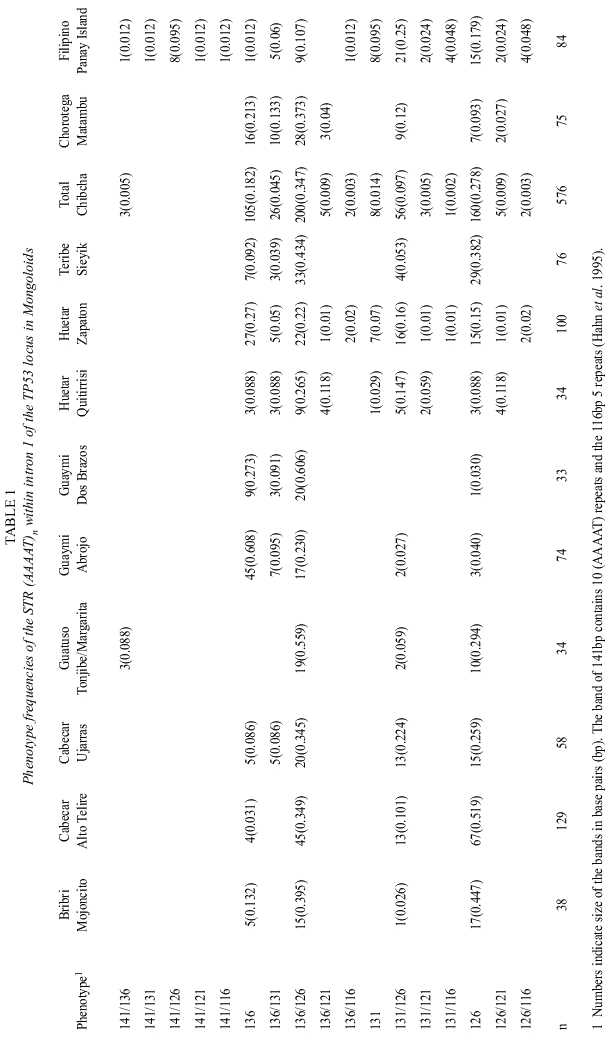
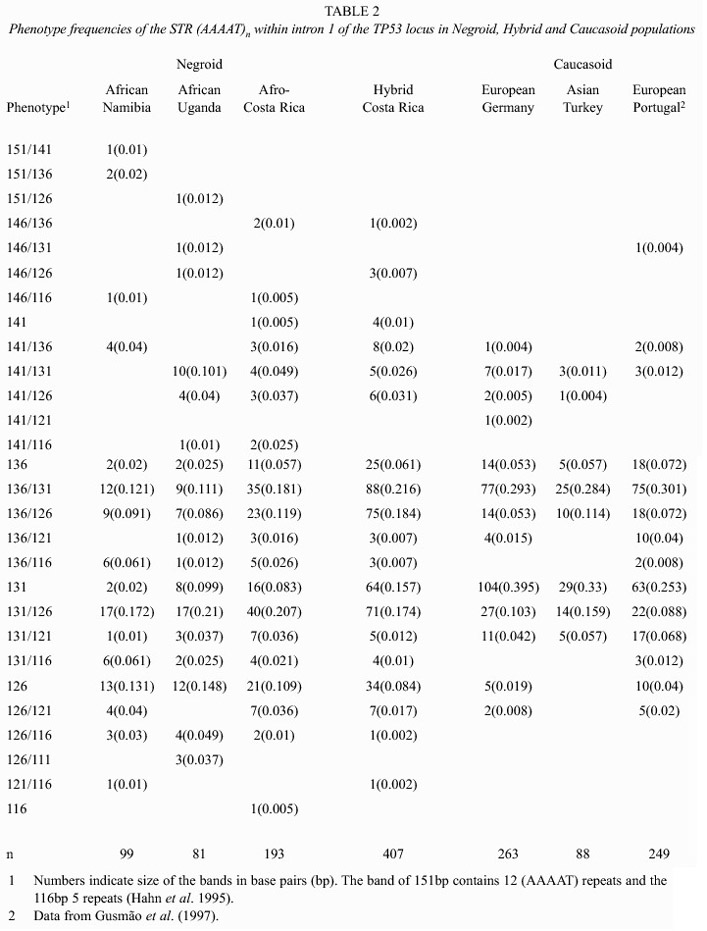
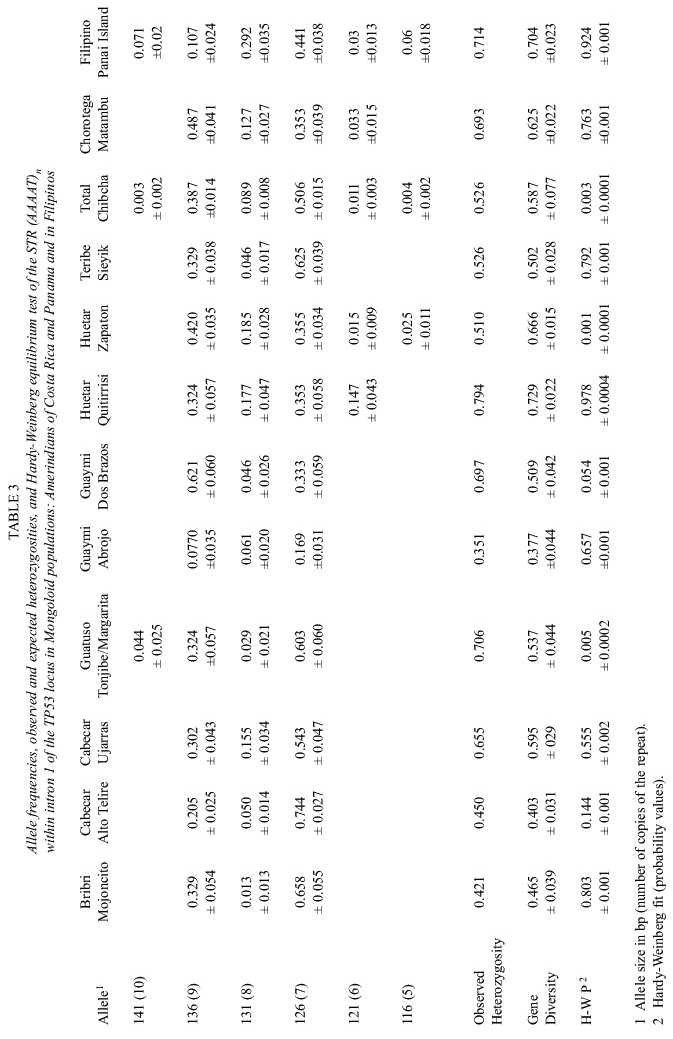
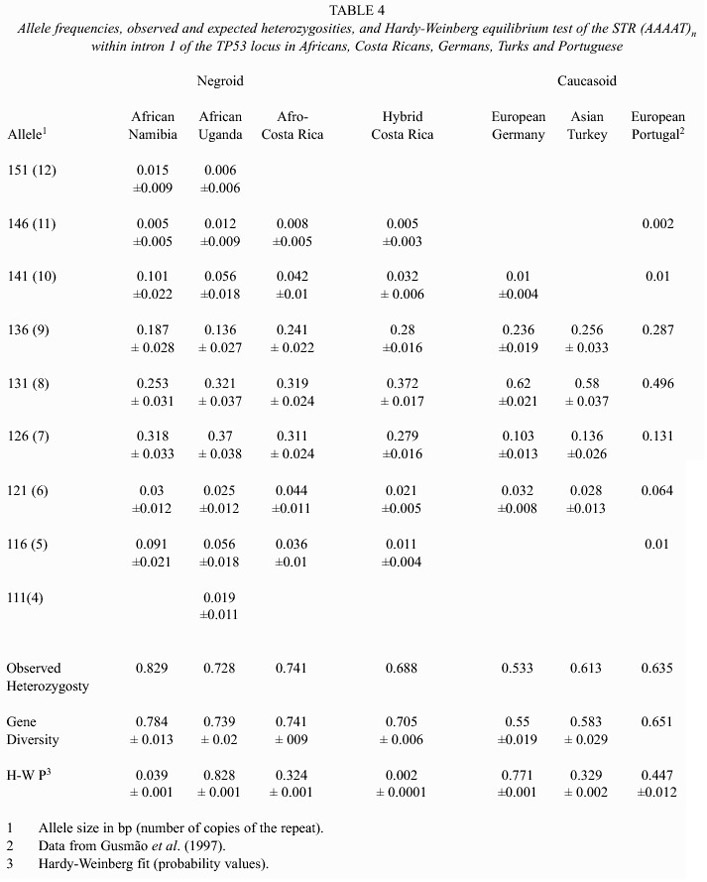
<p>Results</p> </b> </font>     <p><font face="Arial" size="2">The absolute and relative phenotype frequencies obtained in the Asiatic group are presented in <a  href="#t1">Table 1</a>. Those found in the Africans, Europeans and the Hybrid population of Costa Rica are shown in <a href="#t2">Table 2</a>. Their corresponding allele frequencies, observed and expected (gene diversities) heterozygosities and their Hardy-Weinberg fit are summarized in <a href="#t3">Tables 3</a> and <a href="#t4">4</a>.</font></p>     <p style="text-align: center;"><font face="Arial" size="2">&nbsp;<a  name="t1"></a><img src="/img/fbpe/rbt/v52n3/3080i2.JPG" title=""  alt="" style="width: 613px; height: 1049px;">    
<br> </font></p> <a name="t2"></a>     ]]></body>
<body><![CDATA[<div style="text-align: left;"><img src="/img/fbpe/rbt/v52n3/3080i3.JPG" title=""  alt="" style="width: 707px; height: 931px;">    
<br> </div> <a name="t3"></a>     <div style="text-align: center;"><img  src="/img/fbpe/rbt/v52n3/3080i4.JPG" title="" alt=""  style="width: 673px; height: 1039px;">    
<br> <a name="t4"></a>    <br> </div> <img src="/img/fbpe/rbt/v52n3/3080i5.JPG" title="" alt=""  style="width: 707px; height: 882px;">     
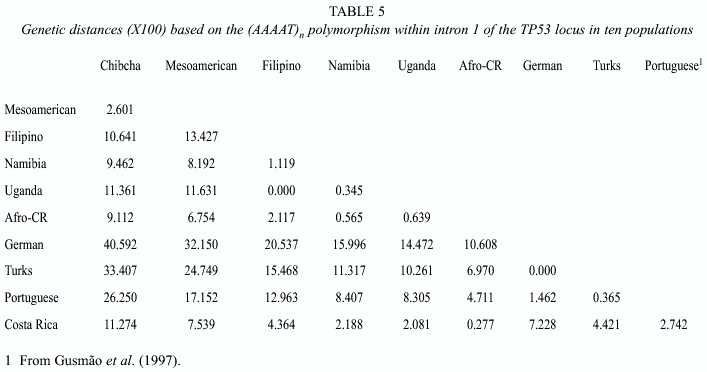
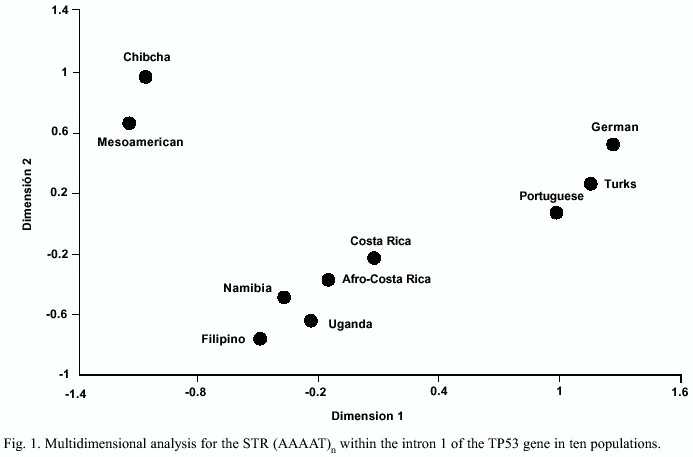
<p><font face="Arial" size="2">Although three alleles (126, 131, 136 bp) are the most frequent in all populations, the number of phenotypes and gene diversities follow patterns concordant with the geographic origin of each population as if they had spread from an African centroid. Africans, the oldest of them under this perspective, have, as would be expected, more alleles (7-9) more phenotypes (18-19) and higher gene diversities (0.739-0.784) than the other groups. Europeans, have 4-7 alleles, 6-14 phenotypes and gene diversities ranging from 0.55-0.705. Amerindians have 3-6 alleles, the number of phenotypes ranged between 3 and 12 and gene diversities between 0.377 and 0.729. However, setting apart the Guatuso, Huetar and Chorotega, tribes with the highest degree of interethnic admixture (<a href="#ba93">Barrantes 1993</a>), the rest of the tribes show an even lower diversity: 3 alleles, the number of phenotypes is 4 or 5 and the gene diversities range between 0.351 and 0.697. Filipinos have 9 alleles, 16 phenotypes and a gene diversity of 0.704, values intermediate between Africans and Europeans. The hybrid population of Costa Rica reflects, through its high diversity, 7 alleles, 20 phenotypes and a gene diversity of 0.705, its multiethnic origin.</font></p>     <p><font face="Arial" size="2">Genetic distances (<a href="#t5">Table 5</a>) and a multidimensional analysis (<a href="#f1">Fig. 1</a>) were performed to obtain a complementary perspective of the path followed by this STR during the divergence of these populations and to test the confidence of the data obtained from the samples analyzed (however, these statistics were not intended to estimate the actual genetic distances among the populations compared, i.e. they must be regarded in their qualitative sense). Populations clustered in three groups, an array in agreement with expectations according to their geographic origin and history: the Europeans, the Amerindians and a third one including the Africans, the Filipino and the hybrid population of Costa Rica.</font></p> <a name="t5"></a>     <div style="text-align: center;">     <div style="text-align: left;"><img  src="/img/fbpe/rbt/v52n3/3080i6.JPG" title="" alt=""  style="width: 707px; height: 372px;">    
<br> </div>     ]]></body>
<body><![CDATA[<br> </div> <a name="f1"></a>     <div style="text-align: left;"><img  src="/img/fbpe/rbt/v52n3/3080i1.JPG" title="" alt=""  style="width: 693px; height: 457px;"></div>     
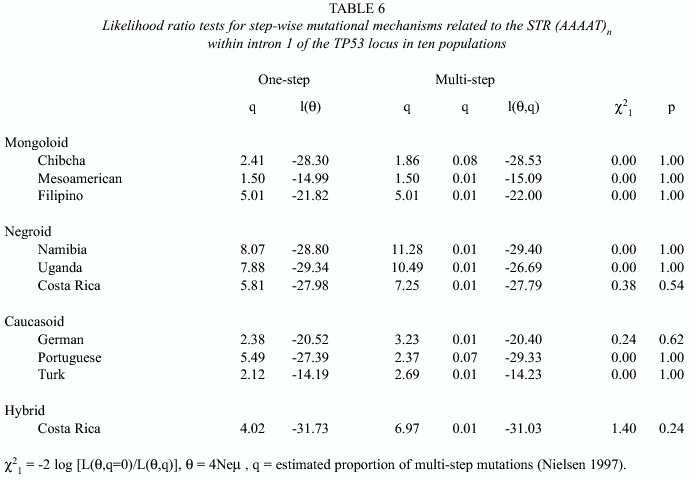
<p><font face="Arial" size="2">The fixation indexes for the major groups, Europeans, Asiatics, Africans and hybrid were R<sub>IS</sub> = 0.0112 (p <font face="Symbol">&lt;</font> 0.001), R<sub>IT</sub> = 0.0197 (p <font face="Symbol">&lt;</font> 0.001) and R<sub>ST</sub> = 0.0085 (p &gt; 0.05). Thus variation is significant among individuals within subpopulations (R<sub>IS</sub>) as well as among individuals within the total of all populations (R<sub>IT</sub> ). In contrast, R<sub>ST</sub> did not disclose any significant effect of population subdivision on the divergence of this STR at this level of population subdivision. The same was the case within Africans (R<sub>ST</sub> = 0.0015, p &gt; 0.05) and within Europeans (R<sub>ST</sub> = -0.0005, p &gt; 0.05). However, within the Asiatics R ST showed that subdivision in the three possible combinations has been significant: within the Chibchan (R<sub>ST</sub> = 0.1411, p <font face="Symbol">&lt;</font> 0.001), Chibchan total vs. Mesoamerican (R<sub>ST</sub> = 0.0199, p &lt; 0.05), and Chibchan total vs. Mesoamerican vs. Filipino (R<sub>ST</sub> = 0.0324, p <font  face="Symbol">&lt;</font> 0.001).</font></p>     <p><font face="Arial" size="2">The data obtained also permitted a statistical exploration of the possible molecular mechanisms originating new alleles at this STR. Expansion or contraction in the number of tandem repeats could occur by single- or by multi-step events, i.e. the original allele could win or lose a single repeat or multiple repeats per mutational event. <a href="#t6">Table 6</a> summarizes like-lihood ratios for a one-step mutation model relative to a multi-step mutation model in ten populations (the Chibchan tribes were pooled as a single group). All ratios indicate that the single-step model better explains the observed allele-frequency distributions. Therefore, as <font face="Symbol">q</font> &#61472;measures the joint effect of mutation, through its rate, and population structure, through Ne, it would be safe to postulate that mutation on this marker acts mainly by single steps.</font></p> <a name="t6"></a>     <div style="text-align: left;"><img  src="/img/fbpe/rbt/v52n3/3080i7.JPG" title="" alt=""  style="width: 695px; height: 480px;"></div> <font face="Arial" size="2"><b>     
<p>Discussion</p> </b> </font>     <p><font face="Arial" size="2">The characterization of genetic variation at an STR, the (AAAAT)<sub>n</sub> within intron 1 of the TP53 locus in 17 populations of 3 major ethnic groups, permitted the documentation of some of the effects of the spread of the human species through the world on its patterns of diversity. The subdivisions of ancestral populations, mainly by fissions, were events often associated with bottlenecks. Since the derived groups were small groups of related individuals, one of the main consequences during differentiation was the loss of alleles by genetic drift (<a href="#fi99">Fix 1999</a>). In the groups screened here the reduction of diversity follows an almost linear fashion from the African Continent: Africans, the oldest and most diverse, Europeans and Filipinos intermediate between the former and the youngest and less diverse Amerindians. Assuming a dispersal of the modern humans from an African centroid, this is an indication of the relative good representation of the samples screened and the discriminative power of the marker. The multidimensional analysis performed supports this interpretation, which is in very good agreement with worldwide studies based on many more genetic markers (e.g. <a  href="#ca94">Cavalli-Sforza <i>et a</i>l. 1994</a>). However, it must be kept in mind that it is based on a single marker, and, second, as noted by <a href="#ha00">Harpending and Rogers (2000)</a>, measures of genetic distances of populations covering large geographic areas are often misleading.</font></p>     <p><font face="Arial" size="2">Among the fixation indexes, R<sub>ST</sub> , like genetic distances, also showed to be insensitive at major scales. A possible cause for this is the fact that three alleles (136/9, 131/8 and 126/7) are the most common in all populations and even though the size of the alleles ranged between 111/4 and 151/12, alleles other than the commonest rarely reached 10% or a higher frequency, which in turn could be the result of random fixation of alleles that can act differently on different loci. Some of these loci would have fixed different alleles in different parts of the world, as has been documented (<a href="#ze95">Zerylnick <i>et a</i>l. 1995</a>, <a href="#de96">Deka <i>et a</i>l. 1996</a>, <a href="#de99">1999</a>). It could also be the case that they preserve the same alleles in all populations as has been shown for the CSF1R locus (<a href="#de99">Deka <i>et a</i>l. 1999</a>). Balancing selection cannot be ruled out given the important role of TP53 in genomic stability (<a href="#ja99">Janus <i>et a</i>l. 1999</a>), and although the marker screened is located at an intron, increased instability of mRNA from alleles with motif-repeat numbers outside the range observed could affect the normal function of the gene. In addition, some alleles might have been indirectly selected by hitchhiking if they were in cis with alleles conferring increased fitness. The latter hypothesis could be tested extending the screening to haplotypic variation.</font></p>     <p><font face="Arial" size="2">The Filipino and the hybrid Costa Rican population deserve comments aside. The Filipino shows an intermediate diversity between the Africans and Europeans and was unexpectedly placed at the multidimensional analysis closer to the Africans rather than to the Asiatics. <a href="#ca94">Cavalli-Sforza <i>et a</i>l. (1994)</a> found a high diversity in this group using classical markers (blood groups and blood proteins) and explained the fact as a sign of a putative multiple origin (Negrito, Malayan and Chinese). In addition, the populations of Southeast Asia stem from an early split from the group that led to the other Asiatic groups (<a href="#ca94">Cavalli-Sforza <i>et a</i>l. 1994</a>). Both facts, fusion of different ethnic groups each originating from a time when the ancestral (African) gene diversity was not diminished by bottlenecks could explain their higher diversity and closer proximity to the Africans than to the Amerindians. Regarding the high diversity value shown by the hybrid population of Costa Rica, it also reflects its multiethnic origin. <a href="#mo03">Morera <i>et al. </i>(2003)</a> estimated that the Costa Rican population has 61% European -mainly Spanish-, 30% Amerindian and 9% Africans genetic ancestry. Its nearer position to the African cluster is in accordance with that estimate. In the end, admixture can be seen as a regression to the ancestral conditions.</font></p>     <p><font face="Arial" size="2">The data obtained also permitted a statistical analysis of the main molecular mechanism producing new alleles at this marker. The test favors a model of expansion or contraction in the number of tandem repeats by single-steps, although this does not rule out multi-step mutations. This conclusion is concordant with empirical data of <a href="#br98">Brinkmann <i>et al. </i>(1998)</a> who analyzed 10 844 parent/child allelic transfers at 23 STRs and found that 22 out of 23 mismatches detected were single-step and only 1 a two-step. </font></p> <font face="Arial" size="2"><b>     ]]></body>
<body><![CDATA[<p>Aknowledgments</p> </b> </font>     <p><font face="Arial" size="2">We thank Omar Achí for his fine laboratory work. We also thank Carsten Wolff (Halberstadt, Germany), Ulrich Müller, Daniela Steinberger (Giessen, Germany) and Dietrich Büttner (Hamburg, Germany) for providing us the samples from Uganda, Namibia, The Philippines, Germany and Turkey. Support of Alfred Pingoud (Giessen) and Peter Lichter (Heidelberg), is also greatly acknowledged. This research was partially funded by the Universidad de Costa Rica (Grants 742-93- 903, 111-97-522 and 742-A1-502) and by the Consejo Nacional de Investigaciones Científicas y Tecnológicas de Costa Rica (CONICIT).</font></p> <font face="Arial" size="2"><b>     <p>Resumen</p> </b> </font>     <p><font face="Arial" size="2">Se estudió el polimorfismo del microsatélite (AAAAT)<sub>n</sub> del intrón 1 del gene TP53 en 17 poblaciones de 3 grupos étnicos: europeos, asiáticos, y africanos subsaharianos, así como de la población híbrida de Costa Rica (en total 1968 muestras). Tres alelos, 126/7 (pares de bases/ copias de la repetición), 131/8 y 136/9 fueron los más frecuentes en todas las poblaciones, aunque se observaron otros alelos usualmente a frecuencias menores al 10%. Las heterocigosis observadas variaron de 0.351 a 0.829. La distribución de la diversidad parece concordar con el origen geográfico de las muestras y con la historia de las poblaciones estudiadas. Una prueba estadística indica que el evento mutacional que más alelos nuevos produce en este marcador es el de un solo paso (expansión o contracción de una sola copia de la repetición). El índice de fijación R<sub>ST</sub> mostró los efectos de la subdivision de poblaciones sólo dentro del grupo de los asiáticos y mostró falta de sensibilidad cuando los grupos comparados eran de niveles superiores de clasificación (europeos, asiáticos, y africanos) o cuando la comparación se hizo entre los grupos más antiguos (africanos y europeos).</font></p> <font face="Arial" size="2"><b>     <p>References</p> </b> </font>     <!-- ref --><p><font face="Arial" size="2"><a name="ba93"></a>Barrantes, R. 1993. Diversidad genética y mezcla racial en los amerindios de Costa Rica y Panamá. Rev. Biol. Trop. 41:<b> </b>379-384.</font>&nbsp;&nbsp;&nbsp;&nbsp;&nbsp;&nbsp;&nbsp;&nbsp;[&#160;<a href="javascript:void(0);" onclick="javascript: window.open('/scielo.php?script=sci_nlinks&ref=1331490&pid=S0034-7744200400030002600001&lng=','','width=640,height=500,resizable=yes,scrollbars=1,menubar=yes,');">Links</a>&#160;]<!-- end-ref --><!-- ref --><p><font face="Arial" size="2"><a name="ba90"></a>Barrantes, R., P.E. Smouse, H.W. Mohrenweiser, H. Gershowitz., J. Azofeifa, T.D.Arias &amp; J.V. Neel. 1990. Microevolution in Lower Central America: genetic characterization of the Chibcha-speaking groups of Costa Rica and Panama, and a consensus taxonomy based on genetic and linguistic affinity. Am. J. Hum. Genet. 46: 63-84.</font>&nbsp;&nbsp;&nbsp;&nbsp;&nbsp;&nbsp;&nbsp;&nbsp;[&#160;<a href="javascript:void(0);" onclick="javascript: window.open('/scielo.php?script=sci_nlinks&ref=1331491&pid=S0034-7744200400030002600002&lng=','','width=640,height=500,resizable=yes,scrollbars=1,menubar=yes,');">Links</a>&#160;]<!-- end-ref --><!-- ref --><p><font face="Arial" size="2"><a name="bo97"></a>Borg, I. 1997. Modern Multidimensional Scaling. Theory and applications. New York: Springer.</font>&nbsp;&nbsp;&nbsp;&nbsp;&nbsp;&nbsp;&nbsp;&nbsp;[&#160;<a href="javascript:void(0);" onclick="javascript: window.open('/scielo.php?script=sci_nlinks&ref=1331492&pid=S0034-7744200400030002600003&lng=','','width=640,height=500,resizable=yes,scrollbars=1,menubar=yes,');">Links</a>&#160;]<!-- end-ref --><!-- ref --><p><font face="Arial" size="2"><a name="br98"></a>Brinkmann, B., M. Klintschar, F. Neuhuber, J. Hühne &amp; R. Burkhard. 1998. Mutation rate in human microsatellites: influence of the structure and length of the tandem repeat. Am. J. Hum. Genet. 62: 1408-1415.</font>&nbsp;&nbsp;&nbsp;&nbsp;&nbsp;&nbsp;&nbsp;&nbsp;[&#160;<a href="javascript:void(0);" onclick="javascript: window.open('/scielo.php?script=sci_nlinks&ref=1331493&pid=S0034-7744200400030002600004&lng=','','width=640,height=500,resizable=yes,scrollbars=1,menubar=yes,');">Links</a>&#160;]<!-- end-ref --><!-- ref --><p><font face="Arial" size="2"><a name="ca94"></a>Cavalli-Sforza, L.L., P. Menozzi &amp; A. Piazza. 1994. The History and Geography of Human Genes. Princeton University, New Jersey.</font>&nbsp;&nbsp;&nbsp;&nbsp;&nbsp;&nbsp;&nbsp;&nbsp;[&#160;<a href="javascript:void(0);" onclick="javascript: window.open('/scielo.php?script=sci_nlinks&ref=1331494&pid=S0034-7744200400030002600005&lng=','','width=640,height=500,resizable=yes,scrollbars=1,menubar=yes,');">Links</a>&#160;]<!-- end-ref --><!-- ref --><p><font face="Arial" size="2"><a name="co91"></a>Constenla-Umaña, A. 1991. Las lenguas del Área Intermedia. Introducción a su estudio areal. Editorial Universidad de Costa Rica, San José, Costa Rica.</font>&nbsp;&nbsp;&nbsp;&nbsp;&nbsp;&nbsp;&nbsp;&nbsp;[&#160;<a href="javascript:void(0);" onclick="javascript: window.open('/scielo.php?script=sci_nlinks&ref=1331495&pid=S0034-7744200400030002600006&lng=','','width=640,height=500,resizable=yes,scrollbars=1,menubar=yes,');">Links</a>&#160;]<!-- end-ref --><!-- ref --><p><font face="Arial" size="2"><a name="de96"></a>Deka, R, P.P. Majumder, M.D. Shriver, D.N. Stivers, Y. Zhong, L.M. Yu, R. Barrantes, S.J. Yin, T. Miki, J. Hundrieser, C.H. Bunker, S.T. McGarvey, S. Sakallah, R.E. Ferrell &amp; R. Chakraborty. 1996. Distribution and evolution of CTG repeats at the myotonin protein kinase gene in human populations. Genome Res. 6: 142-154.</font>&nbsp;&nbsp;&nbsp;&nbsp;&nbsp;&nbsp;&nbsp;&nbsp;[&#160;<a href="javascript:void(0);" onclick="javascript: window.open('/scielo.php?script=sci_nlinks&ref=1331496&pid=S0034-7744200400030002600007&lng=','','width=640,height=500,resizable=yes,scrollbars=1,menubar=yes,');">Links</a>&#160;]<!-- end-ref --><!-- ref --><p><font face="Arial" size="2"><a name="de99"></a>Deka, R, M.D. Shriver, L.M. Yu, E. Mueller-Heidreich, L. Jin, Y. Zhong, S.T. McGarvey, S.S. Argawal, C.H. Bunker, T. Miki, J. Hundrieser, S.J. Yin, S. Raskin, R. Barrantes, R.E. Ferrel &amp; R. Chakraborty. 1999. Genetic variation at twentythree microsatellite loci in sixteen human populations. J. Genet. 78: 99-121. </font>&nbsp;&nbsp;&nbsp;&nbsp;&nbsp;&nbsp;&nbsp;&nbsp;[&#160;<a href="javascript:void(0);" onclick="javascript: window.open('/scielo.php?script=sci_nlinks&ref=1331497&pid=S0034-7744200400030002600008&lng=','','width=640,height=500,resizable=yes,scrollbars=1,menubar=yes,');">Links</a>&#160;]<!-- end-ref --><!-- ref --><p><font face="Arial" size="2"><a name="fi99"></a>Fix, A.G. 1999. Migration and Colonization in Human Microevolution. Cambridge University, Cambridge.    &nbsp;&nbsp;&nbsp;&nbsp;&nbsp;&nbsp;&nbsp;&nbsp;[&#160;<a href="javascript:void(0);" onclick="javascript: window.open('/scielo.php?script=sci_nlinks&ref=1331498&pid=S0034-7744200400030002600009&lng=','','width=640,height=500,resizable=yes,scrollbars=1,menubar=yes,');">Links</a>&#160;]<!-- end-ref --><!-- ref --> Futreal, P.A., J.C. Barret &amp; R.W. Wiseman. 1991. An Alu polymorphism intragenic to the TP53 gene. Nucl. Acids Res. 19: 6977.</font>&nbsp;&nbsp;&nbsp;&nbsp;&nbsp;&nbsp;&nbsp;&nbsp;[&#160;<a href="javascript:void(0);" onclick="javascript: window.open('/scielo.php?script=sci_nlinks&ref=1331499&pid=S0034-7744200400030002600010&lng=','','width=640,height=500,resizable=yes,scrollbars=1,menubar=yes,');">Links</a>&#160;]<!-- end-ref --><!-- ref --><p><font face="Arial" size="2"><a name="ga01"></a>Gaspar, P.A., M.H. Hutz, F.M. Salzano &amp; T.A. Weimer. 2001. TP53 polymorphisms and haplotypes in South Amerindians and neo-Brazilians. Ann. Hum. Biol. 28: 184-194.</font>&nbsp;&nbsp;&nbsp;&nbsp;&nbsp;&nbsp;&nbsp;&nbsp;[&#160;<a href="javascript:void(0);" onclick="javascript: window.open('/scielo.php?script=sci_nlinks&ref=1331500&pid=S0034-7744200400030002600011&lng=','','width=640,height=500,resizable=yes,scrollbars=1,menubar=yes,');">Links</a>&#160;]<!-- end-ref --><!-- ref --><p><font face="Arial" size="2"><a name="ga02"></a>Gaspar, P.A., M.H. Hutz, F.M. Salzano, K. Hill, A.M. Hurtado, ML. Petz-Erler, L.T. Tsuneto &amp; T.A. Weimer. 2002. Polymorphisms of CYP1A1, CYP2E1, GSTM1, GSTT1, and TP53 genes in Amerindians. Am. J. Phys. Anthrop. 119: 249-256.</font>&nbsp;&nbsp;&nbsp;&nbsp;&nbsp;&nbsp;&nbsp;&nbsp;[&#160;<a href="javascript:void(0);" onclick="javascript: window.open('/scielo.php?script=sci_nlinks&ref=1331501&pid=S0034-7744200400030002600012&lng=','','width=640,height=500,resizable=yes,scrollbars=1,menubar=yes,');">Links</a>&#160;]<!-- end-ref --><!-- ref --><p><font face="Arial" size="2"><a name="gr94"></a>Griffiths, R.C. &amp; S. Tavare. 1994. Simulating probability distributions. Theor. Pop. Biol. 46: 131-159.</font>&nbsp;&nbsp;&nbsp;&nbsp;&nbsp;&nbsp;&nbsp;&nbsp;[&#160;<a href="javascript:void(0);" onclick="javascript: window.open('/scielo.php?script=sci_nlinks&ref=1331502&pid=S0034-7744200400030002600013&lng=','','width=640,height=500,resizable=yes,scrollbars=1,menubar=yes,');">Links</a>&#160;]<!-- end-ref --><!-- ref --><p><font face="Arial" size="2"><a name="gu92"></a>Guo, S. &amp; E. Thompson. 1992. Performing the exact test of the Hardy-Weinberg proportion for multiple alleles. Biometrics 48: 361-372.</font>&nbsp;&nbsp;&nbsp;&nbsp;&nbsp;&nbsp;&nbsp;&nbsp;[&#160;<a href="javascript:void(0);" onclick="javascript: window.open('/scielo.php?script=sci_nlinks&ref=1331503&pid=S0034-7744200400030002600014&lng=','','width=640,height=500,resizable=yes,scrollbars=1,menubar=yes,');">Links</a>&#160;]<!-- end-ref --><!-- ref --><p><font face="Arial" size="2"><a name="gu97"></a>Gusmão, L., M. J. Prata, A. Amorim, F. Silva &amp; I. Bessa. 1997. Characterization of four short tandem repeat loci (THO1, VWA31/A, CD4, and TP53) in Northern Portugal. Hum. Biol. 69: 31-40.</font>&nbsp;&nbsp;&nbsp;&nbsp;&nbsp;&nbsp;&nbsp;&nbsp;[&#160;<a href="javascript:void(0);" onclick="javascript: window.open('/scielo.php?script=sci_nlinks&ref=1331504&pid=S0034-7744200400030002600015&lng=','','width=640,height=500,resizable=yes,scrollbars=1,menubar=yes,');">Links</a>&#160;]<!-- end-ref --><!-- ref --><p><font face="Arial" size="2"><a name="ha93"></a>Hahn, M., J. Serth, R. Fislage, H. Wolfes, R. Allhoff, U. Jonas &amp; A. Pingoud. 1993. Polymerase chain reaction detection of a highly polymorphic VNTR segment in intron 1 of the human p53 gene. Clin. Chem. 39: 549-550.</font>&nbsp;&nbsp;&nbsp;&nbsp;&nbsp;&nbsp;&nbsp;&nbsp;[&#160;<a href="javascript:void(0);" onclick="javascript: window.open('/scielo.php?script=sci_nlinks&ref=1331505&pid=S0034-7744200400030002600016&lng=','','width=640,height=500,resizable=yes,scrollbars=1,menubar=yes,');">Links</a>&#160;]<!-- end-ref --><!-- ref --><p><font face="Arial" size="2"><a name="ha95"></a>Hahn, M., R. Fislage &amp; A. Pingoud. 1995. Polymorphism of the pentanucleotide repeat d(AAAAT) within intron 1 of the human tumor suppressor gene p53 (17p13.1). Hum. Genet. 95: 471-472. </font>&nbsp;&nbsp;&nbsp;&nbsp;&nbsp;&nbsp;&nbsp;&nbsp;[&#160;<a href="javascript:void(0);" onclick="javascript: window.open('/scielo.php?script=sci_nlinks&ref=1331506&pid=S0034-7744200400030002600017&lng=','','width=640,height=500,resizable=yes,scrollbars=1,menubar=yes,');">Links</a>&#160;]<!-- end-ref --><!-- ref --><p><font face="Arial" size="2"><a name="ha01"></a>Hahn, M., J. Wilhelm &amp; A. Pingoud. 2001. Influence of fluorophor dye labels on the migration behavior of polymerase chain reaction-amplified short tandem repeats during denaturing capillary electrophoresis. Electrophoresis 22: 2691-2700.</font>&nbsp;&nbsp;&nbsp;&nbsp;&nbsp;&nbsp;&nbsp;&nbsp;[&#160;<a href="javascript:void(0);" onclick="javascript: window.open('/scielo.php?script=sci_nlinks&ref=1331507&pid=S0034-7744200400030002600018&lng=','','width=640,height=500,resizable=yes,scrollbars=1,menubar=yes,');">Links</a>&#160;]<!-- end-ref --><!-- ref --><p><font face="Arial" size="2"><a name="ha00"></a>Harpending, H. &amp; A. Rogers. 2000. Genetic perspectives on human origins and differentiation. Ann. Rev. Genomics Hum. Genet. 1: 361-385.</font>&nbsp;&nbsp;&nbsp;&nbsp;&nbsp;&nbsp;&nbsp;&nbsp;[&#160;<a href="javascript:void(0);" onclick="javascript: window.open('/scielo.php?script=sci_nlinks&ref=1331508&pid=S0034-7744200400030002600019&lng=','','width=640,height=500,resizable=yes,scrollbars=1,menubar=yes,');">Links</a>&#160;]<!-- end-ref --><!-- ref --><p><font face="Arial" size="2"><a name="he87"></a>Hermann, B.G. &amp; A.M. Frischauf. 1987. Isolation of genomic DNA. Methods Enzymol. 152: 180-183.</font>&nbsp;&nbsp;&nbsp;&nbsp;&nbsp;&nbsp;&nbsp;&nbsp;[&#160;<a href="javascript:void(0);" onclick="javascript: window.open('/scielo.php?script=sci_nlinks&ref=1331509&pid=S0034-7744200400030002600020&lng=','','width=640,height=500,resizable=yes,scrollbars=1,menubar=yes,');">Links</a>&#160;]<!-- end-ref --><!-- ref --><p><font face="Arial" size="2"><a name="he97"></a>Hesketh, R. 1997. The Oncogene and Tumor Suppressor Gene Facts Book. Academic, London. </font>&nbsp;&nbsp;&nbsp;&nbsp;&nbsp;&nbsp;&nbsp;&nbsp;[&#160;<a href="javascript:void(0);" onclick="javascript: window.open('/scielo.php?script=sci_nlinks&ref=1331510&pid=S0034-7744200400030002600021&lng=','','width=640,height=500,resizable=yes,scrollbars=1,menubar=yes,');">Links</a>&#160;]<!-- end-ref --><!-- ref --><p><font face="Arial" size="2"><a name="is86"></a>Isobe, M., B.S. Emanuel, D. Givol, M. Oren &amp; C.M. Croce. 1986. Localization of the human p53 tumor antigen to band 17p13. Nature 320: 84-85.</font>&nbsp;&nbsp;&nbsp;&nbsp;&nbsp;&nbsp;&nbsp;&nbsp;[&#160;<a href="javascript:void(0);" onclick="javascript: window.open('/scielo.php?script=sci_nlinks&ref=1331511&pid=S0034-7744200400030002600022&lng=','','width=640,height=500,resizable=yes,scrollbars=1,menubar=yes,');">Links</a>&#160;]<!-- end-ref --><!-- ref --><p><font face="Arial" size="2"><a name="ja99"></a>Janus, F., N. Albrechtsen, I. Dornreiter, L. Wiesmüller, F. Grosse &amp; W. Deppert. 1999. The dual role model for p53 in maintaining genomic integrity. Cell. Mol. Life Sci. 55: 12-27.</font>&nbsp;&nbsp;&nbsp;&nbsp;&nbsp;&nbsp;&nbsp;&nbsp;[&#160;<a href="javascript:void(0);" onclick="javascript: window.open('/scielo.php?script=sci_nlinks&ref=1331512&pid=S0034-7744200400030002600023&lng=','','width=640,height=500,resizable=yes,scrollbars=1,menubar=yes,');">Links</a>&#160;]<!-- end-ref --><!-- ref --><p><font face="Arial" size="2"><a name="lo97"></a>Lobo-Wiehoff, T. &amp; M. Meléndez-Obando. 1997. Negros y blancos. Todo Mezclado. Editorial de la Universidad de Costa Rica, San José, Costa Rica.</font>&nbsp;&nbsp;&nbsp;&nbsp;&nbsp;&nbsp;&nbsp;&nbsp;[&#160;<a href="javascript:void(0);" onclick="javascript: window.open('/scielo.php?script=sci_nlinks&ref=1331513&pid=S0034-7744200400030002600024&lng=','','width=640,height=500,resizable=yes,scrollbars=1,menubar=yes,');">Links</a>&#160;]<!-- end-ref --><!-- ref --><p><font face="Arial" size="2"><a name="me79"></a>Meléndez, C. &amp; Q. Duncan. 1979. El Negro en Costa Rica. Editorial Costa Rica, San José, Costa Rica.</font>&nbsp;&nbsp;&nbsp;&nbsp;&nbsp;&nbsp;&nbsp;&nbsp;[&#160;<a href="javascript:void(0);" onclick="javascript: window.open('/scielo.php?script=sci_nlinks&ref=1331514&pid=S0034-7744200400030002600025&lng=','','width=640,height=500,resizable=yes,scrollbars=1,menubar=yes,');">Links</a>&#160;]<!-- end-ref --><!-- ref --><p><font face="Arial" size="2"><a name="mi88"></a>Miller, S.A., D.D. Dykes &amp; H.F. Polesky. 1988. A simple salting out procedure for extracting DNA from human nucleated cells. Nucl. Acids Res. 16: 1215.</font>&nbsp;&nbsp;&nbsp;&nbsp;&nbsp;&nbsp;&nbsp;&nbsp;[&#160;<a href="javascript:void(0);" onclick="javascript: window.open('/scielo.php?script=sci_nlinks&ref=1331515&pid=S0034-7744200400030002600026&lng=','','width=640,height=500,resizable=yes,scrollbars=1,menubar=yes,');">Links</a>&#160;]<!-- end-ref --><!-- ref --><p><font face="Arial" size="2"><a name="mo75"></a>Moran, P.A. 1975. Wandering distributions and the electrophoretic profile. Theor. Pop. Biol. 8: 318-330.</font>&nbsp;&nbsp;&nbsp;&nbsp;&nbsp;&nbsp;&nbsp;&nbsp;[&#160;<a href="javascript:void(0);" onclick="javascript: window.open('/scielo.php?script=sci_nlinks&ref=1331516&pid=S0034-7744200400030002600027&lng=','','width=640,height=500,resizable=yes,scrollbars=1,menubar=yes,');">Links</a>&#160;]<!-- end-ref --><!-- ref --><p><font face="Arial" size="2"><a name="mo01"></a>Morera, B., R. Marín-Rojas &amp; R. Barrantes. 2001. Análisis de varios marcadores genéticos clásicos en la población de Costa Rica. Rev. Biol. Trop. 49: 1237- 1252.</font>&nbsp;&nbsp;&nbsp;&nbsp;&nbsp;&nbsp;&nbsp;&nbsp;[&#160;<a href="javascript:void(0);" onclick="javascript: window.open('/scielo.php?script=sci_nlinks&ref=1331517&pid=S0034-7744200400030002600028&lng=','','width=640,height=500,resizable=yes,scrollbars=1,menubar=yes,');">Links</a>&#160;]<!-- end-ref --><!-- ref --><p><font face="Arial" size="2"><a name="mo03"></a>Morera, B., R. Barrantes &amp; R. Marin-Rojas. 2003. Gene admixture in the Costa Rican population. Ann. Hum. Genet. 67: 71-80.</font>&nbsp;&nbsp;&nbsp;&nbsp;&nbsp;&nbsp;&nbsp;&nbsp;[&#160;<a href="javascript:void(0);" onclick="javascript: window.open('/scielo.php?script=sci_nlinks&ref=1331518&pid=S0034-7744200400030002600029&lng=','','width=640,height=500,resizable=yes,scrollbars=1,menubar=yes,');">Links</a>&#160;]<!-- end-ref --><!-- ref --><p><font face="Arial" size="2"><a name="nei87"></a>Nei, M. 1987. Molecular Evolutionary Genetics. Columbia University, New York. </font>&nbsp;&nbsp;&nbsp;&nbsp;&nbsp;&nbsp;&nbsp;&nbsp;[&#160;<a href="javascript:void(0);" onclick="javascript: window.open('/scielo.php?script=sci_nlinks&ref=1331519&pid=S0034-7744200400030002600030&lng=','','width=640,height=500,resizable=yes,scrollbars=1,menubar=yes,');">Links</a>&#160;]<!-- end-ref --><!-- ref --><p><font face="Arial" size="2"><a name="ne87"></a>Newson, L. 1987. Indian Survival in Colonial Nicaragua. Norman, University of Oklahoma.</font>&nbsp;&nbsp;&nbsp;&nbsp;&nbsp;&nbsp;&nbsp;&nbsp;[&#160;<a href="javascript:void(0);" onclick="javascript: window.open('/scielo.php?script=sci_nlinks&ref=1331520&pid=S0034-7744200400030002600031&lng=','','width=640,height=500,resizable=yes,scrollbars=1,menubar=yes,');">Links</a>&#160;]<!-- end-ref --><!-- ref --><p><font face="Arial" size="2"><a name="ni97"></a>Nielsen, R. 1997. A likelihood approach to population samples of microsatellite alleles. Genetics 146: 711-716.</font>&nbsp;&nbsp;&nbsp;&nbsp;&nbsp;&nbsp;&nbsp;&nbsp;[&#160;<a href="javascript:void(0);" onclick="javascript: window.open('/scielo.php?script=sci_nlinks&ref=1331521&pid=S0034-7744200400030002600032&lng=','','width=640,height=500,resizable=yes,scrollbars=1,menubar=yes,');">Links</a>&#160;]<!-- end-ref --><!-- ref --><p><font face="Arial" size="2"><a name="oh73"></a>Ohta, T. &amp; M. Kimura. 1973. A model of mutation appropriate to estimate the number of electrophoretically detectable alleles in a finite population. Genet. Res. 22: 201-204.</font>&nbsp;&nbsp;&nbsp;&nbsp;&nbsp;&nbsp;&nbsp;&nbsp;[&#160;<a href="javascript:void(0);" onclick="javascript: window.open('/scielo.php?script=sci_nlinks&ref=1331522&pid=S0034-7744200400030002600033&lng=','','width=640,height=500,resizable=yes,scrollbars=1,menubar=yes,');">Links</a>&#160;]<!-- end-ref --><!-- ref --><p><font face="Arial" size="2"><a name="ri95"></a>Ridanpää, M., S. Anttila &amp; K. Husgafvel-Pursiainen. 1995. Detection of loss of heterozygosity in the p53 tumor suppressor gene using a PCR-based assay. Path. Res. Pract. 191: 399-402.</font>&nbsp;&nbsp;&nbsp;&nbsp;&nbsp;&nbsp;&nbsp;&nbsp;[&#160;<a href="javascript:void(0);" onclick="javascript: window.open('/scielo.php?script=sci_nlinks&ref=1331523&pid=S0034-7744200400030002600034&lng=','','width=640,height=500,resizable=yes,scrollbars=1,menubar=yes,');">Links</a>&#160;]<!-- end-ref --><!-- ref --><p><font face="Arial" size="2"><a name="sc97"></a>Schneider, S., J.M. Kueffer, D. Roesli &amp; L. Excoffier. 1997. Arlequin version 1.1. A software for population genetic data analysis. Genetic and Biometry Laboratory, Department of Anthropology. University of Geneva, Switzerland. (Available at: <a href="http://lgb.unige.ch/arlequin/">http://lgb.unige.ch/arlequin/</a>). </font>&nbsp;&nbsp;&nbsp;&nbsp;&nbsp;&nbsp;&nbsp;&nbsp;[&#160;<a href="javascript:void(0);" onclick="javascript: window.open('/scielo.php?script=sci_nlinks&ref=1331524&pid=S0034-7744200400030002600035&lng=','','width=640,height=500,resizable=yes,scrollbars=1,menubar=yes,');">Links</a>&#160;]<!-- end-ref --><!-- ref --><p><font face="Arial" size="2"><a name="sj95"></a>Själander, A., R. Birgander, A. Kivelä &amp; G. Beckman. 1995. p53 Polymorphisms and haplotypes in different ethnic groups. Hum. Hered. 45: 144-149.</font>&nbsp;&nbsp;&nbsp;&nbsp;&nbsp;&nbsp;&nbsp;&nbsp;[&#160;<a href="javascript:void(0);" onclick="javascript: window.open('/scielo.php?script=sci_nlinks&ref=1331525&pid=S0034-7744200400030002600036&lng=','','width=640,height=500,resizable=yes,scrollbars=1,menubar=yes,');">Links</a>&#160;]<!-- end-ref --><!-- ref --><p><font face="Arial" size="2"><a name="sj96"></a>Själander, A., R. Birgander, N. Saha, L. Beckman &amp; G. Beckman. 1996. p53 polymorphisms and haplotypes show distinct differences between major ethnic groups. Hum. Hered. 46: 41-48. </font>&nbsp;&nbsp;&nbsp;&nbsp;&nbsp;&nbsp;&nbsp;&nbsp;[&#160;<a href="javascript:void(0);" onclick="javascript: window.open('/scielo.php?script=sci_nlinks&ref=1331526&pid=S0034-7744200400030002600037&lng=','','width=640,height=500,resizable=yes,scrollbars=1,menubar=yes,');">Links</a>&#160;]<!-- end-ref --><!-- ref --><p><font face="Arial" size="2"><a name="sl95"></a>Slatkin, M. 1995. A measure of population subdivision based on microsatellite allele frequencies. Genetics 139: 457-462.</font>&nbsp;&nbsp;&nbsp;&nbsp;&nbsp;&nbsp;&nbsp;&nbsp;[&#160;<a href="javascript:void(0);" onclick="javascript: window.open('/scielo.php?script=sci_nlinks&ref=1331527&pid=S0034-7744200400030002600038&lng=','','width=640,height=500,resizable=yes,scrollbars=1,menubar=yes,');">Links</a>&#160;]<!-- end-ref --><!-- ref --><p><font face="Arial" size="2"><a name="we75"></a>Wehrhan, C.F. 1975. The evolution of selectively similar electrophoretically detectable alleles in finite natural populations. Genetics 80: 375-394.</font>&nbsp;&nbsp;&nbsp;&nbsp;&nbsp;&nbsp;&nbsp;&nbsp;[&#160;<a href="javascript:void(0);" onclick="javascript: window.open('/scielo.php?script=sci_nlinks&ref=1331528&pid=S0034-7744200400030002600039&lng=','','width=640,height=500,resizable=yes,scrollbars=1,menubar=yes,');">Links</a>&#160;]<!-- end-ref --><!-- ref --><p><font face="Arial" size="2"><a name="ze95"></a>Zerylnick, C., A. Torroni, S.L. Sherman &amp; S.T. Warren. 1995. Normal variation at the myotonic dystrophy locus in global human populations. Am. J. Hum. Genet. 56: 123-130.</font>&nbsp;&nbsp;&nbsp;&nbsp;&nbsp;&nbsp;&nbsp;&nbsp;[&#160;<a href="javascript:void(0);" onclick="javascript: window.open('/scielo.php?script=sci_nlinks&ref=1331529&pid=S0034-7744200400030002600040&lng=','','width=640,height=500,resizable=yes,scrollbars=1,menubar=yes,');">Links</a>&#160;]<!-- end-ref --><p>Internet references</p> </b> </font>     <!-- ref --><p><font face="Arial" size="2"><a name="gd03"></a>GDB (TM). 2003. Human Genome Database [database online]. Available from Internet: URL <a  href="http://www.gdb.org">http://www.gdb.org</a> (Downloaded: 11 Aug. 2003; GDB node: The Netherlands: <a href="http://gdb.cmbi.kun.nl/gdb/">http://gdb.cmbi.kun.nl/gdb/</a> ) GDB Data Type: Gene; object name: TP53; Accession ID: GDB: 120445.</font>&nbsp;&nbsp;&nbsp;&nbsp;&nbsp;&nbsp;&nbsp;&nbsp;[&#160;<a href="javascript:void(0);" onclick="javascript: window.open('/scielo.php?script=sci_nlinks&ref=1331531&pid=S0034-7744200400030002600041&lng=','','width=640,height=500,resizable=yes,scrollbars=1,menubar=yes,');">Links</a>&#160;]<!-- end-ref --><!-- ref --><p><font face="Arial" size="2"><a name="om00"></a>OMIM (TM). 2000. Online Mendelian Inheritance in Man. Johns Hopkins University, Baltimore, MD, MIM 191170. Date of last modification 7/24/2003. (Downloaded: <a  href="http://www.ncbi.nlm.nih.gov/htbinpost/%20Omim/dispmim?191170#">http://www.ncbi.nlm.nih.gov/htbinpost/ Omim/dispmim?191170#</a>.).</font>&nbsp;&nbsp;&nbsp;&nbsp;&nbsp;&nbsp;&nbsp;&nbsp;[&#160;<a href="javascript:void(0);" onclick="javascript: window.open('/scielo.php?script=sci_nlinks&ref=1331532&pid=S0034-7744200400030002600042&lng=','','width=640,height=500,resizable=yes,scrollbars=1,menubar=yes,');">Links</a>&#160;]<!-- end-ref --> ]]></body><back>
<ref-list>
<ref id="B1">
<nlm-citation citation-type="journal">
<person-group person-group-type="author">
<name>
<surname><![CDATA[Barrantes]]></surname>
<given-names><![CDATA[R]]></given-names>
</name>
</person-group>
<article-title xml:lang="es"><![CDATA[Diversidad genética y mezcla racial en los amerindios de Costa Rica y Panamá]]></article-title>
<source><![CDATA[Rev. Biol. Trop]]></source>
<year>1993</year>
<volume>41</volume>
<page-range>379-384</page-range></nlm-citation>
</ref>
<ref id="B2">
<nlm-citation citation-type="journal">
<person-group person-group-type="author">
<name>
<surname><![CDATA[Barrantes]]></surname>
<given-names><![CDATA[R]]></given-names>
</name>
<name>
<surname><![CDATA[Smouse]]></surname>
<given-names><![CDATA[P.E]]></given-names>
</name>
<name>
<surname><![CDATA[Mohrenweiser]]></surname>
<given-names><![CDATA[H.W]]></given-names>
</name>
<name>
<surname><![CDATA[Gershowitz]]></surname>
<given-names><![CDATA[H]]></given-names>
</name>
<name>
<surname><![CDATA[Azofeifa]]></surname>
<given-names><![CDATA[J]]></given-names>
</name>
<name>
<surname><![CDATA[Arias]]></surname>
<given-names><![CDATA[T.D]]></given-names>
</name>
<name>
<surname><![CDATA[Neel]]></surname>
<given-names><![CDATA[J.V]]></given-names>
</name>
</person-group>
<article-title xml:lang="en"><![CDATA[Microevolution in Lower Central America: genetic characterization of the Chibcha-speaking groups of Costa Rica and Panama, and a consensus taxonomy based on genetic and linguistic affinity]]></article-title>
<source><![CDATA[Am. J. Hum. Genet]]></source>
<year>1990</year>
<volume>46</volume>
<page-range>63-84</page-range></nlm-citation>
</ref>
<ref id="B3">
<nlm-citation citation-type="book">
<person-group person-group-type="author">
<name>
<surname><![CDATA[Borg]]></surname>
<given-names><![CDATA[I]]></given-names>
</name>
</person-group>
<source><![CDATA[Modern Multidimensional Scaling. Theory and applications]]></source>
<year>1997</year>
<publisher-loc><![CDATA[^eNew York New York]]></publisher-loc>
<publisher-name><![CDATA[Springer]]></publisher-name>
</nlm-citation>
</ref>
<ref id="B4">
<nlm-citation citation-type="journal">
<person-group person-group-type="author">
<name>
<surname><![CDATA[Brinkmann]]></surname>
<given-names><![CDATA[B]]></given-names>
</name>
<name>
<surname><![CDATA[Klintschar]]></surname>
<given-names><![CDATA[M]]></given-names>
</name>
<name>
<surname><![CDATA[Neuhuber]]></surname>
<given-names><![CDATA[F]]></given-names>
</name>
<name>
<surname><![CDATA[Hühne]]></surname>
<given-names><![CDATA[J]]></given-names>
</name>
<name>
<surname><![CDATA[Burkhard]]></surname>
<given-names><![CDATA[R]]></given-names>
</name>
</person-group>
<article-title xml:lang="en"><![CDATA[Mutation rate in human microsatellites: influence of the structure and length of the tandem repeat]]></article-title>
<source><![CDATA[Am. J. Hum. Genet]]></source>
<year>1998</year>
<volume>62</volume>
<page-range>1408-1415</page-range></nlm-citation>
</ref>
<ref id="B5">
<nlm-citation citation-type="book">
<person-group person-group-type="author">
<name>
<surname><![CDATA[Cavalli-Sforza]]></surname>
<given-names><![CDATA[L.L]]></given-names>
</name>
<name>
<surname><![CDATA[Menozzi]]></surname>
<given-names><![CDATA[P]]></given-names>
</name>
<name>
<surname><![CDATA[Piazza]]></surname>
<given-names><![CDATA[A]]></given-names>
</name>
</person-group>
<source><![CDATA[The History and Geography of Human Genes]]></source>
<year>1994</year>
<publisher-loc><![CDATA[^eNew Jersey New Jersey]]></publisher-loc>
<publisher-name><![CDATA[Princeton University]]></publisher-name>
</nlm-citation>
</ref>
<ref id="B6">
<nlm-citation citation-type="book">
<person-group person-group-type="author">
<name>
<surname><![CDATA[Constenla-Umaña]]></surname>
<given-names><![CDATA[A]]></given-names>
</name>
</person-group>
<source><![CDATA[Las lenguas del Área Intermedia. Introducción a su estudio areal]]></source>
<year>1991</year>
<publisher-loc><![CDATA[San José ]]></publisher-loc>
<publisher-name><![CDATA[Editorial Universidad de Costa Rica]]></publisher-name>
</nlm-citation>
</ref>
<ref id="B7">
<nlm-citation citation-type="journal">
<person-group person-group-type="author">
<name>
<surname><![CDATA[Deka]]></surname>
<given-names><![CDATA[R]]></given-names>
</name>
<name>
<surname><![CDATA[Majumder]]></surname>
<given-names><![CDATA[P.P]]></given-names>
</name>
<name>
<surname><![CDATA[Shriver]]></surname>
<given-names><![CDATA[M.D]]></given-names>
</name>
<name>
<surname><![CDATA[Stivers]]></surname>
<given-names><![CDATA[D.N]]></given-names>
</name>
<name>
<surname><![CDATA[Zhong]]></surname>
<given-names><![CDATA[Y]]></given-names>
</name>
<name>
<surname><![CDATA[Yu]]></surname>
<given-names><![CDATA[L.M]]></given-names>
</name>
<name>
<surname><![CDATA[Barrantes]]></surname>
<given-names><![CDATA[R]]></given-names>
</name>
<name>
<surname><![CDATA[Yin]]></surname>
<given-names><![CDATA[S.J]]></given-names>
</name>
<name>
<surname><![CDATA[Miki]]></surname>
<given-names><![CDATA[T]]></given-names>
</name>
<name>
<surname><![CDATA[Hundrieser]]></surname>
<given-names><![CDATA[J]]></given-names>
</name>
<name>
<surname><![CDATA[Bunker]]></surname>
<given-names><![CDATA[C.H]]></given-names>
</name>
<name>
<surname><![CDATA[McGarvey]]></surname>
<given-names><![CDATA[S.T]]></given-names>
</name>
<name>
<surname><![CDATA[Sakallah]]></surname>
<given-names><![CDATA[S]]></given-names>
</name>
<name>
<surname><![CDATA[Ferrell]]></surname>
<given-names><![CDATA[R.E]]></given-names>
</name>
<name>
<surname><![CDATA[Chakraborty]]></surname>
<given-names><![CDATA[R]]></given-names>
</name>
</person-group>
<article-title xml:lang="en"><![CDATA[Distribution and evolution of CTG repeats at the myotonin protein kinase gene in human populations]]></article-title>
<source><![CDATA[Genome Res]]></source>
<year>1996</year>
<volume>6</volume>
<page-range>142-154</page-range></nlm-citation>
</ref>
<ref id="B8">
<nlm-citation citation-type="journal">
<person-group person-group-type="author">
<name>
<surname><![CDATA[Deka]]></surname>
<given-names><![CDATA[R]]></given-names>
</name>
<name>
<surname><![CDATA[Shriver]]></surname>
<given-names><![CDATA[M.D]]></given-names>
</name>
<name>
<surname><![CDATA[Yu]]></surname>
<given-names><![CDATA[L.M]]></given-names>
</name>
<name>
<surname><![CDATA[Mueller-Heidreich]]></surname>
<given-names><![CDATA[E]]></given-names>
</name>
<name>
<surname><![CDATA[Jin]]></surname>
<given-names><![CDATA[L]]></given-names>
</name>
<name>
<surname><![CDATA[Zhong]]></surname>
<given-names><![CDATA[Y]]></given-names>
</name>
<name>
<surname><![CDATA[McGarvey]]></surname>
<given-names><![CDATA[S.T]]></given-names>
</name>
<name>
<surname><![CDATA[Argawal]]></surname>
<given-names><![CDATA[S.S]]></given-names>
</name>
<name>
<surname><![CDATA[Bunker]]></surname>
<given-names><![CDATA[C.H]]></given-names>
</name>
<name>
<surname><![CDATA[Miki]]></surname>
<given-names><![CDATA[T]]></given-names>
</name>
<name>
<surname><![CDATA[Hundrieser]]></surname>
<given-names><![CDATA[J]]></given-names>
</name>
<name>
<surname><![CDATA[Yin]]></surname>
<given-names><![CDATA[S.J]]></given-names>
</name>
<name>
<surname><![CDATA[Raskin]]></surname>
<given-names><![CDATA[S]]></given-names>
</name>
<name>
<surname><![CDATA[Barrantes]]></surname>
<given-names><![CDATA[R]]></given-names>
</name>
<name>
<surname><![CDATA[Ferrel]]></surname>
<given-names><![CDATA[R.E]]></given-names>
</name>
<name>
<surname><![CDATA[Chakraborty]]></surname>
<given-names><![CDATA[R]]></given-names>
</name>
</person-group>
<article-title xml:lang="en"><![CDATA[Genetic variation at twentythree microsatellite loci in sixteen human populations]]></article-title>
<source><![CDATA[J. Genet]]></source>
<year>1999</year>
<volume>78</volume>
<page-range>99-121</page-range></nlm-citation>
</ref>
<ref id="B9">
<nlm-citation citation-type="book">
<person-group person-group-type="author">
<name>
<surname><![CDATA[Fix]]></surname>
<given-names><![CDATA[A.G]]></given-names>
</name>
</person-group>
<source><![CDATA[Migration and Colonization in Human Microevolution]]></source>
<year>1999</year>
<publisher-loc><![CDATA[Cambridge ]]></publisher-loc>
<publisher-name><![CDATA[Cambridge University]]></publisher-name>
</nlm-citation>
</ref>
<ref id="B10">
<nlm-citation citation-type="journal">
<person-group person-group-type="author">
<name>
<surname><![CDATA[Futreal]]></surname>
<given-names><![CDATA[P.A]]></given-names>
</name>
<name>
<surname><![CDATA[Barret]]></surname>
<given-names><![CDATA[J.C]]></given-names>
</name>
<name>
<surname><![CDATA[Wiseman]]></surname>
<given-names><![CDATA[R.W]]></given-names>
</name>
</person-group>
<article-title xml:lang="en"><![CDATA[An Alu polymorphism intragenic to the TP53 gene]]></article-title>
<source><![CDATA[Nucl. Acids Res]]></source>
<year>1991</year>
<volume>19</volume>
<page-range>6977</page-range></nlm-citation>
</ref>
<ref id="B11">
<nlm-citation citation-type="journal">
<person-group person-group-type="author">
<name>
<surname><![CDATA[Gaspar]]></surname>
<given-names><![CDATA[P.A]]></given-names>
</name>
<name>
<surname><![CDATA[Hutz]]></surname>
<given-names><![CDATA[M.H]]></given-names>
</name>
<name>
<surname><![CDATA[Salzano]]></surname>
<given-names><![CDATA[F.M]]></given-names>
</name>
<name>
<surname><![CDATA[Weimer]]></surname>
<given-names><![CDATA[T.A]]></given-names>
</name>
</person-group>
<article-title xml:lang="en"><![CDATA[TP53 polymorphisms and haplotypes in South Amerindians and neo-Brazilians]]></article-title>
<source><![CDATA[Ann. Hum. Biol]]></source>
<year>2001</year>
<volume>28</volume>
<page-range>184-194</page-range></nlm-citation>
</ref>
<ref id="B12">
<nlm-citation citation-type="journal">
<person-group person-group-type="author">
<name>
<surname><![CDATA[Gaspar]]></surname>
<given-names><![CDATA[P.A]]></given-names>
</name>
<name>
<surname><![CDATA[Hutz]]></surname>
<given-names><![CDATA[M.H]]></given-names>
</name>
<name>
<surname><![CDATA[Salzano]]></surname>
<given-names><![CDATA[F.M]]></given-names>
</name>
<name>
<surname><![CDATA[Hill]]></surname>
<given-names><![CDATA[K]]></given-names>
</name>
<name>
<surname><![CDATA[Hurtado]]></surname>
<given-names><![CDATA[A.M]]></given-names>
</name>
<name>
<surname><![CDATA[Petz-Erler]]></surname>
<given-names><![CDATA[ML]]></given-names>
</name>
<name>
<surname><![CDATA[Tsuneto]]></surname>
<given-names><![CDATA[L.T]]></given-names>
</name>
<name>
<surname><![CDATA[Weimer]]></surname>
<given-names><![CDATA[T.A]]></given-names>
</name>
</person-group>
<article-title xml:lang="en"><![CDATA[Polymorphisms of CYP1A1, CYP2E1, GSTM1, GSTT1, and TP53 genes in Amerindians]]></article-title>
<source><![CDATA[Am. J. Phys. Anthrop]]></source>
<year>2002</year>
<volume>119</volume>
<page-range>249-256</page-range></nlm-citation>
</ref>
<ref id="B13">
<nlm-citation citation-type="journal">
<person-group person-group-type="author">
<name>
<surname><![CDATA[Griffiths]]></surname>
<given-names><![CDATA[R.C]]></given-names>
</name>
<name>
<surname><![CDATA[Tavare]]></surname>
<given-names><![CDATA[S]]></given-names>
</name>
</person-group>
<article-title xml:lang="en"><![CDATA[Simulating probability distributions]]></article-title>
<source><![CDATA[Theor. Pop. Biol]]></source>
<year>1994</year>
<volume>46</volume>
<page-range>131-159</page-range></nlm-citation>
</ref>
<ref id="B14">
<nlm-citation citation-type="journal">
<person-group person-group-type="author">
<name>
<surname><![CDATA[Guo]]></surname>
<given-names><![CDATA[S]]></given-names>
</name>
<name>
<surname><![CDATA[Thompson]]></surname>
<given-names><![CDATA[E]]></given-names>
</name>
</person-group>
<article-title xml:lang="en"><![CDATA[Performing the exact test of the Hardy-Weinberg proportion for multiple alleles]]></article-title>
<source><![CDATA[Biometrics]]></source>
<year>1992</year>
<volume>48</volume>
<page-range>361-372</page-range></nlm-citation>
</ref>
<ref id="B15">
<nlm-citation citation-type="journal">
<person-group person-group-type="author">
<name>
<surname><![CDATA[Gusmão]]></surname>
<given-names><![CDATA[L]]></given-names>
</name>
<name>
<surname><![CDATA[Prata]]></surname>
<given-names><![CDATA[M. J]]></given-names>
</name>
<name>
<surname><![CDATA[Amorim]]></surname>
<given-names><![CDATA[A]]></given-names>
</name>
<name>
<surname><![CDATA[Silva]]></surname>
<given-names><![CDATA[F]]></given-names>
</name>
<name>
<surname><![CDATA[Bessa]]></surname>
<given-names><![CDATA[I]]></given-names>
</name>
</person-group>
<article-title xml:lang="en"><![CDATA[Characterization of four short tandem repeat loci (THO1, VWA31/A, CD4, and TP53) in Northern Portugal]]></article-title>
<source><![CDATA[Hum. Biol]]></source>
<year>1997</year>
<volume>69</volume>
<page-range>31-40</page-range></nlm-citation>
</ref>
<ref id="B16">
<nlm-citation citation-type="journal">
<person-group person-group-type="author">
<name>
<surname><![CDATA[Hahn]]></surname>
<given-names><![CDATA[M]]></given-names>
</name>
<name>
<surname><![CDATA[Serth]]></surname>
<given-names><![CDATA[J]]></given-names>
</name>
<name>
<surname><![CDATA[Fislage]]></surname>
<given-names><![CDATA[R]]></given-names>
</name>
<name>
<surname><![CDATA[Wolfes]]></surname>
<given-names><![CDATA[H]]></given-names>
</name>
<name>
<surname><![CDATA[Allhoff]]></surname>
<given-names><![CDATA[R]]></given-names>
</name>
<name>
<surname><![CDATA[Jonas]]></surname>
<given-names><![CDATA[U]]></given-names>
</name>
<name>
<surname><![CDATA[Pingoud]]></surname>
<given-names><![CDATA[A]]></given-names>
</name>
</person-group>
<article-title xml:lang="en"><![CDATA[Polymerase chain reaction detection of a highly polymorphic VNTR segment in intron 1 of the human p53 gene]]></article-title>
<source><![CDATA[Clin. Chem]]></source>
<year>1993</year>
<volume>39</volume>
<page-range>549-550</page-range></nlm-citation>
</ref>
<ref id="B17">
<nlm-citation citation-type="journal">
<person-group person-group-type="author">
<name>
<surname><![CDATA[Hahn]]></surname>
<given-names><![CDATA[M]]></given-names>
</name>
<name>
<surname><![CDATA[Fislage]]></surname>
<given-names><![CDATA[R]]></given-names>
</name>
<name>
<surname><![CDATA[Pingoud]]></surname>
<given-names><![CDATA[A]]></given-names>
</name>
</person-group>
<article-title xml:lang="en"><![CDATA[Polymorphism of the pentanucleotide repeat d(AAAAT) within intron 1 of the human tumor suppressor gene p53 (17p13.1)]]></article-title>
<source><![CDATA[Hum. Genet]]></source>
<year>1995</year>
<volume>95</volume>
<page-range>471-472</page-range></nlm-citation>
</ref>
<ref id="B18">
<nlm-citation citation-type="journal">
<person-group person-group-type="author">
<name>
<surname><![CDATA[Hahn]]></surname>
<given-names><![CDATA[M]]></given-names>
</name>
<name>
<surname><![CDATA[Wilhelm]]></surname>
<given-names><![CDATA[J]]></given-names>
</name>
<name>
<surname><![CDATA[Pingoud]]></surname>
<given-names><![CDATA[A]]></given-names>
</name>
</person-group>
<article-title xml:lang="en"><![CDATA[Influence of fluorophor dye labels on the migration behavior of polymerase chain reaction-amplified short tandem repeats during denaturing capillary electrophoresis]]></article-title>
<source><![CDATA[Electrophoresis]]></source>
<year>2001</year>
<volume>22</volume>
<page-range>2691-2700</page-range></nlm-citation>
</ref>
<ref id="B19">
<nlm-citation citation-type="journal">
<person-group person-group-type="author">
<name>
<surname><![CDATA[Harpending]]></surname>
<given-names><![CDATA[H]]></given-names>
</name>
<name>
<surname><![CDATA[Rogers]]></surname>
<given-names><![CDATA[A]]></given-names>
</name>
</person-group>
<article-title xml:lang="en"><![CDATA[Genetic perspectives on human origins and differentiation]]></article-title>
<source><![CDATA[Ann. Rev. Genomics Hum. Genet]]></source>
<year>2000</year>
<volume>1</volume>
<page-range>361-385</page-range></nlm-citation>
</ref>
<ref id="B20">
<nlm-citation citation-type="journal">
<person-group person-group-type="author">
<name>
<surname><![CDATA[Hermann]]></surname>
<given-names><![CDATA[B.G]]></given-names>
</name>
<name>
<surname><![CDATA[Frischauf]]></surname>
<given-names><![CDATA[A.M]]></given-names>
</name>
</person-group>
<article-title xml:lang="en"><![CDATA[Isolation of genomic DNA]]></article-title>
<source><![CDATA[Methods Enzymol]]></source>
<year>1987</year>
<volume>152</volume>
<page-range>180-183</page-range></nlm-citation>
</ref>
<ref id="B21">
<nlm-citation citation-type="book">
<person-group person-group-type="author">
<name>
<surname><![CDATA[Hesketh]]></surname>
<given-names><![CDATA[R]]></given-names>
</name>
</person-group>
<source><![CDATA[The Oncogene and Tumor Suppressor Gene Facts Book]]></source>
<year>1997</year>
<publisher-loc><![CDATA[London ]]></publisher-loc>
<publisher-name><![CDATA[Academic]]></publisher-name>
</nlm-citation>
</ref>
<ref id="B22">
<nlm-citation citation-type="journal">
<person-group person-group-type="author">
<name>
<surname><![CDATA[Isobe]]></surname>
<given-names><![CDATA[M]]></given-names>
</name>
<name>
<surname><![CDATA[Emanuel]]></surname>
<given-names><![CDATA[B.S]]></given-names>
</name>
<name>
<surname><![CDATA[Givol]]></surname>
<given-names><![CDATA[D]]></given-names>
</name>
<name>
<surname><![CDATA[Oren]]></surname>
<given-names><![CDATA[M]]></given-names>
</name>
<name>
<surname><![CDATA[Croce]]></surname>
<given-names><![CDATA[C.M]]></given-names>
</name>
</person-group>
<article-title xml:lang="en"><![CDATA[Localization of the human p53 tumor antigen to band 17p13]]></article-title>
<source><![CDATA[Nature]]></source>
<year>1986</year>
<volume>320</volume>
<page-range>84-85</page-range></nlm-citation>
</ref>
<ref id="B23">
<nlm-citation citation-type="journal">
<person-group person-group-type="author">
<name>
<surname><![CDATA[Janus]]></surname>
<given-names><![CDATA[F]]></given-names>
</name>
<name>
<surname><![CDATA[Albrechtsen]]></surname>
<given-names><![CDATA[N]]></given-names>
</name>
<name>
<surname><![CDATA[Dornreiter]]></surname>
<given-names><![CDATA[I]]></given-names>
</name>
<name>
<surname><![CDATA[Wiesmüller]]></surname>
<given-names><![CDATA[L]]></given-names>
</name>
<name>
<surname><![CDATA[Grosse]]></surname>
<given-names><![CDATA[F]]></given-names>
</name>
<name>
<surname><![CDATA[Deppert]]></surname>
<given-names><![CDATA[W]]></given-names>
</name>
</person-group>
<article-title xml:lang="en"><![CDATA[The dual role model for p53 in maintaining genomic integrity]]></article-title>
<source><![CDATA[Cell. Mol. Life Sci]]></source>
<year>1999</year>
<volume>55</volume>
<page-range>12-27</page-range></nlm-citation>
</ref>
<ref id="B24">
<nlm-citation citation-type="book">
<person-group person-group-type="author">
<name>
<surname><![CDATA[Lobo-Wiehoff]]></surname>
<given-names><![CDATA[T]]></given-names>
</name>
<name>
<surname><![CDATA[Meléndez-Obando]]></surname>
<given-names><![CDATA[M]]></given-names>
</name>
</person-group>
<source><![CDATA[Negros y blancos. Todo Mezclado]]></source>
<year>1997</year>
<publisher-loc><![CDATA[San José ]]></publisher-loc>
<publisher-name><![CDATA[Editorial de la Universidad de Costa Rica]]></publisher-name>
</nlm-citation>
</ref>
<ref id="B25">
<nlm-citation citation-type="book">
<person-group person-group-type="author">
<name>
<surname><![CDATA[Meléndez]]></surname>
<given-names><![CDATA[C]]></given-names>
</name>
<name>
<surname><![CDATA[Duncan]]></surname>
<given-names><![CDATA[Q]]></given-names>
</name>
</person-group>
<source><![CDATA[El Negro en Costa Rica]]></source>
<year>1979</year>
<publisher-loc><![CDATA[San José ]]></publisher-loc>
<publisher-name><![CDATA[Editorial Costa Rica]]></publisher-name>
</nlm-citation>
</ref>
<ref id="B26">
<nlm-citation citation-type="journal">
<person-group person-group-type="author">
<name>
<surname><![CDATA[Miller]]></surname>
<given-names><![CDATA[S.A]]></given-names>
</name>
<name>
<surname><![CDATA[Dykes]]></surname>
<given-names><![CDATA[D.D]]></given-names>
</name>
<name>
<surname><![CDATA[Polesky]]></surname>
<given-names><![CDATA[H.F]]></given-names>
</name>
</person-group>
<article-title xml:lang="en"><![CDATA[A simple salting out procedure for extracting DNA from human nucleated cells]]></article-title>
<source><![CDATA[Nucl. Acids Res]]></source>
<year>1988</year>
<volume>16</volume>
<page-range>1215</page-range></nlm-citation>
</ref>
<ref id="B27">
<nlm-citation citation-type="journal">
<person-group person-group-type="author">
<name>
<surname><![CDATA[Moran]]></surname>
<given-names><![CDATA[P.A]]></given-names>
</name>
</person-group>
<article-title xml:lang="en"><![CDATA[Wandering distributions and the electrophoretic profile]]></article-title>
<source><![CDATA[Theor. Pop. Biol]]></source>
<year>1975</year>
<volume>8</volume>
<page-range>318-330</page-range></nlm-citation>
</ref>
<ref id="B28">
<nlm-citation citation-type="journal">
<person-group person-group-type="author">
<name>
<surname><![CDATA[Morera]]></surname>
<given-names><![CDATA[B]]></given-names>
</name>
<name>
<surname><![CDATA[Marín-Rojas]]></surname>
<given-names><![CDATA[R]]></given-names>
</name>
<name>
<surname><![CDATA[Barrantes]]></surname>
<given-names><![CDATA[R]]></given-names>
</name>
</person-group>
<article-title xml:lang="es"><![CDATA[Análisis de varios marcadores genéticos clásicos en la población de Costa Rica]]></article-title>
<source><![CDATA[Rev. Biol. Trop]]></source>
<year>2001</year>
<volume>49</volume>
<page-range>1237- 1252</page-range></nlm-citation>
</ref>
<ref id="B29">
<nlm-citation citation-type="journal">
<person-group person-group-type="author">
<name>
<surname><![CDATA[Morera]]></surname>
<given-names><![CDATA[B]]></given-names>
</name>
<name>
<surname><![CDATA[Barrantes]]></surname>
<given-names><![CDATA[R]]></given-names>
</name>
<name>
<surname><![CDATA[Marin-Rojas]]></surname>
<given-names><![CDATA[R]]></given-names>
</name>
</person-group>
<article-title xml:lang="en"><![CDATA[Gene admixture in the Costa Rican population]]></article-title>
<source><![CDATA[Ann. Hum. Genet]]></source>
<year>2003</year>
<volume>67</volume>
<page-range>71-80</page-range></nlm-citation>
</ref>
<ref id="B30">
<nlm-citation citation-type="book">
<person-group person-group-type="author">
<name>
<surname><![CDATA[Nei]]></surname>
<given-names><![CDATA[M]]></given-names>
</name>
</person-group>
<source><![CDATA[Molecular Evolutionary Genetics]]></source>
<year>1987</year>
<publisher-loc><![CDATA[^eNew York New York]]></publisher-loc>
<publisher-name><![CDATA[Columbia University]]></publisher-name>
</nlm-citation>
</ref>
<ref id="B31">
<nlm-citation citation-type="book">
<person-group person-group-type="author">
<name>
<surname><![CDATA[Newson]]></surname>
<given-names><![CDATA[L]]></given-names>
</name>
</person-group>
<source><![CDATA[Indian Survival in Colonial Nicaragua]]></source>
<year>1987</year>
<publisher-loc><![CDATA[Norman ]]></publisher-loc>
<publisher-name><![CDATA[University of Oklahoma]]></publisher-name>
</nlm-citation>
</ref>
<ref id="B32">
<nlm-citation citation-type="journal">
<person-group person-group-type="author">
<name>
<surname><![CDATA[Nielsen]]></surname>
<given-names><![CDATA[R]]></given-names>
</name>
</person-group>
<article-title xml:lang="en"><![CDATA[A likelihood approach to population samples of microsatellite alleles]]></article-title>
<source><![CDATA[Genetics]]></source>
<year>1997</year>
<volume>146</volume>
<page-range>711-716</page-range></nlm-citation>
</ref>
<ref id="B33">
<nlm-citation citation-type="journal">
<person-group person-group-type="author">
<name>
<surname><![CDATA[Ohta]]></surname>
<given-names><![CDATA[T]]></given-names>
</name>
<name>
<surname><![CDATA[Kimura]]></surname>
<given-names><![CDATA[M]]></given-names>
</name>
</person-group>
<article-title xml:lang="en"><![CDATA[A model of mutation appropriate to estimate the number of electrophoretically detectable alleles in a finite population]]></article-title>
<source><![CDATA[Genet. Res]]></source>
<year>1973</year>
<volume>22</volume>
<page-range>201-204</page-range></nlm-citation>
</ref>
<ref id="B34">
<nlm-citation citation-type="journal">
<person-group person-group-type="author">
<name>
<surname><![CDATA[Ridanpää]]></surname>
<given-names><![CDATA[M]]></given-names>
</name>
<name>
<surname><![CDATA[Anttila]]></surname>
<given-names><![CDATA[S]]></given-names>
</name>
<name>
<surname><![CDATA[Husgafvel-Pursiainen]]></surname>
<given-names><![CDATA[K]]></given-names>
</name>
</person-group>
<article-title xml:lang="en"><![CDATA[Detection of loss of heterozygosity in the p53 tumor suppressor gene using a PCR-based assay]]></article-title>
<source><![CDATA[Path. Res. Pract]]></source>
<year>1995</year>
<volume>191</volume>
<page-range>399-402</page-range></nlm-citation>
</ref>
<ref id="B35">
<nlm-citation citation-type="book">
<person-group person-group-type="author">
<name>
<surname><![CDATA[Schneider]]></surname>
<given-names><![CDATA[S]]></given-names>
</name>
<name>
<surname><![CDATA[Kueffer]]></surname>
<given-names><![CDATA[J.M]]></given-names>
</name>
<name>
<surname><![CDATA[Roesli]]></surname>
<given-names><![CDATA[D]]></given-names>
</name>
<name>
<surname><![CDATA[Excoffier]]></surname>
<given-names><![CDATA[L]]></given-names>
</name>
</person-group>
<source><![CDATA[Arlequin version 1.1. A software for population genetic data analysis. Genetic and Biometry Laboratory, Department of Anthropology]]></source>
<year>1997</year>
<publisher-name><![CDATA[University of Geneva]]></publisher-name>
</nlm-citation>
</ref>
<ref id="B36">
<nlm-citation citation-type="journal">
<person-group person-group-type="author">
<name>
<surname><![CDATA[Själander]]></surname>
<given-names><![CDATA[A]]></given-names>
</name>
<name>
<surname><![CDATA[Birgander]]></surname>
<given-names><![CDATA[R]]></given-names>
</name>
<name>
<surname><![CDATA[Kivelä]]></surname>
<given-names><![CDATA[A]]></given-names>
</name>
<name>
<surname><![CDATA[Beckman]]></surname>
<given-names><![CDATA[G]]></given-names>
</name>
</person-group>
<article-title xml:lang="en"><![CDATA[p53 Polymorphisms and haplotypes in different ethnic groups]]></article-title>
<source><![CDATA[Hum. Hered]]></source>
<year>1995</year>
<volume>45</volume>
<page-range>144-149</page-range></nlm-citation>
</ref>
<ref id="B37">
<nlm-citation citation-type="journal">
<person-group person-group-type="author">
<name>
<surname><![CDATA[Själander]]></surname>
<given-names><![CDATA[A]]></given-names>
</name>
<name>
<surname><![CDATA[Birgander]]></surname>
<given-names><![CDATA[R]]></given-names>
</name>
<name>
<surname><![CDATA[Saha]]></surname>
<given-names><![CDATA[N]]></given-names>
</name>
<name>
<surname><![CDATA[Beckman]]></surname>
<given-names><![CDATA[L]]></given-names>
</name>
<name>
<surname><![CDATA[Beckman]]></surname>
<given-names><![CDATA[G]]></given-names>
</name>
</person-group>
<article-title xml:lang="en"><![CDATA[p53 polymorphisms and haplotypes show distinct differences between major ethnic groups]]></article-title>
<source><![CDATA[Hum. Hered]]></source>
<year>1996</year>
<volume>46</volume>
<page-range>41-48</page-range></nlm-citation>
</ref>
<ref id="B38">
<nlm-citation citation-type="journal">
<person-group person-group-type="author">
<name>
<surname><![CDATA[Slatkin]]></surname>
<given-names><![CDATA[M]]></given-names>
</name>
</person-group>
<article-title xml:lang="en"><![CDATA[A measure of population subdivision based on microsatellite allele frequencies]]></article-title>
<source><![CDATA[Genetics]]></source>
<year>1995</year>
<volume>139</volume>
<page-range>457-462</page-range></nlm-citation>
</ref>
<ref id="B39">
<nlm-citation citation-type="journal">
<person-group person-group-type="author">
<name>
<surname><![CDATA[Wehrhan]]></surname>
<given-names><![CDATA[C.F]]></given-names>
</name>
</person-group>
<article-title xml:lang="en"><![CDATA[The evolution of selectively similar electrophoretically detectable alleles in finite natural populations]]></article-title>
<source><![CDATA[Genetics]]></source>
<year>1975</year>
<volume>80</volume>
<page-range>375-394</page-range></nlm-citation>
</ref>
<ref id="B40">
<nlm-citation citation-type="journal">
<person-group person-group-type="author">
<name>
<surname><![CDATA[Zerylnick]]></surname>
<given-names><![CDATA[C]]></given-names>
</name>
<name>
<surname><![CDATA[Torroni]]></surname>
<given-names><![CDATA[A]]></given-names>
</name>
<name>
<surname><![CDATA[Sherman]]></surname>
<given-names><![CDATA[S.L]]></given-names>
</name>
<name>
<surname><![CDATA[Warren]]></surname>
<given-names><![CDATA[S.T]]></given-names>
</name>
</person-group>
<article-title xml:lang="en"><![CDATA[Normal variation at the myotonic dystrophy locus in global human populations]]></article-title>
<source><![CDATA[Am. J. Hum. Genet]]></source>
<year>1995</year>
<volume>56</volume>
<page-range>123-130</page-range></nlm-citation>
</ref>
<ref id="B41">
<nlm-citation citation-type="">
<collab>GDB (TM)</collab>
<source><![CDATA[Human Genome Database [database online]]]></source>
<year>2003</year>
</nlm-citation>
</ref>
<ref id="B42">
<nlm-citation citation-type="book">
<collab>OMIM (TM)</collab>
<source><![CDATA[Online Mendelian Inheritance in Man]]></source>
<year>2000</year>
<publisher-loc><![CDATA[Baltimore ]]></publisher-loc>
<publisher-name><![CDATA[Johns Hopkins University]]></publisher-name>
</nlm-citation>
</ref>
</ref-list>
</back>
</article>