<?xml version="1.0" encoding="ISO-8859-1"?><article xmlns:mml="http://www.w3.org/1998/Math/MathML" xmlns:xlink="http://www.w3.org/1999/xlink" xmlns:xsi="http://www.w3.org/2001/XMLSchema-instance">
<front>
<journal-meta>
<journal-id>0034-7744</journal-id>
<journal-title><![CDATA[Revista de Biología Tropical]]></journal-title>
<abbrev-journal-title><![CDATA[Rev. biol. trop]]></abbrev-journal-title>
<issn>0034-7744</issn>
<publisher>
<publisher-name><![CDATA[Universidad de Costa Rica]]></publisher-name>
</publisher>
</journal-meta>
<article-meta>
<article-id>S0034-77442004000300013</article-id>
<title-group>
<article-title xml:lang="en"><![CDATA[Molecular diagnosis of hemophilia A and B. Report of five families from Costa Rica]]></article-title>
</title-group>
<contrib-group>
<contrib contrib-type="author">
<name>
<surname><![CDATA[Salazar-Sánchez]]></surname>
<given-names><![CDATA[Lizbeth]]></given-names>
</name>
<xref ref-type="aff" rid="A01"/>
</contrib>
<contrib contrib-type="author">
<name>
<surname><![CDATA[Jiménez-Cruz]]></surname>
<given-names><![CDATA[Guillermo]]></given-names>
</name>
<xref ref-type="aff" rid="A02"/>
</contrib>
<contrib contrib-type="author">
<name>
<surname><![CDATA[Chaverri]]></surname>
<given-names><![CDATA[Pilar]]></given-names>
</name>
<xref ref-type="aff" rid="A02"/>
</contrib>
<contrib contrib-type="author">
<name>
<surname><![CDATA[Schröder]]></surname>
<given-names><![CDATA[Winnie]]></given-names>
</name>
<xref ref-type="aff" rid="A03"/>
</contrib>
<contrib contrib-type="author">
<name>
<surname><![CDATA[Wulff]]></surname>
<given-names><![CDATA[Karin]]></given-names>
</name>
<xref ref-type="aff" rid="A03"/>
</contrib>
<contrib contrib-type="author">
<name>
<surname><![CDATA[Jiménez-Arce]]></surname>
<given-names><![CDATA[Gerardo]]></given-names>
</name>
<xref ref-type="aff" rid="A01"/>
</contrib>
<contrib contrib-type="author">
<name>
<surname><![CDATA[Sandoval]]></surname>
<given-names><![CDATA[Miriam]]></given-names>
</name>
<xref ref-type="aff" rid="A02"/>
</contrib>
<contrib contrib-type="author">
<name>
<surname><![CDATA[Ramírez]]></surname>
<given-names><![CDATA[Patricia]]></given-names>
</name>
<xref ref-type="aff" rid="A02"/>
</contrib>
<contrib contrib-type="author">
<name>
<surname><![CDATA[Herrmann]]></surname>
<given-names><![CDATA[F.H]]></given-names>
</name>
<xref ref-type="aff" rid="A03"/>
</contrib>
</contrib-group>
<aff id="A01">
<institution><![CDATA[,Universidad de Costa Rica  ]]></institution>
<addr-line><![CDATA[San José ]]></addr-line>
<country>Costa Rica</country>
</aff>
<aff id="A02">
<institution><![CDATA[,Hospital México  ]]></institution>
<addr-line><![CDATA[San José ]]></addr-line>
<country>Costa Rica</country>
</aff>
<aff id="A03">
<institution><![CDATA[,Ernst-Moritz-Arndt-University  ]]></institution>
<addr-line><![CDATA[Greifswald ]]></addr-line>
<country>Germany</country>
</aff>
<pub-date pub-type="pub">
<day>00</day>
<month>09</month>
<year>2004</year>
</pub-date>
<pub-date pub-type="epub">
<day>00</day>
<month>09</month>
<year>2004</year>
</pub-date>
<volume>52</volume>
<numero>3</numero>
<fpage>521</fpage>
<lpage>530</lpage>
<copyright-statement/>
<copyright-year/>
<self-uri xlink:href="http://www.scielo.sa.cr/scielo.php?script=sci_arttext&amp;pid=S0034-77442004000300013&amp;lng=en&amp;nrm=iso"></self-uri><self-uri xlink:href="http://www.scielo.sa.cr/scielo.php?script=sci_abstract&amp;pid=S0034-77442004000300013&amp;lng=en&amp;nrm=iso"></self-uri><self-uri xlink:href="http://www.scielo.sa.cr/scielo.php?script=sci_pdf&amp;pid=S0034-77442004000300013&amp;lng=en&amp;nrm=iso"></self-uri><abstract abstract-type="short" xml:lang="en"><p><![CDATA[Hemophilia Aand B are X-chromosome linked bleeding disorders caused by deficiency of the respective coagulation factor VIII and IX. Affected individuals develop a variable phenotype of hemorrhage caused by a broad range of mutations within the Factor VIII or Factor IX gene. Here, were report the results of the molecular diagnosis in a five Costa Rican families affected with Hemophilia. Methods of indirect and direct molecular diagnosis are applied in three Hemophilia A and two Hemophilia B families from Costa Rica as well as preconditions, practicability and facilities of this diagnosis. In two families with Hemophilia A and both families with Hemophilia B the causative mutation could be detected by Southern blotting, polymerase chain reaction or sequence analysis. One Hemophilia A family could only analyzed by linkage analysis using genomic markers. Rev. Biol. Trop. 52(3): 521-530. Epub 2004 Dic 15.]]></p></abstract>
<abstract abstract-type="short" xml:lang="es"><p><![CDATA[La hemofilia A y B es una enfermedad hemorrágica hereditaria ligada al cromosoma X, producida por la deficiencia del factor VIII o IX, respectivamente. Los individuso afectados presentan un fenotipo de hemorragia variable causada por el amplio espectro de mutacionesdentro del gen del factor VIII o IX. Se reportan los resultados preliminares del diagnóstico molecular de familias hemofilicas costarricenses. Se demuestran los hallazgos obtenidos por medio de diagnóstico molecular directo e indirecto en tres familias con hemofilia A y dos con hemofilia B; así como las precondiciones y facilidad de este diagnóstico. En dos familias con hemofilia A y dos con hemofilia B, la mutación responsable pudo ser detectada por medio de Southern Blot, por la reacción en cadena de la polimerasa o por secuenciación genética. Una familia con hemofilia A pudo ser analizada solamente por medio de análisis indirecto por medio de marcadores genéticos intragénicos y extragénicos.]]></p></abstract>
<kwd-group>
<kwd lng="en"><![CDATA[Hemophilia A]]></kwd>
<kwd lng="en"><![CDATA[Hemophilia B]]></kwd>
<kwd lng="en"><![CDATA[factor IX]]></kwd>
<kwd lng="en"><![CDATA[factor VIII]]></kwd>
<kwd lng="en"><![CDATA[molecular diagnosis]]></kwd>
<kwd lng="en"><![CDATA[carrier detection]]></kwd>
<kwd lng="es"><![CDATA[Hemofilia A]]></kwd>
<kwd lng="es"><![CDATA[Hemofilia B]]></kwd>
<kwd lng="es"><![CDATA[factor IX]]></kwd>
<kwd lng="es"><![CDATA[factor VIII]]></kwd>
<kwd lng="es"><![CDATA[diagnóstico molecular]]></kwd>
<kwd lng="es"><![CDATA[detección de portadores]]></kwd>
</kwd-group>
</article-meta>
</front><body><![CDATA[  <b><font face="Arial">     <p align="center">Molecular diagnosis of hemophilia A and B. Report of five families from Costa Rica</p> </font><font face="Arial" size="2"> </font></b>     <p><font face="Arial" size="2">Lizbeth Salazar-Sánchez<sup><a name="1"></a><a  href="#2">1</a></sup> , Guillermo Jiménez-Cruz<a href="#2"><sup>2</sup></a> , Pilar Chaverri<a  href="#2"><sup>2</sup></a> , Winnie Schröder<a href="#2"><sup>3</sup></a> , Karin Wulff<a href="#2"><sup>3</sup></a> , Gerardo Jiménez-Arce<a href="#2"><sup>1</sup></a> , Miriam Sandoval<a href="#2"><sup>2</sup></a> , Patricia Ramírez<a href="#2"><sup>2</sup></a> &amp; F.H. Herrmann<a href="#2"><sup>3</sup></a></font></p>     <p><font face="Arial" size="2"><a name="2"></a><a href="#1">1</a> Centro de Investigación en Hematología y Trastornos Afines (CIHATA), Facultad de Microbiología. Universidad de Costa Rica, San José, Costa Rica. Fax (506)223.1385; <a  href="mailto:lsalazar@cariari.ucr.ac.cr">lsalazar@cariari.ucr.ac.cr</a></font></p>     <p><font face="Arial" size="2"><a href="#1">2</a> Servicio de Hematología, Hospital México, San José, Costa Rica.</font></p>     <p><font face="Arial" size="2"><a href="#1">3</a> Institute of Human Genetics; Ernst-Moritz-Arndt-University, Greifswald, Germany.</font></p>     <p style="text-align: center;"><font face="Arial" size="2">Received 01-VII-2003.&nbsp;&nbsp;&nbsp;&nbsp; Corrected 11-X-2003.&nbsp;&nbsp;&nbsp;&nbsp; Accepted 24-XI-2003.</font></p> <font face="Arial" size="2"><b>     <p>Abstract</p> </b></font>     <p><font face="Arial" size="2">Hemophilia Aand B are X-chromosome linked bleeding disorders caused by deficiency of the respective coagulation factor VIII and IX. Affected individuals develop a variable phenotype of hemorrhage caused by a broad range of mutations within the Factor VIII or Factor IX gene. Here, were report the results of the molecular diagnosis in a five Costa Rican families affected with Hemophilia. Methods of indirect and direct molecular diagnosis are applied in three Hemophilia A and two Hemophilia B families from Costa Rica as well as preconditions, practicability and facilities of this diagnosis. In two families with Hemophilia A and both families with Hemophilia B the causative mutation could be detected by Southern blotting, polymerase chain reaction or sequence analysis. One Hemophilia A family could only analyzed by linkage analysis using genomic markers. Rev. Biol. Trop. 52(3): 521-530. Epub 2004 Dic 15.</font></p> <font face="Arial" size="2"><b></b></font>     <p><font face="Arial" size="2"><b>Key words: </b>Hemophilia A, Hemophilia B, factor IX, factor VIII, molecular diagnosis, carrier detection.</font></p> <font face="Arial" size="2"><b> </b></font>     ]]></body>
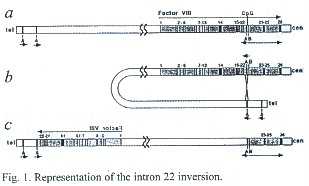
<body><![CDATA[<p><font face="Arial" size="2"><b>Palabras clave: </b>Hemofilia A, Hemofilia B, factor IX, factor VIII, diagnóstico molecular, detección de portadores.</font></p>     <p><font face="Arial" size="2">Hemophilia A and B due to factor VIII (FVIII) and IX (FIX) deficiencies are the most common bleeding disorders with incidences of about 1 per 4000 to 7000 and 1 per 25000 to 30000 male births respectively (<a href="#fo97">Forbes <i>et a</i>l. 1997</a>). Since the diseases follow an X-linked recessive mode of inheritance, they mostly afflict men whereas most female carriers remain healthy. The genes for both coagulation factors are located at the distal end of the long arm of the human X-chromosome (Xq28 and Xq27) (<a href="#fu90">Furie and Furie 1990</a>). Theoretically carriers have a clotting factor level around 50% of normal, which is generally sufficient for normal haemostasis. So far, the application of clotting and immunological methods allow to detect only about 80% of the carriers due to the random inactivation of one X-chromosome in females. Anxiety about the risk of Hemophilia affecting their offspring is the reason, why possible carriers ask for counselling.</font></p>     <p><font face="Arial" size="2">The precondition for an effective counselling is reliable detection of female carriers. </font></p>     <p><font face="Arial" size="2">Molecular diagnosis of this disease as well as a carrier and prenatal diagnosis is possible since the FVIII and FIX gene where cloned and characterized (<a href="#fu90">Furie and Furie 1990</a>). The gene which codes for the FVIII protein is 186 kb long and has 26 exons which code for the FVIII protein (<a href="#gi84">Gitschier <i>et a</i>l. 1984</a>). In molecular diagnosis of families with severe Hemophilia the natural starting point today is to ascertain whether the disease is due to inversion in the X-chromosome. Almost 45% of cases of severe Hemophilia A are caused by a substantial re-arrangements in the long arm of the X-chromosome. Two sequence elements homologous to intron 22 of the factor VIII gene are located in reverse orientation telomeric of the FVIII gene. Pairing and crossing over between the intron 22 element and the distal or proximal one of the extragenic elements result in an inversion of the FVIII gene with one break point in intron 22 (<a href="#f1">Fig. 1</a>) (<a href="#pa90">Pattinson <i>et a</i>l. 1990</a>, <a href="#la93">Lakich <i>et a</i>l. 1993</a>, <a  href="#he99">Herrmann and Scharrer 1999</a>). In Hemophilia B, the FIX gene is 33.5 kb long, has eight exons and codes for the FIX factor, a single chain glycoprotein (<a href="#yo85">Yoshitake <i>et al. </i>1985</a>). As most of the exons in the Hemophilia B gene are relatively short, direct sequencing of a complete exon is possible once it has been amplified from genomic DNA with the PCR technique.</font></p>     <p style="text-align: center;"><font face="Arial" size="2">&nbsp;<a  name="f1"></a><img src="/img/fbpe/rbt/v52n3/3067i1.JPG" title=""  alt="" style="width: 309px; height: 186px;">    
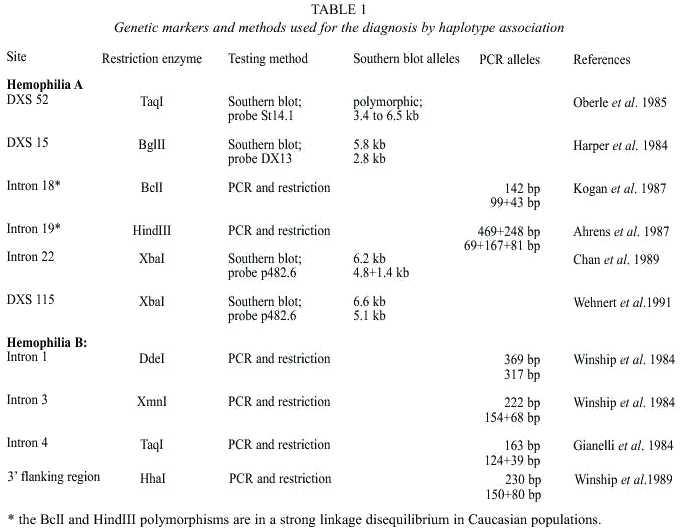
<br> </font></p>     <p><font face="Arial" size="2">Mutations at both genes exhibit extreme diversity, in most cases they are point mutations. Sequence analysis of FVIII and IX-genes to detecte the precise nature of any mutation is expensive, time consuming and it is offered only by a few specialized centres. Therefore many laboratories indirectly assess the genetic status of potential carriers using genetic markers linked to the FVIII- or FIX-genes respectively (<a href="#gi84">Giannelli <i>et a</i>l. 1984</a>, <a href="#he90">Herrmann <i>et a</i>l. 1990</a>, <a href="#ha84">Harper <i>et a</i>l. 1984</a>, <a href="#pe92">Peake 1992</a>). Such markers are e.g. restriction fragment length polymorphism (RFLPs), short tandem repeats (STS) or variable number tandem repeats (VNTRs) which can be identified by Southern blotting or the polymerase chain reaction (PCR). In about 5% of the patients with severe Hemophilia deletions of the factor VIII/IX-genes can be detected by Southern blotting (<a  href="#he90">Herrmann <i>et a</i>l. 1990</a>, <a href="#pe92">Peake 1992</a>). </font></p>     <p><font face="Arial" size="2">The Costa Rican population has recently surpassed the 4.0 millions inhabitants (<a href="#in00">INEC 2002-CCP</a>). At present there are 130 families with Hemophilia A and 30 families with Hemophilia B registered. Currently, the diagnosis is performed in the country only by standard laboratory tests and only one hospital offers specialized care and treatment to patients. In this article we present the molecular results of five families, three with Hemophilia A and two with Hemophilia B.</font></p> <font face="Arial" size="2"><b>     <p>Material and methods</p> </b> </font>     <p><font face="Arial" size="2">DNA Preparation and Genotyping: DNA was prepared by standard methods from whole blood (<a href="#mi88">Miller <i>et a</i>l. 1988</a>). For the indirect genomic diagnosis of Hemophilia A and B several common RFLP have been characterized by Southern blotting and PCR (<a href="#t1">Table 1</a>) (<a href="#gi84">Giannelli <i>et a</i>l. 1984</a>, <a href="#pe92">Peake 1992</a>, <a href="#ah87">Ahrens <i>et a</i>l. 1987</a>, <a href="#ch89">Chan <i>et a</i>l. 1989</a>, <a  href="#ko87">Kogan <i>et a</i>l. 1987</a>, <a href="#ob85">Oberle <i>et a</i>l. 1985</a>, <a href="#wi86">Wion <i>et a</i>l. 1986</a>, <a  href="#we90">Wehnert <i>et a</i>l. 1990</a>, <a href="#we91">Wehnert <i>et a</i>l. 1991</a>, <a href="#wi84">Winship <i>et a</i>l. 1984</a>, <a href="#wi89">Winship <i>et a</i>l. 1989</a>). The inversion in FVIII was detected by Southern blotting after restriction with BclI and hybridization with probe p482.6 (<a href="#ha84">Harper <i>et a</i>l. 1984</a>). The deletion in FIX gene was detected by restriction of the total DNA with the enzymes TaqI and EcoRI respectively and hybridization with a cDNA probe of factor IX (<a href="#gi84">Giannelli <i>et a</i>l. 1984</a>, <a href="#he90">Herrmann <i>et a</i>l. 1990</a>, <a href="#wi89">Winship <i>et a</i>l. 1989</a>). For mutation analysis all exons of the FIX gene have been amplified by PCR (<a href="#wu95">Wulff <i>et al. </i>1995</a>). The PCR products were screened by heteroduplex analysis. Small mutations (&lt;30bp) in the FIX gene were made evident by shifted extra bands. Mutations in exons a and h do not lead in all cases to visible shift bands in the heteroduplex analysis or single-strand conformation polymorphisms (SSCPs) (<a href="#wi84">Winship <i>et a</i>l. 1984</a>). Mutation analysis of the FIX gene was also performed by PCR and cycle sequencing procedure using Taq Dye Deoxy-terminator kit and the 373 ABI sequencer (<a href="#wu95">Wulff <i>et a</i>l. 1995</a>, <a href="#he98">Herrmann <i>et a</i>l. 1998</a>, <a  href="#wu99">Wulff <i>et a</i>l. 1999</a>).</font></p> <a name="t1"></a>     ]]></body>
<body><![CDATA[<div style="text-align: left;"><img src="/img/fbpe/rbt/v52n3/3067i11.JPG" title=""  alt="" style="width: 713px; height: 532px;"></div>     
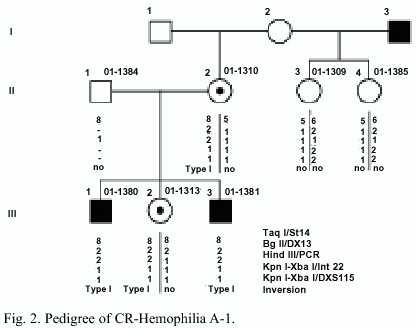
<p><font face="Arial" size="2"><b>Subjects: </b>From June 2000 to June 2002 data and blood samples of 5 Costa Rican families including patients and their relatives were collected. Females relatives of Hemophilia A patients showed an FVIII activity &gt;75%. All participants gave informed consent according to a protocol approved by the University of Costa Rica.</font></p>     <p><font face="Arial" size="2">Family HA-1: Four female relatives of the patients with severe Hemophilia A asked for genetic counselling (<a  href="#f2">Fig. 2</a>). The patients (III-1; III-3) are treated prophylactically at home. </font></p>     <p style="text-align: center;"><font face="Arial" size="2">&nbsp;<a  name="f2"></a></font></p>     <p style="text-align: center;"><font face="Arial" size="2"><img  src="/img/fbpe/rbt/v52n3/3067i3.JPG" title="" alt=""  style="width: 417px; height: 329px;">    
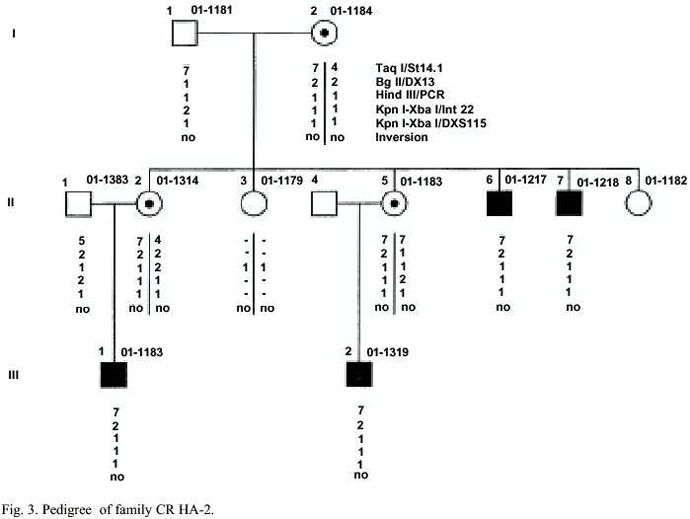
<br> </font></p>     <p style="text-align: left;"><font face="Arial" size="2">Family HA-2: In this family a severe Hemophilia Awith factor VIII activity of &lt;1% is evident. Patients II-6; II-7; III-1 and III-2 (<a href="#f3">Fig. 3</a>) suffered severe bleedings and they are treated prophylactically at home. Four females relatives of the patients asked for genetic counselling.</font></p>     <p style="text-align: left;"><font face="Arial" size="2"><a name="f3"></a><img  src="/img/fbpe/rbt/v52n3/3067i4.JPG" title="" alt=""  style="width: 699px; height: 526px;">&nbsp;    
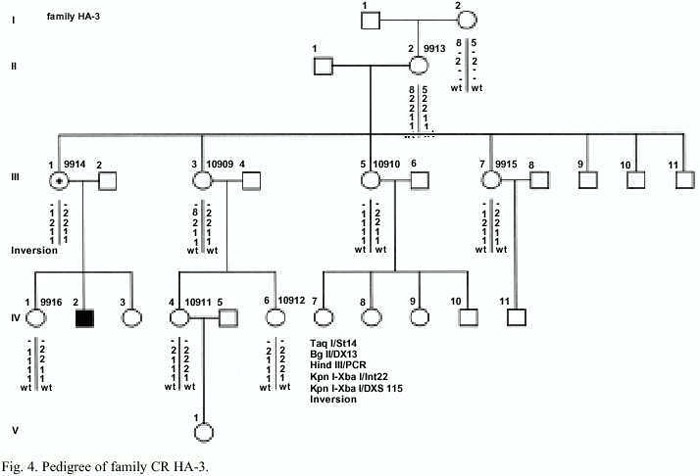
<br> </font></p>     <p><font face="Arial" size="2">Family HA-3: Nine female relatives of an isolated patient (IV-2) with severe Hemophilia A asked for genetic counselling (<a href="#f4">Fig. 4</a>). The patient is treated prophylactically at home. The patient’s DNA was not available for molecular analysis.</font></p> <a name="f4"></a>     ]]></body>
<body><![CDATA[<div style="text-align: left;"><img src="/img/fbpe/rbt/v52n3/3067i5.JPG" title=""  alt="" style="width: 714px; height: 486px;"></div>     
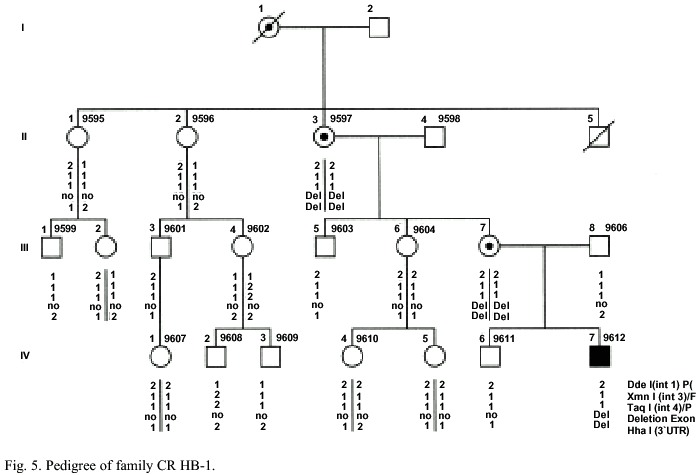
<p><font face="Arial" size="2">Family HB-1: The 7 year old patient IV-7 has a FIX activity &lt;1%. Joint bleedings in knees, elbows and calves were evident. Recently, the patient is at prophylactic home treatment with prothrombinic complex. Ten females at risk to be a carrier asked for diagnosis (<a href="#f5">Fig. 5</a>). The II-3 and III-7 females had a FIX activity of near 35% and presented moderate bleeding events after surgical treatment and tooth extraction.</font></p>     <p style="text-align: left;"><font face="Arial" size="2">&nbsp;<a  name="f5"></a><img src="/img/fbpe/rbt/v52n3/3067i6.JPG" title="" alt=""  style="width: 699px; height: 475px;"></font></p>     
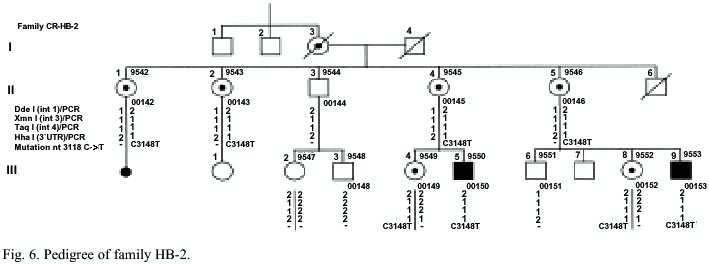
<p><font face="Arial" size="2">Family HB-2: In this family two Hemophilia B patients and seven females at risk to be a carrier asked for diagnosis . Both patients III-5 and III-9 (<a href="#f6">Fig. 6</a>) have a severe phenotype with an FIX activity &lt;1%. Patient III-5 suffered from severe bleedings in the subdural region with PCI and epilepsy. Recently, he got at prophylactic treatment at hospital twice a week. </font></p> <a name="f6"></a>     <div style="text-align: left;"><img  src="/img/fbpe/rbt/v52n3/3067i7.JPG" title="" alt=""  style="width: 709px; height: 265px;"></div> <font face="Arial" size="2"><b>     
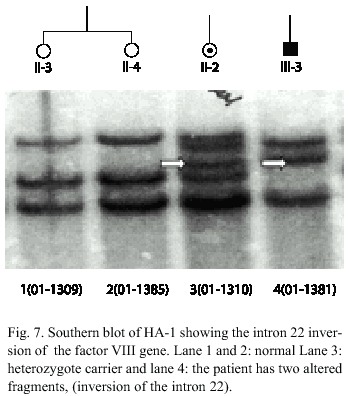
<p>Results</p> </b> </font>     <p><font face="Arial" size="2">Family HA-1: The Hemophilia A in this family is caused by an inversion type I in the F VIII gene (<a  href="#f7">Fig. 7</a>). In this family the inversion of the intron 22 could be detected in the mother II-2, one daughter III-1 and in the patients (<a href="#f2">Fig. 2</a>). The inversion enables a sure carrier detection and prenatal diagnosis in this family.</font></p> <a name="f7"></a>     <div style="text-align: center;"><img  src="/img/fbpe/rbt/v52n3/3067i8.JPG" title="" alt=""  style="width: 349px; height: 396px;"></div>     
<p><font face="Arial" size="2">Family HA-2: The inversion is absent in patients of this family. Thus, three intergenic and two intragenic RFLPs have been characterized for indirect diagnosis. By pedigree analysis it is clear that the females I-2, II-2 and II-5 are obligate carries for Hemophilia A, (<a href="#f3">Fig. 3</a>). I-2 is heterozygote only for the intergenic RFLP Taq I/St14.1. With this RFLP for the daughters II-2 and II-5 a carrier diagnosis can be offered with a diagnostic risk of about 2-5%. In case of pregnancy, II-2 a prenatal diagnosis can be offered base on the RFLP TaqI/St14.1 and the intragenic RFLP Hind III (PCR) and for II-5 on the intragenic RFLP KpnI-Xba I-int22. Both RFLPs enable an indirect diagnosis with a diagnostic risk of 0.1%.</font></p>     <p><font face="Arial" size="2">Family HA-3: An inversion type I in the factor VIII gene causes the Hemophilia A. In this family the inversion of the intron 22 could be detected only in the mother III-1 (<a  href="#f4">Fig. 4</a>). Therefore she is a carrier of Hemophilia A. The inversion enables a sure carrier detection and prenatal diagnosis in this family. In the DNA of the females I-2, II-2, III-3, III-5, III-7, IV-1; IV-4 and IV-6 the inversion is not present, they can be excluded as a carriers. </font></p>     ]]></body>
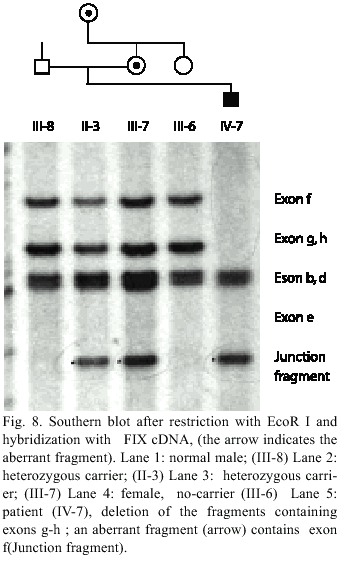
<body><![CDATA[<p><font face="Arial" size="2">Family HB-1: Southern blot analysis after restriction with the enzymes EcoRI and TaqI respectively and hybridization with a factor IX cDNA showed that one fragment typical for the exons g and h is missing. The EcoRI – blot showed a smaller aberrant fragment (<a href="#f8">Fig. 8</a>). The region downstream of the FIX gene with the HhaI polymorphism cannot be amplified. This result indicates a deletion of exons g and h, which extends more than 8 kb downstream of the FIX gene in the patients DNA. An aberrant restriction (junction) fragment include the exon f of the FIX gene can used for the direct diagnosis, for the detection of female carriers in this family (II-1 and III-7). A prenatal diagnosis can be offered to the carriers IV-7. </font></p>     <p style="text-align: center;"><font face="Arial" size="2">&nbsp;<a  name="f8"></a><img src="/img/fbpe/rbt/v52n3/3067i9.JPG" title=""  alt="" style="width: 345px; height: 561px;"></font></p>     
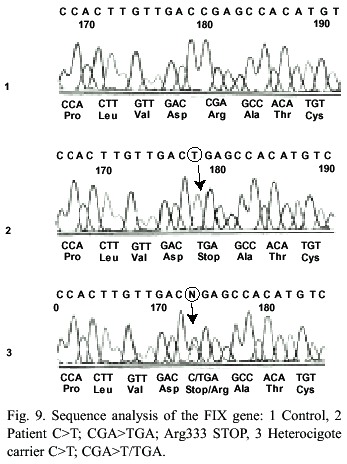
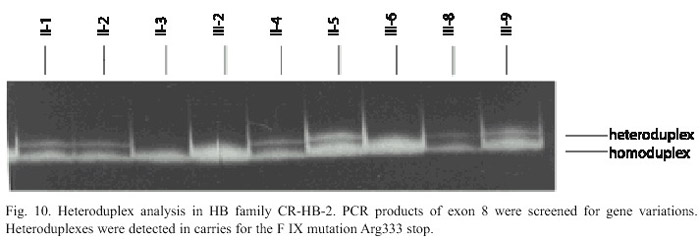
<p><font face="Arial" size="2">Family HB-2: In this family the causative mutation was analysed by amplification of all exons, the exon/intron regions and the promoter of the FIX gene. The PCR products of all exons were screened for variations by heteroduplex analysis. In PCR products of exon 8 of patients III-5 and III-9 and the females II-1, II-2, II-4, II-5, III-4 and III-8 were found shift bands using heteroduplex analysis. By sequencing of exon 8 of the patients DNA the nonsense mutation Arg333stop in nucleotide 31118C-&gt;T was found (<a  href="#f9">Fig. 9</a>). In the DNA of the females II-1, II-2, II-4, II-5, III-4 and III-8 the FIX mutation 31118C&gt;T has been detected by heteroduplex analysis (<a href="#f10">Fig. 10</a>) and sequencing (<a  href="#f9">Fig. 9</a>). They all are carriers for Hemophilia B. The mutation could not be detected in the DNA of proband III-2. She can be excluded as a carrier. In case of a pregnancy all carriers of this family a prenatal diagnosis could be offered by mutation analysis of fetal DNA. By indirect diagnosis II-4 and II-5 the possibility of a prenatal diagnosis also could be offered. The carrier status of II-1 and II-2 would not have been identified by indirect diagnosis. A prenatal diagnosis just for the detection of the linkage group not linked to the Hemophilia would be possible.    <br> </font></p>     <p style="text-align: center;"><font face="Arial" size="2"><a name="f9"></a><img  src="/img/fbpe/rbt/v52n3/3067i10.JPG" title="" alt=""  style="width: 347px; height: 464px;">    
<br> </font></p>     <p style="text-align: left;"><font face="Arial" size="2">&nbsp;<a  name="f10"></a><img src="/img/fbpe/rbt/v52n3/3067i2.JPG" title="" alt=""  style="width: 713px; height: 244px;"></font></p> <font face="Arial" size="2"><b>     
<p>Discussion</p> </b> </font>     <p><font face="Arial" size="2">The detection of carriership of Hemophilia A by the conventional methods has a probability between 5% and 95%, the main limitation of these methods is that they examine the phenotype (level of the factor) rather than the genotype (DNA) (<a  href="#fu90">Furier and Furier 1990</a>, <a href="#he90">Herrmann <i>et a</i>l. 1990</a>). In fact, the results are probabilistic because the higher overlap existing between the activity levels according the lionization phenomenon. In Hemophilia B, carrier detection is also complicated for this reason and the molecular heterogeneity (<a  href="#ch90">Chistolini <i>et a</i>l. 1990</a>). The molecular technology has provided the possibility for exactly carrier analyses and prenatal diagnosis as precondition for genetic counselling (<a  href="#he99">Herrmann and Scharrer 1999</a>). In case that the mutation leading to the Hemophilia A or B is not known or the direct mutation detection is not possible, the indirect diagnosis or heteroduplex analysis is alternatives for the carrier detection in families at risk (<a href="#wu95">Wulff <i>et a</i>l. 1995</a>, <a  href="#wu97">Wulff <i>et a</i>l. 1997</a>, <a href="#wu99">Wulff <i>et a</i>l. 1999</a>). </font></p>     <p><font face="Arial" size="2">In our study, we described the results of fifty-six subjects (9 patients) belong to five CR Hemophilia families and fourteen carriers were detected. Two Hemophilia A families, present the inversion in the intron 22 of the FVIII gene, which is a common mutation and it is described as the main cause (40-50%) for severe cases of Hemophilia A (<a href="#la93">Lakich <i>et a</i>l. 1993</a>). One family was not possible to detected this mutation in this gene, so in this case was useful the indirect genomic diagnosis, we used extragenic and intragenic probes. In order to track the individual copies of the FVIII gene in heterozygotes, it is essential to have available polymorphisms, which allow differentiating between the two copies present in female. The presence of heterozygosity or "informativeness" is essential for the indirect diagnosis. For the FVIII gene there are two types of polymorphisms, which segregate close with this gene (<a href="#ch90">Chistonilli <i>et a</i>l. 1990</a>). Additionally to the most frequent biallelic polymorphisms resulting from single nucleotide substitutions, which create or abolish restriction sites (RFLPs), multiallelic CA repeat sequences are known in the FVIII-gene (<a href="#he90">Herrmann <i>et a</i>l. 1990</a>, <a href="#pe92">Peake 1992</a>). Using these genomic markers about 95% of females at risk a diagnosis can be offered, as in this Hemophilia A family.</font></p>     ]]></body>
<body><![CDATA[<p><font face="Arial" size="2">We detected a deletion of exon g and h of the FIX gene and a nonsense mutation as a cause of the severe disease in the two Hemophilia B families. They are known mutations related with development of inhibitors, that is a complication in the hemophilic treatment (<a href="#wu03">Wulff <i>et a</i>l. 2003</a>). The indirect diagnosis, the heteroduplex analysis and sequenciacion of the FIX gene were utilized for detecting these mutations. In the heteroduplex, PCR products of the different exon regions were analysed by gel electrophoresis. Mutation in the FIX gene becomes evident by heteroduplex bands. This method can be used for mutation screening, for carrier detection and prenatal diagnosis. A disadvantage of this method is that not all mutations cause shift bands, which are detectable under standard conditions (<a href="#wu97">Wulff <i>et a</i>l. 1997</a>).</font></p>     <p><font face="Arial" size="2">In conclusion, we showed in this study, the importance of the improvement of the molecular analysis for the Costa Rican Hemophilia, the utility of the direct and indirect diagnosis for the molecular characterization in the patients and the possibility of carrier detection and prenatal diagnosis for the females.</font></p> <font face="Arial" size="2"><b>     <p>Acknowledgment</p> </b> </font>     <p><font face="Arial" size="2">This work was made possible by the support from the Faculty of Medicine, Ernst-Moritz-Arndt- University, Greifswald Germany; Deutscher Akademischer Austauschdienst (DAAD) and by Vicerrectoría de Investigación, University of Costa Rica (project N. 807-A0-163). </font></p> <font face="Arial" size="2"><b>     <p>Resumen</p> </b> </font>     <p><font face="Arial" size="2">La hemofilia A y B es una enfermedad hemorrágica hereditaria ligada al cromosoma X, producida por la deficiencia del factor VIII o IX, respectivamente. Los individuso afectados presentan un fenotipo de hemorragia variable causada por el amplio espectro de mutacionesdentro del gen del factor VIII o IX. Se reportan los resultados preliminares del diagnóstico molecular de familias hemofilicas costarricenses. Se demuestran los hallazgos obtenidos por medio de diagnóstico molecular directo e indirecto en tres familias con hemofilia A y dos con hemofilia B; así como las precondiciones y facilidad de este diagnóstico. En dos familias con hemofilia A y dos con hemofilia B, la mutación responsable pudo ser detectada por medio de Southern Blot, por la reacción en cadena de la polimerasa o por secuenciación genética. Una familia con hemofilia A pudo ser analizada solamente por medio de análisis indirecto por medio de marcadores genéticos intragénicos y extragénicos.</font></p> <font face="Arial" size="2"><b>     <p>References</p> </b> </font>     <!-- ref --><p><font face="Arial" size="2"><a name="ah87"></a>Ahrens, P., T.A. Kruse, M. Schwarty, P.B. Rasmussen &amp; N. Din. 1987. A new HindIII restriction fragment length polymorphism in the Hemophilia A locus. Hum. Genet. 76: 127-128.</font>&nbsp;&nbsp;&nbsp;&nbsp;&nbsp;&nbsp;&nbsp;&nbsp;[&#160;<a href="javascript:void(0);" onclick="javascript: window.open('/scielo.php?script=sci_nlinks&ref=1325324&pid=S0034-7744200400030001300001&lng=','','width=640,height=500,resizable=yes,scrollbars=1,menubar=yes,');">Links</a>&#160;]<!-- end-ref --><!-- ref --><p><font face="Arial" size="2"><a name="ch89"></a>Chan, V., T.N. Tong &amp; T.P. Chan. 1989. Multiple XbaI polymorphisms for carrier detection and prenatal diagnosis of haemophilia A. Br. J. Haematol. 73: 497-500.</font>&nbsp;&nbsp;&nbsp;&nbsp;&nbsp;&nbsp;&nbsp;&nbsp;[&#160;<a href="javascript:void(0);" onclick="javascript: window.open('/scielo.php?script=sci_nlinks&ref=1325325&pid=S0034-7744200400030001300002&lng=','','width=640,height=500,resizable=yes,scrollbars=1,menubar=yes,');">Links</a>&#160;]<!-- end-ref --><!-- ref --><p><font face="Arial" size="2"><a name="ch90"></a>Chistolini, A., M. Papacchini, M.G. Mazzucconi, G. La Verde, R. Arcieri, A. Ferrari, R. Paesano, A. Pachi &amp; G. Mariani. 1990. Carrier detection and prenatal diagnosis in Haemophilia A and B. Hematology 75: 424-428. </font>&nbsp;&nbsp;&nbsp;&nbsp;&nbsp;&nbsp;&nbsp;&nbsp;[&#160;<a href="javascript:void(0);" onclick="javascript: window.open('/scielo.php?script=sci_nlinks&ref=1325326&pid=S0034-7744200400030001300003&lng=','','width=640,height=500,resizable=yes,scrollbars=1,menubar=yes,');">Links</a>&#160;]<!-- end-ref --><!-- ref --><p><font face="Arial" size="2"><a name="fo97"></a>Forbes, C.D., L.M. Aledort &amp; R. Madhok. 1997. Hemophilia. Chapman Hall Medical. London. pp. 3-143.</font>&nbsp;&nbsp;&nbsp;&nbsp;&nbsp;&nbsp;&nbsp;&nbsp;[&#160;<a href="javascript:void(0);" onclick="javascript: window.open('/scielo.php?script=sci_nlinks&ref=1325327&pid=S0034-7744200400030001300004&lng=','','width=640,height=500,resizable=yes,scrollbars=1,menubar=yes,');">Links</a>&#160;]<!-- end-ref --><!-- ref --><p><font face="Arial" size="2"><a name="fu90"></a>Furie, B. &amp; B. Furie. 1990. Hemophilia basis of Hemophilia. Sem. Hematol. 27: 270-285. </font>&nbsp;&nbsp;&nbsp;&nbsp;&nbsp;&nbsp;&nbsp;&nbsp;[&#160;<a href="javascript:void(0);" onclick="javascript: window.open('/scielo.php?script=sci_nlinks&ref=1325328&pid=S0034-7744200400030001300005&lng=','','width=640,height=500,resizable=yes,scrollbars=1,menubar=yes,');">Links</a>&#160;]<!-- end-ref --><!-- ref --><p><font face="Arial" size="2"><a name="gi84"></a></font><font  face="Arial" size="2">Giannelli, F., D.S. Anson, K.H. Choo, D.J. Ress, P.R. Einship, N. Ferrari, C.R. Rizza &amp; G.G. Brownlee. 1984. Characterization and use of an intragenic polymorphic marker for detection of carriers of haemophilia B (factor IX deficiency). Lancet 1 (8371): 239-241.</font>&nbsp;&nbsp;&nbsp;&nbsp;&nbsp;&nbsp;&nbsp;&nbsp;[&#160;<a href="javascript:void(0);" onclick="javascript: window.open('/scielo.php?script=sci_nlinks&ref=1325329&pid=S0034-7744200400030001300006&lng=','','width=640,height=500,resizable=yes,scrollbars=1,menubar=yes,');">Links</a>&#160;]<!-- end-ref --><!-- ref --><p><font face="Arial" size="2">Gitschier, J., W.I. Wood, T.M. Goralka, K.L. Wion, E.Y. Chen, D.H. Eaton, G.A.Vehar, D.J. Capon &amp; R.M. Lawn. 1984. Characterization of the human factor VIII gene. Nature 312: 326-330. </font>&nbsp;&nbsp;&nbsp;&nbsp;&nbsp;&nbsp;&nbsp;&nbsp;[&#160;<a href="javascript:void(0);" onclick="javascript: window.open('/scielo.php?script=sci_nlinks&ref=1325330&pid=S0034-7744200400030001300007&lng=','','width=640,height=500,resizable=yes,scrollbars=1,menubar=yes,');">Links</a>&#160;]<!-- end-ref --><!-- ref --><p><font face="Arial" size="2"><a name="ha84"></a>Harper, K., M.E. Pembrey, R.M. Winter, D. Hartley &amp; E.G.D. Tuddenham.1984. A clinically useful DNA probe closely linked to haemophilia A. Lancet 2 (8393): 6-8.</font>&nbsp;&nbsp;&nbsp;&nbsp;&nbsp;&nbsp;&nbsp;&nbsp;[&#160;<a href="javascript:void(0);" onclick="javascript: window.open('/scielo.php?script=sci_nlinks&ref=1325331&pid=S0034-7744200400030001300008&lng=','','width=640,height=500,resizable=yes,scrollbars=1,menubar=yes,');">Links</a>&#160;]<!-- end-ref --><!-- ref --><p><font face="Arial" size="2"><a name="he99"></a>Herrmann, F.H. &amp; I. Scharrer.1999. Humangenetische Beratung bei Hämophilie A und B. pp. 3-33. <i>In </i>Deutsche Hämophiliegesellschaft (eds.). Mitteilungen der Deutschen Hämophiliegesellschaft zur Bekämpfung von Blutungskrankheiten, Hamburg.</font>&nbsp;&nbsp;&nbsp;&nbsp;&nbsp;&nbsp;&nbsp;&nbsp;[&#160;<a href="javascript:void(0);" onclick="javascript: window.open('/scielo.php?script=sci_nlinks&ref=1325332&pid=S0034-7744200400030001300009&lng=','','width=640,height=500,resizable=yes,scrollbars=1,menubar=yes,');">Links</a>&#160;]<!-- end-ref --><!-- ref --><p><font face="Arial" size="2"><a name="he90"></a>Herrmann, F.H., M. Wehnert, W. Schröder &amp; K. Wulff. 1990. Genomic diagnosis of Hemophilia A and B. Thromb. Haemorrh. Disorders 2(1): 11-15.</font>&nbsp;&nbsp;&nbsp;&nbsp;&nbsp;&nbsp;&nbsp;&nbsp;[&#160;<a href="javascript:void(0);" onclick="javascript: window.open('/scielo.php?script=sci_nlinks&ref=1325333&pid=S0034-7744200400030001300010&lng=','','width=640,height=500,resizable=yes,scrollbars=1,menubar=yes,');">Links</a>&#160;]<!-- end-ref --><!-- ref --><p><font face="Arial" size="2"><a name="he98"></a>Herrmann, F.H. &amp; K. Wulff. 1998. Molekulare Genanalyse und Geniagnostik bei Hämophilie B und FVII Mangel. Hämostaseologie 3: 129-139.</font>&nbsp;&nbsp;&nbsp;&nbsp;&nbsp;&nbsp;&nbsp;&nbsp;[&#160;<a href="javascript:void(0);" onclick="javascript: window.open('/scielo.php?script=sci_nlinks&ref=1325334&pid=S0034-7744200400030001300011&lng=','','width=640,height=500,resizable=yes,scrollbars=1,menubar=yes,');">Links</a>&#160;]<!-- end-ref --><!-- ref --><p><font face="Arial" size="2"><a name="in00"></a>INEC-CCP. Costa Rica: estimaciones y proyecciones de población actualizadas al año 2000. Período 1970- 2050. San José, Instituto Nacional de Estadística y Censos y Centro Centroamericano de Población, Universidad de Costa Rica. (En prensa).</font>&nbsp;&nbsp;&nbsp;&nbsp;&nbsp;&nbsp;&nbsp;&nbsp;[&#160;<a href="javascript:void(0);" onclick="javascript: window.open('/scielo.php?script=sci_nlinks&ref=1325335&pid=S0034-7744200400030001300012&lng=','','width=640,height=500,resizable=yes,scrollbars=1,menubar=yes,');">Links</a>&#160;]<!-- end-ref --><!-- ref --><p><font face="Arial" size="2"><a name="ko87"></a>Kogan, S.C., M. Doherty &amp; J. Gitschier. 1987. An improved method for prenatal diagnosis of genetic diseases by analysis of amplified DNA sequences. Application to Hemophilia A. N. Engl. J. Med. 317: 985-990.</font>&nbsp;&nbsp;&nbsp;&nbsp;&nbsp;&nbsp;&nbsp;&nbsp;[&#160;<a href="javascript:void(0);" onclick="javascript: window.open('/scielo.php?script=sci_nlinks&ref=1325336&pid=S0034-7744200400030001300013&lng=','','width=640,height=500,resizable=yes,scrollbars=1,menubar=yes,');">Links</a>&#160;]<!-- end-ref --><!-- ref --><p><font face="Arial" size="2"><a name="la93"></a>Lakich, D., H. Kazazian, S.E. Antonarakis &amp; J. Gitschier. 1993 Inversions disrupting the factor VIII gene are a common cause of severe haemophilia A. Nature Genet. 5: 236-241.</font>&nbsp;&nbsp;&nbsp;&nbsp;&nbsp;&nbsp;&nbsp;&nbsp;[&#160;<a href="javascript:void(0);" onclick="javascript: window.open('/scielo.php?script=sci_nlinks&ref=1325337&pid=S0034-7744200400030001300014&lng=','','width=640,height=500,resizable=yes,scrollbars=1,menubar=yes,');">Links</a>&#160;]<!-- end-ref --><!-- ref --><p><font face="Arial" size="2"><a name="mi88"></a>Miller, S.A., D.D. Dykes &amp; H.F. Polesky. 1988. A simple salting out procedure for extracting DNA from human nucleated cells. Nucleic Acid Res. 16: 1215.</font>&nbsp;&nbsp;&nbsp;&nbsp;&nbsp;&nbsp;&nbsp;&nbsp;[&#160;<a href="javascript:void(0);" onclick="javascript: window.open('/scielo.php?script=sci_nlinks&ref=1325338&pid=S0034-7744200400030001300015&lng=','','width=640,height=500,resizable=yes,scrollbars=1,menubar=yes,');">Links</a>&#160;]<!-- end-ref --><!-- ref --><p><font face="Arial" size="2"><a name="ob85"></a>Oberle I., G. Camerino, R. Heilig, L. Grunebaum, J.P. Cazenave, C. Crapanzano, P.M. Mannucci &amp; J.L. Mandel. 1985. Genetic screening for haemohilia A with a polymorphic DNA probe. N. Engl. J. Med. 312: 682-686.</font>&nbsp;&nbsp;&nbsp;&nbsp;&nbsp;&nbsp;&nbsp;&nbsp;[&#160;<a href="javascript:void(0);" onclick="javascript: window.open('/scielo.php?script=sci_nlinks&ref=1325339&pid=S0034-7744200400030001300016&lng=','','width=640,height=500,resizable=yes,scrollbars=1,menubar=yes,');">Links</a>&#160;]<!-- end-ref --><!-- ref --><p><font face="Arial" size="2"><a name="pa90"></a>Pattinson, J.K., D.S. Millar, J.H. McVery, C.B.Grundy, K. Wieland &amp; R.S. Misbashan. 1990. The molecular genetic analysis of Hemophilia A: A directed search strategy for the detection of point mutation in the human factor VIII gene. Blood 76: 2242-2248.</font>&nbsp;&nbsp;&nbsp;&nbsp;&nbsp;&nbsp;&nbsp;&nbsp;[&#160;<a href="javascript:void(0);" onclick="javascript: window.open('/scielo.php?script=sci_nlinks&ref=1325340&pid=S0034-7744200400030001300017&lng=','','width=640,height=500,resizable=yes,scrollbars=1,menubar=yes,');">Links</a>&#160;]<!-- end-ref --><!-- ref --><p><font face="Arial" size="2"><a name="pe92"></a>Peake, I. 1992. Registry of DNA Polymorphisms within or close to the Human Factor VIII and IX Genes. Thromb. Haemost. 67: 277-280.</font>&nbsp;&nbsp;&nbsp;&nbsp;&nbsp;&nbsp;&nbsp;&nbsp;[&#160;<a href="javascript:void(0);" onclick="javascript: window.open('/scielo.php?script=sci_nlinks&ref=1325341&pid=S0034-7744200400030001300018&lng=','','width=640,height=500,resizable=yes,scrollbars=1,menubar=yes,');">Links</a>&#160;]<!-- end-ref --><!-- ref --><p><font face="Arial" size="2"><a name="we91"></a>Wehnert, M., W. Schröder &amp; F.H. Herrmann. 1991. Two new markers at DXS 115 useful for genomic diagnosis in haemophilia A. Thromb. Haemorrh. Disorders 3(1): 21-24.</font>&nbsp;&nbsp;&nbsp;&nbsp;&nbsp;&nbsp;&nbsp;&nbsp;[&#160;<a href="javascript:void(0);" onclick="javascript: window.open('/scielo.php?script=sci_nlinks&ref=1325342&pid=S0034-7744200400030001300019&lng=','','width=640,height=500,resizable=yes,scrollbars=1,menubar=yes,');">Links</a>&#160;]<!-- end-ref --><!-- ref --><p><font face="Arial" size="2"><a name="we90"></a>Wehnert, M., E.L. Shukova, V.I. Surin, W. Schroder, Solovjev Gya &amp; F.H. Herrmann. 1990. Prenatal diagnosis of haemophilia by the polymerase chain reaction using the intragenic Hind III polymorphism. Prenatal Diagnosis 10: 529-532.</font>&nbsp;&nbsp;&nbsp;&nbsp;&nbsp;&nbsp;&nbsp;&nbsp;[&#160;<a href="javascript:void(0);" onclick="javascript: window.open('/scielo.php?script=sci_nlinks&ref=1325343&pid=S0034-7744200400030001300020&lng=','','width=640,height=500,resizable=yes,scrollbars=1,menubar=yes,');">Links</a>&#160;]<!-- end-ref --><!-- ref --><p><font face="Arial" size="2"><a name="wi84"></a>Winship, P.R., D.S. Anson, C.R. Rizza &amp; G.G. Brownlee. 1984. Carrier detection in haemophilia B using two futher intragenic restriction fragment length polymorphisms. Nucleic Acid Res. 12: 8861-8872.</font>&nbsp;&nbsp;&nbsp;&nbsp;&nbsp;&nbsp;&nbsp;&nbsp;[&#160;<a href="javascript:void(0);" onclick="javascript: window.open('/scielo.php?script=sci_nlinks&ref=1325344&pid=S0034-7744200400030001300021&lng=','','width=640,height=500,resizable=yes,scrollbars=1,menubar=yes,');">Links</a>&#160;]<!-- end-ref --><!-- ref --><p><font face="Arial" size="2"><a name="wi89"></a>Winship, P.R., D.J. Rees &amp; M. Alkan. 1989. Detection of polymorphisms at cytosine phosphoguanadine dinucleotides and diagnosis of haemophilia B carriers. Lancet 1(8639): 631-634.</font>&nbsp;&nbsp;&nbsp;&nbsp;&nbsp;&nbsp;&nbsp;&nbsp;[&#160;<a href="javascript:void(0);" onclick="javascript: window.open('/scielo.php?script=sci_nlinks&ref=1325345&pid=S0034-7744200400030001300022&lng=','','width=640,height=500,resizable=yes,scrollbars=1,menubar=yes,');">Links</a>&#160;]<!-- end-ref --><!-- ref --><p><font face="Arial" size="2"><a name="wi86"></a>Wion, K.L., E.G.D. Tuddenham &amp; R.M. Lawn. 1986. A new polymorphism in the factor VIII gene for prenatal diagnosis of haemophilia A. Nucleic Acid Res. 14: 4535-4542.</font>&nbsp;&nbsp;&nbsp;&nbsp;&nbsp;&nbsp;&nbsp;&nbsp;[&#160;<a href="javascript:void(0);" onclick="javascript: window.open('/scielo.php?script=sci_nlinks&ref=1325346&pid=S0034-7744200400030001300023&lng=','','width=640,height=500,resizable=yes,scrollbars=1,menubar=yes,');">Links</a>&#160;]<!-- end-ref --><!-- ref --><p><font face="Arial" size="2"><a name="wu99"></a>Wulff, K., K. Bykowska, S. Lopaciuk &amp; F.H. Herrmann. 1999. Molecular analysis of Hemophilia B in Poland: 12 novel mutations of the factor IX gene. Acta Biochim. Polonica. 721-726.</font>&nbsp;&nbsp;&nbsp;&nbsp;&nbsp;&nbsp;&nbsp;&nbsp;[&#160;<a href="javascript:void(0);" onclick="javascript: window.open('/scielo.php?script=sci_nlinks&ref=1325347&pid=S0034-7744200400030001300024&lng=','','width=640,height=500,resizable=yes,scrollbars=1,menubar=yes,');">Links</a>&#160;]<!-- end-ref --><!-- ref --><p><font face="Arial" size="2"><a name="wu97"></a>Wulff, K., U. Ebener, Ch-S. Wehnert, P.A. Ward, U. Reuner, W. Hiebsch, F.H. Herrmann &amp; M. Wehnert. 1997. Direct molecular genetic diagnosis and heterozygote identification in X-linked Emery-Dreifuss muscular dystrophy by heterodeplex analysis. Dis. Markers 13: 77-86.</font>&nbsp;&nbsp;&nbsp;&nbsp;&nbsp;&nbsp;&nbsp;&nbsp;[&#160;<a href="javascript:void(0);" onclick="javascript: window.open('/scielo.php?script=sci_nlinks&ref=1325348&pid=S0034-7744200400030001300025&lng=','','width=640,height=500,resizable=yes,scrollbars=1,menubar=yes,');">Links</a>&#160;]<!-- end-ref --><!-- ref --><p><font face="Arial" size="2"><a name="wu95"></a>Wulff, K., W. Schröder, M. Wehnert &amp; F.H. Herrmann. 1995. Twenty-five novel mutations of the factor IX gene in haemophilia B. Human Mutat. 6: 346-348.</font>&nbsp;&nbsp;&nbsp;&nbsp;&nbsp;&nbsp;&nbsp;&nbsp;[&#160;<a href="javascript:void(0);" onclick="javascript: window.open('/scielo.php?script=sci_nlinks&ref=1325349&pid=S0034-7744200400030001300026&lng=','','width=640,height=500,resizable=yes,scrollbars=1,menubar=yes,');">Links</a>&#160;]<!-- end-ref --><!-- ref --><p><font face="Arial" size="2"><a name="wu03"></a>Wulff, K., W. Schröder, M. Wehnert &amp; F.H. Herrmann. 2003. Molecular Analysis of Hemophilia B: Greifswald Registry FIX deficiency (HemophiliaB). pp.35-48 In I.III. Scharrer, W. Schramm (eds.). 32nd Hemophilia Symposium Hamburg 2001. Springer, Berlin.</font>&nbsp;&nbsp;&nbsp;&nbsp;&nbsp;&nbsp;&nbsp;&nbsp;[&#160;<a href="javascript:void(0);" onclick="javascript: window.open('/scielo.php?script=sci_nlinks&ref=1325350&pid=S0034-7744200400030001300027&lng=','','width=640,height=500,resizable=yes,scrollbars=1,menubar=yes,');">Links</a>&#160;]<!-- end-ref --><!-- ref --><p><font face="Arial" size="2"><a name="yo85"></a>Yoshitake, S., B.G. Schach, D.C. Foster, E.W. Davie &amp; K. Kurachi. 1985. Nucelotide sequence of the gene of human factor IX ( haemophilic factor B). Biochem. 24: 3736-3750.</font>&nbsp;&nbsp;&nbsp;&nbsp;&nbsp;&nbsp;&nbsp;&nbsp;[&#160;<a href="javascript:void(0);" onclick="javascript: window.open('/scielo.php?script=sci_nlinks&ref=1325351&pid=S0034-7744200400030001300028&lng=','','width=640,height=500,resizable=yes,scrollbars=1,menubar=yes,');">Links</a>&#160;]<!-- end-ref --> ]]></body><back>
<ref-list>
<ref id="B1">
<nlm-citation citation-type="journal">
<person-group person-group-type="author">
<name>
<surname><![CDATA[Ahrens]]></surname>
<given-names><![CDATA[P]]></given-names>
</name>
<name>
<surname><![CDATA[Kruse]]></surname>
<given-names><![CDATA[T.A]]></given-names>
</name>
<name>
<surname><![CDATA[Schwarty]]></surname>
<given-names><![CDATA[M]]></given-names>
</name>
<name>
<surname><![CDATA[Rasmussen]]></surname>
<given-names><![CDATA[P.B]]></given-names>
</name>
<name>
<surname><![CDATA[Din]]></surname>
<given-names><![CDATA[N]]></given-names>
</name>
</person-group>
<article-title xml:lang="en"><![CDATA[A new HindIII restriction fragment length polymorphism in the Hemophilia A locus]]></article-title>
<source><![CDATA[Hum. Genet]]></source>
<year>1987</year>
<volume>76</volume>
<page-range>127-128</page-range></nlm-citation>
</ref>
<ref id="B2">
<nlm-citation citation-type="journal">
<person-group person-group-type="author">
<name>
<surname><![CDATA[Chan]]></surname>
<given-names><![CDATA[V]]></given-names>
</name>
<name>
<surname><![CDATA[Tong]]></surname>
<given-names><![CDATA[T.N]]></given-names>
</name>
<name>
<surname><![CDATA[Chan]]></surname>
<given-names><![CDATA[T.P]]></given-names>
</name>
</person-group>
<article-title xml:lang="en"><![CDATA[Multiple XbaI polymorphisms for carrier detection and prenatal diagnosis of haemophilia A]]></article-title>
<source><![CDATA[Br. J. Haematol]]></source>
<year>1989</year>
<volume>73</volume>
<page-range>497-500</page-range></nlm-citation>
</ref>
<ref id="B3">
<nlm-citation citation-type="journal">
<person-group person-group-type="author">
<name>
<surname><![CDATA[Chistolini]]></surname>
<given-names><![CDATA[A]]></given-names>
</name>
<name>
<surname><![CDATA[Papacchini]]></surname>
<given-names><![CDATA[M]]></given-names>
</name>
<name>
<surname><![CDATA[Mazzucconi]]></surname>
<given-names><![CDATA[M.G]]></given-names>
</name>
<name>
<surname><![CDATA[La Verde]]></surname>
<given-names><![CDATA[G]]></given-names>
</name>
<name>
<surname><![CDATA[Arcieri]]></surname>
<given-names><![CDATA[R]]></given-names>
</name>
<name>
<surname><![CDATA[Ferrari]]></surname>
<given-names><![CDATA[A]]></given-names>
</name>
<name>
<surname><![CDATA[Paesano]]></surname>
<given-names><![CDATA[R]]></given-names>
</name>
<name>
<surname><![CDATA[Pachi]]></surname>
<given-names><![CDATA[A]]></given-names>
</name>
<name>
<surname><![CDATA[Mariani]]></surname>
<given-names><![CDATA[G]]></given-names>
</name>
</person-group>
<article-title xml:lang="en"><![CDATA[Carrier detection and prenatal diagnosis in Haemophilia A and B]]></article-title>
<source><![CDATA[Hematology]]></source>
<year>1990</year>
<volume>75</volume>
<page-range>424-428</page-range></nlm-citation>
</ref>
<ref id="B4">
<nlm-citation citation-type="book">
<person-group person-group-type="author">
<name>
<surname><![CDATA[Forbes]]></surname>
<given-names><![CDATA[C.D]]></given-names>
</name>
<name>
<surname><![CDATA[Aledort]]></surname>
<given-names><![CDATA[L.M]]></given-names>
</name>
<name>
<surname><![CDATA[Madhok]]></surname>
<given-names><![CDATA[R]]></given-names>
</name>
</person-group>
<source><![CDATA[Hemophilia]]></source>
<year>1997</year>
<page-range>3-143</page-range><publisher-loc><![CDATA[London ]]></publisher-loc>
<publisher-name><![CDATA[Chapman Hall Medical]]></publisher-name>
</nlm-citation>
</ref>
<ref id="B5">
<nlm-citation citation-type="journal">
<person-group person-group-type="author">
<name>
<surname><![CDATA[Furie]]></surname>
<given-names><![CDATA[B]]></given-names>
</name>
<name>
<surname><![CDATA[Furie]]></surname>
<given-names><![CDATA[B]]></given-names>
</name>
</person-group>
<article-title xml:lang="en"><![CDATA[Hemophilia basis of Hemophilia]]></article-title>
<source><![CDATA[Sem. Hematol]]></source>
<year>1990</year>
<volume>27</volume>
<page-range>270-285</page-range></nlm-citation>
</ref>
<ref id="B6">
<nlm-citation citation-type="journal">
<person-group person-group-type="author">
<name>
<surname><![CDATA[Giannelli]]></surname>
<given-names><![CDATA[F]]></given-names>
</name>
<name>
<surname><![CDATA[Anson]]></surname>
<given-names><![CDATA[D.S]]></given-names>
</name>
<name>
<surname><![CDATA[Choo]]></surname>
<given-names><![CDATA[K.H]]></given-names>
</name>
<name>
<surname><![CDATA[Ress]]></surname>
<given-names><![CDATA[D.J]]></given-names>
</name>
<name>
<surname><![CDATA[Einship]]></surname>
<given-names><![CDATA[P.R]]></given-names>
</name>
<name>
<surname><![CDATA[Ferrari]]></surname>
<given-names><![CDATA[N]]></given-names>
</name>
<name>
<surname><![CDATA[Rizza]]></surname>
<given-names><![CDATA[C.R]]></given-names>
</name>
<name>
<surname><![CDATA[Brownlee]]></surname>
<given-names><![CDATA[G.G]]></given-names>
</name>
</person-group>
<article-title xml:lang="en"><![CDATA[Characterization and use of an intragenic polymorphic marker for detection of carriers of haemophilia B (factor IX deficiency)]]></article-title>
<source><![CDATA[Lancet]]></source>
<year>1984</year>
<volume>1</volume>
<numero>^s8371</numero>
<issue>^s8371</issue>
<supplement>8371</supplement>
<page-range>239-241</page-range></nlm-citation>
</ref>
<ref id="B7">
<nlm-citation citation-type="journal">
<person-group person-group-type="author">
<name>
<surname><![CDATA[Gitschier]]></surname>
<given-names><![CDATA[J]]></given-names>
</name>
<name>
<surname><![CDATA[Wood]]></surname>
<given-names><![CDATA[W.I]]></given-names>
</name>
<name>
<surname><![CDATA[Goralka]]></surname>
<given-names><![CDATA[T.M]]></given-names>
</name>
<name>
<surname><![CDATA[Wion]]></surname>
<given-names><![CDATA[K.L]]></given-names>
</name>
<name>
<surname><![CDATA[Chen]]></surname>
<given-names><![CDATA[E.Y]]></given-names>
</name>
<name>
<surname><![CDATA[Eaton]]></surname>
<given-names><![CDATA[D.H]]></given-names>
</name>
<name>
<surname><![CDATA[Vehar]]></surname>
<given-names><![CDATA[G.A]]></given-names>
</name>
<name>
<surname><![CDATA[Capon]]></surname>
<given-names><![CDATA[D.J]]></given-names>
</name>
<name>
<surname><![CDATA[Lawn]]></surname>
<given-names><![CDATA[R.M]]></given-names>
</name>
</person-group>
<article-title xml:lang="en"><![CDATA[Characterization of the human factor VIII gene]]></article-title>
<source><![CDATA[Nature]]></source>
<year>1984</year>
<volume>312</volume>
<page-range>326-330</page-range></nlm-citation>
</ref>
<ref id="B8">
<nlm-citation citation-type="journal">
<person-group person-group-type="author">
<name>
<surname><![CDATA[Harper]]></surname>
<given-names><![CDATA[K]]></given-names>
</name>
<name>
<surname><![CDATA[Pembrey]]></surname>
<given-names><![CDATA[M.E]]></given-names>
</name>
<name>
<surname><![CDATA[Winter]]></surname>
<given-names><![CDATA[R.M]]></given-names>
</name>
<name>
<surname><![CDATA[Hartley]]></surname>
<given-names><![CDATA[D]]></given-names>
</name>
<name>
<surname><![CDATA[Tuddenham]]></surname>
<given-names><![CDATA[E.G.D]]></given-names>
</name>
</person-group>
<article-title xml:lang="en"><![CDATA[A clinically useful DNA probe closely linked to haemophilia A]]></article-title>
<source><![CDATA[Lancet]]></source>
<year>1984</year>
<volume>2</volume>
<numero>8393</numero>
<issue>8393</issue>
<page-range>6-8</page-range></nlm-citation>
</ref>
<ref id="B9">
<nlm-citation citation-type="">
<person-group person-group-type="author">
<name>
<surname><![CDATA[Herrmann]]></surname>
<given-names><![CDATA[F.H]]></given-names>
</name>
<name>
<surname><![CDATA[Scharrer]]></surname>
<given-names><![CDATA[I]]></given-names>
</name>
</person-group>
<article-title xml:lang="en"><![CDATA[Humangenetische Beratung bei Hämophilie A und B]]></article-title>
<collab>Deutsche Hämophiliegesellschaft</collab>
<source><![CDATA[Mitteilungen der Deutschen Hämophiliegesellschaft zur Bekämpfung von Blutungskrankheiten]]></source>
<year>1999</year>
<page-range>3-33</page-range><publisher-loc><![CDATA[Hamburg ]]></publisher-loc>
</nlm-citation>
</ref>
<ref id="B10">
<nlm-citation citation-type="journal">
<person-group person-group-type="author">
<name>
<surname><![CDATA[Herrmann]]></surname>
<given-names><![CDATA[F.H]]></given-names>
</name>
<name>
<surname><![CDATA[Wehnert]]></surname>
<given-names><![CDATA[M]]></given-names>
</name>
<name>
<surname><![CDATA[Schröder]]></surname>
<given-names><![CDATA[W]]></given-names>
</name>
<name>
<surname><![CDATA[Wulff]]></surname>
<given-names><![CDATA[K]]></given-names>
</name>
</person-group>
<article-title xml:lang="en"><![CDATA[Genomic diagnosis of Hemophilia A and B]]></article-title>
<source><![CDATA[Thromb. Haemorrh. Disorders]]></source>
<year>1990</year>
<volume>2</volume>
<numero>1</numero>
<issue>1</issue>
<page-range>11-15</page-range></nlm-citation>
</ref>
<ref id="B11">
<nlm-citation citation-type="journal">
<person-group person-group-type="author">
<name>
<surname><![CDATA[Herrmann]]></surname>
<given-names><![CDATA[F.H]]></given-names>
</name>
<name>
<surname><![CDATA[Wulff]]></surname>
<given-names><![CDATA[K]]></given-names>
</name>
</person-group>
<article-title xml:lang="de"><![CDATA[Molekulare Genanalyse und Geniagnostik bei Hämophilie B und FVII Mangel]]></article-title>
<source><![CDATA[Hämostaseologie]]></source>
<year>1998</year>
<volume>3</volume>
<page-range>129-139</page-range></nlm-citation>
</ref>
<ref id="B12">
<nlm-citation citation-type="book">
<collab>INEC-CCP</collab>
<source><![CDATA[Costa Rica: estimaciones y proyecciones de población actualizadas al año 2000. Período 1970- 2050]]></source>
<year></year>
<publisher-loc><![CDATA[San José ]]></publisher-loc>
<publisher-name><![CDATA[Instituto Nacional de Estadística y Censos y Centro Centroamericano de Población, Universidad de Costa Rica]]></publisher-name>
</nlm-citation>
</ref>
<ref id="B13">
<nlm-citation citation-type="journal">
<person-group person-group-type="author">
<name>
<surname><![CDATA[Kogan]]></surname>
<given-names><![CDATA[S.C]]></given-names>
</name>
<name>
<surname><![CDATA[Doherty]]></surname>
<given-names><![CDATA[M]]></given-names>
</name>
<name>
<surname><![CDATA[Gitschier]]></surname>
<given-names><![CDATA[J]]></given-names>
</name>
</person-group>
<article-title xml:lang="en"><![CDATA[An improved method for prenatal diagnosis of genetic diseases by analysis of amplified DNA sequences. Application to Hemophilia A]]></article-title>
<source><![CDATA[N. Engl. J. Med]]></source>
<year>1987</year>
<volume>317</volume>
<page-range>985-990</page-range></nlm-citation>
</ref>
<ref id="B14">
<nlm-citation citation-type="journal">
<person-group person-group-type="author">
<name>
<surname><![CDATA[Lakich]]></surname>
<given-names><![CDATA[D]]></given-names>
</name>
<name>
<surname><![CDATA[Kazazian]]></surname>
<given-names><![CDATA[H]]></given-names>
</name>
<name>
<surname><![CDATA[Antonarakis]]></surname>
<given-names><![CDATA[S.E]]></given-names>
</name>
<name>
<surname><![CDATA[Gitschier]]></surname>
<given-names><![CDATA[J]]></given-names>
</name>
</person-group>
<article-title xml:lang="en"><![CDATA[Inversions disrupting the factor VIII gene are a common cause of severe haemophilia A]]></article-title>
<source><![CDATA[Nature Genet]]></source>
<year>1993</year>
<volume>5</volume>
<page-range>236-241</page-range></nlm-citation>
</ref>
<ref id="B15">
<nlm-citation citation-type="journal">
<person-group person-group-type="author">
<name>
<surname><![CDATA[Miller]]></surname>
<given-names><![CDATA[S.A]]></given-names>
</name>
<name>
<surname><![CDATA[Dykes]]></surname>
<given-names><![CDATA[D.D]]></given-names>
</name>
<name>
<surname><![CDATA[Polesky]]></surname>
<given-names><![CDATA[H.F]]></given-names>
</name>
</person-group>
<article-title xml:lang="en"><![CDATA[A simple salting out procedure for extracting DNA from human nucleated cells]]></article-title>
<source><![CDATA[Nucleic Acid Res]]></source>
<year>1988</year>
<volume>16</volume>
<page-range>1215</page-range></nlm-citation>
</ref>
<ref id="B16">
<nlm-citation citation-type="journal">
<person-group person-group-type="author">
<name>
<surname><![CDATA[Oberle]]></surname>
<given-names><![CDATA[I]]></given-names>
</name>
<name>
<surname><![CDATA[Camerino]]></surname>
<given-names><![CDATA[G]]></given-names>
</name>
<name>
<surname><![CDATA[Heilig]]></surname>
<given-names><![CDATA[R]]></given-names>
</name>
<name>
<surname><![CDATA[Grunebaum]]></surname>
<given-names><![CDATA[L]]></given-names>
</name>
<name>
<surname><![CDATA[Cazenave]]></surname>
<given-names><![CDATA[J.P]]></given-names>
</name>
<name>
<surname><![CDATA[Crapanzano]]></surname>
<given-names><![CDATA[C]]></given-names>
</name>
<name>
<surname><![CDATA[Mannucci]]></surname>
<given-names><![CDATA[P.M]]></given-names>
</name>
<name>
<surname><![CDATA[Mandel]]></surname>
<given-names><![CDATA[J.L]]></given-names>
</name>
</person-group>
<article-title xml:lang="en"><![CDATA[Genetic screening for haemohilia A with a polymorphic DNA probe]]></article-title>
<source><![CDATA[N. Engl. J. Med]]></source>
<year>1985</year>
<volume>312</volume>
<page-range>682-686</page-range></nlm-citation>
</ref>
<ref id="B17">
<nlm-citation citation-type="journal">
<person-group person-group-type="author">
<name>
<surname><![CDATA[Pattinson]]></surname>
<given-names><![CDATA[J.K]]></given-names>
</name>
<name>
<surname><![CDATA[Millar]]></surname>
<given-names><![CDATA[D.S]]></given-names>
</name>
<name>
<surname><![CDATA[McVery]]></surname>
<given-names><![CDATA[J.H]]></given-names>
</name>
<name>
<surname><![CDATA[Grundy]]></surname>
<given-names><![CDATA[C.B]]></given-names>
</name>
<name>
<surname><![CDATA[Wieland]]></surname>
<given-names><![CDATA[K]]></given-names>
</name>
<name>
<surname><![CDATA[Misbashan]]></surname>
<given-names><![CDATA[R.S]]></given-names>
</name>
</person-group>
<article-title xml:lang="en"><![CDATA[The molecular genetic analysis of Hemophilia A: A directed search strategy for the detection of point mutation in the human factor VIII gene]]></article-title>
<source><![CDATA[Blood]]></source>
<year>1990</year>
<volume>76</volume>
<page-range>2242-2248</page-range></nlm-citation>
</ref>
<ref id="B18">
<nlm-citation citation-type="journal">
<person-group person-group-type="author">
<name>
<surname><![CDATA[Peake]]></surname>
<given-names><![CDATA[I]]></given-names>
</name>
</person-group>
<article-title xml:lang="en"><![CDATA[Registry of DNA Polymorphisms within or close to the Human Factor VIII and IX Genes]]></article-title>
<source><![CDATA[Thromb. Haemost]]></source>
<year>1992</year>
<volume>67</volume>
<page-range>277-280</page-range></nlm-citation>
</ref>
<ref id="B19">
<nlm-citation citation-type="journal">
<person-group person-group-type="author">
<name>
<surname><![CDATA[Wehnert]]></surname>
<given-names><![CDATA[M]]></given-names>
</name>
<name>
<surname><![CDATA[Schröder]]></surname>
<given-names><![CDATA[W]]></given-names>
</name>
<name>
<surname><![CDATA[Herrmann]]></surname>
<given-names><![CDATA[F.H]]></given-names>
</name>
</person-group>
<article-title xml:lang="en"><![CDATA[Two new markers at DXS 115 useful for genomic diagnosis in haemophilia A]]></article-title>
<source><![CDATA[Thromb. Haemorrh. Disorders]]></source>
<year>1991</year>
<volume>3</volume>
<numero>1</numero>
<issue>1</issue>
<page-range>21-24</page-range></nlm-citation>
</ref>
<ref id="B20">
<nlm-citation citation-type="journal">
<person-group person-group-type="author">
<name>
<surname><![CDATA[Wehnert]]></surname>
<given-names><![CDATA[M]]></given-names>
</name>
<name>
<surname><![CDATA[Shukova]]></surname>
<given-names><![CDATA[E.L]]></given-names>
</name>
<name>
<surname><![CDATA[Surin]]></surname>
<given-names><![CDATA[V.I]]></given-names>
</name>
<name>
<surname><![CDATA[Schroder]]></surname>
<given-names><![CDATA[W]]></given-names>
</name>
<name>
<surname><![CDATA[Gya]]></surname>
<given-names><![CDATA[Solovjev]]></given-names>
</name>
<name>
<surname><![CDATA[Herrmann]]></surname>
<given-names><![CDATA[F.H]]></given-names>
</name>
</person-group>
<article-title xml:lang="en"><![CDATA[Prenatal diagnosis of haemophilia by the polymerase chain reaction using the intragenic Hind III polymorphism]]></article-title>
<source><![CDATA[Prenatal Diagnosis]]></source>
<year>1990</year>
<volume>10</volume>
<page-range>529-532</page-range></nlm-citation>
</ref>
<ref id="B21">
<nlm-citation citation-type="journal">
<person-group person-group-type="author">
<name>
<surname><![CDATA[Winship]]></surname>
<given-names><![CDATA[P.R]]></given-names>
</name>
<name>
<surname><![CDATA[Anson]]></surname>
<given-names><![CDATA[D.S]]></given-names>
</name>
<name>
<surname><![CDATA[Rizza]]></surname>
<given-names><![CDATA[C.R]]></given-names>
</name>
<name>
<surname><![CDATA[Brownlee]]></surname>
<given-names><![CDATA[G.G]]></given-names>
</name>
</person-group>
<article-title xml:lang="en"><![CDATA[Carrier detection in haemophilia B using two futher intragenic restriction fragment length polymorphisms]]></article-title>
<source><![CDATA[Nucleic Acid Res]]></source>
<year>1984</year>
<volume>12</volume>
<page-range>8861-8872</page-range></nlm-citation>
</ref>
<ref id="B22">
<nlm-citation citation-type="journal">
<person-group person-group-type="author">
<name>
<surname><![CDATA[Winship]]></surname>
<given-names><![CDATA[P.R]]></given-names>
</name>
<name>
<surname><![CDATA[Rees]]></surname>
<given-names><![CDATA[D.J]]></given-names>
</name>
<name>
<surname><![CDATA[Alkan]]></surname>
<given-names><![CDATA[M]]></given-names>
</name>
</person-group>
<article-title xml:lang="en"><![CDATA[Detection of polymorphisms at cytosine phosphoguanadine dinucleotides and diagnosis of haemophilia B carriers]]></article-title>
<source><![CDATA[Lancet]]></source>
<year>1989</year>
<volume>1</volume><volume>8639</volume>
<page-range>631-634</page-range></nlm-citation>
</ref>
<ref id="B23">
<nlm-citation citation-type="journal">
<person-group person-group-type="author">
<name>
<surname><![CDATA[Wion]]></surname>
<given-names><![CDATA[K.L]]></given-names>
</name>
<name>
<surname><![CDATA[Tuddenham]]></surname>
<given-names><![CDATA[E.G.D]]></given-names>
</name>
<name>
<surname><![CDATA[Lawn]]></surname>
<given-names><![CDATA[R.M]]></given-names>
</name>
</person-group>
<article-title xml:lang="en"><![CDATA[A new polymorphism in the factor VIII gene for prenatal diagnosis of haemophilia A]]></article-title>
<source><![CDATA[Nucleic Acid Res]]></source>
<year>1986</year>
<volume>14</volume>
<page-range>4535-4542</page-range></nlm-citation>
</ref>
<ref id="B24">
<nlm-citation citation-type="journal">
<person-group person-group-type="author">
<name>
<surname><![CDATA[Wulff]]></surname>
<given-names><![CDATA[K]]></given-names>
</name>
<name>
<surname><![CDATA[Bykowska]]></surname>
<given-names><![CDATA[K]]></given-names>
</name>
<name>
<surname><![CDATA[Lopaciuk]]></surname>
<given-names><![CDATA[S]]></given-names>
</name>
<name>
<surname><![CDATA[Herrmann]]></surname>
<given-names><![CDATA[F.H]]></given-names>
</name>
</person-group>
<article-title xml:lang="en"><![CDATA[Molecular analysis of Hemophilia B in Poland: 12 novel mutations of the factor IX gene]]></article-title>
<source><![CDATA[Acta Biochim. Polonica]]></source>
<year>1999</year>
<page-range>721-726</page-range></nlm-citation>
</ref>
<ref id="B25">
<nlm-citation citation-type="journal">
<person-group person-group-type="author">
<name>
<surname><![CDATA[Wulff]]></surname>
<given-names><![CDATA[K]]></given-names>
</name>
<name>
<surname><![CDATA[Ebener]]></surname>
<given-names><![CDATA[U]]></given-names>
</name>
<name>
<surname><![CDATA[Wehnert]]></surname>
<given-names><![CDATA[Ch-S]]></given-names>
</name>
<name>
<surname><![CDATA[Ward]]></surname>
<given-names><![CDATA[P.A]]></given-names>
</name>
<name>
<surname><![CDATA[Reuner]]></surname>
<given-names><![CDATA[U]]></given-names>
</name>
<name>
<surname><![CDATA[Hiebsch]]></surname>
<given-names><![CDATA[W]]></given-names>
</name>
<name>
<surname><![CDATA[Herrmann]]></surname>
<given-names><![CDATA[F.H]]></given-names>
</name>
<name>
<surname><![CDATA[Wehnert]]></surname>
<given-names><![CDATA[M]]></given-names>
</name>
</person-group>
<article-title xml:lang="en"><![CDATA[Direct molecular genetic diagnosis and heterozygote identification in X-linked Emery-Dreifuss muscular dystrophy by heterodeplex analysis]]></article-title>
<source><![CDATA[Dis. Markers]]></source>
<year>1997</year>
<volume>13</volume>
<page-range>77-86</page-range></nlm-citation>
</ref>
<ref id="B26">
<nlm-citation citation-type="journal">
<person-group person-group-type="author">
<name>
<surname><![CDATA[Wulff]]></surname>
<given-names><![CDATA[K]]></given-names>
</name>
<name>
<surname><![CDATA[Schröder]]></surname>
<given-names><![CDATA[W]]></given-names>
</name>
<name>
<surname><![CDATA[Wehnert]]></surname>
<given-names><![CDATA[M]]></given-names>
</name>
<name>
<surname><![CDATA[Herrmann]]></surname>
<given-names><![CDATA[F.H]]></given-names>
</name>
</person-group>
<article-title xml:lang="en"><![CDATA[Twenty-five novel mutations of the factor IX gene in haemophilia B]]></article-title>
<source><![CDATA[Human Mutat]]></source>
<year>1995</year>
<volume>6</volume>
<page-range>346-348</page-range></nlm-citation>
</ref>
<ref id="B27">
<nlm-citation citation-type="confpro">
<person-group person-group-type="author">
<name>
<surname><![CDATA[Wulff]]></surname>
<given-names><![CDATA[K]]></given-names>
</name>
<name>
<surname><![CDATA[Schröder]]></surname>
<given-names><![CDATA[W]]></given-names>
</name>
<name>
<surname><![CDATA[Wehnert]]></surname>
<given-names><![CDATA[M]]></given-names>
</name>
<name>
<surname><![CDATA[Herrmann]]></surname>
<given-names><![CDATA[F.H]]></given-names>
</name>
</person-group>
<article-title xml:lang="en"><![CDATA[Molecular Analysis of Hemophilia B: Greifswald Registry FIX deficiency (HemophiliaB)]]></article-title>
<person-group person-group-type="editor">
<name>
<surname><![CDATA[Scharrer]]></surname>
<given-names><![CDATA[I.III]]></given-names>
</name>
<name>
<surname><![CDATA[Schramm]]></surname>
<given-names><![CDATA[W]]></given-names>
</name>
</person-group>
<source><![CDATA[]]></source>
<year>2003</year>
<conf-name><![CDATA[32 Hemophilia Symposium Hamburg]]></conf-name>
<conf-date>2001</conf-date>
<conf-loc>Springer Berlin</conf-loc>
<page-range>35-48</page-range></nlm-citation>
</ref>
<ref id="B28">
<nlm-citation citation-type="journal">
<person-group person-group-type="author">
<name>
<surname><![CDATA[Yoshitake]]></surname>
<given-names><![CDATA[S]]></given-names>
</name>
<name>
<surname><![CDATA[Schach]]></surname>
<given-names><![CDATA[B.G]]></given-names>
</name>
<name>
<surname><![CDATA[Foster]]></surname>
<given-names><![CDATA[D.C]]></given-names>
</name>
<name>
<surname><![CDATA[Davie]]></surname>
<given-names><![CDATA[E.W]]></given-names>
</name>
<name>
<surname><![CDATA[Kurachi]]></surname>
<given-names><![CDATA[K]]></given-names>
</name>
</person-group>
<article-title xml:lang="en"><![CDATA[Nucelotide sequence of the gene of human factor IX ( haemophilic factor B)]]></article-title>
<source><![CDATA[Biochem]]></source>
<year>1985</year>
<volume>24</volume>
<page-range>3736-3750</page-range></nlm-citation>
</ref>
</ref-list>
</back>
</article>