Hace 500 años,hace 50 años …Tiempo de descubrimientos y fundaciones
Bernal Morera
Editor
"...fondeamos en una isleta llamada Quiribí,y en un pueblo
de Tierra Firme llamado Cariay ,que era de la mejor gente,
país y sitio que hasta entonces habíamos hallado ..."
Recientemente fuimos testigos de una inusual conjunción histórica.En el periodo anual comprendido entre mediados del 2002 y el mismo lapso del 2003,la comunidad académica costarricense conmemoró tres eventos significativos,que sin duda representaron puntos de inflexión histórica:el 500 aniversario del contacto de indígenas y españoles en tierras costarricenses,el 50 aniversario de la publicación del modelo de la doble hélice del ADN y el 50 aniversario de existencia de la Revista de Biología Tropical .
Estos motivos nos permiten revivir,reconstruir y reinterpretar aquellos momentos de amplias consecuencias para nuestro presente.
]]> El 25 de setiembre de 1502,se registra el arribo de la flota de Cristobal Colón a Cariay , en la región caribeña de la "costa rica ",en su cuarto y último viaje de exploración por Centroamérica. Como recordaría, años después, su hijo Hernando Colón (1571),quien estuvo presente en dicha expedición:"...fondeamos en una isleta llamada Quiribí,y en un pueblo de Tierra Firme llamado Cariay,que era de la mejor gente, país y sitio que hasta entonces habíamos hallado ..."
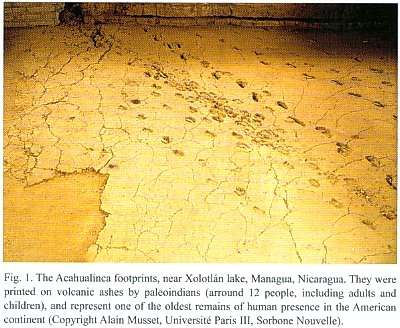
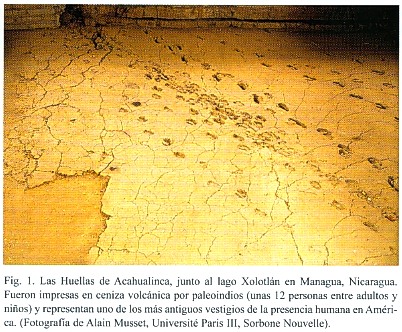
Si bien los amerindios habían descubierto y poblado el continente americano entre 10000 y 30000 años antes que los europeos (Fig. 1),y si bien la invasión y conquista española del territorio del Valle Central de Costa Rica esperaría medio siglo (1561-1563),sin duda, podemos tomar aquella fecha de 1502 como referente del inicio de la población multiétnica actual,no por lo que sucedió,si no por lo que ahí se vislumbró que ocurriría a largo plazo.
La flota castellana, forzada por las circunstancias, permaneció en frente de aquellas tierras -hoy costarricenses-,mientras reparaban sus buques y se restablecían sus enfermos:el tiempo suficiente para que se estableciera un primer contacto entre los marineros y la población local. Del encuentro nos ha quedado evidencia documental del mutuo descubrimiento (Colón 1503, Colón 1571);contacto temeroso y bastante pacífico, etnográfico,naturalista y exploratorio.Pero ningún hecho resultó más premonitorio del futuro,que el envío de dos jóvenes mujeres por el líder indígena al español. Descrito en las palabras de Hernando Colón:
"...enviaron a las naves un indio viejo de venerable presencia, con una bandera puesta en un palo y con dos muchachas, una de ocho años y otra de catorce ...Y a instancias del viejo que las llevaba, aceptamos que quedasen con nosotros. En lo cual no solo mostraban más ingenio del que se había visto en otros, sino que en las muchachas se observó una gran fortaleza, porque siendo los cristianos de tan extraña vista, trata y generación, no dieron muestra alguna de dolor ni de tristeza, manteniéndose siempre con semblante alegre y honesto, por lo que fueron muy bien tratadas por el Almirante, que hizo que se les diese de vestir y de comer; y luego mandó que fuesen devueltas a tierra,..."
Poco importa que el Almirante Colón malinterpretara o rechazara la oferta de alianza, el honor o símbolo de amistad, y tras hospedar a las jóvenes un día las haya enviado de regreso. Los motivos indígenas del envío de esposas a los caciques fueron explicados posteriormente -en 1529-al cronista Gonzalo Fernández de Oviedo en el Golfo de Nicoya o de los Güetares (ver Meléndez 1974),y es una costumbre que se mantiene en la actualidad.Lo trascendental es que está aquí sembrada la semilla de lo que sería la relación entre indígenas y europeos,de su más duradero producto,del crisol que daría origen a la población actual costarricense.
Dentro de un marco histórico extenso, este resulta ser otro ejemplo del patrón de migración "específico del sexo ",con diferentes tasas de flujo génico entre hombres y mujeres (Pérez-Lezaun et al.1999).Se trata de un poderoso mecanismo en la evolución humana, el cual tiende a homogeneizar las diferencias genéticas acumuladas entre grupos vecinos.
Estamos descubriendo recientemente, que la contribución de las mujeres amerindias dejó una profunda e indeleble huella en la población costarricense, mucho más importante que lo que antes se había pensado. Un primer esfuerzo por rescatar para la historia –al menos-los nombres de aquellas mujeres que fundaron la población actual de Costa Rica es presentado aquí por Meléndez Obando (2004). Futuros estudios podrán tal vez profundizar en sus orígenes étnicos.En tanto,semejantes procesos ocurrirían -tarde o temprano-también en otros lugares de la América Latina,como Brasil (Alves-Silva et al.2000,ver Salzano 2004),Colombia (Carvajal-Carmona et al. 2000),México (Green et al.2000)y Uruguay (Bonilla et al.2004).
]]> Además de conmemorar como cada año este acontecimiento que llevó a cambios profundos, esta vez hemos leido algunos de los registros históricos poblacionales que nos han transmitido nuestros antecesores,a través de la molécula del ADN,solo para comprender que esta historia requiere ser reevaluada y reescrita.Asistimos, asimismo,a la celebración de uno de los eventos más significativos en la historia de la ciencia occidental.El 25 de abril de 1953,James Watson y Francis Crick publicaron el modelo de la estructura del acido desoxiribonucleico (ADN).Probablemente el trabajo más importante de la biología desde El Origen de la Especies de Charles Darwin. Dicho trabajo,y sus dos artículos acompañanles valieron el premio Nobel compartido a Watson,Crick y a Maurice Wilkins en 1962. Pero al igual que comentamos en la historia anterior,el papel femenino en dicho modelo -esta vez en la persona de Rosalind Franklin- fue menospreciado hasta muy recientemente.
Sin duda la esencia y fascinación por la molécula del ADN,la han convertido en un ícono moderno,que ha permeado nuestro "imaginario colectivo "y ha provocado una profunda impresión en la visión de la sociedad respecto de la historia,la medicina y al arte de nuestro tiempo (Dennis y Cambell 2003).Pero más que eso,el modelo de la doble hélice es un monumento al poder ilimitado de la imaginación humana,manifiesto del esfuerzo por comprender la naturaleza.
Con la doble hélice se proporcionó las bases para la comprensión del mecanismo de duplicación y herencia del material genético, de su daño y reparación,y de la diversidad y evolución de las especies.La ciencia del ADN hizo posible la clonación de genes individuales, la secuenciación de genomas completos,y el desarrollo de la bioinformática,y generó las herramientas que llevaron a la revolución biotecnológica,al diagnóstico molecular,a la identificación genético-forense,y al desarrollo de organismos transgénicos.Además,influenció nuestra visión -aún en desarrollo-de las interacciones entre la genética y los factores ambientales en la enfermedad humana,y se prevé que transformará la medicina clínica y traerá cambios en la práctica del cuidado de la salud.
La mayoría de nosotros ha nacido y crecido con la doble hélice,y a pesar de esto, apenas se está empezando a considerar cuán rápido la biología del ADN ha progresado en lo largo de solo una vida humana.La influencia de tal descubrimiento y sus desarrollos ulteriores en nuestro medio fue analizada por Albertazi (2004)y se ve reflejada en varios de los artículos de este número,mostrándonos cuán lejos ha viajado la doble hélice,aún en un pequeño país del "tercer mundo ".Sin embargo,a pesar del amplio impacto que ha provocado en nuestras vidas,solo podemos intuir las revoluciones que todavía estan por venir.
En tercera instancia,celebramos el 50 aniversario de publicación ininterrumpida de la Revista de Biología Tropical desde julio de 1953.Un hecho trascendente para la comunidad científica costarricense que consolidaba así su madurez,como ha sido ampliamente analizado (Aguilar 2002,Cortés y Nielsen 2002,Gutiérrez 2002,Hanson 2002,León 2002,Lomonte y Ainsworth 2002),y además relevante para la biología latinoamericana por cuanto la Revista ha acogido trabajos de investigadores de todo el mundo,pero mayoritariamente de esta región (Monge-Nájera y Díaz 1988,Monge-Nájera et al.2004),y ha logrado posicionarse como una revista líder en el área tropical y un importante portal internacional, dentro de la llamada "corriente principal " de la ciencia.
Desde sus inicios (Vol 1.No 1.),distintos aspectos de la genética humana,fundamental pero no exclusivamente referidos a la población de Costa Rica,han encontrado albergue en sus páginas.Así,se han publicado aquí 36 artículos científicos de temas relacionados con hematología,genética de enfermedades humanas,interacciones genética-ambiente y genética poblacional latinoamericana (Apéndice 1).
Motivados por tan singular cadena de acontecimientos,decidimos publicar este número especial de la Revista -que hoy ve la luz-sobre la genética de las poblaciones humanas de Costa Rica y América Latina,que reflejara tanto sus aspectos evolutivos y de salud humana, como de genética de enfermedades simples y complejas,mapeo génico,interacción genética y ambiente,y genética de poblaciones.Ello calza con un momento histórico en el cual la población del Valle Central se ha convertido en uno de los modelos más relevantes para la búsqueda de genes asociados a enfermedades multifactoriales.
A esta iniciativa se sumaron además los investigadores que trabajan con la nueva biotecnología, en los campos relacionados directamente con el ADN.
Tenemos ahora el honor de presentar el producto del esfuerzo conjunto de la comunidad científica costarricense y de algunos de sus más notables colaboradores.Por demás, como puede observarse aquí,la proporción de género entre los autores en la ciencia de la genética costarricense está bastante equuilibrada.Esperamos que este número sea motivo inspirador de interacciones coordinadas,que posibiliten futuros desarrollos teóricos y tecnológicos,y que permitan la apertura del sistema de salud nacional a los avances de la genética y genómica. Esperamos que esto posibilite la transmisión de tales conocimientos en aplicaciones prácticas de medicina del siglo XXI, preventiva,predictiva,individualizada y apegada a los principios éticos fundamentales.A la vez esperamos que este número sea motivo de estímulo para las nuevas generaciones:a ellas corresponderá avanzar esta obra colectiva.
]]> REFERENCIASAguilar,T.2002.50 years of the Revista de Biología Tropical:its contribution to the development of the Geo-Paleontology.Rev.Biol.Trop.50:473-476.
Albertazzi,F.J.2004.Scientific publications about DNA structure-function and PCR technique in Costa Rica:A historic view 1953-2003.Rev.Biol.Trop.52:13-17.
Alves-Silva,J.,M.da Silva Santos,P.E.Guimaraes,A.C. Ferreira,H.J.Bandelt,S.D.Pena &V.F.Prado.2000. The ancestry of Brazilian mtDNA lineages.Am J Hum Genet.67:444-461.
Bonilla,C.,B.Bertoni,S.Gonzalez,H.Cardoso,N. Brum-Zorrilla &M.Sans.2004.Substantial Native American female contribution to the population of Tacuarembo,Uruguay,reveals past episodes of sex- biased gene flow.Am.J.Hum.Biol.16:289-297.
Carvajal-Carmona,L.G.,I.D.Soto,N.Pineda,D. Ortiz-Barrientos,C.Duque,J.Ospina-Duque,M. McCarthy,P.Montoya,V.M.Alvarez,G.Bedoya & A.Ruiz-Linares.2000.Strong Amerind/white sex bias and a possible Sephardic contribution among the founders of a population in northwest Colombia. Am.J.Hum.Genet.67:1287-1295.
Colón,C.1503."Carta de Jamaica ".(Carta que escribió D.Cristóbal Colón,Virrey y Almirante de la Indias, a los cristianos y muy poderosos Rey y Reina de España,nuestros señores,en que le notifica cuanto le ha acontecido en su viage;y las tierras,provincias, ciudades,ríos y otras cosas maravillosas,y donde hay minas de oro en mucha cantidad,y otras cosas
de gran riqueza y valor).pp.34-37.In AGHCR (Academia de Geografía e Historia de Costa Rica).2002. Colón en Centroamérica.Documentos relativos al IV viaje.EU,Universidad de Costa Rica,San José, Costa Rica.
Colón,H.1571.Vida del Almirante don Cristóbal Colón. pp.15.In AGHCR (Academia de Geografía e Historia de Costa Rica).2002.Colón en Centroamérica. Documentos relativos al IV viaje.EU,Universidad de Costa Rica,San José,Costa Rica.
Cortés,J.&V.Nielsen.2002.Marine science in Revista de Biologia Tropical in its 50th anniversary.Rev. Biol.Trop.50:903-907.
]]> Dennis,C.&P.Cambell.2003.The eternal molecule. Nature 421(6921):396.Green,L.,J.N.Deer &A.Knight.2000.mtDNA affinities of the peoples of North-Central Mexico.Am.J. Hum.Genet.66:989-998.
Gutiérrez,J.M.2002.Biomedical research in Revista de Biologia Tropical.Rev.Biol.Trop.50:941-949.
Hanson,P.2002.Fifty years of entomological publications in the Revista de Biologia Tropical.Rev.Biol.Trop. 50:909-926.
León,J.2002.Half century of botany publishing in Revista de Biologia Tropical.Rev.Biol.Trop.50: 879-892.
Lomonte,B.&S.Ainsworth.2002.publicaciones científicas de Costa Rica en el Science Citation Index: análisis bibliométrico del trienio 1999-2001.Biol. Trop.50:951-962.
Meléndez,C.1974.Viajeros por Guanacaste.(Recopilación,Introducción y Notas).Ministerio de Cultura Juventud y Deportes.San José,Costa Rica.pp 21-40.
Meléndez Obando,M.O.2004.Importancia de la genealogía aplicada a estudios genéticos en Costa Rica.Rev. Biol.Trop.52:19-46.
Monge-Najera,J.&L.Diaz.1988.Thirty-five years of Tropical biology:a quantitative history.Rev Biol Trop.36:347-359.
Monge-Nájera,J.,C.Benavides-Varela &B.Morera. 2004.¿Cuáles son las revistas,libros y personas más influyentes en la biología latinoamericana?Rev. Biol.Trop.51:1-17.
]]> Perez-Lezaun,A.,F.Calafell,D.Comas,E.Mateu,E.Bosch, R.Martinez-Arias,J.Clarimon,G.Fiori,D.Luiselli,F. Facchini,D.Pettener &J.Bertranpetit.1999.Sex-specific migration patterns in Central Asian populations, revealed by analysis of Y-chromosome short tandem repeats and mtDNA.Am J Hum Genet.65:208-219.Salzano,F.M.2004.Interethnic variability and admixture in Latin America -social implications.Rev.Biol. Trop.52:1-11.
Watson,J.D.&F.H.C.1953.Crick.Molecular structure of Nucleic Acids.Nature 171:737-738.
500 years ago,50 years ago...Time of discoveries and foundations
Bernal Morera
Editor
"…we dropped anchor in an islet called Quiribí,
and in a village on firm land called Cariay ,in which we found
]]> the best people,country and place so far …"Just recently were we witnesses of a rather unusual historical conjunction.In the annual period understood between mid 2002 and mid 2003,the Costa Rican academic community commemorated three significant events,which undoubtedly represented points of historical inflexion:the 500 th anniversary of the contact between indigenous people and Spaniards in Costa Rican lands,the 50 th anniversary since the publication of the model of the double helix of DNA and the 50 th anniversary of existence of the Tropical Biology Magazine . These motives allow us to re-live,reconstruct and reinterpret those moments of broad consequences for our present.
September 25 th ,1502,the arrival of Christopher Columbus ’s fleet at Cariay is registered,in the Caribbean region of the "rich coast ",in his fourth and last trip of exploration through Central America.As would remember, some years later,his son Hernando Columbus (1571),who was present in the above mentioned expedition:"…we dropped anchor in an islet called Quiribí,in a village on firm land called Cariay,in which we found the best people, country and place so far …"
Though the American indigenous peoples had discovered and populated the American continent between 10 000 and 30 000 years before Europeans (Fig.1),and though the invasion and Spanish conquest of the territory of the Central Valley of Costa Rica would wait half a century (1561-1563),undoubtedly,we can take that date of 1502 as a starting point of the multiethnic current population,not for what happened,but by what was foreseen at this point that would happen in the long term.
The Castilian fleet,forced by the circumstances,remained in front of those lands –today Costa Rican-,while they repaired their ships and their patients recovered:just enough time in order to establish the first contact between the sailors and the local population.Of this meeting we have documented evidence of the mutual discovery (Colon 1503,Colon 1571);encounter which was fearful and pacific enough,ethnographic,naturalistic and of exploratory contact. But no fact turned out to be more indicative of the future,than the sending of two young women by the indigenous leader to the Spanish. Described in Hernando Columbus ’ words:
"they sent to the ships an old man of venerable presence,with a flag put in a stick and with two girls,one of eight years and other one of fourteen...And to instances of the old man who was taking them,we accepted that they stayed with us.In which not only they were showing more genius than we had seen in others,but in the girls a great strength was observed,because being Christians of such a strange sight, treatment and generation,they did not give any sample of pain nor sadness, remaining always with happy and honest face,for which they were very well treated by the Admiral,who saw that they were given dress and food;and he then ordered that they should return to land ".
Little matters that Admiral Columbus misinterpreted or rejected the offer of alliance,the honor or symbol of friendship;and after lodging the young women for one day he sent them back.The indigenous motives for sending the wives ’ to the chiefs were explained later -in 1529-to the chronicler Gonzalo Fernández de Oviedo in the Gulf of Nicoya or of the Güetares (see Meléndez 1974),and it is a custom that is kept at present.The transcendental thing is that the seed is sowed here of what would be the relation between indigenous and Europeans,of their more lasting product,of the cresol that would give origin to the current Costa Rican population.
]]> Within an extensive historical frame,this turns out to be another example of the "gender specific "migration pattern,with different rates of gene flow between men and women (Perez- Lezaun et al.1999).It is about a powerful mechanism in human evolution,which tends to homogenize the genetic differences accumulated between neighboring groups.We are discovering recently,that the contribution of the Amerindian women left a deep and indelible fingerprint in the Costa Rican population,much more importantly than what before had been thought.The first effort for rescuing from history -at least-the names of those women who founded the current population of Costa Rica is presented here by Meléndez Obando (2004). Future studies will perhaps be able to penetrate into their ethnic origins.Meanwhile,similar processes would take place -sooner or later-also in other places of Latin America,such as Brazil (Alves-forest et al .2000,to see Salzano 2004),Colombia (Carvajal-Carmona et al.2000),Mexico (Green et al .2000)and Uruguay (Bonilla et al .2004).
Besides commemorating,as each year, this event which led to deep changes;this time we have read some of the historical population records that our predecessors have transmitted us,across the DNA molecule,only to understand that this history needs to be re-evaluated and rewritten.We assisted,likewise,to the celebration of one of the most significant events in the history of Western Science.On April 25 th ,1953,James Watson and Francis Crick published the model of the structure of the deoxyribonucleic acid (DNA).Probably the most important work in biology since The Origin of Species by Charles Darwin.The above mentioned work and its two additional articles were worth for them the shared Nobel Prize to Watson,Crick and Maurice Wilkins in 1962.But as we comment in the previous story,the feminine role in the fore-mentioned model -this time in the person of Rosalind Franklin-was despised until very recently.
Undoubtedly,the essence and fascination for the DNA molecule have turned it into a modern icon,which has permeated our "collective imagery "and has provoked a deep impression in the vision of society in respect to history, the medicine and the art of our time (Dennis and Cambell 2003).But more than that,the model of the double helix is a monument to the unlimited power of human imagination,manifest of the effort for comprehending nature.
With the double helix the bases were provided for the comprehension of the mechanism of duplication and heredity of the genetic material,of its damage and repair,and of the diversity and evolution of the species.The science of the DNA made possible the cloning of individual genes,the sequencing of complete and the development of the bioin- and generated the tools that led to the biotechnological revolution,the molecular the forensic genetics identification, and the development of transgenic organisms. Besides,it influenced our vision -still develop-on the interactions between genetics and environmental factors in human diseases,and it is foreseen that it will transform clinical medicine and will bring changes in the practices of healthcare.
The majority of us was born and grew with the double helix,and in spite of this it is barely starting to be considered how rapidly the biology of DNA has progressed along just one human life.The influence of such a discovery and its subsequent developments in our surrounding was analyzed by Albertazi (2004) and is reflected in several of the articles on this issue,showing how far the double helix has traveled,even in a small "third world "country. Nevertheless,in spite of the broad impact it has provoked in our lives,we can only feel the revolutions that are yet to come.
Thirdly,we celebrate the 50th anniversary of uninterrupted publication of the Revista Biología Tropical since July,1953. A transcendental fact for the Costa Rican scientific community that consolidated in this way its maturity,as it has been widely analyzed (Aguilar 2002,Polite and Nielsen 2002, Gutiérrez 2002,Hanson 2002,León 2002, Lomonte and Ainsworth 2002),and besides relevant to Latin-American biology since the Revista has received investigators ’ works from all over the world,but for the most part from this region (Monge-Nájera and Díaz 1988, Monge-Nájera et al .2004),and has managed to position itself as a leader publication in the field of the tropics and an important international portal,inside the so called main stream of science.
From the very beginning (Vol.1.No. 1),different aspects of human genetics,fundamental but not exclusively related to the population of Costa Rica,have found shelter in its pages.In this way,36 scientific articles of topics related with hematology,genetics of human diseases,genetic-environment interactions,and Latin-American population genetics have been published here (Appendix 1).
Motivated by such a singular chain of events,we decided to publish this special issue of the magazine -that today sees the light-on the genetics of human populations of Costa Rica and Latin America,which would reflect its evolutionary and human health aspects, as well as those related to genetics of simple and complex diseases,gene mapping,genetic interaction and environment,and genetics of populations.This coincides with a historical moment in which the population of the Costa Rican Central Valley has turned into one of the most relevant models for the search of genes associated with multifactor diseases.In this initiative have also taken part the investigators who work with the new biotechnologies,in thefields related directly to the DNA.
We have now the honor of presenting the product of the joint effort of the Costa Rican scientific community and some of its more notable collaborators.On the other hand,as can be observed here,the gender proportion between authors in the science of genetics in Costa Rica is balanced enough.We hope that this issue is an inspiring motive of coordinated interactions, which makes future theoretical and technological developments possible,that will allow the opening of the system of national health care system the advances of the genetics and genomics.We hope that this makes possible the transmission of such knowledge in practical applications of medicine of the XXIst century,preventive,predictive,individualized and close to the ethical fundamental values.Simultaneously we hope that this number is a motive of stimulus for the new generations:it will suit them to advance in this collective work.
]]> REFERENCESAguilar,T.2002.50 years of the Revista de Biología Tropical:its contribution to the development of the Geo-Paleontology.Rev. Biol.Trop.50:473-476.
Albertazzi,F.J.2004.Scientific publications about DNA structure-function and PCR technique in Costa Rica:A historic view 1953-2003.Rev.Biol.Trop.52:13-17.
Alves-Silva,J.,M.da Silva Santos,P.E.Guimaraes,A.C. Ferreira,H.J.Bandelt,S.D.Pena &V.F.Prado.2000. The ancestry of Brazilian mtDNA lineages.Am J Hum Genet.67:444-461.
Bonilla,C.,B.Bertoni,S.Gonzalez,H.Cardoso,N. Brum-Zorrilla &M.Sans.2004.Substantial Native American female contribution to the population of Tacuarembo,Uruguay,reveals past episodes of sex- biased gene flow.Am.J.Hum.Biol.16:289-297.
Carvajal-Carmona,L.G.,I.D.Soto,N.Pineda,D. Ortiz-Barrientos,C.Duque,J.Ospina-Duque,M. McCarthy,P.Montoya,V.M.Alvarez,G.Bedoya & A.Ruiz-Linares.2000.Strong Amerind/white sex bias and a possible Sephardic contribution among the founders of a population in northwest Colombia. Am.J.Hum.Genet.67:1287-1295.
Colón,C.1503."Carta de Jamaica ".(Carta que escribió D.Cristóbal Colón,Virrey y Almirante de la Indias, a los cristianos y muy poderosos Rey y Reina de España,nuestros señores,en que le notifica cuanto le ha acontecido en su viage;y las tierras,provincias, ciudades,ríos y otras cosas maravillosas,y donde hay minas de oro en mucha cantidad,y otras cosas de gran riqueza y valor).pp.34-37.In AGHCR (Academia de Geografía e Historia de Costa Rica).2002. Colón en Centroamérica. Documentos relativos al IV viaje.EU,Universidad de Costa Rica,San José, Costa Rica.
Colón,H.1571.Vida del Almirante don Cristóbal Colón. pp.15.In AGHCR (Academia de Geografía e Historia de Costa Rica).2002.Colón en Centroamérica. Documentos relativos al IV viaje.EU,Universidad de Costa Rica,San José,Costa Rica.
Cortés,J.&V.Nielsen.2002.Marine science in Revista de Biologia Tropical in its 50th anniversary.Rev. Biol.Trop.50:903-907.
Dennis,C.&P.Cambell.2003.The eternal molecule. Nature 421(6921):396.
]]> Green,L.,J.N.Deer &A.Knight.2000.mtDNA affinities of the peoples of North-Central Mexico.Am.J. Hum.Genet.66:989-998.Gutiérrez,J.M.2002.Biomedical research in Revista de Biologia Tropical.Rev.Biol.Trop.50:941-949.
Hanson,P.2002.Fifty years of entomological publications in the Revista de Biologia Tropical.Rev.Biol.Trop. 50:909-926.
León,J.2002.Half century of botany publishing in Revista de Biologia Tropical.Rev.Biol.Trop.50: 879-892.
Lomonte,B.&S.Ainsworth.2002.publicaciones científicas de Costa Rica en el Science Citation Index: análisis bibliométrico del trienio 1999-2001.Biol. Trop.50:951-962.
Meléndez,C.1974.Viajeros por Guanacaste.(Recopilación,Introducción y Notas).Ministerio de Cultura Juventud y Deportes.San José,Costa Rica.pp 21-40.
Meléndez Obando,M.O.2004.Importancia de la genealogía aplicada a estudios genéticos en Costa Rica.Rev. Biol.Trop.52:19-46.
Monge-Najera,J.&L.Diaz.1988.Thirty-five years of Tropical biology:a quantitative history.Rev Biol Trop.36:347-359.
Monge-Nájera,J.,C.Benavides-Varela &B.Morera. 2004.¿Cuáles son las revistas,libros y personas más influyentes en la biología latinoamericana?Rev. Biol.Trop.51:1-17.
Perez-Lezaun,A.,F.Calafell,D.Comas,E.Mateu,E.Bosch, R.Martinez-Arias,J.Clarimon,G.Fiori,D.Luiselli,F. Facchini,D.Pettener &J.Bertranpetit.1999.Sex-specific migration patterns in Central Asian populations, revealed by analysis of Y-chromosome short tandem repeats and mtDNA.Am J Hum Genet.65:208-219.
]]> Salzano,F.M.2004.Interethnic variability and admixture in Latin America -social implications.Rev.Biol. Trop.52:1-11.Watson,J.D.&F.H.C.1953.Crick.Molecular structure of Nucleic Acids.Nature 171:737-738.
Artículos de genética humana y ciencias afines publicados en la Revista de Biología Tropical
(1953-2003).
Human Genetics papers published at the International Journal of Tropical Biology and Conservation (1953-2003).
HEMOGENÉTICA /HEMOGENETICS
Grupos Sanguíneos /Blood groups
Loría &Fonseca 1956.Rev.Biol.Trop.4(1):9-26.
Fuentes 1961.Rev.Biol.Trop.9(1):131-140.
Barrantes et al.1985.Rev.Biol.Trop.33(1):13-16.
Morera et al.2001b.Rev.Biol.Trop.49(3-4):1237-1252.
Hemoglobinopatías /Hemoglobinopathies
Saenz et al.1971.Rev.Biol.Trop.19(1-2):251-256.
Sáenz 1976.Rev.Biol.Trop.24(1):57-68.
Elizondo et al.1979.Rev.Biol.Trop.27(1):51-56.
Sáenz 1988.Rev.Biol.Trop.36(2B):361-372.
]]> Sáenz et al 1993.Rev.Biol.Trop.41(3A):393-403.GENÉTICA DE POBLACIONES /POPULATION GENETICS
Consanguinidad /Consanguinity
Barrantes 1978.Rev.Biol.Trop.26(2):347-358.
Amerindios /Amerinds
Fuentes 1961,
Barrantes &Azofeifa 1981.Rev.Biol.Trop.29(1):123-132.
Quesada &Barrantes 1983.Rev.Biol.Trop.31(2):269-276.
Barrantes et al.1985.Rev.Biol.Trop.33(1):13-16.
Barrantes 1988.Rev.Biol.Trop.36(2A):227-234.
]]> Barrantes 1990.Rev.Biol.Trop.38(2A):277-282.Quesada &Barrantes 1991.Rev.Biol.Trop.39(1):63-70.
Azofeifa &Barrantes 1991.Rev.Biol.Trop.39(2):249-254.
Layrisse et al.1992.Rev.Biol.Trop.40(3):349.
Barrantes 1992.Rev.Biol.Trop.40(3):350.
Barrantes 1993.Rev.Biol.Trop.41(3A):379-384.
Azofeifa et al.1998.Rev.Biol.Trop.46(1):157-165.
Lomonte et al.1987.Rev.Biol.Trop.35(1):339-340.
Dermatoglifos /Dermatoglyphics
Quesada &Barrantes 1983.Rev.Biol.Trop.31(2):269-276.
]]> Quesada &Barrantes 1991.Rev.Biol.Trop.39(1):63-70.Forense /Forensics
Morera et al.2001a.Rev.Biol.Trop.49(3-4):1253-1260.
Morera et al.2001b.Rev.Biol.Trop.49(3-4):1237-1252.
GENÉTICA HUMANA /HUMAN GENETICS
Genética y Enfermedad /Genetics and Disease
Santisteban &Baudrit 1988.Rev.Biol.Trop.36(2B):559-562.
De Cespedes et al.1983.Rev.Biol.Trop.31(1):1-10.
Solís 2000.Rev.Biol.Trop.48(1):703-706.
Citogenética /Cytogenetics
Castro V.et al.1993.Rev.Biol.Trop.41(3A):385-392.
Castro V.1995.Rev.Biol.Trop.43(1-3):31-37.
Solís et al.2000.Rev.Biol.Trop.48(1):707-718.
Solís 2001.Rev.Biol.Trop.49(3-4):1223-1226.
Castro-Volio et al.2001.Rev.Biol.Trop.49(3-4):1227-1236.
Castro-Volio &Valle-Bourrette.2002.Rev.Biol.Trop.50(1):347-353.
EPIDEMIOLOGÍA GENÉTICA /GENETIC EPIDEMIOLOGY
Cáncer /Cancer
Sierra &Barrantes 1983.Rev.Biol.Trop.31(1):11-18.
Ramírez &Cuenca 2001.Rev.Biol.Trop.49(1):1-8.
Ramírez &Cuenca 2002.Rev.Biol.Trop.50(2):507-518.
INMUNOLOGÍA Y ALERGOLOGÍA /IMMUNOLOGY AND ALERGOLOGY
Lomonte et al.1987.Rev.Biol.Trop.35(1):339-340.
Riggioni et al.1994a.Rev.Biol.Trop.Vol.42 (Suppl.1):41-45.
Riggioni et al.1994b.Rev.Biol.Trop.Vol.42 (Suppl.1):47-53.
Riggioni et al.1994c.Rev.Biol.Trop.Vol.42 (Suppl.1):55-58.
Riggioni et al.1994d.Rev.Biol.Trop.Vol.42 (Suppl.1):59-64.
Riggioni et al.1994e.Rev.Biol.Trop.Vol.42 (Suppl.1):65-70.
]]> Riggioni et al.1994f.Rev.Biol.Trop.Vol.42 (Suppl.1):71-76.Riggioni et al.1994g.Rev.Biol.Trop.Vol.42 (Suppl.1):77-83.