<?xml version="1.0" encoding="ISO-8859-1"?><article xmlns:mml="http://www.w3.org/1998/Math/MathML" xmlns:xlink="http://www.w3.org/1999/xlink" xmlns:xsi="http://www.w3.org/2001/XMLSchema-instance">
<front>
<journal-meta>
<journal-id>0034-7744</journal-id>
<journal-title><![CDATA[Revista de Biología Tropical]]></journal-title>
<abbrev-journal-title><![CDATA[Rev. biol. trop]]></abbrev-journal-title>
<issn>0034-7744</issn>
<publisher>
<publisher-name><![CDATA[Universidad de Costa Rica]]></publisher-name>
</publisher>
</journal-meta>
<article-meta>
<article-id>S0034-77442004000200006</article-id>
<title-group>
<article-title xml:lang="en"><![CDATA[Gastrointestinal helminth parasitism in fruit-eating bats (Chiroptera, Stenodermatinae) from western Amazonian Brazil]]></article-title>
</title-group>
<contrib-group>
<contrib contrib-type="author">
<name>
<surname><![CDATA[R. Nogueira]]></surname>
<given-names><![CDATA[Marcelo]]></given-names>
</name>
<xref ref-type="aff" rid="A01"/>
</contrib>
<contrib contrib-type="author">
<name>
<surname><![CDATA[P. de Fabio]]></surname>
<given-names><![CDATA[Sueli]]></given-names>
</name>
<xref ref-type="aff" rid="A02"/>
</contrib>
<contrib contrib-type="author">
<name>
<surname><![CDATA[L. Peracchi]]></surname>
<given-names><![CDATA[Adriano]]></given-names>
</name>
<xref ref-type="aff" rid="A02"/>
</contrib>
</contrib-group>
<aff id="A01">
<institution><![CDATA[,Universidade Federal Rural do Rio de Janeiro  ]]></institution>
<addr-line><![CDATA[ ]]></addr-line>
<country>Brazil</country>
</aff>
<aff id="A02">
<institution><![CDATA[,Universidade Federal Rural do Rio de Janeiro  ]]></institution>
<addr-line><![CDATA[ ]]></addr-line>
<country>Brazil</country>
</aff>
<pub-date pub-type="pub">
<day>00</day>
<month>06</month>
<year>2004</year>
</pub-date>
<pub-date pub-type="epub">
<day>00</day>
<month>06</month>
<year>2004</year>
</pub-date>
<volume>52</volume>
<numero>2</numero>
<fpage>387</fpage>
<lpage>392</lpage>
<copyright-statement/>
<copyright-year/>
<self-uri xlink:href="http://www.scielo.sa.cr/scielo.php?script=sci_arttext&amp;pid=S0034-77442004000200006&amp;lng=en&amp;nrm=iso"></self-uri><self-uri xlink:href="http://www.scielo.sa.cr/scielo.php?script=sci_abstract&amp;pid=S0034-77442004000200006&amp;lng=en&amp;nrm=iso"></self-uri><self-uri xlink:href="http://www.scielo.sa.cr/scielo.php?script=sci_pdf&amp;pid=S0034-77442004000200006&amp;lng=en&amp;nrm=iso"></self-uri><abstract abstract-type="short" xml:lang="en"><p><![CDATA[In this paper we report endoparasites from a sample of 50 stenodermatine bats collected mainly over lick sites at the Parque Nacional da Serra do Divisor, westernmost extremity of Amazonian Brazil. Four helminth species were recovered (Hasstilesia tricolor, Vampirolepis elongatus, Cheiropteronema globocephala, and Capillaria sp.), most of them from small intestines. Overall helminth prevalence achieved 26% (13/50) and the more prevalent species was H. tricolor (20%). Previously unknown in bats and reported for the first time in Brazil, this digenetic trematode was found in seven of the 18 bat species studied here. We argue that the drinking behaviour of stenodermatines at lick sites may be implicated in the dissemination of helminth infection among these bats]]></p></abstract>
<abstract abstract-type="short" xml:lang="es"><p><![CDATA[En este artículo se informa de los endoparásitos en una muestra de 50 murciélagos stenodermatine recolectados principalmente sobre sitios de lamedura en el Parque Nacional da Serra do Divisor, extremo oeste de la Amazonía Brasileña. Cuatro especies de helmintos fueron recuperados (Hasstilesia tricolor, Vampirolepis elongatus, Cheiropteronema globocephala, y Capillaria sp.), principalmente en los intestinos delgados. En general, la prevalencia de helmintos alcanza un 26% (13/50) y la especie más prevalente fue H. tricolor (20%). Este era desconocido previamente en los murciélagos y es informado por primera vez en Brasil. Este tremátodo digenético fue encontrado en siete de las 18 especies de murciélagos estudiadas aquí. Se discute que el comportamiento de bebida de los stenodermatinos en los sitios de lamedura puede estar implicado en la diseminación de las infecciones de helmintos entre estos murciélagos]]></p></abstract>
<kwd-group>
<kwd lng="en"><![CDATA[Phyllostomidae]]></kwd>
<kwd lng="en"><![CDATA[endoparasites]]></kwd>
<kwd lng="en"><![CDATA[digeneans]]></kwd>
<kwd lng="en"><![CDATA[Hasstilesia tricolor]]></kwd>
<kwd lng="en"><![CDATA[Brazil]]></kwd>
</kwd-group>
</article-meta>
</front><body><![CDATA[ <div style="text-align: center;"><span  style="font-family: arial; font-weight: bold;">Gastrointestinal helminth parasitism in fruit-eating </span> <br style="font-family: arial; font-weight: bold;"> <span style="font-family: arial; font-weight: bold;">bats (Chiroptera, Stenodermatinae) </span> <br style="font-family: arial; font-weight: bold;"> <span style="font-family: arial; font-weight: bold;">from western Amazonian Brazil</span>    <br> </div> <font face="Arial" size="2"></font>     <p><font face="Arial" size="2"><a name="a01"></a>Marcelo R. Nogueira <a  href="#a02"><sup>1</sup>*</a>, Sueli P. de Fabio <a href="#a02"><sup>2</sup></a> &amp; Adriano L. Peracchi <a href="#a02"><sup>2</sup></a></font></p>     <p><font face="Arial" size="2"><a name="a02"></a><a href="#a01">1</a> Pós-graduação em Biologia Animal, Departamento de Biologia Animal, IB, Universidade Federal Rural do Rio de Janeiro, CEP 23851-970, Seropédica, RJ, Brazil; <a href="mailto:mrnogueira@rionet.com.br">mrnogueira@rionet.com.br</a></font></p>     <p><font face="Arial" size="2"><a href="#a01">2</a> Departamento de Biologia Animal, IB, Universidade Federal Rural do Rio de Janeiro, CEP 23851-970, Seropédica, RJ, Brazil; <a  href="mailto:alperacchi@webdigital.com.br">alperacchi@webdigital.com.br</a></font></p>     <p><font face="Arial" size="2">* Corresponding author.</font></p>     <p style="text-align: center;"><font face="Arial" size="2">Received 02-V-2002. Corrected 13-III-2003. Accepted 07-V-2003.</font></p> <font face="Arial" size="2"><b>     <p>Abstract</p> </b> </font>     <p><font face="Arial" size="2">In this paper we report endoparasites from a sample of 50 stenodermatine bats collected mainly over lick sites at the Parque Nacional da Serra do Divisor, westernmost extremity of Amazonian Brazil. Four helminth species were recovered <i>(Hasstilesia tricolo</i>r, <i>Vampirolepis elongatu</i>s, <i>Cheiropteronema globocephal</i>a, and <i>Capillaria </i>sp.), most of them from small intestines. Overall helminth prevalence achieved 26% (13/50) and the more prevalent species was <i>H. tricolor </i>(20%). Previously unknown in bats and reported for the first time in Brazil, this digenetic trematode was found in seven of the 18 bat species studied here. We argue that the drinking behaviour of stenodermatines at lick sites may be implicated in the dissemination of helminth infection among these bats.</font></p> <font face="Arial" size="2"><b> </b></font>     <p><font face="Arial" size="2"><b>Key word</b>s: Phyllostomidae, endoparasites, digeneans, <i>Hasstilesia tricolo</i>r, Brazil.</font></p>     ]]></body>
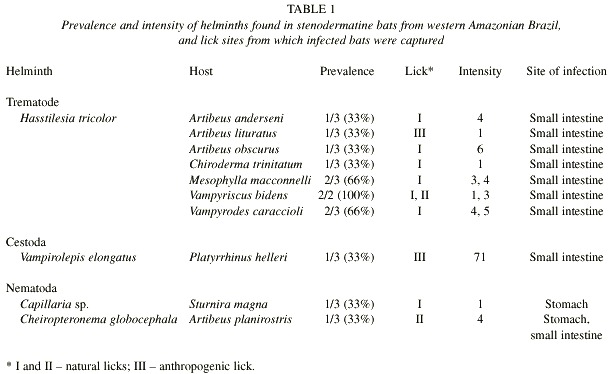
<body><![CDATA[<p><font face="Arial" size="2">    <br> Bats are known to harbor a wide variety of endoparasites, including many protozoans, trematodes, cestodes and nematodes (<a  href="#Zeledon57">Zeledon and Vieto 1957</a>, <a href="#Agrawal67">Agrawal 1967</a>, <a href="#Ubelaker70">Ubelaker 1970</a>, <a href="#Ubelaker77">Ubelaker <i>et a</i>l. 1977</a>, <a href="#Cuartas-Calle99">Cuartas-Calle and Muñoz-Arango 1999</a>). Among these, digeneans (trematodes) constitute the most diversified group (</font><font  face="Arial" size="2"><a href="#Ubelaker70">Ubelaker 1970</a></font><font  face="Arial" size="2">, <a href="#Coggins88">Coggins 1988</a>) and have been found mainly in the bat’s digestive tract, though other body cavities may also be suitable (</font><font  face="Arial" size="2"><a href="#Coggins88">Coggins 1988</a></font><font  face="Arial" size="2">). Their prevalence and incidence seem to be strongly affected by the feeding habits and foraging strategies of the bats (<a href="#Marshall79">Marshall and Miller 1979</a>, </font><font face="Arial" size="2"><a  href="#Coggins88">Coggins 1988</a></font><font face="Arial" size="2">). Most digeneans have been found in insecteating forms that are more prone to ingest an infected insect (serving as intermediate host) than is a fruit or nectar-feeding bat (</font><font  face="Arial" size="2"><a href="#Ubelaker70">Ubelaker 1970</a></font><font  face="Arial" size="2">, </font><font face="Arial" size="2"><a  href="#Coggins88">Coggins 1988</a></font><font face="Arial" size="2">, <a href="#Garcia-Vargas96">García-Vargas <i>et a</i>l. 1996</a>). Few life cycles of bat digeneans, however, have been elucidated until now (</font><font  face="Arial" size="2"><a href="#Coggins88">Coggins 1988</a></font><font  face="Arial" size="2">), and additional knowledge on the feeding ecology of bats may bring important insights on the relationships between these groups (</font><font face="Arial" size="2"><a href="#Ubelaker70">Ubelaker 1970</a></font><font  face="Arial" size="2">).</font></p>     <p><font face="Arial" size="2">The purpose of this paper is to report helminth prevalence and intensity data for a collection of stenodermatine fruit-eating bats obtained during a short- term survey conducted at the Parque Nacional da Serra do Divisor (PNSD), in the Amazonian Brazil (<a href="#Nogueira99">Nogueira <i>et a</i>l. 1999</a>). The great majority of the voucher bats available for this study were collected over licks (<a href="#Nogueira98">Nogueira <i>et a</i>l. 1998</a>), the use of which has been reported to be potentially implicated in the acquisition of parasites (<a  href="#Klaus98">Klaus and Schmid 1998</a>).</font></p> <font face="Arial" size="2"><b>     <p>Materials and methods</p> </b> </font>     <p><font face="Arial" size="2">PNSD is situated in northwestern Acre state, forming the westernmost extremity of Amazonian Brazil, along the Peruvian border. It encompasses approximately 605 000 ha, and comprises several rainforest vegetational physiognomies (<a href="#Anonymous77">Anonymous 1977</a>). Annual rainfall at PNSD averages ca. 2300 mm, with a drier season extending from June to August (</font><a href="#Anonymous77"><font face="Arial"  size="2">Anonymous 1977</font></a><font face="Arial" size="2">). Total precipitation in these less rainy months oscillates between 200 and 250 mm. Mean annual temperature at the lowlands where we conducted the survey (ca. 250 m a.s.l.) is 24 o C (</font><font face="Arial" size="2"><a href="#Anonymous77">Anonymous 1977</a></font><font face="Arial" size="2">).</font></p>     <p><font face="Arial" size="2">Bats were sampled from 8-28 July 1996 in northern PNSD, along the Rio Moa, and 11-29 March 1997 in southern PNSD, along the upper Rio Juruá. From a total of 50 voucher specimens of Stenodermatinae available for the present study, 42 were collected in nets set across lick sites and the remainder came from a trail in primary forest (one bat) and from cultivated clearings adjacent to houses of riverine natives (seven bats). Licks, as referred here (review in </font><font face="Arial" size="2"><a href="#Klaus98">Klaus and Schmid 1998</a></font><font face="Arial" size="2">), are puddle areas with pools of variable size. They were classified as natural, when surrounded by dense vegetation (sites I and II), and anthropogenic, when located close to houses of riverine natives (site III). In this latter case, dense vegetation was no further than 20 m from the nets. The anthropogenic lick (7º24’11’’ S and 73º10’55’’ W) was characterized as a few small pools spread around the house. None of these pools were more than 1 m in diameter. Licks in primary forests were larger puddle areas (ca. 25 m in diameter in site II) with several pools of variable size. Site I (7º27’18’’ S and 73º41’25’’ W) was located at the foot of the Serra da Jaquirana and site II (7º27’39’’ S and 73º46’24’’ W) in the hilly forest associated to Igarapé Ramon. Rainwater, spring water, adjacent water courses and, in the case of the anthropogenic lick, water discarded by natives, were the apparent sources that maintained the water availability in lick sites.</font></p>     <p><font face="Arial" size="2">Procedures to which bats were submitted before removal and examination of the gastrointestinal tract included fixation in 10% formalin and preservation in 70% alcohol. Stomachs and intestines were slit longitudinally and examined separately under a dissecting microscope. Helminths were recovered from stomachs and intestines with the aid of a fine forceps or by using a spatula. Prior to identification, they were counted (cestodes were carefully isolated and counted one by one), stained with alcoholic chlorhydric carmine, and mounted in Canada balsam. Voucher specimens are deposited at the Instituto de Biologia da Universidade Federal Rural do Rio de Janeiro (IB-UFRRJ) under the following collection numbers: SF/UFRRJ 962a-f, 963a-d, 964-71, 972a-e, 973a-d and 974. Except for a non-infected subadult <i>Sturnira magna </i>de la Torre, 1966, all voucher bats were considered adults by completely fused phalangeal epiphyses. This material is also deposited at the IB-UFRRJ. Terminology used in this paper is in accordance with <a href="#Bush97">Bush <i>et a</i>l. (1997)</a>. These authors defined prevalence as "the number of hosts infected with one or more individuals of a particular parasite species (or taxonomic group) divided by the number of hosts examined for that parasite species". Intensity (of infection) was defined as "the number of individuals of a particular parasite species in a single infected host".</font></p> <font face="Arial" size="2"><b>     <p>    <br> Results</p> </b> </font>     <p><font face="Arial" size="2">Overall helminth prevalence for the stenodermatine bats examined here was 26% (13/50). All parasited bats were collected over licks, and considering only our sample at these sites helminth prevalence increases to 31% (13/42). The 13 infected specimens are representative of ten bat species, which comprises more then 50% of the 18 taxons included in the analysis. We found no sex-related difference in the proportions of infected (3M/10F) and non-infected bats (15M/22F) (Fischer’s Exact Test, p&gt; 0.05). Data on the prevalence and intensity of parasitism for each bat species are summarized in <a href="#t1">Table 1</a>.    ]]></body>
<body><![CDATA[<br> </font></p>     <p style="text-align: center;"><font face="Arial" size="2"><a name="t1"></a><img  src="/img/fbpe/rbt/v52n2/2785i1.JPG" title="" alt=""  style="width: 612px; height: 374px;">    
<br> </font></p>     <p><font face="Arial" size="2">The helminth with higher prevalence in our sample was <i>Hasstilesia tricolor </i>(Stile and Hassal, 1894) (Trematoda, Hasstilesiidae) (20%, 10/50). Ten of the 13 infected bats harbored this trematode that was responsible for the parasitism in seven (39%) of the 18 species included in the analysis. There was no significant correlation between host size, as indicated by the forearm length (45.15 mm ± 14.4 SD, 30.1-73.8, n = 10) and intensity of parasitism by <i>H. tricolor </i>(Spearman, p&gt; 0.05). Other three helminths were recovered, but each one from a single host. These were <i>Vampirolepis elongatus </i>Arandas Rego, 1962 (Cestoda, Hymenolepididae), <i>Cheiropteronema globocephala </i>Sandground, 1929 (Nematoda, Trichostrongylidae), and <i>Capillaria </i>sp. (Nematoda, Trichuridae). We were unable to assign this latter nematode to species because the single specimen available was in larval stage and had the posterior extremity of its body accidentally mutilated during the removal process (it was adhered to the gastric mucosa of the host). </font></p>     <p><font face="Arial" size="2">If our samples at lick sites are considered separately, the resultant prevalences are as follows: site I - 42% (8/19), site II - 22% (2/9), and site III-14% (2/14). Comparisons of the frequency distribution of infected and non-infected bats at these sites indicated no significant differences (Fischer’s Exact Test, p&gt; 0.05). <i>H. tricolor </i>was the only parasite recovered from bats in all lick sites, achieving a prevalence of 37% (7/19) in site I. Non infected bat species, with respective number of individuals examined and sites of capture, are as follows: <i>Sturnira lilium </i>(Geoffroy, 1810)-3/III; <i>Sturnira tildae </i>de la Torre, 1959-1/non-lick site; <i>Chiroderma villosum </i>Peters, 1860 -3/III; <i>Platyrrhinus brachycephalus </i>(Rouk and Carter, 1972)-1/III, 2/non-lick sites; <i>Platyrrhinus infuscus </i>(Peters, 1880)-3/I; <i>Uroderma bilobatum </i>Peters, 1866-2/II, 1/non-lick site; <i>Uroderma magnirostrum </i>Davis, 1968-2/non-lick sites; and <i>Vampyressa thyone </i>Thomas 1909 (Wagner, 1843)-1/I, 2/III.</font></p> <font face="Arial" size="2"><b>     <p>Discussion</p> </b> </font>     <p><font face="Arial" size="2">Except for <i>Artibeus planirostris </i>(Spix, 1823), which some authors consider a junior synonym of <i>Artibeus jamaicensis </i>Leach, 1821 (<a href="#Marques-Aguiar94">Marques-Aguiar 1994</a>, <a href="#Simmons98">Simmons and Voss 1998</a>) and, therefore, could be regarded as an already known host of <i>C. globocephala </i>(</font><font face="Arial" size="2"><a  href="#Cuartas-Calle99">Cuartas-Calle and Muñoz-Arango 1999</a></font><font  face="Arial" size="2">), all other host records reported here are new. <i>V. elongatus </i>has also been found in <i>A. jamaicensis </i>(</font><font face="Arial" size="2"><a  href="#Garcia-Vargas96">García-Vargas <i>et a</i>l. 1996</a></font><font  face="Arial" size="2">) but in a much lower intensity (3 versus 71) than we found in <i>Platyrrhinus helleri </i>(Peters, 1866). It is the first time that a Hasstilesiidae trematode is recovered from bats and it is also the first record of this family in Brazil. Previously, <i>H. tricolor </i>was known only from some Leporidae <i>(Lepus </i>spp. and <i>Sylvilagus </i>spp.) and from <i>Vulpes fulva </i>(Linnaeus, 1758), all from North America (<a href="#Rowan55">Rowan 1955</a>, <a href="#Yamaguti71">Yamaguti 1971</a>). Differing from other bat trematodes, <i>H. tricolor </i>has a life cycle that is currently known to include only two hosts (<a href="#Robinson53">Robinson 1953</a>, </font><font  face="Arial" size="2"><a href="#Rowan55">Rowan 1955</a></font><font  face="Arial" size="2">). Adult forms live in the intestine of the definitive host (e.g. rabbit) where eggs are deposited. These eggs are eliminated in the feces and ingested by a suitable land snail (intermediate host) where it passes through larval stages (miracidium, sporocyst, cercariea, and metacercariae). The cycle is completed when a definitive host ingests an infected snail and the metacercariae develops to mature flukes. As fruit-eating bats are unlikely to be frequent consumers of snails and the high prevalence of <i>H. tricolor </i>reported here does not seem to be compatible with accidental infection, we suggest that alternative contamination routes may be occurring in the studied area. <a href="#Robinson53">Robinson (1953)</a> mentioned the possibility that two snails from the same species could act as first and second intermediate hosts of <i>H. tricolo</i>r. Under this situation, a bat drinking at the lick water could ingest a free-swimming cercariea and become infected. </font></p>     <p><font face="Arial" size="2">Acquisition of parasites is a potential cost associated to the use of licks and is related to the high accumulation of feces and urine that may occur at these sites (</font><font  face="Arial" size="2"><a href="#Klaus98">Klaus and Schmid 1998</a></font><font face="Arial" size="2">). Particularly in the Neotropics, however, scarce information is available about lick use (<a href="#Emmons79">Emmons and Stark 1979</a>), and its ecological implications remain unknown. Current evidence suggests that stenodermatines may be frequent visitors at these sites (Tuttle 1974, Ascorra and Wilson 1992, </font><font face="Arial" size="2"><a  href="#Nogueira98">Nogueira <i>et a</i>l. 1998</a></font><font  face="Arial" size="2">), which is particularly relevant if we consider infection by digeneans. As reported by <a href="#Perez-Ponce01">Pérez-Ponce de León (2001)</a>, the general pattern of digenean life cycles suggests that, the more contact the host has with water, the greater the probability of infection by these helminths. The drinking behaviour of stenodermatines at lick sites put them in contact with a resource probably shared with a diversified faunal assemblage. Although we have no evidence about leporids, local hunters from PNSD reported that several free-ranging mammals (e.g. tapirs, peccaries, deer) visit the natural licks studied here, and domestic animals such as pigs and chickens were seem at the anthropogenic site.</font></p>     <p><font face="Arial" size="2">Although it has long been considered that frugivorous bats supplement their diet with protein from insects (<a href="#Gardner77">Gardner 1977</a>, <a href="#Thomas84">Thomas 1984</a>), which could explain infection by helminths with insects as intermediate hosts, it may not be applicable to all species and in all places. The increasing number of studies showing that fruit-eating bats are able to meet all their protein requirements feeding solely on fruits (<a href="#Delorme99">Delorme and Thomas 1999</a>, <a href="#Herrera01a">Herrera <i>et a</i>l. 2001a</a>, <a href="#Herrera01b">2001b)</a> reinforces the importance of investigations on alternative hypothesis for helminth infections in these bats. The possible implication of lick use in the acquisition of parasites like <i>H. tricolor </i>can be further clarified not only by the examination of a larger series of hosts, but also by surveying the potential biological content of lick water.</font></p> <font face="Arial" size="2"><b>     <p>Acknowledgments</p> </b> </font>     ]]></body>
<body><![CDATA[<p><font face="Arial" size="2">We are thankful to A. Pol, C.P.H. Rocha and A.M. da Silva for their assistance with the bat inventory at PNSD, and to J.L. Luque and two anonymous referees for critically reviewing the manuscript. Financial support for field work was provided by the United States Agency for International Development and passed on by The Nature Conservancy, which in partnership with the non-governmental organization S.O.S. Amazônia and Instituto Brasileiro de Meio Ambiente e Recursos Naturais Renováveis (IBAMA), was responsible for the "Projeto para Conservação do Parque Nacional da Serra do Divisor". We are also thankful to Conselho Nacional de Desenvolvimento Científico e Tecnológico (CNPq) for the grants to MRN (146829/991-9) and ALP (300265/80-8).</font></p> <font face="Arial" size="2"><b>     <p>Resumen</p> </b> </font>     <p><font face="Arial" size="2">En este artículo se informa de los endoparásitos en una muestra de 50 murciélagos stenodermatine recolectados principalmente sobre sitios de lamedura en el Parque Nacional da Serra do Divisor, extremo oeste de la Amazonía Brasileña. Cuatro especies de helmintos fueron recuperados <i>(Hasstilesia tricolo</i>r, <i>Vampirolepis elongatu</i>s, <i>Cheiropteronema globocephal</i>a, y <i>Capillaria </i>sp.), principalmente en los intestinos delgados. En general, la prevalencia de helmintos alcanza un 26% (13/50) y la especie más prevalente fue <i>H. tricolor </i>(20%). Este era desconocido previamente en los murciélagos y es informado por primera vez en Brasil. Este tremátodo digenético fue encontrado en siete de las 18 especies de murciélagos estudiadas aquí. Se discute que el comportamiento de bebida de los stenodermatinos en los sitios de lamedura puede estar implicado en la diseminación de las infecciones de helmintos entre estos murciélagos.</font></p> <font face="Arial" size="2"><b>     <p>References</p> </b> </font>     <!-- ref --><p><font face="Arial" size="2"><a name="Agrawal67"></a>Agrawal, Vinod. 1967. Two new trematodes from the intestine of a yellow bat, <i>Nycticeius kuhlii </i>from Lucknow, India. Rev. Biol. Trop. 15: 207-214.</font>&nbsp;&nbsp;&nbsp;&nbsp;&nbsp;&nbsp;&nbsp;&nbsp;[&#160;<a href="javascript:void(0);" onclick="javascript: window.open('/scielo.php?script=sci_nlinks&ref=1238643&pid=S0034-7744200400020000600001&lng=','','width=640,height=500,resizable=yes,scrollbars=1,menubar=yes,');">Links</a>&#160;]<!-- end-ref --><!-- ref --><p><font face="Arial" size="2"><a name="Anonymous77"></a>Anonymous. 1977. Folhas SB/SC. 18 Javari/Contamana-Levantamento de recursos naturais, 13 (geologia, geomorfologia, pedologia, vegetação e uso potencial da terra). Rio de Janeiro, Projeto RADAMBRASIL, DNPM. 413 p.</font>&nbsp;&nbsp;&nbsp;&nbsp;&nbsp;&nbsp;&nbsp;&nbsp;[&#160;<a href="javascript:void(0);" onclick="javascript: window.open('/scielo.php?script=sci_nlinks&ref=1238644&pid=S0034-7744200400020000600002&lng=','','width=640,height=500,resizable=yes,scrollbars=1,menubar=yes,');">Links</a>&#160;]<!-- end-ref --><!-- ref --><p><font face="Arial" size="2"><a name="Ascorra92"></a>Ascorra, C.F. &amp; D.E. Wilson. 1992. Bat frugivory and seed dispersal in the Amazon, Loreto, Peru. Pub. Mus. Hist. Nat. UNMSM (A) 43: 1-6.</font>&nbsp;&nbsp;&nbsp;&nbsp;&nbsp;&nbsp;&nbsp;&nbsp;[&#160;<a href="javascript:void(0);" onclick="javascript: window.open('/scielo.php?script=sci_nlinks&ref=1238645&pid=S0034-7744200400020000600003&lng=','','width=640,height=500,resizable=yes,scrollbars=1,menubar=yes,');">Links</a>&#160;]<!-- end-ref --><!-- ref --><p><font face="Arial" size="2"><a name="Bush97"></a>Bush, A.O., K.D. Lafferty, J.M. Lotz &amp; A.W. Shostak. 1997. Parasitology meets ecology on its own terms: Margolis et al. revisited. J. Parasitol. 83: 575-583.</font>&nbsp;&nbsp;&nbsp;&nbsp;&nbsp;&nbsp;&nbsp;&nbsp;[&#160;<a href="javascript:void(0);" onclick="javascript: window.open('/scielo.php?script=sci_nlinks&ref=1238646&pid=S0034-7744200400020000600004&lng=','','width=640,height=500,resizable=yes,scrollbars=1,menubar=yes,');">Links</a>&#160;]<!-- end-ref --><!-- ref --><p><font face="Arial" size="2"><a name="Coggins88"></a>Coggins, J.R. 1988. Methods for the ecological study of bat endoparasites, pp. 475-489. <i>In </i>T.H. Kunz (ed.). Ecological and behavioral methods for the study of bats. Smithsonian Inst., Washington, D.C.</font>&nbsp;&nbsp;&nbsp;&nbsp;&nbsp;&nbsp;&nbsp;&nbsp;[&#160;<a href="javascript:void(0);" onclick="javascript: window.open('/scielo.php?script=sci_nlinks&ref=1238647&pid=S0034-7744200400020000600005&lng=','','width=640,height=500,resizable=yes,scrollbars=1,menubar=yes,');">Links</a>&#160;]<!-- end-ref --><!-- ref --><p><font face="Arial" size="2"><a name="Cuartas-Calle99"></a>Cuartas-Calle, C. &amp; J. Muñoz-Arango. 1999. Nemátodos en la cavidad abdominal y el tracto digestivo de algunos murciélagos Colombianos. Caldasia 21: 10-25.</font>&nbsp;&nbsp;&nbsp;&nbsp;&nbsp;&nbsp;&nbsp;&nbsp;[&#160;<a href="javascript:void(0);" onclick="javascript: window.open('/scielo.php?script=sci_nlinks&ref=1238648&pid=S0034-7744200400020000600006&lng=','','width=640,height=500,resizable=yes,scrollbars=1,menubar=yes,');">Links</a>&#160;]<!-- end-ref --><!-- ref --><p><font face="Arial" size="2"><a name="Delorme99"></a>Delorme, M. &amp; D.W. Thomas. 1999. Comparative analysis of the digestive efficiency and nitrogen and energy requirements of the phyllostomid fruitbat <i>(Artibeus jamaicensi</i>s) and the pteropodid fruitbat <i>(Rousettus aegyptiacu</i>s). J. Comp. Physiol. B 169: 123-132.</font>&nbsp;&nbsp;&nbsp;&nbsp;&nbsp;&nbsp;&nbsp;&nbsp;[&#160;<a href="javascript:void(0);" onclick="javascript: window.open('/scielo.php?script=sci_nlinks&ref=1238649&pid=S0034-7744200400020000600007&lng=','','width=640,height=500,resizable=yes,scrollbars=1,menubar=yes,');">Links</a>&#160;]<!-- end-ref --><!-- ref --><p><font face="Arial" size="2"><a name="Garcia-Vargas96"></a>García-Vargas, F., D. Osório S. &amp; G. Pérez-Ponce de León. 1996. Helminth parasites of bats (Mormoopidae and Phyllostomidae) from the Estación de Biología Chamela, Jalisco State, México. Bat Res. News 37: 7-8.</font>&nbsp;&nbsp;&nbsp;&nbsp;&nbsp;&nbsp;&nbsp;&nbsp;[&#160;<a href="javascript:void(0);" onclick="javascript: window.open('/scielo.php?script=sci_nlinks&ref=1238650&pid=S0034-7744200400020000600008&lng=','','width=640,height=500,resizable=yes,scrollbars=1,menubar=yes,');">Links</a>&#160;]<!-- end-ref --><!-- ref --><p><font face="Arial" size="2"><a name="Gardner77"></a>Gardner, A.L. 1977. Feeding habits, pp. 293-350. <i>In </i>R.J. Baker, J.K. Jones Jr. &amp; D.C. Carter (eds.). Biology of bats of the New World Family Phyllostomatidae. Part II. Spec. Pub. Mus. Texas Tech Univ., 13.</font>&nbsp;&nbsp;&nbsp;&nbsp;&nbsp;&nbsp;&nbsp;&nbsp;[&#160;<a href="javascript:void(0);" onclick="javascript: window.open('/scielo.php?script=sci_nlinks&ref=1238651&pid=S0034-7744200400020000600009&lng=','','width=640,height=500,resizable=yes,scrollbars=1,menubar=yes,');">Links</a>&#160;]<!-- end-ref --><!-- ref --><p><font face="Arial" size="2"><a name="Emmons79"></a>Emmons, L.H. &amp; N.M. Stark. 1979. Elemental composition of a natural mineral lick in Amazonia. Biotropica 11: 311-313.</font>&nbsp;&nbsp;&nbsp;&nbsp;&nbsp;&nbsp;&nbsp;&nbsp;[&#160;<a href="javascript:void(0);" onclick="javascript: window.open('/scielo.php?script=sci_nlinks&ref=1238652&pid=S0034-7744200400020000600010&lng=','','width=640,height=500,resizable=yes,scrollbars=1,menubar=yes,');">Links</a>&#160;]<!-- end-ref --><!-- ref --><p><font face="Arial" size="2"><a name="Herrera01a"></a>Herrera, L.G., K.A. Hobson, L. Mirón, N. Ramírez, G. Méndez &amp; V. Sánchez- Cordero. 2001a. Sources of protein in two species of phytophagous bats in a seasonal dry forest: evidence from stable-isotope analysis. J. Mamm. 82: 352-361.</font>&nbsp;&nbsp;&nbsp;&nbsp;&nbsp;&nbsp;&nbsp;&nbsp;[&#160;<a href="javascript:void(0);" onclick="javascript: window.open('/scielo.php?script=sci_nlinks&ref=1238653&pid=S0034-7744200400020000600011&lng=','','width=640,height=500,resizable=yes,scrollbars=1,menubar=yes,');">Links</a>&#160;]<!-- end-ref --><!-- ref --><p><font face="Arial" size="2"><a name="Herrera01b"></a>Herrera, L.G., K.A. Hobson, A. Manzo, D. Estrada, V. Sánchez-Cordero &amp; G. Méndez. 2001b. The role of fruits and insects in the nutrition of frugivorous bats: evaluating the use of stable isotope models. Biotropica 33: 520-528.</font>&nbsp;&nbsp;&nbsp;&nbsp;&nbsp;&nbsp;&nbsp;&nbsp;[&#160;<a href="javascript:void(0);" onclick="javascript: window.open('/scielo.php?script=sci_nlinks&ref=1238654&pid=S0034-7744200400020000600012&lng=','','width=640,height=500,resizable=yes,scrollbars=1,menubar=yes,');">Links</a>&#160;]<!-- end-ref --><!-- ref --><p><font face="Arial" size="2"><a name="Klaus98"></a>Klaus, G. &amp; B. Schmid. 1998. Geophagy at natural licks and mammal ecology: a review. Mammalia 62: 481-497.</font>&nbsp;&nbsp;&nbsp;&nbsp;&nbsp;&nbsp;&nbsp;&nbsp;[&#160;<a href="javascript:void(0);" onclick="javascript: window.open('/scielo.php?script=sci_nlinks&ref=1238655&pid=S0034-7744200400020000600013&lng=','','width=640,height=500,resizable=yes,scrollbars=1,menubar=yes,');">Links</a>&#160;]<!-- end-ref --><!-- ref --><p><font face="Arial" size="2"><a name="Marques-Aguiar94"></a>Marques-Aguiar, S.A. 1994. A systematic review of the large species of <i>Artibeus </i>Leach, 1821 (Mammalia: Chiroptera) with some phylogenetic inferences. Bol. Mus. Emílio Goeldi, ser. zool. 10: 3-83.</font>&nbsp;&nbsp;&nbsp;&nbsp;&nbsp;&nbsp;&nbsp;&nbsp;[&#160;<a href="javascript:void(0);" onclick="javascript: window.open('/scielo.php?script=sci_nlinks&ref=1238656&pid=S0034-7744200400020000600014&lng=','','width=640,height=500,resizable=yes,scrollbars=1,menubar=yes,');">Links</a>&#160;]<!-- end-ref --><!-- ref --><p><font face="Arial" size="2"><a name="Marshall79"></a>Marshall, M.E &amp; G.C. Miller. 1979. Some digenetic trematodes from Ecuadorian bats including five new species and one new genus. J. Parasitol. 65: 909-917.</font>&nbsp;&nbsp;&nbsp;&nbsp;&nbsp;&nbsp;&nbsp;&nbsp;[&#160;<a href="javascript:void(0);" onclick="javascript: window.open('/scielo.php?script=sci_nlinks&ref=1238657&pid=S0034-7744200400020000600015&lng=','','width=640,height=500,resizable=yes,scrollbars=1,menubar=yes,');">Links</a>&#160;]<!-- end-ref --><!-- ref --><p><font face="Arial" size="2"><a name="Nogueira98"></a>Nogueira, M.R., A. Pol &amp; A.L. Peracchi. 1998. Use of water holes by Stenodermatinae bats in Western Amazonian Brazil. Bat Res. News 39: 95.</font>&nbsp;&nbsp;&nbsp;&nbsp;&nbsp;&nbsp;&nbsp;&nbsp;[&#160;<a href="javascript:void(0);" onclick="javascript: window.open('/scielo.php?script=sci_nlinks&ref=1238658&pid=S0034-7744200400020000600016&lng=','','width=640,height=500,resizable=yes,scrollbars=1,menubar=yes,');">Links</a>&#160;]<!-- end-ref --><!-- ref --><p><font face="Arial" size="2"><a name="Nogueira99"></a>Nogueira, M.R., A. Pol &amp; A.L. Peracchi. 1999. New records of bats from Brazil with a list of additional species for the chiropteran fauna of the state of Acre, western Amazon basin. Mammalia 63: 363-367.</font>&nbsp;&nbsp;&nbsp;&nbsp;&nbsp;&nbsp;&nbsp;&nbsp;[&#160;<a href="javascript:void(0);" onclick="javascript: window.open('/scielo.php?script=sci_nlinks&ref=1238659&pid=S0034-7744200400020000600017&lng=','','width=640,height=500,resizable=yes,scrollbars=1,menubar=yes,');">Links</a>&#160;]<!-- end-ref --><!-- ref --><p><font face="Arial" size="2"><a name="Perez-Ponce01"></a>Pérez-Ponce de León, G. 2001. The diversity of digeneans (Platyhelminthes: Cercomeria: Trematoda) in vertebrates in Mexico. Comp. Parasitol. 68: 1-8.</font>&nbsp;&nbsp;&nbsp;&nbsp;&nbsp;&nbsp;&nbsp;&nbsp;[&#160;<a href="javascript:void(0);" onclick="javascript: window.open('/scielo.php?script=sci_nlinks&ref=1238660&pid=S0034-7744200400020000600018&lng=','','width=640,height=500,resizable=yes,scrollbars=1,menubar=yes,');">Links</a>&#160;]<!-- end-ref --><!-- ref --><p><font face="Arial" size="2"><a name="Robinson53"></a>Robinson, E.J. 1953. A possible molluscan host of <i>Hasstilesia tricolor </i>(Trematoda: Brachylaemidae). J. Parasitol. 39: 228.</font>&nbsp;&nbsp;&nbsp;&nbsp;&nbsp;&nbsp;&nbsp;&nbsp;[&#160;<a href="javascript:void(0);" onclick="javascript: window.open('/scielo.php?script=sci_nlinks&ref=1238661&pid=S0034-7744200400020000600019&lng=','','width=640,height=500,resizable=yes,scrollbars=1,menubar=yes,');">Links</a>&#160;]<!-- end-ref --><!-- ref --><p><font face="Arial" size="2"><a name="Rowan55"></a>Rowan, W.B. 1955. The life cycle and epizootiology of the rabbit trematode, <i>Hasstilesia tricolor </i>(Stiles and Hassal, 1894) Hall, 1916 (Trematoda: Brachylaemidae). Trans. Amer. Microscop. Soc. 74: 1-21.</font>&nbsp;&nbsp;&nbsp;&nbsp;&nbsp;&nbsp;&nbsp;&nbsp;[&#160;<a href="javascript:void(0);" onclick="javascript: window.open('/scielo.php?script=sci_nlinks&ref=1238662&pid=S0034-7744200400020000600020&lng=','','width=640,height=500,resizable=yes,scrollbars=1,menubar=yes,');">Links</a>&#160;]<!-- end-ref --><!-- ref --><p><font face="Arial" size="2"><a name="Simmons98"></a>Simmons, N.B. &amp; R.S. Voss. 1998. The Mammals of Paracou, French Guiana: a Neotropical lowland rainforest fauna. Part 1. Bats. Bull. Amer. Mus. Nat. Hist. 237: 1-219.</font>&nbsp;&nbsp;&nbsp;&nbsp;&nbsp;&nbsp;&nbsp;&nbsp;[&#160;<a href="javascript:void(0);" onclick="javascript: window.open('/scielo.php?script=sci_nlinks&ref=1238663&pid=S0034-7744200400020000600021&lng=','','width=640,height=500,resizable=yes,scrollbars=1,menubar=yes,');">Links</a>&#160;]<!-- end-ref --><!-- ref --><p><font face="Arial" size="2"><a name="Thomas84"></a>Thomas, D.W. 1984. Fruit intake and energy budgets of frugivorous bats. Physiol. Zool. 57: 457-467.</font>&nbsp;&nbsp;&nbsp;&nbsp;&nbsp;&nbsp;&nbsp;&nbsp;[&#160;<a href="javascript:void(0);" onclick="javascript: window.open('/scielo.php?script=sci_nlinks&ref=1238664&pid=S0034-7744200400020000600022&lng=','','width=640,height=500,resizable=yes,scrollbars=1,menubar=yes,');">Links</a>&#160;]<!-- end-ref --><!-- ref --><p><font face="Arial" size="2"><a name="Tuttle74"></a>Tuttle, M.D. 1974. Unusual drinking behavior of some stenodermine bats. Mammalia 38: 141-144.</font>&nbsp;&nbsp;&nbsp;&nbsp;&nbsp;&nbsp;&nbsp;&nbsp;[&#160;<a href="javascript:void(0);" onclick="javascript: window.open('/scielo.php?script=sci_nlinks&ref=1238665&pid=S0034-7744200400020000600023&lng=','','width=640,height=500,resizable=yes,scrollbars=1,menubar=yes,');">Links</a>&#160;]<!-- end-ref --><!-- ref --><p><font face="Arial" size="2"><a name="Ubelaker70"></a>Ubelaker, J.E. 1970. Some observations on ecto- and endoparasites of Chiroptera, pp. 247-261. <i>In </i>B.H. Slaughter &amp; D.W. Walton (eds.). About bats. Southern Methodist Univ., Dallas, Texas.</font>&nbsp;&nbsp;&nbsp;&nbsp;&nbsp;&nbsp;&nbsp;&nbsp;[&#160;<a href="javascript:void(0);" onclick="javascript: window.open('/scielo.php?script=sci_nlinks&ref=1238666&pid=S0034-7744200400020000600024&lng=','','width=640,height=500,resizable=yes,scrollbars=1,menubar=yes,');">Links</a>&#160;]<!-- end-ref --><!-- ref --><p><font face="Arial" size="2"><a name="Ubelaker77"></a>Ubelaker, J.E., R.D. Specian &amp; D.W. Duszynski. 1977. Endoparasites. pp. 7-56. <i>In </i>R.J. Baker, J.K. Jones Jr. &amp; D.C. Carter (eds.). Biology of bats of the New World Family Phyllostomatidae. Part II. Spec. Pub. Mus. Texas Tech Univ., 13.</font>&nbsp;&nbsp;&nbsp;&nbsp;&nbsp;&nbsp;&nbsp;&nbsp;[&#160;<a href="javascript:void(0);" onclick="javascript: window.open('/scielo.php?script=sci_nlinks&ref=1238667&pid=S0034-7744200400020000600025&lng=','','width=640,height=500,resizable=yes,scrollbars=1,menubar=yes,');">Links</a>&#160;]<!-- end-ref --><!-- ref --><p><font face="Arial" size="2"><a name="Yamaguti71"></a>Yamaguti, S. 1971. Synopsis of digenetic trematodes of vertebrates. Vol. I. Keigaku Publishing. Tokyo. 1074 p.</font>&nbsp;&nbsp;&nbsp;&nbsp;&nbsp;&nbsp;&nbsp;&nbsp;[&#160;<a href="javascript:void(0);" onclick="javascript: window.open('/scielo.php?script=sci_nlinks&ref=1238668&pid=S0034-7744200400020000600026&lng=','','width=640,height=500,resizable=yes,scrollbars=1,menubar=yes,');">Links</a>&#160;]<!-- end-ref --><!-- ref --><p><font face="Arial" size="2"><a name="Zeledon57"></a>Zeledon, R. &amp; P.L. Vieto. 1957. Hallazgo de <i>Schizotrypanum vespertilionis </i>(Battaglia, 1904) en la sangre de murciélagos de Costa Rica. Rev. Biol. Trop. 5: 123-128.</font>&nbsp;&nbsp;&nbsp;&nbsp;&nbsp;&nbsp;&nbsp;&nbsp;[&#160;<a href="javascript:void(0);" onclick="javascript: window.open('/scielo.php?script=sci_nlinks&ref=1238669&pid=S0034-7744200400020000600027&lng=','','width=640,height=500,resizable=yes,scrollbars=1,menubar=yes,');">Links</a>&#160;]<!-- end-ref --> ]]></body><back>
<ref-list>
<ref id="B1">
<nlm-citation citation-type="journal">
<person-group person-group-type="author">
<name>
<surname><![CDATA[Agrawal]]></surname>
<given-names><![CDATA[Vinod]]></given-names>
</name>
</person-group>
<article-title xml:lang="en"><![CDATA[Two new trematodes from the intestine of a yellow bat, Nycticeius kuhlii from Lucknow, India]]></article-title>
<source><![CDATA[Rev. Biol. Trop]]></source>
<year>1967</year>
<volume>15</volume>
<page-range>207-214</page-range></nlm-citation>
</ref>
<ref id="B2">
<nlm-citation citation-type="book">
<person-group person-group-type="author">
<name>
</name>
<name>
</name>
</person-group>
<source><![CDATA[Folhas SB/SC. 18 Javari/Contamana-Levantamento de recursos naturais, 13 (geologia, geomorfologia, pedologia, vegetação e uso potencial da terra)]]></source>
<year>1977</year>
<page-range>413</page-range><publisher-loc><![CDATA[Rio de Janeiro ]]></publisher-loc>
<publisher-name><![CDATA[Projeto RADAMBRASIL, DNPM]]></publisher-name>
</nlm-citation>
</ref>
<ref id="B3">
<nlm-citation citation-type="journal">
<person-group person-group-type="author">
<name>
<surname><![CDATA[Ascorra]]></surname>
<given-names><![CDATA[C.F]]></given-names>
</name>
<name>
<surname><![CDATA[Wilson]]></surname>
<given-names><![CDATA[D.E]]></given-names>
</name>
</person-group>
<article-title xml:lang="en"><![CDATA[Bat frugivory and seed dispersal in the Amazon, Loreto, Peru]]></article-title>
<source><![CDATA[Pub. Mus. Hist. Nat. UNMSM (A)]]></source>
<year>1992</year>
<volume>43</volume>
<page-range>1-6</page-range></nlm-citation>
</ref>
<ref id="B4">
<nlm-citation citation-type="journal">
<person-group person-group-type="author">
<name>
<surname><![CDATA[Bush]]></surname>
<given-names><![CDATA[A.O]]></given-names>
</name>
<name>
<surname><![CDATA[Lafferty]]></surname>
<given-names><![CDATA[K.D]]></given-names>
</name>
<name>
<surname><![CDATA[Lotz]]></surname>
<given-names><![CDATA[J.M]]></given-names>
</name>
<name>
<surname><![CDATA[Shostak]]></surname>
<given-names><![CDATA[A.W]]></given-names>
</name>
</person-group>
<article-title xml:lang="en"><![CDATA[Parasitology meets ecology on its own terms: Margolis et al. revisited]]></article-title>
<source><![CDATA[J. Parasitol]]></source>
<year>1997</year>
<volume>83</volume>
<page-range>575-583</page-range></nlm-citation>
</ref>
<ref id="B5">
<nlm-citation citation-type="book">
<person-group person-group-type="author">
<name>
<surname><![CDATA[Coggins]]></surname>
<given-names><![CDATA[J.R]]></given-names>
</name>
<name>
<surname><![CDATA[Kunz]]></surname>
<given-names><![CDATA[T.H]]></given-names>
</name>
</person-group>
<source><![CDATA[Methods for the ecological study of bat endoparasites]]></source>
<year>1988</year>
<page-range>475-489</page-range><publisher-loc><![CDATA[^eWashington, D.C Washington, D.C]]></publisher-loc>
<publisher-name><![CDATA[Smithsonian Inst]]></publisher-name>
</nlm-citation>
</ref>
<ref id="B6">
<nlm-citation citation-type="journal">
<person-group person-group-type="author">
<name>
<surname><![CDATA[Cuartas-Calle]]></surname>
<given-names><![CDATA[C]]></given-names>
</name>
<name>
<surname><![CDATA[Muñoz-Arango]]></surname>
<given-names><![CDATA[J]]></given-names>
</name>
</person-group>
<article-title xml:lang="es"><![CDATA[Nemátodos en la cavidad abdominal y el tracto digestivo de algunos murciélagos Colombianos]]></article-title>
<source><![CDATA[Caldasia]]></source>
<year>1999</year>
<volume>21</volume>
<page-range>10-25</page-range></nlm-citation>
</ref>
<ref id="B7">
<nlm-citation citation-type="journal">
<person-group person-group-type="author">
<name>
<surname><![CDATA[Delorme]]></surname>
<given-names><![CDATA[M]]></given-names>
</name>
<name>
<surname><![CDATA[Thomas]]></surname>
<given-names><![CDATA[D.W]]></given-names>
</name>
</person-group>
<article-title xml:lang="en"><![CDATA[Comparative analysis of the digestive efficiency and nitrogen and energy requirements of the phyllostomid fruitbat (Artibeus jamaicensis) and the pteropodid fruitbat (Rousettus aegyptiacus)]]></article-title>
<source><![CDATA[J. Comp. Physiol. B]]></source>
<year>1999</year>
<volume>169</volume>
<page-range>123-132</page-range></nlm-citation>
</ref>
<ref id="B8">
<nlm-citation citation-type="journal">
<person-group person-group-type="author">
<name>
<surname><![CDATA[García-Vargas]]></surname>
<given-names><![CDATA[F]]></given-names>
</name>
<name>
<surname><![CDATA[Osório S]]></surname>
<given-names><![CDATA[D]]></given-names>
</name>
<name>
<surname><![CDATA[Pérez-Ponce de León]]></surname>
<given-names><![CDATA[G]]></given-names>
</name>
</person-group>
<article-title xml:lang="en"><![CDATA[Helminth parasites of bats (Mormoopidae and Phyllostomidae) from the Estación de Biología Chamela, Jalisco State, México]]></article-title>
<source><![CDATA[Bat Res. News]]></source>
<year>1996</year>
<volume>37</volume>
<page-range>7-8</page-range></nlm-citation>
</ref>
<ref id="B9">
<nlm-citation citation-type="book">
<person-group person-group-type="author">
<name>
<surname><![CDATA[Gardner]]></surname>
<given-names><![CDATA[A.L]]></given-names>
</name>
<name>
<surname><![CDATA[Baker]]></surname>
<given-names><![CDATA[R.J]]></given-names>
</name>
<name>
<surname><![CDATA[Jones]]></surname>
<given-names><![CDATA[J.K]]></given-names>
</name>
<name>
<surname><![CDATA[Carter]]></surname>
<given-names><![CDATA[D.C]]></given-names>
</name>
</person-group>
<source><![CDATA[Feeding habits]]></source>
<year>1977</year>
<page-range>293-350</page-range><publisher-name><![CDATA[Spec. Pub. Mus. Texas Tech Univ]]></publisher-name>
</nlm-citation>
</ref>
<ref id="B10">
<nlm-citation citation-type="journal">
<person-group person-group-type="author">
<name>
<surname><![CDATA[Emmons]]></surname>
<given-names><![CDATA[L.H]]></given-names>
</name>
<name>
<surname><![CDATA[Stark]]></surname>
<given-names><![CDATA[N.M]]></given-names>
</name>
</person-group>
<article-title xml:lang="es"><![CDATA[Elemental composition of a natural mineral lick in Amazonia]]></article-title>
<source><![CDATA[Biotropica]]></source>
<year>1979</year>
<volume>11</volume>
<page-range>311-313</page-range></nlm-citation>
</ref>
<ref id="B11">
<nlm-citation citation-type="journal">
<person-group person-group-type="author">
<name>
<surname><![CDATA[Herrera]]></surname>
<given-names><![CDATA[L.G]]></given-names>
</name>
<name>
<surname><![CDATA[Hobson]]></surname>
<given-names><![CDATA[K.A]]></given-names>
</name>
<name>
<surname><![CDATA[Mirón]]></surname>
<given-names><![CDATA[L]]></given-names>
</name>
<name>
<surname><![CDATA[Ramírez]]></surname>
<given-names><![CDATA[N]]></given-names>
</name>
<name>
<surname><![CDATA[Méndez]]></surname>
<given-names><![CDATA[G]]></given-names>
</name>
<name>
<surname><![CDATA[Sánchez- Cordero]]></surname>
<given-names><![CDATA[V]]></given-names>
</name>
</person-group>
<article-title xml:lang="en"><![CDATA[Sources of protein in two species of phytophagous bats in a seasonal dry forest: evidence from stable-isotope analysis]]></article-title>
<source><![CDATA[J. Mamm]]></source>
<year>2001</year>
<volume>82</volume>
<page-range>352-361</page-range></nlm-citation>
</ref>
<ref id="B12">
<nlm-citation citation-type="journal">
<person-group person-group-type="author">
<name>
<surname><![CDATA[Herrera]]></surname>
<given-names><![CDATA[L.G]]></given-names>
</name>
<name>
<surname><![CDATA[Hobson]]></surname>
<given-names><![CDATA[K.A]]></given-names>
</name>
<name>
<surname><![CDATA[Manzo]]></surname>
<given-names><![CDATA[A]]></given-names>
</name>
<name>
<surname><![CDATA[Estrada]]></surname>
<given-names><![CDATA[D]]></given-names>
</name>
<name>
<surname><![CDATA[Sánchez-Cordero]]></surname>
<given-names><![CDATA[V]]></given-names>
</name>
<name>
<surname><![CDATA[Méndez]]></surname>
<given-names><![CDATA[G]]></given-names>
</name>
</person-group>
<article-title xml:lang="en"><![CDATA[The role of fruits and insects in the nutrition of frugivorous bats: evaluating the use of stable isotope models]]></article-title>
<source><![CDATA[Biotropica]]></source>
<year>2001</year>
<volume>33</volume>
<page-range>520-528</page-range></nlm-citation>
</ref>
<ref id="B13">
<nlm-citation citation-type="journal">
<person-group person-group-type="author">
<name>
<surname><![CDATA[Klaus]]></surname>
<given-names><![CDATA[G]]></given-names>
</name>
<name>
<surname><![CDATA[Schmid]]></surname>
<given-names><![CDATA[B]]></given-names>
</name>
</person-group>
<article-title xml:lang="en"><![CDATA[Geophagy at natural licks and mammal ecology: a review]]></article-title>
<source><![CDATA[Mammalia]]></source>
<year>1998</year>
<volume>62</volume>
<page-range>481-497</page-range></nlm-citation>
</ref>
<ref id="B14">
<nlm-citation citation-type="journal">
<person-group person-group-type="author">
<name>
<surname><![CDATA[Marques-Aguiar]]></surname>
<given-names><![CDATA[S.A]]></given-names>
</name>
</person-group>
<article-title xml:lang="en"><![CDATA[A systematic review of the large species of Artibeus Leach, 1821 (Mammalia: Chiroptera) with some phylogenetic inferences]]></article-title>
<source><![CDATA[Bol. Mus. Emílio Goeldi, ser. zool]]></source>
<year>1994</year>
<volume>10</volume>
<page-range>3-83</page-range></nlm-citation>
</ref>
<ref id="B15">
<nlm-citation citation-type="journal">
<person-group person-group-type="author">
<name>
<surname><![CDATA[Marshall]]></surname>
<given-names><![CDATA[M.E]]></given-names>
</name>
<name>
<surname><![CDATA[Miller]]></surname>
<given-names><![CDATA[G.C]]></given-names>
</name>
</person-group>
<article-title xml:lang="en"><![CDATA[Some digenetic trematodes from Ecuadorian bats including five new species and one new genus]]></article-title>
<source><![CDATA[J. Parasitol]]></source>
<year>1979</year>
<volume>65</volume>
<page-range>909-917</page-range></nlm-citation>
</ref>
<ref id="B16">
<nlm-citation citation-type="journal">
<person-group person-group-type="author">
<name>
<surname><![CDATA[Nogueira]]></surname>
<given-names><![CDATA[M.R]]></given-names>
</name>
<name>
<surname><![CDATA[Pol]]></surname>
<given-names><![CDATA[A]]></given-names>
</name>
<name>
<surname><![CDATA[Peracchi]]></surname>
<given-names><![CDATA[A.L]]></given-names>
</name>
</person-group>
<article-title xml:lang="en"><![CDATA[Use of water holes by Stenodermatinae bats in Western Amazonian Brazil]]></article-title>
<source><![CDATA[Bat Res. News]]></source>
<year>1998</year>
<volume>39</volume>
<page-range>95</page-range></nlm-citation>
</ref>
<ref id="B17">
<nlm-citation citation-type="journal">
<person-group person-group-type="author">
<name>
<surname><![CDATA[Nogueira]]></surname>
<given-names><![CDATA[M.R]]></given-names>
</name>
<name>
<surname><![CDATA[Pol]]></surname>
<given-names><![CDATA[A]]></given-names>
</name>
<name>
<surname><![CDATA[Peracchi]]></surname>
<given-names><![CDATA[A.L]]></given-names>
</name>
</person-group>
<article-title xml:lang="en"><![CDATA[New records of bats from Brazil with a list of additional species for the chiropteran fauna of the state of Acre, western Amazon basin]]></article-title>
<source><![CDATA[Mammalia]]></source>
<year>1999</year>
<volume>63</volume>
<page-range>363-367</page-range></nlm-citation>
</ref>
<ref id="B18">
<nlm-citation citation-type="journal">
<person-group person-group-type="author">
<name>
<surname><![CDATA[Pérez-Ponce de León]]></surname>
<given-names><![CDATA[G]]></given-names>
</name>
</person-group>
<article-title xml:lang="en"><![CDATA[The diversity of digeneans (Platyhelminthes: Cercomeria: Trematoda) in vertebrates in Mexico]]></article-title>
<source><![CDATA[Comp. Parasitol]]></source>
<year>2001</year>
<volume>68</volume>
<page-range>1-8</page-range></nlm-citation>
</ref>
<ref id="B19">
<nlm-citation citation-type="journal">
<person-group person-group-type="author">
<name>
<surname><![CDATA[Robinson]]></surname>
<given-names><![CDATA[E.J]]></given-names>
</name>
</person-group>
<article-title xml:lang="en"><![CDATA[A possible molluscan host of Hasstilesia tricolor (Trematoda: Brachylaemidae)]]></article-title>
<source><![CDATA[J. Parasitol]]></source>
<year>1953</year>
<volume>39</volume>
<page-range>228</page-range></nlm-citation>
</ref>
<ref id="B20">
<nlm-citation citation-type="journal">
<person-group person-group-type="author">
<name>
<surname><![CDATA[Rowan]]></surname>
<given-names><![CDATA[W.B]]></given-names>
</name>
</person-group>
<article-title xml:lang="en"><![CDATA[The life cycle and epizootiology of the rabbit trematode, Hasstilesia tricolor (Stiles and Hassal, 1894) Hall, 1916 (Trematoda: Brachylaemidae)]]></article-title>
<source><![CDATA[Trans. Amer. Microscop. Soc]]></source>
<year>1955</year>
<volume>74</volume>
<page-range>1-21</page-range></nlm-citation>
</ref>
<ref id="B21">
<nlm-citation citation-type="journal">
<person-group person-group-type="author">
<name>
<surname><![CDATA[Simmons]]></surname>
<given-names><![CDATA[N.B]]></given-names>
</name>
<name>
<surname><![CDATA[Voss]]></surname>
<given-names><![CDATA[R.S]]></given-names>
</name>
</person-group>
<article-title xml:lang="en"><![CDATA[The Mammals of Paracou, French Guiana: a Neotropical lowland rainforest fauna. Part 1]]></article-title>
<source><![CDATA[Bats. Bull. Amer. Mus. Nat. Hist]]></source>
<year>1998</year>
<volume>237</volume>
<page-range>1-219</page-range></nlm-citation>
</ref>
<ref id="B22">
<nlm-citation citation-type="journal">
<person-group person-group-type="author">
<name>
<surname><![CDATA[Thomas]]></surname>
<given-names><![CDATA[D.W]]></given-names>
</name>
</person-group>
<article-title xml:lang="en"><![CDATA[Fruit intake and energy budgets of frugivorous bats]]></article-title>
<source><![CDATA[Physiol. Zool]]></source>
<year>1984</year>
<volume>57</volume>
<page-range>457-467</page-range></nlm-citation>
</ref>
<ref id="B23">
<nlm-citation citation-type="journal">
<person-group person-group-type="author">
<name>
<surname><![CDATA[Tuttle]]></surname>
<given-names><![CDATA[M.D]]></given-names>
</name>
</person-group>
<article-title xml:lang="en"><![CDATA[Unusual drinking behavior of some stenodermine bats]]></article-title>
<source><![CDATA[Mammalia]]></source>
<year>1974</year>
<volume>38</volume>
<page-range>141-144</page-range></nlm-citation>
</ref>
<ref id="B24">
<nlm-citation citation-type="book">
<person-group person-group-type="author">
<name>
<surname><![CDATA[Ubelaker]]></surname>
<given-names><![CDATA[J.E]]></given-names>
</name>
<name>
<surname><![CDATA[Slaughter]]></surname>
<given-names><![CDATA[B.H]]></given-names>
</name>
<name>
<surname><![CDATA[Walton]]></surname>
<given-names><![CDATA[D.W]]></given-names>
</name>
</person-group>
<source><![CDATA[Some observations on ecto- and endoparasites of Chiroptera]]></source>
<year>1970</year>
<page-range>247-261</page-range><publisher-loc><![CDATA[Dallas^eTexas Texas]]></publisher-loc>
<publisher-name><![CDATA[Southern Methodist Univ]]></publisher-name>
</nlm-citation>
</ref>
<ref id="B25">
<nlm-citation citation-type="book">
<person-group person-group-type="author">
<name>
<surname><![CDATA[Ubelaker]]></surname>
<given-names><![CDATA[J.E]]></given-names>
</name>
<name>
<surname><![CDATA[Specian]]></surname>
<given-names><![CDATA[R.D]]></given-names>
</name>
<name>
<surname><![CDATA[Duszynski]]></surname>
<given-names><![CDATA[D.W]]></given-names>
</name>
<name>
<surname><![CDATA[Baker]]></surname>
<given-names><![CDATA[R.J]]></given-names>
</name>
<name>
<surname><![CDATA[Jones]]></surname>
<given-names><![CDATA[J.K]]></given-names>
</name>
<name>
<surname><![CDATA[Carter]]></surname>
<given-names><![CDATA[D.C]]></given-names>
</name>
</person-group>
<source><![CDATA[Endoparasites]]></source>
<year>1977</year>
<page-range>7-56</page-range><publisher-name><![CDATA[Spec. Pub. Mus. Texas Tech Univ]]></publisher-name>
</nlm-citation>
</ref>
<ref id="B26">
<nlm-citation citation-type="book">
<person-group person-group-type="author">
<name>
<surname><![CDATA[Yamaguti]]></surname>
<given-names><![CDATA[S]]></given-names>
</name>
</person-group>
<source><![CDATA[Synopsis of digenetic trematodes of vertebrates]]></source>
<year>1971</year>
<volume>I</volume>
<publisher-loc><![CDATA[Tokyo ]]></publisher-loc>
<publisher-name><![CDATA[Keigaku Publishing]]></publisher-name>
</nlm-citation>
</ref>
<ref id="B27">
<nlm-citation citation-type="journal">
<person-group person-group-type="author">
<name>
<surname><![CDATA[Zeledon]]></surname>
<given-names><![CDATA[R]]></given-names>
</name>
<name>
<surname><![CDATA[Vieto]]></surname>
<given-names><![CDATA[P.L]]></given-names>
</name>
</person-group>
<article-title xml:lang="es"><![CDATA[Hallazgo de Schizotrypanum vespertilionis (Battaglia, 1904) en la sangre de murciélagos de Costa Rica]]></article-title>
<source><![CDATA[Rev. Biol. Trop]]></source>
<year>1957</year>
<volume>5</volume>
<page-range>123-128</page-range></nlm-citation>
</ref>
</ref-list>
</back>
</article>
