<?xml version="1.0" encoding="ISO-8859-1"?><article xmlns:mml="http://www.w3.org/1998/Math/MathML" xmlns:xlink="http://www.w3.org/1999/xlink" xmlns:xsi="http://www.w3.org/2001/XMLSchema-instance">
<front>
<journal-meta>
<journal-id>0034-7744</journal-id>
<journal-title><![CDATA[Revista de Biología Tropical]]></journal-title>
<abbrev-journal-title><![CDATA[Rev. biol. trop]]></abbrev-journal-title>
<issn>0034-7744</issn>
<publisher>
<publisher-name><![CDATA[Universidad de Costa Rica]]></publisher-name>
</publisher>
</journal-meta>
<article-meta>
<article-id>S0034-77442004000100031</article-id>
<title-group>
<article-title xml:lang="en"><![CDATA[A new species of Dipsas (Squamata: Colubridae) from Guyana]]></article-title>
</title-group>
<contrib-group>
<contrib contrib-type="author">
<name>
<surname><![CDATA[MacCulloch]]></surname>
<given-names><![CDATA[Ross D.]]></given-names>
</name>
<xref ref-type="aff" rid="A01"/>
</contrib>
<contrib contrib-type="author">
<name>
<surname><![CDATA[Lathrop]]></surname>
<given-names><![CDATA[Amy]]></given-names>
</name>
<xref ref-type="aff" rid="A01"/>
</contrib>
</contrib-group>
<aff id="A01">
<institution><![CDATA[,Centre for Biodiversity and Conservation Biology  ]]></institution>
<addr-line><![CDATA[Toronto ]]></addr-line>
<country>Canada</country>
</aff>
<pub-date pub-type="pub">
<day>00</day>
<month>03</month>
<year>2004</year>
</pub-date>
<pub-date pub-type="epub">
<day>00</day>
<month>03</month>
<year>2004</year>
</pub-date>
<volume>52</volume>
<numero>1</numero>
<fpage>239</fpage>
<lpage>247</lpage>
<copyright-statement/>
<copyright-year/>
<self-uri xlink:href="http://www.scielo.sa.cr/scielo.php?script=sci_arttext&amp;pid=S0034-77442004000100031&amp;lng=en&amp;nrm=iso"></self-uri><self-uri xlink:href="http://www.scielo.sa.cr/scielo.php?script=sci_abstract&amp;pid=S0034-77442004000100031&amp;lng=en&amp;nrm=iso"></self-uri><self-uri xlink:href="http://www.scielo.sa.cr/scielo.php?script=sci_pdf&amp;pid=S0034-77442004000100031&amp;lng=en&amp;nrm=iso"></self-uri><abstract abstract-type="short" xml:lang="en"><p><![CDATA[A new species of Dipsas is described from the Pakaraima Mountains of Guyana. The new species is characterised by 15 dorsal scale rows with the middorsal row slightly enlarged, four pairs of chinshields with the first pair elongate, elongate loreal entering orbit, one preocular, six upper labials, and head narrow anteriorly, increasing in width posteriorly. It could not be determined to which of Peters’ (1960) species groups the new species belongs. The new species is known only from 1490 m elevation on Mount Ayanganna, a tepui in the Guiana Shield, where it was found in high-tepui low-canopy habitat, in bromeliads or branches. This is the first record of Dipsas as a member of the Guiana Shield high-tepui herpetofauna]]></p></abstract>
<abstract abstract-type="short" xml:lang="es"><p><![CDATA[Se describe una nueva especie del género Dipsas de las montañas Pakaraima de Guyana. Esta se caracteriza por presentar 15 hileras de escamas dorsales con las escamas de la hilera vertebral ligeramente agrandadas, cuatro pares de escudos geneiales con el primer par elongado, loreal elongado y en contacto con la órbita, una escama preocular, seis labiales superiores y la cabeza angosta en la partie anterior y más ancha posteriormente. No se determino su ubicación de acuerdo a los grupos de especies de Peters (1960). La nueva especie solo es conocida a 1490 m.s.n.m. en el monte Ayanganna, un tepuy del Escudo Guayanés, en bosque de baja altura, dentro de bromelias o sobre ramas. Es el primer informe del género Dipsas como miembro de la fauna altotepuyana del Escudo Guayanés]]></p></abstract>
<kwd-group>
<kwd lng="en"><![CDATA[Colubridae]]></kwd>
<kwd lng="en"><![CDATA[Dipsas]]></kwd>
<kwd lng="en"><![CDATA[new species]]></kwd>
<kwd lng="en"><![CDATA[Guyana]]></kwd>
<kwd lng="en"><![CDATA[Pakaraima Mountains]]></kwd>
<kwd lng="en"><![CDATA[tepuis]]></kwd>
</kwd-group>
</article-meta>
</front><body><![CDATA[ <div style="text-align: center;"><b><font face="Arial">A new species of </font></b><font face="Arial"><i>Dipsas </i><b>(Squamata: Colubridae) from Guyana</b></font></div> <font face="Arial" size="2"> </font>     <p><font face="Arial" size="2">    <br> </font></p>     <p><font face="Arial" size="2">Ross D. MacCulloch &amp; Amy Lathrop</font></p>     <p><font face="Arial" size="2">Centre for Biodiversity and Conservation Biology, Royal Ontario Museum, 100 Queen’s Park, Toronto, Ontario M5S 2C6, Canada; <a href="mailto:rossm@rom.on.ca;%20amyl@rom.on.ca">rossm@rom.on.ca; amyl@rom.on.ca</a></font></p> <font face="Arial" size="2"><b> </b></font>     <p><font face="Arial" size="2">    <br> </font></p>     <div style="text-align: center;"><font face="Arial" size="2">Received 04-XII-2002.&nbsp;&nbsp;&nbsp;&nbsp;&nbsp;&nbsp; Corrected 09-I-2004.&nbsp;&nbsp;&nbsp;&nbsp;&nbsp; Accepted 12-X-2004.</font></div> <font face="Arial" size="2"><b>     <p>    <br> </p>     ]]></body>
<body><![CDATA[<p>Abstract</p> </b></font>     <p><font face="Arial" size="2">A new species of <i>Dipsas </i>is described from the Pakaraima Mountains of Guyana. The new species is characterised by 15 dorsal scale rows with the middorsal row slightly enlarged, four pairs of chinshields with the first pair elongate, elongate loreal entering orbit, one preocular, six upper labials, and head narrow anteriorly, increasing in width posteriorly. It could not be determined to which of <a href="#pe60">Peters’ (1960)</a> species groups the new species belongs. The new species is known only from 1490 m elevation on Mount Ayanganna, a tepui in the Guiana Shield, where it was found in high-tepui low-canopy habitat, in bromeliads or branches. This is the first record of <i>Dipsas </i>as a member of the Guiana Shield high-tepui herpetofauna.</font></p> <font face="Arial" size="2"><b></b></font>     <p><font face="Arial" size="2"><b>Key words: </b>Colubridae, <i>Dipsa</i>s, new species, Guyana, Pakaraima Mountains, tepuis.</font></p>     <p><font face="Arial" size="2">    <br> </font></p>     <p><font face="Arial" size="2">    <br> Dipsadine snakes constitute a morphologically unique group of the Neotropical Colubridae. The members of this group exhibit a number of characters specialised for an arboreal malacophagous life such as lateral compression of the body, reduction or loss of the mental groove and inward angling of the maxillary teeth.</font></p>     <p><font face="Arial" size="2">The most recent thorough review of the genus <i>Dipsas </i>Laurenti 1768 was by <a href="#pe60">Peters (1960)</a>, who recognized 32 species, and divided them into seven species groups based primarily on colour pattern. <a href="#pe70">Peters and Orejas-Miranda (1970)</a> revised the genus to 28 species. More recently, a new species of <i>Dipsas </i>from Bolivia was described by <a href="#re92">Reynolds and Foster (1992)</a>. Mexican species of <i>Dipsas </i>were examined by <a href="#ko82">Kofron (1982)</a>, and Costa Rican species were reviewed by <a href="#sa02">Savage (2002)</a>.</font></p>     <p><font face="Arial" size="2">Of the 29 species of <i>Dipsa</i>s, most occur in Central America or Andean South America. Five species <i>(D. catesby</i>i, <i>D. cope</i>i, <i>D. indic</i>a, <i>D. pavonina </i>and <i>D. variegat</i>a), as well as the dipsadine <i>Sibon nebulat</i>a, occur in the Guiana region of northeastern South America (<a  href="#pe60">Peters 1960</a>, <a href="#ro66">Roze 1966</a>, <a href="#pe70">Peters and Orejas-Miranda 1970</a>, <a href="#ch86">Chippaux 1986</a>, <a  href="#st98">Starace 1998</a>, <a href="#ko99">Kornacker 1999</a>).</font></p>     <p><font face="Arial" size="2">Recent collections from Mount Ayanganna, in the Pakaraima mountains of western Guyana, included specimens of a new species of <i>Dipsa</i>s.</font></p> <font face="Arial" size="2"><b>     ]]></body>
<body><![CDATA[<p>    <br> </p>     <p>Materials and methods</p> </b> </font>     <p><font face="Arial" size="2">Collecting activities were concentrated on the northeast plateau of Mount Ayanganna (05º24’ N, 059º57’ W), at an elevation of 1490 m. Mount Ayanganna is one of the easternmost tepuis in the highlands of the Guiana Shield. The habitat was described in<a href="#ma01"> MacCulloch and Lathrop (2001</a>, <a href="#ma02">2002</a>). Specimens were euthanized by injection with sodium pentobarbitol, and then fixed in formalin, while tissue (liver) was removed and preserved in 95% ethanol. Specimens were compared with published descriptions or museum specimens (<a href="#ap">Appendix</a>). Descriptions follow the format used by <a href="#pe60">Peters (1960)</a> to facilitate intrageneric comparisons. Scale reductions are expressed using the method devised by <a href="#do51">Dowling (1951)</a>, as modified by <a  href="#pe60">Peters (1960)</a>. Hemipenes are described using terminology established by Dowling and Savage (1960). Dentition was determined from x-rays of specimens.</font></p>     <p><font face="Arial" size="2">All specimens of the species described herein are in the collections of the Royal Ontario Museum (ROM).</font></p> <font face="Arial" size="2"><b></b></font>     <p><font face="Arial" size="2"><b>    <br> </b></font></p>     <p><font face="Arial" size="2"><b>Description</b></font></p> <font face="Arial" size="2"><b><i> </i></b></font>     <p><font face="Arial" size="2"><b><i>Dipsas pakaraima </i>sp. nov. </b>(Figs. <a href="#f1">1</a>, <a href="#f2">2</a>, <a href="#f3">3</a>)</font></p> <font face="Arial" size="2"><b></b></font>     <p><font face="Arial" size="2"><b>Holotype: </b>ROM 41233, adult male collected on the northeast plateau of Mount Ayanganna, Guyana, 05º24’N, 059º57’W, elevation 1490 m, 31 October 2000, by Roland Edward.</font></p> <font face="Arial" size="2"><b> </b></font>     ]]></body>
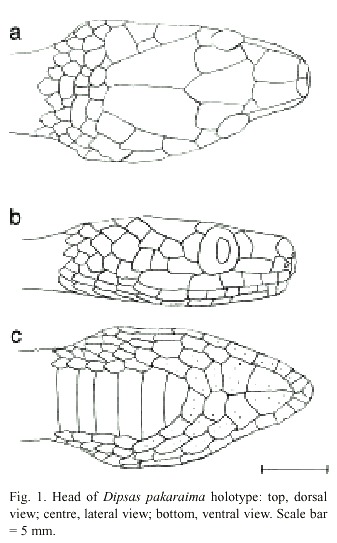
<body><![CDATA[<p><font face="Arial" size="2"><b>Paratypes: </b>ROM 41234–6, three adult males and ROM 41237, a female, collected in the vicinity of the type-locality, 26–31 October 2000, by Amy Lathrop, Carter Cox and Ross MacCulloch.</font></p> <font face="Arial" size="2"><b></b></font>     <p><font face="Arial" size="2"><b>Diagnosis: </b>Amember of the genus <i>Dipsas </i>characterised by 15 dorsal scale rows, the mid-dorsal row slightly enlarged; four pairs of chin-shields, the first pair elongate; elongate loreal entering orbit; one preocular; six upper labials, with only one elongate upper labial posterior to those that enter the orbit; head narrow anteriorly, increasing in width posteriorly; eye visible from below.</font></p>     <p><font face="Arial" size="2">The new species can be referred to <i>Dipsas </i>because it possesses the following suite of characters: head distinct from neck; mental groove absent; tertiary temporals present; four pairs chinshields; posterior chinshields separated from lower labials by other scales; maxillary teeth angled inwards; pterygoids parallel, not diverging posteriorly; occurring in northern South America (<a href="#pe60">Peters 1960</a>).</font></p> <font face="Arial" size="2"><i></i></font>     <p><font face="Arial" size="2"><i>Dipsas pakaraima </i>can be distinguished from <i>D. catesbyi </i>by its 15 dorsal scale rows (13 in <i>D. catesby</i>i), six upper labials (8-9), loreal entering orbit (not); from <i>D. copei </i>by four pairs of chinshields (three in <i>D. cope</i>i), six upper labials (10-11), loreal entering orbit (not); from <i>D. indica </i>and <i>D. pavonina </i>by 15 scale rows (13 in <i>D. indica </i>and <i>D. pavonin</i>a), six upper labials (9-11), four pairs of chin-shields (three); from <i>D. variegata </i>by one pre-ocular (none in <i>D. variegat</i>a), six upper labials (7-10), four pairs of chinshields (two or three). No other described species of <i>Dipsas </i>occurs in the Guiana region.</font></p>     <p><font face="Arial" size="2"><b>Description of holotype: </b>Rostral as broad as long, visible from above; internasals wider than long, much smaller than pre-frontals; prefrontals pentagonal, as wide as long; frontal bell-shaped, 1.3 times as long as wide; supraoculars 1; parietals 1.4 times as long as wide; occipital region with three transverse rows of scales (<a href="#f1">Fig. 1</a>, top).     <br> </font></p>     <p style="text-align: center;"><font face="Arial" size="2"><a name="f1"></a><img  src="/img/fbpe/rbt/v52n1/2632i1.JPG" title="" alt=""  style="width: 337px; height: 543px;"></font></p>     
<p><font face="Arial" size="2">&nbsp;    <br> Nasal partially divided dorsally; loreal elongate, in contact with nasal, prefrontal, preocular, 2nd, 3rd and 4th labials, enters orbit; preocular 1, narrowly in contact with frontal; suboculars absent; postoculars 1; primary temporal 1, enters orbit; secondary temporals 2; tertiary temporals 2; upper labials 6, 4th and 5th entering orbit, 6th longest. Pupil vertical (<a href="#f1">Fig. 1</a>, centre).</font></p>     <p><font face="Arial" size="2">Lower labials 8, first pair in contact behind mental, 4 pairs in contact with first pair of chin-shields; 4 pairs of chinshields, the first elongate, crescent-shaped, the second in contact with 4th and 5th labials, the third and fourth separated from labials. Ventral headscales with pores scattered across the surface of the scales. Mental groove absent (<a href="#f1">Fig. 1</a>, bottom).</font></p>     ]]></body>
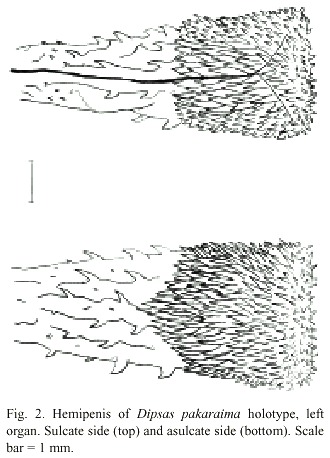
<body><![CDATA[<p><font face="Arial" size="2">Head narrow anteriorly, widest at temporal region, maximum width 55% of length. Maxillary teeth 17; palatine teeth 9; pterygoid teeth 7. Snoutvent length 435 mm, tail 190 mm. </font></p>     <p><font face="Arial" size="2">Ventrals 191; anal entire; subcaudals 117. Dorsal scale rows 15, vertebral scale row slightly enlarged, 1.1 times the width of the paravertebral scales at midbody, vertebral scales blunt-tipped. Scales without apical pits. </font></p>     <p><font face="Arial" size="2">Dorsal scale reduction formula <b>17 </b>3+4 (6) <b>15 </b>–8 (189) <b>14 </b>7+7 (191) <b>1</b>3. Caudo-dorsal scale reduction formula <b>6 </b>1+2 (12) <b>4 </b>1+2 (76) <b>2 </b>(117).</font></p>     <p><font face="Arial" size="2"><b>Hemipenial Morphology: </b>The hemipenis is single, slightly wider at apex, capitate. The everted organ is five subcaudals or 8 mm in length. The demarcation of the capitate region is evident on both the sulcate and asulcate sides, at about the level of the third subcaudal. The capitate region is covered in spines which decrease slightly in size distally. On the sulcate side, the midsection has spinose longitudinal plicae, the spines increasing in size distally. The capitate region has a patch of large spines medially with smaller spines laterally and distally. Asulcate midsection with spinose plicae laterally and basally; capitate region with larger spines medially, decreasing in size distally. Basal section plicate, naked but for a few small spinules. The sulcus spermaticus bifurcates near the apex. The intrasulcar surface is smooth. Hemipenes and adjacent tissue are white. (<a href="#f2">Fig. 2</a>).    <br> </font></p>     <p style="text-align: center;"><font face="Arial" size="2"><a name="f2"></a><img  src="/img/fbpe/rbt/v52n1/2632i2.JPG" title="" alt=""  style="width: 330px; height: 458px;"></font></p>     
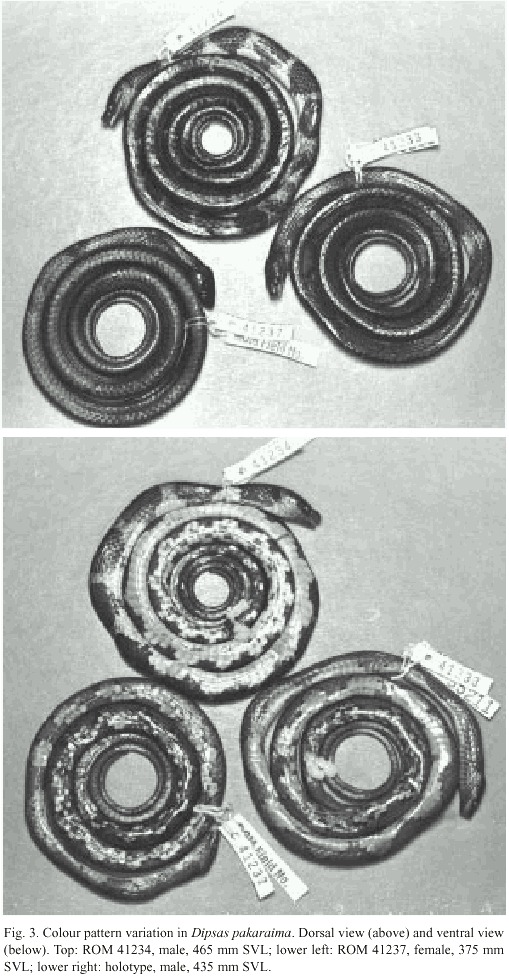
<p><font face="Arial" size="2">&nbsp;</font>    <br> <font size="-1"><b style="font-family: arial;">Colour in life: </b><span  style="font-family: arial;">Dorsolateral ground colour light brown anteriorly, darkening posteriorly. A series of 22 pairs of medium brown dorso-lateral blotches, outlined in black, between neck and vent. Anteriorly the blotches are each about five scales long middorsally, lengthening to 8–9 scales dorsolaterally, then tapering to five scales on the first dorsal scale row. Posteriorly the blotches become shorter. Anteriorly the blotches are separated by one or two lateral scales; toward midbody this separation diminishes, and the black borders of adjacent blotches are in contact. In the five posteriormost blotches the black borders are reduced laterally, present only middorsally and on the ventrals. This results in a continuous uniform medium brown lateral colouration.</span></font> </p>     <p><font face="Arial" size="2">Many pairs of blotches are not exactly opposite or symmetrical but rather alternating, creating a pattern of staggered blotches along the back. This asymmetry is caused by a blotch being a different length from its corresponding opposite blotch. In the holotype the blotch pairs change from opposite to alternating to opposite twice along the length of the body (<a href="#f3">Fig. 3</a>).    <br> &nbsp;</font></p>     ]]></body>
<body><![CDATA[<p style="text-align: center;"><font face="Arial" size="2"><a name="f3"></a><img  src="/img/fbpe/rbt/v52n1/2632i4.JPG" title="" alt=""  style="width: 509px; height: 978px;"></font></p>     
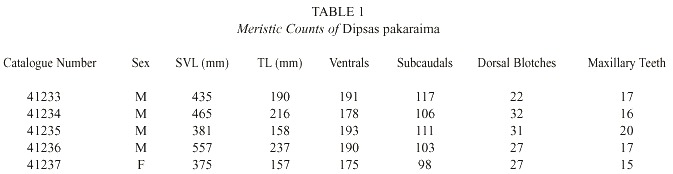
<p><font face="Arial" size="2">&nbsp;    <br> Within the dorsal blotches the scales appear to have dark tips, the result of overlapping the next posterior scale. However, the lighter-coloured scales outside the blotches do not appear dark-tipped where they overlap the next scale. Between the blotches the light brown background creates a middorsal pattern of diamond shapes (or half-diamond where the blotches are not symmetrical); these diamonds contain small dark brown spots. The dorsal background colour becomes progressively darker posteriorly, converging with the blotch colour. </font></p>     <p><font face="Arial" size="2">Ventral background colour pale brown, the dorsolateral blotches extending to the mid-ventral point, each covering two or three ventrals. Ventrals otherwise immaculate anteriorly, posteriorly with small black patches consisting of several juxtaposed or narrowly separated squarish to half-moon-shaped marks. The ventral dark markings become more intense posteriorly (<a href="#f3">Fig. 3</a>).</font></p>     <p><font face="Arial" size="2">Tail with a narrow cream middorsal stripe flanked by narrow black stripes. Background colour is dark brown laterally and ventrally, with a few small cream-and-black lateral blotches proximally.</font></p>     <p><font face="Arial" size="2">Head dark brown dorsally and laterally. Lower labials with a narrow white band at lip. Chin medium brown with light brown mottling increasing posteriorly. In preservative the colour has changed only slightly.</font></p> <font face="Arial" size="2"><b></b></font>     <p><font face="Arial" size="2"><b>Variation: </b>The male paratypes vary in SVL from 381–557 mm and in tail length from 158–237 mm. The single female has a SVL of 375 mm and tail length of 157 mm.</font></p>     <p><font face="Arial" size="2">There is considerable variation in scale counts, as is often encountered in <i>Dipsas </i>(<a href="#pe56">Peters 1956</a>, <a href="#pe60">1960</a>). Among the males ventrals range from 178–193, subcaudals 103–117. The longest male has the fewest subcaudals and the second-fewest ventrals, while the shortest male has the most ventrals. The female has 175 ventrals and 98 subcaudals. There was no correlation between SVL and number of ventrals, subcaudals, blotches or maxillary teeth among the males (<a href="#t1">Table 1</a>).</font></p>     <p align="center"><font face="Arial" size="2">&nbsp;<a name="t1"></a><img  src="/img/fbpe/rbt/v52n1/2632i3.JPG" title="" alt=""  style="width: 673px; height: 174px;"></font></p>     
<p align="center"></p>     ]]></body>
<body><![CDATA[<p align="center"><font face="Arial" size="2">&nbsp;</font></p>     <p><font face="Arial" size="2">Other than the holotype, only one male (ROM 41234) has scale row reduction anterior to the anus. This specimen has 178 ventrals and a reduction formula of <b>15 </b>–8 (175) <b>14 </b>7+7 (177) <b>1</b>3. In two males and the female, the neck reduction involves rows four and five instead of rows three and four. Among the males the caudo-dorsal scale reduction formula is <b>6 </b>1+2 (12–18) <b>4 </b>1+2 (54–82) <b>2 </b>(103–117). Caudo-dorsal scale row reduction is 1+2 in all males, but is 2+3 in the female, and occurs closer to the vent. The female’s caudo-dorsal scale reduction formula is <b>6 </b>2+3 (7) <b>4 </b>1+2 (60) <b>2 </b>98.</font></p>     <p><font face="Arial" size="2">The smallest male has two postoculars, so the primary temporal does not enter the orbit. This male also has the most temporals, 3+3+3. The female has fused temporals on both sides, creating a temporal formula of (left/right) 1+1+3/1+1+2. The female has only three pairs of chinshields and lacks pores on the ventral head scales. One male has a few divided ventral scales, of types 1 and 6 of <a href="#pe60">Peters (1960)</a>.</font></p>     <p><font face="Arial" size="2">Maxillary teeth are 16–20 in males, 15 in the female (<a href="#t1">Table 1</a>). Palatine teeth are 7–8 in males, five in the female. Pterygoid teeth are 7–9 in males, six in the female.</font></p> <font face="Arial" size="2"><b></b></font>     <p><font face="Arial" size="2"><b>Colour variation: </b>The dorsal background colour varies from light brown to cream, and the blotches range from medium brown to very dark brown (<a href="#f3">Fig. 3</a>). In most paratypes the majority of the dorsal blotches are symmetrically paired, but all exhibit a pattern of alternating blotches or asymmetry at some point along the body. Asymmetry is caused by a blotch being a different length from its corresponding opposite blotch. In some individuals the blotches change from symmetrical pairing to asymmetrical (alternating) and back again, along the length of the body, sometimes more than once. In all paratypes the blotches become progressively shorter posteriorly, from 6–7 to 4–5 scales in length. In all individuals the dorsal and ventral background colour becomes progressively darker posteriorly, and the tail pattern is much less obvious than the body pattern. <a  href="#pe60">Peters (1960)</a> found that older individuals exhibited less colour contrast, but there was no correlation between size and colour contrast among the four males of <i>D. pakaraim</i>a.</font></p>     <p><font face="Arial" size="2">In the female the blotches are apparent ventrally and laterally, but much less apparent on the upper part of the body, so that the mid-dorsal colouration appears uniformly medium brown (<a href="#f3">Fig. 3</a>). This specimen has 27 body blotches; its tail has only a few midventral traces of blotches proximally, and is otherwise immaculate medium brown.</font></p> <font face="Arial" size="2"><b> </b></font>     <p><font face="Arial" size="2"><b>Etymology: </b>The specific epithet refers to the Pakaraima Mountains of western Guyana, where the type locality is located. It is used as a noun in apposition.</font></p> <font face="Arial" size="2"><b></b></font>     <p><font face="Arial" size="2"><b>Distribution: </b><i>Dipsas pakaraima </i>is known only from the type locality, Mount Ayanganna, Guyana.</font></p> <font face="Arial" size="2"><b></b></font>     <p><font face="Arial" size="2"><b>Natural History: </b>All specimens were collected on the northeast plateau of Mount Ayanganna (05º24’ N, 059º57’ W), in the Pakaraima Range of western Guyana. Mount Ayanganna is one of the easternmost tepuis in the Guiana Shield. The specimens were collected at 1490 m, in wet, low, evergreen high-tepui forest. The vegetation was described by <a href="#fa52">Fanshawe (1952)</a>, <a  href="#ma70">Maguire (1970)</a>, and <a href="#hu95">Huber <i>et al. </i>(1995)</a>, and a checklist is available at ww.mnh.si.edu/biodiversity/bdg/. All specimens were collected at night, and all were in large terrestrial bromeliads <i>(Brocchini</i>a) or on low branches (0.5–2 m height). Stomachs contained no identifiable remains of prey. All individuals have some abdominal fat deposits. The female’s ovaries have no enlarged follicles. </font></p>     <p><font face="Arial" size="2">Single individuals of two other colubrid species, <i>Dipsas variegata </i>and <i>Liophis miliari</i>s, were also collected on the plateau.</font></p> <font face="Arial" size="2"><b></b></font>     ]]></body>
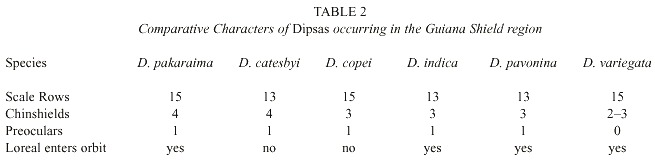
<body><![CDATA[<p><font face="Arial" size="2"><b>    <br> </b></font></p>     <p><font face="Arial" size="2"><b>Discussion</b></font></p>     <p><font face="Arial" size="2"><b>Relationships: </b><a href="#pe60">Peters (1960)</a> separated <i>Dipsas </i>into seven species groups based primarily on colour pattern, although some squamation characters were also used. The <i>catesbyi </i>group has 13 scale rows, the loreal seldom enters the orbit and in some species the head narrows anteriorly. The <i>oreas </i>group has 15 scale rows, and some have four chinshields. Some members of the <i>pratti </i>group (eg. <i>D. latifrontali</i>s) have four chinshields. The <i>variegata </i>group has 15 scale rows, 3 pairs of chinshields, and no loreal. The <i>indica </i>group has three pairs of chinshields, 13 scale rows, one preocular plus loreal entering orbit, and no teeth on the pterygoid. </font></p>     <p><font face="Arial" size="2"><i>Dipsas pakaraima </i>cannot be assigned to any existing species group because it does not match the characters of any one group. It resembles the <i>catesbyi </i>group in colour pattern, but has three squamation characters in common with <i>D. elegans (oreas </i>group); long loreal, first pair of chinshields slightly elongate, temporals 2+2/3+3. Some characters of Guiana Shield species of <i>Dipsas </i>are summarised in <a href="#t2">Table 2</a>.     <br> </font></p>     <p align="center"><font face="Arial" size="2"><a name="t2"></a><img  src="/img/fbpe/rbt/v52n1/2632i5.JPG" title="" alt=""  style="width: 655px; height: 160px;"></font></p>     
<p align="center"></p>     <p align="center"><font face="Arial" size="2">&nbsp;</font></p>     <div style="text-align: left;"><font face="Arial" size="2">&nbsp;</font><font  face="Arial" size="2"><b>Zoogeography: </b>Although some of the Andean species of <i>Dipsas </i>occur at high elevations, there have been no previous reports of <i>Dipsas </i>from the Guiana Shield tepuis (<a href="#ro58a">Roze 1958a</a>, <a href="#ro58b">b</a>, <a  href="#ro66">1966</a>, <a href="#do91">Donnelly and Myers 1991</a>, <a  href="#my97">Myers 1997</a>, <a href="#my96">Myers and Donnelly 1996</a>, <a href="#my97et">1997</a>, <a href="#my01">2001</a>, <a href="#go98-99">Gorzula and Señaris 1999</a>). In addition to <i>Dipsas pakaraim</i>a, one <i>D. variegat</i>a, a female, was also collected at 1490 m on Mt. Ayanganna. The highest reported elevations for the latter species have been 300 m (<a href="#go98-99">Gorzula and Señaris 1999</a>) and 500 m (<a href="#ro66">Roze 1966</a>), in Venezuela. The only other snake collected on Mt. Ayanganna at 1490 m was a male <i>Liophis miliari</i>s. Several other snakes <i>(Chironius fuscu</i>s, <i>Oxyrhopus trigeminu</i>s, <i>Bothrops atro</i>x) were encountered at the base of the mountain, at 800–850 m elevation.</font></div>     ]]></body>
<body><![CDATA[<p align="center"> </p>     <p><font face="Arial" size="2"><i>Dipsas </i>is not a common tepui colubrid genus, unlike <i>Thamnodynaste</i>s, which has been found on several Venezuelan tepuis (<a href="#go95-96">Gorzula and Ayarzagüena 1996</a>, <a href="#my96">Myers and Donnelly 1996</a>, <a href="#my97et">1997</a>, <a href="#my01">2001</a>, <a href="#go98-99">Gorzula and Señaris 1999</a>). The presence of <i>D. pakaraima </i>on Ayanganna, but not on other tepuis, does not support the pantepui theory of Guiana Shield zoogeography. Rather, it appears that the ancestor of <i>D. pakaraima </i>invaded Ayanganna from the surrounding lowland, and its presence supports the "lowland invader" hypothesis of tepui faunas. This is further supported by the sympatric presence of the low-land species <i>D. variegata </i>and <i>Liophis miliaris. </i><a href="#my97">Myers (1997)</a> and <a href="#my01">Myers and Donnelly (2001)</a> found little overlap between the fauna of neighbouring Guiana tepuis; these findings, combined with the results of this paper, indicate that opportunistic colonization of the region’s highlands by lowland taxa is commonplace, and that tepui herpetofaunas are composed of the descendants of both pantepui and lowland ancestors.</font></p> <font face="Arial" size="2"><b>     <p>    <br> </p>     <p>Acknowledgments</p> </b> </font>     <p><font face="Arial" size="2">Specimens were collected and exported under permits issued by the Guyana Environmental Protection Agency. The field assistance of Lancelot George, Roland Edward, and especially Carter Cox was greatly appreciated. We thank R. Reynolds and S. Gotte (USNM) for loans of or access to specimens. We also thank V. Funk, C. Kelloff, M. Tamessar, D. Naraine, C. Mendonca, and Fr. C.L. Roland. B. Morera and three reviewers provided valuable comments on an earlier version. This study was funded by grants from the Royal Ontario Museum Foundation, the ROM Centre for Biodiversity and Conservation Biology, and a Smithsonian BDG Fellowship to RDM. This is contribution 260 of the Centre for Biodiversity and Conservation Biology, ROM and number 99 in the Smithsonian’s Biological Diversity of the Guianas Program publication series.</font></p> <font face="Arial" size="2"><b>     <p>    <br> </p>     <p>Resumen</p> </b> </font>     <p><font face="Arial" size="2">Se describe una nueva especie del género <i>Dipsas </i>de las montañas Pakaraima de Guyana. Esta se caracteriza por presentar 15 hileras de escamas dorsales con las escamas de la hilera vertebral ligeramente agrandadas, cuatro pares de escudos geneiales con el primer par elongado, loreal elongado y en contacto con la órbita, una escama preocular, seis labiales superiores y la cabeza angosta en la partie anterior y más ancha posteriormente. No se determino su ubicación de acuerdo a los grupos de especies de <a  href="#pe60">Peters (1960)</a>. La nueva especie solo es conocida a 1490 m.s.n.m. en el monte Ayanganna, un tepuy del Escudo Guayanés, en bosque de baja altura, dentro de bromelias o sobre ramas. Es el primer informe del género <i>Dipsas </i>como miembro de la fauna altotepuyana del Escudo Guayanés.</font></p> <font face="Arial" size="2"><b>     ]]></body>
<body><![CDATA[<p>    <br> </p>     <p>References</p> </b> </font>     <!-- ref --><p><font face="Arial" size="2"><a name="ch86"></a>Chippaux, J.–P. 1986. Les serpents de la Guyane français<i>e. </i>ORSTOM Faune Tropical #27, Paris. 165 p.</font>&nbsp;&nbsp;&nbsp;&nbsp;&nbsp;&nbsp;&nbsp;&nbsp;[&#160;<a href="javascript:void(0);" onclick="javascript: window.open('/scielo.php?script=sci_nlinks&ref=1301336&pid=S0034-7744200400010003100001&lng=','','width=640,height=500,resizable=yes,scrollbars=1,menubar=yes,');">Links</a>&#160;]<!-- end-ref --><!-- ref --><p><font face="Arial" size="2"><a name="do91"></a>Donnelly, M.A. &amp; C.W. Myers. 1991. Herpetological results of the 1990 Venezuelan expedition to the summit of Cerro Guaiquinima, with new tepui reptiles. Amer. Mus. Novit. 3017: 1–54.</font>&nbsp;&nbsp;&nbsp;&nbsp;&nbsp;&nbsp;&nbsp;&nbsp;[&#160;<a href="javascript:void(0);" onclick="javascript: window.open('/scielo.php?script=sci_nlinks&ref=1301337&pid=S0034-7744200400010003100002&lng=','','width=640,height=500,resizable=yes,scrollbars=1,menubar=yes,');">Links</a>&#160;]<!-- end-ref --><!-- ref --><p><font face="Arial" size="2"><a name="do51"></a>Dowling, H.G. 1951. A proposed method of expressing scale reductions in snake<i>s. </i>Copeia 1951(2): 131–134.</font>&nbsp;&nbsp;&nbsp;&nbsp;&nbsp;&nbsp;&nbsp;&nbsp;[&#160;<a href="javascript:void(0);" onclick="javascript: window.open('/scielo.php?script=sci_nlinks&ref=1301338&pid=S0034-7744200400010003100003&lng=','','width=640,height=500,resizable=yes,scrollbars=1,menubar=yes,');">Links</a>&#160;]<!-- end-ref --><!-- ref --><p><font face="Arial" size="2"><a name="do60"></a>Dowling, H.G. &amp; J.M. Savage. 1960. A guide to the snake hemipenis: a survey of basic structure and systematic characteristics. Zoologica 45: 17–28. </font>&nbsp;&nbsp;&nbsp;&nbsp;&nbsp;&nbsp;&nbsp;&nbsp;[&#160;<a href="javascript:void(0);" onclick="javascript: window.open('/scielo.php?script=sci_nlinks&ref=1301339&pid=S0034-7744200400010003100004&lng=','','width=640,height=500,resizable=yes,scrollbars=1,menubar=yes,');">Links</a>&#160;]<!-- end-ref --><!-- ref --><p><font face="Arial" size="2"><a name="fa52"></a>Fanshawe, D.B. 1952. The vegetation of British Guiana: a preliminary review. Inst. Paper #29, Imperial Forestry Inst., Oxford. 96 p.</font>&nbsp;&nbsp;&nbsp;&nbsp;&nbsp;&nbsp;&nbsp;&nbsp;[&#160;<a href="javascript:void(0);" onclick="javascript: window.open('/scielo.php?script=sci_nlinks&ref=1301340&pid=S0034-7744200400010003100005&lng=','','width=640,height=500,resizable=yes,scrollbars=1,menubar=yes,');">Links</a>&#160;]<!-- end-ref --><!-- ref --><p><font face="Arial" size="2"><a name="go95-96"></a>Gorzula, S. &amp; J. Ayarzagüena. "1995" [1996]. Dos nuevas especies del genero <i>Thamnodynastes </i>(Serpentes: Colubridae) de los tepuyes de la Guayana Venezolana. Publ. Asoc. Amigos de Doñana 6: 1–17.</font>&nbsp;&nbsp;&nbsp;&nbsp;&nbsp;&nbsp;&nbsp;&nbsp;[&#160;<a href="javascript:void(0);" onclick="javascript: window.open('/scielo.php?script=sci_nlinks&ref=1301341&pid=S0034-7744200400010003100006&lng=','','width=640,height=500,resizable=yes,scrollbars=1,menubar=yes,');">Links</a>&#160;]<!-- end-ref --><!-- ref --><p><font face="Arial" size="2"><a name="go98-99"></a>Gorzula, S. &amp; J.C. Señaris. "1998" [1999]. Contribution to the herpetofauna of the Venezuelan Guayana I. A data base. Scientia Guaianae #8, Caracas. xviii + 270 + 32 p.</font>&nbsp;&nbsp;&nbsp;&nbsp;&nbsp;&nbsp;&nbsp;&nbsp;[&#160;<a href="javascript:void(0);" onclick="javascript: window.open('/scielo.php?script=sci_nlinks&ref=1301342&pid=S0034-7744200400010003100007&lng=','','width=640,height=500,resizable=yes,scrollbars=1,menubar=yes,');">Links</a>&#160;]<!-- end-ref --><!-- ref --><p><font face="Arial" size="2"><a name="hu95"></a>Huber, O., G. Gharbarran &amp; V. Funk. 1995. Vegetation map of Guyana. Centre for the Study of Biological Diversity, Univ. of Guyana, Georgetown. </font>&nbsp;&nbsp;&nbsp;&nbsp;&nbsp;&nbsp;&nbsp;&nbsp;[&#160;<a href="javascript:void(0);" onclick="javascript: window.open('/scielo.php?script=sci_nlinks&ref=1301343&pid=S0034-7744200400010003100008&lng=','','width=640,height=500,resizable=yes,scrollbars=1,menubar=yes,');">Links</a>&#160;]<!-- end-ref --><!-- ref --><p><font face="Arial" size="2"><a name="ko82"></a>Kofron, C.P. 1982. A review of the Mexican snail-eating snakes, <i>Dipsas brevifacies </i>and <i>Dipsas gaiga</i>e. J. Herpetol. 16: 270–286.</font>&nbsp;&nbsp;&nbsp;&nbsp;&nbsp;&nbsp;&nbsp;&nbsp;[&#160;<a href="javascript:void(0);" onclick="javascript: window.open('/scielo.php?script=sci_nlinks&ref=1301344&pid=S0034-7744200400010003100009&lng=','','width=640,height=500,resizable=yes,scrollbars=1,menubar=yes,');">Links</a>&#160;]<!-- end-ref --><!-- ref --><p><font face="Arial" size="2"><a name="ko99"></a>Kornacker, P.M. 1999. Checklist and key to the snakes of Venezuela. Pako-Verlag, Rheinbach. 269 p.</font>&nbsp;&nbsp;&nbsp;&nbsp;&nbsp;&nbsp;&nbsp;&nbsp;[&#160;<a href="javascript:void(0);" onclick="javascript: window.open('/scielo.php?script=sci_nlinks&ref=1301345&pid=S0034-7744200400010003100010&lng=','','width=640,height=500,resizable=yes,scrollbars=1,menubar=yes,');">Links</a>&#160;]<!-- end-ref --><!-- ref --><p><font face="Arial" size="2"><a name="ma01"></a>MacCulloch, R.D. &amp; A. Lathrop. 2001. A new species of <i>Arthrosaura </i>(Sauria: Teiidae) from the highlands of Guyana. Carib. J. Sci. 37: 174–181.</font>&nbsp;&nbsp;&nbsp;&nbsp;&nbsp;&nbsp;&nbsp;&nbsp;[&#160;<a href="javascript:void(0);" onclick="javascript: window.open('/scielo.php?script=sci_nlinks&ref=1301346&pid=S0034-7744200400010003100011&lng=','','width=640,height=500,resizable=yes,scrollbars=1,menubar=yes,');">Links</a>&#160;]<!-- end-ref --><!-- ref --><p><font face="Arial" size="2"><a name="ma02"></a>MacCulloch, R.D. &amp; A. Lathrop. 2002. Exceptional diversity of <i>Stefania </i>(Anura: Hylidae) on Mount Ayanganna, Guyana: three new species and new distribution records. Herpetologica 58: 327–346.</font>&nbsp;&nbsp;&nbsp;&nbsp;&nbsp;&nbsp;&nbsp;&nbsp;[&#160;<a href="javascript:void(0);" onclick="javascript: window.open('/scielo.php?script=sci_nlinks&ref=1301347&pid=S0034-7744200400010003100012&lng=','','width=640,height=500,resizable=yes,scrollbars=1,menubar=yes,');">Links</a>&#160;]<!-- end-ref --><!-- ref --><p><font face="Arial" size="2"><a name="ma70"></a>Maguire, B. 1970. On the flora of the Guyana highland. Biotropica 2: 85-100.</font>&nbsp;&nbsp;&nbsp;&nbsp;&nbsp;&nbsp;&nbsp;&nbsp;[&#160;<a href="javascript:void(0);" onclick="javascript: window.open('/scielo.php?script=sci_nlinks&ref=1301348&pid=S0034-7744200400010003100013&lng=','','width=640,height=500,resizable=yes,scrollbars=1,menubar=yes,');">Links</a>&#160;]<!-- end-ref --><!-- ref --><p><font face="Arial" size="2"><a name="my97"></a>Myers, C.W. 1997. Preliminary remarks on the summit herpetofauna of Auyantepui, eastern Venezuela. Acta Terramaris 10: 1–8.</font>&nbsp;&nbsp;&nbsp;&nbsp;&nbsp;&nbsp;&nbsp;&nbsp;[&#160;<a href="javascript:void(0);" onclick="javascript: window.open('/scielo.php?script=sci_nlinks&ref=1301349&pid=S0034-7744200400010003100014&lng=','','width=640,height=500,resizable=yes,scrollbars=1,menubar=yes,');">Links</a>&#160;]<!-- end-ref --><!-- ref --><p><font face="Arial" size="2"><a name="my96"></a>Myers, C.W. &amp; M.A. Donnelly. 1996. A new herpetofauna from Cerro Yavi, Venezuela: first results of the Robert G. Goelet American Museum – Terramar expedition to the northwest tepuis. Amer. Mus. Novit. 3172: 1–56.</font>&nbsp;&nbsp;&nbsp;&nbsp;&nbsp;&nbsp;&nbsp;&nbsp;[&#160;<a href="javascript:void(0);" onclick="javascript: window.open('/scielo.php?script=sci_nlinks&ref=1301350&pid=S0034-7744200400010003100015&lng=','','width=640,height=500,resizable=yes,scrollbars=1,menubar=yes,');">Links</a>&#160;]<!-- end-ref --><!-- ref --><p><font face="Arial" size="2"><a name="my97et"></a>Myers, C.W. &amp; M.A. Donnelly. 1997. A tepui herpetofauna on a granitic mountain (Tamacuari) in the border-land between Venezuela and Brazil: report from the Phipps Tapirapeco expedition. Amer. Mus. Novit. 3213: 1–71.</font>&nbsp;&nbsp;&nbsp;&nbsp;&nbsp;&nbsp;&nbsp;&nbsp;[&#160;<a href="javascript:void(0);" onclick="javascript: window.open('/scielo.php?script=sci_nlinks&ref=1301351&pid=S0034-7744200400010003100016&lng=','','width=640,height=500,resizable=yes,scrollbars=1,menubar=yes,');">Links</a>&#160;]<!-- end-ref --><!-- ref --><p><font face="Arial" size="2"><a name="my01"></a>Myers, C.W. &amp; M.A. Donnelly. 2001. Herpetofauna of the Yutaje-Corocoro massif, Venezuela: second report from the Robert G. Goelet American Museum –Terramar expedition to the northwestern tepuis. Bull. Amer. Mus. Nat. Hist. 261: 1–85.</font>&nbsp;&nbsp;&nbsp;&nbsp;&nbsp;&nbsp;&nbsp;&nbsp;[&#160;<a href="javascript:void(0);" onclick="javascript: window.open('/scielo.php?script=sci_nlinks&ref=1301352&pid=S0034-7744200400010003100017&lng=','','width=640,height=500,resizable=yes,scrollbars=1,menubar=yes,');">Links</a>&#160;]<!-- end-ref --><!-- ref --><p><font face="Arial" size="2"><a name="pe56"></a>Peters, J.A. 1956. An analysis of variation in a South American snake, Catesby’s snail-sucker <i>(Dipsas catesbyi </i>Sentzen). Amer. Mus. Novit. 1783: 1-41. </font>&nbsp;&nbsp;&nbsp;&nbsp;&nbsp;&nbsp;&nbsp;&nbsp;[&#160;<a href="javascript:void(0);" onclick="javascript: window.open('/scielo.php?script=sci_nlinks&ref=1301353&pid=S0034-7744200400010003100018&lng=','','width=640,height=500,resizable=yes,scrollbars=1,menubar=yes,');">Links</a>&#160;]<!-- end-ref --><!-- ref --><p><font face="Arial" size="2"><a name="pe60"></a>Peters, J.A. 1960. The snakes of the subfamily Dipsadinae. Misc. Pub. Mus. Zool. Univ. Michigan 114: 1–224.</font>&nbsp;&nbsp;&nbsp;&nbsp;&nbsp;&nbsp;&nbsp;&nbsp;[&#160;<a href="javascript:void(0);" onclick="javascript: window.open('/scielo.php?script=sci_nlinks&ref=1301354&pid=S0034-7744200400010003100019&lng=','','width=640,height=500,resizable=yes,scrollbars=1,menubar=yes,');">Links</a>&#160;]<!-- end-ref --><!-- ref --><p><font face="Arial" size="2"><a name="pe70"></a>Peters, J.A. &amp; B. Orejas-Miranda. 1970. Catalogue of the neotropical squamata. Part I. Snakes. U.S. Nat. Mus. Bull. 297: 1–347.</font>&nbsp;&nbsp;&nbsp;&nbsp;&nbsp;&nbsp;&nbsp;&nbsp;[&#160;<a href="javascript:void(0);" onclick="javascript: window.open('/scielo.php?script=sci_nlinks&ref=1301355&pid=S0034-7744200400010003100020&lng=','','width=640,height=500,resizable=yes,scrollbars=1,menubar=yes,');">Links</a>&#160;]<!-- end-ref --><!-- ref --><p><font face="Arial" size="2"><a name="re92"></a>Reynolds, R.P. &amp; M.S. Foster. 1992. Four new species of frogs and one new species of snake from the Chapare region of Bolivia, with notes on other species. Herpetol. Monogr. 6: 83–104.</font>&nbsp;&nbsp;&nbsp;&nbsp;&nbsp;&nbsp;&nbsp;&nbsp;[&#160;<a href="javascript:void(0);" onclick="javascript: window.open('/scielo.php?script=sci_nlinks&ref=1301356&pid=S0034-7744200400010003100021&lng=','','width=640,height=500,resizable=yes,scrollbars=1,menubar=yes,');">Links</a>&#160;]<!-- end-ref --><!-- ref --><p><font face="Arial" size="2"><a name="ro58a"></a></font><font  face="Arial" size="2">Roze, J.A. 1958a. Los reptiles del Auyantepui, Venezuela, basandose en las colecciones de las expediciónes de Phelps-Tate, del American Museum of Natural History, 1937-1938, y de l a Universidad Central de Venezuela, 1956. Acta Biol. Venez. 2: 243–270.</font>&nbsp;&nbsp;&nbsp;&nbsp;&nbsp;&nbsp;&nbsp;&nbsp;[&#160;<a href="javascript:void(0);" onclick="javascript: window.open('/scielo.php?script=sci_nlinks&ref=1301357&pid=S0034-7744200400010003100022&lng=','','width=640,height=500,resizable=yes,scrollbars=1,menubar=yes,');">Links</a>&#160;]<!-- end-ref --><!-- ref --><p><font face="Arial" size="2"><a name="ro58b"></a>Roze, J.A. 1958b. Los reptiles de Chimanta tepui (Estado Bolivar) Venezuela, colectados por la expedición botanica del Chicago Natural History Museum. Acta Biol. Venez. 2: 299–314.</font>&nbsp;&nbsp;&nbsp;&nbsp;&nbsp;&nbsp;&nbsp;&nbsp;[&#160;<a href="javascript:void(0);" onclick="javascript: window.open('/scielo.php?script=sci_nlinks&ref=1301358&pid=S0034-7744200400010003100023&lng=','','width=640,height=500,resizable=yes,scrollbars=1,menubar=yes,');">Links</a>&#160;]<!-- end-ref --><!-- ref --><p><font face="Arial" size="2"><a name="ro66"></a>Roze, J.A. 1966. La taxonomía y zoogeografía de los ofidios de Venezuela. Univ. Central de Venezuela, Caracas. 362 p.</font>&nbsp;&nbsp;&nbsp;&nbsp;&nbsp;&nbsp;&nbsp;&nbsp;[&#160;<a href="javascript:void(0);" onclick="javascript: window.open('/scielo.php?script=sci_nlinks&ref=1301359&pid=S0034-7744200400010003100024&lng=','','width=640,height=500,resizable=yes,scrollbars=1,menubar=yes,');">Links</a>&#160;]<!-- end-ref --><!-- ref --><p><font face="Arial" size="2"><a name="sa02"></a>Savage, J.M. 2002. The Amphibians and Retiles of Costa Rica: a herpetofauna between two continents, between two seas. University of Chicago. pp. 596- 599.</font>&nbsp;&nbsp;&nbsp;&nbsp;&nbsp;&nbsp;&nbsp;&nbsp;[&#160;<a href="javascript:void(0);" onclick="javascript: window.open('/scielo.php?script=sci_nlinks&ref=1301360&pid=S0034-7744200400010003100025&lng=','','width=640,height=500,resizable=yes,scrollbars=1,menubar=yes,');">Links</a>&#160;]<!-- end-ref --><!-- ref --><p><font face="Arial" size="2"><a name="st98"></a>Starace, F. 1998. Guide des serpents et amphisbènes de Guyane. Ibis Rouge, Paris. 449 p.</font>&nbsp;&nbsp;&nbsp;&nbsp;&nbsp;&nbsp;&nbsp;&nbsp;[&#160;<a href="javascript:void(0);" onclick="javascript: window.open('/scielo.php?script=sci_nlinks&ref=1301361&pid=S0034-7744200400010003100026&lng=','','width=640,height=500,resizable=yes,scrollbars=1,menubar=yes,');">Links</a>&#160;]<!-- end-ref --><p><font face="Arial" size="2">&nbsp;</font></p> <font face="Arial" size="2"><b>     ]]></body>
<body><![CDATA[<p align="center"><a name="ap"></a>Appendix</p>     <p>Specimens examined</p> </b><i> </i></font>     <p><font face="Arial" size="2"><i>Dipsas albifrons </i>(1).&nbsp;&nbsp;&nbsp;&nbsp;&nbsp;&nbsp;&nbsp;&nbsp;&nbsp;&nbsp;&nbsp;&nbsp;&nbsp;&nbsp;&nbsp;&nbsp; &nbsp;&nbsp; &nbsp;&nbsp; BRAZIL, <i>Sao Paol</i>o, Presidente Penna, USNM 79356    <br> <i>Dipsas catesbyi </i>(2).&nbsp;&nbsp;&nbsp;&nbsp;&nbsp;&nbsp;&nbsp;&nbsp;&nbsp;&nbsp;&nbsp;&nbsp;&nbsp;&nbsp;&nbsp;&nbsp;&nbsp;&nbsp; &nbsp; &nbsp; GUYANA, Bartica, USNM 200509-10    <br> <i>Dipsas copei </i>(1).&nbsp;&nbsp;&nbsp;&nbsp;&nbsp;&nbsp;&nbsp;&nbsp;&nbsp;&nbsp;&nbsp;&nbsp;&nbsp;&nbsp;&nbsp;&nbsp;&nbsp;&nbsp;&nbsp;&nbsp;&nbsp; &nbsp; &nbsp;&nbsp; GUYANA, Paramakatoi, ROM 28371    <br> <i>Dipsas elegans </i>(2).&nbsp;&nbsp;&nbsp;&nbsp;&nbsp;&nbsp;&nbsp;&nbsp;&nbsp;&nbsp;&nbsp;&nbsp;&nbsp;&nbsp;&nbsp;&nbsp;&nbsp; &nbsp; &nbsp; &nbsp; ECUADOR, <i>Pichinch</i>a, Pacto, USNM 210937; Nanegal,     <br> &nbsp;&nbsp;&nbsp;&nbsp;&nbsp;&nbsp;&nbsp;&nbsp;&nbsp;&nbsp;&nbsp;&nbsp;&nbsp;&nbsp;&nbsp;&nbsp;&nbsp;&nbsp;&nbsp;&nbsp;&nbsp;&nbsp;&nbsp;&nbsp;&nbsp;&nbsp;&nbsp;&nbsp;&nbsp;&nbsp;&nbsp;&nbsp;&nbsp;&nbsp;&nbsp;&nbsp;&nbsp;&nbsp;&nbsp;&nbsp;&nbsp;&nbsp;&nbsp;&nbsp;&nbsp; &nbsp; &nbsp; &nbsp; USNM 210936    <br> <i>Dipsas gracilis </i>(2).&nbsp;&nbsp;&nbsp;&nbsp;&nbsp;&nbsp;&nbsp;&nbsp;&nbsp;&nbsp;&nbsp;&nbsp;&nbsp;&nbsp;&nbsp;&nbsp;&nbsp;&nbsp;&nbsp; &nbsp;&nbsp; &nbsp; ECUADOR, <i>Esmerelda</i>s, Santo Domingo, USNM 210945; <i>    <br> &nbsp;&nbsp;&nbsp;&nbsp;&nbsp;&nbsp;&nbsp;&nbsp;&nbsp;&nbsp;&nbsp;&nbsp;&nbsp;&nbsp;&nbsp;&nbsp;&nbsp;&nbsp;&nbsp;&nbsp;&nbsp;&nbsp;&nbsp;&nbsp;&nbsp;&nbsp;&nbsp;&nbsp;&nbsp;&nbsp;&nbsp;&nbsp;&nbsp;&nbsp;&nbsp;&nbsp;&nbsp;&nbsp;&nbsp;&nbsp;&nbsp;&nbsp;&nbsp;&nbsp;&nbsp;&nbsp;&nbsp; &nbsp; &nbsp; Guaya</i>s, Guayaquil, USNM 210947    <br> <i>Dipsas indica </i>(3).&nbsp;&nbsp;&nbsp;&nbsp;&nbsp;&nbsp;&nbsp;&nbsp;&nbsp;&nbsp;&nbsp;&nbsp;&nbsp;&nbsp;&nbsp;&nbsp;&nbsp;&nbsp;&nbsp;&nbsp;&nbsp; &nbsp; &nbsp;&nbsp; PERU, <i>Amazona</i>s, Tseasim, USNM 316598; Huampami,    ]]></body>
<body><![CDATA[<br> &nbsp;&nbsp;&nbsp;&nbsp;&nbsp;&nbsp;&nbsp;&nbsp;&nbsp;&nbsp;&nbsp;&nbsp;&nbsp;&nbsp;&nbsp;&nbsp;&nbsp;&nbsp;&nbsp;&nbsp;&nbsp;&nbsp;&nbsp;&nbsp;&nbsp;&nbsp;&nbsp;&nbsp;&nbsp;&nbsp;&nbsp;&nbsp;&nbsp;&nbsp;&nbsp;&nbsp;&nbsp;&nbsp;&nbsp;&nbsp;&nbsp;&nbsp;&nbsp;&nbsp;&nbsp;&nbsp; &nbsp; &nbsp;&nbsp; USNM 316597; BRAZIL, <i>Rio de Janeir</i>o, Teresopolis,     <br> &nbsp;&nbsp;&nbsp;&nbsp;&nbsp;&nbsp;&nbsp;&nbsp;&nbsp;&nbsp;&nbsp;&nbsp;&nbsp;&nbsp;&nbsp;&nbsp;&nbsp;&nbsp;&nbsp;&nbsp;&nbsp;&nbsp;&nbsp;&nbsp;&nbsp;&nbsp;&nbsp;&nbsp;&nbsp;&nbsp;&nbsp;&nbsp;&nbsp;&nbsp;&nbsp;&nbsp;&nbsp;&nbsp;&nbsp;&nbsp;&nbsp;&nbsp;&nbsp;&nbsp;&nbsp;&nbsp; &nbsp; &nbsp;&nbsp; USNM 208671    <br> <i>Dipsas latifrontalis </i>(2).&nbsp;&nbsp;&nbsp;&nbsp;&nbsp;&nbsp;&nbsp;&nbsp;&nbsp;&nbsp;&nbsp;&nbsp;&nbsp;&nbsp;&nbsp;&nbsp;&nbsp; &nbsp; ECUADOR, <i>Nap</i>o, Borja, USNM 210957, 210959    <br> <i>Dipsas oreas </i>(1).&nbsp;&nbsp;&nbsp;&nbsp;&nbsp;&nbsp;&nbsp;&nbsp;&nbsp;&nbsp;&nbsp;&nbsp;&nbsp;&nbsp;&nbsp;&nbsp;&nbsp;&nbsp;&nbsp;&nbsp;&nbsp; &nbsp; &nbsp;&nbsp;&nbsp; ECUADOR, <i>Guaya</i>s, Guayaquil, USNM 62799    <br> <i>Dipsas pavonina </i>(2).&nbsp;&nbsp;&nbsp;&nbsp;&nbsp;&nbsp;&nbsp;&nbsp;&nbsp;&nbsp;&nbsp;&nbsp;&nbsp;&nbsp;&nbsp;&nbsp; &nbsp; &nbsp; &nbsp; ECUADOR, <i>Nap</i>o, Loreto, USNM 210967-8    <br> <i>Dipsas peruana </i>(2).&nbsp;&nbsp;&nbsp;&nbsp;&nbsp;&nbsp;&nbsp;&nbsp;&nbsp;&nbsp;&nbsp;&nbsp;&nbsp;&nbsp;&nbsp;&nbsp;&nbsp; &nbsp; &nbsp;&nbsp;&nbsp; PERU, <i>Pun</i>o, Ollachea, USNM 299232-3    <br> <i>Dipsas variegata </i>(2).&nbsp;&nbsp;&nbsp;&nbsp;&nbsp;&nbsp;&nbsp;&nbsp;&nbsp;&nbsp;&nbsp;&nbsp;&nbsp;&nbsp;&nbsp; &nbsp; &nbsp; &nbsp; GUYANA, Baramita, USNM 535807; Mount Ayanganna,     <br> &nbsp;&nbsp;&nbsp;&nbsp;&nbsp;&nbsp;&nbsp;&nbsp;&nbsp;&nbsp;&nbsp;&nbsp;&nbsp;&nbsp;&nbsp;&nbsp;&nbsp;&nbsp;&nbsp;&nbsp;&nbsp;&nbsp;&nbsp;&nbsp;&nbsp;&nbsp;&nbsp;&nbsp;&nbsp;&nbsp;&nbsp;&nbsp;&nbsp;&nbsp;&nbsp;&nbsp;&nbsp;&nbsp;&nbsp;&nbsp;&nbsp;&nbsp;&nbsp;&nbsp;&nbsp; &nbsp; &nbsp; &nbsp;&nbsp; ROM 39440    <br> <i>Dipsas vermiculata </i>(1).&nbsp;&nbsp;&nbsp;&nbsp;&nbsp;&nbsp;&nbsp;&nbsp;&nbsp;&nbsp;&nbsp;&nbsp;&nbsp;&nbsp;&nbsp;&nbsp;&nbsp;&nbsp;&nbsp; PERU, <i>Amazona</i>s, Huampami, USNM 316600    <br> <i>Sibon dimidiata </i>(3).&nbsp;&nbsp;&nbsp;&nbsp;&nbsp;&nbsp;&nbsp;&nbsp;&nbsp;&nbsp;&nbsp;&nbsp;&nbsp;&nbsp;&nbsp;&nbsp;&nbsp; &nbsp; &nbsp; &nbsp;&nbsp; HONDURAS, <i>Copa</i>n, Quebrada Grande, ROM 19987-9    ]]></body>
<body><![CDATA[<br> <i>Sibon nebulata </i>(5). &nbsp; &nbsp; &nbsp; &nbsp; &nbsp; &nbsp; &nbsp; &nbsp; &nbsp; &nbsp; &nbsp; &nbsp;&nbsp; TRINIDAD AND TOBAGO, <i>St. Georg</i>e, Blanchisseuse,     <br> &nbsp;&nbsp;&nbsp;&nbsp;&nbsp;&nbsp;&nbsp;&nbsp;&nbsp;&nbsp;&nbsp;&nbsp;&nbsp;&nbsp;&nbsp;&nbsp;&nbsp;&nbsp;&nbsp;&nbsp;&nbsp;&nbsp;&nbsp;&nbsp;&nbsp;&nbsp;&nbsp;&nbsp;&nbsp;&nbsp;&nbsp;&nbsp;&nbsp;&nbsp;&nbsp;&nbsp;&nbsp;&nbsp;&nbsp;&nbsp;&nbsp;&nbsp;&nbsp;&nbsp;&nbsp;&nbsp;&nbsp;&nbsp;&nbsp;&nbsp;&nbsp;&nbsp;&nbsp; ROM 17085; BELIZE, <i>Orange Wal</i>k, Lamanai, ROM 12789;     <br> &nbsp;&nbsp;&nbsp;&nbsp;&nbsp;&nbsp;&nbsp;&nbsp;&nbsp;&nbsp;&nbsp;&nbsp;&nbsp;&nbsp;&nbsp;&nbsp;&nbsp;&nbsp;&nbsp;&nbsp;&nbsp;&nbsp;&nbsp;&nbsp;&nbsp;&nbsp;&nbsp;&nbsp;&nbsp;&nbsp;&nbsp;&nbsp;&nbsp;&nbsp;&nbsp;&nbsp;&nbsp;&nbsp;&nbsp;&nbsp;&nbsp;&nbsp;&nbsp;&nbsp;&nbsp; &nbsp; &nbsp; &nbsp; &nbsp; GUYANA, Paramakatoi, ROM 28373; Mabaruma, USNM     <br> &nbsp;&nbsp;&nbsp;&nbsp;&nbsp;&nbsp;&nbsp;&nbsp;&nbsp;&nbsp;&nbsp;&nbsp;&nbsp;&nbsp;&nbsp;&nbsp;&nbsp;&nbsp;&nbsp;&nbsp;&nbsp;&nbsp;&nbsp;&nbsp;&nbsp;&nbsp;&nbsp;&nbsp;&nbsp;&nbsp;&nbsp;&nbsp;&nbsp;&nbsp;&nbsp;&nbsp;&nbsp;&nbsp;&nbsp;&nbsp;&nbsp;&nbsp;&nbsp;&nbsp;&nbsp;&nbsp;&nbsp;&nbsp;&nbsp;&nbsp;&nbsp;&nbsp;&nbsp; 164202; McKenzie, USNM 84524    <br> <i>Sibynomorphus turgidus </i>(2).&nbsp;&nbsp;&nbsp;&nbsp;&nbsp;&nbsp;&nbsp;&nbsp;&nbsp;&nbsp;&nbsp;&nbsp; ARGENTINA, <i>La Rioj</i>a, Patquia, USNM 73488, 73492    <br> <i>Sibynomorphus ventrimaculatus </i>(1).&nbsp; PARAGUAY, <i>Itapu</i>a, El Tirol, USNM 253571</font></p> <dir> <dir> <dir> <dir> <dir> <dir> <dir> <dir> <dir></dir> </dir> </dir> </dir> </dir> </dir> </dir> </dir> </dir>      ]]></body><back>
<ref-list>
<ref id="B1">
<nlm-citation citation-type="book">
<person-group person-group-type="author">
<name>
<surname><![CDATA[Chippaux]]></surname>
<given-names><![CDATA[J.-P.]]></given-names>
</name>
</person-group>
<source><![CDATA[Les serpents de la Guyane française]]></source>
<year>1986</year>
<page-range>165</page-range><publisher-loc><![CDATA[Paris ]]></publisher-loc>
<publisher-name><![CDATA[ORSTOM Faune Tropical #27]]></publisher-name>
</nlm-citation>
</ref>
<ref id="B2">
<nlm-citation citation-type="journal">
<person-group person-group-type="author">
<name>
<surname><![CDATA[Donnelly]]></surname>
<given-names><![CDATA[M.A.]]></given-names>
</name>
<name>
<surname><![CDATA[Myers]]></surname>
<given-names><![CDATA[C.W.]]></given-names>
</name>
</person-group>
<article-title xml:lang="en"><![CDATA[Herpetological results of the 1990 Venezuelan expedition to the summit of Cerro Guaiquinima, with new tepui reptiles]]></article-title>
<source><![CDATA[Amer. Mus. Novit]]></source>
<year>1991</year>
<volume>3017</volume>
<page-range>1-54</page-range></nlm-citation>
</ref>
<ref id="B3">
<nlm-citation citation-type="journal">
<person-group person-group-type="author">
<name>
<surname><![CDATA[Dowling]]></surname>
<given-names><![CDATA[H.G.]]></given-names>
</name>
</person-group>
<article-title xml:lang="en"><![CDATA[A proposed method of expressing scale reductions in snakes]]></article-title>
<source><![CDATA[Copeia]]></source>
<year>1951</year>
<volume>1951</volume>
<numero>2</numero>
<issue>2</issue>
<page-range>131-134</page-range></nlm-citation>
</ref>
<ref id="B4">
<nlm-citation citation-type="journal">
<person-group person-group-type="author">
<name>
<surname><![CDATA[Dowling]]></surname>
<given-names><![CDATA[H.G.]]></given-names>
</name>
<name>
<surname><![CDATA[Savage]]></surname>
<given-names><![CDATA[J.M.]]></given-names>
</name>
</person-group>
<article-title xml:lang="en"><![CDATA[A guide to the snake hemipenis: a survey of basic structure and systematic characteristics]]></article-title>
<source><![CDATA[Zoologica]]></source>
<year>1960</year>
<volume>45</volume>
<page-range>17-28</page-range></nlm-citation>
</ref>
<ref id="B5">
<nlm-citation citation-type="book">
<person-group person-group-type="author">
<name>
<surname><![CDATA[Fanshawe]]></surname>
<given-names><![CDATA[D.B.]]></given-names>
</name>
</person-group>
<source><![CDATA[The vegetation of British Guiana: a preliminary review]]></source>
<year>1952</year>
<page-range>96</page-range><publisher-loc><![CDATA[Oxford ]]></publisher-loc>
<publisher-name><![CDATA[Inst. Paper #29, Imperial Forestry Inst]]></publisher-name>
</nlm-citation>
</ref>
<ref id="B6">
<nlm-citation citation-type="journal">
<person-group person-group-type="author">
<name>
<surname><![CDATA[Gorzula]]></surname>
<given-names><![CDATA[S.]]></given-names>
</name>
<name>
<surname><![CDATA[Ayarzagüena]]></surname>
<given-names><![CDATA[J.]]></given-names>
</name>
</person-group>
<article-title xml:lang="es"><![CDATA[Dos nuevas especies del genero Thamnodynastes (Serpentes: Colubridae) de los tepuyes de la Guayana Venezolana]]></article-title>
<source><![CDATA[Publ. Asoc. Amigos de Doñana]]></source>
<year>"199</year>
<month>5"</month>
<day> [</day>
<volume>6</volume>
<page-range>1-17</page-range></nlm-citation>
</ref>
<ref id="B7">
<nlm-citation citation-type="book">
<person-group person-group-type="author">
<name>
<surname><![CDATA[Gorzula]]></surname>
<given-names><![CDATA[S.]]></given-names>
</name>
<name>
<surname><![CDATA[Señaris]]></surname>
<given-names><![CDATA[J.C.]]></given-names>
</name>
</person-group>
<source><![CDATA[Contribution to the herpetofauna of the Venezuelan Guayana I: A data base]]></source>
<year>"199</year>
<month>8"</month>
<day> [</day>
<page-range>xviii + 270 + 32</page-range><publisher-loc><![CDATA[Caracas ]]></publisher-loc>
<publisher-name><![CDATA[Scientia Guaianae #8]]></publisher-name>
</nlm-citation>
</ref>
<ref id="B8">
<nlm-citation citation-type="book">
<person-group person-group-type="author">
<name>
<surname><![CDATA[Huber]]></surname>
<given-names><![CDATA[O.]]></given-names>
</name>
<name>
<surname><![CDATA[Gharbarran]]></surname>
<given-names><![CDATA[G.]]></given-names>
</name>
<name>
<surname><![CDATA[Funk]]></surname>
<given-names><![CDATA[V.]]></given-names>
</name>
</person-group>
<source><![CDATA[Vegetation map of Guyana: Centre for the Study of Biological Diversity]]></source>
<year>1995</year>
<publisher-loc><![CDATA[Georgetown ]]></publisher-loc>
<publisher-name><![CDATA[Univ. of Guyana]]></publisher-name>
</nlm-citation>
</ref>
<ref id="B9">
<nlm-citation citation-type="journal">
<person-group person-group-type="author">
<name>
<surname><![CDATA[Kofron]]></surname>
<given-names><![CDATA[C.P.]]></given-names>
</name>
</person-group>
<article-title xml:lang="en"><![CDATA[A review of the Mexican snail-eating snakes, Dipsas brevifacies and Dipsas gaigae]]></article-title>
<source><![CDATA[J. Herpetol]]></source>
<year>1982</year>
<volume>16</volume>
<page-range>270-286</page-range></nlm-citation>
</ref>
<ref id="B10">
<nlm-citation citation-type="book">
<person-group person-group-type="author">
<name>
<surname><![CDATA[Kornacker]]></surname>
<given-names><![CDATA[P.M.]]></given-names>
</name>
</person-group>
<source><![CDATA[Checklist and key to the snakes of Venezuela]]></source>
<year>1999</year>
<page-range>269</page-range><publisher-loc><![CDATA[Rheinbach ]]></publisher-loc>
<publisher-name><![CDATA[Pako-Verlag]]></publisher-name>
</nlm-citation>
</ref>
<ref id="B11">
<nlm-citation citation-type="journal">
<person-group person-group-type="author">
<name>
<surname><![CDATA[MacCulloch]]></surname>
<given-names><![CDATA[R.D.]]></given-names>
</name>
<name>
<surname><![CDATA[Lathrop]]></surname>
<given-names><![CDATA[A.]]></given-names>
</name>
</person-group>
<article-title xml:lang="en"><![CDATA[A new species of Arthrosaura (Sauria: Teiidae) from the highlands of Guyana]]></article-title>
<source><![CDATA[Carib. J. Sci]]></source>
<year>2001</year>
<volume>37</volume>
<page-range>174-181</page-range></nlm-citation>
</ref>
<ref id="B12">
<nlm-citation citation-type="journal">
<person-group person-group-type="author">
<name>
<surname><![CDATA[MacCulloch]]></surname>
<given-names><![CDATA[R.D.]]></given-names>
</name>
<name>
<surname><![CDATA[Lathrop]]></surname>
<given-names><![CDATA[A.]]></given-names>
</name>
</person-group>
<article-title xml:lang="en"><![CDATA[Exceptional diversity of Stefania (Anura: Hylidae) on Mount Ayanganna, Guyana: three new species and new distribution records]]></article-title>
<source><![CDATA[Herpetologica]]></source>
<year>2002</year>
<volume>58</volume>
<page-range>327-346</page-range></nlm-citation>
</ref>
<ref id="B13">
<nlm-citation citation-type="journal">
<person-group person-group-type="author">
<name>
<surname><![CDATA[Maguire]]></surname>
<given-names><![CDATA[B.]]></given-names>
</name>
</person-group>
<article-title xml:lang="en"><![CDATA[On the flora of the Guyana highland]]></article-title>
<source><![CDATA[Biotropica]]></source>
<year>1970</year>
<volume>2</volume>
<page-range>85-100</page-range></nlm-citation>
</ref>
<ref id="B14">
<nlm-citation citation-type="journal">
<person-group person-group-type="author">
<name>
<surname><![CDATA[Myers]]></surname>
<given-names><![CDATA[C.W.]]></given-names>
</name>
</person-group>
<article-title xml:lang="en"><![CDATA[Preliminary remarks on the summit herpetofauna of Auyantepui, eastern Venezuela]]></article-title>
<source><![CDATA[Acta Terramaris]]></source>
<year>1997</year>
<volume>10</volume>
<page-range>1-8</page-range></nlm-citation>
</ref>
<ref id="B15">
<nlm-citation citation-type="journal">
<person-group person-group-type="author">
<name>
<surname><![CDATA[Myers]]></surname>
<given-names><![CDATA[C.W.]]></given-names>
</name>
<name>
<surname><![CDATA[Donnelly]]></surname>
<given-names><![CDATA[M.A.]]></given-names>
</name>
</person-group>
<article-title xml:lang="en"><![CDATA[A new herpetofauna from Cerro Yavi, Venezuela: first results of the Robert G. Goelet American Museum - Terramar expedition to the northwest tepuis]]></article-title>
<source><![CDATA[Amer. Mus. Novit]]></source>
<year>1996</year>
<volume>3172</volume>
<page-range>1-56</page-range></nlm-citation>
</ref>
<ref id="B16">
<nlm-citation citation-type="journal">
<person-group person-group-type="author">
<name>
<surname><![CDATA[Myers]]></surname>
<given-names><![CDATA[C.W.]]></given-names>
</name>
<name>
<surname><![CDATA[Donnelly]]></surname>
<given-names><![CDATA[M.A.]]></given-names>
</name>
</person-group>
<article-title xml:lang="en"><![CDATA[A tepui herpetofauna on a granitic mountain (Tamacuari) in the border-land between Venezuela and Brazil: report from the Phipps Tapirapeco expedition]]></article-title>
<source><![CDATA[Amer. Mus. Novit]]></source>
<year>1997</year>
<volume>3213</volume>
<page-range>1-71</page-range></nlm-citation>
</ref>
<ref id="B17">
<nlm-citation citation-type="journal">
<person-group person-group-type="author">
<name>
<surname><![CDATA[Myers]]></surname>
<given-names><![CDATA[C.W.]]></given-names>
</name>
<name>
<surname><![CDATA[Donnelly]]></surname>
<given-names><![CDATA[M.A.]]></given-names>
</name>
</person-group>
<article-title xml:lang="en"><![CDATA[Herpetofauna of the Yutaje-Corocoro massif, Venezuela: second report from the Robert G. Goelet American Museum -Terramar expedition to the northwestern tepuis]]></article-title>
<source><![CDATA[Bull. Amer. Mus. Nat. Hist]]></source>
<year>2001</year>
<volume>261</volume>
<page-range>1-85</page-range></nlm-citation>
</ref>
<ref id="B18">
<nlm-citation citation-type="journal">
<person-group person-group-type="author">
<name>
<surname><![CDATA[Peters]]></surname>
<given-names><![CDATA[J.A.]]></given-names>
</name>
</person-group>
<article-title xml:lang="en"><![CDATA[An analysis of variation in a South American snake, Catesby’s snail-sucker (Dipsas catesbyi Sentzen)]]></article-title>
<source><![CDATA[Amer. Mus. Novit]]></source>
<year>1956</year>
<volume>1783</volume>
<page-range>1-41</page-range></nlm-citation>
</ref>
<ref id="B19">
<nlm-citation citation-type="journal">
<person-group person-group-type="author">
<name>
<surname><![CDATA[Peters]]></surname>
<given-names><![CDATA[J.A.]]></given-names>
</name>
</person-group>
<article-title xml:lang="en"><![CDATA[The snakes of the subfamily Dipsadinae]]></article-title>
<source><![CDATA[Misc. Pub. Mus. Zool. Univ. Michigan]]></source>
<year>1960</year>
<volume>114</volume>
<page-range>1-224</page-range></nlm-citation>
</ref>
<ref id="B20">
<nlm-citation citation-type="journal">
<person-group person-group-type="author">
<name>
<surname><![CDATA[Peters]]></surname>
<given-names><![CDATA[J.A.]]></given-names>
</name>
<name>
<surname><![CDATA[Orejas-Miranda]]></surname>
<given-names><![CDATA[B.]]></given-names>
</name>
</person-group>
<article-title xml:lang="en"><![CDATA[Catalogue of the neotropical squamata: Part I. Snakes. U.S]]></article-title>
<source><![CDATA[Nat. Mus. Bull]]></source>
<year>1970</year>
<volume>297</volume>
<page-range>1-347</page-range></nlm-citation>
</ref>
<ref id="B21">
<nlm-citation citation-type="journal">
<person-group person-group-type="author">
<name>
<surname><![CDATA[Reynolds]]></surname>
<given-names><![CDATA[R.P.]]></given-names>
</name>
<name>
<surname><![CDATA[Foster]]></surname>
<given-names><![CDATA[M.S.]]></given-names>
</name>
</person-group>
<article-title xml:lang="en"><![CDATA[Four new species of frogs and one new species of snake from the Chapare region of Bolivia, with notes on other species]]></article-title>
<source><![CDATA[Herpetol. Monogr]]></source>
<year>1992</year>
<volume>6</volume>
<page-range>83-104</page-range></nlm-citation>
</ref>
<ref id="B22">
<nlm-citation citation-type="journal">
<person-group person-group-type="author">
<name>
<surname><![CDATA[Roze]]></surname>
<given-names><![CDATA[J.A.]]></given-names>
</name>
</person-group>
<article-title xml:lang="es"><![CDATA[Los reptiles del Auyantepui, Venezuela, basandose en las colecciones de las expediciónes de Phelps-Tate, del American Museum of Natural History, 1937-1938, y de l a Universidad Central de Venezuela, 1956]]></article-title>
<source><![CDATA[Acta Biol. Venez]]></source>
<year>1958</year>
<volume>2</volume>
<page-range>243-270</page-range></nlm-citation>
</ref>
<ref id="B23">
<nlm-citation citation-type="journal">
<person-group person-group-type="author">
<name>
<surname><![CDATA[Roze]]></surname>
<given-names><![CDATA[J.A.]]></given-names>
</name>
</person-group>
<article-title xml:lang="es"><![CDATA[Los reptiles de Chimanta tepui (Estado Bolivar) Venezuela, colectados por la expedición botanica del Chicago Natural History Museum]]></article-title>
<source><![CDATA[Acta Biol. Venez]]></source>
<year>1958</year>
<volume>2</volume>
<page-range>299-314</page-range></nlm-citation>
</ref>
<ref id="B24">
<nlm-citation citation-type="book">
<person-group person-group-type="author">
<name>
<surname><![CDATA[Roze]]></surname>
<given-names><![CDATA[J.A.]]></given-names>
</name>
</person-group>
<source><![CDATA[La taxonomía y zoogeografía de los ofidios de Venezuela]]></source>
<year>1966</year>
<page-range>362</page-range><publisher-loc><![CDATA[Caracas ]]></publisher-loc>
<publisher-name><![CDATA[Univ. Central de Venezuela]]></publisher-name>
</nlm-citation>
</ref>
<ref id="B25">
<nlm-citation citation-type="book">
<person-group person-group-type="author">
<name>
<surname><![CDATA[Savage]]></surname>
<given-names><![CDATA[J.M.]]></given-names>
</name>
</person-group>
<source><![CDATA[The Amphibians and Retiles of Costa Rica: a herpetofauna between two continents, between two seas]]></source>
<year>2002</year>
<page-range>596- 599</page-range><publisher-name><![CDATA[University of Chicago]]></publisher-name>
</nlm-citation>
</ref>
<ref id="B26">
<nlm-citation citation-type="book">
<person-group person-group-type="author">
<name>
<surname><![CDATA[Starace]]></surname>
<given-names><![CDATA[F.]]></given-names>
</name>
</person-group>
<source><![CDATA[Guide des serpents et amphisbènes de Guyane]]></source>
<year>1998</year>
<page-range>449</page-range><publisher-loc><![CDATA[Paris ]]></publisher-loc>
<publisher-name><![CDATA[Ibis Rouge]]></publisher-name>
</nlm-citation>
</ref>
</ref-list>
</back>
</article>