<?xml version="1.0" encoding="ISO-8859-1"?><article xmlns:mml="http://www.w3.org/1998/Math/MathML" xmlns:xlink="http://www.w3.org/1999/xlink" xmlns:xsi="http://www.w3.org/2001/XMLSchema-instance">
<front>
<journal-meta>
<journal-id>0034-7744</journal-id>
<journal-title><![CDATA[Revista de Biología Tropical]]></journal-title>
<abbrev-journal-title><![CDATA[Rev. biol. trop]]></abbrev-journal-title>
<issn>0034-7744</issn>
<publisher>
<publisher-name><![CDATA[Universidad de Costa Rica]]></publisher-name>
</publisher>
</journal-meta>
<article-meta>
<article-id>S0034-77442004000100028</article-id>
<title-group>
<article-title xml:lang="en"><![CDATA[Rediscovery of Hyalinobatrachium chirripoi (Anura: Centrolenidae) in southeastern Costa Rica]]></article-title>
</title-group>
<contrib-group>
<contrib contrib-type="author">
<name>
<surname><![CDATA[Kubicki]]></surname>
<given-names><![CDATA[Brian]]></given-names>
</name>
<xref ref-type="aff" rid="A01"/>
</contrib>
</contrib-group>
<aff id="A01">
<institution><![CDATA[,Costa Rican Amphibian Research Center  ]]></institution>
<addr-line><![CDATA[Limón Province ]]></addr-line>
<country>Costa Rica</country>
</aff>
<pub-date pub-type="pub">
<day>00</day>
<month>03</month>
<year>2004</year>
</pub-date>
<pub-date pub-type="epub">
<day>00</day>
<month>03</month>
<year>2004</year>
</pub-date>
<volume>52</volume>
<numero>1</numero>
<fpage>214</fpage>
<lpage>218</lpage>
<copyright-statement/>
<copyright-year/>
<self-uri xlink:href="http://www.scielo.sa.cr/scielo.php?script=sci_arttext&amp;pid=S0034-77442004000100028&amp;lng=en&amp;nrm=iso"></self-uri><self-uri xlink:href="http://www.scielo.sa.cr/scielo.php?script=sci_abstract&amp;pid=S0034-77442004000100028&amp;lng=en&amp;nrm=iso"></self-uri><self-uri xlink:href="http://www.scielo.sa.cr/scielo.php?script=sci_pdf&amp;pid=S0034-77442004000100028&amp;lng=en&amp;nrm=iso"></self-uri><abstract abstract-type="short" xml:lang="en"><p><![CDATA[The Suretka glass frog, Hyalinobatrachium chirripoi, has been recently rediscovered in the south-eastern region of Costa Rica. This species was last reported in Costa Rica in the 1950’s. H. chirripoi is distinguished from H. colymbiphyllum, which appears to be its most closely Costa Rican related taxon, by having extensive webbing between fingers II-III]]></p></abstract>
<abstract abstract-type="short" xml:lang="es"><p><![CDATA[La rana de vidrio de Suretka, Hyalinobatrachium chirripoi, fue redescubierta recientamente en la región sureste de Costa Rica. Esta especie fue reportada por última vez en Costa Rica en los años cincuentas. H. Chirripoi puede ser distinguida de H. colymbiphyllum, la rana de vidrio costarricense a la que más se le asemeja, por la presencia de membranas extensivas entre dedos II-III]]></p></abstract>
<kwd-group>
<kwd lng="en"><![CDATA[Anura]]></kwd>
<kwd lng="en"><![CDATA[Centrolenidae]]></kwd>
<kwd lng="en"><![CDATA[Hyalinobatrachium chirripoi]]></kwd>
<kwd lng="en"><![CDATA[Costa Rica]]></kwd>
<kwd lng="en"><![CDATA[glass frog]]></kwd>
</kwd-group>
</article-meta>
</front><body><![CDATA[ <div style="text-align: center;"><i style="font-family: arial;"><b>Rediscovery of </b><i>Hyalinobatrachium chirripoi </i><b>(Anura: Centrolenidae) </b></i>    <br> <i style="font-family: arial;"><b>in southeastern Costa Rica</b></i></div> <font face="Arial" size="2"> </font>     <p><font face="Arial" size="2">    <br> </font></p>     <p><font face="Arial" size="2">Brian Kubicki</font></p>     <p><font face="Arial" size="2">Costa Rican Amphibian Research Center. Apartado Postal 81-7200 Siquirres, Limón Province, Costa Rica; <a  href="mailto:acropora@racsa.co.cr">acropora@racsa.co.cr</a>.</font></p> <font face="Arial" size="2"><b> </b></font>     <p style="text-align: center;"><font face="Arial" size="2">    <br> </font></p>     <p style="text-align: center;"><font face="Arial" size="2">Received 03-VI-2003. &nbsp; &nbsp;&nbsp; Corrected 25-VII-2003. &nbsp; &nbsp; &nbsp; Accepted 01-VIII-2003.</font></p> <font face="Arial" size="2"><b>     <p>Abstract</p> </b></font>     ]]></body>
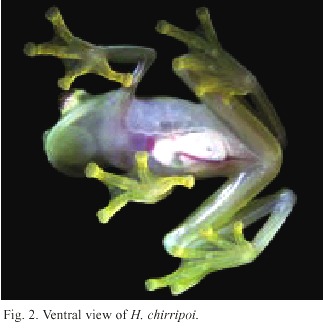
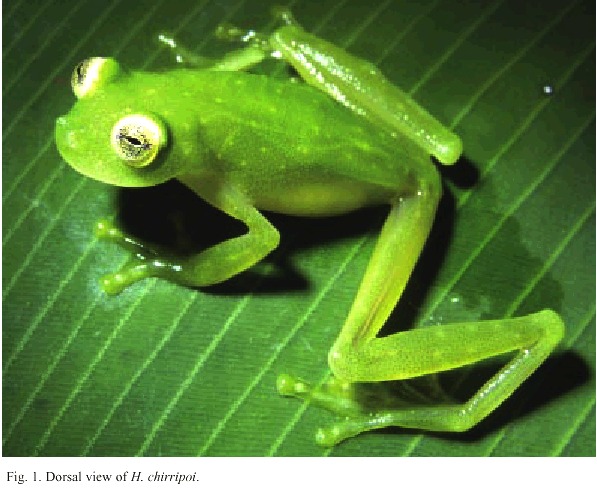
<body><![CDATA[<p><font face="Arial" size="2">The Suretka glass frog, <i>Hyalinobatrachium chirripo</i>i, has been recently rediscovered in the south-eastern region of Costa Rica. This species was last reported in Costa Rica in the 1950’s. <i>H. chirripoi </i>is distinguished from <i>H. colymbiphyllum, </i>which appears to be its most closely Costa Rican related taxon, by having extensive webbing between fingers II-III.</font></p>     <p><font face="Arial" size="2"><b>Key Words: </b>Anura, Centrolenidae, <i>Hyalinobatrachium chirripo</i>i, Costa Rica, glass frog.</font></p>     <p><font face="Arial" size="2">    <br> </font></p>     <p><font face="Arial" size="2">In 1954 Edward H. Taylor collected nine specimens of an unusual centrolenid frog near Suretka, Limón Province, Costa Rica. This form had nearly as extensive webbing between fingers II-III as between fingers III-IV. <a href="#ta58">Taylor (1958)</a> described these specimens as a new species, <i>Cochranella chirripo</i>i. Later this species was referred to the genus <i>Centrolenella </i>(<a  href="#go64">Goin 1964</a>), and in 1991 it was placed into the new, and currently recognized genus <i>Hyalinobatrachium </i>(<a href="#ru91">Ruiz-Carranza and Lynch 1991</a>). Since Taylor’s discovery in 1954 this frog has not been reported from Costa Rica until now (Savage pers. comm.). This species is also known from Panama (Ibáñez and Jaramillo 1997) and Colombia (<a href="#ha80">Hayes and Starrett 1980</a>).</font></p>     <p><font face="Arial" size="2">On July 15, 2001, I surveyed a tributary of the Río Banano, Limón Province, Costa Rica. The site consisted of a small lowland creek approximately 2-2.5 m wide, and with an average depth of 0.3-0.5 m. This creek originates in the nearby mountains and empties into one of the larger tributaries of the Río Banano. The habitats surrounding the creek were a mixture of secondary forest, abandoned cacao plantation, and disturbed open habitat. The area is defined as Tropical Moist Forest (Holdridge 1967), at an altitude of approximately 80 m.a.s.l.</font></p>     <p><font face="Arial" size="2">During the survey I encountered a small glass frog that strongly resembled H. <i>colymbiphyllum </i>both in appearance and call. Upon further observation this species was found to be common at the site. One calling male was collected (UCR 17066) from the underside of a palm leaf overhanging the water. Several other calling males and egg masses were seen on the vegetation along the creek. An amplectant pair was also observed moving among the leaves of a small shrub next to the creek.</font></p>     <p><font face="Arial" size="2">In life the collected specimen was lime green dorsally, with numerous small yellow spots (<a href="#f1">Fig. 1</a>). The venter was transparent, lacking white pigmentation in the parietal peritoneum. The liver, stomach, and intestinal tract were covered in a white visceral peritoneum. The pericardial peritoneum was transparent, and the red heart was visible (<a href="#f2">Fig. 2</a>). The absence of pigment in the parietal pericardium is characteristic of the chirripoi sub-group (Ruiz-Carranza and Lynch 1998). The webbing between fingers II-III is nearly as extensive as that between fingers III-IV, in agreement with Taylor’s (1958) description of <i>H. chirripo</i>i. The specimen (UCR 17066) has a snout-vent length of 25 mm. The bones in the living specimen were white. The female that was seen in amplexus had greenish-white eggs visible through the skin of the stomach and flanks.    <br> &nbsp;    <br> </font></p>     ]]></body>
<body><![CDATA[<p style="text-align: center;"><font face="Arial" size="2"><a name="f1"></a><img  src="/img/fbpe/rbt/v52n1/2629i1.JPG" title="" alt=""  style="width: 597px; height: 489px;"></font></p>     
<p style="text-align: center;"><font face="Arial" size="2">&nbsp;     <br> <a name="f2"></a><img src="/img/fbpe/rbt/v52n1/2629i2.JPG" title="" alt=""  style="width: 323px; height: 328px;"></font></p>     
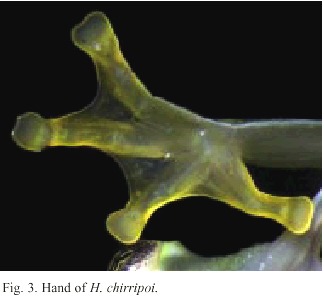
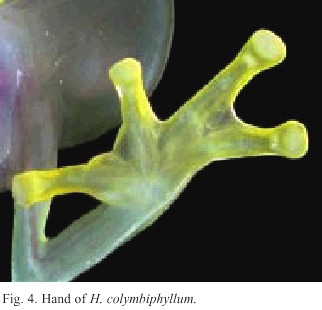
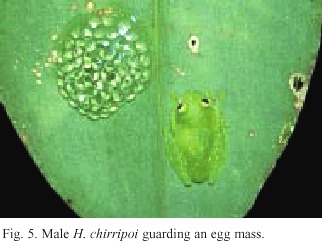
<p style="font-family: arial;"><font size="-1">&nbsp;<i>H. chirripoi </i>appears to be most closely related to <i>H. colymbiphyllum </i>among Costa Rican centrolenids. The over all appearance, calls, and ecology of these two species are very similar. I compared the specimen of H. <i>chirripo</i>i, to a H. <i>colymbiphyllum </i>(UCR 17082) I collected from Rincón de Osa, Puntarenas Province, Costa Rica. Coloration in life and other physical characteristics show little noticeable difference between the two apart from the webbing. <i>H. chirripoi </i>(<a href="#f3">Fig. 3</a>) has extensive webbing between fingers II-III, but <i>H. colymbiphyllum </i>(<a href="#f4">Fig. 4</a>) has little webbing between fingers II-III (Taylor 1949, and Starrett and Savage 1973). The only reliable differentiating feature, especially while working with live specimens in the field, is the difference in the finger webbing.</font></p>     <p style="text-align: center;"><font face="Arial" size="2">&nbsp;<a  name="f3"></a><img src="/img/fbpe/rbt/v52n1/2629i3.JPG" title="" alt=""  style="width: 324px; height: 300px;"></font></p>     
<p style="text-align: center;"><font face="Arial" size="2">&nbsp;<a  name="f4"></a><img src="/img/fbpe/rbt/v52n1/2629i4.JPG" title="" alt=""  style="width: 322px; height: 310px;"></font></p>     
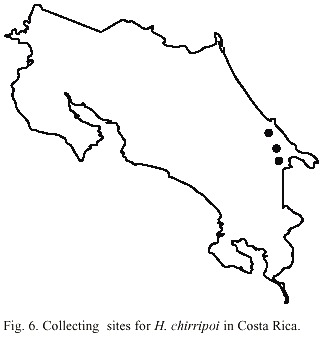
<p><font face="Arial" size="2">&nbsp;    <br> One other species of Costa Rican centrolenid, <i>H. pulveratu</i>m, also has extensive webbing between fingers II-III and III-IV. <i>H. pulveratum </i>is easily distinguished from <i>H. chirripoi </i>by having white pigment in its parietal pericardium. Some individuals of H. <i>fleischmanni </i>have a similar dorsal coloration to that of H. <i>chirripo</i>i, but H. <i>fleischmanni </i>is easily distinguished by the presence of white pigment in the parietal pericardium.</font></p>     <p><font face="Arial" size="2">H. <i>chirripoi </i>reproduces by laying greenish-white eggs in a single layer on the underside of smooth leaved plants overhanging streams. Males were most often seen calling from below palm fronds or other smooth leaves between 1-4 m above the water. Males were also seen calling from the upper sides of vegetation, but much less frequent. The previously unknown call of <i>H. chirripoi </i>(Savage 2002) is a high-pitched insect-like buzz, extremely similar to that of H. <i>colymbiphyllu</i>m. All observed egg masses had between 65-80 eggs, and were on the underside of leaves. One male was seen guarding eggs on July 15th, 2001 (<a href="#f5">Fig. 5</a>). I was not able to return the following morning to see if he was still present near the egg mass, but on a recent visit to the site a single male was observed guarding eggs during daylight hours.</font></p>     <p style="text-align: center;"><font face="Arial" size="2">&nbsp;<a  name="f5"></a><img src="/img/fbpe/rbt/v52n1/2629i5.JPG" title="" alt=""  style="width: 322px; height: 246px;"></font></p>     
]]></body>
<body><![CDATA[<p><font face="Arial" size="2">&nbsp;    <br> After finding the population near the Río Banano, I discovered H. <i>chirripoi </i>in another small stream in the Hitoy Cerere Biological Reserve, Limon Province, Costa Rica. A single male was seen calling from a height of 1.5 m, on a group of ginger plants (family Zingiberaceae) growing along the bank of the stream. This section of stream was disturbed open habitat. </font></p>     <p><font face="Arial" size="2">In a recent review of material at the University of Costa Rica, I found one misidentified specimen of <i>H. chirripoi </i>(UCR 11057), labeled <i>H. colymbiphyllu</i>m. The specimen is from the Hitoy Cerere Biological Reserve, and was collected in 1990. <i>H. chirripoi </i>is now known from three sites on the Atlantic versant of Costa Rica (<a href="#f6">Fig. 6</a>). </font></p>     <p style="text-align: center;"><font face="Arial" size="2">&nbsp;    <br> <a name="f6"></a><img src="/img/fbpe/rbt/v52n1/2629i6.JPG" title="" alt=""  style="width: 325px; height: 344px;"></font></p>     
<p><font face="Arial" size="2">&nbsp;    <br> At the Río Banano site <i>H. chirripoi </i>occurs sympatrically with H. <i>fleischmann</i>i, H. <i>valerio</i>i, and <i>Cochranella granulos</i>a. At the stream in the Hitoy Cerere Biological Reserve the only other species of centrolenid seen or heard was H. <i>valerioi.</i></font></p> <font face="Arial" size="2"><b>     <p>    <br> </p>     <p>Acknowledgments</p> </b> </font>     ]]></body>
<body><![CDATA[<p><font face="Arial" size="2">I would like to thank Jay Savage, Karen Lips, Robert Puschendorf, and Andrew Crawford for comments on early versions of the manuscript. For allowing me access to specimens and collection data at the Museum of Zoology, University of Costa Rica I am also very grateful to Federico Bolaños and Gerardo Chavez. </font></p> <font face="Arial" size="2"><b>     <p>    <br> </p>     <p>Resumen</p> </b> </font>     <p><font face="Arial" size="2">La rana de vidrio de Suretka, <i>Hyalinobatrachium chirripoi, </i>fue redescubierta recientamente en la región sureste de Costa Rica. Esta especie fue reportada por última vez en Costa Rica en los años cincuentas. <i>H. Chirripoi </i>puede ser distinguida de <i>H. colymbiphyllu</i>m, la rana de vidrio costarricense a la que más se le asemeja, por la presencia de membranas extensivas entre dedos II-III.</font></p> <font face="Arial" size="2"><b>     <p>    <br> </p>     <p>References</p> </b> </font>     <!-- ref --><p><font face="Arial" size="2"><a name="go64"></a>Goin, C. 1964. Distribution and synonymy of <i>Centrolenella fleischmanni </i>in northern South America. Herpetological 20(1): 1-8.</font>&nbsp;&nbsp;&nbsp;&nbsp;&nbsp;&nbsp;&nbsp;&nbsp;[&#160;<a href="javascript:void(0);" onclick="javascript: window.open('/scielo.php?script=sci_nlinks&ref=1303952&pid=S0034-7744200400010002800001&lng=','','width=640,height=500,resizable=yes,scrollbars=1,menubar=yes,');">Links</a>&#160;]<!-- end-ref --><!-- ref --><p><font face="Arial" size="2"><a name="ha80"></a>Hayes, M.P. &amp; P.H. Starrett. 1980. Notes on a collection of centrolenid frogs from the Colombian Chocó. Bull. South. Calif. Acad. Sci. 79(3): 89-96.</font>&nbsp;&nbsp;&nbsp;&nbsp;&nbsp;&nbsp;&nbsp;&nbsp;[&#160;<a href="javascript:void(0);" onclick="javascript: window.open('/scielo.php?script=sci_nlinks&ref=1303953&pid=S0034-7744200400010002800002&lng=','','width=640,height=500,resizable=yes,scrollbars=1,menubar=yes,');">Links</a>&#160;]<!-- end-ref --><!-- ref --><p><font face="Arial" size="2"><a name="ho67"></a>Holdridge, L.R. 1967. Life Zone Ecology. Rev. ed. San José: Tropical Science Center.    &nbsp;&nbsp;&nbsp;&nbsp;&nbsp;&nbsp;&nbsp;&nbsp;[&#160;<a href="javascript:void(0);" onclick="javascript: window.open('/scielo.php?script=sci_nlinks&ref=1303954&pid=S0034-7744200400010002800003&lng=','','width=640,height=500,resizable=yes,scrollbars=1,menubar=yes,');">Links</a>&#160;]<!-- end-ref --><!-- ref --> Ibáñez, R.D. &amp; C.A. Jaramillo. 1997. Geographical distribution <i>Hyalinobatrachium chirripo</i>i. Herp. Rev. 28(1): 48.</font>&nbsp;&nbsp;&nbsp;&nbsp;&nbsp;&nbsp;&nbsp;&nbsp;[&#160;<a href="javascript:void(0);" onclick="javascript: window.open('/scielo.php?script=sci_nlinks&ref=1303955&pid=S0034-7744200400010002800004&lng=','','width=640,height=500,resizable=yes,scrollbars=1,menubar=yes,');">Links</a>&#160;]<!-- end-ref --><!-- ref --><p><font face="Arial" size="2"><a name="ru91"></a>Ruiz-Carranza, P.M. &amp; J.D. Lynch. 1991. Ranas Centrolenidae de Colombia I, propuesta de una nueva classificación genérica. Lozania 57: 1-30.</font>&nbsp;&nbsp;&nbsp;&nbsp;&nbsp;&nbsp;&nbsp;&nbsp;[&#160;<a href="javascript:void(0);" onclick="javascript: window.open('/scielo.php?script=sci_nlinks&ref=1303956&pid=S0034-7744200400010002800005&lng=','','width=640,height=500,resizable=yes,scrollbars=1,menubar=yes,');">Links</a>&#160;]<!-- end-ref --><!-- ref --><p><font face="Arial" size="2"><a name="ru98"></a>Ruiz-Carranza, P.M. &amp; J.D. Lynch. 1998. Ranas Centrolenidae de Colombia XI. Nuevas especies de ranas cristal del género <i>HYALINOBATRACHIUM. </i>Rev. Acad. Colomb. Cien. Exact. Físic. Nat. 22(85): 571-586.</font>&nbsp;&nbsp;&nbsp;&nbsp;&nbsp;&nbsp;&nbsp;&nbsp;[&#160;<a href="javascript:void(0);" onclick="javascript: window.open('/scielo.php?script=sci_nlinks&ref=1303957&pid=S0034-7744200400010002800006&lng=','','width=640,height=500,resizable=yes,scrollbars=1,menubar=yes,');">Links</a>&#160;]<!-- end-ref --><!-- ref --><p><font face="Arial" size="2"><a name="sa02"></a>Savage, J.M. 2002. The Amphibians and Reptiles of Costa Rica. A Herpetofauna Between Two Continents, and Two Seas. The University of Chicago, Chicago, USA. 934 p.</font>&nbsp;&nbsp;&nbsp;&nbsp;&nbsp;&nbsp;&nbsp;&nbsp;[&#160;<a href="javascript:void(0);" onclick="javascript: window.open('/scielo.php?script=sci_nlinks&ref=1303958&pid=S0034-7744200400010002800007&lng=','','width=640,height=500,resizable=yes,scrollbars=1,menubar=yes,');">Links</a>&#160;]<!-- end-ref --><!-- ref --><p><font face="Arial" size="2"><a name="sr73"></a>Starrett, P.H. &amp; J.M. Savage. 1973. The systematic status and distribution of Costa Rican glass-frogs, genus <i>Centrolenella </i>(Family Centrolenidae), with description of a new species. Bull. South. Calif. Acad. Sci. 72: 57-78.</font>&nbsp;&nbsp;&nbsp;&nbsp;&nbsp;&nbsp;&nbsp;&nbsp;[&#160;<a href="javascript:void(0);" onclick="javascript: window.open('/scielo.php?script=sci_nlinks&ref=1303959&pid=S0034-7744200400010002800008&lng=','','width=640,height=500,resizable=yes,scrollbars=1,menubar=yes,');">Links</a>&#160;]<!-- end-ref --><!-- ref --><p><font face="Arial" size="2"><a name="ta49"></a>Taylor, E.H. 1949. Costa Rican frogs of the genera <i>Centrolene </i>and <i>Centrolenella. </i>Univ. Kansas Sci. Bull. 33: 257-270.</font>&nbsp;&nbsp;&nbsp;&nbsp;&nbsp;&nbsp;&nbsp;&nbsp;[&#160;<a href="javascript:void(0);" onclick="javascript: window.open('/scielo.php?script=sci_nlinks&ref=1303960&pid=S0034-7744200400010002800009&lng=','','width=640,height=500,resizable=yes,scrollbars=1,menubar=yes,');">Links</a>&#160;]<!-- end-ref --><!-- ref --><p><font face="Arial" size="2"><a name="ta58"></a>Taylor, E.H. 1958. Notes on Costa Rican Centrolenidae with descriptions of new forms. Univ. Kansas Sci. Bull. 39(2): 41-68.</font>&nbsp;&nbsp;&nbsp;&nbsp;&nbsp;&nbsp;&nbsp;&nbsp;[&#160;<a href="javascript:void(0);" onclick="javascript: window.open('/scielo.php?script=sci_nlinks&ref=1303961&pid=S0034-7744200400010002800010&lng=','','width=640,height=500,resizable=yes,scrollbars=1,menubar=yes,');">Links</a>&#160;]<!-- end-ref --> ]]></body><back>
<ref-list>
<ref id="B1">
<nlm-citation citation-type="journal">
<person-group person-group-type="author">
<name>
<surname><![CDATA[Goin]]></surname>
<given-names><![CDATA[C.]]></given-names>
</name>
</person-group>
<article-title xml:lang="en"><![CDATA[Distribution and synonymy of Centrolenella fleischmanni in northern South America]]></article-title>
<source><![CDATA[Herpetological]]></source>
<year>1964</year>
<volume>20</volume>
<numero>1</numero>
<issue>1</issue>
<page-range>1-8</page-range></nlm-citation>
</ref>
<ref id="B2">
<nlm-citation citation-type="journal">
<person-group person-group-type="author">
<name>
<surname><![CDATA[Hayes]]></surname>
<given-names><![CDATA[M.P.]]></given-names>
</name>
<name>
<surname><![CDATA[Starrett]]></surname>
<given-names><![CDATA[P.H.]]></given-names>
</name>
</person-group>
<article-title xml:lang="en"><![CDATA[Notes on a collection of centrolenid frogs from the Colombian Chocó]]></article-title>
<source><![CDATA[Bull. South. Calif. Acad. Sci]]></source>
<year>1980</year>
<volume>79</volume>
<numero>3</numero>
<issue>3</issue>
<page-range>89-96</page-range></nlm-citation>
</ref>
<ref id="B3">
<nlm-citation citation-type="journal">
<person-group person-group-type="author">
<name>
<surname><![CDATA[Holdridge]]></surname>
<given-names><![CDATA[L.R.]]></given-names>
</name>
</person-group>
<article-title xml:lang="es"><![CDATA[Life Zone Ecology]]></article-title>
<source><![CDATA[Rev. ed. San José]]></source>
<year>1967</year>
<numero>Tropical Science Center</numero>
<issue>Tropical Science Center</issue>
</nlm-citation>
</ref>
<ref id="B4">
<nlm-citation citation-type="journal">
<person-group person-group-type="author">
<name>
<surname><![CDATA[Ibáñez]]></surname>
<given-names><![CDATA[R.D.]]></given-names>
</name>
<name>
<surname><![CDATA[Jaramillo]]></surname>
<given-names><![CDATA[C.A.]]></given-names>
</name>
</person-group>
<article-title xml:lang="en"><![CDATA[Geographical distribution Hyalinobatrachium chirripoi]]></article-title>
<source><![CDATA[Herp. Rev]]></source>
<year>1997</year>
<volume>28</volume>
<numero>1</numero>
<issue>1</issue>
<page-range>48</page-range></nlm-citation>
</ref>
<ref id="B5">
<nlm-citation citation-type="journal">
<person-group person-group-type="author">
<name>
<surname><![CDATA[Ruiz-Carranza]]></surname>
<given-names><![CDATA[P.M.]]></given-names>
</name>
<name>
<surname><![CDATA[Lynch]]></surname>
<given-names><![CDATA[J.D.]]></given-names>
</name>
</person-group>
<article-title xml:lang="es"><![CDATA[Ranas Centrolenidae de Colombia I, propuesta de una nueva classificación genérica]]></article-title>
<source><![CDATA[Lozania]]></source>
<year>1991</year>
<volume>57</volume>
<page-range>1-30</page-range></nlm-citation>
</ref>
<ref id="B6">
<nlm-citation citation-type="journal">
<person-group person-group-type="author">
<name>
<surname><![CDATA[Ruiz-Carranza]]></surname>
<given-names><![CDATA[P.M.]]></given-names>
</name>
<name>
<surname><![CDATA[Lynch]]></surname>
<given-names><![CDATA[J.D.]]></given-names>
</name>
</person-group>
<article-title xml:lang="es"><![CDATA[Ranas Centrolenidae de Colombia XI: Nuevas especies de ranas cristal del género HYALINOBATRACHIUM]]></article-title>
<source><![CDATA[Rev. Acad. Colomb. Cien. Exact. Físic. Nat]]></source>
<year>1998</year>
<volume>22</volume>
<numero>85</numero>
<issue>85</issue>
<page-range>571-586</page-range></nlm-citation>
</ref>
<ref id="B7">
<nlm-citation citation-type="book">
<person-group person-group-type="author">
<name>
<surname><![CDATA[Savage]]></surname>
<given-names><![CDATA[J.M.]]></given-names>
</name>
</person-group>
<source><![CDATA[The Amphibians and Reptiles of Costa Rica: A Herpetofauna Between Two Continents, and Two Seas]]></source>
<year>2002</year>
<publisher-loc><![CDATA[Chicago ]]></publisher-loc>
<publisher-name><![CDATA[The University of Chicago]]></publisher-name>
</nlm-citation>
</ref>
<ref id="B8">
<nlm-citation citation-type="journal">
<person-group person-group-type="author">
<name>
<surname><![CDATA[Starrett]]></surname>
<given-names><![CDATA[P.H.]]></given-names>
</name>
<name>
<surname><![CDATA[Savage]]></surname>
<given-names><![CDATA[J.M.]]></given-names>
</name>
</person-group>
<article-title xml:lang="en"><![CDATA[The systematic status and distribution of Costa Rican glass-frogs, genus Centrolenella (Family Centrolenidae), with description of a new species]]></article-title>
<source><![CDATA[Bull. South. Calif. Acad. Sci]]></source>
<year>1973</year>
<volume>72</volume>
<page-range>57-78</page-range></nlm-citation>
</ref>
<ref id="B9">
<nlm-citation citation-type="journal">
<person-group person-group-type="author">
<name>
<surname><![CDATA[Taylor]]></surname>
<given-names><![CDATA[E.H.]]></given-names>
</name>
</person-group>
<article-title xml:lang="en"><![CDATA[Costa Rican frogs of the genera Centrolene and Centrolenella]]></article-title>
<source><![CDATA[Univ. Kansas Sci. Bull]]></source>
<year>1949</year>
<volume>33</volume>
<page-range>257-270</page-range></nlm-citation>
</ref>
<ref id="B10">
<nlm-citation citation-type="journal">
<person-group person-group-type="author">
<name>
<surname><![CDATA[Taylor]]></surname>
<given-names><![CDATA[E.H.]]></given-names>
</name>
</person-group>
<article-title xml:lang="en"><![CDATA[Notes on Costa Rican Centrolenidae with descriptions of new forms]]></article-title>
<source><![CDATA[Univ. Kansas Sci. Bull]]></source>
<year>1958</year>
<volume>39</volume>
<numero>2</numero>
<issue>2</issue>
<page-range>41-68</page-range></nlm-citation>
</ref>
</ref-list>
</back>
</article>