<?xml version="1.0" encoding="ISO-8859-1"?><article xmlns:mml="http://www.w3.org/1998/Math/MathML" xmlns:xlink="http://www.w3.org/1999/xlink" xmlns:xsi="http://www.w3.org/2001/XMLSchema-instance">
<front>
<journal-meta>
<journal-id>0034-7744</journal-id>
<journal-title><![CDATA[Revista de Biología Tropical]]></journal-title>
<abbrev-journal-title><![CDATA[Rev. biol. trop]]></abbrev-journal-title>
<issn>0034-7744</issn>
<publisher>
<publisher-name><![CDATA[Universidad de Costa Rica]]></publisher-name>
</publisher>
</journal-meta>
<article-meta>
<article-id>S0034-77442004000100023</article-id>
<title-group>
<article-title xml:lang="en"><![CDATA[Gill asymmetry in Labeo ogunensis from Ogun river, Southwest Nigeria]]></article-title>
</title-group>
<contrib-group>
<contrib contrib-type="author">
<name>
<surname><![CDATA[Ayoade]]></surname>
<given-names><![CDATA[A.A.]]></given-names>
</name>
<xref ref-type="aff" rid="A01"/>
</contrib>
<contrib contrib-type="author">
<name>
<surname><![CDATA[Sowunmi]]></surname>
<given-names><![CDATA[A.A.]]></given-names>
</name>
<xref ref-type="aff" rid="A02"/>
</contrib>
<contrib contrib-type="author">
<name>
<surname><![CDATA[Nwachukwu]]></surname>
<given-names><![CDATA[H.I.]]></given-names>
</name>
<xref ref-type="aff" rid="A01"/>
</contrib>
</contrib-group>
<aff id="A01">
<institution><![CDATA[,University of Ibadan Department of Zoology Hydrobiology and Fisheries Unit]]></institution>
<addr-line><![CDATA[ ]]></addr-line>
<country>Nigeria</country>
</aff>
<aff id="A02">
<institution><![CDATA[,Olabisi Onabanjo University Biological Sciences Department ]]></institution>
<addr-line><![CDATA[ ]]></addr-line>
<country>Nigeria</country>
</aff>
<pub-date pub-type="pub">
<day>00</day>
<month>03</month>
<year>2004</year>
</pub-date>
<pub-date pub-type="epub">
<day>00</day>
<month>03</month>
<year>2004</year>
</pub-date>
<volume>52</volume>
<numero>1</numero>
<fpage>171</fpage>
<lpage>175</lpage>
<copyright-statement/>
<copyright-year/>
<self-uri xlink:href="http://www.scielo.sa.cr/scielo.php?script=sci_arttext&amp;pid=S0034-77442004000100023&amp;lng=en&amp;nrm=iso"></self-uri><self-uri xlink:href="http://www.scielo.sa.cr/scielo.php?script=sci_abstract&amp;pid=S0034-77442004000100023&amp;lng=en&amp;nrm=iso"></self-uri><self-uri xlink:href="http://www.scielo.sa.cr/scielo.php?script=sci_pdf&amp;pid=S0034-77442004000100023&amp;lng=en&amp;nrm=iso"></self-uri><abstract abstract-type="short" xml:lang="en"><p><![CDATA[Fluctuating asymmetry (FA), often used as indicator of environmental stress, was evaluated in gill rakers and filaments of Labeo ogunensis from Ogun river, Southwest Nigeria. Mean length and weight of 13.68+1.28 cm and 59.40+17.48 g were respectively recorded. The gill rakers (t = -0.919) and filaments (t = -1.150) from both sides were not significantly different. The gill filaments recorded (0.31+2.42) higher incidence of fluctuating asymmetry (FA) compared with the gill rakers (0.21+1.58), signifying developmental interference in the population. Fish size and sex were observed to exert minimal influence on FA]]></p></abstract>
<abstract abstract-type="short" xml:lang="en"><p><![CDATA[Fluctuating asymmetry (FA), often used as indicator of environmental stress, was evaluated in gill rakers and filaments of Labeo ogunensis from Ogun river, Southwest Nigeria. Mean length and weight of 13.68+1.28 cm and 59.40+17.48 g were respectively recorded. The gill rakers (t = -0.919) and filaments (t = -1.150) from both sides were not significantly different. The gill filaments recorded (0.31+2.42) higher incidence of fluctuating asymmetry (FA) compared with the gill rakers (0.21+1.58), signifying developmental interference in the population. Fish size and sex were observed to exert minimal influence on FA]]></p></abstract>
<kwd-group>
<kwd lng="en"><![CDATA[gills]]></kwd>
<kwd lng="en"><![CDATA[rakers]]></kwd>
<kwd lng="en"><![CDATA[filaments]]></kwd>
<kwd lng="en"><![CDATA[asymmetry]]></kwd>
<kwd lng="en"><![CDATA[Nigeria]]></kwd>
</kwd-group>
</article-meta>
</front><body><![CDATA[ <div style="text-align: center;"><b><font face="Arial">Gill asymmetry in </font></b><font face="Arial"><i>Labeo ogunensis </i><b>from Ogun river, Southwest Nigeria</b></font></div> <font face="Arial" size="2"> </font>     <p><font face="Arial" size="2">    <br> </font></p>     <p><font face="Arial" size="2">A.A. Ayoade<sup><a name="1"></a><a  href="#2">1</a></sup> , A.A. Sowunmi<sup><a href="#2">*</a><a href="#2">2</a></sup> &amp; H.I. Nwachukwu<a href="#2"><sup>1</sup></a></font></p>     <p><font face="Arial" size="2"><a name="2"></a><a href="#1">1</a> Hydrobiology and Fisheries Unit, Department of Zoology, University of Ibadan , Nigeria.</font></p>     <p><font face="Arial" size="2"><a href="#1">2</a> Biological Sciences Department, Olabisi Onabanjo University, P.M.B.2002, Ago-Iwoye. Nigeria.</font></p>     <p><font face="Arial" size="2"><a href="#1">*</a> corresponding author: <a href="mailto:dayolegba@yahoo.co.uk">dayolegba@yahoo.co.uk</a></font></p>     <p style="text-align: center;"><font face="Arial" size="2">    <br> </font></p>     <p style="text-align: center;"><font face="Arial" size="2">Received 13-II-2002.&nbsp;&nbsp;&nbsp;&nbsp; Corrected 19-VIII-2003.&nbsp;&nbsp;&nbsp;&nbsp;&nbsp; Accepted 24-X-2003.</font></p> <font face="Arial" size="2"><b>     ]]></body>
<body><![CDATA[<p>    <br> </p>     <p>Abstract</p> </b></font>     <p><font face="Arial" size="2">Fluctuating asymmetry (FA), often used as indicator of environmental stress, was evaluated in gill rakers and filaments of <i>Labeo ogunensis </i>from Ogun river, Southwest Nigeria. Mean length and weight of 13.68+1.28 cm and 59.40+17.48 g were respectively recorded. The gill rakers (t = -0.919) and filaments (t = -1.150) from both sides were not significantly different. The gill filaments recorded (0.31+2.42) higher incidence of fluctuating asymmetry (FA) compared with the gill rakers (0.21+1.58), signifying developmental interference in the population. Fish size and sex were observed to exert minimal influence on FA.</font></p>     <p><font face="Arial" size="2"><b>Keywords: </b>gills, rakers, filaments, asymmetry, Nigeria.</font></p>     <p><font face="Arial" size="2">    <br> </font></p>     <p><font face="Arial" size="2">    <br> Fluctuating asymmetry (FA), the most widely used measure of developmental stability, is the random departure from perfect bilateral symmetry. This deviation results either from genetic or environmental stress (<a href="#va62">Van Valen 1962</a>, <a href="#pa86">Palmer and Strobeck 1986</a>, <a href="#gr93">Graham <i>et a</i>l. 1993</a>). The inherent ability to regulate development and to faithfully produce the genetically dictated phenotypes under environmental stress is generally referred to developmental stability. FAtherefore measures developmental stability (<a href="#va62">Van Valen 1962</a>). The need for simple monitoring methods for ecosystem has been greatly stressed, and many models have been proposed as biomarkers for stress responses. FA has a prime attribute of indicating environmental stress at early stages or sub-analytical concentrations, before manifesting at community or ecosystem levels due to incorporation of homeostasis (<a  href="#gr93">Graham <i>et a</i>l. 1993</a>). This was perhaps responsible for its been highly recommended for ecosystem monitoring (<a  href="#ge80">GESAMP 1980</a>).</font></p>     <p><font face="Arial" size="2">Ogun river is one of the perennial rivers in Nigeria with characteristics synchronizing typical tropical climate. It has coordinates of 3º28’’E and 8º41’’N from its source in Oyo state to 3º25’’E and 6º35’’N in Lagos where it enters the Lagos lagoon. <a href="#ad81">Adebisi (1981)</a> gave a detailed description of its hydrology. In areas of high population density the river is used for domestic purposes such as bathing, washing and drinking also acting as sink to mostly organic wastes from abattoirs located along the course. This paper seeks to provide information on FA in gills small sample of <i>Labeo ogunensis </i>(Boulenger) as indicator of environmental stress.</font></p> <font face="Arial" size="2"><b>     ]]></body>
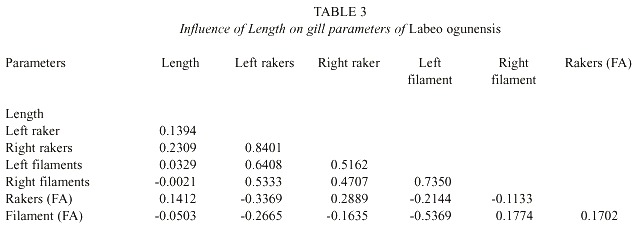
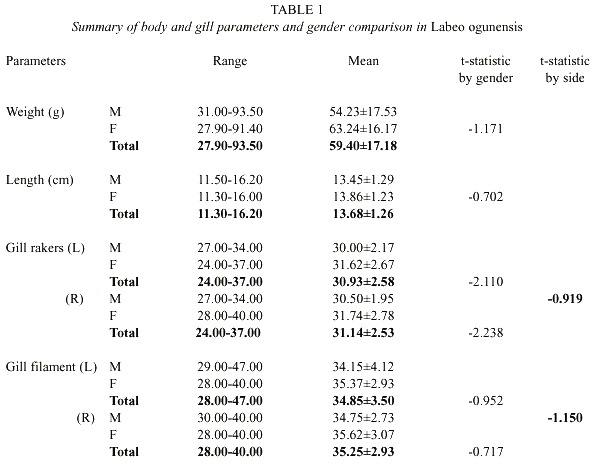
<body><![CDATA[<p>    <br> </p>     <p>Materials and methods</p> </b> </font><font face="Arial" size="2">The gills from both sides of the head were extracted from 47 fish specimens of <i>L. ogunensis </i>and examined according to <a href="#lu77">Lucky (1977)</a>. The gill length were measured and meristic counts of gill rakers and filaments on each arch were counted under microscope (<a href="#ki92">Kisia and Hughes 1992</a>). Gills extracted were analyzed same day to avoid shrinkage (<a href="#hu95">Hughes 1995</a>). The gender, standard length and body weight were also determined for each specimens. Gender comparison and relationship between gill meristics from both sides were determined using T-student’s test (<a href="#so87">Sokal and Rohlf 1987</a>). FA was estimated from difference between values of traits on the right and left sides as A<sub>i</sub> = |R<sub>i </sub>—L<sub>i</sub> | (<a  href="#pa86">Palmer and Strobeck 1986</a>, <a href="#gr93">Graham <i>et a</i>l. 1993</a>). Relationships between body and gill characteristics were explored using Pearson’s and Partial correlations (<a href="#so87">Sokal and Rohlf 1987</a>, <a href="#mi99">Milton 1999</a>).</font> <font face="Arial" size="2"><b>     <p>Results</p> </b> </font>     <p><font face="Arial" size="2">The summary of weight, length, gill meristics for indivdual sexes and the total in <i>L. ogunensis </i>is shown on <a href="#t1">Table 1</a>. Results of t-test between the sexes, the right and left gill meristics is also presented. The females had higher mean weight compared with males but negligible length differences. The t-test however indicated no significant differences between sexes. There were no significant differences between right and left gill rakers or filaments. However, males have higher gill raker counts compared with males; the reverse was however observed in the filaments. Acomparison of gill rakers and filaments on gender basis indicated no significant differences<i>.</i></font></p>     <div style="text-align: center;"><a name="t1"></a><img alt=""  src="/img/fbpe/rbt/v52n1/2624i1.JPG" style="width: 596px; height: 465px;">    
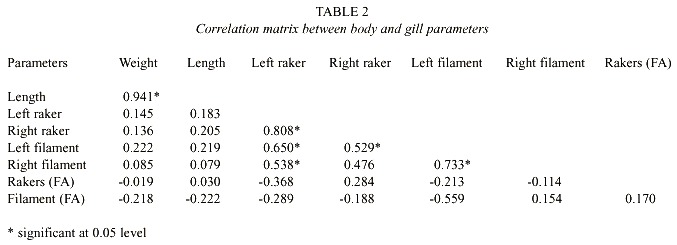
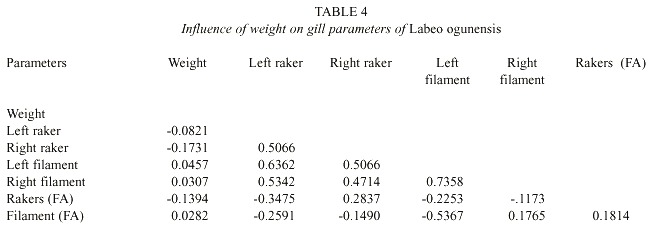
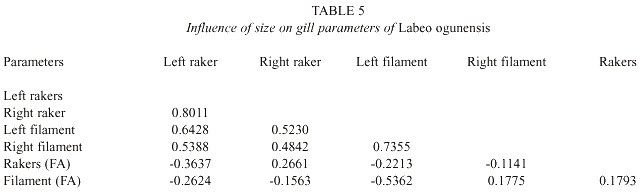
<br> </div>     <br>     <p><font face="Arial" size="2">Pearson’s correlations showed two levels of significance: between weight and length and between gill meristics (<a  href="#t2">Table 2</a>). Partial correlations indicated that length has more influence on gill meristics compared with weight (<a href="#t3">Tables 3</a> and <a href="#t4">4</a>); while the absence of both parameters does not greatly affect interaction between gill parameters (<a  href="#t5">Table 5</a>).</font></p>     <p style="text-align: center;"><font face="Arial" size="2">&nbsp;<a  name="t2"></a><img alt="" src="/img/fbpe/rbt/v52n1/2624i2.JPG"  style="width: 677px; height: 245px;"></font></p>     
]]></body>
<body><![CDATA[<p style="text-align: center;"><font face="Arial" size="2">&nbsp;<a  name="t3"></a><img alt="" src="/img/fbpe/rbt/v52n1/2624i3.JPG"  style="width: 637px; height: 229px;"></font></p>     
<p align="center"><font face="Arial" size="2"><a name="t4"></a><img  alt="" src="/img/fbpe/rbt/v52n1/2624i4.JPG" style="width: 650px; height: 232px;">    
<br> <a name="t5"></a><img alt="" src="/img/fbpe/rbt/v52n1/2624i5.JPG"  style="width: 641px; height: 196px;">    
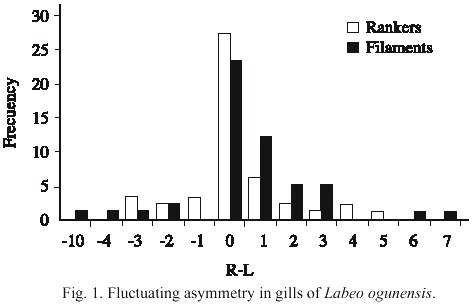
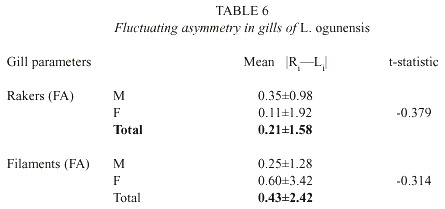
<br> </font></p> <font face="Arial" size="2">The level of FA in gill rakers and filaments is presented in <a href="#f1">Figure 1</a>. The rakers exhibited lower asymmetry compared with the filaments. The males had higher mean asymmetry for the gill rakers while the females recorded had for filaments. t-test indicated no significant differences between the sexes (<a href="#t6">Table 6</a>). The gill filaments recorded higher mean asymmetry compared with rakers. </font>     <p style="text-align: center;"><font face="Arial" size="2">&nbsp;<a  name="f1"></a><img alt="" src="/img/fbpe/rbt/v52n1/2624i7.JPG"  style="width: 473px; height: 308px;"></font></p>     
<p style="text-align: center;"><font face="Arial" size="2">&nbsp;<a  name="t6"></a><img alt="" src="/img/fbpe/rbt/v52n1/2624i6.JPG"  style="width: 445px; height: 209px;"></font></p> <font face="Arial" size="2"><b>     
<p>    <br> Discussion</p> </b> </font>     <p><font face="Arial" size="2">Fluctuating asymmetry reflects the inability of the organism to perfectly control its development and this has been proposed as a measure of developmental stability (<a  href="#va62">Van Valen 1962</a>, <a href="#fe80">Felley 1980</a>). The FA observed in both the gill rakers and filaments of <i>L. ogunensis </i>agreed with earlier studies involving fish species from different water bodies (<a href="#fe80">Felley 1980</a>, <a  href="#be85">Bengtsson <i>et a</i>l. 1985</a>, <a href="#gr93">Graham <i>et a</i>l. 1993</a>, <a href="#so04">Sowunmi 2004</a>) where varying degrees of FA were observed in response to environmental stress. Our results were able to compare asymmetry in two structures: gill rakers and filaments, on the same bilateral organ. This differs greatly from the common practice, of similar organs at different parts of the body as observed in studies using fins (<a href="#fe80">Felley 1980</a>, <a href="#be85">Bengtsson <i>et a</i>l. 1985</a>).</font></p>     <p><font face="Arial" size="2">Since development proceeds on the basis of the same genotype under essentially identical conditions, developmental instability will be observed, according to <a  href="#za90">Zakharov and Yablokov (1990)</a> and <a href="#gr93">Graham <i>et a</i>l. (1993)</a>, when population has been living under environmental stress. Jobling (1995) stated clearly that different parts of the gill are under similar genetic control, therefore the varied susceptibility could have arisen only from developmental interference capable of manifesting at microconcetrations or at submorbidity levels. Two possible origins have been implicated in asymmetry: genetic (endogenous) and environmental (exogenous). Exogenous influence was clearly manifest in this study (<a href="#be85">Bengtsson <i>et a</i>l. 1985</a>, <a href="#gr93">Graham <i>et a</i>l. 1993</a>). </font></p>     ]]></body>
<body><![CDATA[<p><font face="Arial" size="2">The filaments were found more sensitive on the basis of frequency of FA occurrence, contrary to patterns observed for <i>Oreochromis niloticus </i>and <i>Clarias gariepinus </i>(Sowunmi in press) where gill rakers exhibited higher FA, earlier workers did not make such comparison. The implication of this is that different parts of the gill exhibit varying susceptibility depending on the species and not necessarily types of stressors. Fish gills will probably be a better indicator of stress compared with other bilaterally symmetrical structures in fish. The gender influence in this study was considered minimal as most developmental interference did not appear sex dependent, it is important to note gender influence in fishes has not been earlier considered. The varied levels of correlations obtained showed that while correlations were observed between length and gill size, the pattern of asymmetry is not dependent on the size parameters vis: weight and length.</font></p>     <p><font face="Arial" size="2">FA has been extensively used in many studies as acknowledged by literature, and highly recommended for environmental monitoring (<a href="#ge80">GESAMP 1980</a>) as simple and more reliable indicator of environmental perturbations compared with other indices because it detects perturbation and concentration considered non-harmful (<a href="#gr93">Graham <i>et a</i>l. 1993</a>). Despite these advantages, it does not have widespread application, and information on FA pattern in tropical fish species is absent.</font></p> <font face="Arial" size="2"><b>     <p>    <br> </p>     <p>Resumen</p> </b> </font>     <p><font face="Arial" size="2">Fluctuating asymmetry (FA), often used as indicator of environmental stress, was evaluated in gill rakers and filaments of <i>Labeo ogunensis </i>from Ogun river, Southwest Nigeria. Mean length and weight of 13.68+1.28 cm and 59.40+17.48 g were respectively recorded. The gill rakers (t = -0.919) and filaments (t = -1.150) from both sides were not significantly different. The gill filaments recorded (0.31+2.42) higher incidence of fluctuating asymmetry (FA) compared with the gill rakers (0.21+1.58), signifying developmental interference in the population. Fish size and sex were observed to exert minimal influence on FA.</font></p> <font face="Arial" size="2"><b>     <p>    <br> </p>     <p>References</p> </b> </font>     <!-- ref --><p><font face="Arial" size="2"><a name="ad81"></a></font><font  face="Arial" size="2">Adebisi, A.A. 1981 The physico-chemical hydrology of tropical seasonal river-upper Ogun river. Hydrobiologia 79: 157-165.</font>&nbsp;&nbsp;&nbsp;&nbsp;&nbsp;&nbsp;&nbsp;&nbsp;[&#160;<a href="javascript:void(0);" onclick="javascript: window.open('/scielo.php?script=sci_nlinks&ref=1300123&pid=S0034-7744200400010002300001&lng=','','width=640,height=500,resizable=yes,scrollbars=1,menubar=yes,');">Links</a>&#160;]<!-- end-ref --><!-- ref --><p><font face="Arial" size="2"><a name="be85"></a></font><font  face="Arial" size="2">Bengtsson, B-E., Å. Bengtsson &amp; M. Himberg. 1985 Fish deformities and pollution in some Swedish waters. Ambio 14(1): 32-35.</font>&nbsp;&nbsp;&nbsp;&nbsp;&nbsp;&nbsp;&nbsp;&nbsp;[&#160;<a href="javascript:void(0);" onclick="javascript: window.open('/scielo.php?script=sci_nlinks&ref=1300124&pid=S0034-7744200400010002300002&lng=','','width=640,height=500,resizable=yes,scrollbars=1,menubar=yes,');">Links</a>&#160;]<!-- end-ref --><!-- ref --><p><font face="Arial" size="2"><a name="fe80"></a></font><font  face="Arial" size="2">Felley, J. 1980 Analysis of morphology and asymmetry in bluegill sunfish <i>(Lepomis macrochiru</i>s) in the Southeastern United States. Copeia 1: 18-29. </font>&nbsp;&nbsp;&nbsp;&nbsp;&nbsp;&nbsp;&nbsp;&nbsp;[&#160;<a href="javascript:void(0);" onclick="javascript: window.open('/scielo.php?script=sci_nlinks&ref=1300125&pid=S0034-7744200400010002300003&lng=','','width=640,height=500,resizable=yes,scrollbars=1,menubar=yes,');">Links</a>&#160;]<!-- end-ref --><!-- ref --><p><font face="Arial" size="2"><a name="ge80"></a></font><font  face="Arial" size="2">GESAMP. 1980 Monitoring biological variables related to marine pollution. Rep. Stud. 12: 8-10.</font>&nbsp;&nbsp;&nbsp;&nbsp;&nbsp;&nbsp;&nbsp;&nbsp;[&#160;<a href="javascript:void(0);" onclick="javascript: window.open('/scielo.php?script=sci_nlinks&ref=1300126&pid=S0034-7744200400010002300004&lng=','','width=640,height=500,resizable=yes,scrollbars=1,menubar=yes,');">Links</a>&#160;]<!-- end-ref --><!-- ref --><p><font face="Arial" size="2"><a name="gr93"></a></font><font  face="Arial" size="2">Graham, J.H., D.C. Freeman &amp; J.M. Emleen 1993 Developmental stability: A sensitive indicator of populations under stress. <i>In </i>W.G. Landis, J.S. Hughes &amp; M.A. Lewis. (eds.). pp. 136-158. Environmental Toxicology and Risk Assessment, ASTM STP 1179, American Society for Testing and Materials, Philadelphia.</font>&nbsp;&nbsp;&nbsp;&nbsp;&nbsp;&nbsp;&nbsp;&nbsp;[&#160;<a href="javascript:void(0);" onclick="javascript: window.open('/scielo.php?script=sci_nlinks&ref=1300127&pid=S0034-7744200400010002300005&lng=','','width=640,height=500,resizable=yes,scrollbars=1,menubar=yes,');">Links</a>&#160;]<!-- end-ref --><!-- ref --><p><font face="Arial" size="2"><a name="hu95"></a></font><font  face="Arial" size="2">Hughes, G.M. 1995 Preliminary morphometric study of the gills of <i>Oreochromis alcalicus grahami </i>from Lake Magadi and a comparison with <i>O. niloticu</i>s. J. Fish Biol. 47: 1102-1105.</font>&nbsp;&nbsp;&nbsp;&nbsp;&nbsp;&nbsp;&nbsp;&nbsp;[&#160;<a href="javascript:void(0);" onclick="javascript: window.open('/scielo.php?script=sci_nlinks&ref=1300128&pid=S0034-7744200400010002300006&lng=','','width=640,height=500,resizable=yes,scrollbars=1,menubar=yes,');">Links</a>&#160;]<!-- end-ref --><!-- ref --><p><font face="Arial" size="2"><a name="jo95"></a></font><font  face="Arial" size="2">Jobling, M. 1995 Environmental biology of fishes. Chapman and Hall London. pp. 93-136.</font>&nbsp;&nbsp;&nbsp;&nbsp;&nbsp;&nbsp;&nbsp;&nbsp;[&#160;<a href="javascript:void(0);" onclick="javascript: window.open('/scielo.php?script=sci_nlinks&ref=1300129&pid=S0034-7744200400010002300007&lng=','','width=640,height=500,resizable=yes,scrollbars=1,menubar=yes,');">Links</a>&#160;]<!-- end-ref --><!-- ref --><p><font face="Arial" size="2"><a name="ki92"></a></font><font  face="Arial" size="2">Kisia, S.M. &amp; G.M. Hughes. 1992. Estimation of oxygen diffusing capacity in the gills of different sizes of tilapia, <i>Oreochromis niloticus. </i>J. Zool. (Lond.) 227: 405-415.</font>&nbsp;&nbsp;&nbsp;&nbsp;&nbsp;&nbsp;&nbsp;&nbsp;[&#160;<a href="javascript:void(0);" onclick="javascript: window.open('/scielo.php?script=sci_nlinks&ref=1300130&pid=S0034-7744200400010002300008&lng=','','width=640,height=500,resizable=yes,scrollbars=1,menubar=yes,');">Links</a>&#160;]<!-- end-ref --><!-- ref --><p><font face="Arial" size="2"><a name="lu77"></a></font><font  face="Arial" size="2">Lucky, Z. 1977. Methods For The Diagnosis Of Fish Diseases. Amerind Pub. Co. PVT. Ltd. New Delhi. pp. 74.</font>&nbsp;&nbsp;&nbsp;&nbsp;&nbsp;&nbsp;&nbsp;&nbsp;[&#160;<a href="javascript:void(0);" onclick="javascript: window.open('/scielo.php?script=sci_nlinks&ref=1300131&pid=S0034-7744200400010002300009&lng=','','width=640,height=500,resizable=yes,scrollbars=1,menubar=yes,');">Links</a>&#160;]<!-- end-ref --><!-- ref --><p><font face="Arial" size="2"><a name="mi99"></a></font><font  face="Arial" size="2">Milton, S.W. 1999. Statistical methods in the biological and health sciences. WCB/McGraw-Hill, London. pp. 390-434.</font>&nbsp;&nbsp;&nbsp;&nbsp;&nbsp;&nbsp;&nbsp;&nbsp;[&#160;<a href="javascript:void(0);" onclick="javascript: window.open('/scielo.php?script=sci_nlinks&ref=1300132&pid=S0034-7744200400010002300010&lng=','','width=640,height=500,resizable=yes,scrollbars=1,menubar=yes,');">Links</a>&#160;]<!-- end-ref --><!-- ref --><p><font face="Arial" size="2"><a name="pa86"></a></font><font  face="Arial" size="2">Palmer, A.R. &amp; C. Strobeck. 1986. Fluctuating asymmetry: Measurements, Analysis, Patterns. Ann. Rev. Ecol. Syst. 17: 391-421.</font>&nbsp;&nbsp;&nbsp;&nbsp;&nbsp;&nbsp;&nbsp;&nbsp;[&#160;<a href="javascript:void(0);" onclick="javascript: window.open('/scielo.php?script=sci_nlinks&ref=1300133&pid=S0034-7744200400010002300011&lng=','','width=640,height=500,resizable=yes,scrollbars=1,menubar=yes,');">Links</a>&#160;]<!-- end-ref --><!-- ref --><p><font face="Arial" size="2"><a name="so87"></a></font><font  face="Arial" size="2">Sokal, R.R. &amp; F.J. Rohlf 1987. Introduction to Biostatistics. W.H. Freeman, N.Y. pp. 49-120.</font>&nbsp;&nbsp;&nbsp;&nbsp;&nbsp;&nbsp;&nbsp;&nbsp;[&#160;<a href="javascript:void(0);" onclick="javascript: window.open('/scielo.php?script=sci_nlinks&ref=1300134&pid=S0034-7744200400010002300012&lng=','','width=640,height=500,resizable=yes,scrollbars=1,menubar=yes,');">Links</a>&#160;]<!-- end-ref --><!-- ref --><p><font face="Arial" size="2"><a name="so04"></a></font><font  face="Arial" size="2">Sowunmi, A.A. 2004. Incidence of gill deformities and asymmetry in small fish population from Asejire reservoir, South-west Nigeria. West Afri. J. Appl. Ecol. (in press).</font>&nbsp;&nbsp;&nbsp;&nbsp;&nbsp;&nbsp;&nbsp;&nbsp;[&#160;<a href="javascript:void(0);" onclick="javascript: window.open('/scielo.php?script=sci_nlinks&ref=1300135&pid=S0034-7744200400010002300013&lng=','','width=640,height=500,resizable=yes,scrollbars=1,menubar=yes,');">Links</a>&#160;]<!-- end-ref --><!-- ref --><p><font face="Arial" size="2"><a name="va62"></a></font><font  face="Arial" size="2">Van Valen, L. 1962. A study of fluctuating asymmetry. Evolution 16: 125-142.</font>&nbsp;&nbsp;&nbsp;&nbsp;&nbsp;&nbsp;&nbsp;&nbsp;[&#160;<a href="javascript:void(0);" onclick="javascript: window.open('/scielo.php?script=sci_nlinks&ref=1300136&pid=S0034-7744200400010002300014&lng=','','width=640,height=500,resizable=yes,scrollbars=1,menubar=yes,');">Links</a>&#160;]<!-- end-ref --><!-- ref --><p><font face="Arial" size="2"><a name="za90"></a>Zacharov, V.A. &amp; A.V. Yablokov. 1990. Skull asymmetry in Baltic Grey Seal: Effects of environmental pollution. Ambio 19(5): 266-269. </font>&nbsp;&nbsp;&nbsp;&nbsp;&nbsp;&nbsp;&nbsp;&nbsp;[&#160;<a href="javascript:void(0);" onclick="javascript: window.open('/scielo.php?script=sci_nlinks&ref=1300137&pid=S0034-7744200400010002300015&lng=','','width=640,height=500,resizable=yes,scrollbars=1,menubar=yes,');">Links</a>&#160;]<!-- end-ref --> ]]></body><back>
<ref-list>
<ref id="B1">
<nlm-citation citation-type="journal">
<person-group person-group-type="author">
<name>
<surname><![CDATA[Adebisi]]></surname>
<given-names><![CDATA[A.A.]]></given-names>
</name>
</person-group>
<article-title xml:lang="en"><![CDATA[The physico-chemical hydrology of tropical seasonal river-upper Ogun river]]></article-title>
<source><![CDATA[Hydrobiologia]]></source>
<year>1981</year>
<volume>79</volume>
<page-range>157-165</page-range></nlm-citation>
</ref>
<ref id="B2">
<nlm-citation citation-type="journal">
<person-group person-group-type="author">
<name>
<surname><![CDATA[Bengtsson]]></surname>
<given-names><![CDATA[B-E.]]></given-names>
</name>
<name>
<surname><![CDATA[Bengtsson]]></surname>
<given-names><![CDATA[Å.]]></given-names>
</name>
<name>
<surname><![CDATA[Himberg]]></surname>
<given-names><![CDATA[M.]]></given-names>
</name>
</person-group>
<article-title xml:lang="en"><![CDATA[Fish deformities and pollution in some Swedish waters]]></article-title>
<source><![CDATA[Ambio]]></source>
<year>1985</year>
<volume>14</volume>
<numero>1</numero>
<issue>1</issue>
<page-range>32-35</page-range></nlm-citation>
</ref>
<ref id="B3">
<nlm-citation citation-type="journal">
<person-group person-group-type="author">
<name>
<surname><![CDATA[Felley]]></surname>
<given-names><![CDATA[J.]]></given-names>
</name>
</person-group>
<article-title xml:lang="en"><![CDATA[Analysis of morphology and asymmetry in bluegill sunfish (Lepomis macrochirus) in the Southeastern United States]]></article-title>
<source><![CDATA[Copeia]]></source>
<year>1980</year>
<volume>1</volume>
<page-range>18-29</page-range></nlm-citation>
</ref>
<ref id="B4">
<nlm-citation citation-type="journal">
<collab>GESAMP</collab>
<article-title xml:lang="en"><![CDATA[Monitoring biological variables related to marine pollution]]></article-title>
<source><![CDATA[Rep. Stud]]></source>
<year>1980</year>
<volume>12</volume>
<page-range>8-10</page-range></nlm-citation>
</ref>
<ref id="B5">
<nlm-citation citation-type="book">
<person-group person-group-type="author">
<name>
<surname><![CDATA[Graham]]></surname>
<given-names><![CDATA[J.H.]]></given-names>
</name>
<name>
<surname><![CDATA[Freeman]]></surname>
<given-names><![CDATA[D.C.]]></given-names>
</name>
<name>
<surname><![CDATA[Emleen]]></surname>
<given-names><![CDATA[J.M.]]></given-names>
</name>
<name>
<surname><![CDATA[Landis]]></surname>
<given-names><![CDATA[W.G.]]></given-names>
</name>
<name>
<surname><![CDATA[Hughes]]></surname>
<given-names><![CDATA[J.S.]]></given-names>
</name>
<name>
<surname><![CDATA[Lewis]]></surname>
<given-names><![CDATA[M.A.]]></given-names>
</name>
</person-group>
<source><![CDATA[Developmental stability: A sensitive indicator of populations under stress]]></source>
<year>1993</year>
<page-range>136-158</page-range><publisher-loc><![CDATA[Philadelphia ]]></publisher-loc>
<publisher-name><![CDATA[American Society for Testing and Materials]]></publisher-name>
</nlm-citation>
</ref>
<ref id="B6">
<nlm-citation citation-type="journal">
<person-group person-group-type="author">
<name>
<surname><![CDATA[Hughes]]></surname>
<given-names><![CDATA[G.M.]]></given-names>
</name>
</person-group>
<article-title xml:lang="en"><![CDATA[Preliminary morphometric study of the gills of Oreochromis alcalicus grahami from Lake Magadi and a comparison with O. niloticus]]></article-title>
<source><![CDATA[J. Fish Biol]]></source>
<year>1995</year>
<volume>47</volume>
<page-range>1102-1105</page-range></nlm-citation>
</ref>
<ref id="B7">
<nlm-citation citation-type="book">
<person-group person-group-type="author">
<name>
<surname><![CDATA[Jobling]]></surname>
<given-names><![CDATA[M.]]></given-names>
</name>
</person-group>
<source><![CDATA[Environmental biology of fishes]]></source>
<year>1995</year>
<page-range>93-136</page-range><publisher-loc><![CDATA[London ]]></publisher-loc>
<publisher-name><![CDATA[Chapman and Hall]]></publisher-name>
</nlm-citation>
</ref>
<ref id="B8">
<nlm-citation citation-type="journal">
<person-group person-group-type="author">
<name>
<surname><![CDATA[Kisia]]></surname>
<given-names><![CDATA[S.M.]]></given-names>
</name>
<name>
<surname><![CDATA[Hughes]]></surname>
<given-names><![CDATA[G.M.]]></given-names>
</name>
</person-group>
<article-title xml:lang="en"><![CDATA[Estimation of oxygen diffusing capacity in the gills of different sizes of tilapia, Oreochromis niloticus]]></article-title>
<source><![CDATA[J. Zool. (Lond.)]]></source>
<year>1992</year>
<volume>227</volume>
<page-range>405-415</page-range></nlm-citation>
</ref>
<ref id="B9">
<nlm-citation citation-type="book">
<person-group person-group-type="author">
<name>
<surname><![CDATA[Lucky]]></surname>
<given-names><![CDATA[Z.]]></given-names>
</name>
</person-group>
<source><![CDATA[Methods For The Diagnosis Of Fish Diseases]]></source>
<year>1977</year>
<page-range>74</page-range><publisher-loc><![CDATA[New Delhi ]]></publisher-loc>
<publisher-name><![CDATA[Amerind Pub. Co. PVT. Ltd]]></publisher-name>
</nlm-citation>
</ref>
<ref id="B10">
<nlm-citation citation-type="book">
<person-group person-group-type="author">
<name>
<surname><![CDATA[Milton]]></surname>
<given-names><![CDATA[S.W.]]></given-names>
</name>
</person-group>
<source><![CDATA[Statistical methods in the biological and health sciences]]></source>
<year>1999</year>
<page-range>390-434</page-range><publisher-name><![CDATA[WCB/McGraw-Hill]]></publisher-name>
</nlm-citation>
</ref>
<ref id="B11">
<nlm-citation citation-type="journal">
<person-group person-group-type="author">
<name>
<surname><![CDATA[Palmer]]></surname>
<given-names><![CDATA[A.R.]]></given-names>
</name>
<name>
<surname><![CDATA[Strobeck]]></surname>
<given-names><![CDATA[C.]]></given-names>
</name>
</person-group>
<article-title xml:lang="en"><![CDATA[Fluctuating asymmetry: Measurements, Analysis, Patterns]]></article-title>
<source><![CDATA[Ann. Rev. Ecol. Syst]]></source>
<year>1986</year>
<volume>17</volume>
<page-range>391-421</page-range></nlm-citation>
</ref>
<ref id="B12">
<nlm-citation citation-type="book">
<person-group person-group-type="author">
<name>
<surname><![CDATA[Sokal]]></surname>
<given-names><![CDATA[R.R.]]></given-names>
</name>
<name>
<surname><![CDATA[Rohlf]]></surname>
<given-names><![CDATA[F.J.]]></given-names>
</name>
</person-group>
<source><![CDATA[Introduction to Biostatistics]]></source>
<year>1987</year>
<page-range>49-120</page-range><publisher-loc><![CDATA[N.Y. ]]></publisher-loc>
<publisher-name><![CDATA[W.H. Freeman]]></publisher-name>
</nlm-citation>
</ref>
<ref id="B13">
<nlm-citation citation-type="">
<person-group person-group-type="author">
<name>
<surname><![CDATA[Sowunmi]]></surname>
<given-names><![CDATA[A.A.]]></given-names>
</name>
</person-group>
<source><![CDATA[Incidence of gill deformities and asymmetry in small fish population from Asejire reservoir, South-west Nigeria]]></source>
<year>2004</year>
</nlm-citation>
</ref>
<ref id="B14">
<nlm-citation citation-type="journal">
<person-group person-group-type="author">
<name>
<surname><![CDATA[Van Valen]]></surname>
<given-names><![CDATA[L.]]></given-names>
</name>
</person-group>
<article-title xml:lang="en"><![CDATA[A study of fluctuating asymmetry]]></article-title>
<source><![CDATA[Evolution]]></source>
<year>1962</year>
<volume>16</volume>
<page-range>125-142</page-range></nlm-citation>
</ref>
<ref id="B15">
<nlm-citation citation-type="journal">
<person-group person-group-type="author">
<name>
<surname><![CDATA[Zacharov]]></surname>
<given-names><![CDATA[V.A.]]></given-names>
</name>
<name>
<surname><![CDATA[Yablokov]]></surname>
<given-names><![CDATA[A.V.]]></given-names>
</name>
</person-group>
<article-title xml:lang="en"><![CDATA[Skull asymmetry in Baltic Grey Seal: Effects of environmental pollution]]></article-title>
<source><![CDATA[Ambio]]></source>
<year>1990</year>
<volume>19</volume>
<numero>5</numero>
<issue>5</issue>
<page-range>266-269</page-range></nlm-citation>
</ref>
</ref-list>
</back>
</article>