<?xml version="1.0" encoding="ISO-8859-1"?><article xmlns:mml="http://www.w3.org/1998/Math/MathML" xmlns:xlink="http://www.w3.org/1999/xlink" xmlns:xsi="http://www.w3.org/2001/XMLSchema-instance">
<front>
<journal-meta>
<journal-id>0034-7744</journal-id>
<journal-title><![CDATA[Revista de Biología Tropical]]></journal-title>
<abbrev-journal-title><![CDATA[Rev. biol. trop]]></abbrev-journal-title>
<issn>0034-7744</issn>
<publisher>
<publisher-name><![CDATA[Universidad de Costa Rica]]></publisher-name>
</publisher>
</journal-meta>
<article-meta>
<article-id>S0034-77442004000100015</article-id>
<title-group>
<article-title xml:lang="en"><![CDATA[Description of the female and male of Mycetarotes carinatus (Hymenoptera: Formicidae)]]></article-title>
</title-group>
<contrib-group>
<contrib contrib-type="author">
<name>
<surname><![CDATA[Mayhé-Nunes]]></surname>
<given-names><![CDATA[Antonio José]]></given-names>
</name>
<xref ref-type="aff" rid="A01"/>
</contrib>
<contrib contrib-type="author">
<name>
<surname><![CDATA[Maria Lanziotti]]></surname>
<given-names><![CDATA[Adriana]]></given-names>
</name>
<xref ref-type="aff" rid="A02"/>
</contrib>
</contrib-group>
<aff id="A01">
<institution><![CDATA[,Universidade Federal Rural do Rio de Janeiro Instituto de Biologia Departamento de Biologia Animal]]></institution>
<addr-line><![CDATA[ ]]></addr-line>
<country>Brazil</country>
</aff>
<aff id="A02">
<institution><![CDATA[,Universidade Federal Rural do Rio de Janeiro Instituto de Biologia Curso de Pós-Graduação em Biologia Animal]]></institution>
<addr-line><![CDATA[ ]]></addr-line>
<country>Brazil</country>
</aff>
<pub-date pub-type="pub">
<day>00</day>
<month>03</month>
<year>2004</year>
</pub-date>
<pub-date pub-type="epub">
<day>00</day>
<month>03</month>
<year>2004</year>
</pub-date>
<volume>52</volume>
<numero>1</numero>
<fpage>109</fpage>
<lpage>114</lpage>
<copyright-statement/>
<copyright-year/>
<self-uri xlink:href="http://www.scielo.sa.cr/scielo.php?script=sci_arttext&amp;pid=S0034-77442004000100015&amp;lng=en&amp;nrm=iso"></self-uri><self-uri xlink:href="http://www.scielo.sa.cr/scielo.php?script=sci_abstract&amp;pid=S0034-77442004000100015&amp;lng=en&amp;nrm=iso"></self-uri><self-uri xlink:href="http://www.scielo.sa.cr/scielo.php?script=sci_pdf&amp;pid=S0034-77442004000100015&amp;lng=en&amp;nrm=iso"></self-uri><abstract abstract-type="short" xml:lang="en"><p><![CDATA[We describe the female and male of the Neotropical fungus-growing ant Mycetarotes carinatus, hitherto only known from type locality, Rio de Janeiro state, Brazil, based on samples of workers. The sexual forms were obtained from a nest maintained in the laboratory. The samples found in Minas Gerais state, expand the geographic distribution of the species. We illustrate the external architecture of the nest of M. carinatus]]></p></abstract>
<abstract abstract-type="short" xml:lang="es"><p><![CDATA[Describimos la hembra y el macho de la hormiga neotropical cultivadora de hongos, Mycetarotes carinatus, hasta ahora solo conocida de la localidad-tipo, con base en muestras de obreras. Las formas sexuales fueron obtenidas de un nido criado en laboratorio. Las muestras del estado de Minas Gerais, Brasil, amplían la distribución geográfica de la especie. Ilustramos la arquictetura externa del nido de M. carinatus]]></p></abstract>
<kwd-group>
<kwd lng="en"><![CDATA[Brazil]]></kwd>
<kwd lng="en"><![CDATA[Attini]]></kwd>
<kwd lng="en"><![CDATA[fungus-growing ant]]></kwd>
<kwd lng="en"><![CDATA[nest]]></kwd>
<kwd lng="en"><![CDATA[taxonomy]]></kwd>
</kwd-group>
</article-meta>
</front><body><![CDATA[ <p align="center"><b><font face="Arial">Description of the female and male of </font></b><font face="Arial"><i>Mycetarotes carinatus </i><b>    <br> (Hymenoptera: Formicidae)</b></font></p> <font face="Arial" size="2"> </font>     <p><font face="Arial" size="2">    <br> Antonio José Mayhé-Nunes<sup><a name="1"></a><a href="#2">1</a></sup> &amp; Adriana Maria Lanziotti<sup> <a href="#2">2</a></sup></font></p>     <p><font face="Arial" size="2"><a name="2"></a><a href="#1">1</a> Departamento de Biologia Animal. Instituto de Biologia. Universidade Federal Rural do Rio de Janeiro. Seropédica, RJ, 23890-000, Brazil; <a  href="mailto:amayhe@ufrrj.br">amayhe@ufrrj.br</a></font></p>     <p><font face="Arial" size="2"><a href="#1">2</a> Curso de Pós-Graduação em Biologia Animal. Instituto de Biologia. Universidade Federal Rural do Rio de Janeiro. Seropédica, RJ, 23890-000, Brazil; <a  href="mailto:alanziotti@bol.com.br">alanziotti@bol.com.br</a></font></p> <font face="Arial" size="2"><b>     <p>&nbsp;</p> </b></font>     <p style="text-align: center;"><font face="Arial" size="2">Received 20-IX-2001.&nbsp;&nbsp;&nbsp;&nbsp;&nbsp;&nbsp; Corrected 30-VI-2002.&nbsp;&nbsp;&nbsp;&nbsp;&nbsp; Accepted 20-VII-2002.</font></p> <font face="Arial" size="2"><b>     <p>    <br> </p>     ]]></body>
<body><![CDATA[<p>Abstract</p> </b></font>     <p><font face="Arial" size="2">We describe the female and male of the Neotropical fungus-growing ant <i>Mycetarotes carinatu</i>s, hitherto only known from type locality, Rio de Janeiro state, Brazil, based on samples of workers. The sexual forms were obtained from a nest maintained in the laboratory. The samples found in Minas Gerais state, expand the geographic distribution of the species. We illustrate the external architecture of the nest of <i>M. carinatu</i>s.</font></p>     <p><font face="Arial" size="2"><b>Key words: </b>Brazil, Attini, fungus-growing ant, nest, taxonomy.</font></p>     <p><font face="Arial" size="2">    <br> </font></p>     <p><font face="Arial" size="2">The taxonomy of ants is usually based on the worker caste, described in about 92% of the total of catalogued species of Attini (<a href="#ke72">Kempf 1972</a>, <a href="#br91">Brandão 1991</a>, <a href="#bo95">Bolton 1995</a>). However, nearly 46% of these ant species are only known from worker, with no record of sexual forms. Produced exclusively in periodical cycles, when leave their nests in nuptial flights for mating, males and females are found with lower frequency than workers, suggesting the necessity of more studies involving alates to fill this lacuna of knowledge. Concerning the genus <i>Mycetarote</i>s, just one species, <i>M. parallelu</i>s, had female and male described, by <a href="#em05">Emery (1905)</a> and <a  href="#ke61">Kempf (1961)</a>, respectively.</font></p>     <p><font face="Arial" size="2"><i>Mycetarotes carinatus </i>was described based on workers from a county of Rio de Janeiro state (<a  href="#ma95">Mayhé-Nunes 1995</a>). After the description was published we received a live nest with some males of this species from Minas Gerais state, collected by José Henrique Schoereder in the Campus of the Universidade Federal de Viçosa.</font></p>     <p><font face="Arial" size="2">The nest was inside a secondary forest in clay soil on a human trail, and a single chamber was found at a shallow depth (Schoereder pers. com.). After six months in the laboratory we obtained more males and also females, described in this work. Moreover, this discovery expands the geographic distribution of <i>M. carinatu</i>s, hitherto known only from type locality, and it was possible to remark on the unknown external architecture of its nest. </font></p>     <p><font face="Arial" size="2">The descriptions of the ants were partially based on <a href="#em05">Emery (1905)</a> and <a  href="#ke61">Kempf (1961)</a>, the first authors who described sexual forms of <i>Mycetarote</i>s. The terminology for the characters of the alitrunk was based on <a href="#wh25">Wheeler (1925)</a>. Some terms needed modernization and we follow Hölldobler and Wilson (1990) and <a  href="#bo94">Bolton (1994)</a>. </font></p>     <p><font face="Arial" size="2">The specimens examined were labeled as Viçosa, Mata da Biologia, MG, BRA, 2.iv.1996, J.H. Schoereder leg. ~700m alt. (#225 Mayhé’s notebook), and were deposited in the following Brazilian institutions: 10 males and 5 females in the CECL – Coleção Entomológica Angelo Moreira da Costa Lima (at the institution of the senior author); 2 males and 2 females in the MZSP - Museu de Zoologia da Universidade de São Paulo (São Paulo, SP); 1 male and 1 female in the MNRJ - Museu Nacional do Rio de Janeiro (Rio de Janeiro, RJ).</font></p>     ]]></body>
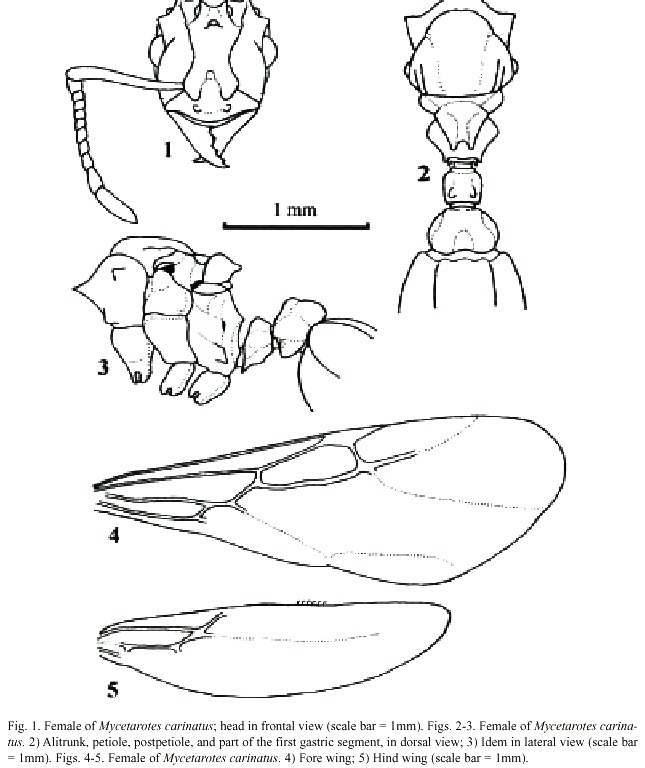
<body><![CDATA[<p><font face="Arial" size="2">The abbreviations for the measurements are: TL, total length; HL, maximum length of cephalic capsule (without mandibles); HW, head width (including eyes); DE maximum diameter of eyes; IFW, inter frontal width (distance between the lateral margins of frontal lobes); ScL, scape length; TrL, alitrunk length (= Weber’s length); LFw, length of fore wing; LHw, length of hind wing. </font></p>     <div style="text-align: center; font-family: arial;"><font size="-1">&nbsp;<i>Mycetarotes carinatus</i>    <br> Mayhé-Nunes, 1995 .    <br> (Figs. 1-11)    <br>     <br> <a name="f1-5"></a><img alt="" src="/img/fbpe/rbt/v52n1/2616i1.JPG"  style="width: 645px; height: 768px;">    
<br> </font></div>     <p><font face="Arial" size="2">&nbsp;</font></p>     <p><font face="Arial" size="2"><i>Mycetarotes carinatus </i>Mayhé-Nunes, 1995:200-202, <a href="#f1-5">fig. 3 a-b</a> (worker; Brazil: Engenheiro Paulo de Frontin, Rio de Janeiro; key; nest).</font></p>     <p><font face="Arial" size="2"><b>Description of the female Measures (in mm): </b>TL 3.1; HL 0.85; HW 0.88; DE 0.18; IFW 0.41; ScL 0.74; TrL 1.11; LFw 3.29; LHw 2.45. Body light brown, with head front slightly darker; inconspicuous and appressed minute hairs; integument finely granulated.</font></p>     ]]></body>
<body><![CDATA[<p><font face="Arial" size="2"><b>Head: </b>(<a href="#f1-5">Fig. 1</a>) Mandible finely striated on dorsal surface; masticatory margin with five teeth; external margin slightly sinuous. Median margin of clypeus moderately convex, without anterior notch; surface of clypeus with two small lateral tubercles, between its anterior margin and base of frontal lobe. Frontal lobe subtriangular, rather rounded and outwards directed. Frontal carina attaining the occiput, divided above the eye in two branches, the outer stem finishing in blunt spine. Preocular carina curved above eye, not reaching frontal carina. Compound eye convex, placed close to middle of side of head, surpassing slightly its lateral margin. Three ocelli on vertex (two lateral and one median) bordered by short and curved carinae. Antenna with 11 segments; scape surpassing occipital corner by nearly 1/3 of length, longer than funicular segments I-III combined; funicular segment I longer than II. Occipital corner tridentate. Occipital margin notched in middle.</font></p>     <p style="font-family: arial;"><small><font size="2"><small>&nbsp;</small></font><b>Alitrunk: </b>(<a href="#f1-5">Figs. 2</a> and <a href="#f1-5">3</a>) Pronotum with pair of strong and blunt humeral spines, out and forwards directed, and with pair of inferior spines down and forwards pointed, similar to the humeral ones. Scutum without notable large divisions; anterior margin with small notch and narrow and short furrow on each side; median posterior portion superficially impressed; parapsidial furrow visible in dorsal view, parapsis weakly excavate, with outer margin transformed into low ridge. Mesothoracic paraptera deeply impressed in middle, with rounded lateral margin. Scutellum with pair of longitudinal tubercles on each side, finishing posteriorly in pair of short and blunt spines. Metathoracic paraptera similar to those of male. Propodeum with rounded lateral margins in dorsal view and with pair of small tubercles, between basal and declivitous faces.</small></p>     <p><font face="Arial" size="2"><b>Waist and gaster: </b>(<a  href="#f1-5">Figs. 2</a> and <a href="#f1-5">3</a>) Dorsum of petiole with pair of blunt tubercles. Postpetiole broader than petiole, in dorsal view, shallowlly impressed above, with the posterior margin largely notched. First gastric tergite with four longitudinal ridges, the lateral ones matched with lateral margin of the sclerite. </font></p>     <p><font face="Arial" size="2"><b>Wings: </b>(<a href="#f1-5">Figs. 4</a> and <a href="#f1-5">5</a>) Wings microscopically hairy and infuscated. Fore wing with four closed cells (sub-marginal, costal, median and submedian); marginal cell open. Pterostigma conspicuous. Hind wing with five veins, without closed cells; six hamuli on anterior margin.</font></p>     <p><font face="Arial" size="2"><b>Comments: </b>The principal characters that separate the two hitherto known females of <i>Mycetarotes </i>are: (1) Presence of two anterior teeth of the occipital corners relatively more prominent than in <i>M. parallelu</i>s. (2) Apical teeth of the mandibles similar in size to the sub-apical ones; longer in <i>M. parallelu</i>s. (3) Head almost as long as broad; longer than broad in <i>M. parallelu</i>s. (4) Pair of blunt dorsal projections on petiole; acute in <i>M. parallelu</i>s. (5) Lateral margins of postpetiole without lateral expansions in dorsal view; in <i>M. paral lelus </i>laterally expanded on its posterior half. (6) Propodeum with a pair of small projections tubercle-like; prominent and strong spines in <i>M. parallelu</i>s. (7) First gastric tergite with four longitudinal ridges; absent in <i>M. parallelu</i>s.</font></p>     <p><font face="Arial" size="2"><b>    <br> Description of the male</b></font></p>     <p><font face="Arial" size="2"><b>Measures (in mm): </b>TL 3.9; HL 0.65; HW 0.89; DE 0.34; IFW 0.21; ScL 0.62; TrL 1.38; LFw 2.98; LHw 2.07. The body is dark brown, with black head; inconspicuous and appressed minute hairs; integument finely reticulated, with rugulae on some parts of head and alitrunk.</font></p>     <p><font face="Arial" size="2"><b>Head: </b>(<a href="#f6-10">Fig. 6</a>) Mandible striated on dorsal surface and fully punctuated; masticatory margin with only two apical teeth; external margin straight with the apex curved inwards, with head in full-face view. Median margin of clypeus moderately convex, without anterior notch; surface of clypeus with two minute lateral tubercles, between anterior margin and base of frontal lobe, followed above, in the median region, by wide and transversally vaulted furrow. Frontal lobe laterally rounded and dorsally forwards pointed. Frontal carina short, rather straight, obliquely directed medially. Preocular carina curved above eye, not attaining the vertex. Compound eye very large and convex, occupying about 2/3 of the side of head. Ocelli inserted on short and cylindrical projections. Antenna with 13 segments; scape surpassing the occipital corner by nearly 1/4 of its length, longer than funicular segments I-III combined; funicular segment I slightly shorter than II. Occipital corners angulated with single tooth on each side. Occipital margin notched in the middle, between lateral ocelli.    <br> </font></p>     ]]></body>
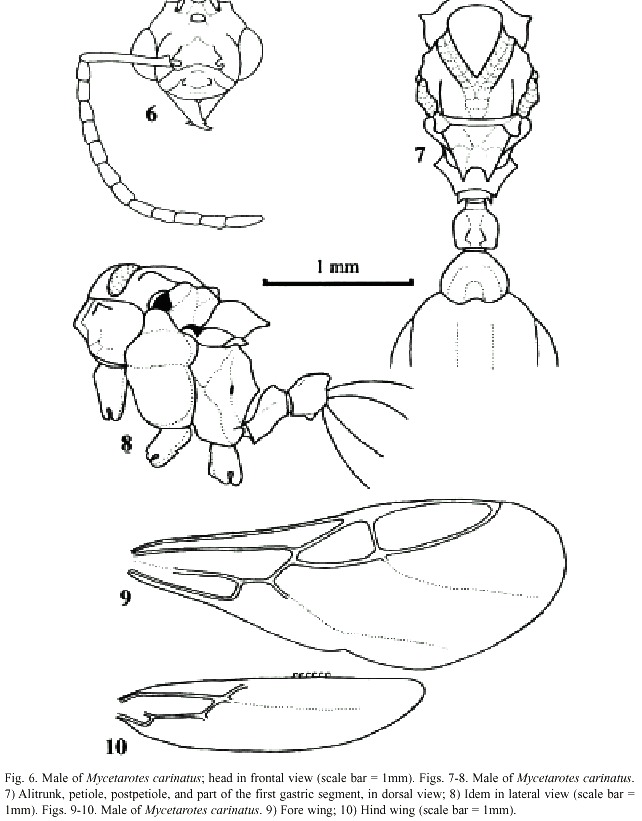
<body><![CDATA[<p style="text-align: center;"><font face="Arial" size="2"><a  name="f6-10"></a>    <br> <img alt="" src="/img/fbpe/rbt/v52n1/2616i2.JPG" style="width: 642px; height: 821px;"></font></p>     
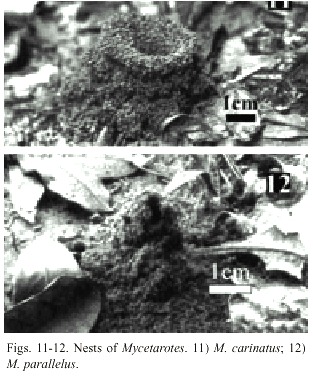
<p><font face="Arial" size="2">&nbsp;</font></p>     <p><font face="Arial" size="2"> </font></p>     <p><font face="Arial" size="2"><b>Alitrunk: </b>(<a href="#f6-10">Figs. 7</a> and <a href="#f6-10">8</a>) Pronotum with small humeral spine and tumuliform projection close to rounded inferior margin. Scutum with wide and deeply impressed Mayrian furrow separating three areas: an anterior prescutal and two lateral mesoscutal. Prescutum a little lower than mesoscutum, when in lateral view; parapsidial furrows on mesoscutum, visible in dorsal view; parapsis deeply excavated, with the outer margin transformed into high ridge. Mesothoracic paraptera narrowed and deeply impressed in middle, in dorsal view, with thick and blunt projection on each side. Scutellum surmounted by pair of longitudinal tubercles on each side, ending as two short, slender and blunt spines. Metathoracic paraptera concealed by scutellum in dorsal view. Propodeum with the lateral margins angulated in dorsal view and with pair of small projections, between basal and declivitous faces.</font></p> <font face="Arial" size="2"><b> </b></font><font face="Arial" size="2"><b>Waist and gaster: </b>(<a  href="#f6-10">Figs. 7</a> and <a href="#f6-10">8</a>) Dorsum of petiole with pair of blunt tubercles. In dorsal view, postpetiole just broader than petiole, shallowly impressed, with the posterior margin notched. First gastric tergite with median impression and four ridges, the two lateral ridges more notables than two median ones.</font>     <p><font face="Arial" size="2"><b>Wings: </b>(<a href="#f6-10">Figs. 9</a> and <a href="#f6-10">10</a>) Wings microscopically hairy and infuscated. Fore wing with three closed cells (marginal, submarginal and costal); median and sub-median cells partially open. Pterostigma conspicuous. Hind wing with five veins, without closed cells; six hamuli on anterior margin.</font></p> <font face="Arial" size="2"><b> </b></font><font face="Arial" size="2"><b>Comments: </b>Two distinctive characters of the female of <i>M. carinatus </i>are also observed in the male of this species: propodeal projections and longitudinal ridges of first gastric tergite. Other characters are: (1) Antennal scape surpassing the occipital corner, longer than funicular segments I-III combined; in <i>M. parallelus </i>it is shorter, similar in length to funicular segments I-III combined, not surpassing the occipital corner. (2) Median portion of anterior margin of clypeus moderately convex; notably convex in <i>M. parallelu</i>s. (3) Occipital corner angulated with a single tooth on each side; in <i>M. parallelus </i>tridentate.</font>&nbsp; <font face="Arial" size="2"><b>    <br> Biology of the nest </b></font>     <p><font face="Arial" size="2">The larger nest of <i>M. carinatus </i>(<a  href="#f11-12">Fig. 11</a>) observed in the Mata da Biologia has an external architecture very different from that described by <a  href="#ma95">Mayhé-Nunes (1995)</a> for <i>M. parallelus </i>(<a  href="#f11-12">Fig. 12</a>). The entrance was in the bottom of a small crater-shaped mound, with nearly 6 cm of diameter at the base and 4 cm height; the other nest found in the area also had the same shape, but was smaller. In a third nest without mound, the same pattern found by <a  href="#ma95">Mayhé-Nunes (1995)</a> to <i>M. carinatu</i>s, the workers were following two opposite trails to put earth grains nearly 15 cm away from the entrance. The exuviae of a spider carried by a worker (deposited in CECL) was the only forage item observed in the field, but substrate discarded from the nest in the laboratory reveled that the items used to cultivated fungus in this species are similar to those of <i>M. parallelus </i>(seeds, woody decayed matter and insect feces). The maintenance of the laboratory nest was done with parts of <i>Hibiscus </i>flowers, manioc root flow and cotton soaked in water.    <br> </font></p>     <p style="text-align: center;"><font face="Arial" size="2"><a  name="f11-12"></a><img alt="" src="/img/fbpe/rbt/v52n1/2616i3.JPG"  style="width: 313px; height: 377px;">    
]]></body>
<body><![CDATA[<br> </font></p>     <p><font face="Arial" size="2">&nbsp;</font></p> <font face="Arial" size="2"><b>     <p>Acknowledgments</p> </b> </font>     <p><font face="Arial" size="2">This work is part of the research "Comparative Biology of Ants, Specially of the Tribe Attini", with a grant from Conselho Nacional de Desenvolvimento Científico e Tecnológico - CNPq (301273/95-2), and financial support by Fundação de Amparo à Pesquisa do Estado do Rio de Janeiro –FAPERJ (E-26/171.734/99). The Fundação de Amparo à Pesquisa do Estado de Minas Gerais - FAPEMIG (CAG1703/95) supported partially this work. We are also grateful to José Henrique Schoereder for the nest of <i>Mycetarotes carinatu</i>s, and the three anonymous referees for helpful suggestions.</font></p> <font face="Arial" size="2"><b>     <p>    <br> </p>     <p>Resumen</p> </b> </font>     <p><font face="Arial" size="2">Describimos la hembra y el macho de la hormiga neotropical cultivadora de hongos, <i>Mycetarotes carinatu</i>s, hasta ahora solo conocida de la localidad-tipo, con base en muestras de obreras. Las formas sexuales fueron obtenidas de un nido criado en laboratorio. Las muestras del estado de Minas Gerais, Brasil, amplían la distribución geográfica de la especie. Ilustramos la arquictetura externa del nido de <i>M. carinatu</i>s. </font></p> <font face="Arial" size="2"><b>     <p>    <br> </p>     ]]></body>
<body><![CDATA[<p>References</p> </b> </font>     <!-- ref --><p><font face="Arial" size="2"><a name="bo94"></a>Bolton, B. 1994. Identification Guide to the Ant Genera of the World. Harvard University, Cambridge, Massachusetts. 222 p.</font>&nbsp;&nbsp;&nbsp;&nbsp;&nbsp;&nbsp;&nbsp;&nbsp;[&#160;<a href="javascript:void(0);" onclick="javascript: window.open('/scielo.php?script=sci_nlinks&ref=1292155&pid=S0034-7744200400010001500001&lng=','','width=640,height=500,resizable=yes,scrollbars=1,menubar=yes,');">Links</a>&#160;]<!-- end-ref --><!-- ref --><p><font face="Arial" size="2"><a name="bo95"></a>Bolton, B. 1995. A New General Catalogue of the Ants of the World. Harvard University, Cambridge, Massachusetts. 504 p.</font>&nbsp;&nbsp;&nbsp;&nbsp;&nbsp;&nbsp;&nbsp;&nbsp;[&#160;<a href="javascript:void(0);" onclick="javascript: window.open('/scielo.php?script=sci_nlinks&ref=1292156&pid=S0034-7744200400010001500002&lng=','','width=640,height=500,resizable=yes,scrollbars=1,menubar=yes,');">Links</a>&#160;]<!-- end-ref --><!-- ref --><p><font face="Arial" size="2"><a name="br91"></a>Brandão, C.R.F. 1991. Adendos ao Catálogo abreviado das Formigas da Região Neotropical (Hymenoptera: Formicidae). Rev. Bras. Entomol. 35: 319-412.</font>&nbsp;&nbsp;&nbsp;&nbsp;&nbsp;&nbsp;&nbsp;&nbsp;[&#160;<a href="javascript:void(0);" onclick="javascript: window.open('/scielo.php?script=sci_nlinks&ref=1292157&pid=S0034-7744200400010001500003&lng=','','width=640,height=500,resizable=yes,scrollbars=1,menubar=yes,');">Links</a>&#160;]<!-- end-ref --><!-- ref --><p><font face="Arial" size="2"><a name="em05"></a>Emery, C. 1905. Studi sulle formiche della fauna neotropica. XXVI. Bull. Soc. Ent. Ital., 37: 107-194.</font>&nbsp;&nbsp;&nbsp;&nbsp;&nbsp;&nbsp;&nbsp;&nbsp;[&#160;<a href="javascript:void(0);" onclick="javascript: window.open('/scielo.php?script=sci_nlinks&ref=1292158&pid=S0034-7744200400010001500004&lng=','','width=640,height=500,resizable=yes,scrollbars=1,menubar=yes,');">Links</a>&#160;]<!-- end-ref --><!-- ref --><p><font face="Arial" size="2"><a name="ho90"></a>Hölldobler, B. &amp; E.O. Wilson. 1990. The Ants. Harvard University, Cambridge, Massachusetts. 732 p.</font>&nbsp;&nbsp;&nbsp;&nbsp;&nbsp;&nbsp;&nbsp;&nbsp;[&#160;<a href="javascript:void(0);" onclick="javascript: window.open('/scielo.php?script=sci_nlinks&ref=1292159&pid=S0034-7744200400010001500005&lng=','','width=640,height=500,resizable=yes,scrollbars=1,menubar=yes,');">Links</a>&#160;]<!-- end-ref --><!-- ref --><p><font face="Arial" size="2"><a name="ke61"></a>Kempf, W.W. 1961. Review of the ant genus <i>Mycetarotes </i>Emery (Hymenoptera, Formicidae). Rev. Bras. Biol. 20: 277-283.</font>&nbsp;&nbsp;&nbsp;&nbsp;&nbsp;&nbsp;&nbsp;&nbsp;[&#160;<a href="javascript:void(0);" onclick="javascript: window.open('/scielo.php?script=sci_nlinks&ref=1292160&pid=S0034-7744200400010001500006&lng=','','width=640,height=500,resizable=yes,scrollbars=1,menubar=yes,');">Links</a>&#160;]<!-- end-ref --><!-- ref --><p><font face="Arial" size="2"><a name="ke72"></a>Kempf, W.W. 1972. Catálogo abreviado das Formigas da Região Neotropical (Hym., Formicidae). Studia Entomol. 15: 3-344.</font>&nbsp;&nbsp;&nbsp;&nbsp;&nbsp;&nbsp;&nbsp;&nbsp;[&#160;<a href="javascript:void(0);" onclick="javascript: window.open('/scielo.php?script=sci_nlinks&ref=1292161&pid=S0034-7744200400010001500007&lng=','','width=640,height=500,resizable=yes,scrollbars=1,menubar=yes,');">Links</a>&#160;]<!-- end-ref --><!-- ref --><p><font face="Arial" size="2"><a name="ma95"></a>Mayhé-Nunes, A.J. 1995. Sinopse do gênero <i>Mycetarotes </i>Emery (Hym., Formicidae), com a descrição de duas espécies novas. Bol. Entomol. Venez. 10: 197-205.</font>&nbsp;&nbsp;&nbsp;&nbsp;&nbsp;&nbsp;&nbsp;&nbsp;[&#160;<a href="javascript:void(0);" onclick="javascript: window.open('/scielo.php?script=sci_nlinks&ref=1292162&pid=S0034-7744200400010001500008&lng=','','width=640,height=500,resizable=yes,scrollbars=1,menubar=yes,');">Links</a>&#160;]<!-- end-ref --><!-- ref --><p><font face="Arial" size="2"><a name="wh25"></a>Wheeler, W.W. 1925. Ants: their structure, behavior and development. Columbia University, New York. pp. 660.</font>&nbsp;&nbsp;&nbsp;&nbsp;&nbsp;&nbsp;&nbsp;&nbsp;[&#160;<a href="javascript:void(0);" onclick="javascript: window.open('/scielo.php?script=sci_nlinks&ref=1292163&pid=S0034-7744200400010001500009&lng=','','width=640,height=500,resizable=yes,scrollbars=1,menubar=yes,');">Links</a>&#160;]<!-- end-ref --> ]]></body><back>
<ref-list>
<ref id="B1">
<nlm-citation citation-type="book">
<person-group person-group-type="author">
<name>
<surname><![CDATA[Bolton]]></surname>
<given-names><![CDATA[B.]]></given-names>
</name>
</person-group>
<source><![CDATA[Identification Guide to the Ant Genera of the World]]></source>
<year>1994</year>
<page-range>222</page-range><publisher-loc><![CDATA[Cambridge ]]></publisher-loc>
<publisher-name><![CDATA[Harvard University]]></publisher-name>
</nlm-citation>
</ref>
<ref id="B2">
<nlm-citation citation-type="book">
<person-group person-group-type="author">
<name>
<surname><![CDATA[Bolton]]></surname>
<given-names><![CDATA[B.]]></given-names>
</name>
</person-group>
<source><![CDATA[A New General Catalogue of the Ants of the World]]></source>
<year>1995</year>
<page-range>504</page-range><publisher-loc><![CDATA[Cambridge ]]></publisher-loc>
<publisher-name><![CDATA[Harvard University]]></publisher-name>
</nlm-citation>
</ref>
<ref id="B3">
<nlm-citation citation-type="journal">
<person-group person-group-type="author">
<name>
<surname><![CDATA[Brandão]]></surname>
<given-names><![CDATA[C.R.F.]]></given-names>
</name>
</person-group>
<article-title xml:lang="pt"><![CDATA[Adendos ao Catálogo abreviado das Formigas da Região Neotropical (Hymenoptera: Formicidae)]]></article-title>
<source><![CDATA[Rev. Bras. Entomol]]></source>
<year>1991</year>
<volume>35</volume>
<page-range>319-412</page-range></nlm-citation>
</ref>
<ref id="B4">
<nlm-citation citation-type="journal">
<person-group person-group-type="author">
<name>
<surname><![CDATA[Emery]]></surname>
<given-names><![CDATA[C.]]></given-names>
</name>
</person-group>
<article-title xml:lang="en"><![CDATA[Studi sulle formiche della fauna neotropica. XXVI]]></article-title>
<source><![CDATA[Bull. Soc. Ent. Ital.]]></source>
<year>1905</year>
<volume>37</volume>
<page-range>107-194</page-range></nlm-citation>
</ref>
<ref id="B5">
<nlm-citation citation-type="book">
<person-group person-group-type="author">
<name>
<surname><![CDATA[Hölldobler]]></surname>
<given-names><![CDATA[B]]></given-names>
</name>
<name>
<surname><![CDATA[Wilson]]></surname>
<given-names><![CDATA[E.O]]></given-names>
</name>
</person-group>
<source><![CDATA[The Ants]]></source>
<year>1990</year>
<publisher-loc><![CDATA[Cambridge^eMassachusetts Massachusetts]]></publisher-loc>
<publisher-name><![CDATA[Harvard University]]></publisher-name>
</nlm-citation>
</ref>
<ref id="B6">
<nlm-citation citation-type="journal">
<person-group person-group-type="author">
<name>
<surname><![CDATA[Kempf]]></surname>
<given-names><![CDATA[W.W.]]></given-names>
</name>
</person-group>
<article-title xml:lang="en"><![CDATA[Review of the ant genus Mycetarotes Emery (Hymenoptera, Formicidae)]]></article-title>
<source><![CDATA[Rev. Bras. Biol]]></source>
<year>1961</year>
<volume>20</volume>
<page-range>277-283</page-range></nlm-citation>
</ref>
<ref id="B7">
<nlm-citation citation-type="journal">
<person-group person-group-type="author">
<name>
<surname><![CDATA[W.W]]></surname>
<given-names><![CDATA[Kempf]]></given-names>
</name>
</person-group>
<article-title xml:lang="pt"><![CDATA[Catálogo abreviado das Formigas da Região Neotropical (Hym., Formicidae)]]></article-title>
<source><![CDATA[Studia Entomol]]></source>
<year>1972</year>
<volume>15</volume>
<page-range>3-344</page-range></nlm-citation>
</ref>
<ref id="B8">
<nlm-citation citation-type="journal">
<person-group person-group-type="author">
<name>
<surname><![CDATA[Mayhé-Nunes]]></surname>
<given-names><![CDATA[A.J.]]></given-names>
</name>
</person-group>
<article-title xml:lang="pt"><![CDATA[Sinopse do gênero Mycetarotes Emery (Hym., Formicidae), com a descrição de duas espécies novas]]></article-title>
<source><![CDATA[Bol. Entomol. Venez]]></source>
<year>1995</year>
<volume>10</volume>
<page-range>197-205</page-range></nlm-citation>
</ref>
<ref id="B9">
<nlm-citation citation-type="book">
<person-group person-group-type="author">
<name>
<surname><![CDATA[Wheeler]]></surname>
<given-names><![CDATA[W.W.]]></given-names>
</name>
</person-group>
<source><![CDATA[Ants: their structure, behavior and development]]></source>
<year>1925</year>
<page-range>660</page-range><publisher-loc><![CDATA[New York ]]></publisher-loc>
<publisher-name><![CDATA[Columbia University]]></publisher-name>
</nlm-citation>
</ref>
</ref-list>
</back>
</article>