<?xml version="1.0" encoding="ISO-8859-1"?><article xmlns:mml="http://www.w3.org/1998/Math/MathML" xmlns:xlink="http://www.w3.org/1999/xlink" xmlns:xsi="http://www.w3.org/2001/XMLSchema-instance">
<front>
<journal-meta>
<journal-id>0034-7744</journal-id>
<journal-title><![CDATA[Revista de Biología Tropical]]></journal-title>
<abbrev-journal-title><![CDATA[Rev. biol. trop]]></abbrev-journal-title>
<issn>0034-7744</issn>
<publisher>
<publisher-name><![CDATA[Universidad de Costa Rica]]></publisher-name>
</publisher>
</journal-meta>
<article-meta>
<article-id>S0034-77442004000100011</article-id>
<title-group>
<article-title xml:lang="en"><![CDATA[The genera of Chrysomelinae (Coleoptera: Chrysomelidae) in Costa Rica]]></article-title>
</title-group>
<contrib-group>
<contrib contrib-type="author">
<name>
<surname><![CDATA[Wills Flowers]]></surname>
<given-names><![CDATA[R.]]></given-names>
</name>
<xref ref-type="aff" rid="A01"/>
</contrib>
</contrib-group>
<aff id="A01">
<institution><![CDATA[,Florida A y M University Center for Biological Control ]]></institution>
<addr-line><![CDATA[ ]]></addr-line>
<country>USA</country>
</aff>
<pub-date pub-type="pub">
<day>00</day>
<month>03</month>
<year>2004</year>
</pub-date>
<pub-date pub-type="epub">
<day>00</day>
<month>03</month>
<year>2004</year>
</pub-date>
<volume>52</volume>
<numero>1</numero>
<fpage>77</fpage>
<lpage>83</lpage>
<copyright-statement/>
<copyright-year/>
<self-uri xlink:href="http://www.scielo.sa.cr/scielo.php?script=sci_arttext&amp;pid=S0034-77442004000100011&amp;lng=en&amp;nrm=iso"></self-uri><self-uri xlink:href="http://www.scielo.sa.cr/scielo.php?script=sci_abstract&amp;pid=S0034-77442004000100011&amp;lng=en&amp;nrm=iso"></self-uri><self-uri xlink:href="http://www.scielo.sa.cr/scielo.php?script=sci_pdf&amp;pid=S0034-77442004000100011&amp;lng=en&amp;nrm=iso"></self-uri><abstract abstract-type="short" xml:lang="en"><p><![CDATA[Keys in Spanish and English are given for the genera of Chrysomelinae known from Costa Rica. For each genus, a list of species compiled from collections in the University of Costa Rica, the National Biodiversity Institute, and the entomological literature is presented. The genus Planagetes Chevrolat 1843 is recorded for the first time from Central America, and the genus Leptinotarsa Stål 1858 is synonymized with Stilodes Chevrolat 1843]]></p></abstract>
<abstract abstract-type="short" xml:lang="es"><p><![CDATA[Se presenta claves en español y inglés para los géneros de Chrysomelinae conocidas de Costa Rica. Para cada género, se presenta una lista de especies compiladas de las colecciones de la Universidad de Costa Rica, el Instituto Nacional de Biodiversidad, y la literatura entomológica. El género Planagetes Chevrolat 1843 está registrado por primera vez de América Central, y el género Leptinotarsa Stål 1858 está sinonomizado con Stilodes Chevrolat 1843]]></p></abstract>
<kwd-group>
<kwd lng="en"><![CDATA[Chrysomelinae]]></kwd>
<kwd lng="en"><![CDATA[keys]]></kwd>
<kwd lng="en"><![CDATA[Planagetes]]></kwd>
<kwd lng="en"><![CDATA[Stilodes]]></kwd>
<kwd lng="en"><![CDATA[Leptinotarsa]]></kwd>
</kwd-group>
</article-meta>
</front><body><![CDATA[ <p style="text-align: center; font-family: arial;"><font size="-1"><b>The genera of Chrysomelinae (Coleoptera: Chrysomelidae) in Costa Rica</b></font></p>     <p style="font-family: arial;"><font size="-1">    <br> </font></p>     <p style="font-family: arial;"><font size="-1">R. Wills Flowers</font></p>     <p style="font-family: arial;"><font size="-1">Center for Biological Control, Florida A&amp;M University, Tallahassee, FL 32307 USA; <a  href="mailto:rflowers@mail.istal.com">rflowers@mail.istal.com</a></font></p> <font style="font-family: arial;" face="Arial" size="-1"><b> </b></font>     <p style="font-family: arial;"><font size="-1">    <br> </font></p>     <div style="text-align: center; font-family: arial;"><font size="-1">Received 04-III-2003.&nbsp;&nbsp;&nbsp;&nbsp;&nbsp; Corrected 10-I-2004. &nbsp; &nbsp; &nbsp; Accepted 12-II-2004.</font></div> <font style="font-family: arial;" face="Arial" size="-1"><b> </b></font>     <p style="font-family: arial;"><font size="-1"><b>    <br> </b></font></p>     ]]></body>
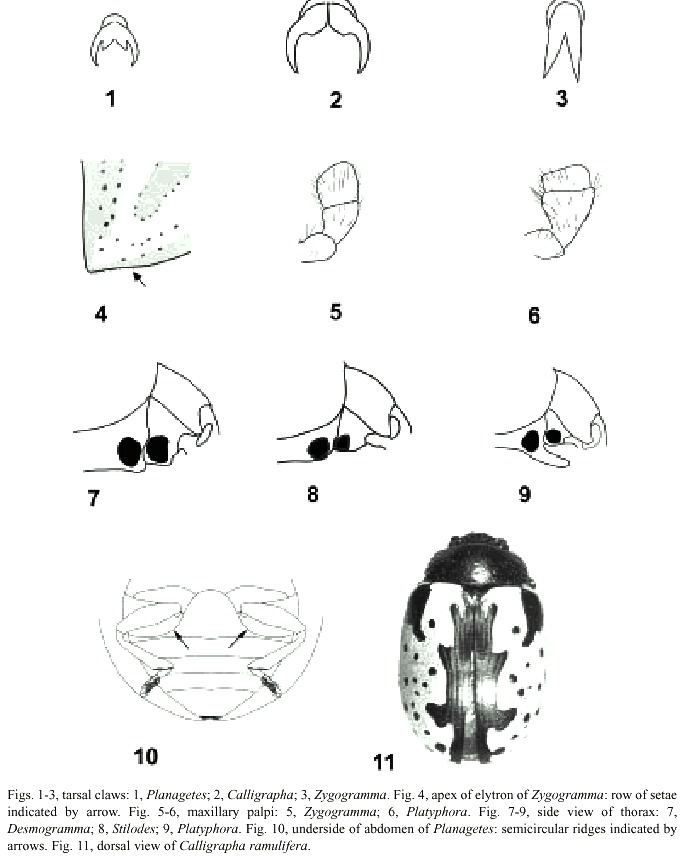
<body><![CDATA[<p style="font-family: arial;"><font size="-1"><b>Abstrac</b><span  style="font-weight: bold;">t</span></font></p>     <p style="font-family: arial;"><font size="-1">Keys in Spanish and English are given for the genera of Chrysomelinae known from Costa Rica. For each genus, a list of species compiled from collections in the University of Costa Rica, the National Biodiversity Institute, and the entomological literature is presented. The genus <i>Planagetes </i>Chevrolat 1843 is recorded for the first time from Central America, and the genus <i>Leptinotarsa </i>Stål 1858 is synonymized with <i>Stilodes </i>Chevrolat 1843.</font></p> <font style="font-family: arial;" face="Arial" size="-1"><b> </b></font>     <p style="font-family: arial;"><font size="-1"><b>Key word</b>s: Chrysomelinae, keys, <i>Planagete</i>s, <i>Stilodes, Leptinotars</i>a.</font></p>     <p style="font-family: arial;"><font size="-1">    <br> </font></p> <font style="font-family: arial;" face="Arial" size="-1">    <br> Members of the subfamily Chrysomelinae –popularly known in Costa Rica as "confites con patas" (walking candies)– are among the largest and most colorful representatives of the family Chrysomelidae in Costa Rica. They are of broad ecological interest because of their host plant preferences and varying modes of life. Although readily noticed, there are no keys to the Neotropical fauna for identification of either species or genera, and many taxonomic problems persist in this subfamily. The only recent generic key for this region was published in 1965 by Jan and Bohumila Bechyné for Venezuela. To assist present and future workers studying this group, a modified version of their key for genera known to occur in Costa Rica is presented in English and Spanish. This is followed by notes on the diversity of the individual genera in Costa Rica with a list of both species identified in the collections of the University of Costa Rica and the National Biodiversity Institute (INBio) and those recorded from Costa Rica in the catalogs of <a href="#bl47">Blackwelder (1947)</a> and <a  href="#be52">Bechyné (1952)</a>, along with a discussion of the taxonomic status of <i>Stilodes </i>and <i>Leptinotars</i>a.</font>     <p style="text-align: center; font-family: arial;"><font size="-1"><i>&nbsp;<img  alt="" src="/img/fbpe/rbt/v52n1/2612i1.JPG" style="width: 681px; height: 629px;"></i></font></p>     
<p style="text-align: center; font-family: arial;"><font size="-1"><i>&nbsp;<img  alt="" src="/img/fbpe/rbt/v52n1/2612i2.JPG" style="width: 681px; height: 602px;">    
<br> </i></font></p> <font style="font-family: arial;" size="-1"><span  style="font-weight: bold;">Notes on the genera</span></font><font  style="font-family: arial;" face="Arial" size="-1"><b> </b></font>     <p style="font-family: arial;"><font size="-1"><i>Calligrapha </i>Chevrolat 1837</font></p>     ]]></body>
<body><![CDATA[<p style="font-family: arial;"><font size="-1">Adult specimens of all species have white, pale yellow, or pale rose elytra with intricate patterns of dark markings. Twelve species are presently known from Costa Rica:</font></p> <font style="font-family: arial;" size="-1"><i>Calligrapha argus </i>Stål    <br> <i>Calligrapha diversa </i>(Stål)    <br> </font><font style="font-family: arial;" face="Arial" size="-1"><i>Calligrapha elegantula </i>Jacoby    <br> </font><font style="font-family: arial;" face="Arial" size="-1"><i>Calligrapha fulvipes </i>Stål    <br> </font><font style="font-family: arial;" face="Arial" size="-1"><i>Calligrapha gyllenhali </i>Stål    <br> </font><font style="font-family: arial;" face="Arial" size="-1"><i>Calligrapha notatipennis </i>Stål    <br> </font><font style="font-family: arial;" face="Arial" size="-1"><i>Calligrapha pantherina </i>Stål    <br> </font><font style="font-family: arial;" face="Arial" size="-1"><i>Calligrapha ramulifera </i>Stål    <br> </font><font style="font-family: arial;" face="Arial" size="-1"><i>Calligrapha serpentina </i>(Rogers)    <br> </font><font style="font-family: arial;" face="Arial" size="-1"><i>Calligrapha sponsa </i>Stål    ]]></body>
<body><![CDATA[<br> </font><font style="font-family: arial;" face="Arial" size="-1"><i>Calligrapha subdentata </i>Bechyné    <br> </font><font style="font-family: arial;" face="Arial" size="-1"><i>Calligrapha tortilis </i>Stål</font>     <p style="font-family: arial;"><font size="-1"><i>    <br> </i><i>Chrysomela </i>Linné 1758</font></p> <font style="font-family: arial;" size="-1">Several specimens of <i>Chrysomela scripta </i>(Fabr.), a Nearctic species, have recently been collected from higher elevations. In one case, the species was damaging planted alder trees.</font>     <p style="font-family: arial;"><font size="-1">    <br> <i>Desmogramma </i>Erichson 1847</font></p>     <p style="font-family: arial;"><font size="-1">One species, <i>Desmogramma conjugata </i>Stål, is known from Costa Rica.</font></p>     <p style="font-family: arial;"><font size="-1"><i>    <br> Doryphora </i>Illiger 1807 </font></p>     <p style="font-family: arial;"><font size="-1">Two species occur in Costa Rica and are the largest members of the Costa Rican chrysomelid fauna.    ]]></body>
<body><![CDATA[<br> <i>Doryphora bioleyi </i>(Achard)    <br> <i>Doryphora paykulli </i>(Stål)</font></p> <font style="font-family: arial;" size="-1"><i>    <br> Labidomera </i>Chevrolat 1837</font>     <p style="font-family: arial;"><font size="-1"><span  style="font-family: arial;">One species, </span><i>Labidomera suturella </i>Guérin-Méneville occurs in Costa Rica. <a href="#ch89">Choe (1989)</a> reported maternal care in this species.</font></p>     <p style="font-family: arial;"><font size="-1">&nbsp;<i>    <br> Phaedon </i>Latreille 1829</font></p> <font style="font-family: arial;" size="-1">Three species are recorded from Costa Rica:    <br> <i>Phaedon cyanescens </i>Stål    <br> </font><font style="font-family: arial;" face="Arial" size="-1"><i>Phaedon mexicanum </i>Jacoby    <br> </font><font style="font-family: arial;" face="Arial" size="-1"><i>Phaedon ruficeps </i>Achard</font>     <p style="font-family: arial;"><font size="-1"><i>    ]]></body>
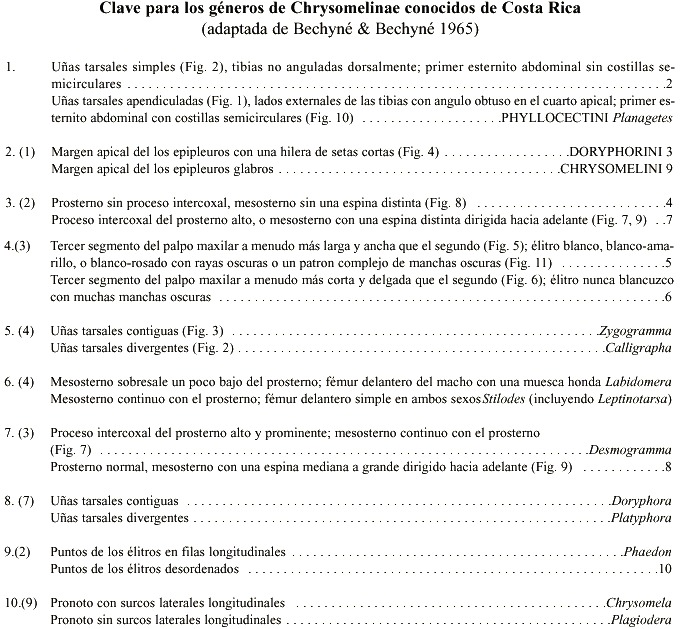
<body><![CDATA[<br> Plagiodera </i>Chevrolat 1837</font></p> <font style="font-family: arial;" size="-1">Three species are known from Costa Rica.    <br> <i>Plagiodera atritarsis </i>Stål    <br> </font><font style="font-family: arial;" face="Arial" size="-1"><i>Plagiodera bistripunctata </i>Duvivier    <br> </font><font style="font-family: arial;" face="Arial" size="-1"><i>Plagiodera quadrimaculata </i>Jacoby</font>     <p style="font-family: arial;"><font size="-1"><i>&nbsp;    <br> Planagetes </i>Chevrolat 1843</font></p>     <p style="font-family: arial;"><font size="-1">One species, <i>Planagetes uniformis </i>(Jacoby) <b>new combination </b>occurs in Costa Rica. Jacoby described this species in <i>Plagioder</i>a, noting its small round body out-line and its similarity to a coccinellid. However, this species has appendiculate claws and angulate tibia, both characters of <i>Planagetes </i>(<a href="#be65">Bechyné &amp; Bechyné 1965</a>). This is a new Central American generic record. Along with its coccinellid-like habitus, <i>P. uniformis </i>has semi-circular costae on the first abdominal sternum behind the metacoxae (<a href="#f">Fig. 10</a>), a character also found in many Coccinellidae.    <br> </font></p>     <p style="text-align: center; font-family: arial;"><font size="-1"><a  name="f"></a><img alt="" src="/img/fbpe/rbt/v52n1/2612i3.JPG"  style="width: 687px; height: 857px;">    
<br> </font></p> <font style="font-family: arial;" size="-1">    ]]></body>
<body><![CDATA[<br> </font>     <p style="font-family: arial;"><font size="-1"><i>Platyphora </i>Gistl 1857</font></p>     <p style="font-family: arial;"><font size="-1">This is the largest genus of Chrysomelinae in Costa Rica. Twenty-three species are known and many as-yet unidentified specimens have also been collected. Vivipary has been observed in at least two Costa Rican species and is known from a number of South America species. However, the biology of most of the species is still unknown.</font></p> <font style="font-family: arial;" size="-1"><i>Platyphora arangoi </i>(Jacoby)    <br> <i>Platyphora bicolor </i>(Jacoby)    <br> </font><font style="font-family: arial;" face="Arial" size="-1"><i>Platyphora biremis </i>(Stål)    <br> </font><font style="font-family: arial;" face="Arial" size="-1"><i>Platyphora decorata </i>(Jacoby)    <br> </font><font style="font-family: arial;" face="Arial" size="-1"><i>Platyphora decurrens </i>(Stål)    <br> </font><font style="font-family: arial;" face="Arial" size="-1"><i>Platyphora eucosoma </i>(Stål)    <br> </font><font style="font-family: arial;" face="Arial" size="-1"><i>Platyphora flavoguttata </i>(Jacoby)    <br> </font><font style="font-family: arial;" face="Arial" size="-1"><i>Platyphora ligata </i>(Stål)    ]]></body>
<body><![CDATA[<br> </font><font style="font-family: arial;" face="Arial" size="-1"><i>Platyphora macrogramma </i>Bechyné    <br> </font><font style="font-family: arial;" face="Arial" size="-1"><i>Platyphora nigroguttata </i>(Stål)    <br> </font><font style="font-family: arial;" face="Arial" size="-1"><i>Platyphora </i>nr. <i>lativittis </i>(Jacoby)    <br> </font><font style="font-family: arial;" face="Arial" size="-1"><i>Platyphora ocellata </i>(Jacoby)    <br> </font><font style="font-family: arial;" face="Arial" size="-1"><i>Platyphora ornata </i>(Jacoby)    <br> </font><font style="font-family: arial;" face="Arial" size="-1"><i>Platyphora panamensis </i>(Jacoby)    <br> </font><font style="font-family: arial;" face="Arial" size="-1"><i>Platyphora petulans </i>(Stål)    <br> </font><font style="font-family: arial;" face="Arial" size="-1"><i>Platyphora punctipennis </i>(Jacoby)    <br> </font><font style="font-family: arial;" face="Arial" size="-1"><i>Platyphora purulensis </i>(Jacoby)    <br> </font><font style="font-family: arial;" face="Arial" size="-1"><i>Platyphora rogersi </i>(Jacoby)    ]]></body>
<body><![CDATA[<br> </font><font style="font-family: arial;" face="Arial" size="-1"><i>Platyphora salvini </i>(Baly)    <br> </font><font style="font-family: arial;" face="Arial" size="-1"><i>Platyphora selva </i>Daccordi    <br> </font><font style="font-family: arial;" face="Arial" size="-1"><i>Platyphora semiviridis </i>(Jacoby)    <br> </font><font style="font-family: arial;" face="Arial" size="-1"><i>Platyphora spectabilis </i>(Stål)    <br> </font><font style="font-family: arial;" face="Arial" size="-1"><i>Platyphora spectanda </i>(Stål)    <br> </font><font style="font-family: arial;" face="Arial" size="-1"><i>Platyphora uniformis </i>(Jacoby)</font>     <p style="font-family: arial;"><font size="-1"><i>&nbsp;</i><i>    <br> Stilodes </i>Chevrolat 1843</font></p>     <p style="font-family: arial;"><font size="-1"><i>Leptinotarsa </i>Stål 1858 <b>new synonymy</b></font></p>     <p style="font-family: arial;"><font size="-1">Although it contains one of the most studied animals on Planet Earth, the genus <i>Leptinotarsa </i>has never been adequately differentiated from other genera in the Doryphorini. Given the enormous economic impact of the Colorado Potato Beetle, <i>Leptinotarsa decimlineata </i>(Say), and the increasing interest in finding some alternative to pesticide control, it is strange that the status of the genus <i>Leptinotarsa </i>has not attracted more interest. <a href="#ja80">Jacoby (1880-1892)</a>, in the <i>Biologia Centrali Americana </i>noted the high degree of similarity between <i>Leptinotarsa </i>and <i>Stilodes </i>and the difficulty in correctly assigning some of the Central American species. Stål (quoted by Jacoby) recognized <i>Leptinotarsa </i>on the basis of the last segment of the maxillary palp which he described as shorter than the penultimate, and truncate. <a href="#ch75">Chapuis (1875)</a> used the longer length of the tibial groove to separate <i>Leptinotars</i>a. <a href="#be65">Bechyné and Bechyné (1965)</a> used the form of the antennae; short and sub-clavate in <i>Stilode</i>s, filiform in <i>Leptinotars</i>a. The only recent attempt at a taxonomic treatment was <a href="#ja88">Jacques’ (1988)</a> short booklet on <i>Leptinotars</i>a, but this work ignored the species south of Mexico, and comparisons with other genera were limited to meaningless tabulations of species numbers among North American Doryphorini. Likewise, <a href="#hs88">Hsiao (1988)</a> compared <i>Leptinotarsa </i>only to other Nearctic Doryphorini. Neither author mentioned <i>Stilode</i>s.</font></p>     ]]></body>
<body><![CDATA[<p style="font-family: arial;"><font size="-1">After studying four species assigned to <i>Leptinotarsa </i>and seven species assigned to <i>Stilodes </i>in the INBio collection, I conclude that none of these characters is reliable. Most species in both these genera have the last two segments of the maxillary papli subequal, and in neither genus is the last segment consistently longer or shorter than in the other (they are truncate in all the species). Indeed, the last segment appears to be somewhat retractable into the third segment because in some specimens the length ratios are noticeably different from side to side.</font></p>     <p style="font-family: arial;"><font size="-1">The tibial groove is also an unreliable character. In species assigned to <i>Leptinotarsa </i>it purportedly runs down the entire apical half of the tibia while it is confined to the apical third in those of <i>Stilode</i>s. However, in all species the beginning of the groove is extremely shallow somewhere between the apical half or third of the tibia. The angle of the light can often change the point at which the groove appears to begin. Jacoby also noted the variability of this character.</font></p>     <p style="font-family: arial;"><font size="-1">Finally, there is no difference in shape of the antennae between the two genera in Costa Rica. All have the apical antennomeres somewhat thicker than the basal antennomeres.</font></p>     <p style="font-family: arial;"><font size="-1">Examination of the male and female genitalia also failed to provide any consistent characters for separation. The spermathecae of most of the species in both genera had the same general form, and showed as much intra-as intergeneric variation. The aedeagi were similar except for some differences in the apex of the median lobe. In Costa Rican <i>Stilodes </i>the lateral margins are sinuate (viewed from the side), while in <i>Leptinotarsa </i>they are evenly curved. At least one other species of <i>Leptinotars</i>a, however, also has a sinuate apicolateral margin of the median lobe (<a href="#ja88">Jaques 1988</a>). Nor would the tip of the median lobe in and of itself be considered a valid way to separate genera in many other groups of Coleoptera.</font></p>     <p style="font-family: arial;"><font size="-1"><i>Stilodes </i>is a large and probably polyphyletic genus, largely South American in distribution. Both it and <i>Leptinotarsa </i>are in need of modern taxonomic revisions. For the present, there are no characters or combination of characters that reliably separate these taxa and hence no justification for keeping them as separate genera. Unfortunately for the applied entomological literature and those overly concerned with "taxonomic stability", <i>Stilodes </i>Chevrolat 1843 has nomenclatural priority.</font></p> <font style="font-family: arial;" size="-1">    <br> </font><font style="font-family: arial;" size="-1">S</font><font  style="font-family: arial;" face="Arial" size="-1"><i>tilodes belti </i>(Jacoby)    <br> </font><font style="font-family: arial;" face="Arial" size="-1"><i>Leptinotarsa belti </i>Jacoby <b>new synonymy</b></font><font style="font-family: arial;" size="-1"> </font><font  style="font-family: arial;" size="-1"><i>    <br>     <br> Stilodes decimlineata </i>(Say)    <br> <i>Leptinotarsa decimlineata </i>Say <b>    ]]></body>
<body><![CDATA[<br> new synonymy</b>     <br>     <br> <i>Stilodes evanescens </i>(Stål)    <br> <i>Leptinotarsa evanscens </i>Stål     <br> <b>new synonymy</b></font><font style="font-family: arial;" face="Arial"  size="-1"><b>&nbsp;</b></font><font style="font-family: arial;"  size="-1"> <i>    <br>     <br> Stilodes flavitarsis </i>(Guerin-Meneville)<i>    <br> Leptinotarsa flavitarsis </i>Guerin-Meneville     <br> <b>new synonymy</b></font>     <p style="font-family: arial;"><font size="-1"><i>Stilodes fuscolineata </i>(Stål)</font><font size="-1"><b>     ]]></body>
<body><![CDATA[<br> </b></font></p> <font style="font-family: arial;" size="-1"><i>Stilodes haldemani </i>(Rogers)    <br> <i>Leptinotarsa haldemani </i>Rogers <b>    <br> new synonymy    <br>     <br> </b>    <br> </font><font style="font-family: arial;" face="Arial" size="-1"><i>Stilodes leoparda </i>Jacoby</font><font style="font-family: arial;"  face="Arial" size="-1"> </font><font style="font-family: arial;"  face="Arial" size="-1"><i>    <br>     <br> Stilodes modesta </i>Jacoby</font><font style="font-family: arial;"  face="Arial" size="-1"><i>    <br>     <br> Stilodes motschulkyi </i>Stål</font><font style="font-family: arial;"  face="Arial" size="-1"><i>    ]]></body>
<body><![CDATA[<br>     <br> Stilodes neptis </i>(Stål)<i>    <br>     <br> Stilodes panamensis </i>Jacoby</font><font style="font-family: arial;"  face="Arial" size="-1"><i>    <br>     <br> Stilodes quadristriata </i>Jacoby</font><font  style="font-family: arial;" face="Arial" size="-1"><i>     <br>     <br> </i></font><font style="font-family: arial;" face="Arial" size="-1"><i>    <br> Stilodes undecimlineata </i>(Stål)</font><font  style="font-family: arial;" face="Arial" size="-1"><i>    <br> Leptinotarsa undecimlineata </i>Stål <b>    ]]></body>
<body><![CDATA[<br> new synonymy</b></font><font size="-1"><span style="font-family: arial;">&nbsp; </span><br style="font-family: arial;"> <br style="font-family: arial;"> <br style="font-family: arial;"> </font><font style="font-family: arial;" face="Arial" size="-1"><i>Zygogramma </i>Chevrolat 1837</font>     <p style="font-family: arial;"><font size="-1">Species in this genus have <i>Calligrapha </i>– like markings of white to yellowish white, overlain with dark stripes or irregular blotches.</font></p>     <p style="font-family: arial;"><font size="-1">Seven species have been recorded from Costa Rica and several more unidentified ones are in the INBio material.    <br> <i>Zygogramma bigenera </i>(Stål)    <br> <i>Zygogramma curvatolineata </i>Jacoby    <br> </font><font size="-1"><i>Zygogramma guttulosa </i>(Stål)    <br> </font><font size="-1"><i>Zygogramma picecollis </i>Stål    <br> </font><font size="-1"><i>Zygogramma popa </i>(Stål)    <br> <i>Zygogramma signatipennis </i>(Stål)    <br> <i>Zygogramma violaceomaculata </i>(Jacoby)</font></p> <font style="font-family: arial;" size="-1">&nbsp;     ]]></body>
<body><![CDATA[<br> </font><font style="font-family: arial;" face="Arial" size="-1"><b>     <p>Acknowledgments</p> </b> </font>     <p style="font-family: arial;"><font size="-1">This study was funded by the Costa Rica National Biodiversity Inventory and the Biodiversity Resources Development Project, GEF/World Bank. This study was also funded in part by a grant (FLAX 91005) from CSREES, USDA to Florida A&amp;M University.</font></p> <font style="font-family: arial;" face="Arial" size="-1"><b>     <p>    <br> Resumen</p> </b> </font>     <p style="font-family: arial;"><font size="-1">Se presenta claves en español y inglés para los géneros de Chrysomelinae conocidas de Costa Rica. Para cada género, se presenta una lista de especies compiladas de las colecciones de la Universidad de Costa Rica, el Instituto Nacional de Biodiversidad, y la literatura entomológica. El género <i>Planagetes </i>Chevrolat 1843 está registrado por primera vez de América Central, y el género <i>Leptinotarsa </i>Stål 1858 está sinonomizado con <i>Stilodes </i>Chevrolat 1843.</font></p> <font style="font-family: arial;" face="Arial" size="-1"><b>     <p>    <br> References</p> </b> </font>     <!-- ref --><p style="font-family: arial;"><font size="-1"><a name="be52"></a>Bechyné, J. 1952. Nachträge zu de Katalogen von Blackwelder und Junk-Schenkling der neotropischen echten Chrysomeliden (Col. Phytophaga). Entomologische Arbeiten aus dem Museum G. Frey 3: 1-62.</font>&nbsp;&nbsp;&nbsp;&nbsp;&nbsp;&nbsp;&nbsp;&nbsp;[&#160;<a href="javascript:void(0);" onclick="javascript: window.open('/scielo.php?script=sci_nlinks&ref=1301158&pid=S0034-7744200400010001100001&lng=','','width=640,height=500,resizable=yes,scrollbars=1,menubar=yes,');">Links</a>&#160;]<!-- end-ref --><!-- ref --><p style="font-family: arial;"><font size="-1"><a name="be65"></a>Bechyné, J. &amp; B. Springlová de Bechyné. 1965. Notes sur les Chrysomelidae s. str. de Venezuela et des pays limitrophes. Revista de la Facultad de Agronomía (Maracay) 3: 44-110.</font>&nbsp;&nbsp;&nbsp;&nbsp;&nbsp;&nbsp;&nbsp;&nbsp;[&#160;<a href="javascript:void(0);" onclick="javascript: window.open('/scielo.php?script=sci_nlinks&ref=1301159&pid=S0034-7744200400010001100002&lng=','','width=640,height=500,resizable=yes,scrollbars=1,menubar=yes,');">Links</a>&#160;]<!-- end-ref --><!-- ref --><p style="font-family: arial;"><font size="-1"><a name="bl47"></a>Blackwelder, R.E. 1947. Checklist of the coleopterous insects of Mexico, Central America, the West Indies, and South America. Smithsonian Institution, United States National Museum Bulletin 185, Part 4: 551- 763.</font>&nbsp;&nbsp;&nbsp;&nbsp;&nbsp;&nbsp;&nbsp;&nbsp;[&#160;<a href="javascript:void(0);" onclick="javascript: window.open('/scielo.php?script=sci_nlinks&ref=1301160&pid=S0034-7744200400010001100003&lng=','','width=640,height=500,resizable=yes,scrollbars=1,menubar=yes,');">Links</a>&#160;]<!-- end-ref --><!-- ref --><p style="font-family: arial;"><font size="-1"><a name="ch75"></a>Chapuis, F. 1875. <i>In </i>Histoire Naturelle des Insectes. Genera des Coléoptères. T. Lacordaire &amp; F. Chapuis (eds.) 11: 1-420.</font>&nbsp;&nbsp;&nbsp;&nbsp;&nbsp;&nbsp;&nbsp;&nbsp;[&#160;<a href="javascript:void(0);" onclick="javascript: window.open('/scielo.php?script=sci_nlinks&ref=1301161&pid=S0034-7744200400010001100004&lng=','','width=640,height=500,resizable=yes,scrollbars=1,menubar=yes,');">Links</a>&#160;]<!-- end-ref --><!-- ref --><p style="font-family: arial;"><font size="-1"><a name="ch89"></a>Choe, J.C. 1989. Maternal care in <i>Labidomera suturella </i>Chevrolat (Coleoptera: Chrysomelidae) from Costa Rica. Psyche 96: 65-67.</font>&nbsp;&nbsp;&nbsp;&nbsp;&nbsp;&nbsp;&nbsp;&nbsp;[&#160;<a href="javascript:void(0);" onclick="javascript: window.open('/scielo.php?script=sci_nlinks&ref=1301162&pid=S0034-7744200400010001100005&lng=','','width=640,height=500,resizable=yes,scrollbars=1,menubar=yes,');">Links</a>&#160;]<!-- end-ref --><!-- ref --><p style="font-family: arial;"><font size="-1"><a name="hs88"></a>Hsiao, T.H. 1988. Host specificity, seasonality and bionomics of <i>Leptinotarsa </i>beetles. <i>In </i>P. Jolivet, E. Petitpierre and T.H. Hsiao (eds.). Biology of Chrysomelidae. Kluwer Academic Publishers. Dordrecht. 615+xvii pp.</font>&nbsp;&nbsp;&nbsp;&nbsp;&nbsp;&nbsp;&nbsp;&nbsp;[&#160;<a href="javascript:void(0);" onclick="javascript: window.open('/scielo.php?script=sci_nlinks&ref=1301163&pid=S0034-7744200400010001100006&lng=','','width=640,height=500,resizable=yes,scrollbars=1,menubar=yes,');">Links</a>&#160;]<!-- end-ref --><!-- ref --><p style="font-family: arial;"><font size="-1"><a name="ja80"></a>Jacoby, M. 1880-1892. Biologia Centrali-Americana, Insecta, Coleoptera, vol. 6, pt. 1; Suppl. 1-168; 1-348</font>&nbsp;&nbsp;&nbsp;&nbsp;&nbsp;&nbsp;&nbsp;&nbsp;[&#160;<a href="javascript:void(0);" onclick="javascript: window.open('/scielo.php?script=sci_nlinks&ref=1301164&pid=S0034-7744200400010001100007&lng=','','width=640,height=500,resizable=yes,scrollbars=1,menubar=yes,');">Links</a>&#160;]<!-- end-ref --><!-- ref --><p style="font-family: arial;"><font size="-1"><a name="ja88"></a>Jaques, R.L. 1988. The potato beetles. Flora &amp; Fauna Handbook No. 3. E.J. Brill, Leiden, 144 p.</font>&nbsp;&nbsp;&nbsp;&nbsp;&nbsp;&nbsp;&nbsp;&nbsp;[&#160;<a href="javascript:void(0);" onclick="javascript: window.open('/scielo.php?script=sci_nlinks&ref=1301165&pid=S0034-7744200400010001100008&lng=','','width=640,height=500,resizable=yes,scrollbars=1,menubar=yes,');">Links</a>&#160;]<!-- end-ref --> ]]></body><back>
<ref-list>
<ref id="B1">
<nlm-citation citation-type="journal">
<person-group person-group-type="author">
<name>
<surname><![CDATA[Bechyné]]></surname>
<given-names><![CDATA[J.]]></given-names>
</name>
</person-group>
<article-title xml:lang="de"><![CDATA[Nachträge zu de Katalogen von Blackwelder und Junk-Schenkling der neotropischen echten Chrysomeliden (Col. Phytophaga)]]></article-title>
<source><![CDATA[Entomologische Arbeiten aus dem Museum G. Frey]]></source>
<year>1952</year>
<volume>3</volume>
<page-range>1-62</page-range></nlm-citation>
</ref>
<ref id="B2">
<nlm-citation citation-type="journal">
<person-group person-group-type="author">
<name>
<surname><![CDATA[Bechyné]]></surname>
<given-names><![CDATA[J.]]></given-names>
</name>
<name>
<surname><![CDATA[Springlová de Bechyné]]></surname>
<given-names><![CDATA[B.]]></given-names>
</name>
</person-group>
<article-title xml:lang="fr"><![CDATA[Notes sur les Chrysomelidae s. str. de Venezuela et des pays limitrophes]]></article-title>
<source><![CDATA[Revista de la Facultad de Agronomía (Maracay)]]></source>
<year>1965</year>
<volume>3</volume>
<page-range>44-110</page-range></nlm-citation>
</ref>
<ref id="B3">
<nlm-citation citation-type="journal">
<person-group person-group-type="author">
<name>
<surname><![CDATA[Blackwelder]]></surname>
<given-names><![CDATA[R.E.]]></given-names>
</name>
</person-group>
<article-title xml:lang="en"><![CDATA[Checklist of the coleopterous insects of Mexico, Central America, the West Indies, and South America]]></article-title>
<source><![CDATA[Smithsonian Institution, United States National Museum Bulletin 185]]></source>
<year>1947</year>
<volume>4</volume>
<page-range>551- 763</page-range></nlm-citation>
</ref>
<ref id="B4">
<nlm-citation citation-type="">
<person-group person-group-type="author">
<name>
<surname><![CDATA[Chapuis]]></surname>
<given-names><![CDATA[F.]]></given-names>
</name>
<name>
<surname><![CDATA[Lacordaire]]></surname>
<given-names><![CDATA[T.]]></given-names>
</name>
<name>
<surname><![CDATA[Chapuis]]></surname>
<given-names><![CDATA[F.]]></given-names>
</name>
</person-group>
<source><![CDATA[Histoire Naturelle des Insectes: Genera des Coléoptères]]></source>
<year>1875</year>
<volume>11</volume>
<page-range>1-420</page-range></nlm-citation>
</ref>
<ref id="B5">
<nlm-citation citation-type="journal">
<person-group person-group-type="author">
<name>
<surname><![CDATA[Choe]]></surname>
<given-names><![CDATA[J.C.]]></given-names>
</name>
</person-group>
<article-title xml:lang="en"><![CDATA[Maternal care in Labidomera suturella Chevrolat (Coleoptera: Chrysomelidae) from Costa Rica]]></article-title>
<source><![CDATA[Psyche]]></source>
<year>1989</year>
<volume>96</volume>
<page-range>65-67</page-range></nlm-citation>
</ref>
<ref id="B6">
<nlm-citation citation-type="book">
<person-group person-group-type="author">
<name>
<surname><![CDATA[Hsiao]]></surname>
<given-names><![CDATA[T.H.]]></given-names>
</name>
<name>
<surname><![CDATA[Jolivet]]></surname>
<given-names><![CDATA[P.]]></given-names>
</name>
<name>
<surname><![CDATA[Petitpierre]]></surname>
<given-names><![CDATA[E.]]></given-names>
</name>
<name>
<surname><![CDATA[Hsiao]]></surname>
<given-names><![CDATA[T.H.]]></given-names>
</name>
</person-group>
<source><![CDATA[Biology of Chrysomelidae]]></source>
<year>1988</year>
<page-range>615+xvii</page-range><publisher-loc><![CDATA[Dordrecht ]]></publisher-loc>
<publisher-name><![CDATA[Kluwer Academic Publishers]]></publisher-name>
</nlm-citation>
</ref>
<ref id="B7">
<nlm-citation citation-type="journal">
<person-group person-group-type="author">
<name>
<surname><![CDATA[Jacoby]]></surname>
<given-names><![CDATA[M.]]></given-names>
</name>
</person-group>
<article-title xml:lang="es"><![CDATA[Biologia Centrali-Americana, Insecta]]></article-title>
<source><![CDATA[Coleoptera]]></source>
<year>1880</year>
<month>-1</month>
<day>89</day>
<volume>6</volume>
<numero>^s1-168</numero>
<issue>^s1-168</issue>
<supplement>1-168</supplement>
<page-range>1-348</page-range></nlm-citation>
</ref>
<ref id="B8">
<nlm-citation citation-type="book">
<person-group person-group-type="author">
<name>
<surname><![CDATA[Jaques]]></surname>
<given-names><![CDATA[R.L.]]></given-names>
</name>
</person-group>
<source><![CDATA[The potato beetles: Flora & Fauna Handbook No. 3]]></source>
<year>1988</year>
<page-range>144</page-range><publisher-loc><![CDATA[Leiden ]]></publisher-loc>
<publisher-name><![CDATA[E.J. Brill]]></publisher-name>
</nlm-citation>
</ref>
</ref-list>
</back>
</article>