<?xml version="1.0" encoding="ISO-8859-1"?><article xmlns:mml="http://www.w3.org/1998/Math/MathML" xmlns:xlink="http://www.w3.org/1999/xlink" xmlns:xsi="http://www.w3.org/2001/XMLSchema-instance">
<front>
<journal-meta>
<journal-id>0034-7744</journal-id>
<journal-title><![CDATA[Revista de Biología Tropical]]></journal-title>
<abbrev-journal-title><![CDATA[Rev. biol. trop]]></abbrev-journal-title>
<issn>0034-7744</issn>
<publisher>
<publisher-name><![CDATA[Universidad de Costa Rica]]></publisher-name>
</publisher>
</journal-meta>
<article-meta>
<article-id>S0034-77442003000300022</article-id>
<title-group>
<article-title xml:lang="en"><![CDATA[A new species of hognose pitviper, genus Porthidium, from the southwestern Pacific of Costa Rica (Serpentes: Viperidae)]]></article-title>
</title-group>
<contrib-group>
<contrib contrib-type="author">
<name>
<surname><![CDATA[Lamar]]></surname>
<given-names><![CDATA[William W]]></given-names>
</name>
<xref ref-type="aff" rid="A01"/>
</contrib>
<contrib contrib-type="author">
<name>
<surname><![CDATA[Sasa]]></surname>
<given-names><![CDATA[Mahmood]]></given-names>
</name>
<xref ref-type="aff" rid="A02"/>
</contrib>
</contrib-group>
<aff id="A01">
<institution><![CDATA[,University of Texas College of Sciences ]]></institution>
<addr-line><![CDATA[ ]]></addr-line>
<country>USA</country>
</aff>
<aff id="A02">
<institution><![CDATA[,Universidad de Costa Rica Instituto Clodomiro Picado ]]></institution>
<addr-line><![CDATA[San José ]]></addr-line>
<country>Costa Rica</country>
</aff>
<pub-date pub-type="pub">
<day>00</day>
<month>09</month>
<year>2003</year>
</pub-date>
<pub-date pub-type="epub">
<day>00</day>
<month>09</month>
<year>2003</year>
</pub-date>
<volume>51</volume>
<numero>3-4</numero>
<fpage>797</fpage>
<lpage>804</lpage>
<copyright-statement/>
<copyright-year/>
<self-uri xlink:href="http://www.scielo.sa.cr/scielo.php?script=sci_arttext&amp;pid=S0034-77442003000300022&amp;lng=en&amp;nrm=iso"></self-uri><self-uri xlink:href="http://www.scielo.sa.cr/scielo.php?script=sci_abstract&amp;pid=S0034-77442003000300022&amp;lng=en&amp;nrm=iso"></self-uri><self-uri xlink:href="http://www.scielo.sa.cr/scielo.php?script=sci_pdf&amp;pid=S0034-77442003000300022&amp;lng=en&amp;nrm=iso"></self-uri><abstract abstract-type="short" xml:lang="en"><p><![CDATA[A new species of terrestrial pitviper, Porthidium porrasi, is described from mesophytic forests of the Península de Osa and surrounding area of the Pacific versant of southwestern Costa Rica. It is most similar to P. nasutum and is characterized by a pattern of bands, persistence of the juvenile tail color in adults, and a high number of dorsal scales. Analysis of mtDNA sequences confirms its distinction from P. nasutum. The existence of this species reinforces the notion of elevated herpetofaunal endemism in southwestern Costa Rica]]></p></abstract>
<abstract abstract-type="short" xml:lang="es"><p><![CDATA[Una nueva especie de víbora terrestre, Porthidium porrasi, es descrita de los bosques húmedos de la Península de Osa y áreas adyacentes en la vertiente Pacífica del suroeste de Costa Rica. La especie es más similar a P. nasutum y se caracteriza por la persistencia en adultos de caracteres neoténicos como patrón de bandas, línea vertebral pálida, punta de cola crema y la presencia de un número alto de filas de escamas dorsales. Los análisis de secuencias de ADN mitocondrial confirman su distinción de P. nasutum. La existencia de esta especie refuerza la noción de un fuerte endemismo de herpetofauna en el suroeste de Costa Rica]]></p></abstract>
<kwd-group>
<kwd lng="en"><![CDATA[Porthidium porrasi]]></kwd>
<kwd lng="en"><![CDATA[Porthidium nasutum]]></kwd>
<kwd lng="en"><![CDATA[Osa Peninsula]]></kwd>
<kwd lng="en"><![CDATA[Costa Rica]]></kwd>
<kwd lng="en"><![CDATA[Central America]]></kwd>
</kwd-group>
</article-meta>
</front><body><![CDATA[ <div style="text-align: center;"><b><font face="Arial">A new species of hognose pitviper, genus </font></b><font face="Arial"><i>Porthidiu</i><span  style="font-style: italic;">m</span><b>, from the southwestern    <br> Pacific of Costa Rica (Serpentes: Viperidae)</b></font>    <br> </div> <font face="Arial" size="2"></font>     <p><font face="Arial" size="2">William W. Lamar<sup> <a name="a01"></a><a  href="#a02">1</a></sup> &amp; Mahmood Sasa<sup> <a href="#a02">2</a></sup></font></p>     <p><font face="Arial" size="2"><a name="a02"></a><a href="#a01">1</a> College of Sciences, University of Texas, 3900 University Blvd., Tyler, Texas 75799, USA.</font></p>     <p><font face="Arial" size="2"><a href="#a01">2</a> Instituto Clodomiro Picado, Universidad de Costa Rica. San José, Costa Rica, and Organization for Tropical Studies, San José, Costa Rica.</font></p>     <p style="text-align: center;"><font face="Arial" size="2">Received 12-IV-2003. &nbsp; &nbsp; &nbsp;&nbsp; Corrected 29-VIII-2003.&nbsp;&nbsp;&nbsp;&nbsp;&nbsp;&nbsp;&nbsp; Accepted 01-IX-2003.</font></p> <font face="Arial" size="2"><b>     <p>Abstract</p> </b></font>     <p><font face="Arial" size="2">A new species of terrestrial pitviper, <i>Porthidium porras</i>i, is described from mesophytic forests of the Península de Osa and surrounding area of the Pacific versant of southwestern Costa Rica. It is most similar to <i>P. nasutum </i>and is characterized by a pattern of bands, persistence of the juvenile tail color in adults, and a high number of dorsal scales. Analysis of mtDNA sequences confirms its distinction from <i>P. nasutum. </i>The existence of this species reinforces the notion of elevated herpetofaunal endemism in southwestern Costa Rica. </font></p> <font face="Arial" size="2"><b></b></font>     <p><font face="Arial" size="2"><b>Key words: </b><i>Porthidium porras</i>i, <i>Porthidium nasutu</i>m, Osa Peninsula, Costa Rica, Central America.</font></p>     ]]></body>
<body><![CDATA[<p><font face="Arial" size="2">    <br> The pitviper genus <i>Porthidium </i>has undergone several revisions since its conception by <a href="#Cope71">Cope (1871)</a>. The genus has included two to 17 species of terrestrial snakes, most of them less than a meter in total length, and most with middle American distributions (<a href="#Amaral27">Amaral 1927</a>, <a href="#Amaral29">1929</a>, <a href="#Amaral44">1944</a>, <a href="#Boulenger96">Boulenger 1896</a>, <a href="#Campbell89">Campbell and Lamar 1989</a>, <a href="#Cope71">Cope 1871</a>, <a href="#Dunn28">Dunn 1928</a>). They share cryptic patterns and colors, and a sharply defined <i>canthus rostrali</i>s, presumably adaptations necessary for the sedentary lifestyle of ambush predators (</font><font face="Arial" size="2"><a href="#Campbell89">Campbell and Lamar 1989</a></font><font face="Arial" size="2">).</font></p>     <p><font face="Arial" size="2"><a href="#Gutberlet98">Gutberlet (1998)</a> placed <i>Porthidium melanurum </i>(Muller 1923) into <i>Ophryacus. </i>The genus <i>Bothrocophias </i>now includes <i>P. hyoprora </i>(<a  href="#Gutberlet01">Gutberlet and Campbell 2001</a>). Recently, phylogenetic relationships among the remaining species have been reviewed using morphological (<a href="#Werman92">Werman 1992, 1999</a>), and molecular (<a href="#Parkinson99">Parkinson 1999</a>, <a  href="#Parkinson02">Parkinson <i>et al. </i>2002</a>) characters, and analyzed with powerful new computational algorithms. <i>Porthidium </i>(sensu lato) comprises three genera: the jumping pitvipers, genus <i>Atropoides </i>(</font><font face="Arial" size="2"><a href="#Werman92">Werman 1992</a></font><font  face="Arial" size="2">); the montane pitvipers, genus <i>Cerrophidion </i>(<a href="#Campbell92">Campbell and Lamar 1992</a>); and the hognosed pitvipers, genus <i>Porthidium </i>(</font><font face="Arial"  size="2"><a href="#Campbell89">Campbell and Lamar 1989</a></font><font  face="Arial" size="2">, in press). Despite the considerable morphological differences, the three genera form a monophyletic clade that originated and evolved in Central America (<a href="#Savage02">Savage 2002</a>). </font></p> <font face="Arial" size="2"><i></i></font>     <p><font face="Arial" size="2"><i>Porthidium </i>includes eight species of terrestrial snakes ranging collectively from Mexico to Ecuador. In addition to a well defined <i>canthus rostrali</i>s, members of <i>Porthidium </i>possess a rostral that is higher than it is wide, and the snout is usually attenuate and may be elevated either moderately or greatly. They are terrestrial, less than a meter in overall length, are medium to moderately stout in build, and inhabit xeric or transitional forest (<a href="#Lawson96">Lawson 1997</a>). The widely distributed <i>P. nasutum </i>is a notable exception, being restricted to lowland rainforest and lower montane wet forest. It ranges from Chiapas, Mexico, to western Colombia and Ecuador (<a  href="#Wilson84">Wilson and McCranie 1984</a>, </font><font  face="Arial" size="2"><a href="#Campbell89">Campbell and Lamar 1989</a></font><font  face="Arial" size="2">). More than twenty years’ field experience along the Caribbean versant of lower Central America leads us to conclude that <i>P. nasutum </i>is one of the most abundant snakes in that region, and this was recently supported by <a href="#Castoe02">Castoe (2002)</a>. Another species that ranges into mesic forest is <i>P. lansbergi</i>i, but it is likely a composite species as currently recognized, and the distribution in Central America is restricted to Panama. In Costa Rica the endemic <i>P. volcanicum </i>is also found in mesic forest (<a href="#Solorzano94">Solórzano 1994</a>), and we herein describe another species, an inhabitant of the isolated rainforests in the southwestern portion of that country. Like its closest relative, <i>P. nasutu</i>m, it is rather stout and has a greatly elevated snout.</font></p>     <p align="center"></p>     <div style="text-align: left; font-weight: bold; font-family: arial;"><font  size="-1">Materials and methods    <br>     <br> </font><font face="Arial" size="2" style="font-weight: normal;">Specimens used in the descriptions or examined for comparisons are housed in the Instituto Clodomiro Picado, Universidad de Costa Rica (ICP), in the Museo de Zoología, Universidad de Costa Rica (UCR), or in the Vertebrate Collection, University of Texas at Arlington (UTA) (see <a  href="#a1">Appendix 1</a>).</font></div> <font face="Arial" size="2"><b></b> </font>     <p><font face="Arial" size="2">Measurements were made to the nearest 0.1 mm with dial calipers. Twenty-nine morphological characters, including scale counts, head shape, and color pattern commonly used in taxonomic work in pitvipers (<a href="#Sasa02">Sasa 2002</a>) were recorded. Measurements and scale counts follow <a href="#Peters64">Peters (1964)</a>: 1) head length; 2) head width; 3) snout length; 4) interorbital length; 5) rostral height, 6) rostral width, 7) supralabial scales; 8) infralabial scales; 9) preocular scales; 10) postocular scales; 11) interocular scales; 12) canthal scales; 13) post-canthals (marginal head scales between the canthal and supraocular); 14) intercanthal scales; 15) foveals; 16) internasals (separated or not); 17) ventrals (Dowling 1951); 18) preventrals; 19) subcaudals; 20) dorsal scale rows; 21) loreals; 22) interrictals (supracephalic scales between last supralabials); 23) nasofrontals (scales anterior to and including the interoculars, <a href="#Porras81">Porras <i>et al. </i>1981</a>); 24) oculabials (rows of scales between suboculars and supralabials), 25) nasorostrals (the scales between nasals and rostrals); 26) dorsal blotches (banded or fragmented); 27) number of dorsal blotches, 28) color of tail tip; 29) Presence of vertebral line. Dorsal scales rows were counted one head length posterior to the interrictals, at midbody, and at the vent (</font><font  face="Arial" size="2"><a href="#Savage02">Savage 2002</a></font><font  face="Arial" size="2">). </font></p>     <p><font face="Arial" size="2">In order to evaluate molecular divergence of the new species and other members of the <i>Porthidium </i>clade, total cellular DNA was extracted from the skins of four individuals from Golfito, and Rincón de Osa (Puntarenas Province, Costa Rica) using standard phenolchloroform- isoamyl alcohol methods (<a href="#Hillis96">Hillis <i>et al. </i>1996</a>). We also extracted DNA from <i>P. nasutum </i>from Guatemala (UTA R-46138, 46909) and Costa Rica (ASL-068).</font></p>     ]]></body>
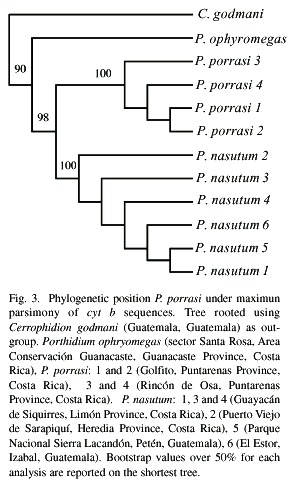
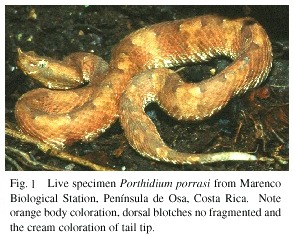
<body><![CDATA[<p><font face="Arial" size="2">The polymerase chain reaction (PCR) was used to amplify ~740 bp fragment of the cytochrome <i>b </i>gene (<span  style="font-style: italic;">cyt b</span>) following the protocols of <a  href="#Chippindale98">Chippindale <i>et al</i>. (1998)</a> The amplification primers were Gludg:</font></p>     <p><font face="Arial" size="2">(5’-TGACTTGAARAACCAYCGTTG-3’) and ATRCB3:</font></p>     <p><font face="Arial" size="2">(5’-TGAGAAGTTTTCYGGGTCRTT-3’) (Palumbi 1996).</font></p>     <p><font face="Arial" size="2">Sequencing was performed using a LICOR<font  face="Symbol" size="-1" style="font-family: arial;">©</font> 4200 dual–laser long-read automated sequencer. Sequencing primers were the same as PCR primers (end-labeled in automated sequencing). We used the Sequiterm Excel<font face="Symbol" size="-1" style="font-family: arial;">©</font> <sup> </sup>kit (Epicentre Technologies), reducing the manufactures reaction volumes to one fourth, and ran them under these conditions: current of 35 mA, and a voltage set to 3000 V for ca. 7 hours. Electropherograms were analyzed for sequence ambiguities and mismatch, and the sequences aligned with a sequence of <i>Crotalus viridis </i>(cytochrome b, GenBank accession number: U65377) using Sequecher©.</font></p>     <p><font face="Arial" size="2">Phylogenetic analyses were conducted using PAUP* (Swofford, version 4.0b1-b2; Sinauer Associates), under two optimality criteria: maximum parsimony (MP) and maximum likelihood (ML). For parsimony analyses, changes among character states were differentially weighted using step matrices (<a href="#Swofford96et">Swofford <i>et a</i>l. 1996</a>).</font></p>     <p><font face="Arial" size="2">Because the methods for phylogenetic inference depend on their underlying sequence divergence model, 10 models were examined to find the one that best fits the data using ModelTest (version 2.1, <a href="#Posada98">Posada and Crandall 1998</a>). The models are: Jukes-Cantor, Kimura 2 parameter, Tamura-Nei equal frequencies, Kimura 3 parameter, SYM, Felsenstein81, Hasegawa-Kishino-Yano, Tamura-Nei, Kimura 3 parameter unequeal base frequencies, and General time reversible (see references in </font><font  face="Arial" size="2"><a href="#Posada98">Posada and Crandall 1998</a></font><font  face="Arial" size="2">). These models were tested under four different schemes of among-site variation: 1) equal rates among all sites, 2) a proportion of sites assumed invariant while equal rates are assumed for variable sites (I), 3) rates at all sites assumed to follow a gamma distribution (G), 4) a combination of I + G (some sites invariable, those variable assume gamma distribution). The resulting combination of 40 models allowed for testing four null hypotheses on our data: equal base frequencies, equal rates of transitions and transversions, rates equal among sites, and no invariable sites. Because all models are interrelated, ModelTest incorporates a likelihood ratio test to evaluate the goodness of fit of the data to the models. For ML analyses implemented via PAUP*, input order was randomized and global swapping across all nodes was implemented (using the global option). The ts:tv ratio was estimated empirically from the sequences. In all analyses, shortest trees were obtained using the heuristic search option with stepwise addition and 100 random taxon-sequence addition replicates in each search. Nodal support was assessed by conducting 100 heuristic non-parametric bootstrap replicates (<a href="#Hillis93">Hillis and Bull 1993</a>).</font></p> <font face="Arial" size="2"><b></b></font>     <p align="center"><font face="Arial" size="2"><b>Results</b></font></p> <font face="Arial" size="2"><b><i> </i></b></font>     <p><font face="Arial" size="2"><b><i>Porthidium porrasi </i></b>sp. nov.</font></p> <font face="Arial" size="2"><b><i></i></b></font>     <p><font face="Arial" size="2"><b><i>Holotype: </i></b>A male 276 mm SVL, UTA R-30829 collected at Drake Bay, Península de Osa, Puntarenas Province, Costa Rica, on 10 July 1990 (<a href="#f1">Fig. 1</a> <a  href="#f2">and 2</a>). </font></p>     <div style="text-align: center;"><a name="f1"></a><img  src="/img/fbpe/rbt/v51n3-4/2925i1.JPG" title="" alt=""  style="width: 294px; height: 237px;">    
]]></body>
<body><![CDATA[<br>     <br> <a name="f2"></a><img src="/img/fbpe/rbt/v51n3-4/2925i2.JPG" title="" alt=""  style="width: 285px; height: 467px;">    
<br>     <br> </div> <font face="Arial" size="2"><i>Paratype</i>s. — UCR 3310, adult female (261 mm SVL); UCR 3359, adult male (341 mm SVL); ICP 1131, adult female (338 mm SVL) from Rincón de Osa, Península de Osa, Puntarenas Province, Costa Rica. UCR 11479, juvenile male (173 mm SVL) from Golfito, Puntarenas Province, Costa Rica.</font>     <p><font face="Arial" size="2"><b>Diagnosis: </b><i>Porthidium porrasi </i>may be distinguished from all congeners by a combination of the following features: snout extremely elevated, tail tip white in both juveniles and adults, ventrals fewer than 145, and usually 25-27 midbody dorsal scale rows. </font></p> <font face="Arial" size="2"><b></b></font>     <p><font face="Arial" size="2"><b>Comparison with other species: </b><i>Porthidium porrasi </i>is not sympatric with any congeners, but its range closely approaches those of <i>P. ophryomega</i>s, <i>P. nasutu</i>m, and <i>P. volcanicu</i>m. From <i>P. ophryomegas </i>it may be distinguished by the presence of only one canthal scale per side; from <i>P. volcanicum </i>it may be distinguished by its elevated snout, banded pattern, white tail tip, and lower number of ventrals (fewer than 155); from <i>P. nasutum </i>it may be distinguished by usually possessing 25-27 dorsal scale rows (vs 23), a white tail tip in adults, and a banded pattern rather than juxtaposed blotches.</font></p> <font face="Arial" size="2"><b></b></font>     <p><font face="Arial" size="2"><b>Description of the Holotype: </b>An adult male, 305.7 mm in total length; tail length 29.7 mm, comprising 9.7% of total length; head length 23.12 mm from front face of rostral to posterior end of mandible; head width 13.83 mm at broadest point (posterior end of mandible); snout elevated, 6.68 mm in length (from front edge of supraocular to rostral); rostral greatly elevated, about 1.65 times higher than broad; internasals 1.5 times longer than wide, not separated; nostrils small, dorsally oriented; one pre-ocular; three postoculars; interocular scales 6; supralabials 9/10, 1 contacting anterior nasal, 4 and 5 are the largest; mental small, 1.1 times broader than long; canthal enlarged; no post canthal, five to six intercanthal scales; internasals in contact; dorsal scales keeled and disposed in 23 rows in neck, 25 at midbody and reduced to 19 one head length from vent; dorsal scales in 6 rows at level of tenth subcaudal; no apical pits apparent; ventrals 143; two preventrals; anal not divided; 30 subcaudals; 24 rows of interrictals; 17 nasofrontals; one row of oculabials between suboculars and supralabials.</font></p> <font face="Arial" size="2"><b></b></font>     <p><font face="Arial" size="2"><b>Color of holotype: </b>In life the color is orange tan. The pattern consisted of 18 dorsal blotches, the anterior nine are juxtaposed at each side of vertebral line, the others form bands; vertebral line is pale, and almost 38% of the tail is cream including the tip. In preservative (ethanol after formaldehyde) color is dull brown, with darker dorsal blotches, and white tail tip. Chin heavily pigmented. The vertebral line persists after preservative. </font></p> <font face="Arial" size="2"><b></b></font>     <p><font face="Arial" size="2"><b>Natural History: </b><i>Porthidium porrasi </i>inhabits mesic forest where it lies coiled by day in leaf litter. One specimen was coiled on a small log by day, and another was crawling slowly on a forest trail by night. Captives feed readily on anoline lizards and rodents. A female (UTA R-30830) from Bahía Drake on the Osa Peninsula gave birth to six young (UTA R-30831-36) ranging from 167 to 175 mm in total length on 24 June 1991. Another from La Gamba, near Golfito, gave birth to nine young in March.</font></p> <font face="Arial" size="2"><b></b></font>     <p><font face="Arial" size="2"><b>Distribution: </b>As currently recognized, the species is distributed in the lowland Pacific wet forest southwestern Costa Rica, including Península de Osa, and the lands surrounding the Golfo Dulce. It is found below 1000 m above sea level. </font></p> <font face="Arial" size="2"><b></b></font>     ]]></body>
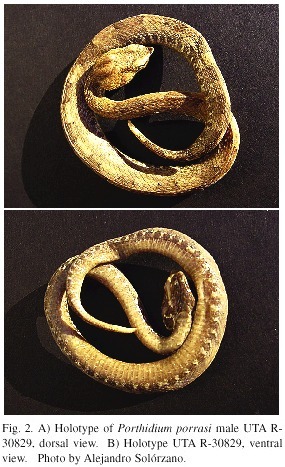
<body><![CDATA[<p><font face="Arial" size="2"><b>Etymology: </b>The name <i>porrasi </i>is a patronym honoring Louis W. Porras, a Costa Rican born herpetologist who was the first to recognize the distinctiveness of the hognosed pitvipers inhabiting the Península de Osa. It is masculine in gender.</font></p> <font face="Arial" size="2"><b></b></font>     <p><font face="Arial" size="2"><b>Variation: </b>Total length of adult specimens examined ranged from 288 mm to 385 mm. Tail lengths of males (UCR 3359 and UCR 11479) are 44 (11.4% body length) and 22 mm (11.3%) respectively; whereas females have shorter tails: 27 (9.3%), and 39 mm (10.2%). The rostral is higher than wide in all specimens: observed ratios (height/width) were 1.17, 1.43, 1.32, and 1.21. All specimens have 10 strongly pigmented supralabials, except UCR 3310 that has nine. Eleven infralabials, usually pigmented, are present, together with 1 or 2 preoculars and similar number of postoculars. Interocular scales range from 5 to 6. Canthals are elongated and slightly pigmented. One individual (UCR 3359) lacks a postcanthal, the others possess one. Intercanthal count differs among individuals, ranging from 6 to 9 scales. In all examined specimens, internasals are not separated totally, although one scale is usually inserted</font></p>     <p><font face="Arial" size="2">between them. Ventral scales are not different between males and females examined, as 138 and 144 were observed for both sexes. On the other hand, undivided subcaudals in males are 30 and 33, whereas in both females 26 sub-caudals were counted. Interrictals range from 25 to 29. Dorsal scales rows are consistently higher in the neck and midbody than at the vent: observed formulas are 25-25-20, 25-24- 19, 27-24-19, 25-25-19. Nasofrontals range from 23 to 29 scales. One or two oculabials were observed. The number of dorsal blotches in the body is 15 and 16, and in all specimens more than 70% of the blotches are not fragmented. </font></p>     <p><font face="Arial" size="2">In all specimens, tip of the tail is cream, covering a third to a quarter of the overall length of the tail. Also, a cream vertebral line is present in all cases (see <a href="#f2">Fig. 2</a>). </font></p> <font face="Arial" size="2"><b></b></font>     <p><font face="Arial" size="2"><b>Divergence at the molecular level: </b>An analysis of <i>cyt b </i>sequences of <i>Porthidium porrasi </i>and <i>P. nasutum </i>reveal seventy-one parsimony informative characters. Nucleotide sequences departed from the equal base frequency hypothesis, as well as from the equal rates of transitions and transversions, and equal ratio among sites hypotheses (p&lt; 0.00001 in all cases). However, the null hypotheses of equal rate transitions and equal rate transversions were accepted (p&gt; 0.133 in both cases). Thus, the evolutionary model that best fit the divergence of nucleotide sequences in both parameter economy and sequence divergence was Hasegawa-Kishino-Yano (1985, HKY + G).</font></p>     <p><font face="Arial" size="2">Divergence within cyt <i>b </i>sequences <i>Porthidium porrasi </i>ranged from 0.0028 to 0.0048 substitutions per site, whereas observed divergence between sequences of <i>P. porrasi </i>and <i>P. nasutum </i>ranged from 0.049 to 0.066 substitutions per site (mean = 0.055). Parsimony analyses retrieved a single parsimony trees (215 steps, consistency index <i>CI </i>= 0.898, retention index <i>RI </i>= 0.861). In this tree, <i>P. porrasi </i>samples form a monophyletic group sister to the clade that includes samples from <i>P. nasutum </i>from Costa Rica and Guatemala <a href="#f3">(Fig. 3)</a>.</font></p>     <div style="text-align: center;"><span style="font-family: arial;"><a  name="f3"></a><img src="/img/fbpe/rbt/v51n3-4/2925i3.JPG" title="" alt=""  style="width: 289px; height: 481px;"></span>    
<br> </div>     <p><font face="Arial" size="2">The topology retrieved under maximum parsimony analysis was not in conflict with that obtained using maximum likelihood under the HKY + G model (-ln L = 1948.759, ti/tv = 4.2082, a (gamma shape parameter) = 0.2488). Thus both methods of phylogenetic reconstruction placed <i>Porthidium porrasi </i>as a distinct clade sister to <i>P. nasutu</i>m, and the observed divergences are well supported with mtDNA.</font></p> <font face="Arial" size="2"><b>     <p>Discussion</p> </b> </font>     ]]></body>
<body><![CDATA[<p><font face="Arial" size="2">In their analysis of <i>P. nasutum </i>morphological variatio<i>n, </i><a href="#Porras81">Porras <i>et a</i>l. (1981)</a> noticed that populations from Península de Osa and adjacent areas could be distinguished from other populations of the species. However, no taxonomic changes were suggested at that time, and individuals from the southwestern populations were regarded as simple variants of the <i>P. nasutum </i>morphotype. Our study reveals however that, despite the extensive overlap in scale counts with other related species, <i>P. porrasi </i>can be distinguished from other members of the genus both at the morphological and molecular level.</font></p>     <p><font face="Arial" size="2">Most of the diagnostic features of <i>P. porrasi </i>might be described as neotenic characters that are expressed early on in other related members of the group. For instance, </font><font face="Arial" size="2"><a href="#Porras81">Porras <i>et a</i>l. (1981)</a></font><font face="Arial" size="2"> stated that juveniles of <i>P. nasutum </i>differ from adults in that they are "noticeably brighter in color and more distinct in pattern than are the adults" (pp. 99). All adult <i>P. porrasi </i>collected by us are also brightly colored and banded. Juvenile <i>P. nasutum </i>are also characterized by the following combination: usually with head markings, pale vertebral line present, well defined dorsal blotches, and a conspicuous cream to yellowish coloration in the tip of the tail, features that are also present in juveniles of other terrestrial pitvipers (<a  href="#Solorzano90">Solórzano 1990</a>, Solórzano <i>et al. </i>1998). All these characters are present in adult <i>P. porrasi </i>of both sexes. Thus, it seems that retention of neotenic characters was a byproduct of the process of speciation that resulted in <i>P. porrasi. </i>Speciation through neoteny might not be an uncommon pattern, as several examples of neotenic lineages are known among lower vertebrates (<a href="#Chippindale00">Chippindale <i>et al. </i>2000</a>).</font></p>     <p><font face="Arial" size="2">The phylogenetic affinities of <i>P. porrasi </i>are not understood to this date, but it seems that the species is closely related to <i>P. nasutum </i>(</font><font  face="Arial" size="2"><a href="#Porras81">Porras <i>et al. </i>1981</a></font><font  face="Arial" size="2">). To estimate time of divergence between these forms form our mDNA sequences, we employed the <a href="#Brown82">Brown <i>et al. </i>(1982)</a> primate molecular clock based on cyt <i>b </i>sequences. Using the gamma-HKY model, Arbogast and Slowinski (1998) corrected the primate clock and estimated a rate of 0.0278 substitutions per site per lineage per million years (Mya). Thus, at that rate, the divergence between the <i>P. porrasi </i>and <i>P. nasutum </i>lineages might have occurred in the last 1.7 million years, coinciding with events that began during the late Pliocene. In late Pliocene and throughout the Pleistocene, repeated cooling and warming episodes affected the region. During Glacial periods, temperatures dropped so that mountain vegetation mixed with low-land. However, as Colineaux (1996) suggested, interglacial periods were probably wet periods in Middle America. Thus, isolation of the wet lowland forest in the Southwestern Pacific of Costa Rica might be produced by other factors. It seems that the uplift of the major mountain ranges in the country emphasized the rainshadow effect of the Pacific slope and fragmented the faunas at each side of the mountains. The last episodes of volcanism in the Talamancas, the southern mountain range that divides Costa Rica, coincide with the <i>P. nasutum </i>– <i>P. porrasi </i>separation timeframe (<a  href="#Denyer00">Denyer <i>et al. </i>2000</a>). </font></p>     <p><font face="Arial" size="2">In recent years, two other species of vipers have been described from the southwestern region of Costa Rica: <i>Porthidium volcanicum </i>(</font><font face="Arial" size="2"><a  href="#Solorzano94">Solórzano 1994</a></font><font face="Arial"  size="2">) and <i>Bothriechis supraciliaris </i>(Solórzano <i>et a</i>l. 1998). The presence of <i>P. porrasi </i>on the Península de Osa adds to the notion that these wet forests contain not only a great diversity, but also are highly rich in endemics.</font></p> <font face="Arial" size="2"><b>     <p>Agknowledgements</p> </b> </font>     <p><font face="Arial" size="2">We thank Jonathan A. Campbell and Federico Bolaños for kindly providing material for this study. Erika Deinert, Louis W. Porras, and Alejandro Solórzano made valuable comments about the manuscript. Paul T. Chippindale and Todd Castoe kindly help us with the molecular analyses. Luis Diego Gómez discussed the biogeography of the mesic forest in southern Costa Rica. The Miranda family and staff of Marenco Biological Station helped us with logistics and housing while working in Osa. This study was supported in part by Vicerrectoría de Investigación, Universidad de Costa Rica (Project 741-A1-021).</font></p> <font face="Arial" size="2"><b>     <p>Resumen</p> </b> </font>     <p><font face="Arial" size="2">Una nueva especie de víbora terrestre, <i>Porthidium porras</i>i, es descrita de los bosques húmedos de la Península de Osa y áreas adyacentes en la vertiente Pacífica del suroeste de Costa Rica. La especie es más similar a <i>P. nasutum </i>y se caracteriza por la persistencia en adultos de caracteres neoténicos como patrón de bandas, línea vertebral pálida, punta de cola crema y la presencia de un número alto de filas de escamas dorsales. Los análisis de secuencias de ADN mitocondrial confirman su distinción de <i>P. nasutu</i>m. La existencia de esta especie refuerza la noción de un fuerte endemismo de herpetofauna en el suroeste de Costa Rica.</font></p> <font face="Arial" size="2"><b>     <p>References</p> </b> </font>     <!-- ref --><p><font face="Arial" size="2"><a name="Arbogast98"></a>Arbogast, B.S. &amp; J.B. Slowinski. 1998. Pleistocene speciation and the mitochondrial DNA clock. Science 282: 1955.    &nbsp;&nbsp;&nbsp;&nbsp;&nbsp;&nbsp;&nbsp;&nbsp;[&#160;<a href="javascript:void(0);" onclick="javascript: window.open('/scielo.php?script=sci_nlinks&ref=1677666&pid=S0034-7744200300030002200001&lng=','','width=640,height=500,resizable=yes,scrollbars=1,menubar=yes,');">Links</a>&#160;]<!-- end-ref --></font></p>     <!-- ref --><p><font face="Arial" size="2"><a name="Amaral27"></a>Amaral, A. do. 1927. Studies of neotropical ophidia. V. Notes on <i>Bothrops lansbergii </i>and <i>B. brachystom</i>a. Bull Antivenin Inst. America 1: 22.    &nbsp;&nbsp;&nbsp;&nbsp;&nbsp;&nbsp;&nbsp;&nbsp;[&#160;<a href="javascript:void(0);" onclick="javascript: window.open('/scielo.php?script=sci_nlinks&ref=1677668&pid=S0034-7744200300030002200002&lng=','','width=640,height=500,resizable=yes,scrollbars=1,menubar=yes,');">Links</a>&#160;]<!-- end-ref --></font></p>     <!-- ref --><p><font face="Arial" size="2"><a name="Amaral29"></a>Amaral, A. do. 1929. Studies of neotropical ophidia. XII. On the <i>Bothrops lansbergii </i>group. Bull. Antivenin Inst. America 3: 19-27.    &nbsp;&nbsp;&nbsp;&nbsp;&nbsp;&nbsp;&nbsp;&nbsp;[&#160;<a href="javascript:void(0);" onclick="javascript: window.open('/scielo.php?script=sci_nlinks&ref=1677670&pid=S0034-7744200300030002200003&lng=','','width=640,height=500,resizable=yes,scrollbars=1,menubar=yes,');">Links</a>&#160;]<!-- end-ref --></font></p>     <!-- ref --><p><font face="Arial" size="2"><a name="Amaral44"></a>Amaral, A. do. 1944. Notas sôbre a ofiología neotrópica e brasílica. II. Sôbre <i>Bothrops lansbergii lansbergii </i>(Schlegel 1841); <i>Trimeresurus dunni </i>Hartweg and Oliver 1938; <i>T. lansbergii annectens </i>Schmidt 1936. Pap. Avulsos. Dep. Zool., São Paulo 5: 7-12.    &nbsp;&nbsp;&nbsp;&nbsp;&nbsp;&nbsp;&nbsp;&nbsp;[&#160;<a href="javascript:void(0);" onclick="javascript: window.open('/scielo.php?script=sci_nlinks&ref=1677672&pid=S0034-7744200300030002200004&lng=','','width=640,height=500,resizable=yes,scrollbars=1,menubar=yes,');">Links</a>&#160;]<!-- end-ref --></font></p>     <!-- ref --><p><font face="Arial" size="2"><a name="Boulenger96"></a>Boulenger, G.A. 1896. Catalogue of the snakes in the British Museum (Natural History). Vol. 3. Taylor and Francis, London, 727 p.    &nbsp;&nbsp;&nbsp;&nbsp;&nbsp;&nbsp;&nbsp;&nbsp;[&#160;<a href="javascript:void(0);" onclick="javascript: window.open('/scielo.php?script=sci_nlinks&ref=1677674&pid=S0034-7744200300030002200005&lng=','','width=640,height=500,resizable=yes,scrollbars=1,menubar=yes,');">Links</a>&#160;]<!-- end-ref --></font></p>     <!-- ref --><p><font face="Arial" size="2"><a name="Brown82"></a>Brown, W.M., E.M. Prager, A. Wang &amp; A.C. Wilson. 1982. Mitochondrial DNA sequences of primates: Tempo and mode of evolution. J. Mol. Evol. 18: 225-239.    &nbsp;&nbsp;&nbsp;&nbsp;&nbsp;&nbsp;&nbsp;&nbsp;[&#160;<a href="javascript:void(0);" onclick="javascript: window.open('/scielo.php?script=sci_nlinks&ref=1677676&pid=S0034-7744200300030002200006&lng=','','width=640,height=500,resizable=yes,scrollbars=1,menubar=yes,');">Links</a>&#160;]<!-- end-ref --></font></p>     <!-- ref --><p><font face="Arial" size="2"><a name="Campbell89"></a>Campbell, J.A. &amp; W.W. Lamar. 1989. The venomous reptiles of Latin America. Cornell Univ., Ithaca, New York, 425 p.    &nbsp;&nbsp;&nbsp;&nbsp;&nbsp;&nbsp;&nbsp;&nbsp;[&#160;<a href="javascript:void(0);" onclick="javascript: window.open('/scielo.php?script=sci_nlinks&ref=1677678&pid=S0034-7744200300030002200007&lng=','','width=640,height=500,resizable=yes,scrollbars=1,menubar=yes,');">Links</a>&#160;]<!-- end-ref --></font></p>     <!-- ref --><p><font face="Arial" size="2"><a name="Campbell92"></a>Campbell, J.A. &amp; W.W. Lamar. 1992. Taxonomic status of miscellaneous Neotropical viperids, with the description of a new genus. Occas. Pap. Mus. Texas Tech. Univ. 153: 1-31.    &nbsp;&nbsp;&nbsp;&nbsp;&nbsp;&nbsp;&nbsp;&nbsp;[&#160;<a href="javascript:void(0);" onclick="javascript: window.open('/scielo.php?script=sci_nlinks&ref=1677680&pid=S0034-7744200300030002200008&lng=','','width=640,height=500,resizable=yes,scrollbars=1,menubar=yes,');">Links</a>&#160;]<!-- end-ref --></font></p>     <!-- ref --><p><font face="Arial" size="2"><a name="Campbell"></a>Campbell, J.A. &amp; W.W. Lamar. [in press]. The venomous reptiles of the Western Hemisphere. Vol. 2. Cornell University, Ithaca, New York.    &nbsp;&nbsp;&nbsp;&nbsp;&nbsp;&nbsp;&nbsp;&nbsp;[&#160;<a href="javascript:void(0);" onclick="javascript: window.open('/scielo.php?script=sci_nlinks&ref=1677682&pid=S0034-7744200300030002200009&lng=','','width=640,height=500,resizable=yes,scrollbars=1,menubar=yes,');">Links</a>&#160;]<!-- end-ref --></font></p>     <!-- ref --><p><font face="Arial" size="2"><a name="Castoe02"></a>Castoe, T.A. 2002. Microhabitat selection in <i>Porthidium nasutum </i>(Serpentes: Viperidae) in Costa Rica, with comments on ontogenetic variation. Herpetol. Rev. 33: 174-175.    &nbsp;&nbsp;&nbsp;&nbsp;&nbsp;&nbsp;&nbsp;&nbsp;[&#160;<a href="javascript:void(0);" onclick="javascript: window.open('/scielo.php?script=sci_nlinks&ref=1677684&pid=S0034-7744200300030002200010&lng=','','width=640,height=500,resizable=yes,scrollbars=1,menubar=yes,');">Links</a>&#160;]<!-- end-ref --></font></p>     <!-- ref --><p><font face="Arial" size="2"><a name="Chippindale98"></a>Chippindale, P.T., L.K. Ammerman, &amp; J.A. Campbell. 1998. Molecular approaches to phylogeny of <i>Abronia </i>(Anguidae: Gerrhonotinae), with emphasis on relationships in the subgenus <i>Auriculabroni</i>a. Copeia 1998:883-892</font>&nbsp;&nbsp;&nbsp;&nbsp;&nbsp;&nbsp;&nbsp;&nbsp;[&#160;<a href="javascript:void(0);" onclick="javascript: window.open('/scielo.php?script=sci_nlinks&ref=1677686&pid=S0034-7744200300030002200011&lng=','','width=640,height=500,resizable=yes,scrollbars=1,menubar=yes,');">Links</a>&#160;]<!-- end-ref --><!-- ref --><p><font face="Arial" size="2"><a name="Chippindale00"></a>Chippindale, P.T., A.H. Price, J.J. Wiens &amp; D.M. Hillis. 2000. Phylogenetic relationships and systematics revision of central Texas hemidactyliine plethodontid salamanders. Carnagie Museum Publications in Zoology.    &nbsp;&nbsp;&nbsp;&nbsp;&nbsp;&nbsp;&nbsp;&nbsp;[&#160;<a href="javascript:void(0);" onclick="javascript: window.open('/scielo.php?script=sci_nlinks&ref=1677687&pid=S0034-7744200300030002200012&lng=','','width=640,height=500,resizable=yes,scrollbars=1,menubar=yes,');">Links</a>&#160;]<!-- end-ref --> </font></p>     <!-- ref --><p><font face="Arial" size="2"><a name="Colinveaux96"></a>Colinveaux, P.A. 1996. Quaternary environmental history and forest diversity in the Neotropics. pp. 359-405. <i>In </i>J.B.C. Jackson, A.F. Budd &amp; A.G. Coates. Evolution and environment in tropical America. The University of Chicago, Chicago.    &nbsp;&nbsp;&nbsp;&nbsp;&nbsp;&nbsp;&nbsp;&nbsp;[&#160;<a href="javascript:void(0);" onclick="javascript: window.open('/scielo.php?script=sci_nlinks&ref=1677689&pid=S0034-7744200300030002200013&lng=','','width=640,height=500,resizable=yes,scrollbars=1,menubar=yes,');">Links</a>&#160;]<!-- end-ref --></font></p>     <!-- ref --><p><font face="Arial" size="2"><a name="Cope71"></a>Cope, E.D. 1871. Ninth contribution to the herpetology of tropical America. Proc. Acad. Nat. Sci. Philadelphia 23: 200-224.    &nbsp;&nbsp;&nbsp;&nbsp;&nbsp;&nbsp;&nbsp;&nbsp;[&#160;<a href="javascript:void(0);" onclick="javascript: window.open('/scielo.php?script=sci_nlinks&ref=1677691&pid=S0034-7744200300030002200014&lng=','','width=640,height=500,resizable=yes,scrollbars=1,menubar=yes,');">Links</a>&#160;]<!-- end-ref --></font></p>     <!-- ref --><p><font face="Arial" size="2"><a name="Denyer00"></a>Denyer, P., G.E. Alvarado &amp; T. Aguilar. 2000. Historia Geológica. pp. 155-167. <i>In </i>P. Denyer &amp; S. Kussmaul (eds.). Geología de Costa Rica. Editorial Tecnologica de Costa Rica, San José. 513 p.    &nbsp;&nbsp;&nbsp;&nbsp;&nbsp;&nbsp;&nbsp;&nbsp;[&#160;<a href="javascript:void(0);" onclick="javascript: window.open('/scielo.php?script=sci_nlinks&ref=1677693&pid=S0034-7744200300030002200015&lng=','','width=640,height=500,resizable=yes,scrollbars=1,menubar=yes,');">Links</a>&#160;]<!-- end-ref --></font></p>     <!-- ref --><p><font face="Arial" size="2"><a name="Dowling51"></a>Dowling, H.G. 1951. A proposed standard system of counting ventrals in snakes. British J. Herpetol. 1: 97-99.    &nbsp;&nbsp;&nbsp;&nbsp;&nbsp;&nbsp;&nbsp;&nbsp;[&#160;<a href="javascript:void(0);" onclick="javascript: window.open('/scielo.php?script=sci_nlinks&ref=1677695&pid=S0034-7744200300030002200016&lng=','','width=640,height=500,resizable=yes,scrollbars=1,menubar=yes,');">Links</a>&#160;]<!-- end-ref --></font></p>     ]]></body>
<body><![CDATA[<!-- ref --><p><font face="Arial" size="2"><a name="Dunn28"></a>Dunn, E.R. 1928. Notes on <i>Bothrops lansbergi </i>and <i>Bothrops ophryomega</i>s. Bull. Antivenin Inst. America 2: 29-30.    &nbsp;&nbsp;&nbsp;&nbsp;&nbsp;&nbsp;&nbsp;&nbsp;[&#160;<a href="javascript:void(0);" onclick="javascript: window.open('/scielo.php?script=sci_nlinks&ref=1677697&pid=S0034-7744200300030002200017&lng=','','width=640,height=500,resizable=yes,scrollbars=1,menubar=yes,');">Links</a>&#160;]<!-- end-ref --></font></p>     <!-- ref --><p><font face="Arial" size="2"><a name="Gutberlet98"></a>Gutberlet, R.L. Jr. 1998. The phylogenetic position of the Mexican black tailed pitviper (Squamata: Viperidae: Crotalinae). Herpetologica 54: 184-206.    &nbsp;&nbsp;&nbsp;&nbsp;&nbsp;&nbsp;&nbsp;&nbsp;[&#160;<a href="javascript:void(0);" onclick="javascript: window.open('/scielo.php?script=sci_nlinks&ref=1677699&pid=S0034-7744200300030002200018&lng=','','width=640,height=500,resizable=yes,scrollbars=1,menubar=yes,');">Links</a>&#160;]<!-- end-ref --></font></p>     <!-- ref --><p><font face="Arial" size="2"><a name="Gutberlet01"></a>Gutberlet, R.L. Jr. &amp; J.A. Campbell. 2001. Generic recognition for a neglected lineage of South American pitvipers (Squamata: Viperidae: Crotalinae), with a description of a new species from the Colombian Chocó. Amer. Mus. Novitates. 3316: 1-15.    &nbsp;&nbsp;&nbsp;&nbsp;&nbsp;&nbsp;&nbsp;&nbsp;[&#160;<a href="javascript:void(0);" onclick="javascript: window.open('/scielo.php?script=sci_nlinks&ref=1677701&pid=S0034-7744200300030002200019&lng=','','width=640,height=500,resizable=yes,scrollbars=1,menubar=yes,');">Links</a>&#160;]<!-- end-ref --></font></p>     <!-- ref --><p><font face="Arial" size="2"><a name="Hasegawa85"></a>Hasegawa, M., Kishino, K. &amp; T. Yano. 1985. Dating the human-ape splitting by a molecular clock of mitochondrial DNA. J. Mol. Evol. 22: 160-174.    &nbsp;&nbsp;&nbsp;&nbsp;&nbsp;&nbsp;&nbsp;&nbsp;[&#160;<a href="javascript:void(0);" onclick="javascript: window.open('/scielo.php?script=sci_nlinks&ref=1677703&pid=S0034-7744200300030002200020&lng=','','width=640,height=500,resizable=yes,scrollbars=1,menubar=yes,');">Links</a>&#160;]<!-- end-ref --> </font></p>     <!-- ref --><p><font face="Arial" size="2"><a name="Hillis93"></a>Hillis, D.M. &amp; J.J. Bull. 1993. An empirical test of boot-strapping as a method for assessing confidence in phylogenetic analysis. Syst. Biol. 42: 182-192.    &nbsp;&nbsp;&nbsp;&nbsp;&nbsp;&nbsp;&nbsp;&nbsp;[&#160;<a href="javascript:void(0);" onclick="javascript: window.open('/scielo.php?script=sci_nlinks&ref=1677705&pid=S0034-7744200300030002200021&lng=','','width=640,height=500,resizable=yes,scrollbars=1,menubar=yes,');">Links</a>&#160;]<!-- end-ref --></font></p>     ]]></body>
<body><![CDATA[<!-- ref --><p><font face="Arial" size="2"><a name="Hillis96"></a>Hillis, D.M., B.K. Mable, A. Larson, S.K. Davis &amp; E.A. Zimmer. 1996. Nucleic acids. IV. Sequencing and clonning. pp. 321-381. <i>In </i>D.M. Hillis, C. Moritz &amp; B.K. Mable (eds.). Molecular Systematics. Sinauer Associates, Sunderland, Massachusetts.    &nbsp;&nbsp;&nbsp;&nbsp;&nbsp;&nbsp;&nbsp;&nbsp;[&#160;<a href="javascript:void(0);" onclick="javascript: window.open('/scielo.php?script=sci_nlinks&ref=1677707&pid=S0034-7744200300030002200022&lng=','','width=640,height=500,resizable=yes,scrollbars=1,menubar=yes,');">Links</a>&#160;]<!-- end-ref --></font></p>     <!-- ref --><p><font face="Arial" size="2"><a name="Lawson96"></a>Lawson, D. 1996/1997. Sexual dimorphism and reproduction of the pitviper <i>Porthidium ophryomegas </i>(Serpentes: Viperidae) in Guatemala. Rev. Biol. Trop. 44 (3)/45(1): 671-674.    &nbsp;&nbsp;&nbsp;&nbsp;&nbsp;&nbsp;&nbsp;&nbsp;[&#160;<a href="javascript:void(0);" onclick="javascript: window.open('/scielo.php?script=sci_nlinks&ref=1677709&pid=S0034-7744200300030002200023&lng=','','width=640,height=500,resizable=yes,scrollbars=1,menubar=yes,');">Links</a>&#160;]<!-- end-ref --></font></p>     <!-- ref --><p><font face="Arial" size="2"><a name="Palumbi96"></a>Palumbi, S.R. 1996. Nucleic acids II: The polymerase chain reaction. pp. 205-247. <i>In </i>D.M. Hillis, C. Moritz &amp; B.K. Mable (eds.). Molecular Systematics. Sinauer Associates, Sunderland, Massachusetts.    &nbsp;&nbsp;&nbsp;&nbsp;&nbsp;&nbsp;&nbsp;&nbsp;[&#160;<a href="javascript:void(0);" onclick="javascript: window.open('/scielo.php?script=sci_nlinks&ref=1677711&pid=S0034-7744200300030002200024&lng=','','width=640,height=500,resizable=yes,scrollbars=1,menubar=yes,');">Links</a>&#160;]<!-- end-ref --> </font></p>     <!-- ref --><p><font face="Arial" size="2"><a name="Parkinson99"></a>Parkinson, C.L. 1999. Molecular systematics and biogeographical history of pitvipers as determined by mitochondrial ribosomal DNA sequences. Copeia 1999: 576-586.    &nbsp;&nbsp;&nbsp;&nbsp;&nbsp;&nbsp;&nbsp;&nbsp;[&#160;<a href="javascript:void(0);" onclick="javascript: window.open('/scielo.php?script=sci_nlinks&ref=1677713&pid=S0034-7744200300030002200025&lng=','','width=640,height=500,resizable=yes,scrollbars=1,menubar=yes,');">Links</a>&#160;]<!-- end-ref --></font></p>     <!-- ref --><p><font face="Arial" size="2"><a name="Parkinson02"></a>Parkinson, C.L., J.A. Campbell &amp; P.T. Chippindale. 2002. Multigene phylogenetic analysis of pitvipers with comments on their biogeography. pp. 93-110. In G. W. Schuett, M. Höggren, M.E. Douglas &amp; H.W. Greene (eds.). Biology of the Vipers. Eagle Mountain Publishing, Eagle Mountain, Utah. 580 p.    &nbsp;&nbsp;&nbsp;&nbsp;&nbsp;&nbsp;&nbsp;&nbsp;[&#160;<a href="javascript:void(0);" onclick="javascript: window.open('/scielo.php?script=sci_nlinks&ref=1677715&pid=S0034-7744200300030002200026&lng=','','width=640,height=500,resizable=yes,scrollbars=1,menubar=yes,');">Links</a>&#160;]<!-- end-ref --></font></p>     ]]></body>
<body><![CDATA[<!-- ref --><p><font face="Arial" size="2"><a name="Peters64"></a>Peters, J.A. 1964. Dictionary of Herpetology. Hafner Publishing, New York and London.    &nbsp;&nbsp;&nbsp;&nbsp;&nbsp;&nbsp;&nbsp;&nbsp;[&#160;<a href="javascript:void(0);" onclick="javascript: window.open('/scielo.php?script=sci_nlinks&ref=1677717&pid=S0034-7744200300030002200027&lng=','','width=640,height=500,resizable=yes,scrollbars=1,menubar=yes,');">Links</a>&#160;]<!-- end-ref --></font></p>     <!-- ref --><p><font face="Arial" size="2"><a name="Porras81"></a>Porras, L., J.R. McCranie, &amp; L.D. Wilson. 1981. The systematics and distribution of the hognose viper <i>Bothrops nasuta </i>Bocourt (Serpentes: Viperidae). Tulane Stud. Zool. Bot. 22: 85-107.    &nbsp;&nbsp;&nbsp;&nbsp;&nbsp;&nbsp;&nbsp;&nbsp;[&#160;<a href="javascript:void(0);" onclick="javascript: window.open('/scielo.php?script=sci_nlinks&ref=1677719&pid=S0034-7744200300030002200028&lng=','','width=640,height=500,resizable=yes,scrollbars=1,menubar=yes,');">Links</a>&#160;]<!-- end-ref --></font></p>     <!-- ref --><p><font face="Arial" size="2"><a name="Posada98"></a>Posada, D. &amp; K.A. Crandall. 1998. Modeltest: Testing the model of DNA substitution. Bioinformatics 14: 817- 818.    &nbsp;&nbsp;&nbsp;&nbsp;&nbsp;&nbsp;&nbsp;&nbsp;[&#160;<a href="javascript:void(0);" onclick="javascript: window.open('/scielo.php?script=sci_nlinks&ref=1677721&pid=S0034-7744200300030002200029&lng=','','width=640,height=500,resizable=yes,scrollbars=1,menubar=yes,');">Links</a>&#160;]<!-- end-ref --></font></p>     <!-- ref --><p><font face="Arial" size="2"><a name="Sasa02"></a>Sasa, M. 2002. Morphological variation in the lancehead pitviper <i>Bothrops asper </i>(Garman) (Serpentes: Viperidae) from Middle America. Rev. Biol. Trop. 50(1): 259-271.    &nbsp;&nbsp;&nbsp;&nbsp;&nbsp;&nbsp;&nbsp;&nbsp;[&#160;<a href="javascript:void(0);" onclick="javascript: window.open('/scielo.php?script=sci_nlinks&ref=1677723&pid=S0034-7744200300030002200030&lng=','','width=640,height=500,resizable=yes,scrollbars=1,menubar=yes,');">Links</a>&#160;]<!-- end-ref --></font></p>     <!-- ref --><p><font face="Arial" size="2"><a name="Savage02"></a>Savage, J.M. 2002. The amphibians and reptiles of Costa Rica. A herpetofauna between two continents, between two seas. The University of Chicago, Chicago and London, 933 p.    &nbsp;&nbsp;&nbsp;&nbsp;&nbsp;&nbsp;&nbsp;&nbsp;[&#160;<a href="javascript:void(0);" onclick="javascript: window.open('/scielo.php?script=sci_nlinks&ref=1677725&pid=S0034-7744200300030002200031&lng=','','width=640,height=500,resizable=yes,scrollbars=1,menubar=yes,');">Links</a>&#160;]<!-- end-ref --></font></p>     ]]></body>
<body><![CDATA[<!-- ref --><p><font face="Arial" size="2"><a name="Solorzano90"></a>Solórzano, A. 1990. Reproduction in the pitviper <i>Porthidium picadoi </i>Dunn (Serpentes: Viperidae) in Costa Rica. Copeia 1990: 1154-1157.    &nbsp;&nbsp;&nbsp;&nbsp;&nbsp;&nbsp;&nbsp;&nbsp;[&#160;<a href="javascript:void(0);" onclick="javascript: window.open('/scielo.php?script=sci_nlinks&ref=1677727&pid=S0034-7744200300030002200032&lng=','','width=640,height=500,resizable=yes,scrollbars=1,menubar=yes,');">Links</a>&#160;]<!-- end-ref --></font></p>     <!-- ref --><p><font face="Arial" size="2"><a name="Solorzano94"></a>Solórzano, A. 1994. Una nueva especie de serpiente venenosa terrestre del genero <i>Porthidium </i>(Serpentes: Viperidae), del sureste de Costa Rica. Rev. Biol. Trop. 42: 695-701.    &nbsp;&nbsp;&nbsp;&nbsp;&nbsp;&nbsp;&nbsp;&nbsp;[&#160;<a href="javascript:void(0);" onclick="javascript: window.open('/scielo.php?script=sci_nlinks&ref=1677729&pid=S0034-7744200300030002200033&lng=','','width=640,height=500,resizable=yes,scrollbars=1,menubar=yes,');">Links</a>&#160;]<!-- end-ref --></font></p>     <!-- ref --><p><font face="Arial" size="2"><a name="Solorzano99"></a>Solórzano, A., L.D. Gómez, J. Monge &amp; B. Crother. 1999 [dated 1998]. Redescription and validation of <i>Bothriechis supraciliaris </i>(Serpentes: Viperidae). Rev. Biol. Trop. 46: 453-62.    &nbsp;&nbsp;&nbsp;&nbsp;&nbsp;&nbsp;&nbsp;&nbsp;[&#160;<a href="javascript:void(0);" onclick="javascript: window.open('/scielo.php?script=sci_nlinks&ref=1677731&pid=S0034-7744200300030002200034&lng=','','width=640,height=500,resizable=yes,scrollbars=1,menubar=yes,');">Links</a>&#160;]<!-- end-ref --></font></p>     <!-- ref --><p><font face="Arial" size="2"><a name="Solorzano88"></a>Solórzano, A., J. M. Gutiérrez &amp; L. Cerdas. 1988. <i>Botrhops ophryomegas </i>Bocourt (Serpentes: Viperidae) en Costa Rica: distribución, lepidosis, variación sexual y cariotipo. Rev. Biol. Trop. 36: 187-190.    &nbsp;&nbsp;&nbsp;&nbsp;&nbsp;&nbsp;&nbsp;&nbsp;[&#160;<a href="javascript:void(0);" onclick="javascript: window.open('/scielo.php?script=sci_nlinks&ref=1677733&pid=S0034-7744200300030002200035&lng=','','width=640,height=500,resizable=yes,scrollbars=1,menubar=yes,');">Links</a>&#160;]<!-- end-ref --></font></p>     <!-- ref --><p><font face="Arial" size="2"><a name="Swofford96"></a>Swofford, D.L. 1996. PAUP*: Phylogenetic analysis using parsimony. Version 4.0. Sinauer Associates, Sunderland, Massachusetts.    &nbsp;&nbsp;&nbsp;&nbsp;&nbsp;&nbsp;&nbsp;&nbsp;[&#160;<a href="javascript:void(0);" onclick="javascript: window.open('/scielo.php?script=sci_nlinks&ref=1677735&pid=S0034-7744200300030002200036&lng=','','width=640,height=500,resizable=yes,scrollbars=1,menubar=yes,');">Links</a>&#160;]<!-- end-ref --></font></p>     ]]></body>
<body><![CDATA[<!-- ref --><p><font face="Arial" size="2"><a name="Swofford96et"></a>Swofford, D.L., G.J. Olsen, P.J. Waddell &amp; D.M. Hillis. 1996. Phylogenetic inference. pp. 407-514. <i>In </i>Hillis, D.M., C. Moritz &amp; B.K. Mable (eds.). Molecular Systematics. 2<sup>nd</sup> ed. Sinauer Associates, Sunderland, Massachusetts.    &nbsp;&nbsp;&nbsp;&nbsp;&nbsp;&nbsp;&nbsp;&nbsp;[&#160;<a href="javascript:void(0);" onclick="javascript: window.open('/scielo.php?script=sci_nlinks&ref=1677737&pid=S0034-7744200300030002200037&lng=','','width=640,height=500,resizable=yes,scrollbars=1,menubar=yes,');">Links</a>&#160;]<!-- end-ref --></font></p>     <!-- ref --><p><font face="Arial" size="2"><a name="Werman92"></a>Werman, S.D. 1992. Phylogenetic relationships of Central and South American pitvipers of the genus <i>Bothrops </i>(sensu lato): Cladistic analyses of biochemical and anatomical characters. pp. 21-40. In Biology of the Pitvipers, J.A. Campbell &amp; E.D. Brodie, Jr., (eds.). Selva, Tyler, Texas.    &nbsp;&nbsp;&nbsp;&nbsp;&nbsp;&nbsp;&nbsp;&nbsp;[&#160;<a href="javascript:void(0);" onclick="javascript: window.open('/scielo.php?script=sci_nlinks&ref=1677739&pid=S0034-7744200300030002200038&lng=','','width=640,height=500,resizable=yes,scrollbars=1,menubar=yes,');">Links</a>&#160;]<!-- end-ref --></font></p>     <!-- ref --><p><font face="Arial" size="2"><a name="Werman99"></a>Werman, S.D. 1999. Molecular phylogenetics and morphological evolution in Neotropical pitvipers: An evaluation of mitochondrial DNA sequence information and the comparative morphology of the cranium and palatomaxilary arch. Kaupia 8: 113-126.    &nbsp;&nbsp;&nbsp;&nbsp;&nbsp;&nbsp;&nbsp;&nbsp;[&#160;<a href="javascript:void(0);" onclick="javascript: window.open('/scielo.php?script=sci_nlinks&ref=1677741&pid=S0034-7744200300030002200039&lng=','','width=640,height=500,resizable=yes,scrollbars=1,menubar=yes,');">Links</a>&#160;]<!-- end-ref --></font></p>     <!-- ref --><p><font face="Arial" size="2"><a name="Wilson84"></a>Wilson, L.D. &amp; J.R. McCranie. 1984. <i>Bothrops nasut</i>a. Cat. Amer. Amph. Rept. 349: 1-2.    &nbsp;&nbsp;&nbsp;&nbsp;&nbsp;&nbsp;&nbsp;&nbsp;[&#160;<a href="javascript:void(0);" onclick="javascript: window.open('/scielo.php?script=sci_nlinks&ref=1677743&pid=S0034-7744200300030002200040&lng=','','width=640,height=500,resizable=yes,scrollbars=1,menubar=yes,');">Links</a>&#160;]<!-- end-ref --></font></p>     <p><font face="Arial" size="2">&nbsp;     <br> </font></p>     ]]></body>
<body><![CDATA[<div style="text-align: center;"><font face="Arial" size="2"><b>     <p><a name="a1"></a>Appendix 1</p> </b></font></div> <font face="Arial" size="2"><b>     <p>Specimens examined</p> </b><i> </i></font>     <p><font face="Arial" size="2"><i>Porthidium porrasi </i>– COSTA RICA: Puntarenas, Golfito (UCR 11479, personal collection); Península de Osa, Rincón de Osa (UCR 3310, UCR 3359, ICP 1131).</font></p> <font face="Arial" size="2"><i></i></font>     <p><font face="Arial" size="2"><i>P. nasutum </i>– COSTA RICA: Guayacán, Siquirres (ASL-068); Heredia, Puerto Viejo de Sarapiquí (personal collection); – GUATEMALA: Petén, La Libertad, Parque Nacional Sierra Lacandón (UTA R-46138); Izabal, Sierra de Santa Cruz, El Estor, Aldea Santa María (UTA R-46909).</font></p>      ]]></body><back>
<ref-list>
<ref id="B1">
<nlm-citation citation-type="journal">
<person-group person-group-type="author">
<name>
<surname><![CDATA[Arbogast]]></surname>
<given-names><![CDATA[B.S]]></given-names>
</name>
<name>
<surname><![CDATA[Slowinski]]></surname>
<given-names><![CDATA[J.B]]></given-names>
</name>
</person-group>
<article-title xml:lang="en"><![CDATA[Pleistocene speciation and the mitochondrial DNA clock]]></article-title>
<source><![CDATA[Science]]></source>
<year>1998</year>
<volume>282</volume>
<page-range>1955</page-range></nlm-citation>
</ref>
<ref id="B2">
<nlm-citation citation-type="journal">
<person-group person-group-type="author">
<name>
<surname><![CDATA[Amaral]]></surname>
<given-names><![CDATA[A]]></given-names>
</name>
</person-group>
<article-title xml:lang="en"><![CDATA[Studies of neotropical ophidia: V. Notes on Bothrops lansbergii and B. brachystoma]]></article-title>
<source><![CDATA[Bull Antivenin Inst. America]]></source>
<year>1927</year>
<volume>1</volume>
<page-range>22</page-range></nlm-citation>
</ref>
<ref id="B3">
<nlm-citation citation-type="journal">
<person-group person-group-type="author">
<name>
<surname><![CDATA[Amaral]]></surname>
<given-names><![CDATA[A]]></given-names>
</name>
</person-group>
<article-title xml:lang="pt"><![CDATA[Studies of neotropical ophidia: XII. On the Bothrops lansbergii group]]></article-title>
<source><![CDATA[Bull. Antivenin Inst. America]]></source>
<year>1929</year>
<volume>3</volume>
<page-range>19-27</page-range></nlm-citation>
</ref>
<ref id="B4">
<nlm-citation citation-type="journal">
<person-group person-group-type="author">
<name>
<surname><![CDATA[Amaral]]></surname>
<given-names><![CDATA[A]]></given-names>
</name>
</person-group>
<article-title xml:lang="pt"><![CDATA[Notas sôbre a ofiología neotrópica e brasílica: II. Sôbre Bothrops lansbergii lansbergii (Schlegel 1841); Trimeresurus dunni Hartweg and Oliver 1938; T. lansbergii annectens Schmidt 1936]]></article-title>
<source><![CDATA[Pap. Avulsos. Dep. Zool., São Paulo]]></source>
<year>1944</year>
<volume>5</volume>
<page-range>7-12</page-range></nlm-citation>
</ref>
<ref id="B5">
<nlm-citation citation-type="book">
<person-group person-group-type="author">
<name>
<surname><![CDATA[Boulenger]]></surname>
<given-names><![CDATA[G.A]]></given-names>
</name>
</person-group>
<source><![CDATA[Catalogue of the snakes in the British Museum (Natural History)]]></source>
<year>1896</year>
<volume>3</volume>
<page-range>727</page-range><publisher-loc><![CDATA[London ]]></publisher-loc>
<publisher-name><![CDATA[Taylor and Francis]]></publisher-name>
</nlm-citation>
</ref>
<ref id="B6">
<nlm-citation citation-type="journal">
<person-group person-group-type="author">
<name>
<surname><![CDATA[Brown]]></surname>
<given-names><![CDATA[W.M]]></given-names>
</name>
<name>
<surname><![CDATA[Prager]]></surname>
<given-names><![CDATA[E.M]]></given-names>
</name>
<name>
<surname><![CDATA[Wang]]></surname>
<given-names><![CDATA[A]]></given-names>
</name>
<name>
<surname><![CDATA[Wilson]]></surname>
<given-names><![CDATA[A.C]]></given-names>
</name>
</person-group>
<article-title xml:lang="en"><![CDATA[Mitochondrial DNA sequences of primates: Tempo and mode of evolution]]></article-title>
<source><![CDATA[J. Mol. Evol]]></source>
<year>1982</year>
<volume>18</volume>
<page-range>225-239</page-range></nlm-citation>
</ref>
<ref id="B7">
<nlm-citation citation-type="book">
<person-group person-group-type="author">
<name>
<surname><![CDATA[Campbell]]></surname>
<given-names><![CDATA[J.A]]></given-names>
</name>
<name>
<surname><![CDATA[Lamar]]></surname>
<given-names><![CDATA[W.W]]></given-names>
</name>
</person-group>
<source><![CDATA[The venomous reptiles of Latin America]]></source>
<year>1989</year>
<page-range>425</page-range><publisher-loc><![CDATA[Ithaca^eNew York New York]]></publisher-loc>
<publisher-name><![CDATA[Cornell Univ]]></publisher-name>
</nlm-citation>
</ref>
<ref id="B8">
<nlm-citation citation-type="book">
<person-group person-group-type="author">
<name>
<surname><![CDATA[Campbell]]></surname>
<given-names><![CDATA[J.A]]></given-names>
</name>
<name>
<surname><![CDATA[Lamar]]></surname>
<given-names><![CDATA[W.W]]></given-names>
</name>
</person-group>
<source><![CDATA[Taxonomic status of miscellaneous Neotropical viperids, with the description of a new genus]]></source>
<year>1992</year>
<volume>153</volume>
<page-range>1-31</page-range><publisher-name><![CDATA[Occas. Pap. Mus. Texas Tech. Univ]]></publisher-name>
</nlm-citation>
</ref>
<ref id="B9">
<nlm-citation citation-type="book">
<person-group person-group-type="author">
<name>
<surname><![CDATA[Campbell]]></surname>
<given-names><![CDATA[J.A]]></given-names>
</name>
<name>
<surname><![CDATA[Lamar]]></surname>
<given-names><![CDATA[W.W]]></given-names>
</name>
</person-group>
<source><![CDATA[The venomous reptiles of the Western Hemisphere]]></source>
<year></year>
<volume>2</volume>
<publisher-loc><![CDATA[Ithaca^eNew York New York]]></publisher-loc>
<publisher-name><![CDATA[Cornell University]]></publisher-name>
</nlm-citation>
</ref>
<ref id="B10">
<nlm-citation citation-type="journal">
<person-group person-group-type="author">
<name>
<surname><![CDATA[Castoe]]></surname>
<given-names><![CDATA[T.A]]></given-names>
</name>
</person-group>
<article-title xml:lang="en"><![CDATA[Microhabitat selection in Porthidium nasutum (Serpentes: Viperidae) in Costa Rica, with comments on ontogenetic variation]]></article-title>
<source><![CDATA[Herpetol. Rev]]></source>
<year>2002</year>
<volume>33</volume>
<page-range>174-175</page-range></nlm-citation>
</ref>
<ref id="B11">
<nlm-citation citation-type="journal">
<person-group person-group-type="author">
<name>
<surname><![CDATA[Chippindale]]></surname>
<given-names><![CDATA[P.T]]></given-names>
</name>
<name>
<surname><![CDATA[Ammerman]]></surname>
<given-names><![CDATA[L.K]]></given-names>
</name>
<name>
<surname><![CDATA[Campbell]]></surname>
<given-names><![CDATA[J.A]]></given-names>
</name>
</person-group>
<article-title xml:lang="en"><![CDATA[Molecular approaches to phylogeny of Abronia (Anguidae: Gerrhonotinae), with emphasis on relationships in the subgenus Auriculabronia]]></article-title>
<source><![CDATA[Copeia]]></source>
<year>1998</year>
<volume>1998</volume>
<page-range>883-892</page-range></nlm-citation>
</ref>
<ref id="B12">
<nlm-citation citation-type="book">
<person-group person-group-type="author">
<name>
<surname><![CDATA[Chippindale]]></surname>
<given-names><![CDATA[P.T]]></given-names>
</name>
<name>
<surname><![CDATA[Price]]></surname>
<given-names><![CDATA[A.H]]></given-names>
</name>
<name>
<surname><![CDATA[Wiens]]></surname>
<given-names><![CDATA[J.J]]></given-names>
</name>
<name>
<surname><![CDATA[Hillis]]></surname>
<given-names><![CDATA[D.M]]></given-names>
</name>
</person-group>
<source><![CDATA[Phylogenetic relationships and systematics revision of central Texas hemidactyliine plethodontid salamanders]]></source>
<year>2000</year>
<publisher-name><![CDATA[Carnagie Museum Publications in Zoology]]></publisher-name>
</nlm-citation>
</ref>
<ref id="B13">
<nlm-citation citation-type="book">
<person-group person-group-type="author">
<name>
<surname><![CDATA[Colinveaux]]></surname>
<given-names><![CDATA[P.A]]></given-names>
</name>
<name>
<surname><![CDATA[Jackson]]></surname>
<given-names><![CDATA[J.B.C]]></given-names>
</name>
<name>
<surname><![CDATA[Budd]]></surname>
<given-names><![CDATA[A.F]]></given-names>
</name>
<name>
<surname><![CDATA[Coates]]></surname>
<given-names><![CDATA[A.G]]></given-names>
</name>
</person-group>
<source><![CDATA[Quaternary environmental history and forest diversity in the Neotropics]]></source>
<year>1996</year>
<page-range>359-405</page-range><publisher-loc><![CDATA[Chicago ]]></publisher-loc>
<publisher-name><![CDATA[The University of Chicago]]></publisher-name>
</nlm-citation>
</ref>
<ref id="B14">
<nlm-citation citation-type="book">
<person-group person-group-type="author">
<name>
<surname><![CDATA[Cope]]></surname>
<given-names><![CDATA[E.D]]></given-names>
</name>
</person-group>
<source><![CDATA[Ninth contribution to the herpetology of tropical America]]></source>
<year>1871</year>
<volume>23</volume>
<page-range>200-224</page-range><publisher-loc><![CDATA[Philadelphia ]]></publisher-loc>
<publisher-name><![CDATA[Proc. Acad. Nat. Sci]]></publisher-name>
</nlm-citation>
</ref>
<ref id="B15">
<nlm-citation citation-type="book">
<person-group person-group-type="author">
<name>
<surname><![CDATA[Denyer]]></surname>
<given-names><![CDATA[P]]></given-names>
</name>
<name>
<surname><![CDATA[Alvarado]]></surname>
<given-names><![CDATA[G.E]]></given-names>
</name>
<name>
<surname><![CDATA[Aguilar]]></surname>
<given-names><![CDATA[T]]></given-names>
</name>
<name>
<surname><![CDATA[Denyer]]></surname>
<given-names><![CDATA[P]]></given-names>
</name>
<name>
<surname><![CDATA[Kussmaul]]></surname>
<given-names><![CDATA[S]]></given-names>
</name>
</person-group>
<source><![CDATA[Historia Geológica]]></source>
<year>2000</year>
<page-range>155-167</page-range><publisher-loc><![CDATA[San José ]]></publisher-loc>
<publisher-name><![CDATA[Editorial Tecnologica de Costa Rica]]></publisher-name>
</nlm-citation>
</ref>
<ref id="B16">
<nlm-citation citation-type="journal">
<person-group person-group-type="author">
<name>
<surname><![CDATA[Dowling]]></surname>
<given-names><![CDATA[H.G]]></given-names>
</name>
</person-group>
<article-title xml:lang="en"><![CDATA[A proposed standard system of counting ventrals in snakes]]></article-title>
<source><![CDATA[British J. Herpetol]]></source>
<year>1951</year>
<volume>1</volume>
<page-range>97-99</page-range></nlm-citation>
</ref>
<ref id="B17">
<nlm-citation citation-type="journal">
<person-group person-group-type="author">
<name>
<surname><![CDATA[Dunn]]></surname>
<given-names><![CDATA[E.R]]></given-names>
</name>
</person-group>
<article-title xml:lang="en"><![CDATA[Notes on Bothrops lansbergi and Bothrops ophryomegas]]></article-title>
<source><![CDATA[Bull. Antivenin Inst. America]]></source>
<year>1928</year>
<volume>2</volume>
<page-range>29-30</page-range></nlm-citation>
</ref>
<ref id="B18">
<nlm-citation citation-type="journal">
<person-group person-group-type="author">
<name>
<surname><![CDATA[Gutberlet]]></surname>
<given-names><![CDATA[R.L]]></given-names>
</name>
</person-group>
<article-title xml:lang="en"><![CDATA[The phylogenetic position of the Mexican black tailed pitviper (Squamata: Viperidae: Crotalinae)]]></article-title>
<source><![CDATA[Herpetologica]]></source>
<year>1998</year>
<volume>54</volume>
<page-range>184-206</page-range></nlm-citation>
</ref>
<ref id="B19">
<nlm-citation citation-type="journal">
<person-group person-group-type="author">
<name>
<surname><![CDATA[Gutberlet]]></surname>
<given-names><![CDATA[R.L]]></given-names>
</name>
<name>
<surname><![CDATA[Campbell]]></surname>
<given-names><![CDATA[J.A]]></given-names>
</name>
</person-group>
<article-title xml:lang="en"><![CDATA[Generic recognition for a neglected lineage of South American pitvipers (Squamata: Viperidae: Crotalinae), with a description of a new species from the Colombian Chocó]]></article-title>
<source><![CDATA[Amer. Mus. Novitates]]></source>
<year>2001</year>
<volume>3316</volume>
<page-range>1-15</page-range></nlm-citation>
</ref>
<ref id="B20">
<nlm-citation citation-type="journal">
<person-group person-group-type="author">
<name>
<surname><![CDATA[Hasegawa]]></surname>
<given-names><![CDATA[M]]></given-names>
</name>
<name>
<surname><![CDATA[Kishino]]></surname>
<given-names><![CDATA[K]]></given-names>
</name>
<name>
<surname><![CDATA[Yano]]></surname>
<given-names><![CDATA[T]]></given-names>
</name>
</person-group>
<article-title xml:lang="en"><![CDATA[Dating the human-ape splitting by a molecular clock of mitochondrial DNA]]></article-title>
<source><![CDATA[J. Mol. Evol]]></source>
<year>1985</year>
<volume>22</volume>
<page-range>160-174</page-range></nlm-citation>
</ref>
<ref id="B21">
<nlm-citation citation-type="journal">
<person-group person-group-type="author">
<name>
<surname><![CDATA[Hillis]]></surname>
<given-names><![CDATA[D.M]]></given-names>
</name>
<name>
<surname><![CDATA[Bull]]></surname>
<given-names><![CDATA[J.J]]></given-names>
</name>
</person-group>
<article-title xml:lang="en"><![CDATA[An empirical test of boot-strapping as a method for assessing confidence in phylogenetic analysis]]></article-title>
<source><![CDATA[Syst. Biol]]></source>
<year>1993</year>
<volume>42</volume>
<page-range>182-192</page-range></nlm-citation>
</ref>
<ref id="B22">
<nlm-citation citation-type="book">
<person-group person-group-type="author">
<name>
<surname><![CDATA[Hillis]]></surname>
<given-names><![CDATA[D.M]]></given-names>
</name>
<name>
<surname><![CDATA[Mable]]></surname>
<given-names><![CDATA[B.K]]></given-names>
</name>
<name>
<surname><![CDATA[Larson]]></surname>
<given-names><![CDATA[A]]></given-names>
</name>
<name>
<surname><![CDATA[Davis]]></surname>
<given-names><![CDATA[S.K]]></given-names>
</name>
<name>
<surname><![CDATA[Zimmer]]></surname>
<given-names><![CDATA[E.A]]></given-names>
</name>
<name>
<surname><![CDATA[Hillis]]></surname>
<given-names><![CDATA[D.M]]></given-names>
</name>
<name>
<surname><![CDATA[Moritz]]></surname>
<given-names><![CDATA[C]]></given-names>
</name>
<name>
<surname><![CDATA[Mable]]></surname>
<given-names><![CDATA[B.K]]></given-names>
</name>
</person-group>
<source><![CDATA[Nucleic acids: IV. Sequencing and clonning]]></source>
<year>1996</year>
<page-range>321-381</page-range><publisher-loc><![CDATA[Sunderland^eMassachusetts Massachusetts]]></publisher-loc>
<publisher-name><![CDATA[Sinauer Associates]]></publisher-name>
</nlm-citation>
</ref>
<ref id="B23">
<nlm-citation citation-type="journal">
<person-group person-group-type="author">
<name>
<surname><![CDATA[Lawson]]></surname>
<given-names><![CDATA[D]]></given-names>
</name>
</person-group>
<article-title xml:lang="en"><![CDATA[Sexual dimorphism and reproduction of the pitviper Porthidium ophryomegas (Serpentes: Viperidae) in Guatemala]]></article-title>
<source><![CDATA[Rev. Biol. Trop]]></source>
<year>1996</year>
<month>/1</month>
<day>99</day>
<volume>44</volume><volume>45</volume>
<numero>3</numero><numero>1</numero>
<issue>3</issue><issue>1</issue>
<page-range>671-674</page-range></nlm-citation>
</ref>
<ref id="B24">
<nlm-citation citation-type="">
<person-group person-group-type="author">
<name>
<surname><![CDATA[Palumbi]]></surname>
<given-names><![CDATA[S.R]]></given-names>
</name>
<name>
<surname><![CDATA[Hillis]]></surname>
<given-names><![CDATA[D.M]]></given-names>
</name>
<name>
<surname><![CDATA[Moritz]]></surname>
<given-names><![CDATA[C]]></given-names>
</name>
<name>
<surname><![CDATA[Mable]]></surname>
<given-names><![CDATA[B.K]]></given-names>
</name>
</person-group>
<source><![CDATA[Nucleic acids II: The polymerase chain reaction]]></source>
<year>1996</year>
<page-range>205-247</page-range><publisher-loc><![CDATA[Sunderland^eMassachusetts Massachusetts]]></publisher-loc>
</nlm-citation>
</ref>
<ref id="B25">
<nlm-citation citation-type="journal">
<person-group person-group-type="author">
<name>
<surname><![CDATA[Parkinson]]></surname>
<given-names><![CDATA[C.L]]></given-names>
</name>
</person-group>
<article-title xml:lang="en"><![CDATA[Molecular systematics and biogeographical history of pitvipers as determined by mitochondrial ribosomal DNA sequences]]></article-title>
<source><![CDATA[Copeia]]></source>
<year>1999</year>
<month>19</month>
<day>99</day>
<page-range>576-586</page-range></nlm-citation>
</ref>
<ref id="B26">
<nlm-citation citation-type="book">
<person-group person-group-type="author">
<name>
<surname><![CDATA[Parkinson]]></surname>
<given-names><![CDATA[C.L]]></given-names>
</name>
<name>
<surname><![CDATA[Campbell]]></surname>
<given-names><![CDATA[J.A]]></given-names>
</name>
<name>
<surname><![CDATA[Chippindale]]></surname>
<given-names><![CDATA[P.T]]></given-names>
</name>
<name>
<surname><![CDATA[Schuett]]></surname>
<given-names><![CDATA[G. W]]></given-names>
</name>
<name>
<surname><![CDATA[Höggren]]></surname>
<given-names><![CDATA[M]]></given-names>
</name>
<name>
<surname><![CDATA[Douglas]]></surname>
<given-names><![CDATA[M.E]]></given-names>
</name>
<name>
<surname><![CDATA[Greene]]></surname>
<given-names><![CDATA[H.W]]></given-names>
</name>
</person-group>
<source><![CDATA[Multigene phylogenetic analysis of pitvipers with comments on their biogeography]]></source>
<year>2002</year>
<page-range>93-110</page-range><publisher-loc><![CDATA[Utah ]]></publisher-loc>
<publisher-name><![CDATA[Eagle Mountain Publishing, Eagle Mountain]]></publisher-name>
</nlm-citation>
</ref>
<ref id="B27">
<nlm-citation citation-type="book">
<person-group person-group-type="author">
<name>
<surname><![CDATA[Peters]]></surname>
<given-names><![CDATA[J.A]]></given-names>
</name>
</person-group>
<source><![CDATA[Dictionary of Herpetology]]></source>
<year>1964</year>
<publisher-loc><![CDATA[New York and London ]]></publisher-loc>
<publisher-name><![CDATA[Hafner Publishing]]></publisher-name>
</nlm-citation>
</ref>
<ref id="B28">
<nlm-citation citation-type="journal">
<person-group person-group-type="author">
<name>
<surname><![CDATA[Porras]]></surname>
<given-names><![CDATA[L]]></given-names>
</name>
<name>
<surname><![CDATA[McCranie]]></surname>
<given-names><![CDATA[J.R]]></given-names>
</name>
<name>
<surname><![CDATA[Wilson]]></surname>
<given-names><![CDATA[L.D]]></given-names>
</name>
</person-group>
<article-title xml:lang="en"><![CDATA[The systematics and distribution of the hognose viper Bothrops nasuta Bocourt (Serpentes: Viperidae)]]></article-title>
<source><![CDATA[Tulane Stud. Zool. Bot]]></source>
<year>1981</year>
<volume>22</volume>
<page-range>85-107</page-range></nlm-citation>
</ref>
<ref id="B29">
<nlm-citation citation-type="journal">
<person-group person-group-type="author">
<name>
<surname><![CDATA[Posada]]></surname>
<given-names><![CDATA[D]]></given-names>
</name>
<name>
<surname><![CDATA[Crandall]]></surname>
<given-names><![CDATA[K.A]]></given-names>
</name>
</person-group>
<article-title xml:lang="en"><![CDATA[Modeltest: Testing the model of DNA substitution]]></article-title>
<source><![CDATA[Bioinformatics]]></source>
<year>1998</year>
<volume>14</volume>
<page-range>817- 818</page-range></nlm-citation>
</ref>
<ref id="B30">
<nlm-citation citation-type="journal">
<person-group person-group-type="author">
<name>
<surname><![CDATA[Sasa]]></surname>
<given-names><![CDATA[M]]></given-names>
</name>
</person-group>
<article-title xml:lang="en"><![CDATA[Morphological variation in the lancehead pitviper Bothrops asper (Garman) (Serpentes: Viperidae) from Middle America]]></article-title>
<source><![CDATA[Rev. Biol. Trop]]></source>
<year>2002</year>
<volume>50</volume>
<numero>1</numero>
<issue>1</issue>
<page-range>259-271</page-range></nlm-citation>
</ref>
<ref id="B31">
<nlm-citation citation-type="book">
<person-group person-group-type="author">
<name>
<surname><![CDATA[Savage]]></surname>
<given-names><![CDATA[J.M]]></given-names>
</name>
</person-group>
<source><![CDATA[The amphibians and reptiles of Costa Rica: A herpetofauna between two continents, between two seas]]></source>
<year>2002</year>
<page-range>933</page-range><publisher-name><![CDATA[The University of Chicago, Chicago and London]]></publisher-name>
</nlm-citation>
</ref>
<ref id="B32">
<nlm-citation citation-type="journal">
<person-group person-group-type="author">
<name>
<surname><![CDATA[Solórzano]]></surname>
<given-names><![CDATA[A]]></given-names>
</name>
</person-group>
<article-title xml:lang="en"><![CDATA[Reproduction in the pitviper Porthidium picadoi Dunn (Serpentes: Viperidae) in Costa Rica]]></article-title>
<source><![CDATA[Copeia]]></source>
<year>1990</year>
<month>19</month>
<day>90</day>
<page-range>1154-1157</page-range></nlm-citation>
</ref>
<ref id="B33">
<nlm-citation citation-type="journal">
<person-group person-group-type="author">
<name>
<surname><![CDATA[Solórzano]]></surname>
<given-names><![CDATA[A]]></given-names>
</name>
</person-group>
<article-title xml:lang="es"><![CDATA[Una nueva especie de serpiente venenosa terrestre del genero Porthidium (Serpentes: Viperidae), del sureste de Costa Rica]]></article-title>
<source><![CDATA[Rev. Biol. Trop]]></source>
<year>1994</year>
<volume>42</volume>
<page-range>695-701</page-range></nlm-citation>
</ref>
<ref id="B34">
<nlm-citation citation-type="journal">
<person-group person-group-type="author">
<name>
<surname><![CDATA[Solórzano]]></surname>
<given-names><![CDATA[A]]></given-names>
</name>
<name>
<surname><![CDATA[Gómez]]></surname>
<given-names><![CDATA[L.D]]></given-names>
</name>
<name>
<surname><![CDATA[Monge]]></surname>
<given-names><![CDATA[J]]></given-names>
</name>
<name>
<surname><![CDATA[Crother]]></surname>
<given-names><![CDATA[B]]></given-names>
</name>
</person-group>
<article-title xml:lang="en"><![CDATA[Redescription and validation of Bothriechis supraciliaris (Serpentes: Viperidae)]]></article-title>
<source><![CDATA[Rev. Biol. Trop]]></source>
<year>1999</year>
<volume>46</volume>
<page-range>453-62</page-range></nlm-citation>
</ref>
<ref id="B35">
<nlm-citation citation-type="journal">
<person-group person-group-type="author">
<name>
<surname><![CDATA[Solórzano]]></surname>
<given-names><![CDATA[A]]></given-names>
</name>
<name>
<surname><![CDATA[Gutiérrez]]></surname>
<given-names><![CDATA[J. M]]></given-names>
</name>
<name>
<surname><![CDATA[Cerdas]]></surname>
<given-names><![CDATA[L]]></given-names>
</name>
</person-group>
<article-title xml:lang="en"><![CDATA[Botrhops ophryomegas Bocourt (Serpentes: Viperidae) en Costa Rica: distribución, lepidosis, variación sexual y cariotipo]]></article-title>
<source><![CDATA[Rev. Biol. Trop]]></source>
<year>1988</year>
<volume>36</volume>
<page-range>187-190</page-range></nlm-citation>
</ref>
<ref id="B36">
<nlm-citation citation-type="book">
<person-group person-group-type="author">
<name>
<surname><![CDATA[Swofford]]></surname>
<given-names><![CDATA[D.L]]></given-names>
</name>
</person-group>
<source><![CDATA[PAUP*: Phylogenetic analysis using parsimony. Version 4.0]]></source>
<year>1996</year>
<publisher-loc><![CDATA[Sunderland^eMassachusetts Massachusetts]]></publisher-loc>
<publisher-name><![CDATA[Sinauer Associates]]></publisher-name>
</nlm-citation>
</ref>
<ref id="B37">
<nlm-citation citation-type="book">
<person-group person-group-type="author">
<name>
<surname><![CDATA[Swofford]]></surname>
<given-names><![CDATA[D.L]]></given-names>
</name>
<name>
<surname><![CDATA[Olsen]]></surname>
<given-names><![CDATA[G.J]]></given-names>
</name>
<name>
<surname><![CDATA[Waddell]]></surname>
<given-names><![CDATA[P.J]]></given-names>
</name>
<name>
<surname><![CDATA[Hillis]]></surname>
<given-names><![CDATA[D.M]]></given-names>
</name>
<name>
<surname><![CDATA[Hillis]]></surname>
<given-names><![CDATA[D.M]]></given-names>
</name>
<name>
<surname><![CDATA[Moritz]]></surname>
<given-names><![CDATA[C]]></given-names>
</name>
<name>
<surname><![CDATA[Mable]]></surname>
<given-names><![CDATA[B.K]]></given-names>
</name>
</person-group>
<source><![CDATA[Phylogenetic inference]]></source>
<year>1996</year>
<edition>2nd</edition>
<page-range>407-514</page-range><publisher-loc><![CDATA[Sunderland^eMassachusetts Massachusetts]]></publisher-loc>
<publisher-name><![CDATA[Sinauer Associates]]></publisher-name>
</nlm-citation>
</ref>
<ref id="B38">
<nlm-citation citation-type="book">
<person-group person-group-type="author">
<name>
<surname><![CDATA[Werman]]></surname>
<given-names><![CDATA[S.D]]></given-names>
</name>
<name>
<surname><![CDATA[Campbell]]></surname>
<given-names><![CDATA[J.A]]></given-names>
</name>
<name>
<surname><![CDATA[Brodie]]></surname>
<given-names><![CDATA[E.D]]></given-names>
</name>
</person-group>
<source><![CDATA[Phylogenetic relationships of Central and South American pitvipers of the genus Bothrops (sensu lato): Cladistic analyses of biochemical and anatomical characters]]></source>
<year>1992</year>
<page-range>21-40</page-range><publisher-loc><![CDATA[Tyler^eTexas Texas]]></publisher-loc>
<publisher-name><![CDATA[Selva]]></publisher-name>
</nlm-citation>
</ref>
<ref id="B39">
<nlm-citation citation-type="journal">
<person-group person-group-type="author">
<name>
<surname><![CDATA[Werman]]></surname>
<given-names><![CDATA[S.D]]></given-names>
</name>
</person-group>
<article-title xml:lang="en"><![CDATA[Molecular phylogenetics and morphological evolution in Neotropical pitvipers: An evaluation of mitochondrial DNA sequence information and the comparative morphology of the cranium and palatomaxilary arch]]></article-title>
<source><![CDATA[Kaupia]]></source>
<year>1999</year>
<volume>8</volume>
<page-range>113-126</page-range></nlm-citation>
</ref>
<ref id="B40">
<nlm-citation citation-type="journal">
<person-group person-group-type="author">
<name>
<surname><![CDATA[Wilson]]></surname>
<given-names><![CDATA[L.D]]></given-names>
</name>
<name>
<surname><![CDATA[McCranie]]></surname>
<given-names><![CDATA[J.R]]></given-names>
</name>
</person-group>
<article-title xml:lang="en"><![CDATA[Bothrops nasuta]]></article-title>
<source><![CDATA[Cat. Amer. Amph. Rept]]></source>
<year>1984</year>
<volume>349</volume>
<page-range>1-2</page-range></nlm-citation>
</ref>
</ref-list>
</back>
</article>