<?xml version="1.0" encoding="ISO-8859-1"?><article xmlns:mml="http://www.w3.org/1998/Math/MathML" xmlns:xlink="http://www.w3.org/1999/xlink" xmlns:xsi="http://www.w3.org/2001/XMLSchema-instance">
<front>
<journal-meta>
<journal-id>0034-7744</journal-id>
<journal-title><![CDATA[Revista de Biología Tropical]]></journal-title>
<abbrev-journal-title><![CDATA[Rev. biol. trop]]></abbrev-journal-title>
<issn>0034-7744</issn>
<publisher>
<publisher-name><![CDATA[Universidad de Costa Rica]]></publisher-name>
</publisher>
</journal-meta>
<article-meta>
<article-id>S0034-77442003000300019</article-id>
<title-group>
<article-title xml:lang="en"><![CDATA[The fish fauna in tropical rivers: The case of the Sorocaba river basin, SP, Brazil]]></article-title>
</title-group>
<contrib-group>
<contrib contrib-type="author">
<name>
<surname><![CDATA[Senteio Smith]]></surname>
<given-names><![CDATA[Welber]]></given-names>
</name>
<xref ref-type="aff" rid="A01"/>
</contrib>
<contrib contrib-type="author">
<name>
<surname><![CDATA[Petrere]]></surname>
<given-names><![CDATA[Miguel]]></given-names>
</name>
<xref ref-type="aff" rid="A02"/>
</contrib>
<contrib contrib-type="author">
<name>
<surname><![CDATA[Barrella]]></surname>
<given-names><![CDATA[Walter]]></given-names>
</name>
<xref ref-type="aff" rid="A03"/>
</contrib>
</contrib-group>
<aff id="A01">
<institution><![CDATA[,Universidade de São Paulo Escola de Engenharia de São Carlos Departamento de Hidráulica e Saneamento]]></institution>
<addr-line><![CDATA[ ]]></addr-line>
<country>Brazil</country>
</aff>
<aff id="A02">
<institution><![CDATA[,Universidade Estadual Paulista Departamento de Ecologia ]]></institution>
<addr-line><![CDATA[Rio Claro ]]></addr-line>
<country>Brazil</country>
</aff>
<aff id="A03">
<institution><![CDATA[,Universidade Católica de São Paulo Departamento de Ciências do Ambiente ]]></institution>
<addr-line><![CDATA[ ]]></addr-line>
</aff>
<pub-date pub-type="pub">
<day>00</day>
<month>09</month>
<year>2003</year>
</pub-date>
<pub-date pub-type="epub">
<day>00</day>
<month>09</month>
<year>2003</year>
</pub-date>
<volume>51</volume>
<numero>3-4</numero>
<fpage>769</fpage>
<lpage>782</lpage>
<copyright-statement/>
<copyright-year/>
<self-uri xlink:href="http://www.scielo.sa.cr/scielo.php?script=sci_arttext&amp;pid=S0034-77442003000300019&amp;lng=en&amp;nrm=iso"></self-uri><self-uri xlink:href="http://www.scielo.sa.cr/scielo.php?script=sci_abstract&amp;pid=S0034-77442003000300019&amp;lng=en&amp;nrm=iso"></self-uri><self-uri xlink:href="http://www.scielo.sa.cr/scielo.php?script=sci_pdf&amp;pid=S0034-77442003000300019&amp;lng=en&amp;nrm=iso"></self-uri><abstract abstract-type="short" xml:lang="en"><p><![CDATA[A survey was carried out on the fish species in the Sorocaba River basin, the main tributary of the left margin of the Tietê River, located in the State of São Paulo, Brazil. The species were collected with gill nets. After identification of the specimens, their relative abundance, weight and standard length were determined. Up to the present moment there are not any studies that focus this subject in this hydrographic basin. Fifty-three species, distributed in eighteen families and six orders were collected. Characiformes were represented by twenty-eight species, Siluriformes by seventeen species, the Gymnotiformes by three species, Perciformes and Cyprinodontiformes by two species, and the Synbranchiformes by one species. Among the collected species there were two exotic. The most abundant species were Astyanax fasciatus and Hypostomus ancistroides. In relation to total weight the most representative species were Hoplias malabaricus and Hypostomus ancistroides. Cyprinus carpio, Prochilodus lineatus, Schizodon nasutus and Hoplias malabaricus were the most representative species in relation to average weight. Largest standard length were recorded for Sternopygus macrurus, Steindachnerina insculpta, Eigenmannia aff. virescens and Cyprinus carpio]]></p></abstract>
<abstract abstract-type="short" xml:lang="es"><p><![CDATA[Se realizó un análisis de las especies de peces de la cuenca del Río Sorocaba, el principal tributario de la margen izquierda del Río Tietê, localizado en el estado de Sao Paulo, Brasil. Las especies fueron recolectadas con redes agalleras. Luego de la identificación de los especímenes, fue determinada su abundancia relativa, peso, y longitud estandar. Hasta el presente, no hay ningún otro estudio que analice estos aspectos en dicha cuenca hidrográfica. Fueron recolectados 55 especies, distribuidas en 18 familias y 6 ordenes. Los Characiformes estuvieron representados por 28 especies, Siluriformes por 17 especies, Gymnotiformes por 3 especies, Perciformes y Cyprinodontiformes por 2 especies, y Synbranchiformes por una especie. Entre estas, se encontró 2 especies exóticas. Las especies más abundantes fueron Astyanax fasciatus y Hypostomus ancistroides. En relación con el peso total, la especie más representativas fueron Hoplias malabaricus y Hypostomus ancistroides. En tanto que, Cyprinus carpio, Prochilodus lineatus, Schizodon nasutus y Hoplias malabaricus fueron las más representativas en relación al preso promedio. Las longitudes estandar más grandes fue encontradas en Sternopygus macrurus, Steindachnerina insculpta, Eigenmannia aff. virescens y Cyprinus carpio]]></p></abstract>
<kwd-group>
<kwd lng="en"><![CDATA[freshwater fishes]]></kwd>
<kwd lng="en"><![CDATA[spatial distribution]]></kwd>
<kwd lng="en"><![CDATA[Sorocaba River]]></kwd>
<kwd lng="en"><![CDATA[lagoon]]></kwd>
<kwd lng="en"><![CDATA[reservoir]]></kwd>
<kwd lng="en"><![CDATA[Brazil]]></kwd>
</kwd-group>
</article-meta>
</front><body><![CDATA[ <div style="text-align: center;"><span  style="font-family: arial; font-weight: bold;">The fish fauna in tropical rivers:</span><br  style="font-family: arial; font-weight: bold;"> <span style="font-family: arial; font-weight: bold;">The case of the Sorocaba river basin, SP, Brazil</span>    <br> </div> <b><font face="Arial"></font></b><font face="Arial" size="2"> </font>     <p><font face="Arial" size="2">Welber Senteio Smith<sup><a name="a01"></a> <a href="#a02">1</a></sup> , Miguel Petrere Jr.<sup> <a href="#a02">2</a></sup> &amp; Walter Barrella <a href="#a02"><sup>3</sup></a></font></p>     <p><font face="Arial" size="2"><a name="a02"></a><a href="#a01">1</a> Departamento de Hidráulica e Saneamento-Escola de Engenharia de São Carlos-Universidade de São Paulo (USP), Centro de Recursos Hídricos e Ecologia Aplicada, Rua Anibal Costa Dias, 34. 18043-020 Sorocaba, SP. Brazil, E-mail: <a href="mailto:welber_smith@uol.com.br">welber_smith@uol.com.br</a>, Fax: 01515-2215306</font></p>     <p><font face="Arial" size="2"><a href="#a01">2</a> Departamento de Ecologia, Universidade Estadual Paulista, CP199, CEP 13506-900- Rio Claro (SP), Brazil</font></p>     <p><font face="Arial" size="2"><a href="#a01">3</a> Departamento de Ciências do Ambiente, Pontíficia Universidade Católica de São Paulo</font></p>     <p style="text-align: center;"><font face="Arial" size="2">Received 18-IV-2001.&nbsp;&nbsp;&nbsp;&nbsp;&nbsp;&nbsp;&nbsp; Corrected 10-X-2002.&nbsp;&nbsp;&nbsp;&nbsp;&nbsp;&nbsp;&nbsp; Accepted 15-XI-2002.</font></p> <font face="Arial" size="2"><b>     <p>Abstract</p> </b></font>     <p><font face="Arial" size="2">A survey was carried out on the fish species in the Sorocaba River basin, the main tributary of the left margin of the Tietê River, located in the State of São Paulo, Brazil. The species were collected with gill nets. After identification of the specimens, their relative abundance, weight and standard length were determined. Up to the present moment there are not any studies that focus this subject in this hydrographic basin. Fifty-three species, distributed in eighteen families and six orders were collected. Characiformes were represented by twenty-eight species, Siluriformes by seventeen species, the Gymnotiformes by three species, Perciformes and Cyprinodontiformes by two species, and the Synbranchiformes by one species. Among the collected species there were two exotic. The most abundant species were <i>Astyanax fasciatus </i>and <i>Hypostomus ancistroide</i>s. In relation to total weight the most representative species were <i>Hoplias malabaricus </i>and <i>Hypostomus ancistroides. Cyprinus carpio, Prochilodus lineatus, Schizodon nasutus </i>and <i>Hoplias malabaricus </i>were the most representative species in relation to average weight. Largest standard length were recorded for <i>Sternopygus macrurus, Steindachnerina insculpta, Eigenmannia aff. virescens </i>and <i>Cyprinus carpio.</i></font></p> <font face="Arial" size="2"><b></b></font>     <p><font face="Arial" size="2"><b>Key words: </b>freshwater fishes, spatial distribution, Sorocaba River, lagoon, reservoir, Brazil.</font></p>     ]]></body>
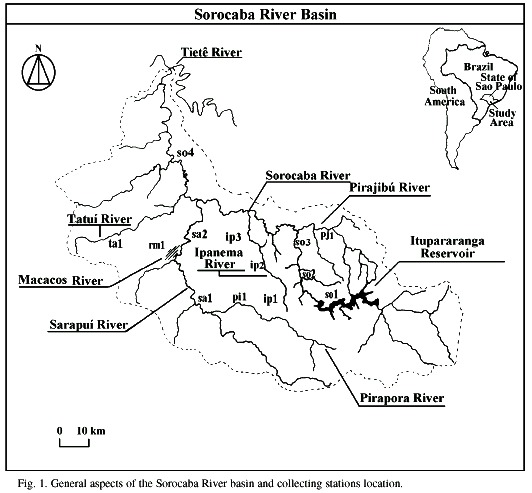
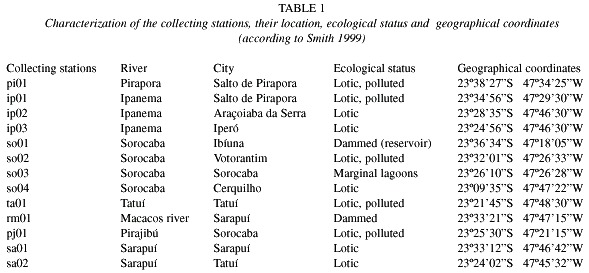
<body><![CDATA[<p><font face="Arial" size="2">    <br> <a href="#Vari98">Vari and Malabarba (1998)</a> proposed that the number of species in South and Central America could rise to 5600. There are 3228 fish species in South America (<a href="#Gery69">Gery 1969</a>). <a href="#Lowe-McConnell69">Lowe-McConnel (1969)</a> reported 1383 identified species in Brazil, distributed in 46 families. The orders Siluriformes and Characiformes are dominant. <a  href="#Britsky72">Britski (1972)</a> emphasizes that Characidae is the most representative family of freshwater fishes in Brazil. It is estimated that in South America there are 58 families of Teleostei (<a  href="#Lowe-McConnell75">Lowe-McConnel 1975</a>). </font></p>     <p><font face="Arial" size="2">In the State of São Paulo, Brazil, <a  href="#Castro98">Castro and Menezes (1998)</a> report the existence of 261 freshwater fish species distributed in 22 families (Britski 1972). Recently </font><font face="Arial" size="2"><a href="#Castro98">Castro and Menezes (1998)</a></font><font face="Arial" size="2"> registered 25 families of fishes, where the order Siluriformes prevail over the others, and Characiformes was the second most important </font><font  face="Arial" size="2"><a href="#Castro98">(Castro and Menezes 1998)</a></font><font  face="Arial" size="2">. </font></p>     <p><font face="Arial" size="2">Many authors have focused the studies of the ichthyofauna of rivers of the Tietê River basin (<a href="#Godoy75">Godoy 1975</a>, <a href="#Caramaschi86">Caramaschi 1986</a>, <a  href="#Castro87">Castro and Arcifa 1987</a>, <a href="#Barrella89">Barrela, 1989</a>, <a href="#Barrella94">Barrela and Petrere 1994</a>, <a  href="#Barrella98">Barrela, 1998</a> and <a href="#Smith99">Smith, 1999</a>). According to <a href="#Bizerril96">Bizerril (1996)</a>, despite the increase of publications on ecological aspects of fish communities in South America, a comprehensive knowledge is still incipient. </font></p>     <p><font face="Arial" size="2">Furthermore, due to the explosive growth of human population there is an increasing need to explore water resources, especially regarding the use of the water of the rivers as energy source, water supply and to dilute domestic and industrial effluents. Aquatic ecosystems suffer a deep impacts due to these activities. In this case, the ichthyofauna composition is constantly changing and some unknown might disappear or become rare. Therefore, knowing the ichthyofauna of a river basin is the first step to future studies, such as monitoring projects, regarding fish conservation and its application to studies regarding polluttion control (<a  href="#Smith97">Smith <i>et a</i>l. 1997</a>).</font></p>     <p><font face="Arial" size="2">The lack of studies about fish fauna and its ecological characteristics in the Sorocaba River basin is a known fact. Thus, this study has the objective to know about the composition of the fish species in Sorocaba river basin, its distribution along the basin and to characterize its main species.</font></p> <font face="Arial" size="2"><b>     <p>Material and methods</p> </b> </font>     <p><font face="Arial" size="2">There are 18 cities in the drainage area of 5269 km<sup>2</sup> of the Sorocaba river basin, located in the State of São Paulo (Anonymous 1990). This hydrographic basin is constituted by Sorocaba River, which is mainly formed by the rivers Sorocamirim and Sorocabuçu and its main tributary rivers the Tatuí, Sarapuí, Pirajibú, and Ipanema rivers. Samples were collected in thirteen stations located in seven rivers, being four points along the Sorocaba River (so01, so02, so03 e so04), three points in the Ipanema River (ip01, ip02 e ip03), two points in the Sarapuí River (sa01 e sa02) and one point in the rivers Tatuí (ta01), Pirajibú (pj01) and Pirapora (pi01) <a href="#f1">(Fig. 1)</a>. From those, eleven are lotics kind and two are lentic kind. The so01 station is a reservoir and so03 station is a marginal lagoon (<a href="#t1">Table 1</a>). </font></p>     <p align="center"><font face="Arial" size="2"><a name="t1"></a><img  src="/img/fbpe/rbt/v51n3-4/2922i1.JPG" title="" alt=""  style="width: 589px; height: 273px;">    
<br> </font></p>     ]]></body>
<body><![CDATA[<p align="center"><font face="Arial" size="2">    <br> <a name="f1"></a><img src="/img/fbpe/rbt/v51n3-4/2922i2.JPG" title="" alt=""  style="width: 532px; height: 493px;">&nbsp;</font></p>     
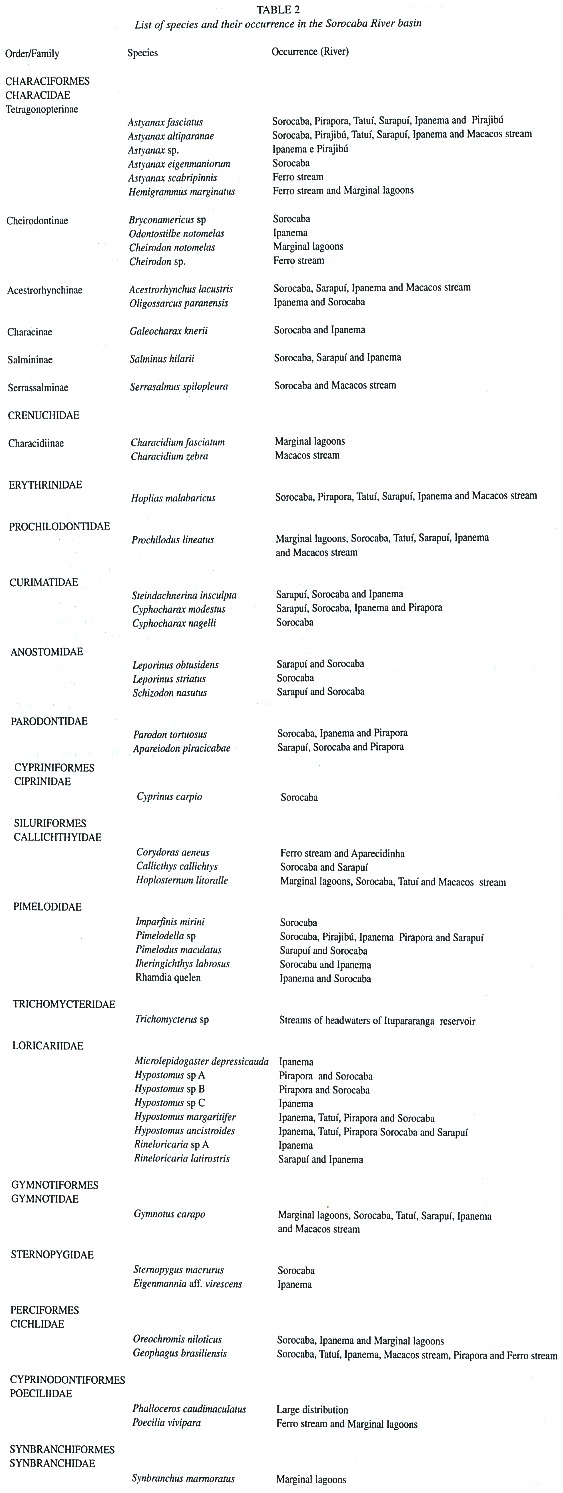
<p align="center"><font face="Arial" size="2"> </font></p>     <p><font face="Arial" size="2">The fish sampling consisted of 26 campaigns in 13 collecting stations. Samples were collected at each site in the dry and rainy seasons. Two batteries of gill nets with 8 nets of 10 meters in length and 1.5 meters in width, and different meshes (3, 4, 5, 6, 7, 8, 10, and 12 cm between opposite knots) were used to catch fish. Fishes were measured, weighed and fixed in 10% formaline solution, preserved in 70% alcohol and identified according to <a href="#Britsky72">Britsky (1972)</a>. The identification of the species was confirmed by Heraldo Britski, Zoology Museum, University of São Paulo. </font></p>     <p><font face="Arial" size="2">Information about species composition, number of individuals, weight and standard length for each specimen was recorded for each collecting station. The species inventory was complemented with the information about species described in the marginal lagoons of the Sorocaba River by Smith and Barrella (1994) and data from reports of Environmental Impacts conducted in this hydrographic basin in 1993 in rivers Ipanema e Sorocaba. These data were only used to describe the ichthyofauna and were calculated the constancy ocorrence of species. Resident species were the ones present in more than 50% of the collections, accessory present in 25 to 50% of the collections and accidental, present in fewer than 25% of the collections (<a href="#Dajos83">Dajos 1983</a>). Information for fish diet and reproduction were gathered in the current literature.</font></p> <font face="Arial" size="2"><b></b></font>     <p><font face="Arial" size="2"><b>Results</b></font></p>     <p><font face="Arial" size="2"><b>Inventory of the Ichthyofauna. </b>In this work 53 fish species were identified in the basin, distributed in 18 families and 6 orders (<a href="#t2">Table 2</a>). Characiformes was represented by 28 species, 52.8% of the total of species collected. It was followed by Siluriformes with 17 species (32.1%); Gymnotiformes with 3 species (5.7%) of the total; Perciformes and Cipronodontiformes with 2 species, both representing 3.8% of the total; and Synbranchiformes with one specie corresponding to 1.8% of the total number of species.</font></p>     <div style="text-align: center;"><span style="font-family: arial;"><a  name="t2"></a><img src="/img/fbpe/rbt/v51n3-4/2922i6.JPG" title="" alt=""  style="width: 563px; height: 1493px;"></span>    
<br> </div>     <p><font face="Arial" size="2">Of these species, 96.2% are natives, only 3.8% are exotic. Besides 64.8% of species are captured for fishing in the basin. The professional fishery is incipient while sport fishery is practiced by larger amount of people. Many people utilize the fishes as food.</font></p> <font face="Arial" size="2"><b></b></font>     ]]></body>
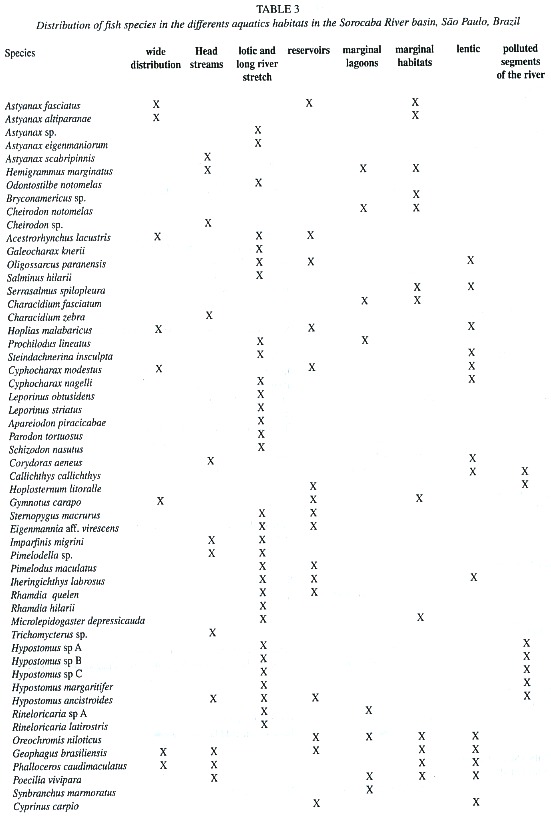
<body><![CDATA[<p><font face="Arial" size="2"><b>The distribution of the Ichthyofauna along the basin. </b><a href="#t3">Table 3</a> shows the species that were identified in the basin and the places where they occur. It is possible to describe the distribution of the ichthyofauna along the rivers, lagoons and reservoirs of the basin as follows:</font></p>     <div style="text-align: center;"><font face="Arial" size="2"><a  name="t3"></a><img src="/img/fbpe/rbt/v51n3-4/2922i7.JPG" title="" alt=""  style="width: 551px; height: 818px;">&nbsp;</font></div>     
<p><font face="Arial" size="2">Widely distributed in the basin: species were found in all the streams, rivers, lagoons and reservoirs such as <i>Hoplias malabaricus, Astyanax fasciatus, Astyanax altiparanae, Prochilodus lineatus, Gymnotus carapo, Geophagus brasiliensis </i>and <i>Phaloceros caudimaculatus. </i></font></p>     <p><font face="Arial" size="2">Species were restricted to or more frequently found in headwater streams: <i>Trichomycterus </i>sp, <i>Cheirodon </i>s<i>p, Astyanax scabripinnis, Corydoras aeneus </i>and <i>Characidium zebr</i>a. These species were collected in tributary streams of "Itupararanga" reservoir, "Ribeirão do Ferro" and other stream.</font></p>     <p><font face="Arial" size="2">Species were restricted to lentic environments: they were collected in the "Itupararanga" reservoir, marginal lagoons and stillwater: <i>Cyprinus carpio, Synbranchus marmoratus, Oreochromis niloticus </i>and <i>Cyphocarax modestus.</i></font></p>     <p><font face="Arial" size="2">Species that prefer lotic environments: they were found in the rivers Sorocaba, Tatuí, Sarapuí and Pirapora, <i>Hypostomus ancistroides, Hypostomus margaritifer, Prochilodus lineatus, Leporinus striatus, Leporinus obtusidens, Schizodon nasutus </i>and <i>Apareiodon piracicabae </i>belong to this group.</font></p>     <p><font face="Arial" size="2">Species that prefer long stretches of river: among this group are <i>Salminus hilarii, Iheringichthys labrosus, Galeocharax knerii, Pimelodus maculatus, </i>and <i>Schizodon nasutus. </i>They were found in the rivers Sorocaba, Tatuí, Sarapuí and Ipanema. </font></p>     <p><font face="Arial" size="2">Species that benefit of disturbed environments: these species were collected mainly in the Tatuí River and the Sorocaba River. <i>Hoplosternum litoralle, Callichthys callichthys, </i>and two species of <i>Hypostmous (Hypostomus ancistroides </i>and <i>Hypostomus margaritife</i>r) belong to this group.</font></p>     <p><font face="Arial" size="2">Small sized fishes that inhabit the margins of rivers and lagoons, living under the protection of macrophytes and marginal vegetation: these species were found in most of the basin aquatic environment. The species exhibiting these characteristics are: <i>Corydoras aeneus, Cheirodon notomelas, Cheirodon </i>s<i>p, Characidium fasciatum, Hemigrammus marginatus, Phaloceros caudimaculatus </i>and <i>Poecilia vivipara.</i></font></p>     <p><font face="Arial" size="2">Species that are adapted to reservoirs: species found in the "Itupararanga" reservoir are: <i>Cyphocharax modestus, Astyanax fasciatus, Oreochromis niloticus </i>and <i>Geophagus brasiliensi</i>s.</font></p>     ]]></body>
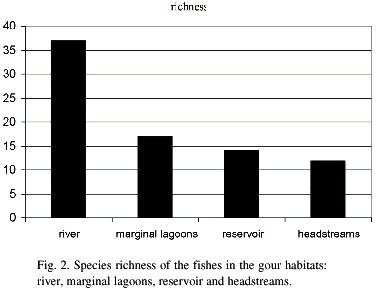
<body><![CDATA[<p><font face="Arial" size="2"><a href="#f2">Figure 2</a> shows the species richness in the four habitats. River are the richest ones, followed by marginal lagoons. The reservoir present the lesser richness, perhaps due to habitat change. Headstreams are also poor mostly due to resource limitation and niche availability and geological traits.</font></p>     <div style="text-align: center;"><a name="f2"></a><img  src="/img/fbpe/rbt/v51n3-4/2922i3.JPG" title="" alt=""  style="width: 378px; height: 291px;">    
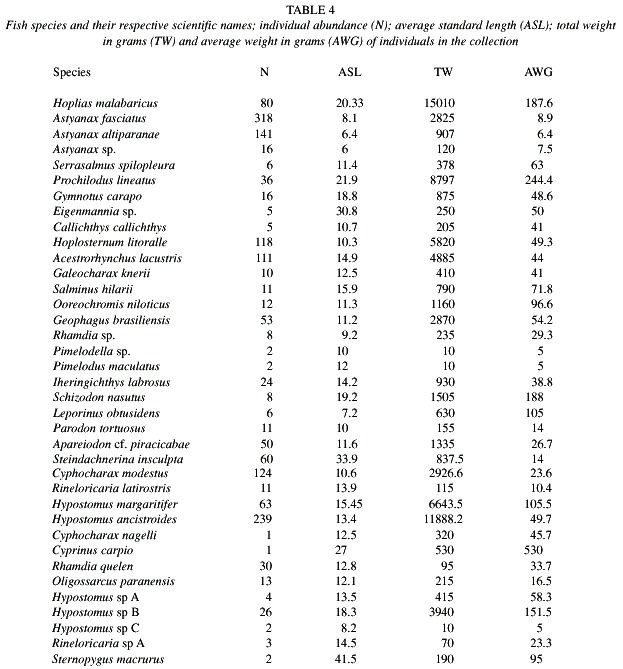
<br> </div> <span style="font-family: arial;"></span>     <p><font face="Arial" size="2"><b>Characterization of the Ichthyofauna in the present study. </b>A total of 626 individuals were collected; corresponding to a total fish weight of 79.0 kg, belonging to 37 species distributed in 28 genera, 4 orders and 15 families of teleosts fishes. The Characiforms are the most representative group contributing with 46.0% of the species, followed by Siluriformes (37.8%), Gymnotiformes (8.1%) and Perciformes (5.4%) and Cypriniformes (2.7%). Among the families, Characidae and Loricaridae are noticed, both with 18.4% and Pimelodidade with 15.8% of the collected species. </font></p>     <p><font face="Arial" size="2">The abundance, average standard length, total and average weight of each captured species are shown in <a  href="#t4">Table 4</a>. The Characidae family is the most abundant family in the Sorocaba River Basin, dominating its rivers and lagoons. The family has 7 species, grouped in 4 genera, where <i>Astyanax </i>was the most abundant and widely distributed species of this family. Among the Siluriformes, the most important families in number of species were the Loricaridae and Pimelodidade with 7 and 5 genera, respectively. The genus <i>Hypostomus </i>(Loricaridae) was the most captured. The next family is the Curimatidae with 2 genera and 2 species, among them the <i>Cyphocharax </i>is the most abundant.</font></p>     <div style="text-align: center;"><font face="Arial" size="2"><a  name="t4"></a><img src="/img/fbpe/rbt/v51n3-4/2922i4.JPG" title="" alt=""  style="width: 623px; height: 669px;">&nbsp;</font></div>     
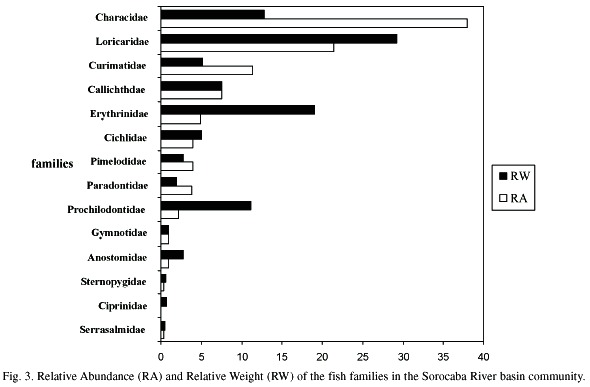
<p><font face="Arial" size="2">Overall, the Characidae and Loricaridae presented the highest relative abundance of individuals, with 38% and 21.4% respectively, followed by the Curimatidade family with 11.4%. The most important families in relative weight, was Loricaridae and Erythrinidae that presented highest percentages in total weight of 29.0% and 19.0%, respectively <a href="#f3">(Fig. 3)</a>. </font></p>     <div style="text-align: center;"><span style="font-family: arial;"><a  name="f3"></a><img src="/img/fbpe/rbt/v51n3-4/2922i5.JPG" title="" alt=""  style="width: 590px; height: 387px;"></span>    
<br> </div>     <p><font face="Arial" size="2">The most abundant species were the <i>Astyanax fasciatus </i>and the <i>Hypostomus ancistroides </i>with 318 and 239 individuals. The less abundant species in the basin were the <i>Cyprinus carpio </i>and <i>Cyphocharax nagelli </i>with only one individual. The most representative species in relation to weight were the <i>Hoplias malabaricus </i>with 15 g and the <i>Hypostomus ancistroides </i>with 11.9 g <a href="#t4">(Table 4)</a>.</font></p>     ]]></body>
<body><![CDATA[<p><font face="Arial" size="2">The species that presented the largest average standard length were <i>Sternopygus macrurus </i>with 41.5 cm, <i>Steindachnerina insculpta </i>with 33.9 cm, <i>Eigenmannia </i>aff. <i>virescens </i>with 30.8 cm and <i>Cyprinus carpio </i>with 27 cm. The smallest captured species were <i>Astyanax </i>sp with 6 cm and <i>Astyanax altiparanae </i>with 6.2 cm. In general, the species that showed the highest abundance had the smallest average standard length, whereas the species with the largest average standard length were less abundant <a  href="#t4">(Table 4)</a>.</font></p>     <p><font face="Arial" size="2">In the entire collection, the most representative species in respect to average weight were <i>Cyprinus carpio </i>with 530 g, <i>Prochilodus lineatus </i>with 244.4 g, <i>Schizodon nasutus </i>and <i>Hoplias malabaricus </i>with 188 and 187.6 g, respectively. The species with the lowest weight values were <i>Pimelodella </i>sp, <i>Pimelodus macu la</i>tus and the <i>Hypostomus </i>sp C, all with 5 g <a href="#t4">(Table 4)</a>. The most common species at the collecting stations was <i>Hypostomus ancistroides </i>present in 78% of the collected samples and distributed in most of the streams and rivers, marginal lagoons and in the Itupararanga reservoir.</font></p> <font face="Arial" size="2"><i></i></font>     <p><font face="Arial" size="2"><i>Hoplias malabaricu</i>s, <i>Astyanax fasciatus </i>and <i>Astyanax altiparanae </i>were captured in 69.2% of the collected samples. These species were also widely distributed in streams, rivers, lagoons and reservoir of the basin <a href="#t3">(Table 3)</a>. When considering the collecting stations, <i>Astyanax altiparanae </i>was present in 11 of the 13 collecting stations. <i>Hoplias malabaricu</i>s, <i>Astyanax fasciatus </i>and <i>Hypostomus ancistroides </i>were present in 10 of the 13 stations sampled and showed the widest spatial distribution in the basin. The species that presented a restricted distribution were <i>Pimelodella </i>sp, <i>Pimelodus maculatu</i>s, <i>Cyphocharax nagell</i>i, <i>Cyprinus carpi</i>o, <i>Hypostomus </i>sp C and <i>Sternopygus macruru</i>s). Specimens of these species were captured at the station sa02, sa01, so01,so01, so04 and ip03, respectively. </font></p> <font face="Arial" size="2"><i></i></font>     <p><font face="Arial" size="2"><i>Hoplias malabaricu</i>s, <i>Astyanax fasciatu</i>s, <i>Astyanax altiparana</i>e, <i>Prochilodus lineatu</i>s, <i>Gymnotus carap</i>o, <i>Geophagus brasiliensis </i>and <i>Hypostomus ancistroides </i>were considered residents (present in more than 50% of the collections), <i>Astyanax </i>sp, <i>Hoplosternum litorall</i>e, <i>Acestrorhynchus lacustri</i>s, <i>Salminus hilari</i>i, <i>Tilapia nilotic</i>a, <i>Iheringichthys labrosu</i>s, <i>Steindachnerina insculpt</i>a, <i>Cyphocharax modestus </i>and <i>Hypostomus margaritifer </i>acessory (present in 25% to 50% of the collections) and <i>Serrasalmus spilopleur</i>a, <i>Eigenmannia </i>sp, <i>Galeocharax kneri</i>i, <i>Rhamdia </i>sp, <i>Pimelodella </i>sp, <i>Pimelodus maculatu</i>s, <i>Schizodon nasutu</i>s, <i>Leporinus obtusiden</i>s, <i>Parodon tortuosu</i>s, <i>Apareiodon piracicaba</i>e, <i>Rineloricaria latirostri</i>s, <i>Cyphocharax nagell</i>i, <i>Cyprinus carpi</i>o, <i>Oligossarcus paranensi</i>s, <i>Hyspostomus </i>sp A, <i>Hypostomus </i>sp B, <i>Hypostomus </i>sp C, <i>Rineloricaria </i>sp A and <i>Sternopygus macrurus </i>accidental (present in fewer than 25% of the collections). </font></p>     <p><font face="Arial" size="2">The exotic species present in the Sorocaba River basin seem to be restricted to habitats with low hydrodynamics such as lagoons and reservoirs. <i>Cyprinus carpio </i>and <i>Oreochromis niloticus </i>are the 2 species captured in the basin natural environment. <i>Oreochromis niloticus </i>was the most abundant specie captured in 3 stations, while the carp was present in only one station. <i>Hoplosternum litoralle </i>is considered exotic (accidental introduction) for some ichthyologists (Britski, personal communication).</font></p> <font face="Arial" size="2"><b></b></font>     <p><font face="Arial" size="2"><b>Characterization of the main species. </b>The species of genus <i>Astyanax (Astyanax fasciatu</i>s, <i>Astyanax altiparanae, Astyanax cabripinnis </i>and <i>Astyanax eigenmanioru</i>m) are omnivorous fishes with great alimentary flexibility (Agostinho and Julio Jr 1999), and it is widely distributied in the Sorocaba river basin. These species exibit external fecundation, are not migratory and do not present parental care (<a href="#Vazzoler92">Vazzoler and Menezes, 1992</a>). <i>Astyanax fasciatus </i>present total spawining and <i>Astyanax altiparanae </i>present parcelled spawining (<a  href="#Vazzoler92">Vazzoler and Menezes 1992</a>). These species are omnivorous, forager, with feed flexibility and have wide distribution in the Latin America (Nelson 1984 apud </font><font face="Arial"  size="2"><a href="#Castro87">Castro and Arcifa 1987</a></font><font  face="Arial" size="2">). <i>Astyanax scabripinnis </i>just occur in headwater streams.</font></p> <font face="Arial" size="2"><i></i></font>     <p><font face="Arial" size="2"><i>Cyphocharax modestus </i>and <i>Steindachnerina insculpta </i>are iliophagous species when adults and plancthophagous when young (</font><font face="Arial" size="2"><a href="#Castro87">Castro and Arcifa 1987</a></font><font face="Arial" size="2">). They are adapted to colonize lentics habitats, do are not migratory, do not present parental care and are parcelled spawners. <i>Prochilodus lineatus </i>present external fecundation, is migratory and present parental care (</font><font face="Arial" size="2"><a href="#Vazzoler92">Vazzoler and Menezes 1992</a></font><font face="Arial" size="2">). <i>Serrasalmus spilopleura </i>is not migratory, present parental care and utilize the "aguapé" <i>(Eichhornia </i>sp.) and other macrophytes for laying eggs (</font><font face="Arial" size="2"><a href="#Castro87">Castro and Arcifa 1987</a></font><font face="Arial" size="2">, <a href="#Thomaz99">Thomaz and Bini 1999</a>). Their diet is predominant piscivore.</font></p> <font face="Arial" size="2"><i></i></font>     <p><font face="Arial" size="2"><i>Hoplias malabaricus </i>show a wide distribution in rivers, lagoons and reservoir of the basin. This species present parcelled spawning (</font><font face="Arial" size="2"><a  href="#Vazzoler92">Vazzoler and Menezes 1992</a></font><font  face="Arial" size="2">) and parental care, prefering lentic habitats. <i>Salminus hilarii </i>is a migratory species with parental care and total spawining, while <i>Acestrorhynchus lacustris </i>and <i>Schizodon nasutus </i>are not migratory and do not care for the offspring (</font><font  face="Arial" size="2"><a href="#Vazzoler92">Vazzoler and Menezes 1992</a></font><font  face="Arial" size="2">). The species of genus <i>Parodon </i>and <i>Apareiodon </i>occur in lotic habitats. These species are parcelled spawning. </font></p>     <p><font face="Arial" size="2">The species of genus <i>Hypostomus </i>prefer lotics habitats (<a href="#Uieda83">Uieda 1983</a>), parcelled spawning and herbivorous or iliophagous diet. In countampart <i>Rhamdia quelen </i>and <i>Pimelodus maculatus </i>are parcelled spawning and are carnivorous. These species are abundant in rivers, principally in lotic habitats. The interesting species is <i>Hoplosternum litorall</i>e, very abundant in locals with increase concentration of organic composed and low water oxynation. This specie is adapted to live in impacted habitats because present saculiforms structures in intestinal alces, than facilitate gaseous exchange (<a href="#Kramer87">Kramer 1987</a>). The gretat abundance of <i>Hoplosternum litoralle </i>in marginal lagoons is due to its increased endurance to lowd dissolved oxygen concentration (Agostinho and Julio Jr. 1999). <i>Geophagus brasiliensis </i>is a species with wide distribution in the basin, presenting omnivore diet, parental care and use the substratum to spawn (</font><font face="Arial" size="2"><a href="#Castro87">Castro and Arcifa 1987</a></font><font face="Arial" size="2">). </font></p> <font face="Arial" size="2"><b>     <p>Discusión</p> </b> </font>     ]]></body>
<body><![CDATA[<p><font face="Arial" size="2">The fish fauna of the Sorocaba River basin showed similarities with reported data of the other studies. Its ichthyofauna was dominated by Characiformes and Siluriformes with 28 and 20 species, respectively. The Characidae family was the most representative. <a href="#Matthews98">Matthews (1998)</a> observed that there are many species per family in temperate river assemblage<i>s. </i>On the other hand, in tropical river assemblages there are few species per family, but many families. In the Sorocaba River basin it was not different, 14 families were found, some of them represented by only one species, as observed with Prochilodontidae, Serrasalmidae, and Erythrinidae, among others.</font></p>     <p><font face="Arial" size="2"><a href="#Matthews98">Matthews (1998)</a></font><font  face="Arial" size="2"> also stresses that the successs of a family in a tropical river is due to its availability food, habitats and general resources. When compared to other basins, the results obtained in this study show that there are a high number of families in the Sorocaba River basin, especially if the limited number of samples and the little knowledge of the ichthyofauna of this basin are taken into account.</font></p>     <p><font face="Arial" size="2">The ichthyofauna of the Sorocaba River is characterized by omnivorous, carnivorous, iliophagus and herbivorous (algae and plants) species; no herbivorous species specialized in fruits or seeds were collected. Agostinho and Julio Jr (1999) say that in the High Parana Basin, where Sorocaba Basin is included, piscivorous and iliophagous species are dominant. </font></p>     <p><font face="Arial" size="2">Furthermore, species that depend on organic matter imported from the riparian forest for feeding, reproduction and shelter (</font><font face="Arial" size="2"><a  href="#Castro98">Castro and Menezes 1998</a></font><font face="Arial"  size="2">) are in disadvantage due to intense deforesting of the area (<a  href="#Smith99">Smith 1999</a>). As example we can refer to <i>Brycon s</i>p, which should occur in the basin, albeit not caught, it was reported in the area (<a href="#Britsky72">Britsky 1972</a>). Arcifa (1987) warns for the reduction of fish population that relies in riparian vegetation resources such as seeds, fruits and insects.</font></p>     <p><font face="Arial" size="2">Besides the lost of the riparian vegetation other impacts occurred in the basin as domestic and industrial sewage, draining of flood-plain lakes, exotic species introduction, etc. (<a href="#Smith00ba">Smith and Barrella 2000</a>, <a  href="#Smith00pe">Smith and Petrere 2000</a>). Amoung the species which were not caught due to these causes are the species of the subfamily Sorubiminae how <i>Pseudo-platystoma corruscan</i>s, <i>Hemisorubim platyrhynchos </i>and <i>Paulicea luetken</i>i. These species were documented for the Piracicaba River (another affluent of Tiete river by the right margin) (<a href="#Monteiro53">Monteiro, 1953</a>), Mogi-Guassu river (Rio Grande basin), (<a href="#Schubart62">Schubart 1962</a>) and for the Stete of Sao Paulo (<a href="#Britsky72">Britskii 1972</a>). Moreover some species presented characteristics which allowed them to stay in these polluted places as <i>Hoplosternum litorall</i>e, <i>Hypostomus ancistroides </i>among other. These species exhibit accessory respiration being considered resistent to low dissolved oxygen. </font></p>     <p><font face="Arial" size="2">The ichthyofauna spatial distribution shown in this paper is in accordance with several other published works in other hydrographic basins, if environmental characteristics are considered. Species that are less demanding for food and reproduction, such as <i>Hoplias malabaricus, Astyanax fasciatus, Astyanax altiparanae, Geophagus brasiliensis </i>and <i>Phaloceros caudimaculatu</i>s, show a wide geographic distribution. It was already shown that these species are the most common in rivers, streams and lagoons in the State of São Paulo (<a href="#Britsky72">Britski 1972</a>). In addition to these widely distributed species, there are species that are usually found in specific environments. </font></p>     <p><font face="Arial" size="2"><a href="#Castro87">Castro and Arcifa (1987)</a> emphasized the dominance of <i>Cyphocharax modestus </i>and <i>Astyanax fasciatus </i>in reservoirs of the State of São Paulo. This is the same result that was obtained in the Itupararanga reservoir. </font></p>     <p><font face="Arial" size="2">Besides the species that were well adapted to the reservoir environment, there are those species that are typical to lotic environments such as <i>Hypostomus ancistroides, Hypostomus margaritifer, Prochilodus lineatus, Leporinus striatus, Leporinus obtusidens, Schizodon nasutus </i>and <i>Apareiodon piracicabae.&nbsp;</i></font><font face="Arial" size="2"><a  href="#Britsky72">Britski (1972)</a></font><font face="Arial" size="2">, <a href="#Nomura84">Nomura (1984)</a> and <a href="#Uieda95">Uieda (1995)</a> characterized the genus <i>Hypostomus </i>as vegetarians and inhabitants of flowing water sites. </font><font face="Arial"  size="2"><a href="#Nomura84">Nomura (1984)</a></font><font face="Arial"  size="2"> also describes the genus <i>Apareiodon </i>as a preferential inhabitant of these.</font></p>     <p><font face="Arial" size="2">At this point, the capture of "corimbat<i>á" (Prochilodus lineatu</i>s) in marginal lagoons must be emphasized. The presence of this specie, typical of riverbeds, in marginal lagoons suggests that these lagoons have the role of fish nurseries (<a  href="#Godoy95">Godoy 1995</a>) due to food and shelter availability (<a  href="#Verissimo94">Veríssimo 1994</a>) and also to food sources for adult individuals. According to <a href="#Smith00ba">Smith and Barrella (2000)</a> the most abundant species and weight is <i>Prochilodus lineatus </i>and <i>Hoplias malabaricu</i>s, confirmed by <a  href="#Lowe-McConnell87">Lowe-McConell (1987)</a>. </font><font  face="Arial" size="2"><a href="#Smith00ba">Smith and Barrella (2000)</a></font><font  face="Arial" size="2"> also state that low size specimens as <i>Phaloceros caudimaculatu</i>s, <i>Geophagus brasiliensis </i>and Serrapinus notomelas are very abundant.</font></p>     <p><font face="Arial" size="2">In the Sorocaba River basin there are several headwater streams that should be studied. In these streams <i>Trichomycterus </i>sp and <i>Astyanax scabripinnis </i>were captured and characterized as typical species of this environment (Britski 1997, personal comm.). Agostinho and Julio Jr (1999) also state that Astyanax scabripinnis is typical creek specie. According to Menezes (1998, personal comm.), the unknown Brazilian ichthyofauna is concentrated in the headwater streams. </font></p>     ]]></body>
<body><![CDATA[<p><font face="Arial" size="2">The ichthyofauna differences between collecting stations or even between the aquatic habitats studied are related to the different abiotic gradients observed along the river; habitat diversity (<a href="#Vannote80">Vannote <i>et a</i>l. 1980</a>, <a href="#Johnsson95">Johnson <i>et a</i>l. 1995</a>); the influence of current velocity and river size (<a href="#Meffe88">Meffe and Sheldon 1988</a>) depth and kind of substract (<a href="#Bain88">Bain <i>et a</i>l. 1988</a>) and waterland interface (<a href="#Schlosser95">Schlosser 1995</a>). The amount of resources such as shelters, food and number of habitats contributes to emphasize differences between stations, thus influencing the structure of fish communities (<a href="#Schreck90">Schreck and Moyle 1990</a>), since each environment has its own characteristics (</font><font face="Arial" size="2"><a href="#Barrella94">Barrela and Petrere 1994</a></font><font face="Arial" size="2">).</font></p>     <p><font face="Arial" size="2">Besides the kind of environment (lotic or lentic) can influence fish abundance and distribution. <i>Hoplias malabaricus, Hoplosternum litorall</i>e, <i>Oreochromis nilóticu</i>s, <i>Astyanax fasciatu</i>s, <i>Geophagus brasiliensis </i>and <i>Cyphocharax modestus </i>were more abundant in lentic habitats than in lotic ones. These species prefer lagoons, reservoirs and backwaters (<a  href="#Britsky72">Britki 1972</a>, </font><font face="Arial" size="2"><a  href="#Castro87">Castro and Arcifa 1987</a></font><font face="Arial"  size="2">), as rm01, so01 and so03 station. In counterpart <i>Hypostomus margaritife</i>r, <i>Hypostomus ancistroides, Rineloricaria latirostri</i>s, <i>Rhamdia quele</i>n, <i>Salminus hilari</i>i, <i>Pimelodus maculatus </i>and <i>Leporinus obtusidens </i>prefer lotic habitats (Agostinho and Julio Jr. 1999). These species were more abundant in station with current as pi01, so02, so04 and ip03. </font></p> <font face="Arial" size="2"><b>     <p>Acknowledgement </p> </b> </font>     <p><font face="Arial" size="2">The authors wish to thank Carolina V. Minte-Vera, Antônio Carlos Beaumord for critically reading the manuscript, PUC-SP, UNESP-Rio Claro and USP-São Carlos for the logistic support. We also thank CNPq and FAPESP (Procces: 95/1311-0) for financial support.</font></p> <font face="Arial" size="2"><b>     <p>Resumen</p> </b> </font>     <p><font face="Arial" size="2">Se realizó un análisis de las especies de peces de la cuenca del Río Sorocaba, el principal tributario de la margen izquierda del Río Tietê, localizado en el estado de Sao Paulo, Brasil. Las especies fueron recolectadas con redes agalleras. Luego de la identificación de los especímenes, fue determinada su abundancia relativa, peso, y longitud estandar. Hasta el presente, no hay ningún otro estudio que analice estos aspectos en dicha cuenca hidrográfica. Fueron recolectados 55 especies, distribuidas en 18 familias y 6 ordenes. Los Characiformes estuvieron representados por 28 especies, Siluriformes por 17 especies, Gymnotiformes por 3 especies, Perciformes y Cyprinodontiformes por 2 especies, y Synbranchiformes por una especie. Entre estas, se encontró 2 especies exóticas. Las especies más abundantes fueron <i>Astyanax fasciatus </i>y <i>Hypostomus ancistroide</i>s. En relación con el peso total, la especie más representativas fueron <i>Hoplias malabaricus </i>y <i>Hypostomus ancistroide</i>s. En tanto que, <i>Cyprinus carpio, Prochilodus lineatus, Schizodon nasutus </i>y <i>Hoplias malabaricus </i>fueron las más representativas en relación al preso promedio. Las longitudes estandar más grandes fue encontradas en <i>Sternopygus macrurus, Steindachnerina insculpta, Eigenmannia aff. virescens </i>y <i>Cyprinus carpio.</i></font></p> <font face="Arial" size="2"><b>     <p>References</p> </b> </font>     <!-- ref --><p><font face="Arial" size="2"><a name="Agostinho99"></a>Agostinho, A.A. &amp; H.F. Júlio Jr. 1999. Peixes da bacia do Alto Rio Paraná. <i>In </i>R.H. Lowe-McConell (ed.). Estudos Ecológicos de Comunidade de Peixes Tropicais, EDUSP. pp. 374-399.    &nbsp;&nbsp;&nbsp;&nbsp;&nbsp;&nbsp;&nbsp;&nbsp;[&#160;<a href="javascript:void(0);" onclick="javascript: window.open('/scielo.php?script=sci_nlinks&ref=1667683&pid=S0034-7744200300030001900001&lng=','','width=640,height=500,resizable=yes,scrollbars=1,menubar=yes,');">Links</a>&#160;]<!-- end-ref --></font></p>     <!-- ref --><p><font face="Arial" size="2"><a name="Anonymous90"></a>Anonymous, 1990. <i>Plano Estadual de Recursos Hídricos: Primeiro Plano do Estado de São Paul</i>o. Síntese. Conselho Estadual de Recursos Hídricos, DAEE, São Paulo. 97 p.    &nbsp;&nbsp;&nbsp;&nbsp;&nbsp;&nbsp;&nbsp;&nbsp;[&#160;<a href="javascript:void(0);" onclick="javascript: window.open('/scielo.php?script=sci_nlinks&ref=1667685&pid=S0034-7744200300030001900002&lng=','','width=640,height=500,resizable=yes,scrollbars=1,menubar=yes,');">Links</a>&#160;]<!-- end-ref --></font></p>     <!-- ref --><p><font face="Arial" size="2"><a name="Bain88"></a>Bain, M. B., J.T. Finn &amp; H.E. Booke. 1988. Stream Regulation and Fish Communnity Structure. Ecology 69(2): 382-392.    &nbsp;&nbsp;&nbsp;&nbsp;&nbsp;&nbsp;&nbsp;&nbsp;[&#160;<a href="javascript:void(0);" onclick="javascript: window.open('/scielo.php?script=sci_nlinks&ref=1667687&pid=S0034-7744200300030001900003&lng=','','width=640,height=500,resizable=yes,scrollbars=1,menubar=yes,');">Links</a>&#160;]<!-- end-ref --></font></p>     <!-- ref --><p><font face="Arial" size="2"><a name="Barrella89"></a>Barrella, W. 1989. Estrutura das comunidades de peixes da bacia do Rio Jacaré-Pepira (SP) em diferentes biótopos. Campinas. Dissertação (Mestrado). Unicamp.    &nbsp;&nbsp;&nbsp;&nbsp;&nbsp;&nbsp;&nbsp;&nbsp;[&#160;<a href="javascript:void(0);" onclick="javascript: window.open('/scielo.php?script=sci_nlinks&ref=1667689&pid=S0034-7744200300030001900004&lng=','','width=640,height=500,resizable=yes,scrollbars=1,menubar=yes,');">Links</a>&#160;]<!-- end-ref --> </font></p>     <!-- ref --><p><font face="Arial" size="2"><a name="Barrella94"></a>Barrella, W. &amp; M. Petrere Jr. 1994. The influence of environmental factors on fish community structure in Jacaré Pepira river. <i>In </i>I. Cowx (ed.). Rehabilitation of Inland Fisheries. Oxford. pp. 161-170.    &nbsp;&nbsp;&nbsp;&nbsp;&nbsp;&nbsp;&nbsp;&nbsp;[&#160;<a href="javascript:void(0);" onclick="javascript: window.open('/scielo.php?script=sci_nlinks&ref=1667691&pid=S0034-7744200300030001900005&lng=','','width=640,height=500,resizable=yes,scrollbars=1,menubar=yes,');">Links</a>&#160;]<!-- end-ref --> </font></p>     <!-- ref --><p><font face="Arial" size="2"><a name="Barrella98"></a>Barrella, W. 1998. Alterações das comunidades de peixes nas bacias dos rios Tietê e Paranapanema (SP), devido a poluição e ao represamento. Rio Claro. Tese (Doutorado) UNESP. 115 p.    &nbsp;&nbsp;&nbsp;&nbsp;&nbsp;&nbsp;&nbsp;&nbsp;[&#160;<a href="javascript:void(0);" onclick="javascript: window.open('/scielo.php?script=sci_nlinks&ref=1667693&pid=S0034-7744200300030001900006&lng=','','width=640,height=500,resizable=yes,scrollbars=1,menubar=yes,');">Links</a>&#160;]<!-- end-ref --></font></p>     <!-- ref --><p><font face="Arial" size="2"><a name="Britsky72"></a>Britsky, H.A. 1972. Peixes de água doce de Estado de São Paulo: Sistemática. <i>In </i>Comissão Interestadual da Bacia Paraná-Uruguai. Poluição e Piscicultura, São Paulo. pp. 83-108.    &nbsp;&nbsp;&nbsp;&nbsp;&nbsp;&nbsp;&nbsp;&nbsp;[&#160;<a href="javascript:void(0);" onclick="javascript: window.open('/scielo.php?script=sci_nlinks&ref=1667695&pid=S0034-7744200300030001900007&lng=','','width=640,height=500,resizable=yes,scrollbars=1,menubar=yes,');">Links</a>&#160;]<!-- end-ref --></font></p>     <!-- ref --><p><font face="Arial" size="2"><a name="Britski84"></a>Britski, H.A., Y. Sato &amp; A.B.S. Rosa. 1984. Manual de identificação de peixes da Bacia do São Francisco -Brasília. Câmara dos Deputados, Coordenação de Publicações-CODEVASF, Divisão de Piscicultura e Pesca, 143 p.    &nbsp;&nbsp;&nbsp;&nbsp;&nbsp;&nbsp;&nbsp;&nbsp;[&#160;<a href="javascript:void(0);" onclick="javascript: window.open('/scielo.php?script=sci_nlinks&ref=1667697&pid=S0034-7744200300030001900008&lng=','','width=640,height=500,resizable=yes,scrollbars=1,menubar=yes,');">Links</a>&#160;]<!-- end-ref --></font></p>     <!-- ref --><p><font face="Arial" size="2"><a name="Bizerril96"></a>Bizerril, C.R.S.F. 1996. Estrutura trófica de associações ícticas da bacia do rio São João, RJ, Brasil. Arq. Biol. Tecnol. 39(3): 509-523.    &nbsp;&nbsp;&nbsp;&nbsp;&nbsp;&nbsp;&nbsp;&nbsp;[&#160;<a href="javascript:void(0);" onclick="javascript: window.open('/scielo.php?script=sci_nlinks&ref=1667699&pid=S0034-7744200300030001900009&lng=','','width=640,height=500,resizable=yes,scrollbars=1,menubar=yes,');">Links</a>&#160;]<!-- end-ref --></font></p>     <!-- ref --><p><font face="Arial" size="2"><a name="Caramaschi86"></a>Caramaschi, E.P. 1986. Distribuição da ictiofauna de riachos das Bacias do Tietê e do Paranapanema, junto ao divisor de águas (Botucatu, SP). Dissertação de Doutorado, Departamento de Ciências Biológicas da Univ. Federal de São Carlos. 245 p.    &nbsp;&nbsp;&nbsp;&nbsp;&nbsp;&nbsp;&nbsp;&nbsp;[&#160;<a href="javascript:void(0);" onclick="javascript: window.open('/scielo.php?script=sci_nlinks&ref=1667701&pid=S0034-7744200300030001900010&lng=','','width=640,height=500,resizable=yes,scrollbars=1,menubar=yes,');">Links</a>&#160;]<!-- end-ref --></font></p>     <!-- ref --><p><font face="Arial" size="2"><a name="Castro87"></a>Castro, R.M.C. &amp; M.F. Arcifa. 1987. Comunidades de peixes de reservatórios do sul do Brasil. Rev. Bras. Biol. 47(4): 493-500.    &nbsp;&nbsp;&nbsp;&nbsp;&nbsp;&nbsp;&nbsp;&nbsp;[&#160;<a href="javascript:void(0);" onclick="javascript: window.open('/scielo.php?script=sci_nlinks&ref=1667703&pid=S0034-7744200300030001900011&lng=','','width=640,height=500,resizable=yes,scrollbars=1,menubar=yes,');">Links</a>&#160;]<!-- end-ref --></font></p>     <!-- ref --><p><font face="Arial" size="2"><a name="Castro98"></a>Castro, R.M.C. &amp; N.A. Menezes. 1998. Estudo diagnóstico da diversidade de peixes do Estado de São Paulo. pp. 1-13. <i>In </i>R.M.C. Castro, Joly, C.ª, Bicudo, C.E.M. Orgs (eds.). Biodiversidade do Estado de São Paulo, Brasil: Síntese do conhecimento ao final do século XX, vol. 6 Vertebrados. Winnergraph-FAPESP, São Paulo.    &nbsp;&nbsp;&nbsp;&nbsp;&nbsp;&nbsp;&nbsp;&nbsp;[&#160;<a href="javascript:void(0);" onclick="javascript: window.open('/scielo.php?script=sci_nlinks&ref=1667705&pid=S0034-7744200300030001900012&lng=','','width=640,height=500,resizable=yes,scrollbars=1,menubar=yes,');">Links</a>&#160;]<!-- end-ref --></font></p>     <!-- ref --><p><font face="Arial" size="2"><a name="Dajos83"></a>Dajos, R. 1983. Ecologia Geral. Vozes, São Paulo, Brazil. 470 p.    &nbsp;&nbsp;&nbsp;&nbsp;&nbsp;&nbsp;&nbsp;&nbsp;[&#160;<a href="javascript:void(0);" onclick="javascript: window.open('/scielo.php?script=sci_nlinks&ref=1667707&pid=S0034-7744200300030001900013&lng=','','width=640,height=500,resizable=yes,scrollbars=1,menubar=yes,');">Links</a>&#160;]<!-- end-ref --></font></p>     <!-- ref --><p><font face="Arial" size="2"><a name="Gery69"></a>Géry, J. 1969. The fresh-water fishes of South America. pp. 828-848. <i>In </i>E.J. Fittkau <i>et a</i>l. Biogeography and Ecology in South America. 2. Junk, The Hague.    &nbsp;&nbsp;&nbsp;&nbsp;&nbsp;&nbsp;&nbsp;&nbsp;[&#160;<a href="javascript:void(0);" onclick="javascript: window.open('/scielo.php?script=sci_nlinks&ref=1667709&pid=S0034-7744200300030001900014&lng=','','width=640,height=500,resizable=yes,scrollbars=1,menubar=yes,');">Links</a>&#160;]<!-- end-ref --> </font></p>     <!-- ref --><p><font face="Arial" size="2"><a name="Godoy75"></a>Godoy, M.P. 1975. Peixes do Brasil subordem Characoidei- Bacia do Rio Mogi Guassu. Piracicaba: Franciscana, 4v.    &nbsp;&nbsp;&nbsp;&nbsp;&nbsp;&nbsp;&nbsp;&nbsp;[&#160;<a href="javascript:void(0);" onclick="javascript: window.open('/scielo.php?script=sci_nlinks&ref=1667711&pid=S0034-7744200300030001900015&lng=','','width=640,height=500,resizable=yes,scrollbars=1,menubar=yes,');">Links</a>&#160;]<!-- end-ref --></font></p>     <!-- ref --><p><font face="Arial" size="2"><a name="Godoy95"></a>Godoy, M.P. 1995. Piracema: peixes brasileiros também tem história. Pirassununga-SP, Brasil. Anais de Etologia, cap.13, pp. 3-19.    &nbsp;&nbsp;&nbsp;&nbsp;&nbsp;&nbsp;&nbsp;&nbsp;[&#160;<a href="javascript:void(0);" onclick="javascript: window.open('/scielo.php?script=sci_nlinks&ref=1667713&pid=S0034-7744200300030001900016&lng=','','width=640,height=500,resizable=yes,scrollbars=1,menubar=yes,');">Links</a>&#160;]<!-- end-ref --></font></p>     <!-- ref --><p><font face="Arial" size="2"><a name="Johnsson95"></a>Johnsson, B.L., W.B. Richardson &amp; T.J. Naimo. 1995. Past, Present and Future Concepts in Large River Ecology. BioSciense 45(3): 134-141.    &nbsp;&nbsp;&nbsp;&nbsp;&nbsp;&nbsp;&nbsp;&nbsp;[&#160;<a href="javascript:void(0);" onclick="javascript: window.open('/scielo.php?script=sci_nlinks&ref=1667715&pid=S0034-7744200300030001900017&lng=','','width=640,height=500,resizable=yes,scrollbars=1,menubar=yes,');">Links</a>&#160;]<!-- end-ref --></font></p>     <!-- ref --><p><font face="Arial" size="2"><a name="Kramer87"></a>Kramer, D.L. 1987. Dissolved oxygen and fish behavior. <i>Ibi</i>d., v.18, pp. 81-92.    &nbsp;&nbsp;&nbsp;&nbsp;&nbsp;&nbsp;&nbsp;&nbsp;[&#160;<a href="javascript:void(0);" onclick="javascript: window.open('/scielo.php?script=sci_nlinks&ref=1667717&pid=S0034-7744200300030001900018&lng=','','width=640,height=500,resizable=yes,scrollbars=1,menubar=yes,');">Links</a>&#160;]<!-- end-ref --></font></p>     <!-- ref --><p><font face="Arial" size="2"><a name="Lowe-McConnell69"></a>Lowe-McConnell, R.H. 1969. Speciation in tropical fresh-water fishes. Biol. J. Limn. Soc. (1): 51-75.    &nbsp;&nbsp;&nbsp;&nbsp;&nbsp;&nbsp;&nbsp;&nbsp;[&#160;<a href="javascript:void(0);" onclick="javascript: window.open('/scielo.php?script=sci_nlinks&ref=1667719&pid=S0034-7744200300030001900019&lng=','','width=640,height=500,resizable=yes,scrollbars=1,menubar=yes,');">Links</a>&#160;]<!-- end-ref --></font></p>     <!-- ref --><p><font face="Arial" size="2"><a name="Lowe-McConnell75"></a>Lowe-McConnell, R.H. 1975. Fish communities in tropical freshwaters. Longman. London, 337 p.    &nbsp;&nbsp;&nbsp;&nbsp;&nbsp;&nbsp;&nbsp;&nbsp;[&#160;<a href="javascript:void(0);" onclick="javascript: window.open('/scielo.php?script=sci_nlinks&ref=1667721&pid=S0034-7744200300030001900020&lng=','','width=640,height=500,resizable=yes,scrollbars=1,menubar=yes,');">Links</a>&#160;]<!-- end-ref --></font></p>     <!-- ref --><p><font face="Arial" size="2"><a name="Lowe-McConnell87"></a>Lowe-McConnell, R.H.L. 1987. Ecological Studies in Tropical Fish Communities. Cambridge Univ., Cambridge. 382 p.    &nbsp;&nbsp;&nbsp;&nbsp;&nbsp;&nbsp;&nbsp;&nbsp;[&#160;<a href="javascript:void(0);" onclick="javascript: window.open('/scielo.php?script=sci_nlinks&ref=1667723&pid=S0034-7744200300030001900021&lng=','','width=640,height=500,resizable=yes,scrollbars=1,menubar=yes,');">Links</a>&#160;]<!-- end-ref --></font></p>     <!-- ref --><p><font face="Arial" size="2"><a name="Matthews98"></a>Matthews, W.J. 1998. Patterns in Freshwater Fish Ecology. Chapman &amp; Hall. 752 p.    &nbsp;&nbsp;&nbsp;&nbsp;&nbsp;&nbsp;&nbsp;&nbsp;[&#160;<a href="javascript:void(0);" onclick="javascript: window.open('/scielo.php?script=sci_nlinks&ref=1667725&pid=S0034-7744200300030001900022&lng=','','width=640,height=500,resizable=yes,scrollbars=1,menubar=yes,');">Links</a>&#160;]<!-- end-ref --></font></p>     <!-- ref --><p><font face="Arial" size="2"><a name="Meffe88"></a>Meffe, G.K. &amp; A.L. Sheldon. 1988. The influence of habitat structure on fish assemblage composition in Southeastern blackwater streams. Amer. Midland Natur. 120(2): 225-240.    &nbsp;&nbsp;&nbsp;&nbsp;&nbsp;&nbsp;&nbsp;&nbsp;[&#160;<a href="javascript:void(0);" onclick="javascript: window.open('/scielo.php?script=sci_nlinks&ref=1667727&pid=S0034-7744200300030001900023&lng=','','width=640,height=500,resizable=yes,scrollbars=1,menubar=yes,');">Links</a>&#160;]<!-- end-ref --></font></p>     <!-- ref --><p><font face="Arial" size="2"><a name="Monteiro53"></a>Monteiro, F. P. 1953. Contribuição ao estudo da pesca no rio Piracicaba. Tese Doutorado, ESALQ-USP. 76 p.    &nbsp;&nbsp;&nbsp;&nbsp;&nbsp;&nbsp;&nbsp;&nbsp;[&#160;<a href="javascript:void(0);" onclick="javascript: window.open('/scielo.php?script=sci_nlinks&ref=1667729&pid=S0034-7744200300030001900024&lng=','','width=640,height=500,resizable=yes,scrollbars=1,menubar=yes,');">Links</a>&#160;]<!-- end-ref --></font></p>     <!-- ref --><p><font face="Arial" size="2"><a name="Nomura84"></a>Nomura, H. 1984. <i>Dicionário de Peixes do Brasi</i>l. Editerra, Brasília. 482 p.    &nbsp;&nbsp;&nbsp;&nbsp;&nbsp;&nbsp;&nbsp;&nbsp;[&#160;<a href="javascript:void(0);" onclick="javascript: window.open('/scielo.php?script=sci_nlinks&ref=1667731&pid=S0034-7744200300030001900025&lng=','','width=640,height=500,resizable=yes,scrollbars=1,menubar=yes,');">Links</a>&#160;]<!-- end-ref --></font></p>     <!-- ref --><p><font face="Arial" size="2"><a name="Schlosser95"></a>Schlosser, I.J. 1995. Critical landscape attibutes that influence fish population dynamics in headwater streams. Hydrobiologia 303: 71-81.    &nbsp;&nbsp;&nbsp;&nbsp;&nbsp;&nbsp;&nbsp;&nbsp;[&#160;<a href="javascript:void(0);" onclick="javascript: window.open('/scielo.php?script=sci_nlinks&ref=1667733&pid=S0034-7744200300030001900026&lng=','','width=640,height=500,resizable=yes,scrollbars=1,menubar=yes,');">Links</a>&#160;]<!-- end-ref --></font></p>     <!-- ref --><p><font face="Arial" size="2"><a name="Schreck90"></a>Schreck, C.B .&amp; P.B. Moyle. 1990. Methods for fish biology. American Fisheries Society, Bethesda, Maryland. 684 p.    &nbsp;&nbsp;&nbsp;&nbsp;&nbsp;&nbsp;&nbsp;&nbsp;[&#160;<a href="javascript:void(0);" onclick="javascript: window.open('/scielo.php?script=sci_nlinks&ref=1667735&pid=S0034-7744200300030001900027&lng=','','width=640,height=500,resizable=yes,scrollbars=1,menubar=yes,');">Links</a>&#160;]<!-- end-ref --></font></p>     <!-- ref --><p><font face="Arial" size="2"><a name="Schubart62"></a>Schubart, O. 1962. Lista de Peixes da bacia do rio Mogi Guassu. Atas Soc. Biol. Rio de Janeiro (3): 26-32.    &nbsp;&nbsp;&nbsp;&nbsp;&nbsp;&nbsp;&nbsp;&nbsp;[&#160;<a href="javascript:void(0);" onclick="javascript: window.open('/scielo.php?script=sci_nlinks&ref=1667737&pid=S0034-7744200300030001900028&lng=','','width=640,height=500,resizable=yes,scrollbars=1,menubar=yes,');">Links</a>&#160;]<!-- end-ref --></font></p>     <!-- ref --><p><font face="Arial" size="2"><a name="Smith97"></a>Smith, W.S., W. Barrella &amp; M. Cetra. 1997. Comunidade de peixes como indicadora de poluição ambiental. Rev. Bras. Ecol. 1: 67-71.    &nbsp;&nbsp;&nbsp;&nbsp;&nbsp;&nbsp;&nbsp;&nbsp;[&#160;<a href="javascript:void(0);" onclick="javascript: window.open('/scielo.php?script=sci_nlinks&ref=1667739&pid=S0034-7744200300030001900029&lng=','','width=640,height=500,resizable=yes,scrollbars=1,menubar=yes,');">Links</a>&#160;]<!-- end-ref --></font></p>     <!-- ref --><p><font face="Arial" size="2"><a name="Smith99"></a>Smith, W.S. 1999. A estrutura da comunidade de peixes da bacia do rio Sorocaba em diferentes situações ambientais. Dissertação Mestrado, USP-São Carlos, Brazil. 121 p.    &nbsp;&nbsp;&nbsp;&nbsp;&nbsp;&nbsp;&nbsp;&nbsp;[&#160;<a href="javascript:void(0);" onclick="javascript: window.open('/scielo.php?script=sci_nlinks&ref=1667741&pid=S0034-7744200300030001900030&lng=','','width=640,height=500,resizable=yes,scrollbars=1,menubar=yes,');">Links</a>&#160;]<!-- end-ref --></font></p>     <!-- ref --><p><font face="Arial" size="2"><a name="Smith00ba"></a>Smith, W.S. &amp; W. Barrela. 2000. The Ichthyofauna of the marginal lagoons, SP, Brazil: Composition, Abundance and Effect of the Anthropogenic Actions. Rev. Bras. Biol. 52(4): 627-640.    &nbsp;&nbsp;&nbsp;&nbsp;&nbsp;&nbsp;&nbsp;&nbsp;[&#160;<a href="javascript:void(0);" onclick="javascript: window.open('/scielo.php?script=sci_nlinks&ref=1667743&pid=S0034-7744200300030001900031&lng=','','width=640,height=500,resizable=yes,scrollbars=1,menubar=yes,');">Links</a>&#160;]<!-- end-ref --></font></p>     <!-- ref --><p><font face="Arial" size="2"><a name="Smith00pe"></a>Smith, W.S. &amp; M. Petrere Jr. 2000. Caracterização Limnológica da bacia de drenagem do rio Sorocaba, São Paulo, Brasil. Acta Limnol. Brás. (12): 15-27.    &nbsp;&nbsp;&nbsp;&nbsp;&nbsp;&nbsp;&nbsp;&nbsp;[&#160;<a href="javascript:void(0);" onclick="javascript: window.open('/scielo.php?script=sci_nlinks&ref=1667745&pid=S0034-7744200300030001900032&lng=','','width=640,height=500,resizable=yes,scrollbars=1,menubar=yes,');">Links</a>&#160;]<!-- end-ref --></font></p>     <!-- ref --><p><font face="Arial" size="2"><a name="Thomaz99"></a>Thomaz, S.M. &amp; L.M. Bini. 1999. A expansão das macrófitas aquáticas e implicações para o manejo de reservatórios: Um estudo na represa de Itaipu. <i>I</i>n. R Henry (ed.). Ecologia de Reservatório: estrutura, função e ascpectos sociais, FUNBIO/FAPESP. pp. 599-625.    &nbsp;&nbsp;&nbsp;&nbsp;&nbsp;&nbsp;&nbsp;&nbsp;[&#160;<a href="javascript:void(0);" onclick="javascript: window.open('/scielo.php?script=sci_nlinks&ref=1667747&pid=S0034-7744200300030001900033&lng=','','width=640,height=500,resizable=yes,scrollbars=1,menubar=yes,');">Links</a>&#160;]<!-- end-ref --></font></p>     <!-- ref --><p><font face="Arial" size="2"><a name="Uieda83"></a>Uieda, V.S. 1983. <i>Regime Alimentar, Distribuição Espacial e Temporal de Peixes (Teleostei) em um Riacho na Região de Limeira, São Paul</i>o. Campinas. Dissertação (Mestrado). Unicamp.    &nbsp;&nbsp;&nbsp;&nbsp;&nbsp;&nbsp;&nbsp;&nbsp;[&#160;<a href="javascript:void(0);" onclick="javascript: window.open('/scielo.php?script=sci_nlinks&ref=1667749&pid=S0034-7744200300030001900034&lng=','','width=640,height=500,resizable=yes,scrollbars=1,menubar=yes,');">Links</a>&#160;]<!-- end-ref --></font></p>     <!-- ref --><p><font face="Arial" size="2"><a name="Uieda95"></a>Uieda, V.S. 1995. <i>Comunidade de peixes de um rio litorâneo: composição, habitat e hábito</i>s. Campinas. Tese (Doutorado). Unicamp.    &nbsp;&nbsp;&nbsp;&nbsp;&nbsp;&nbsp;&nbsp;&nbsp;[&#160;<a href="javascript:void(0);" onclick="javascript: window.open('/scielo.php?script=sci_nlinks&ref=1667751&pid=S0034-7744200300030001900035&lng=','','width=640,height=500,resizable=yes,scrollbars=1,menubar=yes,');">Links</a>&#160;]<!-- end-ref --></font></p>     <!-- ref --><p><font face="Arial" size="2"><a name="Vannote80"></a>Vannote, R.V., G.W. Minshall, K.W. Cummins, J.R. Sedell &amp; C.E. Cushing. 1980. The river continuum concept. Can. J. Fish. Biol. 25: 371-84.    &nbsp;&nbsp;&nbsp;&nbsp;&nbsp;&nbsp;&nbsp;&nbsp;[&#160;<a href="javascript:void(0);" onclick="javascript: window.open('/scielo.php?script=sci_nlinks&ref=1667753&pid=S0034-7744200300030001900036&lng=','','width=640,height=500,resizable=yes,scrollbars=1,menubar=yes,');">Links</a>&#160;]<!-- end-ref --></font></p>     <!-- ref --><p><font face="Arial" size="2"><a name="Vari98"></a>Vari, R.P. &amp; L.R. Malabarba. 1998. Neotropical Ichthyology: An Overview. <i>In </i>L.R. Malabarba, R.E. Reis, R.P. Vari, Z.M.S. Lucena &amp; C.A.S. Lucena (eds.) Phylogeny and Classification of Neotropical Fishes, ECIPUCRS. pp. 1-11.    &nbsp;&nbsp;&nbsp;&nbsp;&nbsp;&nbsp;&nbsp;&nbsp;[&#160;<a href="javascript:void(0);" onclick="javascript: window.open('/scielo.php?script=sci_nlinks&ref=1667755&pid=S0034-7744200300030001900037&lng=','','width=640,height=500,resizable=yes,scrollbars=1,menubar=yes,');">Links</a>&#160;]<!-- end-ref --></font></p>     <!-- ref --><p><font face="Arial" size="2"><a name="Vazzoler92"></a>Vazzoler, A.E.A. de M. &amp; N.A. Menezes. 1992. Síntese do conhecimento sobre o comportamento reprodutivo dos Characiformes da América do Sul (Teleostei, Ostariophysi). Rev. Bras. Biol. 52(4): 627-640.    &nbsp;&nbsp;&nbsp;&nbsp;&nbsp;&nbsp;&nbsp;&nbsp;[&#160;<a href="javascript:void(0);" onclick="javascript: window.open('/scielo.php?script=sci_nlinks&ref=1667757&pid=S0034-7744200300030001900038&lng=','','width=640,height=500,resizable=yes,scrollbars=1,menubar=yes,');">Links</a>&#160;]<!-- end-ref --></font></p>     <!-- ref --><p><font face="Arial" size="2"><a name="Verissimo94"></a>Veríssimo, S. 1994. Variações na composição da ictiofauna em três lagoas sazonalmente isoladas, na planicie de inundação do alto rio Paraná, ilha Porto Rico, PR-Brasil. São Carlos. Dissertação (Mestrado)-UFSCar. 77 p.    &nbsp;&nbsp;&nbsp;&nbsp;&nbsp;&nbsp;&nbsp;&nbsp;[&#160;<a href="javascript:void(0);" onclick="javascript: window.open('/scielo.php?script=sci_nlinks&ref=1667759&pid=S0034-7744200300030001900039&lng=','','width=640,height=500,resizable=yes,scrollbars=1,menubar=yes,');">Links</a>&#160;]<!-- end-ref --></font></p>      ]]></body><back>
<ref-list>
<ref id="B1">
<nlm-citation citation-type="book">
<person-group person-group-type="author">
<name>
<surname><![CDATA[Agostinho]]></surname>
<given-names><![CDATA[A.A]]></given-names>
</name>
<name>
<surname><![CDATA[Júlio]]></surname>
<given-names><![CDATA[H.F]]></given-names>
</name>
<name>
<surname><![CDATA[Lowe-McConell]]></surname>
<given-names><![CDATA[R.H]]></given-names>
</name>
</person-group>
<source><![CDATA[Peixes da bacia do Alto Rio Paraná]]></source>
<year>1999</year>
<page-range>374-399</page-range><publisher-name><![CDATA[EDUSP]]></publisher-name>
</nlm-citation>
</ref>
<ref id="B2">
<nlm-citation citation-type="book">
<person-group person-group-type="author">
<name>
</name>
<name>
</name>
</person-group>
<source><![CDATA[Plano Estadual de Recursos Hídricos: Primeiro Plano do Estado de São Paulo]]></source>
<year>1990</year>
<page-range>97</page-range><publisher-loc><![CDATA[São Paulo ]]></publisher-loc>
<publisher-name><![CDATA[DAEE]]></publisher-name>
</nlm-citation>
</ref>
<ref id="B3">
<nlm-citation citation-type="journal">
<person-group person-group-type="author">
<name>
<surname><![CDATA[Bain]]></surname>
<given-names><![CDATA[M. B]]></given-names>
</name>
<name>
<surname><![CDATA[Finn]]></surname>
<given-names><![CDATA[J.T]]></given-names>
</name>
<name>
<surname><![CDATA[Booke]]></surname>
<given-names><![CDATA[H.E]]></given-names>
</name>
</person-group>
<article-title xml:lang="en"><![CDATA[Stream Regulation and Fish Communnity Structure]]></article-title>
<source><![CDATA[Ecology]]></source>
<year>1988</year>
<volume>69</volume>
<numero>2</numero>
<issue>2</issue>
<page-range>382-392</page-range></nlm-citation>
</ref>
<ref id="B4">
<nlm-citation citation-type="book">
<person-group person-group-type="author">
<name>
<surname><![CDATA[Barrella]]></surname>
<given-names><![CDATA[W]]></given-names>
</name>
</person-group>
<source><![CDATA[Estrutura das comunidades de peixes da bacia do Rio Jacaré-Pepira (SP) em diferentes biótopos: Campinas]]></source>
<year>1989</year>
<publisher-name><![CDATA[Unicamp]]></publisher-name>
</nlm-citation>
</ref>
<ref id="B5">
<nlm-citation citation-type="">
<person-group person-group-type="author">
<name>
<surname><![CDATA[Barrella]]></surname>
<given-names><![CDATA[W]]></given-names>
</name>
<name>
<surname><![CDATA[Petrere]]></surname>
<given-names><![CDATA[M]]></given-names>
</name>
<name>
<surname><![CDATA[Cowx]]></surname>
<given-names><![CDATA[I]]></given-names>
</name>
</person-group>
<source><![CDATA[The influence of environmental factors on fish community structure in Jacaré Pepira river]]></source>
<year>1994</year>
<page-range>161-170</page-range><publisher-loc><![CDATA[Oxford ]]></publisher-loc>
</nlm-citation>
</ref>
<ref id="B6">
<nlm-citation citation-type="book">
<person-group person-group-type="author">
<name>
<surname><![CDATA[Barrella]]></surname>
<given-names><![CDATA[W]]></given-names>
</name>
</person-group>
<source><![CDATA[Alterações das comunidades de peixes nas bacias dos rios Tietê e Paranapanema (SP), devido a poluição e ao represamento]]></source>
<year>1998</year>
<page-range>115</page-range><publisher-loc><![CDATA[Rio Claro ]]></publisher-loc>
<publisher-name><![CDATA[UNESP]]></publisher-name>
</nlm-citation>
</ref>
<ref id="B7">
<nlm-citation citation-type="book">
<person-group person-group-type="author">
<name>
<surname><![CDATA[Britsky]]></surname>
<given-names><![CDATA[H.A]]></given-names>
</name>
</person-group>
<source><![CDATA[Peixes de água doce de Estado de São Paulo: Sistemática]]></source>
<year>1972</year>
<page-range>83-108</page-range><publisher-loc><![CDATA[São Paulo ]]></publisher-loc>
<publisher-name><![CDATA[Poluição e Piscicultura]]></publisher-name>
</nlm-citation>
</ref>
<ref id="B8">
<nlm-citation citation-type="book">
<person-group person-group-type="author">
<name>
<surname><![CDATA[Britski]]></surname>
<given-names><![CDATA[H.A]]></given-names>
</name>
<name>
<surname><![CDATA[Sato]]></surname>
<given-names><![CDATA[Y]]></given-names>
</name>
<name>
<surname><![CDATA[Rosa]]></surname>
<given-names><![CDATA[A.B.S]]></given-names>
</name>
</person-group>
<source><![CDATA[Manual de identificação de peixes da Bacia do São Francisco -Brasília: Câmara dos Deputados, Coordenação de Publicações-CODEVASF]]></source>
<year>1984</year>
<page-range>143</page-range><publisher-name><![CDATA[Divisão de Piscicultura e Pesca]]></publisher-name>
</nlm-citation>
</ref>
<ref id="B9">
<nlm-citation citation-type="journal">
<person-group person-group-type="author">
<name>
<surname><![CDATA[Bizerril]]></surname>
<given-names><![CDATA[C.R.S.F]]></given-names>
</name>
</person-group>
<article-title xml:lang="es"><![CDATA[Estrutura trófica de associações ícticas da bacia do rio São João, RJ, Brasil]]></article-title>
<source><![CDATA[Arq. Biol. Tecnol]]></source>
<year>1996</year>
<volume>39</volume>
<numero>3</numero>
<issue>3</issue>
<page-range>509-523</page-range></nlm-citation>
</ref>
<ref id="B10">
<nlm-citation citation-type="">
<person-group person-group-type="author">
<name>
<surname><![CDATA[Caramaschi]]></surname>
<given-names><![CDATA[E.P]]></given-names>
</name>
</person-group>
<source><![CDATA[Distribuição da ictiofauna de riachos das Bacias do Tietê e do Paranapanema, junto ao divisor de águas (Botucatu, SP)]]></source>
<year>1986</year>
<page-range>245</page-range></nlm-citation>
</ref>
<ref id="B11">
<nlm-citation citation-type="journal">
<person-group person-group-type="author">
<name>
<surname><![CDATA[Castro]]></surname>
<given-names><![CDATA[R.M.C]]></given-names>
</name>
<name>
<surname><![CDATA[Arcifa]]></surname>
<given-names><![CDATA[M.F]]></given-names>
</name>
</person-group>
<article-title xml:lang="pt"><![CDATA[Comunidades de peixes de reservatórios do sul do Brasil]]></article-title>
<source><![CDATA[Rev. Bras. Biol]]></source>
<year>1987</year>
<volume>47</volume>
<numero>4</numero>
<issue>4</issue>
<page-range>493-500</page-range></nlm-citation>
</ref>
<ref id="B12">
<nlm-citation citation-type="book">
<person-group person-group-type="author">
<name>
<surname><![CDATA[Castro]]></surname>
<given-names><![CDATA[R.M.C]]></given-names>
</name>
<name>
<surname><![CDATA[Menezes]]></surname>
<given-names><![CDATA[N.A]]></given-names>
</name>
<name>
<surname><![CDATA[Castro]]></surname>
<given-names><![CDATA[R.M.C]]></given-names>
</name>
<name>
<surname><![CDATA[Bicudo]]></surname>
<given-names><![CDATA[Joly, C.ª]]></given-names>
</name>
<name>
<surname><![CDATA[Orgs]]></surname>
<given-names><![CDATA[C.E.M]]></given-names>
</name>
</person-group>
<source><![CDATA[Estudo diagnóstico da diversidade de peixes do Estado de São Paulo]]></source>
<year>1998</year>
<volume>6</volume>
<page-range>1-13</page-range><publisher-loc><![CDATA[São Paulo ]]></publisher-loc>
<publisher-name><![CDATA[Vertebrados. Winnergraph-FAPESP]]></publisher-name>
</nlm-citation>
</ref>
<ref id="B13">
<nlm-citation citation-type="book">
<person-group person-group-type="author">
<name>
<surname><![CDATA[Dajos]]></surname>
<given-names><![CDATA[R]]></given-names>
</name>
</person-group>
<source><![CDATA[Ecologia Geral]]></source>
<year>1983</year>
<page-range>470</page-range><publisher-loc><![CDATA[São Paulo ]]></publisher-loc>
<publisher-name><![CDATA[Vozes]]></publisher-name>
</nlm-citation>
</ref>
<ref id="B14">
<nlm-citation citation-type="book">
<person-group person-group-type="author">
<name>
<surname><![CDATA[Géry]]></surname>
<given-names><![CDATA[J]]></given-names>
</name>
<name>
<surname><![CDATA[Fittkau]]></surname>
<given-names><![CDATA[E.J]]></given-names>
</name>
</person-group>
<source><![CDATA[The fresh-water fishes of South America]]></source>
<year>1969</year>
<page-range>828-848</page-range><publisher-name><![CDATA[2. Junk, The Hague]]></publisher-name>
</nlm-citation>
</ref>
<ref id="B15">
<nlm-citation citation-type="">
<person-group person-group-type="author">
<name>
<surname><![CDATA[Godoy]]></surname>
<given-names><![CDATA[M.P]]></given-names>
</name>
</person-group>
<source><![CDATA[Peixes do Brasil subordem Characoidei- Bacia do Rio Mogi Guassu. Piracicaba: Franciscana]]></source>
<year>1975</year>
<volume>4</volume>
</nlm-citation>
</ref>
<ref id="B16">
<nlm-citation citation-type="book">
<person-group person-group-type="author">
<name>
<surname><![CDATA[Godoy]]></surname>
<given-names><![CDATA[M.P]]></given-names>
</name>
</person-group>
<source><![CDATA[Piracema: peixes brasileiros também tem história]]></source>
<year>1995</year>
<page-range>3-19</page-range><publisher-name><![CDATA[Pirassununga-SP, Brasil. Anais de Etologia]]></publisher-name>
</nlm-citation>
</ref>
<ref id="B17">
<nlm-citation citation-type="journal">
<person-group person-group-type="author">
<name>
<surname><![CDATA[Johnsson]]></surname>
<given-names><![CDATA[B.L]]></given-names>
</name>
<name>
<surname><![CDATA[Richardson]]></surname>
<given-names><![CDATA[W.B]]></given-names>
</name>
<name>
<surname><![CDATA[Naimo]]></surname>
<given-names><![CDATA[T.J]]></given-names>
</name>
</person-group>
<article-title xml:lang="en"><![CDATA[Past, Present and Future Concepts in Large River Ecology]]></article-title>
<source><![CDATA[BioSciense]]></source>
<year>1995</year>
<volume>45</volume>
<numero>3</numero>
<issue>3</issue>
<page-range>134-141</page-range></nlm-citation>
</ref>
<ref id="B18">
<nlm-citation citation-type="">
<person-group person-group-type="author">
<name>
<surname><![CDATA[Kramer]]></surname>
<given-names><![CDATA[D.L]]></given-names>
</name>
</person-group>
<source><![CDATA[Dissolved oxygen and fish behavior]]></source>
<year>1987</year>
<volume>18</volume>
<page-range>81-92</page-range></nlm-citation>
</ref>
<ref id="B19">
<nlm-citation citation-type="journal">
<person-group person-group-type="author">
<name>
<surname><![CDATA[Lowe-McConnell]]></surname>
<given-names><![CDATA[R.H]]></given-names>
</name>
</person-group>
<article-title xml:lang="en"><![CDATA[Speciation in tropical fresh-water fishes]]></article-title>
<source><![CDATA[Biol. J. Limn. Soc]]></source>
<year>1969</year>
<numero>1</numero>
<issue>1</issue>
<page-range>51-75</page-range></nlm-citation>
</ref>
<ref id="B20">
<nlm-citation citation-type="book">
<person-group person-group-type="author">
<name>
<surname><![CDATA[Lowe-McConnell]]></surname>
<given-names><![CDATA[R.H]]></given-names>
</name>
</person-group>
<source><![CDATA[Fish communities in tropical freshwaters]]></source>
<year>1975</year>
<page-range>337</page-range><publisher-loc><![CDATA[London ]]></publisher-loc>
<publisher-name><![CDATA[Longman]]></publisher-name>
</nlm-citation>
</ref>
<ref id="B21">
<nlm-citation citation-type="book">
<person-group person-group-type="author">
<name>
<surname><![CDATA[Lowe-McConnell]]></surname>
<given-names><![CDATA[R.H.L]]></given-names>
</name>
</person-group>
<source><![CDATA[Ecological Studies in Tropical Fish Communities]]></source>
<year>1987</year>
<page-range>382</page-range><publisher-loc><![CDATA[Cambridge ]]></publisher-loc>
<publisher-name><![CDATA[Cambridge Univ]]></publisher-name>
</nlm-citation>
</ref>
<ref id="B22">
<nlm-citation citation-type="book">
<person-group person-group-type="author">
<name>
<surname><![CDATA[Matthews]]></surname>
<given-names><![CDATA[W.J]]></given-names>
</name>
</person-group>
<source><![CDATA[Patterns in Freshwater Fish Ecology]]></source>
<year>1998</year>
<page-range>752</page-range><publisher-name><![CDATA[Chapman & Hall]]></publisher-name>
</nlm-citation>
</ref>
<ref id="B23">
<nlm-citation citation-type="journal">
<person-group person-group-type="author">
<name>
<surname><![CDATA[Meffe]]></surname>
<given-names><![CDATA[G.K]]></given-names>
</name>
<name>
<surname><![CDATA[Sheldon]]></surname>
<given-names><![CDATA[A.L]]></given-names>
</name>
</person-group>
<source><![CDATA[Amer. Midland NaturThe influence of habitat structure on fish assemblage composition in Southeastern blackwater streams]]></source>
<year>1988</year>
<volume>120</volume>
<numero>2</numero>
<issue>2</issue>
<page-range>225-240</page-range></nlm-citation>
</ref>
<ref id="B24">
<nlm-citation citation-type="book">
<person-group person-group-type="author">
<name>
<surname><![CDATA[Monteiro]]></surname>
<given-names><![CDATA[F. P]]></given-names>
</name>
</person-group>
<source><![CDATA[Contribuição ao estudo da pesca no rio Piracicaba]]></source>
<year>1953</year>
<page-range>76</page-range><publisher-name><![CDATA[ESALQ-USP]]></publisher-name>
</nlm-citation>
</ref>
<ref id="B25">
<nlm-citation citation-type="book">
<person-group person-group-type="author">
<name>
<surname><![CDATA[Nomura]]></surname>
<given-names><![CDATA[H]]></given-names>
</name>
</person-group>
<source><![CDATA[Dicionário de Peixes do Brasil]]></source>
<year>1984</year>
<page-range>482</page-range><publisher-loc><![CDATA[Brasília ]]></publisher-loc>
<publisher-name><![CDATA[Editerra]]></publisher-name>
</nlm-citation>
</ref>
<ref id="B26">
<nlm-citation citation-type="journal">
<person-group person-group-type="author">
<name>
<surname><![CDATA[Schlosser]]></surname>
<given-names><![CDATA[I.J]]></given-names>
</name>
</person-group>
<article-title xml:lang="en"><![CDATA[Critical landscape attibutes that influence fish population dynamics in headwater streams]]></article-title>
<source><![CDATA[Hydrobiologia]]></source>
<year>1995</year>
<volume>303</volume>
<page-range>71-81</page-range></nlm-citation>
</ref>
<ref id="B27">
<nlm-citation citation-type="book">
<person-group person-group-type="author">
<name>
<surname><![CDATA[Schreck]]></surname>
<given-names><![CDATA[C.B]]></given-names>
</name>
<name>
<surname><![CDATA[Moyle]]></surname>
<given-names><![CDATA[P.B]]></given-names>
</name>
</person-group>
<source><![CDATA[Methods for fish biology]]></source>
<year>1990</year>
<publisher-loc><![CDATA[Bethesda ]]></publisher-loc>
<publisher-name><![CDATA[American Fisheries Society]]></publisher-name>
</nlm-citation>
</ref>
<ref id="B28">
<nlm-citation citation-type="journal">
<person-group person-group-type="author">
<name>
<surname><![CDATA[Schubart]]></surname>
<given-names><![CDATA[O]]></given-names>
</name>
</person-group>
<article-title xml:lang="pt"><![CDATA[Lista de Peixes da bacia do rio Mogi Guassu]]></article-title>
<source><![CDATA[Atas Soc. Biol. Rio de Janeiro]]></source>
<year>1962</year>
<numero>3</numero>
<issue>3</issue>
<page-range>26-32</page-range></nlm-citation>
</ref>
<ref id="B29">
<nlm-citation citation-type="journal">
<person-group person-group-type="author">
<name>
<surname><![CDATA[Smith]]></surname>
<given-names><![CDATA[W.S]]></given-names>
</name>
<name>
<surname><![CDATA[Barrella]]></surname>
<given-names><![CDATA[W]]></given-names>
</name>
<name>
<surname><![CDATA[Cetra]]></surname>
<given-names><![CDATA[M]]></given-names>
</name>
</person-group>
<article-title xml:lang="pt"><![CDATA[Comunidade de peixes como indicadora de poluição ambiental]]></article-title>
<source><![CDATA[Rev. Bras. Ecol]]></source>
<year>1997</year>
<volume>1</volume>
<page-range>67-71</page-range></nlm-citation>
</ref>
<ref id="B30">
<nlm-citation citation-type="">
<person-group person-group-type="author">
<name>
<surname><![CDATA[Smith]]></surname>
<given-names><![CDATA[W.S]]></given-names>
</name>
</person-group>
<source><![CDATA[A estrutura da comunidade de peixes da bacia do rio Sorocaba em diferentes situações ambientais]]></source>
<year>1999</year>
<page-range>121</page-range><publisher-loc><![CDATA[USP-São Carlos ]]></publisher-loc>
</nlm-citation>
</ref>
<ref id="B31">
<nlm-citation citation-type="journal">
<person-group person-group-type="author">
<name>
<surname><![CDATA[Smith]]></surname>
<given-names><![CDATA[W.S]]></given-names>
</name>
<name>
<surname><![CDATA[Barrela]]></surname>
<given-names><![CDATA[W]]></given-names>
</name>
</person-group>
<article-title xml:lang="en"><![CDATA[The Ichthyofauna of the marginal lagoons, SP, Brazil: Composition, Abundance and Effect of the Anthropogenic Actions]]></article-title>
<source><![CDATA[Rev. Bras. Biol]]></source>
<year>2000</year>
<volume>52</volume>
<numero>4</numero>
<issue>4</issue>
<page-range>627-640</page-range></nlm-citation>
</ref>
<ref id="B32">
<nlm-citation citation-type="journal">
<person-group person-group-type="author">
<name>
<surname><![CDATA[Smith]]></surname>
<given-names><![CDATA[W.S]]></given-names>
</name>
<name>
<surname><![CDATA[Petrere]]></surname>
<given-names><![CDATA[M]]></given-names>
</name>
</person-group>
<article-title xml:lang="pt"><![CDATA[Caracterização Limnológica da bacia de drenagem do rio Sorocaba, São Paulo, Brasil]]></article-title>
<source><![CDATA[Acta Limnol. Brás]]></source>
<year>2000</year>
<volume>12</volume>
<page-range>15-27</page-range></nlm-citation>
</ref>
<ref id="B33">
<nlm-citation citation-type="book">
<person-group person-group-type="author">
<name>
<surname><![CDATA[Thomaz]]></surname>
<given-names><![CDATA[S.M]]></given-names>
</name>
<name>
<surname><![CDATA[Bini]]></surname>
<given-names><![CDATA[L.M]]></given-names>
</name>
<name>
<surname><![CDATA[Henry]]></surname>
<given-names><![CDATA[R]]></given-names>
</name>
</person-group>
<source><![CDATA[A expansão das macrófitas aquáticas e implicações para o manejo de reservatórios: Um estudo na represa de Itaipu]]></source>
<year>1999</year>
<page-range>599-625</page-range><publisher-name><![CDATA[FUNBIO/FAPESP]]></publisher-name>
</nlm-citation>
</ref>
<ref id="B34">
<nlm-citation citation-type="book">
<person-group person-group-type="author">
<name>
<surname><![CDATA[Uieda]]></surname>
<given-names><![CDATA[V.S]]></given-names>
</name>
</person-group>
<source><![CDATA[Regime Alimentar, Distribuição Espacial e Temporal de Peixes (Teleostei) em um Riacho na Região de Limeira, São Paulo: Campinas]]></source>
<year>1983</year>
<publisher-name><![CDATA[Dissertação (Mestrado). Unicamp]]></publisher-name>
</nlm-citation>
</ref>
<ref id="B35">
<nlm-citation citation-type="book">
<person-group person-group-type="author">
<name>
<surname><![CDATA[Uieda]]></surname>
<given-names><![CDATA[V.S]]></given-names>
</name>
</person-group>
<source><![CDATA[Comunidade de peixes de um rio litorâneo: composição, habitat e hábitos]]></source>
<year>1995</year>
<publisher-name><![CDATA[Unicamp]]></publisher-name>
</nlm-citation>
</ref>
<ref id="B36">
<nlm-citation citation-type="journal">
<person-group person-group-type="author">
<name>
<surname><![CDATA[Vannote]]></surname>
<given-names><![CDATA[R.V]]></given-names>
</name>
<name>
<surname><![CDATA[Minshall]]></surname>
<given-names><![CDATA[G.W]]></given-names>
</name>
<name>
<surname><![CDATA[Cummins]]></surname>
<given-names><![CDATA[K.W]]></given-names>
</name>
<name>
<surname><![CDATA[Sedell]]></surname>
<given-names><![CDATA[J.R]]></given-names>
</name>
<name>
<surname><![CDATA[Cushing]]></surname>
<given-names><![CDATA[C.E]]></given-names>
</name>
</person-group>
<article-title xml:lang="en"><![CDATA[The river continuum concept]]></article-title>
<source><![CDATA[Can. J. Fish. Biol]]></source>
<year>1980</year>
<volume>25</volume>
<page-range>371-84</page-range></nlm-citation>
</ref>
<ref id="B37">
<nlm-citation citation-type="book">
<person-group person-group-type="author">
<name>
<surname><![CDATA[Vari]]></surname>
<given-names><![CDATA[R.P]]></given-names>
</name>
<name>
<surname><![CDATA[Malabarba]]></surname>
<given-names><![CDATA[L.R]]></given-names>
</name>
<name>
<surname><![CDATA[Malabarba]]></surname>
<given-names><![CDATA[L.R]]></given-names>
</name>
<name>
<surname><![CDATA[Reis]]></surname>
<given-names><![CDATA[R.E]]></given-names>
</name>
<name>
<surname><![CDATA[Vari]]></surname>
<given-names><![CDATA[R.P]]></given-names>
</name>
<name>
<surname><![CDATA[Lucena]]></surname>
<given-names><![CDATA[Z.M.S]]></given-names>
</name>
<name>
<surname><![CDATA[Lucena]]></surname>
<given-names><![CDATA[C.A.S]]></given-names>
</name>
</person-group>
<source><![CDATA[Neotropical Ichthyology: An Overview]]></source>
<year>1998</year>
<page-range>1-11</page-range><publisher-name><![CDATA[ECIPUCRS]]></publisher-name>
</nlm-citation>
</ref>
<ref id="B38">
<nlm-citation citation-type="journal">
<person-group person-group-type="author">
<name>
<surname><![CDATA[Vazzoler]]></surname>
<given-names><![CDATA[A.E.A. de M]]></given-names>
</name>
<name>
<surname><![CDATA[Menezes]]></surname>
<given-names><![CDATA[N.A]]></given-names>
</name>
</person-group>
<article-title xml:lang="pt"><![CDATA[Síntese do conhecimento sobre o comportamento reprodutivo dos Characiformes da América do Sul (Teleostei, Ostariophysi)]]></article-title>
<source><![CDATA[Rev. Bras. Biol]]></source>
<year>1992</year>
<volume>52</volume>
<numero>4</numero>
<issue>4</issue>
<page-range>627-640</page-range></nlm-citation>
</ref>
<ref id="B39">
<nlm-citation citation-type="book">
<person-group person-group-type="author">
<name>
<surname><![CDATA[Veríssimo]]></surname>
<given-names><![CDATA[S]]></given-names>
</name>
</person-group>
<source><![CDATA[Variações na composição da ictiofauna em três lagoas sazonalmente isoladas, na planicie de inundação do alto rio Paraná, ilha Porto Rico, PR-Brasil]]></source>
<year>1994</year>
<page-range>77</page-range><publisher-loc><![CDATA[São Carlos ]]></publisher-loc>
<publisher-name><![CDATA[Dissertação (Mestrado)-UFSCar]]></publisher-name>
</nlm-citation>
</ref>
</ref-list>
</back>
</article>