<?xml version="1.0" encoding="ISO-8859-1"?><article xmlns:mml="http://www.w3.org/1998/Math/MathML" xmlns:xlink="http://www.w3.org/1999/xlink" xmlns:xsi="http://www.w3.org/2001/XMLSchema-instance">
<front>
<journal-meta>
<journal-id>0034-7744</journal-id>
<journal-title><![CDATA[Revista de Biología Tropical]]></journal-title>
<abbrev-journal-title><![CDATA[Rev. biol. trop]]></abbrev-journal-title>
<issn>0034-7744</issn>
<publisher>
<publisher-name><![CDATA[Universidad de Costa Rica]]></publisher-name>
</publisher>
</journal-meta>
<article-meta>
<article-id>S0034-77442003000300017</article-id>
<title-group>
<article-title xml:lang="en"><![CDATA[Male and mosquito larvae survey at the Arenal-Tempisque irrigation project, Guanacaste, Costa Rica]]></article-title>
</title-group>
<contrib-group>
<contrib contrib-type="author">
<name>
<surname><![CDATA[Vargas V]]></surname>
<given-names><![CDATA[Mario]]></given-names>
</name>
<xref ref-type="aff" rid="A01"/>
</contrib>
<contrib contrib-type="author">
<name>
<surname><![CDATA[Vargas C]]></surname>
<given-names><![CDATA[Jorge V]]></given-names>
</name>
<xref ref-type="aff" rid="A02"/>
</contrib>
</contrib-group>
<aff id="A01">
<institution><![CDATA[,Universidad de Costa Rica Facultad de Microbiología Departamento de Parasitología]]></institution>
<addr-line><![CDATA[San José ]]></addr-line>
<country>Costa Rica</country>
</aff>
<aff id="A02">
<institution><![CDATA[,Hospital de Golfito  ]]></institution>
<addr-line><![CDATA[Puntarenas ]]></addr-line>
<country>Costa Rica</country>
</aff>
<pub-date pub-type="pub">
<day>00</day>
<month>09</month>
<year>2003</year>
</pub-date>
<pub-date pub-type="epub">
<day>00</day>
<month>09</month>
<year>2003</year>
</pub-date>
<volume>51</volume>
<numero>3-4</numero>
<fpage>759</fpage>
<lpage>762</lpage>
<copyright-statement/>
<copyright-year/>
<self-uri xlink:href="http://www.scielo.sa.cr/scielo.php?script=sci_arttext&amp;pid=S0034-77442003000300017&amp;lng=en&amp;nrm=iso"></self-uri><self-uri xlink:href="http://www.scielo.sa.cr/scielo.php?script=sci_abstract&amp;pid=S0034-77442003000300017&amp;lng=en&amp;nrm=iso"></self-uri><self-uri xlink:href="http://www.scielo.sa.cr/scielo.php?script=sci_pdf&amp;pid=S0034-77442003000300017&amp;lng=en&amp;nrm=iso"></self-uri><abstract abstract-type="short" xml:lang="en"><p><![CDATA[A monitoring of male and larvae of mosquitoes was conducted during 1991-1994, at the Irrigation Project in Arenal-Tempisque, Guanacaste, Costa Rica. CDC CO2 -baited traps were used to collect adults of mosquitoes and dips were used for immatures of culicids. A total of 1 480 larvae and 1 129 males of culicids were identified resulting in, Aedes with 6 species, Anopheles, Mansonia and Psorophora with 2 species, Culex with 21 species and Haemagogus, Limatus, Toxorhynchites and Uranotaenia with only one species each. The results indicate that, as occurred in other countries, irrigation projects must be under strict monitoring programs to prevent and control possible health problems in which mosquitoes act as vectors]]></p></abstract>
<abstract abstract-type="short" xml:lang="es"><p><![CDATA[Se realizó un monitoreo de machos y larvas de mosquitos durante los años 1991 a 1994 en el Proyecto de Riego Arenal-Tempisque, Guanacaste, Costa Rica. Los especímenes fueron colectados en 32 giras de cuatro días cada una y cada 15 días. La colecta de adultos se hizo mediante trampas tipo CDC y la de larvas con la técnica estándar del cucharón. Se identificaron un total de 1 480 larvas y 1 129 machos de culícidos, correspondientes a 21 especies de Culex, 6 especies de Aedes, 2 especies de Anopheles, Mansonia, y Psorophora y una especie de Haemagogus, Limatus, Toxorhynchites y Uranotaenia. Los resultados indican que tal y como ha ocurrido en proyectos de riego en otros países, se deben mantener estrictos programas de monitoreo con el fin de prevenir y controlar posibles problemas de salud humana y animal, en los cuales los mosquitos actúen como vectores]]></p></abstract>
<kwd-group>
<kwd lng="en"><![CDATA[Irrigation project]]></kwd>
<kwd lng="en"><![CDATA[Guanacaste]]></kwd>
<kwd lng="en"><![CDATA[Costa Rica]]></kwd>
<kwd lng="en"><![CDATA[monitoring mosquitoes]]></kwd>
<kwd lng="en"><![CDATA[Diptera]]></kwd>
<kwd lng="en"><![CDATA[Culicidae]]></kwd>
</kwd-group>
</article-meta>
</front><body><![CDATA[ <div style="text-align: center;"><span  style="font-weight: bold; font-family: arial;">Male and mosquito larvae survey at the Arenal-Tempisque irrigation    <br> project, Guanacaste, Costa Rica</span>    <br> </div> <b><font face="Arial"></font><font face="Arial" size="2"> </font></b>     <p><font face="Arial" size="2">Mario Vargas V.<sup> <a name="a01"></a><a  href="#a02">1</a></sup> &amp; Jorge V. Vargas C.<sup> <a href="#a02">1,2</a></sup></font></p>     <p><font face="Arial" size="2"><a name="a02"></a><a href="#a01">1</a> Departamento de Parasitología, Facultad de Microbiología, Universidad de Costa Rica, Apdo. 2060, San Pedro, San José, Costa Rica.</font></p>     <p><font face="Arial" size="2"><a href="#a01">2</a> Hospital de Golfito, Puntarenas, Costa Rica.</font></p>     <p style="text-align: center;"><font face="Arial" size="2">Received 21-I-2002. &nbsp; &nbsp; &nbsp;&nbsp; Corrected 06-XI-2002.&nbsp;&nbsp;&nbsp;&nbsp;&nbsp;&nbsp;&nbsp; Accepted 06-XI-2002.</font></p> <font face="Arial" size="2"><b>     <p>Abstract</p> </b> </font>     <p><font face="Arial" size="2">A monitoring of male and larvae of mosquitoes was conducted during 1991-1994, at the Irrigation Project in Arenal-Tempisque, Guanacaste, Costa Rica. CDC CO<sub>2</sub> -baited traps were used to collect adults of mosquitoes and dips were used for immatures of culicids. A total of 1 480 larvae and 1 129 males of culicids were identified resulting in, <i>Aedes </i>with 6 species, <i>Anophele</i>s, <i>Mansonia </i>and <i>Psorophora </i>with 2 species, <i>Culex </i>with 21 species and <i>Haemagogu</i>s, <i>Limatu</i>s, <i>Toxorhynchites </i>and <i>Uranotaenia </i>with only one species each. The results indicate that, as occurred in other countries, irrigation projects must be under strict monitoring programs to prevent and control possible health problems in which mosquitoes act as vectors.</font></p> <font face="Arial" size="2"><b></b></font>     <p><font face="Arial" size="2"><b>Key words: </b>Irrigation project, Guanacaste, Costa Rica, monitoring mosquitoes, Diptera, Culicidae.</font></p>     ]]></body>
<body><![CDATA[<p><font face="Arial" size="2">    <br> The Arenal-Tempisque Irrigation Project is located at the northern region of Costa Rica, Province of Guanacaste. The area is characterized by a very strong dry season that limits the agricultural potentialities but, at the same time, possess soils of great fertility and savannah type topography. The total area of the project covers 66 657 ha, is divided into two districts, Arenal and Zapandi, and partly covers the towns of Abangares, Cañas, Bagaces, Liberia, Carrillo and Santa Cruz.</font></p>     <p><font face="Arial" size="2">The estimated population covered by the project is about 60 000 inhabitants (<a href="#Anonymous85">Anonymous 1985</a>, <a href="#Gutierrez85">Gutiérrez <i>et al. </i>1985</a>). </font></p>     <p><font face="Arial" size="2">The climatic conditions of the zone are characterized by high temperatures (28ºC mean) and a seasonal precipitation of 1600 mm, mostly from May through November. Winds limits some of the cultivated crops during the dry season. About 79% of the land belongs to classes I, II and III useful for many varieties of crops. </font></p>     <p><font face="Arial" size="2">The importance of irrigation projects on health has been pointed out by Mather and That (1986), <a  href="#Anonymous87">Anonymous (1987)</a>, <a href="#Birley91">Birley (1991)</a> and <a href="#Tiffen91">Tiffen (1991)</a>. </font></p>     <p><font face="Arial" size="2">An example of the field management of the entomological aspects is given by <a href="#Amerashinghe88a">Amerasinghe and Munasingha (1988a, 1988b)</a> and <a href="#Amerashinghe90">Amerasinghe and Ariyasena (1990)</a>. </font></p>     <p><font face="Arial" size="2">The purposes of this entomological observations, were to determine present mosquito species, their possible density changes, population dynamics and diversity of species of medical and veterinary importance. </font></p> <font face="Arial" size="2"><b>     <p>Materials and methods</p> </b> </font>     <p><font face="Arial" size="2">Preliminary observations were made during the period January-December 1990 (<a href="#Vargas91">Vargas and Coto 1991</a>), in the irrigated area at the region of Cañas, Guanacaste, where the dam "Arenal-Tempisque" is located.</font></p>     <p><font face="Arial" size="2">The formal phase of the project consisted of 32 field trips in a period from August, 1991 to September, 1994, every 15 days, for a four day period, per each collecting trip. </font></p>     ]]></body>
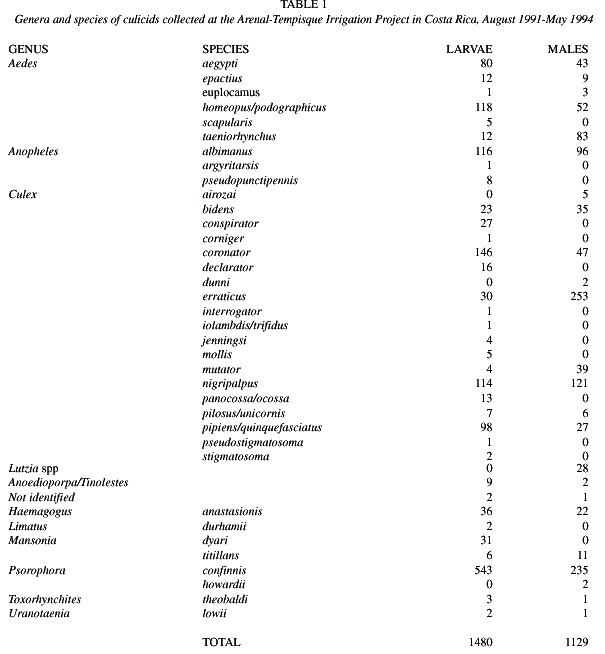
<body><![CDATA[<p><font face="Arial" size="2">Larvae of culicids were collected using the standard dipper technique.</font></p>     <p><font face="Arial" size="2">For each sample, the immature forms of culicids were split for preservation and for individual rearings to correlate larval stages with the corresponding adults.</font></p>     <p><font face="Arial" size="2">Larvae were dissected and mounted in Hoyer’s medium.</font></p>     <p><font face="Arial" size="2">The adults were collected using six CDC CO<sub>2</sub> -baited traps. The collecting period was from 6:00 pm to 6:00 am.</font></p> <font face="Arial" size="2"><b>     <p>Results</p> </b> </font>     <p><font face="Arial" size="2">The species of larvae and males of mosquitoes collected are presented in <a href="#t1">Table 1</a>.</font></p>     <div style="text-align: center;"><a name="t1"></a><img  src="/img/fbpe/rbt/v51n3-4/2920i1.JPG" title="" alt=""  style="width: 605px; height: 654px;">    
<br> </div> <font face="Arial" size="2"><b>     <p>Discussion</p> </b> </font>     <p><font face="Arial" size="2">Among the 1480 larvae of mosquitoes identified, <i>Psorophora </i>represents 36.7%, <i>Culex </i>34% (both genera represent 70.7%), the other genera in descending order are <i>Aedes </i>(15.4%), <i>Anopheles </i>(8.4%) <i>Mansonia </i>(2.5%), <i>Haemagogus </i>(2.7%), <i>Toxorhynchites </i>(0.2%), <i>Limatus </i>and <i>Uranotaenia </i>(0.13%).</font></p>     ]]></body>
<body><![CDATA[<p><font face="Arial" size="2">The genus <i>Culex </i>showed the higher species diversity (21). Meanwhile the diversity of the other species was <i>Aedes </i>(6), <i>Anopheles </i>(3), <i>Mansonia </i>(2), and the genera <i>Haemagogu</i>s, <i>Limatu</i>s, <i>Psorophor</i>a, <i>Toxorhynchites </i>and <i>Uranotaenia </i>(1).</font></p>     <p><font face="Arial" size="2">The most common species collected was <i>P. confinnis </i>(with 36.7%), followed by <i>C. coronator </i>(9.9%), the complex <i>Ae.homeopus/ podographicu</i>s, <i>An. albimanus </i>and <i>C. nigripalpus </i>were represented by 8% and others by 29.3%</font></p>     <p><font face="Arial" size="2">The relative densities of females between culicines and anophelines were 94% and 6% respectively.</font></p>     <p><font face="Arial" size="2">The diversity and population levels of the different culicid species are typical to the neotropical region, but two species would be used as parameters of the changes of habitats and ecological impact of the irrigation project, <i>An. albimanus </i>as the primary vector of malaria in Costa Rica, and <i>P. confinnis </i>as a potential vector of several arbovirosis. </font></p>     <p><font face="Arial" size="2">Because the ecological impact in irrigation projects has been estimated in five years after the project has been finished, a sustainable monitoring strategy to anticipate possible problems with clinical entities transmitted by mosquitoes is recommended.</font></p> <font face="Arial" size="2"><b>     <p>Acknowledgements</p> </b> </font>     <p><font face="Arial" size="2">The Vicerrectorías de Investigación and Administración, the Centro de Investigación en Enfermedades Tropicales, Facultad de Microbiología, and the Centro de Investigación en Contaminación Ambiental of the Universidad de Costa Rica provided economical and logistic support. SENARA that promptly handled the funds given by the B.I.D. Sergio Alfaro and Juan Carlos Cerdas for his field and laboratory duties. William Bussing of the Escuela de Biología for the improvement of the english language.</font></p> <font face="Arial" size="2"><b>     <p>Resumen </p> </b> </font>     <p><font face="Arial" size="2">Se realizó un monitoreo de machos y larvas de mosquitos durante los años 1991 a 1994 en el Proyecto de Riego Arenal-Tempisque, Guanacaste, Costa Rica. Los especímenes fueron colectados en 32 giras de cuatro días cada una y cada 15 días. La colecta de adultos se hizo mediante trampas tipo CDC y la de larvas con la técnica estándar del cucharón. Se identificaron un total de 1 480 larvas y 1 129 machos de culícidos, correspondientes a 21 especies de <i>Cule</i>x, 6 especies de <i>Aede</i>s, 2 especies de <i>Anophele</i>s, <i>Mansoni</i>a, y <i>Psorophora </i>y una especie de <i>Haemagogu</i>s, <i>Limatu</i>s, <i>Toxorhynchites </i>y <i>Uranotaeni</i>a. Los resultados indican que tal y como ha ocurrido en proyectos de riego en otros países, se deben mantener estrictos programas de monitoreo con el fin de prevenir y controlar posibles problemas de salud humana y animal, en los cuales los mosquitos actúen como vectores.</font></p> <font face="Arial" size="2"><b>     <p>References</p> </b> </font>     ]]></body>
<body><![CDATA[<!-- ref --><p><font face="Arial" size="2"><a name="Amerashinghe88a"></a>Amerashinghe, F.P. &amp; N.B. Munasingha. 1988a. A predevelopment mosquito survey in the Mahaweli development project area, Sri Lanka: Adults. J. Med. Entomol. 25: 276-285.    &nbsp;&nbsp;&nbsp;&nbsp;&nbsp;&nbsp;&nbsp;&nbsp;[&#160;<a href="javascript:void(0);" onclick="javascript: window.open('/scielo.php?script=sci_nlinks&ref=1679985&pid=S0034-7744200300030001700001&lng=','','width=640,height=500,resizable=yes,scrollbars=1,menubar=yes,');">Links</a>&#160;]<!-- end-ref --></font></p>     <!-- ref --><p><font face="Arial" size="2"><a name="Amerashinghe88b"></a>Amerashinghe, F.P. &amp; N.A. Munasingha. 1988b. A predevelopment mosquito survey in the Mahaweli development project area, Sri Lanka: Immatures. J. Med. Entomol. 25: 286-294.    &nbsp;&nbsp;&nbsp;&nbsp;&nbsp;&nbsp;&nbsp;&nbsp;[&#160;<a href="javascript:void(0);" onclick="javascript: window.open('/scielo.php?script=sci_nlinks&ref=1679987&pid=S0034-7744200300030001700002&lng=','','width=640,height=500,resizable=yes,scrollbars=1,menubar=yes,');">Links</a>&#160;]<!-- end-ref --></font></p>     <!-- ref --><p><font face="Arial" size="2"><a name="Amerashinghe90"></a>Amerashinghe, F.P. &amp; T.G. Ariyasena. 1990. Larval survey of surface water breeding mosquitoes during irrigation development in the Mahaweli project. Sri Lanka. J. Med. Entomol. 27: 789-802.    &nbsp;&nbsp;&nbsp;&nbsp;&nbsp;&nbsp;&nbsp;&nbsp;[&#160;<a href="javascript:void(0);" onclick="javascript: window.open('/scielo.php?script=sci_nlinks&ref=1679989&pid=S0034-7744200300030001700003&lng=','','width=640,height=500,resizable=yes,scrollbars=1,menubar=yes,');">Links</a>&#160;]<!-- end-ref --></font></p>     <!-- ref --><p><font face="Arial" size="2"><a name="Anonymous85"></a>Anonymous. 1985. Proyecto de Riego Arenal-Tempisque. Resumen. Servicio Nacional de Aguas Subterráneas Riego y Avenamiento (SENARA).    &nbsp;&nbsp;&nbsp;&nbsp;&nbsp;&nbsp;&nbsp;&nbsp;[&#160;<a href="javascript:void(0);" onclick="javascript: window.open('/scielo.php?script=sci_nlinks&ref=1679991&pid=S0034-7744200300030001700004&lng=','','width=640,height=500,resizable=yes,scrollbars=1,menubar=yes,');">Links</a>&#160;]<!-- end-ref --></font></p>     <!-- ref --><p><font face="Arial" size="2"><a name="Anonymous87"></a>Anonymous. 1987. Effects of Agricultural development on Vector-Borne Diseases. WHO/FAO/UNEP (eds.). FAO. Roma. AGL/MISC/12/87.    &nbsp;&nbsp;&nbsp;&nbsp;&nbsp;&nbsp;&nbsp;&nbsp;[&#160;<a href="javascript:void(0);" onclick="javascript: window.open('/scielo.php?script=sci_nlinks&ref=1679993&pid=S0034-7744200300030001700005&lng=','','width=640,height=500,resizable=yes,scrollbars=1,menubar=yes,');">Links</a>&#160;]<!-- end-ref --></font></p>     ]]></body>
<body><![CDATA[<!-- ref --><p><font face="Arial" size="2"><a name="Birley91"></a>Birley, M.H. 1991. Forecasting the vector-borne disease implications. PEEM Guidelines Series WHO/CWS/91.3.    &nbsp;&nbsp;&nbsp;&nbsp;&nbsp;&nbsp;&nbsp;&nbsp;[&#160;<a href="javascript:void(0);" onclick="javascript: window.open('/scielo.php?script=sci_nlinks&ref=1679995&pid=S0034-7744200300030001700006&lng=','','width=640,height=500,resizable=yes,scrollbars=1,menubar=yes,');">Links</a>&#160;]<!-- end-ref --></font></p>     <!-- ref --><p><font face="Arial" size="2"><a name="Gutierrez85"></a>Gutiérrez, C., O. Lucke. &amp; R. Solórzano. 1985. Integración de la Conservación con el Desarrollo en el Proyecto de Riego Arenal-Tempisque (un estudio de caso). CATIE- IUCN. Turrialba, Costa Rica. Vols I y II.    &nbsp;&nbsp;&nbsp;&nbsp;&nbsp;&nbsp;&nbsp;&nbsp;[&#160;<a href="javascript:void(0);" onclick="javascript: window.open('/scielo.php?script=sci_nlinks&ref=1679997&pid=S0034-7744200300030001700007&lng=','','width=640,height=500,resizable=yes,scrollbars=1,menubar=yes,');">Links</a>&#160;]<!-- end-ref --></font></p>     <!-- ref --><p><font face="Arial" size="2"><a name="Mather86"></a>Mather T.H. &amp; T.T. That. 1986. Ordenación del ambiente para la lucha antivectorial en arrozales. FAO, Roma Nº 41. 155 p.    &nbsp;&nbsp;&nbsp;&nbsp;&nbsp;&nbsp;&nbsp;&nbsp;[&#160;<a href="javascript:void(0);" onclick="javascript: window.open('/scielo.php?script=sci_nlinks&ref=1679999&pid=S0034-7744200300030001700008&lng=','','width=640,height=500,resizable=yes,scrollbars=1,menubar=yes,');">Links</a>&#160;]<!-- end-ref --></font></p>     <!-- ref --><p><font face="Arial" size="2"><a name="Tiffen91"></a>Tiffen M. 1991. Incorporation of health safeguards into irrigation projects through intersectorial cooperation. PEEM Guidelines Series WHO/CWS/91.2.    &nbsp;&nbsp;&nbsp;&nbsp;&nbsp;&nbsp;&nbsp;&nbsp;[&#160;<a href="javascript:void(0);" onclick="javascript: window.open('/scielo.php?script=sci_nlinks&ref=1680001&pid=S0034-7744200300030001700009&lng=','','width=640,height=500,resizable=yes,scrollbars=1,menubar=yes,');">Links</a>&#160;]<!-- end-ref --></font></p>     <!-- ref --><p><font face="Arial" size="2"><a name="Vargas91"></a>Vargas M. &amp; I. Coto. 1991. Entomological aspects of the Arenal-Tempisque irrigation project, Guanacaste, Costa Rica. Preliminary observations. J. Am. Mosq. Control. Assoc. 7: 637.    &nbsp;&nbsp;&nbsp;&nbsp;&nbsp;&nbsp;&nbsp;&nbsp;[&#160;<a href="javascript:void(0);" onclick="javascript: window.open('/scielo.php?script=sci_nlinks&ref=1680003&pid=S0034-7744200300030001700010&lng=','','width=640,height=500,resizable=yes,scrollbars=1,menubar=yes,');">Links</a>&#160;]<!-- end-ref --> </font></p>     ]]></body>
<body><![CDATA[ ]]></body><back>
<ref-list>
<ref id="B1">
<nlm-citation citation-type="journal">
<person-group person-group-type="author">
<name>
<surname><![CDATA[Amerashinghe]]></surname>
<given-names><![CDATA[F.P]]></given-names>
</name>
<name>
<surname><![CDATA[Munasingha]]></surname>
<given-names><![CDATA[N.B]]></given-names>
</name>
</person-group>
<article-title xml:lang="en"><![CDATA[A predevelopment mosquito survey in the Mahaweli development project area, Sri Lanka: Adults]]></article-title>
<source><![CDATA[J. Med. Entomol]]></source>
<year>1988</year>
<volume>25</volume>
<page-range>276-285</page-range></nlm-citation>
</ref>
<ref id="B2">
<nlm-citation citation-type="journal">
<person-group person-group-type="author">
<name>
<surname><![CDATA[Amerashinghe]]></surname>
<given-names><![CDATA[F.P]]></given-names>
</name>
<name>
<surname><![CDATA[Munasingha]]></surname>
<given-names><![CDATA[N.A]]></given-names>
</name>
</person-group>
<article-title xml:lang="en"><![CDATA[A predevelopment mosquito survey in the Mahaweli development project area, Sri Lanka: Immatures]]></article-title>
<source><![CDATA[J. Med. Entomol]]></source>
<year>1988</year>
<volume>25</volume>
<page-range>286-294</page-range></nlm-citation>
</ref>
<ref id="B3">
<nlm-citation citation-type="journal">
<person-group person-group-type="author">
<name>
<surname><![CDATA[Amerashinghe]]></surname>
<given-names><![CDATA[F.P]]></given-names>
</name>
<name>
<surname><![CDATA[Ariyasena]]></surname>
<given-names><![CDATA[T.G]]></given-names>
</name>
</person-group>
<article-title xml:lang="en"><![CDATA[Larval survey of surface water breeding mosquitoes during irrigation development in the Mahaweli project: Sri Lanka]]></article-title>
<source><![CDATA[J. Med. Entomol]]></source>
<year>1990</year>
<volume>27</volume>
<page-range>789-802</page-range></nlm-citation>
</ref>
<ref id="B4">
<nlm-citation citation-type="book">
<person-group person-group-type="author">
<name>
</name>
<name>
</name>
</person-group>
<source><![CDATA[Proyecto de Riego Arenal-Tempisque: Resumen]]></source>
<year>1985</year>
<publisher-name><![CDATA[Servicio Nacional de Aguas Subterráneas Riego y Avenamiento (SENARA)]]></publisher-name>
</nlm-citation>
</ref>
<ref id="B5">
<nlm-citation citation-type="book">
<person-group person-group-type="author">
<name>
</name>
<name>
</name>
</person-group>
<collab>WHO/FAO/UNEP</collab>
<source><![CDATA[Effects of Agricultural development on Vector-Borne Diseases]]></source>
<year>1987</year>
<publisher-loc><![CDATA[Roma ]]></publisher-loc>
<publisher-name><![CDATA[FAO]]></publisher-name>
</nlm-citation>
</ref>
<ref id="B6">
<nlm-citation citation-type="">
<person-group person-group-type="author">
<name>
<surname><![CDATA[Birley]]></surname>
<given-names><![CDATA[M.H]]></given-names>
</name>
</person-group>
<source><![CDATA[Forecasting the vector-borne disease implications]]></source>
<year>1991</year>
</nlm-citation>
</ref>
<ref id="B7">
<nlm-citation citation-type="book">
<person-group person-group-type="author">
<name>
<surname><![CDATA[Gutiérrez]]></surname>
<given-names><![CDATA[C]]></given-names>
</name>
<name>
<surname><![CDATA[Lucke]]></surname>
<given-names><![CDATA[O]]></given-names>
</name>
<name>
<surname><![CDATA[Solórzano]]></surname>
<given-names><![CDATA[R]]></given-names>
</name>
</person-group>
<source><![CDATA[Integración de la Conservación con el Desarrollo en el Proyecto de Riego Arenal-Tempisque (un estudio de caso)]]></source>
<year>1985</year>
<volume>I y II</volume>
<publisher-loc><![CDATA[Turrialba ]]></publisher-loc>
<publisher-name><![CDATA[CATIE- IUCN]]></publisher-name>
</nlm-citation>
</ref>
<ref id="B8">
<nlm-citation citation-type="book">
<person-group person-group-type="author">
<name>
<surname><![CDATA[Mather]]></surname>
<given-names><![CDATA[T.H]]></given-names>
</name>
<name>
<surname><![CDATA[That]]></surname>
<given-names><![CDATA[T.T]]></given-names>
</name>
</person-group>
<source><![CDATA[Ordenación del ambiente para la lucha antivectorial en arrozales]]></source>
<year>1986</year>
<volume>41</volume>
<page-range>155</page-range><publisher-loc><![CDATA[Roma ]]></publisher-loc>
<publisher-name><![CDATA[FAO]]></publisher-name>
</nlm-citation>
</ref>
<ref id="B9">
<nlm-citation citation-type="">
<person-group person-group-type="author">
<name>
<surname><![CDATA[Tiffen]]></surname>
<given-names><![CDATA[M]]></given-names>
</name>
</person-group>
<source><![CDATA[Incorporation of health safeguards into irrigation projects through intersectorial cooperation]]></source>
<year>1991</year>
</nlm-citation>
</ref>
<ref id="B10">
<nlm-citation citation-type="journal">
<person-group person-group-type="author">
<name>
<surname><![CDATA[Vargas]]></surname>
<given-names><![CDATA[M]]></given-names>
</name>
<name>
<surname><![CDATA[Coto]]></surname>
<given-names><![CDATA[I]]></given-names>
</name>
</person-group>
<article-title xml:lang="en"><![CDATA[Entomological aspects of the Arenal-Tempisque irrigation project, Guanacaste, Costa Rica: Preliminary observations]]></article-title>
<source><![CDATA[J. Am. Mosq. Control. Assoc]]></source>
<year>1991</year>
<volume>7</volume>
<page-range>637</page-range></nlm-citation>
</ref>
</ref-list>
</back>
</article>
