<?xml version="1.0" encoding="ISO-8859-1"?><article xmlns:mml="http://www.w3.org/1998/Math/MathML" xmlns:xlink="http://www.w3.org/1999/xlink" xmlns:xsi="http://www.w3.org/2001/XMLSchema-instance">
<front>
<journal-meta>
<journal-id>0034-7744</journal-id>
<journal-title><![CDATA[Revista de Biología Tropical]]></journal-title>
<abbrev-journal-title><![CDATA[Rev. biol. trop]]></abbrev-journal-title>
<issn>0034-7744</issn>
<publisher>
<publisher-name><![CDATA[Universidad de Costa Rica]]></publisher-name>
</publisher>
</journal-meta>
<article-meta>
<article-id>S0034-77442003000300005</article-id>
<title-group>
<article-title xml:lang="en"><![CDATA[In vitro multiplication of Toxoplasma gondii and Trypanosoma cruzi in mouse, rat, and hamster astrocytes]]></article-title>
</title-group>
<contrib-group>
<contrib contrib-type="author">
<name>
<surname><![CDATA[Troyo]]></surname>
<given-names><![CDATA[Adriana]]></given-names>
</name>
<xref ref-type="aff" rid="A01"/>
</contrib>
<contrib contrib-type="author">
<name>
<surname><![CDATA[Chinchilla]]></surname>
<given-names><![CDATA[Misael]]></given-names>
</name>
<xref ref-type="aff" rid="A01"/>
</contrib>
</contrib-group>
<aff id="A01">
<institution><![CDATA[,Universidad de Costa Rica Facultad de Microbiología Departamento de Parasitología]]></institution>
<addr-line><![CDATA[San José ]]></addr-line>
<country>Costa Rica</country>
</aff>
<pub-date pub-type="pub">
<day>00</day>
<month>09</month>
<year>2003</year>
</pub-date>
<pub-date pub-type="epub">
<day>00</day>
<month>09</month>
<year>2003</year>
</pub-date>
<volume>51</volume>
<numero>3-4</numero>
<fpage>639</fpage>
<lpage>645</lpage>
<copyright-statement/>
<copyright-year/>
<self-uri xlink:href="http://www.scielo.sa.cr/scielo.php?script=sci_arttext&amp;pid=S0034-77442003000300005&amp;lng=en&amp;nrm=iso"></self-uri><self-uri xlink:href="http://www.scielo.sa.cr/scielo.php?script=sci_abstract&amp;pid=S0034-77442003000300005&amp;lng=en&amp;nrm=iso"></self-uri><self-uri xlink:href="http://www.scielo.sa.cr/scielo.php?script=sci_pdf&amp;pid=S0034-77442003000300005&amp;lng=en&amp;nrm=iso"></self-uri><abstract abstract-type="short" xml:lang="en"><p><![CDATA[The infection and multiplication of Toxoplasma gondii and Trypanosoma cruzi were compared in primary cultures of white rat, mouse and hamster astrocytes. These cells were cultured on cover slides and infected with T. gondii tachyzoites or T. cruzi blood trypomastigotes. Results show that hamster astrocytes are more susceptible to the multiplication of both parasites than rat and mouse cells. There was no statistical difference between the T. gondii infection in rat and mouse astrocytes (p<0.05), and this suggests an important role of other mechanisms or cells in the white rat natural resistance to this parasite. Because the hamster astrocytes are less resistant to these parasites multiplication and not necessarily to the invasion, any difference observed could be due to an intracellular effect: hamster brain astrocytes favor survival and multiplication of these parasites]]></p></abstract>
<abstract abstract-type="short" xml:lang="es"><p><![CDATA[Se comparó la infección y multiplicación de Toxoplasma gondii y Trypanosoma cruzi en cultivos celulares primarios de astrocitos, a partir de células de cerebro de rata blanca, ratón y hámster. Las células fueron cultivadas en cubreobjetos e infectadas con taquizoitos de T. gondii o tripomastigotos sanguíneos de T. cruzi. Los resultados muestran que los astrocitos de hámster son más susceptibles que los de rata y ratón a la multiplicación de ambos parásitos. No se encontró diferencia estadísticamente significativa entre la infección por T. gondii en los astrocitos de ratón y rata (p<0.05), lo que sugiere la importancia de otros mecanismos o células en la resistencia natural de la rata blanca a esta parásito. Al ser los astrositos de hámster menos resistentes a la multiplicación de estos parásitos y no necesariamente a la invasión, cualquier diferencia observada podría deberse a un fenómeno intracelular: los astrocitos de hámster favorecen la permanencia y multiplicación de estos parásitos]]></p></abstract>
<kwd-group>
<kwd lng="en"><![CDATA[Toxoplasma gondii]]></kwd>
<kwd lng="en"><![CDATA[Trypanosoma cruzi]]></kwd>
<kwd lng="en"><![CDATA[cell culture]]></kwd>
<kwd lng="en"><![CDATA[astrocyte]]></kwd>
<kwd lng="en"><![CDATA[rat]]></kwd>
<kwd lng="en"><![CDATA[mouse]]></kwd>
<kwd lng="en"><![CDATA[hamster]]></kwd>
</kwd-group>
</article-meta>
</front><body><![CDATA[ <div style="text-align: center;"><b><i><font face="Arial">In vitro </font></i><font  face="Arial">multiplication of </font></b><font face="Arial"><i>Toxoplasma gondii </i><b>and </b><i>Trypanosoma cruzi</i></font>    <br> <font face="Arial"><i><span style="font-weight: bold;"></span></i><b>in mouse, rat, and hamster astrocytes</b></font></div> <font face="Arial" size="2"> </font>     <p><font face="Arial" size="2">Adriana Troyo &amp; Misael Chinchilla</font></p>     <p><font face="Arial" size="2">Centro de Investigación en Enfermedades Tropicales, Departamento de Parasitología, Facultad de Microbiología, Universidad de Costa Rica, 2060 San José, Costa Rica; address: <a  href="mailto:atroyo@cariari.ucr.ac.cr">atroyo@cariari.ucr.ac.cr</a></font></p>     <p style="text-align: center;"><font face="Arial" size="2">Received 10-IV-2002.&nbsp;&nbsp;&nbsp;&nbsp;&nbsp;&nbsp; Corrected 26-VIII-2003.&nbsp;&nbsp;&nbsp;&nbsp;&nbsp;&nbsp; Accepted 29-VIII-2003.</font></p> <font face="Arial" size="2"><b>     <p>Abstract</p> </b></font>     <p><font face="Arial" size="2">The infection and multiplication of <i>Toxoplasma gondii </i>and <i>Trypanosoma cruzi </i>were compared in primary cultures of white rat, mouse and hamster astrocytes. These cells were cultured on cover slides and infected with <i>T. gondii </i>tachyzoites or <i>T. cruzi </i>blood trypomastigotes. Results show that hamster astrocytes are more susceptible to the multiplication of both parasites than rat and mouse cells. There was no statistical difference between the <i>T. gondii </i>infection in rat and mouse astrocytes (p&lt;0.05), and this suggests an important role of other mechanisms or cells in the white rat natural resistance to this parasite. Because the hamster astrocytes are less resistant to these parasites multiplication and not necessarily to the invasion, any difference observed could be due to an intracellular effect: hamster brain astrocytes favor survival and multiplication of these parasites.</font></p> <font face="Arial" size="2"><b></b></font>     <p><font face="Arial" size="2"><b>Key words: </b><i>Toxoplasma gondi</i>i, <i>Trypanosoma cruz</i>i, cell culture, astrocyte, rat, mouse, hamster.</font></p> <font face="Arial" size="2"><i> </i></font>     <p><font face="Arial" size="2"><i>    <br> Toxoplasma gondii </i>and <i>Trypanosoma cruzi </i>are parasites of great importance in public health. In immunocompetent hosts, <i>T. gondii </i>infection may cause chorioretinitis, abortion or nervous system problems in the newborn, and <i>T. cruzi </i>infection causes Chagas’ disease, which involves chronic problems such as cardiomyopathy. However, in the immuno-suppressed host, both parasites may provoke death from severe central nervous system infection (<a  href="#Tanowitz92">Tanowitz <i>et a</i>l. 1992</a>, <a  href="#McCabe93">McCabe and Chirurgi 1993</a>).</font></p> <font face="Arial" size="2"><i></i></font>     ]]></body>
<body><![CDATA[<p><font face="Arial" size="2"><i>T. gondii </i>and <i>T. cruzi </i>are obligate parasites capable of infecting and multiplying in cells of different animals, including humans (<a href="#Dubey87">Dubey 1987</a>, <a href="#Tanowitz92">Tanowitz <i>et a</i>l. 1992</a>). This has been demonstrated by <i>in vivo </i>and <i>in vitro </i>experiments using different animal species (<a href="#Kaufman62">Kaufman and Maloney 1962</a>, <a href="#Braveny78">Braveny <i>et a</i>l. 1978</a>, <a href="#Chinchilla81a">Chinchilla <i>et a</i>l. 1981a</a>, <a  href="#Shepp85">Shepp <i>et al. </i>1985</a>, <a href="#Jones86">Jones <i>et al. </i>1986</a>, <a href="#Chinchilla95">Chinchilla <i>et a</i>l. 1995</a>, <a href="#Chinchilla96">1996</a>).</font></p>     <p><font face="Arial" size="2">For <i>T. cruzi </i>as well as for <i>T. gondii </i>investigations have shown that each animal species has variable susceptibility to the infection. For example, in a study done with white rats, it was demonstrated that this animal is highly resistant to <i>T. gondii </i>infection, and that its susceptibility depends on the age of the rat (</font><font face="Arial" size="2"><a  href="#Chinchilla81a">Chinchilla <i>et a</i>l. 1981a</a></font><font  face="Arial" size="2">, <a href="#Chinchilla96">1996</a>). The multiplication patterns of these parasites have also been compared <i>in vitro </i>in macrophages of different animals. In these cases also, white rat macrophages were more resistant to infection than mouse, and hamster macrophages (<a href="#Chinchilla81b">Chinchilla <i>et al. </i>1981b</a>, <a href="#Chinchilla95">1995</a>). </font></p>     <p><font face="Arial" size="2">Both of these parasites are able to infect different cell types, including cells from the nervous system. Research on the <i>in vitro </i>infection of brain cells and specially on the behavior of <i>T. gondii </i>in these cells is relevant, considering the increase in disseminated and central nervous system infections that occur in immunosuppression (</font><font  face="Arial" size="2"><a href="#Jones86">Jones <i>et al. </i>1986</a></font><font  face="Arial" size="2">, <a href="#Fagard99">Fagard <i>et a</i>l. 1999</a>). </font></p>     <p><font face="Arial" size="2">Even though there have been some investigations using brain cells of different animals, the infection of <i>T. gondii </i>and <i>T. cruzi </i>in astrocytes from different host species has not been thoroughly compared. Therefore, we have designed a model in order to study and compare the multiplication pattern of <i>T. gondii </i>and <i>T. cruzi </i>in primary culture of astrocytes from different rodents. This could be used as the basis for future research including immunity studies in mouse, rat and hamster astrocytes.</font></p> <font face="Arial" size="2"><b></b></font>     <p><font face="Arial" size="2"><b>Materials and methods</b></font></p>     <p><font face="Arial" size="2"><b>Animals: </b>White NGP mice, Sprague Dawley rats, and golden Syrian hamsters, <i>Mesocricetus auratu</i>s, were used in the experiments. They were fed with a locally produced concentrate (Harrigan Mix) and water <i>ad libitu</i>m. Rodents of less than 3 days old were used for the cell cultures.</font></p> <font face="Arial" size="2"><b></b></font>     <p><font face="Arial" size="2"><b>Parasites: </b><i>T. gondii </i>RH strain maintained by twice weekly passages in NGP mice (20- 25g), and <i>T. cruzi </i>TC-2 strain isolated in Costa Rica and maintained by passages once a month in C<sub>3</sub> H mice (20g) were used.</font></p> <font face="Arial" size="2"><b></b></font>     <p><font face="Arial" size="2"><b>Cell cultures: </b>The cell cultures were worked separately using the brains of mice, rats and hamsters according to the method described by Ponten (1973) with some modifications. Briefly, the animals of less than three days old (approximately 8 animals for mice or hamsters, and 4 for rats) were anesthetized until death with ether and soaked with 70º ethyl alcohol. Their heads were separated using sterile scissors and tweezers, and the brains were dissected aseptically. They were placed in Minimal Essential Medium (Sigma) with 10% bovine fetal serum, 100 U/ml of penicillin, and 100 µg/ml of streptomycin (MEM-BFS). Passing the brains through 18, 20 (or 21), and 26 gauge needles, in that order, 3 times each, dissociated the cells. This material was placed in MEM-BFS in 25 cm<sup>2</sup> cell culture bottles (or 75 cm 2 if necessary) and incubated at 37º C in a 5% CO<sub>2</sub> atmosphere for 8-10 days or until a cell monolayer formed. The medium was replaced whenever necessary.</font></p> <font face="Arial" size="2"><b></b></font>     <p><font face="Arial" size="2"><b>Infection models: </b>After the primary culture, the cells were washed 3 times with Hanks solution (Sigma) and dispersed by adding 0.25% trypsin and 0.02% EDTA in MEM without bovine fetal serum for 10-15 minutes. The suspension was centrifuged for 8 min at 300 x g, and the resuspended cells in MEM-BFS were subcultured on 22x22 mm cover slides by placing 0.3 ml of the cell suspension on each slide (Chinchilla and Frenkel 1978). By this method, subcultured brain cell monolayers contain more than 95% astrocytes (<a  href="#Fontana84">Fontana <i>et a</i>l. 1984</a>, <a  href="#Peterson93">Peterson <i>et a</i>l. 1993</a>, <a  href="#Creuzet98">Creuzet <i>et a</i>l. 1998</a>). The cover slides were incubated at 37ºC in 5% CO<sub>2</sub> for 24-48 hours and infected after counting the cells on one of the slides in a Neubauer chamber following trypsinization. </font></p>     <p><font face="Arial" size="2">For the infection with <i>T. gondi</i>i, the tachyzoites were obtained from peritoneal exudate of an infected mouse, they were counted in a Neubauer chamber, and the inoculum was adjusted to one tachyzoite per cell. The cells were infected and samples were obtained after 1 and 24 hours of incubation at 37ºC in 5% CO<sub>2</sub> . The cover slides were dried at room temperature, fixed for 5 minutes with methanol, stained for 30 minutes with Giemsa, dried, and mounted with Permount.</font></p>     ]]></body>
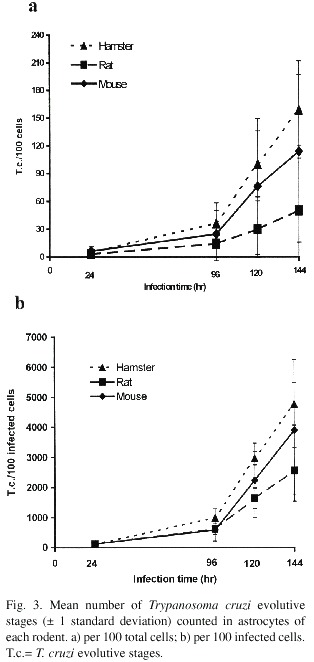
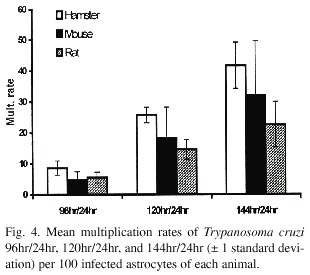
<body><![CDATA[<p><font face="Arial" size="2">The trypomastigotes used in the infections with <i>T. cruzi </i>were obtained according to the method described by Budzko <i>et a</i>l. (1975). Briefly, total heparinized blood of an infected mouse was stratified on Ficoll Histopaque-1077 (Sigma), centrifuged at 400 x g for 40 min at room temperature, and the mononuclear cells and trypanosome layer was separated. The trypomastigotes were counted, the cells infected, and cover slide samples taken at 24, 96, 120 and 144 hours after incubation, treating and staining them as described for <i>T. gondi</i>i. </font></p>     <p><font face="Arial" size="2">For each cover slide infected with <i>T. gondi</i>i, 500-700 astrocytes were counted, and 700-1200 astrocytes for those infected with <i>T. cruz</i>i. The number of parasites per 100 total cells and per 100 infected cells was determined, and multiplication rates were obtained with these data: 24hr/1hr for <i>T. gondii </i>and 96hr/24hr, 120hr/24hr, and 144hr/24hr for <i>T. cruz</i>i.</font></p>     <p><font face="Arial" size="2">All the experiments were repeated 5 times and the data was analyzed using the Student’s t-test to determine the differences between the means (a:0.05) (<a href="#Hill66">Hill 1966</a>).</font></p> <font face="Arial" size="2"><b>     <p>Results</p> </b> </font>     <p><font face="Arial" size="2">The multiplication curve for <i>T. gondii </i>in the astrocytes of each animal species is shown in <a  href="#f1">Figs. 1</a> and <a href="#f2">2</a>. According to these results, less than 15% of the tachyzoites penetrated the astrocytes of these rodents in an hour or less. In the rat, less than 5% of the cells are infected after 1 hour of incubation. The multiplication rates of <i>T. gondii </i>24hr/1hr for 100 total cells and 100 infected cells are presented in <a href="#f2">Fig. 2</a>.</font></p>     <div style="text-align: center;"><span style="font-family: arial;"><a  name="f1"></a><img src="/img/fbpe/rbt/v51n3-4/2908i1.JPG" title="" alt=""  style="width: 323px; height: 665px;">    
<br>     <br> <a name="f2"></a><img src="/img/fbpe/rbt/v51n3-4/2908i2.JPG" title="" alt=""  style="width: 311px; height: 303px;">    
<br> </span></div>     <p><font face="Arial" size="2">When comparing the three rodents, the <i>T. gondii </i>infection after 1 hour is similar in all of them. However, the parasite multiplication was higher in the hamster astrocytes because the number of tachyzoites after 24 hours of infection is evidently greater for 100 total cells <a href="#f1">(Fig. 1a)</a> as well as 100 infected cells (<a href="#f1">Fig. 1b</a>). The statistical analysis indicates a significant difference (p&lt;0.05).</font></p>     ]]></body>
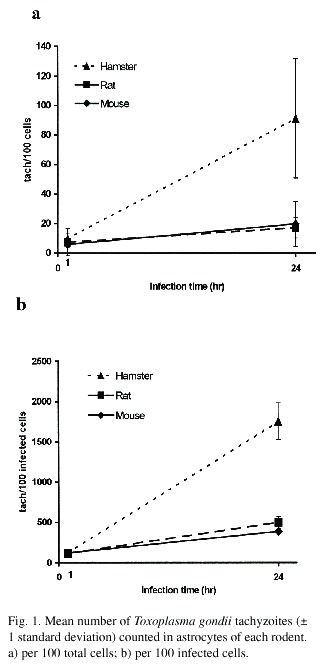
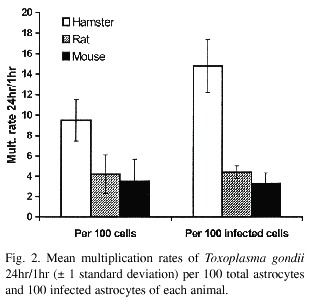
<body><![CDATA[<p><font face="Arial" size="2">The same result is obtained when the multiplication rates of <i>Toxoplasma </i>(24hr/1hr) between the different animal astrocytes are compared. The multiplication rates in the hamster cells are greater for 100 total and infected cells (p&lt;0.05). The multiplication rates for mouse and rat cells were similar, and the difference between both rodents is not statistically significant <a href="#f2">(Fig. 2)</a>. </font></p>     <p><font face="Arial" size="2">The <i>T. cruzi </i>multiplication curves for each rodent are shown in <a href="#f3">figures 3</a>, <a  href="#f4">and 4</a>. For this flagellate, the infection after 24 hours in most experiments is less than 10 parasites per 100 cells, and in the case of the rat astrocytes, this percentage is much lower.</font></p>     <div style="text-align: center;"><span style="font-family: arial;"><a  name="f3"></a><img src="/img/fbpe/rbt/v51n3-4/2908i3.JPG" title="" alt=""  style="width: 314px; height: 662px;">    
<br>     <br>     <br> <a name="f4"></a><img src="/img/fbpe/rbt/v51n3-4/2908i4.JPG" title="" alt=""  style="width: 310px; height: 275px;">    
<br> </span></div>     <p><font face="Arial" size="2">In all the astrocyte cells infected with <i>T. cruz</i>i, only amastigotes were found after 24 and 96 hours, but other forms of the parasite such as epimastigotes and trypomastigotes were present at 120 hours post-infection (in lower proportion than amastigotes). At 144 hours of infection there were less amastigotes than epimastigotes and trypomastigotes in the cells of the three animals studied. </font></p>     <p><font face="Arial" size="2">When comparing the multiplication of <i>T. cruzi </i>in the astrocytes, the number of parasites per 100 total cells and 100 infected cells in hamster differs significantly from the rat cells (p&lt;0.05). The hamster astrocytes are more susceptible whereas the rat astrocytes are more resistant to the parasite multiplication <a href="#f3">(Fig. 3)</a>.</font></p>     <p><font face="Arial" size="2">The trypanosome 96hr/24hr and 120hr/24hr multiplication rates for hamster and rat astrocytes are also statistically different (p&lt;0.05): they are greater for the hamster cells than for the rat cells. For the mouse astrocytes, the multiplication rate is intermediate <a href="#f4">(Fig. 4)</a>.</font></p> <font face="Arial" size="2"><b>     ]]></body>
<body><![CDATA[<p>Discussion</p> </b> </font>     <p><font face="Arial" size="2">The multiplication of <i>T. gondii </i>in cell cultures has been studied using cells of different origin. It has been studied in cells such as microglial cells, astrocytes, and even neurons, along with the effect of different immune factors on the infection (</font><font face="Arial" size="2"><a href="#Jones86">Jones <i>et al. </i>1986</a></font><font face="Arial" size="2">, </font><font  face="Arial" size="2"><a href="#Peterson93">Peterson <i>et a</i>l. 1993</a></font><font face="Arial" size="2">, <a href="#Chao93">Chao <i>et a</i>l. 1993</a>, </font><font face="Arial" size="2"><a  href="#Fagard99">Fagard <i>et a</i>l. 1999</a></font><font  face="Arial" size="2">, <a href="#Freund01">Freund <i>et a</i>l. 2001</a>).</font></p>     <p><font face="Arial" size="2">It has been reported that strains of <i>T. gondii </i>behave differently when infecting the same cell type (Kaufman and Maolney 1962), and it is also known that animals such as the white rat are less susceptible to <i>T. gondii </i>(</font><font  face="Arial" size="2"><a href="#Chinchilla81a">Chinchilla <i>et a</i>l. 1981a</a></font><font face="Arial" size="2">). Experiments done <i>in vivo </i>with white rats, wild rats <i>(Sigmodon hispidu</i>s), mice, and hamsters show that the white rat is more resistant to a <i>Toxoplasma </i>infection compared to mice and hamsters (<a href="#Chinchilla96">Chinchilla <i>et a</i>l. 1996</a>). On the other hand, and according to <i>in vivo </i>and <i>in vitro </i>studies, the white rat peritoneal macrophages play a very important role in this animal natural adaptation to the parasite, apparently due to enzymatic factors that prevent the development of <i>T. gondii </i>within the macrophage (</font><font  face="Arial" size="2"><a href="#Chinchilla81a">Chinchilla <i>et a</i>l. 1981a</a></font><font face="Arial" size="2">, <a href="#Chinchilla81b">1981b</a>).</font></p>     <p><font face="Arial" size="2">In this study, the <i>in vitro </i>infection and multiplication of <i>Toxoplasma </i>in rat and mouse astrocytes were similar, further supporting the hypothesis that the natural resistance of the white rat is due to other cells or mechanisms, such as the action of the peritoneal macrophages. However, there is a difference regarding the hamster astrocytes, which are evidently more susceptible to this parasite. In reports of other <i>in vitro </i>(macrophages) and <i>in vivo </i>infections, the similarity was between mice and hamsters (which differ from rats), mostly due to the mentioned activity of the rat macrophages (</font><font face="Arial" size="2"><a  href="#Chinchilla95">Chinchilla <i>et a</i>l. 1995</a></font><font  face="Arial" size="2">, <a href="#Chinchilla96">1996</a>).</font></p>     <p><font face="Arial" size="2">Also, the number of tachyzoites per 100 infected cells after 1 hour was similar for all the animals studied. Therefore, hamster astrocytes are less resistant to <i>Toxoplasma </i>than mouse and rat astrocytes <i>in vitr</i>o, and the difference observed in the parasite multiplication in these cells is due to intracellular phenomena, rather than a deficiency in the organism invasion capacity.</font></p>     <p><font face="Arial" size="2">As it has been mentioned, the macrophages of the rat are more resistant to <i>T. gondii </i>than those of other rodents, and it has also been observed that they are more resistant to other intracellular parasites like <i>T. cruzi </i>(</font><font  face="Arial" size="2"><a href="#Chinchilla95">Chinchilla <i>et a</i>l. 1995</a></font><font face="Arial" size="2">). This experiment shows that <i>in vitr</i>o, rat astrocytes are also less susceptible to the multiplication of this flagellate than the other rodents, but its entrance into the cell is similar in white rats, mice, and hamsters. Mouse astrocytes present an intermediate resistance, while hamster cells are the least resistant.</font></p>     <p><font face="Arial" size="2">When comparing the multiplication rates of <i>T. cruzi </i>and <i>T. gondii </i>in the cells of the different animals, the hamster astrocytes again show to be the most favorable ones for the parasites. Therefore, apparently hamster astrocytes present an intracellular environment that favors their permanence and multiplication more than the rat and mouse cells. This could be due to factors that have a similar intracellular effect for both parasites, as it has been previously suggested for cotton rat <i>(S. hispidu</i>s) macrophages (</font><font face="Arial" size="2"><a  href="#Chinchilla95">Chinchilla <i>et a</i>l. 1995</a></font><font  face="Arial" size="2">).</font></p>     <p><font face="Arial" size="2">With these results, the difference that animals and host cells can show in an infection by an intracellular parasite is even more obvious. The work on intracellular multiplication of parasites that many times is carried out <i>in vitro </i>does not contemplate the differences that can exist between cells of different origin, animals whose characteristics may vary, or differences in human or cell lines. Even cell subpopulations in one organism may possess characteristics and express genes differently, limiting the intracellular parasite multiplication (<a href="#Moulder85">Moulder 1985</a>, <a href="#Crocker87">Crocker <i>et a</i>l. 1987</a>).</font></p>     <p><font face="Arial" size="2">By comparing the multiplication of <i>T. gondii </i>and <i>T. cruzi </i>in astrocytes of different rodents, a base study is established to continue the work comparing these cells. <i>In vitro </i>investigations have been done with astrocytes and microglial cells, protecting the cells from infection with cytokines like interferon <font face="Symbol">g</font> &#61472; and tumor necrosis factor <font face="Symbol">a</font> &#61472;(</font><font face="Arial" size="2"><a href="#Peterson93">Peterson <i>et a</i>l. 1993</a></font><font face="Arial" size="2">, </font><font  face="Arial" size="2"><a href="#Chao93">Chao <i>et a</i>l. 1993</a></font><font  face="Arial" size="2">, <a href="#Halonen00">Halonen and Weiss 2000</a>, </font><font face="Arial" size="2"><a href="#Freund01">Freund <i>et a</i>l. 2001</a></font><font face="Arial" size="2">), but most of these have been done in mice. This study serves as a basis to compare the effect of cytokines obtained from different animals and evaluate their specificity according to parasite and host species, as it has been done with these two parasites in other non-phagocytic cells (<a  href="#Chinchilla78">Chinchilla and Frenkel 1978</a>, <a  href="#Chinchilla84">1984</a>, <a href="#Reyes87">Reyes and Chinchilla 1987</a>, <a href="#Chinchilla90">Chinchilla and Reyes 1990</a>, <a href="#Chinchilla03">Chinchilla <i>et al. </i>2003</a>). Therefore, it presents the possibility of using astrocytes of various rodents, considering the differences in susceptibility, to determine important host factors that influence the parasite multiplication.</font></p> <font face="Arial" size="2"><b>     <p>Acknowledgements</p> </b> </font>     ]]></body>
<body><![CDATA[<p><font face="Arial" size="2">This work was supported by the Vicerectoría de Investigación, Universidad de Costa Rica, project # 803-97-262. </font></p> <font face="Arial" size="2"><b>     <p>Resumen</p> </b> </font>     <p><font face="Arial" size="2">Se comparó la infección y multiplicación de <i>Toxoplasma gondii </i>y <i>Trypanosoma cruzi </i>en cultivos celulares primarios de astrocitos, a partir de células de cerebro de rata blanca, ratón y hámster. Las células fueron cultivadas en cubreobjetos e infectadas con taquizoitos de <i>T. gondii </i>o tripomastigotos sanguíneos de <i>T. cruz</i>i. Los resultados muestran que los astrocitos de hámster son más susceptibles que los de rata y ratón a la multiplicación de ambos parásitos. No se encontró diferencia estadísticamente significativa entre la infección por <i>T. gondii </i>en los astrocitos de ratón y rata (p&lt;0.05), lo que sugiere la importancia de otros mecanismos o células en la resistencia natural de la rata blanca a esta parásito. Al ser los astrositos de hámster menos resistentes a la multiplicación de estos parásitos y no necesariamente a la invasión, cualquier diferencia observada podría deberse a un fenómeno intracelular: los astrocitos de hámster favorecen la permanencia y multiplicación de estos parásitos. </font></p> <font face="Arial" size="2"><b>     <p>References</p> </b> </font>     <!-- ref --><p><font face="Arial" size="2"><a name="Braveny78"></a>Braveny, I., W. Winter &amp; R. Disko. 1978. A method of mass cultivation of <i>Toxoplasma gondii </i>in cell culture. Tropenmed. Parasit. 29: 432-434.    &nbsp;&nbsp;&nbsp;&nbsp;&nbsp;&nbsp;&nbsp;&nbsp;[&#160;<a href="javascript:void(0);" onclick="javascript: window.open('/scielo.php?script=sci_nlinks&ref=1673549&pid=S0034-7744200300030000500001&lng=','','width=640,height=500,resizable=yes,scrollbars=1,menubar=yes,');">Links</a>&#160;]<!-- end-ref --></font></p>     <!-- ref --><p><font face="Arial" size="2"><a name="Budzko75"></a>Budzko, D.B., M.C. Pizzimenti &amp; F. Kierszenbaum. 1975. Effects of complement depletion in experimental Chagas disease: immune lysis of virulent blood forms of <i>Trypanosoma cruz</i>i. Infect. Immun. 11: 86- 91.    &nbsp;&nbsp;&nbsp;&nbsp;&nbsp;&nbsp;&nbsp;&nbsp;[&#160;<a href="javascript:void(0);" onclick="javascript: window.open('/scielo.php?script=sci_nlinks&ref=1673551&pid=S0034-7744200300030000500002&lng=','','width=640,height=500,resizable=yes,scrollbars=1,menubar=yes,');">Links</a>&#160;]<!-- end-ref --></font></p>     <!-- ref --><p><font face="Arial" size="2"><a name="Chao93"></a>Chao, C.C., S. Hu, G. Gekker, W.J. Novick Jr., J.S. Remington &amp; P.K. Peterson. 1993. Effects of cytokines on multiplication of <i>Toxoplasma gondii </i>in microglial cells. J. Immunol. 150: 3404-3410.    &nbsp;&nbsp;&nbsp;&nbsp;&nbsp;&nbsp;&nbsp;&nbsp;[&#160;<a href="javascript:void(0);" onclick="javascript: window.open('/scielo.php?script=sci_nlinks&ref=1673553&pid=S0034-7744200300030000500003&lng=','','width=640,height=500,resizable=yes,scrollbars=1,menubar=yes,');">Links</a>&#160;]<!-- end-ref --></font></p>     ]]></body>
<body><![CDATA[<!-- ref --><p><font face="Arial" size="2"><a name="Chinchilla78"></a>Chinchilla, M. &amp; J.K. Frenkel. 1978. Mediation of immunity to intracellular infection <i>(Toxoplasma </i>and <i>Besnoiti</i>a) within somatic cells. Infect. Immun. 19: 999-1012.    &nbsp;&nbsp;&nbsp;&nbsp;&nbsp;&nbsp;&nbsp;&nbsp;[&#160;<a href="javascript:void(0);" onclick="javascript: window.open('/scielo.php?script=sci_nlinks&ref=1673555&pid=S0034-7744200300030000500004&lng=','','width=640,height=500,resizable=yes,scrollbars=1,menubar=yes,');">Links</a>&#160;]<!-- end-ref --></font></p>     <!-- ref --><p><font face="Arial" size="2"><a name="Chinchilla81a"></a>Chinchilla, M., M. Alfaro &amp; O.M. Guerrero. 1981a. Adaptación natural de la rata blanca a <i>Toxoplasma gondi</i>i. Rev. Biol. Trop. 29: 273-282.    &nbsp;&nbsp;&nbsp;&nbsp;&nbsp;&nbsp;&nbsp;&nbsp;[&#160;<a href="javascript:void(0);" onclick="javascript: window.open('/scielo.php?script=sci_nlinks&ref=1673557&pid=S0034-7744200300030000500005&lng=','','width=640,height=500,resizable=yes,scrollbars=1,menubar=yes,');">Links</a>&#160;]<!-- end-ref --></font></p>     <!-- ref --><p><font face="Arial" size="2"><a name="Chinchilla96"></a>Chinchilla, M., O.M. Guerrero, L. Reyes &amp; E. Abrahams. 1996. Susceptibilidad de la rata <i>Sigmodon hispidus </i>(Rodentia: Cricetidae) al <i>Toxoplasma gondii </i>(Eucoccidia: Sarcocystidae). Rev. Biol. Trop. 44: 265-268.    &nbsp;&nbsp;&nbsp;&nbsp;&nbsp;&nbsp;&nbsp;&nbsp;[&#160;<a href="javascript:void(0);" onclick="javascript: window.open('/scielo.php?script=sci_nlinks&ref=1673559&pid=S0034-7744200300030000500006&lng=','','width=640,height=500,resizable=yes,scrollbars=1,menubar=yes,');">Links</a>&#160;]<!-- end-ref --></font></p>     <!-- ref --><p><font face="Arial" size="2"><a name="Chinchilla81b"></a>Chinchilla, M., O.M. Guerrero &amp; E. Solano. 1981b. Acción de los macrófagos de la rata blanca contra <i>Toxoplasma gondii </i>"in vitro". Rev. Latinoam. Microbiol. 23: 239-243.    &nbsp;&nbsp;&nbsp;&nbsp;&nbsp;&nbsp;&nbsp;&nbsp;[&#160;<a href="javascript:void(0);" onclick="javascript: window.open('/scielo.php?script=sci_nlinks&ref=1673561&pid=S0034-7744200300030000500007&lng=','','width=640,height=500,resizable=yes,scrollbars=1,menubar=yes,');">Links</a>&#160;]<!-- end-ref --></font></p>     <!-- ref --><p><font face="Arial" size="2"><a name="Chinchilla84"></a>Chinchilla, M. &amp; J.K. Frenkel. 1984. Resistencia a la infección por <i>Toxoplasma </i>in vitro inducida por mediadores linfocitarios en células no fagocíticas de ratón y hámster. Inmunología 3: 144-150.    &nbsp;&nbsp;&nbsp;&nbsp;&nbsp;&nbsp;&nbsp;&nbsp;[&#160;<a href="javascript:void(0);" onclick="javascript: window.open('/scielo.php?script=sci_nlinks&ref=1673563&pid=S0034-7744200300030000500008&lng=','','width=640,height=500,resizable=yes,scrollbars=1,menubar=yes,');">Links</a>&#160;]<!-- end-ref --></font></p>     ]]></body>
<body><![CDATA[<!-- ref --><p><font face="Arial" size="2"><a name="Chinchilla03"></a>Chinchilla Carmona, M., M. Herrera Corrales, O.M. Guerrero Bermúdez, A. Jiménez Somarribas, G. Tamayo, A. Sittenfeld Appel, V. Nielsen &amp; P. Hurtado. 2003. Efecto de extractos de artrópodos sobre la multiplicación del <i>Toxoplasma gondii </i>dentro de macrófagos peritoneales de ratón. Rev. Biol. Trop. 51: 317-332.    &nbsp;&nbsp;&nbsp;&nbsp;&nbsp;&nbsp;&nbsp;&nbsp;[&#160;<a href="javascript:void(0);" onclick="javascript: window.open('/scielo.php?script=sci_nlinks&ref=1673565&pid=S0034-7744200300030000500009&lng=','','width=640,height=500,resizable=yes,scrollbars=1,menubar=yes,');">Links</a>&#160;]<!-- end-ref --></font></p>     <!-- ref --><p><font face="Arial" size="2"><a name="Chinchilla90"></a>Chinchilla, M. &amp; L. Reyes. 1990. Characteristics of the lymphokine active against multiplication of <i>T. cruzi </i>in mouse heart cell<i>s. </i>Infect. Immun. 9: 75-82.    &nbsp;&nbsp;&nbsp;&nbsp;&nbsp;&nbsp;&nbsp;&nbsp;[&#160;<a href="javascript:void(0);" onclick="javascript: window.open('/scielo.php?script=sci_nlinks&ref=1673567&pid=S0034-7744200300030000500010&lng=','','width=640,height=500,resizable=yes,scrollbars=1,menubar=yes,');">Links</a>&#160;]<!-- end-ref --></font></p>     <!-- ref --><p><font face="Arial" size="2"><a name="Chinchilla95"></a>Chinchilla, M., L. Reyes &amp; O.M. Guerrero. 1995. Resistance to intracellular parasites correlates with species differences in ability of macrophages to inhibit parasite replication. Immun. Infect. Dis. 5: 83-87.    &nbsp;&nbsp;&nbsp;&nbsp;&nbsp;&nbsp;&nbsp;&nbsp;[&#160;<a href="javascript:void(0);" onclick="javascript: window.open('/scielo.php?script=sci_nlinks&ref=1673569&pid=S0034-7744200300030000500011&lng=','','width=640,height=500,resizable=yes,scrollbars=1,menubar=yes,');">Links</a>&#160;]<!-- end-ref --></font></p>     <!-- ref --><p><font face="Arial" size="2"><a name="Creuzet98"></a>Creuzet C., F. Robert, M. P. Roisin, H. Van Tan, C. Benes, J. Dupouy-Camet &amp; R. Fagard. 1998. Neurons in primary culture are less efficiently infected by <i>Toxoplasma gondii </i>than glial cells. Parasitol. Res. 84: 25-30.    &nbsp;&nbsp;&nbsp;&nbsp;&nbsp;&nbsp;&nbsp;&nbsp;[&#160;<a href="javascript:void(0);" onclick="javascript: window.open('/scielo.php?script=sci_nlinks&ref=1673571&pid=S0034-7744200300030000500012&lng=','','width=640,height=500,resizable=yes,scrollbars=1,menubar=yes,');">Links</a>&#160;]<!-- end-ref --></font></p>     <!-- ref --><p><font face="Arial" size="2"><a name="Crocker87"></a>Crocker, P.R., E.V. Davies &amp; J.M. Blackwell. 1987. Variable expression of the murine natural resistance gene Lsh in different macrophage populations infected in vitro with <i>Leishmania donovan</i>i. Parasite Immunol. 9: 705-719.    &nbsp;&nbsp;&nbsp;&nbsp;&nbsp;&nbsp;&nbsp;&nbsp;[&#160;<a href="javascript:void(0);" onclick="javascript: window.open('/scielo.php?script=sci_nlinks&ref=1673573&pid=S0034-7744200300030000500013&lng=','','width=640,height=500,resizable=yes,scrollbars=1,menubar=yes,');">Links</a>&#160;]<!-- end-ref --></font></p>     ]]></body>
<body><![CDATA[<!-- ref --><p><font face="Arial" size="2"><a name="Dubey87"></a>Dubey, J.P. 1987. Toxoplasmosis. Vet. Clinics North. Am.: Small Animal Practice. 17: 1389-1404.    &nbsp;&nbsp;&nbsp;&nbsp;&nbsp;&nbsp;&nbsp;&nbsp;[&#160;<a href="javascript:void(0);" onclick="javascript: window.open('/scielo.php?script=sci_nlinks&ref=1673575&pid=S0034-7744200300030000500014&lng=','','width=640,height=500,resizable=yes,scrollbars=1,menubar=yes,');">Links</a>&#160;]<!-- end-ref --></font></p>     <!-- ref --><p><font face="Arial" size="2"><a name="Fagard99"></a>Fagard, R., H. Van Tan, C. Creuzet &amp; H. Pelloux. 1999. Differential development of <i>Toxoplasma gondii </i>in neural cells. Parasitology Today. 15: 504-507.    &nbsp;&nbsp;&nbsp;&nbsp;&nbsp;&nbsp;&nbsp;&nbsp;[&#160;<a href="javascript:void(0);" onclick="javascript: window.open('/scielo.php?script=sci_nlinks&ref=1673577&pid=S0034-7744200300030000500015&lng=','','width=640,height=500,resizable=yes,scrollbars=1,menubar=yes,');">Links</a>&#160;]<!-- end-ref --></font></p>     <!-- ref --><p><font face="Arial" size="2"><a name="Freund01"></a>Freund, Y.R., N.T. Zaveri &amp; H.S. Javitz. 2001. In vivo investigation of host resistance to <i>Toxoplasma gondii </i>infection in microglia of BALB/c and CBA/Ca mice. Infect. Immun. 69: 765-772.    &nbsp;&nbsp;&nbsp;&nbsp;&nbsp;&nbsp;&nbsp;&nbsp;[&#160;<a href="javascript:void(0);" onclick="javascript: window.open('/scielo.php?script=sci_nlinks&ref=1673579&pid=S0034-7744200300030000500016&lng=','','width=640,height=500,resizable=yes,scrollbars=1,menubar=yes,');">Links</a>&#160;]<!-- end-ref --></font></p>     <!-- ref --><p><font face="Arial" size="2"><a name="Fontana84"></a>Fontana, A., W. Fierz &amp; H. Wekerle. 1984. Astrocytes present myelin basic protein to encephalitogenic T-cell lines. Nature 307: 273-276.    &nbsp;&nbsp;&nbsp;&nbsp;&nbsp;&nbsp;&nbsp;&nbsp;[&#160;<a href="javascript:void(0);" onclick="javascript: window.open('/scielo.php?script=sci_nlinks&ref=1673581&pid=S0034-7744200300030000500017&lng=','','width=640,height=500,resizable=yes,scrollbars=1,menubar=yes,');">Links</a>&#160;]<!-- end-ref --></font></p>     <!-- ref --><p><font face="Arial" size="2"><a name="Halonen00"></a>Halonen, S.K. &amp; L.M. Weiss. 2000. Investigation into the mechanism of gamma interferon-mediated inhibition of <i>Toxoplasma gondii </i>in murine astrocytes. Infect. Immun. 68: 3426-3430.    &nbsp;&nbsp;&nbsp;&nbsp;&nbsp;&nbsp;&nbsp;&nbsp;[&#160;<a href="javascript:void(0);" onclick="javascript: window.open('/scielo.php?script=sci_nlinks&ref=1673583&pid=S0034-7744200300030000500018&lng=','','width=640,height=500,resizable=yes,scrollbars=1,menubar=yes,');">Links</a>&#160;]<!-- end-ref --></font></p>     ]]></body>
<body><![CDATA[<!-- ref --><p><font face="Arial" size="2"><a name="Hill66"></a>Hill, A.B. 1966<i>. </i>Principles of Medical Statistics. Oxford University, New York.    &nbsp;&nbsp;&nbsp;&nbsp;&nbsp;&nbsp;&nbsp;&nbsp;[&#160;<a href="javascript:void(0);" onclick="javascript: window.open('/scielo.php?script=sci_nlinks&ref=1673585&pid=S0034-7744200300030000500019&lng=','','width=640,height=500,resizable=yes,scrollbars=1,menubar=yes,');">Links</a>&#160;]<!-- end-ref --></font></p>     <!-- ref --><p><font face="Arial" size="2"><a name="Jones86"></a>Jones, T.C., K.A. Bienz &amp; P. Erb. 1986. In vitro cultivation of <i>Toxoplasma gondii </i>cysts in astrocytes in the presence of gamma interferon. Infect. Immun. 51: 147- 156.    &nbsp;&nbsp;&nbsp;&nbsp;&nbsp;&nbsp;&nbsp;&nbsp;[&#160;<a href="javascript:void(0);" onclick="javascript: window.open('/scielo.php?script=sci_nlinks&ref=1673587&pid=S0034-7744200300030000500020&lng=','','width=640,height=500,resizable=yes,scrollbars=1,menubar=yes,');">Links</a>&#160;]<!-- end-ref --></font></p>     <!-- ref --><p><font face="Arial" size="2"><a name="Kaufman62"></a>Kaufman, H.E. &amp; E.D. Maloney. 1962. Multiplication of three strains of <i>Toxoplasma gondii </i>in tissue culture. J. Parasitol. 48: 358-361.    &nbsp;&nbsp;&nbsp;&nbsp;&nbsp;&nbsp;&nbsp;&nbsp;[&#160;<a href="javascript:void(0);" onclick="javascript: window.open('/scielo.php?script=sci_nlinks&ref=1673589&pid=S0034-7744200300030000500021&lng=','','width=640,height=500,resizable=yes,scrollbars=1,menubar=yes,');">Links</a>&#160;]<!-- end-ref --></font></p>     <!-- ref --><p><font face="Arial" size="2"><a name="McCabe93"></a>McCabe, R. &amp; V. Chirurgi. 1993. Issues in Toxoplasmosis. Infect. Dis. Clin. North America. 7: 587-604.    &nbsp;&nbsp;&nbsp;&nbsp;&nbsp;&nbsp;&nbsp;&nbsp;[&#160;<a href="javascript:void(0);" onclick="javascript: window.open('/scielo.php?script=sci_nlinks&ref=1673591&pid=S0034-7744200300030000500022&lng=','','width=640,height=500,resizable=yes,scrollbars=1,menubar=yes,');">Links</a>&#160;]<!-- end-ref --></font></p>     <!-- ref --><p><font face="Arial" size="2"><a name="Moulder85"></a>Moulder, J.W. 1985. Comparative biology of intracellular parasitism. Microbiol. Rev. 49: 298-337.    &nbsp;&nbsp;&nbsp;&nbsp;&nbsp;&nbsp;&nbsp;&nbsp;[&#160;<a href="javascript:void(0);" onclick="javascript: window.open('/scielo.php?script=sci_nlinks&ref=1673593&pid=S0034-7744200300030000500023&lng=','','width=640,height=500,resizable=yes,scrollbars=1,menubar=yes,');">Links</a>&#160;]<!-- end-ref --></font></p>     ]]></body>
<body><![CDATA[<!-- ref --><p><font face="Arial" size="2"><a name="Peterson93"></a>Peterson, P. K., G. Gekker, S. Hu &amp; C. C. Chao. 1993. Intracellular survival and multiplication of <i>Toxoplasma gondii </i>in astrocyte<i>s. </i>J. Infect. Dis. 168: 1472-1478.    &nbsp;&nbsp;&nbsp;&nbsp;&nbsp;&nbsp;&nbsp;&nbsp;[&#160;<a href="javascript:void(0);" onclick="javascript: window.open('/scielo.php?script=sci_nlinks&ref=1673595&pid=S0034-7744200300030000500024&lng=','','width=640,height=500,resizable=yes,scrollbars=1,menubar=yes,');">Links</a>&#160;]<!-- end-ref --></font></p>     <!-- ref --><p><font face="Arial" size="2"><a name="Ponten73"></a>Ponten, J. 1973. Human Glial Cells. <i>In </i>P. Kruse &amp; M.K. Patterson (eds.). Tissue Culture Methods and Applications. Academic, New York. 868 p.    &nbsp;&nbsp;&nbsp;&nbsp;&nbsp;&nbsp;&nbsp;&nbsp;[&#160;<a href="javascript:void(0);" onclick="javascript: window.open('/scielo.php?script=sci_nlinks&ref=1673597&pid=S0034-7744200300030000500025&lng=','','width=640,height=500,resizable=yes,scrollbars=1,menubar=yes,');">Links</a>&#160;]<!-- end-ref --></font></p>     <!-- ref --><p><font face="Arial" size="2"><a name="Reyes87"></a>Reyes, L. &amp; M. Chinchilla. 1987. Growth inhibition of <i>Trypanosoma cruzi </i>in cultured murine myocardial cells mediated by a specifically induced lymphokine. Infect. Immun. 55: 1513-1516.    &nbsp;&nbsp;&nbsp;&nbsp;&nbsp;&nbsp;&nbsp;&nbsp;[&#160;<a href="javascript:void(0);" onclick="javascript: window.open('/scielo.php?script=sci_nlinks&ref=1673599&pid=S0034-7744200300030000500026&lng=','','width=640,height=500,resizable=yes,scrollbars=1,menubar=yes,');">Links</a>&#160;]<!-- end-ref --></font></p>     <!-- ref --><p><font face="Arial" size="2"><a name="Shepp85"></a>Shepp, D.H., R.C. Hackman, F.K. Conley, J.B. Anderson &amp; J.D. Meyers. 1985. <i>Toxoplasma gondii </i>reactivation identified by detection of parasitemia in tissue culture. Ann. Intern. Med. 103: 218-221.    &nbsp;&nbsp;&nbsp;&nbsp;&nbsp;&nbsp;&nbsp;&nbsp;[&#160;<a href="javascript:void(0);" onclick="javascript: window.open('/scielo.php?script=sci_nlinks&ref=1673601&pid=S0034-7744200300030000500027&lng=','','width=640,height=500,resizable=yes,scrollbars=1,menubar=yes,');">Links</a>&#160;]<!-- end-ref --></font></p>     <!-- ref --><p><font face="Arial" size="2"><a name="Tanowitz92"></a>Tanowitz, H.B., L.V. Kirchhoff, D. Simon, S.A. Morris, L.M. Weiss &amp; M. Wittner. 1992. Chagas’ disease. Clin. Microb. Rev. 5: 400-419.    &nbsp;&nbsp;&nbsp;&nbsp;&nbsp;&nbsp;&nbsp;&nbsp;[&#160;<a href="javascript:void(0);" onclick="javascript: window.open('/scielo.php?script=sci_nlinks&ref=1673603&pid=S0034-7744200300030000500028&lng=','','width=640,height=500,resizable=yes,scrollbars=1,menubar=yes,');">Links</a>&#160;]<!-- end-ref --></font></p>     ]]></body>
<body><![CDATA[ ]]></body><back>
<ref-list>
<ref id="B1">
<nlm-citation citation-type="journal">
<person-group person-group-type="author">
<name>
<surname><![CDATA[Braveny]]></surname>
<given-names><![CDATA[I]]></given-names>
</name>
<name>
<surname><![CDATA[Winter]]></surname>
<given-names><![CDATA[W]]></given-names>
</name>
<name>
<surname><![CDATA[Disko]]></surname>
<given-names><![CDATA[R]]></given-names>
</name>
</person-group>
<article-title xml:lang="en"><![CDATA[A method of mass cultivation of Toxoplasma gondii in cell culture]]></article-title>
<source><![CDATA[Tropenmed. Parasit]]></source>
<year>1978</year>
<volume>29</volume>
<page-range>432-434</page-range></nlm-citation>
</ref>
<ref id="B2">
<nlm-citation citation-type="journal">
<person-group person-group-type="author">
<name>
<surname><![CDATA[Budzko]]></surname>
<given-names><![CDATA[D.B]]></given-names>
</name>
<name>
<surname><![CDATA[Pizzimenti]]></surname>
<given-names><![CDATA[M.C]]></given-names>
</name>
<name>
<surname><![CDATA[Kierszenbaum]]></surname>
<given-names><![CDATA[F]]></given-names>
</name>
</person-group>
<article-title xml:lang="en"><![CDATA[Effects of complement depletion in experimental Chagas disease: immune lysis of virulent blood forms of Trypanosoma cruzi]]></article-title>
<source><![CDATA[Infect. Immun]]></source>
<year>1975</year>
<volume>11</volume>
<page-range>86- 91</page-range></nlm-citation>
</ref>
<ref id="B3">
<nlm-citation citation-type="journal">
<person-group person-group-type="author">
<name>
<surname><![CDATA[Chao]]></surname>
<given-names><![CDATA[C.C]]></given-names>
</name>
<name>
<surname><![CDATA[Hu]]></surname>
<given-names><![CDATA[S]]></given-names>
</name>
<name>
<surname><![CDATA[Gekker]]></surname>
<given-names><![CDATA[G]]></given-names>
</name>
<name>
<surname><![CDATA[Novick]]></surname>
<given-names><![CDATA[W.J]]></given-names>
</name>
<name>
<surname><![CDATA[Remington]]></surname>
<given-names><![CDATA[J.S]]></given-names>
</name>
<name>
<surname><![CDATA[Peterson]]></surname>
<given-names><![CDATA[P.K]]></given-names>
</name>
</person-group>
<article-title xml:lang="en"><![CDATA[Effects of cytokines on multiplication of Toxoplasma gondii in microglial cells]]></article-title>
<source><![CDATA[J. Immunol]]></source>
<year>1993</year>
<volume>150</volume>
<page-range>3404-3410</page-range></nlm-citation>
</ref>
<ref id="B4">
<nlm-citation citation-type="journal">
<person-group person-group-type="author">
<name>
<surname><![CDATA[Chinchilla]]></surname>
<given-names><![CDATA[M]]></given-names>
</name>
<name>
<surname><![CDATA[Frenkel]]></surname>
<given-names><![CDATA[J.K]]></given-names>
</name>
</person-group>
<article-title xml:lang="en"><![CDATA[Mediation of immunity to intracellular infection (Toxoplasma and Besnoitia) within somatic cells]]></article-title>
<source><![CDATA[Infect. Immun]]></source>
<year>1978</year>
<volume>19</volume>
<page-range>999-1012</page-range></nlm-citation>
</ref>
<ref id="B5">
<nlm-citation citation-type="journal">
<person-group person-group-type="author">
<name>
<surname><![CDATA[Chinchilla]]></surname>
<given-names><![CDATA[M]]></given-names>
</name>
<name>
<surname><![CDATA[Alfaro]]></surname>
<given-names><![CDATA[M]]></given-names>
</name>
<name>
<surname><![CDATA[Guerrero]]></surname>
<given-names><![CDATA[O.M]]></given-names>
</name>
</person-group>
<article-title xml:lang="es"><![CDATA[Adaptación natural de la rata blanca a Toxoplasma gondii]]></article-title>
<source><![CDATA[Rev. Biol. Trop]]></source>
<year>1981</year>
<volume>29</volume>
<page-range>273-282</page-range></nlm-citation>
</ref>
<ref id="B6">
<nlm-citation citation-type="journal">
<person-group person-group-type="author">
<name>
<surname><![CDATA[Chinchilla]]></surname>
<given-names><![CDATA[M]]></given-names>
</name>
<name>
<surname><![CDATA[Guerrero]]></surname>
<given-names><![CDATA[O.M]]></given-names>
</name>
<name>
<surname><![CDATA[Reyes]]></surname>
<given-names><![CDATA[L]]></given-names>
</name>
<name>
<surname><![CDATA[Abrahams]]></surname>
<given-names><![CDATA[E]]></given-names>
</name>
</person-group>
<article-title xml:lang="es"><![CDATA[Susceptibilidad de la rata Sigmodon hispidus (Rodentia: Cricetidae) al Toxoplasma gondii (Eucoccidia: Sarcocystidae)]]></article-title>
<source><![CDATA[Rev. Biol. Trop]]></source>
<year>1996</year>
<volume>44</volume>
<page-range>265-268</page-range></nlm-citation>
</ref>
<ref id="B7">
<nlm-citation citation-type="journal">
<person-group person-group-type="author">
<name>
<surname><![CDATA[Chinchilla]]></surname>
<given-names><![CDATA[M]]></given-names>
</name>
<name>
<surname><![CDATA[Guerrero]]></surname>
<given-names><![CDATA[O.M]]></given-names>
</name>
<name>
<surname><![CDATA[Solano]]></surname>
<given-names><![CDATA[E]]></given-names>
</name>
</person-group>
<article-title xml:lang="en"><![CDATA[Acción de los macrófagos de la rata blanca contra Toxoplasma gondii "in vitro"]]></article-title>
<source><![CDATA[Rev. Latinoam. Microbiol]]></source>
<year>1981</year>
<volume>23</volume>
<page-range>239-243</page-range></nlm-citation>
</ref>
<ref id="B8">
<nlm-citation citation-type="journal">
<person-group person-group-type="author">
<name>
<surname><![CDATA[Chinchilla]]></surname>
<given-names><![CDATA[M]]></given-names>
</name>
<name>
<surname><![CDATA[Frenkel]]></surname>
<given-names><![CDATA[J.K]]></given-names>
</name>
</person-group>
<article-title xml:lang="en"><![CDATA[Resistencia a la infección por Toxoplasma in vitro inducida por mediadores linfocitarios en células no fagocíticas de ratón y hámster]]></article-title>
<source><![CDATA[Inmunología]]></source>
<year>1984</year>
<volume>3</volume>
<page-range>144-150</page-range></nlm-citation>
</ref>
<ref id="B9">
<nlm-citation citation-type="journal">
<person-group person-group-type="author">
<name>
<surname><![CDATA[Chinchilla Carmona]]></surname>
<given-names><![CDATA[M]]></given-names>
</name>
<name>
<surname><![CDATA[Herrera Corrales]]></surname>
<given-names><![CDATA[M]]></given-names>
</name>
<name>
<surname><![CDATA[Guerrero Bermúdez]]></surname>
<given-names><![CDATA[O.M]]></given-names>
</name>
<name>
<surname><![CDATA[Jiménez Somarribas]]></surname>
<given-names><![CDATA[A]]></given-names>
</name>
<name>
<surname><![CDATA[Tamayo]]></surname>
<given-names><![CDATA[G]]></given-names>
</name>
<name>
<surname><![CDATA[Sittenfeld Appel]]></surname>
<given-names><![CDATA[A]]></given-names>
</name>
<name>
<surname><![CDATA[Nielsen]]></surname>
<given-names><![CDATA[V]]></given-names>
</name>
<name>
<surname><![CDATA[Hurtado]]></surname>
<given-names><![CDATA[P]]></given-names>
</name>
</person-group>
<article-title xml:lang="en"><![CDATA[Efecto de extractos de artrópodos sobre la multiplicación del Toxoplasma gondii dentro de macrófagos peritoneales de ratón]]></article-title>
<source><![CDATA[Rev. Biol. Trop]]></source>
<year>2003</year>
<volume>51</volume>
<page-range>317-332</page-range></nlm-citation>
</ref>
<ref id="B10">
<nlm-citation citation-type="journal">
<person-group person-group-type="author">
<name>
<surname><![CDATA[Chinchilla]]></surname>
<given-names><![CDATA[M]]></given-names>
</name>
<name>
<surname><![CDATA[Reyes]]></surname>
<given-names><![CDATA[L]]></given-names>
</name>
</person-group>
<article-title xml:lang="en"><![CDATA[Characteristics of the lymphokine active against multiplication of T. cruzi in mouse heart cells]]></article-title>
<source><![CDATA[Infect. Immun]]></source>
<year>1990</year>
<volume>9</volume>
<page-range>75-82</page-range></nlm-citation>
</ref>
<ref id="B11">
<nlm-citation citation-type="journal">
<person-group person-group-type="author">
<name>
<surname><![CDATA[Chinchilla]]></surname>
<given-names><![CDATA[M]]></given-names>
</name>
<name>
<surname><![CDATA[Reyes]]></surname>
<given-names><![CDATA[L]]></given-names>
</name>
<name>
<surname><![CDATA[Guerrero]]></surname>
<given-names><![CDATA[O.M]]></given-names>
</name>
</person-group>
<article-title xml:lang="en"><![CDATA[Resistance to intracellular parasites correlates with species differences in ability of macrophages to inhibit parasite replication]]></article-title>
<source><![CDATA[Immun. Infect. Dis]]></source>
<year>1995</year>
<volume>5</volume>
<page-range>83-87</page-range></nlm-citation>
</ref>
<ref id="B12">
<nlm-citation citation-type="journal">
<person-group person-group-type="author">
<name>
<surname><![CDATA[Creuzet]]></surname>
<given-names><![CDATA[C]]></given-names>
</name>
<name>
<surname><![CDATA[Robert]]></surname>
<given-names><![CDATA[F]]></given-names>
</name>
<name>
<surname><![CDATA[Roisin]]></surname>
<given-names><![CDATA[M. P]]></given-names>
</name>
<name>
<surname><![CDATA[Van Tan]]></surname>
<given-names><![CDATA[H]]></given-names>
</name>
<name>
<surname><![CDATA[Benes]]></surname>
<given-names><![CDATA[C]]></given-names>
</name>
<name>
<surname><![CDATA[Dupouy-Camet]]></surname>
<given-names><![CDATA[J]]></given-names>
</name>
<name>
<surname><![CDATA[Fagard]]></surname>
<given-names><![CDATA[R]]></given-names>
</name>
</person-group>
<article-title xml:lang="en"><![CDATA[Neurons in primary culture are less efficiently infected by Toxoplasma gondii than glial cells]]></article-title>
<source><![CDATA[Parasitol. Res]]></source>
<year>1998</year>
<volume>84</volume>
<page-range>25-30</page-range></nlm-citation>
</ref>
<ref id="B13">
<nlm-citation citation-type="journal">
<person-group person-group-type="author">
<name>
<surname><![CDATA[Crocker]]></surname>
<given-names><![CDATA[P.R]]></given-names>
</name>
<name>
<surname><![CDATA[Davies]]></surname>
<given-names><![CDATA[E.V]]></given-names>
</name>
<name>
<surname><![CDATA[Blackwell]]></surname>
<given-names><![CDATA[J.M]]></given-names>
</name>
</person-group>
<article-title xml:lang="en"><![CDATA[Variable expression of the murine natural resistance gene Lsh in different macrophage populations infected in vitro with Leishmania donovani]]></article-title>
<source><![CDATA[Parasite Immunol]]></source>
<year>1987</year>
<volume>9</volume>
<page-range>705-719</page-range></nlm-citation>
</ref>
<ref id="B14">
<nlm-citation citation-type="journal">
<person-group person-group-type="author">
<name>
<surname><![CDATA[Dubey]]></surname>
<given-names><![CDATA[J.P]]></given-names>
</name>
</person-group>
<article-title xml:lang="en"><![CDATA[Toxoplasmosis]]></article-title>
<source><![CDATA[Vet. Clinics North. Am.: Small Animal Practice]]></source>
<year>1987</year>
<volume>17</volume>
<page-range>1389-1404</page-range></nlm-citation>
</ref>
<ref id="B15">
<nlm-citation citation-type="journal">
<person-group person-group-type="author">
<name>
<surname><![CDATA[Fagard]]></surname>
<given-names><![CDATA[R]]></given-names>
</name>
<name>
<surname><![CDATA[Van Tan]]></surname>
<given-names><![CDATA[H]]></given-names>
</name>
<name>
<surname><![CDATA[Creuzet]]></surname>
<given-names><![CDATA[C]]></given-names>
</name>
<name>
<surname><![CDATA[Pelloux]]></surname>
<given-names><![CDATA[H]]></given-names>
</name>
</person-group>
<article-title xml:lang="en"><![CDATA[Differential development of Toxoplasma gondii in neural cells]]></article-title>
<source><![CDATA[Parasitology Today]]></source>
<year>1999</year>
<volume>15</volume>
<page-range>504-507</page-range></nlm-citation>
</ref>
<ref id="B16">
<nlm-citation citation-type="journal">
<person-group person-group-type="author">
<name>
<surname><![CDATA[Freund]]></surname>
<given-names><![CDATA[Y.R]]></given-names>
</name>
<name>
<surname><![CDATA[Zaveri]]></surname>
<given-names><![CDATA[N.T.]]></given-names>
</name>
<name>
<surname><![CDATA[Javitz]]></surname>
<given-names><![CDATA[H.S]]></given-names>
</name>
</person-group>
<article-title xml:lang="en"><![CDATA[In vivo investigation of host resistance to Toxoplasma gondii infection in microglia of BALB/c and CBA/Ca mice]]></article-title>
<source><![CDATA[Infect. Immun]]></source>
<year>2001</year>
<volume>69</volume>
<page-range>765-772</page-range></nlm-citation>
</ref>
<ref id="B17">
<nlm-citation citation-type="journal">
<person-group person-group-type="author">
<name>
<surname><![CDATA[Fontana]]></surname>
<given-names><![CDATA[A]]></given-names>
</name>
<name>
<surname><![CDATA[Fierz]]></surname>
<given-names><![CDATA[W]]></given-names>
</name>
<name>
<surname><![CDATA[Wekerle]]></surname>
<given-names><![CDATA[H]]></given-names>
</name>
</person-group>
<article-title xml:lang="en"><![CDATA[Astrocytes present myelin basic protein to encephalitogenic T-cell lines]]></article-title>
<source><![CDATA[Nature]]></source>
<year>1984</year>
<volume>307</volume>
<page-range>273-276</page-range></nlm-citation>
</ref>
<ref id="B18">
<nlm-citation citation-type="journal">
<person-group person-group-type="author">
<name>
<surname><![CDATA[Halonen]]></surname>
<given-names><![CDATA[S.K]]></given-names>
</name>
<name>
<surname><![CDATA[Weiss]]></surname>
<given-names><![CDATA[L.M]]></given-names>
</name>
</person-group>
<article-title xml:lang="en"><![CDATA[Investigation into the mechanism of gamma interferon-mediated inhibition of Toxoplasma gondii in murine astrocytes]]></article-title>
<source><![CDATA[Infect. Immun]]></source>
<year>2000</year>
<volume>68</volume>
<page-range>3426-3430</page-range></nlm-citation>
</ref>
<ref id="B19">
<nlm-citation citation-type="book">
<person-group person-group-type="author">
<name>
<surname><![CDATA[Hill]]></surname>
<given-names><![CDATA[A.B]]></given-names>
</name>
</person-group>
<source><![CDATA[Principles of Medical Statistics]]></source>
<year>1966</year>
<publisher-loc><![CDATA[New York ]]></publisher-loc>
<publisher-name><![CDATA[Oxford University]]></publisher-name>
</nlm-citation>
</ref>
<ref id="B20">
<nlm-citation citation-type="journal">
<person-group person-group-type="author">
<name>
<surname><![CDATA[Jones]]></surname>
<given-names><![CDATA[T.C]]></given-names>
</name>
<name>
<surname><![CDATA[Bienz]]></surname>
<given-names><![CDATA[K.A]]></given-names>
</name>
<name>
<surname><![CDATA[Erb]]></surname>
<given-names><![CDATA[P]]></given-names>
</name>
</person-group>
<article-title xml:lang="en"><![CDATA[In vitro cultivation of Toxoplasma gondii cysts in astrocytes in the presence of gamma interferon]]></article-title>
<source><![CDATA[Infect. Immun]]></source>
<year>1986</year>
<volume>51</volume>
<page-range>147- 156</page-range></nlm-citation>
</ref>
<ref id="B21">
<nlm-citation citation-type="journal">
<person-group person-group-type="author">
<name>
<surname><![CDATA[Kaufman]]></surname>
<given-names><![CDATA[H.E]]></given-names>
</name>
<name>
<surname><![CDATA[Maloney]]></surname>
<given-names><![CDATA[E.D]]></given-names>
</name>
</person-group>
<article-title xml:lang="en"><![CDATA[Multiplication of three strains of Toxoplasma gondii in tissue culture]]></article-title>
<source><![CDATA[J. Parasitol]]></source>
<year>1962</year>
<volume>48</volume>
<page-range>358-361</page-range></nlm-citation>
</ref>
<ref id="B22">
<nlm-citation citation-type="journal">
<person-group person-group-type="author">
<name>
<surname><![CDATA[McCabe]]></surname>
<given-names><![CDATA[R]]></given-names>
</name>
<name>
<surname><![CDATA[Chirurgi]]></surname>
<given-names><![CDATA[V]]></given-names>
</name>
</person-group>
<article-title xml:lang="en"><![CDATA[Issues in Toxoplasmosis]]></article-title>
<source><![CDATA[Infect. Dis. Clin. North America]]></source>
<year>1993</year>
<volume>7</volume>
<page-range>587-604</page-range></nlm-citation>
</ref>
<ref id="B23">
<nlm-citation citation-type="journal">
<person-group person-group-type="author">
<name>
<surname><![CDATA[Moulder]]></surname>
<given-names><![CDATA[J.W]]></given-names>
</name>
</person-group>
<article-title xml:lang="en"><![CDATA[Comparative biology of intracellular parasitism]]></article-title>
<source><![CDATA[Microbiol. Rev]]></source>
<year>1985</year>
<volume>49</volume>
<page-range>298-337</page-range></nlm-citation>
</ref>
<ref id="B24">
<nlm-citation citation-type="journal">
<person-group person-group-type="author">
<name>
<surname><![CDATA[Peterson]]></surname>
<given-names><![CDATA[P. K]]></given-names>
</name>
<name>
<surname><![CDATA[Gekker]]></surname>
<given-names><![CDATA[G]]></given-names>
</name>
<name>
<surname><![CDATA[Hu]]></surname>
<given-names><![CDATA[S]]></given-names>
</name>
<name>
<surname><![CDATA[Chao]]></surname>
<given-names><![CDATA[C. C]]></given-names>
</name>
</person-group>
<article-title xml:lang="en"><![CDATA[Intracellular survival and multiplication of Toxoplasma gondii in astrocytes]]></article-title>
<source><![CDATA[J. Infect. Dis]]></source>
<year>1993</year>
<volume>168</volume>
<page-range>1472-1478</page-range></nlm-citation>
</ref>
<ref id="B25">
<nlm-citation citation-type="book">
<person-group person-group-type="author">
<name>
<surname><![CDATA[Ponten]]></surname>
<given-names><![CDATA[J]]></given-names>
</name>
<name>
<surname><![CDATA[Kruse]]></surname>
<given-names><![CDATA[P]]></given-names>
</name>
<name>
<surname><![CDATA[Patterson]]></surname>
<given-names><![CDATA[M.K]]></given-names>
</name>
</person-group>
<source><![CDATA[Human Glial Cells]]></source>
<year>1973</year>
<page-range>868</page-range><publisher-loc><![CDATA[New York ]]></publisher-loc>
<publisher-name><![CDATA[Academic]]></publisher-name>
</nlm-citation>
</ref>
<ref id="B26">
<nlm-citation citation-type="journal">
<person-group person-group-type="author">
<name>
<surname><![CDATA[Reyes]]></surname>
<given-names><![CDATA[L]]></given-names>
</name>
<name>
<surname><![CDATA[Chinchilla]]></surname>
<given-names><![CDATA[M]]></given-names>
</name>
</person-group>
<article-title xml:lang="en"><![CDATA[Growth inhibition of Trypanosoma cruzi in cultured murine myocardial cells mediated by a specifically induced lymphokine]]></article-title>
<source><![CDATA[Infect. Immun]]></source>
<year>1987</year>
<volume>55</volume>
<page-range>1513-1516</page-range></nlm-citation>
</ref>
<ref id="B27">
<nlm-citation citation-type="journal">
<person-group person-group-type="author">
<name>
<surname><![CDATA[Shepp]]></surname>
<given-names><![CDATA[D.H]]></given-names>
</name>
<name>
<surname><![CDATA[Hackman]]></surname>
<given-names><![CDATA[R.C]]></given-names>
</name>
<name>
<surname><![CDATA[Conley]]></surname>
<given-names><![CDATA[F.K]]></given-names>
</name>
<name>
<surname><![CDATA[Anderson]]></surname>
<given-names><![CDATA[J.B]]></given-names>
</name>
<name>
<surname><![CDATA[Meyers]]></surname>
<given-names><![CDATA[J.D]]></given-names>
</name>
</person-group>
<article-title xml:lang="en"><![CDATA[Toxoplasma gondii reactivation identified by detection of parasitemia in tissue culture]]></article-title>
<source><![CDATA[Ann. Intern. Med]]></source>
<year>1985</year>
<volume>103</volume>
<page-range>218-221</page-range></nlm-citation>
</ref>
<ref id="B28">
<nlm-citation citation-type="journal">
<person-group person-group-type="author">
<name>
<surname><![CDATA[Tanowitz]]></surname>
<given-names><![CDATA[H.B]]></given-names>
</name>
<name>
<surname><![CDATA[Kirchhoff]]></surname>
<given-names><![CDATA[L.V]]></given-names>
</name>
<name>
<surname><![CDATA[Simon]]></surname>
<given-names><![CDATA[D]]></given-names>
</name>
<name>
<surname><![CDATA[Morris]]></surname>
<given-names><![CDATA[S.A]]></given-names>
</name>
<name>
<surname><![CDATA[Weiss]]></surname>
<given-names><![CDATA[L.M]]></given-names>
</name>
<name>
<surname><![CDATA[Wittner]]></surname>
<given-names><![CDATA[M]]></given-names>
</name>
</person-group>
<article-title xml:lang="en"><![CDATA[Chagas’ disease]]></article-title>
<source><![CDATA[Clin. Microb. Rev]]></source>
<year>1992</year>
<volume>5</volume>
<page-range>400-419</page-range></nlm-citation>
</ref>
</ref-list>
</back>
</article>