Julián Monge-Nájera, Catalina Benavides-Varela & Bernal Morera
Revista de Biología Tropical, Universidad de Costa Rica, 2060 San José, Costa Rica, rbt@cariari.ucr.ac.cr
En el mundo de la publicación científica, tanto los nombres de los autores como los nombres de las revistas tienen mayor importancia de la que suele creerse. Por ejemplo, los autores cuyos nombres comienzan con las últimas letras del alfabeto, tienen una menor posibilidad de aparecer como primeros autores, posiblemente debido a la costumbre de ubicar los nombres en orden alfabético, y no en orden de aporte como debería ser (Chambers et al. 2002). Los títulos de los artículos, que no son otra cosa que sus nombres, también afectan de manera significativa las probabilidades de que sean leidos y citados (Atkin 2002).
De manera similar, los nombres de las revistas afectan su éxito y se ha demostrado que los nombres en inglés aumentan la frecuencia con que son citadas, lo que por ejemplo ha llevado al cambio de nombre de revistas clásicas como el Zeitschrift für Tierpsychologie; muy conocida por publicar allí sus obras pioneras el premio nobel de medicina Konrad Lorenz. Desde 1986 el Zeitschrift für Tierpsychologie lleva el nombre inglés de Ethology.
Con este tipo de información en mente, hemos consultado a quienes leen Biología Tropical y publican en ella si consideran conveniente un cambio de nombre para la revista. En 1999, se hizo una consulta similar sobre cómo debía citarse la revista dado que su nombre es bilingüe, un 61% respondió que por su nombre tradicional en español y un 39% que en inglés (Monge-Nájera 1999).
El tema del nombre de la revista fue un asunto esencial en 1952, cuando se planeaba su creación, y se consideraron diversos nombres, incluyendo Acta de Biología Tropical y Anales de Biología Tropical. Sin embargo, se decidió usar Revista, tal vez por razones estéticas. Se escogió Biología porque era el factor común a todas las ciencias que se pretendía abarcar (acorde con las facultades de ese momento en la Universidad de Costa Rica, donde surgió la revista: Farmacia, Odontología, Ciencias y Agronomía) sin restringir demasiado los temas de las publicaciones, y Tropical porque así la mayoría del material a publicar sería sobre esta importante región (De Girolami 1988).
En 1994 (volumen 42, fascículo 1-2) agregamos un subtítulo a la revista: The International Journal of Tropical Biology and Conservation, al cual se eliminó el "The" inicial por decisión del Consejo Editorial en 1996; el subtítulo abreviado apareció por vez primera en 1997, en el vol. 44(3)/45(1). El uso del subtítulo en inglés produjo buenos comentarios de los autores, principalmente en el sentido de que finalmente resultaría fácil saber de que trata la revista para bibliotecarios y biólogos de países donde no se habla español. Solo se entiende la importancia de este enfoque internacional si se considera que menos de 2 de cada 100 científicos habla español, solo el 0.5% de las publicaciones biológicas son en este idioma (Monge-Nájera y Nielsen en preparación) y que la revista circula impresa en más de 40 países donde no se habla esta lengua (y la versión electrónica, en unos 200 países). Otro efecto inesperado
fue un aumento en el índice de citas de la revista en los años siguientes a que se agregó el subtítulo.
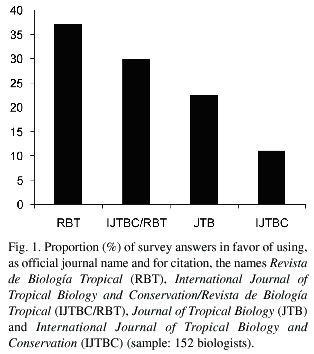
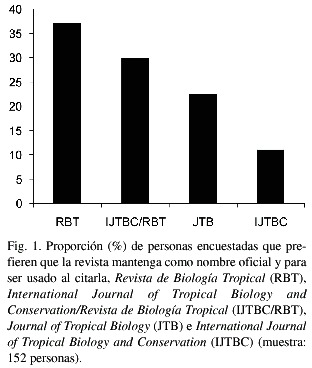
Sin embargo, en la encuesta del 2003 (Monge-Nájera et al. 2003), nuevamente los autores y lectores eligieron mantener el nombre tradicional o el bilingüe (Fig. 1).
]]>
Existen varias posibles causas para explicar la decisión de mantener el nombre tradicional. Una es de tipo emotivo, pues muchos hemos conocido a la Revista de Biología Tropical desde nuestros años de formación y nos hemos acostumbrado al nombre. Incluso los autores de habla inglesa suelen referirse a ella como "the Revista".
Otra posible causa es que no existe conciencia entre autores y lectores sobre las ventajas de que sus trabajos aparezcan en una revista de nombre inglés, particularmente el aumento en el número de veces que la revista es citada y la percepción inmediata de que se trata de una publicación internacional. Sin embargo, el apoyo por el nombre en español bajó significativamente en la segunda encuesta. Por eso, como en el editorial de 1999, solo podemos concluir que por el momento, Biología Tropical mantendrá su nombre bilingüe.
Referencias
Atkin, P.A. 2002. A paradigm shift in the medical literature. Brit. Med. J. 325: 1450-1451. [ Links ]
Chambers, R., E. Boath & S. Chambers. 2002. The A to Z of authorship: analysis of letter of surname on order of authorship. Brit. Med. J. 323: 1460-1461. [ Links ]
De Girolami, E. 1988. Reseña histórica de la fundación de la Revista de Biología Tropical. Rev. Biol. Trop. 36: 341-346. [ Links ]
Monge-Nájera, J. 1999. La revista científica que los investigadores desean para el siglo XXI: los problemas del idioma y la temática. Rev. Biol. Trop. 47: xix-xxi. [ Links ]
Monge-Nájera, J., C. Benavides-Varela & B. Morera. 2003. ¿Cuáles son las revistas, libros y personas más influyentes en la biología neotropical? Rev. Biol. Trop. 51: en prensa. [ Links ]
A name for Biología Tropical
Julián Monge-Nájera, Catalina Benavides-Varela & Bernal Morera
Revista de Biología Tropical, Universidad de Costa Rica, 2060 San José, Costa Rica, rbt@cariari.ucr.ac.cr
]]> In the world of scientific publication, the names of authors and journals have a greater importance than is usually believed. For example, the authors whose names begin with the last letters of the alphabet have a smaller possibility of signing papers as first authors, possibly because some research teams place names in alphabetical order, and not in an order that reflects the real contribution of each author (Chambers et al. 2002). The titles of articles, i.e. their names, also affect significantly the probability that a paper will be read and cited (Atkin 2002).Similarly, journal names affect their success and it has been reported that names in English increase journal citation. This finding lead to a name change in some classical journals, for example, the Zeitschrift für Tierpsychologie, a journal that is very well-known because it published the pioneering works of Nobel laureate Konrad Lorenz. Since 1986 the Zeitschrift uses the English name Ethology.
With this type of information in mind, we recently consulted Revista’s readers and authors if they would welcome a change in the journal’s name. In 1999, a similar survey was made about how the journal should be cited, because it has a Spanish title and an English subtitle: 61% chose the traditional Spanish name and 39% said they would prefer to cite the English subtitle (Monge-Nájera 1999).
The journal’s name was a key subject in 1952, when its creation was planned, and several names were considered, including Acta de Biología Tropical (Act of Tropical Biology) and Anales de Biología Tropical (Annals of Tropical Biology). Nevertheless, the word Revista (journal) was selected, perhaps for aesthetic reasons. Biología (Biology) was chosen because it would not restrict unnecessarily the topics and because it was the common factor to all science branches that the journal includes, in agreement with the faculties that the University of Costa Rica, where the journal was created, had in 1953: Pharmacy, Dentistry, Sciences and Agronomy. Tropical was added because the reports to be published would deal on this important region (De Girolami 1988).
In 1994 (volume 42, issue 1-2) we added an English subtitle to the Spanish name: The International Journal of Tropical Biology and Conservation. Two years later the Editorial Board decided to eliminate the initial "The" and the shortened subtitle appeared for the first time in 1997, in vol. 44(3)/45(1).
The use of an English subtitle received favorable comments from the authors, mainly along the line that finally it would be easy, for librarians and biologists in countries where Spanish is not spoken, to know what the journal was about. The importance of this international approach is more easily understood when it is considered that less than 2 percent of scientists speak Spanish, that only about 0,5% of biological publications worldwide are in this language (Monge-Nájera and Nielsen in preparation) and that the printed journal circulates in more than 40 countries where Spanish is not spoken (for the electronic version, the number increases to about 200 countries and territories). An unexpected effect of adding the English subtitle was an increase in the journal’s citation index in the years following the addition.
Nevertheless, in the 2003 survey (Monge-Nájera et al. 2003), authors and readers again chose to maintain the traditional or the bilingual name (Fig. 1).
Several possible causes could explain the decision of conserving the traditional name. One is subjective: many of us have known the Revista de Biología Tropical since our student years and have become used to the name. Even English speaking authors usually refer to the journal as "the Revista".
Another possible cause is that authors and readers ignore the advantages that their papers receive when they appear in a journal with an English name, particularly the increase in number of times that it is cited and the immediate perception of the journal as an international publication. Overall, the support for the Spanish name fell significantly between surveys. For that reason, as we did in the 1999 editorial, this time we can only conclude that, for the moment, the journal will retain its bilingual name.
]]> ReferencesAtkin, P.A. 2002. A paradigm shift in the medical literature. Brit. Med. J. 325: 1450-1451.
Chambers, R., E. Boath & S. Chambers. 2002. The A to Z of authorship: analysis of letter of surname on order of authorship. Brit. Med. J. 323: 1460-1461.
De Girolami, E. 1988. Reseña histórica de la fundación de la Revista de Biología Tropical. Rev. Biol. Trop. 36: 341-346.
Monge-Nájera, J. 1999. La revista científica que los investigadores desean para el siglo XXI: los problemas del idioma y la temática. Rev. Biol. Trop. 47: xix-xxi.
Monge-Nájera, J., C. Benavides-Varela & B. Morera. 2003. ¿Cuáles son las revistas, libros y personas más influyentes en la biología neotropical? Rev. Biol. Trop. 51: in press.
]]>