<?xml version="1.0" encoding="ISO-8859-1"?><article xmlns:mml="http://www.w3.org/1998/Math/MathML" xmlns:xlink="http://www.w3.org/1999/xlink" xmlns:xsi="http://www.w3.org/2001/XMLSchema-instance">
<front>
<journal-meta>
<journal-id>0034-7744</journal-id>
<journal-title><![CDATA[Revista de Biología Tropical]]></journal-title>
<abbrev-journal-title><![CDATA[Rev. biol. trop]]></abbrev-journal-title>
<issn>0034-7744</issn>
<publisher>
<publisher-name><![CDATA[Universidad de Costa Rica]]></publisher-name>
</publisher>
</journal-meta>
<article-meta>
<article-id>S0034-77442003000200018</article-id>
<title-group>
<article-title xml:lang="en"><![CDATA[Life history of Manataria maculata (Lepidoptera: Satyrinae) from Costa Rica]]></article-title>
</title-group>
<contrib-group>
<contrib contrib-type="author">
<name>
<surname><![CDATA[Murillo]]></surname>
<given-names><![CDATA[L. Ricardo]]></given-names>
</name>
<xref ref-type="aff" rid="A01"/>
</contrib>
<contrib contrib-type="author">
<name>
<surname><![CDATA[Nishida]]></surname>
<given-names><![CDATA[Kenji]]></given-names>
</name>
<xref ref-type="aff" rid="A02"/>
</contrib>
</contrib-group>
<aff id="A01">
<institution><![CDATA[,Universidad de Costa Rica Museo de Insectos ]]></institution>
<addr-line><![CDATA[ ]]></addr-line>
</aff>
<aff id="A02">
<institution><![CDATA[,Universidad de Costa Rica Escuela de Biología Sistema de Estudios de Posgrado en Biología]]></institution>
<addr-line><![CDATA[San José ]]></addr-line>
<country>Costa Rica</country>
</aff>
<pub-date pub-type="pub">
<day>00</day>
<month>06</month>
<year>2003</year>
</pub-date>
<pub-date pub-type="epub">
<day>00</day>
<month>06</month>
<year>2003</year>
</pub-date>
<volume>51</volume>
<numero>2</numero>
<fpage>463</fpage>
<lpage>470</lpage>
<copyright-statement/>
<copyright-year/>
<self-uri xlink:href="http://www.scielo.sa.cr/scielo.php?script=sci_arttext&amp;pid=S0034-77442003000200018&amp;lng=en&amp;nrm=iso"></self-uri><self-uri xlink:href="http://www.scielo.sa.cr/scielo.php?script=sci_abstract&amp;pid=S0034-77442003000200018&amp;lng=en&amp;nrm=iso"></self-uri><self-uri xlink:href="http://www.scielo.sa.cr/scielo.php?script=sci_pdf&amp;pid=S0034-77442003000200018&amp;lng=en&amp;nrm=iso"></self-uri><abstract abstract-type="short" xml:lang="en"><p><![CDATA[The life history and early stages of the satyrine butterfly Manataria maculata are described and illustrated from Costa Rica. Eggs are laid on Lasiacis sp. (Panicoideae), a new non-bamboo host plant for the genus Manataria. The larval stage varied from 23 to 28 days, and the pupal duration was approximately 12 days when reared on Bambusa vulgaris and Guadua angustifolia in captivity at 23-24°C.]]></p></abstract>
<abstract abstract-type="short" xml:lang="es"><p><![CDATA[Se describe e ilustran los estadios tempranos y la historia natura de Manataria maculata (Hopffer, 1874) de Costa Rica. Los huevos fueron encontrados en Lasiacis sp. (Panicoideae), una nueva planta hospedera para el género Manataria, y que no es un bambú. El estadio larval varió desde 23 a 28 días y el estadio pupal, aproximadamente 12 días cuando es criado con Bambusa vulgaris y Guadua angustifolia bajo condiciones de cautiverio a 23-24°C.]]></p></abstract>
<kwd-group>
<kwd lng="en"><![CDATA[Bambusa vulgaris]]></kwd>
<kwd lng="en"><![CDATA[Guadua angustifolia]]></kwd>
<kwd lng="en"><![CDATA[Lasiacis]]></kwd>
<kwd lng="en"><![CDATA[Manataria]]></kwd>
<kwd lng="en"><![CDATA[Natural History]]></kwd>
<kwd lng="en"><![CDATA[Neotropical]]></kwd>
<kwd lng="en"><![CDATA[Patelloa xanthura]]></kwd>
<kwd lng="en"><![CDATA[Tachinidae]]></kwd>
</kwd-group>
</article-meta>
</front><body><![CDATA[ <div style="text-align: center;"><b><font face="Arial"> Life history of <i>Manataria maculata </i>(Lepidoptera: Satyrinae) from Costa Rica</font></b><font face="Arial" size="2">&nbsp;     <br> </font></div>     <div style="text-align: left;"><font face="Arial" size="2">&nbsp;    <br> &nbsp;    <br> L. Ricardo Murillo <sup><a name="r1"></a><a href="#r1">1</a></sup> &amp; Kenji Nishida <sup><a href="#r1">1</a>,<a href="#r1">2</a>,<a  href="#r1">3</a></sup></font></div>     <div style="text-align: center;"><font face="Arial" size="2">     <p><font face="Arial" size="2">Received 20-VI-2002. Corrected 07-IX-2002. Accepted 07-IX-2002.</font></p> </font></div> <font face="Arial" size="2"><b>     <p>Abstract</p> </b></font>     <p><font face="Arial" size="2">The life history and early stages of the satyrine butterfly <i>Manataria maculata </i>are described and illustrated from Costa Rica. Eggs are laid on <i>Lasiacis </i>sp. (Panicoideae), a new non-bamboo host plant for the genus <i>Manatari</i>a. The larval stage varied from 23 to 28 days, and the pupal duration was approximately 12 days when reared on <i>Bambusa vulgaris </i>and <i>Guadua angustifolia </i>in captivity at 23-24°C. </font></p>     <p><font face="Arial" size="2"><b>Key words: </b><i>Bambusa vulgari</i>s, <i>Guadua angustifoli</i>a, <i>Lasiaci</i>s, <i>Manataria, </i>Natural History, Neotropical, <i>Patelloa xanthur</i>a, Tachinidae.</font></p>     ]]></body>
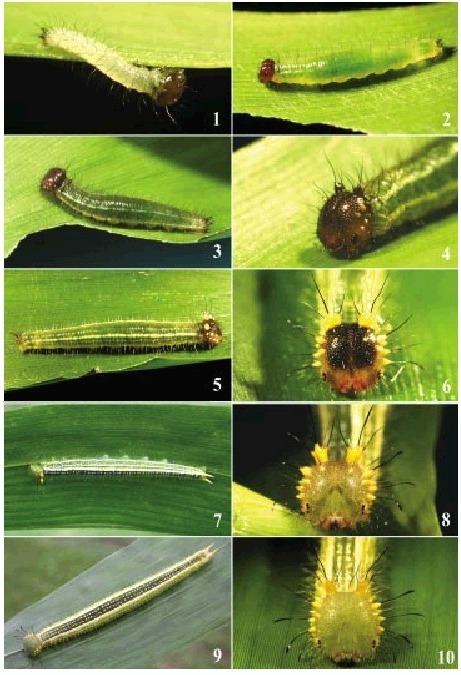
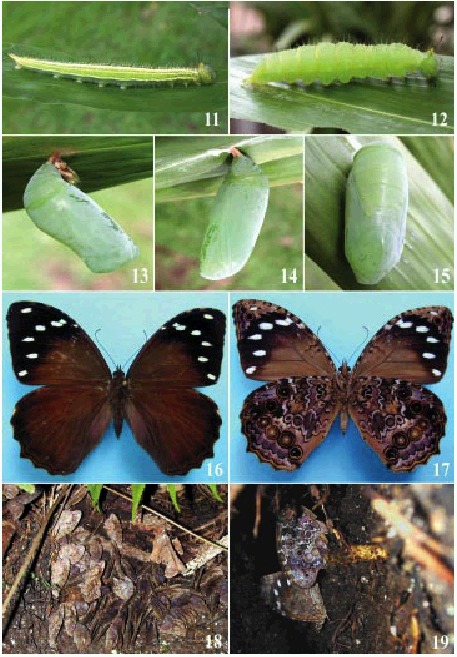
<body><![CDATA[<p><font face="Arial" size="2">The genus <i>Manataria </i>Kirby is distributed from Mexico to northern Argentina, Paraguay, Uruguay, and the southeast Brazil to the south; and to French Guyana in the northeast. It is currently regarded as containing three species (<a  href="#Barrera">Barrera and Díaz 1977</a>, <a href="#DeVries">DeVries 1987</a>, <a href="#DAbrera">D’Abrera 1988</a>), but it may well be monotypic (G. Lamas, pers. comm.). In Costa Rica, only a single species, <i>Manataria maculata </i>(Hopffer, 1874), (<a  href="#fig1-10">Figs. 1-17</a>) occurs. It is found commonly on the Pacific slope, from sea level to 2500 m elevation, although its abundance varies according to location, season, and year. The adults are attracted to rotten fruits (<a  href="#DeVries">DeVries 1987</a>). <a href="#Stevenson96">Stevenson and Haber (1996, 2000)</a> reported that groups of a few to more than 50 adults were observed roosting in small caves, under overgrown cliffs, in rock outcrops and shaded areas along forest trails at Monteverde (Figs. 18-19). They also mentioned that females remain in reproductive diapause from the end of June until April-May (end of dry season), and that breeding begins with the onset of the rainy season (May-June). The host plants for the genus belong to the Bambusoideae (<a  href="#Figueroa">Figueroa 1953</a>, <a href="#Valenzuela">Valenzuela 1963</a> <a href="#Young">Young and Muyshondt 1972</a>, <a  href="#Gallego">Gallego and Vélez 1974</a>). <a href="#Valenzuela">Valenzuela (1963)</a>, described the morphology of adult and last instar larva of <i>Manataria maculat</i>a; however, it is misidentified as <i>Pronophila thelebe </i>Doubleday (A. Viloria, pers. comm.). The larvae were reported to be a pest of <i>Guadua angustifolia </i>Kunth, and a sarcophagid fly was considered to be a biological control agent (<a href="#Valenzuela">Valenzuela 1963</a>). Here, we describe the complete life history of <i>M. maculata </i>and include illustrations of the early stages. We also briefly mention its nomenclatural history, since its taxonomic composition is still uncertain.</font></p> <font face="Arial" size="2"><b>     <p>Materials and methods</p> </b></font>     <p><font face="Arial" size="2">An extensive search for larvae was carried out on May 23rd, 1999, at the Hacienda "El Rodeo" (750 m), San José, Costa Rica, 09º55’ N, 84º16’ W. The climate of the locality is defined as Tropical Wet Forest Transition to Premountane (<a  href="#Holdridge">Holdridge 1967</a>). Eggs and larvae were found on a small bamboo-like plant. The plant and early stages were transported to, and reared in, the entomological laboratory (average room temperature 23-24°C) of the Escuela de Biología, Universidad de Costa Rica. Leaves of <i>Bambusa vulgaris </i>Schrad. ex J.C. Wendl. and <i>Guadua angustifolia </i>Kunth (Poaceae: Bambu-soideae) from the University campus were substituted as food plants from mid- second instar. Larvae were reared inside plastic bags until adult emergence. Samples of eggs, larvae, head capsules of each instar, and pupae were preserved in 75% alcohol. All materials obtained from this study, including adults, are deposited in the collection of Museo de Insectos, Universidad de Costa Rica. Digital images of the early stages were recorded with Nikon Coolpix cameras. </font></p>     <p><font face="Arial" size="2">A bait trap (<a href="#Austin">Austin and Riley 1995</a>, <a href="#Shuey">Shuey 1977</a>) was placed in a <i>Guadua angustifolia </i>bamboo patch located in the Reserva Ecológica Leonel Oviedo on the University campus during April-June, 2001 and 2002, to obtain additional information on the life history and biology. Captured male and female adults were then placed in a mesh cage (approximately 2x1x1 m), with live <i>G. angustifolia </i>plants and rotten plantain bananas in the reserve. Abdomens of dead females were periodically dissected to assess reproductive condition. A fertilized egg from a live female was forcefully extracted by massaging the abdomen using fingers. The egg was also reared to adult as described above.</font></p>     <p><font face="Arial" size="2"><b>Host plant: </b><i>Lasiacis </i>(Poaceae: Panicoideae). A non-bambusoid subwoody grass plant lacking pseudopetioles on leaf blade; fruits are usually black and round, and possess shiny fruiting spikelets (<a href="#Gentry">Gentry 1996</a>). </font></p>     <p><font face="Arial" size="2"><b>Results</b></font></p>     <p><font face="Arial" size="2"><b>Early stages</b></font></p>     <p><font face="Arial" size="2"><b>Egg: </b>1.0 mm diameter; spherical, creamy white, chorion smooth. </font></p>     <p><font face="Arial" size="2"><b>First instar larva </b>(<a  href="#fig1-10">Figs. 1, 2</a>): ranging 2- 6 mm long (after hatching and before molting). Head capsule 0.8 mm wide, dark brown; stemmata black, 1-3 grouped together; first and second contiguously located (same in rest of instars). Body initially white (<a href="#fig1-10">Fig. 1</a>), changing to light green after feeding (<a href="#fig1-10">Fig. 2</a>); a pair of dark brown spots on T1, <i>i.e. </i>T1 plate divided; a dark brown bifurcated suranal plate on A10; primary setae dark brown to black on chalazae, evenly scattered over body segments, head, and over bifurcated suranal plate; spiracles creamy white to light brown. </font></p>     <p><font face="Arial" size="2"><b>Second instar </b>(<a href="#fig1-10">Figs. 3, 4</a>): 6-11 mm (after molt-before next molt). Head capsule 1.3 mm wide, dark brown, granulose except parts near fronds, stemmata, and mouth parts. A toothed-(dentated-) dark brown horn (protuberance) on apex of each epicranial robe, bearing a seta on each tooth. Six conical protuberances (or enlarged chalazae), in different sizes, on middorsal to lateral area; color varies from creamy white to dark brown; bearing a single seta at apex. Body green to light green; bifurcated suranal plate conically elongated and protruding at approximately 55 degrees from body line (75 degrees in preserved larva); setae on body segments same as in first instar; a pair of pale white subdorsal and subventral lines longitudinally from T1 to A10.</font></p>     ]]></body>
<body><![CDATA[<p><font face="Arial" size="2"><b>Third instar </b>(<a href="#fig1-10">Figs. 5, 6</a>): 11-18 mm. Head capsule 1.8 mm wide, color varies from uniform dark brown to dark brown with partially light brown areas; toothed horn and seven conical protuberances on each robe; color varies from bright yellow to dark brown; a protuberance (chalaza) on each side of dorsal epicranium (vertex) with a dark brown to black seta; some spatulate setae on horns and conical protuberances (same in remaining instars). Body green with creamy white longitudinal lines; color of suranal plate has varying shades of dark brown; thoracic and abdominal setae dorsally dark brown to black and laterally to subventrally translucent; a pair of creamy white subdorsal, lateral, and subventral lines from T1 to A10; thickness of lateral line <i>ca. </i>one-third of subdorsal line; a dotted line between lateral and subvenral line, located above spiracles.</font></p>     <p><font face="Arial" size="2"><b>Fourth instar </b>(<a href="#fig1-10">Figs. 7, 8</a>): 18-35 mm. Head capsule 3.0 mm wide; color varies between black, black with pale brown, and pale greenish-creamy white (greenish color turned darker as larva matured); toothed horns bright yellow; approximately 12 conical protuberances on middorsal to lateral area and protuberances on dorsal epicranium bright yellow to creamish-yellow. Spatulate setae up to 7 mm. Body dark green dorsally and bright creamish-green laterally with creamish-white longitudinal lines; T1 plate varies from creamish-white to black; suranal plate on A10 pale creamish-yellow; 4 to 5 mm long, angled at approximately 35 degrees <i>(ca. </i>55 degrees in preserved larva); thoracic and abdominal setae translucent with dark brown to black setae intermittently on dorsal surface; creamish-white longitudinal lines same as in third instar; a pair of creamish-white dotted lines from T1 to A10 below dorsal chalazae.</font></p>     <p><font face="Arial" size="2"><b>Fifth instar </b>(<a href="#fig1-10">Figs. 9, 10</a>, <a href="#fig11-19">11</a>): 35-60 mm long. Head capsule 4.5 mm wide, color similarly varied as in the fourth instar from black with pale brown, pale greenish-creamy white, to pale greenish-creamy white with pale black (greenish color turned darker as larva matured). Body dark green dorsally and bright creamish-green laterally with creamish-white longitudinal lines (as in fourth instar); rest of pattern similar to fourth instar. In some individuals, irregular interruptions or creamish white blotches occur between T1 and A10.</font></p>     <p><font face="Arial" size="2"><b>Prepupa </b>(<a href="#fig11-19">Fig. 12</a>): 37 mm long. Bright light green.</font></p>     <p><font face="Arial" size="2"><b>Pupa </b>(<a href="#fig11-19">Figs. 13, 14, 15</a>: three-day old): 17-23 mm long, 9-10 mm wide. Light green and becoming lighter on abdominal segments; surface covered with white waxy substance; spiracles creamish-white; cremaster light orangish-pink; cremaster and ventral body surface forming a <i>ca. </i>110° angle.    <br> &nbsp;&nbsp;     <br> <a name="fig1-10"></a></font></p>     <div style="text-align: center;"><font face="Arial" size="2"><img alt=""  src="/img/fbpe/rbt/v51n2/2482i1.JPG" style="width: 461px; height: 675px;">    
<br> Figs. 1-10. Early stages of Manataria maculata: 1) recently hatched first instar (dorso-lateral view), 2) late first instar, 3)    <br> second instar, 4) head of second instar (frontal view), 5) third instar, 6) third instar head, 7) fourth instar in resting position,    ]]></body>
<body><![CDATA[<br> 8) fourth instar head, 9) fifth instar (dorsal view), 10) fifth instar head.    <br> </font></div> <font face="Arial" size="2"><b>     <p>Biological observations</p> </b></font>     <p><font face="Arial" size="2">Egg masses and first instar larvae of <i>M. maculata </i>were found in a patch of <i>Lasiacis </i>sp. The egg masses varied from 5 to 20 eggs and were located on the underside of leaves. Usually, the early instar larvae fed and rested gregariously on the underside of leaves until the late second instar. From third instar onward, the larvae appeared to feed solitarily. Third instar larvae rested on the upper side near the leaf tip and partially fed on the basal portion of the leaf. Fourth and fifth instar larvae rested in the central part on the under side of a leaf (<a href="#fig1-10">Fig. 7</a>), and fed on the apical portion.</font></p>     <p><font face="Arial" size="2">Pupation occurred in the middle portion on the under side of a leaf, with the pupa suspended downward with the cremaster attached to the midrib by silk. Pupae changed from green to reddish brown about a day before eclosion. A larva of a tachinid parasitoid, <i>Patelloa xanthura </i>(Wulp), emerged from one of the pupae (in this case, the reddish brown color of the pupa persisted for five days). </font></p>     <p><font face="Arial" size="2">From the eggs and first instar larvae collected and reared on May 23, 1999, adults emerged between June 28th and July 3rd, 1999. Total duration of the early stages varied from 35 to 40 days, the larval stage lasting between 23 and 28 days, and the pupal duration, approximately 12 days. The developmental time for the extracted egg from the female captured in the bait trap on June 1 st , 2002 is as follows: egg (4 days), instar I (5 days), instar II (4 days), instar III (3 days), instar IV (5 days), instar V (9 days), pre-pupa (1 day), pupa (17 days), with adult eclosing on July 15, 2002.</font></p>     <p><font face="Arial" size="2">At the start of the rainy season, solitary adults were observed flying eastward along the roads, wide trails and rivers, or flying from tree to tree from ground level to about 15 m in the Central Valley of San José. Occasionally they were observed perching on the side of tree trunks with the head pointing down ward. </font></p>     <p><font face="Arial" size="2">Between April and June 2001, approximately 10 worn adults <i>(i.e. </i>several parts of wings torn off, &gt;30 % scales on wings detached) were observed in the bait trap in the Ecological Reserve. During May and June 2002, at least seven worn males and females were captured in the bait trap. All females captured in early April of both years contained no fully developed eggs in their abdomen. By contrast, varying numbers of females captured in mid- to late April, May and June carried fully developed eggs. The adults in the mesh cage survived for nearly 10 days. No courting or mating behavior was observed in the cage. A few freshly-emerged adults <i>(i.e. </i>no parts of wings torn off, all wing scales intact) were observed flying and resting in the Reserve between the 20 th and the 25 th of July, 2002.    <br> &nbsp;     <br> </font></p>     ]]></body>
<body><![CDATA[<div style="text-align: center;"><a name="fig11-19"></a><img alt=""  src="/img/fbpe/rbt/v51n2/2482i2.JPG" style="width: 457px; height: 657px;">    
<br> <small><span style="font-family: arial;">Figs. 11-15. Early stages of Manataria maculata: 11) fifth instar (lateral view). 12) prepupa (lateral view). 13-15) pupa: 13) </span><span  style="font-family: arial;">dorso-lateral view, 14) ventro-lateral view, 15) dorsal view. Figs. 16-19. Adult of M. maculata: 16-17) male adult captured </span><span style="font-family: arial;">at UCR, bait trap (wing span 73 mm): 16) dorsal view, 17) ventral view; 18-19) adults roosting under overgrown cliffs: 18) </span><span  style="font-family: arial;">about 80 individuals, 19) close-up of figure 18 showing two individuals.</span></small>    <br> </div> <font face="Arial" size="2"><b>     <p>Discussion</p> </b></font>     <p><font face="Arial" size="2">Previously recorded host plants for <i>M. maculata </i>are <i>Bambusa </i>sp. (<a href="#Young">Young and Muyshondt 1972</a>), <i>Guadua angustifolia </i>(<a href="#Valenzuela">Valenzuela 1963</a>), <i>Bambusa guadua </i>(<a href="#Gallego">Gallego and Vélez 1974</a>), and <i>Guadua </i>sp. (<a href="#Figueroa">Figueroa 1953</a>). All of these plants belong to the bamboo group (Bambusoideae). However, we have recorded the food plant as <i>Lasiacis </i>which is placed in the Panicoideae. We have also recorded <i>Bambusa vulgaris </i>as a new food plant in this study. The <i>B. vulgaris </i>is nonnative plant which was introduced from South-Pacific Asia (C.O. Morales, pers. comm.). These records suggest that <i>M. maculata </i>feeds on a wide range of bamboo and bamboo-like plants.</font></p>     <p><font face="Arial" size="2"><a href="#Stevenson96">Stevenson and Haber (1996)</a> mentioned that the larvae feed in groups until the last part of the fourth instar, but we recorded the gregarious feeding behavior only until the last part of the second instar. However, we were not able to observe thoroughly the larval behavior of each instar, especially the gregarious feeding and resting behavior. This was because of the massive mortality of larvae in the second instar, probably due to poor conditions of the <i>Lasiacis </i>plant. Subsequently, we separated larvae into smaller groups comprising a few individuals per plastic bag, and found greater survival success.</font></p>     <p><font face="Arial" size="2">The collection of a freshly emerged adult in the Ecological Reserve may suggest that the species breeds seasonally in the <i>G. angustifolia </i>patch on the University campus. Additionally, a fresh male was captured in the bait trap on the 15th of December, 1998, at the Reserve, and slightly worn male was captured by net at Playa Dominical in the Pacific lowland on January 1st, 1999. These additional records may suggest that there are some individuals which do not migrate to higher elevations, but are resident and breed the year round in the lower elevations. In contrast, individuals which migrate to Monteverde are univoltine and enter reproductive diapause during the non-breeeding season (<a  href="#Stevenson96">Stevenson and Haber 1996</a>).</font></p>     <p><font face="Arial" size="2">The phylogenetic relationships of <i>Manataria </i>are currently unknown (Miller 1968). <a href="#Miller">Miller and Miller (1997)</a> suggested that the genus might be closely related to <i>Paralethe </i>van Son and <i>Aeropetes </i>Billberg from southern Africa. <i>Manataria </i>is currently classified in the subtribe Parargina in the tribe Elymniini (G. Lamas, pers. comm.). Within this tribe, <i>Manataria </i>is the only member which has a Neotropical distribution (A. Viloria, pers. comm.). The three species currently recognized in the genus are <i>M. hercyna </i>(Hübner, 1821), <i>M. hyrnethia </i>(Fruhstorfer, 1912) and <i>M. maculata </i>(Hopffer, 1874). All species are distinguished from other satyrines by their relatively large, rounded hind wings, dark ground color, and the presence of white spots on the forewing (<a href="#DeVries">DeVries 1987</a>). The three species are possibly conspecific with <i>M. hyrnethia </i>and <i>M. maculata </i>being junior subjective synonyms of <i>M. hercyna </i>(G. Lamas, pers. comm.). </font></p>     <p><font face="Arial" size="2"><i>Manataria hercyna and M. maculata </i>were originally described in the genus <i>Tisiphon</i>e. <i>Tisiphone maculat</i>a, mentioned in some previously published works <i>(e.g. </i><a  href="#Figueroa">Figueroa 1953</a>, <a href="#Young">Young and Muyshondt 1972</a>, <a  href="#Gallego">Gallego and Vélez 1974</a>), refers to the genus <i>Manataria </i>Kirby [1904]. <i>Tisiphone </i>is otherwise endemic to Australia and includes two species (<a href="#Braby">Braby 2000</a>).</font></p> <font face="Arial" size="2"><b>     <p>Aknowledgements</p> </b></font>     ]]></body>
<body><![CDATA[<p><font face="Arial" size="2">We thank Gerardo Lamas and Michael F. Braby for the revision of the manuscript, Debra Murray for providing suggestions and corrections on the drafts, Carlos O. Morales for identification of food plants, Manuel Zumbado for identification of the tachinid, George W. Beccaloni for information on host plants, and Angel L. Viloria for information about <i>Manataria </i>and literature. Thanks are also due to Jacqueline Y. Miller and Julian A. Salazar for help with literature.</font></p> <font face="Arial" size="2"><b>     <p>Resumen</p> </b></font>     <p><font face="Arial" size="2">Se describe e ilustran los estadios tempranos y la historia natura de <i>Manataria maculata </i>(Hopffer, 1874) de Costa Rica. Los huevos fueron encontrados en <i>Lasiacis </i>sp. (Panicoideae), una nueva planta hospedera para el género <i>Manatari</i>a, y que no es un bambú. El estadio larval varió desde 23 a 28 días y el estadio pupal, aproximadamente 12 días cuando es criado con <i>Bambusa vulgaris </i>y <i>Guadua angustifolia </i>bajo condiciones de cautiverio a 23-24°C.</font></p> <font face="Arial" size="2"><b>     <p>References</p> </b></font>     <!-- ref --><p><font face="Arial" size="2"><a name="Austin"></a>Austin, G.T. &amp; T.J. Riley. 1995. Portable bait traps for the stuffy of butterflies. Trop. Lepidoptera 6: 5-9.    &nbsp;&nbsp;&nbsp;&nbsp;&nbsp;&nbsp;&nbsp;&nbsp;[&#160;<a href="javascript:void(0);" onclick="javascript: window.open('/scielo.php?script=sci_nlinks&ref=1668929&pid=S0034-7744200300020001800001&lng=','','width=640,height=500,resizable=yes,scrollbars=1,menubar=yes,');">Links</a>&#160;]<!-- end-ref --></font></p>     <!-- ref --><p><font face="Arial" size="2"><a name="Barrera"></a>Barrera, A. &amp; M.E. Díaz. 1977. Distribución de algunos lepidópteros de la Sierra de Nanchititla, México, con especial referencia a <i>Tisiphone maculata </i>Hpff. (Ins.: Lepid.). Rev. Soc. Mex. Lepidopterol. 3(1): 17-28.    &nbsp;&nbsp;&nbsp;&nbsp;&nbsp;&nbsp;&nbsp;&nbsp;[&#160;<a href="javascript:void(0);" onclick="javascript: window.open('/scielo.php?script=sci_nlinks&ref=1668931&pid=S0034-7744200300020001800002&lng=','','width=640,height=500,resizable=yes,scrollbars=1,menubar=yes,');">Links</a>&#160;]<!-- end-ref --></font></p>     <!-- ref --><p><font face="Arial" size="2"><a name="DAbrera"></a>D’Abrera, B.L. 1988. Butterflies of the Neotropical Region. Part V. Nymphalidae (Conc.) and Satyridae. Victoria, Black Rock, Hill House. pp. 679-877.    &nbsp;&nbsp;&nbsp;&nbsp;&nbsp;&nbsp;&nbsp;&nbsp;[&#160;<a href="javascript:void(0);" onclick="javascript: window.open('/scielo.php?script=sci_nlinks&ref=1668933&pid=S0034-7744200300020001800003&lng=','','width=640,height=500,resizable=yes,scrollbars=1,menubar=yes,');">Links</a>&#160;]<!-- end-ref --></font></p>     ]]></body>
<body><![CDATA[<!-- ref --><p><font face="Arial" size="2"><a name="Braby"></a>Braby, M.F. 2000. Butterflies of Australia: their identification, biology and distribution. CSIRO Publishing. Collingwood, Australia. 976 p.    &nbsp;&nbsp;&nbsp;&nbsp;&nbsp;&nbsp;&nbsp;&nbsp;[&#160;<a href="javascript:void(0);" onclick="javascript: window.open('/scielo.php?script=sci_nlinks&ref=1668935&pid=S0034-7744200300020001800004&lng=','','width=640,height=500,resizable=yes,scrollbars=1,menubar=yes,');">Links</a>&#160;]<!-- end-ref --></font></p>     <!-- ref --><p><font face="Arial" size="2"><a name="DeVries"></a>DeVries, P.J. 1987. The butterflies of Costa Rica and their natural history. Princeton University, New Jersey. 327 p.    &nbsp;&nbsp;&nbsp;&nbsp;&nbsp;&nbsp;&nbsp;&nbsp;[&#160;<a href="javascript:void(0);" onclick="javascript: window.open('/scielo.php?script=sci_nlinks&ref=1668937&pid=S0034-7744200300020001800005&lng=','','width=640,height=500,resizable=yes,scrollbars=1,menubar=yes,');">Links</a>&#160;]<!-- end-ref --></font></p>     <!-- ref --><p><font face="Arial" size="2"><a name="Figueroa"></a>Figueroa, A. 1953. La ruptura de un equilibrio. Consideraciones biológicas alrededor del uso de los nuevos insecticidas. Rev. Acad. Colombiana Cien. Exactas, Fís. Natur. 9 (33/34): 92-102.    &nbsp;&nbsp;&nbsp;&nbsp;&nbsp;&nbsp;&nbsp;&nbsp;[&#160;<a href="javascript:void(0);" onclick="javascript: window.open('/scielo.php?script=sci_nlinks&ref=1668939&pid=S0034-7744200300020001800006&lng=','','width=640,height=500,resizable=yes,scrollbars=1,menubar=yes,');">Links</a>&#160;]<!-- end-ref --></font></p>     <!-- ref --><p><font face="Arial" size="2"><a name="Gallego"></a>Gallego, F.L. &amp; R. Vélez. 1974. Lista de insectos y algunos otros artrópodos que afectan los principales cultivos, animales domésticos y al hombre, en Colombia. Silabo para el curso de Entomología Económica. Medellín, Universidad Nacional de Colombia, Facultad de Ciencias Agrícolas. 141 p.    &nbsp;&nbsp;&nbsp;&nbsp;&nbsp;&nbsp;&nbsp;&nbsp;[&#160;<a href="javascript:void(0);" onclick="javascript: window.open('/scielo.php?script=sci_nlinks&ref=1668941&pid=S0034-7744200300020001800007&lng=','','width=640,height=500,resizable=yes,scrollbars=1,menubar=yes,');">Links</a>&#160;]<!-- end-ref --></font></p>     <!-- ref --><p><font face="Arial" size="2"><a name="Gentry"></a>Gentry, A.H. 1996. A field guide to the families and genera of woody plants of northwest South America (Colombia, Ecuador, Peru) with supplementary notes on herbaceous taxa. University of Chicago, Chicago. x + 895 pp.    &nbsp;&nbsp;&nbsp;&nbsp;&nbsp;&nbsp;&nbsp;&nbsp;[&#160;<a href="javascript:void(0);" onclick="javascript: window.open('/scielo.php?script=sci_nlinks&ref=1668943&pid=S0034-7744200300020001800008&lng=','','width=640,height=500,resizable=yes,scrollbars=1,menubar=yes,');">Links</a>&#160;]<!-- end-ref --></font></p>     ]]></body>
<body><![CDATA[<!-- ref --><p><font face="Arial" size="2"><a name="Holdridge"></a>Holdridge, L.R. 1967. Life zone ecology. Rev. ed. Tropical Science Center, San José, Costa Rica. 206 p.    &nbsp;&nbsp;&nbsp;&nbsp;&nbsp;&nbsp;&nbsp;&nbsp;[&#160;<a href="javascript:void(0);" onclick="javascript: window.open('/scielo.php?script=sci_nlinks&ref=1668945&pid=S0034-7744200300020001800009&lng=','','width=640,height=500,resizable=yes,scrollbars=1,menubar=yes,');">Links</a>&#160;]<!-- end-ref --> </font></p>     <!-- ref --><p><font face="Arial" size="2"><a name="Miller"></a>Miller, L.D. &amp; J.Y. Miller. 1997. Gondwanan butterflies: the Africa-South America connection. Metamorphosis suppl. 3: 42-51.    &nbsp;&nbsp;&nbsp;&nbsp;&nbsp;&nbsp;&nbsp;&nbsp;[&#160;<a href="javascript:void(0);" onclick="javascript: window.open('/scielo.php?script=sci_nlinks&ref=1668947&pid=S0034-7744200300020001800010&lng=','','width=640,height=500,resizable=yes,scrollbars=1,menubar=yes,');">Links</a>&#160;]<!-- end-ref --></font></p>     <!-- ref --><p><font face="Arial" size="2"><a name="Shuey"></a>Shuey, J.A. 1997. An optimized portable bait trap for quantitative sampling of butterflies. Trop. Lepidoptera. 8: 1-4.    &nbsp;&nbsp;&nbsp;&nbsp;&nbsp;&nbsp;&nbsp;&nbsp;[&#160;<a href="javascript:void(0);" onclick="javascript: window.open('/scielo.php?script=sci_nlinks&ref=1668949&pid=S0034-7744200300020001800011&lng=','','width=640,height=500,resizable=yes,scrollbars=1,menubar=yes,');">Links</a>&#160;]<!-- end-ref --></font></p>     <!-- ref --><p><font face="Arial" size="2"><a name="Stevenson96"></a>Stevenson, R.D. &amp; W.A. Haber. 1996. Time budgets and the crepuscular migration activity of a tropical butterfly, <i>Manataria maculata </i>(Satyrinae). Bull. Ecol. Soc. America. v. 77, Suppl. 3, Part 2. p. 424.    &nbsp;&nbsp;&nbsp;&nbsp;&nbsp;&nbsp;&nbsp;&nbsp;[&#160;<a href="javascript:void(0);" onclick="javascript: window.open('/scielo.php?script=sci_nlinks&ref=1668951&pid=S0034-7744200300020001800012&lng=','','width=640,height=500,resizable=yes,scrollbars=1,menubar=yes,');">Links</a>&#160;]<!-- end-ref --></font></p>     <!-- ref --><p><font face="Arial" size="2"><a name="Stevenson00"></a>Stevenson, R.D. &amp; W.A. Haber. 2000. <i>Manataria maculata </i>(Nymphalidae: Satyrinae). pp. 119-120. <i>In </i>N.M. Nadkarni &amp; N.T. Wheelwright (eds.). Monteverde: Ecology and conservation of a tropical cloud forest. Oxford University, New York. 573 p.    &nbsp;&nbsp;&nbsp;&nbsp;&nbsp;&nbsp;&nbsp;&nbsp;[&#160;<a href="javascript:void(0);" onclick="javascript: window.open('/scielo.php?script=sci_nlinks&ref=1668953&pid=S0034-7744200300020001800013&lng=','','width=640,height=500,resizable=yes,scrollbars=1,menubar=yes,');">Links</a>&#160;]<!-- end-ref --></font></p>     ]]></body>
<body><![CDATA[<!-- ref --><p><font face="Arial" size="2"><a name="Valenzuela"></a>Valenzuela, G.O. 1963. <i>Pronophyla </i>[sic] <i>thelebe </i>Double-day and Hewitson [sic] Satyridae, Lepidoptera) plaga de la caña guadua <i>(Guadua angustifolia </i>Kunth). Agron. (Manizales) 1(2): 15-23.    &nbsp;&nbsp;&nbsp;&nbsp;&nbsp;&nbsp;&nbsp;&nbsp;[&#160;<a href="javascript:void(0);" onclick="javascript: window.open('/scielo.php?script=sci_nlinks&ref=1668955&pid=S0034-7744200300020001800014&lng=','','width=640,height=500,resizable=yes,scrollbars=1,menubar=yes,');">Links</a>&#160;]<!-- end-ref --></font></p>     <!-- ref --><p><font face="Arial" size="2"><a name="Young"></a>Young, A.M. &amp; A. Muyshondt. 1972. Geographical and ecological expansion in tropical butterflies of the genus <i>Morpho </i>in evolutionary time. Rev. Biol. Trop. 20: 231-263.    &nbsp;&nbsp;&nbsp;&nbsp;&nbsp;&nbsp;&nbsp;&nbsp;[&#160;<a href="javascript:void(0);" onclick="javascript: window.open('/scielo.php?script=sci_nlinks&ref=1668957&pid=S0034-7744200300020001800015&lng=','','width=640,height=500,resizable=yes,scrollbars=1,menubar=yes,');">Links</a>&#160;]<!-- end-ref --><br> &nbsp;     <br> </font></p>     <p><font face="Arial" size="2"><a name="a1"></a><a href="2482.htm#r1">1</a> Museo de Insectos, Universidad de Costa Rica. Fax: (506)-207-5318</font></p>     <p><font face="Arial" size="2"><a href="2482.htm#r1">2</a> Sistema de Estudios de Posgrado en Biología, Escuela de Biología, Universidad de Costa Rica, 2060 San José, Costa Rica.</font></p> <font face="Arial" size="2"><a href="2482.htm#r1">3</a> Correspondence: Kenji Nishida, Laboratorio 170, Biología, 2060 Universidad de Costa Rica, </font><a style="font-family: arial;"  href="mailto:knishida@cariari.ucr.ac.cr"><font size="2">knishida@cariari.ucr.ac.cr</font></a>      ]]></body><back>
<ref-list>
<ref id="B1">
<nlm-citation citation-type="journal">
<person-group person-group-type="author">
<name>
<surname><![CDATA[Austin]]></surname>
<given-names><![CDATA[G.T.]]></given-names>
</name>
<name>
<surname><![CDATA[Riley]]></surname>
<given-names><![CDATA[T.J.]]></given-names>
</name>
</person-group>
<article-title xml:lang="en"><![CDATA[Portable bait traps for the stuffy of butterflies]]></article-title>
<source><![CDATA[Trop. Lepidoptera]]></source>
<year>1995</year>
<volume>6</volume>
<page-range>5-9</page-range></nlm-citation>
</ref>
<ref id="B2">
<nlm-citation citation-type="journal">
<person-group person-group-type="author">
<name>
<surname><![CDATA[Barrera]]></surname>
<given-names><![CDATA[A.]]></given-names>
</name>
<name>
<surname><![CDATA[Díaz]]></surname>
<given-names><![CDATA[M.E.]]></given-names>
</name>
</person-group>
<article-title xml:lang="es"><![CDATA[Distribución de algunos lepidópteros de la Sierra de Nanchititla, México, con especial referencia a Tisiphone maculata Hpff. (Ins.: Lepid.)]]></article-title>
<source><![CDATA[Rev. Soc. Mex. Lepidopterol]]></source>
<year>1977</year>
<volume>3</volume>
<numero>1</numero>
<issue>1</issue>
<page-range>17-28</page-range></nlm-citation>
</ref>
<ref id="B3">
<nlm-citation citation-type="book">
<person-group person-group-type="author">
<name>
<surname><![CDATA[D’Abrera]]></surname>
<given-names><![CDATA[B.L.]]></given-names>
</name>
</person-group>
<source><![CDATA[Butterflies of the Neotropical Region. Part V. Nymphalidae (Conc.) and Satyridae]]></source>
<year>1988</year>
<page-range>679-877</page-range><publisher-name><![CDATA[VictoriaBlack RockHill House]]></publisher-name>
</nlm-citation>
</ref>
<ref id="B4">
<nlm-citation citation-type="book">
<person-group person-group-type="author">
<name>
<surname><![CDATA[Braby]]></surname>
<given-names><![CDATA[M.F.]]></given-names>
</name>
</person-group>
<source><![CDATA[Butterflies of Australia: their identification, biology and distribution]]></source>
<year>2000</year>
<page-range>976</page-range><publisher-loc><![CDATA[Collingwood ]]></publisher-loc>
<publisher-name><![CDATA[CSIRO Publishing]]></publisher-name>
</nlm-citation>
</ref>
<ref id="B5">
<nlm-citation citation-type="book">
<person-group person-group-type="author">
<name>
<surname><![CDATA[DeVries]]></surname>
<given-names><![CDATA[P.J.]]></given-names>
</name>
</person-group>
<source><![CDATA[The butterflies of Costa Rica and their natural history]]></source>
<year>1987</year>
<page-range>327</page-range><publisher-loc><![CDATA[New Jersey ]]></publisher-loc>
<publisher-name><![CDATA[Princeton University]]></publisher-name>
</nlm-citation>
</ref>
<ref id="B6">
<nlm-citation citation-type="journal">
<person-group person-group-type="author">
<name>
<surname><![CDATA[Figueroa]]></surname>
<given-names><![CDATA[A.]]></given-names>
</name>
</person-group>
<article-title xml:lang="es"><![CDATA[La ruptura de un equilibrio: Consideraciones biológicas alrededor del uso de los nuevos insecticidas]]></article-title>
<source><![CDATA[Rev. Acad. Colombiana Cien. Exactas, Fís. Natur]]></source>
<year>1953</year>
<volume>9</volume>
<numero>33/34</numero>
<issue>33/34</issue>
<page-range>92-102</page-range></nlm-citation>
</ref>
<ref id="B7">
<nlm-citation citation-type="book">
<person-group person-group-type="author">
<name>
<surname><![CDATA[Gallego]]></surname>
<given-names><![CDATA[F.L.]]></given-names>
</name>
<name>
<surname><![CDATA[Vélez]]></surname>
<given-names><![CDATA[R.]]></given-names>
</name>
</person-group>
<source><![CDATA[Lista de insectos y algunos otros artrópodos que afectan los principales cultivos, animales domésticos y al hombre, en Colombia. Silabo para el curso de Entomología Económica]]></source>
<year>1974</year>
<page-range>141</page-range><publisher-loc><![CDATA[Medellín ]]></publisher-loc>
<publisher-name><![CDATA[Universidad Nacional de ColombiaFacultad de Ciencias Agrícolas]]></publisher-name>
</nlm-citation>
</ref>
<ref id="B8">
<nlm-citation citation-type="book">
<person-group person-group-type="author">
<name>
<surname><![CDATA[Gentry]]></surname>
<given-names><![CDATA[A.H.]]></given-names>
</name>
</person-group>
<source><![CDATA[A field guide to the families and genera of woody plants of northwest South America (Colombia, Ecuador, Peru) with supplementary notes on herbaceous taxa]]></source>
<year>1996</year>
<page-range>x + 895</page-range><publisher-loc><![CDATA[Chicago ]]></publisher-loc>
<publisher-name><![CDATA[University of Chicago]]></publisher-name>
</nlm-citation>
</ref>
<ref id="B9">
<nlm-citation citation-type="book">
<person-group person-group-type="author">
<name>
<surname><![CDATA[Holdridge]]></surname>
<given-names><![CDATA[L.R.]]></given-names>
</name>
</person-group>
<source><![CDATA[Life zone ecology]]></source>
<year>1967</year>
<page-range>206</page-range><publisher-loc><![CDATA[San José ]]></publisher-loc>
<publisher-name><![CDATA[Tropical Science Center]]></publisher-name>
</nlm-citation>
</ref>
<ref id="B10">
<nlm-citation citation-type="journal">
<person-group person-group-type="author">
<name>
<surname><![CDATA[Miller]]></surname>
<given-names><![CDATA[L.D.]]></given-names>
</name>
<name>
<surname><![CDATA[Miller]]></surname>
<given-names><![CDATA[J.Y.]]></given-names>
</name>
</person-group>
<article-title xml:lang="en"><![CDATA[Gondwanan butterflies: the Africa-South America connection]]></article-title>
<source><![CDATA[Metamorphosis]]></source>
<year>1997</year>
<volume>3</volume>
<numero>^ssuppl</numero>
<issue>^ssuppl</issue>
<supplement>suppl</supplement>
<page-range>42-51</page-range></nlm-citation>
</ref>
<ref id="B11">
<nlm-citation citation-type="journal">
<person-group person-group-type="author">
<name>
<surname><![CDATA[Shuey]]></surname>
<given-names><![CDATA[J.A.]]></given-names>
</name>
</person-group>
<article-title xml:lang="en"><![CDATA[An optimized portable bait trap for quantitative sampling of butterflies]]></article-title>
<source><![CDATA[Trop. Lepidoptera]]></source>
<year>1997</year>
<volume>8</volume>
<numero>1-4</numero>
<issue>1-4</issue>
</nlm-citation>
</ref>
<ref id="B12">
<nlm-citation citation-type="journal">
<person-group person-group-type="author">
<name>
<surname><![CDATA[Stevenson]]></surname>
<given-names><![CDATA[R.D.]]></given-names>
</name>
<name>
<surname><![CDATA[Haber]]></surname>
<given-names><![CDATA[W.A.]]></given-names>
</name>
</person-group>
<article-title xml:lang="en"><![CDATA[Time budgets and the crepuscular migration activity of a tropical butterfly, Manataria maculata (Satyrinae)]]></article-title>
<source><![CDATA[Bull. Ecol. Soc. America]]></source>
<year>1996</year>
<volume>77</volume>
<numero>^s3</numero><numero>^s2</numero>
<issue>^s3</issue><issue>^s2</issue>
<supplement>3</supplement><supplement>2</supplement>
<page-range>424</page-range></nlm-citation>
</ref>
<ref id="B13">
<nlm-citation citation-type="book">
<person-group person-group-type="author">
<name>
<surname><![CDATA[Stevenson]]></surname>
<given-names><![CDATA[R.D.]]></given-names>
</name>
<name>
<surname><![CDATA[Haber]]></surname>
<given-names><![CDATA[W.A.]]></given-names>
</name>
<name>
<surname><![CDATA[Nadkarni]]></surname>
<given-names><![CDATA[N.M.]]></given-names>
</name>
<name>
<surname><![CDATA[Wheelwright]]></surname>
<given-names><![CDATA[N.T.]]></given-names>
</name>
</person-group>
<source><![CDATA[Monteverde: Ecology and conservation of a tropical cloud forest]]></source>
<year>2000</year>
<page-range>119-120</page-range><publisher-loc><![CDATA[New York ]]></publisher-loc>
<publisher-name><![CDATA[Oxford University]]></publisher-name>
</nlm-citation>
</ref>
<ref id="B14">
<nlm-citation citation-type="journal">
<person-group person-group-type="author">
<name>
<surname><![CDATA[Valenzuela]]></surname>
<given-names><![CDATA[G.O.]]></given-names>
</name>
</person-group>
<article-title xml:lang="en"><![CDATA[Pronophyla [sic] thelebe Double-day and Hewitson [sic] Satyridae, Lepidoptera) plaga de la caña guadua (Guadua angustifolia Kunth)]]></article-title>
<source><![CDATA[Agron. (Manizales)]]></source>
<year>1963</year>
<volume>1</volume>
<numero>2</numero>
<issue>2</issue>
<page-range>15-23</page-range></nlm-citation>
</ref>
<ref id="B15">
<nlm-citation citation-type="journal">
<person-group person-group-type="author">
<name>
<surname><![CDATA[Young]]></surname>
<given-names><![CDATA[A.M.]]></given-names>
</name>
<name>
<surname><![CDATA[Muyshondt]]></surname>
<given-names><![CDATA[A.]]></given-names>
</name>
</person-group>
<article-title xml:lang="en"><![CDATA[Geographical and ecological expansion in tropical butterflies of the genus Morpho in evolutionary time]]></article-title>
<source><![CDATA[Rev. Biol. Trop.]]></source>
<year>1972</year>
<volume>20</volume>
<page-range>231-263</page-range></nlm-citation>
</ref>
</ref-list>
</back>
</article>