<?xml version="1.0" encoding="ISO-8859-1"?><article xmlns:mml="http://www.w3.org/1998/Math/MathML" xmlns:xlink="http://www.w3.org/1999/xlink" xmlns:xsi="http://www.w3.org/2001/XMLSchema-instance">
<front>
<journal-meta>
<journal-id>0034-7744</journal-id>
<journal-title><![CDATA[Revista de Biología Tropical]]></journal-title>
<abbrev-journal-title><![CDATA[Rev. biol. trop]]></abbrev-journal-title>
<issn>0034-7744</issn>
<publisher>
<publisher-name><![CDATA[Universidad de Costa Rica]]></publisher-name>
</publisher>
</journal-meta>
<article-meta>
<article-id>S0034-77442003000200017</article-id>
<title-group>
<article-title xml:lang="en"><![CDATA[Revision of the Natada fusca complex and description of six new Neotropical species (Lepidoptera: Limacodidae)]]></article-title>
</title-group>
<contrib-group>
<contrib contrib-type="author">
<name>
<surname><![CDATA[Corrales]]></surname>
<given-names><![CDATA[Jorge F.]]></given-names>
</name>
<xref ref-type="aff" rid="A01"/>
</contrib>
<contrib contrib-type="author">
<name>
<surname><![CDATA[Epstein]]></surname>
<given-names><![CDATA[Marc E.]]></given-names>
</name>
<xref ref-type="aff" rid="A02"/>
</contrib>
</contrib-group>
<aff id="A01">
<institution><![CDATA[,Instituto Nacional de Biodiversidad  ]]></institution>
<addr-line><![CDATA[Heredia ]]></addr-line>
<country>Costa Rica</country>
</aff>
<aff id="A02">
<institution><![CDATA[,Smithsonian Institution National Museum of Natural History Department of Entomology]]></institution>
<addr-line><![CDATA[Washington, D.C ]]></addr-line>
</aff>
<pub-date pub-type="pub">
<day>00</day>
<month>06</month>
<year>2003</year>
</pub-date>
<pub-date pub-type="epub">
<day>00</day>
<month>06</month>
<year>2003</year>
</pub-date>
<volume>51</volume>
<numero>2</numero>
<fpage>445</fpage>
<lpage>462</lpage>
<copyright-statement/>
<copyright-year/>
<self-uri xlink:href="http://www.scielo.sa.cr/scielo.php?script=sci_arttext&amp;pid=S0034-77442003000200017&amp;lng=en&amp;nrm=iso"></self-uri><self-uri xlink:href="http://www.scielo.sa.cr/scielo.php?script=sci_abstract&amp;pid=S0034-77442003000200017&amp;lng=en&amp;nrm=iso"></self-uri><self-uri xlink:href="http://www.scielo.sa.cr/scielo.php?script=sci_pdf&amp;pid=S0034-77442003000200017&amp;lng=en&amp;nrm=iso"></self-uri><abstract abstract-type="short" xml:lang="en"><p><![CDATA[Six new species in the genus Natada, which have been hidden under Natada fusca Druce, are described and defined primarily by genitalia. New species include N. burnsi, N. truncata, N. singulara, N. chaconi, N. covelli, and N. confusa. Five of eight species in the Natada fusca complex, which also includes N. fuscodivisa Dognin, occur in Costa Rica. Distribution of the complex ranges from Mexico to the upper Amazon Basin and Guianas. Detailed geographic information and multiple genitalic drawings of males of one species, N. confusa, are provided to help define and separate species. The lectotype and paralectotype of N. fusca are designated.]]></p></abstract>
<abstract abstract-type="short" xml:lang="es"><p><![CDATA[Se describen seis nuevas especies en el género Natada, las cuales habían estado escondidas bajo el nombre Natada fusca Druce, que se definen principalmente por los genitales. La nuevas especies incluyen N. burnsi, N. truncata, N. singulara, N. chaconi, N. covelli, y N. confusa. Cinco de ocho especies en el complejo Natada fusca, que también incluye a N. fuscodivisa Dognin, están presentes en Costa Rica. La distribución del complejo tiene un ámbito desde México hasta el escudo del Amazonas y de las Guayanas. Se proporciona información geográfica detallada y múltiples dibujos de los genitales masculinos de la especie N. confusa, para ayudar a separar las especies. Se designaron el lectotipo y el paralectotipo de N. fusca.]]></p></abstract>
<kwd-group>
<kwd lng="en"><![CDATA[Limacodidae]]></kwd>
<kwd lng="en"><![CDATA[Natada fusca complex]]></kwd>
<kwd lng="en"><![CDATA[Natada]]></kwd>
<kwd lng="en"><![CDATA[Costa Rica]]></kwd>
<kwd lng="en"><![CDATA[larval host plants]]></kwd>
<kwd lng="en"><![CDATA[defoliation]]></kwd>
</kwd-group>
</article-meta>
</front><body><![CDATA[ <div style="text-align: center;"><b><font face="Arial"> Revision of the <i>Natada fusca </i>complex and description of six new Neotropical species (Lepidoptera: Limacodidae)</font></b></div>     <p><font face="Arial" size="2">Jorge F. Corrales <sup><a name="r1"></a><a  href="#a1">1</a></sup> &amp; Marc E. Epstein <a href="#a1"><sup>2</sup></a></font></p>     <div style="text-align: center;"><font face="Arial" size="2">     <p><font face="Arial" size="2">&nbsp;&nbsp;     <br> Received 04-VI-2001. Corrected 12-II-2002. Accepted 04-VI-2002.</font></p> </font></div> <font face="Arial" size="2"><b>     <p>Abstract</p> </b></font>     <p><font face="Arial" size="2">Six new species in the genus <i>Natad</i>a, which have been hidden under <i>Natada fusca </i>Druce, are described and defined primarily by genitalia. New species include N. <i>burns</i>i, N. <i>truncat</i>a, <i>N. singular</i>a, N. <i>chaconi, N. covell</i>i, and N. <i>confus</i>a. Five of eight species in the <i>Natada fusca </i>complex, which also includes <i>N. fuscodivisa </i>Dognin, occur in Costa Rica. Distribution of the complex ranges from Mexico to the upper Amazon Basin and Guianas. Detailed geographic information and multiple genitalic drawings of males of one species, <i>N. confus</i>a, are provided to help define and separate species. The lectotype and paralectotype of <i>N. fusca </i>are designated.</font></p>     <p><font face="Arial" size="2"><b>Key Words: </b>Limacodidae, <i>Natada fusca </i>complex, <i>Natad</i>a, Costa Rica, larval host plants, defoliation.</font></p>     <p><font face="Arial" size="2">    <br> </font></p>     ]]></body>
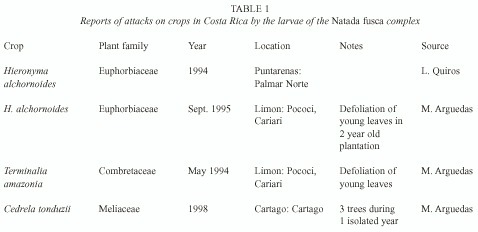
<body><![CDATA[<p><font face="Arial" size="2"><i>Natada fusc</i>a, a medium sized neotropical limacodid moth, was described by Druce (1887), from a group of specimens from Panamá, including Chiriquí. Other than the original description, the only treatments of <i>fusca </i>were brief redescriptions by <a href="#Dyar">Dyar (1935)</a> and <a  href="#Forbes">Forbes (1942)</a>. The genitalia have been neither described nor figured in the literature. When approximately 400 specimens of what were initially thought to be <i>N. fusca </i>were sorted in the Instituto Nacional de Biodiversidad (INBio) collection, it was noted that there was variation in wing color. Although the variation was later found to be of no taxonomic use, dissections of Costa Rican and other Latin American specimens revealed that under the name <i>fusca </i>was a complex of at least seven species. The <i>fusca </i>species complex is distributed from Tamaulipas and San Luis Potosí, Mexico in the north, to the state of Pichincha, Ecuador, on the Pacific slope to the south, through the upper Amazon Basin in Brazil, Perú, and Venezuela, and to French Guiana on the east, primarily in localities below 1200 m. The lectotype of <i>fusc</i>a, designated here, corresponds to the species with the most specimens in museum collections that we have studied. In Costa Rica the species has a broad distribution and is sympatric with four other species in the complex.</font></p>     <p><font face="Arial" size="2">Even though the <i>fusca </i>complex is relatively common in collections, its natural history is not well known. However, it is presumed that the larvae are generalists, as are other New World species in the genus that have been reared (<a  href="#Janzen">Janzen and Hallwachs 2003</a> and J. F. Corrales, pers. observ.). In Costa Rica, several pest attacks by <i>Natada fusca </i>or related species have been brought to our attention in recent years (<a href="#table1">Table 1</a>).</font></p>     <p><font face="Arial" size="2">Every species in Costa Rica can be associated with disturbed or semi-open sites. The border of a primary forest, such as the site where N. <i>chaconi </i>was collected in the Braulio Carrillo National Park, may also be considered a disturbed site.</font></p>     <p><font face="Arial" size="2">Males of the six new species described herein can be separated reliably from <i>N. fusca </i>only by examination of the genitalia. <i>N. fuscodivisa </i>Dognin, the only other species in the group, can be easily separated by wing pattern. Females are known for <i>fusc</i>a, <i>fuscodivisa </i>and three of the new species. To avoid redundancy, the redescription of <i>N. fusca </i>below will suffice for the description of the wings and body of adults (except forewing lengths) for all the species except <i>fuscodivisa </i>and <i>chacon</i>i. Likewise, the description of the larva for <i>fusca </i>will serve for the rest of the complex.</font></p>     <p><font face="Arial" size="2">In our work on the Costa Rican fauna we have found the largest number and highest proportion of new species in the New World <i>Natada </i>complex compared to any other complex. In addition to four new species in the <i>fusca </i>complex from Costa Rica presented here, we found an additional five new <i>Natada </i>species and two from related genera (<a href="#Corrales">Corrales and Epstein 2000</a>).    <br> &nbsp;&nbsp;     <br> <a name="table1"></a></font></p>     <div style="text-align: center;"><font face="Arial" size="2"><img alt=""  src="/img/fbpe/rbt/v51n2/2481t1.JPG" style="width: 478px; height: 232px;"></font>    
<br> </div> <font face="Arial" size="2"><b>     <p>Specimens studied</p> </b></font> <font face="Arial" size="2">Specimens examined in this study are from the following collections: Instituto Nacional de Biodiversidad (INBio); National Museum of Natural History, Smithsonian Institution (USNM); Natural History Museum of Los Angeles County (LACM); The Natural History Museum, London (BMNH); Vitor O. Becker private collection, Brasilia, Brazil (VOB); American Museum of Natural History, New York (AMNH); Zoologische Staatssammlung des Bayerischen Staates, München (ZSBS); Zoologisches Museum der Humboldt Universitaet, Berlin (ZMHB); Florida State Collection of Arthropods, Gainesville, Florida (FSCA). Paratypes or additional voucher material not found in the USNM and INBio collections will be deposited at each institution following the completion of the limacodid guide book. INBio bar codes indicated under "Material Examined" are for data base purposes only and do not indicate the collection of deposition. The bar codes on actual specimens have the prefix INBIOCRI. For brevity, we report the bar codes on specimens herein as CB: ####, eliminating zeros that preceed the other numbers in the ten digit code (e.g., INBIOCRI0078654321 = CB: 78654321). Voucher specimens reared by Janzen, Hallwachs and others for the Área de Conservación Guanacaste (ACG) Caterpillars of Santa Rosa National Park project are indicated by ##-SRNP-#### (<a href="#Janzen">Janzen and Hallwachs 2003</a>). More detailed specimen data, including capture dates and collectors, were not included for <i>N. fusca </i>because of space constraints. This information can be obtained from the inventory data base maintained by INBio and the authors. Geographic coordinates (Lambert system) are indicated by LN or LS numbers with the specimen label data.</font>     ]]></body>
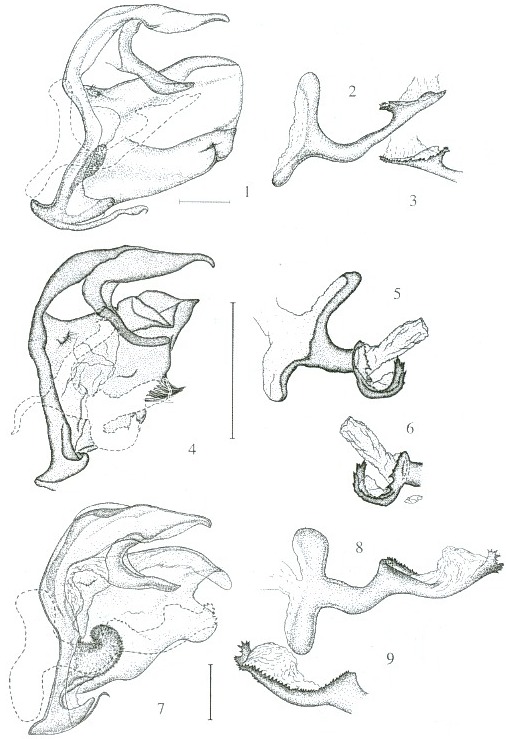
<body><![CDATA[<p align="center"><font face="Arial" size="2"><i>Natada fusca </i>complex</font></p>     <p><font face="Arial" size="2"><b>Diagnosis: </b>Adults separated from similar Central American species of <i>Natada </i>with two forewing bands that reach subapex of the costa (e.g., <i>N. daon</i>a, <i>N. subpectinat</i>a) by the absence of white scale patches on front coxae and scapes of antennae. Presence of bipectinate antennae to apex on male separates it from <i>subpectinat</i>a. Larvae broad dorsoventrally; cannot be distinguished from a number of other New World species.</font></p>     <p><font face="Arial" size="2"><b>Adult: </b>Ground color of body and wings yellowish brown to dark gray. Forewing pattern typical of genus <i>Natada </i>with two cream colored lines; line from tornus to apex is straight or slightly curved; second line from median of anal margin to costal margin near apex forms a triangle between the first line and anal margin at base. Forewing R<sub>3</sub> and R<sub>4</sub> stalked near connection of R<sub>2</sub> and R<sub>5</sub> . No dark spots are present in discal cell. Antennae bipectinate to apex in males and filiform in females. Proboscis absent in both sexes. </font></p>     <p><font face="Arial" size="2"><b>Male genitalia: </b>Uncus simple, without a spine or downcurved apex. Gnathos not extending as far to posterior as apex of uncus; distal arms fused and angled obliquely down-ward with apical region at least lightly upcurved below. Aedeagus with "hammer-head" base, with dorsal and ventral arms roughly equal in length, followed by distal arm obliquely angled or curved somewhat dorsad. Form of apex of aedeagus is species specific, with spines or processes in most specimens observable by brushing off scales. Transtilla without lobes or processes. Juxta with two membranous lobes. Valva simple, broad, and bluntly pointed or truncate at apex; usually without processes, except for a setose lobe at base of dorsum or near apex above.</font></p>     <p><font face="Arial" size="2"><b>Female genitalia: </b>Antrum ranges from narrow to broad with different degrees of sclerotization. Area between ostium bursae and papillae anales (= posterior lobe) varies in complexity from flat and sclerotized to deeply sculpted with different shaped ridges. All known females have a narrow horizontal signum across the width of corpus bursae (=crescent type signum of <a  href="#Holloway">Holloway, 1986</a>), and common in New World species of <i>Natada </i>(<a href="#Corrales">Corrales and Epstein 2000</a>). Weakly developed lateral lobes present on outer surface of 8th segment, near anterior apophyses.</font></p>     <p><font face="Arial" size="2"><b>Larva: </b>Late instars broad dorsoventrally (round in cross section), with small, equal sized dorsal and subdorsal scoli. Green, with spines sunken and directed towards ventrum at rest. </font></p>     <p align="center"><font face="Arial" size="2"><i>Natada fusca </i>(Druce, 1887)     <br> (<a href="#fig1-9">Figs. 1, 2, 3</a>, <a href="#fig23-25">23</a>, <a  href="#fig28-40">28, 29</a>)</font></p> <font face="Arial" size="2"><i>Trabala fusca </i>Druce, 1887:207. </font><font face="Arial" size="2">Lectotype </font><font face="Arial"  size="2">&#9794;</font><font face="Arial" size="2">, Panama: Bugaba 800-1500? ft (Champion) (BMNH), designated here. Specimen examined.</font>     <p><font face="Arial" size="2">Paralectotype </font><font face="Arial"  size="2">&#9794;</font><font face="Arial" size="2">, P</font><font  face="Arial" size="2">anamá: Chiriquí, 742, <i>Trabala fusca </i>Druce (Original stüche), Coll. Staundinger, det. Martin Hering (ZMNU), designated here. Specimen examined.</font></p>     <p><font face="Arial" size="2"><b>Diagnosis: </b>Only species in the complex with a keel shaped gnathos. Aedeagus with toothed apical plate most similar to <i>burns</i>i, although plate not as elongate relative to medial portion of aedeagus to anterior. Shape of valva most rectangular of species in complex.</font></p>     ]]></body>
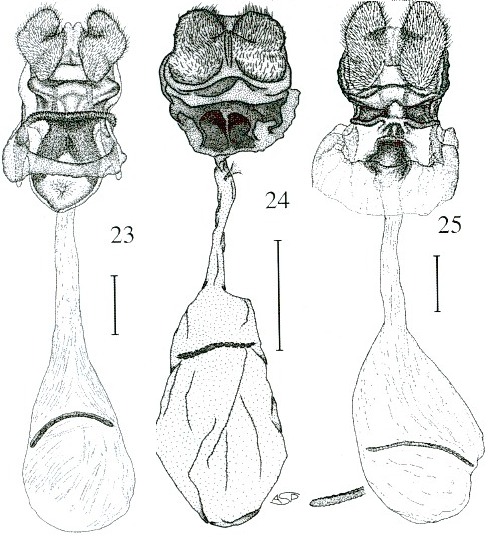
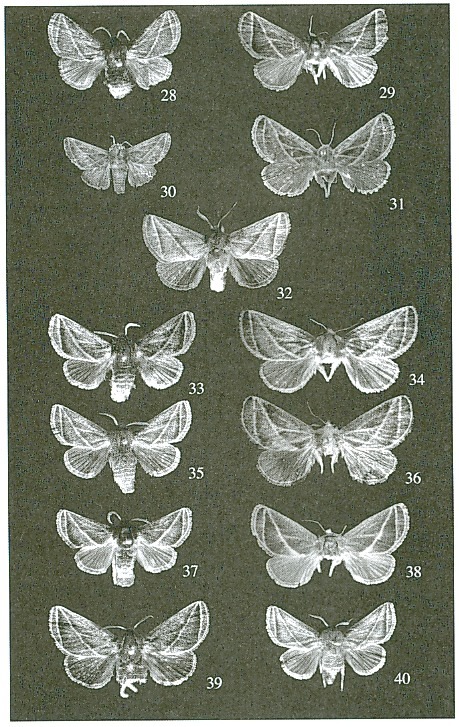
<body><![CDATA[<p><font face="Arial" size="2"><b>Adult male: </b>(<a href="#fig28-40">Fig. 28</a>). Forewing length: 12.6-17.0 mm (lectotype 15.7 mm). Typical of <i>fusca </i>complex (see description above). Ground color of wings and body dark yellowish brown. Forewings with two cream lines; one that extends from tornus to apex, other from anal margin of median area to apex forming a triangle or trapezoid, typical of <i>Natad</i>a. Region inside of trapezoid often grades from dark gray to dark brown medially. </font></p>     <p><font face="Arial" size="2"><b>Adult female: </b>(<a  href="#fig28-40">Fig. 29</a>). Forewing length: 17.0-20.0 mm. Similar to male in pattern and coloration, except medial vein of posterior discal cell often highlighted with light scales. </font></p>     <p><font face="Arial" size="2"><b>Male genitalia: </b>(<a  href="#fig1-9">Figs. 1, 2, 3</a>). Uncus simple, somewhat flattened. Gnathos shorter than uncus, sinuate below, keel shaped and laterally compressed. Valva rectangular with truncate apex, sacculus and costal margins more sclerotized than in middle; round setose lobe at dorsal base. Juxta with two spinulate lobes weakly formed. Aedeagus with base projecting above and below, medial arm curved upwards and longer than apical plate; pedunculate apical plate convex above, with 15-40 teeth on right border.</font></p>     <p><font face="Arial" size="2"><b>Female genitalia: </b>(<a  href="#fig23-25">Fig. 23</a>). Antrum broad and deep, equal in width to 8th segment. Inner, dorsal surface of antrum covered with sensory hairs in two vertical patches joined in middle, ventral side much smoother and translucent. Posterior lobe with two horizontal ridges, one near antrum and other to posterior slightly produced on each side below lateroventral margins of papillae anales; each ridge is covered with sensory hairs.</font></p> <font face="Arial" size="2"><b>Hostplants: </b><i>Guarea excelsa </i>(Meliaceae), <i>Hymenaea courbaril </i>(Fabaceae)(89-SRNP-794), <i>Inga vera </i>(Fabaceae) (96-SRNP-8427), <i>Andira inermis </i>(Fabaceae)(96-SRNP-9477), <i>Spondias mombin </i>(Anacardiaceae), <i>Hieronyma alchornoides </i>(Euphorbiaceae), <i>Manilkara chicle </i>(Sapotaceae)(96-SRNP-7703). </font>     <p><font face="Arial" size="2"><b>Remarks: </b>The altitudinal range of <i>fusca </i>is from sea level to 1300 m, with collections in all the months of the year. N. <i>fusca </i>is the most abundant species in collections. In Costa Rica it is found throughout the Atlantic and Pacific slopes, in both the dry and rain forests. The geographic distribution is sympatric with all other species in the <i>fusca </i>complex found in Costa Rica.</font></p>     <p><font face="Arial" size="2">From the original description there are three syntypes. The male lectotype, here designated, and one male paralectotype are deposited in the BMNH. The other male paralectotype is in ZMNU. The specimen illustrated in Druce (1887) is possibly the lectotype because it looks like a male in good condition; other specimens that he mentions are a female, also collected by Champion, and one specimen in the Staudinger collection that was ruined. </font></p>     <p><font face="Arial" size="2"><i>N. fusca </i>was placed in Lasiocampidae by Druce (1887), who was doubtful of its assignment to <i>Trabala </i>Walker. <i>Perola salta </i>Druce was synonymized with <i>fusca </i>by <a href="#Dyar">Dyar (1935)</a>. Although we have not examined the type of <i>salt</i>a, it is likely to match <i>fusca </i>rather than other members of the <i>fusca </i>group. This is because the type locality of <i>salta </i>is Bonda, in northeastern Colombia, which most closely matches the distribution of <i>fusc</i>a.</font></p>     <p><font face="Arial" size="2"><b>Distribution: </b><i>N. fusca </i>is known from throughout Costa Rica, western and northern Colombia, the state of Guarico in Venezuela, and in northern Ecuador. It is probable that this species occurs in southern Nicaragua because it occurs in similar habitats in Northern Costa Rica.</font></p>     <p><font face="Arial" size="2"><b>Material Examined: </b>(548 specimens, 527</font><font style="color: rgb(0, 0, 0);" color="#ff0000"  face="Arial" size="2">&#9794;</font><font style="color: rgb(0, 0, 0);"  face="Arial" size="2">, 21</font><font style="color: rgb(0, 0, 0);"  color="#ff0000" face="Arial" size="2">&#9792;</font><font  style="color: rgb(0, 0, 0);" face="Arial" size="2">)</font></p>     <p><font face="Arial" size="2">Costa Rica: Área de Conservación     ]]></body>
<body><![CDATA[Guanacaste (reared vouchers, see Janzen and Hallwachs, 2001): 1</font><font      face="Arial" size="2">&#9792;</font><font face="Arial" size="2">, Alacrán     (96-SRNP-7703); 2</font><font face="Arial" size="2">&#9792;</font><font      face="Arial" size="2">, Bosque San     Emilio (89-SRNP-728b, 89-SRNP-816); 1</font><font face="Arial" size="2">&#9794;</font><font      face="Arial" size="2">, 1</font><font face="Arial" size="2">&#9792;</font><font      face="Arial" size="2">Cafetal (89-SRNP-794, 89-SRNP-795); 1</font><font      face="Arial" size="2">&#9792;</font><font face="Arial" size="2">, Quebrada     Puercos (99-SRNP-10551); 2</font><font face="Arial" size="2">&#9794;</font><font      face="Arial" size="2">, 1</font><font face="Arial" size="2">&#9792;</font><font     ]]></body>
<body><![CDATA[ face="Arial" size="2">, Río Cuajiniquil (94-SRNP-5813, 94-SRNP-5888,     96-SRNP-8427); 1</font><font face="Arial" size="2">&#9792;</font><font      face="Arial" size="2">, Vado Quebrada Aserradero (99-SRNP-10797), 1</font><font      face="Arial" size="2">&#9792;</font><font face="Arial" size="2">, Vado Río     Esteron (96-SRNP-9477); 1</font><font face="Arial" size="2">&#9794;</font><font      face="Arial" size="2">, 1</font><font face="Arial" size="2">&#9792;</font><font      face="Arial" size="2">, Turrialba; 5</font><font face="Arial" size="2">&#9794;</font><font      face="Arial" size="2">, 1</font><font face="Arial" size="2">&#9792;</font><font      face="Arial" size="2">, Est. Maritza, 13 km SO Volcán Orosí (LN     316900-373000); 5</font><font face="Arial" size="2">&#9794;</font><font     ]]></body>
<body><![CDATA[ face="Arial" size="2">, Cerro de Oro; 2</font><font face="Arial"      size="2">&#9794;</font><font face="Arial" size="2">, Est. Bijagual; 2</font><font      face="Arial" size="2">&#9794;</font><font face="Arial" size="2">, Bribrí; 4</font><font      face="Arial" size="2">&#9794;</font><font face="Arial" size="2">, Barra     Honda; 2</font><font face="Arial" size="2">&#9794;</font><font face="Arial"      size="2">, Est.     Agujas; 2</font><font face="Arial" size="2">&#9794;</font><font face="Arial"      size="2">, Fila Esquinas; 2</font><font face="Arial" size="2">&#9794;</font><font      face="Arial" size="2">, Fca.     Cafrosa; 1</font><font face="Arial" size="2">&#9794;</font><font face="Arial"     ]]></body>
<body><![CDATA[ size="2">, Los Almendros; 1</font><font face="Arial" size="2">&#9794;</font><font      face="Arial" size="2">, Barra     Honda; 1</font><font face="Arial" size="2">&#9794;</font><font face="Arial"      size="2">, Tierras Morenas; 1</font><font face="Arial" size="2">&#9794;</font><font      face="Arial" size="2">, El Amo; 1</font><font face="Arial" size="2">&#9794;</font><font      face="Arial" size="2">, Hitoy Cerere; 1</font><font face="Arial"      size="2">&#9794; </font><font face="Arial" size="2">Punta Camíbar; 1</font><font      face="Arial" size="2">&#9794; </font><font face="Arial" size="2">, Cuatro     Esquinas; 1</font><font face="Arial" size="2">&#9794;</font><font face="Arial"      size="2">, La Estrella     ]]></body>
<body><![CDATA[(CB:1924871); 1</font><font face="Arial" size="2">&#9794;</font><font      face="Arial" size="2">, Río Bonito (CB: 1938750); 1</font><font      face="Arial" size="2">&#9794;</font><font face="Arial" size="2">,</font><font      face="Arial" size="2"> </font><font face="Arial" size="2">Carmona     (CB: 1119123); 1</font><font face="Arial" size="2">&#9794;</font><font      face="Arial" size="2">, Dos de Tilarán; 1</font><font face="Arial"      size="2">&#9794;</font><font face="Arial" size="2">, Cabo Blanco (CB:     1652218); 9</font><font face="Arial" size="2">&#9794;</font><font face="Arial"      size="2">, Río Sardinas; 5</font><font face="Arial" size="2">&#9794;</font><font      face="Arial" size="2">, Río     ]]></body>
<body><![CDATA[Esquinas; 5</font><font face="Arial" size="2">&#9794;</font><font face="Arial"      size="2">, Cedrales de La Rita; 124</font><font face="Arial" size="2">&#9794;</font><font      face="Arial" size="2">, Parque Nacional Corcovado, Est. Sirena; 12</font><font      face="Arial" size="2">&#9794;</font><font face="Arial" size="2">, 2</font><font      face="Arial" size="2">&#9792;</font><font face="Arial" size="2">, P. N.     Santa Rosa, A. C. Guanacaste, 300 m (LN     313000 - 359800); 17</font><font face="Arial" size="2">&#9794;</font><font      face="Arial" size="2"> , 1</font><font face="Arial" size="2">&#9792;</font><font      face="Arial" size="2">, P. N. Manuel Antonio,     Quepos; 74</font><font face="Arial" size="2">&#9794;</font><font face="Arial"     ]]></body>
<body><![CDATA[ size="2">, 1</font><font face="Arial" size="2">&#9792;</font><font      face="Arial" size="2">, Queb. Bonita; 12</font><font face="Arial"      size="2">&#9794;</font><font face="Arial" size="2">, 1</font><font      face="Arial" size="2">&#9792;</font><font face="Arial" size="2">, Cerro     Tortuguero; 8</font><font face="Arial" size="2">&#9794;</font><font      face="Arial" size="2">, 1</font><font face="Arial" size="2">&#9792;</font><font      face="Arial" size="2"> , Casa Oeste, Cerro el Hacha, 12 km SE La Cruz,     300 m; 5</font><font face="Arial" size="2">&#9794;</font><font face="Arial"      size="2">, Cerro Cocorí; 10</font><font face="Arial" size="2">&#9794;</font><font      face="Arial" size="2">, 1</font><font face="Arial" size="2">&#9792;</font><font     ]]></body>
<body><![CDATA[ face="Arial" size="2">, Amubri (CB: 1845270); 17</font><font      face="Arial" size="2">&#9794;</font><font face="Arial" size="2"> , 1</font><font      face="Arial" size="2">&#9792;</font><font face="Arial" size="2">, Las     Pailas; 32</font><font face="Arial" size="2">&#9794;</font><font face="Arial"      size="2">, Rancho Quemado; 68</font><font face="Arial" size="2">&#9794;</font><font      face="Arial" size="2">, Bosque Esquinas; Panamá: 25</font><font      face="Arial" size="2">&#9794;</font><font face="Arial" size="2">, 2</font><font      face="Arial" size="2">&#9792;</font><font face="Arial" size="2">, Isla Barro     Colorado (USNM), (AMNH); 2</font><font face="Arial" size="2">&#9794;</font><font      face="Arial" size="2">, Río Trinidad (USNM); 1</font><font face="Arial"     ]]></body>
<body><![CDATA[ size="2">&#9794;</font><font face="Arial" size="2">, Bejuco     (CB: 2607496) (USNM); 1</font><font face="Arial" size="2">&#9794;</font><font      face="Arial" size="2">, Cabina (CB:2607499)     (USNM); 1</font><font face="Arial" size="2">&#9794;</font><font face="Arial"      size="2">, Cerro Campana (CB:2607498) (FSCA); 8</font><font      face="Arial" size="2">&#9794;</font><font face="Arial" size="2">, La     Chorrera (USNM);2</font><font face="Arial" size="2">&#9794;</font><font      face="Arial" size="2">, Chiriqui     (USNM); 2</font><font face="Arial" size="2">&#9794;</font><font face="Arial"      size="2">, Pipeline Rd, Río Frijoles (USNM); Colombia: 3</font><font     ]]></body>
<body><![CDATA[ face="Arial" size="2">&#9794;</font><font face="Arial" size="2">, Colombia     [only data on specimens](USNM); 1</font><font face="Arial" size="2">&#9794;</font><font      face="Arial" size="2">, Río Magdalena (ZSBS); 1</font><font      face="Arial" size="2">&#9794;</font><font face="Arial" size="2">, Medellin,     La Estrella (ZSBS); 6</font><font face="Arial" size="2">&#9794;</font><font      face="Arial" size="2">, 1</font><font face="Arial" size="2">&#9792;</font><font      face="Arial" size="2">, Bajo Calima (USNM); 2</font><font face="Arial"      size="2">&#9794;</font><font face="Arial" size="2">, Iscuande, Nariño     (USNM); 1</font><font face="Arial" size="2">&#9794;</font><font face="Arial"      size="2">, Guapi,     ]]></body>
<body><![CDATA[Cauca (USNM); 3</font><font face="Arial" size="2">&#9794;</font><font      face="Arial" size="2">, Pance, Valle Colombia (USNM); Venezuela: 2</font><font      face="Arial" size="2">&#9794;</font><font face="Arial" size="2">, El Pao; 1</font><font      face="Arial" size="2">&#9794;</font><font face="Arial" size="2">, Venezuela     (USNM); 11</font><font face="Arial" size="2">&#9794;</font><font face="Arial"      size="2">, Merida, 600 m (USNM); 1</font><font face="Arial" size="2">&#9794;</font><font      face="Arial" size="2">, Sierra     Perija, Guasare (USNM); 2</font><font face="Arial" size="2">&#9794;</font><font      face="Arial" size="2">, Maracay (USMN); 7</font><font face="Arial"      size="2">&#9794;</font><font face="Arial" size="2">, Guárico, Calabozo     ]]></body>
<body><![CDATA[(USNM); 1</font><font face="Arial" size="2">&#9794;</font><font face="Arial"      size="2">, 1</font><font face="Arial" size="2">&#9792;</font><font      face="Arial" size="2">, Zulia, 35 km W Carrascuero (FSCA); Ecuador: 5</font><font      face="Arial" size="2">&#9794;</font><font face="Arial" size="2">,     Esmeraldas, San Mateo (ZSBS).</font></p>     <p style="text-align: center;"><font face="Arial" size="2"><i>&nbsp;</i></font><font  face="Arial" size="2"><i>Natada fuscodivisa </i>Dognin, 1910    <br> </font><font face="Arial" size="2">(<a href="#fig1-9">Figs. 4, 5, 6</a>, <a href="#fig23-25">24</a>, <a href="#fig28-40">30, 31</a>)</font></p>     <div style="text-align: center;"> </div> <font face="Arial" size="2"><i>    <br> Natada fuscodivisa </i>Dognin, 1910:41. Holotype</font><font  face="Arial" size="2"> </font><font face="Arial" size="2">&#9794;</font><font  face="Arial" size="2">: S</font><font face="Arial" size="2">aint-Laurent du Maroni, Guyane Français. Collection Le Moult (Collection Dognin). USNM type no 29787. Specimen examined. </font>     <p><font face="Arial" size="2"><b>Diagnosis: </b>Smallest species in <i>fusca </i>complex and only species with FW veins high-lighted by cream scales on R and M veins of discal cell and branches beyond until reaching medial line or beyond, and on A<sub>1</sub> + A<sub>2</sub> . Spiny apical plate distinguished from <i>burnsi </i>and <i>fusca </i>in being u-shaped. Valvae of male distinguished by dorsal lobe near apex and setal tuft on ventrum. Corpus bursae of female relatively elongate with signum located much closer to proximal end than in other species. Antrum and anterior apophyses weakly developed compared to <i>fusc</i>a.</font></p>     ]]></body>
<body><![CDATA[<p><font face="Arial" size="2"><b>Adult male: </b>(<a href="#fig28-40">Fig. 30</a>). Forewing length: 12.0-13.2 mm (holotype 12.0 mm). Triangulate FW band divided into two longitudinal areas by faint light band, with strip along basal inner margin of triangle gray and strip along inside of postmedial margin dark brown. FW discal cell and anal veins highlighted by cream scales, dividing the wing base into three regions.</font></p>     <p><font face="Arial" size="2"><b>Adult female: </b>(<a  href="#fig28-40">Fig. 31</a>). Forewing length: 17.0 mm. Similar to males, except no faint light band dividing FW triangle longitudinally.</font></p>     <p><font face="Arial" size="2"><b>Male genitalia: </b>(<a  href="#fig1-9">Figs. 4, 5, 6</a>). Aedeagus with elongate dorsal hump at base, longer than ventral arm; distal arm short; apical plate forms oval ring perpendicular to distal arm with spines on right side continuing along the u-shaped apex. Gnathos with distal portion cylindrical and apex rounded. Valva with flap on dorsum near apex, equally sclerotized as margin, and with pointed apex; tuft of setae on ventral margin midway between base and apex.</font></p>     <p><font face="Arial" size="2"><b>Female genitalia: </b>(<a  href="#fig23-25">Fig. 24</a>). Antrum narrow and membranous. Lobe ventral and medial to antrum, and surrounding ostium bursae, covered with sensory hairs. Corpus bursae large, roughly equal in length to ductus bursae; transverse signum on anterior end of corpus bursae, near ductus bursae. Anterior apophyses weakly developed.</font></p>     <p><font face="Arial" size="2"><b>Remarks: </b>This is the first report of females of this species in the literature and the first report of the species beyond the Guianas. The contrasting FW veins sometimes occur on the M vein of the discal cell and A<sub>1</sub> + A<sub>2</sub> in other species in the complex, especially on the females.</font></p>     <p><font face="Arial" size="2">The ventral lobe in the female genitalia may be homologous to the posterior lobe, which forms the dorsal wall of the antrum in <i>fusc</i>a.</font></p>     <p><font face="Arial" size="2"><b>Distribution: </b><i>N. fuscodivisa </i>is known from Ecuador, Peru, the upper Amazon of Brazil, southern Venezuela and the Guianas.</font></p>     <p><font face="Arial" size="2"><b>Material exa</b></font><font  face="Arial" size="2"><b>mined: </b>(17 specimens, 15</font><font face="Arial" size="2">&#9794;</font><font  face="Arial" size="2">, 2</font><font face="Arial" size="2">&#9792;</font><font  face="Arial" size="2"> ).</font></p>     <p><font face="Arial" size="2">Ecuador: Napo Province: 1 , Misahualli Jungle Hotel on Napo River, 1200 ft, 7-19 Sep 1997, Ron Leuschner (USNM); 2 , Junction Río Napo and Misahualli, 366m, 6-18 Sep 1998, 1.034 S, 77.664 W, Ron Leuschner (USNM); Peru: Loreta Province: 1</font><font  face="Arial" size="2">&#9794;</font><font face="Arial" size="2">, Río Amazonas, 200 m, Explorer’s Inn, 26 mi E Iquitos, 9-12 and 17-21 Sep 1990, Ron Leuschner (LACM); 1</font><font face="Arial"  size="2">&#9794;</font><font face="Arial" size="2">, Cuzco, Pilcopata, 600 m, 8-10 Dec 1979, premontane moist forest, J. B. Heppner (USNM)(Figs. 4-6); 1</font><font face="Arial" size="2">&#9794;</font><font  face="Arial" size="2">,1</font><font face="Arial" size="2">&#9792;</font><font  face="Arial" size="2">, Pakitza, Manu, 11E56’S, 71E18’W, 17-21 Sep 1989, D. Adamski and M. Epstein (USNM); 1</font><font  face="Arial" size="2">&#9794;</font><font face="Arial" size="2">, Tingo Maria, at light, 7 Feb 1950, H.A.Allard (USNM); Brazil: 1</font><font face="Arial" size="2">&#9794;</font><font face="Arial"  size="2">, 1</font><font face="Arial" size="2">&#9792; </font><font  face="Arial" size="2">Fonte Boa, Upper Amazon, May 1906, S.M. Klages (BMNH); 1</font><font face="Arial"  size="2">&#9794;</font><font face="Arial" size="2">, Rondonia, Porto Velho, 180 m, 24 Apr 1989, V.O. Becker (USNM); 1</font><font  face="Arial" size="2">&#9794;</font><font face="Arial" size="2">, Porto Velho, Coll. of Brooklyn Museum (USNM); 1</font><font face="Arial"  size="2">&#9794;</font><font face="Arial" size="2">, Amazonas, Manaus, Reserva Ducke, uv light, AM-010, km 26, 2E55’S, 59E59’W, 14 Dec 1993, R.W. Hutchings &amp; J. B. Sullivan (USNM);1 , Amazones, P. Nac. Do Jau, rio Carabinani, 2E01’S, 61E32’W, 1-2 Aug 1995, R.W. Hutchings (USNM); Guyana: 1</font><font face="Arial"  size="2">&#9794;</font><font face="Arial" size="2">, Kartabo Bartica District, 18 Jul 1922 (AMNH) (CB: 2249401); Venezuela: 1</font><font face="Arial" size="2">&#9794;</font><font  face="Arial" size="2">, </font><font face="Arial" size="2">T.P. Amaz. Cerro de la Neblina Basecamp, 66N 9’44"W, 140 m 1-10 Mar 1984 D. Davis &amp; T. McCabe (USNM).</font></p>     <div style="text-align: center;"><font face="Arial" size="2"><i>Natada burnsi </i>sp. n.</font>    ]]></body>
<body><![CDATA[<br> <font face="Arial" size="2">(<a href="#fig1-9">Figs. 7, 8, 9</a>, <a  href="#fig28-40">32</a>)</font> </div>     <p><font face="Arial" size="2"><b>Diagnosis: </b>Only species in complex with an aedeagus having a spiny apical plate more than half as long as distal arm and a valva with a deeply emarginated apex.</font></p>     <p><font face="Arial" size="2"><b>Adult male: </b>(<a href="#fig28-40">Fig. 32</a>). Forewing length: 16.5 mm (holotype and paratype). External features same as <i>fusca </i>(see description above).</font></p>     <p><font face="Arial" size="2"><b>Adult female: </b>Unknown.</font></p>     <p><font face="Arial" size="2"><b>Male genitalia: </b>(<a  href="#fig1-9">Figs. 7, 8, 9</a>). Aedeagus with large apical plate longer than distal arm. Plate dorsally striated with up to 72 small teeth along right margin. Apex of valva emarginate. Base of gnathos short.</font></p>     <p><font face="Arial" size="2"><b>Remarks: </b>The aedeagus suggests a close relationship with <i>fusc</i>a. The species is named in honor of Dr. John M. Burns, for a life dedi cated to the understanding and meticulous explanation of the taxonomy of Hesperiidae, and for poetically giving this information to the scientific community.</font></p>     <p><font face="Arial" size="2"><b>Distribution: </b><i>N. burnsi </i>is only known to occur in southwestern Colombia. </font></p>     <p><font face="Arial" size="2"><b>Material Examined: </b><span  style="color: rgb(0, 0, 0);">(3</span></font><font  style="color: rgb(0, 0, 0);" color="#ff0000" face="Arial" size="2">&#9794;</font><font  style="color: rgb(0, 0, 0);" face="Arial" size="2"> specimens) </font></p>     <p style="color: rgb(0, 0, 0);"><font face="Arial" size="2"><i>Holotype </i></font><font face="Arial" size="2">&#9794;</font><i><font face="Arial"  size="2"> </font></i><font face="Arial" size="2">. Colombia: Cauca, Popayan, Finca Manzana, 2 200 m, 9 Jan 1959, J. F. G. Clarke (USNM)(CB: 1147430).</font></p>     <p><font style="color: rgb(0, 0, 0);" face="Arial" size="2"><i>Paratyp</i>e. Colombia: 1</font><font style="color: rgb(0, 0, 0);" color="#ff0000"  face="Arial" size="2">&#9794;</font><font style="color: rgb(0, 0, 0);"  face="Arial" size="2">, Cauca, Popayan, Finca Manzana, 2 200 m, 9 Jan 1959, J. F. G. Clarke (USNM)(CB: 1121355)(Figs. 7-9); 1</font><font  style="color: rgb(0, 0, 0);" color="#ff0000" face="Arial" size="2">&#9794;</font><font  face="Arial" size="2">, Pance, Valle Colombia, 4 000 ft, 20 Jan 1986, J. Bolling Sullivan (USNM)(CB: 1121358).</font></p>     ]]></body>
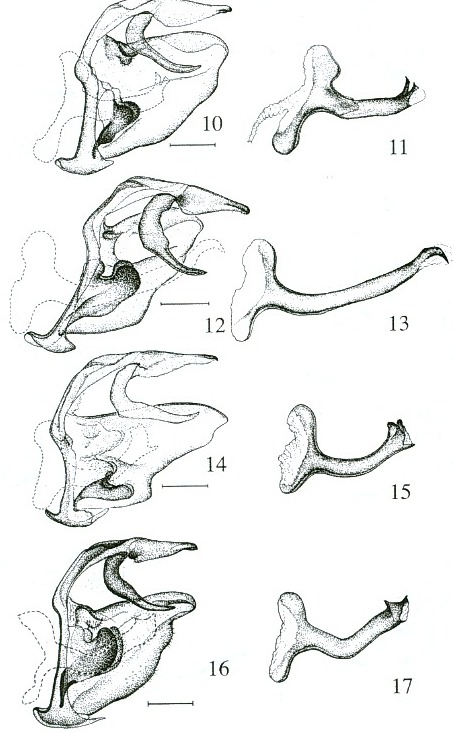
<body><![CDATA[<div style="text-align: center;"><font face="Arial" size="2"><i>Natada truncata </i>sp. n.</font>    <br> <font face="Arial" size="2">(<a href="#fig10-17">Figs. 10, 11</a>, <a  href="#fig23-25">25</a>, <a href="#fig28-40">33, 34</a>)</font> </div>     <p><font face="Arial" size="2"><b>Diagnosis: </b>Truncated tips of two processes at apex of aedeagus separates this from other species in complex. Valva nearly as wide at apex as base, intermediate between <i>fusca </i>and <i>burnsii </i>and other species in complex.</font></p>     <p><font face="Arial" size="2"><b>Adult male: </b>(<a href="#fig28-40">Fig. 33</a>). Forewing Length: 15.8-18.0 mm (holotype 17.0 mm). External features same as <i>fusca </i>(see description above).</font></p>     <p><font face="Arial" size="2"><b>Adult female: </b>(<a  href="#fig28-40">Fig. 34</a>). Forewing length: 21.0 mm. Similar to male in pattern and color.</font></p>     <p><font face="Arial" size="2"><b>Male genitalia: </b>(<a  href="#fig10-17">Figs. 10, 11</a>). Apex of aedeagus with two dorsally angled processes, truncated at apex. Dorsal hump at base of aedeagus short and wide, angled toward posterior. Gnathos thin dorsoventrally in distal half and of even width. Valva trapezoidal, with bump near apex below.</font></p>     <p><font face="Arial" size="2"><b>Female genitalia: </b>(<a  href="#fig23-25">Fig. 25</a>). Ostium bursae round with irregular margin and forms a shallow bowl with short antrum. Posterior lobes with short sensory hairs. A short, sclerotized ridge between posterior margin of ostium bursae and posterior lobe. Cleft between two horizontal rows well sclerotized and extending to lateral part of 8th segment. Dorsum of 8<sup>th</sup> segment convex.</font></p>     <p><font face="Arial" size="2"><b>Remarks: </b>The altitudinal limit of <i>truncata </i>is from sea level to 1340 m. Specimens have been collected every month of the year, except September and December. The species is named for the truncate processes near the apex of the aedeagus.</font></p>     <p><font face="Arial" size="2"><b>Distribution: </b><i>Natada truncata </i>is only known from Costa Rica in the humid Pacific slope, with its northern limits at Estación Quebrada Bonita in the Carara Biological Reserve to Estación Sirena in Corcovado National Park, Osa Peninsula, in the south.</font></p>     <p><font face="Arial" size="2"><b>Material Examined: </b>(79</font><font  face="Arial" size="2"> specimens, 78</font><font face="Arial" size="2">&#9794;</font><font  face="Arial" size="2">, 1</font><font face="Arial" size="2">&#9792;</font><font  face="Arial" size="2">)</font></p>     ]]></body>
<body><![CDATA[<p><font face="Arial" size="2"><i>Holotype.</i></font><font face="Arial"  size="2"> &#9794;</font><i><font face="Arial" size="2"> </font></i><font  face="Arial" size="2">. Costa Rica: PUNTARENAS: Zona Protectora Las Tablas, 1380 m, 25 Aug B 25 Sep 1995, M. Segura (LS 319300 B594700) (CB: 2344631).</font></p>     <p><font face="Arial" size="2"><i>Paratypes. </i>Costa Rica:     PUNTARENAS: Bosque Esquinas, Península de Osa, 200 m, (LS 302400 -     545250), 1</font><font face="Arial" size="2">&#9794;</font><font face="Arial"      size="2">, J. F. Quesada, Jun 1994 (CB: 2003519), 4</font><font      face="Arial" size="2">&#9794;</font><font face="Arial" size="2">, M. Segura,     Apr 1994 (CB: 1773548, 1773555, 1773557,     1773566), 8</font><font face="Arial" size="2">&#9794;</font><font face="Arial"      size="2">, May 1994 (CB: 1999922, 1999924, 1999925,     1999926, 1999928, 1999932, 1999933, 1999935); 1.8 mi W. Rincon, Osa     ]]></body>
<body><![CDATA[Penin, 19 Feb 1971, 1</font><font face="Arial" size="2">&#9794;</font><font      face="Arial" size="2">, J.P. Donahue &amp; C.L. Hogue (LACM)(CB:     1147435); Fca Cafrosa, Est. Las Mellizas, P. N. La Amistad, 1300 m, (LS     316100 -596100), 3</font><font face="Arial" size="2">&#9794;</font><font      face="Arial" size="2">, M. Ramirez, Apr 1991 (CB: 1112276, 1112278,     1112281), 1</font><font face="Arial" size="2">&#9794;</font><font face="Arial"      size="2">, Mar 1991 (CB: 679510), 7</font><font face="Arial" size="2">&#9794;</font><font      face="Arial" size="2">, G. Mora, May 1991 (CB: 510483, 510575, 510629,     510664,     532549, 532770, 665217), 2</font><font face="Arial" size="2">&#9794;</font><font     ]]></body>
<body><![CDATA[ face="Arial" size="2">, Mar 1991, 1</font><font face="Arial" size="2">&#9794;</font><font      face="Arial" size="2">, Apr 1991, 1</font><font face="Arial" size="2">&#9794;</font><font      face="Arial" size="2">, M. Ramirez &amp; G.     Mora, Jun 1990, 3</font><font face="Arial" size="2">&#9794;</font><font      face="Arial" size="2">, Oct 1989, 1</font><font face="Arial" size="2">&#9794;</font><font      face="Arial" size="2">, Mar 1990, 2</font><font face="Arial" size="2">&#9794;</font><font      face="Arial" size="2">, 20 Aug - 4 Sep 1989, 2</font><font face="Arial"      size="2">&#9794;</font><font face="Arial" size="2">, R.     Delgado, 19-26 Jun 1990 (CB: 234770, 246728); Finca Cafrosa, 1.5 km NE.     de la escuela El Progreso, 1240 m, (LS358100 - 595500), 1</font><font     ]]></body>
<body><![CDATA[ face="Arial" size="2">&#9794;</font><font face="Arial" size="2">, M.     Chichilla, 8-11 Apr 1996 (CB: 2368591); Est. Sirena, P.     N. Corcovado, 0-100 m, (LS270500 - 508300), 2</font><font face="Arial"      size="2">&#9794;</font><font face="Arial" size="2">, G. Fonseca, 27 Aug - 4     Sep 1989 (CB:19620, 28744), 1</font><font face="Arial" size="2">&#9794;</font><font      face="Arial" size="2">, Nov 1989 (CB: 113437), 2</font><font      face="Arial" size="2">&#9794;</font><font face="Arial" size="2">, Jan 1990, 1</font><font      face="Arial" size="2">&#9794;</font><font face="Arial" size="2"> (CB:     185139, 185144), Oct 1989 (CB: 617280), 1</font><font face="Arial"      size="2">&#9794;</font><font face="Arial" size="2">, DH Janzen &amp; W     ]]></body>
<body><![CDATA[Hallwachs, 5-11 Jan 1981 (CB: 1119136), 1</font><font face="Arial"      size="2">&#9794;</font><font face="Arial" size="2">, 10-19 Aug 1980 (CB:     1119099); Rancho Quemado, Pen. de Osa,     200 m, (LS 292500 - 511000), 3</font><font face="Arial" size="2">&#9794;</font><font      face="Arial" size="2">, Francisco Quesada, 1     Feb-2 Mar 1991 (CB: 217425, 217697, 217933) , 1</font><font face="Arial"      size="2">&#9794;</font><font face="Arial" size="2">, Mar 1991 (CB: 275941), 2</font><font      face="Arial" size="2">&#9794;</font><font face="Arial" size="2">, Apr 1991     (CB: 439889, 444906), 1</font><font face="Arial" size="2">&#9794;</font><font      face="Arial" size="2">, Oct 1990 (CB:1374283), 1</font><font     ]]></body>
<body><![CDATA[ face="Arial" size="2">&#9794;</font><font face="Arial" size="2">, A. L.     Marín, Jul 1992 (CB: 692402), 1</font><font face="Arial" size="2">&#9794;</font><font      face="Arial" size="2">, 6-12 Feb 1994 (CB: 1913325); Est. Quebrada     Bonita, Res.     Biol. Carara, 50 m, (LN 194500 - 469850), 2</font><font face="Arial"      size="2">&#9794;</font><font face="Arial" size="2">, J. C.     Saborío, May 1992 (CB: 804780, 808236), 1</font><font face="Arial"      size="2">&#9794;</font><font face="Arial" size="2">, Jan 1994     (CB: 1842502), 1</font><font face="Arial" size="2">&#9794;</font><font      face="Arial" size="2">, Dec 1994, 1</font><font face="Arial" size="2">&#9794;</font><font     ]]></body>
<body><![CDATA[ face="Arial" size="2">, E. Bello     &amp; E. Rojas, Jul 1990 (CB: 241587), 1</font><font face="Arial"      size="2">&#9794;</font><font face="Arial" size="2">, R. Zuñiga,     Aug 1989 (CB: 16807), 1</font><font face="Arial" size="2">&#9794;</font><font      face="Arial" size="2">, Jun 1991 (CB: 590569);     Albergue Cerro de Oro, 150 m, (LS 279650 - 518450), 3</font><font      face="Arial" size="2">&#9794;</font><font face="Arial" size="2">, J. F.     Corrales, 29 May 1995 (CB: 2212658, 2212659,     2212661), 2</font><font face="Arial" size="2">&#9794;</font><font face="Arial"      size="2">, L. Angulo, 30 Aug 1995 (CB: 2404535, 2404537),     ]]></body>
<body><![CDATA[1</font><font face="Arial" size="2">&#9794;</font><font face="Arial" size="2">,     16-20 May 1996 (CB: 2454390); Zona Protectora     Las Tablas, 1380 m, (LS 319300 -594700), 1</font><font face="Arial"      size="2">&#9794;</font><font face="Arial" size="2">, M. Segura,     25 Aug-25 Sep 1995 [same locality and date as holotype](CB: 2344632);     Punta Camibar, 0 m, (LS 298550 -528350), 1</font><font face="Arial"      size="2">&#9794;</font><font face="Arial" size="2">, J. F.     Quesada, Jun 1994 (CB:2350393); Est. Santa Elena, Las Nubes, 1210 m,     (LS 371750 - 507800), 1</font><font face="Arial" size="2">&#9794;</font><font      face="Arial" size="2">, E. Alfaro, 14 Dec 1996     ]]></body>
<body><![CDATA[(CB:2540325); Sector Altamira, Buenos Aires, P. I. L. A, 1 400 m, (LS     332700 - 572400), 1</font><font face="Arial" size="2">&#9794;</font><font      face="Arial" size="2">, R. Delgado, Aug 1994 (CB:2026957); Fila     Guerra, 100 m, (LS 300350 -506100), 1</font><font face="Arial" size="2">&#9794;</font><font      face="Arial" size="2">, J.     Quesada, Mar 1991, (CB:1689894); La Escuadra, P. N. La Amistad, 1 340     m, (LS 326700 - 591200), 1</font><font face="Arial" size="2">&#9794;</font><font      face="Arial" size="2">, M. Ramirez &amp; G.     Mora, 14 Apr 1989 (CB: 2942); Las Cruces, Biol. Sta, San Vito, 1 200 m,     (LS 304500 - 577500), 1</font><font face="Arial" size="2">&#9794;</font><font     ]]></body>
<body><![CDATA[ face="Arial" size="2">, I. Chacón, 16-20 Nov     1987 (CB: 1119156), 1</font><font face="Arial" size="2">&#9794;</font><font      face="Arial" size="2">, 26-27 Jun 1972, C.L. Hogue &amp; J. Dockweiler     (LACM)(CB:1147434); Fila Esquinas, 35 km S. Palmar Norte, 150 m, (LS     301800 - 531000), 2</font><font face="Arial" size="2">&#9794;</font><font      face="Arial" size="2">, D. H. Janzen &amp; W. Hallwachs, 7-8 Jan 1983     (CB: 1119145 [Figs. 10, 11], 1120951); Est. Agujas, Río Agujas, 300 m,     (LS 276750 - 526550), A. Azofeifa, 1</font><font face="Arial" size="2">&#9794;</font><font      face="Arial" size="2">, 13-18 Sep     1996 (CB: 2457968),1</font><font face="Arial" size="2">&#9794;</font><font     ]]></body>
<body><![CDATA[ face="Arial" size="2">, 9-28 Mar 1996 (CB: 2372973); Las Alturas Field     Station, 35 km NE of San Vito: Cal Snyder &amp; Andrei Sourakov, 3</font><font      face="Arial" size="2">&#9794;</font><font face="Arial" size="2">, 26 Jun     1992 (AMNH)(CB: 222688, 2607578, 2226885), 1</font><font face="Arial"      size="2">&#9794;</font><font face="Arial" size="2">, 27 Jun 1992 (AMNH)(CB:     2226880), 1</font><font face="Arial" size="2">&#9794;</font><font face="Arial"      size="2">, Cal Snyder, 23 May 1992 (AMNH)(CB: 2226886), 2</font><font      face="Arial" size="2">&#9794;</font><font face="Arial" size="2">, A.     Sourakov, 3</font><font face="Arial" size="2">&#9794; </font><font      face="Arial" size="2">Aug 1992 (AMNH)(CB:     ]]></body>
<body><![CDATA[2226888), 16 Jul 1992 (AMNH)(CB: 2226887); Villa Neilly, 800 m, 2</font><font      face="Arial" size="2">&#9794;</font><font face="Arial" size="2">, 26 Nov     1973, V. O. Becker col., N° 31351, (LS 2895000 -     579500) (USNM)(VOB) (CB:</font><font face="Arial" size="2"> 1121214,     1147436).</font></p>     <div style="text-align: center;"><font face="Arial" size="2"><i>Natada singulara </i>sp. n.</font>    <br> <font face="Arial" size="2">(<a href="#fig10-17">Figs. 12, 13</a>, <a  href="#fig26-27">26</a>, <a href="#fig28-40">35, 36</a>)</font> </div>     <p><font face="Arial" size="2"><b>Diagnosis: </b>Aedeagus very elongated, with a single downcurved spine at apex, unique in <i>fusca </i>complex.</font></p>     <p><font face="Arial" size="2"><b>Adult male: </b>(<a href="#fig28-40">Fig. 35</a>). Forewing length: 14.0-17.2 mm (holotype 16.0 mm). External features same as <i>fusca </i>(see description above).</font></p>     <p><font face="Arial" size="2"><b>Adult female: </b>(<a  href="#fig28-40">Fig. 36</a>). Forewing length: 17.5-21.5 mm. Similar to the male in pattern and color.</font></p>     ]]></body>
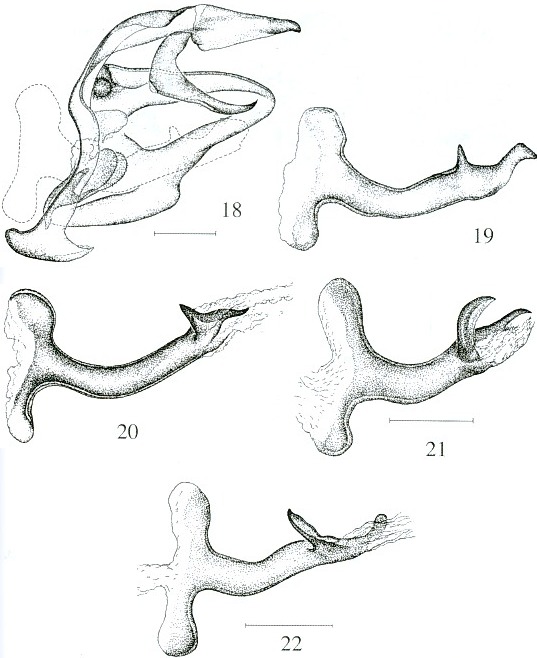
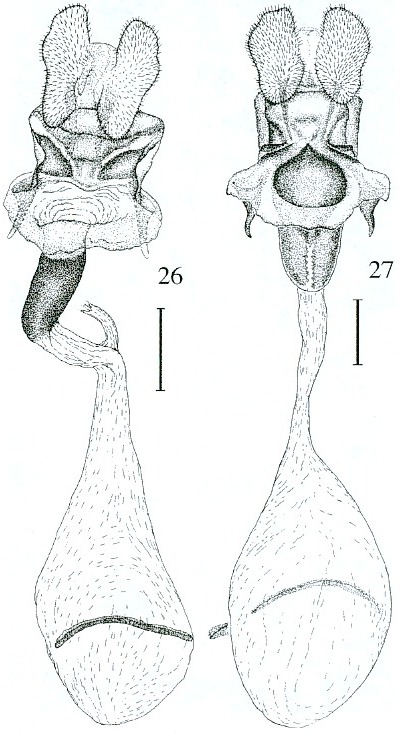
<body><![CDATA[<p><font face="Arial" size="2"><b>Male genitalia: </b>(<a  href="#fig10-17">Figs. 12, 13</a>). Apex of aedeagus with single downcurved spine. Distal part of aedeagus more elongate than in other species in complex, only slightly curved, with base and dorsal hump small in relation to it. Gnathos with basal part wide and angled downward; distal part narrows immediately beyond base. Valva triangulate with bump on ventral margin midway between apex and horizontal base. Membranous juxta lobes located lateral to aedeagus.</font></p>     <p><font face="Arial" size="2"><b>Female genitalia: </b>(<a  href="#fig26-27">Fig. 26</a>). Ostium bursae narrow and not broadly connected with bulbous sclerotized antrum below. Posterior lobe with two horizontal ridges similar to <i>fusc</i>a, though more shallow in between. Dorsum of 8th segment wrinkled and convex beyond posterior margin.</font></p>     <p><font face="Arial" size="2"><b>Remarks: </b>The altitudinal limit is from sea level to 1200 m. Specimens have been collected almost all year round, except for December. <i>N. singulara </i>has been only collected in the Costa Rican Caribbean zone associated with the rain forest. The species is named for the single spine at the apex of the aedeagus. </font></p>     <p><font face="Arial" size="2"><b>Distribution: </b><i>N. singulara </i>is only known on the Caribbean slope of Costa Rica.</font></p>     <p><font face="Arial" size="2"><b>Material Examined: </b>(75 spec</font><font face="Arial" size="2">imens, 71</font><font  face="Arial" size="2">&#9794;</font><font face="Arial" size="2">, 4</font><font  face="Arial" size="2">&#9792;</font><font face="Arial" size="2">)</font></p>     <p><font face="Arial" size="2"><i>Holotyp</i>e.</font><font face="Arial"  size="2"> &#9794;</font><font face="Arial" size="2">. Costa Rica: GUANACASTE: P. N. Guanacaste, Estacion Pitilla, 9 km Sur de Santa Cecilia, 700 m, (LN330200 - 380200), 22 Sep-14 Oct 1992, Calixto Moraga (CB:837554).</font></p>     <p><font face="Arial" size="2"><i>Paratypes. </i>Costa Rica: Costa Rica [only data on specimen], 1</font><font face="Arial" size="2">&#9794;</font><font  face="Arial" size="2">, Nevermann, 30. Nov 1935 (ZSBS)(CB:2226884); CARTAGO: Turrialba, 600 m, V.O. Becker, 7</font><font  face="Arial" size="2">&#9794;</font><font face="Arial" size="2">, 3 Dec 1972, 5 Mar 1973, 8 Apr 1973,10 May 1973, 20 May 1972, 10 Jul 1973, 10 Jan 1973, 25 Oct 1972, Jul 1981 (USNM)(CB: 1121210, 1121209, 1121212, 1121208, 1121205, 1121206, 1121213, 1121211, 2226878); Turrialba, 2 080 ft, Scullen &amp; Bolinger, 1</font><font  face="Arial" size="2">&#9792;</font><font face="Arial" size="2">, 22 Jul 1963, (USNM)(CB: 1147463); GUANACASTE: 4 km E. Casetilla, Rincón Nat.Pk., 750 m, 1</font><font face="Arial" size="2">&#9794;</font><font  face="Arial" size="2">, D. H. Janzen &amp; W. Hallwachs, 11 Apr 1983(USNM) (CB:1120952); Estación Pitilla, 9 km Sur de Santa Cecilia, 700 m, (LN 330200 - 380200), C. Moraga, 3</font><font face="Arial" size="2">&#9794;</font><font face="Arial"  size="2">, Aug 1991 (CB: 493481, 493497, 493498), 1</font><font  face="Arial" size="2">&#9794;</font><font face="Arial" size="2">, 1</font><font  face="Arial" size="2">&#9792;</font><font face="Arial" size="2">, Mar 1993 (CB:1203091, 1203092), 1</font><font face="Arial" size="2">&#9794;</font><font  face="Arial" size="2">, Jun 1991 (CB: 616847), 2</font><font  face="Arial" size="2">&#9794;</font><font face="Arial" size="2">, Oct 1992 (CB: 837460, 837461), 2</font><font face="Arial" size="2">&#9794;</font><font  face="Arial" size="2">, Oct 1993 (CB: 1641811, 1641813), 2 , Mar 1994 (CB: 1763663,1763664), 1</font><font face="Arial"  size="2">&#9794;</font><font face="Arial" size="2"> , 6-17 Sep 1993 (CB: 1614496), 1</font><font face="Arial" size="2">&#9794;</font><font face="Arial"  size="2">, 21-29 Nov 1992 (CB: 820507), Biodiversity Survey, 4</font><font face="Arial"  size="2">&#9794;</font><font face="Arial" size="2">, Jul 1988 (CB: 27736, 45814, 105489, 124467), 1</font><font face="Arial" size="2">&#9794;</font><font  face="Arial" size="2">, Oct 1988 (CB: 1055850), 2</font><font face="Arial" size="2">&#9794;</font><font  face="Arial" size="2">, May 1989 (CB: 1055852, 1055942), 1</font><font  face="Arial" size="2">&#9794;</font><font face="Arial" size="2">, 27 Jan-4 Feb 1989 (CB: 45814), 1</font><font face="Arial" size="2">&#9792;</font><font  face="Arial" size="2">, May 1988 (CB: 105489), 1</font><font face="Arial" size="2">&#9794;</font><font  face="Arial" size="2">, Aug 1988 (CB: 124467), P. Rios, 1</font><font  face="Arial" size="2">&#9794;</font><font face="Arial" size="2">, May 1991 (CB: 541429), 1</font><font face="Arial" size="2">&#9794;</font><font  face="Arial" size="2">, Aug 1991, 2</font><font face="Arial" size="2">&#9794;</font><font  face="Arial" size="2">, 18-23 Jul 1993, 1</font><font face="Arial"  size="2">&#9794;</font><font face="Arial" size="2">, 19-23 Jun 1993, 1</font><font  face="Arial" size="2">&#9794;</font><font face="Arial" size="2">, Oct 1994, 1</font><font  face="Arial" size="2">&#9794;</font><font face="Arial" size="2"> , Apr 1990 (CB: 615425), P. Rios, C. Moraga &amp; R. Blanco, 1</font><font face="Arial" size="2">&#9794;</font><font  face="Arial" size="2">, Mar 1990 (CB: 206034), C. Moraga &amp; P. Rios, 3</font><font face="Arial"  size="2">&#9794;</font><font face="Arial" size="2">, Nov 1989, 8</font><font  face="Arial" size="2">&#9794;</font><font face="Arial" size="2">, Sep 1989 (CB: 54660, 54662, 54663, 54664, 54665, 54747, 104344, 104449), A. Chacón &amp; M. Espinoza, 2</font><font face="Arial"  size="2">&#9794;</font><font face="Arial" size="2">, Jan 1988 (CB: 1119149, 1119152), M. Espinoza, 5</font><font face="Arial" size="2">&#9794;</font><font  face="Arial" size="2">, Jun 1988 (CB: 1119155, 1119299, 1119315, 1119325, 1119330), Espinoza &amp; Chaves, 4</font><font face="Arial" size="2">&#9794;</font><font  face="Arial" size="2">, Jul 1988 (CB: 1119154, 1119157, 1119158, 1119316), 2</font><font face="Arial" size="2">&#9794;</font><font  face="Arial" size="2">, Aug 1988, Janzen &amp; Hallwachs, 1</font><font face="Arial" size="2">&#9794;</font><font  face="Arial" size="2">, 18 May 1988, Taller de Microlepidoptera, 1</font><font  face="Arial" size="2">&#9794;</font><font face="Arial" size="2">, 23-26 Jun 1993, C. Moraga (CB: 54747), 1</font><font face="Arial" size="2">&#9794;</font><font  face="Arial" size="2">, 4-24 Apr 1995 (CB: 2141241); LIMON: Reventazon, 25 m, 1</font><font face="Arial" size="2">&#9794;</font><font  face="Arial" size="2">, Ferd. Nevermann, 15 Apr 1923 (ZSBS)(CB: 2226883), Hac. La Suerte/Tapezco, 29 air km W Tortuguero, 10.49 degrees N, 83.78 degrees W, 13-31 Aug 1979, 3</font><font face="Arial" size="2">&#9794;</font><font  face="Arial" size="2">, J. &amp; K. Donahue, C. Hair, N. Moore, M. Hopkins (LACM) (CB: 1147427, 1147432, 1147433); SAN JOSE: Carrillo, 1</font><font  face="Arial" size="2">&#9794;</font><font face="Arial" size="2">, 15 Jun 1900 (ZSBS)(CB: 22268</font><font face="Arial" size="2">79).</font></p>     <p style="text-align: center;"><font face="Arial" size="2">&nbsp;</font><font  face="Arial" size="2"><i>Natada confusa </i>sp. n.    <br> </font><font face="Arial" size="2">(<a href="#fig18-22">Figs. 18, 19, 20, 21, 22</a>, <a href="#fig26-27">27</a>, <a href="#fig28-40">37, 38</a>)</font></p>     <p><font face="Arial" size="2"><b>Diagnosis: </b>Aedeagus elongate with two distal processes variable in length, shape, and direction.</font></p>     ]]></body>
<body><![CDATA[<p><font face="Arial" size="2"><b>Adult male: </b>(<a href="#fig28-40">Fig. 37</a>). Forewing length: 14.3-16.9 mm (holotype 16.0 mm). External features same as <i>fusca </i>(see description above).</font></p>     <p><font face="Arial" size="2"><b>Adult female: </b>(<a  href="#fig28-40">Fig. 38</a>). Forewing length: 18.0-20.0 mm. Similar to the male in patterns and color.</font></p>     <p><font face="Arial" size="2"><b>Male genitalia: </b>(<a  href="#fig18-22">Figs. 18, 19, 20, 21, 22</a>).Apex of the aedeagus with two processes of variable length and direction (<a href="#fig18-22">Figs. 19-22</a>) (see "Remarks" below). Dorsal hump nearly equal to basal arm or longer. Distal arm with shallow ushaped curve. Gnathos with pointed upcurved apex. Valva with ventral concavity between apex and horizontal base.</font></p>     <p><font face="Arial" size="2"><b>Female genitalia: </b>(<a  href="#fig26-27">Fig. 27</a>). Antrum and ostium bursae broadly connected, similar to <i>fusc</i>a. Major difference is dorsal side of antrum extends to posterior lobe, dividing anterior ridge in two parts, and sensory hairs less pronounced. Dorsum of 8th segment convex, similar <i>singular</i>a.</font></p>     <p><font face="Arial" size="2"><b>Host plant: </b><i>Swietenia macrophylla </i>(Meliaceae)(90-SRNP-1300), <i>Spondias mombin </i>(Anacardiaceae)(89-SRNP-843).</font></p>     <p><font face="Arial" size="2"><b>Remarks: </b>The anterior process of the aedeagus of <i>confusa </i>tends to be directed toward the dorsum in specimens at the limits of the range in northern Mexico and along the Pacific Coast in Guatemala, El Salvador, and northern Costa Rica (<a href="#fig18-22">Fig. 19</a>) (note: the anterior process is often hooked laterad and left at the apex). Specimens from Nicaragua and Honduras have sharp narrow processes forming a wide V (<a href="#fig18-22">Fig. 20</a>) (note: the anterior process is directed laterally to the left, so it appears foreshortened). Specimens from Tikal, Guatemala are similar to those from Nicauragua and Honduras, but possess a rounded, upcurved posterior process (<a  href="#fig18-22">Fig. 22</a>). The most distinctive geographic form of <i>confusa </i>occurs in the state of Veracruz, Mexico (<a href="#fig18-22">Fig. 21</a>). It has the broadest aedeagus, with distal arm thick, anterior process on the left side, is strong, curved, and directed toward the apex, and the posterior process is long, sharp, and well sclerotized. </font></p>     <p><font face="Arial" size="2">The name <i>confusa </i>refers to the confusion surrounding the limits of this species due to the variation discussed above. The altitudinal range of this species is from sea level to 700 m. The specimens were collected from April through June and October. In Costa Rica, <i>N. confusa </i>has been collected only in the dry forests.</font></p>     <p><font face="Arial" size="2"><b>Distribution: </b><i>N. confusa </i>is known from the Mexican gulf coast to northern Pacific slope of Costa Rica.</font></p>     <p><font face="Arial" size="2"><b>Material Examined: </b>(106 specimen</font><font face="Arial" size="2">s, 100</font><font  face="Arial" size="2">&#9794;</font><font face="Arial" size="2">, 6</font><font  face="Arial" size="2">&#9792;</font><font face="Arial" size="2">)</font></p>     <p><font face="Arial" size="2"><i>Holotype. </i>. Honduras: San Pedro Sula, 700 m, Robert D. Lehman, 15 Jul 1979 (USNM)(CB: 1147143)</font></p>     ]]></body>
<body><![CDATA[<p><font face="Arial" size="2"><i>Paratypes. </i>México: CHIAPAS:     Santa Anita, 1</font><font face="Arial" size="2">&#9794;</font><font      face="Arial" size="2">, C. C. Hoffmann, 14 Jul 1930     (AMNH)(CB:1150036); La Granja, 1</font><font face="Arial" size="2">&#9794;</font><font      face="Arial" size="2">, C. C.     Hoffmann, 28 Jul 1930, No. 2030, <i>"Natada salta </i>Drc."     (AMNH)(CB: 1150037); TAMAULIPAS.: Rancho del Cielo, 6 km NNW Gomez     Farias, 3500 ft, 1</font><font face="Arial" size="2">&#9794;</font><font      face="Arial" size="2">, M. A. Solis, July1982 (USNM)(CB: 1147431); El     Ensino, 250 m, 4-13 Aug 1988, 2</font><font face="Arial" size="2">&#9794;</font><font     ]]></body>
<body><![CDATA[ face="Arial" size="2">, V. O. Becker (VOB#     68922)(VOB), 1</font><font face="Arial" size="2">&#9794;</font><font      face="Arial" size="2">, (USNM) (CB: 1121364); Gómez Farias, 1200 m, 2</font><font      face="Arial" size="2">&#9794;</font><font face="Arial" size="2">, 26 May     1997, V. O. Becker Col, (VOB# 109184) (VOB); SAN     LUIS POTOSI: Rancho Quemado, Rt 85, km 353, 4-6 Aug 1966, 1</font><font      face="Arial" size="2">&#9792;</font><font face="Arial" size="2">, O.S. Flint     (USNM)(CB: 1121361); Xilitla, Vencidor Station,     3750 ft, 1</font><font face="Arial" size="2">&#9794;</font><font face="Arial"      size="2">, W. H. Howe, 12 June 1974 (AMNH)(CB: 1150040);     ]]></body>
<body><![CDATA[San Luis Potosi, Tamazunchele, 300 ft, 1</font><font face="Arial"      size="2">&#9794;</font><font face="Arial" size="2">, W. H.     Howe, 24 Apr 1977 (AMNH)(CB: 1150040); VERACRUZ: Cordova, 2</font><font      face="Arial" size="2">&#9794;</font><font face="Arial" size="2">, Wm Schaus,     May [19]06 (USNM)(CB: 2607577, 2249405), 1</font><font face="Arial"      size="2">&#9794;</font><font face="Arial" size="2">, Apr 1906 (USNM)(CB:     1146206), 1</font><font face="Arial" size="2">&#9794;</font><font face="Arial"      size="2">, Wm Schaus,     "v" [May?](USNM)(CB: 2607597), 1</font><font face="Arial" size="2">&#9794;</font><font      face="Arial" size="2">, Fredk     ]]></body>
<body><![CDATA[Knab, 28 Apr 1908 (USNM)(CB: 1146209)(Fig. 21); Jalapa, 1</font><font      face="Arial" size="2">&#9794;</font><font face="Arial" size="2">, Wm Schaus     (USNM)(CB: 1147141); Misantla, 1</font><font face="Arial" size="2">&#9794;</font><font      face="Arial" size="2">, Apr 1909 (ZSBS)(CB: 2249397), 1</font><font      face="Arial" size="2">&#9792;</font><font face="Arial" size="2">, Sep 29     (ZSBS)(CB:3030197); Orizaba, 1</font><font face="Arial" size="2">&#9794;</font><font      face="Arial" size="2">, May 1908 (USNM)(CB:     1146208), 1</font><font face="Arial" size="2">&#9794;</font><font face="Arial"      size="2">, C. C. Hoffmann, May 1909 (AMNH)(CB: 1150038), 1</font><font      face="Arial" size="2">&#9792;</font><font face="Arial" size="2">, Jul [19?]     ]]></body>
<body><![CDATA[10, 1</font><font face="Arial" size="2">&#9792;</font><font face="Arial"      size="2">, May [19?]11 (ZSBS) (CB:     3030196), 1</font><font face="Arial" size="2">&#9792;</font><font face="Arial"      size="2">, no date (ZSBS)(CB: 2249404); CAMPECHE,     Escarcega, 85 m, 2</font><font face="Arial" size="2">&#9794;</font><font      face="Arial" size="2">, V. O. Becker, 17-21 May 1981 (Col. Becker     42916)(USNM)(CB: 1121360)(VOB)(Col. Becker 42917); Belize: Augustine,     Mt. Pine Ridge, 500 m, 24-25 Sep 1973, V.O. Becker, 2</font><font      face="Arial" size="2">&#9794;</font><font face="Arial" size="2">, (VOB)(VOB#     31408), (USNM) (CB: 1147142); Guatemala: 1</font><font face="Arial"     ]]></body>
<body><![CDATA[ size="2">&#9794;</font><font face="Arial" size="2">, "Guatemala", [Lg.     Brodinas?] (ZSBS) (2249402); 1</font><font face="Arial" size="2">&#9794;</font><font      face="Arial" size="2">, Dept. Retalhuleu Pte. El Nino, Flint &amp;     Ortiz, 16 Jun     1966 (USMN)(CB: 1121365);1</font><font face="Arial" size="2">&#9794; </font><font      face="Arial" size="2">Quirigua, Dec, Schaus     &amp; Barnes Coll (USNM) (CB:1147145); Tikal, 200 m, 2</font><font      face="Arial" size="2">&#9794;</font><font face="Arial" size="2">, S.     Steinhauser, 10 May 1969 (USNM) (CB: 1121363 [Fig. 22],     2607596); Tikal, Petén, Guatemala, 19-22 Sep 1973, V.O. Becker, 1</font><font     ]]></body>
<body><![CDATA[ face="Arial" size="2">&#9794;</font><font face="Arial" size="2"> (VOB #     31400)(CB: 3030198); El Salvador: San Salvador,     Amérique centrale, 1</font><font face="Arial" size="2">&#9794;</font><font      face="Arial" size="2">, Dognin Collection (USNM)(CB: 1147177); San     Salvador, 600 m, 2</font><font face="Arial" size="2">&#9794;</font><font      face="Arial" size="2">, 29 May 1960, 12 Jun 1960, leg. Bechyné     (ZSBS)(CB: 2249403, 2607583); Santa Tecla, 900 m, 1</font><font      face="Arial" size="2">&#9794;</font><font face="Arial" size="2">, S.R. &amp;     L. M. Steinhauser, 19 May 1968 (USNM)(CB:     2607581), 5</font><font face="Arial" size="2">&#9794;</font><font face="Arial"     ]]></body>
<body><![CDATA[ size="2">, L. Steinhauser, 18-31 May 1968 (USNM)(CB:     2607579, 2607582, 2607585, 2607584, 1147144); Nicaragua: Esteli, 2</font><font      face="Arial" size="2">&#9794;</font><font face="Arial" size="2">, V. O.     Becker, 3 Sep 1973 (VOB)(USNM)(CB: 1146212)(Fig. 20);     Costa Rica: GUANACASTE: P. N. Santa Rosa, A. C. Guanacaste, 300 m, (LN     313000 -359800), D. H. Janzen, 1</font><font face="Arial" size="2">&#9794;</font><font      face="Arial" size="2">, 13-15 Jul     1979 (USNM) (CB: 1120955), 2</font><font face="Arial" size="2">&#9794;</font><font      face="Arial" size="2">, 18-20 May 1979 (CB:     1119113, 1119126), 2</font><font face="Arial" size="2">&#9794;</font><font     ]]></body>
<body><![CDATA[ face="Arial" size="2">, 29-31 May 1979, 3 , 23 May 1978 (CB: 1119104,     1119106, 1119131), 4</font><font face="Arial" size="2">&#9794;</font><font      face="Arial" size="2">, 5 June 1978 (CB: 1119089, 1119101, 1119116,     1119120), 4</font><font face="Arial" size="2">&#9794;</font><font face="Arial"      size="2">, 15-17 May 1979, D. H. Janzen &amp; W.     Hallwachs (CB: 1119090, 1119091, 1119103, 1119107), 4</font><font      face="Arial" size="2">&#9794;</font><font face="Arial" size="2">, May 1985     (CB: 1119313, 1119321, 1119328, 1120061), 5</font><font face="Arial"      size="2">&#9794;</font><font face="Arial" size="2">, May 1983 (CB: 1119802,     1119806, 1120046, 1120047, 1120056),     ]]></body>
<body><![CDATA[2</font><font face="Arial" size="2">&#9794;</font><font face="Arial" size="2">,     Jun 1994 (CB: 1987553, 1987555), 1</font><font face="Arial" size="2">&#9794;</font><font      face="Arial" size="2">, 2-4 May 1980, 1</font><font face="Arial"      size="2">&#9794;</font><font face="Arial" size="2">, Apr 1983 (CB:     1119318)(Fig. 19), 1</font><font face="Arial" size="2">&#9794;</font><font      face="Arial" size="2">, 17-19 May 1980 (CB: 1119105); Area     Administrativa, 280 m, 1</font><font face="Arial" size="2">&#9794;</font><font      face="Arial" size="2">, 5 Jul 1982, D.H. Janzen     (82-SRNP-450); Bosque San Emilio, 300 m, "gusaneros", 1</font><font      face="Arial" size="2">&#9792;</font><font face="Arial" size="2">, 5 Aug     ]]></body>
<body><![CDATA[1989, (89-SRNP-843), 1</font><font face="Arial" size="2">&#9794;</font><font      face="Arial" size="2">, 5 Aug 1989     (90-SRNP-1300); Est. Murciélago, 8 km SW Cuajiniquil, 100 m, (LN     320300-347200), F. A. Quesada, 9</font><font face="Arial" size="2">&#9794;</font><font      face="Arial" size="2">, 3-19 Sep     1994 (CB: 2033930, 2033931, 2033932, 2033933, 2033934, 2033935,     2033936, 2033937, 2033938), 2</font><font face="Arial" size="2">&#9794;</font><font      face="Arial" size="2">, 18 May - 5 Jun 1995     (CB: 1182202, 1182292), 1</font><font face="Arial" size="2">&#9794;</font><font      face="Arial" size="2">, 7-25 Mar 1994 (CB:     ]]></body>
<body><![CDATA[1758880), C. Cano, 2</font><font face="Arial" size="2">&#9794;</font><font      face="Arial" size="2">, 4-18 Sep 1994 (CB: 2022336, 2022340), 2</font><font      face="Arial" size="2">&#9794;</font><font face="Arial" size="2">, 10-28 Sep     1993 (CB: 1955976, 1955978), 1</font><font face="Arial" size="2">&#9794;</font><font      face="Arial" size="2">, 11-29 Aug 1993 (CB: 1945883); Casa Oeste,     Cerro el Hacha,     12 km SE La Cruz, 300 m, 5</font><font face="Arial" size="2">&#9794;</font><font      face="Arial" size="2">, A. Chacón, Oct 1987     (CB: 1119114, 1119124, 1119128, 1119295, 1119298); Est. Maritsa, Hda.     Orosí, 550 m, W. Hallwachs &amp; D. H. Janzen, 1 , 2-5 Jun 1986 (CB:     ]]></body>
<body><![CDATA[1119148); Bahía Santa Elena, P. N. Guanacaste, A. C. Guanacaste, 100 m,     (LN 321800 - 339100), F. A. Quesada, 2</font><font face="Arial" size="2">&#9794;</font><font      face="Arial" size="2">, 11 Jun     1994 (CB: 1966400); Finca Jenny, 30 km N. Liberia, 240 m, (LN 317150-     363700), 1</font><font face="Arial" size="2">&#9794;</font><font face="Arial"      size="2">, E. Araya, 6 Nov -5 Dec 1994 (CB: 2193747);     Agua Buena, 220 m, (LN 334800-364100), 1</font><font face="Arial"      size="2">&#9794;</font><font face="Arial" size="2">, III Curso     de Parataxónomos, Jun 1992 (CB: 858460); Est. los Almendros, P. N. G.     300 m, (LN 334800-369800), 1</font><font face="Arial" size="2">&#9794;</font><font     ]]></body>
<body><![CDATA[ face="Arial" size="2">, E. Lopez, 18-26 May     1993 (CB: 1750692).</font></p>     <div style="text-align: center;"><font face="Arial" size="2"><i>Natada chaconi </i>sp. n.</font>    <br> </div>     <div style="text-align: center;"><font face="Arial" size="2">(<a  href="#fig10-17">Figs. 14, 15</a>, <a href="#fig28-40">39</a>)</font></div>     <p><font face="Arial" size="2"><b>Diagnosis: </b>Male forewing longest in <i>fusca </i>complex and with a unique dark reddish ground color. Gnathos distal arm is most horizontal relative to uncus of any species in complex. Aedeagus apex with a dorsal process on each side rather than one anterior and one posterior as in <i>confusa </i>and <i>covell</i>i.</font></p>     <p><font face="Arial" size="2"><b>Adult male: </b>(<a href="#fig28-40">Fig. 39</a>). Forewing length: 19.3 mm. External features same as <i>fusca </i>except for dark reddish ground color of forewing (see description above). </font></p>     <p><font face="Arial" size="2"><b>Adult female: </b>Unknown.</font></p>     <p><font face="Arial" size="2"><b>Male genitalia: </b>(<a  href="#fig10-17">Fig. 14, 15</a>). Aedeagus apex with a small, rounded process on each side of dorsum, giving apex a truncated appearance. Membranous juxta lobes located ventral to aedeagus. Gnathos with distal arm angled parallel with uncus and extending nearly as far to posterior. Valva triangulate with bump on ventral margin near apex and concave from bump to horizontal base.</font></p>     <p><font face="Arial" size="2"><b>Remarks: </b>The species is only known from the type specimen, which was collected in February in the Costa Rican Caribbean slope rain forest. <i>N. chaconi </i>is named in honor of Isidro and Abelardo Chacón Gamboa, for their important contribution to the study of Lepidoptera in Costa Rica.</font></p>     ]]></body>
<body><![CDATA[<p><font face="Arial" size="2"><b>Distribution: </b><i>N. chaconi </i>is only known from old Braulio Carrillo station near Río Sucio, Costa Rica. </font></p>     <p><font face="Arial" size="2"><b>Material Examined: </b>(1</font><font  face="Arial" size="2">&#9794; </font><font face="Arial" size="2">specimen)</font></p>     <p><font face="Arial" size="2"><i>Holotype </i></font><font  face="Arial" size="2">&#9794;</font><font face="Arial" size="2">. Co</font><font  face="Arial" size="2">sta Rica: Estacion Carrillo, Pk. Nac. Braulio Carrillo. Prov. San Jose, 700 m Feb 1985 Coll. I. &amp; A. Chacón (LN 238500 B 541200)(CB: 1119317).</font></p>     <div style="text-align: center;"><font face="Arial" size="2"><i>Natada covelli </i>sp. n.</font>    <br> </div>     <div style="text-align: center;"><font face="Arial" size="2">(<a  href="#fig10-17">Figs. 16, 17</a>, <a href="#fig28-40">40</a>)</font></div>     <p><font face="Arial" size="2"><b>Diagnosis: </b>Only species in <i>fusca </i>complex with valva having both narrow apex and convex ventral margin.</font></p>     <p><font face="Arial" size="2"><b>Adult male: </b>(<a href="#fig28-40">Fig. 40</a>). Forewing length: 15.0-16.0 mm (holotype male 15.0 mm). External features same as <i>fusca </i>(see description above).</font></p>     <p><font face="Arial" size="2"><b>Adult female: </b>Unknown.</font></p>     <p><font face="Arial" size="2"><b>Male genitalia: </b>(<a  href="#fig10-17">Figs. 16, 17</a>). Apex of aedeagus with two small dorsal processes, one to anterior on left side more developed and other to posterior arises on right side. Distal arm of aedeagus bent in middle. Gnathos distal arm sinuate above and below. Valva with ventral margin convex to base after indentation near apex.</font></p>     ]]></body>
<body><![CDATA[<p><font face="Arial" size="2"><b>Remarks: </b>This species is named after Dr. Charles V. Covell, Jr. (University of Louisville), who collected the holotype of this species. Covell’s active work in New World moths, especially in the Geometridae, and his field guide to moths, have encouraged a new generation of lepidopterists.</font></p>     <p><font face="Arial" size="2"><b>Distribution: </b>This species is found only in the southern part of the Pacific slope in Colombia and in northern Ecuador. </font></p>     <p><font face="Arial" size="2"><b>Material Examined: </b>(</font><font  face="Arial" size="2">7</font><font face="Arial" size="2">&#9794; </font><font  face="Arial" size="2">specimens) <i>Holotype </i>. Ecuador: Tinalandia, el 700 m, Pichinchi Prov. 24 Jun 1983, C. V. Covell, Jr. (USNM)(CB: 2607501).</font></p>     <p><font face="Arial" size="2"><i>Paratype</i>s. Colombia: 2</font><font  face="Arial" size="2">&#9794;</font><font face="Arial" size="2">, C. C. Hq., Bajo Calima, 300ft, Valle Colombia, J. Bolling Sullivan 11-12 Jan 1985 (USNM) (CB: 2607502, 2607500); 1</font><font  face="Arial" size="2">&#9794;</font><font face="Arial" size="2">, Dept. Valle Anchicaya, 600 m, long. 76° 53", lat. 3° 33’, 20 - 24 Jan 1992, J. Bolling Sullivan (USNM) (CB: 1146205) (Figs. 16, 17); 1</font><font face="Arial" size="2">&#9794;</font><font face="Arial"  size="2">, Colombia [only data on specimen] (USNM) (CB: 2607503); Ecuador: 1</font><font face="Arial" size="2">&#9794;</font><font  face="Arial" size="2">, Tinalandia, el 700 m, Pichinchi Prov., H. V. Weems, Jr, 10 - 17 Jul 1983 (FSCA)(CB: 2226889); 1</font><font  face="Arial" size="2">&#9794;</font><font face="Arial" size="2">, Pichincha Tinalandia, 16 km E Santo Domingo de los Colorados, 600 m, 5-11 May 1990, R.H. Leuschner (LACM) (CB: 11474</font><font  face="Arial" size="2">29).</font></p> <font face="Arial" size="2"><b>     <p>Acknowledgments</p> </b></font>     <p><font face="Arial" size="2">The authors extend their gratitude to all of INBio’s personnel with special thanks to the parataxonomists who collected the material used for this work. Thanks also to John W. Brown and Michael G. Pogue (Systematic Entomology Laboratory, USDA) for reviewing the manuscript, José A. Herrera and Asha Patel for their excellent illustrations of genitalia, to Bernardo A. Espinoza for preparation of dissections and locating specimens, to Daniel Janzen (U. Pennsylvania) for providing voucher specimens and manuscript review, to Vitor O. Becker, Julian P. Donahue (LACM), John B. Heppner (FSCA), the staff of ZSBS and Martin Honey (BMNH) for loaning specimens, Marcela Arguedas (Agrónoma, Instituto Tecnológico de Costa Rica) for host plant records, and finally to John M. Burns (USNM) for discussions about species in the <i>fusca </i>complex.</font></p> <font face="Arial" size="2"><b>     <p>Resumen</p> </b></font>     <p><font face="Arial" size="2">Se describen seis nuevas especies en el género <i>Natad</i>a, las cuales habían estado escondidas bajo el nombre <i>Natada fusca </i>Druce, que se definen principalmente por los genitales. La nuevas especies incluyen N. <i>burns</i>i, N. <i>truncat</i>a, <i>N. singular</i>a, N. <i>chaconi, N. covell</i>i, y N. <i>confus</i>a. Cinco de ocho especies en el complejo <i>Natada fusc</i>a, que también incluye a <i>N. fuscodivisa </i>Dognin, están presentes en Costa Rica. La distribución del complejo tiene un ámbito desde México hasta el escudo del Amazonas y de las Guayanas. Se proporciona información geográfica detallada y múltiples dibujos de los genitales masculinos de la especie <i>N. confus</i>a, para ayudar a separar las especies. Se designaron el lectotipo y el paralectotipo de <i>N. fusc</i>a.    <br> &nbsp;     <br> </font></p>     ]]></body>
<body><![CDATA[<div style="text-align: center;"><a name="fig1-9"></a><img alt=""  src="/img/fbpe/rbt/v51n2/2481i1.JPG" style="width: 507px; height: 739px;">    
<br> </div>     <div style="text-align: center;"><font face="Arial" size="2">Figs. 1-9. Male genitalia (lateral view with left valva removed). 1-3, Natada fusca (lectotype, Panama): 1, lateral view of </font><font face="Arial"  size="2">genitalia; 2, aedeagus; 3, right lateral view of aedeagus apex; 4-6, N. fuscodivisa (Cuzco, Peru): 4, lateral view of genitalia; 5, aedeagus; 6, right lateral view of aedeagus apex; 7-9, N. burnsi, new species (CB: 1121355): 7, lateral view of genitalia; </font><small><span  style="font-family: arial;">8, aedeagus; 9, right lateral view of aedeagus apex. (scale = 1mm).</span></small>    <br> </div>     <p><font face="Arial" size="2">&nbsp;&nbsp;     <br> <a name="fig10-17"></a></font></p>     <div style="text-align: center;"><font face="Arial" size="2"><img alt=""  src="/img/fbpe/rbt/v51n2/2481i2.JPG" style="width: 454px; height: 733px;">    
<br> Figs. 10-17. Male genitalia (lateral view with left valva removed). 10-11, Natada truncata, new species (CB: 1119145): 10,    <br> lateral view of genitalia; 11, aedeagus; N. singulara (CB: 541429): 12, lateral view of genitalia; 13, aedeagus; 14-15, N.    <br> chaconi, new species (holotype, CB: 1119317): 14, lateral view of genitalia; 15, aedeagus; 16-17, N. covelli, new species    ]]></body>
<body><![CDATA[<br> (CB: 1146205): 16, lateral view of genitalia; 17, aedeagus. (scale = 1mm).    <br> &nbsp;&nbsp;     <br> <a name="fig18-22"></a><img alt="" src="/img/fbpe/rbt/v51n2/2481i3.JPG"  style="width: 537px; height: 658px;">    
<br> Figs. 18-22. Natada confusa, new species, male genitalia (lateral view with left valva removed) and distribution. 18-19,    <br> (Guanacaste, Costa Rica, CB: 1119318): 18, lateral view of genitalia; 19, aedeagus; 20, aedeagus (Esteli, Nicaragua, CB:    <br> 1146212); 21, aedeagus (Tikal, Guatemala, CB: 1121363); 22, aedeagus (Veracruz, México, CB: 1146209). (scale = 1mm).    <br> &nbsp;     <br> <a name="fig23-25"></a><img alt="" src="/img/fbpe/rbt/v51n2/2481i4.JPG"  style="width: 488px; height: 537px;">    
<br> Figs. 23-25. Female genitalia (ventral view). 23, Natada fusca (CB: 1119329); 24, N. fuscodivisa (Fonte Boa, Brazil); 25,    <br> N. truncata, new species (CB: 590569). (scale = 1mm).    ]]></body>
<body><![CDATA[<br> &nbsp;&nbsp;&nbsp;     <br> <a name="fig26-27"></a><img alt="" src="/img/fbpe/rbt/v51n2/2481i5.JPG"  style="width: 401px; height: 735px;">    
<br> Figs. 26-27. Female genitalia (ventral view). 26, Natada singulara, new species (CB: 641212); 27, N. confusa, new species    <br> (CB: 1119806). (scale = 1mm).    <br> &nbsp;&nbsp;     <br> <a name="fig28-40"></a><img alt="" src="/img/fbpe/rbt/v51n2/2481i6.JPG"  style="width: 459px; height: 727px;">    
<br> Figs. 28-40. Species in the Natada fusca complex. 28-29, N. fusca: 28, male (CB: 1328653); 29, female (CB: 119329);    <br> 30-31, N. fuscodivisa: 30, male (holotype); 31, female; 32, N. burnsi, new species, male (holotype, CB: 2009806); 33-34,    <br> N. truncata new species: 33, male (holotype, CB: 2344631); 34, female (CB: 590569); 35-36, N. singulara, new species:    <br> 35, male (CB: 1120040); 36, female (CB: 1118507); 37-38, N. confusa, new species: 37, male (CB: 2033936); 38, female    ]]></body>
<body><![CDATA[<br> (CB: 1119802); 39, N. chaconi, new species, male (holotype, CB: 1119317); 40, N. covelli, new species, male (holotype,    <br> CB: 2607501).    <br> </font></div> <font face="Arial" size="2"><b>     <p>References</p> </b></font>     <!-- ref --><p><font face="Arial" size="2"><a name="Corrales"></a>Corrales, J.F. and M.E. Epstein. 2000. New species in the New World <i>Natada </i>complex (Lepidoptera: Limacodidae). Rev. Biol. Trop. 48: 591-604.    &nbsp;&nbsp;&nbsp;&nbsp;&nbsp;&nbsp;&nbsp;&nbsp;[&#160;<a href="javascript:void(0);" onclick="javascript: window.open('/scielo.php?script=sci_nlinks&ref=1663510&pid=S0034-7744200300020001700001&lng=','','width=640,height=500,resizable=yes,scrollbars=1,menubar=yes,');">Links</a>&#160;]<!-- end-ref --></font></p>     <!-- ref --><p><font face="Arial" size="2"><a name="Druce"></a>Druce, H. 1887. Biologia Centrali-Americana. Insecta. Lepidoptera-Heterocera. Vol.1. pp. 201-256.    &nbsp;&nbsp;&nbsp;&nbsp;&nbsp;&nbsp;&nbsp;&nbsp;[&#160;<a href="javascript:void(0);" onclick="javascript: window.open('/scielo.php?script=sci_nlinks&ref=1663512&pid=S0034-7744200300020001700002&lng=','','width=640,height=500,resizable=yes,scrollbars=1,menubar=yes,');">Links</a>&#160;]<!-- end-ref --></font></p>     <!-- ref --><p><font face="Arial" size="2"><a name="Dognin"></a>Dognin, P. 1910. Hétérocèras Nouveaux de L’Amérique du Sud. Fascicle I. Oberthür, Rennes.    &nbsp;&nbsp;&nbsp;&nbsp;&nbsp;&nbsp;&nbsp;&nbsp;[&#160;<a href="javascript:void(0);" onclick="javascript: window.open('/scielo.php?script=sci_nlinks&ref=1663514&pid=S0034-7744200300020001700003&lng=','','width=640,height=500,resizable=yes,scrollbars=1,menubar=yes,');">Links</a>&#160;]<!-- end-ref --></font></p>     ]]></body>
<body><![CDATA[<!-- ref --><p><font face="Arial" size="2"><a name="Dyar"></a>Dyar, H.G. 1935.[1936-1937]. Limacodidae. <i>In </i>A. Seitz (ed.). The Macrolepidoptera of the World. The American Bombyces and Sphinges. 6:1104-1139. [1113-1136 (1937), 1137-1256 (1936), Heppner 1982]</font>&nbsp;&nbsp;&nbsp;&nbsp;&nbsp;&nbsp;&nbsp;&nbsp;[&#160;<a href="javascript:void(0);" onclick="javascript: window.open('/scielo.php?script=sci_nlinks&ref=1663516&pid=S0034-7744200300020001700004&lng=','','width=640,height=500,resizable=yes,scrollbars=1,menubar=yes,');">Links</a>&#160;]<!-- end-ref --><!-- ref --><p><font face="Arial" size="2"><a name="Forbes"></a>Forbes, W.T.M. 1942. The Lepidoptera of Barro Colorado Island, Panama. No. 2. Bull. Mus. Comp. Zool. 90: 265-406.    &nbsp;&nbsp;&nbsp;&nbsp;&nbsp;&nbsp;&nbsp;&nbsp;[&#160;<a href="javascript:void(0);" onclick="javascript: window.open('/scielo.php?script=sci_nlinks&ref=1663517&pid=S0034-7744200300020001700005&lng=','','width=640,height=500,resizable=yes,scrollbars=1,menubar=yes,');">Links</a>&#160;]<!-- end-ref --></font></p>     <!-- ref --><p><font face="Arial" size="2"><a name="Holloway"></a>Holloway, J.D. 1986. The Moths of Borneo: Key to Families; Families Cossidae, Metarbelidae, Ratardidae, Dudgeoneidae, Epipyropidae and Limacodidae. The Malayan Nature Journal, 40: 1-166.    &nbsp;&nbsp;&nbsp;&nbsp;&nbsp;&nbsp;&nbsp;&nbsp;[&#160;<a href="javascript:void(0);" onclick="javascript: window.open('/scielo.php?script=sci_nlinks&ref=1663519&pid=S0034-7744200300020001700006&lng=','','width=640,height=500,resizable=yes,scrollbars=1,menubar=yes,');">Links</a>&#160;]<!-- end-ref --></font></p> <small style="font-weight: bold; font-family: arial;">Internet references</small>     <!-- ref --><p><font face="Arial" size="2"><a name="Janzen"></a>Janzen, D.H. and W. Hallwachs. 2003. Philosophy, navigation and use of a dynamic database ("ACG Caterpillars SRNP") for an inventory of the macro-caterpillar fauna, and its food plants and parasitoids, of the Área de Conservación Guanacaste (ACG), northwestern Costa Rica. (Downloaded: February 12, 2003. </font><a  href="http://janzen.sas.upenn.edu%29/"><font face="Arial" size="2">http://janzen.sas.upenn.edu)</font></a><font  face="Arial" size="2">.    &nbsp;&nbsp;&nbsp;&nbsp;&nbsp;&nbsp;&nbsp;&nbsp;[&#160;<a href="javascript:void(0);" onclick="javascript: window.open('/scielo.php?script=sci_nlinks&ref=1663521&pid=S0034-7744200300020001700007&lng=','','width=640,height=500,resizable=yes,scrollbars=1,menubar=yes,');">Links</a>&#160;]<!-- end-ref --><br> &nbsp;     <br> </font></p>     <p><font face="Arial" size="2"><a name="a1"></a><a href="2481.htm#r1">1</a> Formerly at Instituto Nacional de Biodiversidad (INBio), 22-3100, Sto. Domingo, Heredia, Costa Rica.</font></p>     <p><font face="Arial" size="2"><a href="2481.htm#r1">2</a> Department of Entomology, National Museum of Natural History, Smithsonian Institution, Washington, D.C. 20560-105, </font><a  style="font-family: arial;" href="mailto:epstein.marc@nmnh.si.edu"><font  size="2">epstein.marc@nmnh.si.edu</font></a><font  style="font-family: arial;" face="Arial" size="2"> .</font></p>     ]]></body>
<body><![CDATA[ ]]></body><back>
<ref-list>
<ref id="B1">
<nlm-citation citation-type="journal">
<person-group person-group-type="author">
<name>
<surname><![CDATA[Corrales]]></surname>
<given-names><![CDATA[J.F.]]></given-names>
</name>
<name>
<surname><![CDATA[Epstein]]></surname>
<given-names><![CDATA[M.E.]]></given-names>
</name>
</person-group>
<article-title xml:lang="en"><![CDATA[New species in the New World Natada complex (Lepidoptera: Limacodidae)]]></article-title>
<source><![CDATA[Rev. Biol. Trop.]]></source>
<year>2000</year>
<volume>48</volume>
<page-range>591-604</page-range></nlm-citation>
</ref>
<ref id="B2">
<nlm-citation citation-type="">
<person-group person-group-type="author">
<name>
<surname><![CDATA[Druce]]></surname>
<given-names><![CDATA[H.]]></given-names>
</name>
</person-group>
<source><![CDATA[Biologia Centrali-Americana: Insecta. Lepidoptera-Heterocera]]></source>
<year>1887</year>
<volume>1</volume>
<page-range>201-256</page-range></nlm-citation>
</ref>
<ref id="B3">
<nlm-citation citation-type="book">
<person-group person-group-type="author">
<name>
<surname><![CDATA[Dognin]]></surname>
<given-names><![CDATA[P.]]></given-names>
</name>
</person-group>
<source><![CDATA[Hétérocèras Nouveaux de L’Amérique du Sud]]></source>
<year>1910</year>
<volume>I</volume>
<publisher-loc><![CDATA[Oberthür ]]></publisher-loc>
<publisher-name><![CDATA[Rennes]]></publisher-name>
</nlm-citation>
</ref>
<ref id="B4">
<nlm-citation citation-type="">
<person-group person-group-type="author">
<name>
<surname><![CDATA[Dyar]]></surname>
<given-names><![CDATA[H.G.]]></given-names>
</name>
<name>
<surname><![CDATA[Seitz]]></surname>
<given-names><![CDATA[A.]]></given-names>
</name>
</person-group>
<source><![CDATA[The Macrolepidoptera of the World: The American Bombyces and Sphinges]]></source>
<year>1935</year>
<volume>6</volume>
<page-range>1936-1937</page-range></nlm-citation>
</ref>
<ref id="B5">
<nlm-citation citation-type="journal">
<person-group person-group-type="author">
<name>
<surname><![CDATA[Forbes]]></surname>
<given-names><![CDATA[W.T.M.]]></given-names>
</name>
</person-group>
<article-title xml:lang="en"><![CDATA[The Lepidoptera of Barro Colorado Island, Panama. No.2]]></article-title>
<source><![CDATA[Bull. Mus. Comp. Zool.]]></source>
<year>1942</year>
<volume>90</volume>
<page-range>265-406</page-range></nlm-citation>
</ref>
<ref id="B6">
<nlm-citation citation-type="journal">
<person-group person-group-type="author">
<name>
<surname><![CDATA[Holloway]]></surname>
<given-names><![CDATA[J.D.]]></given-names>
</name>
</person-group>
<article-title xml:lang="en"><![CDATA[The Moths of Borneo: Key to Families; Families Cossidae, Metarbelidae, Ratardidae, Dudgeoneidae, Epipyropidae and Limacodidae]]></article-title>
<source><![CDATA[The Malayan Nature Journal]]></source>
<year>1986</year>
<volume>40</volume>
<page-range>1-166</page-range></nlm-citation>
</ref>
<ref id="B7">
<nlm-citation citation-type="book">
<person-group person-group-type="author">
<name>
<surname><![CDATA[Janzen]]></surname>
<given-names><![CDATA[D.H.]]></given-names>
</name>
<name>
<surname><![CDATA[Hallwachs]]></surname>
<given-names><![CDATA[W.]]></given-names>
</name>
</person-group>
<source><![CDATA[Philosophy, navigation and use of a dynamic database ("ACG Caterpillars SRNP") for an inventory of the macro-caterpillar fauna, and its food plants and parasitoids, of the Área de Conservación Guanacaste (ACG), northwestern Costa Rica]]></source>
<year>Febr</year>
<month>ua</month>
<day>ry</day>
<publisher-name><![CDATA[Downloaded]]></publisher-name>
</nlm-citation>
</ref>
</ref-list>
</back>
</article>