<?xml version="1.0" encoding="ISO-8859-1"?><article xmlns:mml="http://www.w3.org/1998/Math/MathML" xmlns:xlink="http://www.w3.org/1999/xlink" xmlns:xsi="http://www.w3.org/2001/XMLSchema-instance">
<front>
<journal-meta>
<journal-id>0034-7744</journal-id>
<journal-title><![CDATA[Revista de Biología Tropical]]></journal-title>
<abbrev-journal-title><![CDATA[Rev. biol. trop]]></abbrev-journal-title>
<issn>0034-7744</issn>
<publisher>
<publisher-name><![CDATA[Universidad de Costa Rica]]></publisher-name>
</publisher>
</journal-meta>
<article-meta>
<article-id>S0034-77442003000200012</article-id>
<title-group>
<article-title xml:lang="en"><![CDATA[Combined effect of concentrations of algal food (Chlorella vulgaris) and salt (sodium chloride) on the population growth of Brachionus calyciflorus and Brachionus patulus (Rotifera)]]></article-title>
</title-group>
<contrib-group>
<contrib contrib-type="author">
<name>
<surname><![CDATA[Peredo-Álvarez]]></surname>
<given-names><![CDATA[Víctor M.]]></given-names>
</name>
<xref ref-type="aff" rid="A01"/>
</contrib>
<contrib contrib-type="author">
<name>
<surname><![CDATA[Sarma]]></surname>
<given-names><![CDATA[S.S.S.]]></given-names>
</name>
<xref ref-type="aff" rid="A01"/>
</contrib>
<contrib contrib-type="author">
<name>
<surname><![CDATA[Nandini]]></surname>
<given-names><![CDATA[S.]]></given-names>
</name>
<xref ref-type="aff" rid="A02"/>
</contrib>
</contrib-group>
<aff id="A01">
<institution><![CDATA[,Universidad Nacional Autónoma de México Laboratorio de Zoología Acuática ]]></institution>
<addr-line><![CDATA[Tlalnepantla ]]></addr-line>
<country>México</country>
</aff>
<aff id="A02">
<institution><![CDATA[,Universidad Nacional Autónoma de México División de Investigación y Posgrado ]]></institution>
<addr-line><![CDATA[Tlalnepantla Edo. de México]]></addr-line>
</aff>
<pub-date pub-type="pub">
<day>00</day>
<month>06</month>
<year>2003</year>
</pub-date>
<pub-date pub-type="epub">
<day>00</day>
<month>06</month>
<year>2003</year>
</pub-date>
<volume>51</volume>
<numero>2</numero>
<fpage>399</fpage>
<lpage>408</lpage>
<copyright-statement/>
<copyright-year/>
<self-uri xlink:href="http://www.scielo.sa.cr/scielo.php?script=sci_arttext&amp;pid=S0034-77442003000200012&amp;lng=en&amp;nrm=iso"></self-uri><self-uri xlink:href="http://www.scielo.sa.cr/scielo.php?script=sci_abstract&amp;pid=S0034-77442003000200012&amp;lng=en&amp;nrm=iso"></self-uri><self-uri xlink:href="http://www.scielo.sa.cr/scielo.php?script=sci_pdf&amp;pid=S0034-77442003000200012&amp;lng=en&amp;nrm=iso"></self-uri><abstract abstract-type="short" xml:lang="en"><p><![CDATA[Salinity is an important variable influencing the density and diversity of rotifers. Studies on salt tolerance of rotifers have so far concentrated on euryhaline species while very little information is available on noneuryhaline taxa. In the present work, we have evaluated the combined effects of Chlorella vulgaris and sodium chloride on the population growth of two freshwater rotifers B. calyciflorus and B. patulus. A 24 hr acute tolerance test using NaCl revealed that B. calyciflorus was more resistant (LC50 = 3.75 ± 0.04 g l-1 ) than B. patulus (2.14 ± 0.09 g l-1 ). The maximal population density (mean±standard error) for B. calyciflorus in the control at 4.5 X10 6 cells ml-1 (algal level) was 80 ±5 ind. ml-1 , which was nearly a fifth of the one for B. patulus (397 ± 7 ind. ml-1 ) under comparable conditions. Data on population growth revealed that regardless of salt concentration, the density of B. calyciflorus increased with increasing food levels, while for B. patulus, this trend was evident only in the controls. Regardless of salt concentration and algal food level, the day of maximal population density was lower (4 ± 0.5 days) for B. calyciflorus than for B. patulus (11 ±1 day). The highest rates of population increase (r values) for B. calyciflorus and B. patulus were 0.429 ± 0.012 and 0.367 ± 0.004, respectively, recorded at 4.5 X10(6) cells ml-1 of Chlorella in the controls. The protective role of algae in reducing the effect of salt stress was more evident in B. calyciflorus than B. patulus.]]></p></abstract>
<abstract abstract-type="short" xml:lang="es"><p><![CDATA[La salinidad es una variable importante que tiene influencia sobre la densidad y la diversidad de los rotíferos. Los estudios de rotíferos sobre tolerancia a la sal que se tienen hasta ahora se han concentrado en especies eurihalinas, sin embargo, hay muy poca información sobre taxas no eurihalinos. En el presente trabajo, se evaluaron los efectos combinados de las concentraciones de Chlorella vulgaris y cloruro de sodio sobre el crecimiento poblacional de dos rotíferos de agua dulce, B. calyciflorus y B. patulus. Una prueba de toxicidad aguda de 24 h utilizando cloruro de sodio reveló que B. calyciflorus fue más resistente (CL50 = 3.75 ± 0.04 g l -1 ) que B. patulus (2.14 ± 0.09 g l-1 ). La máxima densidad de población (media ± error estándar) de B. calyciflorus en el lote control, utilizando una concentración 4.5 X10(6) células ml-1 de alga fue de 80 ± 5 ind. ml-1 , casi una quinta parte de B. patulus (397 ±7 ind. ml-1 ) sobre condiciones comparables. Datos sobre el crecimiento poblacional revelaron que cualquier concentración de sal carece de efecto, la densidad de B. calyciflorus se incrementa cuando aumentan los niveles de alimento. Sin embargo para B. patulus esta tendencia fue evidente únicamente en los controles. Independientemente de las concentraciones de sal y los niveles de alimento, el día de abundancia máxima fue menor para B. calyciflorus (4 ± 0.5 días) que para B. patulus (11 ±1 días). Los valores de la máxima tasa de crecimiento poblacional (r) fueron para B. calyciflorus y B. patulus de 0.429 ± 0.012 y 0.367 ± 0.004, respectivamente en lotes control con 4.5 X10(6) células ml-1 de Chlorella. El papel de protección de alga para reducir el efecto del estrés de la sal fue más evidente en B. calyciflorus que en B. patulus.]]></p></abstract>
<kwd-group>
<kwd lng="en"><![CDATA[Rotifera]]></kwd>
<kwd lng="en"><![CDATA[Population growth]]></kwd>
<kwd lng="en"><![CDATA[Salt stress]]></kwd>
<kwd lng="en"><![CDATA[Brachionus patulus]]></kwd>
<kwd lng="en"><![CDATA[Brachionus calyciflorus]]></kwd>
</kwd-group>
</article-meta>
</front><body><![CDATA[  <b><font face="Arial">     <p align="center">Combined effect of concentrations of algal food <i>(Chlorella vulgari</i>s) and salt (sodium chloride) on the population growth of <i>Brachionus calyciflorus </i>and <i>Brachionus patulus </i>(Rotifera)</p> </font></b><font face="Arial" size="2"></font>     <p align="center"><font face="Arial" size="2">&nbsp;&nbsp;     <br> Víctor M. Peredo-Álvarez <sup><a name="r1"></a><a href="#a1">1</a></sup>, S.S.S. Sarma <a href="#a1"><sup>1,3</sup></a> &amp; S. Nandini <a  href="#a1"><sup>2</sup></a></font></p>     <div style="text-align: center;"><font face="Arial" size="2">     <p><font face="Arial" size="2">&nbsp;     <br> Received 02-XI-2000. Corrected 08-XI-2001. Accepted 24-XI-2001.</font></p> </font></div> <font face="Arial" size="2"><b>     <p>Abstract</p> </b></font>     <p><font face="Arial" size="2">Salinity is an important variable influencing the density and diversity of rotifers. Studies on salt tolerance of rotifers have so far concentrated on euryhaline species while very little information is available on noneuryhaline taxa. In the present work, we have evaluated the combined effects of <i>Chlorella vulgaris </i>and sodium chloride on the population growth of two freshwater rotifers <i>B. calyciflorus </i>and <i>B. patulu</i>s. A 24 hr acute tolerance test using NaCl revealed that <i>B. calyciflorus </i>was more resistant (LC50 = 3.75 ± 0.04 g l<sup>-1</sup> ) than <i>B. patulus </i>(2.14 ± 0.09 g l<sup>-1</sup> ). The maximal population density (mean±standard error) for <i>B. calyciflorus </i>in the control at 4.5 X10 6 cells ml<sup>-1</sup> (algal level) was 80 ±5 ind. ml<sup>-1</sup> , which was nearly a fifth of the one for <i>B. patulus </i>(397 ± 7 ind. ml<sup>-1</sup> ) under comparable conditions. Data on population growth revealed that regardless of salt concentration, the density of <i>B. calyciflorus </i>increased with increasing food levels, while for <i>B. patulu</i>s, this trend was evident only in the controls. Regardless of salt concentration and algal food level, the day of maximal population density was lower (4 ± 0.5 days) for <i>B. calyciflorus </i>than for <i>B. patulus </i>(11 ±1 day). The highest rates of population increase (r values) for <i>B. calyciflorus </i>and <i>B. patulus </i>were 0.429 ± 0.012 and 0.367 ± 0.004, respectively, recorded at 4.5 X10<sup>6</sup> cells ml<sup>-1</sup> of <i>Chlorella </i>in the controls. The protective role of algae in reducing the effect of salt stress was more evident in <i>B. calyciflorus </i>than <i>B. patulu</i>s.</font></p> <font face="Arial" size="2"><b></b></font>     <p><font face="Arial" size="2"><b>Key words:</b> Rotifera, Population growth, Salt stress, <i>Brachionus patulu</i>s, <i>Brachionus calyciflorus.</i></font></p> <span style="font-family: arial;">&nbsp;&nbsp;</span>     ]]></body>
<body><![CDATA[<p><font face="Arial" size="2">Rotifers, in natural waters, experience extremes of variations with respect to both abiotic (e.g. temperature, salinity) and biotic factors (e.g., food availability, predation) (<a href="#Nogrady">Nogrady <i>et a</i>l. 1993</a>). Studies on the effect of food concentration and temperature on the population growth of rotifers have been well-documented (<a href="#Edmondson">Edmondson 1965</a>). Among abiotic factors salinity is an important variable strongly influencing the density and diversity of freshwater zooplankton (<a href="#Green">Green 1993</a>, <a  href="#Zhao">Zhao <i>et a</i>l. 1996</a>). Rotifers, generally being less halotolerant, are restricted to freshwaters (<a href="#Nogrady">Nogrady <i>et a</i>l. 1993</a>). Of the nearly 2000 taxa of rotifers, only about 150 species are considered to be marine (<a  href="#Koste">Koste 1978</a>). Various mechanisms have been suggested to explain the poor survival of freshwater rotifers to salt stress. Some of them are a) failure of osmoregulation b) energetic costs associated with osmoregulation, c) reduced swimming rate, d) possible effect of salt on algal survival, e) low hatching success or even heavy mortality of neonates, even though some reproduction may have occurred in the population and f) biochemical changes (<a href="#Epp">Epp and Lewis 1984</a>, <a href="#Yamasaki">Yamasaki and Hirata 1985</a>, <a href="#Frolov">Frolov <i>et a</i>l. 1991</a>, <a  href="#Oeie">Oeie and Olsen 1993</a>).</font></p>     <p><font face="Arial" size="2">Salinity tolerance studies on rotifers have concentrated on selected euryhaline species such as <i>Brachionus plicatilis </i>and <i>Brachionus rotundiformi</i>s, because of their role as starter food in mariculture for larval stages of fish and crustaceans (<a href="#Snell86">Snell 1986</a>, <a href="#James">James and Abu-Rezeq 1990</a>). A number of freshwater rotifers such as <i>Brachionus calycifloru</i>s, <i>B. rubens </i>and <i>B. patulus </i>are also used in freshwater aquaculture or even in rearing brackishwater crustaceans (<a  href="#Sarma91">Sarma 1991</a>). It is therefore necessary to understand the extent to which freshwater rotifers of the genus <i>Brachionus </i>can survive under different levels of salt stress. </font></p>     <p><font face="Arial" size="2"> </font></p>     <p><font face="Arial" size="2">Anthropogenic causes such as agricultural activities and natural changes such as seasonal evaporation of freshwater bodies can contribute to increase the salinity in many aquatic ecosystems (<a href="#Dash">Dash <i>et a</i>l. 1995</a>, <a href="#Williams">Williams <i>et a</i>l. 1998</a>). Under these circumstances, it is not known whether changes in the abundances of certain rotifer species in natural waterbodies are result of diminution of food supply or increased salinity levels or both.The aim of the present work is to study the combined effects of food levels and salt (sodium chloride) concentrations on the population growth of two freshwater rotifer species <i>Brachionus calyciflorus </i>and <i>Brachionus patulus </i>under laboratory conditions.</font></p> <font face="Arial" size="2"><b>     <p>Materials and methods</p> </b></font>     <p><font face="Arial" size="2">We used two laboratory-cultured rotifer species <i>Brachionus calyciflorus </i>Pallas and <i>Brachionus patulus </i>(Müller) (synonyms: <i>Platyias patulus </i>and <i>Plationus patulu</i>s), originally isolated from lake Chapultepec (Mexico City) and the waterbody Presa Santa Elena (State of Mexico), respectively. Starting with a single parthenogenetic female from each species, clonal populations were established in large aquaria (40 l) using the single-celled green alga <i>Chlorella vulgaris </i>as exclusive food and reconstituted moderately hardwater as the medium (EPA medium, <a href="#Anonymous">Anonymous 1985</a>). The EPA medium was prepared by dissolving 96 mg NaHCO<sub>3</sub> , 60 mg CaSO<sub>4</sub>, 60 mg MgSO<sub>4</sub> and 4 mg KCl in one litre of distilled water. Rotifers in mass cultures were fed daily with <i>Chlorella </i>(centrifuged and resuspended in EPA medium) at a density of 1 X10<sup>6</sup> to 2 X10<sup>6</sup> cells ml and the medium was changed every alternate day. Normally the mass cultures of both the rotifers had an average density of 40 to 50 ind. ml<sup>-1</sup> ; at higher densities they were harvested.</font></p>     <p><font face="Arial" size="2">For regular feeding in rotifers mass culture tanks as well as in experiments, we used <i>Chlorella vulgari</i>s, cultured on Bold’s basal medium (<a href="#Borowitzka">Borowitzka and Borowitzka 1988</a>). Algae in log phase of their growth were harvested, centrifuged at 3 000 rpm for 5 minutes, rinsed with distilled water and resuspended in EPA medium. The stock algal density was estimated using a haemocytometer. From this stock we prepared three densities, viz. 0.5 X10<sup>6</sup>, 1.5 X10<sup>6</sup> and 4.5 X10<sup>6</sup> cells ml<sup>-1</sup> using EPA medium. Standard grade (99.9% purity) sodium chloride was used in the experiments. A stock solution (nominal concentration) of 10 g l<sup>-1</sup> was prepared using distilled water. From this stock solution, we prepared seven salinity levels (0,0.5, 1.0, 2.0, 3.0, 4.0 and 5.0 g l<sup>-1</sup> ) using EPA medium. While preparing various combinations of algal-sodium chloride mixtures, we considered the effect of mutual dilution and adjustments were made accordingly.</font></p>     <p><font face="Arial" size="2">In order to detect the range of salt concentration that would permit population growth of rotifers for a reasonable period of time, it was necessary to conduct acute tolerance tests for a 24 h period. For both species, we used neonates obtained from hatching parthenogenetic eggs. For both, <i>B. calyciflorus </i>and <i>B. patulu</i>s, we used 6 concentrations of sodium chloride (0, 1.0, 2.0, 3.0, 4.0 and 5.0 g l<sup>-1</sup> ). For each concentration we maintained 3 replicates, each one with 50 individuals. In order to keep rotifers active, we added <i>Chlorella </i>at a density of 0.5 X10<sup>6</sup> cells ml<sup>-1</sup> .</font></p>     <p><font face="Arial" size="2">After 24 h of inoculation, we counted the number of rotifers alive in each replicate. The data were used to derive median lethal concentration (LC50) using probit method (<a  href="#Finney">Finney 1971</a>).</font></p>     <p><font face="Arial" size="2">Based on the results of the acute tolerance tests, we chose five salt concentrations (0, 0.5, 1.0, 2.0 and 3.0 g l<sup>-1</sup> ) for <i>B. calyciflorus </i>and four (0, 0.5, 1.0, 2.0 g l<sup>-1</sup> ) for <i>B. patulu</i>s. For <i>B. calycifloru</i>s, the experimental design consisted of a total of 45 (= 5 salt concentrations X 3 algal levels X 3 replicates) transparent test jars (50 ml capacity) containing 50 ml of EPA medium with one of the selected combinations of <i>Chlorell</i>a-sodium chloride mixture. Into each of these test jars, we introduced a mixed population (young and non-egg bearing adults) of <i>B. calyciflorus </i>at an initial density of 5 ind. ml<sup>-1</sup> using finely drawn Pasteur pipette under a stereomicroscope at a magnification of 30 X. The test jars were maintained at 25 ± 2ºC, pH 7.2 to 7.5 under continuous but diffused fluorescent illumination. Following inoculation, the density of live individuals of <i>B. calyciflorus </i>was estimated daily using total counts or 2-3 aliquots of 1 ml each. Males were rarely encountered. Following the counting, rotifers were transferred (using 50 µm mesh) to new jars containing appropriate salt concentration and algal food density. We discontinued the experiment after 14 days, the time when <i>B. calyciflorus </i>began to decline in most replicates.</font></p>     ]]></body>
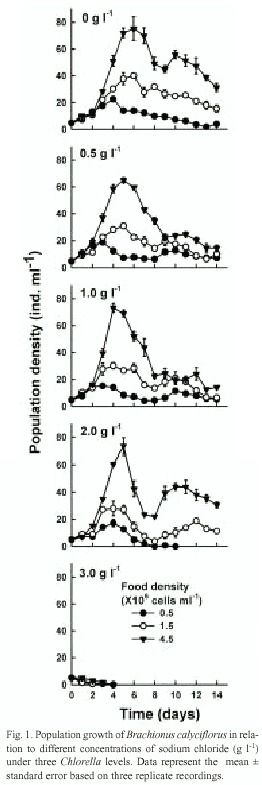
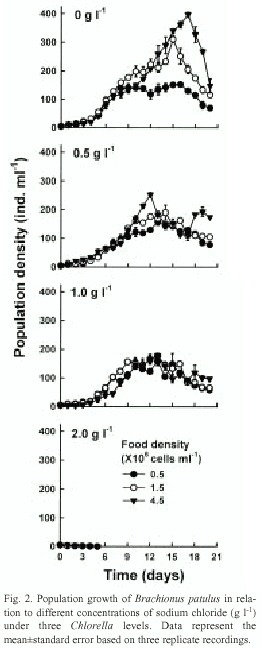
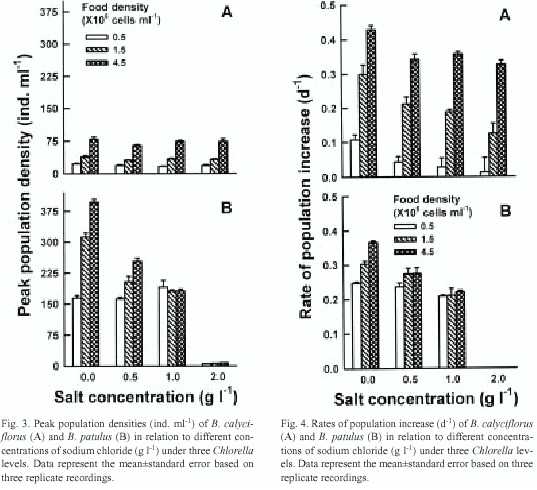
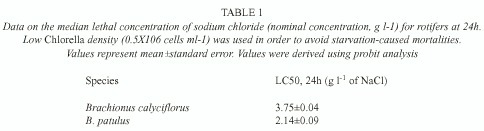
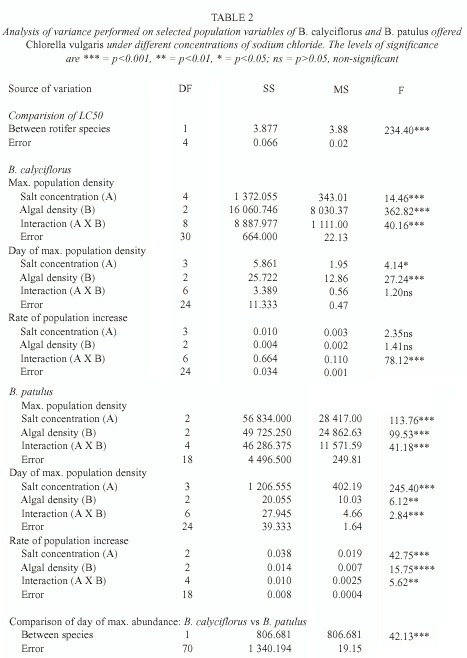
<body><![CDATA[<p><font face="Arial" size="2">The experimental design for <i>B. patulus </i>was similar to that used for <i>B. calycifloru</i>s. In this case however, we continued the experiments for 20 days after then we observed a declining trend in all test jars. </font></p>     <p><font face="Arial" size="2">Based on the data collected, we calculated the rate of population increase (r) using the exponential growth equation: r = (ln N<sub>t</sub> - ln N<sub>o</sub> )/t, where, N<sub>o</sub> = initial population density, N<sub>t</sub> = density of population after time t (days) (<a href="#Krebs">Krebs 1985</a>). The r was obtained, as far as possible, from a mean of 4-5 values during the exponential phase of the population growth for each rotifer species.</font></p> <font face="Arial" size="2"><b>     <p>Results</p> </b></font>     <p><font face="Arial" size="2">Data on the median lethal concentration of sodium chloride for <i>B. calyciflorus </i>and <i>B. patulus </i>are presented in <a href="#table1">Table 1</a>. <i>B. calyciflorus </i>was more resistant to salt concentrations than <i>B. patulu</i>s. The differences in the LC50 values for both the species were statistically significant (p&lt;0.001, F-test, <a href="#table2">Table 2</a>). Population growth curves of <i>B. calyciflorus </i>and <i>B. patulus </i>in relation to different concentrations of sodium chloride and algal food levels are presented in <a href="#fig1">figures 1</a> and <a href="#fig2">2</a>, respectively. Regardless of salt concentration, <i>B. calyciflorus </i>showed increased population density with increasing food levels, while for <i>B. patulu</i>s, this trend was evident only in the controls. The maximal population density (mean±standard error) for <i>B. calyciflorus </i>in the control at 4.5 X10<sup>6</sup> cells ml<sup>-1</sup> algal level was 80±5 ind. ml<sup>-1</sup>, which was nearly one-fifth of the one for <i>B. patulus </i>(397 ±7 ind. ml<sup>-1</sup>) under comparable conditions (<a href="#fig3-4">Fig. 3</a>). <i>B. calyciflorus </i>reached the maximal population density in a shorter time (4±0.5 days) than <i>B. patulus </i>(11±1 days) regardless of salt concentration and algal food level.    <br> &nbsp;&nbsp;     <br> <a name="table1"></a></font></p>     <div style="text-align: center;"><font face="Arial" size="2"><img alt=""  src="/img/fbpe/rbt/v51n2/2476i1.JPG" style="width: 484px; height: 131px;">    
<br> &nbsp;     <br> <a name="table2"></a><img alt="" src="/img/fbpe/rbt/v51n2/2476i2.JPG"  style="width: 467px; height: 658px;">    
<br> </font></div>     ]]></body>
<body><![CDATA[<p><font face="Arial" size="2">The rate of population increase per day (r) (mean ±standard error) for <i>B. calyciflorus </i>varied from 0.013±0.001 (at 0.5 X10<sup>6</sup> cells ml<sup>-1</sup> of food level and 2.0 g l<sup>-1</sup> of sodium chloride) to 0.429± 0.028 (at 4.5 X10<sup>6</sup> cells ml<sup>-1</sup> of food level in the control). The highest r value (0.367±0.004) for <i>B. patulus </i>was recorded at 4.5 X10<sup>6</sup> cells ml<sup>-1</sup> of food level in the control and the lowest was (0.209±0.003) observed at 0.5 X10<sup>6</sup> cells ml<sup>-1</sup> of <i>Chlorella </i>at a salt concentration of 1.0 g l<sup>-1</sup> (<a href="#fig3-4">Fig. 4</a>).</font></p>     <p><font face="Arial" size="2">Maximal population density, day of peak population density and the rate of population increase were all significantly affected by the concentrations of sodium chloride, food level as well their interaction (p&lt;0.05, ANOVA) for <i>B. patulu</i>s. However, for <i>B. calyciflorus </i>the interaction between salt concentration and algal food level on the day of maximal population abundance was not significant (p&gt;0.05). Similarly, the rate of population increase for <i>B. calyciflorus </i>was not significantly affected by salt concentration or algal food density (<a href="#table2">Table 2</a>).    <br> &nbsp;&nbsp;     <br> <a name="fig1"></a></font></p>     <div style="text-align: center;"><font face="Arial" size="2"><img alt=""  src="/img/fbpe/rbt/v51n2/2476i3.JPG" style="width: 262px; height: 785px;"><a name="fig2"></a><img  alt="" src="/img/fbpe/rbt/v51n2/2476i4.JPG" style="width: 262px; height: 648px;"></font>    
<br> </div> <font face="Arial" size="2"><b> </b></font>     <div style="text-align: center;"><font face="Arial" size="2"><b>     <p>&nbsp; <a name="fig3-4"></a><img alt="" src="/img/fbpe/rbt/v51n2/2476i5.JPG"  style="width: 537px; height: 490px;">    
<br> </p> </b></font>    <br> </div> <font face="Arial" size="2"><b>     ]]></body>
<body><![CDATA[<p>Discussion</p> </b></font>     <p><font face="Arial" size="2">It is evident that both the rotifer species were negatively affected by salt concentrations of 4 g l<sup>-1 </sup>as demonstrated in the acute tolerance tests, and 2 g l<sup>-1</sup> when exposed chronically. In general, our results agree with field observations, where most members of the family Brachionidae are nearly absent when the salinity exceeds 2 g l<sup>-1</sup> (<a  href="#Greenwald">Greenwald and Hurlbert 1993</a>). Relatively higher salt tolerance (&gt; 5g l<sup>-1</sup>) of <i>B. calyciflorus </i>in some laboratory studies using rotifers obtained from hatching resting eggs (<a href="#Snell91">Snell <i>et al. </i>1991</a>) is probably due to strain differences or origin of the test population.Generally, neonates hatched from resting eggs are more resistant than those from parthenogenetic eggs (<a href="#Sarma00">Sarma 2000</a>). In our case, the rotifer population was obtained from parthenogenetic eggs.</font></p> <font face="Arial" size="2">Regardless of salt concentration and food levels, the growth curves obtained in the present study are typical for planktonic rotifers (<a href="#Walz95">Walz 1995</a>). An increase in density with increasing algal food level has been well-documented for several rotifer genera of Brachionidae e.g., <i>Anuraeopsis </i>(<a href="#Dumont">Dumont <i>et a</i>l. 1995</a>), <i>Brachionus </i>(<a href="#Halbach">Halbach and Halbach-Keup 1974</a>), <i>Keratella </i>(<a href="#Walz83">Walz 1983</a>) and <i>Notholca </i>(<a href="#May">May 1980</a>). In the present study, <i>B. calyciflorus </i>and <i>B. patulus </i>have also increased in population abundance with increasing availability of <i>Chlorell</i>a. Nevertheless, the magnitude of rotifer increase was influenced by the concentration of sodium chloride (<a href="#fig1">Figs. 1-2</a>).</font>     <p><font face="Arial" size="2">For single species studies, maximal population density, day of maximal abundance and the rate of population increase are important variables which are sensitive to changes in the medium (<a href="#Sarma98">Sarma <i>et a</i>l. 1998</a>). Usually an increase in the available food, results in an increase in the population growth rate (<a href="#Dumont">Dumont <i>et a</i>l. 1995</a>). This is evident in the present work (<a href="#fig3-4">Fig. 3</a>). However, some factors can modify this relation such as temperature, salinity or both (<a href="#Oltra">Oltra and Todoli 1997</a>). Effect of temperature and salinity on the life history variables of <i>B. plicatilis </i>has been reviewed by <a href="#Miracle">Miracle and Serra (1989)</a>. According to them, the intensity of salt stress has a greater influence on the fecundity of rotifers when compared to temperature variation. However, these conclusions are based on the euryhaline <i>B. plicatili</i>s, which inhabits freshwater environments and can survive even in hypersaline conditions (<a href="#Walker">Walker 1981</a>). In the present work, both rotifer species showed nearly a similar response to salinity, i.e. up to a certain level of sodium chloride (2 g l<sup>-1</sup> in case of <i>B. calyciflorus </i>and 1 g l<sup>-1</sup> for <i>B. patulu</i>s); although they continue to grow but beyond this, they suddenly crashed in all the replicates.</font></p>     <p><font face="Arial" size="2">Information published so far does not support the hypothesis that death of the algae under the range of salt concentrations used in this study could have contributed to the low population growth of the species tested (<a href="#He">He <i>et a</i>l. 1993</a>). Reduced swimming speed of rotifers as a result of stress could probably cause reduced food intake (<a href="#Lee">Lee and Macko 1981</a>, <a  href="#Korstad">Korstad <i>et a</i>l. 1995</a>). This is probably responsible for low population growth of <i>B. calyciflorus </i>and <i>B. patulus </i>under 3 g l<sup>-1 </sup>and 2 g l<sup>-1</sup> of sodium chloride, respectively. The protective role of algae in reducing the effect of salt stress was more evident in <i>B. calycifloru</i>s. Thus, if the sodium chloride had a uniform effect up to 2 g l<sup>-1</sup> , this would have caused more or less similar density of <i>B. calyciflorus </i>either at 0.5 X10<sup>6</sup> or 4.5 X10<sup>6</sup> cells ml<sup>-1</sup> of <i>Chlorell</i>a. Nevertheless, under salt concentrations up to 2.0 g l<sup>-1</sup> , <i>B. calyciflorus </i>showed population growth rates dependent on food level. Conversely, due to relatively low tolerance to salt stress, <i>B. patulus </i>showed no food level-dependent population growth at 1.0 g l <sup>-1</sup> . The absence of population growth at 3.0 g l<sup>-1</sup> for <i>B. calyciflorus </i>and 2.0 g l<sup>-1</sup> for <i>B. patulus </i>even under 4.5 X10 6 cells ml<sup>-1</sup> of <i>Chlorella </i>suggested that food density could protect rotifers from the salt stress up to a certain limit, beyond which the effect of salinity is independent of food supply. In conclusion, our data show that both <i>B. calyciflorus </i>and <i>B. patulus </i>have a narrow range of tolerance to salt concentration and that the algal food had a protective role in reducing the effect of sodium chloride but only up to a concentration of 2.0 g l<sup>-1</sup>.</font></p> <font face="Arial" size="2"><b>     <p>Acknowledgements</p> </b></font>     <p><font face="Arial" size="2">This investigation was supported by a Project from CONACyT (C01-41786). SSSS and SN thank the National System of Investigators (SNI-18723 and 20520).</font></p> <font face="Arial" size="2"><b>     <p>Resumen</p> </b></font>     <p><font face="Arial" size="2">La salinidad es una variable importante que tiene influencia sobre la densidad y la diversidad de los rotíferos. Los estudios de rotíferos sobre tolerancia a la sal que se tienen hasta ahora se han concentrado en especies eurihalinas, sin embargo, hay muy poca información sobre taxas no eurihalinos. En el presente trabajo, se evaluaron los efectos combinados de las concentraciones de <i>Chlorella vulgaris </i>y cloruro de sodio sobre el crecimiento poblacional de dos rotíferos de agua dulce, <i>B. calyciflorus </i>y <i>B. patulu</i>s. Una prueba de toxicidad aguda de 24 h utilizando cloruro de sodio reveló que <i>B. calyciflorus </i>fue más resistente (CL50 = 3.75 ± 0.04 g l<sup>-1</sup>) que <i>B. patulus </i>(2.14 ± 0.09 g l<sup>-1</sup>). La máxima densidad de población (media ± error estándar) de <i>B. calyciflorus </i>en el lote control, utilizando una concentración 4.5 X10<sup>6</sup> células ml<sup>-1</sup> de alga fue de 80 ± 5 ind. ml<sup>-1</sup>, casi una quinta parte de <i>B. patulus </i>(397 ±7 ind. ml<sup>-1</sup>) sobre condiciones comparables. Datos sobre el crecimiento poblacional revelaron que cualquier concentración de sal carece de efecto, la densidad de <i>B. calyciflorus </i>se incrementa cuando aumentan los niveles de alimento. Sin embargo para <i>B. patulus </i>esta tendencia fue evidente únicamente en los controles. Independientemente de las concentraciones de sal y los niveles de alimento, el día de abundancia máxima fue menor para <i>B. calyciflorus </i>(4 ± 0.5 días) que para <i>B. patulus </i>(11 ±1 días). Los valores de la máxima tasa de crecimiento poblacional (r) fueron para <i>B. calyciflorus </i>y <i>B. patulus </i>de 0.429 ± 0.012 y 0.367 ± 0.004, respectivamente en lotes control con 4.5 X10<sup> 6</sup> células ml<sup>-1</sup> de <i>Chlorell</i>a. El papel de protección de alga para reducir el efecto del estrés de la sal fue más evidente en <i>B. calyciflorus </i>que en <i>B. patulu</i>s.</font></p> <font face="Arial" size="2">     <p><b>References</b></p> </font>    <!-- ref --><p><font face="Arial" size="2"><a name="Anonymous"></a>Anonymous. 1985. Methods of measuring the acute toxicity of effluents to freshwater and marine organisms. US Environment Protection Agency EPA/600/4- 85/013.    &nbsp;&nbsp;&nbsp;&nbsp;&nbsp;&nbsp;&nbsp;&nbsp;[&#160;<a href="javascript:void(0);" onclick="javascript: window.open('/scielo.php?script=sci_nlinks&ref=1669869&pid=S0034-7744200300020001200001&lng=','','width=640,height=500,resizable=yes,scrollbars=1,menubar=yes,');">Links</a>&#160;]<!-- end-ref --></font></p>     <!-- ref --><p><font face="Arial" size="2"><a name="Borowitzka"></a>Borowitzka, M.A. &amp; L.J. Borowitzka. 1988. Microalgal biotechnology; Cambridge University: London, England, 480 p.    &nbsp;&nbsp;&nbsp;&nbsp;&nbsp;&nbsp;&nbsp;&nbsp;[&#160;<a href="javascript:void(0);" onclick="javascript: window.open('/scielo.php?script=sci_nlinks&ref=1669871&pid=S0034-7744200300020001200002&lng=','','width=640,height=500,resizable=yes,scrollbars=1,menubar=yes,');">Links</a>&#160;]<!-- end-ref --></font></p>     <!-- ref --><p><font face="Arial" size="2"><a name="Dash"></a>Dash, R.C., P.K. Mohapatra &amp; R. C. Mohanty. 1995. Salt induced changes in the growth of <i>Chlorococcum humicolo </i>and <i>Scenedesmus bijugatus </i>under nutrient limited cultures. Bull. Environ. Contam. Toxicol. 54:695-702.    &nbsp;&nbsp;&nbsp;&nbsp;&nbsp;&nbsp;&nbsp;&nbsp;[&#160;<a href="javascript:void(0);" onclick="javascript: window.open('/scielo.php?script=sci_nlinks&ref=1669873&pid=S0034-7744200300020001200003&lng=','','width=640,height=500,resizable=yes,scrollbars=1,menubar=yes,');">Links</a>&#160;]<!-- end-ref --></font></p>     <!-- ref --><p><font face="Arial" size="2"><a name="Dumont"></a>Dumont, H.J., S.S.S. Sarma &amp; A.J. Ali. 1995. Laboratory studies on the population dynamics of <i>Anuraeopsis fissa </i>(Rotifera) in relation to food density. Freshwater Biol. 33: 39-46.    &nbsp;&nbsp;&nbsp;&nbsp;&nbsp;&nbsp;&nbsp;&nbsp;[&#160;<a href="javascript:void(0);" onclick="javascript: window.open('/scielo.php?script=sci_nlinks&ref=1669875&pid=S0034-7744200300020001200004&lng=','','width=640,height=500,resizable=yes,scrollbars=1,menubar=yes,');">Links</a>&#160;]<!-- end-ref --></font></p>     <!-- ref --><p><font face="Arial" size="2"><a name="Edmondson"></a>Edmondson, W.T. 1965. Reproductive rate of planktonic rotifers as related to food and temperature in nature. Ecol. Monogr. 35: 61 - 111.    &nbsp;&nbsp;&nbsp;&nbsp;&nbsp;&nbsp;&nbsp;&nbsp;[&#160;<a href="javascript:void(0);" onclick="javascript: window.open('/scielo.php?script=sci_nlinks&ref=1669877&pid=S0034-7744200300020001200005&lng=','','width=640,height=500,resizable=yes,scrollbars=1,menubar=yes,');">Links</a>&#160;]<!-- end-ref --></font></p>     <!-- ref --><p><font face="Arial" size="2"><a name="Epp"></a>Epp, R.W. &amp; W.M. Lewis Jr. 1984. Cost and speed of locomotion for rotifers. Oecologia 61: 289-292.    &nbsp;&nbsp;&nbsp;&nbsp;&nbsp;&nbsp;&nbsp;&nbsp;[&#160;<a href="javascript:void(0);" onclick="javascript: window.open('/scielo.php?script=sci_nlinks&ref=1669879&pid=S0034-7744200300020001200006&lng=','','width=640,height=500,resizable=yes,scrollbars=1,menubar=yes,');">Links</a>&#160;]<!-- end-ref --></font></p>     <!-- ref --><p><font face="Arial" size="2"><a name="Finney"></a>Finney, D.J. 1971. Probit analysis. Cambridge University Press, 3rd edn, London, 333 p.    &nbsp;&nbsp;&nbsp;&nbsp;&nbsp;&nbsp;&nbsp;&nbsp;[&#160;<a href="javascript:void(0);" onclick="javascript: window.open('/scielo.php?script=sci_nlinks&ref=1669881&pid=S0034-7744200300020001200007&lng=','','width=640,height=500,resizable=yes,scrollbars=1,menubar=yes,');">Links</a>&#160;]<!-- end-ref --></font></p>     <!-- ref --><p><font face="Arial" size="2"><a name="Frolov"></a>Frolov, A.V., S L. Pankov, K.N. Geradze &amp; S.A. Pankova. 1991. Influence of salinity on the biochemical composition of the rotifer <i>Brachionus plicatilis </i>Müller. Aspects of adaptation. Comp. Biochem. Physiol. A. Comp. Physiol. 99: 541-550.    &nbsp;&nbsp;&nbsp;&nbsp;&nbsp;&nbsp;&nbsp;&nbsp;[&#160;<a href="javascript:void(0);" onclick="javascript: window.open('/scielo.php?script=sci_nlinks&ref=1669883&pid=S0034-7744200300020001200008&lng=','','width=640,height=500,resizable=yes,scrollbars=1,menubar=yes,');">Links</a>&#160;]<!-- end-ref --></font></p>     <!-- ref --><p><font face="Arial" size="2"><a name="Green"></a>Green, J. 1993. Zooplankton associations in East African lakes spanning a wide salinity range. Hydrobiologia 267: 249-256.    &nbsp;&nbsp;&nbsp;&nbsp;&nbsp;&nbsp;&nbsp;&nbsp;[&#160;<a href="javascript:void(0);" onclick="javascript: window.open('/scielo.php?script=sci_nlinks&ref=1669885&pid=S0034-7744200300020001200009&lng=','','width=640,height=500,resizable=yes,scrollbars=1,menubar=yes,');">Links</a>&#160;]<!-- end-ref --></font></p>     <!-- ref --><p><font face="Arial" size="2"><a name="Greenwald"></a>Greenwald, G.M. &amp; S.H. Hurlbert. 1993. Microcosm analysis of salinity effects on coastal lagoon plankton assemblages. Hydrobiologia 267: 307-335.    &nbsp;&nbsp;&nbsp;&nbsp;&nbsp;&nbsp;&nbsp;&nbsp;[&#160;<a href="javascript:void(0);" onclick="javascript: window.open('/scielo.php?script=sci_nlinks&ref=1669887&pid=S0034-7744200300020001200010&lng=','','width=640,height=500,resizable=yes,scrollbars=1,menubar=yes,');">Links</a>&#160;]<!-- end-ref --></font></p>     <!-- ref --><p><font face="Arial" size="2"><a name="Halbach"></a>Halbach, U. &amp; G. Halbach-Keup. 1974. Quantitative beziehungen zwischen phytoplankton und der populationsdynamik des rotators <i>Brachionus calyciflorus </i>Pallas. Befunde aus laboratoriumsexperimenten und freilanduntersuchungen. Arch. Hydrobiol. 73: 273-309.    &nbsp;&nbsp;&nbsp;&nbsp;&nbsp;&nbsp;&nbsp;&nbsp;[&#160;<a href="javascript:void(0);" onclick="javascript: window.open('/scielo.php?script=sci_nlinks&ref=1669889&pid=S0034-7744200300020001200011&lng=','','width=640,height=500,resizable=yes,scrollbars=1,menubar=yes,');">Links</a>&#160;]<!-- end-ref --></font></p>     <!-- ref --><p><font face="Arial" size="2"><a name="He"></a>He, Z., K. Qin, Y. Wang &amp; W. Zhao. 1993. Biological resources in inland saline waters from southern Shanxi, China Part 1. Lake Xiaochi. J. Dalian Fish. Coll. 8: 1-15.    &nbsp;&nbsp;&nbsp;&nbsp;&nbsp;&nbsp;&nbsp;&nbsp;[&#160;<a href="javascript:void(0);" onclick="javascript: window.open('/scielo.php?script=sci_nlinks&ref=1669891&pid=S0034-7744200300020001200012&lng=','','width=640,height=500,resizable=yes,scrollbars=1,menubar=yes,');">Links</a>&#160;]<!-- end-ref --></font></p>     <!-- ref --><p><font face="Arial" size="2"><a name="James"></a>James, C.M. &amp; T. Abu Rezeq. 1990. Efficiency of rotifer chemostats in relation to salinity regimes for producing rotifers for aquaculture. J. Aquacult. Trop. 5:103-116.    &nbsp;&nbsp;&nbsp;&nbsp;&nbsp;&nbsp;&nbsp;&nbsp;[&#160;<a href="javascript:void(0);" onclick="javascript: window.open('/scielo.php?script=sci_nlinks&ref=1669893&pid=S0034-7744200300020001200013&lng=','','width=640,height=500,resizable=yes,scrollbars=1,menubar=yes,');">Links</a>&#160;]<!-- end-ref --></font></p>     <!-- ref --><p><font face="Arial" size="2"><a name="Korstad"></a>Korstad, J., A. Neyts, T. Danielsen, I. Overrein &amp; Y. Olsen. 1995. Use of swimming speed and egg ratio as predictors of the status of rotifer cultures in aquaculture. Hydrobiologia 313/314: 395-398.    &nbsp;&nbsp;&nbsp;&nbsp;&nbsp;&nbsp;&nbsp;&nbsp;[&#160;<a href="javascript:void(0);" onclick="javascript: window.open('/scielo.php?script=sci_nlinks&ref=1669895&pid=S0034-7744200300020001200014&lng=','','width=640,height=500,resizable=yes,scrollbars=1,menubar=yes,');">Links</a>&#160;]<!-- end-ref --></font></p>     <!-- ref --><p><font face="Arial" size="2"><a name="Koste"></a>Koste, W. 1978. Rotatoria. Die Rädertiere Mitteleuropas. Ein Bestimmungswerk begründet von Max Voigt. Bornträger, Stuttgart. Vol. 1, Textband 673 p. Vol. 2,Tafelband 234 p.    &nbsp;&nbsp;&nbsp;&nbsp;&nbsp;&nbsp;&nbsp;&nbsp;[&#160;<a href="javascript:void(0);" onclick="javascript: window.open('/scielo.php?script=sci_nlinks&ref=1669897&pid=S0034-7744200300020001200015&lng=','','width=640,height=500,resizable=yes,scrollbars=1,menubar=yes,');">Links</a>&#160;]<!-- end-ref --></font></p>     <!-- ref --><p><font face="Arial" size="2"><a name="Krebs"></a>Krebs, C.J. 1985. Ecology. The experimental analysis of distribution and abundance. Harper and Row, New York. 789 p.    &nbsp;&nbsp;&nbsp;&nbsp;&nbsp;&nbsp;&nbsp;&nbsp;[&#160;<a href="javascript:void(0);" onclick="javascript: window.open('/scielo.php?script=sci_nlinks&ref=1669899&pid=S0034-7744200300020001200016&lng=','','width=640,height=500,resizable=yes,scrollbars=1,menubar=yes,');">Links</a>&#160;]<!-- end-ref --></font></p>     <!-- ref --><p><font face="Arial" size="2"><a name="Lee"></a>Lee, W.Y. &amp; S.A. Macko. 1981. Toxic effects of cembranolides derived from octocorals on the rotifer <i>Brachionus plicatilis </i>and the amphipod <i>Parhyale hawaiensi</i>s. J. Exp. Mar. Biol. Ecol. 54: 91-96.    &nbsp;&nbsp;&nbsp;&nbsp;&nbsp;&nbsp;&nbsp;&nbsp;[&#160;<a href="javascript:void(0);" onclick="javascript: window.open('/scielo.php?script=sci_nlinks&ref=1669901&pid=S0034-7744200300020001200017&lng=','','width=640,height=500,resizable=yes,scrollbars=1,menubar=yes,');">Links</a>&#160;]<!-- end-ref --></font></p>     <!-- ref --><p><font face="Arial" size="2"><a name="May"></a>May, L. 1980. Studies on the grazing rate of <i>Notholca squamula </i>Müller on <i>Asterionella formosa </i>Hass. at diferent temperatures. Hydrobiologia 73: 79 - 81.    &nbsp;&nbsp;&nbsp;&nbsp;&nbsp;&nbsp;&nbsp;&nbsp;[&#160;<a href="javascript:void(0);" onclick="javascript: window.open('/scielo.php?script=sci_nlinks&ref=1669903&pid=S0034-7744200300020001200018&lng=','','width=640,height=500,resizable=yes,scrollbars=1,menubar=yes,');">Links</a>&#160;]<!-- end-ref --></font></p>     <!-- ref --><p><font face="Arial" size="2"><a name="Miracle"></a>Miracle, M.R. &amp; M. Serra. 1989. Salinity and temperature influence in rotifer life history characteristics. Hydrobiologia 186/187: 81-102.    &nbsp;&nbsp;&nbsp;&nbsp;&nbsp;&nbsp;&nbsp;&nbsp;[&#160;<a href="javascript:void(0);" onclick="javascript: window.open('/scielo.php?script=sci_nlinks&ref=1669905&pid=S0034-7744200300020001200019&lng=','','width=640,height=500,resizable=yes,scrollbars=1,menubar=yes,');">Links</a>&#160;]<!-- end-ref --></font></p>     <!-- ref --><p><font face="Arial" size="2"><a name="Nogrady"></a>Nogrady, T., R.L. Wallace &amp; T.W. Snell. 1993. Rotifera. Vol. 1. Biology, ecology and systematics. SBP Academic, The Hague, 142 p.    &nbsp;&nbsp;&nbsp;&nbsp;&nbsp;&nbsp;&nbsp;&nbsp;[&#160;<a href="javascript:void(0);" onclick="javascript: window.open('/scielo.php?script=sci_nlinks&ref=1669907&pid=S0034-7744200300020001200020&lng=','','width=640,height=500,resizable=yes,scrollbars=1,menubar=yes,');">Links</a>&#160;]<!-- end-ref --></font></p>     <!-- ref --><p><font face="Arial" size="2"><a name="Oeie"></a>Oeie, G. &amp; Y. Olsen. 1993. Influence of rapid changes insalinity and temperature on the mobility of the rotifer <i>Brachionus plicatili</i>s. Hydrobiologia 255/256: 81-86.    &nbsp;&nbsp;&nbsp;&nbsp;&nbsp;&nbsp;&nbsp;&nbsp;[&#160;<a href="javascript:void(0);" onclick="javascript: window.open('/scielo.php?script=sci_nlinks&ref=1669909&pid=S0034-7744200300020001200021&lng=','','width=640,height=500,resizable=yes,scrollbars=1,menubar=yes,');">Links</a>&#160;]<!-- end-ref --></font></p>     <!-- ref --><p><font face="Arial" size="2"><a name="Oltra"></a>Oltra, R. &amp; R. Todoli. 1997. Effects of temperature, salinity and food level on the life history traits of the marine rotifer <i>Synchaeta cecilia valentin</i>a, n. subsp. J. Plankton Res. 19: 693-702.    &nbsp;&nbsp;&nbsp;&nbsp;&nbsp;&nbsp;&nbsp;&nbsp;[&#160;<a href="javascript:void(0);" onclick="javascript: window.open('/scielo.php?script=sci_nlinks&ref=1669911&pid=S0034-7744200300020001200022&lng=','','width=640,height=500,resizable=yes,scrollbars=1,menubar=yes,');">Links</a>&#160;]<!-- end-ref --></font></p>     <!-- ref --><p><font face="Arial" size="2"><a name="Sarma91"></a>Sarma, S.S.S. 1991. Rotifers and aquaculture (Review). Environ. Ecol. 9: 414-428.    &nbsp;&nbsp;&nbsp;&nbsp;&nbsp;&nbsp;&nbsp;&nbsp;[&#160;<a href="javascript:void(0);" onclick="javascript: window.open('/scielo.php?script=sci_nlinks&ref=1669913&pid=S0034-7744200300020001200023&lng=','','width=640,height=500,resizable=yes,scrollbars=1,menubar=yes,');">Links</a>&#160;]<!-- end-ref --></font></p>     <!-- ref --><p><font face="Arial" size="2"><a name="Sarma00"></a>Sarma, S.S.S. 2000. The use of rotifers for ecotoxicological studies in Mexico, pp. 8-11. <i>In </i>E. Ríos-Jara <i>et al. </i>(eds). Estudios sobre plancton en México y el Caribe. Sociedad Mexicana Planctología, Universidad de Guadalajara, México.    &nbsp;&nbsp;&nbsp;&nbsp;&nbsp;&nbsp;&nbsp;&nbsp;[&#160;<a href="javascript:void(0);" onclick="javascript: window.open('/scielo.php?script=sci_nlinks&ref=1669915&pid=S0034-7744200300020001200024&lng=','','width=640,height=500,resizable=yes,scrollbars=1,menubar=yes,');">Links</a>&#160;]<!-- end-ref --></font></p>     <!-- ref --><p><font face="Arial" size="2"><a name="Sarma98"></a>Sarma, S.S.S., R.A.A. Stevenson &amp; S. Nandini. 1998 Influence of food <i>(Chlorella vulgari</i>s) concentration and temperature on the population dynamics of <i>Brachionus calyciflorus </i>Pallas (Rotifera). Ciencia Ergo Sum 5: 77-81.    &nbsp;&nbsp;&nbsp;&nbsp;&nbsp;&nbsp;&nbsp;&nbsp;[&#160;<a href="javascript:void(0);" onclick="javascript: window.open('/scielo.php?script=sci_nlinks&ref=1669917&pid=S0034-7744200300020001200025&lng=','','width=640,height=500,resizable=yes,scrollbars=1,menubar=yes,');">Links</a>&#160;]<!-- end-ref --></font></p>     <!-- ref --><p><font face="Arial" size="2"><a name="Snell86"></a>Snell, T.W. 1986. Effect of temperature, salinity and food level on sexual and asexual reproduction in <i>Brachionus plicatilis </i>(Rotifera). Mar. Biol. 92: 157-162.    &nbsp;&nbsp;&nbsp;&nbsp;&nbsp;&nbsp;&nbsp;&nbsp;[&#160;<a href="javascript:void(0);" onclick="javascript: window.open('/scielo.php?script=sci_nlinks&ref=1669919&pid=S0034-7744200300020001200026&lng=','','width=640,height=500,resizable=yes,scrollbars=1,menubar=yes,');">Links</a>&#160;]<!-- end-ref --></font></p>     <!-- ref --><p><font face="Arial" size="2"><a name="Snell91"></a>Snell, T.W., B.D. Moffat, C. Janssen &amp; G. Persoone. 1991. Acute toxicity tests using rotifers. IV. Effects of cyst age, temperature, and salinity on the sensitivity of <i>Brachionus calycifloru</i>s. Ecotoxicol. Environ. Saf. 21: 308-317.    &nbsp;&nbsp;&nbsp;&nbsp;&nbsp;&nbsp;&nbsp;&nbsp;[&#160;<a href="javascript:void(0);" onclick="javascript: window.open('/scielo.php?script=sci_nlinks&ref=1669921&pid=S0034-7744200300020001200027&lng=','','width=640,height=500,resizable=yes,scrollbars=1,menubar=yes,');">Links</a>&#160;]<!-- end-ref --></font></p>     <!-- ref --><p><font face="Arial" size="2"><a name="Walker"></a>Walker, K.F. 1981. A synopsis of ecological information on the saline lake rotifer <i>Brachionus plicatili</i>s, Müller, 1786. Hydrobiologia 81: 150 - 167.    &nbsp;&nbsp;&nbsp;&nbsp;&nbsp;&nbsp;&nbsp;&nbsp;[&#160;<a href="javascript:void(0);" onclick="javascript: window.open('/scielo.php?script=sci_nlinks&ref=1669923&pid=S0034-7744200300020001200028&lng=','','width=640,height=500,resizable=yes,scrollbars=1,menubar=yes,');">Links</a>&#160;]<!-- end-ref --></font></p>     <!-- ref --><p><font face="Arial" size="2"><a name="Walz83"></a>Walz, N. 1983. Individual culture and experimental population dynamics of <i>Keratella cochlearis </i>(Rotatoria). Hydrobiologia 107: 35 - 43.    &nbsp;&nbsp;&nbsp;&nbsp;&nbsp;&nbsp;&nbsp;&nbsp;[&#160;<a href="javascript:void(0);" onclick="javascript: window.open('/scielo.php?script=sci_nlinks&ref=1669925&pid=S0034-7744200300020001200029&lng=','','width=640,height=500,resizable=yes,scrollbars=1,menubar=yes,');">Links</a>&#160;]<!-- end-ref --></font></p>     <!-- ref --><p><font face="Arial" size="2"><a name="Walz95"></a>Walz, N. 1995. Rotifer populations in plankton communities: Energetics and life history strategies. Experientia 51: 437 - 453.    &nbsp;&nbsp;&nbsp;&nbsp;&nbsp;&nbsp;&nbsp;&nbsp;[&#160;<a href="javascript:void(0);" onclick="javascript: window.open('/scielo.php?script=sci_nlinks&ref=1669927&pid=S0034-7744200300020001200030&lng=','','width=640,height=500,resizable=yes,scrollbars=1,menubar=yes,');">Links</a>&#160;]<!-- end-ref --></font></p>     <!-- ref --><p><font face="Arial" size="2"><a name="Williams"></a>Williams, W.D., P. De Deckker &amp; R.J. Shiel. 1998. The limnology of Lake Torrens, an episodic salt lake of central Australia, with particular reference to unique events in 1989. Hydrobiologia 384: 101-110.    &nbsp;&nbsp;&nbsp;&nbsp;&nbsp;&nbsp;&nbsp;&nbsp;[&#160;<a href="javascript:void(0);" onclick="javascript: window.open('/scielo.php?script=sci_nlinks&ref=1669929&pid=S0034-7744200300020001200031&lng=','','width=640,height=500,resizable=yes,scrollbars=1,menubar=yes,');">Links</a>&#160;]<!-- end-ref --></font></p>     <!-- ref --><p><font face="Arial" size="2"><a name="Yamasaki"></a>Yamasaki, S. &amp; H. Hirata. 1985. Effects of salinity on food conversion rate of rotifer <i>Brachionus plicatili</i>s. Mem. Fac. Fish. Kagoshima Univ. 34: 37-43.    &nbsp;&nbsp;&nbsp;&nbsp;&nbsp;&nbsp;&nbsp;&nbsp;[&#160;<a href="javascript:void(0);" onclick="javascript: window.open('/scielo.php?script=sci_nlinks&ref=1669931&pid=S0034-7744200300020001200032&lng=','','width=640,height=500,resizable=yes,scrollbars=1,menubar=yes,');">Links</a>&#160;]<!-- end-ref --></font></p>     <!-- ref --><p><font face="Arial" size="2"><a name="Zhao"></a>Zhao, W., H. Jiang, &amp; Z. He. 1996. Planktonic crustaceans of inland saline waters in Sanbei District, Northern China. J. Dalian Fish. Coll. 11: 1-13.    &nbsp;&nbsp;&nbsp;&nbsp;&nbsp;&nbsp;&nbsp;&nbsp;[&#160;<a href="javascript:void(0);" onclick="javascript: window.open('/scielo.php?script=sci_nlinks&ref=1669933&pid=S0034-7744200300020001200033&lng=','','width=640,height=500,resizable=yes,scrollbars=1,menubar=yes,');">Links</a>&#160;]<!-- end-ref --><br> &nbsp;&nbsp;&nbsp;     <br> </font></p>     <p><font face="Arial" size="2"><a name="a1"></a><a href="2476.htm#r1">1</a>. Laboratorio de Zoología Acuática, División de Investigación y Posgrado, Edificio UMF, Universidad Nacional Autónoma de México, Campus Iztacala, AP 314, CP 54090, Tlalnepantla, Edo. de México. México. FAX: +52 5 623 1256. e-mail: </font><a style="font-family: arial;"  href="mailto:sarma@servidor.unam.mx"><font size="2">sarma@servidor.unam.mx</font></a><font  face="Arial" size="2"> </font></p>     <p><font face="Arial" size="2"><a href="2476.htm#r1">2</a>. División de Investigación y Posgrado, Universidad Nacional Autónoma de México, Campus Iztacala, AP 314, CP 54090, Tlalnepantla, Edo. de México. </font></p>     <p><font face="Arial" size="2"><a href="2476.htm#r1">3</a>. Corresponding author.</font></p>      ]]></body><back>
<ref-list>
<ref id="B1">
<nlm-citation citation-type="book">
<person-group person-group-type="author">
<name>
</name>
<name>
</name>
</person-group>
<source><![CDATA[Methods of measuring the acute toxicity of effluents to freshwater and marine organisms]]></source>
<year>1985</year>
<publisher-name><![CDATA[US Environment Protection Agency EPA/600/4- 85/013]]></publisher-name>
</nlm-citation>
</ref>
<ref id="B2">
<nlm-citation citation-type="">
<person-group person-group-type="author">
<name>
<surname><![CDATA[Borowitzka]]></surname>
<given-names><![CDATA[M.A.]]></given-names>
</name>
<name>
<surname><![CDATA[Borowitzka]]></surname>
<given-names><![CDATA[L.J.]]></given-names>
</name>
</person-group>
<source><![CDATA[Microalgal biotechnology; Cambridge University: London]]></source>
<year>1988</year>
<page-range>480</page-range></nlm-citation>
</ref>
<ref id="B3">
<nlm-citation citation-type="journal">
<person-group person-group-type="author">
<name>
<surname><![CDATA[Dash]]></surname>
<given-names><![CDATA[R.C.]]></given-names>
</name>
<name>
<surname><![CDATA[Mohapatra]]></surname>
<given-names><![CDATA[P.K.]]></given-names>
</name>
<name>
<surname><![CDATA[Mohanty]]></surname>
<given-names><![CDATA[R.C]]></given-names>
</name>
</person-group>
<article-title xml:lang="en"><![CDATA[Salt induced changes in the growth of Chlorococcum humicolo and Scenedesmus bijugatus under nutrient limited cultures]]></article-title>
<source><![CDATA[Bull. Environ. Contam. Toxicol.]]></source>
<year>1995</year>
<volume>54</volume>
<page-range>695-702</page-range></nlm-citation>
</ref>
<ref id="B4">
<nlm-citation citation-type="journal">
<person-group person-group-type="author">
<name>
<surname><![CDATA[Dumont]]></surname>
<given-names><![CDATA[H.J.]]></given-names>
</name>
<name>
<surname><![CDATA[Sarma]]></surname>
<given-names><![CDATA[S.S.S.]]></given-names>
</name>
<name>
<surname><![CDATA[Ali]]></surname>
<given-names><![CDATA[A.J.]]></given-names>
</name>
</person-group>
<article-title xml:lang="en"><![CDATA[Laboratory studies on the population dynamics of Anuraeopsis fissa (Rotifera) in relation to food density]]></article-title>
<source><![CDATA[Freshwater Biol.]]></source>
<year>1995</year>
<volume>33</volume>
<page-range>39-46</page-range></nlm-citation>
</ref>
<ref id="B5">
<nlm-citation citation-type="journal">
<person-group person-group-type="author">
<name>
<surname><![CDATA[Edmondson]]></surname>
<given-names><![CDATA[W.T.]]></given-names>
</name>
</person-group>
<article-title xml:lang="en"><![CDATA[Reproductive rate of planktonic rotifers as related to food and temperature in nature]]></article-title>
<source><![CDATA[Ecol. Monogr.]]></source>
<year>1965</year>
<volume>35</volume>
<page-range>61 - 111</page-range></nlm-citation>
</ref>
<ref id="B6">
<nlm-citation citation-type="journal">
<person-group person-group-type="author">
<name>
<surname><![CDATA[Epp]]></surname>
<given-names><![CDATA[R.W.]]></given-names>
</name>
<name>
<surname><![CDATA[Lewis]]></surname>
<given-names><![CDATA[W.M.]]></given-names>
</name>
</person-group>
<article-title xml:lang="en"><![CDATA[Cost and speed of locomotion for rotifers]]></article-title>
<source><![CDATA[Oecologia]]></source>
<year>1984</year>
<volume>61</volume>
<page-range>289-292</page-range></nlm-citation>
</ref>
<ref id="B7">
<nlm-citation citation-type="book">
<person-group person-group-type="author">
<name>
<surname><![CDATA[Finney]]></surname>
<given-names><![CDATA[D.J.]]></given-names>
</name>
</person-group>
<source><![CDATA[Probit analysis]]></source>
<year>1971</year>
<edition>3rd</edition>
<page-range>333</page-range><publisher-loc><![CDATA[London ]]></publisher-loc>
<publisher-name><![CDATA[Cambridge University Press]]></publisher-name>
</nlm-citation>
</ref>
<ref id="B8">
<nlm-citation citation-type="journal">
<person-group person-group-type="author">
<name>
<surname><![CDATA[Frolov]]></surname>
<given-names><![CDATA[A.V.]]></given-names>
</name>
<name>
<surname><![CDATA[Pankov]]></surname>
<given-names><![CDATA[S L.]]></given-names>
</name>
<name>
<surname><![CDATA[Geradze]]></surname>
<given-names><![CDATA[K.N.]]></given-names>
</name>
<name>
<surname><![CDATA[Pankova]]></surname>
<given-names><![CDATA[S.A.]]></given-names>
</name>
</person-group>
<article-title xml:lang="en"><![CDATA[Influence of salinity on the biochemical composition of the rotifer Brachionus plicatilis Müller: Aspects of adaptation]]></article-title>
<source><![CDATA[Comp. Biochem. Physiol. A. Comp. Physiol.]]></source>
<year>1991</year>
<volume>99</volume>
<page-range>541-550</page-range></nlm-citation>
</ref>
<ref id="B9">
<nlm-citation citation-type="journal">
<person-group person-group-type="author">
<name>
<surname><![CDATA[Green]]></surname>
<given-names><![CDATA[J.]]></given-names>
</name>
</person-group>
<article-title xml:lang="en"><![CDATA[Zooplankton associations in East African lakes spanning a wide salinity range]]></article-title>
<source><![CDATA[Hydrobiologia]]></source>
<year>1993</year>
<volume>267</volume>
<page-range>249-256</page-range></nlm-citation>
</ref>
<ref id="B10">
<nlm-citation citation-type="journal">
<person-group person-group-type="author">
<name>
<surname><![CDATA[Greenwald]]></surname>
<given-names><![CDATA[G.M.]]></given-names>
</name>
<name>
<surname><![CDATA[Hurlbert]]></surname>
<given-names><![CDATA[S.H.]]></given-names>
</name>
</person-group>
<article-title xml:lang="en"><![CDATA[Microcosm analysis of salinity effects on coastal lagoon plankton assemblages]]></article-title>
<source><![CDATA[Hydrobiologia]]></source>
<year>1993</year>
<volume>267</volume>
<page-range>307-335</page-range></nlm-citation>
</ref>
<ref id="B11">
<nlm-citation citation-type="journal">
<person-group person-group-type="author">
<name>
<surname><![CDATA[Halbach]]></surname>
<given-names><![CDATA[U.]]></given-names>
</name>
<name>
<surname><![CDATA[Halbach-Keup]]></surname>
<given-names><![CDATA[G.]]></given-names>
</name>
</person-group>
<article-title xml:lang="en"><![CDATA[Quantitative beziehungen zwischen phytoplankton und der populationsdynamik des rotators Brachionus calyciflorus Pallas: Befunde aus laboratoriumsexperimenten und freilanduntersuchungen]]></article-title>
<source><![CDATA[Arch. Hydrobiol.]]></source>
<year>1974</year>
<volume>73</volume>
<page-range>273-309</page-range></nlm-citation>
</ref>
<ref id="B12">
<nlm-citation citation-type="journal">
<person-group person-group-type="author">
<name>
<surname><![CDATA[He]]></surname>
<given-names><![CDATA[Z.]]></given-names>
</name>
<name>
<surname><![CDATA[Qin]]></surname>
<given-names><![CDATA[K.]]></given-names>
</name>
<name>
<surname><![CDATA[Wang]]></surname>
<given-names><![CDATA[Y.]]></given-names>
</name>
<name>
<surname><![CDATA[Zhao]]></surname>
<given-names><![CDATA[W.]]></given-names>
</name>
</person-group>
<article-title xml:lang="en"><![CDATA[Biological resources in inland saline waters from southern Shanxi, China Part 1: Lake Xiaochi]]></article-title>
<source><![CDATA[J. Dalian Fish. Coll.]]></source>
<year>1993</year>
<volume>8</volume>
<page-range>1-15</page-range></nlm-citation>
</ref>
<ref id="B13">
<nlm-citation citation-type="journal">
<person-group person-group-type="author">
<name>
<surname><![CDATA[James]]></surname>
<given-names><![CDATA[C.M.]]></given-names>
</name>
<name>
<surname><![CDATA[Abu Rezeq]]></surname>
<given-names><![CDATA[T.]]></given-names>
</name>
</person-group>
<article-title xml:lang="en"><![CDATA[Efficiency of rotifer chemostats in relation to salinity regimes for producing rotifers for aquaculture]]></article-title>
<source><![CDATA[J. Aquacult. Trop.]]></source>
<year>1990</year>
<volume>5</volume>
<page-range>103-116</page-range></nlm-citation>
</ref>
<ref id="B14">
<nlm-citation citation-type="journal">
<person-group person-group-type="author">
<name>
<surname><![CDATA[Korstad]]></surname>
<given-names><![CDATA[J.]]></given-names>
</name>
<name>
<surname><![CDATA[Neyts]]></surname>
<given-names><![CDATA[A.]]></given-names>
</name>
<name>
<surname><![CDATA[Danielsen]]></surname>
<given-names><![CDATA[T.]]></given-names>
</name>
<name>
<surname><![CDATA[Overrein]]></surname>
<given-names><![CDATA[I.]]></given-names>
</name>
<name>
<surname><![CDATA[Olsen]]></surname>
<given-names><![CDATA[Y.]]></given-names>
</name>
</person-group>
<article-title xml:lang="en"><![CDATA[Use of swimming speed and egg ratio as predictors of the status of rotifer cultures in aquaculture]]></article-title>
<source><![CDATA[Hydrobiologia]]></source>
<year>1995</year>
<volume>313/314</volume>
<page-range>395-398</page-range></nlm-citation>
</ref>
<ref id="B15">
<nlm-citation citation-type="book">
<person-group person-group-type="author">
<name>
<surname><![CDATA[Koste]]></surname>
<given-names><![CDATA[W.]]></given-names>
</name>
</person-group>
<source><![CDATA[Rotatoria. Die Rädertiere Mitteleuropas: Ein Bestimmungswerk begründet von Max Voigt. Bornträger, Stuttgart]]></source>
<year>1978</year>
<volume>1</volume><volume>2</volume>
<page-range>673</page-range><publisher-name><![CDATA[TextbandTafelband]]></publisher-name>
</nlm-citation>
</ref>
<ref id="B16">
<nlm-citation citation-type="book">
<person-group person-group-type="author">
<name>
<surname><![CDATA[Krebs]]></surname>
<given-names><![CDATA[C.J.]]></given-names>
</name>
</person-group>
<source><![CDATA[Ecology. The experimental analysis of distribution and abundance]]></source>
<year>1985</year>
<page-range>789</page-range><publisher-loc><![CDATA[New York ]]></publisher-loc>
<publisher-name><![CDATA[Harper and Row]]></publisher-name>
</nlm-citation>
</ref>
<ref id="B17">
<nlm-citation citation-type="journal">
<person-group person-group-type="author">
<name>
<surname><![CDATA[Lee]]></surname>
<given-names><![CDATA[W.Y.]]></given-names>
</name>
<name>
<surname><![CDATA[Macko]]></surname>
<given-names><![CDATA[S.A.]]></given-names>
</name>
</person-group>
<article-title xml:lang="en"><![CDATA[Toxic effects of cembranolides derived from octocorals on the rotifer Brachionus plicatilis and the amphipod Parhyale hawaiensis]]></article-title>
<source><![CDATA[J. Exp. Mar. Biol. Ecol.]]></source>
<year>1981</year>
<volume>54</volume>
<page-range>91-96</page-range></nlm-citation>
</ref>
<ref id="B18">
<nlm-citation citation-type="journal">
<person-group person-group-type="author">
<name>
<surname><![CDATA[May]]></surname>
<given-names><![CDATA[L.]]></given-names>
</name>
</person-group>
<article-title xml:lang="en"><![CDATA[Studies on the grazing rate of Notholca squamula Müller on Asterionella formosa Hass. at diferent temperatures]]></article-title>
<source><![CDATA[Hydrobiologia]]></source>
<year>1980</year>
<volume>73</volume>
<page-range>79 - 81</page-range></nlm-citation>
</ref>
<ref id="B19">
<nlm-citation citation-type="journal">
<person-group person-group-type="author">
<name>
<surname><![CDATA[Miracle]]></surname>
<given-names><![CDATA[M.R.]]></given-names>
</name>
<name>
<surname><![CDATA[Serra]]></surname>
<given-names><![CDATA[M.]]></given-names>
</name>
</person-group>
<article-title xml:lang="en"><![CDATA[Salinity and temperature influence in rotifer life history characteristics]]></article-title>
<source><![CDATA[Hydrobiologia]]></source>
<year>1989</year>
<volume>186/187</volume>
<page-range>81-102</page-range></nlm-citation>
</ref>
<ref id="B20">
<nlm-citation citation-type="book">
<person-group person-group-type="author">
<name>
<surname><![CDATA[Nogrady]]></surname>
<given-names><![CDATA[T.]]></given-names>
</name>
<name>
<surname><![CDATA[Wallace]]></surname>
<given-names><![CDATA[R.L.]]></given-names>
</name>
<name>
<surname><![CDATA[Snell]]></surname>
<given-names><![CDATA[T.W.]]></given-names>
</name>
</person-group>
<source><![CDATA[Biology, ecology and systematics]]></source>
<year>1993</year>
<volume>1</volume>
<page-range>142</page-range><publisher-name><![CDATA[SBP AcademicThe Hague]]></publisher-name>
</nlm-citation>
</ref>
<ref id="B21">
<nlm-citation citation-type="journal">
<person-group person-group-type="author">
<name>
<surname><![CDATA[Oeie]]></surname>
<given-names><![CDATA[G.]]></given-names>
</name>
<name>
<surname><![CDATA[Olsen]]></surname>
<given-names><![CDATA[Y.]]></given-names>
</name>
</person-group>
<article-title xml:lang="en"><![CDATA[Influence of rapid changes insalinity and temperature on the mobility of the rotifer Brachionus plicatilis]]></article-title>
<source><![CDATA[Hydrobiologia]]></source>
<year>1993</year>
<volume>255/256</volume>
<page-range>81-86</page-range></nlm-citation>
</ref>
<ref id="B22">
<nlm-citation citation-type="journal">
<person-group person-group-type="author">
<name>
<surname><![CDATA[Oltra]]></surname>
<given-names><![CDATA[R.]]></given-names>
</name>
<name>
<surname><![CDATA[Todoli]]></surname>
<given-names><![CDATA[R.]]></given-names>
</name>
</person-group>
<article-title xml:lang="en"><![CDATA[Effects of temperature, salinity and food level on the life history traits of the marine rotifer Synchaeta cecilia valentina, n. subsp]]></article-title>
<source><![CDATA[J. Plankton Res.]]></source>
<year>1997</year>
<volume>19</volume>
<page-range>693-702</page-range></nlm-citation>
</ref>
<ref id="B23">
<nlm-citation citation-type="journal">
<person-group person-group-type="author">
<name>
<surname><![CDATA[Sarma]]></surname>
<given-names><![CDATA[S.S.S.]]></given-names>
</name>
</person-group>
<article-title xml:lang="en"><![CDATA[Rotifers and aquaculture (Review)]]></article-title>
<source><![CDATA[Environ. Ecol.]]></source>
<year>1991</year>
<volume>9</volume>
<page-range>414-428</page-range></nlm-citation>
</ref>
<ref id="B24">
<nlm-citation citation-type="book">
<person-group person-group-type="author">
<name>
<surname><![CDATA[Sarma]]></surname>
<given-names><![CDATA[S.S.S.]]></given-names>
</name>
<name>
<surname><![CDATA[Ríos-Jara]]></surname>
<given-names><![CDATA[E.]]></given-names>
</name>
</person-group>
<source><![CDATA[Estudios sobre plancton en México y el Caribe]]></source>
<year>2000</year>
<page-range>8-11</page-range><publisher-name><![CDATA[Sociedad Mexicana PlanctologíaUniversidad de Guadalajara]]></publisher-name>
</nlm-citation>
</ref>
<ref id="B25">
<nlm-citation citation-type="journal">
<person-group person-group-type="author">
<name>
<surname><![CDATA[Sarma]]></surname>
<given-names><![CDATA[S.S.S.]]></given-names>
</name>
<name>
<surname><![CDATA[Stevenson]]></surname>
<given-names><![CDATA[R.A.A.]]></given-names>
</name>
<name>
<surname><![CDATA[Nandini]]></surname>
<given-names><![CDATA[S.]]></given-names>
</name>
</person-group>
<article-title xml:lang="en"><![CDATA[Influence of food (Chlorella vulgaris) concentration and temperature on the population dynamics of Brachionus calyciflorus Pallas (Rotifera)]]></article-title>
<source><![CDATA[Ciencia Ergo Sum]]></source>
<year>1998</year>
<volume>5</volume>
<page-range>77-81</page-range></nlm-citation>
</ref>
<ref id="B26">
<nlm-citation citation-type="journal">
<person-group person-group-type="author">
<name>
<surname><![CDATA[Snell]]></surname>
<given-names><![CDATA[T.W.]]></given-names>
</name>
</person-group>
<article-title xml:lang="en"><![CDATA[Effect of temperature, salinity and food level on sexual and asexual reproduction in Brachionus plicatilis (Rotifera)]]></article-title>
<source><![CDATA[Mar. Biol.]]></source>
<year>1986</year>
<volume>92</volume>
<page-range>157-162</page-range></nlm-citation>
</ref>
<ref id="B27">
<nlm-citation citation-type="journal">
<person-group person-group-type="author">
<name>
<surname><![CDATA[Snell]]></surname>
<given-names><![CDATA[T.W.]]></given-names>
</name>
<name>
<surname><![CDATA[Moffat]]></surname>
<given-names><![CDATA[B.D.]]></given-names>
</name>
<name>
<surname><![CDATA[Janssen]]></surname>
<given-names><![CDATA[C.]]></given-names>
</name>
<name>
<surname><![CDATA[Persoone]]></surname>
<given-names><![CDATA[G.]]></given-names>
</name>
</person-group>
<article-title xml:lang="en"><![CDATA[Acute toxicity tests using rotifers: IV. Effects of cyst age, temperature, and salinity on the sensitivity of Brachionus calyciflorus]]></article-title>
<source><![CDATA[Ecotoxicol. Environ. Saf.]]></source>
<year>1991</year>
<volume>21</volume>
<page-range>308-317</page-range></nlm-citation>
</ref>
<ref id="B28">
<nlm-citation citation-type="journal">
<person-group person-group-type="author">
<name>
<surname><![CDATA[Walker]]></surname>
<given-names><![CDATA[K.F.]]></given-names>
</name>
</person-group>
<article-title xml:lang="en"><![CDATA[A synopsis of ecological information on the saline lake rotifer Brachionus plicatilis, Müller, 1786]]></article-title>
<source><![CDATA[Hydrobiologia]]></source>
<year>1981</year>
<volume>81</volume>
<page-range>150 - 167</page-range></nlm-citation>
</ref>
<ref id="B29">
<nlm-citation citation-type="journal">
<person-group person-group-type="author">
<name>
<surname><![CDATA[Walz]]></surname>
<given-names><![CDATA[N.]]></given-names>
</name>
</person-group>
<article-title xml:lang="en"><![CDATA[Individual culture and experimental population dynamics of Keratella cochlearis (Rotatoria)]]></article-title>
<source><![CDATA[Hydrobiologia]]></source>
<year>1983</year>
<volume>107</volume>
<page-range>35 - 43</page-range></nlm-citation>
</ref>
<ref id="B30">
<nlm-citation citation-type="journal">
<person-group person-group-type="author">
<name>
<surname><![CDATA[Walz]]></surname>
<given-names><![CDATA[N.]]></given-names>
</name>
</person-group>
<article-title xml:lang="en"><![CDATA[Rotifer populations in plankton communities: Energetics and life history strategies]]></article-title>
<source><![CDATA[Experientia]]></source>
<year>1995</year>
<volume>51</volume>
<page-range>437 - 453</page-range></nlm-citation>
</ref>
<ref id="B31">
<nlm-citation citation-type="journal">
<person-group person-group-type="author">
<name>
<surname><![CDATA[Williams]]></surname>
<given-names><![CDATA[W.D.]]></given-names>
</name>
<name>
<surname><![CDATA[De Deckker]]></surname>
<given-names><![CDATA[P.]]></given-names>
</name>
<name>
<surname><![CDATA[Shiel]]></surname>
<given-names><![CDATA[R.J.]]></given-names>
</name>
</person-group>
<article-title xml:lang="en"><![CDATA[The limnology of Lake Torrens, an episodic salt lake of central Australia, with particular reference to unique events in 1989]]></article-title>
<source><![CDATA[Hydrobiologia]]></source>
<year>1998</year>
<volume>384</volume>
<page-range>101-110</page-range></nlm-citation>
</ref>
<ref id="B32">
<nlm-citation citation-type="journal">
<person-group person-group-type="author">
<name>
<surname><![CDATA[Yamasaki]]></surname>
<given-names><![CDATA[S.]]></given-names>
</name>
<name>
<surname><![CDATA[Hirata]]></surname>
<given-names><![CDATA[H.]]></given-names>
</name>
</person-group>
<article-title xml:lang="en"><![CDATA[Effects of salinity on food conversion rate of rotifer Brachionus plicatilis]]></article-title>
<source><![CDATA[Mem. Fac. Fish.]]></source>
<year>1985</year>
<volume>34</volume>
<page-range>37-43</page-range><publisher-name><![CDATA[Kagoshima Univ.]]></publisher-name>
</nlm-citation>
</ref>
<ref id="B33">
<nlm-citation citation-type="journal">
<person-group person-group-type="author">
<name>
<surname><![CDATA[Zhao]]></surname>
<given-names><![CDATA[W.]]></given-names>
</name>
<name>
<surname><![CDATA[Jiang]]></surname>
<given-names><![CDATA[H.]]></given-names>
</name>
<name>
<surname><![CDATA[He]]></surname>
<given-names><![CDATA[Z.]]></given-names>
</name>
</person-group>
<article-title xml:lang="en"><![CDATA[Planktonic crustaceans of inland saline waters in Sanbei District, Northern China]]></article-title>
<source><![CDATA[J. Dalian Fish. Coll.]]></source>
<year>1996</year>
<volume>11</volume>
<page-range>1-13</page-range></nlm-citation>
</ref>
</ref-list>
</back>
</article>