<?xml version="1.0" encoding="ISO-8859-1"?><article xmlns:mml="http://www.w3.org/1998/Math/MathML" xmlns:xlink="http://www.w3.org/1999/xlink" xmlns:xsi="http://www.w3.org/2001/XMLSchema-instance">
<front>
<journal-meta>
<journal-id>0034-7744</journal-id>
<journal-title><![CDATA[Revista de Biología Tropical]]></journal-title>
<abbrev-journal-title><![CDATA[Rev. biol. trop]]></abbrev-journal-title>
<issn>0034-7744</issn>
<publisher>
<publisher-name><![CDATA[Universidad de Costa Rica]]></publisher-name>
</publisher>
</journal-meta>
<article-meta>
<article-id>S0034-77442003000200002</article-id>
<title-group>
<article-title xml:lang="en"><![CDATA[The aqueous extract of Triumfetta semitriloba (Tiliaceae) does not inhibit the in-vitro hydrolytic activity of the major pancreatic enzymes]]></article-title>
</title-group>
<contrib-group>
<contrib contrib-type="author">
<name>
<surname><![CDATA[Arce-Urbina]]></surname>
<given-names><![CDATA[María Elena]]></given-names>
</name>
<xref ref-type="aff" rid="A01"/>
</contrib>
<contrib contrib-type="author">
<name>
<surname><![CDATA[Hun-Opfer]]></surname>
<given-names><![CDATA[Cyra]]></given-names>
</name>
<xref ref-type="aff" rid="A02"/>
</contrib>
<contrib contrib-type="author">
<name>
<surname><![CDATA[Mata-Segreda]]></surname>
<given-names><![CDATA[Julio F.]]></given-names>
</name>
<xref ref-type="aff" rid="A03"/>
</contrib>
</contrib-group>
<aff id="A01">
<institution><![CDATA[,University of Costa Rica Division of Basic Studies ]]></institution>
<addr-line><![CDATA[Turrialba ]]></addr-line>
<country>Costa Rica</country>
</aff>
<aff id="A02">
<institution><![CDATA[,University of Costa Rica Department of Biochemistry ]]></institution>
<addr-line><![CDATA[ ]]></addr-line>
<country>Costa Rica</country>
</aff>
<aff id="A03">
<institution><![CDATA[,University of Costa Rica School of Chemistry ]]></institution>
<addr-line><![CDATA[ ]]></addr-line>
</aff>
<pub-date pub-type="pub">
<day>00</day>
<month>06</month>
<year>2003</year>
</pub-date>
<pub-date pub-type="epub">
<day>00</day>
<month>06</month>
<year>2003</year>
</pub-date>
<volume>51</volume>
<numero>2</numero>
<fpage>313</fpage>
<lpage>316</lpage>
<copyright-statement/>
<copyright-year/>
<self-uri xlink:href="http://www.scielo.sa.cr/scielo.php?script=sci_arttext&amp;pid=S0034-77442003000200002&amp;lng=en&amp;nrm=iso"></self-uri><self-uri xlink:href="http://www.scielo.sa.cr/scielo.php?script=sci_abstract&amp;pid=S0034-77442003000200002&amp;lng=en&amp;nrm=iso"></self-uri><self-uri xlink:href="http://www.scielo.sa.cr/scielo.php?script=sci_pdf&amp;pid=S0034-77442003000200002&amp;lng=en&amp;nrm=iso"></self-uri><abstract abstract-type="short" xml:lang="en"><p><![CDATA[The aqueous extract of Triumfetta semitriloba is part of the Costa Rican folk pharmacopoeia. It shows no in-vitro inhibitory action on the hydrolytic activity of porcine pancreatic amylase, lipase or proteases, thus diminishing the concern of intestinal malabsorption in human beings.]]></p></abstract>
<abstract abstract-type="short" xml:lang="es"><p><![CDATA[El extracto acuoso de Triumfetta semitriloba es parte de la farmacopea popular de Costa Rica. Éste no muestra acción inhibitoria in vitro sobre las actividades hidrolíticas de la amilasa, la lipasa y las proteasas pancreáticas porcinas, disminuyendo la preocupación de que su uso provoque malabsorción intestinal.]]></p></abstract>
<kwd-group>
<kwd lng="en"><![CDATA[Triumfetta semitriloba]]></kwd>
<kwd lng="en"><![CDATA[mozote de caballo]]></kwd>
<kwd lng="en"><![CDATA[pancreatic enzymes inhibition]]></kwd>
<kwd lng="en"><![CDATA[obesity]]></kwd>
<kwd lng="en"><![CDATA[diabetes mellitus]]></kwd>
</kwd-group>
</article-meta>
</front><body><![CDATA[ <div style="text-align: center;"><b><font face="Arial">The aqueous extract of <i>Triumfetta semitriloba </i>(Tiliaceae) does not inhibit</font></b><b><font face="Arial"> the in-vitro hydrolytic activity of the major pancreatic enzymes</font></b></div>     <p><font face="Arial" size="2">    <br> María Elena Arce-Urbina <a href="#a1"><sup>1</sup></a> , Cyra Hun-Opfer <a href="#a1"><sup>2</sup></a> &amp; Julio F. Mata-Segreda <a  href="#a1"><sup>3</sup></a><sup><a name="r1"></a></sup></font></p>     <div style="text-align: center;"><font face="Arial" size="2">&nbsp;&nbsp;     <br> Received 18-VII-2002. Corrected 23-IV-2003. Accepted 23-IV-2003.    <br> &nbsp;     <br> </font></div>     <p style="font-weight: bold;"><font face="Arial" size="2">Abstract</font></p>     <p><font face="Arial" size="2">The aqueous extract of <i>Triumfetta semitriloba </i>is part of the Costa Rican folk pharmacopoeia. It shows no <i>in-vitro </i>inhibitory action on the hydrolytic activity of porcine pancreatic amylase, lipase or proteases, thus diminishing the concern of intestinal malabsorption in human beings.</font></p>     <p><font face="Arial" size="2"><b>Keywords: </b><i>Triumfetta semitrilob</i>a, mozote de caballo, pancreatic enzymes inhibition, obesity, diabetes mellitus.</font></p>     ]]></body>
<body><![CDATA[<p><font face="Arial" size="2">    <br> </font></p>     <p><font face="Arial" size="2">Dietary fibre is comprised of cellulose, hemicellulose, pectins, algae polysaccharides, other types of glycosides and lignin. Its soluble constituents (viscous fibre) attenuate postprandial glucose blood levels, but the mechanism and extent of such effect seems unpredictable amongst different plant materials. For example, addition of small amounts of guar gum to enteral diets of high energy density exerts only small effects on absorption of nutrients (<a href="#Ehrlein">Ehrlein and Stockmann 1998</a>). A recent study with American ginseng showed that including this material in test meals certainly attenuated postprandial glycaemia in a time-dependent but not dose-dependent manner (<a href="#Vuksan">Vuksan <i>et al. </i>2001</a>). The situation seems even more complex, when considering the finding that the physiological postprandial responses to grain products are determined by the chemical form of carbohydrate and botanical structure, rather than by the amount of fibre or the type of cereal in the meal (<a  href="#Juntunen">Juntunen <i>et al. </i>2002</a>). Thus, scattered anecdotic information is building up around the use of plant materials, as modulators of the glycaemic index of meals, and no information is being gained on the nature of the effect at the molecular level.</font></p>     <p><font face="Arial" size="2">The aqueous extract of <i>Triumfetta semitriloba </i>Jacq. et spp. pl. is commonly used in Costa Rican folk medicine as remedy for the treatment of peptic ulcer. The plant is known by the common name of <i>mozote de caballo </i>(<a  href="#Fournier">Fournier and García 1998</a>). <a href="#Esquivel">Esquivel-Herrera <i>et al. </i>(1987)</a> reported its protective action on caffeine-induced gastric lesions in albino rats. The same authors found the aqueous extract of the plant material to contain an acidic polysaccharide of pK<sub>a</sub> = 4.2, a value in agreement with the structure of polygalacturonic acids (pectin). The protonic nuclear magnetic resonance spectrum of the crude extract (deuterium oxide solution) shows the expected signal centred at </font><font  style="color: rgb(0, 0, 0);" color="#ff0000" face="Arial" size="2">4.1</font><font  face="Arial" size="2"><img alt=""  src="/img/fbpe/rbt/v51n2/Image26.GIF"  style="width: 9px; height: 14px;" align="top"> &#61472;, for the anomeric proton in the polymer units. Later in 1994, Hun-Opfer and Mata-Segreda reported the inhibitory action of the extract on the ex-vivo hydrolytic activity of duodenal membrane-bound sucrase from albino rats, though no inhibition was observed on membrane-bound alkaline phosphatase, thus suggesting a specific interaction of the polysaccharide in the extract and the disaccharase.</font></p>     
<p><font face="Arial" size="2">Diabetic and obese individuals show a craving for sugar as a common psychological propensity. Those individuals could find advantage from the properties of this material in reducing the glycaemic index of sucrose containing meals. Nevertheless, the concern exists about iatrogenic malabsorption, due to the possible inhibition of the digestion of the major dietary components.</font></p>     <p><font face="Arial" size="2">We report in this article the absence of in-vitro inhibitory action of the aqueous extract of <i>T. semitriloba </i>on the hydrolytic activity of porcine pancreatic amylase, lipase and proteases, as models for the human enzymes.</font></p>     <p><font face="Arial" size="2"><b>Materials and methods</b></font></p>     <p><font face="Arial" size="2"><b>Plant material: </b>Fresh packed 10-cm stems of <i>T. semitriloba </i>were obtained from an herbal shop in the Central Market of San José. The shop advertises their plant materials as being botanically identified, this one being sold as folk remedy for gastritis. </font></p>     <p><font face="Arial" size="2"><b>Preparation of extract: </b>40 g of arboreal wood was used to yield 200 ml of extract, as indicated in a previous article (Hun-Opfer and Mata-Segreda 1994). Fresh extracts were made for the different kinetic runs. Total carbohydrate content in the preparations was of the order of 0.3 g/l as in previous studies (anthrone reaction, expressed as free glucose, Glc).</font></p>     <p><font face="Arial" size="2"><b>Enzyme assays: </b>All enzyme measurements were done at 37 ºC, under zeroth order kinetics. The extract concentration was held constant in all experiments; at polysaccharide concentration of 0.10 g/l, expressed as free Glc.</font></p>     ]]></body>
<body><![CDATA[<p><font face="Arial" size="2">The source of the pancreatic enzymes was Pancreatin (Merck, porcine pancreas "acetone powder"). All kinetic runs were carried out by previous incubation of extract and substrate, followed by addition of the enzyme after thermal equilibration (15 minutes), in a constant-temperature bath. The total reaction times for all enzyme experiments were from 30 up to 60 min. Reaction progress was linear with time.</font></p>     <p><font face="Arial" size="2">Amylase activity was measured at pH 7.00 (0.15 M NaCl) by the usual amyloclastic method, where the amount of remaining starch was measured at different reaction times with iodine </font><font  style="color: rgb(0, 0, 0);" color="#ff0000" face="Arial" size="2">&#61480;(<img  alt="" src="/img/fbpe/rbt/v51n2/s.JPG"  style="width: 11px; height: 16px;" align="top">= 590</font><font  face="Arial" size="2"> nm, reagents for amylase were Ticolab ® , Costa Rica). Reaction rates were determined as <i>–d</i>A<sub>590</sub><i>/dt </i>by linear least squares fitting of the A<sub>590</sub>/time data pairs. The activity was expressed as the amount of starch degraded per second, per milligramme of total pancreatic preparation used. </font></p>     
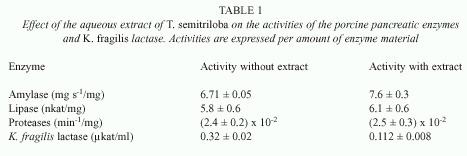
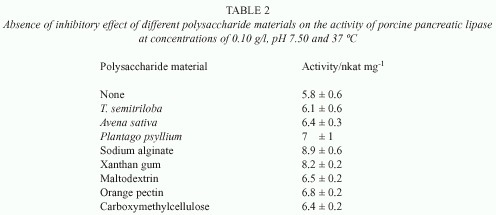
<p><font face="Arial" size="2">The lipolytic activity was measured at pH 7.50 (10 mM phosphate, 0.15 M NaCl) by titration of free fatty acids derived from milkfat globules, with NaOH/thymolphtalein (<a href="#Mata">Mata-Segreda 1981</a>, <a href="#Pazos">Pazos-Sanou and Mata-Segreda 1989</a>). Rates of conversion were determined as d(RCO<sub>2</sub> H)/<i>dt</i>, by the same numerical procedure as above. The activity was expressed as nkat/mg of pancreatin. Experiments were also carried out in the presence of other sources of soluble polysaccharide materials (See <a href="#table2">Table 2</a>).</font></p>     <p><font face="Arial" size="2">The combined hydrolytic activity of the pancreatic proteases on casein as substrate was measured at pH 7.50 (10 mM Tris, 0.15 M NaCl) following the methodology in <i>USP </i>25 (<a href="#Anonymous">Anonymous 2002</a>). Activity was expressed as <i>d</i>A<sub>280</sub><i>/dt </i>per mg of pancreatin.</font></p>     <p><font face="Arial" size="2">The activity of lactase was determined at pH 7.50 (10 mM Tris, 0.15 M NaCl) by measuring d(Glc)/<i>dt </i>from the hydrolysis of 100 mM lactose, with glucose-oxidase reagent (Ticolab ® , Costa Rica) and expressed as the rate of conversion per ml of used <i>Kluyveromyces fragilis </i>lactase industrial preparation (Lactozym ® , Trisan).</font></p>     <p><font face="Arial" size="2"><b>Statistical analysis: </b>The experimental results were expressed as the mean ± standard error and null hypothesis significance was evaluated by Student <i>t-</i>test.</font></p> <font face="Arial" size="2"><b>     <p>Results and discussion</p> </b></font>     <p><font face="Arial" size="2"><a href="#table1">Table 1</a> shows the lack of inhibitory activity from the aqueous extract of <i>T. semitriloba </i>(0.10 g/l, expressed as free Glc) on the hydrolytic activities of the porcine pancreatic enzymes. Nonetheless, 60 % inhibition was found on the activity of the soluble lactase <i>(p </i>&lt; 0.001). This inhibitory effect is analogous to the previous observation on the hydrolytic activity of rat intestinal sucrase, an <img alt=""  src="/img/fbpe/rbt/v51n2/alfa.JPG"  style="width: 16px; height: 17px;" align="top">&#61472;-o</font><font  color="#ff0000" face="Arial" size="2"><span  style="color: rgb(0, 0, 0);">ligosaccharase</span></font><b><font  color="#ff0000" face="Arial" size="2"> </font></b><font face="Arial"  size="2">(<a href="#Hun">Hun-Opfer and Mata-Segreda 1994</a>); despite the fact that lactase is a <img alt=""  src="/img/fbpe/rbt/v51n2/beta.JPG"  style="width: 7px; height: 14px;" align="top">&#61472;-</font><span  style="color: rgb(0, 0, 0);"><font face="Arial" size="2">oligosaccharase</font></span><font  face="Arial" size="2">.    
<br> &nbsp;&nbsp;&nbsp;&nbsp;&nbsp;     <br> </font></p>     ]]></body>
<body><![CDATA[<div style="text-align: center;"><font face="Arial" size="2"><a  name="table1"></a><img alt="" src="/img/fbpe/rbt/v51n2/2466i1.JPG"  style="width: 467px; height: 156px;"></font>    
<br> </div>     <p><font face="Arial" size="2">&nbsp;     <br> <a href="#table2">Table 2</a> shows that the catalytic activity of porcine pancreatic lipase is not affected by different soluble polysaccharide materials. The nature of the more complex molecular aspects of lipolytic activity –relative to amylase or the proteases- deserved a special interest on the eventual inhibitory potential of soluble polysaccharides from different sources (<a  href="#Verger84">Verger 1984</a>, <a href="#Verger91">Verger <i>et al. </i>1991</a>).    <br> &nbsp;&nbsp;     <br> <a name="table2"></a></font></p>     <div style="text-align: center;"><font face="Arial" size="2"><img alt=""  src="/img/fbpe/rbt/v51n2/2466i2.JPG"  style="width: 496px; height: 215px;"></font>    
<br> </div>     <p><font face="Arial" size="2">&nbsp;&nbsp;&nbsp;     <br> The absence of in-vitro inhibition of the major pancreatic enzymes by <i>T. semitriloba </i>extract at 0.10 g/l (expressed as free glucose) suggests that no malabsorption disorder should be expected from to the consumption of this plant material. An anonymous reviewer pointed to the importance to emphasize that this result is not definite evidence of safety. In relation with this point, the aqueous extract used in this work was found to exert no significant effect on the intestinal motility of albino rats (S. González-Camacho, and M. García. 2003. Personal communication).</font></p>     ]]></body>
<body><![CDATA[<p><font face="Arial" size="2">It is interesting to compare this result with findings related to <i>in vivo </i>experiments, carried out with more widely known plant materials such as psyllium. For example, addition of psyllium to a traditional American diet of persons with diabetes has been observed as safe and well tolerated, besides the fact that improvement was observed in glycaemic and lipid control in men with type 2 diabetes and hypertension (<a href="#Anderson">Anderson <i>et al. </i>1999</a>).</font></p>     <p><font face="Arial" size="2">In conclusion, the results of this experiment provide support to the claim that no significant digestive disorders should be expected from the use of the aqueous extract of <i>T. semitrilob</i>a, as a way to decrease the glycaemic index of sucrose-containing meals by diabetic or obese persons.</font></p> <small><span style="font-weight: bold; font-family: arial;">Acknowledgements</span></small> <font face="Arial" size="2"><b></b>     <p>The corresponding author expresses his gratitude to the Vice-Rectory for Research UCR, for providing support to this work. MEA-U acknowledges institutional support from UCR Turrialba Campus.</p> <b>     <p>Resumen</p> </b>     <p>El extracto acuoso de <i>Triumfetta semitriloba </i>es parte de la farmacopea popular de Costa Rica. Éste no muestra acción inhibitoria <i>in vitro </i>sobre las actividades hidrolíticas de la amilasa, la lipasa y las proteasas pancreáticas porcinas, disminuyendo la preocupación de que su uso provoque malabsorción intestinal.</p> <b>     <p>References</p> </b>     <!-- ref --><p><a name="Anderson"></a>Anderson, J.W., L.D. Allgood, J. Turner, P.R. Oeltgen &amp; B.P. Daggy. 1999. Effects of psyllium on glucose and serum lipid responses in men with type 2 diabetes and hypercholesterolemia. Am. J. Clin. Nutr. 70:466.    &nbsp;&nbsp;&nbsp;&nbsp;&nbsp;&nbsp;&nbsp;&nbsp;[&#160;<a href="javascript:void(0);" onclick="javascript: window.open('/scielo.php?script=sci_nlinks&ref=1670698&pid=S0034-7744200300020000200001&lng=','','width=640,height=500,resizable=yes,scrollbars=1,menubar=yes,');">Links</a>&#160;]<!-- end-ref --></p>     <!-- ref --><p><a name="Anonymous"></a>Anonymous. 2002. United States Pharmacopoeia 25. Pancreatin tablets, pp. 1303-1305.    &nbsp;&nbsp;&nbsp;&nbsp;&nbsp;&nbsp;&nbsp;&nbsp;[&#160;<a href="javascript:void(0);" onclick="javascript: window.open('/scielo.php?script=sci_nlinks&ref=1670700&pid=S0034-7744200300020000200002&lng=','','width=640,height=500,resizable=yes,scrollbars=1,menubar=yes,');">Links</a>&#160;]<!-- end-ref --></p>     ]]></body>
<body><![CDATA[<!-- ref --><p><a name="Ehrlein"></a>Ehrlein, H. &amp; A. Stockmann. 1998. Absorption of nutrients is only slightly reduced by supplementing enteral formulas with viscous fiber in miniature pigs. J. Nutr. 128: 2446-2455.    &nbsp;&nbsp;&nbsp;&nbsp;&nbsp;&nbsp;&nbsp;&nbsp;[&#160;<a href="javascript:void(0);" onclick="javascript: window.open('/scielo.php?script=sci_nlinks&ref=1670702&pid=S0034-7744200300020000200003&lng=','','width=640,height=500,resizable=yes,scrollbars=1,menubar=yes,');">Links</a>&#160;]<!-- end-ref --></p>     <!-- ref --><p><a name="Esquivel"></a>Esquivel-Herrera, E., A. Ugalde-Vargas, C. Beckenridge &amp; J.F. Mata-Segreda. 1987. Protective effect on rat gastric mucosa of the mucopolysaccharide of <i>Triunfetta semitrilob</i>a. Fitoterapia 58: 268-270.    &nbsp;&nbsp;&nbsp;&nbsp;&nbsp;&nbsp;&nbsp;&nbsp;[&#160;<a href="javascript:void(0);" onclick="javascript: window.open('/scielo.php?script=sci_nlinks&ref=1670704&pid=S0034-7744200300020000200004&lng=','','width=640,height=500,resizable=yes,scrollbars=1,menubar=yes,');">Links</a>&#160;]<!-- end-ref --></p>     <!-- ref --><p><a name="Fournier"></a>Fournier O., L.A. &amp; E.G. García D. 1998. Nombres vernaculares y científicos de los árboles de Costa Rica. Guayacán, San José, Costa Rica, p. 196.    &nbsp;&nbsp;&nbsp;&nbsp;&nbsp;&nbsp;&nbsp;&nbsp;[&#160;<a href="javascript:void(0);" onclick="javascript: window.open('/scielo.php?script=sci_nlinks&ref=1670706&pid=S0034-7744200300020000200005&lng=','','width=640,height=500,resizable=yes,scrollbars=1,menubar=yes,');">Links</a>&#160;]<!-- end-ref --></p>     <!-- ref --><p><a name="Hun"></a>Hun-Opfer, C. &amp; J.F. Mata-Segreda. 1994. Effect of <i>Triunfetta semitriloba </i>aqueous extract on sucrase activity in rat gut. Fitoterapia 65: 457-459.    &nbsp;&nbsp;&nbsp;&nbsp;&nbsp;&nbsp;&nbsp;&nbsp;[&#160;<a href="javascript:void(0);" onclick="javascript: window.open('/scielo.php?script=sci_nlinks&ref=1670708&pid=S0034-7744200300020000200006&lng=','','width=640,height=500,resizable=yes,scrollbars=1,menubar=yes,');">Links</a>&#160;]<!-- end-ref --></p>     <!-- ref --><p><a name="Juntunen"></a>Juntunen, K.S., L.K. Niskanen, R.H. Liukkonen, K.S. Poutanen, J.J. Holst &amp; H.M. Mykkänen. 2002. Postprandial glucose, insulin and incretin responses to grain products in healthy subjects. Am. J. Clin. Nutr. 75: 254-262.    &nbsp;&nbsp;&nbsp;&nbsp;&nbsp;&nbsp;&nbsp;&nbsp;[&#160;<a href="javascript:void(0);" onclick="javascript: window.open('/scielo.php?script=sci_nlinks&ref=1670710&pid=S0034-7744200300020000200007&lng=','','width=640,height=500,resizable=yes,scrollbars=1,menubar=yes,');">Links</a>&#160;]<!-- end-ref --></p>     ]]></body>
<body><![CDATA[<!-- ref --><p><a name="Mata"></a>Mata-Segreda, J.F. 1981. Hidrólisis de la grasa de leche con lipasa pancreática. Ing. Cienc. Quim. 5: 114-115.    &nbsp;&nbsp;&nbsp;&nbsp;&nbsp;&nbsp;&nbsp;&nbsp;[&#160;<a href="javascript:void(0);" onclick="javascript: window.open('/scielo.php?script=sci_nlinks&ref=1670712&pid=S0034-7744200300020000200008&lng=','','width=640,height=500,resizable=yes,scrollbars=1,menubar=yes,');">Links</a>&#160;]<!-- end-ref --> </p>     <!-- ref --><p><a name="Pazos"></a>Pazos-Sanou, L. &amp; J.F. Mata-Segreda. 1989. Actividad de preparados enzimáticos para uso digestivo. Fármacos 5: 67-74.    &nbsp;&nbsp;&nbsp;&nbsp;&nbsp;&nbsp;&nbsp;&nbsp;[&#160;<a href="javascript:void(0);" onclick="javascript: window.open('/scielo.php?script=sci_nlinks&ref=1670714&pid=S0034-7744200300020000200009&lng=','','width=640,height=500,resizable=yes,scrollbars=1,menubar=yes,');">Links</a>&#160;]<!-- end-ref --></p>     <!-- ref --><p><a name="Verger84"></a>Verger, R. 1984. Pancreatic lipase, pp. 83–150. <i>In </i>B. Borgström &amp; H.L. Brockman (eds.). Lipases. Elsevier, Amsterdam.    &nbsp;&nbsp;&nbsp;&nbsp;&nbsp;&nbsp;&nbsp;&nbsp;[&#160;<a href="javascript:void(0);" onclick="javascript: window.open('/scielo.php?script=sci_nlinks&ref=1670716&pid=S0034-7744200300020000200010&lng=','','width=640,height=500,resizable=yes,scrollbars=1,menubar=yes,');">Links</a>&#160;]<!-- end-ref --><!-- ref -->&nbsp;&nbsp;&nbsp;&nbsp;&nbsp;&nbsp;&nbsp;&nbsp;[&#160;<a href="javascript:void(0);" onclick="javascript: window.open('/scielo.php?script=sci_nlinks&ref=1670717&pid=S0034-7744200300020000200011&lng=','','width=640,height=500,resizable=yes,scrollbars=1,menubar=yes,');">Links</a>&#160;]<!-- end-ref --><!-- ref --><p><a name="Vuksan"></a>Vuksan, V., J.L. Sievenpiper, J. Wong, Z. Xu, U. Beljan-Zdravkovic, J.T. Arnason, V. Assinewe, M.S. Stavro, A.L. Jenkins &amp; L.A. Leiter, T. Francis. 2001. American ginseng <i>(Panax quiquefolius </i>L) attenuates postprandial glycemia in a time-dependent but not dose-dependent manner in healthy individuals. Am. J. Clin. Nutr. 73: 753-758.    &nbsp;&nbsp;&nbsp;&nbsp;&nbsp;&nbsp;&nbsp;&nbsp;[&#160;<a href="javascript:void(0);" onclick="javascript: window.open('/scielo.php?script=sci_nlinks&ref=1670718&pid=S0034-7744200300020000200012&lng=','','width=640,height=500,resizable=yes,scrollbars=1,menubar=yes,');">Links</a>&#160;]<!-- end-ref --><br> &nbsp;&nbsp;     <br> &nbsp;     <br> </p> </font>     ]]></body>
<body><![CDATA[<p><font face="Arial" size="2"><a name="a1"></a><a href="2466.htm#r1">1</a>. Division of Basic Studies, University of Costa Rica Turrialba Campus 7150, Costa Rica.</font></p>     <p><font face="Arial" size="2"><a href="2466.htm#r1">2</a>. Department of Biochemistry, University of Costa Rica, 2060, Costa Rica.</font></p>     <p><font face="Arial" size="2"><a href="2466.htm#r1">3</a>. School of Chemistry, University of Costa Rica, 2060, Costa Rica; </font><a  style="font-family: arial;" href="mailto:jmata@cariari.ucr.ac.cr"><font  size="2">jmata@cariari.ucr.ac.cr</font></a></p> <font face="Arial" size="2"></font><font face="Arial" size="2">     <p>    <br> </p> </font>      ]]></body><back>
<ref-list>
<ref id="B1">
<nlm-citation citation-type="journal">
<person-group person-group-type="author">
<name>
<surname><![CDATA[Anderson]]></surname>
<given-names><![CDATA[J.W.]]></given-names>
</name>
<name>
<surname><![CDATA[Allgood]]></surname>
<given-names><![CDATA[L.D.]]></given-names>
</name>
<name>
<surname><![CDATA[Turner]]></surname>
<given-names><![CDATA[J.]]></given-names>
</name>
<name>
<surname><![CDATA[Oeltgen]]></surname>
<given-names><![CDATA[P.R.]]></given-names>
</name>
<name>
<surname><![CDATA[Daggy]]></surname>
<given-names><![CDATA[B.P.]]></given-names>
</name>
</person-group>
<article-title xml:lang="en"><![CDATA[Effects of psyllium on glucose and serum lipid responses in men with type 2 diabetes and hypercholesterolemia]]></article-title>
<source><![CDATA[Am. J. Clin. Nutr.]]></source>
<year>1999</year>
<volume>70</volume>
<page-range>466</page-range></nlm-citation>
</ref>
<ref id="B2">
<nlm-citation citation-type="">
<person-group person-group-type="author">
<name>
</name>
<name>
</name>
</person-group>
<source><![CDATA[United States Pharmacopoeia 25: Pancreatin tablets]]></source>
<year>2002</year>
<page-range>1303-1305</page-range></nlm-citation>
</ref>
<ref id="B3">
<nlm-citation citation-type="journal">
<person-group person-group-type="author">
<name>
<surname><![CDATA[Ehrlein]]></surname>
<given-names><![CDATA[H.]]></given-names>
</name>
<name>
<surname><![CDATA[Stockmann]]></surname>
<given-names><![CDATA[A.]]></given-names>
</name>
</person-group>
<article-title xml:lang="en"><![CDATA[Absorption of nutrients is only slightly reduced by supplementing enteral formulas with viscous fiber in miniature pigs]]></article-title>
<source><![CDATA[J. Nutr.]]></source>
<year>1998</year>
<volume>128</volume>
<page-range>2446-2455</page-range></nlm-citation>
</ref>
<ref id="B4">
<nlm-citation citation-type="journal">
<person-group person-group-type="author">
<name>
<surname><![CDATA[Esquivel-Herrera]]></surname>
<given-names><![CDATA[E.]]></given-names>
</name>
<name>
<surname><![CDATA[Ugalde-Vargas]]></surname>
<given-names><![CDATA[A.]]></given-names>
</name>
<name>
<surname><![CDATA[Beckenridge]]></surname>
<given-names><![CDATA[C.]]></given-names>
</name>
<name>
<surname><![CDATA[Mata-Segreda]]></surname>
<given-names><![CDATA[J.F.]]></given-names>
</name>
</person-group>
<article-title xml:lang="en"><![CDATA[Protective effect on rat gastric mucosa of the mucopolysaccharide of Triunfetta semitriloba]]></article-title>
<source><![CDATA[Fitoterapia]]></source>
<year>1987</year>
<volume>58</volume>
<page-range>268-270</page-range></nlm-citation>
</ref>
<ref id="B5">
<nlm-citation citation-type="book">
<person-group person-group-type="author">
<name>
<surname><![CDATA[Fournier]]></surname>
<given-names><![CDATA[O.]]></given-names>
</name>
<name>
<surname><![CDATA[García]]></surname>
<given-names><![CDATA[E.G.]]></given-names>
</name>
</person-group>
<source><![CDATA[Nombres vernaculares y científicos de los árboles de Costa Rica]]></source>
<year>1998</year>
<page-range>196</page-range><publisher-loc><![CDATA[San José ]]></publisher-loc>
<publisher-name><![CDATA[Guayacán]]></publisher-name>
</nlm-citation>
</ref>
<ref id="B6">
<nlm-citation citation-type="journal">
<person-group person-group-type="author">
<name>
<surname><![CDATA[Hun-Opfer]]></surname>
<given-names><![CDATA[C.]]></given-names>
</name>
<name>
<surname><![CDATA[Mata-Segreda]]></surname>
<given-names><![CDATA[J.F.]]></given-names>
</name>
</person-group>
<article-title xml:lang="en"><![CDATA[Effect of Triunfetta semitriloba aqueous extract on sucrase activity in rat gut]]></article-title>
<source><![CDATA[Fitoterapia]]></source>
<year>1994</year>
<volume>65</volume>
<page-range>457-459</page-range></nlm-citation>
</ref>
<ref id="B7">
<nlm-citation citation-type="journal">
<person-group person-group-type="author">
<name>
<surname><![CDATA[Juntunen]]></surname>
<given-names><![CDATA[K.S.]]></given-names>
</name>
<name>
<surname><![CDATA[Niskanen]]></surname>
<given-names><![CDATA[L.K.]]></given-names>
</name>
<name>
<surname><![CDATA[Liukkonen]]></surname>
<given-names><![CDATA[R.H.]]></given-names>
</name>
<name>
<surname><![CDATA[Poutanen]]></surname>
<given-names><![CDATA[K.S.]]></given-names>
</name>
<name>
<surname><![CDATA[Holst]]></surname>
<given-names><![CDATA[J.J.]]></given-names>
</name>
<name>
<surname><![CDATA[Mykkänen]]></surname>
<given-names><![CDATA[H.M.]]></given-names>
</name>
</person-group>
<article-title xml:lang="en"><![CDATA[Postprandial glucose, insulin and incretin responses to grain products in healthy subjects]]></article-title>
<source><![CDATA[Am. J. Clin. Nutr.]]></source>
<year>2002</year>
<volume>75</volume>
<page-range>254-262</page-range></nlm-citation>
</ref>
<ref id="B8">
<nlm-citation citation-type="journal">
<person-group person-group-type="author">
<name>
<surname><![CDATA[Mata-Segreda]]></surname>
<given-names><![CDATA[J.F]]></given-names>
</name>
</person-group>
<article-title xml:lang="en"><![CDATA[Hidrólisis de la grasa de leche con lipasa pancreática]]></article-title>
<source><![CDATA[Ing. Cienc. Quim.]]></source>
<year>1981</year>
<volume>5</volume>
<page-range>114-115</page-range></nlm-citation>
</ref>
<ref id="B9">
<nlm-citation citation-type="journal">
<person-group person-group-type="author">
<name>
<surname><![CDATA[Pazos-Sanou]]></surname>
<given-names><![CDATA[L.]]></given-names>
</name>
<name>
<surname><![CDATA[Mata-Segreda]]></surname>
<given-names><![CDATA[J.F.]]></given-names>
</name>
</person-group>
<article-title xml:lang="es"><![CDATA[Actividad de preparados enzimáticos para uso digestivo]]></article-title>
<source><![CDATA[Fármacos]]></source>
<year>1989</year>
<volume>5</volume>
<page-range>67-74</page-range></nlm-citation>
</ref>
<ref id="B10">
<nlm-citation citation-type="book">
<person-group person-group-type="author">
<name>
<surname><![CDATA[Verger]]></surname>
<given-names><![CDATA[R]]></given-names>
</name>
<name>
<surname><![CDATA[Borgström]]></surname>
<given-names><![CDATA[B.]]></given-names>
</name>
<name>
<surname><![CDATA[Brockman]]></surname>
<given-names><![CDATA[H.L.]]></given-names>
</name>
</person-group>
<source><![CDATA[Lipases]]></source>
<year>1984</year>
<page-range>83-150</page-range><publisher-loc><![CDATA[Amsterdam ]]></publisher-loc>
<publisher-name><![CDATA[Elsevier]]></publisher-name>
</nlm-citation>
</ref>
<ref id="B11">
<nlm-citation citation-type="book">
<person-group person-group-type="author">
<name>
<surname><![CDATA[Verger]]></surname>
<given-names><![CDATA[R]]></given-names>
</name>
<name>
<surname><![CDATA[Rivière]]></surname>
<given-names><![CDATA[C.]]></given-names>
</name>
<name>
<surname><![CDATA[Moreau]]></surname>
<given-names><![CDATA[H.]]></given-names>
</name>
<name>
<surname><![CDATA[Gargouri]]></surname>
<given-names><![CDATA[Y.]]></given-names>
</name>
<name>
<surname><![CDATA[Rogalska]]></surname>
<given-names><![CDATA[E.]]></given-names>
</name>
<name>
<surname><![CDATA[Nury]]></surname>
<given-names><![CDATA[S.]]></given-names>
</name>
<name>
<surname><![CDATA[Moulin]]></surname>
<given-names><![CDATA[A.]]></given-names>
</name>
<name>
<surname><![CDATA[Ferrato]]></surname>
<given-names><![CDATA[F.]]></given-names>
</name>
<name>
<surname><![CDATA[Ransac]]></surname>
<given-names><![CDATA[S.]]></given-names>
</name>
<name>
<surname><![CDATA[Carrière]]></surname>
<given-names><![CDATA[F.]]></given-names>
</name>
<name>
<surname><![CDATA[Cudrey]]></surname>
<given-names><![CDATA[C.]]></given-names>
</name>
<name>
<surname><![CDATA[Trétout]]></surname>
<given-names><![CDATA[N.]]></given-names>
</name>
<name>
<surname><![CDATA[Alberghina]]></surname>
<given-names><![CDATA[L.]]></given-names>
</name>
<name>
<surname><![CDATA[Schmid]]></surname>
<given-names><![CDATA[R.D.]]></given-names>
</name>
<name>
<surname><![CDATA[Verger]]></surname>
<given-names><![CDATA[R.]]></given-names>
</name>
</person-group>
<source><![CDATA[Lipases: Structure, mechanism and genetic engineering]]></source>
<year>1991</year>
<page-range>105-116</page-range><publisher-loc><![CDATA[Germany ]]></publisher-loc>
<publisher-name><![CDATA[VCH, Weinheim]]></publisher-name>
</nlm-citation>
</ref>
<ref id="B12">
<nlm-citation citation-type="journal">
<person-group person-group-type="author">
<name>
<surname><![CDATA[Vuksan]]></surname>
<given-names><![CDATA[V.]]></given-names>
</name>
<name>
<surname><![CDATA[Sievenpiper]]></surname>
<given-names><![CDATA[J.L.]]></given-names>
</name>
<name>
<surname><![CDATA[Wong]]></surname>
<given-names><![CDATA[J.]]></given-names>
</name>
<name>
<surname><![CDATA[Xu]]></surname>
<given-names><![CDATA[Z.]]></given-names>
</name>
<name>
<surname><![CDATA[Beljan-Zdravkovic]]></surname>
<given-names><![CDATA[U.]]></given-names>
</name>
<name>
<surname><![CDATA[Arnason]]></surname>
<given-names><![CDATA[J.T.]]></given-names>
</name>
<name>
<surname><![CDATA[Assinewe]]></surname>
<given-names><![CDATA[V.]]></given-names>
</name>
<name>
<surname><![CDATA[Stavro]]></surname>
<given-names><![CDATA[M.S.]]></given-names>
</name>
<name>
<surname><![CDATA[Jenkins]]></surname>
<given-names><![CDATA[A.L.]]></given-names>
</name>
<name>
<surname><![CDATA[Leiter]]></surname>
<given-names><![CDATA[L.A.]]></given-names>
</name>
<name>
<surname><![CDATA[Francis]]></surname>
<given-names><![CDATA[T.]]></given-names>
</name>
</person-group>
<article-title xml:lang="en"><![CDATA[American ginseng (Panax quiquefolius L) attenuates postprandial glycemia in a time-dependent but not dose-dependent manner in healthy individuals]]></article-title>
<source><![CDATA[Am. J. Clin. Nutr.]]></source>
<year>2001</year>
<volume>73</volume>
<page-range>753-758</page-range></nlm-citation>
</ref>
</ref-list>
</back>
</article>