<?xml version="1.0" encoding="ISO-8859-1"?><article xmlns:mml="http://www.w3.org/1998/Math/MathML" xmlns:xlink="http://www.w3.org/1999/xlink" xmlns:xsi="http://www.w3.org/2001/XMLSchema-instance">
<front>
<journal-meta>
<journal-id>0034-7744</journal-id>
<journal-title><![CDATA[Revista de Biología Tropical]]></journal-title>
<abbrev-journal-title><![CDATA[Rev. biol. trop]]></abbrev-journal-title>
<issn>0034-7744</issn>
<publisher>
<publisher-name><![CDATA[Universidad de Costa Rica]]></publisher-name>
</publisher>
</journal-meta>
<article-meta>
<article-id>S0034-77442003000100024</article-id>
<title-group>
<article-title xml:lang="en"><![CDATA[Isolation of bothrasperin, a disintegrin with potent platelet aggregation inhibitory activity, from the venom of the snake Bothrops asper]]></article-title>
</title-group>
<contrib-group>
<contrib contrib-type="author">
<name>
<surname><![CDATA[Pinto]]></surname>
<given-names><![CDATA[Adrián]]></given-names>
</name>
<xref ref-type="aff" rid="A01"/>
</contrib>
<contrib contrib-type="author">
<name>
<surname><![CDATA[Angulo]]></surname>
<given-names><![CDATA[Yamileth]]></given-names>
</name>
<xref ref-type="aff" rid="A01"/>
</contrib>
<contrib contrib-type="author">
<name>
<surname><![CDATA[Jiménez]]></surname>
<given-names><![CDATA[Rafael]]></given-names>
</name>
<xref ref-type="aff" rid="A02"/>
</contrib>
<contrib contrib-type="author">
<name>
<surname><![CDATA[Lomonte]]></surname>
<given-names><![CDATA[Bruno]]></given-names>
</name>
<xref ref-type="aff" rid="A03"/>
</contrib>
</contrib-group>
<aff id="A01">
<institution><![CDATA[,Facultad de Microbiología Instituto Clodomiro Picado ]]></institution>
<addr-line><![CDATA[ ]]></addr-line>
</aff>
<aff id="A02">
<institution><![CDATA[,Caja Costarricense de Seguro Social Hospital Nacional de Niños Laboratorio de Investigación]]></institution>
<addr-line><![CDATA[San José ]]></addr-line>
<country>Costa Rica</country>
</aff>
<aff id="A03">
<institution><![CDATA[,Universidad de Costa Rica Facultad de Microbiología Instituto Clodomiro Picado]]></institution>
<addr-line><![CDATA[San José ]]></addr-line>
<country>Costa Rica</country>
</aff>
<pub-date pub-type="pub">
<day>00</day>
<month>03</month>
<year>2003</year>
</pub-date>
<pub-date pub-type="epub">
<day>00</day>
<month>03</month>
<year>2003</year>
</pub-date>
<volume>51</volume>
<numero>1</numero>
<fpage>253</fpage>
<lpage>260</lpage>
<copyright-statement/>
<copyright-year/>
<self-uri xlink:href="http://www.scielo.sa.cr/scielo.php?script=sci_arttext&amp;pid=S0034-77442003000100024&amp;lng=en&amp;nrm=iso"></self-uri><self-uri xlink:href="http://www.scielo.sa.cr/scielo.php?script=sci_abstract&amp;pid=S0034-77442003000100024&amp;lng=en&amp;nrm=iso"></self-uri><self-uri xlink:href="http://www.scielo.sa.cr/scielo.php?script=sci_pdf&amp;pid=S0034-77442003000100024&amp;lng=en&amp;nrm=iso"></self-uri><abstract abstract-type="short" xml:lang="en"><p><![CDATA[The venom of Bothrops asper induces severe coagulation disturbances in accidentally envenomed humans. However, only few studies have been conducted to identify components that interact with the hemostatic system in this venom. In the present work, we fractionated B. asper venom in order to investigate the possible presence of inhibitors of platelet aggregation. Using a combination of gel filtration, anion-exchange chromatography, and reverse-phase high performance liquid chromatography, we isolated an acidic protein which shows a single chain composition, with a molecular mass of ~8 kDa, estimated by SDS-polyacrylamide gel electrophoresis. Its N-terminal sequence has high similarity to disintegrins isolated from different snake venoms, which are known to bind to cellular integrins such as the GPIIb/IIIa fibrinogen receptor on platelets. The purified protein exerted potent aggregation inhibitory activity on ADP-stimulated human platelets in vitro, with an estimated IC50 of 50 nM. This biological activity, together with the biochemical characteristics observed, demonstrate that the protein isolated from B. asper venom is a disintegrin, hereby named "bothrasperin". This is the first disintegrin isolated from Central American viperid snake species.]]></p></abstract>
<abstract abstract-type="short" xml:lang="es"><p><![CDATA[El veneno de la serpiente Bothrops asper induce graves alteraciones de la coagulación en los humanos accidentalmente envenenados. Sin embargo, se han realizado pocos estudios para identificar los componentes del veneno que interactúan con el sistema hemostático. En el presente trabajo, fraccionamos el veneno de B. asper para investigar la posible presencia de inhibidores de la agregación plaquetaria. Empleando una combinación de técnicas cromatográficas (filtración en gel, intercambio aniónico y cromatografía líquida de alto desempeño en fase reversa), aislamos una proteína acídica de cadena simple, con una masa molecular de ~8 kDa, estimada mediante electroforesis en gel de poliacrilamida con SDS. Su secuencia de aminoácidos N-terminal muestra una alta similitud con la de disintegrinas aisladas de diferentes venenos de serpiente, las cuales se unen a integrinas celulares como el receptor de fibrinógeno GPIIb/IIIa de las plaquetas. La proteína purificada ejerce una potente acción inhibitoria sobre la agregación in vitro de plaquetas humanas estimuladas con ADP, con una IC 50 estimada en 50 nM. Esta actividad biológica, sumada a las características bioquímicas observadas, demuestran que la proteína aislada del veneno de B. asper es una disintegrina, a la cual denominamos "both-rasperina". Esta es la primera disintegrina aislada de una especie de vipéridos de Centroamérica.]]></p></abstract>
<kwd-group>
<kwd lng="en"><![CDATA[Snake venom]]></kwd>
<kwd lng="en"><![CDATA[disintegrin]]></kwd>
<kwd lng="en"><![CDATA[Bothrops]]></kwd>
<kwd lng="en"><![CDATA[platelet aggregation]]></kwd>
</kwd-group>
</article-meta>
</front><body><![CDATA[ <CENTER><B><FONT FACE="Arial">Isolation of bothrasperin, a disintegrin with potent platelet aggregation inhibitory activity, from the venom of the snake <I>Bothrops asper</I></FONT></B></CENTER>      <CENTER>&nbsp;</CENTER>      <CENTER>&nbsp;</CENTER>      <CENTER><FONT FACE="Arial"><FONT SIZE=-1>Adri&aacute;n Pinto&nbsp;<A NAME="R1"></A><SUP><A HREF="#A1">1</A>,<A HREF="#A1">2</A></SUP>, Yamileth Angulo <SUP><A HREF="#A1">1</A>,<A HREF="#A1">2</A></SUP>, Rafael Jim&eacute;nez <SUP><A HREF="#A1">3</A> </SUP>and Bruno Lomonte <SUP><A HREF="#A1">1</A>,<A HREF="#A1">4</A></SUP></FONT></FONT></CENTER> <FONT FACE="Arial,Helvetica">&nbsp;</FONT>     <BR>&nbsp;     <CENTER><FONT FACE="Arial"><FONT SIZE=-1>Received 21-VIII-2002. Corrected 14-III-2003. Accepted 29-III-2003.</FONT></FONT></CENTER> <B><FONT FACE="Arial"><FONT SIZE=-1>&nbsp;</FONT></FONT></B>     <BR><B><FONT FACE="Arial"><FONT SIZE=-1>Abstract</FONT></FONT></B>      <P><FONT FACE="Arial"><FONT SIZE=-1>The venom of <I>Bothrops asper </I>induces severe coagulation disturbances in accidentally envenomed humans. However, only few studies have been conducted to identify components that interact with the hemostatic system in this venom. In the present work, we fractionated <I>B. asper </I>venom in order to investigate the possible presence of inhibitors of platelet aggregation. Using a combination of gel filtration, anion-exchange chromatography, and reverse-phase high performance liquid chromatography, we isolated an acidic protein which shows a single chain composition, with a molecular mass of ~8 kDa, estimated by SDS-polyacrylamide gel electrophoresis. Its N-terminal sequence has high similarity to disintegrins isolated from different snake venoms, which are known to bind to cellular integrins such as the GPIIb/IIIa fibrinogen receptor on platelets. The purified protein exerted potent aggregation inhibitory activity on ADP-stimulated human platelets <I>in vitr</I>o, with an estimated IC<SUB>50</SUB> of 50 nM. This biological activity, together with the biochemical characteristics observed, demonstrate that the protein isolated from <I>B. asper </I>venom is a disintegrin, hereby named "bothrasperin". This is the first disintegrin isolated from Central American viperid snake species.</FONT></FONT>      <P><FONT FACE="Arial"><FONT SIZE=-1><B>Keywords: </B>Snake venom, disintegrin, <I>Bothrop</I>s, platelet aggregation.</FONT></FONT>      <P><FONT FACE="Arial"><FONT SIZE=-1>Snake venoms constitute rich sources of proteins that interact with the hemostatic system of vertebrates, either by promoting or by inhibiting particular steps of the coagulation cascade (<A HREF="#Markland">Markland 1998</A>, <A HREF="#Kamiguti96">Kamiguti <I>et al. </I>1998</A>, <A HREF="#Braud">Braud <I>et al</I>. 2000</A>, <A HREF="#Matsui">Matsui <I>et al</I> . 2000</A>). Such proteins may be of central relevance during the clinical course of accidental human envenomations by various snake species, particularly from the families Viperidae and Crotalidae, by inducing striking alterations in the coagulation system that might lead to fatal hemorrhages. In addition, the remarkable specificity of such venom proteins towards defined components of the hemostatic system, in many instances, has opened the possibility to exploit them as molecular tools for the study of coagulation reactions, for the development of <I>in vitro </I>diagnostic assays, and for potential therapeutic applications (<A HREF="#Niewiarowski">Niewiarowski <I>et al. </I>1994</A>, <A HREF="#Markland">Markland 1998</A>, <A HREF="#Braud">Braud <I>et al</I>. 2000</A>).</FONT></FONT>      ]]></body>
<body><![CDATA[<P><FONT FACE="Arial"><FONT SIZE=-1>In Central America, the majority of human envenomations due to snakebites are inflicted by <I>Bothrops aspe</I>r, commonly known as "ter-ciopelo" or "barba amarilla" (<A HREF="#Gutierrez95">Guti&eacute;rrez 1995, 2002</A>). As typical of many viperid/crotalid snakes, the venom of <I>B. asper </I>induces severe coagulation disturbances (<A HREF="#Barrantes">Barrantes <I>et al</I>. 1985</A>). Only few studies have been conducted to identify toxins affecting hemostasis in <I>B. asper </I>venom, despite their potential relevance for its lethal action. A thrombin-like enzyme has been described (<A HREF="#Aragon">Arag&oacute;n and Gubensek 1978</A>), and more recently, an inducer of platelet aggregation (aspercetin) from this venom was reported (<A HREF="#Rucavado">Rucavado <I>et al.</I> 2001</A>). In the present study, the possible presence of inhibitors of platelet aggregation in the venom of <I>B. asper </I>was investigated, resulting in the purification and characterization of a disintegrin, hereby named "bothrasperin".</FONT></FONT>      <P><B><FONT FACE="Arial"><FONT SIZE=-1>Materials and methods</FONT></FONT></B>      <P><FONT FACE="Arial"><FONT SIZE=-1><B>Venom. </B>The venom of <I>Bothrops asper </I>was a pool obtained from more than 30 specimens collected in the Atlantic region of Costa Rica, and kept at the serpentarium of the Instituto Clodomiro Picado, Universidad de Costa Rica. Immediately after extraction, the venom was centrifuged to remove insoluble debris, lyophilized, and stored at -20&deg;C.</FONT></FONT>      <P><FONT FACE="Arial"><FONT SIZE=-1><B>Gel filtration chromatography. </B>Venom samples of 250 mg were dissolved in 0.5 M acetic acid, pH 1.8, and applied to a column of Sephadex G-50 (93 x 2 cm; Pharmacia, Sweden) equilibrated with the same solvent. Elution was carried out at 0.3 ml/min, monitoring proteins with an absorbance detector at 280 nm (Bio-Rad, USA). Fractions of 4 ml were collected, dried in a vacuum centrifuge (Savant SpeedVac System, AES 1010), and stored at -20&deg;C.</FONT></FONT>      <P><FONT FACE="Arial"><FONT SIZE=-1><B>Anion-exchange fast protein liquid chromatography (FPLC). </B>Aliquots of 2 mg of fraction III from the gel filtration step were dissolved in 0.05 M ammonium acetate, pH 7.5, and applied to a Mono-Q anion-exchange column using an FPLC instrument (Pharmacia, Sweden). A linear gradient from 0.05 M to 0.24 M ammonium acetate, pH 7.5, was developed in 30 min. Fractions were collected manually, vacuum dried, and finally dissolved in 100 &micro;l of 0.12 M NaCl, 0.04 M sodium phosphate, pH 7.2 (PBS) , in order to screen for platelet aggregation inhibitory activity.</FONT></FONT>      <P><FONT FACE="Arial"><FONT SIZE=-1><B>High performance liquid chromatography (HPLC). </B>Subfraction III-3 from the anion-exchange chromatography step was applied to a C18 reverse-phase column (15 x 4.6 mm; Vydac, USA) using an HPLC instrument (Waters model 600E, USA). Elution was carried out with a linear gradient from 0 to 60% acetonitrile in 0.1% trifluoroacetic acid, at 1 ml/min during 60 min.</FONT></FONT>      <P><FONT FACE="Arial"><FONT SIZE=-1><B>Gel electrophoresis. </B>A triphasic discontinuous polyacrylamide gel electrophoresis system in the presence of sodium dodecylsulphate (SDS-PAGE; <A HREF="#Hames">Hames 1981</A>) was utilized to monitor the protein composition of venom fractions during purification, as well as to estimate the molecular mass of the isolated disintegrin. Final monomer concentrations of the gel layers were 4% (stacking gel), 10% (upper resolving gel), and 15% (lower resolving gel). A set of very low molecular weight markers (VLMW; Pharmacia, Sweden) was run in parallel to samples, at a constant voltage of 150 V, and proteins were finally visualized by R-250 Coomassie blue staining.</FONT></FONT>      <P><FONT FACE="Arial"><FONT SIZE=-1><B>Assay for inhibition of platelet aggregation. </B>Fresh platelet-rich human plasma was prepared by centrifugation of blood from healthy volunteers, at 100 G during 15 min. Aliquots of 450 &micro;l of this preparation were incubated with 10-20 &micro;l of venom fractions for 5 min at 37&deg;C. Then, platelet aggregation was initiated by the addition of 50 &micro;l of 0.1 mM ADP, and monitored by the increase in light transmittance signal using a model 530-VS aggregometer (Chrono-Log Corporation, 530-VS) interfaced to a chart recorder, during 5-8 min. Platelet-poor plasma (450 &micro;l) alone was utilized as a blank, whereas platelet-rich plasma (450 &micro;l) incubated only with ADP (50 &micro;l) was utilized as a positive control for aggregation. All samples were analyzed in duplicate assays. Protein concentration of the samples was estimated by the Bradford colorimetric microassay (<A HREF="#Bradford">Bradford 1976</A>).</FONT></FONT>      <P><FONT FACE="Arial"><FONT SIZE=-1><B>N-terminal sequence. </B>The native purified protein was subjected to direct N-terminal sequencing by automated Edman degradation, using a model LF 3000 Beckman sequencer (Beckman, USA).</FONT></FONT>      <P><B><FONT FACE="Arial"><FONT SIZE=-1>Results</FONT></FONT></B>      ]]></body>
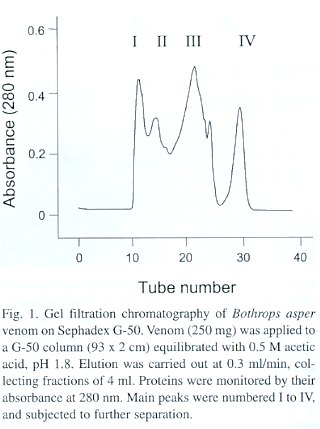
<body><![CDATA[<P><FONT FACE="Arial"><FONT SIZE=-1>The separation of <I>B. asper </I>venom components by gel filtration on Sephadex G-50 is shown in <A HREF="#fig1">Fig. 1</A>. All four major peaks obtained (I-IV) caused a direct coagulation of human plasma in the assay for platelet aggregation inhibitory activity, and therefore could not be screened for the presence of aggregation inhibitors. SDS-PAGE analysis revealed that peak I contained the high molecular weight venom components, whereas peak IV had very low amounts of protein, its absorbance being probably due to non-proteinaceous small compounds. Peaks II and III, on the basis of the molecular weight of its components, were selected for further fractionation by anion-exchange FPLC on Mono-Q.</FONT></FONT>     <BR>&nbsp;     <CENTER><A NAME="fig1"></A><IMG SRC="/img/fbpe/rbt/v51n1/2413i01.JPG" HEIGHT=429 WIDTH=320></CENTER> &nbsp;     
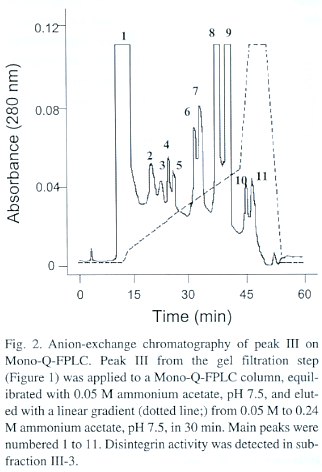
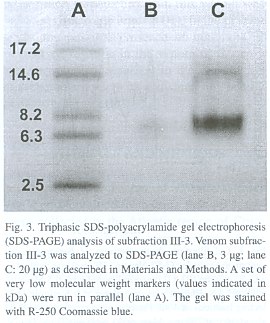
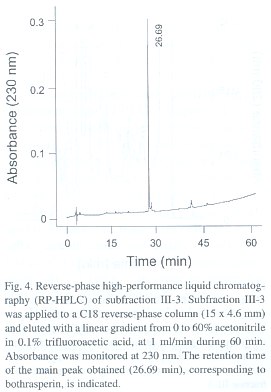
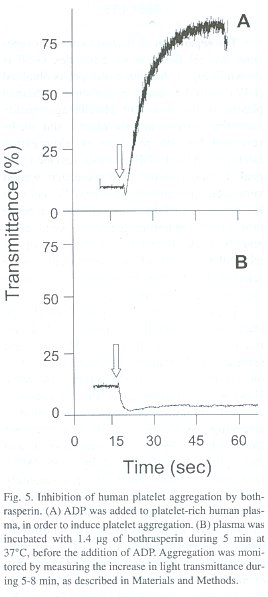
<BR><FONT FACE="Arial"><FONT SIZE=-1>The anion-exchange step resolved 10 sub-fractions from peak II (not shown), and 11 subfractions from peak III (<A HREF="#fig2">Fig. 2</A>). Most of these subfractions had direct procoagulant activity on plasma, and were therefore discarded. However, subfraction III-3 (<A HREF="#fig2">Fig. 2</A>) caused a complete inhibition of platelet aggregation in screening assays. Several III-3 subfractions from different FPLC runs were pooled, and their purity was evaluated by SDS-PAGE, revealing a major band of approximately 8 kDa, and a minor band of 13-14 kDa that became evident only in overloaded gels (<A HREF="#fig3">Fig. 3</A>). Since the molecular weight of phospholi-pases A 2 corresponds to 13-15 kDA, an indirect hemolysis assay in agarose gel (<A HREF="#Gutierrez88">Guti&eacute;rrez <I>et al. </I>1988</A>) was performed, confirming that this enzymatic activity was contaminating the 8 kDa preparation. Therefore, a third chromatographic step was performed, using RP-HPLC, resulting in the separation of a major sharp peak from few minor contaminants (<A HREF="#fig4">Fig. 4</A>). This final protein preparation was devoid of phospholipase A<SUB>2</SUB> activity, and efficiently inhibited platelet aggregation (<A HREF="#fig5">Fig. 5</A>), thus showing the characteristics of a disintegrin.</FONT></FONT>     <BR>&nbsp;     <CENTER><A NAME="fig2"></A><IMG SRC="/img/fbpe/rbt/v51n1/2413i02.JPG" HEIGHT=472 WIDTH=322></CENTER>      
<CENTER>&nbsp;</CENTER>      <CENTER><A NAME="fig3"></A><IMG SRC="/img/fbpe/rbt/v51n1/2413i03.JPG" HEIGHT=323 WIDTH=270></CENTER>      
<CENTER>&nbsp;</CENTER>      <CENTER><A NAME="fig4"></A><IMG SRC="/img/fbpe/rbt/v51n1/2413i04.JPG" HEIGHT=392 WIDTH=271></CENTER>      
]]></body>
<body><![CDATA[<CENTER>&nbsp;</CENTER>      <CENTER><A NAME="fig5"></A><IMG SRC="/img/fbpe/rbt/v51n1/2413i05.JPG" HEIGHT=597 WIDTH=268></CENTER>       
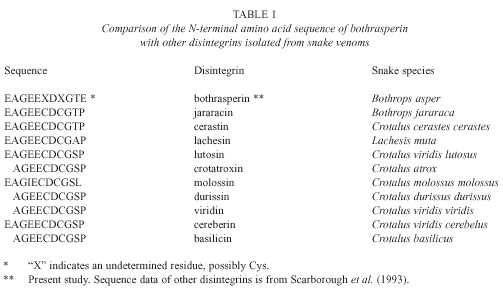
<P><FONT FACE="Arial"><FONT SIZE=-1>By testing a series of different concentrations of the purified disintegrin, an inhibitory concentration 50% (IC<SUB>50</SUB> ) of 50 nM was calculated as its platelet aggregation inhibitory potency. The final protein preparation was subjected to N-terminal sequence analysis, in which the first 11 amino acid residues were identified as NH 2 -EAGEEXDXGTE (where X is a possible cysteine residue). This partial sequence is compared to that of other disintegrins in <A HREF="#table1">Table 1</A>.</FONT></FONT>     <BR><FONT FACE="Arial"><FONT SIZE=-1>&nbsp;</FONT></FONT>     <CENTER><A NAME="table1"></A><IMG SRC="/img/fbpe/rbt/v51n1/2413t01.JPG" HEIGHT=293 WIDTH=503></CENTER>       
<P><B><FONT FACE="Arial"><FONT SIZE=-1>Discussion</FONT></FONT></B>      <P><FONT FACE="Arial"><FONT SIZE=-1>Snake venoms may contain a variety of components with the ability to inhibit platelet aggregation, which, to date, correspond to one of the following types: disintegrins,&nbsp;<IMG SRC="/img/fbpe/rbt/v51n1/alfa.JPG" HEIGHT=17 WIDTH=16 ALIGN=ABSBOTTOM>-fibrinogenases, 5’-nucleotidases, and phospholipases A<SUB>2</SUB> (<A HREF="#Markland">Markland 1998</A>). This study demonstrates that the venom of <I>B. asper</I>, the most relevant venomous snake in Central America from the medical point of view, contains at least one component with potent anti-aggregating activity upon human platelets. This protein, here named bothrasperin, was isolated by a combination of gel filtration, ion-exchange, and RP-HPLC chromatographies. It was identified as a disintegrin on the basis of its molecular weight (8 kDa), acidic nature, N-terminal amino acid sequence, and biological activity. Its potency to inhibit human platelet aggregation <I>in vitro </I>(IC<SUB>50</SUB> ) was estimated at approximately 50 nM.</FONT></FONT>      
<P><FONT FACE="Arial"><FONT SIZE=-1>Disintegrins from snake venoms have attracted interest in recent years, due to their clinical potential as platelet aggregation inhibitors in the thrombotic events that are frequently involved in cardiovascular and cerebrovascular disease (<A HREF="#Markland">Markland 1998</A>). Another relevant area of interest focuses on their anti-angiogenic and anti-metastasic activities in animal cancer models, due to their ability to interact with cellular integrins that participate in the mechanisms of neovascularization and tumor cell invasion (<A HREF="#Danen">Danen <I>et al. </I>1998</A>, <A HREF="#Yeh">Yeh <I>et al. </I>1998</A>). On the other hand, the precise role of disintegrins in the toxic actions of snake venoms has not been established yet. Some venom hemorrhagic metalloproteinases contain a disintegrin-like domain, which might be released after partial proteolysis (<A HREF="#Bjarnason">Bjarnason and Fox 1994</A>). Some of these disintegrin-like domains have been shown to interact with integrins (<A HREF="#Kamiguti96">Kamiguti <I>et al. </I>1996</A>, <A HREF="#Jia">Jia <I>et al. </I>1997</A>). It has been hypothesized that the disintegrin-like domain, by targeting particular cell surface integrins, may have a role in directing the large, multidomain hemorrhagic toxins towards specific locations, therefore enhancing their toxic efficiency (<A HREF="#Matsui">Matsui <I>et al. </I>2000</A>). In addition, if inhibition of platelet aggregation by disintegrins occurs also <I>in viv</I> o, hemorrhage induced by venom metalloproteinases might be potentiated, a possibility that awaits to be experimentally evaluated.</FONT></FONT>      <P><FONT FACE="Arial"><FONT SIZE=-1>The disintegrins usually contain a recognition motif composed by the sequence Arg-Gly-Asp (RGD motif), which confers to them an affinity towards cellular integrins such as the GPIIb/IIIa fibrinogen receptor on platelets (<A HREF="#Zhou">Zhou <I>et al. </I>1996</A>, <A HREF="#Markland">Markland 1998</A>), explaining their anti-aggregating activity. In the case of bothrasperin, its N-terminal amino acid sequence showed a high similarity with jararacin, a disintegrin of 73 amino acids (7,739 Da) isolated from the venom of the South American species <I>Bothrops jararaca </I>(<A HREF="#Scarborough">Scarborough <I>et al. </I>1993</A>). Further characterization of the structural and functional properties of bothrasperin will be of importance to determine its specificity and its role in the pathophysiological alterations occurring in snakebite envenomations by <I>B. aspe</I>r, as well as to explore potentially useful activities related to its ability to inhibit platelet aggregation.</FONT></FONT>      <P><B><FONT FACE="Arial"><FONT SIZE=-1>Acknowledgements</FONT></FONT></B>      ]]></body>
<body><![CDATA[<P><FONT FACE="Arial"><FONT SIZE=-1>The valuable collaboration of Timoteo Olamendi, Fernando Zamudio, and Lourival Possani (Instituto de Biotecnolog&iacute;a, Universidad Nacional Aut&oacute;noma de M&eacute;xico at Cuernavaca, M&eacute;xico) in the N-terminal sequence determination of bothrasperin is gratefully acknowledged. Financial support for these studies was obtained from Vicerrector&iacute;a de Investigaci&oacute;n, Universidad de Costa Rica (VI-741-AO-085) and the Embassy of Japan in Costa Rica. This work was performed in partial fulfillment of the <I>Licenciatura </I>degree of A. Pinto at the Faculty of Microbiology, University of Costa Rica.</FONT></FONT>      <P><B><FONT FACE="Arial"><FONT SIZE=-1>Resumen</FONT></FONT></B>      <P><FONT FACE="Arial"><FONT SIZE=-1>El veneno de la serpiente <I>Bothrops asper </I>induce graves alteraciones de la coagulaci&oacute;n en los humanos accidentalmente envenenados. Sin embargo, se han realizado pocos estudios para identificar los componentes del veneno que interact&uacute;an con el sistema hemost&aacute;tico. En el presente trabajo, fraccionamos el veneno de <I>B. asper </I>para investigar la posible presencia de inhibidores de la agregaci&oacute;n plaquetaria. Empleando una combinaci&oacute;n de t&eacute;cnicas cromatogr&aacute;ficas (filtraci&oacute;n en gel, intercambio ani&oacute;nico y cromatograf&iacute;a l&iacute;quida de alto desempe&ntilde;o en fase reversa), aislamos una prote&iacute;na ac&iacute;dica de cadena simple, con una masa molecular de ~8 kDa, estimada mediante electroforesis en gel de poliacrilamida con SDS. Su secuencia de amino&aacute;cidos N-terminal muestra una alta similitud con la de disintegrinas aisladas de diferentes venenos de serpiente, las cuales se unen a integrinas celulares como el receptor de fibrin&oacute;geno GPIIb/IIIa de las plaquetas. La prote&iacute;na purificada ejerce una potente acci&oacute;n inhibitoria sobre la agregaci&oacute;n <I>in vitro </I>de plaquetas humanas estimuladas con ADP, con una IC 50 estimada en 50 nM. Esta actividad biol&oacute;gica, sumada a las caracter&iacute;sticas bioqu&iacute;micas observadas, demuestran que la prote&iacute;na aislada del veneno de <I>B. asper </I>es una disintegrina, a la cual denominamos "both-rasperina". Esta es la primera disintegrina aislada de una especie de vip&eacute;ridos de Centroam&eacute;rica.</FONT></FONT>      <P><B><FONT FACE="Arial"><FONT SIZE=-1>References</FONT></FONT></B>      <P><A NAME="Aragon"></A><FONT FACE="Arial"><FONT SIZE=-1>Arag&oacute;n, F. &amp; F. Gubens&cent;ek. 1978. Characterization of thrombin-like proteinase from <I>Bothrops asper </I>venom. pp. 107-111. <I>In </I>P. Rosenberg (ed.). Toxins: Animal, Plant and Microbial. Pergamon, Oxford.</FONT></FONT>      <!-- ref --><P><A NAME="Barrantes"></A><FONT FACE="Arial"><FONT SIZE=-1>Barrantes, A., V. Sol&iacute;s &amp; R. Bola&ntilde;os. 1985. Alteraci&oacute;n de los mecanismos de la coagulaci&oacute;n en el envenenamiento por <I>Bothrops asper </I>(terciopelo). Toxicon 23: 399-408.</FONT></FONT>    &nbsp;&nbsp;&nbsp;&nbsp;&nbsp;&nbsp;&nbsp;&nbsp;[&#160;<a href="javascript:void(0);" onclick="javascript: window.open('/scielo.php?script=sci_nlinks&ref=1216775&pid=S0034-7744200300010002400002&lng=','','width=640,height=500,resizable=yes,scrollbars=1,menubar=yes,');">Links</a>&#160;]<!-- end-ref --><!-- ref --><P><A NAME="Bjarnason"></A><FONT FACE="Arial"><FONT SIZE=-1>Bjarnason, J.B. &amp; J.W. Fox. 1994. Hemorrhagic metallo-proteinases from snake venoms. Pharmac. Ther. 62: 325-372.</FONT></FONT>    &nbsp;&nbsp;&nbsp;&nbsp;&nbsp;&nbsp;&nbsp;&nbsp;[&#160;<a href="javascript:void(0);" onclick="javascript: window.open('/scielo.php?script=sci_nlinks&ref=1216776&pid=S0034-7744200300010002400003&lng=','','width=640,height=500,resizable=yes,scrollbars=1,menubar=yes,');">Links</a>&#160;]<!-- end-ref --><P><A NAME="Bradford"></A><FONT FACE="Arial"><FONT SIZE=-1>Bradford, M. 1976. A rapid and sensitive method for the quantitation of microgram quantities of protein utilizing the principle of protein-dye binding. Anal. Biochem. 72: 248-254.</FONT></FONT>      <!-- ref --><P><A NAME="Braud"></A><FONT FACE="Arial"><FONT SIZE=-1>Braud, S., C. Bon &amp; A. Wisner. 2000. Snake venom proteins acting on hemostasis. Biochimie 82: 851-859.</FONT></FONT>    &nbsp;&nbsp;&nbsp;&nbsp;&nbsp;&nbsp;&nbsp;&nbsp;[&#160;<a href="javascript:void(0);" onclick="javascript: window.open('/scielo.php?script=sci_nlinks&ref=1216778&pid=S0034-7744200300010002400004&lng=','','width=640,height=500,resizable=yes,scrollbars=1,menubar=yes,');">Links</a>&#160;]<!-- end-ref --><P><A NAME="Danen"></A><FONT FACE="Arial"><FONT SIZE=-1>Danen, E.H., C. Marcinkiewicz, I.M. Cornelissen, A.A. van Kraats, J.A. Pachter, D.J. Ruiter, S.</FONT></FONT>      ]]></body>
<body><![CDATA[<P><A NAME="Niewiarowski"></A><FONT FACE="Arial"><FONT SIZE=-1>Niewiarowski &amp; G.N. van Muijen. 1998. The disintegrin eritostatin interferes with integrin a4b1 function and with experimental metastasis of human melanoma cells. Exp. Cell. Res. 238: 188-196.</FONT></FONT>      <P><A NAME="Gutierrez95"></A><FONT FACE="Arial"><FONT SIZE=-1>Guti&eacute;rrez, J.M. 1995. Clinical toxicology of snake bites in Central America, p. 646–663. <I>In </I>J. Meier &amp; J. White (eds.). Handbook of Clinical Toxicology of Animal Venomous and Poisons. CRC, Boca Raton.</FONT></FONT>      <P><A NAME="Gutierrez02"></A><FONT FACE="Arial"><FONT SIZE=-1>Guti&eacute;rrez, J.M. 2002. Comprendiendo los venenos de serpientes: 50 a&ntilde;os de investigaciones en America Latina. Rev. Biol. Trop. 50: 377-394.</FONT></FONT>      <!-- ref --><P><A NAME="Gutierrez88"></A><FONT FACE="Arial"><FONT SIZE=-1>Guti&eacute;rrez, J.M., C. Avila, E. Rojas &amp; L. Cerdas. 1988. An alternative <I>in vitro </I>method for testing the potency of the polyvalent antivenom produced in Costa Rica. Toxicon 26: 411-413.</FONT></FONT>    &nbsp;&nbsp;&nbsp;&nbsp;&nbsp;&nbsp;&nbsp;&nbsp;[&#160;<a href="javascript:void(0);" onclick="javascript: window.open('/scielo.php?script=sci_nlinks&ref=1216783&pid=S0034-7744200300010002400007&lng=','','width=640,height=500,resizable=yes,scrollbars=1,menubar=yes,');">Links</a>&#160;]<!-- end-ref --><P><A NAME="Hames"></A><FONT FACE="Arial"><FONT SIZE=-1>Hames, B.D. 1981. Peptide mapping by limited proteolysis using SDS-polyacrylamide gel electrophoresis, pp. 219-229. <I>In </I>B.D. Hames &amp; D. Rickwood (eds.). Gel Electrophoresis of Proteins, a Practical Approach. IRL Press, Oxford.</FONT></FONT>      <P><A NAME="Jia"></A><FONT FACE="Arial"><FONT SIZE=-1>Jia, L.G., Wang X.M., J.D. Shannon, J.B. Bjarnason &amp; J.W. Fox. 1997. Function of disintegrin-like/cys-teine-rich domain of atrolysin A: inhibition of platelet aggregation by recombinant protein and peptide antagonists. J. Biol. Chem. 272: 13094-13102.</FONT></FONT>      <P><A NAME="Kamiguti96"></A><FONT FACE="Arial"><FONT SIZE=-1>Kamiguti, A.S., C.R.M. Hay, R.D.G. Theakston &amp; M. Zuzel. 1996. Insights into the mechanism of hemorrhage caused by snake venom metalloproteinases. Toxicon 34: 627-642.</FONT></FONT>      <!-- ref --><P><A NAME="Kamiguti98"></A><FONT FACE="Arial"><FONT SIZE=-1>Kamiguti, A.S., M. Zuzel &amp; R.D.G. Theakston. 1998. Snake venom metalloproteinases and disintegrins: interactions with cells. Braz. J. Med. Biol. Re<I>s. </I>31:853-862.</FONT></FONT>    &nbsp;&nbsp;&nbsp;&nbsp;&nbsp;&nbsp;&nbsp;&nbsp;[&#160;<a href="javascript:void(0);" onclick="javascript: window.open('/scielo.php?script=sci_nlinks&ref=1216787&pid=S0034-7744200300010002400009&lng=','','width=640,height=500,resizable=yes,scrollbars=1,menubar=yes,');">Links</a>&#160;]<!-- end-ref --><!-- ref --><P><A NAME="Markland"></A><FONT FACE="Arial"><FONT SIZE=-1>Markland, F.S. 1998. Snake venoms and the hemostatic system. Toxicon 36: 1749-1800.</FONT></FONT>    &nbsp;&nbsp;&nbsp;&nbsp;&nbsp;&nbsp;&nbsp;&nbsp;[&#160;<a href="javascript:void(0);" onclick="javascript: window.open('/scielo.php?script=sci_nlinks&ref=1216788&pid=S0034-7744200300010002400010&lng=','','width=640,height=500,resizable=yes,scrollbars=1,menubar=yes,');">Links</a>&#160;]<!-- end-ref --><!-- ref --><P><A NAME="Matsui"></A><FONT FACE="Arial"><FONT SIZE=-1>Matsui, T., Y. Fujimura &amp; K. Titani. 2000. Snake venom proteases affecting hemostasis and thrombosis. Biochim. Biophys. Acta 1477: 146-156.</FONT></FONT>    &nbsp;&nbsp;&nbsp;&nbsp;&nbsp;&nbsp;&nbsp;&nbsp;[&#160;<a href="javascript:void(0);" onclick="javascript: window.open('/scielo.php?script=sci_nlinks&ref=1216789&pid=S0034-7744200300010002400011&lng=','','width=640,height=500,resizable=yes,scrollbars=1,menubar=yes,');">Links</a>&#160;]<!-- end-ref --><P><A NAME="Niewiarowski"></A><FONT FACE="Arial"><FONT SIZE=-1>Niewiarowski, S., M.A. McLane, M. Kloczewiak &amp; G.J. Stewart. 1994. Disintegrins and other naturally occurring antagonists of platelet fibrinogen receptors. Seminars in Haematology. 31: 289-300.</FONT></FONT>      <P><A NAME="Rucavado"></A><FONT FACE="Arial"><FONT SIZE=-1>Rucavado, A., M. Soto, A.S. Kamiguti, R.D.G. Theakston, J.W. Fox, T. Escalante &amp; J.M. Guti&eacute;rrez. 2001. Characterization of aspercetin, a platelet aggregating component from the venom of the snake <I>Bothrops asper </I>which induces thrombocytopenia and potentiates metalloproteinase-induced hemorrhage. Thromb. Haemost. 85: 710-715.</FONT></FONT>      <P><A NAME="Scarborough"></A><FONT FACE="Arial"><FONT SIZE=-1>Scarborough, R.M., J.W. Rose, M.A. Naughton, D.R. Phillips, L. Nannizzi, A. Arfsten, A.M. Campbell &amp; I.F. Charo. 1993. Characterization of the integrin specificities of disintegrins isolated from American pit viper venoms. J. Biol. Chem. 268: 1058-1065.</FONT></FONT>      <!-- ref --><P><A NAME="Yeh"></A><FONT FACE="Arial"><FONT SIZE=-1>Yeh, C.H., H.C. Peng &amp; T.F. Huang. 1998 Accutin, a new disintegrin, inhibits angiogenesis in vitro and in vivo by acting as integrin aVb3 antagonist and inducing apoptosis. Blood 92: 3 268-3 276.</FONT></FONT>    &nbsp;&nbsp;&nbsp;&nbsp;&nbsp;&nbsp;&nbsp;&nbsp;[&#160;<a href="javascript:void(0);" onclick="javascript: window.open('/scielo.php?script=sci_nlinks&ref=1216793&pid=S0034-7744200300010002400012&lng=','','width=640,height=500,resizable=yes,scrollbars=1,menubar=yes,');">Links</a>&#160;]<!-- end-ref --><!-- ref --><P><A NAME="Zhou"></A><FONT FACE="Arial"><FONT SIZE=-1>Zhou, Q., C. Dangelmaier &amp; J.B. Smith. 1996. The hemorrhagin catrocollastatin inhibits collagen-induced platelet aggregation by binding to collagen via its disintegrin-like domain. Biochem. Biophys. Res. Commun. 219: 720-726.</FONT></FONT>    &nbsp;&nbsp;&nbsp;&nbsp;&nbsp;&nbsp;&nbsp;&nbsp;[&#160;<a href="javascript:void(0);" onclick="javascript: window.open('/scielo.php?script=sci_nlinks&ref=1216794&pid=S0034-7744200300010002400013&lng=','','width=640,height=500,resizable=yes,scrollbars=1,menubar=yes,');">Links</a>&#160;]<!-- end-ref --><BR><FONT FACE="Arial"><FONT SIZE=-1>&nbsp;</FONT></FONT>      <P><A NAME="A1"></A><FONT FACE="Arial"><FONT SIZE=-1><A HREF="#R1">1</A> Instituto Clodomiro Picado, Facultad de Microbiolog&iacute;a,</FONT></FONT>      <P><FONT FACE="Arial"><FONT SIZE=-1><A HREF="#R1">2</A> Departamento de Bioqu&iacute;mica, Escuela de Medicina, Universidad de Costa Rica, San Jos&eacute;, Costa Rica;</FONT></FONT>      <P><FONT FACE="Arial"><FONT SIZE=-1><A HREF="#R1">3</A> Laboratorio de Investigaci&oacute;n, Hospital Nacional de Ni&ntilde;os, Caja Costarricense de Seguro Social, San Jos&eacute;, Costa Rica.</FONT></FONT>      <P><FONT SIZE=-1><FONT FACE="Arial"><A HREF="#R1">4</A> Correspondence to: Bruno Lomonte, PhD, Instituto Clodomiro Picado, Facultad de Microbiolog&iacute;a, Universidad de Costa Rica, San Jos&eacute;, Costa Rica, fax (+506) 292-0485, e-ma</FONT><FONT FACE="Arial,Helvetica">il: <A HREF="mailto:blomonte@cariari.ucr.ac.cr">blomonte@cariari.ucr.ac.cr</A></FONT></FONT>     ]]></body>
<body><![CDATA[ ]]></body><back>
<ref-list>
<ref id="B1">
<nlm-citation citation-type="">
<person-group person-group-type="author">
<name>
<surname><![CDATA[Aragón]]></surname>
<given-names><![CDATA[F]]></given-names>
</name>
<name>
<surname><![CDATA[Gubenscek]]></surname>
<given-names><![CDATA[F]]></given-names>
</name>
</person-group>
<article-title xml:lang="en"><![CDATA[Characterization of thrombin-like proteinase from Bothrops asper venom]]></article-title>
<person-group person-group-type="editor">
<name>
<surname><![CDATA[Rosenberg]]></surname>
<given-names><![CDATA[P]]></given-names>
</name>
</person-group>
<source><![CDATA[Toxins: Animal, Plant and Microbial]]></source>
<year>1978</year>
<publisher-loc><![CDATA[Pergamon^eOxford Oxford]]></publisher-loc>
</nlm-citation>
</ref>
<ref id="B2">
<nlm-citation citation-type="journal">
<person-group person-group-type="author">
<name>
<surname><![CDATA[Barrantes]]></surname>
<given-names><![CDATA[A]]></given-names>
</name>
<name>
<surname><![CDATA[Solís]]></surname>
<given-names><![CDATA[V]]></given-names>
</name>
<name>
<surname><![CDATA[Bolaños]]></surname>
<given-names><![CDATA[R]]></given-names>
</name>
</person-group>
<article-title xml:lang="es"><![CDATA[Alteración de los mecanismos de la coagulación en el envenenamiento por Bothrops asper (terciopelo)]]></article-title>
<source><![CDATA[Toxicon]]></source>
<year>1985</year>
<volume>23</volume>
<page-range>399-408</page-range></nlm-citation>
</ref>
<ref id="B3">
<nlm-citation citation-type="journal">
<person-group person-group-type="author">
<name>
<surname><![CDATA[Bjarnason]]></surname>
<given-names><![CDATA[J.B]]></given-names>
</name>
<name>
<surname><![CDATA[Fox]]></surname>
<given-names><![CDATA[J.W]]></given-names>
</name>
</person-group>
<article-title xml:lang="en"><![CDATA[Hemorrhagic metallo-proteinases from snake venoms]]></article-title>
<source><![CDATA[Pharmac. Ther]]></source>
<year>1994</year>
<volume>62</volume>
<page-range>325-372</page-range></nlm-citation>
</ref>
<ref id="B4">
<nlm-citation citation-type="journal">
<person-group person-group-type="author">
<name>
<surname><![CDATA[Braud]]></surname>
<given-names><![CDATA[S]]></given-names>
</name>
<name>
<surname><![CDATA[Bon]]></surname>
<given-names><![CDATA[C]]></given-names>
</name>
<name>
<surname><![CDATA[Wisner]]></surname>
<given-names><![CDATA[A]]></given-names>
</name>
</person-group>
<article-title xml:lang="en"><![CDATA[Snake venom proteins acting on hemostasis]]></article-title>
<source><![CDATA[Biochimie]]></source>
<year>2000</year>
<volume>82</volume>
<page-range>851-859</page-range></nlm-citation>
</ref>
<ref id="B5">
<nlm-citation citation-type="journal">
<person-group person-group-type="author">
<name>
<surname><![CDATA[Danen]]></surname>
<given-names><![CDATA[E.H]]></given-names>
</name>
<name>
<surname><![CDATA[Marcinkiewicz]]></surname>
<given-names><![CDATA[C]]></given-names>
</name>
<name>
<surname><![CDATA[Cornelissen]]></surname>
<given-names><![CDATA[I.M]]></given-names>
</name>
</person-group>
<article-title xml:lang="en"><![CDATA[The disintegrin eritostatin interferes with integrin a4b1 function and with experimental metastasis of human melanoma cells]]></article-title>
<source><![CDATA[Exp. Cell. Res]]></source>
<year>1998</year>
<volume>238</volume>
<page-range>188-196</page-range></nlm-citation>
</ref>
<ref id="B6">
<nlm-citation citation-type="journal">
<person-group person-group-type="author">
<name>
<surname><![CDATA[Gutierrez]]></surname>
<given-names><![CDATA[J.M]]></given-names>
</name>
</person-group>
<article-title xml:lang="es"><![CDATA[Comprendiendo los venenos de serpientes: 50 años de investigaciones en America Latina]]></article-title>
<source><![CDATA[Rev. Biol. Trop]]></source>
<year>2002</year>
<volume>50</volume>
<page-range>377-394</page-range></nlm-citation>
</ref>
<ref id="B7">
<nlm-citation citation-type="journal">
<person-group person-group-type="author">
<name>
<surname><![CDATA[Gutiérrez]]></surname>
<given-names><![CDATA[J.M]]></given-names>
</name>
<name>
<surname><![CDATA[Avila]]></surname>
<given-names><![CDATA[C]]></given-names>
</name>
<name>
<surname><![CDATA[Rojas]]></surname>
<given-names><![CDATA[E]]></given-names>
</name>
<name>
<surname><![CDATA[Cerdas]]></surname>
<given-names><![CDATA[L]]></given-names>
</name>
</person-group>
<article-title xml:lang="en"><![CDATA[An alternative in vitro method for testing the potency of the polyvalent antivenom produced in Costa Rica]]></article-title>
<source><![CDATA[Toxicon]]></source>
<year>1988</year>
<volume>26</volume>
<page-range>411-413</page-range></nlm-citation>
</ref>
<ref id="B8">
<nlm-citation citation-type="journal">
<person-group person-group-type="author">
<name>
<surname><![CDATA[Kamiguti]]></surname>
<given-names><![CDATA[A.S]]></given-names>
</name>
<name>
<surname><![CDATA[Hay]]></surname>
<given-names><![CDATA[C.R.M]]></given-names>
</name>
<name>
<surname><![CDATA[Theakston]]></surname>
<given-names><![CDATA[R.D.G]]></given-names>
</name>
</person-group>
<article-title xml:lang="en"><![CDATA[Insights into the mechanism of hemorrhage caused by snake venom metalloproteinases]]></article-title>
<source><![CDATA[Toxicon]]></source>
<year>1996</year>
<volume>34</volume>
<page-range>627-642</page-range></nlm-citation>
</ref>
<ref id="B9">
<nlm-citation citation-type="journal">
<person-group person-group-type="author">
<name>
<surname><![CDATA[Kamiguti]]></surname>
<given-names><![CDATA[A.S]]></given-names>
</name>
<name>
<surname><![CDATA[Zuzel]]></surname>
<given-names><![CDATA[M]]></given-names>
</name>
<name>
<surname><![CDATA[Theakston]]></surname>
<given-names><![CDATA[R.D.G]]></given-names>
</name>
</person-group>
<article-title xml:lang="en"><![CDATA[Snake venom metalloproteinases and disintegrins: interactions with cells]]></article-title>
<source><![CDATA[Braz. J. Med. Biol. Res]]></source>
<year>1998</year>
<volume>31</volume>
<page-range>853-862</page-range></nlm-citation>
</ref>
<ref id="B10">
<nlm-citation citation-type="journal">
<person-group person-group-type="author">
<name>
<surname><![CDATA[Markland]]></surname>
<given-names><![CDATA[F.S]]></given-names>
</name>
</person-group>
<article-title xml:lang="en"><![CDATA[Snake venoms and the hemostatic system]]></article-title>
<source><![CDATA[Toxicon]]></source>
<year>1998</year>
<volume>36</volume>
<page-range>1749-1800</page-range></nlm-citation>
</ref>
<ref id="B11">
<nlm-citation citation-type="journal">
<person-group person-group-type="author">
<name>
<surname><![CDATA[Matsui]]></surname>
<given-names><![CDATA[T]]></given-names>
</name>
<name>
<surname><![CDATA[Fujimura]]></surname>
<given-names><![CDATA[Y]]></given-names>
</name>
<name>
<surname><![CDATA[Titani]]></surname>
<given-names><![CDATA[K]]></given-names>
</name>
</person-group>
<article-title xml:lang="en"><![CDATA[Snake venom proteases affecting hemostasis and thrombosis]]></article-title>
<source><![CDATA[Biochim. Biophys. Acta]]></source>
<year>2000</year>
<volume>1477</volume>
<page-range>146-156</page-range></nlm-citation>
</ref>
<ref id="B12">
<nlm-citation citation-type="journal">
<person-group person-group-type="author">
<name>
<surname><![CDATA[Yeh]]></surname>
<given-names><![CDATA[C.H]]></given-names>
</name>
<name>
<surname><![CDATA[Peng]]></surname>
<given-names><![CDATA[H.C]]></given-names>
</name>
<name>
<surname><![CDATA[Huang]]></surname>
<given-names><![CDATA[T.F]]></given-names>
</name>
</person-group>
<article-title xml:lang="en"><![CDATA[Accutin, a new disintegrin, inhibits angiogenesis in vitro and in vivo by acting as integrin aVb3 antagonist and inducing apoptosis]]></article-title>
<source><![CDATA[Blood]]></source>
<year>1998</year>
<volume>92</volume><volume>3</volume>
<page-range>268-3 276</page-range></nlm-citation>
</ref>
<ref id="B13">
<nlm-citation citation-type="journal">
<person-group person-group-type="author">
<name>
<surname><![CDATA[Zhou]]></surname>
<given-names><![CDATA[Q]]></given-names>
</name>
<name>
<surname><![CDATA[Dangelmaier]]></surname>
<given-names><![CDATA[C]]></given-names>
</name>
<name>
<surname><![CDATA[Smith]]></surname>
<given-names><![CDATA[J.B]]></given-names>
</name>
</person-group>
<article-title xml:lang="en"><![CDATA[The hemorrhagin catrocollastatin inhibits collagen-induced platelet aggregation by binding to collagen via its disintegrin-like domain]]></article-title>
<source><![CDATA[Biochem. Biophys. Res. Commun]]></source>
<year>1996</year>
<volume>219</volume>
<page-range>720-726</page-range></nlm-citation>
</ref>
</ref-list>
</back>
</article>