<?xml version="1.0" encoding="ISO-8859-1"?><article xmlns:mml="http://www.w3.org/1998/Math/MathML" xmlns:xlink="http://www.w3.org/1999/xlink" xmlns:xsi="http://www.w3.org/2001/XMLSchema-instance">
<front>
<journal-meta>
<journal-id>0034-7744</journal-id>
<journal-title><![CDATA[Revista de Biología Tropical]]></journal-title>
<abbrev-journal-title><![CDATA[Rev. biol. trop]]></abbrev-journal-title>
<issn>0034-7744</issn>
<publisher>
<publisher-name><![CDATA[Universidad de Costa Rica]]></publisher-name>
</publisher>
</journal-meta>
<article-meta>
<article-id>S0034-77442003000100021</article-id>
<title-group>
<article-title xml:lang="es"><![CDATA[Demografía y ecología de anidación de la iguana verde, Iguana iguana (Squamata: Iguanidae), en dos poblaciones explotadas en la Depresión Momposina, Colombia]]></article-title>
</title-group>
<contrib-group>
<contrib contrib-type="author">
<name>
<surname><![CDATA[Muñoz]]></surname>
<given-names><![CDATA[Eliana M.]]></given-names>
</name>
<xref ref-type="aff" rid="A01"/>
</contrib>
<contrib contrib-type="author">
<name>
<surname><![CDATA[Ortega]]></surname>
<given-names><![CDATA[Angela M.]]></given-names>
</name>
<xref ref-type="aff" rid="A01"/>
</contrib>
<contrib contrib-type="author">
<name>
<surname><![CDATA[Bock]]></surname>
<given-names><![CDATA[Brian C.]]></given-names>
</name>
<xref ref-type="aff" rid="A02"/>
</contrib>
<contrib contrib-type="author">
<name>
<surname><![CDATA[Páez]]></surname>
<given-names><![CDATA[Vivian P.]]></given-names>
</name>
<xref ref-type="aff" rid="A01"/>
</contrib>
</contrib-group>
<aff id="A01">
<institution><![CDATA[,Universidad de Antioquia Instituto de Biología ]]></institution>
<addr-line><![CDATA[Medellín ]]></addr-line>
<country>Colombia</country>
</aff>
<aff id="A02">
<institution><![CDATA[,Universidad Nacional de Colombia Departamento de Ciencias Forestales ]]></institution>
<addr-line><![CDATA[Medellín ]]></addr-line>
<country>Colombia</country>
</aff>
<pub-date pub-type="pub">
<day>00</day>
<month>03</month>
<year>2003</year>
</pub-date>
<pub-date pub-type="epub">
<day>00</day>
<month>03</month>
<year>2003</year>
</pub-date>
<volume>51</volume>
<numero>1</numero>
<fpage>229</fpage>
<lpage>240</lpage>
<copyright-statement/>
<copyright-year/>
<self-uri xlink:href="http://www.scielo.sa.cr/scielo.php?script=sci_arttext&amp;pid=S0034-77442003000100021&amp;lng=en&amp;nrm=iso"></self-uri><self-uri xlink:href="http://www.scielo.sa.cr/scielo.php?script=sci_abstract&amp;pid=S0034-77442003000100021&amp;lng=en&amp;nrm=iso"></self-uri><self-uri xlink:href="http://www.scielo.sa.cr/scielo.php?script=sci_pdf&amp;pid=S0034-77442003000100021&amp;lng=en&amp;nrm=iso"></self-uri><abstract abstract-type="short" xml:lang="en"><p><![CDATA[We studied the demography and nesting ecology of two populations of Iguana iguana that face heavy exploitation and habitat modification in the Momposina Depression, Colombia. Lineal transect data was analyzed using the Fourier model to provide estimates of social group densities, which was found to differ both within and among populations (1.05 - 6.0 groups/ha). Mean group size and overall iguana density estimates varied between populations as well (1.5 -13.7 iguanas/ha). The density estimates were far lower than those reported from more protected areas in Panama and Venezuela. Iguana densities were consistently higher in sites located along rivers (2.5 iguanas/group) than in sites along the margin of marshes, probably due to vegetational differences (1.5 iguanas/group). There was no correlation between density estimates and estimates of relative abundance (number of iguanas seen/hour/person) due to differing detectabilities of iguana groups among sites. The adult sex ratio (1:2.5 males:females) agreed well with other reports in the literature based upon observation of adult social groups, and probably results from the polygynous mating system in this species rather than a real demographic skew. Nesting in this population occurs from the end of January through March and hatching occurs between April and May. We monitored 34 nests, which suffered little vertebrate predation, perhaps due to the lack of a complete vertebrate fauna in this densely inhabited area, but nests suffered from inundation, cattle trampling, and infestation by phorid fly larvae. Clutch sizes in these populations were lower than all other published reports except for the iguana population on the highly xeric island of Curaçao, implying that adult females in our area are unusually small. We argue that this is more likely the result of the exploitation of these populations rather than an adaptive response to environmentally extreme conditions.]]></p></abstract>
<abstract abstract-type="short" xml:lang="es"><p><![CDATA[Se estudió la demografía y ecología de anidación de dos poblaciones de Iguana iguana que enfrentan explotación severa y alteración del hábitat, en la Depresión Momposina, Colombia. Los atos de transectos lineales fueron analizados con el modelo de Fourier para estimar la densidad de grupos sociales. El tamaño promedio de grupo y la densidad general de iguanas varió dentro y entre poblaciones (1.05 - 6.0 grupos/ha, y 1.5 - 13.7 iguanas/ha respectivamente). Las estimaciones de densidad fueron mucho menores que las reportadas en áreas más protegidas en Panamá y Venezuela. Las densidades de las iguanas fueron considerablemente mayores en sitios localizados a lo largo de los ríos (2.5 iguanas/grupo) que en sitios en el margen de las ciénagas (1.5 iguanas/grupo), probablemente debido a diferencias en la vegetación. No hubo correlación entre las estimaciones de densidad y la de abundancia relativa (número de iguanas vistas/hora/persona), debido a diferencias en detectabilidad de los grupos de iguanas entre los sitios. La proporción sexual hallada (1:2.5 machos: hembras), es probablemente el resultado del sistema de apareamiento polígamo de esta especie, en vez de indicar un verdadero sesgo demográfico. Se monitoreó 34 nidos los cuales sufrieron poca depredación por vertebrados. Sin embargo si fueron afectados por inundaciones, pisoteo por ganado e infestación por larvas de mosca Phoridae. El tamaño de huevos por nidada en estas poblaciones fue de 29.4 menor que cualquier otro reporte de la literatura, con la excepción de las poblaciones de Iguana que habitan la isla altamente xérica de Curaçao, implicando que las hembras adultas en nuestra área son inusualmente pequeñas. Probablemente éste es el resultado de la explotación prolongada y excesiva de estas poblaciones en vez de ser una respuesta adaptativa a condiciones ambientales extremas.]]></p></abstract>
<kwd-group>
<kwd lng="en"><![CDATA[Iguana]]></kwd>
<kwd lng="en"><![CDATA[Reptilia]]></kwd>
<kwd lng="en"><![CDATA[Iguanidae]]></kwd>
<kwd lng="en"><![CDATA[nesting]]></kwd>
<kwd lng="en"><![CDATA[group size]]></kwd>
<kwd lng="en"><![CDATA[clutch size]]></kwd>
<kwd lng="en"><![CDATA[exploitation]]></kwd>
</kwd-group>
</article-meta>
</front><body><![CDATA[ <CENTER><B><FONT FACE="Arial">Demograf&iacute;a y ecolog&iacute;a de anidaci&oacute;n de la iguana verde, <I>Iguana iguana </I>(Squamata: Iguanidae), en dos poblaciones explotadas en la Depresi&oacute;n Momposina, Colombia</FONT></B></CENTER> &nbsp;     <BR>&nbsp;     <CENTER><FONT FACE="Arial"><FONT SIZE=-1>Eliana M. Mu&ntilde;oz&nbsp;<A NAME="R1"></A><SUP><A HREF="#A1">1</A></SUP>, Angela M. Ortega <SUP><A HREF="#A1">1</A></SUP>, Brian C. Bock <SUP><A HREF="#A1">2</A></SUP> y Vivian P. P&aacute;ez <SUP><A HREF="#A1">1</A></SUP></FONT></FONT></CENTER> &nbsp;     <BR>&nbsp;     <CENTER><FONT FACE="Arial"><FONT SIZE=-1>Recibido 5-VII-2001. Corregido 20-VI-2002. Aceptado 10-VII-2002.</FONT></FONT></CENTER>       <P><B><FONT FACE="Arial"><FONT SIZE=-1>Abstract</FONT></FONT></B>      <P><FONT FACE="Arial"><FONT SIZE=-1>We studied the demography and nesting ecology of two populations of <I>Iguana iguana </I>that face heavy exploitation and habitat modification in the Momposina Depression, Colombia. Lineal transect data was analyzed using the Fourier model to provide estimates of social group densities, which was found to differ both within and among populations (1.05 - 6.0 groups/ha). Mean group size and overall iguana density estimates varied between populations as well (1.5 -13.7 iguanas/ha). The density estimates were far lower than those reported from more protected areas in Panama and Venezuela. Iguana densities were consistently higher in sites located along rivers (2.5 iguanas/group) than in sites along the margin of marshes, probably due to vegetational differences (1.5 iguanas/group). There was no correlation between density estimates and estimates of relative abun-dance (number of iguanas seen/hour/person) due to differing detectabilities of iguana groups among sites. The adult sex ratio (1:2.5 males:females) agreed well with other reports in the literature based upon observation of adult social groups, and probably results from the polygynous mating system in this species rather than a real demographic skew. Nesting in this population occurs from the end of January through March and hatching occurs between April and May. We monitored 34 nests, which suffered little vertebrate predation, perhaps due to the lack of a complete vertebrate fauna in this densely inhabited area, but nests suffered from inundation, cattle trampling, and infestation by phorid fly larvae. Clutch sizes in these populations were lower than all other published reports except for the iguana population on the highly xeric island of Cura&ccedil;ao, implying that adult females in our area are unusually small. We argue that this is more likely the result of the exploitation of these populations rather than an adaptive response to environmentally extreme conditions.</FONT></FONT>      <P><FONT FACE="Arial"><FONT SIZE=-1><B>Key words: </B><I>Iguan</I>a, Reptilia, Iguanidae, nesting, group size, clutch size, exploitation.</FONT></FONT>      <P><FONT FACE="Arial"><FONT SIZE=-1>La iguana verde, <I>Iguana iguan</I>a, es la &uacute;nica especie de la familia Iguanidae que ha logrado establecerse en la parte continental de Sur Am&eacute;rica, con un &aacute;mbito de distribuci&oacute;n que va desde M&eacute;xico hasta Paraguay (<A HREF="#Etheridge">Etheridge 1982</A>). En varios pa&iacute;ses, las poblaciones de <I>I. iguana </I>son altamente explotadas, siendo las hembras reproductivas m&aacute;s apetecidas, ya que sus huevos son considerados un manjar y son preferidos m&aacute;s que su carne (<A HREF="#Muller72">M&uuml;ller 1972</A>, <A HREF="#Fitch">Fitch y Henderson 1977</A>, <A HREF="#Harris">Harris 1982</A>). A &eacute;sto se suma la tala a que han sido sometidos los bosques nativos para la formaci&oacute;n de &aacute;reas aptas para la ganader&iacute;a y agricultura, factor que incide sobre las poblaciones de <I>I. iguana </I>tanto de forma directa, por la muerte de animales durante la tala y quema, como indirecta por la reducci&oacute;n de los h&aacute;bitats apropiados para la especie (<A HREF="#Ruiz">Ru&iacute;z y Rand 1985</A>, Werner 1977). En consecuencia, a pesar de su amplia distribuci&oacute;n, la iguana verde actualmente se encuentra en el Ap&eacute;ndice II de CITES como una especie amenazada.</FONT></FONT>      <P><FONT FACE="Arial"><FONT SIZE=-1>Varios aspectos de la ecolog&iacute;a de <I>I. iguana </I>han sido estudiados en distintas poblaciones, como su dieta (<A HREF="#Troyer82">Troyer 1982, 1984a, 1984b</A>, <A HREF="#Rand90">Rand <I>et al. </I>1990</A>), tasas de crecimiento y supervivencia (<A HREF="#Harris">Harris 1982</A>, <A HREF="#Troyer82">Troyer 1982, 1987</A>, <A HREF="#VanDevender">Van Devender 1982</A>, <A HREF="#Burghardt85">Burghardt y Rand, 1985</A>, <A HREF="#Zug87">Zug y Rand 1987</A>, <A HREF="#Rodda90">Rodda 1990</A>, <A HREF="#Rand92">Rand y Bock 1992</A>), ecolog&iacute;a reproductiva (<A HREF="#Hirth">Hirth 1963</A>, <A HREF="#Rand68">Rand 1968</A>, <A HREF="#Rand72">1972, 1984</A>, <A HREF="#Rand69">Rand y Robinson 1969</A>, <A HREF="#Fitch">Fitch y Henderson 1977</A>, <A HREF="#Rand80">Rand y Dugan 1980, 1983</A>, <A HREF="#Klein">Klein 1982</A>, <A HREF="#Casas">Casas-Andreu y Valenzuela- L&oacute;pez 1984</A>, <A HREF="#Werner88">Werner 1988</A>, <A HREF="#Phillips">Phillips <I>et al. </I>1990</A>, <A HREF="#Rodda90">Rodda 1990</A>, <A HREF="#Roddaet90">Rodda y Grajal 1990</A>, <A HREF="#vanMarken">van Marken Lichtenbelt y Albers 1993</A>, <A HREF="#Bock98">Bock <I>et al. </I>1998</A>), comportamiento social de los juveniles (<A HREF="#Henderson">Henderson 1974</A>, <A HREF="#Burghardt77">Burghardt <I>et al. </I>1977</A>, <A HREF="#Burghardt85">Burghardt y Rand 1985</A>, <A HREF="#Werner87">Werner <I>et al. </I>1987</A>, <A HREF="#Mora91">Mora 1991</A>) y adultos (<A HREF="#Rand76">Rand y Rand, 1976</A>, <A HREF="#Dugan82">Dugan 1982</A>, <A HREF="#Rand89">Rand <I>et al. </I>1989</A>, <A HREF="#Rodda92">Rodda 1992</A>).</FONT></FONT>      ]]></body>
<body><![CDATA[<P><FONT FACE="Arial"><FONT SIZE=-1>Ir&oacute;nicamente, a pesar de la necesidad de conocer el estado demogr&aacute;fico de las poblaciones naturales, en especial de aquellas que est&aacute;n bajo una alta presi&oacute;n de cacer&iacute;a u otros efectos antr&oacute;picos, son muy escasos los estudios enfocados a determinar los tama&ntilde;os poblacionales o densidades de <I>I. iguana </I>(<A HREF="#Henderson">Henderson 1974</A>, <A HREF="#Dugan82">Dugan 1982</A>, <A HREF="#Rodda92">Rodda 1992</A>). En el presente estudio, nos propusimos cuantificar la estructura demogr&aacute;fica y la densidad de dos poblaciones naturales de <I>I. iguana </I>en la Depresi&oacute;n Momposina, una zona de Colombia muy deteriorada por las actividades humanas y donde es tradicional la explotaci&oacute;n de la especie por su carne y huevos (<A HREF="#DelaOssa">De la Ossa 1999</A>).</FONT></FONT>      <P><FONT FACE="Arial"><FONT SIZE=-1>Adem&aacute;s, presentamos datos sobre la ecolog&iacute;a de anidaci&oacute;n de esta especie en la zona y a su vez establecemos el efecto por la intervenci&oacute;n antr&oacute;pica, u otros factores naturales o artificiales sobre el &eacute;xito reproductivo de esta especie.</FONT></FONT>      <P><B><FONT FACE="Arial"><FONT SIZE=-1>Materiales y m&eacute;todos</FONT></FONT></B>      <P><FONT FACE="Arial"><FONT SIZE=-1>El estudio se llev&oacute; a cabo en dos &aacute;reas ubicadas en la Depresi&oacute;n Momposina, una regi&oacute;n localizada al Noroeste de Colombia que recibe este nombre debido a que se encuentra en una altura de cinco metros bajo el nivel del mar (mbnm). Seleccionamos dos &aacute;reas de estudio con diferencias en cuanto el tipo de vegetaci&oacute;n y cuerpos de agua presentes. Una de las &aacute;reas corresponde al &aacute;rea de Juan Criollo, parte del Complejo Cenagoso de Piji&ntilde;o (Municipio de San Zen&oacute;n, Departamento de Magdalena).Aqu&iacute; hay grandes cuerpos de agua permanentes, cuyos niveles fluct&uacute;an dependiendo de la din&aacute;mica del R&iacute;o Magdalena. La zona de vida corresponde a bosque seco tropical (<A HREF="#Holdridge">Holdridge 1979</A>); no obstante, en la actualidad la vegetaci&oacute;n esta conformada por escasos fragmentos boscosos en diferentes estadios sucesionales y grandes extensiones de <I>Symmeria paniculata </I>(Polygonaceae), conocida vulgarmente en la zona como "mangle", que crece en las orillas de las ci&eacute;nagas. En esta &aacute;rea, seleccionamos dos sitios de trabajo para el estudio demogr&aacute;fico: uno en la orilla de la ci&eacute;naga cerca al pueblo de Angostura (de aproximadamente 400 habitantes) y otro en una finca privada llamada Isla Le&oacute;n, a unos 300 m de distancia de la primera. En Angostura hay fragmentos de vegetaci&oacute;n ribere&ntilde;a y grandes extensiones de mangle, mientras que en Isla Le&oacute;n predominan frutales y &aacute;rboles de poca altura.</FONT></FONT>      <P><FONT FACE="Arial"><FONT SIZE=-1>A una distancia de aproximadamente 50 km, seleccionamos una segunda &aacute;rea de estudio en el municipio de Hatillo de Loba (Departamento Bol&iacute;var). Esta &aacute;rea est&aacute; conformada por cuerpos de agua semipermanentes (pozas y ca&ntilde;os), que son alimentados por el R&iacute;o Magdalena durante &eacute;pocas de lluvia y que pueden llegar a secarse completamente en verano.</FONT></FONT>      <P><FONT FACE="Arial"><FONT SIZE=-1>Es una zona de vida de transici&oacute;n entre bosque h&uacute;medo y bosque seco (<A HREF="#Holdridge">Holdridge 1979</A>). Actualmente predominan los potreros ya que all&iacute; se presenta una intensa actividad ganadera, quedando s&oacute;lo peque&ntilde;os parches de vegetaci&oacute;n ribere&ntilde;a en diferentes estadios sucesionales. Para el estudio demogr&aacute;fico en Hatillo de Loba seleccionamos dos sitios de trabajo; uno en La Ribona, un corregimiento de aproximadamente 600 habitantes y otro en El Mor&oacute;n, una finca privada a una distancia de 6 km de La Ribona. Los sitios se caracterizan por presentar vegetaci&oacute;n ribere&ntilde;a al lado del R&iacute;o Magdalena y ci&eacute;nagas adyacentes en diferentes estadios de sucesi&oacute;n (rastrojo bajo y alto, con una cantidad variable de &aacute;rboles de gran porte).</FONT></FONT>      <P><FONT FACE="Arial"><FONT SIZE=-1>Dado el comportamiento gregario que presenta la <I>I. iguan</I>a, tanto en estado juvenil (<A HREF="#Henderson">Henderson 1974</A>, <A HREF="#Burghardt77">Burghardt <I>et al. </I>1977</A>, <A HREF="#Burghardt85">Burghardt y Rand 1985</A>, <A HREF="#Mora91">Mora 1991</A>) como adulto (<A HREF="#Dugan82">Dugan 1982</A>, <A HREF="#Rodda92">Rodda 1992</A>), determinamos la densidad con base al n&uacute;mero de grupos observados y al n&uacute;mero de individuos conformando cada grupo. En la estimaci&oacute;n de la densidad, empleamos la metodolog&iacute;a del transecto lineal simple (<A HREF="#Lancia">Lancia <I>et al. </I>1994</A>), una t&eacute;cnica de avistamiento donde se registra la distancia entre el observador y el animal (en este caso el grupo) en el momento de su detecci&oacute;n, la distancia perpendicular entre el animal y la l&iacute;nea de progresi&oacute;n, y el &aacute;ngulo entre la l&iacute;nea recorrida y la l&iacute;nea de observaci&oacute;n del animal. Ambas distancias se midieron con una cinta m&eacute;trica y el &aacute;ngulo se hall&oacute; a partir de las distancias anteriores. Cada transecto tuvo una longitud total de 300 m y la ubicaci&oacute;n siempre fue la misma en cada muestreo. En el &aacute;rea de estudio de Hatillo de Loba se demarcaron cinco transectos, tres en El Mor&oacute;n (1H, 2H, 3H) y dos en La Ribona (4H y 5H). Los transectos se ubicaron cerca del R&iacute;o Magdalena, excepto el sitio 3H, ubicado a la orilla de una ci&eacute;naga. En el &aacute;rea de estudio Juan Criollo se trazaron tres transectos a orillas de la ci&eacute;naga, dos en Angostura (1J y 2J) y una en Isla Le&oacute;n (3J). Realizamos un total de cuatro muestreos en Hatillo de Loba y tres en Juan Criollo entre los meses de febrero y mayo del a&ntilde;o 2000.</FONT></FONT>      <P><FONT FACE="Arial"><FONT SIZE=-1>La densidad de grupos por hect&aacute;rea se calcul&oacute; por medio del estimador de series de Fourier (<A HREF="#Krebs">Krebs 1999</A>). Debido a que la conformaci&oacute;n de la estructura vegetal var&iacute;a entre los sitios de muestreo, la funci&oacute;n de detectabilidad de individuos no fue constante. Por lo tanto, para cada transecto calculamos la detectabilidad a partir de la distancia del animal m&aacute;s alejado visto. La densidad de individuos por hect&aacute;rea se estim&oacute; multiplicando la densidad de grupos para cada sitio por el n&uacute;mero promedio de individuos que conformaban cada grupo.</FONT></FONT>      <P><FONT FACE="Arial"><FONT SIZE=-1>Adicionalmente, con base en los datos de transectos, calculamos un &iacute;ndice de abundancia relativa de individuos, como el n&uacute;mero de individuos vistos/hora de muestreo/persona (siempre hubo dos personas participando en cada muestreo), con el fin de contrastarla con los resultados de densidad y determinar las proporciones de sexo y edad para cada sitio. Dado que no se realizaron capturas, tuvimos que clasificar los individuos adultos como machos y hembras basados en caracteres sexuales secundarios como color corporal, tama&ntilde;o de crestas dorsales, tama&ntilde;o de gula y tama&ntilde;o de la cabeza (<A HREF="#Fitch">Fitch y Henderson 1977</A>, <A HREF="#Bakhuis">Bakhuis 1982</A>, <A HREF="#Dugan82">Dugan 1982</A>, <A HREF="#Rodda91">Rodda 1991</A>). La diferenciaci&oacute;n entre individuos adultos y subadultos la hicimos con base en el tama&ntilde;o corporal.</FONT></FONT>      <P><FONT FACE="Arial"><FONT SIZE=-1>Para estudiar la ecolog&iacute;a de anidaci&oacute;n en ambas &aacute;reas de estudio, realizamos recorridos en varias partes de cada &aacute;rea durante el mes de febrero con el fin de interceptar hembras en actividad de anidaci&oacute;n o hallar nidos ya construidos. Cuando nos fue posible, los nidos fueron marcados con la fecha de postura; sin embargo debido a que en ambas &aacute;reas la actividad de anidaci&oacute;n ya hab&iacute;a iniciado al momento de comenzar el monitoreo, a veces tuvimos que estimar la fecha de postura con base en el estado de desarrollo de los huevos y a partir de la fecha de eclosi&oacute;n. En cada caso, establecimos si se trataba de una anidaci&oacute;n solitaria o comunal (<A HREF="#Rand68">Rand 1968</A>, <A HREF="#Rand80">Rand y Dugan 1980, 1983</A>, <A HREF="#Bock89">Bock y Rand 1989</A>, <A HREF="#Rodda90">Rodda y Grajal 1990</A>), con base en el n&uacute;mero de entradas y distancias entre &eacute;stas, o por observaci&oacute;n directa de la cantidad de hembras en actividad de anidaci&oacute;n. Hicimos un monitoreo peri&oacute;dico a los nidos para detectar posibles p&eacute;rdidas por inundaci&oacute;n o por otra causa. Dado que la complejidad de los sistemas de t&uacute;neles facilit&oacute; la huida de los neonatos, excavamos los nidos y por medio del conteo de c&aacute;scaras, estimamos de manera indirecta (<A HREF="#Ortega">Ortega <I>et al. </I>1998</A>) el tama&ntilde;o de la nidada y la tasa de eclosi&oacute;n. Los huevos que no eclosionaron se disectaron con el fin de determinar las posibles causas de mortalidad. Tambi&eacute;n colectamos larvas de insectos halladas dentro de algunos huevos, las cuales colocamos dentro de bolsas sellables con un algod&oacute;n h&uacute;medo para permitir su desarrollo y obtener individuos adultos para su identificaci&oacute;n. Adicionalmente registramos las dimensiones de los nidos (altura de la entrada, profundidad de la c&aacute;mara de los huevos y longitud del t&uacute;nel) y caracterizamos de manera cualitativa el sustrato en que estaban puestos (arena, arcilla, arena y arcilla, o arena y grava).</FONT></FONT>      ]]></body>
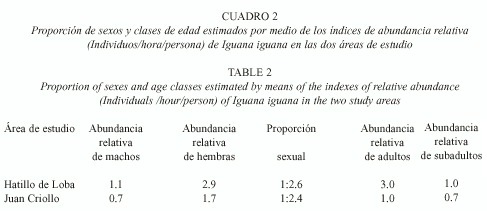
<body><![CDATA[<P><B><FONT FACE="Arial"><FONT SIZE=-1>Resultados</FONT></FONT></B>      <P><FONT FACE="Arial"><FONT SIZE=-1><B>Aspectos demogr&aacute;ficos: </B>No encontramos diferencias significativas entre la densidad de los grupos de iguanas en los dos sitios de trabajo en Juan Criollo (Kruskal-Wallis, p>0.10; <A HREF="#cuadro1">Cuadro 1</A>), pero en Hatillo de Loba, la densidad de iguanas en el sitio de La Ribona fue significativamente mayor que en El Mor&oacute;n (Kruskal-Wallis, p&lt;0.01). Comparando sitios de trabajo de &aacute;reas diferentes, no encontramos diferencias entre la densidad de los grupos de iguanas en El Mor&oacute;n y Juan Criollo (Kruskal-Wallis, p>0.01), pero la densidad en La Ribona fue significativamente mayor que en Juan Criollo (Kruskal-Wallis, p&lt;0.01). Los cuatro sitios de trabajo ubicados en las orillas del r&iacute;o (todos en Hatillo de Loba) tuvieron una densidad de grupos significativamente mayor con respecto a los sitios de trabajo ubicados cerca de las ci&eacute;nagas (los tres de Juan Criollo y uno de El Mor&oacute;n en Hatillo de Loba; Wilcoxon, p&lt;0.005).</FONT></FONT>      <P><FONT FACE="Arial"><FONT SIZE=-1>No hubo diferencias significativas en el tama&ntilde;o promedio de los grupos entre los transectos dentro los sitios de trabajo, ni entre los sitios de trabajo de cada &aacute;rea (<A HREF="#cuadro1">Cuadro 1</A>; Kruskal-Wallis, p>0.10). Sin embargo, el tama&ntilde;o promedio de los grupos en Hatillo de Loba fue mayor con respecto a Juan Criollo (<A HREF="#cuadro1">Cuadro 1</A>; Kruskal-Wallis, p&lt;0.001). Por &uacute;ltimo, una comparaci&oacute;n del tama&ntilde;o de los grupos por tipo de h&aacute;bitat (cerca de ci&eacute;naga o r&iacute;o), sin importar el &aacute;rea de estudio, revel&oacute; un mayor promedio en los sitios al lado de la orilla del r&iacute;o (2.5 iguanas/grupo) que en los sitios adyacentes a las ci&eacute;nagas (1.5 iguanas/grupo) (Kruskal-Wallis, p&lt;0.001).</FONT></FONT>      <P><FONT FACE="Arial"><FONT SIZE=-1>Combinando las estimaciones de densidad de grupos y tama&ntilde;os promedios de los grupos por sitio (<A HREF="#cuadro1">Cuadro 1</A>), las estimaciones de densidad de individuos por hect&aacute;rea siempre fueron mayores en Hatillo de Loba, y siempre mayores en los sitios de trabajo ubicados al lado de la orilla del R&iacute;o. En contraste, ninguna asociaci&oacute;n entre el &iacute;ndice de abundancia relativa y sitio o tipo de h&aacute;bitat fue evidente (<A HREF="#cuadro1">Cuadro 1</A>). Tampoco hubo una relaci&oacute;n entre la estimaci&oacute;n de la densidad de iguanas por hect&aacute;rea y el &iacute;ndice de abundancia relativa para los sitios de trabajo (Spearman, R = 0.34, p> 0.10).</FONT></FONT>     <BR><FONT FACE="Arial"><FONT SIZE=-1>&nbsp;</FONT></FONT>     <CENTER><A NAME="cuadro1"></A><IMG SRC="/img/fbpe/rbt/v51n1/2410t01.JPG" HEIGHT=318 WIDTH=532></CENTER> &nbsp;     
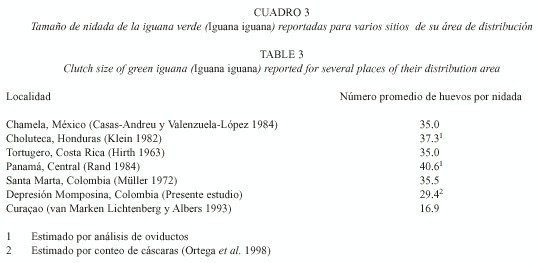
<BR><FONT FACE="Arial"><FONT SIZE=-1>Sin embargo, analizamos los datos de abundancia relativa para contrastar los sitios en t&eacute;rminos de su composici&oacute;n demogr&aacute;fica (proporciones sexuales y de clases de edad). En las dos &aacute;reas, la abundancia relativa de machos resulto inferior a la de las hembras y la proporci&oacute;n de sexos en cada &aacute;rea se acerc&oacute; a 1: 2.5 a favor de las hembras (<A HREF="#cuadro2">Cuadro 2</A>). En cuanto a la estructura de edad, encontramos que la abundancia relativa de subadultos fue menor comparada con los adultos, tanto en Hatillo de Loba como en Juan Criollo (<A HREF="#cuadro2">Cuadro 2</A>). Dentro de estos an&aacute;lisis no incluimos a los juveniles, ya que solo observamos individuos de esta edad en Isla Le&oacute;n.</FONT></FONT>     <BR>&nbsp;     <CENTER><A NAME="cuadro2"></A><IMG SRC="/img/fbpe/rbt/v51n1/2410t02.JPG" HEIGHT=211 WIDTH=487></CENTER> &nbsp;     
<BR><FONT FACE="Arial"><FONT SIZE=-1><B>Ecolog&iacute;a de anidaci&oacute;n: </B>La temporada de anidaci&oacute;n y eclosi&oacute;n de <I>I. iguana </I>en la zona de estudio coincide con lo reportado para la zona norte de Colombia, y va desde la mitad de enero hasta junio (<A HREF="#Muller72">M&uuml;ller 1972</A>, <A HREF="#Harris">Harris 1982</A>). En Hatillo de Loba encontramos un total de 24 nidos y en Juan Criollo solo hallamos diez nidos en Isla Le&oacute;n. No hubo diferencias significativas entre los tama&ntilde;os de las nidadas en las dos &aacute;reas de estudio (Hatillo de Loba: = 27.8, DE = 8.3, rango = 12 a 44 huevos; Isla Le&oacute;n: = 33, DE = 46.7, rango = 21 a 56 huevos, ANOVA, p>0.10). El promedio de las nidadas para am-bas &aacute;reas fue de 29.43 huevos.</FONT></FONT>      ]]></body>
<body><![CDATA[<P><FONT FACE="Arial"><FONT SIZE=-1>Las caracter&iacute;sticas de los nidos muestreados variaron mucho (la longitud del t&uacute;nel vari&oacute; entre 61.0 y 573.0 cm, = 182.2, DE = 104.9 cm; el di&aacute;metro de la entrada vari&oacute; entre 11.0 y 45.0 cm, = 23.1, DE = 17.6cm) y la profun-didad de la c&aacute;mara donde se alojan los huevos estuvo entre 9.0 cm y 98 cm, = 43.4, DE = 17.6). La mayor&iacute;a de los nidos se hallaron en suelos de arcilla (41.2%) y arena (29.4%), y en menor cantidad en sustratos mixtos de arena y arcilla (14.7%) y grava y arena (14.7%). Los nidos de arena presentaron profundidades de la c&aacute;mara de los huevos significativamente menores con respecto a los nidos de otros sustratos (Kruskal-Wallis, p>0.05), relacionadas con el tipo de sustrato.</FONT></FONT>      <P><FONT FACE="Arial"><FONT SIZE=-1>En Hatillo de Loba, 16 (el 67%) nidos culminaron con la eclosi&oacute;n y siete de ellos se perdieron durante las primeras semanas de incubaci&oacute;n debido al pisoteo del ganado (cinco nidos) y por inundaci&oacute;n (dos nidos). El nido restante fue depredado aparentemente por una serpiente, ya que al inicio se detect&oacute; actividad de anidaci&oacute;n y presencia de huevos, sin embargo durante la eclosi&oacute;n no se observ&oacute; emergencia de neonatos ni se hallaron rastros de c&aacute;scaras. De estos ocho nidos (33%), no se tienen registros del tama&ntilde;o de la nidada ya que se perdieron completamente. En Isla Le&oacute;n (Juan Criollo), ocho de los diez nidos eclosionaron y en los otros dos nidos no se hallaron huevos ni c&aacute;scaras durante la excavaci&oacute;n.</FONT></FONT>      <P><FONT FACE="Arial"><FONT SIZE=-1>Las tasa de eclosi&oacute;n de huevos en Hatillo de Loba (66.4%) y Juan Criollo (55.0%) fueron similares (<I>X</I><SUP>2</SUP> = 0.91, p>0.1). No encontramos diferencias significativas en la tasa de eclosi&oacute;n relacionadas al tipo de construcci&oacute;n de los nidos (comunal vs. solitaria) (<I>X</I><SUP>2</SUP> = 4.3; p>0.1) La mortalidad embrionaria de huevos en nidos con &eacute;xito de eclosi&oacute;n estuvo siempre asociada a invertebrados, principalmente larvas de d&iacute;ptero <I>Dohriphora </I>(Insecta: Phoridae), los cuales se hallaron consumiendo el contenido de los huevos.</FONT></FONT>      <P><B><FONT FACE="Arial"><FONT SIZE=-1>Discusi&oacute;n</FONT></FONT></B>      <P><FONT FACE="Arial"><FONT SIZE=-1>Varios aspectos demogr&aacute;ficos de poblaciones de iguana verde han sido estudiados utilizando t&eacute;cnicas diferentes, incluyendo observaciones directas, marca y recaptura, radio-telemetr&iacute;a, o el estudio de espec&iacute;menes colectados u obtenidos de forma oportunista. Estos estudios han arrojado una informaci&oacute;n invaluable sobre: distribuci&oacute;n de edades (tama&ntilde;os) y proporciones sexuales (<A HREF="#Muller68">M&uuml;ller 1968, 1972</A>, <A HREF="#Fitch">Fitch y Henderson 1977</A>, <A HREF="#Bakhuis">Bakhuis 1982</A>, <A HREF="#Dugan82">Dugan 1982</A>, <A HREF="#Rand92">Rand y Bock 1992</A>, <A HREF="#Rodda92">Rodda 1992</A>, <A HREF="#vanMarken">van Marken Lichtenbelt y Albers 1993</A>), fenolog&iacute;a de anidaci&oacute;n anual (<A HREF="#Hirth">Hirth 1963</A>, <A HREF="#Rand68">Rand 1968</A>, <A HREF="#Muller72">M&uuml;ller 1972</A>, <A HREF="#Fitch">Fitch y Henderson 1977</A>, <A HREF="#Harris">Harris 1982</A>, <A HREF="#Klein">Klein 1982</A>, <A HREF="#Casas">Casas-A y Valenzuela-L 1984</A>, <A HREF="#Bock89">Bock y Rand 1989</A>, <A HREF="#Rand90">Rodda 1990, 1992</A>, <A HREF="#Rodda90">Rodda y Grajal 1990</A>, <A HREF="#vanMarken">van Marken Lichtenberg y Albers 1993</A>) y sobre tasas de crecimiento y sobrevivencia (<A HREF="#Muller68">M&uuml;ller 1968, 1972</A>, <A HREF="#Henderson">Henderson 1974</A>, <A HREF="#Harris">Harris 1982</A>, <A HREF="#VanDevender">van Devender 1982</A>, <A HREF="#Burghardt85">Burghardt y Rand 1985</A>, <A HREF="#Rand92">Rand y Bock 1992</A>). Por otra parte, muy pocas estimaciones de densidad han sido obtenidas. <A HREF="#Henderson">Henderson (1974)</A> emple&oacute; m&eacute;todos de marca y recaptura para estimar densidades de iguanas juveniles en un &aacute;rea de 1.3 ha con vegetaci&oacute;n baja en Belice durante un a&ntilde;o. Sin embargo se ha demostrado que los m&eacute;todos de marca y recaptura alteran el comportamiento de los juveniles de <I>I. iguana </I>(<A HREF="#Rodda88">Rodda <I>et al. </I>1988</A>) y no son apropiados para iguanas adultas, las cuales prefieren posarse en las partes altas de la vegetaci&oacute;n (<A HREF="#Hirth">Hirth 1963</A>, <A HREF="#Muller68">M&uuml;ller 1968, 1972</A> y <A HREF="#Henderson">Henderson 1974</A>). Los otros dos &uacute;nicos estimados de densidad de <I>I. iguana </I>reportados en la literatura son extrapolaciones realizadas por medio de intensas observaciones directas de grupos sociales de iguanas en una isla boscosa en la costa pac&iacute;fica de Panam&aacute; (36-50 adultos/ha) (<A HREF="#Dugan82">Dugan 1982</A>) y tres sitios en los llanos orientales de Venezuela (55-364 adultos/ha) (<A HREF="#Rodda92">Rodda 1992</A>). En ambos estudios, los sitios fueron seleccionados en parte debido a su situaci&oacute;n de protecci&oacute;n.</FONT></FONT>      <P><FONT FACE="Arial"><FONT SIZE=-1>Nuestro estudio representa el primer intento de utilizar el m&eacute;todo de transectos lineales para estimar la densidad de iguanas en h&aacute;bitats riparios, en donde existe explotaci&oacute;n humana de poblaciones naturales de iguana verde. Como era de esperarse, las densidades estimadas fueron considerablemente m&aacute;s bajas que aquellas obtenidas en los estudios mencionados previamente en poblaciones protegidas.</FONT></FONT>      <P><FONT FACE="Arial"><FONT SIZE=-1>Tambi&eacute;n encontramos diferencias significativas en la densidad de los grupos sociales de iguanas viviendo en h&aacute;bitats similares separados &uacute;nicamente por 6 km, as&iacute; como diferencias en la densidad de los grupos sociales y promedio del tama&ntilde;o de los grupos entre las dos &aacute;reas de estudio, las cuales est&aacute;n probablemente relacionadas con las diferencias de h&aacute;bitat. Tanto la densidad de los grupos como la densidad individual fueron menores en la vegetaci&oacute;n homog&eacute;nea de mangle, <I>S. paniculata</I>, asociada con las orillas de las ci&eacute;nagas. Las iguanas cambian su microh&aacute;bitat a medida que se hacen adultas, desplaz&aacute;ndose hacia las partes elevadas de la vegetaci&oacute;n (<A HREF="#Hirth">Hirth 1963</A>, <A HREF="#Muller68">M&uuml;ller 1968, 1972</A>, <A HREF="#Henderson">Henderson 1974</A>). Es posible que los estimados m&aacute;s bajos de densidad de la vegetaci&oacute;n de mangle, <I>S. paniculata</I>, sean una consecuencia de la emigraci&oacute;n de individuos adultos fuera de esta &aacute;rea. Alternativamente, las densidades m&aacute;s bajas pueden estar reflejando que este h&aacute;bitat homog&eacute;neo es sub&oacute;ptimo para <I>I. iguana </I>en t&eacute;rminos de sus requerimientos diet&eacute;ticos. Las iguanas verdes son herb&iacute;voras generalistas (<A HREF="#Rand90">Rand <I>et al. </I>1990</A>), pero parecen requerir peri&oacute;dicamente un cambio en el tipo de vegetaci&oacute;n consumida (<A HREF="#Dugan80">Dugan 1980</A>), probablemente para prevenir la ingesti&oacute;n excesiva de un compuesto secundario vegetal en particular, como lo hacen otros herb&iacute;voros generalistas (<A HREF="#Freeland">Freeland y Janzen 1974</A>, <A HREF="#Milton">Milton 1979</A>).</FONT></FONT>      <P><FONT FACE="Arial"><FONT SIZE=-1>Los estimativos de densidad que se obtuvieron en este estudio deben ser vistos como aproximaciones, especialmente en los casos en que las densidades (y por lo tanto el tama&ntilde;o de las muestras) fueron bajas. Sin embargo, nuestras estimaciones de densidad no difirieron significativamente entre transectos localizados dentro del mismo sitio de trabajo y se correlacionan con las principales caracter&iacute;sticas del h&aacute;bitat, a diferencia de los &iacute;ndices (m&aacute;s sencillos) de abundancia relativa, los cuales no mostraron esta correlaci&oacute;n. La falta de correlaci&oacute;n entre las estimaciones de densidad y los &iacute;ndices de abundancia relativa es el resultado de la imposibilidad, en el segundo caso, de corregir las diferencias en t&eacute;rminos de la detectabilidad de iguanas documentada entre los sitios. Estudios demogr&aacute;ficos futuros de iguanas verdes deben considerar que tanto la detectabilidad, como el promedio de tama&ntilde;o de grupo puede variar a una escala microgeogr&aacute;fica.</FONT></FONT>      <P><FONT FACE="Arial"><FONT SIZE=-1>Las proporciones sexuales de iguanas usualmente son cercanas a 1:1 cuando el muestreo requiere la captura de los individuos (o una medici&oacute;n oportunista de las proporciones sexuales obtenida, por ejemplo, de animales cazados o atropellados; <A HREF="#Muller72">M&uuml;ller 1972</A>, <A HREF="#Fitch">Fitch y Henderson 1977</A>, <A HREF="#Bakhuis">Bakhuis 1982</A>, <A HREF="#Dugan82">Dugan 1982</A>). Sin embargo, las estimaciones de las proporciones sexuales basadas en observaciones de adultos en el campo, frecuentemente reportan un sesgo a favor de las hembras, al igual como lo hacemos nosotros. Esta diferencia es probablemente una consecuencia del sistema de apareamiento pol&iacute;gamo en estos lagartos territoriales. Presumiblemente, los machos subadultos tambi&eacute;n est&aacute;n presentes, pero ocupan un h&aacute;bitat sub&oacute;ptimo o simplemente no son divisados durante los censos (<A HREF="#Dugan80">Dugan 1980, 1982</A>, <A HREF="#Rodda92">Rodda 1992</A>).</FONT></FONT>      <P><FONT FACE="Arial"><FONT SIZE=-1>Tampoco divisamos iguanas juveniles durante el estudio (con la excepci&oacute;n de la &eacute;poca de eclosi&oacute;n en la Isla Le&oacute;n). Sin embargo, obviamente hay reclutamiento en la poblaci&oacute;n, ya que documentamos tasas de eclosi&oacute;n altas en todos los tipos del suelo, tanto en nidos solitarios como comunales. Sorprendentemente, encontramos muy pocas evidencias de depredaci&oacute;n de nidos por vertebrados (<A HREF="#Rand69">Rand y Robinson 1969</A>, <A HREF="#Drummond">Drummond 1983</A>), posiblemente debido a la escasez general de fauna nativa en esta &aacute;rea poblada densamente por humanos. Sin embargo, el da&ntilde;o causado por el ganado pisoteando las nidadas es importante. Otros estudios reportan nidos de otras especies de iguanas que sufren da&ntilde;os por la introducci&oacute;n de animales dom&eacute;sticos en sus h&aacute;bitats nativos (<A HREF="#Mitchell">Mitchell 1999</A>).</FONT></FONT>      ]]></body>
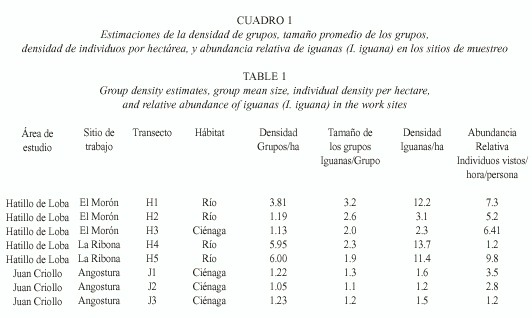
<body><![CDATA[<P><FONT FACE="Arial"><FONT SIZE=-1>Tambi&eacute;n encontramos nidos vac&iacute;os, de los cuales no sabemos si conten&iacute;an huevos inicialmente y fueron depredados, o si las hembras no pusieron sus nidadas despu&eacute;s de excavarlos. Se sabe que algunas veces las iguanas no terminan de construir sus nidos, tal vez porque detectan un obst&aacute;culo que impide elaboraci&oacute;n de &eacute;ste (ra&iacute;z, piedra) (<A HREF="#Sexton">Sexton 1975</A>) o que construyen nidos falsos como un posible mecanismo de protecci&oacute;n para sus nidadas (<A HREF="#Rand68">Rand 1968</A>).</FONT></FONT>      <P><FONT FACE="Arial"><FONT SIZE=-1>En todos los nidos donde se present&oacute; muerte embrionaria, detectamos la presencia de larvas de d&iacute;ptero. Desconocemos si las moscas son las responsables directas de la mortalidad de los huevos, debido a que las condiciones del terreno (suelo muy compacto), no permiten un ingreso f&aacute;cil de las moscas hacia la c&aacute;mara de huevos. Estas pueden haber entrado por los canales que dejan las iguanas adultas, los cuales poseen una textura poco compacta facilitando as&iacute; su entrada; o pueden penetrar durante el proceso de postura de la hembra. Tambi&eacute;n cuando un embri&oacute;n muere, las moscas pueden ser atra&iacute;das por el olor que &eacute;ste expelen e invadir los dem&aacute;s. En incubaciones semi-naturales de iguana verde en Panam&aacute;, se han hallado huevos infestados por causa de moscas de la familia Phoridae, aliment&aacute;ndose del contenido de &eacute;stos y causando posteriormente su muerte (Werner com. pers.). Sin embargo, en nidos naturales de esta especie no ha sido reportado antes. En otras especies de reptiles como tortugas <I>(Trachemys scripta, Rhinoclemmys pulcherrima, Lepidochelys olivace</I>a) y lagartijas <I>(Sceloropus undulatu</I> s), los huevos han sido infestados por larvas de moscas Phoridae y Sarcophagidae en nidos naturales (<A HREF="#Acuna">Acu&ntilde;a-Mes&eacute;n y Hanson 1990</A>, <A HREF="#DeSouza">De Souza 1982</A>, <A HREF="#Trauth">Trauth y Mullen 1990</A>).</FONT></FONT>      <P><FONT FACE="Arial"><FONT SIZE=-1>El n&uacute;mero promedio de huevos por nidada en poblaciones de la Depresi&oacute;n Momposina es menor que los reportados en otras poblaciones de esta especie (<A HREF="#cuadro3">Cuadro 3</A>), con la excepci&oacute;n de la poblaci&oacute;n en la Isla de Cura&ccedil;ao. En <I>I. iguana </I>el n&uacute;mero de huevos por nidada esta relacionado con el tama&ntilde;o de la hembra (<A HREF="#Rand83">Rand y Dugan 1983</A>, <A HREF="#Casas">Casas-Andreu y Valenzuela-L&oacute;pez 1984</A>, <A HREF="#Rand83">Rand 1983</A>), lo que implica que las hembras reproductivas en nuestras &aacute;reas de estudio son relativamente j&oacute;venes y/o peque&ntilde;as. Hay evidencia de que el tama&ntilde;o corporal de iguanas provenientes de climas &aacute;ridos es significativamente menor (<A HREF="#Muller72">M&uuml;ller 1972</A>, <A HREF="#Bakhuis">Bakhuis 1982</A>, <A HREF="#vanMarken">van Marken Lichtenbelt y Albers 1993</A>) pero Cura&ccedil;ao recibe la mitad de la precipitaci&oacute;n anual en comparaci&oacute;n a nuestras &aacute;reas de estudio, mientras que la poblaci&oacute;n cercana estudiada por <A HREF="#Muller72">M&uuml;ller (1972)</A> y las poblaciones centroamericanas de M&eacute;xico y Honduras tambi&eacute;n se encuentran en la zona de vida de bosque seco tropical (<A HREF="#Holdridge">Holdridge 1979</A>), pero muestran mayores tama&ntilde;os de nidadas. En nuestro estudio no se verific&oacute; el tama&ntilde;o de las hembras. Es probable que el reducido tama&ntilde;o de nidadas documentado en este estudio se deba principalmente a la alta presi&oacute;n de caza a que han sido sometidas estas poblaciones, en vez de una adaptaci&oacute;n a las condiciones clim&aacute;ticas extremas.</FONT></FONT>     <BR>&nbsp;     <CENTER><A NAME="cuadro3"></A><IMG SRC="/img/fbpe/rbt/v51n1/2410t03.JPG" HEIGHT=263 WIDTH=538></CENTER> &nbsp;     
<BR><B><FONT FACE="Arial"><FONT SIZE=-1>Agradecimientos</FONT></FONT></B>     <BR>&nbsp;     <BR><FONT FACE="Arial"><FONT SIZE=-1>Agradecemos al fondo de estampilla de la Universidad de Antioquia por su apoyo econ&oacute;mico y a la Corporaci&oacute;n Ambiental de la Universidad por su apoyo administrativo, igualmente agradecemos, a la fundaci&oacute;n Neotr&oacute;picos por su apoyo log&iacute;stico, a Alvaro Lema por su asesor&iacute;a con los an&aacute;lisis de Fourier, a John Jairo Estrada, Juan Manuel Daza y Marcela Bernal por la colaboraci&oacute;n en la obtenci&oacute;n de datos y a los habitantes de la zona por su colaboraci&oacute;n y gu&iacute;a al campo durante la ejecuci&oacute;n de este proyecto.</FONT></FONT>     <BR>&nbsp;     <BR><B><FONT FACE="Arial"><FONT SIZE=-1>Resumen</FONT></FONT></B>     ]]></body>
<body><![CDATA[<BR>&nbsp;     <BR><FONT FACE="Arial"><FONT SIZE=-1>Se estudi&oacute; la demograf&iacute;a y ecolog&iacute;a de anidaci&oacute;n de dos poblaciones de <I>Iguana iguana </I>que enfrentan explotaci&oacute;n severa y alteraci&oacute;n del h&aacute;bitat, en la Depresi&oacute;n Momposina, Colombia. Los atos de transectos lineales fueron analizados con el modelo de Fourier para estimar la densidad de grupos sociales. El tama&ntilde;o promedio de grupo y la densidad general de iguanas vari&oacute; dentro y entre poblaciones (1.05 - 6.0 grupos/ha, y 1.5 - 13.7 iguanas/ha respectivamente). Las estimaciones de densidad fueron mucho menores que las reportadas en &aacute;reas m&aacute;s protegidas en Panam&aacute; y Venezuela. Las densidades de las iguanas fueron considerablemente mayores en sitios localizados a lo largo de los r&iacute;os (2.5 iguanas/grupo) que en sitios en el margen de las ci&eacute;nagas (1.5 iguanas/grupo), probablemente debido a diferencias en la vegetaci&oacute;n. No hubo correlaci&oacute;n entre las estimaciones de densidad y la de abundancia relativa (n&uacute;mero de iguanas vistas/hora/persona), debido a diferencias en detectabilidad de los grupos de iguanas entre los sitios. La proporci&oacute;n sexual hallada (1:2.5 machos: hembras), es probablemente el resultado del sistema de apareamiento pol&iacute;gamo de esta especie, en vez de indicar un verdadero sesgo demogr&aacute;fico. Se monitore&oacute; 34 nidos los cuales sufrieron poca depredaci&oacute;n por vertebrados. Sin embargo si fueron afectados por inundaciones, pisoteo por ganado e infestaci&oacute;n por larvas de mosca Phoridae. El tama&ntilde;o de huevos por nidada en estas poblaciones fue de 29.4 menor que cualquier otro reporte de la literatura, con la excepci&oacute;n de las poblaciones de <I>Iguana </I>que habitan la isla altamente x&eacute;rica de Cura&ccedil;ao, implicando que las hembras adultas en nuestra &aacute;rea son inusualmente peque&ntilde;as. Probablemente &eacute;ste es el resultado de la explotaci&oacute;n prolongada y excesiva de estas poblaciones en vez de ser una respuesta adaptativa a condiciones ambientales extremas.</FONT></FONT>     <BR>&nbsp;     <BR><B><FONT FACE="Arial"><FONT SIZE=-1>Referencias</FONT></FONT></B>     <BR>&nbsp;     <!-- ref --><BR><A NAME="Acuna"></A><FONT FACE="Arial"><FONT SIZE=-1>Acu&ntilde;a-Mes&eacute;n, R.A. &amp; P.E. Hanson. 1990. Phorid fly larvae as predators of turtle eggs. Herp. Rev. 21: 13-14.</FONT></FONT>    &nbsp;&nbsp;&nbsp;&nbsp;&nbsp;&nbsp;&nbsp;&nbsp;[&#160;<a href="javascript:void(0);" onclick="javascript: window.open('/scielo.php?script=sci_nlinks&ref=1217833&pid=S0034-7744200300010002100001&lng=','','width=640,height=500,resizable=yes,scrollbars=1,menubar=yes,');">Links</a>&#160;]<!-- end-ref --><!-- ref --><P><A NAME="Bakhuis"></A><FONT FACE="Arial"><FONT SIZE=-1>Bakhuis, W.L. 1982. Size and sexual differentiation in the lizard <I>Iguana iguana </I>on a semi-arid island. J. Herpetol. 16: 322-325.</FONT></FONT>    &nbsp;&nbsp;&nbsp;&nbsp;&nbsp;&nbsp;&nbsp;&nbsp;[&#160;<a href="javascript:void(0);" onclick="javascript: window.open('/scielo.php?script=sci_nlinks&ref=1217834&pid=S0034-7744200300010002100002&lng=','','width=640,height=500,resizable=yes,scrollbars=1,menubar=yes,');">Links</a>&#160;]<!-- end-ref --><P><A NAME="Bock89"></A><FONT FACE="Arial"><FONT SIZE=-1>Bock, B.C. &amp; A.S. Rand. 1989. Factors influencing nesting synchrony and hatching success at a green iguana nesting aggregation in Panama. Copeia 1989: 214-216.</FONT></FONT>      <P><A NAME="Bock98"></A><FONT FACE="Arial"><FONT SIZE=-1>Bock, B.C., V.P. P&aacute;ez &amp; A.S. Rand. 1998. Temperaturas del suelo at&iacute;picas en &aacute;reas comunales de anidaci&oacute;n de la iguana verde <I>(Iguana iguan</I>a) en Colombia y Panam&aacute;. Cr&oacute;nica Forestal y del Medio Ambiente 13:55-70.</FONT></FONT>      <P><A NAME="Burghardt77"></A><FONT FACE="Arial"><FONT SIZE=-1>Burghardt, G.M., H.W. Greene &amp; A.S. Rand. 1977. Social behavior in hatchling green iguanas. Life at a reptile rookery. Science 195: 68-91.</FONT></FONT>      ]]></body>
<body><![CDATA[<P><A NAME="Burghardt85"></A><FONT FACE="Arial"><FONT SIZE=-1>Burghardt, G.M. &amp; A.S. Rand. 1985. Group size and growth rate in hatchling green iguanas <I>(Iguana iguan</I>a). Behav. Ecol. Sociobiol. 18: 101-104.</FONT></FONT>      <P><A NAME="Casas"></A><FONT FACE="Arial"><FONT SIZE=-1>Casas-Andreu, G. &amp; G. Valenzuela-L&oacute;pez. 1984. Observaciones sobre los ciclos reproductivos de <I>Ctenosaura pectinata </I>e <I>Iguana iguana </I>(Reptilia: Iguanidae) en Chamela, Jalisco. An. Inst. Biol. Univ. Auton. M&eacute;xico 55, ser Zoolog&iacute;a 2: 253-262.</FONT></FONT>      <P><A NAME="DelaOssa"></A><FONT FACE="Arial"><FONT SIZE=-1>De la Ossa, J. 1999. Zootecnia: Gu&iacute;a acad&eacute;mica introductoria con &eacute;nfasis en algunos reptiles. Facultad de Ciencias Agropecuarias. Universidad de Sucre, Sincelejo, Sucre. 152 p.</FONT></FONT>      <!-- ref --><P><A NAME="DeSouza"></A><FONT FACE="Arial"><FONT SIZE=-1>De Souza, H. 1982. On <I>Eumacronychia sternalis </I>Allen (Diptera, Sarcophagidae) with larvae living on eggs and hatchlings of the east Pacific green turtle. Rev. Brasil Biol. 42: 425-429.</FONT></FONT>    &nbsp;&nbsp;&nbsp;&nbsp;&nbsp;&nbsp;&nbsp;&nbsp;[&#160;<a href="javascript:void(0);" onclick="javascript: window.open('/scielo.php?script=sci_nlinks&ref=1217841&pid=S0034-7744200300010002100003&lng=','','width=640,height=500,resizable=yes,scrollbars=1,menubar=yes,');">Links</a>&#160;]<!-- end-ref --><!-- ref --><P><A NAME="Drummond"></A><FONT FACE="Arial"><FONT SIZE=-1>Drummond, H. 1983. Adaptiveness of island nest-sites of green iguanas and slider turtles. Copeia 1983: 529-530.</FONT></FONT>    &nbsp;&nbsp;&nbsp;&nbsp;&nbsp;&nbsp;&nbsp;&nbsp;[&#160;<a href="javascript:void(0);" onclick="javascript: window.open('/scielo.php?script=sci_nlinks&ref=1217842&pid=S0034-7744200300010002100004&lng=','','width=640,height=500,resizable=yes,scrollbars=1,menubar=yes,');">Links</a>&#160;]<!-- end-ref --><P><A NAME="Dugan80"></A><FONT FACE="Arial"><FONT SIZE=-1>Dugan, B.A. 1980. A field study of the social structure, mating system, and display behavior of the green iguana <I>(Iguana iguan</I>a). Disertaci&oacute;n doctoral, University of Tennessee, Knoxville. 171 p.</FONT></FONT>      <!-- ref --><P><A NAME="Dugan82"></A><FONT FACE="Arial"><FONT SIZE=-1>Dugan, B.A. 1982. The mating behavior of the green iguana <I>(Iguana iguan</I>a). pp. 320-339. <I>In </I>G.M. Burhgardt &amp; A.S. Rand (eds.). Iguanas of the world: Their behavior, ecology and conservation. Noyes, Park Rid-ge, New Jersey.</FONT></FONT>    &nbsp;&nbsp;&nbsp;&nbsp;&nbsp;&nbsp;&nbsp;&nbsp;[&#160;<a href="javascript:void(0);" onclick="javascript: window.open('/scielo.php?script=sci_nlinks&ref=1217844&pid=S0034-7744200300010002100005&lng=','','width=640,height=500,resizable=yes,scrollbars=1,menubar=yes,');">Links</a>&#160;]<!-- end-ref --><P><A NAME="Etheridge"></A><FONT FACE="Arial"><FONT SIZE=-1>Etheridge, R.E. 1982. Checklist of the iguanine and Malagasy iguanid lizards. pp 7-37. <I>In </I>G.M. Burhgardt &amp; A.S. Rand (eds.). Iguanas of the world: Their behavior, ecology and conservation. Noyes, Park Ridge, New Jersey.</FONT></FONT>      <P><A NAME="Fitch"></A><FONT FACE="Arial"><FONT SIZE=-1>Fitch, H.S. &amp; R.W. Henderson. 1977. Age and sex differences, reproduction, and conservation of the green iguana. Milwaukee. Publ. Mus. Contr. Biol. Geol. 13: 1-21.</FONT></FONT>      <!-- ref --><P><A NAME="Freeland"></A><FONT FACE="Arial"><FONT SIZE=-1>Freeland, W.J. &amp; D.H. Janzen. 1974. Strategies in herbivory by mammals: The role of plant secondary compounds. Amer. Natur. 108:269-289.</FONT></FONT>    &nbsp;&nbsp;&nbsp;&nbsp;&nbsp;&nbsp;&nbsp;&nbsp;[&#160;<a href="javascript:void(0);" onclick="javascript: window.open('/scielo.php?script=sci_nlinks&ref=1217847&pid=S0034-7744200300010002100006&lng=','','width=640,height=500,resizable=yes,scrollbars=1,menubar=yes,');">Links</a>&#160;]<!-- end-ref --><P><A NAME="Harris"></A><FONT FACE="Arial"><FONT SIZE=-1>Harris, D.M. 1982. The phenology, growth and survival of the green iguana,(<I>Iguana iguan</I>a), in northern Colombia. pp. 150-161. <I>In </I>G.M. Burhgardt &amp; A.S. Rand (eds.). Iguanas of the world: Their behavior, ecology and conservation. Noyes, Park Ridge, New Jersey.</FONT></FONT>      <!-- ref --><P><A NAME="Henderson"></A><FONT FACE="Arial"><FONT SIZE=-1>Henderson, R.W. 1974. Aspects of the ecology of the juvenil common iguana <I>(Iguana iguan</I>a). Herpetologica 30: 327-332.</FONT></FONT>    &nbsp;&nbsp;&nbsp;&nbsp;&nbsp;&nbsp;&nbsp;&nbsp;[&#160;<a href="javascript:void(0);" onclick="javascript: window.open('/scielo.php?script=sci_nlinks&ref=1217849&pid=S0034-7744200300010002100007&lng=','','width=640,height=500,resizable=yes,scrollbars=1,menubar=yes,');">Links</a>&#160;]<!-- end-ref --><P><A NAME="Hirth"></A><FONT FACE="Arial"><FONT SIZE=-1>Hirth, H.F. 1963. Some aspects of the natural history of <I>Iguana iguana </I>on a tropical strand. Ecology 44: 613-615.</FONT></FONT>      <P><A NAME="Holdridge"></A><FONT FACE="Arial"><FONT SIZE=-1>Holdridge, L. 1979. Ecolog&iacute;a basada en zonas de vida. Instituto Interamericano de Ciencias Agr&iacute;colas, Costa Rica. 216 p.</FONT></FONT>      <P><A NAME="Klein"></A><FONT FACE="Arial"><FONT SIZE=-1>Klein, E.H. 1982. Reproduction of the green iguana <I>(Iguana iguan</I>a) in the tropical dry forest of southern Honduras. Brenesia 19/20: 301-310.</FONT></FONT>      <!-- ref --><P><A NAME="Krebs"></A><FONT FACE="Arial"><FONT SIZE=-1>Krebs, C.J. 1999. Ecological Methodology (2nd ed.). Addison Wesley Longman, Inc., Menlo Park, California. 620 p.</FONT></FONT>    &nbsp;&nbsp;&nbsp;&nbsp;&nbsp;&nbsp;&nbsp;&nbsp;[&#160;<a href="javascript:void(0);" onclick="javascript: window.open('/scielo.php?script=sci_nlinks&ref=1217853&pid=S0034-7744200300010002100008&lng=','','width=640,height=500,resizable=yes,scrollbars=1,menubar=yes,');">Links</a>&#160;]<!-- end-ref --><P><A NAME="Lancia"></A><FONT FACE="Arial"><FONT SIZE=-1>Lancia, R.A., J.D. Nichols &amp; K.H. Pollock. 1994. Estimating the number of animals in wildlife populations. <I>In </I>T.A. Bookhout (ed.). Research and management techniques for wildlife and habitats. The Wildlife Society, Bethesda, Maryland.</FONT></FONT>      <!-- ref --><P><A NAME="Milton"></A><FONT FACE="Arial"><FONT SIZE=-1>Milton, K. 1979. Factors influencing leaf choice by howler monkeys: A test of some hypotheses of food selection by generalist herbivores. Amer. Natur. 114: 362-378.</FONT></FONT>    &nbsp;&nbsp;&nbsp;&nbsp;&nbsp;&nbsp;&nbsp;&nbsp;[&#160;<a href="javascript:void(0);" onclick="javascript: window.open('/scielo.php?script=sci_nlinks&ref=1217855&pid=S0034-7744200300010002100009&lng=','','width=640,height=500,resizable=yes,scrollbars=1,menubar=yes,');">Links</a>&#160;]<!-- end-ref --><P><A NAME="Mitchell"></A><FONT FACE="Arial"><FONT SIZE=-1>Mitchell, N. 1999. Effect of introduced ungulates on density. Dietary preferences, home range, and physical condition of the iguana <I>(Cyclura pingui</I>s) on Anegada. J. Herpetol. 55: 7-17.</FONT></FONT>      <!-- ref --><P><A NAME="Mora87"></A><FONT FACE="Arial"><FONT SIZE=-1>Mora, J.M. 1987. Predation by <I>Loxocemus bicolor </I>on the eggs the <I>Ctenosaura similis </I>and <I>Iguana iguana </I>. J. Herpetol. 21: 334-335.</FONT></FONT>    &nbsp;&nbsp;&nbsp;&nbsp;&nbsp;&nbsp;&nbsp;&nbsp;[&#160;<a href="javascript:void(0);" onclick="javascript: window.open('/scielo.php?script=sci_nlinks&ref=1217857&pid=S0034-7744200300010002100010&lng=','','width=640,height=500,resizable=yes,scrollbars=1,menubar=yes,');">Links</a>&#160;]<!-- end-ref --><!-- ref --><P><A NAME="Mora91"></A><FONT FACE="Arial"><FONT SIZE=-1>Mora, J.M. 1991. Comparative grouping behavior of juvenile ctenosaurs and iguanas. J. Herpetol. 25: 244-246.</FONT></FONT>    &nbsp;&nbsp;&nbsp;&nbsp;&nbsp;&nbsp;&nbsp;&nbsp;[&#160;<a href="javascript:void(0);" onclick="javascript: window.open('/scielo.php?script=sci_nlinks&ref=1217858&pid=S0034-7744200300010002100011&lng=','','width=640,height=500,resizable=yes,scrollbars=1,menubar=yes,');">Links</a>&#160;]<!-- end-ref --><P><A NAME="Muller68"></A><FONT FACE="Arial"><FONT SIZE=-1>M&uuml;ller, H.V. 1968. Untersuchungen &uuml;ber Wachstum und Altersverteilung einer Population des Gr&uuml;nen Leguans <I>Iguana iguana iguana </I>L. (Reptilia: Iguanidae). Mitt. Inst. Colombo-Alem&aacute;n. Invest. Cient. 2:57-65.</FONT></FONT>      <P><A NAME="Muller72"></A><FONT FACE="Arial"><FONT SIZE=-1>M&uuml;ller. H.V. 1972. &Ouml;kologische und ethologische studien an <I>Iguana iguana </I>(Reptilia-Iguanidae) in Kolombien. Zool. Bertrag. 18: 109-131.</FONT></FONT>      <P><A NAME="Ortega"></A><FONT FACE="Arial"><FONT SIZE=-1>Ortega A.M., B.C. Bock &amp; V.P. P&aacute;ez. 1998. Efecto del estado de desarrollo en el momento de la transferencia de nidos sobre la tasa de eclosi&oacute;n en la tortuga Terecay <I>(Podocnemis unifili</I> s). Vida Silvestre Neotropical 7: 126-131.</FONT></FONT>      <P><A NAME="Phillips"></A><FONT FACE="Arial"><FONT SIZE=-1>Phillips, J.A., A. Garel, G.C. Packard &amp; M.J. Packard. 1990. Influence of moisture and temperature on eggs and embryos of green iguanas <I>(Iguana iguan</I>a). Herpetologica, 46:238-244.</FONT></FONT>      <!-- ref --><P><A NAME="Rand68"></A><FONT FACE="Arial"><FONT SIZE=-1>Rand, A.S. 1968. Anesting aggregation of iguanas. Copeia 1968: 552-561.</FONT></FONT>    &nbsp;&nbsp;&nbsp;&nbsp;&nbsp;&nbsp;&nbsp;&nbsp;[&#160;<a href="javascript:void(0);" onclick="javascript: window.open('/scielo.php?script=sci_nlinks&ref=1217863&pid=S0034-7744200300010002100013&lng=','','width=640,height=500,resizable=yes,scrollbars=1,menubar=yes,');">Links</a>&#160;]<!-- end-ref --><!-- ref --><P><A NAME="Rand69"></A><FONT FACE="Arial"><FONT SIZE=-1>Rand, A.S. &amp; M. Robinson. 1969. Predation on iguana nests. Herpetologica 25: 172-174.</FONT></FONT>    &nbsp;&nbsp;&nbsp;&nbsp;&nbsp;&nbsp;&nbsp;&nbsp;[&#160;<a href="javascript:void(0);" onclick="javascript: window.open('/scielo.php?script=sci_nlinks&ref=1217864&pid=S0034-7744200300010002100014&lng=','','width=640,height=500,resizable=yes,scrollbars=1,menubar=yes,');">Links</a>&#160;]<!-- end-ref --><P><A NAME="Rand72"></A><FONT FACE="Arial"><FONT SIZE=-1>Rand, A.S. 1972. The temperature of iguana nests and their relation to incubation optima and to nesting sites and season. Herpetologica 28: 252-253.</FONT></FONT>      <!-- ref --><P><A NAME="Rand80"></A><FONT FACE="Arial"><FONT SIZE=-1>Rand, A.S. &amp; B.A. Dugan. 1980. Iguana egg mortality within the nests. Copeia 1980: 531-534.</FONT></FONT>    &nbsp;&nbsp;&nbsp;&nbsp;&nbsp;&nbsp;&nbsp;&nbsp;[&#160;<a href="javascript:void(0);" onclick="javascript: window.open('/scielo.php?script=sci_nlinks&ref=1217866&pid=S0034-7744200300010002100015&lng=','','width=640,height=500,resizable=yes,scrollbars=1,menubar=yes,');">Links</a>&#160;]<!-- end-ref --><!-- ref --><P><A NAME="Rand83"></A><FONT FACE="Arial"><FONT SIZE=-1>Rand, A.S. &amp; B.A. Dugan. 1983. Structure of complex iguana nests. Copeia 1983: 705-711.</FONT></FONT>    &nbsp;&nbsp;&nbsp;&nbsp;&nbsp;&nbsp;&nbsp;&nbsp;[&#160;<a href="javascript:void(0);" onclick="javascript: window.open('/scielo.php?script=sci_nlinks&ref=1217867&pid=S0034-7744200300010002100016&lng=','','width=640,height=500,resizable=yes,scrollbars=1,menubar=yes,');">Links</a>&#160;]<!-- end-ref --><P><A NAME="Rand84"></A><FONT FACE="Arial"><FONT SIZE=-1>Rand, A.S. 1984. Clutch size in <I>Iguana iguana </I>in central Panam&aacute;. pp. 115-122. <I>En </I>R.A. Segal, L.E. Hunt, J.I., Knight, L. Malaret, &amp; N.L. Zuschlag (eds.). Vertebrate ecology and systematics. Univ. Kansas Mus. Nat. Hist. Spec. Publ., Lawrence Kansas.</FONT></FONT>      <P><A NAME="Rand89"></A><FONT FACE="Arial"><FONT SIZE=-1>Rand, A.S., E. Font, D. Ramos, D.I. Werner &amp; B.C. Bock. 1989. Home range in green iguanas <I>(Iguana iguan</I>a) in Panam&aacute;. Copeia 1989: 217-221.</FONT></FONT>      <P><A NAME="Rand90"></A><FONT FACE="Arial"><FONT SIZE=-1>Rand, A.S., B.A. Dugan, H. Montza &amp; D. Vianda. 1990. The diet of a generalized folivore: <I>Iguana iguana </I>in Panama. J. Herpetol. 24: 211-214.</FONT></FONT>      <!-- ref --><P><A NAME="Rand92"></A><FONT FACE="Arial"><FONT SIZE=-1>Rand, A.S. &amp; B.C. Bock. 1992. Size variation, growth, and survivorship in nesting green iguanas <I>(Iguana iguan</I>a) in Panama. Amphibia-Reptilia 13: 147-156.</FONT></FONT>    &nbsp;&nbsp;&nbsp;&nbsp;&nbsp;&nbsp;&nbsp;&nbsp;[&#160;<a href="javascript:void(0);" onclick="javascript: window.open('/scielo.php?script=sci_nlinks&ref=1217871&pid=S0034-7744200300010002100018&lng=','','width=640,height=500,resizable=yes,scrollbars=1,menubar=yes,');">Links</a>&#160;]<!-- end-ref --><P><A NAME="Rand76"></A><FONT FACE="Arial"><FONT SIZE=-1>Rand, W.M. &amp; A.S. Rand. 1976. Agonistic behavior in nesting iguanas: A stochastic analysis of dispute settlement dominated by the minimization of energy costs. Z. Tierpsychol. 40: 279-299.</FONT></FONT>      <!-- ref --><P><A NAME="Rodda88"></A><FONT FACE="Arial"><FONT SIZE=-1>Rodda, G.H., B.C. Bock, G.M. Burghardt, &amp; A.S. Rand. 1988. Techniques for identifying individual lizards at a distance reveal influences of handling. Copeia 1988: 905-913.</FONT></FONT>    &nbsp;&nbsp;&nbsp;&nbsp;&nbsp;&nbsp;&nbsp;&nbsp;[&#160;<a href="javascript:void(0);" onclick="javascript: window.open('/scielo.php?script=sci_nlinks&ref=1217873&pid=S0034-7744200300010002100019&lng=','','width=640,height=500,resizable=yes,scrollbars=1,menubar=yes,');">Links</a>&#160;]<!-- end-ref --><!-- ref --><P><A NAME="Rodda90"></A><FONT FACE="Arial"><FONT SIZE=-1>Rodda, G.H. 1990. Highway madness revisited: Roadkilled <I>Iguana iguana </I>in the llanos of Venezuela. J. Herpetol. 24: 209-211.</FONT></FONT>    &nbsp;&nbsp;&nbsp;&nbsp;&nbsp;&nbsp;&nbsp;&nbsp;[&#160;<a href="javascript:void(0);" onclick="javascript: window.open('/scielo.php?script=sci_nlinks&ref=1217874&pid=S0034-7744200300010002100020&lng=','','width=640,height=500,resizable=yes,scrollbars=1,menubar=yes,');">Links</a>&#160;]<!-- end-ref --><P><A NAME="Roddaet90"></A><FONT FACE="Arial"><FONT SIZE=-1>Rodda, G.H. &amp; A. Grajal. 1990. The nesting behavior of the green iguana <I>(Iguana iguan</I>a) in the llanos of Venezuela. Amphibia-Reptilia 11: 31-39.</FONT></FONT>      <!-- ref --><P><A NAME="Rodda91"></A><FONT FACE="Arial"><FONT SIZE=-1>Rodda, G.H. 1991. Sexing <I>Iguana iguan</I> a. Bull. Chicago Herp. Soc. 26: 173-175.</FONT></FONT>    &nbsp;&nbsp;&nbsp;&nbsp;&nbsp;&nbsp;&nbsp;&nbsp;[&#160;<a href="javascript:void(0);" onclick="javascript: window.open('/scielo.php?script=sci_nlinks&ref=1217876&pid=S0034-7744200300010002100021&lng=','','width=640,height=500,resizable=yes,scrollbars=1,menubar=yes,');">Links</a>&#160;]<!-- end-ref --><!-- ref --><P><A NAME="Rodda92"></A><FONT FACE="Arial"><FONT SIZE=-1>Rodda, G.H. 1992. The mating behavior of <I>Iguana iguana.</I> Smithsonian Contr. Zool. 534: 1-40.</FONT></FONT>    &nbsp;&nbsp;&nbsp;&nbsp;&nbsp;&nbsp;&nbsp;&nbsp;[&#160;<a href="javascript:void(0);" onclick="javascript: window.open('/scielo.php?script=sci_nlinks&ref=1217877&pid=S0034-7744200300010002100022&lng=','','width=640,height=500,resizable=yes,scrollbars=1,menubar=yes,');">Links</a>&#160;]<!-- end-ref --><P><A NAME="Ruiz"></A><FONT FACE="Arial"><FONT SIZE=-1>Ruiz, A &amp; A.S. Rand. 1985. Las iguanas y el hombre en Panam&aacute;. p. 243-249. <I>In </I>S. Heckadon-M &amp; J. Espinosa G (eds.). Agon&iacute;a de la Naturaleza. Impretex, S.A., Panam&aacute;.</FONT></FONT>      <!-- ref --><P><A NAME="Sexton"></A><FONT FACE="Arial"><FONT SIZE=-1>Sexton, O.J. 1975. Black vultures feeding on iguana eggs in Panama. Amer. Midl. Natur. 93: 463-468.</FONT></FONT>    &nbsp;&nbsp;&nbsp;&nbsp;&nbsp;&nbsp;&nbsp;&nbsp;[&#160;<a href="javascript:void(0);" onclick="javascript: window.open('/scielo.php?script=sci_nlinks&ref=1217879&pid=S0034-7744200300010002100023&lng=','','width=640,height=500,resizable=yes,scrollbars=1,menubar=yes,');">Links</a>&#160;]<!-- end-ref --><!-- ref --><P><A NAME="Trauth"></A><FONT FACE="Arial"><FONT SIZE=-1>Trauth, S.E. &amp; G.R. Mullen. 1990. Additional observations on sarcophagid fly infestation of <I>Sceloporus undulatus </I>egg clutches in Arkansas. Southwest Nat. 35: 98-99.</FONT></FONT>    &nbsp;&nbsp;&nbsp;&nbsp;&nbsp;&nbsp;&nbsp;&nbsp;[&#160;<a href="javascript:void(0);" onclick="javascript: window.open('/scielo.php?script=sci_nlinks&ref=1217880&pid=S0034-7744200300010002100024&lng=','','width=640,height=500,resizable=yes,scrollbars=1,menubar=yes,');">Links</a>&#160;]<!-- end-ref --><P><A NAME="Troyer82"></A><FONT FACE="Arial"><FONT SIZE=-1>Troyer, K. 1982. Transfer of fermentative microbes between generations in a herbivorous lizard. Science 216: 540-542.</FONT></FONT>      <P><A NAME="Troyer84a"></A><FONT FACE="Arial"><FONT SIZE=-1>Troyer, K. 1984a. Diet selection and digestion in <I>Iguana iguan</I>a: The importance of age and nutrient requirements. Oecologia 61: 201-207.</FONT></FONT>      <!-- ref --><P><A NAME="Troyer84b"></A><FONT FACE="Arial"><FONT SIZE=-1>Troyer, K. 1984b. Behavioral acquisition of the hindgut fermentation system by hatchling <I>Iguana iguana</I>. Behav. Ecol. Sociobiol. 14: 189-193.</FONT></FONT>    &nbsp;&nbsp;&nbsp;&nbsp;&nbsp;&nbsp;&nbsp;&nbsp;[&#160;<a href="javascript:void(0);" onclick="javascript: window.open('/scielo.php?script=sci_nlinks&ref=1217883&pid=S0034-7744200300010002100025&lng=','','width=640,height=500,resizable=yes,scrollbars=1,menubar=yes,');">Links</a>&#160;]<!-- end-ref --><P><A NAME="Troyer87"></A><FONT FACE="Arial"><FONT SIZE=-1>Troyer, K. 1987. Posthatching yolk in a lizard: Internalization and contribution to growth. J. Herpetol. 21: 102-106.</FONT></FONT>      <P><A NAME="VanDevender"></A><FONT FACE="Arial"><FONT SIZE=-1>Van Devender, R.W. 1982. Growth and ecology of spiny- tailed and green iguanas in Costa Rica, with comments on the evolution of herbivory and large body size. pp 162-183, <I>In </I>G.M. Burhgardt &amp; A.S. Rand (eds.). Iguanas of the world: Their behavior, ecology and conservation. Noyes, Park Ridge, New Jersey.</FONT></FONT>      <!-- ref --><P><A NAME="vanMarken"></A><FONT FACE="Arial"><FONT SIZE=-1>van Marken Lichtenbelt, W.D. &amp; K.B. Albers. 1993. Reproductive adaptations of the green iguana on a semiarid island. Copeia 1993: 790–798.</FONT></FONT>    &nbsp;&nbsp;&nbsp;&nbsp;&nbsp;&nbsp;&nbsp;&nbsp;[&#160;<a href="javascript:void(0);" onclick="javascript: window.open('/scielo.php?script=sci_nlinks&ref=1217886&pid=S0034-7744200300010002100026&lng=','','width=640,height=500,resizable=yes,scrollbars=1,menubar=yes,');">Links</a>&#160;]<!-- end-ref --><P><A NAME="Werner87"></A><FONT FACE="Arial"><FONT SIZE=-1>Werner, D.I., E.M. Baker, E. Gonzales, &amp; I. Sosa. 1987. Kinship recognition and grouping in hatchling green iguanas. Behav. Ecol. Sociobiol. 21: 83-89.</FONT></FONT>      ]]></body>
<body><![CDATA[<P><A NAME="Werner88"></A><FONT FACE="Arial"><FONT SIZE=-1>Werner, D.I. 1988. The effect of varying water potential on body weight, yolk and fat bodies in neonate green iguanas. Copeia 1988: 406-411.</FONT></FONT>      <P><A NAME="Werner97"></A><FONT FACE="Arial"><FONT SIZE=-1>Werner, D.I. 1997. Aprovechamiento racional de la Iguana verde. pp. 221-243. <I>In </I>J.G. Robinson &amp; K.H. Redford (eds.). Uso y Conservaci&oacute;n de la Vida Silvestre Neotropical. Fondo de Cultura Econ&oacute;mica. M&eacute;xico D.F.</FONT></FONT>      <!-- ref --><P><A NAME="Zug87"></A><FONT FACE="Arial"><FONT SIZE=-1>Zug, G.R. &amp; A.S. Rand. 1987. Estimation of age in nesting female <I>Iguana iguan</I>a: Testing skeletochronology in a tropical lizard. Amphibia-Reptilia 8: 237-250.</FONT></FONT>    &nbsp;&nbsp;&nbsp;&nbsp;&nbsp;&nbsp;&nbsp;&nbsp;[&#160;<a href="javascript:void(0);" onclick="javascript: window.open('/scielo.php?script=sci_nlinks&ref=1217890&pid=S0034-7744200300010002100028&lng=','','width=640,height=500,resizable=yes,scrollbars=1,menubar=yes,');">Links</a>&#160;]<!-- end-ref --><BR><FONT FACE="Arial"><FONT SIZE=-1>&nbsp;</FONT></FONT>     <BR><FONT FACE="Arial"><FONT SIZE=-1>&nbsp;</FONT></FONT>     <BR><A NAME="A1"></A><FONT SIZE=-1><FONT FACE="Arial"><A HREF="#R1">1</A> Bloque 7-106. Instituto de Biolog&iacute;a, Universidad de Antioquia, Medell&iacute;n, Colombia. Fax: (574) 2330120, Tel.: (574) 2105625; </FONT><FONT FACE="Arial,Helvetica"><A HREF="mailto:vpaez@quimbaya.udea.edu.co">vpaez@quimbaya.udea.edu.co</A></FONT></FONT>      <P><FONT FACE="Arial"><FONT SIZE=-1><A HREF="#R1">2</A> Departamento de Ciencias Forestales, Universidad Nacional de Colombia, Sede Medell&iacute;n, Medell&iacute;n, Colombia</FONT></FONT>      ]]></body><back>
<ref-list>
<ref id="B1">
<nlm-citation citation-type="journal">
<person-group person-group-type="author">
<name>
<surname><![CDATA[Acuña-Mesén]]></surname>
<given-names><![CDATA[R.A]]></given-names>
</name>
<name>
<surname><![CDATA[Hanson]]></surname>
<given-names><![CDATA[P.E]]></given-names>
</name>
</person-group>
<article-title xml:lang="en"><![CDATA[Phorid fly larvae as predators of turtle eggs]]></article-title>
<source><![CDATA[Herp. Rev]]></source>
<year>1990</year>
<volume>21</volume>
<page-range>13-14</page-range></nlm-citation>
</ref>
<ref id="B2">
<nlm-citation citation-type="journal">
<person-group person-group-type="author">
<name>
<surname><![CDATA[Bakhuis]]></surname>
<given-names><![CDATA[W.L]]></given-names>
</name>
</person-group>
<article-title xml:lang="en"><![CDATA[Size and sexual differentiation in the lizard Iguana iguana on a semi-arid island]]></article-title>
<source><![CDATA[J. Herpetol]]></source>
<year>1982</year>
<volume>16</volume>
<page-range>322-325</page-range></nlm-citation>
</ref>
<ref id="B3">
<nlm-citation citation-type="journal">
<person-group person-group-type="author">
<name>
<surname><![CDATA[De Souza]]></surname>
<given-names><![CDATA[H]]></given-names>
</name>
</person-group>
<article-title xml:lang="en"><![CDATA[On Eumacronychia sternalis Allen (Diptera, Sarcophagidae) with larvae living on eggs and hatchlings of the east Pacific green turtle]]></article-title>
<source><![CDATA[Rev. Brasil Biol]]></source>
<year>1982</year>
<volume>42</volume>
<page-range>425-429</page-range></nlm-citation>
</ref>
<ref id="B4">
<nlm-citation citation-type="journal">
<person-group person-group-type="author">
<name>
<surname><![CDATA[Drummond]]></surname>
<given-names><![CDATA[H]]></given-names>
</name>
</person-group>
<article-title xml:lang="en"><![CDATA[Adaptiveness of island nest-sites of green iguanas and slider turtles]]></article-title>
<source><![CDATA[Copeia]]></source>
<year>1983</year>
<month>19</month>
<day>83</day>
<page-range>529-530</page-range></nlm-citation>
</ref>
<ref id="B5">
<nlm-citation citation-type="book">
<person-group person-group-type="author">
<name>
<surname><![CDATA[Dugan]]></surname>
<given-names><![CDATA[B.A]]></given-names>
</name>
</person-group>
<article-title xml:lang="en"><![CDATA[The mating behavior of the green iguana (Iguana iguana)]]></article-title>
<person-group person-group-type="editor">
<name>
<surname><![CDATA[Burhgardt]]></surname>
<given-names><![CDATA[G.M]]></given-names>
</name>
<name>
<surname><![CDATA[Rand]]></surname>
<given-names><![CDATA[A.S]]></given-names>
</name>
</person-group>
<source><![CDATA[Iguanas of the world: Their behavior, ecology and conservation]]></source>
<year>1982</year>
<page-range>320-339</page-range><publisher-loc><![CDATA[New Jersey ]]></publisher-loc>
<publisher-name><![CDATA[Noyes]]></publisher-name>
</nlm-citation>
</ref>
<ref id="B6">
<nlm-citation citation-type="journal">
<person-group person-group-type="author">
<name>
<surname><![CDATA[Freeland]]></surname>
<given-names><![CDATA[W.J]]></given-names>
</name>
<name>
<surname><![CDATA[Janzen]]></surname>
<given-names><![CDATA[D.H]]></given-names>
</name>
</person-group>
<article-title xml:lang="en"><![CDATA[Strategies in herbivory by mammals: The role of plant secondary compounds]]></article-title>
<source><![CDATA[Amer. Natur]]></source>
<year>1974</year>
<volume>108</volume>
<page-range>269-289</page-range></nlm-citation>
</ref>
<ref id="B7">
<nlm-citation citation-type="journal">
<person-group person-group-type="author">
<name>
<surname><![CDATA[Henderson]]></surname>
<given-names><![CDATA[R.W]]></given-names>
</name>
</person-group>
<article-title xml:lang="en"><![CDATA[Aspects of the ecology of the juvenil common iguana (Iguana iguana)]]></article-title>
<source><![CDATA[Herpetologica]]></source>
<year>1974</year>
<volume>30</volume>
<page-range>327-332</page-range></nlm-citation>
</ref>
<ref id="B8">
<nlm-citation citation-type="book">
<person-group person-group-type="author">
<name>
<surname><![CDATA[Krebs]]></surname>
<given-names><![CDATA[C.J]]></given-names>
</name>
</person-group>
<source><![CDATA[Ecological Methodology]]></source>
<year>1999</year>
<edition>2nd ed</edition>
<page-range>620</page-range><publisher-loc><![CDATA[Menlo Park^eCalifornia California]]></publisher-loc>
<publisher-name><![CDATA[Addison Wesley Longman, Inc]]></publisher-name>
</nlm-citation>
</ref>
<ref id="B9">
<nlm-citation citation-type="journal">
<person-group person-group-type="author">
<name>
<surname><![CDATA[Milton]]></surname>
<given-names><![CDATA[K]]></given-names>
</name>
</person-group>
<article-title xml:lang="en"><![CDATA[Factors influencing leaf choice by howler monkeys: A test of some hypotheses of food selection by generalist herbivores]]></article-title>
<source><![CDATA[Amer. Natur]]></source>
<year>1979</year>
<volume>114</volume>
<page-range>362-378</page-range></nlm-citation>
</ref>
<ref id="B10">
<nlm-citation citation-type="journal">
<person-group person-group-type="author">
<name>
<surname><![CDATA[Mora]]></surname>
<given-names><![CDATA[J.M]]></given-names>
</name>
</person-group>
<article-title xml:lang="en"><![CDATA[Predation by Loxocemus bicolor on the eggs the Ctenosaura similis and Iguana iguana]]></article-title>
<source><![CDATA[J. Herpetol]]></source>
<year>1987</year>
<volume>21</volume>
<page-range>334-335</page-range></nlm-citation>
</ref>
<ref id="B11">
<nlm-citation citation-type="journal">
<person-group person-group-type="author">
<name>
<surname><![CDATA[Mora]]></surname>
<given-names><![CDATA[J.M]]></given-names>
</name>
</person-group>
<article-title xml:lang="en"><![CDATA[Comparative grouping behavior of juvenile ctenosaurs and iguanas]]></article-title>
<source><![CDATA[J. Herpetol]]></source>
<year>1991</year>
<volume>25</volume>
<page-range>244-246</page-range></nlm-citation>
</ref>
<ref id="B12">
<nlm-citation citation-type="journal">
<person-group person-group-type="author">
<name>
<surname><![CDATA[Phillips]]></surname>
<given-names><![CDATA[J.A]]></given-names>
</name>
<name>
<surname><![CDATA[Garel]]></surname>
<given-names><![CDATA[A]]></given-names>
</name>
<name>
<surname><![CDATA[Packard]]></surname>
<given-names><![CDATA[G.C]]></given-names>
</name>
</person-group>
<article-title xml:lang="en"><![CDATA[Influence of moisture and temperature on eggs and embryos of green iguanas (Iguana iguana)]]></article-title>
<source><![CDATA[Herpetologica]]></source>
<year>1990</year>
<volume>46</volume>
<page-range>238-244</page-range></nlm-citation>
</ref>
<ref id="B13">
<nlm-citation citation-type="journal">
<person-group person-group-type="author">
<name>
<surname><![CDATA[Rand]]></surname>
<given-names><![CDATA[A.S]]></given-names>
</name>
</person-group>
<article-title xml:lang="en"><![CDATA[Anesting aggregation of iguanas]]></article-title>
<source><![CDATA[Copeia]]></source>
<year>1968</year>
<month>19</month>
<day>68</day>
<page-range>552-561</page-range></nlm-citation>
</ref>
<ref id="B14">
<nlm-citation citation-type="journal">
<person-group person-group-type="author">
<name>
<surname><![CDATA[Rand]]></surname>
<given-names><![CDATA[A.S]]></given-names>
</name>
<name>
<surname><![CDATA[Robinson]]></surname>
<given-names><![CDATA[M]]></given-names>
</name>
</person-group>
<article-title xml:lang="en"><![CDATA[Predation on iguana nests]]></article-title>
<source><![CDATA[Herpetologica]]></source>
<year>1969</year>
<volume>25</volume>
<page-range>172-174</page-range></nlm-citation>
</ref>
<ref id="B15">
<nlm-citation citation-type="journal">
<person-group person-group-type="author">
<name>
<surname><![CDATA[Rand]]></surname>
<given-names><![CDATA[A.S]]></given-names>
</name>
<name>
<surname><![CDATA[Dugan]]></surname>
<given-names><![CDATA[B.A]]></given-names>
</name>
</person-group>
<article-title xml:lang="en"><![CDATA[Iguana egg mortality within the nests]]></article-title>
<source><![CDATA[Copeia]]></source>
<year>1980</year>
<month>19</month>
<day>80</day>
<page-range>531-534</page-range></nlm-citation>
</ref>
<ref id="B16">
<nlm-citation citation-type="journal">
<person-group person-group-type="author">
<name>
<surname><![CDATA[Rand]]></surname>
<given-names><![CDATA[A.S]]></given-names>
</name>
<name>
<surname><![CDATA[Dugan]]></surname>
<given-names><![CDATA[B.A]]></given-names>
</name>
</person-group>
<article-title xml:lang="en"><![CDATA[Structure of complex iguana nests]]></article-title>
<source><![CDATA[Copeia]]></source>
<year>1983</year>
<month>19</month>
<day>83</day>
<page-range>705-711</page-range></nlm-citation>
</ref>
<ref id="B17">
<nlm-citation citation-type="journal">
<person-group person-group-type="author">
<name>
<surname><![CDATA[Rand]]></surname>
<given-names><![CDATA[A.S]]></given-names>
</name>
<name>
<surname><![CDATA[Font]]></surname>
<given-names><![CDATA[E]]></given-names>
</name>
</person-group>
<article-title xml:lang="en"><![CDATA[Home range in green iguanas (Iguana iguana) in Panamá]]></article-title>
<source><![CDATA[Copeia]]></source>
<year>1989</year>
<month>19</month>
<day>89</day>
<page-range>217-221</page-range></nlm-citation>
</ref>
<ref id="B18">
<nlm-citation citation-type="journal">
<person-group person-group-type="author">
<name>
<surname><![CDATA[Rand]]></surname>
<given-names><![CDATA[A.S]]></given-names>
</name>
<name>
<surname><![CDATA[Bock]]></surname>
<given-names><![CDATA[B.C]]></given-names>
</name>
</person-group>
<article-title xml:lang="en"><![CDATA[Size variation, growth, and survivorship in nesting green iguanas (Iguana iguana) in Panama]]></article-title>
<source><![CDATA[Amphibia-Reptilia]]></source>
<year>1992</year>
<volume>13</volume>
<page-range>147-156</page-range></nlm-citation>
</ref>
<ref id="B19">
<nlm-citation citation-type="journal">
<person-group person-group-type="author">
<name>
<surname><![CDATA[Rodda]]></surname>
<given-names><![CDATA[G.H]]></given-names>
</name>
<name>
<surname><![CDATA[Bock]]></surname>
<given-names><![CDATA[B.C]]></given-names>
</name>
<name>
<surname><![CDATA[Burghardt]]></surname>
<given-names><![CDATA[G.M]]></given-names>
</name>
<name>
<surname><![CDATA[Rand]]></surname>
<given-names><![CDATA[A.S]]></given-names>
</name>
</person-group>
<article-title xml:lang="en"><![CDATA[Techniques for identifying individual lizards at a distance reveal influences of handling]]></article-title>
<source><![CDATA[Copeia]]></source>
<year>1988</year>
<month>19</month>
<day>88</day>
<page-range>905-913</page-range></nlm-citation>
</ref>
<ref id="B20">
<nlm-citation citation-type="journal">
<person-group person-group-type="author">
<name>
<surname><![CDATA[Rodda]]></surname>
<given-names><![CDATA[G.H]]></given-names>
</name>
</person-group>
<article-title xml:lang="en"><![CDATA[Highway madness revisited: Roadkilled Iguana iguana in the llanos of Venezuela]]></article-title>
<source><![CDATA[J. Herpetol]]></source>
<year>1990</year>
<volume>24</volume>
<page-range>209-211</page-range></nlm-citation>
</ref>
<ref id="B21">
<nlm-citation citation-type="journal">
<person-group person-group-type="author">
<name>
<surname><![CDATA[Rodda]]></surname>
<given-names><![CDATA[G.H]]></given-names>
</name>
</person-group>
<article-title xml:lang="en"><![CDATA[Sexing Iguana iguan a]]></article-title>
<source><![CDATA[Bull. Chicago Herp. Soc]]></source>
<year>1991</year>
<volume>26</volume>
<page-range>173-175</page-range></nlm-citation>
</ref>
<ref id="B22">
<nlm-citation citation-type="journal">
<person-group person-group-type="author">
<name>
<surname><![CDATA[Rodda]]></surname>
<given-names><![CDATA[G.H]]></given-names>
</name>
</person-group>
<article-title xml:lang="en"><![CDATA[The mating behavior of Iguana iguana]]></article-title>
<source><![CDATA[Smithsonian Contr. Zool]]></source>
<year>1992</year>
<volume>534</volume>
<page-range>1-40</page-range></nlm-citation>
</ref>
<ref id="B23">
<nlm-citation citation-type="journal">
<person-group person-group-type="author">
<name>
<surname><![CDATA[Sexton]]></surname>
<given-names><![CDATA[O.J]]></given-names>
</name>
</person-group>
<article-title xml:lang="en"><![CDATA[Black vultures feeding on iguana eggs in Panama]]></article-title>
<source><![CDATA[Amer. Midl. Natur]]></source>
<year>1975</year>
<volume>93</volume>
<page-range>463-468</page-range></nlm-citation>
</ref>
<ref id="B24">
<nlm-citation citation-type="journal">
<person-group person-group-type="author">
<name>
<surname><![CDATA[Trauth]]></surname>
<given-names><![CDATA[S.E]]></given-names>
</name>
<name>
<surname><![CDATA[Mullen]]></surname>
<given-names><![CDATA[G.R]]></given-names>
</name>
</person-group>
<article-title xml:lang="en"><![CDATA[Additional observations on sarcophagid fly infestation of Sceloporus undulatus egg clutches in Arkansas]]></article-title>
<source><![CDATA[Southwest Nat]]></source>
<year>1990</year>
<volume>35</volume>
<page-range>98-99</page-range></nlm-citation>
</ref>
<ref id="B25">
<nlm-citation citation-type="journal">
<person-group person-group-type="author">
<name>
<surname><![CDATA[Troyer]]></surname>
<given-names><![CDATA[K]]></given-names>
</name>
</person-group>
<article-title xml:lang="en"><![CDATA[Behavioral acquisition of the hindgut fermentation system by hatchling Iguana iguana]]></article-title>
<source><![CDATA[Behav. Ecol. Sociobiol]]></source>
<year>1984</year>
<volume>14</volume>
<page-range>189-193</page-range></nlm-citation>
</ref>
<ref id="B26">
<nlm-citation citation-type="journal">
<person-group person-group-type="author">
<name>
<surname><![CDATA[van Marken Lichtenbelt]]></surname>
<given-names><![CDATA[W.D]]></given-names>
</name>
<name>
<surname><![CDATA[Albers]]></surname>
<given-names><![CDATA[K.B]]></given-names>
</name>
</person-group>
<article-title xml:lang="en"><![CDATA[Reproductive adaptations of the green iguana on a semiarid island]]></article-title>
<source><![CDATA[Copeia]]></source>
<year>1993</year>
<month>19</month>
<day>93</day>
<page-range>790-798</page-range></nlm-citation>
</ref>
<ref id="B27">
<nlm-citation citation-type="journal">
<person-group person-group-type="author">
<name>
<surname><![CDATA[Werner]]></surname>
<given-names><![CDATA[D.I]]></given-names>
</name>
<name>
<surname><![CDATA[Baker]]></surname>
<given-names><![CDATA[E.M]]></given-names>
</name>
<name>
<surname><![CDATA[Gonzales]]></surname>
<given-names><![CDATA[E]]></given-names>
</name>
</person-group>
<article-title xml:lang="en"><![CDATA[Kinship recognition and grouping in hatchling green iguanas]]></article-title>
<source><![CDATA[Behav. Ecol. Sociobiol]]></source>
<year>1987</year>
<volume>21</volume>
<page-range>83-89</page-range></nlm-citation>
</ref>
<ref id="B28">
<nlm-citation citation-type="journal">
<person-group person-group-type="author">
<name>
<surname><![CDATA[Zug]]></surname>
<given-names><![CDATA[G.R]]></given-names>
</name>
<name>
<surname><![CDATA[Rand]]></surname>
<given-names><![CDATA[A.S]]></given-names>
</name>
</person-group>
<article-title xml:lang="en"><![CDATA[Estimation of age in nesting female Iguana iguana: Testing skeletochronology in a tropical lizard]]></article-title>
<source><![CDATA[Amphibia-Reptilia]]></source>
<year>1987</year>
<volume>8</volume>
<page-range>237-250</page-range></nlm-citation>
</ref>
</ref-list>
</back>
</article>