<?xml version="1.0" encoding="ISO-8859-1"?><article xmlns:mml="http://www.w3.org/1998/Math/MathML" xmlns:xlink="http://www.w3.org/1999/xlink" xmlns:xsi="http://www.w3.org/2001/XMLSchema-instance">
<front>
<journal-meta>
<journal-id>0034-7744</journal-id>
<journal-title><![CDATA[Revista de Biología Tropical]]></journal-title>
<abbrev-journal-title><![CDATA[Rev. biol. trop]]></abbrev-journal-title>
<issn>0034-7744</issn>
<publisher>
<publisher-name><![CDATA[Universidad de Costa Rica]]></publisher-name>
</publisher>
</journal-meta>
<article-meta>
<article-id>S0034-77442003000100020</article-id>
<title-group>
<article-title xml:lang="en"><![CDATA[Reproductive aspects of Oreochromis niloticus (Perciformes: Cichlidae) at Coatetelco lake, Morelos, Mexico]]></article-title>
</title-group>
<contrib-group>
<contrib contrib-type="author">
<name>
<surname><![CDATA[Gómez-Márquez]]></surname>
<given-names><![CDATA[J.L.]]></given-names>
</name>
<xref ref-type="aff" rid="A01"/>
</contrib>
<contrib contrib-type="author">
<name>
<surname><![CDATA[Peña-Mendoza]]></surname>
<given-names><![CDATA[B.]]></given-names>
</name>
<xref ref-type="aff" rid="A01"/>
</contrib>
<contrib contrib-type="author">
<name>
<surname><![CDATA[Salgado-Ugarte]]></surname>
<given-names><![CDATA[I.H.]]></given-names>
</name>
<xref ref-type="aff" rid="A01"/>
</contrib>
<contrib contrib-type="author">
<name>
<surname><![CDATA[Guzmán-Arroyo]]></surname>
<given-names><![CDATA[M.]]></given-names>
</name>
<xref ref-type="aff" rid="A02"/>
</contrib>
</contrib-group>
<aff id="A01">
<institution><![CDATA[,U.N.A.M. Laboratorio de Limnología ]]></institution>
<addr-line><![CDATA[ México, D.F.]]></addr-line>
</aff>
<aff id="A02">
<institution><![CDATA[,Universidad de Guadalajara Instituto de Limnología ]]></institution>
<addr-line><![CDATA[Jalisco ]]></addr-line>
</aff>
<pub-date pub-type="pub">
<day>00</day>
<month>03</month>
<year>2003</year>
</pub-date>
<pub-date pub-type="epub">
<day>00</day>
<month>03</month>
<year>2003</year>
</pub-date>
<volume>51</volume>
<numero>1</numero>
<fpage>221</fpage>
<lpage>228</lpage>
<copyright-statement/>
<copyright-year/>
<self-uri xlink:href="http://www.scielo.sa.cr/scielo.php?script=sci_arttext&amp;pid=S0034-77442003000100020&amp;lng=en&amp;nrm=iso"></self-uri><self-uri xlink:href="http://www.scielo.sa.cr/scielo.php?script=sci_abstract&amp;pid=S0034-77442003000100020&amp;lng=en&amp;nrm=iso"></self-uri><self-uri xlink:href="http://www.scielo.sa.cr/scielo.php?script=sci_pdf&amp;pid=S0034-77442003000100020&amp;lng=en&amp;nrm=iso"></self-uri><abstract abstract-type="short" xml:lang="en"><p><![CDATA[Sex ratio, size at maturity, maturity stages, fecundity and egg diameter of Oreochromis niloticus from Coatetelco Lake, Morelos State, Mexico, were studied from January to December 1993. Sex ratio (male:female) was approximately 1:1.02. Length at maturity was 117 mm (males) and 120 mm (females). The fecundity ranged between 104 and 709 eggs, with egg diameter from 1 000 to 3 000 µm. The gonadosomatic and hepatosomatic index indicate that the species breeds during summer and winter.]]></p></abstract>
<abstract abstract-type="short" xml:lang="es"><p><![CDATA[En este estudio se analizaron algunos aspectos reproductivos de la mojarra-tilapia Oreochromis niloticus L. en el lago de Coatetelco, Morelos. La información esta basada en los datos biológicos de 319 organismos obtenidos de enero a diciembre de 1993 de la captura comercial. Las hembras (161) representaron el 51% y los machos (158) el 49 % del total de la población. La proporción de sexo fue de 1:1.02 &#61480;_ = 0.02; p=0.05). Los peces alcanzan la primera madurez sexual a los 117 mm y 120 mm de longitud total (hembras y machos respectivamente). El número de óvulos presentes en las gónadas osciló entre 104 y 709 con diámetro de 1 000 a 3 000 µm, lo cual hace que esta especie tenga baja fecundidad pero alta fertilidad por los hábitos de reproducción que presenta la especie. Se aplicó el indice gonadosomático y hepatosomático con los cuales se detectaron dos períodos (verano e invierno) de máxima actividad reproductiva.]]></p></abstract>
<kwd-group>
<kwd lng="en"><![CDATA[Oreochromis niloticus]]></kwd>
<kwd lng="en"><![CDATA[fecundity]]></kwd>
<kwd lng="en"><![CDATA[gonadosomatic index]]></kwd>
<kwd lng="en"><![CDATA[sex ratio]]></kwd>
<kwd lng="en"><![CDATA[Coatetelco lake]]></kwd>
<kwd lng="en"><![CDATA[Mexico]]></kwd>
</kwd-group>
</article-meta>
</front><body><![CDATA[ <CENTER><B><FONT FACE="Arial">Reproductive aspects of <I>Oreochromis niloticus </I>(Perciformes: Cichlidae) at Coatetelco lake, Morelos, Mexico</FONT></B></CENTER> &nbsp;     <BR><B><FONT FACE="Arial"><FONT SIZE=-1>&nbsp;</FONT></FONT></B>     <CENTER><FONT FACE="Arial"><FONT SIZE=-1>G&oacute;mez-M&aacute;rquez, J.L.<A NAME="r1"></A><SUP><A HREF="#r1">1</A></SUP>, B. Pe&ntilde;a-Mendoza <SUP><A HREF="#r1">1</A></SUP>, I.H. Salgado-Ugarte <SUP><A HREF="#r1">1</A></SUP> and M. Guzm&aacute;n-Arroyo <SUP><A HREF="#r1">2</A></SUP></FONT></FONT></CENTER> <FONT FACE="Arial,Helvetica"><FONT SIZE=-1>&nbsp;</FONT></FONT>     <BR>&nbsp;     <CENTER><FONT FACE="Arial"><FONT SIZE=-1>Received 22-X-2001. Corrected 04-VI-2002. Accepted 06-II-2003.</FONT></FONT></CENTER> &nbsp;     <BR><B><FONT FACE="Arial"><FONT SIZE=-1>Abstract</FONT></FONT></B>      <P><FONT FACE="Arial"><FONT SIZE=-1>Sex ratio, size at maturity, maturity stages, fecundity and egg diameter of <I>Oreochromis niloticus </I>from Coatetelco Lake, Morelos State, Mexico, were studied from January to December 1993. Sex ratio (male:female) was approximately 1:1.02. Length at maturity was 117 mm (males) and 120 mm (females). The fecundity ranged between 104 and 709 eggs, with egg diameter from 1 000 to 3 000 &micro;m. The gonadosomatic and hepatosomatic index indicate that the species breeds during summer and winter.</FONT></FONT>      <P><FONT FACE="Arial"><FONT SIZE=-1><B>Key words: </B><I>Oreochromis niloticus</I>, fecundity, gonadosomatic index, sex ratio, Coatetelco lake, Mexico.</FONT></FONT>      <P><FONT FACE="Arial"><FONT SIZE=-1>Tilapias (Cichlidae) constitute a group of native fishes from Africa, that have been introduced into various other countries. The Nile’s tilapia <I>Oreochromis niloticus </I>(Linnaeus, 1757) is one of the most widespread and important fishes in tropical freshwater aquaculture. There is a growing consensus that tilapias can become the world’s most important warm water cultured fishes. The main advantage of tilapia is its relatively low cost of production, mainly for fry and feed, and the quality of its flesh. The attributes which make Nile’s tilapia so suitable for fish farming are its general hardiness, ease of breeding, rapid growth rate, ability to efficiently convert organic and domestic wastes into high quality protein, and good taste (<A HREF="#Wohlfarth">Wohlfarth and Hulata 1983</A>, <A HREF="#Yi">Yi <I>et al. </I>1996</A>). In spite of these qualities, during 1997 the extensive aquaculture in Mexico produced 83 132 t of tilapias (<A HREF="#Anonymous">Anonymous 1998</A>). This figure only represents about 5.29 % of total production from fish caught in lakes and from fish farming.</FONT></FONT>      <P><FONT FACE="Arial"><FONT SIZE=-1>Knowledge on their biology is essential for rational utilization of stocks. Studies on breeding season and factors associated with it are needed to protect new recruits and predict recruitment variability. Other advantages in favour of economic culturing of <I>O. niloticus </I>are its herbivorous nature and its mouth-brooding habits. The main reason that tilapias make a relatively small contribution to fisheries production in most countries, in spite of their desirable traits, is their early sexual maturity.Tilapias reproduce when they are only a few months old, often below market weight. Early sexual maturity may also have a negative influence on growth rate (<A HREF="#Morales91">Morales 1991</A>). Actually, <I>O. niloticus </I>is ecologically and commercially the most important species in Mexico aquatic systems. The fish is a maternal mouth-brooder.</FONT></FONT>      ]]></body>
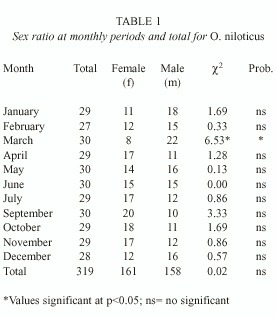
<body><![CDATA[<P><FONT FACE="Arial"><FONT SIZE=-1>Various aspects of the biology of Cichlids of commercial importance have been studied by <A HREF="#Fryer">Fryer and Iles (1972)</A>, <A HREF="#Babiker">Babiker and Ibrahim (1979)</A>, <A HREF="#Arredondo">Arredondo-Figueroa and Guzm&aacute;n-Arroyo (1986)</A>, <A HREF="#Gomez">G&oacute;mez <I>et al. </I>(1993)</A>, <A HREF="#Morales91">Morales (1991)</A>, <A HREF="#Morales92">Morales (1992)</A>, <A HREF="#Castrejon">Castrej&oacute;n <I>et al. </I>(1995)</A>, <A HREF="#Palacios">Palacios (1995)</A>, <A HREF="#Ramos">Ramos-Cruz (1995)</A> and <A HREF="#Fawole">Fawole and Arawomo (2000)</A>. There are however, unpublished accounts on the biology of these species from Coatetelco Lake, Mexico. The purpose of this study was to analyze the relationships among fecundity-length, fecundity-weight, oocyte diameter, and the reproductive cycle of <I>O. niloticu</I>s.</FONT></FONT>      <P><B><FONT FACE="Arial"><FONT SIZE=-1>Materials and methods</FONT></FONT></B>      <P><FONT FACE="Arial"><FONT SIZE=-1>Samples from the commercial catch at Coatetelco Lake, located in Morelos State (18&deg;45’ N, 99&deg;20’ W, altitude 1100 m), were taken approximately at monthly periods from January to December 1993. Fish were caught by a static gill net with 5.08 cm of mesh size. The specimens were collected by the same fisherman in the same place and date. A total of 319 fish were analyzed: 161 females and 158 males. Fish were measured for total (TL) and standard lengths (SL) to the nearest 1 mm (from the tip of the snout to the end of the caudal fin), weighed (total weight) to the nearest 0.1 g and dissected to determine sex; the gonadic maturity stage was recorded following <A HREF="#Holden">Holden and Raitt (1975)</A> procedures. The gonads and liver were removed and weighted to the nearest 0.01 g. The sexual proportion male:female was obtained. The mean length at first reproduction, or mean length at sexual maturity was obtained as the length at which 50 percent of all individuals are sexually mature (<A HREF="#King">King 1995</A>). Gonadosomatic index (GSI) for each fish was calculated as the weight of the gonads relative to the total body weight, expressed as a percentage (<A HREF="#deVlaming">de Vlaming <I>et al. </I>1982</A>). Hepatosomatic index (HSI) was calculated for females as the weight of the liver relative to the total body weight, expressed as a percentage. The monthly frequency of the various gonad stages, and mean monthly GSI and HSI were plotted by month to determine the reproductive cycle and the breeding season of the fish. Ripe female fish (85) were used for fecundity estimations. Fecundity was estimated using the total number of oocytes contained in the ovary of the fish, and diameters of the oocytes were measured with a dissecting microscope equipped with an ocular micrometer. The variation of fecundity with fish body length was estimated (<A HREF="#Bagenal">Bagenal 1978</A>). A mean fecundity from all samples was calculated using a "direct summation" procedure (<A HREF="#Shoesmith">Shoesmith 1990</A>).</FONT></FONT>      <P><FONT FACE="Arial"><FONT SIZE=-1>Catalogue number of voucher specimens: IBUNAM-P 8832.</FONT></FONT>      <P><B><FONT FACE="Arial"><FONT SIZE=-1>Results</FONT></FONT></B>      <P><B><FONT FACE="Arial"><FONT SIZE=-1>Sex ratio</FONT></FONT></B>      <P><FONT FACE="Arial"><FONT SIZE=-1>The 319 fishes ranged from 117 to 206 mm in total length, and 31.2 to 167.0 g in body weight with 161 females (50.4 %) and 158 males (49.6 %). Females were more numerous from July to November and the males from January to June, except April (<A HREF="#table1">Table 1</A>). The sex ratio was 1:1.02 (males: females), and did not differ significantly of the sex ratio 1:1 (<I>X</I><SUP>2</SUP> = 0.02; p=0.05).</FONT></FONT>     <BR>&nbsp;     <CENTER><A NAME="table1"></A><IMG SRC="/img/fbpe/rbt/v51n1/2409t01.JPG" HEIGHT=317 WIDTH=276></CENTER> &nbsp;     
<BR><B><FONT FACE="Arial"><FONT SIZE=-1>Maturity stages</FONT></FONT></B>      ]]></body>
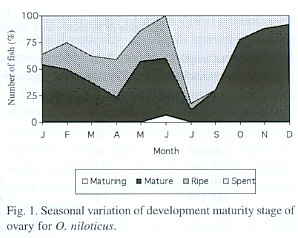
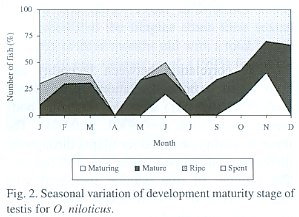
<body><![CDATA[<P><FONT FACE="Arial"><FONT SIZE=-1>The increase from the immature condition to the ripe condition through well-defined intermediate stages of maturation and ripening, and the percentage of each stage of gonadal development is illustrated in <A HREF="#fig1">Fig. 1</A>. According with the females gonadic maturation stages, 0.6% of the total fishes were maturing (II), 51.6% were mature (III), 14.3% were ripe (IV), and 33.5% were spent (V). Therefore, the 47.8% of the fishes were in reproductive process. In the males gonadic maturation stages were: 7.0% of the total fishes were maturing (II), 29.0% were mature (III), 5.0% were ripe (IV), and 59.0% were spent (V). Therefore, the 64.0% of the fishes were in reproductive process</FONT></FONT>      <P><FONT FACE="Arial"><FONT SIZE=-1><A HREF="#fig1">Fig. 1</A> shows that for the female in February, April and June the highest proportion of the average gonadal ripe stage (IV) was present. On the other hand, the fishes in spent stage (V) increased from January to April and in July. This percentage decreased progressively towards December. Similar results were obtained for the male (<A HREF="#fig2">Fig. 2</A>).</FONT></FONT>     <BR>&nbsp;     <CENTER><A NAME="fig1"></A><IMG SRC="/img/fbpe/rbt/v51n1/2409i01.JPG" HEIGHT=238 WIDTH=298></CENTER>      
<CENTER>&nbsp;</CENTER>      <CENTER><A NAME="fig2"></A><IMG SRC="/img/fbpe/rbt/v51n1/2409i02.JPG" HEIGHT=217 WIDTH=299></CENTER> &nbsp;     
<BR><B><FONT FACE="Arial"><FONT SIZE=-1>Size at first maturity</FONT></FONT></B>      <P><FONT FACE="Arial"><FONT SIZE=-1>The relation between body length and gonadal development was examined in 311 fishes from randomly selected catches. Young males and females attain maturity while they are in their first year of life. The smallest mature female was 120 mm long and the smallest mature male was 117 mm long. The smallest ripe female was 141 mm in total length and 50 g of total weight, while the smallest ripe male was 144 mm long. It appears that females attain maturity earlier in life with a size around 3 mm larger than males. None of the fish examined was immature beyond a body length of about 150 mm.</FONT></FONT>      <P><B><FONT FACE="Arial"><FONT SIZE=-1>Fecundity</FONT></FONT></B>      <P><FONT FACE="Arial"><FONT SIZE=-1>The total lengths of the specimen examined ranged from 125 mm to 209 mm while the total weight ranged from 41.4 g to 167.0 g. In small ripe females, fecundity ranged from 104 to 373 oocytes/fish, and the mean fecundity decreased progressively with fish length between 125 to 144 mm long body. In larger fish, fecundity increased (609 to 709 oocytes/fish) with total length (205 to 209 mm) (Table 2). The relationship of fecundity with fish total length was analyzed for all the examined fish; it can be expressed by the following equation where F= fecundity (oocytes/fish) and TL= total length (mm):</FONT></FONT>      ]]></body>
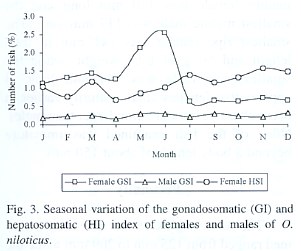
<body><![CDATA[<P><FONT FACE="Arial"><FONT SIZE=-1>F = 0.4701 TL <SUP>2.4808</SUP></FONT></FONT>      <P><FONT FACE="Arial"><FONT SIZE=-1>Regression analysis of fecundity versus body weight, where F= fecundity (oocytes/fish) and TW= Total weight (g) was:</FONT></FONT>      <P><FONT FACE="Arial"><FONT SIZE=-1>Log F = 1.1421 + 0.8085 Log TW</FONT></FONT>      <P><FONT FACE="Arial"><FONT SIZE=-1>The correlation between fecundity and body length expressed relationship was lower (r=0.7930, p&lt;0.001) than the fecundity-body weight correlation (r=0.8064, p&lt;0.001). The mean fecundity obtained for tilapia through the direct summation procedure was 465 oocytes. The number of ripe oocytes increased with ovarian weight in small fishes and the diameter of oocytes contained in the ovaries ranged of less than 1 000 &micro;m for fish in gonadal stage II; between 1 000 and 2 000 &micro;m for fish in gonadal stage III, and between 2 000 and 3 000 &micro;m for fish in stage of gonadal stage IV.</FONT></FONT>      <P><B><FONT FACE="Arial"><FONT SIZE=-1>Gonadosomatic and hepatosomatic index</FONT></FONT></B>      <P><FONT FACE="Arial"><FONT SIZE=-1>The gonadosomatic index increases with the progressive development of the gonads in both males and females until gonads are ripe and, the index then declines sharply in spawning and spent fish. The increase in weight from immature to the ripe condition through intermediate stages of maturation is illustrated in <A HREF="#fig1">Fig. 1</A> and <A HREF="#fig2">Fig. 2</A>. In relation with reproduction, the maximum value of the gonadosomatic index for females was obtained in June and January (<A HREF="#fig3">Fig. 3</A>) and, during December and June for the males. An opposite pattern between gonad and liver weight means for females was detected.</FONT></FONT>     <BR>&nbsp;     <CENTER><A NAME="fig3"></A><IMG SRC="/img/fbpe/rbt/v51n1/2409i03.JPG" HEIGHT=251 WIDTH=301></CENTER> &nbsp;     
<BR><B><FONT FACE="Arial"><FONT SIZE=-1>Discussion</FONT></FONT></B>      <P><FONT FACE="Arial"><FONT SIZE=-1>According to sizes obtained in <I>Oreochromis niloticus </I>the individuals have been considered as small fishes, due to that were caught by static gill-net with mesh size of 5.08 cm. Therefore, is necessary change the mesh size of the gillnet (probably to eight or nine cm) with the intention to obtain more production in weight and size. <A HREF="#Ramos">Ramos-Cruz (1995)</A> and <A HREF="#Palacios">Palacios (1995)</A> reported that the total average length for <I>O. aureus </I>using gillnet with mesh size of 9 cm is 20.9 cm. This is the reason why the former recommendation is made.</FONT></FONT>      ]]></body>
<body><![CDATA[<P><FONT FACE="Arial"><FONT SIZE=-1>The sex ratio for <I>O. niloticus </I>in Coatetelco lake indicate that male and females are approximately nearly equal in numbers and the deviation from the expected 1:1 (male:female) was not significant. <A HREF="#Fawole">Fawole and Arawomo (2000)</A> also indicated that for every female, there is a male specimen in <I>Sarotherodon galilaeu</I>s. <A HREF="#Babiker">Babiker and Ibrahim (1979)</A> reported for <I>T. nilotica </I>that the two sexes are present in an almost 1:1 ratio in populations of middleage fish. <A HREF="#Nikolsky">Nikolsky (1963)</A> cited that the sex ratio varies considerably from species to species, but in the majority of cases it is close to one, and may vary from year to year in the same population. It is important to stand out the fact that the captures in some time are composed by more males, which could be favourable to the fishery, because this can serve as a regulatory mechanism for the sex ratio. This may be due to the passive nature gill nets or because the nets not were set close to the brooding grounds. <A HREF="#Ramos">Ramos-Cruz (1995)</A> mentioned that the sex ratio for <I>O. aureus </I>was of 2.6:1 males:females, which considers normal. Also, <A HREF="#Fryer">Fryer and Iles (1972)</A> point out that in the African lakes it is common that in the populations of cichlids the males dominate because they generally present more growth than the females, without this representing a risk situation for the fishery.</FONT></FONT>      <P><FONT FACE="Arial"><FONT SIZE=-1>In this study the sex ratio was different in each one of the samples. This variation in the sex ratio can occur because once the fertilization of the eggs has concluded, the males possibly emigrate from the areas of spawning toward feeding areas located in the shallow part of the lake (where they are captured). The females possibly go toward submerged vegetation and rocky areas to avoid the fishermen and to carry out the incubation and protection of the offspring.</FONT></FONT>      <P><FONT FACE="Arial"><FONT SIZE=-1>In spite of the variation in the gonadal stages males and females, the periodicity of spawning for <I>O. niloticus </I>at Coatetelco lake, indicate that the fish spawn at least twice in the breeding season. <A HREF="#Castrejon">Castrej&oacute;n <I>et al</I>. (1995)</A> for <I>O. niloticus </I>and <A HREF="#Babiker">Babiker and Ibrahim (1979)</A> for <I>T. nilotica </I>found that females breed more than once in a season. <A HREF="#Morales91">Morales (1991)</A> mentioned that the frequency of tilapia spawning varies considerably in function of the environmental factors and that in Mexico tilapia may present a frequency of up to 10 spawning for year. <A HREF="#Bardach">Bardach <I>et al</I>. (1986)</A> reports that when the tilapias has reached sexual maturity, they can reproduce from three to six weeks while the water is warm, and when environmental conditions are unfavorable the reproductive activity is suspended.</FONT></FONT>      <P><FONT FACE="Arial"><FONT SIZE=-1>In this study the smallest mature male had a total length of 11.7 cm while the smallest mature female had a total length of 12.0 cm. Uchida and King (1962, in <A HREF="#Morales91">Morales 1991</A>) mentioned that the tilapias attain their sexual maturity at three months old with a total length of 8 to 16 cm. <A HREF="#Gomez">G&oacute;mez <I>et al</I>. (1993)</A> found for <I>O. mossambicus </I>that the total length of the smallest mature male and female were between six and eight cm, and three months of age. <A HREF="#Ramos">Ramos-Cruz (1995)</A> indicates that <I>O. aureus </I>reaches the sexual maturity at 22 cm of total length at six months old. <A HREF="#Fawole">Fawole and Arawomo (2000)</A> cited for <I>S. galilaeus </I>that males in Opa reservoir matures at about the same size as the female (12.5 and 11.7 cm respectively). This difference arises because the sexual maturity is a function of the size and may be influenced by the abundance and seasonal availability of food, the temperature, the photoperiod and by other environmental factors in different localities (<A HREF="#Nikolsky">Nikolsky 1963</A>, <A HREF="#Babiker">Babiker and Ibrahim 1979</A>).</FONT></FONT>      <P><FONT FACE="Arial"><FONT SIZE=-1><A HREF="#Arredondo">Arredondo-Figueroa and Guzm&aacute;n-Arroyo (1986)</A> mentioned that <I>Oreochromis </I>spp is a mouth brooder with small gonads of less than 700 eggs. In this study, we reported a fecundity range from 104 to 709 eggs. This result is lower than that observed by other workers for <I>O. niloticu</I>s. <A HREF="#Fryer">Fryer and Iles (1972)</A> obtained a fecundity of 3 706 eggs from a gigantic female specimen with total length of 57 cm of <I>T. nilotica</I>. The maximum numbers of eggs counted in the ripe ovaries of any mouth-brooding cichlid are 4 300 in a 25 cm specimen of the <I>T. aurea</I>. <A HREF="#Babiker">Babiker and Ibrahim (1979)</A> reported a fecundity range of 300 - 2 800 eggs for <I>T. nilotica </I>whose body length ranged from 11.0 and 32.0 cm. <A HREF="#Palacios">Palacios (1995)</A> cited a fecundity range of 162 - 954 eggs for <I>O. aureus </I>whose body length ranged from 18.4 cm and 30.2 cm in Adolfo L&oacute;pez Mateos dam, in Mexico. <A HREF="#Moyle">Moyle and Cech (2000)</A> mentioned that in mouth-brooding cichlids, the fecundity is often considerably higher because the parents assure the survival of the offspring, and in consequence less mortality. In addition, the variation in fecundity may be attributed to differential abundance of food within the members of the population, and <A HREF="#Bagenal">Bagenal (1978)</A> cited that fish species exhibit wide fluctuations in fecundity among fish of the same species, size and age.</FONT></FONT>      <P><FONT FACE="Arial"><FONT SIZE=-1>On criteria of length, females reach maturity before males (12.0 and 11.7 cm, respectively). Small females produce only a few eggs but fecundity is directly correlated with body length (r=0.7930) and body weight (r=0.8064). Even when expressed in terms of body length, the fecundity by <I>O. niloticu</I>s, of the order of exponential (2.4808) of length, is much lower than that of most economically exploited species, as mentioned by <A HREF="#Babiker">Babiker and Ibrahim (1979)</A> for <I>T. nilotica</I>. Similar values for <I>O.mossambicus </I>(<A HREF="#Gomez">G&oacute;mez <I>et al</I>. 1993</A>) and <I>S. galilaeus </I>(<A HREF="#Fawole">Fawole and Arawomo 2000</A>) were obtained. This is most probably a result of the restrictions imposed by the mouth-brooding habit of this species and the limited space available for rearing of the spawn in the mouth cavity (<A HREF="#Babiker">Babiker and Ibrahim 1979</A>).</FONT></FONT>      <P><FONT FACE="Arial"><FONT SIZE=-1>The occurrence of eggs of varying sizes is also an indication of multiple spawning by this species and the egg diameter varied in fish of the same length or weight. In this study the eggs ranged between 2.0 and 3.0 mm. <A HREF="#Fawole">Fawole and Arawomo (2000)</A> mentioned for <I>S. galilaeus </I>an egg diameter of 2.49 &plusmn; 1.81 mm. <A HREF="#Fryer">Fryer and Iles (1972)</A> reported that <I>T. galilaeus </I>had a maximum egg diameter of 2.2 mm; furthermore, they mentioned that egg size varies considerably from species to species among the mouth brooding forms. These differences in egg and brood size must have some biological significance and an attempt has been made to explain them, at least in part, in terms of the habitat in which the various species live. There appears to be a relationship between the risk of being eaten and the size of the egg produced. However, the degree to which an animal is able to separate the growth and reproductive phases must depend on the constancy and pre-dictability of the environment.</FONT></FONT>      <P><FONT FACE="Arial"><FONT SIZE=-1>In spite of the periodicity of oviposition and spawning, the generation and development of gonads seemed to proceed without interruption as indicated by the high frequency of occurrences of all stages of gonadal maturation. <A HREF="#Babiker">Babiker and Ibrahim (1979)</A> cited that it is possible that in this species and in the majority of teleosts oogenesis proceeds uninterruptedly or cyclically throughout reproductive life. Mature ovaries were available all the year round and this is an indication that the fish breeds throughout the year. The GSI for the males was always lower than those from females. This is associated with relatively heavier female gonads. These observations suggest, that, in spite that the pattern of variation in the mean gonad weight, the evidence found in this study corroborates the summer and winter spawning season for this species.</FONT></FONT>      <P><FONT FACE="Arial"><FONT SIZE=-1>The reproductive season for this species, showed that the liver weight is minimal in spring. <A HREF="#Salgado">Salgado-Ugarte (1995)</A> mentioned that the poor somatic condition during the spawning season is a common observation in many species of fish, and give and indication that the somatic growth is limited due to the development of gonads, furthermore, the decrease in condition has been ascribed to a depletion of body reserves during gonad maturation.</FONT></FONT>      <P><FONT FACE="Arial"><FONT SIZE=-1>The data and information presented here indicate that the GSI may perhaps not yield a totally accurate indication of gonadal activity. <A HREF="#Garcia93">Garc&iacute;a-Berthou and Moreno-Amich (1993)</A> cited that the use of the multivariate analysis of covariance (MANCOVA) could be applied most appropriate the use of this measurement. This method have the advantages of eliminates the effect of the individual size, the increment in the variability when comparing variables by means of a ratio and the anomalous characteristics of estimating mean true values of the ratio.</FONT></FONT>      ]]></body>
<body><![CDATA[<P><B><FONT FACE="Arial"><FONT SIZE=-1>Acknowledgements</FONT></FONT></B>      <P><FONT FACE="Arial"><FONT SIZE=-1>We thank everyone who kindly assisted in several parts of the work, especially Mercedes Gardu&ntilde;o Paredes and Juan Avelar Esquivel for collecting, processing and providing measurements of <I>O. niloticus</I>. The authors acknowledge Benny Weiss Steider for his help with the manuscript. This work was supported by the Facultad de Estudios Superiores Zaragoza, U.N.A.M. and Secretar&iacute;a de Desarrollo Rural del Estado de Morelos, Mexico.</FONT></FONT>      <P><B><FONT FACE="Arial"><FONT SIZE=-1>Resumen</FONT></FONT></B>      <P><FONT FACE="Arial"><FONT SIZE=-1>En este estudio se analizaron algunos aspectos reproductivos de la mojarra-tilapia <I>Oreochromis niloticus </I>L. en el lago de Coatetelco, Morelos. La informaci&oacute;n esta basada en los datos biol&oacute;gicos de 319 organismos obtenidos de enero a diciembre de 1993 de la captura comercial. Las hembras (161) representaron el 51% y los machos (158) el 49 % del total de la poblaci&oacute;n. La proporci&oacute;n de sexo fue de 1:1.02 (<I>X</I> = 0.02; p=0.05). Los peces alcanzan la primera madurez sexual a los 117 mm y 120 mm de longitud total (hembras y machos respectivamente). El n&uacute;mero de &oacute;vulos presentes en las g&oacute;nadas oscil&oacute; entre 104 y 709 con di&aacute;metro de 1 000 a 3 000 &micro;m, lo cual hace que esta especie tenga baja fecundidad pero alta fertilidad por los h&aacute;bitos de reproducci&oacute;n que presenta la especie. Se aplic&oacute; el indice gonadosom&aacute;tico y hepatosom&aacute;tico con los cuales se detectaron dos per&iacute;odos (verano e invierno) de m&aacute;xima actividad reproductiva.</FONT></FONT>      <P><B><FONT FACE="Arial"><FONT SIZE=-1>References</FONT></FONT></B>      <!-- ref --><P><A NAME="Anonymous"></A><FONT FACE="Arial"><FONT SIZE=-1>Anonymous. 1998. Anuario Estad&iacute;stico de Pesca 1997. Direcci&oacute;n de Estad&iacute;stica y Registro Pesquero<I>. </I>Secretar&iacute;a de Pesca. 235 p.</FONT></FONT>    &nbsp;&nbsp;&nbsp;&nbsp;&nbsp;&nbsp;&nbsp;&nbsp;[&#160;<a href="javascript:void(0);" onclick="javascript: window.open('/scielo.php?script=sci_nlinks&ref=1216319&pid=S0034-7744200300010002000001&lng=','','width=640,height=500,resizable=yes,scrollbars=1,menubar=yes,');">Links</a>&#160;]<!-- end-ref --><!-- ref --><P><A NAME="Arredondo"></A><FONT FACE="Arial"><FONT SIZE=-1>Arredondo-Figueroa, J.L &amp; M. Guzm&aacute;n-Arroyo. 1986. Actual situaci&oacute;n taxon&oacute;mica de las especies de la Tribu Tilappini (Pisces: Cichlidae) introducidas en M&eacute;xico. An. Inst. Biol. U.N.A.M., Serie Zool. 56: 555-572.</FONT></FONT>    &nbsp;&nbsp;&nbsp;&nbsp;&nbsp;&nbsp;&nbsp;&nbsp;[&#160;<a href="javascript:void(0);" onclick="javascript: window.open('/scielo.php?script=sci_nlinks&ref=1216320&pid=S0034-7744200300010002000002&lng=','','width=640,height=500,resizable=yes,scrollbars=1,menubar=yes,');">Links</a>&#160;]<!-- end-ref --><!-- ref --><P><A NAME="Babiker"></A><FONT FACE="Arial"><FONT SIZE=-1>Babiker, M.M. &amp; H. Ibrahim. 1979. Studies on the biology of reproduction in the cichlid <I>Tilapia nilotica </I>(L): Gonadal maduration and fecundity. J. Fish. Biol. 14: 437-447.</FONT></FONT>    &nbsp;&nbsp;&nbsp;&nbsp;&nbsp;&nbsp;&nbsp;&nbsp;[&#160;<a href="javascript:void(0);" onclick="javascript: window.open('/scielo.php?script=sci_nlinks&ref=1216321&pid=S0034-7744200300010002000003&lng=','','width=640,height=500,resizable=yes,scrollbars=1,menubar=yes,');">Links</a>&#160;]<!-- end-ref --><!-- ref --><P><A NAME="Bardach"></A><FONT FACE="Arial"><FONT SIZE=-1>Bardach, E. J., J. H. Ryther &amp; W.O. Mclarney. 1986. Acuacultura. Crianza y cultivo de organismos marinos y de agua dulce. AGT Editor, S.A.: 288-316.</FONT></FONT>    &nbsp;&nbsp;&nbsp;&nbsp;&nbsp;&nbsp;&nbsp;&nbsp;[&#160;<a href="javascript:void(0);" onclick="javascript: window.open('/scielo.php?script=sci_nlinks&ref=1216322&pid=S0034-7744200300010002000004&lng=','','width=640,height=500,resizable=yes,scrollbars=1,menubar=yes,');">Links</a>&#160;]<!-- end-ref --><!-- ref --><P><A NAME="Bagenal"></A><FONT FACE="Arial"><FONT SIZE=-1>Bagenal, T. 1978. Aspects of fish fecundity: 75-101. <I>In </I>Shelby, D.G. (Ed.). Ecology of freshwater fish production. Blackwell Scientific Publication. Oxford, London.</FONT></FONT>    &nbsp;&nbsp;&nbsp;&nbsp;&nbsp;&nbsp;&nbsp;&nbsp;[&#160;<a href="javascript:void(0);" onclick="javascript: window.open('/scielo.php?script=sci_nlinks&ref=1216323&pid=S0034-7744200300010002000005&lng=','','width=640,height=500,resizable=yes,scrollbars=1,menubar=yes,');">Links</a>&#160;]<!-- end-ref --><P><A NAME="Castrejon"></A><FONT FACE="Arial"><FONT SIZE=-1>Castrej&oacute;n, M.T., R. Palacios &amp; A. Garc&iacute;a-Alarc&oacute;n. 1995. Patr&oacute;n reproductivo de la tilapia del Nilo <I>Oreochromis niloticu</I> s, Programa Res&uacute;menes. XIII Congreso Nacional de Zoolog&iacute;a. Nov. 1995. Morelia, Mich.:24.</FONT></FONT>      <!-- ref --><P><A NAME="deVlaming"></A><FONT FACE="Arial"><FONT SIZE=-1>de Vlaming, V., G. Grossman &amp; F. Chapman. 1982. On the use the gonosomatic index. Comp. Biochem. Physiol., 73: 31-39.</FONT></FONT>    &nbsp;&nbsp;&nbsp;&nbsp;&nbsp;&nbsp;&nbsp;&nbsp;[&#160;<a href="javascript:void(0);" onclick="javascript: window.open('/scielo.php?script=sci_nlinks&ref=1216325&pid=S0034-7744200300010002000006&lng=','','width=640,height=500,resizable=yes,scrollbars=1,menubar=yes,');">Links</a>&#160;]<!-- end-ref --><P><A NAME="Erickson"></A><FONT FACE="Arial"><FONT SIZE=-1>Erickson, L.D., J. E. Hightower &amp; G.D. Grossman. 1985. The relative gonadal index: An alternative index for quantification of reproductive condition. Comp. Biochem. Physiol. 81: 117-120.</FONT></FONT>      <P><A NAME="Fawole"></A><FONT FACE="Arial"><FONT SIZE=-1>Fawole, O.O. &amp; G.A.O. Arawomo. 2000. Fecundity of <I>Sarotherodon galilaeus </I>(Pisces:Cichlidae) in the Opa reservoir, Ile-Ife, Nigeria. Rev. Biol. Trop., 48: 201-204.</FONT></FONT>      <!-- ref --><P><A NAME="Fryer"></A><FONT FACE="Arial"><FONT SIZE=-1>Fryer, G. &amp; T.D. Iles. 1972. The Cichlid Fishes of the Great Lakes of Africa. Their Biology and Evolutio<I>n. </I>Oliver and Boyd, Edinburgh. 641 p.</FONT></FONT>    &nbsp;&nbsp;&nbsp;&nbsp;&nbsp;&nbsp;&nbsp;&nbsp;[&#160;<a href="javascript:void(0);" onclick="javascript: window.open('/scielo.php?script=sci_nlinks&ref=1216328&pid=S0034-7744200300010002000007&lng=','','width=640,height=500,resizable=yes,scrollbars=1,menubar=yes,');">Links</a>&#160;]<!-- end-ref --><P><A NAME="Garcia93"></A><FONT FACE="Arial"><FONT SIZE=-1>Garc&iacute;a-Berthou, E. &amp; R. Moreno-Amich. 1993. Multivariate analysis of covariance in morphometric studies of the reproductive cycle. Can. J. Fish. Aquat. Sci. 50: 1394-1399.</FONT></FONT>      <P><A NAME="Gomez"></A><FONT FACE="Arial"><FONT SIZE=-1>G&oacute;mez-M&aacute;rquez, J.L., R.M.A. Castillo, M.J.G. Fabila &amp; V.A.D. Zamora. 1993. Reproducci&oacute;n de la tilapia en la laguna El Rodeo, Estado de Morelos, M&eacute;xico. T&oacute;picos de Investigaci&oacute;n y Posgrado. III: 16-22.</FONT></FONT>      <!-- ref --><P><A NAME="Holden"></A><FONT FACE="Arial"><FONT SIZE=-1>Holden, M.J. &amp; D.F.S. Raitt (eds.). 1975. Manual de ciencia pesquera. parte 2. M&eacute;todos para investigar los recursos y su aplicaci&oacute;n. Doc. Tec. FAO. Pesca, 115, 1: 211 p.</FONT></FONT>    &nbsp;&nbsp;&nbsp;&nbsp;&nbsp;&nbsp;&nbsp;&nbsp;[&#160;<a href="javascript:void(0);" onclick="javascript: window.open('/scielo.php?script=sci_nlinks&ref=1216331&pid=S0034-7744200300010002000008&lng=','','width=640,height=500,resizable=yes,scrollbars=1,menubar=yes,');">Links</a>&#160;]<!-- end-ref --><!-- ref --><P><A NAME="King"></A><FONT FACE="Arial"><FONT SIZE=-1>King, M. 1995. Fisheries biology, assessment and management. Fishing News Books, Blackwell Science, Ltd., 341 p.</FONT></FONT>    &nbsp;&nbsp;&nbsp;&nbsp;&nbsp;&nbsp;&nbsp;&nbsp;[&#160;<a href="javascript:void(0);" onclick="javascript: window.open('/scielo.php?script=sci_nlinks&ref=1216332&pid=S0034-7744200300010002000009&lng=','','width=640,height=500,resizable=yes,scrollbars=1,menubar=yes,');">Links</a>&#160;]<!-- end-ref --><!-- ref --><P><A NAME="Morales91"></A><FONT FACE="Arial"><FONT SIZE=-1>Morales, D. A. 1991. La Tilapia en M&eacute;xico. Biolog&iacute;a, Cultivo y Pesquer&iacute;as. AG Editor, S.A. 190 p.</FONT></FONT>    &nbsp;&nbsp;&nbsp;&nbsp;&nbsp;&nbsp;&nbsp;&nbsp;[&#160;<a href="javascript:void(0);" onclick="javascript: window.open('/scielo.php?script=sci_nlinks&ref=1216333&pid=S0034-7744200300010002000010&lng=','','width=640,height=500,resizable=yes,scrollbars=1,menubar=yes,');">Links</a>&#160;]<!-- end-ref --><P><A NAME="Morales92"></A><FONT FACE="Arial"><FONT SIZE=-1>Morales, B.E. 1992. Evaluaci&oacute;n de algunos aspectos biol&oacute;gico-pesqueros de la tilapia <I>Oreochromis aureus </I>(Steindachner, 1864) en la presa Vicente Guerrero, Las Adjuntas, Tamaulipas. Tesis de Licenciatura, ENEP-Iztacala, UNAM. 28 p.</FONT></FONT>      <P><A NAME="Moyle"></A><FONT FACE="Arial"><FONT SIZE=-1>Moyle, B. Peter &amp; J.J. Cech, Jr. 2000. Fishes: An Introduction to Ichthyology. Fourth edition. Prentice Hall: 123-144.</FONT></FONT>      <P><A NAME="Nikolsky"></A><FONT FACE="Arial"><FONT SIZE=-1>Nikolsky, D.V. 1963. The ecology of fishe<I> s. </I>Part II. Academic Press, New York: 352 p.</FONT></FONT>      <P><A NAME="Palacios"></A><FONT FACE="Arial"><FONT SIZE=-1>Palacios, S.S.E. 1995. Estudio biol&oacute;gico pesquero de la tilapia <I>Oreochromis aureus </I>(Steindachner, 1864) en la presa Adolfo L&oacute;pez Mateos (El Infiernillo), Michoac&aacute;n-Guerrero, M&eacute;xico. Tesis de Licenciatura, Facultad de Ciencias, UNAM. 81 p.</FONT></FONT>      <!-- ref --><P><A NAME="Ramos"></A><FONT FACE="Arial"><FONT SIZE=-1>Ramos-Cruz, S. 1995. Reproducci&oacute;n y crecimiento de la mojarra tilapia <I>(Oreochromis aureus) </I>en la Presa Benito Ju&aacute;rez, Oaxaca, M&eacute;xico, en 1993. INP-SEMARNAP. M&eacute;xico, Ciencia Pesquera No. 11: 54-61.</FONT></FONT>    &nbsp;&nbsp;&nbsp;&nbsp;&nbsp;&nbsp;&nbsp;&nbsp;[&#160;<a href="javascript:void(0);" onclick="javascript: window.open('/scielo.php?script=sci_nlinks&ref=1216338&pid=S0034-7744200300010002000011&lng=','','width=640,height=500,resizable=yes,scrollbars=1,menubar=yes,');">Links</a>&#160;]<!-- end-ref --><!-- ref --><P><A NAME="Shoesmith"></A><FONT FACE="Arial"><FONT SIZE=-1>Shoesmith E. 1990, A comparision of methods for estimating mean fecundity. J. Fish Biology 36: 29-37.</FONT></FONT>    &nbsp;&nbsp;&nbsp;&nbsp;&nbsp;&nbsp;&nbsp;&nbsp;[&#160;<a href="javascript:void(0);" onclick="javascript: window.open('/scielo.php?script=sci_nlinks&ref=1216339&pid=S0034-7744200300010002000012&lng=','','width=640,height=500,resizable=yes,scrollbars=1,menubar=yes,');">Links</a>&#160;]<!-- end-ref --><P><A NAME="Salgado"></A><FONT FACE="Arial"><FONT SIZE=-1>Salgado-Ugarte, I.H. 1995. Nonparametric methods for fisheries data analysis and their application in conjunction with other statistical techniques to study biological data of the Japanese sea bass <I>Lateolabrax japonicus </I>in Tokyo Bay. Ph. D. in Aquatic Bioscience Thesis, Laboratory of Fisheries Biology, University of Tokyo, Japan. 389 p.</FONT></FONT>      <P><A NAME="SPSS"></A><FONT FACE="Arial"><FONT SIZE=-1>SPSS Inc. 1993. SPSS for Windows. Release 6.0. SPSS Inc, Chicago III USA.</FONT></FONT>      <P><A NAME="Wohlfarth"></A><FONT FACE="Arial"><FONT SIZE=-1>Wohlfarth G.W. &amp; G. Hulata. 1983. Applied of Tilapias. ICLARM Studies and Reviews 6, 26 p. International Center for Living Aquatic Resources Management, Manila, Philippines.</FONT></FONT>      <P><A NAME="Yi"></A><FONT FACE="Arial"><FONT SIZE=-1>Yi, Y, C.K. Lin &amp; J.S. Diana. 1996. Influence of Nile tilapia <I>(Oreochromis niloticu</I>s) stocking density on their growth and yield in cages and ponds containing the cages. Aquaculture, 146: 205-215.</FONT></FONT>     ]]></body>
<body><![CDATA[<BR><FONT FACE="Arial"><FONT SIZE=-1>&nbsp;</FONT></FONT>     <BR>&nbsp;     <BR><A NAME="a1"></A><FONT SIZE=-1><FONT FACE="Arial"><A HREF="#a1">1</A>. Laboratorio de Limnolog&iacute;a, F.E.S</FONT><FONT FACE="Arial,Helvetica">. Zaragoza, U.N.A.M. Av. 5 de Mayo y Fuerte de Loreto, Col. Ej&eacute;rcito de Oriente, Iztapalapa. C.P. 09230, M&eacute;xico, D.F., Fax: 5773 6336; <A HREF="mailto:lgomez@servidor.unam.mx">lgomez@servidor.unam.mx</A></FONT></FONT><FONT FACE="Arial,Helvetica"> <FONT SIZE=-1>.</FONT></FONT>      <P><FONT FACE="Arial,Helvetica"><FONT SIZE=-1><A HREF="#a1">2</A>. Instituto de Limnolog&iacute;a. Universidad de Guadalajara. A.P. 310, Chapala (45900) Jalisco; <A HREF="mailto:mguzman44@prodigy.net.mx">mguzman44@prodigy.net.mx</A></FONT> <FONT SIZE=-1>.</FONT></FONT>      ]]></body><back>
<ref-list>
<ref id="B1">
<nlm-citation citation-type="book">
<person-group person-group-type="author">
<name>
</name>
<name>
</name>
</person-group>
<source><![CDATA[Anuario Estadístico de Pesca 1997]]></source>
<year>1998</year>
<page-range>235</page-range><publisher-name><![CDATA[Dirección de Estadística y Registro Pesquero]]></publisher-name>
</nlm-citation>
</ref>
<ref id="B2">
<nlm-citation citation-type="journal">
<person-group person-group-type="author">
<name>
<surname><![CDATA[Arredondo-Figueroa]]></surname>
<given-names><![CDATA[J.L]]></given-names>
</name>
<name>
<surname><![CDATA[Guzmán-Arroyo]]></surname>
<given-names><![CDATA[M]]></given-names>
</name>
</person-group>
<article-title xml:lang="es"><![CDATA[Actual situación taxonómica de las especies de la Tribu Tilappini (Pisces: Cichlidae) introducidas en México]]></article-title>
<source><![CDATA[An. Inst. Biol. U.N.A.M]]></source>
<year>1986</year>
<volume>56</volume>
<page-range>555-572</page-range></nlm-citation>
</ref>
<ref id="B3">
<nlm-citation citation-type="journal">
<person-group person-group-type="author">
<name>
<surname><![CDATA[Babiker]]></surname>
<given-names><![CDATA[M.M]]></given-names>
</name>
<name>
<surname><![CDATA[Ibrahim]]></surname>
<given-names><![CDATA[H]]></given-names>
</name>
</person-group>
<article-title xml:lang="en"><![CDATA[Studies on the biology of reproduction in the cichlid Tilapia nilotica (L): Gonadal maduration and fecundity]]></article-title>
<source><![CDATA[J. Fish. Biol]]></source>
<year>1979</year>
<volume>14</volume>
<page-range>437-447</page-range></nlm-citation>
</ref>
<ref id="B4">
<nlm-citation citation-type="book">
<person-group person-group-type="author">
<name>
<surname><![CDATA[Bardach]]></surname>
<given-names><![CDATA[E. J]]></given-names>
</name>
<name>
<surname><![CDATA[Ryther]]></surname>
<given-names><![CDATA[J. H]]></given-names>
</name>
<name>
<surname><![CDATA[Mclarney]]></surname>
<given-names><![CDATA[W.O]]></given-names>
</name>
</person-group>
<source><![CDATA[Acuacultura. Crianza y cultivo de organismos marinos y de agua dulce]]></source>
<year>1986</year>
<page-range>288-316</page-range><publisher-name><![CDATA[AGT Editor, S.A]]></publisher-name>
</nlm-citation>
</ref>
<ref id="B5">
<nlm-citation citation-type="book">
<person-group person-group-type="author">
<name>
<surname><![CDATA[Bagenal]]></surname>
<given-names><![CDATA[T]]></given-names>
</name>
</person-group>
<article-title xml:lang="en"><![CDATA[Aspects of fish fecundity: 75-101]]></article-title>
<person-group person-group-type="editor">
<name>
<surname><![CDATA[Shelby]]></surname>
<given-names><![CDATA[D.G]]></given-names>
</name>
</person-group>
<source><![CDATA[Ecology of freshwater fish production]]></source>
<year>1978</year>
<publisher-loc><![CDATA[Oxford^eLondon London]]></publisher-loc>
<publisher-name><![CDATA[Blackwell Scientific Publication]]></publisher-name>
</nlm-citation>
</ref>
<ref id="B6">
<nlm-citation citation-type="journal">
<person-group person-group-type="author">
<name>
<surname><![CDATA[de Vlaming]]></surname>
<given-names><![CDATA[V]]></given-names>
</name>
<name>
<surname><![CDATA[Grossman]]></surname>
<given-names><![CDATA[G]]></given-names>
</name>
<name>
<surname><![CDATA[Chapman]]></surname>
<given-names><![CDATA[F]]></given-names>
</name>
</person-group>
<article-title xml:lang="en"><![CDATA[On the use the gonosomatic index. Comp]]></article-title>
<source><![CDATA[Biochem. Physiol]]></source>
<year>1982</year>
<volume>73</volume>
<page-range>31-39</page-range></nlm-citation>
</ref>
<ref id="B7">
<nlm-citation citation-type="">
<person-group person-group-type="author">
<name>
<surname><![CDATA[Fryer]]></surname>
<given-names><![CDATA[G]]></given-names>
</name>
<name>
<surname><![CDATA[Iles]]></surname>
<given-names><![CDATA[T.D]]></given-names>
</name>
</person-group>
<source><![CDATA[The Cichlid Fishes of the Great Lakes of Africa: Their Biology and Evolution]]></source>
<year>1972</year>
<page-range>641</page-range><publisher-loc><![CDATA[Edinburgh ]]></publisher-loc>
</nlm-citation>
</ref>
<ref id="B8">
<nlm-citation citation-type="book">
<person-group person-group-type="author">
<name>
<surname><![CDATA[Holden]]></surname>
<given-names><![CDATA[M.J]]></given-names>
</name>
<name>
<surname><![CDATA[Raitt]]></surname>
<given-names><![CDATA[D.F.S]]></given-names>
</name>
</person-group>
<source><![CDATA[Manual de ciencia pesquera. parte 2. Métodos para investigar los recursos y su aplicación]]></source>
<year>1975</year>
<volume>115</volume>
<page-range>211</page-range><publisher-name><![CDATA[Doc. Tec. FAO]]></publisher-name>
</nlm-citation>
</ref>
<ref id="B9">
<nlm-citation citation-type="book">
<person-group person-group-type="author">
<name>
<surname><![CDATA[King]]></surname>
<given-names><![CDATA[M]]></given-names>
</name>
</person-group>
<source><![CDATA[Fisheries biology, assessment and management]]></source>
<year>1995</year>
<page-range>341</page-range><publisher-name><![CDATA[Blackwell Science]]></publisher-name>
</nlm-citation>
</ref>
<ref id="B10">
<nlm-citation citation-type="book">
<person-group person-group-type="author">
<name>
<surname><![CDATA[Morales]]></surname>
<given-names><![CDATA[D. A]]></given-names>
</name>
</person-group>
<source><![CDATA[La Tilapia en México. Biología, Cultivo y Pesquerías]]></source>
<year>1991</year>
<page-range>190</page-range><publisher-name><![CDATA[AG Editor, S.A.]]></publisher-name>
</nlm-citation>
</ref>
<ref id="B11">
<nlm-citation citation-type="journal">
<person-group person-group-type="author">
<name>
<surname><![CDATA[Ramos-Cruz]]></surname>
<given-names><![CDATA[S]]></given-names>
</name>
</person-group>
<article-title xml:lang="es"><![CDATA[Reproducción y crecimiento de la mojarra tilapia (Oreochromis aureus) en la Presa Benito Juárez, Oaxaca, México, en 1993. INP-SEMARNAP. México]]></article-title>
<source><![CDATA[Ciencia Pesquera]]></source>
<year>1995</year>
<volume>11</volume>
<page-range>54-61</page-range></nlm-citation>
</ref>
<ref id="B12">
<nlm-citation citation-type="journal">
<person-group person-group-type="author">
<name>
<surname><![CDATA[Shoesmith]]></surname>
<given-names><![CDATA[E]]></given-names>
</name>
</person-group>
<article-title xml:lang="en"><![CDATA[A comparision of methods for estimating mean fecundity]]></article-title>
<source><![CDATA[J. Fish Biology]]></source>
<year>1990</year>
<volume>36</volume>
<page-range>29-37</page-range></nlm-citation>
</ref>
</ref-list>
</back>
</article>