<?xml version="1.0" encoding="ISO-8859-1"?><article xmlns:mml="http://www.w3.org/1998/Math/MathML" xmlns:xlink="http://www.w3.org/1999/xlink" xmlns:xsi="http://www.w3.org/2001/XMLSchema-instance">
<front>
<journal-meta>
<journal-id>0034-7744</journal-id>
<journal-title><![CDATA[Revista de Biología Tropical]]></journal-title>
<abbrev-journal-title><![CDATA[Rev. biol. trop]]></abbrev-journal-title>
<issn>0034-7744</issn>
<publisher>
<publisher-name><![CDATA[Universidad de Costa Rica]]></publisher-name>
</publisher>
</journal-meta>
<article-meta>
<article-id>S0034-77442003000100017</article-id>
<title-group>
<article-title xml:lang="en"><![CDATA[Caterpillars of Eumaeus childrenae (Lepidoptera: Lycaenidae) feeding on two species of cycads (Zamiaceae) in the Huasteca region, Mexico]]></article-title>
</title-group>
<contrib-group>
<contrib contrib-type="author">
<name>
<surname><![CDATA[Contreras-Medina]]></surname>
<given-names><![CDATA[Raúl]]></given-names>
</name>
<xref ref-type="aff" rid="A01"/>
</contrib>
<contrib contrib-type="author">
<name>
<surname><![CDATA[Ruiz-Jiménez]]></surname>
<given-names><![CDATA[Carlos A.]]></given-names>
</name>
<xref ref-type="aff" rid="A01"/>
</contrib>
<contrib contrib-type="author">
<name>
<surname><![CDATA[Luna Vega]]></surname>
<given-names><![CDATA[Isolda]]></given-names>
</name>
<xref ref-type="aff" rid="A01"/>
</contrib>
</contrib-group>
<aff id="A01">
<institution><![CDATA[,Universidad Nacional Autónoma de México Facultad de Ciencias Departamento de Biología Evolutiva]]></institution>
<addr-line><![CDATA[ México, D. F]]></addr-line>
<country>México</country>
</aff>
<pub-date pub-type="pub">
<day>00</day>
<month>03</month>
<year>2003</year>
</pub-date>
<pub-date pub-type="epub">
<day>00</day>
<month>03</month>
<year>2003</year>
</pub-date>
<volume>51</volume>
<numero>1</numero>
<fpage>201</fpage>
<lpage>204</lpage>
<copyright-statement/>
<copyright-year/>
<self-uri xlink:href="http://www.scielo.sa.cr/scielo.php?script=sci_arttext&amp;pid=S0034-77442003000100017&amp;lng=en&amp;nrm=iso"></self-uri><self-uri xlink:href="http://www.scielo.sa.cr/scielo.php?script=sci_abstract&amp;pid=S0034-77442003000100017&amp;lng=en&amp;nrm=iso"></self-uri><self-uri xlink:href="http://www.scielo.sa.cr/scielo.php?script=sci_pdf&amp;pid=S0034-77442003000100017&amp;lng=en&amp;nrm=iso"></self-uri><abstract abstract-type="short" xml:lang="en"><p><![CDATA[There are few genera of butterflies that feed on cycads. Among them the genus Eumaeus (Lycaenidae) presents aposematic coloration in all its life stages. In this work we report for the first time the herbivory of young leaflets of Ceratozamia mexicana and Zamia fischeri (Zamiaceae) by caterpillars of E. childrenae in their natural habitat in the Huasteca region, Mexico.]]></p></abstract>
<abstract abstract-type="short" xml:lang="es"><p><![CDATA[Muy pocos géneros de mariposas se alimentan de cícadas. Entre ellos, el género Fumaeus (Lycaenidae) presenta coloración aposemática en todos sus estadíos de vida. En este trabajo informamos por primera vez la herbivoría de folíolos jóvenes de Ceratozamia mexicana y Zamia fischeri (Zamiacecae) por orugas de E. childrenae en su hábitat natural en la región Huasteca, México.]]></p></abstract>
<kwd-group>
<kwd lng="en"><![CDATA[Ceratozamia mexicana]]></kwd>
<kwd lng="en"><![CDATA[cloud forest]]></kwd>
<kwd lng="en"><![CDATA[Eumaeus childrenae]]></kwd>
<kwd lng="en"><![CDATA[herbivory]]></kwd>
<kwd lng="en"><![CDATA[Mexico]]></kwd>
<kwd lng="en"><![CDATA[Zamia fischeri]]></kwd>
</kwd-group>
</article-meta>
</front><body><![CDATA[ <CENTER><B><FONT FACE="Arial">Caterpillars of <I>Eumaeus childrenae </I>(Lepidoptera: Lycaenidae) feeding on two species of cycads (Zamiaceae) in the Huasteca region, Mexico</FONT></B></CENTER>      <CENTER>&nbsp;</CENTER>      <CENTER>&nbsp;</CENTER>      <CENTER><FONT SIZE=-1><FONT FACE="Arial">Ra&uacute;l Contreras-Medina&nbsp;<A NAME="R1"></A></FONT><SUP><FONT FACE="Arial,Helvetica"><A HREF="#A1">1</A></FONT></SUP><FONT FACE="Arial">, Carlos A. Ruiz-Jim&eacute;nez</FONT><SUP><FONT FACE="Arial,Helvetica"><A HREF="#A1">1</A></FONT></SUP><FONT FACE="Arial"> and Isolda Luna Vega</FONT><SUP><FONT FACE="Arial,Helvetica"><A HREF="#A1">1</A></FONT></SUP></FONT></CENTER> &nbsp;     <BR>&nbsp;     <CENTER>&nbsp;<FONT FACE="Arial"><FONT SIZE=-1>Received 22-VI-2001. Corrected 09-X-2002. Accepted 20-X-2002.</FONT></FONT></CENTER>       <P><B><FONT FACE="Arial"><FONT SIZE=-1>Abstract</FONT></FONT></B>      <P><FONT FACE="Arial"><FONT SIZE=-1>There are few genera of butterflies that feed on cycads. Among them the genus <I>Eumaeus </I>(Lycaenidae) presents aposematic coloration in all its life stages. In this work we report for the first time the herbivory of young leaflets of <I>Ceratozamia mexicana </I>and <I>Zamia fischeri </I>(Zamiaceae) by caterpillars of E. <I>childrenae </I>in their natural habitat in the Huasteca region, Mexico.</FONT></FONT>      <P><FONT FACE="Arial"><FONT SIZE=-1><B>Key words: </B><I>Ceratozamia mexican</I> a, cloud forest, <I>Eumaeus childrena</I>e, herbivory, Mexico, <I>Zamia fischeri.</I></FONT></FONT>      <P><FONT FACE="Arial"><FONT SIZE=-1>Insects and cycads are ecologically interrelated, mainly by pollination and herbivory. Beetles, especially weevils, have a special role in pollination (<A HREF="#Norstog">Norstog 1987</A>, <A HREF="#Vovides">Vovides 1991</A>). This ecological relationship is very strong, which is evidenced in cultivated plants that, far from their original area, may remain unfertile due to the absence of their natural pollinators (<A HREF="#Schneider">Schneider 1999</A>). In relation to herbivory, some phytophagous insects of cycads have been reported in previous studies, such as beetles, moths, flies, and butterflies (<A HREF="#Ehrlich">Ehrlich and Raven 1964</A>, <A HREF="#Jones">Jones 1993</A>). Few genera of butterflies feed on gymnosperms; among them <I>Eumaeus </I>(Lycaenidae) feed on Zamiaceae (<A HREF="#Comstock">Comstock 1948</A>, <A HREF="#Ehrlich">Ehrlich and Raven 1964</A>, <A HREF="#DeLa">De La Maza 1987</A>), especially on some species of <I>Zamia (</I>e.g., <A HREF="#Rothschild">Rothschild <I>et a</I>l. 1986</A>, <A HREF="#Clark">Clark <I>et al</I>. 1992</A>, <A HREF="#Jones">Jones 1993</A>). All species of <I>Eumaeus </I>display striking coloration in the imago, eggs, larva, and pupa (<A HREF="#Schneider">Schneider 1999</A>). In Mexican cycads, larvae of <I>Eumaeus childrenae </I>(Geyer, 1834) have been only reported feeding on <I>Dioon edule </I>Lindl. (<A HREF="#Comstock">Comstock 1948</A>, <A HREF="#Ehrlich">Ehrlich and Raven 1964</A>). Larvae of <I>E. childrenae </I>also feed on <I>Amaryllis </I>(Amaryllidaceae) and <I>E. atala </I>Poey on <I>Manihot </I>(Euphorbiaceae), both angiosperms (<A HREF="#Comstock">Comstock 1948</A>, <A HREF="#Ehrlich">Ehrlich and Raven 1964</A>). No information about toxic compounds used by <I>Eumaeus </I>larvae taken from flowering plants exists in the current literature. Larval choice plays an important role in food plant relationships and chemical factors are decisive in two ways, nutrition and protection (<A HREF="#Ehrlich">Ehrlich and Raven 1964</A>). In some species of the genus <I>Eumaeu</I>s, toxins of <I>Zamia </I>leaves, such as cycasin and macrozamin, are utilized by the caterpillars for their protection and also for the latter developmental stages of pupae and adults (<A HREF="#Rothschild">Rothschild <I>et al</I>. 1986</A>, <A HREF="#Jones">Jones 1993</A>). Adult butterflies of E. <I>atala </I>store cycasin in their wings, and also a considerable amount in their eggs and spermatophores (<A HREF="#Schneider">Schneider 1999</A>). Cycasin is a chemical compound exclusive of cycads (<A HREF="#DeLuca">De Luca <I>et al</I>. 1980</A>, <A HREF="#Moretti">Moretti <I>et al</I>. 1983</A>) and their presence represent a synapomorphy for the group (<A HREF="#Crane">Crane 1988</A>).</FONT></FONT>      ]]></body>
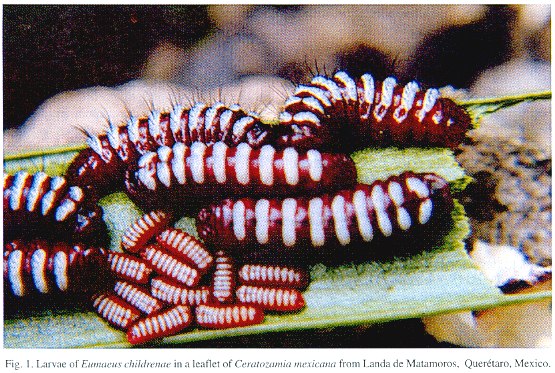
<body><![CDATA[<P><FONT FACE="Arial"><FONT SIZE=-1>This paper presents, for the first time, evidence that caterpillars of E. <I>childrenae </I>(Lepidoptera: Lycaenidae) feed on leaflets of <I>Ceratozamia mexicana </I>Brongn. and <I>Zamia fischeri </I>Miq. (Zamiaceae), both in their natural habitats in the Huasteca region of Mexico.</FONT></FONT>      <P><FONT FACE="Arial"><FONT SIZE=-1>During recent field work in the cloud forest of the Mexican states of Hidalgo and Quer&eacute;taro from the Huasteca region, caterpillars of <I>E. childrenae </I>were found feeding on leaves of two cycad species. Larvae were collected from leaves of <I>Z. fischeri,</I> in an ecotonal zone of cloud forest and tropical evergreen forest in Pisaflores, Hidalgo, and from leaves of <I>C. mexicana </I>in the cloud forest of Landa de Matamoros, Quer&eacute;taro; both sites are located in the Sierra Madre Oriental region, in north-eastern Mexico.</FONT></FONT>      <P><FONT FACE="Arial"><FONT SIZE=-1>One mature larva and two young larvae were collected and preserved in alcohol (70%) and were deposited in the collection of the Museo de Zoolog&iacute;a, UNAM (MZFC). Botanical reference specimens of both cycad species with signs of herbivory were deposited in the Facultad de Ciencias herbarium, UNAM (FCME).</FONT></FONT>      <P><FONT FACE="Arial"><FONT SIZE=-1>Newly hatched larvae and older caterpillars were observed, in some cases on the same leaf (<A HREF="#fig1">Fig. 1</A>), where only the leaflets and not the stem or cones show signs of herbivory, such as occurs in <I>Zamia skinneri </I>Warscz. ex A. Dietr. fed by <I>Eumaeus minyas </I>Hbn. (<A HREF="#Clark">Clark <I>et al</I>. 1992</A>). The gregarious habit and the aposematic coloration are characteristics of unpalatable insects, which suggest that <I>Eumaeus </I>species are unpalatable for predators (<A HREF="#Bowers">Bowers and Larin 1989</A>).</FONT></FONT>     <BR>&nbsp;     <CENTER><A NAME="fig1"></A><IMG SRC="/img/fbpe/rbt/v51n1/2406i01.JPG" HEIGHT=373 WIDTH=555></CENTER> &nbsp;     
<BR><FONT FACE="Arial"><FONT SIZE=-1>In the Mexican state of Hidalgo, the population of <I>Z. fischeri </I>shows very strong signs of herbivory. Two species of the genus <I>Zami</I>a, <I>Z. fischeri </I>and <I>Z. loddigesii </I>Miq., grow together in the locality of El Coyol in Hidalgo, but we do not have evidence of feeding on the latter species. In the locality of La Florida in the state of Quer&eacute;taro, a single juvenile plant of <I>C. mexicana </I>showed signs of herbivory by <I>Eumaeus </I>caterpillars. In this last species the presence of cycasin and macrozamin in seeds and ovules has been reported in previous studies (<A HREF="#DeLuca">De Luca <I>et al</I>. 1980</A>, <A HREF="#Moretti">Moretti <I>et al</I>. 1983</A>).</FONT></FONT>      <P><FONT FACE="Arial"><FONT SIZE=-1>Reference botanical specimens: <B>M&eacute;xico. Hidalgo: </B>ca. 1.5 km al SE del Coyol, Municipio de Pisaflores, 850 m, 27-08-2000, <I>R. Contreras-Medina, O. Alc&aacute;ntara &amp; J. Escutia # 14 </I>(FCME). <B>Quer&eacute;taro: </B>2.13 km al NW de La Florida, Municipio de Landa de Matamoros, 1850 m, 28-09-2000, <I>C. Ruiz, A. Ponce &amp; J. Escutia # 8 </I>(FCME).</FONT></FONT>      <P><FONT FACE="Arial"><FONT SIZE=-1>Insects use cycad toxins to protect the different stages of their life cycle from predators (<A HREF="#Bowers">Bowers and Larin 1989</A>, <A HREF="#Schneider">Schneider 1999</A>). The concentration of cycasin is more elevated in young leaves in the case of <I>Zamia integrifolia </I>L. (<A HREF="#Rothschild">Rothschild <I>et a</I>l. 1986</A>). This is probably true in the Mexican species because larvae prefer young leaves.</FONT></FONT>      <P><FONT FACE="Arial"><FONT SIZE=-1>Much remains to be discovered about the relationships of cycads and insects (<A HREF="#Stevenson">Stevenson <I>et al</I>. 1998</A>), especially studies in their natural habitat, of both pollination and herbivory. This study represents an example of animal and plant interaction where the cycad toxins are involved in a complex ecological relationship. Further chemical studies are required for analysis of sequestration and storage of cycad toxins in <I>E. childrena</I> e, and to corroborate the concentration of cycasin and macrozamin in leaves of both cycad species and different life stages of the butterfly.</FONT></FONT>      ]]></body>
<body><![CDATA[<P><B><FONT FACE="Arial"><FONT SIZE=-1>Acknowledgements</FONT></FONT></B>      <P><FONT FACE="Arial"><FONT SIZE=-1>We thank Juan J. Morrone and Isabel Var gas for useful comments on the manuscript. Jorge Llorente determined the larvae. Oth&oacute;n Alc&aacute;ntara, Jorge Escutia, and Armando Ponce assisted us in the field. Support from PAPIIT IN206202 of the DGAPA, UNAM and 31879-N of CONACYT are gratefully acknowledged.</FONT></FONT>      <P><B><FONT FACE="Arial"><FONT SIZE=-1>Resumen</FONT></FONT></B>      <P><FONT FACE="Arial"><FONT SIZE=-1>Muy pocos g&eacute;neros de mariposas se alimentan de c&iacute;cadas. Entre ellos, el g&eacute;nero <I>Fumaeus </I>(Lycaenidae) presenta coloraci&oacute;n aposem&aacute;tica en todos sus estad&iacute;os de vida. En este trabajo informamos por primera vez la herbivor&iacute;a de fol&iacute;olos j&oacute;venes de <I>Ceratozamia mexicana </I>y <I>Zamia fischeri </I>(Zamiacecae) por orugas de <I>E. childrenae </I>en su h&aacute;bitat natural en la regi&oacute;n Huasteca, M&eacute;xico.</FONT></FONT>      <P><B><FONT FACE="Arial"><FONT SIZE=-1>References</FONT></FONT></B>      <!-- ref --><P><A NAME="Bowers"></A><FONT FACE="Arial"><FONT SIZE=-1>Bowers, M.D. &amp; Z. Larin. 1989. Acquired chemical defense in the lycaenid butterfly, <I>Eumaeus atal</I>a. J. Chem. Ecol. 15(4): 1133-1146.</FONT></FONT>    &nbsp;&nbsp;&nbsp;&nbsp;&nbsp;&nbsp;&nbsp;&nbsp;[&#160;<a href="javascript:void(0);" onclick="javascript: window.open('/scielo.php?script=sci_nlinks&ref=1212044&pid=S0034-7744200300010001700001&lng=','','width=640,height=500,resizable=yes,scrollbars=1,menubar=yes,');">Links</a>&#160;]<!-- end-ref --><!-- ref --><P><A NAME="Clark"></A><FONT FACE="Arial"><FONT SIZE=-1>Clark, D.B., D.A. Clark &amp; M.H. Grayum. 1992. Leaf demography of a Neotropical rain forest cycad, <I>Zamia skinneri </I>(Zamiaceae). Amer. J. Bot. 79(1): 28-33.</FONT></FONT>    &nbsp;&nbsp;&nbsp;&nbsp;&nbsp;&nbsp;&nbsp;&nbsp;[&#160;<a href="javascript:void(0);" onclick="javascript: window.open('/scielo.php?script=sci_nlinks&ref=1212045&pid=S0034-7744200300010001700002&lng=','','width=640,height=500,resizable=yes,scrollbars=1,menubar=yes,');">Links</a>&#160;]<!-- end-ref --><!-- ref --><P><A NAME="Comstock"></A><FONT FACE="Arial"><FONT SIZE=-1>Comstock, J.A. 1948. The larva and pupa of <I>Eumaeus debora </I>Hbn. Bull. Soc. Calif. Acad. Sci. 47(1): 3-5.</FONT></FONT>    &nbsp;&nbsp;&nbsp;&nbsp;&nbsp;&nbsp;&nbsp;&nbsp;[&#160;<a href="javascript:void(0);" onclick="javascript: window.open('/scielo.php?script=sci_nlinks&ref=1212046&pid=S0034-7744200300010001700003&lng=','','width=640,height=500,resizable=yes,scrollbars=1,menubar=yes,');">Links</a>&#160;]<!-- end-ref --><P><A NAME="Crane"></A><FONT FACE="Arial"><FONT SIZE=-1>Crane, P.R. 1988. Major clades and relationships in the "higher" gymnosperms, pp. 218-272 <I>In </I>C.B. Beck (ed.). Origin and evolution of gymnosperms. Columbia University Press, New York.</FONT></FONT>      <!-- ref --><P><A NAME="DeLa"></A><FONT FACE="Arial"><FONT SIZE=-1>De La Maza, R. 1987. Mariposas Mexicanas. Fondo de Cultura Econ&oacute;mica, M&eacute;xico, D. F. 302 p.</FONT></FONT>    &nbsp;&nbsp;&nbsp;&nbsp;&nbsp;&nbsp;&nbsp;&nbsp;[&#160;<a href="javascript:void(0);" onclick="javascript: window.open('/scielo.php?script=sci_nlinks&ref=1212048&pid=S0034-7744200300010001700004&lng=','','width=640,height=500,resizable=yes,scrollbars=1,menubar=yes,');">Links</a>&#160;]<!-- end-ref --><!-- ref --><P><A NAME="DeLuca"></A><FONT FACE="Arial"><FONT SIZE=-1>De Luca, P., A Moretti, S. Sabato &amp; G. Siniscalco Gigliano. 1980. The ubiquity of cycasin in cycads. Phytochemistry 19(10): 2230-2231.</FONT></FONT>    &nbsp;&nbsp;&nbsp;&nbsp;&nbsp;&nbsp;&nbsp;&nbsp;[&#160;<a href="javascript:void(0);" onclick="javascript: window.open('/scielo.php?script=sci_nlinks&ref=1212049&pid=S0034-7744200300010001700005&lng=','','width=640,height=500,resizable=yes,scrollbars=1,menubar=yes,');">Links</a>&#160;]<!-- end-ref --><!-- ref --><P><A NAME="Ehrlich"></A><FONT FACE="Arial"><FONT SIZE=-1>Ehrlich, P.R. &amp; P.H. Raven. 1964. Butterflies and plants: A study in coevolution. Evolution 18(4): 586-608.</FONT></FONT>    &nbsp;&nbsp;&nbsp;&nbsp;&nbsp;&nbsp;&nbsp;&nbsp;[&#160;<a href="javascript:void(0);" onclick="javascript: window.open('/scielo.php?script=sci_nlinks&ref=1212050&pid=S0034-7744200300010001700006&lng=','','width=640,height=500,resizable=yes,scrollbars=1,menubar=yes,');">Links</a>&#160;]<!-- end-ref --><!-- ref --><P><A NAME="Jones"></A><FONT FACE="Arial"><FONT SIZE=-1>Jones, D.L. 1993. Cycads of the world. New Holland Publishers, Sidney. 312 p.</FONT></FONT>    &nbsp;&nbsp;&nbsp;&nbsp;&nbsp;&nbsp;&nbsp;&nbsp;[&#160;<a href="javascript:void(0);" onclick="javascript: window.open('/scielo.php?script=sci_nlinks&ref=1212051&pid=S0034-7744200300010001700007&lng=','','width=640,height=500,resizable=yes,scrollbars=1,menubar=yes,');">Links</a>&#160;]<!-- end-ref --><!-- ref --><P><A NAME="Moretti"></A><FONT FACE="Arial"><FONT SIZE=-1>Moretti, A., S. Sabato &amp; G. Siniscalco Gigliano. 1983. Taxonomic significance of methylazoxymethanol glycosides in the cycads. Phytochemistry 22(1): 115-117.</FONT></FONT>    &nbsp;&nbsp;&nbsp;&nbsp;&nbsp;&nbsp;&nbsp;&nbsp;[&#160;<a href="javascript:void(0);" onclick="javascript: window.open('/scielo.php?script=sci_nlinks&ref=1212052&pid=S0034-7744200300010001700008&lng=','','width=640,height=500,resizable=yes,scrollbars=1,menubar=yes,');">Links</a>&#160;]<!-- end-ref --><!-- ref --><P><A NAME="Norstog"></A><FONT FACE="Arial"><FONT SIZE=-1>Norstog, K.J. 1987. Cycads and the origin of insect pollination. Amer. Sci. 75(3): 270-279.</FONT></FONT>    &nbsp;&nbsp;&nbsp;&nbsp;&nbsp;&nbsp;&nbsp;&nbsp;[&#160;<a href="javascript:void(0);" onclick="javascript: window.open('/scielo.php?script=sci_nlinks&ref=1212053&pid=S0034-7744200300010001700009&lng=','','width=640,height=500,resizable=yes,scrollbars=1,menubar=yes,');">Links</a>&#160;]<!-- end-ref --><!-- ref --><P><A NAME="Rothschild"></A><FONT FACE="Arial"><FONT SIZE=-1>Rothschild, M., R.J. Nash &amp; E.A. Bell. 1986. Cycasin in the endangered butterfly <I>Eumaeus atala florida</I>. Phytochemistry 25(8): 1853-1854.</FONT></FONT>    &nbsp;&nbsp;&nbsp;&nbsp;&nbsp;&nbsp;&nbsp;&nbsp;[&#160;<a href="javascript:void(0);" onclick="javascript: window.open('/scielo.php?script=sci_nlinks&ref=1212054&pid=S0034-7744200300010001700010&lng=','','width=640,height=500,resizable=yes,scrollbars=1,menubar=yes,');">Links</a>&#160;]<!-- end-ref --><P><A NAME="Schneider"></A><FONT SIZE=-1><FONT FACE="Arial">Schneider, D. 1999. Cycads-Palmferns and their insects (herbivores and pollinators). ESITO VI, European Symposium for Insect Taste and Olfaction. Available in: </FONT><FONT FACE="Arial,Helvetica"><A HREF="http://www.esitosymp.org./talks.html">www.esitosymp.org./talks.html</A></FONT></FONT><FONT FACE="Arial,Helvetica"> <FONT SIZE=-1>.</FONT></FONT>      <!-- ref --><P><A NAME="Stevenson"></A><FONT FACE="Arial"><FONT SIZE=-1>Stevenson, D.W., K.J. Norstog &amp; P.K.S. Fawcet. 1998. Pollination biology of cycads, pp. 277-294 <I>In </I>S.J. Owens &amp; P. J. Rudall (eds.). Reproductive Biology. Royal Botanic Gardens, Kew.</FONT></FONT>    &nbsp;&nbsp;&nbsp;&nbsp;&nbsp;&nbsp;&nbsp;&nbsp;[&#160;<a href="javascript:void(0);" onclick="javascript: window.open('/scielo.php?script=sci_nlinks&ref=1212056&pid=S0034-7744200300010001700011&lng=','','width=640,height=500,resizable=yes,scrollbars=1,menubar=yes,');">Links</a>&#160;]<!-- end-ref --><!-- ref --><P><A NAME="Vovides"></A><FONT FACE="Arial"><FONT SIZE=-1>Vovides, A.P. 1991. Insect symbionts of some Mexican cycads in their natural habitat. Biotropica 23(1): 102-104.</FONT></FONT>    &nbsp;&nbsp;&nbsp;&nbsp;&nbsp;&nbsp;&nbsp;&nbsp;[&#160;<a href="javascript:void(0);" onclick="javascript: window.open('/scielo.php?script=sci_nlinks&ref=1212057&pid=S0034-7744200300010001700012&lng=','','width=640,height=500,resizable=yes,scrollbars=1,menubar=yes,');">Links</a>&#160;]<!-- end-ref --><BR><FONT FACE="Arial"><FONT SIZE=-1>&nbsp;</FONT></FONT>     ]]></body>
<body><![CDATA[<BR><FONT FACE="Arial"><FONT SIZE=-1>&nbsp;</FONT></FONT>     <BR><A NAME="A1"></A><FONT SIZE=-1><FONT FACE="Arial"><A HREF="#R1">1</A> Departamento de Biolog&iacute;a Evolutiva, Facultad de Ciencias, Universidad Nacional Aut&oacute;noma de M&eacute;xico, Apartado postal 70-399, M&eacute;xico, D. F. 04510, M&eacute;xico; </FONT><FONT FACE="Arial,Helvetica"><A HREF="mailto:ilv@hp.fciencias.unam.mx">ilv@hp.fciencias.unam.mx</A></FONT></FONT>      ]]></body><back>
<ref-list>
<ref id="B1">
<nlm-citation citation-type="journal">
<person-group person-group-type="author">
<name>
<surname><![CDATA[Bowers]]></surname>
<given-names><![CDATA[M.D]]></given-names>
</name>
<name>
<surname><![CDATA[Larin]]></surname>
<given-names><![CDATA[Z]]></given-names>
</name>
</person-group>
<article-title xml:lang="en"><![CDATA[Acquired chemical defense in the lycaenid butterfly, Eumaeus atala]]></article-title>
<source><![CDATA[J. Chem. Ecol]]></source>
<year>1989</year>
<volume>15</volume>
<numero>^s4</numero>
<issue>^s4</issue>
<supplement>4</supplement>
<page-range>1133-1146</page-range></nlm-citation>
</ref>
<ref id="B2">
<nlm-citation citation-type="journal">
<person-group person-group-type="author">
<name>
<surname><![CDATA[Clark]]></surname>
<given-names><![CDATA[D.B]]></given-names>
</name>
<name>
<surname><![CDATA[Clark]]></surname>
<given-names><![CDATA[D.A]]></given-names>
</name>
<name>
<surname><![CDATA[Grayum]]></surname>
<given-names><![CDATA[M.H]]></given-names>
</name>
</person-group>
<article-title xml:lang="en"><![CDATA[Leaf demography of a Neotropical rain forest cycad, Zamia skinneri (Zamiaceae)]]></article-title>
<source><![CDATA[Amer. J. Bot]]></source>
<year>1992</year>
<volume>79</volume>
<numero>^s1</numero>
<issue>^s1</issue>
<supplement>1</supplement>
<page-range>28-33</page-range></nlm-citation>
</ref>
<ref id="B3">
<nlm-citation citation-type="journal">
<person-group person-group-type="author">
<name>
<surname><![CDATA[Comstock]]></surname>
<given-names><![CDATA[J.A]]></given-names>
</name>
</person-group>
<article-title xml:lang="en"><![CDATA[The larva and pupa of Eumaeus debora Hbn]]></article-title>
<source><![CDATA[Bull. Soc. Calif. Acad. Sci]]></source>
<year>1948</year>
<volume>47</volume>
<numero>^s1</numero>
<issue>^s1</issue>
<supplement>1</supplement>
<page-range>3-5</page-range></nlm-citation>
</ref>
<ref id="B4">
<nlm-citation citation-type="book">
<person-group person-group-type="author">
<name>
<surname><![CDATA[De La Maza]]></surname>
<given-names><![CDATA[R]]></given-names>
</name>
</person-group>
<source><![CDATA[Mariposas Mexicanas]]></source>
<year>1987</year>
<page-range>302</page-range><publisher-loc><![CDATA[^eMéxico, D. F México, D. F]]></publisher-loc>
<publisher-name><![CDATA[Fondo de Cultura Económica]]></publisher-name>
</nlm-citation>
</ref>
<ref id="B5">
<nlm-citation citation-type="journal">
<person-group person-group-type="author">
<name>
<surname><![CDATA[De Luca]]></surname>
<given-names><![CDATA[P]]></given-names>
</name>
<name>
<surname><![CDATA[Moretti]]></surname>
<given-names><![CDATA[A]]></given-names>
</name>
<name>
<surname><![CDATA[Sabato]]></surname>
<given-names><![CDATA[S]]></given-names>
</name>
<name>
<surname><![CDATA[Siniscalco Gigliano]]></surname>
<given-names><![CDATA[G]]></given-names>
</name>
</person-group>
<article-title xml:lang="en"><![CDATA[The ubiquity of cycasin in cycads]]></article-title>
<source><![CDATA[Phytochemistry]]></source>
<year>1980</year>
<volume>19</volume>
<numero>^s10</numero>
<issue>^s10</issue>
<supplement>10</supplement>
<page-range>2230-2231</page-range></nlm-citation>
</ref>
<ref id="B6">
<nlm-citation citation-type="journal">
<person-group person-group-type="author">
<name>
<surname><![CDATA[Ehrlich]]></surname>
<given-names><![CDATA[P.R]]></given-names>
</name>
<name>
<surname><![CDATA[Raven]]></surname>
<given-names><![CDATA[P.H]]></given-names>
</name>
</person-group>
<article-title xml:lang="en"><![CDATA[Butterflies and plants: A study in coevolution]]></article-title>
<source><![CDATA[Evolution]]></source>
<year>1964</year>
<volume>18</volume>
<numero>^s4</numero>
<issue>^s4</issue>
<supplement>4</supplement>
<page-range>586-608</page-range></nlm-citation>
</ref>
<ref id="B7">
<nlm-citation citation-type="book">
<person-group person-group-type="author">
<name>
<surname><![CDATA[Jones]]></surname>
<given-names><![CDATA[D.L]]></given-names>
</name>
</person-group>
<source><![CDATA[Cycads of the world]]></source>
<year>1993</year>
<page-range>312</page-range><publisher-loc><![CDATA[Sidney ]]></publisher-loc>
<publisher-name><![CDATA[New Holland Publishers]]></publisher-name>
</nlm-citation>
</ref>
<ref id="B8">
<nlm-citation citation-type="journal">
<person-group person-group-type="author">
<name>
<surname><![CDATA[Moretti]]></surname>
<given-names><![CDATA[A]]></given-names>
</name>
<name>
<surname><![CDATA[Sabato]]></surname>
<given-names><![CDATA[S]]></given-names>
</name>
<name>
<surname><![CDATA[Siniscalco Gigliano]]></surname>
<given-names><![CDATA[G]]></given-names>
</name>
</person-group>
<article-title xml:lang="en"><![CDATA[Taxonomic significance of methylazoxymethanol glycosides in the cycads]]></article-title>
<source><![CDATA[Phytochemistry]]></source>
<year>1983</year>
<volume>22</volume>
<numero>^s1</numero>
<issue>^s1</issue>
<supplement>1</supplement>
<page-range>115-117</page-range></nlm-citation>
</ref>
<ref id="B9">
<nlm-citation citation-type="journal">
<person-group person-group-type="author">
<name>
<surname><![CDATA[Norstog]]></surname>
<given-names><![CDATA[K.J]]></given-names>
</name>
</person-group>
<article-title xml:lang="en"><![CDATA[Cycads and the origin of insect pollination]]></article-title>
<source><![CDATA[Amer. Sci]]></source>
<year>1987</year>
<volume>75</volume>
<numero>^s3</numero>
<issue>^s3</issue>
<supplement>3</supplement>
<page-range>270-279</page-range></nlm-citation>
</ref>
<ref id="B10">
<nlm-citation citation-type="journal">
<person-group person-group-type="author">
<name>
<surname><![CDATA[Rothschild]]></surname>
<given-names><![CDATA[M]]></given-names>
</name>
<name>
<surname><![CDATA[Nash]]></surname>
<given-names><![CDATA[R.J]]></given-names>
</name>
<name>
<surname><![CDATA[Bell]]></surname>
<given-names><![CDATA[E.A]]></given-names>
</name>
</person-group>
<article-title xml:lang="en"><![CDATA[Cycasin in the endangered butterfly Eumaeus atala florida]]></article-title>
<source><![CDATA[Phytochemistry]]></source>
<year>1986</year>
<volume>25</volume>
<numero>^s8</numero>
<issue>^s8</issue>
<supplement>8</supplement>
<page-range>1853-1854</page-range></nlm-citation>
</ref>
<ref id="B11">
<nlm-citation citation-type="book">
<person-group person-group-type="author">
<name>
<surname><![CDATA[Stevenson]]></surname>
<given-names><![CDATA[D.W]]></given-names>
</name>
<name>
<surname><![CDATA[Norstog]]></surname>
<given-names><![CDATA[K.J]]></given-names>
</name>
<name>
<surname><![CDATA[Fawcet]]></surname>
<given-names><![CDATA[P.K.S]]></given-names>
</name>
</person-group>
<article-title xml:lang="en"><![CDATA[Pollination biology of cycads, pp]]></article-title>
<person-group person-group-type="editor">
<name>
<surname><![CDATA[Owens]]></surname>
<given-names><![CDATA[S.J]]></given-names>
</name>
<name>
<surname><![CDATA[Rudall]]></surname>
<given-names><![CDATA[P. J]]></given-names>
</name>
</person-group>
<source><![CDATA[Reproductive Biology]]></source>
<year>1998</year>
<page-range>277-294</page-range><publisher-loc><![CDATA[Kew ]]></publisher-loc>
<publisher-name><![CDATA[Royal Botanic Gardens]]></publisher-name>
</nlm-citation>
</ref>
<ref id="B12">
<nlm-citation citation-type="journal">
<person-group person-group-type="author">
<name>
<surname><![CDATA[Vovides]]></surname>
<given-names><![CDATA[A.P]]></given-names>
</name>
</person-group>
<article-title xml:lang="en"><![CDATA[Insect symbionts of some Mexican cycads in their natural habitat]]></article-title>
<source><![CDATA[Biotropica]]></source>
<year>1991</year>
<volume>23</volume>
<numero>^s1</numero>
<issue>^s1</issue>
<supplement>1</supplement>
<page-range>102-104</page-range></nlm-citation>
</ref>
</ref-list>
</back>
</article>
