<?xml version="1.0" encoding="ISO-8859-1"?><article xmlns:mml="http://www.w3.org/1998/Math/MathML" xmlns:xlink="http://www.w3.org/1999/xlink" xmlns:xsi="http://www.w3.org/2001/XMLSchema-instance">
<front>
<journal-meta>
<journal-id>0034-7744</journal-id>
<journal-title><![CDATA[Revista de Biología Tropical]]></journal-title>
<abbrev-journal-title><![CDATA[Rev. biol. trop]]></abbrev-journal-title>
<issn>0034-7744</issn>
<publisher>
<publisher-name><![CDATA[Universidad de Costa Rica]]></publisher-name>
</publisher>
</journal-meta>
<article-meta>
<article-id>S0034-77442003000100011</article-id>
<title-group>
<article-title xml:lang="en"><![CDATA[Asexual reproduction and molecular systematics of the sea anemone Anthopleura krebsi (Actiniaria: Actiniidae)]]></article-title>
</title-group>
<contrib-group>
<contrib contrib-type="author">
<name>
<surname><![CDATA[Braga Gomes]]></surname>
<given-names><![CDATA[Paula]]></given-names>
</name>
<xref ref-type="aff" rid="A01"/>
</contrib>
<contrib contrib-type="author">
<name>
<surname><![CDATA[Zamponi]]></surname>
<given-names><![CDATA[Mauricio Oscar]]></given-names>
</name>
<xref ref-type="aff" rid="A02"/>
</contrib>
<contrib contrib-type="author">
<name>
<surname><![CDATA[Solé-Cava]]></surname>
<given-names><![CDATA[Antonio Mateo]]></given-names>
</name>
<xref ref-type="aff" rid="A03"/>
</contrib>
</contrib-group>
<aff id="A01">
<institution><![CDATA[,Universidade Federal de Pernambuco Departamento de Zoologia-CCB LAMAMEBEN]]></institution>
<addr-line><![CDATA[ ]]></addr-line>
<country>Brazil</country>
</aff>
<aff id="A02">
<institution><![CDATA[,FCEyN Depto. Cs. Marinas Laboratorio de Biología de Cnidarios]]></institution>
<addr-line><![CDATA[Mar del Plata ]]></addr-line>
<country>Argentina</country>
</aff>
<aff id="A03">
<institution><![CDATA[,Universidade Federal do Rio de Janeiro Instituto de Biologia Departamento de Genética]]></institution>
<addr-line><![CDATA[Isle of Man ]]></addr-line>
<country>UK</country>
</aff>
<pub-date pub-type="pub">
<day>00</day>
<month>03</month>
<year>2003</year>
</pub-date>
<pub-date pub-type="epub">
<day>00</day>
<month>03</month>
<year>2003</year>
</pub-date>
<volume>51</volume>
<numero>1</numero>
<fpage>147</fpage>
<lpage>154</lpage>
<copyright-statement/>
<copyright-year/>
<self-uri xlink:href="http://www.scielo.sa.cr/scielo.php?script=sci_arttext&amp;pid=S0034-77442003000100011&amp;lng=en&amp;nrm=iso"></self-uri><self-uri xlink:href="http://www.scielo.sa.cr/scielo.php?script=sci_abstract&amp;pid=S0034-77442003000100011&amp;lng=en&amp;nrm=iso"></self-uri><self-uri xlink:href="http://www.scielo.sa.cr/scielo.php?script=sci_pdf&amp;pid=S0034-77442003000100011&amp;lng=en&amp;nrm=iso"></self-uri><abstract abstract-type="short" xml:lang="en"><p><![CDATA[In this paper we use allozyme analyses to demonstrate that individuals in Anthopleura krebsi aggregates are monoclonal. Additionally, sympatric samples of the red and the green colour-morphs of A. krebsi from Pernambuco, Brazil were genetically compared and no significant differences were observed between them (gene identity= 0.992), indicating that they do not belong to different biological species. All individuals within aggregates of the green colour-morph were found to be identical over the five polymorphic loci analysed. Such results would be extremely unlikely (P<10 -11 ) if the individuals analysed had been generated through sexual reproduction, thus confirming the presence of asexual reproduction in this species.]]></p></abstract>
<abstract abstract-type="short" xml:lang="es"><p><![CDATA[En el presente trabajo se utilizó análisis de aloenzimas para demostrar que los individuos en los agregados de la especie Anthopleura krebsi son monoclonales. Además, muestras simpátricas de las variedades roja y verde fueron comparadas genéticamente y ninguna diferencia significativa fue observada entre ellas (Identidad génica= 0.992), indicando que ellas no pertenecen a especies biológicamente distintas. Todos los individuos dentro de un agregado de la variedad roja resultaron ser idénticos para los cinco loci polimórficos analizados. Tal resultado sería extremadamente improbable (p<10 -11 ) si los individuos analizados hubiesen sido generados a través de reproducción sexual, confirmando así la presencia de reproducción asexual en esta especie.]]></p></abstract>
<kwd-group>
<kwd lng="en"><![CDATA[Cnidaria]]></kwd>
<kwd lng="en"><![CDATA[allozymes]]></kwd>
<kwd lng="en"><![CDATA[clones]]></kwd>
<kwd lng="en"><![CDATA[fission]]></kwd>
<kwd lng="en"><![CDATA[molecular systematics]]></kwd>
</kwd-group>
</article-meta>
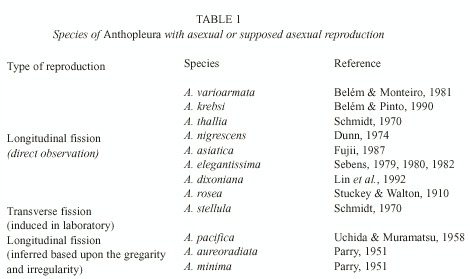
</front><body><![CDATA[ <CENTER><B><FONT FACE="Arial">Asexual reproduction and molecular systematics of the sea anemone <I>Anthopleura krebsi </I>(Actiniaria: Actiniidae)</FONT></B></CENTER> &nbsp;     <BR>&nbsp;     <CENTER><FONT FACE="Arial"><FONT SIZE=-1>Paula Braga Gomes <SUP><A HREF="#A1">1</A></SUP>, Mauricio Oscar Zamponi <SUP><A HREF="#A1">2</A></SUP> and Antonio Mateo Sol&eacute;-Cava&nbsp;<A NAME="R1"></A><SUP><A HREF="#A1">3</A></SUP></FONT></FONT></CENTER> &nbsp;     <BR>&nbsp;     <CENTER><FONT FACE="Arial"><FONT SIZE=-1>Received 26-VI-2001. Corrected 02-V-2002. Accepted 07-III-2003.</FONT></FONT></CENTER> &nbsp;     <BR><B><FONT FACE="Arial"><FONT SIZE=-1>Abstract</FONT></FONT></B>      <P><FONT FACE="Arial"><FONT SIZE=-1>In this paper we use allozyme analyses to demonstrate that individuals in <I>Anthopleura krebsi </I>aggregates are monoclonal. Additionally, sympatric samples of the red and the green colour-morphs of <I>A. krebsi </I>from Pernambuco, Brazil were genetically compared and no significant differences were observed between them (gene identity= 0.992), indicating that they do not belong to different biological species. All individuals within aggregates of the green colour-morph were found to be identical over the five polymorphic loci analysed. Such results would be extremely unlikely (P&lt;10 -11 ) if the individuals analysed had been generated through sexual reproduction, thus confirming the presence of asexual reproduction in this species.</FONT></FONT>      <P><FONT FACE="Arial"><FONT SIZE=-1><B>Key words: </B>Cnidaria, allozymes, clones, fission, molecular systematics.</FONT></FONT>      <P><FONT FACE="Arial"><FONT SIZE=-1>Sea anemones are polyp animals of Actiniaria, an order of skeletonless Anthozoa. Longitudinal fission has traditionally been acknowledged as the most common type of asexual reproduction in sea anemones of the family Actiniidae (<A HREF="#Shick91">Shick 1991</A>). This type of reproduction has important ecological consequences, since it often leads to the production of geographically restricted clones, which can out-compete exclusively sexually reproducing species (<A HREF="#Jackson">Jackson 1985</A>). This type of reproduction is reported to occur in eight out of the 42 species of the widely distributed sea anemone genus <I>Anthopleura </I>Duchassaing &amp; Michelotti, 1860 (<A HREF="#table1">Table 1</A>). Other three species of this genus have been inferred to reproduce asexually based upon their aggregation habit and the irregularity of some characters like number of mesenteries and siphonoglyphs. Based on the existence of aggregations, of regenerating individuals, and on the complete absence of gonads in anemones from some localities, <I>Anthopleura krebsi </I>has been presumed to be able to reproduce asexually (<A HREF="#Carlgreen">Carlgreen and Hedgepeth 1952</A>, <A HREF="#Belem90">Bel&eacute;m and Pinto 1990</A>, <A HREF="#Gomes97">Gomes and Mayal 1997</A>). Although gregarity is indeed very common among sea anemones that reproduce asexually (<A HREF="#Hand55">Hand 1955</A>, <A HREF="#Schmidt">Schmidt 1970</A>, <A HREF="#Shick77">Shick and Lamb 1977</A>), it is not a clear proof of asexual reproduction, since some species, like <I>Bunodosoma caissarum </I>Corr&ecirc;a, 1964 reproduce exclusively sexually but can form very large aggregations (<A HREF="#Belem87">Bel&eacute;m 1987</A>, <A HREF="#Russo">Russo <I>et a</I>l. 1994</A>). Also, the observation of fission or other forms of asexual reproduction in aquaria demonstrates the potential of the species to reproduce asexually, but it doesn’t indicate how common the process may be under natural conditions. The best approach for the confirmation of the presence of asexual reproduction in natural populations is the study of composite genotypes using genetic markers (<A HREF="#Jackson">Jackson 1985</A>, <A HREF="#Avise">Avise 1994</A>).</FONT></FONT>     <BR>&nbsp;     ]]></body>
<body><![CDATA[<CENTER><A NAME="table1"></A><IMG SRC="/img/fbpe/rbt/v51n1/2400t01.JPG" HEIGHT=279 WIDTH=470></CENTER> &nbsp;     
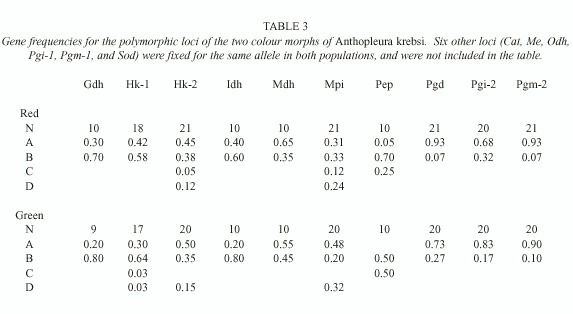
<BR><FONT FACE="Arial"><FONT SIZE=-1>Genetic markers have been used successfully to determine the asexual origin of broods of several species of sea anemones (<A HREF="#Gashout">Gashout and Ormond 1979</A>, <A HREF="#Carter79">Carter and Thorp 1979</A>, <A HREF="#Schaefer">Schaefer 1981</A>, <A HREF="#Monteiro98">Monteiro <I>et a</I>l. 1998</A>), and to confirm the asexual reproduction of <I>Anthopleura legantissima </I>Brandt, 1835 (<A HREF="#Sebens82">Sebens 1982</A>, <A HREF="#McFadden97">McFadden 1997</A>). The rationale behind the usage of molecular markers to study asexual reproduction is that it is extremely unlikely that two sexually produced individuals will be identical over a large number of polymorphic loci. Putative clonemates are, thus, those individuals in the population analysed that have identical multiloci genotypes when the cumulative probability (P) of that identity is very small (usually a conservative threshold value of P &lt;10 -5 is used for each comparison; <A HREF="#Monteiro98">Monteiro <I>et al</I>. 1998</A>).</FONT></FONT>      <P><FONT FACE="Arial"><FONT SIZE=-1>In <I>A. krebsi </I>two colour morphs are very common: the so-called "red" and "green" varieties (<A HREF="#Bigger">Bigger 1980</A>, <A HREF="#Belem90">Bel&eacute;m and Pinto 1990</A>). The two types occur sympatrically on the same position in the intertidal area. <A HREF="#Bigger">Bigger (1980)</A> studied the aggressive behaviour of <I>A. krebsi </I>from Florida with specimens inferred to be clonemates based upon their colour and proximity in aggregates. No aggression was observed between individuals from the same putative clone, neither between individuals supposedly from different clones of the "red" colour-morph. However, anemones from different ‘clones’ of the green <I>A. krebsi </I>presented some aggressive behaviour against each other and invariably attacked anemones of the red morph. The constant antagonism between the anemones of the two colour-morphs, compared to the small aggression between clones of the red morph or some of the clones of the green morph, could be an indication that all anemones of the red morph were members of one single clone, whereas the green anemones belonged to different clones, or that, instead of being between individuals of the same species, the aggression was interspecific like that observed between the clonal and solitary forms of <I>A. elegantissima </I>studied by <A HREF="#Francis">Francis (1979)</A> and <A HREF="#McFaddenet97">McFadden <I>et al. </I>(1997)</A>. In this case, the two colour-morphs should be raised to specific status.</FONT></FONT>      <P><FONT FACE="Arial"><FONT SIZE=-1>The aims of this paper were, thus, to verify whether individuals in <I>A. krebsi </I>aggregates were produced asexually, and to use molecular markers to determine if sympatric samples of the red and the green morphs of <I>A. krebsi </I>belonged to different biological species. The technique chosen was the analysis of allozymes, which has been extremely useful for the study of reproductive biology in sea anemones and for clarifying taxonomic problems (<A HREF="#McCommas">McCommas and Lester 1980</A>, <A HREF="#Bucklin">Bucklin and Hedgecock 1982</A>, <A HREF="#Sole85">Sol&eacute;-Cava <I>et al</I>. 1985</A>, <A HREF="#Shaw87">Shaw <I>et al. </I>1987</A>, <A HREF="#McFaddenet97">McFadden <I>et al</I>. 1997</A>, <A HREF="#Monteiro97">Monteiro <I>et al. </I>1997</A>, <A HREF="#Monteiro98">1998</A>, <A HREF="#Perrin">Perrin <I>et al. </I>1999</A>).</FONT></FONT>      <P><B><FONT FACE="Arial"><FONT SIZE=-1>Materials and methods</FONT></FONT></B>      <P><B><FONT FACE="Arial"><FONT SIZE=-1>a) Collection of samples: </FONT></FONT></B><FONT FACE="Arial"><FONT SIZE=-1>Twenty anemones of the green morph and twenty-one samples of the red morph of <I>Anthopleura krebsi </I>were collected at Carneiros Beach (8&ordm;45’ S, 35&ordm;05’ W), Pernambuco State, Brazil, in January 1999. Care was taken to collect individuals that were at least 2 meters apart (as in <A HREF="#Monteiro97">Monteiro <I>et al</I>. 1997</A>), to avoid the collection of clone-mates. The anemones were usually found in horizontal crevices on the upper area of the intertidal zone on the shore side of a beach rock <I>(sensu </I><A HREF="#Guilcher85">Guilcher 1985</A>). Red <I>A. krebsi </I>were normally found in the upper crevices while individuals of the green morph were found in the lower crevices.</FONT></FONT>      <P><FONT FACE="Arial"><FONT SIZE=-1>Additionally, we collected all the individuals (n=7 and n=14, respectively) of two closely packet groups of the green variety of <I>A. krebsi </I>that were about 2 meters distant from each other. These individuals would normally be inferred to be "clone-mates", based on their proximity and their homogeneity in colour and size.</FONT></FONT>      <P><FONT FACE="Arial"><FONT SIZE=-1>All anemones were transported alive in seawater and maintained in an aquarium until electrophoresis, which occurred no later than one week after collection.</FONT></FONT>      <P><FONT FACE="Arial"><FONT SIZE=-1><B>b) Electrophoresis: </B>Samples were ground with a glass rod in a cold solution (1:1 vol/vol) of 0.1% NADP in 0.02 M Tris-HCl (pH 8.0). After homogenisation, the samples were inserted, on paper wicks, in a 13% hydrolysed starch gel, using three different buffer systems: 0.01 M Tris, 0.01M EDTA, 0.10 M Maleate, pH 7.4 ("TEM", Hillis <I>et al. </I>1996); 0.25 M Tris, 0.06 M Citrate, pH 8.0 ("TC8", Ward and Beardmore 1977) and 0.135 M Tris, 0.043 M Citrate, pH 7.0 ("TC7", Shaw and Prasad 1970). Gels were run at a constant power of 3 Watts, during 6 (TC8), 7 (TC7) or 12 (TEM) hours. Stains for seventeen enzymes were tested, of which thirteen yielded reproducible results (<A HREF="#table2">Table 2</A>). Genotype frequencies were used to estimate gene frequencies, and unbiased heterozygosity (h) and gene identity (I) levels (Nei 1978) using the BIOSYS 1.6 programme (<A HREF="#Swofford">Swofford and Selander 1981</A>).</FONT></FONT>      <P><FONT FACE="Arial"><FONT SIZE=-1>The electrophoretic work was divided into two phases: first, the 20 samples of each colour morph were analysed and compared. Second, the genotypes of the putative clone-mates were determined for the more polymorphic enzymes, to verify whether they indeed belonged to monoclonal colonies. For that, we used the composite probability of complete identity over all polymorphic loci analysed, using the gene frequencies of the green morph estimated in the first part of the work (as in <A HREF="#Monteiro98">Monteiro <I>et al</I>. 1998</A>).</FONT></FONT>     ]]></body>
<body><![CDATA[<BR>&nbsp;     <CENTER><A NAME="table2"></A><IMG SRC="/img/fbpe/rbt/v51n1/2400t02.JPG" HEIGHT=301 WIDTH=453></CENTER> &nbsp;     
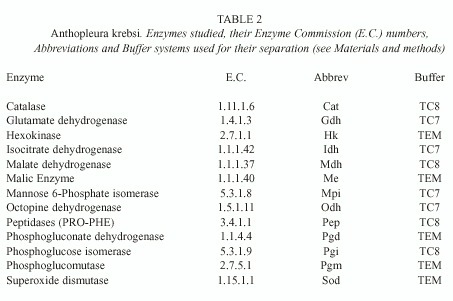
<BR><B><FONT FACE="Arial"><FONT SIZE=-1>Results</FONT></FONT></B>      <P><B><FONT FACE="Arial"><FONT SIZE=-1>Comparison between colour morphs:</FONT></FONT></B>      <P><FONT FACE="Arial"><FONT SIZE=-1>Gene frequencies of the two colour morphs of <I>Anthopleura krebsi </I>studied are given in Table 3. Levels of gene variation were high in the two morphs (h=0.282 and 0.283 for the red and green morphs, respectively), as usually found for sea anemones both from intertidal and sub-tidal</FONT></FONT>      <P><FONT FACE="Arial"><FONT SIZE=-1>areas (<A HREF="#Sole91">Sol&eacute;-Cava and Thorpe 1991</A>). Genotype frequencies did not deviate significantly from Hardy-Weinberg expectations at any of the loci analysed (Fisher’s exact test, P>0.05, after Bonferroni’s transformation, <A HREF="#Lessios">Lessios 1992</A>). A pair-wise comparison of the genotypes of the anemones of each colour morph demonstrated that each anemone collected within each colour morph was genetically unique. On the other hand, no diagnostic loci <I>(sensu </I><A HREF="#Ayala">Ayala 1983</A>) could be found between the two colour morphs, and a high level of gene identity (<A HREF="#Nei">Nei 1978</A>) was observed between them (I=0.992).</FONT></FONT>     <BR><FONT FACE="Arial"><FONT SIZE=-1>&nbsp;</FONT></FONT>     <CENTER><IMG SRC="/img/fbpe/rbt/v51n1/2400t03.JPG" HEIGHT=314 WIDTH=573></CENTER> &nbsp;     
<BR><B><FONT FACE="Arial"><FONT SIZE=-1>Comparison between putative clone-mates:</FONT></FONT></B>      <P><FONT FACE="Arial"><FONT SIZE=-1>The genotypes of the individuals within each of the two putative clones analysed were identical over the five polymorphic loci analysed (Clone 1: <I>Hk-</I>2=AB, <I>Mp</I>i=AD, <I>Pg</I>d=AB, <I>Pgi-</I>2=AA, <I>Pgm-</I>2=AA; Clone 2: <I>Hk-</I>2=AA, <I>Mp</I>i=AB, <I>Pg</I>d=AB, <I>Pgi-</I>2=AA, <I>Pgm-</I>2=AA). The estimated compound probability of observing that complete genotype identity by chance alone, when sampling sexually produced individuals, was extremely small (binomial calculations; P&lt;10 -11 for clone 1 and P&lt;10 -28 for clone 2).</FONT></FONT>     ]]></body>
<body><![CDATA[<BR>&nbsp;     <BR><B><FONT FACE="Arial"><FONT SIZE=-1>Discussion</FONT></FONT></B>      <P><FONT FACE="Arial"><FONT SIZE=-1>The main results of this work were the genetic demonstration of asexual reproduction in <I>Anthopleura krebsi </I>and the high genetic similarity between its green and red colour morphs.</FONT></FONT>      <P><FONT FACE="Arial"><FONT SIZE=-1>The genetic study of the two groups of individuals supposed to be clones, demonstrates that they originated through asexual reproduction. Given the high level of gene variation observed in <I>A. krebsi </I>(h=0.283), if the aggregations were the result of sexual reproduction they should have individuals with different genotypes. The complete genotype identity of the anemones within each clone, thus, clearly shows that they are clone-mates.</FONT></FONT>      <P><FONT FACE="Arial"><FONT SIZE=-1>Populations of sea anemones that have facultative asexual reproduction are usually found, in the intertidal zone, to consist of locally distributed clones (e.g. <A HREF="#Shick79">Shick <I>et al</I>. 1979</A>, <A HREF="#Ayre">Ayre 1983</A>, <A HREF="#Shaw91">Shaw 1991</A>, <A HREF="#McFaddenet97">McFadden <I>et al</I>. 1997</A>). The population of <I>A. krebsi </I>studied here was found in the upper intertidal zone, where stress conditions include long periods of air exposure and high variation in air temperature (<A HREF="#Gomes98">Gomes <I>et al. </I>1998</A>). The two clones studied were genetically distinct, regardless of the relatively short distance (2m) between them. Also, no putative clone-mates – defined in this study as individuals with identical multilocus genotypes – were found among the 41 individuals analysed. Since, during the fieldwork, care was taken to avoid collecting samples closer than 2 meters from each other, it can be said that clones in this species are unlikely to be spread over areas larger than 2 meters, at least in the region studied. Therefore, it appears that <I>A. krebsi </I>may have a clonal structure similar to that of <I>Anthothoe albocinct</I>a, whose populations seem to consist predominantly of spatially restricted clones (<A HREF="#Billingham">Billingham and Ayre 1997</A>) resulting from the local increase of population size through longitudinal fission, supplemented by the production of widely dispersed colonists through sexual reproduction.</FONT></FONT>      <P><FONT FACE="Arial"><FONT SIZE=-1>Sympatric samples of different morphs should, if conspecific, be freely interbreeding. This means that, within sampling errors, they should have the same gene frequencies at each gene locus. They should be different only at the loci coding for the morphological difference used to separate them in the first place, and perhaps some closely linked loci. Usually, conspecific populations of marine invertebrates have gene identity values above 0.90 and rarely as low as 0.85, whilst between congeneric species the usual range is about 0.30 to 0.85 (<A HREF="#Knowlton93">Knowlton 1993, 2000</A>, <A HREF="#Thorpe">Thorpe and Sol&eacute;-Cava 1994</A>, <A HREF="#Sole99">Sol&eacute;-Cava and Boury-Esnault 1999</A>).</FONT></FONT>      <P><FONT FACE="Arial"><FONT SIZE=-1>The sympatric populations of the red and green morphs of <I>A. krebsi </I>showed a high level of gene identity (I=0.992). This result and the absence of diagnostic loci, indicates that there is no restriction to gene flow between the two colour morphs of <I>A. krebs</I> i, i.e. we don’t have any reason to believe, with the data at hand, that they do not belong to the same species.</FONT></FONT>      <P><FONT FACE="Arial"><FONT SIZE=-1>Colour has been considered a unreliable character for sea anemone taxonomy (<A HREF="#Stephenson">Stephenson 1928</A>). However, in many cases it has proven to be a good first evidence of interspecific differences: several colour varieties of sea anemones were found to belong, in fact, to different species (<A HREF="#Carter81">Carter and Thorpe 1981</A>, <A HREF="#Haylor84">Haylor <I>et al. </I>1984</A>, <A HREF="#Sole87">Sol&eacute;-Cava and Thorpe 1987</A>, <A HREF="#Perrin">Perrin <I>et al</I>. 1999</A>).</FONT></FONT>      <P><FONT FACE="Arial"><FONT SIZE=-1>Contrastingly, no genetic differences were observed (<A HREF="#McFaddenet97">McFadden <I>et al</I>. 1997</A>) between colour morphs of <I>A. elegantissima </I>or in <I>A. albocincta </I>(Hutton, 1878) (<A HREF="#Billingham">Billingham and Ayre 1997</A>). Also, colour morphs of <I>Adamsia carcioniopados </I>("pink" and "white" mesenteric filaments), of <I>Anemonia viridis </I>("green" and "red" columns) and of <I>Metridium senile </I>("brown" and "white" columns) from Britain (A.M. Sol&eacute;-Cava, unpublished results) and of <I>Actinia bermudensis </I>("yellow", "green" and "red" columns) from Brazil (C. Russo, unpublished results) did not display any major genetic differences. There appears to be a strong bias in the literature for molecular systematics papers describing the detection of genetic isolation between colour morphs, in detriment of those indicating that they were conspecific. Molecular systematics has, indeed, demonstrated that, many times, the variation treated by taxonomists as phenotypic plasticity or intraspecific polymorphism was in fact due to interspecific differences (reviewed in Knowlton 2000). However, because of the publication bias in the field, this trend has been exaggerated, to a point that some may prematurely conclude that most of the described colour morphs in marine invertebrates do belong to different species. We believe that the best way to obtain a more balanced view of this problem will be through the publication not only of molecular systematics papers demonstrating hidden species, but also of those presenting genetic evidence of conspecificity between colour morphs.</FONT></FONT>      <P><B><FONT FACE="Arial"><FONT SIZE=-1>Acknowledgements</FONT></FONT></B>      ]]></body>
<body><![CDATA[<P><FONT FACE="Arial"><FONT SIZE=-1>This work was supported by grants from CNPq, FAPERJ and CAPES.</FONT></FONT>      <P><B><FONT FACE="Arial"><FONT SIZE=-1>Resumen</FONT></FONT></B>      <P><FONT FACE="Arial"><FONT SIZE=-1>En el presente trabajo se utiliz&oacute; an&aacute;lisis de aloenzimas para demostrar que los individuos en los agregados de la especie <I>Anthopleura krebsi </I>son monoclonales. Adem&aacute;s, muestras simp&aacute;tricas de las variedades roja y verde fueron comparadas gen&eacute;ticamente y ninguna diferencia significativa fue observada entre ellas (Identidad g&eacute;nica= 0.992), indicando que ellas no pertenecen a especies biol&oacute;gicamente distintas. Todos los individuos dentro de un agregado de la variedad roja resultaron ser id&eacute;nticos para los cinco loci polim&oacute;rficos analizados. Tal resultado ser&iacute;a extremadamente improbable (p&lt;10 -11 ) si los individuos analizados hubiesen sido generados a trav&eacute;s de reproducci&oacute;n sexual, confirmando as&iacute; la presencia de reproducci&oacute;n asexual en esta especie.</FONT></FONT>      <P><B><FONT FACE="Arial"><FONT SIZE=-1>References</FONT></FONT></B>      <!-- ref --><P><A NAME="Avise"></A><FONT FACE="Arial"><FONT SIZE=-1>Avise, J.C. 1994. Molecular Markers, Natural History and Evolution. Chapman, London. 511 p.</FONT></FONT>    &nbsp;&nbsp;&nbsp;&nbsp;&nbsp;&nbsp;&nbsp;&nbsp;[&#160;<a href="javascript:void(0);" onclick="javascript: window.open('/scielo.php?script=sci_nlinks&ref=1216605&pid=S0034-7744200300010001100001&lng=','','width=640,height=500,resizable=yes,scrollbars=1,menubar=yes,');">Links</a>&#160;]<!-- end-ref --><!-- ref --><P><A NAME="Ayala"></A><FONT FACE="Arial"><FONT SIZE=-1>Ayala, F.J. 1983. Enzymes as taxonomic characters. pp. 3- 26. <I>In </I>G.S. Oxford &amp; D. Rollinson (eds.). Protein Polymorphism: Adaptive and Taxonomic Significance. Academic, London.</FONT></FONT>    &nbsp;&nbsp;&nbsp;&nbsp;&nbsp;&nbsp;&nbsp;&nbsp;[&#160;<a href="javascript:void(0);" onclick="javascript: window.open('/scielo.php?script=sci_nlinks&ref=1216606&pid=S0034-7744200300010001100002&lng=','','width=640,height=500,resizable=yes,scrollbars=1,menubar=yes,');">Links</a>&#160;]<!-- end-ref --><!-- ref --><P><A NAME="Ayre"></A><FONT FACE="Arial"><FONT SIZE=-1>Ayre, D.J. 1983. The effects of asexual reproduction and intergenotypic aggression on the genotypic structure of populations of the sea anemone <I>Actinia tenebros</I>a. Oecologia 57: 158-165.</FONT></FONT>    &nbsp;&nbsp;&nbsp;&nbsp;&nbsp;&nbsp;&nbsp;&nbsp;[&#160;<a href="javascript:void(0);" onclick="javascript: window.open('/scielo.php?script=sci_nlinks&ref=1216607&pid=S0034-7744200300010001100003&lng=','','width=640,height=500,resizable=yes,scrollbars=1,menubar=yes,');">Links</a>&#160;]<!-- end-ref --><P><A NAME="Belem81"></A><FONT FACE="Arial"><FONT SIZE=-1>Bel&eacute;m, M.J.C. &amp; D.C. Monteiro. 1981. Fauna de Cnid&aacute;rios do Rio de Janeiro. III. <I>Anthopleura var-ioarmata </I>Watzl, 1922 (Actiniaria, Endomyaria), uma nova ocorr&ecirc;ncia de Actiniidae. Semin&aacute;rios de Biologia Marinha - Acad. Bras. Ci. pp. 193-203.</FONT></FONT>      <!-- ref --><P><A NAME="Belem87"></A><FONT FACE="Arial"><FONT SIZE=-1>Bel&eacute;m, M.J.C. 1987. Anatomy and biology of <I>Bunodosoma caissarum </I>Corr&ecirc;a, 1964 (Cnidaria, Anthozoa, Actiniidae) 1. Systematic position and morphological and microanatomical revision. An. Acad. Bras. Cienc. 59: 275-275.</FONT></FONT>    &nbsp;&nbsp;&nbsp;&nbsp;&nbsp;&nbsp;&nbsp;&nbsp;[&#160;<a href="javascript:void(0);" onclick="javascript: window.open('/scielo.php?script=sci_nlinks&ref=1216609&pid=S0034-7744200300010001100004&lng=','','width=640,height=500,resizable=yes,scrollbars=1,menubar=yes,');">Links</a>&#160;]<!-- end-ref --><P><A NAME="Belem90"></A><FONT FACE="Arial"><FONT SIZE=-1>Bel&eacute;m, M.J.C. &amp; S.M. Pinto. 1990. Morphological and microanatomical study of <I>Anthopleura krebsi </I>Duchassaing and Michelotti, 1860 (Cnidaria, Anthozoa, Actiniidae), a new record in Brazil. An. Acad. Bras. Cienc. 62: 183-192.</FONT></FONT>      ]]></body>
<body><![CDATA[<P><A NAME="Bigger"></A><FONT FACE="Arial"><FONT SIZE=-1>Bigger, C.H. 1980. Interspecific and intraspecific acrorhagial aggressive behavior among sea anemones: a recognition of self and not-self. Biol. Bull. 159: 117-134.</FONT></FONT>      <P><A NAME="Billingham"></A><FONT FACE="Arial"><FONT SIZE=-1>Billingham, M.R. &amp; D.J. Ayre. 1997. Asexual reproduction and genetic determination of colour patterns within populations of the subtidal sea anemone <I>Anthothoe albocinct</I>a. Mar. Ecol. Prog. Ser. 156: 121-130.</FONT></FONT>      <!-- ref --><P><A NAME="Bucklin"></A><FONT FACE="Arial"><FONT SIZE=-1>Bucklin, A. &amp; D. Hedgecock. 1982. Biochemical genetic evidence for a third species of <I>Metridium </I>(Coelenterata: Actiniaria). Mar. Biol. 66: 1-7.</FONT></FONT>    &nbsp;&nbsp;&nbsp;&nbsp;&nbsp;&nbsp;&nbsp;&nbsp;[&#160;<a href="javascript:void(0);" onclick="javascript: window.open('/scielo.php?script=sci_nlinks&ref=1216613&pid=S0034-7744200300010001100005&lng=','','width=640,height=500,resizable=yes,scrollbars=1,menubar=yes,');">Links</a>&#160;]<!-- end-ref --><!-- ref --><P><A NAME="Carlgreen"></A><FONT FACE="Arial"><FONT SIZE=-1>Carlgreen, O. &amp; J.W. Hedgepeth. 1952. Actiniaria, Zoantharia and Ceriantharia from shallow water in the North Western Gulf of Mexico. Pub. Inst. Mar. Sci. Univ. Texas 2: 141-172.</FONT></FONT>    &nbsp;&nbsp;&nbsp;&nbsp;&nbsp;&nbsp;&nbsp;&nbsp;[&#160;<a href="javascript:void(0);" onclick="javascript: window.open('/scielo.php?script=sci_nlinks&ref=1216614&pid=S0034-7744200300010001100006&lng=','','width=640,height=500,resizable=yes,scrollbars=1,menubar=yes,');">Links</a>&#160;]<!-- end-ref --><!-- ref --><P><A NAME="Carter79"></A><FONT FACE="Arial"><FONT SIZE=-1>Carter, M.A. &amp; C.H. Thorp. 1979. The reproduction of <I>Actinia equina </I>L. Var. <I>mesembryanthemu</I>m. J. Mar. Biol. Ass. U. K. 59: 989-1001.</FONT></FONT>    &nbsp;&nbsp;&nbsp;&nbsp;&nbsp;&nbsp;&nbsp;&nbsp;[&#160;<a href="javascript:void(0);" onclick="javascript: window.open('/scielo.php?script=sci_nlinks&ref=1216615&pid=S0034-7744200300010001100007&lng=','','width=640,height=500,resizable=yes,scrollbars=1,menubar=yes,');">Links</a>&#160;]<!-- end-ref --><P><A NAME="Carter81"></A><FONT FACE="Arial"><FONT SIZE=-1>Carter, M.A. &amp; J.P. Thorpe. 1981. Reproductive, genetic and ecological evidence that <I>Actinia equina </I>var. <I>mesembrianthemum </I>and va<I>r. fragacea </I>are not conspecific. J. Mar. Biol. Ass. U. K. 61: 79-93.</FONT></FONT>      <!-- ref --><P><A NAME="Dunn"></A><FONT FACE="Arial"><FONT SIZE=-1>Dunn, D.F. 1974. Redescription of <I>Anthopleura nigrescens </I>(Coelenterata, Actiniaria) from Hawaii. Pac. Sci. 28(4): 377-382.</FONT></FONT>    &nbsp;&nbsp;&nbsp;&nbsp;&nbsp;&nbsp;&nbsp;&nbsp;[&#160;<a href="javascript:void(0);" onclick="javascript: window.open('/scielo.php?script=sci_nlinks&ref=1216617&pid=S0034-7744200300010001100008&lng=','','width=640,height=500,resizable=yes,scrollbars=1,menubar=yes,');">Links</a>&#160;]<!-- end-ref --><!-- ref --><P><A NAME="Francis"></A><FONT FACE="Arial"><FONT SIZE=-1>Francis, L. 1979. Contrast between solitary and clonal lifestyles in the sea anemone <I>Anthopleura elegantissim</I>a. Amer. Zool. 19: 669-681.</FONT></FONT>    &nbsp;&nbsp;&nbsp;&nbsp;&nbsp;&nbsp;&nbsp;&nbsp;[&#160;<a href="javascript:void(0);" onclick="javascript: window.open('/scielo.php?script=sci_nlinks&ref=1216618&pid=S0034-7744200300010001100009&lng=','','width=640,height=500,resizable=yes,scrollbars=1,menubar=yes,');">Links</a>&#160;]<!-- end-ref --><!-- ref --><P><A NAME="Fujii"></A><FONT FACE="Arial"><FONT SIZE=-1>Fujii, H. 1987. The predominance of clones in populations of the sea anemone <I>Anthopleura asiatica </I>(Uchida). Biol. Bull. 172: 202-221.</FONT></FONT>    &nbsp;&nbsp;&nbsp;&nbsp;&nbsp;&nbsp;&nbsp;&nbsp;[&#160;<a href="javascript:void(0);" onclick="javascript: window.open('/scielo.php?script=sci_nlinks&ref=1216619&pid=S0034-7744200300010001100010&lng=','','width=640,height=500,resizable=yes,scrollbars=1,menubar=yes,');">Links</a>&#160;]<!-- end-ref --><!-- ref --><P><A NAME="Gashout"></A><FONT FACE="Arial"><FONT SIZE=-1>Gashout, S.E. &amp; R.F.G. Ormond. 1979. Evidence for parthenogenetic reproduction in the sea anemone <I>Actinia equina </I>L. J. Mar. Biol. Ass. U.K. 59: 975-987.</FONT></FONT>    &nbsp;&nbsp;&nbsp;&nbsp;&nbsp;&nbsp;&nbsp;&nbsp;[&#160;<a href="javascript:void(0);" onclick="javascript: window.open('/scielo.php?script=sci_nlinks&ref=1216620&pid=S0034-7744200300010001100011&lng=','','width=640,height=500,resizable=yes,scrollbars=1,menubar=yes,');">Links</a>&#160;]<!-- end-ref --><P><A NAME="Gomes97"></A><FONT FACE="Arial"><FONT SIZE=-1>Gomes, P.B. &amp; E.M. Mayal. 1997. Levantamento preliminar das an&ecirc;monas-do-mar (cnidaria, actiniaria) da costa de Pernambuco, Brasil. Bioci&ecirc;ncias 5: 45-52.</FONT></FONT>      <!-- ref --><P><A NAME="Gomes98"></A><FONT FACE="Arial"><FONT SIZE=-1>Gomes, P.B., M.J.C. Bel&eacute;m &amp; E. Schlenz. 1998. Distribution, abundance and adaptations of three species of Actiniidae (Cnidaria, Actiniaria) on an intertidal beach rock in Carneiros Beach, Pernambuco, Brazil. Misc. Zool. 21(2): 65-72.</FONT></FONT>    &nbsp;&nbsp;&nbsp;&nbsp;&nbsp;&nbsp;&nbsp;&nbsp;[&#160;<a href="javascript:void(0);" onclick="javascript: window.open('/scielo.php?script=sci_nlinks&ref=1216622&pid=S0034-7744200300010001100012&lng=','','width=640,height=500,resizable=yes,scrollbars=1,menubar=yes,');">Links</a>&#160;]<!-- end-ref --><!-- ref --><P><A NAME="Guilcher85"></A><FONT FACE="Arial"><FONT SIZE=-1>Guilcher, A. 1985. Coral Reef Geomorphology. I-XIII. Wiley, New York. 228 p.</FONT></FONT>    &nbsp;&nbsp;&nbsp;&nbsp;&nbsp;&nbsp;&nbsp;&nbsp;[&#160;<a href="javascript:void(0);" onclick="javascript: window.open('/scielo.php?script=sci_nlinks&ref=1216623&pid=S0034-7744200300010001100013&lng=','','width=640,height=500,resizable=yes,scrollbars=1,menubar=yes,');">Links</a>&#160;]<!-- end-ref --><!-- ref --><P><A NAME="Hand55"></A><FONT FACE="Arial"><FONT SIZE=-1>Hand, C. 1955. The sea anemones of Central California. pt. 2. The Endomyarian and Mesomyarian anemones. Was. J. Biol. 13: 37-99.</FONT></FONT>    &nbsp;&nbsp;&nbsp;&nbsp;&nbsp;&nbsp;&nbsp;&nbsp;[&#160;<a href="javascript:void(0);" onclick="javascript: window.open('/scielo.php?script=sci_nlinks&ref=1216624&pid=S0034-7744200300010001100014&lng=','','width=640,height=500,resizable=yes,scrollbars=1,menubar=yes,');">Links</a>&#160;]<!-- end-ref --><!-- ref --><P><A NAME="Haylor84"></A><FONT FACE="Arial"><FONT SIZE=-1>Haylor, G.S., J.P. Thorpe &amp; M.A. Carter. 1984. Genetic and ecological differentiation between sympatric colour morphs of the common intertidal sea anemone <I>Actinia equin</I>a. Mar. Ecol. Prog. Ser. 16: 281-289.</FONT></FONT>    &nbsp;&nbsp;&nbsp;&nbsp;&nbsp;&nbsp;&nbsp;&nbsp;[&#160;<a href="javascript:void(0);" onclick="javascript: window.open('/scielo.php?script=sci_nlinks&ref=1216625&pid=S0034-7744200300010001100015&lng=','','width=640,height=500,resizable=yes,scrollbars=1,menubar=yes,');">Links</a>&#160;]<!-- end-ref --><!-- ref --><P><A NAME="Hillis"></A><FONT FACE="Arial"><FONT SIZE=-1>Hillis, D.M., S. Moritz &amp; B.K. Mable. 1996. Molecular Systematics. Sinauer, Massachusetts. 588 p.</FONT></FONT>    &nbsp;&nbsp;&nbsp;&nbsp;&nbsp;&nbsp;&nbsp;&nbsp;[&#160;<a href="javascript:void(0);" onclick="javascript: window.open('/scielo.php?script=sci_nlinks&ref=1216626&pid=S0034-7744200300010001100016&lng=','','width=640,height=500,resizable=yes,scrollbars=1,menubar=yes,');">Links</a>&#160;]<!-- end-ref --><P><A NAME="Jackson"></A><FONT FACE="Arial"><FONT SIZE=-1>Jackson, J.B.C. 1985. Distribution and ecology of clonal and aclonal benthic invertebrates, pp. 297-353. <I>In </I>J.B.C. Jackson, L.W. Buss &amp; R.E. Cook (eds.). Population biology and evolution of clonal organisms. Yale University, London.</FONT></FONT>      <P><A NAME="Knowlton93"></A><FONT FACE="Arial"><FONT SIZE=-1>Knowlton, N. 1993. Sibling species in the sea. Annu. Rev. Ecol. Syst. 24: 189-216.</FONT></FONT>      <P><A NAME="Knowlton00"></A><FONT FACE="Arial"><FONT SIZE=-1>Knowlton, N. 2000. Molecular genetic analyses of species boundaries in the sea, pp. 73-90. <I>In </I>A.M. Sol&eacute;-Cava, C.A.M. Russo &amp; J.P. Thorpe (eds.). Marine Genetics. Kluwer, Dordretch, The Netherlands.</FONT></FONT>      <!-- ref --><P><A NAME="Lessios"></A><FONT FACE="Arial"><FONT SIZE=-1>Lessios, H.A. 1992. Testing electrophoretic data for agreement with Hardy-Weinberg expectations. Mar. Biol. 112: 517-523.</FONT></FONT>    &nbsp;&nbsp;&nbsp;&nbsp;&nbsp;&nbsp;&nbsp;&nbsp;[&#160;<a href="javascript:void(0);" onclick="javascript: window.open('/scielo.php?script=sci_nlinks&ref=1216630&pid=S0034-7744200300010001100017&lng=','','width=640,height=500,resizable=yes,scrollbars=1,menubar=yes,');">Links</a>&#160;]<!-- end-ref --><!-- ref --><P><A NAME="Lin"></A><FONT FACE="Arial"><FONT SIZE=-1>Lin, J., C.P. Chen &amp; I.M. Chen. 1992. Sexual and asexual reproduction of <I>Anthopleura dixoniana </I>(Anthozoa: Actiniaria): periodicity and regulation. Mar. Biol. 112: 91-98.</FONT></FONT>    &nbsp;&nbsp;&nbsp;&nbsp;&nbsp;&nbsp;&nbsp;&nbsp;[&#160;<a href="javascript:void(0);" onclick="javascript: window.open('/scielo.php?script=sci_nlinks&ref=1216631&pid=S0034-7744200300010001100018&lng=','','width=640,height=500,resizable=yes,scrollbars=1,menubar=yes,');">Links</a>&#160;]<!-- end-ref --><!-- ref --><P><A NAME="McCommas"></A><FONT FACE="Arial"><FONT SIZE=-1>McCommas, S.A. &amp; L.J. Lester. 1980. Electrophoretic evaluation of the taxonomic status of two species of sea anemone. Biochem. Syst. Ecol. 8: 289-292.</FONT></FONT>    &nbsp;&nbsp;&nbsp;&nbsp;&nbsp;&nbsp;&nbsp;&nbsp;[&#160;<a href="javascript:void(0);" onclick="javascript: window.open('/scielo.php?script=sci_nlinks&ref=1216632&pid=S0034-7744200300010001100019&lng=','','width=640,height=500,resizable=yes,scrollbars=1,menubar=yes,');">Links</a>&#160;]<!-- end-ref --><!-- ref --><P><A NAME="McFadden97"></A><FONT FACE="Arial"><FONT SIZE=-1>McFadden, C.S. 1997. Contributions of sexual and asexual reproduction to population structure in the clonal soft coral, <I>Alcyonium rudyi. </I>Evolution 51: 112-126.</FONT></FONT>    &nbsp;&nbsp;&nbsp;&nbsp;&nbsp;&nbsp;&nbsp;&nbsp;[&#160;<a href="javascript:void(0);" onclick="javascript: window.open('/scielo.php?script=sci_nlinks&ref=1216633&pid=S0034-7744200300010001100020&lng=','','width=640,height=500,resizable=yes,scrollbars=1,menubar=yes,');">Links</a>&#160;]<!-- end-ref --><P><A NAME="McFaddenet97"></A><FONT FACE="Arial"><FONT SIZE=-1>McFadden, C.S., R.K. Grosberg, B.B. Cameron, D.P. Karlton &amp; D. Secord. 1997. Genetic relationships within and between clonal and solitary forms of the sea anemone <I>Anthopleura elegantissima </I>revisited: Evidence for the existence of two species. Mar. Biol. 128: 127-139.</FONT></FONT>      <P><A NAME="Monteiro97"></A><FONT FACE="Arial"><FONT SIZE=-1>Monteiro, F.A., A.M. Sol&eacute;-Cava &amp; J.P. Thorpe. 1997. Extensive genetic divergence between populations of the common intertidal sea anemone <I>Actinia equina </I>from Britain, the Mediterranean and the Cape Verde Islands. Mar. Biol. 129: 425-433.</FONT></FONT>      <!-- ref --><P><A NAME="Monteiro98"></A><FONT FACE="Arial"><FONT SIZE=-1>Monteiro, F.A., C.A.M. Russo &amp; A.M. Sol&eacute;-Cava. 1998. Genetic evidence for the asexual origin of small individuals found in the coelenteron of the sea anemone <I>Actinia bermudensis </I>McMurrich. Bull. Mar. Sci. 63:257-264.</FONT></FONT>    &nbsp;&nbsp;&nbsp;&nbsp;&nbsp;&nbsp;&nbsp;&nbsp;[&#160;<a href="javascript:void(0);" onclick="javascript: window.open('/scielo.php?script=sci_nlinks&ref=1216636&pid=S0034-7744200300010001100021&lng=','','width=640,height=500,resizable=yes,scrollbars=1,menubar=yes,');">Links</a>&#160;]<!-- end-ref --><!-- ref --><P><A NAME="Nei"></A><FONT FACE="Arial"><FONT SIZE=-1>Nei, M. 1978. Estimation of average heterozygosity and genetic distance from a small number of individuals. Genetics 89: 583-590.</FONT></FONT>    &nbsp;&nbsp;&nbsp;&nbsp;&nbsp;&nbsp;&nbsp;&nbsp;[&#160;<a href="javascript:void(0);" onclick="javascript: window.open('/scielo.php?script=sci_nlinks&ref=1216637&pid=S0034-7744200300010001100022&lng=','','width=640,height=500,resizable=yes,scrollbars=1,menubar=yes,');">Links</a>&#160;]<!-- end-ref --><!-- ref --><P><A NAME="Parry"></A><FONT FACE="Arial"><FONT SIZE=-1>Parry, G. 1951. The Actiniaria od New Zealand, part <B>I. </B>Records of the Canterbury Museum 6: 83-119.</FONT></FONT>    &nbsp;&nbsp;&nbsp;&nbsp;&nbsp;&nbsp;&nbsp;&nbsp;[&#160;<a href="javascript:void(0);" onclick="javascript: window.open('/scielo.php?script=sci_nlinks&ref=1216638&pid=S0034-7744200300010001100023&lng=','','width=640,height=500,resizable=yes,scrollbars=1,menubar=yes,');">Links</a>&#160;]<!-- end-ref --><!-- ref --><P><A NAME="Perrin"></A><FONT FACE="Arial"><FONT SIZE=-1>Perrin, M.C., J.P. Thorpe &amp; A.M. Sol&eacute;-Cava. 1999. <I>Actinia equin</I>a: a genetic role model and reproductive enigma. Oceanogr. Mar. Biol. Annu. Rev. 37: 129-152.</FONT></FONT>    &nbsp;&nbsp;&nbsp;&nbsp;&nbsp;&nbsp;&nbsp;&nbsp;[&#160;<a href="javascript:void(0);" onclick="javascript: window.open('/scielo.php?script=sci_nlinks&ref=1216639&pid=S0034-7744200300010001100024&lng=','','width=640,height=500,resizable=yes,scrollbars=1,menubar=yes,');">Links</a>&#160;]<!-- end-ref --><!-- ref --><P><A NAME="Russo"></A><FONT FACE="Arial"><FONT SIZE=-1>Russo, C.A.M., A.M. Sol&eacute;-Cava &amp; J.P. Thorpe. 1994. Population structure and genetic variation in two tropical sea anemones (Cnidaria, Actinidae) with different reproductive strategies. Mar. Biol. 119: 267-276.</FONT></FONT>    &nbsp;&nbsp;&nbsp;&nbsp;&nbsp;&nbsp;&nbsp;&nbsp;[&#160;<a href="javascript:void(0);" onclick="javascript: window.open('/scielo.php?script=sci_nlinks&ref=1216640&pid=S0034-7744200300010001100025&lng=','','width=640,height=500,resizable=yes,scrollbars=1,menubar=yes,');">Links</a>&#160;]<!-- end-ref --><!-- ref --><P><A NAME="Schaefer"></A><FONT FACE="Arial"><FONT SIZE=-1>Schaefer, W. 1981. Reproduction and sexuality of <I>Cereus pedunculatus </I>and <I>Actinia equina </I>(Anthozoa, Actiniaria). Helgol. Meer. 34: 451-461.</FONT></FONT>    &nbsp;&nbsp;&nbsp;&nbsp;&nbsp;&nbsp;&nbsp;&nbsp;[&#160;<a href="javascript:void(0);" onclick="javascript: window.open('/scielo.php?script=sci_nlinks&ref=1216641&pid=S0034-7744200300010001100026&lng=','','width=640,height=500,resizable=yes,scrollbars=1,menubar=yes,');">Links</a>&#160;]<!-- end-ref --><P><A NAME="Schmidt"></A><FONT FACE="Arial"><FONT SIZE=-1>Schmidt, H. 1970. <I>Anthopleura stellula </I>(Actiniaria: Actiniidae) and its reproduction by transverse fission. Mar. Biol. 5: 245-255.</FONT></FONT>      <!-- ref --><P><A NAME="Sebens79"></A><FONT FACE="Arial"><FONT SIZE=-1>Sebens, K. P. 1979. The energetics of asexual reproduction and colony formation in benthic marine invertebrates. Amer. Zool. 683-697.</FONT></FONT>    &nbsp;&nbsp;&nbsp;&nbsp;&nbsp;&nbsp;&nbsp;&nbsp;[&#160;<a href="javascript:void(0);" onclick="javascript: window.open('/scielo.php?script=sci_nlinks&ref=1216643&pid=S0034-7744200300010001100027&lng=','','width=640,height=500,resizable=yes,scrollbars=1,menubar=yes,');">Links</a>&#160;]<!-- end-ref --><!-- ref --><P><A NAME="Sebens80"></A><FONT FACE="Arial"><FONT SIZE=-1>Sebens, K.P. 1980. The regulation of asexual reproduction and indeterminate body size n the sea anemone <I>Anthopleura elegantissima </I>(Brandt). Biol. Bull. Mar. Biol. Lab. 158: 370-382.</FONT></FONT>    &nbsp;&nbsp;&nbsp;&nbsp;&nbsp;&nbsp;&nbsp;&nbsp;[&#160;<a href="javascript:void(0);" onclick="javascript: window.open('/scielo.php?script=sci_nlinks&ref=1216644&pid=S0034-7744200300010001100028&lng=','','width=640,height=500,resizable=yes,scrollbars=1,menubar=yes,');">Links</a>&#160;]<!-- end-ref --><!-- ref --><P><A NAME="Sebens82"></A><FONT FACE="Arial"><FONT SIZE=-1>Sebens, K.P. 1982. Asexual reproduction in <I>Anthopleura elegantissima </I>(Anthozoa: Actiniaria): seasonality and spatial extent of clones. Ecology 63: 434-444.</FONT></FONT>    &nbsp;&nbsp;&nbsp;&nbsp;&nbsp;&nbsp;&nbsp;&nbsp;[&#160;<a href="javascript:void(0);" onclick="javascript: window.open('/scielo.php?script=sci_nlinks&ref=1216645&pid=S0034-7744200300010001100029&lng=','','width=640,height=500,resizable=yes,scrollbars=1,menubar=yes,');">Links</a>&#160;]<!-- end-ref --><!-- ref --><P><A NAME="Shaw91"></A><FONT FACE="Arial"><FONT SIZE=-1>Shaw, P.W. 1991. Effects of asexual reproduction on population structure of <I>Sargatia elegans </I>(Anthozoa: Actiniaria). Hydrobiologia 216/217: 519-525.</FONT></FONT>    &nbsp;&nbsp;&nbsp;&nbsp;&nbsp;&nbsp;&nbsp;&nbsp;[&#160;<a href="javascript:void(0);" onclick="javascript: window.open('/scielo.php?script=sci_nlinks&ref=1216646&pid=S0034-7744200300010001100030&lng=','','width=640,height=500,resizable=yes,scrollbars=1,menubar=yes,');">Links</a>&#160;]<!-- end-ref --><!-- ref --><P><A NAME="Shaw70"></A><FONT FACE="Arial"><FONT SIZE=-1>Shaw, C.R. &amp; R. Prasad. 1970. Starch gel electrophoresis of enzymes- A compilation of recipes. Biochem. Genet. 4: 297-320.</FONT></FONT>    &nbsp;&nbsp;&nbsp;&nbsp;&nbsp;&nbsp;&nbsp;&nbsp;[&#160;<a href="javascript:void(0);" onclick="javascript: window.open('/scielo.php?script=sci_nlinks&ref=1216647&pid=S0034-7744200300010001100031&lng=','','width=640,height=500,resizable=yes,scrollbars=1,menubar=yes,');">Links</a>&#160;]<!-- end-ref --><!-- ref --><P><A NAME="Shaw87"></A><FONT FACE="Arial"><FONT SIZE=-1>Shaw, P.W., J.A. Beardmore &amp; J.S. Ryland. 1987. <I>Sagartia troglodytes </I>(Anthozoa: Actiniaria) consists of two species. Mar. Ecol. Prog. Ser. 41: 21-28.</FONT></FONT>    &nbsp;&nbsp;&nbsp;&nbsp;&nbsp;&nbsp;&nbsp;&nbsp;[&#160;<a href="javascript:void(0);" onclick="javascript: window.open('/scielo.php?script=sci_nlinks&ref=1216648&pid=S0034-7744200300010001100032&lng=','','width=640,height=500,resizable=yes,scrollbars=1,menubar=yes,');">Links</a>&#160;]<!-- end-ref --><!-- ref --><P><A NAME="Shick91"></A><FONT FACE="Arial"><FONT SIZE=-1>Shick, J.M. 1991. A functional biology of sea anemones. Chapman, London. 395 p.</FONT></FONT>    &nbsp;&nbsp;&nbsp;&nbsp;&nbsp;&nbsp;&nbsp;&nbsp;[&#160;<a href="javascript:void(0);" onclick="javascript: window.open('/scielo.php?script=sci_nlinks&ref=1216649&pid=S0034-7744200300010001100033&lng=','','width=640,height=500,resizable=yes,scrollbars=1,menubar=yes,');">Links</a>&#160;]<!-- end-ref --><!-- ref --><P><A NAME="Shick79"></A><FONT FACE="Arial"><FONT SIZE=-1>Shick, J.M., R.J. Hoffman &amp; A.N. Lamb. 1979. Asexual reproduction, population structure, and genotype-environment interactions in sea anemones. Amer. Zool. 19: 699-713.</FONT></FONT>    &nbsp;&nbsp;&nbsp;&nbsp;&nbsp;&nbsp;&nbsp;&nbsp;[&#160;<a href="javascript:void(0);" onclick="javascript: window.open('/scielo.php?script=sci_nlinks&ref=1216650&pid=S0034-7744200300010001100034&lng=','','width=640,height=500,resizable=yes,scrollbars=1,menubar=yes,');">Links</a>&#160;]<!-- end-ref --><P><A NAME="Shick77"></A><FONT FACE="Arial"><FONT SIZE=-1>Shick, J.M. &amp; A.N. Lamb. 1977. Asexual reproduction and genetic population structure in the colonizing sea anemone <I>Haliplanella lucia</I>e. Biol. Bull. 153: 604-617.</FONT></FONT>      <P><A NAME="Sole99"></A><FONT FACE="Arial"><FONT SIZE=-1>Sol&eacute;-Cava, A.M. &amp; N. Boury-Esnault. 1999. Levels of inter and intraspecific differentiation in marine sponges. Mem. Queensland Mus. 44: 591-602.</FONT></FONT>      <P><A NAME="Sole87"></A><FONT FACE="Arial"><FONT SIZE=-1>Sol&eacute;-Cava, A.M. &amp; J.P. Thorpe. 1987. Further genetic evidence for the reproductive isolation of green sea anemone <I>Actinia prasina </I>Gosse from common intertidal beadlet anemone <I>Actinia equina </I>(L.). Mar. Ecol. Prog. Ser. 38: 225-229.</FONT></FONT>      <!-- ref --><P><A NAME="Sole91"></A><FONT FACE="Arial"><FONT SIZE=-1>Sol&eacute;-Cava, A.M. &amp; J.P. Thorpe. 1991. High levels of genetic variation in natural populations of marine lower invertebrates. Biol. J. Linn. Soc. 44: 65-80.</FONT></FONT>    &nbsp;&nbsp;&nbsp;&nbsp;&nbsp;&nbsp;&nbsp;&nbsp;[&#160;<a href="javascript:void(0);" onclick="javascript: window.open('/scielo.php?script=sci_nlinks&ref=1216654&pid=S0034-7744200300010001100035&lng=','','width=640,height=500,resizable=yes,scrollbars=1,menubar=yes,');">Links</a>&#160;]<!-- end-ref --><P><A NAME="Sole85"></A><FONT FACE="Arial"><FONT SIZE=-1>Sol&eacute;-Cava, A.M., J.P. Thorpe &amp; J.G. Kaye. 1985. Reproductive isolation with little genetic divergence between <I>Urticina </I>(= <I>Teali</I>a) <I>felina </I>and <I>U. eques </I>(Anthozoa: Actiniaria). Mar. Biol. 85: 279-284.</FONT></FONT>      <!-- ref --><P><A NAME="Stephenson"></A><FONT FACE="Arial"><FONT SIZE=-1>Stephenson, T.A. 1928. The British Sea anemone. Ray Soc. 113: 1-148.</FONT></FONT>    &nbsp;&nbsp;&nbsp;&nbsp;&nbsp;&nbsp;&nbsp;&nbsp;[&#160;<a href="javascript:void(0);" onclick="javascript: window.open('/scielo.php?script=sci_nlinks&ref=1216656&pid=S0034-7744200300010001100036&lng=','','width=640,height=500,resizable=yes,scrollbars=1,menubar=yes,');">Links</a>&#160;]<!-- end-ref --><!-- ref --><P><A NAME="Stuckey"></A><FONT FACE="Arial"><FONT SIZE=-1>Stuckey, F.G.A. &amp; C.L. Walton. 1910. Notes on a collection of sea-anemones. Transactons of the New Zealand Institute 42: 541-543.</FONT></FONT>    &nbsp;&nbsp;&nbsp;&nbsp;&nbsp;&nbsp;&nbsp;&nbsp;[&#160;<a href="javascript:void(0);" onclick="javascript: window.open('/scielo.php?script=sci_nlinks&ref=1216657&pid=S0034-7744200300010001100037&lng=','','width=640,height=500,resizable=yes,scrollbars=1,menubar=yes,');">Links</a>&#160;]<!-- end-ref --><P><A NAME="Swofford"></A><FONT FACE="Arial"><FONT SIZE=-1>Swofford, D.L. &amp; R.B. Selander. 1981. BIOSYS-1, a FORTRAN programme for the comprehensive analysis of electrophoretic data in population genetics and systematics. J. Hered. 72: 281-283.</FONT></FONT>      <!-- ref --><P><A NAME="Uchida"></A><FONT FACE="Arial"><FONT SIZE=-1>Uchida, T. &amp; S. Muramatsu. 1958. Notes on some japanese sea-anemones. J. Fac. Sci. Hokkaido Univ. Ser. VI Zool. 14: 111-119.</FONT></FONT>    &nbsp;&nbsp;&nbsp;&nbsp;&nbsp;&nbsp;&nbsp;&nbsp;[&#160;<a href="javascript:void(0);" onclick="javascript: window.open('/scielo.php?script=sci_nlinks&ref=1216659&pid=S0034-7744200300010001100038&lng=','','width=640,height=500,resizable=yes,scrollbars=1,menubar=yes,');">Links</a>&#160;]<!-- end-ref --><!-- ref --><P><A NAME="Thorpe"></A><FONT FACE="Arial"><FONT SIZE=-1>Thorpe, J.P. &amp; A.M. Sol&eacute;-Cava. 1994. The use of allozyme electrophoresis in invertebrate systematics. Zool. Scripta 23: 3-18.</FONT></FONT>    &nbsp;&nbsp;&nbsp;&nbsp;&nbsp;&nbsp;&nbsp;&nbsp;[&#160;<a href="javascript:void(0);" onclick="javascript: window.open('/scielo.php?script=sci_nlinks&ref=1216660&pid=S0034-7744200300010001100039&lng=','','width=640,height=500,resizable=yes,scrollbars=1,menubar=yes,');">Links</a>&#160;]<!-- end-ref --><!-- ref --><P><A NAME="Ward"></A><FONT FACE="Arial"><FONT SIZE=-1>Ward, R.D. &amp; J.A. Beardmore. 1977. Protein variation in the plaice <I>(Pleuronectes platess</I>a). Genet. Res. 30: 45-62.</FONT></FONT>    &nbsp;&nbsp;&nbsp;&nbsp;&nbsp;&nbsp;&nbsp;&nbsp;[&#160;<a href="javascript:void(0);" onclick="javascript: window.open('/scielo.php?script=sci_nlinks&ref=1216661&pid=S0034-7744200300010001100040&lng=','','width=640,height=500,resizable=yes,scrollbars=1,menubar=yes,');">Links</a>&#160;]<!-- end-ref --><BR><FONT FACE="Arial"><FONT SIZE=-1>&nbsp;</FONT></FONT>     <BR>&nbsp;     <BR><A NAME="A1"></A><FONT SIZE=-1><FONT FACE="Arial"><A HREF="#R1">1</A>. LAMAMEBEN, Departamento de Zoologia-CCB, Universidade Federal de Pernambuco, Av. Prof. Moraes Rego 1235, Cidade Universit&aacute;ria, Recife-Pe, 50670-901, Brazil</FONT><FONT FACE="Arial,Helvetica">. <A HREF="mailto:bragagomes@hotmail.com">bragagomes@hotmail.com</A></FONT></FONT>      <P><FONT FACE="Arial"><FONT SIZE=-1><A HREF="#R1">2</A>. Laboratorio de Biolog&iacute;a de Cnidarios, Depto. Cs. Marinas, FCEyN, Funes, 3250 (7600), Mar del Plata - Argentina. CONICET Research.</FONT></FONT>      <P><FONT FACE="Arial"><FONT SIZE=-1><A HREF="#R1">3</A>. Molecular Biodiversity Lab. Departamento de Gen&eacute;tica, Instituto de Biologia, Bloco A, CCS, Universidade Federal do Rio de Janeiro, Ilha do Fund&atilde;o, CEP 21941-590, Rio de Janeiro, RJ, Brazil and Port Erin Marine Laboratory, University of Liverpool, Isle of Man, IM9 6JA, UK.</FONT></FONT>      ]]></body><back>
<ref-list>
<ref id="B1">
<nlm-citation citation-type="book">
<person-group person-group-type="author">
<name>
<surname><![CDATA[Avise]]></surname>
<given-names><![CDATA[J.C]]></given-names>
</name>
</person-group>
<source><![CDATA[Molecular Markers, Natural History and Evolution]]></source>
<year>1994</year>
<page-range>511</page-range><publisher-loc><![CDATA[London ]]></publisher-loc>
<publisher-name><![CDATA[Chapman]]></publisher-name>
</nlm-citation>
</ref>
<ref id="B2">
<nlm-citation citation-type="book">
<person-group person-group-type="author">
<name>
<surname><![CDATA[Ayala]]></surname>
<given-names><![CDATA[F.J]]></given-names>
</name>
</person-group>
<article-title xml:lang="en"><![CDATA[Enzymes as taxonomic characters]]></article-title>
<person-group person-group-type="editor">
<name>
<surname><![CDATA[Oxford]]></surname>
<given-names><![CDATA[G.S]]></given-names>
</name>
<name>
<surname><![CDATA[Rollinson]]></surname>
<given-names><![CDATA[D]]></given-names>
</name>
</person-group>
<source><![CDATA[Protein Polymorphism: Adaptive and Taxonomic Significance]]></source>
<year>1983</year>
<page-range>3- 26</page-range><publisher-loc><![CDATA[London ]]></publisher-loc>
<publisher-name><![CDATA[Academic]]></publisher-name>
</nlm-citation>
</ref>
<ref id="B3">
<nlm-citation citation-type="journal">
<person-group person-group-type="author">
<name>
<surname><![CDATA[Ayre]]></surname>
<given-names><![CDATA[D.J]]></given-names>
</name>
</person-group>
<article-title xml:lang="en"><![CDATA[The effects of asexual reproduction and intergenotypic aggression on the genotypic structure of populations of the sea anemone Actinia tenebrosa]]></article-title>
<source><![CDATA[Oecologia]]></source>
<year>1983</year>
<volume>57</volume>
<page-range>158-165</page-range></nlm-citation>
</ref>
<ref id="B4">
<nlm-citation citation-type="journal">
<person-group person-group-type="author">
<name>
<surname><![CDATA[Belém]]></surname>
<given-names><![CDATA[M.J.C]]></given-names>
</name>
</person-group>
<article-title xml:lang="en"><![CDATA[Anatomy and biology of Bunodosoma caissarum Corrêa, 1964 (Cnidaria, Anthozoa, Actiniidae) 1. Systematic position and morphological and microanatomical revision]]></article-title>
<source><![CDATA[An. Acad. Bras. Cienc]]></source>
<year>1987</year>
<volume>59</volume>
<page-range>275-275</page-range></nlm-citation>
</ref>
<ref id="B5">
<nlm-citation citation-type="journal">
<person-group person-group-type="author">
<name>
<surname><![CDATA[Bucklin]]></surname>
<given-names><![CDATA[A]]></given-names>
</name>
<name>
<surname><![CDATA[Hedgecock]]></surname>
<given-names><![CDATA[D]]></given-names>
</name>
</person-group>
<article-title xml:lang="en"><![CDATA[Biochemical genetic evidence for a third species of Metridium (Coelenterata: Actiniaria)]]></article-title>
<source><![CDATA[Mar. Biol]]></source>
<year>1982</year>
<volume>66</volume>
<page-range>1-7</page-range></nlm-citation>
</ref>
<ref id="B6">
<nlm-citation citation-type="journal">
<person-group person-group-type="author">
<name>
<surname><![CDATA[Carlgreen]]></surname>
<given-names><![CDATA[O]]></given-names>
</name>
<name>
<surname><![CDATA[Hedgepeth]]></surname>
<given-names><![CDATA[J.W]]></given-names>
</name>
</person-group>
<article-title xml:lang="en"><![CDATA[Actiniaria, Zoantharia and Ceriantharia from shallow water in the North Western Gulf of Mexico]]></article-title>
<source><![CDATA[Pub. Inst. Mar. Sci. Univ. Texas]]></source>
<year>1952</year>
<volume>2</volume>
<page-range>141-172</page-range></nlm-citation>
</ref>
<ref id="B7">
<nlm-citation citation-type="journal">
<person-group person-group-type="author">
<name>
<surname><![CDATA[Carter]]></surname>
<given-names><![CDATA[M.A]]></given-names>
</name>
<name>
<surname><![CDATA[Thorp]]></surname>
<given-names><![CDATA[C.H]]></given-names>
</name>
</person-group>
<article-title xml:lang="en"><![CDATA[The reproduction of Actinia equina L. Var. mesembryanthemum]]></article-title>
<source><![CDATA[J. Mar. Biol. Ass. U. K]]></source>
<year>1979</year>
<volume>59</volume>
<page-range>989-1001</page-range></nlm-citation>
</ref>
<ref id="B8">
<nlm-citation citation-type="journal">
<person-group person-group-type="author">
<name>
<surname><![CDATA[Dunn]]></surname>
<given-names><![CDATA[D.F]]></given-names>
</name>
</person-group>
<article-title xml:lang="en"><![CDATA[Redescription of Anthopleura nigrescens (Coelenterata, Actiniaria) from Hawaii]]></article-title>
<source><![CDATA[Pac. Sci]]></source>
<year>1974</year>
<volume>28</volume>
<numero>^s4</numero>
<issue>^s4</issue>
<supplement>4</supplement>
<page-range>377-382</page-range></nlm-citation>
</ref>
<ref id="B9">
<nlm-citation citation-type="journal">
<person-group person-group-type="author">
<name>
<surname><![CDATA[Francis]]></surname>
<given-names><![CDATA[L]]></given-names>
</name>
</person-group>
<article-title xml:lang="en"><![CDATA[Contrast between solitary and clonal lifestyles in the sea anemone Anthopleura elegantissima]]></article-title>
<source><![CDATA[Amer. Zool]]></source>
<year>1979</year>
<volume>19</volume>
<page-range>669-681</page-range></nlm-citation>
</ref>
<ref id="B10">
<nlm-citation citation-type="journal">
<person-group person-group-type="author">
<name>
<surname><![CDATA[Fujii]]></surname>
<given-names><![CDATA[H]]></given-names>
</name>
</person-group>
<article-title xml:lang="en"><![CDATA[The predominance of clones in populations of the sea anemone Anthopleura asiatica (Uchida)]]></article-title>
<source><![CDATA[Biol. Bull]]></source>
<year>1987</year>
<volume>172</volume>
<page-range>202-221</page-range></nlm-citation>
</ref>
<ref id="B11">
<nlm-citation citation-type="journal">
<person-group person-group-type="author">
<name>
<surname><![CDATA[Gashout]]></surname>
<given-names><![CDATA[S.E]]></given-names>
</name>
<name>
<surname><![CDATA[Ormond]]></surname>
<given-names><![CDATA[R.F.G]]></given-names>
</name>
</person-group>
<article-title xml:lang="en"><![CDATA[Evidence for parthenogenetic reproduction in the sea anemone Actinia equina L]]></article-title>
<source><![CDATA[J. Mar. Biol. Ass]]></source>
<year>1979</year>
<volume>59</volume>
<page-range>975-987</page-range></nlm-citation>
</ref>
<ref id="B12">
<nlm-citation citation-type="journal">
<person-group person-group-type="author">
<name>
<surname><![CDATA[Gomes]]></surname>
<given-names><![CDATA[P.B]]></given-names>
</name>
<name>
<surname><![CDATA[Belém]]></surname>
<given-names><![CDATA[M.J.C]]></given-names>
</name>
<name>
<surname><![CDATA[Schlenz]]></surname>
<given-names><![CDATA[E]]></given-names>
</name>
</person-group>
<article-title xml:lang="en"><![CDATA[Distribution, abundance and adaptations of three species of Actiniidae (Cnidaria, Actiniaria) on an intertidal beach rock in Carneiros Beach, Pernambuco, Brazil]]></article-title>
<source><![CDATA[Misc. Zool]]></source>
<year>1998</year>
<volume>21</volume>
<numero>^s2</numero>
<issue>^s2</issue>
<supplement>2</supplement>
<page-range>65-72</page-range></nlm-citation>
</ref>
<ref id="B13">
<nlm-citation citation-type="">
<person-group person-group-type="author">
<name>
<surname><![CDATA[Guilcher]]></surname>
<given-names><![CDATA[A]]></given-names>
</name>
</person-group>
<source><![CDATA[Coral Reef Geomorphology. I-XIII]]></source>
<year>1985</year>
<page-range>228</page-range><publisher-loc><![CDATA[Wiley^eNew York New York]]></publisher-loc>
</nlm-citation>
</ref>
<ref id="B14">
<nlm-citation citation-type="journal">
<person-group person-group-type="author">
<name>
<surname><![CDATA[Hand]]></surname>
<given-names><![CDATA[C]]></given-names>
</name>
</person-group>
<article-title xml:lang="en"><![CDATA[The sea anemones of Central California. pt. 2. The Endomyarian and Mesomyarian anemones]]></article-title>
<source><![CDATA[Was. J. Biol]]></source>
<year>1955</year>
<volume>13</volume>
<page-range>37-99</page-range></nlm-citation>
</ref>
<ref id="B15">
<nlm-citation citation-type="journal">
<person-group person-group-type="author">
<name>
<surname><![CDATA[Haylor]]></surname>
<given-names><![CDATA[G.S]]></given-names>
</name>
<name>
<surname><![CDATA[Thorpe]]></surname>
<given-names><![CDATA[J.P]]></given-names>
</name>
<name>
<surname><![CDATA[Carter]]></surname>
<given-names><![CDATA[M.A]]></given-names>
</name>
</person-group>
<article-title xml:lang="en"><![CDATA[Genetic and ecological differentiation between sympatric colour morphs of the common intertidal sea anemone Actinia equina]]></article-title>
<source><![CDATA[Mar. Ecol. Prog. Ser]]></source>
<year>1984</year>
<volume>16</volume>
<page-range>281-289</page-range></nlm-citation>
</ref>
<ref id="B16">
<nlm-citation citation-type="book">
<person-group person-group-type="author">
<name>
<surname><![CDATA[Hillis]]></surname>
<given-names><![CDATA[D.M]]></given-names>
</name>
<name>
<surname><![CDATA[Moritz]]></surname>
<given-names><![CDATA[S]]></given-names>
</name>
<name>
<surname><![CDATA[Mable]]></surname>
<given-names><![CDATA[B.K]]></given-names>
</name>
</person-group>
<source><![CDATA[Molecular Systematics]]></source>
<year>1996</year>
<page-range>588</page-range><publisher-loc><![CDATA[Massachusetts ]]></publisher-loc>
<publisher-name><![CDATA[Sinauer]]></publisher-name>
</nlm-citation>
</ref>
<ref id="B17">
<nlm-citation citation-type="journal">
<person-group person-group-type="author">
<name>
<surname><![CDATA[Lessios]]></surname>
<given-names><![CDATA[H.A]]></given-names>
</name>
</person-group>
<article-title xml:lang="en"><![CDATA[Testing electrophoretic data for agreement with Hardy-Weinberg expectations]]></article-title>
<source><![CDATA[Mar. Biol]]></source>
<year>1992</year>
<volume>112</volume>
<page-range>517-523</page-range></nlm-citation>
</ref>
<ref id="B18">
<nlm-citation citation-type="journal">
<person-group person-group-type="author">
<name>
<surname><![CDATA[Lin]]></surname>
<given-names><![CDATA[J]]></given-names>
</name>
<name>
<surname><![CDATA[Chen]]></surname>
<given-names><![CDATA[C.P]]></given-names>
</name>
<name>
<surname><![CDATA[Chen]]></surname>
<given-names><![CDATA[I.M]]></given-names>
</name>
</person-group>
<article-title xml:lang="en"><![CDATA[Sexual and asexual reproduction of Anthopleura dixoniana (Anthozoa: Actiniaria): periodicity and regulation]]></article-title>
<source><![CDATA[Mar. Biol]]></source>
<year>1992</year>
<volume>112</volume>
<page-range>91-98</page-range></nlm-citation>
</ref>
<ref id="B19">
<nlm-citation citation-type="journal">
<person-group person-group-type="author">
<name>
<surname><![CDATA[McCommas]]></surname>
<given-names><![CDATA[S.A]]></given-names>
</name>
<name>
<surname><![CDATA[Lester]]></surname>
<given-names><![CDATA[L.J]]></given-names>
</name>
</person-group>
<article-title xml:lang="en"><![CDATA[Electrophoretic evaluation of the taxonomic status of two species of sea anemone]]></article-title>
<source><![CDATA[Biochem. Syst. Ecol]]></source>
<year>1980</year>
<volume>8</volume>
<page-range>289-292</page-range></nlm-citation>
</ref>
<ref id="B20">
<nlm-citation citation-type="journal">
<person-group person-group-type="author">
<name>
<surname><![CDATA[McFadden]]></surname>
<given-names><![CDATA[C.S]]></given-names>
</name>
</person-group>
<article-title xml:lang="en"><![CDATA[Contributions of sexual and asexual reproduction to population structure in the clonal soft coral, Alcyonium rudyi]]></article-title>
<source><![CDATA[Evolution]]></source>
<year>1997</year>
<volume>51</volume>
<page-range>112-126</page-range></nlm-citation>
</ref>
<ref id="B21">
<nlm-citation citation-type="journal">
<person-group person-group-type="author">
<name>
<surname><![CDATA[Monteiro]]></surname>
<given-names><![CDATA[F.A]]></given-names>
</name>
<name>
<surname><![CDATA[Russo]]></surname>
<given-names><![CDATA[C.A.M]]></given-names>
</name>
<name>
<surname><![CDATA[Solé-Cava]]></surname>
<given-names><![CDATA[A.M]]></given-names>
</name>
</person-group>
<article-title xml:lang="en"><![CDATA[Genetic evidence for the asexual origin of small individuals found in the coelenteron of the sea anemone Actinia bermudensis McMurrich]]></article-title>
<source><![CDATA[Bull. Mar. Sci]]></source>
<year>1998</year>
<volume>63</volume>
<page-range>257-264</page-range></nlm-citation>
</ref>
<ref id="B22">
<nlm-citation citation-type="journal">
<person-group person-group-type="author">
<name>
<surname><![CDATA[Nei]]></surname>
<given-names><![CDATA[M]]></given-names>
</name>
</person-group>
<article-title xml:lang="en"><![CDATA[Estimation of average heterozygosity and genetic distance from a small number of individuals]]></article-title>
<source><![CDATA[Genetics]]></source>
<year>1978</year>
<volume>89</volume>
<page-range>583-590</page-range></nlm-citation>
</ref>
<ref id="B23">
<nlm-citation citation-type="journal">
<person-group person-group-type="author">
<name>
<surname><![CDATA[Parry]]></surname>
<given-names><![CDATA[G]]></given-names>
</name>
</person-group>
<article-title xml:lang="en"><![CDATA[The Actiniaria od New Zealand, part I]]></article-title>
<source><![CDATA[Records of the Canterbury Museum]]></source>
<year>1951</year>
<volume>6</volume>
<page-range>83-119</page-range></nlm-citation>
</ref>
<ref id="B24">
<nlm-citation citation-type="journal">
<person-group person-group-type="author">
<name>
<surname><![CDATA[Perrin]]></surname>
<given-names><![CDATA[M.C]]></given-names>
</name>
<name>
<surname><![CDATA[Thorpe]]></surname>
<given-names><![CDATA[J.P]]></given-names>
</name>
<name>
<surname><![CDATA[Solé-Cava]]></surname>
<given-names><![CDATA[A.M]]></given-names>
</name>
</person-group>
<article-title xml:lang="en"><![CDATA[Actinia equina: a genetic role model and reproductive enigma]]></article-title>
<source><![CDATA[Oceanogr. Mar. Biol. Annu. Rev]]></source>
<year>1999</year>
<volume>37</volume>
<page-range>129-152</page-range></nlm-citation>
</ref>
<ref id="B25">
<nlm-citation citation-type="journal">
<person-group person-group-type="author">
<name>
<surname><![CDATA[Russo]]></surname>
<given-names><![CDATA[C.A.M]]></given-names>
</name>
<name>
<surname><![CDATA[Solé-Cava]]></surname>
<given-names><![CDATA[A.M]]></given-names>
</name>
<name>
<surname><![CDATA[Thorpe]]></surname>
<given-names><![CDATA[J.P]]></given-names>
</name>
</person-group>
<article-title xml:lang="en"><![CDATA[Population structure and genetic variation in two tropical sea anemones (Cnidaria, Actinidae) with different reproductive strategies]]></article-title>
<source><![CDATA[Mar. Biol]]></source>
<year>1994</year>
<volume>119</volume>
<page-range>267-276</page-range></nlm-citation>
</ref>
<ref id="B26">
<nlm-citation citation-type="journal">
<person-group person-group-type="author">
<name>
<surname><![CDATA[Schaefer]]></surname>
<given-names><![CDATA[W]]></given-names>
</name>
</person-group>
<article-title xml:lang="en"><![CDATA[Reproduction and sexuality of Cereus pedunculatus and Actinia equina (Anthozoa, Actiniaria)]]></article-title>
<source><![CDATA[Helgol. Meer]]></source>
<year>1981</year>
<volume>34</volume>
<page-range>451-461</page-range></nlm-citation>
</ref>
<ref id="B27">
<nlm-citation citation-type="journal">
<person-group person-group-type="author">
<name>
<surname><![CDATA[Sebens]]></surname>
<given-names><![CDATA[K. P]]></given-names>
</name>
</person-group>
<article-title xml:lang="en"><![CDATA[The energetics of asexual reproduction and colony formation in benthic marine invertebrates]]></article-title>
<source><![CDATA[Amer. Zool]]></source>
<year>1979</year>
<page-range>683-697</page-range></nlm-citation>
</ref>
<ref id="B28">
<nlm-citation citation-type="journal">
<person-group person-group-type="author">
<name>
<surname><![CDATA[Sebens]]></surname>
<given-names><![CDATA[K.P]]></given-names>
</name>
</person-group>
<article-title xml:lang="en"><![CDATA[The regulation of asexual reproduction and indeterminate body size n the sea anemone Anthopleura elegantissima (Brandt)]]></article-title>
<source><![CDATA[Biol. Bull. Mar. Biol. Lab]]></source>
<year>1980</year>
<volume>158</volume>
<page-range>370-382</page-range></nlm-citation>
</ref>
<ref id="B29">
<nlm-citation citation-type="journal">
<person-group person-group-type="author">
<name>
<surname><![CDATA[Sebens]]></surname>
<given-names><![CDATA[K.P]]></given-names>
</name>
</person-group>
<article-title xml:lang="en"><![CDATA[Asexual reproduction in Anthopleura elegantissima (Anthozoa: Actiniaria): seasonality and spatial extent of clones]]></article-title>
<source><![CDATA[Ecology]]></source>
<year>1982</year>
<volume>63</volume>
<page-range>434-444</page-range></nlm-citation>
</ref>
<ref id="B30">
<nlm-citation citation-type="journal">
<person-group person-group-type="author">
<name>
<surname><![CDATA[Shaw]]></surname>
<given-names><![CDATA[P.W]]></given-names>
</name>
</person-group>
<article-title xml:lang="en"><![CDATA[Effects of asexual reproduction on population structure of Sargatia elegans (Anthozoa: Actiniaria)]]></article-title>
<source><![CDATA[Hydrobiologia]]></source>
<year>1991</year>
<volume>216/217</volume>
<page-range>519-525</page-range></nlm-citation>
</ref>
<ref id="B31">
<nlm-citation citation-type="journal">
<person-group person-group-type="author">
<name>
<surname><![CDATA[Shaw]]></surname>
<given-names><![CDATA[C.R]]></given-names>
</name>
<name>
<surname><![CDATA[Prasad]]></surname>
<given-names><![CDATA[R]]></given-names>
</name>
</person-group>
<article-title xml:lang="en"><![CDATA[Starch gel electrophoresis of enzymes- A compilation of recipes]]></article-title>
<source><![CDATA[Biochem. Genet]]></source>
<year>1970</year>
<volume>4</volume>
<page-range>297-320</page-range></nlm-citation>
</ref>
<ref id="B32">
<nlm-citation citation-type="journal">
<person-group person-group-type="author">
<name>
<surname><![CDATA[Shaw]]></surname>
<given-names><![CDATA[P.W]]></given-names>
</name>
<name>
<surname><![CDATA[Beardmore]]></surname>
<given-names><![CDATA[J.A]]></given-names>
</name>
<name>
<surname><![CDATA[Ryland]]></surname>
<given-names><![CDATA[J.S]]></given-names>
</name>
</person-group>
<article-title xml:lang="en"><![CDATA[Sagartia troglodytes (Anthozoa: Actiniaria) consists of two species]]></article-title>
<source><![CDATA[Mar. Ecol. Prog. Ser]]></source>
<year>1987</year>
<volume>41</volume>
<page-range>21-28</page-range></nlm-citation>
</ref>
<ref id="B33">
<nlm-citation citation-type="book">
<person-group person-group-type="author">
<name>
<surname><![CDATA[Shick]]></surname>
<given-names><![CDATA[J.M]]></given-names>
</name>
</person-group>
<source><![CDATA[A functional biology of sea anemones]]></source>
<year>1991</year>
<page-range>395</page-range><publisher-loc><![CDATA[London ]]></publisher-loc>
<publisher-name><![CDATA[Chapman]]></publisher-name>
</nlm-citation>
</ref>
<ref id="B34">
<nlm-citation citation-type="journal">
<person-group person-group-type="author">
<name>
<surname><![CDATA[Shick]]></surname>
<given-names><![CDATA[J.M]]></given-names>
</name>
<name>
<surname><![CDATA[Hoffman]]></surname>
<given-names><![CDATA[R.J]]></given-names>
</name>
<name>
<surname><![CDATA[Lamb]]></surname>
<given-names><![CDATA[A.N]]></given-names>
</name>
</person-group>
<article-title xml:lang="en"><![CDATA[Asexual reproduction, population structure, and genotype-environment interactions in sea anemones]]></article-title>
<source><![CDATA[Amer. Zool]]></source>
<year>1979</year>
<volume>19</volume>
<page-range>699-713</page-range></nlm-citation>
</ref>
<ref id="B35">
<nlm-citation citation-type="journal">
<person-group person-group-type="author">
<name>
<surname><![CDATA[Solé-Cava]]></surname>
<given-names><![CDATA[A.M]]></given-names>
</name>
<name>
<surname><![CDATA[Thorpe]]></surname>
<given-names><![CDATA[J.P]]></given-names>
</name>
</person-group>
<article-title xml:lang="en"><![CDATA[High levels of genetic variation in natural populations of marine lower invertebrates]]></article-title>
<source><![CDATA[Biol. J. Linn. Soc]]></source>
<year>1991</year>
<volume>44</volume>
<page-range>65-80</page-range></nlm-citation>
</ref>
<ref id="B36">
<nlm-citation citation-type="journal">
<person-group person-group-type="author">
<name>
<surname><![CDATA[Stephenson]]></surname>
<given-names><![CDATA[T.A]]></given-names>
</name>
</person-group>
<article-title xml:lang="en"><![CDATA[The British Sea anemone]]></article-title>
<source><![CDATA[Ray Soc]]></source>
<year>1928</year>
<volume>113</volume>
<page-range>1-148</page-range></nlm-citation>
</ref>
<ref id="B37">
<nlm-citation citation-type="journal">
<person-group person-group-type="author">
<name>
<surname><![CDATA[Stuckey]]></surname>
<given-names><![CDATA[F.G.A]]></given-names>
</name>
<name>
<surname><![CDATA[Walton]]></surname>
<given-names><![CDATA[C.L]]></given-names>
</name>
</person-group>
<article-title xml:lang="en"><![CDATA[Notes on a collection of sea-anemones]]></article-title>
<source><![CDATA[Transactons of the New Zealand Institute]]></source>
<year>1910</year>
<volume>42</volume>
<page-range>541-543</page-range></nlm-citation>
</ref>
<ref id="B38">
<nlm-citation citation-type="journal">
<person-group person-group-type="author">
<name>
<surname><![CDATA[Uchida]]></surname>
<given-names><![CDATA[T]]></given-names>
</name>
<name>
<surname><![CDATA[Muramatsu]]></surname>
<given-names><![CDATA[S]]></given-names>
</name>
</person-group>
<article-title xml:lang="en"><![CDATA[Notes on some japanese sea-anemones]]></article-title>
<source><![CDATA[J. Fac. Sci. Hokkaido Univ. Ser. VI Zool]]></source>
<year>1958</year>
<volume>14</volume>
<page-range>111-119</page-range></nlm-citation>
</ref>
<ref id="B39">
<nlm-citation citation-type="journal">
<person-group person-group-type="author">
<name>
<surname><![CDATA[Thorpe]]></surname>
<given-names><![CDATA[J.P]]></given-names>
</name>
<name>
<surname><![CDATA[Solé-Cava]]></surname>
<given-names><![CDATA[A.M]]></given-names>
</name>
</person-group>
<article-title xml:lang="en"><![CDATA[The use of allozyme electrophoresis in invertebrate systematics]]></article-title>
<source><![CDATA[Zool. Scripta]]></source>
<year>1994</year>
<volume>23</volume>
<page-range>3-18</page-range></nlm-citation>
</ref>
<ref id="B40">
<nlm-citation citation-type="journal">
<person-group person-group-type="author">
<name>
<surname><![CDATA[Ward]]></surname>
<given-names><![CDATA[R.D]]></given-names>
</name>
<name>
<surname><![CDATA[Beardmore]]></surname>
<given-names><![CDATA[J.A]]></given-names>
</name>
</person-group>
<article-title xml:lang="en"><![CDATA[Protein variation in the plaice (Pleuronectes platessa)]]></article-title>
<source><![CDATA[Genet. Res]]></source>
<year>1977</year>
<volume>30</volume>
<page-range>45-62</page-range></nlm-citation>
</ref>
</ref-list>
</back>
</article>