<?xml version="1.0" encoding="ISO-8859-1"?><article xmlns:mml="http://www.w3.org/1998/Math/MathML" xmlns:xlink="http://www.w3.org/1999/xlink" xmlns:xsi="http://www.w3.org/2001/XMLSchema-instance">
<front>
<journal-meta>
<journal-id>0034-7744</journal-id>
<journal-title><![CDATA[Revista de Biología Tropical]]></journal-title>
<abbrev-journal-title><![CDATA[Rev. biol. trop]]></abbrev-journal-title>
<issn>0034-7744</issn>
<publisher>
<publisher-name><![CDATA[Universidad de Costa Rica]]></publisher-name>
</publisher>
</journal-meta>
<article-meta>
<article-id>S0034-77442003000100010</article-id>
<title-group>
<article-title xml:lang="en"><![CDATA[Shallow-water Campanulariidae (Hydrozoa, Leptothecatae) from Northern Bahía, Brazil]]></article-title>
</title-group>
<contrib-group>
<contrib contrib-type="author">
<name>
<surname><![CDATA[Kelmo]]></surname>
<given-names><![CDATA[Francisco]]></given-names>
</name>
<xref ref-type="aff" rid="A01"/>
</contrib>
<contrib contrib-type="author">
<name>
<surname><![CDATA[Attrill]]></surname>
<given-names><![CDATA[Martin J.]]></given-names>
</name>
<xref ref-type="aff" rid="A01"/>
</contrib>
</contrib-group>
<aff id="A01">
<institution><![CDATA[,University of Plymouth School of Biological Sciences Marine Biology and Ecology Research Group]]></institution>
<addr-line><![CDATA[ ]]></addr-line>
<country>United Kingdom</country>
</aff>
<pub-date pub-type="pub">
<day>00</day>
<month>03</month>
<year>2003</year>
</pub-date>
<pub-date pub-type="epub">
<day>00</day>
<month>03</month>
<year>2003</year>
</pub-date>
<volume>51</volume>
<numero>1</numero>
<fpage>123</fpage>
<lpage>146</lpage>
<copyright-statement/>
<copyright-year/>
<self-uri xlink:href="http://www.scielo.sa.cr/scielo.php?script=sci_arttext&amp;pid=S0034-77442003000100010&amp;lng=en&amp;nrm=iso"></self-uri><self-uri xlink:href="http://www.scielo.sa.cr/scielo.php?script=sci_abstract&amp;pid=S0034-77442003000100010&amp;lng=en&amp;nrm=iso"></self-uri><self-uri xlink:href="http://www.scielo.sa.cr/scielo.php?script=sci_pdf&amp;pid=S0034-77442003000100010&amp;lng=en&amp;nrm=iso"></self-uri><abstract abstract-type="short" xml:lang="en"><p><![CDATA[This study provides the first semi-quantititative account of the benthic campanulariid hydroids from Northern Bahia (Brazil), down to a depth of 60 m, based largely on collections obtained since 1992. Colonies were collected from six habitats along the coast of Salvador City, Todos os Santos Bay, Itaparica Island and at the northernmost part of the coast of the State of Bahia. From the 982 colonies examined, nine species were recorded: Campanularia hincksii, Clytia gracilis, C. hemisphaerica, C. hummelincki, C. linearis, C. macrotheca, C. noliformis, Obelia bidentata and O. dichotoma. Following a defined abundance scale, Clytia gracilis and C. noliformis were the most abundant species, whereas Campanularia hincksii and Clytia hummelincki were rare. Cluster analysis of relative abundance data revealed sandy shores had a markedly different hydroid community from other habitats. A simplified identification key, redescriptions, illustrations and data on nematocyst compliment are provided for each species. Campanularia hincksii, Clytia macrotheca and C. noliformis are reported from Brazil for the first time.]]></p></abstract>
<abstract abstract-type="short" xml:lang="es"><p><![CDATA[La familia Campanulariidae es relativamente bien conocida, sin embargo varios aspectos de su biología y ecología no han sido aclarados. Este estudio presenta el primer enfoque semicuantitativo sobre los hidroidos campanularidos del noreste del Brasil, distribuidos hasta los 60 metros de profundidad y se basa en colecciones obtenidas desde 1992. Las colonias fueron colectadas de seis hábitats a lo largo de la costa de Ciudad de Salvador, Bahía de Todos os Santos, Isla de Itaparica hasta la región norte de la costa del estado de Bahia. Se registraron nueve especies de las 982 colonias examinadas: Campanularia hincksii, Clytia gracilis, C.hemisphaerica, C. Hummelincki, C. Linearis, C. Macrotheca, C. Noliformis, Obelia bidentata y O. Dichotoma. En la escala de abundancia Clytia gracilis y C. Noliformis fueron las especies más abundantes, mientras que Campanularia hincksii y Clytia hummelincki fueron las especies raras. El análisis de clasificación con datos de abundancia relativa mostró que las costas arenosas poseen una comunidad de hidroidos muy diferente a la de los otros hábitats. Se proporciona una clave simplificada de identificación, redescripciones, ilustraciones y un estudio del cnidoma para cada especie. Campanularia hincksii, Clytia macrotheca y C. noliformis se informan por primera vez para Brasil.]]></p></abstract>
<kwd-group>
<kwd lng="en"><![CDATA[Campanularia]]></kwd>
<kwd lng="en"><![CDATA[Clytia]]></kwd>
<kwd lng="en"><![CDATA[Obelia]]></kwd>
<kwd lng="en"><![CDATA[hydroid]]></kwd>
<kwd lng="en"><![CDATA[cnidome]]></kwd>
<kwd lng="en"><![CDATA[Brazil]]></kwd>
</kwd-group>
</article-meta>
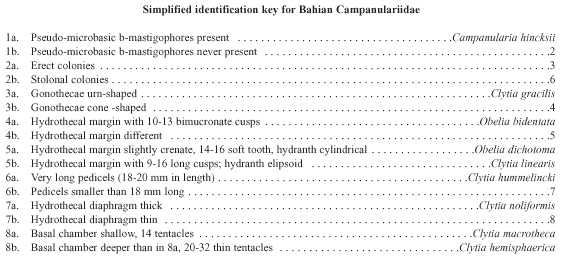
</front><body><![CDATA[ <CENTER><B><FONT FACE="Arial">Shallow-water Campanulariidae (Hydrozoa, Leptothecatae) from Northern Bah&iacute;a, Brazil</FONT></B></CENTER>      <CENTER>&nbsp;</CENTER>      <CENTER>&nbsp;</CENTER>      <CENTER><FONT SIZE=-1><FONT FACE="Arial">Francisco Kelmo&nbsp;<A NAME="R1"></A></FONT><SUP><FONT FACE="Arial,Helvetica"><A HREF="#A1">1</A></FONT></SUP><FONT FACE="Arial"> and Martin J. Attrill </FONT><SUP><FONT FACE="Arial,Helvetica"><A HREF="#A1">1</A></FONT></SUP></FONT></CENTER> &nbsp;     <BR>&nbsp;     <CENTER><FONT FACE="Arial"><FONT SIZE=-1>&nbsp;Received 30-X-2000. Corrected 14-V-2001. Accepted 5-VI-2002.</FONT></FONT></CENTER> <B><FONT FACE="Arial"><FONT SIZE=-1>&nbsp;</FONT></FONT></B>     <BR><B><FONT FACE="Arial"><FONT SIZE=-1>Abstract</FONT></FONT></B>      <P><FONT FACE="Arial"><FONT SIZE=-1>This study provides the first semi-quantititative account of the benthic campanulariid hydroids from Northern Bahia (Brazil), down to a depth of 60 m, based largely on collections obtained since 1992. Colonies were collected from six habitats along the coast of Salvador City, Todos os Santos Bay, Itaparica Island and at the northernmost part of the coast of the State of Bahia. From the 982 colonies examined, nine species were recorded: <I>Campanularia hincksii, Clytia gracilis, C. hemisphaerica, C. hummelincki, C. linearis, C. macrotheca, C. noliformis, Obelia bidentata </I>and <I>O. dichotom</I>a. Following a defined abundance scale, <I>Clytia gracilis </I>and <I>C. noliformis </I>were the most abundant species, whereas <I>Campanularia hincksii </I>and <I>Clytia hummelincki </I>were rare. Cluster analysis of relative abundance data revealed sandy shores had a markedly different hydroid community from other habitats. A simplified identification key, redescriptions, illustrations and data on nematocyst compliment are provided for each species. <I>Campanularia hincksii,</I> <I>Clytia macrotheca </I>and <I>C. noliformis </I>are reported from Brazil for the first time.</FONT></FONT>      <P><FONT FACE="Arial"><FONT SIZE=-1><B>Key Words:</B> <I>Campanulari</I>a, <I>Clytia, Obelia</I>, hydroid, cnidome, Brazil.</FONT></FONT>      <P><FONT FACE="Arial"><FONT SIZE=-1>The Campanulariidae is a comparatively well-known hydroid family (<A HREF="#Calder91">Calder 1991</A>) and most of its genera are nearly cosmopolitan, with records from all oceans (<A HREF="#Cornelius82">Cornelius 1982</A>). Although significant progress has been made on this group, including accurate description of cnidome (<A HREF="#Ostman79a">&Ouml;stman 1979a</A>, <A HREF="#Ostman79b">1979b</A>, <A HREF="#Ostman82a">1982a</A>, <A HREF="#Ostman87">1987</A> and <A HREF="#Ostman88">1988</A>) and biochemical taxonomy (<A HREF="#Ostman82b">&Ouml;stman 1982b</A>), many aspects of its biology and ecology remain unclear. This lack of knowledge is particularly evident in South America. In Brazil, research on benthic hydroids started in the 1940 (<A HREF="#Vannucci46">Vannucci Mendes 1946</A>; <A HREF="#Vannucci49">Vannucci 1949</A>, <A HREF="#Vannucci50">1950</A>). Some reports appeared three decades later (<A HREF="#Narchi">Narchi and Hebling 1975</A>; <A HREF="#Mayal73">Mayal 1973</A>, <A HREF="#Mayal83">1983</A>; <A HREF="#Migotto93">Migotto 1993</A>; <A HREF="#Silveira84">Silveira and Migotto 1984</A>, <A HREF="#Silveira91">1991</A>, <A HREF="#Silveira92">1992</A>; <A HREF="#Migotto87">Migotto and Silveira 1987</A>); however, except for the works of <A HREF="#Mayal73">Mayal (1973, 1983)</A>, these studies concentrated mainly on species from the south coast of the country.</FONT></FONT>      ]]></body>
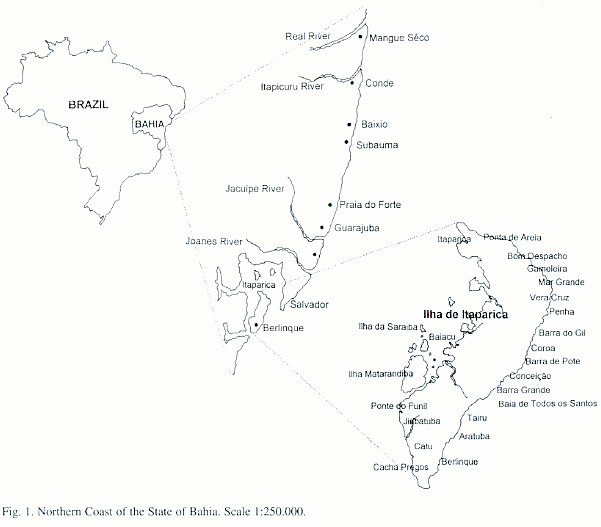
<body><![CDATA[<P><FONT FACE="Arial"><FONT SIZE=-1>The State of Bahia (Northeastern Brazil) has a very extensive coastline (1 120 km) with many different ecosystems, including mangroves, rocky and sandy shores, beach rocks (bedrock appearing through an eroding sandy shore), coral-algal build ups and coral reefs. Although there are some hydroid descriptions from these environments, the general hydroid fauna is poorly known except for the taxonomic accounts of <A HREF="#Kelmo96">Kelmo and Peixinho (1996)</A>, <A HREF="#Souza">Souza (1997)</A> and <A HREF="#Kelmo98">Kelmo and Santa-Isabel (1998)</A>, but these did not concentrate on campanulariids. There is no complete systematic inventory of leptothecate hydroids. Many aspects of the biology and ecology of these animals remain unclear, discouraging research into the group. The purpose of this report is to provide the first semiquantitative account of the biodiversity of benthic campanulariid hydroids from Northern Bahia, down to a depth of 60 m, based largely on collections obtained since 1992. We present a simplified identification key, redescriptions and illustrations for all species.</FONT></FONT>      <P><B><FONT FACE="Arial"><FONT SIZE=-1>Material and methods</FONT></FONT></B>      <P><FONT FACE="Arial"><FONT SIZE=-1>The present study considers material from the northernmost coast of the State of Bahia, Salvador City, Todos os Santos Bay and Itaparica Island (<A HREF="#fig1">Fig. 1</A>).</FONT></FONT>     <BR>&nbsp;     <CENTER><IMG SRC="/img/fbpe/rbt/v51n1/2399t1.JPG" HEIGHT=261 WIDTH=562></CENTER>      
<CENTER>&nbsp;</CENTER>      <CENTER><A NAME="fig1"></A><IMG SRC="/img/fbpe/rbt/v51n1/2399i01.JPG" HEIGHT=527 WIDTH=601></CENTER> &nbsp;     
<BR><FONT FACE="Arial"><FONT SIZE=-1>Hydroids were collected either along transect lines, during snorkelling and SCUBA, and/or using a Petersen’s dredge. Colonies were anaesthetised in 7.8% solution of MgCl 2 , fixed in 4% formaldehyde, preserved in 70% ethanol and stored at the Scientific Collection of Cnidarians of the Departamento de Zoologia do Instituto de Biologia da Universidade Federal da Bahia - Brazil (UFBA-CNI-HYD). In this paper, we refer the catalogue number [N] for each studied species. Colonies were examined under high-power stereoscopic and brightfield microscopy, and taxonomic identification was based on the literature cited in the text of this paper. All descriptions and illustrations provided herein are from the examined material.</FONT></FONT>      <P><FONT FACE="Arial"><FONT SIZE=-1>The listed synonymy, following <A HREF="#Calder91">Calder (1991)</A>, <A HREF="#Cornelius82">Cornelius (1982, 1995)</A> and <A HREF="#Migotto93">Migotto (1993)</A>, was verified by examination of the original references. In most cases, only one significant record has been cited to document occurrences worldwide. Hydroid classification has been modified extensively by <A HREF="#Petersen79">Petersen (1979, 1990)</A>, Werner (1984), <A HREF="#Bouillon">Bouillon (1985)</A> and <A HREF="#Calder88">Calder (1988, 1991, 1997)</A>; however, in the interests of simplicity, the classification adopted here follows <A HREF="#Cornelius95">Cornelius (1995)</A>.</FONT></FONT>      <P><FONT FACE="Arial"><FONT SIZE=-1>Nematocysts were examined by compressing pieces of tissue, or entire individuals, between a slide and coverslip (<A HREF="#Calder91">Calder 1991</A>). Specimens were treated with a 10% solution of sodium hypochlorite for 5-10 secs, and rinsed twice in distilled water prior to slide preparation (<A HREF="#Kelmo98">Kelmo and Santa-Isabel 1998</A>). Nematocyst categories were identified according to the classification of <A HREF="#Weill">Weill (1934)</A> and <A HREF="#Ostman88">&Ouml;stman (1988)</A>. Length and width measurements were made from undischarged nematocysts using an ocular micrometer. For each species, at least 10 nematocysts of each type were measured for determining size ranges.</FONT></FONT>      ]]></body>
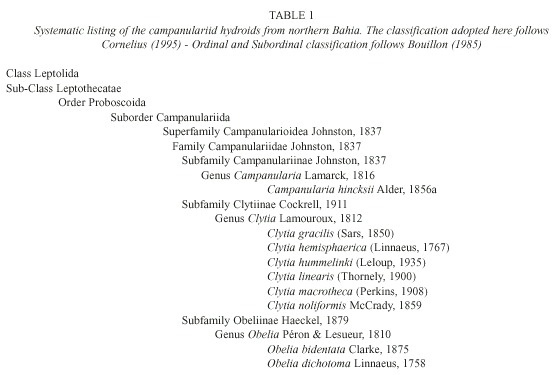
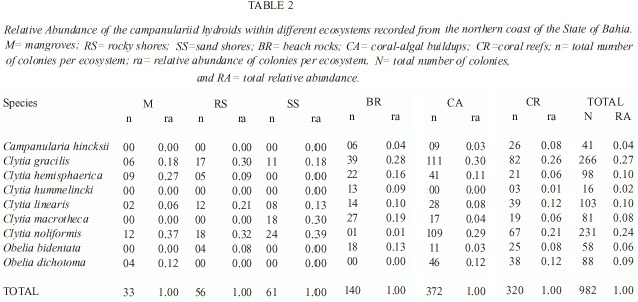
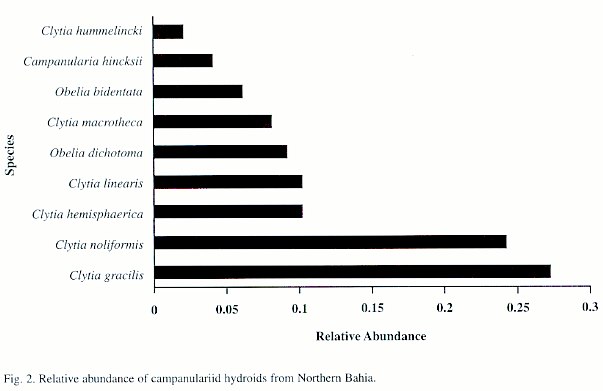
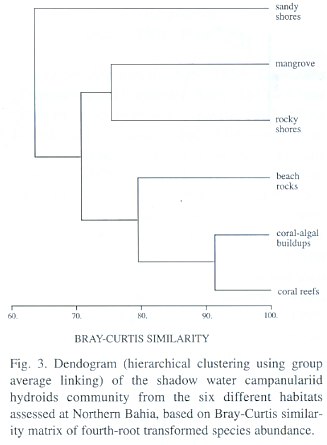
<body><![CDATA[<P><FONT FACE="Arial"><FONT SIZE=-1>Relative abundance analysis was performed on hydroid samples from each ecosystem according to the progressive scale proposed by <A HREF="#Peixinho">Peixinho and Peso-Aguiar (1989)</A>. Fourth-root transformed abundance data from each ecosystem were used to compute Bray-Curtis similarity coefficients (<A HREF="#Bray">Bray and Curtis 1957</A>) for each pair of ecosystem. The similarity matrix was subjected to cluster analysis using the program PRIMER (Plymouth Routines in Multivariate Ecological Resource, <A HREF="#Carr">Carr 1996</A>). Clustering utilised a hierarchical agglomerative method with group-average linking, resulting in a dendogram.</FONT></FONT>      <P><B><FONT FACE="Arial"><FONT SIZE=-1>Results</FONT></FONT></B>      <P><FONT FACE="Arial"><FONT SIZE=-1>Of the 982 colonies examined, nine species were recorded: <I>Campanularia hincksii, Clytia gracilis, C. hemisphaerica, C. hummelincki, C. linearis, C. macrotheca, C. noliformis, Obelia bidentata </I>and <I>O. dichotoma </I>(<A HREF="#table1">Table 1</A>). <I>Clytia gracilis </I>and <I>C. noliformis </I>were the most abundant species (<A HREF="#table2">Table 2</A>), whereas <I>Campanularia hincksii </I>and <I>Clytia hummelincki </I>were rare (<A HREF="#fig2">Fig. 2</A>).</FONT></FONT>      <P><FONT FACE="Arial"><FONT SIZE=-1>The Bray-Curtis similarity dendogram (<A HREF="#fig3">Fig. 3</A>) formed three distinct clusters at 63% similarity. The first cluster isolated sandy shore samples, the second group comprised man-grove and rocky shore fauna, and the third comprised all the samples from the northern coast of the State of Bahia (beach rocks, coral-algal build ups and coral reefs).</FONT></FONT>     <BR><FONT FACE="Arial"><FONT SIZE=-1>&nbsp;</FONT></FONT>     <CENTER><A NAME="table1"></A><IMG SRC="/img/fbpe/rbt/v51n1/2399t01.JPG" HEIGHT=375 WIDTH=556></CENTER>      
<CENTER>&nbsp;</CENTER>      <CENTER>&nbsp;</CENTER>      <CENTER><A NAME="table2"></A><IMG SRC="/img/fbpe/rbt/v51n1/2399t02.JPG" HEIGHT=302 WIDTH=638></CENTER> &nbsp;     
<CENTER><A NAME="fig2"></A><IMG SRC="/img/fbpe/rbt/v51n1/2399i02.JPG" HEIGHT=391 WIDTH=603></CENTER>      
]]></body>
<body><![CDATA[<CENTER>&nbsp;</CENTER>      <CENTER><A NAME="fig3"></A><IMG SRC="/img/fbpe/rbt/v51n1/2399i03.JPG" HEIGHT=445 WIDTH=327></CENTER> <B><FONT FACE="Arial"><FONT SIZE=-1></FONT></FONT></B>      
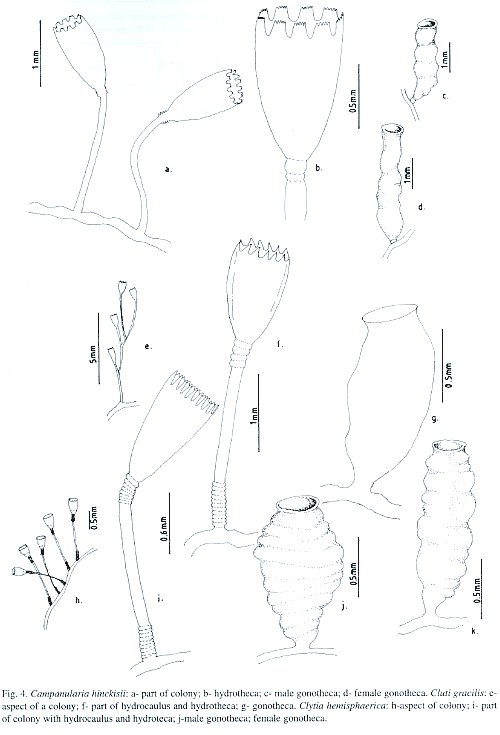
<P><B><FONT FACE="Arial"><FONT SIZE=-1>&nbsp;</FONT></FONT></B>     <BR><B><FONT FACE="Arial"><FONT SIZE=-1>Systematic Account</FONT></FONT></B>     <CENTER><B><I><FONT FACE="Arial"><FONT SIZE=-1>Campanularia hincksii</FONT></FONT></I></B></CENTER>      <CENTER><FONT FACE="Arial"><FONT SIZE=-1><A HREF="#Alder56">Alder, 1856a</A> (Plate I a-d)</FONT></FONT></CENTER>       <P><FONT FACE="Arial"><FONT SIZE=-1><I>Campanularia volubilis </I><A HREF="#Hincks53">Hincks, 1853</A>; <I>Campanularia hincksii </I><A HREF="#Alder56">Alder, 1856</A>; <A HREF="#Calder91">Calder, 1991</A>; <A HREF="#Cornelius95">Cornelius, 1995</A>; <I>Campanularia (Orthopyxi</I>s) <I>hincksii </I><A HREF="#Verrill">Verrill, 1873</A>; <I>Campanularia hincksii grandis </I><A HREF="#Billard06">Billard, 1906a</A>; <I>Campanularia (Eu-Campanulari</I>a) <I>hincksii </I><A HREF="#Broch33">Broch, 1933</A>; <I>Campanularia emarginata </I><A HREF="#Fraser38">Fraser, 1938a</A>; <I>Campanularia altitheca </I><A HREF="#Fraser48">Fraser, 1948</A>; <I>Campanularia (Campanularia</I>) <I>hincksii </I><A HREF="#Vervoort68">Vervoort, 1968</A>.</FONT></FONT>      <P><FONT FACE="Arial"><FONT SIZE=-1><B>Material studied: </B>Arembepe Beach, on external bank of beach rocks, 10-11 m depth, 6.iv.1996, six colonies, 5- 6.5 mm high, female gonophores observed [N 1752]; Northern coast of Bahia, on coral algal buildups, 20-25 m depth, 20.xii.1992, four colonies, 6-6.8 mm high, male gonophores [N 1755]; 30 m depth, 16.iii.1993, two colonies, 5.5 and 6.2 mm high, without gonophores [N 1768]; Arembepe region, 22 m depth, 10.xi.1996, three colonies, 6-6.5 mm high, male and female gonophores [N 1775]; Guarajuba Beach, on shallow bank coral reefs, 18 m depth, 16.viii.1996, fourteen colonies, 6.5-6.8 mm high, male and female gonophores [N 1788]; Praia do Forte Beach, on shallow bank coral reefs, 12 m depth, 24.iv.1997, eight colonies, 6.0-6.4 mm high, without gonophores [N 1792]; 21.ix.1997, 14 m depth, four colonies, 6.5-6.8 mm high, gonophores not observed [N 1795].</FONT></FONT>      <P><FONT FACE="Arial"><FONT SIZE=-1><B>Description: </B>Soft brown or yellowish stolonal colony, up to 6.8 mm high, arising from a creeping hydrorhiza. Long pedicels, 3.4-4.6 &micro;m in length, 50-68 &micro;m in diameter; pedicel base with 2, 3 or 4 annulations; perisarc thick. Hydrothecae strongly campanulate, 640-975 &micro;m long, 275-398 &micro;m wide at margin, 69-76 &micro;m wide at basal annular thickening; hydrothecal walls with thin perisarc, convex just above basal chamber, quite straight elsewhere. Hydrothecal margin with 9, 11 or occasionally 12 (never 10) cusps separated by U-shaped conspicuous embayments. Each marginal tooth with a distal concavity. Hydrothecal wall scalloped in cross section, with an U-shaped pleat extending outwards from hydrothecal cavity between adjacent cusp; basal chamber cup-shaped, 18-23 slightly filiform tentacles, 0.65-0.68 mm long. Gonothecae, yellowish, dimorphic; both types born on stolon; short and conspicuous pedicel; terminal aperture wide. Male gonothecae short, 1.42-1.85 mm long, 0.28-0.3<FONT COLOR="#FFFFFF">3.</FONT> mm in diameter; sub-cylindrical; irregularly sinuous in a loose succession of incomplete rings. Female gonothecae, long, 1.88-2.23 mm in length, 0.30-0.35 mm in diameter; asymmetric, broadest near base, truncate below, tapering gradually above; incompletely ringed and/or irregularly folded. Nematocyst compliment represented by microbasic b-mastigophores of two different sizes: (i) A-type: 5.5-7.2 &micro;m x 1.5-2.6 &micro;m; (ii) B-type: 7.5-9.8 &micro;m x 2.2-2.8 &micro;m. The A-type is abundant throughout the entire colony, especially on tentacles, whilst the B-type is less abundant and never occurs on tenta-cles. Pseudo-microbasic b-mastigophores (&Ouml;st-man, 1988), 14.4 -19.5 &micro;m x 2.1-3.6 &micro;m, were not abundant.</FONT></FONT>      <P><FONT FACE="Arial"><FONT SIZE=-1><B>Known range: </B>Brazil: first record. Circumglobal distribution: western Atlantic (<A HREF="#Fraser44">Fraser 1944</A>); eastern Atlantic (<A HREF="#Cornelius82">Cornelius 1982</A>, <A HREF="#Cornelius95">1995</A>); Indian Ocean (<A HREF="#Millard75">Millard 1975</A>); western Pacific (<A HREF="#Hirohito">Hirohito 1983</A>); eastern Pacific (<A HREF="#Fraser48">Fraser 1948</A>), Bermuda (<A HREF="#Calder91">Calder 1991</A>).</FONT></FONT>     ]]></body>
<body><![CDATA[<CENTER><I><FONT FACE="Arial"><FONT SIZE=-1>&nbsp;</FONT></FONT></I></CENTER>      <CENTER><IMG SRC="/img/fbpe/rbt/v51n1/2399i04.JPG" HEIGHT=735 WIDTH=500><I><FONT FACE="Arial"><FONT SIZE=-1></FONT></FONT></I></CENTER>      
<CENTER><I><FONT FACE="Arial"><FONT SIZE=-1>&nbsp;</FONT></FONT></I></CENTER>      <CENTER><B><I><FONT FACE="Arial"><FONT SIZE=-1>Clytia gracilis</FONT></FONT></I></B></CENTER>      <CENTER><FONT FACE="Arial"><FONT SIZE=-1>(<A HREF="#Sars50">Sars, 1850</A>) (Plate I e-g)</FONT></FONT></CENTER>       <P><FONT FACE="Arial"><FONT SIZE=-1><I>Laomedea gracilis </I><A HREF="#Sars50">Sars, 1850</A>; <I>Laomedea (Campanularia</I>i) <I>gracilis </I><A HREF="#Sars57">Sars, 1857</A>; <I>Clytia (Platypyxi</I>s) <I>cylindrica </I>L. <A HREF="#Agassiz62">Agassiz, 1862</A>; <I>Clytia cylindrica </I>L. <A HREF="#Agassiz62">Agassiz, 1862</A>; <I>Platypyxis cylindrica </I>L. <A HREF="#Agassiz62">Agassiz, 1862</A>; <I>Gonothyraea gracilis </I><A HREF="#Allman64">Allman, 1864</A>; <I>Campanularia gracilis </I><A HREF="#VanBenemen">van Beneden, 1867</A>; <I>Clytia laevis </I><A HREF="#Weismann">Weismann, 1883</A>; <I>Campanularia pelagica </I><A HREF="#VanBreemen">van Breemen, 1905</A>; <I>Campanularia (Clytia</I>) <I>pelagica </I><A HREF="#VanBreemen">van Breemen, 1905</A>; <I>Clytia coronata </I><A HREF="#Fraser12">Fraser, 1912</A>; <I>Clytia elsae-oswaldae </I><A HREF="#Stechow14">Stechow, 1914</A>; <I>Clytia pelagica </I><A HREF="#Billard17">Billard, 1917</A>; <I>Clytia gracilis </I>Stechow, 1923c; <A HREF="#Calder91">Calder, 1991</A>; <A HREF="#Migotto93">Migotto, 1993</A>; <A HREF="#Cornelius95">Cornelius, 1995</A>; <I>Laomedea (Phialidium</I>) <I>pelagica </I><A HREF="#Hummelinck30">Hummelinck, 1930</A>; <I>Laomedea (Phialidium</I>) <I>gracilis </I><A HREF="#Hummelinck30">Hummelinck, 1930</A>; <I>Laomedea pelagica </I><A HREF="#Hummelinck30">Hummelinck, 1930</A>; <I>Laomedea (Clytia</I>) <I>gracilis </I><A HREF="#Broch33">Broch, 1933</A>; <I>Laomedea gracilis </I>forma <I>pelagica </I><A HREF="#Leloup33">Leloup, 1933</A>; <I>Clytia (Campanularia</I>) <I>pelagica </I><A HREF="#Kunne">K&uuml;nne, 1937</A>; <I>Laomedea cylindrica </I><A HREF="#Leloup37">Leloup, 1937a</A>; <I>Clytia stechowi </I><A HREF="#Hargitt27">Hargitt, 1927</A>; <I>Clytia hemisphaerica </I><A HREF="#Millard66a">Millard, 1966</A>; <A HREF="#Cornelius82">Cornelius, 1982</A>; <I>Clytia elsaeoswaldae </I><A HREF="#Vervoort68">Vervoort,<I> </I>1968</A><I>; Campanularia (Clytia</I>) <I>cylindrica </I><A HREF="#Vervoort68">Vervoort, 1968</A>; <I>Clytia sarsi </I><A HREF="#Cornelius82">Cornelius, 1982</A>.</FONT></FONT>      <P><FONT FACE="Arial"><FONT SIZE=-1><B>Material studied: </B>Todos os Santos Bay, Fontes Island, on the sponge <I>Haliclona </I>sp., 4.ix.1994, 1-2 m depth, six colonies, 4-8.5 mm high, gonophores observed [N 1753]; Itaparica Island, Mar Grande region, on coral reef building, 10.ix.1997, 5-6 m depth, nine colonies, 8 mm high, gonophores not seen [N 1898]; Salvador City<B>, </B>Ponta de Itapu&atilde;, on rock outcrop, 16.xii.1994, 18 m depth, nine colonies, 6-12 mm high, gonophores observed [N 1754]; Farol da Barra, on rock outcrop, 9.ii.1995, 6 m depth, eight colonies, 6-10.5 mm high, without gonophores [N 1761]; Ribeira Beach, on ascidians <I>Styella plicata </I>and <I>Falusia nigra</I>, 18.xi.1993, shallow subtidal, eleven colonies, 6.5-12 mm high, without gonophores [N 1762]; Northern Coast, Emiss&aacute;rio beach, on internal beach rock bank, 15.xi.1995, shallow subtidal, twenty colonies, 4-8.5 mm high, without gonophores [N 1769]; Arembepe beach, on external beach rock bank, 15.xi.1995, 1-2 m depth, six colonies, 5-9.5 mm high, without gonophores [N 1771]; Arembepe beach, on embayment beach rock bank, 15.xi.1995, 2 m depth, thirteen colonies, 6-9 mm high, without gonophores [N 1772]; Arembepe region, on coral algal buildup, 20.xii.1992, 25 m depth, forty six colonies, 5-9 mm high, without gonophores [N 1774]; 17.iii.1993, 16 m depth, thirty four colonies, 6-10 mm high, gonophores observed [N 1782]; 24.ix.1996, 42 m depth, thirty one colonies, 4-6 mm high, gonophores not seen [N 1783]; Guarajuba beach, on coral reef wall, 4.xi.1995, 6-7 m depth, twenty six colonies, 8-12 mm high, gonophores observed [N 1784]; Itacimirim beach, on coral reef bank, 10.viii.1996, 11 m depth, ten colonies, 8-11 mm high, gonophores not observed [N 1785]; Praia do Forte beach, on shallow bank reef, 14.viii.1996, 18 m depth, thirty seven colonies, 6-10 mm high, gonophores not seen [N 1896].</FONT></FONT>      <P><FONT FACE="Arial"><FONT SIZE=-1><B>Description: </B>Colonies orange or dark golden, erect, fragile, sparingly and irregularly branched, up to 12 mm high, always arising from a creeping hydrorhiza. Hydrocaulus monosiphonic; each branch arising from a slightly curved aphophysis given off below hydrothecae of pedicel from which it arises. Branches resemble primary pedicels and directed abruptly upwards, 8-11 annulations proximally and 4 - 6 distally placed. Pedicels about 0.5-0.4 mm high, 101-142 &micro;m in diameter, annulated basally and distally, with annuli or wrinkles elsewhere. Hydrothecae deeply cam-panulate, quite cone-shaped, about 727-935 &micro;m long, 387-528 &micro;m wide at margin, 159-241 &micro;m wide at diaphragm, with thin perisarc. Walls convex above diaphragm, nearly straight elsewhere; margin with about 11 to 17 deeply cut, blunt, triangular cusps separated by U-shaped incisions. Diaphragm thin, straight; the basal chamber varied in depth but typically deep and cupshaped. Tentacles short, 18-21 in number, occasionally 24. Gonothecae, orange, urn-shaped, about 965-997 &micro;m long, and 401-434 &micro;m in diameter; usually symmetric; wide-mouthed, orifice diameter about 305-342 &micro;m, constricted just below aperture to about 320 &micro;m wide, arising from hydrorhiza on short inconspicuous pedicels; walls smooth, constricted below aperture. Nematocyst compliment comprising isorhizas about 5.9-6.5 x 1.5-1.9 &micro;m and microbasic mastigophores of three distinct sizes; (i) small 6.3-8.0 x 1.9-2.5 &micro;m; (ii) medium 8.5-9.3 x 2.8-3.2 &micro;m; and (iii) large 13.6-16.8 x 3.3-4.1 &micro;m.</FONT></FONT>      <P><FONT FACE="Arial"><FONT SIZE=-1><B>Known range: </B>Brazil: S&atilde;o Sebasti&atilde;o (S&atilde;o Paulo), Ponta do Jerob&aacute;, Parque de Cultivo de Mexilh&otilde;es and Ponta do Baleeiro (<A HREF="#Migotto93">Migotto, 1993</A>). Circumglobal distribution: western Atlantic [<A HREF="#Vervoort68">Vervoort 1968</A>, as <I>Laomedea (Phialidium</I>) <I>pelagica]</I>; eastern Atlantic (<A HREF="#Vervoort46">Vervoort 1946a</A>, as <I>Laomedea pelagica; </I><A HREF="#Cornelius95">Cornelius 1995</A>); Indian Ocean (<A HREF="#Mammen">Mammen 1965</A>); western Pacific (<A HREF="#Yamada">Yamada 1959</A>); eastern Pacific (<A HREF="#Fraser48">Fraser 1948</A>, as <I>Gonothyraea gracilis</I>); Bermuda (<A HREF="#Calder91">Calder 1991</A>).</FONT></FONT>     <CENTER><I><FONT FACE="Arial"><FONT SIZE=-1>&nbsp;</FONT></FONT></I></CENTER>      ]]></body>
<body><![CDATA[<CENTER><B><I><FONT FACE="Arial"><FONT SIZE=-1>Clytia hemisphaerica</FONT></FONT></I></B></CENTER>      <CENTER><FONT FACE="Arial"><FONT SIZE=-1>(Linnaeus, 1767) (Plate I h-k)</FONT></FONT></CENTER>       <P><FONT FACE="Arial"><FONT SIZE=-1><I>Medusa hemisphaerica </I><A HREF="#Linnaeus67">Linnaeus, 1767</A> [Medusa]; <I>Sertularia uniflora </I><A HREF="#Ellis68">Ellis, 1768</A>; <I>Sertularia volubilis </I><A HREF="#Ellis86">Ellis and Solander, 1786</A>; <I>Oceania flavidula </I><A HREF="#Peron">P&eacute;ron and Lesueur, 1810</A>; <I>Oceania hemisphaerica </I><A HREF="#Peron">P&eacute;ron and Lesueur, 1810</A>; <I>Thaumantias hemisphaerica </I><A HREF="#Eschscholtz">Eschscholtz, 1829</A>; <I>Campanularia johnstoni </I><A HREF="#Alder56">Alder, 1856</A>; <I>Campanularia gegenbaurii </I><A HREF="#Sars57">Sars, 1857</A>; <I>Campanularia volubilis </I><A HREF="#Sars57">Sars, 1857</A>; <I>Campanularia noliformis </I><A HREF="#McCrady">McCrady, 1859</A>; <I>Clytia bicophora </I>L. <A HREF="#Agassiz62">Agassiz, 1862</A>; <I>Clytia (Trachopyxi</I>s) <I>bicophoba </I>L. <A HREF="#Agassiz62">Agassiz, 1862</A>; <I>Campanularia bicophora </I><A HREF="#Allman64">Allman, 1864</A>; <I>Clytia johnstoni </I>A. <A HREF="#Agassiz65">Agassiz, 1865</A>; <I>Clytia (Campanulari</I>a) <I>volubilis </I>du <A HREF="#Plessis">Plessis, 1871</A>; <I>Campanularia (Clyti</I>a) <I>johnstoni </I><A HREF="#Hincks72">Hincks, 1872</A>; <I>Campanularia coronata </I><A HREF="#Clarke79">Clarke, 1879</A>; <I>Epenthesis bicophora </I><A HREF="#Haeckel">Haeckel, 1879</A>; <I>Clytia flavidula </I><A HREF="#Metschnikoff">Metschnikoff, 1886</A>; <I>Campanularia edwardsi </I><A HREF="#Nutting01a">Nutting, 1901a</A>; <I>Clytia grayi </I><A HREF="#Nutting01a">Nutting, 1901a</A>; <I>Campanularia minuta </I><A HREF="#Fraser12">Fraser, 1912b</A>; <I>Phialidium hemisphaericum </I><A HREF="#Mayer10">Mayer, 1910</A>; <I>Campanularia (Clytia</I>) <I>johnstoni </I><A HREF="#Broch12">Broch, 1912</A>; <I>Clytia minuta </I><A HREF="#Fraser12">Fraser, 1912b</A>; <I>Clytia uniflora </I>Stechow, 1923a; <I>Clytia similis </I><A HREF="#Fraser47">Fraser, 1947</A>; <I>Phialidium noliformis </I><A HREF="#Kramp59">Kramp, 1959</A>; <I>Phialidium noliforme </I><A HREF="#Kramp61">Kramp, 1961</A>; <I>Campanularia (Clytia</I>) <I>coronata </I><A HREF="#Vervoort68">Vervoort, 1968</A>; <I>Clytia (Campanulari</I>a) <I>hemisphaerica </I><A HREF="#Gili82">Gili, 1982</A>; <I>Clytia hemisphaerica </I><A HREF="#Calder91">Calder, 1991</A>; <A HREF="#Migotto93">Migotto, 1993</A>; <A HREF="#Cornelius82">Cornelius, 1982, 1995</A>.</FONT></FONT>      <P><FONT FACE="Arial"><FONT SIZE=-1><B>Material studied: </B>Todos os Santos Bay, Fontes Island, on <I>Eudendrium carneum, </I>3.vi.1995, 1-2 m depth, nine colonies, up to 2 mm high, with male gonophores [N 1792]; Itaparica Island, Berlinque Beach, on shallow coral reef bank, 11.i.1993, 5 m depth, twenty one colonies, up to 8 mm high, with male and female gonophores [N 1790]; Salvador City, Boa Viagem beach, on rock outcrop, 23.v.1992, 8 m depth, five colonies, 6.5-9.4 mm high, without gonophores [N 1787]; Northern Coast, Emiss&aacute;rio Beach, on internal beach rock bank, 15.xi.1995, intertidal zone, ten colonies, up to <FONT COLOR="#FFFFFF">4</FONT> mm high, with female gonophores [N 1793]; Arembepe Beach, on external beach rock bank, 15.xi.1995, 6 m depth, twelve colonies, up to 2.5 mm high, with female gonophores [N 1789]; Arembepe region, on coral algal buildups, 13.x.1996, 35 m depth, twenty three colonies, up to 3 mm high, with male and female gonophores [N 1786]; 10.ii.1997, 28 m depth, eighteen colonies, up to 3 mm high, gonophores not observed [N 1791].</FONT></FONT>      <P><FONT FACE="Arial"><FONT SIZE=-1><B>Description: </B>Colonies pale yellow to golden, particularly stolonal, arising from a creeping hydrorhiza. Tall hydrothecal pedicels, arising at close intervals. Hydrothecae of moderately thin perisarc, campanulated, urn-shaped, 587-976 &micro;m long, 95-137 &micro;m wide at diaphragm, 229-399 &micro;m wide at margin; convex walls above diaphragm, nearly straight elsewhere. Pedicels usually straight, with 3-14 rings at top, and 2-11 at the base; specimens collected from rock out-crop with 8-9 central rings. Occasionally some pedicels with secondary pedicels arising from them. Hydrothecal margin with 13-17, but usually 14, rounded triangular cusps, separated by U-shaped incisions. Hydrothecal walls weakly scalloped in cross section at margin, with each cusp having a shallow, U-shaped pleat extending inwards towards hydrothecal cavity. Hydrothecal diaphragm quite thin and straight; basal chamber is rather deep and cup-shaped. Hydranth ovoid, with 20 to 32 thin tentacles, about 1.4 mm long. Gonothecae yellowish, dimorphic. Male gonotheca, 0.89-1.01 mm long, 0.45-0.61 mm wide, broad and asymmetric, with smooth walls and sub-terminal constriction; irregular annulations or folds at distal part; large terminal aperture, about 0.26 mm in diameter; pedicel short and usually inconspicuous. Female gonotheca, longer than male, 0.91-1.08 mm long, 0.42-0.46 mm wide, sub-cylindrical, distinct but irregular ribs; terminal aperture about 0.28 mm in diameter; short slender pedicel. Nematocyst compliment consists of microbasic b-mastigophores of two sizes: (i) A-type: 6.9-8.1 x 1.9-3.1 &micro;m, throughout the colony; (ii) B-type: 15.3-17.5 x 3.5-4.2 &micro;m, never occurs in tentacles.</FONT></FONT>     <BR>&nbsp;     <BR><FONT FACE="Arial"><FONT SIZE=-1><B>Known range: </B>Brazil: S&atilde;o Sebasti&atilde;o (S&atilde;o Paulo) (<A HREF="#Migotto93">Migotto 1993</A>). Circumglobal distribution: western Atlantic (<A HREF="#Calder75">Calder 1975</A>); eastern Atlantic (<A HREF="#Cornelius82">Cornelius 1982, 1995</A>); Indian Ocean (<A HREF="#Mammen">Mammen 1965</A>); eastern Pacific (<A HREF="#Fraser48">Fraser 1948</A>, as <I>C. johnstoni</I>); Bermuda (<A HREF="#Calder91">Calder 1991</A>).</FONT></FONT>     <CENTER><I><FONT FACE="Arial"><FONT SIZE=-1>&nbsp;</FONT></FONT></I></CENTER>      <CENTER><B><I><FONT FACE="Arial"><FONT SIZE=-1>Clytia hummelincki</FONT></FONT></I></B></CENTER>      <CENTER><FONT FACE="Arial"><FONT SIZE=-1>(<A HREF="#Leloup35">Leloup, 1935</A>) (Plate II a-b)</FONT></FONT></CENTER>       ]]></body>
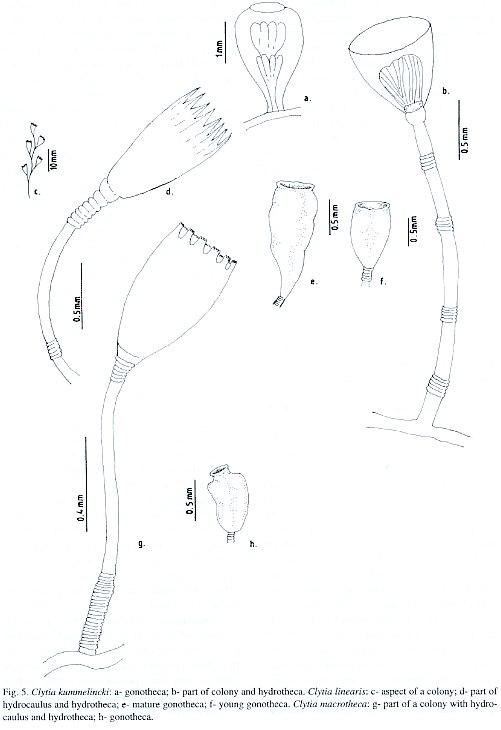
<body><![CDATA[<P><FONT FACE="Arial"><FONT SIZE=-1><I>Laomedea hummelincki </I><A HREF="#Leloup35">Leloup, 1935</A>; <I>Campanularia hummelincki </I><A HREF="#Fraser44">Fraser, 1944</A>; <I>Clytia hummelincki </I><A HREF="#Millard66a">Millard, 1966</A>; <A HREF="#Calder91">Calder, 1991</A>; <A HREF="#Migotto93">Migotto, 1993</A>; <I>Campanularia (Clyti</I>a) <I>hummelincki </I><A HREF="#Vervoort68">Vervoort, 1968</A>.</FONT></FONT>      <P><FONT FACE="Arial"><FONT SIZE=-1><B>Material studied: </B>Northern Coast, Emiss&aacute;rio Beach, on internal beach rock bank, 15 th November 1995, 3 m depth, thirteen colonies, 3-4 mm high, with gonophores [N 1795]; Guarajuba Beach, on the sponge <I>Dysidea variabilis </I>from the shallow bank reef, 10 th April 1996, 19 m depth, three colonies, gonophores not seen [N 1796].</FONT></FONT>      <P><FONT FACE="Arial"><FONT SIZE=-1><B>Description: </B>Whitish or pale yellowish stolonal colonies, up to 4 mm high; creeping hydrorhiza. Pedicels very long, about 18-20 mm, thick perisarc, with 3-4 occasional groups of annuli irregularly placed along length; groups with 3-7 annuli; distal end of pedicel with slight swelling just beneath a sub-hydrothecal spherule. Hydrothecae short, 299-314 &micro;m long, and wide, 310-323 &micro;m at margin, and 160-169 &micro;m at diaphragm; margin entire, usually parallel or slightly sinuous; diaphragm thin, delicate and quite oblique in lateral view; basal chamber short. Hydranth with subspherical hypostome and 18-20 soft tentacles, about 2.6 mm long. Gonothecae, whitish, sessile, truncate, pear-shaped and short, 0.76-0.88 mm long; about 0.23 mm in diameter at base and 0.39 at margin; usually symmetric; terminal aperture rounded and wide; two medusa buds insuccessive development. Nematocyst compliment represented by small microbasic b-mastigophores, 3.1-3.4 &micro;m x 0.55-0.59 &micro;m, throughout the colony.</FONT></FONT>      <P><FONT FACE="Arial"><FONT SIZE=-1><B>Known range: </B>Brazil: S&atilde;o Sebasti&atilde;o (S&atilde;o Paulo) (<A HREF="#Migotto93">Migotto 1993</A>). Circumglobal distribution: western Atlantic (<A HREF="#Leloup35">Leloup 1935</A>); eastern Atlantic (<A HREF="#Millard75">Millard 1975</A>, <A HREF="#Cornelius82">Cornelius 1982</A>); Bermuda (<A HREF="#Calder91">Calder 1991</A>). <I>Clytia linearis </I>(<A HREF="#Thornely">Thornely, 1900</A>) (Plate II c-f) <I>Obelia linearis </I><A HREF="#Thornely">Thornely, 1900</A>; <I>Campanularia ravieri </I><A HREF="#Billard04">Billard, 1904</A>; <I>Campanularia linearis </I><A HREF="#Borradaile">Borradaile, 1905</A>; <I>Obelia striata </I><A HREF="#Clarke07">Clarke, 1907</A>; <I>Clytia fragilis </I><A HREF="#Congdon">Congdon, 1907</A>; <I>Clytia striata </I><A HREF="#Vanhoffen">Vanh&ouml;ffen, 1910</A>; <I>Clytia linearis </I><A HREF="#Stechow13">Stechow, 1913</A>; <I>Laomedea striata </I><A HREF="#Kramp22">Kramp, 1922</A>; <I>Clytia alternata </I><A HREF="#Hargitt24">Hargitt, 1924</A>; <I>Laomedea (Obelia</I>) <I>bistriata </I><A HREF="#Leloup31">Leloup, 1931</A>; <I>Laomedea bistriata </I><A HREF="#Leloup32">Leloup, 1932</A>; <I>Laomedea gravieri </I><A HREF="#Billard33">Billard, 1933</A>; <I>Laomedea tottoni </I><A HREF="#Leloup35">Leloup, 1935</A>; <I>Laomedea fragilis </I><A HREF="#Leloup35">Leloup, 1935</A>; <I>Clytia gravieri </I><A HREF="#Billard38">Billard, 1938</A>; <I>Clytia acutidentata </I><A HREF="#Fraser38">Fraser, 1938</A>; <I>Clytia carinadentata </I><A HREF="#Fraser38">Fraser, 1938</A>; <I>Gonothyraea serialis </I><A HREF="#Fraser38">Fraser, 1938</A>; <I>Clytia obliqua </I><A HREF="#Picard50">Picard, 1950</A>; <I>Clytia serrata </I><A HREF="#Millard58">Millard, 1958</A>; <I>Campanularia (Clytia</I>) gravieri <A HREF="#Vervoort67">Vervoort, 1967</A>; <I>Laomedea (Phialidium</I>) <I>tottoni </I><A HREF="#Vervoort68">Vervoort, 1968</A>; <I>Clytia linearis </I><A HREF="#Calder91">Calder, 1991</A>; <A HREF="#Migotto93">Migotto, 1993</A>.</FONT></FONT>      <P><FONT FACE="Arial"><FONT SIZE=-1><B>Material studied: </B>Todos os Santos Bay, Pati Island, on the sponge <I>Tedania igni</I>s, intertidal zone, 2.vi.1995, two colonies, 5 mm high, gonophores observed [N 1794]; Mar Grande -Coroa Beach, on biogenic rock, 4m depth, 20.x.1994, 13 colonies, 10-12 mm high, gonophores observed [N 1805]; Salvador City, Farol da Barra, on rock outcrop, 17 m depth, 30.x.1993, five colonies, 10-14 mm high, with-out gonophores [N 1797]; Pituba Beach, on rock outcrop, 4-5 m depth, 15.viii.1996, seven colonies, 8 - 10 mm high, gonophores observed [N 1798]; Ribeira beach, on the bivalve <I>Anomalocardia brasilian</I>a, intertidal zone, 18.xi.1993, eight colonies, 9.5 - 13 mm high, gonophores observed [N 1799]; Northern Coast, Arembepe beach, on external beach rock bank, 8-9 m depth, 15.xi.1995, fourteen colonies, up to 6 mm high, gonophores observed [N 1781]; Arembepe region, on coral algal buildup, 38 m depth, 20.iv.1996, sixteen colonies, 5 - 6.5 mm high, gonophores not seen [N 1801]; 22 m depth, 14.vi.1996, twelve colonies, 6-6.5 mm high, gonophores not seen [N 1802]; Guarajuba Beach, on coral reef wall, 9 m depth, 12.iv.1996, eleven colonies, 8-10 mm high, gonophores not seen [N 1803]; Praia do Forte, on shallow bank reef, 16 m depth, 14.iv.1996, fifteen colonies, 8-10 mm high, gonophores not observed [N 1804].</FONT></FONT>      <P><FONT FACE="Arial"><FONT SIZE=-1><B>Description: </B>Stolonal or erect colonies, with brownish and thick perisarc. Stolonal forms, up to 6 mm high, arising from a creeping hydrorhiza; erect forms branching sympodially up to 13 mm high, but usually 10 mm. Hydrocaulus always unbranched, monosiphonic, divided by internodes at regular intervals. Internodes long, about 1.6 mm in length, slender, straight or sometimes slightly curved; a group of 6-9 annuli are basally or subbasally placed; distal end with a hydrothecal pedicel composed of 5-7 narrow annuli. All internodes with apophysis, except terminal ones. Apophysis short, curved upwards, alternating from side to side, each supporting an intern-ode. Hydrothecae strongly campanulated, long, 760-988 &micro;m in length, 316-478 &micro;m wide at margin and 145-199 &micro;m wide at diaphragm, sometimes asymmetric. Hydrothecal margin with 9-16 long cusps, separated by U-shaped incisions; each cusp with internal stiffening strip reaching to tip and extending downwards sometimes to middle of hydrotheca; diaphragm thin and oblique, occasionally transverse; basal chamber cup-shaped, of variedsize. Hydranth more or less ellipsoid, with 10-16 long tentacles, about 465 mm long. Gonothecae cone-shaped. Young ones light brown, elongated, 650-712 &micro;m long, pedicel of 3-4 rings, usually on stolon, but sometimes on erect shoot in axil; wide in centre, about 310 &micro;m in diamenter, and sometimes at terminal end, tapering below, 230 &micro;m wide; gonophores with 1 or 2 rows of developing medusae.</FONT></FONT>      <P><FONT FACE="Arial"><FONT SIZE=-1>Mature gonotheca, dark orange, longer, 960-989 &micro;m long, placed like the young ones; asymmetric; wide terminal orifice, about 330 &micro;m in diameter, usually constricted just below margin; short pedicel, 4-6 annuli; 2-4 developing medusae. Nematocyst compliment (excluding medusae) represented by microbasic b-mastigophores of two different sizes: (i) A-type: 7.8-9.2 x 2.4-3.1 &micro;m and, (ii) B-type: 12.2-13.5 x 3.5 - 4.4 &micro;m.</FONT></FONT>     <BR>&nbsp;     <BR><FONT FACE="Arial"><FONT SIZE=-1><B>Known range: </B>Brazil: S&atilde;o Sebasti&atilde;o (S&atilde;o Paulo) (<A HREF="#Migotto93">Migotto 1993</A>). Circumglobal distribution: western Atlantic [<A HREF="#Vervoort68">Vervoort 1968</A>, as <I>Laomedea (Phialidiu</I>m) <I>tottoni</I>]; eastern Atlantic (<A HREF="#Garcia">Garc&iacute;a, Aguirre and Gonz&aacute;lez 1978</A>, as <I>Clytia gravieri</I>; <A HREF="#Cornelius82">Cornelius 1982</A>); Indian Ocean (<A HREF="#Millard75">Millard 1975</A> as <I>Clytia gravieri</I>); western Pacific (<A HREF="#Yamada">Yamada 1959</A>); eastern Pacific (<A HREF="#Fraser38">Fraser 1938a</A>, as <I>C. acutidentata, C. carinadentata, </I>and <I>Gonothyraea serialis</I>); Bermuda (<A HREF="#Calder91">Calder 1991</A>).</FONT></FONT>     <CENTER><I><FONT FACE="Arial"><FONT SIZE=-1>&nbsp;</FONT></FONT></I></CENTER>      ]]></body>
<body><![CDATA[<CENTER><IMG SRC="/img/fbpe/rbt/v51n1/2399i05.JPG" HEIGHT=730 WIDTH=501></CENTER>      
<CENTER><I><FONT FACE="Arial"><FONT SIZE=-1>&nbsp;</FONT></FONT></I></CENTER>      <CENTER><B><I><FONT FACE="Arial"><FONT SIZE=-1>Clytia macrotheca</FONT></FONT></I></B></CENTER>      <CENTER><FONT FACE="Arial"><FONT SIZE=-1>(<A HREF="#Perkins">Perkins, 1908</A>) (Plate II g-h)</FONT></FONT></CENTER>       <P><FONT FACE="Arial"><FONT SIZE=-1><I>Campanularia macrotheca </I><A HREF="#Perkins">Perkins, 1908</A>; <I>Clytia macrotheca </I>Stechow, 1923; <I>Laomedea macrotheca </I><A HREF="#Leloup35">Leloup, 1935</A>; <I>Campanularia (Clytia</I>) <I>macrotheca </I><A HREF="#Vervoort68">Vervoort, 1968</A>; <I>Clytia macrotheca </I><A HREF="#Calder91">Calder, 1991</A>.</FONT></FONT>      <P><FONT FACE="Arial"><FONT SIZE=-1><B>Material studied: </B>Salvador City, Ribeira Beach, on the hydroid <I>Thyroscyphus ramosu</I>s, 2 m depth, 18.xi.1993, eighteen colonies, 5mm high, gonophores observed [N 1806]; Northern Coast, Arembepe region, on embayment beach rock bank, 3-4 m depth, 15.xi.1995, three colonies, 3-3.5 mm high, gonophores not observed [N 1807]; on external beach rock bank, 6-8 m depth, 15.xi.1995, twenty four colonies, 3 mm high, gonophores observed [N 1808]; on coral algal buildup, 30 m depth, 4.iii.1994, eleven colonies, up to 2 mm high, gonophores not seen [N 1809]; 55 m depth, 16.v.1994, six colonies, up to 2.5 mm high, gonophores not seen [N 1810]; Guarajuba Beach, on shallow coral reef bank, 19 m depth, 30.iv.1996, seven colonies, 3-4 mm high, without gonophores [N 1811]; Papa Gente Beach, on coastal emergent reef wall, 5-6 m depth, 1.v.1997, twelve colonies, 3 mm high, without gonophores [N 1812].</FONT></FONT>      <P><FONT FACE="Arial"><FONT SIZE=-1><B>Description: </B>Whitish or sometimes yellowish stolonal colonies, up to 5 mm high, arising from a creeping hydrorhiza. Delicate pedicels, 0.8-5.0 mm high, 35-50 &micro;m in diameter, with a group of 22-25 basally placed annuli, and 6-8 annuli at distal end. No subhydrothecal spherule. Perisarc relatively thick, usually yellowish. Hydrothecae champagne-glass-shaped, 440-581 &micro;m long, cylindrical distally, slightly constricted basally, 160-199 &micro;m at margin, and 48-83 &micro;m at diaphragm; margin with 9-11 truncated cusps separated by U-shaped incisions. Hydrothecal diaphragm thin, usually horizontal, but sometimes oblique; basal chamber shallow and cupshaped. Hydranth ovoid, whitish, with 14 tentacles, each about 400 &micro;m long. Gonothecae white, irregularly pear-shaped,and sometimes cone-shaped; always asymmetric; short, about 620 &micro;m long, 200 &micro;m in maximum diameter at distal end, tapering towards the base, and these about 138 mm; terminal aperture wide, about 190 &micro;m in diameter, slightly constricted below margin; short pedicels with 3-5 annuli. Nematocyst compliment represented by microbasic b-mastigophores of two sizes: (i) A-type: 5.5-6.0 x 1.8-2.0 &micro;m, very abundant throughout the colony, and (ii) B-type: 8.0-8.5 x 2.5-2.8 &micro;m, less numerous than A-type.</FONT></FONT>      <P><FONT FACE="Arial"><FONT SIZE=-1><B>Known range: </B>Brazil: first record. Circumglobal distribution: western Atlantic (<A HREF="#Fraser44">Fraser 1944</A>); Bermuda (<A HREF="#Calder91">Calder 1991</A>).</FONT></FONT>     <CENTER><I><FONT FACE="Arial"><FONT SIZE=-1>&nbsp;</FONT></FONT></I></CENTER>      <CENTER><B><I><FONT FACE="Arial"><FONT SIZE=-1>&nbsp;Clytia noliformis</FONT></FONT></I></B></CENTER>      ]]></body>
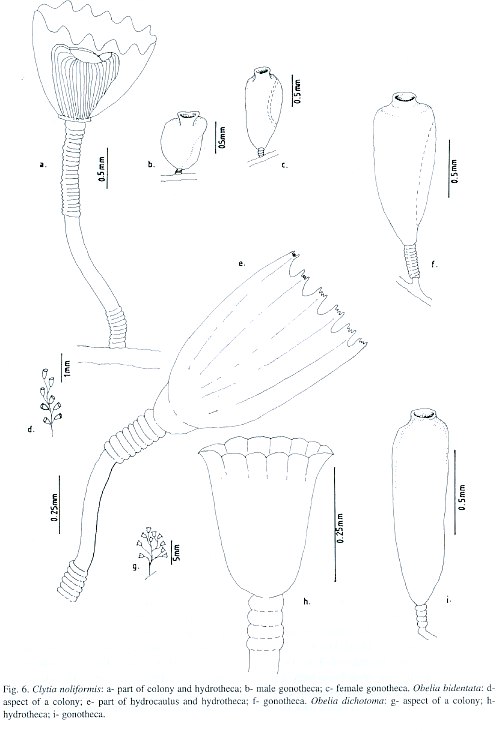
<body><![CDATA[<CENTER><FONT FACE="Arial"><FONT SIZE=-1><A HREF="#McCrady">McCrady, 1859</A> (Plate III a-c)</FONT></FONT></CENTER>       <P><FONT FACE="Arial"><FONT SIZE=-1><I>Clytia volubilis </I><A HREF="#Marktanner">Marktanner-Turneretscher, 1890</A>; <A HREF="#Versluys">Verluys, 1899</A>; <A HREF="#Hargitt09">Hargitt, 1909</A>; <I>Clytia noliformis </I><A HREF="#Nutting01a">Nutting, 1901a</A>; <A HREF="#Wallace">Wallace, 1909</A>; <A HREF="#Fraser12">Fraser, 1912a, 1918, 1921, 1943, 1944, 1946, 1947</A>; <A HREF="#Bennitt">Bennitt, 1922</A>; <A HREF="#Timmermann">Timmermann, 1932</A>; <A HREF="#Burkenroad">Burkenroad, 1939</A>; <A HREF="#Picard49">Picard, 1949</A>; <A HREF="#Behre">Behre, 1950</A>; <A HREF="#Deevey">Deevey, 1950</A>; <A HREF="#Mammen">Mammen, 1965</A>; <A HREF="#Rees65">Rees and Thursfield, 1965</A>; <A HREF="#Rees66">Rees and White, 1966</A>; <A HREF="#Gravier">Gravier, 1970</A>; <A HREF="#Gosner">Gosner, 1971</A>; <A HREF="#Morris">Morris and Mogelberg, 1973</A>; <A HREF="#Defenbaugh73">Defenbaugh and Hopkins, 1973</A>; <A HREF="#Defenbaugh74">Defenbaugh, 1974</A>; <A HREF="#Ryland">Ryland, 1974</A>; <A HREF="#Boero81a">Boero, 1981a, 1981b, 1987a</A>; <A HREF="#Spracklin">Spracklin, 1982</A>; <A HREF="#Florez">Fl&oacute;rez Gonz&aacute;lez, 1983</A>; <A HREF="#Calder86">Calder, 1986, 1991</A>; <A HREF="#Llobet">Llobet, Gili and Barang&eacute;, 1986</A>; <A HREF="#Ostman87">&Ouml;stman, Piraino and Roca, 1987</A>. <I>Clytia simplex </I><A HREF="#Congdon">Congdon, 1907</A>; <I>Campanularia (Clyti</I>a) <I>noliformis </I><A HREF="#Winge">Winge, 1923</A>; <A HREF="#Leloup32">Leloup, 1932</A>; <A HREF="#Germain">Germain, 1935</A>; <A HREF="#Vervoort68">Vervoort, 1968</A>; <I>Campanularia noliformis </I><A HREF="#McCrady">McCrady, 1859</A>; <I>Clytia folleata </I><A HREF="#Vannucci46">Vannucci Mendes, 1946</A>.</FONT></FONT>      <P><FONT FACE="Arial"><FONT SIZE=-1><B>Material studied: </B>Todos os Santos Bay, Fontes Island, on the octocoral <I>Caryjoa riisei</I>, 1-2 m depth, 20.viii.1994, nine colonies, 2 mm high, without gonophores [N 1813]; Pati Island, on the sponge <I>Haliclona carbonaria, </I>intertidal zone, 3.xii.1994, three colonies, 2 mm high, without gonophores [N 1814]; Berlinque Beach, on coral reef bank, 9 m depth, 22.xii.1993, twenty nine colonies, up to 3 mm high, female gonophores observed [N 1833]; Salvador City, Farol da Barra, on rock outcrop, 18 m depth, 1.iii.1993, four colonies, 2.5 mm high, without gonophores [N 1815]; Pituba Beach, on rock outcrop, 2-3 m depth, 10.v.1996, six colonies, 2 mm high, without gonophores [N 1816]; Ponta de Itapu&atilde;, on rock outcrop, intertidal zone, 30.i.1997, eight colonies, up to 3 mm high, male and female gonophores observed [N 1817]; Ribeira Beach, on ascidian <I>Botrylloides nige</I>r, shallow subtidal zone, 14.ii.1995, eighteen colonies, up to 3 mm high, male and female gonophores observed [N 1818]; Porto da Barra, on ascidian <I>Styella plicat</I>a, 6-8 m depth, 23.xi.1996, six colonies, up to 3 mm high, male gonophores observed [N 1819]; Northern Coast, Arembepe Beach, on external beach rock bank, 4-5 m depth, 15.xi.1995, one colony, 2 mm high, female gonophore observed [N 1820]; Arembepe region, on coral algal buildup, 25 m depth, 30.iii.1994, thirteen colonies, up to 2 mm high, without gonophores [N 1821]; 37 m depth, 18.vi.1992, twenty two colonies, up to 2 mm high, without gonophores [N 1822]; 50 m depth, 20.ix.1995, six colonies, up to 2 mm high, female gonophores observed [N 1823]; 42 m depth, 10.x.1996, seventeen colonies, up to 2 mm high, male and female gonophores observed [N 1824]; 17 m depth, 30.i.1997, nineteen colonies, up to 2 mm high, male and female gonophores observed [N 1825]; 22 m depth, 5.v.1997, thirty two colonies, up to 2 mm high, without gonophores [N 1826]; Guarajuba Beach, on shallow bank reef, 18 m depth, 18.iv.1996, twenty seven colonies, up to 3 mm high, without gonophores [N 1834]; Itacimirim beach, on coastal emergent reef wall, 4-5 m depth, 20.iv.1996, eleven colonies, 2- 2.5 mm high, without gonophores [N 1835].</FONT></FONT>      <P><FONT FACE="Arial"><FONT SIZE=-1><B>Description: </B>Yellowish stolonal colonies, up to 3 mm high, arising from a creeping hydrorhiza. Pedicels with thick perisarc, strong, straight or slightly sinuous, relatively short, 1.1-2.6 mm high, 65-88 &micro;m in maximum diameter; group of 18-20 strong annuli placed basally, and of 20-22 distally; usually smooth in between, but occasionally slightly waved. Hydrothecae with thick perisarc, campanulate, moderately shallow, 400-520 &micro;m deep, 350-465 &micro;m wide at margin, 135-190 &micro;m wide at diaphragm; margin with 14 or 15 blunt pyramidal cusps, separately by shallow U-shaped incisions. Hydrothecal diaphragm thick, pale or crystalline, usually straight; basal chamber sub-spherical and shallow. Hydranth yellow or pale, spherical, with 25-28 tentacles, about 810 &micro;m long each. Gonothecae dimorphic, usually golden or brownish, both arising from hydrorhiza on short annulated pedicels. Male: sub-cylindrical, irregularly folded, and usually asymmetric; short, about 650 &micro;m long, 250 &micro;m in maximum diameter; terminal aperture about 180 &micro;m wide, placed on a semi-tubular neck. Female, coneshaped, symmetric, longer, about 780 &micro;m long, 410 &micro;m in maximum diameter; terminal aperture about 220 &micro;m wide, placed on a tubular neck. Nematocyst compliment is represented by microbasic b-mastigophores of two sizes: (i) A-type: 4.0-5.0 x 1.2-1.5 &micro;m, very abundant throughout the colony, and (ii) B-type: 8.5-9.1 x 2.4-2.9 &micro;m, less numerous than A-type.</FONT></FONT>      <P><FONT FACE="Arial"><FONT SIZE=-1><B>nown range: </B>Brazil: first record. Circumglobal distribution: western Atlantic (<A HREF="#Fraser44">Fraser 1944</A>); eastern Atlantic (<A HREF="#Picard49">Picard 1949</A>); Indian Ocean (<A HREF="#Mammen">Mammen 1965</A>); eastern Pacific (<A HREF="#Fraser48">Fraser 1948</A>); Bermuda (<A HREF="#Congdon">Congdon 1907</A>, <A HREF="#Bennitt">Bennitt 1922</A>, <A HREF="#Burkenroad">Burkenroad 1939</A>, <A HREF="#Morris">Morris and Mogelberg 1973</A>, <A HREF="#Ryland">Ryland 1974</A>, <A HREF="#Calder86">Calder 1986a, 1991</A>).</FONT></FONT>     <BR>&nbsp;     <CENTER><IMG SRC="/img/fbpe/rbt/v51n1/2399i06.JPG" HEIGHT=731 WIDTH=499></CENTER> &nbsp;     
<CENTER><B><I><FONT FACE="Arial"><FONT SIZE=-1>Obelia bidentata</FONT></FONT></I></B></CENTER>      <CENTER><FONT FACE="Arial"><FONT SIZE=-1><A HREF="#Clarke75">Clarke, 1875</A> (Plate III d-f)</FONT></FONT></CENTER>       <P><FONT FACE="Arial"><FONT SIZE=-1><I>Obelia bidentata </I><A HREF="#Clarke75">Clarke, 1875</A>; <A HREF="#Calder91">Calder, 1991</A>; <A HREF="#Migotto93">Migotto, 1993</A>; <A HREF="#Cornelius82">Cornelius, 1982, 1995</A>; <I>Obelia bicuspidata </I><A HREF="#Clarke75">Clarke, 1875</A>; <I>Obelia longicyatha </I><A HREF="#Allman77">Allman, 1877</A>; <I>Obelia andersoni </I>Hincks, 1887; <I>Gonothyraea longicyatha </I><A HREF="#Thornely">Thornely, 1900</A>; <I>Clytia longicyatha </I><A HREF="#Billard06">Billard, 1906</A>; <I>Laomedea (Gonothyrae</I>a) <I>bidentata </I><A HREF="#Babic">Babic, 1913</A>; <I>Obelia spinulosa </I><A HREF="#Annandale">Annandale, 1915</A>; <I>Gonothyraea bicuspidata </I><A HREF="#Stechow19a">Stechow, 1919</A>; <I>Clytia longitheca </I><A HREF="#Hargitt24">Hargitt, 1924</A>; <I>Obelia longitheca </I><A HREF="#Hargitt24">Hargitt, 1924</A>; <I>Obelia atenuata </I><A HREF="#Hargitt24">Hargitt, 1924</A>; <I>Laomedea (Obelia</I>) <I>spinulosa </I>var. <I>minor </I><A HREF="#Leloup32">Leloup, 1932</A>; <I>Laomedea spinulosa </I><A HREF="#Leloup33">Leloup, 1933</A>; <I>Laomedea longicyatha </I><A HREF="#Leloup35">Leloup, 1935</A>; <I>Laomedea (Obelia</I>) <I>biscuspidata </I><A HREF="#Hummelinck36">Hummelincki, 1936</A>; <I>Laomedea bicuspidata </I><A HREF="#Vervoort46">Vervoort, 1946</A>; <I>Laomedea bicuspidata </I>var. <I>tenuis </I><A HREF="#Vervoort46">Vervoort, 1946</A>; <I>Laomedea (Obelia</I>) <I>longicyatha </I><A HREF="#Vervoort68">Vervoort, 1968</A>.</FONT></FONT>      ]]></body>
<body><![CDATA[<P><FONT FACE="Arial"><FONT SIZE=-1><B>Material studied: </B>Salvador City, Farol da Barra, on rock outcrop, 18 m depth, 1.iii.1993, four colonies, 4 mm high, without gonophores [N 1836]; Northern Coast, Arembepe Beach, on external beach rock bank, 6-8 m depth, 15.xi.1995, eighteen colonies, up to 4 mm high, gonophores observed [N 1837]; Arembepe region, on coral-algal buildup, 37 m depth, 18.vi.1992, eleven colonies, 3-4 mm high, with-out gonophores [N 1838]; Guarajuba Beach, on coastal emergent reef wall, 6-8 m depth, 23.iv.1997, five colonies, 4 mm high, without gonophores [N 1839]; Praia do Forte Beach, on coastal emergent reef wall, 5-6 m depth, 25.iv.1997, twenty colonies, 3-4 mm high, with-out gonophores [N 1840].</FONT></FONT>      <P><FONT FACE="Arial"><FONT SIZE=-1><B>Description: </B>Brownish erect colonies, sympodial, up to 4 mm high, arising from a creeping hydrorhiza. Hydrocaulus unbranched or irregularly branched in older colonies, monosiphonic and straight, divided into internodes at more or less regular intervals. Perisarc thick. Internodes long, about 520 &micro;m, with a group of 6 basally placed annuli; each internode supporting a hydrothecal pedicel from a distal apophysis; hydrothecal pedicel composed by 8-13 semi-spiral annulations, up to 200 &micro;m in length; apophysis alternating from side to side. Hydrothecae deeply campanulated, semi-cylindric, 480-530 &micro;m long, 167-210 &micro;m wide at margin, and 60-83 &micro;m wide at diaphragm; sometimes asymmetric; 6-8 conspicuous folds in hydrothecal walls runs down-wards from the margin; diaphragm always oblique; margin with 10-13 bimucronate cusps, never uniform, separated by U-shaped incisions. Hydrothecal diaphragm thin, delicate; basal chamber shallow, about 66-74 &micro;m deep. Hydranth soft brown or pale, small, cylindrical, about 320 &micro;m from diaphragm to tentacles. Tentacles short, 19-23 in number, about 265 &micro;m long. Gonothecae coneshaped, pale to whitish, 760-830 &micro;m long, 420-440 &micro;m wide at distal end, tapering dowards the base, 55-70 &micro;m wide, usually symmetrical. Terminal aperture, about 96 &micro;m wide, placed on a collar neck. Base with a long pedicel, with 8-14 annulations. Nematocyst compliment represented by microbasic b-mastigophores A-type, 6.1-6.5 x 2.0-2.6 &micro;m and by ishorhizas 5.1-6.5 x 1.1-2.0 &micro;m.</FONT></FONT>      <P><FONT FACE="Arial"><FONT SIZE=-1><B>Known range: </B>Brazil: Baia de Guanabara (<A HREF="#Vannucci49">Vannucci 1949</A> as <I>Gonothyraea bicuspidat</I>a); S&atilde;o Sebasti&atilde;o (S&atilde;o Paulo) (<A HREF="#Migotto93">Migotto 1993</A>). Circumglobal distribution: western Atlantic (<A HREF="#Fraser44">Fraser 1944</A>); eastern Atlantic (<A HREF="#Cornelius75b">Cornelius 1975b, 1982, 1995</A>); Indian Ocean (<A HREF="#Mammen">Mammen 1965</A>); western Pacific (<A HREF="#Hirohito">Hirohito 1983</A>); eastern Pacific (<A HREF="#Fraser37">Fraser 1937a</A>); Bermuda (<A HREF="#Calder91">Calder 1991</A>).</FONT></FONT>     <CENTER><I><FONT FACE="Arial"><FONT SIZE=-1>&nbsp;</FONT></FONT></I></CENTER>      <CENTER><B><I><FONT FACE="Arial"><FONT SIZE=-1>Obelia dichotoma</FONT></FONT></I></B></CENTER>      <CENTER><FONT FACE="Arial"><FONT SIZE=-1><A HREF="#Linnaeus58">Linnaeus, 1758</A> (Plate III g-i)</FONT></FONT></CENTER>       <P><FONT FACE="Arial"><FONT SIZE=-1><I>Sertularia dichotoma </I><A HREF="#Linnaeus58">Linnaeus, 1758</A>; <I>Sertularia longissima </I><A HREF="#Pallas">Pallas, 1766</A>; <I>Laomedea (Sertularia</I>) <I>dichotoma </I><A HREF="#Lamouroux12">Lamouroux, 1812</A>; <I>Sertularia geniculata </I><A HREF="#Sprengel">Sprengel, 1813</A>; <I>Campanularia dichotoma </I><A HREF="#Lamarck">Lamarck, 1816</A>; <I>Laomedea dichotoma </I><A HREF="#Lamouroux16">Lamouroux, 1816</A>; <I>Campanularia maior </I><A HREF="#Meyen">Meyen, 1834</A>; <I>Campanularia brasiliensis </I><A HREF="#Meyen">Meyen, 1834</A>; <I>Campanularia cavolinii </I><A HREF="#Deshayes">Deshayes and Milne-Edwards, 1836</A>; <I>Sertularia cavolini </I><A HREF="#Kolliker">K&ouml;lliker, 1843</A>; <I>Laomedea dichotoma </I>var. a <A HREF="#Johnston">Johnston, 1847</A>; <I>Campanularia (Laomede</I>a) <I>dichotoma </I><A HREF="#Maitland">Maitland, 1851</A>; <I>Obelia dichotoma </I><A HREF="#Allman64">Allman, 1864</A>; <A HREF="#Cornelius82">Cornelius, 1982, 1995</A>; <A HREF="#Calder91">Calder, 1991</A>; <A HREF="#Migotto93">Migotto, 1993</A>; <I>Eucope parasitica </I>A. <A HREF="#Agassiz65">Agassiz, 1865</A>; <I>Eucope pyriformis </I>A. <A HREF="#Agassiz65">Agassiz, 1865</A>; <I>Obelia hyalina </I><A HREF="#Clarke79">Clarke, 1879</A>; <I>Obelaria dichotoma </I><A HREF="#Haeckel">Haeckel, 1879</A>; <I>Obelaria (Campanularia</I>) <I>pyriformis </I><A HREF="#Haeckel">Haeckel, 1879</A>; <I>Campanularia cheloniae </I><A HREF="#Allman88">Allman, 1888</A>; <I>Obelia angulosa </I><A HREF="#Bale88">Bal<I>e,</I>1888</A>; <I>Laomedea (Obelia) dichotoma </I><A HREF="#Levinsen">Levinsen, 1893</A>; <I>Obelia gracilis </I><A HREF="#Calkins">Calkins, 1899</A>; <I>Obelia surcularis </I><A HREF="#Calkins">Calkins<I>, </I>1899</A>; <I>Obelia fragilis </I><A HREF="#Calkins">Calkin<I>s, </I>1899</A>; <I>Obelia griffini </I><A HREF="#Calkins">Calkin<I>s, </I>1899</A>; <I>Obelia rhunicola </I><A HREF="#Billard01">Billard, 1901</A>; <I>Obelia dubia </I><A HREF="#Nutting01a">Nutting, 1901</A>; <I>Campanularia obtusidens </I><A HREF="#Jaderholm">J&auml;derholm, 1904b</A>; <I>Obelia brasiliensis </I><A HREF="#Hartlaub05">Hartlaub, 1905</A>; <I>Obelia congdoni </I><A HREF="#Hargitt09">Hargitt, 1909</A>; <I>Laomedea sargassi </I><A HREF="#Broch13">Broch, 1913</A>; <I>Obelia obtusidentata </I><A HREF="#Bedot">Bedot, 1925</A>; <I>Obelia everta </I><A HREF="#Hargitt27">Hargitt, 1927</A>; <I>Obelia alternata </I><A HREF="#Fraser38">Fraser, 1938</A>; <I>Obelia equilateralis </I><A HREF="#Fraser38">Fraser, 1938</A>; <I>Obelia microtheca </I>Fraser, 1938; <I>Obelia obtusidens </I>Fraser, 1938; <I>Obelia tenuis </I><A HREF="#Fraser38">Fraser, 1938</A>; <I>Gonothyraea integra </I><A HREF="#Fraser40">Fraser, 1940</A>; <I>Obelia biserialis </I><A HREF="#Fraser48">Fraser, 1948</A>; <I>Laomedea (Obeli</I>a) <I>congdoni </I><A HREF="#Vervoort68">Vervoort, 1968</A>; <I>Laomedea (Obeli</I>a) <I>equilateralis </I><A HREF="#Vervoort68">Vervoort, 1968</A>; <I>Obelia (Laomede</I> a) <I>dichotoma </I><A HREF="#Gili82">Gili, 1982</A>.</FONT></FONT>      <P><FONT FACE="Arial"><FONT SIZE=-1><B>Material studied: </B>Todos os Santos Bay, Fontes Island, on <I>Eudendrium carneu</I>m, 1-2 m depth, 3.vi.1995, four colonies, 4-5 mm high, without gonophores [N 1827]; Northern Coast, Arembepe region, 50 m depth, 20.ix.1995, eight colonies, 6 mm high, gonophores observed [N 1828]; 25 m depth, 20.xii.1992, eighteen colonies, 5-6 mm high, gonophores observed [N 1829]; 42 m depth, 24.ix.1996, twenty colonies, 5-6 mm high, gonophores observed [N 1830]; Northern Coast, Itacimirim Beach, on shallow bank reef, 15 m depth, 20.iv.1996, fifteen colonies, 10-12 mm high, ithout gonophores [N 1831]; Praia do Forte Beach, on coastal emergent reef wall, 5-6 m depth, 25.iv.1997, twenty three colonies, up to 12 mm high, without gonophores [N 1832].</FONT></FONT>      <P><FONT FACE="Arial"><FONT SIZE=-1><B>Description: </B>Soft orange, brown, pale or slightly pinkish erect or bushy colonies, up to 12 mm high, sympodial, arising from a creeping hydrorhiza. Hydrocaulus usually branched, monosiphonic, divided into internodes at regular intervals. Internodes varied in length, slightly curved, slender, annulated basally, about 5-8 annuli, supporting a hydrothecal pedicel from distal apophysis. Hydrothecal pedicels with 4, 5 or 8 annulations. Hydrothecae, wide, bell-shaped, 250-280 &micro;m long, 200-245 &micro;m wide at margin, 95-110 &micro;m wide at diaphragm; margin slightly crenulate, 14-16 soft cusps, and 13-15 fine longitudinal folds, or sometimes entire; diaphragm thin, transverse or slightly oblique; basal chamber usually small. Hydranth short, cylindrical, about 150 &micro;m long, with 25-38 tentacles, each 220-240 &micro;m long. Gonothecae, whitish or yellowish, conical, long, 820-912 &micro;m long, 240-300 &micro;m in maximum diameter at distal end, tapering basally, 112-154 &micro;m wide. Terminal aperture on a tubular neck. Pedicels short, 30-42 &micro;m long, sometimes with 4-5 annulations, and usually arising directly from hydrothecal pedicel. Nematocyst compliment represented by microbasic b-mastigophores of small size, 4.8-7.5 x 1.9-2.5 &micro;m on tentacles and hypostome. Isorhizas of two different sizes: (i) 8.0-9.1 x 1.6-2.0 &micro;m, not recorded from tentacles and, (ii) 5.1-8.0 x 1.0-1.6 &micro;m less numerous throughout the colony.</FONT></FONT>      <P><FONT FACE="Arial"><FONT SIZE=-1><B>Known range: </B>Brazil: Rio de Janeiro (<A HREF="#Stechow19a">Stechow 1919</A> as <I>O. angulos</I>a); S&atilde;o Sebasti&atilde;o (S&atilde;o Paulo) (<A HREF="#Migotto93">Migotto 1993</A>). Circumglobal distribution: western Atlantic (<A HREF="#Fraser44">Fraser 1944</A>); eastern Atlantic (<A HREF="#Cornelius75a">Cornelius 1975a, 1982, 1995</A>); Indian Ocean (<A HREF="#Millard75">Millard 1975</A>); western Pacific (<A HREF="#Yamada">Yamada 1959</A>); eastern Pacific (<A HREF="#Fraser37">Fraser 1937</A>); Bermuda (<A HREF="#Congdon">Congdon 1907</A>, <A HREF="#Bennitt">Bennitt 1922</A>, <A HREF="#Calder86">Calder 1986</A>, <A HREF="#Calder91">1991</A>).</FONT></FONT>      ]]></body>
<body><![CDATA[<P><B><FONT FACE="Arial"><FONT SIZE=-1>Discussion</FONT></FONT></B>      <P><FONT FACE="Arial"><FONT SIZE=-1>Three distinct groups of hydroids were separated based upon species composition and geographical location along the coast of Bahia. The first group, represented by sandy shores, was characterised solely by three species of <I>Clyti</I>a, of which two <I>(C. macrotheca </I>and <I>C. noliformi</I>s) are recorded for the first time from Brazil. The second cluster comprised mangroves and rocky shores, and was characterised by five species, including <I>C. gracilis </I>and <I>C. noliformis. </I>The third group (beach rocks, coral-algal buildup and coral reefs) was located at the northern coast of Bahia, and had higher species numbers than the other two groups, including the presence of <I>Campanularia hincksii </I>(recorded for the first time in Brazil).</FONT></FONT>      <P><FONT FACE="Arial"><FONT SIZE=-1>Phenotypically plastic species such as <I>Clytia gracilis </I>and <I>C. noliformis </I>colonised all six ecosystems assessed, including sandy shores where only three hydroid species were recorded. This wide distribution a wide tolerance to various levels of physical stress as long as there is a hard substratum for attachment. In contrast, <I>C. hummelinck</I>i, a remarkably rare species (<A HREF="#Cornelius82">Cornelius 1982</A>, <A HREF="#Calder91">Calder 1991</A>, <A HREF="#Migotto93">Migotto 1993</A>), occurred in smaller numbers and was recorded only from two ecosystems, each with oligotrophic waters. This indicates that this species requires very specific environmental conditions and may be lost if the ecosystem becomes further degraded.</FONT></FONT>      <P><FONT FACE="Arial"><FONT SIZE=-1>Based on these distribution, it appears that hydroid species may be suitable candidates for biomonitors of Brazilian waters.</FONT></FONT>      <P><FONT FACE="Arial"><FONT SIZE=-1>The campanulariids recorded from northern Bahia, and those from the south coast of Brazil (<A HREF="#Migotto93">Migotto 1993</A>), are usually smaller than those reported from Europe (<A HREF="#Cornelius82">Cornelius 1982, 1995</A>). Morphological variations (i.e. margin of the hydrotheca, number of annulations throughout the colony, and abundance of certain types of nematocyst) can be taxonomically frustrating and make identifications difficult. However, these variations appear to be phenotypic responses to environmental conditions recorded in different ecosystems (<A HREF="#Gili95">Gili and Hughes 1995</A>). Biochemical systematical studies are helpful in defining species, but to address the reasons behind such phenotipic variation requires detailed and intensive studies of hydroid communities, including quanti-tative and behavioural ecology.</FONT></FONT>      <P><B><FONT FACE="Arial"><FONT SIZE=-1>Acknowledgements</FONT></FONT></B>      <P><FONT FACE="Arial"><FONT SIZE=-1>The authors wish to thank the Environmental Protection Corporation (CETREL S/A), Petroleum of Brazil (PETROBR&Aacute;S) and Centro de Apoio ao Desenvolvimento Cient&iacute;fico e Tecnol&oacute;gico (CNPq-Brazil) for financial support. The constructive criticism of the manuscript by two external referees P. Cornelius (Natural History Museum, London) and W. Vervoort (Nationaal Natuurhistorisch Museum, Leiden) are gratefully acknowledged. Sincere thanks are due to Malcolm B. Jones (Department of Biological Sciences, University of Plymouth) who kindly served as manuscript editor. Gratitude is extended to Jos&eacute; Mar&iacute;a Land&iacute;n Dom&iacute;nguez -Laboratory of Coastal Studies, and to Marlene Campos Peso Aguiar - Laboratory of Malacology and Benthic Ecology, both from Universidade Federal da Bahia, Brazil, for the technical facilities provided during the period of this research. Gratitude is expanded to Arilma Farias de Souza, Carlos Neves, Dirlene Cairo Aguiar, Larissa de Siqueira, Rita de C&aacute;ssia Farani Assis, Rilza da Costa Tourinho Gomes, Simone Souza de Moraes, Tania Kobler Brazil and Yonara Souza Braga for all encouragement and assistance. Thanks to Tendai Mutyasera for the illustrations.</FONT></FONT>      <P><B><FONT FACE="Arial"><FONT SIZE=-1>Resumen</FONT></FONT></B>      <P><FONT FACE="Arial"><FONT SIZE=-1>La familia Campanulariidae es relativamente bien conocida, sin embargo varios aspectos de su biolog&iacute;a y ecolog&iacute;a no han sido aclarados. Este estudio presenta el primer enfoque semicuantitativo sobre los hidroidos campanularidos del noreste del Brasil, distribuidos hasta los 60 metros de profundidad y se basa en colecciones obtenidas desde 1992. Las colonias fueron colectadas de seis h&aacute;bitats a lo largo de la costa de Ciudad de Salvador, Bah&iacute;a de Todos os Santos, Isla de Itaparica hasta la regi&oacute;n norte de la costa del estado de Bahia. Se registraron nueve especies de las 982 colonias examinadas: <I>Campanularia hincksii, Clytia gracilis, C.hemisphaerica, C. Hummelincki, C. Linearis, C. Macrotheca, C. Noliformis, Obelia bidentata </I>y <I>O. Dichotom</I>a. En la escala de abundancia <I>Clytia gracilis </I>y <I>C. Noliformis </I>fueron las especies m&aacute;s abundantes, mientras que <I>Campanularia hincksii </I>y <I>Clytia hummelincki </I>fueron las especies raras. El an&aacute;lisis de clasificaci&oacute;n con datos de abundancia relativa mostr&oacute; que las costas arenosas poseen una comunidad de hidroidos muy diferente a la de los otros h&aacute;bitats. Se proporciona una clave simplificada de identificaci&oacute;n, redescripciones, ilustraciones y un estudio del cnidoma para cada especie. <I>Campanularia hincksii, Clytia macrotheca </I>y <I>C. noliformis </I>se informan por primera vez para Brasil.</FONT></FONT>      <P><B><FONT FACE="Arial"><FONT SIZE=-1>References</FONT></FONT></B>      ]]></body>
<body><![CDATA[<!-- ref --><P><A NAME="Adams"></A><FONT FACE="Arial"><FONT SIZE=-1>Adams, J. 1960. Acontribution to the biology of postlarval development of the Sargassum fish, <I>Histrio histrio </I>(Linnaeus), with a discussion of the <I>Sargassum </I>complex. Bull. Mar. Sci. Gulf Caribb. 10: 55-82.</FONT></FONT>    &nbsp;&nbsp;&nbsp;&nbsp;&nbsp;&nbsp;&nbsp;&nbsp;[&#160;<a href="javascript:void(0);" onclick="javascript: window.open('/scielo.php?script=sci_nlinks&ref=1219208&pid=S0034-7744200300010001000001&lng=','','width=640,height=500,resizable=yes,scrollbars=1,menubar=yes,');">Links</a>&#160;]<!-- end-ref --><!-- ref --><P><A NAME="Agassiz65"></A><FONT FACE="Arial"><FONT SIZE=-1>Agassiz, A. 1865. Illustrated catalogue of the Museum of Comparative Zoology, at Harvard College. No. II, North American Acalephae. Cambridge, 234 p.</FONT></FONT>    &nbsp;&nbsp;&nbsp;&nbsp;&nbsp;&nbsp;&nbsp;&nbsp;[&#160;<a href="javascript:void(0);" onclick="javascript: window.open('/scielo.php?script=sci_nlinks&ref=1219209&pid=S0034-7744200300010001000002&lng=','','width=640,height=500,resizable=yes,scrollbars=1,menubar=yes,');">Links</a>&#160;]<!-- end-ref --><!-- ref --><P><A NAME="Agassiz62"></A><FONT FACE="Arial"><FONT SIZE=-1>Agassiz, L. 1862. Contributions to the natural history of the United States of America, 4. Little Brown, Boston, 380 p.</FONT></FONT>    &nbsp;&nbsp;&nbsp;&nbsp;&nbsp;&nbsp;&nbsp;&nbsp;[&#160;<a href="javascript:void(0);" onclick="javascript: window.open('/scielo.php?script=sci_nlinks&ref=1219210&pid=S0034-7744200300010001000003&lng=','','width=640,height=500,resizable=yes,scrollbars=1,menubar=yes,');">Links</a>&#160;]<!-- end-ref --><P><A NAME="Alder56"></A><FONT FACE="Arial"><FONT SIZE=-1>Alder, J. 1856. Anotice of some new genera and species of British hydroid zoophytes. Ann. Mag. Nat. Hist. (Series 2). 18: 353-362.</FONT></FONT>      <!-- ref --><P><A NAME="Allman64"></A><FONT FACE="Arial"><FONT SIZE=-1>Allman, G.J. 1864. On the construction and limitation of genera among the Hydroida. Ann. Mag. Nat. Hist. (Series 3). 13: 345-380.</FONT></FONT>    &nbsp;&nbsp;&nbsp;&nbsp;&nbsp;&nbsp;&nbsp;&nbsp;[&#160;<a href="javascript:void(0);" onclick="javascript: window.open('/scielo.php?script=sci_nlinks&ref=1219212&pid=S0034-7744200300010001000004&lng=','','width=640,height=500,resizable=yes,scrollbars=1,menubar=yes,');">Links</a>&#160;]<!-- end-ref --><P><A NAME="Allman77"></A><FONT FACE="Arial"><FONT SIZE=-1>Allman, G.J. 1877. Report on the Hydroida collected during the exploration of the Gulf Stream by L.F.Portual&egrave;s, assistant, United States Coast Survey. Mem. Mus. Comp. Zool. Harvard Coll. 5:1-66.</FONT></FONT>      <P><A NAME="Allman88"></A><FONT FACE="Arial"><FONT SIZE=-1>Allman, G.J. 1888. Report on the Hydroida dredged by H.M.S. Challenger during the years 1873-76. Part II: The Tubularinae, Corymorphinae, Campanularinae, Sertularinae, and Thalamophora. Report on Scientific Results of the Voyage H.M.S. Challenger during the years 1873-76. Zoology. 7: 1-90.</FONT></FONT>      <!-- ref --><P><A NAME="Annandale"></A><FONT FACE="Arial"><FONT SIZE=-1>Annandale, N. 1915. Fauna of the Chilka Lake. The coelenterates of the lake, with an account of the Actiniaria of brackish water in the Gangetic delta. Mem. Indian Mus. 5: 65-114.</FONT></FONT>    &nbsp;&nbsp;&nbsp;&nbsp;&nbsp;&nbsp;&nbsp;&nbsp;[&#160;<a href="javascript:void(0);" onclick="javascript: window.open('/scielo.php?script=sci_nlinks&ref=1219215&pid=S0034-7744200300010001000005&lng=','','width=640,height=500,resizable=yes,scrollbars=1,menubar=yes,');">Links</a>&#160;]<!-- end-ref --><!-- ref --><P><A NAME="Babic"></A><FONT FACE="Arial"><FONT SIZE=-1>Babic, K. 1913. Bemerkungen zu den zwei in der Adria vorkommenden thacaphoren Hydroiden. Zool. Anz. 43: 284-288.</FONT></FONT>    &nbsp;&nbsp;&nbsp;&nbsp;&nbsp;&nbsp;&nbsp;&nbsp;[&#160;<a href="javascript:void(0);" onclick="javascript: window.open('/scielo.php?script=sci_nlinks&ref=1219216&pid=S0034-7744200300010001000006&lng=','','width=640,height=500,resizable=yes,scrollbars=1,menubar=yes,');">Links</a>&#160;]<!-- end-ref --><!-- ref --><P><A NAME="Bale87"></A><FONT FACE="Arial"><FONT SIZE=-1>Bale, W.M. 1887. The genera of the Plumulariidae, with observations on various Australian hydroids. Trans. and Proc. Royal Soc. Victoria. 23: 73-110.</FONT></FONT>    &nbsp;&nbsp;&nbsp;&nbsp;&nbsp;&nbsp;&nbsp;&nbsp;[&#160;<a href="javascript:void(0);" onclick="javascript: window.open('/scielo.php?script=sci_nlinks&ref=1219217&pid=S0034-7744200300010001000007&lng=','','width=640,height=500,resizable=yes,scrollbars=1,menubar=yes,');">Links</a>&#160;]<!-- end-ref --><!-- ref --><P><A NAME="Bale88"></A><FONT FACE="Arial"><FONT SIZE=-1>Bale, W.M. 1888. On some new and rare Hydroids in the Australian Museum Collection. Proc. Lin. Soc. New South Wales. 2(3): 745-799.</FONT></FONT>    &nbsp;&nbsp;&nbsp;&nbsp;&nbsp;&nbsp;&nbsp;&nbsp;[&#160;<a href="javascript:void(0);" onclick="javascript: window.open('/scielo.php?script=sci_nlinks&ref=1219218&pid=S0034-7744200300010001000008&lng=','','width=640,height=500,resizable=yes,scrollbars=1,menubar=yes,');">Links</a>&#160;]<!-- end-ref --><!-- ref --><P><A NAME="Bedot"></A><FONT FACE="Arial"><FONT SIZE=-1>Bedot, M. 1925. Mat&eacute;riaux pour servir a l’histoire des hydro&iuml;des. 7&eacute;me p&eacute;riode (1901 &agrave; 1910). Rev. Suisse Zool. 32: 1-657.</FONT></FONT>    &nbsp;&nbsp;&nbsp;&nbsp;&nbsp;&nbsp;&nbsp;&nbsp;[&#160;<a href="javascript:void(0);" onclick="javascript: window.open('/scielo.php?script=sci_nlinks&ref=1219219&pid=S0034-7744200300010001000009&lng=','','width=640,height=500,resizable=yes,scrollbars=1,menubar=yes,');">Links</a>&#160;]<!-- end-ref --><P><A NAME="Behre"></A><FONT FACE="Arial"><FONT SIZE=-1>Behre, E.H. 1950. Annotated list of the fauna of the Grand Isle region 1928-1946. Occasional Papers of the Marine Laboratory, Louisiana State Univ. 6: 1-66.</FONT></FONT>      <P><A NAME="Bennitt"></A><FONT FACE="Arial"><FONT SIZE=-1>Bennitt, R. 1922. Additions to the hydroid fauna of the Bermuda. Proc. Amer. Acad. of Arts Sci. 57: 241-259.</FONT></FONT>      <!-- ref --><P><A NAME="Billard01"></A><FONT FACE="Arial"><FONT SIZE=-1>Billard, A.1901. De la stolonisation chez les hydro&iuml;des. Comptes rendus Hebdomadaires des S&eacute;ances l’Acad. Sci. 133: 521-524.</FONT></FONT>    &nbsp;&nbsp;&nbsp;&nbsp;&nbsp;&nbsp;&nbsp;&nbsp;[&#160;<a href="javascript:void(0);" onclick="javascript: window.open('/scielo.php?script=sci_nlinks&ref=1219222&pid=S0034-7744200300010001000010&lng=','','width=640,height=500,resizable=yes,scrollbars=1,menubar=yes,');">Links</a>&#160;]<!-- end-ref --><!-- ref --><P><A NAME="Billard04"></A><FONT FACE="Arial"><FONT SIZE=-1>Billard, A. 1904. Contribution &agrave; l’&eacute;tude des hydro&iuml;des (multiplication, r&eacute;g&eacute;n&eacute;ration, greffes, variations). Ann. Sci. Natur., Zool. Pal&eacute;ontol. (8) 20: 1-251.</FONT></FONT>    &nbsp;&nbsp;&nbsp;&nbsp;&nbsp;&nbsp;&nbsp;&nbsp;[&#160;<a href="javascript:void(0);" onclick="javascript: window.open('/scielo.php?script=sci_nlinks&ref=1219223&pid=S0034-7744200300010001000011&lng=','','width=640,height=500,resizable=yes,scrollbars=1,menubar=yes,');">Links</a>&#160;]<!-- end-ref --><P><A NAME="Billard06"></A><FONT FACE="Arial"><FONT SIZE=-1>Billard, A. 1906. Note sur les hydro&iuml;des du Travailler et du Talisman. Bull. Mus. d’Hist. Natur. 12: 329-334.</FONT></FONT>      <P><A NAME="Billard17"></A><FONT FACE="Arial"><FONT SIZE=-1>Billard, A. 1917. Note sur quelques esp&egrave;ces d’hydro&iuml;des libres. Bull. Mus. Nat. d’Hist. Natur. 23: 539-546.</FONT></FONT>      <P><A NAME="Billard33"></A><FONT FACE="Arial"><FONT SIZE=-1>Billard, A. 1933. Les hydro&iuml;des des Golfes de Suez et d’Akaba. M&eacute;m. l’Inst. d’&Eacute;gypt. 21: 1-30.</FONT></FONT>      <!-- ref --><P><A NAME="Billard38"></A><FONT FACE="Arial"><FONT SIZE=-1>Billard, A. 1938. Note sur une esp&egrave;ce de campanularid&eacute;s <I>(Clytia gravier</I>i, Billard). Bull. Mus. Nat. d’Hist. Natur. Series 2. 10: 429-432.</FONT></FONT>    &nbsp;&nbsp;&nbsp;&nbsp;&nbsp;&nbsp;&nbsp;&nbsp;[&#160;<a href="javascript:void(0);" onclick="javascript: window.open('/scielo.php?script=sci_nlinks&ref=1219227&pid=S0034-7744200300010001000012&lng=','','width=640,height=500,resizable=yes,scrollbars=1,menubar=yes,');">Links</a>&#160;]<!-- end-ref --><P><A NAME="Boero81a"></A><FONT FACE="Arial"><FONT SIZE=-1>Boero, F. 1981a. Systematics and ecology of the hydroid population of two <I>Posidonia oceanica </I>meadows. Mar. Ecol. 2: 181-197.</FONT></FONT>      <P><A NAME="Boero81b"></A><FONT FACE="Arial"><FONT SIZE=-1>Boero, F. 1981b. Osservazioni ecologiche sugli idroidi della fascia a mitili della Riviera Ligure di levante. Cahiers Biol. Mar. 22: 107-117.</FONT></FONT>      <!-- ref --><P><A NAME="Boero87"></A><FONT FACE="Arial"><FONT SIZE=-1>Boero, F. 1987. Evolutionary implications of habitat selection in the hydroids of <I>Posidonia oceanica </I>meadows. <I>In J. </I>Bouillon, Boero, F., Cicogna, F. &amp; P.F.S. Cornelius (eds.). Modern trends in the systematics, ecology, and evolution of hydroids and hydromedusae. Claredon, Oxford. pp. 251-256.</FONT></FONT>    &nbsp;&nbsp;&nbsp;&nbsp;&nbsp;&nbsp;&nbsp;&nbsp;[&#160;<a href="javascript:void(0);" onclick="javascript: window.open('/scielo.php?script=sci_nlinks&ref=1219230&pid=S0034-7744200300010001000013&lng=','','width=640,height=500,resizable=yes,scrollbars=1,menubar=yes,');">Links</a>&#160;]<!-- end-ref --><!-- ref --><P><A NAME="Borradaile"></A><FONT FACE="Arial"><FONT SIZE=-1>Borradaile, L.A. 1905. Hydroids. The Fauna and Geography of the Maldive and Laccadive Archipelagos. 2: 836-845.</FONT></FONT>    &nbsp;&nbsp;&nbsp;&nbsp;&nbsp;&nbsp;&nbsp;&nbsp;[&#160;<a href="javascript:void(0);" onclick="javascript: window.open('/scielo.php?script=sci_nlinks&ref=1219231&pid=S0034-7744200300010001000014&lng=','','width=640,height=500,resizable=yes,scrollbars=1,menubar=yes,');">Links</a>&#160;]<!-- end-ref --><!-- ref --><P><A NAME="Bouillon"></A><FONT FACE="Arial"><FONT SIZE=-1>Bouillon, J. 1985. Essai de classification des hydropolypes-hydrom&eacute;duses (Hydrozoa-Cnidaria). Indo Malayan Zool. 1: 29-243.</FONT></FONT>    &nbsp;&nbsp;&nbsp;&nbsp;&nbsp;&nbsp;&nbsp;&nbsp;[&#160;<a href="javascript:void(0);" onclick="javascript: window.open('/scielo.php?script=sci_nlinks&ref=1219232&pid=S0034-7744200300010001000015&lng=','','width=640,height=500,resizable=yes,scrollbars=1,menubar=yes,');">Links</a>&#160;]<!-- end-ref --><!-- ref --><P><A NAME="Bray"></A><FONT FACE="Arial"><FONT SIZE=-1>Bray, J.R. &amp; Curtis, J.T. An ordination of the upland forest communities of southern Wisconsin. Ecol. Monogr. 27: 325-349.</FONT></FONT>    &nbsp;&nbsp;&nbsp;&nbsp;&nbsp;&nbsp;&nbsp;&nbsp;[&#160;<a href="javascript:void(0);" onclick="javascript: window.open('/scielo.php?script=sci_nlinks&ref=1219233&pid=S0034-7744200300010001000016&lng=','','width=640,height=500,resizable=yes,scrollbars=1,menubar=yes,');">Links</a>&#160;]<!-- end-ref --><!-- ref --><P><A NAME="Broch12"></A><FONT FACE="Arial"><FONT SIZE=-1>Broch, H. 1912. Hydroiduntersuchungen III. Vergleichende Studien an Adriatischen Hydroiden. Det Kongelige Norske Videnskabers Selskabs Skrifter. 1: 1-65.</FONT></FONT>    &nbsp;&nbsp;&nbsp;&nbsp;&nbsp;&nbsp;&nbsp;&nbsp;[&#160;<a href="javascript:void(0);" onclick="javascript: window.open('/scielo.php?script=sci_nlinks&ref=1219234&pid=S0034-7744200300010001000017&lng=','','width=640,height=500,resizable=yes,scrollbars=1,menubar=yes,');">Links</a>&#160;]<!-- end-ref --><!-- ref --><P><A NAME="Broch13"></A><FONT FACE="Arial"><FONT SIZE=-1>Broch, H. 1913. Hydroida from the "Michael Sars" North Atlantic Deep Sea Expedition 1910. Report on the Scientific Results of the "Michael Sars" North Atlantic Deep Sea Expedition 1910. Zoology 3: 1-18.</FONT></FONT>    &nbsp;&nbsp;&nbsp;&nbsp;&nbsp;&nbsp;&nbsp;&nbsp;[&#160;<a href="javascript:void(0);" onclick="javascript: window.open('/scielo.php?script=sci_nlinks&ref=1219235&pid=S0034-7744200300010001000018&lng=','','width=640,height=500,resizable=yes,scrollbars=1,menubar=yes,');">Links</a>&#160;]<!-- end-ref --><P><A NAME="Broch33"></A><FONT FACE="Arial"><FONT SIZE=-1>Broch, H. 1933. Zur Kenntnis des Adriatischen Hydroidenfauna von Split. Arten und Variationen. Skrifter Utgitt av det Norske Videnskaps-Akademi I Oslo I, Matematisk-Naturvidenskapelig Kl. 4: 1-115.</FONT></FONT>      <P><A NAME="Burkenroad"></A><FONT FACE="Arial"><FONT SIZE=-1>Burkenroad, M.D. 1939. <I>In </I>Parr, A.E. Quantitative observations on the pelagic <I>Sargassum </I>vegetation of the western north Atlantic. Bull. Bingham Oceanogr. Collec. 6: 1-94.</FONT></FONT>      ]]></body>
<body><![CDATA[<!-- ref --><P><A NAME="Calder75"></A><FONT FACE="Arial"><FONT SIZE=-1>Calder, D.R. 1975. Biotic census of Cape Cod Bay: Hydroids. Biol. Bull. Mar. Biol. Lab. Woods Hole. 149: 287-315.</FONT></FONT>    &nbsp;&nbsp;&nbsp;&nbsp;&nbsp;&nbsp;&nbsp;&nbsp;[&#160;<a href="javascript:void(0);" onclick="javascript: window.open('/scielo.php?script=sci_nlinks&ref=1219238&pid=S0034-7744200300010001000019&lng=','','width=640,height=500,resizable=yes,scrollbars=1,menubar=yes,');">Links</a>&#160;]<!-- end-ref --><!-- ref --><P><A NAME="Calder86"></A><FONT FACE="Arial"><FONT SIZE=-1>Calder, D.R. 1986. Class Hydrozoa. pp. 127-155. <I>In </I>W. Sterrer (ed.). Marine fauna and flora of Bermuda: a systematic guide to the identification of marine organisms. Wiley-Interscience, New York.</FONT></FONT>    &nbsp;&nbsp;&nbsp;&nbsp;&nbsp;&nbsp;&nbsp;&nbsp;[&#160;<a href="javascript:void(0);" onclick="javascript: window.open('/scielo.php?script=sci_nlinks&ref=1219239&pid=S0034-7744200300010001000020&lng=','','width=640,height=500,resizable=yes,scrollbars=1,menubar=yes,');">Links</a>&#160;]<!-- end-ref --><!-- ref --><P><A NAME="Calder88"></A><FONT FACE="Arial"><FONT SIZE=-1>Calder, D.R. 1988. Shallow water hydroids of Bermuda: the Athecatae. Roy. Ontario Mus., Life Sci. Contrib. 148. 107 p.</FONT></FONT>    &nbsp;&nbsp;&nbsp;&nbsp;&nbsp;&nbsp;&nbsp;&nbsp;[&#160;<a href="javascript:void(0);" onclick="javascript: window.open('/scielo.php?script=sci_nlinks&ref=1219240&pid=S0034-7744200300010001000021&lng=','','width=640,height=500,resizable=yes,scrollbars=1,menubar=yes,');">Links</a>&#160;]<!-- end-ref --><!-- ref --><P><A NAME="Calder91"></A><FONT FACE="Arial"><FONT SIZE=-1>Calder, D.R. 1991. Shallow water hydroids from Bermuda: the Thecatae, exclusive of Plumularioidea. Roy. Ontario Mus. Life Sci. Contrib. 154. 140 p.</FONT></FONT>    &nbsp;&nbsp;&nbsp;&nbsp;&nbsp;&nbsp;&nbsp;&nbsp;[&#160;<a href="javascript:void(0);" onclick="javascript: window.open('/scielo.php?script=sci_nlinks&ref=1219241&pid=S0034-7744200300010001000022&lng=','','width=640,height=500,resizable=yes,scrollbars=1,menubar=yes,');">Links</a>&#160;]<!-- end-ref --><P><A NAME="Calder97"></A><FONT FACE="Arial"><FONT SIZE=-1>Calder, D.R. 1997. Synopsis of hydroids from 1000 m and deeper in the western North Atlantic. <I>In </I>J.C. den Hartog <I>et al. </I>(eds.). Proceedings of the 6 th International Conference on Coelenterate Biology: 85-90. Nationaal Natuurhistorisch Museum, Leiden, The Netherlands: i-xviii, 1-542.</FONT></FONT>      <P><A NAME="Calkins"></A><FONT FACE="Arial"><FONT SIZE=-1>Calkins, G.N. 1899. Some hydroids from Puget Sound. Proc. Boston Soc. Nat. Hist. 28: 333-368.</FONT></FONT>      <P><A NAME="Carr"></A><FONT FACE="Arial"><FONT SIZE=-1>Carr, M.R. 1996. Plymouth Routines in Multivariate Analysis. Primer user manual. 45 p.</FONT></FONT>      <!-- ref --><P><A NAME="Clarke75"></A><FONT FACE="Arial"><FONT SIZE=-1>Clarke, S.F. 1875. Descriptions of the new and rare species of hydroids from the new England coast. Trans. Connecticut Acad. Arts Sci. 3: 58-66.</FONT></FONT>    &nbsp;&nbsp;&nbsp;&nbsp;&nbsp;&nbsp;&nbsp;&nbsp;[&#160;<a href="javascript:void(0);" onclick="javascript: window.open('/scielo.php?script=sci_nlinks&ref=1219245&pid=S0034-7744200300010001000023&lng=','','width=640,height=500,resizable=yes,scrollbars=1,menubar=yes,');">Links</a>&#160;]<!-- end-ref --><!-- ref --><P><A NAME="Clarke79"></A><FONT FACE="Arial"><FONT SIZE=-1>Clarke, S.F. 1879. Report on the Hydroida collected during the exploration of the Gulf Stream and Gulf of Mexico by Alexander Agassiz, 1877-88. Bull. Mus. Comp. Zo&ouml;l. Harvard Coll. 5: 239-252.</FONT></FONT>    &nbsp;&nbsp;&nbsp;&nbsp;&nbsp;&nbsp;&nbsp;&nbsp;[&#160;<a href="javascript:void(0);" onclick="javascript: window.open('/scielo.php?script=sci_nlinks&ref=1219246&pid=S0034-7744200300010001000024&lng=','','width=640,height=500,resizable=yes,scrollbars=1,menubar=yes,');">Links</a>&#160;]<!-- end-ref --><P><A NAME="Clarke07"></A><FONT FACE="Arial"><FONT SIZE=-1>Clarke, S.F. 1907. Reports on the scientific results of the expedition to eastern tropical Pacific, in charge of Alexander Agassiz, by the U.S. Fish Commission steamer "Albatross", from October, 1904, to March, 1905, Lieut. – Commander L.M. Garret, U.S.N., commanding. VIII. The hydroids. Mem. Mus. Comp. Zool. Harvard Coll. 35(1): 1-18.</FONT></FONT>      ]]></body>
<body><![CDATA[<P><A NAME="Congdon"></A><FONT FACE="Arial"><FONT SIZE=-1>Congdon, E.D. 1907. The hydroids of Bermuda. Proc. Of the American Acad. of Arts and Sci. 42: 463-485.</FONT></FONT>      <!-- ref --><P><A NAME="Cornelius75a"></A><FONT FACE="Arial"><FONT SIZE=-1>Cornelius, P.F.S. 1975a. A revision of the species of Lafoeidae and Haleciidae (Coelenterata:Hydroida) recorded from Britain and nearby seas. Bull. of the Brit. Mus. (Natur. Hist.). Zool. 28: 375-426.</FONT></FONT>    &nbsp;&nbsp;&nbsp;&nbsp;&nbsp;&nbsp;&nbsp;&nbsp;[&#160;<a href="javascript:void(0);" onclick="javascript: window.open('/scielo.php?script=sci_nlinks&ref=1219249&pid=S0034-7744200300010001000025&lng=','','width=640,height=500,resizable=yes,scrollbars=1,menubar=yes,');">Links</a>&#160;]<!-- end-ref --><!-- ref --><P><A NAME="Cornelius75b"></A><FONT FACE="Arial"><FONT SIZE=-1>Cornelius, P.F.S. 1975b. The hydroid species of <I>Obelia </I>(Coelenterata, Hydrozoa, Campanulariidae), with notes on the medusa stage. Bull. Brit. Mus. (Natur. Hist.). Zool. 28: 249-293.</FONT></FONT>    &nbsp;&nbsp;&nbsp;&nbsp;&nbsp;&nbsp;&nbsp;&nbsp;[&#160;<a href="javascript:void(0);" onclick="javascript: window.open('/scielo.php?script=sci_nlinks&ref=1219250&pid=S0034-7744200300010001000026&lng=','','width=640,height=500,resizable=yes,scrollbars=1,menubar=yes,');">Links</a>&#160;]<!-- end-ref --><!-- ref --><P><A NAME="Cornelius82"></A><FONT FACE="Arial"><FONT SIZE=-1>Cornelius, P.F.S. 1982. Hydroids and medusae of the family Campanularidae recorded from the eastern North Atlantic, with a world synopsis of genera. Bull. Brit. Mus. (Natur. Hist.). Zool. 42: 37-148.</FONT></FONT>    &nbsp;&nbsp;&nbsp;&nbsp;&nbsp;&nbsp;&nbsp;&nbsp;[&#160;<a href="javascript:void(0);" onclick="javascript: window.open('/scielo.php?script=sci_nlinks&ref=1219251&pid=S0034-7744200300010001000027&lng=','','width=640,height=500,resizable=yes,scrollbars=1,menubar=yes,');">Links</a>&#160;]<!-- end-ref --><P><A NAME="Cornelius95"></A><FONT FACE="Arial"><FONT SIZE=-1>Cornelius, P.F.S 1995. North-west European thecate hydroids and their medusae (Cnidaria, Leptolida, Leptothecatae). Part 2. Synopses of the British Fauna, 50. 396 p.</FONT></FONT>      <P><A NAME="Deevey"></A><FONT FACE="Arial"><FONT SIZE=-1>Deevey, E.S. 1950. Hydroids from Louisiana and Texas, with remarks on the Pleistocene biogeography of the western Gulf of Mexico. Ecology 31: 334-367.</FONT></FONT>      <!-- ref --><P><A NAME="Defenbaugh74"></A><FONT FACE="Arial"><FONT SIZE=-1>Defenbaugh, R. 1974. Hydroids. pp. 94-112. <I>In </I>T.J. Bright &amp; L.H. Pequegnat (eds.). Biota of the West Flower Garden Bank. Gulf Publishing, Houston.</FONT></FONT>    &nbsp;&nbsp;&nbsp;&nbsp;&nbsp;&nbsp;&nbsp;&nbsp;[&#160;<a href="javascript:void(0);" onclick="javascript: window.open('/scielo.php?script=sci_nlinks&ref=1219254&pid=S0034-7744200300010001000028&lng=','','width=640,height=500,resizable=yes,scrollbars=1,menubar=yes,');">Links</a>&#160;]<!-- end-ref --><!-- ref --><P><A NAME="Defenbaugh73"></A><FONT FACE="Arial"><FONT SIZE=-1>Defenbaugh, R. &amp; S.H. Hopkins. 1973. The occurrence and distribution of the hydroids of the Galveston Bay, Texas area. Texas A &amp; M University, TAMU-SG-73-210. 202 p.</FONT></FONT>    &nbsp;&nbsp;&nbsp;&nbsp;&nbsp;&nbsp;&nbsp;&nbsp;[&#160;<a href="javascript:void(0);" onclick="javascript: window.open('/scielo.php?script=sci_nlinks&ref=1219255&pid=S0034-7744200300010001000029&lng=','','width=640,height=500,resizable=yes,scrollbars=1,menubar=yes,');">Links</a>&#160;]<!-- end-ref --><!-- ref --><P><A NAME="Deshayes"></A><FONT FACE="Arial"><FONT SIZE=-1>Deshayes, G.P. &amp; H. Milne-Edwards. 1836. Histoire naturelle des animaux sans vert&egrave;bres par J.B.P.A. de Lamarck, 2. Bailli&egrave;re, Paris, 683 pp.</FONT></FONT>    &nbsp;&nbsp;&nbsp;&nbsp;&nbsp;&nbsp;&nbsp;&nbsp;[&#160;<a href="javascript:void(0);" onclick="javascript: window.open('/scielo.php?script=sci_nlinks&ref=1219256&pid=S0034-7744200300010001000030&lng=','','width=640,height=500,resizable=yes,scrollbars=1,menubar=yes,');">Links</a>&#160;]<!-- end-ref --><!-- ref --><P><A NAME="Ellis68"></A><FONT FACE="Arial"><FONT SIZE=-1>Ellis, J. 1768. An account of the <I>Actinia sociata, </I>or clustered animal-flower, lately found on the sea-coasts of new ceded islands. Phil. Trans. Roy. Soc. London. 57: 428-437.</FONT></FONT>    &nbsp;&nbsp;&nbsp;&nbsp;&nbsp;&nbsp;&nbsp;&nbsp;[&#160;<a href="javascript:void(0);" onclick="javascript: window.open('/scielo.php?script=sci_nlinks&ref=1219257&pid=S0034-7744200300010001000031&lng=','','width=640,height=500,resizable=yes,scrollbars=1,menubar=yes,');">Links</a>&#160;]<!-- end-ref --><P><A NAME="Ellis86"></A><FONT FACE="Arial"><FONT SIZE=-1>Ellis, J. &amp; Solander, D. 1786. The natural history of many curious and uncommon zoophytes, collected from various parts of the globe by the late J. Ellis…Systematically arranged and described by the late Daniel Solander. London. 206 p.</FONT></FONT>      <P><A NAME="Eschscholtz"></A><FONT FACE="Arial"><FONT SIZE=-1>Eschscholtz, F. 1829. System der Acalephen. Eine aus-f&uuml;hrliche Beschreibung aller medusenartigen Strahltie. Ferdinand D&uuml;mmler, Berlin, 190 p.</FONT></FONT>      <P><A NAME="Florez"></A><FONT FACE="Arial"><FONT SIZE=-1>Fl&oacute;rez Gonz&aacute;lez, L. 1983. Invent&aacute;rio preliminar de la fauna hydroide de la Bah&iacute;a de Cartagena y &aacute;reas adyacentes. Bol. Mus. Mar. 11: 385-391.</FONT></FONT>      <P><A NAME="Fraser12"></A><FONT FACE="Arial"><FONT SIZE=-1>Fraser, C.M. 1912. Some hydroids of Beaufort, North Carolina. Bull. U. S. Bur. Fisheries. 30: 339-387.</FONT></FONT>      <P><A NAME="Fraser18"></A><FONT FACE="Arial"><FONT SIZE=-1>Fraser, C.M. 1918. Hydroids of eastern Canada. Contrib. Canadian Biol. 1917-1918, pp. 329-367.</FONT></FONT>      <!-- ref --><P><A NAME="Fraser21"></A><FONT FACE="Arial"><FONT SIZE=-1>Fraser, C.M. 1921. Key to the hydroids of eastern Canada. Contrib. Canadian Biol. 1918-1920. 137-180.</FONT></FONT>    &nbsp;&nbsp;&nbsp;&nbsp;&nbsp;&nbsp;&nbsp;&nbsp;[&#160;<a href="javascript:void(0);" onclick="javascript: window.open('/scielo.php?script=sci_nlinks&ref=1219263&pid=S0034-7744200300010001000032&lng=','','width=640,height=500,resizable=yes,scrollbars=1,menubar=yes,');">Links</a>&#160;]<!-- end-ref --><!-- ref --><P><A NAME="Fraser37"></A><FONT FACE="Arial"><FONT SIZE=-1>Fraser, C.M. 1937. Hydroids of the Pacific coast of Canada and the United States. University of Toronto, Toronto, 207 p.</FONT></FONT>    &nbsp;&nbsp;&nbsp;&nbsp;&nbsp;&nbsp;&nbsp;&nbsp;[&#160;<a href="javascript:void(0);" onclick="javascript: window.open('/scielo.php?script=sci_nlinks&ref=1219264&pid=S0034-7744200300010001000033&lng=','','width=640,height=500,resizable=yes,scrollbars=1,menubar=yes,');">Links</a>&#160;]<!-- end-ref --><P><A NAME="Fraser38"></A><FONT FACE="Arial"><FONT SIZE=-1>Fraser, C.M. 1938. Hydroids of the 1934 Allan Hancock Pacific Expedition. Allan Hancock Expeditions. 4: 1-105.</FONT></FONT>      <P><A NAME="Fraser40"></A><FONT FACE="Arial"><FONT SIZE=-1>Fraser, C.M. 1940. Seven new species and one new genus of hydroids, mostly from the Atlantic Ocean. Proc. U. S. Nat. Mus. 88: 575-580.</FONT></FONT>      <!-- ref --><P><A NAME="Fraser43"></A><FONT FACE="Arial"><FONT SIZE=-1>Fraser, C.M. 1943. Distribution records of some hydroids in the collection of the Museum of Comparative Zo&ouml;logy at Harvard College, with description of new genera and new species. Proc. New England Zool. Club. 22: 75-98.</FONT></FONT>    &nbsp;&nbsp;&nbsp;&nbsp;&nbsp;&nbsp;&nbsp;&nbsp;[&#160;<a href="javascript:void(0);" onclick="javascript: window.open('/scielo.php?script=sci_nlinks&ref=1219267&pid=S0034-7744200300010001000034&lng=','','width=640,height=500,resizable=yes,scrollbars=1,menubar=yes,');">Links</a>&#160;]<!-- end-ref --><!-- ref --><P><A NAME="Fraser44"></A><FONT FACE="Arial"><FONT SIZE=-1>Fraser, C.M. 1944. Hydroids of the Atlantic coast of North America. University of Toronto. Toronto. 451 p.</FONT></FONT>    &nbsp;&nbsp;&nbsp;&nbsp;&nbsp;&nbsp;&nbsp;&nbsp;[&#160;<a href="javascript:void(0);" onclick="javascript: window.open('/scielo.php?script=sci_nlinks&ref=1219268&pid=S0034-7744200300010001000035&lng=','','width=640,height=500,resizable=yes,scrollbars=1,menubar=yes,');">Links</a>&#160;]<!-- end-ref --><P><A NAME="Fraser46"></A><FONT FACE="Arial"><FONT SIZE=-1>Fraser, C.M. 1946. Distribution and relationship in American hydroids. University of Toronto, Toronto. 464 p.</FONT></FONT>      <P><A NAME="Fraser47"></A><FONT FACE="Arial"><FONT SIZE=-1>Fraser, C.M. 1947. Hydroids of the 1939 Allan Hancock Caribbean Sea Expedition. Allan Hancock Atlantic Expedition. 4: 1-24.</FONT></FONT>      <P><A NAME="Fraser48"></A><FONT FACE="Arial"><FONT SIZE=-1>Fraser, C.M. 1948. Hydroids of the Allan Hancock Pacific Expeditions since March, 1938. Allan Hancock Pacific Expeditions. 4: 179-335.</FONT></FONT>      <!-- ref --><P><A NAME="Garcia"></A><FONT FACE="Arial"><FONT SIZE=-1>Garc&iacute;a-Corralez, P., A. Aguirre-Inchaurbe &amp; D. Gonz&aacute;lez Mora. 1978. Contribuici&oacute;n al conocimiento de los hidrozoos de las costas Espa&ntilde;olas. Parte I: hal&eacute;cidos, campanul&aacute;ridos y plumul&aacute;ridos. Bol. Inst. Espa&ntilde;ol Oceanogr. 4: 3-73.</FONT></FONT>    &nbsp;&nbsp;&nbsp;&nbsp;&nbsp;&nbsp;&nbsp;&nbsp;[&#160;<a href="javascript:void(0);" onclick="javascript: window.open('/scielo.php?script=sci_nlinks&ref=1219272&pid=S0034-7744200300010001000036&lng=','','width=640,height=500,resizable=yes,scrollbars=1,menubar=yes,');">Links</a>&#160;]<!-- end-ref --><!-- ref --><P><A NAME="Germain"></A><FONT FACE="Arial"><FONT SIZE=-1>Germain, L. 1935. La mer de sargasses. Bull. l’Inst. Oc&eacute;anogr. 671: 1-23.</FONT></FONT>    &nbsp;&nbsp;&nbsp;&nbsp;&nbsp;&nbsp;&nbsp;&nbsp;[&#160;<a href="javascript:void(0);" onclick="javascript: window.open('/scielo.php?script=sci_nlinks&ref=1219273&pid=S0034-7744200300010001000037&lng=','','width=640,height=500,resizable=yes,scrollbars=1,menubar=yes,');">Links</a>&#160;]<!-- end-ref --><P><A NAME="Gili82"></A><FONT FACE="Arial"><FONT SIZE=-1>Gili, J.M. 1982. Fauna de cnidaris de les illes Medes. Treballs Inst. Catalana d’Hist. Natur. 10, 175 p.</FONT></FONT>      <P><A NAME="Gili95"></A><FONT FACE="Arial"><FONT SIZE=-1>Gili, J.M. &amp; R.G. Hughes. 1995. The ecology of marine benthic hydroids. A.D. Ansell, R.N. Gibson &amp; M. Barnes (eds.). Oceanog. Mar. Biol.: Annu. Rev. 33:351-426.</FONT></FONT>      <!-- ref --><P><A NAME="Gosner"></A><FONT FACE="Arial"><FONT SIZE=-1>Gosner, K.L. 1971. Guide to identification of marine and estuarine invertebrates. Wiley-Interscience, New York. 693 p.</FONT></FONT>    &nbsp;&nbsp;&nbsp;&nbsp;&nbsp;&nbsp;&nbsp;&nbsp;[&#160;<a href="javascript:void(0);" onclick="javascript: window.open('/scielo.php?script=sci_nlinks&ref=1219276&pid=S0034-7744200300010001000038&lng=','','width=640,height=500,resizable=yes,scrollbars=1,menubar=yes,');">Links</a>&#160;]<!-- end-ref --><P><A NAME="Gravier"></A><FONT FACE="Arial"><FONT SIZE=-1>Gravier, N. 1970. &Eacute;tude des hydraires epiphytes des phan&eacute;rogames marines de la r&eacute;gion de Tulear (sud-ouest de Madagascar). Recueil des Travaux de la Station Marine d’Endoume, Fascicule Hors S&eacute;rie Suppl&eacute;ment. 10: 111-161.</FONT></FONT>      ]]></body>
<body><![CDATA[<!-- ref --><P><A NAME="Haeckel"></A><FONT FACE="Arial"><FONT SIZE=-1>Haeckel, E. 1879. Das System der Medusen. Erster Theil einer Monographie der Medusen. Denksch. Med.-Naturwiss. Ges. Jena 1. 360 p.</FONT></FONT>    &nbsp;&nbsp;&nbsp;&nbsp;&nbsp;&nbsp;&nbsp;&nbsp;[&#160;<a href="javascript:void(0);" onclick="javascript: window.open('/scielo.php?script=sci_nlinks&ref=1219278&pid=S0034-7744200300010001000039&lng=','','width=640,height=500,resizable=yes,scrollbars=1,menubar=yes,');">Links</a>&#160;]<!-- end-ref --><!-- ref --><P><A NAME="Hargitt09"></A><FONT FACE="Arial"><FONT SIZE=-1>Hargitt, C.W. 1909. New and little known hydroids of Woods Holl. Biol. Bull. 17: 369-385.</FONT></FONT>    &nbsp;&nbsp;&nbsp;&nbsp;&nbsp;&nbsp;&nbsp;&nbsp;[&#160;<a href="javascript:void(0);" onclick="javascript: window.open('/scielo.php?script=sci_nlinks&ref=1219279&pid=S0034-7744200300010001000040&lng=','','width=640,height=500,resizable=yes,scrollbars=1,menubar=yes,');">Links</a>&#160;]<!-- end-ref --><!-- ref --><P><A NAME="Hargitt24"></A><FONT FACE="Arial"><FONT SIZE=-1>Hargitt, C.W. 1924. Hydroids of the Philippine Islands. Philippine J. Sci. 24: 467-507.</FONT></FONT>    &nbsp;&nbsp;&nbsp;&nbsp;&nbsp;&nbsp;&nbsp;&nbsp;[&#160;<a href="javascript:void(0);" onclick="javascript: window.open('/scielo.php?script=sci_nlinks&ref=1219280&pid=S0034-7744200300010001000041&lng=','','width=640,height=500,resizable=yes,scrollbars=1,menubar=yes,');">Links</a>&#160;]<!-- end-ref --><!-- ref --><P><A NAME="Hargitt27"></A><FONT FACE="Arial"><FONT SIZE=-1>Hargitt, C.W. 1927. Some hydroids of South China. Bull. of the Mus. Comp. Zo&ouml;l. Harvard Coll. 67: 491-520.</FONT></FONT>    &nbsp;&nbsp;&nbsp;&nbsp;&nbsp;&nbsp;&nbsp;&nbsp;[&#160;<a href="javascript:void(0);" onclick="javascript: window.open('/scielo.php?script=sci_nlinks&ref=1219281&pid=S0034-7744200300010001000042&lng=','','width=640,height=500,resizable=yes,scrollbars=1,menubar=yes,');">Links</a>&#160;]<!-- end-ref --><!-- ref --><P><A NAME="Hartlaub05"></A><FONT FACE="Arial"><FONT SIZE=-1>Hartlaub, C. 1905. Die Hydroiden der magalhaensischen Region und chilenischen K&uuml;ste. Zool. Jahrb&uuml;cher. Sappl. 6:497-714.</FONT></FONT>    &nbsp;&nbsp;&nbsp;&nbsp;&nbsp;&nbsp;&nbsp;&nbsp;[&#160;<a href="javascript:void(0);" onclick="javascript: window.open('/scielo.php?script=sci_nlinks&ref=1219282&pid=S0034-7744200300010001000043&lng=','','width=640,height=500,resizable=yes,scrollbars=1,menubar=yes,');">Links</a>&#160;]<!-- end-ref --><!-- ref --><P><A NAME="Hincks53"></A><FONT FACE="Arial"><FONT SIZE=-1>Hincks, T. 1853. Further notes on British zoophytes, with descriptions of new species. Ann. Mag. Natur. Hist. (Series 2). 11: 178-185.</FONT></FONT>    &nbsp;&nbsp;&nbsp;&nbsp;&nbsp;&nbsp;&nbsp;&nbsp;[&#160;<a href="javascript:void(0);" onclick="javascript: window.open('/scielo.php?script=sci_nlinks&ref=1219283&pid=S0034-7744200300010001000044&lng=','','width=640,height=500,resizable=yes,scrollbars=1,menubar=yes,');">Links</a>&#160;]<!-- end-ref --><!-- ref --><P><A NAME="Hincks72"></A><FONT FACE="Arial"><FONT SIZE=-1>Hincks, T. 1872. Note on Prof. Heller’s Catalogue of the Hydroida of the Adriatic. Ann. Mag. Natur. Hist. (Series 4). 9: 116-121.</FONT></FONT>    &nbsp;&nbsp;&nbsp;&nbsp;&nbsp;&nbsp;&nbsp;&nbsp;[&#160;<a href="javascript:void(0);" onclick="javascript: window.open('/scielo.php?script=sci_nlinks&ref=1219284&pid=S0034-7744200300010001000045&lng=','','width=640,height=500,resizable=yes,scrollbars=1,menubar=yes,');">Links</a>&#160;]<!-- end-ref --><P><A NAME="Hincks77"></A><FONT FACE="Arial"><FONT SIZE=-1>Hincks, T. 1877. Contributions to the history of the Hydroida. Ann. Mag. Natur. Hist. (Series 4). 19: 148-152.</FONT></FONT>      <P><A NAME="Hirohito"></A><FONT FACE="Arial"><FONT SIZE=-1>Hirohito, his majesty the showa emperor. 1983. Hydroids from Izu &Ocirc;shima and Niijima. Tokyo, Biological Laboratory, Imperial Household, (6): 83 p.</FONT></FONT>      <P><A NAME="Hummelinck30"></A><FONT FACE="Arial"><FONT SIZE=-1>Hummelinck, P.W. 1930. Beitr&auml;ge zur Kenntnis Holl&auml;ndischer Hydroiden I. Bemerkungen &uuml;ber einige Campanuliden und Campanulariden vom Vagdam und Nieuwediep. Tijdschr. Nederland. Dierkundige Vereeniging. (Series 3). 2: 28-42.</FONT></FONT>      ]]></body>
<body><![CDATA[<!-- ref --><P><A NAME="Hummelinck36"></A><FONT FACE="Arial"><FONT SIZE=-1>Hummelinck, P.W. 1936. Hydropoliepen. Flora en Fauna der Zuiderzee. Suppl. Zuiderzee-Comm. Nederland. Dierkundige Vereeniging. pp. 41-64.</FONT></FONT>    &nbsp;&nbsp;&nbsp;&nbsp;&nbsp;&nbsp;&nbsp;&nbsp;[&#160;<a href="javascript:void(0);" onclick="javascript: window.open('/scielo.php?script=sci_nlinks&ref=1219288&pid=S0034-7744200300010001000046&lng=','','width=640,height=500,resizable=yes,scrollbars=1,menubar=yes,');">Links</a>&#160;]<!-- end-ref --><!-- ref --><P><A NAME="Jaderholm"></A><FONT FACE="Arial"><FONT SIZE=-1>J&auml;derholm. E. 1904. Hydroiden aus den K&uuml;sten von Chile. Ark. Zool. 2: 1-7.</FONT></FONT>    &nbsp;&nbsp;&nbsp;&nbsp;&nbsp;&nbsp;&nbsp;&nbsp;[&#160;<a href="javascript:void(0);" onclick="javascript: window.open('/scielo.php?script=sci_nlinks&ref=1219289&pid=S0034-7744200300010001000047&lng=','','width=640,height=500,resizable=yes,scrollbars=1,menubar=yes,');">Links</a>&#160;]<!-- end-ref --><!-- ref --><P><A NAME="Johnston"></A><FONT FACE="Arial"><FONT SIZE=-1>Johnston, G. 1847. A history of the British zoophytes, 2 vols. John van Voorst, London. 488 p.</FONT></FONT>    &nbsp;&nbsp;&nbsp;&nbsp;&nbsp;&nbsp;&nbsp;&nbsp;[&#160;<a href="javascript:void(0);" onclick="javascript: window.open('/scielo.php?script=sci_nlinks&ref=1219290&pid=S0034-7744200300010001000048&lng=','','width=640,height=500,resizable=yes,scrollbars=1,menubar=yes,');">Links</a>&#160;]<!-- end-ref --><P><A NAME="Kelmo96"></A><FONT FACE="Arial"><FONT SIZE=-1>Kelmo, F. &amp; S. Peixinho. 1996. Hydroids as indicators of coral reef health. Abstr. 8 th Int. Coral Reef Symp. Panama City, Panama. 96 p.</FONT></FONT>      <P><A NAME="Kelmo98"></A><FONT FACE="Arial"><FONT SIZE=-1>Kelmo, F. &amp; L.M. Santa-Isabel. 1998. Athecatae hydroids (Cnidaria-Hydrozoa) from Northern Bahia, Brazil. Rev. Biol. Trop. 46(5): 61-72.</FONT></FONT>      <P><A NAME="Kolliker"></A><FONT FACE="Arial"><FONT SIZE=-1>K&ouml;lliker, A. 1843. Ueber die Randk&ouml;rper der Quallen, Polypen und Strahlthiere. Nueu Notizen aus dem Gebiete der Natur- und Heilkund. 25: 81-84.</FONT></FONT>      <P><A NAME="Kramp22"></A><FONT FACE="Arial"><FONT SIZE=-1>Kramp, P.L. 1922. <I>Kinetocodium danae </I>n.g., n.sp., a new gymnoblastic hydroid. Videnskabelige Meddelelser fra Dansk Naturhistorisk Forening i Kj&oslash;benhavn. 74:1-21.</FONT></FONT>      <!-- ref --><P><A NAME="Kramp59"></A><FONT FACE="Arial"><FONT SIZE=-1>Kramp, P.L. 1959. The hydromedusae of the Atlantic Ocean and adjacent waters. Dana Rep. 46: 1-283.</FONT></FONT>    &nbsp;&nbsp;&nbsp;&nbsp;&nbsp;&nbsp;&nbsp;&nbsp;[&#160;<a href="javascript:void(0);" onclick="javascript: window.open('/scielo.php?script=sci_nlinks&ref=1219295&pid=S0034-7744200300010001000049&lng=','','width=640,height=500,resizable=yes,scrollbars=1,menubar=yes,');">Links</a>&#160;]<!-- end-ref --><!-- ref --><P><A NAME="Kramp61"></A><FONT FACE="Arial"><FONT SIZE=-1>Kramp, P.L. 1961. Synopsis of the medusae of the world. J. Mar. Biol. Ass. UK. 40: 1-469.</FONT></FONT>    &nbsp;&nbsp;&nbsp;&nbsp;&nbsp;&nbsp;&nbsp;&nbsp;[&#160;<a href="javascript:void(0);" onclick="javascript: window.open('/scielo.php?script=sci_nlinks&ref=1219296&pid=S0034-7744200300010001000050&lng=','','width=640,height=500,resizable=yes,scrollbars=1,menubar=yes,');">Links</a>&#160;]<!-- end-ref --><P><A NAME="Kunne"></A><FONT FACE="Arial"><FONT SIZE=-1>K&uuml;nne, C. 1937. &Uuml;ber die Verbreitung der Leitformen des Grossplanktons in der s&uuml;dlichen Nordsee im Winter. Ber. Deutschen Wiss. Komm. Meeresforsc. 8:131-164.</FONT></FONT>      ]]></body>
<body><![CDATA[<!-- ref --><P><A NAME="Lamarck"></A><FONT FACE="Arial"><FONT SIZE=-1>Lamarck, J.B. P.A. 1816. Histoire naturelle des animaux sans vert&egrave;bres. Tome 2. Paris, Verdi&egrave;re. 568 p.</FONT></FONT>    &nbsp;&nbsp;&nbsp;&nbsp;&nbsp;&nbsp;&nbsp;&nbsp;[&#160;<a href="javascript:void(0);" onclick="javascript: window.open('/scielo.php?script=sci_nlinks&ref=1219298&pid=S0034-7744200300010001000051&lng=','','width=640,height=500,resizable=yes,scrollbars=1,menubar=yes,');">Links</a>&#160;]<!-- end-ref --><!-- ref --><P><A NAME="Lamouroux12"></A><FONT FACE="Arial"><FONT SIZE=-1>Lamouroux, J.V.F. 1812. Extrait d’un memoire sur la classification des polypieres corallig&egrave;nes non enti&egrave;rement pierreux. Nouv. Bull. Sci. Soc. Philom. Paris. 3:181-188.</FONT></FONT>    &nbsp;&nbsp;&nbsp;&nbsp;&nbsp;&nbsp;&nbsp;&nbsp;[&#160;<a href="javascript:void(0);" onclick="javascript: window.open('/scielo.php?script=sci_nlinks&ref=1219299&pid=S0034-7744200300010001000052&lng=','','width=640,height=500,resizable=yes,scrollbars=1,menubar=yes,');">Links</a>&#160;]<!-- end-ref --><P><A NAME="Lamouroux16"></A><FONT FACE="Arial"><FONT SIZE=-1>Lamouroux, J.V.F. 1816. Histoire des polypieres coralig&egrave;nes flexibiles, vulgairement nomm&eacute;s zoophytes. Caen, F. Poisson. 559 p.</FONT></FONT>      <!-- ref --><P><A NAME="Leloup31"></A><FONT FACE="Arial"><FONT SIZE=-1>Leloup, E. 1931. Trois nouvelles esp&egrave;ces d’hydropolypes. Bull. Mus. Roy. Hist. Natur. Belg. 7(25): 1-6.</FONT></FONT>    &nbsp;&nbsp;&nbsp;&nbsp;&nbsp;&nbsp;&nbsp;&nbsp;[&#160;<a href="javascript:void(0);" onclick="javascript: window.open('/scielo.php?script=sci_nlinks&ref=1219301&pid=S0034-7744200300010001000053&lng=','','width=640,height=500,resizable=yes,scrollbars=1,menubar=yes,');">Links</a>&#160;]<!-- end-ref --><P><A NAME="Leloup32"></A><FONT FACE="Arial"><FONT SIZE=-1>Leloup, E. 1932. Une collection d’hydropolypes appartenant l’Indian Museum de Calcutta. Rec. Indian Mus. 34: 131-170.</FONT></FONT>      <P><A NAME="Leloup33"></A><FONT FACE="Arial"><FONT SIZE=-1>Leloup, E. 1933. Contribution &agrave; la connaissance des hydropolypes de la c&ocirc;te des Pays-Bas. Bulletin du Mus. Roy Hist. Natur. Belg. 9(45): 1-30.</FONT></FONT>      <!-- ref --><P><A NAME="Leloup35"></A><FONT FACE="Arial"><FONT SIZE=-1>Leloup, E. 1935. Hydraires calyptoblastiques des Indes Ocidentales. M&eacute;m. Mus. Roy. Hist. Natur. Belg. (2)2: 1-73.</FONT></FONT>    &nbsp;&nbsp;&nbsp;&nbsp;&nbsp;&nbsp;&nbsp;&nbsp;[&#160;<a href="javascript:void(0);" onclick="javascript: window.open('/scielo.php?script=sci_nlinks&ref=1219304&pid=S0034-7744200300010001000054&lng=','','width=640,height=500,resizable=yes,scrollbars=1,menubar=yes,');">Links</a>&#160;]<!-- end-ref --><P><A NAME="Leloup37"></A><FONT FACE="Arial"><FONT SIZE=-1>Leloup, E. 1937. R&eacute;sultats scientifiques des croisi&egrave;res du navire-&eacute;cole belge "Mercator". VI. Hydroidea, Siphonophora, Ceriantharia. M&eacute;m. Mus. Roy. Hist. Natur. Belg. (2)9: 91-121.</FONT></FONT>      <P><A NAME="Levinsen"></A><FONT FACE="Arial"><FONT SIZE=-1>Levinsen, G.M.R. 1893a. Meduser, Ctenophorer og Hydroider fra Gr&oslash;nlands Vestkyst, tilligemed Bemaerkninger om Hydroidernes Systematik. Videnskabelige Meddelelser fra Dansk Naturhistorisk Forening i Kj&oslash;benhavn. 5: 143-220.</FONT></FONT>      <P><A NAME="Linnaeus58"></A><FONT FACE="Arial"><FONT SIZE=-1>Linnaeus, C. 1758. Systema naturae per regna tria naturae, secundum classes, ordines, genera, species cum characteribus, differentis, synonymis, locis. Holmiae, Laurentii Salvi. 823 p.</FONT></FONT>      ]]></body>
<body><![CDATA[<P><A NAME="Linnaeus67"></A><FONT FACE="Arial"><FONT SIZE=-1>Linnaeus, C. 1767. Systema naturae per regna tria naturae, secundum classes, ordines, genera, species, cum characteribus, differenttis, synonymis, locis. Tomus I. Pars II. Holmiae, Laurentii Salvii, pp. 533-1317.</FONT></FONT>      <P><A NAME="Llobet"></A><FONT FACE="Arial"><FONT SIZE=-1>Llobet, I.; J.M.Gili &amp; M. Barang&eacute;. 1986. Estudio de una poblac&iacute;on de hidrop&oacute;lipos epibiontes de <I>Halimeda tuna. </I>Misc. Zool. 10: 33-43.</FONT></FONT>      <P><A NAME="Maitland"></A><FONT FACE="Arial"><FONT SIZE=-1>Maitland, R.T. 1851. Descriptio systematica animalium, Belgii septentrionalis adjectis synonimis nec non locis in quibus reperiuntur, secundum classificationem Professoris J. van der Hoeven disposita. Leiden, C.C. van der Hoek. 234 p.</FONT></FONT>      <P><A NAME="Mammen"></A><FONT FACE="Arial"><FONT SIZE=-1>Mammen, T.A. 1965. On a collection of hydroids from south India. III. Family Plumulariidae. J. Mar. Biol. Assoc. India. 7: 291-324.</FONT></FONT>      <!-- ref --><P><A NAME="Marktanner"></A><FONT FACE="Arial"><FONT SIZE=-1>Marktanner-Turneretscher, G. 1890. Die Hydroiden des K.K. Naturhistorischen Hofmuseums. Ann. K.K. Naturhist. Hofmus. 5: 195-286.</FONT></FONT>    &nbsp;&nbsp;&nbsp;&nbsp;&nbsp;&nbsp;&nbsp;&nbsp;[&#160;<a href="javascript:void(0);" onclick="javascript: window.open('/scielo.php?script=sci_nlinks&ref=1219312&pid=S0034-7744200300010001000055&lng=','','width=640,height=500,resizable=yes,scrollbars=1,menubar=yes,');">Links</a>&#160;]<!-- end-ref --><!-- ref --><P><A NAME="Mayal73"></A><FONT FACE="Arial"><FONT SIZE=-1>Mayal, E.M. 1973. Hidr&oacute;ides (Hydrozoa, Hydroida) de Pernambuco. S&atilde;o Paulo. Instituto de Bioci&ecirc;ncias, Universidade de S&atilde;o Paulo. 75 p.</FONT></FONT>    &nbsp;&nbsp;&nbsp;&nbsp;&nbsp;&nbsp;&nbsp;&nbsp;[&#160;<a href="javascript:void(0);" onclick="javascript: window.open('/scielo.php?script=sci_nlinks&ref=1219313&pid=S0034-7744200300010001000056&lng=','','width=640,height=500,resizable=yes,scrollbars=1,menubar=yes,');">Links</a>&#160;]<!-- end-ref --><!-- ref --><P><A NAME="Mayal83"></A><FONT FACE="Arial"><FONT SIZE=-1>Mayal , E.M. 1983. Distribui&ccedil;&atilde;o dos hidr&oacute;ides (Hydrozoa, Thecata) na Costa do estado de Pernambuco, Brasil. Bol. Zool. Univ. S&atilde;o Paulo. 6: 1-13.</FONT></FONT>    &nbsp;&nbsp;&nbsp;&nbsp;&nbsp;&nbsp;&nbsp;&nbsp;[&#160;<a href="javascript:void(0);" onclick="javascript: window.open('/scielo.php?script=sci_nlinks&ref=1219314&pid=S0034-7744200300010001000057&lng=','','width=640,height=500,resizable=yes,scrollbars=1,menubar=yes,');">Links</a>&#160;]<!-- end-ref --><!-- ref --><P><A NAME="Mayer10"></A><FONT FACE="Arial"><FONT SIZE=-1>Mayer, A.G. 1910. Medusae of the world. The Hydromedusae. Carnegie Inst. Washington Pub. 109(2): 231-498.</FONT></FONT>    &nbsp;&nbsp;&nbsp;&nbsp;&nbsp;&nbsp;&nbsp;&nbsp;[&#160;<a href="javascript:void(0);" onclick="javascript: window.open('/scielo.php?script=sci_nlinks&ref=1219315&pid=S0034-7744200300010001000058&lng=','','width=640,height=500,resizable=yes,scrollbars=1,menubar=yes,');">Links</a>&#160;]<!-- end-ref --><!-- ref --><P><A NAME="McCrady"></A><FONT FACE="Arial"><FONT SIZE=-1>McCrady, J. 1859. Gymnopthalmata of Charleston Harbor. Proc. Elliott Soc. Nat. Hist. 1: 103-221.</FONT></FONT>    &nbsp;&nbsp;&nbsp;&nbsp;&nbsp;&nbsp;&nbsp;&nbsp;[&#160;<a href="javascript:void(0);" onclick="javascript: window.open('/scielo.php?script=sci_nlinks&ref=1219316&pid=S0034-7744200300010001000059&lng=','','width=640,height=500,resizable=yes,scrollbars=1,menubar=yes,');">Links</a>&#160;]<!-- end-ref --><!-- ref --><P><A NAME="Metschnikoff"></A><FONT FACE="Arial"><FONT SIZE=-1>Metschnikoff, E. 1886. Medusologischen Mittheilung. Arb. Zool. Inst. Univ. Wien Zool. Sta. Triest. 6: 237-266.</FONT></FONT>    &nbsp;&nbsp;&nbsp;&nbsp;&nbsp;&nbsp;&nbsp;&nbsp;[&#160;<a href="javascript:void(0);" onclick="javascript: window.open('/scielo.php?script=sci_nlinks&ref=1219317&pid=S0034-7744200300010001000060&lng=','','width=640,height=500,resizable=yes,scrollbars=1,menubar=yes,');">Links</a>&#160;]<!-- end-ref --><P><A NAME="Meyen"></A><FONT FACE="Arial"><FONT SIZE=-1>Meyen, F.J.F. 1834. Beitr&auml;ge zur Zoologie, gesammelt auf einer Reise um die Erde. F&uuml;nfte Abhandlung. &Uuml;ber das Leuchten des Meeres und Beschreibung einiger Polypen und anderer niederer Tiere. Novorum Actorum Naturae Curiosorum. 16: 125-216.</FONT></FONT>      <P><A NAME="Migotto93"></A><FONT FACE="Arial"><FONT SIZE=-1>Migotto, 1993. Hidr&oacute;ides (Hydrozoa: Cnidaria) marinhos bent&ocirc;nicos da regi&atilde;o costeira do canal de S&atilde;o Sebasti&atilde;o, SP. Universidade de S&atilde;o Paulo, S&atilde;o Paulo, Brazil. 258 p.</FONT></FONT>      <P><A NAME="Migotto87"></A><FONT FACE="Arial"><FONT SIZE=-1>Migotto, A.E. &amp; F.L. da Silveira. 1987. Hidr&oacute;ides (Cnidaria, Hydrozoa) do litoral sudeste e sul do Brasil: Halocordylidae, Tubulariidae e Corymorphidae. Iheringia Ser. Zool. 66: 95-115.</FONT></FONT>      <!-- ref --><P><A NAME="Millard58"></A><FONT FACE="Arial"><FONT SIZE=-1>Millard, N.H.A. 1958. Hydrozoan from the coasts of Natal and Portuguese East Africa. Part I. Calyptoblastea. Ann. South African Mus. 44: 165-226.</FONT></FONT>    &nbsp;&nbsp;&nbsp;&nbsp;&nbsp;&nbsp;&nbsp;&nbsp;[&#160;<a href="javascript:void(0);" onclick="javascript: window.open('/scielo.php?script=sci_nlinks&ref=1219321&pid=S0034-7744200300010001000061&lng=','','width=640,height=500,resizable=yes,scrollbars=1,menubar=yes,');">Links</a>&#160;]<!-- end-ref --><!-- ref --><P><A NAME="Millard66a"></A><FONT FACE="Arial"><FONT SIZE=-1>Millard, N.H.A. 1966a. The Hydrozoa of south and west coasts of South Africa. Part III. The Gymnoblastea and small families of Calyptoblastea. Ann. South African Mus. 48: 427-487.</FONT></FONT>    &nbsp;&nbsp;&nbsp;&nbsp;&nbsp;&nbsp;&nbsp;&nbsp;[&#160;<a href="javascript:void(0);" onclick="javascript: window.open('/scielo.php?script=sci_nlinks&ref=1219322&pid=S0034-7744200300010001000062&lng=','','width=640,height=500,resizable=yes,scrollbars=1,menubar=yes,');">Links</a>&#160;]<!-- end-ref --><!-- ref --><P><A NAME="Millard66b"></A><FONT FACE="Arial"><FONT SIZE=-1>Millard, N.H.A. 1966b. Hydroids of the Vema Seamount. Ann. South African Mus. 50: 169-194.</FONT></FONT>    &nbsp;&nbsp;&nbsp;&nbsp;&nbsp;&nbsp;&nbsp;&nbsp;[&#160;<a href="javascript:void(0);" onclick="javascript: window.open('/scielo.php?script=sci_nlinks&ref=1219323&pid=S0034-7744200300010001000063&lng=','','width=640,height=500,resizable=yes,scrollbars=1,menubar=yes,');">Links</a>&#160;]<!-- end-ref --><!-- ref --><P><A NAME="Millard75"></A><FONT FACE="Arial"><FONT SIZE=-1>Millard, N.H.A. 1975. Monograph on the Hydroida of southern Africa. Ann. South African Mus. 68: 1-513.</FONT></FONT>    &nbsp;&nbsp;&nbsp;&nbsp;&nbsp;&nbsp;&nbsp;&nbsp;[&#160;<a href="javascript:void(0);" onclick="javascript: window.open('/scielo.php?script=sci_nlinks&ref=1219324&pid=S0034-7744200300010001000064&lng=','','width=640,height=500,resizable=yes,scrollbars=1,menubar=yes,');">Links</a>&#160;]<!-- end-ref --><!-- ref --><P><A NAME="Morris"></A><FONT FACE="Arial"><FONT SIZE=-1>Morris, B.F. &amp; D.D. Mogelberg. 1973. Identification manual to the pelagic <I>Sargassum </I>fauna. Bermuda Biological Sta. Res. Spec. Pub. 11: 1-63.</FONT></FONT>    &nbsp;&nbsp;&nbsp;&nbsp;&nbsp;&nbsp;&nbsp;&nbsp;[&#160;<a href="javascript:void(0);" onclick="javascript: window.open('/scielo.php?script=sci_nlinks&ref=1219325&pid=S0034-7744200300010001000065&lng=','','width=640,height=500,resizable=yes,scrollbars=1,menubar=yes,');">Links</a>&#160;]<!-- end-ref --><!-- ref --><P><A NAME="Narchi"></A><FONT FACE="Arial"><FONT SIZE=-1>Narchi, W. &amp; N.J. Hebling. 1975. The life cycle of the commensal hydromedusa <I>Eutima sapinhoa </I>n.sp. Mar. Biol. 30(1): 73-78.</FONT></FONT>    &nbsp;&nbsp;&nbsp;&nbsp;&nbsp;&nbsp;&nbsp;&nbsp;[&#160;<a href="javascript:void(0);" onclick="javascript: window.open('/scielo.php?script=sci_nlinks&ref=1219326&pid=S0034-7744200300010001000066&lng=','','width=640,height=500,resizable=yes,scrollbars=1,menubar=yes,');">Links</a>&#160;]<!-- end-ref --><P><A NAME="Nutting01a"></A><FONT FACE="Arial"><FONT SIZE=-1>Nutting, C.C. 1901a. The hydroids of Woods Hole region. Bull. U. S. Fish Comm. 19: 325-386.</FONT></FONT>      ]]></body>
<body><![CDATA[<P><A NAME="Nutting01b"></A><FONT FACE="Arial"><FONT SIZE=-1>Nutting, C.C. 1901b. Papers from Harriman Alaska Expedition. XXI. The hydroids. Proc. Washington Acad. Sci. 3: 157-216.</FONT></FONT>      <!-- ref --><P><A NAME="Ostman79a"></A><FONT FACE="Arial"><FONT SIZE=-1>&Ouml;stman, C. 1979a. Two species of nematocysts in Campanulariidae (Cnidaria, Hydrozoa) studied by light and scanning electron microscopy. Zool. Scripta. 8: 5-12.</FONT></FONT>    &nbsp;&nbsp;&nbsp;&nbsp;&nbsp;&nbsp;&nbsp;&nbsp;[&#160;<a href="javascript:void(0);" onclick="javascript: window.open('/scielo.php?script=sci_nlinks&ref=1219329&pid=S0034-7744200300010001000067&lng=','','width=640,height=500,resizable=yes,scrollbars=1,menubar=yes,');">Links</a>&#160;]<!-- end-ref --><P><A NAME="Ostman79b"></A><FONT FACE="Arial"><FONT SIZE=-1>&Ouml;stman, C. 1979b. Nematocysts in the <I>Phialidium </I>medusae of <I>Clytia hemisphaerica </I>(Hydrozoa,</FONT></FONT> <FONT FACE="Arial"><FONT SIZE=-1>Campanulariidae) studied by light and scanning electron microscopy. Zoon. 7: 125-142.</FONT></FONT>      <!-- ref --><P><A NAME="Ostman82a"></A><FONT FACE="Arial"><FONT SIZE=-1>&Ouml;stman, C. 1982a. Nematocysts and taxonomy in <I>Laomedea, Gonothyraea </I>and <I>Obelia </I>(Hydrozoa, Campanulariidae). Zool. Scripta. 11: 227-241.</FONT></FONT>    &nbsp;&nbsp;&nbsp;&nbsp;&nbsp;&nbsp;&nbsp;&nbsp;[&#160;<a href="javascript:void(0);" onclick="javascript: window.open('/scielo.php?script=sci_nlinks&ref=1219331&pid=S0034-7744200300010001000068&lng=','','width=640,height=500,resizable=yes,scrollbars=1,menubar=yes,');">Links</a>&#160;]<!-- end-ref --><!-- ref --><P><A NAME="Ostman82b"></A><FONT FACE="Arial"><FONT SIZE=-1>&Ouml;stman, C. 1982b. Isoenzymes and taxonomy in Scandinavian hydroids (Cnidaria, Campanulariidae). Zool. Scripta. 11: 155-163.</FONT></FONT>    &nbsp;&nbsp;&nbsp;&nbsp;&nbsp;&nbsp;&nbsp;&nbsp;[&#160;<a href="javascript:void(0);" onclick="javascript: window.open('/scielo.php?script=sci_nlinks&ref=1219332&pid=S0034-7744200300010001000069&lng=','','width=640,height=500,resizable=yes,scrollbars=1,menubar=yes,');">Links</a>&#160;]<!-- end-ref --><P><A NAME="Ostman87"></A><FONT FACE="Arial"><FONT SIZE=-1>&Ouml;stman, C. 1987. New techniques and old problems in hydrozoan systematics. <I>In </I>J. Bouillon, F. Boero, F. Cigona &amp; P.F.S. Cornelius. (eds.). Modern Trends in the systematics, ecology, and evolution of hydroids and hydromedusae. Claredon, Oxford: pp. 67-82.</FONT></FONT>      <P><A NAME="Ostman88"></A><FONT FACE="Arial"><FONT SIZE=-1>&Ouml;stman, C. 1988. Nematocysts as taxonomic criteria with-in the family Campanulariidae, Hydrozoa. <I>In </I>Biology of nematocysts. Academic. pp. 501-517.</FONT></FONT>      <P><A NAME="Ostmanetal87"></A><FONT FACE="Arial"><FONT SIZE=-1>&Ouml;stman, C., S. Piraino &amp; I. Roca. 1987. Nematocyst comparisons between some Mediterranean and Scandinavian campanulariids (Cnidaria, Hydrozoa). <I>In </I>J. Bouillon, F. Boero, F. Cigona &amp; P.F.S. Cornelius (eds.). Modern Trends in the systematics, ecology, and evolution of hydroids and hydromedusae. Claredon, Oxford: pp. 299-310.</FONT></FONT>      <!-- ref --><P><A NAME="Pallas"></A><FONT FACE="Arial"><FONT SIZE=-1>Pallas, P.A. 1766. Elenchus zoophytorum sistens generum adumbrationes generaliores et specierum cognitarum succinctas descriptiones cum selectis auctorum synonymis. Hagae, Franciscum Varrentrapp. 451 p.</FONT></FONT>    &nbsp;&nbsp;&nbsp;&nbsp;&nbsp;&nbsp;&nbsp;&nbsp;[&#160;<a href="javascript:void(0);" onclick="javascript: window.open('/scielo.php?script=sci_nlinks&ref=1219336&pid=S0034-7744200300010001000070&lng=','','width=640,height=500,resizable=yes,scrollbars=1,menubar=yes,');">Links</a>&#160;]<!-- end-ref --><P><A NAME="Peixinho"></A><FONT FACE="Arial"><FONT SIZE=-1>Peixinho, S. &amp; M.C. Peso-Aguiar. 1989. Marine sponges as biomonitors: an approach at Todos os Santos Bay. Bahia, Brazil. Proc. Int. Workshop on Biomonitors. MARC UFBA, London.</FONT></FONT>      ]]></body>
<body><![CDATA[<!-- ref --><P><A NAME="Perkins"></A><FONT FACE="Arial"><FONT SIZE=-1>Perkins, H.F. 1908. Notes on medusae of the western Atlantic. Papers from the Tortugas laboratory of the Carnegie Inst. Washington. 1: 135-149.</FONT></FONT>    &nbsp;&nbsp;&nbsp;&nbsp;&nbsp;&nbsp;&nbsp;&nbsp;[&#160;<a href="javascript:void(0);" onclick="javascript: window.open('/scielo.php?script=sci_nlinks&ref=1219338&pid=S0034-7744200300010001000071&lng=','','width=640,height=500,resizable=yes,scrollbars=1,menubar=yes,');">Links</a>&#160;]<!-- end-ref --><P><A NAME="Peron"></A><FONT FACE="Arial"><FONT SIZE=-1>P&eacute;ron, F. &amp; C.A. Lesueur. 1810. Tableau des caract&egrave;res g&eacute;n&eacute;riques et sp&eacute;cifiques de toutes les esp&egrave;ces de m&eacute;duses connues jusqu’&agrave; ce jour. Ann. Mus. Hist. Natur. 14: 325-366.</FONT></FONT>      <!-- ref --><P><A NAME="Petersen79"></A><FONT FACE="Arial"><FONT SIZE=-1>Petersen, K.W. 1979. Development of coloniality in Hydrozoa. <I>In </I>G. Lariwood &amp; B.R. Rosen (eds.). Biology and Systematics of colonial organisms. Syst. Ass. Spec.Vol. 11: 105-139.</FONT></FONT>    &nbsp;&nbsp;&nbsp;&nbsp;&nbsp;&nbsp;&nbsp;&nbsp;[&#160;<a href="javascript:void(0);" onclick="javascript: window.open('/scielo.php?script=sci_nlinks&ref=1219340&pid=S0034-7744200300010001000072&lng=','','width=640,height=500,resizable=yes,scrollbars=1,menubar=yes,');">Links</a>&#160;]<!-- end-ref --><!-- ref --><P><A NAME="Petersen90"></A><FONT FACE="Arial"><FONT SIZE=-1>Petersen, K.W. 1990. Evolution and taxonomy in capitate hydroids and medusa (Cnidaria: Hydrozoa). J. Linn. Soc. London, Zool. 100: 101-31.</FONT></FONT>    &nbsp;&nbsp;&nbsp;&nbsp;&nbsp;&nbsp;&nbsp;&nbsp;[&#160;<a href="javascript:void(0);" onclick="javascript: window.open('/scielo.php?script=sci_nlinks&ref=1219341&pid=S0034-7744200300010001000073&lng=','','width=640,height=500,resizable=yes,scrollbars=1,menubar=yes,');">Links</a>&#160;]<!-- end-ref --><!-- ref --><P><A NAME="Picard49"></A><FONT FACE="Arial"><FONT SIZE=-1>Picard, J. 1949. Sur la pr&eacute;sence en M&eacute;diterrann&eacute;e de <I>Clytia noliformis </I>(McCrady). Bull. Mus. Hist. Nat. Marseilles. 9: 184-190.</FONT></FONT>    &nbsp;&nbsp;&nbsp;&nbsp;&nbsp;&nbsp;&nbsp;&nbsp;[&#160;<a href="javascript:void(0);" onclick="javascript: window.open('/scielo.php?script=sci_nlinks&ref=1219342&pid=S0034-7744200300010001000074&lng=','','width=640,height=500,resizable=yes,scrollbars=1,menubar=yes,');">Links</a>&#160;]<!-- end-ref --><!-- ref --><P><A NAME="Picard50"></A><FONT FACE="Arial"><FONT SIZE=-1>Picard, J. 1950. Observations sur les hydraires r&eacute;colt&eacute;s aux martigues dans le canal de Caronte. Vie et Milieu. 1:51-52.</FONT></FONT>    &nbsp;&nbsp;&nbsp;&nbsp;&nbsp;&nbsp;&nbsp;&nbsp;[&#160;<a href="javascript:void(0);" onclick="javascript: window.open('/scielo.php?script=sci_nlinks&ref=1219343&pid=S0034-7744200300010001000075&lng=','','width=640,height=500,resizable=yes,scrollbars=1,menubar=yes,');">Links</a>&#160;]<!-- end-ref --><P><A NAME="Plessis"></A><FONT FACE="Arial"><FONT SIZE=-1>Plessis, G. 1871. &Eacute;volution m&eacute;dusipare de <I>Clytia (Campanulari</I>a) <I>volubilis. </I>Bull. Soci&eacute;t&eacute; vaudoise Sci. Nat. 11: 167-170.</FONT></FONT>      <P><A NAME="Rees65"></A><FONT FACE="Arial"><FONT SIZE=-1>Rees, W.J. &amp; S. Thursfield. 1965. The hydroid collections of James Ritchie. Proc. Roy. Soc. Edinburg. 69: 34-220.</FONT></FONT>      <!-- ref --><P><A NAME="Rees66"></A><FONT FACE="Arial"><FONT SIZE=-1>Rees, W.J. &amp; E. White. 1966. New records and fauna list of hydroids from the Azores. Ann. Mag. Natur. Hist. 9: 271-284.</FONT></FONT>    &nbsp;&nbsp;&nbsp;&nbsp;&nbsp;&nbsp;&nbsp;&nbsp;[&#160;<a href="javascript:void(0);" onclick="javascript: window.open('/scielo.php?script=sci_nlinks&ref=1219346&pid=S0034-7744200300010001000076&lng=','','width=640,height=500,resizable=yes,scrollbars=1,menubar=yes,');">Links</a>&#160;]<!-- end-ref --><!-- ref --><P><A NAME="Ryland"></A><FONT FACE="Arial"><FONT SIZE=-1>Ryland, J.S. 1974. Observations on some epibionts of gulf-weed, <I>Sargassum natans </I>(L.). Meyen. J. Exp. Mar. Biol. Ecol. 14: 17-25.</FONT></FONT>    &nbsp;&nbsp;&nbsp;&nbsp;&nbsp;&nbsp;&nbsp;&nbsp;[&#160;<a href="javascript:void(0);" onclick="javascript: window.open('/scielo.php?script=sci_nlinks&ref=1219347&pid=S0034-7744200300010001000077&lng=','','width=640,height=500,resizable=yes,scrollbars=1,menubar=yes,');">Links</a>&#160;]<!-- end-ref --><!-- ref --><P><A NAME="Sars50"></A><FONT FACE="Arial"><FONT SIZE=-1>Sars, M. 1850. Beretning om en I Sommeren idhg foretagen zoologisk Reise i Lofoten og Finmarken. Nyt Mag. Naturvidensk. 6: 121-211.</FONT></FONT>    &nbsp;&nbsp;&nbsp;&nbsp;&nbsp;&nbsp;&nbsp;&nbsp;[&#160;<a href="javascript:void(0);" onclick="javascript: window.open('/scielo.php?script=sci_nlinks&ref=1219348&pid=S0034-7744200300010001000078&lng=','','width=640,height=500,resizable=yes,scrollbars=1,menubar=yes,');">Links</a>&#160;]<!-- end-ref --><P><A NAME="Sars57"></A><FONT FACE="Arial"><FONT SIZE=-1>Sars, M. 1857. Bidrag til kundskaben om Middelhavets Littoral-Fauna, Reisebemaerkninger fra Italien. Nyt Mag. Naturvidensk. 9: 110-164.</FONT></FONT>      <P><A NAME="Silveira84"></A><FONT FACE="Arial"><FONT SIZE=-1>Silveira, F.L da. &amp; A.E. Migotto. 1984. <I>Serehyba sanctise-bastiani </I>n.gen., n.sp. (Hydrozoa,Tubulariidae) simbiont of a gorgonian octocoral from the southeast coast of Brazil. Bijdr. Dierkd. 54(2): 231-242.</FONT></FONT>      <P><A NAME="Silveira91"></A><FONT FACE="Arial"><FONT SIZE=-1>Silveira, F.L da. &amp; A.E. Migotto. 1991. The variation of <I>Halocordyle disticha </I>(Cnidaria, Athecata) from the Brazilian coast: an environmental indicator species? Hydrobiologia 216/217: 437-442.</FONT></FONT>      <P><A NAME="Silveira92"></A><FONT FACE="Arial"><FONT SIZE=-1>Silveira, F.L da. &amp; A.E. Migotto. 1992. Rediscovery of <I>Corymorpharia januarii </I>Steenstrup, 1854 (Hydrozoa, Corymorphidae) on the southeastern and southern coasts of Brazil. Steenstrupia 18(4): 81-89.</FONT></FONT>      <P><A NAME="Souza"></A><FONT FACE="Arial"><FONT SIZE=-1>Souza, A.F. 1997. Sertulari&iacute;deos (Hydroida-Thecatae) das constru&ccedil;&otilde;es recifais do litoral norte do estado da Bahia. Monografia de bacharelado. Instituto de Biologia, Universidade Federal da Bahia. 84 p.</FONT></FONT>      <P><A NAME="Spracklin"></A><FONT FACE="Arial"><FONT SIZE=-1>Spracklin, B.W. 1982. Hydroidea (Cnidaria: Hydrozoa) from the Carrie Bow Cay, Belize. <I>In </I>K. R&uuml;tzler &amp; I.G. Macyntyre (eds.). The Atlantic barrier reef ecosystem at Carrie Bow Cay, Belize, I. Structure and communities. Smithsonian Contrib. Mar. Sci. 12: 239-251.</FONT></FONT>      <!-- ref --><P><A NAME="Sprengel"></A><FONT FACE="Arial"><FONT SIZE=-1>Sprengel, W. 1813. Philipp Cavolini’s Abhandlungen &uuml;ber Pflanzen-Thiere des Mittelmeers. N&uuml;rnburg, J. Leonhard. 131 p.</FONT></FONT>    &nbsp;&nbsp;&nbsp;&nbsp;&nbsp;&nbsp;&nbsp;&nbsp;[&#160;<a href="javascript:void(0);" onclick="javascript: window.open('/scielo.php?script=sci_nlinks&ref=1219355&pid=S0034-7744200300010001000080&lng=','','width=640,height=500,resizable=yes,scrollbars=1,menubar=yes,');">Links</a>&#160;]<!-- end-ref --><P><A NAME="Stechow13"></A><FONT FACE="Arial"><FONT SIZE=-1>Stechow, E. 1913. Hydropolypen der japanischen Ostk&uuml;ste II. Teil: Campanulariidae, Halecidae, Lafoeidae, Campanulidae und Sertularidae, nebst Erg&auml;nzungen zu den Athecata und Plumularidae. Abhandl. der Math.-Phys. Kla. K&ouml;niglichen Bayerischen Akad. Wissenschften. Sappl. 3: 1-162.</FONT></FONT>      <P><A NAME="Stechow14"></A><FONT FACE="Arial"><FONT SIZE=-1>Stechow, E. 1914. Zur Kenntnis neuer oder seltener Hydroidpolypen, meist Campanulariden, aus Amerika und Norwegen. Zool. Anzeiger. 45: 120-136.</FONT></FONT>      ]]></body>
<body><![CDATA[<P><A NAME="Stechow19a"></A><FONT FACE="Arial"><FONT SIZE=-1>Stechow, E. 1919a. Zur Kenntnis der Hydroidenfauna des Mittelmeeres, Amerikas und anderer Gebiete, nebst Angaben &uuml;ber einige Kirchenpauer’sche Typen von Plumulariidae. Zoologische Jahrb&uuml;cher, Abt. Syst. Geog. Biol. Thiere. 42: 1-172.</FONT></FONT>      <!-- ref --><P><A NAME="Stechow19b"></A><FONT FACE="Arial"><FONT SIZE=-1>Stechow, E. 1919b. Neue Ergebnisse auf dem Gebiete der Hydroidenenforschung. M&uuml;nchener Med. Wochensch. 66: 852-853.</FONT></FONT>    &nbsp;&nbsp;&nbsp;&nbsp;&nbsp;&nbsp;&nbsp;&nbsp;[&#160;<a href="javascript:void(0);" onclick="javascript: window.open('/scielo.php?script=sci_nlinks&ref=1219359&pid=S0034-7744200300010001000081&lng=','','width=640,height=500,resizable=yes,scrollbars=1,menubar=yes,');">Links</a>&#160;]<!-- end-ref --><P><A NAME="Thornely"></A><FONT FACE="Arial"><FONT SIZE=-1>Thornely, L.R. 1900. The hydroid zoophytes collected by Dr. Willey in the southern seas. pp. 451-457. <I>In </I>A. Willey. Zoological results based on material from New Britain, New Guinea, Loyalty Islands and else-where, collected during the years 1895, 1896 and 1897. Part IV. Cambridge University, Cambridge.</FONT></FONT>      <!-- ref --><P><A NAME="Timmermann"></A><FONT FACE="Arial"><FONT SIZE=-1>Timmermann,G.1932. Biogeographische Untersuchungen &uuml;ber die Lebensgemeinschaft des treibenden Golfkrautes. Z. Morphol. &Ouml;kol. Tiere. 25: 288-335.</FONT></FONT>    &nbsp;&nbsp;&nbsp;&nbsp;&nbsp;&nbsp;&nbsp;&nbsp;[&#160;<a href="javascript:void(0);" onclick="javascript: window.open('/scielo.php?script=sci_nlinks&ref=1219361&pid=S0034-7744200300010001000082&lng=','','width=640,height=500,resizable=yes,scrollbars=1,menubar=yes,');">Links</a>&#160;]<!-- end-ref --><!-- ref --><P><A NAME="VanBenemen"></A><FONT FACE="Arial"><FONT SIZE=-1>Van Beneden, P.J. 1867. Recherches sur la faune littorale de Belgique (polypes). M&eacute;m. Acad. Roy. Sci. Lettres Beaux-Arts de Belg. 36: 1-207.</FONT></FONT>    &nbsp;&nbsp;&nbsp;&nbsp;&nbsp;&nbsp;&nbsp;&nbsp;[&#160;<a href="javascript:void(0);" onclick="javascript: window.open('/scielo.php?script=sci_nlinks&ref=1219362&pid=S0034-7744200300010001000083&lng=','','width=640,height=500,resizable=yes,scrollbars=1,menubar=yes,');">Links</a>&#160;]<!-- end-ref --><!-- ref --><P><A NAME="VanBreemen"></A><FONT FACE="Arial"><FONT SIZE=-1>Van-Breemen, P.J. 1905. Plankton van Noord- en Zuiderzee. Tjidschr. Nederland. Dierkunde Vereeniging (2). 9: 145-324.</FONT></FONT>    &nbsp;&nbsp;&nbsp;&nbsp;&nbsp;&nbsp;&nbsp;&nbsp;[&#160;<a href="javascript:void(0);" onclick="javascript: window.open('/scielo.php?script=sci_nlinks&ref=1219363&pid=S0034-7744200300010001000084&lng=','','width=640,height=500,resizable=yes,scrollbars=1,menubar=yes,');">Links</a>&#160;]<!-- end-ref --><P><A NAME="Vanhoffen"></A><FONT FACE="Arial"><FONT SIZE=-1>Vanh&ouml;ffen, E. 1910. Die Hydroiden der deutschen S&uuml;dpolar-Expedition 1901-1903. Deut. S&uuml;dpolar-Expedition 1901-1913, 11, Zool. 3: 269-340.</FONT></FONT>      <P><A NAME="Vannucci49"></A><FONT FACE="Arial"><FONT SIZE=-1>Vannucci, M. 1949. Hydrozoa do Brasil. Bol. Fac. Filosofia, Ci&ecirc;n. Letras, Univ. S&atilde;o Paulo, Zool. 14: 219-265.</FONT></FONT>      <P><A NAME="Vannucci50"></A><FONT FACE="Arial"><FONT SIZE=-1>Vannucci, M. 1950. Resultados Cient&iacute;ficos do Cruzeiro do "Baependi" e do "Vega" a Ilha da Trindade. Hydrozoa. Bol. Inst. Ocean. S. Paulo. 1(1): 81-96.</FONT></FONT>      <!-- ref --><P><A NAME="Vannucci46"></A><FONT FACE="Arial"><FONT SIZE=-1>Vannucci-Mendes, M. 1946. Hydroida Thecaphora do Brasil. Arq. Zool. Estado de S&atilde;o Paulo. 4: 535-538.</FONT></FONT>    &nbsp;&nbsp;&nbsp;&nbsp;&nbsp;&nbsp;&nbsp;&nbsp;[&#160;<a href="javascript:void(0);" onclick="javascript: window.open('/scielo.php?script=sci_nlinks&ref=1219367&pid=S0034-7744200300010001000085&lng=','','width=640,height=500,resizable=yes,scrollbars=1,menubar=yes,');">Links</a>&#160;]<!-- end-ref --><P><A NAME="Verrill"></A><FONT FACE="Arial"><FONT SIZE=-1>Verrill, A.E. 1873. Brief contributions to zo&ouml;logy, from the Museum of Yale College. N&ordm; XXIV. Results of recent dredging expeditions on the coast of New England. Amer. J. Sci. Arts. 5: 98-106.</FONT></FONT>      <!-- ref --><P><A NAME="Versluys"></A><FONT FACE="Arial"><FONT SIZE=-1>Versluys, J. 1899. Hydraires calyptoblastiques recueillis dans la mer des Antilles pendant l’une des croisi&egrave;res accomplies par le comte R. de Dalmas sur son yacht CHAZALIE. M&eacute;m. Soc. Zool. France. 12: 29-58.</FONT></FONT>    &nbsp;&nbsp;&nbsp;&nbsp;&nbsp;&nbsp;&nbsp;&nbsp;[&#160;<a href="javascript:void(0);" onclick="javascript: window.open('/scielo.php?script=sci_nlinks&ref=1219369&pid=S0034-7744200300010001000086&lng=','','width=640,height=500,resizable=yes,scrollbars=1,menubar=yes,');">Links</a>&#160;]<!-- end-ref --><!-- ref --><P><A NAME="Vervoort46"></A><FONT FACE="Arial"><FONT SIZE=-1>Vervoort, W. 1946. Hydrozoa (C 1). A. Hydropolypen. Fauna van Nederland, Aflevering. 14: 336 p.</FONT></FONT>    &nbsp;&nbsp;&nbsp;&nbsp;&nbsp;&nbsp;&nbsp;&nbsp;[&#160;<a href="javascript:void(0);" onclick="javascript: window.open('/scielo.php?script=sci_nlinks&ref=1219370&pid=S0034-7744200300010001000087&lng=','','width=640,height=500,resizable=yes,scrollbars=1,menubar=yes,');">Links</a>&#160;]<!-- end-ref --><!-- ref --><P><A NAME="Vervoort67"></A><FONT FACE="Arial"><FONT SIZE=-1>Vervoort, W. 1967. The Hydroida and Chondrophora of the Israel South Red Sea expedition, 1962. Bull. Sea Fish. Res. Stn. Israel. 43: 18-54.</FONT></FONT>    &nbsp;&nbsp;&nbsp;&nbsp;&nbsp;&nbsp;&nbsp;&nbsp;[&#160;<a href="javascript:void(0);" onclick="javascript: window.open('/scielo.php?script=sci_nlinks&ref=1219371&pid=S0034-7744200300010001000088&lng=','','width=640,height=500,resizable=yes,scrollbars=1,menubar=yes,');">Links</a>&#160;]<!-- end-ref --><P><A NAME="Vervoort68"></A><FONT FACE="Arial"><FONT SIZE=-1>Vervoort, W. 1968. Report on a collection of Hydroida from the Caribbean region, including an annotated checklist of Caribbean hydroids. Zool. Verh. 92: 1-124.</FONT></FONT>      <P><A NAME="Wallace"></A><FONT FACE="Arial"><FONT SIZE=-1>Wallace, W.S. 1909. A collection of hydroids made at the Tortugas, during May, June and July, 1908. Carnegie Inst. Washington. 7: 136-138.</FONT></FONT>      <P><A NAME="Weill"></A><FONT FACE="Arial"><FONT SIZE=-1>Weill, R. 1934. Contribuition &agrave; l’&eacute;tude des cnidaires et leurs nematocysts I, II. Trav. Stn. Zool. Wimereux, 10: 1-347, 11: 347-701.</FONT></FONT>      <P><A NAME="Weismann"></A><FONT FACE="Arial"><FONT SIZE=-1>Weismann, A. 1883. Die Entstehung der Sexualzellen bei den Hydromedusen. Zugleich ein Beitrag zur Kenntnis des Baues und der Lebenserscheinungen dieser Gruppe. Jena, Gustav Fisher. 295 p.</FONT></FONT>      <P><A NAME="Winge"></A><FONT FACE="Arial"><FONT SIZE=-1>Winge, &Ouml;. 1923. The Sargasso Sea, its boundaries and vegetation. Report on the Danish Oceanographical Expeditions 1908-1910 to the mediterranean and Adjacent Seas. Vol. III. Misc. Papers. 2: 1-34.</FONT></FONT>      <!-- ref --><P><A NAME="Yamada"></A><FONT FACE="Arial"><FONT SIZE=-1>Yamada, M. 1959. Hydroid fauna of Japanese sea and its adjacent waters. Pub. Akkeshi Mar. Biol. Sta. 9: 1-101.</FONT></FONT>    &nbsp;&nbsp;&nbsp;&nbsp;&nbsp;&nbsp;&nbsp;&nbsp;[&#160;<a href="javascript:void(0);" onclick="javascript: window.open('/scielo.php?script=sci_nlinks&ref=1219377&pid=S0034-7744200300010001000089&lng=','','width=640,height=500,resizable=yes,scrollbars=1,menubar=yes,');">Links</a>&#160;]<!-- end-ref --><BR><FONT FACE="Arial"><FONT SIZE=-1>&nbsp;</FONT></FONT>     <BR>&nbsp;     <BR><A NAME="A1"></A><FONT SIZE=-1><FONT FACE="Arial"><A HREF="#R1">1</A>&nbsp; Marine Biology and Ecology Research Group, School of Biological Sciences, University of Plymouth, Drake Circus, Plymouth, Devon, PL4 8AA, United Kingdom; </FONT><FONT FACE="Arial,Helvetica"><A HREF="mailto:F.Kelmo@plymouth.ac.uk">F.Kelmo@plymouth.ac.uk</A></FONT></FONT><FONT FACE="Arial,Helvetica"> <FONT SIZE=-1>– <A HREF="mailto:fkelmo@ufba.br">fkelmo@ufba.br</A></FONT></FONT>      ]]></body><back>
<ref-list>
<ref id="B1">
<nlm-citation citation-type="journal">
<person-group person-group-type="author">
<name>
<surname><![CDATA[Adams]]></surname>
<given-names><![CDATA[J]]></given-names>
</name>
</person-group>
<article-title xml:lang="en"><![CDATA[Acontribution to the biology of postlarval development of the Sargassum fish, Histrio histrio (Linnaeus), with a discussion of the Sargassum complex]]></article-title>
<source><![CDATA[Bull. Mar. Sci. Gulf Caribb]]></source>
<year>1960</year>
<volume>10</volume>
<page-range>55-82</page-range></nlm-citation>
</ref>
<ref id="B2">
<nlm-citation citation-type="book">
<person-group person-group-type="author">
<name>
<surname><![CDATA[Agassiz]]></surname>
<given-names><![CDATA[A]]></given-names>
</name>
</person-group>
<source><![CDATA[Illustrated catalogue of the Museum of Comparative Zoology, at Harvard College]]></source>
<year>1865</year>
<page-range>234</page-range><publisher-loc><![CDATA[Cambridge ]]></publisher-loc>
<publisher-name><![CDATA[North American Acalephae]]></publisher-name>
</nlm-citation>
</ref>
<ref id="B3">
<nlm-citation citation-type="">
<person-group person-group-type="author">
<name>
<surname><![CDATA[Agassiz]]></surname>
<given-names><![CDATA[L]]></given-names>
</name>
</person-group>
<source><![CDATA[Contributions to the natural history of the United States of America]]></source>
<year>1862</year>
<page-range>380</page-range><publisher-loc><![CDATA[Little Brown^eBoston Boston]]></publisher-loc>
</nlm-citation>
</ref>
<ref id="B4">
<nlm-citation citation-type="journal">
<person-group person-group-type="author">
<name>
<surname><![CDATA[Allman]]></surname>
<given-names><![CDATA[G.J]]></given-names>
</name>
</person-group>
<article-title xml:lang="en"><![CDATA[On the construction and limitation of genera among the Hydroida]]></article-title>
<source><![CDATA[Ann. Mag. Nat. Hist]]></source>
<year>1864</year>
<volume>13</volume>
<page-range>345-380</page-range></nlm-citation>
</ref>
<ref id="B5">
<nlm-citation citation-type="journal">
<person-group person-group-type="author">
<name>
<surname><![CDATA[Annandale]]></surname>
<given-names><![CDATA[N]]></given-names>
</name>
</person-group>
<article-title xml:lang="en"><![CDATA[Fauna of the Chilka Lake. The coelenterates of the lake, with an account of the Actiniaria of brackish water in the Gangetic delta]]></article-title>
<source><![CDATA[Mem. Indian Mus]]></source>
<year>1915</year>
<volume>5</volume>
<page-range>65-114</page-range></nlm-citation>
</ref>
<ref id="B6">
<nlm-citation citation-type="journal">
<person-group person-group-type="author">
<name>
<surname><![CDATA[Babic]]></surname>
<given-names><![CDATA[K]]></given-names>
</name>
</person-group>
<article-title xml:lang="en"><![CDATA[Bemerkungen zu den zwei in der Adria vorkommenden thacaphoren Hydroiden]]></article-title>
<source><![CDATA[Zool. Anz]]></source>
<year>1913</year>
<volume>43</volume>
<page-range>284-288</page-range></nlm-citation>
</ref>
<ref id="B7">
<nlm-citation citation-type="journal">
<person-group person-group-type="author">
<name>
<surname><![CDATA[Bale]]></surname>
<given-names><![CDATA[W.M]]></given-names>
</name>
</person-group>
<article-title xml:lang="en"><![CDATA[The genera of the Plumulariidae, with observations on various Australian hydroids]]></article-title>
<source><![CDATA[Trans. and Proc. Royal Soc. Victoria]]></source>
<year>1887</year>
<volume>23</volume>
<page-range>73-110</page-range></nlm-citation>
</ref>
<ref id="B8">
<nlm-citation citation-type="journal">
<person-group person-group-type="author">
<name>
<surname><![CDATA[Bale]]></surname>
<given-names><![CDATA[W.M]]></given-names>
</name>
</person-group>
<article-title xml:lang="en"><![CDATA[On some new and rare Hydroids in the Australian Museum Collection]]></article-title>
<source><![CDATA[Proc. Lin. Soc. New South Wales]]></source>
<year>1888</year>
<volume>2</volume>
<numero>^s3</numero>
<issue>^s3</issue>
<supplement>3</supplement>
<page-range>745-799</page-range></nlm-citation>
</ref>
<ref id="B9">
<nlm-citation citation-type="journal">
<person-group person-group-type="author">
<name>
<surname><![CDATA[Bedot]]></surname>
<given-names><![CDATA[M]]></given-names>
</name>
</person-group>
<article-title xml:lang="en"><![CDATA[Matériaux pour servir a l’histoire des hydroïdes. 7éme période (1901 à 1910)]]></article-title>
<source><![CDATA[Rev. Suisse Zool]]></source>
<year>1925</year>
<volume>32</volume>
<page-range>1-657</page-range></nlm-citation>
</ref>
<ref id="B10">
<nlm-citation citation-type="journal">
<person-group person-group-type="author">
<name>
<surname><![CDATA[Billard]]></surname>
<given-names><![CDATA[A]]></given-names>
</name>
</person-group>
<article-title xml:lang="en"><![CDATA[De la stolonisation chez les hydroïdes. Comptes rendus Hebdomadaires des Séances l’Acad]]></article-title>
<source><![CDATA[Sci]]></source>
<year>1901</year>
<volume>133</volume>
<page-range>521-524</page-range></nlm-citation>
</ref>
<ref id="B11">
<nlm-citation citation-type="journal">
<person-group person-group-type="author">
<name>
<surname><![CDATA[Billard]]></surname>
<given-names><![CDATA[A]]></given-names>
</name>
</person-group>
<article-title xml:lang="en"><![CDATA[Contribution à l’étude des hydroïdes (multiplication, régénération, greffes, variations)]]></article-title>
<source><![CDATA[Ann. Sci. Natur., Zool. Paléontol]]></source>
<year>1904</year>
<volume>8</volume>
<page-range>1-251</page-range></nlm-citation>
</ref>
<ref id="B12">
<nlm-citation citation-type="journal">
<person-group person-group-type="author">
<name>
<surname><![CDATA[Billard]]></surname>
<given-names><![CDATA[A]]></given-names>
</name>
</person-group>
<article-title xml:lang="en"><![CDATA[Note sur une espèce de campanularidés (Clytia gravieri, Billard)]]></article-title>
<source><![CDATA[Bull. Mus. Nat. d’Hist. Natur. Series]]></source>
<year>1938</year>
<volume>10</volume>
<page-range>429-432</page-range></nlm-citation>
</ref>
<ref id="B13">
<nlm-citation citation-type="">
<person-group person-group-type="author">
<name>
<surname><![CDATA[Boero]]></surname>
<given-names><![CDATA[F]]></given-names>
</name>
</person-group>
<article-title xml:lang="en"><![CDATA[Evolutionary implications of habitat selection in the hydroids of Posidonia oceanica meadows]]></article-title>
<person-group person-group-type="editor">
<name>
<surname><![CDATA[Bouillon]]></surname>
<given-names><![CDATA[J]]></given-names>
</name>
<name>
<surname><![CDATA[Boero]]></surname>
<given-names><![CDATA[F]]></given-names>
</name>
</person-group>
<source><![CDATA[Modern trends in the systematics, ecology, and evolution of hydroids and hydromedusae]]></source>
<year>1987</year>
<page-range>251-256</page-range><publisher-loc><![CDATA[Claredon^eOxford Oxford]]></publisher-loc>
</nlm-citation>
</ref>
<ref id="B14">
<nlm-citation citation-type="journal">
<person-group person-group-type="author">
<name>
<surname><![CDATA[Borradaile]]></surname>
<given-names><![CDATA[L.A]]></given-names>
</name>
</person-group>
<article-title xml:lang="en"><![CDATA[Hydroids. The Fauna and Geography of the Maldive and Laccadive]]></article-title>
<source><![CDATA[Archipelagos]]></source>
<year>1905</year>
<volume>2</volume>
<page-range>836-845</page-range></nlm-citation>
</ref>
<ref id="B15">
<nlm-citation citation-type="journal">
<person-group person-group-type="author">
<name>
<surname><![CDATA[Bouillon]]></surname>
<given-names><![CDATA[J]]></given-names>
</name>
</person-group>
<article-title xml:lang="en"><![CDATA[Essai de classification des hydropolypes-hydroméduses (Hydrozoa-Cnidaria)]]></article-title>
<source><![CDATA[Indo Malayan Zool]]></source>
<year>1985</year>
<volume>1</volume>
<page-range>29-243</page-range></nlm-citation>
</ref>
<ref id="B16">
<nlm-citation citation-type="journal">
<person-group person-group-type="author">
<name>
<surname><![CDATA[Bray]]></surname>
<given-names><![CDATA[J.R]]></given-names>
</name>
<name>
<surname><![CDATA[Curtis]]></surname>
<given-names><![CDATA[J.T]]></given-names>
</name>
</person-group>
<article-title xml:lang="en"><![CDATA[An ordination of the upland forest communities of southern Wisconsin]]></article-title>
<source><![CDATA[Ecol. Monogr]]></source>
<year></year>
<volume>27</volume>
<page-range>325-349</page-range></nlm-citation>
</ref>
<ref id="B17">
<nlm-citation citation-type="journal">
<person-group person-group-type="author">
<name>
<surname><![CDATA[Broch]]></surname>
<given-names><![CDATA[H]]></given-names>
</name>
</person-group>
<article-title xml:lang="en"><![CDATA[Hydroiduntersuchungen III. Vergleichende Studien an Adriatischen Hydroiden]]></article-title>
<source><![CDATA[Det Kongelige Norske Videnskabers Selskabs Skrifter]]></source>
<year>1912</year>
<volume>1</volume>
<page-range>1-65</page-range></nlm-citation>
</ref>
<ref id="B18">
<nlm-citation citation-type="journal">
<person-group person-group-type="author">
<name>
<surname><![CDATA[Broch]]></surname>
<given-names><![CDATA[H]]></given-names>
</name>
</person-group>
<article-title xml:lang="en"><![CDATA[Hydroida from the "Michael Sars" North Atlantic Deep Sea Expedition 1910. Report on the Scientific Results of the "Michael Sars" North Atlantic Deep Sea Expedition 1910]]></article-title>
<source><![CDATA[Zoology]]></source>
<year>1913</year>
<volume>3</volume>
<page-range>1-18</page-range></nlm-citation>
</ref>
<ref id="B19">
<nlm-citation citation-type="journal">
<person-group person-group-type="author">
<name>
<surname><![CDATA[Calder]]></surname>
<given-names><![CDATA[D.R]]></given-names>
</name>
</person-group>
<article-title xml:lang="en"><![CDATA[Biotic census of Cape Cod Bay: Hydroids]]></article-title>
<source><![CDATA[Biol. Bull. Mar. Biol. Lab. Woods Hole]]></source>
<year>1975</year>
<volume>149</volume>
<page-range>287-315</page-range></nlm-citation>
</ref>
<ref id="B20">
<nlm-citation citation-type="book">
<person-group person-group-type="author">
<name>
<surname><![CDATA[Calder]]></surname>
<given-names><![CDATA[D.R]]></given-names>
</name>
</person-group>
<article-title xml:lang="en"><![CDATA[Class Hydrozoa]]></article-title>
<person-group person-group-type="editor">
<name>
<surname><![CDATA[Sterrer]]></surname>
</name>
</person-group>
<source><![CDATA[Marine fauna and flora of Bermuda: a systematic guide to the identification of marine organisms]]></source>
<year>1986</year>
<page-range>127-155</page-range><publisher-loc><![CDATA[New York ]]></publisher-loc>
<publisher-name><![CDATA[Wiley-Interscience]]></publisher-name>
</nlm-citation>
</ref>
<ref id="B21">
<nlm-citation citation-type="journal">
<person-group person-group-type="author">
<name>
<surname><![CDATA[Calder]]></surname>
<given-names><![CDATA[D.R]]></given-names>
</name>
</person-group>
<article-title xml:lang="en"><![CDATA[Shallow water hydroids of Bermuda: the Athecatae]]></article-title>
<source><![CDATA[Roy. Ontario Mus., Life Sci. Contrib]]></source>
<year>1988</year>
<volume>148</volume>
<page-range>107</page-range></nlm-citation>
</ref>
<ref id="B22">
<nlm-citation citation-type="journal">
<person-group person-group-type="author">
<name>
<surname><![CDATA[Calder]]></surname>
<given-names><![CDATA[D.R]]></given-names>
</name>
</person-group>
<article-title xml:lang="en"><![CDATA[Shallow water hydroids from Bermuda: the Thecatae, exclusive of Plumularioidea]]></article-title>
<source><![CDATA[Roy. Ontario Mus. Life Sci. Contrib]]></source>
<year>1991</year>
<volume>154</volume>
<page-range>140</page-range></nlm-citation>
</ref>
<ref id="B23">
<nlm-citation citation-type="journal">
<person-group person-group-type="author">
<name>
<surname><![CDATA[Clarke]]></surname>
<given-names><![CDATA[S.F]]></given-names>
</name>
</person-group>
<article-title xml:lang="en"><![CDATA[Descriptions of the new and rare species of hydroids from the new England coast]]></article-title>
<source><![CDATA[Trans. Connecticut Acad. Arts Sci]]></source>
<year>1875</year>
<volume>3</volume>
<page-range>58-66</page-range></nlm-citation>
</ref>
<ref id="B24">
<nlm-citation citation-type="journal">
<person-group person-group-type="author">
<name>
<surname><![CDATA[Clarke]]></surname>
<given-names><![CDATA[S.F]]></given-names>
</name>
</person-group>
<article-title xml:lang="en"><![CDATA[Report on the Hydroida collected during the exploration of the Gulf Stream and Gulf of Mexico by Alexander Agassiz, 1877-88]]></article-title>
<source><![CDATA[Bull. Mus. Comp. Zoöl. Harvard Coll]]></source>
<year>1879</year>
<volume>5</volume>
<page-range>239-252</page-range></nlm-citation>
</ref>
<ref id="B25">
<nlm-citation citation-type="journal">
<person-group person-group-type="author">
<name>
<surname><![CDATA[Cornelius]]></surname>
<given-names><![CDATA[P.F.S]]></given-names>
</name>
</person-group>
<article-title xml:lang="en"><![CDATA[A revision of the species of Lafoeidae and Haleciidae (Coelenterata:Hydroida) recorded from Britain and nearby seas]]></article-title>
<source><![CDATA[Bull. of the Brit. Mus. (Natur. Hist.). Zool]]></source>
<year>1975</year>
<volume>28</volume>
<page-range>375-426</page-range></nlm-citation>
</ref>
<ref id="B26">
<nlm-citation citation-type="journal">
<person-group person-group-type="author">
<name>
<surname><![CDATA[Cornelius]]></surname>
<given-names><![CDATA[P.F.S]]></given-names>
</name>
</person-group>
<article-title xml:lang="en"><![CDATA[The hydroid species of Obelia (Coelenterata, Hydrozoa, Campanulariidae), with notes on the medusa stage]]></article-title>
<source><![CDATA[Bull. Brit. Mus. (Natur. Hist.). Zool]]></source>
<year>1975</year>
<volume>28</volume>
<page-range>249-293</page-range></nlm-citation>
</ref>
<ref id="B27">
<nlm-citation citation-type="journal">
<person-group person-group-type="author">
<name>
<surname><![CDATA[Cornelius]]></surname>
<given-names><![CDATA[P.F.S]]></given-names>
</name>
</person-group>
<article-title xml:lang="en"><![CDATA[Hydroids and medusae of the family Campanularidae recorded from the eastern North Atlantic, with a world synopsis of genera]]></article-title>
<source><![CDATA[Bull. Brit. Mus. (Natur. Hist.). Zool]]></source>
<year>1982</year>
<volume>42</volume>
<page-range>37-148</page-range></nlm-citation>
</ref>
<ref id="B28">
<nlm-citation citation-type="book">
<person-group person-group-type="author">
<name>
<surname><![CDATA[Defenbaugh]]></surname>
<given-names><![CDATA[R]]></given-names>
</name>
</person-group>
<article-title xml:lang="en"><![CDATA[Hydroids]]></article-title>
<person-group person-group-type="editor">
<name>
<surname><![CDATA[Bright]]></surname>
<given-names><![CDATA[T.J]]></given-names>
</name>
<name>
<surname><![CDATA[Pequegnat]]></surname>
<given-names><![CDATA[L.H]]></given-names>
</name>
</person-group>
<source><![CDATA[Biota of the West Flower Garden Bank]]></source>
<year>1974</year>
<page-range>94-112</page-range><publisher-loc><![CDATA[Houston ]]></publisher-loc>
<publisher-name><![CDATA[Gulf Publishing]]></publisher-name>
</nlm-citation>
</ref>
<ref id="B29">
<nlm-citation citation-type="book">
<person-group person-group-type="author">
<name>
<surname><![CDATA[Defenbaugh]]></surname>
<given-names><![CDATA[R]]></given-names>
</name>
<name>
<surname><![CDATA[Hopkins]]></surname>
<given-names><![CDATA[S.H]]></given-names>
</name>
</person-group>
<source><![CDATA[The occurrence and distribution of the hydroids of the Galveston Bay, Texas area]]></source>
<year>1973</year>
<page-range>202</page-range><publisher-name><![CDATA[Texas A & M University]]></publisher-name>
</nlm-citation>
</ref>
<ref id="B30">
<nlm-citation citation-type="book">
<person-group person-group-type="author">
<name>
<surname><![CDATA[Deshayes]]></surname>
</name>
<name>
<surname><![CDATA[Milne-Edwards]]></surname>
<given-names><![CDATA[H]]></given-names>
</name>
</person-group>
<source><![CDATA[Histoire naturelle des animaux sans vertèbres par J.B.P.A. de Lamarck]]></source>
<year>1836</year>
<page-range>683</page-range><publisher-loc><![CDATA[Paris ]]></publisher-loc>
<publisher-name><![CDATA[Baillière]]></publisher-name>
</nlm-citation>
</ref>
<ref id="B31">
<nlm-citation citation-type="journal">
<person-group person-group-type="author">
<name>
<surname><![CDATA[Ellis]]></surname>
<given-names><![CDATA[J]]></given-names>
</name>
</person-group>
<article-title xml:lang="en"><![CDATA[An account of the Actinia sociata, or clustered animal-flower, lately found on the sea-coasts of new ceded islands]]></article-title>
<source><![CDATA[Phil. Trans. Roy. Soc. London]]></source>
<year>1768</year>
<volume>57</volume>
<page-range>428-437</page-range></nlm-citation>
</ref>
<ref id="B32">
<nlm-citation citation-type="journal">
<person-group person-group-type="author">
<name>
<surname><![CDATA[Fraser]]></surname>
<given-names><![CDATA[C.M]]></given-names>
</name>
</person-group>
<article-title xml:lang="en"><![CDATA[Key to the hydroids of eastern Canada]]></article-title>
<source><![CDATA[Contrib. Canadian Biol]]></source>
<year>1921</year>
<month>19</month>
<day>18</day>
<page-range>137-180</page-range></nlm-citation>
</ref>
<ref id="B33">
<nlm-citation citation-type="book">
<person-group person-group-type="author">
<name>
<surname><![CDATA[Fraser]]></surname>
<given-names><![CDATA[C.M]]></given-names>
</name>
</person-group>
<source><![CDATA[Hydroids of the Pacific coast of Canada and the United States]]></source>
<year>1937</year>
<page-range>207</page-range><publisher-loc><![CDATA[Toronto ]]></publisher-loc>
<publisher-name><![CDATA[University of Toronto]]></publisher-name>
</nlm-citation>
</ref>
<ref id="B34">
<nlm-citation citation-type="journal">
<person-group person-group-type="author">
<name>
<surname><![CDATA[Fraser]]></surname>
<given-names><![CDATA[C.M]]></given-names>
</name>
</person-group>
<article-title xml:lang="en"><![CDATA[Distribution records of some hydroids in the collection of the Museum of Comparative Zoölogy at Harvard College, with description of new genera and new species]]></article-title>
<source><![CDATA[Proc. New England Zool. Club]]></source>
<year>1943</year>
<volume>22</volume>
<page-range>75-98</page-range></nlm-citation>
</ref>
<ref id="B35">
<nlm-citation citation-type="book">
<person-group person-group-type="author">
<name>
<surname><![CDATA[Fraser]]></surname>
<given-names><![CDATA[C.M]]></given-names>
</name>
</person-group>
<source><![CDATA[Hydroids of the Atlantic coast of North America]]></source>
<year>1944</year>
<page-range>451</page-range><publisher-loc><![CDATA[Toronto ]]></publisher-loc>
<publisher-name><![CDATA[University of Toronto]]></publisher-name>
</nlm-citation>
</ref>
<ref id="B36">
<nlm-citation citation-type="journal">
<person-group person-group-type="author">
<name>
<surname><![CDATA[García-Corralez]]></surname>
<given-names><![CDATA[P]]></given-names>
</name>
<name>
<surname><![CDATA[Aguirre-Inchaurbe]]></surname>
<given-names><![CDATA[A]]></given-names>
</name>
<name>
<surname><![CDATA[González Mora]]></surname>
<given-names><![CDATA[D]]></given-names>
</name>
</person-group>
<article-title xml:lang="es"><![CDATA[Contribuición al conocimiento de los hidrozoos de las costas Españolas. Parte I: halécidos, campanuláridos y plumuláridos]]></article-title>
<source><![CDATA[Bol. Inst. Español Oceanogr]]></source>
<year>1978</year>
<volume>4</volume>
<page-range>3-73</page-range></nlm-citation>
</ref>
<ref id="B37">
<nlm-citation citation-type="journal">
<person-group person-group-type="author">
<name>
<surname><![CDATA[Germain]]></surname>
<given-names><![CDATA[L]]></given-names>
</name>
</person-group>
<article-title xml:lang="en"><![CDATA[La mer de sargasses]]></article-title>
<source><![CDATA[Bull. l’Inst. Océanogr]]></source>
<year>1935</year>
<volume>671</volume>
<page-range>1-23</page-range></nlm-citation>
</ref>
<ref id="B38">
<nlm-citation citation-type="book">
<person-group person-group-type="author">
<name>
<surname><![CDATA[Gosner]]></surname>
<given-names><![CDATA[K.L]]></given-names>
</name>
</person-group>
<source><![CDATA[Guide to identification of marine and estuarine invertebrates]]></source>
<year>1971</year>
<page-range>693</page-range><publisher-loc><![CDATA[New York ]]></publisher-loc>
<publisher-name><![CDATA[Wiley-Interscience]]></publisher-name>
</nlm-citation>
</ref>
<ref id="B39">
<nlm-citation citation-type="book">
<person-group person-group-type="author">
<name>
<surname><![CDATA[Haeckel]]></surname>
<given-names><![CDATA[E]]></given-names>
</name>
</person-group>
<source><![CDATA[Das System der Medusen. Erster Theil einer Monographie der Medusen]]></source>
<year>1879</year>
<page-range>360</page-range><publisher-name><![CDATA[Denksch. Med.-Naturwiss]]></publisher-name>
</nlm-citation>
</ref>
<ref id="B40">
<nlm-citation citation-type="journal">
<person-group person-group-type="author">
<name>
<surname><![CDATA[Hargitt]]></surname>
<given-names><![CDATA[C.W]]></given-names>
</name>
</person-group>
<article-title xml:lang="en"><![CDATA[New and little known hydroids of Woods Holl]]></article-title>
<source><![CDATA[Biol. Bull]]></source>
<year>1909</year>
<volume>17</volume>
<page-range>369-385</page-range></nlm-citation>
</ref>
<ref id="B41">
<nlm-citation citation-type="journal">
<person-group person-group-type="author">
<name>
<surname><![CDATA[Hargitt]]></surname>
<given-names><![CDATA[C.W]]></given-names>
</name>
</person-group>
<article-title xml:lang="en"><![CDATA[Hydroids of the Philippine Islands]]></article-title>
<source><![CDATA[Philippine J. Sci]]></source>
<year>1924</year>
<volume>24</volume>
<page-range>467-507</page-range></nlm-citation>
</ref>
<ref id="B42">
<nlm-citation citation-type="journal">
<person-group person-group-type="author">
<name>
<surname><![CDATA[Hargitt]]></surname>
<given-names><![CDATA[C.W]]></given-names>
</name>
</person-group>
<article-title xml:lang="en"><![CDATA[Some hydroids of South China.]]></article-title>
<source><![CDATA[Bull. of the Mus Comp. Zoöl. Harvard Coll]]></source>
<year>1927</year>
<volume>67</volume>
<page-range>491-520</page-range></nlm-citation>
</ref>
<ref id="B43">
<nlm-citation citation-type="journal">
<person-group person-group-type="author">
<name>
<surname><![CDATA[Hartlaub]]></surname>
<given-names><![CDATA[C]]></given-names>
</name>
</person-group>
<article-title xml:lang="en"><![CDATA[Die Hydroiden der magalhaensischen Region und chilenischen Küste]]></article-title>
<source><![CDATA[Zool. Jahrbücher. Sappl]]></source>
<year>1905</year>
<volume>6</volume>
<page-range>497-714</page-range></nlm-citation>
</ref>
<ref id="B44">
<nlm-citation citation-type="journal">
<person-group person-group-type="author">
<name>
<surname><![CDATA[Hincks]]></surname>
<given-names><![CDATA[T]]></given-names>
</name>
</person-group>
<article-title xml:lang="en"><![CDATA[Further notes on British zoophytes, with descriptions of new species]]></article-title>
<source><![CDATA[Ann. Mag. Natur. Hist]]></source>
<year>1853</year>
<volume>11</volume>
<page-range>178-185</page-range></nlm-citation>
</ref>
<ref id="B45">
<nlm-citation citation-type="journal">
<person-group person-group-type="author">
<name>
<surname><![CDATA[Hincks]]></surname>
<given-names><![CDATA[T]]></given-names>
</name>
</person-group>
<article-title xml:lang="en"><![CDATA[Note on Prof. Heller’s Catalogue of the Hydroida of the Adriatic]]></article-title>
<source><![CDATA[Ann. Mag. Natur. Hist]]></source>
<year>1872</year>
<volume>9</volume>
<page-range>116-121</page-range></nlm-citation>
</ref>
<ref id="B46">
<nlm-citation citation-type="book">
<person-group person-group-type="author">
<name>
<surname><![CDATA[Hummelinck]]></surname>
<given-names><![CDATA[P.W]]></given-names>
</name>
</person-group>
<source><![CDATA[Hydropoliepen. Flora en Fauna der Zuiderzee. Suppl. Zuiderzee-Comm]]></source>
<year>1936</year>
<page-range>41-64</page-range><publisher-name><![CDATA[Dierkundige Vereeniging]]></publisher-name>
</nlm-citation>
</ref>
<ref id="B47">
<nlm-citation citation-type="journal">
<person-group person-group-type="author">
<name>
<surname><![CDATA[Jäderholm]]></surname>
<given-names><![CDATA[E]]></given-names>
</name>
</person-group>
<article-title xml:lang="en"><![CDATA[Hydroiden aus den Küsten von Chile]]></article-title>
<source><![CDATA[Ark. Zool]]></source>
<year>1904</year>
<volume>2</volume>
<page-range>1-7</page-range></nlm-citation>
</ref>
<ref id="B48">
<nlm-citation citation-type="book">
<person-group person-group-type="author">
<name>
<surname><![CDATA[Johnston]]></surname>
<given-names><![CDATA[G]]></given-names>
</name>
</person-group>
<source><![CDATA[A history of the British zoophytes]]></source>
<year>1847</year>
<page-range>488</page-range><publisher-loc><![CDATA[London ]]></publisher-loc>
<publisher-name><![CDATA[John van Voorst]]></publisher-name>
</nlm-citation>
</ref>
<ref id="B49">
<nlm-citation citation-type="journal">
<person-group person-group-type="author">
<name>
<surname><![CDATA[Kramp]]></surname>
<given-names><![CDATA[P.L]]></given-names>
</name>
</person-group>
<article-title xml:lang="en"><![CDATA[The hydromedusae of the Atlantic Ocean and adjacent waters]]></article-title>
<source><![CDATA[Dana Rep]]></source>
<year>1959</year>
<volume>46</volume>
<page-range>1-283</page-range></nlm-citation>
</ref>
<ref id="B50">
<nlm-citation citation-type="journal">
<person-group person-group-type="author">
<name>
<surname><![CDATA[Kramp]]></surname>
<given-names><![CDATA[P.L]]></given-names>
</name>
</person-group>
<article-title xml:lang="en"><![CDATA[Synopsis of the medusae of the world]]></article-title>
<source><![CDATA[J. Mar. Biol. Ass. UK]]></source>
<year>1961</year>
<volume>40</volume>
<page-range>1-469</page-range></nlm-citation>
</ref>
<ref id="B51">
<nlm-citation citation-type="">
<person-group person-group-type="author">
<name>
<surname><![CDATA[Lamarck]]></surname>
<given-names><![CDATA[J.B]]></given-names>
</name>
</person-group>
<source><![CDATA[Histoire naturelle des animaux sans vertèbres]]></source>
<year>1816</year>
<page-range>568</page-range><publisher-loc><![CDATA[Paris^eVerdière Verdière]]></publisher-loc>
</nlm-citation>
</ref>
<ref id="B52">
<nlm-citation citation-type="journal">
<person-group person-group-type="author">
<name>
<surname><![CDATA[Lamouroux]]></surname>
<given-names><![CDATA[J.V.F]]></given-names>
</name>
</person-group>
<article-title xml:lang="fr"><![CDATA[Extrait d’un memoire sur la classification des polypieres coralligènes non entièrement pierreux]]></article-title>
<source><![CDATA[Nouv. Bull. Sci. Soc. Philom]]></source>
<year>1812</year>
<volume>3</volume>
<page-range>181-188</page-range><publisher-loc><![CDATA[Paris ]]></publisher-loc>
</nlm-citation>
</ref>
<ref id="B53">
<nlm-citation citation-type="journal">
<person-group person-group-type="author">
<name>
<surname><![CDATA[Leloup]]></surname>
<given-names><![CDATA[E]]></given-names>
</name>
</person-group>
<article-title xml:lang="fr"><![CDATA[Trois nouvelles espèces d’hydropolypes]]></article-title>
<source><![CDATA[Bull. Mus. Roy. Hist. Natur. Belg]]></source>
<year>1931</year>
<volume>7</volume>
<numero>^s25</numero>
<issue>^s25</issue>
<supplement>25</supplement>
<page-range>1-6</page-range></nlm-citation>
</ref>
<ref id="B54">
<nlm-citation citation-type="journal">
<person-group person-group-type="author">
<name>
<surname><![CDATA[Leloup]]></surname>
<given-names><![CDATA[E]]></given-names>
</name>
</person-group>
<article-title xml:lang="fr"><![CDATA[Hydraires calyptoblastiques des Indes Ocidentales]]></article-title>
<source><![CDATA[Mém. Mus. Roy. Hist. Natur. Belg]]></source>
<year>1935</year>
<volume>2</volume>
<page-range>1-73</page-range></nlm-citation>
</ref>
<ref id="B55">
<nlm-citation citation-type="journal">
<person-group person-group-type="author">
<name>
<surname><![CDATA[Marktanner-Turneretscher]]></surname>
<given-names><![CDATA[G]]></given-names>
</name>
</person-group>
<article-title xml:lang="de"><![CDATA[Die Hydroiden des K.K. Naturhistorischen Hofmuseums]]></article-title>
<source><![CDATA[Ann. K.K. Naturhist. Hofmus]]></source>
<year>1890</year>
<volume>5</volume>
<page-range>195-286</page-range></nlm-citation>
</ref>
<ref id="B56">
<nlm-citation citation-type="book">
<person-group person-group-type="author">
<name>
<surname><![CDATA[Mayal]]></surname>
<given-names><![CDATA[E.M]]></given-names>
</name>
</person-group>
<source><![CDATA[Hidróides (Hydrozoa, Hydroida) de Pernambuco. São Paulo]]></source>
<year>1973</year>
<page-range>75</page-range><publisher-name><![CDATA[Instituto de Biociências]]></publisher-name>
</nlm-citation>
</ref>
<ref id="B57">
<nlm-citation citation-type="journal">
<person-group person-group-type="author">
<name>
<surname><![CDATA[Mayal]]></surname>
<given-names><![CDATA[E.M]]></given-names>
</name>
</person-group>
<article-title xml:lang="pt"><![CDATA[Distribuição dos hidróides (Hydrozoa, Thecata) na Costa do estado de Pernambuco, Brasil]]></article-title>
<source><![CDATA[Bol. Zool. Univ. São Paulo]]></source>
<year>1983</year>
<volume>6</volume>
<page-range>1-13</page-range></nlm-citation>
</ref>
<ref id="B58">
<nlm-citation citation-type="journal">
<person-group person-group-type="author">
<name>
<surname><![CDATA[Mayer]]></surname>
<given-names><![CDATA[A.G]]></given-names>
</name>
</person-group>
<article-title xml:lang="en"><![CDATA[Medusae of the world. The Hydromedusae]]></article-title>
<source><![CDATA[Carnegie Inst. Washington Pub]]></source>
<year>1910</year>
<volume>109</volume>
<numero>^s2</numero>
<issue>^s2</issue>
<supplement>2</supplement>
<page-range>231-498</page-range></nlm-citation>
</ref>
<ref id="B59">
<nlm-citation citation-type="journal">
<person-group person-group-type="author">
<name>
<surname><![CDATA[McCrady]]></surname>
<given-names><![CDATA[J]]></given-names>
</name>
</person-group>
<article-title xml:lang="de"><![CDATA[Gymnopthalmata of Charleston Harbor]]></article-title>
<source><![CDATA[Proc. Elliott Soc. Nat. Hist]]></source>
<year>1859</year>
<volume>1</volume>
<page-range>103-221</page-range></nlm-citation>
</ref>
<ref id="B60">
<nlm-citation citation-type="journal">
<person-group person-group-type="author">
<name>
<surname><![CDATA[Metschnikoff]]></surname>
<given-names><![CDATA[E]]></given-names>
</name>
</person-group>
<article-title xml:lang="de"><![CDATA[Medusologischen Mittheilung]]></article-title>
<source><![CDATA[Arb. Zool. Inst. Univ. Wien Zool. Sta. Triest]]></source>
<year>1886</year>
<volume>6</volume>
<page-range>237-266</page-range></nlm-citation>
</ref>
<ref id="B61">
<nlm-citation citation-type="journal">
<person-group person-group-type="author">
<name>
<surname><![CDATA[Millard]]></surname>
<given-names><![CDATA[N.H.A]]></given-names>
</name>
</person-group>
<article-title xml:lang="en"><![CDATA[Hydrozoan from the coasts of Natal and Portuguese East Africa. Part I. Calyptoblastea]]></article-title>
<source><![CDATA[Ann. South African Mus]]></source>
<year>1958</year>
<volume>44</volume>
<page-range>165-226</page-range></nlm-citation>
</ref>
<ref id="B62">
<nlm-citation citation-type="journal">
<person-group person-group-type="author">
<name>
<surname><![CDATA[Millard]]></surname>
<given-names><![CDATA[N.H.A]]></given-names>
</name>
</person-group>
<article-title xml:lang="en"><![CDATA[The Hydrozoa of south and west coasts of South Africa. Part III. The Gymnoblastea and small families of Calyptoblastea]]></article-title>
<source><![CDATA[Ann. South African Mus]]></source>
<year>1966</year>
<volume>48</volume>
<page-range>427-487</page-range></nlm-citation>
</ref>
<ref id="B63">
<nlm-citation citation-type="journal">
<person-group person-group-type="author">
<name>
<surname><![CDATA[Millard]]></surname>
<given-names><![CDATA[N.H.A]]></given-names>
</name>
</person-group>
<article-title xml:lang="en"><![CDATA[Hydroids of the Vema Seamount]]></article-title>
<source><![CDATA[Ann. South African Mus]]></source>
<year>1966</year>
<volume>50</volume>
<page-range>169-194</page-range></nlm-citation>
</ref>
<ref id="B64">
<nlm-citation citation-type="journal">
<person-group person-group-type="author">
<name>
<surname><![CDATA[Millard]]></surname>
<given-names><![CDATA[N.H.A]]></given-names>
</name>
</person-group>
<article-title xml:lang="en"><![CDATA[Monograph on the Hydroida of southern Africa]]></article-title>
<source><![CDATA[Ann. South African Mus]]></source>
<year>1975</year>
<volume>68</volume>
<page-range>1-513</page-range></nlm-citation>
</ref>
<ref id="B65">
<nlm-citation citation-type="journal">
<person-group person-group-type="author">
<name>
<surname><![CDATA[Morris]]></surname>
<given-names><![CDATA[B.F]]></given-names>
</name>
<name>
<surname><![CDATA[Mogelberg]]></surname>
<given-names><![CDATA[D.D]]></given-names>
</name>
</person-group>
<article-title xml:lang="en"><![CDATA[Identification manual to the pelagic Sargassum fauna]]></article-title>
<source><![CDATA[Bermuda Biological Sta. Res. Spec. Pub]]></source>
<year>1973</year>
<volume>11</volume>
<page-range>1-63</page-range></nlm-citation>
</ref>
<ref id="B66">
<nlm-citation citation-type="journal">
<person-group person-group-type="author">
<name>
<surname><![CDATA[Narchi]]></surname>
<given-names><![CDATA[W]]></given-names>
</name>
<name>
<surname><![CDATA[Hebling]]></surname>
<given-names><![CDATA[N.J]]></given-names>
</name>
</person-group>
<article-title xml:lang="en"><![CDATA[The life cycle of the commensal hydromedusa Eutima sapinhoa n.sp]]></article-title>
<source><![CDATA[Mar. Biol]]></source>
<year>1975</year>
<volume>30</volume>
<numero>^s1</numero>
<issue>^s1</issue>
<supplement>1</supplement>
<page-range>73-78</page-range></nlm-citation>
</ref>
<ref id="B67">
<nlm-citation citation-type="journal">
<person-group person-group-type="author">
<name>
<surname><![CDATA[Östman]]></surname>
<given-names><![CDATA[C]]></given-names>
</name>
</person-group>
<article-title xml:lang="en"><![CDATA[Two species of nematocysts in Campanulariidae (Cnidaria, Hydrozoa) studied by light and scanning electron microscopy]]></article-title>
<source><![CDATA[Zool. Scripta]]></source>
<year>1979</year>
<volume>8</volume>
<page-range>5-12</page-range></nlm-citation>
</ref>
<ref id="B68">
<nlm-citation citation-type="journal">
<person-group person-group-type="author">
<name>
<surname><![CDATA[Östman]]></surname>
<given-names><![CDATA[C]]></given-names>
</name>
</person-group>
<article-title xml:lang="en"><![CDATA[Nematocysts and taxonomy in Laomedea, Gonothyraea and Obelia (Hydrozoa, Campanulariidae)]]></article-title>
<source><![CDATA[Zool. Scripta]]></source>
<year>1982</year>
<volume>11</volume>
<page-range>227-241</page-range></nlm-citation>
</ref>
<ref id="B69">
<nlm-citation citation-type="journal">
<person-group person-group-type="author">
<name>
<surname><![CDATA[Östman]]></surname>
<given-names><![CDATA[C]]></given-names>
</name>
</person-group>
<article-title xml:lang="en"><![CDATA[Isoenzymes and taxonomy in Scandinavian hydroids (Cnidaria, Campanulariidae)]]></article-title>
<source><![CDATA[Zool. Scripta]]></source>
<year>1982</year>
<volume>11</volume>
<page-range>155-163</page-range></nlm-citation>
</ref>
<ref id="B70">
<nlm-citation citation-type="">
<person-group person-group-type="author">
<name>
<surname><![CDATA[Pallas]]></surname>
<given-names><![CDATA[P.A]]></given-names>
</name>
</person-group>
<source><![CDATA[Elenchus zoophytorum sistens generum adumbrationes generaliores et specierum cognitarum succinctas descriptiones cum selectis auctorum synonymis]]></source>
<year>1766</year>
<page-range>451</page-range></nlm-citation>
</ref>
<ref id="B71">
<nlm-citation citation-type="">
<person-group person-group-type="author">
<name>
<surname><![CDATA[Perkins]]></surname>
<given-names><![CDATA[H.F]]></given-names>
</name>
</person-group>
<source><![CDATA[Notes on medusae of the western Atlantic. Papers from the Tortugas laboratory of the Carnegie Inst]]></source>
<year>1908</year>
<page-range>135-149</page-range><publisher-loc><![CDATA[Washington ]]></publisher-loc>
</nlm-citation>
</ref>
<ref id="B72">
<nlm-citation citation-type="journal">
<person-group person-group-type="author">
<name>
<surname><![CDATA[Petersen]]></surname>
<given-names><![CDATA[K.W]]></given-names>
</name>
</person-group>
<article-title xml:lang="en"><![CDATA[Development of coloniality in Hydrozoa. In G. Lariwood & B.R. Rosen (eds.). Biology and Systematics of colonial organisms]]></article-title>
<source><![CDATA[Syst. Ass. Spec.Vol]]></source>
<year>1979</year>
<volume>11</volume>
<page-range>105-139</page-range></nlm-citation>
</ref>
<ref id="B73">
<nlm-citation citation-type="journal">
<person-group person-group-type="author">
<name>
<surname><![CDATA[Petersen]]></surname>
<given-names><![CDATA[K.W]]></given-names>
</name>
</person-group>
<article-title xml:lang="en"><![CDATA[Evolution and taxonomy in capitate hydroids and medusa (Cnidaria: Hydrozoa)]]></article-title>
<source><![CDATA[J. Linn. Soc. London, Zool]]></source>
<year>1990</year>
<volume>100</volume>
<page-range>101-31</page-range></nlm-citation>
</ref>
<ref id="B74">
<nlm-citation citation-type="journal">
<person-group person-group-type="author">
<name>
<surname><![CDATA[Picard]]></surname>
<given-names><![CDATA[J]]></given-names>
</name>
</person-group>
<article-title xml:lang="fr"><![CDATA[Sur la présence en Méditerrannée de Clytia noliformis (McCrady)]]></article-title>
<source><![CDATA[Bull. Mus. Hist. Nat. Marseilles]]></source>
<year>1949</year>
<volume>9</volume>
<page-range>184-190</page-range></nlm-citation>
</ref>
<ref id="B75">
<nlm-citation citation-type="journal">
<person-group person-group-type="author">
<name>
<surname><![CDATA[Picard]]></surname>
<given-names><![CDATA[J]]></given-names>
</name>
</person-group>
<article-title xml:lang="fr"><![CDATA[Observations sur les hydraires récoltés aux martigues dans le canal de Caronte]]></article-title>
<source><![CDATA[Vie et Milieu]]></source>
<year>1950</year>
<volume>1</volume>
<page-range>51-52</page-range></nlm-citation>
</ref>
<ref id="B76">
<nlm-citation citation-type="journal">
<person-group person-group-type="author">
<name>
<surname><![CDATA[Rees]]></surname>
<given-names><![CDATA[W.J]]></given-names>
</name>
<name>
<surname><![CDATA[White]]></surname>
<given-names><![CDATA[E]]></given-names>
</name>
</person-group>
<article-title xml:lang="en"><![CDATA[New records and fauna list of hydroids from the Azores]]></article-title>
<source><![CDATA[Ann. Mag. Natur. Hist]]></source>
<year>1966</year>
<volume>9</volume>
<page-range>271-284</page-range></nlm-citation>
</ref>
<ref id="B77">
<nlm-citation citation-type="journal">
<person-group person-group-type="author">
<name>
<surname><![CDATA[Ryland]]></surname>
<given-names><![CDATA[J.S]]></given-names>
</name>
</person-group>
<article-title xml:lang="en"><![CDATA[Observations on some epibionts of gulf-weed, Sargassum natans (L.)]]></article-title>
<source><![CDATA[J. Exp. Mar. Biol. Ecol]]></source>
<year>1974</year>
<volume>14</volume>
<page-range>17-25</page-range></nlm-citation>
</ref>
<ref id="B78">
<nlm-citation citation-type="journal">
<person-group person-group-type="author">
<name>
<surname><![CDATA[Sars]]></surname>
<given-names><![CDATA[M]]></given-names>
</name>
</person-group>
<article-title xml:lang="en"><![CDATA[Beretning om en I Sommeren idhg foretagen zoologisk Reise i Lofoten og Finmarken]]></article-title>
<source><![CDATA[Nyt Mag. Naturvidensk]]></source>
<year>1850</year>
<volume>6</volume>
<page-range>121-211</page-range></nlm-citation>
</ref>
<ref id="B79">
<nlm-citation citation-type="journal">
<person-group person-group-type="author">
<name>
<surname><![CDATA[Spracklin]]></surname>
<given-names><![CDATA[B.W]]></given-names>
</name>
</person-group>
<article-title xml:lang="en"><![CDATA[Hydroidea (Cnidaria: Hydrozoa) from the Carrie Bow Cay, Belize]]></article-title>
<source><![CDATA[Smithsonian Contrib. Mar. Sci]]></source>
<year>1982</year>
<volume>12</volume>
<page-range>239-251</page-range></nlm-citation>
</ref>
<ref id="B80">
<nlm-citation citation-type="journal">
<person-group person-group-type="author">
<name>
<surname><![CDATA[Sprengel]]></surname>
<given-names><![CDATA[W]]></given-names>
</name>
</person-group>
<article-title xml:lang="de"><![CDATA[Philipp Cavolini’s Abhandlungen über Pflanzen-Thiere des Mittelmeers]]></article-title>
<source><![CDATA[Nürnburg, J. Leonhard]]></source>
<year>1813</year>
<page-range>131</page-range></nlm-citation>
</ref>
<ref id="B81">
<nlm-citation citation-type="journal">
<person-group person-group-type="author">
<name>
<surname><![CDATA[Stechow]]></surname>
<given-names><![CDATA[E]]></given-names>
</name>
</person-group>
<article-title xml:lang="de"><![CDATA[Neue Ergebnisse auf dem Gebiete der Hydroidenenforschung]]></article-title>
<source><![CDATA[Münchener Med. Wochensch]]></source>
<year>1919</year>
<volume>66</volume>
<page-range>852-853</page-range></nlm-citation>
</ref>
<ref id="B82">
<nlm-citation citation-type="journal">
<person-group person-group-type="author">
<name>
<surname><![CDATA[Timmermann]]></surname>
<given-names><![CDATA[G]]></given-names>
</name>
</person-group>
<article-title xml:lang="de"><![CDATA[Biogeographische Untersuchungen über die Lebensgemeinschaft des treibenden Golfkrautes]]></article-title>
<source><![CDATA[Z. Morphol. Ökol. Tiere]]></source>
<year>1932</year>
<volume>25</volume>
<page-range>288-335</page-range></nlm-citation>
</ref>
<ref id="B83">
<nlm-citation citation-type="">
<person-group person-group-type="author">
<name>
<surname><![CDATA[Van Beneden]]></surname>
<given-names><![CDATA[P.J]]></given-names>
</name>
</person-group>
<article-title xml:lang="en"><![CDATA[Recherches sur la faune littorale de Belgique (polypes)]]></article-title>
<source><![CDATA[]]></source>
<year>1867</year>
<volume>36</volume>
<page-range>1-207</page-range></nlm-citation>
</ref>
<ref id="B84">
<nlm-citation citation-type="journal">
<person-group person-group-type="author">
<name>
<surname><![CDATA[Van-Breemen]]></surname>
<given-names><![CDATA[P.J]]></given-names>
</name>
</person-group>
<article-title xml:lang="en"><![CDATA[Plankton van Noord- en Zuiderzee. Tjidschr. Nederland]]></article-title>
<source><![CDATA[Dierkunde Vereeniging]]></source>
<year>1905</year>
<volume>2</volume>
<numero>^s9</numero>
<issue>^s9</issue>
<supplement>9</supplement>
<page-range>145-324</page-range></nlm-citation>
</ref>
<ref id="B85">
<nlm-citation citation-type="journal">
<person-group person-group-type="author">
<name>
<surname><![CDATA[Vannucci-Mendes]]></surname>
<given-names><![CDATA[M]]></given-names>
</name>
</person-group>
<article-title xml:lang="en"><![CDATA[Hydroida Thecaphora do Brasil]]></article-title>
<source><![CDATA[Arq. Zool. Estado de São Paulo]]></source>
<year>1946</year>
<volume>4</volume>
<page-range>535-538</page-range></nlm-citation>
</ref>
<ref id="B86">
<nlm-citation citation-type="journal">
<person-group person-group-type="author">
<name>
<surname><![CDATA[Versluys]]></surname>
<given-names><![CDATA[J]]></given-names>
</name>
</person-group>
<article-title xml:lang="en"><![CDATA[Hydraires calyptoblastiques recueillis dans la mer des Antilles pendant l’une des croisières accomplies par le comte R. de Dalmas sur son yacht CHAZALIE]]></article-title>
<source><![CDATA[Mém. Soc. Zool. France]]></source>
<year>1899</year>
<volume>12</volume>
<page-range>29-58</page-range></nlm-citation>
</ref>
<ref id="B87">
<nlm-citation citation-type="journal">
<person-group person-group-type="author">
<name>
<surname><![CDATA[Vervoort]]></surname>
<given-names><![CDATA[W]]></given-names>
</name>
</person-group>
<article-title xml:lang="en"><![CDATA[Hydrozoa (C 1). A. Hydropolypen]]></article-title>
<source><![CDATA[Fauna van Nederland, Aflevering]]></source>
<year>1946</year>
<volume>14</volume>
<page-range>336</page-range></nlm-citation>
</ref>
<ref id="B88">
<nlm-citation citation-type="journal">
<person-group person-group-type="author">
<name>
<surname><![CDATA[Vervoort]]></surname>
<given-names><![CDATA[W]]></given-names>
</name>
</person-group>
<article-title xml:lang="en"><![CDATA[The Hydroida and Chondrophora of the Israel South Red Sea expedition, 1962]]></article-title>
<source><![CDATA[Bull. Sea Fish. Res. Stn. Israel]]></source>
<year>1967</year>
<volume>43</volume>
<page-range>18-54</page-range></nlm-citation>
</ref>
<ref id="B89">
<nlm-citation citation-type="journal">
<person-group person-group-type="author">
<name>
<surname><![CDATA[Yamada]]></surname>
<given-names><![CDATA[M]]></given-names>
</name>
</person-group>
<article-title xml:lang="en"><![CDATA[Hydroid fauna of Japanese sea and its adjacent waters]]></article-title>
<source><![CDATA[Pub. Akkeshi Mar. Biol. Sta]]></source>
<year>1959</year>
<volume>9</volume>
<page-range>1-101</page-range></nlm-citation>
</ref>
</ref-list>
</back>
</article>