<?xml version="1.0" encoding="ISO-8859-1"?><article xmlns:mml="http://www.w3.org/1998/Math/MathML" xmlns:xlink="http://www.w3.org/1999/xlink" xmlns:xsi="http://www.w3.org/2001/XMLSchema-instance">
<front>
<journal-meta>
<journal-id>0034-7744</journal-id>
<journal-title><![CDATA[Revista de Biología Tropical]]></journal-title>
<abbrev-journal-title><![CDATA[Rev. biol. trop]]></abbrev-journal-title>
<issn>0034-7744</issn>
<publisher>
<publisher-name><![CDATA[Universidad de Costa Rica]]></publisher-name>
</publisher>
</journal-meta>
<article-meta>
<article-id>S0034-77442002000300030</article-id>
<title-group>
<article-title xml:lang="en"><![CDATA[Experimental taphonomy of velvet worms (Onychophora) and implications for the Cambrian "explosion, disparity and decimation" model]]></article-title>
</title-group>
<contrib-group>
<contrib contrib-type="author">
<name>
<surname><![CDATA[Monge-Nájera]]></surname>
<given-names><![CDATA[Julián]]></given-names>
</name>
<xref ref-type="aff" rid="A01"/>
</contrib>
<contrib contrib-type="author">
<name>
<surname><![CDATA[Xianguang]]></surname>
<given-names><![CDATA[Hou]]></given-names>
</name>
<xref ref-type="aff" rid="A02"/>
</contrib>
</contrib-group>
<aff id="A01">
<institution><![CDATA[,Universidad de Costa Rica Biología Tropical ]]></institution>
<addr-line><![CDATA[San José ]]></addr-line>
<country>Costa Rica</country>
</aff>
<aff id="A02">
<institution><![CDATA[,Yunnan University Yunnan Research Centre for Chengjiang Biota ]]></institution>
<addr-line><![CDATA[Kunming Yunnan Province]]></addr-line>
<country>China</country>
</aff>
<pub-date pub-type="pub">
<day>00</day>
<month>12</month>
<year>2002</year>
</pub-date>
<pub-date pub-type="epub">
<day>00</day>
<month>12</month>
<year>2002</year>
</pub-date>
<volume>50</volume>
<numero>3-4</numero>
<fpage>1133</fpage>
<lpage>1138</lpage>
<copyright-statement/>
<copyright-year/>
<self-uri xlink:href="http://www.scielo.sa.cr/scielo.php?script=sci_arttext&amp;pid=S0034-77442002000300030&amp;lng=en&amp;nrm=iso"></self-uri><self-uri xlink:href="http://www.scielo.sa.cr/scielo.php?script=sci_abstract&amp;pid=S0034-77442002000300030&amp;lng=en&amp;nrm=iso"></self-uri><self-uri xlink:href="http://www.scielo.sa.cr/scielo.php?script=sci_pdf&amp;pid=S0034-77442002000300030&amp;lng=en&amp;nrm=iso"></self-uri><abstract abstract-type="short" xml:lang="en"><p><![CDATA[Experimental preservation of velvet worms (phylum Onychophora), a very rare but evolutionarily important group that has existed for more than 500 million years, showed that the absence of bucal parts, adhesive-expelling organs, gonopore, eyes, legs, claws, annulation and papillation in fossils may not represent absence in the living animals. In fossils, leg thickness and claw orientation can be unreliable. The experiments indicate that not only absence, but even presence of certain structures can simply be the result of tissue decomposition. Computer-aided photorealistic reconstructions of fossil onychophorans are presented. We recommend future researchers to conduct taphonomy experiments specially before analysing unusual fossils.]]></p></abstract>
<abstract abstract-type="short" xml:lang="es"><p><![CDATA[La preservación experimental de los gusanos "aterciopelados" u onicóforos (Phylum Onychophora), un grupo poco común pero evolutivamente importante que ha existido por más de 500 millones de años, mostró que la ausencia de partes bucales, glándulas secretoras de adhesivo, gonoporo, ojos, patas, garras, anulación cuticular y papilas en los fósiles, puede no representar la ausencia de tales órganos en los organismos vivos. No son contables el grueso de las patas y la orientación de las garras (uñas), pues se modifican durante la preservación. Los experimentos indican que no sólo la ausencia, sino también la presencia de ciertas estructuras pueden ser simplemente resultado de la descomposición de los tejidos. Se presentan reconstrucciones fotorrealistas computarizadas de onicóforos fósiles. Para futuras investigaciones, recomendarnos conducir experimentos tafonónúcos previos al análisis del material preservado, especialmente antes de analizar fósiles poco comunes.]]></p></abstract>
<kwd-group>
<kwd lng="en"><![CDATA[Taphonomy]]></kwd>
<kwd lng="en"><![CDATA[Cambrian]]></kwd>
<kwd lng="en"><![CDATA[Onychophora]]></kwd>
<kwd lng="en"><![CDATA[evolution]]></kwd>
<kwd lng="en"><![CDATA[model]]></kwd>
<kwd lng="en"><![CDATA[fossil]]></kwd>
<kwd lng="en"><![CDATA[photorealistic reconstruction]]></kwd>
</kwd-group>
</article-meta>
</front><body><![CDATA[ <center>&nbsp;<b><font face="Arial"> Experimental taphonomy of velvet worms  (Onychophora) and implications</font></b></center>          <center><b><font face="Arial">for the Cambrian "explosion, disparity and decimation" model</font></b></center>   <font face="Arial"><font size="-1">&nbsp;</font></font>       <center>&nbsp;</center>          <center>&nbsp;</center>          <center><b><font size="-1"><font face="Arial">Juli&aacute;n Monge-N&aacute;jera&nbsp;<a name="1"></a>  </font><sup><font face="Arial,Helvetica"><a href="#1a">1</a>  </font></sup><font face="Arial"> and Hou Xianguang </font><sup><font face="Arial,Helvetica"><a href="#1a">  2</a>  </font></sup></font></b></center>           <p><font face="Arial"><font size="-1">&nbsp;</font></font> </p>       <center>&nbsp;</center>          <center><font face="Arial"><font size="-1">Received 8-I-2000. Corrected 22-XI-2001.  Accepted 27-V-2002.</font></font></center>   &nbsp;     <br>  &nbsp;     <br>  <b><font face="Arial"><font size="-1">Abstract</font></font></b>        ]]></body>
<body><![CDATA[<div align="Justify">      <p><font face="Arial"><font size="-1">Experimental preservation of velvet  worms (phylum Onychophora), a very rare but evolutionarily important group  that has existed for more than 500 million years, showed that the absence  of bucal parts, adhesive-expelling organs, gonopore, eyes, legs, claws, annulation and papillation in fossils may not represent absence in the living animals. In fossils, leg thickness and claw orientation can be unreliable. The experiments indicate that not only absence, but even presence of certain structures can simply be the result of tissue decomposition. Computer-aided photorealistic reconstructions of fossil onychophorans are presented. We recommend future researchers to conduct taphonomy experiments specially before analysing unusual fossils.</font></font>  </p>       <p><font face="Arial"><font size="-1">&nbsp;<b>Key words</b></font></font>    </p>       <p><font face="Arial"><font size="-1">Taphonomy, Cambrian, Onychophora, evolution,  model, fossil, photorealistic reconstruction.</font></font>  </p>       <p><font face="Arial"><font size="-1">&nbsp;</font></font>  </p>       <p><font face="Arial"><font size="-1">Onychophoran worms are rare and most  biologists have never seen them alive, but they are important because they  have been considered "missing links" between annelids and arthropods as well as "living fossils" because their shape has not changed for 500 million years (<a href="#Monge-Najera95">Monge-N&aacute;jera 1995</a>  , <a href="#Hou97">Hou and Bergstr&ouml;m 1997</a>  ). Nevertheless, only four of the 130 known species have been studied in  some detail (<a href="#Monge-Najera94b">Monge-N&aacute;jera 1994b</a>  , <a href="#Monge-Najera95">1995</a>  , <a href="#Monge-Najera99">1999</a>  ) and invertebrate textbooks are not only outdated but also fail to transmit  our ignorance about the great mayority of species (<a href="#Monge-Najera01">  Monge-N&aacute;jera 2001</a>  ).</font></font>  </p>       <p><font face="Arial"><font size="-1">Except for mandibles, onychophoran bodies are soft and unlikely to fossilize, but special conditions led to the fossilitation of severas specimens (<a href="#Monge-Najera00">Monge-N&aacute;jera and Hou 2000</a>  ), mainly in Chengjiang (China) and Burgess Shale (Canada), where they were  marine during the Cambrian (all known living species are terrestrial and their continental distribution has been studied paleobiogeographically, <a href="#Monge-Najera96">  Monge-N&aacute;jera 1996</a>  ).</font></font>  </p>       <p><font face="Arial"><font size="-1">A recent study indicated that Cambrian  onychophoran communities did not differ as much as expected from a modern  coastal tropical community. The proportion of the total invertebrate population  represented by onychophorans and even ecological indices that mathematically  measure biodiversity were similar in the Cambrian and present (<a href="#Monge-Najera00">  Monge-N&aacute;jera and Hou 2000</a>  ). Evidence suggests that onychophorans have been evolving as a separate  group by more than 500 million years and that the modem concept of a Cambrian  "explosion" reflects an artifact of fossilization, in agreement with what  was believed nearly 200 years ago (<a href="#Monge-Najera00">Monge-N&aacute;jera  and Hou 2000</a>  ).</font></font>  </p>       <p><font face="Arial"><font size="-1">Experimental taphonomy of extant species  has been found useful to interpret certain fossils for almost two centurias  (see <a href="#Briggs94">Briggs and Kear 1994</a>  , <a href="#Orr">Orr <i>et al. </i>1998</a>   for recent studies). This paper complements <a href="#Monge-Najera00"> Monge-N&aacute;jera and Hou's (2000)</a>   paleoecological study by reporting on experimental decay of these rare animals and presents computer-aided photorealistic reconstructions of extinct onychophorans.</font></font>   </p>       <p><font face="Arial"><font size="-1">&nbsp;</font></font>     ]]></body>
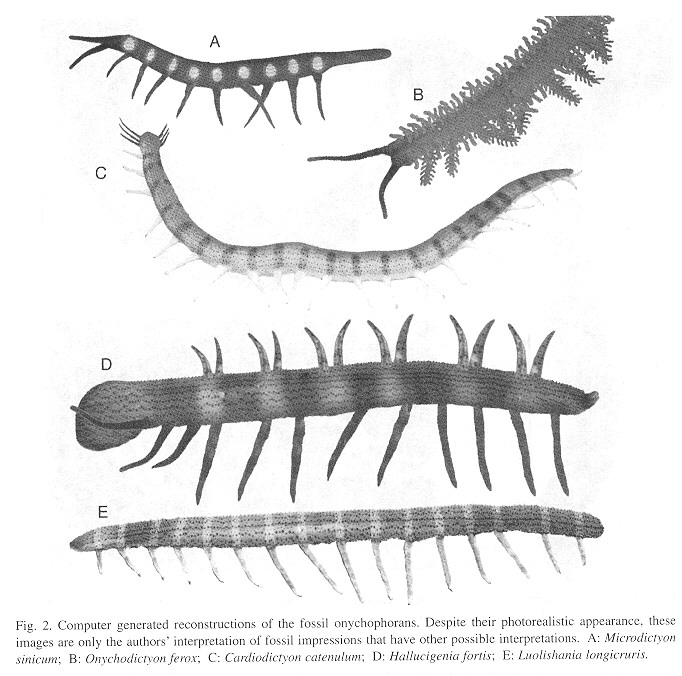
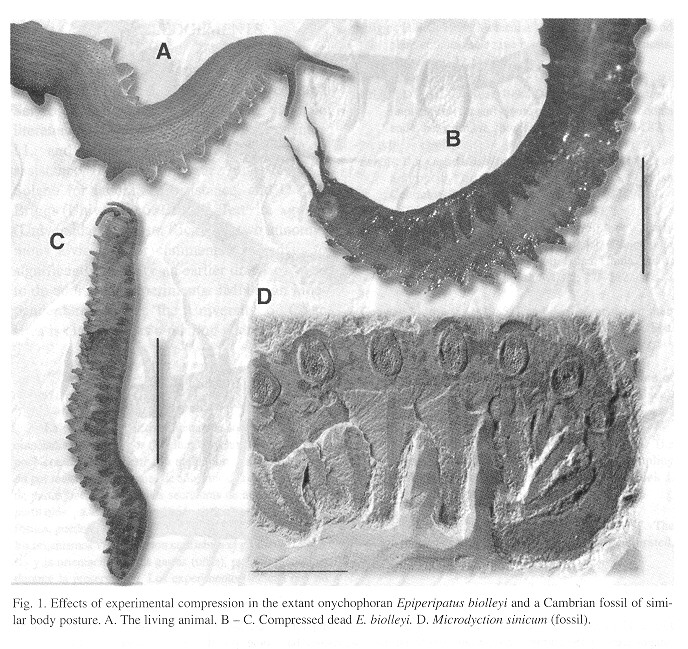
<body><![CDATA[<br>  <b><font face="Arial"><font size="-1">Materials and methods</font></font></b>    </p>       <p><font face="Arial"><font size="-1">To test the effect of compression and  decay on onychophoran bodies five <i>Epiperipatus biolleyi </i>Bouvier, 1902 from Coronado, San Jos&eacute;, Costa Rica (collected December 1992 and March 1993) were killed with an overdose of ethyl acetate (<a href="#Monge-Najera94">  Monge-N&aacute;jera and Morera 1994</a>  ) and placed in a 0.5 cm thick bed of marine mud (from the Punta Morales  mudflat, Costa Rica, describes by <a href="#Vargas88a">Vargas 1998 a,b</a>  , <a href="#Vargas96">1996</a>  ) under a weight of 17 kg. This compression was used to simulate burial under a layer of sediment, as some believe was the case when the fossilized animals died (<a href="#Conway85">Conway Morris 1985</a>  , <a href="#Hou91">Hou <i>et al.</i> 1991</a>  ). The pressure was enough to obtain a degree of flatening that in our opinion  is similar to the one perceived in the fossils. Decay is very rapid in onychophorans,  and for this reason three of the specimens were compressed 3.5 hr in mud and marine water and photographed. For comparison, the other two were left in mud with 70 % ethanol to prevent the action of decomposing microorganisms  and photographed after 24 hr because no macroscopic indication of change had been noticed in that period.</font></font>  </p>       <p><font face="Arial"><font size="-1">A computer was used to produce photorealistic  reconstructions of fossil onychophorans by applying standard functions of  the software Photoshop 5.0 to photographic material of living onychophorans'  skin texture, color and body shape.</font></font>  </p>       <p><font face="Arial"><font size="-1">&nbsp;</font></font>     <br>  <b><font face="Arial"><font size="-1">Results</font></font></b>  </p>       <p><font face="Arial"><font size="-1">In experimentally compressed onychophorans  the general body shaped was preserved (<a href="#fig1">Fig. 1</a>  ) but mouth, mandibles, adhesive-expelling organs (that look like tip-less  legs) and gonopore became invisible or indicated only by a spot (<a href="#fig1">  Fig. 1</a>  ).</font></font>  </p>       <p><font face="Arial"><font size="-1">Mandibles were visible only in an individual  that died with the mouth extruded. The eyes were always invisible. The leg  tips and claws were lost in some cases. When visible, the claws sometimes  turned toward the front or toward the rear of the animal, losing their natural  position. Some legs look thicker or even thinner than they were in life and  when appressed against the body became practically invisible in some cases  (<a href="#fig1">Fig. 1</a>  ).</font></font>  </p>       <p><font face="Arial"><font size="-1">Sand grains and organic remains from  the mud may give a false impression of organs (<a href="#fig1">Fig. 1</a>  ). The digestive tract was never visible (<a href="#fig1">Fig. 1</a>  ). The only visible difference between specimens that decayed naturally and those that were placed in alcohol was that when bacterial decomposition was allowed, annulation and papillation disappeared from severas body parts and portions of skin were detached, giving some antennae a slightly branched  appearance (<a href="#fig1">Fig. 1</a>  ).</font></font>  </p>       <p><font face="Arial"><font size="-1">The above results served as a basis,  together with the senior author's direct experience with living onychophorans,  to produce the photorealistic reconstructions of Cambrian onychophorans that appear in <a href="#fig2">Fig. 2</a>  .</font></font> </p>       <center><a name="fig1"></a>  <img src="/img/fbpe/rbt/v50n2-3/2144i01.JPG" height="649" width="688">  </center>          
]]></body>
<body><![CDATA[<center><a name="fig2"></a>  <img src="/img/fbpe/rbt/v50n2-3/2144i02.JPG" height="676" width="682">  </center>   &nbsp;        
<p><b><font face="Arial"><font size="-1">Discussion</font></font></b>  </p>       <p><font face="Arial"><font size="-1">The experimental compression results  suggest that in fossil onychophorans (both Cambrian and Carboniferous) the  general shape can be reconstructed but that the absence of bucal parts, adhesive-expelling  organs, gonopore, eyes, annulation, papillation, leg tips, claws and even  whole legs, may not represent absence in the living animals. In the past,  ways of feeding alien to onychophorans have been proposed because mandibles  were not found (e.g. <a href="#Robison">Robison 1985</a>  , <a href="#Chen">Chen <i>et al. </i>1995</a>  ) but our results do not support those hypotheses.</font></font>  </p>       <p><font face="Arial"><font size="-1">Furthermore, in fossils, leg thickness  and claw orientation may be unreliable and the branched antennae, interpreted  as "grasping organs" in <i>Aysheaia </i>(review in <a href="#Gould">Gould  1989</a>  ) may also be post-mortem artifacts. The long papillae of <i>Onychodictyon  </i>(<a href="#Hou95">Hou and Bergstr&ouml;m 1995</a>  ) could similarly be artifacts: more fossils are required to conclude that  they were real.</font></font>  </p>       <p><font face="Arial"><font size="-1">Several reasons have been proposed to explain why longitudinal bands thought to represent the digestive tract vary their position in fossil onychophorans (<a href="#Chen">Chen <i>et al. </i> 1995</a>  ) but experience with dissection of extant species shows that this is normal  for many internal organs because there are no mesenteries to hold them in  a fixed position (J.<b> </b>Monge-N&aacute;jera personal observation).</font></font>    </p>       <p><font face="Arial"><font size="-1">Unidentified bands in fossil legs have  been mentioned by <a href="#Chen">Chen <i>et al. </i>(1995)</a>  . We believe that they may represent the normal fluid-filled cavity of living  onychophoran legs (<a href="#Bouvier05">Bouvier 1905</a>  ). Neither these bands nor indication of the digestive tract were visible  in the experimentally compressed specimens: apparently they must be formed  as part of fossilization rather than during decay.</font></font>  </p>       <p><font face="Arial"><font size="-1">For centuries, science has been limited  to drawings for the reconstruction of - extinct species. Computer aided reconstructions became available at the end of the 20th century and have been extensively used to reconstruct dinosaurs in educational material but not in the primary scientific literature, despite the more satisfactory realism possible with computers. This may represent cultural inertia but another possible reason is that in contrast with photorealistic images, drawings are inmediately perceived as mere interpretations. lf this is correct, we expect our use of photorealistic reconstructions to be controversias. However, we consider photorealism a superior method for the reconstruction of the organisms' appearance, which also is the goal of drawings. Photorealism appears valid to us as long as it is clearly stated that the images are reconstructions, as we have done here.</font></font>  </p>       <p><font face="Arial"><font size="-1">These experiments indicate that not  only absence, but even presence of certain structures that may lead to the  proposal of comprehensive evolutionary models such as the Cambrian "explosion,  disparity and decimation" model (<a href="#Gould">Gould 1989</a>  ), can simply be the result of tissue decomposition. We recommend future  researchers to conduct taphonomy experiments specially before analysing unusual  fossils.</font></font>  </p>       <p><b><font face="Arial"><font size="-1">&nbsp;</font></font></b>     <br>  <b><font face="Arial"><font size="-1">Acknowledgements</font></font></b>    </p>       ]]></body>
<body><![CDATA[<p><font face="Arial"><font size="-1">We thank Jos&eacute; A. Vargas Z. for  assistance and support, Bernal Morera, Harlan Dean and Sergio Salazar Vallejo  for providing valuable literature and information, Zaidett Barrientos LL.  and Fernando Barrientos LL. for field assistance, Karina Rodr&iacute;guez  and Juan C. Solano for laboratory assistance, and D.E.G. Briggs (University  of Bristol), Teresita Aguilar (Universidad de Costa Rica) and two annomymous  reviewers for comments that led us to significantly improve an earlier draft  and even to do additional experiments. JMN is an independent researcher: the University of Costa Rica is cited only as a mailing address.</font></font>    </p>       <p><font face="Arial"><font size="-1">&nbsp;</font></font>     <br>  <b><font face="Arial"><font size="-1">Resumen</font></font></b>  </p>       <p><font face="Arial"><font size="-1">La preservaci&oacute;n experimental  de los gusanos "aterciopelados" u onic&oacute;foros (Phylum Onychophora),  un grupo poco com&uacute;n pero evolutivamente importante que ha existido  por m&aacute;s de 500 millones de a&ntilde;os, mostr&oacute; que la ausencia  de partes bucales, gl&aacute;ndulas secretoras de adhesivo, gonoporo, ojos,  patas, garras, anulaci&oacute;n cuticular y papilas en los f&oacute;siles,  puede no representar la ausencia de tales &oacute;rganos en los organismos  vivos. No son contables el grueso de las patas y la orientaci&oacute;n de  las garras (u&ntilde;as), pues se modifican durante la preservaci&oacute;n.  Los experimentos indican que no s&oacute;lo la ausencia, sino tambi&eacute;n  la presencia de ciertas estructuras pueden ser simplemente resultado de la descomposici&oacute;n de los tejidos. Se presentan reconstrucciones fotorrealistas  computarizadas de onic&oacute;foros f&oacute;siles. Para futuras investigaciones,  recomendarnos conducir experimentos tafon&oacute;n&uacute;cos previos al an&aacute;lisis del material preservado, especialmente antes de analizar f&oacute;siles poco comunes.</font></font>  </p>       <p><font face="Arial"><font size="-1">&nbsp;</font></font>     <br>  <b><font face="Arial"><font size="-1">References</font></font></b>  </p>       <!-- ref --><p><a name="Alongi"></a>  <font face="Arial"><font size="-1">Alongi, D.M. 1989. Ecology of tropical  soft-bottom benthos: a review with emphasis on emerging concepts. Rev. Biol.  Trop. 37: 85- 1 00.    &nbsp;&nbsp;&nbsp;&nbsp;&nbsp;&nbsp;&nbsp;&nbsp;[&#160;<a href="javascript:void(0);" onclick="javascript: window.open('/scielo.php?script=sci_nlinks&ref=1696427&pid=S0034-7744200200030003000001&lng=','','width=640,height=500,resizable=yes,scrollbars=1,menubar=yes,');">Links</a>&#160;]<!-- end-ref --></font></font>  </p>       <!-- ref --><p><a name="Bergstrom"></a>  <font face="Arial"><font size="-1">Bergstr&ouml;m, J. 1986. Metazoan evolution  - a new model. Zool. Seripta 15: 189-200.    &nbsp;&nbsp;&nbsp;&nbsp;&nbsp;&nbsp;&nbsp;&nbsp;[&#160;<a href="javascript:void(0);" onclick="javascript: window.open('/scielo.php?script=sci_nlinks&ref=1696429&pid=S0034-7744200200030003000002&lng=','','width=640,height=500,resizable=yes,scrollbars=1,menubar=yes,');">Links</a>&#160;]<!-- end-ref --></font></font>  </p>       ]]></body>
<body><![CDATA[<!-- ref --><p><a name="Bouvier05"></a>  <font face="Arial"><font size="-1">Bouvier, E.L. 1905. Monographie des Onychophores.  Ann. Sei. Nat. (Zool.) (9)2: 1-383.    &nbsp;&nbsp;&nbsp;&nbsp;&nbsp;&nbsp;&nbsp;&nbsp;[&#160;<a href="javascript:void(0);" onclick="javascript: window.open('/scielo.php?script=sci_nlinks&ref=1696431&pid=S0034-7744200200030003000003&lng=','','width=640,height=500,resizable=yes,scrollbars=1,menubar=yes,');">Links</a>&#160;]<!-- end-ref --></font></font>  </p>       <!-- ref --><p><a name="Briggs99"></a>  <font face="Arial"><font size="-1">Briggs, D.E.G. 1999. Molecular taphonomy  of animal and plant cuticles: selective preservation and diagenesis. Phil.  Trans. R. Soc. Lond. B 354: 7-17.    &nbsp;&nbsp;&nbsp;&nbsp;&nbsp;&nbsp;&nbsp;&nbsp;[&#160;<a href="javascript:void(0);" onclick="javascript: window.open('/scielo.php?script=sci_nlinks&ref=1696433&pid=S0034-7744200200030003000004&lng=','','width=640,height=500,resizable=yes,scrollbars=1,menubar=yes,');">Links</a>&#160;]<!-- end-ref --></font></font>  </p>       <!-- ref --><p><a name="Briggs94"></a>  <font face="Arial"><font size="-1">Briggs, D.E. &amp; A.J. Kear. 1994. Decay  of <i>Branchiostoma:</i> implications for soft-tissue preservation in conodonts  and other primitive chordates. Lethaia 26: 275-287.    &nbsp;&nbsp;&nbsp;&nbsp;&nbsp;&nbsp;&nbsp;&nbsp;[&#160;<a href="javascript:void(0);" onclick="javascript: window.open('/scielo.php?script=sci_nlinks&ref=1696435&pid=S0034-7744200200030003000005&lng=','','width=640,height=500,resizable=yes,scrollbars=1,menubar=yes,');">Links</a>&#160;]<!-- end-ref --></font></font>  </p>       <!-- ref --><p><a name="Briggs85"></a>  <font face="Arial"><font size="-1">Briggs, D.E.G. &amp; H.B. Whittington.  1985. Modes of life of arthropods from the Burguess Shale, British Columbia.  Trans. Rey. Soc. Edinburg 76: 149-160.    &nbsp;&nbsp;&nbsp;&nbsp;&nbsp;&nbsp;&nbsp;&nbsp;[&#160;<a href="javascript:void(0);" onclick="javascript: window.open('/scielo.php?script=sci_nlinks&ref=1696437&pid=S0034-7744200200030003000006&lng=','','width=640,height=500,resizable=yes,scrollbars=1,menubar=yes,');">Links</a>&#160;]<!-- end-ref --></font></font>  </p>       <!-- ref --><p><a name="Chen"></a>  <font face="Arial"><font size="-1">Chen, J., G. Zhou &amp; L. Ramsk&ouml;ld.  1995. A new Early Cambrian onychophoran-like animal, <i>Paucipodia</i> gen.  nov., from the Chengjiang fauna, China. Trans. Rev. Soc. Edinburgh Earth Sci. 85: 275-282.    &nbsp;&nbsp;&nbsp;&nbsp;&nbsp;&nbsp;&nbsp;&nbsp;[&#160;<a href="javascript:void(0);" onclick="javascript: window.open('/scielo.php?script=sci_nlinks&ref=1696439&pid=S0034-7744200200030003000007&lng=','','width=640,height=500,resizable=yes,scrollbars=1,menubar=yes,');">Links</a>&#160;]<!-- end-ref --></font></font>  </p>       ]]></body>
<body><![CDATA[<!-- ref --><p><a name="Conway85"></a>  <font face="Arial"><font size="-1">Conway Morris, S.C. 1985. Cambrian Lagerst&auml;tten:  their distribution and significance. Phil. Trans. R. Soc. Lond. B 311: 49-65.    &nbsp;&nbsp;&nbsp;&nbsp;&nbsp;&nbsp;&nbsp;&nbsp;[&#160;<a href="javascript:void(0);" onclick="javascript: window.open('/scielo.php?script=sci_nlinks&ref=1696441&pid=S0034-7744200200030003000008&lng=','','width=640,height=500,resizable=yes,scrollbars=1,menubar=yes,');">Links</a>&#160;]<!-- end-ref --></font></font>    </p>       <!-- ref --><p><a name="Conway86"></a>  <font face="Arial"><font size="-1">Conway Morris, S.C. 1986. The community  structure of the middle Cambrian phyllopod bed (Burgess Shale). Palaeontology  29: 423-467.    &nbsp;&nbsp;&nbsp;&nbsp;&nbsp;&nbsp;&nbsp;&nbsp;[&#160;<a href="javascript:void(0);" onclick="javascript: window.open('/scielo.php?script=sci_nlinks&ref=1696443&pid=S0034-7744200200030003000009&lng=','','width=640,height=500,resizable=yes,scrollbars=1,menubar=yes,');">Links</a>&#160;]<!-- end-ref --></font></font>  </p>       <!-- ref --><p><a name="Fortey96"></a>  <font face="Arial"><font size="-1">Fortey, R.A., D.E.G. Briggs &amp; M.A.  Wills. 1996. The Cambrian evolutionary 'explosion': decoupling cladogenesis  from morphological disparity. Biol. J. Linn. Soc. London 57: 13-33.    &nbsp;&nbsp;&nbsp;&nbsp;&nbsp;&nbsp;&nbsp;&nbsp;[&#160;<a href="javascript:void(0);" onclick="javascript: window.open('/scielo.php?script=sci_nlinks&ref=1696445&pid=S0034-7744200200030003000010&lng=','','width=640,height=500,resizable=yes,scrollbars=1,menubar=yes,');">Links</a>&#160;]<!-- end-ref --></font></font>    </p>       <!-- ref --><p><a name="Fortey97"></a>  <font face="Arial"><font size="-1">Fortey, R.A., D.E.G. Briggs &amp; M.A.  Wills. 1997. The Cambrian evolutionary 'explosion' recalibrated. BioEssays  19: 429-434.    &nbsp;&nbsp;&nbsp;&nbsp;&nbsp;&nbsp;&nbsp;&nbsp;[&#160;<a href="javascript:void(0);" onclick="javascript: window.open('/scielo.php?script=sci_nlinks&ref=1696447&pid=S0034-7744200200030003000011&lng=','','width=640,height=500,resizable=yes,scrollbars=1,menubar=yes,');">Links</a>&#160;]<!-- end-ref --></font></font>  </p>       <!-- ref --><p><a name="Gould"></a>  <font face="Arial"><font size="-1">Gould, S.J. 1989. Wonderful life. The  Burgess Shale and the nature of history. W.W. Norton, New York. 347 p.    &nbsp;&nbsp;&nbsp;&nbsp;&nbsp;&nbsp;&nbsp;&nbsp;[&#160;<a href="javascript:void(0);" onclick="javascript: window.open('/scielo.php?script=sci_nlinks&ref=1696449&pid=S0034-7744200200030003000012&lng=','','width=640,height=500,resizable=yes,scrollbars=1,menubar=yes,');">Links</a>&#160;]<!-- end-ref --></font></font>    </p>       ]]></body>
<body><![CDATA[<!-- ref --><p><a name="Hou94"></a>  <font face="Arial"><font size="-1">Hou, X. &amp; J. Bergstr&ouml;m. 1994.  Palaeoscolecid worms may be nematomorphs rather than annelids. Lethaia 27:  11-17.    &nbsp;&nbsp;&nbsp;&nbsp;&nbsp;&nbsp;&nbsp;&nbsp;[&#160;<a href="javascript:void(0);" onclick="javascript: window.open('/scielo.php?script=sci_nlinks&ref=1696451&pid=S0034-7744200200030003000013&lng=','','width=640,height=500,resizable=yes,scrollbars=1,menubar=yes,');">Links</a>&#160;]<!-- end-ref --></font></font>  </p>       <!-- ref --><p><a name="Hou95"></a>  <font face="Arial"><font size="-1">Hou, X. &amp; J. Bergstr&ouml;m. 1995.  Cambrian lobopodians ancestors of extant onychophorans? Zool. J. Linn. Soc.  London 114: 3-19.    &nbsp;&nbsp;&nbsp;&nbsp;&nbsp;&nbsp;&nbsp;&nbsp;[&#160;<a href="javascript:void(0);" onclick="javascript: window.open('/scielo.php?script=sci_nlinks&ref=1696453&pid=S0034-7744200200030003000014&lng=','','width=640,height=500,resizable=yes,scrollbars=1,menubar=yes,');">Links</a>&#160;]<!-- end-ref --></font></font>  </p>       <!-- ref --><p><a name="Hou97"></a>  <font face="Arial"><font size="-1">Hou, X. &amp; J. Bergstr&ouml;m. 1997.  Arthropods from the lower Cambrian Chengjiang fauna, southwest China. Scandinavian  University Press, Oslo, Norway. 116 p.    &nbsp;&nbsp;&nbsp;&nbsp;&nbsp;&nbsp;&nbsp;&nbsp;[&#160;<a href="javascript:void(0);" onclick="javascript: window.open('/scielo.php?script=sci_nlinks&ref=1696455&pid=S0034-7744200200030003000015&lng=','','width=640,height=500,resizable=yes,scrollbars=1,menubar=yes,');">Links</a>&#160;]<!-- end-ref --></font></font>  </p>       <p><a name="Hou91"></a>  <font face="Arial"><font size="-1">Hou, X., L. Ramskbld &amp; J. Bergstr&ouml;m.  1991. Composition and preservation of the Chengjiang fauna - a Lower Cambrian  soft-bodied biota. Zool. Scripta 20: 395-411.</font></font>  </p>       <!-- ref --><p><a name="Houetal95"></a>  <font face="Arial"><font size="-1">Hou, X., J. Bergstr&ouml;m &amp; P. Ahlberg.  1995. <i>Anomalocaris </i>and other large animals in the Lower Cambrian Chengjiang  fauna of southwest China. GFF 117: 163-183.    &nbsp;&nbsp;&nbsp;&nbsp;&nbsp;&nbsp;&nbsp;&nbsp;[&#160;<a href="javascript:void(0);" onclick="javascript: window.open('/scielo.php?script=sci_nlinks&ref=1696458&pid=S0034-7744200200030003000017&lng=','','width=640,height=500,resizable=yes,scrollbars=1,menubar=yes,');">Links</a>&#160;]<!-- end-ref --></font></font>  </p>       <!-- ref --><p><a name="Jin"></a>  <font face="Arial"><font size="-1">Jin, Y, X. Hou &amp; H. Wang. 1993. Lower  Cambrian pediculate lingulids from Yunnan, China. J. Paleontol. 67: 788-798.    &nbsp;&nbsp;&nbsp;&nbsp;&nbsp;&nbsp;&nbsp;&nbsp;[&#160;<a href="javascript:void(0);" onclick="javascript: window.open('/scielo.php?script=sci_nlinks&ref=1696460&pid=S0034-7744200200030003000018&lng=','','width=640,height=500,resizable=yes,scrollbars=1,menubar=yes,');">Links</a>&#160;]<!-- end-ref --></font></font>    </p>       <!-- ref --><p><a name="Manton"></a>  <font face="Arial"><font size="-1">Manton, S.M. 1953. Locomotory habits and the evolution of the larger arthropodan groups. Symposia of the Society for Experimental Biology, Evolution 7: 339376.    &nbsp;&nbsp;&nbsp;&nbsp;&nbsp;&nbsp;&nbsp;&nbsp;[&#160;<a href="javascript:void(0);" onclick="javascript: window.open('/scielo.php?script=sci_nlinks&ref=1696462&pid=S0034-7744200200030003000019&lng=','','width=640,height=500,resizable=yes,scrollbars=1,menubar=yes,');">Links</a>&#160;]<!-- end-ref --></font></font>  </p>       <!-- ref --><p><a name="Monge-Najera94a"></a>  <font face="Arial"><font size="-1">Monge-N&aacute;jera, J. 1994a. Ecological  Biogeography in the Phylum Onychophora. Biogeographica 70: 111-123.    &nbsp;&nbsp;&nbsp;&nbsp;&nbsp;&nbsp;&nbsp;&nbsp;[&#160;<a href="javascript:void(0);" onclick="javascript: window.open('/scielo.php?script=sci_nlinks&ref=1696464&pid=S0034-7744200200030003000020&lng=','','width=640,height=500,resizable=yes,scrollbars=1,menubar=yes,');">Links</a>&#160;]<!-- end-ref --></font></font>    </p>       <!-- ref --><p><a name="Monge-Najera94b"></a>  <font face="Arial"><font size="-1">Monge-N&aacute;jera, J. 1994b. Reproductive  trends, habitat type and body characteristics in velvet worms (Onychophora).  Rev. Biol. Trop. 42: 611-622.    &nbsp;&nbsp;&nbsp;&nbsp;&nbsp;&nbsp;&nbsp;&nbsp;[&#160;<a href="javascript:void(0);" onclick="javascript: window.open('/scielo.php?script=sci_nlinks&ref=1696466&pid=S0034-7744200200030003000021&lng=','','width=640,height=500,resizable=yes,scrollbars=1,menubar=yes,');">Links</a>&#160;]<!-- end-ref --></font></font>  </p>       <!-- ref --><p><a name="Monge-Najera95"></a>  <font face="Arial"><font size="-1">Monge-N&aacute;jera, J. 1995. Phylogeny,  biogeography and reproductive trends in the Onychophora. Zool. J. Linn. Soc.  (London) 114: 21-60.    &nbsp;&nbsp;&nbsp;&nbsp;&nbsp;&nbsp;&nbsp;&nbsp;[&#160;<a href="javascript:void(0);" onclick="javascript: window.open('/scielo.php?script=sci_nlinks&ref=1696468&pid=S0034-7744200200030003000022&lng=','','width=640,height=500,resizable=yes,scrollbars=1,menubar=yes,');">Links</a>&#160;]<!-- end-ref --></font></font>  </p>       <!-- ref --><p><a name="Monge-Najera96"></a>  <font face="Arial"><font size="-1">Monge-N&aacute;jera, J. 1996. Jurassic-Pliocene  biogeography: testing a model with velvet worm (Onychophora) vicariance. Rev. Biol. Trop. 44: 159-175.    &nbsp;&nbsp;&nbsp;&nbsp;&nbsp;&nbsp;&nbsp;&nbsp;[&#160;<a href="javascript:void(0);" onclick="javascript: window.open('/scielo.php?script=sci_nlinks&ref=1696470&pid=S0034-7744200200030003000023&lng=','','width=640,height=500,resizable=yes,scrollbars=1,menubar=yes,');">Links</a>&#160;]<!-- end-ref --></font></font>  </p>       <!-- ref --><p><a name="Monge-Najera99"></a>  <font face="Arial"><font size="-1">Monge-N&aacute;jera, J. 1999. Onychophora,  pp. 23-35. In J. Llorente, E. Gonz&aacute;lez, A. Garc&iacute;a &amp; N. Papavero (eds.). Biodiversidad, taxonom&iacute;a y biogeograf&iacute;a de artr&oacute;podos de M&eacute;xico: hacia una s&iacute;ntesis de su conocimiento, vol. II. Universidad Nacional Aut&oacute;noma de M&eacute;xico, M&eacute;xico, DF.    &nbsp;&nbsp;&nbsp;&nbsp;&nbsp;&nbsp;&nbsp;&nbsp;[&#160;<a href="javascript:void(0);" onclick="javascript: window.open('/scielo.php?script=sci_nlinks&ref=1696472&pid=S0034-7744200200030003000024&lng=','','width=640,height=500,resizable=yes,scrollbars=1,menubar=yes,');">Links</a>&#160;]<!-- end-ref --></font></font>   </p>       <!-- ref --><p><a name="Monge-Najera01"></a>  <font face="Arial"><font size="-1">Monge-N&aacute;jera, J. 2001. Walking  fossils. Fauna 3: in press.    &nbsp;&nbsp;&nbsp;&nbsp;&nbsp;&nbsp;&nbsp;&nbsp;[&#160;<a href="javascript:void(0);" onclick="javascript: window.open('/scielo.php?script=sci_nlinks&ref=1696474&pid=S0034-7744200200030003000025&lng=','','width=640,height=500,resizable=yes,scrollbars=1,menubar=yes,');">Links</a>&#160;]<!-- end-ref --></font></font>  </p>       <!-- ref --><p><a name="Monge-Najera94"></a>  <font face="Arial"><font size="-1">Monge-N&aacute;jera, J. &amp;<b> </b> B. Morera. 1994. Morphological and physiological characteristics of two species  of <i>Epiperipatus </i>from Costa Rica (Onychophora: Peripatidae). Rev. Biol.  Trop. 42: 181-188.    &nbsp;&nbsp;&nbsp;&nbsp;&nbsp;&nbsp;&nbsp;&nbsp;[&#160;<a href="javascript:void(0);" onclick="javascript: window.open('/scielo.php?script=sci_nlinks&ref=1696476&pid=S0034-7744200200030003000026&lng=','','width=640,height=500,resizable=yes,scrollbars=1,menubar=yes,');">Links</a>&#160;]<!-- end-ref --></font></font>  </p>       <!-- ref --><p><a name="Monge-Najera-A95"></a>  <font face="Arial"><font size="-1">Monge-N&aacute;jera, J. &amp; J.P. Alfaro.  1995. Geographic variation of habitats in Costa Rican velvet worms (Onychophora  Peripatidae). Biogeographica 71: 97-108.    &nbsp;&nbsp;&nbsp;&nbsp;&nbsp;&nbsp;&nbsp;&nbsp;[&#160;<a href="javascript:void(0);" onclick="javascript: window.open('/scielo.php?script=sci_nlinks&ref=1696478&pid=S0034-7744200200030003000027&lng=','','width=640,height=500,resizable=yes,scrollbars=1,menubar=yes,');">Links</a>&#160;]<!-- end-ref --></font></font>  </p>       <!-- ref --><p><a name="Monge-Najera-L95"></a>  <font face="Arial"><font size="-1">Monge-N&aacute;jera, J. &amp; W. Lourengo.  1995. Biogeographic implications of evolutionary trends in onychophorans and scorpions. Biogeographica 71: 179185.    &nbsp;&nbsp;&nbsp;&nbsp;&nbsp;&nbsp;&nbsp;&nbsp;[&#160;<a href="javascript:void(0);" onclick="javascript: window.open('/scielo.php?script=sci_nlinks&ref=1696480&pid=S0034-7744200200030003000028&lng=','','width=640,height=500,resizable=yes,scrollbars=1,menubar=yes,');">Links</a>&#160;]<!-- end-ref --></font></font>  </p>       <!-- ref --><p><a name="Monge-Najera00"></a>  <font face="Arial"><font size="-1">Monge-N&aacute;jera, J. &amp; X. Hou.  2000. Disparity, decimation and the Cambrian "explosion": comparison of early  Cambrian and Present faunal communities with emphasis on velvet worms (Onychophora)  Rev. Biol. Trop. 48: 333-351.    &nbsp;&nbsp;&nbsp;&nbsp;&nbsp;&nbsp;&nbsp;&nbsp;[&#160;<a href="javascript:void(0);" onclick="javascript: window.open('/scielo.php?script=sci_nlinks&ref=1696482&pid=S0034-7744200200030003000029&lng=','','width=640,height=500,resizable=yes,scrollbars=1,menubar=yes,');">Links</a>&#160;]<!-- end-ref --></font></font>  </p>       <!-- ref --><p><a name="Monge-Najera93"></a>  <font face="Arial"><font size="-1">Monge-N&aacute;jera, J., Z. Barrientos  &amp; E Aguilar. 1993. Behavior of <i>Epiperipatus biolleyi </i>(Onychophora:  Peripatidae) under laboratory conditions. Rev. Biol. Trop. 41: 689-696.    &nbsp;&nbsp;&nbsp;&nbsp;&nbsp;&nbsp;&nbsp;&nbsp;[&#160;<a href="javascript:void(0);" onclick="javascript: window.open('/scielo.php?script=sci_nlinks&ref=1696484&pid=S0034-7744200200030003000030&lng=','','width=640,height=500,resizable=yes,scrollbars=1,menubar=yes,');">Links</a>&#160;]<!-- end-ref --></font></font>    </p>       <!-- ref --><p><a name="Orr"></a>  <font face="Arial"><font size="-1">Orr, P.J., D.E.G. Briggs &amp; S.L. Kearns.  1998. Cambrian Burgess Shale animals replicated in clay minerals. Science  281: 1173-1175.    &nbsp;&nbsp;&nbsp;&nbsp;&nbsp;&nbsp;&nbsp;&nbsp;[&#160;<a href="javascript:void(0);" onclick="javascript: window.open('/scielo.php?script=sci_nlinks&ref=1696486&pid=S0034-7744200200030003000031&lng=','','width=640,height=500,resizable=yes,scrollbars=1,menubar=yes,');">Links</a>&#160;]<!-- end-ref --></font></font>  </p>       <!-- ref --><p><a name="Rhebergen"></a>  <font face="Arial"><font size="-1">Rhebergen, E &amp; S.K. Donovan. 1994.  A Lower Palaeozoic 'onychophoran' reinterpreted as a pelmatozoan (stalked  echinoderin) column. Atlantic Geol. 30: 19-23.    &nbsp;&nbsp;&nbsp;&nbsp;&nbsp;&nbsp;&nbsp;&nbsp;[&#160;<a href="javascript:void(0);" onclick="javascript: window.open('/scielo.php?script=sci_nlinks&ref=1696488&pid=S0034-7744200200030003000032&lng=','','width=640,height=500,resizable=yes,scrollbars=1,menubar=yes,');">Links</a>&#160;]<!-- end-ref --></font></font>  </p>       <!-- ref --><p><a name="Rigby"></a>  <font face="Arial"><font size="-1">Rigby, J.K. &amp; X. Hou. 1995. Lower  Cambrian demosponges and hexactinellid sponges from Yunnan, China. J. Paleontol.  69: 1009-1019.    &nbsp;&nbsp;&nbsp;&nbsp;&nbsp;&nbsp;&nbsp;&nbsp;[&#160;<a href="javascript:void(0);" onclick="javascript: window.open('/scielo.php?script=sci_nlinks&ref=1696490&pid=S0034-7744200200030003000033&lng=','','width=640,height=500,resizable=yes,scrollbars=1,menubar=yes,');">Links</a>&#160;]<!-- end-ref --></font></font>  </p>       <!-- ref --><p><a name="Robison"></a>  <font face="Arial"><font size="-1">Robison, R.A. 1985. Affinites of <i>Aysheaia  </i>(Onychophora), with description of a new Cambrian species. J. Paleontol.  59: 226-235.    &nbsp;&nbsp;&nbsp;&nbsp;&nbsp;&nbsp;&nbsp;&nbsp;[&#160;<a href="javascript:void(0);" onclick="javascript: window.open('/scielo.php?script=sci_nlinks&ref=1696492&pid=S0034-7744200200030003000034&lng=','','width=640,height=500,resizable=yes,scrollbars=1,menubar=yes,');">Links</a>&#160;]<!-- end-ref --></font></font>  </p>       <!-- ref --><p><a name="Tait"></a>  <font face="Arial"><font size="-1">Tait, N.N., D.A. Briscoe &amp; D.M. Rowell.  1995. Onychophora - ancient and modern radiations. Mem. Ass. Australas. Paleontols.  18: 21-30.    &nbsp;&nbsp;&nbsp;&nbsp;&nbsp;&nbsp;&nbsp;&nbsp;[&#160;<a href="javascript:void(0);" onclick="javascript: window.open('/scielo.php?script=sci_nlinks&ref=1696494&pid=S0034-7744200200030003000035&lng=','','width=640,height=500,resizable=yes,scrollbars=1,menubar=yes,');">Links</a>&#160;]<!-- end-ref --></font></font>  </p>       <!-- ref --><p><a name="Vargas87"></a>  <font face="Arial"><font size="-1">Vargas, J.A. 1987. Community structure  of macrobenthos and the results of macropredator exclusion on a tropical intertidal mud fiat. Rev. Biol. Trop. 36 (2A): 287-308.    &nbsp;&nbsp;&nbsp;&nbsp;&nbsp;&nbsp;&nbsp;&nbsp;[&#160;<a href="javascript:void(0);" onclick="javascript: window.open('/scielo.php?script=sci_nlinks&ref=1696496&pid=S0034-7744200200030003000036&lng=','','width=640,height=500,resizable=yes,scrollbars=1,menubar=yes,');">Links</a>&#160;]<!-- end-ref --></font></font>  </p>       <!-- ref --><p><a name="Vargas88a"></a>  <font face="Arial"><font size="-1">Vargas, J.A. 1988a. The benthic community  of an intertidal mud fiat in the Gulf of Nicoya, Costa Rica. Description of the community. Rev. Biol. Trop. 35: 299-316.    &nbsp;&nbsp;&nbsp;&nbsp;&nbsp;&nbsp;&nbsp;&nbsp;[&#160;<a href="javascript:void(0);" onclick="javascript: window.open('/scielo.php?script=sci_nlinks&ref=1696498&pid=S0034-7744200200030003000037&lng=','','width=640,height=500,resizable=yes,scrollbars=1,menubar=yes,');">Links</a>&#160;]<!-- end-ref --></font></font>  </p>       <!-- ref --><p><a name="Vargas88b"></a>  <font face="Arial"><font size="-1">Vargas, J.A. 1988b. A survey of the meiofauna  of an Eastern Tropical Pacific mud fiat. Rev. Biol. Trop. 36 (2B): 541-544.    &nbsp;&nbsp;&nbsp;&nbsp;&nbsp;&nbsp;&nbsp;&nbsp;[&#160;<a href="javascript:void(0);" onclick="javascript: window.open('/scielo.php?script=sci_nlinks&ref=1696500&pid=S0034-7744200200030003000038&lng=','','width=640,height=500,resizable=yes,scrollbars=1,menubar=yes,');">Links</a>&#160;]<!-- end-ref --></font></font>    </p>       <!-- ref --><p><a name="Vargas96"></a>  <font face="Arial"><font size="-1">Vargas, J.A. 1996. Ecological dynamics  of a tropical intertidal mudflat community, pp. 355-371. In K.E Nordstrom  &amp; C.T. Roman (eds.). Estuarine Shores: Evolution, Environments and Human  Alterations. Wiley, New York.    &nbsp;&nbsp;&nbsp;&nbsp;&nbsp;&nbsp;&nbsp;&nbsp;[&#160;<a href="javascript:void(0);" onclick="javascript: window.open('/scielo.php?script=sci_nlinks&ref=1696502&pid=S0034-7744200200030003000039&lng=','','width=640,height=500,resizable=yes,scrollbars=1,menubar=yes,');">Links</a>&#160;]<!-- end-ref --></font></font>  </p>       <!-- ref --><p><a name="Whittington"></a>  <font face="Arial"><font size="-1">Whittington, H.B. 1978. The lobopod animal  <i>Aysheaia</i> <i>pedunculata </i>Walcott, Middle Cambrian, Burgess Shale,  British Columbia. Phil. Trans. Roy. Soc., London B. 284: 165-197.    &nbsp;&nbsp;&nbsp;&nbsp;&nbsp;&nbsp;&nbsp;&nbsp;[&#160;<a href="javascript:void(0);" onclick="javascript: window.open('/scielo.php?script=sci_nlinks&ref=1696504&pid=S0034-7744200200030003000040&lng=','','width=640,height=500,resizable=yes,scrollbars=1,menubar=yes,');">Links</a>&#160;]<!-- end-ref --></font></font>       <br>  &nbsp;  </p>       <p><b><font face="Arial,Helvetica"><font size="-1">&nbsp;</font></font></b>       <br>  <font face="Arial,Helvetica"><font size="-1"><a href="#1">1</a>  . Biolog&iacute;a Tropical, Universidad de Costa Rica, San Jos&eacute;, Costa Rica. Fax (506)2075550; <a href="mailto:rbt@biologia.ucr.ac.cr">rbt@biologia.ucr.ac.cr</a>  </font></font>  </p>       <p><a name="1a"></a>  <font face="Arial,Helvetica"><font size="-1"><a href="#1">2</a>  . Yunnan Research Centre for Chengjiang Biota, Yunnan University, Kunming  650091, Yunnan Province, People's Republic of China; <a href="mailto:xghou@ynu.edu.cn">  xghou@ynu.edu.cn</a>  </font></font> </p>  </div>        ]]></body><back>
<ref-list>
<ref id="B1">
<nlm-citation citation-type="journal">
<person-group person-group-type="author">
<name>
<surname><![CDATA[Alongi]]></surname>
<given-names><![CDATA[D.M]]></given-names>
</name>
</person-group>
<article-title xml:lang="en"><![CDATA[Ecology of tropical soft-bottom benthos: a review with emphasis on emerging concepts]]></article-title>
<source><![CDATA[Rev. Biol. Trop]]></source>
<year>1989</year>
<volume>37</volume>
<page-range>85- 100</page-range></nlm-citation>
</ref>
<ref id="B2">
<nlm-citation citation-type="journal">
<person-group person-group-type="author">
<name>
<surname><![CDATA[Bergström]]></surname>
<given-names><![CDATA[J]]></given-names>
</name>
</person-group>
<article-title xml:lang="en"><![CDATA[Metazoan evolution - a new model]]></article-title>
<source><![CDATA[Zool. Seripta]]></source>
<year>1986</year>
<volume>15</volume>
<page-range>189-200</page-range></nlm-citation>
</ref>
<ref id="B3">
<nlm-citation citation-type="journal">
<person-group person-group-type="author">
<name>
<surname><![CDATA[Bouvier]]></surname>
<given-names><![CDATA[E.L]]></given-names>
</name>
</person-group>
<article-title xml:lang="en"><![CDATA[Monographie des Onychophores]]></article-title>
<source><![CDATA[Ann. Sei. Nat. (Zool.)]]></source>
<year>1905</year>
<volume>9</volume>
<numero>^s2</numero>
<issue>^s2</issue>
<supplement>2</supplement>
<page-range>1-383</page-range></nlm-citation>
</ref>
<ref id="B4">
<nlm-citation citation-type="journal">
<person-group person-group-type="author">
<name>
<surname><![CDATA[Briggs]]></surname>
<given-names><![CDATA[D.E.G]]></given-names>
</name>
</person-group>
<article-title xml:lang="en"><![CDATA[Molecular taphonomy of animal and plant cuticles: selective preservation and diagenesis]]></article-title>
<source><![CDATA[Phil. Trans. R. Soc. Lond. B]]></source>
<year>1999</year>
<volume>354</volume>
<page-range>7-17</page-range></nlm-citation>
</ref>
<ref id="B5">
<nlm-citation citation-type="journal">
<person-group person-group-type="author">
<name>
<surname><![CDATA[Briggs]]></surname>
<given-names><![CDATA[D.E]]></given-names>
</name>
<name>
<surname><![CDATA[Kear]]></surname>
<given-names><![CDATA[A.J]]></given-names>
</name>
</person-group>
<article-title xml:lang="en"><![CDATA[Decay of Branchiostoma: implications for soft-tissue preservation in conodonts and other primitive chordates]]></article-title>
<source><![CDATA[Lethaia]]></source>
<year>1994</year>
<volume>26</volume>
<page-range>275-287</page-range></nlm-citation>
</ref>
<ref id="B6">
<nlm-citation citation-type="journal">
<person-group person-group-type="author">
<name>
<surname><![CDATA[Briggs]]></surname>
<given-names><![CDATA[D.E.G]]></given-names>
</name>
<name>
<surname><![CDATA[Whittington]]></surname>
<given-names><![CDATA[H.B]]></given-names>
</name>
</person-group>
<article-title xml:lang="en"><![CDATA[Modes of life of arthropods from the Burguess Shale, British Columbia]]></article-title>
<source><![CDATA[Trans. Rey. Soc. Edinburg]]></source>
<year>1985</year>
<volume>76</volume>
<page-range>149-160</page-range></nlm-citation>
</ref>
<ref id="B7">
<nlm-citation citation-type="journal">
<person-group person-group-type="author">
<name>
<surname><![CDATA[Chen]]></surname>
<given-names><![CDATA[J]]></given-names>
</name>
<name>
<surname><![CDATA[Zhou]]></surname>
<given-names><![CDATA[G]]></given-names>
</name>
<name>
<surname><![CDATA[Ramsköld]]></surname>
<given-names><![CDATA[L]]></given-names>
</name>
</person-group>
<article-title xml:lang="en"><![CDATA[A new Early Cambrian onychophoran-like animal, Paucipodia gen. nov., from the Chengjiang fauna, China]]></article-title>
<source><![CDATA[Trans. Rev. Soc. Edinburgh Earth Sci]]></source>
<year>1995</year>
<volume>85</volume>
<page-range>275-282</page-range></nlm-citation>
</ref>
<ref id="B8">
<nlm-citation citation-type="journal">
<person-group person-group-type="author">
<name>
<surname><![CDATA[Conway Morris]]></surname>
<given-names><![CDATA[S.C]]></given-names>
</name>
</person-group>
<article-title xml:lang="en"><![CDATA[Cambrian Lagerstätten: their distribution and significance]]></article-title>
<source><![CDATA[Phil. Trans. R. Soc. Lond. B]]></source>
<year>1985</year>
<volume>311</volume>
<page-range>49-65</page-range></nlm-citation>
</ref>
<ref id="B9">
<nlm-citation citation-type="journal">
<person-group person-group-type="author">
<name>
<surname><![CDATA[Conway Morris]]></surname>
<given-names><![CDATA[S.C]]></given-names>
</name>
</person-group>
<article-title xml:lang="en"><![CDATA[The community structure of the middle Cambrian phyllopod bed (Burgess Shale)]]></article-title>
<source><![CDATA[Palaeontology]]></source>
<year>1986</year>
<volume>29</volume>
<page-range>423-467</page-range></nlm-citation>
</ref>
<ref id="B10">
<nlm-citation citation-type="journal">
<person-group person-group-type="author">
<name>
<surname><![CDATA[Fortey]]></surname>
<given-names><![CDATA[R.A]]></given-names>
</name>
<name>
<surname><![CDATA[Briggs]]></surname>
<given-names><![CDATA[D.E.G]]></given-names>
</name>
<name>
<surname><![CDATA[Wills]]></surname>
<given-names><![CDATA[M.A]]></given-names>
</name>
</person-group>
<article-title xml:lang="en"><![CDATA[The Cambrian evolutionary 'explosion': decoupling cladogenesis from morphological disparity]]></article-title>
<source><![CDATA[Biol. J. Linn. Soc. London]]></source>
<year>1996</year>
<volume>57</volume>
<page-range>13-33</page-range></nlm-citation>
</ref>
<ref id="B11">
<nlm-citation citation-type="journal">
<person-group person-group-type="author">
<name>
<surname><![CDATA[Fortey]]></surname>
<given-names><![CDATA[R.A]]></given-names>
</name>
<name>
<surname><![CDATA[Briggs]]></surname>
<given-names><![CDATA[D.E.G]]></given-names>
</name>
<name>
<surname><![CDATA[Wills]]></surname>
<given-names><![CDATA[M.A]]></given-names>
</name>
</person-group>
<article-title xml:lang="en"><![CDATA[The Cambrian evolutionary 'explosion' recalibrated]]></article-title>
<source><![CDATA[BioEssays]]></source>
<year>1997</year>
<volume>19</volume>
<page-range>429-434</page-range></nlm-citation>
</ref>
<ref id="B12">
<nlm-citation citation-type="book">
<person-group person-group-type="author">
<name>
<surname><![CDATA[Gould]]></surname>
<given-names><![CDATA[S.J]]></given-names>
</name>
</person-group>
<source><![CDATA[Wonderful life: The Burgess Shale and the nature of history]]></source>
<year>1989</year>
<page-range>347</page-range><publisher-loc><![CDATA[New York ]]></publisher-loc>
<publisher-name><![CDATA[W.W. Norton]]></publisher-name>
</nlm-citation>
</ref>
<ref id="B13">
<nlm-citation citation-type="journal">
<person-group person-group-type="author">
<name>
<surname><![CDATA[Hou]]></surname>
<given-names><![CDATA[X]]></given-names>
</name>
<name>
<surname><![CDATA[Bergström]]></surname>
<given-names><![CDATA[J]]></given-names>
</name>
</person-group>
<article-title xml:lang="en"><![CDATA[Palaeoscolecid worms may be nematomorphs rather than annelids]]></article-title>
<source><![CDATA[Lethaia]]></source>
<year>1994</year>
<volume>27</volume>
<page-range>11-17</page-range></nlm-citation>
</ref>
<ref id="B14">
<nlm-citation citation-type="journal">
<person-group person-group-type="author">
<name>
<surname><![CDATA[Hou]]></surname>
<given-names><![CDATA[X]]></given-names>
</name>
<name>
<surname><![CDATA[Bergström]]></surname>
<given-names><![CDATA[J]]></given-names>
</name>
</person-group>
<article-title xml:lang="en"><![CDATA[Cambrian lobopodians ancestors of extant onychophorans?]]></article-title>
<source><![CDATA[Zool. J. Linn. Soc. London]]></source>
<year>1995</year>
<volume>114</volume>
<page-range>3-19</page-range></nlm-citation>
</ref>
<ref id="B15">
<nlm-citation citation-type="book">
<person-group person-group-type="author">
<name>
<surname><![CDATA[Hou]]></surname>
<given-names><![CDATA[X]]></given-names>
</name>
<name>
<surname><![CDATA[Bergström]]></surname>
<given-names><![CDATA[J]]></given-names>
</name>
</person-group>
<source><![CDATA[Arthropods from the lower Cambrian Chengjiang fauna, southwest China]]></source>
<year>1997</year>
<page-range>116</page-range><publisher-loc><![CDATA[Oslo ]]></publisher-loc>
<publisher-name><![CDATA[Scandinavian University Press]]></publisher-name>
</nlm-citation>
</ref>
<ref id="B16">
<nlm-citation citation-type="journal">
<person-group person-group-type="author">
<name>
<surname><![CDATA[Hou]]></surname>
<given-names><![CDATA[X]]></given-names>
</name>
<name>
<surname><![CDATA[Ramskbld]]></surname>
<given-names><![CDATA[L]]></given-names>
</name>
<name>
<surname><![CDATA[Bergström]]></surname>
<given-names><![CDATA[J]]></given-names>
</name>
</person-group>
<article-title xml:lang="en"><![CDATA[Composition and preservation of the Chengjiang fauna - a Lower Cambrian soft-bodied biota]]></article-title>
<source><![CDATA[Zool. Scripta]]></source>
<year>1991</year>
<volume>20</volume>
<page-range>395-411</page-range></nlm-citation>
</ref>
<ref id="B17">
<nlm-citation citation-type="journal">
<person-group person-group-type="author">
<name>
<surname><![CDATA[Hou]]></surname>
<given-names><![CDATA[X]]></given-names>
</name>
<name>
<surname><![CDATA[Bergström]]></surname>
<given-names><![CDATA[J]]></given-names>
</name>
<name>
<surname><![CDATA[Ahlberg]]></surname>
<given-names><![CDATA[P]]></given-names>
</name>
</person-group>
<article-title xml:lang="en"><![CDATA[Anomalocaris and other large animals in the Lower Cambrian Chengjiang fauna of southwest China]]></article-title>
<source><![CDATA[GFF]]></source>
<year>1995</year>
<volume>117</volume>
<page-range>163-183</page-range></nlm-citation>
</ref>
<ref id="B18">
<nlm-citation citation-type="journal">
<person-group person-group-type="author">
<name>
<surname><![CDATA[Jin]]></surname>
<given-names><![CDATA[Y]]></given-names>
</name>
<name>
<surname><![CDATA[Hou]]></surname>
<given-names><![CDATA[X]]></given-names>
</name>
<name>
<surname><![CDATA[Wang]]></surname>
<given-names><![CDATA[H]]></given-names>
</name>
</person-group>
<article-title xml:lang="en"><![CDATA[Lower Cambrian pediculate lingulids from Yunnan, China]]></article-title>
<source><![CDATA[J. Paleontol]]></source>
<year>1993</year>
<volume>67</volume>
<page-range>788-798</page-range></nlm-citation>
</ref>
<ref id="B19">
<nlm-citation citation-type="journal">
<person-group person-group-type="author">
<name>
<surname><![CDATA[Manton]]></surname>
<given-names><![CDATA[S.M]]></given-names>
</name>
</person-group>
<article-title xml:lang="en"><![CDATA[Locomotory habits and the evolution of the larger arthropodan groups. Symposia of the Society for Experimental Biology]]></article-title>
<source><![CDATA[Evolution]]></source>
<year>1953</year>
<volume>7</volume>
<page-range>339-376</page-range></nlm-citation>
</ref>
<ref id="B20">
<nlm-citation citation-type="journal">
<person-group person-group-type="author">
<name>
<surname><![CDATA[Monge-Nájera]]></surname>
<given-names><![CDATA[J]]></given-names>
</name>
</person-group>
<article-title xml:lang="en"><![CDATA[Ecological Biogeography in the Phylum Onychophora]]></article-title>
<source><![CDATA[Biogeographica]]></source>
<year>1994</year>
<volume>70</volume>
<page-range>111-123</page-range></nlm-citation>
</ref>
<ref id="B21">
<nlm-citation citation-type="journal">
<person-group person-group-type="author">
<name>
<surname><![CDATA[Monge-Nájera]]></surname>
<given-names><![CDATA[J]]></given-names>
</name>
</person-group>
<article-title xml:lang="en"><![CDATA[Reproductive trends, habitat type and body characteristics in velvet worms (Onychophora)]]></article-title>
<source><![CDATA[Rev. Biol. Trop]]></source>
<year>1994</year>
<volume>42</volume>
<page-range>611-622</page-range></nlm-citation>
</ref>
<ref id="B22">
<nlm-citation citation-type="journal">
<person-group person-group-type="author">
<name>
<surname><![CDATA[Monge-Nájera]]></surname>
<given-names><![CDATA[J]]></given-names>
</name>
</person-group>
<article-title xml:lang="en"><![CDATA[Phylogeny, biogeography and reproductive trends in the Onychophora]]></article-title>
<source><![CDATA[Zool. J. Linn. Soc]]></source>
<year>1995</year>
<volume>114</volume>
<page-range>21-60</page-range><publisher-loc><![CDATA[London ]]></publisher-loc>
</nlm-citation>
</ref>
<ref id="B23">
<nlm-citation citation-type="journal">
<person-group person-group-type="author">
<name>
<surname><![CDATA[Monge-Nájera]]></surname>
<given-names><![CDATA[J]]></given-names>
</name>
</person-group>
<article-title xml:lang="en"><![CDATA[Jurassic-Pliocene biogeography: testing a model with velvet worm (Onychophora) vicariance]]></article-title>
<source><![CDATA[Rev. Biol. Trop]]></source>
<year>1996</year>
<volume>44</volume>
<page-range>159-175</page-range></nlm-citation>
</ref>
<ref id="B24">
<nlm-citation citation-type="book">
<person-group person-group-type="author">
<name>
<surname><![CDATA[Monge-Nájera]]></surname>
<given-names><![CDATA[J]]></given-names>
</name>
</person-group>
<article-title xml:lang="en"><![CDATA[Onychophora]]></article-title>
<person-group person-group-type="editor">
<name>
<surname><![CDATA[Llorente]]></surname>
<given-names><![CDATA[J]]></given-names>
</name>
<name>
<surname><![CDATA[González]]></surname>
<given-names><![CDATA[E]]></given-names>
</name>
<name>
<surname><![CDATA[García]]></surname>
<given-names><![CDATA[A]]></given-names>
</name>
<name>
<surname><![CDATA[Papavero]]></surname>
<given-names><![CDATA[N]]></given-names>
</name>
</person-group>
<source><![CDATA[Biodiversidad, taxonomía y biogeografía de artrópodos de México: hacia una síntesis de su conocimiento]]></source>
<year>1999</year>
<volume>II</volume>
<publisher-loc><![CDATA[^eMéxico, DF México, DF]]></publisher-loc>
<publisher-name><![CDATA[Universidad Nacional Autónoma de México]]></publisher-name>
</nlm-citation>
</ref>
<ref id="B25">
<nlm-citation citation-type="journal">
<person-group person-group-type="author">
<name>
<surname><![CDATA[Monge-Nájera]]></surname>
<given-names><![CDATA[J]]></given-names>
</name>
</person-group>
<article-title xml:lang="en"><![CDATA[Walking fossils]]></article-title>
<source><![CDATA[Fauna]]></source>
<year>2001</year>
<volume>3</volume>
</nlm-citation>
</ref>
<ref id="B26">
<nlm-citation citation-type="journal">
<person-group person-group-type="author">
<name>
<surname><![CDATA[Monge-Nájera]]></surname>
<given-names><![CDATA[J]]></given-names>
</name>
<name>
<surname><![CDATA[Morera]]></surname>
<given-names><![CDATA[B]]></given-names>
</name>
</person-group>
<article-title xml:lang="en"><![CDATA[Morphological and physiological characteristics of two species of Epiperipatus from Costa Rica (Onychophora: Peripatidae)]]></article-title>
<source><![CDATA[Rev. Biol. Trop]]></source>
<year>1994</year>
<volume>42</volume>
<page-range>181-188</page-range></nlm-citation>
</ref>
<ref id="B27">
<nlm-citation citation-type="journal">
<person-group person-group-type="author">
<name>
<surname><![CDATA[Monge-Nájera]]></surname>
<given-names><![CDATA[J]]></given-names>
</name>
<name>
<surname><![CDATA[Alfaro]]></surname>
<given-names><![CDATA[J.P]]></given-names>
</name>
</person-group>
<article-title xml:lang="en"><![CDATA[Geographic variation of habitats in Costa Rican velvet worms (Onychophora Peripatidae)]]></article-title>
<source><![CDATA[Biogeographica]]></source>
<year>1995</year>
<volume>71</volume>
<page-range>97-108</page-range></nlm-citation>
</ref>
<ref id="B28">
<nlm-citation citation-type="journal">
<person-group person-group-type="author">
<name>
<surname><![CDATA[Monge-Nájera]]></surname>
<given-names><![CDATA[J]]></given-names>
</name>
<name>
<surname><![CDATA[Lourengo]]></surname>
<given-names><![CDATA[W]]></given-names>
</name>
</person-group>
<article-title xml:lang="en"><![CDATA[Biogeographic implications of evolutionary trends in onychophorans and scorpions]]></article-title>
<source><![CDATA[Biogeographica]]></source>
<year>1995</year>
<volume>71</volume>
<page-range>179-185</page-range></nlm-citation>
</ref>
<ref id="B29">
<nlm-citation citation-type="journal">
<person-group person-group-type="author">
<name>
<surname><![CDATA[Monge-Nájera]]></surname>
<given-names><![CDATA[J]]></given-names>
</name>
<name>
<surname><![CDATA[Hou]]></surname>
<given-names><![CDATA[X]]></given-names>
</name>
</person-group>
<article-title xml:lang="en"><![CDATA[Disparity, decimation and the Cambrian "explosion": comparison of early Cambrian and Present faunal communities with emphasis on velvet worms (Onychophora)]]></article-title>
<source><![CDATA[Rev. Biol. Trop]]></source>
<year>2000</year>
<volume>48</volume>
<page-range>333-351</page-range></nlm-citation>
</ref>
<ref id="B30">
<nlm-citation citation-type="journal">
<person-group person-group-type="author">
<name>
<surname><![CDATA[Monge-Nájera]]></surname>
<given-names><![CDATA[J]]></given-names>
</name>
<name>
<surname><![CDATA[Barrientos]]></surname>
<given-names><![CDATA[Z]]></given-names>
</name>
<name>
<surname><![CDATA[Aguilar]]></surname>
<given-names><![CDATA[E]]></given-names>
</name>
</person-group>
<article-title xml:lang="en"><![CDATA[Behavior of Epiperipatus biolleyi (Onychophora: Peripatidae) under laboratory conditions]]></article-title>
<source><![CDATA[Rev. Biol. Trop]]></source>
<year>1993</year>
<volume>41</volume>
<page-range>689-696</page-range></nlm-citation>
</ref>
<ref id="B31">
<nlm-citation citation-type="journal">
<person-group person-group-type="author">
<name>
<surname><![CDATA[Orr]]></surname>
<given-names><![CDATA[P.J]]></given-names>
</name>
<name>
<surname><![CDATA[Briggs]]></surname>
<given-names><![CDATA[D.E.G]]></given-names>
</name>
<name>
<surname><![CDATA[Kearns]]></surname>
<given-names><![CDATA[S.L]]></given-names>
</name>
</person-group>
<article-title xml:lang="en"><![CDATA[Cambrian Burgess Shale animals replicated in clay minerals]]></article-title>
<source><![CDATA[Science]]></source>
<year>1998</year>
<volume>281</volume>
<page-range>1173-1175</page-range></nlm-citation>
</ref>
<ref id="B32">
<nlm-citation citation-type="journal">
<person-group person-group-type="author">
<name>
<surname><![CDATA[Rhebergen]]></surname>
<given-names><![CDATA[E]]></given-names>
</name>
<name>
<surname><![CDATA[Donovan]]></surname>
<given-names><![CDATA[S.K]]></given-names>
</name>
</person-group>
<article-title xml:lang="en"><![CDATA[A Lower Palaeozoic 'onychophoran' reinterpreted as a pelmatozoan (stalked echinoderin) column]]></article-title>
<source><![CDATA[Atlantic Geol]]></source>
<year>1994</year>
<volume>30</volume>
<page-range>19-23</page-range></nlm-citation>
</ref>
<ref id="B33">
<nlm-citation citation-type="journal">
<person-group person-group-type="author">
<name>
<surname><![CDATA[Rigby]]></surname>
<given-names><![CDATA[J.K]]></given-names>
</name>
<name>
<surname><![CDATA[Hou]]></surname>
<given-names><![CDATA[X]]></given-names>
</name>
</person-group>
<article-title xml:lang="en"><![CDATA[Lower Cambrian demosponges and hexactinellid sponges from Yunnan, China]]></article-title>
<source><![CDATA[J. Paleontol]]></source>
<year>1995</year>
<volume>69</volume>
<page-range>1009-1019</page-range></nlm-citation>
</ref>
<ref id="B34">
<nlm-citation citation-type="journal">
<person-group person-group-type="author">
<name>
<surname><![CDATA[Robison]]></surname>
<given-names><![CDATA[R.A]]></given-names>
</name>
</person-group>
<article-title xml:lang="en"><![CDATA[Affinites of Aysheaia (Onychophora), with description of a new Cambrian species]]></article-title>
<source><![CDATA[J. Paleontol]]></source>
<year>1985</year>
<volume>59</volume>
<page-range>226-235</page-range></nlm-citation>
</ref>
<ref id="B35">
<nlm-citation citation-type="journal">
<person-group person-group-type="author">
<name>
<surname><![CDATA[Tait]]></surname>
</name>
<name>
<surname><![CDATA[Briscoe]]></surname>
<given-names><![CDATA[D.A]]></given-names>
</name>
<name>
<surname><![CDATA[Rowell]]></surname>
<given-names><![CDATA[D.M]]></given-names>
</name>
</person-group>
<article-title xml:lang="en"><![CDATA[Onychophora - ancient and modern radiations]]></article-title>
<source><![CDATA[Mem. Ass. Australas. Paleontols]]></source>
<year>1995</year>
<volume>18</volume>
<page-range>21-30</page-range></nlm-citation>
</ref>
<ref id="B36">
<nlm-citation citation-type="journal">
<person-group person-group-type="author">
<name>
<surname><![CDATA[Vargas]]></surname>
<given-names><![CDATA[J.A]]></given-names>
</name>
</person-group>
<article-title xml:lang="en"><![CDATA[Community structure of macrobenthos and the results of macropredator exclusion on a tropical intertidal mud fiat]]></article-title>
<source><![CDATA[Rev. Biol. Trop]]></source>
<year>1987</year>
<volume>36</volume>
<numero>^s2A</numero>
<issue>^s2A</issue>
<supplement>2A</supplement>
<page-range>287-308</page-range></nlm-citation>
</ref>
<ref id="B37">
<nlm-citation citation-type="journal">
<person-group person-group-type="author">
<name>
<surname><![CDATA[Vargas]]></surname>
<given-names><![CDATA[J.A]]></given-names>
</name>
</person-group>
<article-title xml:lang="en"><![CDATA[The benthic community of an intertidal mud fiat in the Gulf of Nicoya, Costa Rica. Description of the community]]></article-title>
<source><![CDATA[Rev. Biol. Trop]]></source>
<year>1988</year>
<volume>35</volume>
<page-range>299-316</page-range></nlm-citation>
</ref>
<ref id="B38">
<nlm-citation citation-type="journal">
<person-group person-group-type="author">
<name>
<surname><![CDATA[Vargas]]></surname>
<given-names><![CDATA[J.A]]></given-names>
</name>
</person-group>
<article-title xml:lang="en"><![CDATA[A survey of the meiofauna of an Eastern Tropical Pacific mud fiat]]></article-title>
<source><![CDATA[Rev. Biol. Trop]]></source>
<year>1988</year>
<volume>36</volume>
<numero>^s2B</numero>
<issue>^s2B</issue>
<supplement>2B</supplement>
<page-range>541-544</page-range></nlm-citation>
</ref>
<ref id="B39">
<nlm-citation citation-type="book">
<person-group person-group-type="author">
<name>
<surname><![CDATA[Vargas]]></surname>
<given-names><![CDATA[J.A]]></given-names>
</name>
</person-group>
<article-title xml:lang="en"><![CDATA[Ecological dynamics of a tropical intertidal mudflat community]]></article-title>
<person-group person-group-type="editor">
<name>
<surname><![CDATA[Nordstrom]]></surname>
<given-names><![CDATA[K.E]]></given-names>
</name>
<name>
<surname><![CDATA[Roman]]></surname>
<given-names><![CDATA[C.T]]></given-names>
</name>
</person-group>
<source><![CDATA[Estuarine Shores: Evolution, Environments and Human Alterations]]></source>
<year>1996</year>
<publisher-loc><![CDATA[New York ]]></publisher-loc>
<publisher-name><![CDATA[Wiley]]></publisher-name>
</nlm-citation>
</ref>
<ref id="B40">
<nlm-citation citation-type="journal">
<person-group person-group-type="author">
<name>
<surname><![CDATA[Whittington]]></surname>
<given-names><![CDATA[H.B]]></given-names>
</name>
</person-group>
<article-title xml:lang="en"><![CDATA[The lobopod animal Aysheaia pedunculata Walcott, Middle Cambrian, Burgess Shale, British Columbia]]></article-title>
<source><![CDATA[Phil. Trans. Roy. Soc., London B]]></source>
<year>1978</year>
<volume>284</volume>
<page-range>165-197</page-range></nlm-citation>
</ref>
</ref-list>
</back>
</article>