<?xml version="1.0" encoding="ISO-8859-1"?><article xmlns:mml="http://www.w3.org/1998/Math/MathML" xmlns:xlink="http://www.w3.org/1999/xlink" xmlns:xsi="http://www.w3.org/2001/XMLSchema-instance">
<front>
<journal-meta>
<journal-id>0034-7744</journal-id>
<journal-title><![CDATA[Revista de Biología Tropical]]></journal-title>
<abbrev-journal-title><![CDATA[Rev. biol. trop]]></abbrev-journal-title>
<issn>0034-7744</issn>
<publisher>
<publisher-name><![CDATA[Universidad de Costa Rica]]></publisher-name>
</publisher>
</journal-meta>
<article-meta>
<article-id>S0034-77442002000300025</article-id>
<title-group>
<article-title xml:lang="en"><![CDATA[Population ecology and fishery of Cittarium pica (Gastropoda: Trochidae) on the Caribbean coast of Costa Rica]]></article-title>
</title-group>
<contrib-group>
<contrib contrib-type="author">
<name>
<surname><![CDATA[Schmidt]]></surname>
<given-names><![CDATA[Stefanie]]></given-names>
</name>
<xref ref-type="aff" rid="A01"/>
</contrib>
<contrib contrib-type="author">
<name>
<surname><![CDATA[Wolff]]></surname>
<given-names><![CDATA[Matthias]]></given-names>
</name>
<xref ref-type="aff" rid="A01"/>
</contrib>
<contrib contrib-type="author">
<name>
<surname><![CDATA[Vargas]]></surname>
<given-names><![CDATA[José A.]]></given-names>
</name>
<xref ref-type="aff" rid="A02"/>
</contrib>
</contrib-group>
<aff id="A01">
<institution><![CDATA[,University of Bremen Centre for Tropical Marine Ecology (ZMT) ]]></institution>
<addr-line><![CDATA[Bremen ]]></addr-line>
<country>Germany</country>
</aff>
<aff id="A02">
<institution><![CDATA[,Universidad de Costa Rica Centro de Investigación en Ciencias del Mar y Limnología, (CIMAR) ]]></institution>
<addr-line><![CDATA[San José ]]></addr-line>
<country>Costa Rica</country>
</aff>
<pub-date pub-type="pub">
<day>00</day>
<month>12</month>
<year>2002</year>
</pub-date>
<pub-date pub-type="epub">
<day>00</day>
<month>12</month>
<year>2002</year>
</pub-date>
<volume>50</volume>
<numero>3-4</numero>
<fpage>1079</fpage>
<lpage>1090</lpage>
<copyright-statement/>
<copyright-year/>
<self-uri xlink:href="http://www.scielo.sa.cr/scielo.php?script=sci_arttext&amp;pid=S0034-77442002000300025&amp;lng=en&amp;nrm=iso"></self-uri><self-uri xlink:href="http://www.scielo.sa.cr/scielo.php?script=sci_abstract&amp;pid=S0034-77442002000300025&amp;lng=en&amp;nrm=iso"></self-uri><self-uri xlink:href="http://www.scielo.sa.cr/scielo.php?script=sci_pdf&amp;pid=S0034-77442002000300025&amp;lng=en&amp;nrm=iso"></self-uri><abstract abstract-type="short" xml:lang="en"><p><![CDATA[The West Indian Topshell Cittarium pica is artisanally collected on rocky shores along the Caribbean Coast of Costa Rica. There are neither data on the state of its exploitation nor exist any regulation of the fishery. From October 2000 to March 2001, the population dynamics of this species were studied at an unexploited and two exploited sites to determine the present impact of the fishery on the resource. Average population density with 14 ind./m² about three times higher at the unexploited than at the exploited sites. Length-frequeney histograms showed a strong shift towards smaller specimens at the exploited sites, which is also reflected in significantly higher rates of total mortality (Z = 4.05 and 4.47) when compared to the unexploited site (Z = 1.47). Von Bertalanffy growth parameters were estimated as k = 0.19-0.28 (yr-1) and L&#8734;= 104 mm. No significant differences were found among sites. From these values a range of the growth performance index &#934; was computed ( &#934; = 3.31-3.48) which lies at the lower end of the values reported for other tropical marine gastropods. The size at first maturity for both sexes combined was estimated as 29.20 ± 1.14 mm. Exploitation rates &gt;0.6 for both exploited sites and a large fraction of small specimens (<30mm) in the catches suggest overexploitation and recruitment overfishing. Based on the estimated maximum sustainable yield we recommend regulative measures for the fishery such as a control of a minimum landing size of 40 mm and a closure of the fishery during its reproductive period (from July to November).]]></p></abstract>
<abstract abstract-type="short" xml:lang="es"><p><![CDATA[El caracol Cittarium pica (West Indian Top Shell) es recolectado en forma artesanal en zonas rocosas de la costa Caribe de Costa Rica. A la fecha no hay datos sobre esta extracción ni existe regulación de su pesquería. La dinámica poblacional de esta especie fue evaluada, desde octubre del 2000 hasta marzo del 2001, en dos sitios en los cuales la especies es recolectada (Playa Negra y Cahuita), y en un sitio protegido de la actividad pesquera (Isla Uvita). La densidad promedio de la población fue 14 ind/m², cerca de tres veces más alta en el sitio protegido que en los dos no protegidos. Los histogramas de frecuencia de tallas mostraron un fuerte sesgo hacia los ejemplares más pequeños en los sitios no protegidos, lo que se refleja también en tasas de mortalidad total significativamente más altas (Z = 4.05 y 4.47) cuando se les compara con el sitio protegido (Z = 1.47). Los parámetros de crecimiento según von Bertalanffy fueron estirnados en k = 0.19 - 0.28 / año y L&#8734;= 104 mm. No se encontró diferencias significativas entre los sitios. A partir de estos valores el índice &#934; (performance index &#934;) estuvo en un &#945;mbito de 3.31 a 3.48, el cual se encuentra entre los valores bajos informados para otros gastrópodos tropicales. La edad a la primera madurez sexual para ambos sexos combinados fue estimada en 29.20 ± 1.14 mm. Las tasas de explotación fueron mayores a 0.6 para los sitios no protegidos y un alto componente de ejemplares pequeños (menos de 30 mm) en las recolectas, sugieren una sobre explotación de los adultos y sobrepesca en el reclutamiento. Con base en la estimación de la captura máxima sostenible (maximum sustainable yield), se recomienda algunas medidas reguladores de la pesquería como el control de un tamaño mínimo de desernbarque de 40 mm y la veda de la pesquería durante los rneses de reproducción (de julio a noviembre).]]></p></abstract>
<kwd-group>
<kwd lng="en"><![CDATA[Cittarium pica]]></kwd>
<kwd lng="en"><![CDATA[Gastropods]]></kwd>
<kwd lng="en"><![CDATA[ELEFAN]]></kwd>
<kwd lng="en"><![CDATA[Fishery]]></kwd>
<kwd lng="en"><![CDATA[Population Ecology]]></kwd>
<kwd lng="en"><![CDATA[Caribbean]]></kwd>
<kwd lng="en"><![CDATA[Costa Rica]]></kwd>
</kwd-group>
</article-meta>
</front><body><![CDATA[ <center></center>          <center><b><font face="Arial">Population ecology and fishery of <i>Cittarium  pica </i>(Gastropoda: Trochidae)</font></b></center>          <center><b><font face="Arial">on the Caribbean coast of Costa Rica</font></b></center>   &nbsp;     <br>  <font face="Arial"><font size="-1">&nbsp;&nbsp;<b></b></font></font>       <center>&nbsp;</center>          <center><b><font size="-1"><font face="Arial">Stefanie Schmidt,<a name="1"></a>  </font><sup><font face="Arial,Helvetica"><a href="#1a">1</a>  </font></sup><font face="Arial"> Matthias Wolff </font><sup><font face="Arial,Helvetica"><a href="#1a">  1</a>  </font></sup><font face="Arial"> and Jos&eacute; A.Vargas </font><sup><font face="Arial,Helvetica"><a href="#1a">  2</a>  </font></sup></font></b></center>          <center>&nbsp;</center>   &nbsp;     <br>  <font face="Arial"><font size="-1">&nbsp;</font></font>       <center><font face="Arial"><font size="-1">Received 24-V-2002. Corrected 15-XI-2002. Accepted 09-XII-2002.</font></font></center>   &nbsp;     <br>  <font face="Arial"><font size="-1">&nbsp;</font></font>     ]]></body>
<body><![CDATA[<br>  <b><font face="Arial"><font size="-1">Abstract</font></font></b>        <div align="Justify">      <p><font face="Arial"><font size="-1">The West Indian Topshell <i>Cittarium  pica </i>is artisanally collected on rocky shores along the Caribbean Coast  of Costa Rica. There are neither data on the state of its exploitation nor  exist any regulation of the fishery. From October 2000 to March 2001, the  population dynamics of this species were studied at an unexploited and two  exploited sites to determine the present impact of the fishery on the resource.  Average population density with 14 ind./m<sup>2</sup> about three times higher  at the unexploited than at the exploited sites. Length-frequeney histograms  showed a strong shift towards smaller specimens at the exploited sites, which  is also reflected in significantly higher rates of total mortality (Z = 4.05  and 4.47) when compared to the unexploited site (Z = 1.47). Von Bertalanffy  growth parameters were estimated as k = 0.19-0.28 (yr<sup>-1</sup>) and L<img src="/img/fbpe/rbt/v50n2-3/infinito.JPG" height="11" width="15" align="Absbottom">  &nbsp; = 104 mm. No significant differences were found among sites. From  these values a range of the growth performance index&nbsp;<img src="/img/fbpe/rbt/v50n2-3/bola.JPG" height="16" width="13" align="Absbottom">   was computed (<img src="/img/fbpe/rbt/v50n2-3/bola.JPG" height="16" width="13" align="Absbottom">  = 3.31-3.48) which lies at the lower end of the values reported for other  tropical marine gastropods. The size at first maturity for both sexes combined  was estimated as 29.20 &plusmn; 1.14 mm. Exploitation rates &gt;0.6 for both  exploited sites and a large fraction of small specimens (&lt;30mm) in the  catches suggest overexploitation and recruitment overfishing. Based on the estimated maximum sustainable yield we recommend regulative measures for the fishery such as a control of a minimum landing size of 40 mm and a closure of the fishery during its reproductive period (from July to November).</font></font>    </p>       
<p><b><font face="Arial"><font size="-1">Key Words</font></font></b>  </p>       <p><font face="Arial"><font size="-1"><i>Cittarium pica, </i>Gastropods, ELEFAN, Fishery, Population Ecology, Caribbean, Costa Rica.</font></font>      <br>  &nbsp;     <br>  &nbsp;     <br>  <font face="Arial"><font size="-1">The gastropod <i>Cittarium pica (= Livona</i>   <i>pica, </i>L. 1758) is fished throughout its whole distribution range  in the Caribbean, where it used to rank second after the conch <i>Strombus</i>   <i>gigas </i>(L.) as a shellfish-resource (<a href="#Randall">Randall 1964</a>  ). <a href="#Bell">Bell (1992)</a>   and <a href="#Cervigon">Cervig&oacute;n <i>et al. </i>(1993)</a>  , however, stated a heavy overexploitation of this species in recent years  and observes its disappearance from the markets. A management program for  this species is only known from the Virgin Islands and Puerto Rico. In the  Virgin Islands the minimum landing size is 62 mm in shell length and the fishery is closed between April and September (Mateo, pers. comm.), while in Puerto Rico the minimum landing size is about 63 mm (Lilyestroem, pers. comm.).</font></font>   </p>       <p><font face="Arial"><font size="-1">In Costa Rica the whelk, as the species  is commonly called here, is hand-collected on a small scale and not commercialised  at the public market (INCOPESCA, pers. comm.). For this reason no information  is available on the present condition of the stock. The objectives of this  study were to determine the condition of the stock, to ascertain the level  of exploitation and to contribute with recommendations for an adequate management  of this species in Costa Rica.</font></font>  </p>       <p><font face="Arial"><font size="-1">&nbsp;</font></font>     ]]></body>
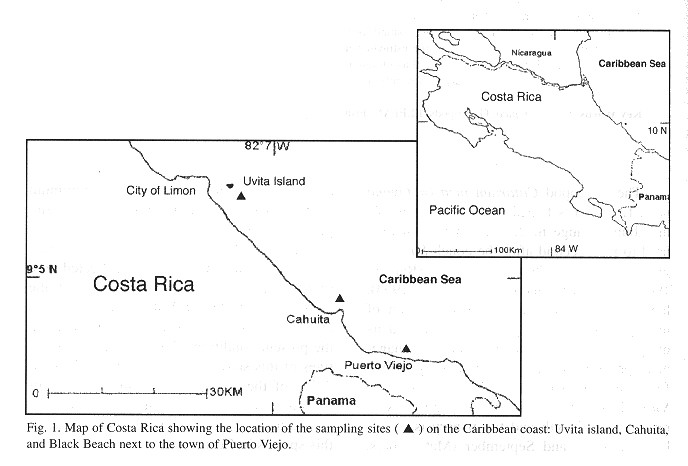
<body><![CDATA[<br>  <b><font face="Arial"><font size="-1">Material and methods</font></font></b>    </p>       <p><font face="Arial"><font size="-1"><b>Study area and sampling sites: </b>  The Caribbean coast of Costa Rica stretches between Nicaragua to the North  and Panama to the South and belongs to the Southern part of the Caribbean  Sea (<a href="#fig1">Fig. 1</a>  ). lt is about 200 km long and except for the small island of Uvita in front  of the port city of Lim&oacute;n (10&ordm; N, 83&ordm; W) and three points  in the Southern half the coast (<a href="#fig1">Fig. 1</a>  ) the coast is relatively straight and dominated by sandy beaches, rocky  shores, and river mouths. Tides are diurnal with a range of about 0.5 m (<a href="#Jimenez">  Jim&eacute;nez 2001</a>  ).</font></font>  </p>       <p><font face="Arial"><font size="-1">The rocky part of the coast is limited  to severas patches between Mo&iacute;n and Manzanillo (<a href="#fig1">Fig.  1</a>  ) which are only a few hundred m long and about 10 m wide. Most of these  rocky patches consist of living and fossil reefs full of holes and crevices.  The coral patches on the Caribbean coast of Costa Rica are impacted by siltation  and bleaching (<a href="#Cortes">Cort&eacute;s and Risk 1985</a>  ; <a href="#Jimenez">Jim&eacute;nez 2001</a>  ).</font></font>  </p>       <p><font face="Arial"><font size="-1"><i>C. pica </i>can be found at the majority of these patches but densities are generally low (&lt;10 ind./m<sup> 2</sup>  in most areas). Within this stretch of rocky patches along the coast, the  Uvita island, located about 1 km offshore from the port city of Lim&oacute;n  (<a href="#fig1">Fig. 1</a>  ) was chosen as an unexploited site. Uvita has the status of a National Monument (Columbus anchored there in 1502) and as such the collection of animals and plants is prohibited.</font></font>  </p>       <p><font face="Arial"><font size="-1">For the assessment of the actual impact  of the fishery, one unexploited and two exploited sites were compared in terms of population density, length-frequency distribution and mortality. Additionally, growth and mortality rate, the size at first maturity and a sustainable relative yield per recruit were determined to understand the population dynamics and production characteristics of this species in Costa Rica and to provide the scientific basis for fishery recommendations.</font></font>   </p>       <p><font face="Arial"><font size="-1">lt was assumed that low population densities and smaller individuals are to be found in areas of more intense fishing and that the comparison of areas of different fishing impact would allow for a better understanding of the population dynamics of this species as influenced by the fishery (<a href="#Moreno">Moreno <i>et al. </i>1984</a>  , <a href="#Castilla">Castilla and Duran 1985</a>  , <a href="#Hockey">Hockey and Bosman 1986</a>  , <a href="#Ortega">Ortega 1987</a>  , <a href="#Keough">Keough <i>et al. </i>1993</a>  ). In addition, fishery operation and catch volumes were recorded and people  involved in the fishery were interviewed for their knowledge and expertise  as resource users (<a href="#Schoenhuth">Schoenhuth and Kievelitz 1993</a>  , <a href="#Pomeroy">Pomeroy 1995</a>  , <a href="#Debrot00">Debrot 2000</a>  , <a href="#Ruddle">Ruddle 1994</a>  ).</font></font>  </p>       <p><font face="Arial"><font size="-1">As exploited sites, two rocky areas  of a length of about 1 km near the small village of Cahuita, 40 km South-East  of Lim&oacute;n were chosen (<a href="#fig1">Fig. 1</a>  ). All three sites were selected due to their great similarity in environmental  characteristies, such as a shore slope &lt;10&ordm;, wave action and the substrate consisting of fossil reef and similar species composition of algae and invertebrates. Hereinafter these sites are referred to as Uvita, Cahuita, and Black Beach.</font></font>      <br>  <font face="Arial"><font size="-1">&nbsp;</font></font> </p>       <center><a name="fig1"></a>  <img src="/img/fbpe/rbt/v50n2-3/2139i01.JPG" height="466" width="688">  </center>   &nbsp;     
<br>  &nbsp;     ]]></body>
<body><![CDATA[<br>  <font face="Arial"><font size="-1"><b>Density and size distribution: </b>  A total of 295 randomly allocated squares (1 m x 1 m) were counted along  transects perpendicular to the coastline, for the presence of <i>C. pica </i> (95 at Black Beach, 96 at Cahuita, and 104 at Uvita), with a 1 m<sup> 2</sup>  plastic frame. To prevent double counting of snails moving through the habitat, the transects were placed at a minimum distance of 2 m between each other. To obtain the average snail density at each site, the number of specimens of all squares was divided by the total number of squares counted:</font></font>         <center><font face="Arial"><font size="-1">&nbsp;</font></font><img src="/img/fbpe/rbt/v50n2-3/2139F01.JPG" height="33" width="128">  </center>   <font size="-1"><font face="Arial">with N</font><sub><font face="Arial,Helvetica">  Av</font></sub><font face="Arial">= Average Number of individuals per square;  N</font><sub><font face="Arial,Helvetica">I </font></sub><font face="Arial">  = Number of Individuals; N</font><sub><font face="Arial,Helvetica">s</font></sub><font face="Arial">   = Number of squares according to Perez and Aranda (2000).</font></font>         
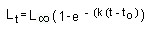
<p><font face="Arial"><font size="-1">&nbsp;</font></font>     <br>  <font face="Arial"><font size="-1">Additionally, length-frequency histograms  were constructed from the measurements of the snails obtained from each site. Shell length was measured across the widest diameter of the shell base (<a href="#Debrot90b"> Debrot 1990b</a>  ) using a calliper with an accuracy of 0.01 mm. Due to the prevailing high  wave conditions, the lower part of the shore edge and the vertical drop zone  of the shore, where large specimens (&gt;60 mm) are concentrated (<a href="#Randall">  Randall 1964</a>  , <a href="#Debrot90a">Debrot 1990a</a>  , pers. observations), could not adequately be sampled at any of the three  sites. Hence, they are not included in the calculations.</font></font>  </p>       <p><font face="Arial"><font size="-1"><b>Growth: </b>Length frequency data  were also used to calculase the von Bertalanffy growth rate 'k' and the asymptotic length 'L<img src="/img/fbpe/rbt/v50n2-3/infinito.JPG" height="11" width="15" align="Absbottom">  ' by model progression analysis using the FISAT programme (<a href="#Sparre">  Sparre and Venema 1992</a>  ) The non-seasonalized von Bertalanffy equation was used as samples were  only taken during one period of the year (rainy season):</font></font> </p>       
<center><img src="/img/fbpe/rbt/v50n2-3/2139F02.JPG" height="31" width="154">  </center>           
<p><font size="-1"><font face="Arial">where L</font><sub><font face="Arial,Helvetica">  t</font></sub><font face="Arial"> = Length at time t; L<img src="/img/fbpe/rbt/v50n2-3/infinito.JPG" height="11" width="15" align="Absbottom">   = asymptotic length; k growth constant; t</font><sub><font face="Arial,Helvetica">  o</font></sub><font face="Arial"> = age at length 0; here to<b> </b>was considered zero, as any specific information en absolute age at length t</font><sub><font face="Arial,Helvetica">  o</font></sub><font face="Arial"> was not available (Appeldoom 1988).</font></font>       
<br>  &nbsp;     <br>  <font face="Arial"><font size="-1">Based on the findings of <a href="#Debrot90b">  Debrot (1990b)</a>   and <a href="#Randall">Randall (1964)</a>   the asymptotic length 'L<img src="/img/fbpe/rbt/v50n2-3/infinito.JPG" height="11" width="15" align="Absbottom">  ' was assumed to range between 90 mm and 110 mm and the instantaneous growth  rate 'k' between 0.1 and 0.6. These value ranges were used as input for the  FISAT program and the best possible fit of the growth curve was obtained by first using the "surface analysis" and then the "automatic search routine"  of the ELEFAN 1 program (<a href="#Sparre">Sparre and Venema 1992</a>  ).</font></font>  </p>       
<p><font face="Arial"><font size="-1">As different cohorts could not clearly  be distinguished visually in the Cahuita samples, the Bhattacharya-method  of the ELEFAN 1 program was used to visualize the different cohorts in this  sample.</font></font>  </p>       ]]></body>
<body><![CDATA[<p><font face="Arial"><font size="-1">In addition, 546 snails were tagged  in Cahuita and the Munro-plot was used to calculate the growth rate using  the formula:</font></font> </p>       <center><img src="/img/fbpe/rbt/v50n2-3/2139F03.JPG" height="36" width="258">  </center>           

<p><font size="-1"><font face="Arial">with k = growth constant; L<img src="/img/fbpe/rbt/v50n2-3/infinito.JPG" height="11" width="15" align="Absbottom">   = asymptotic length as calculated with the length-frequencies; L</font><sub><font face="Arial,Helvetica">  1</font></sub><font face="Arial">= length at<b> </b>tagging; L </font><sub><font face="Arial,Helvetica">  2</font></sub><font face="Arial"> = length at recapture, t</font><sub><font face="Arial,Helvetica">  2</font></sub><font face="Arial"> - t</font><sub><font face="Arial,Helvetica">  1</font></sub><font face="Arial"><b> = </b>time interval between tagging  and recapture (<a href="#Kochwolff96">Koch and Wolff 1996</a>  ).</font></font>  </p>       
<p><font face="Arial"><font size="-1">The whelks were marked with nail polish  of a colour similar to red calcareous algae often overgrowing the shells of <i>Cittarium pica. </i>To distinguish between single individuals, a number  was written with a water-resistant ink on the nail polish. Finally, glue was put on top to seal the tag, following <a href="#Koch92">Koch (1992)</a>  . The animals were recaptured after three weeks on average, measured with  a calliper and repainted as the tag tended to fade after three weeks.</font></font>    </p>       <p><font face="Arial"><font size="-1">New snails were marked at each recapture  date to compensase for losses due to mortality, collection, or tag shedding.  To reduce emigration of the tagged specimens all marked snails were always  released at the same point (<a href="#Appeldoom84">Appeldoom 1984</a>  ).</font></font>  </p>       <p><font face="Arial"><font size="-1">The growth performance index&nbsp;<img src="/img/fbpe/rbt/v50n2-3/bola.JPG" height="16" width="13" align="Absbottom">   was calculated from the growth parameter estimates because it facilitates  the intra and interspecific comparison of the growth performance (<a href="#Pauly84">  Pauly and Munro 1984</a>  ):</font></font> </p>       
<center><img src="/img/fbpe/rbt/v50n2-3/2139F04.JPG" height="32" width="165">  </center>           
<p><font face="Arial"><font size="-1">with k = growth constant and L<img src="/img/fbpe/rbt/v50n2-3/infinito.JPG" height="11" width="15" align="Absbottom">   = asymptotic length.</font></font>     
<br>  &nbsp;  </p>       <p><b><font face="Arial"><font size="-1">Mortality: <i>Total mortality "Z"</i>  :</font></font></b><font face="Arial"><font size="-1"><i> </i>For the calculation  of the instantaneous annual mortality rate "Z" the length converted catch  curve (<a href="#Pauly83">Pauly 1983</a>  , <a href="#Munro">Munro 1984</a>  ) was applied to the pooled length frequency data of the different sites  using the estimated growth parameter. With this method 'Z' is calculated from the right descending arm of the curve:</font></font> </p>       ]]></body>
<body><![CDATA[<center><img src="/img/fbpe/rbt/v50n2-3/2139F05.JPG" height="33" width="289">  </center>           
<p><font size="-1"><font face="Arial">with C = number of specimens, L</font><sub><font face="Arial,Helvetica">  1</font></sub><font face="Arial">; L</font><sub><font face="Arial,Helvetica">  2</font></sub><font face="Arial"> = length at time point t</font><sub><font face="Arial,Helvetica">  1</font></sub><font face="Arial">; t</font><sub><font face="Arial,Helvetica">  2</font></sub><font face="Arial">,&nbsp;<img src="/img/fbpe/rbt/v50n2-3/triangulo.JPG" height="12" width="13">  t = time interval between L</font><sub><font face="Arial,Helvetica">1</font></sub><font face="Arial">   and L</font><sub><font face="Arial,Helvetica">2</font></sub><font face="Arial">  , c =conversion factor and Z = mortality rate. The calculation was done with  the FISAT program (<a href="#Sparre">Sparre and Venema 1992</a>  ).</font></font>  </p>       
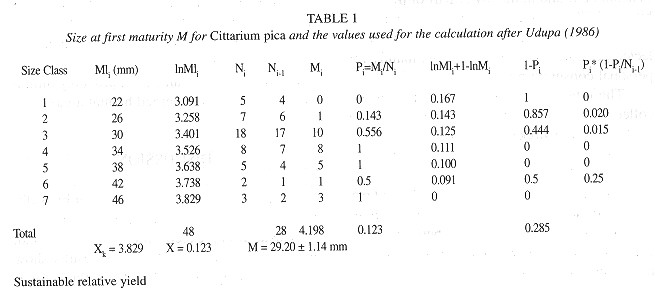
<p><font face="Arial"><font size="-1"><b><i>Natural mortality "M" and fishing  mortality "F": </i></b>At the unexploited site Uvita the fishing mortality  was assumed as F=0 and thus resulting in M=Z. For the calculation of the fishery mortality "F" at the two fished sites Cabuita and Black Beach, the above M value was subtracted from the Z- value in order to get the fishing mortality (F=Z-M) (<a href="#Sainsbury82a">Sainsbury 1982a</a>  , <a href="#Appeldoom84">Appeldoom 1984</a>  ,<a href="#Appeldoom88a">1988</a>  ).</font></font>  </p>       <p><font face="Arial"><font size="-1"><b><i>Exploitation rate "E": </i></b>  With the known values of 'F' and 'Z' the exploitation rate 'E' was calculated  according to (<a href="#Sparre">Sparre and Venema 1992</a>  ):</font></font> </p>       <center></center>          <center><font face="Arial"><font size="-1">E = F/Z</font></font></center>           <p><font face="Arial"><font size="-1"><b>Size at first maturity: </b>The mean size at first maturity was obtained following a method suggested by <a href="#Udupa"> Udupa (1986)</a>  . which also allows for the calculation of the 95% confidente intervals around the estimate. The sample is organised in size classes and the formula of Spearman-Karber is used to<b> </b>calculase the size at first maturity 'M':</font></font>  </p>       <center></center>          <center><img src="/img/fbpe/rbt/v50n2-3/2139F06.JPG" height="28" width="310">  </center>           
<p><font size="-1"><font face="Arial">with: Xk = In of first size at which  100% of individuals are fully mature; X = In of the average size increment;  MI = Midlength per size class; In Ml</font><sub><font face="Arial,Helvetica">  i+1</font></sub><font face="Arial"> - Mli</font><sub><font face="Arial,Helvetica">  +1</font></sub><font face="Arial"> - Ml</font><sub><font face="Arial,Helvetica">  1</font></sub><font face="Arial">; P</font><sub><font face="Arial,Helvetica">  i</font></sub><font face="Arial"> = Proportion of fully mature individuals  per size class; N</font><sub><font face="Arial,Helvetica">i</font></sub><font face="Arial">   = Total number of individuals per size class.</font></font>  </p>       ]]></body>
<body><![CDATA[<p><font face="Arial"><font size="-1">The 95% confidence intervals were calculated  with the same parameters as above and the formula:</font></font> </p>       <center><img src="/img/fbpe/rbt/v50n2-3/2139F07.JPG" height="43" width="320">  </center>           

<p><font face="Arial"><font size="-1">Sexing of mature specimens was done  by visual inspection of the gonad colour (<a href="#Randall">Randall 1964</a>  , <a href="#Bell">Bell 1992</a>  ). The data of both sexes and of all sites were pooled since the total number  of mature specimens in the samples was quite low with 4 from Cahuita, 13 from Black Beach and 14 from Isla Uvita.</font></font>  </p>       <p><font face="Arial"><font size="-1"><b>Relative sustainable yield: </b>  The relative yield per recruit was calculated with the FISAT program (Sparre  and Venema 1992). Input values were the mean value of the estimated growth  rates k = 0.235, the asymptotic length L<img src="/img/fbpe/rbt/v50n2-3/infinito.JPG" height="11" width="15" align="Absbottom">  <b> </b>= 104mm, the natural mortality M 1.47 and the length at first capture  Lc.</font></font>  </p>       
<p><font face="Arial"><font size="-1">The relative yield per recruit was calculated first for the actual length at first capture Lc = 25 mm and the exploitation rate E = 0.65 being the mean of the exploitation rates at the two sites.</font></font>   </p>       <p><font face="Arial"><font size="-1">Then the length at first capture was  modified within a range above the size at first maturity that would allow  the snails to reproduce at least once before collection (Lc&gt;30mm) to find  a size limitation for the fishery that would provide a sustainable yield per recruit.</font></font>  </p>       <p><font face="Arial"><font size="-1">The fishing mortality itself was not  varied because a size limitation for the collection is more likely to be accepted than a limitation of the number of snails being taken.</font></font>   </p>       <p><font face="Arial"><font size="-1"><b>Observations on the fishery: </b>  Catch volumes were registered and fishery operation was observed by accompanying  fishermen on several occasions. The quantity and composition of the catches  was registered and interviews were done in an informal manner without distributing  questionnaires. lt was taken care of asking similar questions (on topics listed below) thus the obtained information could be cross-checked. The topics covered in the interviews are given below. Order and exact formulation of the questions depended on the situation and the interviewed person.</font></font>  </p>   <ul>       <li> <font face="Arial"><font size="-1">Knowledge about the species.</font></font></li>        <li> <font face="Arial"><font size="-1">Temporal dynamics of fishery and  snails.</font></font></li>        ]]></body>
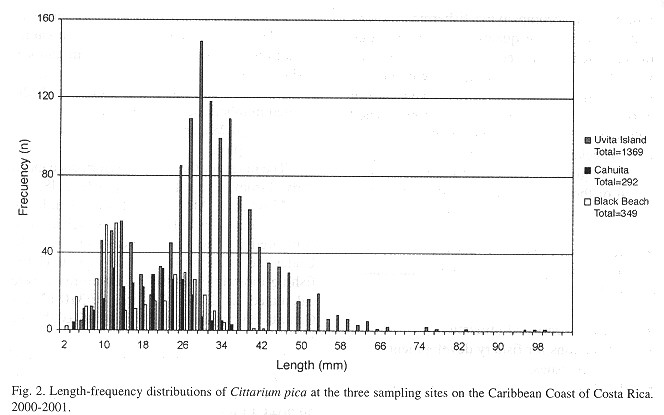
<body><![CDATA[<li> <font face="Arial"><font size="-1">Fishery operation.</font></font></li>        <li> <font face="Arial"><font size="-1">Social position of the interviewee.</font></font></li>        <li> <font face="Arial"><font size="-1">Yield success and utilization.</font></font></li>        <li> <font face="Arial"><font size="-1">Predictions for fishery development.</font></font></li>        <li> <font face="Arial"><font size="-1">Market issues.</font></font></li>        <li> <font face="Arial"><font size="-1">Predictions for snail dynamics  over time.</font></font></li>         </ul>   <font face="Arial"><font size="-1">&nbsp;</font></font>     <br>  <b><font face="Arial"><font size="-1">Results</font></font></b>        <p><font face="Arial"><font size="-1"><b>Density and Size distribution: </b>  Average densities at the exploited sites (Cahuita and Black Beach) are 3&plusmn;3  and 4&plusmn;2, respectively being three times lower than at the unexploited  site Uvita (14&plusmn;5). The length frequency histograms show a significantly  higher proportion of smaller specimens at the exploited sites (F-test, p&lt;0,05),  (<a href="#fig2">Fig. 2</a>  ).    <br>     ]]></body>
<body><![CDATA[<br> </font></font> </p>       <center><a name="fig2"></a>  <img src="/img/fbpe/rbt/v50n2-3/2139i03.JPG" height="415" width="664">  </center>   &nbsp;        
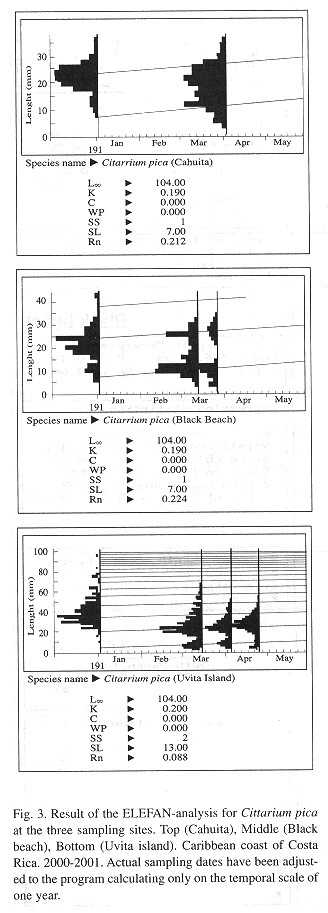
<p><font face="Arial"><font size="-1"><b>Growth: </b>The model progression  analysis using the ELEFAN method gave similar values for all three sites with L&nbsp;<img src="/img/fbpe/rbt/v50n2-3/infinito.JPG" height="11" width="15" align="Absbottom">  = 104 mm and k = 0.19- 0.20 ( <a href="#fig3">Fig. 3</a>  )</font></font>  </p>       
<p><font face="Arial"><font size="-1">Based on 268 recaptures from which the painted number could be identified, a mean k-value of = 0.28 per year was calculated with the Munro-plot.</font></font>  </p>       <p><font face="Arial"><font size="-1">The range for the growth performance  index derived from these values is:&nbsp;<img src="/img/fbpe/rbt/v50n2-3/bola.JPG" height="16" width="13" align="Absbottom">   = 3.31- 3.48.</font></font>  </p>       
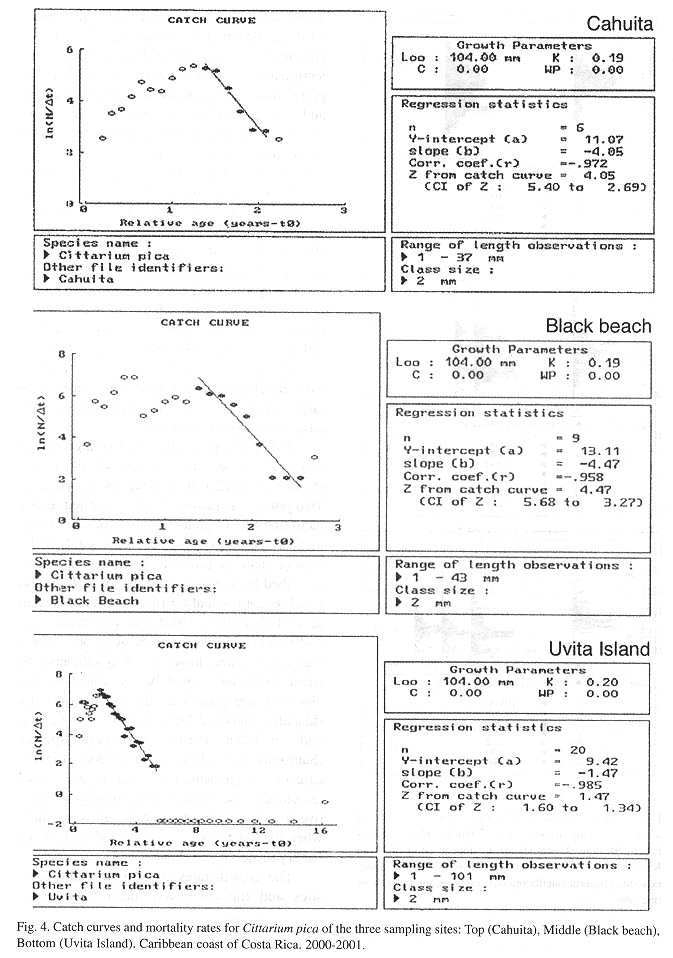
<p><font face="Arial"><font size="-1"><b>Mortality: </b>Mortality rates are  similar at the exploited sites but three times higher when compared to the  unexploited site (<a href="#fig4">Fig. 4</a>  ). Under the assumption that M = Z at Uvita, fishing mortalities and exploitation  rates were calculated as 2.59&plusmn;1.35 and 0.63&plusmn;0.12 for Cahuita  and as 3.00&plusmn;1.21 and 0.67&plusmn;0.09 for Black Beach, respectively.</font></font>    </p>       <p><font face="Arial"><font size="-1"><b>Size at first maturity: </b>The calculation of the size at first maturity for both sexes combined is given in <a href="#table1"> Table 1</a>  . and resulted in M 29.20&plusmn;1.14 mm.</font></font>  </p>       <p><font face="Arial"><font size="-1"><b>Sustainable relative yield: </b>  Based on the input data the relative yield per recruit for the actual length  at first capture was calculated to be 2.7 * 10<sup>-3</sup>. A sustainable  relative yield was identified at the length at first capture Lc = 40 mm. This length allows the snails to reproduce and maintains a relative yield per recruit close to the actual one of 2.3 * 10<sup>-3</sup>.</font></font>   </p>       <p><font face="Arial"><font size="-1"><b>Observations on the fishery: </b>  Cahuita is a small fishing village with about 4 000 people living in its  total catchment area. The National Park next to Cahuita and the associated  tourism are an important source of income for the village. The fishery is  small scale focusing on finfish and spiny lobster. The catch is either for  personal consumption or sold at the village.    <br>     ]]></body>
<body><![CDATA[<br> </font></font> </p>       <center><a name="fig3"></a>  <img src="/img/fbpe/rbt/v50n2-3/2139i04.JPG" height="913" width="328">  </center>   <font face="Arial"><font size="-1">&nbsp;</font></font>       
<center><a name="fig4"></a>  <img src="/img/fbpe/rbt/v50n2-3/2139i05.JPG" height="958" width="673">  </center>          
<center>&nbsp;</center>   <a name="table1"></a>       <br>  <img src="/img/fbpe/rbt/v50n2-3/2139i02.JPG" height="307" width="655">       
<br>  &nbsp;        <p><font face="Arial"><font size="-1">There are two different types of <i>  C. pica</i> fishery in Cahuita. One is a seasonal fishery between March and  April when the ocean is calm enough to allow access to the vertical drop zone of the rocky shore below the low tide line. During this time, people from Cahuita collect bigger specimens (&gt;40 mm) that can be found in the lower part of the shore by snorkelling around the rocks. About 100 snails with an average size of 60 mm are collected per household in one season, mainly for personal consumption.</font></font>  </p>       <p><font face="Arial"><font size="-1">The other type of fishery is a permanent  collection of snails of 20-40 mm by people walking in the upper, horizontal  zone of the rocky shore that could be accessed most of the time during low  tide.</font></font>  </p>       <p><font face="Arial"><font size="-1">A range of 14 to 50 snails are collected  per walk, and the frequency of visits to the shore to collect whelks varied  strongly between once every other week to every day depending on the fishermen  and weather conditions.</font></font>  </p>       <p><font face="Arial"><font size="-1">Mainly Iow<b> </b>income people are  involved in the fishery. The whelks are sold to other people in the village,  or are used for as food, or the shells are processed and sold as jewelry.</font></font>    </p>       ]]></body>
<body><![CDATA[<p><font face="Arial"><font size="-1">All people that were interviewed knew  of the existence of this species but had generally very little knowledge about its biology and population dynamics. Still about 70% of the interviewees stated a decline of the population around the village over the years. People with a higher educational background in biology (e.g. natural tourist guides) related the decline to overfishing, while others attributed the decline to the 1991 earthquake (7.6 Richter scale, <a href="#Denyer">Denyer 1991</a>  ) but could not explain the mechanism behind (the shoreline was uplifted and exposed more than 0.5 m, probably diminishing available submerged habitat  area).</font></font>     <br>  &nbsp;     <br>  &nbsp;     <br>  <b><font face="Arial"><font size="-1">Discussion</font></font></b>  </p>       <p><font face="Arial"><font size="-1"><i>Cittarium pica </i>is collected either by walking or by snorkeling along the Caribbean coast of Costa Rica, except for at Uvita Island, where it is protected. Our study results show that the average snail density is three times higher at Uvita island compared to the exploited Black Beach and Cahuita sites. This difference may be related to the observed higher collection activity at the latter two sites, where the populations are strongly reduced in number and - as the largest available  specimens are depleted first- size classes &gt; 40-60 mm are not to be found  at these sites, while these size classes are present at the protected site  (Uvita).</font></font>  </p>       <p><font face="Arial"><font size="-1">Two distinct peaks can be seen in the  length-frequency histograms for all three sites which correspond to the first two year classes (<a href="#fig2">Fig. 2</a>  ). The first peak is similar for all three sites which suggest that spawning  and recruitment is synchronized between the sites correlating with the small  distance between the sites (<a href="#fig1">Fig. 1</a>  ) and similar environmental conditions. The size of the peaks (= relative  number of specimens) is decreasing from Uvita over Black Beach to Cahuita  indicating that larger specimens of the exploited cohorts have been largely  removed.</font></font>  </p>       <p><font face="Arial"><font size="-1">Although one would expect younger specimens  being more numerous than the older ones (<a href="#Sainsbury82a">Sainsbury  1982a</a>  ) the opposite is shown here. Two possible explanations are suggested: either  recruitment of <i>C. pica </i>strongly varies from year to year (being possibly  less successful in the present than in previous years) as has been describes  by <a href="#Sainsbury82a">Sainsbury (1982a)</a>   for <i>Haliotis </i>and which is not unusual for marine invertebrates in  general (<a href="#Sainsbury82b">Sainsbury 1982b</a>  ), or the recruits are understimated in the samples. A cryptic behaviour  and a general lower sampling efficiency of small individuals could be the  cause for the observed size pattern as already describes by <a href="#Randall">  Randall (1964)</a>   and <a href="#Debrot90a">Debrot (1990a)</a>   for <i>C. pica</i> and for other marine invertebrate species (<a href="#Sainsbury82a">  Sainsbury 1982a</a>  , <a href="#Prince">Prince <i>et al. </i>1988</a>  ). In the first case of a high natural variance in the annual recruitment,  the stocks would seem quite sensitive to collapse due to recruitment overfishing  when the adult stock is heavily reduced by the fishery (<a href="#Catterall">  Caterall and Poiner 1987</a>  ).</font></font>  </p>       <p><font face="Arial"><font size="-1">The growth rates are similar at the  other sites and the calculated mean value is in between the values found by <a href="#Debrot90a">Debrot (1990a)</a>   with k = 0.30-0.36, and k = 0.14-0.25 by <a href="#Randall">Randall (1964)</a>  .</font></font>  </p>       <p><font face="Arial"><font size="-1">The goodness of fit for the ELEFAN growth curves is low (<a href="#fig3">Fig. 3</a>  ) and the confidence limits around the parameter estimates are correspondingly  rather large. However, the estimates seem realistic, because independent calculations for all sites gave similar results and the values are comparable with literature reports for other marine gastropods (<a href="#Kochwolff96"> Koch 1996</a>  ). One further reason for the poor fit of the growth curve could be that  the von Bertalanffy model is not the most suited one for describing growth  in <i>C.</i> <i>pica, </i>especially for the part that concerns the younger  age groups (the older and larger specimens were not quantitatively assessed  in our study). A curve of a sigmoid form, with inflexion somewhere in the  latter juvenile phase, might be better suited as proposed for <i>Concholepas  concholepas </i>(<a href="#Wolff">Wolff 1994</a>  ).</font></font>  </p>       <p><font face="Arial"><font size="-1">When the estimate for the growth performance  index (<img src="/img/fbpe/rbt/v50n2-3/bola.JPG" height="16" width="13" align="Absbottom">   = 3.31-3.48) is compared with the range of values compiled by <a href="#Wolff">  Wolff (1994)</a>   for marine gastropods of all latitudes (<img src="/img/fbpe/rbt/v50n2-3/bola.JPG" height="16" width="13" align="Absbottom">   = 2.2-4.7) and the tropics (<img src="/img/fbpe/rbt/v50n2-3/bola.JPG" height="16" width="13" align="Absbottom">   = 3.6-4.7), it is found that the growth performance of <i>C. pica </i>lies  at the low end of the range observed for most other tropical marine gastropods  (<img src="/img/fbpe/rbt/v50n2-3/bola.JPG" height="16" width="13" align="Absbottom">   = 3.6-4.7). lt may be speculated that the growth rates obtained in this  study are a little too low for the following reasons: field sampling took  place only during the rainy (winter) season, when the waves are rough, rainfall  is higher and temperatures are lower; and spawning took place during the study period in November and December followed by a high inflow of new recruits  in January which might have had negatively affected growth. Possibly growth  is somewhat faster in the dry season (summer) when the average water temperature  is higher and the animals do not need to use energy for reproduction.</font></font>    </p>       
]]></body>
<body><![CDATA[<p><font face="Arial"><font size="-1">The natural mortality rate (M = 1.34-1.60)  estimated for the population of Uvita island is higher than that estimated  by <a href="#Debrot90a">Debrot (1990a)</a>   (M = 0.83) but lies in the range of values (1.01.7) for marine gastropods  given by several authors (<a href="#Sainsbury82a">Sainsbury 1982a</a>  ,<a href="#Sainsbury82b">b</a>  , <a href="#Appeldoom87">Appeldoom 1987</a>  , <a href="#Appeldoom88a">1988</a>  , <a href="#Debrot90b">Debrot 1990b</a>  ). Still in relation to the relative slow growth of the species the estimate  seems rather too high (less than 30% would survive one year). Emigration out of the accessible part of the habitat while growing and the tendency to hide in crevices (which results in a lower capture efficiency) can be expected to have somewhat increased the M estimate which was based on the catch curve.</font></font>   </p>       <p><font face="Arial"><font size="-1">In addition, it has to be considered  that only small to middle-sized specimens were used for the calculation. The mortality is inversely related to size (<a href="#Appeldoom87">Appeldoom 1987</a>  ) thus the calculation of the rate was not based on a balanced set of data.</font></font>    </p>       <p><font face="Arial"><font size="-1">Total mortality at Uvita island is significantly lower than at Cahuita and Black Beach (<a href="#fig4">Fig. 4</a>  ), which is indicative for the strong fishing impact at these sites.</font></font>    </p>       <p><font face="Arial"><font size="-1">The exploitation rate (E around 0.65)  calculated here suggest overexploitation (Gulland 1971). <i>C. pica </i> seems  to be impacted in two ways at Black Beach and Cahuita, since collection of the larger size classes (&gt;60 mm) takes place once a year on a quite intensive level (through snorkelling in the subtidal), while permanent harvest of the smaller size classes occurs on a rather low level but over the whole year's period (through walking collectors).</font></font>  </p>       <p><font face="Arial"><font size="-1">The size at first maturity as calculated  in this study shows that immature snails are already collected. Thus a large  part of the reproductively active individuals are removed. This should impact  the spawning and recruitment success of the population over time (<a href="#Catterall">  Caterall and Poiner 1987</a>  ) and might increase the risk of the population to collapse.</font></font>    </p>       <p><font face="Arial"><font size="-1">This risk exists probably not only around Cahuita but all along the Caribbean coast except for a few inaccessible spots and of course for the protected arca at Uvita island, as indicated by some preliminary sampling at severas spots between Mo&iacute;n and Manzanillo.</font></font>    </p>       <p><font face="Arial"><font size="-1">Based on the results for the calculation  of a sustainable relative yield per recruit, a minimum collection size of  40 mm is recommended. The majority of new recruits is from spawnings in November  and December and enter the rocky shore in January. According to the estimated  growth rate they need two years before they take actively part in reproduction.  <a href="#Catterall">Caterall and Poiner (1987)</a>   demonstrated that gastropods are not fully reproductive at the size of first maturity which is about the size the snails reach in their first year. To ensure that a sufficient number of snails reach the second spawning period  in winter alter their settlement, we additionally suggest a seasonal closure  between July and December. By these measures (seasonal closure of the fishery  and Lc = 40 mm) and their suitable combination, the total yield can be improved  because the closures increase the egg production (and subsequent recruit number). The collectors would benefit since fewer fishing visits would be needed to harvest the same biomass because snail numbers (through larger recruitment) and the average length (through higher landing size) would increase (<a href="#Sluczanowski"> Sluczanowski 1984</a>  ).</font></font>  </p>       <p><font face="Arial"><font size="-1">These measures would not affect the  fishermen working in the subtidal, but would heavily affect those walking  between the rocks, collecting year-around specimens of (mostly) smaller sizes. Therefore we suggest to determine the socio-economic impact of these measures and to assess the need for alternatives to compensase for the loss that these regulations would mean lo the fishermen.</font></font>  </p>       <p><font face="Arial"><font size="-1">Mariculture of this species could he  an interesting alternative as already suggested by <a href="#Bell">Bell (1992)</a>  . lf suitability for mariculture could be combined with a good market potential,  a mariculture project could be envisioned, either in Cahuita or at another  village along the coast and involving local people. In this way a new employment  area could be created which would contribute to the development of the village  in general and a decrease in the fishing pressure on the natural population.</font></font>    </p>       <p><font face="Arial"><font size="-1">Further research on the population dynamics should be done as the results of this study are based on a rather temporally and spatially limited data set. Another interesting topic for future research would be the role of the <i>C. pica</i> population on Uvita as a source of recruits to the mainland shore.</font></font>  </p>       ]]></body>
<body><![CDATA[<p><font face="Arial"><font size="-1">&nbsp;</font></font>     <br>  <b><font face="Arial"><font size="-1">Acknowledgments</font></font></b>  </p>       <p><font face="Arial"><font size="-1">This study was part of a M.Sc. Thesis  of the senior author within the ISATEC - programme at the University of Bremen. Field work in Costa Rica was conducted under the Memorandum of Understanding  between ZMT and CIMAR.</font></font>  </p>       <p><font face="Arial"><font size="-1">We would like to thank the personnel  of CIMAR for their logistic support and the German Agency for Academic Exchange  (DAAD) for funding. Special thanks go to Rosaura Steele, (Gesti&oacute;n Ambiental, J.A.P.D.E.V.A.,Costa Rica) for her help and granting the permit to conduct part of this study at Uvita island, National Monument.</font></font>   </p>       <p><font face="Arial"><font size="-1">&nbsp;</font></font>     <br>  <b><font face="Arial"><font size="-1">Resumen</font></font></b>  </p>       <p><font face="Arial"><font size="-1">El caracol <i>Cittarium pica </i>(West  Indian Top Shell) es recolectado en forma artesanal en zonas rocosas de la costa Caribe de Costa Rica. A la fecha no hay datos sobre esta extracci&oacute;n  ni existe regulaci&oacute;n de su pesquer&iacute;a. La din&aacute;mica poblacional  de esta especie fue evaluada, desde octubre del 2000 hasta marzo del 2001,  en dos sitios en los cuales la especies es recolectada (Playa Negra y Cahuita),  y en un sitio protegido de la actividad pesquera (Isla Uvita). La densidad  promedio de la poblaci&oacute;n fue 14 ind/m<sup>2</sup>, cerca de tres veces  m&aacute;s alta en el sitio protegido que en los dos no protegidos. Los histogramas  de frecuencia de tallas mostraron un fuerte sesgo hacia los ejemplares m&aacute;s  peque&ntilde;os en los sitios no protegidos, lo que se refleja tambi&eacute;n  en tasas de mortalidad total significativamente m&aacute;s altas (Z = 4.05  y 4.47) cuando se les compara con el sitio protegido (Z = 1.47). Los par&aacute;metros  de crecimiento seg&uacute;n von Bertalanffy fueron estirnados en k = 0.19  - 0.28 / a&ntilde;o y L<img src="/img/fbpe/rbt/v50n2-3/infinito.JPG" height="11" width="15" align="Absbottom">   = 104 mm. No se encontr&oacute; diferencias significativas entre los sitios.  A partir de estos valores el &iacute;ndice&nbsp;<img src="/img/fbpe/rbt/v50n2-3/bola.JPG" height="16" width="13" align="Absbottom">   (performance index&nbsp;<img src="/img/fbpe/rbt/v50n2-3/bola.JPG" height="16" width="13" align="Absbottom">  ) estuvo en un &aacute;mbito de 3.31 a 3.48, el cual se encuentra entre los  valores bajos informados para otros gastr&oacute;podos tropicales. La edad  a la primera madurez sexual para ambos sexos combinados fue estimada en 29.20 &plusmn; 1.14 mm. Las tasas de explotaci&oacute;n fueron mayores a 0.6 para los sitios no protegidos y un alto componente de ejemplares peque&ntilde;os  (menos de 30 mm) en las recolectas, sugieren una sobre explotaci&oacute;n  de los adultos y sobrepesca en el reclutamiento. Con base en la estimaci&oacute;n  de la captura m&aacute;xima sostenible (maximum sustainable yield), se recomienda  algunas medidas reguladores de la pesquer&iacute;a como el control de un tama&ntilde;o m&iacute;nimo de desernbarque de 40 mm y la veda de la pesquer&iacute;a durante los rneses de reproducci&oacute;n (de julio a noviembre).</font></font>   </p>       
<p><font face="Arial"><font size="-1">&nbsp;</font></font>     <br>  <b><font face="Arial"><font size="-1">References</font></font></b>  </p>       <!-- ref --><p><a name="Appeldoom84"></a>  <font face="Arial"><font size="-1">Appeldoom R.S. 1984. The effect of size  on mortality of small juvenile conchs <i>(Strombus gigas </i>L. and <i>S.  costatus </i>G.). J. shellfish. Res. 4: 37- 43.    &nbsp;&nbsp;&nbsp;&nbsp;&nbsp;&nbsp;&nbsp;&nbsp;[&#160;<a href="javascript:void(0);" onclick="javascript: window.open('/scielo.php?script=sci_nlinks&ref=1699524&pid=S0034-7744200200030002500001&lng=','','width=640,height=500,resizable=yes,scrollbars=1,menubar=yes,');">Links</a>&#160;]<!-- end-ref --></font></font>  </p>       <!-- ref --><p><a name="Appeldoom87"></a>  <font face="Arial"><font size="-1">Appeldoom R.S. 1987. Assessment of mortality  in an offshore population of queen conch, <i>Strombus gigas </i>L., in Southwest  Puerto Rico. Fish. Bull. 85: 797- 804.    &nbsp;&nbsp;&nbsp;&nbsp;&nbsp;&nbsp;&nbsp;&nbsp;[&#160;<a href="javascript:void(0);" onclick="javascript: window.open('/scielo.php?script=sci_nlinks&ref=1699526&pid=S0034-7744200200030002500002&lng=','','width=640,height=500,resizable=yes,scrollbars=1,menubar=yes,');">Links</a>&#160;]<!-- end-ref --></font></font>  </p>       <!-- ref --><p><a name="Appeldoom88a"></a>  <font face="Arial"><font size="-1">Appeldoom R.S. 1988a. Ontogenetic changes  in natural mortality rate of queen conch, <i>Strombus gigas </i>(Mollusca:  Mesogastropoda). Bull. Mar. Sci., 42: 159- 165.    &nbsp;&nbsp;&nbsp;&nbsp;&nbsp;&nbsp;&nbsp;&nbsp;[&#160;<a href="javascript:void(0);" onclick="javascript: window.open('/scielo.php?script=sci_nlinks&ref=1699528&pid=S0034-7744200200030002500003&lng=','','width=640,height=500,resizable=yes,scrollbars=1,menubar=yes,');">Links</a>&#160;]<!-- end-ref --></font></font>  </p>       <!-- ref --><p><a name="Appeldoom88b"></a>  <font face="Arial"><font size="-1">Appeldoom R.S. 1988b. Age determination,  growth, mortality and age of first reproduction in adult queen conch, <i>  Strombus gigas </i>L., off Puerto Rico. Fish. Res. 6: 363-378.    &nbsp;&nbsp;&nbsp;&nbsp;&nbsp;&nbsp;&nbsp;&nbsp;[&#160;<a href="javascript:void(0);" onclick="javascript: window.open('/scielo.php?script=sci_nlinks&ref=1699530&pid=S0034-7744200200030002500004&lng=','','width=640,height=500,resizable=yes,scrollbars=1,menubar=yes,');">Links</a>&#160;]<!-- end-ref --></font></font>    </p>       <!-- ref --><p><a name="Bell"></a>  <font face="Arial"><font size="-1">Bell L.J. 1992. Reproduction and larval  development of the West Indian Topshell, <i>Cittarium pica </i>(Trochidae),  in the Bahamas. Bull. Mar. Sci. 51: 250-266.    &nbsp;&nbsp;&nbsp;&nbsp;&nbsp;&nbsp;&nbsp;&nbsp;[&#160;<a href="javascript:void(0);" onclick="javascript: window.open('/scielo.php?script=sci_nlinks&ref=1699532&pid=S0034-7744200200030002500005&lng=','','width=640,height=500,resizable=yes,scrollbars=1,menubar=yes,');">Links</a>&#160;]<!-- end-ref --></font></font>  </p>       <!-- ref --><p><a name="Castilla"></a>  <font face="Arial"><font size="-1">Castilla J.C. &amp; L.R. Dur&aacute;n.  1985. Human exclusion from the rocky intertidal zone of central Chile: the  effects en <i>C. concholepas </i>(Gastropoda). Oikos 45: 391- 399.    &nbsp;&nbsp;&nbsp;&nbsp;&nbsp;&nbsp;&nbsp;&nbsp;[&#160;<a href="javascript:void(0);" onclick="javascript: window.open('/scielo.php?script=sci_nlinks&ref=1699534&pid=S0034-7744200200030002500006&lng=','','width=640,height=500,resizable=yes,scrollbars=1,menubar=yes,');">Links</a>&#160;]<!-- end-ref --></font></font>    </p>       <!-- ref --><p><a name="Catterall"></a>  <font face="Arial"><font size="-1">Catterall C.P. &amp; IR. Poiner. 1987.  The potential impact of human gathering en shellfish populations, with reference  to some NE Australian intertidal fiats. Oikos 50: 114-122.    &nbsp;&nbsp;&nbsp;&nbsp;&nbsp;&nbsp;&nbsp;&nbsp;[&#160;<a href="javascript:void(0);" onclick="javascript: window.open('/scielo.php?script=sci_nlinks&ref=1699536&pid=S0034-7744200200030002500007&lng=','','width=640,height=500,resizable=yes,scrollbars=1,menubar=yes,');">Links</a>&#160;]<!-- end-ref --></font></font>   </p>       <!-- ref --><p><a name="Cervigon"></a>  <font face="Arial"><font size="-1">Cervig&oacute;n E, R. Cipriani, W. Fischer,  L. Garibaldi, M. Hendrickx, A. Lemus, R. Marqu&eacute;z, J.M. Pontiers, G.  Robaina &amp; B. Rodr&iacute;guez. 1993. Field Guide to the commercial marine  and brackish-water resources of the Northern coast of South America. FAO species identification sheets for fishery purposes, Rome, 490 p.    &nbsp;&nbsp;&nbsp;&nbsp;&nbsp;&nbsp;&nbsp;&nbsp;[&#160;<a href="javascript:void(0);" onclick="javascript: window.open('/scielo.php?script=sci_nlinks&ref=1699538&pid=S0034-7744200200030002500008&lng=','','width=640,height=500,resizable=yes,scrollbars=1,menubar=yes,');">Links</a>&#160;]<!-- end-ref --></font></font>   </p>       <!-- ref --><p><a name="Cortes"></a>  <font face="Arial"><font size="-1">Cort&eacute;s. J.A. &amp; M.J. Risk. 1985. A reef under siltation stress: Cahuita, Costa Rica. Bull. Mar. Sci. 36: 339-356.    &nbsp;&nbsp;&nbsp;&nbsp;&nbsp;&nbsp;&nbsp;&nbsp;[&#160;<a href="javascript:void(0);" onclick="javascript: window.open('/scielo.php?script=sci_nlinks&ref=1699540&pid=S0034-7744200200030002500009&lng=','','width=640,height=500,resizable=yes,scrollbars=1,menubar=yes,');">Links</a>&#160;]<!-- end-ref --></font></font>   </p>       <p><a name="Debrot87"></a>  <font face="Arial"><font size="-1">Debrot A.O. 1987 Biology and Management  of the West Indian Topshell <i>Cittarium pica </i>of the Exuma Islands, Bahamas.  Ph.D. Thesis University of Miami, Miarni USA. 193 p.</font></font>  </p>       <!-- ref --><p><a name="Debrot90a"></a>  <font face="Arial"><font size="-1">Debrot A.O. 1990a. Temporal aspects of  population dynamies and dispersal bebaviour of the West Indian Tops<i>hell,  Cittarium pica </i>(Linnaeus), at selected sites in the Exuma Cays, Bahamas.  Bull. Mar. Sci. 47: 431-447.    &nbsp;&nbsp;&nbsp;&nbsp;&nbsp;&nbsp;&nbsp;&nbsp;[&#160;<a href="javascript:void(0);" onclick="javascript: window.open('/scielo.php?script=sci_nlinks&ref=1699543&pid=S0034-7744200200030002500011&lng=','','width=640,height=500,resizable=yes,scrollbars=1,menubar=yes,');">Links</a>&#160;]<!-- end-ref --></font></font>  </p>       ]]></body>
<body><![CDATA[<!-- ref --><p><a name="Debrot90b"></a>  <font face="Arial"><font size="-1">Debrot A.O. 1990b. Survival, growth, and fecundity of the West Indian Topshell, <i>Cittarium pica </i>(Linnaeus),  in various rocky intertidal habitats of the Exuma Cays, Bahamas. The Veliger  33: 363-371.    &nbsp;&nbsp;&nbsp;&nbsp;&nbsp;&nbsp;&nbsp;&nbsp;[&#160;<a href="javascript:void(0);" onclick="javascript: window.open('/scielo.php?script=sci_nlinks&ref=1699545&pid=S0034-7744200200030002500012&lng=','','width=640,height=500,resizable=yes,scrollbars=1,menubar=yes,');">Links</a>&#160;]<!-- end-ref --></font></font>  </p>       <!-- ref --><p><a name="Debrot00"></a>  <font face="Arial"><font size="-1">Debrot A.O. &amp; I. Nagelkerke. 2000.  User perceptions en coastal resource state management options in Curazao.  Rev. Biol. Trop. 48 Supl. 1: 95- 106.    &nbsp;&nbsp;&nbsp;&nbsp;&nbsp;&nbsp;&nbsp;&nbsp;[&#160;<a href="javascript:void(0);" onclick="javascript: window.open('/scielo.php?script=sci_nlinks&ref=1699547&pid=S0034-7744200200030002500013&lng=','','width=640,height=500,resizable=yes,scrollbars=1,menubar=yes,');">Links</a>&#160;]<!-- end-ref --></font></font>  </p>       <!-- ref --><p><a name="Denyer"></a>  <font face="Arial"><font size="-1">Denyer, P. 1998. Historic-prehistoric  earthquakes, seismic hazards, and Tertiary and Quartemary geology of the Gandoca-Mazanillo National Wildlife, Lim&oacute;n, Costa Rica. Rev. Biol. Trop. 46. Supl. 6: 237-250.    &nbsp;&nbsp;&nbsp;&nbsp;&nbsp;&nbsp;&nbsp;&nbsp;[&#160;<a href="javascript:void(0);" onclick="javascript: window.open('/scielo.php?script=sci_nlinks&ref=1699549&pid=S0034-7744200200030002500014&lng=','','width=640,height=500,resizable=yes,scrollbars=1,menubar=yes,');">Links</a>&#160;]<!-- end-ref --></font></font>  </p>       <!-- ref --><p><a name="Hockey"></a>  <font face="Arial"><font size="-1">Hockey P.A.R. &amp; A.L. Bosman. 1986.  Man as an intertidal predator in Transkei: disturbance, community convergence  and management of a natural food resource. Oikos 46: 3-14.    &nbsp;&nbsp;&nbsp;&nbsp;&nbsp;&nbsp;&nbsp;&nbsp;[&#160;<a href="javascript:void(0);" onclick="javascript: window.open('/scielo.php?script=sci_nlinks&ref=1699551&pid=S0034-7744200200030002500015&lng=','','width=640,height=500,resizable=yes,scrollbars=1,menubar=yes,');">Links</a>&#160;]<!-- end-ref --></font></font>   </p>       <!-- ref --><p><a name="Hughes"></a>  <font face="Arial"><font size="-1">Hughes R.N. &amp; D.J. Roberts. 1980.  Growth and reproductive rates of <i>Littorina rudis </i>from three contrastes  shores in North Wales, UK. Mar. Biol. 58: 47-54.    &nbsp;&nbsp;&nbsp;&nbsp;&nbsp;&nbsp;&nbsp;&nbsp;[&#160;<a href="javascript:void(0);" onclick="javascript: window.open('/scielo.php?script=sci_nlinks&ref=1699553&pid=S0034-7744200200030002500016&lng=','','width=640,height=500,resizable=yes,scrollbars=1,menubar=yes,');">Links</a>&#160;]<!-- end-ref --></font></font>  </p>       ]]></body>
<body><![CDATA[<!-- ref --><p><a name="Jimenez"></a>  <font face="Arial"><font size="-1">Jim&eacute;nez, C. 2001. Bleaching and  mortality of reef organisms during a warning<b> </b>event in 1995 on the Caribbean coast of Costa Rica. Rev. Biol. Trop. 49 Supl. 2: 233-238.    &nbsp;&nbsp;&nbsp;&nbsp;&nbsp;&nbsp;&nbsp;&nbsp;[&#160;<a href="javascript:void(0);" onclick="javascript: window.open('/scielo.php?script=sci_nlinks&ref=1699555&pid=S0034-7744200200030002500017&lng=','','width=640,height=500,resizable=yes,scrollbars=1,menubar=yes,');">Links</a>&#160;]<!-- end-ref --></font></font>   </p>       <!-- ref --><p><a name="Keough"></a>  <font face="Arial"><font size="-1">Keough M.J., G. Quinn &amp; A. King. 1992. Correlations between human collecting and intertidal mollusc populations  en rocky shores. Conservation Biol. 7: 378- 390.    &nbsp;&nbsp;&nbsp;&nbsp;&nbsp;&nbsp;&nbsp;&nbsp;[&#160;<a href="javascript:void(0);" onclick="javascript: window.open('/scielo.php?script=sci_nlinks&ref=1699557&pid=S0034-7744200200030002500018&lng=','','width=640,height=500,resizable=yes,scrollbars=1,menubar=yes,');">Links</a>&#160;]<!-- end-ref --></font></font>  </p>       <!-- ref --><p><a name="Kochwolff96"></a>  <font face="Arial"><font size="-1">Koch Y &amp; M. Wolff. 1996. The mangrove  snail <i>Thais kiosquiformis </i>Duclos: A case of life history adaptation  to an extreme environment. J. Shellfish Res. 15: 421- 432.    &nbsp;&nbsp;&nbsp;&nbsp;&nbsp;&nbsp;&nbsp;&nbsp;[&#160;<a href="javascript:void(0);" onclick="javascript: window.open('/scielo.php?script=sci_nlinks&ref=1699559&pid=S0034-7744200200030002500019&lng=','','width=640,height=500,resizable=yes,scrollbars=1,menubar=yes,');">Links</a>&#160;]<!-- end-ref --></font></font>   </p>       <!-- ref --><p><a name="Koch92"></a>  <font face="Arial"><font size="-1">Koch Y 1992. Zur Populations&ouml;kologie  und &ouml;kologischen Rolle der Mangrovenschnecke <i>Thais kiosquiformis im</i>  Golf von Nicoya, Costa Rica. Diplomarbeit University of Bremen, Bremen, Germany. 64 p.    &nbsp;&nbsp;&nbsp;&nbsp;&nbsp;&nbsp;&nbsp;&nbsp;[&#160;<a href="javascript:void(0);" onclick="javascript: window.open('/scielo.php?script=sci_nlinks&ref=1699561&pid=S0034-7744200200030002500020&lng=','','width=640,height=500,resizable=yes,scrollbars=1,menubar=yes,');">Links</a>&#160;]<!-- end-ref --></font></font>  </p>       <!-- ref --><p><a name="Moreno"></a>  <font face="Arial"><font size="-1">Moreno C.A., J.R Sutherland &amp; E Jara.  1984. Man as a predator in the intertidal zone of Southern Chile. Oikos 42:  155- 160.    &nbsp;&nbsp;&nbsp;&nbsp;&nbsp;&nbsp;&nbsp;&nbsp;[&#160;<a href="javascript:void(0);" onclick="javascript: window.open('/scielo.php?script=sci_nlinks&ref=1699563&pid=S0034-7744200200030002500021&lng=','','width=640,height=500,resizable=yes,scrollbars=1,menubar=yes,');">Links</a>&#160;]<!-- end-ref --></font></font>  </p>       ]]></body>
<body><![CDATA[<!-- ref --><p><a name="Munro"></a>  <font face="Arial"><font size="-1">Munro J.L. 1984. Estimation of Natural  mortality rates from selectivity and catch length-frequency data. Fishbyte  2: 11-14.    &nbsp;&nbsp;&nbsp;&nbsp;&nbsp;&nbsp;&nbsp;&nbsp;[&#160;<a href="javascript:void(0);" onclick="javascript: window.open('/scielo.php?script=sci_nlinks&ref=1699565&pid=S0034-7744200200030002500022&lng=','','width=640,height=500,resizable=yes,scrollbars=1,menubar=yes,');">Links</a>&#160;]<!-- end-ref --></font></font>  </p>       <!-- ref --><p><a name="Ortega"></a>  <font face="Arial"><font size="-1">Ortega S. 1987. The effect of human predation  en the size distribution of <i>Siphonaria gigas </i>(Mollusca: Pulmonata)  en the Pacific coast of Costa Rica. The Veliger 29: 251- 255.    &nbsp;&nbsp;&nbsp;&nbsp;&nbsp;&nbsp;&nbsp;&nbsp;[&#160;<a href="javascript:void(0);" onclick="javascript: window.open('/scielo.php?script=sci_nlinks&ref=1699567&pid=S0034-7744200200030002500023&lng=','','width=640,height=500,resizable=yes,scrollbars=1,menubar=yes,');">Links</a>&#160;]<!-- end-ref --></font></font>    </p>       <!-- ref --><p><a name="Pauly83"></a>  <font face="Arial"><font size="-1">Pauly D. 1983. Length-converted catch  curves: a powerful tool for fisheries research in the tropics (part I). Fishbyte  1: 9-13.    &nbsp;&nbsp;&nbsp;&nbsp;&nbsp;&nbsp;&nbsp;&nbsp;[&#160;<a href="javascript:void(0);" onclick="javascript: window.open('/scielo.php?script=sci_nlinks&ref=1699569&pid=S0034-7744200200030002500024&lng=','','width=640,height=500,resizable=yes,scrollbars=1,menubar=yes,');">Links</a>&#160;]<!-- end-ref --></font></font>  </p>       <!-- ref --><p><a name="Pauly84"></a>  <font face="Arial"><font size="-1">Pauly D. &amp; J.D. Munro. 1984. Once  more on the comparison of growth in fish and invertebrates. Fishbyte 2: 21.    &nbsp;&nbsp;&nbsp;&nbsp;&nbsp;&nbsp;&nbsp;&nbsp;[&#160;<a href="javascript:void(0);" onclick="javascript: window.open('/scielo.php?script=sci_nlinks&ref=1699571&pid=S0034-7744200200030002500025&lng=','','width=640,height=500,resizable=yes,scrollbars=1,menubar=yes,');">Links</a>&#160;]<!-- end-ref --></font></font>    </p>       <!-- ref --><p><a name="Perez"></a>  <font face="Arial"><font size="-1">P&eacute;rez M.P. &amp; D.A. Aranda. 2000. Distribuci&oacute;n, abundancia, densidad y morfometr&iacute;a de <i> Strombus gigas </i>(Mesogastropoda: Strombidae) en el arrecife Alacranes, Yucat&aacute;n, M&eacute;xico. Rev. Biol. Trop. 48 Supl. 1: 51- 57.    &nbsp;&nbsp;&nbsp;&nbsp;&nbsp;&nbsp;&nbsp;&nbsp;[&#160;<a href="javascript:void(0);" onclick="javascript: window.open('/scielo.php?script=sci_nlinks&ref=1699573&pid=S0034-7744200200030002500026&lng=','','width=640,height=500,resizable=yes,scrollbars=1,menubar=yes,');">Links</a>&#160;]<!-- end-ref --></font></font>   </p>       ]]></body>
<body><![CDATA[<!-- ref --><p><a name="Pomeroy"></a>  <font face="Arial"><font size="-1">Pomeroy R.S. 1995. Community-based and  co-management institutions for sustainable coastal fisheries management in  Southeast Asia. Ocean &amp; Coastal Management 27: 143-162.    &nbsp;&nbsp;&nbsp;&nbsp;&nbsp;&nbsp;&nbsp;&nbsp;[&#160;<a href="javascript:void(0);" onclick="javascript: window.open('/scielo.php?script=sci_nlinks&ref=1699575&pid=S0034-7744200200030002500027&lng=','','width=640,height=500,resizable=yes,scrollbars=1,menubar=yes,');">Links</a>&#160;]<!-- end-ref --></font></font>    </p>       <!-- ref --><p><a name="Prince"></a>  <font face="Arial"><font size="-1">Prince<b> </b>J.D., T.L. Sellers, W.B.  Ford &amp; S.R. Talbot. 1988. Recruitment, growth, mortality and population  structure in a Southem Australian population of <i>Haliotis ruba </i>(Mollusca:  Gastropoda). Mar. Biol. 100: 75- 82.    &nbsp;&nbsp;&nbsp;&nbsp;&nbsp;&nbsp;&nbsp;&nbsp;[&#160;<a href="javascript:void(0);" onclick="javascript: window.open('/scielo.php?script=sci_nlinks&ref=1699577&pid=S0034-7744200200030002500028&lng=','','width=640,height=500,resizable=yes,scrollbars=1,menubar=yes,');">Links</a>&#160;]<!-- end-ref --></font></font>  </p>       <!-- ref --><p><a name="Randall"></a>  <font face="Arial"><font size="-1">Randall H.A. 1964. A study of the growdi  and other aspects of the biology of the West Indian Topshell <i>Cittarium</i>   pica (Linnaeus). Bull. Mar. Sci. of the Gulf and Caribbean 14: 424-443.    &nbsp;&nbsp;&nbsp;&nbsp;&nbsp;&nbsp;&nbsp;&nbsp;[&#160;<a href="javascript:void(0);" onclick="javascript: window.open('/scielo.php?script=sci_nlinks&ref=1699579&pid=S0034-7744200200030002500029&lng=','','width=640,height=500,resizable=yes,scrollbars=1,menubar=yes,');">Links</a>&#160;]<!-- end-ref --></font></font>    </p>       <!-- ref --><p><a name="Ruddle"></a>  <font face="Arial"><font size="-1">Ruddle K.<b> </b>1994. Local knowledge  in the future management of inshore tropical marine resources and environments.  Nature &amp; Resources 30: 28-37.    &nbsp;&nbsp;&nbsp;&nbsp;&nbsp;&nbsp;&nbsp;&nbsp;[&#160;<a href="javascript:void(0);" onclick="javascript: window.open('/scielo.php?script=sci_nlinks&ref=1699581&pid=S0034-7744200200030002500030&lng=','','width=640,height=500,resizable=yes,scrollbars=1,menubar=yes,');">Links</a>&#160;]<!-- end-ref --></font></font>  </p>       <!-- ref --><p><a name="Sainsbury82a"></a>  <font face="Arial"><font size="-1">Sainsbury K.J. 1982a. Population dynamics  and fishery management of the paua, <i>Haliotis iris. </i>I. Population structure,  growth, reproduction, and mortality. NZ J. Mar. Freshw. Res. 16: 147- 161.    &nbsp;&nbsp;&nbsp;&nbsp;&nbsp;&nbsp;&nbsp;&nbsp;[&#160;<a href="javascript:void(0);" onclick="javascript: window.open('/scielo.php?script=sci_nlinks&ref=1699583&pid=S0034-7744200200030002500031&lng=','','width=640,height=500,resizable=yes,scrollbars=1,menubar=yes,');">Links</a>&#160;]<!-- end-ref --></font></font>    </p>       ]]></body>
<body><![CDATA[<!-- ref --><p><a name="Sainsbury82b"></a>  <font face="Arial"><font size="-1">Sainsbury K.J. 1982b. Population dynamics  and fishery management of the paua, <i>Haliotis iris. </i>II. Dynamics and  Management as examined using a size class population model. N.Z J.<b> </b>  Mar. Freshw. Res 16: 163-173.    &nbsp;&nbsp;&nbsp;&nbsp;&nbsp;&nbsp;&nbsp;&nbsp;[&#160;<a href="javascript:void(0);" onclick="javascript: window.open('/scielo.php?script=sci_nlinks&ref=1699585&pid=S0034-7744200200030002500032&lng=','','width=640,height=500,resizable=yes,scrollbars=1,menubar=yes,');">Links</a>&#160;]<!-- end-ref --></font></font>  </p>       <!-- ref --><p><a name="Schoenhuth"></a>  <font face="Arial"><font size="-1">Schoenhuth, M. &amp; U. Kievelitz. 1993.  Participatory learning approaches (RRA &amp; PRA) An introductory guide. Schriftenreihe der GTZ, Nr. 248. Universum Verlagsanstalt GmbH, Wiesbaden 1993, 183 p.    &nbsp;&nbsp;&nbsp;&nbsp;&nbsp;&nbsp;&nbsp;&nbsp;[&#160;<a href="javascript:void(0);" onclick="javascript: window.open('/scielo.php?script=sci_nlinks&ref=1699587&pid=S0034-7744200200030002500033&lng=','','width=640,height=500,resizable=yes,scrollbars=1,menubar=yes,');">Links</a>&#160;]<!-- end-ref --></font></font>   </p>       <!-- ref --><p><a name="Sluczanowski"></a>  <font face="Arial"><font size="-1">Sluczanowski P.R. 1984. A management oriented model of an abalone fishery whose substocks are subject to pulse fishing. Can. J. Fish. Aquat. Sci 41: 1008- 1014.    &nbsp;&nbsp;&nbsp;&nbsp;&nbsp;&nbsp;&nbsp;&nbsp;[&#160;<a href="javascript:void(0);" onclick="javascript: window.open('/scielo.php?script=sci_nlinks&ref=1699589&pid=S0034-7744200200030002500034&lng=','','width=640,height=500,resizable=yes,scrollbars=1,menubar=yes,');">Links</a>&#160;]<!-- end-ref --></font></font>  </p>       <!-- ref --><p><a name="Sparre"></a>  <font face="Arial"><font size="-1">Sparre P. &amp; Venema S.C. 1992. Introduction  to tropical fish stock assessment. Part l-Manual. FAO Fisheries Technical  Paper 306/1 Rev. 1376 p.    &nbsp;&nbsp;&nbsp;&nbsp;&nbsp;&nbsp;&nbsp;&nbsp;[&#160;<a href="javascript:void(0);" onclick="javascript: window.open('/scielo.php?script=sci_nlinks&ref=1699591&pid=S0034-7744200200030002500035&lng=','','width=640,height=500,resizable=yes,scrollbars=1,menubar=yes,');">Links</a>&#160;]<!-- end-ref --></font></font>  </p>       <!-- ref --><p><a name="Udupa"></a>  <font face="Arial"><font size="-1">Udupa K.S. 1986. Statistical method of  estimating the<b> </b>size at first maturity in fishes. Fishbyte 4: 8-10.    &nbsp;&nbsp;&nbsp;&nbsp;&nbsp;&nbsp;&nbsp;&nbsp;[&#160;<a href="javascript:void(0);" onclick="javascript: window.open('/scielo.php?script=sci_nlinks&ref=1699593&pid=S0034-7744200200030002500036&lng=','','width=640,height=500,resizable=yes,scrollbars=1,menubar=yes,');">Links</a>&#160;]<!-- end-ref --></font></font>    </p>       ]]></body>
<body><![CDATA[<!-- ref --><p><a name="Wolff"></a>  <font face="Arial"><font size="-1">Wolff M. 1994. Population dynamics, life  histories and management of selected invertebrates of the Southeast Pacific  upwelling system. Habilitationsschrift University of Bremen, Bremen, Germany.    &nbsp;&nbsp;&nbsp;&nbsp;&nbsp;&nbsp;&nbsp;&nbsp;[&#160;<a href="javascript:void(0);" onclick="javascript: window.open('/scielo.php?script=sci_nlinks&ref=1699595&pid=S0034-7744200200030002500037&lng=','','width=640,height=500,resizable=yes,scrollbars=1,menubar=yes,');">Links</a>&#160;]<!-- end-ref --></font></font>   </p>       <center><font face="Arial"><font size="-1">&nbsp;</font></font></center>           <p><a name="1a"></a>  <font face="Arial"><font size="-1"><a href="#1">1</a>  . Centre for Tropical Marine Ecology (ZMT), University of Bremen, Fahrenheitstrasse  6, 28359 Bremen<b> </b>Germany; <a href="mailto:finecr@yahoo.com">finecr@yahoo.com</a>  </font></font> <font face="Arial"><font size="-1">; <a href="mailto:mwolff@zmt.uni-bremen.de">  mwolff@zmt.uni-bremen.de</a>  </font></font>  </p>       <p><font face="Arial"><font size="-1"><a href="#1">2</a>  . Centro de Investigaci&oacute;n en Ciencias del Mar y Limnolog&iacute;a,  (CIMAR), Universidad de Costa Rica, 2060 San Jos&eacute;, Costa Rica; <a href="mailto:javargas@biologia.ucr.ac.cr">  javargas@biologia.ucr.ac.cr</a>  </font></font> </p>  </div>        ]]></body><back>
<ref-list>
<ref id="B1">
<nlm-citation citation-type="journal">
<person-group person-group-type="author">
<name>
<surname><![CDATA[Appeldoom]]></surname>
<given-names><![CDATA[R.S]]></given-names>
</name>
</person-group>
<article-title xml:lang="en"><![CDATA[The effect of size on mortality of small juvenile conchs (Strombus gigas L. and S. costatus G.)]]></article-title>
<source><![CDATA[J. shellfish. Res]]></source>
<year>1984</year>
<volume>4</volume>
<page-range>37- 43</page-range></nlm-citation>
</ref>
<ref id="B2">
<nlm-citation citation-type="journal">
<person-group person-group-type="author">
<name>
<surname><![CDATA[Appeldoom]]></surname>
<given-names><![CDATA[R.S]]></given-names>
</name>
</person-group>
<article-title xml:lang="en"><![CDATA[Assessment of mortality in an offshore population of queen conch, Strombus gigas L., in Southwest Puerto Rico]]></article-title>
<source><![CDATA[Fish. Bull]]></source>
<year>1987</year>
<volume>85</volume>
<page-range>797- 804</page-range></nlm-citation>
</ref>
<ref id="B3">
<nlm-citation citation-type="journal">
<person-group person-group-type="author">
<name>
<surname><![CDATA[Appeldoom]]></surname>
<given-names><![CDATA[R.S]]></given-names>
</name>
</person-group>
<article-title xml:lang="en"><![CDATA[Ontogenetic changes in natural mortality rate of queen conch, Strombus gigas (Mollusca: Mesogastropoda)]]></article-title>
<source><![CDATA[Bull. Mar. Sci]]></source>
<year>1988</year>
<volume>42</volume>
<page-range>159- 165</page-range></nlm-citation>
</ref>
<ref id="B4">
<nlm-citation citation-type="journal">
<person-group person-group-type="author">
<name>
<surname><![CDATA[Appeldoom]]></surname>
<given-names><![CDATA[R.S]]></given-names>
</name>
</person-group>
<article-title xml:lang="en"><![CDATA[Age determination, growth, mortality and age of first reproduction in adult queen conch, Strombus gigas L., off Puerto Rico]]></article-title>
<source><![CDATA[Fish. Res]]></source>
<year>1988</year>
<volume>6</volume>
<page-range>363-378</page-range></nlm-citation>
</ref>
<ref id="B5">
<nlm-citation citation-type="journal">
<person-group person-group-type="author">
<name>
<surname><![CDATA[Bell]]></surname>
<given-names><![CDATA[L.J]]></given-names>
</name>
</person-group>
<article-title xml:lang="en"><![CDATA[Reproduction and larval development of the West Indian Topshell, Cittarium pica (Trochidae), in the Bahamas]]></article-title>
<source><![CDATA[Bull. Mar. Sci]]></source>
<year>1992</year>
<volume>51</volume>
<page-range>250-266</page-range></nlm-citation>
</ref>
<ref id="B6">
<nlm-citation citation-type="journal">
<person-group person-group-type="author">
<name>
<surname><![CDATA[Castilla]]></surname>
<given-names><![CDATA[J.C]]></given-names>
</name>
<name>
<surname><![CDATA[Durán]]></surname>
<given-names><![CDATA[L.R]]></given-names>
</name>
</person-group>
<article-title xml:lang="en"><![CDATA[Human exclusion from the rocky intertidal zone of central Chile: the effects en C. concholepas (Gastropoda)]]></article-title>
<source><![CDATA[Oikos]]></source>
<year>1985</year>
<volume>45</volume>
<page-range>391- 399</page-range></nlm-citation>
</ref>
<ref id="B7">
<nlm-citation citation-type="journal">
<person-group person-group-type="author">
<name>
<surname><![CDATA[Catterall]]></surname>
<given-names><![CDATA[C.P]]></given-names>
</name>
<name>
<surname><![CDATA[Poiner]]></surname>
<given-names><![CDATA[IR]]></given-names>
</name>
</person-group>
<article-title xml:lang="en"><![CDATA[The potential impact of human gathering en shellfish populations, with reference to some NE Australian intertidal fiats]]></article-title>
<source><![CDATA[Oikos]]></source>
<year>1987</year>
<volume>50</volume>
<page-range>114-122</page-range></nlm-citation>
</ref>
<ref id="B8">
<nlm-citation citation-type="">
<person-group person-group-type="author">
<name>
<surname><![CDATA[Cervigón]]></surname>
<given-names><![CDATA[E]]></given-names>
</name>
<name>
<surname><![CDATA[Cipriani]]></surname>
<given-names><![CDATA[R]]></given-names>
</name>
<name>
<surname><![CDATA[Fischer]]></surname>
<given-names><![CDATA[W]]></given-names>
</name>
<name>
<surname><![CDATA[Garibaldi]]></surname>
<given-names><![CDATA[L]]></given-names>
</name>
<name>
<surname><![CDATA[Hendrickx]]></surname>
<given-names><![CDATA[M]]></given-names>
</name>
<name>
<surname><![CDATA[Lemus]]></surname>
<given-names><![CDATA[A]]></given-names>
</name>
<name>
<surname><![CDATA[Marquéz]]></surname>
<given-names><![CDATA[R]]></given-names>
</name>
<name>
<surname><![CDATA[Pontiers]]></surname>
<given-names><![CDATA[J.M]]></given-names>
</name>
<name>
<surname><![CDATA[Robaina]]></surname>
<given-names><![CDATA[G]]></given-names>
</name>
<name>
<surname><![CDATA[Rodríguez]]></surname>
<given-names><![CDATA[B]]></given-names>
</name>
</person-group>
<source><![CDATA[Field Guide to the commercial marine and brackish-water resources of the Northern coast of South America: FAO species identification sheets for fishery purposes]]></source>
<year>1993</year>
<page-range>490</page-range><publisher-loc><![CDATA[Rome ]]></publisher-loc>
</nlm-citation>
</ref>
<ref id="B9">
<nlm-citation citation-type="journal">
<person-group person-group-type="author">
<name>
<surname><![CDATA[Cortés]]></surname>
<given-names><![CDATA[J.A]]></given-names>
</name>
<name>
<surname><![CDATA[Risk]]></surname>
<given-names><![CDATA[M.J]]></given-names>
</name>
</person-group>
<article-title xml:lang="en"><![CDATA[A reef under siltation stress: Cahuita, Costa Rica]]></article-title>
<source><![CDATA[Bull. Mar. Sci]]></source>
<year>1985</year>
<volume>36</volume>
<page-range>339-356</page-range></nlm-citation>
</ref>
<ref id="B10">
<nlm-citation citation-type="">
<person-group person-group-type="author">
<name>
<surname><![CDATA[Debrot]]></surname>
<given-names><![CDATA[A.O]]></given-names>
</name>
</person-group>
<source><![CDATA[Biology and Management of the West Indian Topshell Cittarium pica of the Exuma Islands, Bahamas]]></source>
<year>1987</year>
<page-range>193</page-range></nlm-citation>
</ref>
<ref id="B11">
<nlm-citation citation-type="journal">
<person-group person-group-type="author">
<name>
<surname><![CDATA[Debrot]]></surname>
<given-names><![CDATA[A.O]]></given-names>
</name>
</person-group>
<article-title xml:lang="en"><![CDATA[Temporal aspects of population dynamies and dispersal bebaviour of the West Indian Topshell, Cittarium pica (Linnaeus), at selected sites in the Exuma Cays, Bahamas]]></article-title>
<source><![CDATA[Bull. Mar. Sci]]></source>
<year>1990</year>
<volume>47</volume>
<page-range>431-447</page-range></nlm-citation>
</ref>
<ref id="B12">
<nlm-citation citation-type="journal">
<person-group person-group-type="author">
<name>
<surname><![CDATA[Debrot]]></surname>
<given-names><![CDATA[A.O]]></given-names>
</name>
</person-group>
<article-title xml:lang="en"><![CDATA[Survival, growth, and fecundity of the West Indian Topshell, Cittarium pica (Linnaeus), in various rocky intertidal habitats of the Exuma Cays, Bahamas]]></article-title>
<source><![CDATA[The Veliger]]></source>
<year>1990</year>
<volume>33</volume>
<page-range>363-371</page-range></nlm-citation>
</ref>
<ref id="B13">
<nlm-citation citation-type="journal">
<person-group person-group-type="author">
<name>
<surname><![CDATA[Debrot]]></surname>
<given-names><![CDATA[A.O]]></given-names>
</name>
<name>
<surname><![CDATA[Nagelkerke]]></surname>
<given-names><![CDATA[I]]></given-names>
</name>
</person-group>
<article-title xml:lang="en"><![CDATA[User perceptions en coastal resource state management options in Curazao]]></article-title>
<source><![CDATA[Rev. Biol. Trop]]></source>
<year>2000</year>
<volume>48</volume>
<numero>^s1</numero>
<issue>^s1</issue>
<supplement>1</supplement>
<page-range>95- 106</page-range></nlm-citation>
</ref>
<ref id="B14">
<nlm-citation citation-type="journal">
<person-group person-group-type="author">
<name>
<surname><![CDATA[Denyer]]></surname>
<given-names><![CDATA[P]]></given-names>
</name>
</person-group>
<article-title xml:lang="en"><![CDATA[Historic-prehistoric earthquakes, seismic hazards, and Tertiary and Quartemary geology of the Gandoca-Mazanillo National Wildlife, Limón, Costa Rica]]></article-title>
<source><![CDATA[Rev. Biol. Trop]]></source>
<year>1998</year>
<volume>46</volume>
<numero>^s6</numero>
<issue>^s6</issue>
<supplement>6</supplement>
<page-range>237-250</page-range></nlm-citation>
</ref>
<ref id="B15">
<nlm-citation citation-type="journal">
<person-group person-group-type="author">
<name>
<surname><![CDATA[Hockey]]></surname>
<given-names><![CDATA[P.A.R]]></given-names>
</name>
<name>
<surname><![CDATA[Bosman]]></surname>
<given-names><![CDATA[A.L]]></given-names>
</name>
</person-group>
<article-title xml:lang="en"><![CDATA[Man as an intertidal predator in Transkei: disturbance, community convergence and management of a natural food resource]]></article-title>
<source><![CDATA[Oikos]]></source>
<year>1986</year>
<volume>46</volume>
<page-range>3-14</page-range></nlm-citation>
</ref>
<ref id="B16">
<nlm-citation citation-type="journal">
<person-group person-group-type="author">
<name>
<surname><![CDATA[Hughes]]></surname>
<given-names><![CDATA[R.N]]></given-names>
</name>
<name>
<surname><![CDATA[Roberts]]></surname>
<given-names><![CDATA[D.J]]></given-names>
</name>
</person-group>
<article-title xml:lang="en"><![CDATA[Growth and reproductive rates of Littorina rudis from three contrastes shores in North Wales, UK]]></article-title>
<source><![CDATA[Mar. Biol]]></source>
<year>1980</year>
<volume>58</volume>
<page-range>47-54</page-range></nlm-citation>
</ref>
<ref id="B17">
<nlm-citation citation-type="journal">
<person-group person-group-type="author">
<name>
<surname><![CDATA[Jiménez]]></surname>
<given-names><![CDATA[C]]></given-names>
</name>
</person-group>
<article-title xml:lang="en"><![CDATA[Bleaching and mortality of reef organisms during a warning event in 1995 on the Caribbean coast of Costa Rica]]></article-title>
<source><![CDATA[Rev. Biol. Trop]]></source>
<year>2001</year>
<volume>49</volume>
<numero>^s2</numero>
<issue>^s2</issue>
<supplement>2</supplement>
<page-range>233-238</page-range></nlm-citation>
</ref>
<ref id="B18">
<nlm-citation citation-type="journal">
<person-group person-group-type="author">
<name>
<surname><![CDATA[Keough]]></surname>
<given-names><![CDATA[M.J]]></given-names>
</name>
<name>
<surname><![CDATA[Quinn]]></surname>
<given-names><![CDATA[G]]></given-names>
</name>
<name>
<surname><![CDATA[King]]></surname>
<given-names><![CDATA[A]]></given-names>
</name>
</person-group>
<article-title xml:lang="en"><![CDATA[Correlations between human collecting and intertidal mollusc populations en rocky shores]]></article-title>
<source><![CDATA[Conservation Biol]]></source>
<year>1992</year>
<volume>7</volume>
<page-range>378- 390</page-range></nlm-citation>
</ref>
<ref id="B19">
<nlm-citation citation-type="journal">
<person-group person-group-type="author">
<name>
<surname><![CDATA[Koch]]></surname>
<given-names><![CDATA[Y]]></given-names>
</name>
<name>
<surname><![CDATA[Wolff]]></surname>
<given-names><![CDATA[M]]></given-names>
</name>
</person-group>
<article-title xml:lang="en"><![CDATA[The mangrove snail Thais kiosquiformis Duclos: A case of life history adaptation to an extreme environment]]></article-title>
<source><![CDATA[J. Shellfish Res]]></source>
<year>1996</year>
<volume>15</volume>
<page-range>421- 432</page-range></nlm-citation>
</ref>
<ref id="B20">
<nlm-citation citation-type="book">
<person-group person-group-type="author">
<name>
<surname><![CDATA[Koch]]></surname>
<given-names><![CDATA[Y]]></given-names>
</name>
</person-group>
<source><![CDATA[Zur Populationsökologie und ökologischen Rolle der Mangrovenschnecke Thais kiosquiformis im Golf von Nicoya, Costa Rica]]></source>
<year>1992</year>
<page-range>64</page-range><publisher-loc><![CDATA[Bremen ]]></publisher-loc>
<publisher-name><![CDATA[Diplomarbeit University of Bremen]]></publisher-name>
</nlm-citation>
</ref>
<ref id="B21">
<nlm-citation citation-type="journal">
<person-group person-group-type="author">
<name>
<surname><![CDATA[Moreno]]></surname>
<given-names><![CDATA[C.A]]></given-names>
</name>
<name>
<surname><![CDATA[Sutherland]]></surname>
<given-names><![CDATA[J.R]]></given-names>
</name>
<name>
<surname><![CDATA[Jara]]></surname>
<given-names><![CDATA[E]]></given-names>
</name>
</person-group>
<article-title xml:lang="en"><![CDATA[Man as a predator in the intertidal zone of Southern Chile]]></article-title>
<source><![CDATA[Oikos]]></source>
<year>1984</year>
<volume>42</volume>
<page-range>155- 160</page-range></nlm-citation>
</ref>
<ref id="B22">
<nlm-citation citation-type="journal">
<person-group person-group-type="author">
<name>
<surname><![CDATA[Munro]]></surname>
<given-names><![CDATA[J.L]]></given-names>
</name>
</person-group>
<article-title xml:lang="en"><![CDATA[Estimation of Natural mortality rates from selectivity and catch length-frequency data]]></article-title>
<source><![CDATA[Fishbyte]]></source>
<year>1984</year>
<volume>2</volume>
<page-range>11-14</page-range></nlm-citation>
</ref>
<ref id="B23">
<nlm-citation citation-type="journal">
<person-group person-group-type="author">
<name>
<surname><![CDATA[Ortega]]></surname>
<given-names><![CDATA[S]]></given-names>
</name>
</person-group>
<article-title xml:lang="en"><![CDATA[The effect of human predation en the size distribution of Siphonaria gigas (Mollusca: Pulmonata) en the Pacific coast of Costa Rica]]></article-title>
<source><![CDATA[The Veliger]]></source>
<year>1987</year>
<volume>29</volume>
<page-range>251- 255</page-range></nlm-citation>
</ref>
<ref id="B24">
<nlm-citation citation-type="journal">
<person-group person-group-type="author">
<name>
<surname><![CDATA[Pauly]]></surname>
<given-names><![CDATA[D]]></given-names>
</name>
</person-group>
<article-title xml:lang="en"><![CDATA[Length-converted catch curves: a powerful tool for fisheries research in the tropics (part I)]]></article-title>
<source><![CDATA[Fishbyte]]></source>
<year>1983</year>
<volume>1</volume>
<page-range>9-13</page-range></nlm-citation>
</ref>
<ref id="B25">
<nlm-citation citation-type="journal">
<person-group person-group-type="author">
<name>
<surname><![CDATA[Pauly]]></surname>
<given-names><![CDATA[D]]></given-names>
</name>
<name>
<surname><![CDATA[Munro]]></surname>
<given-names><![CDATA[J.D]]></given-names>
</name>
</person-group>
<article-title xml:lang="en"><![CDATA[Once more on the comparison of growth in fish and invertebrates]]></article-title>
<source><![CDATA[Fishbyte]]></source>
<year>1984</year>
<volume>2</volume>
<page-range>21</page-range></nlm-citation>
</ref>
<ref id="B26">
<nlm-citation citation-type="journal">
<person-group person-group-type="author">
<name>
<surname><![CDATA[Pérez]]></surname>
<given-names><![CDATA[M.P]]></given-names>
</name>
<name>
<surname><![CDATA[Aranda]]></surname>
<given-names><![CDATA[D.A]]></given-names>
</name>
</person-group>
<article-title xml:lang="es"><![CDATA[Distribución, abundancia, densidad y morfometría de Strombus gigas (Mesogastropoda: Strombidae) en el arrecife Alacranes, Yucatán, México]]></article-title>
<source><![CDATA[Rev. Biol. Trop]]></source>
<year>2000</year>
<volume>48</volume>
<numero>^s1</numero>
<issue>^s1</issue>
<supplement>1</supplement>
<page-range>51- 57</page-range></nlm-citation>
</ref>
<ref id="B27">
<nlm-citation citation-type="journal">
<person-group person-group-type="author">
<name>
<surname><![CDATA[Pomeroy]]></surname>
<given-names><![CDATA[R.S]]></given-names>
</name>
</person-group>
<article-title xml:lang="en"><![CDATA[Community-based and co-management institutions for sustainable coastal fisheries management in Southeast Asia]]></article-title>
<source><![CDATA[Ocean & Coastal Management]]></source>
<year>1995</year>
<volume>27</volume>
<page-range>143-162</page-range></nlm-citation>
</ref>
<ref id="B28">
<nlm-citation citation-type="journal">
<person-group person-group-type="author">
<name>
<surname><![CDATA[Prince]]></surname>
<given-names><![CDATA[J.D]]></given-names>
</name>
<name>
<surname><![CDATA[Sellers]]></surname>
<given-names><![CDATA[T.L]]></given-names>
</name>
<name>
<surname><![CDATA[Ford]]></surname>
<given-names><![CDATA[W.B]]></given-names>
</name>
<name>
<surname><![CDATA[Talbot]]></surname>
<given-names><![CDATA[S.R]]></given-names>
</name>
</person-group>
<article-title xml:lang="en"><![CDATA[Recruitment, growth, mortality and population structure in a Southem Australian population of Haliotis ruba (Mollusca: Gastropoda)]]></article-title>
<source><![CDATA[Mar. Biol]]></source>
<year>1988</year>
<volume>100</volume>
<page-range>75- 82</page-range></nlm-citation>
</ref>
<ref id="B29">
<nlm-citation citation-type="journal">
<person-group person-group-type="author">
<name>
<surname><![CDATA[Randall]]></surname>
<given-names><![CDATA[H.A]]></given-names>
</name>
</person-group>
<article-title xml:lang="en"><![CDATA[A study of the growdi and other aspects of the biology of the West Indian Topshell Cittarium pica (Linnaeus)]]></article-title>
<source><![CDATA[Bull. Mar. Sci. of the Gulf and Caribbean]]></source>
<year>1964</year>
<volume>14</volume>
<page-range>424-443</page-range></nlm-citation>
</ref>
<ref id="B30">
<nlm-citation citation-type="journal">
<person-group person-group-type="author">
<name>
<surname><![CDATA[Ruddle]]></surname>
<given-names><![CDATA[K]]></given-names>
</name>
</person-group>
<article-title xml:lang="en"><![CDATA[Local knowledge in the future management of inshore tropical marine resources and environments]]></article-title>
<source><![CDATA[Nature & Resources]]></source>
<year>1994</year>
<volume>30</volume>
<page-range>28-37</page-range></nlm-citation>
</ref>
<ref id="B31">
<nlm-citation citation-type="journal">
<person-group person-group-type="author">
<name>
<surname><![CDATA[Sainsbury]]></surname>
<given-names><![CDATA[K.J]]></given-names>
</name>
</person-group>
<article-title xml:lang="en"><![CDATA[Population dynamics and fishery management of the paua, Haliotis iris. I. Population structure, growth, reproduction, and mortality]]></article-title>
<source><![CDATA[NZ J. Mar. Freshw. Res]]></source>
<year>1982</year>
<volume>16</volume>
<page-range>147- 161</page-range></nlm-citation>
</ref>
<ref id="B32">
<nlm-citation citation-type="journal">
<person-group person-group-type="author">
<name>
<surname><![CDATA[Sainsbury]]></surname>
<given-names><![CDATA[K.J]]></given-names>
</name>
</person-group>
<article-title xml:lang="en"><![CDATA[Population dynamics and fishery management of the paua, Haliotis iris. II. Dynamics and Management as examined using a size class population model]]></article-title>
<source><![CDATA[N.Z J. Mar. Freshw. Res]]></source>
<year>1982</year>
<volume>16</volume>
<page-range>163-173</page-range></nlm-citation>
</ref>
<ref id="B33">
<nlm-citation citation-type="book">
<person-group person-group-type="author">
<name>
<surname><![CDATA[Schoenhuth]]></surname>
<given-names><![CDATA[M]]></given-names>
</name>
<name>
<surname><![CDATA[Kievelitz]]></surname>
<given-names><![CDATA[U]]></given-names>
</name>
</person-group>
<source><![CDATA[Participatory learning approaches (RRA & PRA) An introductory guide]]></source>
<year>1993</year>
<page-range>183</page-range><publisher-loc><![CDATA[Wiesbaden ]]></publisher-loc>
<publisher-name><![CDATA[Universum Verlagsanstalt]]></publisher-name>
</nlm-citation>
</ref>
<ref id="B34">
<nlm-citation citation-type="journal">
<person-group person-group-type="author">
<name>
<surname><![CDATA[Sluczanowski]]></surname>
<given-names><![CDATA[P.R]]></given-names>
</name>
</person-group>
<article-title xml:lang="en"><![CDATA[A management oriented model of an abalone fishery whose substocks are subject to pulse fishing]]></article-title>
<source><![CDATA[Can. J. Fish. Aquat. Sci]]></source>
<year>1984</year>
<volume>41</volume>
<page-range>1008- 1014</page-range></nlm-citation>
</ref>
<ref id="B35">
<nlm-citation citation-type="">
<person-group person-group-type="author">
<name>
<surname><![CDATA[Sparre]]></surname>
<given-names><![CDATA[P]]></given-names>
</name>
<name>
<surname><![CDATA[Venema]]></surname>
<given-names><![CDATA[S.C]]></given-names>
</name>
</person-group>
<source><![CDATA[Introduction to tropical fish stock assessment]]></source>
<year>1992</year>
<volume>306</volume>
<page-range>1376</page-range></nlm-citation>
</ref>
<ref id="B36">
<nlm-citation citation-type="journal">
<person-group person-group-type="author">
<name>
<surname><![CDATA[Udupa]]></surname>
<given-names><![CDATA[K.S]]></given-names>
</name>
</person-group>
<article-title xml:lang="en"><![CDATA[Statistical method of estimating the size at first maturity in fishes]]></article-title>
<source><![CDATA[Fishbyte]]></source>
<year>1986</year>
<volume>4</volume>
<page-range>8-10</page-range></nlm-citation>
</ref>
<ref id="B37">
<nlm-citation citation-type="book">
<person-group person-group-type="author">
<name>
<surname><![CDATA[Wolff]]></surname>
<given-names><![CDATA[M]]></given-names>
</name>
</person-group>
<source><![CDATA[Population dynamics, life histories and management of selected invertebrates of the Southeast Pacific upwelling system]]></source>
<year>1994</year>
<publisher-loc><![CDATA[Bremen ]]></publisher-loc>
<publisher-name><![CDATA[Habilitationsschrift University of Bremen]]></publisher-name>
</nlm-citation>
</ref>
</ref-list>
</back>
</article>