<?xml version="1.0" encoding="ISO-8859-1"?><article xmlns:mml="http://www.w3.org/1998/Math/MathML" xmlns:xlink="http://www.w3.org/1999/xlink" xmlns:xsi="http://www.w3.org/2001/XMLSchema-instance">
<front>
<journal-meta>
<journal-id>0034-7744</journal-id>
<journal-title><![CDATA[Revista de Biología Tropical]]></journal-title>
<abbrev-journal-title><![CDATA[Rev. biol. trop]]></abbrev-journal-title>
<issn>0034-7744</issn>
<publisher>
<publisher-name><![CDATA[Universidad de Costa Rica]]></publisher-name>
</publisher>
</journal-meta>
<article-meta>
<article-id>S0034-77442002000300024</article-id>
<title-group>
<article-title xml:lang="en"><![CDATA[Black corals (Cnidaria: Anthozoa: Antipatharia): first records and a new species from the Brazilian coast]]></article-title>
</title-group>
<contrib-group>
<contrib contrib-type="author">
<name>
<surname><![CDATA[Echeverría]]></surname>
<given-names><![CDATA[Carlos Alejandro]]></given-names>
</name>
<xref ref-type="aff" rid="A01"/>
</contrib>
</contrib-group>
<aff id="A01">
<institution><![CDATA[,Universidade Federal do Rio de Janeiro Instituto de Biologia Dto. de Zoología]]></institution>
<addr-line><![CDATA[Rio de Janeiro ]]></addr-line>
<country>Brazil</country>
</aff>
<pub-date pub-type="pub">
<day>00</day>
<month>12</month>
<year>2002</year>
</pub-date>
<pub-date pub-type="epub">
<day>00</day>
<month>12</month>
<year>2002</year>
</pub-date>
<volume>50</volume>
<numero>3-4</numero>
<fpage>1067</fpage>
<lpage>1077</lpage>
<copyright-statement/>
<copyright-year/>
<self-uri xlink:href="http://www.scielo.sa.cr/scielo.php?script=sci_arttext&amp;pid=S0034-77442002000300024&amp;lng=en&amp;nrm=iso"></self-uri><self-uri xlink:href="http://www.scielo.sa.cr/scielo.php?script=sci_abstract&amp;pid=S0034-77442002000300024&amp;lng=en&amp;nrm=iso"></self-uri><self-uri xlink:href="http://www.scielo.sa.cr/scielo.php?script=sci_pdf&amp;pid=S0034-77442002000300024&amp;lng=en&amp;nrm=iso"></self-uri><abstract abstract-type="short" xml:lang="en"><p><![CDATA[A new species, Cirripathes secchini (Cnidaria: Antipatharia) from the Abrolhos area (Babia, Brazil) is describes and constitutes the first record to this genus from Brazil. Two other species (Antipathes hirta, first record from the Southwestern Atlantic; and Antipathes fernandezi, first record from the Atlantic Ocean) are compared to the most recent redescriptions and new data on the size distribution of the characters is provided. To the present there are only two records of the order Antipatharia from Brazil.]]></p></abstract>
<abstract abstract-type="short" xml:lang="es"><p><![CDATA[Se describe una nueva especie, Cirripathes secchini (Cnidaria: Antipatharia) proveniente de la región de Abrolhos (Bahia, Brasil), que constituye además el primer registro de este género en Brasil. Otras dos especies (Antipathes hirta, primer registro en el Océano Atlántico sur-occidental; Antipathes fernandezi, primer registro en el Océano Atlántico) se comparan a sus redescripciones más recientes y se agregan nuevos datos sobre la distribución de tamaño de sus caracteres taxonómicos. Hasta el momento existen apenas dos registros del orden Antipatharia en Brasil.]]></p></abstract>
<kwd-group>
<kwd lng="en"><![CDATA[Corals]]></kwd>
<kwd lng="en"><![CDATA[Cirripathes secchini n. sp]]></kwd>
<kwd lng="en"><![CDATA[Antipathes hirta]]></kwd>
<kwd lng="en"><![CDATA[Antipathes fernandezi]]></kwd>
<kwd lng="en"><![CDATA[Brazil]]></kwd>
</kwd-group>
</article-meta>
</front><body><![CDATA[    &nbsp;       <center><b><font face="Arial">Black corals (Cnidaria: Anthozoa: Antipatharia):</font></b></center>          <center><b><font face="Arial">first records and a new species from the Brazilian  coast</font></b></center>           <p><font face="Arial"><font size="-1">&nbsp;</font></font> </p>       <center><b><font face="Arial"><font size="-1">Carlos Alejandro Echeverr&iacute;a&nbsp;<a name="*"></a>  <a href="#*a">*</a>  </font></font></b></center>   &nbsp;        <p><font face="Arial"><font size="-1">&nbsp;</font></font> </p>       <center><font face="Arial"><font size="-1">Received 09-VII-2002. Corrected  04-XII-2002. Accepted 31 -V-2002.</font></font></center>           <p><font face="Arial"><font size="-1">&nbsp;</font></font>     <br>  <b><font face="Arial"><font size="-1">Abstract</font></font></b>  </p>       <div align="Justify">      ]]></body>
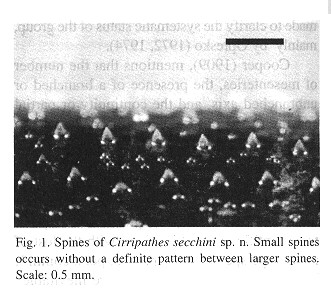
<body><![CDATA[<p><font face="Arial"><font size="-1">A new species, <i>Cirripathes secchini  </i>(Cnidaria: Antipatharia) from the Abrolhos area (Babia, Brazil) is describes  and constitutes the first record to this genus from Brazil. Two other species  <i>(Antipathes hirta, first</i> record from the Southwestern Atlantic; and  <i>Antipathes fernandezi, </i>first record from the Atlantic Ocean) are compared  to the most recent redescriptions and new data on the size distribution of  the characters is provided. To the present there are only two records of the order Antipatharia from Brazil.</font></font>  </p>       <p><b><font face="Arial"><font size="-1">Key words</font></font></b>  </p>       <p><font face="Arial"><font size="-1"><i>Corals, Cirripathes secchini </i>  n. sp., <i>Antipathes hirta,</i><b> </b><i>Antipathes fernandezi, </i>Brazil.</font></font>    </p>       <p><font face="Arial"><font size="-1">&nbsp;</font></font>     <br>  <font face="Arial"><font size="-1">The order Antipatharia (black corals) comprises approximately 200 recognized species. Several monographs (<a href="#Brook">  Brook 1889</a>  , <a href="#Schultze">Schultze 1896</a>  , <a href="#Cooper09">Cooper 1909</a>  , <a href="#VanPesch">Van Pesch 1914</a>   and <a href="#Pax">Pax 1918</a>  ) dealed with the order's taxonomy and geographical distribution, many of  them<b> </b>associated to long range expeditions (Challenger, Siboga, British  Antantic "Terra Nova" and Percy Sladen Trust). <a href="#VanPesch">Van Pesch  (1 914)</a>   carried out the last revision of the group. Since then, efforts have been  made lo clarify the systematic status of the group, mainly by Opresko (<a href="#Opresko72">  1972</a>  , <a href="#Opresko74">1974</a>  ).</font></font>  </p>       <p><font face="Arial"><font size="-1"><a href="#Cooper09">Cooper (1909)</a>  , mentions that the number of mesenteries, the presence of a branched or unbranched axis, and the continuity or partial spacing of the polyps, allow the specimens to be located in recognizable genera, like <i>Antipathes, Cirripathes and Stichopathes. </i>However, the characters in the species level are very poorly defined, and many species descriptions are not detailed enough lo allow a positive identification. This, along with the lost of many type specimens  (Opresko, pers. comm.), causes that "misidentifications are inevitable" (<a href="#Grigg">  Grigg and Opresko 1977</a>  ). Most of the descriptions were based in a single specimen or in a fragment,  not considering intra-specific variation, which seems to be a very common  feature in the antipatharians.</font></font>  </p>       <p><font face="Arial"><font size="-1">Large monographs dealing with the order  were based mainly on collections from the Indo-Pacific (<a href="#Brook">  Brook 1889</a>  , <a href="#Schultze">Schultze 1896</a>  , <a href="#Cooper09">Cooper 1909</a>  , <a href="#VanPesch">Van Pesch 1914</a>   and <a href="#Pax">Pax 1918</a>  ). Species from the Atlantic Ocean were poorly describes in scattered papers,  being discussed later in <a href="#Brook">Brook (1889)</a>   and <a href="#VanPesch">Van Pesch (1914)</a>   monographs without a conclusivo result (<a href="#Opresko72">Opresko 1972</a>  ).</font></font>  </p>       <p><font face="Arial"><font size="-1"><a href="#Opresko72">Opresko (1972)</a>   redescribed and reevaluated twelve Atlantic antipatharians previously describes  by L.E de Pourtal&egrave;s. Opresko mentions approximately 32 species frorn  the Atlantic Ocean. In later works, severas new species were describes (<a href="#Wamer">  Wamer 1981</a>  , <a href="#Opresko92">Opresko and Cairns 1992</a>  , <a href="#Opresko93">Opresko 1993</a>  , <a href="#Opresko96">1996</a>  , <a href="#Cairns">Caims <i>et al. </i>1993</a>   and <a href="#Opresko97">Opresko and S&aacute;nchez 1997</a>  ), resulting in approximately 39 recognized species from this arca.</font></font>    </p>       <p><font face="Arial"><font size="-1">In the present paper a new species <i> (Cirripathes secchiini) </i>is proposed. The description is based in a large number of measures in twenty specimens from the same locality, in order to deal with part of the intraspecifical variation of the species. Two species <i>(Antipathes hirta </i>Gray, 1857, first record from the Southwestern Atlantic and <i>Antipathes fernandezi </i><a href="#Pourtales74">Pourtal&egrave;s,  1874</a>  , first record from the Atlantic Ocean) are compared to the more recent redescriptions (<a href="#Opresko72">Opresko 1972</a>  ) and new data on the size distribution of the characters are provided. The studied material, including <i>C. secchini </i>holotype and paratypes, were deposited in the Cnidaria collections of the Museu Nacional do Rio de Janeiro-UFRJ.  Acronym for Museu Nacional do Rio de Janeiro is MNRJ.</font></font>      <br>  <b><font face="Arial"><font size="-1">&nbsp;</font></font></b>  </p>       ]]></body>
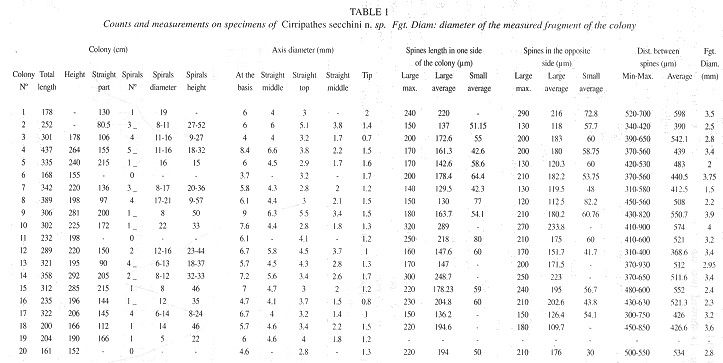
<body><![CDATA[<p><font face="Arial"><font size="-1"><b>Family Antipathidae: </b><i>Cirripathes  secchini </i>sp. nov. (Figs. 1-3, <a href="#cuadro1">Table 1</a>  ).</font></font>  </p>       <p><font face="Arial"><font size="-1"><b>Holotype: </b>MNRJ 2757. specimen  18, 1 colony wet / 18 august 1993 / C.A. Echeverr&iacute;a and C.B. Castro  / 20 m depth.</font></font>  </p>       <p><font face="Arial"><font size="-1"><b>Type locality: </b>Recifes de Popa  Verde, Abrolhos, Bahia, Brazil. 18&ordm; 00.2' S, 039&ordm; 03.1 'W; 10 to 25 m depth.</font></font>  </p>       <p><font face="Arial"><font size="-1"><b>Paratypes: </b>MNRJ 2757, 19 colonies  wet, same locality.</font></font>  </p>       <p><font face="Arial"><font size="-1"><b>Other material: </b>Type specimen  of <i>Stichopathes luetkeni </i>Brook 1889, Zoologisk Museum, Denmark.</font></font>    </p>       <p><font face="Arial"><font size="-1"><b>Diagnosis: </b>Colonies unbranched,  1.55-2.92 m in height, showing a basal plate. Axis straight for 25 to 81%  of the total length, then curving in regular, step, well defined spirals or in a sinuous stem. Spiral's height (when defined) 9-57 cm, diameter 5-22  cm; spiral's number 1 to 5.5. Axis diameter just above basal plate 3.7-9 mm; at tip of colony 0.7-2 mm.</font></font>  </p>       <p><font face="Arial"><font size="-1">Larger spines around stem; conical,  laterally compressed, rounded at tip, forming a 90&ordm; angle with axis;  showing small tubercles or protuberances (<a href="#Fig1">Fig. 1</a>  ). Spines size 100 to 330&nbsp;<img src="/img/fbpe/rbt/v50n2-3/u.JPG" height="12" width="11" align="Absbottom">   m (individual colonies average 140-320&nbsp;<img src="/img/fbpe/rbt/v50n2-3/u.JPG" height="12" width="11" align="Absbottom">  m, n = 19 colonies). Distance between consecutiva spines 310-930&nbsp;<img src="/img/fbpe/rbt/v50n2-3/u.JPG" height="12" width="11" align="Absbottom">   m.</font></font>  </p>       
<p><font face="Arial"><font size="-1">Small spines distributed irregularly  between large spines, with no apparent pattern (<a href="#Fig1">Fig. 1</a>  ). Small spines conical, sharp, forming a 90&ordm; with axis, size 30-82&nbsp;<img src="/img/fbpe/rbt/v50n2-3/u.JPG" height="12" width="11" align="Absbottom">  m, with no tubercles or protuberances.</font></font>  </p>       
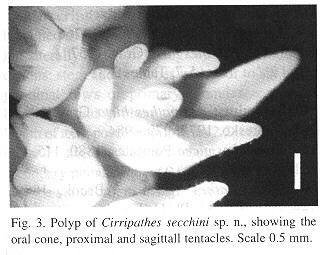
<p><font face="Arial"><font size="-1">Polyps white, transverse diameter about  2-3 mm; longitudinal diameter 1-2 mm, artanged in multiple irregular rows,  except in apical part of axis (apparently in a single row); one side of entire stem usually free of polyps. Sagittal tentacles about 1.3-2.15 mm; lateral tentacles 1.05-1.45 mm. Oral cone about 0.50.7 mm.</font></font> </p>       <center><a name="Fig1"></a>  <img src="/img/fbpe/rbt/v50n2-3/2138i01.JPG" height="304" width="331">  </center>       <img src="/img/fbpe/rbt/v50n2-3/2138i09.JPG" alt="" width="723" height="363">   <b><font face="Arial"><font size="-1">&nbsp;</font></font></b>     
]]></body>
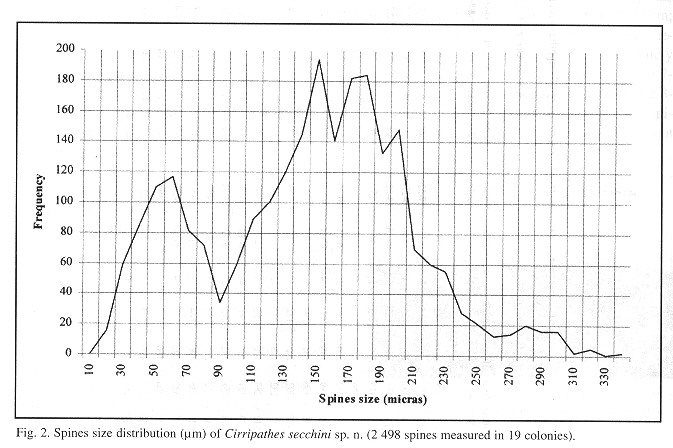
<body><![CDATA[<br>  <b><font face="Arial"><font size="-1">&nbsp;</font></font></b> &nbsp;     <br>      <br>  <font face="Arial"><font size="-1"><b>Description: </b>Colonies unbranched,  1.55-2.92 m in height, attached to substrata (reef calcareous structure) via a basal plate. Colonies almost straight for a variable distance (about 0.8 to 2.15 m, or 25 to 81% of the total length), then recurving forming regular or irregular step spirals. Colonies total length (measured along the axis) about 1.68-4.37 m. Spirals sometimes not well defined, with distal part of colony only slightly sinuous (15% of colonies showed this pattern, n = 20). Spirals height about 9-57 cm, diameter about 5-22 cm; spirals per colony about 1 to 5.5. Axis diameter gradually tapering; diameter immediately above hasal plate (basal diameter) about 3.79 mm; at end of straight part of axis about 2.85.5 mm; at middle point of curved part (spiraled) about 1.4-3.8 mm; at colony tip about 0.7-2 mm. Colonies height / basal diameter average 0.465 (&plusmn; 0.115, n = 20).</font></font>        <p><font face="Arial"><font size="-1">Spines (<a href="#Fig1">Fig. 1</a>  ) showed two size classes: small (modal class: 50&nbsp;<img src="/img/fbpe/rbt/v50n2-3/u.JPG" height="12" width="11" align="Absbottom">  m); and large (modal class: 160&nbsp;<img src="/img/fbpe/rbt/v50n2-3/u.JPG" height="12" width="11" align="Absbottom">  m, n = 2 498; see <a href="#fig2">Fig. 2</a>  ). Size and distribution patterns of spines did not valy around the colony.  Larger spines arranged in rows. Small spines distributed between larger ones  (<a href="#Fig1">Fig. 1</a>  ), not arranged in any particular fashion, showing no preferences for any  side of colonies.</font></font>  </p>       
<p><font face="Arial"><font size="-1">Larger spines mainly conical (<a href="#Fig1">  Fig. 1</a>  ), slightly laterally compressed, rounded at tip, forming a 90&ordm; angle  with stem, covered with small tubercles from apex to middle of spines, and  sometimes to its bases. Large spines colonies average variation about 140-320&nbsp;<img src="/img/fbpe/rbt/v50n2-3/u.JPG" height="12" width="11" align="Absbottom">  m (n = 2 498 spines in 19 colonies). Distance between consecutiva spines  in the same row about 310-930&nbsp;<img src="/img/fbpe/rbt/v50n2-3/u.JPG" height="12" width="11" align="Absbottom">  m (average per colonie range about 360-590&nbsp;<img src="/img/fbpe/rbt/v50n2-3/u.JPG" height="12" width="11" align="Absbottom">  m).</font></font>  </p>       
<p><font face="Arial"><font size="-1">Small spines (<a href="#Fig1">Fig. 1</a>  ) conical, sharp, forming a 90&ordm; angle with stem, length about 10-80&nbsp;<img src="/img/fbpe/rbt/v50n2-3/u.JPG" height="12" width="11" align="Absbottom">  m (colonies average about 30-82&nbsp;<img src="/img/fbpe/rbt/v50n2-3/u.JPG" height="12" width="11" align="Absbottom">  m, n=579 spines, in 19 colonies). Few small spines, usually those in the  upper size class distribution, showed tubercles or protuberances in its surface.</font></font>   </p>       
<center><a name="fig2"></a>  <img src="/img/fbpe/rbt/v50n2-3/2138i02.JPG" height="448" width="673">  </center>           
<p><font face="Arial"><font size="-1">Polyps white (<a href="#fig3">Fig. 3</a>  ), about 2-3 mm in transverse (related to stem) diameter and 1-2 mm in longitudinal  diameter (parallel to stem), measured between external basis of opposite tentacles. Polyps arranged in continuous multiple irregular rows, leaving one side of stem free of polyps along entire colony. Occasionally arranged in a single row in apical part of stem. Distance between consecutive polyps varied from imperceptible, with polyps "crowded" in younger parts of colony, to a distance of 7 mm at the older parts of colony, Common interpolypar distance approximately 2.5 mm. Sagittal tentacles long, about 1.3-2.15 mm in length. Proximal tentacles shorter, about 1.05-1.45 mm in length. Oral cone (<a href="#fig3"> Fig. 3</a>  ) always present, about 0.5-0.7 mm in height.</font></font>  </p>       <p><font face="Arial"><font size="-1">Underwater observations of the polyps  of <i>C. secchini </i>reveled that they are heavily contracted when fixed,  resulting in less reliable measures. <a href="#Wamer">Warner (1981)</a>   also found a great polyp contraction in severas species of the <i>genus Antipathes </i>during their fixation.</font></font> </p>       <center><a name="fig3"></a>  <img src="/img/fbpe/rbt/v50n2-3/2138i03.JPG" height="255" width="325">  </center>          
]]></body>
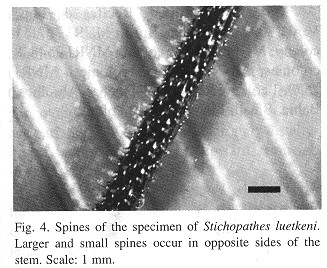
<body><![CDATA[<center>&nbsp;</center>          <center>&nbsp;</center>   <font face="Arial"><font size="-1"><b>Etymology: </b>The specific name honors  Dr. Paulo Secchin Young for his contribution to the knowledge of the marine  fauna of Brazil.</font></font>        <p><font face="Arial"><font size="-1"><b>Remarks: </b><a href="#VanPesch">  Van Pesch (1914)</a>   carried out the last revision of the genus <i>Cirripathes and</i> synomized  severas species. This author recognized as valid only four previously describes  species: <i>C. anguina (Dana), C. spiralis</i> (Linnaeus), C. <i>? paucispina  </i>Brook, and a species without name describes by Simpson and Thompson in  1905 (see <a href="#VanPesch">Van Pesch 1914</a>  ). He also describes six new species: <i>C. nana, C.</i> <i>translucens,  C. ramosa, C. contorta, C. musculosa and C. rumphii. </i>This author also  proposed to include the two unbranched genus of antipatharians <i>(Cirripathes  and Stichopathes)</i> as subgenus of <i>Cirripathes, </i>with the name of  <i>Eucirripathes and Stichopathes. </i>In later works, authors (<a href="#Pax">  Pax 1918</a>  , <a href="#Pasternak">Pasternak 1977</a>  , <a href="#Opresko90">Opresko and Genin 1990</a>  ) argued for retaining them as separate genera. This latter position is adopted here.</font></font>  </p>       <p><font face="Arial"><font size="-1">The main difference between <i>Cirripathes</i>   <i>and Stichopathes </i>is the polyp arrangement. Several unbranched species  were describes only on the basis of colony growth form, not including polyps.  Therefore, <i>Stichopathes</i> <i>luetkeni </i>type was compared to the <i> C. secchini</i> description.</font></font> </p>       <center><a name="fig4"></a>  <img src="/img/fbpe/rbt/v50n2-3/2138i04.JPG" height="268" width="327">  </center>   &nbsp;       
<center>&nbsp;</center>           <p><font face="Arial"><font size="-1">The colony growth form in <i>C. secchini  is</i> very similar to <a href="#Brook">Brook's (1889)</a>   <i>S. luetkeni</i> description. Larger spines (<a href="#fig4">Fig. 4</a>  ) size (not included in Brook's description; checked by the author on the  type specimen) are also very similar. The shape of the spines, however, differs  in this species mainly by the fact that their are curved upwards in the type  of <i>S. luetkeni. </i>Another differences between these species are:</font></font>    </p>       <p><font face="Arial"><font size="-1">1. The existence of two different kind  of spines in opposite sides of <i>S. luetkeni</i> (<a href="#fig4">Fig. 4</a>  ). This is mentioned in Brook's description, and is typical of the antipatharians  that bear polyps in only one side of the stem. Although Brook's description  was based in a dry specimen and he does not mention polyps, he places this  species in the genus <i>Stichopathes</i> (polyps unisseriately arranged in  one side of the stem). In <i>C. secchini, </i>larger spines occur all around  the axis, with the small spines between them (<a href="#Fig1">Fig.1</a>  ). lt also shows the polyps distributed in severas rows without a specific  arrangement, which is a characteristic of the genus <i>Cirripathes.</i></font></font>    </p>       <p><font face="Arial"><font size="-1">2. <i>Cirripathes secchini </i>shows  larger and better defined spirals that <i>S. luetkeni. </i>lt also shows a comparatively greater stem diameter. Although this can be related to the  colonies development status, similar length specimens compared with the type  of <i>S. luetkeni </i>also showed this difference. The type specimen of <i>  S. luetkeni </i>is very similar to the <i>C. spiralis </i>description (<a href="#Linnaeus">  Linnaeus 1758</a>  ), and <a href="#VanPesch">Van Pesch (1914)</a>   suggested that they were synonymous. C. <i>spiralis, </i>however, is redescribed  by Van Pesch as showing a great number of close spirals, about 1-2 cm in diameter. The type specimen of <i>S. luetkeni </i>shows spirals usually with larger diameter, but greatly varying in shape and size.</font></font>  </p>       <p><font face="Arial"><font size="-1">Another species bearing small secondary  spines, although they are not from the Caribbean area, are compared here to <i>C. secchini. </i>Not all these species were considered valid by Van Pesch (1914). The genus is in a great need of revision.</font></font>  </p>       ]]></body>
<body><![CDATA[<p><b><font face="Arial"><font size="-1"><i>Cirripathes </i>diversa</font></font></b><font face="Arial"><font size="-1">   <b><a href="#Brook">Brook 1889</a>  : </b>Brook mentions that the axis is "spiraled as in <i>Cirripathes spiralis"  </i>(Van Pesch synomized both in 1914), with large spines with a blunt apex  and small triangular spines between them. The poor description makes difficult  any discussion, except by the fact that <i>C. spiralis </i>shows severas small (diameter aprox. 2 cm) spirals, and <i>C. secchini </i>shows few spirals,  but with a larger diameter.</font></font>  </p>       <p><b><font face="Arial"><font size="-1"><i>Cirripathes flagellum </i><a href="#Brook">  Brook 1889</a>  :</font></font></b><font face="Arial"><font size="-1"> Brook mentions secondary  spines distributed between larger spines. The axis of this species is not  spiraled. <a href="#Summers">Summers (1910)</a>   suggested to place this species in the genus Stichopathes.</font></font>    </p>       <p><b><font face="Arial"><font size="-1"><i>Cirripathes gardineri </i><a href="#Cooper03">  Cooper 1903</a>  :</font></font></b><font face="Arial"><font size="-1"> A very poor and incomplete  description. <a href="#VanPesch">Van Pesch (1914)</a>   synomized this species with <i>Cirripathes anguina </i>Dana, that shows  only primary spines. <a href="#Opresko74">Opresko (1974)</a>   mentions that <a href="#Cooper03">Cooper's (1903)</a>   descriptions are very abbreviated and, although they have figures, are insufficient to determine the validity of the species.</font></font> </p>       <center>&nbsp;</center>          <center>&nbsp;</center>          <center><b><font face="Arial"><font size="-1">Family Antipathidae:</font></font></b></center>          <center><b><font face="Arial"><font size="-1">Genus <i>Antipathes</i> Pailas,  1766</font></font></b></center>          <center><font face="Arial"><font size="-1"><i>Antipathes hirta </i>Gray, 1857</font></font></center>          <center><font face="Arial"><font size="-1">(Fig. 5-7, Tables 2-3)</font></font></center>   &nbsp;        <p><font face="Arial"><font size="-1"><b>Synonims: </b><i>Antipathes hirta  </i>Gray, 1857: 293.- Opresko, 1972: 979 - 984.</font></font>     ]]></body>
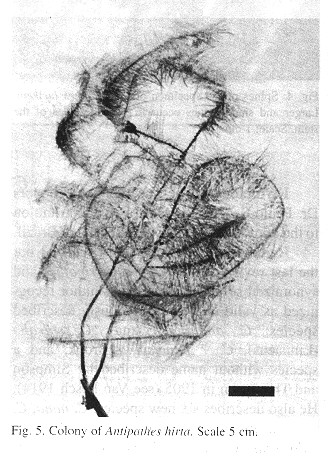
<body><![CDATA[<br>  <font face="Arial"><font size="-1"><i>Antipathes picea </i>Pourtal&egrave;s,  1880: 115, PI. 3. Figs. 9, 29.</font></font>     <br>  <font face="Arial"><font size="-1"><i>Parantipathes? hirta -- </i>Brook, 1889: 144, PI. 2, Fig. 11, PI. 11, Fig. 1.</font></font>     <br>  <font face="Arial"><font size="-1"><i>Antipathes picea </i>-- Brook. 1889:  161.</font></font>     <br>  <font face="Arial"><font size="-1"><i>Paratitipatlies hirta </i>-- van Pesch,  1914: 20.</font></font>  </p>       <p><font face="Arial"><font size="-1"><b>Material examined: </b>Recifes de  Popa Verde, Abrolhos, Bahia, Brasil: MNRJ 3071, 1 colony; MNRJ 2577, 1 colony;  MNRJ 2548, 8 colonies; MNRJ2467, 2 colonies; MNRJ2579, 1 colony; Recife de  Timbebas, Abrolhos, Bahia, Brasil; MNRJ 2847, 1 colony.</font></font>  </p>       <p><font face="Arial"><font size="-1"><b>Description:</b> Colony (<a href="#fig5">  Fig. 5</a>  ) sparsely branched to third or fourth order, branches arising laterally and at right angles to lower ramifications; stem and branches with four to six longitudinal rows of primary pinnules arranged bisserially and in alternating  groups along the length of axis; posterior primarias 2.2-4.6 cm long (colonies  average variation about 1.5-3.25 cm); secondary pinnules about 0.68-1.53 cm (colonies average variation), in a single series on basal half of posterior  (abpolypar) side of primaries; tertiary pinnules few in number (one to tree)  and restricted to posterior side of those secondaries nearest the base of  each primary; quatemary pinnules rarely present.</font></font>     <br>  &nbsp; </p>       <center>&nbsp;<a name="fig5"></a>  <img src="/img/fbpe/rbt/v50n2-3/2138i05.JPG" height="457" width="328">  </center>   &nbsp;     
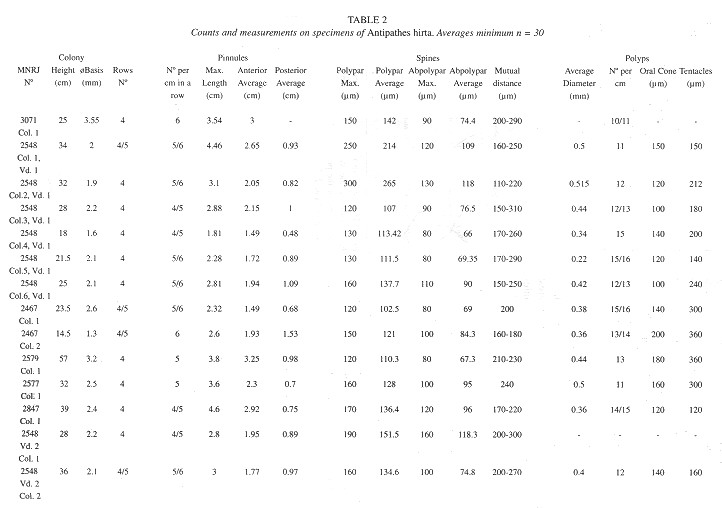
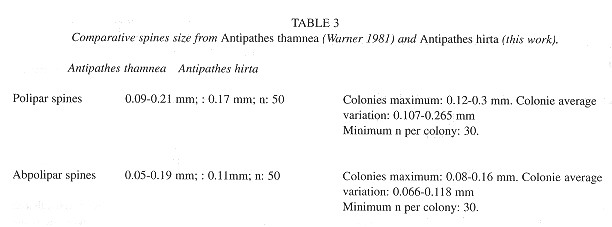
<br>  <font face="Arial"><font size="-1">Spines smooth, conical, with an acute apex; maximum polypar spine's length per colony 0.12-0.3 mm; colonies average variation 0.107-0.265 mm; maximum abpolypar spine's length per colony 0.08-0.16 mm length, colonies average variation 0.066-0.118 mm; strongly distally inclined  (30&ordm;-45&ordm;) and hooked upward, arranged in eight to ten longitudinal  rows.</font></font>        <p><font face="Arial"><font size="-1">Polyps 0.22-0.51 mm long (10-16 per  centimeter) in a single series orientated perpendicular to primary dorsoventral  axis of colony; tentacles 0.12-0.360 mm long; oral cone raised about 0.1-0.2  mm (<a href="#tabla2">Table 2</a>  ); mouth usually sagittally elongated.</font></font>  </p>       ]]></body>
<body><![CDATA[<p><font face="Arial"><font size="-1"><b>Geographic distribution: </b>West  Indies, Brazil.</font></font>  </p>       <p><font face="Arial"><font size="-1"><b>Remarks: </b>Warner (<a href="#Wamer">  1981</a>  , p.151) proposed a new species <i>(Antipathes thamnea)</i> very similar to A. <i>hirta, </i>and mentions that "differences arise in details of pinnation  and in the size of spines and polyps". This author mentions 0.52-0.64 mm for A. <i>thamnea</i> polyp's size. <a href="#Opresko72">Opresko (1972)</a>   mentions 0.70.8 mm length to A. <i>hirta </i>polyps. The A. <i>hirta </i>  specimens studied herein showed even smaller polyps (0.22-0.51 mm) than A. <i>thamiiea </i>description (<a href="#cuadro3">Table 3</a>  ). This suggests that the polyp's size in A. <i>hirta </i>would be about  0.22-0.8 mm in length. Considering also the contraction of the polyps during  fixation, polyp's size does not seem to be a very reliable character in order  to separate these two species. <a href="#Wamer">Warner (1981)</a>  , however, mentions that the measurements where carried out in fresh specimens,  and that a great contraction (1/3 to half of the original size) occurs in  this process. Taking this contraction into account, there seems to exist an overlying in polyp's size gradient between A. <i>thamnea </i>and A. <i> hirta. </i><a href="#Opresko72">Opresko (1972)</a>   also mentions a polypar spine's length of 0.07-0.13 mm to A. <i>hirta. </i> Warner mentions, 0.09-0.21 mm to A. <i>thamnea </i>polypar spines length  and 0.05-0.19 mm to the abpolypar spines. The knew polypar spine's size distribution  in A. <i>hirta </i>would be about 0.07 mm (Opresko 1972) to 0.3 mm (this work, see <a href="#cuadro1">Table 1</a>  ). Again, there appears to exist an overlying on the spine's length gradient  between these two species.</font></font> </p>       <center><a name="tabla2"></a>  <img src="/img/fbpe/rbt/v50n2-3/2138i08.JPG" alt="" width="722" height="508">  </center>   &nbsp;    
<br>  &nbsp;      <center>&nbsp;<a name="cuadro3"></a>   <img src="/img/fbpe/rbt/v50n2-3/2138i10.JPG" alt="" width="612" height="227">  </center>           
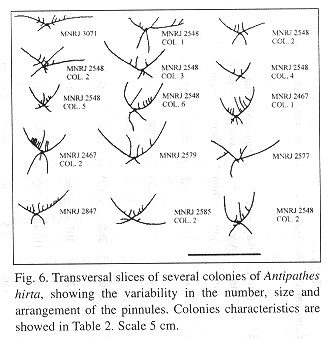
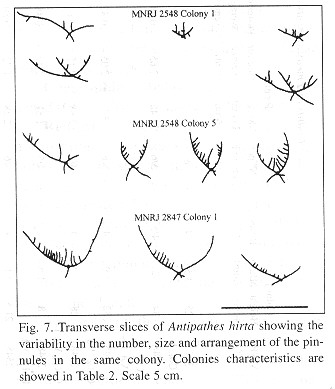
<p><font face="Arial"><font size="-1">I found a great variability in the characters size of the herein studied specimens (<a href="#fig6">Fig. 6</a>  , <a href="#tabla2">Table 2</a>  ) even in the same colony (<a href="#fig7">Fig. 7</a>  ). lt is likely that the characteristics used to define A. <i>thamnea </i>  could he included in the intraespecific variability observed in A. <i>hirta.  </i>The great variability in spines size and pinnules arrangement seems to  be a common feature in the order Antipatharia; therefore, a large number of measures in severas specimens from diverse localities, are necessary to verify the variability of a species character. Unfortunately, most of species descriptions were based in fragments from dredgings, with soft tissues very damaged or lost.</font></font> </p>       <center><a name="fig6"></a>  <img src="/img/fbpe/rbt/v50n2-3/2138i06.JPG" height="339" width="333">  <a name="fig7"></a>  <img src="/img/fbpe/rbt/v50n2-3/2138i07.JPG" height="389" width="335">  </center>           
<p><font face="Arial"><font size="-1">&nbsp;</font></font>     <br>  &nbsp; </p>       <center><b><font face="Arial"><font size="-1">Family Antipathidae:</font></font></b></center>          ]]></body>
<body><![CDATA[<center><font face="Arial"><font size="-1"><b><i>Genus Antipathes</i></b>   <b>Palias, 1766</b></font></font></center>          <center><font face="Arial"><font size="-1"><i>Antipathes fernandezi </i>Pourtal&egrave;s,  1874</font></font></center>   &nbsp;        <p><font face="Arial"><font size="-1"><b>Synonims: </b><i>Antipathes femandezii  </i>Pourtal&egrave;s, 1874: 47.</font></font>     <br>  <font face="Arial"><font size="-1"><i>Antipathes fernandezii -- </i>Pourtal&eacute;s,  1880: pl. 3, fig. 20.</font></font>     <br>  <font face="Arial"><font size="-1"><i>Parantipathes? fernandezi -- </i>Brook,  1889: 144.</font></font>     <br>  <font face="Arial"><font size="-1"><i>Parantipathes? fernandezi -- </i>Looser,  1926: 272, fig. 38.</font></font>  </p>       <p><font face="Arial"><font size="-1"><b>Material examines: </b><i>Antipathes  fernandezi: </i>one complete colony and severas small fragments (MNRJ 3188)  - off Rio Grande do Sul, between Rio Grande do Sul and Chu&iacute;. N/Oc Saldanha, Esta. 14, Sul 11, March, 1972:</font></font>  </p>       <p><font face="Arial"><font size="-1"><b>Description: </b>Colony 4.86 cm height, mainly in one plane; axis diameter above basal plate 0.75 mm; stem and branches pinnate; pinnules simple and bilateral, arranged alternately along the axis; interpinnular distance 24 mm; pinnules average size 1.39 cm; pinnules diameter 0.20-0.25 mm.</font></font>  </p>       <p><font face="Arial"><font size="-1">Spines long, conical and acute, forming  regular groups of longer spines alternating with relatively shorter spines  groups along pinnules; slightly longer in one side of axis; maximum length  on branches 0.24 mm, average 0.17 mm (n = 41; S: 0.04); pinnules spines maximum 0.31 mm, average 0.21 mm (n = 42; S: 0.06); arranged in eight longitudinal  rows; 55-60 per centimeter in each row. These colonies bear no polyps.</font></font>    </p>       <p><font face="Arial"><font size="-1"><b>Geographic distribution: </b>Juan  Fernandez Island (Chile), Rio Grande do Sul (Brazil).</font></font>  </p>       ]]></body>
<body><![CDATA[<p><font face="Arial"><font size="-1"><b>Remarks: </b>Opresko's (</font></font><font face="Arial"><font size="-1"><a href="#Opresko72"> 1972</a> ) diagnosis did not mention the spines  size. In his redescription of the type specimen, however, this author mentions  0.13-0.17 mm in length. In the herein studied material, the maximum spine  length is about 0.31 mm. This spine length is relatively uncommon, occurring  mainly on some spines of the pinnules apex. Average length seems to be a most reliable character than maximun spines length.</font></font>  </p>       <p><font face="Arial"><font size="-1">The split of the Antarctic Convergence  waters by the South-American continent in two branches (the Falklands current,  that reaches southern coast of Brazil; and Humboldt current, that reaches  western coast of Chile and Juan Fernandez Island), may justify the occurrence  of A. <i>fernandezi </i>in both sides of South America. Since antipatharians  are common in the continental shelf and in deeper waters, it is unlikely the existence of a barrier to its distribution in both sides of southern south-American continent.</font></font>  </p>       <p><b><font face="Arial"><font size="-1">&nbsp;</font></font></b>     <br>  <b><font face="Arial"><font size="-1">Acnowledgments</font></font></b>  </p>       <p><font face="Arial"><font size="-1">I wish to thank Dennis M. Opresko, for suggestions and encouragement; Ole S. Tendal (Zoologisk Museum, Denmark),  for his gently loan of the type specimen of <i>Stichopathes</i> <i>luetkeni.  </i>Clovis B. Castro (Museu Nacional do Rio de Janeiro/UFRJ) for field and  laboratory facilities. Thanks to three anonymous reviewers for comments and  suggestions that greatly contributed to improve this manuscript.</font></font>    </p>       <p><font face="Arial"><font size="-1">&nbsp;</font></font>     <br>  <b><font face="Arial"><font size="-1">Resumen</font></font></b>  </p>       <p><font face="Arial"><font size="-1">Se describe una nueva especie, <i>Cirripathes  secchini</i> (Cnidaria: Antipatharia) proveniente de la regi&oacute;n de Abrolhos (Bahia, Brasil), que constituye adem&aacute;s el primer registro de este g&eacute;nero en Brasil. Otras dos especies <i>(Antipathes</i> <i> hirta, </i>primer registro en el Oc&eacute;ano Atl&aacute;ntico sur-occidental;<i>   Antipathes fernandezi, </i>primer registro en el Oc&eacute;ano Atl&aacute;ntico)  se comparan a sus redescripciones m&aacute;s recientes y se agregan nuevos  datos sobre la distribuci&oacute;n de tama&ntilde;o de sus caracteres taxon&oacute;micos.  Hasta el momento existen apenas dos registros del orden Antipatharia en Brasil.</font></font>   </p>       <p><font face="Arial"><font size="-1">&nbsp;</font></font>     <br>  <b><font face="Arial"><font size="-1">References</font></font></b>  </p>       ]]></body>
<body><![CDATA[<!-- ref --><p><a name="Brook"></a>  <font face="Arial"><font size="-1">Brook, G. 1889. Report on the Antipatharia  - Rep. Sci. Results Voyage Challenger - Zool. 32: 5-222.    &nbsp;&nbsp;&nbsp;&nbsp;&nbsp;&nbsp;&nbsp;&nbsp;[&#160;<a href="javascript:void(0);" onclick="javascript: window.open('/scielo.php?script=sci_nlinks&ref=1687004&pid=S0034-7744200200030002400001&lng=','','width=640,height=500,resizable=yes,scrollbars=1,menubar=yes,');">Links</a>&#160;]<!-- end-ref --></font></font>  </p>       <!-- ref --><p><a name="Cairns"></a>  <font face="Arial"><font size="-1">Cairns, S.D., Opresko, D.M., Hopkins,  T.S. &amp; Schroeder, W.W. 1993. New records of deep-water Cnidaria (Scleractinia  &amp; Antipatharia) from the Gulf of Mexico. Northeast Gulf Sci. 13: 1-11.    &nbsp;&nbsp;&nbsp;&nbsp;&nbsp;&nbsp;&nbsp;&nbsp;[&#160;<a href="javascript:void(0);" onclick="javascript: window.open('/scielo.php?script=sci_nlinks&ref=1687006&pid=S0034-7744200200030002400002&lng=','','width=640,height=500,resizable=yes,scrollbars=1,menubar=yes,');">Links</a>&#160;]<!-- end-ref --></font></font>    </p>       <!-- ref --><p><a name="Cooper03"></a>  <font face="Arial"><font size="-1">Cooper, C.F. 1903. Antipatharia. Fauna  and Geography of the Maldive and Laccadive Archipelagoes. Vol. 2. pp. 761-796.    &nbsp;&nbsp;&nbsp;&nbsp;&nbsp;&nbsp;&nbsp;&nbsp;[&#160;<a href="javascript:void(0);" onclick="javascript: window.open('/scielo.php?script=sci_nlinks&ref=1687008&pid=S0034-7744200200030002400003&lng=','','width=640,height=500,resizable=yes,scrollbars=1,menubar=yes,');">Links</a>&#160;]<!-- end-ref --></font></font>    </p>       <!-- ref --><p><a name="Cooper09"></a>  <font face="Arial"><font size="-1">Cooper, C.F. 1909. Antipatharia. Rep.  Percy Sladen Trust Exped. Indian Ocean 1905. Linnean Soc. London Trans., Ser 2a, 12 (17): 301-321.    &nbsp;&nbsp;&nbsp;&nbsp;&nbsp;&nbsp;&nbsp;&nbsp;[&#160;<a href="javascript:void(0);" onclick="javascript: window.open('/scielo.php?script=sci_nlinks&ref=1687010&pid=S0034-7744200200030002400004&lng=','','width=640,height=500,resizable=yes,scrollbars=1,menubar=yes,');">Links</a>&#160;]<!-- end-ref --></font></font>  </p>       <!-- ref --><p><a name="Echeverria"></a>  <font face="Arial"><font size="-1">Echeverr&iacute;a, C.A. &amp; Castro,  C.B. 1995. <i>Antipathes</i> (Cnidaria-Antipatharia) from southeastern Brazil.  Bol. Mus. Nacional, Nova S&eacute;rie, Zool. 364:1-7.    &nbsp;&nbsp;&nbsp;&nbsp;&nbsp;&nbsp;&nbsp;&nbsp;[&#160;<a href="javascript:void(0);" onclick="javascript: window.open('/scielo.php?script=sci_nlinks&ref=1687012&pid=S0034-7744200200030002400005&lng=','','width=640,height=500,resizable=yes,scrollbars=1,menubar=yes,');">Links</a>&#160;]<!-- end-ref --></font></font>  </p>       ]]></body>
<body><![CDATA[<!-- ref --><p><a name="Gray"></a>  <font face="Arial"><font size="-1">Gray, J.E. 1857. Synopsis of the Families  and Genera of Axiferous Zoophytes or Barked Corals. Proc. Zool. Soci. London  25:278-294.    &nbsp;&nbsp;&nbsp;&nbsp;&nbsp;&nbsp;&nbsp;&nbsp;[&#160;<a href="javascript:void(0);" onclick="javascript: window.open('/scielo.php?script=sci_nlinks&ref=1687014&pid=S0034-7744200200030002400006&lng=','','width=640,height=500,resizable=yes,scrollbars=1,menubar=yes,');">Links</a>&#160;]<!-- end-ref --></font></font>  </p>       <!-- ref --><p><a name="Grigg"></a>  <font face="Arial"><font size="-1">Grigg, R.W. &amp; Opresko, D.M. 1977.  Order Antipatharia: Black Corals. pp. 761-796. In Reef and shore fauna from  Hawaii, Section 1: Protozoa through Ctenophora. B.P. Bishop Museum Special  Publication.    &nbsp;&nbsp;&nbsp;&nbsp;&nbsp;&nbsp;&nbsp;&nbsp;[&#160;<a href="javascript:void(0);" onclick="javascript: window.open('/scielo.php?script=sci_nlinks&ref=1687016&pid=S0034-7744200200030002400007&lng=','','width=640,height=500,resizable=yes,scrollbars=1,menubar=yes,');">Links</a>&#160;]<!-- end-ref --></font></font>  </p>       <!-- ref --><p><a name="Linnaeus"></a>  <font face="Arial"><font size="-1">Linnaeus, C. 1758. Systema Naturae, I.  Editio decima, reformata. <i>Holmiae: </i>819.    &nbsp;&nbsp;&nbsp;&nbsp;&nbsp;&nbsp;&nbsp;&nbsp;[&#160;<a href="javascript:void(0);" onclick="javascript: window.open('/scielo.php?script=sci_nlinks&ref=1687018&pid=S0034-7744200200030002400008&lng=','','width=640,height=500,resizable=yes,scrollbars=1,menubar=yes,');">Links</a>&#160;]<!-- end-ref --></font></font>  </p>       <!-- ref --><p><a name="Opresko72"></a>  <font face="Arial"><font size="-1">Opresko, D.M. 1972. Redescriptions and  reevaluation of the Antipatharians describes by L.F. de Pourial&egrave;s.  Biol. Results Univ. of Miami Deep-Sea Exped. 97: 950-1015.    &nbsp;&nbsp;&nbsp;&nbsp;&nbsp;&nbsp;&nbsp;&nbsp;[&#160;<a href="javascript:void(0);" onclick="javascript: window.open('/scielo.php?script=sci_nlinks&ref=1687020&pid=S0034-7744200200030002400009&lng=','','width=640,height=500,resizable=yes,scrollbars=1,menubar=yes,');">Links</a>&#160;]<!-- end-ref --></font></font>   </p>       <!-- ref --><p><a name="Opresko74"></a>  <font face="Arial"><font size="-1">Opresko, D.M. 1974. A Study of the Classification  of the Antipatharia (Coelenterata: Anthozoa) with Redescriptions of Eleven  Species. Doctor of Phylosophy dissertation, University of Miami, Miami.    &nbsp;&nbsp;&nbsp;&nbsp;&nbsp;&nbsp;&nbsp;&nbsp;[&#160;<a href="javascript:void(0);" onclick="javascript: window.open('/scielo.php?script=sci_nlinks&ref=1687022&pid=S0034-7744200200030002400010&lng=','','width=640,height=500,resizable=yes,scrollbars=1,menubar=yes,');">Links</a>&#160;]<!-- end-ref --></font></font>    </p>       ]]></body>
<body><![CDATA[<!-- ref --><p><a name="Opresko93"></a>  <font face="Arial"><font size="-1">Opresko, D.M. 1993. A new species of <i> Sibopathes</i> (Cnidaria: Anthozoa: Antipatharia: Antipathidae) from the Gulf of Mexico. Proc. Biol. Soc. Washington 106: 195-203.    &nbsp;&nbsp;&nbsp;&nbsp;&nbsp;&nbsp;&nbsp;&nbsp;[&#160;<a href="javascript:void(0);" onclick="javascript: window.open('/scielo.php?script=sci_nlinks&ref=1687024&pid=S0034-7744200200030002400011&lng=','','width=640,height=500,resizable=yes,scrollbars=1,menubar=yes,');">Links</a>&#160;]<!-- end-ref --></font></font>   </p>       <!-- ref --><p><a name="Opresko96"></a>  <font face="Arial"><font size="-1">Opresko, D.M. 1996. New species of black  coral (Cnidaria: Anthozoa: Antipatharia) from the Caribbean. Bull. Mar. Sci.  58: 289-300.    &nbsp;&nbsp;&nbsp;&nbsp;&nbsp;&nbsp;&nbsp;&nbsp;[&#160;<a href="javascript:void(0);" onclick="javascript: window.open('/scielo.php?script=sci_nlinks&ref=1687026&pid=S0034-7744200200030002400012&lng=','','width=640,height=500,resizable=yes,scrollbars=1,menubar=yes,');">Links</a>&#160;]<!-- end-ref --></font></font>  </p>       <!-- ref --><p><a name="Opresko92"></a>  <font face="Arial"><font size="-1">Opresko, D.M. &amp; Cairns, S.D. 1992.  New species of black coral (Cnidaria: Antipatharia) from the northern Gulf  of Mexico. Northeast Gulf. Sci. 12: 93-97.    &nbsp;&nbsp;&nbsp;&nbsp;&nbsp;&nbsp;&nbsp;&nbsp;[&#160;<a href="javascript:void(0);" onclick="javascript: window.open('/scielo.php?script=sci_nlinks&ref=1687028&pid=S0034-7744200200030002400013&lng=','','width=640,height=500,resizable=yes,scrollbars=1,menubar=yes,');">Links</a>&#160;]<!-- end-ref --></font></font>  </p>       <!-- ref --><p><a name="Opresko97"></a>  <font face="Arial"><font size="-1">Opresko, D.M. &amp; S&aacute;nchez, J.A.  1997. A new species of Antipatharian coral (Cnidaria-Anthozoa) from the Caribbean  Coast of Colombia. Carib. J.<b> </b>Sci. 33: 7581.    &nbsp;&nbsp;&nbsp;&nbsp;&nbsp;&nbsp;&nbsp;&nbsp;[&#160;<a href="javascript:void(0);" onclick="javascript: window.open('/scielo.php?script=sci_nlinks&ref=1687030&pid=S0034-7744200200030002400014&lng=','','width=640,height=500,resizable=yes,scrollbars=1,menubar=yes,');">Links</a>&#160;]<!-- end-ref --></font></font>  </p>       <!-- ref --><p><a name="Opresko90"></a>  <font face="Arial"><font size="-1">Opresko, D.M. &amp; Genin, A. 1990. A  new species of antipatharian (Cnidaria: Anthozoa) from seamounts in the eastern  North Pacific. Bull. Mar. Sci. 46: 301-310.    &nbsp;&nbsp;&nbsp;&nbsp;&nbsp;&nbsp;&nbsp;&nbsp;[&#160;<a href="javascript:void(0);" onclick="javascript: window.open('/scielo.php?script=sci_nlinks&ref=1687032&pid=S0034-7744200200030002400015&lng=','','width=640,height=500,resizable=yes,scrollbars=1,menubar=yes,');">Links</a>&#160;]<!-- end-ref --></font></font>  </p>       ]]></body>
<body><![CDATA[<!-- ref --><p><a name="Pax"></a>  <font face="Arial"><font size="-1">Pax, E 1918. Die Antipatharien. Zool.  Jahrbucher, 41: 419-478.    &nbsp;&nbsp;&nbsp;&nbsp;&nbsp;&nbsp;&nbsp;&nbsp;[&#160;<a href="javascript:void(0);" onclick="javascript: window.open('/scielo.php?script=sci_nlinks&ref=1687034&pid=S0034-7744200200030002400016&lng=','','width=640,height=500,resizable=yes,scrollbars=1,menubar=yes,');">Links</a>&#160;]<!-- end-ref --></font></font>  </p>       <!-- ref --><p><a name="Pasternak"></a>  <font face="Arial"><font size="-1">Pasternak, F.A. 1977. Antipatharia. Scientific  results of the Danish Deep-Sea Expedition round the world 1950-1952. pp. 157-164. In Galathea Report, Vol. 14, Seandinavian Sci. Copenhagen.    &nbsp;&nbsp;&nbsp;&nbsp;&nbsp;&nbsp;&nbsp;&nbsp;[&#160;<a href="javascript:void(0);" onclick="javascript: window.open('/scielo.php?script=sci_nlinks&ref=1687036&pid=S0034-7744200200030002400017&lng=','','width=640,height=500,resizable=yes,scrollbars=1,menubar=yes,');">Links</a>&#160;]<!-- end-ref --></font></font>   </p>       <!-- ref --><p><a name="Pourtales74"></a>  <font face="Arial"><font size="-1">Pourtal&egrave;s, L.E de, 1874. Crinoids  and Corals. Zoological Resuits of the "Hassler" Expedition. Illus Cat. Mus.  Comp. Zool. Harvard Coll. 8: 25-50.    &nbsp;&nbsp;&nbsp;&nbsp;&nbsp;&nbsp;&nbsp;&nbsp;[&#160;<a href="javascript:void(0);" onclick="javascript: window.open('/scielo.php?script=sci_nlinks&ref=1687038&pid=S0034-7744200200030002400018&lng=','','width=640,height=500,resizable=yes,scrollbars=1,menubar=yes,');">Links</a>&#160;]<!-- end-ref --></font></font>  </p>       <!-- ref --><p><a name="Pourtales80"></a>  <font face="Arial"><font size="-1">Pourtal&egrave;s, L.E de. 1880. Zoological  Results of the "Blake" Expedition to the Caribbean Sea. Bull. Mus. Comp. Zool. Harvard Coll. 6: 113-118.    &nbsp;&nbsp;&nbsp;&nbsp;&nbsp;&nbsp;&nbsp;&nbsp;[&#160;<a href="javascript:void(0);" onclick="javascript: window.open('/scielo.php?script=sci_nlinks&ref=1687040&pid=S0034-7744200200030002400019&lng=','','width=640,height=500,resizable=yes,scrollbars=1,menubar=yes,');">Links</a>&#160;]<!-- end-ref --></font></font>  </p>       <!-- ref --><p><a name="Schultze"></a>  <font face="Arial"><font size="-1">Schultze, L.S. 1896. Antipathiden ven  Temate nach den Sammlungen Prof. W. Kukenthal's. Zool.Anz., Jena Xix: 89-92.    &nbsp;&nbsp;&nbsp;&nbsp;&nbsp;&nbsp;&nbsp;&nbsp;[&#160;<a href="javascript:void(0);" onclick="javascript: window.open('/scielo.php?script=sci_nlinks&ref=1687042&pid=S0034-7744200200030002400020&lng=','','width=640,height=500,resizable=yes,scrollbars=1,menubar=yes,');">Links</a>&#160;]<!-- end-ref --></font></font>    </p>       ]]></body>
<body><![CDATA[<!-- ref --><p><a name="Summers"></a>  <font face="Arial"><font size="-1">Summers, L. 1910. Antipatharians from  the Indian Ocean. Royal Microsc. Soc. London: 273-281.    &nbsp;&nbsp;&nbsp;&nbsp;&nbsp;&nbsp;&nbsp;&nbsp;[&#160;<a href="javascript:void(0);" onclick="javascript: window.open('/scielo.php?script=sci_nlinks&ref=1687044&pid=S0034-7744200200030002400021&lng=','','width=640,height=500,resizable=yes,scrollbars=1,menubar=yes,');">Links</a>&#160;]<!-- end-ref --></font></font>  </p>       <!-- ref --><p><a name="VanPesch"></a>  <font face="Arial"><font size="-1">Van Pesch, A.J. 1914. The Antipatharia  of the Siboga Expeditie. Monographe 17:1-258.    &nbsp;&nbsp;&nbsp;&nbsp;&nbsp;&nbsp;&nbsp;&nbsp;[&#160;<a href="javascript:void(0);" onclick="javascript: window.open('/scielo.php?script=sci_nlinks&ref=1687046&pid=S0034-7744200200030002400022&lng=','','width=640,height=500,resizable=yes,scrollbars=1,menubar=yes,');">Links</a>&#160;]<!-- end-ref --></font></font>  </p>       <p><a name="Wamer"></a>  <font face="Arial"><font size="-1">Warner, G.F. 1981. Species descriptions  and ecological observations of black corals (Antipatharia) from Trinidad.  Bull. Mar. Sci. 31: 147-163.</font></font>     <br>  &nbsp;  </p>       <p><a name="*a"></a>  <font face="Arial"><font size="-1"><a href="#*">*</a>  &nbsp; Dto. de Zoolog&iacute;a, Instituto de Biologia, Universidade Federal  do Rio de Janeiro. Ccs, Bloco A, Ilha do Fundao. 21940-590, Rio de Janeiro,  RJ, Brazil. Tel./Fax: 055-021-560-5993, ramal 31, e-mail: <a href="mailto:caecheve@acd.ufrj.br">  caecheve@acd.ufrj.br</a>  </font></font> </p>  </div>        ]]></body><back>
<ref-list>
<ref id="B1">
<nlm-citation citation-type="journal">
<person-group person-group-type="author">
<name>
<surname><![CDATA[Brook]]></surname>
<given-names><![CDATA[G]]></given-names>
</name>
</person-group>
<article-title xml:lang="en"><![CDATA[Report on the Antipatharia - Rep. Sci. Results Voyage Challenger]]></article-title>
<source><![CDATA[Zool]]></source>
<year>1889</year>
<volume>32</volume>
<page-range>5-222</page-range></nlm-citation>
</ref>
<ref id="B2">
<nlm-citation citation-type="journal">
<person-group person-group-type="author">
<name>
<surname><![CDATA[Cairns]]></surname>
<given-names><![CDATA[S.D]]></given-names>
</name>
<name>
<surname><![CDATA[Opresko]]></surname>
<given-names><![CDATA[D.M]]></given-names>
</name>
<name>
<surname><![CDATA[Hopkins]]></surname>
<given-names><![CDATA[T.S]]></given-names>
</name>
<name>
<surname><![CDATA[Schroeder]]></surname>
<given-names><![CDATA[W.W]]></given-names>
</name>
</person-group>
<article-title xml:lang="en"><![CDATA[New records of deep-water Cnidaria (Scleractinia & Antipatharia) from the Gulf of Mexico]]></article-title>
<source><![CDATA[Northeast Gulf Sci]]></source>
<year>1993</year>
<volume>13</volume>
<page-range>1-11</page-range></nlm-citation>
</ref>
<ref id="B3">
<nlm-citation citation-type="">
<person-group person-group-type="author">
<name>
<surname><![CDATA[Cooper]]></surname>
<given-names><![CDATA[C.F]]></given-names>
</name>
</person-group>
<source><![CDATA[Antipatharia]]></source>
<year>1903</year>
<volume>2</volume>
<page-range>761-796</page-range></nlm-citation>
</ref>
<ref id="B4">
<nlm-citation citation-type="journal">
<person-group person-group-type="author">
<name>
<surname><![CDATA[Cooper]]></surname>
<given-names><![CDATA[C.F]]></given-names>
</name>
</person-group>
<article-title xml:lang="en"><![CDATA[Antipatharia: Rep. Percy Sladen Trust Exped. Indian Ocean 1905]]></article-title>
<source><![CDATA[Linnean Soc. London Trans]]></source>
<year>1909</year>
<volume>12</volume>
<numero>^s17</numero>
<issue>^s17</issue>
<supplement>17</supplement>
<page-range>301-321</page-range></nlm-citation>
</ref>
<ref id="B5">
<nlm-citation citation-type="journal">
<person-group person-group-type="author">
<name>
<surname><![CDATA[Echeverría]]></surname>
<given-names><![CDATA[C.A]]></given-names>
</name>
<name>
<surname><![CDATA[Castro]]></surname>
<given-names><![CDATA[C.B]]></given-names>
</name>
</person-group>
<article-title xml:lang="en"><![CDATA[Antipathes (Cnidaria-Antipatharia) from southeastern Brazil]]></article-title>
<source><![CDATA[Bol. Mus. Nacional, Nova Série, Zool]]></source>
<year>1995</year>
<volume>364</volume>
<page-range>1-7</page-range></nlm-citation>
</ref>
<ref id="B6">
<nlm-citation citation-type="journal">
<person-group person-group-type="author">
<name>
<surname><![CDATA[Gray]]></surname>
<given-names><![CDATA[J.E]]></given-names>
</name>
</person-group>
<article-title xml:lang="en"><![CDATA[Synopsis of the Families and Genera of Axiferous Zoophytes or Barked Corals]]></article-title>
<source><![CDATA[Proc. Zool. Soci. London]]></source>
<year>1857</year>
<volume>25</volume>
<page-range>278-294</page-range></nlm-citation>
</ref>
<ref id="B7">
<nlm-citation citation-type="book">
<person-group person-group-type="author">
<name>
<surname><![CDATA[Grigg]]></surname>
<given-names><![CDATA[R.W]]></given-names>
</name>
<name>
<surname><![CDATA[Opresko]]></surname>
<given-names><![CDATA[D.M]]></given-names>
</name>
</person-group>
<article-title xml:lang="en"><![CDATA[Order Antipatharia: Black Corals]]></article-title>
<source><![CDATA[Reef and shore fauna from Hawaii, Section 1: Protozoa through Ctenophora]]></source>
<year>1977</year>
<publisher-name><![CDATA[B.P. Bishop Museum]]></publisher-name>
</nlm-citation>
</ref>
<ref id="B8">
<nlm-citation citation-type="">
<person-group person-group-type="author">
<name>
<surname><![CDATA[Linnaeus]]></surname>
<given-names><![CDATA[C]]></given-names>
</name>
</person-group>
<source><![CDATA[Systema Naturae]]></source>
<year>1758</year>
<edition>Editio decima</edition>
<page-range>819</page-range></nlm-citation>
</ref>
<ref id="B9">
<nlm-citation citation-type="journal">
<person-group person-group-type="author">
<name>
<surname><![CDATA[Opresko]]></surname>
<given-names><![CDATA[D.M]]></given-names>
</name>
</person-group>
<article-title xml:lang="en"><![CDATA[Redescriptions and reevaluation of the Antipatharians describes by L.F. de Pourialès. Biol. Results Univ. of Miami]]></article-title>
<source><![CDATA[Deep-Sea Exped]]></source>
<year>1972</year>
<volume>97</volume>
<page-range>950-1015</page-range></nlm-citation>
</ref>
<ref id="B10">
<nlm-citation citation-type="book">
<person-group person-group-type="author">
<name>
<surname><![CDATA[Opresko]]></surname>
<given-names><![CDATA[D.M]]></given-names>
</name>
</person-group>
<source><![CDATA[A Study of the Classification of the Antipatharia (Coelenterata: Anthozoa) with Redescriptions of Eleven Species: Doctor of Phylosophy dissertation]]></source>
<year>1974</year>
<publisher-loc><![CDATA[Miami ]]></publisher-loc>
<publisher-name><![CDATA[University of Miami]]></publisher-name>
</nlm-citation>
</ref>
<ref id="B11">
<nlm-citation citation-type="journal">
<person-group person-group-type="author">
<name>
<surname><![CDATA[Opresko]]></surname>
<given-names><![CDATA[D.M]]></given-names>
</name>
</person-group>
<article-title xml:lang="en"><![CDATA[A new species of Sibopathes (Cnidaria: Anthozoa: Antipatharia: Antipathidae) from the Gulf of Mexico]]></article-title>
<source><![CDATA[Proc. Biol. Soc. Washington]]></source>
<year>1993</year>
<volume>106</volume>
<page-range>195-203</page-range></nlm-citation>
</ref>
<ref id="B12">
<nlm-citation citation-type="journal">
<person-group person-group-type="author">
<name>
<surname><![CDATA[Opresko]]></surname>
<given-names><![CDATA[D.M]]></given-names>
</name>
</person-group>
<article-title xml:lang="en"><![CDATA[New species of black coral (Cnidaria: Anthozoa: Antipatharia) from the Caribbean]]></article-title>
<source><![CDATA[Bull. Mar. Sci]]></source>
<year>1996</year>
<volume>58</volume>
<page-range>289-300</page-range></nlm-citation>
</ref>
<ref id="B13">
<nlm-citation citation-type="journal">
<person-group person-group-type="author">
<name>
<surname><![CDATA[Opresko]]></surname>
<given-names><![CDATA[D.M]]></given-names>
</name>
<name>
<surname><![CDATA[Cairns]]></surname>
<given-names><![CDATA[S.D]]></given-names>
</name>
</person-group>
<article-title xml:lang="en"><![CDATA[New species of black coral (Cnidaria: Antipatharia) from the northern Gulf of Mexico]]></article-title>
<source><![CDATA[Northeast Gulf. Sci]]></source>
<year>1992</year>
<volume>12</volume>
<page-range>93-97</page-range></nlm-citation>
</ref>
<ref id="B14">
<nlm-citation citation-type="journal">
<person-group person-group-type="author">
<name>
<surname><![CDATA[Opresko]]></surname>
<given-names><![CDATA[D.M]]></given-names>
</name>
<name>
<surname><![CDATA[Sánchez]]></surname>
<given-names><![CDATA[J.A]]></given-names>
</name>
</person-group>
<article-title xml:lang="en"><![CDATA[A new species of Antipatharian coral (Cnidaria-Anthozoa) from the Caribbean Coast of Colombia]]></article-title>
<source><![CDATA[Carib. J. Sci]]></source>
<year>1997</year>
<volume>33</volume>
<page-range>7581</page-range></nlm-citation>
</ref>
<ref id="B15">
<nlm-citation citation-type="journal">
<person-group person-group-type="author">
<name>
<surname><![CDATA[Opresko]]></surname>
<given-names><![CDATA[D.M]]></given-names>
</name>
<name>
<surname><![CDATA[Genin]]></surname>
<given-names><![CDATA[A]]></given-names>
</name>
</person-group>
<article-title xml:lang="en"><![CDATA[A new species of antipatharian (Cnidaria: Anthozoa) from seamounts in the eastern North Pacific]]></article-title>
<source><![CDATA[Bull. Mar. Sci]]></source>
<year>1990</year>
<volume>46</volume>
<page-range>301-310</page-range></nlm-citation>
</ref>
<ref id="B16">
<nlm-citation citation-type="journal">
<person-group person-group-type="author">
<name>
<surname><![CDATA[Pax]]></surname>
<given-names><![CDATA[E]]></given-names>
</name>
</person-group>
<article-title xml:lang="de"><![CDATA[Die Antipatharien]]></article-title>
<source><![CDATA[Zool. Jahrbucher]]></source>
<year>1918</year>
<volume>41</volume>
<page-range>419-478</page-range></nlm-citation>
</ref>
<ref id="B17">
<nlm-citation citation-type="book">
<person-group person-group-type="author">
<name>
<surname><![CDATA[Pasternak]]></surname>
<given-names><![CDATA[F.A]]></given-names>
</name>
</person-group>
<source><![CDATA[Antipatharia. Scientific results of the Danish Deep-Sea Expedition round the world]]></source>
<year>1977</year>
<volume>14</volume>
<publisher-loc><![CDATA[Copenhagen ]]></publisher-loc>
<publisher-name><![CDATA[Seandinavian Sci]]></publisher-name>
</nlm-citation>
</ref>
<ref id="B18">
<nlm-citation citation-type="journal">
<person-group person-group-type="author">
<name>
<surname><![CDATA[Pourtalès]]></surname>
<given-names><![CDATA[L.E de]]></given-names>
</name>
</person-group>
<article-title xml:lang="en"><![CDATA[Crinoids and Corals. Zoological Resuits of the "Hassler" Expedition]]></article-title>
<source><![CDATA[Illus Cat. Mus. Comp. Zool. Harvard Coll]]></source>
<year>1874</year>
<volume>8</volume>
<page-range>25-50</page-range></nlm-citation>
</ref>
<ref id="B19">
<nlm-citation citation-type="journal">
<person-group person-group-type="author">
<name>
<surname><![CDATA[Pourtalès]]></surname>
<given-names><![CDATA[L.E de]]></given-names>
</name>
</person-group>
<article-title xml:lang="en"><![CDATA[Zoological Results of the "Blake" Expedition to the Caribbean Sea]]></article-title>
<source><![CDATA[Bull. Mus. Comp. Zool. Harvard Coll]]></source>
<year>1880</year>
<volume>6</volume>
<page-range>113-118</page-range></nlm-citation>
</ref>
<ref id="B20">
<nlm-citation citation-type="">
<person-group person-group-type="author">
<name>
<surname><![CDATA[Schultze]]></surname>
<given-names><![CDATA[L.S]]></given-names>
</name>
</person-group>
<source><![CDATA[Antipathiden ven Temate nach den Sammlungen]]></source>
<year>1896</year>
<page-range>89-92</page-range></nlm-citation>
</ref>
<ref id="B21">
<nlm-citation citation-type="journal">
<person-group person-group-type="author">
<name>
<surname><![CDATA[Summers]]></surname>
<given-names><![CDATA[L]]></given-names>
</name>
</person-group>
<article-title xml:lang="en"><![CDATA[Antipatharians from the Indian Ocean]]></article-title>
<source><![CDATA[Royal Microsc. Soc. London]]></source>
<year>1910</year>
<page-range>273-281</page-range></nlm-citation>
</ref>
<ref id="B22">
<nlm-citation citation-type="journal">
<person-group person-group-type="author">
<name>
<surname><![CDATA[Van Pesch]]></surname>
<given-names><![CDATA[A.J]]></given-names>
</name>
</person-group>
<article-title xml:lang="en"><![CDATA[The Antipatharia of the Siboga Expeditie]]></article-title>
<source><![CDATA[Monographe]]></source>
<year>1914</year>
<volume>17</volume>
<page-range>1-258</page-range></nlm-citation>
</ref>
<ref id="B23">
<nlm-citation citation-type="journal">
<person-group person-group-type="author">
<name>
<surname><![CDATA[Wamer]]></surname>
<given-names><![CDATA[G.F]]></given-names>
</name>
</person-group>
<article-title xml:lang="en"><![CDATA[Species descriptions and ecological observations of black corals (Antipatharia) from Trinidad]]></article-title>
<source><![CDATA[Bull. Mar. Sci]]></source>
<year>1981</year>
<volume>31</volume>
<page-range>147-163</page-range></nlm-citation>
</ref>
</ref-list>
</back>
</article>