<?xml version="1.0" encoding="ISO-8859-1"?><article xmlns:mml="http://www.w3.org/1998/Math/MathML" xmlns:xlink="http://www.w3.org/1999/xlink" xmlns:xsi="http://www.w3.org/2001/XMLSchema-instance">
<front>
<journal-meta>
<journal-id>0034-7744</journal-id>
<journal-title><![CDATA[Revista de Biología Tropical]]></journal-title>
<abbrev-journal-title><![CDATA[Rev. biol. trop]]></abbrev-journal-title>
<issn>0034-7744</issn>
<publisher>
<publisher-name><![CDATA[Universidad de Costa Rica]]></publisher-name>
</publisher>
</journal-meta>
<article-meta>
<article-id>S0034-77442002000300023</article-id>
<title-group>
<article-title xml:lang="en"><![CDATA[Environmental factors affecting tissue regeneration of the reef - building coral Montastraea annularis (Faviidae) at Los Roques National Park, Venezuela]]></article-title>
</title-group>
<contrib-group>
<contrib contrib-type="author">
<name>
<surname><![CDATA[Cróquer]]></surname>
<given-names><![CDATA[Aldo]]></given-names>
</name>
<xref ref-type="aff" rid="A01"/>
</contrib>
<contrib contrib-type="author">
<name>
<surname><![CDATA[Villamizar]]></surname>
<given-names><![CDATA[Estrella]]></given-names>
</name>
<xref ref-type="aff" rid="A02"/>
</contrib>
<contrib contrib-type="author">
<name>
<surname><![CDATA[Noriega]]></surname>
<given-names><![CDATA[Nicida]]></given-names>
</name>
<xref ref-type="aff" rid="A01"/>
</contrib>
</contrib-group>
<aff id="A01">
<institution><![CDATA[,Universidad Simón Bolivar Sartenejas Laboratorio de Comunidades Marinas ]]></institution>
<addr-line><![CDATA[Caracas ]]></addr-line>
<country>Venezuela</country>
</aff>
<aff id="A02">
<institution><![CDATA[,Universidad Central de Venezuela Instituto de Biología Tropical ]]></institution>
<addr-line><![CDATA[ ]]></addr-line>
</aff>
<pub-date pub-type="pub">
<day>00</day>
<month>12</month>
<year>2002</year>
</pub-date>
<pub-date pub-type="epub">
<day>00</day>
<month>12</month>
<year>2002</year>
</pub-date>
<volume>50</volume>
<numero>3-4</numero>
<fpage>1055</fpage>
<lpage>1065</lpage>
<copyright-statement/>
<copyright-year/>
<self-uri xlink:href="http://www.scielo.sa.cr/scielo.php?script=sci_arttext&amp;pid=S0034-77442002000300023&amp;lng=en&amp;nrm=iso"></self-uri><self-uri xlink:href="http://www.scielo.sa.cr/scielo.php?script=sci_abstract&amp;pid=S0034-77442002000300023&amp;lng=en&amp;nrm=iso"></self-uri><self-uri xlink:href="http://www.scielo.sa.cr/scielo.php?script=sci_pdf&amp;pid=S0034-77442002000300023&amp;lng=en&amp;nrm=iso"></self-uri><abstract abstract-type="short" xml:lang="en"><p><![CDATA[In this study, the rates of tissue regeneration and recovery from injuries that emulated the bites of either butterfly or parrotfish on colonies of Montastraea annularis exposed to different sedimentation regimesp were determined. Two small reef patches were chosen elose to key Dos Mosquises, north of the Venezuelan mainland. Sixteen colonies (8 treatments + a single replicate) were artificially damaged at each patch and their recovery was monitored for three months by photographic means. The lesions were inflicted using two different techniques: scratching the polyps with a hard-nylon brush to resemble parrotfish (Scaridae) damages (Lesions Type 1) or jetting out the tissue with a syringe to simulate butterflyfish (Chaetondontidae) bites (Lesions Type 2). The diameter of the wounds ranged from 5 (small lesion) to 8 cm (large lesions) and both kinds were inflicted on the top and bottom of the colonies, with a single replicate for each treatment. The main factors affecting the recovery of the colonies' surface were lesion features (type, position and size), turbidity and chiefly, the sedimentation rate. WhiIe lesion recovery was slow where sedimentation and resuspension rates were high, tissue regeneration was improved under low sedimentation and resuspension conditions. Moreover, lesions located at the bottom of colonies regenerated completely, whereas sediments frequently covered top lesions and limited their recovery. More than 60% of the colonies with small lesions recovered almost completely in less than 90 days, whereas those with larger injuries frequently showed extensions of their damage and increased mortality. Tissue-only lesions (LT2) regenerated two to three times faster than those involving both tissue and skeletal damage (LT1).Other variables not controlled in this study, such as diseases, encrusting organisms overgrowth and herbivory introduced further variability to the regeneration rates.]]></p></abstract>
<abstract abstract-type="short" xml:lang="es"><p><![CDATA[En este estudio se determinó la tasa de regeneración de tejidos y la recuperación de colonias de Montastraea annularis, expuestas a diferentes grados de sedimentación después de inducir daños que simulan los mordiscos de peces mariposa y peces loro. El estudio se realizó en dos pequeños parches de arrecife escogidos cerca del Cayo Dos Mosquises, al norte de Venezuela. Dieciséis colonias (8 tratamientos + una réplica) fueron dañadas artificialmente en cada parche, y su recuperación fue monitoreada mediante fotografías durante tres meses. Las lesiones se produjeron usando dos técnicas: raspado de los pólipos, para semejar los daños de peces loro (Scaridae) (tipo 1) y aspiración del tejido para simular los mordiscos de peces mariposa (Chaetondontidae) (tipo 2). El diámetro de las lesiones varió entre 5 (lesiones pequeñas) y 8 cm (lesiones grandes) y ambos tipos fueron infringidos en partes de abajo y arriba de las colonias. Los principales factores que afectaron la recuperación de la superficie de las colonias fueron las características de la lesión (tipo, posición y tamaño), la turbidez y principalmente, la tasa de sedimentación. La recuperación de las lesiones fue lenta donde las tasas de sedimentación y resuspensión fueron altas, y la regeneración del tejido fue mejor en condiciones de baja sedimentación y resuspensión. Además, las lesiones localizadas en la parte inferior de las colonias se regeneraron completamente, en tanto que los sedimentos frecuentemente cubrieron las lesiones superiores y limitaron su recuperación. Más del 60% de las colonias con lesiones pequeñas se recuperaron casi completamente en menos de 90 días, mientras que aquellas con grandes heridas mostraron extensiones de sus áreas dañadas y aumentó su mortalidad. Las lesiones que afectaron solamente al tejido (tipo 1) se regeneraron 2 a 3 veces más rápido que aquellas que involucraron tanto al tejido y como al esqueleto (tipo 2).]]></p></abstract>
<kwd-group>
<kwd lng="en"><![CDATA[Tissue regeneration]]></kwd>
<kwd lng="en"><![CDATA[Montastraea annularis]]></kwd>
<kwd lng="en"><![CDATA[sedimentation rates]]></kwd>
<kwd lng="en"><![CDATA[recovery]]></kwd>
<kwd lng="en"><![CDATA[artificial damages]]></kwd>
<kwd lng="en"><![CDATA[Archipiélago de Los Roques]]></kwd>
<kwd lng="en"><![CDATA[corals]]></kwd>
</kwd-group>
</article-meta>
</front><body><![CDATA[ <center>&nbsp;<b><font face="Arial">Environmental factors affecting tissue  regeneration of the reef - building</font></b></center>          <center><b><font face="Arial"><i>coral Montastraea annularis </i>(Faviidae)  at Los Roques National Park, Venezuela</font></b></center>           <p><font face="Arial"><font size="-1">&nbsp;</font></font> </p>   <dir>   <dir>       <center><b><font size="-1"><font face="Arial">Aldo Cr&oacute;quer, </font><sup><font face="Arial,Helvetica"><a href="#1a">  1</a>  ,<a href="#1a">2</a>  </font></sup><font face="Arial">&nbsp;&nbsp; Estrella Villamizar </font><sup><font face="Arial,Helvetica"><a href="#1a">  1</a>  ,<a href="#1a">3</a>  </font></sup><font face="Arial">&nbsp;&nbsp; y&nbsp;&nbsp;&nbsp; Nicida Noriega&nbsp;<a name="1"></a>  </font><sup><font face="Arial,Helvetica"><a href="#1a">1</a>  </font></sup></font></b></center>          <center><font face="Arial"><font size="-1">&nbsp;</font></font></center>          <center><font face="Arial"><font size="-1">&nbsp;</font></font></center>          <center><font face="Arial"><font size="-1">&nbsp;</font></font></center>          <center><font face="Arial"><font size="-1">Received 12-VII-2000. Corrected  16-VII-2001. Accepted 4-X-2001.</font></font></center>   </dir>   </dir>   <b><font face="Arial"><font size="-1">Abstract</font></font></b>        <div align="Justify">      <p><font face="Arial"><font size="-1">In this study, the rates of tissue regeneration and recovery from injuries that emulated the bites of either butterfly or parrotfish on colonies of <i>Montastraea annularis </i>exposed to different sedimentation regimesp were determined. Two small reef patches were chosen elose to key Dos Mosquises, north of the Venezuelan mainland. Sixteen colonies (8 treatments + a single replicate) were artificially damaged at each patch and their recovery was monitored for three months by photographic means. The lesions were inflicted using two different techniques: scratching the polyps with a hard-nylon brush to resemble parrotfish (Scaridae) damages  (Lesions Type 1) or jetting out the tissue with a syringe to simulate butterflyfish  (Chaetondontidae) bites (Lesions Type 2). The diameter of the wounds ranged  from 5 (small lesion) to 8 cm (large lesions) and both kinds were inflicted  on the top and bottom of the colonies, with a single replicate for each treatment.  The main factors affecting the recovery of the colonies' surface were lesion  features (type, position and size), turbidity and chiefly, the sedimentation  rate. WhiIe lesion recovery was slow where sedimentation and resuspension  rates were high, tissue regeneration was improved under low sedimentation  and resuspension conditions. Moreover, lesions located at the bottom of colonies  regenerated completely, whereas sediments frequently covered top lesions and limited their recovery. More than 60% of the colonies with small lesions recovered almost completely in less than 90 days, whereas those with larger injuries frequently showed extensions of their damage and increased mortality. Tissue-only lesions (LT2) regenerated two to three times faster than those involving both tissue and skeletal damage (LT1).Other variables not controlled in this study, such as diseases, encrusting organisms overgrowth and herbivory introduced further variability to the regeneration rates.</font></font>  </p>       ]]></body>
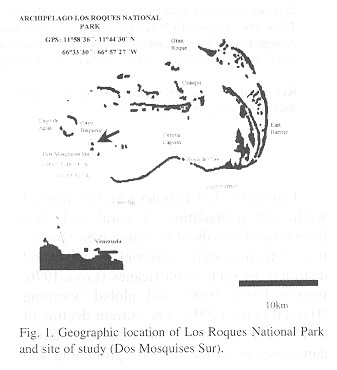
<body><![CDATA[<p><b><font face="Arial"><font size="-1">Key words</font></font></b>  </p>       <p><font face="Arial"><font size="-1">Tissue regeneration, <i>Montastraea  annularis, </i>sedimentation rates, recovery, artificial damages, Archipi&eacute;lago  de Los Roques, corals.</font></font>  </p>       <p><font face="Arial"><font size="-1">&nbsp;</font></font>  </p>       <p><font face="Arial"><font size="-1">During the last two decades the trend  of worldwide degradation of coral reefs has been related to habitat loss and overexploitation of their resources, as well as to natural disturbances such as hurricanes (<a href="#Loya">Loya 1976</a>  , <a href="#Brown87">Brown 1987</a>  , <a href="#Brown90">1990</a>  ) and global warming (<a href="#Harvell">Harvell <i>et al. </i>1999</a>  ). The current decline of coral reefs has also been related to direct damages  caused by anchors, grounding and mechanical extraction of reef organisms,  all of which may particularly affect scleractinean corals. These damages has been classified into two main groups: (1) Tissue removal, and (2) Skeleton  and tissue loss. The morphology of these colonial organisms allows for the  partial loss of their modules whereas the polyps can survive and subsequently  regenerate (<a href="#Reusik">Reusik 1997</a>  ).</font></font>  </p>       <p><font face="Arial"><font size="-1">The study of lesion recovery in corals  is a relatively new aspect of coral reefs science; most of the research done on this subject has been carried out in Curacao (<a href="#Bak77">Bak <i> et al. </i>1977</a>  , <a href="#Bak80">Bak and Van Es 1980</a>  , <a href="#Bak83">Bak 1983</a>  , <a href="#Meesters93">Meesters and Bak 1993</a>  , <a href="#Meesters95">1995</a>  , <a href="#Meesters94">Meesters <i>et al. </i>1994</a>  , <a href="#Meesters96">1996</a>  , <a href="#Meesters97">1997</a>  , <a href="#Nagelkerken">Nagelkerken and Bak, 1998</a>  ), Panama (<a href="#Guzman">Guzm&aacute;n <i>et al. </i>1994</a>  ), Florida (<a href="#Hayes">Hayes and Bush 1990</a>  ), the Red Sea (<a href="#Oren">Oren <i>et al. </i>1998</a>  ) and Australia (<a href="#Hall">Hall 1997</a>  ). Only few studies that have focused on environmental factors as regulators  of tissue regeneration processes have been performed. For instance, <a href="#Lester">  Lester and Bak (1985)</a>   studied the effects of environment in tissue regeneration on the reef-building  coral <i>Montastraea annularis</i> (Ellis and Solander 1786). More recently  <a href="#Woesik">Woesik (1998)</a>   compared the lesion healing capability in <i>Porites lutea and P lobata  </i>corals from Japan, but he found no differences in tissue regeneration  between these two species.</font></font>  </p>       <p><font face="Arial"><font size="-1">Like in many other Western Atlantic  locations, <i>M. annularis, Montastraea faveolata</i> <i>and Montastraea franksi </i>are conspicuously predominant at Los Roques National Park coral reefs. Due to its phenotypic plasticity, high reproductive fitness and competition  abilities, the first species is widely distributed and can be easily found  in reef patches and forming both, fringing and barrier reefs, covering a wide range of depths (<a href="#Foster">Foster 1979</a>  , <a href="#Weil">Weil and Knowlton 1994</a>  , <a href="#Van-Veghel">Van Veguel <i>et al. </i>1996</a>  , <a href="#Knowlton">Knowlton <i>et al. </i>1997</a>  ). Even though the Los Roques coral reef complex is the largest and most  important in Venezuela (<a href="#Amend">Amend 1992</a>  ), studies concerning coral injury recovery have not been conducted there  before. In this paper we show how <i>M. annularis </i>responds to the disturbance  produced by both tissue and skeletal removal. The progress of recovery of  these lesions was also studied and comparisons were made between specimens  from two reef patches with different sedimentation regimes.</font></font>    </p>       <p><font face="Arial"><font size="-1">&nbsp;</font></font>     <br>  <b><font face="Arial"><font size="-1">Materials and methods</font></font></b>    </p>       <p><font face="Arial"><font size="-1"><b>Study site: </b>The present study  was carried out at the Archipi&eacute;lago Los Roques National Park, which  is located 160 km north of the Venezuelan coast (11&ordm; 44' 45" to 11&ordm;  58' 36" N, 66&ordm; 32' 42" to 66&ordm; 52' 57" W). The Archipelago has more than fifteen coralina Keys and over two hundred banks. The keys form an irregular oval around a shallow lagoon, which is surrounded by to large barrier reefs; the eastern barrier is 20 km long, and the southern barrier is 30 km long (<a href="#fig1">Fig. 1</a>  ). The experiments were done in Dos Mosquises, a Key located on the South-western  edge of the Archipelago (11&ordm; 48' N, 66&ordm; 53'W.) Dos Mosquises is  protected by a horseshoe barrier reef, which is separated from the shoreline  by a lagoon of shallow waters with a depth that rarely exceeds 4 m. The Key  has a fringing reef 150 to 240 m wide and it has a maximal depth of 40 m (Hung 1985). Experiments were carried out between March and June of 1998, in two sites each under different sedimentation regimes but of similar depth (1-1.5 m). The first site, (S1) was on the horseshoe reef, 500 m off the shoreline; this site was subjected to low sedimentation rates. The second site, (S2) was on the fringing reef lagoon, close to the coastline, and with higher sedimentation rates.</font></font>     <br>  <font face="Arial"><font size="-1">&nbsp;</font></font> </p>       ]]></body>
<body><![CDATA[<center><font face="Arial"><font size="-1">&nbsp;</font></font><a name="fig1"></a>  <img src="/img/fbpe/rbt/v50n2-3/2137i01.JPG" height="370" width="337">  </center>           
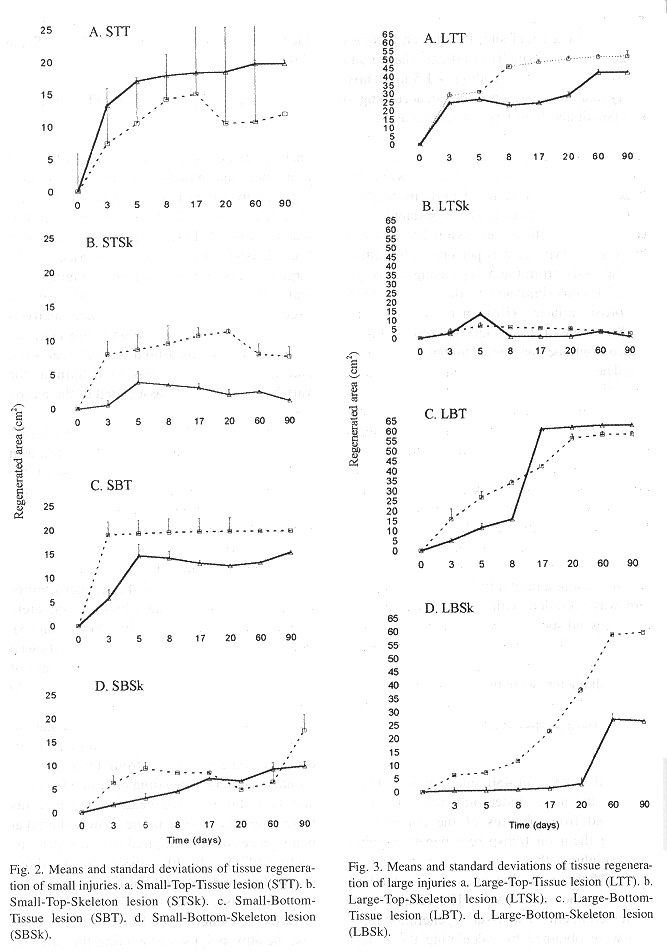
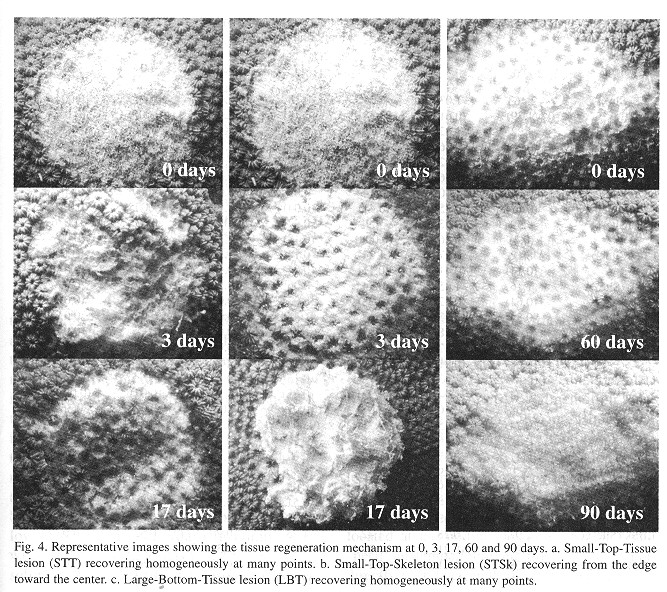
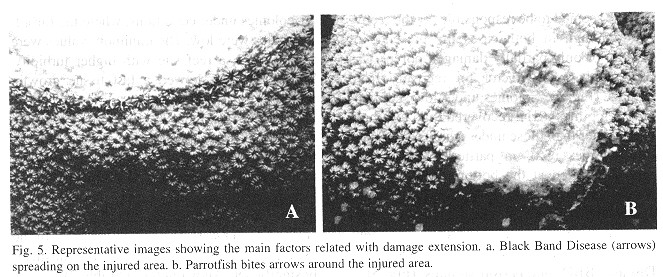
<p><font size="-1"><font face="Arial"><b>Coral injuries: </b>Sixteen healthy  colonias (8 treatments + a single replicate per treatment) with no signs of injuries or bleaching were selected at each reef site; the chosen colonies  ranged from 30 (small) to 60 cm</font><sup><font face="Arial,Helvetica"> 2</font></sup><font face="Arial">  (large) and all were at the same depth (1-1.5 m). Three injury treatments  were performed, according to size (small and large), type (skeletal and tissue loss) and position of the lesions (top and bottom of the colony). The diameter of small wounds ranged from 4.5 - 5 cm , while the larger ones ranged from 7.5 to 8 cm. Skeletal lesions (Type 1) were made by scratching the coral surface with a hard-nylon brush, while tissue loss (Type 2) was performed by jetting out the tissue from the polyps using a syringe. Type 1 lesions simulated the damage caused by parrotfish injuries (<a href="#Bruckner">Bruckner  and Bruckner 1998</a>  ), while Type 2 lesions resembled to Chaetodontidae damages (<a href="#Ohman">  Ohman <i>et al. </i>1998</a>  ).</font></font>  </p>       <p><font face="Arial"><font size="-1">These lesions were monitored at three,  five, eight, 17, 20, 60 and 90 days after the colonies were injured, using  an underwater camera separated 10 cm from the damaged colonies. A frame adapted to the camera (Motor Marine 11) macro-lens was used in order to take all the photographs always at the same distance and at the same angle (90&ordm;).  Daily records of air and surface water temperature, wind speed, turbidity  and tide level were taken at each location. Turbidity was measured <i>"in  situ" </i>using a digital turbidimeter, temperature was recorded with a hand  thermometer and the wind speed with a digital anemometer. Six PVC sediment  traps (15 cm high x 6cm diameter) and six Petri capsules (2 cm high x 6cm  in diameter) were placed on concrete supports to estimate the sedimentation  and resuspension rates, respectively. Each collector was changed every three  days at cach reef site: the collected material was washed with freshwater,  dried at 30 C&ordm; for 48hr and then weighed.</font></font>  </p>       <p><font face="Arial"><font size="-1">All the areas undergoing recovery were  calculated from pictures of the colonies by drawing them on transparent paper, clipping and weighing these shapes and comparing those weights with that of a known standard square of the same paper. The results were expressed in cm<sup>2</sup> . The tissue regeneration rates (T<sub>s</sub>) were obtained  by calculatinc, the difference between the areas of the recovered surfaces  (Ra) for any given interval (T<sub>1</sub> and T<sub>o</sub> in days), as  follows:</font></font>  </p>       <p><font face="Arial"><font size="-1">T<sub>s</sub> = [R<sub>a</sub> (T<sub>  1</sub> ) - R<sub>a</sub> (T<sub>o</sub>)] / (T1 - T<sub>o</sub>)</font></font>    </p>       <p><b><font face="Arial"><font size="-1">Statistical analysis: </font></font></b><font face="Arial"><font size="-1">  To test the effects of each treatment on regenerated areas between reef sites  and monitoring days; we used a repeated-measures five-way analysis of variance  (<a href="#Zar">Zar 1998</a>  ). The factors included in this analysis were: 1. Lesion type (tissue and  skeleton), 2. Position (top-bottom), 3. Size (smalllarge), 4. Locality (barrier  and fringing reef) and 5. Time (3, 5, 8, 17, 20, 60, 90). We also used a canonical correspondence analysis (CCA) (Jongman <i>et al. </i>1995) with environmental variables measured at both reef sites, and the regenerated areas to determine the variables significantly associated to the recovery of lesions.</font></font>   </p>       <p><font face="Arial"><font size="-1">The species <i>M. annularis </i>recovered,  rapidly from the artificially inflicted injuries, as it look just over twenty  days for most of the colonies to regenerase the removed tissue. Injuries at the bottom position of the colonies recovered faster than those located on top of them, and Type 2 lesions (tissue) recovered faster than Type 1 lesions (skeleton and tissue). In addition, about 60% of the smaller injuries regenerated their tissue almost completely over the 90 days of monitoring (<a href="#Fig2-3"> Figs. 2 and 3</a>  ). For all lesion Types, tissue recovery showed two stages: 1. A fast growing  (1-2cm<sup>2</sup>/day) of a thin layer of new tissue during the first 20  days. 2. The regeneration of new polyps; which gradually regained their pigmentation.  The total recovery of the injuries took 20 to 30 days in some cases, or from  three to four months in others, depending on lesion features; and two different  regeneration mechanisms were observed. In one, tissue growth started at many  places over the injured surfaces, perhaps "activated" by healthy tissue inside  those polyps that were injured but not destroyed. In the other case, tissue  grew from the edges towards the center of the lesions. In this latter case  healthy polyps surrounding the affected surface seemed to be responsable for the recovery, although in both cases the presence of healthy or only partially damaged polyps was presumably a key factor for recovery from damage (<a href="#fig4"> Fig. 4</a>  ). Colonies under low sedimentation regimes (SI) recovered two or three times faster than those under a high sedimentation regimes (S2), in particular  those with injuries located at the bottom of the colony. Most of the colonies  from S2 with Type 1 damages suffered an additional extension of damage, due  to four uncontrolled factors: sedimentation, macroalgae overgrowth, Black  Band Disease (BBD) and parrotfish bites (<a href="#fig5">Fig. 5</a>  ).</font></font> </p>       <center><a name="Fig2-3"></a>  <img src="/img/fbpe/rbt/v50n2-3/2137i02.JPG" height="952" width="667">  </center>   &nbsp;     
<br>  &nbsp;       <center><a name="fig4"></a>  <img src="/img/fbpe/rbt/v50n2-3/2137i03.JPG" height="592" width="667">  </center>          
]]></body>
<body><![CDATA[<center>&nbsp;</center>          <center>&nbsp;</center>          <center><a name="fig5"></a>  <img src="/img/fbpe/rbt/v50n2-3/2137i04.JPG" height="277" width="663">  </center>   &nbsp;     
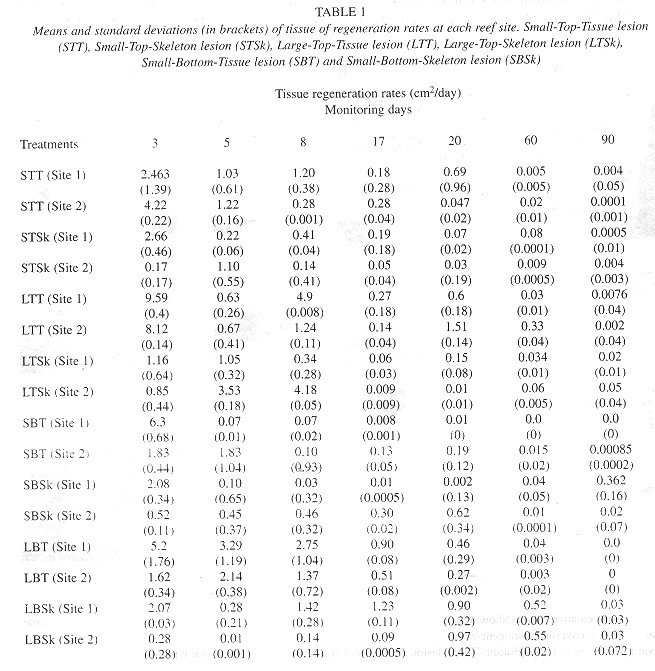
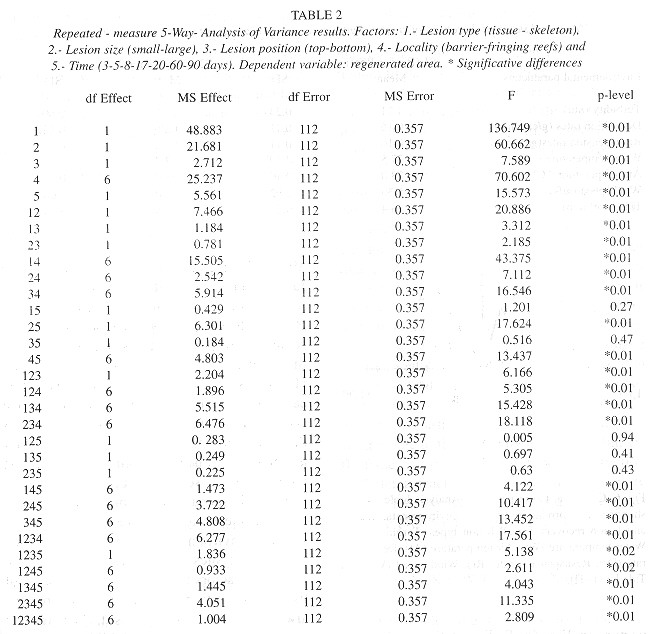
<br>  <font face="Arial"><font size="-1">The regeneration rates ranged from 1 to 9cm<sup> 2</sup>/day; the fastest values were obtained for SI colonies under conditions, where the turbidity values were low. The minimum values were found at S2, a reef site with higher turbidity. Type 2 lesions showed a fast tissue growth, while Type 1 lesions showed lower values (<a href="#tabla1">  Table 1</a>  ). A further observed trend was the decrease of tissue regeneration rates  in time, as the maximum values were obtained during the first days of monitoring.  The characteristies of lesions (size, type and position), reef site (locality)  and time, significantly affected regenerated areas (Anova p&lt; 0.001). More  over, most of the interactions between factors resulted statistically significant  (Anova p&lt;0.01) (<a href="#tabla2">Table 2</a>  ).</font></font>     <br>  <font face="Arial"><font size="-1">&nbsp;</font></font>     <br>  <font face="Arial"><font size="-1">&nbsp;</font></font>       <center><a name="tabla1"></a>  <img src="/img/fbpe/rbt/v50n2-3/2137i05.JPG" height="671" width="655">  </center>   <font face="Arial"><font size="-1">&nbsp;</font></font>       
<center><font face="Arial"><font size="-1">&nbsp;</font></font><a name="tabla2"></a>  <img src="/img/fbpe/rbt/v50n2-3/2137i06.JPG" height="634" width="655">  </center>   <b><font face="Arial"><font size="-1">&nbsp;</font></font></b>     
<br>  <b><font face="Arial"><font size="-1">&nbsp;</font></font></b>     <br>  <b><font face="Arial"><font size="-1">&nbsp;</font></font></b>     ]]></body>
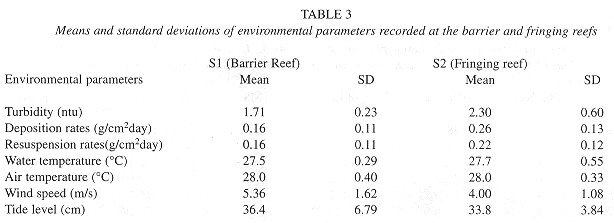
<body><![CDATA[<br>  <font face="Arial"><font size="-1"><b>Environmental parameters: </b>During  the course of these experiments, the surface water temperature remained similar for both sites and ranged from 26 to 31&ordm;C; the maximum temperatures were recorded late in the afternoon while the minima were recorded early in the morning, and air temperatures showed the same trend. The average of water turbidity measured at S2 was 2.303 ntu, whereas the average of recordings  at SI was 1.711 ntu. Sedimentation rates were much higher at S2 (0.266g/cm<sup>   2</sup>/day) that at compared to SI (0.16g/cm<sup>2</sup>/day), while resuspension  was low at SI (0.157g/cm<sup>2</sup>/day) in comparison with S2 (0.23g/cm<sup>   2</sup>/day). The test sites salinity showed little variations, ranging  from 37 to 38% according to the time of day (<a href="#tabla3">Table 3</a>  ).</font></font>     <br>  <font face="Arial"><font size="-1">&nbsp;</font></font>     <br>  <font face="Arial"><font size="-1">&nbsp;</font></font>       <center><a name="tabla3"></a>  <img src="/img/fbpe/rbt/v50n2-3/2137i07.JPG" height="223" width="614">  </center>   &nbsp;       
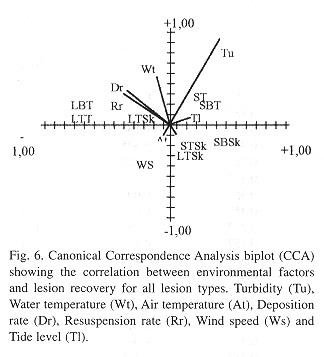
<center>&nbsp;&nbsp;<a name="fig6"></a>  <img src="/img/fbpe/rbt/v50n2-3/2137i08.JPG" height="357" width="324">  </center>   <font face="Arial"><font size="-1"><b>Canonical Correspondence Analysis</b>   <b>(CCA): </b>The CCA (<a href="#fig6">Fig. 6</a>  ) showed that turbidity, water temperature, sedimentation and resuspension  rates were the most important environmental variables affecting lesion recovery  (larger vectors). Large skeleton (Lsk) lesions were more affected by these  variables (notice the relative position among vectors and treatments) compared  to small tissue lesions located at the bottom positions (SBT). Wind speed,  air temperature and tide level were not directly correlated with this recovery  (smaller vectors in <a href="#fig6">Fig. 6</a>  ). Sedimentation and resuspension rates were strongly correlated to each  other (notice the small angle between these vectors), and we believe that  the main environmental factor determining the resuspension and turbidity dynamics was the water motion produced by the oscillation of tides.</font></font>      
<br>  <b><font face="Arial"><font size="-1">&nbsp;</font></font></b>     <br>  <b><font face="Arial"><font size="-1">&nbsp;</font></font></b>     <br>  <b><font face="Arial"><font size="-1">Discussion</font></font></b>        <p><font face="Arial"><font size="-1">The regeneration of polips is a very  important survival factor for corals, as this ability affects colony growth  (<a href="#Bak83">Bak 1983</a>  ), reproduction, the resistance to some diseases and the competitive performance  of the colony (<a href="#Meesters94">Meesters <i>et al. </i>1994</a>  ). Sedimentation is an important abiotic factor controlling growth, survival  and development of coral reef communities (<a href="#Rogers90">Rogers 1990</a>  , <a href="#Rielg">Rielg 1995</a>  , <a href="#Kleypas">Kleypas 1996</a>  ). The accumulation of sediment on damaged areas negatively affects the recovery  from injuries, as <a href="#Meesters96">Meesters <i>et al.</i> (1996)</a>   have demonstrated that the regeneration capacity of artificially inflicted  lesions in the species <i>Acropora palmata and M. annularis</i> diminishes  in areas where sedimentation rates are high. Sedimentation might affect lesion recovery because it induces major energy expenses in mucus production, sediment rejection and defense against algae overgrowth.</font></font>  </p>       <p><font face="Arial"><font size="-1">The environmental parameters measured  at both reef sites during our study also were important factors in controlling  the process of tissue regeneration. Injuries on corals from SI always remained  free of silt, because the strong currents at this site inhibited sediment  accumulation over the injuries. Colonies covered by silt frequently showed  an extension of damage by BBD, and the fast bacterial growth might be related  to these mortality factors, but further work involving both tissue regeneration  and bacterial growth studies is required in order to corroborase this view.</font></font>    </p>       ]]></body>
<body><![CDATA[<p><font face="Arial"><font size="-1">The position of the wound on the colony  was an important factor related to tissue regeneration. <a href="#Meesters96">  Meesters <i>et al. </i>(1996)</a>   found that injuries located at the top of colonies recovered faster than  those located at the bottom. They suggested that polyps located at the top  of the colony were healthier as compared to those located at the bottom, because the latter surrounded by sediments. Our data do not support this view, in as such as sediments usually covered top lesions and their regeneration was prevented, while bottom lesions remained elean because sediments did not accumulate over them, thus enhancing lesion recovery.</font></font>  </p>       <p><font face="Arial"><font size="-1">The type of lesions was also a key factor in the success of tissue regeneration seemingly, Type 2 lesions (Chactodontidae  bites) recovered faster than those of Type 1 (Parrotfish bites) due lo the  following reasons: first, when tissue is partially removed, new tissue layers  begin to grow rapidly, probably relying on mechanisms of cellular division  (Meesters and Bak 1993, Meesters <i>et al. </i>1997). Secondly, if skeleton  structures are destroyed, then the final recovery involves both the regeneration  of tissue and the recovery of the skeletal structure. This involves a greater  energetic cost or expenditure than in the former case.</font></font>  </p>       <p><font face="Arial"><font size="-1">Our findings indicate that BBD and parrotfish bites were the most important factors related to the extension of damages on the coral's surface. Many of the injuries located on the top of the colonies showed new bites of different sizes (60 x 70 mm to 10 x 12 mm) presumably caused by parrotfish (Scaridae) and surgeon fishes (Acanthuridae), respectively. When a colony is attacked by a parrotfish, other fishes also bite at the same injured colony, and this behavior accelerates the fast spread of damage and it may ultimately lead the to death of the entire affected colony in a relatively short time, Similar behavior patterns have been describes by <a href="#Bruckner">Bruckner and Bruckner (1998)</a>   in Puerto Rico and other Caribbean locations.</font></font>  </p>       <p><font face="Arial"><font size="-1">Substrate competition has been recognized  as one of the main biotic factors regulating the reef community structure  (<a href="#Connell">Connel 1973</a>  , <a href="#Lang">Lang 1973</a>  , <a href="#Rogers93">Rogers 1993</a>  , <a href="#Guzman">Guzm&aacute;n <i>et al.</i> 1994</a>  , <a href="#Tanner95">Tanner 1995</a>  ). The mechanisms, by which competition reduces the coral fitness are still  not very clear. However, it is known that diminished coral growth is related  to the secretion of allopathic substances by algae along contact places between  them and the corals (<a href="#Tanner97">Tanner 1997</a>  ). The reproduction and fecundity of the latter can decrease by abrasion,  or by the continuos contact between polyps and macroalgae, which causes that polyps always remain retracted (<a href="#Tanner97">Tanner 1997</a>  ).</font></font>  </p>       <p><font face="Arial"><font size="-1">Based on our results, it emerges that  the species <i>M. annularis </i>has the ability to regenerate damaged tissue  fairly rapidly; however, the regeneration rates decrease almost exponentially  with time. The regeneration of damages is strongly influenced by the characteristics  of the lesion (size, type and position). The environmental parameters to which the colonies are normally exposed are a key factor for the final damage recovery. In our study case, clearly the main threats that a colony faces when it becomes damaged are overgrowth (especially by filamentous algae), extension of the damage by diseases (BBD) or fish bites, and damage by sedimentation. Our results suggest that the colonies of <i>M. annularis </i>have a greater probability of recovering from injuries that only involve the partial loss of tissue; this damage is comparable to that made by the bites of butterfly fishes. Lesions that imply both destruction of skeletal structures and tissue loss, take more time to recover. These damages are analogous to those produced  by parrotfish bites.</font></font>  </p>       <p><font face="Arial"><font size="-1">&nbsp;</font></font>     <br>  <b><font face="Arial"><font size="-1">Acknowledgments</font></font></b>  </p>       <p><font face="Arial"><font size="-1">We would like lo thank to Econatura,  Fundaci&oacute;n Cient&iacute;fica Los Roques and Juan Carlos Fem&aacute;ndez,  for all the logistics and financial support. I also want lo thank H&eacute;ctor  Guzm&aacute;n, Jes&uacute;s Ramos, Luis Bulla, David Bone, Sheila Marques  Pauls, Roberto Cipriani and Percy Sanders, for their comments on the manuscript.  Finally we thank the support of the staff (Pablo Mata, Francisco Le&oacute;n,  Jes&uacute;s Le&oacute;n and Melchor) of Dos Mosquises Sur Biological Station.</font></font>    </p>       <p><font face="Arial"><font size="-1">&nbsp;</font></font>     <br>  <b><font face="Arial"><font size="-1">Resumen</font></font></b>  </p>       ]]></body>
<body><![CDATA[<p><font face="Arial"><font size="-1">En este estudio se determin&oacute;  la tasa de regeneraci&oacute;n de tejidos y la recuperaci&oacute;n de colonias  de <i>Montastraea annularis, </i>expuestas a diferentes grados de sedimentaci&oacute;n  despu&eacute;s de inducir da&ntilde;os que simulan los mordiscos de peces  mariposa y peces loro. El estudio se realiz&oacute; en dos peque&ntilde;os  parches de arrecife escogidos cerca del Cayo Dos Mosquises, al norte de Venezuela. Diecis&eacute;is colonias (8 tratamientos + una r&eacute;plica) fueron da&ntilde;adas artificialmente en cada parche, y su recuperaci&oacute;n fue monitoreada mediante fotograf&iacute;as durante tres meses. Las lesiones se produjeron usando dos t&eacute;cnicas: raspado de los p&oacute;lipos, para semejar los da&ntilde;os de peces loro (Scaridae) (tipo 1) y aspiraci&oacute;n del tejido para simular los mordiscos de peces mariposa (Chaetondontidae) (tipo 2). El di&aacute;metro de las lesiones vari&oacute; entre 5 (lesiones peque&ntilde;as) y 8 cm (lesiones grandes) y ambos tipos fueron infringidos en partes de abajo y arriba de las colonias. Los principales factores que afectaron la recuperaci&oacute;n de la superficie de las colonias fueron las caracter&iacute;sticas de la lesi&oacute;n (tipo, posici&oacute;n y tama&ntilde;o), la turbidez y principalmente, la tasa de sedimentaci&oacute;n. La recuperaci&oacute;n de las lesiones fue lenta donde las tasas de sedimentaci&oacute;n y resuspensi&oacute;n fueron altas, y la regeneraci&oacute;n del tejido fue mejor en condiciones de baja sedimentaci&oacute;n y resuspensi&oacute;n. Adem&aacute;s, las lesiones localizadas en la parte inferior de las colonias se regeneraron completamente, en tanto que los sedimentos frecuentemente cubrieron las lesiones superiores y limitaron su recuperaci&oacute;n. M&aacute;s del 60% de las colonias con lesiones peque&ntilde;as se recuperaron casi completamente en menos de 90 d&iacute;as, mientras que aquellas con grandes heridas mostraron extensiones de sus &aacute;reas da&ntilde;adas y aument&oacute; su mortalidad. Las lesiones que afectaron solamente al tejido (tipo 1) se regeneraron 2 a 3 veces m&aacute;s r&aacute;pido que aquellas que involucraron tanto al tejido y como al esqueleto (tipo 2).</font></font>   </p>       <p><font face="Arial"><font size="-1">&nbsp;</font></font>     <br>  <b><font face="Arial"><font size="-1">References</font></font></b>  </p>       <!-- ref --><p><a name="Amend"></a>  <font face="Arial"><font size="-1">Amend, T. 1992. Parque Nacional Archipi&eacute;lago  de los Roques, Serie Parques Nacionales y Conservaci&oacute;n Ambiental. Tomo 3, Torino, Caracas. 223 p.    &nbsp;&nbsp;&nbsp;&nbsp;&nbsp;&nbsp;&nbsp;&nbsp;[&#160;<a href="javascript:void(0);" onclick="javascript: window.open('/scielo.php?script=sci_nlinks&ref=1690717&pid=S0034-7744200200030002300001&lng=','','width=640,height=500,resizable=yes,scrollbars=1,menubar=yes,');">Links</a>&#160;]<!-- end-ref --></font></font>  </p>       <!-- ref --><p><a name="Bak83"></a>  <font face="Arial"><font size="-1">Bak, R.P.M. 1983. Neoplasia, regeneration  and growth in the reefs building coral <i>Acropora palmata. </i>Mar.<i> </i>  Biol. 77: 221-227.    &nbsp;&nbsp;&nbsp;&nbsp;&nbsp;&nbsp;&nbsp;&nbsp;[&#160;<a href="javascript:void(0);" onclick="javascript: window.open('/scielo.php?script=sci_nlinks&ref=1690719&pid=S0034-7744200200030002300002&lng=','','width=640,height=500,resizable=yes,scrollbars=1,menubar=yes,');">Links</a>&#160;]<!-- end-ref --></font></font>  </p>       <!-- ref --><p><a name="Bak77"></a>  <font face="Arial"><font size="-1">Bak, R.P.M., J.W. Brounds &amp; F.M.L  Heys. 1977. Regeneration and aspects of spatial competition in the scleractinian  corals <i>Agaricia agaricites and</i> <i>Montastraea annularis. </i>Proc.  31 Coral Reef Symp., Miami. pp. 143-148.    &nbsp;&nbsp;&nbsp;&nbsp;&nbsp;&nbsp;&nbsp;&nbsp;[&#160;<a href="javascript:void(0);" onclick="javascript: window.open('/scielo.php?script=sci_nlinks&ref=1690721&pid=S0034-7744200200030002300003&lng=','','width=640,height=500,resizable=yes,scrollbars=1,menubar=yes,');">Links</a>&#160;]<!-- end-ref --></font></font>  </p>       <!-- ref --><p><a name="Bak80"></a>  <font face="Arial"><font size="-1">Bak, R.RM. &amp; S. Van Es. 1980. Regeneration  of superficial damage in the scleractinean coral <i>Agaricia</i> <i>agaricites,  Favia purpurea and Porites astreoides. </i>Bull. Mar. Sci. 30: 883-887.    &nbsp;&nbsp;&nbsp;&nbsp;&nbsp;&nbsp;&nbsp;&nbsp;[&#160;<a href="javascript:void(0);" onclick="javascript: window.open('/scielo.php?script=sci_nlinks&ref=1690723&pid=S0034-7744200200030002300004&lng=','','width=640,height=500,resizable=yes,scrollbars=1,menubar=yes,');">Links</a>&#160;]<!-- end-ref --></font></font>    </p>       <!-- ref --><p><a name="Brown87"></a>  <font face="Arial"><font size="-1">Brown, B.E. 1987. World wide death of  corals- natural cyclical events or man made pollution? Mar. Poll. Bull. 18:  9-13.    &nbsp;&nbsp;&nbsp;&nbsp;&nbsp;&nbsp;&nbsp;&nbsp;[&#160;<a href="javascript:void(0);" onclick="javascript: window.open('/scielo.php?script=sci_nlinks&ref=1690725&pid=S0034-7744200200030002300005&lng=','','width=640,height=500,resizable=yes,scrollbars=1,menubar=yes,');">Links</a>&#160;]<!-- end-ref --></font></font>  </p>       <!-- ref --><p><a name="Brown90"></a>  <font face="Arial"><font size="-1">Brown, B.E. 1990. Bleaching. Coral Reefs  8 (4): 135-232,    &nbsp;&nbsp;&nbsp;&nbsp;&nbsp;&nbsp;&nbsp;&nbsp;[&#160;<a href="javascript:void(0);" onclick="javascript: window.open('/scielo.php?script=sci_nlinks&ref=1690727&pid=S0034-7744200200030002300006&lng=','','width=640,height=500,resizable=yes,scrollbars=1,menubar=yes,');">Links</a>&#160;]<!-- end-ref --></font></font>  </p>       <!-- ref --><p><a name="Bruckner"></a>  <font face="Arial"><font size="-1">Bruckner, A. &amp; R.J. Bruckner 1998.  Rapid Wasting Syndrome or coral predation by spotlight parrotfish? Reef Encounter  Newsletter (ICRS) 23: 18-26.    &nbsp;&nbsp;&nbsp;&nbsp;&nbsp;&nbsp;&nbsp;&nbsp;[&#160;<a href="javascript:void(0);" onclick="javascript: window.open('/scielo.php?script=sci_nlinks&ref=1690729&pid=S0034-7744200200030002300007&lng=','','width=640,height=500,resizable=yes,scrollbars=1,menubar=yes,');">Links</a>&#160;]<!-- end-ref --></font></font>  </p>       <!-- ref --><p><a name="Connell"></a>  <font face="Arial"><font size="-1">Connell, J.H. 1973. Population ecology  of reefs building corals. pp. 205-245. In Jones O.A. &amp; R. Endean (ed.).  Biology and Geology of Coral Reefs. New York.    &nbsp;&nbsp;&nbsp;&nbsp;&nbsp;&nbsp;&nbsp;&nbsp;[&#160;<a href="javascript:void(0);" onclick="javascript: window.open('/scielo.php?script=sci_nlinks&ref=1690731&pid=S0034-7744200200030002300008&lng=','','width=640,height=500,resizable=yes,scrollbars=1,menubar=yes,');">Links</a>&#160;]<!-- end-ref --></font></font>  </p>       <!-- ref --><p><a name="Foster"></a>  <font face="Arial"><font size="-1">Foster, A.B. 1979. Phenotypic plasticity  in the reefs corals <i>Montastraea annularis and Siderastrea siderea. J.</i>   Exp. Mar. Biol. Ecol. 39: 25-54.    &nbsp;&nbsp;&nbsp;&nbsp;&nbsp;&nbsp;&nbsp;&nbsp;[&#160;<a href="javascript:void(0);" onclick="javascript: window.open('/scielo.php?script=sci_nlinks&ref=1690733&pid=S0034-7744200200030002300009&lng=','','width=640,height=500,resizable=yes,scrollbars=1,menubar=yes,');">Links</a>&#160;]<!-- end-ref --></font></font>  </p>       <!-- ref --><p><a name="Guzman"></a>  <font face="Arial"><font size="-1">Guzm&aacute;n, H.M., K.A. Burns, &amp;  J.B.C. Jackson. 1994. Injury regeneration and growth of Caribbean reef corals  after a major oil spill at Panam&aacute;. Mar. Ecol. Prog. Ser. 105: 231-241.    &nbsp;&nbsp;&nbsp;&nbsp;&nbsp;&nbsp;&nbsp;&nbsp;[&#160;<a href="javascript:void(0);" onclick="javascript: window.open('/scielo.php?script=sci_nlinks&ref=1690735&pid=S0034-7744200200030002300010&lng=','','width=640,height=500,resizable=yes,scrollbars=1,menubar=yes,');">Links</a>&#160;]<!-- end-ref --></font></font>    </p>       <!-- ref --><p><a name="Hall"></a>  <font face="Arial"><font size="-1">Hall, R.V 1997. Interspecific differences  in the regeneration of artificial injuries on scleractinean corals. J. Exp.  Mar. Biol. Ecol. 212: 9-23.    &nbsp;&nbsp;&nbsp;&nbsp;&nbsp;&nbsp;&nbsp;&nbsp;[&#160;<a href="javascript:void(0);" onclick="javascript: window.open('/scielo.php?script=sci_nlinks&ref=1690737&pid=S0034-7744200200030002300011&lng=','','width=640,height=500,resizable=yes,scrollbars=1,menubar=yes,');">Links</a>&#160;]<!-- end-ref --></font></font>  </p>       <!-- ref --><p><a name="Hayes"></a>  <font face="Arial"><font size="-1">Hayes R.L. &amp; P.G. Bush. 1990. Microscopic  observations of recovery in the reefs building scleractinean coral <i>Montastraea  annularis </i>after bleaching en a Cayman reef. Coral Reefs 8: 203-209.    &nbsp;&nbsp;&nbsp;&nbsp;&nbsp;&nbsp;&nbsp;&nbsp;[&#160;<a href="javascript:void(0);" onclick="javascript: window.open('/scielo.php?script=sci_nlinks&ref=1690739&pid=S0034-7744200200030002300012&lng=','','width=640,height=500,resizable=yes,scrollbars=1,menubar=yes,');">Links</a>&#160;]<!-- end-ref --></font></font>    </p>       <!-- ref --><p><a name="Harvell"></a>  <font face="Arial"><font size="-1">Harvell, C.D, K. Kim, J.M. Burkholder,  R.R. Colwell, P.R. Epstein, D.J. Grimes, E. E. Hofmann, E.K. Lipp, A.D. M.E.  Osterhaus, R. M. Overstreet, J.M. Porter, G.W. Smith &amp; G.R. Vasta. 1999.  Emerging Marine Diseases - Climate Links and Anthropogenic factors. Science  285: 1505-1510.    &nbsp;&nbsp;&nbsp;&nbsp;&nbsp;&nbsp;&nbsp;&nbsp;[&#160;<a href="javascript:void(0);" onclick="javascript: window.open('/scielo.php?script=sci_nlinks&ref=1690741&pid=S0034-7744200200030002300013&lng=','','width=640,height=500,resizable=yes,scrollbars=1,menubar=yes,');">Links</a>&#160;]<!-- end-ref --></font></font>  </p>       <!-- ref --><p><a name="Hung"></a>  <font face="Arial"><font size="-1">Hung, M. 1985. Los corales p&eacute;treos  del Parque Nacional Archipi&eacute;lago Los Roques. Tesis de Licenciatura,  Universidad Central de Venezuela, Venezuela. 204 p.    &nbsp;&nbsp;&nbsp;&nbsp;&nbsp;&nbsp;&nbsp;&nbsp;[&#160;<a href="javascript:void(0);" onclick="javascript: window.open('/scielo.php?script=sci_nlinks&ref=1690743&pid=S0034-7744200200030002300014&lng=','','width=640,height=500,resizable=yes,scrollbars=1,menubar=yes,');">Links</a>&#160;]<!-- end-ref --></font></font>  </p>       <!-- ref --><p><a name="Jongman"></a>  <font face="Arial"><font size="-1">Jongman, R.H. G., C.J.F. Ter Braak &amp;  O.F.R. Van Tongeren. 1995. Data Analysis in Community and Landscape Ecology.  University, Cambridge. 292 p.    &nbsp;&nbsp;&nbsp;&nbsp;&nbsp;&nbsp;&nbsp;&nbsp;[&#160;<a href="javascript:void(0);" onclick="javascript: window.open('/scielo.php?script=sci_nlinks&ref=1690745&pid=S0034-7744200200030002300015&lng=','','width=640,height=500,resizable=yes,scrollbars=1,menubar=yes,');">Links</a>&#160;]<!-- end-ref --></font></font>  </p>       <!-- ref --><p><a name="Kleypas"></a>  <font face="Arial"><font size="-1">Kleypas, J.A. 1996. Coral reef development  under naturally turbid conditions: fringing reefs near Broad Sound, Australia.  Coral Reefs 15: 153-167.    &nbsp;&nbsp;&nbsp;&nbsp;&nbsp;&nbsp;&nbsp;&nbsp;[&#160;<a href="javascript:void(0);" onclick="javascript: window.open('/scielo.php?script=sci_nlinks&ref=1690747&pid=S0034-7744200200030002300016&lng=','','width=640,height=500,resizable=yes,scrollbars=1,menubar=yes,');">Links</a>&#160;]<!-- end-ref --></font></font>  </p>       <!-- ref --><p><a name="Knowlton"></a>  <font face="Arial"><font size="-1">Knowlton, N., J.L. Mat&eacute;, H.M. Guzm&aacute;n &amp; R. Rowan. 1997. Direct evidence for reproductive isolation among the three species of the <i>Montastraea annularis </i>complex in Central America (Panam&aacute; and Honduras). Mar. Biol. 127: 705-711.    &nbsp;&nbsp;&nbsp;&nbsp;&nbsp;&nbsp;&nbsp;&nbsp;[&#160;<a href="javascript:void(0);" onclick="javascript: window.open('/scielo.php?script=sci_nlinks&ref=1690749&pid=S0034-7744200200030002300017&lng=','','width=640,height=500,resizable=yes,scrollbars=1,menubar=yes,');">Links</a>&#160;]<!-- end-ref --></font></font>   </p>       <!-- ref --><p><a name="Lang"></a>  <font face="Arial"><font size="-1">Lang, J. 1973. Interspecific aggression  by seleractincan coral. 2. &iquest;Why the race is not only to the swift?  Bull. Mar. Sci. 23: 260-279.    &nbsp;&nbsp;&nbsp;&nbsp;&nbsp;&nbsp;&nbsp;&nbsp;[&#160;<a href="javascript:void(0);" onclick="javascript: window.open('/scielo.php?script=sci_nlinks&ref=1690751&pid=S0034-7744200200030002300018&lng=','','width=640,height=500,resizable=yes,scrollbars=1,menubar=yes,');">Links</a>&#160;]<!-- end-ref --></font></font>  </p>       <!-- ref --><p><a name="Lester"></a>  <font face="Arial"><font size="-1">Lester, R.T. &amp; R.RM. Bak. 1985. Effect  of environment on regeneration of tissue lesions in the reef coral <i>Montastraea  annularis </i>(Scleractinea). Mar. Ecol. Prog. Ser. 24: 183-185.    &nbsp;&nbsp;&nbsp;&nbsp;&nbsp;&nbsp;&nbsp;&nbsp;[&#160;<a href="javascript:void(0);" onclick="javascript: window.open('/scielo.php?script=sci_nlinks&ref=1690753&pid=S0034-7744200200030002300019&lng=','','width=640,height=500,resizable=yes,scrollbars=1,menubar=yes,');">Links</a>&#160;]<!-- end-ref --></font></font>    </p>       <!-- ref --><p><a name="Loya"></a>  <font face="Arial"><font size="-1">Loya, Y 1976. Recolonization of Red Sea  corals affected by natural catastrophes and man made perturbations. Ecology  57: 278-279.    &nbsp;&nbsp;&nbsp;&nbsp;&nbsp;&nbsp;&nbsp;&nbsp;[&#160;<a href="javascript:void(0);" onclick="javascript: window.open('/scielo.php?script=sci_nlinks&ref=1690755&pid=S0034-7744200200030002300020&lng=','','width=640,height=500,resizable=yes,scrollbars=1,menubar=yes,');">Links</a>&#160;]<!-- end-ref --></font></font>  </p>       <!-- ref --><p><a name="Meesters93"></a>  <font face="Arial"><font size="-1">Meesters, E.H. &amp; R.RM. Bak. 1993.  Effects of coral bleaching on tissue regeneration potential and colony survival.  Mar. Ecol. Prog. Ser. 96: 189-198.    &nbsp;&nbsp;&nbsp;&nbsp;&nbsp;&nbsp;&nbsp;&nbsp;[&#160;<a href="javascript:void(0);" onclick="javascript: window.open('/scielo.php?script=sci_nlinks&ref=1690757&pid=S0034-7744200200030002300021&lng=','','width=640,height=500,resizable=yes,scrollbars=1,menubar=yes,');">Links</a>&#160;]<!-- end-ref --></font></font>  </p>       <!-- ref --><p><a name="Meesters94"></a>  <font face="Arial"><font size="-1">Meesters, E.H., M. Noordeloos, &amp; R.P.M. Bak. 1994. Damage and regeneration: links to growth in the reef building  coral <i>Montastraea annularis. </i>Mar. Ecol. Prog. Ser. 112: 119-128.    &nbsp;&nbsp;&nbsp;&nbsp;&nbsp;&nbsp;&nbsp;&nbsp;[&#160;<a href="javascript:void(0);" onclick="javascript: window.open('/scielo.php?script=sci_nlinks&ref=1690759&pid=S0034-7744200200030002300022&lng=','','width=640,height=500,resizable=yes,scrollbars=1,menubar=yes,');">Links</a>&#160;]<!-- end-ref --></font></font>    </p>       <!-- ref --><p><a name="Meesters95"></a>  <font face="Arial"><font size="-1">Meesters, E.H. &amp; R.P.M. Bak. 1995.  Age-related deterioration of a physiological function in the branching <i>  coral Acropora palmata. </i>Mar. Ecol. Prog. Ser. 121: 203-209.    &nbsp;&nbsp;&nbsp;&nbsp;&nbsp;&nbsp;&nbsp;&nbsp;[&#160;<a href="javascript:void(0);" onclick="javascript: window.open('/scielo.php?script=sci_nlinks&ref=1690761&pid=S0034-7744200200030002300023&lng=','','width=640,height=500,resizable=yes,scrollbars=1,menubar=yes,');">Links</a>&#160;]<!-- end-ref --></font></font>    </p>       <!-- ref --><p><a name="Meesters96"></a>  <font face="Arial"><font size="-1">Meesters, E.H., I. Wesseling &amp; R.P.M.  Bak. 1996. Partial mortality in three species of reef building corals and  its relation with colony morphology. Bull. Mar. Sci. 58: 838-852.    &nbsp;&nbsp;&nbsp;&nbsp;&nbsp;&nbsp;&nbsp;&nbsp;[&#160;<a href="javascript:void(0);" onclick="javascript: window.open('/scielo.php?script=sci_nlinks&ref=1690763&pid=S0034-7744200200030002300024&lng=','','width=640,height=500,resizable=yes,scrollbars=1,menubar=yes,');">Links</a>&#160;]<!-- end-ref --></font></font>    </p>       <!-- ref --><p><a name="Meesters97"></a>  <font face="Arial"><font size="-1">Meesters, E.H., W. Pauchli &amp; R.P.M.  Bak. 1997. Predicting regeneration of physical damage on a reef - building  coral by regeneration capacity and lesion shape. Mar. Ecol. Prog. Ser. 146:  91-99.    &nbsp;&nbsp;&nbsp;&nbsp;&nbsp;&nbsp;&nbsp;&nbsp;[&#160;<a href="javascript:void(0);" onclick="javascript: window.open('/scielo.php?script=sci_nlinks&ref=1690765&pid=S0034-7744200200030002300025&lng=','','width=640,height=500,resizable=yes,scrollbars=1,menubar=yes,');">Links</a>&#160;]<!-- end-ref --></font></font>  </p>       <!-- ref --><p><a name="Nagelkerken"></a>  <font face="Arial"><font size="-1">Nagelkerken, I. &amp; R.P.M. Balc. 1998.  Differential regeneration of artificial lesions among sympatric morphs of  the Caribbean corals <i>Porites astreoides and</i> <i>Stephanocoenia michelinii.  </i>Mar. Ecol. Prog. Ser. 163: 279-283.    &nbsp;&nbsp;&nbsp;&nbsp;&nbsp;&nbsp;&nbsp;&nbsp;[&#160;<a href="javascript:void(0);" onclick="javascript: window.open('/scielo.php?script=sci_nlinks&ref=1690767&pid=S0034-7744200200030002300026&lng=','','width=640,height=500,resizable=yes,scrollbars=1,menubar=yes,');">Links</a>&#160;]<!-- end-ref --></font></font>  </p>       <!-- ref --><p><a name="Ohman"></a>  <font face="Arial"><font size="-1">Ohman, M.C., A. Rajasuriya &amp; S. Sevensson.  1998. The use of Butterflyfishes (Chaetodontidae) as bio - indicators of habitat structure and human disturbance. Ambio 27(8): 708-716.    &nbsp;&nbsp;&nbsp;&nbsp;&nbsp;&nbsp;&nbsp;&nbsp;[&#160;<a href="javascript:void(0);" onclick="javascript: window.open('/scielo.php?script=sci_nlinks&ref=1690769&pid=S0034-7744200200030002300027&lng=','','width=640,height=500,resizable=yes,scrollbars=1,menubar=yes,');">Links</a>&#160;]<!-- end-ref --></font></font>   </p>       <!-- ref --><p><a name="Oren"></a>  <font face="Arial"><font size="-1">Oren, U., Y Benayahu &amp; Y. Loya. 1998.  Effect of lesion size and shape on regeneration of the Red Sea coral <i>Faviafavus.  </i>Mar. Ecol. Prog. Ser. 146: 101-107.    &nbsp;&nbsp;&nbsp;&nbsp;&nbsp;&nbsp;&nbsp;&nbsp;[&#160;<a href="javascript:void(0);" onclick="javascript: window.open('/scielo.php?script=sci_nlinks&ref=1690771&pid=S0034-7744200200030002300028&lng=','','width=640,height=500,resizable=yes,scrollbars=1,menubar=yes,');">Links</a>&#160;]<!-- end-ref --></font></font>  </p>       <!-- ref --><p><a name="Rielg"></a>  <font face="Arial"><font size="-1">Rielg, B. 1995. Effects of sand deposition  on scleractinean and alcyonacean corals. Mar. Biol. 121: 517-526.    &nbsp;&nbsp;&nbsp;&nbsp;&nbsp;&nbsp;&nbsp;&nbsp;[&#160;<a href="javascript:void(0);" onclick="javascript: window.open('/scielo.php?script=sci_nlinks&ref=1690773&pid=S0034-7744200200030002300029&lng=','','width=640,height=500,resizable=yes,scrollbars=1,menubar=yes,');">Links</a>&#160;]<!-- end-ref --></font></font>    </p>       <!-- ref --><p><a name="Rogers90"></a>  <font face="Arial"><font size="-1">Rogers, C. 1990. Responses of coral reef  organisms to sedimentation. Mar. Ecol. Prog. Ser. 62: 185-202.    &nbsp;&nbsp;&nbsp;&nbsp;&nbsp;&nbsp;&nbsp;&nbsp;[&#160;<a href="javascript:void(0);" onclick="javascript: window.open('/scielo.php?script=sci_nlinks&ref=1690775&pid=S0034-7744200200030002300030&lng=','','width=640,height=500,resizable=yes,scrollbars=1,menubar=yes,');">Links</a>&#160;]<!-- end-ref --></font></font>    </p>       <!-- ref --><p><a name="Rogers93"></a>  <font face="Arial"><font size="-1">Rogers, C. 1993. Hurricanes and coral  reefs: the intermediate disturbance hypothesis revisited. Coral Reefs 12:  127-137.    &nbsp;&nbsp;&nbsp;&nbsp;&nbsp;&nbsp;&nbsp;&nbsp;[&#160;<a href="javascript:void(0);" onclick="javascript: window.open('/scielo.php?script=sci_nlinks&ref=1690777&pid=S0034-7744200200030002300031&lng=','','width=640,height=500,resizable=yes,scrollbars=1,menubar=yes,');">Links</a>&#160;]<!-- end-ref --></font></font>  </p>       <!-- ref --><p><a name="Reusik"></a>  <font face="Arial"><font size="-1">Reusik, L.J. 1997. Coral injury and recovery:  matrix models link process to pattern. J. Exp. Mar. Biol. Ecol. 210: 187-208.    &nbsp;&nbsp;&nbsp;&nbsp;&nbsp;&nbsp;&nbsp;&nbsp;[&#160;<a href="javascript:void(0);" onclick="javascript: window.open('/scielo.php?script=sci_nlinks&ref=1690779&pid=S0034-7744200200030002300032&lng=','','width=640,height=500,resizable=yes,scrollbars=1,menubar=yes,');">Links</a>&#160;]<!-- end-ref --></font></font>    </p>       <!-- ref --><p><a name="Tanner95"></a>  <font face="Arial"><font size="-1">Tanner, J.E. 1995. Competition between  scleractinean corals and macroalgae: An experimental investigation of coral  growth, survival and reproduction. Jour Exp. Mar. Biol. Ecol. 190: 151-168.    &nbsp;&nbsp;&nbsp;&nbsp;&nbsp;&nbsp;&nbsp;&nbsp;[&#160;<a href="javascript:void(0);" onclick="javascript: window.open('/scielo.php?script=sci_nlinks&ref=1690781&pid=S0034-7744200200030002300033&lng=','','width=640,height=500,resizable=yes,scrollbars=1,menubar=yes,');">Links</a>&#160;]<!-- end-ref --></font></font>    </p>       <!-- ref --><p><a name="Tanner97"></a>  <font face="Arial"><font size="-1">Tanner, J.E. 1997. Interspecific competition  reduces fitness in scleractinean corals. J. Exp. Mar. Biol. Ecol 214: 19-34.    &nbsp;&nbsp;&nbsp;&nbsp;&nbsp;&nbsp;&nbsp;&nbsp;[&#160;<a href="javascript:void(0);" onclick="javascript: window.open('/scielo.php?script=sci_nlinks&ref=1690783&pid=S0034-7744200200030002300034&lng=','','width=640,height=500,resizable=yes,scrollbars=1,menubar=yes,');">Links</a>&#160;]<!-- end-ref --></font></font>    </p>       <!-- ref --><p><a name="Van-Veghel"></a>  <font face="Arial"><font size="-1">Van Veghel, M., F.R. Daniel, &amp; R.P.M.  Bak. 1996. Interspecific interactions and competitive ability of the polymorphic  reef-building coral <i>Montastraea</i> <i>annularis. </i>Bull. Mar. Sci. 58: 708-803.    &nbsp;&nbsp;&nbsp;&nbsp;&nbsp;&nbsp;&nbsp;&nbsp;[&#160;<a href="javascript:void(0);" onclick="javascript: window.open('/scielo.php?script=sci_nlinks&ref=1690785&pid=S0034-7744200200030002300035&lng=','','width=640,height=500,resizable=yes,scrollbars=1,menubar=yes,');">Links</a>&#160;]<!-- end-ref --></font></font>  </p>       <!-- ref --><p><a name="Weil"></a>  <font face="Arial"><font size="-1">Weil, E. &amp; N. Knowlton. 1994. A multicharacter  analysis of the Caribbean coral <i>Montastraea </i>annularis (Ellis and Solander,  1786) and its two sibling species, M. <i>faveolata </i>(Ellis and Solander,  1786) and <i>M. franksi</i> (Gregory, 1895). Bull. Mar. Sci. 55: 151-175.    &nbsp;&nbsp;&nbsp;&nbsp;&nbsp;&nbsp;&nbsp;&nbsp;[&#160;<a href="javascript:void(0);" onclick="javascript: window.open('/scielo.php?script=sci_nlinks&ref=1690787&pid=S0034-7744200200030002300036&lng=','','width=640,height=500,resizable=yes,scrollbars=1,menubar=yes,');">Links</a>&#160;]<!-- end-ref --></font></font>    </p>       <!-- ref --><p><a name="Woesik"></a>  <font face="Arial"><font size="-1">Woesik, R.V. 1998. Lesion healing on massive <i>Porites spp. </i>corals. Mar. Ecol. Prog. Ser. 164: 213-220.    &nbsp;&nbsp;&nbsp;&nbsp;&nbsp;&nbsp;&nbsp;&nbsp;[&#160;<a href="javascript:void(0);" onclick="javascript: window.open('/scielo.php?script=sci_nlinks&ref=1690789&pid=S0034-7744200200030002300037&lng=','','width=640,height=500,resizable=yes,scrollbars=1,menubar=yes,');">Links</a>&#160;]<!-- end-ref --></font></font>    </p>       <!-- ref --><p><a name="Zar"></a>  <font face="Arial"><font size="-1">Zar, H.J. 1998. Biostatistical Analisis.  Prentice Hall, New Jersey. 663 p.    &nbsp;&nbsp;&nbsp;&nbsp;&nbsp;&nbsp;&nbsp;&nbsp;[&#160;<a href="javascript:void(0);" onclick="javascript: window.open('/scielo.php?script=sci_nlinks&ref=1690791&pid=S0034-7744200200030002300038&lng=','','width=640,height=500,resizable=yes,scrollbars=1,menubar=yes,');">Links</a>&#160;]<!-- end-ref --></font></font>     <br>  &nbsp;     ]]></body>
<body><![CDATA[<br>  &nbsp;  </p>       <p><a name="1a"></a>  <font face="Arial"><font size="-1"><a href="#1">1</a>  . Universidad Sim&oacute;n Bolivar Sartenejas, Edificio B&aacute;sico 1, Laboratorio de Comunidades Marinas, Caracas, Venezuela; <a href="mailto:croquer@telcel.net.ve">  croquer@telcel.net.ve</a>  </font></font> <font face="Arial"><font size="-1">. Fax:02129063416.</font></font>    </p>       <p><font face="Arial"><font size="-1"><a href="#1">2</a>  . Fundaci&oacute;n Cient&iacute;fica Los Roques, Urbanizaci&oacute;n Country  Club, Caracas, Venezuela.</font></font>  </p>       <p><font face="Arial"><font size="-1"><a href="#1">3</a>  . Universidad Central de Venezuela, Facultad de Ciencias. Instituto de Biolog&iacute;a  Tropical; <a href="mailto:museomar@telcel.net.ve">museomar@telcel.net.ve</a>  </font></font> </p>  </div>        ]]></body><back>
<ref-list>
<ref id="B1">
<nlm-citation citation-type="">
<person-group person-group-type="author">
<name>
<surname><![CDATA[Amend]]></surname>
<given-names><![CDATA[T]]></given-names>
</name>
</person-group>
<source><![CDATA[Parque Nacional Archipiélago de los Roques, Serie Parques Nacionales y Conservación Ambiental]]></source>
<year>1992</year>
<volume>3</volume>
<page-range>223</page-range><publisher-loc><![CDATA[Torino^eCaracas Caracas]]></publisher-loc>
</nlm-citation>
</ref>
<ref id="B2">
<nlm-citation citation-type="journal">
<person-group person-group-type="author">
<name>
<surname><![CDATA[Bak]]></surname>
<given-names><![CDATA[R.P.M]]></given-names>
</name>
</person-group>
<article-title xml:lang="en"><![CDATA[Neoplasia, regeneration and growth in the reefs building coral Acropora palmata]]></article-title>
<source><![CDATA[Mar. Biol]]></source>
<year>1983</year>
<volume>77</volume>
<page-range>221-227</page-range></nlm-citation>
</ref>
<ref id="B3">
<nlm-citation citation-type="confpro">
<person-group person-group-type="author">
<name>
<surname><![CDATA[Bak]]></surname>
<given-names><![CDATA[R.P.M]]></given-names>
</name>
<name>
<surname><![CDATA[Brounds]]></surname>
<given-names><![CDATA[J.W]]></given-names>
</name>
<name>
<surname><![CDATA[Heys]]></surname>
<given-names><![CDATA[F.M.L]]></given-names>
</name>
</person-group>
<source><![CDATA[Regeneration and aspects of spatial competition in the scleractinian corals Agaricia agaricites and Montastraea annularis]]></source>
<year>1977</year>
<conf-name><![CDATA[31 Coral Reef Symp]]></conf-name>
<conf-loc>Miami </conf-loc>
<page-range>143-148</page-range></nlm-citation>
</ref>
<ref id="B4">
<nlm-citation citation-type="journal">
<person-group person-group-type="author">
<name>
<surname><![CDATA[Bak]]></surname>
<given-names><![CDATA[R.RM]]></given-names>
</name>
<name>
<surname><![CDATA[Van Es]]></surname>
<given-names><![CDATA[S]]></given-names>
</name>
</person-group>
<article-title xml:lang="en"><![CDATA[Regeneration of superficial damage in the scleractinean coral Agaricia agaricites, Favia purpurea and Porites astreoides]]></article-title>
<source><![CDATA[Bull. Mar. Sci]]></source>
<year>1980</year>
<volume>30</volume>
<page-range>883-887</page-range></nlm-citation>
</ref>
<ref id="B5">
<nlm-citation citation-type="journal">
<person-group person-group-type="author">
<name>
<surname><![CDATA[Brown]]></surname>
<given-names><![CDATA[B.E]]></given-names>
</name>
</person-group>
<article-title xml:lang="en"><![CDATA[World wide death of corals- natural cyclical events or man made pollution?]]></article-title>
<source><![CDATA[Mar. Poll. Bull]]></source>
<year>1987</year>
<volume>18</volume>
<page-range>9-13</page-range></nlm-citation>
</ref>
<ref id="B6">
<nlm-citation citation-type="journal">
<person-group person-group-type="author">
<name>
<surname><![CDATA[Brown]]></surname>
<given-names><![CDATA[B.E]]></given-names>
</name>
</person-group>
<article-title xml:lang="en"><![CDATA[Bleaching]]></article-title>
<source><![CDATA[Coral Reefs]]></source>
<year>1990</year>
<volume>8</volume>
<numero>^s4</numero>
<issue>^s4</issue>
<supplement>4</supplement>
<page-range>135-232</page-range></nlm-citation>
</ref>
<ref id="B7">
<nlm-citation citation-type="journal">
<person-group person-group-type="author">
<name>
<surname><![CDATA[Bruckner]]></surname>
<given-names><![CDATA[A]]></given-names>
</name>
<name>
<surname><![CDATA[Bruckner]]></surname>
<given-names><![CDATA[R.J]]></given-names>
</name>
</person-group>
<article-title xml:lang="en"><![CDATA[Rapid Wasting Syndrome or coral predation by spotlight parrotfish?]]></article-title>
<source><![CDATA[Reef Encounter Newsletter (ICRS)]]></source>
<year>1998</year>
<volume>23</volume>
<page-range>18-26</page-range></nlm-citation>
</ref>
<ref id="B8">
<nlm-citation citation-type="">
<person-group person-group-type="author">
<name>
<surname><![CDATA[Connell]]></surname>
<given-names><![CDATA[J.H]]></given-names>
</name>
</person-group>
<article-title xml:lang="en"><![CDATA[Population ecology of reefs building corals]]></article-title>
<person-group person-group-type="editor">
<name>
<surname><![CDATA[Jones]]></surname>
<given-names><![CDATA[O.A]]></given-names>
</name>
<name>
<surname><![CDATA[Endean]]></surname>
<given-names><![CDATA[R]]></given-names>
</name>
</person-group>
<source><![CDATA[Biology and Geology of Coral Reefs]]></source>
<year>1973</year>
<publisher-loc><![CDATA[New York ]]></publisher-loc>
</nlm-citation>
</ref>
<ref id="B9">
<nlm-citation citation-type="journal">
<person-group person-group-type="author">
<name>
<surname><![CDATA[Foster]]></surname>
<given-names><![CDATA[A.B]]></given-names>
</name>
</person-group>
<article-title xml:lang="en"><![CDATA[Phenotypic plasticity in the reefs corals Montastraea annularis and Siderastrea siderea]]></article-title>
<source><![CDATA[J. Exp. Mar. Biol. Ecol]]></source>
<year>1979</year>
<volume>39</volume>
<page-range>25-54</page-range></nlm-citation>
</ref>
<ref id="B10">
<nlm-citation citation-type="journal">
<person-group person-group-type="author">
<name>
<surname><![CDATA[Guzmán]]></surname>
<given-names><![CDATA[H.M]]></given-names>
</name>
<name>
<surname><![CDATA[Burns]]></surname>
<given-names><![CDATA[K.A]]></given-names>
</name>
<name>
<surname><![CDATA[Jackson]]></surname>
<given-names><![CDATA[J.B.C]]></given-names>
</name>
</person-group>
<article-title xml:lang="en"><![CDATA[Injury regeneration and growth of Caribbean reef corals after a major oil spill at Panamá]]></article-title>
<source><![CDATA[Mar. Ecol. Prog. Ser]]></source>
<year>1994</year>
<volume>105</volume>
<page-range>231-241</page-range></nlm-citation>
</ref>
<ref id="B11">
<nlm-citation citation-type="journal">
<person-group person-group-type="author">
<name>
<surname><![CDATA[Hall]]></surname>
<given-names><![CDATA[R.V]]></given-names>
</name>
</person-group>
<article-title xml:lang="en"><![CDATA[Interspecific differences in the regeneration of artificial injuries on scleractinean corals]]></article-title>
<source><![CDATA[J. Exp. Mar. Biol. Ecol]]></source>
<year>1997</year>
<volume>212</volume>
<page-range>9-23</page-range></nlm-citation>
</ref>
<ref id="B12">
<nlm-citation citation-type="journal">
<person-group person-group-type="author">
<name>
<surname><![CDATA[Hayes]]></surname>
<given-names><![CDATA[R.L]]></given-names>
</name>
<name>
<surname><![CDATA[Bush]]></surname>
<given-names><![CDATA[P.G]]></given-names>
</name>
</person-group>
<article-title xml:lang="en"><![CDATA[Microscopic observations of recovery in the reefs building scleractinean coral Montastraea annularis after bleaching en a Cayman reef]]></article-title>
<source><![CDATA[Coral Reefs]]></source>
<year>1990</year>
<volume>8</volume>
<page-range>203-209</page-range></nlm-citation>
</ref>
<ref id="B13">
<nlm-citation citation-type="journal">
<person-group person-group-type="author">
<name>
<surname><![CDATA[Harvell]]></surname>
<given-names><![CDATA[C.D]]></given-names>
</name>
<name>
<surname><![CDATA[Kim]]></surname>
<given-names><![CDATA[K]]></given-names>
</name>
<name>
<surname><![CDATA[Burkholder]]></surname>
<given-names><![CDATA[J.M]]></given-names>
</name>
<name>
<surname><![CDATA[Colwell]]></surname>
<given-names><![CDATA[R.R]]></given-names>
</name>
<name>
<surname><![CDATA[Epstein]]></surname>
<given-names><![CDATA[P.R]]></given-names>
</name>
<name>
<surname><![CDATA[Grimes]]></surname>
<given-names><![CDATA[D.J]]></given-names>
</name>
<name>
<surname><![CDATA[Hofmann]]></surname>
<given-names><![CDATA[E. E]]></given-names>
</name>
<name>
<surname><![CDATA[Lipp]]></surname>
<given-names><![CDATA[E.K]]></given-names>
</name>
<name>
<surname><![CDATA[Osterhaus]]></surname>
<given-names><![CDATA[A.D. M.E]]></given-names>
</name>
<name>
<surname><![CDATA[Overstreet]]></surname>
<given-names><![CDATA[R. M]]></given-names>
</name>
<name>
<surname><![CDATA[Porter]]></surname>
<given-names><![CDATA[J.M]]></given-names>
</name>
<name>
<surname><![CDATA[Smith]]></surname>
<given-names><![CDATA[G.W]]></given-names>
</name>
<name>
<surname><![CDATA[Vasta]]></surname>
<given-names><![CDATA[G.R]]></given-names>
</name>
</person-group>
<article-title xml:lang="en"><![CDATA[Emerging Marine Diseases - Climate Links and Anthropogenic factors]]></article-title>
<source><![CDATA[Science]]></source>
<year>1999</year>
<volume>285</volume>
<page-range>1505-1510</page-range></nlm-citation>
</ref>
<ref id="B14">
<nlm-citation citation-type="">
<person-group person-group-type="author">
<name>
<surname><![CDATA[Hung]]></surname>
<given-names><![CDATA[M]]></given-names>
</name>
</person-group>
<source><![CDATA[Los corales pétreos del Parque Nacional Archipiélago Los Roques]]></source>
<year>1985</year>
<page-range>204</page-range></nlm-citation>
</ref>
<ref id="B15">
<nlm-citation citation-type="book">
<person-group person-group-type="author">
<name>
<surname><![CDATA[Jongman]]></surname>
<given-names><![CDATA[R.H. G]]></given-names>
</name>
<name>
<surname><![CDATA[Ter Braak]]></surname>
<given-names><![CDATA[C.J.F]]></given-names>
</name>
<name>
<surname><![CDATA[Van Tongeren]]></surname>
<given-names><![CDATA[O.F.R]]></given-names>
</name>
</person-group>
<source><![CDATA[Data Analysis in Community and Landscape Ecology]]></source>
<year>1995</year>
<page-range>292</page-range><publisher-loc><![CDATA[^eCambridge Cambridge]]></publisher-loc>
<publisher-name><![CDATA[University]]></publisher-name>
</nlm-citation>
</ref>
<ref id="B16">
<nlm-citation citation-type="journal">
<person-group person-group-type="author">
<name>
<surname><![CDATA[Kleypas]]></surname>
<given-names><![CDATA[J.A]]></given-names>
</name>
</person-group>
<article-title xml:lang="en"><![CDATA[Coral reef development under naturally turbid conditions: fringing reefs near Broad Sound, Australia]]></article-title>
<source><![CDATA[Coral Reefs]]></source>
<year>1996</year>
<volume>15</volume>
<page-range>153-167</page-range></nlm-citation>
</ref>
<ref id="B17">
<nlm-citation citation-type="journal">
<person-group person-group-type="author">
<name>
<surname><![CDATA[Knowlton]]></surname>
<given-names><![CDATA[N]]></given-names>
</name>
<name>
<surname><![CDATA[Maté]]></surname>
<given-names><![CDATA[J.L]]></given-names>
</name>
<name>
<surname><![CDATA[Guzmán]]></surname>
<given-names><![CDATA[H.M]]></given-names>
</name>
<name>
<surname><![CDATA[Rowan]]></surname>
<given-names><![CDATA[R]]></given-names>
</name>
</person-group>
<article-title xml:lang="en"><![CDATA[Direct evidence for reproductive isolation among the three species of the Montastraea annularis complex in Central America (Panamá and Honduras)]]></article-title>
<source><![CDATA[Mar. Biol]]></source>
<year>1997</year>
<volume>127</volume>
<page-range>705-711</page-range></nlm-citation>
</ref>
<ref id="B18">
<nlm-citation citation-type="journal">
<person-group person-group-type="author">
<name>
<surname><![CDATA[Lang]]></surname>
<given-names><![CDATA[J]]></given-names>
</name>
</person-group>
<article-title xml:lang="en"><![CDATA[Interspecific aggression by seleractincan coral. 2. ¿Why the race is not only to the swift?]]></article-title>
<source><![CDATA[Bull. Mar. Sci]]></source>
<year>1973</year>
<volume>23</volume>
<page-range>260-279</page-range></nlm-citation>
</ref>
<ref id="B19">
<nlm-citation citation-type="journal">
<person-group person-group-type="author">
<name>
<surname><![CDATA[Lester]]></surname>
<given-names><![CDATA[R.T]]></given-names>
</name>
<name>
<surname><![CDATA[Bak]]></surname>
<given-names><![CDATA[R.RM]]></given-names>
</name>
</person-group>
<article-title xml:lang="en"><![CDATA[Effect of environment on regeneration of tissue lesions in the reef coral Montastraea annularis (Scleractinea)]]></article-title>
<source><![CDATA[Mar. Ecol. Prog. Ser]]></source>
<year>1985</year>
<volume>24</volume>
<page-range>183-185</page-range></nlm-citation>
</ref>
<ref id="B20">
<nlm-citation citation-type="journal">
<person-group person-group-type="author">
<name>
<surname><![CDATA[Loya]]></surname>
<given-names><![CDATA[Y]]></given-names>
</name>
</person-group>
<article-title xml:lang="en"><![CDATA[Recolonization of Red Sea corals affected by natural catastrophes and man made perturbations]]></article-title>
<source><![CDATA[Ecology]]></source>
<year>1976</year>
<volume>57</volume>
<page-range>278-279</page-range></nlm-citation>
</ref>
<ref id="B21">
<nlm-citation citation-type="journal">
<person-group person-group-type="author">
<name>
<surname><![CDATA[Meesters]]></surname>
<given-names><![CDATA[E.H]]></given-names>
</name>
<name>
<surname><![CDATA[Bak]]></surname>
<given-names><![CDATA[R.RM]]></given-names>
</name>
</person-group>
<article-title xml:lang="en"><![CDATA[Effects of coral bleaching on tissue regeneration potential and colony survival]]></article-title>
<source><![CDATA[Mar. Ecol. Prog. Ser]]></source>
<year>1993</year>
<volume>96</volume>
<page-range>189-198</page-range></nlm-citation>
</ref>
<ref id="B22">
<nlm-citation citation-type="journal">
<person-group person-group-type="author">
<name>
<surname><![CDATA[Meesters]]></surname>
<given-names><![CDATA[E.H]]></given-names>
</name>
<name>
<surname><![CDATA[Noordeloos]]></surname>
<given-names><![CDATA[M]]></given-names>
</name>
<name>
<surname><![CDATA[Bak]]></surname>
<given-names><![CDATA[R.P.M]]></given-names>
</name>
</person-group>
<article-title xml:lang="en"><![CDATA[Damage and regeneration: links to growth in the reef building coral Montastraea annularis]]></article-title>
<source><![CDATA[Mar. Ecol. Prog. Ser]]></source>
<year>1994</year>
<volume>112</volume>
<page-range>119-128</page-range></nlm-citation>
</ref>
<ref id="B23">
<nlm-citation citation-type="journal">
<person-group person-group-type="author">
<name>
<surname><![CDATA[Meesters]]></surname>
<given-names><![CDATA[E.H]]></given-names>
</name>
<name>
<surname><![CDATA[Bak]]></surname>
<given-names><![CDATA[R.P.M]]></given-names>
</name>
</person-group>
<article-title xml:lang="en"><![CDATA[Age-related deterioration of a physiological function in the branching coral Acropora palmata]]></article-title>
<source><![CDATA[Mar. Ecol. Prog. Ser]]></source>
<year>1995</year>
<volume>121</volume>
<page-range>203-209</page-range></nlm-citation>
</ref>
<ref id="B24">
<nlm-citation citation-type="journal">
<person-group person-group-type="author">
<name>
<surname><![CDATA[Meesters]]></surname>
<given-names><![CDATA[E.H]]></given-names>
</name>
<name>
<surname><![CDATA[Wesseling]]></surname>
<given-names><![CDATA[I]]></given-names>
</name>
<name>
<surname><![CDATA[Bak]]></surname>
<given-names><![CDATA[R.P.M]]></given-names>
</name>
</person-group>
<article-title xml:lang="en"><![CDATA[Partial mortality in three species of reef building corals and its relation with colony morphology]]></article-title>
<source><![CDATA[Bull. Mar. Sci]]></source>
<year>1996</year>
<volume>58</volume>
<page-range>838-852</page-range></nlm-citation>
</ref>
<ref id="B25">
<nlm-citation citation-type="journal">
<person-group person-group-type="author">
<name>
<surname><![CDATA[Meesters]]></surname>
<given-names><![CDATA[E.H]]></given-names>
</name>
<name>
<surname><![CDATA[Pauchli]]></surname>
<given-names><![CDATA[W]]></given-names>
</name>
<name>
<surname><![CDATA[Bak]]></surname>
<given-names><![CDATA[R.P.M]]></given-names>
</name>
</person-group>
<article-title xml:lang="en"><![CDATA[Predicting regeneration of physical damage on a reef - building coral by regeneration capacity and lesion shape]]></article-title>
<source><![CDATA[Mar. Ecol. Prog. Ser]]></source>
<year>1997</year>
<volume>146</volume>
<page-range>91-99</page-range></nlm-citation>
</ref>
<ref id="B26">
<nlm-citation citation-type="journal">
<person-group person-group-type="author">
<name>
<surname><![CDATA[Nagelkerken]]></surname>
<given-names><![CDATA[I]]></given-names>
</name>
<name>
<surname><![CDATA[Balc]]></surname>
<given-names><![CDATA[R.P.M]]></given-names>
</name>
</person-group>
<article-title xml:lang="en"><![CDATA[Differential regeneration of artificial lesions among sympatric morphs of the Caribbean corals Porites astreoides and Stephanocoenia michelinii]]></article-title>
<source><![CDATA[Mar. Ecol. Prog. Ser]]></source>
<year>1998</year>
<volume>163</volume>
<page-range>279-283</page-range></nlm-citation>
</ref>
<ref id="B27">
<nlm-citation citation-type="journal">
<person-group person-group-type="author">
<name>
<surname><![CDATA[Ohman]]></surname>
<given-names><![CDATA[M.C]]></given-names>
</name>
<name>
<surname><![CDATA[Rajasuriya]]></surname>
<given-names><![CDATA[A]]></given-names>
</name>
<name>
<surname><![CDATA[Sevensson]]></surname>
<given-names><![CDATA[S]]></given-names>
</name>
</person-group>
<article-title xml:lang="en"><![CDATA[The use of Butterflyfishes (Chaetodontidae) as bio - indicators of habitat structure and human disturbance]]></article-title>
<source><![CDATA[Ambio]]></source>
<year>1998</year>
<volume>27</volume>
<numero>^s8</numero>
<issue>^s8</issue>
<supplement>8</supplement>
<page-range>708-716</page-range></nlm-citation>
</ref>
<ref id="B28">
<nlm-citation citation-type="journal">
<person-group person-group-type="author">
<name>
<surname><![CDATA[Oren]]></surname>
<given-names><![CDATA[U]]></given-names>
</name>
<name>
<surname><![CDATA[Benayahu]]></surname>
<given-names><![CDATA[Y]]></given-names>
</name>
<name>
<surname><![CDATA[Loya]]></surname>
<given-names><![CDATA[Y]]></given-names>
</name>
</person-group>
<article-title xml:lang="en"><![CDATA[Effect of lesion size and shape on regeneration of the Red Sea coral Faviafavus]]></article-title>
<source><![CDATA[Mar. Ecol. Prog. Ser]]></source>
<year>1998</year>
<volume>146</volume>
<page-range>101-107</page-range></nlm-citation>
</ref>
<ref id="B29">
<nlm-citation citation-type="journal">
<person-group person-group-type="author">
<name>
<surname><![CDATA[Rielg]]></surname>
<given-names><![CDATA[B]]></given-names>
</name>
</person-group>
<article-title xml:lang="en"><![CDATA[Effects of sand deposition on scleractinean and alcyonacean corals]]></article-title>
<source><![CDATA[Mar. Biol]]></source>
<year>1995</year>
<volume>121</volume>
<page-range>517-526</page-range></nlm-citation>
</ref>
<ref id="B30">
<nlm-citation citation-type="journal">
<person-group person-group-type="author">
<name>
<surname><![CDATA[Rogers]]></surname>
<given-names><![CDATA[C]]></given-names>
</name>
</person-group>
<article-title xml:lang="en"><![CDATA[Responses of coral reef organisms to sedimentation]]></article-title>
<source><![CDATA[Mar. Ecol. Prog. Ser]]></source>
<year>1990</year>
<volume>62</volume>
<page-range>185-202</page-range></nlm-citation>
</ref>
<ref id="B31">
<nlm-citation citation-type="journal">
<person-group person-group-type="author">
<name>
<surname><![CDATA[Rogers]]></surname>
<given-names><![CDATA[C]]></given-names>
</name>
</person-group>
<article-title xml:lang="en"><![CDATA[Hurricanes and coral reefs: the intermediate disturbance hypothesis revisited]]></article-title>
<source><![CDATA[Coral Reefs]]></source>
<year>1993</year>
<volume>12</volume>
<page-range>127-137</page-range></nlm-citation>
</ref>
<ref id="B32">
<nlm-citation citation-type="journal">
<person-group person-group-type="author">
<name>
<surname><![CDATA[Reusik]]></surname>
<given-names><![CDATA[L.J]]></given-names>
</name>
</person-group>
<article-title xml:lang="en"><![CDATA[Coral injury and recovery: matrix models link process to pattern]]></article-title>
<source><![CDATA[J. Exp. Mar. Biol. Ecol]]></source>
<year>1997</year>
<volume>210</volume>
<page-range>187-208</page-range></nlm-citation>
</ref>
<ref id="B33">
<nlm-citation citation-type="journal">
<person-group person-group-type="author">
<name>
<surname><![CDATA[Tanner]]></surname>
<given-names><![CDATA[J.E]]></given-names>
</name>
</person-group>
<article-title xml:lang="en"><![CDATA[Competition between scleractinean corals and macroalgae: An experimental investigation of coral growth, survival and reproduction]]></article-title>
<source><![CDATA[Jour Exp. Mar. Biol. Ecol]]></source>
<year>1995</year>
<volume>190</volume>
<page-range>151-168</page-range></nlm-citation>
</ref>
<ref id="B34">
<nlm-citation citation-type="journal">
<person-group person-group-type="author">
<name>
<surname><![CDATA[Tanner]]></surname>
<given-names><![CDATA[J.E]]></given-names>
</name>
</person-group>
<article-title xml:lang="en"><![CDATA[Interspecific competition reduces fitness in scleractinean corals]]></article-title>
<source><![CDATA[J. Exp. Mar. Biol. Ecol]]></source>
<year>1997</year>
<volume>214</volume>
<page-range>19-34</page-range></nlm-citation>
</ref>
<ref id="B35">
<nlm-citation citation-type="journal">
<person-group person-group-type="author">
<name>
<surname><![CDATA[Van Veghel]]></surname>
<given-names><![CDATA[M]]></given-names>
</name>
<name>
<surname><![CDATA[Daniel]]></surname>
<given-names><![CDATA[F.R]]></given-names>
</name>
<name>
<surname><![CDATA[Bak]]></surname>
<given-names><![CDATA[R.P.M]]></given-names>
</name>
</person-group>
<article-title xml:lang="en"><![CDATA[Interspecific interactions and competitive ability of the polymorphic reef-building coral Montastraea annularis]]></article-title>
<source><![CDATA[Bull. Mar. Sci]]></source>
<year>1996</year>
<volume>58</volume>
<page-range>708-803</page-range></nlm-citation>
</ref>
<ref id="B36">
<nlm-citation citation-type="journal">
<person-group person-group-type="author">
<name>
<surname><![CDATA[Weil]]></surname>
<given-names><![CDATA[E]]></given-names>
</name>
<name>
<surname><![CDATA[Knowlton]]></surname>
<given-names><![CDATA[N]]></given-names>
</name>
</person-group>
<article-title xml:lang="en"><![CDATA[A multicharacter analysis of the Caribbean coral Montastraea annularis (Ellis and Solander, 1786) and its two sibling species, M. faveolata (Ellis and Solander, 1786) and M. franksi (Gregory, 1895)]]></article-title>
<source><![CDATA[Bull. Mar. Sci]]></source>
<year>1994</year>
<volume>55</volume>
<page-range>151-175</page-range></nlm-citation>
</ref>
<ref id="B37">
<nlm-citation citation-type="journal">
<person-group person-group-type="author">
<name>
<surname><![CDATA[Woesik]]></surname>
<given-names><![CDATA[R.V]]></given-names>
</name>
</person-group>
<article-title xml:lang="en"><![CDATA[Lesion healing on massive Porites spp. corals]]></article-title>
<source><![CDATA[Mar. Ecol. Prog. Ser]]></source>
<year>1998</year>
<volume>164</volume>
<page-range>213-220</page-range></nlm-citation>
</ref>
<ref id="B38">
<nlm-citation citation-type="book">
<person-group person-group-type="author">
<name>
<surname><![CDATA[Zar]]></surname>
<given-names><![CDATA[H.J]]></given-names>
</name>
</person-group>
<source><![CDATA[Biostatistical Analisis]]></source>
<year>1998</year>
<page-range>663</page-range><publisher-loc><![CDATA[New Jersey ]]></publisher-loc>
<publisher-name><![CDATA[Prentice Hall]]></publisher-name>
</nlm-citation>
</ref>
</ref-list>
</back>
</article>