<?xml version="1.0" encoding="ISO-8859-1"?><article xmlns:mml="http://www.w3.org/1998/Math/MathML" xmlns:xlink="http://www.w3.org/1999/xlink" xmlns:xsi="http://www.w3.org/2001/XMLSchema-instance">
<front>
<journal-meta>
<journal-id>0034-7744</journal-id>
<journal-title><![CDATA[Revista de Biología Tropical]]></journal-title>
<abbrev-journal-title><![CDATA[Rev. biol. trop]]></abbrev-journal-title>
<issn>0034-7744</issn>
<publisher>
<publisher-name><![CDATA[Universidad de Costa Rica]]></publisher-name>
</publisher>
</journal-meta>
<article-meta>
<article-id>S0034-77442002000300021</article-id>
<title-group>
<article-title xml:lang="en"><![CDATA[Polliniferous plants aud foraging strategles Of Apis mellifera (Hyínenoptera: Apidae) in the Yucatán Peninsula, Mexico]]></article-title>
</title-group>
<contrib-group>
<contrib contrib-type="author">
<name>
<surname><![CDATA[Villanueva-G]]></surname>
<given-names><![CDATA[Rogel]]></given-names>
</name>
<xref ref-type="aff" rid="A01"/>
</contrib>
</contrib-group>
<aff id="A01">
<institution><![CDATA[,El Colegio de la Frontera Sur (ECOSUR)  ]]></institution>
<addr-line><![CDATA[Chetumal Quintana Roo]]></addr-line>
<country>Mexico</country>
</aff>
<pub-date pub-type="pub">
<day>00</day>
<month>12</month>
<year>2002</year>
</pub-date>
<pub-date pub-type="epub">
<day>00</day>
<month>12</month>
<year>2002</year>
</pub-date>
<volume>50</volume>
<numero>3-4</numero>
<fpage>1035</fpage>
<lpage>1044</lpage>
<copyright-statement/>
<copyright-year/>
<self-uri xlink:href="http://www.scielo.sa.cr/scielo.php?script=sci_arttext&amp;pid=S0034-77442002000300021&amp;lng=en&amp;nrm=iso"></self-uri><self-uri xlink:href="http://www.scielo.sa.cr/scielo.php?script=sci_abstract&amp;pid=S0034-77442002000300021&amp;lng=en&amp;nrm=iso"></self-uri><self-uri xlink:href="http://www.scielo.sa.cr/scielo.php?script=sci_pdf&amp;pid=S0034-77442002000300021&amp;lng=en&amp;nrm=iso"></self-uri><abstract abstract-type="short" xml:lang="en"><p><![CDATA[A study of the most important polliniferous plants for European and Africanized honeybees (Apis mellifera L.) was made in Quintana Roo state. Comparisons were made between the plants visited by both bee types in order to determine whether there were qualitative or quantitative differences in their choice of plant species. Also some foraging strategies of the honeybees were analysed. Pollen from pollen load samples was acetolysed and mounted on slides. Subsequently the polien grains were identified, counted and photographed. A total of 206 pollen load samples were collected at Palmas and St. Teresa during two years. The most frequent species in the ponen load samples from European and Africanized honeyhees were Cecropia peltata, Metopium brownei, Lonchocarpus sp. 2, Viguiera dentata, Eragrostis sp. 1, Bursera simaruba and Eupatorium albicaule. Both types of honey bees show a high reliance on pollen from only a few species, the first five named above comprised around 50% of all the mean percentage frequencies. Families that contributed with the largest number of polien species were Fabaceae, Asteraceac, Boraginaceae, Convolvulaecae, Euphorbiaceae, Sapindaceae, Poaceac, Myrtaceae, Sapotaceae and Tiliaceae. C. peltata, Trema micrantha, B. simaruba, Eugenia sp. 1, Thouinia canesceras, Pouteria sp. 1, Mimosa bahamensis and V. dentata, were the pollen species with the largest percentages of oceurrence in both European and Africanized bee pollen load samples, and also represent a "long-term" food resources during the year.]]></p></abstract>
<abstract abstract-type="short" xml:lang="es"><p><![CDATA[Un estudio de las plantas poliníferas más importantes para las abejas europeas y africanizadas (Apis melifera L.) se realizó en el estado de Quintana Roo. Se hicieron comparaciones entre plantas visitadas por ambos tipos de abejas, con el objetivo de determinar si hay diferencias cualitativas o cuantitativas en la elección de la especie de planta. Adicionalmente, se analizaron algunas estrategias de forrajeo de las abejas. Muestras de cargas de pólen se acetolizaron y se montaron en láminas. Posteriormente, los granos de pólen se identificaron, se contaron y se fotografiaron. Se recolectaron un total de 206 muestras de cargas de pólen en Las Palmas y Sta. Teresa durante dos años. Las especies más frecuentes en las muestras de cargas de pólen fueron Cecropia peltata, Metopium brownei, Lonchocarpus sp. 2, Viguiera dentata, 1, Eragrostis sp. 1, Bursera simaruba y Eupatorium albicaule. Ambos tipos de abejas mostraron una alta dependencia hacia sólo unas pocas especies de plantas, las primetas cinco de las mencionadas anteriormente constituyen aproximadamente un 50% de todas las frecuencias de porcentaje promedio. Las familias que contribuyeron con un mayor número de especies de pólen fueron Fabaceae, Asteraceae, Boraginaceae, Convolvulaceae, Euphorbiaceae, Sapindaceae, Poaceae, Myrtaceae, Sapotaceae y Tiliaceae. En tanto que C. peltata, Trema micrantha, B. simaruba, Eugenia sp. 1, Thouinia canesceras, Pouteria sp. 1, Mimosa bahamensis y V. dentata, fueron las especies de pólen con los más altos porcentajes de presencia en las cargas de pólen de las abejas y representan además, una fuente de recursos alimenticios de larga duración durante todo el año.]]></p></abstract>
<kwd-group>
<kwd lng="en"><![CDATA[Apis mellifera]]></kwd>
<kwd lng="en"><![CDATA[Erpean honeybee]]></kwd>
<kwd lng="en"><![CDATA[Africanized honeybee]]></kwd>
<kwd lng="en"><![CDATA[foraging behaviour]]></kwd>
<kwd lng="en"><![CDATA[Polliniferous plants]]></kwd>
<kwd lng="en"><![CDATA[Yucatán Peninsula]]></kwd>
</kwd-group>
</article-meta>
</front><body><![CDATA[ <center><b><font face="Arial">Polliniferous plants aud foraging strategles  Of <i>Apis mellifera </i>(Hy&iacute;nenoptera: Apidae)</font></b></center>          <center><b><font face="Arial">in the Yucat&aacute;n Peninsula, Mexico</font></b></center>           <p><font face="Arial"><font size="-1">&nbsp;</font></font>     <br>  <font face="Arial"><font size="-1">&nbsp;</font></font> </p>       <center><b><font face="Arial"><font size="-1">Rogel Villanueva-G.&nbsp;<a name="*"></a>  <a href="#*a">*</a>  </font></font></b></center>   <font face="Arial"><font size="-1">&nbsp;</font></font>     <br>  <font face="Arial"><font size="-1">&nbsp;</font></font>       <center><font face="Arial"><font size="-1">Received 28-V-2002. Corrected 26-VI-2002. Accepted 26-VIII-2002.</font></font></center>           <p><b><font face="Arial"><font size="-1">&nbsp;</font></font></b>  </p>       <p><b><font face="Arial"><font size="-1">Abstract</font></font></b>  </p>       <div align="Justify">      ]]></body>
<body><![CDATA[<p><font face="Arial"><font size="-1">A study of the most important polliniferous  plants for European and Africanized honeybees <i>(Apis mellifera </i>L.) was made in Quintana Roo state. Comparisons were made between the plants visited by both bee types in order to determine whether there were qualitative or quantitative differences in their choice of plant species. Also some foraging  strategies of the honeybees were analysed. Pollen from pollen load samples  was acetolysed and mounted on slides. Subsequently the polien grains were  identified, counted and photographed. A total of 206 pollen load samples were collected at Palmas and St. Teresa during two years. The most frequent species in the ponen load samples from European and Africanized honeyhees were <i> Cecropia peltata, Metopium brownei,</i> <i>Lonchocarpus </i>sp. 2, <i>Viguiera dentata, Eragrostis sp. </i>1<i>, </i>Bursera simaruba <i>and Eupatorium albicaule. </i>Both types of honey bees show a high reliance on pollen from only a few species, the first five named above comprised around 50% of all the mean percentage frequencies. Families that contributed with the largest number of polien species were Fabaceae, Asteraceac, Boraginaceae,  Convolvulaecae, Euphorbiaceae, Sapindaceae, Poaceac, Myrtaceae, Sapotaceae  and Tiliaceae. <i>C. peltata, Trema micrantha, B. simaruba, Eugenia sp. </i> 1<i>, Thouinia</i>  <i>canesceras, Pouteria sp</i>. 1<i>, Mimosa bahamensis  and V. dentata, </i>were the pollen species with the largest percentages of oceurrence in both European and Africanized bee pollen load samples, and also represent a "long-term" food resources during the year.</font></font>   </p>       <p><b><font face="Arial"><font size="-1">Keywords</font></font></b>  </p>       <p><font face="Arial"><font size="-1"><i>Apis mellifera, </i>Erpean honeybee,  Africanized honeybee, foraging behaviour, Polliniferous plants, Yucat&aacute;n  Peninsula.</font></font>  </p>       <p><font face="Arial"><font size="-1">&nbsp;</font></font>  </p>       <p><font face="Arial"><font size="-1">There is a growing interest among botanists,  entomologists and ecologists to determine the food resources for bees in the tropics and also to understand the interrelationships between bees and the plants on which they forage. Some of the research in this area involves only observations of bees visiting flowers. Another type of research involves  analysing the ponen that is present in bee nests or honey and pollen loads  of foragers in order to determine which plants are visited.</font></font>    </p>       <p><font face="Arial"><font size="-1">Nectar and pollen are two of the rewards  that plants offer to pollinators, so according to this, entomophilous plants  can be divided into three groups: (1) nectariferous, (2) polliniferous and  (3) nectariferous-polliniferous. In this work, the most importan polliniferous  plants of the Yucat&aacute;n Peninsula were determines, although many of the plants visited by the European and the Africanized honeybees were also anemophilous. Also foraging strategies of <i>Apis mellifera </i>are discussed in relation with the most important polliniferous plants.</font></font>  </p>       <p><font face="Arial"><font size="-1"><a href="#Levin">Levin and Glowska-Konopacka  (1963)</a>   and <a href="#Winston">Winston (1987)</a>   found that a honeybee colony has a mean flight range of 1.7 km, with most  foraging occurring within 6 km of the colony. In some cases, European and  Africanized honeybees have heen observes foraging at a range of 10 km from  their colonies (<a href="#Visscher">Visscher and Seeley 1982</a>  , <a href="#Roubik">Roubik 1989</a>  ), although no studies have been made to compare the flight distances of  these two bee types in the same habitat. In this way, considering the mean  flight range of the honeybee, intensive plant collections were made within  a radius of 2 km from the sampled colonies in order to make a pollen reference  collection and a pollen flora (<a href="#Palacios-Ch%E1vez">Palacios <i>et  al. </i>1991</a>  ), which would help to identify the pollen grains from the honey and the  pollen load samples.</font></font>  </p>       <p><font face="Arial"><font size="-1">According to the classification of <a href="#Koeppen"> Koeppen (1936)</a>  , the type of climate that exists in the Yucat&aacute;n Peninsula is Aw,  which is defined as hot subhumid, with a mean annual temperature over 22 &ordm;C and an annual precipitation between 700 and 1500 mm, and rainfall during the summer season.</font></font>  </p>       <p><font face="Arial"><font size="-1">Some of the most important nectariferous  and polliniferous plants in the Yucat&aacute;n Peninsula are from the northern  and central part of this pen&iacute;nsula. <a href="#Sousa-Novelo">Sousa-Novelo  <i>et al. </i>(1981)</a>   made a floristic list of the plant species present in the Yucat&aacute;n  Peninsula based on field observations. <a href="#Roldan-Ramos">Roldan-Ramos  (1984)</a>   analysed and describes the pollen grains found in honey samples taken from  European honeybees and <i>Melipona beecheii </i>in Tixcacaltuyub, Yucat&aacute;n.  <a href="#Villanueva94">Villanueva-G. (1994)</a>   made comparisons of the nectar sources used by the European and the Africanized  honeybees and also between the numbers of pollen and nectar flowers visited  by bces from both bee types. The SAGAR (<a href="#Anonymous">Anonymous 1998</a>  ) describes the melliferous plants which beekeepers consider the most important.  <a href="#Villanueva99">Villanueva-G. (1999)</a>   made a brief note about the most important pollen sources of European and  Africanized honeybees.</font></font>  </p>       <p><font face="Arial"><font size="-1">There were two objectives in this study:  (a) to identify the polliniferous plants most commonly used by honeybees <i> (Apis mellifera </i>L.) in the eastern Yucat&aacute;n Peninsula, and (b) to determine some foraging strategies of European and Africanized honeybees  as well as evaluate their diets.</font></font>  </p>       ]]></body>
<body><![CDATA[<p><font face="Arial"><font size="-1">&nbsp;</font></font>     <br>  <b><font face="Arial"><font size="-1">Materials and methods</font></font></b>    </p>       <p><font face="Arial"><font size="-1">The research was made with pollen load  samples taken from the European and the Africanized honeybees <i>(Apis mellifera</i>   Linnaeus 1578) during two years, and an attempt has been made to determine  through pollen analysis, the preferences of these honeyhees types for pollen  of different flower species. The study took place in the eastern region of  the Yucat&aacute;n Peninsula, southern Mexico. There is an important beekeeping  activity in this area. It hegan in September 1990, 3 years after the arrival  of the feral Africanized honeybee in the study area. Two sites were chosen  for the work. The first one, Palmas (site 1), is located 33 km south of the  city of Felipe Carrillo Puerto (19&ordm; 09' N, 88&ordm; 09' W) and the second  one, St. Teresa (site 2), is in the research station of the Biosphere Reserve  of Sian Ka'an (19&ordm; 41' N, 87&ordm; 48'W).</font></font>  </p>       <p><b><font face="Arial"><font size="-1">Fieldwork</font></font></b>  </p>       <p><font face="Arial"><font size="-1">The types of vegetation that are present  in both sites are: "selva baja subcaducifolia" (low sub-deciduous forest),  "selva mediana subcaducifolia" (medium sub-evergreen forest) and secondary  vegetation in different successional stages. These vegetation types are very common in most of the Yucat&aacute;n Peninsula. The arcas surrounding Palmas are more disturbed than those in the immediate vicinity of St. Teresa. This is due to the fact that the first site is near a road and there is more agricultural activity. In St. Teresa there are only a few small apiaries, but in the environs of Palmas there is intense beekeeping activity.</font></font>   </p>       <p><font face="Arial"><font size="-1">In May 1987, the Africanized honeybee  was detected in the south of the Yucat&aacute;n Peninsula, in Quintana Roo  state (<a href="#Barrios-Delgado">Barrios Delgado <i>et al. </i>1990</a>  ). At both study sites, Palmas and St. Teresa, 15 hives contaming colonies  headed by mated European honeybee queens, and 15 hives containing Africanized  colonies derived from Africanized wild colonies (identified morphometrically  by the method of <a href="#Daly">Daly and Balling 1978</a>  ) were selected. These Africanized colonies were collected from the surroundings  of the study arcas. Pollen load samples were obtained from these hives for  determination and quantification of polliniferous plants used by these two  bee types. European and Africanized apiaries were separated 80 m from each  other to prevent drifting. Both European and Africanized bee colonies were  never fed artificially neither with pollen nor sugar-water rife.</font></font>    </p>       <p><font face="Arial"><font size="-1">From each study site, three European  and three Africanized honeybee colonies were randomly selected for pollen  load sampling. Modified Ontario Agricultural College (O.A.C.) pollen traps  (<a href="#Smith">Smith and Adie 1963</a>  , <a href="#Walter">Waller 1980</a>  ) were placed at the base of the hives to sample the pollen loads that the  honeybees carry on their hind legs. Pollen loads were collected for 48 hours  each month during a period of two years (June 1989 to May 1991). A total of 206 pollen load samples were obtained in both sites (104 from European honeybees and 102 from Africanized honeybees).</font></font>     <br>  <font face="Arial"><font size="-1">&nbsp;</font></font>  </p>       <p><b><font face="Arial"><font size="-1">Palynological Analysis from Pollen  Load Samples</font></font></b>  </p>       <p><font face="Arial"><font size="-1">The collected pollen load samples were  dried at 45&ordm; C for 24-48 hours until reaching constant weight and the  final weight recorded. A subsample of 10 to 20 g of pollen was taken from  each sample and soaked in 20 ml of distilled water and stirred magnetically  for 1 hour. The pollen grains from the sample were further desegregated using a sonicator cell disrupter (<a href="#ORourke">O'Rourke and Buchmann method, 1991</a>  ). The pollen was sonicated for 5 minutes at 24 kHz using a probe 'ultrasonic  disintegrator' (M.S.E. SONIPREP) adjusted to medium power setting. In this  way, each sample composition could be analysed in terms of (a) pollen percentage  frequency, which was calculated by obtaining the pollen percentage by taxon  from each sample, (b) mean percentage frequency was calculated by obtaining  the mean of the percentage of each pollen species in all the samples either  from European or Africanized honeybees, and c) the occurrence refers to the  percentage of each pollen species in the total number of samples either from  European or Africanized honeybees, considers only the presence or absence  of a pollen species in a pollen load sample (see <a href="#Villanueva99">  Villanueva G.<b> </b>1999</a>  ).</font></font>  </p>       ]]></body>
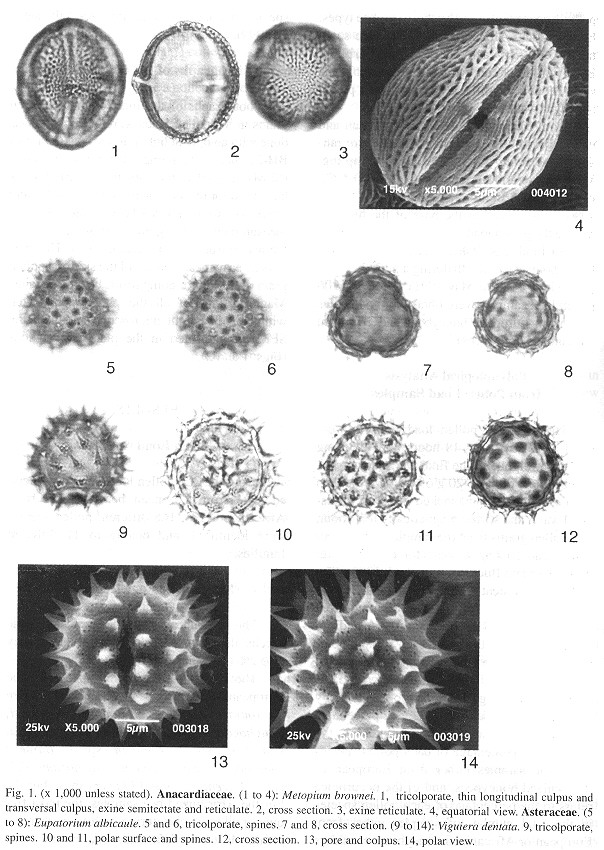
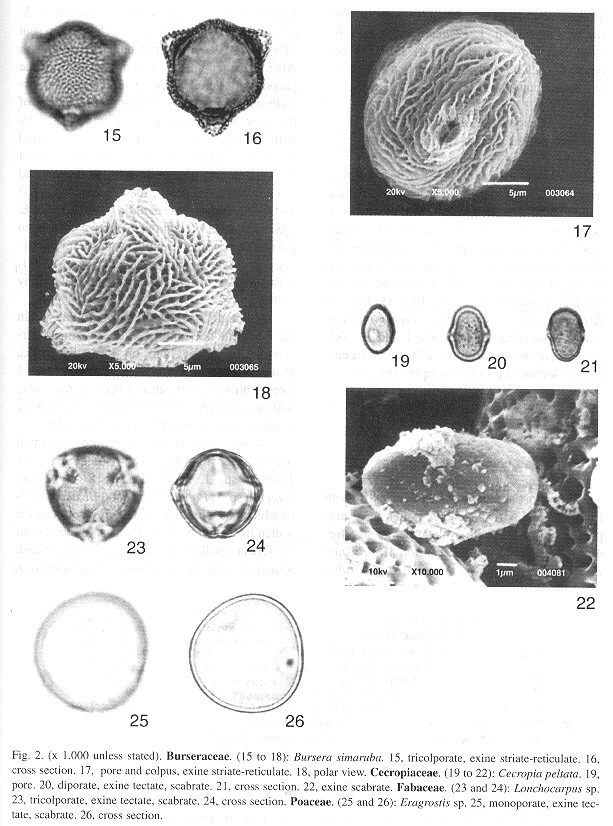
<body><![CDATA[<p><b><font face="Arial"><font size="-1">Micrographs of the Pollen Grains</font></font></b>    </p>       <p><font face="Arial"><font size="-1">Photographs of the most abundant pollen  grains in the pollen loads were taken. This was done with an optical light  microscopic (Olympus BH-2) and a scanning electron microscope (SEM). A standard  magnification of 1000 X has been used for most of the light micrographs, and a scale of 1mm:1mm has been maintained, so a measurement on the grain illustration in mm is the actual true size in microns (pm). This permits an easy measurement of the size of a pollen grain and a direct comparison between grains. Magnifications of all the photographs taken with the optic light microscope and with the SEM are indicated in the plate explanations (<a href="#fig1">Figs. 1</a>   and <a href="#fig2">2</a>  ).</font></font> </p>       <center><font face="Arial"><font size="-1">&nbsp;</font></font></center>          <center><a name="fig1"></a>  <img src="/img/fbpe/rbt/v50n2-3/2135i01.JPG" height="850" width="604">  </center>          
<center>&nbsp;</center>          <center>&nbsp;</center>          <center>&nbsp;&nbsp;<a name="fig2"></a>  <img src="/img/fbpe/rbt/v50n2-3/2135i02.JPG" height="826" width="613">  </center>          
<center>&nbsp;</center>          <center>&nbsp;</center>   <b><font face="Arial"><font size="-1">Results</font></font></b>        <p><b><font face="Arial"><font size="-1">Pollen Load Analysis</font></font></b>    </p>       ]]></body>
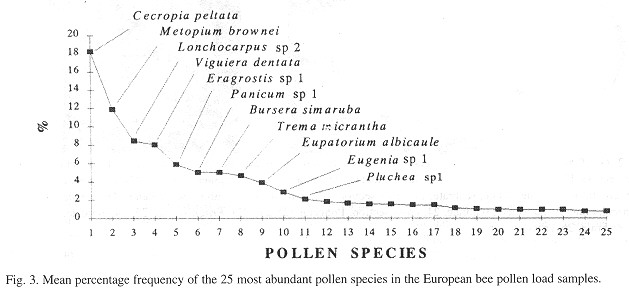
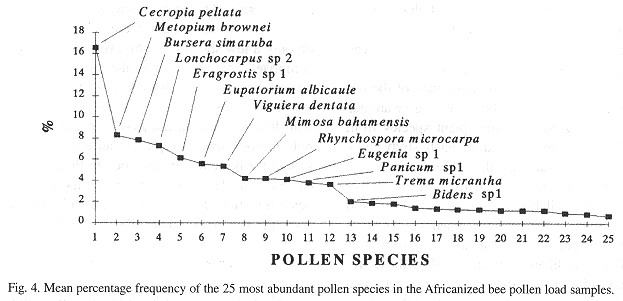
<body><![CDATA[<p><font face="Arial"><font size="-1">From the 206 pollen load samples collected  (104 from European bee and 102 from Africanized bee), 168 different pollen  species were identified, and belong to 41 different families.</font></font>    </p>       <p><font face="Arial"><font size="-1">&nbsp;</font></font>     <br>  <b><font face="Arial"><font size="-1">Mean percentage frequency</font></font></b>    </p>       <p><font face="Arial"><font size="-1">This account mostly concentrates on  those species that have a mean percentage frequency of <u>&gt;</u> 2% (<a href="#fig3">  Figs. 3</a>   and <a href="#fig4">4</a>  ).</font></font>  </p>       <p><font face="Arial"><font size="-1">The most frequent pollen species in  the European bee samples of years 1 and 2 were <i>Cecropia</i> <i>peltata,</i>   <i>Metopium</i> <i>brownei,</i> <i>Lonchocarpus </i>sp. 2, <i>Viguiera dentata,</i>  <i>Eragrostis sp. </i>1<i>, Panicum sp. </i>1<i>, Bursera</i>  <i>simaruba, Trema micrantha, Eupatorium albicaule, Eugenia sp. </i>1 <i> and Pluchea sp. </i>1 (<a href="#fig3">Fig. 3</a>  ). For the Africanized bee samples, the most frequent pollen species during  both years were C <i>peltata, M. brownei, B. simaruba, Lonchocarpus</i> sp.  2, <i>Eragrostis sp. </i>1, <i>E. albicaule, V dentata, Mimosa bahamensis,  Rhynchospora microcarpa, Eugenia sp. </i>1<i>, Panicum sp. </i>1, <i>E. albicaule  and Bidens sp. </i>1 (<a href="#fig4">Fig. 4</a>  ). For both bee types, <i>C. peltata and M. brownei </i>are the first two  most abundant.</font></font> </p>       <center><a name="fig3"></a>  <img src="/img/fbpe/rbt/v50n2-3/2135i03.JPG" height="294" width="629">  </center>          
<center>&nbsp;</center>          <center>&nbsp;&nbsp;<a name="fig4"></a>  <img src="/img/fbpe/rbt/v50n2-3/2135i04.JPG" height="301" width="623">  </center>          
<center>&nbsp;</center>          <center><a name="fig5"></a>  <img src="/img/fbpe/rbt/v50n2-3/2135i05.JPG" height="303" width="621">  </center>          
]]></body>
<body><![CDATA[<center>&nbsp;</center>          <center>&nbsp;<a name="fig6"></a>  <img src="/img/fbpe/rbt/v50n2-3/2135i06.JPG" height="298" width="630">  </center>   &nbsp;        
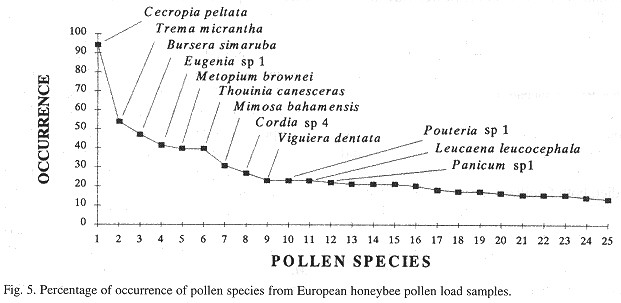
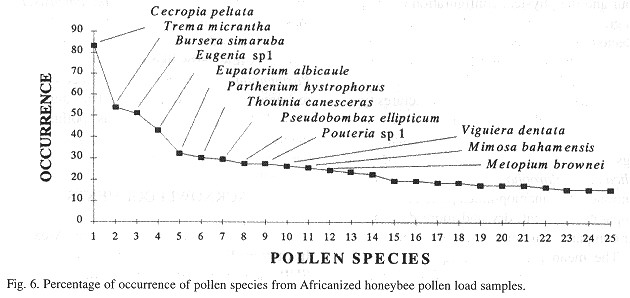
<p><b><font face="Arial"><font size="-1">Percentage of occurrence of pollen  species in the samples</font></font></b>  </p>       <p><font face="Arial"><font size="-1">Some pollen species (regardless of their frequency) were present in at least 30% of the pollen load samples, and also represent a "long-term" food resource during the year; this is the case with <i>C. peltata, Trema micrantha, B. simaruba, Eugenia sp. </i>1<i> , M. brownei,</i>  <i>Thouinia cabeceras and M. bahamensis for</i> the European bee samples (<a href="#fig4">Fig. 4</a>  ). For the Africanized bees, <i>C. peltata, Trema micrantha, B. simaruba,  Eugenia </i>sp. 1 and <i>E. albicaule </i>were the ones with the largest percentage of occurrence in the samples (<a href="#fig6">Fig. 6</a>  ).</font></font>  </p>       <p><b><font face="Arial"><font size="-1">Discussion</font></font></b>  </p>       <p><b><font face="Arial"><font size="-1">Mean percentage frequency</font></font></b>    </p>       <p><font face="Arial"><font size="-1">The most frequent pollen species in  both European and Africanized bee pollen load samples in both sites (with  a mean percentage frequency of <u>&gt;</u> 2%) were <i>C. peltata, M. brownei.,</i>   <i>Lonchocarpus </i>sp. 2, V <i>dentata, B. simaruba,</i> <i>Eragrostis sp. </i>1, <i>E. albicaule, Panicum </i>sp. 1, <i>E.</i> <i>albicaule and Eugenia sp. </i>1. These represent 71% of all the mean percentage frequencies. Also, these ten species account for 89% of the proportion of pollen species considered in this analysis which means that the great majority of the most frequent pollen species collected by both bee types were the same (<a href="#fig1">  Figs. 1</a>  , <a href="#fig2">2</a>  , <a href="#fig3">3</a>   and <a href="#fig4">4</a>  ). <i>C. peltata and M. brownei </i>were the most frequent pollen species  in both European and Afficanized bees pollen load samples (<a href="#fig3">  Figs. 3</a>   and <a href="#fig4">4</a>  ). <i>M. brownei, Y dentata, B. simaruba, E.</i> <i>albicaule and M. bahamensis  </i>have also bcen previously reported as pollen sources for honeyhees in  Mexico (<a href="#Sousa-Novelo">Sousa-Novelo <i>et al. </i>1981</a>  , <a href="#Villanueva84">Villanueva-G. 1984</a>  , <a href="#Chemas">Chem&aacute;s and Rico-Gray 1991</a>  ).</font></font>  </p>       <p><font face="Arial"><font size="-1">Although <i>Pluchea sp. </i>1 was found  within the European bee samples with a <u>&gt;</u> 2 mean percentage frequency,  and on the other hand, <i>R. microcarpa, M. bahamensis and Bidens sp. </i>  1 were within the Africanized bee samples (also with a mean of <u>&gt;</u>   2%), the four species were common to both bee types (<a href="#fig3">Figs  3</a>   and <a href="#fig4">4</a>  ).</font></font>  </p>       <p><font face="Arial"><font size="-1">Some pollen species were more frequent  at one site than the other. This was the case for <i>Pluchea sp. </i>1<i>  , Bidens sp. </i>1, <i>E. albicaule,</i> <i>Eugenia sp. </i>1<i>, Panicum  </i>sp. 1 <i>and Buxus bartlettii</i> which had a high percentage frequency  in the pollen load samples from Palmas. In the case of St. Teresa's pollen  load samples, <i>R. microcarpa,</i> <i>Spondias sp. </i>1<i>, Leucaena leucocephala,  Heliocarpus donnell-smithii, </i>Fabaceac 2, <i>Hibiscus </i>sp. 2 and <i>  Conocarpus erecta </i>were the more frequent. <i>H. donnell-smithii </i> and Fabaceae 2 were only present in St. Teresa.</font></font>  </p>       <p><font face="Arial"><font size="-1">The differences in the frequency of  the pollen species mentioned above might give an idea of the abundance of  many plant species from which they were derived in each study area. Other  factors such as the differences in the amount of pollen produced by different  flower species, the availability of pollen and nectar from flower species  during days when pollen loads were sampled, and the distance of those resources  from the hives, may also reflect these frequency differences. Some of these  factors, and also the ones already mentioned about the colour, odour and morphology of the flowers, are the same as those probably determined the preference of honeybees for nectar and pollen resources.</font></font>  </p>       ]]></body>
<body><![CDATA[<p><font face="Arial"><font size="-1">Some families contributed with a large  number of pollen species: Fabaceae, Asteraceae, Boraginaceae, Convolvulaceae,  Euphorbiaceae, Sapindaceae, Poaceae, Myrtaceae, Sapotaceae and Tiliaceae.  As with honey samples (<a href="#Villanueva94">Villanueva 1994</a>  ), Fabaceae and Asteraceae families are very important in the bee diet, both families were well represented in the pollen load samples, with 12% and 11% of the total number of pollen species respectively.</font></font>   </p>       <p><font face="Arial"><font size="-1">According to <a href="#Stanley">Stanley  and Linskens (1974)</a>   and <a href="#Jay">Jay (1986)</a>   workers choose which pollen to collect not by their nutritive value, age,  moisture, content, or colour, but on the basis of the odour and the physical  configuration of the pollen grains, although many of the pollen species collected  by honeybee foragers (some with high percentage frequency and high percentage  occurrence) had a psilated exine (with a smooth surface), without spines or other structures typical of entomophilous plants. This was the case with  the Cyperaceae and Poaceae pollen grains (<a href="#fig3">Figs. 3</a>   and <a href="#fig4">4</a>  ), also <i>M. bahamensis, Mimosa</i> <i>pudica and Chlorophora tinctoria.  </i><a href="#Shuel">Shuel (1992)</a>   mentioned that anemophilous pollen tends to be comparatively light, dry  and more drab in colour compared with entomophilous pollen.</font></font>    </p>       <p><font face="Arial"><font size="-1">The mean percentage frequency distribution  of the pollen load sampled (from European and Africanized bees) was analysed  (<a href="#fig3">Figs. 3</a>   and <a href="#fig4">4</a>  ). lt can be observed that there is high reliance on only a few species,  the first<b> </b>five for example comprise almost 50 % of all the mean percentage  frequencies, and as the curves become linear, the dependency of the bees is more distributed, with less reliance on the first 5 species. These polliniferous  species represent an important resource for beekeeping, considering that the Yucat&aacute;n Peninsula is one of the most important honey production regions of the world with over 10 hives per square kilometer (<a href="#Paxton"> Paxton 1992</a>  ).</font></font>  </p>       <p><b><font face="Arial"><font size="-1">Percentage of Occurrence</font></font></b>    </p>       <p><font face="Arial"><font size="-1"><i>C. peltata, E. albicaule, B. simaruba,Eugenia  sp. </i>1, <i>T canesceras, Pouteria sp. </i>1, <i>M. bahamensis </i>and V <i>dentata, </i>were the pollen species with the largest percentage of occurrence in both European and Africanized bee pollen load samples, but none of the 168 pollen species identified was found to be present in all the 206 pollen load samples from either European or Africanized bees (<a href="#fig5"> Figs.  5</a>   and <a href="#fig6">6</a>  ).</font></font>  </p>       <p><font face="Arial"><font size="-1">Some woody species (regardless of their  high frequency or their large volume in the pollen load samples) are also  important in the honeybee diet because they represent a constant source of pollen during most of the year. This is the case with trees like <i>C. peltata, B. simaruba,</i> <i>M. brownei, T canesceras and Psidium sartorianum; </i> shrubs like <i>B. bartlettii </i>and <i>T micrantha,</i> and shrubs or trees like <i>Cordia </i>sp. 4, <i>Pouteria</i> sp. 1 <i>and Eugenia sp. </i>1 and <i>M. bahamensis. All</i> these species also had a high percentage of occurrence in the pollen load samples (<a href="#fig5">Figs. 5</a>   and <a href="#fig6">6</a>  ). A few herbs like <i>Eupatorium </i>sp. 2 and <i>Parthenium hysterophorus  </i>representad constant resources of pollen for the honeybees during the  year, but their contribution as polliniferous plants was very small.</font></font>    </p>       <p><font face="Arial"><font size="-1">&nbsp;</font></font>     <br>  <b><font face="Arial"><font size="-1">Acknowledgements</font></font></b>    </p>       <p><font face="Arial"><font size="-1">I want to acknowledge the Mexican Institutions  El Colegio de la Frontera Sur (ECOSUR) and Consejo Nacional de Ciencia y  Tecnolog&iacute;a (CONACYT) for their great support in the development of  the present work, and also I wish to thank the School of Pure and Applied  Biology of the University of Wales College of Cardiff for the facilities I received during the development of this study. I would like to express my sincere thanks to Robert S. Pickard, John Free, Nicola Bradbear, Neil Kidd, Robert J. Paxton and David Roubik, for their useful comments on the manuscript. I would like to thank Wilberto Colli Uc&aacute;n, who assisted me in the fieldwork. I am grateful to Rodolfo Palacios and Beatriz-Ludlow-Wiechers for their help in the identification of some of my pollen grains.</font></font>    </p>       <p><font face="Arial"><font size="-1">&nbsp;</font></font>     ]]></body>
<body><![CDATA[<br>  <b><font face="Arial"><font size="-1">Resumen</font></font></b>  </p>       <p><font face="Arial"><font size="-1">Un estudio de las plantas polin&iacute;feras  m&aacute;s importantes para las abejas europeas y africanizadas <i>(Apis melifera </i>L.) se realiz&oacute; en el estado de Quintana Roo. Se hicieron comparaciones entre plantas visitadas por ambos tipos de abejas, con el objetivo de determinar si hay diferencias cualitativas o cuantitativas en la elecci&oacute;n de la especie de planta. Adicionalmente, se analizaron algunas estrategias de forrajeo de las abejas. Muestras de cargas de p&oacute;len se acetolizaron  y se montaron en l&aacute;minas. Posteriormente, los granos de p&oacute;len  se identificaron, se contaron y se fotografiaron. Se recolectaron un total  de 206 muestras de cargas de p&oacute;len en Las Palmas y Sta. Teresa durante  dos a&ntilde;os. Las especies m&aacute;s frecuentes en las muestras de cargas  de p&oacute;len fueron<i> Cecropia peltata, Metopium brownei, Lonchocarpus  </i>sp. 2, <i>Viguiera dentata,</i> 1<i>, Eragrostis sp. </i>1,<i> Bursera  simaruba y Eupatorium albicaule. </i>Ambos tipos de abejas mostraron una alta dependencia hacia s&oacute;lo unas pocas especies de plantas, las primetas  cinco de las mencionadas anteriormente constituyen aproximadamente un 50%  de todas las frecuencias de porcentaje promedio. Las familias que contribuyeron  con un mayor n&uacute;mero de especies de p&oacute;len fueron Fabaceae, Asteraceae,  Boraginaceae, Convolvulaceae, Euphorbiaceae, Sapindaceae, Poaceae, Myrtaceae,  Sapotaceae y Tiliaceae. En tanto que <i>C. peltata, Trema micrantha, B. simaruba,  Eugenia sp. </i>1,<i> Thouinia canesceras, Pouteria</i> sp. 1,<i> Mimosa bahamensis y V. dentata, </i>fueron las especies de p&oacute;len con los m&aacute;s altos porcentajes de presencia en las cargas de p&oacute;len de las abejas y representan adem&aacute;s, una fuente de recursos alimenticios de larga duraci&oacute;n durante todo el a&ntilde;o.</font></font>     <br>  &nbsp;  </p>       <p><b><font face="Arial"><font size="-1">References</font></font></b>  </p>       <p><a name="Anonymous"></a>  <font face="Arial"><font size="-1">Anonymous. 1998. Flora nectar&iacute;fera  y polin&iacute;fera de la Pen&iacute;nsula de Yucat&aacute;n. COTECOCA-SAGAR,  Mexico, D. E 128 p.</font></font>  </p>       <!-- ref --><p><a name="Barrios-Delgado"></a>  <font face="Arial"><font size="-1">Barrios-Delgado, C., E. P&eacute;mz-Dominguez  &amp; L.M. S&aacute;nchez-Navarro. 1990. Efectos y repercusiones de la abeja  africana en la Pen&iacute;nsula de Yucat&aacute;n. <i>Memorias</i> <i>del  IV Seminario Americano de Apicultura. </i>Secreta, r&iacute;a de Agricultura  y Recursos Hidr&aacute;ulicos and Uni&oacute;n Nacional de Apicultores, Mexico.  pp. 15-33.    &nbsp;&nbsp;&nbsp;&nbsp;&nbsp;&nbsp;&nbsp;&nbsp;[&#160;<a href="javascript:void(0);" onclick="javascript: window.open('/scielo.php?script=sci_nlinks&ref=1699003&pid=S0034-7744200200030002100002&lng=','','width=640,height=500,resizable=yes,scrollbars=1,menubar=yes,');">Links</a>&#160;]<!-- end-ref --></font></font>  </p>       <!-- ref --><p><a name="Chemas"></a>  <font face="Arial"><font size="-1">Chem&aacute;s, A. &amp; Y Rico-Gray. 1991. Apiculture and management of associated vegetation by the<b> </b>Maya of Tixcacaltuyub, Yucat&aacute;n, Mexico. Agrofo. Syst. 13: 13-25.    &nbsp;&nbsp;&nbsp;&nbsp;&nbsp;&nbsp;&nbsp;&nbsp;[&#160;<a href="javascript:void(0);" onclick="javascript: window.open('/scielo.php?script=sci_nlinks&ref=1699005&pid=S0034-7744200200030002100003&lng=','','width=640,height=500,resizable=yes,scrollbars=1,menubar=yes,');">Links</a>&#160;]<!-- end-ref --></font></font>    </p>       <!-- ref --><p><a name="Daly"></a>  <font face="Arial"><font size="-1">Daly, H. V. &amp; S.S. Balling. 1978.  Identification of Africanized honeybees in the Western Hemisphere by discriminant  analysis. J Kansas Entomol. Soc. 5: 857-869.    &nbsp;&nbsp;&nbsp;&nbsp;&nbsp;&nbsp;&nbsp;&nbsp;[&#160;<a href="javascript:void(0);" onclick="javascript: window.open('/scielo.php?script=sci_nlinks&ref=1699007&pid=S0034-7744200200030002100004&lng=','','width=640,height=500,resizable=yes,scrollbars=1,menubar=yes,');">Links</a>&#160;]<!-- end-ref --></font></font>  </p>       <!-- ref --><p><a name="Jay"></a>  <font face="Arial"><font size="-1">Jay, S.C. 1986. Spatial management of  honey bees on crops. Annu. Rev. Entomol. 31: 49-65.    &nbsp;&nbsp;&nbsp;&nbsp;&nbsp;&nbsp;&nbsp;&nbsp;[&#160;<a href="javascript:void(0);" onclick="javascript: window.open('/scielo.php?script=sci_nlinks&ref=1699009&pid=S0034-7744200200030002100005&lng=','','width=640,height=500,resizable=yes,scrollbars=1,menubar=yes,');">Links</a>&#160;]<!-- end-ref --></font></font>  </p>       <!-- ref --><p><a name="Koeppen"></a>  <font face="Arial"><font size="-1">Koeppen, W. 1936. Das gepographische System der Klimate In Handbuch der Klimatologie. Band I, Teil C; Berlin, Germany. 44 p.    &nbsp;&nbsp;&nbsp;&nbsp;&nbsp;&nbsp;&nbsp;&nbsp;[&#160;<a href="javascript:void(0);" onclick="javascript: window.open('/scielo.php?script=sci_nlinks&ref=1699011&pid=S0034-7744200200030002100006&lng=','','width=640,height=500,resizable=yes,scrollbars=1,menubar=yes,');">Links</a>&#160;]<!-- end-ref --></font></font>  </p>       <!-- ref --><p><a name="Levin"></a>  <font face="Arial"><font size="-1">Levin, M.D. &amp; S. Glowska-Konopacka.  1963. Responses of foraging honeybees in alfalfa to increasing competition  from other colonies. J. Apicult. Res. 2: 33-42.    &nbsp;&nbsp;&nbsp;&nbsp;&nbsp;&nbsp;&nbsp;&nbsp;[&#160;<a href="javascript:void(0);" onclick="javascript: window.open('/scielo.php?script=sci_nlinks&ref=1699013&pid=S0034-7744200200030002100007&lng=','','width=640,height=500,resizable=yes,scrollbars=1,menubar=yes,');">Links</a>&#160;]<!-- end-ref --></font></font>  </p>       <!-- ref --><p><a name="Maheshwari"></a>  <font face="Arial"><font size="-1">Maheshwari, R 1950. An introduction to  the embryology of Angiosperms. McGraw-Hill; New York, USA. 453 p.    &nbsp;&nbsp;&nbsp;&nbsp;&nbsp;&nbsp;&nbsp;&nbsp;[&#160;<a href="javascript:void(0);" onclick="javascript: window.open('/scielo.php?script=sci_nlinks&ref=1699015&pid=S0034-7744200200030002100008&lng=','','width=640,height=500,resizable=yes,scrollbars=1,menubar=yes,');">Links</a>&#160;]<!-- end-ref --></font></font>    </p>       <!-- ref --><p><a name="O&apos;Rourke"></a>  <font face="Arial"><font size="-1">O'Rourke, M.K. &amp; S.L. Buchmann. 1991.  Standardised analytical techniques for bee-collected pollen. Entomol. Soc.  Amer. 20: 507-513.    &nbsp;&nbsp;&nbsp;&nbsp;&nbsp;&nbsp;&nbsp;&nbsp;[&#160;<a href="javascript:void(0);" onclick="javascript: window.open('/scielo.php?script=sci_nlinks&ref=1699017&pid=S0034-7744200200030002100009&lng=','','width=640,height=500,resizable=yes,scrollbars=1,menubar=yes,');">Links</a>&#160;]<!-- end-ref --></font></font>  </p>       <!-- ref --><p><a name="Palacios-Chavez"></a>  <font face="Arial"><font size="-1">Palacios-Ch&aacute;vez, R.B., R. Ludlow-Wiechers  y G. Villanueva. 1991. Flora palinol&oacute;gica de la Reserva de la Bi&oacute;sfera  de Sian Ka'an, Quintana Roo, M&eacute;xico. Centro de Investigaciones de Quintana Roo; Quintana Roo, Mexico. 321 p.    &nbsp;&nbsp;&nbsp;&nbsp;&nbsp;&nbsp;&nbsp;&nbsp;[&#160;<a href="javascript:void(0);" onclick="javascript: window.open('/scielo.php?script=sci_nlinks&ref=1699019&pid=S0034-7744200200030002100010&lng=','','width=640,height=500,resizable=yes,scrollbars=1,menubar=yes,');">Links</a>&#160;]<!-- end-ref --></font></font>  </p>       <!-- ref --><p><a name="Paxton"></a>  <font face="Arial"><font size="-1">Paxton, R.J. 1992. Africanized honeybees:  new ideas in honeybee biology. p. 32-41. In J.B. Free (ed.). Keeping bees.  Central Association of Beekeepers' Publications, Cardiff, United Kingdom.    &nbsp;&nbsp;&nbsp;&nbsp;&nbsp;&nbsp;&nbsp;&nbsp;[&#160;<a href="javascript:void(0);" onclick="javascript: window.open('/scielo.php?script=sci_nlinks&ref=1699021&pid=S0034-7744200200030002100011&lng=','','width=640,height=500,resizable=yes,scrollbars=1,menubar=yes,');">Links</a>&#160;]<!-- end-ref --></font></font>    </p>       <!-- ref --><p><a name="Roldan-Ramos"></a>  <font face="Arial"><font size="-1">Rold&aacute;n-Ramos, L.A. 1984. Flora  mel&iacute;fera de la zona de Tixcacaltuyub, Yucat&aacute;n. Bch Thesis. Facultad de Ciencias, Universidad Nacional Aut&oacute;noma de M&eacute;xico, Mexico, D. F. 210 p.    &nbsp;&nbsp;&nbsp;&nbsp;&nbsp;&nbsp;&nbsp;&nbsp;[&#160;<a href="javascript:void(0);" onclick="javascript: window.open('/scielo.php?script=sci_nlinks&ref=1699023&pid=S0034-7744200200030002100012&lng=','','width=640,height=500,resizable=yes,scrollbars=1,menubar=yes,');">Links</a>&#160;]<!-- end-ref --></font></font>  </p>       <!-- ref --><p><a name="Roubik"></a>  <font face="Arial"><font size="-1">Roubik, D.W. 1989. Ecology and natural  history of tropical bees. Cambridge University, Cambridge, UK. 514 p.    &nbsp;&nbsp;&nbsp;&nbsp;&nbsp;&nbsp;&nbsp;&nbsp;[&#160;<a href="javascript:void(0);" onclick="javascript: window.open('/scielo.php?script=sci_nlinks&ref=1699025&pid=S0034-7744200200030002100013&lng=','','width=640,height=500,resizable=yes,scrollbars=1,menubar=yes,');">Links</a>&#160;]<!-- end-ref --></font></font>    </p>       <!-- ref --><p><a name="Shuel"></a>  <font face="Arial"><font size="-1">Shuel, R.W. 1992. The production of nectar  and pollen. pp. 401-436. In J. M. Graham (ed.). The hive and the honeybee.  Dadant &amp; Sons, Hamilton, III., USA.    &nbsp;&nbsp;&nbsp;&nbsp;&nbsp;&nbsp;&nbsp;&nbsp;[&#160;<a href="javascript:void(0);" onclick="javascript: window.open('/scielo.php?script=sci_nlinks&ref=1699027&pid=S0034-7744200200030002100014&lng=','','width=640,height=500,resizable=yes,scrollbars=1,menubar=yes,');">Links</a>&#160;]<!-- end-ref --></font></font>  </p>       <!-- ref --><p><a name="Smith"></a>  <font face="Arial"><font size="-1">Smith, M.V &amp; A. Adie. 1963. A new  design in pollen traps. Can. Bee J. 74: 4-8.    &nbsp;&nbsp;&nbsp;&nbsp;&nbsp;&nbsp;&nbsp;&nbsp;[&#160;<a href="javascript:void(0);" onclick="javascript: window.open('/scielo.php?script=sci_nlinks&ref=1699029&pid=S0034-7744200200030002100015&lng=','','width=640,height=500,resizable=yes,scrollbars=1,menubar=yes,');">Links</a>&#160;]<!-- end-ref --></font></font>  </p>       <!-- ref --><p><a name="Sousa-Novelo"></a>  <font face="Arial"><font size="-1">Sousa-Novelo, N.,V.M. Su&aacute;rez-Molina  &amp; A. Barrera-V&aacute;zquez. 1981. Plantas mel&iacute;feras y polin&iacute;feras  de Yucat&aacute;n. Fondo Editorial de Yucat&aacute;n; M&eacute;rida, Yuc.,  Mexico. 60 p.    &nbsp;&nbsp;&nbsp;&nbsp;&nbsp;&nbsp;&nbsp;&nbsp;[&#160;<a href="javascript:void(0);" onclick="javascript: window.open('/scielo.php?script=sci_nlinks&ref=1699031&pid=S0034-7744200200030002100016&lng=','','width=640,height=500,resizable=yes,scrollbars=1,menubar=yes,');">Links</a>&#160;]<!-- end-ref --></font></font>  </p>       <!-- ref --><p><a name="Stanley"></a>  <font face="Arial"><font size="-1">Stanley, R.G. &amp; H.F. Linskens. 1974.  Pollen: biology, biochemistry, management. Springer-Verlag; Berlin, Heidelberg  and New York. 307 p.    &nbsp;&nbsp;&nbsp;&nbsp;&nbsp;&nbsp;&nbsp;&nbsp;[&#160;<a href="javascript:void(0);" onclick="javascript: window.open('/scielo.php?script=sci_nlinks&ref=1699033&pid=S0034-7744200200030002100017&lng=','','width=640,height=500,resizable=yes,scrollbars=1,menubar=yes,');">Links</a>&#160;]<!-- end-ref --></font></font>  </p>       <p><a name="Villanueva84"></a>  <font face="Arial"><font size="-1">Villanueva-G., R. 1984. Plantas de importancia  ap&iacute;cola en el ejido de Plan del R&iacute;o, Veracruz, M&eacute;xico.  Biofica. 9: 279-340.</font></font>  </p>       <!-- ref --><p><a name="Villanueva94"></a>  <font face="Arial"><font size="-1">Villanueva-G., R. 1994. Nectar sources  of European and Africanized honeybees <i>(Apis mellifera </i>L.) in the Yucat&aacute;n  Peninsula, Mexico. J. Apicult. Res. 33: 44-58.    &nbsp;&nbsp;&nbsp;&nbsp;&nbsp;&nbsp;&nbsp;&nbsp;[&#160;<a href="javascript:void(0);" onclick="javascript: window.open('/scielo.php?script=sci_nlinks&ref=1699036&pid=S0034-7744200200030002100019&lng=','','width=640,height=500,resizable=yes,scrollbars=1,menubar=yes,');">Links</a>&#160;]<!-- end-ref --></font></font>  </p>       ]]></body>
<body><![CDATA[<!-- ref --><p><a name="Villanueva99"></a>  <font face="Arial"><font size="-1">Villanueva-G., R. 1999. Pollen sources  of European and Africanized honeybees in the eastern Yucat&aacute;n Peninsula,  Mexico. J. Apicult. Res. 38: 105-1 1 1.    &nbsp;&nbsp;&nbsp;&nbsp;&nbsp;&nbsp;&nbsp;&nbsp;[&#160;<a href="javascript:void(0);" onclick="javascript: window.open('/scielo.php?script=sci_nlinks&ref=1699038&pid=S0034-7744200200030002100020&lng=','','width=640,height=500,resizable=yes,scrollbars=1,menubar=yes,');">Links</a>&#160;]<!-- end-ref --></font></font>  </p>       <!-- ref --><p><a name="Visscher"></a>  <font face="Arial"><font size="-1">Visscher, P.K. &amp; T.D. Seeley. 1982.  Foraging strategy of honey bee colonies in a temperate deciduous forest. Ecology. 63: 1790-1801.    &nbsp;&nbsp;&nbsp;&nbsp;&nbsp;&nbsp;&nbsp;&nbsp;[&#160;<a href="javascript:void(0);" onclick="javascript: window.open('/scielo.php?script=sci_nlinks&ref=1699040&pid=S0034-7744200200030002100021&lng=','','width=640,height=500,resizable=yes,scrollbars=1,menubar=yes,');">Links</a>&#160;]<!-- end-ref --></font></font>  </p>       <!-- ref --><p><a name="Walter"></a>  <font face="Arial"><font size="-1">Walter, G.D. 1980. A modification of the O.A.C. pollen trap. Amer. Bee J. 120: 119-121.    &nbsp;&nbsp;&nbsp;&nbsp;&nbsp;&nbsp;&nbsp;&nbsp;[&#160;<a href="javascript:void(0);" onclick="javascript: window.open('/scielo.php?script=sci_nlinks&ref=1699042&pid=S0034-7744200200030002100022&lng=','','width=640,height=500,resizable=yes,scrollbars=1,menubar=yes,');">Links</a>&#160;]<!-- end-ref --></font></font>  </p>       <!-- ref --><p><a name="Winston"></a>  <font face="Arial"><font size="-1">Winston, M. 1987. The biology of the honey bee. Harvard University, Cambridge, Mass., USA. 281 p.    &nbsp;&nbsp;&nbsp;&nbsp;&nbsp;&nbsp;&nbsp;&nbsp;[&#160;<a href="javascript:void(0);" onclick="javascript: window.open('/scielo.php?script=sci_nlinks&ref=1699044&pid=S0034-7744200200030002100023&lng=','','width=640,height=500,resizable=yes,scrollbars=1,menubar=yes,');">Links</a>&#160;]<!-- end-ref --></font></font>      <br>  &nbsp;     <br>  &nbsp;  </p>       ]]></body>
<body><![CDATA[<p><a name="*a"></a>  <font face="Arial"><font size="-1"><a href="#*">*</a>   El Colegio de la Frontera Sur (ECOSUR), Apdo. Postal 424, C.P. 77049, Chetumal,  Quintana Roo, Mexico. Fax: (983) 2 04 47. e-mail: <a href="mailto:rogel@ecosur-qroo.mx">  rogel@ecosur-qroo.mx</a>  </font></font> </p>  </div>        ]]></body><back>
<ref-list>
<ref id="B1">
<nlm-citation citation-type="book">
<person-group person-group-type="author">
<name>
</name>
<name>
</name>
</person-group>
<source><![CDATA[Flora nectarífera y polinífera de la Península de Yucatán]]></source>
<year>1998</year>
<page-range>128</page-range><publisher-loc><![CDATA[^eMexico, D. F Mexico, D. F]]></publisher-loc>
<publisher-name><![CDATA[COTECOCA-SAGAR]]></publisher-name>
</nlm-citation>
</ref>
<ref id="B2">
<nlm-citation citation-type="confpro">
<person-group person-group-type="author">
<name>
<surname><![CDATA[Barrios-Delgado]]></surname>
<given-names><![CDATA[C]]></given-names>
</name>
<name>
<surname><![CDATA[Pémz-Dominguez]]></surname>
<given-names><![CDATA[E]]></given-names>
</name>
<name>
<surname><![CDATA[Sánchez-Navarro]]></surname>
<given-names><![CDATA[L.M]]></given-names>
</name>
</person-group>
<source><![CDATA[Efectos y repercusiones de la abeja africana en la Península de Yucatán]]></source>
<year>1990</year>
<conf-name><![CDATA[IV Seminario Americano de Apicultura]]></conf-name>
<conf-loc> </conf-loc>
<page-range>15-33</page-range></nlm-citation>
</ref>
<ref id="B3">
<nlm-citation citation-type="journal">
<person-group person-group-type="author">
<name>
<surname><![CDATA[Chemás]]></surname>
<given-names><![CDATA[A]]></given-names>
</name>
<name>
<surname><![CDATA[Rico-Gray]]></surname>
<given-names><![CDATA[Y]]></given-names>
</name>
</person-group>
<article-title xml:lang="en"><![CDATA[Apiculture and management of associated vegetation by the Maya of Tixcacaltuyub, Yucatán, Mexico]]></article-title>
<source><![CDATA[Agrofo. Syst]]></source>
<year>1991</year>
<volume>13</volume>
<page-range>13-25</page-range></nlm-citation>
</ref>
<ref id="B4">
<nlm-citation citation-type="journal">
<person-group person-group-type="author">
<name>
<surname><![CDATA[Daly]]></surname>
<given-names><![CDATA[H. V]]></given-names>
</name>
<name>
<surname><![CDATA[Balling]]></surname>
<given-names><![CDATA[S.S]]></given-names>
</name>
</person-group>
<article-title xml:lang="en"><![CDATA[Identification of Africanized honeybees in the Western Hemisphere by discriminant analysis]]></article-title>
<source><![CDATA[J Kansas Entomol. Soc]]></source>
<year>1978</year>
<volume>5</volume>
<page-range>857-869</page-range></nlm-citation>
</ref>
<ref id="B5">
<nlm-citation citation-type="journal">
<person-group person-group-type="author">
<name>
<surname><![CDATA[Jay]]></surname>
<given-names><![CDATA[S.C]]></given-names>
</name>
</person-group>
<article-title xml:lang="en"><![CDATA[Spatial management of honey bees on crops]]></article-title>
<source><![CDATA[Annu. Rev. Entomol]]></source>
<year>1986</year>
<volume>31</volume>
<page-range>49-65</page-range></nlm-citation>
</ref>
<ref id="B6">
<nlm-citation citation-type="">
<person-group person-group-type="author">
<name>
<surname><![CDATA[Koeppen]]></surname>
<given-names><![CDATA[W]]></given-names>
</name>
</person-group>
<source><![CDATA[Das gepographische System der Klimate In Handbuch der Klimatologie]]></source>
<year>1936</year>
<page-range>44</page-range><publisher-loc><![CDATA[Berlin ]]></publisher-loc>
</nlm-citation>
</ref>
<ref id="B7">
<nlm-citation citation-type="journal">
<person-group person-group-type="author">
<name>
<surname><![CDATA[Levin]]></surname>
<given-names><![CDATA[M.D]]></given-names>
</name>
<name>
<surname><![CDATA[Glowska-Konopacka]]></surname>
<given-names><![CDATA[S]]></given-names>
</name>
</person-group>
<article-title xml:lang="en"><![CDATA[Responses of foraging honeybees in alfalfa to increasing competition from other colonies]]></article-title>
<source><![CDATA[J. Apicult. Res]]></source>
<year>1963</year>
<volume>2</volume>
<page-range>33-42</page-range></nlm-citation>
</ref>
<ref id="B8">
<nlm-citation citation-type="book">
<person-group person-group-type="author">
<name>
<surname><![CDATA[Maheshwari]]></surname>
<given-names><![CDATA[R]]></given-names>
</name>
</person-group>
<source><![CDATA[An introduction to the embryology of Angiosperms]]></source>
<year>1950</year>
<page-range>453</page-range><publisher-loc><![CDATA[New York ]]></publisher-loc>
<publisher-name><![CDATA[McGraw-Hill]]></publisher-name>
</nlm-citation>
</ref>
<ref id="B9">
<nlm-citation citation-type="journal">
<person-group person-group-type="author">
<name>
<surname><![CDATA[O'Rourke]]></surname>
<given-names><![CDATA[M.K]]></given-names>
</name>
<name>
<surname><![CDATA[Buchmann]]></surname>
<given-names><![CDATA[S.L]]></given-names>
</name>
</person-group>
<article-title xml:lang="en"><![CDATA[Standardised analytical techniques for bee-collected pollen]]></article-title>
<source><![CDATA[Entomol. Soc. Amer]]></source>
<year>1991</year>
<volume>20</volume>
<page-range>507-513</page-range></nlm-citation>
</ref>
<ref id="B10">
<nlm-citation citation-type="book">
<person-group person-group-type="author">
<name>
<surname><![CDATA[Palacios-Chávez]]></surname>
<given-names><![CDATA[R.B]]></given-names>
</name>
<name>
<surname><![CDATA[Ludlow-Wiechers]]></surname>
<given-names><![CDATA[R]]></given-names>
</name>
<name>
<surname><![CDATA[Villanueva]]></surname>
<given-names><![CDATA[G]]></given-names>
</name>
</person-group>
<source><![CDATA[Flora palinológica de la Reserva de la Biósfera de Sian Ka'an, Quintana Roo, México]]></source>
<year>1991</year>
<page-range>321</page-range><publisher-loc><![CDATA[Quintana Roo ]]></publisher-loc>
<publisher-name><![CDATA[Centro de Investigaciones de Quintana Roo]]></publisher-name>
</nlm-citation>
</ref>
<ref id="B11">
<nlm-citation citation-type="book">
<person-group person-group-type="author">
<name>
<surname><![CDATA[Paxton]]></surname>
<given-names><![CDATA[R.J]]></given-names>
</name>
</person-group>
<article-title xml:lang="en"><![CDATA[Africanized honeybees: new ideas in honeybee biology]]></article-title>
<person-group person-group-type="editor">
<name>
<surname><![CDATA[Free]]></surname>
<given-names><![CDATA[J.B]]></given-names>
</name>
</person-group>
<source><![CDATA[Keeping bees]]></source>
<year>1992</year>
<publisher-loc><![CDATA[Cardiff ]]></publisher-loc>
<publisher-name><![CDATA[Central Association of Beekeepers' Publications]]></publisher-name>
</nlm-citation>
</ref>
<ref id="B12">
<nlm-citation citation-type="">
<person-group person-group-type="author">
<name>
<surname><![CDATA[Roldán-Ramos]]></surname>
<given-names><![CDATA[L.A]]></given-names>
</name>
</person-group>
<source><![CDATA[Flora melífera de la zona de Tixcacaltuyub, Yucatán]]></source>
<year>1984</year>
<page-range>210</page-range></nlm-citation>
</ref>
<ref id="B13">
<nlm-citation citation-type="book">
<person-group person-group-type="author">
<name>
<surname><![CDATA[Roubik]]></surname>
<given-names><![CDATA[D.W]]></given-names>
</name>
</person-group>
<source><![CDATA[Ecology and natural history of tropical bees]]></source>
<year>1989</year>
<page-range>514</page-range><publisher-loc><![CDATA[Cambridge ]]></publisher-loc>
<publisher-name><![CDATA[Cambridge University]]></publisher-name>
</nlm-citation>
</ref>
<ref id="B14">
<nlm-citation citation-type="book">
<person-group person-group-type="author">
<name>
<surname><![CDATA[Shuel]]></surname>
<given-names><![CDATA[R.W]]></given-names>
</name>
</person-group>
<article-title xml:lang="en"><![CDATA[The production of nectar and pollen]]></article-title>
<person-group person-group-type="editor">
<name>
<surname><![CDATA[Graham]]></surname>
<given-names><![CDATA[J. M]]></given-names>
</name>
</person-group>
<source><![CDATA[The hive and the honeybee]]></source>
<year>1992</year>
<publisher-loc><![CDATA[Hamilton ]]></publisher-loc>
<publisher-name><![CDATA[Dadant & Sons]]></publisher-name>
</nlm-citation>
</ref>
<ref id="B15">
<nlm-citation citation-type="journal">
<person-group person-group-type="author">
<name>
<surname><![CDATA[Smith]]></surname>
<given-names><![CDATA[M.V]]></given-names>
</name>
<name>
<surname><![CDATA[Adie]]></surname>
<given-names><![CDATA[A]]></given-names>
</name>
</person-group>
<article-title xml:lang="en"><![CDATA[A new design in pollen traps]]></article-title>
<source><![CDATA[Can. Bee J]]></source>
<year>1963</year>
<volume>74</volume>
<page-range>4-8</page-range></nlm-citation>
</ref>
<ref id="B16">
<nlm-citation citation-type="book">
<person-group person-group-type="author">
<name>
<surname><![CDATA[Sousa-Novelo]]></surname>
<given-names><![CDATA[N]]></given-names>
</name>
<name>
<surname><![CDATA[Suárez-Molina]]></surname>
<given-names><![CDATA[V.M]]></given-names>
</name>
<name>
<surname><![CDATA[Barrera-Vázquez]]></surname>
<given-names><![CDATA[A]]></given-names>
</name>
</person-group>
<source><![CDATA[Plantas melíferas y poliníferas de Yucatán]]></source>
<year>1981</year>
<page-range>60</page-range><publisher-loc><![CDATA[Mérida^eYuc Yuc]]></publisher-loc>
<publisher-name><![CDATA[Fondo Editorial de Yucatán]]></publisher-name>
</nlm-citation>
</ref>
<ref id="B17">
<nlm-citation citation-type="book">
<person-group person-group-type="author">
<name>
<surname><![CDATA[Stanley]]></surname>
<given-names><![CDATA[R.G]]></given-names>
</name>
<name>
<surname><![CDATA[Linskens]]></surname>
<given-names><![CDATA[H.F]]></given-names>
</name>
</person-group>
<source><![CDATA[Pollen: biology, biochemistry, management]]></source>
<year>1974</year>
<page-range>307</page-range><publisher-loc><![CDATA[Berlin ]]></publisher-loc>
<publisher-name><![CDATA[Springer-Verlag]]></publisher-name>
</nlm-citation>
</ref>
<ref id="B18">
<nlm-citation citation-type="journal">
<person-group person-group-type="author">
<name>
<surname><![CDATA[Villanueva-G]]></surname>
<given-names><![CDATA[R]]></given-names>
</name>
</person-group>
<article-title xml:lang="es"><![CDATA[Plantas de importancia apícola en el ejido de Plan del Río, Veracruz, México]]></article-title>
<source><![CDATA[Biotica]]></source>
<year>1984</year>
<volume>9</volume>
<page-range>279-340</page-range></nlm-citation>
</ref>
<ref id="B19">
<nlm-citation citation-type="journal">
<person-group person-group-type="author">
<name>
<surname><![CDATA[Villanueva-G]]></surname>
<given-names><![CDATA[R]]></given-names>
</name>
</person-group>
<article-title xml:lang="en"><![CDATA[Nectar sources of European and Africanized honeybees (Apis mellifera L.) in the Yucatán Peninsula, Mexico]]></article-title>
<source><![CDATA[J. Apicult. Res]]></source>
<year>1994</year>
<volume>33</volume>
<page-range>44-58</page-range></nlm-citation>
</ref>
<ref id="B20">
<nlm-citation citation-type="journal">
<person-group person-group-type="author">
<name>
<surname><![CDATA[Villanueva-G]]></surname>
<given-names><![CDATA[R]]></given-names>
</name>
</person-group>
<article-title xml:lang="en"><![CDATA[Pollen sources of European and Africanized honeybees in the eastern Yucatán Peninsula, Mexico]]></article-title>
<source><![CDATA[J. Apicult. Res]]></source>
<year>1999</year>
<volume>38</volume>
<page-range>105-111</page-range></nlm-citation>
</ref>
<ref id="B21">
<nlm-citation citation-type="journal">
<person-group person-group-type="author">
<name>
<surname><![CDATA[Visscher]]></surname>
<given-names><![CDATA[P.K]]></given-names>
</name>
<name>
<surname><![CDATA[Seeley]]></surname>
<given-names><![CDATA[T.D]]></given-names>
</name>
</person-group>
<article-title xml:lang="en"><![CDATA[Foraging strategy of honey bee colonies in a temperate deciduous forest]]></article-title>
<source><![CDATA[Ecology]]></source>
<year>1982</year>
<volume>63</volume>
<page-range>1790-1801</page-range></nlm-citation>
</ref>
<ref id="B22">
<nlm-citation citation-type="journal">
<person-group person-group-type="author">
<name>
<surname><![CDATA[Walter]]></surname>
<given-names><![CDATA[G.D]]></given-names>
</name>
</person-group>
<article-title xml:lang="en"><![CDATA[A modification of the O.A.C. pollen trap]]></article-title>
<source><![CDATA[Amer. Bee J]]></source>
<year>1980</year>
<volume>120</volume>
<page-range>119-121</page-range></nlm-citation>
</ref>
<ref id="B23">
<nlm-citation citation-type="book">
<person-group person-group-type="author">
<name>
<surname><![CDATA[Winston]]></surname>
<given-names><![CDATA[M]]></given-names>
</name>
</person-group>
<source><![CDATA[The biology of the honey bee]]></source>
<year>1987</year>
<page-range>281</page-range><publisher-loc><![CDATA[Cambridge^eMass Mass]]></publisher-loc>
<publisher-name><![CDATA[Harvard University]]></publisher-name>
</nlm-citation>
</ref>
</ref-list>
</back>
</article>