<?xml version="1.0" encoding="ISO-8859-1"?><article xmlns:mml="http://www.w3.org/1998/Math/MathML" xmlns:xlink="http://www.w3.org/1999/xlink" xmlns:xsi="http://www.w3.org/2001/XMLSchema-instance">
<front>
<journal-meta>
<journal-id>0034-7744</journal-id>
<journal-title><![CDATA[Revista de Biología Tropical]]></journal-title>
<abbrev-journal-title><![CDATA[Rev. biol. trop]]></abbrev-journal-title>
<issn>0034-7744</issn>
<publisher>
<publisher-name><![CDATA[Universidad de Costa Rica]]></publisher-name>
</publisher>
</journal-meta>
<article-meta>
<article-id>S0034-77442002000300007</article-id>
<title-group>
<article-title xml:lang="en"><![CDATA[Greening the blue mud!]]></article-title>
</title-group>
<contrib-group>
<contrib contrib-type="author">
<name>
<surname><![CDATA[Kathiresan]]></surname>
<given-names><![CDATA[K.]]></given-names>
</name>
<xref ref-type="aff" rid="A01"/>
</contrib>
</contrib-group>
<aff id="A01">
<institution><![CDATA[,Annamalai University Centre of Advanced Study in Marine Biology ]]></institution>
<addr-line><![CDATA[Parangipettai ]]></addr-line>
<country>India</country>
</aff>
<pub-date pub-type="pub">
<day>00</day>
<month>12</month>
<year>2002</year>
</pub-date>
<pub-date pub-type="epub">
<day>00</day>
<month>12</month>
<year>2002</year>
</pub-date>
<volume>50</volume>
<numero>3-4</numero>
<fpage>869</fpage>
<lpage>874</lpage>
<copyright-statement/>
<copyright-year/>
<self-uri xlink:href="http://www.scielo.sa.cr/scielo.php?script=sci_arttext&amp;pid=S0034-77442002000300007&amp;lng=en&amp;nrm=iso"></self-uri><self-uri xlink:href="http://www.scielo.sa.cr/scielo.php?script=sci_abstract&amp;pid=S0034-77442002000300007&amp;lng=en&amp;nrm=iso"></self-uri><self-uri xlink:href="http://www.scielo.sa.cr/scielo.php?script=sci_pdf&amp;pid=S0034-77442002000300007&amp;lng=en&amp;nrm=iso"></self-uri></article-meta>
</front><body><![CDATA[    <i><font size="-1">INVITED ESSAY</font></i>     <br>  &nbsp;       <center></center>          <center><b><font face="Arial">Greening the blue mud!</font></b></center>          <center>&nbsp;</center>          <center>&nbsp;</center>          <center><b><font face="Arial"><font size="-1">K. Kathiresan&nbsp;<a name="*"></a>  <a href="#*a">*</a>  </font></font></b></center>   &nbsp;        <p><font face="Arial"><font size="-1">&nbsp;</font></font> </p>       <center><font face="Arial"><font size="-1">Received 22-XII-2002. Corrected  22-XII-2002. Accepted 22-XII-2002.</font></font></center>   &nbsp;       <center>&nbsp;</center>          ]]></body>
<body><![CDATA[<center><i><font face="Arial"><font size="-1">The happiest teacher should  have married 'three wives', namely:</font></font></i></center>          <center><i><font face="Arial"><font size="-1">teaching, research and social  service. I did so for the sake of mangroves:</font></font></i></center>          <center><i><font face="Arial"><font size="-1">sites of ecological wonder and scenic splendor. Boat rides through the sun-dappled</font></font></i></center>          <center><i><font face="Arial"><font size="-1">waterways in the mangrove forests  attracted me. The breath-taking beauty of the</font></font></i></center>          <center><i><font face="Arial"><font size="-1">coastal forest, with its arching  roots, breathing roots, salt-vomiting leaves and</font></font></i></center>          <center><i><font face="Arial"><font size="-1">'mud dancing' fish has been  a main source of inspiration, leading me to</font></font></i></center>          <center><i><font face="Arial"><font size="-1">explore mangroves for the last  two decades.</font></font></i></center>           <p><font face="Arial"><font size="-1">&nbsp;</font></font>     <br>  </p>       <div align="Justify"><font face="Arial"><font size="-1">Mangrove forests constitute an important coastal ecosystem and are among the world's most productive ecosystems. They are sometimes called 'tidal forests', 'coastal woodlands', 'walking forests in the sea', 'root of the sea' or 'oceanic rain forests'. These forests are found at the interface between land and sea in tropical and sub-tropical latitudes where they exist in conditions of high salinity, extreme tides, strong winds, high temperatures and muddy anaerobic soils. There may be no other group of plants with such highly developed morphological  and physiological adaptations to extreme conditions (<a href="#Kathiresan00">  Kathiresan 2000</a>  , <a href="#Kathiresan01">Kathiresan and Bingham 2001</a>  ).</font></font>  </div>       ]]></body>
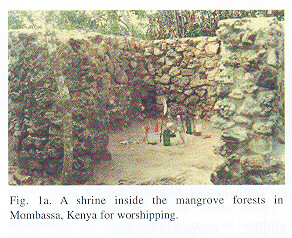
<body><![CDATA[<div align="Justify">      <p><font face="Arial"><font size="-1">The mangroves play a very important  role in peoples' lives and economy. The value of mangroves is expressed in a common way as 'home' for marine and terrestrial animals, as a 'kitchen'  producing food for people and animals, as a 'water treatment plant' in purifying  water, as a 'hospital' in providing medicines, as 'Iung' in purifying air  in coastal area, as 'carbon bank' to reduce global warming, as a 'coastal  wall' in protecting soil erosion and wind stress, as a 'natural laboratory'  for ecobiologists, and finally as a 'bridge' in connecting the land and sea (<a href="#Sanit02">Sanit Aksornkoae 2002</a>  ).</font></font>  </p>  </div>       <p><font face="Arial"><font size="-1">&nbsp;</font></font>     <br>  <b><font face="Arial"><font size="-1">Saluting the Unscientific beliefs and faiths!</font></font></b>  </p>       <div align="Justify">      <p><font face="Arial"><font size="-1">In the Indian Sundarban forests, the  fishermen worship a statue of a god-tiger before entering into the forests.  They believe that otherwise they will be killed by tigers. In Kenya, shrines  built inside the mangrove forests are worshipped by the local people, who  believe that the spirit of the shrine will kill those who cut the mangrove  tree around the shrine! (<a href="#fig1a">Fig. 1a</a>  ). This reveals that the conservation of biological species is quite possible  through fear and faith.</font></font>     <br>  <font face="Arial"><font size="-1">&nbsp;</font></font>     <br>  <font face="Arial"><font size="-1">I did an experiment in the southern east  coast of India, where a particular mangrove <i>species (Sonneratia apetala)  </i>was about to become extinct locally. I applied turmeric powder on the  tree trunk and tied a cloth around it, as done in the Hindu temples. Hiding  myself, I observed that the local fishermen started worshipping the tree and even stopped cutting down that species!</font></font>  </p>  </div>       <div align="Justify"><font face="Arial"><font size="-1">As a scientist, I  am not supposed to rely on unscientific beliefs, but I salute their help in conserving nature from god-fearing men.</font></font>     <br>  </div>       ]]></body>
<body><![CDATA[<p><font face="Arial"><font size="-1">&nbsp;</font></font>     <br>  <font face="Arial"><font size="-1">&nbsp;<a name="fig1a"></a>  <img src="/img/fbpe/rbt/v50n2-3/2121i01.JPG" height="238" width="292">  &nbsp;</font></font><a name="fig1b"></a>  <img src="/img/fbpe/rbt/v50n2-3/2121i02.JPG" height="235" width="298">       
<br>  <font face="Arial"><font size="-1">&nbsp;</font></font> </p>       <center><font face="Arial"><font size="-1">&nbsp;</font></font><a name="fig1c"></a>  <img src="/img/fbpe/rbt/v50n2-3/2121i03.JPG" height="481" width="295">  </center>   &nbsp;     
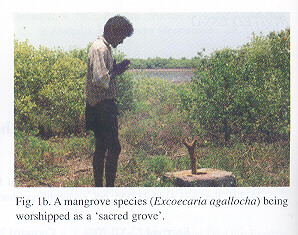
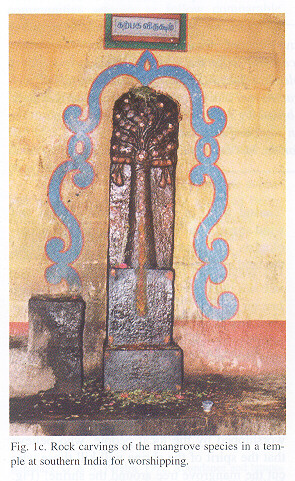
<br>  &nbsp;     <br>  <b><font face="Arial"><font size="-1">Motivated by the unscientific beliefs</font></font></b>          <div align="Justify"><font face="Arial"><font size="-1">In the Hindu temples,  a particular plant is worshipped as a 'temple tree' and thus each temple has its own species. A mangrove <i>species (Excoecaria agallocha) </i>is specifically worshipped as a 'sacred grove' in a temple at southern India in the form of rock carvings (<a href="#fig1b">Fig. 1b</a>  , <a href="#fig1c">c</a>  ). Chidambaram, the town where the temple is found, bears the name of the  mangrove species in local language: 'Thillai'. There was a belief that a  dip in the temple's pond water that was under the influence of the mangrove  species cures many 'incurable' human diseases (e.g. <a href="#Kathiresan01">  Kathiresan and Bingham 2001</a>  ). This lacked scientific validation and prompted me to initiate research  on medicinal aspects of mangrove species, because <i>'Research is not to see or to hear what every</i> <i>one has seen or heard, but to think what no</i>  <i>one has ever thought'.</i></font></font>     <br>  </div>       <p>&nbsp; &nbsp;     <br>  <b><font face="Arial"><font size="-1">Mosquito repellents from mangroves</font></font></b>    </p>       ]]></body>
<body><![CDATA[<div align="Justify">      <p><font face="Arial"><font size="-1">The sacred tree <i>Excoecaria agallocha</i>   exudes an acrid latex that is injurious to human eyes. Reportedly the latex  has a 'knock-down' effect on a variety of marine organisms under laboratory  conditions at concentration as low as 10<sup>-9</sup> (<a href="#Kathiresan87">  Kathiresan and Thangam 1987</a>  ). This was a basis for testing mangrove plants on mosquitoes that transmit  dreadful human diseases.</font></font>     <br>  &nbsp;     <br>  <font face="Arial"><font size="-1">Experiments showed that mangrove extracts  kill mosquito larvae: <i>Anopheles</i> <i>stephensi </i>(vector of malaria),  <i>Aedes aegypti</i> (yellow and dengue fever), <i>Culex tritaeniorhynchus  and C. quinquefasciatus </i>(filariasis) (<a href="#Thangam88">Thangam  and Kathiresan 1988</a>  ,<a href="#Thangam89">1989</a>  ,<a href="#Thangam91">1991</a>  , <a href="#Thangam93a">1993a</a>  , <a href="#Thangam94">1994</a>  , <a href="#Thangam97">1997</a>  ). Extracts applied directly to human skin repel adult mosquitoes (<a href="#Thangam93b">  Thangam and Kathiresan 1993b</a> ). Smoke from burned extracts repel and kill adult mosquitoes (<a href="#Thangam92">  Thangam <i>et al. </i>1992</a>  , <a href="#Thangam92">Thangam and Kathiresan 1992</a>  ). In combination with chemical insecticides, the extract reduces the amount  of chemical treatment needed, which may considerably reduce aquatic pollution  in a mosquito control programme (<a href="#Thangam91">Thangam and Kathiresan  1991</a>  ). The stilt root of <i>Rhizophora </i>mangrove trees is an excellent source  of mosquito larvicidal compounds that are similar to the pyrethrin family  (<a href="#Thangam90">Thangam 1990</a> ).</font></font>  </p>  </div>       <p><font face="Arial"><font size="-1">&nbsp;</font></font>     <br>  <b><font face="Arial"><font size="-1">Antiviral drugs from mangroves</font></font></b>    </p>       <div align="Justify">      <p><font face="Arial"><font size="-1">The mangroves are rich in polyphenols  (for example tannins), which can precipitase proteins. This prompted me to test their activity against medically important viruses. Mangrove plants belonging to the family Rhizophoraceae are highly active against viruses such as HIV and Hepatitis B virus (<a href="#Premanathan92">Premanathan <i> et al. </i>1992</a>  , <a href="#Premanathan96">1996</a>  , <a href="#Premanathan99">1999</a>  , <a href="#Kathiresan95">Kathiresan <i>et al. </i>1995</a>  ). The antiviral compound was identified as a polysaccharide that is able  to prevent HIV adsorption to the host cells. Another antiviral compound identified  was lignin. Lignin protected mice against pathogenic<i> Escherichia coli,  </i>and this antibacterial activitiy was attributed to the antioxidant property  of lignin (<a href="#Sakagami98">Sakagami <i>et al. </i>1998</a>  ).</font></font>  </p>  </div>       <p><font face="Arial"><font size="-1">&nbsp;</font></font>     <br>  <b><font face="Arial"><font size="-1">Black Tea from mangroves</font></font></b>    </p>       ]]></body>
<body><![CDATA[<div align="Justify">      <p><font face="Arial"><font size="-1">The black tea is composed of theaflavin  (giving flavour) and theambrugin (neurostimulant). These compounds are produced  when polyphenols (present in cytoplasms) are allowed to ferment by polyphenol  oxidase (present in cell vacuoles). This is being practiced only with the  tea plant <i>(Camellia sinensis) </i>that grows normally in high altitudes.  Why not in mangroves?</font></font>  </p>       <p><font face="Arial"><font size="-1">I attempted to extract black tea from  mangroves because they are rich in polyphenols (<a href="#Kathiresan90">  Kathiresan and Ravi 1990</a>  ). The tea had no toxicity in mice, and had a better quality than commercial  teas, as evident by sensory evaluation tests performed with my students (<a href="#Kathiresan95">  Kathiresan 1995</a>  ).</font></font>  </p>  </div>       <p><font face="Arial"><font size="-1">&nbsp;</font></font>     <br>  <font face="Arial"><font size="-1"><b>A</b> <b>new species discovered</b></font></font>    </p>       <div align="Justify">      <p><font face="Arial"><font size="-1">To make surveys and inventorization  of biological resources, I visited mangrove forests along the Indian coastline  as well as in Hong Kong, Singapore, Kenya, Malaysia, Australia, Japan and  Sri Lanka. During these trips, I found a new species in India, validated it taxonomically, and named it gratefully after my university, as <i>Rhizophora  x annamalayana </i>Kathir. (<a href="#Kathiresan99">Kathiresan 1999</a>  ). The field work helped me to document the status of mangrove biodiversity  and its challenges, and to formulate strategies for the conservation and management.</font></font>   </p>  </div>       <p><font face="Arial"><font size="-1">&nbsp;</font></font>     <br>  <b><font face="Arial"><font size="-1">Adding economic value to mangroves</font></font></b>    </p>       <div align="Justify">      ]]></body>
<body><![CDATA[<p><font face="Arial"><font size="-1">The decline of mangroves appears to  affect fishery resources. In the absence of such data, the economic value  of mangroves tends to be underestimated and it is also difficult to convince  policy makers and local communities about the economic value of mangroves  for conservation. For this reason, we analyzed the fishery resources and fishing income in three mangrove areas. Luxuriant mangrove areas supported a catch of 11 kg shellfish per hectare per day and 4.5 kg finfish per hectare per day, an economic gain of US$ 14 per day for shellfish and US$ 3 for finfish.  The mangrove-rich area provided significantly high catches of fishes and yielded a high fishery income, compared with the mangrove-poor areas (<a href="#Kathiresan-Raj00">  Kathiresan and Rajendran 2002a</a>  ).</font></font>  </p>  </div>       <p><font face="Arial"><font size="-1">&nbsp;</font></font>     <br>  <b><font face="Arial"><font size="-1">Restoring mangroves from degradation</font></font></b>    </p>       <div align="Justify">      <p><font face="Arial"><font size="-1">With continuing degradation and destruction  of mangroves, there is a critical need to understand them better. To cite  an example, Pichavaram is among one of the best studied mangrove ecosystems  in India (<a href="#Moorthy99">Moorthy and Kathiresan 1999</a>  , <a href="#Kathiresan-Raj00">Kathiresan and Rajendran 2000</a>  , <a href="#Kathiresan02b">2002b</a>  ); its area has already lost 75% of its green cover within the last century  and of the existing forest area, only 10% has dense vegetation while the remaining 90% of the area has been degrading. There is an urgent need to identify the causative factors of natural degradation of mangroves in order to suggest remediar measures towards their restoration. I compared 5 luxuriant and 25 degrading sampling sites in the mangrove forests, for physico-chemical  and biological variables. The data reveal that natural degradation of mangroves  is mainly due to high salinity, low levels of available nutrients, and poor  microbial counts in the soil. To alleviate these stresses, we irrigated the  hypersaline soil with tidal water and/or rain water. Three years after digging  the irrigation creeks, an appreciable reduction in soil salinity and a moderate  increase in colonization by <i>Avicennia marina </i>is observed. Soil analysis  showed a significant reduction in salinity after 2 months of storage of rain  water, with a significant and concomitant increase of heterotrophic bacterial  population. This study raises the possibility of converting degrading sites,  to luxuriant ones through man-made efforts (<a href="#Kathiresan02">Kathiresan  2002</a>  ).</font></font>  </p>  </div>       <p><font face="Arial"><font size="-1">&nbsp;</font></font>     <br>  <b><font face="Arial"><font size="-1">Lessions from the "Supercyclone"</font></font></b>    </p>       <div align="Justify">      <p><font face="Arial"><font size="-1">On October 29,1999, a specially powerful  cyclone showed India the importance of developing mangroves as coastal shelter-belt  areas. The 310 km/hr wind caused a devastating damage to human life and assets  in the areas without mangroves, while there was practically no damage in mangrove areas. I visited the cyclone-hit areas and happened to see the coastal water infested with a heavy load of dead bodies, mostly children and women. This shock motivated me to raise mangroves along the cylcone-prone areas.</font></font>    </p>  </div>       <p><font face="Arial"><font size="-1">&nbsp;</font></font>     ]]></body>
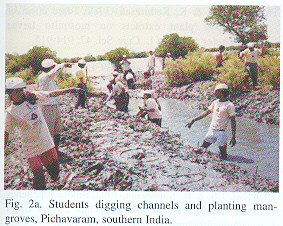
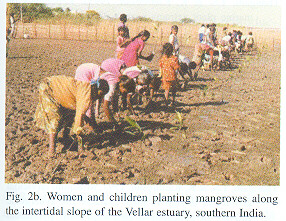
<body><![CDATA[<br>  <b><font face="Arial"><font size="-1">Taking the laboratory to the land</font></font></b>    </p>       <div align="Justify">      <p><font face="Arial"><font size="-1">I organized many programmes about awareness  and plantation of mangroves, and took keen interest in mangrove development  along the suitable coastal areas.</font></font>  </p>       <p><font face="Arial"><font size="-1">Students are the dynamic component of the society. From my experience, they can be succesful and functionally productive, when both sexes are involved together, leading the planting programme (<a href="#fig2a"> Fig. 2a</a>  ). I have been organizing many training programmes for young researchers  of different maritime states of India to identify plant and animal species  in coastal environments, because taxonomists are now a most endangered species  in this country!</font></font>  </p>       <p><font face="Arial"><font size="-1">Children and women are the most responsible  component of the society. I initiated a night school programme for poor school-going children, in 1988. My students served in the school as teachers. When these children became involved in the mangrove planting programme, they began to bring women along, making the programme a success (<a href="#fig2b"> Fig. 2b</a>  ).</font></font>  </p>  </div>       <p><a name="fig2a"></a>  <img src="/img/fbpe/rbt/v50n2-3/2121i04.JPG" height="226" width="283">  &nbsp;<a name="fig2b"></a>  <img src="/img/fbpe/rbt/v50n2-3/2121i05.JPG" height="221" width="286">   </p>       
<center><a name="fig3"></a>  <img src="/img/fbpe/rbt/v50n2-3/2121i06.JPG" height="222" width="282">  </center>           
<p><font face="Arial"><font size="-1">&nbsp;</font></font>     <br>  <b><font face="Arial"><font size="-1">Kindling the sparks</font></font></b>    </p>       <div align="Justify">      ]]></body>
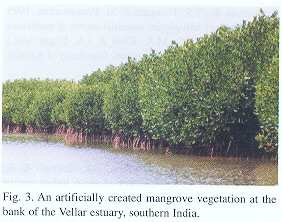
<body><![CDATA[<p><font face="Arial"><font size="-1">As researchers continue to discover  important facts about mangroves and the role they play in the global ecosystem,  the volume of published information has grown enormously and increasing numbers of workers are drawn to these unique environments. There is a need to make information more readily available to researchers around the world in hopes of facilitating and stimulating further study of the mangrove environment.  We therefore contributed a review publication on 'biology of mangroves and  mangrove ecosystems' (<a href="#Kathiresan01">Kathiresan and Bingham 2001</a>  ) that received the prestigious Naga award of the World Fish Centre, Malaysia.</font></font>    </p>  </div>       <p><b><font face="Arial"><font size="-1">&nbsp;</font></font></b>     <br>  <b><font face="Arial"><font size="-1">Hybridizing brain with heart</font></font></b>    </p>       <div align="Justify">      <p><font face="Arial"><font size="-1">By adopting the package of practices  for propagation and afforestation of mangroves that we developed (<a href="#Moorthy99">  Moorthy and Kathiresan 1999</a>  , <a href="#Kathiresan-Raj00">Kathiresan and Rajendran 2000</a>  , <a href="#Kathiresan02b">2002b</a>  ), mangroves have been raised in cyclone-hit and or degraded areas, with  people's participation (<a href="#fig3">Fig. 3</a>  ). Continuous monitoring reveals a significant increase of fishery resources  in those areas. Efforts are being made in our laboratory to develop mangroves  as 'cash crops' for deriving food, recreation, medicines, and high value products along with mass scale propagation of mangroves. This will link the creation of mangroves with economic benefits and ecological security to the coastal community. My experience on 'Greening the blue mud' continues.</font></font>    </p>  </div>       <p><font face="Arial"><font size="-1">&nbsp;</font></font>     <br>  <b><font face="Arial"><font size="-1">References</font></font></b>  </p>       <div align="Justify">      <!-- ref --><p><a name="Kathiresan95"></a>  <font face="Arial"><font size="-1">Kathiresan, K. 1995. Studies on Tea from  mangrove leaves. Environ. Ecol. 13: 321-323.    &nbsp;&nbsp;&nbsp;&nbsp;&nbsp;&nbsp;&nbsp;&nbsp;[&#160;<a href="javascript:void(0);" onclick="javascript: window.open('/scielo.php?script=sci_nlinks&ref=1681596&pid=S0034-7744200200030000700001&lng=','','width=640,height=500,resizable=yes,scrollbars=1,menubar=yes,');">Links</a>&#160;]<!-- end-ref --></font></font>  </p>       ]]></body>
<body><![CDATA[<!-- ref --><p><a name="Kathiresan99"></a>  <font face="Arial"><font size="-1">Kathiresan, K 1999. <i>Rhizophora x annamalayana  </i>Kathir. (Rhizophoraceae), a new Nothospecies from Pichavaram mangrove  forest in Southeastern peninsular India. Environ. Ecol. 17: 500-501.    &nbsp;&nbsp;&nbsp;&nbsp;&nbsp;&nbsp;&nbsp;&nbsp;[&#160;<a href="javascript:void(0);" onclick="javascript: window.open('/scielo.php?script=sci_nlinks&ref=1681598&pid=S0034-7744200200030000700002&lng=','','width=640,height=500,resizable=yes,scrollbars=1,menubar=yes,');">Links</a>&#160;]<!-- end-ref --></font></font>    </p>       <!-- ref --><p><a name="Kathiresan00"></a>  <font face="Arial"><font size="-1">Kathiresan, K. 2000. A review of studies  on Pichavam mangrove, soudieast India. Hydrobiologia 430(1-3): 185-205.    &nbsp;&nbsp;&nbsp;&nbsp;&nbsp;&nbsp;&nbsp;&nbsp;[&#160;<a href="javascript:void(0);" onclick="javascript: window.open('/scielo.php?script=sci_nlinks&ref=1681600&pid=S0034-7744200200030000700003&lng=','','width=640,height=500,resizable=yes,scrollbars=1,menubar=yes,');">Links</a>&#160;]<!-- end-ref --></font></font>    </p>       <!-- ref --><p><a name="Kathiresan02"></a>  <font face="Arial"><font size="-1">Kathiresan, K. 2002. Why are mangroves  degrading? Curr. Sci. 83: 1246-1249.    &nbsp;&nbsp;&nbsp;&nbsp;&nbsp;&nbsp;&nbsp;&nbsp;[&#160;<a href="javascript:void(0);" onclick="javascript: window.open('/scielo.php?script=sci_nlinks&ref=1681602&pid=S0034-7744200200030000700004&lng=','','width=640,height=500,resizable=yes,scrollbars=1,menubar=yes,');">Links</a>&#160;]<!-- end-ref --></font></font>  </p>       <!-- ref --><p><a name="Kathiresan01"></a>  <font face="Arial"><font size="-1">Kathiresan, K. &amp; B.L. Bingham. 2001.  Biology of mangroves and mangrove ecosystem. Adv. Mar. Biol. 40: 81-251.    &nbsp;&nbsp;&nbsp;&nbsp;&nbsp;&nbsp;&nbsp;&nbsp;[&#160;<a href="javascript:void(0);" onclick="javascript: window.open('/scielo.php?script=sci_nlinks&ref=1681604&pid=S0034-7744200200030000700005&lng=','','width=640,height=500,resizable=yes,scrollbars=1,menubar=yes,');">Links</a>&#160;]<!-- end-ref --></font></font>    </p>       <!-- ref --><p><a name="Kathiresan-Raj00"></a>  <font face="Arial"><font size="-1">Kathiresan, K. &amp; N. Rajendran. 2000.  The effects of electric impulse on growth of <i>Rhizophora mucronata</i> seedlings (Rhizophorales: Rhizophoraceae). Rev. Biol. Trop. 48: 919-925.    &nbsp;&nbsp;&nbsp;&nbsp;&nbsp;&nbsp;&nbsp;&nbsp;[&#160;<a href="javascript:void(0);" onclick="javascript: window.open('/scielo.php?script=sci_nlinks&ref=1681606&pid=S0034-7744200200030000700006&lng=','','width=640,height=500,resizable=yes,scrollbars=1,menubar=yes,');">Links</a>&#160;]<!-- end-ref --></font></font>    </p>       ]]></body>
<body><![CDATA[<!-- ref --><p><a name="Kathiresan02a"></a>  <font face="Arial"><font size="-1">Kathiresan, K. &amp; N. Rajendran. 2002a.  Fishery resources and economic gain in three mangrove areas on the south-east  coast of India. Fish. Manage. Ecol. 9: 277283.    &nbsp;&nbsp;&nbsp;&nbsp;&nbsp;&nbsp;&nbsp;&nbsp;[&#160;<a href="javascript:void(0);" onclick="javascript: window.open('/scielo.php?script=sci_nlinks&ref=1681608&pid=S0034-7744200200030000700007&lng=','','width=640,height=500,resizable=yes,scrollbars=1,menubar=yes,');">Links</a>&#160;]<!-- end-ref --></font></font>  </p>       <!-- ref --><p><a name="Kathiresan02b"></a>  <font face="Arial"><font size="-1">Kathiresan, K. &amp; N. Rajendran. 2002b.  Growth of a mangrove <i>(Rhizophora apiculata) </i>seedlings as influenced  by GA3, light and salinity. Rev. Biol. Trop. 50(2): 525-530.    &nbsp;&nbsp;&nbsp;&nbsp;&nbsp;&nbsp;&nbsp;&nbsp;[&#160;<a href="javascript:void(0);" onclick="javascript: window.open('/scielo.php?script=sci_nlinks&ref=1681610&pid=S0034-7744200200030000700008&lng=','','width=640,height=500,resizable=yes,scrollbars=1,menubar=yes,');">Links</a>&#160;]<!-- end-ref --></font></font>    </p>       <!-- ref --><p><a name="Kathiresan90"></a>  <font face="Arial"><font size="-1">Kathiresan, K. &amp; A.Y Ravi. 1990. Seasonal changes in tannin content of mangrove leaves. Indian For. 116(5): 390-392.    &nbsp;&nbsp;&nbsp;&nbsp;&nbsp;&nbsp;&nbsp;&nbsp;[&#160;<a href="javascript:void(0);" onclick="javascript: window.open('/scielo.php?script=sci_nlinks&ref=1681612&pid=S0034-7744200200030000700009&lng=','','width=640,height=500,resizable=yes,scrollbars=1,menubar=yes,');">Links</a>&#160;]<!-- end-ref --></font></font>   </p>       <!-- ref --><p><a name="Kathiresan87"></a>  <font face="Arial"><font size="-1">Kathiresan, K, &amp; T.S. Thangam. 1987.  Biotoxicity of <i>Excoecaria agallocha </i>L. latex on marine organisms. Curr. Sci. 56: 314- 315</font></font>  &nbsp;&nbsp;&nbsp;&nbsp;&nbsp;&nbsp;&nbsp;&nbsp;[&#160;<a href="javascript:void(0);" onclick="javascript: window.open('/scielo.php?script=sci_nlinks&ref=1681614&pid=S0034-7744200200030000700010&lng=','','width=640,height=500,resizable=yes,scrollbars=1,menubar=yes,');">Links</a>&#160;]<!-- end-ref --><!-- ref --><p><a name="Kathiresan_thamgam95"></a>  <font face="Arial"><font size="-1">Kathiresan, K., T.S. Thangam &amp; M.  Premanathan. 1995. Mangrove halophytes: potential source of medicines. pp.  361-370. In M.A. Khan &amp; I.A. Ungar (eds.). Biology of salt tolerant plants.  University of Karachi, Pakistan.    &nbsp;&nbsp;&nbsp;&nbsp;&nbsp;&nbsp;&nbsp;&nbsp;[&#160;<a href="javascript:void(0);" onclick="javascript: window.open('/scielo.php?script=sci_nlinks&ref=1681615&pid=S0034-7744200200030000700011&lng=','','width=640,height=500,resizable=yes,scrollbars=1,menubar=yes,');">Links</a>&#160;]<!-- end-ref --></font></font>  </p>       <!-- ref --><p><a name="Moorthy99"></a>  <font face="Arial"><font size="-1">Moorthy, P. &amp; K. Kathiresan. 1999.  Photosynthetic efficiency in rhizophoracean mangroves with reference to compartmentalization  of photosynthetic pigments. Rev. Biol. Trop. 47: 21-25.    &nbsp;&nbsp;&nbsp;&nbsp;&nbsp;&nbsp;&nbsp;&nbsp;[&#160;<a href="javascript:void(0);" onclick="javascript: window.open('/scielo.php?script=sci_nlinks&ref=1681617&pid=S0034-7744200200030000700012&lng=','','width=640,height=500,resizable=yes,scrollbars=1,menubar=yes,');">Links</a>&#160;]<!-- end-ref --></font></font>  </p>       <!-- ref --><p><a name="Premanathan92"></a>  <font face="Arial"><font size="-1">Premanathan, M., K. Chandra, S.K Bajpai  &amp; K. Kathiresan. 1992. A survey of some Indian marine plants for antiviral  activity. Bot. Mar. 35: 321-324.    &nbsp;&nbsp;&nbsp;&nbsp;&nbsp;&nbsp;&nbsp;&nbsp;[&#160;<a href="javascript:void(0);" onclick="javascript: window.open('/scielo.php?script=sci_nlinks&ref=1681619&pid=S0034-7744200200030000700013&lng=','','width=640,height=500,resizable=yes,scrollbars=1,menubar=yes,');">Links</a>&#160;]<!-- end-ref --></font></font>  </p>       <!-- ref --><p><a name="Premanathan96"></a>  <font face="Arial"><font size="-1">Premanathan, M., H. Nakashima, K. Kathiresan,  N. Rajendran &amp; N. Yamamoto. 1996. <i>In vitro </i>antihuman immunodeficiency  virus activity of mangrove plants. Indian J. Med. Res. 130: 276-279.    &nbsp;&nbsp;&nbsp;&nbsp;&nbsp;&nbsp;&nbsp;&nbsp;[&#160;<a href="javascript:void(0);" onclick="javascript: window.open('/scielo.php?script=sci_nlinks&ref=1681621&pid=S0034-7744200200030000700014&lng=','','width=640,height=500,resizable=yes,scrollbars=1,menubar=yes,');">Links</a>&#160;]<!-- end-ref --></font></font>    </p>       <!-- ref --><p><a name="Premanathan99"></a>  <font face="Arial"><font size="-1">Premanathan, M., K. Kathiresan &amp; H. Nakashima. 1999. Mangrove halophytes : A source of antiviral substances.  South Pacific Study 19(1-2): 49-57.    &nbsp;&nbsp;&nbsp;&nbsp;&nbsp;&nbsp;&nbsp;&nbsp;[&#160;<a href="javascript:void(0);" onclick="javascript: window.open('/scielo.php?script=sci_nlinks&ref=1681623&pid=S0034-7744200200030000700015&lng=','','width=640,height=500,resizable=yes,scrollbars=1,menubar=yes,');">Links</a>&#160;]<!-- end-ref --></font></font>  </p>       <!-- ref --><p><a name="Sakagami98"></a>  <font face="Arial"><font size="-1">Sakagami, H., M. Kashimata, M. Toguchi,  K. Satoh, Y. Odanaka, Y. Ida, M. Premanathan, R. Arakaki, K. Kathiresan, H. Nakashirna, N. Komatsu, M. Fujimaki &amp; M. Yoshihara. 1998. Radical modulation activity of lignins from a mangrove plant, <i>Ceriops</i> <i>decandra </i> (Griff.) Ding Hou. <i>In vivo </i>12: 327-332.    &nbsp;&nbsp;&nbsp;&nbsp;&nbsp;&nbsp;&nbsp;&nbsp;[&#160;<a href="javascript:void(0);" onclick="javascript: window.open('/scielo.php?script=sci_nlinks&ref=1681625&pid=S0034-7744200200030000700016&lng=','','width=640,height=500,resizable=yes,scrollbars=1,menubar=yes,');">Links</a>&#160;]<!-- end-ref --></font></font>  </p>       <!-- ref --><p><a name="Sanit02"></a>  <font face="Arial"><font size="-1">Sanit Aksornkoae. 2002. Management and  sustainable development of mangroves in Thailand. Proccedings of Coastal Management and Sustainable Development UNU-Iwate-UNESCO Joint International Conference 'Conserving Our Coastal Environment' Tokyo, Japan, 8- 10 July 2002.    &nbsp;&nbsp;&nbsp;&nbsp;&nbsp;&nbsp;&nbsp;&nbsp;[&#160;<a href="javascript:void(0);" onclick="javascript: window.open('/scielo.php?script=sci_nlinks&ref=1681627&pid=S0034-7744200200030000700017&lng=','','width=640,height=500,resizable=yes,scrollbars=1,menubar=yes,');">Links</a>&#160;]<!-- end-ref --></font></font>   </p>       <!-- ref --><p><a name="Thangam90"></a>  <font face="Arial"><font size="-1">Thangam, T.S. 1990. Studies on marine  plants for mosquitocontrol. Ph.D. thesis, Annarnalai University, India. 68  p.    &nbsp;&nbsp;&nbsp;&nbsp;&nbsp;&nbsp;&nbsp;&nbsp;[&#160;<a href="javascript:void(0);" onclick="javascript: window.open('/scielo.php?script=sci_nlinks&ref=1681629&pid=S0034-7744200200030000700018&lng=','','width=640,height=500,resizable=yes,scrollbars=1,menubar=yes,');">Links</a>&#160;]<!-- end-ref --></font></font>  </p>       <p><a name="Thangam88"></a>  <font face="Arial"><font size="-1">Thangam, T.S. &amp; K. Kathiresan. 1988.  Toxic effect of mangrove plant extracts on mosquito larvae <i>Anopheles stephensi  </i>L. Curr. Sci. 47: 914-915.</font></font>  </p>       <p><a name="Thangam89"></a>  <font face="Arial"><font size="-1">Thangam, T.S. &amp; K. Kathiresan. 1989.  Larvicidal effect of marine plant extracts on mosquito <i>Culex tritaeniorhynchus.  </i>J. Mar. Biol. Assoc. India 31(1-2): 306307.</font></font>  </p>       <p><a name="Thangam91"></a>  <font face="Arial"><font size="-1">Thangam, T.S. &amp; K. Kathiresan. 1991.  Mosquito larvicidal activity of marine plant extracts with synthetic insecticides.  Bot. Mar. 34: 537-539.</font></font>  </p>       <!-- ref --><p><a name="Thangam92"></a>  <font face="Arial"><font size="-1">Thangam, T.S. &amp; K. Kathiresan. 1992.  Smoke repellency and killing effect of marine plants against <i>Culex</i>   <i>quinquefasciatus. </i>Trop. Biomed. 9: 35-38.    &nbsp;&nbsp;&nbsp;&nbsp;&nbsp;&nbsp;&nbsp;&nbsp;[&#160;<a href="javascript:void(0);" onclick="javascript: window.open('/scielo.php?script=sci_nlinks&ref=1681634&pid=S0034-7744200200030000700022&lng=','','width=640,height=500,resizable=yes,scrollbars=1,menubar=yes,');">Links</a>&#160;]<!-- end-ref --></font></font>  </p>       <p><a name="Thangam93a"></a>  <font face="Arial"><font size="-1">Thangam, T.S. &amp; K. Kathiresan. 1993a.  Repellency of marine plant extracts against <i>Aedes aegypti. </i>Int. J.  Pharmacog. 31: 321-323</font></font>  </p>       <p><a name="Thangam93b"></a>  <font face="Arial"><font size="-1">Thangam, T.S. &amp; K. Kathiresan. 1993b.  The mosquito composition and seasonal distribution of <i>Culex quinquefasciatus  </i>in a coastal town of south India. Trop. Biomed. 10: 175-177.</font></font>    </p>       ]]></body>
<body><![CDATA[<!-- ref --><p><a name="Thangam94"></a>  <font face="Arial"><font size="-1">Thangam, T.S. &amp; K. Kathiresan. 1994.  Mosquito larvicidal activity of <i>Rhizophora apiculata </i>Blume. Int. J.  Pharmacog. 32: 33-36.    &nbsp;&nbsp;&nbsp;&nbsp;&nbsp;&nbsp;&nbsp;&nbsp;[&#160;<a href="javascript:void(0);" onclick="javascript: window.open('/scielo.php?script=sci_nlinks&ref=1681638&pid=S0034-7744200200030000700025&lng=','','width=640,height=500,resizable=yes,scrollbars=1,menubar=yes,');">Links</a>&#160;]<!-- end-ref --></font></font>  </p>       <p><a name="Thangam97"></a>  <font face="Arial"><font size="-1">Thangam, T.S. &amp; K. Kathiresan. 1997.  Mosquito larvicidal activity of mangrove plant extracts and synergistic activity  of <i>Rhizophora apiculata </i>with pyrethrum against <i>Culex quinquefasciatus.  </i>Int. J. Pharmacog. 35: 69-71.</font></font>  </p>       <p><a name="Thangam-Srinivasan92"></a>  <font face="Arial"><font size="-1">Thangam, T.S., K. Srinivasan &amp; K.  Kathiresan. 1992. Smoke repellency and killing effect of mangrove plants against the mosquito <i>Aedes aegypti </i>Linnaeus. Trop. Biomed. 10: 125-128</font></font>       <br>  <font face="Arial"><font size="-1">&nbsp;</font></font>     <br>  <font face="Arial"><font size="-1">&nbsp;</font></font>  </p>       <p><a name="*a"></a>  <font face="Arial"><font size="-1"><a href="#*">*</a>  &nbsp; Centre of Advanced Study in Marine Biology, Annamalai University,  Parangipettai: 608 502, India, Phone: +91 4144 243223. Fax: +91 4144 243555:  <a href="mailto:cdl_aucasmb@sancharnet.in">cdl_aucasmb@sancharnet.in</a>  ; <a href="mailto:casenvis@yahoo.co.in">casenvis@yahoo.co.in</a>  </font></font> </p>  </div>        ]]></body><back>
<ref-list>
<ref id="B1">
<nlm-citation citation-type="journal">
<person-group person-group-type="author">
<name>
<surname><![CDATA[Kathiresan]]></surname>
<given-names><![CDATA[K]]></given-names>
</name>
</person-group>
<article-title xml:lang="en"><![CDATA[Studies on Tea from mangrove leaves]]></article-title>
<source><![CDATA[Environ. Ecol]]></source>
<year>1995</year>
<volume>13</volume>
<page-range>321-323</page-range></nlm-citation>
</ref>
<ref id="B2">
<nlm-citation citation-type="journal">
<person-group person-group-type="author">
<name>
<surname><![CDATA[Kathiresan]]></surname>
<given-names><![CDATA[K]]></given-names>
</name>
</person-group>
<article-title xml:lang="en"><![CDATA[Rhizophora x annamalayana Kathir. (Rhizophoraceae), a new Nothospecies from Pichavaram mangrove forest in Southeastern peninsular India]]></article-title>
<source><![CDATA[Environ. Ecol]]></source>
<year>1999</year>
<volume>17</volume>
<page-range>500-501</page-range></nlm-citation>
</ref>
<ref id="B3">
<nlm-citation citation-type="journal">
<person-group person-group-type="author">
<name>
<surname><![CDATA[Kathiresan]]></surname>
<given-names><![CDATA[K]]></given-names>
</name>
</person-group>
<article-title xml:lang="en"><![CDATA[A review of studies on Pichavam mangrove, soudieast India]]></article-title>
<source><![CDATA[Hydrobiologia]]></source>
<year>2000</year>
<volume>430</volume>
<numero>^s1-3</numero>
<issue>^s1-3</issue>
<supplement>1-3</supplement>
<page-range>185-205</page-range></nlm-citation>
</ref>
<ref id="B4">
<nlm-citation citation-type="journal">
<person-group person-group-type="author">
<name>
<surname><![CDATA[Kathiresan]]></surname>
<given-names><![CDATA[K]]></given-names>
</name>
</person-group>
<article-title xml:lang="en"><![CDATA[Why are mangroves degrading?]]></article-title>
<source><![CDATA[Curr. Sci]]></source>
<year>2002</year>
<volume>83</volume>
<page-range>1246-1249</page-range></nlm-citation>
</ref>
<ref id="B5">
<nlm-citation citation-type="journal">
<person-group person-group-type="author">
<name>
<surname><![CDATA[Kathiresan]]></surname>
<given-names><![CDATA[K]]></given-names>
</name>
<name>
<surname><![CDATA[Bingham]]></surname>
<given-names><![CDATA[B.L]]></given-names>
</name>
</person-group>
<article-title xml:lang="en"><![CDATA[Biology of mangroves and mangrove ecosystem]]></article-title>
<source><![CDATA[Adv. Mar. Biol]]></source>
<year>2001</year>
<volume>40</volume>
<page-range>81-251</page-range></nlm-citation>
</ref>
<ref id="B6">
<nlm-citation citation-type="journal">
<person-group person-group-type="author">
<name>
<surname><![CDATA[Kathiresan]]></surname>
<given-names><![CDATA[K]]></given-names>
</name>
<name>
<surname><![CDATA[Rajendran]]></surname>
<given-names><![CDATA[N]]></given-names>
</name>
</person-group>
<article-title xml:lang="en"><![CDATA[The effects of electric impulse on growth of Rhizophora mucronata seedlings (Rhizophorales: Rhizophoraceae)]]></article-title>
<source><![CDATA[Rev. Biol. Trop]]></source>
<year>2000</year>
<volume>48</volume>
<page-range>919-925</page-range></nlm-citation>
</ref>
<ref id="B7">
<nlm-citation citation-type="journal">
<person-group person-group-type="author">
<name>
<surname><![CDATA[Kathiresan]]></surname>
<given-names><![CDATA[K]]></given-names>
</name>
<name>
<surname><![CDATA[Rajendran]]></surname>
<given-names><![CDATA[N]]></given-names>
</name>
</person-group>
<article-title xml:lang="en"><![CDATA[Fishery resources and economic gain in three mangrove areas on the south-east coast of India]]></article-title>
<source><![CDATA[Fish. Manage. Ecol]]></source>
<year>2002</year>
<volume>9</volume>
<page-range>277-283</page-range></nlm-citation>
</ref>
<ref id="B8">
<nlm-citation citation-type="journal">
<person-group person-group-type="author">
<name>
<surname><![CDATA[Kathiresan]]></surname>
<given-names><![CDATA[K]]></given-names>
</name>
<name>
<surname><![CDATA[Rajendran]]></surname>
<given-names><![CDATA[N]]></given-names>
</name>
</person-group>
<article-title xml:lang="en"><![CDATA[Growth of a mangrove (Rhizophora apiculata) seedlings as influenced by GA3, light and salinity]]></article-title>
<source><![CDATA[Rev. Biol. Trop]]></source>
<year>2002</year>
<volume>50</volume>
<numero>^s2</numero>
<issue>^s2</issue>
<supplement>2</supplement>
<page-range>525-530</page-range></nlm-citation>
</ref>
<ref id="B9">
<nlm-citation citation-type="journal">
<person-group person-group-type="author">
<name>
<surname><![CDATA[Kathiresan]]></surname>
<given-names><![CDATA[K]]></given-names>
</name>
<name>
<surname><![CDATA[Ravi]]></surname>
<given-names><![CDATA[A.Y]]></given-names>
</name>
</person-group>
<article-title xml:lang="en"><![CDATA[Seasonal changes in tannin content of mangrove leaves]]></article-title>
<source><![CDATA[Indian For.]]></source>
<year>1990</year>
<volume>116</volume>
<numero>^s5</numero>
<issue>^s5</issue>
<supplement>5</supplement>
<page-range>390-392</page-range></nlm-citation>
</ref>
<ref id="B10">
<nlm-citation citation-type="journal">
<person-group person-group-type="author">
<name>
<surname><![CDATA[Kathiresan]]></surname>
<given-names><![CDATA[K]]></given-names>
</name>
<name>
<surname><![CDATA[Thangam]]></surname>
<given-names><![CDATA[T.S]]></given-names>
</name>
</person-group>
<article-title xml:lang="en"><![CDATA[Biotoxicity of Excoecaria agallocha L. latex on marine organisms]]></article-title>
<source><![CDATA[Curr. Sci]]></source>
<year>1987</year>
<volume>56</volume>
<page-range>314- 315</page-range></nlm-citation>
</ref>
<ref id="B11">
<nlm-citation citation-type="book">
<person-group person-group-type="author">
<name>
<surname><![CDATA[Kathiresan]]></surname>
<given-names><![CDATA[K]]></given-names>
</name>
<name>
<surname><![CDATA[Thangam]]></surname>
<given-names><![CDATA[T.S]]></given-names>
</name>
<name>
<surname><![CDATA[Premanathan]]></surname>
<given-names><![CDATA[M]]></given-names>
</name>
</person-group>
<article-title xml:lang="en"><![CDATA[Mangrove halophytes: potential source of medicines]]></article-title>
<person-group person-group-type="editor">
<name>
<surname><![CDATA[Khan]]></surname>
<given-names><![CDATA[M.A]]></given-names>
</name>
<name>
<surname><![CDATA[Ungar]]></surname>
<given-names><![CDATA[I.A]]></given-names>
</name>
</person-group>
<source><![CDATA[Biology of salt tolerant plants]]></source>
<year>1995</year>
<publisher-name><![CDATA[University of Karachi]]></publisher-name>
</nlm-citation>
</ref>
<ref id="B12">
<nlm-citation citation-type="journal">
<person-group person-group-type="author">
<name>
<surname><![CDATA[Moorthy]]></surname>
<given-names><![CDATA[P]]></given-names>
</name>
<name>
<surname><![CDATA[Kathiresan]]></surname>
<given-names><![CDATA[K]]></given-names>
</name>
</person-group>
<article-title xml:lang="en"><![CDATA[Photosynthetic efficiency in rhizophoracean mangroves with reference to compartmentalization of photosynthetic pigments]]></article-title>
<source><![CDATA[Rev. Biol. Trop]]></source>
<year>1999</year>
<volume>47</volume>
<page-range>21-25</page-range></nlm-citation>
</ref>
<ref id="B13">
<nlm-citation citation-type="journal">
<person-group person-group-type="author">
<name>
<surname><![CDATA[Premanathan]]></surname>
<given-names><![CDATA[M]]></given-names>
</name>
<name>
<surname><![CDATA[Chandra]]></surname>
<given-names><![CDATA[K]]></given-names>
</name>
<name>
<surname><![CDATA[Bajpai]]></surname>
<given-names><![CDATA[S.K]]></given-names>
</name>
<name>
<surname><![CDATA[Kathiresan]]></surname>
<given-names><![CDATA[K]]></given-names>
</name>
</person-group>
<article-title xml:lang="en"><![CDATA[A survey of some Indian marine plants for antiviral activity]]></article-title>
<source><![CDATA[Bot. Mar]]></source>
<year>1992</year>
<volume>35</volume>
<page-range>321-324</page-range></nlm-citation>
</ref>
<ref id="B14">
<nlm-citation citation-type="journal">
<person-group person-group-type="author">
<name>
<surname><![CDATA[Premanathan]]></surname>
<given-names><![CDATA[M]]></given-names>
</name>
<name>
<surname><![CDATA[Nakashima]]></surname>
<given-names><![CDATA[H]]></given-names>
</name>
<name>
<surname><![CDATA[Kathiresan]]></surname>
<given-names><![CDATA[K]]></given-names>
</name>
<name>
<surname><![CDATA[Rajendran]]></surname>
<given-names><![CDATA[N]]></given-names>
</name>
<name>
<surname><![CDATA[Yamamoto]]></surname>
<given-names><![CDATA[N]]></given-names>
</name>
</person-group>
<article-title xml:lang="en"><![CDATA[In vitro antihuman immunodeficiency virus activity of mangrove plants]]></article-title>
<source><![CDATA[Indian J. Med. Res]]></source>
<year>1996</year>
<volume>130</volume>
<page-range>276-279</page-range></nlm-citation>
</ref>
<ref id="B15">
<nlm-citation citation-type="journal">
<person-group person-group-type="author">
<name>
<surname><![CDATA[Premanathan]]></surname>
<given-names><![CDATA[M]]></given-names>
</name>
<name>
<surname><![CDATA[Kathiresan]]></surname>
<given-names><![CDATA[K]]></given-names>
</name>
<name>
<surname><![CDATA[Nakashima]]></surname>
<given-names><![CDATA[H]]></given-names>
</name>
</person-group>
<article-title xml:lang="en"><![CDATA[Mangrove halophytes : A source of antiviral substances]]></article-title>
<source><![CDATA[South Pacific Study]]></source>
<year>1999</year>
<volume>19</volume>
<numero>^s1-2</numero>
<issue>^s1-2</issue>
<supplement>1-2</supplement>
<page-range>49-57</page-range></nlm-citation>
</ref>
<ref id="B16">
<nlm-citation citation-type="journal">
<person-group person-group-type="author">
<name>
<surname><![CDATA[Sakagami]]></surname>
<given-names><![CDATA[H]]></given-names>
</name>
<name>
<surname><![CDATA[Kashimata]]></surname>
<given-names><![CDATA[M]]></given-names>
</name>
<name>
<surname><![CDATA[Toguchi]]></surname>
<given-names><![CDATA[M]]></given-names>
</name>
<name>
<surname><![CDATA[Satoh]]></surname>
<given-names><![CDATA[K]]></given-names>
</name>
<name>
<surname><![CDATA[Odanaka]]></surname>
<given-names><![CDATA[Y]]></given-names>
</name>
<name>
<surname><![CDATA[Ida]]></surname>
<given-names><![CDATA[Y]]></given-names>
</name>
<name>
<surname><![CDATA[Premanathan]]></surname>
<given-names><![CDATA[M]]></given-names>
</name>
<name>
<surname><![CDATA[Arakaki]]></surname>
<given-names><![CDATA[R]]></given-names>
</name>
<name>
<surname><![CDATA[Kathiresan]]></surname>
<given-names><![CDATA[K]]></given-names>
</name>
<name>
<surname><![CDATA[Nakashirna]]></surname>
<given-names><![CDATA[H]]></given-names>
</name>
<name>
<surname><![CDATA[Komatsu]]></surname>
<given-names><![CDATA[N]]></given-names>
</name>
<name>
<surname><![CDATA[Fujimaki]]></surname>
<given-names><![CDATA[M]]></given-names>
</name>
<name>
<surname><![CDATA[Yoshihara]]></surname>
<given-names><![CDATA[M]]></given-names>
</name>
</person-group>
<article-title xml:lang="en"><![CDATA[Radical modulation activity of lignins from a mangrove plant, Ceriops decandra (Griff.) Ding Hou]]></article-title>
<source><![CDATA[In vivo]]></source>
<year>1998</year>
<volume>12</volume>
<page-range>327-332</page-range></nlm-citation>
</ref>
<ref id="B17">
<nlm-citation citation-type="confpro">
<person-group person-group-type="author">
<name>
<surname><![CDATA[Aksornkoae]]></surname>
<given-names><![CDATA[Sanit]]></given-names>
</name>
</person-group>
<source><![CDATA[Management and sustainable development of mangroves in Thailand]]></source>
<year>2002</year>
<conf-name><![CDATA[ Coastal Management and Sustainable Development UNU-Iwate-UNESCO Joint International Conference 'Conserving Our Coastal Environment']]></conf-name>
<conf-date>2002</conf-date>
<conf-loc>Tokyo </conf-loc>
</nlm-citation>
</ref>
<ref id="B18">
<nlm-citation citation-type="">
<person-group person-group-type="author">
<name>
<surname><![CDATA[Thangam]]></surname>
<given-names><![CDATA[T.S]]></given-names>
</name>
</person-group>
<source><![CDATA[Studies on marine plants for mosquitocontrol]]></source>
<year>1990</year>
<page-range>68</page-range></nlm-citation>
</ref>
<ref id="B19">
<nlm-citation citation-type="journal">
<person-group person-group-type="author">
<name>
<surname><![CDATA[Thangam]]></surname>
<given-names><![CDATA[T.S]]></given-names>
</name>
<name>
<surname><![CDATA[Kathiresan]]></surname>
<given-names><![CDATA[K]]></given-names>
</name>
</person-group>
<article-title xml:lang="en"><![CDATA[Toxic effect of mangrove plant extracts on mosquito larvae Anopheles stephensi L]]></article-title>
<source><![CDATA[Curr. Sci]]></source>
<year>1988</year>
<volume>47</volume>
<page-range>914-915</page-range></nlm-citation>
</ref>
<ref id="B20">
<nlm-citation citation-type="journal">
<person-group person-group-type="author">
<name>
<surname><![CDATA[Thangam]]></surname>
<given-names><![CDATA[T.S]]></given-names>
</name>
<name>
<surname><![CDATA[Kathiresan]]></surname>
<given-names><![CDATA[K]]></given-names>
</name>
</person-group>
<article-title xml:lang="en"><![CDATA[Larvicidal effect of marine plant extracts on mosquito Culex tritaeniorhynchus]]></article-title>
<source><![CDATA[J. Mar. Biol. Assoc]]></source>
<year>1989</year>
<volume>31</volume>
<numero>^s1-2</numero>
<issue>^s1-2</issue>
<supplement>1-2</supplement>
<page-range>306-307</page-range></nlm-citation>
</ref>
<ref id="B21">
<nlm-citation citation-type="journal">
<person-group person-group-type="author">
<name>
<surname><![CDATA[Thangam]]></surname>
<given-names><![CDATA[T.S]]></given-names>
</name>
<name>
<surname><![CDATA[Kathiresan]]></surname>
<given-names><![CDATA[K]]></given-names>
</name>
</person-group>
<article-title xml:lang="en"><![CDATA[Mosquito larvicidal activity of marine plant extracts with synthetic insecticides]]></article-title>
<source><![CDATA[Bot. Mar]]></source>
<year>1991</year>
<volume>34</volume>
<page-range>537-539</page-range></nlm-citation>
</ref>
<ref id="B22">
<nlm-citation citation-type="journal">
<person-group person-group-type="author">
<name>
<surname><![CDATA[Thangam]]></surname>
<given-names><![CDATA[T.S]]></given-names>
</name>
<name>
<surname><![CDATA[Kathiresan]]></surname>
<given-names><![CDATA[K]]></given-names>
</name>
</person-group>
<article-title xml:lang="en"><![CDATA[Smoke repellency and killing effect of marine plants against Culex quinquefasciatus]]></article-title>
<source><![CDATA[Trop. Biomed]]></source>
<year>1992</year>
<volume>9</volume>
<page-range>35-38</page-range></nlm-citation>
</ref>
<ref id="B23">
<nlm-citation citation-type="journal">
<person-group person-group-type="author">
<name>
<surname><![CDATA[Thangam]]></surname>
<given-names><![CDATA[T.S]]></given-names>
</name>
<name>
<surname><![CDATA[Kathiresan]]></surname>
<given-names><![CDATA[K]]></given-names>
</name>
</person-group>
<article-title xml:lang="en"><![CDATA[Repellency of marine plant extracts against Aedes aegypti]]></article-title>
<source><![CDATA[Int. J. Pharmacog]]></source>
<year>1993</year>
<volume>31</volume>
<page-range>321-323</page-range></nlm-citation>
</ref>
<ref id="B24">
<nlm-citation citation-type="journal">
<person-group person-group-type="author">
<name>
<surname><![CDATA[Thangam]]></surname>
<given-names><![CDATA[T.S]]></given-names>
</name>
<name>
<surname><![CDATA[Kathiresan]]></surname>
<given-names><![CDATA[K]]></given-names>
</name>
</person-group>
<article-title xml:lang="en"><![CDATA[The mosquito composition and seasonal distribution of Culex quinquefasciatus in a coastal town of south India]]></article-title>
<source><![CDATA[Trop. Biomed]]></source>
<year>1993</year>
<volume>10</volume>
<page-range>175-177</page-range></nlm-citation>
</ref>
<ref id="B25">
<nlm-citation citation-type="journal">
<person-group person-group-type="author">
<name>
<surname><![CDATA[Thangam]]></surname>
<given-names><![CDATA[T.S]]></given-names>
</name>
<name>
<surname><![CDATA[Kathiresan]]></surname>
<given-names><![CDATA[K]]></given-names>
</name>
</person-group>
<article-title xml:lang="en"><![CDATA[Mosquito larvicidal activity of Rhizophora apiculata Blume]]></article-title>
<source><![CDATA[Int. J. Pharmacog]]></source>
<year>1994</year>
<volume>32</volume>
<page-range>33-36</page-range></nlm-citation>
</ref>
<ref id="B26">
<nlm-citation citation-type="journal">
<person-group person-group-type="author">
<name>
<surname><![CDATA[Thangam]]></surname>
<given-names><![CDATA[T.S]]></given-names>
</name>
<name>
<surname><![CDATA[Kathiresan]]></surname>
<given-names><![CDATA[K]]></given-names>
</name>
</person-group>
<article-title xml:lang="en"><![CDATA[Mosquito larvicidal activity of mangrove plant extracts and synergistic activity of Rhizophora apiculata with pyrethrum against Culex quinquefasciatus]]></article-title>
<source><![CDATA[Int. J. Pharmacog]]></source>
<year>1997</year>
<volume>35</volume>
<page-range>69-71</page-range></nlm-citation>
</ref>
<ref id="B27">
<nlm-citation citation-type="journal">
<person-group person-group-type="author">
<name>
<surname><![CDATA[Thangam]]></surname>
<given-names><![CDATA[T.S]]></given-names>
</name>
<name>
<surname><![CDATA[Srinivasan]]></surname>
<given-names><![CDATA[K]]></given-names>
</name>
<name>
<surname><![CDATA[Kathiresan]]></surname>
<given-names><![CDATA[K]]></given-names>
</name>
</person-group>
<article-title xml:lang="en"><![CDATA[Smoke repellency and killing effect of mangrove plants against the mosquito Aedes aegypti Linnaeus]]></article-title>
<source><![CDATA[Trop. Biomed]]></source>
<year>1992</year>
<volume>10</volume>
<page-range>125-128</page-range></nlm-citation>
</ref>
</ref-list>
</back>
</article>