<?xml version="1.0" encoding="ISO-8859-1"?><article xmlns:mml="http://www.w3.org/1998/Math/MathML" xmlns:xlink="http://www.w3.org/1999/xlink" xmlns:xsi="http://www.w3.org/2001/XMLSchema-instance">
<front>
<journal-meta>
<journal-id>0034-7744</journal-id>
<journal-title><![CDATA[Revista de Biología Tropical]]></journal-title>
<abbrev-journal-title><![CDATA[Rev. biol. trop]]></abbrev-journal-title>
<issn>0034-7744</issn>
<publisher>
<publisher-name><![CDATA[Universidad de Costa Rica]]></publisher-name>
</publisher>
</journal-meta>
<article-meta>
<article-id>S0034-77442002000300006</article-id>
<title-group>
<article-title xml:lang="en"><![CDATA[Stuck in the mud]]></article-title>
</title-group>
<contrib-group>
<contrib contrib-type="author">
<name>
<surname><![CDATA[Dittmann]]></surname>
<given-names><![CDATA[Sabine]]></given-names>
</name>
<xref ref-type="aff" rid="A01"/>
</contrib>
</contrib-group>
<aff id="A01">
<institution><![CDATA[,Centre for Tropical Marine Ecology  ]]></institution>
<addr-line><![CDATA[Bremen ]]></addr-line>
<country>Germany</country>
</aff>
<pub-date pub-type="pub">
<day>00</day>
<month>12</month>
<year>2002</year>
</pub-date>
<pub-date pub-type="epub">
<day>00</day>
<month>12</month>
<year>2002</year>
</pub-date>
<volume>50</volume>
<numero>3-4</numero>
<fpage>865</fpage>
<lpage>868</lpage>
<copyright-statement/>
<copyright-year/>
<self-uri xlink:href="http://www.scielo.sa.cr/scielo.php?script=sci_arttext&amp;pid=S0034-77442002000300006&amp;lng=en&amp;nrm=iso"></self-uri><self-uri xlink:href="http://www.scielo.sa.cr/scielo.php?script=sci_abstract&amp;pid=S0034-77442002000300006&amp;lng=en&amp;nrm=iso"></self-uri><self-uri xlink:href="http://www.scielo.sa.cr/scielo.php?script=sci_pdf&amp;pid=S0034-77442002000300006&amp;lng=en&amp;nrm=iso"></self-uri></article-meta>
</front><body><![CDATA[    <i><font size="-1">INVITED ESSAY</font></i>        <p></p>       <center><b><font face="Arial">Stuck in the mud</font></b></center>   <font face="Arial"><font size="-1">&nbsp; &nbsp;    <br> &nbsp;     <br> </font></font>&nbsp;     <center></center>          <center><b><font face="Arial"><font size="-1">Sabine Dittmann&nbsp;<a name="*"></a>  <a href="#*a">*</a>  </font></font></b></center>          <center>&nbsp;</center>   &nbsp;       <center></center>          <center><font face="Arial"><font size="-1">Received 9-VI-2002. Corrected 9-IX-2002. Accepted 24-X-2002.</font></font></center>           ]]></body>
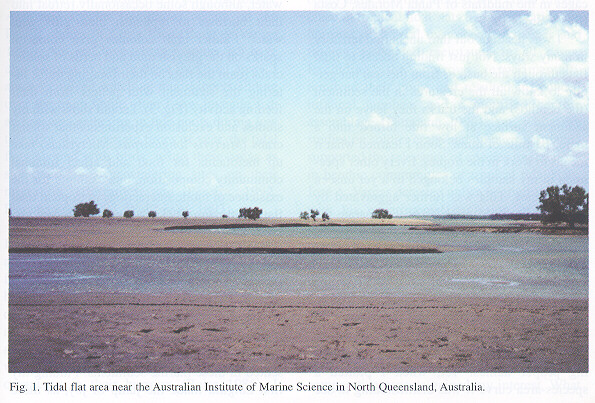
<body><![CDATA[<p><font face="Arial"><font size="-1">&nbsp;</font></font>  </p>       <div align="Justify">      <p><font face="Arial"><font size="-1">One had to be quick. Walk like a stork.  Easier said than done, carrying a backpack full of equipment, buckets full  of samples and a shovel over the shoulder, sinking knee-deep into the mud  under the scorching tropical sun and watching out for crocodiles. l looked  like a pig already. What was I doing here?</font></font>  </p>       <p><font face="Arial"><font size="-1">Growing up near the coast of the North  Sea, harbouring the Wadden Sea being one of the most extensive tidal flat  ecosystems on Earth, I was addicted to wide intertidal areas and already gained in-depth knowledge of its biota. Generations of scientists were studying  this system, but data from tropical tidal flats were scarce. This raised my curiosity. Every other coastal habitat in the tropics had received more attention, although sand- and mudflats abound along many tropical shores (<a href="#fig1"> Fig. 1</a>  ).</font></font> </p>  </div>       <center><a name="fig1"></a>  <img src="/img/fbpe/rbt/v50n2-3/2120i01.JPG" height="403" width="595">  </center>           
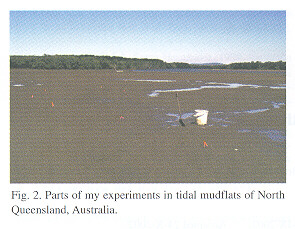
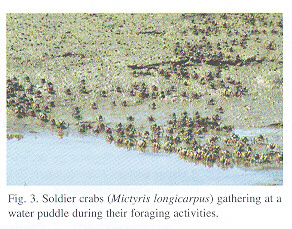
<div align="Justify">      <p><font face="Arial"><font size="-1">At that time, it was doubted by the  scientific community that species interactions would play a role in benthic  communities of tropical tidal flats, as extreme environmental conditions appeared to be the prevailing factor. Yet, no one had investigated any interactions  there. This was a topic for me. Luckily I was given the chance to test this  in the field during a post-doc funded by the German Research Council (DFG),  carried out at the Australian Institute of Marine Science (AIMS) in North  Queensland, Australia. Only later did I find out that Jos&eacute; A. Vargas  had a similar objective and was already putting up predator exclusion cages  in the mudflats of Punta Morales, Costa Rica (<a href="#Vargas88">Vargas  1988</a>  ).</font></font>  </p>  </div>       <div align="Justify">      <p><font face="Arial"><font size="-1">I was heading out into uncharted territory  in many ways. Not just finding access to tidal flats through the bush or from the sea, but getting to know all the creatures in the sediment (the benthos) and the tracks they leave on the sediment surface at low tide turned into a major pastime of mine. Soon I learned what it means to work in the tropics. Every other specimen in my samples belonged to a yet unseen new species. This was further aggravated by my use of severas mesh sizes to separate the animals from the sediment, as finer sieves yielded more and more organisms,  especially polychaete species of small individual size. This component of  the tropical benthos had been overlooked before (<a href="#Dittmann95"> Dittmann 1995</a>  ). Altogether I recorded nearly 500 species of benthic animals in the tidal  flats of North Queensland and quite a few of them are awaiting proper names.  Yet, when I plotted a species-area curve it was disillusioning to see that  I had not even fully assessed the species stock. There is a lot of scope for further surveys and taxonomic efforts to investigase the biodiversity of tropical tidal flats.</font></font>  </p>  </div>       <div align="Justify"><font face="Arial"><font size="-1">Bringing corer, shovel  and sieve into the field is essential to study tidal flat fauna, as most of the organisms are leading a secret live hidden in the sediment (<a href="#fig2">  Fig. 2</a>  ). Yet, while scurrying across the mud in tropical tidal flats, I typically  found decapod crustaceans active on the sediment surface. These crabs are  adapted to spend the low tide period out of the water, although some occasionally  retreat into their burrows to replenish their gills with water. Fiddler crab  colonies give colourful sparks on the greyish mud and herds of soldier crabs  roam the flats on their foraging trails, littering the sediment with pellets  from their feeding activity (<a href="#fig3">Fig. 3</a>  ). I could show with my studies and exclusion experiments that soldier <i>  crabs (Mictyris longicarpus, </i>Mictyridae) take up meiofauna for food and affect infaunal community composition, one example for the existence of biotic interactions in tropical tidal flats (<a href="#Dittmann93">Dittmann 1993</a>  ). During more recent visits to sandflats in East Africa and Malaysia, I  had a real d&eacute;j&agrave;-vu, seeing herds of little crabs wandering around there. They were crabs of the genus <i>Dotilla </i>(Ocypodidae), forming  an analogue to the Australian Mictyridae.</font></font>     ]]></body>
<body><![CDATA[<br>  </div>       <p><font face="Arial"><font size="-1">&nbsp;</font></font> </p>       <center><font face="Arial"><font size="-1">&nbsp;</font></font><a name="fig2"></a>  <img src="/img/fbpe/rbt/v50n2-3/2120i02.JPG" height="229" width="295">  <a name="fig3"></a>  <img src="/img/fbpe/rbt/v50n2-3/2120i03.JPG" height="229" width="292">  </center>           
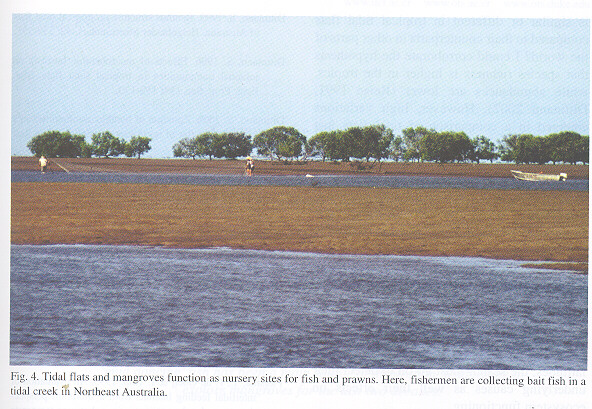
<div align="Justify"><font face="Arial"><font size="-1">Benthic fauna in tidal flats is like a textbook on invertebrates coming alive. With the exception  of insects, all major taxa are represented in these marine sediments. Finding  my first <i>Lingula </i>made me jump of joy, as these brachiopods are considered  to be living fossils. A related species <i>(Glottidia) </i>occurs on the Pacific shores of Costa Rica (<a href="#Emig90">Emig &amp; Vargas 1990</a>  ). Not just invertebrates, some fish<b> </b>have also adapted to live in  these intertidal areas. I always enjoyed watching mudskippers sliding over  the mud. Quite often I saw juvenile fish and prawns gathering in tide pools  during low tide (<a href="#fig4">Fig. 4</a>  ). At certain times of year, the tidal flats abound with birds, using these  areas as Stop-overs or over-wintering sites on their migration (<a href="#Barrantes92">  Barrantes and Pereira 1992</a>  , <a href="#Piersma93">Piersma <i>et al. </i>1993</a>  , <a href="#Wolff93">Wolff <i>et al. </i>1993</a>  ).</font></font>     <br>  </div>       <p><font face="Arial"><font size="-1">&nbsp;</font></font> </p>       <center><font face="Arial"><font size="-1">&nbsp;</font></font><a name="fig4"></a>  <img src="/img/fbpe/rbt/v50n2-3/2120i04.JPG" height="409" width="592">  </center>           
<div align="Justify">      <p><font face="Arial"><font size="-1">All these species interact in some way and I wanted to find out whether their interactions affect benthic communities  in tropical tidal flats. The predator-prey relationship I studied between  soldier crabs and meiofauna was a case of repressive interaction. However,  interactions can also be promotive, as had been shown in temperate tidal flats, where certain worms provide microhabitats for associated organisms  in their burrows (<a href="#Reise85">Reise 1985</a>  ). I could show that this process is of equal importance in tropical tidal  flats by investigating the burrows of severas macrobenthic species and finding  associated meiofauna in all cases. Excluding the burrows experimentally removed  their home and resulted in reduced infaunal numbers and a modified benthic  assemblage (<a href="#Dittmann96">Dittmann 1996</a>  ). Yet, while my studies on soldier crabs and on burrow infauna supported  the relevance of species interactions in benthic communities of tropical tidal flats, Jos&eacute; A. Vargas detected only a negligible effect with his experimental exclusion of macropredators. Further experiments are surely needed to comprehend ecological processes in tropical tidal flats. However, this takes scientists tolerant to frustration, as I can tell from experience how easily experiments are destroyed by cyclones or other disturbances.</font></font>   </p>       <p><font face="Arial"><font size="-1">Knowing temperate tidal flats from childhood days and having had the opportunity to visit tropical tidal flats in every continent, comparative aspects gained my interest. What is similar or different in tropical tidal flats compared to their counterparts in other parts of the world? I could corroborase the hypothesis that species richness is higher in the tropics, while abundances are lower (<a href="#Reise91"> Reise 1991</a>  , <a href="#Dittmann02">Dittmann 2002</a>  ). However, high variations emerged in a comparison of tidal flats just within tropical latitudes (<a href="#Vargas96">Vargas 1996</a>  , <a href="#Dittmann01">Dittmann and Vargas 2001</a>  ), and we have not yet fully understood the reasons behind it. One of my  plans for the future includes comparative studies using the same methodology.  Worldwide, the large-scale zonation of benthic communities appears to follow  comparable enviromnental conditions along an intertidal gradient (<a href="#Dittmann00">  Dittmann 2000</a>  ). Even the spatial distribution of certain life-forms is similar worldwide,  yet representad by either analogue or related species. Finding both similarities  and dissimilarities between tidal flats of various latitudes, the search must go on to detect their underlying causes as well their effects on ecosystem  functioning.</font></font>  </p>       ]]></body>
<body><![CDATA[<p><font face="Arial"><font size="-1">Working in the tropics as a marine ecologist usually pegs you straight away as being either a coral reef or mangrove person. Try explaining that you prefer mudflats! The chance to be considered a lunatic is pretty high. Being stuck in the mud once again and trying to dig out my shoe, it occurs to me that this might not be so wrong. Yet looking up and seeing a pelican glide over the creek and feeling the tranquil mood in an ecosystem time forgot, I wouldn't want to swap with any other place on Earth.</font></font>   </p>  </div>       <p><b><font face="Arial"><font size="-1">References</font></font></b>  </p>       <div align="Justify">      <!-- ref --><p><a name="Barrantes92"></a>  <font face="Arial"><font size="-1">Barrantes, G. &amp; A. Pereira. 1992.  Abundance and temporal variations of Charadriiformes on the mud flats of Chomes, Costa Rica. Rev. Biol. Trop. 40: 303-307.    &nbsp;&nbsp;&nbsp;&nbsp;&nbsp;&nbsp;&nbsp;&nbsp;[&#160;<a href="javascript:void(0);" onclick="javascript: window.open('/scielo.php?script=sci_nlinks&ref=1693990&pid=S0034-7744200200030000600001&lng=','','width=640,height=500,resizable=yes,scrollbars=1,menubar=yes,');">Links</a>&#160;]<!-- end-ref --></font></font>  </p>       <!-- ref --><p><a name="Dittmann93"></a>  <font face="Arial"><font size="-1">Dittmann, S. 1993. Impact of foraging  soldiercrabs (Decapoda: Mictyridae) on meiofauna in a tropical tidal flat.  Rev. Biol. Trop. 41: 627-637.    &nbsp;&nbsp;&nbsp;&nbsp;&nbsp;&nbsp;&nbsp;&nbsp;[&#160;<a href="javascript:void(0);" onclick="javascript: window.open('/scielo.php?script=sci_nlinks&ref=1693992&pid=S0034-7744200200030000600002&lng=','','width=640,height=500,resizable=yes,scrollbars=1,menubar=yes,');">Links</a>&#160;]<!-- end-ref --></font></font>  </p>       <!-- ref --><p><a name="Dittmann95"></a>  <font face="Arial"><font size="-1">Dittmann, S. 1995. Benthos structure on tropical tidal flats of Australia. Helgol&auml;nder Meeresunters. 49: 539-551.    &nbsp;&nbsp;&nbsp;&nbsp;&nbsp;&nbsp;&nbsp;&nbsp;[&#160;<a href="javascript:void(0);" onclick="javascript: window.open('/scielo.php?script=sci_nlinks&ref=1693994&pid=S0034-7744200200030000600003&lng=','','width=640,height=500,resizable=yes,scrollbars=1,menubar=yes,');">Links</a>&#160;]<!-- end-ref --></font></font>   </p>       <!-- ref --><p><a name="Dittmann96"></a>  <font face="Arial"><font size="-1">Dittmann, S. 1996. Effects of macrobenthic  burrows on infaunal communities in tropical tidal flats. Mar. Ecol. Prog.  Ser. 134: 119-130.    &nbsp;&nbsp;&nbsp;&nbsp;&nbsp;&nbsp;&nbsp;&nbsp;[&#160;<a href="javascript:void(0);" onclick="javascript: window.open('/scielo.php?script=sci_nlinks&ref=1693996&pid=S0034-7744200200030000600004&lng=','','width=640,height=500,resizable=yes,scrollbars=1,menubar=yes,');">Links</a>&#160;]<!-- end-ref --></font></font>  </p>       <!-- ref --><p><a name="Dittmann00"></a>  <font face="Arial"><font size="-1">Dittmann, S. 2000. Zonation of benthic  communities in a tropical tidal flat of north-east Australia. J. Sea Res.  43: 33-51.    &nbsp;&nbsp;&nbsp;&nbsp;&nbsp;&nbsp;&nbsp;&nbsp;[&#160;<a href="javascript:void(0);" onclick="javascript: window.open('/scielo.php?script=sci_nlinks&ref=1693998&pid=S0034-7744200200030000600005&lng=','','width=640,height=500,resizable=yes,scrollbars=1,menubar=yes,');">Links</a>&#160;]<!-- end-ref --></font></font>  </p>       <!-- ref --><p><a name="Dittmann02"></a>  <font face="Arial"><font size="-1">Dittmann, S. 2002. Benthic fauna in tropical  tidal flats - a comparative perspective. Wetlands Ecol. Manage. 10: 189-195.    &nbsp;&nbsp;&nbsp;&nbsp;&nbsp;&nbsp;&nbsp;&nbsp;[&#160;<a href="javascript:void(0);" onclick="javascript: window.open('/scielo.php?script=sci_nlinks&ref=1694000&pid=S0034-7744200200030000600006&lng=','','width=640,height=500,resizable=yes,scrollbars=1,menubar=yes,');">Links</a>&#160;]<!-- end-ref --></font></font>    </p>       <!-- ref --><p><a name="Dittmann01"></a>  <font face="Arial"><font size="-1">Dittmann, S. &amp; J.A. Vargas. 2001.  Tropical Tidal Elat Benthos Compared Between Australia and Central America,  In Ecological Comparisons of Sedimentary Shores. pp. 275-293. K. Reise (ed.).  Ecological Studies, Vol. 151. Springer-Verlag, Berlin, Heidelberg, New York.    &nbsp;&nbsp;&nbsp;&nbsp;&nbsp;&nbsp;&nbsp;&nbsp;[&#160;<a href="javascript:void(0);" onclick="javascript: window.open('/scielo.php?script=sci_nlinks&ref=1694002&pid=S0034-7744200200030000600007&lng=','','width=640,height=500,resizable=yes,scrollbars=1,menubar=yes,');">Links</a>&#160;]<!-- end-ref --></font></font>    </p>       <!-- ref --><p><a name="Emig90"></a>  <font face="Arial"><font size="-1">Emig, C.C. &amp; J.A. Vargas. 1990. <i>  Glottidia audebarti</i> (Broderip), (Brachiopoda, Lingulidae) from the Gulf  of Nicoya, Costa Rica. Rev. Biol. Trop. 38: 251-258.    &nbsp;&nbsp;&nbsp;&nbsp;&nbsp;&nbsp;&nbsp;&nbsp;[&#160;<a href="javascript:void(0);" onclick="javascript: window.open('/scielo.php?script=sci_nlinks&ref=1694004&pid=S0034-7744200200030000600008&lng=','','width=640,height=500,resizable=yes,scrollbars=1,menubar=yes,');">Links</a>&#160;]<!-- end-ref --></font></font>  </p>       <!-- ref --><p><a name="Piersma93"></a>  <font face="Arial"><font size="-1">Piersma, T., R de Goeij &amp; I. Tulp.  1993. An evaluation of intertidal feeding habitats from a shorebird perspective:  towards relevant comparisons between temperate and tropical mudflats. Neth.  J. Sea Res. 31: 503-512.    &nbsp;&nbsp;&nbsp;&nbsp;&nbsp;&nbsp;&nbsp;&nbsp;[&#160;<a href="javascript:void(0);" onclick="javascript: window.open('/scielo.php?script=sci_nlinks&ref=1694006&pid=S0034-7744200200030000600009&lng=','','width=640,height=500,resizable=yes,scrollbars=1,menubar=yes,');">Links</a>&#160;]<!-- end-ref --></font></font>  </p>       <!-- ref --><p><a name="Reise85"></a>  <font face="Arial"><font size="-1">Reise, K. 1985. Tidal Flat Ecology. Springer-Verlag,  Berlin, Heidelberg, New York.    &nbsp;&nbsp;&nbsp;&nbsp;&nbsp;&nbsp;&nbsp;&nbsp;[&#160;<a href="javascript:void(0);" onclick="javascript: window.open('/scielo.php?script=sci_nlinks&ref=1694008&pid=S0034-7744200200030000600010&lng=','','width=640,height=500,resizable=yes,scrollbars=1,menubar=yes,');">Links</a>&#160;]<!-- end-ref --></font></font>  </p>       <!-- ref --><p><a name="Reise91"></a>  <font face="Arial"><font size="-1">Reise, K. 1991. Macrofauna in mud and  sand of tropical and temperate tidal flats. pp. 211-216. In M. Elliott &amp;  J.-P. Ducrotoy (eds.). Estuaries and Coasts: Spatial and Temporal Intercomparisons.  Olsen and Olsen, Fredensborg.    &nbsp;&nbsp;&nbsp;&nbsp;&nbsp;&nbsp;&nbsp;&nbsp;[&#160;<a href="javascript:void(0);" onclick="javascript: window.open('/scielo.php?script=sci_nlinks&ref=1694010&pid=S0034-7744200200030000600011&lng=','','width=640,height=500,resizable=yes,scrollbars=1,menubar=yes,');">Links</a>&#160;]<!-- end-ref --></font></font>  </p>       <!-- ref --><p><a name="Vargas88"></a>  <font face="Arial"><font size="-1">Vargas, J.A. 1988. Community structure  of macrobenthos and the results of macropredator exclusion on a tropical intertidal mud flat. Rev. Biol. Trop. 36: 287-308.    &nbsp;&nbsp;&nbsp;&nbsp;&nbsp;&nbsp;&nbsp;&nbsp;[&#160;<a href="javascript:void(0);" onclick="javascript: window.open('/scielo.php?script=sci_nlinks&ref=1694012&pid=S0034-7744200200030000600012&lng=','','width=640,height=500,resizable=yes,scrollbars=1,menubar=yes,');">Links</a>&#160;]<!-- end-ref --></font></font>  </p>       <!-- ref --><p><a name="Vargas96"></a>  <font face="Arial"><font size="-1">Vargas, J.A. 1996. Ecological dynamics  of a tropical intertidal mudflat community. pp. 355-371. In K.F. Nordstrom  &amp; C.T. Roman. (eds.). Estuarine Shores: Evolution, Environments and Human  Alterations. John Wiley and Sons.    &nbsp;&nbsp;&nbsp;&nbsp;&nbsp;&nbsp;&nbsp;&nbsp;[&#160;<a href="javascript:void(0);" onclick="javascript: window.open('/scielo.php?script=sci_nlinks&ref=1694014&pid=S0034-7744200200030000600013&lng=','','width=640,height=500,resizable=yes,scrollbars=1,menubar=yes,');">Links</a>&#160;]<!-- end-ref --></font></font>  </p>       <!-- ref --><p><a name="Wolff93"></a>  <font face="Arial"><font size="-1">Wolff, W.J., J. van der Land, P.H. Nienhuis  &amp; P.A.W.J. de Wilde. 1993. The functioning of the ecosystem of the Banc  d'Arguin, Mauritania: a review. Hydrobiologia 258: 211-222.    &nbsp;&nbsp;&nbsp;&nbsp;&nbsp;&nbsp;&nbsp;&nbsp;[&#160;<a href="javascript:void(0);" onclick="javascript: window.open('/scielo.php?script=sci_nlinks&ref=1694016&pid=S0034-7744200200030000600014&lng=','','width=640,height=500,resizable=yes,scrollbars=1,menubar=yes,');">Links</a>&#160;]<!-- end-ref --></font></font>       <br>  &nbsp;    <br>      <br>    </p>       <p><font face="Arial"><font size="-1">&nbsp;<a name="*a"></a>  <a href="#*">*</a>   Centre for Tropical Marine Ecology, Fahrenheitstr. 6, 28359 Bremen, Germany.  Phone: +49-421-2380047, Fax: +49-421-2380030; <a href="mailto:sabine.dittmann@zmt-bremen.de">  sabine.dittmann@zmt-bremen.de</a>  </font></font> </p>  </div>        ]]></body><back>
<ref-list>
<ref id="B1">
<nlm-citation citation-type="journal">
<person-group person-group-type="author">
<name>
<surname><![CDATA[Barrantes]]></surname>
<given-names><![CDATA[G]]></given-names>
</name>
<name>
<surname><![CDATA[Pereira]]></surname>
<given-names><![CDATA[A]]></given-names>
</name>
</person-group>
<article-title xml:lang="en"><![CDATA[Abundance and temporal variations of Charadriiformes on the mud flats of Chomes, Costa Rica]]></article-title>
<source><![CDATA[Rev. Biol. Trop]]></source>
<year>1992</year>
<volume>40</volume>
<page-range>303-307</page-range></nlm-citation>
</ref>
<ref id="B2">
<nlm-citation citation-type="journal">
<person-group person-group-type="author">
<name>
<surname><![CDATA[Dittmann]]></surname>
<given-names><![CDATA[S]]></given-names>
</name>
</person-group>
<article-title xml:lang="en"><![CDATA[Impact of foraging soldiercrabs (Decapoda: Mictyridae) on meiofauna in a tropical tidal flat]]></article-title>
<source><![CDATA[Rev. Biol. Trop]]></source>
<year>1993</year>
<volume>41</volume>
<page-range>627-637</page-range></nlm-citation>
</ref>
<ref id="B3">
<nlm-citation citation-type="journal">
<person-group person-group-type="author">
<name>
<surname><![CDATA[Dittmann]]></surname>
<given-names><![CDATA[S]]></given-names>
</name>
</person-group>
<article-title xml:lang="en"><![CDATA[Benthos structure on tropical tidal flats of Australia]]></article-title>
<source><![CDATA[Helgoländer Meeresunters]]></source>
<year>1995</year>
<volume>49</volume>
<page-range>539-551</page-range></nlm-citation>
</ref>
<ref id="B4">
<nlm-citation citation-type="journal">
<person-group person-group-type="author">
<name>
<surname><![CDATA[Dittmann]]></surname>
<given-names><![CDATA[S]]></given-names>
</name>
</person-group>
<article-title xml:lang="en"><![CDATA[Effects of macrobenthic burrows on infaunal communities in tropical tidal flats]]></article-title>
<source><![CDATA[Mar. Ecol. Prog. Ser]]></source>
<year>1996</year>
<volume>134</volume>
<page-range>119-130</page-range></nlm-citation>
</ref>
<ref id="B5">
<nlm-citation citation-type="journal">
<person-group person-group-type="author">
<name>
<surname><![CDATA[Dittmann]]></surname>
<given-names><![CDATA[S]]></given-names>
</name>
</person-group>
<article-title xml:lang="en"><![CDATA[Zonation of benthic communities in a tropical tidal flat of north-east Australia]]></article-title>
<source><![CDATA[J. Sea Res]]></source>
<year>2000</year>
<volume>43</volume>
<page-range>33-51</page-range></nlm-citation>
</ref>
<ref id="B6">
<nlm-citation citation-type="journal">
<person-group person-group-type="author">
<name>
<surname><![CDATA[Dittmann]]></surname>
<given-names><![CDATA[S]]></given-names>
</name>
</person-group>
<article-title xml:lang="en"><![CDATA[Benthic fauna in tropical tidal flats - a comparative perspective]]></article-title>
<source><![CDATA[Wetlands Ecol. Manage]]></source>
<year>2002</year>
<volume>10</volume>
<page-range>189-195</page-range></nlm-citation>
</ref>
<ref id="B7">
<nlm-citation citation-type="book">
<person-group person-group-type="author">
<name>
<surname><![CDATA[Dittmann]]></surname>
<given-names><![CDATA[S]]></given-names>
</name>
<name>
<surname><![CDATA[Vargas]]></surname>
<given-names><![CDATA[J.A]]></given-names>
</name>
</person-group>
<article-title xml:lang="en"><![CDATA[Tropical Tidal Elat Benthos Compared Between Australia and Central America, In Ecological Comparisons of Sedimentary Shores]]></article-title>
<person-group person-group-type="editor">
<name>
<surname><![CDATA[Reise]]></surname>
<given-names><![CDATA[K]]></given-names>
</name>
</person-group>
<source><![CDATA[Ecological Studies]]></source>
<year>2001</year>
<volume>151</volume>
<publisher-loc><![CDATA[Berlin ]]></publisher-loc>
<publisher-name><![CDATA[Springer-Verlag]]></publisher-name>
</nlm-citation>
</ref>
<ref id="B8">
<nlm-citation citation-type="journal">
<person-group person-group-type="author">
<name>
<surname><![CDATA[Emig]]></surname>
<given-names><![CDATA[C.C]]></given-names>
</name>
<name>
<surname><![CDATA[Vargas]]></surname>
<given-names><![CDATA[J.A]]></given-names>
</name>
</person-group>
<article-title xml:lang="en"><![CDATA[Glottidia audebarti (Broderip), (Brachiopoda, Lingulidae) from the Gulf of Nicoya, Costa Rica]]></article-title>
<source><![CDATA[Rev. Biol. Trop]]></source>
<year>1990</year>
<volume>38</volume>
<page-range>251-258</page-range></nlm-citation>
</ref>
<ref id="B9">
<nlm-citation citation-type="journal">
<person-group person-group-type="author">
<name>
<surname><![CDATA[Piersma]]></surname>
<given-names><![CDATA[T]]></given-names>
</name>
<name>
<surname><![CDATA[de Goeij]]></surname>
<given-names><![CDATA[R]]></given-names>
</name>
<name>
<surname><![CDATA[Tulp]]></surname>
<given-names><![CDATA[I]]></given-names>
</name>
</person-group>
<article-title xml:lang="en"><![CDATA[An evaluation of intertidal feeding habitats from a shorebird perspective: towards relevant comparisons between temperate and tropical mudflats]]></article-title>
<source><![CDATA[Neth. J. Sea Res]]></source>
<year>1993</year>
<volume>31</volume>
<page-range>503-512</page-range></nlm-citation>
</ref>
<ref id="B10">
<nlm-citation citation-type="book">
<person-group person-group-type="author">
<name>
<surname><![CDATA[Reise]]></surname>
<given-names><![CDATA[K]]></given-names>
</name>
</person-group>
<source><![CDATA[Tidal Flat Ecology]]></source>
<year>1985</year>
<publisher-loc><![CDATA[Berlin ]]></publisher-loc>
<publisher-name><![CDATA[Springer-Verlag]]></publisher-name>
</nlm-citation>
</ref>
<ref id="B11">
<nlm-citation citation-type="book">
<person-group person-group-type="author">
<name>
<surname><![CDATA[Reise]]></surname>
<given-names><![CDATA[K]]></given-names>
</name>
</person-group>
<article-title xml:lang="en"><![CDATA[Macrofauna in mud and sand of tropical and temperate tidal flats]]></article-title>
<person-group person-group-type="editor">
<name>
<surname><![CDATA[Elliott]]></surname>
<given-names><![CDATA[M]]></given-names>
</name>
<name>
<surname><![CDATA[Ducrotoy]]></surname>
<given-names><![CDATA[J.-P]]></given-names>
</name>
</person-group>
<source><![CDATA[Estuaries and Coasts: Spatial and Temporal Intercomparisons]]></source>
<year>1991</year>
<publisher-loc><![CDATA[Fredensborg ]]></publisher-loc>
<publisher-name><![CDATA[Olsen and Olsen]]></publisher-name>
</nlm-citation>
</ref>
<ref id="B12">
<nlm-citation citation-type="journal">
<person-group person-group-type="author">
<name>
<surname><![CDATA[Vargas]]></surname>
<given-names><![CDATA[J.A]]></given-names>
</name>
</person-group>
<article-title xml:lang="en"><![CDATA[Community structure of macrobenthos and the results of macropredator exclusion on a tropical intertidal mud flat]]></article-title>
<source><![CDATA[Rev. Biol. Trop]]></source>
<year>1988</year>
<volume>36</volume>
<page-range>287-308</page-range></nlm-citation>
</ref>
<ref id="B13">
<nlm-citation citation-type="book">
<person-group person-group-type="author">
<name>
<surname><![CDATA[Vargas]]></surname>
<given-names><![CDATA[J.A]]></given-names>
</name>
</person-group>
<article-title xml:lang="en"><![CDATA[Ecological dynamics of a tropical intertidal mudflat community]]></article-title>
<person-group person-group-type="editor">
<name>
<surname><![CDATA[Nordstrom]]></surname>
<given-names><![CDATA[K.F]]></given-names>
</name>
<name>
<surname><![CDATA[Roman]]></surname>
<given-names><![CDATA[C.T]]></given-names>
</name>
</person-group>
<source><![CDATA[Estuarine Shores: Evolution, Environments and Human Alterations]]></source>
<year>1996</year>
<publisher-name><![CDATA[John Wiley and Sons]]></publisher-name>
</nlm-citation>
</ref>
<ref id="B14">
<nlm-citation citation-type="journal">
<person-group person-group-type="author">
<name>
<surname><![CDATA[Wolff]]></surname>
<given-names><![CDATA[W.J]]></given-names>
</name>
<name>
<surname><![CDATA[van der Land]]></surname>
<given-names><![CDATA[J]]></given-names>
</name>
<name>
<surname><![CDATA[Nienhuis]]></surname>
<given-names><![CDATA[P.H]]></given-names>
</name>
<name>
<surname><![CDATA[de Wilde]]></surname>
<given-names><![CDATA[P.A.W.J.]]></given-names>
</name>
</person-group>
<article-title xml:lang="en"><![CDATA[The functioning of the ecosystem of the Banc d'Arguin, Mauritania: a review]]></article-title>
<source><![CDATA[Hydrobiologia]]></source>
<year>1993</year>
<volume>258</volume>
<page-range>211-222</page-range></nlm-citation>
</ref>
</ref-list>
</back>
</article>