<?xml version="1.0" encoding="ISO-8859-1"?><article xmlns:mml="http://www.w3.org/1998/Math/MathML" xmlns:xlink="http://www.w3.org/1999/xlink" xmlns:xsi="http://www.w3.org/2001/XMLSchema-instance">
<front>
<journal-meta>
<journal-id>0034-7744</journal-id>
<journal-title><![CDATA[Revista de Biología Tropical]]></journal-title>
<abbrev-journal-title><![CDATA[Rev. biol. trop]]></abbrev-journal-title>
<issn>0034-7744</issn>
<publisher>
<publisher-name><![CDATA[Universidad de Costa Rica]]></publisher-name>
</publisher>
</journal-meta>
<article-meta>
<article-id>S0034-77442002000300005</article-id>
<title-group>
<article-title xml:lang="en"><![CDATA[Man-made lakes, ecological studies and conservation needs in Nigeria]]></article-title>
</title-group>
<contrib-group>
<contrib contrib-type="author">
<name>
<surname><![CDATA[Araoye]]></surname>
<given-names><![CDATA[P.A.]]></given-names>
</name>
<xref ref-type="aff" rid="A01"/>
</contrib>
</contrib-group>
<aff id="A01">
<institution><![CDATA[,Lower Niger Basin Development Authority  ]]></institution>
<addr-line><![CDATA[llorin ]]></addr-line>
<country>Nigeria</country>
</aff>
<pub-date pub-type="pub">
<day>00</day>
<month>12</month>
<year>2002</year>
</pub-date>
<pub-date pub-type="epub">
<day>00</day>
<month>12</month>
<year>2002</year>
</pub-date>
<volume>50</volume>
<numero>3-4</numero>
<fpage>857</fpage>
<lpage>864</lpage>
<copyright-statement/>
<copyright-year/>
<self-uri xlink:href="http://www.scielo.sa.cr/scielo.php?script=sci_arttext&amp;pid=S0034-77442002000300005&amp;lng=en&amp;nrm=iso"></self-uri><self-uri xlink:href="http://www.scielo.sa.cr/scielo.php?script=sci_abstract&amp;pid=S0034-77442002000300005&amp;lng=en&amp;nrm=iso"></self-uri><self-uri xlink:href="http://www.scielo.sa.cr/scielo.php?script=sci_pdf&amp;pid=S0034-77442002000300005&amp;lng=en&amp;nrm=iso"></self-uri><abstract abstract-type="short" xml:lang="en"><p><![CDATA[The benefit derived from the creation of man-made lakes in Nigeria and other developing countries is usually associated with great risks. Whenever we establish a dam, it appears we dam the inherent consequences to the detriment of man and bis environment. Debts were incurred by the countries concerned, man and animals were displaced, arable lands destroyed including degradation of forest and wild life resources. The creation of dams have also ignored the prevention of man and bis life stock from the inherent spread of water borne diseases. The purpose for which a dam is created is threatened if man is indiscriminately exposed to the risk of water borne diseases. The poor and uneconomic management of the fish resources is also another major issue of concern. In order to tap the full potentials of reservoir projects and to promote conservation, it is important to have a round table talk involving all stake holders during the planning stage of such projects. Therefore apart from the engineering works, there is also need for collaboration with all experts from relates fields especially the biologists, sociologists and economists for bio-socio-economic reasons during the planning and implementation stages of dam projects in Nigeria and other developing countries.]]></p></abstract>
<abstract abstract-type="short" xml:lang="es"><p><![CDATA[La creación de represas y lagos artificiales en Nigeria y en otros países en vías de desarrollo, produce importantes beneficios, pero trae también grandes riesgos, pues es difícil evitar sus consecuencias inherentes, hacia el detrimento del hombre y su ambiente. Los países que desarrollan este tipo de proyectos deben adquirir deudas, desplazar personas y animales y enfrentar la destrucción de tierras que podrían utilizarse para cultivo, así como también la degradación del bosque y la vida silvestre. Se ha ignorado además, el riesgo que representa para el hombre y su ganado, la exposición indiscriminada a enfermedades transmitidas por el agua. El manejo pobre y antieconómico de los recursos pesqueros es otro factor importante a considerar. Con el objetivo de lograr un mejor aprovechamiento del potencial de las represas y promover la conservación, es importante organizar mesas redondas que involucren a todos los que participan durante la fase de planeamiento de los proyectos. Además de los trabajos de ingeniería, se necesita de la colaboración interdisciplinaria de expertos en áreas relacionadas, para los aspectos bio-socio-económicos de las fases de planeamiento e implementación de los proyectos de embalse, tanto en Nigeria como en otros países en vías de desarrollo.]]></p></abstract>
<kwd-group>
<kwd lng="en"><![CDATA[Artificial lakes]]></kwd>
<kwd lng="en"><![CDATA[dams]]></kwd>
<kwd lng="en"><![CDATA[conservation]]></kwd>
<kwd lng="en"><![CDATA[fish resources]]></kwd>
<kwd lng="en"><![CDATA[Nigeria]]></kwd>
</kwd-group>
</article-meta>
</front><body><![CDATA[    <i><font size="-1">INVITED ESSAY</font></i>       <center>&nbsp;</center>          <center>&nbsp;</center>          <center><b><font face="Arial">Man-made lakes, ecological studies and conservation  needs in Nigeria</font></b></center>           <p><font face="Arial"><font size="-1">&nbsp;</font></font> </p>       <center><b><font face="Arial"><font size="-1">P.A. Araoye&nbsp;<a name="*"></a>  <a href="#*a">*</a>  </font></font></b></center>          <center>&nbsp;</center>          <center><font face="Arial"><font size="-1">&nbsp;</font></font></center>          <center><font face="Arial"><font size="-1">&nbsp;</font></font></center>          <center><font face="Arial"><font size="-1">Received 21-VII-2002 Corrected  19-VIII-2002. Accepted 26-VIII-2002.</font></font></center>           ]]></body>
<body><![CDATA[<p><b><font face="Arial"><font size="-1">&nbsp;</font></font></b>     <br>  <b><font face="Arial"><font size="-1">Abstract</font></font></b>  </p>       <div align="Justify">      <p><font face="Arial"><font size="-1">The benefit derived from the creation  of man-made lakes in Nigeria and other developing countries is usually associated  with great risks. Whenever we establish a dam, it appears we dam the inherent  consequences to the detriment of man and bis environment. Debts were incurred  by the countries concerned, man and animals were displaced, arable lands destroyed including degradation of forest and wild life resources. The creation of dams have also ignored the prevention of man and bis life stock from the inherent spread of water borne diseases. The purpose for which a dam is created is threatened if man is indiscriminately exposed to the risk of water borne diseases. The poor and uneconomic management of the fish resources is also another major issue of concern. In order to tap the full potentials of reservoir projects and to promote conservation, it is important to have a round table talk involving all stake holders during the planning stage of such projects. Therefore apart from the engineering works, there is also need for collaboration with all experts from relates fields especially the biologists, sociologists and economists for bio-socio-economic reasons during the planning and implementation stages of dam projects in Nigeria and other developing countries.</font></font>   </p>  </div>       <p><b><font face="Arial"><font size="-1">Key words</font></font></b>  </p>       <p><font face="Arial"><font size="-1">Artificial lakes, dams, conservation,  fish resources, Nigeria.</font></font>  </p>       <p><font face="Arial"><font size="-1">&nbsp;</font></font>  </p>       <div align="Justify">      <p><font face="Arial"><font size="-1">The quality and the quantity of food  available constitute a very important factor among others in the balance of a population within a complex community as diat of the aquatic and terrestrial  enviromnents. The creation of embankments such as dams, dikes, etc., may disrupt this balance by interfering with the quality and the quantity of the available food items, living space, inter and intra specific competition and the<b>  </b>limnological conditions (<a href="#Araoye-jeje99">Araoye and Jeje 1999</a>  ).</font></font>  </p>  </div>       <div align="Justify">      ]]></body>
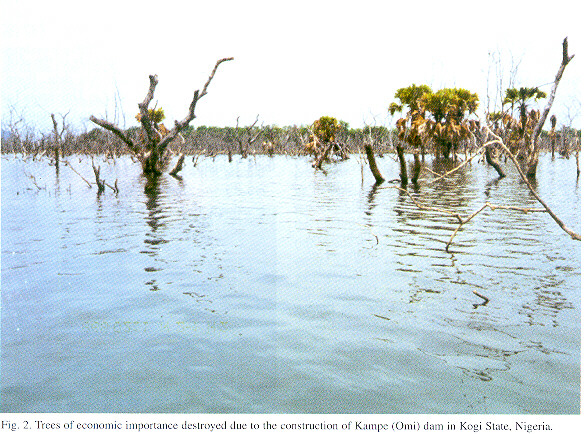
<body><![CDATA[<p><font face="Arial"><font size="-1">Recent reports have shown that the gains from the River Basin Development Project are quite enormous, however there are risks associated with such benefits. The point of the matter is whether their benefits outweigh the<b> </b>risks or not. The benefits include the storing of water for power generation, irrigation, fisheries, navigation,  flood and erosion control purposes. Reports have also indicated that power  supply from large dams account for about a quarter of the world's total supply  of electricity (<a href="#Dellere89">Dellere 1989</a>  ). However, most of these benefits highfighted are not usually devoid of  financiar and enviromnental problems. As we try lo maximize the<b> </b>benefits  of dam projects, we should also try to minimize its negative effects through  a better planning and management. Debts have been incurred heavily by some  third world countries that have engaged in large water projects, people have heen displaced, arable lands were destroyed, forest and wild life resources  degenerated. The spread of water borne diseases and the<b> </b>collapse of  coastal fisheries are also harmful consequences of such big projects. Some  of these problems though were foreseen, they were not considered as crucial  until when the harm was done and could no longer be ignored (<a href="#Anonymous00">  Anonymous 2000</a>  ).</font></font>  </p>  </div>       <div align="Justify"><font face="Arial"><font size="-1">In Nigeria, as well  as in other developing countries (<a href="#Goldman76">Goldman 1976</a>  ), the issue of conservation or environmental protection is of less interest  whenever it comes to building dams for electricity and irrigation. This is  probably because of the need for industrialization and agricultural production  in order to alleviate the problems of poverty. Hence other valuable resources  such as fisheries and wild life conservation are usually ignored at the planning  and implementation stages of the construction of big or small dam projects.  Conservation also includes the prevention of man and his life stock from the inherent spread of water borne diseases that are associated with the establishment of large water bodies for electricity and irrigation projects. The success of the project for which a large dam is established is also threatened if man is indiscriminately exposed to the risk of water borne diseases within  his environment (<a href="#fig1">Fig. 1</a>  ). Farmers and fishermen around man-made lakes established by the Niger River Basin Development Authority llorin, Nigeria, have complained of serious attack by schistosomiasis on members of their families. A fisherman along Kampe (Omi) lake in Kogi State of Nigeria told me he had spent over N30 000 (Thirty thousand Naira), which is equivalent to about $230 annually to treat himself, his wife and two of his children that were infected with schistosomiasis.  This does not include indirect cost such as the inconveniences and the cost  of transportation from their fishing settlement where no hospital exists to the town where medical attention can be received. The annual income of this fisherman may not exceed N50 000 per annum because they constitute the very low income group and yet they face the poorest living conditions despite the fact that they are the group of people that supply 70 to 80% of the fish consumed locally by Nigerians.</font></font>     <br>  </div>       <p>&nbsp; </p>       <center>&nbsp;<a name="fig1"></a>  <img src="/img/fbpe/rbt/v50n2-3/2119i01.JPG" height="469" width="598">  </center>   &nbsp;     
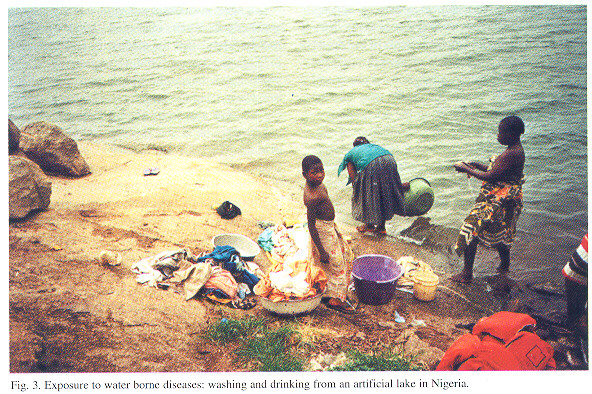
<br>  &nbsp;     <br>       <div align="Justify"><font face="Arial"><font size="-1">Whenever we establish  a dam, it appears we damn the inherent consequences to the detriment of man  and his environment. In the desire to improve the life quality of man through  the provision of electricity to enhance the process of industrialization,  we encroach adversely into the environment without making the adequate provision  to protect it from the degradation of biodiversity. Plants are destroyed (<a href="#fig2"> Fig. 2</a>  ), while man and animals are also displaced. There is a need for a round  table talk during the planning stage of dam projects where all stake holders  can contribute to the building of the<b> </b>dam in order to have minimal  effects of the negative side of the project. The various clashes that usually  arise between different interest groups after the creation of man-made lakes  (e.g. between those who want to farm and those who want to fish or between  those who want to graze and those who want to farm) would be minimal.</font></font>       <br>  </div>  &nbsp;       <center>&nbsp;<a name="fig2"></a>  <img src="/img/fbpe/rbt/v50n2-3/2119i02.JPG" height="434" width="586">  </center>   &nbsp;     
]]></body>
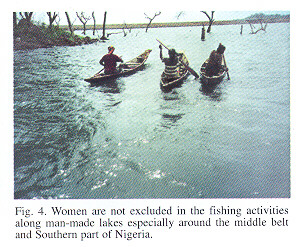
<body><![CDATA[<br>  &nbsp;     <br>       <div align="Justify"><font face="Arial"><font size="-1">I have also observed  with dismay that in some places where man-made lakes were primarily established  for electricity and irrigation in Nigeria, the<b> </b>surrounding communities  lack piped water, hence the people make use of the raw water from the lake  for washing and drinking without any form of purification, and this has compounded  the problem of water borne diseases (<a href="#fig3">Fig. 3</a>  ). The bacteria count obtained from these water bodies were usually higher  than the recommended minimum standard of not more than 100 bacteria/ml of  sample (<a href="#Anonymous00">Anonymous 2000</a>  ). This falls short from VMUs (<a href="#Anonymous85">Anonymous 1985</a>  ) requirements that drinking water must be devoid of pathogenic organisms  and be free from bacteria indicative of sewage pollution. There must be education  to the communities on the life cycle of some pathogenic organisms and the  risk of contacting water borne diseases through indiscrinate exposure to such water bodies. This can be achieved through community sensitization and advocacy programs, which should have commenced even before the creation of such water bodies. After the creation of the water bodies there should be monitoring and evaluation in order to assess the impact of the sensitization  and advocacy program.</font></font>     <br>  </div>  &nbsp;       <center>&nbsp;<a name="fig3"></a>  <img src="/img/fbpe/rbt/v50n2-3/2119i03.JPG" height="394" width="592">  </center>           
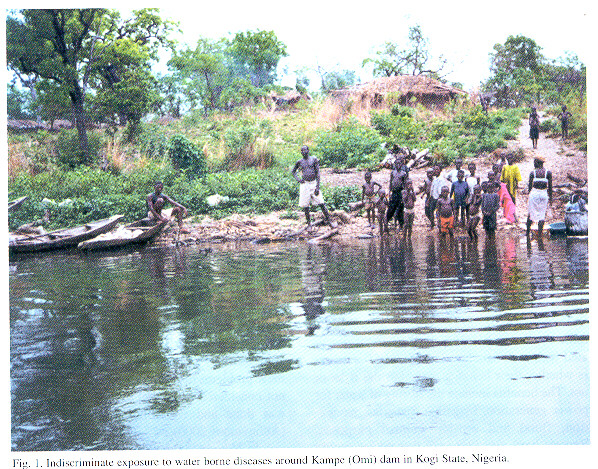
<div align="Justify"><font face="Arial"><font size="-1">The poor and uneconomic  management of lake fisheries is another major issue of concern. The creation  of a dam also provides an ecosystem for the proliferation of a wide range  of aquatic organisms (<a href="#Umana90">Uma&ntilde;a and Collado 1990</a>  , <a href="#Saliu89">Saliu 1989</a>  , <a href="#Chow94">Chow <i>et al </i>1994</a>  , <a href="#Umana97">Uma&ntilde;a <i>et al</i> 1997</a>  , <a href="#Lopez-Lopez99">L&oacute;pez-L&oacute;pez and Serna-Hern&aacute;ndez  1999</a>  ), of which the fish fauna (<a href="#Willoughby76">Willoughby 1976</a>  , <a href="#Fagade79">Fagade and Adebisi 1979</a>  , <a href="#Fagade83">Fagade 1983</a>  , <a href="#Ulloa-Rojas88">Ulloa Rojas <i>et al. </i>1988</a>  , <a href="#Mora97">Mora <i>et al </i>1997</a>  , <a href="#Araoye98">Araoye 1998</a>  , <a href="#Araoye99">Araoye 1999</a>  , <a href="#Araoye-jeje99">Araoye and Jeje 1999</a>  , <a href="#Araoye00a">Araoye 2000a</a>  , <a href="#Fawole00">Fawole and Arawomo 2000</a>  , <a href="#Araoye01">Araoye 2001</a>  , <a href="#Duarte02">Duarte and Ara&uacute;jo 2002</a>  , <a href="#Saliu02a">Saliu 2002a</a>  , <a href="#Saliu02b">b</a>  ) occupies a vital position in promoting socio-economic activities of the  surrounding communities (<a href="#Araoye00b">Araoye 2000b</a>  , <a href="#Achionye-Nzeh02">Achionye-Nzeh and Omoniyi 2002</a>  , <a href="#Fawole02">Fawole 2002</a>  ), if well managed (<a href="#fig4">Fig. 4</a>  ).</font></font>     <br>  </div>       <p>&nbsp; </p>       <center>&nbsp;<a name="fig4"></a>  <img src="/img/fbpe/rbt/v50n2-3/2119i04.JPG" height="247" width="298">  </center>           
<div align="Justify">      ]]></body>
<body><![CDATA[<p><font face="Arial"><font size="-1">What interests me in the study of the  ecology of <i>Synodontis schall </i>in Asa dam, llorin, Nigeria, for my Ph.D. at the University of Ibadan, was its distribution and abundance within its environment. The scramble for this fish at a popular fish market in Borin,  shows that it is highly relished by the coinmunity. This is because of its  small to medium size range that has made its price abordable especially to  the low income group. Both fresh and dried fish are usually available at the local fish markets almost through out the year, and most abundant during the dry season. I get interested in studying its environment in relation with its feeding habits, distribution and abundance, reproductive biology, age and growth studies and gill net efficiency. I noticed that this fish was diverse in its feeding habits because it feeds on a variety of food items  including insects, mollusk, detritus, plant materials and fish scales (<a href="#Araoye-jeje99">  Araoye and Jeje 1999</a>  ). These food items were dispersad all along the surface, shore and bottom  habitats which constitute the three major ecological niches of their environment  (<a href="#Araoye99">Araoye 1999</a>  ). Even though this fish was classified as omnivore in the environment of  Asa dam (<a href="#Araoye-jeje99">Araoye and Jeje 1999</a>  ), reports from River Benue showed that <i>S. schall </i>was grouped among  the predatory species because their choice of food ranged from an assortment  of invertebrates to other fishes (<a href="#Fagade83">Fagade 1983</a>  ). The distribution of the wide variety of food items along the surface,  shore and bottom avails the fish the opportunity to explore the different  habitats at different seasons of the year (<a href="#Araoye99">Araoye 1999</a>  ). The presence of a physostomous swim bladder, the bony shield of the head  and high fat deposition provided the fish the opportunity to explore the bottom habitat despite higher pressure (<a href="#Willoughby76">Willoughby  1976</a>  ). The production potential of this fish has been hampered due to un-controlled  fishing around the dam and the lukewarm attitude towards the management of  the lake fisheries. In my study of the gill net efficiency, it was noticed  that fish specimen below the age group one were captured by the fishermen.  Hence it was suggested that the use of net meshes below 7.62 cm around the  lake should be discouraged (<a href="#Araoye98">Araoye 1998</a>  ). <i>Synodontis </i>are unique in the sense that they are specially armored  due to the presence of well developed cephalo-nuchal shield attached with  sharp dorsal and pectoral spines. lt was funny to Professor Adewolu, one of my colleagues, when she saw me in my laboratory with a mini saw blade that was being used initially to cut this bony shield of the head from the dorsal surface to expose the brain in search of the pair of the otoliths. lt was also interesting to detect a defect in the size of a pectoral spine in one of the specimens out of the 813 specimens that I worked with. This defect was a rare occurtence caused by an injury which probably became infected during healing (<a href="#Araoye00a">Araoye 2000a</a>  ).</font></font>  </p>  </div>       <div align="Justify">      <p><font face="Arial"><font size="-1">Although this fish spawns annually and exhibited high fecundity, there is still a great threat to its sustainability  if fishing and natural mortality continue to progress over the recruitment  rate in this environment. The preponderance of the juveniles of this fish  in the fisherrnen catches during the months of November to December was as a result of the progeny that emerged from the reproductive activities which was at its peak in July to August (<a href="#Araoye01">Araoye 2001</a>  ). This indicates poor and uneconomic fishing activities due to bad management  of the lake fishery. The enforcement of fishery rules and regulations to protect valuable water resources in Nigeria and other West African countries is taken with levity. The factors that are responsible for this problem are many ranging from defects in the policies and the mode of implementation to defects in the expertise, attitude and practices of the fishermen and their communities particularly the consumers. Due to ignorance, there is a general belief among the local fishermen that fishery resources can never be depleted or exhausted because it is a gift from heaven. Unless we correct this erroneous perception, our fishery resources would continue to remain in a state of emergency. Hence I recommended advocacy program to sensitize the fishermen and the community on conservation needs in order to sustain this fish species as others as well (<a href="#Araoye00c">Araoye 2000c</a>  ). This program would involve the training of peer educators on conservation,  and also information dissemination on conservation needs through dramas, role plays and use of IEC (Information, Education &amp; Communication) materials  such as posters, hand bills, etc. Although I have started on this program  along Kampe (Omi) dam, however funding is another major obstacle facing fishery  experts in Tropical West Africa. Assistance from internacional agencies, private agencies and non-govemmental organizations (NGOs) may bring succor to this major obstacle.</font></font>  </p>  </div>       <div align="Justify">      <p><font face="Arial"><font size="-1">I worked with six fishermen leaders  for fishing and record keeping during my study in Asa dam, because I wanted  the information from my research findings to get to the grass roots. Most  of the researches that have been carried out in the past on fish biology did not carty the grass roots along hence their findings may not be impacted because such findings only circulate within the academic environment. I was a full time post graduate student because I took a study leave. I was able to sustain the study financially through my little savings and through the little stipend of N3600 per annum (approximately $28 per annum) being paid to me as award for post graduate teaching assistant only between the year 1991-1993. I was able to win this award through the assistance of my supervisor, C.Y Jeje of the Department of Zoology University of Ibadan, Nigeria. Further help was received from J.S. Omotosho of the Department of Biological Sciences,  University of llorin, who assisted in the identification of the fish species,  while S.S. Ogbogu of the Department of Zoology, Obafemi Awolowo University,  lfe, Nigeria, helped in the identification of the various insects. The libraries  of the University of Ibadan and University of llorin were most useful for  literature review, while N.G. Willoughby of Natural Resources Institute (N.R.I.),  United Kingdom sent me relevant pubIications of his work on the genus <i>  Synodontis. </i>The Chief Laboratory Technologist of the Department of Zoology  University of Ibadan, O.A. Ibrahim also supported me in water sample analysis  while the meteorological unit of the llorin International Airport supplied  meteorological data. For now, I have decided to remain in fisheries development  and ecological programs because I want to practice my academic knowledge for the benefit of the people in order to sustain the aquatic resources particularly  fisheries. I still hope to end my academic career in the University here or abroad. Since I completed my PhD program in 1997, I have met and worked with over 500 local fishermen and my experience with them has heen very exiting.  Although I experienced communication problem with some of them, who don't  speak my local language or English due to illiteracy, however I am able to  overcome this problem because a few among them attended elementary schools  and can interpret my messages to their colleagues in their local language.  In the past these fishermen and poachers usually run away from govemment officials but this orientation has started changing due to enlightenment programs and they are now getting closer and becoming more friendly not only to the government officials but also to the environment in which they operate.</font></font>    </p>  </div>       <div align="Justify">      <p><font face="Arial"><font size="-1">Apart from the primary objective of  creating these water bodies, there is usually no interest for the tapping  of some other benefits that could be derived from such projects to alleviate  poverty. Hence the full potentials of such water bodies remained untapped  and wasted. Big dam projects are supposed to be of multipurpose use, therefore  it is not only the engineers who may be interested in the construction works  alone, but there is also the need to involve experts from other related discipline  for bio-socio-economic reasons. Hence biologists, sociologists and economists  are to join hands together with the engineers during the planning and the  implementation stages of man-made lake projects in Nigeria and other tropical  regions.</font></font>  </p>  </div>       <p><font face="Arial"><font size="-1">&nbsp;</font></font>     <br>  <b><font face="Arial"><font size="-1">Acknowledgement</font></font></b>  </p>       <div align="Justify">      ]]></body>
<body><![CDATA[<p><font face="Arial"><font size="-1">I am grateful to Afremedev Consultancy  Services Limited for giving me the opportunity to share my experiences with  their consultants in the ecological study of Kampe (Omi dam) and irrigation  project in Nigeria. I thank F.A. Adeniji of the University of Maiduguri Nigeria and S.O. Fagade of the University of Ibadan - Nigeria. I am also grateful to Atab Nigeria Investment Limited for inviting me to contribute in the study of Environmental Impact Assessment (EIA) of Tada -Tshoga flood plain and irrigation project of the Lower Niger River Basin Development Authority,  llorin - Nigeria.</font></font>  </p>  </div>       <p><font face="Arial"><font size="-1">I thank my employer, for providing the enabling environment to exercise my knowledge.</font></font>  </p>       <p><font face="Arial"><font size="-1">&nbsp;</font></font>     <br>  <b><font face="Arial"><font size="-1">Resumen</font></font></b>  </p>       <div align="Justify">      <p><font face="Arial"><font size="-1">La creaci&oacute;n de represas y lagos  artificiales en Nigeria y en otros pa&iacute;ses en v&iacute;as de desarrollo,  produce importantes beneficios, pero trae tambi&eacute;n grandes riesgos,  pues es dif&iacute;cil evitar sus consecuencias inherentes, hacia el detrimento  del hombre y su ambiente. Los pa&iacute;ses que desarrollan este tipo de proyectos deben adquirir deudas, desplazar personas y animales y enfrentar la destrucci&oacute;n de tierras que podr&iacute;an utilizarse para cultivo, as&iacute; como tambi&eacute;n la degradaci&oacute;n del bosque y la vida silvestre. Se ha ignorado adem&aacute;s, el riesgo que representa para el hombre y su ganado, la exposici&oacute;n indiscriminada a enfermedades transmitidas por el agua. El manejo pobre y antiecon&oacute;mico de los recursos pesqueros es otro factor importante a considerar. Con el objetivo de lograr un mejor aprovechamiento del potencial de las represas y promover la conservaci&oacute;n, es importante organizar mesas redondas que involucren a todos los que participan durante la fase de planeamiento de los proyectos. Adem&aacute;s de los trabajos de ingenier&iacute;a, se necesita de la colaboraci&oacute;n interdisciplinaria de expertos en &aacute;reas relacionadas, para los aspectos bio-socio-econ&oacute;micos de las fases de planeamiento e implementaci&oacute;n de los proyectos de embalse, tanto en Nigeria como en otros pa&iacute;ses en v&iacute;as de desarrollo.</font></font>    </p>  </div>       <p><font face="Arial"><font size="-1">&nbsp;</font></font>     <br>  <b><font face="Arial"><font size="-1">References</font></font></b>  </p>       <div align="Justify">      <!-- ref --><p><a name="Achionye-Nzeh02"></a>  <font face="Arial"><font size="-1">Achionye-Nzeh, C.G. &amp; O.G. Omoniyi.  2002. Lipid composition of the fishes <i>Heterotis niloticus, Brycenus</i>   <i>nurse, Gnathonemus cyprinoides and Sarotherodon</i> <i>galilaeus </i>  from a small lake in Nigeria. Rev. Biol. Trop. 50: 253-257.    &nbsp;&nbsp;&nbsp;&nbsp;&nbsp;&nbsp;&nbsp;&nbsp;[&#160;<a href="javascript:void(0);" onclick="javascript: window.open('/scielo.php?script=sci_nlinks&ref=1681335&pid=S0034-7744200200030000500001&lng=','','width=640,height=500,resizable=yes,scrollbars=1,menubar=yes,');">Links</a>&#160;]<!-- end-ref --></font></font>    </p>       <!-- ref --><p><a name="Anonymous85"></a>  <font face="Arial"><font size="-1">Anonymous. 1985. WHO for drinkig water,  recommendation. World Health Organisation, Macmillan, pp.<b> </b>17- 48.    &nbsp;&nbsp;&nbsp;&nbsp;&nbsp;&nbsp;&nbsp;&nbsp;[&#160;<a href="javascript:void(0);" onclick="javascript: window.open('/scielo.php?script=sci_nlinks&ref=1681337&pid=S0034-7744200200030000500002&lng=','','width=640,height=500,resizable=yes,scrollbars=1,menubar=yes,');">Links</a>&#160;]<!-- end-ref --></font></font>    </p>       <!-- ref --><p><a name="Anonymous00"></a>  <font face="Arial"><font size="-1">Anonymous. 2000. Environmental Impact  Assessment Report. Kampe (Omi) dam and irrigation project Kogi State, Nigeria.  Report submitted to the Lower Niger River Basin Development Authority, by  Afremedev Consultancy Services Limited, llorin, Nigeria. 207 p.    &nbsp;&nbsp;&nbsp;&nbsp;&nbsp;&nbsp;&nbsp;&nbsp;[&#160;<a href="javascript:void(0);" onclick="javascript: window.open('/scielo.php?script=sci_nlinks&ref=1681339&pid=S0034-7744200200030000500003&lng=','','width=640,height=500,resizable=yes,scrollbars=1,menubar=yes,');">Links</a>&#160;]<!-- end-ref --></font></font>    </p>       <!-- ref --><p><a name="Araoye98"></a>  <font face="Arial"><font size="-1">Araoye, P.A. 1998. Gill net efficiency  for <i>Synodontis schall</i> (Pisces: Mochokidae) in the environment of Asa  lake, llorin Nigeria. J.<b> </b>Pure Appl. Sci. 13: 636-644.    &nbsp;&nbsp;&nbsp;&nbsp;&nbsp;&nbsp;&nbsp;&nbsp;[&#160;<a href="javascript:void(0);" onclick="javascript: window.open('/scielo.php?script=sci_nlinks&ref=1681341&pid=S0034-7744200200030000500004&lng=','','width=640,height=500,resizable=yes,scrollbars=1,menubar=yes,');">Links</a>&#160;]<!-- end-ref --></font></font>    </p>       <!-- ref --><p><a name="Araoye99"></a>  <font face="Arial"><font size="-1">Araoye, P.A. 1999. Spatio-temporal distribution  of <i>Synodontis schall </i>(Teleotei: Mochokidae) in Asa dam llorin, Nigeria.  Rev. Biol. Trop. 47: 1061-1066.    &nbsp;&nbsp;&nbsp;&nbsp;&nbsp;&nbsp;&nbsp;&nbsp;[&#160;<a href="javascript:void(0);" onclick="javascript: window.open('/scielo.php?script=sci_nlinks&ref=1681343&pid=S0034-7744200200030000500005&lng=','','width=640,height=500,resizable=yes,scrollbars=1,menubar=yes,');">Links</a>&#160;]<!-- end-ref --></font></font>  </p>       <!-- ref --><p><a name="Araoye-jeje99"></a>  <font face="Arial"><font size="-1">Araoye, P.A. &amp; C.Y. Jeje. 1999. The  diet <i>of Synodontis</i> <i>schall </i>(Bloch &amp; Schneider 1801) in Asa  dain Ilorin, Nigeria. Nigerian J. Nat. Sci. 33: 67-76.    &nbsp;&nbsp;&nbsp;&nbsp;&nbsp;&nbsp;&nbsp;&nbsp;[&#160;<a href="javascript:void(0);" onclick="javascript: window.open('/scielo.php?script=sci_nlinks&ref=1681345&pid=S0034-7744200200030000500006&lng=','','width=640,height=500,resizable=yes,scrollbars=1,menubar=yes,');">Links</a>&#160;]<!-- end-ref --></font></font>  </p>       <!-- ref --><p><a name="Araoye00a"></a>  <font face="Arial"><font size="-1">Araoye, P.A. 2000a. Pectoral spine size  in <i>Synodontis schall</i> (Teleotei: Mochokidac) in Asa lake llorin, Nigeria.  Rev. Biol. Trop. 48: 519-510.    &nbsp;&nbsp;&nbsp;&nbsp;&nbsp;&nbsp;&nbsp;&nbsp;[&#160;<a href="javascript:void(0);" onclick="javascript: window.open('/scielo.php?script=sci_nlinks&ref=1681347&pid=S0034-7744200200030000500007&lng=','','width=640,height=500,resizable=yes,scrollbars=1,menubar=yes,');">Links</a>&#160;]<!-- end-ref --></font></font>  </p>  </div>       <div align="Justify">      <!-- ref --><p><a name="Araoye00b"></a>  <font face="Arial"><font size="-1">Araoye, RA. 2000b. A base line study for an intervention program to promote sustainable fisheries in the environment  of Kampe (Omi) dam and Irrigation project, Kogi State, Nigeria. Biosci. Res.  Comm. 12: 331-336.    &nbsp;&nbsp;&nbsp;&nbsp;&nbsp;&nbsp;&nbsp;&nbsp;[&#160;<a href="javascript:void(0);" onclick="javascript: window.open('/scielo.php?script=sci_nlinks&ref=1681350&pid=S0034-7744200200030000500008&lng=','','width=640,height=500,resizable=yes,scrollbars=1,menubar=yes,');">Links</a>&#160;]<!-- end-ref --></font></font>  </p>       <p><a name="Araoye00c"></a>  <font face="Arial"><font size="-1">Araoye, RA. 2000c. Conservation needs  for the fisheries resources of Kampe (Omi) dam and irrigation project in Kogi State Nigeria. (accepted) In Proceedings of the 15<sup>th</sup> annual conference of the Fisheries society of Nigeria. 191 - 241 March 2000, Jos Plateau State, Nigeria.</font></font>  </p>       <!-- ref --><p><a name="Araoye01"></a>  <font face="Arial"><font size="-1">Araoye, P.A. 2001. Morphology of the gonads in die reproductive cycle of <i>Synodontis schall </i>(Teleotei: Mochokidae)  in Asa dam llorin, Nigeria. J. Aquatic Sci. 16: 105-110.    &nbsp;&nbsp;&nbsp;&nbsp;&nbsp;&nbsp;&nbsp;&nbsp;[&#160;<a href="javascript:void(0);" onclick="javascript: window.open('/scielo.php?script=sci_nlinks&ref=1681353&pid=S0034-7744200200030000500010&lng=','','width=640,height=500,resizable=yes,scrollbars=1,menubar=yes,');">Links</a>&#160;]<!-- end-ref --></font></font>  </p>       <!-- ref --><p><a name="Chow94"></a>  <font face="Arial"><font size="-1">Chow, N., G. Uma&ntilde;a &amp; F. Fernandez.  1994. Comparaci&oacute;n del fitoplancton en dos bah&iacute;as del Embalse  de Arenal (Costa Rica) empleando el microscopio electr&oacute;nico. Rev. Biol. Trop. 42: 333-338.    &nbsp;&nbsp;&nbsp;&nbsp;&nbsp;&nbsp;&nbsp;&nbsp;[&#160;<a href="javascript:void(0);" onclick="javascript: window.open('/scielo.php?script=sci_nlinks&ref=1681355&pid=S0034-7744200200030000500011&lng=','','width=640,height=500,resizable=yes,scrollbars=1,menubar=yes,');">Links</a>&#160;]<!-- end-ref --></font></font>  </p>       <!-- ref --><p><a name="Dellere89"></a>  <font face="Arial"><font size="-1">Dellere, R. 1989. Land and food. The challenges of sustainable agriculture in the Tropics. Technical Center for Agriculture and rural cooperation (CTA), Wageningen, Netherlands. 96 p</font></font>    &nbsp;&nbsp;&nbsp;&nbsp;&nbsp;&nbsp;&nbsp;&nbsp;[&#160;<a href="javascript:void(0);" onclick="javascript: window.open('/scielo.php?script=sci_nlinks&ref=1681357&pid=S0034-7744200200030000500012&lng=','','width=640,height=500,resizable=yes,scrollbars=1,menubar=yes,');">Links</a>&#160;]<!-- end-ref --><!-- ref --><p><a name="Duarte02"></a>  <font face="Arial"><font size="-1">Duarte S. &amp; E Gerson Ara&uacute;jo.  2002. Fecundity of the Hypostomus affinis (Siluriformes, Loricariidae) in  the Lajes Reservoir, Rio de Janeiro, Brazil. Rev. Biol. Trop. 50: 193-197.    &nbsp;&nbsp;&nbsp;&nbsp;&nbsp;&nbsp;&nbsp;&nbsp;[&#160;<a href="javascript:void(0);" onclick="javascript: window.open('/scielo.php?script=sci_nlinks&ref=1681358&pid=S0034-7744200200030000500013&lng=','','width=640,height=500,resizable=yes,scrollbars=1,menubar=yes,');">Links</a>&#160;]<!-- end-ref --></font></font>    </p>  </div>       <div align="Justify">      <!-- ref --><p><a name="Fagade79"></a>  <font face="Arial"><font size="-1">Fagade, S.O. &amp; A.A. Adebisi 1979.  On the fecundity of <i>Chrysichthys nigrodigitatus </i>(Lacepede) of Asejire  dam, Oyo State, Nigeria. Nigerian J. Nat. Sci 1: 127131.    &nbsp;&nbsp;&nbsp;&nbsp;&nbsp;&nbsp;&nbsp;&nbsp;[&#160;<a href="javascript:void(0);" onclick="javascript: window.open('/scielo.php?script=sci_nlinks&ref=1681361&pid=S0034-7744200200030000500014&lng=','','width=640,height=500,resizable=yes,scrollbars=1,menubar=yes,');">Links</a>&#160;]<!-- end-ref --></font></font>  </p>       <!-- ref --><p><a name="Fagade83"></a>  <font face="Arial"><font size="-1">Fagade, S.O. 1983. Food and feeding habits  of the fishes of Lower River Benue, Nigeria. Bull. De IFAN. Jan. I.T. 45 Ser. A. No. 3-4: 316-314.    &nbsp;&nbsp;&nbsp;&nbsp;&nbsp;&nbsp;&nbsp;&nbsp;[&#160;<a href="javascript:void(0);" onclick="javascript: window.open('/scielo.php?script=sci_nlinks&ref=1681363&pid=S0034-7744200200030000500015&lng=','','width=640,height=500,resizable=yes,scrollbars=1,menubar=yes,');">Links</a>&#160;]<!-- end-ref --></font></font>  </p>       <!-- ref --><p><a name="Fawole00"></a>  <font face="Arial"><font size="-1">Fawole, O.O. &amp; G.A.O. Arawomo, 2000.  Fecundity of <i>Sarotherodon galelaeus </i>(Pisces: Cichlidae) in Opa reservoir,  Ile-lfe, Nigeria. Rev. Biol. Trop. 48: 201-204.    &nbsp;&nbsp;&nbsp;&nbsp;&nbsp;&nbsp;&nbsp;&nbsp;[&#160;<a href="javascript:void(0);" onclick="javascript: window.open('/scielo.php?script=sci_nlinks&ref=1681365&pid=S0034-7744200200030000500016&lng=','','width=640,height=500,resizable=yes,scrollbars=1,menubar=yes,');">Links</a>&#160;]<!-- end-ref --></font></font>  </p>       <!-- ref --><p><a name="Fawole02"></a>  <font face="Arial"><font size="-1">Fawole, O.O. 2002. Morphometry and diet  of Mormyrus rume in the Lekki lagoon, Nigeria. Rev. Biol. Trop. 50: 689-694.    &nbsp;&nbsp;&nbsp;&nbsp;&nbsp;&nbsp;&nbsp;&nbsp;[&#160;<a href="javascript:void(0);" onclick="javascript: window.open('/scielo.php?script=sci_nlinks&ref=1681367&pid=S0034-7744200200030000500017&lng=','','width=640,height=500,resizable=yes,scrollbars=1,menubar=yes,');">Links</a>&#160;]<!-- end-ref --></font></font>    </p>       <!-- ref --><p><a name="Goldman76"></a>  <font face="Arial"><font size="-1">Goldman, C.R. 1976. Ecological aspects  of water impoundment in tropics. Rev. Biol. Trop. 24(Suppl. 1): 87-112.    &nbsp;&nbsp;&nbsp;&nbsp;&nbsp;&nbsp;&nbsp;&nbsp;[&#160;<a href="javascript:void(0);" onclick="javascript: window.open('/scielo.php?script=sci_nlinks&ref=1681369&pid=S0034-7744200200030000500018&lng=','','width=640,height=500,resizable=yes,scrollbars=1,menubar=yes,');">Links</a>&#160;]<!-- end-ref --></font></font>    </p>       <!-- ref --><p><a name="Lopez-Lopez99"></a>  <font face="Arial"><font size="-1">L&oacute;pez-L&oacute;pez, E. &amp; J.A.  Serna-Hern&aacute;ndez. 1999. Variaci&oacute;n estacional del zooplancton  del embalse Ignacio Allende, Guanajuato, M&eacute;xico y su relaci&oacute;n  con el fitoplancton y factores ambientales. Rev. Biol. Trop. 47: 643657.    &nbsp;&nbsp;&nbsp;&nbsp;&nbsp;&nbsp;&nbsp;&nbsp;[&#160;<a href="javascript:void(0);" onclick="javascript: window.open('/scielo.php?script=sci_nlinks&ref=1681371&pid=S0034-7744200200030000500019&lng=','','width=640,height=500,resizable=yes,scrollbars=1,menubar=yes,');">Links</a>&#160;]<!-- end-ref --></font></font>    </p>  </div>       <!-- ref --><p><a name="Mora97"></a>  <font face="Arial"><font size="-1">Mora J., M, J. Cabrera P. &amp; W. Alvarado  B. 1997. Crecimiento y maduraci&oacute;n sexual de Astyanax fasciatus (Pisces:  Characidae) en el embalse Arenal, Guanacaste, Costa Rica. Rev. Biol. Trop.  45: 855- 859.    &nbsp;&nbsp;&nbsp;&nbsp;&nbsp;&nbsp;&nbsp;&nbsp;[&#160;<a href="javascript:void(0);" onclick="javascript: window.open('/scielo.php?script=sci_nlinks&ref=1681373&pid=S0034-7744200200030000500020&lng=','','width=640,height=500,resizable=yes,scrollbars=1,menubar=yes,');">Links</a>&#160;]<!-- end-ref --></font></font>  </p>       <!-- ref --><p><a name="Saliu89"></a>  <font face="Arial"><font size="-1">Saliu, J.K., Jr. 1989. Aquatic insects  associated with plants in two reservoirs at Ibadan, Nigeria. Rev. Biol. Trop.  37: 217-220.    &nbsp;&nbsp;&nbsp;&nbsp;&nbsp;&nbsp;&nbsp;&nbsp;[&#160;<a href="javascript:void(0);" onclick="javascript: window.open('/scielo.php?script=sci_nlinks&ref=1681375&pid=S0034-7744200200030000500021&lng=','','width=640,height=500,resizable=yes,scrollbars=1,menubar=yes,');">Links</a>&#160;]<!-- end-ref --></font></font>  </p>       <div align="Justify">      <!-- ref --><p><a name="Saliu02a"></a>  <font face="Arial"><font size="-1">Saliu, J.K. 2002a. Size, sex and seasonal  dynamics in the dietary cornposition of <i>Brycinus nurse </i>(Pisces: Characidae),  from Asa reservoir, llorin, Nigeria. Rev. Biol. Trop. 50: 233-238.    &nbsp;&nbsp;&nbsp;&nbsp;&nbsp;&nbsp;&nbsp;&nbsp;[&#160;<a href="javascript:void(0);" onclick="javascript: window.open('/scielo.php?script=sci_nlinks&ref=1681378&pid=S0034-7744200200030000500022&lng=','','width=640,height=500,resizable=yes,scrollbars=1,menubar=yes,');">Links</a>&#160;]<!-- end-ref --></font></font>    </p>       <!-- ref --><p><a name="Saliu02b"></a>  <font face="Arial"><font size="-1">Saliu, J.K. 2002b. The diet of <i>Brycinus  nurse </i>(Pisces: Characidae) from Asa reservoir, llorin, Nigeria. Rev. Biol. Trop. 50: 239-242.    &nbsp;&nbsp;&nbsp;&nbsp;&nbsp;&nbsp;&nbsp;&nbsp;[&#160;<a href="javascript:void(0);" onclick="javascript: window.open('/scielo.php?script=sci_nlinks&ref=1681380&pid=S0034-7744200200030000500023&lng=','','width=640,height=500,resizable=yes,scrollbars=1,menubar=yes,');">Links</a>&#160;]<!-- end-ref --></font></font>  </p>       <!-- ref --><p><a name="Ulloa-Rojas88"></a>  <font face="Arial"><font size="-1">Ulloa Rojas, J., O. Alp&iacute;rez Quesada  &amp; J. Cabrera Pe&ntilde;a. 1988. Presencia de <i>Bryconamericus scleroparius,  Poeciliopsis turrubarensis y Cichlasoma nicaraguense </i>en el Embalse Arenal,  Costa Rica. Rev. Biol. Trop. 36: 171-172.    &nbsp;&nbsp;&nbsp;&nbsp;&nbsp;&nbsp;&nbsp;&nbsp;[&#160;<a href="javascript:void(0);" onclick="javascript: window.open('/scielo.php?script=sci_nlinks&ref=1681382&pid=S0034-7744200200030000500024&lng=','','width=640,height=500,resizable=yes,scrollbars=1,menubar=yes,');">Links</a>&#160;]<!-- end-ref --></font></font>  </p>       <!-- ref --><p><a name="Umana97"></a>  <font face="Arial"><font size="-1">Uma&ntilde;a, G., F. Villalobos &amp;  B. Bofill. 1997. Distribuci&oacute;n vertical de zooplancton en el Embalse  Arenal, Costa Rica. Rev. Biol. Trop. 45: 923-926.    &nbsp;&nbsp;&nbsp;&nbsp;&nbsp;&nbsp;&nbsp;&nbsp;[&#160;<a href="javascript:void(0);" onclick="javascript: window.open('/scielo.php?script=sci_nlinks&ref=1681384&pid=S0034-7744200200030000500025&lng=','','width=640,height=500,resizable=yes,scrollbars=1,menubar=yes,');">Links</a>&#160;]<!-- end-ref --></font></font>  </p>       ]]></body>
<body><![CDATA[<!-- ref --><p><a name="Umana90"></a>  <font face="Arial"><font size="-1">Uma&ntilde;a, G. &amp; C. Collado. 1990.  Asociaci&oacute;n planct&oacute;nica en el Embalse Arenal, Costa Rica. Rev.  Biol. Trop. 38: 311-321.    &nbsp;&nbsp;&nbsp;&nbsp;&nbsp;&nbsp;&nbsp;&nbsp;[&#160;<a href="javascript:void(0);" onclick="javascript: window.open('/scielo.php?script=sci_nlinks&ref=1681386&pid=S0034-7744200200030000500026&lng=','','width=640,height=500,resizable=yes,scrollbars=1,menubar=yes,');">Links</a>&#160;]<!-- end-ref --></font></font>  </p>  </div>       <!-- ref --><p><a name="Willoughby76"></a>  <font face="Arial"><font size="-1">Willoughby, N.G. 1976. The buoyancy and  orientation of the upside-down cat fishes of the genus <i>Synodontis </i>  (Pisces: Siluroidei). J. Zool. Lond. 180: 291-314.    &nbsp;&nbsp;&nbsp;&nbsp;&nbsp;&nbsp;&nbsp;&nbsp;[&#160;<a href="javascript:void(0);" onclick="javascript: window.open('/scielo.php?script=sci_nlinks&ref=1681388&pid=S0034-7744200200030000500027&lng=','','width=640,height=500,resizable=yes,scrollbars=1,menubar=yes,');">Links</a>&#160;]<!-- end-ref --></font></font>     <br>  &nbsp;     <br>  &nbsp;  </p>       <div align="Justify">      <p><a name="*a"></a>  <font face="Arial"><font size="-1"><a href="#*">*</a>  &nbsp; Lower Niger Basin Development Authority, P.O. Box 5565, llorin - Nigeria;  Tel: 23431224090; <a href="mailto:paraoye@skannet.com">paraoye@skannet.com</a>  </font></font> <font face="Arial"><font size="-1">and Present address: Departament  of Biological Sciences. University of llorin, llorin-Nigeria.</font></font>   </p>  </div>        ]]></body><back>
<ref-list>
<ref id="B1">
<nlm-citation citation-type="journal">
<person-group person-group-type="author">
<name>
<surname><![CDATA[Achionye-Nzeh]]></surname>
<given-names><![CDATA[C.G]]></given-names>
</name>
<name>
<surname><![CDATA[Omoniyi]]></surname>
<given-names><![CDATA[O.G]]></given-names>
</name>
</person-group>
<article-title xml:lang="en"><![CDATA[Lipid composition of the fishes Heterotis niloticus, Brycenus nurse, Gnathonemus cyprinoides and Sarotherodon galilaeus from a small lake in Nigeria]]></article-title>
<source><![CDATA[Rev. Biol. Trop]]></source>
<year>2002</year>
<volume>50</volume>
<page-range>253-257</page-range></nlm-citation>
</ref>
<ref id="B2">
<nlm-citation citation-type="book">
<person-group person-group-type="author">
<name>
</name>
<name>
</name>
</person-group>
<source><![CDATA[WHO for drinkig water, recommendation]]></source>
<year>1985</year>
<page-range>17- 48</page-range><publisher-loc><![CDATA[Macmillan ]]></publisher-loc>
<publisher-name><![CDATA[World Health Organisation]]></publisher-name>
</nlm-citation>
</ref>
<ref id="B3">
<nlm-citation citation-type="">
<person-group person-group-type="author">
<name>
</name>
<name>
</name>
</person-group>
<source><![CDATA[Environmental Impact Assessment Report. Kampe (Omi) dam and irrigation project Kogi State, Nigeria]]></source>
<year>2000</year>
<page-range>207</page-range><publisher-loc><![CDATA[llorin ]]></publisher-loc>
</nlm-citation>
</ref>
<ref id="B4">
<nlm-citation citation-type="journal">
<person-group person-group-type="author">
<name>
<surname><![CDATA[Araoye]]></surname>
<given-names><![CDATA[P.A]]></given-names>
</name>
</person-group>
<article-title xml:lang="en"><![CDATA[Gill net efficiency for Synodontis schall (Pisces: Mochokidae) in the environment of Asa lake, llorin Nigeria]]></article-title>
<source><![CDATA[J. Pure Appl. Sci]]></source>
<year>1998</year>
<volume>13</volume>
<page-range>636-644</page-range></nlm-citation>
</ref>
<ref id="B5">
<nlm-citation citation-type="journal">
<person-group person-group-type="author">
<name>
<surname><![CDATA[Araoye]]></surname>
<given-names><![CDATA[P.A]]></given-names>
</name>
</person-group>
<article-title xml:lang="en"><![CDATA[Spatio-temporal distribution of Synodontis schall (Teleotei: Mochokidae) in Asa dam llorin, Nigeria]]></article-title>
<source><![CDATA[Rev. Biol. Trop]]></source>
<year>1999</year>
<volume>47</volume>
<page-range>1061-1066</page-range></nlm-citation>
</ref>
<ref id="B6">
<nlm-citation citation-type="journal">
<person-group person-group-type="author">
<name>
<surname><![CDATA[Araoye]]></surname>
<given-names><![CDATA[P.A]]></given-names>
</name>
<name>
<surname><![CDATA[Jeje]]></surname>
<given-names><![CDATA[C.Y]]></given-names>
</name>
</person-group>
<article-title xml:lang="en"><![CDATA[The diet of Synodontis schall (Bloch & Schneider 1801) in Asa dain Ilorin, Nigeria]]></article-title>
<source><![CDATA[Nigerian J. Nat. Sci]]></source>
<year>1999</year>
<volume>33</volume>
<page-range>67-76</page-range></nlm-citation>
</ref>
<ref id="B7">
<nlm-citation citation-type="journal">
<person-group person-group-type="author">
<name>
<surname><![CDATA[Araoye]]></surname>
<given-names><![CDATA[P.A]]></given-names>
</name>
</person-group>
<article-title xml:lang="en"><![CDATA[Pectoral spine size in Synodontis schall (Teleotei: Mochokidac) in Asa lake llorin, Nigeria]]></article-title>
<source><![CDATA[Rev. Biol. Trop]]></source>
<year>2000</year>
<volume>48</volume>
<page-range>519-510</page-range></nlm-citation>
</ref>
<ref id="B8">
<nlm-citation citation-type="journal">
<person-group person-group-type="author">
<name>
<surname><![CDATA[Araoye]]></surname>
<given-names><![CDATA[RA]]></given-names>
</name>
</person-group>
<article-title xml:lang="en"><![CDATA[A base line study for an intervention program to promote sustainable fisheries in the environment of Kampe (Omi) dam and Irrigation project, Kogi State, Nigeria]]></article-title>
<source><![CDATA[Biosci. Res. Comm]]></source>
<year>2000</year>
<volume>12</volume>
<page-range>331-336</page-range></nlm-citation>
</ref>
<ref id="B9">
<nlm-citation citation-type="confpro">
<person-group person-group-type="author">
<name>
<surname><![CDATA[Araoye]]></surname>
<given-names><![CDATA[RA]]></given-names>
</name>
</person-group>
<source><![CDATA[Conservation needs for the fisheries resources of Kampe (Omi) dam and irrigation project in Kogi State Nigeria]]></source>
<year>2000</year>
<conf-name><![CDATA[15th annual conference of the Fisheries society of Nigeria]]></conf-name>
<conf-date>March 2000</conf-date>
<conf-loc>Jos Plateau State </conf-loc>
<page-range>191 - 241</page-range></nlm-citation>
</ref>
<ref id="B10">
<nlm-citation citation-type="journal">
<person-group person-group-type="author">
<name>
<surname><![CDATA[Araoye]]></surname>
<given-names><![CDATA[P.A]]></given-names>
</name>
</person-group>
<article-title xml:lang="en"><![CDATA[Morphology of the gonads in die reproductive cycle of Synodontis schall (Teleotei: Mochokidae) in Asa dam llorin, Nigeria]]></article-title>
<source><![CDATA[J. Aquatic Sci]]></source>
<year>2001</year>
<volume>16</volume>
<page-range>105-110</page-range></nlm-citation>
</ref>
<ref id="B11">
<nlm-citation citation-type="journal">
<person-group person-group-type="author">
<name>
<surname><![CDATA[Chow]]></surname>
<given-names><![CDATA[N]]></given-names>
</name>
<name>
<surname><![CDATA[Umaña]]></surname>
<given-names><![CDATA[G]]></given-names>
</name>
<name>
<surname><![CDATA[Fernandez]]></surname>
<given-names><![CDATA[F]]></given-names>
</name>
</person-group>
<article-title xml:lang="es"><![CDATA[Comparación del fitoplancton en dos bahías del Embalse de Arenal (Costa Rica) empleando el microscopio electrónico]]></article-title>
<source><![CDATA[Rev. Biol. Trop]]></source>
<year>1994</year>
<volume>42</volume>
<page-range>333-338</page-range></nlm-citation>
</ref>
<ref id="B12">
<nlm-citation citation-type="book">
<person-group person-group-type="author">
<name>
<surname><![CDATA[Dellere]]></surname>
<given-names><![CDATA[R]]></given-names>
</name>
</person-group>
<source><![CDATA[Land and food. The challenges of sustainable agriculture in the Tropics]]></source>
<year>1989</year>
<page-range>96</page-range><publisher-loc><![CDATA[Wageningen ]]></publisher-loc>
<publisher-name><![CDATA[Technical Center for Agriculture and rural cooperation (CTA)]]></publisher-name>
</nlm-citation>
</ref>
<ref id="B13">
<nlm-citation citation-type="journal">
<person-group person-group-type="author">
<name>
<surname><![CDATA[Duarte]]></surname>
<given-names><![CDATA[S]]></given-names>
</name>
<name>
<surname><![CDATA[Gerson Araújo]]></surname>
<given-names><![CDATA[E]]></given-names>
</name>
</person-group>
<article-title xml:lang="en"><![CDATA[Fecundity of the Hypostomus affinis (Siluriformes, Loricariidae) in the Lajes Reservoir, Rio de Janeiro, Brazil]]></article-title>
<source><![CDATA[Rev. Biol. Trop]]></source>
<year>2002</year>
<volume>50</volume>
<page-range>193-197</page-range></nlm-citation>
</ref>
<ref id="B14">
<nlm-citation citation-type="journal">
<person-group person-group-type="author">
<name>
<surname><![CDATA[Fagade]]></surname>
<given-names><![CDATA[S.O]]></given-names>
</name>
<name>
<surname><![CDATA[Adebisi]]></surname>
<given-names><![CDATA[A.A]]></given-names>
</name>
</person-group>
<article-title xml:lang="en"><![CDATA[On the fecundity of Chrysichthys nigrodigitatus (Lacepede) of Asejire dam, Oyo State, Nigeria]]></article-title>
<source><![CDATA[Nigerian J. Nat. Sci]]></source>
<year>1979</year>
<volume>1</volume>
<page-range>127-131</page-range></nlm-citation>
</ref>
<ref id="B15">
<nlm-citation citation-type="journal">
<person-group person-group-type="author">
<name>
<surname><![CDATA[Fagade]]></surname>
<given-names><![CDATA[S.O]]></given-names>
</name>
</person-group>
<article-title xml:lang="en"><![CDATA[Food and feeding habits of the fishes of Lower River Benue, Nigeria]]></article-title>
<source><![CDATA[Bull. De IFAN. Jan. I.T]]></source>
<year>1983</year>
<volume>45</volume>
<numero>^s3-4</numero>
<issue>^s3-4</issue>
<supplement>3-4</supplement>
<page-range>316-314</page-range></nlm-citation>
</ref>
<ref id="B16">
<nlm-citation citation-type="journal">
<person-group person-group-type="author">
<name>
<surname><![CDATA[Fawole]]></surname>
<given-names><![CDATA[O.O]]></given-names>
</name>
<name>
<surname><![CDATA[Arawomo]]></surname>
<given-names><![CDATA[G.A.O]]></given-names>
</name>
</person-group>
<article-title xml:lang="en"><![CDATA[Fecundity of Sarotherodon galelaeus (Pisces: Cichlidae) in Opa reservoir, Ile-lfe, Nigeria]]></article-title>
<source><![CDATA[Rev. Biol. Trop]]></source>
<year>2000</year>
<volume>48</volume>
<page-range>201-204</page-range></nlm-citation>
</ref>
<ref id="B17">
<nlm-citation citation-type="journal">
<person-group person-group-type="author">
<name>
<surname><![CDATA[Fawole]]></surname>
<given-names><![CDATA[O.O]]></given-names>
</name>
</person-group>
<article-title xml:lang="en"><![CDATA[Morphometry and diet of Mormyrus rume in the Lekki lagoon, Nigeria]]></article-title>
<source><![CDATA[Rev. Biol. Trop]]></source>
<year>2002</year>
<volume>50</volume>
<page-range>689-694</page-range></nlm-citation>
</ref>
<ref id="B18">
<nlm-citation citation-type="journal">
<person-group person-group-type="author">
<name>
<surname><![CDATA[Goldman]]></surname>
<given-names><![CDATA[C.R]]></given-names>
</name>
</person-group>
<article-title xml:lang="en"><![CDATA[Ecological aspects of water impoundment in tropics]]></article-title>
<source><![CDATA[Rev. Biol. Trop]]></source>
<year>1976</year>
<volume>24</volume>
<numero>^s1</numero>
<issue>^s1</issue>
<supplement>1</supplement>
<page-range>87-112</page-range></nlm-citation>
</ref>
<ref id="B19">
<nlm-citation citation-type="journal">
<person-group person-group-type="author">
<name>
<surname><![CDATA[López-López]]></surname>
<given-names><![CDATA[E]]></given-names>
</name>
<name>
<surname><![CDATA[Serna-Hernández]]></surname>
<given-names><![CDATA[J.A.]]></given-names>
</name>
</person-group>
<article-title xml:lang="es"><![CDATA[Variación estacional del zooplancton del embalse Ignacio Allende, Guanajuato, México y su relación con el fitoplancton y factores ambientales]]></article-title>
<source><![CDATA[Rev. Biol. Trop]]></source>
<year>1999</year>
<volume>47</volume>
<page-range>643-657</page-range></nlm-citation>
</ref>
<ref id="B20">
<nlm-citation citation-type="journal">
<person-group person-group-type="author">
<name>
<surname><![CDATA[Mora]]></surname>
<given-names><![CDATA[J]]></given-names>
</name>
<name>
<surname><![CDATA[Cabrera P.]]></surname>
<given-names><![CDATA[M, J.]]></given-names>
</name>
<name>
<surname><![CDATA[Alvarado B.]]></surname>
<given-names><![CDATA[W.]]></given-names>
</name>
</person-group>
<article-title xml:lang="es"><![CDATA[Crecimiento y maduración sexual de Astyanax fasciatus (Pisces: Characidae) en el embalse Arenal, Guanacaste, Costa Rica]]></article-title>
<source><![CDATA[Rev. Biol. Trop]]></source>
<year>1997</year>
<volume>45</volume>
<page-range>855- 859</page-range></nlm-citation>
</ref>
<ref id="B21">
<nlm-citation citation-type="journal">
<person-group person-group-type="author">
<name>
<surname><![CDATA[Saliu]]></surname>
<given-names><![CDATA[J.K]]></given-names>
</name>
</person-group>
<article-title xml:lang="en"><![CDATA[Aquatic insects associated with plants in two reservoirs at Ibadan, Nigeria]]></article-title>
<source><![CDATA[Rev. Biol. Trop]]></source>
<year>1989</year>
<volume>37</volume>
<page-range>217-220</page-range></nlm-citation>
</ref>
<ref id="B22">
<nlm-citation citation-type="journal">
<person-group person-group-type="author">
<name>
<surname><![CDATA[Saliu]]></surname>
<given-names><![CDATA[J.K]]></given-names>
</name>
</person-group>
<article-title xml:lang="en"><![CDATA[Size, sex and seasonal dynamics in the dietary cornposition of Brycinus nurse (Pisces: Characidae), from Asa reservoir, llorin, Nigeria]]></article-title>
<source><![CDATA[Rev. Biol. Trop]]></source>
<year>2002</year>
<volume>50</volume>
<page-range>233-238</page-range></nlm-citation>
</ref>
<ref id="B23">
<nlm-citation citation-type="journal">
<person-group person-group-type="author">
<name>
<surname><![CDATA[Saliu]]></surname>
<given-names><![CDATA[J.K]]></given-names>
</name>
</person-group>
<article-title xml:lang="en"><![CDATA[The diet of Brycinus nurse (Pisces: Characidae) from Asa reservoir, llorin, Nigeria]]></article-title>
<source><![CDATA[Rev. Biol. Trop]]></source>
<year>2002</year>
<volume>50</volume>
<page-range>239-242</page-range></nlm-citation>
</ref>
<ref id="B24">
<nlm-citation citation-type="journal">
<person-group person-group-type="author">
<name>
<surname><![CDATA[Ulloa Rojas]]></surname>
<given-names><![CDATA[J]]></given-names>
</name>
<name>
<surname><![CDATA[Alpírez Quesada]]></surname>
<given-names><![CDATA[O]]></given-names>
</name>
<name>
<surname><![CDATA[Cabrera Peña]]></surname>
<given-names><![CDATA[J]]></given-names>
</name>
</person-group>
<article-title xml:lang="es"><![CDATA[Presencia de Bryconamericus scleroparius, Poeciliopsis turrubarensis y Cichlasoma nicaraguense en el Embalse Arenal, Costa Rica]]></article-title>
<source><![CDATA[Rev. Biol. Trop]]></source>
<year>1988</year>
<volume>36</volume>
<page-range>171-172</page-range></nlm-citation>
</ref>
<ref id="B25">
<nlm-citation citation-type="journal">
<person-group person-group-type="author">
<name>
<surname><![CDATA[Umaña]]></surname>
<given-names><![CDATA[G]]></given-names>
</name>
<name>
<surname><![CDATA[Villalobos]]></surname>
<given-names><![CDATA[F]]></given-names>
</name>
<name>
<surname><![CDATA[Bofill]]></surname>
<given-names><![CDATA[B]]></given-names>
</name>
</person-group>
<article-title xml:lang="es"><![CDATA[Distribución vertical de zooplancton en el Embalse Arenal, Costa Rica]]></article-title>
<source><![CDATA[Rev. Biol. Trop]]></source>
<year>1997</year>
<volume>45</volume>
<page-range>923-926</page-range></nlm-citation>
</ref>
<ref id="B26">
<nlm-citation citation-type="journal">
<person-group person-group-type="author">
<name>
<surname><![CDATA[Umaña]]></surname>
<given-names><![CDATA[G]]></given-names>
</name>
<name>
<surname><![CDATA[Collado]]></surname>
<given-names><![CDATA[C]]></given-names>
</name>
</person-group>
<article-title xml:lang="es"><![CDATA[Asociación planctónica en el Embalse Arenal, Costa Rica]]></article-title>
<source><![CDATA[Rev. Biol. Trop]]></source>
<year>1990</year>
<volume>38</volume>
<page-range>311-321</page-range></nlm-citation>
</ref>
<ref id="B27">
<nlm-citation citation-type="journal">
<person-group person-group-type="author">
<name>
<surname><![CDATA[Willoughby]]></surname>
<given-names><![CDATA[N.G]]></given-names>
</name>
</person-group>
<article-title xml:lang="en"><![CDATA[The buoyancy and orientation of the upside-down cat fishes of the genus Synodontis (Pisces: Siluroidei)]]></article-title>
<source><![CDATA[J. Zool. Lond]]></source>
<year>1976</year>
<volume>180</volume>
<page-range>291-314</page-range></nlm-citation>
</ref>
</ref-list>
</back>
</article>