<?xml version="1.0" encoding="ISO-8859-1"?><article xmlns:mml="http://www.w3.org/1998/Math/MathML" xmlns:xlink="http://www.w3.org/1999/xlink" xmlns:xsi="http://www.w3.org/2001/XMLSchema-instance">
<front>
<journal-meta>
<journal-id>0034-7744</journal-id>
<journal-title><![CDATA[Revista de Biología Tropical]]></journal-title>
<abbrev-journal-title><![CDATA[Rev. biol. trop]]></abbrev-journal-title>
<issn>0034-7744</issn>
<publisher>
<publisher-name><![CDATA[Universidad de Costa Rica]]></publisher-name>
</publisher>
</journal-meta>
<article-meta>
<article-id>S0034-77442002000200027</article-id>
<title-group>
<article-title xml:lang="en"><![CDATA[Morphometry and diet of Mormyrus rume in the Lekki lagoon, Nigeria]]></article-title>
</title-group>
<contrib-group>
<contrib contrib-type="author">
<name>
<surname><![CDATA[Fawole]]></surname>
<given-names><![CDATA[O.O]]></given-names>
</name>
</contrib>
</contrib-group>
<aff id="A01">
<institution><![CDATA[,Ladoke Akintola University of Technology Department of Pure and Applied Biology Fisheries Unit]]></institution>
<addr-line><![CDATA[ ]]></addr-line>
<country>Nigeria</country>
</aff>
<pub-date pub-type="pub">
<day>00</day>
<month>06</month>
<year>2002</year>
</pub-date>
<pub-date pub-type="epub">
<day>00</day>
<month>06</month>
<year>2002</year>
</pub-date>
<volume>50</volume>
<numero>2</numero>
<fpage>689</fpage>
<lpage>694</lpage>
<copyright-statement/>
<copyright-year/>
<self-uri xlink:href="http://www.scielo.sa.cr/scielo.php?script=sci_arttext&amp;pid=S0034-77442002000200027&amp;lng=en&amp;nrm=iso"></self-uri><self-uri xlink:href="http://www.scielo.sa.cr/scielo.php?script=sci_abstract&amp;pid=S0034-77442002000200027&amp;lng=en&amp;nrm=iso"></self-uri><self-uri xlink:href="http://www.scielo.sa.cr/scielo.php?script=sci_pdf&amp;pid=S0034-77442002000200027&amp;lng=en&amp;nrm=iso"></self-uri><abstract abstract-type="short" xml:lang="en"><p><![CDATA[Aspects of the biology of Mormyrus rume (Cuvier and Valenciennes) in Lekki lagoon were investigated. This included the length-weight relationship, condition factor, food and feeding habits and the fecundity of the fish species. The major fishing methods employed for collecting the 225 specimens were castnetting and setnetting. The total lengths ranged from 15.0 to 24.9 cm while the standard lengths ranged from 13.0 to 23.0 cm. The body weights also ranged from 26.2 to 99.3g. The fish exhibited isometric growth in the lagoon. The mean condition factor obtained was 1.20. The condition factor generally decreased with increase in individual sizes. The major food items were detritus and plant parts. The population of males was significantly higher than the females. The gonadosomatic index showed that M. rume in the Lekki Lagoon uses an average of 7.89% of its body weight in egg production. Fecundity ranged from 741 to 6000 eggs with an average of 2991 eggs per female]]></p></abstract>
<abstract abstract-type="short" xml:lang="es"><p><![CDATA[Se investigó varios aspectos de la biología de Mormyrus rume (Cuvier y Valenciennes) en la laguna Lekki, que Estos incluyeron la relación longitud-peso, el factor condición, alimento y hábitos alimenticios, y la fecundidad de esta especie de peces. Los métodos principales de pesca empleados para recolectar 225 especímenes fueron por medio de redes (castnetting & setnetting). La longitud total se distribuyó en un ámbito de 15.0 cm a 24.9 cm mientras que la longitud estándar se distribuyó entre 13.0 cm a 23.0 cm. Los pesos corporales se distribuyeron en un ámbito de 26.2 g a 99.3 g. Los peces exhibieron un crecimiento isométrico en la laguna. El factor condición promedio obtenido fue 1.20. El factor condición generalmente decrece con el incremento en el tamaño del individuo. Los principales alimentos fueron detritus y partes de plantas. La población de machos fue significativamente mayor que la de hembras. El índice gonadosomático mostrado por M. rume en la laguna Lekki presenta un promedio de 7,89% del peso corporal en producción de huevos. La fecundidad tiene un ámbito de 741 a 6 000 huevos con un promedio de 2 991 huevos por hembra]]></p></abstract>
<kwd-group>
<kwd lng="en"><![CDATA[Length-weight relationship]]></kwd>
<kwd lng="en"><![CDATA[condition factor]]></kwd>
<kwd lng="en"><![CDATA[fecundity]]></kwd>
<kwd lng="en"><![CDATA[Mormyrus rume]]></kwd>
<kwd lng="en"><![CDATA[Lekki Lagoon]]></kwd>
<kwd lng="en"><![CDATA[Nigeria]]></kwd>
</kwd-group>
</article-meta>
</front><body><![CDATA[ <div style="text-align: center;"><span style="font-weight: bold;"></span><b><font  face="Arial">Morphometry and diet of </font></b><font face="Arial"><i>Mormyrus rume </i><b>in the Lekki lagoon, Nigeria</b></font></div> <font face="Arial" size="2"> </font>     <p><font face="Arial" size="2">O.O. Fawole</font></p>     <p><font face="Arial" size="2">Fisheries Unit, Department of Pure and Applied Biology, Ladoke Akintola University of Technology, P.M.B. 4000, Ogbomoso, Oyo State, Nigeria. e-mail: <a  href="mailto:fawole@esscon.skannet.com">fawole@esscon.skannet.com</a></font></p>     <p align="center"><font face="Arial" size="2">Received 08-VIII-2001.&nbsp;&nbsp;&nbsp;&nbsp;&nbsp;&nbsp; Corrected 12-XII-2001. &nbsp; &nbsp;&nbsp; Accepted 30-V-2002.</font></p> <font face="Arial" size="2"><b>     <p>Abstract</p> </b></font>     <p><font face="Arial" size="2">Aspects of the biology of <i>Mormyrus rume </i>(Cuvier and Valenciennes) in Lekki lagoon were investigated. This included the length-weight relationship, condition factor, food and feeding habits and the fecundity of the fish species. The major fishing methods employed for collecting the 225 specimens were castnetting and setnetting. The total lengths ranged from 15.0 to 24.9 cm while the standard lengths ranged from 13.0 to 23.0 cm. The body weights also ranged from 26.2 to 99.3g. The fish exhibited isometric growth in the lagoon. The mean condition factor obtained was 1.20. The condition factor generally decreased with increase in individual sizes. The major food items were detritus and plant parts. The population of males was significantly higher than the females. The gonadosomatic index showed that <i>M. rume </i>in the Lekki Lagoon uses an average of 7.89% of its body weight in egg production. Fecundity ranged from 741 to 6000 eggs with an average of 2991 eggs per female.</font></p> <font face="Arial" size="2"><b></b></font>     <p><font face="Arial" size="2"><b>Key words: </b>Length-weight relationship, condition factor, fecundity, <i>Mormyrus rume, </i>Lekki Lagoon, Nigeria.</font></p>     <p><font face="Arial" size="2">    <br> Mormyrids or elephant snout fishes are curious looking fish, highly variable in shapes of their head and the extent of their unpaired fins. <i>Mormyrus rume </i>belong to the family Mormyridae and are found in freshwaters of tropical Africa (<a href="#Meek16">Meek 1916</a>, <a  href="#Greenwood66">Greenwood <i>et al. </i>1966</a>).</font></p>     <p><font face="Arial" size="2">In Nigeria there is paucity of knowledge on the biology of Mormyrid species. Members of the family have rudimentary electric organs situated on each side of the terminal portion of the tail and they possess extraordinarily large brains (<a  href="#Holden72">Holden and Reed 1972</a>).</font></p>     ]]></body>
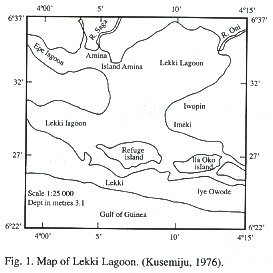
<body><![CDATA[<p><font face="Arial" size="2">In order to obtain a maximum fish yield from a body of water using the minimum effort and without depleting adversely the available stock, a knowledge of the general biology of resident fishes is essential.</font></p>     <p><font face="Arial" size="2">The present study is aimed at making a study of some aspects of the biology of <i>M. rum</i>e, from the Lekki lagoon Nigeria with particular reference to the length – weight relationship, condition factor, food and feeding habits and fecundity. This will contribute to the limited available information on this fish species which is a commercial fish species, being sold fresh or smoked in the markets of Lagos, Nigeria.</font></p> <font face="Arial" size="2"><b></b></font>     <p><font face="Arial" size="2"><b>Materials and methods</b></font></p>     <p><font face="Arial" size="2"><b>The study area: </b>The study was carried out in the Lekki lagoon, a large expanse of shallow freshwater located in the Lagos and Ogun states of Nigeria. It covers an area of nearly 247 km<sup>2</sup> <a href="#f1">(Fig. 1)</a>. A greater part of the lagoon is shallow and less than 3.0 m deep, while there are areas of up to 6.4 km in depth (<a href="#Kusemiju73">Kusemiju 1973</a>). It lies between longitudes 4º 00’ E and 4º 12’ E and latitude 6º 25’ N and 6º 37’ N. The lagoon is fed by river Oni in the north eastern part, while rivers Oshun and Saga flow into the north western part. William (1961, cited by <a href="#Trewavas83">Trewavas 1983</a>) described Lekki lagoon as fresh. <a href="#Vanden90">Vanden Bossche and Bernacsek (1990)</a> recorded a salinity range of 0.0 – 0.5% for this lagoon.</font></p>     <div style="text-align: center;"><span style="font-family: arial;"><a  name="f1"></a><img src="/img/fbpe/rbt/v50n2/2824i1.JPG" title="" alt=""  style="width: 273px; height: 273px;"></span>    
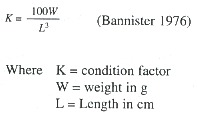
<br> </div>     <p><font face="Arial" size="2">Specimens of <i>Mormyrus rume </i>were collected monthly from the Lekki lagoon between December 1999 and November 2000. The cast net and the set net were the major gears used in the collection. All specimens were measured and weighed to the nearest 0.1 cm and 0.1 g respectively. Each specimen was then dissected in order to identify the stomach and the gonads. The stomach was transferred into a petri dish for analysis of the food organisms. The numerical and frequency of occurrence methods were used to analyze that stomach contents of the specimens. The sex of the fish was identified and the reproductive stage recorded. The condition factor was determined by using the formula:</font></p>     <div style="text-align: center;"><img src="/img/fbpe/rbt/v50n2/2824i3.JPG" title=""  alt="" style="width: 197px; height: 116px;"></div>     
<br> <font face="Arial" size="2">Matured ovaries were preserved in Gilson’s fluid prior to fecundity studies. The surrounding ovarian tissues were removed and the estimate of the number of eggs in each pair of ovaries were determined using the gravimetric method.</font> <font face="Arial" size="2"><b>     <p>Results</p> </b> </font>     ]]></body>
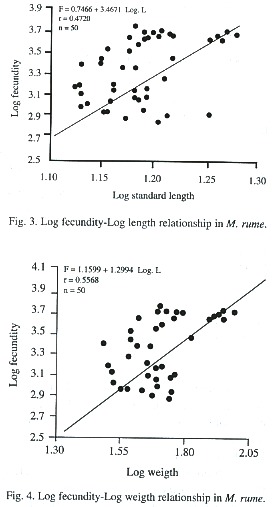
<body><![CDATA[<p><font face="Arial" size="2">A total of 225 specimens of <i>M. rume </i>were examined in this study.</font></p> <font face="Arial" size="2"><b></b></font>     <p><font face="Arial" size="2"><b>Length - weight relationship: </b>The total lengths ranged from 15. 0 to 24.9 cm while the standard lengths ranged from 13.0 to 23.0 cm. The weights ranged from 26.2 to 99.3 g. <a  href="#f2">Fig. 2</a> illustrates the length – weight relationship of the species.</font></p>     <div style="text-align: center;"><a name="f2"></a><img  src="/img/fbpe/rbt/v50n2/2824i2.JPG" title="" alt=""  style="width: 272px; height: 319px;"></div>     
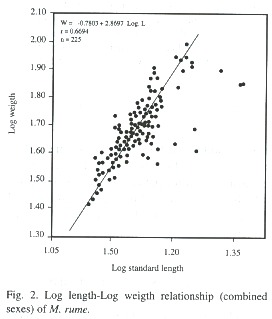
<p><font face="Arial" size="2"><b>Condition factor (K ): </b>The condition factor was calculated for <i>M. rume </i>and examined in relation to size and sex. The K value ranged from 0.33 - 1.40, 1.16 - 1.48 and 0.33 - 1. 48 for males, females and combined sexes respectively. The mean K – values were 1.16, 1.25 and 1.20 for males, females and combined sexes respectively <a href="#t1">(Table 1)</a>.</font></p>     <p style="text-align: center;"><font face="Arial" size="2">&nbsp;<a  name="t1"></a></font><img src="/img/fbpe/rbt/v50n2/2824i4.JPG" title="" alt=""  style="width: 556px; height: 438px;"></p>     
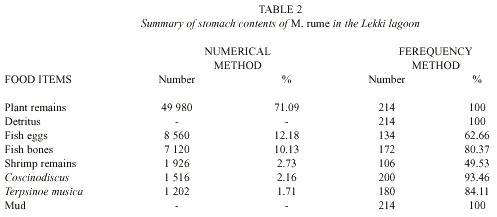
<p><font face="Arial" size="2"><b>Food and feeding habits: </b>Out of the specimens collected, 4.8% had empty stomachs, 22.2% had 1 / 4 full stomachs, 28. 9% had 2/4 full stomachs, 20.4% had 3/4 full stomachs and 28.4% had full stomachs. During the course of examination, it was observed that the fullness of the stomach was not in relation to length or weight.</font></p>     <p><font face="Arial" size="2">A summary of food items that constituted the diet of <i>M. rume </i>specimens from the Lekki lagoon is given in <a href="#t2">Table 2</a>. Detritus and plant remains constituted the most important food items, both occurring in all stomachs containing food (100% in occurrence) and the latter accounting for 71.09% of the number of food items. Mud was also found in all stomachs containing food. Including food items such as fish eggs (12.18% in number and 62.66% in occurrence); and fish bones (10.13% in number and 80.37% in occurrence) made up the next food group in order of importance .</font></p>     <p style="text-align: center;"><font face="Arial" size="2"><a name="t2"></a>&nbsp;</font><font  face="Arial" size="2"><b><img src="/img/fbpe/rbt/v50n2/2824i5.JPG" title="" alt=""  style="width: 497px; height: 217px;"></b></font></p> <font face="Arial" size="2"><b> </b></font>     
<p><font face="Arial" size="2">The class crustacean was the next group, it comprised of remains of shrimp larva and made up 2.73% in number and 49.53% in occurrence. The phytoplankton, <i>Coscinodiscus spp </i>and <i>Terpsinoe musica </i>both diatoms came last accounting for 2.16% in number, 93.46% in occurrence, and 1.71% in number and 84.11% in occurrence respectively.</font></p> <font face="Arial" size="2"><b></b></font>     <p><font face="Arial" size="2"><b>Sex ratio and gonad development: </b>The result shows that, of the 225 specimens examined 145 (64.44%) were males and 80 (35.56%) were females giving a sex ratio of 1:0.55. The population of males were significantly higher than females in the Lagoon. Achi – square analysis of the result shows that there is a significant difference between the preponderance of the male <i>M. rume </i>and that of the female (<span style="font-style: italic;">X</span></font><font  face="Palatino Linotype" size="2"></font><sup><font face="Arial"  size="2">2</font></sup><font face="Arial" size="2"> = 18.78, p = 0.05).</font></p>     ]]></body>
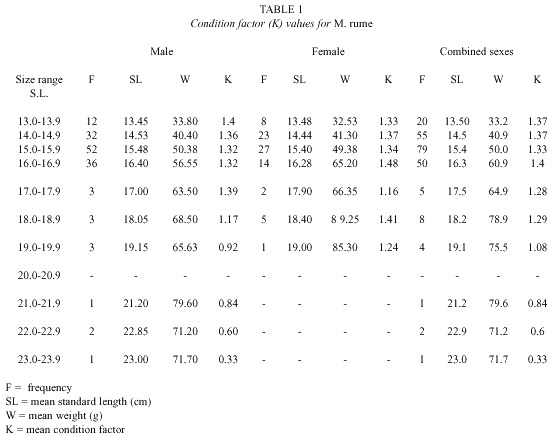
<body><![CDATA[<p><font face="Arial" size="2">Six stages of gonad development were observed in the specimens examined. The stages are</font></p>     <p><font face="Arial" size="2">Stage I - Immature, inactive    <br> Stage II - Immature, developing    <br> Stage III - Maturing    <br> Stage IV - Maturing (Ripe)    <br> Stage V - Ripe running    <br> Stage VI - Spent</font></p>     <p><font face="Arial" size="2">The females show all the stages of gonad development as classified by <a href="#Nikolsky63">Nikolsky (1963)</a>. However, the males show only stages I –IV</font></p> <font face="Arial" size="2"><b></b></font>     <p><font face="Arial" size="2"><b>Gonado–somatic index (GSI</b>): The gonad weight expressed as a percentage of the fish somatic weight (<a  href="#Sturm78">Sturm 1978</a>) was used as the Gonado–somatic index (GSI). It gives an indication of the percentage of the fish’s weight that is used in egg production at the mature stage (when the eggs are to be shed). The GSI ranged from 2.33 to 15.74%. The mean value obtained was 7.89%.</font></p> <font face="Arial" size="2"><b></b></font>     <p><font face="Arial" size="2"><b>Fecundity: </b>50 mature females were used for fecundity studies. The standard lengths ranged from 13.5 to 19.0 cm while the body weights ranged from 32.0 to 99.3 g Fecundity ranged from 741 to 6 000 eggs. Average fecundity was 2 991. The fish specimen with the highest fecundity had a standard length of 16.5 cm and a weight of 89.0 g while that with the lowest fecundity had a standard length of 16.0 cm and a weight of 55.7 g. The relationships between fecundity and fish length; and fecundity and fish weight are shown in <a href="#f3-4">Figs. 3 and 4.</a></font></p>     ]]></body>
<body><![CDATA[<div style="text-align: center;"><a name="f3-4"></a><img  src="/img/fbpe/rbt/v50n2/2824i6.JPG" title="" alt=""  style="width: 273px; height: 507px;">    
<br> </div> <font face="Arial" size="2"><b>     <p>Discussion</p> </b> </font>     <p><font face="Arial" size="2">The length weight relationship of <i>M. rume </i>reflected an increase in weight with a corresponding increase in length. The value of the regression coefficient (b) is approximately 3 which shows that the species exhibit isometric growth in Lekki lagoon (<a href="#Bagenal78">Bagenal and Tesch 1978</a>).</font></p>     <p><font face="Arial" size="2">The correlation coefficient (r) of 0.6694 showed a positive correlation between length and weight.</font></p>     <p><font face="Arial" size="2">There was a general decrease in condition factor with increasing length of the specimens. This means that increase in length did not bring about proportional increase in weight. <a href="#Mgbenka92">Mgbenka and Eyo (1992)</a> attributed the decline in condition factor to the deposition of materials for gonad formation which lead to increase in weight and actual spawning which lead to reduction in fish weight respectively.</font></p>     <p><font face="Arial" size="2">However the mean condition factor of 1.20 obtained for the population of <i>M. rume </i>in Lekki lagoon was an indication of the good condition of the fish (<a  href="#Bannister76">Bannister 1976</a>).</font></p>     <p><font face="Arial" size="2">The major food items of <i>M. rume </i>in Lekki lagoon were found to be detritus and plant parts and these were found in all stomachs containing food. There was also the presence of mud in all stomachs containing food, this was probably ingested along with food items during feeding. Other food items are fish eggs, fish bones, crustacean larval parts and some diatoms. The results showed that <i>M. rume </i>are bottom dwellers, corresponding with the findings of <a href="#Omotosho93">Omotosho (1993)</a> who reported that <i>M. rume </i>fed on detritus, algae and macrophytes in Oyun mini–dam, Ilorin, Nigeria. The long tubular snouts are used to burrow in search of their food items (</font><font  face="Arial" size="2"><a href="#Holden72">Holden and Reed 1972</a></font><font  face="Arial" size="2">). The food items were encountered in the stomachs irrespective of size, sex or season.</font></p>     <p><font face="Arial" size="2">Mature specimens (in stages III and IV) of both sexes were encountered throughout the months of the study period, this agreed with the findings of <a href="#Scott74">Scott (1974)</a> that most of the species of the family Mormyridae spawn more or less, throughout the year.</font></p>     <p><font face="Arial" size="2">The mean GSI value obtained showed that the fish species uses 7.89% of its body weight for egg production. The species was found to be highly fecund with an average of 3 371 eggs per mature female.</font></p>     ]]></body>
<body><![CDATA[<p><font face="Arial" size="2">The correlation (r), between fecundity and weight (0.56) was higher than that between fecundity and length (0.47). Thus there is a closer relationship between fecundity and weight than what obtains between fecundity and length.</font></p>     <p><font face="Arial" size="2">In the study, there were wide variations in fecundity of the species, <a href="#Bagenal66">Bagenal (1966, 1969)</a>, and <a href="#Fawole99">Fawole and Adewoye (1999)</a> attributed these wide fluctuations to differential feeding success within members of the fish population. It could also be due to the coexistence of a varied mixture of age classes since they reproduce year round.</font></p> <font face="Arial" size="2"><b>     <p>Acknowledgements</p> </b> </font>     <p><font face="Arial" size="2">I wish to express my gratitude to Messrs A. O. Adebola and R. Bamisaiye both of the University of Lagos, Nigeria for their assistance in the collection of specimens. </font></p> <font face="Arial" size="2"><b>     <p>Resumen</p> </b> </font>     <p><font face="Arial" size="2">Se investigó varios aspectos de la biología de Mormyrus rume (Cuvier y Valenciennes) en la laguna Lekki, que Estos incluyeron la relación longitud-peso, el factor condición, alimento y hábitos alimenticios, y la fecundidad de esta especie de peces. Los métodos principales de pesca empleados para recolectar 225 especímenes fueron por medio de redes (castnetting &amp; setnetting). La longitud total se distribuyó en un ámbito de 15.0 cm a 24.9 cm mientras que la longitud estándar se distribuyó entre 13.0 cm a 23.0 cm. Los pesos corporales se distribuyeron en un ámbito de 26.2 g a 99.3 g. Los peces exhibieron un crecimiento isométrico en la laguna. El factor condición promedio obtenido fue 1.20. El factor condición generalmente decrece con el incremento en el tamaño del individuo. Los principales alimentos fueron detritus y partes de plantas. La población de machos fue significativamente mayor que la de hembras. El índice gonadosomático mostrado por M. rume en la laguna Lekki presenta un promedio de 7,89% del peso corporal en producción de huevos. La fecundidad tiene un ámbito de 741 a 6 000 huevos con un promedio de 2 991 huevos por hembra.</font></p>     <p style="font-weight: bold;"><font face="Arial" size="2">References</font></p>     <!-- ref --><p><font face="Arial" size="2"><a name="Bagenal66"></a>Bagenal, T.B. 1966. The ecological and geographical aspects of the fecundity of the place. J. Mar. Biol. Ass. U.K. 48: 161-168.</font>&nbsp;&nbsp;&nbsp;&nbsp;&nbsp;&nbsp;&nbsp;&nbsp;[&#160;<a href="javascript:void(0);" onclick="javascript: window.open('/scielo.php?script=sci_nlinks&ref=1216530&pid=S0034-7744200200020002700001&lng=','','width=640,height=500,resizable=yes,scrollbars=1,menubar=yes,');">Links</a>&#160;]<!-- end-ref --><!-- ref --><p><font face="Arial" size="2"><a name="Bagenal69"></a>Bagenal, T.B. 1969 Relationship between egg size and fry survival in brown trout <i>Salmo trutta </i>(L) J. Fish Biol. L: 349- 353.</font>&nbsp;&nbsp;&nbsp;&nbsp;&nbsp;&nbsp;&nbsp;&nbsp;[&#160;<a href="javascript:void(0);" onclick="javascript: window.open('/scielo.php?script=sci_nlinks&ref=1216531&pid=S0034-7744200200020002700002&lng=','','width=640,height=500,resizable=yes,scrollbars=1,menubar=yes,');">Links</a>&#160;]<!-- end-ref --><!-- ref --><p><font face="Arial" size="2"><a name="Bagenal78"></a>Bagenal, T.B. &amp; Tesch F.W. 1978. Age and growth. Pp 101–136. <i>In </i>T. Bagenal (ed.). Methods of Assessment of Fish production in freshwaters. Oxford, Blackwell Scientific publications.</font>&nbsp;&nbsp;&nbsp;&nbsp;&nbsp;&nbsp;&nbsp;&nbsp;[&#160;<a href="javascript:void(0);" onclick="javascript: window.open('/scielo.php?script=sci_nlinks&ref=1216532&pid=S0034-7744200200020002700003&lng=','','width=640,height=500,resizable=yes,scrollbars=1,menubar=yes,');">Links</a>&#160;]<!-- end-ref --><!-- ref --><p><font face="Arial" size="2"><a name="Bannister76"></a>Bannister, J.V.C. 1976. The length–weight relationship, condition factor gut contents in the dolphin fish <i>Coryphaena hippurus </i>(L) in the Mediterranean J. Fish Biol. 9: 335-338.</font>&nbsp;&nbsp;&nbsp;&nbsp;&nbsp;&nbsp;&nbsp;&nbsp;[&#160;<a href="javascript:void(0);" onclick="javascript: window.open('/scielo.php?script=sci_nlinks&ref=1216533&pid=S0034-7744200200020002700004&lng=','','width=640,height=500,resizable=yes,scrollbars=1,menubar=yes,');">Links</a>&#160;]<!-- end-ref --><!-- ref --><p><font face="Arial" size="2"><a name="Fawole99"></a>Fawole, O.O. &amp; S.O. Adewoye. 1999. The length–weight relationship, condition factor and fecundity of <i>Sarotherodon galilaeus </i>(Artedi) in Oba reservoir Ogbomoso, Nigeria. Bioscience Res. Comm. 11(2): 113-119.</font>&nbsp;&nbsp;&nbsp;&nbsp;&nbsp;&nbsp;&nbsp;&nbsp;[&#160;<a href="javascript:void(0);" onclick="javascript: window.open('/scielo.php?script=sci_nlinks&ref=1216534&pid=S0034-7744200200020002700005&lng=','','width=640,height=500,resizable=yes,scrollbars=1,menubar=yes,');">Links</a>&#160;]<!-- end-ref --><!-- ref --><p><font face="Arial" size="2"><a name="Greenwood66"></a>Greenwood, P.H., G.S. Myers, D.E Rosen &amp; S.H. Weitzman. 1966. Phyletic studies of teleostan fishes with a provisional classification for living forms Bull. Am. Mus. Nat. Hist. 131: 339-456.</font>&nbsp;&nbsp;&nbsp;&nbsp;&nbsp;&nbsp;&nbsp;&nbsp;[&#160;<a href="javascript:void(0);" onclick="javascript: window.open('/scielo.php?script=sci_nlinks&ref=1216535&pid=S0034-7744200200020002700006&lng=','','width=640,height=500,resizable=yes,scrollbars=1,menubar=yes,');">Links</a>&#160;]<!-- end-ref --><!-- ref --><p><font face="Arial" size="2"><a name="Holden72"></a>Holden, M. &amp; W. Reed. 197<i>2. </i>West African Freshwater Fish. Longman Singapore. 68 p.</font>&nbsp;&nbsp;&nbsp;&nbsp;&nbsp;&nbsp;&nbsp;&nbsp;[&#160;<a href="javascript:void(0);" onclick="javascript: window.open('/scielo.php?script=sci_nlinks&ref=1216536&pid=S0034-7744200200020002700007&lng=','','width=640,height=500,resizable=yes,scrollbars=1,menubar=yes,');">Links</a>&#160;]<!-- end-ref --><!-- ref --><p><font face="Arial" size="2"><a name="Kusemiju73"></a>Kusemiju, K. 1973. Astudy of Catfishes of Lekki lagoon with particular reference to species of <i>Chrysichthys walkeri </i>(Bagridae) Ph.D. Thesis Univ. of Lagos, Nigeria. </font>&nbsp;&nbsp;&nbsp;&nbsp;&nbsp;&nbsp;&nbsp;&nbsp;[&#160;<a href="javascript:void(0);" onclick="javascript: window.open('/scielo.php?script=sci_nlinks&ref=1216537&pid=S0034-7744200200020002700008&lng=','','width=640,height=500,resizable=yes,scrollbars=1,menubar=yes,');">Links</a>&#160;]<!-- end-ref --><!-- ref --><p><font face="Arial" size="2"><a name="Kusemiju76"></a>Kusemiju, K. 1976. Distribution, reprod uction and growth of the catfish <i>Chrysichthys walkeri </i>(Gunther) in the Lekki lagoon, Nigeria. J. Fish. Biol. 8: 453- 458.</font>&nbsp;&nbsp;&nbsp;&nbsp;&nbsp;&nbsp;&nbsp;&nbsp;[&#160;<a href="javascript:void(0);" onclick="javascript: window.open('/scielo.php?script=sci_nlinks&ref=1216538&pid=S0034-7744200200020002700009&lng=','','width=640,height=500,resizable=yes,scrollbars=1,menubar=yes,');">Links</a>&#160;]<!-- end-ref --><!-- ref --><p><font face="Arial" size="2"><a name="Meek16"></a>Meek, A. 1916. The Migrations of Fish. Edward Arnold London. 427 p.</font>&nbsp;&nbsp;&nbsp;&nbsp;&nbsp;&nbsp;&nbsp;&nbsp;[&#160;<a href="javascript:void(0);" onclick="javascript: window.open('/scielo.php?script=sci_nlinks&ref=1216539&pid=S0034-7744200200020002700010&lng=','','width=640,height=500,resizable=yes,scrollbars=1,menubar=yes,');">Links</a>&#160;]<!-- end-ref --><!-- ref --><p><font face="Arial" size="2"><a name="Mgbenka92"></a>Mgbenka, B.O. &amp; J.E. Eyo. 1992. Aspects of the Biology of <i>Clarias gariepinus </i>in Anambra River Basin 2. Maturation and condition factor J. Sci. Agric. Tech. 2(1): 52 –55.</font>&nbsp;&nbsp;&nbsp;&nbsp;&nbsp;&nbsp;&nbsp;&nbsp;[&#160;<a href="javascript:void(0);" onclick="javascript: window.open('/scielo.php?script=sci_nlinks&ref=1216540&pid=S0034-7744200200020002700011&lng=','','width=640,height=500,resizable=yes,scrollbars=1,menubar=yes,');">Links</a>&#160;]<!-- end-ref --><!-- ref --><p><font face="Arial" size="2"><a name="Nikolsky63"></a>Nikolsky, G.V. 1963. The Ecology of fishes. Academic Press, London and New York. 352 p.</font>&nbsp;&nbsp;&nbsp;&nbsp;&nbsp;&nbsp;&nbsp;&nbsp;[&#160;<a href="javascript:void(0);" onclick="javascript: window.open('/scielo.php?script=sci_nlinks&ref=1216541&pid=S0034-7744200200020002700012&lng=','','width=640,height=500,resizable=yes,scrollbars=1,menubar=yes,');">Links</a>&#160;]<!-- end-ref --><!-- ref --><p><font face="Arial" size="2"><a name="Omotosho93"></a>Omotosho, J.S. 1993. Analysis of fish species composition of Oyun min-dam, University of Ilorin, Nigeria. J. W. Afr. Sci. Assoc. 36: 37–48.</font>&nbsp;&nbsp;&nbsp;&nbsp;&nbsp;&nbsp;&nbsp;&nbsp;[&#160;<a href="javascript:void(0);" onclick="javascript: window.open('/scielo.php?script=sci_nlinks&ref=1216542&pid=S0034-7744200200020002700013&lng=','','width=640,height=500,resizable=yes,scrollbars=1,menubar=yes,');">Links</a>&#160;]<!-- end-ref --><!-- ref --><p><font face="Arial" size="2"><a name="Scott74"></a>Scott, D.B.C. 1974. The reproductive cycle of <i>Mormyrus kannume </i>(Forsk) in Lake Victoria, Uganda. J. Fish Biol. 5: 447–454.</font>&nbsp;&nbsp;&nbsp;&nbsp;&nbsp;&nbsp;&nbsp;&nbsp;[&#160;<a href="javascript:void(0);" onclick="javascript: window.open('/scielo.php?script=sci_nlinks&ref=1216543&pid=S0034-7744200200020002700014&lng=','','width=640,height=500,resizable=yes,scrollbars=1,menubar=yes,');">Links</a>&#160;]<!-- end-ref --><!-- ref --><p><font face="Arial" size="2"><a name="Sturm78"></a>Sturm, de L.M.G. 1978. Aspects of the Biology of <i>Scombemorus maculatus </i>(Mitchell) in Trinidad. J. Fish Biol. 13: 155-172.</font>&nbsp;&nbsp;&nbsp;&nbsp;&nbsp;&nbsp;&nbsp;&nbsp;[&#160;<a href="javascript:void(0);" onclick="javascript: window.open('/scielo.php?script=sci_nlinks&ref=1216544&pid=S0034-7744200200020002700015&lng=','','width=640,height=500,resizable=yes,scrollbars=1,menubar=yes,');">Links</a>&#160;]<!-- end-ref --><!-- ref --><p><font face="Arial" size="2"><a name="Trewavas83"></a>Trewavas, E. 1983. Tilapine fishes of the Genera <i>Sarotherodon, Oreochromis </i>and <i>Danakilia. </i>London British Museum (Natural History). 583 p.</font>&nbsp;&nbsp;&nbsp;&nbsp;&nbsp;&nbsp;&nbsp;&nbsp;[&#160;<a href="javascript:void(0);" onclick="javascript: window.open('/scielo.php?script=sci_nlinks&ref=1216545&pid=S0034-7744200200020002700016&lng=','','width=640,height=500,resizable=yes,scrollbars=1,menubar=yes,');">Links</a>&#160;]<!-- end-ref --><!-- ref --><p><font face="Arial" size="2"><a name="Vanden90"></a>Vanden Bossche, J.P.V. &amp; G.M. Bernacsek. 1990. Source Book for the inland fishery Resources of Africa CIFA technical paper 18/2. FAO Rome. 325 p.</font>&nbsp;&nbsp;&nbsp;&nbsp;&nbsp;&nbsp;&nbsp;&nbsp;[&#160;<a href="javascript:void(0);" onclick="javascript: window.open('/scielo.php?script=sci_nlinks&ref=1216546&pid=S0034-7744200200020002700017&lng=','','width=640,height=500,resizable=yes,scrollbars=1,menubar=yes,');">Links</a>&#160;]<!-- end-ref --> ]]></body><back>
<ref-list>
<ref id="B1">
<nlm-citation citation-type="journal">
<person-group person-group-type="author">
<name>
<surname><![CDATA[Bagenal]]></surname>
<given-names><![CDATA[T.B]]></given-names>
</name>
</person-group>
<article-title xml:lang="en"><![CDATA[The ecological and geographical aspects of the fecundity of the place]]></article-title>
<source><![CDATA[J. Mar. Biol. Ass. U.K]]></source>
<year>1966</year>
<volume>48</volume>
<page-range>161-168</page-range></nlm-citation>
</ref>
<ref id="B2">
<nlm-citation citation-type="journal">
<person-group person-group-type="author">
<name>
<surname><![CDATA[Bagenal]]></surname>
<given-names><![CDATA[T.B]]></given-names>
</name>
</person-group>
<article-title xml:lang="en"><![CDATA[Relationship between egg size and fry survival in brown trout Salmo trutta (L)]]></article-title>
<source><![CDATA[J. Fish Biol]]></source>
<year>1969</year>
<volume>L</volume>
<page-range>349- 353</page-range></nlm-citation>
</ref>
<ref id="B3">
<nlm-citation citation-type="book">
<person-group person-group-type="author">
<name>
<surname><![CDATA[Bagenal]]></surname>
<given-names><![CDATA[T.B]]></given-names>
</name>
<name>
<surname><![CDATA[Tesch]]></surname>
<given-names><![CDATA[F.W]]></given-names>
</name>
<name>
<surname><![CDATA[Bagenal]]></surname>
<given-names><![CDATA[T]]></given-names>
</name>
</person-group>
<source><![CDATA[Age and growth]]></source>
<year>1978</year>
<page-range>101-136</page-range><publisher-loc><![CDATA[Oxford ]]></publisher-loc>
<publisher-name><![CDATA[Blackwell Scientific publications]]></publisher-name>
</nlm-citation>
</ref>
<ref id="B4">
<nlm-citation citation-type="journal">
<person-group person-group-type="author">
<name>
<surname><![CDATA[Bannister]]></surname>
<given-names><![CDATA[J.V.C]]></given-names>
</name>
</person-group>
<article-title xml:lang="en"><![CDATA[The length-weight relationship, condition factor gut contents in the dolphin fish Coryphaena hippurus (L) in the Mediterranean]]></article-title>
<source><![CDATA[J. Fish Biol]]></source>
<year>1976</year>
<volume>9</volume>
<page-range>335-338</page-range></nlm-citation>
</ref>
<ref id="B5">
<nlm-citation citation-type="journal">
<person-group person-group-type="author">
<name>
<surname><![CDATA[Fawole]]></surname>
<given-names><![CDATA[O.O]]></given-names>
</name>
<name>
<surname><![CDATA[Adewoye]]></surname>
<given-names><![CDATA[S.O]]></given-names>
</name>
</person-group>
<article-title xml:lang="en"><![CDATA[The length-weight relationship, condition factor and fecundity of Sarotherodon galilaeus (Artedi) in Oba reservoir Ogbomoso, Nigeria]]></article-title>
<source><![CDATA[Bioscience Res. Comm]]></source>
<year>1999</year>
<volume>11</volume>
<numero>2</numero>
<issue>2</issue>
<page-range>113-119</page-range></nlm-citation>
</ref>
<ref id="B6">
<nlm-citation citation-type="journal">
<person-group person-group-type="author">
<name>
<surname><![CDATA[Greenwood]]></surname>
<given-names><![CDATA[P.H]]></given-names>
</name>
<name>
<surname><![CDATA[Myers]]></surname>
<given-names><![CDATA[G.S]]></given-names>
</name>
<name>
<surname><![CDATA[Rosen]]></surname>
<given-names><![CDATA[D.E]]></given-names>
</name>
<name>
<surname><![CDATA[Weitzman]]></surname>
<given-names><![CDATA[S.H]]></given-names>
</name>
</person-group>
<article-title xml:lang="en"><![CDATA[Phyletic studies of teleostan fishes with a provisional classification for living forms]]></article-title>
<source><![CDATA[Bull. Am. Mus. Nat. Hist]]></source>
<year>1966</year>
<volume>131</volume>
<page-range>339-456</page-range></nlm-citation>
</ref>
<ref id="B7">
<nlm-citation citation-type="book">
<person-group person-group-type="author">
<name>
<surname><![CDATA[Holden]]></surname>
<given-names><![CDATA[M]]></given-names>
</name>
<name>
<surname><![CDATA[Reed]]></surname>
<given-names><![CDATA[W]]></given-names>
</name>
</person-group>
<source><![CDATA[West African Freshwater Fish]]></source>
<year>1972</year>
<page-range>68</page-range><publisher-name><![CDATA[Longman Singapore]]></publisher-name>
</nlm-citation>
</ref>
<ref id="B8">
<nlm-citation citation-type="">
<person-group person-group-type="author">
<name>
<surname><![CDATA[Kusemiju]]></surname>
<given-names><![CDATA[K]]></given-names>
</name>
</person-group>
<source><![CDATA[Astudy of Catfishes of Lekki lagoon with particular reference to species of Chrysichthys walkeri (Bagridae)]]></source>
<year>1973</year>
</nlm-citation>
</ref>
<ref id="B9">
<nlm-citation citation-type="journal">
<person-group person-group-type="author">
<name>
<surname><![CDATA[Kusemiju]]></surname>
<given-names><![CDATA[K]]></given-names>
</name>
</person-group>
<article-title xml:lang="en"><![CDATA[Distribution, reprod uction and growth of the catfish Chrysichthys walkeri (Gunther) in the Lekki lagoon, Nigeria]]></article-title>
<source><![CDATA[J. Fish. Biol]]></source>
<year>1976</year>
<volume>8</volume>
<page-range>453- 458</page-range></nlm-citation>
</ref>
<ref id="B10">
<nlm-citation citation-type="book">
<person-group person-group-type="author">
<name>
<surname><![CDATA[Meek]]></surname>
<given-names><![CDATA[A]]></given-names>
</name>
</person-group>
<source><![CDATA[The Migrations of Fish]]></source>
<year>1916</year>
<page-range>427</page-range><publisher-loc><![CDATA[London ]]></publisher-loc>
<publisher-name><![CDATA[Edward Arnold]]></publisher-name>
</nlm-citation>
</ref>
<ref id="B11">
<nlm-citation citation-type="journal">
<person-group person-group-type="author">
<name>
<surname><![CDATA[Mgbenka]]></surname>
<given-names><![CDATA[B.O]]></given-names>
</name>
<name>
<surname><![CDATA[Eyo]]></surname>
<given-names><![CDATA[J.E]]></given-names>
</name>
</person-group>
<article-title xml:lang="en"><![CDATA[Aspects of the Biology of Clarias gariepinus in Anambra River Basin 2: Maturation and condition factor]]></article-title>
<source><![CDATA[J. Sci. Agric. Tech]]></source>
<year>1992</year>
<volume>2</volume>
<numero>1</numero>
<issue>1</issue>
<page-range>52 -55</page-range></nlm-citation>
</ref>
<ref id="B12">
<nlm-citation citation-type="book">
<person-group person-group-type="author">
<name>
<surname><![CDATA[Nikolsky]]></surname>
<given-names><![CDATA[G.V]]></given-names>
</name>
</person-group>
<source><![CDATA[The Ecology of fishes]]></source>
<year>1963</year>
<page-range>352</page-range><publisher-name><![CDATA[Academic Press, London and New York]]></publisher-name>
</nlm-citation>
</ref>
<ref id="B13">
<nlm-citation citation-type="journal">
<person-group person-group-type="author">
<name>
<surname><![CDATA[Omotosho]]></surname>
<given-names><![CDATA[J.S]]></given-names>
</name>
</person-group>
<article-title xml:lang="en"><![CDATA[Analysis of fish species composition of Oyun min-dam, University of Ilorin, Nigeria]]></article-title>
<source><![CDATA[J. W. Afr. Sci. Assoc]]></source>
<year>1993</year>
<volume>36</volume>
<page-range>37-48</page-range></nlm-citation>
</ref>
<ref id="B14">
<nlm-citation citation-type="journal">
<person-group person-group-type="author">
<name>
<surname><![CDATA[Scott]]></surname>
<given-names><![CDATA[D.B.C]]></given-names>
</name>
</person-group>
<article-title xml:lang="en"><![CDATA[The reproductive cycle of Mormyrus kannume (Forsk) in Lake Victoria, Uganda]]></article-title>
<source><![CDATA[J. Fish Biol]]></source>
<year>1974</year>
<volume>5</volume>
<page-range>447-454</page-range></nlm-citation>
</ref>
<ref id="B15">
<nlm-citation citation-type="journal">
<person-group person-group-type="author">
<name>
<surname><![CDATA[Sturm]]></surname>
<given-names><![CDATA[de L.M.G]]></given-names>
</name>
</person-group>
<article-title xml:lang="en"><![CDATA[Aspects of the Biology of Scombemorus maculatus (Mitchell) in Trinidad]]></article-title>
<source><![CDATA[J. Fish Biol]]></source>
<year>1978</year>
<volume>13</volume>
<page-range>155-172</page-range></nlm-citation>
</ref>
<ref id="B16">
<nlm-citation citation-type="book">
<person-group person-group-type="author">
<name>
<surname><![CDATA[Trewavas]]></surname>
<given-names><![CDATA[E]]></given-names>
</name>
</person-group>
<source><![CDATA[Tilapine fishes of the Genera Sarotherodon, Oreochromis and Danakilia]]></source>
<year>1983</year>
<page-range>583</page-range><publisher-name><![CDATA[London British Museum (Natural History)]]></publisher-name>
</nlm-citation>
</ref>
<ref id="B17">
<nlm-citation citation-type="book">
<person-group person-group-type="author">
<name>
<surname><![CDATA[Vanden Bossche]]></surname>
<given-names><![CDATA[J.P.V]]></given-names>
</name>
<name>
<surname><![CDATA[Bernacsek]]></surname>
<given-names><![CDATA[G.M]]></given-names>
</name>
</person-group>
<source><![CDATA[Source Book for the inland fishery Resources of Africa CIFA technical paper 18/2]]></source>
<year>1990</year>
<page-range>325</page-range><publisher-loc><![CDATA[Rome ]]></publisher-loc>
<publisher-name><![CDATA[FAO]]></publisher-name>
</nlm-citation>
</ref>
</ref-list>
</back>
</article>