Isidro Chacón 1 and Kenji Nishida 2
1 Instituto Nacional de Biodiversidad (INBio); e-mail: ichacon@inbio.ac.cr
2 Escuela de Biología, Universidad de Costa Rica, 2060 San José, Costa Rica; e-mail: knishida@cariari.ucr.ac.cr
Received 11-II-2002. Corrected 14-V-2002. Accepted 15-V-2002.
Abstract
Cyllopsis emilia Chacón and Nishida, a new satyrine species, is described from a single male specimen from Cerro de la Muerte, San José, Costa Rica. This new species can be distinguished from other species of Cyllopsis by its white coloration.
Key words: Cyllopsis emilia, Cerro de la Muerte, Chusquea, high altitude, Neotropical, taxonomy.
]]> Thus far, 26 species are known in the genus Cyllopsis Felder; and its geographic distribution is from the Southern United States to Panama. The majority of the species occurs between Guatemala and Mexico. The habitats of these butterflies are described as montane or submontane; a few are found in the lowlands (Miller 1974). In Costa Rica, five species of Cyllopsis have been reported, three of which are known to be endemic to the Talamancan ranges. The host plants recorded for the genus belong to the Poaceae family and especially to the genus Chusquea (DeVries 1987). The new species, Cyllopsis emilia Chacón and Nishida, possesses white wing coloration which is unique to the genus, i.e. all of the previously described species have brown and grayish brown wing coloration. The female is undiscovered. Here, we describe the male of this new species. The male genitalia is also illustrated.
Cyllopsis emilia Chacón and Nishida, new species
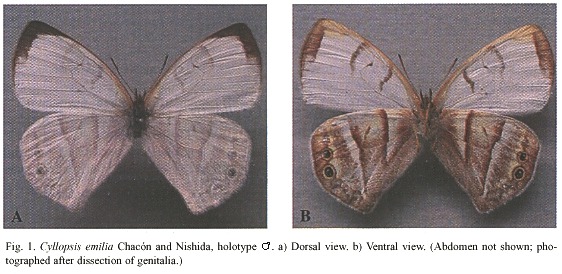
Fig. 1a, b
Diagnosis: Cyllopsis emilia is distinguished from the rest of the species in the genus by its white basal color in the upper and underside of the fore- and hind wings. Characteristics and some main features of Cyllopsis according to Miller (1974): transcellular and extradiscal bands in both wings. Submarginal ocelli absent in forewings, well-developed in hind wings, with silvery colored pupilla, and located between veins M2-M3 and M3-Cu1. Eyes pubescent. Antennae approximately one-third of forewing costa. Labial palpi long (third segment approximately one third of second segment) and semi-porrect. Second segment with hairs extending three to four times the segment width. Tegumen form of shield. Uncus long, curved, and undivided. Gnathos paired, tapered and not freely articulated. Valvae slender, arched laterally; tip gently tapered and weakly dented. Aedeagus straight.
Diagnosis: Cyllopsis emilia se distingue de las demás especies del género por tener la parte dorsal y ventral de las alas anteriores y posteriores de color blanco. Miller (1974) menciona las características del género Cyllopsis, y algunos caracteres principales son los siguientes: banda transcelular (franja que atraviesa celda discal) y banda extradiscal (franja que pasa alrededor de celda discal) en ambas alas. Ocelos submarginales ausentes en las alas anteriores, bien desarrollados en las alas posteriores, con pupilas plateadas y localizados entre las venas M2-M3 y M3-Cu1. Ojos pubescentes. Antenas aproximadamente un tercio del largo de la costa del ala anterior. Palpos labiales largos (tercer segmento aproximadamente un tercio del segundo) y dirigidos hacia adelante y ligeramente hacia arriba. Segundo segmento con pelos extendiéndose de tres a cuatro veces el ancho del segmento. Genitalia del macho con tegumen en forma de escudo. Uncus largo, curvado y no dividido. Gnathos pareado, puntiagudo y no articulado libremente. Valvas delgadas, arqueadas lateralmente, con ápices puntiagudos y levemente dentados. Aedeagus recto.
Description: ♂ .Forewing length: 24lmm. Upper side forewing: White. Dark brown, 3imm wide band in apex-subapex forming ca. 90° angle. Creamy, pale, reddish-brown band along costal margin; wider toward basal area. Dark brown spot on intersection M2 with discal cell. Underside wing pattern visible dorsally. Underside forewing: White. Creamy, pale, reddish-brown along costal mar-gin; lighter near apex. Subapex marginal area with 3 mm wide, reddish-brown band. Transcelular and extradiscal band light brown; the former ends in discal cell, the latter ends around Cu1. Dark brown spot on intersection M2 with discal cell. Upper side hind wing: White. Dark brown spot between M3-Cu1 (behind black ocellus on underside). Underside wing pattern visible dorsally. Underside hind wing: White and reddish-brown to light brown. Anal margin light brown. Basal to postbasal area reddish-brown. Submedial area with creamy white band, tapering toward anal margin. Medial area with reddish-brown transcelular and extradiscal band; from costa to upper half of discal cell cream and from lower half of discal cell to anal margin area light, reddish-brown. Reddish-brown spot on intersection M2 with discal cell. Long white band reaching tornus between medial and postmedial area. Postmedial area with light, reddish-brown stripe. Cream colored between postmedial and submarginal area. Submarginal area with sinuous silver stripe. Pale yellow ringed, black ocellus with silver "horseshoe" pupilla between M2-M3 and M3-Cu1. Antennae: Black with brown line between segments. Eyes: Clear brown, iridescent and pubescent. Labial palpi: Grayish-brown, semi-porrect, and hirsute. Thorax: Grayish-brown dorsally. Yellowish-brown hair-like scales on prothorax. Remainder thoracic segments with white, fine hair-like scales. Abdomen: Grayish-black dorsally, with white, fine hair-like scales; white ventrally. Genitalia (Fig. 2): Tegumen convex and shield-like. Uncus long (ca. 0.8 mm), straight, slightly curved down at tip, undivided, i.e. not paired. Gnathos tapered and curved upward. Saccus moderately sized (0.5 mm long), arched dorsally. Valvae slender (ca. 0.5lmm), tapered, arched laterally, and tridentate at tip. Setae ca. 0.15 mm. Aedeagus straight, non-grooved distally.
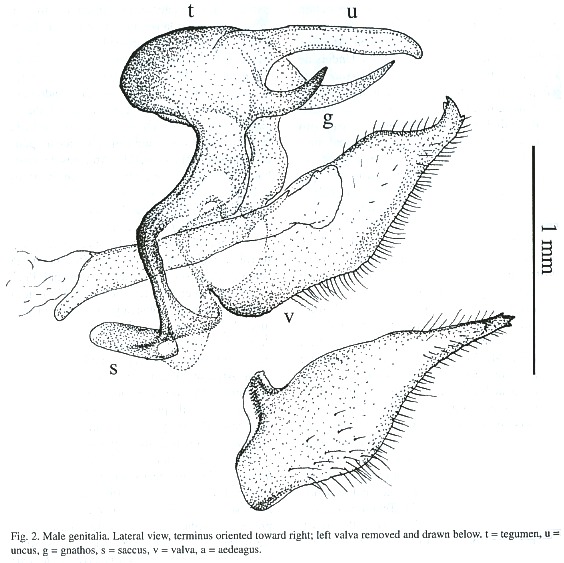
Descripción: ♂. Envergadura del ala anterior: 24 mm. Superficie dorsal del ala anterior: Blanca. Ápice y subápice con una banda café oscura de 3 mm de ancho formando un ángulo de ca. 90°. Margen costal con una banda café amarillenta; más ancha hacia el área basal. Punto café oscuro en la intersección de M2 con la celda discal. Patrón de la superficie ventral del ala visible dorsalmente. Superficie ventral del ala anterior: Blanca. Margen costal café amarillento, más pálido cerca del ápice. Área marginal del subápice con una franja café rojiza de 3imm de ancho. Banda transcelular y extradiscal café canela; la primera termina en la celda discal y la segunda termina alrededor de Cu1. Punto café oscuro en la intersección de M2 con la celda discal. Superficie dorsal del ala posterior: Blanca. Punto café oscuro entre M3-Cu1 (detrás del ocelo negro en el lado ventral). Patrón de la superficie ventral del ala visible dorsalmente. Superficie ventral del ala posterior: Blanca y café rojiza hasta café pálida. Margen anal café pálido. Área basal a post-basal café rojiza. Área submedial con una franja blanca, estrechándose hacia el margen anal. Área medial con una banda transcelular y una extradiscal café rojiza; crema desde la costa hasta la mitad superior de la celda discal y café rojizo pálido desde la mitad inferior de la celda discal hasta el área del margen anal. Punto café rojizo en la intersección de M2 con la celda discal. Franja blanca y larga entre el área medial y postmedial, alcanzando al tornus. Área postmedial con una franja café rojiza pálida. Crema entre el área postmedial y submarginal. Área submarginal con una franja plateada sinuosa. Ocelo negro con un anillo amarillo pálido y la pupila plateada en forma de herradura entre M2-M3 y M3-Cu1. Antenas: Negras con una línea café entre segmentos. Ojos: Café claros, iridiscentes y pubescentes. Palpos labiales: Café grisáceos, dirigidos hacia adelante y levemente hacia arriba e hirsutos. Tórax: Negro grisáceo dorsalmente. Escamas de protórax similares a pelos café amarillentos. Resto de los segmentos torácicos con escamas semejantes a finos pelos blancos. Abdomen: Negro grisáceo dorsalmente, con escamas similares a finos pelos blancos; blanco ventralmente. Genitales (Fig. 2): Tegumen convexo y en forma de escudo. Uncus largo (ca. 0.8lmm), recto, ligeramente curvado hacia abajo en el extremo, no dividido, i.e. no pareado. Gnathos puntiagudo y curvado hacia arriba. Saccus de tamaño moderado (0.5 mm de largo) y arqueado dorsalmente. Valvas delgadas (ca. 0.5 mm), puntiagudas, arqueadas lateralmente y tridentadas en el extremo. Setas ca. 0.15 mm. Aedeagus recto y no acanalado distalmente.
Holotype ♂: Labeled "COSTA RICA, San José, Cerro de la Muerte, Villa Mills, 3 000 m, 23 de VII de 1997, col. Kenji Nishida", 9° 34’ 04" N, 83° 42’ 17" W, INBio 68861. Deposited in the Entomological Collection of the Instituto Nacional de Biodiversidad (INBio), Santo Domingo, Heredia, Costa Rica.
Host plant: Unknown.
Early stages: Unknown.
Distribution: The holotype collection reflects the high elevations in the Talamancan ranges.
Etymology: We dedicate this species to Emily Foster for her commitment to the people and natural resources of the Neotropics.
Comments: The flora of the habitat is dominated by various species of Chusquea, those which are probably hosts of this new species. The second author has returned to the same collecting and surrounding sites with certain frequency, but more individuals have not been observed as of the 29 th of May, 2002. It is probable that this species is highly seasonal. However, many individuals of a pierine butterfly, Leptophobia aripa (Boisduval) were observed flying in the same region. This butterfly possesses a white basal color with black forewing apex, and it could be confused with C. emilia in flight.
Acknowledgments
We thank Phil J. DeVries for the revision of the specimen pictures and the manuscript, Gerardo Lamas for the suggestions on this work, José Montero for the preparation of the genitalia and José Alejandro Herrera for the fine illustration.
]]> ResumenUna especie nueva de Satyrinae, Cyllopsis emilia Chacón y Nishida, es descrita a partir de un solo espécimen macho procedente del Cerro de la Muerte, San José, Costa Rica. Esta nueva especie puede distinguirse de las otras especies del género por su coloración blanca.
References
DeVries, P.J. 1987. The butterflies of Costa Rica and their natural history: Papilionidae, Pieridae, Nymphalidae. Princeton, Princeton. 327 p, 50 pl. [ Links ]
Miller, L.D. 1974. Revision of the Euptychiini (Satyridae) 2. Cyllopsis R. Felder. Bull. Allyn Mus. 20: 1- 98. [ Links ] ]]>