<?xml version="1.0" encoding="ISO-8859-1"?><article xmlns:mml="http://www.w3.org/1998/Math/MathML" xmlns:xlink="http://www.w3.org/1999/xlink" xmlns:xsi="http://www.w3.org/2001/XMLSchema-instance">
<front>
<journal-meta>
<journal-id>0034-7744</journal-id>
<journal-title><![CDATA[Revista de Biología Tropical]]></journal-title>
<abbrev-journal-title><![CDATA[Rev. biol. trop]]></abbrev-journal-title>
<issn>0034-7744</issn>
<publisher>
<publisher-name><![CDATA[Universidad de Costa Rica]]></publisher-name>
</publisher>
</journal-meta>
<article-meta>
<article-id>S0034-77442002000200023</article-id>
<title-group>
<article-title xml:lang="en"><![CDATA[Redescription of the freshwater amphipod Hyalella faxoni from Costa Rica (Crustacea: Amphipoda: Hyalellidae)]]></article-title>
</title-group>
<contrib-group>
<contrib contrib-type="author">
<name>
<surname><![CDATA[R. González]]></surname>
<given-names><![CDATA[Exequiel]]></given-names>
</name>
<xref ref-type="aff" rid="A01"/>
</contrib>
<contrib contrib-type="author">
<name>
<surname><![CDATA[Watling]]></surname>
<given-names><![CDATA[Les]]></given-names>
</name>
<xref ref-type="aff" rid="A02"/>
</contrib>
</contrib-group>
<aff id="A01">
<institution><![CDATA[,Universidad Católica del Norte Facultad de Ciencias del Mar ]]></institution>
<addr-line><![CDATA[Coquimbo ]]></addr-line>
<country>Chile</country>
</aff>
<aff id="A02">
<institution><![CDATA[,University of Maine Darling Marine Center ]]></institution>
<addr-line><![CDATA[ ]]></addr-line>
</aff>
<pub-date pub-type="pub">
<day>00</day>
<month>06</month>
<year>2002</year>
</pub-date>
<pub-date pub-type="epub">
<day>00</day>
<month>06</month>
<year>2002</year>
</pub-date>
<volume>50</volume>
<numero>2</numero>
<fpage>659</fpage>
<lpage>667</lpage>
<copyright-statement/>
<copyright-year/>
<self-uri xlink:href="http://www.scielo.sa.cr/scielo.php?script=sci_arttext&amp;pid=S0034-77442002000200023&amp;lng=en&amp;nrm=iso"></self-uri><self-uri xlink:href="http://www.scielo.sa.cr/scielo.php?script=sci_abstract&amp;pid=S0034-77442002000200023&amp;lng=en&amp;nrm=iso"></self-uri><self-uri xlink:href="http://www.scielo.sa.cr/scielo.php?script=sci_pdf&amp;pid=S0034-77442002000200023&amp;lng=en&amp;nrm=iso"></self-uri><abstract abstract-type="short" xml:lang="en"><p><![CDATA[Hyalella faxoni Stebbing, 1903 from Costa Rica is redescribed. The species was previously in the synonymy of Hyalella azteca (Saussure, 1858). The morphological differences between these two species are discussed]]></p></abstract>
<abstract abstract-type="short" xml:lang="es"><p><![CDATA[La especie Hyalella faxoni Stebbing, 1903 de Costa Rica es redescrita. Esta especie estaba previamente en la sinonimia de Hyalella azteca (Saussure, 1858). Se discuten en este trabajo las diferencias morfológicas entre las dos especies]]></p></abstract>
<kwd-group>
<kwd lng="en"><![CDATA[Amphipoda]]></kwd>
<kwd lng="en"><![CDATA[freshwater]]></kwd>
<kwd lng="en"><![CDATA[Hyalella]]></kwd>
<kwd lng="en"><![CDATA[epigean]]></kwd>
<kwd lng="en"><![CDATA[South America]]></kwd>
</kwd-group>
</article-meta>
</front><body><![CDATA[ <div style="text-align: center;"><b><font face="Arial">Redescription of the freshwater amphipod </font></b><font face="Arial"><i>Hyalella faxoni</i></font>    <br> <font face="Arial"><b>from Costa Rica (Crustacea: Amphipoda: Hyalellidae)</b></font></div> <b><font face="Arial" size="2"> </font></b>     <p><font face="Arial" size="2">Exequiel R. González <a name="a01"></a><a  href="#a02"><sup>1</sup></a> and Les Watling <a href="#a02"><sup>2</sup></a></font></p>     <p><font face="Arial" size="2"><a name="a02"></a><a href="#a01">1</a> Facultad de Ciencias del Mar, Universidad Católica del Norte, Casilla 117, Coquimbo, Chile, Ph.: 56-51-209931, Fax: 56-51-209812, e-mail: <a  href="mailto:egonzale@ucn.cl">egonzale@ucn.cl</a></font></p>     <p><font face="Arial" size="2"><a href="#a01">2</a> Darling Marine Center, University of Maine, 193 Clark’s Cove Rd., Walpole, Maine 04573, USA, Ph.: 207-563-3146, Fax: 207-563-8407, e-mail: <a  href="mailto:watling@maine.edu">watling@maine.edu</a></font></p>     <p align="center"><font face="Arial" size="2">Received 20-VII-2001. Corrected 21-XI-2001. Accepted 05-V-2002.</font></p> <font face="Arial" size="2"><b>     <p>Abstract.</p> </b><i></i></font>     <p><font face="Arial" size="2"><i>Hyalella faxoni&nbsp;</i></font><font  face="Arial" size="2"><a href="#Stebbing03">Stebbing, 1903</a></font><font  face="Arial" size="2"> from Costa Rica is redescribed. The species was previously in the synonymy of <i>Hyalella azteca </i>(<a  href="#Saussure58">Saussure, 1858</a>). The morphological differences between these two species are discussed.</font></p> <font face="Arial" size="2"><b></b></font>     <p><font face="Arial" size="2"><b>Key words: </b>Amphipoda, freshwater, <i>Hyalell</i>a, epigean, South America.</font></p> <font face="Arial" size="2"><i></i></font>     <p><font face="Arial" size="2"><i>Hyalella faxoni </i><a  href="#Stebbing03">Stebbing, 1903</a> is part of what has been called the "azteca complex" named after <i>Hyalella azteca </i>(<a  href="#Saussure58">Saussure 1858</a>), a common freshwater organism generally thought to be found all over North America, Central America and probably also in northern South America. The original description by <a href="#Saussure58">Saussure (1858)</a>, based on samples from a "cistern" in Veracruz and Mexico City in Mexico, was poorly documented and figured. In North and Central America, most of the freshwater species of <i>Hyalella </i>recorded were assigned to <i>H. aztec</i>a, however, seven other related species are known from the region (<a  href="#Gonzalez02">González and Watling 2002</a>).</font></p>     ]]></body>
<body><![CDATA[<p><font face="Arial" size="2">The lack of evident morphological variation and detailed study of <i>H. azteca </i>resulted in all the authors believing that the species was present all over America (<a  href="#Shoemaker33">Shoemaker 1933</a>, <a href="#Ruffo47">Ruffo 1947</a>) and many species have been placed in the synonymy of <i>H. aztec</i>a.</font></p>     <p><font face="Arial" size="2"><a href="#Stebbing03">Stebbing (1903)</a> described <i>H. faxoni </i>from Costa Rica and reestablished the genus name after it was synonymized under <i>Allorchestes </i>by <a  href="#Faxon76">Faxon (1876)</a>. <a href="#Stebbing06">Stebbing (1906)</a> synonymized <i>H. knickerbockeri </i>(<a href="#Bate62">Bate 1862</a>), <i>H. dentata </i><a href="#Smith74">Smith, 1874</a><i>, H. inermis </i><a href="#Smith75">Smith, 1875</a> and <i>Lockingtonia fluvialis </i><a href="#Harford77">Harford, 1877</a>, under <i>H. aztec</i>a, but did not mention <i>H. faxon</i>i. <a href="#Weckel07">Weckel (1907)</a> put <i>H. faxoni </i>in the synonymy of <i>H. knickerbockeri, </i>which she thought had precedence over <i>H. dentat</i>a. She did not see <a href="#Stebbing06">Stebbing (1906)</a> who had already put <i>H. knickerbockeri </i>under <i>H. aztec</i>a. She also does not mention Saussure’s species, indicating that she considered it a valid separate species in the sense of <a  href="#Smith74">Smith (1874, 1875)</a>.</font></p>     <p><font face="Arial" size="2">Several species in the "azteca complex" have been the subject of genetic studies using allozyme (<a  href="#Duan97">Duan <i>et al. </i>1997</a>, <a href="#Duan00">2000</a>, <a href="#Hogg98">Hogg <i>et al. </i>1998</a>,) and allozymes and PCR (<a href="#Thomas94">Thomas <i>et al. </i>1994, 1997, 1998</a>, <a  href="#Witt00">Witt and Hebert 2000</a>). Most of the results show that populations of what has been identified as <i>H. azteca </i>from North America have low levels of gene flow, reduction in genetic variability, low heterozygosity, unique alleles, and strong genetic differentiation and divergence among the populations. From these genetic studies it is clear that <i>H. azteca </i>is a species complex. None of the studies, however, mention any morphological differences among the populations included in the analysis.</font></p>     <p><font face="Arial" size="2">After the redescription of H. <i>azteca </i>based on material from the syntype series (</font><font face="Arial"  size="2"><a href="#Gonzalez02">González and Watling 2002</a></font><font  face="Arial" size="2">), the morphology of the species described by <a  href="#Saussure58">Saussure (1858)</a> was clearer. The new detailed morphology used for the latter description, the lack of detail in Stebbing’s description, and considering </font><font face="Arial"  size="2"><a href="#Weckel07">Weckel (1907)</a></font><font face="Arial"  size="2"> nomenclatural changes, it is necessary to redescribe <i>H. faxoni </i>and establish the differences with H. <i>azteca.</i></font></p> <font face="Arial" size="2"><b>     <p>Materials and methods</p> </b> </font>     <p><font face="Arial" size="2">The 32 specimens examined are deposited in the National Museum of Natural History, USA, under the Accession Number 96617. The morphological characters were coded and descriptions generated, using the taxonomic database DELTA (<a href="#Dallwitz99">Dallwitz <i>et al. </i>1999</a>). The terminology for setae follows <a  href="#Watling89">Watling (1989)</a> and <a href="#Oshel88">Oshel and Steele (1988)</a>. Measurements of the specimens were made from the tip of the head to the base of the telson. This convention was chosen because of the variable position of the tip of the telson in different specimens. The computer program Image-Pro Plus (<a  href="#Media_Cybernetics97">Media Cybernetics 1997</a>) was used to measure the specimens. Latitude and longitude were determined from a gazetteer. Localities, whose record indicates a wide region, were assigned to a middle point of that region.</font></p> <font face="Arial" size="2"><b>     <p>Results<font face="Arial" size="2"><i>     <br> </i></font></p> </b><i> </i></font> <font face="Arial" size="2"><i></i></font>     <p style="text-align: center;"><font face="Arial" size="2"><i>Hyalella faxoni&nbsp;</i></font><font face="Arial" size="2"><a href="#Stebbing03">Stebbing, 1903</a></font><font face="Arial" size="2">     <br> Figs. 1-4</font></p>     ]]></body>
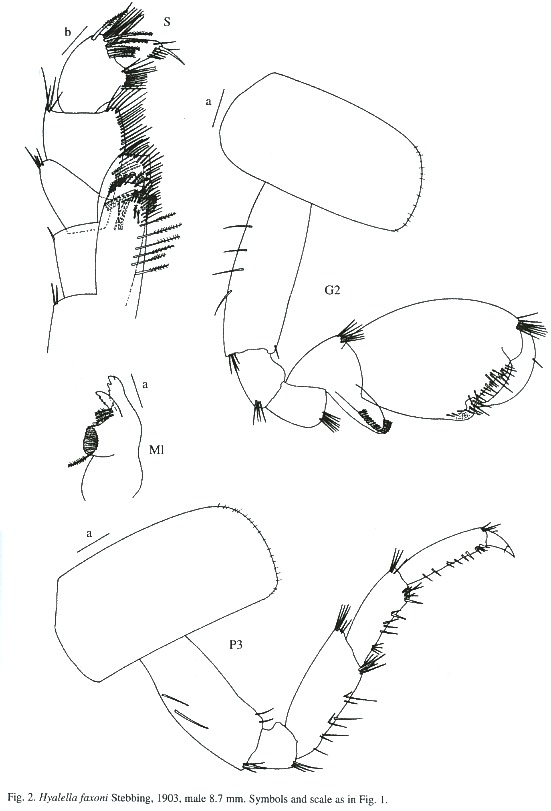
<body><![CDATA[<p><font face="Arial" size="2"><i>Hyalella faxoni&nbsp;</i></font><font  face="Arial" size="2"><a href="#Stebbing03">Stebbing, 1903</a></font><font  face="Arial" size="2">: 928–930, Fig. 61.     <br> </font></p> <font face="Arial" size="2"><b></b></font>     <p><font face="Arial" size="2"><b>Type material: </b>United States National Museum.</font></p> <font face="Arial" size="2"><b> </b></font>     <p><font face="Arial" size="2"><b>Type locality: </b>Volcan Reventado, Costa Rica (9°50’N, 83°56’W).</font></p> <font face="Arial" size="2"><b></b></font>     <p><font face="Arial" size="2"><b>Material Examined: </b>Volcan Barva, Costa Rica. 2000 m.a.s.l (10° 08’ N, 84° 06’ W). Material from Smithsonian Institution (Acc. # 96617).</font></p> <font face="Arial" size="2"><b></b></font>     <p><font face="Arial" size="2"><b>Diagnosis: </b>Body surface smooth. Coxa 4 excavated posteriorly. Eyes pigmented. Antenna 1 shorter than antenna 2. Antenna 2 less than half body length. Mandible incisor toothed. Maxilla 1 palp minute, reaching less than half length the distance between base of palp and tip of setae on outer plate; inner plate slender, with four strong and pappose apical setae. Maxilla 2, inner margin of inner plate with two closely together strong pappose setae. Gnathopod 1 propodus length less than two times maximum width (quadrangular), hammer shape, inner face with five pappose setae, setose scales on disto-posterior and disto-anterior border. Gnathopod 2 propodus ovate, palm shorter than posterior margin, slope slightly oblique, anterior edge with a wide truncated or rounded process. Peraeopods 3 and 4 merus and carpus posterior margin with three hind marginal clusters of long setae; propodus posterior margin with five to eight groups of setae. Uropod 3 peduncle with five strong distal setae; outer ramus same length as peduncle, basal width more than two times tip of ramus. Telson wider than long, apically rounded, with two widely apart, long simple setae, symmetrically distributed. Sternal gills on segments 3 to 7. <b>Female. </b>Gnathopod 1 similar in size, and different in shape to gnathopod 2. Gnathopod 2 different from male gnathopod 2 in shape and smaller, propodus length two to three times maximum width, normally subchelate, palm slightly reverse oblique.</font></p> <font face="Arial" size="2"><b></b></font>     <p><font face="Arial" size="2"><b>Description of male: </b>Size, 8.7 mm. Body surface smooth. Epimeral plate 1, 2 and 3 acuminate (<a  href="#f1">Fig. 1 E</a>). Coxae 1 to 4 subequal in size and shape, slightly overlapping. Acumination in coxae absent. Coxa 1 same as 2 and 3. Coxa 3 narrower than 4. Coxa 4 deeper than wide, excavated posteriorly. Coxa 5 posterior lobe deeper than anterior. Coxa 6 anterior lobe small. </font></p>     <div style="text-align: center;"><a name="f1"></a><img  src="/img/fbpe/rbt/v50n2/2820i1.JPG" title="" alt=""  style="width: 556px; height: 806px;"></div>     
<p><font face="Arial" size="2">Head smaller than first two thoracic segments, typically gammaridean, rostrum absent. Eyes pigmented, medium, ovoid, located between insertion of antenna 1 and 2 (<a  href="#f1">Fig. 1 H</a>).</font></p>     <p><font face="Arial" size="2">Antenna 1 less than half of body length, shorter than antenna 2, longer than peduncle of antenna 2; peduncle longer than head, article 1 longer than 2, article 3 the shortest; flagellum of 12 articles, longer than peduncle, basal article not elongated; asthetascs on flagellum, from articles 4 distally <a  href="#f1">(Fig. 1 A1)</a>.</font></p>     ]]></body>
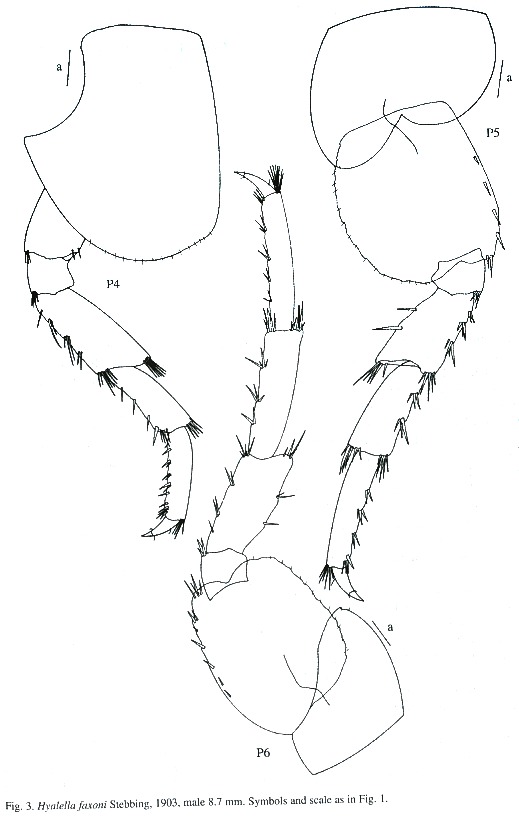
<body><![CDATA[<p><font face="Arial" size="2">Antenna 2 less than half body length; peduncle slender, longer than head, article 4 shorter than article 5, setal groups on article 4 and 5 scarce; flagellum of 15 to 17 articles, longer than article 5, basal article not elongated <a href="#f1">(Fig. 1 A2)</a>.</font></p>     <p><font face="Arial" size="2">Basic amphipodan mandible (in the sense of <a href="#Watling93">Watling 1993</a>); incisor toothed; left lacinia mobilis with five teeth; setae row on left mandible with three main setae without accessory setae, right mandible with two main setae without accessory setae; molar large, cylindrical, and triturative, accessory seta present. Labrum ventral margin round. Lower lip outer lobes rounded without notches or excavations, mandibular projection of outer lobes round <a href="#f2">(Fig. 2 Ml; Fig. 1 L, U)</a>.</font></p>     <div style="text-align: center;"><span style="font-family: arial;"><a  name="f2"></a><img src="/img/fbpe/rbt/v50n2/2820i2.JPG" title="" alt=""  style="width: 551px; height: 811px;"></span>    
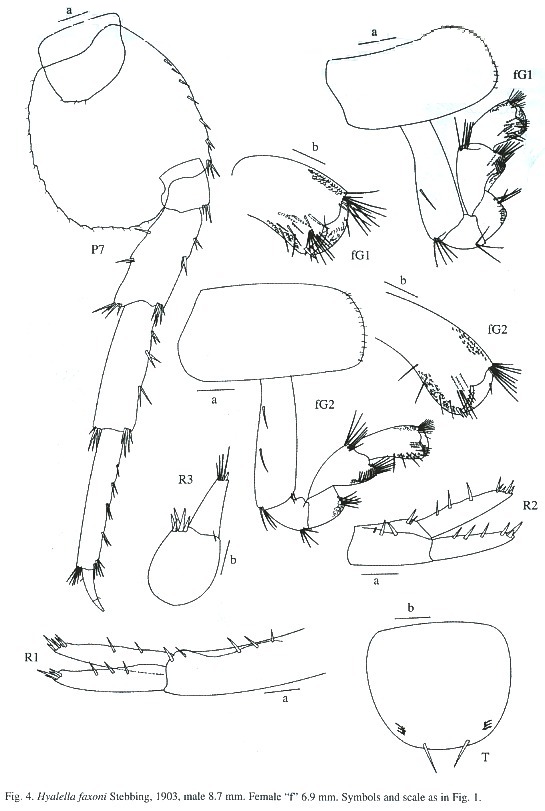
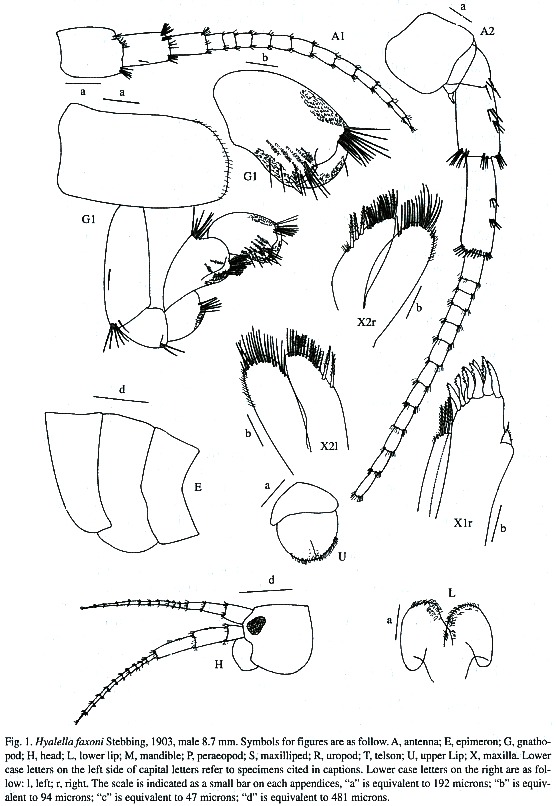
<br> </div>     <p><font face="Arial" size="2">Maxilla 1 palp uniarticulate, minute, reaching less than half length the distance between base of palp and tip of setae on outer plate, distal setae feeble; inner plate slender, smaller than outer plate, with four strong and pappose apical setae; outer plate with nine stout and serrate setae (<a href="#f1">Fig. 1 X1r</a>). Maxilla 2 inner plate subequal in length and width to outer plate, two closely together strong pappose setae on inner margin, outer and inner plates with scarce setules (<a href="#f2">Fig. 1 X2r, X2l</a>).</font></p>     <p><font face="Arial" size="2">Maxilliped inner plates apically truncated, with three connate setae, pappose setae apically and medially; outer plates larger than inner plates, apically truncated, apical, medial and facial setae simple; palp longer than outer plate, four articles; article 2 longer than wide, medial margin with long simple setae; article 3 outer distal face with several long simple setae, inner distal face with long plumose setae, inner distal margin with long setae, outer margin with one or two strong and long plumose setae; dactylus unguiform, shorter than third article, distal setae simple and shorter than nail, inner border with setae, distal nail present (<a href="#f2">Fig. 2 S</a>). </font></p>     <p><font face="Arial" size="2">Gnathopod 1 subchelate; carpus longer than wide, longer and wider than propodus, with strong and wide posterior lobe, produced and forming a scoop like structure, open to the inside, inner face with one to three pappose setae, border pectinate and with several pappose setae; propodus length less than two times maximum width (quadrangular), hammer shape, with no setae on anterior border, inner face with five pappose setae, setose scales on disto-posterior and disto-anterior border, palm slope transverse, margin straight, posterior distal corner with robust setae; dactylus claw-like, with one to three endal setae, congruent with palm (<a  href="#f1">Fig. 1 G1</a>).</font></p>     <p><font face="Arial" size="2">Gnathopod 2 subchelate; basis hind margin with four to six group of setae; merus with seven or more setae on posterior margin, postero- distal margin straight, distal corner rounded; carpus posterior lobe elongated, produced between merus and propodus, border pectinate with several pappose setae; propodus ovate, scales on disto-posterior border, palm shorter than posterior margin, slope slightly oblique, margin irregular, few long setae, several medium size setae, anterior edge with a wide truncated or rounded process, posterior distal corner with strong setae, and with cup for dactyl; dactylus claw-like, congruent with palm, with a few endal setae (<a href="#f2">Fig. 2 G2</a>).</font></p>     <p><font face="Arial" size="2">Peraeopods 3 to 7 simple. Peraeopods 3 and 4 merus and carpus posterior margin with three hind marginal clusters of long setae; propodus posterior margin five to eight groups of setae; dactylus less than half-length of propodus. Peraeopods 5 to 7 all similar in structure and slightly longer successively; dactylus less than half-length of propodus. Peraeopod 5 subequal to peraeopod 4, basis posterior lobe wider than deep, smaller than posterior lobe of peraeopod 7, merus with two hind marginal setae, proximal setae smaller than more distal. Peraeopod 6 longer than peraeopod 4, basis posterior lobe wider than deep, similar to posterior lobe of peraeopod 5, and smaller than posterior lobe of peraeopod 7. Peraeopod 7 subequal to peraeopod 6, basis posterior lobe wider than deep (<a href="#f2">Fig. 2 P3</a>; <a href="#f3">Fig. 3 P4, P5, P6</a>; <a href="#f4">Fig. 4 P7</a>).</font></p>     <div style="text-align: center;"><a name="f3"></a><img  src="/img/fbpe/rbt/v50n2/2820i4.JPG" title="" alt=""  style="width: 519px; height: 821px;">    
]]></body>
<body><![CDATA[<br>     <br>     <br> <a name="f4"></a><img src="/img/fbpe/rbt/v50n2/2820i3.JPG" title="" alt=""  style="width: 545px; height: 811px;">    
<br> </div>     <p><font face="Arial" size="2">Pleopods not modified; peduncle slender; longest ramus longer than peduncle.</font></p>     <p><font face="Arial" size="2">Uropod 1 longer than uropod 2; peduncle longer than rami; rami subequal; inner ramus with two dorsal and five distal setae, all of them subequal, male without curved setae on inner side of the ramus; outer ramus with three dorsal and four distal setae; peduncle setation present (<a href="#f4">Fig. 4 R1</a>).</font></p>     <p><font face="Arial" size="2">Uropod 2 outer ramus shortened; inner ramus with three dorsal and five distal setae; outer ramus with three dorsal and three distal setae; peduncle setation present <a href="#f4">(Fig. 4 R2)</a>.</font></p>     <p><font face="Arial" size="2">Uropod 3 longer than urosomite 3, shorter than peduncle of uropod 1, shorter than peduncle of uropod 2; peduncle globose, wider than ramus, with five strong distal and one marginal seta; inner ramus absent; outer ramus uniarticulate, same length as peduncle, basal width more than two times tip of ramus, with four simple apical slender setae, and one connate seta <a href="#f4">(Fig. 4 R3)</a>.</font></p>     <p><font face="Arial" size="2">Telson wider than long, entire, apically rounded, with two widely apart, long simple setae, symmetrically distributed on the apical margin (<a href="#f4">Fig. 4 T</a>).</font></p>     <p><font face="Arial" size="2">Coxal gills saclike, on segments 2 to 6. Sternal gills tubular, on segments 3 to 7.</font></p> <font face="Arial" size="2"><b></b></font>     ]]></body>
<body><![CDATA[<p><font face="Arial" size="2"><b>Characters of female that differ from male: </b>Size, 6.9 mm. Antenna 1 flagellum with ten articles. Antenna 2 similar in shape to male, flagellum with eleven to fourteen articles. Gnathopod 1 similar in size, and different in shape to gnathopod 2; similar to male gnathopod 1 in size and shape. Gnathopod 2 different from male gnathopod 2 in shape and smaller, propodus length two to three times maximum width, normally subchelate, palm slightly reverse oblique <a href="#f4">(Fig. 4 fG1, fG2)</a>.</font></p> <font face="Arial" size="2"><b> </b></font>     <p><font face="Arial" size="2"><b>Additional material: </b>Volcan Barva, Costa Rica.</font></p> <font face="Arial" size="2"><b></b></font>     <p><font face="Arial" size="2"><b>Habitat: </b>Freshwater, epigean, littoral.</font></p> <font face="Arial" size="2"><b> </b></font>     <p><font face="Arial" size="2"><b>Distribution: </b>Volcan Barva and Volcan Reventado (Type material), Costa Rica, Central America.</font></p> <font face="Arial" size="2"><b>     <p>Discussion</p> </b> <b></b></font>     <p><font face="Arial" size="2"><b>General remarks: </b>After the revision of the genus <i>Hyalella </i>(González and Watling, soon to be published elsewhere), the redescription of <i>H. azteca </i>(</font><font  face="Arial" size="2"><a href="#Gonzalez02">González and Watling 2002</a></font><font  face="Arial" size="2">), and the redefinition of most of the morphological characters for the group, many of the species formerly in the synonymy of <i>H. azteca </i>will probe to be different species. We consider <i>H. faxoni </i>among those valid species. Although very similar to <i>H. aztec</i>a, the species is different enough to be considered a separate species. The main difference is the telson, which is wider than long, apically rounded, with two widely separated long simple setae, whereas in <i>H. azteca </i>the telson is as wide as long, entire, apically pointed, with two apposed, long simple setae. Besides this main difference, other differences include: gnathopod 2 in the female has the palm of the propodus only slightly reversed; uropod 3, peduncle globose, wider than ramus, with five strong distal setae; palp in maxilla 1 is ogival; inner plate of maxilla 1 has four pappose setae. <i>H. faxoni </i>has smooth pleonites. The conditions where this species lives, isolated at high altitude in a rainforest type of environment, makes the genetic exchange with other populations rather difficult.</font></p> <font face="Arial" size="2"><b>     <p>Acknowledgments </p> </b> </font>     <p><font face="Arial" size="2">We thank Elizabeth Nelson from the National Museum Natural History, Smithsonian Institution for lending us the material of <i>Hyalella </i>from Costa Rica. We also thank two anonymous referees for providing constructive comments. </font></p> <font face="Arial" size="2"><b>     <p>    <br> Resumen</p> </b> </font>     ]]></body>
<body><![CDATA[<p><font face="Arial" size="2">La especie <i>Hyalella faxoni&nbsp;</i></font><font  face="Arial" size="2"><a href="#Stebbing03">Stebbing, 1903</a></font><font  face="Arial" size="2"> de Costa Rica es redescrita. Esta especie estaba previamente en la sinonimia de <i>Hyalella azteca </i>(</font><font  face="Arial" size="2"><a href="#Saussure58">Saussure, 1858</a></font><font  face="Arial" size="2">). Se discuten en este trabajo las diferencias morfológicas entre las dos especies.</font></p> <font face="Arial" size="2"><b>     <p>    <br> References</p> </b></font>     <!-- ref --><p><font face="Arial" size="2"><a name="Bate62"></a>Bate, C.S. 1862. Catalogue of the specimens of Amphipodous Crustacea in the collection of the British Museum. Br. Mus. (Natural History) London. 399 p.</font>&nbsp;&nbsp;&nbsp;&nbsp;&nbsp;&nbsp;&nbsp;&nbsp;[&#160;<a href="javascript:void(0);" onclick="javascript: window.open('/scielo.php?script=sci_nlinks&ref=1216231&pid=S0034-7744200200020002300001&lng=','','width=640,height=500,resizable=yes,scrollbars=1,menubar=yes,');">Links</a>&#160;]<!-- end-ref --><!-- ref --><p><font face="Arial" size="2"><a name="Dallwitz99"></a>Dallwitz, M.J., T.A. Paine &amp; E.J. Zurcher. 1999. User’s Guide to the DELTA System. A General System for Processing Taxonomic Descriptions. Edition 4.10. Division of Entomology, CSIRO, Australia. 168 p.</font>&nbsp;&nbsp;&nbsp;&nbsp;&nbsp;&nbsp;&nbsp;&nbsp;[&#160;<a href="javascript:void(0);" onclick="javascript: window.open('/scielo.php?script=sci_nlinks&ref=1216232&pid=S0034-7744200200020002300002&lng=','','width=640,height=500,resizable=yes,scrollbars=1,menubar=yes,');">Links</a>&#160;]<!-- end-ref --><!-- ref --><p><font face="Arial" size="2"><a name="Duan97"></a>Duan, Y., S.I. Guttman &amp; J.T. Oris. 1997. Genetic differentiation among laboratory populations of <i>Hyalella aztec</i>a: Implications for toxicology. Envir. Toxicol. Chem. 16(4): 691-695.</font>&nbsp;&nbsp;&nbsp;&nbsp;&nbsp;&nbsp;&nbsp;&nbsp;[&#160;<a href="javascript:void(0);" onclick="javascript: window.open('/scielo.php?script=sci_nlinks&ref=1216233&pid=S0034-7744200200020002300003&lng=','','width=640,height=500,resizable=yes,scrollbars=1,menubar=yes,');">Links</a>&#160;]<!-- end-ref --><p><font face="Arial" size="2"><a name="Duan00"></a>Duan, Y., S.I. Guttman &amp; J.T. Oris. 2000. Genetic structure and relationships among populations of <i>Hyalella azteca </i>and <i>H. montezuma </i>(Crustacea: Amphipoda). J. North Am. Benthol. Soc. 19(2): 308-320.</font></p>     <!-- ref --><p><font face="Arial" size="2"><a name="Faxon76"></a>Faxon, W. 1876. Exploration of Lake Titicaca by Alexander Agassiz and S.W. Garman. IV. Crustacea. Bull. Mus. Comp. Zool. 3: 361-375.</font>&nbsp;&nbsp;&nbsp;&nbsp;&nbsp;&nbsp;&nbsp;&nbsp;[&#160;<a href="javascript:void(0);" onclick="javascript: window.open('/scielo.php?script=sci_nlinks&ref=1216235&pid=S0034-7744200200020002300005&lng=','','width=640,height=500,resizable=yes,scrollbars=1,menubar=yes,');">Links</a>&#160;]<!-- end-ref --><!-- ref --><p><font face="Arial" size="2"><a name="Gonzalez02"></a>González, E.R. &amp; L. Watling. 2002. Redescription of <i>Hyalella azteca </i>from its type locality, Veracruz, Mexico (Amphipoda: Hyalellidae). J. Crust. Biol. 22: 173-183.</font>&nbsp;&nbsp;&nbsp;&nbsp;&nbsp;&nbsp;&nbsp;&nbsp;[&#160;<a href="javascript:void(0);" onclick="javascript: window.open('/scielo.php?script=sci_nlinks&ref=1216236&pid=S0034-7744200200020002300006&lng=','','width=640,height=500,resizable=yes,scrollbars=1,menubar=yes,');">Links</a>&#160;]<!-- end-ref --><!-- ref --><p><font face="Arial" size="2"><a name="Harford77"></a>Harford, W.G.W. 1877. Description of a new genus and new species of sessile eyed Crustacea. Proc. Calif. Acad. Sci. 7: 53-55.</font>&nbsp;&nbsp;&nbsp;&nbsp;&nbsp;&nbsp;&nbsp;&nbsp;[&#160;<a href="javascript:void(0);" onclick="javascript: window.open('/scielo.php?script=sci_nlinks&ref=1216237&pid=S0034-7744200200020002300007&lng=','','width=640,height=500,resizable=yes,scrollbars=1,menubar=yes,');">Links</a>&#160;]<!-- end-ref --><!-- ref --><p><font face="Arial" size="2"><a name="Hogg98"></a>Hogg, I.D., C, Larose, Y. de Lafontaine &amp; K.G. Doe. 1998. Genetic evidence for a <i>Hyalella </i>species complex within the Great Lakes - St. Lawrence River drainage basin: implications for ecotoxicology and conservation biology. Can. J. Zool. 76(6): 1134-1140.</font>&nbsp;&nbsp;&nbsp;&nbsp;&nbsp;&nbsp;&nbsp;&nbsp;[&#160;<a href="javascript:void(0);" onclick="javascript: window.open('/scielo.php?script=sci_nlinks&ref=1216238&pid=S0034-7744200200020002300008&lng=','','width=640,height=500,resizable=yes,scrollbars=1,menubar=yes,');">Links</a>&#160;]<!-- end-ref --><!-- ref --><p><font face="Arial" size="2"><a name="Media_Cybernetics97"></a>Media Cybernetics, L. P. 1997. Image-Pro Plus for Windows. Reference Guide. 480 p.</font>&nbsp;&nbsp;&nbsp;&nbsp;&nbsp;&nbsp;&nbsp;&nbsp;[&#160;<a href="javascript:void(0);" onclick="javascript: window.open('/scielo.php?script=sci_nlinks&ref=1216239&pid=S0034-7744200200020002300009&lng=','','width=640,height=500,resizable=yes,scrollbars=1,menubar=yes,');">Links</a>&#160;]<!-- end-ref --><!-- ref --><p><font face="Arial" size="2"><a name="Oshel88"></a>Oshel P.E. &amp; D.H. Steele. 1988. Comparative morphology of amphipod setae, and a proposal classification of setal types. Crustaceana (Suppl. 13): 100-106.</font>&nbsp;&nbsp;&nbsp;&nbsp;&nbsp;&nbsp;&nbsp;&nbsp;[&#160;<a href="javascript:void(0);" onclick="javascript: window.open('/scielo.php?script=sci_nlinks&ref=1216240&pid=S0034-7744200200020002300010&lng=','','width=640,height=500,resizable=yes,scrollbars=1,menubar=yes,');">Links</a>&#160;]<!-- end-ref --><!-- ref --><p><font face="Arial" size="2"><a name="Ruffo47"></a>Ruffo, S. 1947. Studi sui crostaci anfipodi. XV. Su alcune speciedi anfipodi dell’Argentina e della Terra del Fuoco. Boll. Lab. Ent. Agr. Portici 7: 326-332.</font>&nbsp;&nbsp;&nbsp;&nbsp;&nbsp;&nbsp;&nbsp;&nbsp;[&#160;<a href="javascript:void(0);" onclick="javascript: window.open('/scielo.php?script=sci_nlinks&ref=1216241&pid=S0034-7744200200020002300011&lng=','','width=640,height=500,resizable=yes,scrollbars=1,menubar=yes,');">Links</a>&#160;]<!-- end-ref --><!-- ref --><p><font face="Arial" size="2"><a name="Saussure58"></a>Saussure, H. 1858. Memoire sur divers crustaces nouveaux de Antilles et du Mexique. Mem. Soc. Phys. Hist. Nat. 14 P. 2: 417-496, 6 plates.</font>&nbsp;&nbsp;&nbsp;&nbsp;&nbsp;&nbsp;&nbsp;&nbsp;[&#160;<a href="javascript:void(0);" onclick="javascript: window.open('/scielo.php?script=sci_nlinks&ref=1216242&pid=S0034-7744200200020002300012&lng=','','width=640,height=500,resizable=yes,scrollbars=1,menubar=yes,');">Links</a>&#160;]<!-- end-ref --><!-- ref --><p><font face="Arial" size="2"><a name="Shoemaker33"></a>Shoemaker, C.R. 1933. Amphipoda from Florida and West Indies. Am. Mus. Novitates 598: 1-24.</font>&nbsp;&nbsp;&nbsp;&nbsp;&nbsp;&nbsp;&nbsp;&nbsp;[&#160;<a href="javascript:void(0);" onclick="javascript: window.open('/scielo.php?script=sci_nlinks&ref=1216243&pid=S0034-7744200200020002300013&lng=','','width=640,height=500,resizable=yes,scrollbars=1,menubar=yes,');">Links</a>&#160;]<!-- end-ref --><!-- ref --><p><font face="Arial" size="2"><a name="Smith74"></a>Smith, S. 1874. The Crustacea of the fresh waters of the United States. A Synopsis of the Higher Fresh-Water Crustacea of the Northern United States. Appendix F. Natural History. Report of the Commissioner for 1872 and 1873. U. S. Comm. Fish Fisheries 2: 637- 661.</font>&nbsp;&nbsp;&nbsp;&nbsp;&nbsp;&nbsp;&nbsp;&nbsp;[&#160;<a href="javascript:void(0);" onclick="javascript: window.open('/scielo.php?script=sci_nlinks&ref=1216244&pid=S0034-7744200200020002300014&lng=','','width=640,height=500,resizable=yes,scrollbars=1,menubar=yes,');">Links</a>&#160;]<!-- end-ref --><!-- ref --><p><font face="Arial" size="2"><a name="Smith75"></a>Smith, S. 1875. Report on Amphipod Crustaceans. Annual Report of the United States Geological and Geographical Survey of the Territories, Embracing Colorado. The Exploration for the year 1873, by F.V. Hayden, Washington D. C., Government Printing Office 1874: 608-611.</font>&nbsp;&nbsp;&nbsp;&nbsp;&nbsp;&nbsp;&nbsp;&nbsp;[&#160;<a href="javascript:void(0);" onclick="javascript: window.open('/scielo.php?script=sci_nlinks&ref=1216245&pid=S0034-7744200200020002300015&lng=','','width=640,height=500,resizable=yes,scrollbars=1,menubar=yes,');">Links</a>&#160;]<!-- end-ref --><!-- ref --><p><font face="Arial" size="2"><a name="Stebbing03"></a>Stebbing, T.R.R. 1903. Amphipoda from Costa Rica. Proc. U. S. Nat. Mus. 32: 25-58. 26: 925-931.</font>&nbsp;&nbsp;&nbsp;&nbsp;&nbsp;&nbsp;&nbsp;&nbsp;[&#160;<a href="javascript:void(0);" onclick="javascript: window.open('/scielo.php?script=sci_nlinks&ref=1216246&pid=S0034-7744200200020002300016&lng=','','width=640,height=500,resizable=yes,scrollbars=1,menubar=yes,');">Links</a>&#160;]<!-- end-ref --><!-- ref --><p><font face="Arial" size="2"><a name="Stebbing06"></a>Stebbing, T.R.R. 1906. Amphipoda I. Gammaridae. Das Tierreich 21: 1-806.</font>&nbsp;&nbsp;&nbsp;&nbsp;&nbsp;&nbsp;&nbsp;&nbsp;[&#160;<a href="javascript:void(0);" onclick="javascript: window.open('/scielo.php?script=sci_nlinks&ref=1216247&pid=S0034-7744200200020002300017&lng=','','width=640,height=500,resizable=yes,scrollbars=1,menubar=yes,');">Links</a>&#160;]<!-- end-ref --><!-- ref --><p><font face="Arial" size="2"><a name="Thomas94"></a>Thomas, E.P., D.W. Blinn &amp; P. Keim. 1994. A test of an Allopatric speciation model for congeneric amphipods in an isolated aquatic ecosystem. J. North Am. Benthol. Soc. 13: 100-109.</font>&nbsp;&nbsp;&nbsp;&nbsp;&nbsp;&nbsp;&nbsp;&nbsp;[&#160;<a href="javascript:void(0);" onclick="javascript: window.open('/scielo.php?script=sci_nlinks&ref=1216248&pid=S0034-7744200200020002300018&lng=','','width=640,height=500,resizable=yes,scrollbars=1,menubar=yes,');">Links</a>&#160;]<!-- end-ref --><!-- ref --><p><font face="Arial" size="2"><a name="Thomas97"></a>Thomas, E.P., D.W. Blinn &amp; P. Keim. 1997. Genetic and behavioral divergence among desert spring amphipod populations. Freshwat. Biol. 38: 137-143.</font>&nbsp;&nbsp;&nbsp;&nbsp;&nbsp;&nbsp;&nbsp;&nbsp;[&#160;<a href="javascript:void(0);" onclick="javascript: window.open('/scielo.php?script=sci_nlinks&ref=1216249&pid=S0034-7744200200020002300019&lng=','','width=640,height=500,resizable=yes,scrollbars=1,menubar=yes,');">Links</a>&#160;]<!-- end-ref --><!-- ref --><p><font face="Arial" size="2"><a name="Thomas98"></a>Thomas, E.P., D.W. Blinn &amp; P. Keim. 1998. Do xeric land-scapes increase genetic divergence in aquatic ecosystems? Freshwat. Biol. 40: 587-593.</font>&nbsp;&nbsp;&nbsp;&nbsp;&nbsp;&nbsp;&nbsp;&nbsp;[&#160;<a href="javascript:void(0);" onclick="javascript: window.open('/scielo.php?script=sci_nlinks&ref=1216250&pid=S0034-7744200200020002300020&lng=','','width=640,height=500,resizable=yes,scrollbars=1,menubar=yes,');">Links</a>&#160;]<!-- end-ref --><!-- ref --><p><font face="Arial" size="2"><a name="Watling89"></a>Watling, L. 1989. A classification system for crustacean setae based on the homology concept, pp. 15-27. <i>In </i>B.E. Felgenhauer, L. Watling &amp; A.B. Thistle (eds.). Functional morphology of feeding and grooming in Crustacea. Crustacean Issues 6. A. A. Balkema, Rotterdam.</font>&nbsp;&nbsp;&nbsp;&nbsp;&nbsp;&nbsp;&nbsp;&nbsp;[&#160;<a href="javascript:void(0);" onclick="javascript: window.open('/scielo.php?script=sci_nlinks&ref=1216251&pid=S0034-7744200200020002300021&lng=','','width=640,height=500,resizable=yes,scrollbars=1,menubar=yes,');">Links</a>&#160;]<!-- end-ref --><!-- ref --><p><font face="Arial" size="2"><a name="Watling93"></a>Watling, L. 1993. Functional morphology of the amphipod mandible. J. Nat. Hist. 27: 837-849.</font>&nbsp;&nbsp;&nbsp;&nbsp;&nbsp;&nbsp;&nbsp;&nbsp;[&#160;<a href="javascript:void(0);" onclick="javascript: window.open('/scielo.php?script=sci_nlinks&ref=1216252&pid=S0034-7744200200020002300022&lng=','','width=640,height=500,resizable=yes,scrollbars=1,menubar=yes,');">Links</a>&#160;]<!-- end-ref --><!-- ref --><p><font face="Arial" size="2"><a name="Weckel07"></a>Weckel, A.L. 1907. The freshwater Amphipoda of North America. Proc. U. S. Nat. Mus. 32: 25-58.</font>&nbsp;&nbsp;&nbsp;&nbsp;&nbsp;&nbsp;&nbsp;&nbsp;[&#160;<a href="javascript:void(0);" onclick="javascript: window.open('/scielo.php?script=sci_nlinks&ref=1216253&pid=S0034-7744200200020002300023&lng=','','width=640,height=500,resizable=yes,scrollbars=1,menubar=yes,');">Links</a>&#160;]<!-- end-ref --><!-- ref --><p><font face="Arial" size="2"><a name="Witt00"></a>Witt, J.D.S. &amp; P.D.N. Hebert. 2000. Cryptic species diversity and evolution in the amphipod genus <i>Hyalella </i>within central glaciated North America: a molecular phylogenetic approach. Can. J. Fish. Aquat. Sci. 57: 687-698.</font>&nbsp;&nbsp;&nbsp;&nbsp;&nbsp;&nbsp;&nbsp;&nbsp;[&#160;<a href="javascript:void(0);" onclick="javascript: window.open('/scielo.php?script=sci_nlinks&ref=1216254&pid=S0034-7744200200020002300024&lng=','','width=640,height=500,resizable=yes,scrollbars=1,menubar=yes,');">Links</a>&#160;]<!-- end-ref --> ]]></body><back>
<ref-list>
<ref id="B1">
<nlm-citation citation-type="book">
<person-group person-group-type="author">
<name>
<surname><![CDATA[Bate]]></surname>
<given-names><![CDATA[C.S]]></given-names>
</name>
</person-group>
<source><![CDATA[Catalogue of the specimens of Amphipodous Crustacea in the collection of the British Museum]]></source>
<year>1862</year>
<page-range>399</page-range><publisher-loc><![CDATA[London ]]></publisher-loc>
<publisher-name><![CDATA[Br. Mus. (Natural History)]]></publisher-name>
</nlm-citation>
</ref>
<ref id="B2">
<nlm-citation citation-type="book">
<person-group person-group-type="author">
<name>
<surname><![CDATA[Dallwitz]]></surname>
<given-names><![CDATA[M.J]]></given-names>
</name>
<name>
<surname><![CDATA[Paine]]></surname>
<given-names><![CDATA[T.A]]></given-names>
</name>
<name>
<surname><![CDATA[Zurcher]]></surname>
<given-names><![CDATA[E.J]]></given-names>
</name>
</person-group>
<source><![CDATA[User’s Guide to the DELTA System. A General System for Processing Taxonomic Descriptions]]></source>
<year>1999</year>
<edition>4</edition>
<page-range>168</page-range><publisher-name><![CDATA[CSIRO]]></publisher-name>
</nlm-citation>
</ref>
<ref id="B3">
<nlm-citation citation-type="journal">
<person-group person-group-type="author">
<name>
<surname><![CDATA[Duan]]></surname>
<given-names><![CDATA[Y]]></given-names>
</name>
<name>
<surname><![CDATA[Guttman]]></surname>
<given-names><![CDATA[S.I]]></given-names>
</name>
<name>
<surname><![CDATA[Oris]]></surname>
<given-names><![CDATA[J.T]]></given-names>
</name>
</person-group>
<article-title xml:lang="en"><![CDATA[Genetic differentiation among laboratory populations of Hyalella azteca: Implications for toxicology]]></article-title>
<source><![CDATA[Envir. Toxicol. Chem]]></source>
<year>1997</year>
<volume>16</volume>
<numero>4</numero>
<issue>4</issue>
<page-range>691-695</page-range></nlm-citation>
</ref>
<ref id="B4">
<nlm-citation citation-type="journal">
<person-group person-group-type="author">
<name>
<surname><![CDATA[Duan]]></surname>
<given-names><![CDATA[Y]]></given-names>
</name>
<name>
<surname><![CDATA[Guttman]]></surname>
<given-names><![CDATA[S.I]]></given-names>
</name>
<name>
<surname><![CDATA[Oris]]></surname>
<given-names><![CDATA[J.T]]></given-names>
</name>
</person-group>
<article-title xml:lang="en"><![CDATA[Genetic structure and relationships among populations of Hyalella azteca and H. montezuma (Crustacea: Amphipoda)]]></article-title>
<source><![CDATA[J. North Am. Benthl. Soc]]></source>
<year>2000</year>
<volume>19</volume>
<numero>2</numero>
<issue>2</issue>
<page-range>308-320</page-range></nlm-citation>
</ref>
<ref id="B5">
<nlm-citation citation-type="journal">
<person-group person-group-type="author">
<name>
<surname><![CDATA[Faxon]]></surname>
<given-names><![CDATA[W]]></given-names>
</name>
</person-group>
<article-title xml:lang="en"><![CDATA[Exploration of Lake Titicaca by Alexander Agassiz and S.W. Garman. IV. Crustacea]]></article-title>
<source><![CDATA[Bull. Mus. Comp. Zool]]></source>
<year>1876</year>
<volume>3</volume>
<page-range>361-375</page-range></nlm-citation>
</ref>
<ref id="B6">
<nlm-citation citation-type="journal">
<person-group person-group-type="author">
<name>
<surname><![CDATA[González]]></surname>
<given-names><![CDATA[E.R]]></given-names>
</name>
<name>
<surname><![CDATA[Watling]]></surname>
<given-names><![CDATA[L]]></given-names>
</name>
</person-group>
<article-title xml:lang="en"><![CDATA[Redescription of Hyalella azteca from its type locality, Veracruz, Mexico (Amphipoda: Hyalellidae)]]></article-title>
<source><![CDATA[J. Crust. Biol]]></source>
<year>2002</year>
<volume>22</volume>
<page-range>173-183</page-range></nlm-citation>
</ref>
<ref id="B7">
<nlm-citation citation-type="journal">
<person-group person-group-type="author">
<name>
<surname><![CDATA[Harford]]></surname>
<given-names><![CDATA[W.G.W]]></given-names>
</name>
</person-group>
<article-title xml:lang="en"><![CDATA[Description of a new genus and new species of sessile eyed Crustacea]]></article-title>
<source><![CDATA[Proc. Calif. Acad. Sci]]></source>
<year>1877</year>
<volume>7</volume>
<page-range>53-55</page-range></nlm-citation>
</ref>
<ref id="B8">
<nlm-citation citation-type="journal">
<person-group person-group-type="author">
<name>
<surname><![CDATA[Hogg]]></surname>
<given-names><![CDATA[I.D]]></given-names>
</name>
<name>
<surname><![CDATA[Larose]]></surname>
<given-names><![CDATA[C]]></given-names>
</name>
<name>
<surname><![CDATA[de Lafontaine]]></surname>
<given-names><![CDATA[Y]]></given-names>
</name>
<name>
<surname><![CDATA[Doe]]></surname>
<given-names><![CDATA[K.G]]></given-names>
</name>
</person-group>
<article-title xml:lang="en"><![CDATA[Genetic evidence for a Hyalella species complex within the Great Lakes - St. Lawrence River drainage basin: implications for ecotoxicology and conservation biology]]></article-title>
<source><![CDATA[Can. J. Zool]]></source>
<year>1998</year>
<volume>76</volume>
<numero>6</numero>
<issue>6</issue>
<page-range>1134-1140</page-range></nlm-citation>
</ref>
<ref id="B9">
<nlm-citation citation-type="book">
<person-group person-group-type="author">
<name>
<surname><![CDATA[Media Cybernetics]]></surname>
<given-names><![CDATA[L. P]]></given-names>
</name>
</person-group>
<source><![CDATA[Image-Pro Plus for Windows]]></source>
<year>1997</year>
<page-range>480</page-range><publisher-name><![CDATA[Reference Guide]]></publisher-name>
</nlm-citation>
</ref>
<ref id="B10">
<nlm-citation citation-type="journal">
<person-group person-group-type="author">
<name>
<surname><![CDATA[Oshel]]></surname>
<given-names><![CDATA[P.E]]></given-names>
</name>
<name>
<surname><![CDATA[Steele]]></surname>
<given-names><![CDATA[D.H]]></given-names>
</name>
</person-group>
<article-title xml:lang="en"><![CDATA[Comparative morphology of amphipod setae, and a proposal classification of setal types]]></article-title>
<source><![CDATA[Crustaceana]]></source>
<year>1988</year>
<numero>^s13</numero>
<issue>^s13</issue>
<supplement>13</supplement>
<page-range>100-106</page-range></nlm-citation>
</ref>
<ref id="B11">
<nlm-citation citation-type="journal">
<person-group person-group-type="author">
<name>
<surname><![CDATA[Ruffo]]></surname>
<given-names><![CDATA[S]]></given-names>
</name>
</person-group>
<article-title xml:lang="en"><![CDATA[Studi sui crostaci anfipodi. XV: Su alcune speciedi anfipodi dell’Argentina e della Terra del Fuoco]]></article-title>
<source><![CDATA[Boll. Lab. Ent. Agr. Portici]]></source>
<year>1947</year>
<volume>7</volume>
<page-range>326-332</page-range></nlm-citation>
</ref>
<ref id="B12">
<nlm-citation citation-type="journal">
<person-group person-group-type="author">
<name>
<surname><![CDATA[Saussure]]></surname>
<given-names><![CDATA[H]]></given-names>
</name>
</person-group>
<article-title xml:lang="en"><![CDATA[Memoire sur divers crustaces nouveaux de Antilles et du Mexique]]></article-title>
<source><![CDATA[Mem. Soc. Phys. Hist. Nat]]></source>
<year>1858</year>
<volume>14 P. 2</volume>
<page-range>417-496</page-range></nlm-citation>
</ref>
<ref id="B13">
<nlm-citation citation-type="journal">
<person-group person-group-type="author">
<name>
<surname><![CDATA[Shoemaker]]></surname>
<given-names><![CDATA[C.R]]></given-names>
</name>
</person-group>
<article-title xml:lang="en"><![CDATA[Amphipoda from Florida and West Indies]]></article-title>
<source><![CDATA[Am. Mus. Novitates]]></source>
<year>1933</year>
<volume>598</volume>
<page-range>1-24</page-range></nlm-citation>
</ref>
<ref id="B14">
<nlm-citation citation-type="journal">
<person-group person-group-type="author">
<name>
<surname><![CDATA[Smith]]></surname>
<given-names><![CDATA[S]]></given-names>
</name>
</person-group>
<article-title xml:lang="en"><![CDATA[The Crustacea of the fresh waters of the United States. A Synopsis of the Higher Fresh-Water Crustacea of the Northern United States. Appendix F. Natural History: Report of the Commissioner for 1872 and 1873]]></article-title>
<source><![CDATA[U. S. Comm. Fish Fisheries]]></source>
<year>1874</year>
<volume>2</volume>
<page-range>637- 661</page-range></nlm-citation>
</ref>
<ref id="B15">
<nlm-citation citation-type="journal">
<person-group person-group-type="author">
<name>
<surname><![CDATA[Smith]]></surname>
<given-names><![CDATA[S]]></given-names>
</name>
</person-group>
<article-title xml:lang="en"><![CDATA[Report on Amphipod Crustaceans. Annual Report of the United States Geological and Geographical Survey of the Territories, Embracing Colorado: The Exploration for the year 1873, by F.V. Hayden, Washington D. C]]></article-title>
<source><![CDATA[Government Printing Office]]></source>
<year>1875</year>
<volume>1874</volume>
<page-range>608-611</page-range></nlm-citation>
</ref>
<ref id="B16">
<nlm-citation citation-type="journal">
<person-group person-group-type="author">
<name>
<surname><![CDATA[Stebbing]]></surname>
<given-names><![CDATA[T.R.R]]></given-names>
</name>
</person-group>
<article-title xml:lang="en"><![CDATA[Amphipoda from Costa Rica]]></article-title>
<source><![CDATA[Proc. U. S. Nat. Mus]]></source>
<year>1903</year>
<volume>32</volume><volume>26</volume>
<page-range>25-58</page-range><page-range>925-931</page-range></nlm-citation>
</ref>
<ref id="B17">
<nlm-citation citation-type="journal">
<person-group person-group-type="author">
<name>
<surname><![CDATA[Stebbing]]></surname>
<given-names><![CDATA[T.R.R]]></given-names>
</name>
</person-group>
<article-title xml:lang="en"><![CDATA[Amphipoda I: Gammaridae]]></article-title>
<source><![CDATA[Das Tierreich]]></source>
<year>1906</year>
<volume>21</volume>
<page-range>1-806</page-range></nlm-citation>
</ref>
<ref id="B18">
<nlm-citation citation-type="journal">
<person-group person-group-type="author">
<name>
<surname><![CDATA[Thomas]]></surname>
<given-names><![CDATA[E.P]]></given-names>
</name>
<name>
<surname><![CDATA[Blinn]]></surname>
<given-names><![CDATA[D.W]]></given-names>
</name>
<name>
<surname><![CDATA[Keim]]></surname>
<given-names><![CDATA[P]]></given-names>
</name>
</person-group>
<article-title xml:lang="en"><![CDATA[A test of an Allopatric speciation model for congeneric amphipods in an isolated aquatic ecosystem]]></article-title>
<source><![CDATA[J. North Am. Benthol. Soc]]></source>
<year>1994</year>
<volume>13</volume>
<page-range>100-109</page-range></nlm-citation>
</ref>
<ref id="B19">
<nlm-citation citation-type="journal">
<person-group person-group-type="author">
<name>
<surname><![CDATA[Thomas]]></surname>
<given-names><![CDATA[E.P]]></given-names>
</name>
<name>
<surname><![CDATA[Blinn]]></surname>
<given-names><![CDATA[D.W]]></given-names>
</name>
<name>
<surname><![CDATA[Keim]]></surname>
<given-names><![CDATA[P]]></given-names>
</name>
</person-group>
<article-title xml:lang="en"><![CDATA[Genetic and behavioral divergence among desert spring amphipod populations]]></article-title>
<source><![CDATA[Freshwat. Biol]]></source>
<year>1997</year>
<volume>38</volume>
<page-range>137-143</page-range></nlm-citation>
</ref>
<ref id="B20">
<nlm-citation citation-type="journal">
<person-group person-group-type="author">
<name>
<surname><![CDATA[Thomas]]></surname>
<given-names><![CDATA[E.P]]></given-names>
</name>
<name>
<surname><![CDATA[Blinn]]></surname>
<given-names><![CDATA[D.W]]></given-names>
</name>
<name>
<surname><![CDATA[Keim]]></surname>
<given-names><![CDATA[P]]></given-names>
</name>
</person-group>
<article-title xml:lang="en"><![CDATA[Do xeric land-scapes increase genetic divergence in aquatic ecosystems?]]></article-title>
<source><![CDATA[Freshwat. Biol]]></source>
<year>1998</year>
<volume>40</volume>
<page-range>587-593</page-range></nlm-citation>
</ref>
<ref id="B21">
<nlm-citation citation-type="">
<person-group person-group-type="author">
<name>
<surname><![CDATA[Watling]]></surname>
<given-names><![CDATA[L]]></given-names>
</name>
<name>
<surname><![CDATA[Felgenhauer]]></surname>
<given-names><![CDATA[B.E]]></given-names>
</name>
</person-group>
<source><![CDATA[A classification system for crustacean setae based on the homology concept]]></source>
<year>1989</year>
<page-range>15-27</page-range></nlm-citation>
</ref>
<ref id="B22">
<nlm-citation citation-type="">
<person-group person-group-type="author">
<name>
<surname><![CDATA[Watling]]></surname>
<given-names><![CDATA[L]]></given-names>
</name>
</person-group>
<article-title xml:lang="en"><![CDATA[Functional morphology of the amphipod mandible]]></article-title>
<source><![CDATA[]]></source>
<year>1993</year>
</nlm-citation>
</ref>
<ref id="B23">
<nlm-citation citation-type="journal">
<person-group person-group-type="author">
<name>
<surname><![CDATA[Weckel]]></surname>
<given-names><![CDATA[A.L]]></given-names>
</name>
</person-group>
<article-title xml:lang="en"><![CDATA[The freshwater Amphipoda of North America]]></article-title>
<source><![CDATA[Proc. U. S. Nat. Mus]]></source>
<year>1907</year>
<volume>32</volume>
<page-range>25-58</page-range></nlm-citation>
</ref>
<ref id="B24">
<nlm-citation citation-type="">
<person-group person-group-type="author">
<name>
<surname><![CDATA[Witt]]></surname>
<given-names><![CDATA[J.D.S]]></given-names>
</name>
<name>
<surname><![CDATA[Hebert]]></surname>
<given-names><![CDATA[P.D.N]]></given-names>
</name>
</person-group>
<article-title xml:lang="en"><![CDATA[Cryptic species diversity and evolution in the amphipod genus Hyalella within central glaciated North America]]></article-title>
<source><![CDATA[]]></source>
<year>2000</year>
</nlm-citation>
</ref>
</ref-list>
</back>
</article>