<?xml version="1.0" encoding="ISO-8859-1"?><article xmlns:mml="http://www.w3.org/1998/Math/MathML" xmlns:xlink="http://www.w3.org/1999/xlink" xmlns:xsi="http://www.w3.org/2001/XMLSchema-instance">
<front>
<journal-meta>
<journal-id>0034-7744</journal-id>
<journal-title><![CDATA[Revista de Biología Tropical]]></journal-title>
<abbrev-journal-title><![CDATA[Rev. biol. trop]]></abbrev-journal-title>
<issn>0034-7744</issn>
<publisher>
<publisher-name><![CDATA[Universidad de Costa Rica]]></publisher-name>
</publisher>
</journal-meta>
<article-meta>
<article-id>S0034-77442002000200021</article-id>
<title-group>
<article-title xml:lang="en"><![CDATA[Distribution and ecological notes on Dynoides (Isopoda: Sphaeromatidae) in the Mexican Pacific]]></article-title>
</title-group>
<contrib-group>
<contrib contrib-type="author">
<name>
<surname><![CDATA[Espinosa-Pérez]]></surname>
<given-names><![CDATA[María del Carmen]]></given-names>
</name>
<xref ref-type="aff" rid="A01"/>
</contrib>
<contrib contrib-type="author">
<name>
<surname><![CDATA[Hendrickx]]></surname>
<given-names><![CDATA[Michel E]]></given-names>
</name>
<xref ref-type="aff" rid="A01"/>
</contrib>
</contrib-group>
<aff id="A01">
<institution><![CDATA[,Unidad Académica Mazatlán Instituto de Ciencias del Mar y Limnología Laboratorio de Invertebrados Bentónicos]]></institution>
<addr-line><![CDATA[ ]]></addr-line>
<country>México</country>
</aff>
<pub-date pub-type="pub">
<day>00</day>
<month>06</month>
<year>2002</year>
</pub-date>
<pub-date pub-type="epub">
<day>00</day>
<month>06</month>
<year>2002</year>
</pub-date>
<volume>50</volume>
<numero>2</numero>
<fpage>643</fpage>
<lpage>647</lpage>
<copyright-statement/>
<copyright-year/>
<self-uri xlink:href="http://www.scielo.sa.cr/scielo.php?script=sci_arttext&amp;pid=S0034-77442002000200021&amp;lng=en&amp;nrm=iso"></self-uri><self-uri xlink:href="http://www.scielo.sa.cr/scielo.php?script=sci_abstract&amp;pid=S0034-77442002000200021&amp;lng=en&amp;nrm=iso"></self-uri><self-uri xlink:href="http://www.scielo.sa.cr/scielo.php?script=sci_pdf&amp;pid=S0034-77442002000200021&amp;lng=en&amp;nrm=iso"></self-uri><abstract abstract-type="short" xml:lang="en"><p><![CDATA[Two species of the genus Dynoides Barnard, 1914 (D. crenulatus Carvacho and Haasmann, 1984; D. saldanai Carvacho and Haasmann, 1984) not reported since their description were rediscovered during an intensive sampling program in the intertidal and shallow subtidal of the Mexican Pacific. Both species are abundant in the area and inhabit among the algae Jania adherens Lamouroux, 1816, Amphiroa misakiensis Yendo, 1902, Chaetomorpha linum Kützing, 1845, and Hypnea pannosa Agardh, 1847 from Nayarit to Oaxaca]]></p></abstract>
<abstract abstract-type="short" xml:lang="es"><p><![CDATA[Durante un programa intensivo de muestreo en la zona intermareal y submareal somera del Pacífico mexicano se redescubrieron dos especies del género Dynoides Barnard, 1914 (D. crenulatus Carvacho y Haasmann, 1984; D. saldanai Carvacho y Haasmann, 1984), no registradas desde su descripción. Ambas especies son abundantes en el área y habitan entre las algas Jania adherens Lamouroux, 1816, Amphiroa misakiensis Yendo, 1902, Chaetomorpha linum Kützing, 1845 e Hypnea pannosa Agardh, 1847 desde Nayarit hasta Oaxaca]]></p></abstract>
<kwd-group>
<kwd lng="en"><![CDATA[Isopoda]]></kwd>
<kwd lng="en"><![CDATA[Dynoides]]></kwd>
<kwd lng="en"><![CDATA[Mexican Pacific]]></kwd>
<kwd lng="en"><![CDATA[distribution]]></kwd>
<kwd lng="en"><![CDATA[fecundity]]></kwd>
</kwd-group>
</article-meta>
</front><body><![CDATA[ <div style="text-align: center;"><b><font face="Arial">Distribution and ecological notes on </font></b><font face="Arial"><i>Dynoides</i></font>    <br> <font face="Arial"><b>(Isopoda: Sphaeromatidae) in the Mexican Pacific</b></font></div> <b><font face="Arial" size="2"> </font></b>     <p><font face="Arial" size="2">María del Carmen Espinosa-Pérez and Michel E. Hendrickx</font></p>     <p><font face="Arial" size="2">Laboratorio de Invertebrados Bentónicos, Instituto de Ciencias del Mar y Limnología, Unidad Académica Mazatlán, UNAM. A. P. 811 Mazatlán, Sinaloa, 82000, México. Fax 52 69 82 61 33; e-mail: <a href="mailto:carmene@ola.icmyl.unam.mx">carmene@ola.icmyl.unam.mx</a> and <a href="mailto:michel@mar.icmyl.unam.mx">michel@mar.icmyl.unam.mx</a></font></p>     <p align="center"><font face="Arial" size="2">Received 26-VI-2001.&nbsp;&nbsp;&nbsp;&nbsp;&nbsp; Corrected 05-II-2002.&nbsp;&nbsp;&nbsp;&nbsp;&nbsp;&nbsp; Accepted 10-IV-2002.</font></p> <font face="Arial" size="2"><b>     <p>Abstract</p> </b></font>     <p><font face="Arial" size="2">Two species of the genus <i>Dynoides&nbsp;</i></font><font  face="Arial" size="2"><a href="#Barnard14">Barnard (1914)</a></font><font  face="Arial" size="2"> <i>(D. crenulatus </i><a href="#Carvacho84">Carvacho and Haasmann, 1984</a>; <i>D. saldanai&nbsp;</i></font><font  face="Arial" size="2"><a href="#Carvacho84">Carvacho and Haasmann, 1984</a></font><font  face="Arial" size="2">) not reported since their description were rediscovered during an intensive sampling program in the intertidal and shallow subtidal of the Mexican Pacific. Both species are abundant in the area and inhabit among the algae <i>Jania adherens </i>Lamouroux, 1816, <i>Amphiroa misakiensis </i>Yendo, 1902, <i>Chaetomorpha linum </i>Kützing, 1845, and <i>Hypnea pannosa </i>Agardh, 1847 from Nayarit to Oaxaca.</font></p> <font face="Arial" size="2"><b></b></font>     <p><font face="Arial" size="2"><b>Key words: </b>Isopoda, <i>Dynoide</i>s, Mexican Pacific, distribution, fecundity.</font></p>     <p><font face="Arial" size="2">    <br> Since it was created by <a href="#Barnard14">Barnard (1914)</a>, several species have been added to the genus <i>Dynoide</i>s. <a  href="#Harrison91">Harrison and Ellis (1991)</a> considered only four species, overlooking the contribution of <a href="#Carvacho84">Carvacho and Haasmann (1984)</a> who described two new species for the state of Oaxaca and first recorded the genus for the entire American Pacific. They also overlooked seven additional species described between 1980 and 1991. In addition to these species, another member of this genus was described in 1997 and one species was transferred to <i>Dynoide</i>s. <a href="#Li00">Li (2000)</a> described another species from Hong Kong, transferred all species of <i>Clianella </i>to <i>Dynoides </i>and considered that 18 species of the genus are known to date, over-looking <i>D. conchicola </i>(Nishimura, 1976) from Japan. The 19 species presently included in <i>Dynoides </i>are: <i>D. serratisinus </i><a  href="#Barnard14">Barnard, 1914</a> [South Africa]; <i>D. elegans </i>(Boone, 1923) [California]; <i>D. barnardi </i>Baker, 1928 [Australia]; <i>D. dentisinus </i>Shen, 1929 [Japan, Korea, China Sea]; <i>D. amblysinus </i>Pillai, 1954 [India]; <i>D. castroi </i><a href="#Loyola60">Loyola and Silva, 1960</a> [Brazil]; <i>D. conchicola </i>(Nishimura, 1976) [Japan]; <i>D. brevispina </i>Bruce, 1980 [Japan]; <i>D. viridis </i>Bruce, 1982 [Australia]; <i>D. Crenulatus&nbsp;</i></font><font face="Arial"  size="2"><a href="#Carvacho84">Carvacho and Haasmann, 1984</a></font><font  face="Arial" size="2"> [Mexican Pacific]; <i>D. saldanai&nbsp;</i></font><font  face="Arial" size="2"><a href="#Carvacho84">Carvacho and Haasmann, 1984</a></font><font  face="Arial" size="2"> [Mexican Pacific]; <i>D. spinipodus </i>Kwon and Kim, 1986 [Korea]; <i>D. brevicornis </i><a href="#Kussakin87">Kussakin and Malyutina, 1987</a> [Eastern Russia]; <i>D. longisinus </i>Kwon, 1990 [Korea]; <i>D. hoonsooi </i>Kwon, 1990 [Korea]; <i>D. indicus </i>Mueller, 1991 [Sri Lanka]; <i>D. harrisoni </i>Kussakin and Malyutina, 1993 [China Sea]; <i>D. artocanalis </i>Nunomura, 1997 [Japan]; and <i>D. daguilarensis </i><a href="#Li00">Li, 2000</a> [Hong Kong]. <a  href="#Kensley01">Kensley and Schotte (2001)</a> cite all these species, except <i>D. castroi </i>and <i>D. brevicornis </i>(see <a  href="#Loyola60">Loyola and Silva 1960</a>, <a href="#Kussakin87">Kussakin and Malyutina 1987</a>) and the species of <i>Clianella </i>transferred by </font><font face="Arial" size="2"><a href="#Li00">Li (2000)</a></font><font  face="Arial" size="2">.</font></p>     ]]></body>
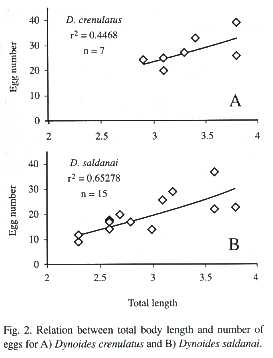
<body><![CDATA[<p><font face="Arial" size="2">Despite of its evident abundance along the Pacific coast of Mexico, it took 70 years after <i>Dynoides </i>was described to record a species of this genus in the area. Indeed, <i>D. crenulatus </i>and <i>D. saldanai </i>were collected in 1982 from Puerto Escondido (15º 52.0’ N - 97º 07.0’ W), Oaxaca, Mexico, and described two years after. Up to date, they have been reported only for their type locality.</font></p>     <p><font face="Arial" size="2">During an intensive sampling program (13 localities) of intertidal and shallow water isopods along the Pacific coast of Mexico, <i>D. crenulatus </i>and <i>D. saldanai </i>were rediscovered in several localities, often abundantly.</font></p> <font face="Arial" size="2"><b>     <p>Materials and methods</p> </b> </font>     <p><font face="Arial" size="2">Specimens were all obtained from a series of samples in the intertidal and shallow subtidal (1996 and 1997) in the coastal area comprised between Los Algodones Bay (27º 58.6’ N -111º l07.7’ W), north of Guaymas Bay, Sonora, and San Juan de Alima (18º36.1’ N - 103º 42.1’ W), in the northern part of Michoacan, Mexico <a href="#f1">(Fig. 1)</a>.</font></p>     <p style="text-align: center;"><font face="Arial" size="2"><a name="f1"></a><img  src="/img/fbpe/rbt/v50n2/2818i1.JPG" title="" alt=""  style="width: 558px; height: 242px;"></font></p>     
<p><font face="Arial" size="2">Collecting was done by hand, amongalgae, under rocks and in rock crevices and along sandy beaches. Scuba diving was used in shallow water. Water temperature (field thermometer) and position (portable GPS) were registered in every collecting site. Specimens of algae were preserved and kept for identification. Fecundity of the two species of <i>Dynoides </i>was estimated in terms of egg numbers related to total body length. The material collected was deposited in the invertebrates reference collection of the Unidad Académica Mazatlán, Instituto de Ciencias del Mar y Limnología, UNAM (EMU-).</font></p>     <p><font face="Arial" size="2">Abbreviations used in this paper are: St., sampling station; IT, intertidal zone; TL, total length; NS, specimen not sexed; NM, specimen not measured; M, male; F, female; OF, ovigerous female; EMU-, Reference Collection of Invertebrates, Unidad Académica Mazatlan, UNAM, followed by catalog number. </font></p> <font face="Arial" size="2"><b>     <p>Results<font face="Arial" size="2"><i>     <br> </i></font></p> </b><i> </i></font> <font face="Arial" size="2"><i></i></font>     <p><font face="Arial" size="2"><i>Dynoides </i></font><font  face="Arial" size="2"><a href="#Barnard14">Barnard, 1914</a><i>     ]]></body>
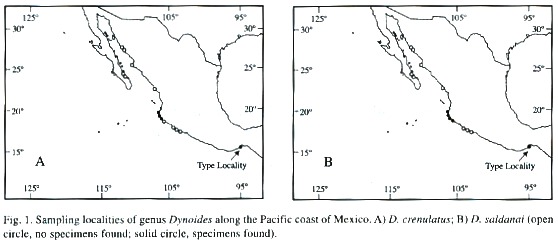
<body><![CDATA[<br> </i></font></p>     <p><font face="Arial" size="2"><i>Dynoides crenulatus </i></font><font  face="Arial" size="2"><a href="#Carvacho84">Carvacho and Haasmann, 1984</a>     <br> </font></p> <font face="Arial" size="2"><i></i></font>     <p><font face="Arial" size="2"><i>Dynoides crenulatus&nbsp;</i></font><font  face="Arial" size="2"><a href="#Carvacho84">Carvacho and Haasmann, 1984</a></font><font  face="Arial" size="2">: 23-27, Figs. 5 - 6.</font></p> <font face="Arial" size="2"><b></b></font>     <p><font face="Arial" size="2"><b>Examined material: </b>Punta Raza (21º 02.6’ N - 105º 19.4’ W), Nayarit, 11/IV/1996, IT, 6 M (TL 2.6 - 3.6 mm), 18 F (TL 1.9 - 3.3 mm), 2 OF (TL 3.3 mm) and 22 additional specimens (NS, NM) (EMU-4407). Same locality, 11/IV/1996, IT, 2 M (TL 4.1 mm), 2 F (TL 2.4 mm), manual (EMU-4638). Same locality, 11/IV/1996, IT, 5 M (TL 3.1 - 4.4 mm), 20 F (TL 2.4 - 3.2 mm), 3 OF (TL 2.9 -3.4 mm) and 33 additional specimens (NS, NM) (EMU-4687). Los Arcos (20º 32.5’ N -105º 18.4’ W), Jalisco, 12/IV/1996, IT, 9 M (TL 3.2 - 4.4 mm), 14 F (TL 2.6 - 3.3 mm), 2 OF (TL 3.8 mm) and 23 additional specimens (NS, NM) (EMU-4639). Bahía Tenacatita (19º 15.9’ N - 104º 47.9’ W), Jalisco, 4/XI/1996, IT, 2 M (TL 3.1 - 3.5 mm), 2 F (TL 3.2 mm), 1 OF (TL 3.1 mm) and 3 additional specimens (NS, NM) (EMU-4736).</font></p> <font face="Arial" size="2"><b></b></font>     <p><font face="Arial" size="2"><b>Previously known localities: </b>Puerto Escondido, Oaxaca, Mexico (type locality).</font></p> <font face="Arial" size="2"><b></b></font>     <p><font face="Arial" size="2"><b>Geographic distribution: </b>From Punta Raza, Nayarit (SE Gulf of California) to Puerto Escondido, Oaxaca, Mexico. Although similar habitats were sampled in ten additional localities, no specimens of <i>D. crenulatus </i>were found (Fig. 1A).</font></p> <font face="Arial" size="2"><b></b></font>     <p><font face="Arial" size="2"><b>Habitat: </b>Lower midintertidal zone, among algae and cirripeds on rocky beaches exposed to waves (<a  href="#Carvacho84">Carvacho and Haasmann 1984</a>). Material examined was collected in the rocky intertidal, associated to the algae <i>Jania adheren</i>s, <i>Amphiroa misakiensi</i>s, <i>Chaetomorpha linum </i>and <i>Hypnea pannos</i>a; water temperature varied from 25.5 to 29.0ºC.</font></p> <font face="Arial" size="2"><b></b></font>     <p><font face="Arial" size="2"><b>Size and fecundity: </b>Maximum size (TL) is 4.75 mm for males and 4.0 mm for females (<a href="#Carvacho84">Carvacho and Haasmann 1984</a>). Material examined contains males of 2.6 to 4.4 mm, females of 1.9 to 3.3 mm, and ovigerous females of 2.9 to 3.8 mm (TL). The analysis of fecundity indicates an increase of egg number (from 24 to 39 eggs) with total body length (<a href="#f2">Fig. 2A</a>).</font></p>     <p align="center"><font face="Arial" size="2"><a name="f2"></a><img  src="/img/fbpe/rbt/v50n2/2818i2.JPG" title="" alt=""  style="width: 273px; height: 358px;"></font></p> <font face="Arial" size="2"><i></i></font> <font face="Arial" size="2"><i></i></font>     
]]></body>
<body><![CDATA[<p><font face="Arial" size="2"><i>Dynoides saldanai </i></font><font  face="Arial" size="2"><a href="#Carvacho84">Carvacho and Haasmann, 1984</a><i>     <br> </i></font></p>     <p><font face="Arial" size="2"><i>Dynoides saldanai&nbsp;</i></font><font  face="Arial" size="2"><a href="#Carvacho84">Carvacho and Haasmann, 1984</a></font><font  face="Arial" size="2">: 27-31, Figs. 6 - 8.     <br> </font></p> <font face="Arial" size="2"><b></b></font>     <p><font face="Arial" size="2"><b>Examined material: </b>Punta Raza (21º 02.6’ N - 105º 19.4’ W), Nayarit, 11/IV/1996, IT, 5 M (TL 2.5 - 3.5 mm), 16 F (TL 2.4 - 3.4 mm) and 3 OF (TL 2.8 - 3.1 mm) (EMU-4686). Same locality, 11/IV/1996, IT, 19 M (TL 2.8 -4.8 mm), 110 F (TL 1.2 - 3.8 mm), 39 OF (TL 2.3 - 3.5 mm) (EMU-4668). Same locality, 11/IV/1996, IT, 2 M (TL 4.6 - 5.0 mm), 119 F (TL 1.2 - 3.5 mm), 5 OF (TL 2.8 - 3.8 mm) and 43 additional specimens (NS, NM) (EMU-4669). Same locality, 11/IV/1996, IT, 10 M (TL 3.4 - 4.7 mm), 100 F (TL 1.3 - 4.0 mm), 16 OF (TL 2.6 - 3.4 mm) and 22 additional specimens (NS, NM) (EMU-4670). Same locality, 11/IV/1996, 3 m, 1 M (TL 2.9 mm), skin diving (EMU-4671). Same locality, 11/IV/1996, IT, 1 M (TL 5.6 mm) and 13 additional specimens (NS, NM) (EMU-4732). Same locality, 11/IV/1996, IT, 6 M (TL 2.8 - 4.3 mm), 15 F (TL 1.9 - 2.8 mm) and 6 additional specimens (NS, NM) (EMU-4733). Sayulita (20º 52.3’ N - 105º 28.0’ W), Nayarit, 10/IV/1996, 3 m, 1 F (TL 1.6 mm), skin diving (EMU-4672). Same locality, 10/IV/1996, 3 m, 1 F (TL 3.1 mm) (EMU-4673). Los Arcos (20º 32.5’ N - 105º 18.4’ W), Jalisco, 12/IV/1996, IT, 5 M (TL 2.5 - 3.5 mm), 31 F (TL 2.4 - 3.4 mm), 1 OF (TL 2.8 - 3.1 mm) and 26 additional specimens (NS, NM) (EMU-4674). Manzanillo Bay, El Arrecife (19º 06.0’</font><font  face="Arial" size="2" color="#ffffff">N</font><font face="Arial"  size="2">N-104º 24.1’W),Colima, 6/XI/1996, 3 m, 37 M (TL 3.1 - 4.0 mm), 39 F (TL 2.4 - 2.9 mm) and 78 additional specimens (NS, NM), skin diving (EMU-4729A). Same locality, 6/XI/1996, 3 m, 14 M (TL 2.1 -3.8 mm), 34 F (TL 2.3 - 3.7 mm), 3 OF (TL 2.</font><font face="Arial"  size="2" color="#ffffff">6</font><font face="Arial" size="2">l- 2.9 mm) and 50 additional specimens (NS, NM), skin diving (EMU-4729B). Same locality, 6/XI/1996, 3 m, 27 M (TL 2.3 -4.l mm), 56 F (TL 2.2 - 3.5 mm) and 85 additional specimens (NS, NM), skin diving (EMU-4730). Same locality, 6/XI/1996, 3 m, 4 M (TL 3.4 - 4.6 mm), 47 F (TL 1.9 -2.9 mm) and 55 additional specimens (NS, NM), skin diving (EMU-4731A). Same locality, 6/XI/1996, 3 m, 7 M (TL 3.2 -4.7 mm), 99 F (TL 2.5 - 4.3 mm) and 50 additional specimens (NS, NM), skin diving (EMU-4731B). San Juan de Alima (18º 36.’ N - 103º 42.1’ W), Michoacan, 5/XI/1996, IT, 1 M (TL 3.4 mm), 7 F (TL 2.2 -3.1 mm) and 5 additional specimens (NS, NM) (EMU-4734A). Same locality, 5/XI/1996, IT, </font><font face="Arial"  size="2" color="#ffffff">1</font><font face="Arial" size="2">lM (TL 3.7 mm), 14 F (TL 2.2 - 3.4 mm) and 12 additional specimens (NS, NM) (EMU-4734B). Same locality, 5/XI/1996, IT, 4 M (TL 3.4 - 4.6 mm), 18 F (TL 2.5 - 3.8 mm) and 15 additional specimens (NS, NM) (EMU-4735A). Same locality, 5/XI/1996, IT, 3 M (TL 3.2 - 3.8 mm), 19 F (TL 2.4 - 3.4 mm), 2 OF (TL 2.8 - 3.2 mm) and 6 additional specimens (NS, NM) (EMU-4735B).</font></p> <font face="Arial" size="2"><b></b></font>     <p><font face="Arial" size="2"><b>Previously known localities: </b>Masunte Beach (type locality) and Puerto Escondido, Oaxaca, Mexico.</font></p> <font face="Arial" size="2"><b></b></font>     <p><font face="Arial" size="2"><b>Geographic distribution: </b>From Punta Raza, Nayarit (SE Gulf of California) to Puerto Escondido, Oaxaca, Mexico. No specimens of <i>D. saldanai </i>were found in the other nine sampling localities (<a href="#f1">Fig. 1B</a>).</font></p> <font face="Arial" size="2"><b> </b></font>     <p><font face="Arial" size="2"><b>Habitat: </b>Lower midintertidal zone, among algae on rocky beaches exposed to waves (<a  href="#Carvacho84">Carvacho and Haasmann 1984</a>). Material examined was collected in the rocky intertidal to a depth of 3 m, associated to the algae <i>J. adheren</i>s, <i>A. misakiensi</i>s, <i>C. linum </i>and <i>H. pannos</i>a; water temperature varied from 25.0 to 29.0ºC. </font></p> <font face="Arial" size="2"><b></b></font>     <p><font face="Arial" size="2"><b>Size and fecundity: </b>Male holotype, 4.4</font><font face="Arial" size="2" color="#ffffff">5</font><font  face="Arial" size="2">lmm (TL); female allotype, 3.0 mm (TL) (<a  href="#Carvacho84">Carvacho and Haasmann 1984</a>). Material examined contains males of 2.1 to 4.8 mm, females of 1.2 to 4.3 mm, and ovigerous females of 2.3 to 3.5 mm (TL). The analysis of fecundity, in terms of number of eggs (from nine to 37 eggs), indicates an increase of egg number with total body length (<a href="#f2">Fig. 2B</a>).</font></p> <font face="Arial" size="2"><b>     <p>Acknowledgments</p> </b> </font>     ]]></body>
<body><![CDATA[<p><font face="Arial" size="2">The authors are grateful to the CONABIO (Comisión Nacional para el Estudio y Uso de la Biodiversidad, México) for supporting our study on the isopod fauna of the Pacific coast of Mexico (Project CONABIO H-170). We thank the people who participate in this study: José Salgado-Barragán, Marcelo García Guerrero and Manuel Ayon Parente during field work, and Germán Ramírez Reséndiz with computer programs.</font></p> <font face="Arial" size="2"><b>     <p>Resumen</p> </b> </font>     <p><font face="Arial" size="2">Durante un programa intensivo de muestreo en la zona intermareal y submareal somera del Pacífico mexicano se redescubrieron dos especies del género <i>Dynoides&nbsp;</i></font><font  face="Arial" size="2"><a href="#Barnard14">Barnard, 1914</a></font><font  face="Arial" size="2"> <i>(D. crenulatus </i><a href="#Carvacho84">Carvacho y Haasmann, 1984</a>; <i>D. saldanai </i><a href="#Carvacho84">Carvacho y Haasmann, 1984</a>), no registradas desde su descripción. Ambas especies son abundantes en el área y habitan entre las algas <i>Jania adherens </i>Lamouroux, 1816, <i>Amphiroa misakiensis </i>Yendo, 1902, <i>Chaetomorpha linum </i>Kützing, 1845 e <i>Hypnea pannosa </i>Agardh, 1847 desde Nayarit hasta Oaxaca.</font></p> <font face="Arial" size="2"><b>     <p>References</p> </b> </font>     <!-- ref --><p><font face="Arial" size="2"><a name="Barnard14"></a>Barnard, K.H. 1914. Contributions to the crustacean fauna of South Africa. 3. Additions to the marine Isopoda, with notes on some previously incompletely known species. Ann. S. Afr. Mus. 10: 325-442.</font>&nbsp;&nbsp;&nbsp;&nbsp;&nbsp;&nbsp;&nbsp;&nbsp;[&#160;<a href="javascript:void(0);" onclick="javascript: window.open('/scielo.php?script=sci_nlinks&ref=1218876&pid=S0034-7744200200020002100001&lng=','','width=640,height=500,resizable=yes,scrollbars=1,menubar=yes,');">Links</a>&#160;]<!-- end-ref --><!-- ref --><p><font face="Arial" size="2"><a name="Carvacho84"></a>Carvacho, A. &amp; Y. Haasmann. 1984. Isópodos litorales de Oaxaca, Pacífico mexicano. Cah. Biol. Mar. 25: 15-32. </font>&nbsp;&nbsp;&nbsp;&nbsp;&nbsp;&nbsp;&nbsp;&nbsp;[&#160;<a href="javascript:void(0);" onclick="javascript: window.open('/scielo.php?script=sci_nlinks&ref=1218877&pid=S0034-7744200200020002100002&lng=','','width=640,height=500,resizable=yes,scrollbars=1,menubar=yes,');">Links</a>&#160;]<!-- end-ref --><!-- ref --><p><font face="Arial" size="2"><a name="Harrison91"></a>Harrison, K. &amp; J.P. Ellis. 1991. The genera of the Sphaeromatidae (Crustacea: Isopoda): Akey and distribution list. Invertebr. Taxon. 5: 915-952.</font>&nbsp;&nbsp;&nbsp;&nbsp;&nbsp;&nbsp;&nbsp;&nbsp;[&#160;<a href="javascript:void(0);" onclick="javascript: window.open('/scielo.php?script=sci_nlinks&ref=1218878&pid=S0034-7744200200020002100003&lng=','','width=640,height=500,resizable=yes,scrollbars=1,menubar=yes,');">Links</a>&#160;]<!-- end-ref --><!-- ref --><p><font face="Arial" size="2"><a name="Kussakin87"></a>Kussakin, O.G. &amp; M.V. Malyutina. 1987. Morskie ravnonogie rakoobraznye (Crustacea, Isopoda) litorali Zaliva Petra Velikogo, p. 47-67. <i>In </i>V. V. Gul’bin (ed.). Issledovaniya litorali Dal’nevostochnogo morskoga zapovednika I sopredel’nykh raionov. DVO AN SSR, Vladivostok. </font>&nbsp;&nbsp;&nbsp;&nbsp;&nbsp;&nbsp;&nbsp;&nbsp;[&#160;<a href="javascript:void(0);" onclick="javascript: window.open('/scielo.php?script=sci_nlinks&ref=1218879&pid=S0034-7744200200020002100004&lng=','','width=640,height=500,resizable=yes,scrollbars=1,menubar=yes,');">Links</a>&#160;]<!-- end-ref --><!-- ref --><p><font face="Arial" size="2"><a name="Li00"></a>Li, L. 2000. A new species of <i>Dynoides </i>(Crustacea: Isopoda: Sphaeromatidae) from the Cape d’Aguilar Marine Reserve, Hong Kong. Rec. Aus. Mus. 52: 137-149.</font>&nbsp;&nbsp;&nbsp;&nbsp;&nbsp;&nbsp;&nbsp;&nbsp;[&#160;<a href="javascript:void(0);" onclick="javascript: window.open('/scielo.php?script=sci_nlinks&ref=1218880&pid=S0034-7744200200020002100005&lng=','','width=640,height=500,resizable=yes,scrollbars=1,menubar=yes,');">Links</a>&#160;]<!-- end-ref --><!-- ref --><p><font face="Arial" size="2"><a name="Loyola60"></a>Loyola &amp; J. de. Silva. 1960. Sphaeromatidae do litoral Brasiliero (Isopoda - Crustacea). Bol. Univ. Parana, Zool. 4: 1-182.</font>&nbsp;&nbsp;&nbsp;&nbsp;&nbsp;&nbsp;&nbsp;&nbsp;[&#160;<a href="javascript:void(0);" onclick="javascript: window.open('/scielo.php?script=sci_nlinks&ref=1218881&pid=S0034-7744200200020002100006&lng=','','width=640,height=500,resizable=yes,scrollbars=1,menubar=yes,');">Links</a>&#160;]<!-- end-ref --><p>Internet references</p> </b> </font>     <!-- ref --><p><font face="Arial" size="2"><a name="Kensley01"></a>Kensley, B. &amp; M. Schotte. 2001. World list of marine, freshwater and terrestrial isopods crustaceans. (<a  href="http://www.nmnh.si.edu/iz/isopod">http://www.nmnh.si.edu/iz/isopod</a>).</font>&nbsp;&nbsp;&nbsp;&nbsp;&nbsp;&nbsp;&nbsp;&nbsp;[&#160;<a href="javascript:void(0);" onclick="javascript: window.open('/scielo.php?script=sci_nlinks&ref=1218883&pid=S0034-7744200200020002100007&lng=','','width=640,height=500,resizable=yes,scrollbars=1,menubar=yes,');">Links</a>&#160;]<!-- end-ref --> ]]></body><back>
<ref-list>
<ref id="B1">
<nlm-citation citation-type="journal">
<person-group person-group-type="author">
<name>
<surname><![CDATA[Barnard]]></surname>
<given-names><![CDATA[K.H]]></given-names>
</name>
</person-group>
<article-title xml:lang="en"><![CDATA[Contributions to the crustacean fauna of South Africa: 3. Additions to the marine Isopoda, with notes on some previously incompletely known species]]></article-title>
<source><![CDATA[Ann. S. Afr. Mus]]></source>
<year>1914</year>
<volume>10</volume>
<page-range>325-442</page-range></nlm-citation>
</ref>
<ref id="B2">
<nlm-citation citation-type="journal">
<person-group person-group-type="author">
<name>
<surname><![CDATA[Carvacho]]></surname>
<given-names><![CDATA[A]]></given-names>
</name>
<name>
<surname><![CDATA[Haasmann]]></surname>
<given-names><![CDATA[Y]]></given-names>
</name>
</person-group>
<article-title xml:lang="es"><![CDATA[Isópodos litorales de Oaxaca, Pacífico mexicano]]></article-title>
<source><![CDATA[Cah. Biol. Mar]]></source>
<year>1984</year>
<volume>25</volume>
<page-range>15-32</page-range></nlm-citation>
</ref>
<ref id="B3">
<nlm-citation citation-type="journal">
<person-group person-group-type="author">
<name>
<surname><![CDATA[Harrison]]></surname>
<given-names><![CDATA[K]]></given-names>
</name>
<name>
<surname><![CDATA[Ellis]]></surname>
<given-names><![CDATA[J.P]]></given-names>
</name>
</person-group>
<article-title xml:lang="en"><![CDATA[The genera of the Sphaeromatidae (Crustacea: Isopoda): Akey and distribution list]]></article-title>
<source><![CDATA[Invertebr. Taxon]]></source>
<year>1991</year>
<volume>5</volume>
<page-range>915-952</page-range></nlm-citation>
</ref>
<ref id="B4">
<nlm-citation citation-type="book">
<person-group person-group-type="author">
<name>
<surname><![CDATA[Kussakin]]></surname>
<given-names><![CDATA[O.G]]></given-names>
</name>
<name>
<surname><![CDATA[Malyutina]]></surname>
<given-names><![CDATA[M.V]]></given-names>
</name>
<name>
<surname><![CDATA[Gul’bin]]></surname>
<given-names><![CDATA[V. V]]></given-names>
</name>
</person-group>
<source><![CDATA[Morskie ravnonogie rakoobraznye (Crustacea, Isopoda) litorali Zaliva Petra Velikogo]]></source>
<year>1987</year>
<page-range>47-67</page-range><publisher-loc><![CDATA[Vladivostok ]]></publisher-loc>
<publisher-name><![CDATA[DVO AN SSR]]></publisher-name>
</nlm-citation>
</ref>
<ref id="B5">
<nlm-citation citation-type="journal">
<person-group person-group-type="author">
<name>
<surname><![CDATA[Li]]></surname>
<given-names><![CDATA[L]]></given-names>
</name>
</person-group>
<article-title xml:lang="en"><![CDATA[A new species of Dynoides (Crustacea: Isopoda: Sphaeromatidae) from the Cape d’Aguilar Marine Reserve, Hong Kong]]></article-title>
<source><![CDATA[Rec. Aus. Mus]]></source>
<year>2000</year>
<volume>52</volume>
<page-range>137-149</page-range></nlm-citation>
</ref>
<ref id="B6">
<nlm-citation citation-type="journal">
<person-group person-group-type="author">
<name>
<surname><![CDATA[Loyola]]></surname>
</name>
<name>
<surname><![CDATA[de. Silva]]></surname>
<given-names><![CDATA[J]]></given-names>
</name>
</person-group>
<article-title xml:lang="en"><![CDATA[Sphaeromatidae do litoral Brasiliero (Isopoda - Crustacea)]]></article-title>
<source><![CDATA[Bol. Univ. Parana, Zool]]></source>
<year>1960</year>
<volume>4</volume>
<page-range>1-182</page-range></nlm-citation>
</ref>
<ref id="B7">
<nlm-citation citation-type="">
<person-group person-group-type="author">
<name>
<surname><![CDATA[Kensley]]></surname>
<given-names><![CDATA[B]]></given-names>
</name>
<name>
<surname><![CDATA[Schotte]]></surname>
<given-names><![CDATA[M]]></given-names>
</name>
</person-group>
<source><![CDATA[World list of marine, freshwater and terrestrial isopods crustaceans]]></source>
<year>2001</year>
</nlm-citation>
</ref>
</ref-list>
</back>
</article>