<?xml version="1.0" encoding="ISO-8859-1"?><article xmlns:mml="http://www.w3.org/1998/Math/MathML" xmlns:xlink="http://www.w3.org/1999/xlink" xmlns:xsi="http://www.w3.org/2001/XMLSchema-instance">
<front>
<journal-meta>
<journal-id>0034-7744</journal-id>
<journal-title><![CDATA[Revista de Biología Tropical]]></journal-title>
<abbrev-journal-title><![CDATA[Rev. biol. trop]]></abbrev-journal-title>
<issn>0034-7744</issn>
<publisher>
<publisher-name><![CDATA[Universidad de Costa Rica]]></publisher-name>
</publisher>
</journal-meta>
<article-meta>
<article-id>S0034-77442002000200017</article-id>
<title-group>
<article-title xml:lang="en"><![CDATA[The use of tropical bromeliads (Tillandsia spp.) for monitoring atmospheric pollution in the town of Florence, Italy]]></article-title>
</title-group>
<contrib-group>
<contrib contrib-type="author">
<name>
<surname><![CDATA[Brighigna]]></surname>
<given-names><![CDATA[Luigi]]></given-names>
</name>
<xref ref-type="aff" rid="A03"/>
</contrib>
<contrib contrib-type="author">
<name>
<surname><![CDATA[Papini]]></surname>
<given-names><![CDATA[Alessio]]></given-names>
</name>
<xref ref-type="aff" rid="A01"/>
</contrib>
<contrib contrib-type="author">
<name>
<surname><![CDATA[Mosti]]></surname>
<given-names><![CDATA[Stefano]]></given-names>
</name>
<xref ref-type="aff" rid="A01"/>
</contrib>
<contrib contrib-type="author">
<name>
<surname><![CDATA[Cornia]]></surname>
<given-names><![CDATA[Andrea]]></given-names>
</name>
<xref ref-type="aff" rid="A02"/>
</contrib>
<contrib contrib-type="author">
<name>
<surname><![CDATA[Bocchini]]></surname>
<given-names><![CDATA[Paola]]></given-names>
</name>
<xref ref-type="aff" rid="A02"/>
</contrib>
<contrib contrib-type="author">
<name>
<surname><![CDATA[Galletti]]></surname>
<given-names><![CDATA[Guido]]></given-names>
</name>
<xref ref-type="aff" rid="A02"/>
</contrib>
</contrib-group>
<aff id="A01">
<institution><![CDATA[,Università degli Studi di Firenze Dipartimento di Biologia Vegetale ]]></institution>
<addr-line><![CDATA[Firenze ]]></addr-line>
<country>Italia</country>
</aff>
<aff id="A02">
<institution><![CDATA[,Università degli Studi di Bologna Dipartimento di Chimica Ciamician ]]></institution>
<addr-line><![CDATA[Bologna ]]></addr-line>
<country>Italia</country>
</aff>
<aff id="A03">
<institution><![CDATA[,Author for correspondence  ]]></institution>
<addr-line><![CDATA[ ]]></addr-line>
</aff>
<pub-date pub-type="pub">
<day>00</day>
<month>06</month>
<year>2002</year>
</pub-date>
<pub-date pub-type="epub">
<day>00</day>
<month>06</month>
<year>2002</year>
</pub-date>
<volume>50</volume>
<numero>2</numero>
<fpage>577</fpage>
<lpage>584</lpage>
<copyright-statement/>
<copyright-year/>
<self-uri xlink:href="http://www.scielo.sa.cr/scielo.php?script=sci_arttext&amp;pid=S0034-77442002000200017&amp;lng=en&amp;nrm=iso"></self-uri><self-uri xlink:href="http://www.scielo.sa.cr/scielo.php?script=sci_abstract&amp;pid=S0034-77442002000200017&amp;lng=en&amp;nrm=iso"></self-uri><self-uri xlink:href="http://www.scielo.sa.cr/scielo.php?script=sci_pdf&amp;pid=S0034-77442002000200017&amp;lng=en&amp;nrm=iso"></self-uri><abstract abstract-type="short" xml:lang="en"><p><![CDATA[The results of an experiment with two species of epiphytic angiosperms (Tillandsia caput-medusae and T. bulbosa) for monitoring polycyclic aromatic hydrocarbons (PAHs) in the air of Florence, Italy, are presented. PAHs are compounds known to be dangerous because of their carcinogenic potential, and among cormophytes, tillands (monocotyledons equipped with peculiar, specialised, epidermal trichomes) are considered promising for air pollution biomonitoring. PAHs data were obtained using GC/MS analysis of plant extracts. Analytical data indicated an increasing trend in time of PAHs bioaccumulation. This result was compared with instrumentally recorded parameters such as meteorological (rain) and environmental ones (PM10), indicating that trichome-operated physical capture of aerial particles was prominent in PAHs bioaccumulation on tillands. SEM (scanning electron microscope) observations confirmed the role of the trichomes. This work indicates that tillands are particularly useful, low-cost, biomonitoring organisms inside their area of distribution (all Latin American countries and southern USA) where these plants are easily available, but also wherever the climate allows them to survive]]></p></abstract>
<abstract abstract-type="short" xml:lang="es"><p><![CDATA[Se presentan los resultados de un experimento con dos especies de angiospermas epífitas (Tillandsia caput-medusae y T. bulbosa) para monitorear hidrocarbonos aromáticos policíclicos (PAHs) en el aire de Florencia, Italia. Los PAHs son compuestos que se sabe son peligrosos por su potencial carcinogénico, y, entre las cormófitas, las tilandsias (monocotiledóneas equipadas con tricomas epidérmicos, especializados y peculiares) son consideradas promisorias para el biomonitoreo de la contaminación del aire. Se obtuvieron datos de PAHs usando el análisis de GC/MS de extractos de plantas. Los datos analíticos indicaron una tendencia creciente de la bioacumulación de PAH’s en el tiempo. Este resultado se comparó con los parámetros registrados instrumentalmente como los meteorológicos (lluvia) y los ambientales (PM10), indicando que la captura física de partículas aéreas por medio de tricomas era prominente en la bioacumulación de PAHs en las tilandsias. Las observaciones de SEM (microscopio electrónico de barrido) confirmaron el papel de los tricomas. Este trabajo indica que las tilandsias son organismos de biomonitoreo, de bajo costo y particularmente útiles dentro de su área de distribución (todos los países Latinoamericanos y el sureste de EUA) donde estas plantas son disponibles fácilmente, pero también donde el clima les permite sobrevivir]]></p></abstract>
<kwd-group>
<kwd lng="en"><![CDATA[Atmospheric pollution]]></kwd>
<kwd lng="en"><![CDATA[biomonitoring]]></kwd>
<kwd lng="en"><![CDATA[GC/MS analysis]]></kwd>
<kwd lng="en"><![CDATA[PAH]]></kwd>
<kwd lng="en"><![CDATA[Tillandsia]]></kwd>
</kwd-group>
</article-meta>
</front><body><![CDATA[ <div style="text-align: center;"><span  style="font-family: arial; font-weight: bold;">The use of tropical bromeliads (Tillandsia spp.) for monitoring </span><br style="font-family: arial; font-weight: bold;"> <span style="font-family: arial; font-weight: bold;">atmospheric pollution in the town of Florence, Italy</span>    <br> </div>     <p><font face="Arial" size="2">Luigi Brighigna </font><font  face="Arial" size="2"><a name="a01"></a></font><font face="Arial"  size="2"><sup><a href="#1">1</a>, <a href="#3">3</a></sup> , Alessio Papini <sup><a href="#1">1</a> </sup>, Stefano Mosti <sup><a  href="#1">1</a> </sup>, Andrea Cornia <a href="#2"><sup>2</sup></a> , Paola Bocchini <sup><a href="#2">2</a> </sup>and Guido Galletti <a  href="#2"><sup>2</sup></a></font></p>     <p><font face="Arial" size="2"><a name="1"></a><a href="#a01">1</a> Dipartimento di Biologia Vegetale, Università degli Studi di Firenze, 50121 Firenze, Italia.</font></p>     <p><font face="Arial" size="2"><a name="2"></a></font><font face="Arial"  size="2"><a href="#2">2</a> Dipartimento di Chimica Ciamician, Università degli Studi di Bologna, 50126 Bologna, Italia.</font></p>     <p><font face="Arial" size="2"><a name="3"></a></font><font face="Arial"  size="2"><a href="#3">3</a> Author for correspondence: Tel. 3955- 2757393; Fax 3955- 2757398; <a href="mailto:luibrig@unifi.it">luibrig@unifi.it</a></font></p>     <p align="center"><font face="Arial" size="2">Recibido 26-VI-2001.&nbsp;&nbsp;&nbsp;&nbsp;&nbsp;&nbsp; Corregido 03-XII-2001.&nbsp;&nbsp;&nbsp;&nbsp; Aceptado 21-I-2002.</font></p> <font face="Arial" size="2"><b>     <p>Abstract</p> </b> </font>     <p><font face="Arial" size="2">The results of an experiment with two species of epiphytic angiosperms <i>(Tillandsia caput-medusae </i>and <i>T. bulbos</i>a) for monitoring polycyclic aromatic hydrocarbons (PAHs) in the air of Florence, Italy, are presented. PAHs are compounds known to be dangerous because of their carcinogenic potential, and among cormophytes, tillands (monocotyledons equipped with peculiar, specialised, epidermal trichomes) are considered promising for air pollution biomonitoring. PAHs data were obtained using GC/MS analysis of plant extracts. Analytical data indicated an increasing trend in time of PAHs bioaccumulation. This result was compared with instrumentally recorded parameters such as meteorological (rain) and environmental ones (PM10), indicating that trichome-operated physical capture of aerial particles was prominent in PAHs bioaccumulation on tillands. SEM (scanning electron microscope) observations confirmed the role of the trichomes. This work indicates that tillands are particularly useful, low-cost, biomonitoring organisms inside their area of distribution (all Latin American countries and southern USA) where these plants are easily available, but also wherever the climate allows them to survive.</font></p> <font face="Arial" size="2"><b></b></font>     <p><font face="Arial" size="2"><b>Key words: </b>Atmospheric pollution, biomonitoring, GC/MS analysis, PAH, <i>Tillandsi</i>a.</font></p>     ]]></body>
<body><![CDATA[<p><font face="Arial" size="2">    <br> Biomonitoring is a sector of excellence of modern biological research. This type of environmental monitoring is useful when it provides data comparable to those available from instrumental investigation. The low maintenance effort limits the costs of biomonitoring.</font></p>     <p><font face="Arial" size="2">Plants used by researchers for biomonitoring have been mainly epiphytic mosses and lichens (<a  href="#Le_Blanc75">Le Blanc and Rao 1975</a>, <a href="#Nieboer78">Nieboer <i>et al. </i>1978</a>, <a href="#Bruning93">Bruning and Kreebs 1993</a>, <a href="#Gordon95">Gordon <i>et al. </i>1995</a>, Vasconcelos and Tavares 1997, <a href="#Scerbo99">Scerbo <i>et al. </i>1999</a>, <a  href="#Loppi00">Loppi <i>et al. </i>2000</a>). The most frequently used higher plants were chosen among the genera <i>Nicotiana </i>(<a  href="#Dellamea97">Dellamea <i>et al. </i>1997</a>), <i>Capsella </i>and <i>Poa </i>(<a href="#Aksoy99">Aksoy <i>et al. </i>1999</a>), <i>Pinus </i>(<a href="#Schultz99">Schulz <i>et al. </i>1999</a>, <a  href="#Lorenzini00">Lorenzini <i>et al. </i>2000</a>), <i>Quercus </i>(<a  href="#Alfani00">Alfani and Baldantoni 2000</a>). We judged tillands very useful for biomonitoring of air pollution since these plants are strictly epiphytic and equipped with peculiar specialised epidermal structures. In fact, tilland epidermis shows peculiar peltate trichomes (<a href="#Benzing80">Benzing 1980</a>, <a href="#Brighigna88">Brighigna <i>et al. </i>1988</a>) that are qualified to catch aerosols and the particles dispersed in the air. These multicellular trichomes, which increase the plan-tair interfaces, receive atmospheric water (rain, dew, fog) together with the other substances present in atmospheric moisture. Moisture and substances are then rapidly conveyed to the internal tissues of the plant. Therefore, peltate trichomes</font></p>     <p><font face="Arial" size="2">perform in tillands the same function of roots in terrestrial plants. Hence, these epiphytes are well suited to perform atmosphere monitoring because they are not subject to soil mediation. The soil factor is important since it introduces uncontrolled variables during biomonitoring with terrestrial plants.</font></p>     <p><font face="Arial" size="2">The biomonitoring potential of tillands was already tested for evaluating trace metals pollution produced by road traffic in the atmosphere of an important Central American capital, San José of Costa Rica (<a href="#Brighigna97">Brighigna <i>et al. </i>1997</a>). In this work we present the results of a biomonitoring experience with two species of tillands <i>(Tillandsia caput-medusae </i>and <i>T. bulbos</i>a), for monitoring polycyclic aromatic hydrocarbons (PAHs) in the atmosphere of Florence, Italy. The presence of high levels of PAHs in the atmosphere is known to be dangerous because of their carcinogenic potential (<a href="#Rundle00">Roundle <i>et al. </i>2000</a>, <a  href="#Smith00">Smith <i>et al. </i>2000</a>).</font></p> <font face="Arial" size="2"><b>     <p>Materials and methods</p> </b> </font>     <p><font face="Arial" size="2">The choice of <i>T. bulbosa </i>Hook. and <i>T. caput-medusae </i>Morren was done because of the low dimension of the plants; the resistance to Florence climate; their availability; the wide geographical native distribution, which was an important data in order to use tillands more extensively; the bulbose habitus of both species and the high number of epidermal trichomes. </font></p>     <p><font face="Arial" size="2">Sixty-two plants of <i>T. caput-medusae </i>and as many <i>T. bulbosa </i>coming from a non-polluted environment were put on tree-like supports at 40 - 90 cm of height from the soil. The supports were installed in a square (Piazza Donatello in Florence) characterised by a high and continuous traffic flow. Tillands appeared quite well adapted to the investigated environment, which is very different from that of their native distribution area. This result was reassuring for future new monitoring experiences with these plants. </font></p>     <p><font face="Arial" size="2">The plants of <i>T. caput-medusae </i>were about 8 - 10 cm tall, those of <i>T. bulbosa </i>were 6 - 8 cm. During the experimentation period, a sudden frost, which followed an abundant rain, caused the death of all tillands in February 1999. Each sampling (every time there were three specimens of each species located at different heights on the support) was done on the 15 th day of each month. The total period of the investigation was since May 15 <sup>th</sup> 1998 until January 1999. The first sampling was on July 15 th , two months after the beginning. The procedures used for our research are summarised as follows:</font></p> <font face="Arial" size="2"><b></b></font>     <p><font face="Arial" size="2"><b>1. Plant extraction for chemical analysis: </b>Thirty grams of ground plant were extracted in acetone for 24 hr. Extracted solution was reduced until an aqueous residue was obtained. The residue was extracted with pentane (4 times, 15 ml). The four extracted fractions were pooled together and extracted with dimethylsulfoxide (4 times, 15 ml). Seventy-five millilitres of distilled water were slowly added to the dimethylsulfoxide extract and the resulting solution was extracted with cyclo-hexane (3 times, 50 ml). The cyclohexane fraction was washed with water, dried on anhydrous sodium sulphate, and, finally, filtered on a cellulose filter. The volume of the filtered solution was reduced to a few millilitres and purified by thin layer chromatography (TLC, silica gel 20 x 20 cm, elution solvent: benzene:n-hexane 40:60). The silica gel with the PAT fluorescent band was then scraped from the TLC plate and extracted with dichloromethane. The dichloromethane extract was dried and dissolved in 0.1 ml of cyclohexane. One microlitre of this final solution was injected in the GC/MS system.</font></p> <font face="Arial" size="2"><b> </b></font>     ]]></body>
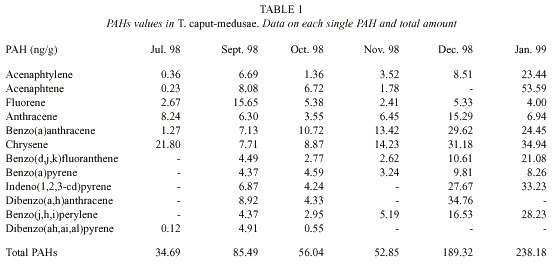
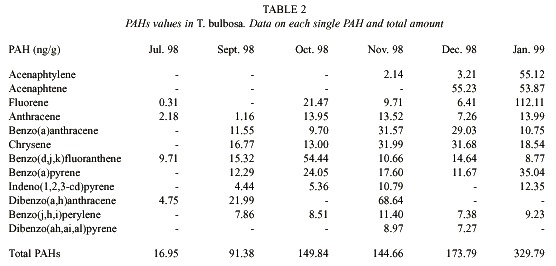
<body><![CDATA[<p><font face="Arial" size="2"><b>2. GC/MS instrumental conditions: </b>All analyses were made using a Varian (Varian, Walnut Creek, Ca, USA) Saturn 2000 GC/MS System. The gas chromatograph was equipped with a Supelco SBP-5 column (30 m x 0.32iµm i.d., film thickness 0.25 mm) (Supelco Inc., Bellefonte, PA, USA) and operated from 60 to 320°C at 5°C min <sup>-1</sup> holding the initial and final temperature for 2 and 6 min, respectively. Peak identification was based on comparison with library mass spectra and on the analysis of standard PAH compounds. </font></p> <font face="Arial" size="2"><i></i></font>     <p><font face="Arial" size="2"><i>Quantitative analysi</i>s: Two compounds were used as internal standards, namely o-terphenyl and triphenylbenzene. The PAH recoveries were calculated by adding to each of the analysed plant samples a known amount of deuterated PAH just before the grinding step and measuring the final amount of deuterated compounds recovered after sample work-up and analysis.</font></p> <font face="Arial" size="2"><b></b></font>     <p><font face="Arial" size="2"><b>3. SEM investigation: </b>The micromorphological investigation of foliar surfaces of the tillands was done with a scanning electron microscope (SEM) PHILIPS XL 20. To avoid artifacts due to the normal SEM protocols such as the use of solvents, a plant of each species was left in a dry environment until the total exsiccation. Fragments of leaves were coated with gold in a sputter coater, examined and photographed.</font></p> <font face="Arial" size="2"><b></b></font>     <p><font face="Arial" size="2"><b>4. Atmospheric PAHs estimate: </b>With the aim to calculate from the total amount of PAHs contained in 1 g of tilland tissue, an estimate of the total amount of PAHs contained in a cubic meter of air we used a mathematical formula found in literature (Simonich and Hites 1994): Kv = PAHveg / (Lip X PAHatm), where <i>PAHveg </i>= PAH concentration measured in the sampled plant (ng/g), <i>Lip </i>= lipid content (mg/g), <i>PAHatm </i>= PAH concentration in the atmosphere (ng/m<sup>3</sup> ), <i>Kv </i>= PAH partition coefficient air/plant surface (m <sup>3</sup> /mg). This model was not developed on tillands, but on other kinds of plants or parts of them. The formula was applied only for benzo(a)pyrene in a specimen of <i>T. caput-medusae </i>sampled after five months of exposition. It was necessary to calculate the percentage of moisture in the plant and the measure of its lipid content. </font></p> <font face="Arial" size="2"><b></b></font>     <p><font face="Arial" size="2"><b>5. Statistical analysis: </b>The Pearson’s correlation coefficient (PCC) was calculated to observe the degree to which each PAH data was linearly correlated with the total amount of PAHs. The same coefficient was calculated for the variables PM10 and total PAHs and for each PAH with the PM10 values.</font></p> <font face="Arial" size="2"><b>     <p>Results</p> </b> <b></b></font>     <p><font face="Arial" size="2"><b>1. Plant behaviour: </b>The exposition of tillands to polluted environment did not cause remarkable stress symptoms. The leaves increased their crooked aspect and afterwards their epidermis were covered with a dark material originated by deposition of particles of atmospheric origin. During the first month all plants emitted many (adventitious) roots that remained free since they could not find any host to adhere to. It is important to indicate that about one third of the plants flowered from September to October 1998. This phenomenon happened 4 - 5 months earlier with respect to flowering time in the native environment and was preceded by reddening of the younger leaves. Flowered plants were not analysed to avoid comparison of data coming from specimens in different physiological conditions.</font></p> <font face="Arial" size="2"><b></b></font>     <p><font face="Arial" size="2"><b>2. Analytical results: </b>The analysis on samples of <i>T. caput-medusae </i>and <i>T. bulbosa </i>with GC/MS produced the results summarised, respectively, in <a href="#t1">Tables 1</a> <a href="#t2">and 2</a>. Data about 12 PAHs were reported in detail and were summed to give the total accumulated PAHs.</font></p>     <div style="text-align: center;"><a name="t1"></a><img  src="/img/fbpe/rbt/v50n2/2814i1.JPG" title="" alt=""  style="width: 553px; height: 264px;">    
<br>     ]]></body>
<body><![CDATA[<br> <a name="t2"></a><img src="/img/fbpe/rbt/v50n2/2814i2.JPG" title="" alt=""  style="width: 556px; height: 266px;">    
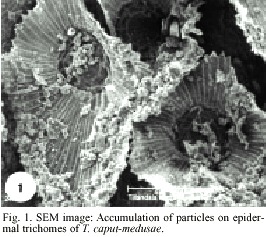
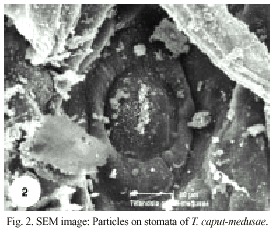
<br> <span style="font-family: arial;"></span></div>     <p><font face="Arial" size="2"><b>3. Micromorphological results: </b>SEM observations indicated the capability of tillands in retaining particles on the leaves’ surface. Accumulation of particles on trichomes was evident <a href="#f1">(Fig. 1)</a>. Particles appeared also on stomata <a href="#f2">(Fig. 2)</a>.</font></p> <span style="font-family: arial;">    <br> </span>     <div style="text-align: center;"><a name="f1"></a><img  src="/img/fbpe/rbt/v50n2/2814i3.JPG" title="" alt=""  style="width: 266px; height: 237px;">    
<br>     <br> <a name="f2"></a><img src="/img/fbpe/rbt/v50n2/2814i4.JPG" title="" alt=""  style="width: 275px; height: 232px;">    
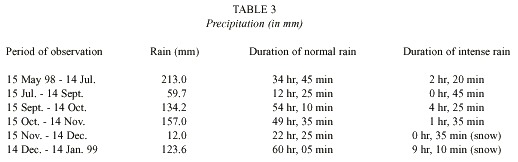
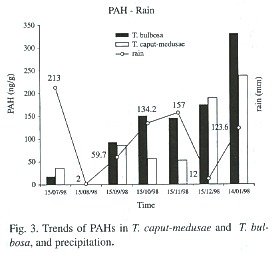
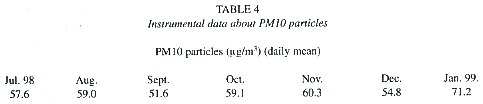
<br> </div> <span style="font-family: arial;"></span>     <p><font face="Arial" size="2"><b>4. Meteorological results: </b>We compared data coming from biomonitoring with instrumental monitoring of atmospherical pollution and meteorological data, both in relation to the experimental period. Instrumental data on PM10 in the city of Florence were obtained from ARPAT (Agency for Environmental Protection of Tuscany), while the atmospheric data were obtained from the Osservatorio Ximeniano di Firenze. Meteorological data (rain) are summarised in <a href="#t3">Table 3</a>. Precipitation was measured in millimeters of rain corresponding to sampling intervals, the duration of rain in hours and minutes. The presence of particularly strong rains was also indicated. Quality and quantity of precipitation heavily influenced the permanence of polluting substances in the air. Moreover, they probably influenced also the capability of trichomes to intercept and retain particles. The graphical progression of PAHs accumulation recorded with <i>T. caput-medusae </i>and with <i>T. bulbosa </i>from July 1998 to January 1999 is represented in <a href="#f3">Fig. 3</a>, where it is also possible to evaluate the precipitation trend. The graph showed a progressive increase in the monitored PAHs, that was related to a progressive bioaccumulation in plants. Quality and quantity of precipitation heavily influenced the permanence of polluting substances in the air. ARPAT’s data about PM 10 particles are reported in <a href="#t4">Table 4</a> with the daily mean referred to the monitoring intervals.</font></p>     <div style="text-align: center;"><span style="font-family: arial;"><a  name="t3"></a><img src="/img/fbpe/rbt/v50n2/2814i5.JPG" title="" alt=""  style="width: 518px; height: 162px;">    
]]></body>
<body><![CDATA[<br>     <br> <a name="f3"></a><img src="/img/fbpe/rbt/v50n2/2814i6.JPG" title="" alt=""  style="width: 272px; height: 253px;">    
<br>     <br> <a name="t4"></a><img src="/img/fbpe/rbt/v50n2/2814i7.JPG" title="" alt=""  style="width: 483px; height: 104px;">    
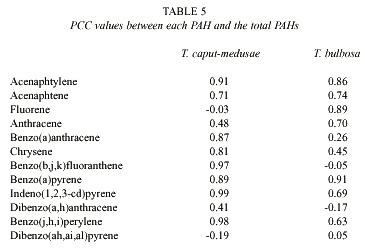
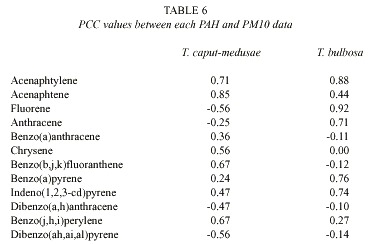
<br> </span></div>     <p align="center"></p> <font face="Arial" size="2"><b></b></font>     <p><font face="Arial" size="2"><b>5. Statistical results: </b>The use of PCC between total PAHs and PM10 produced the value of 0.51 for <i>T. caput-medusae </i>and 0.78 for <i>T. bulbos</i>a. Table 5 lists, for the two species, the PCC values between each PAH and the total PAHs amount. Table 6 lists, for the two species, the PCC values between each PAH and PM 10 data.</font></p>     <p style="text-align: center;"><font face="Arial" size="2">&nbsp;<a  name="t5"></a><img src="/img/fbpe/rbt/v50n2/2814i8.JPG" title="" alt=""  style="width: 365px; height: 248px;">    
<br> </font></p>     <p style="text-align: center;"><font face="Arial" size="2"><a name="t6"></a><img  src="/img/fbpe/rbt/v50n2/2814i9.JPG" title="" alt=""  style="width: 369px; height: 244px;">    
]]></body>
<body><![CDATA[<br> </font></p>     <p align="center"></p> <font face="Arial" size="2"><b></b></font>     <p><font face="Arial" size="2"><b>6. Atmospheric PAHs estimate results: </b>Theoretical PAH measure of moisture percentage and of lipid content in <i>T. caput-medusa</i>e, introduced in the formula for the calculation of the quantity of benzo(a)pyrene in a cubic meter of air, gave the following results: % of moisture = 86.8, lipid content = 21.3 mg/g; hence, the formula by Simonich and Hites applied is PAH <sup>atm</sup> = 0.13 ng/m <sup>3</sup> <b>.</b></font></p> <font face="Arial" size="2"><b>     <p>Discussion</p> </b> </font>     <p><font face="Arial" size="2">The decision to use tillands for atmospheric pollution biomonitoring was taken after the observation of tillands hosted on the trees of Avenida Segunda in San José (Costa Rica). All trees were covered by soot on the basal part of the trunk, but epiphytes, despite their localisation on the main branches (further from the soil and more screened by leaves), had retained so many polluting particles to appear completely dark. However, there was no indication that their health was compromised. Some of them flowered.</font></p>     <p><font face="Arial" size="2">These observations suggested that tillands were able to intercept air particles and to accumulate them on the leaf surface. SEM investigation confirmed this phenomenon, showing the remarkable presence of particles on and among the trichomes. Part of this material was visible also on stomata and possibly it might reach, through this way, the internal tissues, where pollutants can be metabolised. Among atmospheric pollution sources, that is traffic, domestic heating, and industrial activity, in the city of Florence the third source is almost absent, while the second is limited to the winter months.</font></p>     <p><font face="Arial" size="2">The PCC between total PAHs (in tillands) and PM10 (instrumentally detected in air) indicated that <i>T. bulbosa </i>(PCC = 0.78) provided better results from the point of view of comparison to instrumental data, with respect to <i>T. caput-medusae </i>(PCC = 0.51). Hence <i>T. bulbosa </i>can be considered more effective in intercepting organic pollutants.</font></p>     <p><font face="Arial" size="2">The increasing trend with time of PAHs values detected with tillands was a consequence of the experimental conditions. A dip occurred in the period 15/10/1998-14/11/1998 during which rainfall was strong and abundant. Evidently in this period the rain washing was more effective than the capacity of tilland trichomes to retain the polluting particles. <i>Tillandsia bulbosa </i>has been shown to be more efficient in intercepting PAHs, even if this species has less developed trichomes than <i>T. caput-medusae </i>(<a  href="#Mosti99">Mosti 1999</a>). This result was related to two morphological aspects: the leaf shape in <i>T. bulbosa </i>is like a closed water-pipe that makes the leaf like a thin channel in which water flows with difficulty. Hence, it cannot easily wash the leaf. The other aspect consists of the thicker cutine layer of <i>T. bulbos</i>a. Since cutine is a hydrophobic substance, it acts as a solvent relatively to PAH compounds (<a href="#Trapp90">Trapp <i>et al. </i>1990</a>).</font></p>     <p><font face="Arial" size="2">The presence of particles on stomata (observed with SEM) is an indication of the possibility that particles can reach the internal tissues of the plant. Here, pollutants might accumulate or undergo metabolism.</font></p>     <p><font face="Arial" size="2">In literature, a formula exists which correlates PAHs quantity measured in the plant to their concentration in air. Hence, it was possible to compare data obtained by plant extract with PAHs levels recorded with instrumental methods (<a  href="#Trapp90">Trapp <i>et al </i>1990</a>, <a href="#Simonich94">Simonich and Hites 1994</a>). The benzo-(a)-pyrene level recorded in <i>T. caput-medusae </i>was within the maximum law limits indicated by the Italian Environmental Ministry (1 ng/m<sup>3</sup> ).</font></p>     ]]></body>
<body><![CDATA[<p><font face="Arial" size="2">Our results demonstrated the effectiveness of tillands as air biomonitors relatively to PAHs and showed the importance of the physical action operated by the particular epidermis of these epiphytic plants. The results reported here can be added to those by <a href="#Schrimpff84">Schrimpff (1984)</a> and <a  href="#Brighigna97">Brighigna <i>et al. </i>(1997)</a> on biomonitoring of trace metal pollution. The results indicated that tillands are particularly useful as low-cost biomonitoring organisms for all Latin American countries and southern USA, where these plants grow spontaneously and are easily available. This work also indicated that tillands provide good results as biomonitors wherever the climate allows them to survive.</font></p> <font face="Arial" size="2"><b>     <p>Acknowledgments</p> </b> </font>     <p><font face="Arial" size="2">The authors thank Stefano Mannucci of the Military Medical School of Florence for his help in analytical procedures. This work was supported by Ente Fondazione Cassa di Risparmio di Firenze grants.</font></p> <font face="Arial" size="2"><b>     <p>Resumen </p> </b> </font>     <p><font face="Arial" size="2">Se presentan los resultados de un experimento con dos especies de angiospermas epífitas <i>(Tillandsia caput-medusae </i>y <i>T. bulbos</i>a) para monitorear hidrocarbonos aromáticos policíclicos (PAHs) en el aire de Florencia, Italia. Los PAHs son compuestos que se sabe son peligrosos por su potencial carcinogénico, y, entre las cormófitas, las tilandsias (monocotiledóneas equipadas con tricomas epidérmicos, especializados y peculiares) son consideradas promisorias para el biomonitoreo de la contaminación del aire. Se obtuvieron datos de PAHs usando el análisis de GC/MS de extractos de plantas. Los datos analíticos indicaron una tendencia creciente de la bioacumulación de PAH’s en el tiempo. Este resultado se comparó con los parámetros registrados instrumentalmente como los meteorológicos (lluvia) y los ambientales (PM10), indicando que la captura física de partículas aéreas por medio de tricomas era prominente en la bioacumulación de PAHs en las tilandsias. Las observaciones de SEM (microscopio electrónico de barrido) confirmaron el papel de los tricomas. Este trabajo indica que las tilandsias son organismos de biomonitoreo, de bajo costo y particularmente útiles dentro de su área de distribución (todos los países Latinoamericanos y el sureste de EUA) donde estas plantas son disponibles fácilmente, pero también donde el clima les permite sobrevivir.</font></p> <font face="Arial" size="2"><b>     <p>References</p> </b> </font>     <!-- ref --><p><font face="Arial" size="2"><a name="Alfani00"></a>Alfani, A. &amp; D. Baldantoni. 2000. Temporal and spatial variation of C, N, S and trace element contents in the leaves of <i>Quercus ilex </i>within the urban area of Naples. Environ. Pollut. 109: 119-129.</font>&nbsp;&nbsp;&nbsp;&nbsp;&nbsp;&nbsp;&nbsp;&nbsp;[&#160;<a href="javascript:void(0);" onclick="javascript: window.open('/scielo.php?script=sci_nlinks&ref=1222706&pid=S0034-7744200200020001700001&lng=','','width=640,height=500,resizable=yes,scrollbars=1,menubar=yes,');">Links</a>&#160;]<!-- end-ref --><!-- ref --><p><font face="Arial" size="2"><a name="Aksoy99"></a>Aksoy, A., W.H. Hale &amp; J.M. Dixon. 1999. <i>Capsella bursa-pastoris </i>(L.) Medic. as a biomonitor of heavy metals. Sci. Total Environ. 226: 177-186.</font>&nbsp;&nbsp;&nbsp;&nbsp;&nbsp;&nbsp;&nbsp;&nbsp;[&#160;<a href="javascript:void(0);" onclick="javascript: window.open('/scielo.php?script=sci_nlinks&ref=1222707&pid=S0034-7744200200020001700002&lng=','','width=640,height=500,resizable=yes,scrollbars=1,menubar=yes,');">Links</a>&#160;]<!-- end-ref --><!-- ref --><p><font face="Arial" size="2"><a name="Benzing80"></a>Benzing, D.H. 1980. The biology of the bromeliads. Mad River, California.</font>&nbsp;&nbsp;&nbsp;&nbsp;&nbsp;&nbsp;&nbsp;&nbsp;[&#160;<a href="javascript:void(0);" onclick="javascript: window.open('/scielo.php?script=sci_nlinks&ref=1222708&pid=S0034-7744200200020001700003&lng=','','width=640,height=500,resizable=yes,scrollbars=1,menubar=yes,');">Links</a>&#160;]<!-- end-ref --><!-- ref --><p><font face="Arial" size="2"><a name="Brighigna92"></a>Brighigna, L. 1992. Essential aspects of the epiphytic strategy of <i>Tillandsia </i>(Bromeliaceae), p. 21-39. <i>In </i>L. Brighigna (ed.). ATTI del primo contributo dell’Università di Firenze allo studio delle relata ambientali dell’America Latina. Firenze, Italy.</font>&nbsp;&nbsp;&nbsp;&nbsp;&nbsp;&nbsp;&nbsp;&nbsp;[&#160;<a href="javascript:void(0);" onclick="javascript: window.open('/scielo.php?script=sci_nlinks&ref=1222709&pid=S0034-7744200200020001700004&lng=','','width=640,height=500,resizable=yes,scrollbars=1,menubar=yes,');">Links</a>&#160;]<!-- end-ref --><!-- ref --><p><font face="Arial" size="2"><a name="Brighigna88"></a>Brighigna, L., M.R. Palandri, M. Giuffrida, C. Macchi &amp; G. Tani. 1988. Ultrastructural features of the <i>Tillandsia usneoides </i>L. absorbing trichome during conditions moisture and aridity. Caryologia 41: 111-129.</font>&nbsp;&nbsp;&nbsp;&nbsp;&nbsp;&nbsp;&nbsp;&nbsp;[&#160;<a href="javascript:void(0);" onclick="javascript: window.open('/scielo.php?script=sci_nlinks&ref=1222710&pid=S0034-7744200200020001700005&lng=','','width=640,height=500,resizable=yes,scrollbars=1,menubar=yes,');">Links</a>&#160;]<!-- end-ref --><!-- ref --><p><font face="Arial" size="2"><a name="Brighigna90"></a>Brighigna, L., A. Cecchi Fiordi &amp; M.R. Palandri. 1990. Structural comparison between free and anchored roots in <i>Tillandsia </i>(Bromeliaceae) species. Caryologia 43: 27-42.</font>&nbsp;&nbsp;&nbsp;&nbsp;&nbsp;&nbsp;&nbsp;&nbsp;[&#160;<a href="javascript:void(0);" onclick="javascript: window.open('/scielo.php?script=sci_nlinks&ref=1222711&pid=S0034-7744200200020001700006&lng=','','width=640,height=500,resizable=yes,scrollbars=1,menubar=yes,');">Links</a>&#160;]<!-- end-ref --><!-- ref --><p><font face="Arial" size="2"><a name="Brighigna92et"></a>Brighigna, L., P. Montaini, F. Favilli &amp; A. Carabez Trejo. 1992. Role of the nitrogen-fixing bacterial microflora in the epiphytism of <i>Tillandsia </i>(Bromeliaceae). Amer. J. Bot. 79: 723-727.</font>&nbsp;&nbsp;&nbsp;&nbsp;&nbsp;&nbsp;&nbsp;&nbsp;[&#160;<a href="javascript:void(0);" onclick="javascript: window.open('/scielo.php?script=sci_nlinks&ref=1222712&pid=S0034-7744200200020001700007&lng=','','width=640,height=500,resizable=yes,scrollbars=1,menubar=yes,');">Links</a>&#160;]<!-- end-ref --><!-- ref --><p><font face="Arial" size="2"><a name="Brighigna97"></a>Brighigna, L., M. Ravanelli, A. Minelli &amp; L. Ercoli. 1997. The use of an epiphyte <i>(Tillandsia caput-medusae </i>Morren) as bioindicator of air pollution in Costa Rica. Sci. Total Enviro<i>n. </i>198: 175-180.</font>&nbsp;&nbsp;&nbsp;&nbsp;&nbsp;&nbsp;&nbsp;&nbsp;[&#160;<a href="javascript:void(0);" onclick="javascript: window.open('/scielo.php?script=sci_nlinks&ref=1222713&pid=S0034-7744200200020001700008&lng=','','width=640,height=500,resizable=yes,scrollbars=1,menubar=yes,');">Links</a>&#160;]<!-- end-ref --><!-- ref --><p><font face="Arial" size="2"><a name="Bruning93"></a>Bruning, F. &amp; K.H. Kreebs. 1993. Mosses as biomonitors of heavy metal contamination in urban areas, p. 255- 259. <i>In </i>B. Markert (ed.). Plants as biomonitors. VCH, Weinheim.</font>&nbsp;&nbsp;&nbsp;&nbsp;&nbsp;&nbsp;&nbsp;&nbsp;[&#160;<a href="javascript:void(0);" onclick="javascript: window.open('/scielo.php?script=sci_nlinks&ref=1222714&pid=S0034-7744200200020001700009&lng=','','width=640,height=500,resizable=yes,scrollbars=1,menubar=yes,');">Links</a>&#160;]<!-- end-ref --><!-- ref --><p><font face="Arial" size="2"><a name="Cornia99"></a>Cornia, A. 1999. Determinazione di flavonoidi e IPA in <i>Tillandsia caput-medusae </i>mediante HPLC/DAD LC/MS/MS e GC/MS. Thesis type, Università di Bologna, Italy.</font>&nbsp;&nbsp;&nbsp;&nbsp;&nbsp;&nbsp;&nbsp;&nbsp;[&#160;<a href="javascript:void(0);" onclick="javascript: window.open('/scielo.php?script=sci_nlinks&ref=1222715&pid=S0034-7744200200020001700010&lng=','','width=640,height=500,resizable=yes,scrollbars=1,menubar=yes,');">Links</a>&#160;]<!-- end-ref --><!-- ref --><p><font face="Arial" size="2"><a name="Dellamea97"></a>Dellamea, M., G.L. Calzoni &amp; N. Bagni. 1997. Evaluation of ozone injury in <i>Nicotiana tobacum </i>CV. BEL-W3 with computerized image analysis. Frasenius Environ. Bull. 6: 475-480.</font>&nbsp;&nbsp;&nbsp;&nbsp;&nbsp;&nbsp;&nbsp;&nbsp;[&#160;<a href="javascript:void(0);" onclick="javascript: window.open('/scielo.php?script=sci_nlinks&ref=1222716&pid=S0034-7744200200020001700011&lng=','','width=640,height=500,resizable=yes,scrollbars=1,menubar=yes,');">Links</a>&#160;]<!-- end-ref --><!-- ref --><p><font face="Arial" size="2"><a name="Gordon95"></a>Gordon, C.A., R. Herrera &amp; T.C. Hutchinson. 1995. The use of a common epiphytic lichen as a bioindicator of atmospheric inputs to two Venezuelan cloud forests. J. Trop. Ecol. 11: 1-26.</font>&nbsp;&nbsp;&nbsp;&nbsp;&nbsp;&nbsp;&nbsp;&nbsp;[&#160;<a href="javascript:void(0);" onclick="javascript: window.open('/scielo.php?script=sci_nlinks&ref=1222717&pid=S0034-7744200200020001700012&lng=','','width=640,height=500,resizable=yes,scrollbars=1,menubar=yes,');">Links</a>&#160;]<!-- end-ref --><!-- ref --><p><font face="Arial" size="2"><a name="Le_Blanc75"></a>Le Blanc, F. &amp; D.N. Rao. 1975. Effects of air pollutants on lichens and bryophytes. <i>In </i>B.H. Mudd &amp; T.T. Kozlowski (eds.). Responses of plants to air pollutants. Academic.</font>&nbsp;&nbsp;&nbsp;&nbsp;&nbsp;&nbsp;&nbsp;&nbsp;[&#160;<a href="javascript:void(0);" onclick="javascript: window.open('/scielo.php?script=sci_nlinks&ref=1222718&pid=S0034-7744200200020001700013&lng=','','width=640,height=500,resizable=yes,scrollbars=1,menubar=yes,');">Links</a>&#160;]<!-- end-ref --><!-- ref --><p><font face="Arial" size="2"><a name="Loppi00"></a>Loppi, S., E. Putorti, S.A. Pirintsos &amp; V. De Dominicis. 2000. Accumulation of heavy metals in ephiphytic lichens near a municipal solid waste incinerator (Central Italy). Environ. Monit. Assess. 61: 361-371.</font>&nbsp;&nbsp;&nbsp;&nbsp;&nbsp;&nbsp;&nbsp;&nbsp;[&#160;<a href="javascript:void(0);" onclick="javascript: window.open('/scielo.php?script=sci_nlinks&ref=1222719&pid=S0034-7744200200020001700014&lng=','','width=640,height=500,resizable=yes,scrollbars=1,menubar=yes,');">Links</a>&#160;]<!-- end-ref --><!-- ref --><p><font face="Arial" size="2"><a name="Lorenzini00"></a>Lorenzini, G. &amp; C. Nali. 2000. Visual assessment of foliar injury induced by ozone on indicator tobacco plants: A data quality evaluation. Environ. Monit. Assess. 62: 175-191. </font>&nbsp;&nbsp;&nbsp;&nbsp;&nbsp;&nbsp;&nbsp;&nbsp;[&#160;<a href="javascript:void(0);" onclick="javascript: window.open('/scielo.php?script=sci_nlinks&ref=1222720&pid=S0034-7744200200020001700015&lng=','','width=640,height=500,resizable=yes,scrollbars=1,menubar=yes,');">Links</a>&#160;]<!-- end-ref --><!-- ref --><p><font face="Arial" size="2"><a name="Mosti99"></a>Mosti, S. 1999. Il tricoma di <i>Tillandsia </i>L. (Bromeliaceae): Utilità tassonomiche e individuazione di tipi ecologici. PHD thesis, Università di Firenze, Italy.</font>&nbsp;&nbsp;&nbsp;&nbsp;&nbsp;&nbsp;&nbsp;&nbsp;[&#160;<a href="javascript:void(0);" onclick="javascript: window.open('/scielo.php?script=sci_nlinks&ref=1222721&pid=S0034-7744200200020001700016&lng=','','width=640,height=500,resizable=yes,scrollbars=1,menubar=yes,');">Links</a>&#160;]<!-- end-ref --><!-- ref --><p><font face="Arial" size="2"><a name="Nieboer78"></a>Nieboer, E., D.H.S. Richardson &amp; F.D. Tomasini. 1978. Mineral uptake and release by lichens: An overview. Bryologist 81: 226-246.</font>&nbsp;&nbsp;&nbsp;&nbsp;&nbsp;&nbsp;&nbsp;&nbsp;[&#160;<a href="javascript:void(0);" onclick="javascript: window.open('/scielo.php?script=sci_nlinks&ref=1222722&pid=S0034-7744200200020001700017&lng=','','width=640,height=500,resizable=yes,scrollbars=1,menubar=yes,');">Links</a>&#160;]<!-- end-ref --><!-- ref --><p><font face="Arial" size="2"><a name="Rundle00"></a>Rundle, A., D. Tang, H. Hibshoosh, A. Estabrook, F. Schnabel, W. Cao, S. Grumet &amp; F.P. Perera. 2000. The relationship between genetic damage from polycyclic aromatic hydrocarbons in breast tissue and breast cancer. Carcinogenesis 21: 1281-1289.</font>&nbsp;&nbsp;&nbsp;&nbsp;&nbsp;&nbsp;&nbsp;&nbsp;[&#160;<a href="javascript:void(0);" onclick="javascript: window.open('/scielo.php?script=sci_nlinks&ref=1222723&pid=S0034-7744200200020001700018&lng=','','width=640,height=500,resizable=yes,scrollbars=1,menubar=yes,');">Links</a>&#160;]<!-- end-ref --><!-- ref --><p><font face="Arial" size="2"><a name="Scerbo99"></a>Scerbo, R., L. Possenti, L. Lampugnani, T. Ristori, R. Barale &amp; C. Barghigiani. 1999. Lichen <i>(Xanthoria parientin</i>a) biomonitoring of trace element contamination and air quality assessment in Livorno Province (Tuscany, Italy). Sci. Total Enviro<i>n. </i>241: 91-106.</font>&nbsp;&nbsp;&nbsp;&nbsp;&nbsp;&nbsp;&nbsp;&nbsp;[&#160;<a href="javascript:void(0);" onclick="javascript: window.open('/scielo.php?script=sci_nlinks&ref=1222724&pid=S0034-7744200200020001700019&lng=','','width=640,height=500,resizable=yes,scrollbars=1,menubar=yes,');">Links</a>&#160;]<!-- end-ref --><!-- ref --><p><font face="Arial" size="2"><a name="Schultz99"></a>Schultz, H., P. Popp, G. Huhn, H.-J. Stark &amp; G. Schurmann. 1999. Biomonitoring of airborne inorganic and organic pollutans by means of pine tree barks. I. Temporal and spatial variations. Sci. Total Environ. 232: 49-58.</font>&nbsp;&nbsp;&nbsp;&nbsp;&nbsp;&nbsp;&nbsp;&nbsp;[&#160;<a href="javascript:void(0);" onclick="javascript: window.open('/scielo.php?script=sci_nlinks&ref=1222725&pid=S0034-7744200200020001700020&lng=','','width=640,height=500,resizable=yes,scrollbars=1,menubar=yes,');">Links</a>&#160;]<!-- end-ref --><!-- ref --><p><font face="Arial" size="2"><a name="Schrimpff84"></a>Schrimpff, E. 1984. Air pollution patterns in two cities of Colombia, S. A. according to trace substances content of an epiphyte <i>(Tillandsia recurvata </i>L.). Water Air Soil Pollut. 21: 279-315.</font>&nbsp;&nbsp;&nbsp;&nbsp;&nbsp;&nbsp;&nbsp;&nbsp;[&#160;<a href="javascript:void(0);" onclick="javascript: window.open('/scielo.php?script=sci_nlinks&ref=1222726&pid=S0034-7744200200020001700021&lng=','','width=640,height=500,resizable=yes,scrollbars=1,menubar=yes,');">Links</a>&#160;]<!-- end-ref --><!-- ref --><p><font face="Arial" size="2"><a name="Simonich94"></a>Simonich, S. &amp; R. Hites. 1994. Vegetation-atmosphere partioning of polycyclic aromatic hydrocarbons. Sci Technol. 28: 209-220.</font>&nbsp;&nbsp;&nbsp;&nbsp;&nbsp;&nbsp;&nbsp;&nbsp;[&#160;<a href="javascript:void(0);" onclick="javascript: window.open('/scielo.php?script=sci_nlinks&ref=1222727&pid=S0034-7744200200020001700022&lng=','','width=640,height=500,resizable=yes,scrollbars=1,menubar=yes,');">Links</a>&#160;]<!-- end-ref --><!-- ref --><p><font face="Arial" size="2"><a name="Smith00"></a>Smith, L.E., M.F. Denissanko, W.P. Bennett, H. Li, S. Amin, M.-S Tang &amp; G.P. Pfeifer. 2000. Targeting of lung cancer mutational hotspots by polycyclic aromatic hydrocarbons. J. Nat. Cancer Inst. 92: 803-811.</font>&nbsp;&nbsp;&nbsp;&nbsp;&nbsp;&nbsp;&nbsp;&nbsp;[&#160;<a href="javascript:void(0);" onclick="javascript: window.open('/scielo.php?script=sci_nlinks&ref=1222728&pid=S0034-7744200200020001700023&lng=','','width=640,height=500,resizable=yes,scrollbars=1,menubar=yes,');">Links</a>&#160;]<!-- end-ref --><!-- ref --><p><font face="Arial" size="2"><a name="Trapp90"></a>Trapp, S., M. Matthies, I. Scheunert &amp; E. Topp. 1990. Modeling the bioconcentration of organic chemicals in plants. Environ. Sci. Technol.<i> </i>24: 1246-1252.</font>&nbsp;&nbsp;&nbsp;&nbsp;&nbsp;&nbsp;&nbsp;&nbsp;[&#160;<a href="javascript:void(0);" onclick="javascript: window.open('/scielo.php?script=sci_nlinks&ref=1222729&pid=S0034-7744200200020001700024&lng=','','width=640,height=500,resizable=yes,scrollbars=1,menubar=yes,');">Links</a>&#160;]<!-- end-ref --> ]]></body><back>
<ref-list>
<ref id="B1">
<nlm-citation citation-type="journal">
<person-group person-group-type="author">
<name>
<surname><![CDATA[Alfani]]></surname>
<given-names><![CDATA[A]]></given-names>
</name>
<name>
<surname><![CDATA[Baldantoni]]></surname>
<given-names><![CDATA[D]]></given-names>
</name>
</person-group>
<article-title xml:lang="en"><![CDATA[Temporal and spatial variation of C, N, S and trace element contents in the leaves of Quercus ilex within the urban area of Naples]]></article-title>
<source><![CDATA[Environ. Pollut]]></source>
<year>2000</year>
<volume>109</volume>
<page-range>119-129</page-range></nlm-citation>
</ref>
<ref id="B2">
<nlm-citation citation-type="journal">
<person-group person-group-type="author">
<name>
<surname><![CDATA[Aksoy]]></surname>
<given-names><![CDATA[A]]></given-names>
</name>
<name>
<surname><![CDATA[Hale]]></surname>
<given-names><![CDATA[W.H]]></given-names>
</name>
<name>
<surname><![CDATA[Dixon]]></surname>
<given-names><![CDATA[J.M]]></given-names>
</name>
</person-group>
<article-title xml:lang="en"><![CDATA[Capsella bursa-pastoris (L.) Medic. as a biomonitor of heavy metals]]></article-title>
<source><![CDATA[Sci. Total Environ]]></source>
<year>1999</year>
<volume>226</volume>
<page-range>177-186</page-range></nlm-citation>
</ref>
<ref id="B3">
<nlm-citation citation-type="book">
<person-group person-group-type="author">
<name>
<surname><![CDATA[Benzing]]></surname>
<given-names><![CDATA[D.H]]></given-names>
</name>
</person-group>
<source><![CDATA[The biology of the bromeliads]]></source>
<year>1980</year>
<publisher-loc><![CDATA[California ]]></publisher-loc>
<publisher-name><![CDATA[Mad River]]></publisher-name>
</nlm-citation>
</ref>
<ref id="B4">
<nlm-citation citation-type="book">
<person-group person-group-type="author">
<name>
<surname><![CDATA[Brighigna]]></surname>
<given-names><![CDATA[L]]></given-names>
</name>
<name>
<surname><![CDATA[Brighigna]]></surname>
<given-names><![CDATA[L]]></given-names>
</name>
</person-group>
<source><![CDATA[Essential aspects of the epiphytic strategy of Tillandsia (Bromeliaceae)]]></source>
<year>1992</year>
<page-range>21-39</page-range><publisher-name><![CDATA[Firenze]]></publisher-name>
</nlm-citation>
</ref>
<ref id="B5">
<nlm-citation citation-type="journal">
<person-group person-group-type="author">
<name>
<surname><![CDATA[Brighigna]]></surname>
<given-names><![CDATA[L]]></given-names>
</name>
<name>
<surname><![CDATA[Palandri]]></surname>
<given-names><![CDATA[M.R]]></given-names>
</name>
<name>
<surname><![CDATA[Giuffrida]]></surname>
<given-names><![CDATA[M]]></given-names>
</name>
<name>
<surname><![CDATA[Macchi]]></surname>
<given-names><![CDATA[C]]></given-names>
</name>
<name>
<surname><![CDATA[Tani]]></surname>
<given-names><![CDATA[G]]></given-names>
</name>
</person-group>
<article-title xml:lang="en"><![CDATA[Ultrastructural features of the Tillandsia usneoides L. absorbing trichome during conditions moisture and aridity]]></article-title>
<source><![CDATA[Caryologia]]></source>
<year>1988</year>
<volume>41</volume>
<page-range>111-129</page-range></nlm-citation>
</ref>
<ref id="B6">
<nlm-citation citation-type="journal">
<person-group person-group-type="author">
<name>
<surname><![CDATA[Brighigna]]></surname>
<given-names><![CDATA[L]]></given-names>
</name>
<name>
<surname><![CDATA[Cecchi Fiordi]]></surname>
<given-names><![CDATA[A]]></given-names>
</name>
<name>
<surname><![CDATA[Palandri]]></surname>
<given-names><![CDATA[M.R]]></given-names>
</name>
</person-group>
<article-title xml:lang="en"><![CDATA[Structural comparison between free and anchored roots in Tillandsia (Bromeliaceae) species]]></article-title>
<source><![CDATA[Caryologia]]></source>
<year>1990</year>
<volume>43</volume>
<page-range>27-42</page-range></nlm-citation>
</ref>
<ref id="B7">
<nlm-citation citation-type="journal">
<person-group person-group-type="author">
<name>
<surname><![CDATA[Brighigna]]></surname>
<given-names><![CDATA[L]]></given-names>
</name>
<name>
<surname><![CDATA[Montaini]]></surname>
<given-names><![CDATA[P]]></given-names>
</name>
<name>
<surname><![CDATA[Favilli]]></surname>
<given-names><![CDATA[F]]></given-names>
</name>
<name>
<surname><![CDATA[Carabez Trejo]]></surname>
<given-names><![CDATA[A]]></given-names>
</name>
</person-group>
<article-title xml:lang="en"><![CDATA[Role of the nitrogen-fixing bacterial microflora in the epiphytism of Tillandsia (Bromeliaceae)]]></article-title>
<source><![CDATA[Amer. J. Bot]]></source>
<year>1992</year>
<volume>79</volume>
<page-range>723-727</page-range></nlm-citation>
</ref>
<ref id="B8">
<nlm-citation citation-type="journal">
<person-group person-group-type="author">
<name>
<surname><![CDATA[Brighigna]]></surname>
<given-names><![CDATA[L]]></given-names>
</name>
<name>
<surname><![CDATA[Ravanelli]]></surname>
<given-names><![CDATA[M]]></given-names>
</name>
<name>
<surname><![CDATA[Minelli]]></surname>
<given-names><![CDATA[A]]></given-names>
</name>
<name>
<surname><![CDATA[Ercoli]]></surname>
<given-names><![CDATA[L]]></given-names>
</name>
</person-group>
<article-title xml:lang="en"><![CDATA[The use of an epiphyte (Tillandsia caput-medusae Morren) as bioindicator of air pollution in Costa Rica]]></article-title>
<source><![CDATA[Sci. Total Environ]]></source>
<year>1997</year>
<volume>198</volume>
<page-range>175-180</page-range></nlm-citation>
</ref>
<ref id="B9">
<nlm-citation citation-type="book">
<person-group person-group-type="author">
<name>
<surname><![CDATA[Bruning]]></surname>
<given-names><![CDATA[F]]></given-names>
</name>
<name>
<surname><![CDATA[Kreebs]]></surname>
<given-names><![CDATA[K.H]]></given-names>
</name>
<name>
<surname><![CDATA[Markert]]></surname>
<given-names><![CDATA[B]]></given-names>
</name>
</person-group>
<source><![CDATA[Mosses as biomonitors of heavy metal contamination in urban areas]]></source>
<year>1993</year>
<page-range>255- 259</page-range><publisher-loc><![CDATA[Weinheim ]]></publisher-loc>
<publisher-name><![CDATA[VCH]]></publisher-name>
</nlm-citation>
</ref>
<ref id="B10">
<nlm-citation citation-type="book">
<person-group person-group-type="author">
<name>
<surname><![CDATA[Cornia]]></surname>
<given-names><![CDATA[A]]></given-names>
</name>
</person-group>
<source><![CDATA[Determinazione di flavonoidi e IPA in Tillandsia caput-medusae mediante HPLC/DAD LC/MS/MS e GC/MS: Thesis type]]></source>
<year>1999</year>
<publisher-name><![CDATA[Università di Bologna]]></publisher-name>
</nlm-citation>
</ref>
<ref id="B11">
<nlm-citation citation-type="journal">
<person-group person-group-type="author">
<name>
<surname><![CDATA[Dellamea]]></surname>
<given-names><![CDATA[M]]></given-names>
</name>
<name>
<surname><![CDATA[Calzoni]]></surname>
<given-names><![CDATA[G.L]]></given-names>
</name>
<name>
<surname><![CDATA[Bagni]]></surname>
<given-names><![CDATA[N]]></given-names>
</name>
</person-group>
<article-title xml:lang="en"><![CDATA[Evaluation of ozone injury in Nicotiana tobacum CV. BEL-W3 with computerized image analysis]]></article-title>
<source><![CDATA[Frasenius Environ. Bull]]></source>
<year>1997</year>
<volume>6</volume>
<page-range>475-480</page-range></nlm-citation>
</ref>
<ref id="B12">
<nlm-citation citation-type="journal">
<person-group person-group-type="author">
<name>
<surname><![CDATA[Gordon]]></surname>
<given-names><![CDATA[C.A]]></given-names>
</name>
<name>
<surname><![CDATA[Herrera]]></surname>
<given-names><![CDATA[R]]></given-names>
</name>
<name>
<surname><![CDATA[Hutchinson]]></surname>
<given-names><![CDATA[T.C]]></given-names>
</name>
</person-group>
<article-title xml:lang="en"><![CDATA[The use of a common epiphytic lichen as a bioindicator of atmospheric inputs to two Venezuelan cloud forests]]></article-title>
<source><![CDATA[J. Trop. Ecol]]></source>
<year>1995</year>
<volume>11</volume>
<page-range>1-26</page-range></nlm-citation>
</ref>
<ref id="B13">
<nlm-citation citation-type="book">
<person-group person-group-type="author">
<name>
<surname><![CDATA[Le Blanc]]></surname>
<given-names><![CDATA[F]]></given-names>
</name>
<name>
<surname><![CDATA[Rao]]></surname>
<given-names><![CDATA[D.N]]></given-names>
</name>
<name>
<surname><![CDATA[Mudd]]></surname>
<given-names><![CDATA[B.H]]></given-names>
</name>
<name>
<surname><![CDATA[Kozlowski]]></surname>
<given-names><![CDATA[T.T]]></given-names>
</name>
</person-group>
<source><![CDATA[Effects of air pollutants on lichens and bryophytes]]></source>
<year>1975</year>
<publisher-name><![CDATA[Academic]]></publisher-name>
</nlm-citation>
</ref>
<ref id="B14">
<nlm-citation citation-type="journal">
<person-group person-group-type="author">
<name>
<surname><![CDATA[Loppi]]></surname>
<given-names><![CDATA[S]]></given-names>
</name>
<name>
<surname><![CDATA[Putorti]]></surname>
<given-names><![CDATA[E]]></given-names>
</name>
<name>
<surname><![CDATA[Pirintsos]]></surname>
<given-names><![CDATA[S.A]]></given-names>
</name>
<name>
<surname><![CDATA[De Dominicis]]></surname>
<given-names><![CDATA[V]]></given-names>
</name>
</person-group>
<article-title xml:lang="en"><![CDATA[Accumulation of heavy metals in ephiphytic lichens near a municipal solid waste incinerator (Central Italy)]]></article-title>
<source><![CDATA[Environ. Monit. Assess]]></source>
<year>2000</year>
<volume>61</volume>
<page-range>361-371</page-range></nlm-citation>
</ref>
<ref id="B15">
<nlm-citation citation-type="journal">
<person-group person-group-type="author">
<name>
<surname><![CDATA[Lorenzini]]></surname>
<given-names><![CDATA[G]]></given-names>
</name>
<name>
<surname><![CDATA[Nali]]></surname>
<given-names><![CDATA[C]]></given-names>
</name>
</person-group>
<article-title xml:lang="en"><![CDATA[Visual assessment of foliar injury induced by ozone on indicator tobacco plants: A data quality evaluation]]></article-title>
<source><![CDATA[Environ. Monit. Assess]]></source>
<year>2000</year>
<volume>62</volume>
<page-range>175-191</page-range></nlm-citation>
</ref>
<ref id="B16">
<nlm-citation citation-type="">
<person-group person-group-type="author">
<name>
<surname><![CDATA[Mosti]]></surname>
<given-names><![CDATA[S]]></given-names>
</name>
</person-group>
<source><![CDATA[Il tricoma di Tillandsia L. (Bromeliaceae): Utilità tassonomiche e individuazione di tipi ecologici]]></source>
<year>1999</year>
</nlm-citation>
</ref>
<ref id="B17">
<nlm-citation citation-type="journal">
<person-group person-group-type="author">
<name>
<surname><![CDATA[Nieboer]]></surname>
<given-names><![CDATA[E]]></given-names>
</name>
<name>
<surname><![CDATA[Richardson]]></surname>
<given-names><![CDATA[D.H.S]]></given-names>
</name>
<name>
<surname><![CDATA[Tomasini]]></surname>
<given-names><![CDATA[F.D]]></given-names>
</name>
</person-group>
<article-title xml:lang="en"><![CDATA[Mineral uptake and release by lichens: An overview]]></article-title>
<source><![CDATA[Bryologist]]></source>
<year>1978</year>
<volume>81</volume>
<page-range>226-246</page-range></nlm-citation>
</ref>
<ref id="B18">
<nlm-citation citation-type="journal">
<person-group person-group-type="author">
<name>
<surname><![CDATA[Rundle]]></surname>
<given-names><![CDATA[A]]></given-names>
</name>
<name>
<surname><![CDATA[Tang]]></surname>
<given-names><![CDATA[D]]></given-names>
</name>
<name>
<surname><![CDATA[Hibshoosh]]></surname>
<given-names><![CDATA[H]]></given-names>
</name>
<name>
<surname><![CDATA[Estabrook]]></surname>
<given-names><![CDATA[A]]></given-names>
</name>
<name>
<surname><![CDATA[Schnabel]]></surname>
<given-names><![CDATA[F]]></given-names>
</name>
<name>
<surname><![CDATA[Cao]]></surname>
<given-names><![CDATA[W]]></given-names>
</name>
<name>
<surname><![CDATA[Grumet]]></surname>
<given-names><![CDATA[S]]></given-names>
</name>
<name>
<surname><![CDATA[Perera]]></surname>
<given-names><![CDATA[F.P]]></given-names>
</name>
</person-group>
<article-title xml:lang="en"><![CDATA[The relationship between genetic damage from polycyclic aromatic hydrocarbons in breast tissue and breast cancer]]></article-title>
<source><![CDATA[Carcinogenesis]]></source>
<year>2000</year>
<volume>21</volume>
<page-range>1281-1289</page-range></nlm-citation>
</ref>
<ref id="B19">
<nlm-citation citation-type="journal">
<person-group person-group-type="author">
<name>
<surname><![CDATA[Scerbo]]></surname>
<given-names><![CDATA[R]]></given-names>
</name>
<name>
<surname><![CDATA[Possenti]]></surname>
<given-names><![CDATA[L]]></given-names>
</name>
<name>
<surname><![CDATA[Lampugnani]]></surname>
<given-names><![CDATA[L]]></given-names>
</name>
<name>
<surname><![CDATA[Ristori]]></surname>
<given-names><![CDATA[T]]></given-names>
</name>
<name>
<surname><![CDATA[Barale]]></surname>
<given-names><![CDATA[R]]></given-names>
</name>
<name>
<surname><![CDATA[Barghigiani]]></surname>
<given-names><![CDATA[C]]></given-names>
</name>
</person-group>
<article-title xml:lang="en"><![CDATA[Lichen (Xanthoria parientina) biomonitoring of trace element contamination and air quality assessment in Livorno Province (Tuscany, Italy)]]></article-title>
<source><![CDATA[Sci. Total Environ]]></source>
<year>1999</year>
<volume>241</volume>
<page-range>91-106</page-range></nlm-citation>
</ref>
<ref id="B20">
<nlm-citation citation-type="journal">
<person-group person-group-type="author">
<name>
<surname><![CDATA[Schultz]]></surname>
<given-names><![CDATA[H]]></given-names>
</name>
<name>
<surname><![CDATA[Popp]]></surname>
<given-names><![CDATA[P]]></given-names>
</name>
<name>
<surname><![CDATA[Huhn]]></surname>
<given-names><![CDATA[G]]></given-names>
</name>
<name>
<surname><![CDATA[Stark]]></surname>
<given-names><![CDATA[H.-J]]></given-names>
</name>
<name>
<surname><![CDATA[Schurmann]]></surname>
<given-names><![CDATA[G]]></given-names>
</name>
</person-group>
<article-title xml:lang="en"><![CDATA[Biomonitoring of airborne inorganic and organic pollutans by means of pine tree barks: I. Temporal and spatial variations]]></article-title>
<source><![CDATA[Sci. Total Environ]]></source>
<year>1999</year>
<volume>232</volume>
<page-range>49-58</page-range></nlm-citation>
</ref>
<ref id="B21">
<nlm-citation citation-type="journal">
<person-group person-group-type="author">
<name>
<surname><![CDATA[Schrimpff]]></surname>
<given-names><![CDATA[E]]></given-names>
</name>
</person-group>
<article-title xml:lang="en"><![CDATA[Air pollution patterns in two cities of Colombia, S: A. according to trace substances content of an epiphyte (Tillandsia recurvata L.)]]></article-title>
<source><![CDATA[Water Air Soil Pollut]]></source>
<year>1984</year>
<volume>21</volume>
<page-range>279-315</page-range></nlm-citation>
</ref>
<ref id="B22">
<nlm-citation citation-type="journal">
<person-group person-group-type="author">
<name>
<surname><![CDATA[Simonich]]></surname>
<given-names><![CDATA[S]]></given-names>
</name>
<name>
<surname><![CDATA[Hites]]></surname>
<given-names><![CDATA[R]]></given-names>
</name>
</person-group>
<article-title xml:lang="en"><![CDATA[Vegetation-atmosphere partioning of polycyclic aromatic hydrocarbons]]></article-title>
<source><![CDATA[Sci Technol]]></source>
<year>1994</year>
<volume>28</volume>
<page-range>209-220</page-range></nlm-citation>
</ref>
<ref id="B23">
<nlm-citation citation-type="journal">
<person-group person-group-type="author">
<name>
<surname><![CDATA[Smith]]></surname>
<given-names><![CDATA[L.E]]></given-names>
</name>
<name>
<surname><![CDATA[Denissanko]]></surname>
<given-names><![CDATA[M.F]]></given-names>
</name>
<name>
<surname><![CDATA[Bennett]]></surname>
<given-names><![CDATA[W.P]]></given-names>
</name>
<name>
<surname><![CDATA[Li]]></surname>
<given-names><![CDATA[H]]></given-names>
</name>
<name>
<surname><![CDATA[Amin]]></surname>
<given-names><![CDATA[S]]></given-names>
</name>
<name>
<surname><![CDATA[Tang]]></surname>
<given-names><![CDATA[M.-S]]></given-names>
</name>
<name>
<surname><![CDATA[Pfeifer]]></surname>
<given-names><![CDATA[G.P]]></given-names>
</name>
</person-group>
<article-title xml:lang="en"><![CDATA[Targeting of lung cancer mutational hotspots by polycyclic aromatic hydrocarbons]]></article-title>
<source><![CDATA[J. Nat. Cancer Inst]]></source>
<year>2000</year>
<volume>92</volume>
<page-range>803-811</page-range></nlm-citation>
</ref>
<ref id="B24">
<nlm-citation citation-type="journal">
<person-group person-group-type="author">
<name>
<surname><![CDATA[Trapp]]></surname>
<given-names><![CDATA[S]]></given-names>
</name>
<name>
<surname><![CDATA[Matthies]]></surname>
<given-names><![CDATA[M]]></given-names>
</name>
<name>
<surname><![CDATA[Scheunert]]></surname>
<given-names><![CDATA[I]]></given-names>
</name>
<name>
<surname><![CDATA[Topp]]></surname>
<given-names><![CDATA[E]]></given-names>
</name>
</person-group>
<article-title xml:lang="en"><![CDATA[Modeling the bioconcentration of organic chemicals in plants]]></article-title>
<source><![CDATA[Environ. Sci. Technol]]></source>
<year>1990</year>
<volume>24</volume>
<page-range>1246-1252</page-range></nlm-citation>
</ref>
</ref-list>
</back>
</article>