<?xml version="1.0" encoding="ISO-8859-1"?><article xmlns:mml="http://www.w3.org/1998/Math/MathML" xmlns:xlink="http://www.w3.org/1999/xlink" xmlns:xsi="http://www.w3.org/2001/XMLSchema-instance">
<front>
<journal-meta>
<journal-id>0034-7744</journal-id>
<journal-title><![CDATA[Revista de Biología Tropical]]></journal-title>
<abbrev-journal-title><![CDATA[Rev. biol. trop]]></abbrev-journal-title>
<issn>0034-7744</issn>
<publisher>
<publisher-name><![CDATA[Universidad de Costa Rica]]></publisher-name>
</publisher>
</journal-meta>
<article-meta>
<article-id>S0034-77442002000200013</article-id>
<title-group>
<article-title xml:lang="en"><![CDATA[Life history and environment of Cecropia latiloba in Amazonian floodplains]]></article-title>
</title-group>
<contrib-group>
<contrib contrib-type="author">
<name>
<surname><![CDATA[Parolin]]></surname>
<given-names><![CDATA[Pia]]></given-names>
</name>
<xref ref-type="aff" rid="A01"/>
</contrib>
</contrib-group>
<aff id="A01">
<institution><![CDATA[,Max-Planck-Institute for Limnology  ]]></institution>
<addr-line><![CDATA[ ]]></addr-line>
<country>Germany</country>
</aff>
<pub-date pub-type="pub">
<day>00</day>
<month>06</month>
<year>2002</year>
</pub-date>
<pub-date pub-type="epub">
<day>00</day>
<month>06</month>
<year>2002</year>
</pub-date>
<volume>50</volume>
<numero>2</numero>
<fpage>531</fpage>
<lpage>545</lpage>
<copyright-statement/>
<copyright-year/>
<self-uri xlink:href="http://www.scielo.sa.cr/scielo.php?script=sci_arttext&amp;pid=S0034-77442002000200013&amp;lng=en&amp;nrm=iso"></self-uri><self-uri xlink:href="http://www.scielo.sa.cr/scielo.php?script=sci_abstract&amp;pid=S0034-77442002000200013&amp;lng=en&amp;nrm=iso"></self-uri><self-uri xlink:href="http://www.scielo.sa.cr/scielo.php?script=sci_pdf&amp;pid=S0034-77442002000200013&amp;lng=en&amp;nrm=iso"></self-uri><abstract abstract-type="short" xml:lang="en"><p><![CDATA[Cecropia latiloba can be considered to be one of the most efficient colonizers of open areas in the nutrient-rich whitewater floodplains of the Amazon river. Its main strategy to be successful is the high tolerance towards waterlogging and submergence, and the fast vertical growth and reiteration capacity. This, and the tolerance of high irradiation and sediment deposition allow C. latiloba to form large monospecific stands on open sites, and thus the first closed canopy which represents the initial phase of a successional sequence which leads to highly diverse forests. This tree is extremely well adapted to the adverse growth conditions in Amazonian floodplains with prolongued periods of flooding and seedling submergence. The species occurs on the lowest levels in the flooding gradient. Although it belongs to the most often cited species under aspects of taxonomy, species distribution and general descriptions of the ecosystem, little has been published about its ecology. In the present paper the ecological, physiological and phenological characteristics of C. latiloba are described. It is an evergreen species which constantly produces new leaves. With flooding, leaf production is reduced but new leaves are flushed also with prolongued flooding. The peak of flowering and fruiting are in the flooded period. When mature, the fruits are dispersed mainly by water and fish. Seed germination occurs, without dormancy, within 5-13 days after water retreat. In the 7 months before the first flooded period seedlings reach 1 m of height, and height growth increases until a height of 15-20 m is achieved. Photosynthetic assimilation is high, with values of up to 21 mmol CO2m-2s-1 . C. latiloba is a very flood tolerant species, and waterlogged seedlings continuously produce new leaves and adventitiuos roots]]></p></abstract>
<abstract abstract-type="short" xml:lang="es"><p><![CDATA[Cecropia latiloba puede ser considerada una de las especies colonizadoras más eficientes de áreas abiertas en las llanuras inundadas de agua dulce, rica en nutrientes, del río Amazonas. Su principal estrategia para ser exitosa es la tolerancia al transporte por el agua y a permanecer sumergida, y su rápido crecimiento vertical y capacidad de reiteración. Esto, y la tolerancia a la alta irradiación y a la deposición de sedimentos permite a C. latiloba formar grandes parches monoespecíficos en sitios abiertos, y así el primer dosel cerrado el cual representa la fase inicial de la secuencia de sucesión que conduce a bosques altamente diversos. Este árbol, está extremadamente bien adaptado a las condiciones adversas de crecimiento en el terreno aluvial amazónico, con prolongados períodos de inundación y sumersión. La especie está presente en los niveles inferiores en la gradiente de inundación. Aunque pertenece a las especies más frecuentemente citadas en aspectos de taxonomía, distribución y descripción general del ecosistema, poco ha sido publicado respecto a su ecología. En el presente artículo se describen las características ecológicas, fisiológicas y fenológicas de C. latiloba. Es una especie siempre verde que constantemente produce hojas. Con las inundaciones, la producción de hojas se reduce pero nuevas hojas brotan también durante las inundaciones prolongadas. El pico de floración y fructificación es durante el período inundado. Cuando maduran, las frutas son dispersadas principalmente por el agua y los peces. La germinación de las semillas ocurre, sin latencia, entre 513 días después de la retirada de las aguas. En los 7 meses anteriores al primer período de inundación las plantas alcanzan 1 m de altura y el crecimiento se incrementa hasta que se alcanza una altura de 15-20 m. La asimilación fotosintética es alta, con valores de hasta 21 µmol CO2 m-2 s-1 . C. latiloba es una especie muy tolerante a las inundaciones, y el transporte de troncos por el agua continuamente produce nuevas hojas y raíces adventicias]]></p></abstract>
<kwd-group>
<kwd lng="en"><![CDATA[Cecropia latiloba]]></kwd>
<kwd lng="en"><![CDATA[pioneer]]></kwd>
<kwd lng="en"><![CDATA[inundation forest]]></kwd>
<kwd lng="en"><![CDATA[floodplains]]></kwd>
<kwd lng="en"><![CDATA[várzea]]></kwd>
<kwd lng="en"><![CDATA[Amazon]]></kwd>
<kwd lng="en"><![CDATA[Neotropics]]></kwd>
</kwd-group>
</article-meta>
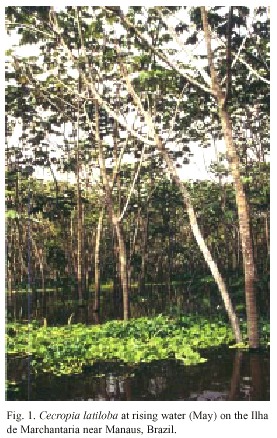
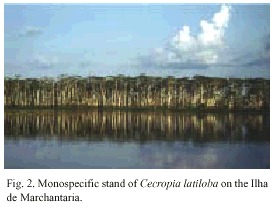
</front><body><![CDATA[ <div style="text-align: center;"><span style="font-weight: bold;"></span><b><font  face="Arial">Life history and environment of </font></b><font  face="Arial"><i>Cecropia latiloba </i><b>in Amazonian floodplains</b></font></div>     <p><font face="Arial" size="2">Pia Parolin</font></p>     <p><font face="Arial" size="2">Max-Planck-Institute for Limnology, Tropical Ecology, P.O. Box 165, 24302 Plön, Germany, <a  href="mailto:pparolin@botanik.uni-hamburg.de">pparolin@botanik.uni-hamburg.de</a></font></p> <a href="mailto:pparolin@botanik.uni-hamburg.de"><font face="Arial"  size="2"><b> </b></font></a>     <p align="center"><font face="Arial" size="2">Recibido 26-VII-2001.&nbsp;&nbsp;&nbsp;&nbsp;&nbsp;&nbsp;&nbsp; Corregido 26-XI-2001. &nbsp; &nbsp; &nbsp; Aceptado 31-V-2002.</font></p> <font face="Arial" size="2"><b>     <p>Abstract</p> </b><i></i></font>     <p><font face="Arial" size="2"><i>Cecropia latiloba </i>can be considered to be one of the most efficient colonizers of open areas in the nutrient-rich whitewater floodplains of the Amazon river. Its main strategy to be successful is the high tolerance towards waterlogging and submergence, and the fast vertical growth and reiteration capacity. This, and the tolerance of high irradiation and sediment deposition allow <i>C. latiloba </i>to form large monospecific stands on open sites, and thus the first closed canopy which represents the initial phase of a successional sequence which leads to highly diverse forests. This tree is extremely well adapted to the adverse growth conditions in Amazonian floodplains with prolongued periods of flooding and seedling submergence. The species occurs on the lowest levels in the flooding gradient. Although it belongs to the most often cited species under aspects of taxonomy, species distribution and general descriptions of the ecosystem, little has been published about its ecology. In the present paper the ecological, physiological and phenological characteristics of <i>C. latiloba </i>are described. It is an evergreen species which constantly produces new leaves. With flooding, leaf production is reduced but new leaves are flushed also with prolongued flooding. The peak of flowering and fruiting are in the flooded period. When mature, the fruits are dispersed mainly by water and fish. Seed germination occurs, without dormancy, within 5-13 days after water retreat. In the 7 months before the first flooded period seedlings reach 1 m of height, and height growth increases until a height of 15-20 m is achieved. Photosynthetic assimilation is high, with values of up to 21 mmol CO<sub>2</sub>m<sup>-2</sup>s<sup>-1</sup> . <i>C. latiloba </i>is a very flood tolerant species, and waterlogged seedlings continuously produce new leaves and adventitiuos roots. </font></p> <font face="Arial" size="2"><b></b></font>     <p><font face="Arial" size="2"><b>Key words: </b><i>Cecropia latiloba, pioneer, inundation forest, floodplains, várzea, Amazon, Neotropics</i></font></p>     <p><font face="Arial" size="2"><i>    <br> Cecropia latiloba </i>Miq. (Cecropiaceae) (<a href="#f1">Fig. 1</a>) is a shade-intolerant pioneer tree which colonizes open areas in Amazonian floodplains. It grows mainly in the floodplains of the Amazon and its nutrient-rich whitewater affluents. It forms dense monospecific stands (<a href="#f2">Fig. 2</a>) in disturbed places along the river, on landslides or on exposed riverbanks and does not occur in closed forest (<a href="#Worbes92">Worbes <i>et al. </i>1992</a>, <a  href="#Prieto95">Prieto <i>et al. </i>1995</a>). It initializes the successional sequence which leads to highly diverse forests (</font><font  face="Arial" size="2"><a href="#Worbes92">Worbes <i>et al. </i>1992</a></font><font  face="Arial" size="2">) and is extremely well adapted to the difficult growth conditions in Amazonian floodplains with prolongued periods of flooding and seedling submergence. Although it belongs to the most often cited species under aspects of taxonomy, species distribution and general descriptions of the ecosystem (<a href="#Worbes97">Worbes 1997</a>), little is known about its ecology. The present paper aims at describing the ecological, physiological and phenological characteristics of <i>C. latilob</i>a.</font></p>     <div style="text-align: center;"><a name="f1"></a><img  src="/img/fbpe/rbt/v50n2/2810i1.JPG" title="" alt=""  style="width: 277px; height: 438px;">    
]]></body>
<body><![CDATA[<br>     <br> <a name="f2"></a><img src="/img/fbpe/rbt/v50n2/2810i2.JPG" title="" alt=""  style="width: 275px; height: 207px;">    
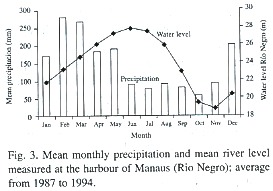
<br> </div>     <p><font face="Arial" size="2"><b>Materials and methods</b></font></p>     <p><font face="Arial" size="2"><b>Study sites, climate and water regime in Amazonian floodplains: </b>Amazonian flood-plains occur all along the Amazon River and its main tributaries (<a href="#Junk89ba">Junk <i>et al. </i>1989</a>). The white-water rivers which originate in the Andes carry a high sediment load, and the floodplains, which are very nutrient rich, are called seasonal várzea (<a href="#Prance79">Prance 1979</a>). Seasonal igapós are nutrient-poor floodplains flooded periodically by blackwater rivers. In the flooded period, water covers the roots, stems and sometimes also canopies of the plants. The lack of oxygen in the rhizosphere influences phenological events and physiological activities of the plants (<a href="#Crawford89">Crawford 1989, 1992</a>). Especially seedlings have to cope with long periods of complete submersion, where they are subjected to lack of oxygen, mechanical disturbance by the water current, and to sediment deposition on the leaf surfaces (<a href="#Parolin00a">Parolin 2000a</a>). Nevertheless, in these floodplains grow highly diverse forests with characteristic successional sequences (</font><font face="Arial"  size="2"><a href="#Worbes92">Worbes <i>et al. </i>1992</a></font><font  face="Arial" size="2">).</font></p>     <p><font face="Arial" size="2">A vegetation zonation along the inundation gradient reflects the flood tolerance of the trees (<a  href="#Ferreira97">Ferreira 1997</a>). In the lowest parts, flooded up to nine months every year, only occur species which tolerate extended periods of flooding and whose seedlings tolerate total submersion. <i>C. latiloba </i>can be found along the whole inundation gradient, and is especially effective at low levels due to the high flood tolerance of the seedlings. It typically occurs in the "chavascal", low-lying areas with dense, often shrubby vegetation which are flooded for 6-8 months with water depths of 6-7 m (<a href="#Ayres93">Ayres 1993</a>).</font></p>     <p><font face="Arial" size="2">Field studies were performed at the Costa do Catalão (3° 10’S, 59°54’W, elevation 23- 24</font><font  face="Arial" size="2" color="#ffffff"> </font><font face="Arial"  size="2">m asl.) and Ilha de Marchantaria (3° 16’S, 60° 03’W, 24 m asl) around 20 km from the city of Manaus, Brazil, on sites with an average flood duration of 7 months. Mean monthly temperature ranges from 26.3 to 27.2°C. Rainfall ranges from 1 700 to 2 300 mm. The amount of rain is irregularly distributed throughout the year, with a dry season between June and November, and a rainy season from December to May. Variation of water level of the Amazon river near Manaus is markedly seasonal. The rising phase lies between December and June, and the receding period between July and November (<a href="#f3">Fig. 3</a>). The amplitude of the river levels changes up to 10 m every year and the flooding lasts up to 230 days a year (<a href="#Junk89">Junk 1989</a>). In the plains along the main river channel in Central Amazonia, sedimentation rates are usually about 50 cm a year, but they can reach up to one meter in particular years (</font><font face="Arial" size="2"><a  href="#Junk89">Junk 1989</a></font><font face="Arial" size="2">). </font></p>     <p align="center"><font face="Arial" size="2"><a name="f3"></a><img  src="/img/fbpe/rbt/v50n2/2810i3.JPG" title="" alt=""  style="width: 273px; height: 191px;"></font></p> <font face="Arial" size="2"><b> </b></font>     
<p><font face="Arial" size="2"><b>Seeds, germination, biomass and seedling growth: </b>Seed mass and germination were analysed at the Amazon Research Institute (INPA) in Manaus, Brazil, at an experimental site which was sunny in the morning and in the afternoon, and shady between 11:00 and 14:00 h. Seed mass of 50 mature seeds collected in the vicinity of Manaus and taken to the INPA in plastic bags was determined after oven drying to constant weight at 105°C. The seeds were preserved floating in water in plastic cups for 2-3 weeks. For germination, 25 seeds were tested, each seed was placed in one plastic cup (300 ml) with várzea soil from the floodplains. Germination defined as shoot emergence was checked daily. Germination rate was calculated by the amount of seeds germinated after 7 weeks in relation to the total initial seed number. Germination of submerged seeds was tested in an experiment with ten pairs of each species consisting of 1 plastic cup (300 ml) with 1 seed + well watered várzea soil and 1 cup with 1 seed + várzea soil + várzea water (seeds submerged). Seedling growth was determined under experimental conditions, at weekly intervals. Seedling mortality was determined on 50 marked seedlings naturally germinated in the field one month after establishment.</font></p> <font face="Arial" size="2"><b></b></font>     <p><font face="Arial" size="2"><b>Structural characteristics of adult trees: </b>Wood gravity and radial gradients were determined on 10 wood cores extracted with an increment borer (for calculations see <a  href="#Whitmore73">Whitmore 1973</a>, <a href="#Parolin98">Parolin <i>et al. </i>1998</a>). Annual increments and age were measured on stem disks of felled trees (<a href="#Worbes94">Worbes 1994</a>). Tree height, diameter at breast height (dbh), crown size, crown density, and height of the first ramification, were measured on 3-10 trees in the field. The capacity for resprouting and vegetative propagation was observed on seedlings and adult trees in the field.</font></p> <font face="Arial" size="2"><b></b></font>     ]]></body>
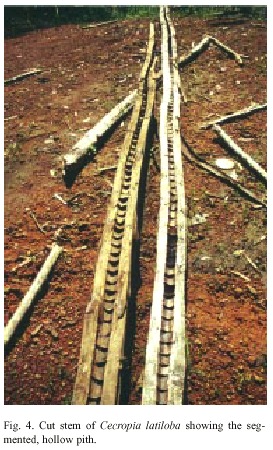
<body><![CDATA[<p><font face="Arial" size="2"><b>Morphological adaptations to flooding: </b>The formation of morphological adaptations to flooding (adventitious roots, formation of lenticels and stem hypertrophy) was monitored qualitatively in the field on adult trees and on seedlings subjected to waterlogging and submergence under experimental conditions.</font></p> <font face="Arial" size="2"><b></b></font>     <p><font face="Arial" size="2"><b>Physiological characteristics of the leaves: </b>Leaf characteristics were measured at monthly intervals for 15 months on five adult individuals in the field. Photosynthetic CO<sub>2</sub> -uptake, transpiration and stomatal conductance were measured between 9:00 and 12:00 a.m. with an infrared gas analyser (IRGA, ADC LCA-2, Analytical Development Co. Ltd., Hoddesdon, Herts, UK). Ten fully expanded, non-flooded leaves of five marked individuals were chosen for measurements at high quantum flux density, with photosynthetically active radiation (PAR) over 2 000 µmol m<sup>-2</sup> s<sup>-1</sup> producing maximal rates of photosynthesis (A<sub>max</sub>). CO<sub>2</sub> assimilation rate (A) and transpiration were calculated according to <a  href="#Coombs85">Coombs et al. (1985)</a>. Specific leaf weight was determined by calculating leaf dry weight (g) by leaf area (m<sup>2</sup> ) (Medina 1983). Leaf area was measured with a "leaf area meter" (<font  face="Symbol">D</font> T Area Meter, Delta-T Devices).</font></p> <font face="Arial" size="2"><b></b></font>     <p><font face="Arial" size="2"><b>Phenology: </b>Leaf production and loss, flowering, and fruiting were measured at intervals of two weeks for 15 consecutive months between April 1993 and June 1994 on 5 adult trees mainly on Costa do Catalão.</font></p> <font face="Arial" size="2"><b>     <p>Results and discusion</p> </b> </font>     <p><font face="Arial" size="2">Biology of <i>Cecropia latiloba</i></font></p> <font face="Arial" size="2"><b> </b></font>     <p><font face="Arial" size="2"><b>Description: </b><i>Cecropia latiloba </i>(Miq.) (Cecropiaceae, synonym <i>C. paraensis </i>Huber, <i>C. stenostachya </i>Warburg) in the Brazilian Central Amazon is called ‘imbaúba branca’ (synonym "embaúba branca") because of the white undersurfaces of the leaves. The common name in Perú is Cetico negro del bajo (<a href="#Lamotte92">Lamotte 1992</a>) and in Venezuela it is Yagrumo (<a href="#Hueck66">Hueck 1966</a>). In Amazonian floodplains, <i>C.llatiloba </i>can reach a height of 20 m (<a href="#Berg78">Berg 1978</a>) but generally forms a closed canopy at 15 m (<a href="#Klinge95">Klinge <i>et al. </i>1995</a>). It is a fast-growing, short-lived tree with a maximum age of 20 years (</font><font face="Arial" size="2"><a  href="#Worbes92">Worbes <i>et al. </i>1992</a></font><font  face="Arial" size="2">) and often forms the first successional stage of trees in clearings by shading out other competing tree species with their huge digitate leaves. The large lobed, simple leaves have white pubescent undersurfaces, by which <i>C. latiloba </i>can be distinguished from the co-occurring <i>C. membranace</i>a. Mean leaf area is 1070 cm<sup>2</sup> , with a diameter of 42-57 cm, and a mean specific leaf weight of 76 g m<sup>-2</sup> (<a href="#Parolin97">Parolin 1997</a>). Young trees form leaves with up to 15 deep lobes, whereas adult trees have 9-12 less pronounced lobes (</font><font face="Arial"  size="2"><a href="#Lamotte92">Lamotte 1992</a></font><font face="Arial"  size="2">). The stipules are light green in young trees, and red to brownish in adult trees. The cotyledons are elliptic, with entire margins. As is typical for the genus, <i>C. latiloba </i>is dioecious (</font><font face="Arial" size="2"><a href="#Berg78">Berg 1978</a></font><font  face="Arial" size="2">, <a href="#Fleming90">Fleming and Williams 1990</a>, <a href="#Milton91">Milton 1991</a>). Cecropiaceae are distinct from Moraceae, to which they belonged before, and the other families of Urticales in inflorescence and floral characters, but in terms of karyomorphology they are not distinguishable (<a href="#Oginuma95">Oginuma and Tobe 1995</a>). Flowers of both sexes are grouped on clustered spikes, and are minute and numerous. The male inflorescence consists of up to 40 spikes, while the female inflorescences have 2-4 spikes. The female spikes develop into multiple fruits, swollen drupes to 6-26 cm long with a diameter of 0.7-1.6 cm. They contain many minute fruits, each with one seed (achene). Mean dry mass of the fruits is 25.8 g (± 0.62), and mean dry seed mass is 0.002 g (±l0.0001) (Parolin 2000b). With <i>C.lmembranacea </i>and <i>Salix humboldtiana </i>these are the smallest seeds in trees of Amazonian floodplains.</font></p>     <p><font face="Arial" size="2">The roots may form stilts, but not as pronounced as in <i>C. membranace</i>a. Branches are few, with bifurcation starting high on the stem. The bark is white, and the wood has low specific gravity (0.33 g cm<sup>-3</sup> , </font><font  face="Arial" size="2"><a href="#Parolin98">Parolin <i>et al. </i>1998</a></font><font  face="Arial" size="2">) with irregular increment rings. It has circular rings around the trunk (</font><font face="Arial" size="2"><a  href="#f1">Fig. 1</a></font><font face="Arial" size="2">) and a segmented, hollow pith (<a href="#f4">Fig. 4</a>), i.e. this species possesses a biologically relatively inexpensive stem structure which is essential for this type of growth strategy to grow very fast by avoiding an energetically costly stem construction (<a href="#Speck98">Speck <i>et al. </i>1998</a>).</font></p>     <p align="center"><font face="Arial" size="2"><a name="f4"></a><img  src="/img/fbpe/rbt/v50n2/2810i4.JPG" title="" alt=""  style="width: 273px; height: 450px;"></font></p> <font face="Arial" size="2"><b> </b></font>     
<p><font face="Arial" size="2"><b>Distribution: </b><i>Cecropia </i>is a neotropical genus comprising 60 species mainly of humid areas between sea level and 2 600 m elevation. Species of <i>Cecropia </i>occur from southern Mexico to northern Argentina (<a href="#Franco-Rosselli97">Franco-Rosselli and Berg 1997</a>). The Andean species are connected to the central Amazonian region by <i>Cecropia </i>species of wide distribution, such as <i>C. sciadophyll</i>a, <i>C. distachya </i>and <i>C. latiloba </i>(</font><font face="Arial" size="2"><a  href="#Franco-Rosselli97">Franco-Rosselli and Berg 1997</a></font><font  face="Arial" size="2">).</font></p>     <p><font face="Arial" size="2">The geographical distribution of <i>C. latiloba </i>is throughout Amazonian floodplains of whitewater rivers in Brazil, Peru, Colombia, Venezuela, and the Guayanas (<a href="#f5">Fig. 5</a>; <a href="#Kubitzki89a">Kubitzki 1989</a>, <a href="#Ziburski91">Ziburski 1991</a>, </font><font face="Arial" size="2"><a href="#Lamotte92">Lamotte 1992</a></font><font face="Arial" size="2">, </font><font face="Arial"  size="2"><a href="#Prieto95">Prieto <i>et al. </i>1995</a></font><font  face="Arial" size="2">). It is almost absent in the floodplains of nutrient-poor blackwater floodplains, with some exceptions, for example in the Anavilhanas archipelago in the Rio Negro. In the inundation gradient in the floodplains, <i>C. latiloba </i>occurs from the high-lying, shortly flooded areas down to levels at 23 m asl subjected to long periods of flooding (</font><font face="Arial" size="2"><a  href="#Junk89">Junk 1989</a></font><font face="Arial" size="2">).</font></p>     ]]></body>
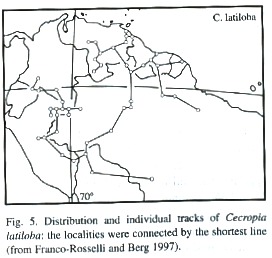
<body><![CDATA[<p align="center"><font face="Arial" size="2"><a name="f5"></a><img  src="/img/fbpe/rbt/v50n2/2810i5.JPG" title="" alt=""  style="width: 272px; height: 258px;"></font></p> <font face="Arial" size="2"><b></b></font>     
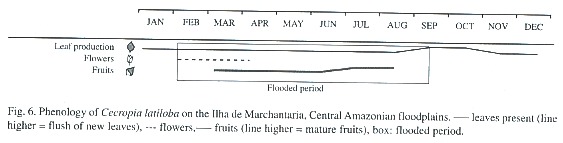
<p><font face="Arial" size="2"><b>Leaf phenology: </b><i>C. latiloba </i>is an evergreen species which constantly produces new leaves. With flooding, new leaf production is reduced but not stopped: new leaves are produced also with prolongued flooding (</font><font face="Arial"  size="2"><a href="#Parolin97">Parolin 1997</a></font><font face="Arial"  size="2">). Submerged leaves rot fast and are shed after few days.</font></p> <font face="Arial" size="2"><b></b></font>     <p><font face="Arial" size="2"><b>Flowering, fruiting, and seed production: </b><i>C. latiloba </i>flowers at the beginning of the flooded period, from February to April (<a href="#f6">Fig. 6</a>). It is pollinated by wind (<a href="#Epperson97">Epperson and Alvarez-Buylla 1997</a>), and fruits (</font><font face="Arial" size="2"><a  href="#f6">Fig. 6</a></font><font face="Arial" size="2">) are present during most of the flooded period, from March to July, but they are mature only at the end of the high water phase, in July and August. When mature, the fruits fall apart and the fruit parts with seeds are dispersed by water and fish. Hairs on the fruits which retain air enable the fruits to float (<a href="#Waldhoff96">Waldhoff <i>et al. </i>1996</a>). The fish species <i>Brycon </i>sp. (matrinchã), <i>Cichlasoma </i>sp. (cará), <i>Colossoma macropomum </i>(tambaqui), <i>Lithodoras dorsalis </i>(bacúpedra), <i>Mylossoma </i>sp. (pacú), and <i>Triportheus </i>sp. (sardinha) (<a href="#Goulding80">Goulding 1980</a>, </font><font  face="Arial" size="2"><a href="#Ziburski91">Ziburski 1991</a></font><font  face="Arial" size="2">, <a href="#Roubach94">Roubach and Saint-Paul 1994</a>, <a href="#Waldhoff00">Waldhoff and Maia 2000</a>). In general, the diaspores of the genus <i>Cecropia </i>are dispersed by bats and birds (<a href="#Kubitzki85">Kubitzki 1985</a>, <a  href="#Galindo-Gonzalez00">Galindo-Gonzalez <i>et al. </i>2000</a>), and other small mammals (<a href="#Guillaumet84">Guillaumet 1984</a>). In <i>C. latilob</i>a, birds, bats and also monkeys feed on the fruits and disperse the seeds (<a href="#Huber10">Huber 1910</a>, <a  href="#Roosmalen85">Roosmalen 1985</a>).</font></p>     <p align="center"><font face="Arial" size="2"><a name="f6"></a><img  src="/img/fbpe/rbt/v50n2/2810i7.JPG" title="" alt=""  style="width: 563px; height: 143px;"></font></p>     
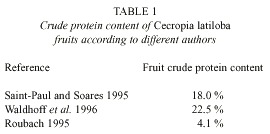
<p><font face="Arial" size="2">There are contradicting measurements of the protein content of <i>C. latiloba </i>fruits (<a href="#t1">Table 1</a>): <a href="#Saint-Paul95">Saint-Paul and Soares 1995</a> measured 18%, in a range of 11% <i>(Vitex cymos</i>a) to 36% <i>(Pseudbombax mungub</i>a). <a href="#Waldhoff96">Waldhoff <i>et al. </i>(1996)</a> measured a crude protein content of 22.5%, and <a href="#Roubach95">Roubach (1995)</a> says that the fruit of <i>Cecropia </i>sp. was the one that presented the lowest crude protein (4.1%) and lipid (0.9%) content in its composition, as well as the highest water content, among several tested species. Total caloric value of the fruits and seeds was 314 kcal(M.E.)/100 g, which was lower than in other plants, and fish of the species <i>Colossoma macropomum </i>that were fed with fruits of <i>Cecropia </i>did not seem to present any weight gain (</font><font face="Arial"  size="2"><a href="#Roubach95">Roubach 1995</a></font><font face="Arial"  size="2">).</font></p>     <p align="center"><font face="Arial" size="2"><a name="t1"></a><img  src="/img/fbpe/rbt/v50n2/2810i6.JPG" title="" alt=""  style="width: 270px; height: 134px;"></font></p>     
<p><font face="Arial" size="2">Water content of the fruit was 78%, and of the seed 58%, compared to an average of 63% water content of the fruits and 47% of the seeds in 27 tree species from the floodplains (Parolin unpubl.).</font></p>     <p><font face="Arial" size="2">Fruit production of <i>C. latiloba </i>was </font><font face="Arial" size="2" color="#ffffff">1</font><font  face="Arial" size="2">l28</font><font face="Arial" size="2"  color="#ffffff">0</font><font face="Arial" size="2">lkg ha<sup>-1</sup> (Adis, pers. comm.). Every fruit produces an average of 5 000 seeds (</font><font  face="Arial" size="2"><a href="#Parolin97">Parolin 1997</a></font><font  face="Arial" size="2">) which survive prolongued submersion. In contrast to other species from Amazonian floodplains, the <i>Cecropia </i>species of the várzea <i>(C. latiloba, C. membranace</i>a) have a soil seed bank but its importance for the reproductive biology of the species is not known (</font><font face="Arial" size="2"><a href="#Ziburski91">Ziburski 1991</a></font><font face="Arial" size="2">).</font></p> <font face="Arial" size="2"><b></b></font>     <p><font face="Arial" size="2"><b>Germination: </b>In contrast to <i>Cecropia </i>species from terra firme, the seeds of <i>C. latiloba </i>do not have a period of dormancy, and do not necessarily require strong, direct light for seed germination (</font><font face="Arial" size="2"><a  href="#Ziburski91">Ziburski 1991</a></font><font face="Arial" size="2">). </font></p>     <p><font face="Arial" size="2">The seeds germinate within 5-13 days, but only if not submerged: germination rate of non-flooded seeds is 96% within three weeks (</font><font face="Arial" size="2"><a  href="#Ziburski91">Ziburski 1991</a></font><font face="Arial" size="2">), compared to 0% in submerged seeds (<a href="#Parolin01a">Parolin 2001a</a>). It does not play a role for germination whether the seeds are directly deposited on soil, or whether they are subjected to submersion or intestinal passages (</font><font face="Arial" size="2"><a  href="#Ziburski91">Ziburski 1991</a></font><font face="Arial" size="2">).</font></p> <font face="Arial" size="2"><i></i></font>     ]]></body>
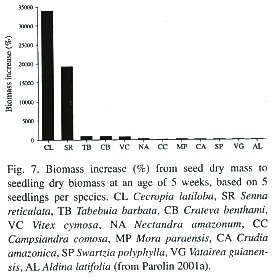
<body><![CDATA[<p><font face="Arial" size="2"><i>C. latiloba </i>has the epigean germination mode with foliaceous cotyledons (<a href="#Hladik90">Hladik and Miquel 1990</a>). Cotyledons opened two days after shoot emergence, which was shorter than in most other analysed species (</font><font  face="Arial" size="2"><a href="#Parolin01a">Parolin 2001a</a></font><font  face="Arial" size="2">). Cotyledon longevity, i.e. the duration until their fall or deterioration, 25 days at an average and the first leaf was expanded after 9 days, which both is shorter than in other floodplain species (</font><font face="Arial" size="2"><a  href="#Parolin01a">Parolin 2001a</a></font><font face="Arial" size="2">). </font></p> <font face="Arial" size="2"><b></b></font>     <p><font face="Arial" size="2"><b>Growth and productivity: </b><i>C. latiloba </i>is a light-demanding tree that grows rapidly in the first months after establishment, reaching </font><font face="Arial" size="2"  color="#ffffff">1</font><font face="Arial" size="2">lm of height in the 7 months before the first flooded period. Young individuals do not form branches and spread laterally very much (<a href="#Worbes96">Worbes 1996</a>). They compensate the reduced crown development by the production of many large leaves which form a large photosynthetically active surface (</font><font face="Arial" size="2"><a href="#Worbes94">Worbes 1994</a></font><font face="Arial" size="2">). Height growth increases continuously until a height of 15-20 m is achieved. The growth form of adult trees corresponds to Rauh‘s model (<a href="#Halle70">Hallé and Oldeman 1970</a>), which is typical for species with a high capacity of reiteration after damage (<a href="#Oldeman90">Oldeman 1990</a>). The architecture of trees growing according to Rauh’s model is characterized by a monopodial trunk which grows rhythmically and so develops tiers of branches, the branches themselves morphogenetically identical with the trunk. Flowers are always lateral and without effect on the growth of the shoot system. This model is one of the most frequent among seed plants, especially among weedtrees. The shoot system is rather unspecialized and is inherently very adaptable because all meristems are equivalent and rhythmic (<a href="#Halle78">Hallé <i>et al. </i>1978</a>). Trees with this architectural model have advantages in early succession because of the inherent simplicity of expression and because of the ability to regenerate readily: if the trunk meristem is destroyed, it is readily replaced, usually by the uppermost lateral meristem (</font><font face="Arial" size="2"><a href="#Halle78">Hallé <i>et al. </i>1978</a></font><font face="Arial" size="2">). <i>C. latiloba </i>belongs to the life-history type in tropical trees that germinate, establish and grow to maturity only in gaps, in contrast to persistent species (<a  href="#Sposito01">Sposito and Santos 2001</a>).</font></p>     <p><font face="Arial" size="2">Biomass increase from seed mass (=l100%) to seedling biomass at an age of five weeks was 33 892 %, compared to 19 300% in <i>Senna reticulat</i>a, another pioneer of the várzea, and to 900 – 50% in non-pioneer species like <i>Tabebuia barbata </i>or <i>Aldina latifolia </i>(<a href="#f7">Fig. 7</a>; </font><font face="Arial"  size="2"><a href="#Parolin01a">Parolin 2001a</a></font><font  face="Arial" size="2">). Seedlings subjected to 12 weeks of waterlogging had 45% lower total biomass than well-watered seedlings of the control (</font><font face="Arial" size="2"><a href="#Parolin97">Parolin 1997</a></font><font face="Arial" size="2">).    <br> </font></p>     <p style="text-align: center;"><font face="Arial" size="2"><a name="f7"></a><img  src="/img/fbpe/rbt/v50n2/2810i8.JPG" title="" alt=""  style="width: 278px; height: 277px;">    
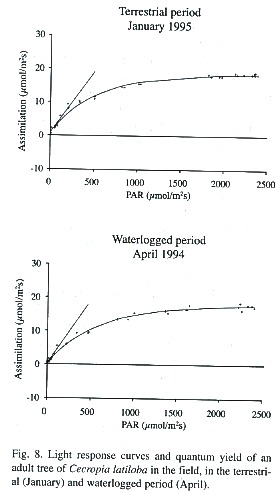
<br> </font></p> <font face="Arial" size="2"></font>     <p><font face="Arial" size="2"><i>C. latiloba </i>has an annual rhythm of shoot extension (</font><font face="Arial" size="2"><a  href="#Worbes97">Worbes 1997</a></font><font face="Arial" size="2">), and wood increment as determined by tree ring analysis is 9.1 mm y<sup>-1</sup> (</font><font face="Arial" size="2"><a href="#Worbes94">Worbes 1994</a></font><font  face="Arial" size="2">), but can be as much as 15 mm y<sup>-1</sup> (</font><font  face="Arial" size="2"><a href="#Parolin98">Parolin <i>et al. </i>1998</a></font><font  face="Arial" size="2">). Nitrogen concentrations of the wood are 0.09%, which is among the lowest measured in Amazonian floodplain trees – average nitrogen concentrations are 0.20% (Martius 1992). The C/N ratio of <i>C. latiloba </i>was 730, an individual reached as much as 1 700, whereas in the other 13 analysed species C/N ratios varied between 95 and 700 (<a href="#Martius92">Martius 1992</a>).</font></p>     <p><font face="Arial" size="2">Productivity of a 12-year-old <i>C. latiloba </i>stand is 8.1 t ha<sup>-1</sup> yr<sup>-1</sup> of wood (</font><font  face="Arial" size="2"><a href="#Worbes97">Worbes 1997</a></font><font  face="Arial" size="2">). In the early successional stands where <i>C. latiloba </i>dominates, it can contribute one third to basal area and above ground biomass, and 50% to total bole volume of the stand (</font><font  face="Arial" size="2"><a href="#Klinge95">Klinge <i>et al. </i>1995</a></font><font  face="Arial" size="2">).</font></p> <font face="Arial" size="2"><b></b></font>     <p><font face="Arial" size="2"><b>Metabolism: </b><i>Photosynthetic assimilation, light response and transpiration. </i>As is typical for pioneer species, <i>C. latiloba </i>performs high photosynthetic assimilation. Mean photosynthetic assimilation of <i>C. latiloba </i>is 17.1 ± 0.8 µmol CO<sub>2</sub> m<sup>-2</sup> s<sup>-1</sup> but values of up to 21 µmol CO<sub>2</sub> m<sup>-2</sup> s<sup>-1</sup> could be measured in adult trees in the field. The optimum performance can be measured in the terrestrial period, in well watered plants in the morning, before light incidence becomes too strong and photoinhibition reduces assimilation. Light saturation is reached at 1 000 µmol m<sup>-2</sup> s<sup>-1</sup> PAR (<a href="#f8">Fig. 8</a>).</font></p>     <p align="center"><font face="Arial" size="2"><a name="f8"></a><img  src="/img/fbpe/rbt/v50n2/2810i9.JPG" title="" alt=""  style="width: 279px; height: 494px;">    
]]></body>
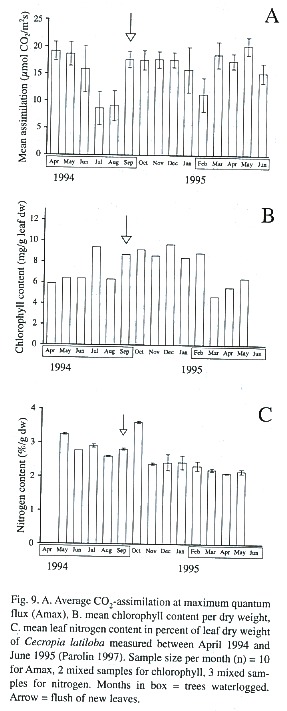
<body><![CDATA[<br> </font></p>     <p><font face="Arial" size="2">In the annual cycle, characteristic changes of CO<sub>2</sub> -assimilation can be measured (<a href="#f9">Fig. 9A</a>, </font><font face="Arial" size="2"><a href="#Parolin97">Parolin 1997</a></font><font face="Arial" size="2">, <a href="#Parolin00c">Parolin 2000c</a>). With the beginning of flooding, CO<sub>2</sub> -uptake is reduced for some weeks. Then new leaves are sprouted, and photosynthetic assimilation rises again to values comparable to the terrestrial phase. After about six months of flooding leaf senescence increased and CO<sub>2</sub> –assimilation decreased, but before the end of flooding new leaves were flushed and photosynthetic assimilation rose.</font></p>     <p align="center"><font face="Arial" size="2"><a name="f9"></a><img  src="/img/fbpe/rbt/v50n2/2810i10.JPG" title="" alt=""  style="width: 287px; height: 711px;"></font></p>     
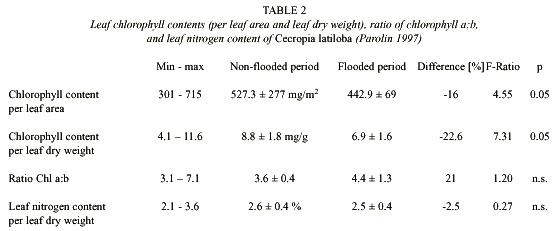
<p><font face="Arial" size="2">In waterlogged adult trees in the aquatic phase, average assimilation at maximum light incidence (Amax) was about 11% lower than in the terrestrial period (average non-flooded: 16.8 ± 1.5 µmol CO<sub>2</sub> m<sup>-2</sup> s<sup>-1</sup> , flooded: 15.0 ± 4.6 µmol CO<sub>2</sub> m<sup>-2</sup> s<sup>-1</sup> ), which is shown also by the lower light response curves (</font><font  face="Arial" size="2"><a href="#f8">Fig. 8</a></font><font face="Arial"  size="2">; </font><font face="Arial" size="2"><a href="#Parolin97">Parolin 1997</a></font><font face="Arial" size="2">). Average quantum yield was 4.5% higher in the flooded than in the non-flooded period.</font></p>     <p><font face="Arial" size="2">Transpiration was significantly lower in the aquatic period: in the flooded trees, an average of 5 700 µmol m<sup>-2</sup> s<sup> -1</sup> was measured, compared to an average of 8 200 µmol m<sup>-2</sup> s<sup>-1</sup> in the terrestrial period (</font><font face="Arial"  size="2"><a href="#Parolin97">Parolin 1997</a></font><font face="Arial"  size="2">). Maximum measured transpiration was 9 600 µmol m<sup>-2</sup> s<sup>-1</sup> .</font></p> <font face="Arial" size="2"><b><i>     <p>Chlorophyll fluorescence</p> </i></b> </font>     <p><font face="Arial" size="2">Chlorophyll fluorescence is a parameter of potential photosynthesis, expressed by the photochemical yield Fv/Fm, where Fm is maximum fluorescence, and Fv is the difference between Fm and the minimal fluorescence level Fo (<a  href="#Bolhar-Nordenkampf92">Bolhàr-Nordenkampf and Götzl 1992</a>). In adult trees, the average photochemical yield was not significantly different in the terrestrial and aquatic periods, and ranged between 0.65 and 0.68 (Fv/Fm) (</font><font face="Arial" size="2"><a  href="#Parolin97">Parolin 1997</a></font><font face="Arial" size="2">). </font></p> <font face="Arial" size="2"><b><i>     <p>Chlorophyll content of the leaves</p> </i></b> </font>     <p><font face="Arial" size="2">Leaf chlorophyll contents (per leaf dry weight) were significantly higher in the non-flooded trees than in the flooded trees (<a href="#t2">Table 2</a>, <a href="#f9">Fig. 9B</a>). The ratio of chlorophyll a:b was around 3.6 in the terrestrial period, and in the flooded period there was an increase of 21% compared to the non-flooded period (<a href="#t2">Table 2</a>).</font></p>     <p align="center"><font face="Arial" size="2"><a name="t2"></a><img  src="/img/fbpe/rbt/v50n2/2810i11.JPG" title="" alt=""  style="width: 555px; height: 231px;"></font></p> <font face="Arial" size="2"><b><i>     
]]></body>
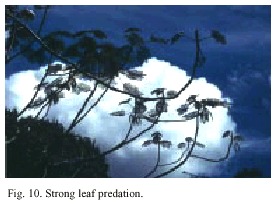
<body><![CDATA[<p>Nitrogen content of the leaves</p> </i></b> </font>     <p><font face="Arial" size="2">Leaf nitrogen content was 2.5% at an average, but up to 3.6%, which is very high compared to other species (</font><font  face="Arial" size="2"><a href="#Parolin97">Parolin 1997</a></font><font  face="Arial" size="2">). Differences between the flooded and the non-flooded period are neglectable (<a href="#t2">Table 2</a>, <a  href="#f9">Fig. 9C</a>).</font></p> <font face="Arial" size="2"><b></b></font>     <p><font face="Arial" size="2"><b>Flood tolerance: </b><i>C. latiloba </i>is a very flood tolerant species, as it occurs mainly at low levels in the flooding gradient. When the plants are submerged, the water destroys the leaves, but below the apex new leaves are produced from new lateral buds as soon as the water recedes. If the strong water currents damage the apex, the high capacity of reiteration compensates the losses (</font><font  face="Arial" size="2"><a href="#Lamotte92">Lamotte 1992</a></font><font  face="Arial" size="2">, </font><font face="Arial" size="2"><a  href="#Worbes94">Worbes 1994</a></font><font face="Arial" size="2">). Reiteration here is a clear adaptation to the water currents and high sedimentation rates of the Amazon river and its affluents, where sedimentation can be as much as </font><font face="Arial" size="2"  color="#ffffff">1</font><font face="Arial" size="2">lm per year (</font><font  face="Arial" size="2"><a href="#Junk89">Junk 1989</a></font><font  face="Arial" size="2">).</font></p>     <p><font face="Arial" size="2">Tolerance to waterlogging is very high (</font><font  face="Arial" size="2"><a href="#Parolin97">Parolin 1997</a></font><font  face="Arial" size="2">): seedlings were left in buckets filled with water for 12 months at the INPA / Manaus. Root volume was reduced because it was planted in a 21 plastic bag, and water was changed only at weekly intervals – thus it was subjected to even more extreme waterlogging conditions than juvenile plants are exposed to in the field. After a year the plants were less vital than non-flooded well watered individuals with the same root volume, and the leaves were smaller and had reduced photosynthetic activity. Nevertheless, they continuously produced new leaves and adventitiuos roots, and as soon as the waterlogging ended, the plant resprouted and grew vigorously.</font></p>     <p><font face="Arial" size="2">The seedlings and saplings tolerate complete submergence for several months. They shed all the leaves, but new leaves expanded soon after flood end. In an experiment, leaf buds were sprouted before the end of flooding, below the water (<a  href="#Parolin01b">Parolin 2001b</a>).</font></p> <font face="Arial" size="2"><b></b></font>     <p><font face="Arial" size="2"><b>Morphological adaptations to flooding: </b>In waterlogged seedlings in a flooding experiment (</font><font  face="Arial" size="2"><a href="#Parolin01b">Parolin 2001b</a></font><font  face="Arial" size="2">), <i>C. latiloba </i>produced adventitious roots and a high amount of lenticels. Additionally, pneumatophore-like roots, stem dimorphism and hypertrophied lenticels were observed (<a  href="#Waldhoff98">Waldhoff <i>et al. </i>1998</a>). The additional root aeration provided by these formations diminishes the oxygen deficiency in the rhizosphere and enhances growth and photosynthetic activity (</font><font face="Arial" size="2"><a href="#Crawford89">Crawford 1989, 1992</a></font><font face="Arial" size="2">). A special mechanism for root aeration, pressure ventilation, was shown to occur in seedlings and supposedly occurs also in adult trees of <i>C. latiloba </i>(<a  href="#Graffmann00">Graffmann 2000</a>). Therefore height growth, new leaf production, and photosynthetic activity were not severely affected in the waterlogged seedlings in the flooding experiment. <i>C. latiloba </i>was the only species among several tested that produced all, and not only one of these adaptations (</font><font face="Arial"  size="2"><a href="#Waldhoff98">Waldhoff <i>et al. </i>1998</a></font><font  face="Arial" size="2">). Another function of the adventitious roots is to increase nutrient uptake: <a href="#Lamotte92">Lamotte (1992)</a> observed that <i>C. latiloba </i>develops adventitious roots in the direction of decomposing organic matter, for example fallen tree stems.</font></p> <font face="Arial" size="2"><b></b></font>     <p><font face="Arial" size="2"><b>Myrmecophyly and secondary compounds: </b>As most <i>Cecropia </i>species, <i>C. latiloba </i>is a myrmecophytic genus. Ants of the genera <i>Azteca, Camponotus </i>and <i>Crematogaster </i>are typically associated with the genus <i>Cecropia </i>(Bandeira and Harada 1991, <a href="#Ayala96">Ayala <i>et al. </i>1996</a>) and occur on <i>C. latiloba </i>in the floodplains (Ana Harada pers. comm.). <i>Azteca alfari </i>is found on <i>C. latiloba </i>(Suzana Ketelhut, Ana Harada pers. comm.) as well as the black ants of the genus <i>Lasius </i>(<a href="#Pio78">Pio Correa 1978</a>).</font></p>     <p><font face="Arial" size="2">Chemical compounds (leaf tannins) and other forms of defenses may augment the biotic defenses (<a  href="#Garay-Arroyo97">Garay-Arroyo and Alvarez-Buylla 1997</a>). <i>Cecropia </i>may also be protected by physical defenses such as leaf consitutents contributing to toughness, and by phenological traits such as rapid leaf expansion (<a href="#Folgarait94">Folgarait and Davidson 1994</a>). Nevertheless, in few cases high leaf predation could be observed on adult trees in the field (<a href="#f10">Fig. 10</a>).</font></p>     <p align="center"><font face="Arial" size="2"><a name="f10"></a><img  src="/img/fbpe/rbt/v50n2/2810i12.JPG" title="" alt=""  style="width: 276px; height: 204px;">    
<br> </font></p> <font face="Arial" size="2"><b></b></font>     ]]></body>
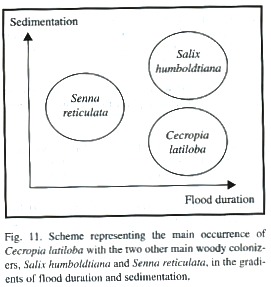
<body><![CDATA[<p><font face="Arial" size="2"><b>Dynamics and colonization strategy: </b><i>C. latiloba </i>colonizes a large spectrum of disturbed habitats over a wide range in the flood level gradient. It belongs to the mid-level tree community which reaches down to 23 m a.s.l on the shores of the Amazon river, where flooding lasts 230 days per year (</font><font  face="Arial" size="2"><a href="#Junk89">Junk 1989</a></font><font  face="Arial" size="2">). Although single individuals may be flooded for up to 8 months and it is considered as a characteristic tree of the chavascal, i.e. a physiognomic type of várzea with mostly low, arbustive vegetation (</font><font face="Arial" size="2"><a  href="#Ayres93">Ayres 1993</a></font><font face="Arial" size="2">), its main distribution occurs at levels in the flooding gradient with less than 7 months of flooding. <i>C. latiloba </i>preferrably establishes on long-term flooded sites which are less exposed to sedimentation (1-5 cm of sediment deposit per year, silt fraction of 60%; <a href="#Wittmann01">Wittmann 2001</a>). It may therefore establish below an open canopy formed by <i>Salix humboldtiana </i>(</font><font  face="Arial" size="2"><a href="#Worbes94">Worbes 1994</a></font><font  face="Arial" size="2">, <a href="#Oliveira98">Oliveira 1998</a>) where sedimentation rates are lower because upright stems break the flow of water, effecting an active deposition of sediment at the water-vegetation interface (<a href="#Terborgh91">Terborgh and Petren 1991</a>).</font></p>     <p><font face="Arial" size="2">According to the classification of <a  href="#Worbes92">Worbes <i>et al. </i>(1992)</a>, it is a typical representant of the species-poor early secondary stage, after the dominance of the extremely sediment-tolerant <i>Salix humboldtian</i>a, and before the late secondary and climax communities, with <i>Pseudobombax munguba </i>and <i>Piranhea trifoliat</i>a, respectively, as typical dominating species.</font></p>     <p><font face="Arial" size="2">The limiting factors for the establishment of <i>C. latiloba </i>are high sediment deposition on new sand banks and competition with other fast-growing pioneer species, as for example <i>Senna reticulata </i>(<a href="#f11">Fig. 11</a>). The highest competitivity is reached on sunny open spaces with high nutrient content, for example at sites which were subjected to human disturbances, or on landslides and and sites with erosion, which are frequent in the highly dynamic floodplain system. <i>Senna reticulata </i>is both a primary and secondary colonizer, but competes only as long as the newly colonized sites are not subjected to high floods because it does not tolerate complete sumergence (<a href="#Parolin99">Parolin 1999</a>, </font><font face="Arial" size="2"><a href="#Parolin01b">Parolin 2001b</a></font><font  face="Arial" size="2">). <i>C. latiloba </i>and <i>Senna reticulata </i>are highly adapted to the colonization of open areas in nutrient-rich white-water floodplains and form large monospeficic stands, but they have different strategies concerning germination, seedling establishment and growth (</font><font face="Arial" size="2"><a  href="#Parolin99">Parolin 1999</a></font><font face="Arial" size="2">) and are hardly found on the same sites. Along a transect of 335 m on Ilha do Careiro (Fazenda Pec) in a disturbed area, an abandoned pasture, several seedlings of <i>C. latilob</i>a, and of the concurring species <i>Senna reticulat</i>a, were found, but never did the two species occur in the same transect plot of 1 m 2 (Parolin unpubl.).</font></p>     <p align="center"><font face="Arial" size="2"><a name="f11"></a><img  src="/img/fbpe/rbt/v50n2/2810i13.JPG" title="" alt=""  style="width: 271px; height: 287px;"></font></p> <font face="Arial" size="2"><i></i></font>     
<p><font face="Arial" size="2"><i>C. latiloba </i>grows more slowly but constantly, and its high flood tolerance allows vertical evasion from concurring species (Williamson <i>et al. </i>1998). <i>Senna reticulata </i>has fast initital growth and intense lateral growth, and outshades plants competing for space and light. Seedling growth of two fast-growing pioneer species, <i>C. latiloba </i>and <i>Senna reticulat</i>a, was analyzed in the vicinity of Manaus (</font><font  face="Arial" size="2"><a href="#Parolin99">Parolin 1999</a></font><font  face="Arial" size="2">). Young plants of <i>C. latiloba </i>grew 1 m in the first 6 months, while <i>Senna reticulata </i>grew up to four meters in the 8 months before the first flood. The strategy of <i>C. latiloba </i>is efficient in várzea environmentswith average to long periods of flooding. When other fast-growing species occur on favourable nutrient-rich sites, <i>C. latiloba </i>may be excluded from dominance because of its intrinsically slow growth, early and high commitment to biotic and other defenses (</font><font face="Arial"  size="2"><a href="#Folgarait94">Folgarait and Davidson 1994</a></font><font  face="Arial" size="2">). With shorter periods of flooding, and high nutrient availability (e.g. on abandoned pastures), the strategy of <i>Senna reticulata </i>is more efficient and leads to its complete dominance.</font></p> <font face="Arial" size="2"><b></b></font>     <p><font face="Arial" size="2"><b>Economical importance: </b>The high cellulose content gives this species economical importance for the production of paper (</font><font face="Arial" size="2"><a  href="#Hueck66">Hueck 1966</a></font><font face="Arial" size="2">, </font><font  face="Arial" size="2"><a href="#Lamotte92">Lamotte 1992</a></font><font  face="Arial" size="2">). It is also used for carbon production (<a  href="#Le22">Le Cointe 1922</a>), and for the construction of boxes, rafts and floating houses (</font><font face="Arial" size="2"><a  href="#Lamotte92">Lamotte 1992</a></font><font face="Arial" size="2">). An infusion of the leaves and the bark is used against fever (<a  href="#Soukup87">Soukoup 1987</a>). The leaves and bark of <i>Cecropia pachystachya </i>from Northern Argentina are used in phytotherapy for their balsamic and expectorant action (<a href="#Cativiela98">Cativiela <i>et al. </i>1998</a>).</font></p>     <p><font face="Arial" size="2">In conclusion <i>C. latiloba </i>can be considered to be one of the most efficient colonizers of open areas in Amazonian floodplains. Its main strategy to be successful is the high tolerance towards waterlogging and submergence, and the fast vertical growth and reiteration capacity. This, and the tolerance of high irradiation and sediment deposition allow <i>C. latiloba </i>to form large monospecific stands on open sites, and thus the first closed canopy which represents the initial phase of a successional sequence where less light-demanding species can penetrate and establish, resulting in stands with 130 species per hectare (</font><font  face="Arial" size="2"><a href="#Junk89">Junk 1989</a></font><font  face="Arial" size="2">) and high floristic diversity.</font></p> <font face="Arial" size="2"><b>     <p>Acknowledgments</p> </b> </font>     <p><font face="Arial" size="2">I wish to thank the technicians of INPAfor help received in the field, and Suzana Ketelhut for additional information. This work was made possible by financial support from the INPA/Max-Planck Project.</font></p> <font face="Arial" size="2"><b>     <p>Resumen</p> </b><i> </i></font>     ]]></body>
<body><![CDATA[<p><font face="Arial" size="2"><i>Cecropia latiloba </i>puede ser considerada una de las especies colonizadoras más eficientes de áreas abiertas en las llanuras inundadas de agua dulce, rica en nutrientes, del río Amazonas. Su principal estrategia para ser exitosa es la tolerancia al transporte por el agua y a permanecer sumergida, y su rápido crecimiento vertical y capacidad de reiteración. Esto, y la tolerancia a la alta irradiación y a la deposición de sedimentos permite a <i>C. latiloba </i>formar grandes parches monoespecíficos en sitios abiertos, y así el primer dosel cerrado el cual representa la fase inicial de la secuencia de sucesión que conduce a bosques altamente diversos. Este árbol, está extremadamente bien adaptado a las condiciones adversas de crecimiento en el terreno aluvial amazónico, con prolongados períodos de inundación y sumersión. La especie está presente en los niveles inferiores en la gradiente de inundación. Aunque pertenece a las especies más frecuentemente citadas en aspectos de taxonomía, distribución y descripción general del ecosistema, poco ha sido publicado respecto a su ecología. En el presente artículo se describen las características ecológicas, fisiológicas y fenológicas de <i>C. latilob</i>a. Es una especie siempre verde que constantemente produce hojas. Con las inundaciones, la producción de hojas se reduce pero nuevas hojas brotan también durante las inundaciones prolongadas. El pico de floración y fructificación es durante el período inundado. Cuando maduran, las frutas son dispersadas principalmente por el agua y los peces. La germinación de las semillas ocurre, sin latencia, entre 513 días después de la retirada de las aguas. En los 7 meses anteriores al primer período de inundación las plantas alcanzan 1 m de altura y el crecimiento se incrementa hasta que se alcanza una altura de 15-20 m. La asimilación fotosintética es alta, con valores de hasta 21 µmol CO<sub>2</sub> m<sup>-2</sup> s<sup>-1</sup> . <i>C. latiloba </i>es una especie muy tolerante a las inundaciones, y el transporte de troncos por el agua continuamente produce nuevas hojas y raíces adventicias.</font></p> <font face="Arial" size="2"><b>     <p>References</p> </b> </font>     <!-- ref --><p><font face="Arial" size="2"><a name="Ayala96"></a>Ayala, F.J., J.K. Wetterer, J.T. Longino, D.L Hartl. 1996. Molecular phylogeny of <i>Azteca </i>ants (Hymenoptera: Formicidae) and the colonization of <i>Cecropia </i>trees. Mol. Phylogenet. Evol. 5: 423-428.</font>&nbsp;&nbsp;&nbsp;&nbsp;&nbsp;&nbsp;&nbsp;&nbsp;[&#160;<a href="javascript:void(0);" onclick="javascript: window.open('/scielo.php?script=sci_nlinks&ref=1204490&pid=S0034-7744200200020001300001&lng=','','width=640,height=500,resizable=yes,scrollbars=1,menubar=yes,');">Links</a>&#160;]<!-- end-ref --><!-- ref --><p><font face="Arial" size="2"><a name="Ayres93"></a>Ayres, J.M.C. 1993. As matas de várzea do Mamirauá. pp. 1-123. <i>I</i>n: Estudos de Mamirauá. Sociedade Civil Mamirauá (ed.). CNPq, Brasília, DF, Brasil. Vol.I. Bandeira, A.G., Harada, A.Y. 1991. Cupins e formigas na Amazônia. <i>I</i>n: Val A.L., R. Figliuolo and E. Feldberg (eds.). Bases cientificas para estratégias de preservaçao e desenvolvimento da Amazônia: Fatos e perspectivas. Manaus 1: 387-395.</font>&nbsp;&nbsp;&nbsp;&nbsp;&nbsp;&nbsp;&nbsp;&nbsp;[&#160;<a href="javascript:void(0);" onclick="javascript: window.open('/scielo.php?script=sci_nlinks&ref=1204491&pid=S0034-7744200200020001300002&lng=','','width=640,height=500,resizable=yes,scrollbars=1,menubar=yes,');">Links</a>&#160;]<!-- end-ref --><!-- ref --><p><font face="Arial" size="2"><a name="Berg78"></a>Berg, C.C. 1978. Espécies de <i>Cecropia </i>da Amazônia Brasileira. Acta Amazonica 8(2): 149-182.</font>&nbsp;&nbsp;&nbsp;&nbsp;&nbsp;&nbsp;&nbsp;&nbsp;[&#160;<a href="javascript:void(0);" onclick="javascript: window.open('/scielo.php?script=sci_nlinks&ref=1204492&pid=S0034-7744200200020001300003&lng=','','width=640,height=500,resizable=yes,scrollbars=1,menubar=yes,');">Links</a>&#160;]<!-- end-ref --><!-- ref --><p><font face="Arial" size="2"><a name="Bolhar-Nordenkampf92"></a>Bolhár-Nordenkampf, H.R., M. Götzl. 1992. Chlorophyllfluoreszenz als Indikator der mit Seehöhe zunehmenden Streßbelastung von Fichtennadeln. FBVA Berichte. Schriftenreihed. Forstl. Bundesveranst. 67: 119-131.</font>&nbsp;&nbsp;&nbsp;&nbsp;&nbsp;&nbsp;&nbsp;&nbsp;[&#160;<a href="javascript:void(0);" onclick="javascript: window.open('/scielo.php?script=sci_nlinks&ref=1204493&pid=S0034-7744200200020001300004&lng=','','width=640,height=500,resizable=yes,scrollbars=1,menubar=yes,');">Links</a>&#160;]<!-- end-ref --><!-- ref --><p><font face="Arial" size="2"><a name="Cativiela98"></a>Cativiela M., M. Torres &amp; M. Gattuso. 1998. Micrographic parameters for <i>Cecropia pachystachy</i>a. Fitoterapia 69(4): 313-321.</font>&nbsp;&nbsp;&nbsp;&nbsp;&nbsp;&nbsp;&nbsp;&nbsp;[&#160;<a href="javascript:void(0);" onclick="javascript: window.open('/scielo.php?script=sci_nlinks&ref=1204494&pid=S0034-7744200200020001300005&lng=','','width=640,height=500,resizable=yes,scrollbars=1,menubar=yes,');">Links</a>&#160;]<!-- end-ref --><!-- ref --><p><font face="Arial" size="2"><a name="Coombs85"></a>Coombs, J., D.O. Hall, S.P. Long &amp; L.H.O. Scurlock, 1985. <i>Techniques in bioproductivity and photosynthesi</i>s. 2nd ed. Pergamon Press. 283 pp.</font>&nbsp;&nbsp;&nbsp;&nbsp;&nbsp;&nbsp;&nbsp;&nbsp;[&#160;<a href="javascript:void(0);" onclick="javascript: window.open('/scielo.php?script=sci_nlinks&ref=1204495&pid=S0034-7744200200020001300006&lng=','','width=640,height=500,resizable=yes,scrollbars=1,menubar=yes,');">Links</a>&#160;]<!-- end-ref --><!-- ref --><p><font face="Arial" size="2"><a name="Crawford89"></a>Crawford, R.M.M. 1989. The anaerobic retreat. <i>I</i>n: Studies on plant survival. Ecological case histories of plant adaptation to adversity. R.M.M. Crawford (ed.). Blackwell Scientific Publications. Studies in Ecology Vol. 11: 105-129.</font>&nbsp;&nbsp;&nbsp;&nbsp;&nbsp;&nbsp;&nbsp;&nbsp;[&#160;<a href="javascript:void(0);" onclick="javascript: window.open('/scielo.php?script=sci_nlinks&ref=1204496&pid=S0034-7744200200020001300007&lng=','','width=640,height=500,resizable=yes,scrollbars=1,menubar=yes,');">Links</a>&#160;]<!-- end-ref --><!-- ref --><p><font face="Arial" size="2"><a name="Crawford92"></a>Crawford, R.M.M. 1992. Oxygen availability as an ecological limit to plant distribution. Adv. Ecol. Res. 23: 93-185.</font>&nbsp;&nbsp;&nbsp;&nbsp;&nbsp;&nbsp;&nbsp;&nbsp;[&#160;<a href="javascript:void(0);" onclick="javascript: window.open('/scielo.php?script=sci_nlinks&ref=1204497&pid=S0034-7744200200020001300008&lng=','','width=640,height=500,resizable=yes,scrollbars=1,menubar=yes,');">Links</a>&#160;]<!-- end-ref --><!-- ref --><p><font face="Arial" size="2"><a name="Epperson97"></a>Epperson BK. &amp; E.R. Alvarez-Buylla 1997: Limited seed dispersal and genetic structure in life stages of <i>Cecropia obtusifoli</i>a. Evolution 51: 275-282.</font>&nbsp;&nbsp;&nbsp;&nbsp;&nbsp;&nbsp;&nbsp;&nbsp;[&#160;<a href="javascript:void(0);" onclick="javascript: window.open('/scielo.php?script=sci_nlinks&ref=1204498&pid=S0034-7744200200020001300009&lng=','','width=640,height=500,resizable=yes,scrollbars=1,menubar=yes,');">Links</a>&#160;]<!-- end-ref --><!-- ref --><p><font face="Arial" size="2"><a name="Ferreira97"></a>Ferreira, L.V. 1997. Effects of the duration of flooding on species richness and floristic composition in three hectares in the Jaú National Park in floodplain forests in central Amazonia. Biodiv. and Conserv. 6: 1353-1363.</font>&nbsp;&nbsp;&nbsp;&nbsp;&nbsp;&nbsp;&nbsp;&nbsp;[&#160;<a href="javascript:void(0);" onclick="javascript: window.open('/scielo.php?script=sci_nlinks&ref=1204499&pid=S0034-7744200200020001300010&lng=','','width=640,height=500,resizable=yes,scrollbars=1,menubar=yes,');">Links</a>&#160;]<!-- end-ref --><!-- ref --><p><font face="Arial" size="2"><a name="Fleming90"></a>Fleming, T.H., C.F. Williams. 1990. Phenology, seed dispersal, and recruitment in <i>Cecropia peltata </i>(Moraceae) in Costa Rican tropical dry forest. J. Trop. Ecol. 6: 163-178.</font>&nbsp;&nbsp;&nbsp;&nbsp;&nbsp;&nbsp;&nbsp;&nbsp;[&#160;<a href="javascript:void(0);" onclick="javascript: window.open('/scielo.php?script=sci_nlinks&ref=1204500&pid=S0034-7744200200020001300011&lng=','','width=640,height=500,resizable=yes,scrollbars=1,menubar=yes,');">Links</a>&#160;]<!-- end-ref --><!-- ref --><p><font face="Arial" size="2"><a name="Folgarait94"></a>Folgarait, P.J., D.W. Davidson. 1994. Antiherbivore defenses of myrmecophytic <i>Cecropia </i>under different light regimes. Oikos 71: 305-320.</font>&nbsp;&nbsp;&nbsp;&nbsp;&nbsp;&nbsp;&nbsp;&nbsp;[&#160;<a href="javascript:void(0);" onclick="javascript: window.open('/scielo.php?script=sci_nlinks&ref=1204501&pid=S0034-7744200200020001300012&lng=','','width=640,height=500,resizable=yes,scrollbars=1,menubar=yes,');">Links</a>&#160;]<!-- end-ref --><!-- ref --><p><font face="Arial" size="2"><a name="Franco-Rosselli97"></a>Franco-Rosselli, P., C.C. Berg. 1997. Distributional patterns of <i>Cecropia </i>(Cecropiaceae): A panbiogeographic analysis. Caldasia 19(1-2): 285-296.</font>&nbsp;&nbsp;&nbsp;&nbsp;&nbsp;&nbsp;&nbsp;&nbsp;[&#160;<a href="javascript:void(0);" onclick="javascript: window.open('/scielo.php?script=sci_nlinks&ref=1204502&pid=S0034-7744200200020001300013&lng=','','width=640,height=500,resizable=yes,scrollbars=1,menubar=yes,');">Links</a>&#160;]<!-- end-ref --><!-- ref --><p><font face="Arial" size="2"><a name="Galindo-Gonzalez00"></a>Galindo-Gonzalez, J., S. Guevara &amp; V.J. Sosa. 2000: Bat-and bird-generated seed rains at isolated trees in pastures in a tropical rainforest. Conservation Biol. 14(6): 1693-1703.</font>&nbsp;&nbsp;&nbsp;&nbsp;&nbsp;&nbsp;&nbsp;&nbsp;[&#160;<a href="javascript:void(0);" onclick="javascript: window.open('/scielo.php?script=sci_nlinks&ref=1204503&pid=S0034-7744200200020001300014&lng=','','width=640,height=500,resizable=yes,scrollbars=1,menubar=yes,');">Links</a>&#160;]<!-- end-ref --><!-- ref --><p><font face="Arial" size="2"><a name="Garay-Arroyo97"></a>Garay-Arroyo, A., E.R. Alvarez-Buylla. 1997. Isozyme variation in a tropical pioneer tree species <i>(Cecropia obtusifoli</i>a, Moraceae) with high contents of secondary compounds. Biotropica. 29: 280-290.</font>&nbsp;&nbsp;&nbsp;&nbsp;&nbsp;&nbsp;&nbsp;&nbsp;[&#160;<a href="javascript:void(0);" onclick="javascript: window.open('/scielo.php?script=sci_nlinks&ref=1204504&pid=S0034-7744200200020001300015&lng=','','width=640,height=500,resizable=yes,scrollbars=1,menubar=yes,');">Links</a>&#160;]<!-- end-ref --><!-- ref --><p><font face="Arial" size="2"><a name="Goulding80"></a>Goulding, M. 1980. The fruit- and seed-eating large characins. pp. 55-216. <i>I</i>n: M. Goulding (ed.) The fishes and the forest. Explorations in Amazonian natural history. Univ. of California.</font>&nbsp;&nbsp;&nbsp;&nbsp;&nbsp;&nbsp;&nbsp;&nbsp;[&#160;<a href="javascript:void(0);" onclick="javascript: window.open('/scielo.php?script=sci_nlinks&ref=1204505&pid=S0034-7744200200020001300016&lng=','','width=640,height=500,resizable=yes,scrollbars=1,menubar=yes,');">Links</a>&#160;]<!-- end-ref --><!-- ref --><p><font face="Arial" size="2"><a name="Graffmann00"></a>Graffmann, K.C. 2000. Die Bedeutung der Druckventilation für die Sauerstoffversorgung des Wurzelsystems bei Bäumen der amazonischen Über-schwemmungswälder. Dissertation Uni Köln, 91 pp.</font>&nbsp;&nbsp;&nbsp;&nbsp;&nbsp;&nbsp;&nbsp;&nbsp;[&#160;<a href="javascript:void(0);" onclick="javascript: window.open('/scielo.php?script=sci_nlinks&ref=1204506&pid=S0034-7744200200020001300017&lng=','','width=640,height=500,resizable=yes,scrollbars=1,menubar=yes,');">Links</a>&#160;]<!-- end-ref --><!-- ref --><p><font face="Arial" size="2"><a name="Guillaumet84"></a>Guillaumet, J.-L. 1984. Observações sobre a frutificação e disseminação das sementes de algumas espécies do gênero <i>Cecropia </i>(Moraceae). pp. 143-163. <i>I</i>n: XXXV Congresso Nacional de Botânica, Anais, SBB, Manaus.</font>&nbsp;&nbsp;&nbsp;&nbsp;&nbsp;&nbsp;&nbsp;&nbsp;[&#160;<a href="javascript:void(0);" onclick="javascript: window.open('/scielo.php?script=sci_nlinks&ref=1204507&pid=S0034-7744200200020001300018&lng=','','width=640,height=500,resizable=yes,scrollbars=1,menubar=yes,');">Links</a>&#160;]<!-- end-ref --><!-- ref --><p><font face="Arial" size="2"><a name="Halle70"></a>Hallé, F., Oldeman, R.A.A. 1970. Essai sur l’architecture et la dynamique de croissance des arbres tropicaux. Monographie 6, Mansson. Paris. 178 p.</font>&nbsp;&nbsp;&nbsp;&nbsp;&nbsp;&nbsp;&nbsp;&nbsp;[&#160;<a href="javascript:void(0);" onclick="javascript: window.open('/scielo.php?script=sci_nlinks&ref=1204508&pid=S0034-7744200200020001300019&lng=','','width=640,height=500,resizable=yes,scrollbars=1,menubar=yes,');">Links</a>&#160;]<!-- end-ref --><!-- ref --><p><font face="Arial" size="2"><a name="Halle78"></a>Hallé, F., Oldeman, R.A.A., Tomlinson, P.B. 1978. Tropical trees and forests. An architectural analysis. Springer, Berlin Heidelberg New York. 441 p.</font>&nbsp;&nbsp;&nbsp;&nbsp;&nbsp;&nbsp;&nbsp;&nbsp;[&#160;<a href="javascript:void(0);" onclick="javascript: window.open('/scielo.php?script=sci_nlinks&ref=1204509&pid=S0034-7744200200020001300020&lng=','','width=640,height=500,resizable=yes,scrollbars=1,menubar=yes,');">Links</a>&#160;]<!-- end-ref --><!-- ref --><p><font face="Arial" size="2"><a name="Hladik90"></a>Hladik, A., &amp; S. Miquel. 1990. Seedling types and plant establishment in an African rain forest. <i>I</i>n: Bawa K.S. &amp; M. Hadley (eds.). Reproductive Ecology of tropical forest plants. Man and the Biosphere Series 7:261-282.</font>&nbsp;&nbsp;&nbsp;&nbsp;&nbsp;&nbsp;&nbsp;&nbsp;[&#160;<a href="javascript:void(0);" onclick="javascript: window.open('/scielo.php?script=sci_nlinks&ref=1204510&pid=S0034-7744200200020001300021&lng=','','width=640,height=500,resizable=yes,scrollbars=1,menubar=yes,');">Links</a>&#160;]<!-- end-ref --><!-- ref --><p><font face="Arial" size="2"><a name="Huber10"></a>Huber, J. 1910. Mattas e madeiras amazonicas. Bol. Museu Goeldi 6: 91-225.</font>&nbsp;&nbsp;&nbsp;&nbsp;&nbsp;&nbsp;&nbsp;&nbsp;[&#160;<a href="javascript:void(0);" onclick="javascript: window.open('/scielo.php?script=sci_nlinks&ref=1204511&pid=S0034-7744200200020001300022&lng=','','width=640,height=500,resizable=yes,scrollbars=1,menubar=yes,');">Links</a>&#160;]<!-- end-ref --><!-- ref --><p><font face="Arial" size="2"><a name="Hueck66"></a>Hueck, K. 1966. Die Wälder Südamerikas. Ökologie, Zusammensetzung und wirtschaftliche Bedeutung. Gustav Fischer, Stuttgart. 358 p.</font>&nbsp;&nbsp;&nbsp;&nbsp;&nbsp;&nbsp;&nbsp;&nbsp;[&#160;<a href="javascript:void(0);" onclick="javascript: window.open('/scielo.php?script=sci_nlinks&ref=1204512&pid=S0034-7744200200020001300023&lng=','','width=640,height=500,resizable=yes,scrollbars=1,menubar=yes,');">Links</a>&#160;]<!-- end-ref --><!-- ref --><p><font face="Arial" size="2"><a name="Junk89"></a>Junk, W.J. 1989. Flood tolerance and tree distribution in Central Amazonian floodplains. pp. 47-64. <i>I</i>n: L.B. Nielsen, I.C. Nielsen and H. Balslev (eds.). Tropical forests: Botanical dynamics, speciation and diversity. Academic Press London.</font>&nbsp;&nbsp;&nbsp;&nbsp;&nbsp;&nbsp;&nbsp;&nbsp;[&#160;<a href="javascript:void(0);" onclick="javascript: window.open('/scielo.php?script=sci_nlinks&ref=1204513&pid=S0034-7744200200020001300024&lng=','','width=640,height=500,resizable=yes,scrollbars=1,menubar=yes,');">Links</a>&#160;]<!-- end-ref --><!-- ref --><p><font face="Arial" size="2"><a name="Junk89ba"></a>Junk, W.J., Bayley, P.B., Sparks, R.E. 1989. The flood pulse concept in river-floodplain systems. <i>I</i>n: D.P. Dodge (ed.). Proceedings of the International Large River Symposium. Can. Publ. Fish. Aquat. Sci. 106: 110-127.</font>&nbsp;&nbsp;&nbsp;&nbsp;&nbsp;&nbsp;&nbsp;&nbsp;[&#160;<a href="javascript:void(0);" onclick="javascript: window.open('/scielo.php?script=sci_nlinks&ref=1204514&pid=S0034-7744200200020001300025&lng=','','width=640,height=500,resizable=yes,scrollbars=1,menubar=yes,');">Links</a>&#160;]<!-- end-ref --><!-- ref --><p><font face="Arial" size="2"><a name="Klinge95"></a>Klinge, H., J. Adis, M. Worbes. 1995. The vegetation of a seasonal várzea forest in the lower Solimões River, Brazilian Amazonia. Acta Amazonica 25(3/4): 201-220.</font>&nbsp;&nbsp;&nbsp;&nbsp;&nbsp;&nbsp;&nbsp;&nbsp;[&#160;<a href="javascript:void(0);" onclick="javascript: window.open('/scielo.php?script=sci_nlinks&ref=1204515&pid=S0034-7744200200020001300026&lng=','','width=640,height=500,resizable=yes,scrollbars=1,menubar=yes,');">Links</a>&#160;]<!-- end-ref --><!-- ref --><p><font face="Arial" size="2"><a name="Kubitzki85"></a>Kubitzki, K. 1985. The dispersal of forest plants. <i>I</i>n: Prance G.T. &amp; T.E. Lovejoy (eds.). Amazonia – Key environments. Pergamon. pp. 129-163.</font>&nbsp;&nbsp;&nbsp;&nbsp;&nbsp;&nbsp;&nbsp;&nbsp;[&#160;<a href="javascript:void(0);" onclick="javascript: window.open('/scielo.php?script=sci_nlinks&ref=1204516&pid=S0034-7744200200020001300027&lng=','','width=640,height=500,resizable=yes,scrollbars=1,menubar=yes,');">Links</a>&#160;]<!-- end-ref --><!-- ref --><p><font face="Arial" size="2"><a name="Kubitzki89a"></a>Kubitzki, K. 1989 a. The ecogeographical differentiation of Amazonian inundation forests. Plant Syst. Evol. 162: 285-304.</font>&nbsp;&nbsp;&nbsp;&nbsp;&nbsp;&nbsp;&nbsp;&nbsp;[&#160;<a href="javascript:void(0);" onclick="javascript: window.open('/scielo.php?script=sci_nlinks&ref=1204517&pid=S0034-7744200200020001300028&lng=','','width=640,height=500,resizable=yes,scrollbars=1,menubar=yes,');">Links</a>&#160;]<!-- end-ref --><!-- ref --><p><font face="Arial" size="2"><a name="Lamotte92"></a>Lamotte, S. 1992. Essai d’interprétation dynamique des végétations en milieu tropical inondable. La plaine alluviale de haute Amazonie. PhD Thesis Academie de Montpellier. 423 p.</font>&nbsp;&nbsp;&nbsp;&nbsp;&nbsp;&nbsp;&nbsp;&nbsp;[&#160;<a href="javascript:void(0);" onclick="javascript: window.open('/scielo.php?script=sci_nlinks&ref=1204518&pid=S0034-7744200200020001300029&lng=','','width=640,height=500,resizable=yes,scrollbars=1,menubar=yes,');">Links</a>&#160;]<!-- end-ref --><!-- ref --><p><font face="Arial" size="2"><a name="Le22"></a>Le Cointe, P. 1922. L’Amazonie brésilienne. Augustin Challamel (ed.). Librairie Maritime et Coloniale, Paris.</font>&nbsp;&nbsp;&nbsp;&nbsp;&nbsp;&nbsp;&nbsp;&nbsp;[&#160;<a href="javascript:void(0);" onclick="javascript: window.open('/scielo.php?script=sci_nlinks&ref=1204519&pid=S0034-7744200200020001300030&lng=','','width=640,height=500,resizable=yes,scrollbars=1,menubar=yes,');">Links</a>&#160;]<!-- end-ref --><!-- ref --><p><font face="Arial" size="2"><a name="Martius92"></a>Martius, C. 1992. Density, humidity, and nitrogen content of dominant wood species of floodplain forests (Várzea) in Amazonia. Holz als Roh- und Werkstoff. 50: 300-303.</font>&nbsp;&nbsp;&nbsp;&nbsp;&nbsp;&nbsp;&nbsp;&nbsp;[&#160;<a href="javascript:void(0);" onclick="javascript: window.open('/scielo.php?script=sci_nlinks&ref=1204520&pid=S0034-7744200200020001300031&lng=','','width=640,height=500,resizable=yes,scrollbars=1,menubar=yes,');">Links</a>&#160;]<!-- end-ref --><!-- ref --><p><font face="Arial" size="2"><a name="Medina83"></a>Medina E. 1983. Adaptations of tropical trees to moisture stress. pp. 225-237. <i>I</i>n: Golley F.B. (ed.). <i>Ecosystems of the world: Tropical rain forest ecosystem</i>s. Elsevier Scientific Publ. Comp. </font>&nbsp;&nbsp;&nbsp;&nbsp;&nbsp;&nbsp;&nbsp;&nbsp;[&#160;<a href="javascript:void(0);" onclick="javascript: window.open('/scielo.php?script=sci_nlinks&ref=1204521&pid=S0034-7744200200020001300032&lng=','','width=640,height=500,resizable=yes,scrollbars=1,menubar=yes,');">Links</a>&#160;]<!-- end-ref --><!-- ref --><p><font face="Arial" size="2"><a name="Milton91"></a>Milton, K. 1991. Leaf change and fruit production in six neotropical Moraceae species. J. Ecol. 79:1-26.</font>&nbsp;&nbsp;&nbsp;&nbsp;&nbsp;&nbsp;&nbsp;&nbsp;[&#160;<a href="javascript:void(0);" onclick="javascript: window.open('/scielo.php?script=sci_nlinks&ref=1204522&pid=S0034-7744200200020001300033&lng=','','width=640,height=500,resizable=yes,scrollbars=1,menubar=yes,');">Links</a>&#160;]<!-- end-ref --><!-- ref --><p><font face="Arial" size="2"><a name="Oginuma95"></a>Oginuma, K. &amp; H. Tobe. 1995. Karyomorphology of some Moraceae and Cecropiaceae (Urticales). J. Plant Research 108(1091): 313-326.</font>&nbsp;&nbsp;&nbsp;&nbsp;&nbsp;&nbsp;&nbsp;&nbsp;[&#160;<a href="javascript:void(0);" onclick="javascript: window.open('/scielo.php?script=sci_nlinks&ref=1204523&pid=S0034-7744200200020001300034&lng=','','width=640,height=500,resizable=yes,scrollbars=1,menubar=yes,');">Links</a>&#160;]<!-- end-ref --><!-- ref --><p><font face="Arial" size="2"><a name="Oldeman90"></a>Oldeman, R.A.A. 1990. Forests: Elements of Silvology. Springer, Berlin. 623 p.</font>&nbsp;&nbsp;&nbsp;&nbsp;&nbsp;&nbsp;&nbsp;&nbsp;[&#160;<a href="javascript:void(0);" onclick="javascript: window.open('/scielo.php?script=sci_nlinks&ref=1204524&pid=S0034-7744200200020001300035&lng=','','width=640,height=500,resizable=yes,scrollbars=1,menubar=yes,');">Links</a>&#160;]<!-- end-ref --><!-- ref --><p><font face="Arial" size="2"><a name="Oliveira98"></a>Oliveira, A.C. de. 1998. Aspectos da dinâmica populacional de <i>Salix martiana </i>Leyb. (Salicaceae), em áreas de várzea da Amazônia Central. Master Thesis INPA/FUA. 83 p.</font>&nbsp;&nbsp;&nbsp;&nbsp;&nbsp;&nbsp;&nbsp;&nbsp;[&#160;<a href="javascript:void(0);" onclick="javascript: window.open('/scielo.php?script=sci_nlinks&ref=1204525&pid=S0034-7744200200020001300036&lng=','','width=640,height=500,resizable=yes,scrollbars=1,menubar=yes,');">Links</a>&#160;]<!-- end-ref --><!-- ref --><p><font face="Arial" size="2"><a name="Parolin97"></a>Parolin, P. 1997. Auswirkungen periodischer Vernässung und Überflutung auf Phänologie, Photosynthese und Blattphysiologie von Baumarten unterschiedlicher Wachstumsstrategie in zentralamazonischen Überschwemmungsgebieten. Herbert Utz, Wissenschaft, München. 166 p.</font>&nbsp;&nbsp;&nbsp;&nbsp;&nbsp;&nbsp;&nbsp;&nbsp;[&#160;<a href="javascript:void(0);" onclick="javascript: window.open('/scielo.php?script=sci_nlinks&ref=1204526&pid=S0034-7744200200020001300037&lng=','','width=640,height=500,resizable=yes,scrollbars=1,menubar=yes,');">Links</a>&#160;]<!-- end-ref --><!-- ref --><p><font face="Arial" size="2"><a name="Parolin98"></a>Parolin, P., L.V. Ferreira, W.J. Junk. 1998. Central Amazonian floodplains: effect of two water types on the wood density of trees. Verh. Internat. Verein. Limnol. 26: 1106-1112.</font>&nbsp;&nbsp;&nbsp;&nbsp;&nbsp;&nbsp;&nbsp;&nbsp;[&#160;<a href="javascript:void(0);" onclick="javascript: window.open('/scielo.php?script=sci_nlinks&ref=1204527&pid=S0034-7744200200020001300038&lng=','','width=640,height=500,resizable=yes,scrollbars=1,menubar=yes,');">Links</a>&#160;]<!-- end-ref --><!-- ref --><p><font face="Arial" size="2"><a name="Parolin99"></a>Parolin, P. 1999. Growth strategies of <i>Senna reticulata </i>and <i>Cecropia latiloba, </i>two pioneer tree species of Central Amazonian floodplains. Bielefelder Ökologische Beiträge 14 :272-277.</font>&nbsp;&nbsp;&nbsp;&nbsp;&nbsp;&nbsp;&nbsp;&nbsp;[&#160;<a href="javascript:void(0);" onclick="javascript: window.open('/scielo.php?script=sci_nlinks&ref=1204528&pid=S0034-7744200200020001300039&lng=','','width=640,height=500,resizable=yes,scrollbars=1,menubar=yes,');">Links</a>&#160;]<!-- end-ref --><!-- ref --><p><font face="Arial" size="2"><a name="Parolin00a"></a>Parolin, P. 2000a. Physiology of Trees in the Flood Plains of the Amazon. The Botanica 50: 10-24.</font>&nbsp;&nbsp;&nbsp;&nbsp;&nbsp;&nbsp;&nbsp;&nbsp;[&#160;<a href="javascript:void(0);" onclick="javascript: window.open('/scielo.php?script=sci_nlinks&ref=1204529&pid=S0034-7744200200020001300040&lng=','','width=640,height=500,resizable=yes,scrollbars=1,menubar=yes,');">Links</a>&#160;]<!-- end-ref --><!-- ref --><p><font face="Arial" size="2"><a name="Parolin00b"></a>Parolin, P. 2000b. Seed mass in Amazonian floodplain forests with contrasting nutrient supplies. J. Trop. Ecol. 16: 417-428.</font>&nbsp;&nbsp;&nbsp;&nbsp;&nbsp;&nbsp;&nbsp;&nbsp;[&#160;<a href="javascript:void(0);" onclick="javascript: window.open('/scielo.php?script=sci_nlinks&ref=1204530&pid=S0034-7744200200020001300041&lng=','','width=640,height=500,resizable=yes,scrollbars=1,menubar=yes,');">Links</a>&#160;]<!-- end-ref --><!-- ref --><p><font face="Arial" size="2"><a name="Parolin00c"></a>Parolin, P. 2000c. Phenology and CO 2 -assimilation of trees in Central Amazonian floodplains. J. Trop. Ecol. 16: 465-473.</font>&nbsp;&nbsp;&nbsp;&nbsp;&nbsp;&nbsp;&nbsp;&nbsp;[&#160;<a href="javascript:void(0);" onclick="javascript: window.open('/scielo.php?script=sci_nlinks&ref=1204531&pid=S0034-7744200200020001300042&lng=','','width=640,height=500,resizable=yes,scrollbars=1,menubar=yes,');">Links</a>&#160;]<!-- end-ref --><!-- ref --><p><font face="Arial" size="2"><a name="Parolin01a"></a>Parolin, P. 2001a. Seed germination and early establishment in 12 tree species from nutrient-rich and nutrient- poor Central Amazonian floodplains. Aquat. Bot. 70: 89-103.</font>&nbsp;&nbsp;&nbsp;&nbsp;&nbsp;&nbsp;&nbsp;&nbsp;[&#160;<a href="javascript:void(0);" onclick="javascript: window.open('/scielo.php?script=sci_nlinks&ref=1204532&pid=S0034-7744200200020001300043&lng=','','width=640,height=500,resizable=yes,scrollbars=1,menubar=yes,');">Links</a>&#160;]<!-- end-ref --><!-- ref --><p><font face="Arial" size="2"><a name="Parolin01b"></a>Parolin, P. 2001b. Effects of waterlogging, flooding and drought on tree seedlings from Amazonian flood-plains. Oecologia 128: 326-335.</font>&nbsp;&nbsp;&nbsp;&nbsp;&nbsp;&nbsp;&nbsp;&nbsp;[&#160;<a href="javascript:void(0);" onclick="javascript: window.open('/scielo.php?script=sci_nlinks&ref=1204533&pid=S0034-7744200200020001300044&lng=','','width=640,height=500,resizable=yes,scrollbars=1,menubar=yes,');">Links</a>&#160;]<!-- end-ref --><!-- ref --><p><font face="Arial" size="2"><a name="Pio78"></a>Pio Correa, M. 1978. Dicionário de plantas úteis do Brasil e das exóticas cultivadas. Min. Agric., Inst. Brasil. Desenv. Florest., 6 volumes.</font>&nbsp;&nbsp;&nbsp;&nbsp;&nbsp;&nbsp;&nbsp;&nbsp;[&#160;<a href="javascript:void(0);" onclick="javascript: window.open('/scielo.php?script=sci_nlinks&ref=1204534&pid=S0034-7744200200020001300045&lng=','','width=640,height=500,resizable=yes,scrollbars=1,menubar=yes,');">Links</a>&#160;]<!-- end-ref --><!-- ref --><p><font face="Arial" size="2"><a name="Prance79"></a>Prance, G.T. 1979. Notes on the vegetation of Amazonia. III. Terminology of Amazonian forest types subjected to inundation. Brittonia, New York Botanical Garden, 31: 26-38.</font>&nbsp;&nbsp;&nbsp;&nbsp;&nbsp;&nbsp;&nbsp;&nbsp;[&#160;<a href="javascript:void(0);" onclick="javascript: window.open('/scielo.php?script=sci_nlinks&ref=1204535&pid=S0034-7744200200020001300046&lng=','','width=640,height=500,resizable=yes,scrollbars=1,menubar=yes,');">Links</a>&#160;]<!-- end-ref --><!-- ref --><p><font face="Arial" size="2"><a name="Prieto95"></a>Prieto, A., J.O. Rangel, A. Rudas, P. Palacios. 1995. Structural aspects and vegetation types from Mocagua Island, Amazon River. Caldasia 17(82-85): 463-479.</font>&nbsp;&nbsp;&nbsp;&nbsp;&nbsp;&nbsp;&nbsp;&nbsp;[&#160;<a href="javascript:void(0);" onclick="javascript: window.open('/scielo.php?script=sci_nlinks&ref=1204536&pid=S0034-7744200200020001300047&lng=','','width=640,height=500,resizable=yes,scrollbars=1,menubar=yes,');">Links</a>&#160;]<!-- end-ref --><!-- ref --><p><font face="Arial" size="2"><a name="Roosmalen85"></a>Roosmalen, M.G.M. 1985. Habitat preferences, diet, feeding strategy and social organization of the black spider monkey <i>(Ateles paniscus paniscus </i>Linnaeus 1758) in Surinam. Acta Amazonica 15: 1-290.</font>&nbsp;&nbsp;&nbsp;&nbsp;&nbsp;&nbsp;&nbsp;&nbsp;[&#160;<a href="javascript:void(0);" onclick="javascript: window.open('/scielo.php?script=sci_nlinks&ref=1204537&pid=S0034-7744200200020001300048&lng=','','width=640,height=500,resizable=yes,scrollbars=1,menubar=yes,');">Links</a>&#160;]<!-- end-ref --><!-- ref --><p><font face="Arial" size="2"><a name="Roubach94"></a>Roubach, R., Saint-Paul, U. 1994. Use of fruits and seeds from Amazonian inundated forests in feeding trials with <i>Colossoma macropomum </i>(Cuvier, 1818) (Pisces, Characidae). J. Appl. Ichthyol. 10: 134-140.</font>&nbsp;&nbsp;&nbsp;&nbsp;&nbsp;&nbsp;&nbsp;&nbsp;[&#160;<a href="javascript:void(0);" onclick="javascript: window.open('/scielo.php?script=sci_nlinks&ref=1204538&pid=S0034-7744200200020001300049&lng=','','width=640,height=500,resizable=yes,scrollbars=1,menubar=yes,');">Links</a>&#160;]<!-- end-ref --><!-- ref --><p><font face="Arial" size="2"><a name="Roubach95"></a>Roubach, R. 1995. Growth performance of <i>Colossoma macropomum </i>(Serrasalminae) fed with fruits from inundated forests. pp. 52-53. <i>I</i>n: 2nd SHIFT Workshop, Cuiabá, 1995. Genus Ed. </font>&nbsp;&nbsp;&nbsp;&nbsp;&nbsp;&nbsp;&nbsp;&nbsp;[&#160;<a href="javascript:void(0);" onclick="javascript: window.open('/scielo.php?script=sci_nlinks&ref=1204539&pid=S0034-7744200200020001300050&lng=','','width=640,height=500,resizable=yes,scrollbars=1,menubar=yes,');">Links</a>&#160;]<!-- end-ref --><!-- ref --><p><font face="Arial" size="2"><a name="Saint-Paul95"></a>Saint-Paul, U., M.G.M. Soares. 1995. The Amazonian inundated forest: relation between fish and environment. pp. 41-43. <i>I</i>n: 2nd SHIFT Workshop, Cuiabá, 1995. Genus Ed.</font>&nbsp;&nbsp;&nbsp;&nbsp;&nbsp;&nbsp;&nbsp;&nbsp;[&#160;<a href="javascript:void(0);" onclick="javascript: window.open('/scielo.php?script=sci_nlinks&ref=1204540&pid=S0034-7744200200020001300051&lng=','','width=640,height=500,resizable=yes,scrollbars=1,menubar=yes,');">Links</a>&#160;]<!-- end-ref --><!-- ref --><p><font face="Arial" size="2"><a name="Soukup87"></a>Soukup, J. 1987. Vocabulario de los nombres vulgares de la flora peruana y catálogo de los géneros. Salesiana Ed., Lima, 436 p.</font>&nbsp;&nbsp;&nbsp;&nbsp;&nbsp;&nbsp;&nbsp;&nbsp;[&#160;<a href="javascript:void(0);" onclick="javascript: window.open('/scielo.php?script=sci_nlinks&ref=1204541&pid=S0034-7744200200020001300052&lng=','','width=640,height=500,resizable=yes,scrollbars=1,menubar=yes,');">Links</a>&#160;]<!-- end-ref --><!-- ref --><p><font face="Arial" size="2"><a name="Speck98"></a>Speck, T., Atger, C., Bogenrieder, A., Galtier, J., Rowe, N.P. &amp; Spatz, H.C. 1998. Mechanical properties of two hollow stemmed tropical trees <i>(Cecropia obtusa, Cecropia sciadophyll</i>a). J. Exp. Bot. 49 (Suppl.): 79.</font>&nbsp;&nbsp;&nbsp;&nbsp;&nbsp;&nbsp;&nbsp;&nbsp;[&#160;<a href="javascript:void(0);" onclick="javascript: window.open('/scielo.php?script=sci_nlinks&ref=1204542&pid=S0034-7744200200020001300053&lng=','','width=640,height=500,resizable=yes,scrollbars=1,menubar=yes,');">Links</a>&#160;]<!-- end-ref --><!-- ref --><p><font face="Arial" size="2"><a name="Sposito01"></a>Sposito, T.C. &amp; F.A.M. Santos. 2001. Architectural patterns of eight <i>Cecropia </i>(Cecropiaceae) species of Brazil. Flora 196: 215-226.</font>&nbsp;&nbsp;&nbsp;&nbsp;&nbsp;&nbsp;&nbsp;&nbsp;[&#160;<a href="javascript:void(0);" onclick="javascript: window.open('/scielo.php?script=sci_nlinks&ref=1204543&pid=S0034-7744200200020001300054&lng=','','width=640,height=500,resizable=yes,scrollbars=1,menubar=yes,');">Links</a>&#160;]<!-- end-ref --><!-- ref --><p><font face="Arial" size="2"><a name="Terborgh91"></a>Terborgh, J. &amp; Petren, K. 1991. Development of habitat structure through succession in an Amazonian flood-plain forest. pp. 28-46. <i>I</i>n: S.S. Bell <i>et al</i>., (eds.): Habitat Structure. Chapman and Hall, London.</font>&nbsp;&nbsp;&nbsp;&nbsp;&nbsp;&nbsp;&nbsp;&nbsp;[&#160;<a href="javascript:void(0);" onclick="javascript: window.open('/scielo.php?script=sci_nlinks&ref=1204544&pid=S0034-7744200200020001300055&lng=','','width=640,height=500,resizable=yes,scrollbars=1,menubar=yes,');">Links</a>&#160;]<!-- end-ref --><!-- ref --><p><font face="Arial" size="2"><a name="Waldhoff00"></a>Waldhoff, D., L. Maia Alencar 2000. Production and chemical composition of fruits from trees in flood-plain forests of Central Amazonia and their importance for fish production. <i>I</i>n: W.J. Junk, J. Ohly, M.T.F. Piedade &amp; Soares, M.G. (eds.): The Central Amazon floodplain: Actual Use and Options for a Sustainable Management. Backhuys, Leiden.</font>&nbsp;&nbsp;&nbsp;&nbsp;&nbsp;&nbsp;&nbsp;&nbsp;[&#160;<a href="javascript:void(0);" onclick="javascript: window.open('/scielo.php?script=sci_nlinks&ref=1204545&pid=S0034-7744200200020001300056&lng=','','width=640,height=500,resizable=yes,scrollbars=1,menubar=yes,');">Links</a>&#160;]<!-- end-ref --><!-- ref --><p><font face="Arial" size="2"><a name="Waldhoff96"></a>Waldhoff, D., U. Saint-Paul, B. Furch. 1996. Value of fruits and seeds from the floodplain forests of Central Amazonia as food resource for fish. Ecotropica 2: 143-156.</font>&nbsp;&nbsp;&nbsp;&nbsp;&nbsp;&nbsp;&nbsp;&nbsp;[&#160;<a href="javascript:void(0);" onclick="javascript: window.open('/scielo.php?script=sci_nlinks&ref=1204546&pid=S0034-7744200200020001300057&lng=','','width=640,height=500,resizable=yes,scrollbars=1,menubar=yes,');">Links</a>&#160;]<!-- end-ref --><!-- ref --><p><font face="Arial" size="2"><a name="Waldhoff98"></a>Waldhoff, D., W.J. Junk, B. Furch. 1998. Responses of three Central Amazonian tree species to drought and flooding under controlled conditions. Intern. J. Ecol. Environm. 24: 237-252.</font>&nbsp;&nbsp;&nbsp;&nbsp;&nbsp;&nbsp;&nbsp;&nbsp;[&#160;<a href="javascript:void(0);" onclick="javascript: window.open('/scielo.php?script=sci_nlinks&ref=1204547&pid=S0034-7744200200020001300058&lng=','','width=640,height=500,resizable=yes,scrollbars=1,menubar=yes,');">Links</a>&#160;]<!-- end-ref --><!-- ref --><p><font face="Arial" size="2"><a name="Whitmore73"></a>Whitmore, J.L. 1973. Wood density variation in Costa Rican balsa. Wood Sci. 5(3): 223-229.</font>&nbsp;&nbsp;&nbsp;&nbsp;&nbsp;&nbsp;&nbsp;&nbsp;[&#160;<a href="javascript:void(0);" onclick="javascript: window.open('/scielo.php?script=sci_nlinks&ref=1204548&pid=S0034-7744200200020001300059&lng=','','width=640,height=500,resizable=yes,scrollbars=1,menubar=yes,');">Links</a>&#160;]<!-- end-ref --><!-- ref --><p><font face="Arial" size="2"><a name="Williamson98"></a>Williamson, G.B., R.C.G. Mesquita, K. Ickes, G. Ganade. 1998. Estratégias de colonizaçao de árvores pioneiras nos Neotrópicos. pp. 131-144. <i>I</i>n: Gascon C., P. Mouthino (eds.). Floresta Amazônica: Dinâmica, Regeneração e Manejo. Instituto Nacional de Pesquisas da Amazônia (INPA).</font>&nbsp;&nbsp;&nbsp;&nbsp;&nbsp;&nbsp;&nbsp;&nbsp;[&#160;<a href="javascript:void(0);" onclick="javascript: window.open('/scielo.php?script=sci_nlinks&ref=1204549&pid=S0034-7744200200020001300060&lng=','','width=640,height=500,resizable=yes,scrollbars=1,menubar=yes,');">Links</a>&#160;]<!-- end-ref --><!-- ref --><p><font face="Arial" size="2"><a name="Wittmann01"></a>Wittmann, F. 2001. Artenverbreitung und Bestandesstruktur amazonischer Várzea-Waelder und die Erfassung von Waldtypen mittels fernerkundlichen Methoden. PhD thesis Univers. Mannheim.</font>&nbsp;&nbsp;&nbsp;&nbsp;&nbsp;&nbsp;&nbsp;&nbsp;[&#160;<a href="javascript:void(0);" onclick="javascript: window.open('/scielo.php?script=sci_nlinks&ref=1204550&pid=S0034-7744200200020001300061&lng=','','width=640,height=500,resizable=yes,scrollbars=1,menubar=yes,');">Links</a>&#160;]<!-- end-ref --><!-- ref --><p><font face="Arial" size="2"><a name="Worbes94"></a>Worbes, M. 1994. Grundlagen und Anwendungen der Jahresringforschung in den Tropen. Habilitationsschrift Uni Hamburg. 211 p.</font>&nbsp;&nbsp;&nbsp;&nbsp;&nbsp;&nbsp;&nbsp;&nbsp;[&#160;<a href="javascript:void(0);" onclick="javascript: window.open('/scielo.php?script=sci_nlinks&ref=1204551&pid=S0034-7744200200020001300062&lng=','','width=640,height=500,resizable=yes,scrollbars=1,menubar=yes,');">Links</a>&#160;]<!-- end-ref --><!-- ref --><p><font face="Arial" size="2"><a name="Worbes96"></a>Worbes, M. 1996. Rhythmisches Wachstum und anatomisch-morphologische Anpassungen an Lebensstrategien von Bäumen in zentralamazonischen Überschwemmungswäldern. Mitt. Dtsch. Dendrol. Ges. 82: 155-172.</font>&nbsp;&nbsp;&nbsp;&nbsp;&nbsp;&nbsp;&nbsp;&nbsp;[&#160;<a href="javascript:void(0);" onclick="javascript: window.open('/scielo.php?script=sci_nlinks&ref=1204552&pid=S0034-7744200200020001300063&lng=','','width=640,height=500,resizable=yes,scrollbars=1,menubar=yes,');">Links</a>&#160;]<!-- end-ref --><!-- ref --><p><font face="Arial" size="2"><a name="Worbes97"></a>Worbes, M. 1997. The forest ecosystem of the floodplains. pp. 223-266. <i>I</i>n: W.J. Junk (ed.). The Central Amazon floodplain: Ecology of a pulsing system. Ecological Studies 126, Springer, Heidelberg.</font>&nbsp;&nbsp;&nbsp;&nbsp;&nbsp;&nbsp;&nbsp;&nbsp;[&#160;<a href="javascript:void(0);" onclick="javascript: window.open('/scielo.php?script=sci_nlinks&ref=1204553&pid=S0034-7744200200020001300064&lng=','','width=640,height=500,resizable=yes,scrollbars=1,menubar=yes,');">Links</a>&#160;]<!-- end-ref --><!-- ref --><p><font face="Arial" size="2"><a name="Worbes92"></a>Worbes, M., H. Klinge, J.D. Revilla, C. Martius. 1992. On the dynamics, floristic subdivision and geographical distribution of Várzea forests in Central Amazonia. J. Vegetation Sci. 3: 553-564.</font>&nbsp;&nbsp;&nbsp;&nbsp;&nbsp;&nbsp;&nbsp;&nbsp;[&#160;<a href="javascript:void(0);" onclick="javascript: window.open('/scielo.php?script=sci_nlinks&ref=1204554&pid=S0034-7744200200020001300065&lng=','','width=640,height=500,resizable=yes,scrollbars=1,menubar=yes,');">Links</a>&#160;]<!-- end-ref --><!-- ref --><p><font face="Arial" size="2"><a name="Ziburski91"></a>Ziburski, A. 1991. Dissemination, Keimung und Etablierung einiger Baumarten der Überschwem-mungswälder Amazoniens. <i>I</i>n: W. Rauh (ed.). Tropische und subtropische Pflanzenwelt. Akademie der Wissenschaften und der Literatur. 77: 96.</font>&nbsp;&nbsp;&nbsp;&nbsp;&nbsp;&nbsp;&nbsp;&nbsp;[&#160;<a href="javascript:void(0);" onclick="javascript: window.open('/scielo.php?script=sci_nlinks&ref=1204555&pid=S0034-7744200200020001300066&lng=','','width=640,height=500,resizable=yes,scrollbars=1,menubar=yes,');">Links</a>&#160;]<!-- end-ref --> ]]></body><back>
<ref-list>
<ref id="B1">
<nlm-citation citation-type="journal">
<person-group person-group-type="author">
<name>
<surname><![CDATA[Ayala]]></surname>
<given-names><![CDATA[F.J]]></given-names>
</name>
<name>
<surname><![CDATA[Wetterer]]></surname>
<given-names><![CDATA[J.K]]></given-names>
</name>
<name>
<surname><![CDATA[Longino]]></surname>
<given-names><![CDATA[J.T]]></given-names>
</name>
<name>
<surname><![CDATA[Hartl]]></surname>
<given-names><![CDATA[D.L]]></given-names>
</name>
</person-group>
<article-title xml:lang="en"><![CDATA[Molecular phylogeny of Azteca ants (Hymenoptera: Formicidae) and the colonization of Cecropia trees]]></article-title>
<source><![CDATA[Mol. Phylogenet. Evol]]></source>
<year>1996</year>
<volume>5</volume>
<page-range>423-428</page-range></nlm-citation>
</ref>
<ref id="B2">
<nlm-citation citation-type="book">
<person-group person-group-type="author">
<name>
<surname><![CDATA[Ayres]]></surname>
<given-names><![CDATA[J.M.C]]></given-names>
</name>
<name>
<surname><![CDATA[Bandeira]]></surname>
<given-names><![CDATA[A.G]]></given-names>
</name>
<name>
<surname><![CDATA[Harada]]></surname>
<given-names><![CDATA[A.Y]]></given-names>
</name>
<name>
<surname><![CDATA[Val]]></surname>
<given-names><![CDATA[A.L]]></given-names>
</name>
<name>
<surname><![CDATA[Figliuolo]]></surname>
<given-names><![CDATA[R]]></given-names>
</name>
<name>
<surname><![CDATA[Feldberg]]></surname>
<given-names><![CDATA[E]]></given-names>
</name>
</person-group>
<collab>Sociedade Civil Mamirauá</collab>
<source><![CDATA[As matas de várzea do MamirauáCupins e formigas na Amazônia]]></source>
<year>1993</year>
<month>19</month>
<day>91</day>
<volume>I</volume><volume>1</volume>
<page-range>1-123</page-range><page-range>387-395</page-range><publisher-loc><![CDATA[^eBrasília, DF Brasília, DF]]></publisher-loc>
<publisher-name><![CDATA[CNPqManaus]]></publisher-name>
</nlm-citation>
</ref>
<ref id="B3">
<nlm-citation citation-type="journal">
<person-group person-group-type="author">
<name>
<surname><![CDATA[Berg]]></surname>
<given-names><![CDATA[C.C]]></given-names>
</name>
</person-group>
<article-title xml:lang="en"><![CDATA[Espécies de Cecropia da Amazônia Brasileira]]></article-title>
<source><![CDATA[Acta Amazonica]]></source>
<year>1978</year>
<volume>8</volume>
<numero>2</numero>
<issue>2</issue>
<page-range>149-182</page-range></nlm-citation>
</ref>
<ref id="B4">
<nlm-citation citation-type="journal">
<person-group person-group-type="author">
<name>
<surname><![CDATA[Bolhár-Nordenkampf]]></surname>
<given-names><![CDATA[H.R]]></given-names>
</name>
<name>
<surname><![CDATA[Götzl]]></surname>
<given-names><![CDATA[M]]></given-names>
</name>
</person-group>
<article-title xml:lang="en"><![CDATA[Chlorophyllfluoreszenz als Indikator der mit Seehöhe zunehmenden Streßbelastung von Fichtennadeln. FBVA Berichte]]></article-title>
<source><![CDATA[Schriftenreihed. Forstl. Bundesveranst]]></source>
<year>1992</year>
<volume>67</volume>
<page-range>119-131</page-range></nlm-citation>
</ref>
<ref id="B5">
<nlm-citation citation-type="journal">
<person-group person-group-type="author">
<name>
<surname><![CDATA[Cativiela]]></surname>
<given-names><![CDATA[M]]></given-names>
</name>
<name>
<surname><![CDATA[Torres]]></surname>
<given-names><![CDATA[M]]></given-names>
</name>
<name>
<surname><![CDATA[Gattuso]]></surname>
<given-names><![CDATA[M]]></given-names>
</name>
</person-group>
<article-title xml:lang="en"><![CDATA[Micrographic parameters for Cecropia pachystachya]]></article-title>
<source><![CDATA[Fitoterapia]]></source>
<year>1998</year>
<volume>69</volume>
<numero>4</numero>
<issue>4</issue>
<page-range>313-321</page-range></nlm-citation>
</ref>
<ref id="B6">
<nlm-citation citation-type="book">
<person-group person-group-type="author">
<name>
<surname><![CDATA[Coombs]]></surname>
<given-names><![CDATA[J]]></given-names>
</name>
<name>
<surname><![CDATA[Hall]]></surname>
<given-names><![CDATA[D.O]]></given-names>
</name>
<name>
<surname><![CDATA[Long]]></surname>
<given-names><![CDATA[S.P]]></given-names>
</name>
<name>
<surname><![CDATA[Scurlock]]></surname>
<given-names><![CDATA[L.H.O]]></given-names>
</name>
</person-group>
<source><![CDATA[Techniques in bioproductivity and photosynthesis]]></source>
<year>1985</year>
<edition>2nd</edition>
<page-range>283</page-range><publisher-name><![CDATA[Pergamon Press]]></publisher-name>
</nlm-citation>
</ref>
<ref id="B7">
<nlm-citation citation-type="journal">
<person-group person-group-type="author">
<name>
<surname><![CDATA[Crawford]]></surname>
<given-names><![CDATA[R.M.M]]></given-names>
</name>
<name>
<surname><![CDATA[Crawford]]></surname>
<given-names><![CDATA[R.M.M]]></given-names>
</name>
</person-group>
<source><![CDATA[Studies in EcologyThe anaerobic retreat]]></source>
<year>1989</year>
<volume>11</volume>
<page-range>105-129</page-range><publisher-name><![CDATA[Blackwell Scientific Publications]]></publisher-name>
</nlm-citation>
</ref>
<ref id="B8">
<nlm-citation citation-type="journal">
<person-group person-group-type="author">
<name>
<surname><![CDATA[Crawford]]></surname>
<given-names><![CDATA[R.M.M]]></given-names>
</name>
</person-group>
<article-title xml:lang="en"><![CDATA[Oxygen availability as an ecological limit to plant distribution]]></article-title>
<source><![CDATA[Adv. Ecol. Res]]></source>
<year>1992</year>
<volume>23</volume>
<page-range>93-185</page-range></nlm-citation>
</ref>
<ref id="B9">
<nlm-citation citation-type="journal">
<person-group person-group-type="author">
<name>
<surname><![CDATA[Epperson]]></surname>
<given-names><![CDATA[BK]]></given-names>
</name>
<name>
<surname><![CDATA[Alvarez-Buylla]]></surname>
<given-names><![CDATA[E.R]]></given-names>
</name>
</person-group>
<article-title xml:lang="en"><![CDATA[Limited seed dispersal and genetic structure in life stages of Cecropia obtusifolia]]></article-title>
<source><![CDATA[Evolution]]></source>
<year>1997</year>
<volume>51</volume>
<page-range>275-282</page-range></nlm-citation>
</ref>
<ref id="B10">
<nlm-citation citation-type="journal">
<person-group person-group-type="author">
<name>
<surname><![CDATA[Ferreira]]></surname>
<given-names><![CDATA[L.V]]></given-names>
</name>
</person-group>
<article-title xml:lang="en"><![CDATA[Effects of the duration of flooding on species richness and floristic composition in three hectares in the Jaú National Park in floodplain forests in central Amazonia]]></article-title>
<source><![CDATA[Biodiv. and Conserv]]></source>
<year>1997</year>
<volume>6</volume>
<page-range>1353-1363</page-range></nlm-citation>
</ref>
<ref id="B11">
<nlm-citation citation-type="journal">
<person-group person-group-type="author">
<name>
<surname><![CDATA[Fleming]]></surname>
<given-names><![CDATA[T.H]]></given-names>
</name>
<name>
<surname><![CDATA[Williams]]></surname>
<given-names><![CDATA[C.F]]></given-names>
</name>
</person-group>
<article-title xml:lang="en"><![CDATA[Phenology, seed dispersal, and recruitment in Cecropia peltata (Moraceae) in Costa Rican tropical dry forest]]></article-title>
<source><![CDATA[J. Trop. Ecol]]></source>
<year>1990</year>
<volume>6</volume>
<page-range>163-178</page-range></nlm-citation>
</ref>
<ref id="B12">
<nlm-citation citation-type="journal">
<person-group person-group-type="author">
<name>
<surname><![CDATA[Folgarait]]></surname>
<given-names><![CDATA[P.J]]></given-names>
</name>
<name>
<surname><![CDATA[Davidson]]></surname>
<given-names><![CDATA[D.W]]></given-names>
</name>
</person-group>
<article-title xml:lang="en"><![CDATA[Antiherbivore defenses of myrmecophytic Cecropia under different light regimes]]></article-title>
<source><![CDATA[Oikos]]></source>
<year>1994</year>
<volume>71</volume>
<page-range>305-320</page-range></nlm-citation>
</ref>
<ref id="B13">
<nlm-citation citation-type="journal">
<person-group person-group-type="author">
<name>
<surname><![CDATA[Franco-Rosselli]]></surname>
<given-names><![CDATA[P]]></given-names>
</name>
<name>
<surname><![CDATA[Berg]]></surname>
<given-names><![CDATA[C.C]]></given-names>
</name>
</person-group>
<article-title xml:lang="en"><![CDATA[Distributional patterns of Cecropia (Cecropiaceae): A panbiogeographic analysis]]></article-title>
<source><![CDATA[Caldasia]]></source>
<year>1997</year>
<volume>19</volume>
<numero>1-2</numero>
<issue>1-2</issue>
<page-range>285-296</page-range></nlm-citation>
</ref>
<ref id="B14">
<nlm-citation citation-type="journal">
<person-group person-group-type="author">
<name>
<surname><![CDATA[Galindo-Gonzalez]]></surname>
<given-names><![CDATA[J]]></given-names>
</name>
<name>
<surname><![CDATA[Guevara]]></surname>
<given-names><![CDATA[S]]></given-names>
</name>
<name>
<surname><![CDATA[Sosa]]></surname>
<given-names><![CDATA[V.J]]></given-names>
</name>
</person-group>
<article-title xml:lang="en"><![CDATA[Bat-and bird-generated seed rains at isolated trees in pastures in a tropical rainforest]]></article-title>
<source><![CDATA[Conservation Biol]]></source>
<year>2000</year>
<volume>14</volume>
<numero>6</numero>
<issue>6</issue>
<page-range>1693-1703</page-range></nlm-citation>
</ref>
<ref id="B15">
<nlm-citation citation-type="journal">
<person-group person-group-type="author">
<name>
<surname><![CDATA[Garay-Arroyo]]></surname>
<given-names><![CDATA[A]]></given-names>
</name>
<name>
<surname><![CDATA[Alvarez-Buylla]]></surname>
<given-names><![CDATA[E.R]]></given-names>
</name>
</person-group>
<article-title xml:lang="en"><![CDATA[Isozyme variation in a tropical pioneer tree species (Cecropia obtusifolia, Moraceae) with high contents of secondary compounds]]></article-title>
<source><![CDATA[Biotropica]]></source>
<year>1997</year>
<volume>29</volume>
<page-range>280-290</page-range></nlm-citation>
</ref>
<ref id="B16">
<nlm-citation citation-type="book">
<person-group person-group-type="author">
<name>
<surname><![CDATA[Goulding]]></surname>
<given-names><![CDATA[M]]></given-names>
</name>
<name>
<surname><![CDATA[Goulding]]></surname>
<given-names><![CDATA[M]]></given-names>
</name>
</person-group>
<source><![CDATA[The fruit- and seed-eating large characins]]></source>
<year>1980</year>
<page-range>55-216</page-range><publisher-name><![CDATA[Univ. of California]]></publisher-name>
</nlm-citation>
</ref>
<ref id="B17">
<nlm-citation citation-type="book">
<person-group person-group-type="author">
<name>
<surname><![CDATA[Graffmann]]></surname>
<given-names><![CDATA[K.C]]></given-names>
</name>
</person-group>
<source><![CDATA[Die Bedeutung der Druckventilation für die Sauerstoffversorgung des Wurzelsystems bei Bäumen der amazonischen Über-schwemmungswälder]]></source>
<year>2000</year>
<page-range>91</page-range><publisher-name><![CDATA[Dissertation Uni Köln]]></publisher-name>
</nlm-citation>
</ref>
<ref id="B18">
<nlm-citation citation-type="confpro">
<person-group person-group-type="author">
<name>
<surname><![CDATA[Guillaumet]]></surname>
<given-names><![CDATA[J.-L]]></given-names>
</name>
</person-group>
<source><![CDATA[Observações sobre a frutificação e disseminação das sementes de algumas espécies do gênero Cecropia (Moraceae)]]></source>
<year>1984</year>
<conf-name><![CDATA[XXXV Congresso Nacional de Botânica, Anais,]]></conf-name>
<conf-loc>Manaus </conf-loc>
<page-range>143-163</page-range></nlm-citation>
</ref>
<ref id="B19">
<nlm-citation citation-type="book">
<person-group person-group-type="author">
<name>
<surname><![CDATA[Hallé]]></surname>
<given-names><![CDATA[F]]></given-names>
</name>
<name>
<surname><![CDATA[Oldeman]]></surname>
<given-names><![CDATA[R.A.A]]></given-names>
</name>
</person-group>
<source><![CDATA[Essai sur l’architecture et la dynamique de croissance des arbres tropicaux]]></source>
<year>1970</year>
<page-range>178</page-range><publisher-loc><![CDATA[Paris ]]></publisher-loc>
<publisher-name><![CDATA[Mansson]]></publisher-name>
</nlm-citation>
</ref>
<ref id="B20">
<nlm-citation citation-type="book">
<person-group person-group-type="author">
<name>
<surname><![CDATA[Hallé]]></surname>
<given-names><![CDATA[F]]></given-names>
</name>
<name>
<surname><![CDATA[Oldeman]]></surname>
<given-names><![CDATA[R.A.A]]></given-names>
</name>
<name>
<surname><![CDATA[Tomlinson]]></surname>
<given-names><![CDATA[P.B]]></given-names>
</name>
</person-group>
<source><![CDATA[Tropical trees and forests: An architectural analysis]]></source>
<year>1978</year>
<page-range>441</page-range><publisher-loc><![CDATA[Springer^eBerlin Berlin]]></publisher-loc>
<publisher-name><![CDATA[Heidelberg New York]]></publisher-name>
</nlm-citation>
</ref>
<ref id="B21">
<nlm-citation citation-type="">
<person-group person-group-type="author">
<name>
<surname><![CDATA[Hladik]]></surname>
<given-names><![CDATA[A]]></given-names>
</name>
<name>
<surname><![CDATA[Miquel]]></surname>
<given-names><![CDATA[S]]></given-names>
</name>
<name>
<surname><![CDATA[Bawa]]></surname>
<given-names><![CDATA[K.S]]></given-names>
</name>
<name>
<surname><![CDATA[Hadley]]></surname>
<given-names><![CDATA[M]]></given-names>
</name>
</person-group>
<source><![CDATA[Seedling types and plant establishment in an African rain forest]]></source>
<year>1990</year>
<volume>7</volume>
<page-range>261-282</page-range></nlm-citation>
</ref>
<ref id="B22">
<nlm-citation citation-type="journal">
<person-group person-group-type="author">
<name>
<surname><![CDATA[Huber]]></surname>
<given-names><![CDATA[J]]></given-names>
</name>
</person-group>
<article-title xml:lang="pt"><![CDATA[Mattas e madeiras amazonicas]]></article-title>
<source><![CDATA[Bol. Museu Goeldi]]></source>
<year>1910</year>
<volume>6</volume>
<page-range>91-225</page-range></nlm-citation>
</ref>
<ref id="B23">
<nlm-citation citation-type="book">
<person-group person-group-type="author">
<name>
<surname><![CDATA[Hueck]]></surname>
<given-names><![CDATA[K]]></given-names>
</name>
</person-group>
<source><![CDATA[Die Wälder Südamerikas: Ökologie, Zusammensetzung und wirtschaftliche Bedeutung]]></source>
<year>1966</year>
<page-range>358</page-range><publisher-loc><![CDATA[Stuttgart ]]></publisher-loc>
<publisher-name><![CDATA[Gustav Fischer]]></publisher-name>
</nlm-citation>
</ref>
<ref id="B24">
<nlm-citation citation-type="book">
<person-group person-group-type="author">
<name>
<surname><![CDATA[Junk]]></surname>
<given-names><![CDATA[W.J]]></given-names>
</name>
<name>
<surname><![CDATA[Nielsen]]></surname>
<given-names><![CDATA[L.B]]></given-names>
</name>
<name>
<surname><![CDATA[Nielsen]]></surname>
<given-names><![CDATA[I.C]]></given-names>
</name>
<name>
<surname><![CDATA[Balslev]]></surname>
<given-names><![CDATA[H]]></given-names>
</name>
</person-group>
<source><![CDATA[Flood tolerance and tree distribution in Central Amazonian floodplains]]></source>
<year>1989</year>
<page-range>47-64</page-range><publisher-loc><![CDATA[London ]]></publisher-loc>
<publisher-name><![CDATA[Academic Press]]></publisher-name>
</nlm-citation>
</ref>
<ref id="B25">
<nlm-citation citation-type="journal">
<person-group person-group-type="author">
<name>
<surname><![CDATA[Junk]]></surname>
<given-names><![CDATA[W.J]]></given-names>
</name>
<name>
<surname><![CDATA[Bayley]]></surname>
<given-names><![CDATA[P.B]]></given-names>
</name>
<name>
<surname><![CDATA[Sparks]]></surname>
<given-names><![CDATA[R.E]]></given-names>
</name>
<name>
<surname><![CDATA[Dodge]]></surname>
<given-names><![CDATA[D.P]]></given-names>
</name>
</person-group>
<source><![CDATA[Can. Publ. Fish. Aquat. SciThe flood pulse concept in river-floodplain systems]]></source>
<year>1989</year>
<volume>106</volume>
<page-range>110-127</page-range></nlm-citation>
</ref>
<ref id="B26">
<nlm-citation citation-type="journal">
<person-group person-group-type="author">
<name>
<surname><![CDATA[Klinge]]></surname>
<given-names><![CDATA[H]]></given-names>
</name>
<name>
<surname><![CDATA[Adis]]></surname>
<given-names><![CDATA[J]]></given-names>
</name>
<name>
<surname><![CDATA[Worbes]]></surname>
<given-names><![CDATA[M]]></given-names>
</name>
</person-group>
<article-title xml:lang="en"><![CDATA[The vegetation of a seasonal várzea forest in the lower Solimões River, Brazilian Amazonia]]></article-title>
<source><![CDATA[Acta Amazonica]]></source>
<year>1995</year>
<volume>25</volume>
<numero>3/4</numero>
<issue>3/4</issue>
<page-range>201-220</page-range></nlm-citation>
</ref>
<ref id="B27">
<nlm-citation citation-type="book">
<person-group person-group-type="author">
<name>
<surname><![CDATA[Kubitzki]]></surname>
<given-names><![CDATA[K]]></given-names>
</name>
<name>
<surname><![CDATA[Prance]]></surname>
<given-names><![CDATA[G.T]]></given-names>
</name>
<name>
<surname><![CDATA[Lovejoy]]></surname>
<given-names><![CDATA[T.E]]></given-names>
</name>
</person-group>
<source><![CDATA[The dispersal of forest plants]]></source>
<year>1985</year>
<page-range>129-163</page-range><publisher-name><![CDATA[Pergamon]]></publisher-name>
</nlm-citation>
</ref>
<ref id="B28">
<nlm-citation citation-type="journal">
<person-group person-group-type="author">
<name>
<surname><![CDATA[Kubitzki]]></surname>
<given-names><![CDATA[K]]></given-names>
</name>
</person-group>
<article-title xml:lang="en"><![CDATA[The ecogeographical differentiation of Amazonian inundation forests]]></article-title>
<source><![CDATA[Plant Syst. Evol]]></source>
<year>1989</year>
<volume>162</volume>
<page-range>285-304</page-range></nlm-citation>
</ref>
<ref id="B29">
<nlm-citation citation-type="">
<person-group person-group-type="author">
<name>
<surname><![CDATA[Lamotte]]></surname>
<given-names><![CDATA[S]]></given-names>
</name>
</person-group>
<source><![CDATA[Essai d’interprétation dynamique des végétations en milieu tropical inondable: La plaine alluviale de haute Amazonie]]></source>
<year>1992</year>
<page-range>423</page-range></nlm-citation>
</ref>
<ref id="B30">
<nlm-citation citation-type="book">
<person-group person-group-type="author">
<name>
<surname><![CDATA[Le Cointe]]></surname>
<given-names><![CDATA[P]]></given-names>
</name>
<name>
<surname><![CDATA[Challamel]]></surname>
<given-names><![CDATA[Augustin]]></given-names>
</name>
</person-group>
<source><![CDATA[L’Amazonie brésilienne]]></source>
<year>1922</year>
<publisher-loc><![CDATA[Paris ]]></publisher-loc>
<publisher-name><![CDATA[Librairie Maritime et Coloniale]]></publisher-name>
</nlm-citation>
</ref>
<ref id="B31">
<nlm-citation citation-type="journal">
<person-group person-group-type="author">
<name>
<surname><![CDATA[Martius]]></surname>
<given-names><![CDATA[C]]></given-names>
</name>
</person-group>
<article-title xml:lang="en"><![CDATA[Density, humidity, and nitrogen content of dominant wood species of floodplain forests (Várzea) in Amazonia]]></article-title>
<source><![CDATA[Holz als Roh- und Werkstoff]]></source>
<year>1992</year>
<volume>50</volume>
<page-range>300-303</page-range></nlm-citation>
</ref>
<ref id="B32">
<nlm-citation citation-type="book">
<person-group person-group-type="author">
<name>
<surname><![CDATA[Medina]]></surname>
<given-names><![CDATA[E]]></given-names>
</name>
<name>
<surname><![CDATA[Golley]]></surname>
<given-names><![CDATA[F.B]]></given-names>
</name>
</person-group>
<source><![CDATA[Adaptations of tropical trees to moisture stress]]></source>
<year>1983</year>
<page-range>225-237</page-range><publisher-name><![CDATA[Elsevier Scientific Publ. Comp]]></publisher-name>
</nlm-citation>
</ref>
<ref id="B33">
<nlm-citation citation-type="journal">
<person-group person-group-type="author">
<name>
<surname><![CDATA[Milton]]></surname>
<given-names><![CDATA[K]]></given-names>
</name>
</person-group>
<article-title xml:lang="en"><![CDATA[Leaf change and fruit production in six neotropical Moraceae species]]></article-title>
<source><![CDATA[J. Ecol]]></source>
<year>1991</year>
<volume>79</volume>
<page-range>1-26</page-range></nlm-citation>
</ref>
<ref id="B34">
<nlm-citation citation-type="journal">
<person-group person-group-type="author">
<name>
<surname><![CDATA[Oginuma]]></surname>
<given-names><![CDATA[K]]></given-names>
</name>
<name>
<surname><![CDATA[Tobe]]></surname>
<given-names><![CDATA[H]]></given-names>
</name>
</person-group>
<article-title xml:lang="en"><![CDATA[Karyomorphology of some Moraceae and Cecropiaceae (Urticales)]]></article-title>
<source><![CDATA[J. Plant Research]]></source>
<year>1995</year>
<volume>108</volume>
<numero>1091</numero>
<issue>1091</issue>
<page-range>313-326</page-range></nlm-citation>
</ref>
<ref id="B35">
<nlm-citation citation-type="book">
<person-group person-group-type="author">
<name>
<surname><![CDATA[Oldeman]]></surname>
<given-names><![CDATA[R.A.A]]></given-names>
</name>
</person-group>
<source><![CDATA[Forests: Elements of Silvology]]></source>
<year>1990</year>
<publisher-loc><![CDATA[Berlin ]]></publisher-loc>
<publisher-name><![CDATA[Springer]]></publisher-name>
</nlm-citation>
</ref>
<ref id="B36">
<nlm-citation citation-type="">
<person-group person-group-type="author">
<name>
<surname><![CDATA[Oliveira]]></surname>
<given-names><![CDATA[A.C. de]]></given-names>
</name>
</person-group>
<source><![CDATA[Aspectos da dinâmica populacional de Salix martiana Leyb. (Salicaceae), em áreas de várzea da Amazônia Central]]></source>
<year>1998</year>
<page-range>83</page-range></nlm-citation>
</ref>
<ref id="B37">
<nlm-citation citation-type="book">
<person-group person-group-type="author">
<name>
<surname><![CDATA[Parolin]]></surname>
<given-names><![CDATA[P]]></given-names>
</name>
</person-group>
<source><![CDATA[Auswirkungen periodischer Vernässung und Überflutung auf Phänologie, Photosynthese und Blattphysiologie von Baumarten unterschiedlicher Wachstumsstrategie in zentralamazonischen Überschwemmungsgebieten]]></source>
<year>1997</year>
<page-range>166</page-range><publisher-loc><![CDATA[Wissenschaft^eMünchen München]]></publisher-loc>
<publisher-name><![CDATA[Herbert Utz]]></publisher-name>
</nlm-citation>
</ref>
<ref id="B38">
<nlm-citation citation-type="journal">
<person-group person-group-type="author">
<name>
<surname><![CDATA[Parolin]]></surname>
<given-names><![CDATA[P]]></given-names>
</name>
<name>
<surname><![CDATA[Ferreira]]></surname>
<given-names><![CDATA[L.V]]></given-names>
</name>
<name>
<surname><![CDATA[Junk]]></surname>
<given-names><![CDATA[W.J]]></given-names>
</name>
</person-group>
<article-title xml:lang="en"><![CDATA[Central Amazonian floodplains: effect of two water types on the wood density of trees]]></article-title>
<source><![CDATA[Verh. Internat. Verein. Limnol]]></source>
<year>1998</year>
<volume>26</volume>
<page-range>1106-1112</page-range></nlm-citation>
</ref>
<ref id="B39">
<nlm-citation citation-type="journal">
<person-group person-group-type="author">
<name>
<surname><![CDATA[Parolin]]></surname>
<given-names><![CDATA[P]]></given-names>
</name>
</person-group>
<article-title xml:lang="en"><![CDATA[Growth strategies of Senna reticulata and Cecropia latiloba, two pioneer tree species of Central Amazonian floodplains]]></article-title>
<source><![CDATA[Bielefelder Ökologische Beiträge]]></source>
<year>1999</year>
<volume>14</volume>
<page-range>272-277</page-range></nlm-citation>
</ref>
<ref id="B40">
<nlm-citation citation-type="journal">
<person-group person-group-type="author">
<name>
<surname><![CDATA[Parolin]]></surname>
<given-names><![CDATA[P]]></given-names>
</name>
</person-group>
<article-title xml:lang="en"><![CDATA[Physiology of Trees in the Flood Plains of the Amazon]]></article-title>
<source><![CDATA[The Botanica]]></source>
<year>2000</year>
<volume>50</volume>
<page-range>10-24</page-range></nlm-citation>
</ref>
<ref id="B41">
<nlm-citation citation-type="journal">
<person-group person-group-type="author">
<name>
<surname><![CDATA[Parolin]]></surname>
<given-names><![CDATA[P]]></given-names>
</name>
</person-group>
<article-title xml:lang="en"><![CDATA[Seed mass in Amazonian floodplain forests with contrasting nutrient supplies]]></article-title>
<source><![CDATA[J. Trop. Ecol]]></source>
<year>2000</year>
<volume>16</volume>
<page-range>417-428</page-range></nlm-citation>
</ref>
<ref id="B42">
<nlm-citation citation-type="journal">
<person-group person-group-type="author">
<name>
<surname><![CDATA[Parolin]]></surname>
<given-names><![CDATA[P]]></given-names>
</name>
</person-group>
<article-title xml:lang="en"><![CDATA[Phenology and CO 2 -assimilation of trees in Central Amazonian floodplains]]></article-title>
<source><![CDATA[J. Trop. Ecol]]></source>
<year>2000</year>
<volume>16</volume>
<page-range>465-473</page-range></nlm-citation>
</ref>
<ref id="B43">
<nlm-citation citation-type="journal">
<person-group person-group-type="author">
<name>
<surname><![CDATA[Parolin]]></surname>
<given-names><![CDATA[P]]></given-names>
</name>
</person-group>
<article-title xml:lang="en"><![CDATA[Seed germination and early establishment in 12 tree species from nutrient-rich and nutrient- poor Central Amazonian floodplains]]></article-title>
<source><![CDATA[Aquat. Bot]]></source>
<year>2001</year>
<volume>70</volume>
<page-range>89-103</page-range></nlm-citation>
</ref>
<ref id="B44">
<nlm-citation citation-type="journal">
<person-group person-group-type="author">
<name>
<surname><![CDATA[Parolin]]></surname>
<given-names><![CDATA[P]]></given-names>
</name>
</person-group>
<article-title xml:lang="en"><![CDATA[Effects of waterlogging, flooding and drought on tree seedlings from Amazonian flood-plains]]></article-title>
<source><![CDATA[Oecologia]]></source>
<year>2001</year>
<volume>128</volume>
<page-range>326-335</page-range></nlm-citation>
</ref>
<ref id="B45">
<nlm-citation citation-type="journal">
<person-group person-group-type="author">
<name>
<surname><![CDATA[Pio Correa]]></surname>
<given-names><![CDATA[M]]></given-names>
</name>
</person-group>
<article-title xml:lang="pt"><![CDATA[Dicionário de plantas úteis do Brasil e das exóticas cultivadas]]></article-title>
<source><![CDATA[Min. Agric., Inst. Brasil. Desenv. Florest]]></source>
<year>1978</year>
<volume>6</volume>
</nlm-citation>
</ref>
<ref id="B46">
<nlm-citation citation-type="journal">
<person-group person-group-type="author">
<name>
<surname><![CDATA[Prance]]></surname>
<given-names><![CDATA[G.T]]></given-names>
</name>
</person-group>
<article-title xml:lang="en"><![CDATA[Notes on the vegetation of Amazonia: III. Terminology of Amazonian forest types subjected to inundation]]></article-title>
<source><![CDATA[Brittonia, New York Botanical Garden]]></source>
<year>1979</year>
<volume>31</volume>
<page-range>26-38</page-range></nlm-citation>
</ref>
<ref id="B47">
<nlm-citation citation-type="journal">
<person-group person-group-type="author">
<name>
<surname><![CDATA[Prieto]]></surname>
<given-names><![CDATA[A]]></given-names>
</name>
<name>
<surname><![CDATA[Rangel]]></surname>
<given-names><![CDATA[J.O]]></given-names>
</name>
<name>
<surname><![CDATA[Rudas]]></surname>
<given-names><![CDATA[A]]></given-names>
</name>
<name>
<surname><![CDATA[Palacios]]></surname>
<given-names><![CDATA[P]]></given-names>
</name>
</person-group>
<article-title xml:lang="en"><![CDATA[Structural aspects and vegetation types from Mocagua Island, Amazon River]]></article-title>
<source><![CDATA[Caldasia]]></source>
<year>1995</year>
<volume>17</volume>
<numero>82-85</numero>
<issue>82-85</issue>
<page-range>463-479</page-range></nlm-citation>
</ref>
<ref id="B48">
<nlm-citation citation-type="journal">
<person-group person-group-type="author">
<name>
<surname><![CDATA[Roosmalen]]></surname>
<given-names><![CDATA[M.G.M]]></given-names>
</name>
</person-group>
<article-title xml:lang="en"><![CDATA[Habitat preferences, diet, feeding strategy and social organization of the black spider monkey (Ateles paniscus paniscus Linnaeus 1758) in Surinam]]></article-title>
<source><![CDATA[Acta Amazonica]]></source>
<year>1985</year>
<volume>15</volume>
<page-range>1-290</page-range></nlm-citation>
</ref>
<ref id="B49">
<nlm-citation citation-type="journal">
<person-group person-group-type="author">
<name>
<surname><![CDATA[Roubach]]></surname>
<given-names><![CDATA[R]]></given-names>
</name>
<name>
<surname><![CDATA[Saint-Paul]]></surname>
<given-names><![CDATA[U]]></given-names>
</name>
</person-group>
<article-title xml:lang="en"><![CDATA[Use of fruits and seeds from Amazonian inundated forests in feeding trials with Colossoma macropomum (Cuvier, 1818) (Pisces, Characidae)]]></article-title>
<source><![CDATA[J. Appl. Ichthyol]]></source>
<year>1994</year>
<volume>10</volume>
<page-range>134-140</page-range></nlm-citation>
</ref>
<ref id="B50">
<nlm-citation citation-type="book">
<person-group person-group-type="author">
<name>
<surname><![CDATA[Roubach]]></surname>
<given-names><![CDATA[R]]></given-names>
</name>
</person-group>
<source><![CDATA[Growth performance of Colossoma macropomum (Serrasalminae) fed with fruits from inundated forests]]></source>
<year>1995</year>
<edition>2nd</edition>
<page-range>52-53</page-range><publisher-name><![CDATA[Genus Ed]]></publisher-name>
</nlm-citation>
</ref>
<ref id="B51">
<nlm-citation citation-type="book">
<person-group person-group-type="author">
<name>
<surname><![CDATA[Saint-Paul]]></surname>
<given-names><![CDATA[U]]></given-names>
</name>
<name>
<surname><![CDATA[Soares]]></surname>
<given-names><![CDATA[M.G.M]]></given-names>
</name>
</person-group>
<source><![CDATA[The Amazonian inundated forest: relation between fish and environment]]></source>
<year>1995</year>
<edition>2nd</edition>
<page-range>41-43</page-range><publisher-name><![CDATA[Genus Ed]]></publisher-name>
</nlm-citation>
</ref>
<ref id="B52">
<nlm-citation citation-type="book">
<person-group person-group-type="author">
<name>
<surname><![CDATA[Soukup]]></surname>
<given-names><![CDATA[J]]></given-names>
</name>
</person-group>
<source><![CDATA[Vocabulario de los nombres vulgares de la flora peruana y catálogo de los géneros]]></source>
<year>1987</year>
<page-range>436</page-range><publisher-loc><![CDATA[Lima ]]></publisher-loc>
<publisher-name><![CDATA[Salesiana Ed]]></publisher-name>
</nlm-citation>
</ref>
<ref id="B53">
<nlm-citation citation-type="journal">
<person-group person-group-type="author">
<name>
<surname><![CDATA[Speck]]></surname>
<given-names><![CDATA[T]]></given-names>
</name>
<name>
<surname><![CDATA[Atger]]></surname>
<given-names><![CDATA[C]]></given-names>
</name>
<name>
<surname><![CDATA[Bogenrieder]]></surname>
<given-names><![CDATA[A]]></given-names>
</name>
<name>
<surname><![CDATA[Galtier]]></surname>
<given-names><![CDATA[J]]></given-names>
</name>
<name>
<surname><![CDATA[Rowe]]></surname>
<given-names><![CDATA[N.P]]></given-names>
</name>
<name>
<surname><![CDATA[Spatz]]></surname>
<given-names><![CDATA[H.C]]></given-names>
</name>
</person-group>
<article-title xml:lang="en"><![CDATA[Mechanical properties of two hollow stemmed tropical trees (Cecropia obtusa, Cecropia sciadophylla)]]></article-title>
<source><![CDATA[J. Exp. Bot]]></source>
<year>1998</year>
<volume>49</volume>
<numero>^sSuppl</numero>
<issue>^sSuppl</issue>
<supplement>Suppl</supplement>
<page-range>79</page-range></nlm-citation>
</ref>
<ref id="B54">
<nlm-citation citation-type="journal">
<person-group person-group-type="author">
<name>
<surname><![CDATA[Sposito]]></surname>
<given-names><![CDATA[T.C]]></given-names>
</name>
<name>
<surname><![CDATA[Santos]]></surname>
<given-names><![CDATA[F.A.M]]></given-names>
</name>
</person-group>
<article-title xml:lang="en"><![CDATA[Architectural patterns of eight Cecropia (Cecropiaceae) species of Brazil]]></article-title>
<source><![CDATA[Flora]]></source>
<year>2001</year>
<volume>196</volume>
<page-range>215-226</page-range></nlm-citation>
</ref>
<ref id="B55">
<nlm-citation citation-type="book">
<person-group person-group-type="author">
<name>
<surname><![CDATA[Terborgh]]></surname>
<given-names><![CDATA[J]]></given-names>
</name>
<name>
<surname><![CDATA[Petren]]></surname>
<given-names><![CDATA[K]]></given-names>
</name>
<name>
<surname><![CDATA[Bell]]></surname>
<given-names><![CDATA[S.S]]></given-names>
</name>
</person-group>
<source><![CDATA[Development of habitat structure through succession in an Amazonian flood-plain forest]]></source>
<year>1991</year>
<page-range>28-46</page-range><publisher-loc><![CDATA[London ]]></publisher-loc>
<publisher-name><![CDATA[Chapman and Hall]]></publisher-name>
</nlm-citation>
</ref>
<ref id="B56">
<nlm-citation citation-type="book">
<person-group person-group-type="author">
<name>
<surname><![CDATA[Waldhoff]]></surname>
<given-names><![CDATA[D]]></given-names>
</name>
<name>
<surname><![CDATA[Maia Alencar]]></surname>
<given-names><![CDATA[L]]></given-names>
</name>
<name>
<surname><![CDATA[Junk]]></surname>
<given-names><![CDATA[W.J]]></given-names>
</name>
<name>
<surname><![CDATA[Ohly]]></surname>
<given-names><![CDATA[J]]></given-names>
</name>
<name>
<surname><![CDATA[Piedade]]></surname>
<given-names><![CDATA[M.T.F]]></given-names>
</name>
<name>
<surname><![CDATA[Soares]]></surname>
<given-names><![CDATA[M.G]]></given-names>
</name>
</person-group>
<source><![CDATA[Production and chemical composition of fruits from trees in flood-plain forests of Central Amazonia and their importance for fish production]]></source>
<year>2000</year>
<publisher-loc><![CDATA[Leiden ]]></publisher-loc>
<publisher-name><![CDATA[Backhuys]]></publisher-name>
</nlm-citation>
</ref>
<ref id="B57">
<nlm-citation citation-type="journal">
<person-group person-group-type="author">
<name>
<surname><![CDATA[Waldhoff]]></surname>
<given-names><![CDATA[D]]></given-names>
</name>
<name>
<surname><![CDATA[Saint-Paul]]></surname>
<given-names><![CDATA[U]]></given-names>
</name>
<name>
<surname><![CDATA[Furch]]></surname>
<given-names><![CDATA[B]]></given-names>
</name>
</person-group>
<article-title xml:lang="en"><![CDATA[Value of fruits and seeds from the floodplain forests of Central Amazonia as food resource for fish]]></article-title>
<source><![CDATA[Ecotropica]]></source>
<year>1996</year>
<volume>2</volume>
<page-range>143-156</page-range></nlm-citation>
</ref>
<ref id="B58">
<nlm-citation citation-type="journal">
<person-group person-group-type="author">
<name>
<surname><![CDATA[Waldhoff]]></surname>
<given-names><![CDATA[D]]></given-names>
</name>
<name>
<surname><![CDATA[Junk]]></surname>
<given-names><![CDATA[W.J]]></given-names>
</name>
<name>
<surname><![CDATA[Furch]]></surname>
<given-names><![CDATA[B]]></given-names>
</name>
</person-group>
<article-title xml:lang="en"><![CDATA[Responses of three Central Amazonian tree species to drought and flooding under controlled conditions]]></article-title>
<source><![CDATA[Intern. J. Ecol. Environm]]></source>
<year>1998</year>
<volume>24</volume>
<page-range>237-252</page-range></nlm-citation>
</ref>
<ref id="B59">
<nlm-citation citation-type="journal">
<person-group person-group-type="author">
<name>
<surname><![CDATA[Whitmore]]></surname>
<given-names><![CDATA[J.L]]></given-names>
</name>
</person-group>
<article-title xml:lang="en"><![CDATA[Wood density variation in Costa Rican balsa]]></article-title>
<source><![CDATA[Wood Sci]]></source>
<year>1973</year>
<volume>5</volume>
<numero>3</numero>
<issue>3</issue>
<page-range>223-229</page-range></nlm-citation>
</ref>
<ref id="B60">
<nlm-citation citation-type="book">
<person-group person-group-type="author">
<name>
<surname><![CDATA[Williamson]]></surname>
<given-names><![CDATA[G.B]]></given-names>
</name>
<name>
<surname><![CDATA[Mesquita]]></surname>
<given-names><![CDATA[R.C.G]]></given-names>
</name>
<name>
<surname><![CDATA[Ickes]]></surname>
<given-names><![CDATA[K]]></given-names>
</name>
<name>
<surname><![CDATA[Ganade]]></surname>
<given-names><![CDATA[G]]></given-names>
</name>
<name>
<surname><![CDATA[Gascon]]></surname>
<given-names><![CDATA[C]]></given-names>
</name>
<name>
<surname><![CDATA[Mouthino]]></surname>
<given-names><![CDATA[P]]></given-names>
</name>
</person-group>
<source><![CDATA[Estratégias de colonizaçao de árvores pioneiras nos Neotrópicos]]></source>
<year>1998</year>
<page-range>131-144</page-range><publisher-name><![CDATA[Instituto Nacional de Pesquisas da Amazônia (INPA)]]></publisher-name>
</nlm-citation>
</ref>
<ref id="B61">
<nlm-citation citation-type="">
<person-group person-group-type="author">
<name>
<surname><![CDATA[Wittmann]]></surname>
<given-names><![CDATA[F]]></given-names>
</name>
</person-group>
<source><![CDATA[Artenverbreitung und Bestandesstruktur amazonischer Várzea-Waelder und die Erfassung von Waldtypen mittels fernerkundlichen Methoden]]></source>
<year>2001</year>
</nlm-citation>
</ref>
<ref id="B62">
<nlm-citation citation-type="book">
<person-group person-group-type="author">
<name>
<surname><![CDATA[Worbes]]></surname>
<given-names><![CDATA[M]]></given-names>
</name>
</person-group>
<source><![CDATA[Grundlagen und Anwendungen der Jahresringforschung in den Tropen]]></source>
<year>1994</year>
<page-range>211</page-range><publisher-name><![CDATA[Habilitationsschrift Uni Hamburg]]></publisher-name>
</nlm-citation>
</ref>
<ref id="B63">
<nlm-citation citation-type="journal">
<person-group person-group-type="author">
<name>
<surname><![CDATA[Worbes]]></surname>
<given-names><![CDATA[M]]></given-names>
</name>
</person-group>
<article-title xml:lang="de"><![CDATA[Rhythmisches Wachstum und anatomisch-morphologische Anpassungen an Lebensstrategien von Bäumen in zentralamazonischen Überschwemmungswäldern]]></article-title>
<source><![CDATA[Mitt. Dtsch. Dendrol. Ges]]></source>
<year>1996</year>
<volume>82</volume>
<page-range>155-172</page-range></nlm-citation>
</ref>
<ref id="B64">
<nlm-citation citation-type="book">
<person-group person-group-type="author">
<name>
<surname><![CDATA[Worbes]]></surname>
<given-names><![CDATA[M]]></given-names>
</name>
<name>
<surname><![CDATA[Junk]]></surname>
<given-names><![CDATA[W.J]]></given-names>
</name>
</person-group>
<source><![CDATA[The forest ecosystem of the floodplains]]></source>
<year>1997</year>
<page-range>223-266</page-range><publisher-name><![CDATA[Ecological Studies 126, Springer, Heidelberg]]></publisher-name>
</nlm-citation>
</ref>
<ref id="B65">
<nlm-citation citation-type="journal">
<person-group person-group-type="author">
<name>
<surname><![CDATA[Worbes]]></surname>
<given-names><![CDATA[M]]></given-names>
</name>
<name>
<surname><![CDATA[Klinge]]></surname>
<given-names><![CDATA[H]]></given-names>
</name>
<name>
<surname><![CDATA[Revilla]]></surname>
<given-names><![CDATA[J.D]]></given-names>
</name>
<name>
<surname><![CDATA[Martius]]></surname>
<given-names><![CDATA[C]]></given-names>
</name>
</person-group>
<article-title xml:lang="en"><![CDATA[On the dynamics, floristic subdivision and geographical distribution of Várzea forests in Central Amazonia]]></article-title>
<source><![CDATA[J. Vegetation Sci]]></source>
<year>1992</year>
<volume>3</volume>
<page-range>553-564</page-range></nlm-citation>
</ref>
<ref id="B66">
<nlm-citation citation-type="book">
<person-group person-group-type="author">
<name>
<surname><![CDATA[Ziburski]]></surname>
<given-names><![CDATA[A]]></given-names>
</name>
<name>
<surname><![CDATA[Rauh]]></surname>
<given-names><![CDATA[W]]></given-names>
</name>
</person-group>
<source><![CDATA[Dissemination, Keimung und Etablierung einiger Baumarten der Überschwem-mungswälder Amazoniens]]></source>
<year>1991</year>
<volume>77</volume>
<page-range>96</page-range><publisher-name><![CDATA[Akademie der Wissenschaften und der Literatur]]></publisher-name>
</nlm-citation>
</ref>
</ref-list>
</back>
</article>