<?xml version="1.0" encoding="ISO-8859-1"?><article xmlns:mml="http://www.w3.org/1998/Math/MathML" xmlns:xlink="http://www.w3.org/1999/xlink" xmlns:xsi="http://www.w3.org/2001/XMLSchema-instance">
<front>
<journal-meta>
<journal-id>0034-7744</journal-id>
<journal-title><![CDATA[Revista de Biología Tropical]]></journal-title>
<abbrev-journal-title><![CDATA[Rev. biol. trop]]></abbrev-journal-title>
<issn>0034-7744</issn>
<publisher>
<publisher-name><![CDATA[Universidad de Costa Rica]]></publisher-name>
</publisher>
</journal-meta>
<article-meta>
<article-id>S0034-77442001000300017</article-id>
<title-group>
<article-title xml:lang="en"><![CDATA[Vegetative propagation of Cecropia obtusifolia (Cecropiaceae)]]></article-title>
</title-group>
<contrib-group>
<contrib contrib-type="author">
<name>
<surname><![CDATA[LaPierre]]></surname>
<given-names><![CDATA[Louis M.]]></given-names>
</name>
<xref ref-type="aff" rid="A01"/>
</contrib>
</contrib-group>
<aff id="A01">
<institution><![CDATA[,University of California Deparment Organismic Biology, Ecology, and Evolution ]]></institution>
<addr-line><![CDATA[Los Angeles CA]]></addr-line>
<country>USA</country>
</aff>
<pub-date pub-type="pub">
<day>00</day>
<month>12</month>
<year>2001</year>
</pub-date>
<pub-date pub-type="epub">
<day>00</day>
<month>12</month>
<year>2001</year>
</pub-date>
<volume>49</volume>
<numero>3-4</numero>
<fpage>973</fpage>
<lpage>976</lpage>
<copyright-statement/>
<copyright-year/>
<self-uri xlink:href="http://www.scielo.sa.cr/scielo.php?script=sci_arttext&amp;pid=S0034-77442001000300017&amp;lng=en&amp;nrm=iso"></self-uri><self-uri xlink:href="http://www.scielo.sa.cr/scielo.php?script=sci_abstract&amp;pid=S0034-77442001000300017&amp;lng=en&amp;nrm=iso"></self-uri><self-uri xlink:href="http://www.scielo.sa.cr/scielo.php?script=sci_pdf&amp;pid=S0034-77442001000300017&amp;lng=en&amp;nrm=iso"></self-uri><abstract abstract-type="short" xml:lang="en"><p><![CDATA[Cecropia is a relatively well-known and well-studied genus in the Neotropics. Methods for the successful propagation of C. obtusifolia Bertoloni. 1840 from cuttings and air layering are described, and the results of an experiment to test the effect of two auxins, naphthalene acetic acid (NAA) and indole butyric acid (IBA), on adventitious root production in cuttings are presented. In general. C. obtusifolia cuttings respond well to adventitious root production (58.3 % of cuttings survived to root), but air layering was the better method (93 % of cuttings survived to root). The concentration of auxins used resulted in an overall significantly lower quality of roots produced compared with cuttings without auxin treatment. Future experiments using Cecropia could benefit from the use of isogenic plants produced by vegetative propagation]]></p></abstract>
<abstract abstract-type="short" xml:lang="es"><p><![CDATA[Cecropia es un género bien conocido y bien estudiado en los Neotrópicos. Se discuten métodos exitosos para la propagación de C. obtusifolia Bertoloni, 1840 de fragmentos de troncos y acodos aéreos. A continuación se presentan los resultados de un experimento para examinar los efectos de dos tipos de hormonas (NAA e IBA) en la producción de raíces adventicias en fragmentos de troncos. En general, los fragmentos de C. abtusifalia responden bien en la producción de raíces adventicias (y sobreviven al azar 58.3% de los cortes), pero el método de acodos aéreos funcionó mejor (sobreviven al azar 93 %). El uso de hormonas resultó en raíces de baja calidad en comparación con cortes sin hormonas. Experimentos en el futuro que usan Cecropia pueden beneficiar al usar plantas isogénicas producidas por propagación vegetativa]]></p></abstract>
<kwd-group>
<kwd lng="en"><![CDATA[Costa Rica]]></kwd>
<kwd lng="en"><![CDATA[Cecropiaceae]]></kwd>
<kwd lng="en"><![CDATA[Cecropia obtusifolia]]></kwd>
<kwd lng="en"><![CDATA[air layering]]></kwd>
<kwd lng="en"><![CDATA[cuttings]]></kwd>
<kwd lng="en"><![CDATA[vegetative propagation]]></kwd>
</kwd-group>
</article-meta>
</front><body><![CDATA[ <div style="text-align: center;"><b><i><font face="Arial">Vegetative propagation of </font></i></b><i><font face="Arial">Cecropia obtusifolia <b>(Cecropiaceae)</b></font></i></div>     <p><font face="Arial" size="2">Louis M. LaPierre</font></p>     <p><font face="Arial" size="2">Dept. Organismic Biology, Ecology, and Evolution, University of California, Los Angeles, CA, USA 90095-1606, Fax: (310) 206-3987, e-mail: <a href="mailto:louis@ucla.edu">louis@ucla.edu</a></font></p>     <p align="center"><font face="Arial" size="2">Received 04-XI-1999. Corrected 07-111-2001. Accepted 22-111-2001.    <br>     <br> </font></p>     <div style="margin-left: 40px; text-align: left;"><font face="Arial"  size="2"><b>     <p align="center">    <br> </p> </b></font></div>     <p><font face="Arial" size="2"><span style="font-weight: bold;">Abstract</span><i>    ]]></body>
<body><![CDATA[<br> </i></font></p>     <p><font face="Arial" size="2"><i>Cecropia </i>is a relatively well-known and well-studied genus in the Neotropics. Methods for the successful propagation of C. <i>obtusifolia </i>Bertoloni. 1840 from cuttings and air layering are described, and the results of an experiment to test the effect of two auxins, naphthalene acetic acid (NAA) and indole butyric acid (IBA), on adventitious root production in cuttings are presented. In general. C. <i>obtusifolia </i>cuttings respond well to adventitious root production (58.3 % of cuttings survived to root), but air layering was the better method (93 % of cuttings survived to root). The concentration of auxins used resulted in an overall significantly lower quality of roots produced compared with cuttings without auxin treatment. Future experiments using <i>Cecropia </i>could benefit from the use of isogenic plants produced by vegetative propagation.</font></p>     <p><font face="Arial" size="2"><b>Key words:</b> Costa Rica, Cecropiaceae, <i>Cecropia obtusifolia, </i>air layering, cuttings, vegetative propagation.    <br>     <br> </font></p>     <p><font face="Arial" size="2">Growing plants from cuttings can be a more desirable alternative to gathering seeds or seedlings from the field for the following reasons: 1) Cuttings may be collected and propagated at any time, thus eliminating reliance on seasonally available seeds; 2) The availability of wild seedlings is patchy in both space and time; 3) Cuttings allow researchers lo done selected genotypes; 4) Clones enable researchers to test the effects of various treatments among genetically identical individuals, thus reducing the variation in intrinsic properties among individual plants. For example, plant secondary chemistry can vary considerably among sympatric conspecifics (<a href="#co86">Coley 1986 </a>).</font></p>     <p><font face="Arial" size="2">Here I describe methods to propagate <i>Cecropia obtusifolia </i>Bertoloni, 1840 saplings from cuttings and air layering sections of the stem, and report on a preliminary experiment to determine if rooting hormones increase adventitious root production in cuttings of C. <i>obtusifolia. </i>Although <i>Cecropia </i>species fruit throughout the year, collecting seeds from ripe fruit is time consuming, and the seedlings' delicate structure require more time and care than working with cuttings and air-layered stem sections (pers. obs.). It is also noteworthy that seeds can take four weeks to germinate (<a href="#yo87">Young <i>et al. </i>1987</a>).</font></p>     <p><font face="Arial" size="2">I conducted this study at two locations: the Organization for Tropical Studies' (OTS) La Selva Biological Station (10º26' N-83°59' W; elevation: 50 - 150 m). Heredia Province, located on the Caribbean slope of the Cordillera Central at the confluence of the Río Puerto Viejo and Río Sarapiquí, and the Ecolodge San Luis and Biological Station (10º06' N-83º26' W; elevation: 1 000 - 1 300 m), Puntarenas Province, located on the Pacific slope of the Cordillera de Tilarán.</font></p>     <p><font face="Arial" size="2">The genus <i>Cecropia </i>includes more than 80 species and ranges from tropical Mexico to middle South America. It is a dioecious pioneer common in disturbed areas <i>(e.g., </i>forest gaps, drainages, human impacted areas, etc.) from sea level to about 2 400 m elevation (<a href="#be90">Berg <i>et al. </i>1990</a>). <i>Cecropia </i>is involved in a well-known ant-plant mutualism in which the plants provide food for ants (primarily of the genus <i>Azteca </i>in Costa Rica; <a href="#lo91">Longino 1991</a>) in the form of Müllerian bodies produced by specialized tomentose pads (trichilia) located at the base of the petioles. The ants access shelter inside hollow intemodes of the stem via unique unvascularized regions (prostomata), and have been shown to reduce herbivory and the threat of encroaching vines on saplings (<a href="#ja69">Janzen 1969</a>, <a  href="#sc86">Schupp 1986</a>). In the species I studied. C. <i>obtusifolia, </i>juvenile plants have a simple architecture consisting of a single stem and large leaves that are few in number and arranged altemately about the stem. Stem nodes on saplings are spaced between 2 and 10 cm apart.</font></p>     <p><font face="Arial" size="2">I experimented with both cutting and air layering techniques for propagating C. <i>obtusifolia </i>vegetatively. For cuttings, leafIess stems from 11 saplings were cut in lengths of approximately 6 cm, 2-3 cm in diameter, such that each cutting contained at least one node. Basal resprouts of felled adult trees can also be used (pers. obs.), but were not for this study. Cuttings (n = 120) were randomly assigned a treatment or control (see following paragraph) and planted approximately 3 cm deep and 4 cm from the nearest neighbor in trays containing a rooting medium of sandy aIluvial soil, and placed inside a shadehouse. The cuttings were misted twice a day, at midday and late afternoon, to reduce stem desiccation. For air layering, ten <i>in situ </i>saplings were braced with a bamboo rod before their stem internodes were wounded with pruning shears at one to two node intervals, for a total of six stem sections per plant. The wounded areas were then wrapped with opaque plastic around a handful of soil. After roots appeared, I removed the stem sections from the plant and placed them in plan ter bags inside a shadehouse.</font></p>     ]]></body>
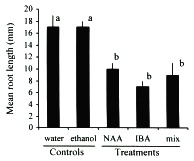
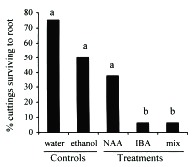
<body><![CDATA[<p><font face="Arial" size="2">I chose the auxins naphthalene acetic acid (N AA) and indole butyric acid (IBA) for application in the cuttings experiment as they have been determined to be the most effective in initiating root formation for the majority of rooting trials reviewed by <a href="#bl88">Blazich (1988)</a>. The auxins were dissolved in 50 % ethanol to formulate solutions, singly and in 50/50 combination, of 100 mg/l concentration (determined to be optimal for many plant species (Blazich 1988, <a href="#pu96">Puri and Verma 1996</a>)). A "quick dip" technique (<a href="#lo93">Longman and Wilson 1993</a>) was used to apply an equivalent amount of solution up to 2 cm above the base of each cutting. Data for the three treatrnents (NAA, IBA, and NAA+IBA) and two controls (ethanol dip and water dip) were gathered on the total number of cuttings that survived to root, on the mean number of roots produced, and the mean root length. After 14 days, the experiments were terminated and the results recorded.</font></p>     <p><font face="Arial" size="2">Although auxins have been determined to catalyze enzymatic reactions and thus increase the rate and quality of root production (<a href="#mo74">Morsink and Smith 1974</a>), in high concentrations they can have the opposite effect and retard or inhibit the formation of roots (Longman and Wilson 1993, <a href="#ar94">Arya <i>et al. </i>1994</a>, Puri and Verma 1996). The effectiveness of auxins can also vary among species of plants and thus the optimal concentration and combination of auxins may differ among species (<a  href="#ha88">Haissig 1988</a>). In general, I found the concentrations of NAA and IBA used in this experiment to result in inhibition of adventitious root production in cuttings of C. <i>obtusifolia </i>(<a  href="#f1">Figs. 1</a>, <a href="#f2">2</a>). Although the number of cuttings that survived to root after the NAA treatment was not significantly different from the controls (Fisher's exact test p &gt; 0.05; <a href="#f1">Fig. 1</a>), the rate at which these roots were produced, as measured by their lengths, was significantIy lower than the controls (unpaired t-test p &lt; 0.05; <a href="#f2">Fig.2</a>). As might be expected, the NAA+IBA mix treatment produced cuttings with intermediate values. In contrast, the cuttings exposed to the ethanol dip control experienced the same mortality and produced roots at the same rate as the water dip control, thus removing the possibility that the ethanol solution damaged the cuttings.    <br> </font></p>     <p style="text-align: center;"><font face="Arial" size="2"><a name="f1"></a><img  alt="" src="/img/fbpe/rbt/v49n3-4/2528i1.JPG" style="width: 193px; height: 167px;">    
<br> </font></p>     <div style="text-align: left; margin-left: 160px;"><font face="Arial"  size="2"><small>Fig. 1. Percent of cuttings surviving to root at the end of 14 days after the start     <br> of the experiment. Controls are water dip and auxin-free 50 % ethanol dip.     <br> Treatments are 100 mg/l “quick dips” (i.e., ethanol solutions) of the auxins naphthalene     <br> acetic acid (NAA), indole butyric acid (IBA), and a 50/50 mix of the two. Different     <br> letters identify significant differences at p &lt; 0.05 (<span  style="font-style: italic;">X</span><sup>2</sup> and Fisher’s exact test).</small></font>    ]]></body>
<body><![CDATA[<br> </div>     <p style="text-align: center;"><font face="Arial" size="2"><a name="f2"></a><img  alt="" src="/img/fbpe/rbt/v49n3-4/2528i2.JPG" style="width: 194px; height: 161px;">    
<br> </font></p>     <div style="text-align: left; margin-left: 160px;"><small><font  face="Arial" size="2"><small>Fig. 2. Mean ± s.e. root length (mm) of cuttings measured at the end of 14     <br> days after the start of the experiment. Controls are water dip and auxin-free     <br> 50 % ethanol dip. Treatments are 100 mg/l “quick dips” (i.e., ethanol solutions)     <br> of the auxins naphthalene acetic acid (NAA), indole butyric acid (IBA), and a     <br> 50/50 mix of the two. Different letters identify significant differences at p &lt; 0.05    <br> &nbsp;(unparied t-test).</small></font></small>    <br> </div>     ]]></body>
<body><![CDATA[<p style="text-align: center;"><font face="Arial" size="2">    <br> </font></p> <font face="Arial" size="2">Air layering as a technique to initiate stem production of adventitious roots resulted in a higher success of rooted sections than did cuttings. Of the 60 stem sections I prepared by air layering, a total of 44 (73.3 %) produced adventitious roots by the end of 14 days. This is significantly higher than the number of cuttings that survived to root in the control treatment (58.3 %; Fisher's exact test p &lt; 0.001).</font>     <p><font face="Arial" size="2">The remaining sections produced only callous tissue along the edges of the wounds. However, seven days after these 16 sections were placed into planter bags 12 (75 %) had produced roots, the remaining sections did not survive. Thus, the overall success rate for airlayered sections that survived to root was 93 % (56 of 60). I did not collect data on number or length of roots for these stem sections.</font></p>     <p><font face="Arial" size="2">Species of <i>Cecropia </i>have been the foci of studies on a wide range of questions dealing with aspects of physiology, developmental biology, and ecology. Future studies involving <i>Cecropia </i>where between-plant genotypic variation may be important could benefit from the use of isogenic plants propagated vegetatively. Previous studies that could have used isogenic plants include the analysis of Müllerian food body chemistry (<a href="#ri76">Rickson 1976</a>), of plant defenses against herbivores as a function of differing habitat variables (<a href="#fo94">Folgarait and Davidson 1994</a>, <a  href="#fo95">1995</a>), and of host selection among <i>Cecropia</i>-obligate ant species (<a href="#yu97">Yu and Davidson 1997</a>).</font></p> <font face="Arial" size="2"><b>     <p>Acknowledgments</p> </b></font>     <p><font face="Arial" size="2">I am grateful to Randy Plewak and Henry Vamey at the Mildred E. Mathais Botanical Garden (University of California, Los Angeles (UCLA) for tips on vegetative propagation. Pamela Wright and an anonymous reviewer provided helpful comments on the manuscript. I thank Danilo Brenes Madrigal for editing the Resumen. The study was supported by a UCLA quarter fellowship from the Department of Organisrnic Biology, Ecology, and Evolution.    <br>     <br> </font></p> <font face="Arial" size="2"><b>     <p>Resumen</p> </b></font>     <p><font face="Arial" size="2"><i>Cecropia </i>es un género bien conocido y bien estudiado en los Neotrópicos. Se discuten métodos exitosos para la propagación de C. <i>obtusifolia </i>Bertoloni, 1840 de fragmentos de troncos y acodos aéreos. A continuación se presentan los resultados de un experimento para examinar los efectos de dos tipos de hormonas (NAA e IBA) en la producción de raíces adventicias en fragmentos de troncos. En general, los fragmentos de C. <i>abtusifalia </i>responden bien en la producción de raíces adventicias (y sobreviven al azar 58.3% de los cortes), pero el método de acodos aéreos funcionó mejor (sobreviven al azar 93 %). El uso de hormonas resultó en raíces de baja calidad en comparación con cortes sin hormonas. Experimentos en el futuro que usan <i>Cecropia </i>pueden beneficiar al usar plantas isogénicas producidas por propagación vegetativa.</font></p> <font face="Arial" size="2"><b>     ]]></body>
<body><![CDATA[<p>References</p> </b></font>     <!-- ref --><p><font face="Arial" size="2"><a name="ar94"></a>Arya, S., R. Tomar &amp; O.P. Toky. 1994. Effect of plant age and auxin treatment on rooting response in stem cuttings of <i>Prasapis cineraria. </i>J. Arid Env. 27: 39-44.</font>&nbsp;&nbsp;&nbsp;&nbsp;&nbsp;&nbsp;&nbsp;&nbsp;[&#160;<a href="javascript:void(0);" onclick="javascript: window.open('/scielo.php?script=sci_nlinks&ref=1284987&pid=S0034-7744200100030001700001&lng=','','width=640,height=500,resizable=yes,scrollbars=1,menubar=yes,');">Links</a>&#160;]<!-- end-ref --><!-- ref --><p><font face="Arial" size="2"><a name="be90"></a>Berg, C.C., R.W.A.P. Akkermans &amp; E.C.H. van Heusden. 1990. Flora neotropica: Cecropiaceae: <i>Caussapaa </i>and <i>Paurauma, </i>with an introduction to the family. New York Botanical Garden, New York. 208 p.</font>&nbsp;&nbsp;&nbsp;&nbsp;&nbsp;&nbsp;&nbsp;&nbsp;[&#160;<a href="javascript:void(0);" onclick="javascript: window.open('/scielo.php?script=sci_nlinks&ref=1284988&pid=S0034-7744200100030001700002&lng=','','width=640,height=500,resizable=yes,scrollbars=1,menubar=yes,');">Links</a>&#160;]<!-- end-ref --><!-- ref --><p><font face="Arial" size="2"><a name="bl88"></a>Blazich, FA. 1988. Chemicals and formu1ations used to promote adventitious rooting, p. 132-149. <i>In </i>TD. Davis, B.E. Haissig &amp; N. Sankhla (eds.). Adventitious root formation in cuttings. Dioscorides, Portland, Oregon.</font>&nbsp;&nbsp;&nbsp;&nbsp;&nbsp;&nbsp;&nbsp;&nbsp;[&#160;<a href="javascript:void(0);" onclick="javascript: window.open('/scielo.php?script=sci_nlinks&ref=1284989&pid=S0034-7744200100030001700003&lng=','','width=640,height=500,resizable=yes,scrollbars=1,menubar=yes,');">Links</a>&#160;]<!-- end-ref --><!-- ref --><p><font face="Arial" size="2"><a name="co86"></a>Coley, P.D. 1986. Costs and benefits of defense by tannins in a neotropical tree. Oecologia 70: 238-241.</font>&nbsp;&nbsp;&nbsp;&nbsp;&nbsp;&nbsp;&nbsp;&nbsp;[&#160;<a href="javascript:void(0);" onclick="javascript: window.open('/scielo.php?script=sci_nlinks&ref=1284990&pid=S0034-7744200100030001700004&lng=','','width=640,height=500,resizable=yes,scrollbars=1,menubar=yes,');">Links</a>&#160;]<!-- end-ref --><!-- ref --><p><font face="Arial" size="2"><a name="fo94"></a>Folgarait, PJ. &amp; D.W. Davidson. 1994. Antiherbivore defenses of myrmecophytic <i>Ceerapia </i>under different light regimes. Oikos 71: 305-320.</font>&nbsp;&nbsp;&nbsp;&nbsp;&nbsp;&nbsp;&nbsp;&nbsp;[&#160;<a href="javascript:void(0);" onclick="javascript: window.open('/scielo.php?script=sci_nlinks&ref=1284991&pid=S0034-7744200100030001700005&lng=','','width=640,height=500,resizable=yes,scrollbars=1,menubar=yes,');">Links</a>&#160;]<!-- end-ref --><!-- ref --><p><font face="Arial" size="2"><a name="fo95"></a>Folgarait, PJ. &amp; DW. Davidson. 1995. Myrmecophytic <i>Ceerapia: </i>Antiherbivore defenses under different nutrient treatments. Oecologia 104: 189-206.</font>&nbsp;&nbsp;&nbsp;&nbsp;&nbsp;&nbsp;&nbsp;&nbsp;[&#160;<a href="javascript:void(0);" onclick="javascript: window.open('/scielo.php?script=sci_nlinks&ref=1284992&pid=S0034-7744200100030001700006&lng=','','width=640,height=500,resizable=yes,scrollbars=1,menubar=yes,');">Links</a>&#160;]<!-- end-ref --><!-- ref -->Haissig, B.E. 1988. Future directions in adventitious rooting research, p. 303-310. <i>In </i>TD. Davis, B.E. Haissig &amp; N. Sankhla (eds.). Adventitious root fonnationm cuttings. Dioscorides, Portland, Oregon.</font>    &nbsp;&nbsp;&nbsp;&nbsp;&nbsp;&nbsp;&nbsp;&nbsp;[&#160;<a href="javascript:void(0);" onclick="javascript: window.open('/scielo.php?script=sci_nlinks&ref=1284993&pid=S0034-7744200100030001700007&lng=','','width=640,height=500,resizable=yes,scrollbars=1,menubar=yes,');">Links</a>&#160;]<!-- end-ref --><!-- ref --><p><font face="Arial" size="2"><a name="ja69"></a>Janzen, D.H. 1969. Allelopathy by myrmecophytes:The ant <i>Azteca </i>as an allelopathic agent of <i>Cecropia. </i>Ecology 50: 147-153.</font>&nbsp;&nbsp;&nbsp;&nbsp;&nbsp;&nbsp;&nbsp;&nbsp;[&#160;<a href="javascript:void(0);" onclick="javascript: window.open('/scielo.php?script=sci_nlinks&ref=1284994&pid=S0034-7744200100030001700008&lng=','','width=640,height=500,resizable=yes,scrollbars=1,menubar=yes,');">Links</a>&#160;]<!-- end-ref --><!-- ref --><p><font face="Arial" size="2"><a name="lo91"></a>Longino, J.T 1991. <i>Azteca </i>ants in <i>Ceerapia </i>trees: Taxonomy, colony structure, and behaviour, p. 271. 288. <i>In </i>R. Cutler &amp; C. Huxley (eds.). Interactions between ants and plants. Oxford University.</font>&nbsp;&nbsp;&nbsp;&nbsp;&nbsp;&nbsp;&nbsp;&nbsp;[&#160;<a href="javascript:void(0);" onclick="javascript: window.open('/scielo.php?script=sci_nlinks&ref=1284995&pid=S0034-7744200100030001700009&lng=','','width=640,height=500,resizable=yes,scrollbars=1,menubar=yes,');">Links</a>&#160;]<!-- end-ref --><!-- ref --><p><font face="Arial" size="2"><a name="lo93"></a>Longman, K.A. &amp; R. Wilson. 1993. Rooting cuttingsof tropical trees. Cornmonwealth Science Council, London. 135 p.</font>&nbsp;&nbsp;&nbsp;&nbsp;&nbsp;&nbsp;&nbsp;&nbsp;[&#160;<a href="javascript:void(0);" onclick="javascript: window.open('/scielo.php?script=sci_nlinks&ref=1284996&pid=S0034-7744200100030001700010&lng=','','width=640,height=500,resizable=yes,scrollbars=1,menubar=yes,');">Links</a>&#160;]<!-- end-ref --><!-- ref --><p><font face="Arial" size="2"><a name="mo74"></a>Morsink, W. &amp; V. Smith. 1974. Root and shoot develop. ment of cuttings of basswood <i>(Tilia americana </i>L.) as affected by auxin treatments and size of cuttings. Can. J. For. Res. 4: 246-249.</font>&nbsp;&nbsp;&nbsp;&nbsp;&nbsp;&nbsp;&nbsp;&nbsp;[&#160;<a href="javascript:void(0);" onclick="javascript: window.open('/scielo.php?script=sci_nlinks&ref=1284997&pid=S0034-7744200100030001700011&lng=','','width=640,height=500,resizable=yes,scrollbars=1,menubar=yes,');">Links</a>&#160;]<!-- end-ref --><!-- ref --><p><font face="Arial" size="2"><a name="pu96"></a>Puri, S. &amp; R.C. Verma. 1996. Vegetative propagation of <i>Dalbergia sissaa </i>Roxb. using softwood and hard. wood stem cuttings. J. Arid Env. 34: 235-245.</font>&nbsp;&nbsp;&nbsp;&nbsp;&nbsp;&nbsp;&nbsp;&nbsp;[&#160;<a href="javascript:void(0);" onclick="javascript: window.open('/scielo.php?script=sci_nlinks&ref=1284998&pid=S0034-7744200100030001700012&lng=','','width=640,height=500,resizable=yes,scrollbars=1,menubar=yes,');">Links</a>&#160;]<!-- end-ref --><!-- ref --><p><font face="Arial" size="2"><a name="ri76"></a>Rickson, FR. 1976. Anatomical development of the leaf trichilium and Müllerian bodies of <i>Ceerapia peltata </i>L. Amer. J. Bol. 63: 1266-1271.</font>&nbsp;&nbsp;&nbsp;&nbsp;&nbsp;&nbsp;&nbsp;&nbsp;[&#160;<a href="javascript:void(0);" onclick="javascript: window.open('/scielo.php?script=sci_nlinks&ref=1284999&pid=S0034-7744200100030001700013&lng=','','width=640,height=500,resizable=yes,scrollbars=1,menubar=yes,');">Links</a>&#160;]<!-- end-ref --><!-- ref --><p><font face="Arial" size="2"><a name="sc86"></a>Schupp, E.W. 1986. <i>Azteca </i>protection of <i>Ceerapia: </i>Ant occupation benefits juvenile trees. Oecologia 70: 379-385.</font>&nbsp;&nbsp;&nbsp;&nbsp;&nbsp;&nbsp;&nbsp;&nbsp;[&#160;<a href="javascript:void(0);" onclick="javascript: window.open('/scielo.php?script=sci_nlinks&ref=1285000&pid=S0034-7744200100030001700014&lng=','','width=640,height=500,resizable=yes,scrollbars=1,menubar=yes,');">Links</a>&#160;]<!-- end-ref --><!-- ref --><p><font face="Arial" size="2"><a name="yo87"></a>Young, K.R., U. Ewel &amp; BJ. Brown. 1987. Seed dynarn. ics during forest succession in Costa Rica. Vegetatio 71: 157-173.</font>&nbsp;&nbsp;&nbsp;&nbsp;&nbsp;&nbsp;&nbsp;&nbsp;[&#160;<a href="javascript:void(0);" onclick="javascript: window.open('/scielo.php?script=sci_nlinks&ref=1285001&pid=S0034-7744200100030001700015&lng=','','width=640,height=500,resizable=yes,scrollbars=1,menubar=yes,');">Links</a>&#160;]<!-- end-ref --><!-- ref --><p><font face="Arial" size="2"><a name="yu97"></a>Yu, D.W. &amp; D.W. Davidson. 1997. Experimental studies of species-specificity in <i>Ceerapia-ant </i>relationships. Ecol. Monogr. 67: 273-294.</font>&nbsp;&nbsp;&nbsp;&nbsp;&nbsp;&nbsp;&nbsp;&nbsp;[&#160;<a href="javascript:void(0);" onclick="javascript: window.open('/scielo.php?script=sci_nlinks&ref=1285002&pid=S0034-7744200100030001700016&lng=','','width=640,height=500,resizable=yes,scrollbars=1,menubar=yes,');">Links</a>&#160;]<!-- end-ref --> ]]></body><back>
<ref-list>
<ref id="B1">
<nlm-citation citation-type="journal">
<person-group person-group-type="author">
<name>
<surname><![CDATA[Arya]]></surname>
<given-names><![CDATA[S.]]></given-names>
</name>
<name>
<surname><![CDATA[Tomar]]></surname>
<given-names><![CDATA[R.]]></given-names>
</name>
<name>
<surname><![CDATA[Toky]]></surname>
<given-names><![CDATA[O.P.]]></given-names>
</name>
</person-group>
<article-title xml:lang="en"><![CDATA[Effect of plant age and auxin treatment on rooting response in stem cuttings of Prasapis cineraria]]></article-title>
<source><![CDATA[J. Arid Env.]]></source>
<year>1994</year>
<volume>27</volume>
<page-range>39-44</page-range></nlm-citation>
</ref>
<ref id="B2">
<nlm-citation citation-type="book">
<person-group person-group-type="author">
<name>
<surname><![CDATA[Berg]]></surname>
<given-names><![CDATA[C.C.]]></given-names>
</name>
<name>
<surname><![CDATA[Akkermans]]></surname>
<given-names><![CDATA[R.W.A.P.]]></given-names>
</name>
<name>
<surname><![CDATA[van Heusden]]></surname>
<given-names><![CDATA[E.C.H.]]></given-names>
</name>
</person-group>
<source><![CDATA[Flora neotropica: Cecropiaceae: Caussapaa and Paurauma, with an introduction to the family]]></source>
<year>1990</year>
<page-range>208</page-range><publisher-loc><![CDATA[New York ]]></publisher-loc>
<publisher-name><![CDATA[New York Botanical Garden]]></publisher-name>
</nlm-citation>
</ref>
<ref id="B3">
<nlm-citation citation-type="book">
<person-group person-group-type="author">
<name>
<surname><![CDATA[Blazich]]></surname>
<given-names><![CDATA[FA.]]></given-names>
</name>
<name>
<surname><![CDATA[Davis]]></surname>
<given-names><![CDATA[TD.]]></given-names>
</name>
<name>
<surname><![CDATA[Haissig]]></surname>
<given-names><![CDATA[B.E.]]></given-names>
</name>
<name>
<surname><![CDATA[Sankhla]]></surname>
<given-names><![CDATA[N.]]></given-names>
</name>
</person-group>
<source><![CDATA[Adventitious root formation in cuttings]]></source>
<year>1988</year>
<page-range>132-149</page-range><publisher-loc><![CDATA[Oregon^ePortland Portland]]></publisher-loc>
<publisher-name><![CDATA[Dioscorides]]></publisher-name>
</nlm-citation>
</ref>
<ref id="B4">
<nlm-citation citation-type="journal">
<person-group person-group-type="author">
<name>
<surname><![CDATA[Coley]]></surname>
<given-names><![CDATA[P.D.]]></given-names>
</name>
</person-group>
<article-title xml:lang="en"><![CDATA[Costs and benefits of defense by tannins in a neotropical tree]]></article-title>
<source><![CDATA[Oecologia]]></source>
<year>1986</year>
<volume>70</volume>
<page-range>238-241</page-range></nlm-citation>
</ref>
<ref id="B5">
<nlm-citation citation-type="journal">
<person-group person-group-type="author">
<name>
<surname><![CDATA[Folgarait]]></surname>
<given-names><![CDATA[PJ.]]></given-names>
</name>
<name>
<surname><![CDATA[Davidson]]></surname>
<given-names><![CDATA[D.W.]]></given-names>
</name>
</person-group>
<article-title xml:lang="en"><![CDATA[Antiherbivore defenses of myrmecophytic Ceerapia under different light regimes]]></article-title>
<source><![CDATA[Oikos]]></source>
<year>1994</year>
<volume>71</volume>
<page-range>305-320</page-range></nlm-citation>
</ref>
<ref id="B6">
<nlm-citation citation-type="journal">
<person-group person-group-type="author">
<name>
<surname><![CDATA[Folgarait]]></surname>
<given-names><![CDATA[PJ.]]></given-names>
</name>
<name>
<surname><![CDATA[Davidson]]></surname>
<given-names><![CDATA[DW.]]></given-names>
</name>
</person-group>
<article-title xml:lang="en"><![CDATA[Myrmecophytic Ceerapia: Antiherbivore defenses under different nutrient treatments]]></article-title>
<source><![CDATA[Oecologia]]></source>
<year>1995</year>
<volume>104</volume>
<page-range>189-206</page-range></nlm-citation>
</ref>
<ref id="B7">
<nlm-citation citation-type="book">
<person-group person-group-type="author">
<name>
<surname><![CDATA[Haissig]]></surname>
<given-names><![CDATA[B.E.]]></given-names>
</name>
<name>
<surname><![CDATA[Davis]]></surname>
<given-names><![CDATA[TD.]]></given-names>
</name>
<name>
<surname><![CDATA[Haissig]]></surname>
<given-names><![CDATA[B.E.]]></given-names>
</name>
<name>
<surname><![CDATA[Sankhla]]></surname>
<given-names><![CDATA[N.]]></given-names>
</name>
</person-group>
<source><![CDATA[Adventitious root fonnationm cuttings]]></source>
<year>1988</year>
<page-range>303-310</page-range><publisher-loc><![CDATA[Oregon^ePortland Portland]]></publisher-loc>
<publisher-name><![CDATA[Dioscorides]]></publisher-name>
</nlm-citation>
</ref>
<ref id="B8">
<nlm-citation citation-type="journal">
<person-group person-group-type="author">
<name>
<surname><![CDATA[Janzen]]></surname>
<given-names><![CDATA[D.H.]]></given-names>
</name>
</person-group>
<article-title xml:lang="en"><![CDATA[Allelopathy by myrmecophytes: The ant Azteca as an allelopathic agent of Cecropia]]></article-title>
<source><![CDATA[Ecology]]></source>
<year>1969</year>
<volume>50</volume>
<page-range>147-153</page-range></nlm-citation>
</ref>
<ref id="B9">
<nlm-citation citation-type="book">
<person-group person-group-type="author">
<name>
<surname><![CDATA[Longino]]></surname>
<given-names><![CDATA[J.T]]></given-names>
</name>
<name>
<surname><![CDATA[Cutler]]></surname>
<given-names><![CDATA[R.]]></given-names>
</name>
<name>
<surname><![CDATA[Huxley]]></surname>
<given-names><![CDATA[C.]]></given-names>
</name>
</person-group>
<source><![CDATA[Interactions between ants and plants]]></source>
<year>1991</year>
<page-range>271-288</page-range><publisher-name><![CDATA[Oxford University]]></publisher-name>
</nlm-citation>
</ref>
<ref id="B10">
<nlm-citation citation-type="book">
<person-group person-group-type="author">
<name>
<surname><![CDATA[Longman]]></surname>
<given-names><![CDATA[K.A.]]></given-names>
</name>
<name>
<surname><![CDATA[Wilson]]></surname>
<given-names><![CDATA[R.]]></given-names>
</name>
</person-group>
<source><![CDATA[Rooting cuttingsof tropical trees]]></source>
<year>1993</year>
<page-range>135</page-range><publisher-loc><![CDATA[London ]]></publisher-loc>
<publisher-name><![CDATA[Cornmonwealth Science Council]]></publisher-name>
</nlm-citation>
</ref>
<ref id="B11">
<nlm-citation citation-type="journal">
<person-group person-group-type="author">
<name>
<surname><![CDATA[Morsink]]></surname>
<given-names><![CDATA[W.]]></given-names>
</name>
<name>
<surname><![CDATA[Smith]]></surname>
<given-names><![CDATA[V.]]></given-names>
</name>
</person-group>
<article-title xml:lang="en"><![CDATA[Root and shoot develop. ment of cuttings of basswood (Tilia americana L.) as affected by auxin treatments and size of cuttings]]></article-title>
<source><![CDATA[Can. J. For. Res.]]></source>
<year>1974</year>
<volume>4</volume>
<page-range>246-249</page-range></nlm-citation>
</ref>
<ref id="B12">
<nlm-citation citation-type="journal">
<person-group person-group-type="author">
<name>
<surname><![CDATA[Puri]]></surname>
<given-names><![CDATA[S.]]></given-names>
</name>
<name>
<surname><![CDATA[Verma]]></surname>
<given-names><![CDATA[R.C.]]></given-names>
</name>
</person-group>
<article-title xml:lang="en"><![CDATA[Vegetative propagation of Dalbergia sissaa Roxb. using softwood and hard. wood stem cuttings]]></article-title>
<source><![CDATA[J. Arid Env.]]></source>
<year>1996</year>
<volume>34</volume>
<page-range>235-245</page-range></nlm-citation>
</ref>
<ref id="B13">
<nlm-citation citation-type="journal">
<person-group person-group-type="author">
<name>
<surname><![CDATA[Rickson]]></surname>
<given-names><![CDATA[FR.]]></given-names>
</name>
</person-group>
<article-title xml:lang="en"><![CDATA[Anatomical development of the leaf trichilium and Müllerian bodies of Ceerapia peltata L]]></article-title>
<source><![CDATA[Amer. J. Bol.]]></source>
<year>1976</year>
<volume>63</volume>
<page-range>1266-1271</page-range></nlm-citation>
</ref>
<ref id="B14">
<nlm-citation citation-type="journal">
<person-group person-group-type="author">
<name>
<surname><![CDATA[Schupp]]></surname>
<given-names><![CDATA[E.W.]]></given-names>
</name>
</person-group>
<article-title xml:lang="en"><![CDATA[Azteca protection of Ceerapia: Ant occupation benefits juvenile trees]]></article-title>
<source><![CDATA[Oecologia]]></source>
<year>1986</year>
<volume>70</volume>
<page-range>379-385</page-range></nlm-citation>
</ref>
<ref id="B15">
<nlm-citation citation-type="journal">
<person-group person-group-type="author">
<name>
<surname><![CDATA[Young]]></surname>
<given-names><![CDATA[K.R.]]></given-names>
</name>
<name>
<surname><![CDATA[Ewel]]></surname>
<given-names><![CDATA[U.]]></given-names>
</name>
<name>
<surname><![CDATA[Brown]]></surname>
<given-names><![CDATA[BJ.]]></given-names>
</name>
</person-group>
<article-title xml:lang="en"><![CDATA[Seed dynarn. ics during forest succession in Costa Rica]]></article-title>
<source><![CDATA[Vegetatio]]></source>
<year>1987</year>
<volume>71</volume>
<page-range>157-173</page-range></nlm-citation>
</ref>
<ref id="B16">
<nlm-citation citation-type="journal">
<person-group person-group-type="author">
<name>
<surname><![CDATA[Yu]]></surname>
<given-names><![CDATA[D.W.]]></given-names>
</name>
<name>
<surname><![CDATA[Davidson]]></surname>
<given-names><![CDATA[D.W.]]></given-names>
</name>
</person-group>
<article-title xml:lang="en"><![CDATA[Experimental studies of species-specificity in Ceerapia-ant relationships]]></article-title>
<source><![CDATA[Ecol. Monogr.]]></source>
<year>1997</year>
<volume>67</volume>
<page-range>273-294</page-range></nlm-citation>
</ref>
</ref-list>
</back>
</article>