<?xml version="1.0" encoding="ISO-8859-1"?><article xmlns:mml="http://www.w3.org/1998/Math/MathML" xmlns:xlink="http://www.w3.org/1999/xlink" xmlns:xsi="http://www.w3.org/2001/XMLSchema-instance">
<front>
<journal-meta>
<journal-id>0034-7744</journal-id>
<journal-title><![CDATA[Revista de Biología Tropical]]></journal-title>
<abbrev-journal-title><![CDATA[Rev. biol. trop]]></abbrev-journal-title>
<issn>0034-7744</issn>
<publisher>
<publisher-name><![CDATA[Universidad de Costa Rica]]></publisher-name>
</publisher>
</journal-meta>
<article-meta>
<article-id>S0034-77442001000300009</article-id>
<title-group>
<article-title xml:lang="en"><![CDATA[Effect of different densities of live and dead Chlorella vulgaris on the population growth of rotifers Brachionus calyciflorus and Brachionus patulus (Rotifera)]]></article-title>
</title-group>
<contrib-group>
<contrib contrib-type="author">
<name>
<surname><![CDATA[Lucía-Pavón]]></surname>
<given-names><![CDATA[E.]]></given-names>
</name>
<xref ref-type="aff" rid="A01"/>
</contrib>
<contrib contrib-type="author">
<name>
<surname><![CDATA[Sarma]]></surname>
<given-names><![CDATA[S.S.S.]]></given-names>
</name>
<xref ref-type="aff" rid="A01"/>
</contrib>
<contrib contrib-type="author">
<name>
<surname><![CDATA[Nandini]]></surname>
<given-names><![CDATA[S.]]></given-names>
</name>
<xref ref-type="aff" rid="A02"/>
</contrib>
</contrib-group>
<aff id="A01">
<institution><![CDATA[,Universidad Nacional Autónoma de México División de Investigación y Posgrado Laboratorio de Zoología Acuática]]></institution>
<addr-line><![CDATA[ ]]></addr-line>
<country>México</country>
</aff>
<aff id="A02">
<institution><![CDATA[,Universidad Nacional Autónoma de México División de Investigación y Posgrado Proyecto CyMA]]></institution>
<addr-line><![CDATA[ ]]></addr-line>
<country>México</country>
</aff>
<pub-date pub-type="pub">
<day>00</day>
<month>12</month>
<year>2001</year>
</pub-date>
<pub-date pub-type="epub">
<day>00</day>
<month>12</month>
<year>2001</year>
</pub-date>
<volume>49</volume>
<numero>3-4</numero>
<fpage>895</fpage>
<lpage>902</lpage>
<copyright-statement/>
<copyright-year/>
<self-uri xlink:href="http://www.scielo.sa.cr/scielo.php?script=sci_arttext&amp;pid=S0034-77442001000300009&amp;lng=en&amp;nrm=iso"></self-uri><self-uri xlink:href="http://www.scielo.sa.cr/scielo.php?script=sci_abstract&amp;pid=S0034-77442001000300009&amp;lng=en&amp;nrm=iso"></self-uri><self-uri xlink:href="http://www.scielo.sa.cr/scielo.php?script=sci_pdf&amp;pid=S0034-77442001000300009&amp;lng=en&amp;nrm=iso"></self-uri><abstract abstract-type="short" xml:lang="en"><p><![CDATA[In order to maintain rotifer populations during periods of low algal production, it is necessary to offer alternate diets, some of which include forms of preserved algae. The present work is based on the effect of live and dead Chlorella vulgaris on the population growth of Brachionus calyciflorus and Brachionus patulus. The experimental design consisted of 3 algal levels (0.5x10(6), 1.5x10(6) and 4.5x10(6) cells ml-1) offered in 3 forms (living, frozen and heat-killed). The maximal population density values for B. calyciflorus ranged from 55±1 ind. ml-1 (at 0.5x10(6) cells ml-1) to 471±72 ind. ml-1 (at 4.5x10(6) cells ml-1) with live Chlorella, but was much lower (6±1 to 26±6 ind. ml-1) with frozen or heat-killed alga under comparable food levels. However, the maximum population density of B. patulus under live or or heat-killed Chlorella was similar at comparable algal levels but when offered frozen algae it was four times less. The highest mean peak population density was 1227±83 ind. ml-1 under 4.5x10(6) cells ml-1. The rate of population increase for B. calyciflorus varied from 0.50 to 0.79 using live Chlorella, but under comparable conditions, this range was lower (0.21 to 0.31) for B. patulus. Results have been discussed in light of possible application for aquaculture]]></p></abstract>
<abstract abstract-type="short" xml:lang="es"><p><![CDATA[Para mantener poblaciones de rotíferos durante periodos con escasez de microalgas, es necesario ofrecer dietas alternativas, incluyendo algunas formas de microalgas preservadas. El presente trabajo analiza el efecto de Chlorella vulgaris viva y muerta sobre el crecimiento poblacional de Brachionus calyciflorus y Brachonus patulus. El diseño experimental consistió en tres niveles de algas (0.5x10(6), 1.5x10(6) y 4.5x10(6) células ml-1) ofrecidas en tres formas (viva, congelada y muerta con agua caliente). Las abundancias máximas de población de B. calyciflorus variaron desde 55±1 ind. ml-1 (en 0.5x10(6) células ml-1) a 471±72 ind. ml-1 (en 4.5x10(6) células ml-1) con Chlorella viva, mientras que, cuando se utilizó alga congelada o muerta con agua caliente, la abundancia fue mucho menor (6±1 a 26±6 ind. ml-1). Sin embargo, la máxima densidad de población de B. patulus con Chlorella viva o muerta con calor fue similar bajo niveles de algas comparables, mientras que cuando se ofreció alga congelada, la abundancia fue cuatro veces menor. La abundancia máxima de B. patulus fue 1 227±83 ind. ml-1 bajo 4.5x10(6) células ml-1. La tasa de crecimiento poblacional de B. calyciflorus varió desde 0.50 hasta 0.79 usando Chlorella viva, pero bajo las mismas condiciones, el rango es menor (0.21 a 0.31) para B. patulus. Los resultados se discuten para su posible aplicación en la acuacultura]]></p></abstract>
<kwd-group>
<kwd lng="en"><![CDATA[Rotifera]]></kwd>
<kwd lng="en"><![CDATA[Chlorella]]></kwd>
<kwd lng="en"><![CDATA[Population growth]]></kwd>
<kwd lng="en"><![CDATA[Live-alga]]></kwd>
<kwd lng="en"><![CDATA[Dead-alga]]></kwd>
</kwd-group>
</article-meta>
</front><body><![CDATA[ <div style="text-align: center;"><b><font face="Arial">Effect of different densities of live and dead <i>Chlorella</i> <i>vulgaris </i></font></b>    <br> <b><font face="Arial">on the population growth of rotifers <i>Brachionus calyciflorus </i></font></b>    <br> <span style="font-weight: bold; font-family: arial;">and </span><i  style="font-weight: bold; font-family: arial;">Brachionus patulus </i><span  style="font-weight: bold; font-family: arial;">(Rotifera)    <br> </span>&nbsp;    <br> </div> <b><font face="Arial"> </font></b><font face="Arial" size="2">E. Lucía-Pavón<a name="1"></a><a  href="#2"><sup>1</sup></a>, S.S.S. Sarma<a href="#2"><sup>1</sup></a>,* &amp; S. Nandini<a href="#2"><sup>2</sup></a>    <br>     <br> <a name="2"></a><a href="#1">1</a> Laboratorio de Zoología Acuática, División de Investigación y Posgrado, Edificio UMF, Universidad Nacional Autónoma de México, Campus Iztacala, AP 314, CP 54090, Tlalnepantla, Edo. de México. México. FAX: +52 5 623 1256. corel: <a  href="mailto:sarma@servidor.unam.mx">sarma@servidor.unam.mx</a>    <br> </font><font face="Arial" size="2"><a href="#2">2</a> División de Investigación y Posgrado, Proyecto CyMA, Universidad Nacional Autónoma de México, Campus Iztacala, AP 314, CP 54090, Tlalnepantla, Edo. de México.    <br> </font><font face="Arial" size="2"><sup>*</sup>Corresponding author</font>     <p align="center"><font face="Arial" size="2">Recibido: 12-VI-2000 Corregido: 31-I-2001 Aceptado: 25-II-2001</font></p>     ]]></body>
<body><![CDATA[<p><font face="Arial" size="2">&nbsp;</font></p> <font face="Arial" size="2"><b>     <p>Abstract</p> </b> </font>     <p><font face="Arial" size="2">In order to maintain rotifer populations during periods of low algal production, it is necessary to offer alternate diets, some of which include forms of preserved algae. The present work is based on the effect of live and dead <i>Chlorella vulgaris</i> on the population growth of <i>Brachionus calyciflorus</i> and <i>Brachionus patulus</i>. The experimental design consisted of 3 algal levels (0.5x10<sup>6</sup>, 1.5x10<sup>6</sup> and 4.5x10<sup>6</sup> cells ml<sup>-1</sup>) offered in 3 forms (living, frozen and heat-killed). The maximal population density values for <i>B. calyciflorus</i> ranged from 55±1 ind. ml<sup>-1</sup> (at 0.5x10<sup>6</sup> cells ml<sup>-1</sup>) to 471±72 ind. ml<sup>-1</sup> (at 4.5x10<sup>6</sup> cells ml<sup>-1</sup>) with live <i>Chlorella</i>, but was much lower (6±1 to 26±6 ind. ml<sup>-1</sup>) with frozen or heat-killed alga under comparable food levels. However, the maximum population density of <i>B. patulus</i> under live or or heat-killed <i>Chlorella</i> was similar at comparable algal levels but when offered frozen algae it was four times less. The highest mean peak population density was 1227±83 ind. ml<sup>-1</sup> under 4.5x10<sup>6</sup> cells ml<sup>-1</sup>. The rate of population increase for <i>B. calyciflorus</i> varied from 0.50 to 0.79 using live <i>Chlorella</i>, but under comparable conditions, this range was lower (0.21 to 0.31) for <i>B. patulus</i>. Results have been discussed in light of possible application for aquaculture.</font></p>     <p><font face="Arial" size="2"><b>Key words</b>: Rotifera, <i>Chlorella</i>, Population growth, Live-alga, Dead-alga.</font></p>     <p><font face="Arial" size="2">&nbsp;</font></p> <font face="Arial" size="2"><b> </b></font>     <p><font face="Arial" size="2">Rotiers of the genus <i>Bracchionus</i> are widely used as live food in rearing larval fish, crabs, prawns, shrimps and molluscs under both marine and freshwater culture conditions (<a href="#sa91">Sarma 1991</a>). For mass production of <i>B. plicatilis </i>various types of food, both natural (<i>e.g.</i>, algae) and artificial diets (microencaspulated pallets) have been used. Hirata and Mori (1967) replaced green algae with baker's yeast for mass production of <i>B. plicatilis. </i>However, due to low nutritional value of normal yeast-fed rotifers, a number of enrichment procedures have to be followed (<a href="#hi83">Hirayama and Funamoto 1983</a>). Althuogh some of these enrichment procedures are easily done, the use of microalgae in rotifer cultures has been largely practiced (<a  href="#po91">Pourriot 1991</a>).</font></p>     <p><font face="Arial" size="2">Since large- scale algal production is relatively cheap, both under field and laboratory conditions, various types of algae are routinely being produced for feeding planktonic rotifers (<a href="#gr81">Groeneweg and Schuter 1981</a>). However, some times algal cultures crash (<a href="#su97">Suminto and Hirayama 1997</a>) which may, in turn, lead to problems of finding adequate food for rotifers. Therefore, stored algae could be used as substitute. On the other hand, at times there may be excessive production of microalgal which could be stored for future use (<a href="#mi90">Millamena <i>et al.</i> 1990</a>, <a href="#ma94">Martínez-Jeronimo ansd Espinosa-Chavez 1994</a>). The nutrional quality as well as the digestibility of the stored-microbal may vary considerably and consequently the growth responses of zooplankton feeding on them (<a  href="#ga81">Gastesoupe and Robin 1981</a>, <a href="#do99">Dobberfuhl and Elser 1999</a>). In this context, population level responses of rotifers to stored microalgae has t been well document (<a href="#st80">Starkweather and Bogdan 1980</a>, <a href="#lu95">Lubzens <i>et al.</i> 1995</a>).</font></p>     <p><font face="Arial" size="2">The main of this study was not compare the population growth of tow freshwater rotifers, <i>B. calciflorus</i> and <i>B. patulus</i> using <i>Chorella vulgaris</i> in live, frozen and heat-killed forms under three food levels. </font></p> <font face="Arial" size="2"><b>     <p> </p>     <p>Materials and methods</p> </b> </font>     ]]></body>
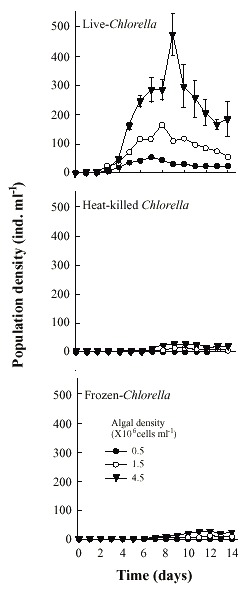
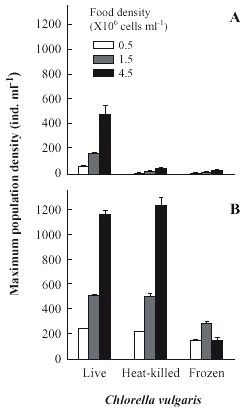
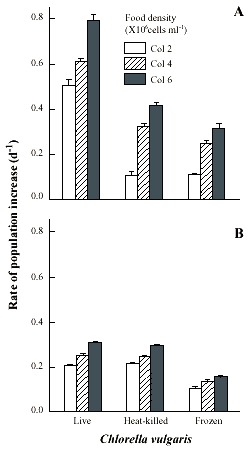
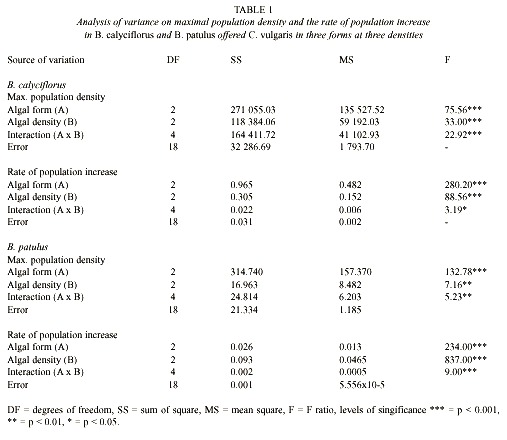
<body><![CDATA[<p><font face="Arial" size="2">The test rotifer species <i>Brachionus calyciflorus</i> and <i>Brachionus patulus</i> were isolated from lake Chapultepec (Mexico City) and the waterbody Presa Santa Elena (State of Mexico), respectively. Clonal populations of both these species were established using the single celled green algae <i>Chlorella vulgaris</i>. For mass cultures as well as for experiments, we used <i>C. vulgaris</i>, raised on Bold's basal medium (Borowitzka and Borowitzka 1988). Algae in log phase of growth were harvested, centrifuged at 3000 rpm for 5 minutes, rinsed with distilled water and resuspended in reconstituted moderately hardwater, (the EPA medium), which was prepared by dissolving 96 mg NaHCO<sub>3</sub>, 60 mg CaSO<sub>4</sub>, 60 mg MgSO<sub>4</sub> and 4 mg KCl in one litre of distilled water (<a href="#an85">Anonymous 1985</a>). The stock algal density was estimated using a haemocytometer. Test rotifers were offered <i>C. vulgaris</i> in three forms: live, cold-killed (freshly frozen) and heat-killed (with boiling water). For experiments, we used algae of no more than two days old, following harvest.</font></p>     <p><font face="Arial" size="2">The experimental design for <i>B. calyciflorus</i> consisted a total of 27 transparent test jars (50 ml capacity) containing 50 ml EPA medium. We used three food levels namely, 0.5x10<sup>6</sup>, 1.5x10<sup>6</sup> and 4.5x10<sup>6</sup> cells ml<sup>-1</sup> in EPA medium. For each food density and form, we used 3 jars per treatment. Into each of the test jars we inoculated individuals of <i>B. calyciflorus</i> at an initial density of 5 ind. ml<sup>-1</sup> using finely drawn Pasteur pipette. The test jars were maintained at 22±2 ºC, pH 7.2-7.5 and continous but diffused flourescent illumination (1000 lux). Following inoculation the density of <i>B. calyciflorus</i> was estimated daily using total counts or 2-3 aliquots of 1 ml each. We counted the number live rotifers (females). Due to uncertainity of the time of death, dead individuals were not estimated. After estimating the density, rotifers were transferred using 50mm mesh to new jars containing appropriate algal food density and form (<i>i.e.</i> live, frozen or heat-killed state). The experiment was discontinued after two weeks by which time <i>B. calyciflorus</i> in most replicates began to decline. Concurrently but separately, experiments were also conducted using the other brachionid rotifer <i>B. patulus</i>. For this species also, the experimental design and the test conditions were similar to those <i>B. calyciflorus</i>, except for the duration, which was 40 days.</font></p>     <p><font face="Arial" size="2">Based on the data collected, we calculated the rate of population increase (r) using the exponential growth equation: r = (ln N<sub>t-</sub> ln N<sub>o</sub>)/t, where, N<sub>o</sub> = initial population density, N<sub>t</sub> = density of population after time t (days) (<a href="#kr85">Krebs, 1985</a>). The r was obtained from a mean of 4-5 values during the exponential phase of the population growth for each species.</font></p>     <p><font face="Arial" size="2">&nbsp;</font></p> <font face="Arial" size="2"><b>     <p>Results</p> </b> </font>     <p><font face="Arial" size="2">Population growth curves of <i>B. calyciflorus</i> in relation to different <i>Chlorella</i> levels and forms are presented in the <a href="#f1">Fig. 1</a>. Regardless of form in which <i>Chlorella</i> was offered, <i>B. calyciflorus</i> showed increased population abundance with increasing food level. Within the three forms of <i>Chlorella</i>, live algae supported the best growth of <i>B. calyciflorus</i>. The maximal population density values for <i>B. calyciflorus</i> ranged from 55±1 ind. ml<sup>-1</sup> (under 0.5x10<sup>6</sup> cells ml<sup>-1</sup>) to 471±72 ind. ml<sup>-1</sup> (under 4.5x10<sup>6</sup> cells ml<sup>-1</sup>) with live <i>Chlorella</i>, but was much lower (6±1 to 26±6 ind. ml<sup>-1</sup>) with frozen alga under comparable food levels (<a href="#f2">Fig. 2A</a>). The maximum population density of rotifers was significantly affected by both the algal level and the form (<a href="#t1">Table 1</a>, p&lt;0.001, ANOVA, Sokal and Rohlf 1985). The rate of population increase for <i>B. calyciflorus</i> varied from 0.50 to 0.79 on live algae, depending on the food level. However, the values were much lower (0.10 to 0.41) when heat-killed or frozen <i>Chlorella</i> was used as food (<a href="#f3">Fig. 3A</a>). Thus, both food level and form as well as their interaction had a significant effect on the rate of population increase of <i>B. calyciflorus</i> (<a href="#t1">Table 1</a>).</font></p>     <p align="center"><font face="Arial" size="2"><a name="t1"></a><img  alt="" src="/img/fbpe/rbt/v49n3-4/2520i5.JPG" style="width: 507px; height: 440px;"></font></p>     
<p style="text-align: center;"><font face="Arial" size="2"><i><a  name="f1"></a><img alt="" src="/img/fbpe/rbt/v49n3-4/2520i1.JPG"  style="width: 284px; height: 691px;">    
<br> </i></font></p>     <p style="text-align: left; margin-left: 120px;"><font face="Arial"  size="2"><small>Fig. 1. Population growth curves of B. calyciflorus in relation to Chlorella density offered as live, heat-killed and    ]]></body>
<body><![CDATA[<br> frozen forms. Shown are the mean±SE values based on three replicate recordings.</small><i>    <br> </i></font></p>     <p style="text-align: center;"><font face="Arial" size="2"><i><a  name="f2"></a><img alt="" src="/img/fbpe/rbt/v49n3-4/2520i2.JPG"  style="width: 283px; height: 466px;">    
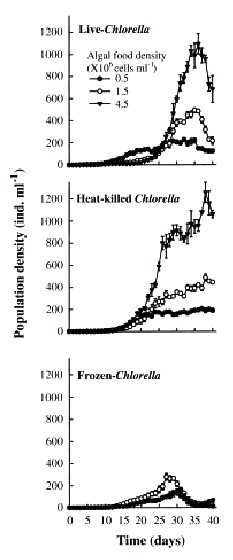
<br> </i></font></p>     <p style="margin-left: 200px; text-align: left;"><font face="Arial"  size="2"><small>Fig. 2. Maximum population density (ind. ml -1 ) of B. calyciflorus (A) and B. patulus (B) in relation     <br> to Chlorella density offered as live, heat-killed and frozen forms. Shown are the mean±SE     <br> values based on three replicate recordings. </small><i>    <br> </i></font></p>     <p><font face="Arial" size="2"><i>    <br> Brachionus patulus</i> needed from 27 to 40 days to show a declining trend in the population densities (<a href="#f4">Fig. 4</a>). The maximum population density of <i>B. patulus</i> under live or or heat-killed <i>Chlorella</i> was similar at comparable algal levels (<a  href="#f2">Fig. 2B</a>), with the trend of increasing population abundance with increasing availability of food. Thus the highest mean peak population density was 1 227±83 ind. ml<sup>-1</sup> under 4.5x10<sup>6</sup> cells ml<sup>-1</sup>. <i>B. patulus</i> offered frozen algae increased only one-fourth of this. The rate of population increase varied from 0.21±0.003 to 0.31±0.002 under 0.5x10<sup>6</sup> cells ml<sup>-1</sup> and 4.5x10<sup>6</sup> cells ml<sup>-1</sup> of live <i>Chlorella</i>, respectively (<a href="#f3">Fig. 3B</a>). Both form and level of <i>Chlorella</i>, as well as their interactions signficantly (p&lt;0.05, ANOVA, Table 1) influenced the mean maximal population density and rate of increase.    ]]></body>
<body><![CDATA[<br> </font></p>     <p style="text-align: center;"><font face="Arial" size="2"><a name="f3"></a><img  alt="" src="/img/fbpe/rbt/v49n3-4/2520i3.JPG" style="width: 266px; height: 474px;">    
<br> </font></p>     <p style="text-align: center;"><font face="Arial" size="2"><small>    <br> </small></font></p>     <div style="text-align: left; margin-left: 160px;"><font face="Arial"  size="2"><small>&nbsp;Fig. 3. Rate of population growth (r) per day for B. calyciflorus (A) and B. patulus (B) in relation to Chlorella     <br> density offered as live, heat-killed and frozen forms. Shown are the mean±SE values based on three replicate     <br> recordings.</small></font>    <br> </div>     <p style="text-align: center;"><font face="Arial" size="2">&nbsp;<a  name="f4"></a><img alt="" src="/img/fbpe/rbt/v49n3-4/2520i4.JPG"  style="width: 223px; height: 525px;">    
]]></body>
<body><![CDATA[<br> </font></p>     <p style="text-align: left; margin-left: 240px;"><font face="Arial"  size="2"><small>Fig. 4. Population growth curves of B. patulus in relation to Chlorella density offered as live,     <br> heat-killed and frozen forms. Shown are the mean±SE values based on three replicate recordings.    <br> </small></font></p> <font face="Arial" size="2"><b>     <p>Discussion</p> </b> </font>     <p><font face="Arial" size="2">Various studies have shown the importance of food density on the population growth of zooplankton, both from field collections and laboratory studies (<a href="#ed60">Edmondson 1960</a>, <a href="#ha74">Halbach and Halbach-Keup 1974</a>). Rotifers being opportunistic species, respond more rapidly to changes in food levels (Nogrady <i>et al.</i> 1993). It is known that rotifers show an almost linear numerical increase with increasing food levels (<a  href="#du95">Dumont <i>et al.</i> 1995</a>). <i>Chlorella</i> is one the most widely used food for culturing planktonic rotifers (<a  href="#po97">Pourriot and Rougier 1997</a>). Studies on the use of preserved algae for zooplankton growth are rare because of a general idea that non-living algae do not support their growth (Kumlu 1997, <a  href="#ba98">Baer and Goulden 1998</a>). Our study showed that this is true for <i>B. calyciflorus</i> but not for <i>B. patulus</i>. For example, <i>B. calyciflorus</i> did not grow well on either heat-killed or frozen <i>Chlorella</i> while, <i>B. patulus</i> was able to utilize heat-killed (but not to the same extent on frozen) algae more effectively and reached densities comparable to those of live <i>Chlorella</i> at all tested levels.</font></p>     <p><font face="Arial" size="2">Data available in literature on the use of various forms of algae such as frozen, dry powder and freeze-dried so far have concentrated on <i>Brachionus plicatilis</i> and usually under a single food density (<a href="#ya89">Yamasaki <i>et al.</i> 1989</a>, <a href="#yu95">Yúfera and Navarro 1995</a>, <a href="#na99">Navarro 1999</a>). Although these results form the basis, they cannot be extrapolated to other commonly co-occuring species of the same genus. Thus, the present study provides the possibility of comparing two rotifer species belonging to the same genus, not only under the same food levels, but also under identical test conditions. It is evident from the data on population growth that <i>B. calyciflorus</i> (<a  href="#f1">Fig. 1</a>) could reach peak abundances much earlier than <i>B. patulus</i> (<a href="#f4">Fig. 4</a>). This was also reflected in the rates of population increase. Among the planktonic rotifers, <i>B. calyciflorus</i> is known to have the highest growth rates (<a  href="#be89">Bennett and Boraas 1989</a>). In the present study also, under comparable live <i>Chlorella</i> levels, <i>B. calyciflorus</i> had higher growth rates than those of <i>B. patulus</i> (<a href="#f3">Fig. 3</a>). The mean maximal population density reached by a given rotifer species is dependent on its body-size. Generally, large rotifer species have lower numerical abundance per unit volume of medium compared to smaller species (<a href="#sa99">Sarma <i>et al.</i> 1999</a>). For example, the rotifer <i>Anuraeopsis fissa</i> with a body lenght of about 70 µm, could reach an abundance of &gt; 9500 ind. ml<sup>-1</sup> but under comparable food levels, a large species (<i>B. calyciflorus</i>, lenght about 255 µm) could reach only one-tenth of this density (<a  href="#sa96">Sarma <i>et al.</i> 1996</a>). In the present study also, <i>B. patulus</i> being smaller than <i>B. calyciflorus</i> reached much higher abundances. The r values obtained in this study are comparable to those reported in a review of growth rates of selected rotifer species by Sarma <i>et al.</i> (2000).</font></p>     <p><font face="Arial" size="2">The differential responses of <i>B. calyciflorus</i> and <i>B. patulus</i> to non-living <i>Chlorella</i> is probably related to their natural feeding habits. For example, <i>B. calyciflorus</i> is typically planktonic, while <i>B. patulus</i> is normally associated with vegetation, probably feeding on detritus and epiphytic algae (<a href="#ru72">Ruttner-Kolisko 1972</a>). This is reflected in the higher maximal population abundances of <i>B. patulus</i> fed on heat-killed <i>Chlorella</i> compared to <i>B. calyciflorus</i>. However, both the rotifer species could not utilize frozen algae effectively. This suggests that frozen <i>Chlorella</i> is probably difficult to digest and/or the tested rotifers might have the capacity to discreminate different forms of the same alga (<a href="#de86">DeMott, 1986</a>). <a href="#lu95">Lubzens <i>et al.</i> (1995)</a> have also shown that the nutritonal quality of frozen alga is not significantly different from live alga. When heat-killed, algal digestibility probably would increase but the nutritional quality may decrease (<a  href="#ho82">Hohman <i>et al.</i> 1982</a>, Brown 1995). However, the fact that <i>B. patulus</i> could grow well on the heat-killed <i>Chlorella</i> suggests that the response of brachionids could vary considerably based on their adaptations to the natural conditions they inhabit. This could also be due to the discriminatory capacity of rotifer species to live versus dead food particles (<a href="#st80">Starkweather and Bogdan 1980</a>, <a href="#de86">DeMott 1986</a>). </font></p>     <p><font face="Arial" size="2">In conclusion, some implications of the present work are that although frozen <i>Chlorella</i> could not support growth of the test species, it could be used just for maintaining the high densities of rotifers, until live alga is available. Also, if the nutritional quality of rotifers fed on heat-killed algae is found comparable to those fed on live alga, then it could be possible to heat-kill and preserve algae for later use to maintain rotifer cultures.</font></p>     <p><font face="Arial" size="2">&nbsp;</font></p> <font face="Arial" size="2"><b>     ]]></body>
<body><![CDATA[<p>Acknowledgements </p> </b></font>     <p><font face="Arial" size="2">This investigation was supported by a Project from PAPIIT (IN223799). Additional support from a grant awarded for SNI members by ENEP-Iztacala to SSSS is gratefully acknowledged. ELP thanks CONACyT (Ref. 67991017) for a scholarship. SN thanks the National System of Investigators (SNI-20520).</font></p>     <p><font face="Arial" size="2">&nbsp;</font></p> <font face="Arial" size="2"><b>     <p>Resumen</p> </b></font>     <p><font face="Arial" size="2">Para mantener poblaciones de rotíferos durante periodos con escasez de microalgas, es necesario ofrecer dietas alternativas, incluyendo algunas formas de microalgas preservadas. El presente trabajo analiza el efecto de <i>Chlorella vulgaris </i>viva y muerta sobre el crecimiento poblacional de <i>Brachionus calyciflorus</i> y <i>Brachonus patulus.</i> El diseño experimental consistió en tres niveles de algas (0.5x10<sup>6</sup>, 1.5x10<sup>6</sup> y 4.5x10<sup>6</sup> células ml<sup>-1</sup>) ofrecidas en tres formas (viva, congelada y muerta con agua caliente). Las abundancias máximas de población<i> </i>de <i>B. calyciflorus</i> variaron desde 55±1 ind. ml<sup>-1</sup> (en 0.5x10<sup>6</sup> células ml<sup>-1</sup>) a 471±72 ind. ml<sup>-1</sup> (en 4.5x10<sup>6</sup> células ml<sup>-1</sup>) con <i>Chlorella </i>viva, mientras que, cuando se utilizó alga congelada o muerta con agua caliente, la abundancia fue mucho menor (6±1 a 26±6 ind. ml<sup>-1</sup>). Sin embargo, la máxima densidad de población de <i>B. patulus</i> con <i>Chlorella</i> viva o muerta con calor fue similar bajo niveles de algas comparables, mientras que cuando se ofreció alga congelada, la abundancia fue cuatro veces menor. La abundancia máxima de <i>B. patulus</i> fue 1 227±83 ind. ml<sup>-1</sup> bajo 4.5x10<sup>6</sup> células ml<sup>-1</sup>. La tasa de crecimiento poblacional de <i>B. calyciflorus </i>varió desde 0.50 hasta 0.79 usando <i>Chlorella </i>viva, pero bajo las mismas condiciones, el rango es menor (0.21 a 0.31) para <i>B. patulus</i>. Los resultados se discuten para su posible aplicación en la acuacultura.</font></p>     <p><font face="Arial" size="2">&nbsp;</font></p> <font face="Arial" size="2"><b>     <p>References</p> </b> </font>     <!-- ref --><p><font face="Arial" size="2"><a name="an85"></a>Anonymous. 1985. Methods of measuring the acute toxicity of effluents to freshwater and marine organisms. US Environment Protection Agency EPA/600/4-85/013, Washington.</font>&nbsp;&nbsp;&nbsp;&nbsp;&nbsp;&nbsp;&nbsp;&nbsp;[&#160;<a href="javascript:void(0);" onclick="javascript: window.open('/scielo.php?script=sci_nlinks&ref=1296103&pid=S0034-7744200100030000900001&lng=','','width=640,height=500,resizable=yes,scrollbars=1,menubar=yes,');">Links</a>&#160;]<!-- end-ref --><!-- ref -->Baer, K.N. &amp; C.E. Goulden. 1998. Evaluation of a highhardness COMBO medium and frozen algae for <i>Daphnia magn</i>a. Ecotoxicol. Environ. Saf. 39: 201- 206.</font>    &nbsp;&nbsp;&nbsp;&nbsp;&nbsp;&nbsp;&nbsp;&nbsp;[&#160;<a href="javascript:void(0);" onclick="javascript: window.open('/scielo.php?script=sci_nlinks&ref=1296104&pid=S0034-7744200100030000900002&lng=','','width=640,height=500,resizable=yes,scrollbars=1,menubar=yes,');">Links</a>&#160;]<!-- end-ref --><br>     ]]></body>
<body><![CDATA[<!-- ref --><br> <a name="be89"></a><font face="Arial" size="2">Bennett, W.N. &amp; M.E. Boraas. 1989. A demographic profile of the fastest growing metazoan a strain of <i>Brachionus calyciflorus </i>(Rotifera). Oikos 55: 365-369.</font>    &nbsp;&nbsp;&nbsp;&nbsp;&nbsp;&nbsp;&nbsp;&nbsp;[&#160;<a href="javascript:void(0);" onclick="javascript: window.open('/scielo.php?script=sci_nlinks&ref=1296106&pid=S0034-7744200100030000900003&lng=','','width=640,height=500,resizable=yes,scrollbars=1,menubar=yes,');">Links</a>&#160;]<!-- end-ref --><!-- ref --><p><font face="Arial" size="2"><a name="bo88"></a>Borowitzka, M.A.&amp; L.J. Borowitzka. 1988. Microalgal biotechnology. Cambridge University, London. 480 p.    &nbsp;&nbsp;&nbsp;&nbsp;&nbsp;&nbsp;&nbsp;&nbsp;[&#160;<a href="javascript:void(0);" onclick="javascript: window.open('/scielo.php?script=sci_nlinks&ref=1296107&pid=S0034-7744200100030000900004&lng=','','width=640,height=500,resizable=yes,scrollbars=1,menubar=yes,');">Links</a>&#160;]<!-- end-ref --><!-- ref --> Brown, M.R. 1995. Effects of storage and processing on the ascorbic acid content of concentrates prepared from <i>Chaetoceros calcitran</i>s. J. Appl. Phycol. 7: 495-500.</font>&nbsp;&nbsp;&nbsp;&nbsp;&nbsp;&nbsp;&nbsp;&nbsp;[&#160;<a href="javascript:void(0);" onclick="javascript: window.open('/scielo.php?script=sci_nlinks&ref=1296108&pid=S0034-7744200100030000900005&lng=','','width=640,height=500,resizable=yes,scrollbars=1,menubar=yes,');">Links</a>&#160;]<!-- end-ref --><!-- ref --><p><font face="Arial" size="2"><a name="de86"></a>DeMott, W.R. 1986. The role of taste in food selection by freshwater zooplankton. Oecologia 69: 334-340.</font>&nbsp;&nbsp;&nbsp;&nbsp;&nbsp;&nbsp;&nbsp;&nbsp;[&#160;<a href="javascript:void(0);" onclick="javascript: window.open('/scielo.php?script=sci_nlinks&ref=1296109&pid=S0034-7744200100030000900006&lng=','','width=640,height=500,resizable=yes,scrollbars=1,menubar=yes,');">Links</a>&#160;]<!-- end-ref --><!-- ref --><p><font face="Arial" size="2"><a name="do99"></a>Dobberfuhl, D.R. &amp; J.J. Elser. 1999. Use of dried algae as a food source for zooplankton growth and nutrient release experiments. J. Plankton Res. 21: 957-970.</font>&nbsp;&nbsp;&nbsp;&nbsp;&nbsp;&nbsp;&nbsp;&nbsp;[&#160;<a href="javascript:void(0);" onclick="javascript: window.open('/scielo.php?script=sci_nlinks&ref=1296110&pid=S0034-7744200100030000900007&lng=','','width=640,height=500,resizable=yes,scrollbars=1,menubar=yes,');">Links</a>&#160;]<!-- end-ref --><!-- ref --><p><font face="Arial" size="2"><a name="du95"></a>Dumont, H.J., S.S.S. Sarma &amp; A.J. Ali. 1995. Laboratory studies on the population dynamics of <i>Anuraeopsis fissa </i>(Rotifera) in relation to food density. Freshwater Biol. 33: 39-46.</font>&nbsp;&nbsp;&nbsp;&nbsp;&nbsp;&nbsp;&nbsp;&nbsp;[&#160;<a href="javascript:void(0);" onclick="javascript: window.open('/scielo.php?script=sci_nlinks&ref=1296111&pid=S0034-7744200100030000900008&lng=','','width=640,height=500,resizable=yes,scrollbars=1,menubar=yes,');">Links</a>&#160;]<!-- end-ref --><!-- ref --><p><font face="Arial" size="2"><a name="ed60"></a>Edmondson, W.T. 1960. Reproductive rates of rotifers in natural populations. Mem. Ist. Ital. Idrobiol. 12: 21-77.</font>&nbsp;&nbsp;&nbsp;&nbsp;&nbsp;&nbsp;&nbsp;&nbsp;[&#160;<a href="javascript:void(0);" onclick="javascript: window.open('/scielo.php?script=sci_nlinks&ref=1296112&pid=S0034-7744200100030000900009&lng=','','width=640,height=500,resizable=yes,scrollbars=1,menubar=yes,');">Links</a>&#160;]<!-- end-ref --><!-- ref --><p><font face="Arial" size="2"><a name="ga81"></a>Gatesoupe, F. J. &amp; J. H. Robin. 1981. Commercial singlecell proteins either as sole food source or in formulated diets for intensive and continuous production of rotifers <i>(Brachionus plicatili</i>s). Aquaculture 25: 1-15.</font>&nbsp;&nbsp;&nbsp;&nbsp;&nbsp;&nbsp;&nbsp;&nbsp;[&#160;<a href="javascript:void(0);" onclick="javascript: window.open('/scielo.php?script=sci_nlinks&ref=1296113&pid=S0034-7744200100030000900010&lng=','','width=640,height=500,resizable=yes,scrollbars=1,menubar=yes,');">Links</a>&#160;]<!-- end-ref --><!-- ref --><p><font face="Arial" size="2"><a name="gr81"></a>Groeneweg, J. &amp; M. Schluter. 1981. Mass production of freshwater rotifers on liquid wastes II. Mass production of <i>Brachionus rubens </i>Ehrenberg, 1838 in the effluent of high-rate algal ponds used for the treatment of piggery waste. Aquaculture 25: 25-33.</font>&nbsp;&nbsp;&nbsp;&nbsp;&nbsp;&nbsp;&nbsp;&nbsp;[&#160;<a href="javascript:void(0);" onclick="javascript: window.open('/scielo.php?script=sci_nlinks&ref=1296114&pid=S0034-7744200100030000900011&lng=','','width=640,height=500,resizable=yes,scrollbars=1,menubar=yes,');">Links</a>&#160;]<!-- end-ref --><!-- ref --><p><font face="Arial" size="2"><a name="ha74"></a>Halbach, U. &amp; G. Halbach-Keup. 1974. Quantitative beziehungen zwischen Phytoplankton und der Populationsdynamik des Rotators <i>Brachionus calyciflorus </i>Pallas. Befunde aus Laboratoriumsexperimenten und Freilanduntersuchungen. Arch. Hydrobiol. 73: 273- 309.</font>&nbsp;&nbsp;&nbsp;&nbsp;&nbsp;&nbsp;&nbsp;&nbsp;[&#160;<a href="javascript:void(0);" onclick="javascript: window.open('/scielo.php?script=sci_nlinks&ref=1296115&pid=S0034-7744200100030000900012&lng=','','width=640,height=500,resizable=yes,scrollbars=1,menubar=yes,');">Links</a>&#160;]<!-- end-ref --><!-- ref -->Hirata, H. &amp; Y. Mori. 1967. Cultivation of the rotifer <i>Brachionus plicatilis </i>fed on a mixed diet of marine <i>Chlorella </i>and baker’s yeast. Saibai Gyigyo 5: 36-40.</font>    &nbsp;&nbsp;&nbsp;&nbsp;&nbsp;&nbsp;&nbsp;&nbsp;[&#160;<a href="javascript:void(0);" onclick="javascript: window.open('/scielo.php?script=sci_nlinks&ref=1296116&pid=S0034-7744200100030000900013&lng=','','width=640,height=500,resizable=yes,scrollbars=1,menubar=yes,');">Links</a>&#160;]<!-- end-ref --><!-- ref --><p><font face="Arial" size="2"><a name="hi83"></a>Hirayama, K. &amp; H. Funamoto. 1983. Supplementary effect of several nutrients on nutritive deficiency of baker’s yeast for population growth of the rotifer <i>Brachionus plicatilis </i>Bull. Jap. Soc. Sci. Fish. 49: 505-510.</font>&nbsp;&nbsp;&nbsp;&nbsp;&nbsp;&nbsp;&nbsp;&nbsp;[&#160;<a href="javascript:void(0);" onclick="javascript: window.open('/scielo.php?script=sci_nlinks&ref=1296117&pid=S0034-7744200100030000900014&lng=','','width=640,height=500,resizable=yes,scrollbars=1,menubar=yes,');">Links</a>&#160;]<!-- end-ref --><!-- ref --><p><font face="Arial" size="2"><a name="ho82"></a>Hohman, T.C., P.L. McNeil &amp; L. Muscatine. 1982. Phagosome-lysosome fusion inhibited by algal symbionts of <i>Hydra viridi</i>s. J. Cell Biol. 94: 56-61.</font>&nbsp;&nbsp;&nbsp;&nbsp;&nbsp;&nbsp;&nbsp;&nbsp;[&#160;<a href="javascript:void(0);" onclick="javascript: window.open('/scielo.php?script=sci_nlinks&ref=1296118&pid=S0034-7744200100030000900015&lng=','','width=640,height=500,resizable=yes,scrollbars=1,menubar=yes,');">Links</a>&#160;]<!-- end-ref --><!-- ref --><p><font face="Arial" size="2"><a name="kr85"></a>Krebs, C.J. 1985. Ecology. The experimental analysis of distribution and abundance. Harper and Row, New York. 789 p.</font>&nbsp;&nbsp;&nbsp;&nbsp;&nbsp;&nbsp;&nbsp;&nbsp;[&#160;<a href="javascript:void(0);" onclick="javascript: window.open('/scielo.php?script=sci_nlinks&ref=1296119&pid=S0034-7744200100030000900016&lng=','','width=640,height=500,resizable=yes,scrollbars=1,menubar=yes,');">Links</a>&#160;]<!-- end-ref --><!-- ref --><p><font face="Arial" size="2">Kumlu, M. 1997. The effect of feed types on survival and trypsin activity in <i>Temora longicornis </i>(Crustacea: Copepoda). Isr. J. Aquacult. 49: 199-204.</font>&nbsp;&nbsp;&nbsp;&nbsp;&nbsp;&nbsp;&nbsp;&nbsp;[&#160;<a href="javascript:void(0);" onclick="javascript: window.open('/scielo.php?script=sci_nlinks&ref=1296120&pid=S0034-7744200100030000900017&lng=','','width=640,height=500,resizable=yes,scrollbars=1,menubar=yes,');">Links</a>&#160;]<!-- end-ref --><!-- ref -->Lubzens, E., O. Gibson, O. Zmora &amp; A. Sukenik. 1995. Potential advantages of frozen algae <i>(Nannochloropsis </i>sp.) for rotifer <i>(Brachionus plicatili</i>s) culture. Aquaculture 133: 295-309.</font>    &nbsp;&nbsp;&nbsp;&nbsp;&nbsp;&nbsp;&nbsp;&nbsp;[&#160;<a href="javascript:void(0);" onclick="javascript: window.open('/scielo.php?script=sci_nlinks&ref=1296121&pid=S0034-7744200100030000900018&lng=','','width=640,height=500,resizable=yes,scrollbars=1,menubar=yes,');">Links</a>&#160;]<!-- end-ref --><!-- ref --><p><font face="Arial" size="2"><a name="ma94"></a>Martínez-Jeronimo, F. &amp; F. Espinosa-Chavez. 1994. Alaboratory-scale system for mass culture of freshwater microalgae in polyethylene bags. J. Appl. Phycol. 6: 423-425.</font>&nbsp;&nbsp;&nbsp;&nbsp;&nbsp;&nbsp;&nbsp;&nbsp;[&#160;<a href="javascript:void(0);" onclick="javascript: window.open('/scielo.php?script=sci_nlinks&ref=1296122&pid=S0034-7744200100030000900019&lng=','','width=640,height=500,resizable=yes,scrollbars=1,menubar=yes,');">Links</a>&#160;]<!-- end-ref --><!-- ref --><p><font face="Arial" size="2"><a name="mi90"></a>Millamena, O.M., E. J. Aujero &amp; I. G. Borlongan. 1990. Techniques on algae harvesting and preservation for use in culture and as larval food. Aquacult. Engineer. 9: 295-304.</font>&nbsp;&nbsp;&nbsp;&nbsp;&nbsp;&nbsp;&nbsp;&nbsp;[&#160;<a href="javascript:void(0);" onclick="javascript: window.open('/scielo.php?script=sci_nlinks&ref=1296123&pid=S0034-7744200100030000900020&lng=','','width=640,height=500,resizable=yes,scrollbars=1,menubar=yes,');">Links</a>&#160;]<!-- end-ref --><!-- ref -->Navarro, N. 1999. Feeding behaviour of the rotifers <i>Brachionus plicatilis </i>and <i>Brachionus rotundiformis </i>with two types of food: Live and freeze-dried microalgae. J. Exp. Mar. Biol. Ecol. 237: 75-87.</font>    &nbsp;&nbsp;&nbsp;&nbsp;&nbsp;&nbsp;&nbsp;&nbsp;[&#160;<a href="javascript:void(0);" onclick="javascript: window.open('/scielo.php?script=sci_nlinks&ref=1296124&pid=S0034-7744200100030000900021&lng=','','width=640,height=500,resizable=yes,scrollbars=1,menubar=yes,');">Links</a>&#160;]<!-- end-ref --><br>     ]]></body>
<body><![CDATA[<!-- ref --><br> <font face="Arial" size="2"><a name="no93"></a>Nogrady, T., R.L. Wallace &amp; T. W. Snell. 1993. Rotifera. Vol. 1. Biology, ecology and systematics. SBP Academic Pub., The Hague. 142 p.</font>    &nbsp;&nbsp;&nbsp;&nbsp;&nbsp;&nbsp;&nbsp;&nbsp;[&#160;<a href="javascript:void(0);" onclick="javascript: window.open('/scielo.php?script=sci_nlinks&ref=1296126&pid=S0034-7744200100030000900022&lng=','','width=640,height=500,resizable=yes,scrollbars=1,menubar=yes,');">Links</a>&#160;]<!-- end-ref --><!-- ref --><p><font face="Arial" size="2"><a name="po91"></a>Pourriot, R. 1991. Los rotiferos. Biología, p. 171-187. <i>In </i>B. Gilbert (ed.). Acuicultura. Omega, Barcelona.</font>&nbsp;&nbsp;&nbsp;&nbsp;&nbsp;&nbsp;&nbsp;&nbsp;[&#160;<a href="javascript:void(0);" onclick="javascript: window.open('/scielo.php?script=sci_nlinks&ref=1296127&pid=S0034-7744200100030000900023&lng=','','width=640,height=500,resizable=yes,scrollbars=1,menubar=yes,');">Links</a>&#160;]<!-- end-ref --><!-- ref -->Pourriot, R. &amp; C. Rougier. 1997. Reproduction rates in relation to food concentration and temperature in three species of the genus <i>Brachionus </i>(Rotifera). Ann. Limnol. 33: 23-31.</font>    &nbsp;&nbsp;&nbsp;&nbsp;&nbsp;&nbsp;&nbsp;&nbsp;[&#160;<a href="javascript:void(0);" onclick="javascript: window.open('/scielo.php?script=sci_nlinks&ref=1296128&pid=S0034-7744200100030000900024&lng=','','width=640,height=500,resizable=yes,scrollbars=1,menubar=yes,');">Links</a>&#160;]<!-- end-ref --><!-- ref --><p><font face="Arial" size="2"><a name="ru72"></a>Ruttner-Kolisko, A.1972. Rotatorien. Die Binnen-gewässer Bd. 26: 99-234.</font>&nbsp;&nbsp;&nbsp;&nbsp;&nbsp;&nbsp;&nbsp;&nbsp;[&#160;<a href="javascript:void(0);" onclick="javascript: window.open('/scielo.php?script=sci_nlinks&ref=1296129&pid=S0034-7744200100030000900025&lng=','','width=640,height=500,resizable=yes,scrollbars=1,menubar=yes,');">Links</a>&#160;]<!-- end-ref --><!-- ref --><p><font face="Arial" size="2"><a name="sa91"></a>Sarma, S.S.S. 1991. Rotifers and aquaculture (Review). Environ. Ecol. 9: 414-428.</font>&nbsp;&nbsp;&nbsp;&nbsp;&nbsp;&nbsp;&nbsp;&nbsp;[&#160;<a href="javascript:void(0);" onclick="javascript: window.open('/scielo.php?script=sci_nlinks&ref=1296130&pid=S0034-7744200100030000900026&lng=','','width=640,height=500,resizable=yes,scrollbars=1,menubar=yes,');">Links</a>&#160;]<!-- end-ref --><!-- ref -->Sarma, S.S.S., N. Iyer &amp; H. J. Dumont. 1996. Competitive interactions between herbivorous rotifers: Importance of food concentration and initial population density. Hydrobiologia 331: 1-7.</font>    &nbsp;&nbsp;&nbsp;&nbsp;&nbsp;&nbsp;&nbsp;&nbsp;[&#160;<a href="javascript:void(0);" onclick="javascript: window.open('/scielo.php?script=sci_nlinks&ref=1296131&pid=S0034-7744200100030000900027&lng=','','width=640,height=500,resizable=yes,scrollbars=1,menubar=yes,');">Links</a>&#160;]<!-- end-ref --><br>     <!-- ref --><br> <font face="Arial" size="2"><a name="sa99"></a>Sarma, S.S.S., M.A. Fernández-Araiza &amp; S. Nandini. 1999. Competition between <i>Brachionus calyciflorus </i>Pallas and <i>Brachionus patulus </i>(Müller) (Rotifera) in relation to algal food concentration and initial population density. Aquat. Ecol. 33: 339-345.</font>    &nbsp;&nbsp;&nbsp;&nbsp;&nbsp;&nbsp;&nbsp;&nbsp;[&#160;<a href="javascript:void(0);" onclick="javascript: window.open('/scielo.php?script=sci_nlinks&ref=1296133&pid=S0034-7744200100030000900028&lng=','','width=640,height=500,resizable=yes,scrollbars=1,menubar=yes,');">Links</a>&#160;]<!-- end-ref --><br>     <!-- ref --><br> <font face="Arial" size="2"><a name="sa01"></a>Sarma, S.S.S., P.S. Larios-Jurado &amp; S. Nandini. 2001. Effect of three food types on the population growth of the rotifers <i>Brachionus calyciflorus </i>and <i>Brachionus patulus </i>(Rotifera: Brachionidae). Rev. Biol. Trop. 49: 75-82.</font>    &nbsp;&nbsp;&nbsp;&nbsp;&nbsp;&nbsp;&nbsp;&nbsp;[&#160;<a href="javascript:void(0);" onclick="javascript: window.open('/scielo.php?script=sci_nlinks&ref=1296135&pid=S0034-7744200100030000900029&lng=','','width=640,height=500,resizable=yes,scrollbars=1,menubar=yes,');">Links</a>&#160;]<!-- end-ref --><!-- ref --><p><font face="Arial" size="2"><a name="so81"></a>Sokal, R.R. &amp; F.J. Rohlf. 1981. Biometry. W. H. Freeman, San Francisco. 859 p.</font>&nbsp;&nbsp;&nbsp;&nbsp;&nbsp;&nbsp;&nbsp;&nbsp;[&#160;<a href="javascript:void(0);" onclick="javascript: window.open('/scielo.php?script=sci_nlinks&ref=1296136&pid=S0034-7744200100030000900030&lng=','','width=640,height=500,resizable=yes,scrollbars=1,menubar=yes,');">Links</a>&#160;]<!-- end-ref --><!-- ref --><p><font face="Arial" size="2"><a name="st80"></a>Starkweather, P.L. &amp; K.G. Bogdan. 1980. Detrital feeding in natural zooplankton communities: discrimination between live and dead algal foods. Hydrobiologia 73: 83-85.</font>&nbsp;&nbsp;&nbsp;&nbsp;&nbsp;&nbsp;&nbsp;&nbsp;[&#160;<a href="javascript:void(0);" onclick="javascript: window.open('/scielo.php?script=sci_nlinks&ref=1296137&pid=S0034-7744200100030000900031&lng=','','width=640,height=500,resizable=yes,scrollbars=1,menubar=yes,');">Links</a>&#160;]<!-- end-ref --><!-- ref -->Suminto, K. &amp; K. Hirayama. 1997. Application of a growth-promoting bacteria for stable mass culture of three marine microalgae. Hydrobiologia 358: 223-230.</font>    &nbsp;&nbsp;&nbsp;&nbsp;&nbsp;&nbsp;&nbsp;&nbsp;[&#160;<a href="javascript:void(0);" onclick="javascript: window.open('/scielo.php?script=sci_nlinks&ref=1296138&pid=S0034-7744200100030000900032&lng=','','width=640,height=500,resizable=yes,scrollbars=1,menubar=yes,');">Links</a>&#160;]<!-- end-ref --><br>     <!-- ref --><br> <font face="Arial" size="2"><a name="ya89"></a>Yamasaki, S., K. Tanabe &amp; H. Hirata. 1989. Efficiency of chilled and frozen <i>Nannochloropsis </i>sp. (marine <i>Chlorell</i>a) for culture of rotifer. Mem. Fac. Fish. Kagoshima Univ. 38: 77-82.</font>    &nbsp;&nbsp;&nbsp;&nbsp;&nbsp;&nbsp;&nbsp;&nbsp;[&#160;<a href="javascript:void(0);" onclick="javascript: window.open('/scielo.php?script=sci_nlinks&ref=1296140&pid=S0034-7744200100030000900033&lng=','','width=640,height=500,resizable=yes,scrollbars=1,menubar=yes,');">Links</a>&#160;]<!-- end-ref --><br>     <!-- ref --><br> <font face="Arial" size="2"><a name="yu95"></a>Yúfera, M. &amp; N. Navarro. 1995. Population growth dynamics of the rotifer <i>Brachionus plicatilis </i>cultured in non-limiting food condition. Hydrobiologia 313/314: 399-405.</font>    &nbsp;&nbsp;&nbsp;&nbsp;&nbsp;&nbsp;&nbsp;&nbsp;[&#160;<a href="javascript:void(0);" onclick="javascript: window.open('/scielo.php?script=sci_nlinks&ref=1296142&pid=S0034-7744200100030000900034&lng=','','width=640,height=500,resizable=yes,scrollbars=1,menubar=yes,');">Links</a>&#160;]<!-- end-ref --><p><font face="Arial" size="2">&nbsp;</font></p>      ]]></body><back>
<ref-list>
<ref id="B1">
<nlm-citation citation-type="book">
<person-group person-group-type="author">
<name>
</name>
<name>
</name>
</person-group>
<source><![CDATA[Methods of measuring the acute toxicity of effluents to freshwater and marine organisms]]></source>
<year>1985</year>
<publisher-loc><![CDATA[Washington ]]></publisher-loc>
<publisher-name><![CDATA[US Environment Protection Agency EPA/600/4-85/013]]></publisher-name>
</nlm-citation>
</ref>
<ref id="B2">
<nlm-citation citation-type="journal">
<person-group person-group-type="author">
<name>
<surname><![CDATA[Baer]]></surname>
<given-names><![CDATA[K.N.]]></given-names>
</name>
<name>
<surname><![CDATA[Goulden]]></surname>
<given-names><![CDATA[C.E.]]></given-names>
</name>
</person-group>
<article-title xml:lang="en"><![CDATA[Evaluation of a highhardness COMBO medium and frozen algae for Daphnia magna]]></article-title>
<source><![CDATA[Ecotoxicol. Environ. Saf.]]></source>
<year>1998</year>
<volume>39</volume>
<page-range>201- 206</page-range></nlm-citation>
</ref>
<ref id="B3">
<nlm-citation citation-type="journal">
<person-group person-group-type="author">
<name>
<surname><![CDATA[Bennett]]></surname>
<given-names><![CDATA[W.N.]]></given-names>
</name>
<name>
<surname><![CDATA[Boraas]]></surname>
<given-names><![CDATA[M.E.]]></given-names>
</name>
</person-group>
<article-title xml:lang="en"><![CDATA[A demographic profile of the fastest growing metazoan a strain of Brachionus calyciflorus (Rotifera)]]></article-title>
<source><![CDATA[Oikos]]></source>
<year>1989</year>
<volume>55</volume>
<page-range>365-369</page-range></nlm-citation>
</ref>
<ref id="B4">
<nlm-citation citation-type="book">
<person-group person-group-type="author">
<name>
<surname><![CDATA[Borowitzka]]></surname>
<given-names><![CDATA[M.A.]]></given-names>
</name>
<name>
<surname><![CDATA[Borowitzka]]></surname>
<given-names><![CDATA[L.J.]]></given-names>
</name>
</person-group>
<source><![CDATA[Microalgal biotechnology]]></source>
<year>1988</year>
<page-range>480</page-range><publisher-loc><![CDATA[London ]]></publisher-loc>
<publisher-name><![CDATA[Cambridge University]]></publisher-name>
</nlm-citation>
</ref>
<ref id="B5">
<nlm-citation citation-type="journal">
<person-group person-group-type="author">
<name>
<surname><![CDATA[Brown]]></surname>
<given-names><![CDATA[M.R.]]></given-names>
</name>
</person-group>
<article-title xml:lang="en"><![CDATA[Effects of storage and processing on the ascorbic acid content of concentrates prepared from Chaetoceros calcitrans]]></article-title>
<source><![CDATA[J. Appl. Phycol.]]></source>
<year>1995</year>
<volume>7</volume>
<page-range>495-500</page-range></nlm-citation>
</ref>
<ref id="B6">
<nlm-citation citation-type="journal">
<person-group person-group-type="author">
<name>
<surname><![CDATA[DeMott]]></surname>
<given-names><![CDATA[W.R.]]></given-names>
</name>
</person-group>
<article-title xml:lang="en"><![CDATA[The role of taste in food selection by freshwater zooplankton]]></article-title>
<source><![CDATA[Oecologia]]></source>
<year>1986</year>
<volume>69</volume>
<page-range>334-340</page-range></nlm-citation>
</ref>
<ref id="B7">
<nlm-citation citation-type="journal">
<person-group person-group-type="author">
<name>
<surname><![CDATA[Dobberfuhl]]></surname>
<given-names><![CDATA[D.R.]]></given-names>
</name>
<name>
<surname><![CDATA[Elser]]></surname>
<given-names><![CDATA[J.J.]]></given-names>
</name>
</person-group>
<article-title xml:lang="en"><![CDATA[Use of dried algae as a food source for zooplankton growth and nutrient release experiments]]></article-title>
<source><![CDATA[J. Plankton Res.]]></source>
<year>1999</year>
<volume>21</volume>
<page-range>957-970</page-range></nlm-citation>
</ref>
<ref id="B8">
<nlm-citation citation-type="journal">
<person-group person-group-type="author">
<name>
<surname><![CDATA[Dumont]]></surname>
<given-names><![CDATA[H.J.]]></given-names>
</name>
<name>
<surname><![CDATA[Sarma]]></surname>
<given-names><![CDATA[S.S.S.]]></given-names>
</name>
<name>
<surname><![CDATA[Ali]]></surname>
<given-names><![CDATA[A.J.]]></given-names>
</name>
</person-group>
<article-title xml:lang="en"><![CDATA[Laboratory studies on the population dynamics of Anuraeopsis fissa (Rotifera) in relation to food density]]></article-title>
<source><![CDATA[Freshwater Biol.]]></source>
<year>1995</year>
<volume>33</volume>
<page-range>39-46</page-range></nlm-citation>
</ref>
<ref id="B9">
<nlm-citation citation-type="journal">
<person-group person-group-type="author">
<name>
<surname><![CDATA[Edmondson]]></surname>
<given-names><![CDATA[W.T.]]></given-names>
</name>
</person-group>
<article-title xml:lang="en"><![CDATA[Reproductive rates of rotifers in natural populations]]></article-title>
<source><![CDATA[Mem. Ist. Ital. Idrobiol.]]></source>
<year>1960</year>
<volume>12</volume>
<page-range>21-77</page-range></nlm-citation>
</ref>
<ref id="B10">
<nlm-citation citation-type="journal">
<person-group person-group-type="author">
<name>
<surname><![CDATA[Gatesoupe]]></surname>
<given-names><![CDATA[F.J.]]></given-names>
</name>
<name>
<surname><![CDATA[Robin]]></surname>
<given-names><![CDATA[J.H.]]></given-names>
</name>
</person-group>
<article-title xml:lang="en"><![CDATA[Commercial singlecell proteins either as sole food source or in formulated diets for intensive and continuous production of rotifers (Brachionus plicatilis)]]></article-title>
<source><![CDATA[Aquaculture]]></source>
<year>1981</year>
<volume>25</volume>
<page-range>1-15</page-range></nlm-citation>
</ref>
<ref id="B11">
<nlm-citation citation-type="journal">
<person-group person-group-type="author">
<name>
<surname><![CDATA[Groeneweg]]></surname>
<given-names><![CDATA[J.]]></given-names>
</name>
<name>
<surname><![CDATA[Schluter]]></surname>
<given-names><![CDATA[M.]]></given-names>
</name>
</person-group>
<article-title xml:lang="en"><![CDATA[Mass production of freshwater rotifers on liquid wastes II. Mass production of Brachionus rubens Ehrenberg, 1838 in the effluent of high-rate algal ponds used for the treatment of piggery waste]]></article-title>
<source><![CDATA[Aquaculture]]></source>
<year>1981</year>
<volume>25</volume>
<page-range>25-33</page-range></nlm-citation>
</ref>
<ref id="B12">
<nlm-citation citation-type="journal">
<person-group person-group-type="author">
<name>
<surname><![CDATA[Halbach]]></surname>
<given-names><![CDATA[U.]]></given-names>
</name>
<name>
<surname><![CDATA[Halbach-Keup]]></surname>
<given-names><![CDATA[G.]]></given-names>
</name>
</person-group>
<article-title xml:lang="en"><![CDATA[Quantitative beziehungen zwischen Phytoplankton und der Populationsdynamik des Rotators Brachionus calyciflorus Pallas. Befunde aus Laboratoriumsexperimenten und Freilanduntersuchungen]]></article-title>
<source><![CDATA[Arch. Hydrobiol.]]></source>
<year>1974</year>
<volume>73</volume>
<page-range>273- 309</page-range></nlm-citation>
</ref>
<ref id="B13">
<nlm-citation citation-type="journal">
<person-group person-group-type="author">
<name>
<surname><![CDATA[Hirata]]></surname>
<given-names><![CDATA[H.]]></given-names>
</name>
<name>
<surname><![CDATA[Mori]]></surname>
<given-names><![CDATA[Y.]]></given-names>
</name>
</person-group>
<article-title xml:lang="en"><![CDATA[Cultivation of the rotifer Brachionus plicatilis fed on a mixed diet of marine Chlorella and baker’s yeast]]></article-title>
<source><![CDATA[Saibai Gyigyo]]></source>
<year>1967</year>
<volume>5</volume>
<page-range>36-40</page-range></nlm-citation>
</ref>
<ref id="B14">
<nlm-citation citation-type="journal">
<person-group person-group-type="author">
<name>
<surname><![CDATA[Hirayama]]></surname>
<given-names><![CDATA[K.]]></given-names>
</name>
<name>
<surname><![CDATA[Funamoto]]></surname>
<given-names><![CDATA[H.]]></given-names>
</name>
</person-group>
<article-title xml:lang="en"><![CDATA[Supplementary effect of several nutrients on nutritive deficiency of baker’s yeast for population growth of the rotifer Brachionus plicatilis Bull]]></article-title>
<source><![CDATA[Jap. Soc. Sci. Fish.]]></source>
<year>1983</year>
<volume>49</volume>
<page-range>505-510</page-range></nlm-citation>
</ref>
<ref id="B15">
<nlm-citation citation-type="journal">
<person-group person-group-type="author">
<name>
<surname><![CDATA[Hohman]]></surname>
<given-names><![CDATA[T.C.]]></given-names>
</name>
<name>
<surname><![CDATA[McNeil]]></surname>
<given-names><![CDATA[P.L.]]></given-names>
</name>
<name>
<surname><![CDATA[Muscatine]]></surname>
<given-names><![CDATA[L.]]></given-names>
</name>
</person-group>
<article-title xml:lang="en"><![CDATA[Phagosome-lysosome fusion inhibited by algal symbionts of Hydra viridis]]></article-title>
<source><![CDATA[J. Cell Biol.]]></source>
<year>1982</year>
<volume>94</volume>
<page-range>56-61</page-range></nlm-citation>
</ref>
<ref id="B16">
<nlm-citation citation-type="book">
<person-group person-group-type="author">
<name>
<surname><![CDATA[Krebs]]></surname>
<given-names><![CDATA[C.J.]]></given-names>
</name>
</person-group>
<source><![CDATA[Ecology: The experimental analysis of distribution and abundance]]></source>
<year>1985</year>
<publisher-loc><![CDATA[New York ]]></publisher-loc>
<publisher-name><![CDATA[Harper and Row]]></publisher-name>
</nlm-citation>
</ref>
<ref id="B17">
<nlm-citation citation-type="journal">
<person-group person-group-type="author">
<name>
<surname><![CDATA[Kumlu]]></surname>
<given-names><![CDATA[M.]]></given-names>
</name>
</person-group>
<article-title xml:lang="en"><![CDATA[The effect of feed types on survival and trypsin activity in Temora longicornis (Crustacea: Copepoda)]]></article-title>
<source><![CDATA[Isr. J. Aquacult.]]></source>
<year>1997</year>
<volume>49</volume>
<page-range>199-204</page-range></nlm-citation>
</ref>
<ref id="B18">
<nlm-citation citation-type="journal">
<person-group person-group-type="author">
<name>
<surname><![CDATA[Lubzens]]></surname>
<given-names><![CDATA[E.]]></given-names>
</name>
<name>
<surname><![CDATA[Gibson]]></surname>
<given-names><![CDATA[O.]]></given-names>
</name>
<name>
<surname><![CDATA[Zmora]]></surname>
<given-names><![CDATA[O.]]></given-names>
</name>
<name>
<surname><![CDATA[Sukenik]]></surname>
<given-names><![CDATA[A.]]></given-names>
</name>
</person-group>
<article-title xml:lang="en"><![CDATA[Potential advantages of frozen algae (Nannochloropsis sp.) for rotifer (Brachionus plicatilis) culture]]></article-title>
<source><![CDATA[Aquaculture]]></source>
<year>1995</year>
<volume>133</volume>
<page-range>295-309</page-range></nlm-citation>
</ref>
<ref id="B19">
<nlm-citation citation-type="journal">
<person-group person-group-type="author">
<name>
<surname><![CDATA[Martínez-Jeronimo]]></surname>
<given-names><![CDATA[F.]]></given-names>
</name>
<name>
<surname><![CDATA[Espinosa-Chavez]]></surname>
<given-names><![CDATA[F.]]></given-names>
</name>
</person-group>
<article-title xml:lang="en"><![CDATA[Alaboratory-scale system for mass culture of freshwater microalgae in polyethylene bags]]></article-title>
<source><![CDATA[J. Appl. Phycol.]]></source>
<year>1994</year>
<volume>6</volume>
<page-range>423-425</page-range></nlm-citation>
</ref>
<ref id="B20">
<nlm-citation citation-type="journal">
<person-group person-group-type="author">
<name>
<surname><![CDATA[Millamena]]></surname>
<given-names><![CDATA[O.M.]]></given-names>
</name>
<name>
<surname><![CDATA[Aujero]]></surname>
<given-names><![CDATA[E.J.]]></given-names>
</name>
<name>
<surname><![CDATA[Borlongan]]></surname>
<given-names><![CDATA[I.G.]]></given-names>
</name>
</person-group>
<article-title xml:lang="en"><![CDATA[Techniques on algae harvesting and preservation for use in culture and as larval food]]></article-title>
<source><![CDATA[Aquacult. Engineer.]]></source>
<year>1990</year>
<volume>9</volume>
<page-range>295-304</page-range></nlm-citation>
</ref>
<ref id="B21">
<nlm-citation citation-type="journal">
<person-group person-group-type="author">
<name>
<surname><![CDATA[Navarro]]></surname>
<given-names><![CDATA[N.]]></given-names>
</name>
</person-group>
<article-title xml:lang="en"><![CDATA[Feeding behaviour of the rotifers Brachionus plicatilis and Brachionus rotundiformis with two types of food: Live and freeze-dried microalgae]]></article-title>
<source><![CDATA[J. Exp. Mar. Biol. Ecol.]]></source>
<year>1999</year>
<volume>237</volume>
<page-range>75-87</page-range></nlm-citation>
</ref>
<ref id="B22">
<nlm-citation citation-type="book">
<person-group person-group-type="author">
<name>
<surname><![CDATA[Nogrady]]></surname>
<given-names><![CDATA[T.]]></given-names>
</name>
<name>
<surname><![CDATA[Wallace]]></surname>
<given-names><![CDATA[R.L.]]></given-names>
</name>
<name>
<surname><![CDATA[Snell]]></surname>
<given-names><![CDATA[T. W.]]></given-names>
</name>
</person-group>
<source><![CDATA[Rotifera: Vol. 1. Biology, ecology and systematics]]></source>
<year>1993</year>
<page-range>142</page-range><publisher-name><![CDATA[SBP Academic Pub]]></publisher-name>
</nlm-citation>
</ref>
<ref id="B23">
<nlm-citation citation-type="book">
<person-group person-group-type="author">
<name>
<surname><![CDATA[Pourriot]]></surname>
<given-names><![CDATA[R.]]></given-names>
</name>
<name>
<surname><![CDATA[Gilbert]]></surname>
<given-names><![CDATA[B.]]></given-names>
</name>
</person-group>
<source><![CDATA[Acuicultura]]></source>
<year>1991</year>
<page-range>171-187</page-range><publisher-loc><![CDATA[Barcelona ]]></publisher-loc>
<publisher-name><![CDATA[Omega]]></publisher-name>
</nlm-citation>
</ref>
<ref id="B24">
<nlm-citation citation-type="journal">
<person-group person-group-type="author">
<name>
<surname><![CDATA[Pourriot,]]></surname>
<given-names><![CDATA[R.]]></given-names>
</name>
<name>
<surname><![CDATA[Rougier]]></surname>
<given-names><![CDATA[C.]]></given-names>
</name>
</person-group>
<article-title xml:lang="en"><![CDATA[Reproduction rates in relation to food concentration and temperature in three species of the genus Brachionus (Rotifera)]]></article-title>
<source><![CDATA[Ann. Limnol.]]></source>
<year>1997</year>
<volume>33</volume>
<page-range>23-31</page-range></nlm-citation>
</ref>
<ref id="B25">
<nlm-citation citation-type="journal">
<person-group person-group-type="author">
<name>
<surname><![CDATA[Ruttner-Kolisko]]></surname>
<given-names><![CDATA[A.]]></given-names>
</name>
</person-group>
<article-title xml:lang="en"><![CDATA[Rotatorien]]></article-title>
<source><![CDATA[Die Binnen-gewässer Bd.]]></source>
<year>1972</year>
<volume>26</volume>
<page-range>99-234</page-range></nlm-citation>
</ref>
<ref id="B26">
<nlm-citation citation-type="journal">
<person-group person-group-type="author">
<name>
<surname><![CDATA[Sarma]]></surname>
<given-names><![CDATA[S.S.S.]]></given-names>
</name>
</person-group>
<article-title xml:lang="en"><![CDATA[Rotifers and aquaculture (Review)]]></article-title>
<source><![CDATA[Environ. Ecol.]]></source>
<year>1991</year>
<volume>9</volume>
<page-range>414-428</page-range></nlm-citation>
</ref>
<ref id="B27">
<nlm-citation citation-type="journal">
<person-group person-group-type="author">
<name>
<surname><![CDATA[Sarma]]></surname>
<given-names><![CDATA[S.S.S.]]></given-names>
</name>
<name>
<surname><![CDATA[Iyer]]></surname>
<given-names><![CDATA[N.]]></given-names>
</name>
<name>
<surname><![CDATA[Dumont]]></surname>
<given-names><![CDATA[H.J.]]></given-names>
</name>
</person-group>
<article-title xml:lang="en"><![CDATA[Competitive interactions between herbivorous rotifers: Importance of food concentration and initial population density]]></article-title>
<source><![CDATA[Hydrobiologia]]></source>
<year>1996</year>
<volume>331</volume>
<page-range>1-7</page-range></nlm-citation>
</ref>
<ref id="B28">
<nlm-citation citation-type="journal">
<person-group person-group-type="author">
<name>
<surname><![CDATA[Sarma]]></surname>
<given-names><![CDATA[S.S.S.]]></given-names>
</name>
<name>
<surname><![CDATA[Fernández-Araiza]]></surname>
<given-names><![CDATA[M.A.]]></given-names>
</name>
<name>
<surname><![CDATA[Nandini]]></surname>
<given-names><![CDATA[S.]]></given-names>
</name>
</person-group>
<article-title xml:lang="en"><![CDATA[Competition between Brachionus calyciflorus Pallas and Brachionus patulus (Müller) (Rotifera) in relation to algal food concentration and initial population density]]></article-title>
<source><![CDATA[Aquat. Ecol.]]></source>
<year>1999</year>
<volume>33</volume>
<page-range>339-345</page-range></nlm-citation>
</ref>
<ref id="B29">
<nlm-citation citation-type="journal">
<person-group person-group-type="author">
<name>
<surname><![CDATA[Sarma]]></surname>
<given-names><![CDATA[S.S.S.]]></given-names>
</name>
<name>
<surname><![CDATA[Larios-Jurado]]></surname>
<given-names><![CDATA[P.S.]]></given-names>
</name>
<name>
<surname><![CDATA[Nandini]]></surname>
<given-names><![CDATA[S.]]></given-names>
</name>
</person-group>
<article-title xml:lang="en"><![CDATA[Effect of three food types on the population growth of the rotifers Brachionus calyciflorus and Brachionus patulus (Rotifera: Brachionidae)]]></article-title>
<source><![CDATA[Rev. Biol. Trop.]]></source>
<year>2001</year>
<volume>49</volume>
<page-range>75-82</page-range></nlm-citation>
</ref>
<ref id="B30">
<nlm-citation citation-type="book">
<person-group person-group-type="author">
<name>
<surname><![CDATA[Sokal]]></surname>
<given-names><![CDATA[R.R.]]></given-names>
</name>
<name>
<surname><![CDATA[Rohlf]]></surname>
<given-names><![CDATA[F.J.]]></given-names>
</name>
</person-group>
<source><![CDATA[Biometry]]></source>
<year>1981</year>
<publisher-loc><![CDATA[San Francisco ]]></publisher-loc>
<publisher-name><![CDATA[W. H. Freeman]]></publisher-name>
</nlm-citation>
</ref>
<ref id="B31">
<nlm-citation citation-type="journal">
<person-group person-group-type="author">
<name>
<surname><![CDATA[Starkweather]]></surname>
<given-names><![CDATA[P.L.]]></given-names>
</name>
<name>
<surname><![CDATA[Bogdan]]></surname>
<given-names><![CDATA[K.G.]]></given-names>
</name>
</person-group>
<article-title xml:lang="en"><![CDATA[Detrital feeding in natural zooplankton communities: discrimination between live and dead algal foods]]></article-title>
<source><![CDATA[Hydrobiologia]]></source>
<year>1980</year>
<volume>73</volume>
<page-range>83-85</page-range></nlm-citation>
</ref>
<ref id="B32">
<nlm-citation citation-type="journal">
<person-group person-group-type="author">
<name>
<surname><![CDATA[Suminto]]></surname>
<given-names><![CDATA[K.]]></given-names>
</name>
<name>
<surname><![CDATA[Hirayama]]></surname>
<given-names><![CDATA[K.]]></given-names>
</name>
</person-group>
<article-title xml:lang="en"><![CDATA[Application of a growth-promoting bacteria for stable mass culture of three marine microalgae]]></article-title>
<source><![CDATA[Hydrobiologia]]></source>
<year>1997</year>
<volume>358</volume>
<page-range>223-230</page-range></nlm-citation>
</ref>
<ref id="B33">
<nlm-citation citation-type="journal">
<person-group person-group-type="author">
<name>
<surname><![CDATA[Yamasaki]]></surname>
<given-names><![CDATA[S.]]></given-names>
</name>
<name>
<surname><![CDATA[Tanabe]]></surname>
<given-names><![CDATA[K.]]></given-names>
</name>
<name>
<surname><![CDATA[Hirata]]></surname>
<given-names><![CDATA[H.]]></given-names>
</name>
</person-group>
<article-title xml:lang="en"><![CDATA[Efficiency of chilled and frozen Nannochloropsis sp. (marine Chlorella) for culture of rotifer]]></article-title>
<source><![CDATA[Mem. Fac. Fish. Kagoshima Univ.]]></source>
<year>1989</year>
<volume>38</volume>
<page-range>77-82</page-range></nlm-citation>
</ref>
<ref id="B34">
<nlm-citation citation-type="journal">
<person-group person-group-type="author">
<name>
<surname><![CDATA[Yúfera]]></surname>
<given-names><![CDATA[M.]]></given-names>
</name>
<name>
<surname><![CDATA[Navarro]]></surname>
<given-names><![CDATA[N.]]></given-names>
</name>
</person-group>
<article-title xml:lang="en"><![CDATA[Population growth dynamics of the rotifer Brachionus plicatilis cultured in non-limiting food condition]]></article-title>
<source><![CDATA[Hydrobiologia]]></source>
<year>1995</year>
<volume>313/314</volume>
<page-range>399-405</page-range></nlm-citation>
</ref>
</ref-list>
</back>
</article>