<?xml version="1.0" encoding="ISO-8859-1"?><article xmlns:mml="http://www.w3.org/1998/Math/MathML" xmlns:xlink="http://www.w3.org/1999/xlink" xmlns:xsi="http://www.w3.org/2001/XMLSchema-instance">
<front>
<journal-meta>
<journal-id>0034-7744</journal-id>
<journal-title><![CDATA[Revista de Biología Tropical]]></journal-title>
<abbrev-journal-title><![CDATA[Rev. biol. trop]]></abbrev-journal-title>
<issn>0034-7744</issn>
<publisher>
<publisher-name><![CDATA[Universidad de Costa Rica]]></publisher-name>
</publisher>
</journal-meta>
<article-meta>
<article-id>S0034-77442001000300003</article-id>
<title-group>
<article-title xml:lang="en"><![CDATA[Gastropods and bivalves of commercial interest from the continental shelf of Jalisco and Colima, México]]></article-title>
</title-group>
<contrib-group>
<contrib contrib-type="author">
<name>
<surname><![CDATA[Ríos-Jara]]></surname>
<given-names><![CDATA[E.]]></given-names>
</name>
<xref ref-type="aff" rid="A01"/>
</contrib>
<contrib contrib-type="author">
<name>
<surname><![CDATA[Pérez-Peña]]></surname>
<given-names><![CDATA[M.]]></given-names>
</name>
<xref ref-type="aff" rid="A01"/>
</contrib>
<contrib contrib-type="author">
<name>
<surname><![CDATA[Beas-Luna]]></surname>
<given-names><![CDATA[R.]]></given-names>
</name>
<xref ref-type="aff" rid="A01"/>
</contrib>
<contrib contrib-type="author">
<name>
<surname><![CDATA[López-Uriarte]]></surname>
<given-names><![CDATA[E.]]></given-names>
</name>
<xref ref-type="aff" rid="A01"/>
</contrib>
<contrib contrib-type="author">
<name>
<surname><![CDATA[Juárez-Carrillo]]></surname>
<given-names><![CDATA[E.]]></given-names>
</name>
<xref ref-type="aff" rid="A01"/>
</contrib>
</contrib-group>
<aff id="A01">
<institution><![CDATA[,Universidad de Guadalajara Departamento de Ecología Laboratorio de Ecosistemas Marinos y Acuicultura]]></institution>
<addr-line><![CDATA[Jalisco ]]></addr-line>
<country>México</country>
</aff>
<pub-date pub-type="pub">
<day>00</day>
<month>12</month>
<year>2001</year>
</pub-date>
<pub-date pub-type="epub">
<day>00</day>
<month>12</month>
<year>2001</year>
</pub-date>
<volume>49</volume>
<numero>3-4</numero>
<fpage>859</fpage>
<lpage>863</lpage>
<copyright-statement/>
<copyright-year/>
<self-uri xlink:href="http://www.scielo.sa.cr/scielo.php?script=sci_arttext&amp;pid=S0034-77442001000300003&amp;lng=en&amp;nrm=iso"></self-uri><self-uri xlink:href="http://www.scielo.sa.cr/scielo.php?script=sci_abstract&amp;pid=S0034-77442001000300003&amp;lng=en&amp;nrm=iso"></self-uri><self-uri xlink:href="http://www.scielo.sa.cr/scielo.php?script=sci_pdf&amp;pid=S0034-77442001000300003&amp;lng=en&amp;nrm=iso"></self-uri><abstract abstract-type="short" xml:lang="en"><p><![CDATA[The distribution and abundance with respect to depth and type of substratum of 20 species of gastropods and 4 species of bivalves of economic importance were examined in the continental shelf of Jalisco and Colima, México. These species were taken with net trawls at depths from 24 to 83 m in August, 1988. Most individuals and species of gastropods were collected in stations with sandy silt substratum. Bivalves were collected in sandy silt and medium sand substrata. The six most abundant species represented 81.2% of all gastropods and bivalves collected. These species are: Cantharus pallidus, Fusinus dupetittouarsi, Ficus ventricosa, Hexaplex brassica, Harpa conoidalis and Arca pacifica]]></p></abstract>
<abstract abstract-type="short" xml:lang="en"><p><![CDATA[La distribución y abundancia con respecto a la profundidad y el tipo de sustrato de 20 especies de gastrópodos y 4 especies de bivalvos de importancia económica fueron examinados en la plataforma continental de las costas de Jalisco y Colima, México. Las especies fueron recolectadas con red de arrastre a profundidades de 24 a 83 m en agosto de 1988. La mayoría de los individuos y especies de gastrópodos fueron recolectados en estaciones con sustrato limo arenoso. Los bivalvos fueron colectados en sustratos limo arenoso y arena media. Las seis especies más abundantes representaron el 81.2% del total de gasteropodos y bivalvos colectados. Estas especies son: Cantharus pallidus, Fusinus dupetittouarsi, Ficus ventricosa, Hexaplex brassica, Harpa conoidalis y Arca pacifica]]></p></abstract>
<kwd-group>
<kwd lng="en"><![CDATA[gastropods]]></kwd>
<kwd lng="en"><![CDATA[bivalves]]></kwd>
<kwd lng="en"><![CDATA[continental shelf]]></kwd>
<kwd lng="en"><![CDATA[Mexican Pacific]]></kwd>
</kwd-group>
</article-meta>
</front><body><![CDATA[ <div style="text-align: center; font-family: arial; font-weight: bold;">Gastropods and bivalves of commercial interest from     <br> the continental shelf of Jalisco and Colima, México</div>     <p align="center"><font face="Arial" size="2">&nbsp;</font></p> <font face="Arial" size="2">E. Ríos-Jara, M. Pérez-Peña, R. Beas-Luna, E. López-Uriarte and E. Juárez-Carrillo    <br>     <br> Laboratorio de Ecosistemas Marinos y Acuicultura. Departamento de Ecología. Universidad de Guadalajara. Apartado Postal 52-114, Zapopan 45030, Jalisco, México. Telfax (52)(3)682-0076. E-mail: <a  href="mailto:edurios@maiz.cucba.udg.mx">edurios@maiz.cucba.udg.mx</a></font>     <p align="center"><font face="Arial" size="2">Received 5-IV-2000 Corrected 27-II-2001 Accepted 6-IV-2001</font></p> <font face="Arial" size="2"><b>     <p>Abstract</p> </b></font>     <p><font face="Arial" size="2">The distribution and abundance with respect to depth and type of substratum of 20 species of gastropods and 4 species of bivalves of economic importance were examined in the continental shelf of Jalisco and Colima, México. These species were taken with net trawls at depths from 24 to 83 m in August, 1988. Most individuals and species of gastropods were collected in stations with sandy silt substratum. Bivalves were collected in sandy silt and medium sand substrata. The six most abundant species represented 81.2% of all gastropods and bivalves collected. These species are: <i>Cantharus pallidus</i>, <i>Fusinus dupetittouarsi</i>, <i>Ficus ventricosa</i>, <i>Hexaplex brassica</i>, <i>Harpa conoidalis </i>and<i> Arca pacifica</i>.</font></p>     <p><font face="Arial" size="2"><b>Key words</b>: gastropods, bivalves, continental shelf, Mexican Pacific.</font></p> <font face="Arial" size="2"><b>     <p>&nbsp;</p> </b></font>     ]]></body>
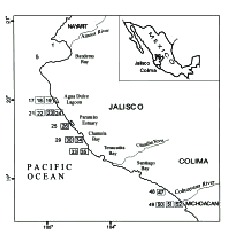
<body><![CDATA[<p><font face="Arial" size="2">The majority of the marine mollusks of economic importance are distributed in the coastal zones, including the inner shallower parts of the continental platform (<a href="#ci90">Cifuentes-Lemus 1990</a>). Mexico presents very favorable conditions for the exploitation of mollusks since its coastline is more than 10 000 km long, with a continental shelf area of 2 892 000 km<sup>2</sup> (<a  href="#ru85">Ruiz-Durá 1985</a>) and 1 500 000 ha<sup>2</sup> of coastal water bodies (<a href="#la77">Lankford 1977</a>). However, a problem for an adequate exploitation of these mollusks in Mexico is the scarcity of published information on their biology and ecology. </font></p>     <p><font face="Arial" size="2">The knowledge on benthic marine mollusks of Jalisco and Colima is mainly the result of studies carried out in the intertidal and shallow subtidal zones. A few studies have also been conducted in the continental platform of this region. A review of this research and the localities studied so far are reported by <a  href="#ri94">Ríos-Jara <i>et al.</i> (1994</a>, <a href="#ri96">1996</a>), Pérez-Peña and Ríos-Jara (1998) and Esqueda <i>et al.</i> (2000). However, information on the gastropod and bivalve species of commercial interest from the continental shelf of Jalisco and Colima is scarce. Only a few published records of these species are mentioned in the literature, they include checklists and museum collections. In addition, there have been some field collections (<a href="#mo66">Morris 1966</a>, <a href="#ke71">Keen 1971</a>, and Holguín-Quiñones and González-Pedraza 1994). Therefore, the present study is important, since it provides information on the spatial distribution patterns of abundance with respect to depth and type of substratum of twenty four species of gastropods and bivalves considered as commercially important in the continental shelf of Jalisco and Colima.</font></p>     <p><font face="Arial" size="2">The area of study includes the continental shelf of Jalisco and Colima on the Pacific coast of Mexico (20°39'-18°39' N) (<a href="#img1">Fig. 1</a>). The coastline of this area spreads along approximately 364 km. The continental platform of both states extends across an area of 5 315 Km<sup>2</sup> (Ruiz-Durá 1985), and it is narrow and mostly rocky. Benthic mollusks were collected with a trawling net (24 m long, 21 m wide, mesh size of 4.5 cm, with cod end of 0.6 cm mesh size) during the oceanographic expedition "Atlas V" on board of the R/V "El Puma" of the Universidad Nacional Autónoma de Mexico (UNAM). The expedition was from August 23<sup>rd</sup> to August 30<sup>th</sup>,1988. Samples of the sediment from the trawling areas were obtained with a geological grab (20 1 capacity, 0.1 m<sup>2</sup> sampling area). A total of 22 sampling stations were performed throughout the study area (<a href="#img1">Fig. 1</a>). One net trawl (43-95 min at 2.5 knots) was conducted at each sampling station. The depth at these stations ranged from 18 to 136 m. The distance covered by each trawl was calculated using the trawling time and the ship velocity. Thus, distance equals trawling time multiply by speed of the ship. Similarly, the area covered by the net in each cast was obtained by multiplying the distance of each trawl and the mouth opening width (21 m). The area is expressed in hectares.    <br> </font></p>     <div style="text-align: center;"><font face="Arial" size="2"><span  style="font-weight: bold;"><a name="img1"></a><img alt=""  src="/img/fbpe/rbt/v49n3-4/2514i1.JPG"  style="width: 231px; height: 233px;">    
<br>     <br>     <br> </span></font>     <div style="text-align: left; margin-left: 120px;"><font face="Arial"  size="2"><font size="-2">Fig. 1. The Pacific coast of Jalisco and Colima. Numbers indicate the location of sampling stations. The squares show those stations where&nbsp; </font></font><font face="Arial" size="2"><font  size="-2">gastropods and&nbsp; bivalves of commercial interest were collected.</font><span style="font-weight: bold;"></span></font>    <br> <font face="Arial" size="2"><span style="font-weight: bold;"></span></font><font  face="Arial" size="2"> </font></div> </div>     ]]></body>
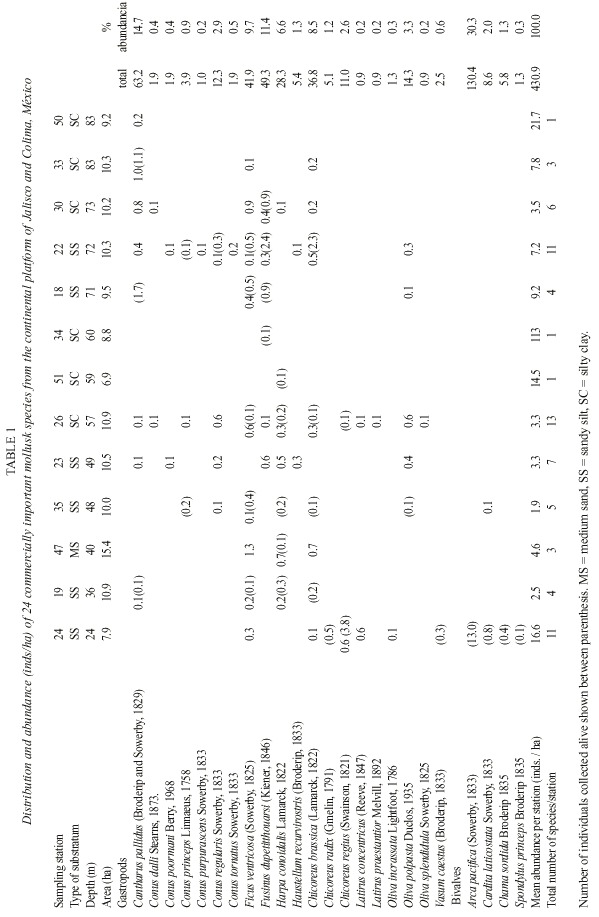
<body><![CDATA[<p><font face="Arial" size="2">All gastropods and bivalves caught were identified and counted using the works of <a href="#mo66">Morris (1966)</a> and <a href="#ke71">Keen (1971)</a>. Only shells that permitted clear identification were used. Live organisms were preserved in 70% alcohol. Scientific names and distribution ranges were reviewed and updated using according to <a href="#sk91">Skoglund (1991</a>, <a href="#sk92">1992</a>). Abundance was expressed as the mean number of individuals per hectares, and diversity as the number of species per station. These organisms form part of the collection of invertebrates at the Centro de Estudios de la Costa of the Universidad de Guadalajara in Melaque, Jalisco.</font></p>     <p><font face="Arial" size="2">Three different types of substratum were recognized in the area of study: 1) silty clay, (most particles &lt;0.020 mm), 2) sandy silt (0.015-0.05 mm), 3) medium sand (&gt;0.2 mm). Sediments became more homogeneous toward deeper stations, decreasing in particle size, from medium sand and sandy silt to silty clay. At stations deeper than 40 m, only sandy silt or silty clay were found. </font></p>     <p><font face="Arial" size="2">A total of 115 gastropod and bivalve species were collected during the oceanographic expedition; 267 individuals of 15 species were collected alive, the rest were recorded by the presence of their shells. Twenty species of gastropods are considered of commercial interest. They represent the 23.3% of all species collected. In the case of bivalves, only four species (13.8%) are commercially important. They were found in only 13 sampling stations in the area of study (<a href="#t1">Table 1</a>, <a  href="#img1">Fig. 1</a>). Individuals of these species were obtained between 24 and 83 m in medium sand, sandy silt and silty clay substrata. Shallow (24-40 m) stations registered the lowest abundance and number of species of gastropods. Bivalve species were only found at depths between 24 and 48 m in medium sand and sandy silt substrata. The absence of organisms at deeper stations is probably related to a marked decrease in dissolved oxygen concentrations (&lt;0.8 mg L<sup>-1</sup>), recorded in all stations deeper than 100 m during the present study (Guzmán-Arroyo and Flores-Rosas 1998). Low oxygen levels may be the principal factor limiting the distribution of benthic mollusks in the continental shelf off Jalisco and Colima (<a href="#pe98">Perez-Peña and Ríos-Jara 1998</a>).</font></p>     <p align="center"><font face="Arial" size="2"><a name="t1"></a></font></p>     <div style="text-align: center;"><font size="2">&nbsp;<img  src="/img/fbpe/rbt/v49n3-4/2514i2.JPG" title="" alt=""  style="width: 599px; height: 917px;"></font></div>     
<p><font face="Arial" size="2">Five gastropods species were quite abundant in the samples, representing 50.7% of the total of individuals: <i>Cantharus pallidus </i>(14.7%), <i>Fusinus</i> <i>dupetittouarsi</i> (11.4%), <i>Ficus ventricosa</i> (9.7%), <i>Chicoreus brassica</i> (8.5%) and <i>Harpa conoidalis</i> (6.6%). These gastropod species are epifaunal carnivores, which tend to have a greater variety in size and shell architecture. The most abundant bivalve species is <i>Arca pacifica</i> (30.3%) All these Gastropods and Bivalves species were collected in depths between 24 and 83 m. the species collected were bigger than 10 cm, and have been reported as an important component of the fauna accompanying commercial shrimp fisheries in the Mexican Pacific (<a href="#ga61">García-Cubas 1961</a>).</font></p>     <p><font face="Arial" size="2">The following is a brief description of the distribution with respect to depth and type of substratum of the six most abundant species in the area of study. Information on the general characteristics and use of these species is also provided: </font></p>     <p><font face="Arial" size="2"><i>1) Cantharus </i>(<i>Solenosteira</i>)<i> pallidus</i> (Broderip &amp; Sowerby, 1829). This species was formerly known as <i>Cantharus</i> (<i>S.) capitanea</i> (Berry, 1957) (<a  href="#sk92">Skoglund 1992</a>) (Family Buccinidae). This is the largest snail found in our collections, with specimens reaching 28 cm of length. The species was mostly found in areas between 36-83 m with sandy silt and silty clay substrata. The muscular foot is used for human consumption. This whelk snail is commonly known as "caracol burro" in the Mexican Pacific. It has good flavor steamed, in cocktails, fried or in soups. It is quite attractive for shell collectors and it is commonly seen in tourist centers.</font></p>     <p><font face="Arial" size="2">2) <i>Ficus ventricosa </i>(Sowerby, 1825). The "fig shell" <i>F. ventricosa</i> (Family Ficidae) was found from shallow to moderately deep sampling stations (24-83 m) in medium sand, sandy silt and silty clay substrata. Most individuals collected were about 10 cm in length. A few smaller juveniles were also collected. This species is seldom used as food but the shell is commonly sold in souvenir shops. </font></p>     <p><font face="Arial" size="2">3) <i>Fusinus</i> <i>dupetitthouarsi </i>(Kiener, 1846). The commonly called spindle conch (Family Fasciolariidae), has a large, pyriform shell with a good periostracum of yellowish brown color. It was found in moderately deep waters between 49-73 m, in sandy silt and silty clay substrata. Most organisms collected were live specimens, some of them reaching a height of 22 cm. This handsome shell is most esteemed by shell collectors. The meat is locally used for fish bait but seldom eaten by man.</font></p>     ]]></body>
<body><![CDATA[<p><font face="Arial" size="2">4) <i>Harpa conoidalis </i>(Lamarck, 1822). The Family Harpidae includes at least two dozen species, which are commonly named harp shells. The whole shell is rather polished, and is one of the most attractive of the marine shells from the Pacific coast of Mexico. Colors range from pinkish gray to bluish white, with square spots of violet in the ribs. This species was collected over a wide range of distribution with respect to depth (36-73 m) and the three types of substrata found in the area of study. The height of the shells collected ranged from 5-8 cm. It is seldom used for human consumption.</font></p>     <p><font face="Arial" size="2">5) <i>Hexaplex brassica </i>(Lamarck, 1822). Murex shells (Family Murcidae) belong to a large and very diverse family, including the cabbage murex, <i>Hexaplex brassica</i>, which is one of the largest members of the genus. This beautiful shell, commonly known as "caracol chino", always attracts the attention of collectors. The species was collected from shallow (24 m) to moderately deep waters (83 m) in medium sand, sandy silt and silty clay substrata. Some of the shells collected reached a length of 18 cm. It is primarily used as food and sometimes as fish bait.</font></p>     <p><font face="Arial" size="2">6) <i>Arca pacifica</i> (Sowerby, 1833). Ark shells include several genera of the Family Arcidae distributed from the Gulf of California to Peru. The most common are <i>Arca</i>, <i>Arcopsis</i>, <i>Barbatia</i>, and <i>Anadara</i>. At least two species of <i>Arca</i>, <i>A.. pacifica</i> and <i>A.. mutabilis</i>, are found in the Pacific coast of Mexico. Their common name in Mexico is "pata de mula". <i>Arca pacifica</i> is large and with a broad flat area on the top that keeps the beaks well separated. It is highly esteemed for food. The heavy shell of this organism has been used as a source of lime (<a href="#ci90">Cifuentes-Lemus <i>et al.</i> 1990</a>). This species was found only in the sampling station 24 (24 m, sandy silt substratum) but in relatively high density (13 ind./ha). This high dominance may be related to the substratum characterisctics of the sampling station (sand with rocks) where the species aggregates. Keen (1974) mentions that this species may be found adhering to the under-sides of rocks in the intertidal zones or dredged in depths to 137 m; while <a href="#fi95">Fischer <i>et al.</i> (1995)</a> indicate these rocks with attached specimens may be on soft bottoms down to 150 m.</font></p>     <p><font face="Arial" size="2"><b>Resumen</b></font></p>     <p><font face="Arial" size="2">La distribución y abundancia con respecto a la profundidad y el tipo de sustrato de 20 especies de gastrópodos y 4 especies de bivalvos de importancia económica fueron examinados en la plataforma continental de las costas de Jalisco y Colima, México. Las especies fueron recolectadas con red de arrastre a profundidades de 24 a 83 m en agosto de 1988. La mayoría de los individuos y especies de gastrópodos fueron recolectados en estaciones con sustrato limo arenoso. Los bivalvos fueron colectados en sustratos limo arenoso y arena media. Las seis especies más abundantes representaron el 81.2% del total de gasteropodos y bivalvos colectados. Estas especies son: <i>Cantharus pallidus</i>, <i>Fusinus dupetittouarsi</i>, <i>Ficus ventricosa</i>, <i>Hexaplex brassica</i>, <i>Harpa conoidalis</i> y<i> Arca pacifica.</i></font></p>     <p><font face="Arial" size="2">&nbsp;</font></p>     <p><font face="Arial" size="2"><b>References</b></font></p>     <!-- ref --><p><font face="Arial" size="2"><a name="ci90"></a>Cifuentes-Lemus, J.L., P. Torres-García &amp; M. Frias. 1990. El océano y sus recursos, X Pesquerías. Fondo Cult. Econ. México, D.F. 228 p.</font>&nbsp;&nbsp;&nbsp;&nbsp;&nbsp;&nbsp;&nbsp;&nbsp;[&#160;<a href="javascript:void(0);" onclick="javascript: window.open('/scielo.php?script=sci_nlinks&ref=1275978&pid=S0034-7744200100030000300001&lng=','','width=640,height=500,resizable=yes,scrollbars=1,menubar=yes,');">Links</a>&#160;]<!-- end-ref --><!-- ref --><p><font face="Arial" size="2"><a name="es20"></a>Esqueda, M.C., E. Ríos-Jara, J.E. Michel-Morfín &amp; V. Landa-Jaime. 2000. The vertical distribution and abundance of gastropods and bivalves from rocky beaches of Cuastecomate Bay, Jalisco. Rev. Biol. Trop. 48: 765-776.</font>&nbsp;&nbsp;&nbsp;&nbsp;&nbsp;&nbsp;&nbsp;&nbsp;[&#160;<a href="javascript:void(0);" onclick="javascript: window.open('/scielo.php?script=sci_nlinks&ref=1275979&pid=S0034-7744200100030000300002&lng=','','width=640,height=500,resizable=yes,scrollbars=1,menubar=yes,');">Links</a>&#160;]<!-- end-ref --><!-- ref --><p><font face="Arial" size="2"><a name="fi95"></a>Fischer, W., F. Krupp, W. Schneider, C. Sommer, K.E. Carpenter &amp; V.H. Niem. 1995. Guia FAO para la identificación de especies para los fines de la pesca. Pacífico Centro-Oriental. Volumen I. Plantas e inver-tebrados. Organización de las Naciones Unidas para la Agricultura y la Alimentación, Roma. 646 p.</font>&nbsp; <font face="Arial" size="2">&nbsp;&nbsp;&nbsp;&nbsp;&nbsp;&nbsp;&nbsp;&nbsp;[&#160;<a href="javascript:void(0);" onclick="javascript: window.open('/scielo.php?script=sci_nlinks&ref=1275980&pid=S0034-7744200100030000300003&lng=','','width=640,height=500,resizable=yes,scrollbars=1,menubar=yes,');">Links</a>&#160;]<!-- end-ref --><!-- ref --><br> <a name="ga61"></a>García-Cubas, A. 1961. Contribución al estudio de los moluscos de valor económico de las costas de Mazatlán, Sinaloa, México. Tesis de Licenciatura, Universidad Nacional Autónoma de México, México.</font><font face="Arial" size="2">&nbsp;</font>    &nbsp;&nbsp;&nbsp;&nbsp;&nbsp;&nbsp;&nbsp;&nbsp;[&#160;<a href="javascript:void(0);" onclick="javascript: window.open('/scielo.php?script=sci_nlinks&ref=1275981&pid=S0034-7744200100030000300004&lng=','','width=640,height=500,resizable=yes,scrollbars=1,menubar=yes,');">Links</a>&#160;]<!-- end-ref --><!-- ref --><p><font face="Arial" size="2"><a name="gu88"></a>Guzmán-Arroyo, M. &amp; E. Flores-Rosas. 1988. Campaña oceanográfica Atlas V Jalisco-Colima: Informe de actividades del Instituto de Limnología. Universidad de Guadalajara, Guadalajara, México. 9 p.</font>&nbsp;&nbsp;&nbsp;&nbsp;&nbsp;&nbsp;&nbsp;&nbsp;[&#160;<a href="javascript:void(0);" onclick="javascript: window.open('/scielo.php?script=sci_nlinks&ref=1275982&pid=S0034-7744200100030000300005&lng=','','width=640,height=500,resizable=yes,scrollbars=1,menubar=yes,');">Links</a>&#160;]<!-- end-ref --><!-- ref -->Holguín Quiñones, O.E. &amp; A.C. González Pedraza. 1994. Moluscos de la franja costera de Michoacán, Colima y Jalisco, México. Inst. Politécnico Nal., México, D.F. 133 p.</font>    &nbsp;&nbsp;&nbsp;&nbsp;&nbsp;&nbsp;&nbsp;&nbsp;[&#160;<a href="javascript:void(0);" onclick="javascript: window.open('/scielo.php?script=sci_nlinks&ref=1275983&pid=S0034-7744200100030000300006&lng=','','width=640,height=500,resizable=yes,scrollbars=1,menubar=yes,');">Links</a>&#160;]<!-- end-ref --><!-- ref --><p><font face="Arial" size="2"><a name="ke71"></a>Keen, M.A. 1971. Sea shells of tropical west America. Standford Univ., Stanford. 1064 p.</font>&nbsp;&nbsp;&nbsp;&nbsp;&nbsp;&nbsp;&nbsp;&nbsp;[&#160;<a href="javascript:void(0);" onclick="javascript: window.open('/scielo.php?script=sci_nlinks&ref=1275984&pid=S0034-7744200100030000300007&lng=','','width=640,height=500,resizable=yes,scrollbars=1,menubar=yes,');">Links</a>&#160;]<!-- end-ref --><!-- ref --><p><font face="Arial" size="2"><a name="la77"></a>Lankford, R.R. 1977. Coastal lagoons of Mexico: Their origin and classification. Mar. Geol.: 182-215. </font>&nbsp;&nbsp;&nbsp;&nbsp;&nbsp;&nbsp;&nbsp;&nbsp;[&#160;<a href="javascript:void(0);" onclick="javascript: window.open('/scielo.php?script=sci_nlinks&ref=1275985&pid=S0034-7744200100030000300008&lng=','','width=640,height=500,resizable=yes,scrollbars=1,menubar=yes,');">Links</a>&#160;]<!-- end-ref --><!-- ref -->Morris, P.A. 1966. A field guide to shells of the Pacific coast and Hawaii. Houghton Mifflin, Boston. 297 p.</font>&nbsp; <font face="Arial" size="2">    &nbsp;&nbsp;&nbsp;&nbsp;&nbsp;&nbsp;&nbsp;&nbsp;[&#160;<a href="javascript:void(0);" onclick="javascript: window.open('/scielo.php?script=sci_nlinks&ref=1275986&pid=S0034-7744200100030000300009&lng=','','width=640,height=500,resizable=yes,scrollbars=1,menubar=yes,');">Links</a>&#160;]<!-- end-ref --><br>     <!-- ref --><br> <a name="pe98"></a>Perez-Peña, M. &amp; E. Rios-Jara. 1998. Gastropod mollusks from the continental shelf off Jalisco and Colima, México: Species collected with a trawl net. Cien. Mar. 24: 425-442.</font>&nbsp; <font face="Arial" size="2">    &nbsp;&nbsp;&nbsp;&nbsp;&nbsp;&nbsp;&nbsp;&nbsp;[&#160;<a href="javascript:void(0);" onclick="javascript: window.open('/scielo.php?script=sci_nlinks&ref=1275988&pid=S0034-7744200100030000300010&lng=','','width=640,height=500,resizable=yes,scrollbars=1,menubar=yes,');">Links</a>&#160;]<!-- end-ref --><br>     <!-- ref --><br> <a name="ri94"></a>Ríos-Jara, E., H.G. León-Alvarez, L. Lizárraga-Chávez &amp; J.E. Michel-Morfín. 1994. Producción y tiempo de recuperación del tinte de Plicopurpura patula pansa (Neogastropoda: Muricidae) en Jalisco, México. Rev. Biol. Trop. 42: 537-545.</font>&nbsp; <font face="Arial" size="2">    &nbsp;&nbsp;&nbsp;&nbsp;&nbsp;&nbsp;&nbsp;&nbsp;[&#160;<a href="javascript:void(0);" onclick="javascript: window.open('/scielo.php?script=sci_nlinks&ref=1275990&pid=S0034-7744200100030000300011&lng=','','width=640,height=500,resizable=yes,scrollbars=1,menubar=yes,');">Links</a>&#160;]<!-- end-ref --><br>     <!-- ref --><br> <a name="ri96"></a>Ríos-Jara, E., M. Pérez-Peña, L. Lizárraga-Chávez. &amp; J.E. Michel-Morfín. 1996. Additional gastropod records from the continental shelf off Jalisco and Colima, México. Cien. Mar. 22: 347-359.</font>&nbsp; <font face="Arial" size="2">    &nbsp;&nbsp;&nbsp;&nbsp;&nbsp;&nbsp;&nbsp;&nbsp;[&#160;<a href="javascript:void(0);" onclick="javascript: window.open('/scielo.php?script=sci_nlinks&ref=1275992&pid=S0034-7744200100030000300012&lng=','','width=640,height=500,resizable=yes,scrollbars=1,menubar=yes,');">Links</a>&#160;]<!-- end-ref --><br>     <!-- ref --><br> <a name="ru85"></a>Ruiz-Durá, M.F. 1985. Recursos pesqueros de las costas de México. Limusa, México, D.F. 135 p.    &nbsp;&nbsp;&nbsp;&nbsp;&nbsp;&nbsp;&nbsp;&nbsp;[&#160;<a href="javascript:void(0);" onclick="javascript: window.open('/scielo.php?script=sci_nlinks&ref=1275994&pid=S0034-7744200100030000300013&lng=','','width=640,height=500,resizable=yes,scrollbars=1,menubar=yes,');">Links</a>&#160;]<!-- end-ref --><br>     <!-- ref --><br> </font><font face="Arial" size="2"><a name="sk91"></a>Skoglund, C. 1991. Additions to the Panamic Province Bivalve (Mollusca) literature 1971-1990. Festivus. 74 p.</font>&nbsp; <font face="Arial" size="2">    &nbsp;&nbsp;&nbsp;&nbsp;&nbsp;&nbsp;&nbsp;&nbsp;[&#160;<a href="javascript:void(0);" onclick="javascript: window.open('/scielo.php?script=sci_nlinks&ref=1275996&pid=S0034-7744200100030000300014&lng=','','width=640,height=500,resizable=yes,scrollbars=1,menubar=yes,');">Links</a>&#160;]<!-- end-ref --><br>     <!-- ref --><br> <a name="sk92"></a>Skoglund, C. 1992. Additions to the Panamic Province Gastropod (Mollusca) literature 1971-1992. Festivus. 169 p.</font>    &nbsp;&nbsp;&nbsp;&nbsp;&nbsp;&nbsp;&nbsp;&nbsp;[&#160;<a href="javascript:void(0);" onclick="javascript: window.open('/scielo.php?script=sci_nlinks&ref=1275998&pid=S0034-7744200100030000300015&lng=','','width=640,height=500,resizable=yes,scrollbars=1,menubar=yes,');">Links</a>&#160;]<!-- end-ref --> ]]></body><back>
<ref-list>
<ref id="B1">
<nlm-citation citation-type="book">
<person-group person-group-type="author">
<name>
<surname><![CDATA[Cifuentes-Lemus]]></surname>
<given-names><![CDATA[J.L.]]></given-names>
</name>
<name>
<surname><![CDATA[Torres-García]]></surname>
<given-names><![CDATA[P.]]></given-names>
</name>
<name>
<surname><![CDATA[Frias]]></surname>
<given-names><![CDATA[M.]]></given-names>
</name>
</person-group>
<source><![CDATA[El océano y sus recursos, X Pesquerías]]></source>
<year>1990</year>
<page-range>228</page-range><publisher-name><![CDATA[Fondo Cult. Econ.]]></publisher-name>
</nlm-citation>
</ref>
<ref id="B2">
<nlm-citation citation-type="journal">
<person-group person-group-type="author">
<name>
<surname><![CDATA[Esqueda]]></surname>
<given-names><![CDATA[M.C.]]></given-names>
</name>
<name>
<surname><![CDATA[Ríos-Jara]]></surname>
<given-names><![CDATA[E.]]></given-names>
</name>
<name>
<surname><![CDATA[Michel-Morfín]]></surname>
<given-names><![CDATA[J.E.]]></given-names>
</name>
<name>
<surname><![CDATA[Landa-Jaime]]></surname>
<given-names><![CDATA[V.]]></given-names>
</name>
</person-group>
<article-title xml:lang="en"><![CDATA[The vertical distribution and abundance of gastropods and bivalves from rocky beaches of Cuastecomate Bay, Jalisco]]></article-title>
<source><![CDATA[Rev. Biol. Trop.]]></source>
<year>2000</year>
<volume>48</volume>
<page-range>765-776</page-range></nlm-citation>
</ref>
<ref id="B3">
<nlm-citation citation-type="book">
<person-group person-group-type="author">
<name>
<surname><![CDATA[Fischer]]></surname>
<given-names><![CDATA[W.]]></given-names>
</name>
<name>
<surname><![CDATA[Krupp]]></surname>
<given-names><![CDATA[F.]]></given-names>
</name>
<name>
<surname><![CDATA[Schneider]]></surname>
<given-names><![CDATA[W.]]></given-names>
</name>
<name>
<surname><![CDATA[Sommer]]></surname>
<given-names><![CDATA[C.]]></given-names>
</name>
<name>
<surname><![CDATA[Carpenter]]></surname>
<given-names><![CDATA[K.E.]]></given-names>
</name>
<name>
<surname><![CDATA[Niem]]></surname>
<given-names><![CDATA[V.H.]]></given-names>
</name>
</person-group>
<source><![CDATA[Guia FAO para la identificación de especies para los fines de la pesca: Pacífico Centro-Oriental]]></source>
<year>1995</year>
<volume>I</volume>
<page-range>646</page-range><publisher-loc><![CDATA[Roma ]]></publisher-loc>
<publisher-name><![CDATA[Organización de las Naciones Unidas para la Agricultura y la Alimentación]]></publisher-name>
</nlm-citation>
</ref>
<ref id="B4">
<nlm-citation citation-type="">
<person-group person-group-type="author">
<name>
<surname><![CDATA[García-Cubas]]></surname>
<given-names><![CDATA[A.]]></given-names>
</name>
</person-group>
<source><![CDATA[Contribución al estudio de los moluscos de valor económico de las costas de Mazatlán]]></source>
<year>1961</year>
<publisher-loc><![CDATA[Sinaloa ]]></publisher-loc>
</nlm-citation>
</ref>
<ref id="B5">
<nlm-citation citation-type="book">
<person-group person-group-type="author">
<name>
<surname><![CDATA[Guzmán-Arroyo]]></surname>
<given-names><![CDATA[M.]]></given-names>
</name>
<name>
<surname><![CDATA[Flores-Rosas]]></surname>
<given-names><![CDATA[E.]]></given-names>
</name>
</person-group>
<source><![CDATA[Campaña oceanográfica Atlas V Jalisco-Colima: Informe de actividades del Instituto de Limnología]]></source>
<year>1988</year>
<page-range>9</page-range><publisher-loc><![CDATA[Guadalajara ]]></publisher-loc>
<publisher-name><![CDATA[Universidad de Guadalajara]]></publisher-name>
</nlm-citation>
</ref>
<ref id="B6">
<nlm-citation citation-type="book">
<person-group person-group-type="author">
<name>
<surname><![CDATA[Holguín Quiñones]]></surname>
<given-names><![CDATA[O.E.]]></given-names>
</name>
<name>
<surname><![CDATA[González Pedraza]]></surname>
<given-names><![CDATA[A.C.]]></given-names>
</name>
</person-group>
<source><![CDATA[Moluscos de la franja costera de Michoacán, Colima y Jalisco, México]]></source>
<year>1994</year>
<page-range>133</page-range><publisher-name><![CDATA[Inst. Politécnico Nal.]]></publisher-name>
</nlm-citation>
</ref>
<ref id="B7">
<nlm-citation citation-type="book">
<person-group person-group-type="author">
<name>
<surname><![CDATA[Keen]]></surname>
<given-names><![CDATA[M.A.]]></given-names>
</name>
</person-group>
<source><![CDATA[Sea shells of tropical west America]]></source>
<year>1971</year>
<publisher-loc><![CDATA[Stanford ]]></publisher-loc>
<publisher-name><![CDATA[Standford Univ]]></publisher-name>
</nlm-citation>
</ref>
<ref id="B8">
<nlm-citation citation-type="journal">
<person-group person-group-type="author">
<name>
<surname><![CDATA[Lankford]]></surname>
<given-names><![CDATA[R.R.]]></given-names>
</name>
</person-group>
<article-title xml:lang="en"><![CDATA[Coastal lagoons of Mexico: Their origin and classification]]></article-title>
<source><![CDATA[Mar. Geol.]]></source>
<year>1977</year>
<page-range>182-215</page-range></nlm-citation>
</ref>
<ref id="B9">
<nlm-citation citation-type="book">
<person-group person-group-type="author">
<name>
<surname><![CDATA[Morris]]></surname>
<given-names><![CDATA[P.A.]]></given-names>
</name>
</person-group>
<source><![CDATA[A field guide to shells of the Pacific coast and Hawaii]]></source>
<year>1966</year>
<page-range>297</page-range><publisher-loc><![CDATA[Boston ]]></publisher-loc>
<publisher-name><![CDATA[Houghton Mifflin]]></publisher-name>
</nlm-citation>
</ref>
<ref id="B10">
<nlm-citation citation-type="journal">
<person-group person-group-type="author">
<name>
<surname><![CDATA[Perez-Peña]]></surname>
<given-names><![CDATA[M]]></given-names>
</name>
<name>
<surname><![CDATA[Rios-Jara]]></surname>
<given-names><![CDATA[E.]]></given-names>
</name>
</person-group>
<article-title xml:lang="en"><![CDATA[Gastropod mollusks from the continental shelf off Jalisco and Colima, México: Species collected with a trawl net]]></article-title>
<source><![CDATA[Cien. Mar.]]></source>
<year>1998</year>
<volume>24</volume>
<page-range>425-442</page-range></nlm-citation>
</ref>
<ref id="B11">
<nlm-citation citation-type="journal">
<person-group person-group-type="author">
<name>
<surname><![CDATA[Ríos-Jara]]></surname>
<given-names><![CDATA[E.]]></given-names>
</name>
<name>
<surname><![CDATA[León-Alvarez]]></surname>
<given-names><![CDATA[H.G.]]></given-names>
</name>
<name>
<surname><![CDATA[Lizárraga-Chávez]]></surname>
<given-names><![CDATA[L.]]></given-names>
</name>
<name>
<surname><![CDATA[Michel-Morfín]]></surname>
<given-names><![CDATA[J.E.]]></given-names>
</name>
</person-group>
<article-title xml:lang="es"><![CDATA[Producción y tiempo de recuperación del tinte de Plicopurpura patula pansa (Neogastropoda: Muricidae) en Jalisco, México]]></article-title>
<source><![CDATA[Rev. Biol. Trop.]]></source>
<year>1994</year>
<volume>42</volume>
<page-range>537-545</page-range></nlm-citation>
</ref>
<ref id="B12">
<nlm-citation citation-type="journal">
<person-group person-group-type="author">
<name>
<surname><![CDATA[Ríos-Jara]]></surname>
<given-names><![CDATA[E.]]></given-names>
</name>
<name>
<surname><![CDATA[Pérez-Peña]]></surname>
<given-names><![CDATA[M.]]></given-names>
</name>
<name>
<surname><![CDATA[Lizárraga-Chávez]]></surname>
<given-names><![CDATA[L.]]></given-names>
</name>
<name>
<surname><![CDATA[Michel-Morfín]]></surname>
<given-names><![CDATA[J.E.]]></given-names>
</name>
</person-group>
<article-title xml:lang="en"><![CDATA[Additional gastropod records from the continental shelf off Jalisco and Colima, México]]></article-title>
<source><![CDATA[Cien. Mar.]]></source>
<year>1996</year>
<volume>22</volume>
<page-range>347-359</page-range></nlm-citation>
</ref>
<ref id="B13">
<nlm-citation citation-type="book">
<person-group person-group-type="author">
<name>
<surname><![CDATA[Ruiz-Durá]]></surname>
<given-names><![CDATA[M.F.]]></given-names>
</name>
</person-group>
<source><![CDATA[Recursos pesqueros de las costas de México]]></source>
<year>1985</year>
<page-range>135</page-range><publisher-name><![CDATA[Limusa]]></publisher-name>
</nlm-citation>
</ref>
<ref id="B14">
<nlm-citation citation-type="book">
<person-group person-group-type="author">
<name>
<surname><![CDATA[Skoglund]]></surname>
<given-names><![CDATA[C.]]></given-names>
</name>
</person-group>
<source><![CDATA[Additions to the Panamic Province Bivalve (Mollusca) literature 1971-1990]]></source>
<year>1991</year>
<page-range>74</page-range><publisher-name><![CDATA[Festivus]]></publisher-name>
</nlm-citation>
</ref>
<ref id="B15">
<nlm-citation citation-type="book">
<person-group person-group-type="author">
<name>
<surname><![CDATA[Skoglund]]></surname>
<given-names><![CDATA[C.]]></given-names>
</name>
</person-group>
<source><![CDATA[Additions to the Panamic Province Gastropod (Mollusca) literature 1971-1992]]></source>
<year>1992</year>
<publisher-name><![CDATA[Festivus]]></publisher-name>
</nlm-citation>
</ref>
</ref-list>
</back>
</article>