<?xml version="1.0" encoding="ISO-8859-1"?><article xmlns:mml="http://www.w3.org/1998/Math/MathML" xmlns:xlink="http://www.w3.org/1999/xlink" xmlns:xsi="http://www.w3.org/2001/XMLSchema-instance">
<front>
<journal-meta>
<journal-id>0034-7744</journal-id>
<journal-title><![CDATA[Revista de Biología Tropical]]></journal-title>
<abbrev-journal-title><![CDATA[Rev. biol. trop]]></abbrev-journal-title>
<issn>0034-7744</issn>
<publisher>
<publisher-name><![CDATA[Universidad de Costa Rica]]></publisher-name>
</publisher>
</journal-meta>
<article-meta>
<article-id>S0034-77442001000300002</article-id>
<title-group>
<article-title xml:lang="en"><![CDATA[Environmental variables and intertidal beach annelids of São Sebastião Channel (State of São Paulo, Brazil)]]></article-title>
</title-group>
<contrib-group>
<contrib contrib-type="author">
<name>
<surname><![CDATA[Rizzo]]></surname>
<given-names><![CDATA[Alexandra E]]></given-names>
</name>
<xref ref-type="aff" rid="A01"/>
</contrib>
<contrib contrib-type="author">
<name>
<surname><![CDATA[Z. Amaral]]></surname>
<given-names><![CDATA[A. Cecília]]></given-names>
</name>
<xref ref-type="aff" rid="A01"/>
</contrib>
</contrib-group>
<aff id="A01">
<institution><![CDATA[,UNICAP Instituto de Biología Departamento de Zoología]]></institution>
<addr-line><![CDATA[ ]]></addr-line>
<country>Brazil</country>
</aff>
<pub-date pub-type="pub">
<day>00</day>
<month>12</month>
<year>2001</year>
</pub-date>
<pub-date pub-type="epub">
<day>00</day>
<month>12</month>
<year>2001</year>
</pub-date>
<volume>49</volume>
<numero>3-4</numero>
<fpage>849</fpage>
<lpage>857</lpage>
<copyright-statement/>
<copyright-year/>
<self-uri xlink:href="http://www.scielo.sa.cr/scielo.php?script=sci_arttext&amp;pid=S0034-77442001000300002&amp;lng=en&amp;nrm=iso"></self-uri><self-uri xlink:href="http://www.scielo.sa.cr/scielo.php?script=sci_abstract&amp;pid=S0034-77442001000300002&amp;lng=en&amp;nrm=iso"></self-uri><self-uri xlink:href="http://www.scielo.sa.cr/scielo.php?script=sci_pdf&amp;pid=S0034-77442001000300002&amp;lng=en&amp;nrm=iso"></self-uri><abstract abstract-type="short" xml:lang="en"><p><![CDATA[Benthic annelid communities were studied during a one-year period (August/95 to July/96) in two sectors of the beaches Engenho d’Água and São Francisco, São Sebastião Channel (São Paulo, Brazil), where the substrate is composed by a mixture of sand and rock fragments. Abiotic parameters such as salinity of interstitial water and sediment properties were used to characterize the environment. The polychaetes were well represented in the two sectors and their distribution was related with sediment type. The density of individuals and the number of taxa was higher at São Francisco, while the diversity and the evenness were higher at Engenho d’Água. This difference can be a consequence of organic enrichment caused by domestic input, and of the lower and more variable salinity at São Francisco. Due to these factors, a high density of opportunistic species, like Capitella capitata ssp., Scolelepis squamata, Laeonereis acuta and several oligochaetes, represented 75.5% of total abundance at this sector]]></p></abstract>
<abstract abstract-type="short" xml:lang="es"><p><![CDATA[Se estudiaron las comunidades bénticas de anélidos durante un periodo de un año (de agosto/95 a julio/96) en dos sectores de las playas Engenho d’Água and São Francisco, Canal de São Sebastião, donde el sustrato está compuesto por una mezcla de arena y fragmentos de roca. Se usaron parámetros abióticos como salidad del agua intersticial y propiedades de sedimento para caracterizar el ambiente. Los poliquetos estuvieron bien representados en los dos sectores y su distribución fue relacionada con el tiempo de sedimento. La densidad de los individuos y el número de táxones fuero mayores en São Francisco, mientras que la diversidad y la equidad fueron mayores en Engenho d’Água. Esta diferencia puede ser una consecueciade u enriquecimiento orgánico causado por una entrada doméstica y la salinidad más baja y variable en São Francisco. Debido a estos factores, la alta densidad de especiesoprtunistas como Capitella capitata ssp., Scolelepis squamata, Laeonereis acuta y varios oligochaetes, representó 75.5% de la abundancia local en ese sector]]></p></abstract>
<kwd-group>
<kwd lng="en"><![CDATA[Sand with rock fragments beach]]></kwd>
<kwd lng="en"><![CDATA[intertidal zone]]></kwd>
<kwd lng="en"><![CDATA[annelids]]></kwd>
<kwd lng="en"><![CDATA[polychaetes]]></kwd>
<kwd lng="en"><![CDATA[São Sebastião Channel]]></kwd>
<kwd lng="en"><![CDATA[Brazil]]></kwd>
</kwd-group>
</article-meta>
</front><body><![CDATA[ <div style="text-align: center;"><b><font face="Arial"> Environmental variables and intertidal beach annelids of</font></b>    <br> <b><font face="Arial">São Sebastião Channel (State of São Paulo, Brazil)</font></b></div> &nbsp; <font face="Arial" size="2">    <br>     <br> Alexandra E. Rizzo &amp; A. Cecília Z. Amaral    <br>     <br> Departamento de Zoologia, Instituto de Biologia, UNICAMP, CP 6109, 13083-970, Campinas, SP, Brazil; Fax (55) 19 32893124, e-mail: <a  href="mailto:aerizzo@rc.unesp.br">aerizzo@rc.unesp.br</a></font>     <p align="center"><font face="Arial" size="2">Recibido: 27-IV-2000 Corregido: 2-I-2001 Aceptado: 25-II-2001</font></p> <font face="Arial" size="2"><b>     <p>Abstract</p> </b></font>     <p><font face="Arial" size="2">Benthic annelid communities were studied during a one-year period (August/95 to July/96) in two sectors of the beaches Engenho d’Água and São Francisco, São Sebastião Channel (São Paulo, Brazil), where the substrate is composed by a mixture of sand and rock fragments. Abiotic parameters such as salinity of interstitial water and sediment properties were used to characterize the environment. The polychaetes were well represented in the two sectors and their distribution was related with sediment type. The density of individuals and the number of taxa was higher at São Francisco, while the diversity and the evenness were higher at Engenho d’Água. This difference can be a consequence of organic enrichment caused by domestic input, and of the lower and more variable salinity at São Francisco. Due to these factors, a high density of opportunistic species, like <i>Capitella capitata </i>ssp.<i>, Scolelepis squamata, Laeonereis acuta</i> and several oligochaetes, represented 75.5% of total abundance at this sector.</font></p>     <p><font face="Arial" size="2"><b>Key words</b><i>: </i>Sand with rock fragments beach, intertidal zone, annelids, polychaetes, São Sebastião Channel, Brazil.</font></p>     ]]></body>
<body><![CDATA[<p><font face="Arial" size="2">&nbsp;</font></p> <font face="Arial" size="2"><b> </b></font>     <p><font face="Arial" size="2">Sandy beaches, as important coastal ecosystems, shelter a high diversity of taxonomic groups that form considerable links in the marine food web (<a href="#fe81">Feder &amp; Jewett 1981</a>). The species diversity, abundances and dominance of sandy beach communities is often associated with environmental conditions such as salinity, temperature, dissolved oxygen, tide variations, wave action, topography, and granulometry (<a href="#sn94">Snelgrove &amp; Butman 1994</a>, <a href="#mc96">McLachlan 1996</a>). Interactions between these factors are responsible for the stability of the system and alterations caused directly or indirectly by humans may disrupt the system and it may take a long time for recovery (<a href="#pe78">Pearson &amp; Rosenberg 1978</a>).</font></p>     <p><font face="Arial" size="2">Polychaetes are important representatives of the marine benthic macrofauna and have often been utilized in environmental monitoring programs as their diversity and relative abundances may be an indication of environmental disturbance (<a href="#ch84">Choi &amp; Koh 1984</a>, <a href="#po92">Pocklington &amp; Wells 1992</a>). In sheltered beaches macrofauna from the intertidal zones may dominate and the polychaetes are usually the more abundant group (<a href="#br90">Brown &amp; McLachlan 1990</a>, <a href="#am95">Amaral <i>et al.</i> 1995</a>). </font></p>     <p><font face="Arial" size="2">Opportunistic species have been receiving great attention in studies of organically enriched areas because they can be used to characterize the degree of impact that has affected a certain locality (<a href="#gr74">Grassle &amp; Grassle 1974</a>). The capitelid polychaetes, especially <i>Capitella capitata </i>"complex", are classified as r-strategists, having the ability to colonize new habitats quickly (<a href="#ts90">Tsutsumi 1990</a>). In undisturbed conditions these r-strategist species are replaced by k-strategist species (<a  href="#pi70">Pianka 1970</a>, <a href="#gr81">Gray 1981</a>) which, with rare exceptions, dominate numerically in the community.</font></p>     <p><font face="Arial" size="2">The aims of this study were to evaluate the influence of environmental variables in the density, frequency, diversity and evenness of annelids in a intertidal environment at two beaches of São Sebastião Channel (Engenho d’Agua and São Francisco) and to compare to results obtained in previous studies. The data of spatial and temporal distribution were analysed in Rizzo &amp; Amaral (<i>in press</i>).</font></p>     <p><font face="Arial" size="2">&nbsp;</font></p> <font face="Arial" size="2"><b>     <p>Material and methods</p> </b></font>     <p><font face="Arial" size="2">The beaches at Engenho d’Água and São Francisco are located in the northern part of São Sebastião Channel (between 45<sup>0</sup>21’W, 23<sup>0</sup>43’S and 45<sup>0</sup>27’30"W, 23<sup>0</sup>52’30"S). São Francisco Beach is more densely populated then Engenho d'Água Beach due to the intense flow of tourists in the summer and by harbor activities, due the presence of the largest oil terminal in the country "Dutos e Terminais Centro Sul" (DTCS – Central and Southern Ducts and Terminals). The substrate found at the studied localities is composed by a mixture of sand and rock fragments, presenting a high environmental complexity (<a href="#ri20">Rizzo &amp; Amaral, 2000</a>).</font></p>     <p><font face="Arial" size="2">Between August 1995 and July 1996, samples were collected in the intertidal zone at the beaches: Engenho d’Água (180 samples) and São Francisco (180 samples). At each beach, a 10m-wide sector was established with an amplitude corresponding to the extension of the intertidal zone. These sectors were defined using visual markers. The samples were taken during the syzygy tides using a cylindrical sampler with an area of 0.01m<sup>2</sup> which was inserted in the sediment to a depth of 20 cm.</font></p>     <p><font face="Arial" size="2">In order to characterize the system, granulometry and organic matter in the sediment (36 samples/sector) were sampled seasonally. Sediment temperature and salinity of the interstitial water (108 samples/sector) were sampled monthly. </font></p>     ]]></body>
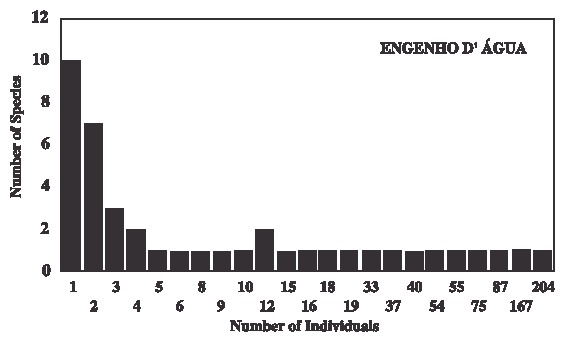
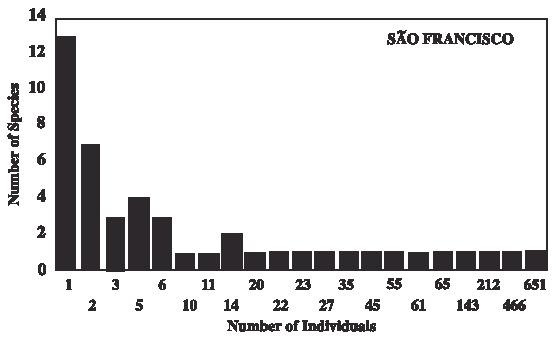
<body><![CDATA[<p><font face="Arial" size="2">Biological samples were washed with sea water and sieved using 1.0 mm and 0.5 mm mesh screens and the organisms anesthetized with magnesium chloride, fixed in 4% formaldehyde, and later preserved in 70% ethanol.</font></p>     <p><font face="Arial" size="2">The salinity of the interstitial water was evaluated using a portable Goldberg T/C refractometer, model 10419. Samples of water were collected and sent to CETESB (<i>Companhia de Tecnologia e Saneamento Ambiental</i>) for the analysis of fecal coliforms. According to the resolution of CONAMA Nr. 20/1986, beaches with fecal coliform counts greater than 1000/100ml of water are considered inappropriate for resorts. The organic matter content was analyzed according to <a href="#am66">Amoureux (1966)</a> while granulometric analysis was accomplished using the technique proposed by <a href="#su73">Suguio (1973)</a>. A program developed at the sedimentology laboratory of the Institute of Geosciences, University of São Paulo, was used to obtain the statistical parameters of <a href="#fo57">Folk &amp; Ward (1957)</a>.</font></p>     <p><font face="Arial" size="2">The environmental variables were submitted to the analysis of factorial variance to test the inequalities between the two sectors. The salinity of the interstitial water and the temperature of the sediment were tested using the factorial type model elaborated with beach and month factors while the model used for the sedimentary parameters (mean grain size, selection coefficient and organic matter) utilized beach and season (SAS program v.6.0). </font></p>     <p><font face="Arial" size="2">Species diversity and evenness were assessed using the Shannon-Wiener index (H') (<a href="#kr86">Krebs 1986</a>). In many of the samples each species was represented by only a few individuals, and consequently there were few numerically dominant species. To express the results in a better way, graphs of absolute abundance were elaborated (<a href="#fig1">Fig. 1</a>). The binary index of Jaccard was used to compare the similarity between the communities of the two sectors. The Jaccard index ranges from 0 (no similarity) to 1 (total similarity) and was calculated using the KREBS Program (<a href="#va95">Valentin 1995</a>). </font></p>     <div style="text-align: center;"><span  style="font-family: arial; color: rgb(51, 153, 153);"><span  style="font-weight: bold;"><a name="fig1"></a><img alt=""  src="/img/fbpe/rbt/v49n3-4/2513i2.JPG"  style="width: 569px; height: 341px;">    
<br>     <br> <img alt="" src="/img/fbpe/rbt/v49n3-4/2513i3.JPG"  style="width: 557px; height: 338px;">    
<br> </span><font size="-2"><br style="color: rgb(0, 0, 0);"> <br style="color: rgb(0, 0, 0);"> </font></span>     <div style="text-align: left;">     <div style="margin-left: 80px;"><span  style="font-family: arial; color: rgb(51, 153, 153);"><font size="-2"><span  style="color: rgb(0, 0, 0);">Fig. 1. Absolute abundance of species obtained between August 1995 and July 1996 at Engenho d’Água and São Francisco sectors </span></font></span>    ]]></body>
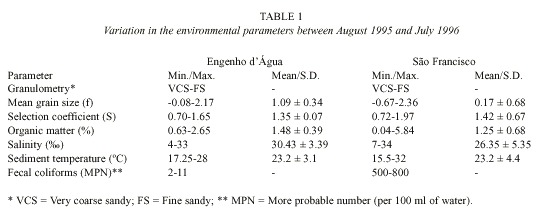
<body><![CDATA[<br> <span style="font-family: arial; color: rgb(51, 153, 153);"><font  size="-2"><span style="color: rgb(0, 0, 0);">(the bars on the left indicate the occa-sional species).</span></font><span  style="font-weight: bold;"></span></span>    <br> </div> <span style="font-family: arial; color: rgb(51, 153, 153);"><span  style="font-weight: bold;"></span></span></div> <span style="font-family: arial; color: rgb(51, 153, 153);"><span  style="font-weight: bold;"></span></span><span  style="font-family: arial;"><span style="font-weight: bold;"></span></span></div> <span style="font-family: arial;"><span style="font-weight: bold;">    <br> </span></span>     <p><font face="Arial" size="2"><b>Results</b></font></p>     <p><font face="Arial" size="2"><b>Environmental variables: </b>The maximum and minimum values, as well as the mean and standard deviation of the main parameters analyzed are shown in <a href="#t1">Table 1</a>. The granulometry of the sediment, both in the Engenho d’Água sector and at São Francisco, showed a typical sandy constitution with very coarse and fine sand occurring in both sectors. The largest range in grain size was found at São Francisco (-0.67 – 2.36 phi), suggesting an accentuated heterogeneity. During most of the year, medium (54.2 %) and coarse (40.2 %) sand predominated at Engenho d’Água and coarse (54.9 %) and very coarse (32.4 %) sand at São Francisco. The medium diameter of the grain differed statistically in the analysis of variance (F=0.0019; p&lt;0.001) undertaken to test the inequalities between the two sectors.</font></p>     <p><font face="Arial" size="2">The values of the selection coefficient varied from 0.70 (Engenho d’Água) to 1.97 (São Francisco) and they are moderately to poorly selected. For this parameter, the means observed in the two sectors were very close, while the standard deviation was larger at São Francisco (0.67).    <br> </font></p>     <p style="text-align: center;"><font face="Arial" size="2"><span  style="color: rgb(204, 153, 51);"><a name="t1"></a><img alt=""  src="/img/fbpe/rbt/v49n3-4/2513i1.JPG"  style="width: 539px; height: 211px;"></span>    
<br> </font></p>     <p><font face="Arial" size="2">The concentration of organic matter had a larger amplitude of variation at São Francisco (0.04 to 5.84 %) which is located close the exit of a domestic sewer. At Engenho d’Água organic matter values were more homogeneous (0.63 to 2.65 %), however, were not verified significant statistical differences between the two sectors.</font></p>     ]]></body>
<body><![CDATA[<p><font face="Arial" size="2">The means of the sediment temperature were the same at the two sectors, although the standard deviation was larger at São Francisco (4.4) due to the extreme values caused by seasonal variations.</font></p>     <p><font face="Arial" size="2">The salinity also showed a wide variation in both sectors, reaching a minimum value of 4‰ at Engenho d’Água and a maximum value of 34‰ at São Francisco. The more extreme variations occurred at São Francisco which had a mean value of 26.35‰ and a standard deviation of 5.35‰, showing a significant difference (F=0.0001; p&lt;0.001) between the two environments.</font></p> <font face="Arial" size="2">The analysis of fecal coliformes in the São Francisco sector revealed a water quality index (800 NMP) that was very close to the tolerable limit for resorts, while Engenho d’Água can be considered as having an excellent water quality (11 NMP).    <br> &nbsp;</font>     <p><font face="Arial" size="2"><b>Species composition:</b> <a  href="#t2">Table 2</a> presents the occurrence, density, diversity and evenness values for the species of annelids found during the sample period at Engenho d’Água and São Francisco sectors. A total of 2869 individuals were collected, distributed among 60 taxa belonging to 26 polychaete families and one oligochaete family. At Engenho d’Água, <i>Cirriformia filigera</i> (22.1 %)<i>, Nematonereis hebes</i> (18.1%)<i>, Scyphoproctus djiboutiensis </i>(9.4%) and <i>Owenia fusiformis</i> (8.1 %) were the most abundant species amounting to 57.7 % of the individuals collected in this sector. São Francisco had the largest number of individuals sampled (67.8%) with only four species, <i>Capitella capitata</i> ssp (33.4 %)<i>, Scolelepis squamata </i>(23.9 %)<i>, Laeonereis acuta</i> (7.3 %) and the oligochaete Tubificidae (10.9 %) making up 75.6 % of the total number of individuals. </font></p>     <p align="center"><font face="Arial" size="2"><a name="t2"></a>Table 2</font></p> <font face="Arial" size="2"><i> </i></font>     <div style="text-align: center;"><font face="Arial" size="2"><i>Occurrence, density (ind/1.8m<sup>2</sup>), density and evenness of the species at Engenho d'Água and São Francisco sector between August 1995 and July 1996</i></font>    <br> </div> <font face="Arial" size="2"><i><font face="Arial" size="2">&nbsp;</font> </i></font> <table  style="text-align: left; margin-left: auto; margin-right: auto; width: 584px;"  border="0" cellpadding="0" cellspacing="0">   <tbody>     <tr>       <td valign="top" width="30%">           <p align="center"><font face="Arial" size="2">Family</font></p>       </td>       <td style="width: 47%; vertical-align: top;">           <p align="center"><font face="Arial" size="2">Species</font></p>       </td>       <td valign="middle" width="12%">           <div style="text-align: center;"> <font face="Arial" size="2">Engenho</font>           ]]></body>
<body><![CDATA[<br>       <font face="Arial" size="2">d'Água</font></div>       </td>       <td valign="top" width="12%">           <div style="text-align: center;"> <font face="Arial" size="2">São</font>           <br>       <font face="Arial" size="2">Francisco</font></div>       </td>     </tr>     <tr>       <td valign="top" width="30%">           <p>&nbsp;</p>       </td>       <td style="width: 47%; vertical-align: top;">           <p>&nbsp;</p>       </td>       <td valign="top" width="12%">           <p>&nbsp;</p>       </td>       <td valign="top" width="12%">           <p>&nbsp;</p>       </td>     </tr>     <tr>       <td valign="top" width="30%">           <p align="right"><font face="Arial" size="2">Polychaeta</font></p>       </td>       <td valign="top" width="47%">           <p>&nbsp;</p>       </td>       <td valign="top" width="12%">           <p>&nbsp;</p>       </td>       <td valign="top" width="12%">           ]]></body>
<body><![CDATA[<p>&nbsp;</p>       </td>     </tr>     <tr>       <td valign="top" width="30%">           <p><font face="Arial" size="2">Sigalionidae</font></p>       </td>       <td valign="top" width="47%">           <p><i><font face="Arial" size="2">Sthenelais boa (Johnston, 1839)</font></i></p>       </td>       <td valign="top" width="12%">           <p align="center"><font face="Arial" size="2">4</font></p>       </td>       <td valign="top" width="12%">           <p align="center"><font face="Arial" size="2">1</font></p>       </td>     </tr>     <tr>       <td valign="top" width="30%">           <p><font face="Arial" size="2">Amphinomidae</font></p>       </td>       <td valign="top" width="47%">           <p><i><font face="Arial" size="2">Eurythoe complanata (Pallas, 1766)</font></i></p>       </td>       <td valign="top" width="12%">           <p align="center"><font face="Arial" size="2">6</font></p>       </td>       <td valign="top" width="12%">           <p align="center"><font face="Arial" size="2">11</font></p>       </td>     </tr>     <tr>       <td valign="top" width="30%">           <p>&nbsp;</p>       </td>       <td valign="top" width="47%">           ]]></body>
<body><![CDATA[<p><i><font face="Arial" size="2">Pseudoeurythoe ambigua Fauvel, 1932</font></i></p>       </td>       <td valign="top" width="12%">           <p>&nbsp;</p>       </td>       <td valign="top" width="12%">           <p align="center"><font face="Arial" size="2">1</font></p>       </td>     </tr>     <tr>       <td valign="top" width="30%">           <p><font face="Arial" size="2">Phyllodocidae</font></p>       </td>       <td valign="top" width="47%">           <p><i><font face="Arial" size="2">Anaitides madeirensis (Langerhans, 1880)</font></i></p>       </td>       <td valign="top" width="12%">           <p>&nbsp;</p>       </td>       <td valign="top" width="12%">           <p align="center"><font face="Arial" size="2">1</font></p>       </td>     </tr>     <tr>       <td valign="top" width="30%">           <p><font face="Arial" size="2">Hesionidae</font></p>       </td>       <td valign="top" width="47%">           <p><i><font face="Arial" size="2">Ophiodromus pugettensis (Johnson, 1901)</font></i></p>       </td>       <td valign="top" width="12%">           <p align="center"><font face="Arial" size="2">3</font></p>       </td>       <td valign="top" width="12%">           ]]></body>
<body><![CDATA[<p align="center"><font face="Arial" size="2">2</font></p>       </td>     </tr>     <tr>       <td valign="top" width="30%">           <p><font face="Arial" size="2">Pilargidae</font></p>       </td>       <td valign="top" width="47%">           <p><i><font face="Arial" size="2">Ansistrosyllis jonesi Pettibone, 1966</font></i></p>       </td>       <td valign="top" width="12%">           <p align="center"><font face="Arial" size="2">5</font></p>       </td>       <td valign="top" width="12%">           <p>&nbsp;</p>       </td>     </tr>     <tr>       <td valign="top" width="30%">           <p>&nbsp;</p>       </td>       <td valign="top" width="47%">           <p><i><font face="Arial" size="2">Parandalia americana (Hartman, 1947)</font></i></p>       </td>       <td valign="top" width="12%">           <p>&nbsp;</p>       </td>       <td valign="top" width="12%">           <p align="center"><font face="Arial" size="2">1</font></p>       </td>     </tr>     <tr>       <td valign="top" width="30%">           <p>&nbsp;</p>       </td>       <td valign="top" width="47%">           ]]></body>
<body><![CDATA[<p><i><font face="Arial" size="2">Sigambra grudii Müller, 1858</font></i></p>       </td>       <td valign="top" width="12%">           <p align="center"><font face="Arial" size="2">1</font></p>       </td>       <td valign="top" width="12%">           <p align="center"><font face="Arial" size="2">20</font></p>       </td>     </tr>     <tr>       <td valign="top" width="30%">           <p><font face="Arial" size="2">Syllidae</font></p>       </td>       <td valign="top" width="47%">           <p><i><font face="Arial" size="2">Langerhansia cornuta (Rathke, 1843)</font></i></p>       </td>       <td valign="top" width="12%">           <p align="center"><font face="Arial" size="2">8</font></p>       </td>       <td valign="top" width="12%">           <p align="center"><font face="Arial" size="2">6</font></p>       </td>     </tr>     <tr>       <td valign="top" width="30%">           <p><font face="Arial" size="2">Nareididae</font></p>       </td>       <td valign="top" width="47%">           <p><font face="Arial" size="2">Nereidae Undetermined</font></p>       </td>       <td valign="top" width="12%">           <p>&nbsp;</p>       </td>       <td valign="top" width="12%">           ]]></body>
<body><![CDATA[<p align="center"><font face="Arial" size="2">2</font></p>       </td>     </tr>     <tr>       <td valign="top" width="30%">           <p>&nbsp;</p>       </td>       <td valign="top" width="47%">           <p><i><font face="Arial" size="2">Laeonereis acuta Treadwell, 1923</font></i></p>       </td>       <td valign="top" width="12%">           <p align="center"><font face="Arial" size="2">3</font></p>       </td>       <td valign="top" width="12%">           <p align="center"><font face="Arial" size="2">143</font></p>       </td>     </tr>     <tr>       <td valign="top" width="30%">           <p>&nbsp;</p>       </td>       <td valign="top" width="47%">           <p><i><font face="Arial" size="2">Neanthes sp.</font></i></p>       </td>       <td valign="top" width="12%">           <p align="center"><font face="Arial" size="2">19</font></p>       </td>       <td valign="top" width="12%">           <p align="center"><font face="Arial" size="2">1</font></p>       </td>     </tr>     <tr>       <td valign="top" width="30%">           <p>&nbsp;</p>       </td>       <td valign="top" width="47%">           ]]></body>
<body><![CDATA[<p><i><font face="Arial" size="2">Platynereis dumerilii (A. and M. Edwards, 1834)</font></i></p>       </td>       <td valign="top" width="12%">           <p align="center"><font face="Arial" size="2">1</font></p>       </td>       <td valign="top" width="12%">           <p align="center"><font face="Arial" size="2">2</font></p>       </td>     </tr>     <tr>       <td valign="top" width="30%">           <p><font face="Arial" size="2">Giniadidae</font></p>       </td>       <td valign="top" width="47%">           <p><i><font face="Arial" size="2">Glyncinde multidens Müller, 1858</font></i></p>       </td>       <td valign="top" width="12%">           <p align="center"><font face="Arial" size="2">9</font></p>       </td>       <td valign="top" width="12%">           <p align="center"><font face="Arial" size="2">14</font></p>       </td>     </tr>     <tr>       <td valign="top" width="30%">           <p>&nbsp;</p>       </td>       <td valign="top" width="47%">           <p><i><font face="Arial" size="2">Goniada littorea Hartman, 1950</font></i></p>       </td>       <td valign="top" width="12%">           <p align="center"><font face="Arial" size="2">2</font></p>       </td>       <td valign="top" width="12%">           ]]></body>
<body><![CDATA[<p align="center"><font face="Arial" size="2">5</font></p>       </td>     </tr>     <tr>       <td valign="top" width="30%">           <p><font face="Arial" size="2">Glyceridae</font></p>       </td>       <td valign="top" width="47%">           <p><i><font face="Arial" size="2">Hemipodus californiensis Hartman, 1938</font></i></p>       </td>       <td valign="top" width="12%">           <p>&nbsp;</p>       </td>       <td valign="top" width="12%">           <p align="center"><font face="Arial" size="2">1</font></p>       </td>     </tr>     <tr>       <td valign="top" width="30%">           <p><font face="Arial" size="2">Onuphidae</font></p>       </td>       <td valign="top" width="47%">           <p><i><font face="Arial" size="2">Diopatra cuprea (Box, 1802)</font></i></p>       </td>       <td valign="top" width="12%">           <p align="center"><font face="Arial" size="2">12</font></p>       </td>       <td valign="top" width="12%">           <p align="center"><font face="Arial" size="2">5</font></p>       </td>     </tr>     <tr>       <td valign="top" width="30%">           <p>&nbsp;</p>       </td>       <td valign="top" width="47%">           ]]></body>
<body><![CDATA[<p><i><font face="Arial" size="2">Moorenuphis lineata Lana, 1991</font></i></p>       </td>       <td valign="top" width="12%">           <p>&nbsp;</p>       </td>       <td valign="top" width="12%">           <p align="center"><font face="Arial" size="2">1</font></p>       </td>     </tr>     <tr>       <td valign="top" width="30%">           <p><font face="Arial" size="2">Eunicidae</font></p>       </td>       <td valign="top" width="47%">           <p><i><font face="Arial" size="2">Marphysa formosa Steiner and Amaral, 2000</font></i></p>       </td>       <td valign="top" width="12%">           <p>&nbsp;</p>       </td>       <td valign="top" width="12%">           <p align="center"><font face="Arial" size="2">45</font></p>       </td>     </tr>     <tr>       <td valign="top" width="30%">           <p>&nbsp;</p>       </td>       <td valign="top" width="47%">           <p><i><font face="Arial" size="2">Marphysa sebastiana Steiner and Amaral, 2000</font></i></p>       </td>       <td valign="top" width="12%">           <p align="center"><font face="Arial" size="2">10</font></p>       </td>       <td valign="top" width="12%">           ]]></body>
<body><![CDATA[<p align="center"><font face="Arial" size="2">27</font></p>       </td>     </tr>     <tr>       <td valign="top" width="30%">           <p>&nbsp;</p>       </td>       <td valign="top" width="47%">           <p><i><font face="Arial" size="2">Nematonereis hebes Verril, 1900</font></i></p>       </td>       <td valign="top" width="12%">           <p align="center"><font face="Arial" size="2">167</font></p>       </td>       <td valign="top" width="12%">           <p align="center"><font face="Arial" size="2">3</font></p>       </td>     </tr>     <tr>       <td valign="top" width="30%">           <p><font face="Arial" size="2">Lumbrineridae</font></p>       </td>       <td valign="top" width="47%">           <p><i><font face="Arial" size="2">Lumbrineris tetraura (Shmarda, 1861)</font></i></p>       </td>       <td valign="top" width="12%">           <p align="center"><font face="Arial" size="2">2</font></p>       </td>       <td valign="top" width="12%">           <p align="center"><font face="Arial" size="2">14</font></p>       </td>     </tr>     <tr>       <td valign="top" width="30%">           <p><font face="Arial" size="2">Dorvilleidae</font></p>       </td>       <td valign="top" width="47%">           ]]></body>
<body><![CDATA[<p><i><font face="Arial" size="2">Dorvillea sp.</font></i></p>       </td>       <td valign="top" width="12%">           <p>&nbsp;</p>       </td>       <td valign="top" width="12%">           <p align="center"><font face="Arial" size="2">1</font></p>       </td>     </tr>     <tr>       <td valign="top" width="30%">           <p><font face="Arial" size="2">Orbinniidae</font></p>       </td>       <td valign="top" width="47%">           <p><i><font face="Arial" size="2">Naineris setosa (Verril, 1900)</font></i></p>       </td>       <td valign="top" width="12%">           <p align="center"><font face="Arial" size="2">55</font></p>       </td>       <td valign="top" width="12%">           <p align="center"><font face="Arial" size="2">35</font></p>       </td>     </tr>     <tr>       <td valign="top" width="30%">           <p>&nbsp;</p>       </td>       <td valign="top" width="47%">           <p><i><font face="Arial" size="2">Scoloplos (Leodamas) dubia Tebble, 1955</font></i></p>       </td>       <td valign="top" width="12%">           <p>&nbsp;</p>       </td>       <td valign="top" width="12%">           ]]></body>
<body><![CDATA[<p align="center"><font face="Arial" size="2">6</font></p>       </td>     </tr>     <tr>       <td valign="top" width="30%">           <p>&nbsp;</p>       </td>       <td valign="top" width="47%">           <p><i><font face="Arial" size="2">Scoloplos treadwelli Eising, 1914</font></i></p>       </td>       <td valign="top" width="12%">           <p>&nbsp;</p>       </td>       <td valign="top" width="12%">           <p align="center"><font face="Arial" size="2">10</font></p>       </td>     </tr>     <tr>       <td valign="top" width="30%">           <p><font face="Arial" size="2">Spionidae</font></p>       </td>       <td valign="top" width="47%">           <p><font face="Arial" size="2">Spionidae Undetermined</font></p>       </td>       <td valign="top" width="12%">           <p align="center"><font face="Arial" size="2">1</font></p>       </td>       <td valign="top" width="12%">           <p>&nbsp;</p>       </td>     </tr>     <tr>       <td valign="top" width="30%">           <p>&nbsp;</p>       </td>       <td valign="top" width="47%">           ]]></body>
<body><![CDATA[<p><i><font face="Arial" size="2">Bocardia redeki Okuda, 1937</font></i></p>       </td>       <td valign="top" width="12%">           <p>&nbsp;</p>       </td>       <td valign="top" width="12%">           <p align="center"><font face="Arial" size="2">2</font></p>       </td>     </tr>     <tr>       <td valign="top" width="30%">           <p>&nbsp;</p>       </td>       <td valign="top" width="47%">           <p><i><font face="Arial" size="2">Dispio uncinata Hartman, 1951</font></i></p>       </td>       <td valign="top" width="12%">           <p>&nbsp;</p>       </td>       <td valign="top" width="12%">           <p align="center"><font face="Arial" size="2">5</font></p>       </td>     </tr>     <tr>       <td valign="top" width="30%">           <p>&nbsp;</p>       </td>       <td valign="top" width="47%">           <p><i><font face="Arial" size="2">Polydora websteri Hartman, 1943</font></i></p>       </td>       <td valign="top" width="12%">           <p>&nbsp;</p>       </td>       <td valign="top" width="12%">           ]]></body>
<body><![CDATA[<p align="center"><font face="Arial" size="2">1</font></p>       </td>     </tr>     <tr>       <td valign="top" width="30%">           <p>&nbsp;</p>       </td>       <td valign="top" width="47%">           <p><i><font face="Arial" size="2">Prionospio heterobranchia Moore, 1907</font></i></p>       </td>       <td valign="top" width="12%">           <p align="center"><font face="Arial" size="2">33</font></p>       </td>       <td valign="top" width="12%">           <p align="center"><font face="Arial" size="2">5</font></p>       </td>     </tr>     <tr>       <td valign="top" width="30%">           <p>&nbsp;</p>       </td>       <td valign="top" width="47%">           <p><i><font face="Arial" size="2">Scolelepis squamata (Müller, 1806)</font></i></p>       </td>       <td valign="top" width="12%">           <p align="center"><font face="Arial" size="2">3</font></p>       </td>       <td valign="top" width="12%">           <p align="center"><font face="Arial" size="2">466</font></p>       </td>     </tr>     <tr>       <td valign="top" width="30%">           <p><font face="Arial" size="2">Magelonidae</font></p>       </td>       <td valign="top" width="47%">           ]]></body>
<body><![CDATA[<p><i><font face="Arial" size="2">Magelona papillicornis Müller, 1858</font></i></p>       </td>       <td valign="top" width="12%">           <p align="center"><font face="Arial" size="2">16</font></p>       </td>       <td valign="top" width="12%">           <p align="center"><font face="Arial" size="2">2</font></p>       </td>     </tr>     <tr>       <td valign="top" width="30%">           <p><font face="Arial" size="2">Poecilochaetidae</font></p>       </td>       <td valign="top" width="47%">           <p><i><font face="Arial" size="2">Poecilochaetus australis Nonato, 1963</font></i></p>       </td>       <td valign="top" width="12%">           <p>&nbsp;</p>       </td>       <td valign="top" width="12%">           <p align="center"><font face="Arial" size="2">3</font></p>       </td>     </tr>     <tr>       <td valign="top" width="30%">           <p><font face="Arial" size="2">Cirratulidae</font></p>       </td>       <td valign="top" width="47%">           <p><i><font face="Arial" size="2">Timarete filigera (Delle Chiaje, 1825)</font></i></p>       </td>       <td valign="top" width="12%">           <p align="center"><font face="Arial" size="2">204</font></p>       </td>       <td valign="top" width="12%">           ]]></body>
<body><![CDATA[<p align="center"><font face="Arial" size="2">63</font></p>       </td>     </tr>     <tr>       <td valign="top" width="30%">           <p>&nbsp;</p>       </td>       <td valign="top" width="47%">           <p><i><font face="Arial" size="2">Cirriformia tentaculata (Montagu, 1808)</font></i></p>       </td>       <td valign="top" width="12%">           <p align="center"><font face="Arial" size="2">12</font></p>       </td>       <td valign="top" width="12%">           <p align="center"><font face="Arial" size="2">2</font></p>       </td>     </tr>     <tr>       <td valign="top" width="30%">           <p><font face="Arial" size="2">Opheliidae</font></p>       </td>       <td valign="top" width="47%">           <p><i><font face="Arial" size="2">Armandia agilis Andrews, 1891</font></i></p>       </td>       <td valign="top" width="12%">           <p align="center"><font face="Arial" size="2">1</font></p>       </td>       <td valign="top" width="12%">           <p>&nbsp;</p>       </td>     </tr>     <tr>       <td valign="top" width="30%">           <p><font face="Arial" size="2">capitellidae</font></p>       </td>       <td valign="top" width="47%">           ]]></body>
<body><![CDATA[<p><font face="Arial" size="2">Capitellidae Undetermined</font></p>       </td>       <td valign="top" width="12%">           <p align="center"><font face="Arial" size="2">2</font></p>       </td>       <td valign="top" width="12%">           <p>&nbsp;</p>       </td>     </tr>     <tr>       <td valign="top" width="30%">           <p>&nbsp;</p>       </td>       <td valign="top" width="47%">           <p><i><font face="Arial" size="2">Capitella capitata ssp.</font></i></p>       </td>       <td valign="top" width="12%">           <p align="center"><font face="Arial" size="2">18</font></p>       </td>       <td valign="top" width="12%">           <p align="center"><font face="Arial" size="2">651</font></p>       </td>     </tr>     <tr>       <td valign="top" width="30%">           <p>&nbsp;</p>       </td>       <td valign="top" width="47%">           <p><i><font face="Arial" size="2">Capitomastus minimus (Langerhans, 1881)</font></i></p>       </td>       <td valign="top" width="12%">           <p align="center"><font face="Arial" size="2">2</font></p>       </td>       <td valign="top" width="12%">           ]]></body>
<body><![CDATA[<p align="center"><font face="Arial" size="2">61</font></p>       </td>     </tr>     <tr>       <td valign="top" width="30%">           <p>&nbsp;</p>       </td>       <td valign="top" width="47%">           <p><i><font face="Arial" size="2">Heteromastus filiformis (Claparède, 1869)</font></i></p>       </td>       <td valign="top" width="12%">           <p align="center"><font face="Arial" size="2">54</font></p>       </td>       <td valign="top" width="12%">           <p align="center"><font face="Arial" size="2">55</font></p>       </td>     </tr>     <tr>       <td valign="top" width="30%">           <p>&nbsp;</p>       </td>       <td valign="top" width="47%">           <p><i><font face="Arial" size="2">Mediomastus californiensis Hartman, 1944</font></i></p>       </td>       <td valign="top" width="12%">           <p align="center"><font face="Arial" size="2">15</font></p>       </td>       <td valign="top" width="12%">           <p align="center"><font face="Arial" size="2">22</font></p>       </td>     </tr>     <tr>       <td valign="top" width="30%">           <p>&nbsp;</p>       </td>       <td valign="top" width="47%">           ]]></body>
<body><![CDATA[<p><i><font face="Arial" size="2">Notomastus hemipodus Hartam, 1945</font></i></p>       </td>       <td valign="top" width="12%">           <p align="center"><font face="Arial" size="2">4</font></p>       </td>       <td valign="top" width="12%">           <p>&nbsp;</p>       </td>     </tr>     <tr>       <td valign="top" width="30%">           <p>&nbsp;</p>       </td>       <td valign="top" width="47%">           <p><i><font face="Arial" size="2">Notomastus lobatus Hartam, 1947</font></i></p>       </td>       <td valign="top" width="12%">           <p align="center"><font face="Arial" size="2">40</font></p>       </td>       <td valign="top" width="12%">           <p>&nbsp;</p>       </td>     </tr>     <tr>       <td valign="top" width="30%">           <p>&nbsp;</p>       </td>       <td valign="top" width="47%">           <p><i><font face="Arial" size="2">Notomastus sp.</font></i></p>       </td>       <td valign="top" width="12%">           <p align="center"><font face="Arial" size="2">1</font></p>       </td>       <td valign="top" width="12%">           ]]></body>
<body><![CDATA[<p>&nbsp;</p>       </td>     </tr>     <tr>       <td valign="top" width="30%">           <p>&nbsp;</p>       </td>       <td valign="top" width="47%">           <p><i><font face="Arial" size="2">Scyphoproctus djiboutiensis Gravier, 1906</font></i></p>       </td>       <td valign="top" width="12%">           <p align="center"><font face="Arial" size="2">87</font></p>       </td>       <td valign="top" width="12%">           <p align="center"><font face="Arial" size="2">6</font></p>       </td>     </tr>     <tr>       <td valign="top" width="30%">           <p><font face="Arial" size="2">Oweniidae</font></p>       </td>       <td valign="top" width="47%">           <p><i><font face="Arial" size="2">Owenia fusiformis Claparède, 1970</font></i></p>       </td>       <td valign="top" width="12%">           <p align="center"><font face="Arial" size="2">75</font></p>       </td>       <td valign="top" width="12%">           <p>&nbsp;</p>       </td>     </tr>     <tr>       <td valign="top" width="30%">           <p><font face="Arial" size="2">Pectinariidae</font></p>       </td>       <td valign="top" width="47%">           ]]></body>
<body><![CDATA[<p><i><font face="Arial" size="2">Pectinaria laelia Nonato, 1981</font></i></p>       </td>       <td valign="top" width="12%">           <p>&nbsp;</p>       </td>       <td valign="top" width="12%">           <p align="center"><font face="Arial" size="2">3</font></p>       </td>     </tr>     <tr>       <td valign="top" width="30%">           <p><font face="Arial" size="2">Ampharetidae</font></p>       </td>       <td valign="top" width="47%">           <p><i><font face="Arial" size="2">Isolda pulchella Müller , 1858</font></i></p>       </td>       <td valign="top" width="12%">           <p align="center"><font face="Arial" size="2">37</font></p>       </td>       <td valign="top" width="12%">           <p align="center"><font face="Arial" size="2">23</font></p>       </td>     </tr>     <tr>       <td valign="top" width="30%">           <p><font face="Arial" size="2">Terebellidae</font></p>       </td>       <td valign="top" width="47%">           <p><i><font face="Arial" size="2">Terebellidae Undetermined</font></i></p>       </td>       <td valign="top" width="12%">           <p align="center"><font face="Arial" size="2">2</font></p>       </td>       <td valign="top" width="12%">           ]]></body>
<body><![CDATA[<p align="center"><font face="Arial" size="2">1</font></p>       </td>     </tr>     <tr>       <td valign="top" width="30%">           <p>&nbsp;</p>       </td>       <td valign="top" width="47%">           <p><i><font face="Arial" size="2">Loimia medusa (Savigny, 1818)</font></i></p>       </td>       <td valign="top" width="12%">           <p>&nbsp;</p>       </td>       <td valign="top" width="12%">           <p align="center"><font face="Arial" size="2">1</font></p>       </td>     </tr>     <tr>       <td valign="top" width="30%">           <p>&nbsp;</p>       </td>       <td valign="top" width="47%">           <p><i><font face="Arial" size="2">Pista corrientis McIntish, 1885</font></i></p>       </td>       <td valign="top" width="12%">           <p>&nbsp;</p>       </td>       <td valign="top" width="12%">           <p align="center"><font face="Arial" size="2">2</font></p>       </td>     </tr>     <tr>       <td valign="top" width="30%">           <p>&nbsp;</p>       </td>       <td valign="top" width="47%">           ]]></body>
<body><![CDATA[<p><i><font face="Arial" size="2">Polycirrus plumosus (Wolleback, 1912)</font></i></p>       </td>       <td valign="top" width="12%">           <p align="center"><font face="Arial" size="2">1</font></p>       </td>       <td valign="top" width="12%">           <p>&nbsp;</p>       </td>     </tr>     <tr>       <td valign="top" width="30%">           <p><font face="Arial" size="2">Trichobranchidae</font></p>       </td>       <td style="width: 47%; vertical-align: top;">           <p><i><font face="Arial" size="2">Terebellides anguicomus Müller, 1858</font></i></p>       </td>       <td valign="top" width="12%">           <p>&nbsp;</p>       </td>       <td valign="top" width="12%">           <p align="center"><font face="Arial" size="2">1</font></p>       </td>     </tr>     <tr>       <td valign="top" width="30%">           <p><font face="Arial" size="2">Sabellidae</font></p>       </td>       <td valign="top" width="47%">           <p><font face="Arial" size="2">Sabellidae Undetermined</font></p>       </td>       <td valign="top" width="12%">           <p align="center"><font face="Arial" size="2">1</font></p>       </td>       <td valign="top" width="12%">           ]]></body>
<body><![CDATA[<p>&nbsp;</p>       </td>     </tr>     <tr>       <td valign="top" width="30%">           <p>&nbsp;</p>       </td>       <td valign="top" width="47%">           <p><i><font face="Arial" size="2">Branchiomma nigromaculata (Baird, 1865)</font></i></p>       </td>       <td valign="top" width="12%">           <p align="center"><font face="Arial" size="2">2</font></p>       </td>       <td valign="top" width="12%">           <p align="center"><font face="Arial" size="2">1</font></p>       </td>     </tr>     <tr>       <td valign="top" width="30%">           <p>&nbsp;</p>       </td>       <td valign="top" width="47%">           <p><i><font face="Arial" size="2">Pseudobranchiomma sp.</font></i></p>       </td>       <td valign="top" width="12%">           <p align="center"><font face="Arial" size="2">1</font></p>       </td>       <td valign="top" width="12%">           <p>&nbsp;</p>       </td>     </tr>     <tr>       <td valign="top" width="30%">           <p>&nbsp;</p>       </td>       <td valign="top" width="47%">           ]]></body>
<body><![CDATA[<p><i><font face="Arial" size="2">Megalomma bioculatum (Ehlers, 1867)</font></i></p>       </td>       <td valign="top" width="12%">           <p align="center"><font face="Arial" size="2">1</font></p>       </td>       <td valign="top" width="12%">           <p>&nbsp;</p>       </td>     </tr>     <tr>       <td valign="top" width="30%">           <p>&nbsp;</p>       </td>       <td valign="top" width="47%">           <p><i><font face="Arial" size="2">Megalomma sp.</font></i></p>       </td>       <td valign="top" width="12%">           <p align="center"><font face="Arial" size="2">1</font></p>       </td>       <td valign="top" width="12%">           <p>&nbsp;</p>       </td>     </tr>     <tr>       <td valign="top" width="30%">           <p align="right"><font face="Arial" size="2">Oligochaeta </font></p>       </td>       <td valign="top" width="47%">           <p>&nbsp;</p>       </td>       <td valign="top" width="12%">           <p>&nbsp;</p>       </td>       <td valign="top" width="12%">           ]]></body>
<body><![CDATA[<p>&nbsp;</p>       </td>     </tr>     <tr>       <td valign="top" width="30%">           <p><font face="Arial" size="2">Tubificidae</font></p>       </td>       <td valign="top" width="47%">           <p><i><font face="Arial" size="2">Tubifex sp.</font></i></p>       </td>       <td valign="top" width="12%">           <p align="center"><font face="Arial" size="2">2</font></p>       </td>       <td valign="top" width="12%">           <p align="center"><font face="Arial" size="2">212</font></p>       </td>     </tr>     <tr>       <td valign="top" width="30%">           <p><font face="Arial" size="2">Number of Individuals (1.8m<sup>2</sup>)</font></p>       </td>       <td valign="top" width="47%">           <p>&nbsp;</p>       </td>       <td valign="top" width="12%">           <p align="center"><font face="Arial" size="2">923</font></p>       </td>       <td valign="top" width="12%">           <p align="center"><font face="Arial" size="2">1946</font></p>       </td>     </tr>     <tr>       <td valign="top" width="30%">           <p><font face="Arial" size="2">Number of Species</font></p>       </td>       <td valign="top" width="47%">           ]]></body>
<body><![CDATA[<p>&nbsp;</p>       </td>       <td valign="top" width="12%">           <p align="center"><font face="Arial" size="2">42</font></p>       </td>       <td valign="top" width="12%">           <p align="center"><font face="Arial" size="2">47</font></p>       </td>     </tr>     <tr>       <td valign="top" width="30%">           <p><font face="Arial" size="2">Shannon's Diversity (H')</font></p>       </td>       <td valign="top" width="47%">           <p>&nbsp;</p>       </td>       <td valign="top" width="12%">           <p align="center"><font face="Arial" size="2">3.839</font></p>       </td>       <td valign="top" width="12%">           <p align="center"><font face="Arial" size="2">3.179</font></p>       </td>     </tr>     <tr>       <td valign="top" width="30%">           <p><font face="Arial" size="2">Evennes (E)</font></p>       </td>       <td valign="top" width="47%">           <p>&nbsp;</p>       </td>       <td valign="top" width="12%">           <p align="center"><font face="Arial" size="2">0.712</font></p>       </td>       <td valign="top" width="12%">           ]]></body>
<body><![CDATA[<p align="center"><font face="Arial" size="2">0.572</font></p>       </td>     </tr>   </tbody> </table>     <p><font face="Arial" size="2">&nbsp;</font></p>     <p><font face="Arial" size="2">Of the 47 species that occurred at São Francisco and of the 42 species that occurred at Engenho d’Água, 29 were common to both sectors. Eighteen were exclusive to São Francisco and 13 to Engenho d’Água. Comparing the two sectors, the Jaccard index of similarity was 0.659 indicating a 66% similarity between the two annelid communities.</font></p>     <p><font face="Arial" size="2">Although the number of species found at São Francisco is larger than at Engenho d’Água, the indexes of Shannon-Wiener (H') showed that the diversity (3.839 bits/ind.) and the evenness (0.712) were higher at Engenho d’Água than at São Francisco (H’ = 3.179; E = 0.572) due to a lower level of numerical dominance by a few species. Figure 1 shows how these species behave when plotted in an absolute abundance graph.</font></p>     <p><font face="Arial" size="2">&nbsp;</font></p>     <p><font face="Arial" size="2"><b>Discussion</b></font></p>     <p><font face="Arial" size="2">The number of species of polychaetes found at Engenho d’Água and São Francisco sectors are probably related to the substrate which is a mixture of fine to very coarse sand and rock fragments at both sites, presumably providing a wide variety of niches and, consequently, minimizing the interspecific interactions. A study in the Bay of Kwangyang (Korea) showed that the community of polychaetes had a larger density in sand-mud sediment and a tendency to decrease in abundance in finer sediment (<a href="#ch84">Choi &amp; Koh 1984</a>). Even so, these authors concluded that the mixture of sediments can be more advantageous for an increase in the diversity and abundance.</font></p>     <p><font face="Arial" size="2">Although the studied beaches do not appropriately fit in to the classification established by <a  href="#wr84">Wright &amp; Short (1984)</a> they can be characterized as protected due to contrasting characteristics such as minimum wave action and little slope besides they are sheltered inside São Sebastião Channel. Such beaches composed by sand with rock fragments are commonly denominated in the literature as mixed rock and sand beach (<a href="#br91">Brown <i>et al.</i> 1991</a>). </font></p>     <p><font face="Arial" size="2">For <a href="#de88">Dexter (1988)</a> the degree of exposure can be a decisive factor for the establishment of macrofauna at sand beaches. The macrofauna of sheltered beaches is characterized by higher density and diversity than that of exposed beaches (<a href="#all87">Allen &amp; Moore 1987</a>). This was supported by <a href="#am95">Amaral <i>et al.</i> (1995)</a> and <a href="#de99">Denadai &amp; Amaral (1999)</a> who studied some aspects of the intertidal zone macrofauna of beaches of São Sebastião Channel and found a higher species diversity and density specific an lower energy beach. However, the stability of São Francisco Sector has been disturbed by the effects of domestic sewage on sediment, altering the salinity and organic matter values and consequently the faunistic composition.</font></p>     <p><font face="Arial" size="2">In terms of granulometric composition, the predominance of coarse and very coarse sand at São Francisco is related to the rains and intense winds that caused strong breakers in the summer, mixing the sediments and depositing larger particles in the lower levels of the intertidal zone. According to <a href="#fo96">Fontes (1996)</a>, the circulation of currents in the summer occurs in two layers: the superficial layers flow predominantly in a south-westerly direction by the predominating winds while the deep currents flow towards the NE, probably under the influence of intrusions that occur near the southern insular margin of channel. That process can partly explain the significant difference between the medium diameter of the grains observed at each sector.</font></p>     ]]></body>
<body><![CDATA[<p><font face="Arial" size="2">The São Francisco Sector, located a few meters away from an exit of a domestic sewage revealed a water quality index very close to the limit tolerated for bathhing. Although significant differences between organic matter at Engenho d’Água and São Francisco, the organic content in the sediment is considered a source of constant food for detritivores and suspension feeders (<a href="#sn94">Snelgrove &amp; Butman 1994</a>), but not always is well quantified and depend of the method employed. The organic particulate material can be of autochthonous (plant fragments, feces) or allochthonous (transported by oceanic currents, fluvial channels or wind) origin. At Engenho d’Água, the concentration of organic matter may be a result of the decomposition of algae remains, or of the angiosperm <i>Halodule</i>, which is abundant in the area (<a href="#am95">Amaral <i>et al.</i> 1995</a>). At São Francisco, besides the decomposition of animal and plant remains, untreated waters of domestic origin, may have contributed to the maximum value of organic matter (5.84%).</font></p>     <p><font face="Arial" size="2">Some organisms tolerate some degree of pollution. According to <a href="#pe78">Pearson &amp; Rosenberg (1978)</a>, species or group of species associated with organic enrichment tended to be ubiquitous, but the behavior of these species in relation to the organic enrichment is similar, independent of their geographical location. Associations between one or more species of capitelid, spionid, nereid polychaetes and/or species of oligochaetes are common in studies of stressed environments. This maybe the case for <i>C. capitata ssp</i>., <i>S. squamata</i> and of the oligochaetes which contribute with 68.3% of the total of individuals sampled at São Francisco. </font></p>     <p><font face="Arial" size="2">In studies accomplished at São Sebastião Channel, like those of <a href="#am90">Amaral <i>et al.</i> (1990)</a> another association was observed, <i>Heteromastus filiformis, Tubifex</i> sp. and <i>Kalliapseudes schubarti</i>. This tanaidacean occurs in large numbers in the Araçá region (São Sebastião) and is considered an r-strategist and opportunist (<a href="#le89">Leite 1989</a>).</font></p>     <p><font face="Arial" size="2">In this study, <i>Capitella capitata</i> ssp was the dominant species reaching 651 ind/1.8 m<sup>2</sup> in the most eutrophic sector (São Francisco). The other capitelids, <i>Capitomastus minimus</i>, <i>H. filiformis</i>, <i>Mediomastus californiensis</i>, <i>Notomastus hemipodus</i>, <i>N. lobatus</i> and <i>Scyphoproctus djiboutiensis</i> constituted 12% of all the collected individuals. <i>C. capitata </i>"complex" tolerates a wide variation in salinity and depth, occurring from estuaries to the deep sea. The biological activities of <i>Capitella</i>, such as feeding and bioturbation can aid in the decomposition of organic matter and in the oxidation of sulfites in the sediment (<a href="#ch94">Chareonpanich <i>et al.</i> 1994</a>).</font></p>     <p><font face="Arial" size="2">The second most common species, <i>S. squamata</i>, is commonly found in the intertidal zone of beaches in São Paulo State (<a href="#am79">Amaral 1979</a>,<a href="#am90"> Amaral <i>et al.</i> 1990</a>, <a href="#co91">Corbisier 1991</a>, <a href="#sh95">Shimizu 1995</a>) and Paraná State (<a  href="#so95">Souza &amp; Gianuca 1995</a>). It is a generalist species, ingesting sand particles of several sizes, and can also be predacious and/or coprophagous (<a href="#da83">Dauer 1983</a>). It preferentially inhabits fine sand sediments (<a href="#sh95">Shimizu 1995</a>) with low amounts of silt and clay (Corbisier 1991). It adapts easily to different environmental pressures, such as great salinity oscillations (Amaral 1979), biological contamination and oil spills (Shimizu 1995). In São Francisco, the high density of <i>S. squamata </i>does not seem to be associated directly to the type of sediment, but to the local hydrodinamism and organic enrichment.</font></p>     <p><font face="Arial" size="2"><i>Laeonereis acuta</i> occurred at a high density at Enseada Beach, was abundant at São Francisco (7.3% of the total number) and was also frequently found at the beaches studied by <a href="#om97">Omena &amp; Amaral (1997)</a> in São Sebastião, SP. This species tolerates great salinity variations, being common in estuaries. In Bahia Blanca, Argentina, the highest recorded abundance of <i>L. acuta</i> (1024 ind/m<sup>2</sup>) was at the greatest salinity gradient 31.9‰ (<a href="#el93">Elias &amp; Ieno 1993</a>). On the other hand, the occurrence of <i>L. acuta</i> and <i>S. squamata</i> in the estuarine system of Santos (SP), was related to the low salinity of the interstitial water (<a href="#co91">Corbisier 1991</a>). At São Francisco <i>L. acuta </i>reached its largest densities (29 to 47 ind/0.15 m<sup>2</sup>) when the salinity was between 16 and 31‰.</font></p>     <p><font face="Arial" size="2">Compared to the São Francisco Sector, Engenho d’Água had a reduced number of species and individuals. The most abundant species at Engenho d’Água were <i>Cirriformia filigera, Nematonereis hebes, Scyphoproctus djiboutiensis</i> and <i>Owenia fusiformis</i>. <a href="#am95">Amaral <i>et al.</i> (1995)</a> registered low densities and number of species at Engenho d’Água, with <i>O. fusiformis</i> the only dominant. In this study, <i>O. fusiformis</i> is also one of the dominant species with 75 ind/1.8m<sup>2</sup>. These values are relatively low when compared to those obtained at the Seine Bay (English Channel), that reached densities superior to 4000 ind./m<sup>2</sup> mainly due to recruitment (<a href="#me89">Ménard <i>et al.</i> 1989</a>).</font></p>     <p><font face="Arial" size="2">Although the density and the number of species were smaller at Engenho d’Água, the diversity and evenness indexes were highers once more equal distribution among species may increase diversity using the Shannon-Wiener function (<a href="#kr86">Krebs 1986</a>). The absolute abundance was lower because the number of species represented by a single individual is very high at São Francisco and at Engenho d’Água.</font></p>     <p><font face="Arial" size="2">&nbsp;</font></p>     <p><font face="Arial" size="2"><b>Acknowledgments</b></font></p>     ]]></body>
<body><![CDATA[<p><font face="Arial" size="2">We thank E. Soares Marinho, A. Máximo Rosa (UNICAMP) and to CEBIMar technicians, who helped in the field work. We are particularly grateful to the "Centro de Biologia Marinha (CEBIMar-USP)" for the logistics support. This research was supported by grants from "Conselho Nacional de Desenvolvimento Científico e Tecnológico (CNPq)" and from "Fundo de Apoio à Pesquisa (FAEP-UNICAMP)". </font></p>     <p><font face="Arial" size="2">&nbsp;</font></p>     <p><font face="Arial" size="2"><b>Resumen</b></font></p>     <p><font face="Arial" size="2">Se estudiaron las comunidades bénticas de anélidos durante un periodo de un año (de agosto/95 a julio/96) en dos sectores de las playas Engenho d’Água and São Francisco, Canal de São Sebastião, donde el sustrato está compuesto por una mezcla de arena y fragmentos de roca. Se usaron parámetros abióticos como salidad del agua intersticial y propiedades de sedimento para caracterizar el ambiente. Los poliquetos estuvieron bien representados en los dos sectores y su distribución fue relacionada con el tiempo de sedimento. La densidad de los individuos y el número de táxones fuero mayores en São Francisco, mientras que la diversidad y la equidad fueron mayores en Engenho d’Água. Esta diferencia puede ser una consecueciade u enriquecimiento orgánico causado por una entrada doméstica y la salinidad más baja y variable en São Francisco. Debido a estos factores, la alta densidad de especiesoprtunistas como <i>Capitella capitata </i>ssp.<i>, Scolelepis squamata, Laeonereis acuta</i> y varios oligochaetes, representó 75.5% de la abundancia local en ese sector.</font></p>     <p><font face="Arial" size="2">&nbsp;</font></p>     <p><font face="Arial" size="2"><b>References</b></font></p>     <!-- ref --><p><font face="Arial" size="2"><a name="all87"></a>Allen, P.L. &amp; J.J. Moore. 1987. Invertebrate macrofauna as potential indicators of sandy beach instability. Est. Coast. Shelf Sci. 24: 109-125.</font>&nbsp;&nbsp;&nbsp;&nbsp;&nbsp;&nbsp;&nbsp;&nbsp;[&#160;<a href="javascript:void(0);" onclick="javascript: window.open('/scielo.php?script=sci_nlinks&ref=1290356&pid=S0034-7744200100030000200001&lng=','','width=640,height=500,resizable=yes,scrollbars=1,menubar=yes,');">Links</a>&#160;]<!-- end-ref --><!-- ref --><p><font face="Arial" size="2"><a name="am79"></a>Amaral, A.C.Z. 1979. Ecologia e contribuição dos anelí-deos poliquetos para a biomassa bêntica da zona das marés, no litoral norte do Estado de São Paulo. Bol. Inst. Oceanogr. S. Paulo 28: 1-52.</font>&nbsp;&nbsp;&nbsp;&nbsp;&nbsp;&nbsp;&nbsp;&nbsp;[&#160;<a href="javascript:void(0);" onclick="javascript: window.open('/scielo.php?script=sci_nlinks&ref=1290357&pid=S0034-7744200100030000200002&lng=','','width=640,height=500,resizable=yes,scrollbars=1,menubar=yes,');">Links</a>&#160;]<!-- end-ref --><!-- ref --><p><font face="Arial" size="2"><a name="am90"></a>Amaral, A.C.Z., E.H. Morgado, P.P. Lopes, L.F. Belucio, F.P. P. Leite &amp; C.P. Ferreira. 1990. Composition and distribution of the intertidal macrofauna of sandy beaches on São Paulo coast. Simpósio de ecossiste-mas da costa sul e sudeste brasileira: Estrutura, fun-ção e manejo. Publ. ACIESP 2: 258-279.</font>&nbsp;&nbsp;&nbsp;&nbsp;&nbsp;&nbsp;&nbsp;&nbsp;[&#160;<a href="javascript:void(0);" onclick="javascript: window.open('/scielo.php?script=sci_nlinks&ref=1290358&pid=S0034-7744200100030000200003&lng=','','width=640,height=500,resizable=yes,scrollbars=1,menubar=yes,');">Links</a>&#160;]<!-- end-ref --><!-- ref --><p><font face="Arial" size="2"><a name="am95"></a>Amaral, A.C.Z., E.H. Morgado, E.V. Pardo &amp; M.O. Reis. 1995. Estrutura da comunidade de poliquetos da zona entremarés em praias da Ilha de São Sebastião (SP). Publ. Esp. Inst. Oceanogr. S. Paulo 11: 229-237.</font>&nbsp;&nbsp;&nbsp;&nbsp;&nbsp;&nbsp;&nbsp;&nbsp;[&#160;<a href="javascript:void(0);" onclick="javascript: window.open('/scielo.php?script=sci_nlinks&ref=1290359&pid=S0034-7744200100030000200004&lng=','','width=640,height=500,resizable=yes,scrollbars=1,menubar=yes,');">Links</a>&#160;]<!-- end-ref --><!-- ref --><p><font face="Arial" size="2"><a name="am66"></a>Amoureux, L. 1966. Étude bionomique et écologique de quelques annélides polyquetes des sables intertidaux de côtes ouest de la France. Arch. Zool. Exp. Gen. 107: 1-218.</font>&nbsp;&nbsp;&nbsp;&nbsp;&nbsp;&nbsp;&nbsp;&nbsp;[&#160;<a href="javascript:void(0);" onclick="javascript: window.open('/scielo.php?script=sci_nlinks&ref=1290360&pid=S0034-7744200100030000200005&lng=','','width=640,height=500,resizable=yes,scrollbars=1,menubar=yes,');">Links</a>&#160;]<!-- end-ref --><!-- ref --><p><font face="Arial" size="2"><a name="br91"></a>Brown, A.C., R.P. Wynberg &amp; Harris. 1991. Ecology of shores of mixed rock and sand in False Bay. Trans. Roy. Soc. S. Afr. 47: 563-573.</font>&nbsp;&nbsp;&nbsp;&nbsp;&nbsp;&nbsp;&nbsp;&nbsp;[&#160;<a href="javascript:void(0);" onclick="javascript: window.open('/scielo.php?script=sci_nlinks&ref=1290361&pid=S0034-7744200100030000200006&lng=','','width=640,height=500,resizable=yes,scrollbars=1,menubar=yes,');">Links</a>&#160;]<!-- end-ref --><!-- ref --><p><font face="Arial" size="2"><a name="br90"></a>Brown, A.C. &amp; A. McLachlan. 1990. Ecology of sandy shores. Elsevier, Amsterdam. 327 p. </font>&nbsp;&nbsp;&nbsp;&nbsp;&nbsp;&nbsp;&nbsp;&nbsp;[&#160;<a href="javascript:void(0);" onclick="javascript: window.open('/scielo.php?script=sci_nlinks&ref=1290362&pid=S0034-7744200100030000200007&lng=','','width=640,height=500,resizable=yes,scrollbars=1,menubar=yes,');">Links</a>&#160;]<!-- end-ref --><!-- ref --><p><font face="Arial" size="2"><a name="ch94"></a>Chareonpanich, C., H. Tsutsumi &amp; S. Montani. 1994. Effi-ciency of the decomposition of organic matter loaded on the sediment, as a result of the biological activity of Capitella sp. I. Mar. Poll. Bull. 28: 314-318.</font>&nbsp;&nbsp;&nbsp;&nbsp;&nbsp;&nbsp;&nbsp;&nbsp;[&#160;<a href="javascript:void(0);" onclick="javascript: window.open('/scielo.php?script=sci_nlinks&ref=1290363&pid=S0034-7744200100030000200008&lng=','','width=640,height=500,resizable=yes,scrollbars=1,menubar=yes,');">Links</a>&#160;]<!-- end-ref --><!-- ref --><p><font face="Arial" size="2"><a name="ch84"></a>Choi, J.W. &amp; C.H. Koh. 1984. A study on the polychaete community in Kwangyang Bay, southern coast of Korea. J. Oceanogr. Soc. Korea 15: 153-162.</font>&nbsp;&nbsp;&nbsp;&nbsp;&nbsp;&nbsp;&nbsp;&nbsp;[&#160;<a href="javascript:void(0);" onclick="javascript: window.open('/scielo.php?script=sci_nlinks&ref=1290364&pid=S0034-7744200100030000200009&lng=','','width=640,height=500,resizable=yes,scrollbars=1,menubar=yes,');">Links</a>&#160;]<!-- end-ref --><!-- ref --><p><font face="Arial" size="2"><a name="co91"></a>Corbisier, T.N. 1991. Benthic macrofauna of sandy interti-dal zone at Santos estuarine system, São Paulo, Bra-zil. Bol. Inst. Oceanogr. S. Paulo 39: 1-13. </font>&nbsp;&nbsp;&nbsp;&nbsp;&nbsp;&nbsp;&nbsp;&nbsp;[&#160;<a href="javascript:void(0);" onclick="javascript: window.open('/scielo.php?script=sci_nlinks&ref=1290365&pid=S0034-7744200100030000200010&lng=','','width=640,height=500,resizable=yes,scrollbars=1,menubar=yes,');">Links</a>&#160;]<!-- end-ref --><!-- ref --><p><font face="Arial" size="2"><a name="da83"></a>Dauer, D.M. 1983. Functional morphology and feeding behavior of Scolelepis squamata (Polychaeta: Spio-nidae). Mar. Biol. 77: 279-285. </font>&nbsp;&nbsp;&nbsp;&nbsp;&nbsp;&nbsp;&nbsp;&nbsp;[&#160;<a href="javascript:void(0);" onclick="javascript: window.open('/scielo.php?script=sci_nlinks&ref=1290366&pid=S0034-7744200100030000200011&lng=','','width=640,height=500,resizable=yes,scrollbars=1,menubar=yes,');">Links</a>&#160;]<!-- end-ref --><!-- ref --><p><font face="Arial" size="2"><a name="de99"></a>Denadai, M.R. &amp; A.C.Z. Amaral. 1999. A comparative study of intertidal molluscan communities in sandy beaches, São Sebastião Channel, São Paulo State, Brazil. Bull. Mar. Sci. 65: 91-103.</font>&nbsp;&nbsp;&nbsp;&nbsp;&nbsp;&nbsp;&nbsp;&nbsp;[&#160;<a href="javascript:void(0);" onclick="javascript: window.open('/scielo.php?script=sci_nlinks&ref=1290367&pid=S0034-7744200100030000200012&lng=','','width=640,height=500,resizable=yes,scrollbars=1,menubar=yes,');">Links</a>&#160;]<!-- end-ref --><!-- ref --><p><font face="Arial" size="2"><a name="de88"></a>Dexter, D.M. 1988. The sandy beach fauna of Portugal. Arq. Mus. Bocage. 1: 101-110. </font>&nbsp;&nbsp;&nbsp;&nbsp;&nbsp;&nbsp;&nbsp;&nbsp;[&#160;<a href="javascript:void(0);" onclick="javascript: window.open('/scielo.php?script=sci_nlinks&ref=1290368&pid=S0034-7744200100030000200013&lng=','','width=640,height=500,resizable=yes,scrollbars=1,menubar=yes,');">Links</a>&#160;]<!-- end-ref --><!-- ref --><p><font face="Arial" size="2"><a name="el93"></a>Elias, R. &amp; E. Ieno. 1993. La asociacion de Laeonereis acuta Treadwell, 1923 (Polychaeta: Nereidae) en la Bahia Blanca, Argentina. Iheringia, Ser. Zool., Porto Alegre 75: 3-13.</font>&nbsp;&nbsp;&nbsp;&nbsp;&nbsp;&nbsp;&nbsp;&nbsp;[&#160;<a href="javascript:void(0);" onclick="javascript: window.open('/scielo.php?script=sci_nlinks&ref=1290369&pid=S0034-7744200100030000200014&lng=','','width=640,height=500,resizable=yes,scrollbars=1,menubar=yes,');">Links</a>&#160;]<!-- end-ref --><!-- ref --><p><font face="Arial" size="2"><a name="fe81"></a>Feder, H.M. &amp; S.C. Jewett. 1981. Feeding interaction in the eastern Bering Sea with emphasis on the benthos, p. 1229- 1261. In W. Hood. &amp; J.A. Calder (eds.). The eastern Bering Sea shelf: Oceanography and resour-ces. 2 (1). University of Washington, Seattle.</font>&nbsp;&nbsp;&nbsp;&nbsp;&nbsp;&nbsp;&nbsp;&nbsp;[&#160;<a href="javascript:void(0);" onclick="javascript: window.open('/scielo.php?script=sci_nlinks&ref=1290370&pid=S0034-7744200100030000200015&lng=','','width=640,height=500,resizable=yes,scrollbars=1,menubar=yes,');">Links</a>&#160;]<!-- end-ref --><!-- ref --><p><font face="Arial" size="2"><a name="fo57"></a>Folk, R.L. &amp; W.C. Ward. 1957. Brazos River Bay, a study in significance of grain size parameters. J. Sedim. Petrol. 27: 3-26.</font>&nbsp;&nbsp;&nbsp;&nbsp;&nbsp;&nbsp;&nbsp;&nbsp;[&#160;<a href="javascript:void(0);" onclick="javascript: window.open('/scielo.php?script=sci_nlinks&ref=1290371&pid=S0034-7744200100030000200016&lng=','','width=640,height=500,resizable=yes,scrollbars=1,menubar=yes,');">Links</a>&#160;]<!-- end-ref --><!-- ref --><p><font face="Arial" size="2"><a name="fo96"></a>Fontes, R.F.C. 1996. As correntes no Canal de São Sebas-tião, SP. Simpósio sobre Oceanografia. Publ. FA-PESP 3: 369.</font>&nbsp;&nbsp;&nbsp;&nbsp;&nbsp;&nbsp;&nbsp;&nbsp;[&#160;<a href="javascript:void(0);" onclick="javascript: window.open('/scielo.php?script=sci_nlinks&ref=1290372&pid=S0034-7744200100030000200017&lng=','','width=640,height=500,resizable=yes,scrollbars=1,menubar=yes,');">Links</a>&#160;]<!-- end-ref --><!-- ref --><p><font face="Arial" size="2"><a name="gr74"></a>Grassle, J.F. &amp; J.P. Grassle. 1974. Opportunistic life histo-ries and genetic systems in marine benthic polychae-tes. J. Mar. Res. 32: 253-284.</font>&nbsp;&nbsp;&nbsp;&nbsp;&nbsp;&nbsp;&nbsp;&nbsp;[&#160;<a href="javascript:void(0);" onclick="javascript: window.open('/scielo.php?script=sci_nlinks&ref=1290373&pid=S0034-7744200100030000200018&lng=','','width=640,height=500,resizable=yes,scrollbars=1,menubar=yes,');">Links</a>&#160;]<!-- end-ref --><!-- ref --><p><font face="Arial" size="2"><a name="gr81"></a>Gray, J. S. 1981. The ecology of marine sediments. Cam-bridge University, Cambridge. 185 p. </font>&nbsp;&nbsp;&nbsp;&nbsp;&nbsp;&nbsp;&nbsp;&nbsp;[&#160;<a href="javascript:void(0);" onclick="javascript: window.open('/scielo.php?script=sci_nlinks&ref=1290374&pid=S0034-7744200100030000200019&lng=','','width=640,height=500,resizable=yes,scrollbars=1,menubar=yes,');">Links</a>&#160;]<!-- end-ref --><!-- ref --><p><font face="Arial" size="2"><a name="kr86"></a>Krebs, C.J. 1986. Ecologia: Análisis experimental de la distribuición y abundancia. Pirámide, Madrid. 782 p. </font>&nbsp;&nbsp;&nbsp;&nbsp;&nbsp;&nbsp;&nbsp;&nbsp;[&#160;<a href="javascript:void(0);" onclick="javascript: window.open('/scielo.php?script=sci_nlinks&ref=1290375&pid=S0034-7744200100030000200020&lng=','','width=640,height=500,resizable=yes,scrollbars=1,menubar=yes,');">Links</a>&#160;]<!-- end-ref --><!-- ref --><p><font face="Arial" size="2"><a name="le89"></a>Leite, F.P.P. 1989. Alterações na distribuição e densidade de Kalliapseudes schubarti Mané-Garzon, 1949 (Crustacea, Tanaidacea) do Araçá, São Sebastião (SP). Simpósio de Biologia Marinha. Publ. CEBI-Mar/ USP 8: 190.</font>&nbsp;&nbsp;&nbsp;&nbsp;&nbsp;&nbsp;&nbsp;&nbsp;[&#160;<a href="javascript:void(0);" onclick="javascript: window.open('/scielo.php?script=sci_nlinks&ref=1290376&pid=S0034-7744200100030000200021&lng=','','width=640,height=500,resizable=yes,scrollbars=1,menubar=yes,');">Links</a>&#160;]<!-- end-ref --><!-- ref --><p><font face="Arial" size="2"><a name="mc96"></a>McLachlan, A. 1996. Physical factors in benthic ecology: Effects of changing sand size on beach fauna. Mar. Ecol. Progr. Ser. 131: 205-217.</font>&nbsp;&nbsp;&nbsp;&nbsp;&nbsp;&nbsp;&nbsp;&nbsp;[&#160;<a href="javascript:void(0);" onclick="javascript: window.open('/scielo.php?script=sci_nlinks&ref=1290377&pid=S0034-7744200100030000200022&lng=','','width=640,height=500,resizable=yes,scrollbars=1,menubar=yes,');">Links</a>&#160;]<!-- end-ref --><!-- ref --><p><font face="Arial" size="2"><a name="me89"></a>Ménard, F., F. Gentil &amp; J.C. Dauvin. 1989. Population dy-namics and secondary production of Owenia fusifor-mis Delle Chiaje (Polychaeta) from the Bay of Seine (eastern English Channel). J. Exp. Mar. Biol. Ecol. 133: 151-167.</font>&nbsp;&nbsp;&nbsp;&nbsp;&nbsp;&nbsp;&nbsp;&nbsp;[&#160;<a href="javascript:void(0);" onclick="javascript: window.open('/scielo.php?script=sci_nlinks&ref=1290378&pid=S0034-7744200100030000200023&lng=','','width=640,height=500,resizable=yes,scrollbars=1,menubar=yes,');">Links</a>&#160;]<!-- end-ref --><!-- ref --><p><font face="Arial" size="2"><a name="om97"></a>Omena, E.P. &amp; A.C.Z. Amaral. 1997. Distribuição espacial de Polychaeta (Annelida) em diferentes ambientes entremarés de São Sebastião (SP). Oecologia 3: 183-196.</font>&nbsp;&nbsp;&nbsp;&nbsp;&nbsp;&nbsp;&nbsp;&nbsp;[&#160;<a href="javascript:void(0);" onclick="javascript: window.open('/scielo.php?script=sci_nlinks&ref=1290379&pid=S0034-7744200100030000200024&lng=','','width=640,height=500,resizable=yes,scrollbars=1,menubar=yes,');">Links</a>&#160;]<!-- end-ref --><!-- ref --><p><font face="Arial" size="2"><a name="pe78"></a><font size="-1">Pearson, T.H. &amp; R. Rosenberg. 1978. Macrobenthic suc-cession in relation to organic enrichment and pollu</font></font><font  face="Arial" size="-1">tion of the marine environment. Oceanogr</font><font  face="Arial" size="-1">. Mar. Biol. Ann. Rev. 16: 229-311.</font>&nbsp;&nbsp;&nbsp;&nbsp;&nbsp;&nbsp;&nbsp;&nbsp;[&#160;<a href="javascript:void(0);" onclick="javascript: window.open('/scielo.php?script=sci_nlinks&ref=1290380&pid=S0034-7744200100030000200025&lng=','','width=640,height=500,resizable=yes,scrollbars=1,menubar=yes,');">Links</a>&#160;]<!-- end-ref --><!-- ref --><p><font face="Arial" size="2"><a name="pi70"></a>Pianka, E.R. 1970. On "r" and "k" selection. Amer. Natur. 104: 592-597.</font>&nbsp;&nbsp;&nbsp;&nbsp;&nbsp;&nbsp;&nbsp;&nbsp;[&#160;<a href="javascript:void(0);" onclick="javascript: window.open('/scielo.php?script=sci_nlinks&ref=1290381&pid=S0034-7744200100030000200026&lng=','','width=640,height=500,resizable=yes,scrollbars=1,menubar=yes,');">Links</a>&#160;]<!-- end-ref --><!-- ref --><p><font face="Arial" size="2"><a name="po92"></a>Pocklington, P. &amp; P.G. Wells. 1992. Polychaetes: Key taxa for marine environmental quality monitoring. Mar. Poll. Bull. 24: 593-598.</font>&nbsp;&nbsp;&nbsp;&nbsp;&nbsp;&nbsp;&nbsp;&nbsp;[&#160;<a href="javascript:void(0);" onclick="javascript: window.open('/scielo.php?script=sci_nlinks&ref=1290382&pid=S0034-7744200100030000200027&lng=','','width=640,height=500,resizable=yes,scrollbars=1,menubar=yes,');">Links</a>&#160;]<!-- end-ref --><!-- ref --><p><font face="Arial" size="2"><a name="ri20"></a>Rizzo, A.E. &amp; A.C.Z. Amaral. 2000. Temporal variation of annelids in the intertidal zone of beaches of the São Sebastião Channel, southern Brazil. J. Mar. Biol. Ass. U.K. 80: 1007-1017.</font>&nbsp;&nbsp;&nbsp;&nbsp;&nbsp;&nbsp;&nbsp;&nbsp;[&#160;<a href="javascript:void(0);" onclick="javascript: window.open('/scielo.php?script=sci_nlinks&ref=1290383&pid=S0034-7744200100030000200028&lng=','','width=640,height=500,resizable=yes,scrollbars=1,menubar=yes,');">Links</a>&#160;]<!-- end-ref --><!-- ref --><p><font face="Arial" size="2"><a name="sh95"></a>Shimizu, R. M. 1995. Influência de um derramamento de óleo numa espécie dominante de fauna de praias are-nosas no litoral paulista. Simpósio de Recursos Hí-dricos, 11 &amp; Simpósio de Hidráulica e Recursos Hí-dricos dos Países de Língua Oficial Portuguesa, 2 (4). Publ. ABRH: 399-404.</font>&nbsp;&nbsp;&nbsp;&nbsp;&nbsp;&nbsp;&nbsp;&nbsp;[&#160;<a href="javascript:void(0);" onclick="javascript: window.open('/scielo.php?script=sci_nlinks&ref=1290384&pid=S0034-7744200100030000200029&lng=','','width=640,height=500,resizable=yes,scrollbars=1,menubar=yes,');">Links</a>&#160;]<!-- end-ref --><!-- ref --><p><font face="Arial" size="2"><a name="sn94"></a>Snelgrove, P.V.R. &amp; C.A. Butman. 1994. Animal-sediment relationships revisited: Cause versus effect. Ocea-nogr. Mar. Biol. Ann. Rev. 32: 111-177.</font>&nbsp;&nbsp;&nbsp;&nbsp;&nbsp;&nbsp;&nbsp;&nbsp;[&#160;<a href="javascript:void(0);" onclick="javascript: window.open('/scielo.php?script=sci_nlinks&ref=1290385&pid=S0034-7744200100030000200030&lng=','','width=640,height=500,resizable=yes,scrollbars=1,menubar=yes,');">Links</a>&#160;]<!-- end-ref --><!-- ref --><p><font face="Arial" size="2"><a name="so95"></a>Souza, J.R.B. &amp; N.M. Gianuca. 1995. Zonation and seasonal variation of the intertidal macrofauna on a sandy beach of Paraná State, Brazil. Sci. Mar. 59: 103-111.</font>&nbsp;&nbsp;&nbsp;&nbsp;&nbsp;&nbsp;&nbsp;&nbsp;[&#160;<a href="javascript:void(0);" onclick="javascript: window.open('/scielo.php?script=sci_nlinks&ref=1290386&pid=S0034-7744200100030000200031&lng=','','width=640,height=500,resizable=yes,scrollbars=1,menubar=yes,');">Links</a>&#160;]<!-- end-ref --><!-- ref --><p><font face="Arial" size="2"><a name="su73"></a>Suguio, K. 1973. Introdução à sedimentologia. Edgard Blucher/EDUSP, São Paulo. 312 p.</font>&nbsp;&nbsp;&nbsp;&nbsp;&nbsp;&nbsp;&nbsp;&nbsp;[&#160;<a href="javascript:void(0);" onclick="javascript: window.open('/scielo.php?script=sci_nlinks&ref=1290387&pid=S0034-7744200100030000200032&lng=','','width=640,height=500,resizable=yes,scrollbars=1,menubar=yes,');">Links</a>&#160;]<!-- end-ref --><!-- ref --><p><font face="Arial" size="2"><a name="ts90"></a>Tsutsumi, H. 1990. Population persistence of Capitella sp. (Polychaeta; Capitellidae) on a mud flat subject to environmental disturbance by organic enrichment. Mar. Ecol. Progr. Ser. 63: 147-156.</font>&nbsp;&nbsp;&nbsp;&nbsp;&nbsp;&nbsp;&nbsp;&nbsp;[&#160;<a href="javascript:void(0);" onclick="javascript: window.open('/scielo.php?script=sci_nlinks&ref=1290388&pid=S0034-7744200100030000200033&lng=','','width=640,height=500,resizable=yes,scrollbars=1,menubar=yes,');">Links</a>&#160;]<!-- end-ref --><!-- ref --><p><font face="Arial" size="2"><a name="va95"></a>Valentin, J. L. 1995. Agrupamento e ordenação. Oecolo-gia. 2: 27-55.</font>&nbsp;&nbsp;&nbsp;&nbsp;&nbsp;&nbsp;&nbsp;&nbsp;[&#160;<a href="javascript:void(0);" onclick="javascript: window.open('/scielo.php?script=sci_nlinks&ref=1290389&pid=S0034-7744200100030000200034&lng=','','width=640,height=500,resizable=yes,scrollbars=1,menubar=yes,');">Links</a>&#160;]<!-- end-ref --><!-- ref -->Wright, L.D. &amp; A.D. Short. 1984. Morphodynamic varia-bility of surf zones and beaches: A synthesis. Mar. Geol. 48: 259-284.</font>    &nbsp;&nbsp;&nbsp;&nbsp;&nbsp;&nbsp;&nbsp;&nbsp;[&#160;<a href="javascript:void(0);" onclick="javascript: window.open('/scielo.php?script=sci_nlinks&ref=1290390&pid=S0034-7744200100030000200035&lng=','','width=640,height=500,resizable=yes,scrollbars=1,menubar=yes,');">Links</a>&#160;]<!-- end-ref --> ]]></body><back>
<ref-list>
<ref id="B1">
<nlm-citation citation-type="journal">
<person-group person-group-type="author">
<name>
<surname><![CDATA[Allen]]></surname>
<given-names><![CDATA[P.L.]]></given-names>
</name>
<name>
<surname><![CDATA[Moore]]></surname>
<given-names><![CDATA[J.J.]]></given-names>
</name>
</person-group>
<article-title xml:lang="en"><![CDATA[Invertebrate macrofauna as potential indicators of sandy beach instability]]></article-title>
<source><![CDATA[Est. Coast. Shelf Sci]]></source>
<year>1987</year>
<volume>24</volume>
<page-range>109-125</page-range></nlm-citation>
</ref>
<ref id="B2">
<nlm-citation citation-type="journal">
<person-group person-group-type="author">
<name>
<surname><![CDATA[Amaral]]></surname>
<given-names><![CDATA[A.C.Z.]]></given-names>
</name>
</person-group>
<article-title xml:lang="pt"><![CDATA[Ecologia e contribuição dos anelí-deos poliquetos para a biomassa bêntica da zona das marés, no litoral norte do Estado de São Paulo]]></article-title>
<source><![CDATA[Bol. Inst. Oceanogr. S. Paulo]]></source>
<year>1979</year>
<volume>28</volume>
<page-range>1-52</page-range></nlm-citation>
</ref>
<ref id="B3">
<nlm-citation citation-type="confpro">
<person-group person-group-type="author">
<name>
<surname><![CDATA[Amaral]]></surname>
<given-names><![CDATA[A.C.Z.]]></given-names>
</name>
<name>
<surname><![CDATA[Morgado]]></surname>
<given-names><![CDATA[E.H.]]></given-names>
</name>
<name>
<surname><![CDATA[Lopes]]></surname>
<given-names><![CDATA[P.P.]]></given-names>
</name>
<name>
<surname><![CDATA[Belucio]]></surname>
<given-names><![CDATA[L.F.]]></given-names>
</name>
<name>
<surname><![CDATA[Leite]]></surname>
<given-names><![CDATA[F.P. P.]]></given-names>
</name>
<name>
<surname><![CDATA[Ferreira]]></surname>
<given-names><![CDATA[C.P.]]></given-names>
</name>
</person-group>
<source><![CDATA[Composition and distribution of the intertidal macrofauna of sandy beaches on São Paulo coast]]></source>
<year>1990</year>
<conf-name><![CDATA[2 Simpósio de ecossistemas da costa sul e sudeste brasileira: Estrutura, função e manejo]]></conf-name>
<conf-loc> </conf-loc>
<page-range>258-279</page-range></nlm-citation>
</ref>
<ref id="B4">
<nlm-citation citation-type="journal">
<person-group person-group-type="author">
<name>
<surname><![CDATA[Amaral]]></surname>
<given-names><![CDATA[A.C.Z.]]></given-names>
</name>
<name>
<surname><![CDATA[Morgado]]></surname>
<given-names><![CDATA[E.H.]]></given-names>
</name>
<name>
<surname><![CDATA[Pardo]]></surname>
<given-names><![CDATA[E.V.]]></given-names>
</name>
<name>
<surname><![CDATA[Reis]]></surname>
<given-names><![CDATA[M.O.]]></given-names>
</name>
</person-group>
<article-title xml:lang="pt"><![CDATA[Estrutura da comunidade de poliquetos da zona entremarés em praias da Ilha de São Sebastião (SP)]]></article-title>
<source><![CDATA[Publ. Esp. Inst. Oceanogr. S. Paulo]]></source>
<year>1995</year>
<volume>11</volume>
<page-range>229-237</page-range></nlm-citation>
</ref>
<ref id="B5">
<nlm-citation citation-type="journal">
<person-group person-group-type="author">
<name>
<surname><![CDATA[Amoureux]]></surname>
<given-names><![CDATA[L.]]></given-names>
</name>
</person-group>
<article-title xml:lang="fr"><![CDATA[Étude bionomique et écologique de quelques annélides polyquetes des sables intertidaux de côtes ouest de la France]]></article-title>
<source><![CDATA[Arch. Zool. Exp. Gen.]]></source>
<year>1966</year>
<volume>107</volume>
<page-range>1-218</page-range></nlm-citation>
</ref>
<ref id="B6">
<nlm-citation citation-type="journal">
<person-group person-group-type="author">
<name>
<surname><![CDATA[Brown]]></surname>
<given-names><![CDATA[A.C.]]></given-names>
</name>
<name>
<surname><![CDATA[Wynberg & Harris]]></surname>
<given-names><![CDATA[R.P.]]></given-names>
</name>
</person-group>
<article-title xml:lang="en"><![CDATA[Ecology of shores of mixed rock and sand in False Bay]]></article-title>
<source><![CDATA[Trans. Roy. Soc. S. Afr.]]></source>
<year>1991</year>
<volume>47</volume>
<page-range>563-573</page-range></nlm-citation>
</ref>
<ref id="B7">
<nlm-citation citation-type="book">
<person-group person-group-type="author">
<name>
<surname><![CDATA[Brown]]></surname>
<given-names><![CDATA[A.C.]]></given-names>
</name>
<name>
<surname><![CDATA[McLachlan]]></surname>
<given-names><![CDATA[A.]]></given-names>
</name>
</person-group>
<source><![CDATA[Ecology of sandy shores]]></source>
<year>1990</year>
<page-range>327</page-range><publisher-loc><![CDATA[Amsterdam ]]></publisher-loc>
<publisher-name><![CDATA[Elsevier]]></publisher-name>
</nlm-citation>
</ref>
<ref id="B8">
<nlm-citation citation-type="journal">
<person-group person-group-type="author">
<name>
<surname><![CDATA[Chareonpanich]]></surname>
<given-names><![CDATA[C.]]></given-names>
</name>
<name>
<surname><![CDATA[Tsutsumi]]></surname>
<given-names><![CDATA[H.]]></given-names>
</name>
<name>
<surname><![CDATA[Montani]]></surname>
<given-names><![CDATA[S.]]></given-names>
</name>
</person-group>
<article-title xml:lang="en"><![CDATA[Efficiency of the decomposition of organic matter loaded on the sediment, as a result of the biological activity of Capitella sp. I]]></article-title>
<source><![CDATA[Mar. Poll. Bull.]]></source>
<year>1994</year>
<volume>28</volume>
<page-range>314-318</page-range></nlm-citation>
</ref>
<ref id="B9">
<nlm-citation citation-type="journal">
<person-group person-group-type="author">
<name>
<surname><![CDATA[Choi]]></surname>
<given-names><![CDATA[J.W.]]></given-names>
</name>
<name>
<surname><![CDATA[Koh]]></surname>
<given-names><![CDATA[C.H.]]></given-names>
</name>
</person-group>
<article-title xml:lang="en"><![CDATA[A study on the polychaete community in Kwangyang Bay, southern coast of Korea]]></article-title>
<source><![CDATA[J. Oceanogr. Soc. Korea]]></source>
<year>1984</year>
<volume>15</volume>
<page-range>153-162</page-range></nlm-citation>
</ref>
<ref id="B10">
<nlm-citation citation-type="journal">
<person-group person-group-type="author">
<name>
<surname><![CDATA[Corbisier]]></surname>
<given-names><![CDATA[T.N.]]></given-names>
</name>
</person-group>
<article-title xml:lang="en"><![CDATA[Benthic macrofauna of sandy intertidal zone at Santos estuarine system, São Paulo, Brazil]]></article-title>
<source><![CDATA[Bol. Inst. Oceanogr. S. Paulo]]></source>
<year>1991</year>
<volume>39</volume>
<page-range>1-13</page-range></nlm-citation>
</ref>
<ref id="B11">
<nlm-citation citation-type="journal">
<person-group person-group-type="author">
<name>
<surname><![CDATA[Dauer]]></surname>
<given-names><![CDATA[D.M.]]></given-names>
</name>
</person-group>
<article-title xml:lang="en"><![CDATA[Functional morphology and feeding behavior of Scolelepis squamata (Polychaeta: Spionidae)]]></article-title>
<source><![CDATA[Mar. Biol.]]></source>
<year>1983</year>
<volume>77</volume>
<page-range>279-285</page-range></nlm-citation>
</ref>
<ref id="B12">
<nlm-citation citation-type="journal">
<person-group person-group-type="author">
<name>
<surname><![CDATA[Denadai]]></surname>
<given-names><![CDATA[M.R.]]></given-names>
</name>
<name>
<surname><![CDATA[Amaral]]></surname>
<given-names><![CDATA[A.C.Z.]]></given-names>
</name>
</person-group>
<article-title xml:lang="en"><![CDATA[A comparative study of intertidal molluscan communities in sandy beaches, São Sebastião Channel, São Paulo State, Brazil]]></article-title>
<source><![CDATA[Bull. Mar. Sci.]]></source>
<year>1999</year>
<volume>65</volume>
<page-range>91-103</page-range></nlm-citation>
</ref>
<ref id="B13">
<nlm-citation citation-type="journal">
<person-group person-group-type="author">
<name>
<surname><![CDATA[Dexter]]></surname>
<given-names><![CDATA[D.M.]]></given-names>
</name>
</person-group>
<source><![CDATA[Arq. Mus. Bocage.]]></source>
<year></year>
<volume>1</volume>
<page-range>101-110</page-range></nlm-citation>
</ref>
<ref id="B14">
<nlm-citation citation-type="journal">
<person-group person-group-type="author">
<name>
<surname><![CDATA[Elias]]></surname>
<given-names><![CDATA[R.]]></given-names>
</name>
<name>
<surname><![CDATA[Ieno]]></surname>
<given-names><![CDATA[E.]]></given-names>
</name>
</person-group>
<article-title xml:lang="en"><![CDATA[La asociacion de Laeonereis acuta Treadwell, 1923 (Polychaeta: Nereidae) en la Bahia Blanca, Argentina]]></article-title>
<source><![CDATA[Iheringia, Ser. Zool.]]></source>
<year>1993</year>
<volume>75</volume>
<page-range>3-13</page-range><publisher-loc><![CDATA[Porto Alegre ]]></publisher-loc>
</nlm-citation>
</ref>
<ref id="B15">
<nlm-citation citation-type="book">
<person-group person-group-type="author">
<name>
<surname><![CDATA[Feder]]></surname>
<given-names><![CDATA[H.M.]]></given-names>
</name>
<name>
<surname><![CDATA[Jewett]]></surname>
<given-names><![CDATA[S.C.]]></given-names>
</name>
<name>
<surname><![CDATA[Hood]]></surname>
<given-names><![CDATA[W.]]></given-names>
</name>
<name>
<surname><![CDATA[Calder]]></surname>
<given-names><![CDATA[J.A.]]></given-names>
</name>
</person-group>
<source><![CDATA[The eastern Bering Sea shelf: Oceanography and resources]]></source>
<year>1981</year>
<page-range>1229- 1261</page-range><publisher-loc><![CDATA[Seattle ]]></publisher-loc>
<publisher-name><![CDATA[University of Washington]]></publisher-name>
</nlm-citation>
</ref>
<ref id="B16">
<nlm-citation citation-type="journal">
<person-group person-group-type="author">
<name>
<surname><![CDATA[Folk]]></surname>
<given-names><![CDATA[R.L.]]></given-names>
</name>
<name>
<surname><![CDATA[Ward]]></surname>
<given-names><![CDATA[W.C.]]></given-names>
</name>
</person-group>
<article-title xml:lang="en"><![CDATA[Brazos River Bay, a study in significance of grain size parameters]]></article-title>
<source><![CDATA[J. Sedim. Petrol.]]></source>
<year>1957</year>
<volume>27</volume>
<page-range>3-26</page-range></nlm-citation>
</ref>
<ref id="B17">
<nlm-citation citation-type="confpro">
<person-group person-group-type="author">
<name>
<surname><![CDATA[Fontes]]></surname>
<given-names><![CDATA[R.F.C.]]></given-names>
</name>
</person-group>
<source><![CDATA[As correntes no Canal de São Sebastião, SP]]></source>
<year>1996</year>
<conf-name><![CDATA[3: 369 Simpósio sobre Oceanografia]]></conf-name>
<conf-loc> </conf-loc>
</nlm-citation>
</ref>
<ref id="B18">
<nlm-citation citation-type="journal">
<person-group person-group-type="author">
<name>
<surname><![CDATA[Grassle]]></surname>
<given-names><![CDATA[J.F.]]></given-names>
</name>
<name>
<surname><![CDATA[Grassle]]></surname>
<given-names><![CDATA[J.P.]]></given-names>
</name>
</person-group>
<article-title xml:lang="en"><![CDATA[Opportunistic life histories and genetic systems in marine benthic polychaetes]]></article-title>
<source><![CDATA[J. Mar. Res.]]></source>
<year>1974</year>
<volume>32</volume>
<page-range>253-284</page-range></nlm-citation>
</ref>
<ref id="B19">
<nlm-citation citation-type="book">
<person-group person-group-type="author">
<name>
<surname><![CDATA[Gray]]></surname>
<given-names><![CDATA[J. S.]]></given-names>
</name>
</person-group>
<source><![CDATA[The ecology of marine sediments]]></source>
<year>1981</year>
<page-range>185</page-range><publisher-loc><![CDATA[Cambridge ]]></publisher-loc>
<publisher-name><![CDATA[Cambridge University]]></publisher-name>
</nlm-citation>
</ref>
<ref id="B20">
<nlm-citation citation-type="book">
<person-group person-group-type="author">
<name>
<surname><![CDATA[Krebs]]></surname>
<given-names><![CDATA[C.J.]]></given-names>
</name>
</person-group>
<source><![CDATA[Ecologia: Análisis experimental de la distribuición y abundancia]]></source>
<year>1986</year>
<publisher-loc><![CDATA[Madrid ]]></publisher-loc>
<publisher-name><![CDATA[Pirámide]]></publisher-name>
</nlm-citation>
</ref>
<ref id="B21">
<nlm-citation citation-type="confpro">
<person-group person-group-type="author">
<name>
<surname><![CDATA[Leite]]></surname>
<given-names><![CDATA[F.P.P.]]></given-names>
</name>
</person-group>
<source><![CDATA[Alterações na distribuição e densidade de Kalliapseudes schubarti Mané-Garzon, 1949 (Crustacea, Tanaidacea) do Araçá, São Sebastião (SP)]]></source>
<year>1989</year>
<conf-name><![CDATA[8: 190 Simpósio de Biologia Marinha]]></conf-name>
<conf-loc> </conf-loc>
</nlm-citation>
</ref>
<ref id="B22">
<nlm-citation citation-type="journal">
<person-group person-group-type="author">
<name>
<surname><![CDATA[McLachlan]]></surname>
<given-names><![CDATA[A]]></given-names>
</name>
</person-group>
<article-title xml:lang="en"><![CDATA[Physical factors in benthic ecology: Effects of changing sand size on beach fauna]]></article-title>
<source><![CDATA[Mar. Ecol. Progr. Ser.]]></source>
<year>1996</year>
<volume>131</volume>
<page-range>205-217</page-range></nlm-citation>
</ref>
<ref id="B23">
<nlm-citation citation-type="journal">
<person-group person-group-type="author">
<name>
<surname><![CDATA[Ménard]]></surname>
<given-names><![CDATA[F.]]></given-names>
</name>
<name>
<surname><![CDATA[Gentil]]></surname>
<given-names><![CDATA[F.]]></given-names>
</name>
<name>
<surname><![CDATA[Dauvin]]></surname>
<given-names><![CDATA[J.C.]]></given-names>
</name>
</person-group>
<article-title xml:lang="en"><![CDATA[Population dynamics and secondary production of Owenia fusiformis Delle Chiaje (Polychaeta) from the Bay of Seine (eastern English Channel)]]></article-title>
<source><![CDATA[J. Exp. Mar. Biol. Ecol.]]></source>
<year>1989</year>
<volume>133</volume>
<page-range>151-167</page-range></nlm-citation>
</ref>
<ref id="B24">
<nlm-citation citation-type="journal">
<person-group person-group-type="author">
<name>
<surname><![CDATA[Omena]]></surname>
<given-names><![CDATA[E.P.]]></given-names>
</name>
<name>
<surname><![CDATA[Amaral]]></surname>
<given-names><![CDATA[A.C.Z.]]></given-names>
</name>
</person-group>
<article-title xml:lang="pt"><![CDATA[Distribuição espacial de Polychaeta (Annelida) em diferentes ambientes entremarés de São Sebastião (SP)]]></article-title>
<source><![CDATA[Oecologia]]></source>
<year>1997</year>
<volume>3</volume>
<page-range>183-196</page-range></nlm-citation>
</ref>
<ref id="B25">
<nlm-citation citation-type="journal">
<person-group person-group-type="author">
<name>
<surname><![CDATA[Pearson]]></surname>
<given-names><![CDATA[T.H.]]></given-names>
</name>
<name>
<surname><![CDATA[Rosenberg]]></surname>
<given-names><![CDATA[R.]]></given-names>
</name>
</person-group>
<article-title xml:lang="en"><![CDATA[Macrobenthic succession in relation to organic enrichment and pollution of the marine environment]]></article-title>
<source><![CDATA[Oceanogr. Mar. Biol. Ann. Rev.]]></source>
<year>1978</year>
<volume>16</volume>
<page-range>229-311</page-range></nlm-citation>
</ref>
<ref id="B26">
<nlm-citation citation-type="journal">
<person-group person-group-type="author">
<name>
<surname><![CDATA[Pianka]]></surname>
<given-names><![CDATA[E.R.]]></given-names>
</name>
</person-group>
<article-title xml:lang="en"><![CDATA[On "r" and "k" selection]]></article-title>
<source><![CDATA[Amer. Natur.]]></source>
<year>1970</year>
<volume>104</volume>
<page-range>592-597</page-range></nlm-citation>
</ref>
<ref id="B27">
<nlm-citation citation-type="journal">
<person-group person-group-type="author">
<name>
<surname><![CDATA[Pocklington]]></surname>
<given-names><![CDATA[P.]]></given-names>
</name>
<name>
<surname><![CDATA[Wells]]></surname>
<given-names><![CDATA[P.G.]]></given-names>
</name>
</person-group>
<article-title xml:lang="en"><![CDATA[Polychaetes: Key taxa for marine environmental quality monitoring]]></article-title>
<source><![CDATA[Mar. Poll. Bull.]]></source>
<year>1992</year>
<volume>24</volume>
<page-range>593-598</page-range></nlm-citation>
</ref>
<ref id="B28">
<nlm-citation citation-type="journal">
<person-group person-group-type="author">
<name>
<surname><![CDATA[Rizzo]]></surname>
<given-names><![CDATA[A.E.]]></given-names>
</name>
<name>
<surname><![CDATA[Amaral]]></surname>
<given-names><![CDATA[A.C.Z.]]></given-names>
</name>
</person-group>
<article-title xml:lang="en"><![CDATA[Temporal variation of annelids in the intertidal zone of beaches of the São Sebastião Channel, southern Brazil]]></article-title>
<source><![CDATA[J. Mar. Biol. Ass. U.K.]]></source>
<year>2000</year>
<volume>80</volume>
<page-range>1007-1017</page-range></nlm-citation>
</ref>
<ref id="B29">
<nlm-citation citation-type="confpro">
<person-group person-group-type="author">
<name>
<surname><![CDATA[Shimizu]]></surname>
<given-names><![CDATA[R. M.]]></given-names>
</name>
</person-group>
<source><![CDATA[Influência de um derramamento de óleo numa espécie dominante de fauna de praias arenosas no litoral paulista]]></source>
<year>1995</year>
<conf-name><![CDATA[2 (4) Simpósio de Recursos Hí-dricos, 11 & Simpósio de Hidráulica e Recursos Hídricos dos Países de Língua Oficial Portuguesa]]></conf-name>
<conf-loc> </conf-loc>
<page-range>399-404</page-range></nlm-citation>
</ref>
<ref id="B30">
<nlm-citation citation-type="journal">
<person-group person-group-type="author">
<name>
<surname><![CDATA[Snelgrove]]></surname>
<given-names><![CDATA[P.V.R.]]></given-names>
</name>
<name>
<surname><![CDATA[Butman]]></surname>
<given-names><![CDATA[C.A.]]></given-names>
</name>
</person-group>
<article-title xml:lang="en"><![CDATA[Animal-sediment relationships revisited: Cause versus effect]]></article-title>
<source><![CDATA[Oceanogr. Mar. Biol. Ann. Rev.]]></source>
<year>1994</year>
<volume>32</volume>
<page-range>111-177</page-range></nlm-citation>
</ref>
<ref id="B31">
<nlm-citation citation-type="journal">
<person-group person-group-type="author">
<name>
<surname><![CDATA[Souza]]></surname>
<given-names><![CDATA[J.R.B.]]></given-names>
</name>
<name>
<surname><![CDATA[Gianuca]]></surname>
<given-names><![CDATA[N.M.]]></given-names>
</name>
</person-group>
<article-title xml:lang="en"><![CDATA[Zonation and seasonal variation of the intertidal macrofauna on a sandy beach of Paraná State, Brazil]]></article-title>
<source><![CDATA[Sci. Mar.]]></source>
<year>1995</year>
<volume>59</volume>
<page-range>103-111</page-range></nlm-citation>
</ref>
<ref id="B32">
<nlm-citation citation-type="book">
<person-group person-group-type="author">
<name>
<surname><![CDATA[Suguio]]></surname>
<given-names><![CDATA[K.]]></given-names>
</name>
</person-group>
<source><![CDATA[Introdução à sedimentologia]]></source>
<year>1973</year>
<publisher-loc><![CDATA[São Paulo ]]></publisher-loc>
<publisher-name><![CDATA[Edgard Blucher/EDUSP]]></publisher-name>
</nlm-citation>
</ref>
<ref id="B33">
<nlm-citation citation-type="journal">
<person-group person-group-type="author">
<name>
<surname><![CDATA[Tsutsumi]]></surname>
<given-names><![CDATA[H.]]></given-names>
</name>
</person-group>
<article-title xml:lang="en"><![CDATA[Population persistence of Capitella sp. (Polychaeta; Capitellidae) on a mud flat subject to environmental disturbance by organic enrichment]]></article-title>
<source><![CDATA[Mar. Ecol. Progr. Ser.]]></source>
<year>1990</year>
<volume>63</volume>
<page-range>147-156</page-range></nlm-citation>
</ref>
<ref id="B34">
<nlm-citation citation-type="journal">
<person-group person-group-type="author">
<name>
<surname><![CDATA[Valentin]]></surname>
<given-names><![CDATA[J. L.]]></given-names>
</name>
</person-group>
<article-title xml:lang="pt"><![CDATA[Agrupamento e ordenação]]></article-title>
<source><![CDATA[Oecologia]]></source>
<year>1995</year>
<volume>2</volume>
<page-range>27-55</page-range></nlm-citation>
</ref>
<ref id="B35">
<nlm-citation citation-type="journal">
<person-group person-group-type="author">
<name>
<surname><![CDATA[Wright]]></surname>
<given-names><![CDATA[L.D.]]></given-names>
</name>
<name>
<surname><![CDATA[Short]]></surname>
<given-names><![CDATA[A.D.]]></given-names>
</name>
</person-group>
<article-title xml:lang="en"><![CDATA[Morphodynamic variability of surf zones and beaches: A synthesis]]></article-title>
<source><![CDATA[Mar. Geol.]]></source>
<year>1984</year>
<volume>48</volume>
<page-range>259-284</page-range></nlm-citation>
</ref>
</ref-list>
</back>
</article>