<?xml version="1.0" encoding="ISO-8859-1"?><article xmlns:mml="http://www.w3.org/1998/Math/MathML" xmlns:xlink="http://www.w3.org/1999/xlink" xmlns:xsi="http://www.w3.org/2001/XMLSchema-instance">
<front>
<journal-meta>
<journal-id>0034-7744</journal-id>
<journal-title><![CDATA[Revista de Biología Tropical]]></journal-title>
<abbrev-journal-title><![CDATA[Rev. biol. trop]]></abbrev-journal-title>
<issn>0034-7744</issn>
<publisher>
<publisher-name><![CDATA[Universidad de Costa Rica]]></publisher-name>
</publisher>
</journal-meta>
<article-meta>
<article-id>S0034-77442001000200035</article-id>
<title-group>
<article-title xml:lang="en"><![CDATA[Taxonomic Reevaluation of Phrynops (Testudines: Chelidae) with the description of two new genera and a new species of Batrachemys]]></article-title>
</title-group>
<contrib-group>
<contrib contrib-type="author">
<name>
<surname><![CDATA[McCord]]></surname>
<given-names><![CDATA[William P.]]></given-names>
</name>
<xref ref-type="aff" rid="A01"/>
</contrib>
<contrib contrib-type="author">
<name>
<surname><![CDATA[Joseph-Ouni]]></surname>
<given-names><![CDATA[Mehdi]]></given-names>
</name>
<xref ref-type="aff" rid="A02"/>
</contrib>
<contrib contrib-type="author">
<name>
<surname><![CDATA[Lamar]]></surname>
<given-names><![CDATA[William W.]]></given-names>
</name>
<xref ref-type="aff" rid="A03"/>
</contrib>
</contrib-group>
<aff id="A01">
<institution><![CDATA[,East Fishkill Animal Hospital  ]]></institution>
<addr-line><![CDATA[New York ]]></addr-line>
<country>USA</country>
</aff>
<aff id="A02">
<institution><![CDATA[,EO Wildlife Conservation and Artistry  ]]></institution>
<addr-line><![CDATA[New York ]]></addr-line>
<country>USA</country>
</aff>
<aff id="A03">
<institution><![CDATA[,University of Texas at Tyler College of Sciences ]]></institution>
<addr-line><![CDATA[Tyler Texas]]></addr-line>
<country>USA</country>
</aff>
<pub-date pub-type="pub">
<day>00</day>
<month>06</month>
<year>2001</year>
</pub-date>
<pub-date pub-type="epub">
<day>00</day>
<month>06</month>
<year>2001</year>
</pub-date>
<volume>49</volume>
<numero>2</numero>
<fpage>715</fpage>
<lpage>764</lpage>
<copyright-statement/>
<copyright-year/>
<self-uri xlink:href="http://www.scielo.sa.cr/scielo.php?script=sci_arttext&amp;pid=S0034-77442001000200035&amp;lng=en&amp;nrm=iso"></self-uri><self-uri xlink:href="http://www.scielo.sa.cr/scielo.php?script=sci_abstract&amp;pid=S0034-77442001000200035&amp;lng=en&amp;nrm=iso"></self-uri><self-uri xlink:href="http://www.scielo.sa.cr/scielo.php?script=sci_pdf&amp;pid=S0034-77442001000200035&amp;lng=en&amp;nrm=iso"></self-uri><abstract abstract-type="short" xml:lang="en"><p><![CDATA[Relationships among turtle species loosely categorized within the South American genus Phrynops are explored. Three once recognized genera (Batrachemys, Mesoclemmys and Phrynops) that were demoted to subgenera, and then synonymized with Phrynops, are demonstrated to warrant full recognition based on morphometric analysis, skull osteology, and mitochondrial and nuclear gene sequencing. Mesoclemmys is resurrected from the synonymy of Phrynops as a monotypic genus including M. gibba. The genus Rhinemys, previously a synonym of Phrynops, is resurrected for the species R. rufipes. Ranacephala gen. nov. is described to inciude the species R hogei. The genus Batrachemys is resurrected from the synonymy of Phrynops and inciudes B. dahli, B. nasuta B. raniceps, B. tuberculata, and B. zuliae. The taxon vanderhaegei is placed in Bufocephala gen. nov. The genus Phrynops is redefined to include the taxa P. geoffroanus, P. hilarii, P. tuberosus and P.williamsi. Ciadistic analysis of morphological data supports this taxonomy. A new species of Batrachemys is described from the western Amazon region, and is distinguished by having facial markings in juveniles, a relatively wide head, and a flattened shell. The new species, B. heliostemma sp. nov., is sympatric with and most similar to the recently resurrected form Batrachemys raniceps in the upper Amazonian region of Peru and adjacent Brazil, Ecuador, Venezuela, and Colombia. Lastly, morphometric data from living and museum specimens of all species of Batrachemys are presented.]]></p></abstract>
<abstract abstract-type="short" xml:lang="es"><p><![CDATA[Se investigaron las afinidades entre las especies de tortugas agrupadas casualmente dentro del género suramericano Phrynops. Tres géneros anteriormente reconocidos (Batrachemys, Mesoclemmys, y Phrynops), que fueron subsecuentemente colocados como sub-géneros, y luego puestos bajo sinonimia de Phrynops, se reconocen ahora como géneros válidos basándose en análisis morfométrico, osteología craneal y de secuencias génicas, nucleares y mitocondriales. Mesoclemmys se reconocen como género válido, monotipíco, conteniendo la especie M. gibba, y no como sinónimo del género Phrynops. El género Rhinemys, previamente sinónimo de Phrynops, se reconocen como género monotipíco Y conteniendo la especie R. rufipes. Se describen Ranacephala gen. nov. e incluyendo la especie R. hogei. Se reconocen el género Batrachemys no como sinónimo de Phrynops sino como género válido e incluyendo las especies: B. dahli, B. nasuta, B. raniceps, B.tuberculata, y B. zuliae. La especie vanderhaegei se colocan en Bufocephala gen. nov.. El género Phrynops se definen de nuevo e incluye las especies: P. geoffroanus, P. hilarii, P. tuberosus, y P. williamsi. Esta taxonomía está apoyada por análisis cladistíco, Se describe una especie nueva de Batrachemys desde la region peruana de Iquitos, y que se destaca por la presencia de patrones distintivos en las caras de juveniles, por su cabeza relativamente ancha y por su caparazón de forma aplastada. La especie nueva, B.heliostemma sp. nov., se asemeja a Batrachemys raniceps, reconocida nuevamente. Ambas son simpátricas en la region altamazónica de Perú y los paises adyacentes Brazil, Ecuador, Venezuela y Colombia. Finalmente, se presentan los datos morfométricos tomados de ejemplares vivos y de museo para todas las especies del género Batrachemys.]]></p></abstract>
<kwd-group>
<kwd lng="en"><![CDATA[Turtles]]></kwd>
<kwd lng="la"><![CDATA[Pleurodira]]></kwd>
<kwd lng="en"><![CDATA[chelid]]></kwd>
<kwd lng="en"><![CDATA[genera]]></kwd>
<kwd lng="en"><![CDATA[South America]]></kwd>
<kwd lng="en"><![CDATA[toadhead]]></kwd>
<kwd lng="en"><![CDATA[lquitos]]></kwd>
<kwd lng="en"><![CDATA[systematics]]></kwd>
</kwd-group>
</article-meta>
</front><body><![CDATA[ <center><b><font face="Arial">&nbsp;Taxonomic Reevaluation of <i>Phrynops </i>(Testudines: Chelidae)</font></b>     <br><b><font face="Arial">with the description of two new genera and a new species of <i>Batrachemys.</i></font></b><font size=-1></font>     <p><font face="Arial"><font size=-1><b>William P. McCord<a NAME="1"></a></b><sup><a href="#1a">1</a>&nbsp;&nbsp;</sup><b> Mehdi Joseph-Ouni<a NAME="2"></a></b><sup><a href="#2a">2</a><b>&nbsp;&nbsp;&nbsp;</b></sup><b> William W. Lamar<a NAME="3"></a></b><sup><a href="#3a">3</a></sup></font></font></center> <font size=-1></font>     <p><b><font face="Arial"><font size=-1>Abstract</font></font></b><font size=-1></font>     <p><font face="Arial"><font size=-1>Relationships among turtle species loosely categorized within the South American genus <i>Phrynops are</i> explored. Three once recognized genera <i>(Batrachemys, Mesoclemmys and Phrynops) </i>that were demoted to subgenera, and then synonymized with <i>Phrynops, </i>are demonstrated to warrant full recognition based on morphometric analysis, skull osteology, and mitochondrial and nuclear gene sequencing. <i>Mesoclemmys </i>is resurrected from the synonymy of <i>Phrynops </i>as a monotypic genus including <i>M. gibba. </i>The genus <i>Rhinemys, </i>previously a synonym of <i>Phrynops, </i>is resurrected for the species <i>R. rufipes. </i><b>Ranacephala gen. nov</b>. is described to inciude the species R <i>hogei. </i>The genus <i>Batrachemys </i>is resurrected from the synonymy of <i>Phrynops </i>and inciudes <i>B. dahli, B. nasuta B.</i> <i>raniceps, B. tuberculata, and B. zuliae. </i>The taxon <i>vanderhaegei </i>is placed in <b><i>Bufocephala</i> gen. nov. </b>The genus <i>Phrynops </i>is redefined to include the taxa <i>P. geoffroanus, P. hilarii, P. tuberosus and P.williamsi. </i>Ciadistic analysis of morphological data supports this taxonomy. A new species of <i>Batrachemys </i>is described from the western Amazon region, and is distinguished by having facial markings in juveniles, a relatively wide head, and a flattened shell. The new species, <b><i>B. heliostemma </i></b>sp. nov., is sympatric with and most similar to the recently resurrected form <i>Batrachemys raniceps </i>in the upper Amazonian region of Peru and adjacent Brazil, Ecuador, Venezuela, and Colombia. Lastly, morphometric data from living and museum specimens of all species of <i>Batrachemys </i>are presented.</font></font>     <br><font size=-1></font>&nbsp;<font size=-1></font>     <p><b><font face="Arial"><font size=-1>Key words</font></font></b><font size=-1></font>     <p><font face="Arial"><font size=-1>Turtles, Pleurodira, chelid, genera, South America, toadhead. lquitos, systematics.</font></font>     <br><font size=-1></font>&nbsp;<font size=-1></font>     <p><font face="Arial"><font size=-1>"Turbulent" well describes the taxonomic history of the New World Pleurodira. <i>Phrynops</i> <i>(sensu lato) </i>is a chelid genus endemic to South America that includes the toadheads, a group of species whose inter-relationships have been uncertain. With the exception of the <i>Phrynops</i> <i>geoffroanus </i>complex, most species are poorly known, rare, or limited in distribution (Iverson, 1992). The toadheads (first defined by Gray, 1855, for the "Toad-Headed <i>Hydraspis, H.</i> <i>raniceps </i>sp. nov.") have a sinuous and perplexing history. Multiple synonyms and poorly recorded field data abound in the literature (i.e., Wermuth and Mertens 1977).</font></font><font size=-1></font>     ]]></body>
<body><![CDATA[<p><font face="Arial"><font size=-1>We herein give a chronological accounting of the taxonomic history specifically of the turtles listed under <i>Phrynops (sensu lato). </i>Starting with his monograph of the Testudines, Schweigger (1812) describes the first<b> </b>three toadheads, <i>Emys geoffroana, Emys nasuta and</i> <i>Emys gibba. </i>Noticing clear differences between the South American side-neeked species in the genus <i>Emys </i>and their congeners, the Australian side-necked turtles, Fitzinger (1826), advised by Oppel, erected the new genus <i>Chelodina </i>for the Australian forms, with <i>Emys longicollis </i>of eastern Australia as the generotype.</font></font><font size=-1></font>     <p><font face="Arial"><font size=-1>Apparently unaware of Fitzinger's work, Bell (1828) proposed the genus <i>Hydraspis to</i> include all side-necked turtles. The generotype was also <i>Testudo (Emys) longicollis, </i>and it was diagnosed as having a depressed head and body; projecting nose and narrow nostrils; a long and "extensile" neck; and an anteriorly broad first vertebral scute.</font></font><font size=-1></font>     <p><font face="Arial"><font size=-1>In 1830, Wagler described the monotypic genus <i>Phrynops </i>for the Brazilian species <i>Emysgeoffroana </i>Schweigger (1812). He also created the genus <i>Rhinemys </i>to subsume four other species then assigned to <i>Emys: E. rufipes Spix</i> (1824), <i>E. gibba </i>Schweigger (1812), <i>E. nasuta</i> Schwe&iacute;gger (1812) and E. <i>radiolata </i>Mikan (1820).</font></font><font size=-1></font>     <p><font face="Arial"><font size=-1>Realizing that Wagler had not designated a generotype for <i>Rhinemys, </i>Fitzinger (1843) specifically chose the species <i>E. rufipes </i>as the type. <i>Emys rufipes </i>Spix (1824) was not the oldest species in the genus <i>Rhinemys, </i>being preceded by <i>E. nasuta </i>Schweigger (1812:298) and <i>E. gibba </i>Schweigger (1812:299). But, as "first reviewer," Fitzinger had the right to choose whichever of Wagler's four <i>Rhinemys</i> species he deemed appropriate. It is possible that his decision was based on the fact that E. <i>Rufipes </i>has the most prominent nose of the toadheads then being considered <i>(Rhinemys</i> translates to "nose-turtle").</font></font><font size=-1></font>     <p><font face="Arial"><font size=-1>Gray (1844) believed that <i>R. rufipes </i>and <i>P. geoffroyana (=P geoffroanus) </i>were congeneric. Since internacional nomenclatorial rules permit the first reviser to select the valid genus in the case of two generic names proposed on the same date, despite the fact that <i>Rhinemys </i>appeared prior to <i>Phrynops </i>(Wagler 1830: 134 vs. 135) in the same publication, Gray synonymized <i>Rhinemys under Phrynops. </i>Further examination of toadheads by Gray (1873a) led him to describe the monotypic <i>genus Mesoclemmys </i>for the species <i>Rhinemysgibba. </i>This genus was considered valid until assigned subgeneric status by Zangerl and Medem (1958).</font></font><font size=-1></font>     <p><font face="Arial"><font size=-1>Subsequent to Bell's (1 828) description of <i>Hydraspis, </i>during the nineteenth and twentieth centuries, and despite both Gray's and Wagler's work, that genus name was used erroneously (e.g., Siebenrock 1904, 1909; Luederwaldt 1926) for many of the South American chelids, including the toadheads as well as taxa currently assigned to <i>Platemys and</i> <i>Acanthochelys. Since Hydraspis </i>was clearly a junior synonym of <i>Chelodina </i>(same generotype; <i>Chelodina </i>has precedence), Stejneger (1909) again corrected the problem by synonymizing <i>Hydraspis under Chelodina.</i></font></font><font size=-1></font>     <p><font face="Arial"><font size=-1>Like Boulenger, Stejneger (1909) also observed that Schweigger's (1812) <i>Emys</i> <i>nasuta </i>was distinct from the species then included in <i>Phrynops. Since E. rufipes </i>was the generotype for <i>Rhinemys, and Rhinemys</i> had been synonymized with <i>Phrynops by</i> Gray (1844), <i>E. nasuta </i>required a new nominal genus. Thus, Stejneger (1909) proposed the genus <i>Batrachemys with B. nasuta </i>as the generotype, although he provided no descriptive characteristics.</font></font><font size=-1></font>     <p><font face="Arial"><font size=-1>Stejneger's (1909) revision was apparently unavailable to Siebenrock (1909), who still recognized <i>Hydraspis </i>as the genus for South American toadheads of the <i>Phrynops geoffroanus complex (P. geoffroanus, P. tuberosus,</i> <i>P. rufipes </i>and <i>P.wagleri) </i>and used the generic designation of <i>Rhinemys </i>for the <i>Batrachemysnasuta </i>complex (at that time, using specimens of <i>"R. nasuta" </i>from Suriname to Bolivia and various localities of the upper Amazon region).</font></font><font size=-1></font>     <p><font face="Arial"><font size=-1>.By the mid-twentieth century, the three genera <i>- Batrachemys, Phrynops and</i> <i>Mesoclemmys, </i>were still in use. The monotypic genus <i>Mesoclemmys held M. gibba;</i> <i>Phrynops </i>included P. <i>geoffroanus geoffroanus,</i> <i>P. g. tuberosus, P. g. hilarii </i>and <i>P. rufipes; and</i> <i>Batrachemys included B. nasuta, B. tuberculata </i>and <i>B. dahli </i>(Wermuth and Mertens, 1961; Pritchard, 1967).</font></font><font size=-1></font>     <p><font face="Arial"><font size=-1>In their description of a new toadhead from Bol&iacute;var, Colombia, Zangerl and Medem (1958) questioned the need for three genera of toadheads. They suggested that the traits supposedly diagnostic of the three genera were in fact substancial enough only for subgeneric division under the priority (oldest) name <i>Phrynops </i>(see also Lescure and Fretey 1975). Their decision was based heavily on the unpublished work of Williams and Vanzolini.</font></font><font size=-1></font>     ]]></body>
<body><![CDATA[<p><font face="Arial"><font size=-1>Bour (1973; see also Bour and Pauler, 1987) considered the subgenera so poorly diagnosed as to warrant full synonymy under <i>Phrynops, </i>an arrangement followed by Vanzolini <i>et al.. </i>(1980) and Rhodin <i>et al..</i> (1982). Ernst and Barbour (1989) mentioned the subgenera, but followed Bour (1973) in not recognizing them. However, some authors (e.g., Winokur and Legler 1974; Freiberg 1975; Albrecht 1976; Gaffney 1979; Winokur 1982; Lema 1994; and Cabrera 1998) retained <i>Batrachemys </i>as a full genus in their works.</font></font><font size=-1></font>     <p><font face="Arial"><font size=-1>Pritchard (1967, 1979) and Pritchard and Trebbau (1984) recognized the three controversial subgenera. They diagnosed the sub<i>genus Mesoclemmys </i>largely on morphological characters: small chin barbels (=barbels); the presence of zero to five often discontiguous neural bones, never contacting the nuchal (proneural) bone; less than thirty cm in shell length; a small head, pointed anteriorly as in <i>Batrachemys; </i>posteriorly wide hourgiassshaped parietals as in <i>Phrynops; </i>and parietosquamosal arches that pass directly above the opisthotics. For the subgenus <i>Batrachemys,</i> Pritchard and Trebbau used the following characters: zero (often) to five neural bones present, never contacting the nuchal bone; comparatively short barbels; broad head; narrow, parallel-sided parietals; and slender parieto-squamosal arches located posterior to the rear margin of the opisthotic bones. They also distinguished the subgenus <i>Phrynops </i>by their six contiguous neural bones, the first of which contacts the nuchal bone; twenty-five to forty-five cm in carapace length; long barbels; broad hourglass-shaped parietals; strong parieto-squamosal arch, passing directly above the opisthotics (as with <i>Mesoclemmys); </i>and a broad, fiat head with a blunt snout.</font></font><font size=-1></font>     <p><font face="Arial"><font size=-1>Gaffney (1977) examined cranial characters of <i>P. geoffroanus, P (M.) gibbus, and P. (B.)</i> nasutus-complex specimens from various localities. Because he was unable to find unique derived skull characters among the species in the genus <i>Phrynops, </i>he could not resolve their relationships (but see Shaffer <i>et al. </i>1997, and Gaffney and Meylan 1988, for other details on chelid phylogeny). Wermuth and Mertens (1977) expressed concern regarding the recognition of subgenera within <i>Phrynops, </i>noting the unstable subgeneric differences, such as the variable neural bone arrangements.</font></font><font size=-1></font>     <p><font face="Arial"><font size=-1>Although inconclusive, the monophyly of the genus <i>Phrynops (sensu lato) </i>seemed to be supported by the "early" genetic data of Frair (1980,1982) and Reed <i>et al. </i>(1991). Using mitochondrial DNA sequencing, morphological and paleontological approaches, Schaffer <i>et al.</i> (1997) provided hypotheses of chelonian phylogeny that show both the family Chelidae and the genus <i>Phrynops (sensu lato) </i>to be monophyletic. However, in an effort to resolve the conflicting taxonomic proposals, Seddon <i>et al.</i> (1997) sequenced 411 mitochondrial 12S rRNA nucleotides of 16 representative species within the 11 recognized chelid genera. Analysis using parsimony and neighbor-joining algorithms strongly supported the generic distinctiveness, or paraphyly among the subgenera of <i>Phrynops</i> <i>(sensu lato). Mesoclemmys </i>was resolved as the sister taxon of <i>Batrachemys, but Phrynops </i>was most closely related to the genus <i>Chelus.</i></font></font><font size=-1></font>     <p><font face="Arial"><font size=-1>Georges <i>et al. ( </i>1998) broadened the study of molecular data by examining 1382 nucleotides from the 16S rRNA and CO1 mitochondrial genes and the nuclear oncogene c-mos from 25 chelid taxa representing all chelid genera. Their studies echoed the conclusions of Seddon <i>et al. </i>(1997) and substantively concluded that the genus <i>Phrynops</i> <i>(sensu lato) </i>was paraphyletic. They believed this was best resolved by elevating once again the subgenera <i>(Phrynops, Mesoclemmys, and</i> <i>Batrachemys) </i>to generic status. They also noted that because of the sister relationship between <i>Batrachemys and Mesoclemmys their</i> data could support the synonymy of those two genera (under the older name <i>Mesoclemmys). </i>However, for taxonomic stability, their final recommendation was to elevate the three subgenera to full generic status.</font></font><font size=-1></font>     <p><font face="Arial"><font size=-1>Cabrera (1998) reviewed the status of the three subgenera, <i>Batrachemys, Mesoclemmys, Phrynops, </i>and placed <i>P. geoffroanus, P.</i> <i>hilaii, P. williamsi, P. rufipes </i>and, tentatively, <i>P. gibbus </i>and <i>P</i>. <i>hogei </i>in the genus <i>Phrynops,</i> while declaring that the status of <i>P.</i> <i>tuberosus</i> and <i>P.wagleri </i>(currently a subjective synonym of <i>P</i>.<i> geoffroanus) </i>was unresolved. He also recognized the genus <i>Batrachemys, including </i>B. <i>dahli, B. nasuta, B. raniceps, B. tuberculata, B.</i> <i>vanderhaegei and B. zuliae. </i>Cabrera declined to take a firm stand on the status of <i>Mesoclemmys </i>because of his lack of direct knowledge of the species involved. Based on the literature he postulated that <i>Mesoclemmys</i> could be synonymous with or subgeneric to <i>Phrynops, </i>and that it might include the species <i>gibbus and hogei. </i>After examining both living and preservad specimens of all recognized species of toadheads <i>(Phrynops sensu lato), </i>we support Georges <i>et al. </i>(1998) in the recognition of the three genera <i>Phrynops,Batrachemys, and Mesoclemmys.</i></font></font>     <br><font size=-1></font>&nbsp;<font size=-1></font>     <p><b><font face="Arial"><font size=-1>Taxonomic and Blackgroud</font></font></b><font size=-1></font>     <p><font face="Arial"><font size=-1>Early taxonomy of the toad-headed turtles (=toadheads) is as follows: In 1788 Lacep&egrave;de (followed by Bonnaterre 1789) cited two main classes of reptiles, belonging to the "Quadrup&egrave;des ovipares" (four-legged, egglaying vertebrates). <i>Reptilia ecaudata </i>(without tails) held <i>Rana, Hyla, and Bufo </i>as "genres" (genera). <i>Reptilia caudata </i>(with tails) held <i>Testudo and Lacerta </i>as "genres". "Reptiles bip&egrave;des" (two-footed) were also included in the "Quadrup&egrave;des ovipares", and the "Serpents" (snakes) were set apart. All chelonians (24 species) were placed in the genus <i>Testudo </i>(Linnaeus 1758), but no toadhead turtles were known at that time.</font></font><font size=-1></font>     <p><font face="Arial"><font size=-1>Largely through the work of Hunt (1958), it is known that in 1758 Linnaeus first used the tern "Testudines" but only at a generic level referring to the plural form of <i>Testudo (Bour</i> and Dubois 1984). Batsch (1788) also used "Testudines", but as a family name, and gave credit for first use to Linnaeus in 1758. Thus, the correct ordinal name for turtles is Chelonii (as "les ch&eacute;loniens", Brongniart 1800). Because the ordinal name Testudines is tentatively accepted by many (e.g., Gasperetti <i>et al.</i> 1993), we will continue to use Testudines as the ordinal name for all turtles and tortoises, for the sake of nomenclaturas stability.</font></font><font size=-1></font>     ]]></body>
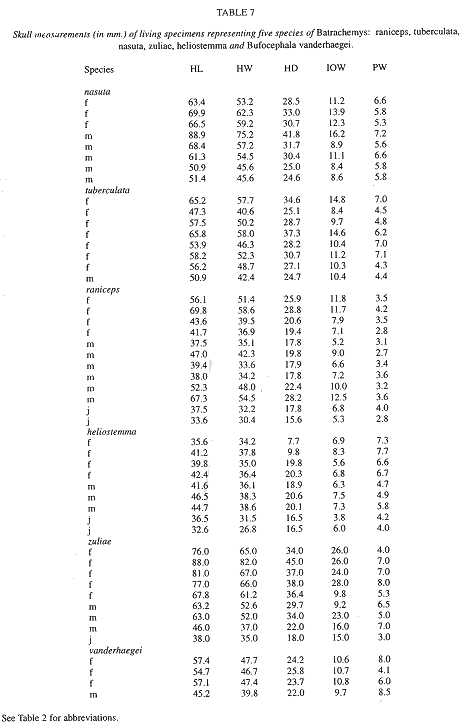
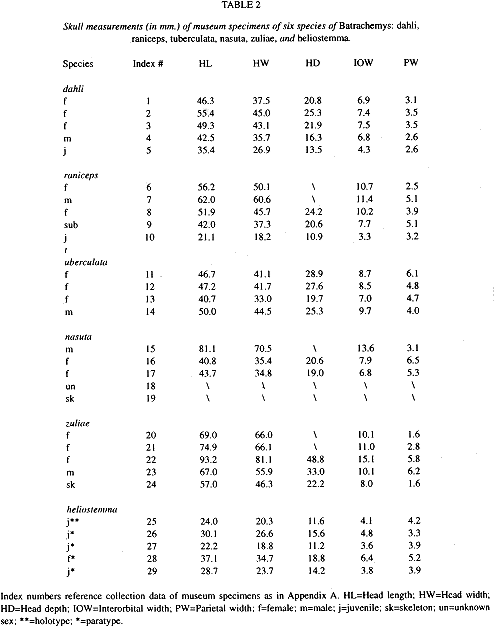
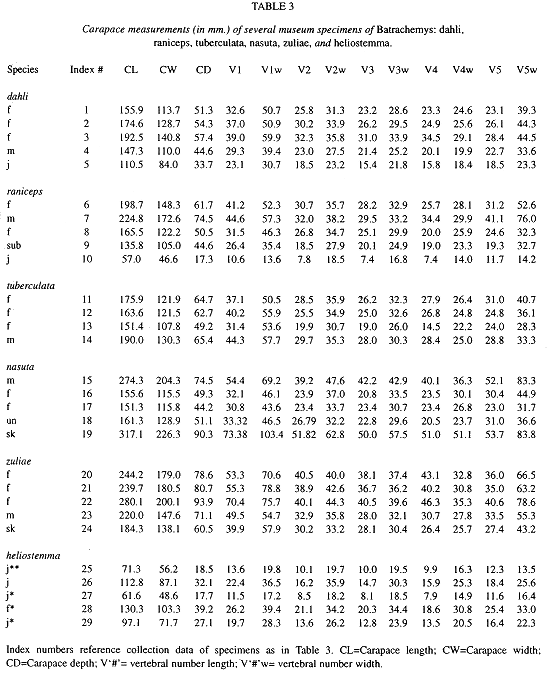
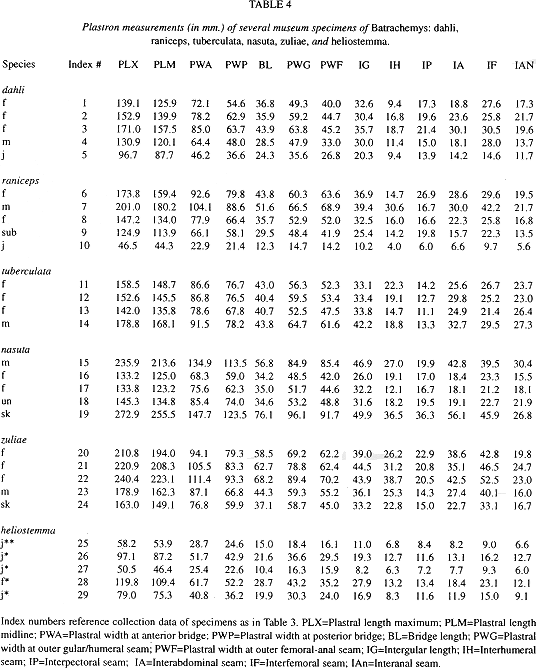
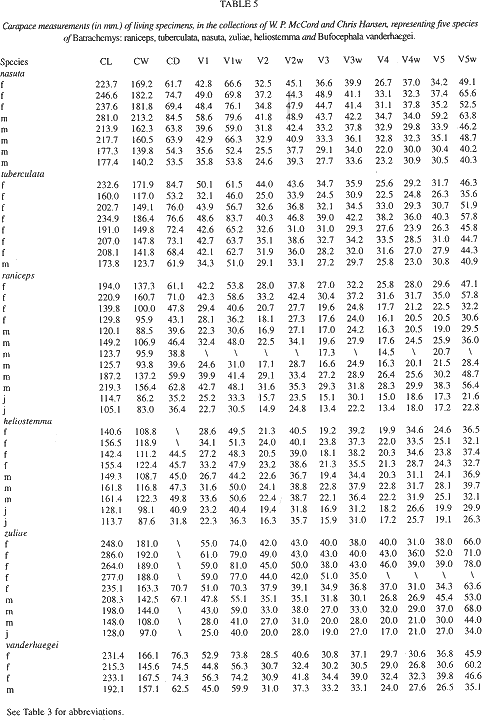
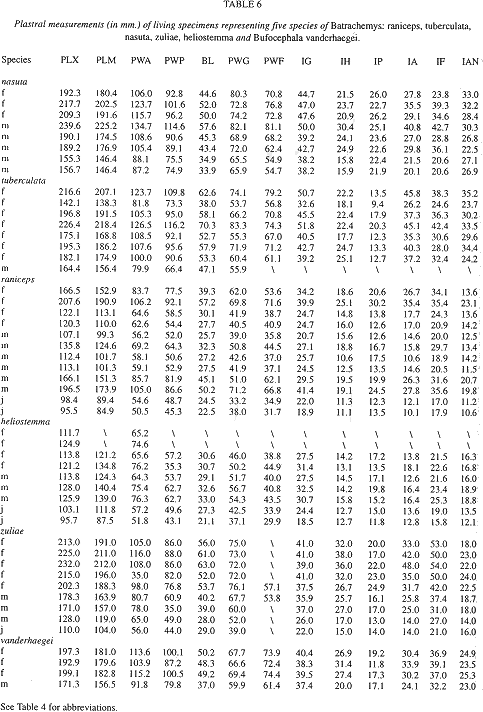
<body><![CDATA[<p><font face="Arial"><font size=-1>In 1826, Fitzinger (using the manuscripts of Hemprich 1796-1825) designed the following taxonomic scheme for some chelonian taxa (i.e., South American toadheads): Class Reptilia; Order - Monopnoa; Tribe Testudinata; Family - Emydoidea; Genus <i>Emys. </i>Gray (1831a) defined "Rep&uacute;lia" as having vertebrae, lungs, warn [sic] red blood, heart with 1 ventricle and 2 auricles, and skin covered with scales. He defined "Testudinata" (Oppel 1811) as having ribs, vertebrae and stemum united in a bony case, usually covered with horny shields or plates, and jaws toothless.</font></font><font size=-1></font>     <p><font face="Arial"><font size=-1>Gaffney and Meylan (1988) elaborated upon Gray's (183la) definition of Testudinata to include that the post parietals are absent, lacrimal bone small or absent, teeth replaced by horny triturating surfaces, parietal (pineal) opening usually absent, stapes solid and rodlike, and postfrontal absent. The toadheads of South America presently fall under the following taxonomic hierarchy: Class - Reptilia; Order - Testudines; Suborder - Pleurodira; Family - Chelidae.</font></font><font size=-1></font>     <p><font face="Arial"><font size=-1>The suborder Pleurodira (Cope 1864) is distinguished by the following combination of characters (after Legler and Georges 1993): the neck flexes laterally to either side and tucks under the anterior edge of the carapace; a trochlear pulley system of the adductor muscles of the jaw utilizes the lateral process of the pterygoid bone to enhance muscular efficiency as opposed to the situation in the Cryptodira where the antero-dorsal edge of the otic capsule is used; and the pelvis is always fused to the plastron. The oldest known Chelonians <i>(Proterochersis </i>Fraas 1913), from the upper Triassic, belong to the Pleurodira.</font></font><font size=-1></font>     <p><font face="Arial"><font size=-1>The family Chelidae (Gray 183la) has Gondwanan origins and first registers in the lower Cretaceous period of Patagonia (Fuente 1997). They are carnivorous (Cei 1993). The skuil is strongly depressed; the basisphenoid is elongate, triangular, much broader behind; the basioccipital is extremely naffow and elongate (Gray 1872a). Nasal bones are present (diagnostic for the family if only living forms are considered (Gaffney 1979) in all but <i>Chelus; a</i> vomer is present and usually separating the palatines; a splenial bone is present; a post parieto-squamosal arch is present (except <i>Chelodina) </i>and the quadratojugal is absent. The central articulations of the 5<sup>th</sup>and 8<sup> th </sup>cervical vertebrae are bi-convex, and saddle joints are never present (no convex articular surface from behind fitting into a concave surface in front). A mesoplastron is absent (Legler and Georges 1993). The pelvis is fused to the carapace and plastron (or to "vertebra and stemum" as per Gray 1870); neural bones are reduced or absent; thirteen plastral scutes (including the intergular) are present; there are twelve pairs of marginal scutes; the two halves of the lower jaw are connected by a seam (not fused) at the symphysis (with the exception of the genera <i>Emydura Elseya - Rheodytes - Elusor); </i>a nuchal scute is present (absent in most Australian and at least one New Guincan <i>Elseya); </i>nictitating membranes are absent; and the head is covered with soft skin or small scales. The chromosome number in the Chelidae (Bull and Legler 1978; Legler and Georges 1993) ranges from 2n=50 to 64 (96 in triploid <i>Platemys).</i></font></font>     <br><font size=-1></font>&nbsp;<font size=-1></font>     <p><b><font face="Arial"><font size=-1>Materials and Methods</font></font></b><font size=-1></font>     <p><font face="Arial"><font size=-1>Specimens of all recognized species of toadheads were examined. In addition, 6 museum and 17 living specimens of an undescribed <i>Batrachemys </i>were available for study (see Tables 1-7, and <a href="#apenA">Appendices A</a> <a href="#apenB">and B</a>).</font></font><font size=-1></font>     <p><font face="Arial"><font size=-1>All measurements to the nearest 0. 1 mm were taken with electronic calipers. The characters obtained include: head length - straight line from anterior edge of premaxilla to back of the crista supraoccipitalis (HL); head width - maximum straight width of skull at tympana (HW); head depth - maximum height of skull from ventral caudal mandible to dorsal parietal roof (HD); interorbital width - the width of the frontal bone between the orbits taken from medial internal ridge of the orbits (IOW); parietal width - across the lateral edges of the dorsal parietal roof taken at its narrowest point (PW); carapace length - maximum straight midline from center of anterior nuchal scute to caudal seam between 12&nbsp;<sup> </sup>marginals (CL); carapace width - straight line at its widest point (CW); carapace depth - maximum height of shell (CD); vertebral scute length - maximum straight midline (VI-5); vertebral scute width - straight line, at widest point (VI -5w); plastral length maximum - straight line from anteriormost point of plastron to posteriormost tip of anal scute (PWX); plastral length midline - maximum straight midline from anterior to posterior plastral margins (PLM); plastral width at anterior bridge - taken as straight line between axillary notches (PWA); plastral width at posterior bridge - straight line between inguinal notches (PWP); bridge length - from axillary to inguinal notches (BL); plastral width at outer gular/humeral seam - straight line between distal ends of gular/humeral seams (PWG); plastral width at outer femoral/anal seam - straight line between distal ends of femoral/anal seams (PWF); intergular scute - straight midline length (IG); inter-humeral, pectoral, abdominal, femoral and anal seams - maximum midline length of each seam (IH, IP, IA, IF and lAn). Sample sizes are given in <a href="#tab2">Tables 2</a> and<a href="#tab5"> 5</a>, and in Appendix A. Many unlisted living and preservad specimens of all the toadhead species were studied in the senior author's private collection.</font></font>     <br><font size=-1></font>&nbsp;<font size=-1></font>     <p><b><font face="Arial"><font size=-1>Sistematics</font></font></b><font size=-1></font>     ]]></body>
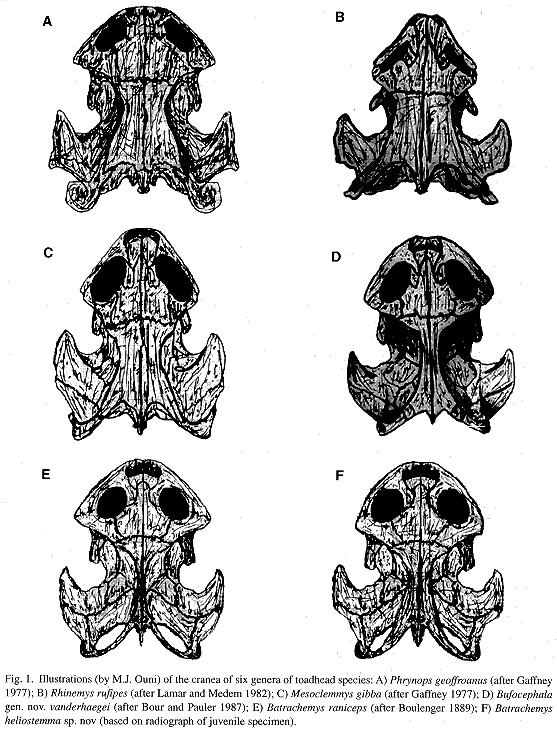
<body><![CDATA[<p><font face="Arial"><font size=-1>In agreement with Georges <i>et al. </i>(1998) and Cabrera (1998), we herein recognize and re-diagnose the three toadhead genera: <i>Batrachemys, Mesoclemmys, and Phrynops. </i>Our diagnoses include characters of skull osteology based on material representad in <a href="#img1">Figure 1</a> (also see Siebenrock, 1897).</font></font><font size=-1></font>     <center>     <p><a NAME="img1"></a><img SRC="/img/fbpe/rbt/v49n2/1034i1.GIF" height=729 width=557>     
<br><font size=-1></font>&nbsp;     <br><font size=-1></font>&nbsp;<font size=-1></font>     <p><a NAME="tab1"></a><img SRC="/img/fbpe/rbt/v49n2/1034ta1.GIF" height=488 width=492><font size=-1></font>     
<p><a NAME="tab2"></a><img SRC="/img/fbpe/rbt/v49n2/1034ta2.GIF" height=632 width=494><font size=-1></font>     
<p><a NAME="tab3"></a><img SRC="/img/fbpe/rbt/v49n2/1034ta3.GIF" height=673 width=547><font size=-1></font>     
<p><a NAME="tab4"></a><img SRC="/img/fbpe/rbt/v49n2/1034ta4.GIF" height=668 width=536><font size=-1></font>     
<p><a NAME="tab5"></a><img SRC="/img/fbpe/rbt/v49n2/1034ta5.GIF" height=720 width=482><font size=-1></font>     
]]></body>
<body><![CDATA[<p><a NAME="tab6"></a><img SRC="/img/fbpe/rbt/v49n2/1034ta6.GIF" height=712 width=483><font size=-1></font>     
<p><a NAME="tab7"></a><img SRC="/img/fbpe/rbt/v49n2/1034ta7.GIF" height=724 width=464></center> <a NAME="Table 2"></a><font face="Arial"><font size=-1><a href="#tab2">Table 2</a></font></font><font size=-1></font>     
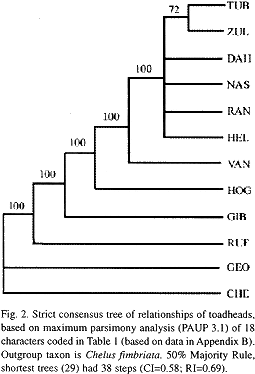
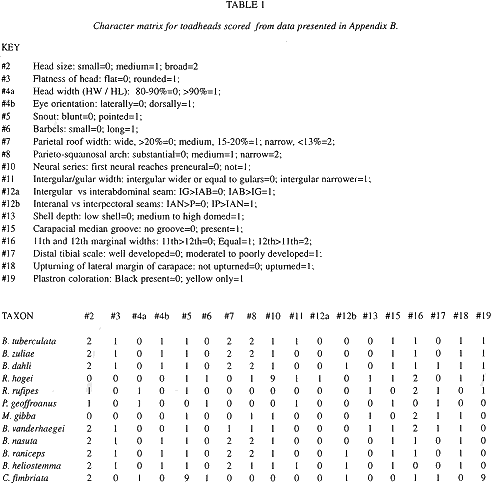
<p><font face="Arial"><font size=-1>After reviewing both osteological and morphological characteristics of currently recognized species within the genera <i>Batrachemys, Mesoclemmys and Phrynops</i> <a href="#apenB">(Appendix B)</a>, we find<b> </b>the need for further taxonomic ciarification. Our data compel us to leave the <i>"Phrynops geoffroanus </i>complex" (including <i>P. geoffroanus </i>[generotype], <i>P</i>. <i>tuberosus, P. williamsi </i>and <i>P.hilaii&iexcl;) </i>in the genus <i>Phrynops; </i>to re-allocate <i>P</i>. <i>rufipes </i>and <i>P</i>. <i>hogei </i>each to their own monotypic genus; to <i>leave Mesoclemmys gibba </i>as generotype of the monotypic genus <i>Mesoclemmys; </i>to leave the <i>"Batrachemys nasuta complex" (B. nasuta</i> [generotype], <i>B. raniceps, B. dahli, B. zuliae</i> and <i>B. tuberculata) </i>in the genus <i>Batrachemys;</i> and to create a monotypic genus for <i>Batrachemys vanderhaegei.</i></font></font><font size=-1></font>     <p><font face="Arial"><font size=-1><i>Since Phrynops (Rhinemys) rufipes </i>is the generotype of <i>Rhinemys, </i>which as a genus was earlier (Gray, 1844) synonymized with <i>Phrynops </i>(see above), we herein resurrect the genus name <i>Rhinemys </i>for this species. Of the 19 characters (<a href="#apenB">Appendix B)</a> examined, <i>Rhinemys</i> <i>rufipes </i>and members of the <i>P. geoffroanus com</i>plex share only 32% (i.e., # 2, 3, 8, 9, 10, and 18), whereas compared to each other, the four members of the <i>P. geoffroanus </i>complex (<i>P</i>. <i>geoffroanus, P tuberosus, P williamsi </i>and P <i>hilarii) </i>share 84%. This justifies the removal of the species <i>rufipes </i>from the genus <i>Phrynops.</i></font></font><font size=-1></font>     <p><font face="Arial"><font size=-1><i>Phrynops hogei </i>Mertens, 1967, was originally describes in the genus <i>Phrynops; </i>however, this species is distinct from all other members of that genus as defined herein. lt is said to be the most osteologically divergent member of the genus <i>Phrynops </i>(Rhodin, in Reed <i>et al. </i>1991). When compared to the <i>P</i>. <i>geoffroanus </i>complex, it shares at most 37% of the characters tabulated in <a href="#apenB">Appendix B</a> (i.e., # 6, 7, 9?, 10?, 11, 14, and 15). We herein propose the new monotypic genus <i>Ranacephala,</i> to include the species <i>R. hogei </i>as the generotype. In addition, <i>Rhinemys rufipes </i>shares at most 37% of the characters in <a href="#apenB">Appendix B</a> (i.e., # 5, 7, 9?, 10?, 13, 16, and 19) with <i>Ranacephala hogei, </i>supporting the recognition of these two forms in separate genera.</font></font><font size=-1></font>     <p><font face="Arial"><font size=-1>Similarly, as noted by two other investigators (Bour, 1973; Bour and Pauler, 1987), we believe that the affinities of <i>Batrachemys vanderhaegei</i> lie somewhere between <i>Mesoclemmys and Batrachemys. Batrachemys</i> <i>vanderhaegei </i>shares 37% of the characters in <a href="#apenB">Appendix B</a> (i.e., # 1, 5, 9, 11, 16, 18 and 19) with <i>M. gibba; </i>37% of the characters in Appendix B (i.e., # 5, 6, 9, 11, 14, 15 and 19) with <i>B. nasuta; </i>and 32% of the characters in Appendix B (i.e., # 3, 6, 9, 14, 15, 18) with B. <i>tuberculata. </i>For comparison, the members of <i>the "Batrachemys nasuta complex" (B. dahli,B. nasuta, B. raniceps, B. tuberculata, B. zuliae) </i>share at least 79% (all but # 1, 11, 12, 19) of the characters representad in <a href="#apenB">Appendix B</a>. This demonstrates that the affinities of <i>B. vanderhaegei </i>do not lie with either <i>Mesoclemmysor Batrachemys. </i>The new monotypic genus <i>name Bufocephala </i>is herein proposed, to include the generotype <i>B. vanderhaegei.</i></font></font><font size=-1></font>     <p><font face="Arial"><font size=-1>In order to test our generic arrangement for the toadheads, we undertook a cladistic analysis (using PAUP 3.1) of the characters scored in <a href="#tab1">Table 1</a>. The resulting ciadogram <a href="#img2">(Fig. 2)</a> further supports our taxonomic conclusions.</font></font><font size=-1></font>     <p><font face="Arial"><font size=-1><b><i>MESOCLEMMYS </i></b>Gray 1873a</font></font><font size=-1></font>     <p><font face="Arial"><font size=-1><b>Type Species. </b><i>- </i>Emys gibba Schweigger 1812, by monotypy.</font></font><font size=-1></font>     <p><font face="Arial"><font size=-1><b>Vernacular Name. - </b>The Humpbacked Toadheads <i>(gibba = </i>Latin for "hump", "bump").</font></font><font size=-1></font>     ]]></body>
<body><![CDATA[<p><font face="Arial"><font size=-1><b>Etymology. - </b>Greek,<i> mesos </i>for "middle" or "in between", and Greek, <i>klemmys </i>for "turtle." The "intermediate turtle"- "between <i>Hydraspis and Platemys," </i>according to Gray, 1873b:305.</font></font><font size=-1></font>     <p><font face="Arial"><font size=-1><b>Grammatical gender: </b>feminine.</font></font><font size=-1></font>     <p><font face="Arial"><font size=-1><b>Diagnosis and Description. - </b>The genus <i>Mesoclemmys </i>is part of the toadhead complex of chelid turtles with the following characteristics: A head width between the tympana 15-20% of the median straight length of the carapace. Three to four neural bones (sometimes none) are usually present. The first neural bone is absent, allowing the f&iacute;rst costals to contact medially. Tbe neurals, when present, may or may not be in a contiguous row. The nuchal reaches the anterior margin of the carapace. There is no large, round scale present distally on the antero-medial row of tibial scales. The 11lth marginal is narrower than the supracaudals. The lateral borders of the carapace narrow mildly, with a strong upward curve. The vertebrals are arched, with the median keel on vertebrals 3, 4, and 5 poorly developed. The anterior end of the plastron is equal to or wider than the posterior end. The interanal plastral seam is shorter than the interhumeral seam. The dorsum of the head is covered by many small seales. The paired barbels are short to medium in size.</font></font><font size=-1></font>     <center>     <p><a NAME="img2"></a><img SRC="/img/fbpe/rbt/v49n2/1034i2.GIF" height=374 width=255></center> <font size=-1></font>     
<p><font face="Arial"><font size=-1><b>Skull. - </b>The skull is relatively smaller than other toadheads. The nasal is long and thin. The quadrate points considerably inward. The exoccipital, supraoccipital, ophisthotic (a cartilaginous bone that ossifies in the posterior half of the otic capsule, according to Gaffney, 1979) and squamosal bones are reduced. The parietals are wide above (dorsally) and some-what hourgiass-shaped. At the narrowest point the parietal roof width is never less than the horizontal diameter of the orbit. The parietosquamosal arches are narrow and pass above, but not posterior to the rear margin of the opisthotic bones. There is lack of symphysial fusion in the mandible. The chelid foramen (McDowell, 1983) or foramen retropterygoideum (Bour and Pauler, 1987) is well developed.</font></font><font size=-1></font>     <p><font face="Arial"><font size=-1><b>Comparisons. </b><i>- Mesoclemmys</i>, as a genus, was originally created because <i>Emysgibba </i>was distinct from the other toadheads. lt shares some features of both <i>Phrynops and</i> <i>Batrachemys. </i>For example, the snout is pointed (as in <i>Batrachemys), </i>the parietals are broadened above (as in <i>Phrynops), </i>the parieto-squamosal arches are narrow (as in <i>Batrachemys); </i>the parieto-squamosal arches pass directly above but not posterior to the rear margin of the opisthotic bones (as in <i>Phrynops), </i>and the first neural bone is absent, allowing the first pair of costals to contact medially (as in <i>Batrachemys).</i></font></font><font size=-1></font>     <p><font face="Arial"><font size=-1><b>Content.</b> <b>-</b><i>Mesoclemmysgibba</i> (Schweigger, 1812). Only one monotypic species is recognized, but there is clearly an east-west cline, for instance with the head coloration, darker westwards (Bour and Pauler, 1987:7).</font></font><font size=-1></font>     <p><font face="Arial"><font size=-1><b>Distribution. - </b>Orinoco to Amazon river basins in Colombia, eastern Ecuador, Peru, Venezuela, the Guianas and northern Brazil; Trinidad (Iverson, 1992).</font></font><font size=-1></font>     <p><font face="Arial"><font size=-1><b>Preserved Material Examined. - </b>See <a href="#apenA">Appendix A</a> (Also many specimens in senior author's preservad and live collection).</font></font><font size=-1></font>     ]]></body>
<body><![CDATA[<p><font face="Arial"><font size=-1><b><i>PHRYNOPS </i></b>Wagler 1830</font></font><font size=-1></font>     <p><font face="Arial"><font size=-1><b>Type Species. </b><i>- </i>Emys geoffroana Schweigger 1812, by monotypy.</font></font><font size=-1></font>     <p><font face="Arial"><font size=-1><b>Vernacular Name. - </b>The Bearded Toadheads.</font></font><font size=-1></font>     <p><font face="Arial"><font size=-1><b>Etymology. - </b>Greek, <i>phryne </i>for "toad" and Greek, <i>ops </i>for "appearance." The "Toadlike Turtle." (cf. Wagler, 1830: 135).</font></font><font size=-1></font>     <p><font face="Arial"><font size=-1><b>Grammatical gender: </b>masculine (Bour 1973).</font></font><font size=-1></font>     <p><font face="Arial"><font size=-1><b>Diagnosis and Description. </b>-The genus <i>Phrynops </i>is a member of the toadhead complex of chelid turtles, with the following characteristics: The head is flat and wide, with a blunt snout, and has a width between the tympana 15-20% of the median straight length of the carapace. Five to seven neural bones are present, usually in a contiguous anterior series. The first neural bone is present, contacting the proneural, and separates the first pair of costals. The carapace is relatively flat. The entoplastron is reduced, separating only the epiplastrals and very little of the hyoplastrals. The 11 th marginals are wider than the supracaudals. The lateral borders of the carapace are not upturned and without narrowing. There is no large round scale present at the distal end of the anteromedial row of tibial scales. The interanal seam of the plastron is longer than the interhumeral seam. The paired barbels usually are long.</font></font><font size=-1></font>     <p><font face="Arial"><font size=-1><b>Skull. - </b>The nasal bone is short and thick. Both the jugal and postorbital are long and wide, so the orbits are situated somewhat dorsally on the skull. The maxilla is long and wide so the front of the face is rounded. There is a lack of symphysial fusion in the mandible. The parieto-squamosal arch is substancial and passes above but not posterior to the rear margin of the opisthotic bones. The parietals are broadened, often hourglass-shaped above (dorsally). At the narrowest point the parietal roof width is never less than the horizontal diameter of the orbit. The chelid foramen is present in the generotype <i>P. geoffroanus </i>(R. Bour and E. Gaffney pers. comm.), and in the other presently recognized species of the <i>P</i>. <i>geoffroanus </i>complex (R. Bour pers. comm.).</font></font><font size=-1></font>     <p><font face="Arial"><font size=-1><b>Comparisons. - </b>See Appendix B to compare 19 characters of every toadhead generotype.</font></font><font size=-1></font>     <p><font face="Arial"><font size=-1><b>Content.</b> - <i>Phrynops geoffroanus</i> (Schweigger 1812); P <i>tuberosus </i>(Peters 1870); <i>P hilarii </i>(Dum&eacute;ril and Bibron, 1835); <i>P. williamsi </i>Rhodin and Mittermeier, 1983.</font></font><font size=-1></font>     <p><font face="Arial"><font size=-1><b>Distribution. - </b>Orinoco to Amazon and S&atilde;o Francisco to Paran&aacute; and adjacent river basins of Colombia, Venezuela, the Guianas, Brazil, Paraguay, Uruguay and northeastern Argentina (Iverson, 1992).</font></font><font size=-1></font>     ]]></body>
<body><![CDATA[<p><font face="Arial"><font size=-1><b>Preserved Material Examined. - </b>See Appendix A (Also many specimens in senior author's preserved and live collection).</font></font><font size=-1></font>     <p><font face="Arial"><font size=-1><b>Comment. - </b>Although disputed by some, <i>Phrynops tuberosus </i>was recognized as a full species originally by Peters (1870), and since by Froes (1957), Rhodin and Mittermeier (1983), David (1994), Fritz <i>et al. </i>(1994) and again herein.</font></font><font size=-1></font>     <p><font face="Arial"><font size=-1><b><i>BATRACHEMYS </i></b>Stejneger 1909</font></font><font size=-1></font>     <p><font face="Arial"><font size=-1><b>Tipe Species. </b><i>- </i>Emys nasuta Schweigger 1812, by original designation of Stejneger.</font></font><font size=-1></font>     <p><font face="Arial"><font size=-1><b>Vernacular Name. - </b>The Northern Toadheads.</font></font><font size=-1></font>     <p><font face="Arial"><font size=-1><b>Etymology. - </b><i>Greek, batrachos for</i> "frog," and Greek, <i>emys </i>for "freshwater turtle." The "Frog Turtle."</font></font><font size=-1></font>     <p><font face="Arial"><font size=-1><b>Grammatical gender: </b>feminine.</font></font><font size=-1></font>     <p><font face="Arial"><font size=-1><b>Diagnosis and Description. - </b>The genus <i>Batrachemys </i>is a member of the toadhead group of chelid turtles with the following characteristics: The snout is pointed. The carapace is relatively broad, as is the head, whose width between the tympana is 20% or more of the median straight length of the carapace. The neck is relatively thin and short. Zero to five reduced neural bones (usually 3 - 4) may be present and are sometimes discontiguous. The first neural is absent, allowing the first pair of costal bones to contact medially (as with <i>Mesoclemmys, </i>but not <i>Phrynops, </i>which has a first neural). The interanal seam of the plastron is usually longer than the interhumeral seam, but sometimes equal or shorter. The 11 th marginals are narrower than or equal to the width of the supracaudals. A welldeveloped scale is present at the distal end of the antero-medial row of tibial scales. The paired barbels are small.</font></font><font size=-1></font>     <p><font face="Arial"><font size=-1><b>Skull. - </b>The nasal bone is short and thick. The jugal and postorbital are short and wide, situating the orbit at the center of the maxilla. The prefrontal and frontal are somewhat smaller, not reaching as far forward as in <i>Phrynops. </i>There is lack of symphysial fusion in the mandible. The parieto-squamosal arch is narrow and posteriorly displaced, reaching caudally beyond the posterior margin of the opisthotic bones. The parietal roof is somewhat parallel-sided, narrow, and sometimes ridged. The width of the parietal roof at its narrowest point is less than the horizontal diameter of the orbit. The chelid foramen is present in all species presently included in this genus (Bour and Pauler, 1987).</font></font><font size=-1></font>     <p><font face="Arial"><font size=-1><b>Comparisons. - </b>See Appendix B to compare 19 characters of every toadhead generotype.</font></font><font size=-1></font>     ]]></body>
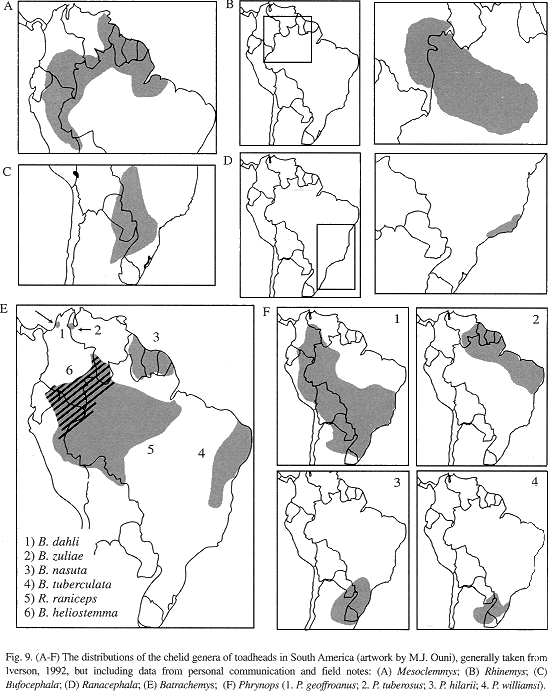
<body><![CDATA[<p><font face="Arial"><font size=-1><b>Content.</b> <b>-</b><i>Batrachemysnasuta</i> (Schweigger 1812); <i>B. dahli </i>(Zangerl and Medem 1958); <i>B. zuliae </i>(Pritchard and Trebbau 1984); <i>B. tuberculata </i>(Luederwaldt 1926); <i>B. heliostemma </i>sp. nov.; <i>B. raniceps</i> (Gray 1855; synonymized under <i>R. nasuta by</i> Boulenger 1889; resurrected by Bour and Pauler 1987).</font></font><font size=-1></font>     <p><font face="Arial"><font size=-1><b>Distribution. - </b>Inciudes <i>B. heliostemma</i> sp. nov. in the upper Amazon basin from southern Venezuela, western Brazil, northeastern Peru, and eastern Ecuador to southeastern Colombia, overlapped <i>by B. raniceps </i>found in the upper Orinoco to Amazon river basins in eastern Colombia, southern Venezuela, Peru, Brazil and Bolivia; <i>B. tuberculata </i>in eastern Brazil in the Rio S&atilde;o Francisco and adjacent basins; <i>B. nasuta </i>in the Guianas and adjacent Brazil; <i>B. dahli </i>in northeastern Colombia; and <i>B. zuliae </i>found in the basins draining with the western shore of Lake Maracaibo, Venezuela (Iverson, 1992).</font></font><font size=-1></font>     <p><font face="Arial"><font size=-1><b>Preserved Material Examined. - </b>See <a href="#apenA">Appendix A</a> (Also many specimens in senior author's preserved and live collection).</font></font><font size=-1></font>     <p><font face="Arial"><font size=-1><b>Comment. </b><i>- Batrachemys</i> (as representad by <i>B</i>. <i>dahli) </i>is the only living chelid genus found west of the Andes Mountains (Medem 1966).</font></font><font size=-1></font>     <p><b><font face="Arial"><font size=-1><i>RHINEMYS </i>Wagler 1830 gen. resurrected.</font></font></b><font size=-1></font>     <p><font face="Arial"><font size=-1><b>Type Species. </b><i>- </i>Emys rufipes Spix 1824, by subsequent designation of Fitzinger 1843.</font></font><font size=-1></font>     <p><font face="Arial"><font size=-1><b>Vernacular Name. - </b>The Red Toadheads.</font></font><font size=-1></font>     <p><font face="Arial"><font size=-1><b>Etymology. - </b>From the Greek r<i>hinos</i> meaning "nose," and the Greek <i>emys </i>meaning "freshwater turtle." The "Big-nosed Freshwater Turtle."</font></font><font size=-1></font>     <p><font face="Arial"><font size=-1><b>Grammatical gender: </b>feminine.</font></font><font size=-1></font>     <p><font face="Arial"><font size=-1><b>Diagnosis. - </b>A toadhead turtle of the family Chelidae distinguished from all others by having red coloration of the head and limbs. Further distinguished by having a mediumsized head (similar to <i>P</i>. <i>geoffroanus and </i>B. <i>vanderhaegei); </i>nostrils (snout) much more prominent than any other toadhead; barbels small (as in all <i>Batrachemys; </i>not as large as <i>Phrytiops); </i>the widest parietal roof in any toadhead (over 30% HW in juveniles); 5-8 neural bones (as in <i>Phrynops; </i>more than <i>Mesoclemmys and Batrachemys); </i>the first neural touching the proneural (as in <i>Phrynops); </i>the intergular wider than the gulars (as with all toadheads but <i>R. hogei, P. geoffroanus, B. tuberculata and B. heliostemma);</i> the interfemoral plastral seam longest (as in <i>B.</i> <i>dahli </i>and often in <i>P. geoffroanus); </i>a domed carapace (as in <i>R. hogei and M. gibba); </i>a vertebral keel present (as in <i>M. gibba); </i>a carapacial groove absent (as in <i>M. gibba); </i>the 11<sup>th</sup> marginas narrower than the 12<sup>th</sup> (as in <i>R.</i> <i>hogei, B. vanderhaegei and M. gibba); </i>a mild&iexcl;y developed antero-medial distal tibial scale (as in <i>M. gibba); </i>no upturn of lateral marginals (as in <i>P</i>. <i>geoffroanus); </i>and a solid yellow plastron<b> </b>(as in <i>R. hogei, B. dahli </i>and<i>B. zuliae). </i>The chelid foramen is present (R. Bour pers. comm. from examination of the holotype).</font></font><font size=-1></font>     ]]></body>
<body><![CDATA[<p><font face="Arial"><font size=-1><b>Description. - </b>A full description of the only inciuded species <i>(E. rufipes) </i>is provided in the original description by Spix (1824), again by Medem (1975), and with further details provided by Lamar and Medem (1982); see also <a href="#apenB">Appendix B</a>.</font></font><font size=-1></font>     <p><font face="Arial"><font size=-1><b>Comparisons. - </b>See <a href="#apenB">Appendix B</a> to compare 19 characters of every toadhead generotype.</font></font><font size=-1></font>     <p><font face="Arial"><font size=-1><b>Content. - </b>Includes only <i>Rhinemys</i> <i>rufipes.</i></font></font><font size=-1></font>     <p><font face="Arial"><font size=-1><b>Distribution. - </b>Primarily the rnid- to upper Amazon Basin, but see Lamar and Medem (1982) for further details.</font></font><font size=-1></font>     <p><font face="Arial"><font size=-1><b>Preserved Material Examined. - </b>See <a href="#apenA">Appendix A</a>. (Also 4 living specimens in the senior author's collection).</font></font><font size=-1></font>     <p><b><font face="Arial"><font size=-1><i>RANACEPHALA </i>gen. nov.</font></font></b><font size=-1></font>     <p><font face="Arial"><font size=-1><b>Type Species. </b><i>- </i>Phrynops hogei Mertens 1967, by present designation.</font></font><font size=-1></font>     <p><font face="Arial"><font size=-1><b>Vernacular Name. - </b>The Rio Paraiba Toadheads.</font></font><font size=-1></font>     <p><font face="Arial"><font size=-1><b>Etymology. - </b>Latin, <i>rana </i>for "frog," and Greek <i>, kephale </i>for "head." The "Froghead Turtle." (The generotype was named in honor of Dr. A. R. Hoge, from the Instituto Butantan in S&aacute;o Paulo, Brazil).</font></font><font size=-1></font>     <p><font face="Arial"><font size=-1><b>Grammatical gender: </b>feminine.</font></font><font size=-1></font>     ]]></body>
<body><![CDATA[<p><font face="Arial"><font size=-1><b>Diagnosis. - </b>A toadhead turtle of the family Chelidae distinguished by having a distinct bicolor head (as in <i>B. nasuta); </i>a relatively small head (as in <i>M. gibba); </i>a pointed snout (as in all toadheads but the <i>P</i>.<i> geoffroanus </i>complex); large barbels (most similar to <i>P.</i> <i>geoffivanus);</i> wide parietal roof width in adults (as in <i>M.</i> <i>gibba </i>and <i>P</i>. <i>geoffroanus); </i>intergular seute narrower than gulars (as in <i>P</i>. <i>geoffroanus, B. tuberculata, and B. heliostemma); </i>interabdominal seam (of plastral seam formula) longest (unique to <i>R. hogei); </i>carapace domed (as in <i>R. rufipes</i> and <i>M gibba); </i>the lack of a vertebral keel (as in all toadheads but <i>R. rufipes and M. gibba); </i>carapacial median groove present in mature adults (as in all toadheads but <i>R. rufipes and M. gibba); </i>11<sup>th</sup> marginal narrower than 12<sup>th</sup> (as in <i>R.</i> <i>rufipes, M. gibba and B. vanderhaegei); the</i> antero-medial distal tibial scale is well developed, (as in <i>B. zuliae, B. raniceps, B. tuberculata, B. nasuta and B. heliostemma); </i>the lateral marginals upturned (as with all toadheads but <i>R</i>. <i>rufipes and P. geoffroanus, </i>but with <i>Ranacephala </i>the upturn is "sharp" as in <i>M.</i> <i>gibba, B. vanderhaegei, B. dahli, B. zuliae, </i>and <i>B. tuberculata); </i>and plastron solid yellow (as in <i>R. rufipes, B. dahli </i>and <i>B. zuliae). </i>The chelid</font></font><font size=-1></font>     <p><font face="Arial"><font size=-1>foramen is thought to be present, but this is not confirmed (R. Bour pers. comm.). Data on the neural series are unconfimed at this time due to lack of skeletonized specimens.</font></font><font size=-1></font>     <p><font face="Arial"><font size=-1><b>Description. - </b>A full description of the only included species <i>(P. hogei) </i>is provided by Mertens (1967) and further detail-s are given by Rhodin <i>et al. </i>(1982); see also <a href="#apenB">Appendix B</a>.</font></font><font size=-1></font>     <p><font face="Arial"><font size=-1><b>Comparisons. - </b>See <a href="#apenB">Appendix B</a> to compare 19 characters of every toadhead generotype.</font></font><font size=-1></font>     <p><font face="Arial"><font size=-1><b>Content. - </b>Includes only <i>Ranacephala</i> <i>hogei </i>(Mertens 1967).</font></font><font size=-1></font>     <p><font face="Arial"><font size=-1><b>Distribution. - </b>Found in low-lying areas of the Rio Paraiba drainage of Rio de Janeiro, and southern Minas Gerais, north to coastal Esp&iacute;rito Santo in Brazil (Mittermeier <i>et al.</i> 1980).</font></font><font size=-1></font>     <p><font face="Arial"><font size=-1><b>Preserved Material Examined. - </b>See <a href="#apenA">Appendix A</a>.</font></font><font size=-1></font>     <p><b><font face="Arial"><font size=-1><i>BUFOCEPHALA </i>gen. nov.</font></font></b><font size=-1></font>     <p><font face="Arial"><font size=-1><b>Type Species. </b><i>- </i>Phrynops vanderhaegei Bour 1973, by present designation.</font></font><font size=-1></font>     <p><font face="Arial"><font size=-1><b>Vernacular Name. - </b>The Southern Toadheads.</font></font><font size=-1></font>     ]]></body>
<body><![CDATA[<p><font face="Arial"><font size=-1><b>Etymology. - </b>Latin, <i>bufo </i>for "toad," and Greek, <i>kephale </i>for "head." The "Toadhead Turtle." (The generotype was named in honor of Maurice Vanderhaege, a cheloniophile and friend of R.<b> </b>Bour).</font></font><font size=-1></font>     <p><font face="Arial"><font size=-1><b>Grammatical gender: </b>feminine.</font></font><font size=-1></font>     <p><font face="Arial"><font size=-1><b>Diagnosis. - </b>A toadhead turtle of the family Chelidae distinguished by having a generally blackish head in adults (as.in <i>M. gibba and </i>B. <i>heliostemma); </i>a medium-sized head (as in <i>R.</i> <i>rufipes </i>and <i>P</i>. <i>geoffroanus); </i>a horizontal "bar" in the iris of the eye [= iris] (as in <i>B. dahli and </i>B. zuliae); nose pointed (as in all toadheads except the <i>P. geoffroanus </i>complex); small barbels (as in all toadheads but <i>R. hogei, </i>and the <i>P</i>. <i>geoffroanus </i>complex); parietal roof width moderate, as in no other toadhead; reduced neural series (as in all toadheads <i>[R. hogei ?</i>]but the <i>P</i>. <i>geoffroanus </i>complex and <i>R. rufipes), </i>but unique in having a usually discontiguous series, often with a first neural present, that does not touch the proneural; intergular wider than gulars (as in all toadheads but <i>R. hogei, P. geoffroanus, B. tuberculata and B. heliostemma); </i>plastral seam formula starts with IG>IF>Iab (as in <i>B. dahli, B.</i> <i>raniceps, B. nasuta, B. heliostemma, </i>and sometimes <i>M. gibba </i>and <i>P. geoffroanus); </i>the carapace is mildly domed (unique to <i>B. vanderhaegei); no</i> carapacial median keel (as in all toadheads but <i>R.</i> <i>rufipes and M. gibba); </i>carapacial median groove present in adults (as in all toadheads but <i>R</i>. <i>rufipes and M. gibba); </i>11<sup>th</sup> marginals narrower than 12<sup>th</sup> (as in <i>R. hogei, R. rufipes and </i>M. <i>gibba); </i>the antero-medial distal tibial scale moderately developed (as in <i>B. dahli and P. geoffroanus); </i>the lateral marginal scutes upturned (as in all toadheads but <i>R. rufipes and P. geoffroanus, </i>but with <i>Bufocephala </i>the upturn is "sharp", as in <i>M. gibba, R. hogei, B. dahli, B.</i> <i>zuliae and B. tuberculata); </i>there is obvious narrowing of the lateral marginals of the carapace, a unique condition among toadheads; plastron generally black with yellow background (as in many <i>M. gibba, </i>and similar to that in <i>B. raniceps, B. nasuta and B. heliostemma); </i>axillary scutes absent in the Paraguayan population (as in <i>R. rufipes, B. zuliae, </i>and sometimes <i>B. nasuta</i> and <i>B. dahli). </i>The chelid foramen is present (Bour and Pauler 1987).</font></font><font size=-1></font>     <p><font face="Arial"><font size=-1><b>Description. - </b>A full description of the only included species <i>(B. vanderhaegei) </i>is provided in the original description by Bour (1973) with further details given by Bour and Pauler (1987); see also <a href="#apenB">Appendix B</a>.</font></font><font size=-1></font>     <p><font face="Arial"><font size=-1><b>Comparisons. - </b>See <a href="#apenB">Appendix B</a> to compare 19 characters of every toadhead generotype.</font></font><font size=-1></font>     <p><font face="Arial"><font size=-1><b>Content. - </b>Includes only <i>Bufocephala</i> <i>vanderhaegei.</i></font></font><font size=-1></font>     <p><font face="Arial"><font size=-1><b>Distribution. - </b>Basins of Paraguay and Parana rivers in Paraguay, Brazil and northern Argentina.</font></font><font size=-1></font>     <p><font face="Arial"><font size=-1><b>Preserved Material Examined. - </b>See <a href="#apenA">Appendix A</a>. (Also 10 living specimens in the senior author's collection).</font></font><font size=-1></font>     <p><b><font face="Arial"><font size=-1>A NEW SPECIES OF <i>BATRACHEMYS</i></font></font></b><font size=-1></font>     <p><font face="Arial"><font size=-1>In the early 1990's, one of the authors (WWL) observed several distinctive toadheads near Iquitos, Peru, in the western Amazon basin. In 1984, Roy W. McDiarmid had also collected this distinct toadhead during the Cerro de La Neblina expedition, Venezuela. Independently, Roger Bour discovered a young specimen in the collections of the British Museum. Then at approximately the same time, Chris Hansen of Florida recognized the same taxon among juvenile offspring from a shipment originating in Iquitos that had passed through the pet trade facility at which he was employed.</font></font><font size=-1></font>     ]]></body>
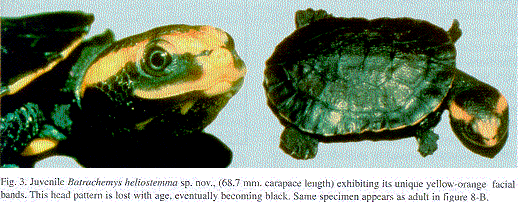
<body><![CDATA[<p><font face="Arial"><font size=-1>All specimens, brought to the attention of the senior author displayed bright yelloworange facial bands <a href="#img3">(Figs. 3</a> and<a href="#img4"> 4)</a> which easily separated them from all other toadheads. These specimens from populations in the Iquitos region of eastern Peru and the Neblina region of southern Venezuela in the upper Amazon clearly represent an undescribed species belonging to the genus <i>Batrachemys as</i> defined herein.</font></font><font size=-1></font>     <center>     <p><a NAME="img3"></a><img SRC="/img/fbpe/rbt/v49n2/1034i3.GIF" height=204 width=518>     
<br><font size=-1></font>&nbsp;<font size=-1></font>     <p><a NAME="img4"></a><img SRC="/img/fbpe/rbt/v49n2/1034i4.GIF" height=451 width=547></center> <font size=-1></font>     
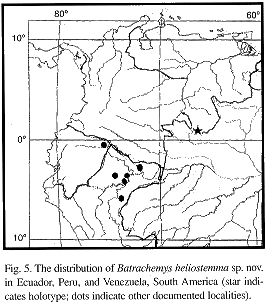
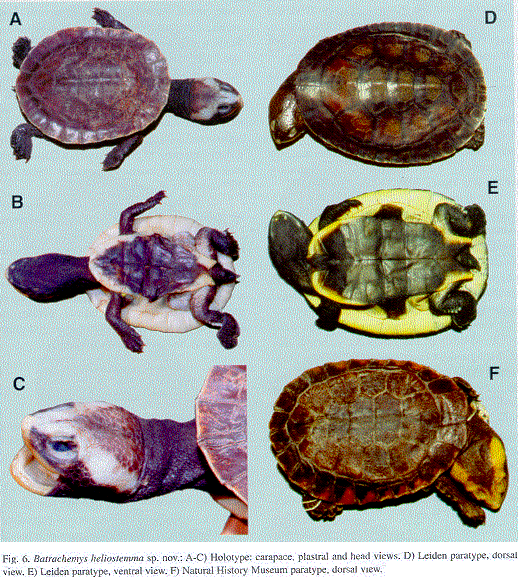
<p><font face="Arial"><font size=-1>AMAZON TOADHEAD</font></font><font size=-1></font>     <p><b><font face="Arial"><font size=-1><i>Batrachemys heliostemma </i>sp. nov.</font></font></b><font size=-1></font>     <p><font face="Arial"><font size=-1><i>Holotype. </i>- Smithsonian Institution (USNM) 541895, juvenile preservad in alcohol, measuring 71.3 mm carapace length, from the base of Pico da Neblina (situated on the Venezuela/Brazil border) on the left bank of R&iacute;o Baria (=R&iacute;o Mawarinuma) [4&deg; 95'N, 66&deg; 10' W], a tributary of the Rio Negro, Amazonas, Venezuela, collected by Roy W. McDiarmid on 17 March, 1984 (<a href="#img5">Figs. 5</a> and<a href="#img6"> 6a-c</a>).</font></font><font size=-1></font>     <center>     <p><a NAME="img5"></a><img SRC="/img/fbpe/rbt/v49n2/1034i5.GIF" height=302 width=267>     
]]></body>
<body><![CDATA[<br><font size=-1></font>&nbsp;<font size=-1></font>     <p><a NAME="img6"></a><img SRC="/img/fbpe/rbt/v49n2/1034i6.GIF" height=577 width=518></center> <font size=-1></font>     
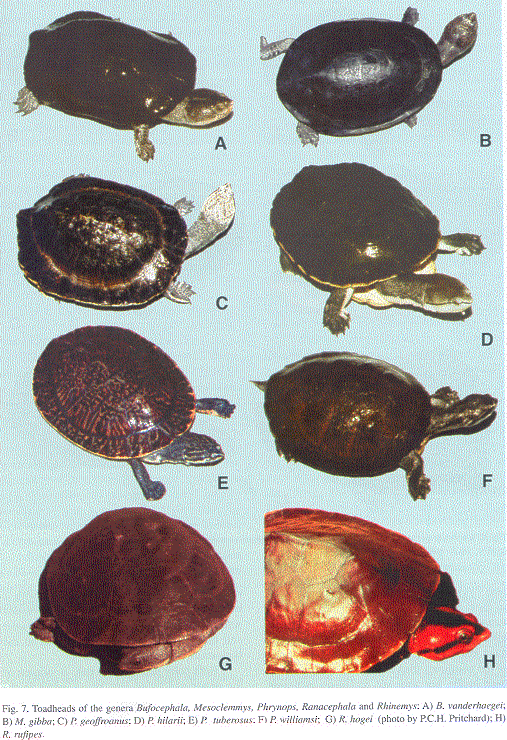
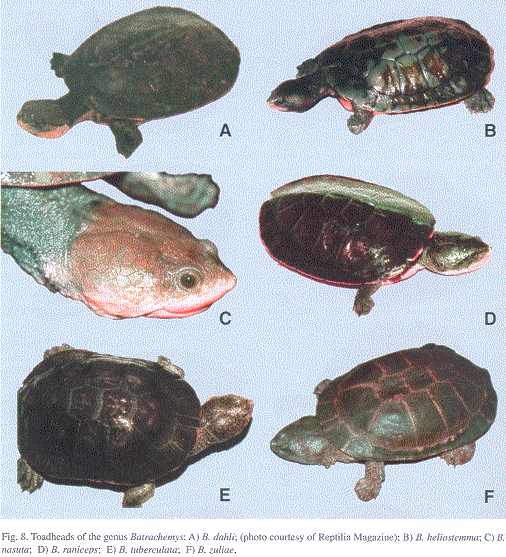
<p><font face="Arial"><font size=-1><i>Paratypes. - </i>Leiden Museum (RMNH) 31998, juvenile preservad in alcohol, measuring 112.8 mm carapace length, from Callao, on the north bank of the R&iacute;o Tapiche [5&deg; 2 1' S, 47&deg; 9'W], near the mouth of the R&iacute;o Blanco, a tributary of the R&iacute;o Ucayali, Loreto, Peru, collected by Federico Medem on 9 September 1972 (F<a href="#img6">ig. 6d and e</a>). RMNH 31999, same data as Leiden Museum (RMNH) 31998. Natural History Museum (NHM; =ex BMNH) 1904.7.26. 1, juvenile, in alcohol, from Igape-Assu, Par&aacute;, Brasil <a href="#img6">(Fig. 6f</a>). Its novelty was noticed by R. Bour in 1987, who withheld describing a new species from such a unique young specimen but of dubious origin (I. Pauler pers. comm.). The collection date is unknown. (C. McCarthy, pers. comm., indicates this specimen was part of a collection made by Monsieur A. Robert and purchased through an animal dealer, Mr. A. Rosenberg. The collection of which it was a part includes species from a wide area of the Amazon basin and we thus do not accept the Par&aacute; locality as valid for <i>B. heliostemma. </i>Moreover, the locality cannot be located in any Brazilian gazeteer). Field Museum of Natural History (FMNH) 218500, subadult, in alcohol, from Marian, Napo, Ecuador, collected by R. M. Timm, on 7 October 1983.</font></font><font size=-1></font>     <p><font face="Arial"><font size=-1><i>Referred Specimens. - </i>Live specimens from the collections of Chris Hansen, Boca Raton, Florida, USA (said to be from Iquitos, Peru), and Carlos Rivera of Iquitos, Peru, collected in the vicinity of Iquitos, Peru. A live adult male colleted at Quebrada Pa&ntilde;ayacu, R&iacute;o Pucacuro (2&deg; 57'9" S, 75&deg; 07'2" W) [tributary of the R&iacute;o Tigre], Peru, colleted by P. Soini.</font></font><font size=-1></font>     <p><font face="Arial"><font size=-1><i>Distribution. </i>-Widely distributed but seemingly localized through the upper Amazon basin, from southern Venezuela, western Brazil, northeastern Peru, and eastern Ecuador to southeastern Colombia. Sympatric chelids are <i>Batrachemys raniceps, M. gibba, P.</i> <i>geoffroanus, Chelus fimbriata, Rhinemys</i> <i>rufipes and Platemys platycephala.</i></font></font><font size=-1></font>     <p><font face="Arial"><font size=-1><i>Diagnosis. - </i>A medium- to large-sized toadhead turtle of the genus <i>Batrachemys that</i> is distinguished from members of other toadhead genera by its large, wide, rounded head; its narrow parietal roof and parieto-squamosal arch; its reduced neural bone series; the combination of its relatively "shallow" carapace, having a median groove, lacking a keel, absence of lateral marginal narrowing, and presence of mild lateral marginal upturning; the presence of a large antero-medial distal tibial scale; and its distinct plastral pattern (see also <a href="#apenB">Appendix B</a> and <a href="#img7">Fig. 7</a>).</font></font><font size=-1></font>     <p><font face="Arial"><font size=-1><i>Batrachemys heliostemma </i>is distinguished from its congeners by its distinct head coloration; diminished size of neck tubercles; lack of horizontal line in the iris; greater parietal roof width; its carapace widest at M7; 4<sup>th</sup> vertebral scute always wider than long; 11<sup>th</sup> marginals equal to or wider than 12<sup>th</sup>; mild upturning of lateral marginals; intergular scute narrower than gulars; greater width of the anterior plastral lobe; its plastral seam formula; and its plastral pattern <a href="#img8">(see Fig. 8)</a>.</font></font><font size=-1></font>     <p><font face="Arial"><font size=-1>Among its congeners <i>. Batrachemys</i> <i>heliostemma </i>is sympatric with and most similar to <i>B. raniceps. </i>The two forms share a relatively similar head size and shape, a pointed nose, small barbels, a similar neural bone series, a similar plastral seam formula, lack of keels, a shallow carapace groove, a well-developed distal antero-medial tibial scale, and similar plastral patterns. However, <i>B. heliostemma</i> sp. nov. differs from <i>B. raniceps </i>by having a different head pattern and coloration, a broader parietal roof, a more substancial parieto-squamosal arch, an intergular narrower than its gulars (opposite in <i>B. raniceps), </i>a flatter shell, and 11<sup>th</sup>pair of marginals equal or wider than 12<sup>th</sup> (equal in <i>B. raniceps).</i></font></font><font size=-1></font>     <p><font face="Arial"><font size=-1><i>Etymology. - </i>The name is a coinbination of Greek <i>helios, </i>"sun," and Greek <i>stemma</i> (grammatical gender neutral), "wreath," in reference to the bright yellow-orange facial bands found in many juveniles that extend like a wreath from the supra-tympanum over and across the eyes, ending and joining at the tip of the nose. As the grammatical gender of <i>Batrachemys </i>is feminine, the binominal combination is <i>Batrachemys heliostemma.</i></font></font>     <br><font size=-1></font>&nbsp;<font size=-1></font>     ]]></body>
<body><![CDATA[<p><b><font face="Arial"><font size=-1>Description</font></font></b><font size=-1></font>     <p><font face="Arial"><font size=-1><i>Carapace. - </i>The nuchal is usually long and thin. The vertebral scutes are all wider than long, the first and fifth being longest; width decreases from VI-V4, then V5 usually widens. Costals decrease in size from 1<sup>st</sup>to 4<sup>th</sup>. Marginals brown to black like the rest of the carapace, with the posterior edge of preceding scute slightly overlapping the anterior edge of the following scute, from M8-11; usually a small notch between the supracaudals; and M4-7 slightly upturned. In stripe-faced juvenile specimens M2-11 may be 'scalloped' with yellow coloring antero-laterally. Maximuni width usually at M7.</font></font><font size=-1></font>     <p><font face="Arial"><font size=-1><i>Plastron. - </i>The intergular scute bisects 25% of the humeral scutes, and is usually narrower than the gulars at the anterior margin of the plastron. The only consistent feature of the plastral seam formula in the specimens studied is that IG>IF> all others. The anterior plastral lobe is wider than the posterior plastral lobe (see PWA versus PWP, and PWG versus PWF in <a href="#tab6">Table 6</a>) and it is rounded in front. The posterior lobe is deeply notched behind. The juveniles with yellow/orange head-bands tend to have less dark pigmentation on the undersides of the marginals than those specimens without head bands, but with age melanism increases in all. Axillary and inguinal scutes are present.</font></font><font size=-1></font>     <center>     <p><a NAME="img7"></a><img SRC="/img/fbpe/rbt/v49n2/1034i7.GIF" height=740 width=507><font size=-1></font>     
<p><a NAME="img8"></a><img SRC="/img/fbpe/rbt/v49n2/1034i8.GIF" height=557 width=506></center> <font size=-1></font>     
<p><i><font face="Arial"><font size=-1>Head and Limbs. - </font></font></i><font face="Arial"><font size=-1>Two juvenile head patterns exist. Some specimens are entirelymelanistic, while others are hatched with a bold, bright yellow-orange "horse-shoe-shaped wreath" that goes from the tip of the nose over and througb the eye, and ends dorsal to the tympanum on either side.</font></font><font size=-1></font>     <p><font face="Arial"><font size=-1>Both color phases show pale coloration of the upper and lower jaw, being palest in the head-banded specimens. The ventral aspect of the mandibles is always discontinuously pale. The barbels are always pale, the tympanum always black. The upper jaw has a slight notch medially, and the lower jaw has a definite "hook" medially that opposes the notch in the upper jaw. Eventually, the yellow-orange head bands on the "light" phase juveniles fade, and by the subadult stage all specimens are melanistic and identical in head coloration. The temporal muscles are well developed. The neck is black and has fine tubercles.</font></font><font size=-1></font>     <p><font face="Arial"><font size=-1>The dorsal and ventral surfaces of the forelimbs are black, although only the dorsal sides on the hindlegs are all black. The ventral surface of only the femoral area is yellowed or pale. The antero-medial row of tibial scales can be all pale, have only the distal scale pale, or be all black. The most distal scale is highly developed. The tail of the male is larger than the female's, and is always black.</font></font><font size=-1></font>     <p><font face="Arial"><font size=-1>All five digits of the forelimbs have black nails. Only the four medial of the five digits of the hind limbs have nails. The feet are extensively webbed. A wild-caught and apparently very old male was an overall horn (olive) color.</font></font><font size=-1></font>     ]]></body>
<body><![CDATA[<p><font face="Arial"><font size=-1><i>Osteology. - </i>Although no prepared skulls were available for direct study, the heads of severas museum and living specimens were measured. These specimens possess several consistent characters. The skull is relatively large, its width averaging 25% of carapace length. The shape, as demonstrated by HW/HL = 88% (average), is round. The width of the parietal roof in juveniles averages a moderate 15% of skull width. The neural series usually consists of 3 to 4 continuous bones with the first neural absent, and therefore no contact occurs between neurals and the proneural.</font></font><font size=-1></font>     <p><font face="Arial"><font size=-1><i>Size and Sexual Dimorphism. - </i>Males (~20 to 31 cm) and females (~25 to 31 cm), are similar in size with the exception of males possessing a larger tail.</font></font>     <br><font size=-1></font>&nbsp;<font size=-1></font>     <p><b><font face="Arial"><font size=-1>Discussion</font></font></b><font size=-1></font>     <p><font face="Arial"><font size=-1>Dixon and Soini (1977) listed two species of toadheads in the Iquitos area, <i>M. gibba and </i>B. <i>nasuta </i>(population there currently known as <i>B.</i> <i>raniceps). Batrachemys heliostemma </i>adds a third species to the list (see <a href="#img5">Figs. 5</a> and<a href="#img9"> 9e</a>). Although <i>B. heliostemma </i>seems to be broadly sympatric with <i>B. raniceps and M. gibba </i>in the Iquitos area, the possibility exists that they are not microsympatric. In August of 1997 one of us (WWL) observed two juvenile <i>B. heliostemma </i>in the lower reaches of Quebrada Tamshiyacu, an affluent of the Amazon River that enters from the east below the town of Tamshiyacu, close to Iquitos, but on the opposite bank of the Amazon. <i>Batrachemys raniceps</i> primarily inhabit lower, flooded forest habitats in the Iquitos region, whereas the two juvenile <i>B. heliostemma </i>observed in 1997, and a subadult observed from the R&iacute;o Tapiche were inhabiting streams of high, non-flooded forest areas. Lamar has also observed specimens from high forest regions along the R&iacute;o Itaya, south of Iquitos, and the R&iacute;o Yahuas-yacu, north of Iquitos, but on the same side of the rivera In the Iquitos region, <i>M. gibba </i>is found in both seasonally flooded and non-flooded situations. Little data are available on the Venezuelan, Colombian, Ecuadorian or Brazilian populations but they are likely to occupy a similar niche to that observed in Peru.</font></font><font size=-1></font>     <p><font face="Arial"><font size=-1>Though many juveniles exhibit the beautiful yellow or orange facial markings, these colors are lost gradually with age. Melanism was completed by the age of two years (based on counting carapace scute annuli) in all known subadult specimens, leaving an almost completely black animal. As the<b> </b>head bands fade, specimens with less intensity in color of these markings give way to mottling of the (once solid) bands, then to a small patch of white pigmentation between the now black scales on the side of the face. Eventually, the pale and dark color phase specimens become indistinguishable. At this time, no biological significance can be assigned to this distinctive feature of <i>B. heliostemma.</i></font></font><font size=-1></font>     <p><font face="Arial"><font size=-1><i>Habitat. - </i>Though historically collected throughout an array of Amazonian habitats, <i>B</i>. <i>heliostemma </i>has been observed only in high, non-flooded forest situations in near permanent water bodies such as oxbow lakes and slow-moving streams. It is likely that some specimens may ventura into lower, flooded-forest situations. However, they seem to prefer shallow and clear waters over the turbid, deeper waters of saturated lowlands.</font></font><font size=-1></font>     <center>     <p><a NAME="img9"></a><img SRC="/img/fbpe/rbt/v49n2/1034i9.GIF" height=691 width=548></center> </font>     
<p><font face="Arial"><font size=-1><i>Ecology. - </i>Little is known of behavior or feeding preferences of this species in the wild. Two adults were caught by Pekka Soini</font></font>     ]]></body>
<body><![CDATA[<br><font face="Arial"><font size=-1>(in a&nbsp; 2-2 1/2m deep, quiet "blackwater" pond at the mouth of the fast-moving Quebrada Pa&ntilde;ayacu, a blackwater tributary of the R&iacute;o Pucacuro, Loreto) in a gill net feeding on fish. Captive specimens have taken well to small worms, live and dead fish, and commercial pelleted food. We have observed specimens in the wild that were active at night. Handling of justcaught wild specimens results in the release of offensive Rathke's gland secretions.</sub></font></font>     <br><font size=-1></font>&nbsp;<font size=-1></font>     <p><font face="Arial"><font size=-1>DIAGNOSTIC COMPARISONS</font></font><font size=-1></font>     <p><font face="Arial"><font size=-1>Comparisons were made with living and/or preserved specimens of all other relevant species presently listed in the genera <i>Batrachemys, Bufocephala, Mesoclemmys,</i> <i>Phrynops, Ranacephala, and Rhinemys</i> (<a href="#apenB">Appendix B</a>). <i>Batrachemys heliostemma can</i> be differentiated from species in the <i>P. geoffroanus complex (P geoffroanus, P. hilarii, P.</i> <i>tuberosus and P. williamsi </i><a href="#img7">(Fig. 7c-f) </a>- but especially from <i>P. geoffroanus, </i>with which it is partially sympatric) by coloration of the head, carapace and plastron; by the relatively larger size and rounder shape of the head; by the shorter length of the barbels; by its narrower parietal roof and parieto-squamosal arch; by the reduced neural series not touching the proneural; by its plastral seam formula; by its well developed distal tibial scale and by the presence of a mild upturning of its lateral marginal scutes on the carapace.</font></font></sub><font size=-1></font>     <p><font face="Arial"><font size=-1><i>Batrachemys heliostemma can </i>be differentiated from <i>Rhinemys rufipes </i><a href="#img7">(Fig. 7h</a>), with which &iexcl;t is partially sympatric, by its head, carapace and plastron coloration; its relatively larger head size and rounder head shape; the narrower parietal roof and parieto-squamosal arch; the reduced features of its neural series, the opposite situation with the gular/intergular width comparisons, the differences in plastral seam fonnula; the carapacial features of being much flatter, without a keel, and having a median groove; having the 11<sup>th</sup> marginas equal or wider than 12<sup>th</sup> marginal pair; having slight lateral marginal upturning; and by a more developed distal antero-medial tibial scale.</font></font></sub><font size=-1></font>     <p><sub><font face="Arial"><font size=-1><i>Batrachemys heliostemma </i>is distinguished from <i>Ranacephala hogei </i>(<a href="#img7">Fig. 7g</a>) by its head, carapace and plastral coloration; by its relatively larger, wider and rounder head with smaller barbels; by its narrower parietal roof; by a different plastral seam formula; by a shorter bridge (in <i>R. hogei </i>the bridge nearly equals the posterior plastral lobe in length); by its flatter shell; by the 11<sup>th</sup> marginals being equal to or wider than the 12<sup>th</sup> marginals; and by being widely separated geographically.</font></font></sub><font size=-1></font>     <p><sub><font face="Arial"><font size=-1><i>Batrachemys heliostemma </i>can be distinguished from <i>Mesoclemmys gibba </i>(<a href="#img7">Fig. 7b</a>), with which it is sympatric, by the coloration of its head (especially the juvenile banded phase) and plastron; its relatively larger and rounder head; its narrower parietal roof, and narrower parieto-squamosal arch; its shorter barbels; its intergular narrower than gulars; its differences in plastral seam formula; its carapacial flatness, lack of a keel, and presence of a median groove; its 11<sup>th</sup>marginals being equal to or wider than the 12<sup>th</sup>; its mildly upturned lateral marginals; and its greatly developed distal antero-medial tibial scale.</font></font></sub><font size=-1></font>     <p><sub><font face="Arial"><font size=-1><i>Batrachemys heliostemma </i>can be distinguished from <i>B. vanderhaegei </i><a href="#img7">(Fig. 7a</a>) by the color of its head (especially the juvenile banded phase) and plastron; its relatively larger, rounder head; its narrower parietal roof width in adults; its usually contiguous neural series lacking a first neural bone; its intergular being narrower than its gulars at the anterior margin of the plastron; its different plastral seam formula; its carapacial fiatness; its 12<sup>th</sup> marginals being equal or wider than 12<sup>th</sup> marginals; its mild upturning of the lateral marginal scutes; its lack of lateral carapacial narrowing; and its greatly developed antero-medial distal tibial <i>scute. Batrachemys heliostemma </i>is not sympatric with <i>B. vanderhaegei.</i></font></font></sub><font size=-1></font>     <p><sub><font face="Arial"><font size=-1><i>Batrachemys heliostemma </i>and its congeners <i>(B. dahli, B. nasuta, B. raniceps, B.</i> <i>tuberculata, B. zuliae) </i>all possess large, rounded heads; tube-shaped nostrils projecting over the upper jaw; small barbels; narrow parietal roof and parieto-squamosal arch in adults; similar reduced neural series; relatively flat shells, lack of keel, and median carapacial groove in adults; and some degree of lateral carapacial upturning. However, head and neck coloration are important characters for distinguishing species of this genus. None of the other species in this genus possess the yellow/orange facial bands of a "light phase" <i>B. heliostemma </i>at any stage, and none has an overall black head and neck (except for the temporary juvenile facial bands) as does <i>B. heliostemma. Batrachemys</i> <i>nasuta </i>has a bicolor dark-over-light pattern; and <i>B. dahli, B. zuliae </i>and <i>B. raniceps </i>all have varying patterns of cephalic black lines. In <i>B.</i> <i>tuberculata </i>the head has a gray background with black patches and vermiculations dorsally, and a gray/yellow (orange variations in hatchlings) mottled throat. Only <i>B. heliostemma has</i> a solid black tympanum (all specimens).</font></font></sub><font size=-1></font>     <p><sub><font face="Arial"><font size=-1>Only <i>B. tuberculata </i>has prominent neck tubercles and elevated head scales. They all have very wide, rounded heads, but the head of <i>B. dahli </i>is narrower (lowest HW/HL %) and slightly smaller in relation to carapace length than the others. Among the <i>Batrachemys only</i> <i>B. zuliae and B. dahli </i>have horizontal "bars" in the iris. All six species have eyes oriented somewhat dorsally, and small barbels. As for parietal roof width, <i>B. heliostemma </i>may possess the widest with an average of 15% PW/HW (all others 11 % or less), but it should be considered that all "in hand" specimens of <i>B. heliostemma </i>used for this study were small to large juveniles, whereas mostly subadults and adults were used for its congeners. It should be noted that as a rule, younger specimens in all <i>Batrachemys </i>usually have a higher PWIHW% than adults (Bour and Pauler 1987), and that the parietal width does not increase in direct proportion to head width, as a turtle in this complex grows (a feature also in <i>R. hogei</i> where juveniles can have a 10- 12% higher PW/HW% than adults). The PW/HW% of an adult <i>B. heliostemma </i>is likely to be 10-12%, supported by field observation (WWL) and in photos <a href="#img8">(see Fig. 8b</a>) of legally unobtainable wild, adult specimens. This may still be a relatively wide parietal roof width for a <i>Batrachemys, </i>but helps to further separate it from <i>B. vanderhaegei </i>which has a 15% PW/HW ratio in adult specimens.</font></font></sub><font size=-1></font>     ]]></body>
<body><![CDATA[<p><sub><font face="Arial"><font size=-1>The neural bone series has the same reduced features in all <i>Batrachemys (B. dahli</i> often has none; Zangerl and Medem 1958); the carapace of <i>B. heliostemma </i>is widest at M7, giving it a more rounded appearance than B. <i>raniceps and B. dahli </i>which have the greatest carapace width at M8 (all other <i>Batrachemys</i> lie somewhere in between). Depth of shell, lack of keel, and shallow median carapacial groove (deepest in <i>B. tuberculata) </i>are similar in all members of this genus.</font></font></sub><font size=-1></font>     <p><sub><font face="Arial"><font size=-1>The 4<sup>th</sup> vertebral scute is consistently wider than long in <i>B. heliostemma, B. raniceps, and B. nasuta; </i>is variable in <i>B. dahli, </i>and is longer than wide in <i>B. zuliae and B. tuberculata. In B. heliostemma and B. zuliae, </i>the 11<sup>th</sup> marginals are equal to or wider than 12<sup> th</sup> marginals, whereas in all other <i>Batrachemys</i> they are equal. All <i>Batrachemys </i>species share the feature of upturned lateral marginas in subadults and adults (but more sharply in <i>B.</i> <i>tuberculata, B. zuliae, and B. dahli) </i>and do not show lateral carapacial narrowing.</font></font></sub><font size=-1></font>     <p><font face="Arial"><font size=-1><i>Batrachemys heliostemma </i>shares with B. <i>tuberculata </i>having an intergular scute narrower than its gulars, which is the opposite of all other congeners. In <i>B. heliostemma </i>the anterior plastral lobe is noticeably broader than in <i>B.raniceps, </i>but not as much as in <i>B. tuberculata. </i>Even the posterior plastral lobe of <i>B. tuberculala </i>is much broader than all other <i>Batrachemys,</i> for which the posterior plastral lobe narrows greatly (going caudally) as compared to the anterior plastral lobe. The plastral seam formulae of all but two <i>Batrachemys </i>species are consistent in the first half of the fomula being IG>IF>Iab. The exceptions are <i>B. tuberculata</i> with IG>Iab>IF (long lab associated with a long bridge), and <i>B. zuliae </i>with IF>IG>Iab, both still maintaining the same three designated seams (in different order) as the three longest in the formula. The latter half of the plastral seam formula varies greatly among all <i>Batrachemys, with B. heliostemma </i>being most similar to <i>B. raniceps. All Batrachemys but B. dahli </i>(moderately developed), have a well-developed distal antero-medial tibial scale. The plastral pattern of <i>B. heliostemma </i>closely resembles that of <i>B.nasuta and B. raniceps </i>with dark central coloring, whereas <i>B. zuliae, B. dahli, and B. tuberculata </i>(with reduced central dark area) have basically yellow plastra.</font></font></sub><font size=-1></font>     <p><font face="Arial"><font size=-1>In the genus <i>Batrachemys, only B. raniceps </i>is sympatric with <i>B. heliostemma.</i> <i>Batrachemys nasuta </i>is found in the Guianas, <i>B. zuliae </i>in northwestern Venezuela, <i>B. Dahli </i>in northwestern Colombia, and <i>B. Tuberculata </i>in the Rio S&atilde;o Francisco drainage of Bahia, Brazil <a href="#img9">(see Fig. 9</a>).</font></font><font size=-1></font>     <p><font face="Arial"><font size=-1>We accept the redescription of the holotype of <i>B. nasuta </i>by Bour (1973) and Lescure and Fretey (1975). Among other characters, they found the specimen to have neither cephalic black lines, nor black 'zones' on the marginal undersides. Thus, the holotype most closely matches the Guyana/Suriname population of <i>Batrachemys.</i></font></font></sub><font size=-1></font>     <p><font face="Arial"><font size=-1>In summary, we recognize the following species arranged in six genera:</font></font>     <br><font face="Arial"><font size=-1>Family: Chelidae Gray 1831a</font></font><font size=-1></font>     <p><font face="Arial"><font size=-1><i>Genus: Batrachemys </i>Stejneger 1909</font></font>     <br><font face="Arial"><font size=-1><i>B. dahli </i>(Zangerl and Medem 1958)</font></font><font size=-1></font>     <p><font face="Arial"><font size=-1><i>B. heliostemma </i>sp. nov.</font></font><font size=-1></font>     ]]></body>
<body><![CDATA[<p><font face="Arial"><font size=-1><i>B. nasuta </i>(Schweigger 1812)</font></font><font size=-1></font>     <p><font face="Arial"><font size=-1><i>B. raniceps </i>(Gray 1855)</font></font><font size=-1></font>     <p><font face="Arial"><font size=-1><i>B. tuberculata </i>(Luederwaldt 1926)</font></font><font size=-1></font>     <p><font face="Arial"><font size=-1><i>B. zuliae </i>(Pritchard and Trebbau 1984)</font></font><font size=-1></font>     <p><font face="Arial"><font size=-1><i>Genus: Bufocephala </i>gen. nov.</font></font>     <br><font face="Arial"><font size=-1><i>B. vanderhaegei </i>(Bour 1973)</font></font><font size=-1></font>     <p><font face="Arial"><font size=-1><i>Genus: Mesoclemmys </i>Gray 1873a</font></font>     <br><font face="Arial"><font size=-1><i>M. gibba </i>(Schweigger 1812)</font></font><font size=-1></font>     <p><font face="Arial"><font size=-1>Genus: <i>Phrynops </i>Wagler 1830</font></font>     <br><font face="Arial"><font size=-1><i>P. geoffroanus </i>(Schweigger 1812)</font></font><font size=-1></font>     ]]></body>
<body><![CDATA[<p><font face="Arial"><font size=-1><i>P. hilarii </i>(Dum&eacute;ril and Bibron 1835)</font></font><font size=-1></font>     <p><font face="Arial"><font size=-1><i>P. tuberosus </i>(Peters 1870)</font></font><font size=-1></font>     <p><font face="Arial"><font size=-1><i>P. williamsi </i>Rhodin and Mittermeier 1983</font></font><font size=-1></font>     <p><font face="Arial"><font size=-1><i>Genus: Ranacephala </i>gen. nov.</font></font><font size=-1></font>     <p><font face="Arial"><font size=-1><i>R. hogei </i>(Mertens 1967)</font></font>     <br><font face="Arial"><font size=-1>Genus: <i>Rhinemys </i>Wagler 1830</font></font><font size=-1></font>     <p><font face="Arial"><font size=-1><i>R. rufipes </i>(Spix 1824)</font></font>     <br><font size=-1></font>&nbsp;<font size=-1></font>     <p><b><font face="Arial"><font size=-1>Acknowledgments</font></font></b><font size=-1></font>     <p><font face="Arial"><font size=-1>We are indebted to many individuals: John B. Iverson, for his advice, guidance, reference material and for performing the cladistic analysis; Roger Bour, for advice, guidance and reference material; Kraig K. Adler of Cornell University, for providing otherwise unobtainable literatura; Eugene Gaffney for advice on skull morphology; Patrick J.<b> </b>Baker, David Fabius, Arthur Georges, Chris Hansen, John H. Long Jr., Ingo Pauler, Hans-Dieter Philippen, Peter C.H. Pritchard, Gerard T. Salmon, and Scott Thomson, for advice, assistance with measurements, photography, and gathering reference papers. We are also thankful for translations of reference papers done by Georg Weyand and Hans-Dieter Philippen (German), David Fabius (Spanish), Gerard Lecocq (French), Peter Pritchard (Latin) and Maurice Rodrigues (Portuguese). For field assistance we thank Judith Cerepera M., Segundo Mes&iacute;a C., Asunci&oacute;n P&eacute;rez, Ren&eacute; P&eacute;rez, and Carlos Rivera. Pekka Soini and Jos&eacute; Alvarez made specimens and data available to us. We also thank the following museum curators and collection managers for loaning specimens under their care: Roger Bour, MNHN; E.N. Arnold and C. McCarthy, NHM; Darrel Frost, AMNH; Harold Voris and Alan Resetar, FMNH; Peter Pritchard, CRI; John Wiens and Stephen Rogers, CM; David Auth, UF; Jens Vindum, CAS; M.S. Hoogmoed, RMNH; Steve W. Gotte and Roy W. McDiamid, USNM.</font></font>     ]]></body>
<body><![CDATA[<br><font size=-1></font>&nbsp;<font size=-1></font>     <p><b><font face="Arial"><font size=-1>Resumen</font></font></b><font size=-1></font>     <p><font face="Arial"><font size=-1>Se investigaron las afinidades entre las especies de tortugas agrupadas casualmente dentro del g&eacute;nero suramericano <i>Phrynops. </i>Tres g&eacute;neros anteriormente reconocidos <i>(Batrachemys, Mesoclemmys, y Phrynops), </i>que fueron subsecuentemente colocados como sub-g&eacute;neros, y luego puestos bajo sinonimia de <i>Phrynops, </i>se reconocen ahora como g&eacute;neros v&aacute;lidos bas&aacute;ndose en an&aacute;lisis morfom&eacute;trico, osteolog&iacute;a craneal y de secuencias g&eacute;nicas, nucleares y mitocondriales. <i>Mesoclemmys se </i>reconocen como g&eacute;nero v&aacute;lido, monotip&iacute;co, conteniendo la especie <i>M. gibba, </i>y no como sin&oacute;nimo del g&eacute;nero <i>Phrynops. </i>El g&eacute;nero <i>Rhinemys, </i>previamente sin&oacute;nimo de <i>Phrynops, </i>se reconocen como g&eacute;nero monotip&iacute;co Y conteniendo la especie <i>R. rufipes. </i>Se describen <i>Ranacephala </i>gen. nov. e incluyendo la especie <i>R. hogei. </i>Se reconocen el g&eacute;nero <i>Batrachemys no</i> como sin&oacute;nimo de <i>Phrynops </i>sino como g&eacute;nero v&aacute;lido e incluyendo las especies: <i>B. dahli, B. nasuta, B. raniceps, B.tuberculata, y B. zuliae. </i>La especie <i>vanderhaegei </i>se colocan en <i>Bufocephala </i>gen. nov.. El g&eacute;nero <i>Phrynops </i>se definen de nuevo e incluye las especies: <i>P. geoffroanus, P. hilarii, P. tuberosus, y P. williamsi. </i>Esta taxonom&iacute;a est&aacute; apoyada por an&aacute;lisis cladist&iacute;co, Se describe una especie nueva de <i>Batrachemys </i>desde la region peruana de Iquitos, y que se destaca por la presencia de patrones distintivos en las caras de juveniles, por su cabeza relativamente ancha y por su caparaz&oacute;n de forma aplastada. La especie nueva, <i>B.heliostemma </i>sp. nov., se asemeja a <i>Batrachemys raniceps,</i> reconocida nuevamente. Ambas son simp&aacute;tricas en la region altamaz&oacute;nica de Per&uacute; y los paises adyacentes Brazil, Ecuador, Venezuela y Colombia. Finalmente, se presentan los datos morfom&eacute;tricos tomados de ejemplares vivos y de museo para todas las especies del g&eacute;nero <i>Batrachemys.</i></font></font>     <br><font size=-1></font>&nbsp;<font size=-1></font>     <p><b><font face="Arial"><font size=-1>References</font></font></b><font size=-1></font>     <!-- ref --><p><font face="Arial"><font size=-1>Ach&aacute;vai, F. 1976. Reptiles. P. 26-29<i>. In</i> A. Langguth (ed.), Lista de las especies de vertebrados del Uruguay. Mus. Nac. Hist. Nat. Departamento de Zoologia-Vertebrados. Montevideo.</font></font><font size=-1></font>    &nbsp;&nbsp;&nbsp;&nbsp;&nbsp;&nbsp;&nbsp;&nbsp;[&#160;<a href="javascript:void(0);" onclick="javascript: window.open('/scielo.php?script=sci_nlinks&ref=1353924&pid=S0034-7744200100020003500001&lng=','','width=640,height=500,resizable=yes,scrollbars=1,menubar=yes,');">Links</a>&#160;]<!-- end-ref --><!-- ref --><p><font face="Arial"><font size=-1>Albrecht, P. W. 1976. The cranial arteries of turtles and their evolutionary signif&iacute;cance. J. Morphol. 149: 159-182.</font></font><font size=-1></font>    &nbsp;&nbsp;&nbsp;&nbsp;&nbsp;&nbsp;&nbsp;&nbsp;[&#160;<a href="javascript:void(0);" onclick="javascript: window.open('/scielo.php?script=sci_nlinks&ref=1353925&pid=S0034-7744200100020003500002&lng=','','width=640,height=500,resizable=yes,scrollbars=1,menubar=yes,');">Links</a>&#160;]<!-- end-ref --><!-- ref --><p><font face="Arial"><font size=-1>Batsch, A. J. G. C. 1788. Versuch einer Anleitung zur Kenntniss und Geschichte der Thiere und Mineralien. Vol. 1. Akad. Buch-, Jena. viii + 528 p., 5 pls.</font></font><font size=-1></font>    &nbsp;&nbsp;&nbsp;&nbsp;&nbsp;&nbsp;&nbsp;&nbsp;[&#160;<a href="javascript:void(0);" onclick="javascript: window.open('/scielo.php?script=sci_nlinks&ref=1353926&pid=S0034-7744200100020003500003&lng=','','width=640,height=500,resizable=yes,scrollbars=1,menubar=yes,');">Links</a>&#160;]<!-- end-ref --><!-- ref --><p><font face="Arial"><font size=-1>Baur, G. 1890. Notes On the genera <i>Hydrapis </i>and <i>Rhinemys. </i>Amer. Nat. 24: 484-485.</font></font><font size=-1></font>    &nbsp;&nbsp;&nbsp;&nbsp;&nbsp;&nbsp;&nbsp;&nbsp;[&#160;<a href="javascript:void(0);" onclick="javascript: window.open('/scielo.php?script=sci_nlinks&ref=1353927&pid=S0034-7744200100020003500004&lng=','','width=640,height=500,resizable=yes,scrollbars=1,menubar=yes,');">Links</a>&#160;]<!-- end-ref --><!-- ref --><p><font face="Arial"><font size=-1>Bell, T. 1828. On <i>Hydrapis, </i>a new genus of freshwater tortoises Of the family Emydidae. Zool. Jour 3: 511-513.</font></font><font size=-1></font>    &nbsp;&nbsp;&nbsp;&nbsp;&nbsp;&nbsp;&nbsp;&nbsp;[&#160;<a href="javascript:void(0);" onclick="javascript: window.open('/scielo.php?script=sci_nlinks&ref=1353928&pid=S0034-7744200100020003500005&lng=','','width=640,height=500,resizable=yes,scrollbars=1,menubar=yes,');">Links</a>&#160;]<!-- end-ref --><!-- ref --><p><font face="Arial"><font size=-1>Bohls. J. 1895. Bemerkung zur Einteilung der Chelydidae Zool. Anz. Leipzig 18: 51-53.</font></font><font size=-1></font>    &nbsp;&nbsp;&nbsp;&nbsp;&nbsp;&nbsp;&nbsp;&nbsp;[&#160;<a href="javascript:void(0);" onclick="javascript: window.open('/scielo.php?script=sci_nlinks&ref=1353929&pid=S0034-7744200100020003500006&lng=','','width=640,height=500,resizable=yes,scrollbars=1,menubar=yes,');">Links</a>&#160;]<!-- end-ref --><!-- ref --><p><font face="Arial"><font size=-1>Bonaparte, C.L.J.L. 1836. Tavola analytica del Chelonii o Testuggini.. Giorn. Arcad. 49: 1-12.</font></font><font size=-1></font>    &nbsp;&nbsp;&nbsp;&nbsp;&nbsp;&nbsp;&nbsp;&nbsp;[&#160;<a href="javascript:void(0);" onclick="javascript: window.open('/scielo.php?script=sci_nlinks&ref=1353930&pid=S0034-7744200100020003500007&lng=','','width=640,height=500,resizable=yes,scrollbars=1,menubar=yes,');">Links</a>&#160;]<!-- end-ref --><!-- ref --><p><font face="Arial"><font size=-1>Bonnaterre, 1789. Tableau encyclop&eacute;dique et m&eacute;thodique des trois r&egrave;gnes de la nature. Erp&eacute;tologie. Panckouke, Paris. xviii + 70 p. + 26 pl.</font></font><font size=-1></font>    &nbsp;&nbsp;&nbsp;&nbsp;&nbsp;&nbsp;&nbsp;&nbsp;[&#160;<a href="javascript:void(0);" onclick="javascript: window.open('/scielo.php?script=sci_nlinks&ref=1353931&pid=S0034-7744200100020003500008&lng=','','width=640,height=500,resizable=yes,scrollbars=1,menubar=yes,');">Links</a>&#160;]<!-- end-ref --><!-- ref --><p><font face="Arial"><font size=-1>Boulenger, G.A. 1889. Catalogue of the Chelonians, Rhynehocephalians,, and Crocodiles in t British Museum (Natural History). Taylor a Francis, London. x + 311 p., 6 pls., 73 figs.</font></font><font size=-1></font>    &nbsp;&nbsp;&nbsp;&nbsp;&nbsp;&nbsp;&nbsp;&nbsp;[&#160;<a href="javascript:void(0);" onclick="javascript: window.open('/scielo.php?script=sci_nlinks&ref=1353932&pid=S0034-7744200100020003500009&lng=','','width=640,height=500,resizable=yes,scrollbars=1,menubar=yes,');">Links</a>&#160;]<!-- end-ref --><!-- ref --><p><font face="Arial"><font size=-1>Bour, R. 1973. Contribution &agrave; la connaissance de <i>Phrynops nasutus </i>(Schweigger, 1812) et <i>Phrynops tuberculatus </i>(Luederwaldt, 1926). Description d'une nouvelle sous-esp&egrave;ce originaire du Paraguay, <i>Phrynops tuberculatus vanderhaegei. </i>(Testudinata-Pleurodira-Chelidae). Bull. Soc. Zool. France. Paris. 98:175 190.</font></font><font size=-1></font>    &nbsp;&nbsp;&nbsp;&nbsp;&nbsp;&nbsp;&nbsp;&nbsp;[&#160;<a href="javascript:void(0);" onclick="javascript: window.open('/scielo.php?script=sci_nlinks&ref=1353933&pid=S0034-7744200100020003500010&lng=','','width=640,height=500,resizable=yes,scrollbars=1,menubar=yes,');">Links</a>&#160;]<!-- end-ref --><!-- ref --><p><font face="Arial"><font size=-1>Bour, R. &amp; A. Dubois. 1984, Nomenclature ordinale e familiale des tortues (Reptilia). Stud. Geol. Salmanticens. Stud. Palaeocheloniol. 1: 77-86.</font></font><font size=-1></font>    &nbsp;&nbsp;&nbsp;&nbsp;&nbsp;&nbsp;&nbsp;&nbsp;[&#160;<a href="javascript:void(0);" onclick="javascript: window.open('/scielo.php?script=sci_nlinks&ref=1353934&pid=S0034-7744200100020003500011&lng=','','width=640,height=500,resizable=yes,scrollbars=1,menubar=yes,');">Links</a>&#160;]<!-- end-ref --><!-- ref --><p><font face="Arial"><font size=-1>Bour, R. &amp; I. Pauler. 1987. identit&eacute; de <i>Phrynops vanderhaegei </i>Bour 1973 et des esp&egrave;ces affines. M&eacute;sog&eacute;e 47: 3-23.</font></font><font size=-1></font>    &nbsp;&nbsp;&nbsp;&nbsp;&nbsp;&nbsp;&nbsp;&nbsp;[&#160;<a href="javascript:void(0);" onclick="javascript: window.open('/scielo.php?script=sci_nlinks&ref=1353935&pid=S0034-7744200100020003500012&lng=','','width=640,height=500,resizable=yes,scrollbars=1,menubar=yes,');">Links</a>&#160;]<!-- end-ref --><!-- ref --><p><font face="Arial"><font size=-1>Brongniart, A. 1800. Esai d'une classification naturelle des Reptiles. <i>Buil. Soc. Philomat., Paris, </i>3, 2, 11 (= 35): 81-82; 12 (= 36): 88-91, 6 pl.</font></font><font size=-1></font>    &nbsp;&nbsp;&nbsp;&nbsp;&nbsp;&nbsp;&nbsp;&nbsp;[&#160;<a href="javascript:void(0);" onclick="javascript: window.open('/scielo.php?script=sci_nlinks&ref=1353936&pid=S0034-7744200100020003500013&lng=','','width=640,height=500,resizable=yes,scrollbars=1,menubar=yes,');">Links</a>&#160;]<!-- end-ref --><!-- ref --><p><font face="Arial"><font size=-1>Bull, J.J. &amp; J.M. Legler,. 1978. Karyotypes of side-neeked turtles (Testudines: Pleurodira). Can. J. ZooI. 58: 828-841.</font></font><font size=-1></font>    &nbsp;&nbsp;&nbsp;&nbsp;&nbsp;&nbsp;&nbsp;&nbsp;[&#160;<a href="javascript:void(0);" onclick="javascript: window.open('/scielo.php?script=sci_nlinks&ref=1353937&pid=S0034-7744200100020003500014&lng=','','width=640,height=500,resizable=yes,scrollbars=1,menubar=yes,');">Links</a>&#160;]<!-- end-ref --><!-- ref --><p><font face="Arial"><font size=-1>Cabrera, M.R. 1998. Las Tortugas Continentales de Sudamerica Austral, BR Copias, C&oacute;rdoba. 108 p.</font></font><font size=-1></font>    &nbsp;&nbsp;&nbsp;&nbsp;&nbsp;&nbsp;&nbsp;&nbsp;[&#160;<a href="javascript:void(0);" onclick="javascript: window.open('/scielo.php?script=sci_nlinks&ref=1353938&pid=S0034-7744200100020003500015&lng=','','width=640,height=500,resizable=yes,scrollbars=1,menubar=yes,');">Links</a>&#160;]<!-- end-ref --><!-- ref --><p><font face="Arial"><font size=-1>Carter, H.J. 1852. Geology of the island of Bombay. J. Bombay Branch Roy. Asiatic Soc. 21: 161-215</font></font><font size=-1></font>    &nbsp;&nbsp;&nbsp;&nbsp;&nbsp;&nbsp;&nbsp;&nbsp;[&#160;<a href="javascript:void(0);" onclick="javascript: window.open('/scielo.php?script=sci_nlinks&ref=1353939&pid=S0034-7744200100020003500016&lng=','','width=640,height=500,resizable=yes,scrollbars=1,menubar=yes,');">Links</a>&#160;]<!-- end-ref --><!-- ref --><p><font face="Arial"><font size=-1>Cei, J.M. 1993, Reptiles del noroeste, nordeste y este de la Argentina. Mus. Reg. Sei. Nat. Torino, Monogr. 14: 1-949.</font></font><font size=-1></font>    &nbsp;&nbsp;&nbsp;&nbsp;&nbsp;&nbsp;&nbsp;&nbsp;[&#160;<a href="javascript:void(0);" onclick="javascript: window.open('/scielo.php?script=sci_nlinks&ref=1353940&pid=S0034-7744200100020003500017&lng=','','width=640,height=500,resizable=yes,scrollbars=1,menubar=yes,');">Links</a>&#160;]<!-- end-ref --><!-- ref --><p><font face="Arial"><font size=-1>Cope, E.D. 1864. On the limits and relations of the Raniformes. Proc. Acad. Nat. Sci. Philadelphia 16: 181-183.</font></font><font size=-1></font>    &nbsp;&nbsp;&nbsp;&nbsp;&nbsp;&nbsp;&nbsp;&nbsp;[&#160;<a href="javascript:void(0);" onclick="javascript: window.open('/scielo.php?script=sci_nlinks&ref=1353941&pid=S0034-7744200100020003500018&lng=','','width=640,height=500,resizable=yes,scrollbars=1,menubar=yes,');">Links</a>&#160;]<!-- end-ref --><!-- ref --><p><font face="Arial"><font size=-1>David, P. 1994. Liste des reptiles actuels du monde. I: Chelonii, Dumerilia 1: 7-27.</font></font><font size=-1></font>    &nbsp;&nbsp;&nbsp;&nbsp;&nbsp;&nbsp;&nbsp;&nbsp;[&#160;<a href="javascript:void(0);" onclick="javascript: window.open('/scielo.php?script=sci_nlinks&ref=1353942&pid=S0034-7744200100020003500019&lng=','','width=640,height=500,resizable=yes,scrollbars=1,menubar=yes,');">Links</a>&#160;]<!-- end-ref --><!-- ref --><p><font face="Arial"><font size=-1>Diesing, C.M. 1840. Neue Gattungen von Binnewurmern nebst einem Nachtrage zur Monographie der Amphistomen. Annl. Wien. Mus. Natur. 2:219-242.</font></font><font size=-1></font>    &nbsp;&nbsp;&nbsp;&nbsp;&nbsp;&nbsp;&nbsp;&nbsp;[&#160;<a href="javascript:void(0);" onclick="javascript: window.open('/scielo.php?script=sci_nlinks&ref=1353943&pid=S0034-7744200100020003500020&lng=','','width=640,height=500,resizable=yes,scrollbars=1,menubar=yes,');">Links</a>&#160;]<!-- end-ref --><!-- ref --><p><font face="Arial"><font size=-1>Diesing, C.m. 1850. Systema belminthum. vol 1. W. Braum&uuml;ller. Vienna, 680p.</font></font><font size=-1></font>    &nbsp;&nbsp;&nbsp;&nbsp;&nbsp;&nbsp;&nbsp;&nbsp;[&#160;<a href="javascript:void(0);" onclick="javascript: window.open('/scielo.php?script=sci_nlinks&ref=1353944&pid=S0034-7744200100020003500021&lng=','','width=640,height=500,resizable=yes,scrollbars=1,menubar=yes,');">Links</a>&#160;]<!-- end-ref --><!-- ref --><p><font face="Arial"><font size=-1>Dixon, J.R. &amp; P Soini. 1977. The reptiles of the upper Amazon basin, lquitos region, Peru. II. Crocodilians, turtles, and snakes, Milwaukee Public Mus. Contrib. Biol. Geol. 12: 1 -91.</font></font><font size=-1></font>    &nbsp;&nbsp;&nbsp;&nbsp;&nbsp;&nbsp;&nbsp;&nbsp;[&#160;<a href="javascript:void(0);" onclick="javascript: window.open('/scielo.php?script=sci_nlinks&ref=1353945&pid=S0034-7744200100020003500022&lng=','','width=640,height=500,resizable=yes,scrollbars=1,menubar=yes,');">Links</a>&#160;]<!-- end-ref --><!-- ref --><p><font face="Arial"><font size=-1>Donoso-Barros, R. 1965. Distribuci&oacute;n de las tortugas en Sudamerica. Publ. Ocas. Mus. Nac. Hist. Nat. (Santiago) 8: 1-14.</font></font><font size=-1></font>    &nbsp;&nbsp;&nbsp;&nbsp;&nbsp;&nbsp;&nbsp;&nbsp;[&#160;<a href="javascript:void(0);" onclick="javascript: window.open('/scielo.php?script=sci_nlinks&ref=1353946&pid=S0034-7744200100020003500023&lng=','','width=640,height=500,resizable=yes,scrollbars=1,menubar=yes,');">Links</a>&#160;]<!-- end-ref --><!-- ref --><p><font face="Arial"><font size=-1>Dubois, A. 2000. Synonymies and related lists in zoology: general proposals, with examples in herpetology. Dumerilia 4: 33-98.</font></font><font size=-1></font>    &nbsp;&nbsp;&nbsp;&nbsp;&nbsp;&nbsp;&nbsp;&nbsp;[&#160;<a href="javascript:void(0);" onclick="javascript: window.open('/scielo.php?script=sci_nlinks&ref=1353947&pid=S0034-7744200100020003500024&lng=','','width=640,height=500,resizable=yes,scrollbars=1,menubar=yes,');">Links</a>&#160;]<!-- end-ref --><!-- ref --><p><font face="Arial"><font size=-1>Dum&eacute;ril, A.M.C. 1806. Zoologie Analytique ou M&eacute;thode Naturelle de Classification des Animaux, rendue plus facile &agrave; l' aide de tableaux synoptiques. Allais, Paris. 344 p.</font></font><font size=-1></font>    &nbsp;&nbsp;&nbsp;&nbsp;&nbsp;&nbsp;&nbsp;&nbsp;[&#160;<a href="javascript:void(0);" onclick="javascript: window.open('/scielo.php?script=sci_nlinks&ref=1353948&pid=S0034-7744200100020003500025&lng=','','width=640,height=500,resizable=yes,scrollbars=1,menubar=yes,');">Links</a>&#160;]<!-- end-ref --><!-- ref --><p><font face="Arial"><font size=-1>Dum&eacute;ril, A.M.C. &amp; G. Bibron. 1835. Erp&eacute;tologie G&eacute;n&eacute;rale ou Histoire Naturelle Compl&egrave;te des Reptiles. Librairie Encyclop&eacute;dique de Roret, Paris. Vol. 2, 680 p.</font></font><font size=-1></font>    &nbsp;&nbsp;&nbsp;&nbsp;&nbsp;&nbsp;&nbsp;&nbsp;[&#160;<a href="javascript:void(0);" onclick="javascript: window.open('/scielo.php?script=sci_nlinks&ref=1353949&pid=S0034-7744200100020003500026&lng=','','width=640,height=500,resizable=yes,scrollbars=1,menubar=yes,');">Links</a>&#160;]<!-- end-ref --><!-- ref --><p><font face="Arial"><font size=-1>Dum&eacute;ril, A.M.C. &amp; A.H.A. Dum&eacute;ril. 1851. Catalogue m&eacute;thodique de la collection des reptiles. Gide et Baudry, Paris. i-iv, 1-224.</font></font><font size=-1></font>    &nbsp;&nbsp;&nbsp;&nbsp;&nbsp;&nbsp;&nbsp;&nbsp;[&#160;<a href="javascript:void(0);" onclick="javascript: window.open('/scielo.php?script=sci_nlinks&ref=1353950&pid=S0034-7744200100020003500027&lng=','','width=640,height=500,resizable=yes,scrollbars=1,menubar=yes,');">Links</a>&#160;]<!-- end-ref --><!-- ref --><p><font face="Arial"><font size=-1>Ernst, C. H. &amp; R. W. Barbour. 1989. Turtles of the World. Smithsonian lnst., Washington, D.C. 313 p.</font></font><font size=-1></font>    &nbsp;&nbsp;&nbsp;&nbsp;&nbsp;&nbsp;&nbsp;&nbsp;[&#160;<a href="javascript:void(0);" onclick="javascript: window.open('/scielo.php?script=sci_nlinks&ref=1353951&pid=S0034-7744200100020003500028&lng=','','width=640,height=500,resizable=yes,scrollbars=1,menubar=yes,');">Links</a>&#160;]<!-- end-ref --><!-- ref --><p><font face="Arial"><font size=-1>Fitzinger, L.J.EJ. 1826. Neue Classification der Reptilien nach ihren Nat&uuml;rlichen Verwandtschaften nebst einer Verwandtschafts-Tafel und einem Verzeichnisse der Reptilien-Sammlung des k. k. Zoologischen Museum zu Wien. J.G. H&uuml;bner, Wien. vii + 66 p.</font></font><font size=-1></font>    &nbsp;&nbsp;&nbsp;&nbsp;&nbsp;&nbsp;&nbsp;&nbsp;[&#160;<a href="javascript:void(0);" onclick="javascript: window.open('/scielo.php?script=sci_nlinks&ref=1353952&pid=S0034-7744200100020003500029&lng=','','width=640,height=500,resizable=yes,scrollbars=1,menubar=yes,');">Links</a>&#160;]<!-- end-ref --><!-- ref --><p><font face="Arial"><font size=-1>Fitzinger, L.J.F.J. 1835. Entwurf einer systematischen Anordung der Schildkr&ouml;jten nach den Grunds&aacute;tzen der Nat&uuml;rlichen Methode. Annal. Wiener Mus. Naturg. 1: 103-128.</font></font><font size=-1></font>    &nbsp;&nbsp;&nbsp;&nbsp;&nbsp;&nbsp;&nbsp;&nbsp;[&#160;<a href="javascript:void(0);" onclick="javascript: window.open('/scielo.php?script=sci_nlinks&ref=1353953&pid=S0034-7744200100020003500030&lng=','','width=640,height=500,resizable=yes,scrollbars=1,menubar=yes,');">Links</a>&#160;]<!-- end-ref --><!-- ref --><p><font face="Arial"><font size=-1>Fitzinger, L.J.F.J. 1843. Systema Reptilium. Fasciculus primus. Amblyglossae. Apud Braum&uuml;ller &amp; Seidel, Vindobonac. 106 + vi p.</font></font><font size=-1></font>    &nbsp;&nbsp;&nbsp;&nbsp;&nbsp;&nbsp;&nbsp;&nbsp;[&#160;<a href="javascript:void(0);" onclick="javascript: window.open('/scielo.php?script=sci_nlinks&ref=1353954&pid=S0034-7744200100020003500031&lng=','','width=640,height=500,resizable=yes,scrollbars=1,menubar=yes,');">Links</a>&#160;]<!-- end-ref --><!-- ref --><p><font face="Arial"><font size=-1>Fraas, E. 1913. <i>- Proterochersis, </i>eine pleurodire Schildkr&ouml;te aus dem Keuper. Jahr. Ver. vaterl. Naturk. W&uuml;rtt. 69: 13-30.</font></font><font size=-1></font>    &nbsp;&nbsp;&nbsp;&nbsp;&nbsp;&nbsp;&nbsp;&nbsp;[&#160;<a href="javascript:void(0);" onclick="javascript: window.open('/scielo.php?script=sci_nlinks&ref=1353955&pid=S0034-7744200100020003500032&lng=','','width=640,height=500,resizable=yes,scrollbars=1,menubar=yes,');">Links</a>&#160;]<!-- end-ref --><!-- ref --><p><font face="Arial"><font size=-1>Frair, W. 1980. Serological survey of Pleurodiran turtles. Comp. Biochem. Physiol. 65B: 505-511.</font></font><font size=-1></font>    &nbsp;&nbsp;&nbsp;&nbsp;&nbsp;&nbsp;&nbsp;&nbsp;[&#160;<a href="javascript:void(0);" onclick="javascript: window.open('/scielo.php?script=sci_nlinks&ref=1353956&pid=S0034-7744200100020003500033&lng=','','width=640,height=500,resizable=yes,scrollbars=1,menubar=yes,');">Links</a>&#160;]<!-- end-ref --><!-- ref --><p><font face="Arial"><font size=-1>Frair, W. 1982. Serological studies of the red turtle, <i>Phrynops rufipes. </i>HERP Bull. N.Y. Herp. Soc. 17: 4-9.</font></font><font size=-1></font>    &nbsp;&nbsp;&nbsp;&nbsp;&nbsp;&nbsp;&nbsp;&nbsp;[&#160;<a href="javascript:void(0);" onclick="javascript: window.open('/scielo.php?script=sci_nlinks&ref=1353957&pid=S0034-7744200100020003500034&lng=','','width=640,height=500,resizable=yes,scrollbars=1,menubar=yes,');">Links</a>&#160;]<!-- end-ref --><!-- ref --><p><font face="Arial"><font size=-1>Freiberg, M.A. 1970. Validez especifica de <i>"Phyrnops hilarii" (D. </i>&amp; B.) (Testudines, Chelidae). Rev. Mus. Argent. Cienc. Nat. Zool., 10: 189-197.</font></font><font size=-1></font>    &nbsp;&nbsp;&nbsp;&nbsp;&nbsp;&nbsp;&nbsp;&nbsp;[&#160;<a href="javascript:void(0);" onclick="javascript: window.open('/scielo.php?script=sci_nlinks&ref=1353958&pid=S0034-7744200100020003500035&lng=','','width=640,height=500,resizable=yes,scrollbars=1,menubar=yes,');">Links</a>&#160;]<!-- end-ref --><!-- ref --><p><font face="Arial"><font size=-1>Freiberg, M.A. 1975. El mundo de las tortugas. Albatros, Buenos Aires. 143 p.</font></font><font size=-1></font>    &nbsp;&nbsp;&nbsp;&nbsp;&nbsp;&nbsp;&nbsp;&nbsp;[&#160;<a href="javascript:void(0);" onclick="javascript: window.open('/scielo.php?script=sci_nlinks&ref=1353959&pid=S0034-7744200100020003500036&lng=','','width=640,height=500,resizable=yes,scrollbars=1,menubar=yes,');">Links</a>&#160;]<!-- end-ref --><!-- ref --><p><font face="Arial"><font size=-1>Freiberg, M.A. 1981. Turtles of South America. TFH Publ., Neptune City, N.J. 125 p.</font></font><font size=-1></font>    &nbsp;&nbsp;&nbsp;&nbsp;&nbsp;&nbsp;&nbsp;&nbsp;[&#160;<a href="javascript:void(0);" onclick="javascript: window.open('/scielo.php?script=sci_nlinks&ref=1353960&pid=S0034-7744200100020003500037&lng=','','width=640,height=500,resizable=yes,scrollbars=1,menubar=yes,');">Links</a>&#160;]<!-- end-ref --><!-- ref --><p><font face="Arial"><font size=-1>Fretey, J. 1975. Les ch&eacute;loniens de Guyane fran&ccedil;aise. Bull. Soc. Zool. France 100: 674-675.</font></font><<font size=-1></font>    &nbsp;&nbsp;&nbsp;&nbsp;&nbsp;&nbsp;&nbsp;&nbsp;[&#160;<a href="javascript:void(0);" onclick="javascript: window.open('/scielo.php?script=sci_nlinks&ref=1353961&pid=S0034-7744200100020003500038&lng=','','width=640,height=500,resizable=yes,scrollbars=1,menubar=yes,');">Links</a>&#160;]<!-- end-ref --><!-- ref --><p><font face="Arial"><font size=-1>Fritz, E., F-J. Obst &amp; R. Gunther. 1994. Kritiseher Typen-Katalog der Schildkr&ouml;tensammlung (Reptilia: Testudines) des Zoologischen Museums Berlin. Mitt. Zool. Mus. Berl. 70: 157-175.</font></font><font size=-1></font>    &nbsp;&nbsp;&nbsp;&nbsp;&nbsp;&nbsp;&nbsp;&nbsp;[&#160;<a href="javascript:void(0);" onclick="javascript: window.open('/scielo.php?script=sci_nlinks&ref=1353962&pid=S0034-7744200100020003500039&lng=','','width=640,height=500,resizable=yes,scrollbars=1,menubar=yes,');">Links</a>&#160;]<!-- end-ref --><!-- ref --><p><font face="Arial"><font size=-1>Froes, O.M. . 1957. Notas quelonol&oacute;gicas. I) Atualizac&atilde;o da nomenclatura dos quel&ocirc;nios brasileiros. Inheringia Zool. 2: 1-24.</font></font><font size=-1></font>    &nbsp;&nbsp;&nbsp;&nbsp;&nbsp;&nbsp;&nbsp;&nbsp;[&#160;<a href="javascript:void(0);" onclick="javascript: window.open('/scielo.php?script=sci_nlinks&ref=1353963&pid=S0034-7744200100020003500040&lng=','','width=640,height=500,resizable=yes,scrollbars=1,menubar=yes,');">Links</a>&#160;]<!-- end-ref --><!-- ref --><p><font face="Arial"><font size=-1>Fuente, M.S. de la. 1997. Las tortugas Chelidae del Cretacico de Patagonia. Aspectos paleobiogeogr&aacute;ficos. Resumenes III Congr. Arg. Herpetol. Corrientes: 22.</font></font><font size=-1></font>    &nbsp;&nbsp;&nbsp;&nbsp;&nbsp;&nbsp;&nbsp;&nbsp;[&#160;<a href="javascript:void(0);" onclick="javascript: window.open('/scielo.php?script=sci_nlinks&ref=1353964&pid=S0034-7744200100020003500041&lng=','','width=640,height=500,resizable=yes,scrollbars=1,menubar=yes,');">Links</a>&#160;]<!-- end-ref --><!-- ref --><p><font face="Arial"><font size=-1>Gaffney, E.S. 1977. The side-necked turtie family Chelidae: A theory of relationships using shared derived characters. Amer. Mus. Novit. 2620: 1-28.</font></font><font size=-1></font>    &nbsp;&nbsp;&nbsp;&nbsp;&nbsp;&nbsp;&nbsp;&nbsp;[&#160;<a href="javascript:void(0);" onclick="javascript: window.open('/scielo.php?script=sci_nlinks&ref=1353965&pid=S0034-7744200100020003500042&lng=','','width=640,height=500,resizable=yes,scrollbars=1,menubar=yes,');">Links</a>&#160;]<!-- end-ref --><!-- ref --><p><font face="Arial"><font size=-1>Gaffney, E.S. 1979. Comparative cranial morphology of recent and fossil turtles. Bull. Amer. Mus. Natur. Hist. 164: 65-376.</font></font><font size=-1></font>    &nbsp;&nbsp;&nbsp;&nbsp;&nbsp;&nbsp;&nbsp;&nbsp;[&#160;<a href="javascript:void(0);" onclick="javascript: window.open('/scielo.php?script=sci_nlinks&ref=1353966&pid=S0034-7744200100020003500043&lng=','','width=640,height=500,resizable=yes,scrollbars=1,menubar=yes,');">Links</a>&#160;]<!-- end-ref --><!-- ref --><p><font face="Arial"><font size=-1>Gaffney, E.S. &amp; P.A. Meylan. 1988. A phylogeny of turtles. Pp. 157-219. <i>In</i> M.J. Benton (ed.), The Phylogeny and Classification of the Tetrapods. Vol. 1, Clarendon Press, Oxford.</font></font><font size=-1></font>    &nbsp;&nbsp;&nbsp;&nbsp;&nbsp;&nbsp;&nbsp;&nbsp;[&#160;<a href="javascript:void(0);" onclick="javascript: window.open('/scielo.php?script=sci_nlinks&ref=1353967&pid=S0034-7744200100020003500044&lng=','','width=640,height=500,resizable=yes,scrollbars=1,menubar=yes,');">Links</a>&#160;]<!-- end-ref --><!-- ref --><p><font face="Arial"><font size=-1>Gasperetti, J., A.E Stimson , J.D. Miller, J.P. Ross &amp; P.R. Gasperetti. 1993. Turtles of Arabia. Vol. 13. Fauna of Saudi Arabia. Pro Entomologia, Basle, Switzeriand. 174 p.</font></font><font size=-1></font>    &nbsp;&nbsp;&nbsp;&nbsp;&nbsp;&nbsp;&nbsp;&nbsp;[&#160;<a href="javascript:void(0);" onclick="javascript: window.open('/scielo.php?script=sci_nlinks&ref=1353968&pid=S0034-7744200100020003500045&lng=','','width=640,height=500,resizable=yes,scrollbars=1,menubar=yes,');">Links</a>&#160;]<!-- end-ref --><!-- ref --><p><font face="Arial"><font size=-1>Georges, A., J. Birrell, K.M. Saint, W.P. McCord, &amp; S.C. Donnellan. 1998. A phylogeny for side-necked turtles (Chelonia: Pleurodira) based on mitochondrial and nuclear gene sequence variation. Biol. J. Linn. Soc. London 67: 213-246.</font></font><font size=-1></font>    &nbsp;&nbsp;&nbsp;&nbsp;&nbsp;&nbsp;&nbsp;&nbsp;[&#160;<a href="javascript:void(0);" onclick="javascript: window.open('/scielo.php?script=sci_nlinks&ref=1353969&pid=S0034-7744200100020003500046&lng=','','width=640,height=500,resizable=yes,scrollbars=1,menubar=yes,');">Links</a>&#160;]<!-- end-ref --><!-- ref --><p><font face="Arial"><font size=-1>Gravenhorst, J.L.C. 1829. Deliciae Musei Zoologica Vratislaviensis. Lipsiae. 106 p.</font></font><font size=-1></font>    &nbsp;&nbsp;&nbsp;&nbsp;&nbsp;&nbsp;&nbsp;&nbsp;[&#160;<a href="javascript:void(0);" onclick="javascript: window.open('/scielo.php?script=sci_nlinks&ref=1353970&pid=S0034-7744200100020003500047&lng=','','width=640,height=500,resizable=yes,scrollbars=1,menubar=yes,');">Links</a>&#160;]<!-- end-ref --><!-- ref --><p><font face="Arial"><font size=-1>Gray, J.E. 1831a. A Synopsis of the Species of the Class Reptilia. 110 pp. Appendix to E. Griffith and E. Pidgeon, The Class Reptilia, Arranged by the Baron C. Cuvier, with Specific Descriptions. Vol. 9. 481 p. <i>In</i>: The Animal Kingdom Arranged in Conformity with its Organization by the Baron Cuvier, with Additional Descriptions of All Species Hitherto Named, and of Many Others. 16 vols. Whittaker, Treacher and Co., London.</font></font><font size=-1></font>    &nbsp;&nbsp;&nbsp;&nbsp;&nbsp;&nbsp;&nbsp;&nbsp;[&#160;<a href="javascript:void(0);" onclick="javascript: window.open('/scielo.php?script=sci_nlinks&ref=1353971&pid=S0034-7744200100020003500048&lng=','','width=640,height=500,resizable=yes,scrollbars=1,menubar=yes,');">Links</a>&#160;]<!-- end-ref --><p><font face="Arial"><font size=-1>Gray, J.E. 183 lb. Synopsis Reptilium or short descriptions of the species of reptiles. Part 1. Cataphracta. Tortoises, Crocodiles, and Enaliosaurians. Treuttel, W&uuml;rtz &amp; Co., London. viii+ 84 p., 1 0 pls.</font></font><font size=-1></font>     <!-- ref --><p><font face="Arial"><font size=-1>Gray, J.E. 1844. Catalogue of Tortoises, Crocodilians, and Amphisbaenians in the Collection of the British Museum. British Museum (Natural History), London. viii + 72 p.</font></font><font size=-1></font>    &nbsp;&nbsp;&nbsp;&nbsp;&nbsp;&nbsp;&nbsp;&nbsp;[&#160;<a href="javascript:void(0);" onclick="javascript: window.open('/scielo.php?script=sci_nlinks&ref=1353973&pid=S0034-7744200100020003500050&lng=','','width=640,height=500,resizable=yes,scrollbars=1,menubar=yes,');">Links</a>&#160;]<!-- end-ref --><!-- ref --><p><font face="Arial"><font size=-1>Gray, J.E. 1853. Description of a new genus and some new species of tortoises. Proc. Zool. Soc. London. 1852:133-135.</font></font><font size=-1></font>    &nbsp;&nbsp;&nbsp;&nbsp;&nbsp;&nbsp;&nbsp;&nbsp;[&#160;<a href="javascript:void(0);" onclick="javascript: window.open('/scielo.php?script=sci_nlinks&ref=1353974&pid=S0034-7744200100020003500051&lng=','','width=640,height=500,resizable=yes,scrollbars=1,menubar=yes,');">Links</a>&#160;]<!-- end-ref --><!-- ref --><p><font face="Arial"><font size=-1>Gray, J.E. 1855. Catalogue of Shield Reptiles in the Collection of the British Museum. Part 1. Testudinata (Tortoises). Taylor and Francis, London. 79 p., 42 pls.</font></font><font size=-1></font>    &nbsp;&nbsp;&nbsp;&nbsp;&nbsp;&nbsp;&nbsp;&nbsp;[&#160;<a href="javascript:void(0);" onclick="javascript: window.open('/scielo.php?script=sci_nlinks&ref=1353975&pid=S0034-7744200100020003500052&lng=','','width=640,height=500,resizable=yes,scrollbars=1,menubar=yes,');">Links</a>&#160;]<!-- end-ref --><!-- ref --><p><font face="Arial"><font size=-1>Gray, J.E. 1864. On the genera of Chelydidae and the characters furnished by the study of their skulls, Proc. Zool. Soc. London 1864: 128-135.</font></font><font size=-1></font>    &nbsp;&nbsp;&nbsp;&nbsp;&nbsp;&nbsp;&nbsp;&nbsp;[&#160;<a href="javascript:void(0);" onclick="javascript: window.open('/scielo.php?script=sci_nlinks&ref=1353976&pid=S0034-7744200100020003500053&lng=','','width=640,height=500,resizable=yes,scrollbars=1,menubar=yes,');">Links</a>&#160;]<!-- end-ref --><!-- ref --><p><font face="Arial"><font size=-1>Gray, J.E. 1868. Notice of <i>Hydraspis gordoni, </i>a new species from Trinidad, living in the gardens of the society. Proc. zool. Soc. London 1868: 563, pl. 42.</font></font><font size=-1></font>    &nbsp;&nbsp;&nbsp;&nbsp;&nbsp;&nbsp;&nbsp;&nbsp;[&#160;<a href="javascript:void(0);" onclick="javascript: window.open('/scielo.php?script=sci_nlinks&ref=1353977&pid=S0034-7744200100020003500054&lng=','','width=640,height=500,resizable=yes,scrollbars=1,menubar=yes,');">Links</a>&#160;]<!-- end-ref --><!-- ref --><p><font face="Arial"><font size=-1>Gray, J.E. 1870. Supplement to the Catalogue of Shield Reptiles in the Collection of the British Museum. Part 1. Testudinata (Tortoises). Taylor and Francis, London 120 p., 40 figs.</font></font><font size=-1></font>    &nbsp;&nbsp;&nbsp;&nbsp;&nbsp;&nbsp;&nbsp;&nbsp;[&#160;<a href="javascript:void(0);" onclick="javascript: window.open('/scielo.php?script=sci_nlinks&ref=1353978&pid=S0034-7744200100020003500055&lng=','','width=640,height=500,resizable=yes,scrollbars=1,menubar=yes,');">Links</a>&#160;]<!-- end-ref --><!-- ref --><p><font face="Arial"><font size=-1>Gray, J.E. 1871. Notice of a fossil Hydraspidae <i>(Testudo leithii </i>Carter) from Bombay. Ann. Mag. Nat. Hist. London. 4(8): 339-340.</font></font><font size=-1></font>    &nbsp;&nbsp;&nbsp;&nbsp;&nbsp;&nbsp;&nbsp;&nbsp;[&#160;<a href="javascript:void(0);" onclick="javascript: window.open('/scielo.php?script=sci_nlinks&ref=1353979&pid=S0034-7744200100020003500056&lng=','','width=640,height=500,resizable=yes,scrollbars=1,menubar=yes,');">Links</a>&#160;]<!-- end-ref --><!-- ref --><p><font face="Arial"><font size=-1>Gray, J.E. 1872a. Appendix to the Catalogue of Shield Reptiles in the Collection of the British Museum. Pt. 1. Testudinata (Tortoises). British Museum, London. 28p.</font></font><font size=-1></font>    &nbsp;&nbsp;&nbsp;&nbsp;&nbsp;&nbsp;&nbsp;&nbsp;[&#160;<a href="javascript:void(0);" onclick="javascript: window.open('/scielo.php?script=sci_nlinks&ref=1353980&pid=S0034-7744200100020003500057&lng=','','width=640,height=500,resizable=yes,scrollbars=1,menubar=yes,');">Links</a>&#160;]<!-- end-ref --><!-- ref --><p><font face="Arial"><font size=-1>Gray, J.E. 1872b. On <i>Spatulemys lasalae, </i>a new genus of Hydraspidae from R&iacute;o Parana, Corrientes. Ann. Mag. Nat. Hist. London 4(10): 463.</font></font><font size=-1></font>    &nbsp;&nbsp;&nbsp;&nbsp;&nbsp;&nbsp;&nbsp;&nbsp;[&#160;<a href="javascript:void(0);" onclick="javascript: window.open('/scielo.php?script=sci_nlinks&ref=1353981&pid=S0034-7744200100020003500058&lng=','','width=640,height=500,resizable=yes,scrollbars=1,menubar=yes,');">Links</a>&#160;]<!-- end-ref --><!-- ref --><p><font face="Arial"><font size=-1>Gray, J.E. 1873a. Hand-list of the specimens of shield reptiles in British Museum. British Museum, London. 124 p.</font></font><font size=-1></font>    &nbsp;&nbsp;&nbsp;&nbsp;&nbsp;&nbsp;&nbsp;&nbsp;[&#160;<a href="javascript:void(0);" onclick="javascript: window.open('/scielo.php?script=sci_nlinks&ref=1353982&pid=S0034-7744200100020003500059&lng=','','width=640,height=500,resizable=yes,scrollbars=1,menubar=yes,');">Links</a>&#160;]<!-- end-ref --><!-- ref --><p><font face="Arial"><font size=-1>Gray, J.E. 1873b. Observations on chelonians, with descriptions of new genera and species. Ann. Mag. Nat. Hist., London 4(11): 289-308.</font></font><font size=-1></font>    &nbsp;&nbsp;&nbsp;&nbsp;&nbsp;&nbsp;&nbsp;&nbsp;[&#160;<a href="javascript:void(0);" onclick="javascript: window.open('/scielo.php?script=sci_nlinks&ref=1353983&pid=S0034-7744200100020003500060&lng=','','width=640,height=500,resizable=yes,scrollbars=1,menubar=yes,');">Links</a>&#160;]<!-- end-ref --><!-- ref --><p><font face="Arial"><font size=-1>Hensel, R. 1868. Beitr&auml;ge zur Kenntniss der Wirbelthiere S&uuml;d-Brasiliens. Arch. Naturg. 1868(1): 323-375.</font></font>    &nbsp;&nbsp;&nbsp;&nbsp;&nbsp;&nbsp;&nbsp;&nbsp;[&#160;<a href="javascript:void(0);" onclick="javascript: window.open('/scielo.php?script=sci_nlinks&ref=1353984&pid=S0034-7744200100020003500061&lng=','','width=640,height=500,resizable=yes,scrollbars=1,menubar=yes,');">Links</a>&#160;]<!-- end-ref --><br><font face="Arial"><font size=-1>Hoogmoed, M.S. &amp; U. Gruber. 1983. Spix and Wagler type specimens of reptiles and amphibians in the</font></font><font size=-1></font>     <p><font face="Arial"><font size=-1>Natural History Musea in Munich (Germany) and Leiden (The Netherlands). Spixiana 9: 319-415.</font></font><font size=-1></font>     <!-- ref --><p><font face="Arial"><font size=-1>Hunt, T.J. 1958. The ordinal name for tortoises, terrapins and turtles. Herpetologica 14: 148-150.</font></font><font size=-1></font>    &nbsp;&nbsp;&nbsp;&nbsp;&nbsp;&nbsp;&nbsp;&nbsp;[&#160;<a href="javascript:void(0);" onclick="javascript: window.open('/scielo.php?script=sci_nlinks&ref=1353987&pid=S0034-7744200100020003500063&lng=','','width=640,height=500,resizable=yes,scrollbars=1,menubar=yes,');">Links</a>&#160;]<!-- end-ref --><!-- ref --><p><font face="Arial"><font size=-1>Ihering, R. 1914. Diccionario da Fauna do Brasil. Alm. Agric. Brasil p. 253-320.</font></font><font size=-1></font>    &nbsp;&nbsp;&nbsp;&nbsp;&nbsp;&nbsp;&nbsp;&nbsp;[&#160;<a href="javascript:void(0);" onclick="javascript: window.open('/scielo.php?script=sci_nlinks&ref=1353988&pid=S0034-7744200100020003500064&lng=','','width=640,height=500,resizable=yes,scrollbars=1,menubar=yes,');">Links</a>&#160;]<!-- end-ref --><!-- ref --><p><font face="Arial"><font size=-1>Iverson, J.B. 1986. A Checklist with Distribution Maps of the Turtles of the World. Privately Printed, Richmond, Indiana. 283 p.</font></font><font size=-1></font>    &nbsp;&nbsp;&nbsp;&nbsp;&nbsp;&nbsp;&nbsp;&nbsp;[&#160;<a href="javascript:void(0);" onclick="javascript: window.open('/scielo.php?script=sci_nlinks&ref=1353989&pid=S0034-7744200100020003500065&lng=','','width=640,height=500,resizable=yes,scrollbars=1,menubar=yes,');">Links</a>&#160;]<!-- end-ref --><!-- ref --><p><font face="Arial"><font size=-1>lverson, J.B. 1992. Revised Checklist with Distribution Maps of the Turtles of the World. Privately Printed, Richmond, Indiana. 363p,</font></font><font size=-1></font>    &nbsp;&nbsp;&nbsp;&nbsp;&nbsp;&nbsp;&nbsp;&nbsp;[&#160;<a href="javascript:void(0);" onclick="javascript: window.open('/scielo.php?script=sci_nlinks&ref=1353990&pid=S0034-7744200100020003500066&lng=','','width=640,height=500,resizable=yes,scrollbars=1,menubar=yes,');">Links</a>&#160;]<!-- end-ref --><!-- ref --><p><font face="Arial"><font size=-1>Kaup, J.J. 1828. Critik der Spixischen Schildkr&ouml;ten. Isis (von Oken). 21: cols. 1150-1151.</font></font><font size=-1></font>    &nbsp;&nbsp;&nbsp;&nbsp;&nbsp;&nbsp;&nbsp;&nbsp;[&#160;<a href="javascript:void(0);" onclick="javascript: window.open('/scielo.php?script=sci_nlinks&ref=1353991&pid=S0034-7744200100020003500067&lng=','','width=640,height=500,resizable=yes,scrollbars=1,menubar=yes,');">Links</a>&#160;]<!-- end-ref --><!-- ref --><p><font face="Arial"><font size=-1>King, F.W. &amp; R.L. Burke. 1989. Crocodilian, Tuatara and Turtle Species of the World. Ass. Syst. Coll. Washington, D.C. 215 p.</font></font><font size=-1></font>    &nbsp;&nbsp;&nbsp;&nbsp;&nbsp;&nbsp;&nbsp;&nbsp;[&#160;<a href="javascript:void(0);" onclick="javascript: window.open('/scielo.php?script=sci_nlinks&ref=1353992&pid=S0034-7744200100020003500068&lng=','','width=640,height=500,resizable=yes,scrollbars=1,menubar=yes,');">Links</a>&#160;]<!-- end-ref --><!-- ref --><p><font face="Arial"><font size=-1>Lacep&egrave;de, B.G.E.L., de. 1788. Histoire naturelle des quadrup&egrave;des ovipares et des serpens. Tome premier. 18 + 651 pp. Tome second 8 + 20 + 144 + 527 pp. Paris. Imprimerie du Roi. (1788-1789)</font></font><font size=-1></font>    &nbsp;&nbsp;&nbsp;&nbsp;&nbsp;&nbsp;&nbsp;&nbsp;[&#160;<a href="javascript:void(0);" onclick="javascript: window.open('/scielo.php?script=sci_nlinks&ref=1353993&pid=S0034-7744200100020003500069&lng=','','width=640,height=500,resizable=yes,scrollbars=1,menubar=yes,');">Links</a>&#160;]<!-- end-ref --><!-- ref --><p><font face="Arial"><font size=-1>Lamar, W.W. &amp; F. Medem. 1984. Notes on the chelid turtle <i>Phrynops rufipes </i>in Colombia (Reptilia: Testudines: Chelidae). Salamandra 18(3/4): 305-321.</font></font><font size=-1></font>    &nbsp;&nbsp;&nbsp;&nbsp;&nbsp;&nbsp;&nbsp;&nbsp;[&#160;<a href="javascript:void(0);" onclick="javascript: window.open('/scielo.php?script=sci_nlinks&ref=1353994&pid=S0034-7744200100020003500070&lng=','','width=640,height=500,resizable=yes,scrollbars=1,menubar=yes,');">Links</a>&#160;]<!-- end-ref --><!-- ref --><p><font face="Arial"><font size=-1>Legler, J.M. &amp; A. Georges. 1993. Family Chelidae. Pp. 142-152. <i>In</i> Glasby, C.J., Ross, G.J.B., and Beesley, P.L. (eds) Fauna of Australia Vol. 2A: Amphibia and Reptilia. Australian Government Publishing Service, Canberra.</font></font><font size=-1></font>    &nbsp;&nbsp;&nbsp;&nbsp;&nbsp;&nbsp;&nbsp;&nbsp;[&#160;<a href="javascript:void(0);" onclick="javascript: window.open('/scielo.php?script=sci_nlinks&ref=1353995&pid=S0034-7744200100020003500071&lng=','','width=640,height=500,resizable=yes,scrollbars=1,menubar=yes,');">Links</a>&#160;]<!-- end-ref --><!-- ref --><p><font face="Arial"><font size=-1>Lescure, J. &amp; J. Fretey. 1975. &Eacute;tude taxinomique de <i>Phrynops (Batrachemys) nasutus (Schweigger)</i> (Testudinata, Chelidae). Buil. Mus. Nat. Hist. Nat., Zool. Paris. Ser. 3, 239:1317-1328.</font></font><font size=-1></font>    &nbsp;&nbsp;&nbsp;&nbsp;&nbsp;&nbsp;&nbsp;&nbsp;[&#160;<a href="javascript:void(0);" onclick="javascript: window.open('/scielo.php?script=sci_nlinks&ref=1353996&pid=S0034-7744200100020003500072&lng=','','width=640,height=500,resizable=yes,scrollbars=1,menubar=yes,');">Links</a>&#160;]<!-- end-ref --><!-- ref --><p><font face="Arial"><font size=-1>Lema, T. de 1994. Lista comentada dos repteis ocorrentes no Rio Grande do Sul, Brasil. Comun. Mus. Cienc. Tecnol. PUCRS. Ser. Zool. 7: 41-150.</font></font><font size=-1></font>    &nbsp;&nbsp;&nbsp;&nbsp;&nbsp;&nbsp;&nbsp;&nbsp;[&#160;<a href="javascript:void(0);" onclick="javascript: window.open('/scielo.php?script=sci_nlinks&ref=1353997&pid=S0034-7744200100020003500073&lng=','','width=640,height=500,resizable=yes,scrollbars=1,menubar=yes,');">Links</a>&#160;]<!-- end-ref --><!-- ref --><p><font face="Arial"><font size=-1>Linnaeus, C. 1758. Systema Naturae per Regna tria Naturae secundum Classes, Ordines, Genera, Species, cum Characteribus, Differentiis, Synonymis, Locis. Ed. 10. Salvii, Stockholm., vol. 1: 1-824.</font></font><font size=-1></font>    &nbsp;&nbsp;&nbsp;&nbsp;&nbsp;&nbsp;&nbsp;&nbsp;[&#160;<a href="javascript:void(0);" onclick="javascript: window.open('/scielo.php?script=sci_nlinks&ref=1353998&pid=S0034-7744200100020003500074&lng=','','width=640,height=500,resizable=yes,scrollbars=1,menubar=yes,');">Links</a>&#160;]<!-- end-ref --><!-- ref --><p><font face="Arial"><font size=-1>Luederwaldt, H. 1926. Os chelonios brasilieros com a lista das esp&eacute;cies do Museu Paulista. Rev. Mus. Paulista. S&atilde;o Paulo 14: 404-468, 11 pls., 4 figs.</font></font><font size=-1></font>    &nbsp;&nbsp;&nbsp;&nbsp;&nbsp;&nbsp;&nbsp;&nbsp;[&#160;<a href="javascript:void(0);" onclick="javascript: window.open('/scielo.php?script=sci_nlinks&ref=1353999&pid=S0034-7744200100020003500075&lng=','','width=640,height=500,resizable=yes,scrollbars=1,menubar=yes,');">Links</a>&#160;]<!-- end-ref --><!-- ref --><p><font face="Arial"><font size=-1>McDiarmid, R.W. &amp; M.S. Foster. 1987. Additions to the reptile fauna of Paraguay with notes on a small herpetological collection from Amambay. Stud, Neotrop. Fauna Environ. 22: 1-9.</font></font><font size=-1></font>    &nbsp;&nbsp;&nbsp;&nbsp;&nbsp;&nbsp;&nbsp;&nbsp;[&#160;<a href="javascript:void(0);" onclick="javascript: window.open('/scielo.php?script=sci_nlinks&ref=1354000&pid=S0034-7744200100020003500076&lng=','','width=640,height=500,resizable=yes,scrollbars=1,menubar=yes,');">Links</a>&#160;]<!-- end-ref --><!-- ref --><p><font face="Arial"><font size=-1>McDowell, S.B. 1983. The genus <i>Emydura </i>(Testudines: Chelidae) in New Guinea with notes on the penial morphology of Pleurodira. Pp. 169-189. <i>In: </i>K. Miyata and A.G,J. Rhodin (eds.), Advances in herpetology and evolutionary biology. Museum of Comparative Zoology, Harvard University, Cambridge. xix + 725 p.</font></font><font size=-1></font>    &nbsp;&nbsp;&nbsp;&nbsp;&nbsp;&nbsp;&nbsp;&nbsp;[&#160;<a href="javascript:void(0);" onclick="javascript: window.open('/scielo.php?script=sci_nlinks&ref=1354001&pid=S0034-7744200100020003500077&lng=','','width=640,height=500,resizable=yes,scrollbars=1,menubar=yes,');">Links</a>&#160;]<!-- end-ref --><!-- ref --><p><font face="Arial"><font size=-1>Medem, F. 1960. El primer hallazgo de la tortuga <i>Phrynops (Batrachemys) nasuta </i>(Schweigger) en Colombia. Novedades Colombianas 1: 284-290.</font></font><font size=-1></font>    &nbsp;&nbsp;&nbsp;&nbsp;&nbsp;&nbsp;&nbsp;&nbsp;[&#160;<a href="javascript:void(0);" onclick="javascript: window.open('/scielo.php?script=sci_nlinks&ref=1354002&pid=S0034-7744200100020003500078&lng=','','width=640,height=500,resizable=yes,scrollbars=1,menubar=yes,');">Links</a>&#160;]<!-- end-ref --><!-- ref --><p><font face="Arial"><font size=-1>Medem, F. 1966. Contribuciones al conocimiento sobre la ecolog&iacute;a y distribuci&oacute;n geogr&aacute;fica de <i>Phrynops</i> <i>(Batrachemys) dahli: </i>(Testudinata, Pleurodira, Chelidae). Caldasia 9: 467-489.</font></font><font size=-1></font>    &nbsp;&nbsp;&nbsp;&nbsp;&nbsp;&nbsp;&nbsp;&nbsp;[&#160;<a href="javascript:void(0);" onclick="javascript: window.open('/scielo.php?script=sci_nlinks&ref=1354003&pid=S0034-7744200100020003500079&lng=','','width=640,height=500,resizable=yes,scrollbars=1,menubar=yes,');">Links</a>&#160;]<!-- end-ref --><!-- ref --><p><font face="Arial"><font size=-1>Medem, F. 1973. Beitr&auml;ge zur Kenntnis &uuml;ber die Fortpflanzung der Buckel-Schildkr&ouml;te, <i>Phrynops (Mesoclemmys) gibba. </i>Salamandra 9: 91-98.</font></font><font size=-1></font>    &nbsp;&nbsp;&nbsp;&nbsp;&nbsp;&nbsp;&nbsp;&nbsp;[&#160;<a href="javascript:void(0);" onclick="javascript: window.open('/scielo.php?script=sci_nlinks&ref=1354004&pid=S0034-7744200100020003500080&lng=','','width=640,height=500,resizable=yes,scrollbars=1,menubar=yes,');">Links</a>&#160;]<!-- end-ref --><!-- ref --><p><font face="Arial"><font size=-1>Medem, F. 1975. El primer hallazgo de la tortuga <i>Phrynops rufipes </i>(Spix), en Colombia. Rev. Acad. Colomb. Cien. 14: 49-66.</font></font><font size=-1></font>    &nbsp;&nbsp;&nbsp;&nbsp;&nbsp;&nbsp;&nbsp;&nbsp;[&#160;<a href="javascript:void(0);" onclick="javascript: window.open('/scielo.php?script=sci_nlinks&ref=1354005&pid=S0034-7744200100020003500081&lng=','','width=640,height=500,resizable=yes,scrollbars=1,menubar=yes,');">Links</a>&#160;]<!-- end-ref --><!-- ref --><p><font face="Arial"><font size=-1>Merrem, B. 1820. Versuch eines Systems der Amphibien. Tentamen Systematis Amphiborum. Krieger, Marburg. 191 p.</font></font><font size=-1></font>    &nbsp;&nbsp;&nbsp;&nbsp;&nbsp;&nbsp;&nbsp;&nbsp;[&#160;<a href="javascript:void(0);" onclick="javascript: window.open('/scielo.php?script=sci_nlinks&ref=1354006&pid=S0034-7744200100020003500082&lng=','','width=640,height=500,resizable=yes,scrollbars=1,menubar=yes,');">Links</a>&#160;]<!-- end-ref --><!-- ref --><p><font face="Arial"><font size=-1>Mertens, R. 1967. Bemerkenswerte s&uuml;sswasserschild-kr&ouml;ten aus Brasilien. Senck. Biol. 48: 71-82.</font></font><font size=-1></font>    &nbsp;&nbsp;&nbsp;&nbsp;&nbsp;&nbsp;&nbsp;&nbsp;[&#160;<a href="javascript:void(0);" onclick="javascript: window.open('/scielo.php?script=sci_nlinks&ref=1354007&pid=S0034-7744200100020003500083&lng=','','width=640,height=500,resizable=yes,scrollbars=1,menubar=yes,');">Links</a>&#160;]<!-- end-ref --><!-- ref --><p><font face="Arial"><font size=-1>Mertens, R. 1969. Eine neue Halswender-Schildkr&ouml;te aus Peru. Senck. Biol. 50: 132.</font></font><font size=-1></font>    &nbsp;&nbsp;&nbsp;&nbsp;&nbsp;&nbsp;&nbsp;&nbsp;[&#160;<a href="javascript:void(0);" onclick="javascript: window.open('/scielo.php?script=sci_nlinks&ref=1354008&pid=S0034-7744200100020003500084&lng=','','width=640,height=500,resizable=yes,scrollbars=1,menubar=yes,');">Links</a>&#160;]<!-- end-ref --><!-- ref --><p><font face="Arial"><font size=-1>Mertens, R. 1970. Zur Kenntnis von <i>Phrynops nasutus. </i>Senck. Biol. 51: 17-20.</font></font><font size=-1></font>    &nbsp;&nbsp;&nbsp;&nbsp;&nbsp;&nbsp;&nbsp;&nbsp;[&#160;<a href="javascript:void(0);" onclick="javascript: window.open('/scielo.php?script=sci_nlinks&ref=1354009&pid=S0034-7744200100020003500085&lng=','','width=640,height=500,resizable=yes,scrollbars=1,menubar=yes,');">Links</a>&#160;]<!-- end-ref --><!-- ref --><p><font face="Arial"><font size=-1>Mertens, R. &amp; H. Wermuth. 1955. Die rezenten Schildkr&ouml;ten, Krokodile, und Br&uuml;ckeneschsen. Zool. Jahrb. 83: 323-440.</font></font>    &nbsp;&nbsp;&nbsp;&nbsp;&nbsp;&nbsp;&nbsp;&nbsp;[&#160;<a href="javascript:void(0);" onclick="javascript: window.open('/scielo.php?script=sci_nlinks&ref=1354010&pid=S0034-7744200100020003500086&lng=','','width=640,height=500,resizable=yes,scrollbars=1,menubar=yes,');">Links</a>&#160;]<!-- end-ref --><!-- ref --><br><font face="Arial"><font size=-1>Mikan, J.C. 1820. Delectus florae et faunae Brasiliensis. Antonii Strauss. Wien. 54 p., 24 pls.</font></font><font size=-1></font>    &nbsp;&nbsp;&nbsp;&nbsp;&nbsp;&nbsp;&nbsp;&nbsp;[&#160;<a href="javascript:void(0);" onclick="javascript: window.open('/scielo.php?script=sci_nlinks&ref=1354011&pid=S0034-7744200100020003500087&lng=','','width=640,height=500,resizable=yes,scrollbars=1,menubar=yes,');">Links</a>&#160;]<!-- end-ref --><!-- ref --><p><font face="Arial"><font size=-1>Mittermeier, R.A. &amp; R.A. Wilson. 1974. Redescription of <i>Podocnemis erythrocephala </i>(Spix, 1824), an Amazonian pelomedusid turtle. Pap&eacute;is Avulsos Zool. (S. Paulo) 28(8): 147-162.</font></font><font size=-1></font>    &nbsp;&nbsp;&nbsp;&nbsp;&nbsp;&nbsp;&nbsp;&nbsp;[&#160;<a href="javascript:void(0);" onclick="javascript: window.open('/scielo.php?script=sci_nlinks&ref=1354012&pid=S0034-7744200100020003500088&lng=','','width=640,height=500,resizable=yes,scrollbars=1,menubar=yes,');">Links</a>&#160;]<!-- end-ref --><!-- ref --><p><font face="Arial"><font size=-1>Mittermeier, R.A., A.G.J. Rhodin, R. da Rocha e Silva &amp; N. Araujo de Oliveira. 1980. Rare Brazilian sideneck turtle. Oryx 15: 473-475.</font></font><font size=-1></font>    &nbsp;&nbsp;&nbsp;&nbsp;&nbsp;&nbsp;&nbsp;&nbsp;[&#160;<a href="javascript:void(0);" onclick="javascript: window.open('/scielo.php?script=sci_nlinks&ref=1354013&pid=S0034-7744200100020003500089&lng=','','width=640,height=500,resizable=yes,scrollbars=1,menubar=yes,');">Links</a>&#160;]<!-- end-ref --><!-- ref --><p><font face="Arial"><font size=-1>M&uuml;ller, G. 1987. Schildkr&ouml;ten: Land, sumpf, und Wasserschildkr&ouml;ten im Terrarium. Ulmer, Stuttgart. 214p.</font></font><font size=-1></font>    &nbsp;&nbsp;&nbsp;&nbsp;&nbsp;&nbsp;&nbsp;&nbsp;[&#160;<a href="javascript:void(0);" onclick="javascript: window.open('/scielo.php?script=sci_nlinks&ref=1354014&pid=S0034-7744200100020003500090&lng=','','width=640,height=500,resizable=yes,scrollbars=1,menubar=yes,');">Links</a>&#160;]<!-- end-ref --><!-- ref --><p><font face="Arial"><font size=-1>M&uuml;ller, L. 1937. &Uuml;ber den Panzer einer verm&uuml;tlich neuen Schildkr&ouml;tenart aus dem brasilianischen Staate, Cear&aacute;. Wochenschr. Aquar. Terrar. 42: 609-612.</font></font><font size=-1></font>    &nbsp;&nbsp;&nbsp;&nbsp;&nbsp;&nbsp;&nbsp;&nbsp;[&#160;<a href="javascript:void(0);" onclick="javascript: window.open('/scielo.php?script=sci_nlinks&ref=1354015&pid=S0034-7744200100020003500091&lng=','','width=640,height=500,resizable=yes,scrollbars=1,menubar=yes,');">Links</a>&#160;]<!-- end-ref --><!-- ref --><p><font face="Arial"><font size=-1>M&uuml;ller, L. 1939. &Uuml;ber die Verbreitung der Chelonier auf dem s&uuml;damerikanischen Kontinent. Physis. 16: 89-102.</font></font><font size=-1></font>    &nbsp;&nbsp;&nbsp;&nbsp;&nbsp;&nbsp;&nbsp;&nbsp;[&#160;<a href="javascript:void(0);" onclick="javascript: window.open('/scielo.php?script=sci_nlinks&ref=1354016&pid=S0034-7744200100020003500092&lng=','','width=640,height=500,resizable=yes,scrollbars=1,menubar=yes,');">Links</a>&#160;]<!-- end-ref --><!-- ref --><p><font face="Arial"><font size=-1>Oppel, M. 1811. M&eacute;moire sur la elassification des reptiles - Suite du 1<sup>er</sup> m&eacute;moire sur la classification des reptiles. Ordre I. Reptiles &agrave; &eacute;cailles. Section Il. Ophidiens. Ann. Mus. Hist. Nat. Paris 16: 254-295, 376-393.</font></font><font size=-1></font>    &nbsp;&nbsp;&nbsp;&nbsp;&nbsp;&nbsp;&nbsp;&nbsp;[&#160;<a href="javascript:void(0);" onclick="javascript: window.open('/scielo.php?script=sci_nlinks&ref=1354017&pid=S0034-7744200100020003500093&lng=','','width=640,height=500,resizable=yes,scrollbars=1,menubar=yes,');">Links</a>&#160;]<!-- end-ref --><!-- ref --><p><font face="Arial"><font size=-1>Peters, W.K.H. 1870. &Uuml;ber <i>Platemys tuberosa, </i>cine neue Art von Schildkr&ouml;ten aus British-Guiana.Monatsber. Akad. Wiss. Berlin 1870: 311-313.</font></font><font size=-1></font>    &nbsp;&nbsp;&nbsp;&nbsp;&nbsp;&nbsp;&nbsp;&nbsp;[&#160;<a href="javascript:void(0);" onclick="javascript: window.open('/scielo.php?script=sci_nlinks&ref=1354018&pid=S0034-7744200100020003500094&lng=','','width=640,height=500,resizable=yes,scrollbars=1,menubar=yes,');">Links</a>&#160;]<!-- end-ref --><!-- ref --><p><font face="Arial"><font size=-1>Pritchard, P.C.H. 1967. Living Turties of the World. T.F.H., Neptune, New Jersey 288 p.</font></font></sub><font size=-1></font>    &nbsp;&nbsp;&nbsp;&nbsp;&nbsp;&nbsp;&nbsp;&nbsp;[&#160;<a href="javascript:void(0);" onclick="javascript: window.open('/scielo.php?script=sci_nlinks&ref=1354019&pid=S0034-7744200100020003500095&lng=','','width=640,height=500,resizable=yes,scrollbars=1,menubar=yes,');">Links</a>&#160;]<!-- end-ref --><!-- ref --><p><font face="Arial"><font size=-1>Pritchard, P.C.H. 1979. Encyclopedia of Turtles. T.F.H., Neptune, New Jersey 895 p.</font></font><font size=-1></font>    &nbsp;&nbsp;&nbsp;&nbsp;&nbsp;&nbsp;&nbsp;&nbsp;[&#160;<a href="javascript:void(0);" onclick="javascript: window.open('/scielo.php?script=sci_nlinks&ref=1354020&pid=S0034-7744200100020003500096&lng=','','width=640,height=500,resizable=yes,scrollbars=1,menubar=yes,');">Links</a>&#160;]<!-- end-ref --><!-- ref --><p><font face="Arial"><font size=-1>Pritchard, P.C.H. &amp; P. Trebbau. 1984. The Turtles of Venezuela. SSAR Contributions to Herpetology, 2; lthaca, New York 403 p.</font></font><font size=-1></font>    &nbsp;&nbsp;&nbsp;&nbsp;&nbsp;&nbsp;&nbsp;&nbsp;[&#160;<a href="javascript:void(0);" onclick="javascript: window.open('/scielo.php?script=sci_nlinks&ref=1354021&pid=S0034-7744200100020003500097&lng=','','width=640,height=500,resizable=yes,scrollbars=1,menubar=yes,');">Links</a>&#160;]<!-- end-ref --><p><font face="Arial"><font size=-1>Reed, K.M., B.G. Hanks, J.W. Bickham, A.G.J. Rhodin, 1.F. Greenbaum, R.A. Mittermeier &amp; L.P. Fedullo. 1991. Cytogenetic analysis of the picurodire turtle <i>Phrynops hogei </i>and its taxonomic implications. Amphibia-Reptilia 12: 203-212.</font></font><font size=-1></font>     <!-- ref --><p><font face="Arial"><font size=-1>Rhodin, A.G.J. &amp; R.A. Mittermeier. 1983. Description of <i>Phrynops williamsi, </i>a new species of chelid turtle of the South American <i>P. geoffroanus</i> complex. Pp. 58-73. In Rhodin, A.G.J. &amp; K. Miyata (eds). Adyances in Herpetology and Evolutionary Biology: Essays in Honor of Ernest E. Williams. Mus. Comp. Zool. Harvard Univ., Cambridge.</font></font><font size=-1></font>    &nbsp;&nbsp;&nbsp;&nbsp;&nbsp;&nbsp;&nbsp;&nbsp;[&#160;<a href="javascript:void(0);" onclick="javascript: window.open('/scielo.php?script=sci_nlinks&ref=1354023&pid=S0034-7744200100020003500099&lng=','','width=640,height=500,resizable=yes,scrollbars=1,menubar=yes,');">Links</a>&#160;]<!-- end-ref --><!-- ref --><p><font face="Arial"><font size=-1>Rhodin, A.G.J., R.A. Mittermeier &amp; R. da Rocha e Silva. 1982. Distribution and taxonomic status of <i>Phrynops hogei, </i>a rare chelid turtle from southeastern Brazil. Copeia 1982: 179-181.</font></font></sub><font size=-1></font>    &nbsp;&nbsp;&nbsp;&nbsp;&nbsp;&nbsp;&nbsp;&nbsp;[&#160;<a href="javascript:void(0);" onclick="javascript: window.open('/scielo.php?script=sci_nlinks&ref=1354024&pid=S0034-7744200100020003500100&lng=','','width=640,height=500,resizable=yes,scrollbars=1,menubar=yes,');">Links</a>&#160;]<!-- end-ref --><!-- ref --><p><sub><font face="Arial"><font size=-1>Ruschi, A. 1966. Lista dos r&eacute;pteis do Estado do Esp&iacute;rito Santo. Bol. Mus. Biol. "Prof. Mello-Leit&atilde;o" (Zool.) 26A: 1-6.</font></font><font size=-1></font>    &nbsp;&nbsp;&nbsp;&nbsp;&nbsp;&nbsp;&nbsp;&nbsp;[&#160;<a href="javascript:void(0);" onclick="javascript: window.open('/scielo.php?script=sci_nlinks&ref=1354025&pid=S0034-7744200100020003500101&lng=','','width=640,height=500,resizable=yes,scrollbars=1,menubar=yes,');">Links</a>&#160;]<!-- end-ref --><!-- ref --><p><font face="Arial"><font size=-1>Schneider, J.G. 1792. Beschreibung und Abbildung einer neuen Art von Wasserschildkr&ouml;te nebst Bestimmung einiger bisher wenig bekannten. Arten. Schr. Ges. Naturf. Fr. Berlin 10: 259-284, pl.7.</font></font><font size=-1></font>    &nbsp;&nbsp;&nbsp;&nbsp;&nbsp;&nbsp;&nbsp;&nbsp;[&#160;<a href="javascript:void(0);" onclick="javascript: window.open('/scielo.php?script=sci_nlinks&ref=1354026&pid=S0034-7744200100020003500102&lng=','','width=640,height=500,resizable=yes,scrollbars=1,menubar=yes,');">Links</a>&#160;]<!-- end-ref --><!-- ref --><p><font face="Arial"><font size=-1>Schoepff, J.D. 1801 (=1792).Historia testudinum iconibus illustrata. Eriangen: loannes lacobus Palm. xii + 136 pp., 34 pls. (1792-1801).</font></font><font size=-1></font>    &nbsp;&nbsp;&nbsp;&nbsp;&nbsp;&nbsp;&nbsp;&nbsp;[&#160;<a href="javascript:void(0);" onclick="javascript: window.open('/scielo.php?script=sci_nlinks&ref=1354027&pid=S0034-7744200100020003500103&lng=','','width=640,height=500,resizable=yes,scrollbars=1,menubar=yes,');">Links</a>&#160;]<!-- end-ref --><p><font face="Arial"><font size=-1>Schweigger, A.F. 1812. Prodromus monographiae Cheloniorum. Koenigsberg. Arch. Naturw. Math. 1:271-368, 406-458.</font></font><font size=-1></font>     ]]></body>
<body><![CDATA[<!-- ref --><p><font face="Arial"><font size=-1>Seddon, J.M., A. Georges, P.R. Baverstock &amp; W.P, McCord. 1997. Phylogenetic relationships of chelid turtles (Pcurodira: Chelidae) based on mitochondrial 12S rRNA gene sequence variation. Mol. Phylogenet. Evol. 7: 55-61.</font></font><font size=-1></font>    &nbsp;&nbsp;&nbsp;&nbsp;&nbsp;&nbsp;&nbsp;&nbsp;[&#160;<a href="javascript:void(0);" onclick="javascript: window.open('/scielo.php?script=sci_nlinks&ref=1354029&pid=S0034-7744200100020003500105&lng=','','width=640,height=500,resizable=yes,scrollbars=1,menubar=yes,');">Links</a>&#160;]<!-- end-ref --><!-- ref --><p><font face="Arial"><font size=-1>Shaffer, H.B., P. Meylan, &amp; M.L McKnight. 1997. Tests of turtle phylogeny: molecular, morphological and paleontological approaches. Syst. Biol. 46: 235-268.</font></font><font size=-1></font>    &nbsp;&nbsp;&nbsp;&nbsp;&nbsp;&nbsp;&nbsp;&nbsp;[&#160;<a href="javascript:void(0);" onclick="javascript: window.open('/scielo.php?script=sci_nlinks&ref=1354030&pid=S0034-7744200100020003500106&lng=','','width=640,height=500,resizable=yes,scrollbars=1,menubar=yes,');">Links</a>&#160;]<!-- end-ref --><!-- ref --><p><font face="Arial"><font size=-1>Siebenrock, F. 1897. Das kopfskelet der Schildkr&ouml;ten. Sitzungsber. Math. - Naturwiss. Kl. Kaiserl. Akad. Wiss. Wien, 106: 245-328.</font></font><font size=-1></font>    &nbsp;&nbsp;&nbsp;&nbsp;&nbsp;&nbsp;&nbsp;&nbsp;[&#160;<a href="javascript:void(0);" onclick="javascript: window.open('/scielo.php?script=sci_nlinks&ref=1354031&pid=S0034-7744200100020003500107&lng=','','width=640,height=500,resizable=yes,scrollbars=1,menubar=yes,');">Links</a>&#160;]<!-- end-ref --><!-- ref --><p><font face="Arial"><font size=-1>Siebenrock, F. 1904. Schildkr&ouml;ten von Brasilien. Denkschr. Math. - Naturwiss. Kl. Kaiserl. Akad. Wiss. 76:1-28, pl. 1-3.</font></font><font size=-1></font>    &nbsp;&nbsp;&nbsp;&nbsp;&nbsp;&nbsp;&nbsp;&nbsp;[&#160;<a href="javascript:void(0);" onclick="javascript: window.open('/scielo.php?script=sci_nlinks&ref=1354032&pid=S0034-7744200100020003500108&lng=','','width=640,height=500,resizable=yes,scrollbars=1,menubar=yes,');">Links</a>&#160;]<!-- end-ref --><!-- ref --><p><font face="Arial"><font size=-1>Siebenrock, F. 1905. &Uuml;ber die Berechtigung der Selbst&auml;ndigkeit von <i>Hydraspis hilarii </i>D. u. B.. Zool. Anz. 29: 424-427.</font></font><font size=-1></font>    &nbsp;&nbsp;&nbsp;&nbsp;&nbsp;&nbsp;&nbsp;&nbsp;[&#160;<a href="javascript:void(0);" onclick="javascript: window.open('/scielo.php?script=sci_nlinks&ref=1354033&pid=S0034-7744200100020003500109&lng=','','width=640,height=500,resizable=yes,scrollbars=1,menubar=yes,');">Links</a>&#160;]<!-- end-ref --><!-- ref --><p><font face="Arial"><font size=-1>Siebenrock, F. 1909. Synopsis der rezenten Schildkr&ouml;ten mit Ber&uuml;cksichtigung der in historischer Zeit ausgestorbenen Arten. Zool. Jahrb., suppl. 10: 427-618.</font></font><font size=-1></font>    &nbsp;&nbsp;&nbsp;&nbsp;&nbsp;&nbsp;&nbsp;&nbsp;[&#160;<a href="javascript:void(0);" onclick="javascript: window.open('/scielo.php?script=sci_nlinks&ref=1354034&pid=S0034-7744200100020003500110&lng=','','width=640,height=500,resizable=yes,scrollbars=1,menubar=yes,');">Links</a>&#160;]<!-- end-ref --><!-- ref --><p><font face="Arial"><font size=-1>Smith, H.M. &amp; R.B. Smith. 1973. Chresonymy ex synonymy. Syst. Zool., "1972", 21: 445.</font></font><font size=-1></font>    &nbsp;&nbsp;&nbsp;&nbsp;&nbsp;&nbsp;&nbsp;&nbsp;[&#160;<a href="javascript:void(0);" onclick="javascript: window.open('/scielo.php?script=sci_nlinks&ref=1354035&pid=S0034-7744200100020003500111&lng=','','width=640,height=500,resizable=yes,scrollbars=1,menubar=yes,');">Links</a>&#160;]<!-- end-ref --><!-- ref --><p><font face="Arial"><font size=-1>Spix, J.B. von. 1824. Animalia nova; sive, Species novae Testudinum et Ranarum, quas in itinere per Brasiliam annis 1817-20 collegit et descripsit. F.S. H&uuml;bschmann, M&uuml;nehen. iv + 53 p., 22 pls.</font></font><font size=-1></font>    &nbsp;&nbsp;&nbsp;&nbsp;&nbsp;&nbsp;&nbsp;&nbsp;[&#160;<a href="javascript:void(0);" onclick="javascript: window.open('/scielo.php?script=sci_nlinks&ref=1354036&pid=S0034-7744200100020003500112&lng=','','width=640,height=500,resizable=yes,scrollbars=1,menubar=yes,');">Links</a>&#160;]<!-- end-ref --><!-- ref --><p><font face="Arial"><font size=-1>Stejneger, L. 1909. Generic names of some chelyid turtles. Proc. Biol. Soc. Wash. 22: 125-128.</font></font><font size=-1></font>    &nbsp;&nbsp;&nbsp;&nbsp;&nbsp;&nbsp;&nbsp;&nbsp;[&#160;<a href="javascript:void(0);" onclick="javascript: window.open('/scielo.php?script=sci_nlinks&ref=1354037&pid=S0034-7744200100020003500113&lng=','','width=640,height=500,resizable=yes,scrollbars=1,menubar=yes,');">Links</a>&#160;]<!-- end-ref --><!-- ref --><p><font face="Arial"><font size=-1>Strauch, A. 1862. Chelonogische Studien, mit hesonderer Beziehung auf die Schildkr&ouml;tensammlung der kaiserlichen Akademie der Wissenschaften zu St.-Petersburg. M&eacute;m. Acad. Imp&eacute;r. Sci. St.-P&eacute;tersbourg 7:1-196.</font></font><font size=-1></font>    &nbsp;&nbsp;&nbsp;&nbsp;&nbsp;&nbsp;&nbsp;&nbsp;[&#160;<a href="javascript:void(0);" onclick="javascript: window.open('/scielo.php?script=sci_nlinks&ref=1354038&pid=S0034-7744200100020003500114&lng=','','width=640,height=500,resizable=yes,scrollbars=1,menubar=yes,');">Links</a>&#160;]<!-- end-ref --><!-- ref --><p><font face="Arial"><font size=-1>Strauch, A. 1890. Bemerkungen &uuml;ber die Schildkr&ouml;tensammlung in zoologischen Museum der kaiserlichen Akademie der Wissenschaften zu St. Petersburg. M&eacute;m. Acad. lmp&eacute;r. Sci. St. P&eacute;tersbourg 7: 1-127.</font></font><font size=-1></font>    &nbsp;&nbsp;&nbsp;&nbsp;&nbsp;&nbsp;&nbsp;&nbsp;[&#160;<a href="javascript:void(0);" onclick="javascript: window.open('/scielo.php?script=sci_nlinks&ref=1354039&pid=S0034-7744200100020003500115&lng=','','width=640,height=500,resizable=yes,scrollbars=1,menubar=yes,');">Links</a>&#160;]<!-- end-ref --><!-- ref --><p><font face="Arial"><font size=-1>Temninck, C.J. &amp; H. Schiegel. 1838(=1835). Vol. III Reptilia. 144 p., [Chelonii, 80 pp.] <i>In:</i> P.F. von Siebold, Fauna Japonica sive Descriptio animalium, quae in itinere per Japonianum, jussu et auspiciis superiorum, qui summum in India Batava Imperium tenent, suscepto, annis 1823-1830 colleget, notis observationibus et adumbrationibus illustratis. J.G. Lalau, Leiden.</font></font><font size=-1></font>    &nbsp;&nbsp;&nbsp;&nbsp;&nbsp;&nbsp;&nbsp;&nbsp;[&#160;<a href="javascript:void(0);" onclick="javascript: window.open('/scielo.php?script=sci_nlinks&ref=1354040&pid=S0034-7744200100020003500116&lng=','','width=640,height=500,resizable=yes,scrollbars=1,menubar=yes,');">Links</a>&#160;]<!-- end-ref --><!-- ref --><p><font face="Arial"><font size=-1>Troschel, H.F. 1848. Amphibien. Pp.645-661. <i>In</i> Sebomburgk, R. (ed.), Versuch einer Zusammenstellung der Fauna und Flora von Britisch Guiana. Leipzig.</font></font><font size=-1></font>    &nbsp;&nbsp;&nbsp;&nbsp;&nbsp;&nbsp;&nbsp;&nbsp;[&#160;<a href="javascript:void(0);" onclick="javascript: window.open('/scielo.php?script=sci_nlinks&ref=1354041&pid=S0034-7744200100020003500117&lng=','','width=640,height=500,resizable=yes,scrollbars=1,menubar=yes,');">Links</a>&#160;]<!-- end-ref --><!-- ref --><p><font face="Arial"><font size=-1>Vanzolini, P.E. 1977. An annotated bibliography of the land and freshwater reptiles of South America. Mus. Zool. Univ. S&atilde;o Paulo. 1: 1 86 p.</font></font><font size=-1></font>    &nbsp;&nbsp;&nbsp;&nbsp;&nbsp;&nbsp;&nbsp;&nbsp;[&#160;<a href="javascript:void(0);" onclick="javascript: window.open('/scielo.php?script=sci_nlinks&ref=1354042&pid=S0034-7744200100020003500118&lng=','','width=640,height=500,resizable=yes,scrollbars=1,menubar=yes,');">Links</a>&#160;]<!-- end-ref --><!-- ref --><p><font face="Arial"><font size=-1>Vanzolini, P.E. 198 1. The scientific and pol&iacute;tical contexts of the Bavarian expedition to Brasil. pp. ixxxvii. <i>In</i> J.B. Spix and J.G. Wagler. 1824-1825. Herpetology of Brazil. Facsimile Reprints in Herpetology. S.S.A.R., ITHACA, New York. 400 p.</font></font><font size=-1></font>    &nbsp;&nbsp;&nbsp;&nbsp;&nbsp;&nbsp;&nbsp;&nbsp;[&#160;<a href="javascript:void(0);" onclick="javascript: window.open('/scielo.php?script=sci_nlinks&ref=1354043&pid=S0034-7744200100020003500119&lng=','','width=640,height=500,resizable=yes,scrollbars=1,menubar=yes,');">Links</a>&#160;]<!-- end-ref --><!-- ref --><p><font face="Arial"><font size=-1>Vanzolini, P.E., A.M.M. Ramos Costa &amp; L.J. Vitt. 1980. Repteis das Caatingas. Acad. Brasil. de Cien. Rio de Janeiro. 161 p.</font></font><font size=-1></font>    &nbsp;&nbsp;&nbsp;&nbsp;&nbsp;&nbsp;&nbsp;&nbsp;[&#160;<a href="javascript:void(0);" onclick="javascript: window.open('/scielo.php?script=sci_nlinks&ref=1354044&pid=S0034-7744200100020003500120&lng=','','width=640,height=500,resizable=yes,scrollbars=1,menubar=yes,');">Links</a>&#160;]<!-- end-ref --><!-- ref --><p><font face="Arial"><font size=-1>Vaz-Ferreira, R. 1955. La fauna en el manuscrito de Toller. <i>In</i> Toller, W. Viaje de William Toller a la Banda Oriental y R&iacute;o de la Plata en 1715. Fac. Human. Cien., Montevideo. 82 p.</font></font><font size=-1></font>    &nbsp;&nbsp;&nbsp;&nbsp;&nbsp;&nbsp;&nbsp;&nbsp;[&#160;<a href="javascript:void(0);" onclick="javascript: window.open('/scielo.php?script=sci_nlinks&ref=1354045&pid=S0034-7744200100020003500121&lng=','','width=640,height=500,resizable=yes,scrollbars=1,menubar=yes,');">Links</a>&#160;]<!-- end-ref --><!-- ref --><p><font face="Arial"><font size=-1>Wagier, J. 1830. Nat&uuml;rliches System der Amphibien, mit vorangehender Classification der S&auml;ugthiere und V&ouml;gel. Stuttgart und T&uuml;bingen, M&uuml;nchen: J. G. Cotta. vi + 354 pp., 9 pis.</font></font><font size=-1></font>    &nbsp;&nbsp;&nbsp;&nbsp;&nbsp;&nbsp;&nbsp;&nbsp;[&#160;<a href="javascript:void(0);" onclick="javascript: window.open('/scielo.php?script=sci_nlinks&ref=1354046&pid=S0034-7744200100020003500122&lng=','','width=640,height=500,resizable=yes,scrollbars=1,menubar=yes,');">Links</a>&#160;]<!-- end-ref --><!-- ref --><p><font face="Arial"><font size=-1>Wagler, J. 1833. Descriptiones et Icones Amphibiorum. Stuttgart and T&uuml;bingen, Monaco: J. G. Cotta. III. pl. XX-XXXVI.</font></font><font size=-1></font>    &nbsp;&nbsp;&nbsp;&nbsp;&nbsp;&nbsp;&nbsp;&nbsp;[&#160;<a href="javascript:void(0);" onclick="javascript: window.open('/scielo.php?script=sci_nlinks&ref=1354047&pid=S0034-7744200100020003500123&lng=','','width=640,height=500,resizable=yes,scrollbars=1,menubar=yes,');">Links</a>&#160;]<!-- end-ref --><p><font face="Arial"><font size=-1>Wermuth, H. &amp; R. Mertens. 1961. Schildkr&ouml;ten, Krokodile, Br&uuml;ckenechsen. Gustav Fischer Verlag, Jena. xxvi + 422 p., 270 figs.</font></font><font size=-1></font>     ]]></body>
<body><![CDATA[<!-- ref --><p><font face="Arial"><font size=-1>Wermuth, H. &amp; R. Mertens. 1977. Liste der rezenten Amphibien und Reptilien. Testudines, Crocodylia, Rhynchocephalia. Das Tierreich. Berlin. 100: i-xxvii, 1-174.</font></font><font size=-1></font>    &nbsp;&nbsp;&nbsp;&nbsp;&nbsp;&nbsp;&nbsp;&nbsp;[&#160;<a href="javascript:void(0);" onclick="javascript: window.open('/scielo.php?script=sci_nlinks&ref=1354049&pid=S0034-7744200100020003500125&lng=','','width=640,height=500,resizable=yes,scrollbars=1,menubar=yes,');">Links</a>&#160;]<!-- end-ref --><!-- ref --><p><font face="Arial"><font size=-1>Williams, E.E. 1953. Fossils and the distribution of Chelyid tuilles 1<i>. "Hydraspis" leithii </i>(Carter) in the Eocene of India is a Pelomedusid. Breviora 13: 1-8.</font></font><font size=-1></font>    &nbsp;&nbsp;&nbsp;&nbsp;&nbsp;&nbsp;&nbsp;&nbsp;[&#160;<a href="javascript:void(0);" onclick="javascript: window.open('/scielo.php?script=sci_nlinks&ref=1354050&pid=S0034-7744200100020003500126&lng=','','width=640,height=500,resizable=yes,scrollbars=1,menubar=yes,');">Links</a>&#160;]<!-- end-ref --><!-- ref --><p><font face="Arial"><font size=-1>Winokur, R.M. 1982. Integumentary appendages of chelonians. J. Morphol. 172(1): 59-74.</font></font><font size=-1></font>    &nbsp;&nbsp;&nbsp;&nbsp;&nbsp;&nbsp;&nbsp;&nbsp;[&#160;<a href="javascript:void(0);" onclick="javascript: window.open('/scielo.php?script=sci_nlinks&ref=1354051&pid=S0034-7744200100020003500127&lng=','','width=640,height=500,resizable=yes,scrollbars=1,menubar=yes,');">Links</a>&#160;]<!-- end-ref --><!-- ref --><p><font face="Arial"><font size=-1>Winokur, R.M. &amp; J.M. Legler. 1974. Rostral pores in turtles. J. Morphol. 143(1): 107-119.</font></font><font size=-1></font>    &nbsp;&nbsp;&nbsp;&nbsp;&nbsp;&nbsp;&nbsp;&nbsp;[&#160;<a href="javascript:void(0);" onclick="javascript: window.open('/scielo.php?script=sci_nlinks&ref=1354052&pid=S0034-7744200100020003500128&lng=','','width=640,height=500,resizable=yes,scrollbars=1,menubar=yes,');">Links</a>&#160;]<!-- end-ref --><!-- ref --><p><font face="Arial"><font size=-1>Zangerl, R. &amp; F. Medem. 1958. A new species of chelid turtle<i>, </i>Phrynops (Batrachemys) dahli, from Colombia. Bull. Mus. Comp. Zool. 119:375-390.</font></font>    &nbsp;&nbsp;&nbsp;&nbsp;&nbsp;&nbsp;&nbsp;&nbsp;[&#160;<a href="javascript:void(0);" onclick="javascript: window.open('/scielo.php?script=sci_nlinks&ref=1354053&pid=S0034-7744200100020003500129&lng=','','width=640,height=500,resizable=yes,scrollbars=1,menubar=yes,');">Links</a>&#160;]<!-- end-ref --><br><font size=-1></font>&nbsp;<font size=-1></font>     <p><a NAME="1a"></a><font face="Arial"><font size=-1><a href="#1">1</a></sup> East Fishkill Animal Hospital, Hopewell Junetion, New York 12533 USA; Fax: 845-221-2570; e-mail:chelodina@aol.com</font></font><font size=-1></font>     <p><a NAME="2a"></a><font face="Arial"><font size=-1><a href="#2">2</a> EO Wildlife Conservation and Artistry; Brooklyn, New York 11228 USA; www.eoartistry.com; e-mail: eo@eoartistry.com</font></font><font size=-1></font>     <p><a NAME="3a"></a><font face="Arial"><font size=-1><sup><a href="#3">3</a></sup> College of Sciences, University of Texas at Tyler, 3900 University Blvd. Tyler, Texas, 75799, USA: Fax: 903-597-5131; email: wlamar@ballistic.com</font></font>     <br><font size=-1></font>&nbsp;<font size=-1></font>     ]]></body>
<body><![CDATA[<p><a NAME="apenA"></a><b><font face="Arial"><font size=-1>APPENDIX A</font></font></b><font size=-1></font>     <p><font face="Arial"><font size=-1>Index to museum specimens used for Tables 2, 3 and 4. Museum acronyms (see Iverson 1992: viii) for these specimens and others cited in the text are: AMNH= American Museum of Natural History; CAS=California Academy of Sciences; CM= Carnegie Museum; CRI= Chelonian Research Institute; FMNH= Field Museum of Natural History; MCZ=Museum of Comparative Zoology, Harvard University, Cambridge; MNHN= Museum National d'Histoire Naturelle, Paris; MZUSP=Muzeu de Zoologie Universidade de S&atilde;o Paulo; NHM= Natural History Museum, London (=ex British Museum of Natrual History); NMW= Naturhistorisches Museum, Wien 1, Austria; RMNH=Rijksmuseum van Natuurlijke Histoire, Leiden; SMF=Natur-Museum und Forschung-Institut Senckenberg; UF= University of Florida; USNM= National Museum of Natural History, Smithsonian Institution; ZMB= Museum f&uuml;r Naturkunde, Universitat Humboldt, Berlin; ZSM(ZSMH, Bour and Pauier 1987:4)= Zoologisches Sammiung des Bayerischen Staates, Munchen.</font></font><font size=-1></font>     <p><font face="Arial"><font size=-1>Batrachemys dahli</font></font>     <br><font face="Arial"><font size=-1>1) FMNH #83042, adult female, dried, Sincelejo, Bol&iacute;var, Colombia, May 1956.</font></font>     <br><font face="Arial"><font size=-1>2) FMNH #81991, adult female, alcohol, paratype.</font></font>     <br><font face="Arial"><font size=-1>3) FMNH #83043, adult female, dried, Sincelejo, Bol&iacute;var, Colombia, June 25, 1956.</font></font>     <br><font face="Arial"><font size=-1>4) FMNH #83044, adult male, dried, Sincelejo, Bol&iacute;var, Colombia, June 24, 1956.</font></font>     <br><font face="Arial"><font size=-1>5) FMNH #81992, juvenile, alcohol, paratype, Sincelejo, Bol&iacute;var, Colombia, Aug. 13, 1956.</font></font><font size=-1></font>     <p><font face="Arial"><font size=-1>B. raniceps</font></font>     <br><font face="Arial"><font size=-1>6) CRI #4915, adult female, skeleton, Iquitos, Loreto, Peru.</font></font>     ]]></body>
<body><![CDATA[<br><font face="Arial"><font size=-1>7) CRI #3409, adult male, dried.</font></font>     <br><font face="Arial"><font size=-1>8) FMNH #229983, adult male, alcohol, Leticia, Amazonas, Colombia.</font></font>     <br><font face="Arial"><font size=-1>9) CM #58619, subadult male, dried.</font></font>     <br><font face="Arial"><font size=-1>10) CRI #813' juvenile, dried, Leticia, Amazonas, Colombia.</font></font><font size=-1></font>     <p><font face="Arial"><font size=-1>B. tuberculata</font></font>     <br><font face="Arial"><font size=-1>11) CM # R3146, female, dried, Bahia, Brazil, by J.D. Haseman, Jan. 4, 1908.</font></font>     <br><font face="Arial"><font size=-1>12) CM # R3144, female, dried.</font></font>     <br><font face="Arial"><font size=-1>13) CRI # 3408, adult female, dried, Brazil.</font></font>     <br><font face="Arial"><font size=-1>14) CRI #4094, adult male, dried, Rio S&aacute;o Francisco, Brazil.</font></font><font size=-1></font>     <p><font face="Arial"><font size=-1>B. nasuta</font></font>     ]]></body>
<body><![CDATA[<br><font face="Arial"><font size=-1>15) CRI # 1831, adult male, dried, Kwanielasamoetoe Village, Suriname.</font></font>     <br><font face="Arial"><font size=-1>16) CRI # 1060, adult female, dried.</font></font>     <br><font face="Arial"><font size=-1>17) CRI # 1832, adult female, dried, Kwamelasainoetoe Village, Suriname.</font></font>     <br><font face="Arial"><font size=-1>18) CRI # 4713, adult female, dried, Sipaliwini, Suriname by T. Hensen.</font></font>     <br><font face="Arial"><font size=-1>19)&nbsp;&nbsp;&nbsp;&nbsp; FMNH #98962, skeleton.</font></font><font size=-1></font>     <p><font face="Arial"><font size=-1>B. zuliae</font></font>     <br><font face="Arial"><font size=-1>20) CRI #1700, adult female, dried, Ca&ntilde;o Madre Vieja, Zulia, Venezuela.</font></font>     <br><font face="Arial"><font size=-1>21) CRI #1701, adult female, dried, Ca&ntilde;o Madre Vieja, Zulia, Venezuela.</font></font>     <br><font face="Arial"><font size=-1>22) UF #51340, adult female, dried, paratype, Parque del Sur, Maracaibo, Venezuela, by P.A. Pritchard.</font></font>     <br><font face="Arial"><font size=-1>23) CRI #1689, adult male, dried, Ca&ntilde;o Madre Vieja, Zulia, Venezuela.</font></font>     ]]></body>
<body><![CDATA[<br><font face="Arial"><font size=-1>24) UF #53440, skeleton, paratype, El Rosario, El Guayabo, Dist&iacute;ict Col&oacute;n, Zulia, Venezuela, by E. Urda&ntilde;eta, Aug. 1981.</font></font><font size=-1></font>     <p><font face="Arial"><font size=-1>B. heliostemma</font></font>     <br><font face="Arial"><font size=-1>25) USNM 541895, juvenile, alcohol, holotype, R&iacute;o Baria, Neblina, Amazonas, Venezuela by Roy W. McDiarmid, 1984, Mar.</font></font>     <br><font face="Arial"><font size=-1>26) RMNH #31998, juvenile, alcohol, paratype, Callao, R&iacute;o Tapiche, Loreto, Peru by Federico Medem, 1972, Sept.</font></font>     <br><font face="Arial"><font size=-1>27) NHM #1904.7.26.1, juvenile, alcohol, paratype, "Igape-Assu, Par&aacute;, Brasil" by A. Roberts.</font></font>     <br><font face="Arial"><font size=-1>28) FMNH #218500, subadult, alcohol, paratype, Marian, Napo, Ecuador by R.M. Timm, 1 Onl83.</font></font>     <br><font face="Arial"><font size=-1>29) RMNH #31999, same data as above in #26, paratype.</font></font><font size=-1></font>     <p><font face="Arial"><font size=-1>Ranacephala hogei</font></font>     <br><font face="Arial"><font size=-1>30) CM #3132, juvenile, alcohol, Minas Gerais, Brazil, by J.D. Haseman, 1908.</font></font>     <br><font face="Arial"><font size=-1>31) CAS #13458, Rio Parahyba (Rio Paraiba, Fazenda Feliz Remanso, Pinheiral) Estado do Rio de Janeiro, Brazil, 1948.</font></font><font size=-1></font>     ]]></body>
<body><![CDATA[<p><font face="Arial"><font size=-1>Phrynops tuberosus</font></font>     <br><font face="Arial"><font size=-1>32) CRI #1327, subadult female, dried, R&iacute;o Caroni, Venezuela, by Dr. P Pritchard.</font></font>     <br><font face="Arial"><font size=-1>33) CRI #4485, adult female, dried, Irewg River, Guyana, by W. Hale, 1995.</font></font>     <br><font face="Arial"><font size=-1>34) CM #R3141,adult male, dried, Pinaby, Lagas de Paragua, Brazil, by J.D. Haseman, 1908.</font></font><font size=-1></font>     <p><font face="Arial"><font size=-1>Rhinemys rufipes</font></font>     <br><font face="Arial"><font size=-1>35) CRI #2897, adult female, dried, R&iacute;o T&iacute;-Paran&aacute;, Vaup&eacute;s, Colombia, by Klaus Methner,'1985.</font></font>     <br><font face="Arial"><font size=-1>36) CRI #152, adult male, alcohol, Leticia, Amazonas,</font></font>     <br><font face="Arial"><font size=-1>Colombia (Tarpon Zoo).</font></font><font size=-1></font>     <p><font face="Arial"><font size=-1>Mesoclemmys gibba</font></font>     <br><font face="Arial"><font size=-1>37) CRI #1945, alcohol, Suriname by Dr. P. Pritchard, 1984.</font></font>     ]]></body>
<body><![CDATA[<br><font face="Arial"><font size=-1>38) CRI #6149, dried, Guyana, by K. Herzog, 1999.</font></font>     <br><font face="Arial"><font size=-1>39) CRI #2931, dried, Surinanie, (pet trade) by W.P McCord, 1989.</font></font><font size=-1></font>     <p><font face="Arial"><font size=-1>Bufocephala vanderhaegei</font></font>     <br><font face="Arial"><font size=-1>40) MNHN-Z #1977-50 (Bour, 1987).</font></font>     <br><font face="Arial"><font size=-1>41) MNHN-Z#1977-51 (Bour, 1987).</font></font><font size=-1></font>     <p><a NAME="apenB"></a><b><font face="Arial"><font size=-1>APPENDIX B</font></font></b><font size=-1></font>     <p><font face="Arial"><font size=-1>List of 19 diagnostic characters and their character states for the following species: Batrachemys raniceps; Batrachemys heliostemma; Batrachemys nasuta; Batrachemys dahli; Batrachemys zuliae; Batrachemys tuberculata; Bufocephala vanderhaegei; Chelus fimbriata; Mesoclemmys gibba; Phrynops geoffroanus; Ranacephala hogei; Rhinemys rufipes</font></font><font size=-1></font>     <p><font face="Arial"><font size=-1>KEY</font></font>     <br><font face="Arial"><font size=-1>1) Color of head.</font></font>     <br><font face="Arial"><font size=-1>2) Size of head relative to carapace.</font></font>     ]]></body>
<body><![CDATA[<br><font face="Arial"><font size=-1>3) Flatness of head.</font></font>     <br><font face="Arial"><font size=-1>4) Shape of head.</font></font>     <br><font face="Arial"><font size=-1>5) Snout.</font></font>     <br><font face="Arial"><font size=-1>6) Length of barbels.</font></font>     <br><font face="Arial"><font size=-1>7) Parietal roof.</font></font>     <br><font face="Arial"><font size=-1>8) Parieto-squamosal arch.</font></font>     <br><font face="Arial"><font size=-1>9) Number of neural bones.</font></font>     <br><font face="Arial"><font size=-1>10) Presence of first neural.</font></font>     <br><font face="Arial"><font size=-1>11) Width of intergular scute compared to gulars (at anterior plastron).</font></font>     <br><font face="Arial"><font size=-1>12) Plastral seam formula.</font></font>     ]]></body>
<body><![CDATA[<br><font face="Arial"><font size=-1>13) Depth of carapace.</font></font>     <br><font face="Arial"><font size=-1>14) Presence of carapacial keel.</font></font>     <br><font face="Arial"><font size=-1>15) Presence of median groove in carapace.</font></font>     <br><font face="Arial"><font size=-1>16) Width of 11 th marginas (measured side to side, or intermarginal seam to intermarginal seam) compared to supracaudals.</font></font>     <br><font face="Arial"><font size=-1>17) Large distal scale medial tibial row of scales.</font></font>     <br><font face="Arial"><font size=-1>18) Upturned lateral borders of carapace.</font></font>     <br><font face="Arial"><font size=-1>19) Plastral pattern.</font></font><font size=-1></font>     <p><b><font face="Arial"><font size=-1>Batrachemys dahli</font></font></b><font size=-1></font>     <p><font face="Arial"><font size=-1>1) Dorsally gray to slate-gray; mouth, barbels, tympanum and throat all light. Cephalic black line running from nostril through eye and ending over dorsal tympanum.&nbsp; Lateral bar present in iris.</font></font>     <br><font face="Arial"><font size=-1>2) Large HWIPL = 24%.</font></font>     ]]></body>
<body><![CDATA[<br><font face="Arial"><font size=-1>3) Rounded to well developed temporal muscles.</font></font>     <br><font face="Arial"><font size=-1>4) Pointed anteriorly, widening gradually as goes caudally. HW 83% of HL. Eyes oriented slightly dorsally.</font></font>     <br><font face="Arial"><font size=-1>5) Pointed.</font></font>     <br><font face="Arial"><font size=-1>6) Small.</font></font>     <br><font face="Arial"><font size=-1>7) Narrow, PW/HW = 8%.</font></font>     <br><font face="Arial"><font size=-1>8) Narrow.</font></font>     <br><font face="Arial"><font size=-1>9) 0-4 (often none).</font></font>     <br><font face="Arial"><font size=-1>10) No.</font></font>     <br><font face="Arial"><font size=-1>11) Wider than gulars.</font></font>     <br><font face="Arial"><font size=-1>12) IG>IF>IAb>IP>IAn>IH.</font></font>     ]]></body>
<body><![CDATA[<br><font face="Arial"><font size=-1>13) Relatively flat.</font></font>     <br><font face="Arial"><font size=-1>14) No.</font></font>     <br><font face="Arial"><font size=-1>15) Yes, shallow.</font></font>     <br><font face="Arial"><font size=-1>16) 11th marginal equal to 121 in width.</font></font>     <br><font face="Arial"><font size=-1>17) Moderately developed.</font></font>     <br><font face="Arial"><font size=-1>18) Yes, sharply.</font></font>     <br><font face="Arial"><font size=-1>19) Yellow.</font></font><font size=-1></font>     <p><b><font face="Arial"><font size=-1>Batrachemys heliostemma</font></font></b><font size=-1></font>     <p><font face="Arial"><font size=-1>1) Head color generally black, with bilateral orange facial bands on some specimens.&nbsp; Tympanum</font></font>     <br><font face="Arial"><font size=-1>&nbsp;is solid black.</font></font>     ]]></body>
<body><![CDATA[<br><font face="Arial"><font size=-1>2) Large HW/CL = 25%.</font></font>     <br><font face="Arial"><font size=-1>3) Rounded with well developed temporal muscles.</font></font>     <br><font face="Arial"><font size=-1>4) Width (Juveniles) 88 % length, pointed anteriorly, widening rapidiy; eyes oriented somewhat dorsally.</font></font>     <br><font face="Arial"><font size=-1>5) Pointed.</font></font>     <br><font face="Arial"><font size=-1>6) Small.</font></font>     <br><font face="Arial"><font size=-1>7) Moderate (15% HW) juvenile width (10-12% expected in adults).</font></font>     <br><font face="Arial"><font size=-1>8) Narrow-moderate (juveniles).</font></font>     <br><font face="Arial"><font size=-1>9) 3-4.</font></font>     <br><font face="Arial"><font size=-1>10) No.</font></font>     <br><font face="Arial"><font size=-1>11) Usually narrower than gulars.</font></font>     ]]></body>
<body><![CDATA[<br><font face="Arial"><font size=-1>12)&nbsp; IG>IF>IAb?IP>IH?IAn.</font></font>     <br><font face="Arial"><font size=-1>13) Flat.</font></font>     <br><font face="Arial"><font size=-1>14) Adults no (slight in juveniles).</font></font>     <br><font face="Arial"><font size=-1>15) Yes, in adults only (shallow).</font></font>     <br><font face="Arial"><font size=-1>16) 11th are equal or wider than 12 th in juveniles.</font></font>     <br><font face="Arial"><font size=-1>17) Yes, well developed.</font></font>     <br><font face="Arial"><font size=-1>18) Yes, but not sharply.</font></font>     <br><font face="Arial"><font size=-1>19) Yellow background with large central dark area, covering rnost of all scutes, extending centrally over bridges. Underside of marginals is yellow in most juveniles with pigment on antero-intermarginal seam in some, developing same pigment in all with age.</font></font><font size=-1></font>     <p><b><font face="Arial"><font size=-1>&nbsp;Batrachemys nasuta</font></font></b>     <br><font face="Arial"><font size=-1>1) Brown-black dorsally, light mouth, chin, barbels, tympanum; dark central throat.</font></font>     ]]></body>
<body><![CDATA[<br><font face="Arial"><font size=-1>2) Wide and large, HW/CL ~ 27%.</font></font>     <br><font face="Arial"><font size=-1>3) Rounded, well developed temporal muscles.</font></font>     <br><font face="Arial"><font size=-1>4) Eyes oriented somewhat dorsally.&nbsp; Head overalll round (width 89% of length).</font></font>     <br><font face="Arial"><font size=-1>5) Pointed.</font></font>     <br><font face="Arial"><font size=-1>6) Small.</font></font>     <br><font face="Arial"><font size=-1>7) Narrow (10% HW) somewhat parallel sided.</font></font>     <br><font face="Arial"><font size=-1>8) Narrow.</font></font>     <br><font face="Arial"><font size=-1>9) Usually 3-4 (usually contiguous).</font></font>     <br><font face="Arial"><font size=-1>10) No.</font></font>     <br><font face="Arial"><font size=-1>11) Wider than gulars.</font></font>     ]]></body>
<body><![CDATA[<br><font face="Arial"><font size=-1>12) IG>IF>IAb?IAn>IP>IH.</font></font>     <br><font face="Arial"><font size=-1>13) Relatively flat.</font></font>     <br><font face="Arial"><font size=-1>14) Adults no (juveniles slight).</font></font>     <br><font face="Arial"><font size=-1>15) Shallow V2,3,4 only in mature adults.</font></font>     <br><font face="Arial"><font size=-1>16) Fairly equal.</font></font>     <br><font face="Arial"><font size=-1>17) Strongly developed.</font></font>     <br><font face="Arial"><font size=-1>18) Yes but not as sharply as Mesoclemmys gibba.</font></font>     <br><font face="Arial"><font size=-1>19) Generally black on yellow background with minimal dark areas only on underside of last four pairs of marginas (juveniles and adults).</font></font><font size=-1></font>     <p><b><font face="Arial"><font size=-1>Batrachemys raniceps</font></font></b>     <br><font face="Arial"><font size=-1>1) Gray-black dorsally, pale mouth, chin, barbels and tympanum; black central throat, cephalic black lines (solid or broken) present from nose to eye to dorsal tympanum and outlining (laterally) the parietal roof (crest).</font></font>     ]]></body>
<body><![CDATA[<br><font face="Arial"><font size=-1>2) Wide and large HW/CL = 27%.</font></font>     <br><font face="Arial"><font size=-1>3) Rounded, well developed temporal muscles.</font></font>     <br><font face="Arial"><font size=-1>4) Head overall round, eyes oriented somewhat dorsally, width 89% of length.</font></font>     <br><font face="Arial"><font size=-1>5) Pointed.</font></font>     <br><font face="Arial"><font size=-1>6) Small.</font></font>     <br><font face="Arial"><font size=-1>7) Narrow (~8% HW) somewhat parallel sided.</font></font>     <br><font face="Arial"><font size=-1>8) Narrow.</font></font>     <br><font face="Arial"><font size=-1>9) Usually 3-4.</font></font>     <br><font face="Arial"><font size=-1>10) No.</font></font>     <br><font face="Arial"><font size=-1>11) Wider or equal to gulars.</font></font>     ]]></body>
<body><![CDATA[<br><font face="Arial"><font size=-1>12) IG>IF>IAb>IP?IH?IAn. (I-anal may lengthen to longer than IP,and IH with age.</font></font>     <br><font face="Arial"><font size=-1>13) Relatively flat.</font></font>     <br><font face="Arial"><font size=-1>14) Adults no (juveniles slight).</font></font>     <br><font face="Arial"><font size=-1>15) Shallow V2,3,4 only in mature adults.</font></font>     <br><font face="Arial"><font size=-1>16) Equal.</font></font>     <br><font face="Arial"><font size=-1>17) Yes, well developed.</font></font>     <br><font face="Arial"><font size=-1>18) Yes but not sharply.</font></font>     <br><font face="Arial"><font size=-1>19) Black on yellow plastron but with age further darkening, including all intermarginal seams.</font></font><font size=-1></font>     <p><b><font face="Arial"><font size=-1>Batrachemys tuberculata</font></font></b>     <br><font face="Arial"><font size=-1>1) Dorsally gray with random small black blotches on most head scales, which are more elevated than in most toad-head turtles; mouth and barbels light. Tympanurn either light with gray blotch or all gray.&nbsp; Throat either all gray or light to gray mottling.</font></font>     ]]></body>
<body><![CDATA[<br><font face="Arial"><font size=-1>2) Large HW/CL = 25%.</font></font>     <br><font face="Arial"><font size=-1>3) Rounded to well developed temporal muscles.</font></font>     <br><font face="Arial"><font size=-1>4) Round, HW 88% of HL.&nbsp; Eyes oriented somewhat dorsally.</font></font>     <br><font face="Arial"><font size=-1>5) Pointed.</font></font>     <br><font face="Arial"><font size=-1>6) Small (but stout).</font></font>     <br><font face="Arial"><font size=-1>7) Narrow, PW/HW = 11 %.</font></font>     <br><font face="Arial"><font size=-1>8) Narrow.</font></font>     <br><font face="Arial"><font size=-1>9) Usually 3-4.</font></font>     <br><font face="Arial"><font size=-1>10) No.</font></font>     <br><font face="Arial"><font size=-1>11) Usually not as wide as gulars at anterior border of the plastron.</font></font>     ]]></body>
<body><![CDATA[<br><font face="Arial"><font size=-1>12) IG>IAB>IF >IAn>IH>IP</font></font>     <br><font face="Arial"><font size=-1>13) Relatively flat.</font></font>     <br><font face="Arial"><font size=-1>14) No.</font></font>     <br><font face="Arial"><font size=-1>15) Yes, shallow.</font></font>     <br><font face="Arial"><font size=-1>16) 11th marginals equal to 12 in width.</font></font>     <br><font face="Arial"><font size=-1>17) Yes, highly developed.</font></font>     <br><font face="Arial"><font size=-1>18) Yes, sharply (not in hatchlings).</font></font>     <br><font face="Arial"><font size=-1>19) Yellow with minimal midline gray mottling.</font></font><font size=-1></font>     <p><b><font face="Arial"><font size=-1>Batrachemys zuliae</font></font></b><font size=-1></font>     <p><font face="Arial"><font size=-1>1) Dorsally gray to slate-gray, throat pale gray to gray.&nbsp; Mouth, chin barbels and tympanum light.&nbsp; Cephalic black line runs from nostril through the eye, ending after passing over tympanum. Lateral bar present in iris.</font></font>     ]]></body>
<body><![CDATA[<br><font face="Arial"><font size=-1>2) Large, HW/CL = 27%</font></font>     <br><font face="Arial"><font size=-1>3) Rounded with well developed temporal muscles.</font></font>     <br><font face="Arial"><font size=-1>4) Head overall round, HW 87% of HL.&nbsp; Eyes oriented somewhat dorsally.</font></font>     <br><font face="Arial"><font size=-1>5) Pointed.</font></font>     <br><font face="Arial"><font size=-1>6) Small.</font></font>     <br><font face="Arial"><font size=-1>7) Narrow.&nbsp; PW/HW = 7%.</font></font>     <br><font face="Arial"><font size=-1>8) Narrow.</font></font>     <br><font face="Arial"><font size=-1>9) Usually 3-4. 10) No.</font></font>     <br><font face="Arial"><font size=-1>11) Wider than gulars.</font></font>     <br><font face="Arial"><font size=-1>12) IF>IG>IAb>IH>IAn>IP</font></font>     ]]></body>
<body><![CDATA[<br><font face="Arial"><font size=-1>13) Relatively flat.</font></font>     <br><font face="Arial"><font size=-1>14) No.</font></font>     <br><font face="Arial"><font size=-1>15) Yes, shallow.</font></font>     <br><font face="Arial"><font size=-1>16) 11th marginaos are equal or wider to 12th</font></font>     <br><font face="Arial"><font size=-1>17) Yes, very developed.</font></font>     <br><font face="Arial"><font size=-1>18) Yes, sharply.</font></font>     <br><font face="Arial"><font size=-1>19) Yellow.</font></font><font size=-1></font>     <p><b><font face="Arial"><font size=-1>Bufocephala vanderhaegei</font></font></b><font size=-1></font>     <p><font face="Arial"><font size=-1>1) Black dorsally, light or dark vermiculated mouth, chin, barbels and tympapum, with dark throat; eye has lateral bar in iris.</font></font>     <br><font face="Arial"><font size=-1>2) Moderately wide HW/CL ~20%.</font></font>     ]]></body>
<body><![CDATA[<br><font face="Arial"><font size=-1>3) Mildly rounded with slightly elevated head scales.</font></font>     <br><font face="Arial"><font size=-1>4) Pointed anteriorly, widening rapidly; eyes oriented laterally (width 86% length).</font></font>     <br><font face="Arial"><font size=-1>5) Pointed.</font></font>     <br><font face="Arial"><font size=-1>6) Small.</font></font>     <br><font face="Arial"><font size=-1>7) Moderate width (15% HW) halfway between hourglass and parallel sided in contour.</font></font>     <br><font face="Arial"><font size=-1>8) Moderate.</font></font>     <br><font face="Arial"><font size=-1>9) 3-4 (often discontiguous).</font></font>     <br><font face="Arial"><font size=-1>10) Often prelent, but not touch proneural.</font></font>     <br><font face="Arial"><font size=-1>11) Wider than gulars.</font></font>     <br><font face="Arial"><font size=-1>12) IG>IF>IAb>IH>IAn>IP.</font></font>     ]]></body>
<body><![CDATA[<br><font face="Arial"><font size=-1>13) Mildly domed.</font></font>     <br><font face="Arial"><font size=-1>14) No.</font></font>     <br><font face="Arial"><font size=-1>15) Yes in adults (V2 and V3).</font></font>     <br><font face="Arial"><font size=-1>16) 11th narrower.</font></font>     <br><font face="Arial"><font size=-1>17) Moderately developed.</font></font>     <br><font face="Arial"><font size=-1>18) Yes, sharply.&nbsp; Plus see lateral carapace obviously narrows.</font></font>     <br><font face="Arial"><font size=-1>19) Generally black with yellow background.</font></font>     <br><font face="Arial"><font size=-1>20) Aggressive when handled.</font></font><font size=-1></font>     <p><font face="Arial"><font size=-1><b>Chelusflmbriata (</b>Schneider, 1783)</font></font><font size=-1></font>     <p><font face="Arial"><font size=-1>1) Tan/ brown adults, orange-red juveniles, black cephalic lines present as anteriorly directed "V" on dorsal head.</font></font>     ]]></body>
<body><![CDATA[<br><font face="Arial"><font size=-1>2) Broad (large) HW/CL= 33%.</font></font>     <br><font face="Arial"><font size=-1>3) Flat.</font></font>     <br><font face="Arial"><font size=-1>4) Skull wider than long, much wider in rear of skull, arrowhead shaped, eyes oriented laterally, width 110% of skull length.</font></font>     <br><font face="Arial"><font size=-1>5) Nostrils long, narrow, fleshy double-tube.</font></font>     <br><font face="Arial"><font size=-1>6) Long.</font></font>     <br><font face="Arial"><font size=-1>7) Wide (hourglass) ~ 21 % HW.</font></font>     <br><font face="Arial"><font size=-1>8) More than substancial.</font></font>     <br><font face="Arial"><font size=-1>9) 6-8 (Usually 7), are wide, (1/2 width of vertebral scute), continuous.</font></font>     <br><font face="Arial"><font size=-1>10) Yes (reaches proneural).</font></font>     <br><font face="Arial"><font size=-1>11) Intergular usually wider, sometimes equal.</font></font>     ]]></body>
<body><![CDATA[<br><font face="Arial"><font size=-1>12)&nbsp;&nbsp; IF>IH>IP?IG>IAb>lan&nbsp;&nbsp;&nbsp;&nbsp;&nbsp;&nbsp;&nbsp;&nbsp;&nbsp;&nbsp;&nbsp;&nbsp;&nbsp;&nbsp;&nbsp; (Peru); IF>IH>IP?IG>IAb>IAn>G (Guyana). ('IG' is actually intergular scute length, whereas 'G' is really the true intergular seam length in Guianan specimens).</font></font>     <br><font face="Arial"><font size=-1>13) Fairly flat (not including keels).</font></font>     <br><font face="Arial"><font size=-1>14) Yes, 3 keels present (very knobby).</font></font>     <br><font face="Arial"><font size=-1>15) No median groove.</font></font>     <br><font face="Arial"><font size=-1>16) 11th marginals equal to 12th pair in width.</font></font>     <br><font face="Arial"><font size=-1>17) Distal tibial scale - moderately developed (Peru); Poorly developed (Guyana).</font></font>     <br><font face="Arial"><font size=-1>18) Lateral borders are not upturned.</font></font>     <br><font face="Arial"><font size=-1>19) Plastral pattern is generally a vague dark pattern over most of a yellow or pink plastron (Peru); All yellow (Guyana).</font></font><font size=-1></font>     <p><b><font face="Arial"><font size=-1>Mesoclemmys gibba</font></font></b><font size=-1></font>     <p><font face="Arial"><font size=-1>1 ) Adults usually black dorsally, light or dark vermiculated mouth, chin, barbels and tympanum, with dark throat.</font></font>     ]]></body>
<body><![CDATA[<br><font face="Arial"><font size=-1>2) Relatively small HW/CL = 1 8%.</font></font>     <br><font face="Arial"><font size=-1>3) Fairly flat with flat head scales.</font></font>     <br><font face="Arial"><font size=-1>4) Pointed anteriorly (Width ~82% length), widening gradually distally; eyes oriented laterally.</font></font>     <br><font face="Arial"><font size=-1>5) Miidly pointed.</font></font>     <br><font face="Arial"><font size=-1>6) Small - medium.</font></font>     <br><font face="Arial"><font size=-1>7) Hourglass, wide, ~23% HW.</font></font>     <br><font face="Arial"><font size=-1>8) Naffow.</font></font>     <br><font face="Arial"><font size=-1>9) 0-4 (usually 3-4).</font></font>     <br><font face="Arial"><font size=-1>10) Absent.</font></font>     <br><font face="Arial"><font size=-1>11) Wider than gulars.</font></font>     ]]></body>
<body><![CDATA[<br><font face="Arial"><font size=-1>12) IG>IAbIF>IH>IAn>IP.</font></font>     <br><font face="Arial"><font size=-1>13) Domed.</font></font>     <br><font face="Arial"><font size=-1>14) Yes.</font></font>     <br><font face="Arial"><font size=-1>15) No.</font></font>     <br><font face="Arial"><font size=-1>16) 11th narrower.</font></font>     <br><font face="Arial"><font size=-1>17) Mildly developed.</font></font>     <br><font face="Arial"><font size=-1>18) Yes (sharply).</font></font>     <br><font face="Arial"><font size=-1>19) Generally black with yellow background.</font></font>     <br><font face="Arial"><font size=-1>20) Non-aggressive when handled.</font></font><font size=-1></font>     <p><b><font face="Arial"><font size=-1>Phrynops geoffroanus</font></font></b><font size=-1></font>     ]]></body>
<body><![CDATA[<p><font face="Arial"><font size=-1>1) Pale background with black (solid or broken) head stripes laterally and dorsally.</font></font>     <br><font face="Arial"><font size=-1>2) Medium, HW/ CL ~ 17%.</font></font>     <br><font face="Arial"><font size=-1>3) Flat.</font></font>     <br><font face="Arial"><font size=-1>4) Fairly blunt (width ~98% length), widening rapidly as goes caudally; eyes oriented lateralty.</font></font>     <br><font face="Arial"><font size=-1>5) Relatively blunt.</font></font>     <br><font face="Arial"><font size=-1>6) Large.</font></font>     <br><font face="Arial"><font size=-1>7) Wide (hourglass ~ 2 1 % HW).</font></font>     <br><font face="Arial"><font size=-1>8) Substantial.</font></font>     <br><font face="Arial"><font size=-1>9) 5 - 7.</font></font>     <br><font face="Arial"><font size=-1>10) Yes (touches proneural).</font></font>     ]]></body>
<body><![CDATA[<br><font face="Arial"><font size=-1>11) Narrower.</font></font>     <br><font face="Arial"><font size=-1>12) IF>&lt;IG>IAb?IAn>IH?IP.</font></font>     <br><font face="Arial"><font size=-1>13) Fairly flat.</font></font>     <br><font face="Arial"><font size=-1>14) None.</font></font>     <br><font face="Arial"><font size=-1>15) Yes (2-4th vertebral scutes).</font></font>     <br><font face="Arial"><font size=-1>16) 11th are wider.</font></font>     <br><font face="Arial"><font size=-1>17) Moderately developed.</font></font>     <br><font face="Arial"><font size=-1>18) No.</font></font>     <br><font face="Arial"><font size=-1>19) White-yellow / orange/ red, with irregular dark vermiculations on each scute.</font></font><font size=-1></font>     <p><b><font face="Arial"><font size=-1>Ranacephala hogei</font></font></b><font size=-1></font>     ]]></body>
<body><![CDATA[<p><font face="Arial"><font size=-1>1) Bicolor - dark brown or gray dorsally w/ dark zw&iacute;ne red line dorso-laterally / yellow-white ventrally (females).&nbsp; Dark brown or gray / yellow-white (males). (Even tympanum is bicolor).</font></font>     <br><font face="Arial"><font size=-1>2) Small, HW/CL ~ 13 - 14% .(adults)</font></font>     <br><font face="Arial"><font size=-1>3) Slightly rounded.</font></font>     <br><font face="Arial"><font size=-1>4) Pointed and narrow anterior, wider posterior (near arrow-head shape), eyes oriented laterally; max width - 86% HL.</font></font>     <br><font face="Arial"><font size=-1>5) Strongly pointed.</font></font>     <br><font face="Arial"><font size=-1>6) Large.</font></font>     <br><font face="Arial"><font size=-1>7) Wide (hourglass) ~22% HW (adults) (Mertens, 1967; Luederwaldt, 1926).</font></font>     <br><font face="Arial"><font size=-1>8) Moderate.</font></font>     <br><font face="Arial"><font size=-1>9) Unknown.</font></font>     <br><font face="Arial"><font size=-1>10) Unknown.</font></font>     ]]></body>
<body><![CDATA[<br><font face="Arial"><font size=-1>11) Narrower than gulars.</font></font>     <br><font face="Arial"><font size=-1>12) lAb>IF> IG>IAn?IH>IP.</font></font>     <br><font face="Arial"><font size=-1>13) Domed.</font></font>     <br><font face="Arial"><font size=-1>14) None.</font></font>     <br><font face="Arial"><font size=-1>15) Yes, 2-4th vertebral scutes (Mertens 1967).</font></font>     <br><font face="Arial"><font size=-1>16) 11th slightly naffower.</font></font>     <br><font face="Arial"><font size=-1>17) Strongly developed.</font></font>     <br><font face="Arial"><font size=-1>18) Yes (3-511 marginas), sharply.</font></font>     <br><font face="Arial"><font size=-1>19) Yellow (no markings).</font></font><font size=-1></font>     <p><b><font face="Arial"><font size=-1>Rhinemys rufipes</font></font></b><font size=-1></font>     ]]></body>
<body><![CDATA[<p><font face="Arial"><font size=-1>1) Red(can be brown in large females) with broad black head stripes laterally and dorsomedially.</font></font>     <br><font face="Arial"><font size=-1>2) Medium, HW/CL = 17%.</font></font>     <br><font face="Arial"><font size=-1>3) Fairly flat.</font></font>     <br><font face="Arial"><font size=-1>4) Strongly pointed anteriorly, much wider posteriorly (almost arrowhead shape); eyes oriented laterally, width ~ 94% length.</font></font>     <br><font face="Arial"><font size=-1>5) Strongly pointed.</font></font>     <br><font face="Arial"><font size=-1>6) Small.</font></font>     <br><font face="Arial"><font size=-1>7) Wide (hourglass ~3 1 % HW).</font></font>     <br><font face="Arial"><font size=-1>8) Substantial.</font></font>     <br><font face="Arial"><font size=-1>9)&nbsp; 5-8.</font></font>     <br><font face="Arial"><font size=-1>10) Yes (touches proneural).</font></font>     ]]></body>
<body><![CDATA[<br><font face="Arial"><font size=-1>11) Wider than gulars.</font></font>     <br><font face="Arial"><font size=-1>12) IF>IG?IAb>IH>IAn>IP.</font></font>     <br><font face="Arial"><font size=-1>13) Domed.</font></font>     <br><font face="Arial"><font size=-1>14) Pronounced vertebral keel.</font></font>     <br><font face="Arial"><font size=-1>15) No.</font></font>     <br><font face="Arial"><font size=-1>16) 11th marginal slightly narrower.</font></font>     <br><font face="Arial"><font size=-1>17) Mildly developed.</font></font>     <br><font face="Arial"><font size=-1>18) No.</font></font>     <br><font face="Arial"><font size=-1>19) Yellow (no markings).</font></font><font size=-1></font>     <p><a NAME="apenC"></a><b><font face="Arial"><font size=-1>APPENDIX C</font></font></b><font size=-1></font>     ]]></body>
<body><![CDATA[<p><font face="Arial"><font size=-1>The following chronological chresonymy (Smith and Smith 1973) presents original descriptions, synonyms, new combinations, authors, dates and pagination of firstuse authorship for the toadheads and is the result of reviewing (with full citation) the reference list herein.&nbsp; Authors of original descriptions are indicated by lack of colon or parentheses in the nominal-complex (Dubois 2000), and for these the type locality along with data for all available types is given.&nbsp; "In part" connotes inappropriate synonymy (=inapp. syn.) and that the author(s) included other forms (correctly or incoffectly) under the same name at that time.&nbsp; Explanation for names not presently in use is given.&nbsp; A bracketed [ ] name is the currently accepted genus and species for that given synonym.</font></font><font size=-1></font>     <p><b><font face="Arial"><font size=-1>Batrachemys nasuta (Schweigger 1812)</font></font></b><font size=-1></font>     <p><font face="Arial"><font size=-1>Emys nasuta Schweigger 1812:298. Holotype: MNHN 4140. Type locality: "Patria Ignota" (locality</font></font>     <br><font face="Arial"><font size=-1>unknown). Designated as "Am&eacute;rique m&eacute;ridionale" (South America) by Dum&eacute;ril and Bibron (1835:437).</font></font>     <br><font face="Arial"><font size=-1>Restricted to "Rivi&egrave;res Ouaqui et Inini, bassin du Maroni en amont de Maripasoula, Guyane francaise"</font></font>     <br><font face="Arial"><font size=-1>by Bour and Pauler (1987:6).&nbsp; Synonymized with Platemys schweiggerii after Emys nasuta was</font></font>     <br><font face="Arial"><font size=-1>excluded from inapp. syn. with Emys depressa Meffem under Platemys neuwiedii by Dum&eacute;ril and</font></font>     <br><font face="Arial"><font size=-1>Bibron (1835:425).</font></font><font size=-1></font>     <p><font face="Arial"><font size=-1>Emys viridis Spix 1824: Kaup (1828:1150; in part). [=Phrynops geoffroanus (Schweigger 1812:299)].</font></font><font size=-1></font>     <p><font face="Arial"><font size=-1>Emys rufipes Spix 1824: Kaup (1828:1150; in part). [=Rhinemys rufipes (Spix 1824:7)].</font></font><font size=-1></font>     ]]></body>
<body><![CDATA[<p><font face="Arial"><font size=-1>Emys stenops Spix 1824: Kaup (1 828:115 1; in part); Froes&nbsp; (1957:18: in part). See Hoogmoed and</font></font>     <br><font face="Arial"><font size=-1>Gruber 1983:351. [=Mesoclemmys gibba (Schweigger 1812:299)].</font></font><font size=-1></font>     <p><font face="Arial"><font size=-1>Emys barbatula Gravenhorst 1829:15. Holotype: Presumed originally in the Museum of Natural</font></font>     <br><font face="Arial"><font size=-1>History, Wroclaw University (WU), Poland, said to be destroyed (Roger Bour pers. comm.); see</font></font>     <br><font face="Arial"><font size=-1>ilustrations in original description. Type locality unknown. Synonymized with Rhinemys nasuta by</font></font>     <br><font face="Arial"><font size=-1>Boulenger (1889:218). [=Batrachemys nasuta (Schweigger 1812:298)].</font></font><font size=-1></font>     <p><font face="Arial"><font size=-1>Rhinemys nasuta (Schweigger 1812): Wagier (1830:134);&nbsp; Boulenger (1889:218; in part). Both Emys</font></font>     <br><font face="Arial"><font size=-1>depressa Merrem and Emys stenopv Spix are excluded from synonymy with Rhinemys nasuta under</font></font>     <br><font face="Arial"><font size=-1>Platemys schweiggerii by Dum&eacute;ril and Bibron (1835:435). Also see inapp. syn. of Rhinemys nasuta</font></font>     <br><font face="Arial"><font size=-1>by&nbsp; Boulenger (1889:218) with Hydraspis spixii (not Dum&eacute;ril and Bibron, =Batrachemys raniceps) Gray</font></font>     ]]></body>
<body><![CDATA[<br><font face="Arial"><font size=-1>1853:134 and Hydraspis raniceps Gray 1855:55 [=Batrachemys nasuta (Schweigger 1812:298)].</font></font><font size=-1></font>     <p><font face="Arial"><font size=-1>Hydraspis barbatula (Gravenhorst 1829): Gray (183ib:43). Synonymized with Rhinemys nasula by</font></font>     <br><font face="Arial"><font size=-1>Boulenger (1889:218) [=Batrachemys nasuta (Schweigger 1812:298)].</font></font><font size=-1></font>     <p><font face="Arial"><font size=-1>Emys nasua Schweigger 1812: Gray (1831b:41).&nbsp; Ex errore (spelling error).</font></font><font size=-1></font>     <p><font face="Arial"><font size=-1>Platemys schweiggerii Dum&eacute;ril and Bibron 1835:435. Holotype:&nbsp; MNHN 4140 (same as for Emys nasuta</font></font>     <br><font face="Arial"><font size=-1>Schweigger 1812:298).&nbsp; Nomen novum (new replacement name) for Emys nasuta Schweigger 1812.</font></font>     <br><font face="Arial"><font size=-1>Type locality: "de l'Am&eacute;rique m&eacute;ridionale" (South America). Named in honor of August Friedrich</font></font>     <br><font face="Arial"><font size=-1>Schweiggen Synonymized under Hydraspis nasuta by Gray (1844:40). [=Batrachemys nasuta</font></font>     <br><font face="Arial"><font size=-1>(Schweigger 1812:298)].</font></font><font size=-1></font>     <p><font face="Arial"><font size=-1>Hydraspis (Rhinemys) nasuta (Schweigger 1812): Bonaparte (1836:8).</font></font><font size=-1></font>     ]]></body>
<body><![CDATA[<p><font face="Arial"><font size=-1>Emys platycephala (Schneider 1792): Temminck and Schlegel (1838:46; in part). Also, synonymized</font></font>     <br><font face="Arial"><font size=-1>under Hydraspis nasuta by Gray (1844:40; in part).&nbsp; Both are inapp. syn. of Emys (Testudo)</font></font>     <br><font face="Arial"><font size=-1>platycephala (Schneider 1792:261) [=Platemys platycephala (Schneider 1792:261)].</font></font><font size=-1></font>     <p><font face="Arial"><font size=-1>Hydraspis nasuta (Schweigger 1812): Gray (1844:40).</font></font><font size=-1></font>     <p><font face="Arial"><font size=-1>Hydraspis spixii (Dum&eacute;ril and Bibron 1835): Gray (1 855:54; in part, M. Clausen collection).&nbsp; Inapp.</font></font>     <br><font face="Arial"><font size=-1>syn. of Hydraspis (Platemys) spixii (Dum&eacute;ril and Bibron 1835:409) with Rhinemys nasuta.&nbsp; See same</font></font>     <br><font face="Arial"><font size=-1>Clausen type specimen appropriately used for Hydraspis spixii (Dum&eacute;ril and Bibron) in Gray</font></font>     <br><font face="Arial"><font size=-1>(1844:39); in Gray (1873a:66), and Gray (1873b:305) as Acanthochelys spixii; and in Boulenger</font></font>     <br><font face="Arial"><font size=-1>1889:227 as Platemys spixii (=Emys depressa Spix 1824:5). Then also see inapp. syn. of Hydraspis</font></font>     <br><font face="Arial"><font size=-1>spixii in Gray (1853:134; in part), as non Dum&eacute;ril and Bibron under Rhinemys nasuta by Boulenger</font></font>     ]]></body>
<body><![CDATA[<br><font face="Arial"><font size=-1>(1889:218; in part).&nbsp; Hydraspis spixii (Gray 1853:134; in part) is describes with "head very large; neck</font></font>     <br><font face="Arial"><font size=-1>smooth"; and from the Bates collection (=Batrachemys raniceps). Gray 1852 (=1853); see Gray</font></font>     <br><font face="Arial"><font size=-1>1855:55; Vanzolini 1977:74. [=Acanthochelys spixii (Dum&eacute;ril and Bibron 1835:409)].</font></font><font size=-1></font>     <p><font face="Arial"><font size=-1>Platemys canaliculata (Spix 1824): Schiegel in Gray (1855:54; in part).&nbsp; Inapp. syn. of Platemys (Emys)</font></font>     <br><font face="Arial"><font size=-1>canaliculata (Wagler 1830:135) (=Emys canaliculata Spix 1824:10) [=Platemys platycephala (Schneider 1792:261)].</font></font><font size=-1></font>     <p><font face="Arial"><font size=-1>Platemys raniceps (Gray 1855): Strauch (1862:47; in part); also in Boulenger (1889:219; in part).&nbsp; Inapp. syn. of Platemys (Hydraspis) raniceps (Gray 1855:55) [=Batrachemys raniceps (Gray 1855:55)].</font></font><font size=-1></font>     <p><font face="Arial"><font size=-1>Platemys nasuta (Schweigger 1812): Strauch (1 862:47)</font></font><font size=-1></font>     <p><font face="Arial"><font size=-1>Hydraspis (Rhinemys) gibba (Schweigger 1812): Gray (1864:130; in pail).&nbsp; See inapp.</font></font>     <br><font face="Arial"><font size=-1>syn. of Hydraspis nasuta under Hydraspis (Rhinemys) gibba (Schweigger</font></font>     <br><font face="Arial"><font size=-1>1812:299) [=Mesoclemmys gibba (Schweigger 1812:299)].</font></font><font size=-1></font>     ]]></body>
<body><![CDATA[<p><font face="Arial"><font size=-1>Hydraspis raniceps Gray 1855: Gray (1873a:64; in part, by locality); Boulenger</font></font>     <br><font face="Arial"><font size=-1>(1889:218; in part, under Rhinemys nasuta).&nbsp; Was never meant by Gray 1853:134 (as</font></font>     <br><font face="Arial"><font size=-1>Hydraspis spixii non Dum&eacute;ril and Bibron) or 1855:55, by locality alone, to be</font></font>     <br><font face="Arial"><font size=-1>Batrachemys nasutus; see inapp. syn. of Hydraspis raniceps, Bates collection</font></font>     <br><font face="Arial"><font size=-1>[=Batrachemys raniceps (Gray 1855:55)], with Batrachemys nasuta and</font></font>     <br><font face="Arial"><font size=-1>Batrachemys nasutus by Wermuth and Mertens (1961:304) and (1977:132); again</font></font>     <br><font face="Arial"><font size=-1>with Phrynapvs (Batrachemys) nasutus nasutus by Lescure and Fretey (1975:1318);</font></font>     <br><font face="Arial"><font size=-1>also see Bour and Pauier 1987:8.</font></font><font size=-1></font>     <p><font face="Arial"><font size=-1>Hydraspis maculata Gray 1873a:65.&nbsp; Holotype: NHM (ex BMNH) 66.8.14.233. Type</font></font>     <br><font face="Arial"><font size=-1>locality: "S.&nbsp; America".&nbsp; Synonymized with Rhinemyy nasuta by Boulenger</font></font>     ]]></body>
<body><![CDATA[<br><font face="Arial"><font size=-1>(1889:219). [=Batrachemys nasuta (Schweigger 1812:298)].</font></font><font size=-1></font>     <p><font face="Arial"><font size=-1>Phrynops walbaumi Fitzinger in Siebenrock (I904:20).&nbsp; Reference specimen (according to the muscum specimen tag): NMW 24932.&nbsp; Locality: "Rio Guapore, near Mato Grosso," Brasil.&nbsp; Holotype belonging to the "Phrynops raniceps group" (Roger Bour pers. comm.). Inapp. syn. by Siebenrock (1904:20) under Rhinemys nasuta [=Batrachemys raniceps (Gray 1855:55)].&nbsp; Nomen nudum (published without a valid description; not an available name, therefore not a true synonym).&nbsp; Named in honor of Johann Julius Walbaum.</font></font><font size=-1></font>     <p><font face="Arial"><font size=-1>Batrachemys nasuta (Schweigger 18 12): Stejneger&nbsp; (1909:127).</font></font><font size=-1></font>     <p><font face="Arial"><font size=-1>Platemys miliusii Dum&eacute;ril and Bibron 1835: Froes (1957:18; in part).&nbsp; See Hoogmoed and Gruber 1983:351 [=Mesoclemmys gibba (Schweigger 1812:299)];</font></font><font size=-1></font>     <p><font face="Arial"><font size=-1>Phrynops (Batrachemys) nasuta (Schweigger 1812): Zangeri and Medem (1958:376); Medem (1960:284; in part, see inapp. syn. with Hydrtjvpis raniceps Gray 1855:55).</font></font><font size=-1></font>     <p><font face="Arial"><font size=-1>Rhinemys tuberculata Luederwaldt 1926: Wermuth and Mertens (1961:304; in part). [=Batrachemys tuberculata (Luederwaldt 1926:437)].</font></font><font size=-1></font>     <p><font face="Arial"><font size=-1>Phrynops (Batrachemys) nasutus (Schweigger 1812): Mertens (1970:19).</font></font><font size=-1></font>     <p><font face="Arial"><font size=-1>Phrynops (Batrachemys) nasutus nasutus (Schweigger 1812): Mertens (1970:19);</font></font>     <br><font face="Arial"><font size=-1>Lescure and Fretey (1975:1318).</font></font><font size=-1></font>     <p><font face="Arial"><font size=-1>Phrynops nasutus (Schweigger 1812): Bour (1 973:177).</font></font><font size=-1></font>     ]]></body>
<body><![CDATA[<p><font face="Arial"><font size=-1>Phrynops wermuthi Mertens 1967: Bour (1973:182; in part). [=Batrachemys raniceps</font></font>     <br><font face="Arial"><font size=-1>(Gray 1855:55)].</font></font><font size=-1></font>     <p><font face="Arial"><font size=-1>Phrynops nasulus nasutus (Schweigger 1812): Bour (1973:185).</font></font><font size=-1></font>     <p><b><font face="Arial"><font size=-1>Batrachemys dahli (Zangeri and Medem 1958)</font></font></b><font size=-1></font>     <p><font face="Arial"><font size=-1>Phrynops (Batrachemys) dahli Zangerl and Medem 1958:377.&nbsp; Holotype: FMNH 75980.&nbsp; Type locality: "vicinity of Sincelejo, Bol&iacute;var, Colombia." Named in honor of George Dahl.</font></font><font size=-1></font>     <p><font face="Arial"><font size=-1>Batrachemys dahli (Zangerl and Medem 1958):Wermuth and Mertens (1961:304).</font></font><font size=-1></font>     <p><font face="Arial"><font size=-1>Phrynops dahli Zangeri and Medem 1958: Bour (1973:180).</font></font><font size=-1></font>     <p><font face="Arial"><font size=-1>Phrynops (Batrachemys) nasutus dahli Zangerl and Medem 1958: M&uuml;ller (1 987:199).</font></font>     <br><font face="Arial"><font size=-1>Inapp. syn. having Phrynops dahli as subspecies of Phrynops (Batrachemys) nasutus</font></font>     <br><font face="Arial"><font size=-1>(Schweigger 1812:298). [=Batrachemys dahli (Zangerl and Medem 1958:377)].</font></font><font size=-1></font>     ]]></body>
<body><![CDATA[<p><b><font face="Arial"><font size=-1>Batrachemys tuberculata (Luederwaldt 1926)</font></font></b><font size=-1></font>     <p><font face="Arial"><font size=-1>Rhinemys tuberculata Luederwaldt 1926:437 &amp; 460.&nbsp; Syntypes: MZUSP 43 and 81; lectotype: MZUSP 43 by Bour and Pauier 1987:9.&nbsp; Type locality: "Villa Nova, (Est. da Bahia)," Brazil.</font></font><font size=-1></font>     <p><font face="Arial"><font size=-1>Phrynops nasutus (Schweigger 1812): M&uuml;ller (1937:610; in part (by locality), "Cear&aacute;,</font></font>     <br><font face="Arial"><font size=-1>150 km SSW of Fortaleza, Rio S&atilde;o Francisco, Brazil") [=Batrachemys nasuta</font></font>     <br><font face="Arial"><font size=-1>(Schweigger 1812:298)].</font></font><font size=-1></font>     <p><font face="Arial"><font size=-1>Batrachemys tuberculata (Luederwaldt 1926): Froes (1957:18).</font></font><font size=-1></font>     <p><font face="Arial"><font size=-1>Phrynops (Batrtichemyv) tuberculata (Luederwaldt 1926): Zangeri and Medem</font></font>     <br><font face="Arial"><font size=-1>(1958:376).</font></font><font size=-1></font>     <p><font face="Arial"><font size=-1>Batrachemys nasuta (Schweigger 1812): Wermuth and Mertens (1961:304, in part). [=Batrachemys nasula</font></font>     <br><font face="Arial"><font size=-1>(Schweigger 1812:298)1.</font></font><font size=-1></font>     ]]></body>
<body><![CDATA[<p><font face="Arial"><font size=-1>Phrynops (Batrachemys) tuberculatus (Luederwaldt 1926): Menens (1970:19); Iverson (1986:228).</font></font><font size=-1></font>     <p><font face="Arial"><font size=-1>Phrynops tuberculatus (Luederwaldt 1926): Mertens (1970:19); King and Burke (1989:124).</font></font><font size=-1></font>     <p><font face="Arial"><font size=-1>Phrynops tuberculatus tuberculatus (Luederwaldt 1926): Bour (1973:184); Wermuth and Mertens</font></font>     <br><font face="Arial"><font size=-1>(1977:133).</font></font><font size=-1></font>     <p><font face="Arial"><font size=-1>Phrynops (Phrynops) tuberculatus (Luederwaldt 1926): Freiberg (1981:69).&nbsp; Inapp. syn., since</font></font>     <br><font face="Arial"><font size=-1>Batrachemyy would be the correct subgenus for this species.</font></font><font size=-1></font>     <p><font face="Arial"><font size=-1>Phrynops (Phrynops) tuberculatus tuberculatus (Luederwaldt 1926): Freiberg (1981:69).&nbsp; Inapp. syn., since</font></font>     <br><font face="Arial"><font size=-1>Batrachemys would be the correct subgenus for this species.</font></font><font size=-1></font>     <p><b><font face="Arial"><font size=-1>Batrachemys zu&uuml;ae (Pritchard and Trebbau 1984)</font></font></b><font size=-1></font>     <p><font face="Arial"><font size=-1>Phrynops (Batrachemys) zuliae Pritchard and Trebbau 1984:135.&nbsp; Holotype: UF 53439.&nbsp; Type locality:</font></font>     ]]></body>
<body><![CDATA[<br><font face="Arial"><font size=-1>Ca&ntilde;o Madre Vieja, Edo.&nbsp; Zulia, Venezuela.</font></font><font size=-1></font>     <p><font face="Arial"><font size=-1>Phrynops zuliae Pritchard and Trebbau 1984: Bour and Pauler ( 1 987:3,4).</font></font><font size=-1></font>     <p><b><font face="Arial"><font size=-1>Batrachemys raniceps (Gray 1855): comb. nov. [new combination].</font></font></b><font size=-1></font>     <p><font face="Arial"><font size=-1>Hydraspis spixii (Dum&eacute;ril and Bibron 1835): Gray (1853:134; in part, Bates collection). Reference</font></font>     <br><font face="Arial"><font size=-1>specimen: "adult stuffed specimen; head very large; neck smooth" from "Braziis, Para".&nbsp; NHM (ex</font></font>     <br><font face="Arial"><font size=-1>BMNH) 1947.3.5.92; also the same specimen in Gray 1855:55 as Hydraspis raniceps and in Gray</font></font>     <br><font face="Arial"><font size=-1>(1873a:65) see the same specimen again, specinien ,la", as Hydravpis raniceps.&nbsp; Thus inapp. syn.</font></font>     <br><font face="Arial"><font size=-1>with Hydraspis spixii (Dum&eacute;ril and Bibron).&nbsp; See Hydraspis spixii non Dum&eacute;ril and Bibron (Gray 1853)</font></font>     <br><font face="Arial"><font size=-1>appropriately synonymized with Hydravpis raniceps Gray 1855:55 by Boulenger (1889:218)</font></font>     <br><font face="Arial"><font size=-1>(=Batrachemy-y raniceps). [=Acanthochelys spixii (Dum&eacute;ril and Bibron 1835:409)].</font></font><font size=-1></font>     ]]></body>
<body><![CDATA[<p><font face="Arial"><font size=-1>Hydraspis raniceps Gray 1855:55.&nbsp; Holotype: none properly designated.&nbsp; Lectotype: NHM (ex BMNH)</font></font>     <br><font face="Arial"><font size=-1>"adult (stuffed)" specimen; Bates collection, 1947.3.5.92 (formerly NHM 51.8.12.1) designated by Bour</font></font>     <br><font face="Arial"><font size=-1>and Pauler 1987:8. Type locality: "Brazils; Para." Also in Gray (1873a:64; in part); see inapp. syn. of</font></font>     <br><font face="Arial"><font size=-1>specimens c, d, e and possibly b, which are Batrachemys nasutus by locality.</font></font><font size=-1></font>     <p><font face="Arial"><font size=-1>Platemys raniceps (Gray 1855): Strauch (1862:47).</font></font><font size=-1></font>     <p><font face="Arial"><font size=-1>Hydraspis gaudichaudii (Dum&eacute;ril and Bibron 1835): Gray (1872a:19; in part).&nbsp; Holotype: MNHN 2101. Type locality: "Br&eacute;sil." Synonymized under Platemys (Emys) radiolata (Mikan 1820) by Mertens and Wermuth (1955:405). Inapp. syn. of Hydraspis (Platemys) gaudichaudii (Dum&eacute;ril and Bibron 1835:427) [=Acanthochelys radiolata (Mikan 1820; unpaginated)].</font></font><font size=-1></font>     <p><font face="Arial"><font size=-1>Rhinemys nasuta (Schweigger 1812): Boulenger (1889:218, in part). [=Batrachemys nasuta (Schweigger</font></font>     <br><font face="Arial"><font size=-1>1812:298)].</font></font><font size=-1></font>     <p><font face="Arial"><font size=-1>Platemys nasuta (Schweigger 1812): Strauch (1890:104; in part). [=Batrachemys nasuta (Schweigger</font></font>     <br><font face="Arial"><font size=-1>1812:298)].</font></font><font size=-1></font>     ]]></body>
<body><![CDATA[<p><font face="Arial"><font size=-1>Phrynops walbaumi Fitzinger in Siebenrock (1904:20).&nbsp; Reference specimen: NMW 24932.&nbsp; Locality: "Rio</font></font>     <br><font face="Arial"><font size=-1>Guapore, near Mato Grosso," Brasil.&nbsp; See inapp. syn. under Rhinemys nasuta by Siebenrock (1904:20).&nbsp; Holotype belonging to the "Phrynops raniceps group" (Roger Bour pers. comm.); see also Bour 1973:186 [=Batrachemys raniceps (Gray 1855:55)].&nbsp; Nomen nudum (published without a valid description; not an available name, therefore not a true synonym).</font></font><font size=-1></font>     <p><font face="Arial"><font size=-1>Phynops (Batrachemys) nasuta (Schweigger 1812): Medem (1960:284; in part). [=Batrachemys nasula</font></font>     <br><font face="Arial"><font size=-1>(Schweigger 1812:298)].</font></font><font size=-1></font>     <p><font face="Arial"><font size=-1>Phrynops wermuthi Mertens 1969:132.&nbsp; Holotype: SNW 66246.&nbsp; Type locality: "Amazonian Peru."</font></font>     <br><font face="Arial"><font size=-1>Synonymized under Phrynops raniceps (Gray 1855:55) by Bour and Pauler (1987:8) [=Batrachemys raniceps (Gray 1855:55)].&nbsp; Named in honor of Heinz Wermuth.</font></font><font size=-1></font>     <p><font face="Arial"><font size=-1>Phrynops (Batrachemyv) nasutus wermuthi Mertens 1969: Mertens (1970:19); and M&uuml;ller (1987:199).</font></font>     <br><font face="Arial"><font size=-1>Inapp. syn. having Phrynops wermuthi as subspecies of Phrynops nasutus (Schweigger 1812:298).</font></font>     <br><font face="Arial"><font size=-1>Synonymized under Phrynops raniceps (Gray 1855:55) by Bour and Pauier (1987:8) [=Batrachemys</font></font>     <br><font face="Arial"><font size=-1>raniceps (Gray 1855:55)].</font></font><font size=-1></font>     ]]></body>
<body><![CDATA[<p><font face="Arial"><font size=-1>Phrynops nasutus (Schweigger 1812): Bour (1973:182; in part, as Phrynops wermuthi). [=Batrachemys</font></font>     <br><font face="Arial"><font size=-1>nasuta (Schweigger 1812:298)].</font></font><font size=-1></font>     <p><font face="Arial"><font size=-1>Phrynops nasutus wermuthi Mertens 1969: Bour (1973:182).&nbsp; Inapp. syn. having Phrynops wermuthi as</font></font>     <br><font face="Arial"><font size=-1>subspecies of Phrynops nasutus (Schweigger 182:298).&nbsp; Synonymized with Phrynops raniceps</font></font><font size=-1></font>     <p><font face="Arial"><font size=-1>(Gray 1855:55) by Bour and Pauler (1987:8) [=Batrachemys raniceps (Gray 1855:55)1.</font></font><font size=-1></font>     <p><font face="Arial"><font size=-1>Phrynops (Phrynops) tuberculatus wermuthi Mertens 1969: Freiberg (1981:69; in part).&nbsp; Inapp. syn. Having</font></font>     <br><font face="Arial"><font size=-1>Phrynops wermuthi as subspecies of Phrynops tuberculatus (Luederwaldt 1926:437).&nbsp; Also inapp. syn.</font></font>     <br><font face="Arial"><font size=-1>since Batrachemys would haye been the correct subgenus in 1981.&nbsp; Synonymized with Phrynops</font></font>     <br><font face="Arial"><font size=-1>raniceps (Gray 1855:55) by Bour and Pauler (1987:8) [=Batrachemys raniceps (Gray 1855:55)].</font></font><font size=-1></font>     <p><font face="Arial"><font size=-1>Phrynops raniceps (Gray 1855): Bour and Pauier (1987:8).</font></font><font size=-1></font>     ]]></body>
<body><![CDATA[<p><b><font face="Arial"><font size=-1>Batrachemys heliostemma sp. Nov</font></font></b>     <br><font face="Arial"><font size=-1>No synonyms.&nbsp; Holotype: USNM 541895<b>.</b></font></font>     <br><b><font face="Arial"><font size=-1>Bufocephala vanderhaegei (Bour 1973): comb. nov.</font></font></b><font size=-1></font>     <p><font face="Arial"><font size=-1>Phrynops schopf&iacute;i Fitzinger in Diesing (1840:237).&nbsp; Reference specimen: NMW 1 5762.&nbsp; Type locality:</font></font>     <br><font face="Arial"><font size=-1>"zu Cujaba" (Cuiab&aacute;, Mato Grosso, Brazil). [=Bufocephala vanderhaegei (Bour 1973:183)1. Nomen</font></font>     <br><font face="Arial"><font size=-1>&nbsp;nudum (published without valid description; not an available name, therefore not a true synonym;</font></font>     <br><font face="Arial"><font size=-1>&nbsp;Bour and Pauler 1987:10).&nbsp; Named in honor of Johann David Schoepff.</font></font><font size=-1></font>     <p><font face="Arial"><font size=-1>Batrachemys nasuta (Schweigger 1812): M&uuml;ller (1937:610; in part, "aus Paraguay"), also M&uuml;ller (1939:94;</font></font>     <br><font face="Arial"><font size=-1>in part; "ins mittlere Paraguay"); also Mertens (1967:72; in part; specimen SMF 62533, "bei Caieiras,</font></font>     <br><font face="Arial"><font size=-1>Sao Paulo, Brasilien").&nbsp; Inapp. syn. of all, by locality. [=Batrachemys nasuta (Schweigger</font></font>     ]]></body>
<body><![CDATA[<br><font face="Arial"><font size=-1>1812:298)].</font></font><font size=-1></font>     <p><font face="Arial"><font size=-1>Phrynops paraguayensis Vanzolini in Donoso-Barros (1965:5).&nbsp; No type designated (Bour &amp; Pauier</font></font>     <br><font face="Arial"><font size=-1>1987:10).&nbsp; Locality: "rio Paraguay." [=Bufocephala vanderhaegei (Bour 1973:183)].&nbsp; Nomen nudum</font></font>     <br><font face="Arial"><font size=-1>(published without valid description; not an available name, therefore not a true synonym; Bour and</font></font>     <br><font face="Arial"><font size=-1>Pauler 1987:10).</font></font><font size=-1></font>     <p><font face="Arial"><font size=-1>Phrynops tuberculatus vanderhaegei Bour 1973:184. Holotype: MNHN 1977.50. Type locality: near</font></font>     <br><font face="Arial"><font size=-1>"Asunci&oacute;n, Paraguay".&nbsp; Restricted to "Tobati (25' 05' S, 57' 04'W), La Cordillera, Paraguay" by Bour</font></font>     <br><font face="Arial"><font size=-1>and Pauler (1987:10).&nbsp; Inappropriate designation having Phrynops vanderhaegei as subspecies of</font></font>     <br><font face="Arial"><font size=-1>Phrynops tuberculatus (Luederwaldt 1926:437).&nbsp; Elevated to full species by Pritchard (1979:793)</font></font>     <br><font face="Arial"><font size=-1>[=Bufocephala vanderhaegei (Bour 1973:184)].</font></font><font size=-1></font>     ]]></body>
<body><![CDATA[<p><font face="Arial"><font size=-1>Phrynops (Batrachemys) vanderhaegei Bour 1973: Pritchard (1979:793).</font></font><font size=-1></font>     <p><font face="Arial"><font size=-1>Phrynops. (Phrynops) tuberculatus vanderhaegei Bour 1973: Freiberg (1981:69). Inapp. syn. having</font></font>     <br><font face="Arial"><font size=-1>Phrynops vanderhaegei as a subspecies of Phrynops tuberculatus (Luederwaldt I926:437).&nbsp; Also</font></font>     <br><font face="Arial"><font size=-1>inapp. syn. since Batrachemys would have been the coffect subgenus in 1981. Elevated to full</font></font>     <br><font face="Arial"><font size=-1>species by Pritchard (1979:793) [=Bufocephala vanderhaegei (Bour 1973:184)].</font></font><font size=-1></font>     <p><font face="Arial"><font size=-1>Phrynops gibbus (Schweigger 1812): McDiarmid and Foster (1987:3; in part). Inapp. syn. of Phrynops</font></font>     <br><font face="Arial"><font size=-1>gibbus (Schweigger 1812:299) due to its phenotypic resemblance to Bufocephala vanderhaegei</font></font>     <br><font face="Arial"><font size=-1>[=Mesoclemmys gibba (Schweigger 1812:299)].</font></font><font size=-1></font>     <p><font face="Arial"><font size=-1>Phrynops vanderhaegei Bour 1973: Bour and Pauler (1987:10).</font></font><font size=-1></font>     <p><b><font face="Arial"><font size=-1>Mesoclemmys gibba (Schweigger 1812)</font></font></b><font size=-1></font>     ]]></body>
<body><![CDATA[<p><font face="Arial"><font size=-1>Testudo geometrica Linnaeus 1758:199; in part.&nbsp; Syntype Juvenile Mesoclemmys gibba (Schweigger</font></font>     <br><font face="Arial"><font size=-1>1812:29)) from "Museum Adolphi Friderici Regis", presently in the collections of the Swedish Museum</font></font>     <br><font face="Arial"><font size=-1>of Natural History, Stockholm.&nbsp; Type locality: "Asia". See Bour and Pauler (1987:7). [=Psammobates</font></font>     <br><font face="Arial"><font size=-1>geometricus (Linnaeus 1758:199)1.</font></font><font size=-1></font>     <p><font face="Arial"><font size=-1>Emys gibba Schweigger 1812:299.&nbsp; Holotype: MNHN 8756.&nbsp; Type locality: "Patria Ignota" (locality</font></font>     <br><font face="Arial"><font size=-1>&nbsp;unknown).&nbsp; Designated as "Am&eacute;rique m&eacute;ridionale" (South America) by Dum&eacute;ril and Dum&eacute;ril (1851:20).</font></font>     <br><font face="Arial"><font size=-1>&nbsp;Restricted to near "Cayenne, Guyane fran&ccedil;aise" by Bour and Pauler (1987:7).</font></font><font size=-1></font>     <p><font face="Arial"><font size=-1>Emys stenops Spix 1824:12; Plate III.&nbsp; Holotype: ZSMH 2454/0.&nbsp; Type locality: "ad ripam fluminis</font></font>     <br><font face="Arial"><font size=-1>solimoens" (Amazonas, Brazil).&nbsp; Synonymized with Platemys miliusii after Emys stenops was</font></font>     <br><font face="Arial"><font size=-1>excluded from synonymy with Rhinemys nasuta under Platemys schweiggeri by Dum&eacute;ril and Bibron</font></font>     ]]></body>
<body><![CDATA[<br><font face="Arial"><font size=-1>(1835:435); later synonymized with Phrynops gibbus by Bour (1973:178). [=Mesoclemmys gibba</font></font>     <br><font face="Arial"><font size=-1>(Schweigger 1812:299)].</font></font><font size=-1></font>     <p><font face="Arial"><font size=-1>Emys nasuta Schweigger 1812: Kaup (1828:1151; in part); Mertens (1970:19; in part).&nbsp; See both</font></font>     <br><font face="Arial"><font size=-1>inappropriately synonymize Emys stenops Spix 1824:12, and only Mertens (1970:19) inappropriately</font></font>     <br><font face="Arial"><font size=-1>synonymize Platemys miliusii Dum&eacute;ril and Bibron 1835:431 with Emys nasuta Schweigger 1812:298.</font></font>     <br><font face="Arial"><font size=-1>[=Phrynops geoffroanus (Schweigger 1812:302)1.</font></font><font size=-1></font>     <p><font face="Arial"><font size=-1>Hydraspis stenops (Spix 1824): Bell (1828:512) [=Mesoclemmys gibba (Schweigger 1812:299)].</font></font><font size=-1></font>     <p><font face="Arial"><font size=-1>Rhinemys gibba (Schweigger 1812): Wagler (1 830:135)</font></font><font size=-1></font>     <p><font face="Arial"><font size=-1>Chelys (Hydraspis) rufipes (Spix 1824): Gray (1831a: 16; in part). [=Rhinemys rufipes (Spix 1824:7)].</font></font><font size=-1></font>     <p><font face="Arial"><font size=-1>Chelys (Hydraspis) cayennensis (Schweigger 1812): Gray (1831a: 17; in part). Inapp. syn. of Emys</font></font>     ]]></body>
<body><![CDATA[<br><font face="Arial"><font size=-1>cayennensis Schweigger 1812:298 [=Podocnemis unifilis Troschel 1848:647]; see Mittermeier</font></font>     <br><font face="Arial"><font size=-1>and Wilson 1974:158; Hoogmoed and Gruber 1983:343; and Iverson 1992:77</font></font>     <br><font face="Arial"><font size=-1>Hydraspis rufipes (Spix 1824): Gray (1831b:41; in part). [=Rhinemys rufipes (Spix 1824:7)].</font></font><font size=-1></font>     <p><font face="Arial"><font size=-1>Hydraspis cayennensis (Schweigger 1812): Gray (1831b:42; in part); also Gray (1855:55; in part).&nbsp; Inapp.</font></font>     <br><font face="Arial"><font size=-1>syn. of Emys cayennensis Schweigger 1812:298 [=Podocnemis unifilis Troschel 1848:647]; see</font></font>     <br><font face="Arial"><font size=-1>Mittermeier and Wilson 1974:158; Hoogmoed and Gruber 1983:343; and lverson 1992:77.</font></font><font size=-1></font>     <p><font face="Arial"><font size=-1>Platemys gibba (Schweigger 1812): Dum&eacute;ril and Bibron (1835:416).</font></font><font size=-1></font>     <p><font face="Arial"><font size=-1>Platemys miliusii Dum&eacute;ril and Bibron 1835:431. Holotype: MNHN8755. Type locality: from "Cayenne"</font></font>     <br><font face="Arial"><font size=-1>(French Guyane). Synonymized under Hydraspis gibba by Boulenger (1889:224). [=Mesoclemmys</font></font>     <br><font face="Arial"><font size=-1>gibba (Schweigger 1812:299)].&nbsp; Named in honor of Baron Pierre-Bernard de Milius.</font></font><font size=-1></font>     ]]></body>
<body><![CDATA[<p><font face="Arial"><font size=-1>Hydraspis gibba&nbsp;&nbsp; (Schweigger&nbsp;&nbsp;&nbsp; 1812):&nbsp; Fitzinger (1835:126).</font></font><font size=-1></font>     <p><font face="Arial"><font size=-1>Emys platycephala (Schneider 1792): Temminck and Schlegel (1838:47; in part, as Emys stenops).</font></font>     <br><font face="Arial"><font size=-1>Inapp. syn. of Emys (Tesudo) platycephala (Schneider 1792:26l).&nbsp; Synonymized under Phrynops</font></font>     <br><font face="Arial"><font size=-1>miliusii by Gray (1844:42). [=Platemys platycephala (Schneider 1792:261)].</font></font><font size=-1></font>     <p><font face="Arial"><font size=-1>Phrynops miliusii (Dum&eacute;ril and Bibron 1835): Gray (1844:42) [=Mesoclemmys gibba (Schweigger</font></font>     <br><font face="Arial"><font size=-1>1812:299)].</font></font><font size=-1></font>     <p><font face="Arial"><font size=-1>Phrynops gibbus (Schweigger 1812): Diesing (1850:406).</font></font><font size=-1></font>     <p><font face="Arial"><font size=-1>Platemys canaliculata (Spix 1824): Schlegel in Gray (1855:54; in part). Inapp. syn. of Platemys (Emys)</font></font>     <br><font face="Arial"><font size=-1>canaliculata (Wagler 1830:135) (=Emys canaliculata Spix 1824:10) [=Platemys platycephala</font></font>     <br><font face="Arial"><font size=-1>(Schneider 1792:261)].</font></font><font size=-1></font>     ]]></body>
<body><![CDATA[<p><font face="Arial"><font size=-1>Rhinemys nasuta (Schweigger 1812): Gray (1855:56; in part).&nbsp; Inapp. syn. of Rhinemys (Emys) nasuta (Schweigger 1812:298) [=Batrachemys nasuta (Schweigger 1812:298)].</font></font><font size=-1></font>     <p><font face="Arial"><font size=-1>Hydraspis miliusii (Dum&eacute;ril and Bibron 1835): Gray (1855:56; in part).&nbsp; Synonymized under Hydraspis</font></font>     <br><font face="Arial"><font size=-1>gibba by Gray (1870:74). [=Mesoclemmys gibba (Schweigger 1812:299)],</font></font><font size=-1></font>     <p><font face="Arial"><font size=-1>Hydraspis (Rhinemys) gibba (Schweigger 1812): Gray (1864:130; in part).&nbsp; Also see inapp. syn with</font></font>     <br><font face="Arial"><font size=-1>Hydraspis (Rhinemys) nasuta (Schweigger 1812:298). [=Mesoclemmys gibba (Schweigger</font></font>     <br><font face="Arial"><font size=-1>1812:299)].</font></font><font size=-1></font>     <p><font face="Arial"><font size=-1>Hydraspis nasuta (Schweigger 1812): Gray (1 864:130; in part); also Gray (1870:74; in part).</font></font>     <br><font face="Arial"><font size=-1>[=Batrachemys nasuta (Schweigger 1812:298)].</font></font><font size=-1></font>     <p><font face="Arial"><font size=-1>Hydraspis gordoni Gray 1868:563.&nbsp; Holotype: NHM (ex BMNH) 1947.3.4.18. Type locality: "Trinidad, near</font></font>     <br><font face="Arial"><font size=-1>the mountain of Tamana." Synonymized under Hydraspis gibba by Boulenger (1889:224).</font></font>     ]]></body>
<body><![CDATA[<br><font face="Arial"><font size=-1>[=Mesoclemmys gibba (Schweigger 1812:299)].</font></font><font size=-1></font>     <p><font face="Arial"><font size=-1>Hydraspis wagleri (Dum&eacute;ril and Bibron 1835): Gray (1870:74; in part). lnapp. syn. of Hydraspis (Platemys)</font></font>     <br><font face="Arial"><font size=-1>wagleri (Dum&eacute;ril and Bibron 1835:422) [=Phrynops geoffroanus (Schweigger 1812:302)].</font></font><font size=-1></font>     <p><font face="Arial"><font size=-1>Testudo leithii Carter 1852: Gray (1871:340 in part).&nbsp; Inapp. syn. of Testudo leithii Carter (not G&uuml;nther)</font></font>     <br><font face="Arial"><font size=-1>1852:1.&nbsp; Assigned new genus (Carteremys) by Williams 1953:5 [=Carteremys leithii (fossil) (Carter</font></font>     <br><font face="Arial"><font size=-1>1852:1)].</font></font><font size=-1></font>     <p><font face="Arial"><font size=-1>Hydraspis leithii (Carter 1852): Gray (1871:340; in part).&nbsp; Inapp. syn. of Hydraspis (Testudo) leilhii (Carter</font></font>     <br><font face="Arial"><font size=-1>(not G&uuml;nther) 1852: l).&nbsp; Assigned new genus (Carteremys) by Williams 1953:5 [=Carteremys leithii</font></font>     <br><font face="Arial"><font size=-1>(fossil) (Carter 1852: 1)].</font></font><font size=-1></font>     <p><font face="Arial"><font size=-1>Emys barbatula Gravenhorst 1829: Gray (1872a:19; in part). lnapp. syn. of Emys barbatula Gravenhorst</font></font>     ]]></body>
<body><![CDATA[<br><font face="Arial"><font size=-1>1829:15 [=Batrachemys nasuta (Schweigger 1812:298)].</font></font><font size=-1></font>     <p><font face="Arial"><font size=-1>Mesoclemmys gibba (Schweigger&nbsp; 1812): Gray (1873b:306).</font></font><font size=-1></font>     <p><font face="Arial"><font size=-1>Hydraspis bicolor Gray 1873b:304. Holotype: NHM (ex BMNH) 72.10.16.80. (New # 1947.2.22.86). Type</font></font>     <br><font face="Arial"><font size=-1>locality: "Demerara Falls," Guyana.&nbsp; Synonymized under Hydraspis gibba by Boulenger (1889:224).</font></font>     <br><font face="Arial"><font size=-1>[=Mesoclemmys gibba (Schweigger 1812:299)1.</font></font><font size=-1></font>     <p><font face="Arial"><font size=-1>Emys radiolata Mikan 1820: Boulenger (1889:224; in part). [=Acanihochelys radiolata (Mikan 1820)1.</font></font><font size=-1></font>     <p><font face="Arial"><font size=-1>Platemys radiolata (Mikan 1820): Boulenger (1889:224; in part).&nbsp; Inapp. syn. of Platemys radiolata Dum&eacute;ril</font></font>     <br><font face="Arial"><font size=-1>and Bibron 1835:412 (=Emys radiolata Mikan 1820) [=Acanihochelys radiolata (Mikan 1820)].</font></font><font size=-1></font>     <p><font face="Arial"><font size=-1>Hydraspis nasuta (Schweigger 1812): Boulenger (1889:224; in part). Inapp. syn. of Hydraspis nasuta (Gray</font></font>     <br><font face="Arial"><font size=-1>1855:55) (=Emys nasuta Schweigger 1812:298) [=Batrachemys nasuta (Schweigger 1812:298)].</font></font><font size=-1></font>     ]]></body>
<body><![CDATA[<p><font face="Arial"><font size=-1>Batrachemys nasuta (Schweigger 1812): Froes (1957:18; in part). [=Batrachemys nasuta (Schweigger</font></font>     <br><font face="Arial"><font size=-1>1812:298)].</font></font><font size=-1></font>     <p><font face="Arial"><font size=-1>Phrynops (Mesoclemmys) gibba (Schweigger 1812): Zangerl and Medem (1958:376).</font></font><font size=-1></font>     <p><font face="Arial"><font size=-1>Phrynops rufipes (Spix. 1824): Wermuth and Mertens (1961:334; in part) [=Rhinemys rufipes (Spix</font></font>     <br><font face="Arial"><font size=-1>1824:7)].</font></font><font size=-1></font>     <p><font face="Arial"><font size=-1>Mesoclemmys giba (Schweigger 1812): Donoso-Barros (1 965:13) Ex errore (spelling error).</font></font><font size=-1></font>     <p><font face="Arial"><font size=-1>Phrynops nasutus (Schweigger 1812): Mertens (1970:19; in part). [=Batrachemys ntisuta (Schweigger</font></font>     <br><font face="Arial"><font size=-1>1812:298)].</font></font><font size=-1></font>     <p><font face="Arial"><font size=-1>Phrynops (Mesoclemmys) gibbus (Schweigger 1812): Medem (1973:91).</font></font><font size=-1></font>     <p><font face="Arial"><font size=-1>Phrynops (Mesoclemmys) "sp." Fretey 1975:674. Locality: "Guyane francaise". Synonymized under Phrynops (Mesoclemmys) gibbus by Hoogmoed and Gruber (1983:351). [=Mesoclemmys gibba (Schweigger 1812:299)].</font></font><font size=-1></font>     ]]></body>
<body><![CDATA[<p><font face="Arial"><font size=-1>Phrynops (Mesoclemmys) miliusii (Dum&eacute;ril and Bibron 1835): Fretey (1975:675). [=Mesoclemmys gibba</font></font>     <br><font face="Arial"><font size=-1>(Schweigger 1812:299)].</font></font><font size=-1></font>     <p><font face="Arial"><font size=-1>Phrynops gibba (Schweigger 1812): Pritchard (1979:432).</font></font><font size=-1></font>     <p><b><font face="Arial"><font size=-1>Phrynops hilarii (Dum&eacute;ril and Bibron 1835)</font></font></b><font size=-1></font>     <p><font face="Arial"><font size=-1>Phrynops (Emys) geoffroana (Schweigger 18 12): Wagier (1 830:136; in part).&nbsp; Appropriately synonymized with Emys viridis Spix, but then inapp. syn. with misidentified Phrynops geoffroana plate 5 in the same publication (= Phrynops hilarii, Roger Bour pers. comm.) [=Phrynops geoffroanus (Schweigger 1812:302)].</font></font><font size=-1></font>     <p><font face="Arial"><font size=-1>Phrynops geoffroana (Schweigger 18 12): Wagier (1830:Table V. (=plate 5); in part), and see Wagier (1 833: plate 26; in part) Inapp. syn. since both plates depict Phrynops hilarii (Roger Bour pers. comm.). [=Phrynops geoffroanus (Schweigger 1812:302)].</font></font><font size=-1></font>     <p><font face="Arial"><font size=-1>Emys geoffreana Schweigger 1812: Dum&eacute;ril and Bibron (1835:418; in part).&nbsp; Incorrect subsequent spelling</font></font>     <br><font face="Arial"><font size=-1>since (Roger Bour pers. comm.) Dum&eacute;ril and Bibron correctly attributed the specific name to Schweigger, thus cannot be used as a substitute name (ICZN Code, 33.3). Appropriately synonymized with Dum&eacute;ril and Bibron 1835:418 adult Platemys geoffreana specimen, with Phrynops (Emys) geoffroana (Wagler 1830:136), and with both Emyv viridis Spix 1824:3 and Hydraspis viridis (Spix, 1824:3).&nbsp; See also inapp. syn. with Dum&eacute;ril and Bibron 1835:422 misidentified juvenile (MNHN 2100) Buenos Ayres specimen collected by d'Orbigny (=Phrynops hilarii, Roger Bour pers. comm.), and Wagler (1830 and 1833, plates 5 and 26, both under Phrynops geoffreana, in Dum&eacute;ril and Bibron 1835:418, both =Phrynops hilarii) [=Phrynops geoffroanus (Schweigger 1812:302)].</font></font><font size=-1></font>     <p><font face="Arial"><font size=-1>Platemys geoffreana (Schweigger 1812): Dum&eacute;&iacute;il and Bibron (1835:418; in part). Appropriately synonymized with Emys geoffreana Schweigger (Dum&eacute;ril and Bibron 1835:418), with Phrynops (Emys) geoffroana (Wagier 1830:136), and with both Emys viridis Spix 1824:3 and Hydraspiv viridis (Spix, 1824:3).&nbsp; This is a redescription of the Emys geoffroana Schweigger 1812:302 holotype, but see inapp. syn. with the Dum&eacute;ril and Bibron 1835:422 "envoy&eacute; des Buenos Ayres" juvenile specimen (=Phrynop.v hilarii) and Wagler (1830 and 1833, plates 5 and 26, =Phrynops hilarii). But see also appropriate synonymy by Boulenger (1889:222; in part) of Platemys geoffreana juvenile specimen from Buenos Ayres (= Phrynops hilarii) Dum&eacute;ril and Bibron 1835:421(=422), under Hydravpis hilairii [=Phrynops geoffroanus (Schweigger 1812:302)].</font></font><font size=-1></font>     <p><font face="Arial"><font size=-1>Phrynops geoffreana (Schweigger 1812): Dum&eacute;ril and Bibron (1 835:418; in part). See intended appropriate synonymy with Emys geoffroana Schweigger 1812:302 as Platemys geoffreana (Schweigger); with Emys geoffreana Schweigger; with Emys viridis Spix 1824; and Hydravpis viridiv (Spix 1824); thus also appropriate synonymy with Phrynops geoffroana Wagler (1830:136 Schweigger/ viridis).&nbsp; But also see unintended inapp. syn. with Dum&eacute;ril and Bibron 1835:422 juvenile from Buenos Ayres specimen (=Phrynops hilarii), and with Wagler (1830 and 1833, plates 5 and 26, =Phrynops hilarii) [=Phrynops geoffro)anus (Schweigger 1812:302)].</font></font><font size=-1></font>     ]]></body>
<body><![CDATA[<p><font face="Arial"><font size=-1>Emys viridis Spix 1824: Dum&eacute;ril and Bibron(1835:418; in part, seen as both Emys viridis Spix 1824, and Hydraspis viridiv (Spix 1824)). Appropriately synonymized with Platemys geoffreana (adult specimen); Emys geoffreana Schweigger; and Phrynops geoffroana (Wagler 1830:136 Schweigger/ viridis): all from Dum&eacute;ril and Bibron (1835:418). See also inapp. syn. with Dum&eacute;ril and Bibron 1835:422 juvenile Buenos Ayres specimen (=Phrynopv hilarii), and Wagier (1830 and 1833 plates 5 and 26, as Phrynops geoffreana, =Phrynops hilarii) [=Phrynops geoffroanus (Schweigger 1812:302)].</font></font><font size=-1></font>     <p><font face="Arial"><font size=-1>Platemys hilarii Dum&eacute;ril and Bibron 1835:428. Holotype: MNHN 8757. Type locality: "Br&eacute;sil" (named in honor of Auguste de Saint-Hilaire).&nbsp; See inapp. syn. by Troschel in Schomburgk (1 848:647).</font></font><font size=-1></font>     <p><font face="Arial"><font size=-1>Hydraspis hilairii (Dum&eacute;ril and Bibron 1835): Gray (1844:40).&nbsp; Incorrect subsequent spelling.</font></font><font size=-1></font>     <p><font face="Arial"><font size=-1>Phrynops geoffroyana (Schweigger 1812): Gray (1 844:4 1; in part), Gray (1864:130; in part).&nbsp; Incorrect</font></font>     <br><font face="Arial"><font size=-1>subsequent spelling. Synonymized appropriately by Gray (1844:41) with Phrynops geoffroana Wagler</font></font>     <br><font face="Arial"><font size=-1>(1830:136 Schweigger), Emys geoffroeana Schweigger in Dum&eacute;ril and Bibron (1835:418), Platemys</font></font>     <br><font face="Arial"><font size=-1>geoffreana (adult specimen) Dum&eacute;ril and Bibron 1835:418, and Emys viridis Spix 1824 (=Schweigger);</font></font>     <br><font face="Arial"><font size=-1>but inapp. syn. with Phrynops geoffroana Wagler (1830 and 1833 plates 5 and 26, =Phrynops hilarii)</font></font>     <br><font face="Arial"><font size=-1>and Dum&eacute;ril and Bibron 1835:422 Buenos Ayres juvenile specimen (=Phrynops hilarii). Also see Gray</font></font>     <br><font face="Arial"><font size=-1>(1864:130) appropriately (intended or not?) synonymize Phrynops geoffroana (Wagler 1830:plate 5,</font></font>     ]]></body>
<body><![CDATA[<br><font face="Arial"><font size=-1>=Phrynops hilarii), as Phrynops geoffroyana, under Hydraspis (Phrynops) geoffroyana Buenos Ayres</font></font>     <br><font face="Arial"><font size=-1>(=Dum&eacute;ril and Bibron 1835:422, =Phrynops hilarii). Also see Boulenger (1889:222; in part)</font></font>     <br><font face="Arial"><font size=-1>appropriately synonymize Phrynops geoffroyana (non Schweigger) with Phrynops geoffroana Wagler</font></font>     <br><font face="Arial"><font size=-1>(1830; 1833, plates 5 and 26; in part, =Phrynops hilarii), and with Dum&eacute;ril and Bibron's 1835:422; in</font></font>     <br><font face="Arial"><font size=-1>part, juvenile Buenos Ayres specimen (=Phrynops hilarii), under Hydraspis hilarii.&nbsp; But then see inapp.</font></font>     <br><font face="Arial"><font size=-1>syn. by Boulenger of Phrynops (Emys) geoffroana (Schweigger/ viridis) Wagier (1830:136; in part)</font></font>     <br><font face="Arial"><font size=-1>nder Hydraspis hilarii. [=Phrynops geoffroanus (Schweigger 1812:302)].</font></font><font size=-1></font>     <p><font face="Arial"><font size=-1>Hydraspis geoffroyana (Schweigger 18 12): Gray (1855:57; in part); Gray (1864:130; in part); Siebenrock</font></font>     <br><font face="Arial"><font size=-1>(1905:426; in part).&nbsp; Both Gray (1855:57) and Gray (1864:130) specifically inciude the Dum&eacute;ril and</font></font>     <br><font face="Arial"><font size=-1>Bibron 1835:422 Buenos Ayres locality (=Phrynops hilarii). See inapp. syn. by Siebenrock (1 905:426)</font></font>     ]]></body>
<body><![CDATA[<br><font face="Arial"><font size=-1>with Wagier (1 830 and 1833 plates 5 and 26, =Phrynops hilarii) [=Phrynops geoffroanus (Schweigger</font></font>     <br><font face="Arial"><font size=-1>1812:302)].</font></font><font size=-1></font>     <p><font face="Arial"><font size=-1>Hydraspis (Phrynops) geoffroyana (Schweigger 1812): Gray (1864:130; in part).&nbsp; Here, Gray refers only to</font></font>     <br><font face="Arial"><font size=-1>the Dum&eacute;ril and Bibron 1835:422, Buenos Ayres locality (=Phrynops hilarii), and synonymizes with</font></font>     <br><font face="Arial"><font size=-1>Phrynops geoffroyana Wagler (1830: plate 5, =Phrynops hilarii). [=Phrynops geoffr(ianus (Schweigger</font></font>     <br><font face="Arial"><font size=-1>1812:302)].</font></font><font size=-1></font>     <p><font face="Arial"><font size=-1>Platemys geoffreyana (Schweigger 1812): Hensel (1868:350); Boulenger (1889:222; in part). Inconrrect</font></font>     <br><font face="Arial"><font size=-1>subsequent spelling.&nbsp; Inapp. syn. of Platemys geoffreyana Hensel (1868:350, refers to Durn&eacute;ril and</font></font>     <br><font face="Arial"><font size=-1>Bibron 1835:418 (Schweigger), not Dum&eacute;ril and Bibron 1835:422 Buenos Ayres, =Phrynops hilarii )by</font></font>     <br><font face="Arial"><font size=-1>Boulenger (1889:222; in part), under Hydraspis hilairii.&nbsp; By locality "In der Provinz Rio-Grande do Sul"</font></font>     ]]></body>
<body><![CDATA[<br><font face="Arial"><font size=-1>may include Phrynops williamsi Rhodin and Mittermeier 1983 [=Phrynops geoffroanus (Schweigger</font></font>     <br><font face="Arial"><font size=-1>1812:302)].</font></font><font size=-1></font>     <p><font face="Arial"><font size=-1>Spatulemys lasalae Gray 1872b:463.&nbsp; Holotype: NHM (ex BMNH) 1947.3.5.93. Type locality: "R&iacute;o Paran&aacute;,</font></font>     <br><font face="Arial"><font size=-1>Corrientes" Province, Argentina.&nbsp; Synonymized under Hydraspis hilarii by Boulenger (1889:222).</font></font>     <br><font face="Arial"><font size=-1>[=Phrynops hilarii (Dum&eacute;ril and Bibron 1835:428)].</font></font><font size=-1></font>     <p><font face="Arial"><font size=-1>Hydraspis geoffroyana hilarii (Duin&eacute;til and Bibron 1835): Siebenrock (1905:426).&nbsp; Inapp. syn. having</font></font>     <br><font face="Arial"><font size=-1>Hydraspis hilarii as subspecies of Hydraspis geoffroyana (Schweigger 1812:302). [=Phrynops hilarii</font></font>     <br><font face="Arial"><font size=-1>(Dum&eacute;ril-and Bibron 1835:428)].</font></font><font size=-1></font>     <p><font face="Arial"><font size=-1>Phrynops hilarii (Dum&eacute;ril and Bibron 1835): Stejneger (1909:127).</font></font><font size=-1></font>     <p><font face="Arial"><font size=-1>Phrynops geoffroana hilarii (Dum&eacute;ril and Bibron 1835): M&uuml;ller (1939:95). Inapp. syn. having Phrynops hilarii as subspecies of Phrynops geoffroana Schweigger (1812:302). [=Phrynops hilarii (Dum&eacute;ril and Bibron 1835:428)].</font></font><font size=-1></font>     ]]></body>
<body><![CDATA[<p><font face="Arial"><font size=-1>Phrynops (Phrynops) hilarii (Dum&eacute;ril and Bibron 1835): Zangerl and Medem (1958:376).</font></font><font size=-1></font>     <p><font face="Arial"><font size=-1>Phrynops geoffroanus hilarii (Dum&eacute;ril and Bibron 1835): Wermuth and Mertens (1961:333).&nbsp; Inapp. syn.</font></font>     <br><font face="Arial"><font size=-1>haying Phrynops hilarii as subspecies of Phrynops geoffroanus (Schweigger 1812:302). [=Phrynops</font></font>     <br><font face="Arial"><font size=-1>hilarii (Dum&eacute;ril and Bibron 1835:428)].</font></font><font size=-1></font>     <p><font face="Arial"><font size=-1>Phrynops (Phrynops) geoffroanus hilarii (Dum&eacute;ril and Bibron 1835): Piitchard (1967:234).&nbsp; Inapp. syn. having Phrynops hilarii as subspecies of Phrynops geoffroanus (Schweigger 1812:302). [=Phrynops hilarii (Dum&eacute;ril and Bibron 1835:428)].</font></font><font size=-1></font>     <p><b><font face="Arial"><font size=-1>Phrynops geoffroanus (Schweigger 1812)</font></font></b><font size=-1></font>     <p><font face="Arial"><font size=-1>Emys geoffroana Schweigger 1812:302.&nbsp; Holotype: MNHN 9417 (taken fron the Lisbon collections during the Napoleonic wars). Type locality: "in Brasilia" (named in honor of Etienne Geoffroy Saint-Hilaire).</font></font><font size=-1></font>     <p><font face="Arial"><font size=-1>Emys depressa Merrem 1820:22. (Not Emys depressa Spix 1824:5; lectotype ZSM 300310; see Hoogmoed and Gruber 1983:344, = Acanihochelys spixii (Dum&eacute;ril and Bibron 1835:409).&nbsp; Holotype: ZSM 16?/?5, collected by Wied-Neuwied.&nbsp; Type locality: "Estado de Rio de Janeiro, Brasilien." Synonymized with Platemys neuwiedii after Emys depressa Merrem was excluded from synonymy with Rhinemys nasuta under Platemys schweigerii by Dum&eacute;ril and Bibron (1835:425). [=Phrynops geoffroanus (Schweigger 1812:302)].</font></font><font size=-1></font>     <p><font face="Arial"><font size=-1>Emys viridis Spix 1824:3. Holotype: ZSMH 300810. Type locality: "in aquis lacustribus fluminis Carinhanhae, confluentis Sti Francisci" (Rio Carinhanhae and Rio San Francisco, Brazil).&nbsp; Synonymized appropriately with Wagler (1 830:136 Schweigger) but inappropriately with Wagler (1830 and 1833, plates 5 and 26, =Phrynops hilarii), as Phrynops geoffroyana by Gmy (1844:41), and as Phrynops geoffreana by Dum&eacute;ril and Bibron (1835:418); then again appropriately synonymized under Platemys geoffreana (Schweigger) and Emys geoffreana Schweigger, but inappropriately synonymized with the Buenos Ayres specimen (=Phrynops hilarii), by Dum&eacute;ril and Bibron (1835:418) where also, as Hydraspis viridis it was excluded from synonymy with Emys rufipes Spix, and inappropriately synonymized with Pialemys miliusii [=Phrynops geoffroanus (Schweigger 1812:302)].</font></font><font size=-1></font>     <p><font face="Arial"><font size=-1>Chelodina geoffroana (Schweigger 1812): Fitzinger (1826:45).</font></font><font size=-1></font>     ]]></body>
<body><![CDATA[<p><font face="Arial"><font size=-1>Emys nasuta Schweigger 1812: Kaup (1 828:1150; in part, as Emys viridis Spix 1824:3).&nbsp; Emys nasuta</font></font>     <br><font face="Arial"><font size=-1>was excluded from synonymy with Emys depressa Merrem under Platemys neuwiedii by Dum&eacute;ril and</font></font>     <br><font face="Arial"><font size=-1>Bibron (1835:425). [=Batrachemys nasuta (Schweigger 1812:298)].</font></font><font size=-1></font>     <p><font face="Arial"><font size=-1>Emys rufipes Spix 1824: Kaup (1828:1150; in part, as Emy,v viridis Spix 1824:3).&nbsp; Emys rufipes was excluded from synonymy with Hydravpis viridis under Platemys geoffreana by Dum&eacute;ril and Bibron (1835:418). [=Rhinemys rufipes (Spix 1824:7)]</font></font><font size=-1></font>     <p><font face="Arial"><font size=-1>Hydraspis viridis (Spix 1824): Bell (1828:512). Synonymized under Platemys geoffreana by Dum&eacute;ril and Bibron (1835:418). [=Phrynops geoffroanus (Schweigger 1812:302)].</font></font><font size=-1></font>     <p><font face="Arial"><font size=-1>Phrynops (Emys) geoffroana (Schweigger 1812): Wagler (1830:136; in part). See appropriately synonymized with Platemys geoffreana (Schweigger), Emys geoffreana Schweigger, Hydraspis viridis (Spix) and Emys viridis Spix, all in Dum&eacute;ril and Bibron (1835:418); but then inapp. syn. with Phrynops hilarii in plate 5 of the same publication, plate 26 of Wagler (1833), and the Dum&eacute;ril and Bibron 1835:422 juvenile Buenos Ayres specimen (all =Phrynops hilarii) [=Phrynops geoffroanus (Schweigger 1812:302)].</font></font><font size=-1></font>     <p><font face="Arial"><font size=-1>Phrynops geoffroana (Schweigger 1812): Wagler (1830:Table V. (=plate 5); in part); Wagier (1833: plate 26; in pail). Inapp. syn. since both plates depict Phrynops hilarii. [=Phrynops geoffroanus (Schweigger 1812:302)].</font></font><font size=-1></font>     <p><font face="Arial"><font size=-1>Chelys (Hydraspis) depressa (Merrem 1820): Gray (1831a:16). [=Phrynops geoffroanus (Schweigger</font></font>     <br><font face="Arial"><font size=-1>1812:302)].</font></font><font size=-1></font>     <p><font face="Arial"><font size=-1>Chelys (Hydraspis) planiceps (Schoepff 1801): Gray (1831a: 16; in part). lnapp. syn. of Testudo planiceps</font></font>     ]]></body>
<body><![CDATA[<br><font face="Arial"><font size=-1>Schoepff 1801:115 [=Platemys platycephala (Schneider 1792:261)].</font></font><font size=-1></font>     <p><font face="Arial"><font size=-1>Chelys (Hydraspis) viridis (Spix 1824): Gray (1 83 1 a: 16). [=Phrynops geoffroanus (Schweigger</font></font>     <br><font face="Arial"><font size=-1>1812:302)].</font></font><font size=-1></font>     <p><font face="Arial"><font size=-1>Emys geoffroyana Schweigger 1812: Gray (183la:16; in part).&nbsp; Incorrect subsequent spelling.&nbsp; See inapp.</font></font>     <br><font face="Arial"><font size=-1>syn. with Testudo platycephala Schneider 1792:261 and Emys caniculata Spix 1824:10 [=Phrynops</font></font>     <br><font face="Arial"><font size=-1>geoffroanus (Schweigger 1812:302)].</font></font><font size=-1></font>     <p><font face="Arial"><font size=-1>Hydraspis planiceps (Schoepff 180 1): Gray (1 83 1 b:40; in part).&nbsp; Inapp. syn. of Testudo planiceps Schoepff 1801:115 [=Plalemys platycephala (Schneider 1792:261)].</font></font><font size=-1></font>     <p><font face="Arial"><font size=-1>Hydraspis depressa (Merrem 1820): Gray (183]b:41).&nbsp; Appropriately synonymized under Hydraspis geoffroyana by Boulenger (1889:223).&nbsp; Also appropriale synonymy by Gray (1855:56) with Hydraspis depressa (Merrem) in Gray (1831b:41); Emys depressa Merrem 1820:20; and Platemys neuwiedii (Merrem) Dum&eacute;ril and Bibron 1835:425.&nbsp; But then see inapp. syn. with Hydraspis depressa (Merrein 1820:20) by Gray (1855:56; in part).&nbsp; Reference specimen: Gray catalogue number NHM (ex BMNH) "5 1.b" (non Merrem: non Spix), Schomburgk collection.&nbsp; Specimen currently catalogues as Phrynops geoffoana tuberosa (C. McCarthy pers. comm.). Locality: "British Guiana".&nbsp; Also see NHM "5 1.b" (as non Merrem) appropriately synonymized under Hydraspis tuberosa by Boulenger (1889:223). [=Phrynops geoffroanus (Schweigger 1812:302)].</font></font><font size=-1></font>     <p><font face="Arial"><font size=-1>Phrynops viridis (Spix 1824): Gray (1831b:76).&nbsp; Synonymized under Emys geoffroyana by Gray (183ib:77).</font></font>     <br><font face="Arial"><font size=-1>[=Phrynops geoffroanus (Schweigger 1812:302)].</font></font><font size=-1></font>     ]]></body>
<body><![CDATA[<p><font face="Arial"><font size=-1>Emys geoffreana Schweigger 1812: Dum&eacute;ril and Bibron (1835:418; in part).&nbsp; Incorrect subsequent spelling.</font></font>     <br><font face="Arial"><font size=-1>Appropriately synonymized with Dum&eacute;ril and Bibron 1835:418 adult Platemys geoffreana</font></font>     <br><font face="Arial"><font size=-1>specimen, with Phrynops (Emys) geoffroana (Wagler 1830:136), and with both Emys viridis Spix</font></font>     <br><font face="Arial"><font size=-1>1824:3 and Hydraspis viridis (Spix, 1824:3).&nbsp; See also inapp. syn. with Dum&eacute;ril and Bibron</font></font>     <br><font face="Arial"><font size=-1>1835:422 juvenile (MNHN 2100) Buenos Ayres specimen (=Phrynops hilarii), and Wagler (1 830</font></font>     <br><font face="Arial"><font size=-1>and 1833, plates 5 and 26) both under Phrynops geoffreana (both =Phrynops hilarii) [=Phrynops</font></font>     <br><font face="Arial"><font size=-1>geoffroanus (Schweigger 1812:302)].</font></font><font size=-1></font>     <p><font face="Arial"><font size=-1>Platemys geoffreana Dum&eacute;xil and Bibron 1835:418; in part.&nbsp; Appropriately synonymized with Emys geoffreana (Schweigger) (Dum&eacute;ril and Bibron 1835:418), with Phrynops (Emys) geoffroana (Wagler 1830:136), and with both emys viridis Spix 1824:3 and Hydraspis viridis (Spix, 1824:3). This is a redescription of the Emys geoffroana Schweigger 1812:302 holotype, but see inapp. syn. with the Dum&eacute;ril and Bibron 1835:422 "envoy&eacute; des Buenos Ayres" juvenile specimen (=Phrynops hilarii) and Wagler (1830 and 1833, plates 5 and 26, =Phrynops hilarii). But see also appropriate synonymy by Boulenger (1889:222; in Part) of Platemys geoffreana juvenile specimen from Buenos Ayres (= Phrynopv hilarii) Dum&eacute;ril and Bibron 1835:421(=422), under Hydraspis hilairii f=Ph,rynops geoffroanus (Schweigger 1812:302)].</font></font><font size=-1></font>     <p><font face="Arial"><font size=-1>Pbrynops geoffreana (Schweigger 1812): Dum&eacute;ril and Bibron (1 835:418; in part). See intended appropriate synonymy with Emys geoffroana Schweigger 1812:302 as Platemys geoffreana (Schweigger); with Emys geoffreana Schweigger; with Emys viridis Spix 1824; and Hydraspis viridis (Spix 1824); thus also appropriate synonymy with Phrynops geoffroana Wagler (1830:136 Schweiggerl viridis).&nbsp; But also see unintended inapp. syn. with Dum&eacute;ril and Bibron 1835:422 juvenile from Buenos Ayres specimen (=Phrynops hilarii), and with Wagler (1830 and 1833, plates 5 and 26, =Phrynops hilarii) [=Phrynops geoffroanus (Schweigger 1812:302)].</font></font><font size=-1></font>     <p><font face="Arial"><font size=-1>Platemys waglerii Dum&eacute;ril and Bibron 1835:422.&nbsp; Holotype: MNHN 8758.&nbsp; Type locality: "Br&eacute;sil" (from collection of August de Saint-Hilaire). Synonymized under Hydraspis wagleri by Gray (1844:40). [=Phrynops geoffroanus (Schweigger 1812:302)].&nbsp; Named in honor of Johann Georg Wagler.</font></font><font size=-1></font>     ]]></body>
<body><![CDATA[<p><font face="Arial"><font size=-1>Platemys neuwiedii Dum&eacute;iil and Bibron 1835:425.&nbsp; Nomen novum (new replacement name) for Emys depressa Merrem 1820. Holotype: ZSM 16?/?5 (same as Emys depressa Merrem 1820:22).&nbsp; Type locality: "Br&eacute;sil". Synonymized under Hydraspis depresva (Merrem) by Gray (1 844:39) and Gray (1855:56). [=Phrynops geoffroanus (Schweigger 1812:302)1.&nbsp; Named in honor of Prince Maximilian Wied-Neuwied.</font></font><font size=-1></font>     <p><font face="Arial"><font size=-1>Hydraspis (Phrynops) ge(>ffroana (Schweigger 1812): Fitzinger (1 835:126).</font></font><font size=-1></font>     <p><font face="Arial"><font size=-1>Emys geoffroiana Schweigger 1812: Temminck and Schiegel (1838:46).&nbsp; Incoffect subsequent spelling.</font></font><font size=-1></font>     <p><font face="Arial"><font size=-1>Emys Platycephala (Schneider 1792): Temminck and Schiegel (1838:46; in part). Synonymized under Hydraspis depressa (Merrem) and Phrynops geoffroyana by Gray (1 844:39 &amp; 4l). Inapp. syn. of Emys (Testudo) platycephala (Schneider 1792:261) [=Platemys platycephala (Schneider 1792:26 l)].</font></font><font size=-1></font>     <p><font face="Arial"><font size=-1>Phrynops geoffroanus (Schweigger 1812): Diesing (1840:237).</font></font><font size=-1></font>     <p><font face="Arial"><font size=-1>HYdraspis wagleri (Dum&eacute;ril and Bibron 1835): Gray (1844:40), Synonymized under Hydraspis geoffroyana by Luederwaldt (1 926:430), and under Phrynops geoffroanus geoffroanus by Mertens and Wermuth (1955:404). [=Phrynops geoffroanus (Schweigger 1812:302)].</font></font><font size=-1></font>     <p><font face="Arial"><font size=-1>Emys geoffroeana Schweigger 1812: Gray 1844:41; in part).&nbsp; Incorrect subsequent spelling.&nbsp; Appropriately synonymized with Phrynops geoffroana Wagler (1830:136, =Schweigger), Emys viridis Spix 1824:3 (=Schweigger), and Platemys geoffreana Dum&eacute;lil and Bibron 1835:418; in part (=Schweigger), but see inapp. syn. with Phrynops geoffroana Wagler (1830 and 1833, plates 5 and 26, =Phrynops hilarii), and Dum&eacute;ril and Bibron 1835:422; in part, as juvenile Buenos Ayres specimen (=Phrynops hilarii) [=Phrynops geoffroanus (Schweigger 18 12:302)].</font></font><font size=-1></font>     <p><font face="Arial"><font size=-1>Phrynops geoffroyana (Schweigger 1812): Gray (1844:41; in Part); Gray (1864:130; in part).&nbsp; Synonymized appropriately by Gray (1844:41) with Phrynops geoffroana Wagler (183O:136 Schweigger), Emys geoffroeana Schweigger in Dum&eacute;ril and Bibron (1835:418), Platemys geoffreana (adult specimen) Dum&eacute;ril and Bibron 1835:418, and Emys viridis Spix 1824 (=Schweigger); but inapp. syn. with Phrynops geoffroana Wagler (1830 and 1833 plates 5 and 26, =Phrynops hilarii) and Dum&eacute;ril and Bibron 1835:422 Buenos Ayres juvenile specimen (=Phrynops hilarii).&nbsp; Also see Gray (1864:130) appropriately (intended or not?) synonymize Phrynops geoffroana (Wagler 1830:plate 5, =Phrynops hilarii), as Phrynops geoffroyana, under Hydraspis (Phrynops) geoffroyana Buenos Ayres (=Dum&eacute;ril and Bibron 1835:422, =Phrynops hilarii).&nbsp; Also see Boulenger (1889:222; in part) appropriately synonymize Phrynops geoffroyana (as non Schweigger) with Phrynops geoffroana Wagler (1830; 1833, plates 5 and 26; in part, =Phrynops hilarii), and with Dum&eacute;ril and Bibron's 1835:422; in part, juvenile Buenos Ayres specimen (=Phrynops hilarii), under Hydraspis hilarii.&nbsp; But then see inapp. syn. by Boulenger of Phrynops (Emys) geoffroana</font></font><font size=-1></font>     <p><font face="Arial"><font size=-1>(Schweigger/ viridis) Wagler (1830:136; in part) under Hydraspis hilarii. [=Phrynops geoffroanus (Schweigger 1812:302)].</font></font><font size=-1></font>     <p><font face="Arial"><font size=-1>Hydraspis rufipes (Spix 1824): Gray (1844:41; in para) [=Rhinemys rufipes (Spix 1824:7)].</font></font><font size=-1></font>     ]]></body>
<body><![CDATA[<p><font face="Arial"><font size=-1>Platemys canaliculata (Spix 1824): Schiegel in Gray (1855:54; in pail).&nbsp; Inapp. syn. o P temys ( canaliculata (Wagler 1830:135) (=Emys canaliculata Spix 1824:10) [=Platemys platycephala (Schneider 1792:261)].</font></font><font size=-1></font>     <p><font face="Arial"><font size=-1>Hydraspis geoffroyana (Schweigger 1812): Gray (1855:57; in part); Gray (1864:130; in part); Siebenrock (1905:426; in part).&nbsp; Both Gray (1855:57) and Gray (1864:130) specifically include the Dum&eacute;ril and Bibron 1835:422 Buenos Ayres locality (=Phrynops hilarii). See inapp. syn. by Siebenrock (1 905:426) with Wagler (1830 and 1833 plates 5 and 26, =Phrynops hilarii) [=Phrynops geoffroanus (Schweigger 1812:302)].</font></font><font size=-1></font>     <p><font face="Arial"><font size=-1>Platemys depressa (Merrem 1820): Strauch (1862:47). [=Phrynops geoffroanus (Schweigger 1812:302)].</font></font><font size=-1></font>     <p><font face="Arial"><font size=-1>Platemys geoffroana (Schweigger 1812): Strauch (1862:47).</font></font><font size=-1></font>     <p><font face="Arial"><font size=-1>Hydraspis (Phrynops) geoffroyana (Schweigger 1812): Gray (1864:130; in part).&nbsp; Here, Gray refers only to the Dum&eacute;ril and Bibron 1835:422, Buenos Ayres locality (=Phrynops hilarii), and synonymizes with Phrynops geoffroyana Wagler (1830: plate 5, =Phrynops hilarii). [=Phrynops geoffroanus (Schweigger 1812:302)].</font></font><font size=-1></font>     <p><font face="Arial"><font size=-1>Platemys geoffreyana (Schweigger 1812): Hensel (1868:350); Boulenger (1 889:222; in pail).&nbsp; Incorrect subsequent spelling. lnapp. syn. of Platemys geoffreyana Hensel (1868:350, refers to Dum&eacute;ril and Bibron 1835:418 (Schweigger), not Dum&eacute;ril and Bibron 1835:422 Buenos Ayres, =Phrynops hilarii) by Boulenger (1889:222; in part), under Hydraspis hilairii.&nbsp; By locality "In der Provinz Rio-Grande do Sul", may include Phrynops williamsi Rhodin and Mittermeier 1983 [=Phrynops geoffroanus (Schweigger 1812:302)].</font></font><font size=-1></font>     <p><font face="Arial"><font size=-1>Platemys geoffroyana (Schweigger 1812): Hensel (1868:354; in part).&nbsp; By locality ("Rio Cad&eacute;a") may include Phrynops williamsi [=Phrynops geoffroanus (Schweigger 1812:302)].</font></font><font size=-1></font>     <p><font face="Arial"><font size=-1>Rhinemys geoffroana (Schweigger 1812):&nbsp; Baur (1890:485).</font></font><font size=-1></font>     <p><font face="Arial"><font size=-1>Hydraspis boulengeri Bohis 1895:53.&nbsp; Holotype: NHM (ex BMNH) 1947.3.5.94 (originally 96.5.11.1). Type locaiity: "im Aquidaban, Tagatiya und anderen linken Nebenfl&uuml;ssen des Paraguaystomes beobachtet habe" (in the Aquidaban, Tagatiy&aacute; and other tributaries of the left bank of the Paraguay river). Synonyrnized under Hydraspis geoffroyana by Siebenrock (1909:576). [=Phrynops geoffroanus (Schweigger 1812:302)].</font></font><font size=-1></font>     <p><font face="Arial"><font size=-1>Hydraspis lutzi lhering in Luederwaldt (1926:441). Holotype: MZUSP 31. Type locality: "Mogy-guassu (Est. de S. Paulo)", Brazil. Synonymized under Phrynops geoffroana geoffroana by Mertens and Wermuth (1955:333). [=Phrynops geoffroanus (Schweigger 1812:302)].</font></font><font size=-1></font>     ]]></body>
<body><![CDATA[<p><font face="Arial"><font size=-1>Phrynops geoffroana geoffroana (Schweigger 1812): M&uuml;ller (1939:95).</font></font><font size=-1></font>     <p><font face="Arial"><font size=-1>Phrynops (Phrynops) geoffroana (Schweigger 1812): Zangerl and Medem (1958:376).</font></font><font size=-1></font>     <p><font face="Arial"><font size=-1>Phrynops geoffroanus geoffroanus (Schwcigger 1812): Wennuth and Mertens (1961:333).</font></font><font size=-1></font>     <p><font face="Arial"><font size=-1>Phrynops (Phrynops)&nbsp; geoffroanus&nbsp; geoffroanus (Schweigger 1812): Pritchard (1967:234).</font></font><font size=-1></font>     <p><font face="Arial"><font size=-1>Phrynops (Phrynops) geoffroanus (Schweigger 1812): Pritchard (1967:234); also Freiberg (1981:69).</font></font><font size=-1></font>     <p><font face="Arial"><font size=-1>Emys depressa Spix 1824: Vanzolini (1981:19; in part). See Hoogmoed and Gruber, 1983:345. Inapp. syn.</font></font>     <br><font face="Arial"><font size=-1>of Emys depressa Spix 1824:5 [=Acanthochelys spixi (Dum&eacute;ril and Bibron 1835:409)].</font></font><font size=-1></font>     <p><b><font face="Arial"><font size=-1>Phrynops tuberosus (Peters 1870)</font></font></b><font size=-1></font>     <p><font face="Arial"><font size=-1>Platemys hilarii Dum&eacute;ril and Bibron 1835: Troschel in Schomburgk (1848:647; in part). Reference specimen (non Dum&eacute;ril and Bibron 1835:428): ZMB (Berlin) 166. Locality: "Cotinga flusse arn Roraimagebirge in British-Guian&aacute;"(Cotinga River, near the Roraima Mountains, British Guiana).&nbsp; Inapp. syn. by Troschel (1848) with Platemys hilarii Dum&eacute;ril and Bibron 1835:428. See appropriate synonymy of Troschel (1848) under Hydraspis tuberosa by Boutenger (1889:223). [=Phrynops hilarii (Dum&eacute;ril and Bibron 1835:428)].</font></font><font size=-1></font>     <p><font face="Arial"><font size=-1>Hydraspis depressa (Merrem 1820): Gray (1855:56; in part).&nbsp; See inapp. syn of reference specimen: Gray catalogue number NHM (ex BMNH) "51.b" (non Merrem; non Spix), Schomburgk collection. Specimen currently catalogues as Phrynops geoffroana tuberosa (C.McCarthy pers. comm.). Locality: "Biitish Guian&aacute;".&nbsp; Also see NHM "5 1.b" (as non Merrem) appropriately synonymized under Hydraspis tuberosa by Boulenger (1889:223). [=Phrynops geoffroanus (Schweigger 1812:302)].</font></font><font size=-1></font>     ]]></body>
<body><![CDATA[<p><font face="Arial"><font size=-1>Platemys tuberosa Peters 1870:311. Holotype: ZMB (Berlin) 166 (same holotype as Troschel 1848).&nbsp; Type</font></font>     <br><font face="Arial"><font size=-1>locality: "British Guiana".</font></font><font size=-1></font>     <p><font face="Arial"><font size=-1>Hydraspis tuberosa (Peters 1870): Gray (1 870:75).</font></font><font size=-1></font>     <p><font face="Arial"><font size=-1>Platemys depressa (Merrem 1820): Boulenger (1889:223;in part).&nbsp; Inapp. syn. of Platemys (Emys) depressa (Merrem) Strauch (1862:153), under Hydraspis tuberosa [=Phrynops geoffroanus (Schweigger 1812:302)].</font></font><font size=-1></font>     <p><font face="Arial"><font size=-1>Phrynops tuberosa (Peters 1870): Stejneger (1909:127).</font></font><font size=-1></font>     <p><font face="Arial"><font size=-1>Hydraspis geoffroyana (Schwcigger 1812): Luederwaldt (1926:430; in part).&nbsp; Incorrect subsequent spelling.&nbsp; Inapp. syn. of Hydraspis tuberosa (Peters 1870) noting that adult Hydraspis tuberosa haye never been found, inferring synonymy with Hydraspis geoffroyana [=Phrynops geoffroanus (Schweigger 1812:302)].</font></font><font size=-1></font>     <p><font face="Arial"><font size=-1>Phrynops geoffroana tuberosa (Peters 1870): M&uuml;lier (1939:95). lnapp. syn. having Phrynops tuberosa as subspecies of Phrynops geoffroana (Schweigger 1812:302) [=Phrynops tuberosus (Peters 1870:31 l)].</font></font><font size=-1></font>     <p><font face="Arial"><font size=-1>Phrynops (Phrynops) tuberosa (Peters 1870): Zangeri and Medem (1958:376).</font></font><font size=-1></font>     <p><font face="Arial"><font size=-1>Phrynops geoffroanus tuberosus (Peters 1870): Wermuth and Mertens (1961:333; in part).&nbsp; Inapp. syn. having Phrynops tuberosus as subspecies of Phrynops geoffroanus (Schweigger 1812:302) [=Phrynops tuberosus (Peters 1870:31 1)].</font></font><font size=-1></font>     <p><font face="Arial"><font size=-1>Phrynops (Phrynops) geoffroanus tuberosus (Peters 1870): Pritchard (1967:234). Inapp. syn. having Phrynops tuberosus as subspecies of Phrynops geoffroanus (Schweigger 1812:302) [=Phrynops tuberosus (Peters 1870:311)].</font></font><font size=-1></font>     ]]></body>
<body><![CDATA[<p><font face="Arial"><font size=-1>Phrynops (Phrynops) tuberosus (Peters 1870): Freiberg (1981:69).</font></font><font size=-1></font>     <p><font face="Arial"><font size=-1>Phrynops tuberosus (Peters 1870): Rhodin and Mittemicier (1983:59).</font></font><font size=-1></font>     <p><b><font face="Arial"><font size=-1>Phrynops williamsi Rhodin and Mittermeicr 1983</font></font></b><font size=-1></font>     <p><font face="Arial"><font size=-1>Platemys geoffreyana (Schweigger 1812): Hensel (1 868:350; in part), by locaiity ("In der Provinz RioGrande do Sul") since Phrynops williamsi Rhodin and Mittermeier 1983:59 (see Paratype ZMB 6858) not yet recognized as distinct.&nbsp; Incorrect subsequent spelling. (=Platemys geoffreana Dum&eacute;ril and Bibron 1835:418; =Emys geoffreana Schweigger (Dum&eacute;ril and Bibron 1835:418)) [=Phrynops geoffroanus (Schweigger 1812:302)].</font></font><font size=-1></font>     <p><font face="Arial"><font size=-1>Platemys geoffroyana (Schweigger 1812): Hensel (1868:354; in part), by locality ("Rio Cad&eacute;a") since Phrynops williamsi Rhodin and Mittermeier 1983:59 (see Paratype ZMB 6858) not yet recognized as distinet. Incorrect subsequent spelling. (=Platemys geoffreana Dum&eacute;ril and Bibron 1835:418; =Emys geoffreana Schweigger (Dum&eacute;ril and Bibron 1835:418)) [=Phrynops geoffroanus (Schweigger 1812:302)].</font></font><font size=-1></font>     <p><font face="Arial"><font size=-1>Hydraspis geoffroyana (Schweigger 1812): Boulenger (1889:223; in part), phenotypically ('Body... rayed with brown") and by locality since Phrynops williamsi Rhodin and Mittermeier 1983:59 not yet recognized as distinct. (=Emys geoffroana Schweigger 1812:302) [=Phrynops geoffroanus (Schweigger 1812:302)].</font></font><font size=-1></font>     <p><font face="Arial"><font size=-1>Phrynops geoffroyana (Schweigger 1812): Vaz-Ferreira (1955:25; in part), by locality since Phrynops</font></font>     <br><font face="Arial"><font size=-1>williamsi Rhodin and Mittermeier 1983:59 not yet recognized as distinct. (=Emys geoffroana Schweigger</font></font>     <br><font face="Arial"><font size=-1>1812:302) [=Phrynops geoffroanus (Schweigger 1812:302)].</font></font><font size=-1></font>     <p><font face="Arial"><font size=-1>Phrynops geoffroana geoffroana (Schweigger 1812): Mertens and Wermuth (1955:404; in part), by locality since Phrynops williamsi Rhodin and Mittermeier 1983:59 not yet recognized as distinct. [=Phrynops geoffroanus (Schweigger 1812:302)].</font></font><font size=-1></font>     ]]></body>
<body><![CDATA[<p><font face="Arial"><font size=-1>Phrynops geoffroanus geoffroanus (Schweigger 1812): Wermuth and Mertens (1961:333; in part), by locality since Phrynops williamsi Rhodin and Mitterimier 1983:59 not yet recognized as distinct. [=Phrynops geoffroanus (Schweigger 1812:302)].</font></font><font size=-1></font>     <p><font face="Arial"><font size=-1>Phrynops geoffroanus (Schweigger 1812): Freiberg (1970:190; in part), by locality since Phrynops williamsi Rhodin and Mittermeicr 1983:59 not yet recognized as distinct. [=Phrynops geoffroanus (Schweigger 1812:302)].</font></font><font size=-1></font>     <p><font face="Arial"><font size=-1>Pbrynops geoffroana (Schweigger 1812): Achayal (1976:26; in part), by locality since Phrynops williamsi Rhodin and Mittermeier 1983:59 not yet recognized as distinet. [=Phrynops geoffroanus (Schweigger 18I2:302)].</font></font><font size=-1></font>     <p><font face="Arial"><font size=-1>Phrynops williamsi Rhodin and Mittermeier 1983:59. Holotype: MCZ 64135.&nbsp; Designated type locality: "Rio Cad&eacute;a, Rio Grande do Sul, Brazil." Named in honor of Ernest Edward Williams.</font></font><font size=-1></font>     <p><font face="Arial"><font size=-1>Phrynops (Phrynops) williamsi Rhodin and Mittermeier 1983: lverson (1986:230).</font></font><font size=-1></font>     <p><b><font face="Arial"><font size=-1>Ranacephala hogei (Mertens 1967): comb. nov.</font></font></b><font size=-1></font>     <p><font face="Arial"><font size=-1>Mesoclemmys sp. (Schweigger 1812): Luederwaldt (1926:450; in part; see corresponding photos of Turtles #47 and #96).&nbsp; Locality: "Rio Parahyba, (Est. do Rio de Janeiro)". lnapp. syn. of Mesoclemmys which has a different locality (range) and misleading phenotypic resembiance to Ranacephala hogei (=Mesociemmys Gray 1873a:66) [=Mesoclemmys gibba (Schweigger 1812:299)].</font></font><font size=-1></font>     <p><font face="Arial"><font size=-1>Mesoclemmys gibba (Schweigger 1812): Ruschi (1966:16; in part).&nbsp; Locality: Esp&iacute;rito Santo, Brazil, where Mesoclemmys does not occur (Rhodin 1982:181). lnapp. syn. of Mesoclemmys gibba due to its having a different locality (range) and misleading phenotypic resembiance to Ranacephala hogei [=Mesoclemmys gibba (Schweigger 1812:299)].</font></font><font size=-1></font>     <p><font face="Arial"><font size=-1>Phrynops (Phrynopv) hogei Mertens 1967:74.&nbsp; Holotype: SMF 62530.&nbsp; Type locaiity: "Rio Pequena, s&uuml;dwestlich von S&atilde;o Paulo, Brasilien, Instituto Butantan" (locality ex errore, see text).&nbsp; Named in honor of Alphonse Richard Hoge.</font></font><font size=-1></font>     <p><font face="Arial"><font size=-1>Phrynops hogei Mertens 1967: M&uuml;ller (1987:197).</font></font><font size=-1></font>     ]]></body>
<body><![CDATA[<p><b><font face="Arial"><font size=-1>Rhinemys rufipes (Spix 1824)</font></font></b><font size=-1></font>     <p><font face="Arial"><font size=-1>Emys rufipes Spix 1824:7.&nbsp; Holotype: ZSM 300610. Type locality: "ad ripam fluminis Solimo&euml;ns", Brazil.&nbsp; See inapp. syn. with Platemys miliusii after Emys rufipes was excluded from synonymy with Hydraspis viridis under Platemys geoffreana by Dum&eacute;ril and Bibron (1835:41 S). [=Rhinemys rufipes (Spix 1824:9)].</font></font><font size=-1></font>     <p><font face="Arial"><font size=-1>Emys nasuta Schweigger 1812: Kaup (1 828:1150; in pali). [=Batrachemys nasuta (Schweigger 1812:298)].</font></font><font size=-1></font>     <p><font face="Arial"><font size=-1>Emys viridis Spix 1824: Kaup (1828:1150; in part). [=Phrynops geoffroanus (Schweigger 1812:302)].</font></font><font size=-1></font>     <p><font face="Arial"><font size=-1>Hydraspis rufipes (Spix 1824): Bell (1828:512).</font></font><font size=-1></font>     <p><font face="Arial"><font size=-1>Rhinemys rufipes (Spix 1824): Wagler (1 830:134).</font></font><font size=-1></font>     <p><font face="Arial"><font size=-1>Chelys (Hydraspis) rufipes (Spix 1824): Gray (183la:16).</font></font><font size=-1></font>     <p><font face="Arial"><font size=-1>Emys stenops Spix 1824: Gray (1831a:16; in part; 183 1 b:4 1; in part); Wermuth and Mertens (1961:334; in part); and Vanzolini (1981:19; in part). See Hoogmoed and Gruber 1983:351. [=Mesoclemmys gibba (Schweigger 1812:299)].</font></font><font size=-1></font>     <p><font face="Arial"><font size=-1>Hydraspis viridis (Spix 1824): Gray (1831b:41; in part). [=Phrynops geoffroanus (Schweigger 1812:302)].</font></font><font size=-1></font>     <p><font face="Arial"><font size=-1>Plaremys rufipes (Spix 1824): Dum&eacute;ril and Bibron (1835:435).</font></font><font size=-1></font>     ]]></body>
<body><![CDATA[<p><font face="Arial"><font size=-1>Emys platycephala (Schneider 1792): Temminck and Schlegel (1838:47; in part).&nbsp; Also synonymized under Phrynops rufipes by Gray (1844:41; in part). Both are inapp. syn. of Emys (Testudo) platycephala (Schneider 1792:261) [=Platemys platycephala (Schneider 1792:261)].</font></font><font size=-1></font>     <p><font face="Arial"><font size=-1>Phrynops rufipes (Spix 1824): Gray (1 844:41).</font></font><font size=-1></font>     <p><font face="Arial"><font size=-1>Platemys canaliculata (Spix 1824): Schlegel in Gray (1855:54; in part).&nbsp; Inapp. syn. of Platemys (Emys) canaliculata (Wagler 1830:135) (=Emys canaliculata Spix 1824:10). [=Platemys platycephala (Schneider 1792:261)].</font></font><font size=-1></font>     <p><font face="Arial"><font size=-1>Phryniops (Phrynopv) rufipes (Spix 1824): Zangeri and Medem (1958:376).</font></font>      ]]></body><back>
<ref-list>
<ref id="B1">
<nlm-citation citation-type="book">
<person-group person-group-type="author">
<name>
<surname><![CDATA[Achávai]]></surname>
<given-names><![CDATA[F.]]></given-names>
</name>
</person-group>
<article-title xml:lang="es"><![CDATA[Reptiles]]></article-title>
<person-group person-group-type="editor">
<name>
<surname><![CDATA[Langguth]]></surname>
<given-names><![CDATA[A.]]></given-names>
</name>
</person-group>
<source><![CDATA[Lista de las especies de vertebrados del Uruguay]]></source>
<year>1976</year>
<page-range>26-29</page-range><publisher-loc><![CDATA[Montevideo ]]></publisher-loc>
<publisher-name><![CDATA[Mus. Nac. Hist. Nat. Departamento de Zoologia-Vertebrados]]></publisher-name>
</nlm-citation>
</ref>
<ref id="B2">
<nlm-citation citation-type="journal">
<person-group person-group-type="author">
<name>
<surname><![CDATA[Albrecht]]></surname>
<given-names><![CDATA[P. W.]]></given-names>
</name>
</person-group>
<article-title xml:lang="en"><![CDATA[The cranial arteries of turtles and their evolutionary signifícance]]></article-title>
<source><![CDATA[J. Morphol.]]></source>
<year>1976</year>
<volume>149</volume>
<page-range>159-182</page-range></nlm-citation>
</ref>
<ref id="B3">
<nlm-citation citation-type="book">
<person-group person-group-type="author">
<name>
<surname><![CDATA[Batsch]]></surname>
<given-names><![CDATA[A. J. G. C.]]></given-names>
</name>
</person-group>
<source><![CDATA[Versuch einer Anleitung zur Kenntniss und Geschichte der Thiere und Mineralien]]></source>
<year>1788</year>
<volume>1</volume>
<page-range>528</page-range><publisher-name><![CDATA[Akad. Buch-, Jena]]></publisher-name>
</nlm-citation>
</ref>
<ref id="B4">
<nlm-citation citation-type="journal">
<person-group person-group-type="author">
<name>
<surname><![CDATA[Baur]]></surname>
<given-names><![CDATA[G.]]></given-names>
</name>
</person-group>
<article-title xml:lang="en"><![CDATA[Notes On the genera Hydrapis and Rhinemys]]></article-title>
<source><![CDATA[Amer. Nat]]></source>
<year>1890</year>
<volume>24</volume>
<page-range>484-485</page-range></nlm-citation>
</ref>
<ref id="B5">
<nlm-citation citation-type="journal">
<person-group person-group-type="author">
<name>
<surname><![CDATA[Bell]]></surname>
<given-names><![CDATA[T.]]></given-names>
</name>
</person-group>
<article-title xml:lang="en"><![CDATA[On Hydrapis, a new genus of freshwater tortoises Of the family Emydidae]]></article-title>
<source><![CDATA[Zool. Jour]]></source>
<year>1828</year>
<volume>3</volume>
<page-range>511-513</page-range></nlm-citation>
</ref>
<ref id="B6">
<nlm-citation citation-type="journal">
<person-group person-group-type="author">
<name>
<surname><![CDATA[Bohls]]></surname>
<given-names><![CDATA[J.]]></given-names>
</name>
</person-group>
<article-title xml:lang="de"><![CDATA[Bemerkung zur Einteilung der Chelydidae Zool. Anz]]></article-title>
<source><![CDATA[Leipzig]]></source>
<year>1895</year>
<volume>18</volume>
<page-range>51-53</page-range></nlm-citation>
</ref>
<ref id="B7">
<nlm-citation citation-type="journal">
<person-group person-group-type="author">
<name>
<surname><![CDATA[Bonaparte]]></surname>
<given-names><![CDATA[C.L.J.L.]]></given-names>
</name>
</person-group>
<article-title xml:lang="es"><![CDATA[Tavola analytica del Chelonii o Testuggini]]></article-title>
<source><![CDATA[Giorn. Arcad.]]></source>
<year>1836</year>
<volume>49</volume>
<page-range>1-12</page-range></nlm-citation>
</ref>
<ref id="B8">
<nlm-citation citation-type="book">
<person-group person-group-type="author">
<name>
<surname><![CDATA[Bonnaterre]]></surname>
</name>
</person-group>
<source><![CDATA[Tableau encyclopédique et méthodique des trois rčgnes de la nature]]></source>
<year>1789</year>
<volume>xviii</volume>
<page-range>70</page-range><publisher-loc><![CDATA[Paris ]]></publisher-loc>
<publisher-name><![CDATA[Panckouke]]></publisher-name>
</nlm-citation>
</ref>
<ref id="B9">
<nlm-citation citation-type="book">
<person-group person-group-type="author">
<name>
<surname><![CDATA[Boulenger]]></surname>
<given-names><![CDATA[G.A.]]></given-names>
</name>
</person-group>
<source><![CDATA[Catalogue of the Chelonians, Rhynehocephalians,, and Crocodiles in t British Museum (Natural History)]]></source>
<year>1889</year>
<volume>x</volume>
<page-range>311</page-range><publisher-loc><![CDATA[London ]]></publisher-loc>
<publisher-name><![CDATA[Taylor a Francis]]></publisher-name>
</nlm-citation>
</ref>
<ref id="B10">
<nlm-citation citation-type="journal">
<person-group person-group-type="author">
<name>
<surname><![CDATA[Bour]]></surname>
<given-names><![CDATA[R.]]></given-names>
</name>
</person-group>
<article-title xml:lang="fr"><![CDATA[Contribution ŕ la connaissance de Phrynops nasutus (Schweigger, 1812) et Phrynops tuberculatus (Luederwaldt, 1926). Description d'une nouvelle sous-espčce originaire du Paraguay, Phrynops tuberculatus vanderhaegei. (Testudinata-Pleurodira-Chelidae)]]></article-title>
<source><![CDATA[Bull. Soc. Zool.]]></source>
<year>1973</year>
<volume>98</volume>
<page-range>175-190</page-range><publisher-loc><![CDATA[Paris ]]></publisher-loc>
</nlm-citation>
</ref>
<ref id="B11">
<nlm-citation citation-type="journal">
<person-group person-group-type="author">
<name>
<surname><![CDATA[Bour]]></surname>
<given-names><![CDATA[R.]]></given-names>
</name>
<name>
<surname><![CDATA[Dubois]]></surname>
<given-names><![CDATA[A.]]></given-names>
</name>
</person-group>
<article-title xml:lang="fr"><![CDATA[Nomenclature ordinale e familiale des tortues (Reptilia). Stud. Geol. Salmanticens]]></article-title>
<source><![CDATA[Stud. Palaeocheloniol.]]></source>
<year>1984</year>
<volume>1</volume>
<page-range>77-86</page-range></nlm-citation>
</ref>
<ref id="B12">
<nlm-citation citation-type="journal">
<person-group person-group-type="author">
<name>
<surname><![CDATA[Bour]]></surname>
<given-names><![CDATA[R.]]></given-names>
</name>
<name>
<surname><![CDATA[Pauler]]></surname>
<given-names><![CDATA[I.]]></given-names>
</name>
</person-group>
<article-title xml:lang="fr"><![CDATA[identité de Phrynops vanderhaegei Bour 1973 et des espčces affines]]></article-title>
<source><![CDATA[Mésogée]]></source>
<year>1987</year>
<volume>47</volume>
<page-range>3-23</page-range></nlm-citation>
</ref>
<ref id="B13">
<nlm-citation citation-type="journal">
<person-group person-group-type="author">
<name>
<surname><![CDATA[Brongniart]]></surname>
<given-names><![CDATA[A.]]></given-names>
</name>
</person-group>
<article-title xml:lang="fr"><![CDATA[Esai d'une classification naturelle des Reptiles]]></article-title>
<source><![CDATA[Buil. Soc. Philomat.]]></source>
<year>1800</year>
<publisher-loc><![CDATA[Paris ]]></publisher-loc>
</nlm-citation>
</ref>
<ref id="B14">
<nlm-citation citation-type="journal">
<person-group person-group-type="author">
<name>
<surname><![CDATA[Bull]]></surname>
<given-names><![CDATA[J.J.]]></given-names>
</name>
<name>
<surname><![CDATA[Legler]]></surname>
<given-names><![CDATA[J.M.]]></given-names>
</name>
</person-group>
<article-title xml:lang="en"><![CDATA[Karyotypes of side-neeked turtles (Testudines: Pleurodira)]]></article-title>
<source><![CDATA[Can. J. ZooI]]></source>
<year>1978</year>
<volume>58</volume>
<page-range>828-841</page-range></nlm-citation>
</ref>
<ref id="B15">
<nlm-citation citation-type="book">
<person-group person-group-type="author">
<name>
<surname><![CDATA[Cabrera]]></surname>
<given-names><![CDATA[M.R.]]></given-names>
</name>
</person-group>
<source><![CDATA[Las Tortugas Continentales de Sudamerica Austral]]></source>
<year>1998</year>
<page-range>108</page-range><publisher-loc><![CDATA[Córdoba ]]></publisher-loc>
<publisher-name><![CDATA[BR Copias]]></publisher-name>
</nlm-citation>
</ref>
<ref id="B16">
<nlm-citation citation-type="journal">
<person-group person-group-type="author">
<name>
<surname><![CDATA[Carter]]></surname>
<given-names><![CDATA[H.J.]]></given-names>
</name>
</person-group>
<article-title xml:lang="en"><![CDATA[Geology of the island of Bombay.]]></article-title>
<source><![CDATA[J. Bombay Branch Roy Asiatic Soc]]></source>
<year>1852</year>
<volume>21</volume>
<page-range>161-215</page-range></nlm-citation>
</ref>
<ref id="B17">
<nlm-citation citation-type="journal">
<person-group person-group-type="author">
<name>
<surname><![CDATA[Cei]]></surname>
<given-names><![CDATA[J.M.]]></given-names>
</name>
</person-group>
<article-title xml:lang="es"><![CDATA[Reptiles del noroeste, nordeste y este de la Argentina]]></article-title>
<source><![CDATA[Mus. Reg. Sei. Nat. Torino, Monogr]]></source>
<year>1993</year>
<volume>14</volume>
<page-range>1-949</page-range></nlm-citation>
</ref>
<ref id="B18">
<nlm-citation citation-type="journal">
<person-group person-group-type="author">
<name>
<surname><![CDATA[Cope]]></surname>
<given-names><![CDATA[E.D.]]></given-names>
</name>
</person-group>
<article-title xml:lang="en"><![CDATA[On the limits and relations of the Raniformes]]></article-title>
<source><![CDATA[Acad. Nat. Sci. Philadelphia]]></source>
<year>1864</year>
<volume>16</volume>
<page-range>181-183</page-range></nlm-citation>
</ref>
<ref id="B19">
<nlm-citation citation-type="journal">
<person-group person-group-type="author">
<name>
<surname><![CDATA[David]]></surname>
<given-names><![CDATA[P.]]></given-names>
</name>
</person-group>
<article-title xml:lang="fr"><![CDATA[Liste des reptiles actuels du monde. I: Chelonii]]></article-title>
<source><![CDATA[Dumerilia]]></source>
<year>1994</year>
<volume>1</volume>
<page-range>7-27</page-range></nlm-citation>
</ref>
<ref id="B20">
<nlm-citation citation-type="journal">
<person-group person-group-type="author">
<name>
<surname><![CDATA[Diesing]]></surname>
<given-names><![CDATA[C.M.]]></given-names>
</name>
</person-group>
<article-title xml:lang="de"><![CDATA[Neue Gattungen von Binnewurmern nebst einem Nachtrage zur Monographie der Amphistomen]]></article-title>
<source><![CDATA[Annl. Wien. Mus. Natur]]></source>
<year>1840</year>
<volume>2</volume>
<page-range>219-242</page-range></nlm-citation>
</ref>
<ref id="B21">
<nlm-citation citation-type="book">
<person-group person-group-type="author">
<name>
<surname><![CDATA[Diesing]]></surname>
<given-names><![CDATA[C.m.]]></given-names>
</name>
</person-group>
<source><![CDATA[Systema belminthum]]></source>
<year>1850</year>
<volume>1</volume>
<page-range>680</page-range><publisher-loc><![CDATA[Vienna ]]></publisher-loc>
<publisher-name><![CDATA[W. Braumüller]]></publisher-name>
</nlm-citation>
</ref>
<ref id="B22">
<nlm-citation citation-type="journal">
<person-group person-group-type="author">
<name>
<surname><![CDATA[Dixon]]></surname>
<given-names><![CDATA[J.R.]]></given-names>
</name>
<name>
<surname><![CDATA[Soini]]></surname>
<given-names><![CDATA[P]]></given-names>
</name>
</person-group>
<article-title xml:lang="en"><![CDATA[The reptiles of the upper Amazon basin, lquitos region, Peru. II. Crocodilians, turtles, and snakes, Milwaukee Public Mus]]></article-title>
<source><![CDATA[Contrib. Biol. Geol]]></source>
<year>1977</year>
<volume>12</volume>
<page-range>1 -91</page-range></nlm-citation>
</ref>
<ref id="B23">
<nlm-citation citation-type="journal">
<person-group person-group-type="author">
<name>
<surname><![CDATA[Donoso-Barros]]></surname>
<given-names><![CDATA[R.]]></given-names>
</name>
</person-group>
<article-title xml:lang="es"><![CDATA[Distribución de las tortugas en Sudamerica]]></article-title>
<source><![CDATA[Publ. Ocas. Mus. Nac. Hist. Nat]]></source>
<year>1965</year>
<volume>8</volume>
<page-range>1-14</page-range><publisher-loc><![CDATA[Santiago ]]></publisher-loc>
</nlm-citation>
</ref>
<ref id="B24">
<nlm-citation citation-type="journal">
<person-group person-group-type="author">
<name>
<surname><![CDATA[Dubois]]></surname>
<given-names><![CDATA[A.]]></given-names>
</name>
</person-group>
<article-title xml:lang="en"><![CDATA[Synonymies and related lists in zoology: general proposals, with examples in herpetology]]></article-title>
<source><![CDATA[Dumerilia]]></source>
<year>2000</year>
<volume>4</volume>
<page-range>33-98</page-range></nlm-citation>
</ref>
<ref id="B25">
<nlm-citation citation-type="book">
<person-group person-group-type="author">
<name>
<surname><![CDATA[Duméril]]></surname>
<given-names><![CDATA[A.M.C.]]></given-names>
</name>
</person-group>
<source><![CDATA[Zoologie Analytique ou Méthode Naturelle de Classification des Animaux, rendue plus facile ŕ l' aide de tableaux synoptiques]]></source>
<year>1806</year>
<page-range>344</page-range><publisher-loc><![CDATA[Paris ]]></publisher-loc>
<publisher-name><![CDATA[Allais]]></publisher-name>
</nlm-citation>
</ref>
<ref id="B26">
<nlm-citation citation-type="">
<person-group person-group-type="author">
<name>
<surname><![CDATA[Duméril]]></surname>
<given-names><![CDATA[A.M.C.]]></given-names>
</name>
<name>
<surname><![CDATA[Bibron]]></surname>
<given-names><![CDATA[G.]]></given-names>
</name>
</person-group>
<source><![CDATA[Erpétologie Générale ou Histoire Naturelle Complčte des Reptiles]]></source>
<year>1835</year>
<volume>2</volume>
<page-range>680</page-range><publisher-loc><![CDATA[Paris ]]></publisher-loc>
</nlm-citation>
</ref>
<ref id="B27">
<nlm-citation citation-type="book">
<person-group person-group-type="author">
<name>
<surname><![CDATA[Duméril]]></surname>
<given-names><![CDATA[A.M.C.]]></given-names>
</name>
<name>
<surname><![CDATA[Duméril]]></surname>
<given-names><![CDATA[A.H.A.]]></given-names>
</name>
</person-group>
<source><![CDATA[Catalogue méthodique de la collection des reptiles]]></source>
<year>1851</year>
<page-range>1-224</page-range><publisher-loc><![CDATA[Paris ]]></publisher-loc>
<publisher-name><![CDATA[Gide et Baudry]]></publisher-name>
</nlm-citation>
</ref>
<ref id="B28">
<nlm-citation citation-type="book">
<person-group person-group-type="author">
<name>
<surname><![CDATA[Ernst]]></surname>
<given-names><![CDATA[C. H.]]></given-names>
</name>
<name>
<surname><![CDATA[Barbour]]></surname>
<given-names><![CDATA[R. W.]]></given-names>
</name>
</person-group>
<source><![CDATA[Turtles of the World]]></source>
<year>1989</year>
<page-range>313</page-range><publisher-loc><![CDATA[Washington, D.C. ]]></publisher-loc>
<publisher-name><![CDATA[Smithsonian lnst.]]></publisher-name>
</nlm-citation>
</ref>
<ref id="B29">
<nlm-citation citation-type="book">
<person-group person-group-type="author">
<name>
<surname><![CDATA[Fitzinger]]></surname>
<given-names><![CDATA[L.J.EJ.]]></given-names>
</name>
</person-group>
<source><![CDATA[Neue Classification der Reptilien nach ihren Natürlichen Verwandtschaften nebst einer Verwandtschafts-Tafel und einem Verzeichnisse der Reptilien-Sammlung des k. k]]></source>
<year>1826</year>
<page-range>66</page-range><publisher-loc><![CDATA[Wien ]]></publisher-loc>
<publisher-name><![CDATA[Zoologischen Museum zu Wien]]></publisher-name>
</nlm-citation>
</ref>
<ref id="B30">
<nlm-citation citation-type="journal">
<person-group person-group-type="author">
<name>
<surname><![CDATA[Fitzinger]]></surname>
<given-names><![CDATA[L.J.F.J.]]></given-names>
</name>
</person-group>
<article-title xml:lang="de"><![CDATA[Entwurf einer systematischen Anordung der Schildkröjten nach den Grundsátzen der Natürlichen Methode]]></article-title>
<source><![CDATA[Annal. Wiener Mus. Naturg]]></source>
<year>1835</year>
<volume>1</volume>
<page-range>103-128</page-range></nlm-citation>
</ref>
<ref id="B31">
<nlm-citation citation-type="book">
<person-group person-group-type="author">
<name>
<surname><![CDATA[Fitzinger]]></surname>
<given-names><![CDATA[L.J.F.J.]]></given-names>
</name>
</person-group>
<source><![CDATA[Systema Reptilium. Fasciculus primus Amblyglossae]]></source>
<year>1843</year>
<page-range>106</page-range><publisher-loc><![CDATA[Vindobonac ]]></publisher-loc>
<publisher-name><![CDATA[Apud Braumüller & Seidel]]></publisher-name>
</nlm-citation>
</ref>
<ref id="B32">
<nlm-citation citation-type="journal">
<person-group person-group-type="author">
<name>
<surname><![CDATA[Fraas]]></surname>
<given-names><![CDATA[E.]]></given-names>
</name>
</person-group>
<article-title xml:lang="de"><![CDATA[Proterochersis, eine pleurodire Schildkröte aus dem Keuper]]></article-title>
<source><![CDATA[Jahr. Ver. vaterl. Naturk. Württ]]></source>
<year>1913</year>
<volume>69</volume>
<page-range>13-30</page-range></nlm-citation>
</ref>
<ref id="B33">
<nlm-citation citation-type="journal">
<person-group person-group-type="author">
<name>
<surname><![CDATA[Frair]]></surname>
<given-names><![CDATA[W.]]></given-names>
</name>
</person-group>
<article-title xml:lang="en"><![CDATA[Serological survey of Pleurodiran turtles]]></article-title>
<source><![CDATA[Comp. Biochem. Physiol]]></source>
<year>1980</year>
<volume>65</volume>
<page-range>505-511</page-range></nlm-citation>
</ref>
<ref id="B34">
<nlm-citation citation-type="journal">
<person-group person-group-type="author">
<name>
<surname><![CDATA[Frair]]></surname>
<given-names><![CDATA[W.]]></given-names>
</name>
</person-group>
<article-title xml:lang="en"><![CDATA[Serological studies of the red turtle, Phrynops rufipes]]></article-title>
<source><![CDATA[HERP Bull. N.Y. Herp. Soc]]></source>
<year>1982</year>
<volume>17</volume>
<page-range>4-9</page-range></nlm-citation>
</ref>
<ref id="B35">
<nlm-citation citation-type="journal">
<person-group person-group-type="author">
<name>
<surname><![CDATA[Freiberg]]></surname>
<given-names><![CDATA[M.A.]]></given-names>
</name>
</person-group>
<article-title xml:lang="es"><![CDATA[Validez especifica de "Phyrnops hilarii" (D. & B.) (Testudines, Chelidae)]]></article-title>
<source><![CDATA[Rev. Mus. Argent. Cienc. Nat. Zool.]]></source>
<year>1970</year>
<volume>10</volume>
<page-range>189-197</page-range></nlm-citation>
</ref>
<ref id="B36">
<nlm-citation citation-type="book">
<person-group person-group-type="author">
<name>
<surname><![CDATA[Freiberg]]></surname>
<given-names><![CDATA[M.A.]]></given-names>
</name>
</person-group>
<source><![CDATA[El mundo de las tortugas]]></source>
<year>1975</year>
<page-range>143</page-range><publisher-loc><![CDATA[Buenos Aires ]]></publisher-loc>
<publisher-name><![CDATA[Albatros]]></publisher-name>
</nlm-citation>
</ref>
<ref id="B37">
<nlm-citation citation-type="book">
<person-group person-group-type="author">
<name>
<surname><![CDATA[Freiberg]]></surname>
<given-names><![CDATA[M.A.]]></given-names>
</name>
</person-group>
<source><![CDATA[Turtles of South America]]></source>
<year>1981</year>
<page-range>125</page-range><publisher-loc><![CDATA[Neptune City^eN.J. N.J.]]></publisher-loc>
<publisher-name><![CDATA[TFH Publ]]></publisher-name>
</nlm-citation>
</ref>
<ref id="B38">
<nlm-citation citation-type="journal">
<person-group person-group-type="author">
<name>
<surname><![CDATA[Fretey]]></surname>
<given-names><![CDATA[J.]]></given-names>
</name>
</person-group>
<article-title xml:lang="fr"><![CDATA[Les chéloniens de Guyane française]]></article-title>
<source><![CDATA[Bull. Soc. Zool.]]></source>
<year>1975</year>
<volume>100</volume>
<page-range>674-675</page-range></nlm-citation>
</ref>
<ref id="B39">
<nlm-citation citation-type="journal">
<person-group person-group-type="author">
<name>
<surname><![CDATA[Fritz]]></surname>
<given-names><![CDATA[E.]]></given-names>
</name>
<name>
<surname><![CDATA[Obst]]></surname>
<given-names><![CDATA[F-J.]]></given-names>
</name>
<name>
<surname><![CDATA[Gunther]]></surname>
<given-names><![CDATA[R.]]></given-names>
</name>
</person-group>
<article-title xml:lang="de"><![CDATA[Kritiseher Typen-Katalog der Schildkrötensammlung (Reptilia: Testudines) des Zoologischen Museums Berlin]]></article-title>
<source><![CDATA[Mitt. Zool. Mus. Berl.]]></source>
<year>1994</year>
<volume>70</volume>
<page-range>157-175</page-range></nlm-citation>
</ref>
<ref id="B40">
<nlm-citation citation-type="journal">
<person-group person-group-type="author">
<name>
<surname><![CDATA[Froes]]></surname>
<given-names><![CDATA[O.M.]]></given-names>
</name>
</person-group>
<article-title xml:lang="pt"><![CDATA[Notas quelonológicas. I) Atualizacăo da nomenclatura dos quelônios brasileiros]]></article-title>
<source><![CDATA[Inheringia Zool.]]></source>
<year>1957</year>
<volume>2</volume>
<page-range>1-24</page-range></nlm-citation>
</ref>
<ref id="B41">
<nlm-citation citation-type="confpro">
<person-group person-group-type="author">
<name>
<surname><![CDATA[Fuente]]></surname>
<given-names><![CDATA[M.S. de la]]></given-names>
</name>
</person-group>
<source><![CDATA[Las tortugas Chelidae del Cretacico de Patagonia. Aspectos paleobiogeográficos]]></source>
<year>1997</year>
<conf-name><![CDATA[III Congr. Arg. Herpetol]]></conf-name>
<conf-loc>Corrientes </conf-loc>
<page-range>22</page-range></nlm-citation>
</ref>
<ref id="B42">
<nlm-citation citation-type="journal">
<person-group person-group-type="author">
<name>
<surname><![CDATA[Gaffney]]></surname>
<given-names><![CDATA[E.S.]]></given-names>
</name>
</person-group>
<article-title xml:lang="en"><![CDATA[The side-necked turtie family Chelidae: A theory of relationships using shared derived characters]]></article-title>
<source><![CDATA[Amer. Mus. Novit]]></source>
<year>1977</year>
<volume>2620</volume>
<page-range>1-28</page-range></nlm-citation>
</ref>
<ref id="B43">
<nlm-citation citation-type="journal">
<person-group person-group-type="author">
<name>
<surname><![CDATA[Gaffney]]></surname>
<given-names><![CDATA[E.S.]]></given-names>
</name>
</person-group>
<article-title xml:lang="en"><![CDATA[Comparative cranial morphology of recent and fossil turtles]]></article-title>
<source><![CDATA[Bull. Amer. Mus. Natur. Hist]]></source>
<year>1979</year>
<volume>164</volume>
<page-range>65-376</page-range></nlm-citation>
</ref>
<ref id="B44">
<nlm-citation citation-type="book">
<person-group person-group-type="author">
<name>
<surname><![CDATA[Gaffney]]></surname>
<given-names><![CDATA[E.S.]]></given-names>
</name>
<name>
<surname><![CDATA[Meylan]]></surname>
<given-names><![CDATA[P.A.]]></given-names>
</name>
</person-group>
<article-title xml:lang="en"><![CDATA[A phylogeny of turtles]]></article-title>
<person-group person-group-type="editor">
<name>
<surname><![CDATA[Benton]]></surname>
<given-names><![CDATA[M.J.]]></given-names>
</name>
</person-group>
<source><![CDATA[The Phylogeny and Classification of the Tetrapods]]></source>
<year>1988</year>
<volume>1</volume>
<page-range>157-219</page-range><publisher-loc><![CDATA[Oxford ]]></publisher-loc>
<publisher-name><![CDATA[Clarendon Press]]></publisher-name>
</nlm-citation>
</ref>
<ref id="B45">
<nlm-citation citation-type="book">
<person-group person-group-type="author">
<name>
<surname><![CDATA[Gasperetti]]></surname>
<given-names><![CDATA[J.]]></given-names>
</name>
<name>
<surname><![CDATA[Stimson]]></surname>
<given-names><![CDATA[A.E]]></given-names>
</name>
<name>
<surname><![CDATA[Miller]]></surname>
<given-names><![CDATA[J.D.]]></given-names>
</name>
<name>
<surname><![CDATA[Ross]]></surname>
<given-names><![CDATA[J.P.]]></given-names>
</name>
<name>
<surname><![CDATA[Gasperetti]]></surname>
<given-names><![CDATA[P.R.]]></given-names>
</name>
</person-group>
<source><![CDATA[Turtles of Arabia]]></source>
<year>1993</year>
<volume>13</volume>
<page-range>174</page-range><publisher-loc><![CDATA[Basle ]]></publisher-loc>
<publisher-name><![CDATA[Pro Entomologia]]></publisher-name>
</nlm-citation>
</ref>
<ref id="B46">
<nlm-citation citation-type="book">
<person-group person-group-type="author">
<name>
<surname><![CDATA[Georges]]></surname>
<given-names><![CDATA[A.]]></given-names>
</name>
<name>
<surname><![CDATA[Birrell]]></surname>
<given-names><![CDATA[J.]]></given-names>
</name>
<name>
<surname><![CDATA[Saint]]></surname>
<given-names><![CDATA[K.M.]]></given-names>
</name>
<name>
<surname><![CDATA[McCord]]></surname>
<given-names><![CDATA[W.P.]]></given-names>
</name>
<name>
<surname><![CDATA[Donnellan]]></surname>
<given-names><![CDATA[S.C.]]></given-names>
</name>
</person-group>
<article-title xml:lang="en"><![CDATA[A phylogeny for side-necked turtles (Chelonia: Pleurodira) based on mitochondrial and nuclear gene sequence variation]]></article-title>
<source><![CDATA[]]></source>
<year>1998</year>
<volume>67</volume>
<page-range>213-246</page-range><publisher-loc><![CDATA[London ]]></publisher-loc>
<publisher-name><![CDATA[Biol. J. Linn. Soc]]></publisher-name>
</nlm-citation>
</ref>
<ref id="B47">
<nlm-citation citation-type="book">
<person-group person-group-type="author">
<name>
<surname><![CDATA[Gravenhorst]]></surname>
<given-names><![CDATA[J.L.C.]]></given-names>
</name>
</person-group>
<source><![CDATA[Deliciae]]></source>
<year>1829</year>
<page-range>106</page-range><publisher-loc><![CDATA[Lipsiae ]]></publisher-loc>
<publisher-name><![CDATA[Musei Zoologica Vratislaviensis]]></publisher-name>
</nlm-citation>
</ref>
<ref id="B48">
<nlm-citation citation-type="book">
<person-group person-group-type="author">
<name>
<surname><![CDATA[Gray]]></surname>
<given-names><![CDATA[J.E.]]></given-names>
</name>
</person-group>
<article-title xml:lang="en"><![CDATA[A Synopsis of the Species of the Class Reptilia]]></article-title>
<source><![CDATA[The Animal Kingdom Arranged in Conformity with its Organization by the Baron Cuvier, with Additional Descriptions of All Species Hitherto Named, and of Many Others]]></source>
<year>1831</year>
<volume>16</volume>
<page-range>110</page-range><publisher-loc><![CDATA[London ]]></publisher-loc>
<publisher-name><![CDATA[Whittaker, Treacher and Co]]></publisher-name>
</nlm-citation>
</ref>
<ref id="B49">
<nlm-citation citation-type="book">
<person-group person-group-type="author">
<name>
<surname><![CDATA[Gray]]></surname>
<given-names><![CDATA[J.E.]]></given-names>
</name>
</person-group>
<source><![CDATA[Synopsis Reptilium or short descriptions of the species of reptiles. Part 1. Cataphracta. Tortoises, Crocodiles, and Enaliosaurians]]></source>
<year>1831</year>
<page-range>84</page-range><publisher-loc><![CDATA[London ]]></publisher-loc>
<publisher-name><![CDATA[Treuttel, Würtz & Co.]]></publisher-name>
</nlm-citation>
</ref>
<ref id="B50">
<nlm-citation citation-type="book">
<person-group person-group-type="author">
<name>
<surname><![CDATA[Gray]]></surname>
<given-names><![CDATA[J.E.]]></given-names>
</name>
</person-group>
<source><![CDATA[Catalogue of Tortoises, Crocodilians, and Amphisbaenians in the Collection of the British Museum]]></source>
<year>1844</year>
<page-range>72</page-range><publisher-loc><![CDATA[London ]]></publisher-loc>
<publisher-name><![CDATA[British Museum (Natural History)]]></publisher-name>
</nlm-citation>
</ref>
<ref id="B51">
<nlm-citation citation-type="journal">
<person-group person-group-type="author">
<name>
<surname><![CDATA[Gray]]></surname>
<given-names><![CDATA[J.E.]]></given-names>
</name>
</person-group>
<article-title xml:lang="en"><![CDATA[Description of a new genus and some new species of tortoises]]></article-title>
<source><![CDATA[Proc. Zool. Soc. London]]></source>
<year>1853</year>
<volume>1852</volume>
<page-range>133-135</page-range></nlm-citation>
</ref>
<ref id="B52">
<nlm-citation citation-type="book">
<person-group person-group-type="author">
<name>
<surname><![CDATA[Gray]]></surname>
<given-names><![CDATA[J.E.]]></given-names>
</name>
</person-group>
<source><![CDATA[Catalogue of Shield Reptiles in the Collection of the British Museum: Testudinata (Tortoises)]]></source>
<year>1855</year>
<page-range>79</page-range><publisher-loc><![CDATA[London ]]></publisher-loc>
<publisher-name><![CDATA[Taylor and Francis]]></publisher-name>
</nlm-citation>
</ref>
<ref id="B53">
<nlm-citation citation-type="journal">
<person-group person-group-type="author">
<name>
<surname><![CDATA[Gray]]></surname>
<given-names><![CDATA[J.E.]]></given-names>
</name>
</person-group>
<article-title xml:lang="en"><![CDATA[On the genera of Chelydidae and the characters furnished by the study of their skulls]]></article-title>
<source><![CDATA[Proc. Zool. Soc. London]]></source>
<year>1864</year>
<volume>1864</volume>
<page-range>128-135</page-range></nlm-citation>
</ref>
<ref id="B54">
<nlm-citation citation-type="journal">
<person-group person-group-type="author">
<name>
<surname><![CDATA[Gray]]></surname>
<given-names><![CDATA[J.E.]]></given-names>
</name>
</person-group>
<article-title xml:lang="en"><![CDATA[Notice of Hydraspis gordoni, a new species from Trinidad, living in the gardens of the society]]></article-title>
<source><![CDATA[Proc. zool. Soc. London]]></source>
<year>1868</year>
<volume>1868</volume>
<page-range>563</page-range></nlm-citation>
</ref>
<ref id="B55">
<nlm-citation citation-type="book">
<person-group person-group-type="author">
<name>
<surname><![CDATA[Gray]]></surname>
<given-names><![CDATA[J.E.]]></given-names>
</name>
</person-group>
<source><![CDATA[Supplement to the Catalogue of Shield Reptiles in the Collection of the British Museum: Testudinata (Tortoises)]]></source>
<year>1870</year>
<page-range>120</page-range><publisher-loc><![CDATA[London ]]></publisher-loc>
<publisher-name><![CDATA[Taylor and Francis]]></publisher-name>
</nlm-citation>
</ref>
<ref id="B56">
<nlm-citation citation-type="journal">
<person-group person-group-type="author">
<name>
<surname><![CDATA[Gray]]></surname>
<given-names><![CDATA[J.E.]]></given-names>
</name>
</person-group>
<article-title xml:lang="en"><![CDATA[Notice of a fossil Hydraspidae (Testudo leithii Carter) from Bombay]]></article-title>
<source><![CDATA[Ann. Mag. Nat. Hist. London]]></source>
<year>1871</year>
<volume>4</volume>
<numero>^s8</numero>
<issue>^s8</issue>
<supplement>8</supplement>
<page-range>339-340</page-range></nlm-citation>
</ref>
<ref id="B57">
<nlm-citation citation-type="book">
<person-group person-group-type="author">
<name>
<surname><![CDATA[Gray]]></surname>
<given-names><![CDATA[J.E.]]></given-names>
</name>
</person-group>
<source><![CDATA[Appendix to the Catalogue of Shield Reptiles in the Collection of the British Museum: Testudinata (Tortoises)]]></source>
<year>1872</year>
<page-range>28</page-range><publisher-loc><![CDATA[London ]]></publisher-loc>
<publisher-name><![CDATA[British Museum]]></publisher-name>
</nlm-citation>
</ref>
<ref id="B58">
<nlm-citation citation-type="journal">
<person-group person-group-type="author">
<name>
<surname><![CDATA[Gray]]></surname>
<given-names><![CDATA[J.E.]]></given-names>
</name>
</person-group>
<article-title xml:lang="en"><![CDATA[On Spatulemys lasalae, a new genus of Hydraspidae from Río Parana, Corrientes]]></article-title>
<source><![CDATA[Ann. Mag. Nat. Hist. London]]></source>
<year>1872</year>
<volume>4</volume>
<numero>^s10</numero>
<issue>^s10</issue>
<supplement>10</supplement>
<page-range>463</page-range></nlm-citation>
</ref>
<ref id="B59">
<nlm-citation citation-type="book">
<person-group person-group-type="author">
<name>
<surname><![CDATA[Gray]]></surname>
<given-names><![CDATA[J.E.]]></given-names>
</name>
</person-group>
<source><![CDATA[Hand-list of the specimens of shield reptiles in British Museum]]></source>
<year>1873</year>
<page-range>124</page-range><publisher-loc><![CDATA[London ]]></publisher-loc>
<publisher-name><![CDATA[British Museum]]></publisher-name>
</nlm-citation>
</ref>
<ref id="B60">
<nlm-citation citation-type="journal">
<person-group person-group-type="author">
<name>
<surname><![CDATA[Gray]]></surname>
<given-names><![CDATA[J.E.]]></given-names>
</name>
</person-group>
<article-title xml:lang="en"><![CDATA[Observations on chelonians, with descriptions of new genera and species]]></article-title>
<source><![CDATA[Ann. Mag. Nat. Hist.]]></source>
<year>1873</year>
<volume>4</volume>
<numero>^s11</numero>
<issue>^s11</issue>
<supplement>11</supplement>
<page-range>289-308</page-range><publisher-loc><![CDATA[London ]]></publisher-loc>
</nlm-citation>
</ref>
<ref id="B61">
<nlm-citation citation-type="journal">
<person-group person-group-type="author">
<name>
<surname><![CDATA[Hensel]]></surname>
<given-names><![CDATA[R.]]></given-names>
</name>
</person-group>
<article-title xml:lang="de"><![CDATA[Beiträge zur Kenntniss der Wirbelthiere Süd-Brasiliens]]></article-title>
<source><![CDATA[Arch. Naturg]]></source>
<year>1868</year>
<volume>1868</volume>
<numero>^s1</numero>
<issue>^s1</issue>
<supplement>1</supplement>
<page-range>323-375</page-range></nlm-citation>
</ref>
<ref id="B62">
<nlm-citation citation-type="journal">
<person-group person-group-type="author">
<name>
<surname><![CDATA[Hoogmoed]]></surname>
<given-names><![CDATA[M.S.]]></given-names>
</name>
<name>
<surname><![CDATA[Gruber]]></surname>
<given-names><![CDATA[U.]]></given-names>
</name>
</person-group>
<article-title xml:lang="en"><![CDATA[Spix and Wagler type specimens of reptiles and amphibians in the Natural History Musea in Munich (Germany) and Leiden (The Netherlands)]]></article-title>
<source><![CDATA[Spixiana]]></source>
<year>1983</year>
<volume>9</volume>
<page-range>319-415</page-range></nlm-citation>
</ref>
<ref id="B63">
<nlm-citation citation-type="journal">
<person-group person-group-type="author">
<name>
<surname><![CDATA[Hunt]]></surname>
<given-names><![CDATA[T.J.]]></given-names>
</name>
</person-group>
<article-title xml:lang="en"><![CDATA[The ordinal name for tortoises, terrapins and turtles]]></article-title>
<source><![CDATA[Herpetologica]]></source>
<year>1958</year>
<volume>14</volume>
<page-range>148-150</page-range></nlm-citation>
</ref>
<ref id="B64">
<nlm-citation citation-type="book">
<person-group person-group-type="author">
<name>
<surname><![CDATA[Ihering]]></surname>
<given-names><![CDATA[R.]]></given-names>
</name>
</person-group>
<source><![CDATA[Diccionario da Fauna do Brasil]]></source>
<year>1914</year>
<page-range>253-320</page-range><publisher-name><![CDATA[Alm. Agric.]]></publisher-name>
</nlm-citation>
</ref>
<ref id="B65">
<nlm-citation citation-type="book">
<person-group person-group-type="author">
<name>
<surname><![CDATA[Iverson]]></surname>
<given-names><![CDATA[J.B.]]></given-names>
</name>
</person-group>
<source><![CDATA[A Checklist with Distribution Maps of the Turtles of the World]]></source>
<year>1986</year>
<page-range>283</page-range><publisher-loc><![CDATA[Richmond^eIndiana Indiana]]></publisher-loc>
<publisher-name><![CDATA[Privately Printed]]></publisher-name>
</nlm-citation>
</ref>
<ref id="B66">
<nlm-citation citation-type="book">
<person-group person-group-type="author">
<name>
<surname><![CDATA[lverson]]></surname>
<given-names><![CDATA[J.B.]]></given-names>
</name>
</person-group>
<source><![CDATA[Revised Checklist with Distribution Maps of the Turtles of the World]]></source>
<year>1992</year>
<page-range>363</page-range><publisher-loc><![CDATA[Richmond^eIndiana Indiana]]></publisher-loc>
<publisher-name><![CDATA[Privately Printed]]></publisher-name>
</nlm-citation>
</ref>
<ref id="B67">
<nlm-citation citation-type="journal">
<person-group person-group-type="author">
<name>
<surname><![CDATA[Kaup]]></surname>
<given-names><![CDATA[J.J.]]></given-names>
</name>
</person-group>
<article-title xml:lang="de"><![CDATA[Critik der Spixischen Schildkröten]]></article-title>
<source><![CDATA[Isis]]></source>
<year>1828</year>
<volume>21</volume>
<page-range>1150-1151</page-range></nlm-citation>
</ref>
<ref id="B68">
<nlm-citation citation-type="book">
<person-group person-group-type="author">
<name>
<surname><![CDATA[King]]></surname>
<given-names><![CDATA[F.W.]]></given-names>
</name>
<name>
<surname><![CDATA[Burke]]></surname>
<given-names><![CDATA[R.L.]]></given-names>
</name>
</person-group>
<source><![CDATA[Crocodilian, Tuatara and Turtle Species of the World]]></source>
<year>1989</year>
<page-range>215</page-range><publisher-loc><![CDATA[Washington, D.C. ]]></publisher-loc>
<publisher-name><![CDATA[Ass. Syst. Coll.]]></publisher-name>
</nlm-citation>
</ref>
<ref id="B69">
<nlm-citation citation-type="book">
<person-group person-group-type="author">
<name>
<surname><![CDATA[Lacepčde]]></surname>
<given-names><![CDATA[B.G.E.L., de]]></given-names>
</name>
</person-group>
<source><![CDATA[Histoire naturelle des quadrupčdes ovipares et des serpens]]></source>
<year>1788</year>
<page-range>18 + 651</page-range><publisher-name><![CDATA[Tome premier]]></publisher-name>
</nlm-citation>
</ref>
<ref id="B70">
<nlm-citation citation-type="journal">
<person-group person-group-type="author">
<name>
<surname><![CDATA[Lamar]]></surname>
<given-names><![CDATA[W.W.]]></given-names>
</name>
<name>
<surname><![CDATA[Medem]]></surname>
<given-names><![CDATA[F.]]></given-names>
</name>
</person-group>
<article-title xml:lang="en"><![CDATA[Notes on the chelid turtle Phrynops rufipes in Colombia (Reptilia: Testudines: Chelidae)]]></article-title>
<source><![CDATA[Salamandra]]></source>
<year>1984</year>
<volume>18</volume>
<numero>^s3/4</numero>
<issue>^s3/4</issue>
<supplement>3/4</supplement>
<page-range>305-321</page-range></nlm-citation>
</ref>
<ref id="B71">
<nlm-citation citation-type="book">
<person-group person-group-type="author">
<name>
<surname><![CDATA[Legler]]></surname>
<given-names><![CDATA[J.M.]]></given-names>
</name>
<name>
<surname><![CDATA[Georges]]></surname>
<given-names><![CDATA[A.]]></given-names>
</name>
</person-group>
<article-title xml:lang="en"><![CDATA[Family Chelidae]]></article-title>
<person-group person-group-type="editor">
<name>
<surname><![CDATA[Glasby]]></surname>
<given-names><![CDATA[C.J.]]></given-names>
</name>
<name>
<surname><![CDATA[Ross]]></surname>
<given-names><![CDATA[G.J.B.]]></given-names>
</name>
<name>
<surname><![CDATA[Beesley]]></surname>
<given-names><![CDATA[P.L.]]></given-names>
</name>
</person-group>
<source><![CDATA[Fauna of Australia: Amphibia and Reptilia]]></source>
<year>1993</year>
<page-range>142-152</page-range><publisher-loc><![CDATA[Canberra ]]></publisher-loc>
<publisher-name><![CDATA[Australian Government Publishing Service]]></publisher-name>
</nlm-citation>
</ref>
<ref id="B72">
<nlm-citation citation-type="journal">
<person-group person-group-type="author">
<name>
<surname><![CDATA[Lescure]]></surname>
<given-names><![CDATA[J.]]></given-names>
</name>
<name>
<surname><![CDATA[Fretey]]></surname>
<given-names><![CDATA[J.]]></given-names>
</name>
</person-group>
<article-title xml:lang="fr"><![CDATA[Étude taxinomique de Phrynops (Batrachemys) nasutus (Schweigger) (Testudinata, Chelidae)]]></article-title>
<source><![CDATA[Buil. Mus. Nat. Hist. Nat., Zool. Paris. Ser]]></source>
<year>1975</year>
<volume>3</volume>
<page-range>1317-1328</page-range></nlm-citation>
</ref>
<ref id="B73">
<nlm-citation citation-type="journal">
<person-group person-group-type="author">
<name>
<surname><![CDATA[Lema]]></surname>
<given-names><![CDATA[T. de]]></given-names>
</name>
</person-group>
<article-title xml:lang="pt"><![CDATA[Lista comentada dos repteis ocorrentes no Rio Grande do Sul, Brasil]]></article-title>
<source><![CDATA[Comun. Mus. Cienc. Tecnol. PUCRS. Ser. Zool.]]></source>
<year>1994</year>
<volume>7</volume>
<page-range>41-150</page-range></nlm-citation>
</ref>
<ref id="B74">
<nlm-citation citation-type="book">
<person-group person-group-type="author">
<name>
<surname><![CDATA[Linnaeus]]></surname>
<given-names><![CDATA[C.]]></given-names>
</name>
</person-group>
<source><![CDATA[Systema Naturae per Regna tria Naturae secundum Classes, Ordines, Genera, Species, cum Characteribus, Differentiis, Synonymis, Locis]]></source>
<year>1758</year>
<volume>1</volume>
<edition>10</edition>
<page-range>1-824</page-range><publisher-loc><![CDATA[Stockholm ]]></publisher-loc>
<publisher-name><![CDATA[Salvii]]></publisher-name>
</nlm-citation>
</ref>
<ref id="B75">
<nlm-citation citation-type="journal">
<person-group person-group-type="author">
<name>
<surname><![CDATA[Luederwaldt]]></surname>
<given-names><![CDATA[H.]]></given-names>
</name>
</person-group>
<article-title xml:lang="pt"><![CDATA[Os chelonios brasilieros com a lista das espécies do Museu Paulista]]></article-title>
<source><![CDATA[Rev. Mus. Paulista]]></source>
<year>1926</year>
<volume>14</volume>
<page-range>404-468</page-range><publisher-loc><![CDATA[Săo Paulo ]]></publisher-loc>
</nlm-citation>
</ref>
<ref id="B76">
<nlm-citation citation-type="journal">
<person-group person-group-type="author">
<name>
<surname><![CDATA[McDiarmid]]></surname>
<given-names><![CDATA[R.W.]]></given-names>
</name>
<name>
<surname><![CDATA[Foster]]></surname>
<given-names><![CDATA[M.S.]]></given-names>
</name>
</person-group>
<article-title xml:lang="en"><![CDATA[Additions to the reptile fauna of Paraguay with notes on a small herpetological collection from Amambay]]></article-title>
<source><![CDATA[Stud, Neotrop. Fauna Environ]]></source>
<year>1987</year>
<volume>22</volume>
<page-range>1-9</page-range></nlm-citation>
</ref>
<ref id="B77">
<nlm-citation citation-type="book">
<person-group person-group-type="author">
<name>
<surname><![CDATA[McDowell]]></surname>
<given-names><![CDATA[S.B.]]></given-names>
</name>
</person-group>
<article-title xml:lang="en"><![CDATA[The genus Emydura (Testudines: Chelidae) in New Guinea with notes on the penial morphology of Pleurodira]]></article-title>
<person-group person-group-type="editor">
<name>
<surname><![CDATA[Miyata]]></surname>
<given-names><![CDATA[K.]]></given-names>
</name>
<name>
<surname><![CDATA[Rhodin]]></surname>
<given-names><![CDATA[A.G,J.]]></given-names>
</name>
</person-group>
<source><![CDATA[Advances in herpetology and evolutionary biology]]></source>
<year>1983</year>
<page-range>169-189</page-range><page-range>725</page-range><publisher-loc><![CDATA[Cambridge ]]></publisher-loc>
<publisher-name><![CDATA[Museum of Comparative Zoology, Harvard University]]></publisher-name>
</nlm-citation>
</ref>
<ref id="B78">
<nlm-citation citation-type="journal">
<person-group person-group-type="author">
<name>
<surname><![CDATA[Medem]]></surname>
<given-names><![CDATA[F.]]></given-names>
</name>
</person-group>
<article-title xml:lang="es"><![CDATA[El primer hallazgo de la tortuga Phrynops (Batrachemys) nasuta (Schweigger) en Colombia]]></article-title>
<source><![CDATA[Novedades Colombianas]]></source>
<year>1960</year>
<volume>1</volume>
<page-range>284-290</page-range></nlm-citation>
</ref>
<ref id="B79">
<nlm-citation citation-type="journal">
<person-group person-group-type="author">
<name>
<surname><![CDATA[Medem]]></surname>
<given-names><![CDATA[F.]]></given-names>
</name>
</person-group>
<article-title xml:lang="es"><![CDATA[Contribuciones al conocimiento sobre la ecología y distribución geográfica de Phrynops (Batrachemys) dahli: (Testudinata, Pleurodira, Chelidae)]]></article-title>
<source><![CDATA[Caldasia]]></source>
<year>1966</year>
<volume>9</volume>
<page-range>467-489</page-range></nlm-citation>
</ref>
<ref id="B80">
<nlm-citation citation-type="journal">
<person-group person-group-type="author">
<name>
<surname><![CDATA[Medem]]></surname>
<given-names><![CDATA[F.]]></given-names>
</name>
</person-group>
<article-title xml:lang="de"><![CDATA[Beiträge zur Kenntnis über die Fortpflanzung der Buckel-Schildkröte, Phrynops (Mesoclemmys) gibba]]></article-title>
<source><![CDATA[Salamandra]]></source>
<year>1973</year>
<volume>9</volume>
<page-range>91-98</page-range></nlm-citation>
</ref>
<ref id="B81">
<nlm-citation citation-type="journal">
<person-group person-group-type="author">
<name>
<surname><![CDATA[Medem]]></surname>
<given-names><![CDATA[F.]]></given-names>
</name>
</person-group>
<article-title xml:lang="es"><![CDATA[El primer hallazgo de la tortuga Phrynops rufipes (Spix), en Colombia]]></article-title>
<source><![CDATA[Rev. Acad.Colomb. Cien]]></source>
<year>1975</year>
<volume>14</volume>
<page-range>49-66</page-range></nlm-citation>
</ref>
<ref id="B82">
<nlm-citation citation-type="book">
<person-group person-group-type="author">
<name>
<surname><![CDATA[Merrem]]></surname>
<given-names><![CDATA[B.]]></given-names>
</name>
</person-group>
<source><![CDATA[Versuch eines Systems der Amphibien: Tentamen Systematis Amphiborum]]></source>
<year>1820</year>
<page-range>191</page-range><publisher-loc><![CDATA[Marburg ]]></publisher-loc>
<publisher-name><![CDATA[Krieger]]></publisher-name>
</nlm-citation>
</ref>
<ref id="B83">
<nlm-citation citation-type="journal">
<person-group person-group-type="author">
<name>
<surname><![CDATA[Mertens]]></surname>
<given-names><![CDATA[R.]]></given-names>
</name>
</person-group>
<article-title xml:lang="de"><![CDATA[Bemerkenswerte süsswasserschild-kröten aus Brasilien]]></article-title>
<source><![CDATA[Senck. Biol]]></source>
<year>1967</year>
<volume>48</volume>
<page-range>71-82</page-range></nlm-citation>
</ref>
<ref id="B84">
<nlm-citation citation-type="journal">
<person-group person-group-type="author">
<name>
<surname><![CDATA[Mertens]]></surname>
<given-names><![CDATA[R.]]></given-names>
</name>
</person-group>
<article-title xml:lang="de"><![CDATA[Eine neue Halswender-Schildkröte aus Peru]]></article-title>
<source><![CDATA[Senck. Biol]]></source>
<year>1969</year>
<volume>50</volume>
<page-range>132</page-range></nlm-citation>
</ref>
<ref id="B85">
<nlm-citation citation-type="journal">
<person-group person-group-type="author">
<name>
<surname><![CDATA[Mertens]]></surname>
<given-names><![CDATA[R.]]></given-names>
</name>
</person-group>
<article-title xml:lang="de"><![CDATA[Zur Kenntnis von Phrynops nasutus]]></article-title>
<source><![CDATA[Senck. Biol]]></source>
<year>1970</year>
<volume>51</volume>
<page-range>17-20</page-range></nlm-citation>
</ref>
<ref id="B86">
<nlm-citation citation-type="journal">
<person-group person-group-type="author">
<name>
<surname><![CDATA[Mertens]]></surname>
<given-names><![CDATA[R.]]></given-names>
</name>
<name>
<surname><![CDATA[Wermuth]]></surname>
<given-names><![CDATA[H.]]></given-names>
</name>
</person-group>
<article-title xml:lang="de"><![CDATA[Die rezenten Schildkröten, Krokodile, und Brückeneschsen]]></article-title>
<source><![CDATA[Zool. Jahrb.]]></source>
<year>1955</year>
<volume>83</volume>
<page-range>323-440</page-range></nlm-citation>
</ref>
<ref id="B87">
<nlm-citation citation-type="book">
<person-group person-group-type="author">
<name>
<surname><![CDATA[Mikan]]></surname>
<given-names><![CDATA[J.C.]]></given-names>
</name>
</person-group>
<source><![CDATA[Delectus florae et faunae Brasiliensis]]></source>
<year>1820</year>
<page-range>54</page-range><publisher-loc><![CDATA[Wien ]]></publisher-loc>
<publisher-name><![CDATA[Antonii Strauss]]></publisher-name>
</nlm-citation>
</ref>
<ref id="B88">
<nlm-citation citation-type="journal">
<person-group person-group-type="author">
<name>
<surname><![CDATA[Mittermeier]]></surname>
<given-names><![CDATA[R.A.]]></given-names>
</name>
<name>
<surname><![CDATA[Wilson]]></surname>
<given-names><![CDATA[R.A.]]></given-names>
</name>
</person-group>
<article-title xml:lang="en"><![CDATA[Redescription of Podocnemis erythrocephala (Spix, 1824), an Amazonian pelomedusid turtle]]></article-title>
<source><![CDATA[Papéis Avulsos Zool. (S. Paulo)]]></source>
<year>1974</year>
<volume>28</volume>
<numero>^s8</numero>
<issue>^s8</issue>
<supplement>8</supplement>
<page-range>147-162</page-range></nlm-citation>
</ref>
<ref id="B89">
<nlm-citation citation-type="journal">
<person-group person-group-type="author">
<name>
<surname><![CDATA[Mittermeier]]></surname>
<given-names><![CDATA[R.A.]]></given-names>
</name>
<name>
<surname><![CDATA[Rhodin]]></surname>
<given-names><![CDATA[A.G.J.]]></given-names>
</name>
<name>
<surname><![CDATA[da Rocha e Silva]]></surname>
<given-names><![CDATA[R.]]></given-names>
</name>
<name>
<surname><![CDATA[Araujo de Oliveira]]></surname>
<given-names><![CDATA[N.]]></given-names>
</name>
</person-group>
<article-title xml:lang="en"><![CDATA[Rare Brazilian sideneck turtle]]></article-title>
<source><![CDATA[Oryx]]></source>
<year>1980</year>
<volume>15</volume>
<page-range>473-475</page-range></nlm-citation>
</ref>
<ref id="B90">
<nlm-citation citation-type="book">
<person-group person-group-type="author">
<name>
<surname><![CDATA[Müller]]></surname>
<given-names><![CDATA[G.]]></given-names>
</name>
</person-group>
<source><![CDATA[Schildkröten: Land, sumpf, und Wasserschildkröten im Terrarium]]></source>
<year>1987</year>
<page-range>214</page-range><publisher-loc><![CDATA[Stuttgart ]]></publisher-loc>
<publisher-name><![CDATA[Ulmer]]></publisher-name>
</nlm-citation>
</ref>
<ref id="B91">
<nlm-citation citation-type="journal">
<person-group person-group-type="author">
<name>
<surname><![CDATA[Müller]]></surname>
<given-names><![CDATA[L.]]></given-names>
</name>
</person-group>
<article-title xml:lang="de"><![CDATA[Über den Panzer einer vermütlich neuen Schildkrötenart aus dem brasilianischen Staate, Ceará]]></article-title>
<source><![CDATA[Wochenschr. Aquar. Terrar]]></source>
<year>1937</year>
<volume>42</volume>
<page-range>609-612</page-range></nlm-citation>
</ref>
<ref id="B92">
<nlm-citation citation-type="journal">
<person-group person-group-type="author">
<name>
<surname><![CDATA[Müller]]></surname>
<given-names><![CDATA[L.]]></given-names>
</name>
</person-group>
<article-title xml:lang="de"><![CDATA[Über die Verbreitung der Chelonier auf dem südamerikanischen Kontinent]]></article-title>
<source><![CDATA[Physis]]></source>
<year>1939</year>
<volume>16</volume>
<page-range>89-102</page-range></nlm-citation>
</ref>
<ref id="B93">
<nlm-citation citation-type="journal">
<person-group person-group-type="author">
<name>
<surname><![CDATA[Oppel]]></surname>
<given-names><![CDATA[M.]]></given-names>
</name>
</person-group>
<article-title xml:lang="fr"><![CDATA[Mémoire sur la elassification des reptiles - Suite du 1er mémoire sur la classification des reptiles. Ordre I. Reptiles ŕ écailles. Section Il. Ophidiens]]></article-title>
<source><![CDATA[Ann. Mus. Hist. Nat. Paris]]></source>
<year>1811</year>
<volume>16</volume>
<page-range>254-295, 376-393</page-range></nlm-citation>
</ref>
<ref id="B94">
<nlm-citation citation-type="journal">
<person-group person-group-type="author">
<name>
<surname><![CDATA[Peters]]></surname>
<given-names><![CDATA[W.K.H.]]></given-names>
</name>
</person-group>
<article-title xml:lang="de"><![CDATA[Über Platemys tuberosa, cine neue Art von Schildkröten aus British-Guiana.Monatsber]]></article-title>
<source><![CDATA[Akad. Wiss]]></source>
<year>1870</year>
<volume>1870</volume>
<page-range>311-313</page-range><publisher-loc><![CDATA[Berlin ]]></publisher-loc>
</nlm-citation>
</ref>
<ref id="B95">
<nlm-citation citation-type="book">
<person-group person-group-type="author">
<name>
<surname><![CDATA[Pritchard]]></surname>
<given-names><![CDATA[P.C.H.]]></given-names>
</name>
</person-group>
<source><![CDATA[Living Turties of the World. T.F.H.]]></source>
<year>1967</year>
<page-range>288</page-range><publisher-loc><![CDATA[New Jersey ]]></publisher-loc>
<publisher-name><![CDATA[Neptune]]></publisher-name>
</nlm-citation>
</ref>
<ref id="B96">
<nlm-citation citation-type="book">
<person-group person-group-type="author">
<name>
<surname><![CDATA[Pritchard]]></surname>
<given-names><![CDATA[P.C.H.]]></given-names>
</name>
</person-group>
<source><![CDATA[Encyclopedia of Turtles. T.F.H.]]></source>
<year>1979</year>
<page-range>895</page-range><publisher-loc><![CDATA[New Jersey ]]></publisher-loc>
<publisher-name><![CDATA[Neptune]]></publisher-name>
</nlm-citation>
</ref>
<ref id="B97">
<nlm-citation citation-type="book">
<person-group person-group-type="author">
<name>
<surname><![CDATA[Pritchard]]></surname>
<given-names><![CDATA[P.C.H.]]></given-names>
</name>
<name>
<surname><![CDATA[Trebbau]]></surname>
<given-names><![CDATA[P.]]></given-names>
</name>
</person-group>
<source><![CDATA[The Turtles of Venezuela]]></source>
<year>1984</year>
<page-range>403</page-range><publisher-loc><![CDATA[lthaca^eNew York New York]]></publisher-loc>
<publisher-name><![CDATA[SSAR Contributions to Herpetology]]></publisher-name>
</nlm-citation>
</ref>
<ref id="B98">
<nlm-citation citation-type="journal">
<person-group person-group-type="author">
<name>
<surname><![CDATA[Reed]]></surname>
<given-names><![CDATA[K.M.]]></given-names>
</name>
<name>
<surname><![CDATA[Hanks]]></surname>
<given-names><![CDATA[B.G.]]></given-names>
</name>
<name>
<surname><![CDATA[Bickham]]></surname>
<given-names><![CDATA[J.W.]]></given-names>
</name>
<name>
<surname><![CDATA[Rhodin]]></surname>
<given-names><![CDATA[A.G.J.]]></given-names>
</name>
<name>
<surname><![CDATA[Greenbaum]]></surname>
<given-names><![CDATA[I.F.]]></given-names>
</name>
<name>
<surname><![CDATA[Mittermeier]]></surname>
<given-names><![CDATA[R.A.]]></given-names>
</name>
<name>
<surname><![CDATA[Fedullo]]></surname>
<given-names><![CDATA[L.P.]]></given-names>
</name>
</person-group>
<article-title xml:lang="en"><![CDATA[Cytogenetic analysis of the picurodire turtle Phrynops hogei and its taxonomic implications]]></article-title>
<source><![CDATA[Amphibia-Reptilia]]></source>
<year>1991</year>
<volume>12</volume>
<page-range>203-212</page-range></nlm-citation>
</ref>
<ref id="B99">
<nlm-citation citation-type="book">
<person-group person-group-type="author">
<name>
<surname><![CDATA[Rhodin]]></surname>
<given-names><![CDATA[A.G.J.]]></given-names>
</name>
<name>
<surname><![CDATA[Mittermeier]]></surname>
<given-names><![CDATA[R.A.]]></given-names>
</name>
</person-group>
<article-title xml:lang="en"><![CDATA[Description of Phrynops williamsi, a new species of chelid turtle of the South American P. geoffroanus complex]]></article-title>
<person-group person-group-type="editor">
<name>
<surname><![CDATA[Rhodin]]></surname>
<given-names><![CDATA[A.G.J.]]></given-names>
</name>
<name>
<surname><![CDATA[Miyata]]></surname>
<given-names><![CDATA[K.]]></given-names>
</name>
</person-group>
<source><![CDATA[Adyances in Herpetology and Evolutionary Biology: Essays in Honor of Ernest E. Williams]]></source>
<year>1983</year>
<page-range>58-73</page-range><publisher-loc><![CDATA[Cambridge ]]></publisher-loc>
<publisher-name><![CDATA[Mus. Comp. Zool. Harvard Univ.]]></publisher-name>
</nlm-citation>
</ref>
<ref id="B100">
<nlm-citation citation-type="journal">
<person-group person-group-type="author">
<name>
<surname><![CDATA[Rhodin]]></surname>
<given-names><![CDATA[A.G.J.]]></given-names>
</name>
<name>
<surname><![CDATA[Mittermeier]]></surname>
<given-names><![CDATA[R.A.]]></given-names>
</name>
<name>
<surname><![CDATA[da Rocha e Silva]]></surname>
<given-names><![CDATA[R.]]></given-names>
</name>
</person-group>
<article-title xml:lang="en"><![CDATA[Distribution and taxonomic status of Phrynops hogei, a rare chelid turtle from southeastern Brazil]]></article-title>
<source><![CDATA[Copeia]]></source>
<year>1982</year>
<month>19</month>
<day>82</day>
<page-range>179-181</page-range></nlm-citation>
</ref>
<ref id="B101">
<nlm-citation citation-type="journal">
<person-group person-group-type="author">
<name>
<surname><![CDATA[Ruschi]]></surname>
<given-names><![CDATA[A.]]></given-names>
</name>
</person-group>
<article-title xml:lang="pt"><![CDATA[Lista dos répteis do Estado do Espírito Santo]]></article-title>
<source><![CDATA[Bol. Mus. Biol. "Prof. Mello-Leităo" (Zool.)]]></source>
<year>1966</year>
<volume>26A</volume>
<page-range>1-6</page-range></nlm-citation>
</ref>
<ref id="B102">
<nlm-citation citation-type="journal">
<person-group person-group-type="author">
<name>
<surname><![CDATA[Schneider]]></surname>
<given-names><![CDATA[J.G.]]></given-names>
</name>
</person-group>
<article-title xml:lang="de"><![CDATA[Beschreibung und Abbildung einer neuen Art von Wasserschildkröte nebst Bestimmung einiger bisher wenig bekannten]]></article-title>
<source><![CDATA[Arten. Schr. Ges. Naturf. Fr. Berlin]]></source>
<year>1792</year>
<volume>10</volume>
<page-range>259-284</page-range></nlm-citation>
</ref>
<ref id="B103">
<nlm-citation citation-type="book">
<person-group person-group-type="author">
<name>
<surname><![CDATA[Schoepff]]></surname>
<given-names><![CDATA[J.D.]]></given-names>
</name>
</person-group>
<source><![CDATA[Historia testudinum iconibus illustrata]]></source>
<year>1801</year>
<publisher-name><![CDATA[Eriangen]]></publisher-name>
</nlm-citation>
</ref>
<ref id="B104">
<nlm-citation citation-type="journal">
<person-group person-group-type="author">
<name>
<surname><![CDATA[Schweigger]]></surname>
<given-names><![CDATA[A.F.]]></given-names>
</name>
</person-group>
<article-title xml:lang="la"><![CDATA[Prodromus monographiae Cheloniorum]]></article-title>
<source><![CDATA[Arch. Naturw. Math]]></source>
<year>1812</year>
<volume>1</volume>
<page-range>271-368, 406-458</page-range><publisher-loc><![CDATA[Koenigsberg ]]></publisher-loc>
</nlm-citation>
</ref>
<ref id="B105">
<nlm-citation citation-type="journal">
<person-group person-group-type="author">
<name>
<surname><![CDATA[Seddon]]></surname>
<given-names><![CDATA[J.M.]]></given-names>
</name>
<name>
<surname><![CDATA[Georges]]></surname>
<given-names><![CDATA[A.]]></given-names>
</name>
<name>
<surname><![CDATA[Baverstock]]></surname>
<given-names><![CDATA[P.R.]]></given-names>
</name>
<name>
<surname><![CDATA[McCord]]></surname>
<given-names><![CDATA[W.P]]></given-names>
</name>
</person-group>
<article-title xml:lang="en"><![CDATA[Phylogenetic relationships of chelid turtles (Pcurodira: Chelidae) based on mitochondrial 12S rRNA gene sequence variation]]></article-title>
<source><![CDATA[Mol. Phylogenet. Evol]]></source>
<year>1997</year>
<volume>7</volume>
<page-range>55-61</page-range></nlm-citation>
</ref>
<ref id="B106">
<nlm-citation citation-type="journal">
<person-group person-group-type="author">
<name>
<surname><![CDATA[Shaffer]]></surname>
<given-names><![CDATA[H.B.]]></given-names>
</name>
<name>
<surname><![CDATA[Meylan]]></surname>
<given-names><![CDATA[P.]]></given-names>
</name>
<name>
<surname><![CDATA[McKnight]]></surname>
<given-names><![CDATA[M.L]]></given-names>
</name>
</person-group>
<article-title xml:lang="en"><![CDATA[Tests of turtle phylogeny: molecular, morphological and paleontological approaches]]></article-title>
<source><![CDATA[Syst. Biol.]]></source>
<year>1997</year>
<volume>46</volume>
<page-range>235-268</page-range></nlm-citation>
</ref>
<ref id="B107">
<nlm-citation citation-type="journal">
<person-group person-group-type="author">
<name>
<surname><![CDATA[Siebenrock]]></surname>
<given-names><![CDATA[F.]]></given-names>
</name>
</person-group>
<article-title xml:lang="de"><![CDATA[Das kopfskelet der Schildkröten.]]></article-title>
<source><![CDATA[Sitzungsber. Math. - Naturwiss Kl. Kaiserl. Akad. Wiss. Wien]]></source>
<year>1897</year>
<volume>106</volume>
<page-range>245-328</page-range></nlm-citation>
</ref>
<ref id="B108">
<nlm-citation citation-type="journal">
<person-group person-group-type="author">
<name>
<surname><![CDATA[Siebenrock]]></surname>
<given-names><![CDATA[F.]]></given-names>
</name>
</person-group>
<article-title xml:lang="de"><![CDATA[Schildkröten von Brasilien]]></article-title>
<source><![CDATA[Denkschr. Math. - Naturwiss. Kl. Kaiserl. Akad. Wiss]]></source>
<year>1904</year>
<volume>76</volume>
<page-range>1-28</page-range><page-range>pl. 1-3</page-range></nlm-citation>
</ref>
<ref id="B109">
<nlm-citation citation-type="journal">
<person-group person-group-type="author">
<name>
<surname><![CDATA[Siebenrock]]></surname>
<given-names><![CDATA[F.]]></given-names>
</name>
</person-group>
<article-title xml:lang="de"><![CDATA[Über die Berechtigung der Selbständigkeit von Hydraspis hilarii D. u. B]]></article-title>
<source><![CDATA[Zool. Anz]]></source>
<year>1905</year>
<volume>29</volume>
<page-range>424-427</page-range></nlm-citation>
</ref>
<ref id="B110">
<nlm-citation citation-type="journal">
<person-group person-group-type="author">
<name>
<surname><![CDATA[Siebenrock]]></surname>
<given-names><![CDATA[F.]]></given-names>
</name>
</person-group>
<article-title xml:lang="de"><![CDATA[Synopsis der rezenten Schildkröten mit Berücksichtigung der in historischer Zeit ausgestorbenen Arten]]></article-title>
<source><![CDATA[Zool. Jahrb.]]></source>
<year>1909</year>
<numero>^s10</numero>
<issue>^s10</issue>
<supplement>10</supplement>
<page-range>427-618</page-range></nlm-citation>
</ref>
<ref id="B111">
<nlm-citation citation-type="journal">
<person-group person-group-type="author">
<name>
<surname><![CDATA[Smith]]></surname>
<given-names><![CDATA[H.M.]]></given-names>
</name>
<name>
<surname><![CDATA[Smith]]></surname>
<given-names><![CDATA[R.B.]]></given-names>
</name>
</person-group>
<article-title xml:lang="la"><![CDATA[Chresonymy ex synonymy]]></article-title>
<source><![CDATA[Syst. Zool.]]></source>
<year>1973</year>
<volume>21</volume>
<page-range>445</page-range></nlm-citation>
</ref>
<ref id="B112">
<nlm-citation citation-type="book">
<person-group person-group-type="author">
<name>
<surname><![CDATA[Spix]]></surname>
<given-names><![CDATA[J.B. von]]></given-names>
</name>
</person-group>
<source><![CDATA[Animalia nova: sive, Species novae Testudinum et Ranarum, quas in itinere per Brasiliam annis 1817-20 collegit et descripsit]]></source>
<year>1824</year>
<page-range>53</page-range><publisher-loc><![CDATA[Münehen ]]></publisher-loc>
<publisher-name><![CDATA[F.S. Hübschmann]]></publisher-name>
</nlm-citation>
</ref>
<ref id="B113">
<nlm-citation citation-type="journal">
<person-group person-group-type="author">
<name>
<surname><![CDATA[Stejneger]]></surname>
<given-names><![CDATA[L.]]></given-names>
</name>
</person-group>
<article-title xml:lang="en"><![CDATA[Generic names of some chelyid turtles]]></article-title>
<source><![CDATA[Proc. Biol. Soc. Wash]]></source>
<year>1909</year>
<volume>22</volume>
<page-range>125-128</page-range></nlm-citation>
</ref>
<ref id="B114">
<nlm-citation citation-type="journal">
<person-group person-group-type="author">
<name>
<surname><![CDATA[Strauch]]></surname>
<given-names><![CDATA[A.]]></given-names>
</name>
</person-group>
<article-title xml:lang="de"><![CDATA[Chelonogische Studien, mit hesonderer Beziehung auf die Schildkrötensammlung der kaiserlichen Akademie der Wissenschaften zu St.-Petersburg]]></article-title>
<source><![CDATA[Mém. Acad. Impér. Sci.]]></source>
<year>1862</year>
<volume>7</volume>
<page-range>1-196</page-range><publisher-loc><![CDATA[St.-Pétersbourg ]]></publisher-loc>
</nlm-citation>
</ref>
<ref id="B115">
<nlm-citation citation-type="journal">
<person-group person-group-type="author">
<name>
<surname><![CDATA[Strauch]]></surname>
<given-names><![CDATA[A.]]></given-names>
</name>
</person-group>
<article-title xml:lang="de"><![CDATA[Bemerkungen über die Schildkrötensammlung in zoologischen Museum der kaiserlichen Akademie der Wissenschaften zu St. Petersburg]]></article-title>
<source><![CDATA[Mém. Acad. lmpér. Sci.]]></source>
<year>1890</year>
<volume>7</volume>
<page-range>1-127</page-range><publisher-loc><![CDATA[St. Pétersbourg ]]></publisher-loc>
</nlm-citation>
</ref>
<ref id="B116">
<nlm-citation citation-type="book">
<person-group person-group-type="author">
<name>
<surname><![CDATA[Temninck]]></surname>
<given-names><![CDATA[C.J.]]></given-names>
</name>
<name>
<surname><![CDATA[Schiegel]]></surname>
<given-names><![CDATA[H.]]></given-names>
</name>
</person-group>
<article-title xml:lang="en"><![CDATA[Reptilia]]></article-title>
<person-group person-group-type="editor">
<name>
<surname><![CDATA[von Siebold]]></surname>
<given-names><![CDATA[P.F.]]></given-names>
</name>
</person-group>
<source><![CDATA[Fauna Japonica sive Descriptio animalium, quae in itinere per Japonianum, jussu et auspiciis superiorum, qui summum in India Batava Imperium tenent, suscepto, annis 1823-1830 colleget, notis observationibus et adumbrationibus illustratis]]></source>
<year>1838</year>
<page-range>144</page-range><publisher-loc><![CDATA[Leiden ]]></publisher-loc>
<publisher-name><![CDATA[J.G. Lalau]]></publisher-name>
</nlm-citation>
</ref>
<ref id="B117">
<nlm-citation citation-type="book">
<person-group person-group-type="author">
<name>
<surname><![CDATA[Troschel]]></surname>
<given-names><![CDATA[H.F.]]></given-names>
</name>
</person-group>
<article-title xml:lang="la"><![CDATA[Amphibien]]></article-title>
<person-group person-group-type="editor">
<name>
<surname><![CDATA[Sebomburgk]]></surname>
<given-names><![CDATA[R.]]></given-names>
</name>
</person-group>
<source><![CDATA[Versuch einer Zusammenstellung der Fauna und Flora von Britisch Guiana]]></source>
<year>1848</year>
<page-range>645-661</page-range><publisher-name><![CDATA[Leipzig]]></publisher-name>
</nlm-citation>
</ref>
<ref id="B118">
<nlm-citation citation-type="journal">
<person-group person-group-type="author">
<name>
<surname><![CDATA[Vanzolini]]></surname>
<given-names><![CDATA[P.E.]]></given-names>
</name>
</person-group>
<article-title xml:lang="en"><![CDATA[An annotated bibliography of the land and freshwater reptiles of South America]]></article-title>
<source><![CDATA[Mus. Zool. Univ. Săo Paulo]]></source>
<year>1977</year>
<volume>1</volume>
<page-range>186</page-range></nlm-citation>
</ref>
<ref id="B119">
<nlm-citation citation-type="book">
<person-group person-group-type="author">
<name>
<surname><![CDATA[Vanzolini]]></surname>
<given-names><![CDATA[P.E.]]></given-names>
</name>
</person-group>
<article-title xml:lang="en"><![CDATA[The scientific and polítical contexts of the Bavarian expedition to Brasil]]></article-title>
<person-group person-group-type="editor">
<name>
<surname><![CDATA[Spix]]></surname>
<given-names><![CDATA[J.B.]]></given-names>
</name>
<name>
<surname><![CDATA[Wagler]]></surname>
<given-names><![CDATA[J.G.]]></given-names>
</name>
</person-group>
<source><![CDATA[1824-1825. Herpetology of Brazil]]></source>
<year>1981</year>
<page-range>ixxxvii</page-range><page-range>400</page-range><publisher-loc><![CDATA[ITHACA^eNew York New York]]></publisher-loc>
<publisher-name><![CDATA[S.S.A.R.]]></publisher-name>
</nlm-citation>
</ref>
<ref id="B120">
<nlm-citation citation-type="book">
<person-group person-group-type="author">
<name>
<surname><![CDATA[Vanzolini]]></surname>
<given-names><![CDATA[P.E.]]></given-names>
</name>
<name>
<surname><![CDATA[Ramos Costa]]></surname>
<given-names><![CDATA[A.M.M.]]></given-names>
</name>
<name>
<surname><![CDATA[Vitt]]></surname>
<given-names><![CDATA[L.J.]]></given-names>
</name>
</person-group>
<source><![CDATA[Repteis das Caatingas]]></source>
<year>1980</year>
<page-range>161</page-range><publisher-loc><![CDATA[Rio de Janeiro ]]></publisher-loc>
<publisher-name><![CDATA[Acad. Brasil. de Cien.]]></publisher-name>
</nlm-citation>
</ref>
<ref id="B121">
<nlm-citation citation-type="book">
<person-group person-group-type="author">
<name>
<surname><![CDATA[Vaz-Ferreira]]></surname>
<given-names><![CDATA[R.]]></given-names>
</name>
</person-group>
<person-group person-group-type="editor">
<name>
<surname><![CDATA[Toller]]></surname>
<given-names><![CDATA[W.]]></given-names>
</name>
</person-group>
<source><![CDATA[Viaje de William Toller a la Banda Oriental y Río de la Plata en 1715]]></source>
<year>1955</year>
<page-range>82</page-range><publisher-loc><![CDATA[Montevideo ]]></publisher-loc>
<publisher-name><![CDATA[Fac. Human. Cien.]]></publisher-name>
</nlm-citation>
</ref>
<ref id="B122">
<nlm-citation citation-type="book">
<person-group person-group-type="author">
<name>
<surname><![CDATA[Wagier]]></surname>
<given-names><![CDATA[J.]]></given-names>
</name>
</person-group>
<source><![CDATA[Natürliches System der Amphibien, mit vorangehender Classification der Säugthiere und Vögel]]></source>
<year>1830</year>
<publisher-loc><![CDATA[München ]]></publisher-loc>
<publisher-name><![CDATA[Stuttgart und Tübingen]]></publisher-name>
</nlm-citation>
</ref>
<ref id="B123">
<nlm-citation citation-type="book">
<person-group person-group-type="author">
<name>
<surname><![CDATA[Wagler]]></surname>
<given-names><![CDATA[J.]]></given-names>
</name>
</person-group>
<source><![CDATA[Descriptiones et Icones Amphibiorum]]></source>
<year>1833</year>
<publisher-loc><![CDATA[Monaco ]]></publisher-loc>
<publisher-name><![CDATA[Stuttgart and Tübingen]]></publisher-name>
</nlm-citation>
</ref>
<ref id="B124">
<nlm-citation citation-type="book">
<person-group person-group-type="author">
<name>
<surname><![CDATA[Wermuth]]></surname>
<given-names><![CDATA[H.]]></given-names>
</name>
<name>
<surname><![CDATA[Mertens]]></surname>
<given-names><![CDATA[R.]]></given-names>
</name>
</person-group>
<source><![CDATA[Schildkröten, Krokodile, Brückenechsen]]></source>
<year>1961</year>
<page-range>422</page-range><publisher-loc><![CDATA[Jena ]]></publisher-loc>
<publisher-name><![CDATA[Gustav Fischer Verlag]]></publisher-name>
</nlm-citation>
</ref>
<ref id="B125">
<nlm-citation citation-type="book">
<person-group person-group-type="author">
<name>
<surname><![CDATA[Wermuth]]></surname>
<given-names><![CDATA[H.]]></given-names>
</name>
<name>
<surname><![CDATA[Mertens]]></surname>
<given-names><![CDATA[R.]]></given-names>
</name>
</person-group>
<source><![CDATA[Liste der rezenten Amphibien und Reptilien. Testudines, Crocodylia, Rhynchocephalia]]></source>
<year>1977</year>
<volume>100</volume>
<page-range>1-174</page-range><publisher-loc><![CDATA[Berlin ]]></publisher-loc>
<publisher-name><![CDATA[Das Tierreich]]></publisher-name>
</nlm-citation>
</ref>
<ref id="B126">
<nlm-citation citation-type="journal">
<person-group person-group-type="author">
<name>
<surname><![CDATA[Williams]]></surname>
<given-names><![CDATA[E.E.]]></given-names>
</name>
</person-group>
<article-title xml:lang="en"><![CDATA[Fossils and the distribution of Chelyid tuilles 1. "Hydraspis" leithii (Carter) in the Eocene of India is a Pelomedusid]]></article-title>
<source><![CDATA[Breviora]]></source>
<year>1953</year>
<volume>13</volume>
<page-range>1-8</page-range></nlm-citation>
</ref>
<ref id="B127">
<nlm-citation citation-type="journal">
<person-group person-group-type="author">
<name>
<surname><![CDATA[Winokur]]></surname>
<given-names><![CDATA[R.M.]]></given-names>
</name>
</person-group>
<article-title xml:lang="en"><![CDATA[Integumentary appendages of chelonians]]></article-title>
<source><![CDATA[J. Morphol.]]></source>
<year>1982</year>
<volume>172</volume>
<numero>^s1</numero>
<issue>^s1</issue>
<supplement>1</supplement>
<page-range>59-74</page-range></nlm-citation>
</ref>
<ref id="B128">
<nlm-citation citation-type="journal">
<person-group person-group-type="author">
<name>
<surname><![CDATA[Winokur]]></surname>
<given-names><![CDATA[R.M.]]></given-names>
</name>
<name>
<surname><![CDATA[Legler]]></surname>
<given-names><![CDATA[J.M.]]></given-names>
</name>
</person-group>
<article-title xml:lang="en"><![CDATA[Rostral pores in turtles]]></article-title>
<source><![CDATA[J. Morphol.]]></source>
<year>1974</year>
<volume>143</volume>
<numero>^s1</numero>
<issue>^s1</issue>
<supplement>1</supplement>
<page-range>107-119</page-range></nlm-citation>
</ref>
<ref id="B129">
<nlm-citation citation-type="journal">
<person-group person-group-type="author">
<name>
<surname><![CDATA[Zangerl]]></surname>
<given-names><![CDATA[R.]]></given-names>
</name>
<name>
<surname><![CDATA[Medem]]></surname>
<given-names><![CDATA[F.]]></given-names>
</name>
</person-group>
<article-title xml:lang="en"><![CDATA[A new species of chelid turtle, Phrynops (Batrachemys) dahli, from Colombia]]></article-title>
<source><![CDATA[Bull. Mus. Comp. Zool]]></source>
<year>1958</year>
<volume>119</volume>
<page-range>375-390</page-range></nlm-citation>
</ref>
</ref-list>
</back>
</article>