<?xml version="1.0" encoding="ISO-8859-1"?><article xmlns:mml="http://www.w3.org/1998/Math/MathML" xmlns:xlink="http://www.w3.org/1999/xlink" xmlns:xsi="http://www.w3.org/2001/XMLSchema-instance">
<front>
<journal-meta>
<journal-id>0034-7744</journal-id>
<journal-title><![CDATA[Revista de Biología Tropical]]></journal-title>
<abbrev-journal-title><![CDATA[Rev. biol. trop]]></abbrev-journal-title>
<issn>0034-7744</issn>
<publisher>
<publisher-name><![CDATA[Universidad de Costa Rica]]></publisher-name>
</publisher>
</journal-meta>
<article-meta>
<article-id>S0034-77442001000200034</article-id>
<title-group>
<article-title xml:lang="en"><![CDATA[Morphological variation in the tropical anole, Anolis casildae (Squamata: Polychrotidae)]]></article-title>
</title-group>
<contrib-group>
<contrib contrib-type="author">
<name>
<surname><![CDATA[Nicholson]]></surname>
<given-names><![CDATA[Kirsten E.]]></given-names>
</name>
<xref ref-type="aff" rid="A01"/>
</contrib>
<contrib contrib-type="author">
<name>
<surname><![CDATA[Ibáñez D.]]></surname>
<given-names><![CDATA[Roberto]]></given-names>
</name>
<xref ref-type="aff" rid="A02"/>
</contrib>
<contrib contrib-type="author">
<name>
<surname><![CDATA[Jarainillo]]></surname>
<given-names><![CDATA[César A.]]></given-names>
</name>
<xref ref-type="aff" rid="A02"/>
</contrib>
<contrib contrib-type="author">
<name>
<surname><![CDATA[Lips]]></surname>
<given-names><![CDATA[Karen R.]]></given-names>
</name>
<xref ref-type="aff" rid="A04"/>
</contrib>
</contrib-group>
<aff id="A01">
<institution><![CDATA[,University of Miami Department of Biology ]]></institution>
<addr-line><![CDATA[Coral Gables Florida]]></addr-line>
<country>USA</country>
</aff>
<aff id="A02">
<institution><![CDATA[,Smithsonian Tropical Research Institute  ]]></institution>
<addr-line><![CDATA[Balboa Ancón]]></addr-line>
<country>Panamá</country>
</aff>
<aff id="A04">
<institution><![CDATA[,Southem Illinois University Department of Zoology ]]></institution>
<addr-line><![CDATA[Carbondale Illinois]]></addr-line>
<country>USA</country>
</aff>
<pub-date pub-type="pub">
<day>00</day>
<month>06</month>
<year>2001</year>
</pub-date>
<pub-date pub-type="epub">
<day>00</day>
<month>06</month>
<year>2001</year>
</pub-date>
<volume>49</volume>
<numero>2</numero>
<fpage>709</fpage>
<lpage>714</lpage>
<copyright-statement/>
<copyright-year/>
<self-uri xlink:href="http://www.scielo.sa.cr/scielo.php?script=sci_arttext&amp;pid=S0034-77442001000200034&amp;lng=en&amp;nrm=iso"></self-uri><self-uri xlink:href="http://www.scielo.sa.cr/scielo.php?script=sci_abstract&amp;pid=S0034-77442001000200034&amp;lng=en&amp;nrm=iso"></self-uri><self-uri xlink:href="http://www.scielo.sa.cr/scielo.php?script=sci_pdf&amp;pid=S0034-77442001000200034&amp;lng=en&amp;nrm=iso"></self-uri><abstract abstract-type="short" xml:lang="en"><p><![CDATA[We describe morphological variation (scalation and coloration) observed among eight individuas of the Panamanian lizard species Anolis casildae. This variation was not observed in the holotipe and aids in identification of this recently described species (originally describes on the basis of a single, male specimen). This species occurs only in the Reserva Forestal Fortuna (Chiriquí Province) and the adjacent Bosque Protector Palo Seco (Bocas del Toro Province) in western Panama. Anolis casildae can be distinguisbed from all other Panamanian anole species via six features: (1) two enlarged superciliary scales (the first larger than the second); (2) an anterior nasal scale in contact with the rostral scale or separated from the rostral by one scale; (3) 6-8 sublabial scales to the center of the eye; (4) 3-4 scales between the supraorbital semicircles; (5) unique coloration (4-6 oblique brown bands interspersed by blueoutlined yellow patches; dewlap is a dirty cream color with broad yellow scale rows irregularly interspersed with smaller emerald green scales) and (6) A. casildae occurs from 1 050 to 1 400 m in the Cordillera Central. We also compare our natural history observations of A. casildae to a similar large anole, A. frenatus, a species which we believe A. casildae to be elosely related.]]></p></abstract>
<abstract abstract-type="short" xml:lang="es"><p><![CDATA[Nosotros describimos la variación morfológica (escamación y coloración) observada entre ocho individuos de la especie de lagartija panameña Anolis casildae. Esta variación no fue observada en el holotipo y ayuda en la identificación de esta especie recientemente descrita (originalmente descrita con base en un único espécimen macho). Esta especie ocurre solo en la Reserva Forestal Fortuna (Provincia de Chiriquí) y en el Bosque Protector Palo Seco (Provincia de Bocas del Toro) adyacente, en el oeste de Panamá. Anolis casildae se puede distinguir de las demás especies panameñas de Anolis por seis características: (1) dos escamas superciliares agrandadas (la primera más grande que la segunda); (2) una escama nasal anterior en contacto con la escama rostral o separada de ésta por una escama; (3) seis-ocho escamas sublabiales hacia el centro del ojo; (4) tres-cuatro escamas entre los semicírculos supraorbitales; (5) coloración única (cuatro-seis bandas café oblicuas interespaciadas por parches amarillos bordeados de azul; la papada es de color crema sucio con filas anchas de escamas amarillas interespaciadas irregularmente con escamas verde esmeralda más pequeñas) y (6) A. casildae ocurre de 1 050 a 1 400 m en la Cordillera Central. Nosotros también comparamos nuestras observaciones de historia natural de A. casildae con un Anolis similar grande, A. frenatus, una especie a la que nosotros creemos está A. casildae cercanamente relacionada.]]></p></abstract>
<kwd-group>
<kwd lng="la"><![CDATA[Squamata]]></kwd>
<kwd lng="la"><![CDATA[Polychrotidae]]></kwd>
<kwd lng="la"><![CDATA[Anolis]]></kwd>
<kwd lng="la"><![CDATA[A. casildae]]></kwd>
<kwd lng="en"><![CDATA[morphology]]></kwd>
<kwd lng="en"><![CDATA[natural history]]></kwd>
</kwd-group>
</article-meta>
</front><body><![CDATA[ <CENTER><B><FONT FACE="Arial,Helvetica">Morphological variation in the tropical anole, <I>Anolis casildae</I></FONT></B></CENTER>      <CENTER><B><FONT FACE="Arial,Helvetica">(Squamata: Polychrotidae)</FONT></B></CENTER>      <CENTER></CENTER>      <CENTER><FONT FACE="Arial,Helvetica"><FONT SIZE=-1><B>Kirsten E. Nicholsonl<A NAME="1"></A></B><SUP><A HREF="#1a">1</A></SUP><B> Roberto Ib&aacute;&ntilde;ez D.<A NAME="2 y 3a"></A></B><SUP><A HREF="#2a">2,3</A></SUP><B> C&eacute;sar A. Jarainillo<A NAME="2,3b"></A></B><SUP><A HREF="#3a">2,3</A><B> </B></SUP><B>Karen R. Lips<A NAME="4"></A></B><SUP><A HREF="#4a">4</A></SUP></FONT></FONT></CENTER>      <CENTER></CENTER>      <CENTER><FONT FACE="Arial,Helvetica"><FONT SIZE=-1>Received 1 1 -V-2000. Corrected 4-X-2000. Accepted 31 -X-2000.</FONT></FONT></CENTER>       <P><B><FONT FACE="Arial,Helvetica"><FONT SIZE=-1>Abstract</FONT></FONT></B>      <P><FONT FACE="Arial,Helvetica"><FONT SIZE=-1>We describe morphological variation (scalation and coloration) observed among eight individuas of the Panamanian lizard species <I>Anolis casildae. </I>This variation was not observed in the holotipe and aids in identification of this recently described species (originally describes on the basis of a single, male specimen). This species occurs only in the Reserva Forestal Fortuna (Chiriqu&iacute; Province) and the adjacent Bosque Protector Palo Seco (Bocas del Toro Province) in western Panama. <I>Anolis casildae </I>can be distinguisbed from all other Panamanian anole species via six features: (1) two enlarged superciliary scales (the first larger than the second); (2) an anterior nasal scale in contact with the rostral scale or separated from the rostral by one scale; (3) 6-8 sublabial scales to the center of the eye; (4) 3-4 scales between the supraorbital semicircles; (5) unique coloration (4-6 oblique brown bands interspersed by blueoutlined yellow patches; dewlap is a dirty cream color with broad yellow scale rows irregularly interspersed with smaller emerald green scales) and (6) A. <I>casildae </I>occurs from 1 050 to 1 400 m in the Cordillera Central. We also compare our natural history observations of A. <I>casildae </I>to a similar large anole, A. fr<I>enatus, </I>a species which we believe A. <I>casildae </I>to be elosely related.</FONT></FONT>     <BR>&nbsp;      <P><B><FONT FACE="Arial,Helvetica"><FONT SIZE=-1>Key words</FONT></FONT></B>      ]]></body>
<body><![CDATA[<P><FONT FACE="Arial,Helvetica"><FONT SIZE=-1>Squamata, Polychrotidae, <I>Anolis, A. casildae, </I>morphology, natural history.</FONT></FONT>     <BR>&nbsp;      <P><FONT FACE="Arial,Helvetica"><FONT SIZE=-1>Since the description of <I>Anolis casildae in</I> 1991 (Arosemena <I>et al.), </I>we have collected and observed additional individuals providing information not previously reported for the species. This western Panamanian species was described on the basis of a single male (Museo de Vertebrados, Universidad de Panam&aacute;, MVUP-755) captured in the Reserva Forestal Fortuna in the Cordillera Central, Provincia de Chiriqu&iacute;. Recently, we examined several females and additional males revealing variation in scalation within the species, the existence of two female color morphs, and sexual dimorphism in severas characters. In this paper we describe morphological variation in A. <I>casildae, </I>review comparisons of this species to other known A. <I>latifrons</I> species, and provide brief ecological and distributional notes for A. <I>casildae.</I></FONT></FONT>     <BR>&nbsp;      <P><FONT FACE="Arial,Helvetica"><FONT SIZE=-1>Morphological Variaton</FONT></FONT>      <P><FONT FACE="Arial,Helvetica"><FONT SIZE=-1>Eight specimens (Natural History Museum of Los Angeles County, LACM 146192-146197, Los Angeles, California, USA; Smithsonian Tropical Research Institute, STRI 0113, Panama; Naturhistoriches Museum Bern, NMBE 1049173-1049174, Switzerland) of A. <I>casildae </I>were collected, some of which exhibit variation in one to several characters not previously reported for the species. Characters that differ from those found in the holotype are describes below with the holotype's features noted in parentheses. In addition, RID reexamined the holotype, finding a few discrepancies from the original description, noted within the parentheses. Characters are describes following the external feature characterizations of Williams <I>et al. </I>(1995) and the format of Arosemena <I>et al. </I>(199l).</FONT></FONT>      <P><FONT FACE="Arial,Helvetica"><FONT SIZE=-1><B>Head:</B> 11-15 scales between die second canthals (11); 5-8 canthal scales (7) enlarged, keeled; 6-10 postrostral scales (7); most individuals possess a single anterior nasal either in contact with the rostral or separated from the rostral by one scale, but one individual (STRI-0113) possesses an inferior nasal in contact with the rostral scale; 6-8 rows of loreals (5, but reexamination showed 6) with 47-65 loreals (not given, but reexamination showed 47), loreals subequal in size and slightly keeled to rugose (slighdy keeled); 6-8 supralabials to the center of eye (7); 3-4 scales between the supraorbital semicircles (3); supraocular disk contains 8-18 enlarged scales (10); interparietal separated from supraorbital semicircles by 3-4 scales (3); one keeled, elongate supercilary scale extending approximately half the length of the eye, followed by one keeled scale 1/3 this length, and rarely an even smaller third scale, then a series of granular scales (one keeled and elongate superciliary followed by a subgranular series, but reexamination showed up to 2 superciliaries followed by a series of small granular series; 3-4 scales between interparietal and nape scales (3, but reexan&uacute;nation showed 4); 6-9 postmental scales (7); 1-3 sublabials (3) in contact with first two infralabials. One feature, not noted for the holotype, is the presence of several dark punctations on the tympanum of all other individuals exan&uacute;ned.</FONT></FONT>      <P><FONT FACE="Arial,Helvetica"><FONT SIZE=-1><B>Trunk: </B>Dorsal scalation consists of approximately 2-6 rows of keeled, imbricate mid-dorsal scales that are larger than nuchal scales (2-3 rows); mid-dorsal scales grade smoothly to conical, granular flank scales as in holotype; flank scales in most specimens are juxtaposed (not given, but reexamination showed juxtaposed to slightly imbricate); ventral scales larger than mid-dorsal and flank scales, smooth, and can be juxtaposed or imbricate (identical for holotype).</FONT></FONT>      <P><FONT FACE="Arial,Helvetica"><FONT SIZE=-1><B>Dewlap:</B> Male dewlap as in holotype, large, extending to anterior third of venter, with broad scale rows 2-3 scales wide interspersed with smaller, single scales, scale rows separated by skin; female dewlap present, small, extending to anterior edge of shoulder, scale rows as in males (see coloration)</FONT></FONT>      <P><FONT FACE="Arial,Helvetica"><FONT SIZE=-1><B>Limbs and digits: </B>21-26 lamellae under phalanges ii and iii of fourth hind toe (23, but reexamination showed 22); hind limbs as in holotype, long, with tip of fourth toe reaching anteriorly between eye and rostral scales. Forelimb extends anteriorly beyond snout level and posteriorly to thigh articulation.</FONT></FONT>      ]]></body>
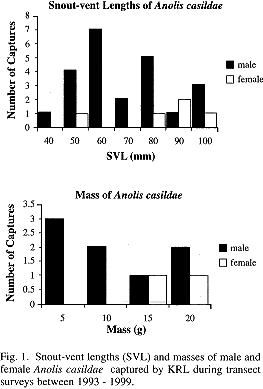
<body><![CDATA[<P><FONT FACE="Arial,Helvetica"><FONT SIZE=-1><B>Tail: </B>Weakly compressed (subcylindrical, but reexamination showed weakly compressed); males possess two enlarged postanal scales, females lack enlarged postanal scales; tail length 2.1 to 3.0 times body length; mean tail length/snout-vent length of males slighty higher than that of females (male mean = 2.8; female mean = 2.5).</FONT></FONT>      <P><FONT FACE="Arial,Helvetica"><FONT SIZE=-1><B>Color: </B>Male color, with some additions, as in holotype: dorsal ground color emerald green with approximately 4-6 oblique brown bands; yellow patches that are frequently outined by light blue present between brown bands; limbs green with alternating brown bands; venter green to yellow green with gray spots, or mottled yellow and green; dewlap of males dirty cream with broad yellow scale rows irregularly interspersed with smaller emerald green scales; female body coloration can be as in males, or displays a second morphotype of solid forest green ground color with a broad, dark brown, mid-dorsal stripe extending from the nape scales to the proximal portion of the tail. Female dewlap is either similarly colored as male dewlap, or is green with yellow scale rows irregularly interspersed with blue spots. Iris is tan-green.</FONT></FONT>      <P><FONT FACE="Arial,Helvetica"><FONT SIZE=-1><B>Sexual Dimorphism: </B>Discrete differences between the sexes include dewlap size (male dewlap large, extending to the sternum; female dewlap small, extending only to anterior edge of shoulder), mid-dorsal crest (present in males extending from nuchal area; absent in females), and enlarged postanal scales (present in males; absent in females). Some females exhibit the mid-dorsal brown stripe, a pattern observed in several <I>Anolis </I>species, however not all females possess this stripe. There is no sexual size dimorphism in SVL or mass for captures of A. <I>casildae <A HREF="#img1">(Fig. </A></I><A HREF="#img1">1)</A>.</FONT></FONT>     <CENTER></CENTER>      <CENTER><A NAME="img1"></A><IMG SRC="/img/fbpe/rbt/v49n2/1033i1.GIF" HEIGHT=389 WIDTH=263></CENTER>       
<P><FONT FACE="Arial,Helvetica"><FONT SIZE=-1><B>Distribution: </B>The holotype of A. <I>casildae</I> was collected along the margins Quebrada Frank in the Reserva Forestal Fortuna, Chiriqu&iacute; Province, western Panama. All observations of sleeping A. <I>casildae </I>by KRL were within 20 m of a stream, although KEN found animals in areas away from streams. The Reserva Forestal Fortuna contains the headwaters of the R&iacute;o Chiriqu&iacute;, so most parts of the reserve are within severas hundred meters of a strearn. Additional specimens have been collected or observed throughout the Reserva Forestal Fortuna, between approximately 1 050 and 1 400 m elevation, and within the adjacent primary forest of the Bosque Protector Palo Seco at 1 400 m elevation, Bocas del Toro Province. The specimens (NMBE 1049173-1049174) from the Bosque Protector Palo Seco represent a range extension for the species, from the Pacific to the Atlantic versant of the Cordillera Central. All localities are within cloud forest <I>(sensu Myers 1969).</I></FONT></FONT>      <P><FONT FACE="Arial,Helvetica"><FONT SIZE=-1><B>Comparisons with other Panamanian Anolis:</B> Arosemena <I>et al. </I>(1991) discussed the relafionships of A. <I>casildae </I>to other anoles based on their similarities, but variation in characters presented here warrants a revised review and clarification. <I>Anolis casildae </I>is allied with the A. <I>latifrons </I>group (according to Arosemena <I>et al.</I> 1991) because it possesses the characteristic features of the group: these are giant (snout-vent length > 100 mm) mainland alpha anoles (Etheridge 1959; <I>Dactyloa </I>of Guyer and Savage 1986, 1992) that possess wide toe lamellae under phalanges ii and iii, have moderately-sized head scales, lack enlarged mid-dorsal scales relative to their flank scales, and lack a prohoscis and axillary pockets (Williams 1976, 1988). Anolis casildae is distinguished from other A. <I>latirfrons</I> group anoles (A. <I>apollinaris, A. danieli, A.</I> <I>fraseri, A. insignis, A. microtus </I>and A. <I>propinquus) </I>by possessing longer hind limbs (Arosemena <I>et al. </I>199 l).</FONT></FONT>      <P><FONT FACE="Arial,Helvetica"><FONT SIZE=-1><I>Anolis casildae </I>was reported previously to possess a single, keeled and elongate superciliary scale extending the length of the eye followed by a series of subgranular scales, and this feature was used to distinguish it from a number of other species. Individuals exarnined and discussed in this paper differ in having a second enlarged superciliary scale behind the first, and sometimes even a third small superciliary scale. The second superciliary scale varies among individuals in its shape and extent of elongation, but it is never as long as the first enlarged superciliary scale. A small granular series follows the posterior - most superciliary scale. This condition distinguishes A. <I>casildae</I> from A. <I>latifrons </I>which has a series of swollen and rugose superciliaries, and from A. <I>squamulatus </I>which has approximately four short superciliary scales followed by a subgranular series. However, the superciliary condition of A. <I>casildae </I>is similar to that of A. <I>frenatus, A.</I> <I>princeps, </I>and A. <I>purpurescens.</I></FONT></FONT>      <P><FONT FACE="Arial,Helvetica"><FONT SIZE=-1>The holotype of A. <I>casildae </I>was reported as having as a diagnostic feature an anterior nasal scale in contact with the rostral scale (distinguishing it from A. <I>princeps and </I>A. <I>purpurescens </I>and in part from A. <I>frenatus). </I>However, we found that A. <I>casildae </I>exhibits variation in this character such that the anterior nasal scale may be in contact with the rostral or separated from the rostral by one scale. Thus, this character does not distinguish A. <I>casildae </I>from <I>A. princeps, A. purpurescens </I>or A. <I>frenatus, </I>but other characters may be used. <I>Anolis princeps</I> has a greater number of sublabials to the center of the eye than does A. <I>casildae </I>(9-12 for A. <I>princeps; </I>6-8 for A. <I>casildae). A. purpurescens,</I> still known only from the holotype, possesses two scales between the nasal and rostral (A. <I>casildae has </I>0-1 scale intervening), has 2 scales between the supraorbital semicircles (A. <I>casildae</I> has 3-4), and the dorsal scales are not keeled (see above for dorsal condition of A. <I>casildae).</I></FONT></FONT>      <P><FONT FACE="Arial,Helvetica"><FONT SIZE=-1>On the basis of overall similarity, A. <I>casildae </I>seems most closely related to A. fr<I>enatus </I>as evidenced by the nearly complete overlap in meristic characters; they seem to differ only in coloration and in geographic range. The dorsum of A. <I>frenatus </I>is covered with several dark green ocelli (most oudined with yellow) that are closely arranged and from dark oblique bands and has a dull, cream-colored dewlap (occasionally with black shading) that appears somewhat translucent. In contrast, A. <I>casildae</I> has approximately 4-6 oblique brown bands (not formed of ad acent ocelli) interspersed by blueoutlined yellow patches, and a dewlap of dirty cream color with broad yellow scale rows irregularly interspersed with smaller emerald green scales. <I>Anolis frenatus </I>is primarily a lowland inhabitant (up to approximately 800 m elevation) ranging from Costa Rica southward to Colombia, whereas A. <I>casildae </I>has been reported only from 1 050 to 1 400 m in the Cordillera Central in the highlands of Chiriqu&iacute; and Bocas del Toro Provinces, western Panama.</FONT></FONT>     ]]></body>
<body><![CDATA[<BR>&nbsp;      <P><B><FONT FACE="Arial,Helvetica"><FONT SIZE=-1>Discussion</FONT></FONT></B>      <P><FONT FACE="Arial,Helvetica"><FONT SIZE=-1>Anolis casildae was regularly seen during herpetofaunal surveys at Fortuna. KRL made 34 observations of A. <I>casildae </I>individuals during surveys (n=174) of stream and terrestrial transects between 1993 and 1999. The annual average of <I>A. casildae </I>captures per transect was 0.27 + 0.34 (range = 0 - 0.30, n = 7 visits), annual average of captures/minute was 0.0014 + 0.0012 (range = 0 - 0.0031, n = 6 visits), and annual average of captures/km surveyed was 0.39 + 0.53 (range = 0 - 1.45, n = 6). During one collecting trip targeting anoles, KEN observed 9 individuals over 32 daytime collecting hours along two transects 0.00468 captures/minute).</FONT></FONT>      <P><FONT FACE="Arial,Helvetica"><FONT SIZE=-1>All KRL sightings occurred at night along streams when lizards were found sleeping on large-leafed plants (e.g., tree ferns, palms, aroids) along stream courses. This species was usually observed at a height of 1 m or more in trees or vegetation adjacent to or within 100 m of a strem. Sleeping females were captured at 1.50 + 0.43 m height (range = 1 - 1.75 m, n = 3 individuals), while males were captured at a height of 1.62 + 0.95 m (range = 0 - 4 m, n = 17 individuals). Adults were capturad at 1.58 + 0.698 m (range = 1 - 3 m, n = 10 individuals), while juveniles were captured at 1.79 + 1.22 m (range = 0 - 4 m, n = 13 individuals). There were no significant differences between male or female or between adult and juvenile capture heights (Mann-Whitney U one tailed tests because adult > juvenile and male > female is expected; Losos <I>et </I>al. 199 l).</FONT></FONT>      <P><FONT FACE="Arial,Helvetica"><FONT SIZE=-1>During the day individuals were usully observed on tree trunks at 2 m or less in height in the characteristic head down posture of <I>Anolis, </I>but were occasionally observed on trunks in a head up position. Individual A. <I>casildae </I>were captured easily by hand and allowed close approach showing only mild wariness. lf wary when approached, they moved to a position on the trunk opposite the captor as other anole species do when attempting to "hide". KEN observed one large male capturing a katydid from the ground and then quickly leaping to a trunk perch approximately 0.5 m in height to consume the prey (Nicholson 1999). It is unknown whether this species regularly forages on the ground.</FONT></FONT>      <P><FONT FACE="Arial,Helvetica"><FONT SIZE=-1><I>Anolis casildae </I>shares some similarities to another large Panamanian anole, <I>Anolis</I> <I>frenatus. </I>Both have been observed to assume a head-down posture when perched during daytime, and are known to forage on the ground (pers.obs., KEN). While females of both species were captured at the same height (Losos <I>et al. </I>1991), male A. <I>frenatus were</I> found one meter higher on average than those of A. <I>casildae (Losos et al. </I>1991). Little work has been done on either species, but they have been captured with varying frequencies at different sites (A. <I>casildae:</I> Fortuna: 0.00468/min by KEN, 0.00140/min by KRL; <I>A. frenatus: </I>"Lutz" in Barro Colorado Island: 0.00329/min by Losos <I>et al. </I>1991; "AVA" in Barro Colorado Island: 0.00033/min by Losos <I>et al. </I>1991; several sites in Barro Colorado Island: 0.00076/min by Losos <I>et al. </I>1991; six sites in the lowlands of central Panama: 0.00002/min by Ib&aacute;&ntilde;ez <I>et al. </I>"1995"[19971). Thus, these species may both appear to occur at low densities, or are seen less frequently than other species due to cryptic coloration or more common associations higher in the trees.</FONT></FONT>     <BR>&nbsp;      <P><B><FONT FACE="Arial,Helvetica"><FONT SIZE=-1>Acknowledgements</FONT></FONT></B>      <P><FONT FACE="Arial,Helvetica"><FONT SIZE=-1>We thank the personnel of the Instituto de Recursos Hidra&uacute;licos y Electrificaci&oacute;n, Fortuna E.G.E., and the Smithsonian Tropical Research Insfitute for pemission to work in the reserve, and for help in obtaining collecting and research permits. KEN especially thanks Stan Rand for encouragement. We thank Brian</FONT></FONT>      <P><FONT FACE="Arial,Helvetica"><FONT SIZE=-1>Crother, Randy McCranie, Paul Richards, and Brian Warren for editing previous drafts of this paper. RID thanks Ulrich Hofer for permission to examine and publish information on specimens collected in Bocas del Toro.</FONT></FONT>     ]]></body>
<body><![CDATA[<BR>&nbsp;      <P><B><FONT FACE="Arial,Helvetica"><FONT SIZE=-1>Resumen</FONT></FONT></B>      <P><FONT FACE="Arial,Helvetica"><FONT SIZE=-1>Nosotros describimos la variaci&oacute;n morfol&oacute;gica (escamaci&oacute;n y coloraci&oacute;n) observada entre ocho individuos de la especie de lagartija paname&ntilde;a <I>Anolis casildae. </I>Esta variaci&oacute;n no fue observada en el holotipo y ayuda en la identificaci&oacute;n de esta especie recientemente descrita (originalmente descrita con base en un &uacute;nico esp&eacute;cimen macho). Esta especie ocurre solo en la Reserva Forestal Fortuna (Provincia de Chiriqu&iacute;) y en el Bosque Protector Palo Seco (Provincia de Bocas del Toro) adyacente, en el oeste de Pana<I>m&aacute;. Anolis casildae </I>se puede distinguir de las dem&aacute;s especies paname&ntilde;as de <I>Anolis </I>por seis caracter&iacute;sticas: (1) dos escamas superciliares agrandadas (la primera m&aacute;s grande que la segunda); (2) una escama nasal anterior en contacto con la escama rostral o separada de &eacute;sta por una escama; (3) seis-ocho escamas sublabiales hacia el centro del ojo; (4) tres-cuatro escamas entre los semic&iacute;rculos supraorbitales; (5) coloraci&oacute;n &uacute;nica (cuatro-seis bandas caf&eacute; oblicuas interespaciadas por parches amarillos bordeados de azul; la papada es de color crema sucio con filas anchas de escamas amarillas interespaciadas irregularmente con escamas verde esmeralda m&aacute;s peque&ntilde;as) y (6) A. <I>casildae </I>ocurre de 1 050 a 1 400 m en la Cordillera Central. Nosotros tambi&eacute;n comparamos nuestras observaciones de historia natural de <I>A. casildae </I>con un <I>Anolis </I>similar grande, A. <I>frenatus, </I>una especie a la que nosotros creemos est&aacute; A. <I>casildae </I>cercanamente relacionada.</FONT></FONT>     <BR>&nbsp;      <P><B><FONT FACE="Arial,Helvetica"><FONT SIZE=-1>References</FONT></FONT></B>      <!-- ref --><P><FONT FACE="Arial,Helvetica"><FONT SIZE=-1>Arosemena, F.A., R. Ib&aacute;&ntilde;ez D. &amp; F. de Sousa. 1991. Una especie nueva de <I>Anolis </I>(Squamata: Iguanidae) del <I>grupo latifrons </I>de Fortuna, Panam&aacute;. Rev. Biol. Trop. 39: 255-262.</FONT></FONT>    &nbsp;&nbsp;&nbsp;&nbsp;&nbsp;&nbsp;&nbsp;&nbsp;[&#160;<a href="javascript:void(0);" onclick="javascript: window.open('/scielo.php?script=sci_nlinks&ref=1345939&pid=S0034-7744200100020003400001&lng=','','width=640,height=500,resizable=yes,scrollbars=1,menubar=yes,');">Links</a>&#160;]<!-- end-ref --><!-- ref --><P><FONT FACE="Arial,Helvetica"><FONT SIZE=-1>Etheridge, R.E. 1959. The relationships of the anoles Reptilia: Sauria: Iguanidae): an interpretation based on skeletal morphology. Ph.D. Dissertation, University of Nfichigan, Ann Arbor. 236 p.</FONT></FONT>    &nbsp;&nbsp;&nbsp;&nbsp;&nbsp;&nbsp;&nbsp;&nbsp;[&#160;<a href="javascript:void(0);" onclick="javascript: window.open('/scielo.php?script=sci_nlinks&ref=1345940&pid=S0034-7744200100020003400002&lng=','','width=640,height=500,resizable=yes,scrollbars=1,menubar=yes,');">Links</a>&#160;]<!-- end-ref --><!-- ref --><P><FONT FACE="Arial,Helvetica"><FONT SIZE=-1>Guyer, C. &amp; J.M. Savage. 1986. Cladistic relationships arnong anoles (Sauria: Iguanidae). Syst. Zool. 35: 509-531.</FONT></FONT>    &nbsp;&nbsp;&nbsp;&nbsp;&nbsp;&nbsp;&nbsp;&nbsp;[&#160;<a href="javascript:void(0);" onclick="javascript: window.open('/scielo.php?script=sci_nlinks&ref=1345941&pid=S0034-7744200100020003400003&lng=','','width=640,height=500,resizable=yes,scrollbars=1,menubar=yes,');">Links</a>&#160;]<!-- end-ref --><!-- ref --><P><FONT FACE="Arial,Helvetica"><FONT SIZE=-1>Guyer, C. &amp; J.M. Savage. 1992. Anole systematics revisited. Syst. Biol. 41: 89-110.</FONT></FONT>    &nbsp;&nbsp;&nbsp;&nbsp;&nbsp;&nbsp;&nbsp;&nbsp;[&#160;<a href="javascript:void(0);" onclick="javascript: window.open('/scielo.php?script=sci_nlinks&ref=1345942&pid=S0034-7744200100020003400004&lng=','','width=640,height=500,resizable=yes,scrollbars=1,menubar=yes,');">Links</a>&#160;]<!-- end-ref --><!-- ref --><P><FONT FACE="Arial,Helvetica"><FONT SIZE=-1>Ib&aacute;&ntilde;ez D., R., C.A. Jaramillo, M. Arrun&aacute;tegui, Q. Fueninayor &amp; F.A. Sol&iacute;s. " 1995"[1997]. II. Inventario biol&oacute;gico del Canal de Panam&aacute;. Estudio Herpetol&oacute;gico. Scientia (Panam&aacute;), N&uacute;mero Especial 2: 1-281.</FONT></FONT>    &nbsp;&nbsp;&nbsp;&nbsp;&nbsp;&nbsp;&nbsp;&nbsp;[&#160;<a href="javascript:void(0);" onclick="javascript: window.open('/scielo.php?script=sci_nlinks&ref=1345943&pid=S0034-7744200100020003400005&lng=','','width=640,height=500,resizable=yes,scrollbars=1,menubar=yes,');">Links</a>&#160;]<!-- end-ref --><!-- ref --><P><FONT FACE="Arial,Helvetica"><FONT SIZE=-1>Losos, J.B., R.M. Andrews, O.J. Sexton, &amp; A.L. Schuler. 1991. Behavior, ecology, and locomotor performance of the giant anole, <I>Anolis frenatus. </I>Carib. J. Sci. 27: 173-179.</FONT></FONT>    &nbsp;&nbsp;&nbsp;&nbsp;&nbsp;&nbsp;&nbsp;&nbsp;[&#160;<a href="javascript:void(0);" onclick="javascript: window.open('/scielo.php?script=sci_nlinks&ref=1345944&pid=S0034-7744200100020003400006&lng=','','width=640,height=500,resizable=yes,scrollbars=1,menubar=yes,');">Links</a>&#160;]<!-- end-ref --><!-- ref --><P><FONT FACE="Arial,Helvetica"><FONT SIZE=-1>Myers, C.W. 1969. The ecological geography of cloud forest in Panama. Amer. Mus. Novit. 2369: 1-52.</FONT></FONT>    &nbsp;&nbsp;&nbsp;&nbsp;&nbsp;&nbsp;&nbsp;&nbsp;[&#160;<a href="javascript:void(0);" onclick="javascript: window.open('/scielo.php?script=sci_nlinks&ref=1345945&pid=S0034-7744200100020003400007&lng=','','width=640,height=500,resizable=yes,scrollbars=1,menubar=yes,');">Links</a>&#160;]<!-- end-ref --><!-- ref --><P><FONT FACE="Arial,Helvetica"><FONT SIZE=-1>Nicholson, K.E. 1999. <I>Anolis casildae </I>foraging. Herp. Rev. 30: 96.</FONT></FONT>    &nbsp;&nbsp;&nbsp;&nbsp;&nbsp;&nbsp;&nbsp;&nbsp;[&#160;<a href="javascript:void(0);" onclick="javascript: window.open('/scielo.php?script=sci_nlinks&ref=1345946&pid=S0034-7744200100020003400008&lng=','','width=640,height=500,resizable=yes,scrollbars=1,menubar=yes,');">Links</a>&#160;]<!-- end-ref --><!-- ref --><P><FONT FACE="Arial,Helvetica"><FONT SIZE=-1>Williams, E.E. 1976. South American anotes: the species groups. Pap. Avuls. Zool. S. Paulo 29: 259-268.</FONT></FONT>    &nbsp;&nbsp;&nbsp;&nbsp;&nbsp;&nbsp;&nbsp;&nbsp;[&#160;<a href="javascript:void(0);" onclick="javascript: window.open('/scielo.php?script=sci_nlinks&ref=1345947&pid=S0034-7744200100020003400009&lng=','','width=640,height=500,resizable=yes,scrollbars=1,menubar=yes,');">Links</a>&#160;]<!-- end-ref --><!-- ref --><P><FONT FACE="Arial,Helvetica"><FONT SIZE=-1>Williams, E.E. 1988. New or problematic <I>Anolis </I>from Colombia. V. <I>Anolis danieli, </I>a new species of the latifrons species group and a reassessment of <I>Anolisapollinaris </I>Boulenger, 1919. Breviora 489: 1-25.</FONT></FONT>    &nbsp;&nbsp;&nbsp;&nbsp;&nbsp;&nbsp;&nbsp;&nbsp;[&#160;<a href="javascript:void(0);" onclick="javascript: window.open('/scielo.php?script=sci_nlinks&ref=1345948&pid=S0034-7744200100020003400010&lng=','','width=640,height=500,resizable=yes,scrollbars=1,menubar=yes,');">Links</a>&#160;]<!-- end-ref --><!-- ref --><P><FONT FACE="Arial,Helvetica"><FONT SIZE=-1>Williams, E.E., H. Rand, A.S. Rand &amp; J.S. O'Hara. 1995. A computer approach to the comparison and identification of species in difficult taxonomic groups. Breviora 502: 1-47.</FONT></FONT>    &nbsp;&nbsp;&nbsp;&nbsp;&nbsp;&nbsp;&nbsp;&nbsp;[&#160;<a href="javascript:void(0);" onclick="javascript: window.open('/scielo.php?script=sci_nlinks&ref=1345949&pid=S0034-7744200100020003400011&lng=','','width=640,height=500,resizable=yes,scrollbars=1,menubar=yes,');">Links</a>&#160;]<!-- end-ref --><P><A NAME="1a"></A><FONT FACE="Arial,Helvetica"><FONT SIZE=-1><SUP><A HREF="#1">1</A></SUP> Department of Biology, University of Miami, PO. Box 249118, Coral Gables, Florida 33124 USA; fax: 305-284-3039, email: kirsten@fig.cox.niianii.edu</FONT></FONT>      <P><A NAME="2a"></A><FONT FACE="Arial,Helvetica"><FONT SIZE=-1><SUP><A HREF="#2 y 3a">2</A></SUP> Smithsonian Tropical Research Institute, Apartado 2072, Balboa, Anc&oacute;n, Rep&uacute;blica de Panam&aacute;; fax: 507-212-8148, email (RI): ibanezr@tivoli.si.edu, email (CJ): jaramilc@tivoli.si.edu</FONT></FONT>      <P><A NAME="3a"></A><FONT FACE="Arial,Helvetica"><FONT SIZE=-1><SUP><A HREF="#2,3b">3</A></SUP> C&iacute;rculo Herpetol&oacute;gico de Panam&aacute;, Apartado 10762, Estafeta Universitaria, Panam&aacute;, Rep&uacute;blica de Panam&aacute;</FONT></FONT>      <P><A NAME="4a"></A><FONT FACE="Arial,Helvetica"><FONT SIZE=-1><SUP><A HREF="#4">4</A></SUP> Department of Zoology, Southem Illinois University, Carbondale, Illinois, 62901 USA; fax: 618-453-2806,</FONT></FONT>     ]]></body>
<body><![CDATA[<BR><FONT FACE="Arial,Helvetica"><FONT SIZE=-1>email: <A HREF="mailto:klips@zoology.siu.edu">klips@zoology.siu.edu</A></FONT></FONT>      ]]></body><back>
<ref-list>
<ref id="B1">
<nlm-citation citation-type="journal">
<person-group person-group-type="author">
<name>
<surname><![CDATA[Arosemena]]></surname>
<given-names><![CDATA[F.A.]]></given-names>
</name>
<name>
<surname><![CDATA[Ibáñez D.]]></surname>
<given-names><![CDATA[R.]]></given-names>
</name>
<name>
<surname><![CDATA[de Sousa]]></surname>
<given-names><![CDATA[F.]]></given-names>
</name>
</person-group>
<article-title xml:lang="es"><![CDATA[Una especie nueva de Anolis (Squamata: Iguanidae) del grupo latifrons de Fortuna, Panamá]]></article-title>
<source><![CDATA[Rev. Biol. Trop.]]></source>
<year>1991</year>
<volume>39</volume>
<page-range>255-262</page-range></nlm-citation>
</ref>
<ref id="B2">
<nlm-citation citation-type="">
<person-group person-group-type="author">
<name>
<surname><![CDATA[Etheridge]]></surname>
<given-names><![CDATA[R.E.]]></given-names>
</name>
</person-group>
<source><![CDATA[The relationships of the anoles Reptilia: Sauria: Iguanidae): an interpretation based on skeletal morphology]]></source>
<year>1959</year>
<page-range>236</page-range></nlm-citation>
</ref>
<ref id="B3">
<nlm-citation citation-type="journal">
<person-group person-group-type="author">
<name>
<surname><![CDATA[Guyer]]></surname>
<given-names><![CDATA[C.]]></given-names>
</name>
<name>
<surname><![CDATA[Savage]]></surname>
<given-names><![CDATA[J.M.]]></given-names>
</name>
</person-group>
<article-title xml:lang="en"><![CDATA[Cladistic relationships arnong anoles (Sauria: Iguanidae)]]></article-title>
<source><![CDATA[Syst. Zool.]]></source>
<year>1986</year>
<volume>35</volume>
<page-range>509-531</page-range></nlm-citation>
</ref>
<ref id="B4">
<nlm-citation citation-type="journal">
<person-group person-group-type="author">
<name>
<surname><![CDATA[Guyer]]></surname>
<given-names><![CDATA[C.]]></given-names>
</name>
<name>
<surname><![CDATA[Savage]]></surname>
<given-names><![CDATA[J.M.]]></given-names>
</name>
</person-group>
<article-title xml:lang="en"><![CDATA[Anole systematics revisited]]></article-title>
<source><![CDATA[Syst. Biol]]></source>
<year>1992</year>
<volume>41</volume>
<page-range>89-110</page-range></nlm-citation>
</ref>
<ref id="B5">
<nlm-citation citation-type="journal">
<person-group person-group-type="author">
<name>
<surname><![CDATA[Ibáñez]]></surname>
<given-names><![CDATA[D., R.]]></given-names>
</name>
<name>
<surname><![CDATA[Jaramillo]]></surname>
<given-names><![CDATA[C.A.]]></given-names>
</name>
<name>
<surname><![CDATA[Arrunátegui]]></surname>
<given-names><![CDATA[M.]]></given-names>
</name>
<name>
<surname><![CDATA[Fueninayor]]></surname>
<given-names><![CDATA[Q.]]></given-names>
</name>
<name>
<surname><![CDATA[Solís]]></surname>
<given-names><![CDATA[F.A.]]></given-names>
</name>
</person-group>
<article-title xml:lang="es"><![CDATA[" 1995"[1997]. II. Inventario biológico del Canal de Panamá. Estudio Herpetológico]]></article-title>
<source><![CDATA[Scientia]]></source>
<year></year>
<volume>2</volume>
<page-range>1-281</page-range></nlm-citation>
</ref>
<ref id="B6">
<nlm-citation citation-type="journal">
<person-group person-group-type="author">
<name>
<surname><![CDATA[Losos]]></surname>
<given-names><![CDATA[J.B.]]></given-names>
</name>
<name>
<surname><![CDATA[Andrews]]></surname>
<given-names><![CDATA[R.M.]]></given-names>
</name>
<name>
<surname><![CDATA[Sexton]]></surname>
<given-names><![CDATA[O.J.]]></given-names>
</name>
<name>
<surname><![CDATA[Schuler]]></surname>
<given-names><![CDATA[A.L.]]></given-names>
</name>
</person-group>
<article-title xml:lang="en"><![CDATA[Behavior, ecology, and locomotor performance of the giant anole, Anolis frenatus]]></article-title>
<source><![CDATA[Carib. J. Sci.]]></source>
<year>1991</year>
<volume>27</volume>
<page-range>173-179</page-range></nlm-citation>
</ref>
<ref id="B7">
<nlm-citation citation-type="journal">
<person-group person-group-type="author">
<name>
<surname><![CDATA[Myers]]></surname>
<given-names><![CDATA[C.W.]]></given-names>
</name>
</person-group>
<article-title xml:lang="en"><![CDATA[The ecological geography of cloud forest in Panama]]></article-title>
<source><![CDATA[Amer. Mus. Novit]]></source>
<year>1969</year>
<volume>2369</volume>
<page-range>1-52</page-range></nlm-citation>
</ref>
<ref id="B8">
<nlm-citation citation-type="journal">
<person-group person-group-type="author">
<name>
<surname><![CDATA[Nicholson]]></surname>
<given-names><![CDATA[K.E.]]></given-names>
</name>
</person-group>
<article-title xml:lang="en"><![CDATA[Anolis casildae foraging]]></article-title>
<source><![CDATA[Herp. Rev.]]></source>
<year>1999</year>
<volume>30</volume>
<page-range>96</page-range></nlm-citation>
</ref>
<ref id="B9">
<nlm-citation citation-type="journal">
<person-group person-group-type="author">
<name>
<surname><![CDATA[Williams]]></surname>
<given-names><![CDATA[E.E.]]></given-names>
</name>
</person-group>
<article-title xml:lang="en"><![CDATA[South American anotes: the species groups]]></article-title>
<source><![CDATA[Pap. Avuls. Zool. S. Paulo]]></source>
<year>1976</year>
<volume>29</volume>
<page-range>259-268</page-range></nlm-citation>
</ref>
<ref id="B10">
<nlm-citation citation-type="journal">
<person-group person-group-type="author">
<name>
<surname><![CDATA[Williams]]></surname>
<given-names><![CDATA[E.E.]]></given-names>
</name>
</person-group>
<article-title xml:lang="en"><![CDATA[New or problematic Anolis from Colombia. V. Anolis danieli, a new species of the latifrons species group and a reassessment of Anolisapollinaris Boulenger, 1919]]></article-title>
<source><![CDATA[Breviora]]></source>
<year>1988</year>
<volume>489</volume>
<page-range>1-25</page-range></nlm-citation>
</ref>
<ref id="B11">
<nlm-citation citation-type="journal">
<person-group person-group-type="author">
<name>
<surname><![CDATA[Williams]]></surname>
<given-names><![CDATA[E.E.]]></given-names>
</name>
<name>
<surname><![CDATA[Rand]]></surname>
<given-names><![CDATA[H.]]></given-names>
</name>
<name>
<surname><![CDATA[Rand]]></surname>
<given-names><![CDATA[A.S.]]></given-names>
</name>
<name>
<surname><![CDATA[O'Hara]]></surname>
<given-names><![CDATA[J.S.]]></given-names>
</name>
</person-group>
<article-title xml:lang="en"><![CDATA[A computer approach to the comparison and identification of species in difficult taxonomic groups]]></article-title>
<source><![CDATA[Breviora]]></source>
<year>1995</year>
<volume>502</volume>
<page-range>1-47</page-range></nlm-citation>
</ref>
</ref-list>
</back>
</article>
