<?xml version="1.0" encoding="ISO-8859-1"?><article xmlns:mml="http://www.w3.org/1998/Math/MathML" xmlns:xlink="http://www.w3.org/1999/xlink" xmlns:xsi="http://www.w3.org/2001/XMLSchema-instance">
<front>
<journal-meta>
<journal-id>0034-7744</journal-id>
<journal-title><![CDATA[Revista de Biología Tropical]]></journal-title>
<abbrev-journal-title><![CDATA[Rev. biol. trop]]></abbrev-journal-title>
<issn>0034-7744</issn>
<publisher>
<publisher-name><![CDATA[Universidad de Costa Rica]]></publisher-name>
</publisher>
</journal-meta>
<article-meta>
<article-id>S0034-77442001000200033</article-id>
<title-group>
<article-title xml:lang="en"><![CDATA[Distribution, habitat and behavior of grasshopper sparrows, Ammodramus savannarum(Passeriformes: Emberizidae) in northeastern Nicaragua]]></article-title>
</title-group>
<contrib-group>
<contrib contrib-type="author">
<name>
<surname><![CDATA[Arguedas-Negrini]]></surname>
<given-names><![CDATA[Nidia]]></given-names>
</name>
<xref ref-type="aff" rid="A01"/>
</contrib>
</contrib-group>
<aff id="A01">
<institution><![CDATA[,The Ohio State University Department of Evolution, Ecology and Organismal Biology ]]></institution>
<addr-line><![CDATA[Columbus Ohio]]></addr-line>
</aff>
<pub-date pub-type="pub">
<day>00</day>
<month>06</month>
<year>2001</year>
</pub-date>
<pub-date pub-type="epub">
<day>00</day>
<month>06</month>
<year>2001</year>
</pub-date>
<volume>49</volume>
<numero>2</numero>
<fpage>703</fpage>
<lpage>708</lpage>
<copyright-statement/>
<copyright-year/>
<self-uri xlink:href="http://www.scielo.sa.cr/scielo.php?script=sci_arttext&amp;pid=S0034-77442001000200033&amp;lng=en&amp;nrm=iso"></self-uri><self-uri xlink:href="http://www.scielo.sa.cr/scielo.php?script=sci_abstract&amp;pid=S0034-77442001000200033&amp;lng=en&amp;nrm=iso"></self-uri><self-uri xlink:href="http://www.scielo.sa.cr/scielo.php?script=sci_pdf&amp;pid=S0034-77442001000200033&amp;lng=en&amp;nrm=iso"></self-uri><abstract abstract-type="short" xml:lang="en"><p><![CDATA[During March and April of 1996, I made field observations of the sedentary subspecies of grasshopper sparrow (Ammodramus savannarum cracens), in 600 points of the pine savannas of northeastern Nicaragua. Isolated individuals were found in the humid depressions, but breeding populations were located exclusively in areas that had suffered a recent fire. Territorial behavior varied in intensity apparently as a function of territory size: the most aggressive males were those trying to defend smaller territories in populations close to Miskito villages, where most of the fires occur. In contrast to what is happening in other parts of Central America, the Nicaraguan grasshopper sparrow may be indirectly protected from extinction by the Miskito’s traditional fire practices.]]></p></abstract>
<abstract abstract-type="short" xml:lang="es"><p><![CDATA[En marzo y abril de 1996, llevé a cabo observaciones del semillero colicorto (Ammodramus savannarum cracens) en las sabanas de pino del noreste de Nicaragua. Encontré individuos aislados en las depresiones más húmedas, pero las poblaciones en estado reproductivo ocupaban solamente áreas que hubieran sido quemadas recientemente. El comportamiento territorial de las aves parecía estar relacionado al tamaño del territorio: las aves más agresivas defendían territorios relativamente pequeños, cercanos a los poblados miskitos, que es adonde los fuegos se producen con mayor frequencia. Fue notable la ausencia de posibles depredadores en las áreas más abiertas de la savanna. Contrario a lo que sucede en otras partes de Centroamérica, la persistencia de esta ave en las savannas de pino de Nicaragua podría estar asegurada por las tradiciones miskitas en el uso del fuego.]]></p></abstract>
<kwd-group>
<kwd lng="la"><![CDATA[Ammodramus savannarum]]></kwd>
<kwd lng="en"><![CDATA[grasshopper sparrow]]></kwd>
<kwd lng="en"><![CDATA[pine savannas]]></kwd>
<kwd lng="es"><![CDATA[Nicaragua]]></kwd>
</kwd-group>
</article-meta>
</front><body><![CDATA[ <center>  <b><font face="Arial,Helvetica"><font size=-1>Distribution, habitat and behavior of grasshopper sparrows<i>, Ammodramus savannarum</i>(Passeriformes:&nbsp;&nbsp; Emberizidae) in northeastern Nicaragua</font></font></b></center>      <center><font face="Arial,Helvetica"><font size=-1>&nbsp;<b>Nidia Arguedas-Negrini<a NAME="1"></a></b><sup><a href="#1a">1</a></sup></font></font>     <p><font face="Arial,Helvetica"><font size=-1>Received 27-V-1999. Corrected 4-10-2000. Accepted 9-X-2000.</font></font></center>      <p><b><font face="Arial,Helvetica"><font size=-1>Abstract</font></font></b>     <p><font face="Arial,Helvetica"><font size=-1>&nbsp;During March and April of 1996, I made field observations of the sedentary subspecies of grasshopper sparrow (<i>Ammodramus savannarum cracens</i>), in 600 points of the pine savannas of northeastern Nicaragua.&nbsp; Isolated individuals were found in the humid depressions, but breeding populations were located exclusively in areas that had suffered a recent fire.&nbsp; Territorial behavior varied in intensity apparently as a function of territory size:&nbsp;&nbsp; the most aggressive males were those trying to defend smaller territories in populations close to Miskito villages, where most of the fires occur.&nbsp; In contrast to what is happening in other parts of Central America, the Nicaraguan grasshopper sparrow may be indirectly protected from extinction by the Miskito’s traditional fire practices.</font></font>     <br>&nbsp;     <p><b><font face="Arial,Helvetica"><font size=-1>Key words</font></font></b>     <p><font face="Arial,Helvetica"><font size=-1><i>Ammodramus savannarum</i>, grasshopper sparrow, pine savannas, Nicaragua.</font></font>     <p><font face="Arial,Helvetica"><font size=-1>The grasshopper sparrow (<i>Ammodramus savannarum</i>) is widely but patchily distributed in the Americas.&nbsp; Some of its subspecies are long distance migrants, some are altitudinal or partial migrants, some are sedentary and others are of unknown status (Monson and Phillips 1981, Bock and Webb 1984, Ridgely and Tudor 1989).&nbsp; The decline of this species in North America prompted an increase in research on its habitat characteristics and life-history requirements<b> </b>(Whitmore 1979, 1981, Askins 1993, Herkert 1994a, 1994b, Knopf 1994, Bollinger 1996), and determined the inclusion of <i>A. s. floridanus</i> in the Federal Endangered Species List in 1986 (Delany <i>et al.&nbsp; </i>1985).</font></font>     <p><font face="Arial,Helvetica"><font size=-1>Little is known about the highly localized populations of the eight recognized subspecies that inhabit tropical and subtropical America<b> </b>(Vickery 1996). The secretive habits of this bird make its observation difficult except during the breeding season, when their territorial singing allows proper detection and identification.&nbsp; The distribution and abundance of grasshopper sparrows <i>(A. s. cracens</i>) in the pine savannas of northeastern Central America were recorded by Monroe (1968) in Honduras and Howell<i> </i>(1971, 1972) in Nicaragua.&nbsp; Monroe found them abundant and widely distributed, the dominant bird in the Honduran lowland pine savannas.&nbsp; In contrast,<b> </b>Howell's surveys located few individuals in his four research plots in the northwestern part of the savanna.<b>&nbsp;</b>&nbsp; Here I report recent&nbsp; information on present distribution, abundance and habitat characteristics of this Central American subspecies (<i>A. s. cracens</i>) in the pine savannas of northeastern Nicaragua, including behavioral parallels with one of the North American migratory subspecies (<i>A. s. pratensis</i>).</font></font>     ]]></body>
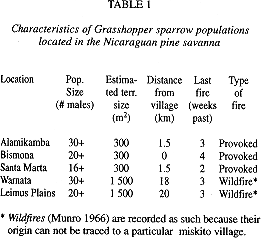
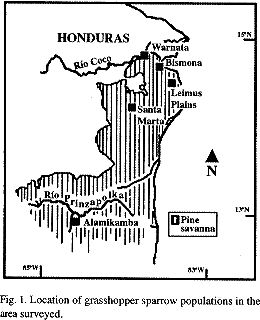
<body><![CDATA[<br>&nbsp;     <p><b><font face="Arial,Helvetica"><font size=-1>Materials and Methods</font></font></b>     <p><font face="Arial,Helvetica"><font size=-1>From March 10 to April 28 of 1996, I surveyed all accessible potential areas for grasshopper sparrows in northeastern Nicaragua.&nbsp; This time of year was chosen to coincide with the bird's breeding season as recorded by Howell in 1966.&nbsp; I covered the area south of R&iacute;o Coco to just south of R&iacute;o Prinzapolka.&nbsp; Areas to the north east of Puerto Cabezas offer good access during the dry season, because of the many roads built to manage the extensive<i> Pinus caribea</i> plantations.&nbsp; There are very few roads to the south and southwest of Puerto Cabezas.</font></font>     <p><font face="Arial,Helvetica"><font size=-1>I surveyed the area using a motorized vehicle and on foot.&nbsp; Once within the defined pine savanna, stops were made every 500-1 000 meters along the roads independent of the particular vegetation characteristics at the point.&nbsp; I entered the land at both sides of the road on foot for approximately 500 meters to scan and listen for grasshopper sparrows.&nbsp; Playbacks of the short (territorial) and long (mated status) songs of&nbsp;<i> A. s. pratensis </i>(Borror Laboratory of Bioacoustics, The Ohio State University) were systematically played at all locations.&nbsp; When birds were located, I used mist-nets to trap them. The individuals were sexed and aged, and color banded to identify recaptures.</font></font>     <br>&nbsp;     <p><b><font face="Arial,Helvetica"><font size=-1>Results</font></font></b>     <p><font face="Arial,Helvetica"><font size=-1><b>Present extent of the pine savanna:&nbsp;&nbsp;&nbsp; </b>The most striking changes in the present distribution of the pine savannas in northeastern Nicaragua from its extent as described by Howell (1972) are man-induced:&nbsp;&nbsp; the existence of relatively old pine forest tracts with dense broadleaf underbrush to the north and northwest which are still live-mined from the 1980's Contra War, and the extensive plantations of<i> </i>the endemic<i> Pinus caribea</i> to the northeast.&nbsp; As noted by Howell (1971) I found tropical forest in the wetter areas with little or no transitional vegetation separating it from the savanna. Howell's "Leicus Creek" type locality, described as "56 miles Northwest of Puerto Cabezas" (Howell 1966), was not recognized by the inhabitants of any of the small villages, and may at present be located within the older pine forests in the heavily land-mined northwest, which I did not survey.</font></font>     <p><font face="Arial,Helvetica"><font size=-1><b>Distribution and abundance:&nbsp;</b> I found grasshopper sparrows only at eleven of the approximately 600 points surveyed.&nbsp; These eleven sites did not include intensively cultivated pine plantations or where brush/pine cover was extensive.&nbsp; I found grasshopper sparrows in large populations, singly, or in groups of a few individuals.&nbsp; Isolated individuals were located in the more humid land depressions, while a group of four first year birds (dispersers?) were mist-netted simultaneously at the edge of a brush area at no less than 35 kilometers from any known breeding population.&nbsp; All sites where I found breeding populations (<a href="#img1">Fig.1)</a> had suffered at least one fire during the beginning of the dry season (less than two months before this survey).&nbsp; I located only five <a href="#tab1">(Table1</a>) large breeding populations (more than fifteen singing males).&nbsp; The three populations of higher density were near Miskito villages.</font></font>     <br><font face="Arial,Helvetica"><font size=-1>The specific vegetation characteristics of the sites varied:&nbsp; scattered, almost exclusively mature <i>P. caribea</i> stands<i> </i>in the Alamikamba area; very low, herbaceous vegetation at Leimus Plains and Warnata; thick grasses with scattered brush<b> </b>in the Bismona area; young, fire-damaged <i>P. caribea</i> plantations spotted with clusters of volcanic rocks around Santa Marta.</font></font>     <p><font face="Arial,Helvetica"><font size=-1><b>Territories and territorial behavior:&nbsp;</b> Defended territories were dominated by low (less than 25 cm high), sparse vegetation. The most abundant were grasses, but mosses, liverworts and particularly forbs were present.&nbsp; All territories included some<i> P. caribea</i>, and<i> </i>a few specimens of <i>Sabal</i> sp. and <i>Byrsonima</i> sp, or less frequently <i>Tripsacum </i>sp. or <i>Miconia</i> sp.</font></font>     ]]></body>
<body><![CDATA[<p><font face="Arial,Helvetica"><font size=-1>I observed two distinct territory patterns.&nbsp; In the three high density sites (Alamikamba, Bismona, and Santa Marta), territories were less than 300 m</font><sup><font size=-2>2</font></sup><font size=-1> each, usually with boundaries closely defined by landscape changes (ditches, higher brush).&nbsp; In their absence, I determined territory boundaries based on the behavior of the males.&nbsp; Individuals that crossed a boundary were aggressively expelled.&nbsp; Agonistic behavior between neighboring males consisted of close, fast approach of the territory owner to the invader who would fly off and seek cover.&nbsp; The territory owner would then perch on a low, exposed bush at the edge of the territory and sing the short song repeatedly.&nbsp; The expelled individual did not respond to the singing.&nbsp; After 2-3 minutes of no response the singing would stop.</font></font>     <center>     <p><a NAME="tab1"></a><img SRC="/img/fbpe/rbt/v49n2/1032ta1.GIF" height=238 width=261>     
<br>&nbsp;     <br>&nbsp;     <p><a NAME="img1"></a><img SRC="/img/fbpe/rbt/v49n2/1032i1.GIF" height=320 width=260></center>      
<p><font face="Arial,Helvetica"><font size=-1>Isolated individuals or individuals of the fourth and fifth scattered populations (Leimus Plains and Warnata) responded only by infrequent bouts of song to an invader which was simulated by the playback (no natural transgressions were observed).&nbsp; These individuals tended not to approach more than 20 m from the playback.&nbsp; Because of the scarcity of obvious landscape boundaries and the low intensity response to territorial invasion, I could only roughly estimate territory size as at least 1 500 m</font><sup><font size=-2>2</font></sup><font size=-1>, about five times the size of a territory in the high density populations.</font></font>     <p><font face="Arial,Helvetica"><font size=-1>When not disturbed the birds sang intensively in the early morning and evening.&nbsp; Both the short and the long songs were heard, as well as chipping, which is used by <i>A. s. pratensis</i> to stay in touch while foraging (Vickery 1996).&nbsp; As I did not locate any nests, I do not know if the long song indicates mated status, as it usually does in <i>A. s. pratensis</i>.&nbsp; No singing was heard when the temperatures soared to 32&ordm;C, usually between noon and mid-afternoon.&nbsp; Evening singing was typical of moonlit nights, lasting sometimes until dawn.&nbsp; The birds responded to playbacks of the songs of<i> A. s. pratensis</i> in a similar way as this northern subspecies during the breeding season.</font></font>     <p><font face="Arial,Helvetica"><font size=-1><b>Interspecific relations:&nbsp;  </b>The only potential avian predator I encountered was the crested caracara (<i>Polyborus plancus</i>).&nbsp; No mammals or reptiles were ever observed on the open savanna, although the presence of large felids (<i>Felis concolo</i>r and <i>F. onca</i>) was detected by their calls and footprints at the boundary between the savanna and the forest patches.&nbsp; At least during this season no other passerine occupied areas of identical vegetation characteristics.&nbsp; In central North America, savanna sparrows (<i>Passerculus sandwichensis</i>) would compete with grasshopper sparrows for singing perches and respond aggressively to playbacks of their songs (pers. obs.). This type of relationship was not observed between the Nicaragua birds and any other species in the savanna.&nbsp; Chipping sparrows (<i>Spizella passerina pinetorium</i>) were found infrequently, always in small flocks (4-5 individuals) and only on pine trees, not descending to the ground. The more common rusty sparrow (<i>Aimophila rufescens discolor</i>) occupied wet areas with dense brush.&nbsp; Red crossbills (<i>Loxia curvirostra</i>), Botteri's sparrows (<i>Aimophila botterii</i>) and black-headed siskins (<i>Carduelis notata</i>) were each encountered only once, all in dense vegetation not used by grasshopper sparrows.</font></font>     <p><font face="Arial,Helvetica"><font size=-1>I observed single birds feeding on the ground apparently on ants.&nbsp; These individuals did not flush when approached, but continued walking and foraging, staying at a distance of&nbsp; 3-4 m.&nbsp; The stomach contents of a single net loss included grass seeds, insect parts and large amounts of grit.&nbsp; By the end of April, small groups (young and adults) were observed feeding together on the pine trees at an average height of 3 m.</font></font>     ]]></body>
<body><![CDATA[<br>&nbsp;     <p><b><font face="Arial,Helvetica"><font size=-1>Discussion</font></font></b>     <p><font face="Arial,Helvetica"><font size=-1>As Monroe (1968) suggested for the Honduran Miskitia, and based on the number of individuals I encountered, grasshopper sparrows may be the dominant species in the Nicaraguan Miskitia.&nbsp; Though very local in their distribution, they were abundant in the new-growth habitat.&nbsp; The difference between my observations and those of Howell's in the late 1960's may be explained in part by recent environmental changes, especially widespread burning during the Contra War which might have expanded the birds' previous range.&nbsp; It is also possible that Howell's results were an artifact of his research design in which he studied intensively and almost exclusively four particular pine savanna plots, all of them in the northwestern part of the savanna (Howell, 1971).</font></font>     <p><font face="Arial,Helvetica"><font size=-1>The permanent presence of grasshopper sparrows near Miskito villages was confirmed by their inhabitants.&nbsp; Fire used to clear up the brush and provide fodder for cattle may also be providing the sparrows with appropriate habitat.&nbsp; Miskitos do not practice fire control but expect the fire to burn itself out, except when the winds drive it toward the village.&nbsp; Fires that spread into more distant areas are responsible for large tracts of burnt savanna as in Warnata and Leimus Plains.&nbsp; In these areas, the large size of grasshopper sparrow territories and their weak territorial behavior may be the result of sudden, extensive opening of new appropriate habitat.</font></font>     <p><font face="Arial,Helvetica"><font size=-1>Ridgely and Gwynne (1989) and Ridgely and Tudor (1989) relate the changes in grasshopper sparrow abundance in Central and South America to the introduction of intensive agricultural systems which include frequent mowing and an increase in the use of pesticides.&nbsp; At present, the status of the populations of this bird is predominantly unknown.&nbsp; In Panama they have not been seen since the seventies, and they are considered extinct (N. Smith, pers. comm.).&nbsp; Strict fire protection measures in the Guanacaste National Park of Costa Rica (R. Blanco, pers. comm.) intended to promote the regeneration of the dry forest, may be threatening the persistence of one of the two populations found in the country (Stiles and Skutch 1989).</font></font>     <p><font face="Arial,Helvetica"><font size=-1>The Nicaraguan pine savanna is considered faunistically depauperate (Howell 1972).&nbsp;&nbsp; As such it is not listed as an area that requires conservation action (Wege and Long 1995, Mittermeier <i>et al.&nbsp;&nbsp;</i> 1998).&nbsp; The Nicaraguan pine savanna has no agricultural potential except for pine.&nbsp; The expansion of the <i>P. caribea</i> plantations may pose a moderate threat to grasshopper sparrows if fire protection measures are effective.&nbsp; In northeastern Nicaragua most of the pine savanna is formally under the control of traditional Miskito rule.&nbsp; As long as their fire practices continue, the bird's persistence may be ensured in this part of their range.</font></font>     <br>&nbsp;     <p><b><font face="Arial,Helvetica"><font size=-1>Acknowledgments</font></font></b>     <p><font face="Arial,Helvetica"><font size=-1>Special thanks to J. C. Martinez for his help with the logistics of travel in northeastern Nicaragua, and P. Ortiz and R. Cruz-Lazo for assistance in the field. Thanks also to the Costa Rica Ambassador in Managua for his timely assistance.&nbsp; Support was provided by two anonymous contributors, and The Ohio State University through The Office of International Education, The Graduate School Alumni Association, and Parker Lab.</font></font>     <br>&nbsp;     ]]></body>
<body><![CDATA[<p><b><font face="Arial,Helvetica"><font size=-1>Resumen</font></font></b>     <p><font face="Arial,Helvetica"><font size=-1>En marzo y abril de 1996, llev&eacute; a cabo observaciones del semillero colicorto (<i>Ammodramus savannarum cracens</i>) en las sabanas de pino del noreste de Nicaragua.&nbsp; Encontr&eacute; individuos aislados en las depresiones m&aacute;s h&uacute;medas, pero las poblaciones en estado reproductivo ocupaban solamente &aacute;reas que hubieran sido quemadas recientemente.&nbsp; El comportamiento territorial de las aves parec&iacute;a estar relacionado al tama&ntilde;o del territorio:&nbsp;&nbsp;&nbsp; las aves m&aacute;s agresivas defend&iacute;an territorios relativamente peque&ntilde;os, cercanos a los poblados miskitos, que es adonde los fuegos se producen con mayor frequencia.&nbsp; Fue notable la ausencia de posibles depredadores en las &aacute;reas m&aacute;s abiertas de la savanna.&nbsp; Contrario a lo que sucede en otras partes de Centroam&eacute;rica, la persistencia de esta ave en las savannas de pino de Nicaragua podr&iacute;a estar asegurada por las tradiciones miskitas en el uso del fuego.</font></font>     <br>&nbsp;     <p><b><font face="Arial,Helvetica"><font size=-1>References</font></font></b>     <!-- ref --><p><font face="Arial,Helvetica"><font size=-1>Askins, R. A. 1993. Population trends in grassland, shrubland, and forest birds in eastern North America.Curr. Ornithol. 11:&nbsp; 1-34.</font></font>    &nbsp;&nbsp;&nbsp;&nbsp;&nbsp;&nbsp;&nbsp;&nbsp;[&#160;<a href="javascript:void(0);" onclick="javascript: window.open('/scielo.php?script=sci_nlinks&ref=1365541&pid=S0034-7744200100020003300001&lng=','','width=640,height=500,resizable=yes,scrollbars=1,menubar=yes,');">Links</a>&#160;]<!-- end-ref --><!-- ref --><p><font face="Arial,Helvetica"><font size=-1>Bock, C. E. &amp; B. Webb. 1984. Birds as grazing indicators in southeastern Arizona. J. Wildl. Manage. 48:&nbsp; 1045-1049.</font></font>    &nbsp;&nbsp;&nbsp;&nbsp;&nbsp;&nbsp;&nbsp;&nbsp;[&#160;<a href="javascript:void(0);" onclick="javascript: window.open('/scielo.php?script=sci_nlinks&ref=1365542&pid=S0034-7744200100020003300002&lng=','','width=640,height=500,resizable=yes,scrollbars=1,menubar=yes,');">Links</a>&#160;]<!-- end-ref --><!-- ref --><p><font face="Arial,Helvetica"><font size=-1>Bollinger, E. K. 1996. Successional changes and habitat selection in hayfield bird communities. Auk 112:&nbsp; 720-730.</font></font>    &nbsp;&nbsp;&nbsp;&nbsp;&nbsp;&nbsp;&nbsp;&nbsp;[&#160;<a href="javascript:void(0);" onclick="javascript: window.open('/scielo.php?script=sci_nlinks&ref=1365543&pid=S0034-7744200100020003300003&lng=','','width=640,height=500,resizable=yes,scrollbars=1,menubar=yes,');">Links</a>&#160;]<!-- end-ref --><!-- ref --><p><font face="Arial,Helvetica"><font size=-1>Bond, J. 1961. Birds of the West Indies. Houghton Mifflin, Boston, Massachusetts.</font></font>    &nbsp;&nbsp;&nbsp;&nbsp;&nbsp;&nbsp;&nbsp;&nbsp;[&#160;<a href="javascript:void(0);" onclick="javascript: window.open('/scielo.php?script=sci_nlinks&ref=1365544&pid=S0034-7744200100020003300004&lng=','','width=640,height=500,resizable=yes,scrollbars=1,menubar=yes,');">Links</a>&#160;]<!-- end-ref --><!-- ref --><p><font face="Arial,Helvetica"><font size=-1>Delany, M., H. Stevenson &amp; R. McCracken. 1985. Distribution, abundance and habitat of the Florida grasshopper sparrow. J. Wildl. Manage. 49:&nbsp; 626-631.</font></font>    &nbsp;&nbsp;&nbsp;&nbsp;&nbsp;&nbsp;&nbsp;&nbsp;[&#160;<a href="javascript:void(0);" onclick="javascript: window.open('/scielo.php?script=sci_nlinks&ref=1365545&pid=S0034-7744200100020003300005&lng=','','width=640,height=500,resizable=yes,scrollbars=1,menubar=yes,');">Links</a>&#160;]<!-- end-ref --><!-- ref --><p><font face="Arial,Helvetica"><font size=-1>Herkert, J. R. 1994a. The effects of habitat fragmentation on Midwestern grassland bird communities. J. Ecol. Appl. 4:&nbsp; 461-471.</font></font>    &nbsp;&nbsp;&nbsp;&nbsp;&nbsp;&nbsp;&nbsp;&nbsp;[&#160;<a href="javascript:void(0);" onclick="javascript: window.open('/scielo.php?script=sci_nlinks&ref=1365546&pid=S0034-7744200100020003300006&lng=','','width=640,height=500,resizable=yes,scrollbars=1,menubar=yes,');">Links</a>&#160;]<!-- end-ref --><!-- ref --><p><font face="Arial,Helvetica"><font size=-1>Herkert, J. R. 1994b. Breeding bird communities on Midwestern prairie fragments: the effects of prescribed burning and habitat-area. Natur. Areas J. 14:&nbsp; 128-135.</font></font>    &nbsp;&nbsp;&nbsp;&nbsp;&nbsp;&nbsp;&nbsp;&nbsp;[&#160;<a href="javascript:void(0);" onclick="javascript: window.open('/scielo.php?script=sci_nlinks&ref=1365547&pid=S0034-7744200100020003300007&lng=','','width=640,height=500,resizable=yes,scrollbars=1,menubar=yes,');">Links</a>&#160;]<!-- end-ref --><!-- ref --><p><font face="Arial,Helvetica"><font size=-1>Howell, T. R. 1966. Precise location of Leicus Creek, Nicaragua, as a type locality. Auk 83:&nbsp; 665.</font></font>    &nbsp;&nbsp;&nbsp;&nbsp;&nbsp;&nbsp;&nbsp;&nbsp;[&#160;<a href="javascript:void(0);" onclick="javascript: window.open('/scielo.php?script=sci_nlinks&ref=1365548&pid=S0034-7744200100020003300008&lng=','','width=640,height=500,resizable=yes,scrollbars=1,menubar=yes,');">Links</a>&#160;]<!-- end-ref --><!-- ref --><p><font face="Arial,Helvetica"><font size=-1>Howell, T. R. 1971. An ecological study of the birds of the lowland pine savanna and adjacent rain forest in northeastern Nicaragua.</font></font>    &nbsp;&nbsp;&nbsp;&nbsp;&nbsp;&nbsp;&nbsp;&nbsp;[&#160;<a href="javascript:void(0);" onclick="javascript: window.open('/scielo.php?script=sci_nlinks&ref=1365549&pid=S0034-7744200100020003300009&lng=','','width=640,height=500,resizable=yes,scrollbars=1,menubar=yes,');">Links</a>&#160;]<!-- end-ref --><!-- ref --><p><font face="Arial,Helvetica"><font size=-1>Living Bird, Tenth Annual, Cornell University, Ithaca, New York, p. 185-242.</font></font>    &nbsp;&nbsp;&nbsp;&nbsp;&nbsp;&nbsp;&nbsp;&nbsp;[&#160;<a href="javascript:void(0);" onclick="javascript: window.open('/scielo.php?script=sci_nlinks&ref=1365550&pid=S0034-7744200100020003300010&lng=','','width=640,height=500,resizable=yes,scrollbars=1,menubar=yes,');">Links</a>&#160;]<!-- end-ref --><!-- ref --><p><font face="Arial,Helvetica"><font size=-1>Howell, T. R. 1972. Birds of the lowland pine savanna of northeastern Nicaragua. Condor 74:&nbsp; 316-340.</font></font>    &nbsp;&nbsp;&nbsp;&nbsp;&nbsp;&nbsp;&nbsp;&nbsp;[&#160;<a href="javascript:void(0);" onclick="javascript: window.open('/scielo.php?script=sci_nlinks&ref=1365551&pid=S0034-7744200100020003300011&lng=','','width=640,height=500,resizable=yes,scrollbars=1,menubar=yes,');">Links</a>&#160;]<!-- end-ref --><!-- ref --><p><font face="Arial,Helvetica"><font size=-1>Monroe, B. L., Jr. 1968. A Distributional Survey of the Birds of Honduras. Ornithol. Monogr. 7. Amer. Ornithol. Union, Washington, D. C.</font></font>    &nbsp;&nbsp;&nbsp;&nbsp;&nbsp;&nbsp;&nbsp;&nbsp;[&#160;<a href="javascript:void(0);" onclick="javascript: window.open('/scielo.php?script=sci_nlinks&ref=1365552&pid=S0034-7744200100020003300012&lng=','','width=640,height=500,resizable=yes,scrollbars=1,menubar=yes,');">Links</a>&#160;]<!-- end-ref --><!-- ref --><p><font face="Arial,Helvetica"><font size=-1>Monson, G. &amp; A. R. Phillips. 1981. Annotated checklist of the birds of Arizona. University of Arizona, Tucson, Arizona.</font></font>    &nbsp;&nbsp;&nbsp;&nbsp;&nbsp;&nbsp;&nbsp;&nbsp;[&#160;<a href="javascript:void(0);" onclick="javascript: window.open('/scielo.php?script=sci_nlinks&ref=1365553&pid=S0034-7744200100020003300013&lng=','','width=640,height=500,resizable=yes,scrollbars=1,menubar=yes,');">Links</a>&#160;]<!-- end-ref --><!-- ref --><p><font face="Arial,Helvetica"><font size=-1>Munro, N. 1966. The fire ecology of Caribbean pine in Nicaragua. Proc. 5th Annu. Tall Timbers Fire Ecol. Conf., Seattle, Washington, p. 67-83.</font></font>    &nbsp;&nbsp;&nbsp;&nbsp;&nbsp;&nbsp;&nbsp;&nbsp;[&#160;<a href="javascript:void(0);" onclick="javascript: window.open('/scielo.php?script=sci_nlinks&ref=1365554&pid=S0034-7744200100020003300014&lng=','','width=640,height=500,resizable=yes,scrollbars=1,menubar=yes,');">Links</a>&#160;]<!-- end-ref --><!-- ref --><p><font face="Arial,Helvetica"><font size=-1>Ridgely, R. S. &amp; J. A. Gwynne, Jr. 1989. A Guide to the Birds of Panama, with Costa Rica, Nicaragua and Honduras. Princeton University, New Jersey.</font></font>    &nbsp;&nbsp;&nbsp;&nbsp;&nbsp;&nbsp;&nbsp;&nbsp;[&#160;<a href="javascript:void(0);" onclick="javascript: window.open('/scielo.php?script=sci_nlinks&ref=1365555&pid=S0034-7744200100020003300015&lng=','','width=640,height=500,resizable=yes,scrollbars=1,menubar=yes,');">Links</a>&#160;]<!-- end-ref --><!-- ref --><p><font face="Arial,Helvetica"><font size=-1>Ridgely, R. S. &amp; G. Tudor. 1989. The Birds of South America. Volume 1:&nbsp; The Oscine Passerines. University of Texas, Austin, Texas.</font></font>    &nbsp;&nbsp;&nbsp;&nbsp;&nbsp;&nbsp;&nbsp;&nbsp;[&#160;<a href="javascript:void(0);" onclick="javascript: window.open('/scielo.php?script=sci_nlinks&ref=1365556&pid=S0034-7744200100020003300016&lng=','','width=640,height=500,resizable=yes,scrollbars=1,menubar=yes,');">Links</a>&#160;]<!-- end-ref --><!-- ref --><p><font face="Arial,Helvetica"><font size=-1>Small, A. 1994. California birds:&nbsp; their status and distribution. Ibis, Vista, California.</font></font>    &nbsp;&nbsp;&nbsp;&nbsp;&nbsp;&nbsp;&nbsp;&nbsp;[&#160;<a href="javascript:void(0);" onclick="javascript: window.open('/scielo.php?script=sci_nlinks&ref=1365557&pid=S0034-7744200100020003300017&lng=','','width=640,height=500,resizable=yes,scrollbars=1,menubar=yes,');">Links</a>&#160;]<!-- end-ref --><!-- ref --><p><font face="Arial,Helvetica"><font size=-1>Stiles, F. G. &amp; A. F. Skutch 1989. A guide to the birds of Costa Rica. Cornell University, Ithaca, New York.</font></font>    &nbsp;&nbsp;&nbsp;&nbsp;&nbsp;&nbsp;&nbsp;&nbsp;[&#160;<a href="javascript:void(0);" onclick="javascript: window.open('/scielo.php?script=sci_nlinks&ref=1365558&pid=S0034-7744200100020003300018&lng=','','width=640,height=500,resizable=yes,scrollbars=1,menubar=yes,');">Links</a>&#160;]<!-- end-ref --><!-- ref --><p><font face="Arial,Helvetica"><font size=-1>Vickery, P. 1996. Grasshopper sparrow (<i>Ammodramus savannarum</i>). The birds of North America, 239. Amer. Ornithol. Union and Acad. Natur. Sci. Philadelphia,Philadelphia, Pennsylvania.</font></font>    &nbsp;&nbsp;&nbsp;&nbsp;&nbsp;&nbsp;&nbsp;&nbsp;[&#160;<a href="javascript:void(0);" onclick="javascript: window.open('/scielo.php?script=sci_nlinks&ref=1365559&pid=S0034-7744200100020003300019&lng=','','width=640,height=500,resizable=yes,scrollbars=1,menubar=yes,');">Links</a>&#160;]<!-- end-ref --><!-- ref --><p><font face="Arial,Helvetica"><font size=-1>Wege, D. C. &amp; A. J. Long. 1995. Key areas for threatened birds in the Neotropics. BirdLife Conservation Series 5, BirdLife International, Burlington, Cambridge.</font></font>    &nbsp;&nbsp;&nbsp;&nbsp;&nbsp;&nbsp;&nbsp;&nbsp;[&#160;<a href="javascript:void(0);" onclick="javascript: window.open('/scielo.php?script=sci_nlinks&ref=1365560&pid=S0034-7744200100020003300020&lng=','','width=640,height=500,resizable=yes,scrollbars=1,menubar=yes,');">Links</a>&#160;]<!-- end-ref --><!-- ref --><p><font face="Arial,Helvetica"><font size=-1>Whitmore, R. C. 1979. Short-term change in vegetation structure and its effects on grasshopper sparrows in West Virginia. Auk 96:&nbsp; 621-625.</font></font>    &nbsp;&nbsp;&nbsp;&nbsp;&nbsp;&nbsp;&nbsp;&nbsp;[&#160;<a href="javascript:void(0);" onclick="javascript: window.open('/scielo.php?script=sci_nlinks&ref=1365561&pid=S0034-7744200100020003300021&lng=','','width=640,height=500,resizable=yes,scrollbars=1,menubar=yes,');">Links</a>&#160;]<!-- end-ref --><!-- ref --><p><font face="Arial,Helvetica"><font size=-1>Whitmore, RC. 1981. Structural characteristics of grasshopper sparrow habitat. J. Wildl. Manage. 45:&nbsp; 811-814.</font></font>    &nbsp;&nbsp;&nbsp;&nbsp;&nbsp;&nbsp;&nbsp;&nbsp;[&#160;<a href="javascript:void(0);" onclick="javascript: window.open('/scielo.php?script=sci_nlinks&ref=1365562&pid=S0034-7744200100020003300022&lng=','','width=640,height=500,resizable=yes,scrollbars=1,menubar=yes,');">Links</a>&#160;]<!-- end-ref --><p><a NAME="1a"></a><font face="Arial,Helvetica"><font size=-1><sup><a href="#1">1</a></sup>Department of Evolution, Ecology and Organismal Biology, The Ohio State University, 104 Botany and Zoology Building, 1735 Neil Avenue, Columbus, Ohio 43210. Fax:&nbsp;&nbsp; 614-292-2030; <a href="mailto:arguedas.2@osu.edu">arguedas.2@osu.edu</a></font></font>      ]]></body><back>
<ref-list>
<ref id="B1">
<nlm-citation citation-type="journal">
<person-group person-group-type="author">
<name>
<surname><![CDATA[Askins]]></surname>
<given-names><![CDATA[R. A.]]></given-names>
</name>
</person-group>
<article-title xml:lang="en"><![CDATA[Population trends in grassland, shrubland, and forest birds in eastern North America]]></article-title>
<source><![CDATA[Curr. Ornithol]]></source>
<year>1993</year>
<volume>11</volume>
<page-range>1-34</page-range></nlm-citation>
</ref>
<ref id="B2">
<nlm-citation citation-type="journal">
<person-group person-group-type="author">
<name>
<surname><![CDATA[Bock]]></surname>
<given-names><![CDATA[C. E.]]></given-names>
</name>
<name>
<surname><![CDATA[Webb]]></surname>
<given-names><![CDATA[B.]]></given-names>
</name>
</person-group>
<article-title xml:lang="en"><![CDATA[Birds as grazing indicators in southeastern Arizona]]></article-title>
<source><![CDATA[J. Wildl. Manage]]></source>
<year>1984</year>
<volume>48</volume>
<page-range>1045-1049</page-range></nlm-citation>
</ref>
<ref id="B3">
<nlm-citation citation-type="journal">
<person-group person-group-type="author">
<name>
<surname><![CDATA[Bollinger]]></surname>
<given-names><![CDATA[E. K.]]></given-names>
</name>
</person-group>
<article-title xml:lang="en"><![CDATA[Successional changes and habitat selection in hayfield bird communities]]></article-title>
<source><![CDATA[Auk]]></source>
<year>1996</year>
<volume>112</volume>
<page-range>720-730</page-range></nlm-citation>
</ref>
<ref id="B4">
<nlm-citation citation-type="book">
<person-group person-group-type="author">
<name>
<surname><![CDATA[Bond]]></surname>
<given-names><![CDATA[J.]]></given-names>
</name>
</person-group>
<source><![CDATA[Birds of the West Indies]]></source>
<year>1961</year>
<publisher-loc><![CDATA[Boston^eMassachusetts Massachusetts]]></publisher-loc>
<publisher-name><![CDATA[Houghton Mifflin]]></publisher-name>
</nlm-citation>
</ref>
<ref id="B5">
<nlm-citation citation-type="journal">
<person-group person-group-type="author">
<name>
<surname><![CDATA[Delany]]></surname>
<given-names><![CDATA[M.]]></given-names>
</name>
<name>
<surname><![CDATA[Stevenson]]></surname>
<given-names><![CDATA[H.]]></given-names>
</name>
<name>
<surname><![CDATA[McCracken]]></surname>
<given-names><![CDATA[R.]]></given-names>
</name>
</person-group>
<article-title xml:lang="en"><![CDATA[Distribution, abundance and habitat of the Florida grasshopper sparrow]]></article-title>
<source><![CDATA[J. Wildl. Manage]]></source>
<year>1985</year>
<volume>49</volume>
<page-range>626-631</page-range></nlm-citation>
</ref>
<ref id="B6">
<nlm-citation citation-type="journal">
<person-group person-group-type="author">
<name>
<surname><![CDATA[Herkert]]></surname>
<given-names><![CDATA[J. R.]]></given-names>
</name>
</person-group>
<article-title xml:lang="en"><![CDATA[The effects of habitat fragmentation on Midwestern grassland bird communities]]></article-title>
<source><![CDATA[J. Ecol. Appl]]></source>
<year>1994</year>
<volume>4</volume>
<page-range>461-471</page-range></nlm-citation>
</ref>
<ref id="B7">
<nlm-citation citation-type="journal">
<person-group person-group-type="author">
<name>
<surname><![CDATA[Herkert]]></surname>
<given-names><![CDATA[J. R.]]></given-names>
</name>
</person-group>
<article-title xml:lang="en"><![CDATA[Breeding bird communities on Midwestern prairie fragments: the effects of prescribed burning and habitat-area]]></article-title>
<source><![CDATA[Natur. Areas J]]></source>
<year>1994</year>
<volume>14</volume>
<page-range>128-135</page-range></nlm-citation>
</ref>
<ref id="B8">
<nlm-citation citation-type="journal">
<person-group person-group-type="author">
<name>
<surname><![CDATA[Howell]]></surname>
<given-names><![CDATA[T. R.]]></given-names>
</name>
</person-group>
<article-title xml:lang="en"><![CDATA[Precise location of Leicus Creek, Nicaragua, as a type locality]]></article-title>
<source><![CDATA[Auk]]></source>
<year>1966</year>
<volume>83</volume>
<page-range>665</page-range></nlm-citation>
</ref>
<ref id="B9">
<nlm-citation citation-type="">
<person-group person-group-type="author">
<name>
<surname><![CDATA[Howell]]></surname>
<given-names><![CDATA[T. R.]]></given-names>
</name>
</person-group>
<source><![CDATA[An ecological study of the birds of the lowland pine savanna and adjacent rain forest in northeastern Nicaragua]]></source>
<year>1971</year>
</nlm-citation>
</ref>
<ref id="B10">
<nlm-citation citation-type="book">
<source><![CDATA[Living Bird]]></source>
<year></year>
<page-range>185-242</page-range><publisher-loc><![CDATA[Ithaca^eNew York New York]]></publisher-loc>
<publisher-name><![CDATA[Cornell University]]></publisher-name>
</nlm-citation>
</ref>
<ref id="B11">
<nlm-citation citation-type="journal">
<person-group person-group-type="author">
<name>
<surname><![CDATA[Howell]]></surname>
<given-names><![CDATA[T. R.]]></given-names>
</name>
</person-group>
<article-title xml:lang="en"><![CDATA[Birds of the lowland pine savanna of northeastern Nicaragua]]></article-title>
<source><![CDATA[Condor]]></source>
<year>1972</year>
<volume>74</volume>
<page-range>316-340</page-range></nlm-citation>
</ref>
<ref id="B12">
<nlm-citation citation-type="book">
<person-group person-group-type="author">
<name>
<surname><![CDATA[Monroe]]></surname>
<given-names><![CDATA[B. L.]]></given-names>
</name>
</person-group>
<source><![CDATA[A Distributional Survey of the Birds of Honduras]]></source>
<year>1968</year>
<volume>7</volume>
<publisher-loc><![CDATA[^eWashington, D. C Washington, D. C]]></publisher-loc>
<publisher-name><![CDATA[Amer. Ornithol. Union]]></publisher-name>
</nlm-citation>
</ref>
<ref id="B13">
<nlm-citation citation-type="book">
<person-group person-group-type="author">
<name>
<surname><![CDATA[Monson]]></surname>
<given-names><![CDATA[G.]]></given-names>
</name>
<name>
<surname><![CDATA[Phillips]]></surname>
<given-names><![CDATA[A. R.]]></given-names>
</name>
</person-group>
<source><![CDATA[Annotated checklist of the birds of Arizona]]></source>
<year>1981</year>
<publisher-loc><![CDATA[Tucson^eArizona Arizona]]></publisher-loc>
<publisher-name><![CDATA[University of Arizona]]></publisher-name>
</nlm-citation>
</ref>
<ref id="B14">
<nlm-citation citation-type="confpro">
<person-group person-group-type="author">
<name>
<surname><![CDATA[Munro]]></surname>
<given-names><![CDATA[N.]]></given-names>
</name>
</person-group>
<source><![CDATA[The fire ecology of Caribbean pine in Nicaragua]]></source>
<year>1966</year>
<conf-name><![CDATA[5th Tall Timbers Fire Ecol. Conf.]]></conf-name>
<conf-loc>Seattle Washington</conf-loc>
<page-range>67-83</page-range></nlm-citation>
</ref>
<ref id="B15">
<nlm-citation citation-type="book">
<person-group person-group-type="author">
<name>
<surname><![CDATA[Ridgely]]></surname>
<given-names><![CDATA[R. S.]]></given-names>
</name>
<name>
<surname><![CDATA[Gwynne, Jr]]></surname>
<given-names><![CDATA[J. A.]]></given-names>
</name>
</person-group>
<source><![CDATA[A Guide to the Birds of Panama, with Costa Rica, Nicaragua and Honduras]]></source>
<year>1989</year>
<publisher-loc><![CDATA[New Jersey ]]></publisher-loc>
<publisher-name><![CDATA[Princeton University]]></publisher-name>
</nlm-citation>
</ref>
<ref id="B16">
<nlm-citation citation-type="book">
<person-group person-group-type="author">
<name>
<surname><![CDATA[Ridgely]]></surname>
<given-names><![CDATA[R. S.]]></given-names>
</name>
<name>
<surname><![CDATA[Tudor]]></surname>
<given-names><![CDATA[G.]]></given-names>
</name>
</person-group>
<source><![CDATA[The Birds of South America]]></source>
<year>1989</year>
<volume>1</volume>
<publisher-loc><![CDATA[Austin^eTexas Texas]]></publisher-loc>
<publisher-name><![CDATA[University of Texas]]></publisher-name>
</nlm-citation>
</ref>
<ref id="B17">
<nlm-citation citation-type="book">
<person-group person-group-type="author">
<name>
<surname><![CDATA[Small]]></surname>
<given-names><![CDATA[A.]]></given-names>
</name>
</person-group>
<source><![CDATA[California birds: their status and distribution]]></source>
<year>1994</year>
<publisher-loc><![CDATA[Vista^eCalifornia California]]></publisher-loc>
<publisher-name><![CDATA[Ibis]]></publisher-name>
</nlm-citation>
</ref>
<ref id="B18">
<nlm-citation citation-type="book">
<person-group person-group-type="author">
<name>
<surname><![CDATA[Stiles]]></surname>
<given-names><![CDATA[F. G.]]></given-names>
</name>
<name>
<surname><![CDATA[Skutch]]></surname>
<given-names><![CDATA[A. F.]]></given-names>
</name>
</person-group>
<source><![CDATA[A guide to the birds of Costa Rica]]></source>
<year>1989</year>
<publisher-loc><![CDATA[Ithaca^eNew York New York]]></publisher-loc>
<publisher-name><![CDATA[Cornell University]]></publisher-name>
</nlm-citation>
</ref>
<ref id="B19">
<nlm-citation citation-type="book">
<person-group person-group-type="author">
<name>
<surname><![CDATA[Vickery]]></surname>
<given-names><![CDATA[P.]]></given-names>
</name>
</person-group>
<source><![CDATA[Grasshopper sparrow (Ammodramus savannarum). The birds of North America, 239]]></source>
<year>1996</year>
<publisher-loc><![CDATA[Philadelphia^ePennsylvania Pennsylvania]]></publisher-loc>
<publisher-name><![CDATA[Amer. Ornithol. Union and Acad. Natur. Sci. Philadelphia]]></publisher-name>
</nlm-citation>
</ref>
<ref id="B20">
<nlm-citation citation-type="book">
<person-group person-group-type="author">
<name>
<surname><![CDATA[Wege]]></surname>
<given-names><![CDATA[D. C.]]></given-names>
</name>
<name>
<surname><![CDATA[Long]]></surname>
<given-names><![CDATA[A. J.]]></given-names>
</name>
</person-group>
<source><![CDATA[Key areas for threatened birds in the Neotropics]]></source>
<year>1995</year>
<volume>5</volume>
<publisher-loc><![CDATA[Burlington^eCambridge Cambridge]]></publisher-loc>
<publisher-name><![CDATA[BirdLife International]]></publisher-name>
</nlm-citation>
</ref>
<ref id="B21">
<nlm-citation citation-type="journal">
<person-group person-group-type="author">
<name>
<surname><![CDATA[Whitmore]]></surname>
<given-names><![CDATA[R. C.]]></given-names>
</name>
</person-group>
<article-title xml:lang="en"><![CDATA[Short-term change in vegetation structure and its effects on grasshopper sparrows in West Virginia]]></article-title>
<source><![CDATA[Auk]]></source>
<year>1979</year>
<volume>96</volume>
<page-range>621-625</page-range></nlm-citation>
</ref>
<ref id="B22">
<nlm-citation citation-type="journal">
<person-group person-group-type="author">
<name>
<surname><![CDATA[Whitmore]]></surname>
<given-names><![CDATA[RC.]]></given-names>
</name>
</person-group>
<article-title xml:lang="en"><![CDATA[Structural characteristics of grasshopper sparrow habitat]]></article-title>
<source><![CDATA[J. Wildl. Manage]]></source>
<year>1981</year>
<volume>45</volume>
<page-range>811-814</page-range></nlm-citation>
</ref>
</ref-list>
</back>
</article>